1. Introduction
The assessment of “vulnerable options”—financial derivatives that account for the counterparty’s potential default—has garnered substantial interest among researchers. Accurately pricing these options necessitates a credit risk model. Two primary methodologies exist for this purpose: the structural model and the reduced-form model. The structural approach, first introduced by Merton [
1] and Black and Cox [
2], connects default events directly to the firm’s value process, triggering default when firm value drops below its debt. In contrast, the reduced-form approach, pioneered by Jarrow and Turnbull [
3] and Jarrow and Yu [
3], treats default as an external event. It is modeled as the first jump of a Poisson process, driven by a specified intensity and detached from the firm’s value dynamics. This study follows the latter approach, aligning with the reduced-form model framework.
This work utilizes a reduced-form model to price vulnerable options, a methodology that has been the focus of much recent research. For example, Fard [
4] formulated a pricing model for vulnerable options within a generalized jump-diffusion framework using a reduced-form approach. Koo and Kim [
5] used a reduced-form model to model the option issuer’s credit event and derived an explicit pricing formula for a vulnerable catastrophe put option using the multidimensional Girsanov theorem. Pasricha and Goel [
6] examined vulnerable power exchange options, implementing a doubly stochastic Poisson process and accounting for correlations. Other studies, such as Wang [
7,
8], extended this to European, Asian options and fader options, incorporating both default risk and stochastic volatility. In more recent contributions, Jeon and Kim [
9] studied the valuation of vulnerable exchange options in a reduced-form model when the underlying assets follow a two-factor volatility model. Following this research line, this paper investigates vulnerable options with stochastic volatility in a reduced-form model. Specifically, we study the valuation of vulnerable options under a 4/2 stochastic volatility model.
Although the Heston model [
10] is a benchmark in stochastic volatility modeling, it has well-known limitations. Specifically, the variance process in the Heston model follows a square-root diffusion, which requires the Feller condition (
) to be satisfied to prevent the variance from hitting zero. However, calibration to market data often violates this condition, causing the volatility process to become absorbed at zero, which is numerically unstable and financially unrealistic. Furthermore, the Heston model often fails to capture the steep implied volatility skew observed in equity markets. To address these issues, recently, the landscape of volatility modeling has evolved significantly. Modern approaches, such as Rough Volatility models (El Euch et al. [
11], Gatheral et al. [
12]), have demonstrated superior capability in capturing the roughness of volatility time series. Additionally, data-driven approaches using Neural SDEs (Luo et al. [
13]) and other advanced frameworks (Kim et al. [
14], Watanabe and Nakajima [
15], Allaj et al. [
16]) offer flexible non-parametric alternatives. However, for the specific purpose of pricing vulnerable options, analytical tractability remains a crucial requirement. While rough volatility models provide empirical realism, they typically necessitate computationally intensive Monte Carlo simulations or asymptotic approximations to price complex path-dependent derivatives. The 4/2 model offers a strategic balance: it provides more realistic volatility dynamics than the standard Heston model while preserving the affine structure that allows for the derivation of closed-form analytical solutions. Motivated by this, we utilize the 4/2 model to facilitate efficient calculation for the valuation of vulnerable option.
Grasselli [
17] proposed the 4/2 stochastic volatility model. This model unifies the 1/2 (Heston) and 3/2 models by defining the instantaneous volatility as a superposition of a square-root process and its inverse (
). This structure naturally bounds the volatility away from zero and provides a more flexible framework to fit market skews. In the context of vulnerable options, accurately modeling the tail behavior of the underlying asset is crucial for credit risk assessment. Therefore, applying the 4/2 model provides a significant improvement over existing Heston-based frameworks.
The rest of the paper is organized as follows. In
Section 2, we describe the model used in this paper. In
Section 3, we derive the explicit pricing formula for option under the proposed model.
Section 4 presents several numerical examples. Finally,
Section 5 concludes this paper.
2. The Model
We assume that there are no arbitrage opportunities in the economy represented by a filtered complete probability space
where
Q is a risk-neutral probability measure and
satisfies the usual conditions (i.e., the filtration is right-continuous and complete [
18]). Under the risk–neutral measure
Q, the asset and its variance are given by
where
r is the riskless interest rate,
is the constant,
is the rate of mean reversion,
is the long-run level of process,
is the volatility of volatility process, and
and
are the standard Brownian motions with the correlation
.
We now introduce the reduced-form model for modeling of the counterparty credit risk. In the reduced-for model, if
is a doubly Poisson process with intensity
and the first jump time of
is
, then
is assumed to be default time. That is, the default time
satisfies the following:
where
T is the maturity. Following the works of Wang [
7,
8], we assume that the intensity process is divided into two parts. The first part examines systematic risk, while the second examines the idiosyncratic risk of option issuers. Then, the intensity process is defined by
where
in (
2) represents a systematic risk,
, and
represents an idiosyncratic risk defined by
where
is the rate of mean reversion,
is the long-run level of process,
is the volatility of idiosyncratic risk, and
is the standard Brownian motion which is independent of all other Brownian motions. We additionally note that a positive value
guarantees that the process
has positive values.
We consider the vulnerable European option under the reduced-form model. As in Fard [
4] and Wang [
7,
8], the value of the vulnerable European call option at time 0 in the reduced-form model is represented by
where
K is the strike,
w is the recovery rate of the option and
denotes the expectation under the risk-neutral measure
Q.
Remark 1.
For the proposed model to be mathematically well-defined, the variance process and the idiosyncratic intensity process must represent stationary processes. In the context of CIR dynamics, this is guaranteed theoretically if the Feller conditions are met:Satisfying these conditions ensures that the processes do not reach zero boundaries, making the volatility specification well-defined. In our numerical analysis, we utilize parameters that strictly satisfy these mathematical inequalities, ensuring the theoretical validity of the results without the need for separate statistical simulation tests. 3. The Valuation of Vulnerable Option
In this section, we derive the pricing formula of vulnerable option under the 4/2 stochastic volatility model. To obtain the price of the option in (
4), we need the joint characteristic function
defined by
where
and
are complex numbers, and
in (
1) and
in (
3) are defined in the previous section. To derive the function
, we introduce the following lemmas.
Lemma 1.
Let follow a Cox–Ingersoll–Ross (CIR) processFor complex parameters , the Grasselli transform is defined as the expectation:This transform has the following closed form:wherewithand Kummer’s function is defined aswhere is the Pochhammer symbol (rising factorial) with the hypergeometric Function Parameters Proof. Refer to Grasselli [
17]. □
Lemma 2.
Let follow the CIR process defined in Lemma 1. The characteristic function of the integrated process is given by:wherewith . Proof. Refer to Cox et al. [
19]. □
Theorem 1.
Under the risk-neutral measure Q, the characteristic function is presented aswhere ϕ is defined in Lemma 1,with , and the corrected front factor isIn addition, the corrected parameters for the Grasselli transform ϕ are:and the shifted parameter is . Proof. We employ the method of conditioning on the volatility path. Let . Since is driven by , is equivalent to the filtration generated by .
Let
and define the volatility function
Note that
. By Itô’s formula:
Integrating from 0 to
t and multiplying by
:
To calculate the conditional expectation
, we decompose
with respect to
(which generates
) and a Brownian motion
independent of
:
We substitute this into the stochastic integral in (
15):
We use the dynamics of
to substitute
. Noting that
:
Thus, the total stochastic integral is
.
Next, we focus on the calculation of the integral
. We introduce an auxiliary function
. Then, we have
and
By Itô’s Lemma, since
:
Integrating this expression, we solve for
:
Subsequently, for the integral
, we expand the integrand as follows:
.
Since
is independent of
and the integrand
is
-measurable,
is a zero-mean Gaussian random variable conditional on
.
We combine all components from Equations (
15)–(
18) into the exponent of the conditional transform and group the terms:
We identify the boundary weights corresponding to the Grasselli transform structure (Lemma 1):
(coefficient of
) and
(coefficient of
). This matches (
14).
We identify the coefficients
(for
) and
(for
) as
We define
and
These match the definitions in (
14). The conditional transform is:
Since
and
is independent of
(and thus
), we factorize the expectation:
The second factor is the standard CIR Laplace transform
(Lemma 2). For the first factor, we use the tower property
. When substituting the conditional transform from Step 5, the term
combines with the existing integral term. The parameter
is shifted to
We define the front factor by combining
and the initial boundary terms from
. Recall
.
The remaining expectation defines the Grasselli transform
(Lemma 1). Multiplying these components yields the final result (
10). □
By using the characteristic function
and the measure change technique, we can derive vulnerable European option in the proposed model. The pricing formula of vulnerable option in (
4) is provided in the following Theorem.
Theorem 2.
The price of vulnerable European option under the proposed model at time 0 is given bywhere Proof. We rewrite the option price
C in (
4) as
where
We first consider the calculation of
. To obtain the explicit solution of
, we employ a new probability measure
, which is equivalent to
Q, defined by the Radon-Nikodým derivative
Then the characteristic function of
under the measure
is given by
By applying the inversion formula of [
20], we express the probability
in terms of the characteristic function
.
Following an analogous approach, we can derive .
For
in (
20), we adopt a new probability measure
defined by
Under the measure
, the characteristic function of
has the form of
Using the characteristic function
, we obtain
In a similar manner, and are calculated and have the similar form as and , respectively. This completes the proof of Theorem 2. □
Remark 2.
The proposed model naturally encompasses the Heston stochastic volatility model as a limiting case. If we set , the volatility diffusion function becomes , which corresponds to the standard Heston dynamics. That is, the Grasselli transform in Lemma 1 reduces from the confluent hypergeometric form to the standard exponential-affine solution characteristic of the CIR process. Thus, the joint characteristic function in (10) coincides with the characteristic function for the vulnerable option under the Heston model. 4. Numerical Examples
Since vulnerable options are primarily traded in Over-The-Counter (OTC) markets, public historical data combining option prices with specific counterparty credit risk profiles is generally unavailable. Therefore, consistent with the theoretical nature of this study, we conduct numerical experiments using a set of baseline parameters derived from existing literature to analyze the sensitivity of option prices to key model variables. Specifically, we provide several numerical examples to show the effects of the option issuer’s credit risk and stochastic volatility on option prices. It is important to note that the baseline parameter values listed in
Table 1 are adopted from existing empirical literature to ensure realism. Specifically, the parameters for the
stochastic volatility model are based on the empirical calibration results of Grasselli [
17], and the credit risk parameters are consistent with those used in Wang [
7]. As noted in Remark 1, these parameters satisfy the theoretical stability conditions.
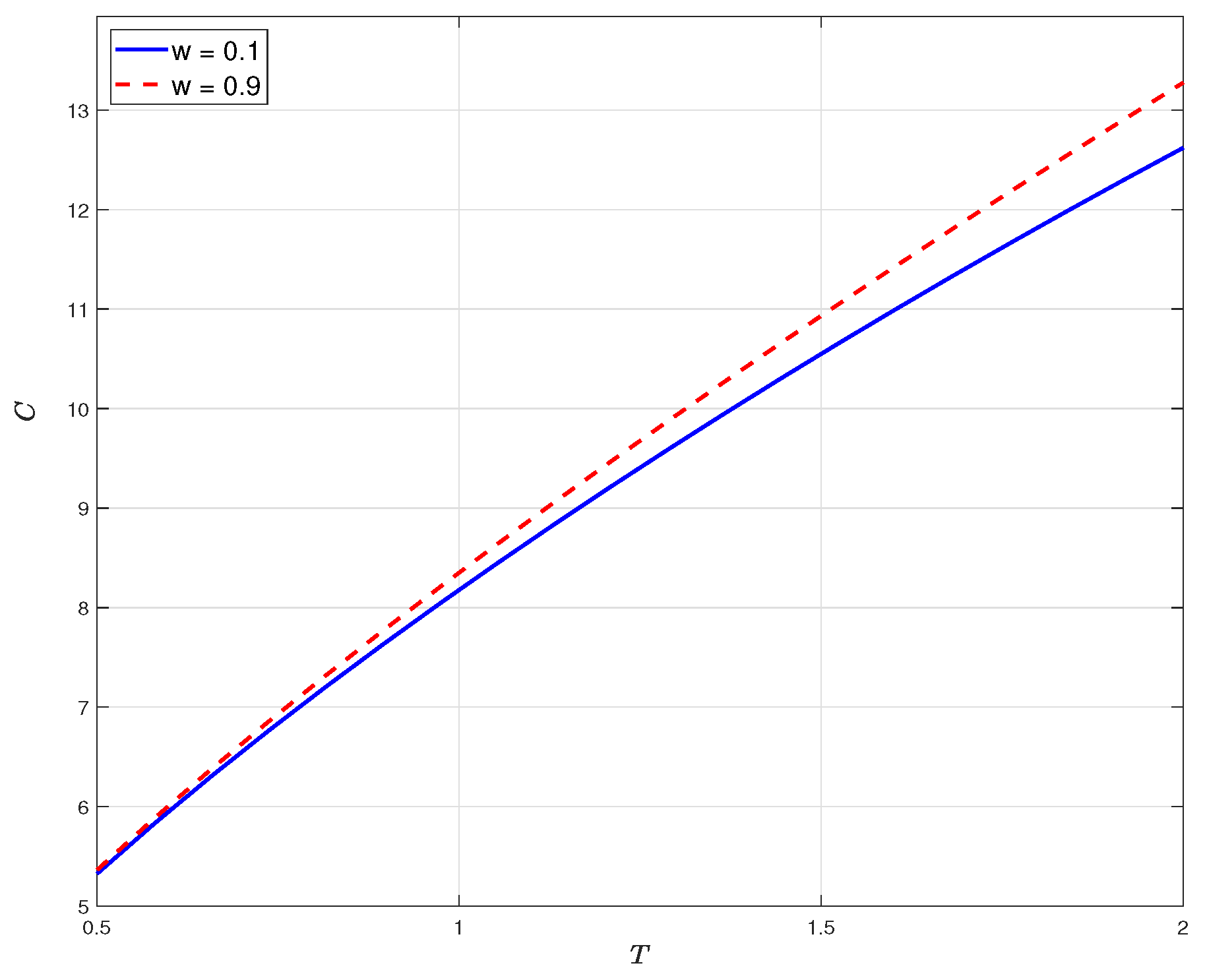
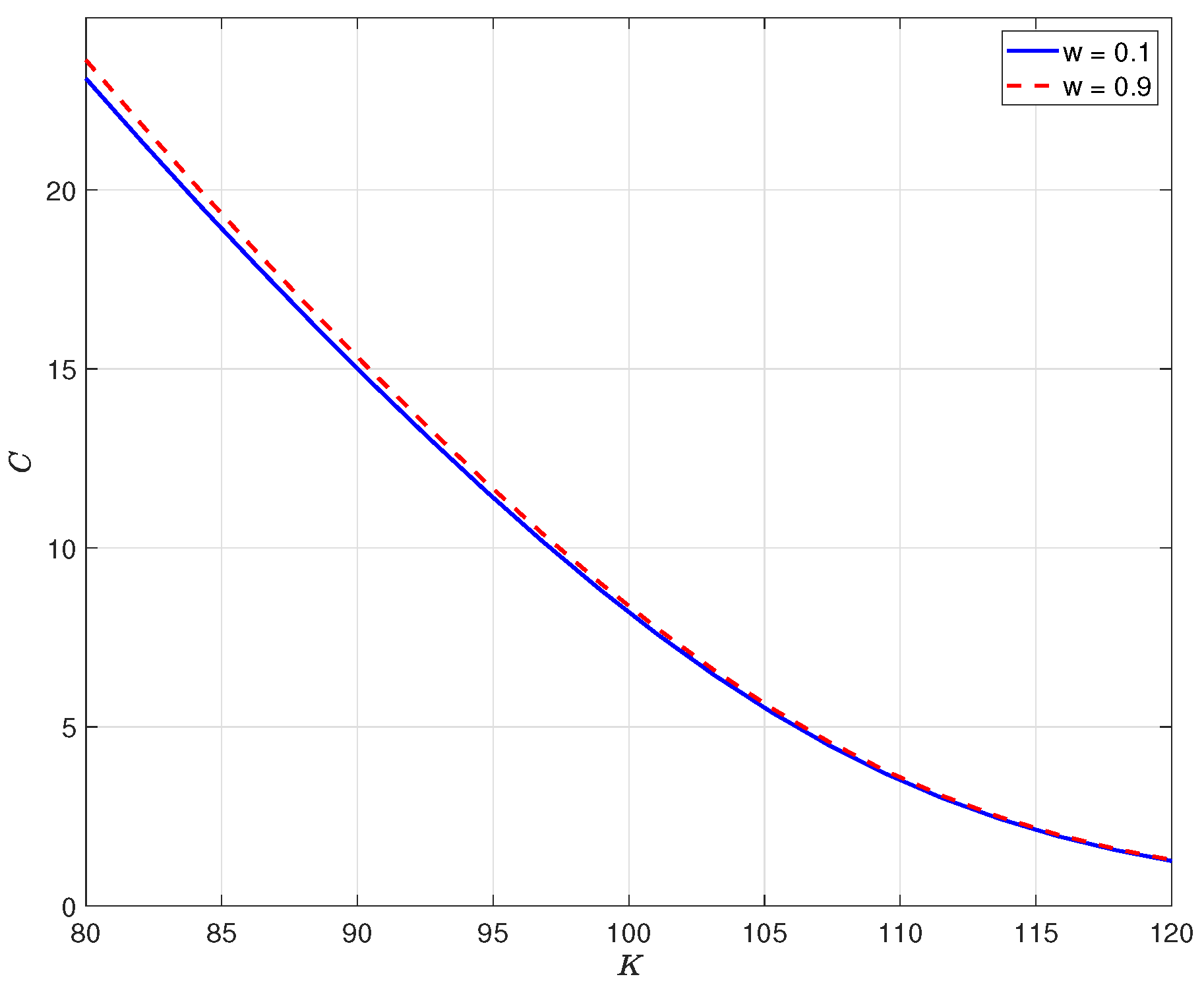
Figure 1 and
Figure 2 illustrate the price of the vulnerable call option
C while varying the foundational option parameters—maturity and strike price—against different recovery rates (
w). We compare a low recovery rate (
) with a high recovery rate (
).
Figure 1 plots the option price
C against the time to maturity
T. As expected, the option price is an increasing function of maturity for both recovery rates. A longer time horizon increases the probability of the underlying asset
expiring in-the-money. In particular, the option with high recovery (
) is consistently more valuable than the option with low recovery (
). This price gap, representing the cost of counterparty default risk, widens as maturity
T increases, indicating that the potential for default has a greater impact over longer periods.
Figure 2 shows the option price
C as a function of the strike price
K. The plot demonstrates the standard behavior of a call option: the price is a monotonically decreasing function of the strike price. The difference in price between the high- and low-recovery-rate options is most significant when the option is deep in-the-money (e.g.,
). In this case, the option’s intrinsic value is high, so the potential loss from an issuer default (and low recovery) is substantial. As the option moves out-of-the-money (
), the prices converge. This is because the option’s intrinsic value approaches zero, making the issuer’s credit risk and the associated recovery rate almost irrelevant.
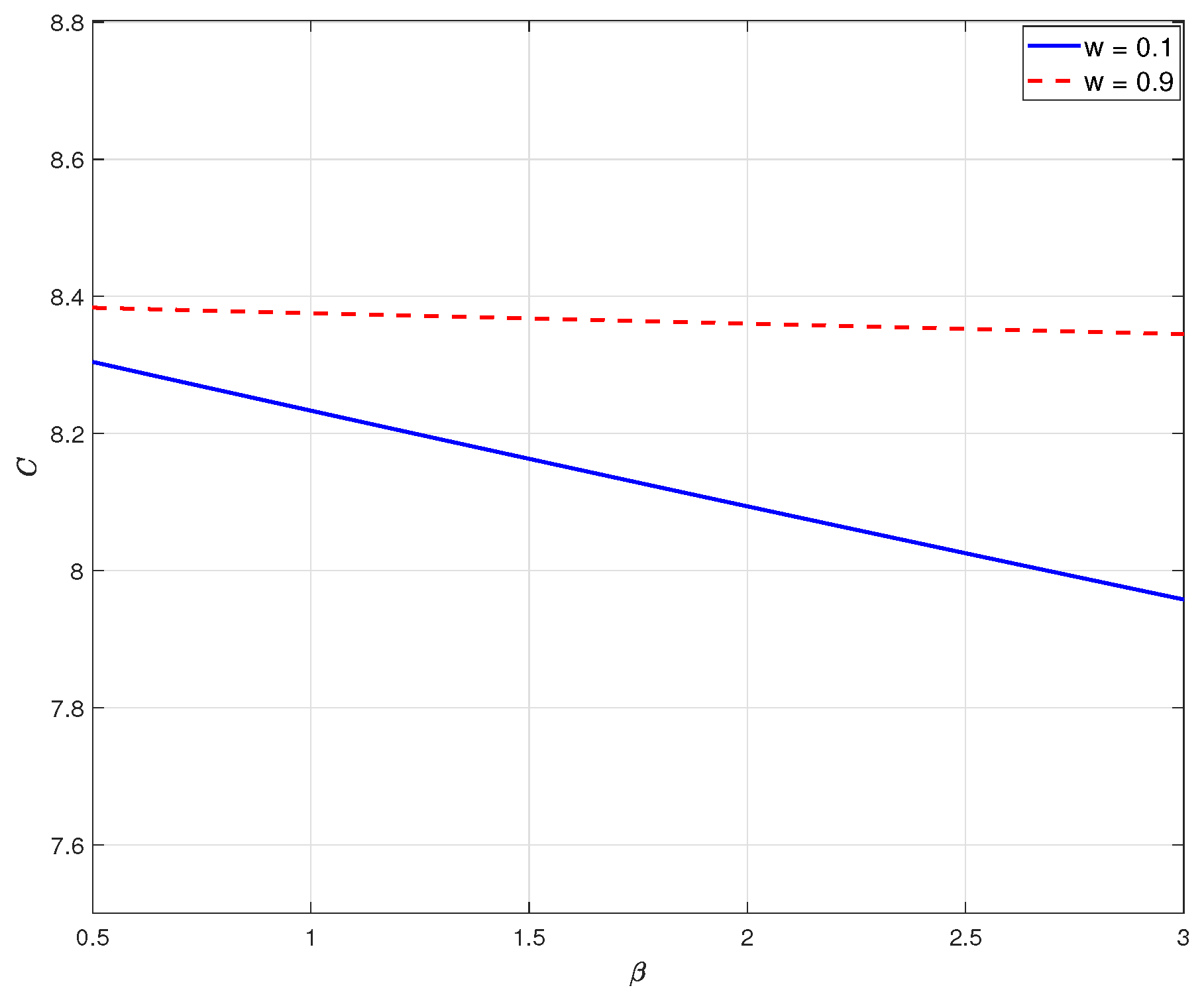
Figure 3 analyzes the option price’s sensitivity to the parameter
, which scales the contribution of the systematic risk factor
to the total default intensity
Figure 3 shows a strong interaction between the systematic risk sensitivity
and the recovery rate
w. For the low recovery rate (
), the option price
C decreases significantly as
increases. A higher
implies a higher probability of default. When recovery is low, this increased risk directly reduces the option’s expected payoff, thus lowering its value. Conversely, when the recovery rate is high (
), the option price is nearly flat and shows very little sensitivity to
. In this case, even if the probability of default increases, the financial consequence of that default is minimal to the option holder, so the option’s value remains stable.
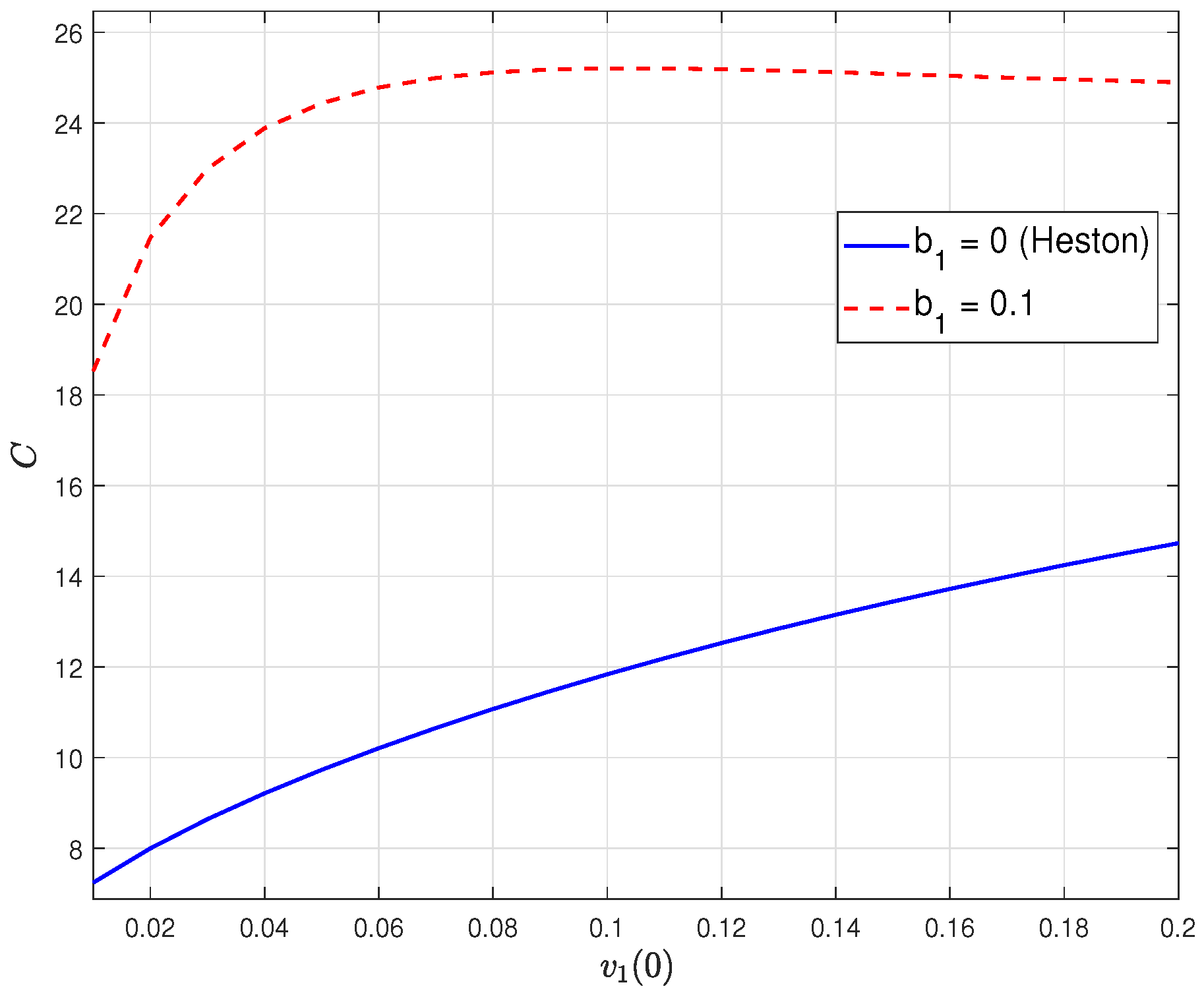
Figure 4 investigates the impact of the stochastic volatility parameters, specifically the initial variance
and the
model parameter
. The parameter
is a key component of the
model’s volatility structure
and distinguishes it from the standard Heston model.
Figure 4 plots the option price
C against the initial variance
for a small
(
) and a larger
(
). For both cases, the option price increases with higher initial variance, which is consistent with the principle that higher volatility increases option value.The magnitude of
has a substantial effect. The option prices under
are significantly higher than those under
(Heston model). This illustrates that the
term in the
model’s volatility function adds significant value to the option. Furthermore, the sensitivity profile changes. The
curve shows a nearly linear, moderate increase in price as
grows. In contrast, the
curve is concave: the price rises very sharply for low levels of
but then flattens, indicating that the marginal benefit of additional initial variance diminishes at higher variance levels. This highlights the non-linear impact of the
model’s volatility specification.
5. Concluding Remarks
In this paper, we developed a pricing framework for vulnerable European options by integrating the 4/2 stochastic volatility model with a reduced-form credit risk model. Using the Grasselli transform, we derived an explicit analytical pricing formula that accounts for the correlation between the issuer’s default intensity and the asset’s volatility.
Our results provide practical tools for risk managers, particularly for the calculation of Credit Valuation Adjustment (CVA). The derived closed-form solution allows for rapid pricing and sensitivity analysis without the computational burden of extensive Monte Carlo simulations. This efficiency is critical for real-time risk management of OTC derivatives portfolios where counterparty risk is a significant factor.
Despite these contributions, this study has limitations that must be addressed in future works. First, while the 4/2 model improves upon the Heston model, it relies on continuous diffusion processes and does not capture the ’rough’ behavior of volatility observed in high-frequency data. Future research could explore vulnerable option pricing under rough volatility models, likely requiring numerical methods. Second, we assumed a constant risk-free interest rate; extending the model to stochastic interest rates would enhance its applicability to long-term contracts. Third, an empirical calibration study comparing the proposed model with standard vulnerable option models would be valuable for demonstrating the practical improvements of the dynamics. Finally, future work will focus on the rigorous statistical implementation of the model, employing advanced estimation techniques such as Quasi-Maximum Likelihood Estimation (QMLE) or Particle Filtering to effectively handle the latent volatility and intensity processes.