Abstract
This work develops and analyzes an iterative method to solve the combined generalized equilibrium and fixed point problems involving two relatively nonexpansive mappings. We establish that the generated sequence converges strongly to a shared solution within a two-uniformly convex and uniformly smooth real Banach space. We also highlight some immediate consequences of the main result. To confirm the algorithm’s efficiency, a numerical example is provided. Furthermore, the practical utility of the proposed algorithm is illustrated using comprehensive tables and figures.
Keywords:
combination of generalized equilibrium problem; iterative methods; relatively nonexpansive mapping; fixed point problem MSC:
47H05; 47J25; 47H09
1. Introduction
Let be a real Banach space, and let denote its dual space. The duality pairing between these spaces is represented by . Suppose a nonempty, closed, and convex subset . A mapping with is known as a normalized duality mapping. It is fundamental in studying the geometric and functional characteristics of Banach spaces.
Let be a mapping. Let denote the set of fixed points of T, i.e., . Fixed point theory, a fundamental area of nonlinear analysis, has been extensively applied to the study of nonlinear phenomena. Over the past five decades, numerous notable fixed point existence theorems have been established (see, for example, [1,2,3,4]).
However, from a practical perspective, it is not sufficient to merely establish the existence of fixed points for nonlinear mappings; it is equally important to develop iterative methods to approximate these fixed points. The computation of fixed points plays a crucial role in solving many real-world problems, including inverse problems. For instance, both the split feasibility problem and the convex feasibility problem, which arise in signal processing and image reconstruction, can be reformulated as problems of finding fixed points of specific operators (see [5,6] and references therein for further details). Fixed point theory is a cornerstone of mathematics, with applications in solving equations, optimization, and modeling in pure and applied sciences. The study of fixed points in the moduli spaces of vector bundles over algebraic curves is fundamental in understanding the geometry of these spaces; see [7]. It is foundational to fields like topology (Brouwer’s theorem), analysis (Banach’s contraction principle), and mathematical physics (e.g., Hitchin integrable systems and mirror symmetry). Fixed points also play a vital role in economics and game theory, such as in Nash equilibria; see [8,9,10,11].
In our study, we consider the combination of generalized equilibrium problems (CGEPs), which extends EPs (3) as a particular instance. Let , , and real numbers satisfy . Consider . Then, the CGEP is to find such that
where fulfills the assumptions defined below:
Assumption 1.
- (i)
- Skew-symmetric, i.e.,
- (ii)
- Convex with respect to its second argument.
- (iii)
- Continuous.
Assume as a solution set of CGEP (1). Assume that ; then, the CGEP (1) simplifies to the combination of equilibrium problems (CEP), where we seek such that
which was studied by Suwannaut et al. [12]. For further studies on the combination of equilibrium problems, see [13,14,15].
Inspired by minimax problems arising in economic equilibrium theory, the concept of equilibrium problems was first introduced by Zuhovickii et al. [16], Fan [17], and Brezis et al. [18]. Blum and Oettli [19] later adopted this notion and formulated the abstract equilibrium problem (commonly referred to as the EP), which is a special case of the CEP (2). For and , the CGEP simplifies to the equilibrium problem (EP), where we seek such that
In 2009, Marino et al. [20] analyzed the convergence properties of a Krasnoselski–Mann-type iterative scheme designed to identify a common element of and the solution set of EP (3). They established that EP (3) serves as a unifying framework encompassing various well-known mathematical problems, such as optimization, variational inequality, Nash equilibrium, complementarity, and fixed point problems. Its solution is represented as (see [19,21,22]).
If we define for all , where , then we find such that
which is known as a variational inequality problem (VIP) [23]. Its solution is represented as .
In a Hilbert space , Korpelevich [24] proposed an extragradient method to solve VIP (4) as
Under suitable assumptions, he studied the convergence analysis.
A hybrid extragradient method studied by Nadezkhina et al. [25] in Hilbert space is defined as
They established that the sequence initiated by (6) converges strongly to a shared solution of VIP (4) and the FPP for the nonexpansive mapping T on . Several extensions and modifications of this method have been explored in the literature (see [26,27,28,29,30] and the references therein).
A hybrid iterative algorithm studied by Matsushita et al. [31] utilizes generalized projection techniques within the broader setting of a Banach space. The iterative process is formulated as follows:
Takahashi et al. [32] established an iterative scheme to find a shared solution to the EP and FPP involving a relatively nonexpansive mapping T in a Banach space as
Under suitable assumptions, they studied the convergence analysis.
Building upon the contributions in [12,14,15,20,31,32], we establish a strong convergence theorem for determining a shared solution of CGEP (3) and the FPP associated with two relatively nonexpansive mappings in a uniformly smooth and uniformly convex Banach space. The approach and findings presented extend and unify various established methods in Banach spaces; see [12,14,15,20,31,32].
2. Preliminaries
Let the symbols → and ⇀ denote strong and weak convergence, respectively. The unit sphere of a Banach space is given by . A Banach space is said to be strictly convex if, for all distinct elements , the inequality holds for all with . It is called uniformly convex if for any , there exists a such that for all ,
It is well known that every uniformly convex Banach space is both reflexive and strictly convex. A Banach space is said to be smooth if the limit exists for all . Furthermore, if this limit is attained uniformly for all , then is called uniformly smooth.
A Banach space is said to satisfy the Kadec–Klee property if for any sequence and any , the conditions and imply that as . It is well established that every uniformly convex Banach space possesses the Kadec–Klee property.
Additionally, if is smooth, the normalized duality mapping J is single-valued. If is uniformly smooth, then J is uniformly norm-to-norm continuous on bounded subsets of . Moreover, J is strictly monotone if and only if is strictly convex. In the special case where is a Hilbert space, the duality mapping reduces to the identity operator, i.e., , where I is the identity mapping.
The Lyapunov function is defined as
From the definition of , it follows that
Additionally, the function satisfies the inequality
and can also be expressed as
Remark 1.
If is a reflexive, strictly convex, and smooth Banach space, then for any holds if and only if .
Lemma 1
([33]). Let be a Banach space that is both smooth and uniformly convex. Consider two sequences and in , where at least one of them is bounded. If then it follows that
Remark 2.
By applying (11), it follows that the converse of Lemma 1 also holds provided that both sequences and are bounded.
Lemma 2
([34]). In a two-uniformly convex Banach space , the following inequality holds for all :
where c is a constant satisfying , which is referred to as the two-uniformly convex constant of .
Definition 1.
Let be a mapping. Then, we have the following:
- (i)
- represents the set of fixed points of T, i.e.,
- (ii)
- A point is called an asymptotic fixed point of T if there exists a sequence that converges weakly to p and satisfies . The set of all asymptotic fixed points of T is denoted by .
- (iii)
- The mapping T is called relatively nonexpansive if
- (iv)
- T is closed if for any sequence such that and , it follows that .
Lemma 3
([31]). Let be a reflexive, strictly convex, and smooth Banach space, and let be a nonempty closed convex subset of . Suppose is a relatively nonexpansive mapping. Then, the set of fixed points of T is a closed convex subset of .
Lemma 4
([35]). Let be a nonempty closed convex subset of , and let be a monotone and hemicontinuous mapping from into . Then, the set is closed and convex.
Lemma 5
([36]). Let be a uniformly convex Banach space, be a positive number, and denote the closed ball in . For a given set and a set of positive numbers such that , there exists a continuous, strictly increasing, and convex function with such that, for any where , the following inequality holds:
In the following, we utilize the function defined by
Note that . The following lemma is well known.
Lemma 6
([37]). Let be a smooth, strictly convex, and reflexive Banach space, with denoting its dual. Then, for all and all , the following inequality holds:
Lemma 7
([33]). Let be a nonempty closed convex subset of a real reflexive, strictly convex, and smooth Banach space , and let . Then, there exists a unique element such that
Recently, Alber [37] introduced the generalized projection operator in a Banach space , which serves as an analogue of the metric projection in a Hilbert space H.
Definition 2.
A generalized projection is a mapping that assigns to any point the point that minimizes the functional , i.e., , where is the solution to the minimization problem .
Lemma 8
([37]). Let be a reflexive, strictly convex, and smooth Banach space, and let be a nonempty closed convex subset of . Then, the following inequality holds:
Lemma 9
([37]). Let be a reflexive, strictly convex Banach space, and let be a nonempty closed convex subset of . For and , the following holds:
Next, we present the following assumption for the bifunction .
Assumption 2.
The bifunction satisfies the following conditions:
- (i)
- (ii)
- H is monotone, i.e.,
- (iii)
- For each , we have
- (iv)
- For each , the mapping is convex and lower semicontinuous.
Lemmas 10 and 11 can be derived from Lemma 2.7, Lemma 2.11, and Remark 2.12, as presented by S. Suwannaut and A. Kangtunyakarn [12].
Lemma 10
([12]). For each , let satisfy Assumption 2, and suppose that
Then, the solution set of the combined problem satisfies
where the coefficients belong to the interval for all , and they sum to 1, i.e., .
For a fixed , and for each , we define the mapping as follows:
Lemma 11
([12]). For each , consider a function that satisfies Assumption 2. Let the operator be given as defined in (12). Then, the following properties hold:
- (a)
- The set is nonempty for every .
- (b)
- The mapping is uniquely defined.
- (c)
- The operator is firmly nonexpansive, satisfying the inequality
- (d)
- The set of fixed points of coincides with the solution set of the CGEP , i.e.,
- (e)
- The solution set is both closed and convex.
Remark 3.
It is straightforward to verify that satisfies Assumption 2. Additionally, we observe that Lemma 11 remains valid for . Moreover, applying Lemmas 10 and 11, we obtain the following result:
3. Main Result
Now, we introduce an iterative scheme, referred to as Algorithm 1, designed to address the combined problem of generalized equilibrium and fixed point formulations involving a pair of relatively nonexpansive mappings. Furthermore, it is shown that the sequence produced by this algorithm converges strongly to a shared solution in a real Banach space that is both two-uniformly convex and uniformly smooth.
| Algorithm 1: Iterative algorithm for combined equilibrium problem |
Initialization: Let , and . |
Iterative Steps: Step 1. Calculate:
Step 2. For and return to Step 1. |
Theorem 1.
Let be a closed convex subset of a Banach space , that is, both two-uniformly convex and uniformly smooth, with denoting its dual space. Suppose that , , and to be maps meet Assumptions 2 and 1, respectively. Let be a γ-ism, , and let be two relatively nonexpansive mappings. Suppose . Then, the sequences and initiated by the iterative scheme (1) converge strongly to an element .
Proof.
Utilizing (14), along with the continuity of , is indeed closed and convex. Therefore, is closed and convex.
Furthermore, applying Lemmas 2, 5, and 6, we obtain
which, together with the condition , yields that
Subsequently, applying (19), we derive the following estimate:
Now, by Lemma 9, it follows that . □
The proof is structured into multiple steps.
- Step 1. By applying Lemmas 3, 4, and 11, it follows that is a closed convex set. Consequently, the projection is well defined.
- Step 2. We establish that is a closed and convex set. According to its concept, is clearly both closed and convex. For all , we verify that maintains these properties. Initially, is closed and convex. The closedness of follows naturally, so it remains to demonstrate its convexity. From the concept of ,
- Step 3. We demonstrate that is contained within for all . Suppose that for ,
As a consequence of (17) and (22), we obtain
This indicates that , and hence, . We now proceed by induction to show that for all .
As , therefore . For some , consider . Then, there exists such that . By the concept of , we obtain, for ,
As , it follows that
implies that . Therefore, , as for all n. Hence, for all , and thus, is well defined. Therefore, is well defined.
- Step 4. Next, prove that , , , , and are bounded. Additionally, we prove that exists, and .
By the definition of , . Using this and applying Lemma 8, we obtain
This indicates that the sequence is bounded, which implies, by (9), that is bounded.
Next, from Equations (15), (19), (22), and (23), we conclude that the sequences , , , and are bounded. Therefore, the sequences , , and are also bounded.
Since and , we have
which yields that is nondecreasing. As the sequence is bounded, therefore exists.
Using Lemma 8 and ,
Thus, by Lemma 1, as . This shows that is a Cauchy sequence in . As is a nonempty closed subset of , it is complete. Hence, ∃, with
- Step 5. We now demonstrate that as , the sequences , , , and , where is a point in .
Since , we can write the following inequality:
From (27), we obtain
and therefore, applying Lemma 1, we have
Next,
From (27), (29), and (30),
which implies that
On a bounded subset of , J is norm-to-norm uniformly continuous; therefore,
By (16) and (21), we obtain
which yields that from (31), (33), and (34),
Using the property of g and J, we obtain
Similarly, from (17) and (21), we obtain
Applying (31), (33), (37), and condition (ii),
Again, applying the property of g and J,
From (17), (18), and (20), we deduce that
which implies that
Using (31), (33), and (40), we have the given conditions
Using the concept of , (26), and (41), we immediately have .
By Lemmas 6 and 3,
- Step 6. We now demonstrate that . It remains to be shown that also belongs to .
Therefore, let , and by (16),
Applying Lemma 11 and , we have
By (31), (33), and (54)
Therefore, by Lemma 1,
Using the property of J,
Given and (55), therefore
Let , where ; then, we have
Utilizing Assumption 2(ii), we obtain
Taking the limit as , by (56) and the lower semicontinuity of , we obtain
Let for all and . Then, it follows that , and hence, we have
Therefore, by Assumption 2(i)–(iv), we deduce
Since , we obtain
Letting , we obtain from Assumption 2(iii) that
Thus, Therefore, Hence,
- Step 7. Finally, we demonstrate that . Let in (24), and we have
We now present a consequence of Algorithm 1 by formulating a second iterative Algorithm 2, which focuses specifically on the equilibrium problem.
| Algorithm 2: Iterative algorithm for equilibrium problem |
Initialization: Choose . Let and . |
Iterative Steps: Step 1. Calculate
Step 2. Let and return Step 1. |
We establish a strong convergence result for determining the common solution of the CGEP as presented in (1). To do so, we focus on the specific case where .
Corollary 1.
Let be closed convex subset of a Banach space , that is, both two-uniformly convex and uniformly smooth, with denoting its dual space. Suppose that and are maps that meet Assumptions 2 and 1, respectively. Let be a γ-ism, , and let be two relatively nonexpansive mappings. Suppose that . Then, the sequences and initiated by the iterative scheme (2) converge strongly to an element .
Numerical Example
We now provide examples to illustrate the main theorem.
Example 1.
Let and . For , consider and . It is straightforward to verify that the functions , for each , satisfy Assumption 2, and satisfies Assumption 1. Let and . These mappings can also be easily checked to satisfy the requirements of Theorem 1. The execution of the algorithms involves specific parameter settings. Let , . Under these configurations, the sequence produced by Algorithm 1 converges to .
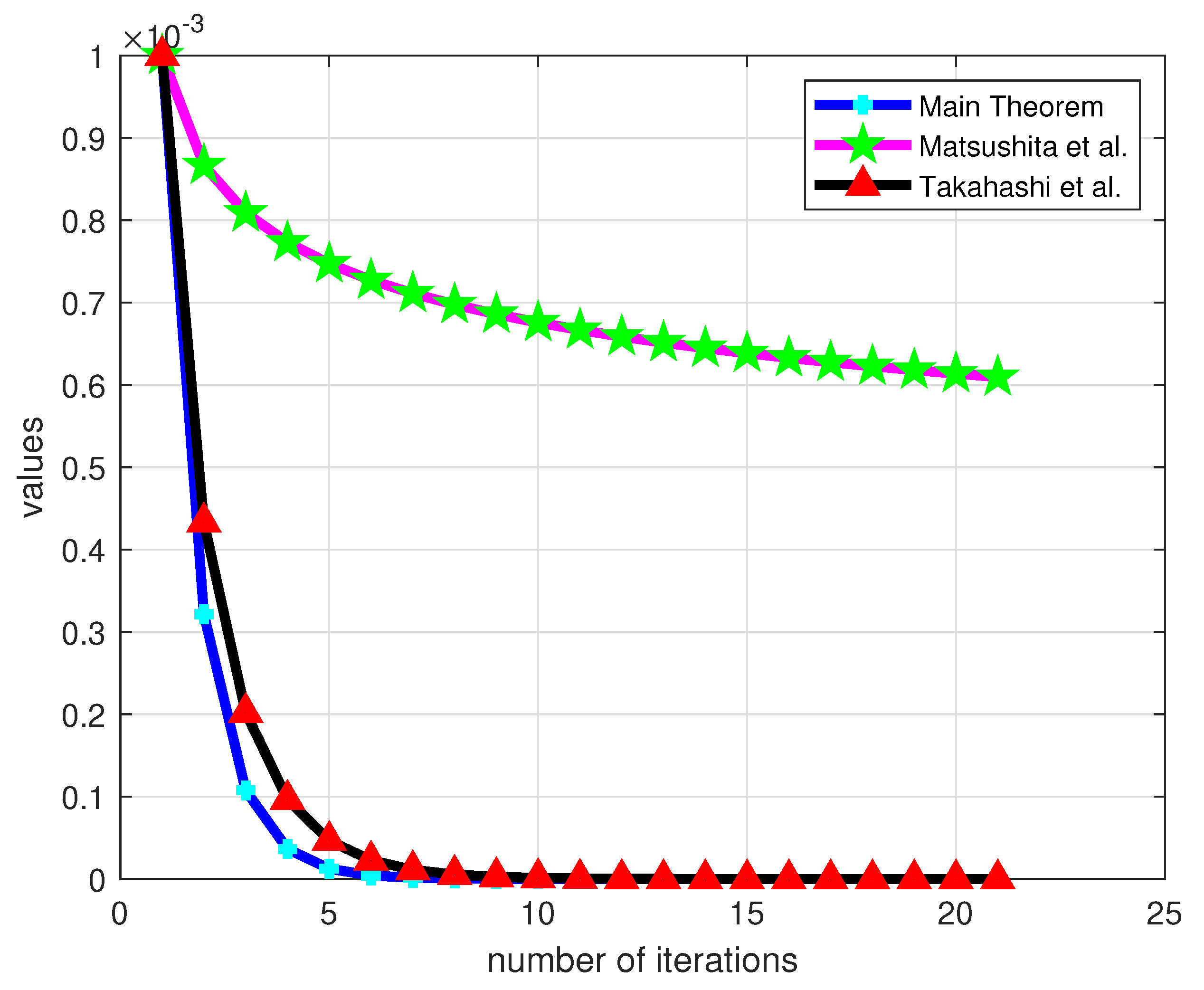
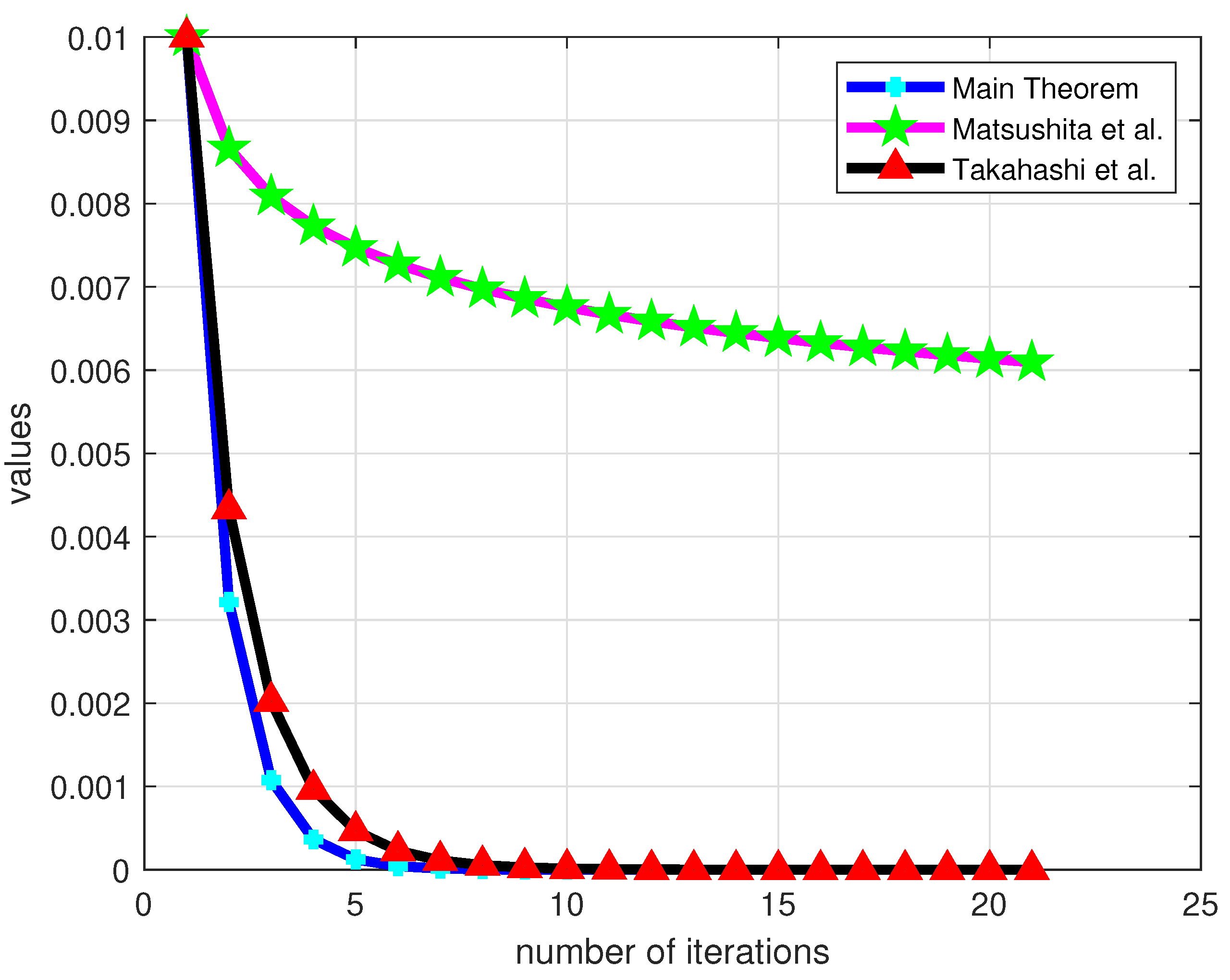
The computations and graphical visualizations for this algorithm were carried out using MATLAB R2015a. The stopping criterion was set as . Various initial points were tested, and the results are summarized in Table 1 and Table 2, where we also compare our findings with those in [31,32]. Additionally, the convergence behavior is illustrated in Figure 1 and Figure 2. We observe that by taking distinct initial points, we found our result more quickly than others.
Table 1.
Comparison of our main results for initial point .
Table 2.
Comparison of our main results for initial point .
Figure 1.
Convergence of [31,32].
Figure 2.
Convergence of [31,32].
Example 2.
Let , where consists of square-summable infinite sequences of real numbers. Define . For , consider and , where . The norm and inner product on are defined by , . It is straightforward to verify that the functions , for each , satisfy Assumption 2, and satisfies Assumption 1. Let and . These mappings can also be easily checked to satisfy the requirements of Theorem 1. The execution of the algorithms involves specific parameter settings. Let , . Under these configurations, the sequence produced by Algorithm 1 converges to .
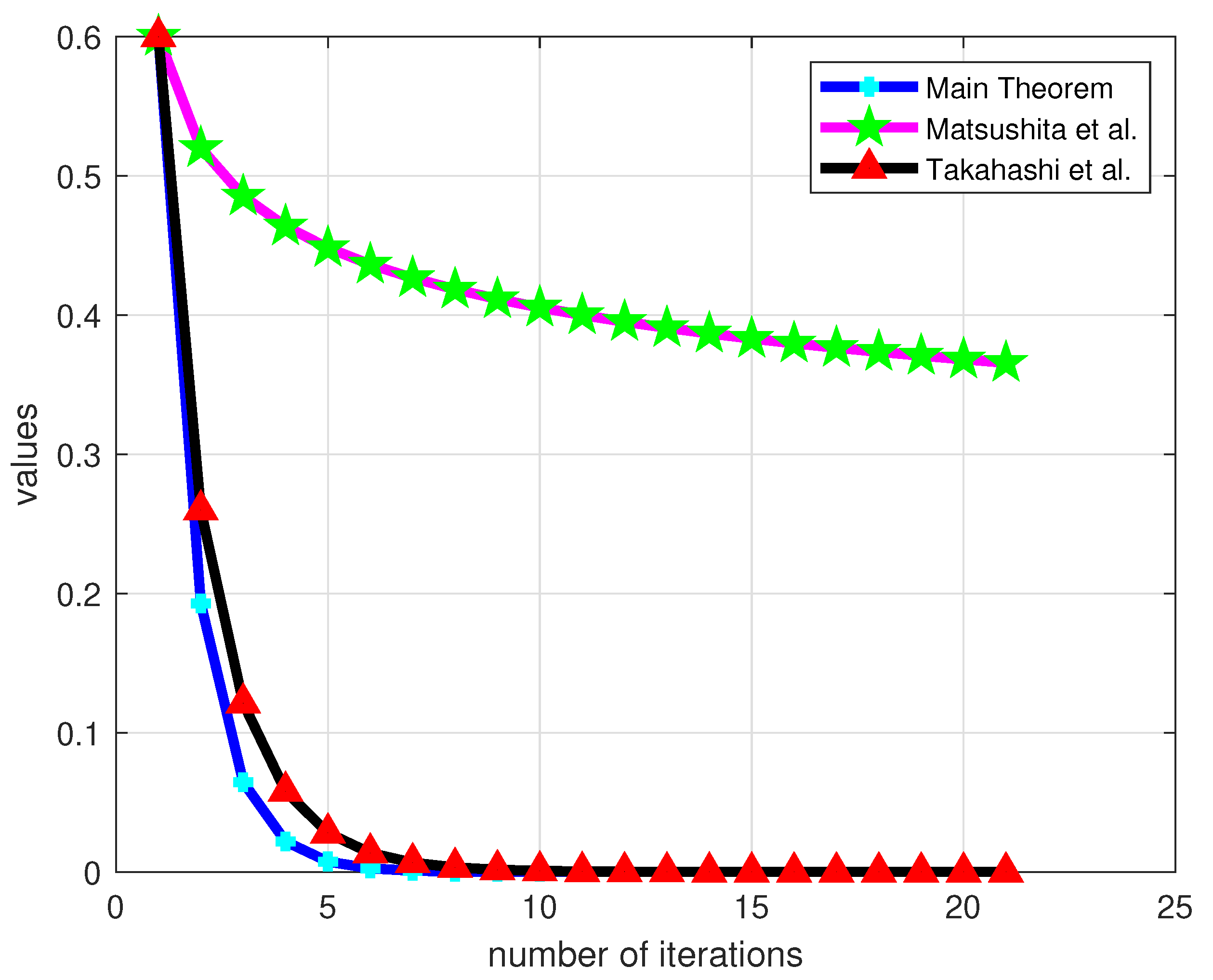
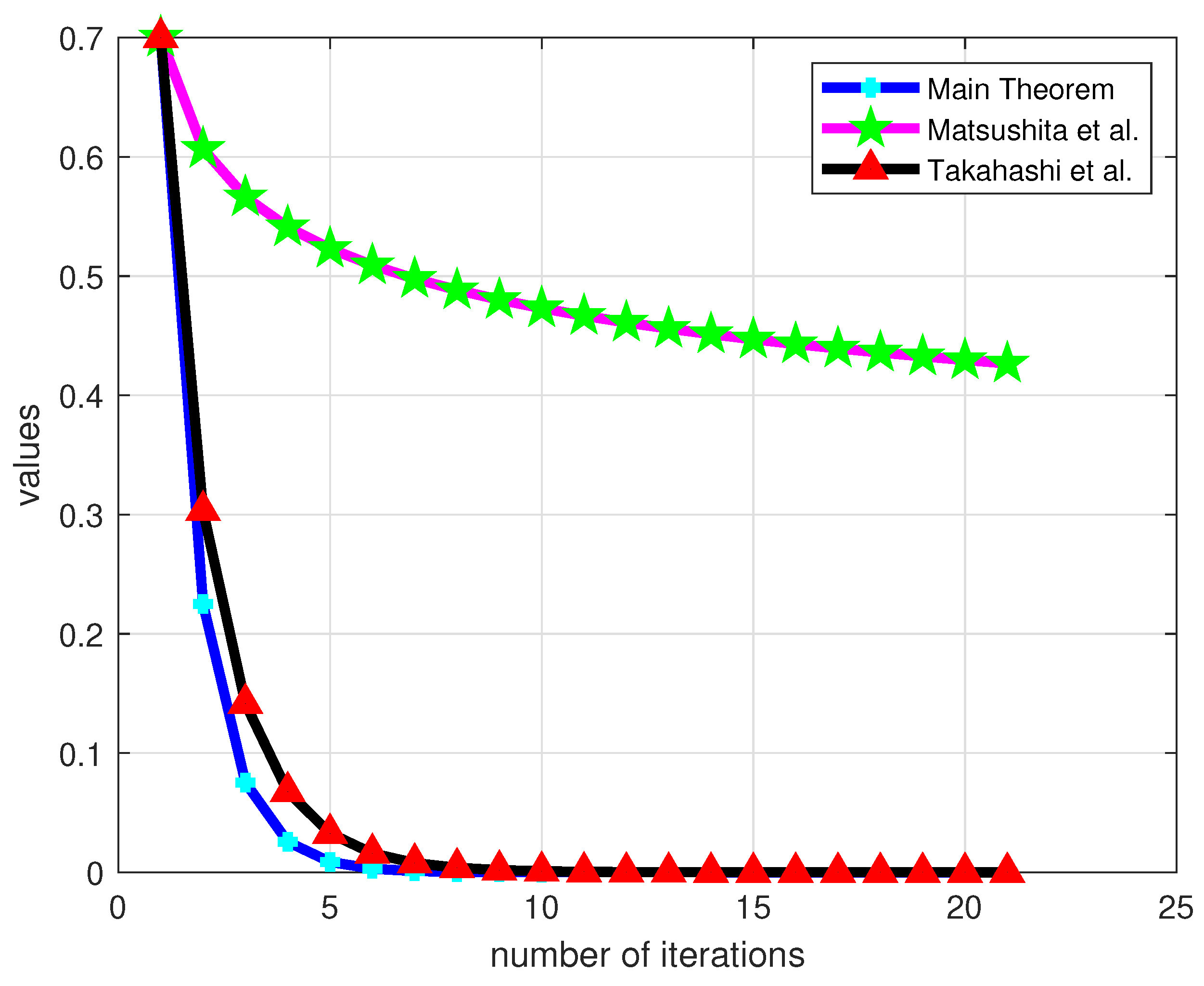
The computations and graphical visualizations for this algorithm were carried out using MATLAB R2015a. The stopping criterion was set to . Several initial points were tested, and the convergence behavior is illustrated in Figure 3 and Figure 4.
Figure 3.
Convergence of [31,32].
Figure 4.
Convergence of [31,32].
Application in optimization problem: We explore the application of our algorithms to optimization problems. Let be a mapping. Define . The objective is to determine such that
Assume that is the solution set of (59) and . It is straightforward to verify that Assumption 2 holds. Consequently, we have .
4. Conclusions
In this work, we establish an iterative method to solve the combined generalized equilibrium and fixed point problems involving two relatively nonexpansive mappings. We prove that the generated sequence converges strongly to a shared solution within a two-uniformly convex and uniformly smooth real Banach space. We also highlight some immediate consequences of the main result. To confirm the algorithm’s efficiency, a numerical example is provided. Furthermore, the practical utility of the proposed algorithm is illustrated using comprehensive tables and figures. The practical applicability of the method is further demonstrated through two detailed tables and four illustrative figures, which provide comparisons with existing approaches and an in-depth analysis of convergence behavior. These findings emphasize the effectiveness and computational advantages of our approach. Moreover, this study generalizes and integrates several well-known results from the literature, providing a unified framework for solving various problems in optimization and computational mathematics. Theorem 3.1 presents an enhancement over the findings of [25,31,32] in the following ways:
- (i)
- In [25], a strong convergence theorem was established for nonexpansive mapping in a real Hilbert spaces. In contrast, our theorem extends this result to a broader context by proving convergence in two uniformly convex and uniformly smooth real Banach space and for two relatively nonexpansive mappings.
- (ii)
- Iterative Algorithm 1 is a generalization of the method introduced in Theorem 1 of [31,32], offering a more comprehensive approach to solving fixed point problems in the specified Banach spaces.
5. Future Direction
- (i)
- Our work is useful from a theoretical and applied perspective, as the result of this paper enables the further development of fixed point theory and its application by using the concept of a specific notion of Galois bundles, as has been introduced to describe fixed points [7].
- (ii)
- A direction for future research is also to extend the method proposed in this paper to an extragradient iterative approach for the considered problems, assuming that is monotone, within the framework of a uniformly smooth and strictly convex Banach space , which generalizes the setting of a uniformly smooth and uniformly convex Banach space.
Author Contributions
Methodology, G.A.; Software, M.F.; Writing—original draft, G.A. and R.A.; Writing—review & editing, R.A. and M.F. All authors have read and agreed to the published version of the manuscript.
Funding
This research was supported by Princess Nourah bint Abdulrahman University Researchers Supporting Project Number (PNURSP2025R45), Princess Nourah bint Abdulrahman University, Riyadh, Saudi Arabia.
Data Availability Statement
Data is contained within the article.
Conflicts of Interest
The authors declare that they have no competing interests.
References
- Browder, F.E. Nonexpansive nonlinear operators in a Banach space. Proc. Natl. Acad. Sci. USA 1965, 54, 1041–1044. [Google Scholar] [CrossRef] [PubMed]
- Goebel, K.; Kirk, W.A. A fixed point theorem for asymptotically nonexpansive mappings. Proc. Am. Math. Soc. 1972, 35, 171–174. [Google Scholar] [CrossRef]
- Kirk, W.A. A fixed point theorem for mappings which do not increase distances. Am. Math. Mon. 1965, 72, 1004–1006. [Google Scholar] [CrossRef]
- Kirk, W.A. Fixed point theorems for non-Lipschitzian mappings of asymptotically non-expansive type. Isr. J. Math. 1974, 17, 339–346. [Google Scholar] [CrossRef]
- Byrne, C. A unified treatment for some iterative algorithms in signal processing and image reconstruction. Inverse Probl. 2004, 20, 103–120. [Google Scholar] [CrossRef]
- Vanderlugt, A. Optical Signal Processing; John Wiley and Sons: New York, NY, USA, 1992. [Google Scholar]
- Sancho, A.A. Fixed points of automorphisms of the vector bundle moduli space over a compact Riemann surface. Mediterr. J. Math. 2024, 21, 20. [Google Scholar] [CrossRef]
- Banach, S. Sur les Operations dans les Ensembles Abstraits et Leur Application aux Equations Integrales. Fundam. Math. 1992, 3, 133–181. [Google Scholar] [CrossRef]
- Hitchin, N. Stable bundles and integrable systems. Duke Math. J. 1987, 54, 91–114. [Google Scholar] [CrossRef]
- Nash, J. Equilibrium points in n-person games. Proc. Natl. Acad. Sci. USA 1950, 36, 48–49. [Google Scholar] [CrossRef]
- Younis, M.; Chen, L.; Singh, D. Recent Developments in Fixed Point Theory: Theoretical Foundations and Real-World Applications; Springer: Singapore, 2024. [Google Scholar] [CrossRef]
- Suwannaut, S.; Kangtunyakarn, A. The Combination of the set of solutions of equilibrium problem for convergence theorem of the set of fixed points of strictly pseudo-contractive mappings and variational inequalities problem. Fixed Point Theory Appl. 2013, 2013, 291. [Google Scholar] [CrossRef][Green Version]
- Bnouhachem, A. A hybrid iterative method for a combination of equilibria problem, a combination of variational inequality problems and a hierarchical fixed point problem. Fixed Point Theory Appl. 2014, 2014, 163. [Google Scholar] [CrossRef]
- Kazmi, K.R.; Ali, R.; Rizvi, S.H. Common solution of a combination of split general variational-like inequality problems and a family of generalized asymptotically nonexpansive mappings. J. Adv. Math. Stud. 2017, 10, 200–215. [Google Scholar]
- Khan, S.A.; Kazmi, K.R.; Cholamjiak, W.; Dutta, H. Convergence analysis for combination of equilibrium problem k-nonspreading set-valued mappings. Proyecciones J. Math. 2020, 39, 599–619. [Google Scholar] [CrossRef]
- Zuhovickii, S.I.; Poljak, R.A.; Primak, M.E. Two methods of search for equilibrium points of n-person concave games. Sov. Math. Dokl. 1969, 10, 279–282. [Google Scholar]
- Fan, K. Minimax Inequalities and Applications. In Inequality III; Shisha, O., Ed.; Academic Press: New York, NY, USA, 1972; pp. 103–113. [Google Scholar]
- Brézis, H.; Nirenberg, L.; Stampacchia, G. A remark on Ky Fan’s minimax principle. Boll. Dell’Unione Mat. Ital. 1972, 6, 293–300. [Google Scholar]
- Blum, E.; Oettli, W. From optimization and variational inequalities to equilibrium problems. Math. Stud. 1994, 63, 123–145. [Google Scholar]
- Marino, G.; Colao, V.; Muglia, L.; Yao, Y. Krasnoselski-Mann iteration for hierarchical fixed-points and equilibrium problem. Bull. Aust. Math. Soc. 2009, 79, 187–200. [Google Scholar] [CrossRef]
- Daniele, P.; Giannessi, F.; Mougeri, A. (Eds.) Equilibrium Problems and Variational Models; Nonconvex Optimization and its Application; Kluwer Academic Publications: Norwell, MA, USA, 2003; Volume 68. [Google Scholar]
- Moudafi, A. Second order differential proximal methods for equilibrium problems. J. Inequalities Pure Appl. Math. 2003, 4, 18. [Google Scholar]
- Hartman, P.; Stampacchia, G. On some non-linear elliptic differential-functional equation. Acta Math. 1966, 115, 271–310. [Google Scholar] [CrossRef]
- Korpelevich, G.M. The extragradient method for finding saddle points and other problems. Matecon 1976, 12, 747–756. [Google Scholar]
- Nadezhkina, N.; Takahashi, W. Strong convergence theorem by a hybrid method for nonexpansive mappings and Lipschitz continuous monotone mapping. SIAM J. Optim. 2006, 16, 1230–1241. [Google Scholar] [CrossRef]
- Ceng, L.C.; Hadjisavvas, N.; Wong, N.C. Strong convergence theorem by a hybrid extragradient-like approximation method for variational inequalities and fixed point problems. J. Glob. Optim. 2010, 46, 635–646. [Google Scholar] [CrossRef]
- Ceng, L.C.; Guu, S.M.; Yao, J.C. Finding common solution of variational inequality, a general system of variational inequalities and fixed point problem via a hybrid extragradient method. Fixed Point Theory Appl. 2011, 2011, 1–22. [Google Scholar] [CrossRef]
- Ceng, L.C.; Wang, C.Y.; Yao, J.C. Strong convergence theorems by a relaxed extragradient method for a general system of variational inequalities. Math. Methods Oper. Res. 2008, 67, 375–390. [Google Scholar] [CrossRef]
- Farid, M.; Ali, R.; Cholamjiak, W. An inertial iterative algorithm to find common solution of a split generalized equilibrium and a variational inequality problem in Hilbert spaces. J. Math. 2021, 2021, 3653807. [Google Scholar] [CrossRef]
- Rouhani, B.D.; Kazmi, K.R.; Farid, M. Common solutions to some systems of variational inequalities and fixed point problems. Fixed Point Theory 2017, 18, 167–190. [Google Scholar] [CrossRef]
- Matsushita, S.; Takahashi, W. Weak and strong convergence theorems for relatively nonexpansive mappings in Banach spaces. Fixed Point Theory Appl. 2004, 2004, 37–47. [Google Scholar] [CrossRef]
- Takahashi, W.; Zembayashi, K. Strong and weak convergence theorem for equilibrium problems and relatively nonexpansive mmapings in Banach spaces. Nonlinear Anal. 2009, 70, 45–57. [Google Scholar] [CrossRef]
- Kamimura, S.; Takahashi, W. Strong convergence of a proximal-type algorithim in a Banach space. SIAM J. Optim. 2002, 13, 938–945. [Google Scholar] [CrossRef]
- Xu, H.K. Inequalities in Banach spaces with applications. Nonlinear Anal. 1991, 16, 1127–1138. [Google Scholar] [CrossRef]
- Nakajo, K. Strong convergence for gradient projection method and relatively nonexpansive mappings in Banach spaces. Appl. Math. Comput. 2017, 271, 251–258. [Google Scholar] [CrossRef]
- Zhang, S. Generalized mixed equilibrium problem in Banach spaces. Appl. Math. Mech. 2009, 30, 1105–1112. [Google Scholar] [CrossRef]
- Alber, Y.I. Metric and generalized projection operators in Banach spaces: Properties and applications. In Theory and Applications of Nonlinear Operators of Accretive and Monotone Type; Dekker: New York, NY, USA, 1996; pp. 15–50. [Google Scholar]
Disclaimer/Publisher’s Note: The statements, opinions and data contained in all publications are solely those of the individual author(s) and contributor(s) and not of MDPI and/or the editor(s). MDPI and/or the editor(s) disclaim responsibility for any injury to people or property resulting from any ideas, methods, instructions or products referred to in the content. |
© 2025 by the authors. Licensee MDPI, Basel, Switzerland. This article is an open access article distributed under the terms and conditions of the Creative Commons Attribution (CC BY) license (https://creativecommons.org/licenses/by/4.0/).