
Abstract
In the first part of this article, a special type of Hammerstein nonlinear integral equation is studied. A theorem of the existence of solutions is given in the framework of -spaces. Afterwards, an iterative method for the resolution of this kind of equations is considered, and the convergence of this algorithm towards a solution of the equation is proved. The rest of the paper considers two modifications of the algorithm. The first one is devoted to the sought of common fixed points of a family of nearly asymptotically nonexpansive mappings. The second variant focuses on the search of common fixed points of a finite number of nonexpansive operators. The characteristics of convergence of these methods are studied in the context of uniformly convex Banach spaces. The iterative scheme is applied to approach the common solution of three nonlinear integral equations of Hammerstein type.
Keywords:
Hammerstein integral equations; common fixed points; nonexpansive maps; nearly asymptotically nonexpansive mappings; iterative methods MSC:
47H09; 47H30; 26A18; 31A10; 31B10
1. Introduction
A. Hammerstein introduced, in the reference [1], a new type of nonlinear integral equation, given by the expression:
for and and given functions. Equations of this kind appear in a great number of fields of physics, especially in electro-magnetic fluid dynamics. Similar to almost every integral equation, it can be reformulated in terms of a problem of ordinary or partial differential equations.
Hammerstein considered as hypotheses that the operator associated to k is symmetric and positive, and is such that
where He proved that, if , where is the first eigenvalue of the kernel, and k and are continuous functions, then the equation has a continuous solution. If, in addition, the mapping is non-decreasing for any , the solution is unique. Brézis and Browder gave in the reference [2] sufficient conditions for the existence and uniqueness of solution of Hammerstein equations in -spaces. For instance, they proved that, if and are such that
- is continuous in y for almost all x, and measurable in x for any fixed y,
- is nondecreasing for any fixed x,
- for any fixed y, and
- the linear integral operator associated with is bounded from into and positive,
then the equation
has a unique solution for each , and f varies continuously with h.
The numerical resolution of integral equations can be approached in very different ways [3]. A standard procedure is the collocation method (see, for instance, [4]). More recent articles about Hammerstein equations are, among many others, the references [5,6].
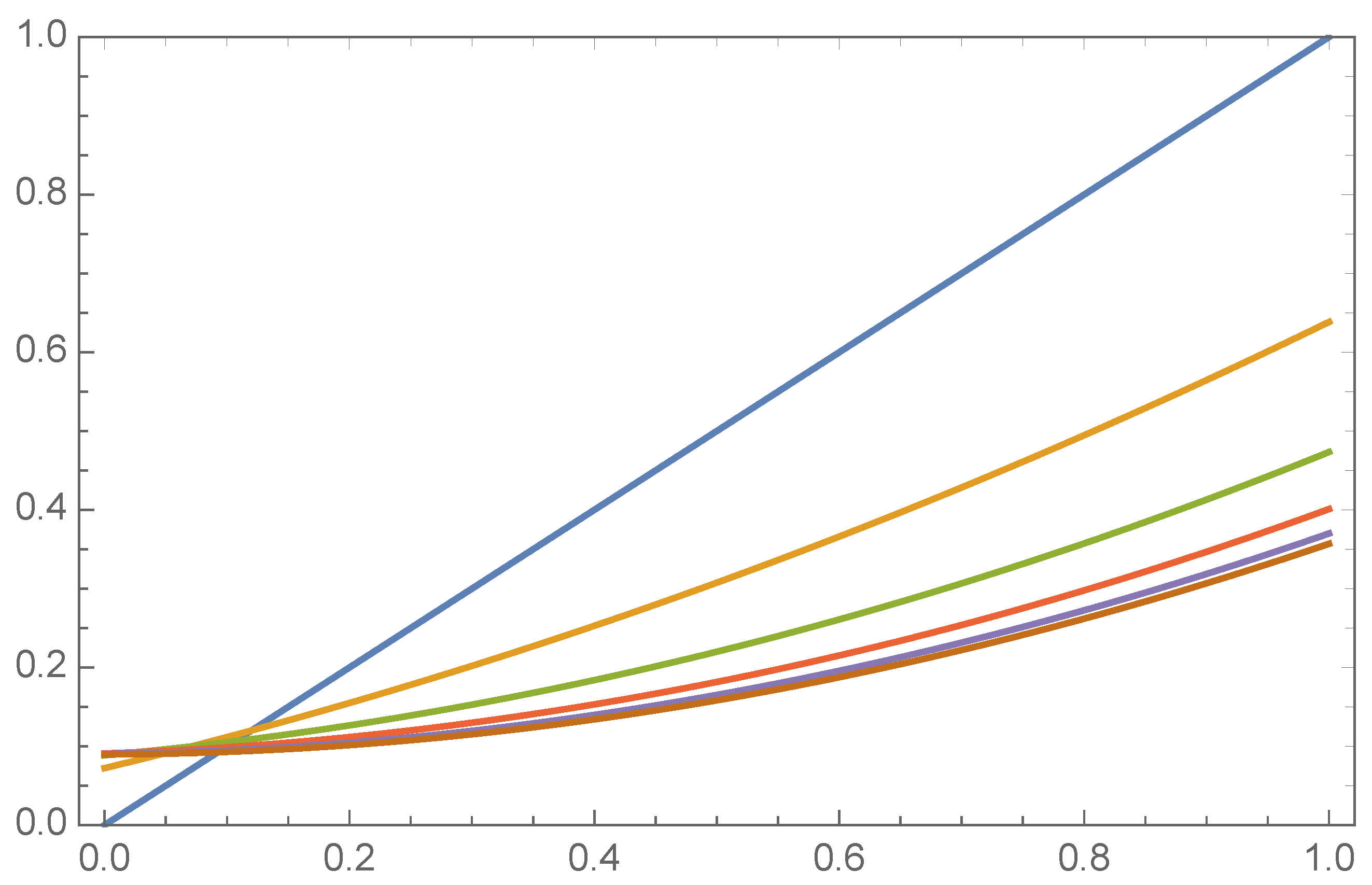
In the first part of this article, a special type of Hammerstein nonlinear equation is studied. A theorem of existence of solutions is given, in the framework of -spaces. The solution may not be unique. Afterwards, an iterative method for the resolution of this kind of equations is considered. The procedure was introduced in the reference [7]. The convergence of this algorithm towards a solution of the equation is proved in the same theorem. The method is illustrated with an example, giving a table of mean-square successive distances between iterations. A figure displays the first approximate solutions provided by the algorithm.
In Section 3, a modification of the algorithm is studied, for the sought of common fixed points of a family of nearly asymptotically nonexpansive mappings (see, for instance, [8]). The approximations properties of this iterative method are studied, and sufficient conditions on the underlying space and the mappings to ensure its convergence are given.
In a previous paper [9], the problem of approximating a common fixed point of two mappings was treated, and an algorithm for the search of common critical points of a finite number m of nonexpansive maps was suggested. However, the properties of approximation and convergence were only studied for In Section 4, the case where is analyzed, generalizing the results given for two maps. The iterative method is applied to find the common solution of three nonlinear integral equations of the Hammerstein type. Since the system has an exact solution, a table of approximation errors with respect to the real solution is given.
2. Solution of a Type of Nonlinear Hammerstein Integral Equation
We consider in this section the approximation of a solution of an integral equation of the Hammerstein type [1]. This kind of nonlinear equations are given, in general, by
where is a closed subset of and k, and are given functions. In the particular case where , we obtain an integral equation of the Fredholm type. Thus, Hammerstein equations are nonlinear generalizations of the Fredholm integral equations of the second kind. The following result can be consulted in the reference ([10], Lemma 4.2.8).
Lemma 1.
Let J be a compact real interval, let and be continuous functions, and assume that there are real numbers , such that
for and . Then the Hammerstein operator
is a continuous operator mapping into itself.
Let us consider the space . Equation (1) can be written as where K is the linear operator given by and is defined by The solution of the Hammerstein equation is a fixed point of the operator of :
Let us assume that is nonexpansive with respect to the 2-norm, and Then H is nonexpansive, since
In the reference [7], we proposed an iterative method, called the N-algorithm, to approach a fixed point of an operator , where C is a nonempty, closed, and convex subset of a normed space V. It is given by the following iterative scheme:
for , and For and for all n, one obtains the Krasnoselskii–Mann iteration ([11,12]):
Hence the N-algorithm can be considered a generalization of this classical method.
We proved that the sequence () generated by the procedure is such that the sequence () is convergent for any fixed point of A (see Proposition 4.1 of [7]).
If V is a uniformly convex Banach space and the coefficients of iterative scheme are such that and then the sequence () tends to zero (see Theorem 4.3 of [7]).
In the following, we give some sufficient conditions for the existence of solution of Equation (1), as well as the convergence of the N-algorithm to a fixed point of the operator A defined in (2). We recall two previous definitions (see, for instance, the reference [13]).
Definition 1.
Let V be a normed space. A linear mapping is compact if for any bounded sequence () there is a subsequence () such that () is convergent.
Definition 2.
Let V be a normed space. A map is demicompact if any bounded sequence () such that () is convergent has a convergent subsequence ().
Theorem 1.
Consider and the operator defined in (2). Let us assume that and are continuous functions such that and and consider that ψ is nonexpansive in the second variable, which is to say,
for any and Then the equation
has at least one solution such that
For any where is the closed ball in with the center in the null function and the radius 1, the N-algorithm converges to a solution of the Equation (7) considering coefficients such that and
Proof.
Let us consider the operator A defined in (2). Then . The inequality (6) implies that is nonexpansive. As , we have seen that A is also nonexpansive. Since
A can be restricted to be . Then A is nonexpansive on a bounded, closed, and convex set, and by Browder’s Theorem ([14]) it has a fixed point. Consequently the equation
has at least one solution.
Let us see now the convergence of the N-algorithm: It is well known that the operator K defined as is nonexpansive and compact if Let us check that the restriction of to is demicompact:
Let be such that is convergent. Then
and () is also bounded. Since K is compact, there is a convergent subsequence () = (). Then
is convergent and consequently A is demicompact.
The sequence () generated by the N-algorithm, with the scalars described, to find a fixed point of A is such that () tends to zero (see Theorem 4.3 of [7]) and () is bounded. The demicompactness of A implies that there is a convergent subsequence (). Let .
The hypotheses on and Lemma 1 imply that A is continuous. On the other hand, ) tends to zero, and f is a fixed point of which is to say, a solution of the Equation (7). Since () is convergent for any fixed point of A (Proposition 4.1 of [7]), the sequence ( tends to f, and the N-method converges strongly to a solution □
Example 1.
Let us consider the Hammerstein equation
where is continuous and Here where and It is easy to see that Ψ is nonexpansive since According to Theorem 1, Equation (8) has a solution.
To perform the algorithm, we chose and The scheme used to approach a solution of this equation according to the N-method has been
Table 1 collects the distances between 10 successive approximations of the solution: , starting from the function
Table 1.
Distances between 10 successive approximations given by the N-algorithm to find a solution of the Hammerstein integral equation.
Figure 1 represents the graphs of the approximations of a solution given by the N-iteration, from to
Figure 1.
Zero-th (blue), first (yellow), second (green), third (red), fourth (purple), and fifth (brown) approximation of the solution.
3. A Modified Algorithm for the Search of Common Fixed Points of Nearly Asymptotically Nonexpansive Mappings
In this section, we analyze an algorithm to find iteratively common fixed points of nearly asymptotically nonexpansive mappings, in case of their existence.
All throughout this section, we assume a normed space and a nonempty subset
Definition 3.
A mapping is nearly asymptotically nonexpansive if there are positive sequences where , and where fulfills the inequality
for any and For , for all n, we obtain an asymptotically nonexpansive map. If additionally for all n, then U is nonexpansive.
The structure of the set of fixed points of a nearly asymptotically nonexpansive map was studied in the reference [8].
The objective of the iterative scheme to find a common fixed point of a family where C is convex and closed, is to define an approximation sequence through the following process: and
for and for and The iteration will be called modified common m-steps N-iteration.
All throughout this section, we consider a family of nearly asymptotically nonexpansive mappings defined on a nonempty, closed, and convex set such that
where and are positive and satisfy the properties described in Definition 3. The superindex i is not a power but a counter.
will denote the set of fixed points of
We will consider that the sets of fixed points are such that
Definition 4.
The sequence has the common limit existence property (CLE property) if for any
The sequence has the approximation fixed point property (AF property) with respect to if (in this case, the existence of a fixed point of is not required).
The next result can be consulted in the reference [15], Lemma 2.5.
Lemma 2.
Let , and be sequences such that and
for If and then the sequence is convergent.
Theorem 2.
Let V be a Banach space, and let be nonempty, closed, and convex. Let us consider a family of nearly asymptotically nonexpansive maps such that with constants and satisfying Definition 3 for Let us consider
and
and assume that and then has the CLE property.
Proof.
Let Then, applying the first step of the algorithm and the bounds of , we have
For the second step of the algorithm, we have
Similarly,
In general,
for where
The last step of the procedure provides
where
and
If and according to Lemma 2, the sequence () is convergent, and () has the CLE property. □
Definition 5.
Let V be a normed space and . A mapping is asymptotically regular if
for any
The next result can be consulted in the reference [16].
Lemma 3.
Let V be a uniformly convex Banach space, and a sequence be such that there is an satisfying the condition . Let , be sequences in V such that , , and for some Then
Theorem 3.
Let V be a uniformly convex Banach space, and let C be a subset of V that is convex and closed. Let be a family of nearly asymptotically nonexpansive operators, and let be such that Let us assume that and defined in (24) and (25), respectively, are such that and Let be the modified common m-steps N-iteration for where the scalars are chosen such that
for Then
- 1.
- the map N defined as is asymptotically regular, and,
- 2.
- if additionally is uniformly continuous, the sequence has the AF property with respect to .
Proof.
We first note that and defined in (22) and (23), respectively, are such that and due to the conditions on and These limits hold for
Theorem 2 implies that, for
Since, by (21),
and, due to the nearly asymptotic nonexpansiveness of ,
applying Lemma 3, we obtain the following:
Moreover,
Therefore,
and Now
and
Applying Lemma 3, we obtain the following:
Iteratively, we obtain that
for
Let us check now the asymptotical regularity of N defined as
According to the algorithm and (29),
etc. Consequently,
and N is asymptotically regular. We see now that has the AF property with respect to
The first term tends to zero due to the asymptotic regularity of N. The limit of the second term is also null due to (29). The definition of nearly asymptotic nonexpansiveness of implies that
The last term converges to zero due to the uniform continuity of and (29) for Consequently,
and has the AF property with respect to □
In the following, we give some results of convergence of the modified common algorithm for nearly asymptotically nonexpansive mappings. They are based on the approximation properties given by Theorems 2 and 3. We will assume a family of nearly asymptotically nonexpansive mappings such that and .
Theorem 4.
Let V be a uniformly convex Banach space, and be compact and convex. Let be a set of uniformly continuous nearly asymptotically nonexpansive mappings with constants and such that
and
are such that and Then the modified common algorithm with the scalars chosen such that converges strongly to a common fixed point of
Proof.
The sequence is obviously bounded. Since C is compact, there is a convergent subsequence Let The AF property of with respect to (Theorem 3) implies that Since is continuous, and The CLE property of implies that Let us see now that is a common fixed point.
Using the first step of the algorithm and the properties of ,
so
and Iteratively we find that
for all . Using the arguments given at the end of the last theorem, the uniform continuity of implies that tends to zero and consequently has the AF property with respect to . Since and is continuous, for all i and thus Therefore, the iteration converges strongly to a common fixed point. □
Corollary 1.
Let V be a uniformly convex Banach space, and let be compact and convex. Let be a set of asymptotically nonexpansive mappings where is such that Then the modified common algorithm with the scalars chosen such that converges to a common fixed point of
Proof.
Asymptotically nonexpansive mappings are nearly asymptotically nonexpansive mappings with and they are uniformly continuous. Therefore, the result is a consequence of the last theorem. □
4. An Iterative Method for the Search of Common Fixed Points of a Finite Number of Quasi-Nonexpansive Operators
For nonexpansive maps, the algorithm studied in the last section may be applicable, since these mappings are nearly asymptotically nonexpansive. However, its implementation is expensive due to the great number of evaluations of the maps required. In the reference [9], we analyzed the properties of an algorithm for the search of common fixed points of two nonexpansive mappings and its application to the approximation of fixed points of fractal convolutions of operators (for the latter concept, see the reference [17]). We proposed also an iterative scheme for finding a common fixed point of a finite collection of mappings . However, the approximation and convergence properties of the algorithm were only studied for In this section, we consider the general case
The algorithm requires the structure of a normed space V. We will assume that and the maps are quasi-nonexpansive for , which is to say, satisfying the inequality
for any u in the domain of and , where denotes the set of fixed points of as usual. We will assume , where C is a convex and closed subset.
The algorithm defines a sequence of approximations for beginning from The scheme proposed is the following:
where for and
Proposition 1.
The sequence generated by the m-steps common fixed point algorithm has the CLE property and, for any ,
for
Proof.
Let . The quasi-nonexpansiveness of implies that
In the same way, we obtain
and, in general,
Using the last step of the algorithm,
Consequently, is bounded and decreasing, and it has a limit. □
Theorem 5.
If V is a uniformly convex Banach space and for all , then the following holds:
- 1.
- The sequence has the CLE property for any
- 2.
- The sequence has the AF property with respect to for any
Proof.
In Proposition 1, we have proved that has the CLE property, which is to say, there is a Then
Bearing in mind (40),
The quasi-nonexpansiveness of implies that
As a consequence, Lemma 3 implies that
and has the AF property with respect to . Moreover,
Then, by (45),
Using the Lemma 3,
and has the AF property with respect to Considering that
by (49),
and thus Repeating the same argument m-times, it follows that
Then has the AF property with respect to and it has the CLE property for any □
Strong Convergence of the m-Steps Common N-Iteration
In this section, we establish some results on the convergence of the m-steps common N-iteration to a common fixed point of a collection of mappings . We will assume that V is a uniformly convex Banach space, the maps , where is nonempty, closed, and convex, are quasi-nonexpansive, and The symbol will denote the identity mapping as before.
Theorem 6.
If C is compact and is continuous for any i, then the m-steps common fixed point algorithm converges strongly to
Proof.
The fact that C is compact implies that there is a convergent subsequence of Let Since is continuous and tends to zero, due to the AF property of ( with respect to and consequently Bearing in mind that
it follows that Repeating the same argument for , we find that and Now, by the last step of the algorithm,
and Since is continuous and tends to zero, then Consequently, is a common fixed point of for
The CLE property of implies that and the common N-iteration converges strongly to □
The next type of mapping was introduced in the reference [7], Definition 3.1.
Definition 6.
Let V be a normed space. is a nonexpansive partial contractivity if there is a with such that, for any ,
Remark 1.
A nonexpansive map is a nonexpansive partial contractivity (taking ψ as the null function).
Corollary 2.
If C is compact and are continuous nonexpansive partial contractivities for , the m-steps common N-iteration converges to a common fixed point.
Proof.
If a nonexpansive partial contractivity has fixed points, then it is quasi-nonexpansive, and the result is a straightforward consequence of the previous theorem. □
Corollary 3.
If C is compact and are nonexpansive for , the m-steps common N-iteration converges to a common fixed point.
Proof.
A nonexpansive map with some fixed point is continuous and quasi-nonexpansive, and the result is a consequence of Theorem 6. □
The following concept may be consulted, for instance, in the reference [18].
Definition 7.
A map is demicompact at zero if a bounded sequence satisfying has a convergent subsequence.
Theorem 7.
If where C is nonempty, closed, and convex, is quasi-nonexpansive and continuous for and there is a such that is demicompact at zero, then the common m-steps algorithm converges strongly to a common fixed point of
Proof.
Let us rearrange the steps of the algorithm so that the demicompact at zero map is the new . By Theorem 5, the sequence is convergent for any , so is bounded and, by the same Theorem, . Since is demicompact, there is a convergent subsequence Let
The continuity of along with the AF property of (), implies that , and Now, by Proposition 1,
and consequently The continuity of implies that Repeating the same argument, we have that and The CLE property of implies that □
Corollary 4.
If where C is nonempty, closed, and convex, is a continuous nonexpansive partial contractivity for any and there is a j such that is demicompact at zero, then the common m-steps algorithm converges strongly to a common fixed point of
Proof.
A continuous nonexpansive partial contractivity with fixed points is quasi-nonexpansive, and the hypotheses of the previous theorem are satisfied. □
Corollary 5.
If where C is nonempty, closed, and convex, is a nonexpansive for any and there is a j such that is demicompact at zero, then the common m-steps algorithm converges strongly to a common fixed point of
Proof.
A nonexpansive map is a continuous nonexpansive partial contractivity, and this is a particular case of the previous corollary. □
Definition 8.
A map is demiclosed if (the sequence converges weakly to u) and imply that
The following is a statement of demiclosedness for nonexpansive mappings. The reference [19], Theorem 10.4, may be consulted.
Theorem 8.
If V is a uniformly convex Banach space and , where is nonempty, closed, and convex, is nonexpansive, then is demiclosed.
Definition 9.
A map is completely continuous if implies that
Recall that, all throughout this subsection, V is a uniformly convex Banach space, , and
Proposition 2.
Let be nonempty, bounded, closed, and convex. If is nonexpansive for any and there is a such that is completely continuous, then the common m-steps algorithm converges strongly to a common fixed point of
Proof.
Let us rearrange the collection of maps so that is the new The properties of boundedness, closedness, and convexity imply that has a weakly convergent subsequence . Let The AF property of with respect to implies that tends to zero. Since is demiclosed (Theorem 8), then and
The complete continuity of implies that Then
The fact that
along with the AF property of and the continuity of imply that
Iteratively, we find that and Applying the last step of the algorithm, we find that
We know also that and is demiclosed, so . Consequently, The CLE property of implies that □
In the following, we give an example of an application of the common m-steps N-algorithm.
Example 2.
The next three integral equations of the Hammerstein type have a common solution at (see the references [20,21]).
The common solution is a common fixed point of the Hammerstein operators:
where
The common three steps N-iteration has been implemented, using the coefficients Thus, the scheme for is the following:
Table 2 gathers the distances between six successive approximations of the algorithm and the solution (, ) starting from for any
Table 2.
Distances between the successive approximations (from zeroth to fifth) and the exact solution given by the common three-steps N- algorithm.
5. Conclusions
A particular case of Hammerstein nonlinear integral equation was studied first. Sufficient conditions for the existence of solutions in the space of square-integrable functions on an interval were given. In the reference [7], an iterative method to solve equations of any kind was proposed. This procedure was proved to be convergent, and hence suitable for the solution of the integral equation considered.
Afterwards, two different variants of the algorithm were proposed. The first one was an iterative method designed to find common fixed points of a set of nearly asymptotically nonexpansive mappings, and the second one had the same purpose, but the target was a system of nonexpansive mappings. In both cases, some theorems of strong convergence of the successive approximations provided by the algorithm to a common fixed point were proved.
Funding
This work has not received external funds.
Data Availability Statement
The original contributions presented in this study are included in the article. Further inquiries can be directed to the corresponding author.
Conflicts of Interest
The authors declare no conflicts of interest.
References
- Hammerstein, A. Nichtlineare integralgleichungen nebst anwendungen. Acta Math. 1930, 54, 117–176. [Google Scholar] [CrossRef]
- Brézis, H.; Browder, F.E. Nonlinear integral equations and systems of Hammerstein type. Adv. Math. 1975, 18, 115–147. [Google Scholar] [CrossRef]
- Baker, C.T.H. The Numerical Treatment of Integral Equations; Clarendon Press: Oxford, UK, 1977. [Google Scholar]
- Kumar, S.; Sloan, I.H. A new collocation type method for Hammerstein equations. Math. Comp. 1987, 48, 585–593. [Google Scholar] [CrossRef]
- Banaś, J.; Madej, J. Asymptotically stable solutions of infinite systems of quadratic Hammerstein integral equations. Symmetry 2024, 16, 107. [Google Scholar] [CrossRef]
- Micula, S. Iterative numerical methods for a Fredholm–Hammerstein integral equation with modified argument. Symmetry 2023, 15, 66. [Google Scholar] [CrossRef]
- Navascués, M.A. Approximation sequences for fixed points of non contractive operators. J. Nonl. Funct. Anal. 2024, 20, 1–13. [Google Scholar]
- Sahu, D.R. Fixed points of demicontinuous nearly Lipschitzian mappings in Banach spaces. Comment. Math. Univ. Carolin. 2005, 46, 652–666. [Google Scholar]
- Navascués, M.A. An iterative method for the approximation of common fixed points of two mappings: Application to fractal functions. Fractal Fract. 2024, 8, 745. [Google Scholar] [CrossRef]
- Hutson, V.; Pym, J.S. Applications of Functional Analysis and Operator Theory; Mathematics in Science and Engineering; Academic Press: Cambridge, MA, USA, 1980; Volume 146. [Google Scholar]
- Krasnoselskii, M.A. Two remarks on the method of successive approximations. (Russian) Uspehi Mat. Nauk. 1955, 10-1, 123–127. [Google Scholar]
- Mann, W.R. Mean value methods in iteration. Proc. Am. Math. Soc. 1953, 44, 506–510. [Google Scholar] [CrossRef]
- Petryshyn, W.V. Construction of fixed points of demicompact mappings in Hilbert space. J. Math. Analysis Appl. 1966, 14, 276–284. [Google Scholar] [CrossRef]
- Browder, F.E. Fixed-points theorems for non-compact mappings in Hilbert spaces. Proc. Natl. Acad. Sci. USA 1965, 53, 1272–1276. [Google Scholar] [CrossRef] [PubMed]
- Osilike, M.O.; Aniagsbosor, S.C. Weak and strong convergence theorems for fixed points of asymptotically nonexpansive mappings. Math. Comput. Model. 2000, 32, 1181–1191. [Google Scholar] [CrossRef]
- Schu, J. Weak and strong convergence of fixed points of asymptotically nonexpansive mappings. Bull. Aust. Math. Soc. 1991, 43, 153–159. [Google Scholar] [CrossRef]
- Navascués, M.A.; Massopust, P. Fractal convolution: A new operation between functions. Fract. Calc. Appl. Anal. 2019, 22, 619–643. [Google Scholar] [CrossRef]
- Combettes, P.L.; Pennanen, T. Generalized Mann iterates for constructing fixed points in Hilbert spaces. J. Math. Anal. Appl. 2002, 275, 521–536. [Google Scholar] [CrossRef]
- Goebel, K.; Kirk, W.A. Topics in Metric Fixed Point Theory; Cambridge University Press: Cambridge, UK, 1990. [Google Scholar]
- Jerri, A.J. Introduction to Integral Equations with Applications, 2nd ed.; Wiley & Sons: Hoboken, NJ, USA, 1999. [Google Scholar]
- Bakoda, H.O.; Darwish, M.A. Solving Hammerstein type integral equations by new discrete Adomian decomposition methods. Math. Probl. Eng. 2013, 760515. [Google Scholar] [CrossRef]
Disclaimer/Publisher’s Note: The statements, opinions and data contained in all publications are solely those of the individual author(s) and contributor(s) and not of MDPI and/or the editor(s). MDPI and/or the editor(s) disclaim responsibility for any injury to people or property resulting from any ideas, methods, instructions or products referred to in the content. |
© 2025 by the author. Licensee MDPI, Basel, Switzerland. This article is an open access article distributed under the terms and conditions of the Creative Commons Attribution (CC BY) license (https://creativecommons.org/licenses/by/4.0/).