1. Introduction
In this study, we develop a comprehensive mathematical model of the cholesterol biosynthesis pathway that integrates genetic regulation, metabolic synthesis, and feedback control, building upon the framework originally proposed by [
1]. The underlying dynamical system governing cholesterol metabolism is systematically derived and parameterized using biologically relevant data, thereby providing a rigorous foundation for the quantitative analysis of system dynamics. A primary objective of this work is to investigate the stability characteristics of the complete model through the application of
M-matrix theory, following the methodological principles established in [
2]. This stability analysis is essential for characterizing the long-term behavior of intracellular cholesterol concentrations under perturbations. By delineating the model’s stability properties, we aim to clarify the fundamental regulatory mechanisms governing cholesterol homeostasis and to evaluate the potential impact of external interventions, such as pharmacological treatments, on equilibrium states.
Cholesterol is a fundamental constituent of mammalian cell membranes, where it contributes to membrane fluidity, structural integrity, and selective permeability [
3]. Maintaining appropriate intracellular cholesterol levels is vital, as excessive accumulation can lead to cytotoxic effects [
4,
5,
6], whereas cholesterol deficiency may disrupt membrane stability and function. Beyond its structural role, cellular cholesterol metabolism is pivotal in regulating plasma cholesterol concentrations, which are strongly associated with cardiovascular risk [
7]. Homeostatic control is achieved through the coordinated regulation of cholesterol influx, efflux, and endogenous biosynthesis, ensuring cholesterol levels remain within a physiologically optimal range. A central mechanism in cholesterol homeostasis is the low-density lipoprotein receptor (LDLR) pathway, which facilitates the removal of cholesterol from the bloodstream [
8,
9]. Endogenous cholesterol biosynthesis proceeds via a complex, multi-step enzymatic process, with the rate-limiting step catalyzed by 3-hydroxy-3-methylglutaryl coenzyme A reductase (HMGCR). The interplay between cholesterol uptake through LDLR and synthesis via HMGCR is regulated by a tightly regulated negative feedback loop. When intracellular cholesterol levels are low, the expression of both LDLR and HMGCR is upregulated, thereby promoting cholesterol influx and biosynthesis. Conversely, elevated intracellular cholesterol suppresses their expression, thereby limiting further accumulation and maintaining physiological balance.
Although numerous mathematical models have been developed to investigate lipoprotein metabolism and the dynamics of the low-density lipoprotein receptor (LDLR) pathway, many of these models omit an explicit representation of cholesterol biosynthesis and its regulatory feedback mechanisms [
10,
11,
12,
13,
14]. This omission limits their capacity to accurately capture the complexity of cholesterol regulation and to predict the impact of pharmacological interventions, such as statins, which act as competitive inhibitors of HMG-CoA reductase (HMGCR). Furthermore, individual variability in statin efficacy is often attributed to genetic differences, which underscores the necessity for a more comprehensive modeling framework that integrates the genetic regulation of cholesterol metabolism [
15,
16].
To investigate the stability of the proposed system, we employ the theory of
M-matrices, a powerful and well-established mathematical framework particularly suited for analyzing the stability of complex biological systems. As demonstrated in [
17], this approach has been successfully applied to biological model equations, where the
M-matrix structure naturally arises from compartmental formulations. It provides an efficient means to determine asymptotic stability properties, especially when traditional methods, such as direct eigenvalue computation, become infeasible in high-dimensional systems. For readers interested in a comprehensive treatment of the theory of
M-matrices, detailed discussions can be found in [
18,
19]. In particular, Araki [
2] demonstrated how this framework can be effectively applied to analyze the stability of large systems of differential equations, offering powerful tools for studying the collective behavior of interconnected dynamical subsystems. In contrast, classical stability analyses are often limited to systems of reduced dimensionality. For instance, in the work of Bhattacharya et al. [
1], a seven-compartment model of the SREBP-2 cholesterol regulatory pathway was reduced to a three-compartment formulation, where the system’s stability and the onset of oscillations were studied via the Hopf bifurcation method. While this approach effectively characterizes local stability and the emergence of limit cycles, it becomes impractical when extended to large-scale interconnected systems with multiple feedback mechanisms.
An
M-matrix is characterized by nonpositive off-diagonal entries and eigenvalues with positive real part properties that ensure desirable stability behavior in dynamical systems [
20]. In our previous work, this framework has proven to be a powerful analytical tool for establishing norm-based stability criteria and bounding the spectral radius in complex biological models. Here, we combine Lyapunov-based analysis with spectral conditions derived from
M-matrix theory to assess the stability of intracellular cholesterol regulation. In particular, we adopt the characterization developed by Araki [
2,
21], which provides sufficient conditions for the stability of large-scale interconnected systems through structured matrix analysis. This framework allows us to determine the parameter regimes under which intracellular cholesterol concentrations return to equilibrium after perturbations, thereby ensuring robust homeostatic regulation.
The remainder of this paper is organized as follows.
Section 2 reviews the biological background of cholesterol biosynthesis and regulation, presents the derivation of the mathematical model together with the full system of equations, and summarizes parameter values obtained from the literature. In
Section 3 and
Section 4, we perform a detailed stability analysis based on
M-matrix theory, demonstrating its effectiveness in characterizing system dynamics and interpreting the results within a biological framework. Finally,
Section 5 highlights the main findings and discusses their broader implications.
2. Model Development
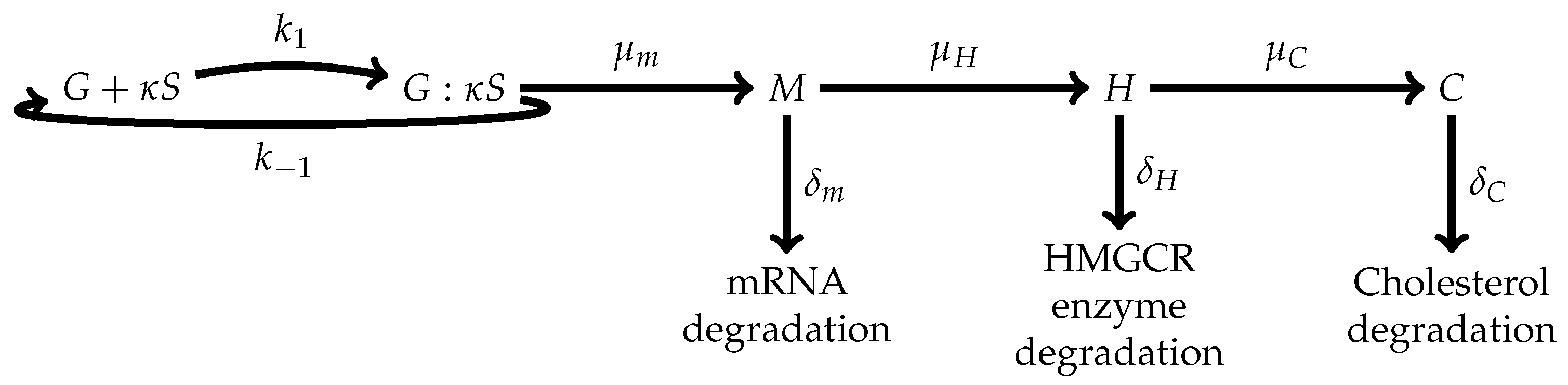
The mathematical model for the sterol regulatory element-binding protein 2 (SREBP-2) cholesterol biosynthesis pathway is developed from a comprehensive understanding of the biological processes involved in cholesterol homeostasis. Maintaining intracellular cholesterol levels within a physiological range is critical for cellular function and survival. The SREBP-2 pathway is central to this regulation and is characterized by intricate interactions among cholesterol, SREBP-2, and molecular components such as 3-hydroxy-3-methylglutaryl-coenzyme A reductase (HMGCR). These interactions are illustrated in the diagram shown in
Figure 1, and the model parameters are listed in
Table 1, see [
1] for further details.
The regulatory mechanism relies on SREBP-2, a transcription factor that activates the expression of genes required for cholesterol biosynthesis. When intracellular cholesterol levels are low, SREBP-2 is transported from the endoplasmic reticulum (ER) to the Golgi apparatus for proteolytic activation, where it undergoes cleavage to release its active form. This active SREBP-2 translocates to the nucleus, binds to sterol regulatory elements (SREs) in the promoter region of target genes, and initiates the transcription of HMGCR messenger RNA (mRNA). The translated HMGCR enzyme catalyzes cholesterol production, increasing intracellular cholesterol levels and restoring homeostasis.
Conversely, when intracellular cholesterol levels are elevated, the transport of SREBP-2 from the endoplasmic reticulum to the Golgi apparatus is blocked, keeping it in an inactive state and preventing the transcription of cholesterol biosynthetic genes. This feedback mechanism ensures that cholesterol synthesis is tightly regulated, protecting cells from the cytotoxic effects of both cholesterol excess and deficiency.
The compartment mathematical model illustrated in the schematic diagram
Figure 1 characterizes the biochemical interactions underlying cholesterol biosynthesis and its feedback regulation via the SREBP-2 pathway. As previously mentioned, the model was developed by [
1] and integrates key mechanisms including transcription, translation, cholesterol synthesis, and feedback inhibition to comprehensively capture the dynamics of this biosynthetic process. These interactions are mathematically formulated as a system of nonlinear ordinary differential equations (ODEs), derived using mass-action kinetics to represent the reaction rates.
The genetic regulation of cholesterol biosynthesis is primarily regulated by the dynamic binding and dissociation of the transcription factor SREBP-2. The transcription factor SREBP-2, denoted by S, acts as a transcriptional activator by binding to the HMGCR gene G, forming an active transcriptional complex . This interaction promotes the transcription of HMGCR mRNA M at a rate . Subsequently, the mRNA M is translated into the HMG-CoA reductase enzyme H at a rate , which catalyzes the synthesis of cholesterol C at a rate .
The binding of SREBP-2
S to the gene
G follows an association rate constant
and a dissociation rate constant
. The dissociation of the active complex regenerates unbound DNA promoters, ensuring dynamic responsiveness to intracellular cholesterol fluctuations. Elevated cholesterol levels facilitate the binding of cholesterol
C to SREBP-2
S, forming an inactive complex and thus suppressing the transcription of HMGCR, providing a robust negative feedback mechanism to regulate cholesterol biosynthesis. Additionally, the degradation of HMGCR mRNA, the HMGCR enzyme, and cholesterol occurs at rates
,
, and
, respectively, which maintains cellular cholesterol homeostasis.
Here, represents the concentration of free (unbound) HMGCR gene promoters (in molecules mL−1), indicating the fraction available for binding by the transcription factor SREBP-2 at time t, with initial condition , reflecting the total gene copy number present in the cell before any binding has occurred. The variable denotes the concentration of active, unbound SREBP-2 transcription factors not currently bound to gene promoters or cholesterol molecules (in molecules mL−1), with initial condition , representing the baseline level of transcription factors in the nucleus. Finally, corresponds to the concentration of the active gene complex formed when SREBP-2 binds to the HMGCR promoter, thereby promoting transcription of the gene (in molecules mL−1). The initial condition reflects that no gene-promoter complexes have yet formed at the initial time.
The parameter represents the dissociation rate constant (in s−1), whereas is the association rate constant (in molecules−κ mLκ s−1). The exponent accounts for the cooperative binding nature of SREBP-2 to DNA, such that the dissociation of one active DNA complex releases molecules of unbound transcription factor, and the formation of an active DNA complex requires up to DNA binding sites.
The mathematical model of the sterol regulatory element-binding protein 2 (SREBP-2) cholesterol biosynthesis pathway is developed based on a comprehensive understanding of the biological processes governing cholesterol homeostasis. Maintaining intracellular cholesterol levels within a physiological range is essential for cellular functionality and survival. The SREBP-2 pathway plays a central role in this regulation and is characterized by intricate interactions between cholesterol, SREBP-2, and molecular components such as 3-hydroxy-3-methylglutaryl-coenzyme A (HMG-CoA) reductase (HMGCR). Experimental findings by [
1,
22] indicate that the HMGCR gene contains three binding sites for SREBP-2, suggesting that cooperative binding is essential for transcriptional activation. Consequently, in our model, we adopt
, reflecting the requirement of three SREBP-2 molecules to effectively activate HMGCR transcription.
The dynamics of active SREBP-2
S are determined by its binding to the HMGCR gene
G, leading to the formation of the active complex
, as well as its interaction with cholesterol
C, resulting in the formation of the inactive complex
:
Here,
represents the concentration of free (unbound) intracellular cholesterol (in molecules mL
−1), which is available to participate in regulatory and metabolic processes. The initial condition
reflects the baseline cholesterol level within the cell at the beginning of observation or simulation. The variable
denotes the concentration of the inactive complex formed when cholesterol binds to SREBP-2, thereby preventing it from activating gene transcription (in molecules mL
−1). The initial condition
indicates that no such complexes are present at time zero, representing a system in which cholesterol has not yet exerted feedback inhibition. The parameters
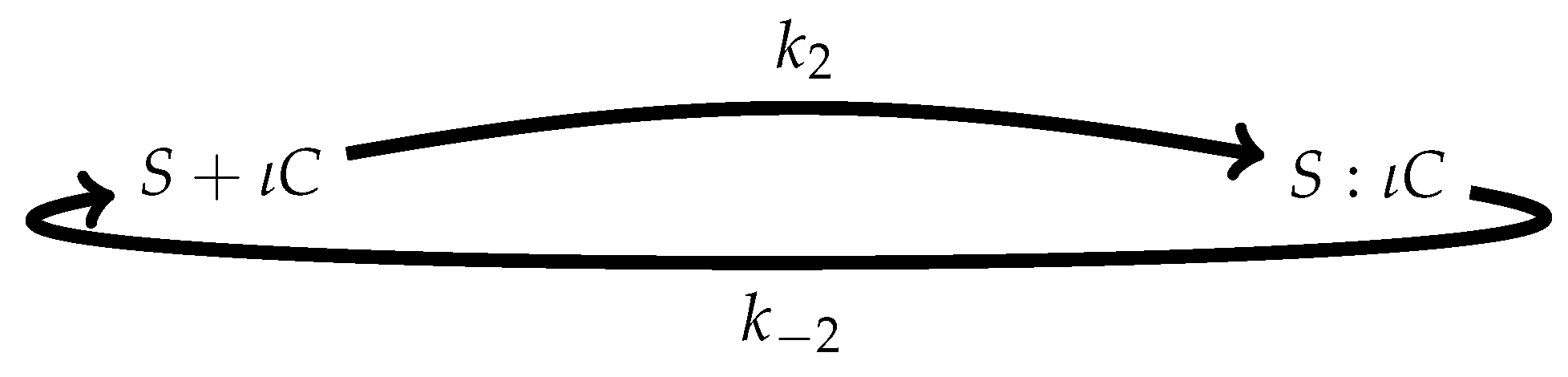
and
are the association and dissociation rate constants for the interaction between
S and
C, with units molecules
−ι mL
ι s
−1 and s
−1, respectively, (see
Figure 2).
The exponent
characterizes the cooperative binding of cholesterol to SREBP-2, where each inactive complex requires up to
cholesterol molecules to form. Moreover, experimental investigations on the sterol-sensing domain (SSD) of SCAP have demonstrated its tetrameric structure, indicating that four cholesterol molecules bind to a SCAP-SREBP complex to promote inactivation. Consequently, we set
in our model [
1,
23,
24]. The variables
and
, play a crucial role in the regulation of cholesterol biosynthesis. These terms are defined as follows:
2.1. Active Complex Concentration ()
The variable
represents the concentration of the active DNA complex, where the transcription factor SREBP-2 (
S) binds cooperatively to the HMGCR gene (
G). This complex is denoted as
and is responsible for activating transcription. The formation and dissociation of this complex are determined by the association rate constant
and the dissociation rate constant
:
The active complex
facilitates the transcription of mRNA (
M) at a rate
, without depleting the bound DNA complex. The dynamics of the active complex
are determined by:
The exponent , as given above, represents the cooperative binding of SREBP-2 to the HMGCR gene, where each active complex formation requires up to binding sites.
2.2. Inactive Complex Concentration ()
The variable
represents the concentration of the inactive complex formed between SREBP-2 (
S) and cholesterol (
C), denoted as
. This complex inhibits the activation of the HMGCR gene and plays a key role in cholesterol regulation. The formation and dissociation of this complex are determined by the association rate constant
and the dissociation rate constant
:
The presence of
sequesters SREBP-2, preventing its binding to the HMGCR gene. This inhibition suppresses transcription and plays a crucial role in the negative feedback regulation of cholesterol homeostasis. The dynamics of inactive complex
are described by:
The parameters
and
represent the association and dissociation rate constants, with units molecules
−ι mL
ι s
−1 and s
−1, respectively. The exponent
represents the stoichiometric coefficient, indicating the number of cholesterol molecules required to bind to
S to form the inactive complex. The transcription of HMGCR mRNA
M occurs at a rate proportional to the active complex
and is balanced by degradation:
Here, is the transcription rate constant (in s−1), represents the concentration of HMGCR mRNA (in molecules mL−1), and is the degradation rate of mRNA (in s−1). The initial condition reflects that at time zero, no mRNA transcripts have been synthesized yet, consistent with a system where gene expression has not yet been initiated.
The HMGCR enzyme
H is synthesized at a rate
from
M and is degraded at a rate
:
Here, denotes the translation rate constant (in s−1), represents the concentration of the HMGCR enzyme (in molecules mL−1), and corresponds to the degradation rate of HMGCR (in s−1). The initial condition reflects that no enzyme molecules are present at the initial time, consistent with a system in which translation has not yet been initiated.
Cholesterol
C is produced by the HMGCR enzyme at a rate
and is degraded at a rate
. Additionally, cholesterol forms inactive complexes with
S, contributing to feedback inhibition:
Here, denotes the cholesterol synthesis rate constant (in s−1), is the degradation rate of cholesterol (in s−1), and is the stoichiometric coefficient indicating the number of cholesterol molecules required to bind a single S molecule to form the inactive complex.
The right-hand sides of the system (
1)–(
7) are polynomial functions of the state variables and are therefore continuously differentiable on
. Consequently, we consider the space
of all continuously differentiable functions that map time
into
.
Define the vector field
by
where
In this context, all state variables are assumed to remain continuous and differentiable over time, reflecting the smooth evolution of the biochemical system under physiological conditions.
The initial concentration of unbound DNA, , can be estimated using three different approaches:
Direct Assumption (): This method assumes that the total transcription factors are evenly distributed among the available DNA binding sites. Since each DNA binding site requires
transcription factors, the total number of available binding sites is approximated as:
This approach provides a straightforward estimate but does not account for the dynamic equilibrium conditions in transcriptional regulation.
DNA Copy Number Approach: Building on this biological parallel, Milo and Phillips [
25], p. 13 affirm that human somatic cells, including hepatocytes, are diploid and thus contain two copies of each gene. Accordingly, we assume
for the HMGCR gene per nucleus. To convert gene copy number into a concentration (in molecules/mL), we divide by the volume of a single cell.
Experimental work by Masyuk et al. [
26] measured total liver volume in normal rats to be
mL. With an approximate hepatocyte count of
cells per liver [
27], the mean volume of a single liver cell is estimated as:
The corresponding concentration of DNA binding sites per unit volume (in molecules/mL) is thus:
where
and
mL. Substituting these values yields:
This range provides a conservative upper- and lower-bound estimate for , offering a tractable method for model initialization when detailed equilibrium data are unavailable.
Binding Equilibrium Approach: This method accounts for cooperative binding dynamics of transcription factors to DNA by incorporating the dissociation constant, given by
. The dynamics of the bound complex
are regulated by a nonlinear Equation (
3) that is assumed to reach equilibrium rapidly (quasi-steady-state approximation). Therefore, we set
, which leads to the steady-state relation:
Assuming
, the expression becomes
Using conservation of gene copy number and the initial condition
, we impose the constraint
Substituting this into the expression above yields
which can be rearranged to estimate:
This provides a biophysically realistic estimate of , accounting for both cooperative binding and equilibrium dynamics.
The
Table 2 summarizes the three methods used to estimate
, highlighting their different assumptions and approaches. The Direct Assumption (
) provides a quick estimation by assuming transcription factors distribute uniformly among available DNA binding sites. However, it does not account for biochemical binding kinetics.
The DNA Copy Number Approach estimates from the number of gene copies per cell, converted into a concentration by dividing by the average liver cell volume. This provides a biologically grounded estimate, assuming that all gene copies are equally accessible for binding. A limitation of this approach is that it may overestimate or underestimate the effective concentration of binding sites, since factors such as chromatin accessibility, transcriptional state, and cell-to-cell variability can decrease or increase the actual availability of gene copies for regulation.
Finally, the Binding Equilibrium Approach incorporates cooperative binding effects by considering the dissociation constant , making it the most dynamically realistic estimation method. Since this method considers equilibrium binding kinetics, it provides a more accurate representation of the actual number of available unbound DNA sites in a real biological system.
3. Stability Analysis
The system (
1)–(
7) is an autonomous set of nonlinear ODEs for intracellular cholesterol regulation, with nonnegative initial data
It is important to note that the total concentration of the dynamic variables
is not conserved, because degradation acts as a sink and synthesis draws from upstream sources. Introduce nonnegative cumulative loss compartments
and nonnegative cumulative source production compartments
Define the augmented (closed) total
Summing (
1)–(
7) with (
12)–(
13) cancels all internal exchanges (
,
) and balances each synthesis term by its source counter and each degradation term by its loss counter. Hence
Theorem 1. Assume all parameters in (1)–(7) are nonnegative and the initial condition (10) satisfies . Then the solutionexists and is unique on , remains in for all , and is uniformly bounded. In particular,where the comparison-based constants are given byand Proof. As previously noted, the right-hand sides of the system (
1)–(
7) are polynomial functions of the state variables and hence belong to
. Therefore, the vector field
defined in (
9) is continuously differentiable and locally Lipschitz on
. By the Picard–Lindelöf theorem (see, e.g., [
28]), the initial value problem
with
admits a unique local solution
.
We next show that the solution remains biologically meaningful, i.e.,
for all
. Let the positive cone
denote the set of admissible (nonnegative) concentrations. To prove that
K is forward invariant under (
19), we employ a boundary first-exit argument.
Assume, for contradiction, that a trajectory starting in
K leaves
K. Define the first exit time
By continuity of
, we have
, and there exists an index
k such that
and
for all
. Since
is continuously differentiable,
Evaluating
at
gives
Hence, for every boundary point
, the vector field satisfies
, where
is the tangent cone of
K at
. In particular,
. For sufficiently small
,
and all other components remain nonnegative by the definition of
. This contradicts the minimality of
. Therefore, no trajectory can leave
K, and the positive cone is forward invariant:
We have the conservation relations
which imply
and
for all
. Taking into account the initial conditions
,
, and
, we obtain the comparison bounds
Therefore,
Finally, the trajectory remains in the compact, positively invariant set
on which the locally Lipschitz vector field
F is bounded. By standard continuation arguments (cf. [
28]), the solution extends globally, i.e.,
. Hence, the system (
1)–(
7) admits a unique, globally defined solution that remains positive and bounded for all
, thereby ensuring both mathematical well-posedness and biological feasibility. □
Definition 1. Let denote a solution of the system (1)–(7) with nonnegative initial conditions. The system is said to be uniformly persistent (or permanent) with respect to a subset of coordinates if there exist positive constants ε and ϖ such that every corresponding component satisfiesIn biological terms, the variables in remain permanently active: they neither diverge nor decay to zero as time increases. To prove the uniform persistence (permanence) of the model Equations (
1)–(
7), we make use of the following Fluctuation Lemma [
29] and of a standard calculus lemma, for which we include a detailed proof for the reader’s convenience.
Lemma 1 ([
29])
. Let be continuously differentiable, and defineThen there exist sequences and tending to infinity such that Lemma 2. Let be a bounded function such that for some . Then there exists a sequence such that Proof. Since
f has a finite limit
ℓ as
, it follows in particular that
f is bounded on
, i.e., there exists
such that
for all
. We first claim that for every
there exists
such that
Suppose, towards a contradiction, that this claim is false. Then there exists some
such that
Define
and
. Then
We now show that
cannot change sign on
. Indeed, if there existed
with
and
, then by continuity of
there would exist some
such that
. This contradicts (
20), which states that
for all
. Hence the sign of
is constant on
. There are now two cases.
Therefore,
Letting
shows that
, which contradicts the boundedness of
f on
.
so
Letting
shows that
, again contradicting the boundedness of
f on
. Therefore, for each
there exists
such that
Finally, relabelling the sequence
as
gives the desired sequence
with
which completes the proof. □
Theorem 2. Assume the admissible initial conditions (10) with , , , and all parameters in (1)–(7) are nonnegative. Then every solution is uniformly bounded andHence the model is uniformly persistent (permanent) in the compartments M, H, and C. Proof. We first establish the uniform boundedness of all state variables in the system (
1)–(
7), and then show that each biologically relevant component remains uniformly positive for all time. By the total concentration identity for the dynamic variables, established in (
16), we conclude that all state variables are uniformly bounded on
. We next prove the positivity of cholesterol
. Suppose, toward a contradiction, that
. There are two cases.
Case A:
. In this case we consider the subcase
. Applying the fluctuation Lemma 1, there exist sequences
with
Passing to a subsequence, we may assume that
as
, where
. Evaluating (
7) at
and letting
yields
hence
.
Using
the variation in constant formulas implies that if
then necessarily
, a contradiction; thus
. From the conservation
we obtain
. Moreover, by stationarity of
at its local minima (we can choose
so that
attains a local minimum near
; boundedness ensures the existence of such minima with
) we have
Therefore, near
, Equation (
7) reduces to
, which is strictly negative for
, contradicting
. Hence Case A is impossible.
Case B:
. Since all state variables remain bounded and the right-hand side of the system is smooth, the solution
is continuously differentiable on
and all its components are bounded. Moreover,
C is bounded and continuously differentiable with
as
. Thus, by Lemma 2 (applied with
and
), there exists a sequence
such that
Since
H,
and
are bounded, we may, after passing to a subsequence (not relabelled), assume that
for some limits
. From the conservation law
it follows that
Next, evaluate the cholesterol Equation (
7) at
:
Rewriting, we obtain
Letting
and using
,
and boundedness of
S, we obtain
which, together with nonnegativity, implies
Moreover, from the
equation
and the facts that
while
S is bounded, the inhomogeneous term
tends to 0 as
. By the variation-of-constants formula for this linear ODE with constant negative coefficient
, we obtain
Now consider the positive linear chain of equations
Using the variation-of-constants formula, if
then
would admit a positive lower bound as
, contradicting the fact that
. Hence
We now distinguish two possibilities for the asymptotic behaviour of .
In this case, set
Applying the Fluctuation Lemma 1 to the function
yields a sequence
such that
Since all state variables are bounded, we may, after passing to a subsequence (not relabelled), assume that
for some
. From the conservation law
and
we obtain
Evaluating the
equation
at
and using
gives
Passing to the limit
yields
Since
and
, we conclude that
On the other hand, from the second conservation relation
and the already established facts
and
, we obtain
, which contradicts the admissible initial condition
. Hence Subcase B1 cannot occur.
Then
as
. Since
is bounded and continuously differentiable, we can apply Lemma 2 with
and
to find a sequence
such that
As before, boundedness allows us to assume (passing to a subsequence if necessary) that
From
and
we again obtain
. Evaluating the
equation at
,
and letting
gives
so that
. On the other hand, using
and the convergence
,
, we obtain again
, and giving the same contradiction. Since both Subcase B1 and Subcase B2 are impossible, Case B cannot occur. Therefore
We now show that
and
also remain permanently positive. Set
By the definition of the liminf, there exists
such that
Since
C is bounded and continuously differentiable on
, there exists
with
We use the following elementary selection fact: for every bounded
function
there exists a sequence
such that
as
. For completeness, we recall the argument. For each integer
, the mean value theorem applied to
yields a point
with
Since the sequence
is bounded, it has a Cauchy subsequence
. For this subsequence we have
, and hence
as
. Setting
gives the desired sequence. Applying this fact with
, we obtain a sequence
such that
We may assume
for all
k, so by (
21) we have
Since all state variables are bounded, we may, after passing to a subsequence (not relabelled), assume that
for some limits
. In particular,
.
Evaluating the cholesterol Equation (
7) at
gives
Letting
and using
, we obtain
Hence we can choose
and find
such that
Next we extend this pointwise lower bound to short time intervals. Since
H and
are bounded and continuously differentiable, their derivatives are bounded: there exists
such that
Thus the combined input
satisfies
for some
. Choose
For any
and any
we have
and therefore
Combining this with (
22), which gives
for all
, we obtain
In other words, we have constructed an unbounded sequence of intervals
such that
We now use this to obtain a recurrent positive forcing from
into the
chain of equations
Suppose, toward a contradiction, that at least one of
M or
H is not permanent, that is,
If
then the variation-of-constants formula for
H implies
as well. Hence non-permanence of
M or
H implies
Therefore there exist sequences
and
with
,
such that
Since
M and
H are bounded and continuously differentiable, their derivatives are bounded: there exists
such that
Using
and
, we can, after passing to subsequences and relabelling, arrange that
for some fixed
and all
j. Then
Choosing
so small that
, and using
,
, we obtain (after a further subsequence if necessary) a single sequence, still denoted
, such that
On the other hand, assume that there exists a sequence
such that
and
remains small on whole neighbourhoods of each
. Since
is bounded and continuously differentiable, there is
such that
for all
. Hence, for any fixed
we can find
such that
whenever
j is large enough. In particular, on
the forcing term
in the
M equation is bounded by
.
Because
M,
H, and
have bounded derivatives, there exists
such that
Since
and
, we can, after passing to subsequences and relabelling, arrange that
for some fixed
and all
j, where
is chosen so small that
. Then
Since
and
, it follows that
On such an interval
the equation
together with the variation-of-constants formula
shows that
for all
. Since
and
is arbitrary, we may choose
small and then
j large so that
is as small as we wish on
.
In turn, from
and the corresponding variation-of-constants formula,
we obtain that
can also be made arbitrarily small on
for large
j, since both
and
is small there.
Moreover, from the conservation law
and the fact that
is small on
, we deduce that
on these intervals. Hence, on
and for large
j, both
and
are uniformly small. Consequently, the combined input
is uniformly small on
. However, the intervals
on which
are unbounded in time. For
j sufficiently large, the intervals
and
must overlap for infinitely many
k. This yields a contradiction, since on the overlap we cannot have simultaneously
arbitrarily small (by the behaviour of
,
M, and
H) and
. Therefore our assumption was false:
cannot remain arbitrarily small on arbitrarily long time intervals for large
t. In particular, there exists
and an unbounded sequence of times
such that
Thus
provides a recurrent, strictly positive forcing into the linear equations
By comparison for this linear system, the recurrent positive forcing from
implies strictly positive lower bounds for
and
as
. Indeed, from the recurrent lower bound (
23) and the variation-of-constants formulas, one can find constants
and
such that
Together with , this shows that M, H, and C are uniformly persistent, and completes the proof of Theorem 2. □
Remark 1 (Non-persistent states)
. The states G, S, , and are nonnegative and uniformly bounded but need not be uniformly persistent. Indeed,so the total mass in each group is fixed while its distribution may shift. Consequently, trajectories with (hence ) or with (hence ) are compatible with boundedness, and thus , , , or can be zero.Note that the positivity of is not part of the persistence statement; it is used only as an intermediate estimate to ensure a strictly positive forcing in the linear chainwhich is essential to conclude and . The model Equations (
1)–(
7) can be written in vector form as
where
To study stability via
M-matrix techniques, we first characterize the biologically relevant equilibrium of (
1)–(
7), and then apply a general theorem on
M-matrices. Let
denote an equilibrium of (
1)–(
7), i.e.,
In particular, for the active complex (
3) we have at equilibrium
Using the gene conservation law
and the steady–state relation from (
3),
we obtain
The downstream balances in (
5)–(
7) give
From the inactive–complex Equation (
4) we likewise obtain
Crucially,
closes the steady state via the SREBP-2 pool conservation
which, in view of (
28)–(
30), reduces the equilibrium conditions to a single scalar equation for
. Writing
S for the unknown equilibrium value of
, we define
where
Lemma 3. Assume , , and that all parameters in (1)–(7) are positive. Then the scalar Equation (32) admits a unique root . Consequently, the equilibriumdetermined by (28)–(30) is componentwise positive and unique. Proof. We first verify continuity of and its limits at 0 and . Since and are obtained by algebraic operations and compositions involving , both functions are continuous on , and hence is continuous on .
From (
28) and (
30), we have
By continuity we may extend
continuously to
by setting
.
Next, we consider the behavior as
. From (
28) we obtain
Hence,
It follows that
We now show that
is strictly increasing on
. Introduce the positive constants
so that
Differentiating gives
Since
,
and
, we have
so
is strictly increasing. It is convenient to rewrite
as
Differentiating and applying the product and chain rules yields
Thus
is strictly increasing on
. Since
and
for all
, it follows that
and therefore
is strictly increasing on
. Combining continuity of
on
with
and strict monotonicity, the intermediate value theorem yields a unique
such that
.
Finally, the remaining equilibrium components are determined by (
28)–(
30). Since
,
and all rate parameters are positive, we obtain
Thus the equilibrium
is componentwise positive. Uniqueness of
immediately implies uniqueness of the full equilibrium vector
. □
To analyze the stability of the equilibrium, we introduce perturbations
where
We begin by analyzing the stability of a perturbed nonlinear system around a nontrivial equilibrium. Substituting the perturbed variables into the original system and using the equilibrium condition
we obtain the perturbed system
Expanding the nonlinear term, the system becomes and collecting terms, the final expression for the perturbed system reads
To facilitate the stability analysis, we rewrite the perturbed system in a decomposed form as
where the vector fields satisfy
and
for all
i. The functions
describe the internal (self) dynamics of the isolated subsystems,
whereas the functions
represent the nonlinear interaction terms that couple the subsystems. This decomposition isolates the intrinsic dynamics of each compartment from the nonlinear interconnections, thus allowing the use of the composite–system framework for large-scale stability analysis.
Explicitly, the isolated dynamics are given by
, taking into account the perturbation
; that is,
The nonlinear interconnection terms are collected into the vector-valued function
where:
This decomposition enables the application of the composite-system method to analyze the stability of interconnected nonlinear subsystems, where the functions
and
are continuously differentiable and satisfy
and
, as established by the foundational result of Araki [
2], stated in the following theorem.
Theorem 3 ([
2])
. Consider the composite nonlinear system defined by the decomposition (33). This system is uniformly asymptotically stable in the large (uniformly a.s.i.l.) if there exist constants , functions , , and , for each subsystem , explicitly satisfying the following conditions:- (a)
For each subsystem i, the function is positive definite, decrescent, radially unbounded, and continuously differentiable. Moreover, the isolated subsystem dynamics must satisfy: where is nonnegative-definite. The function must be either strictly positive definite or identically zero. Specifically:
If , then may be identically zero or positive definite function.
If , then must be positive definite function.
- (b)
There exist explicitly defined positive constants for , bounding the nonlinear interconnection terms as: - (c)
The matrix defined explicitly by: must be an M-matrix.
Remark 2. These explicit conditions accommodate both scenarios:
When isolated subsystems possess inherent negative definite stability (, ).
When isolated subsystems lack inherent negative definite stability (, for all ), explicitly relying on stability through nonlinear interconnections and the M-matrix condition. Here, the term positive definite function means: This distinguishes it from a merely nonnegative function which might vanish at multiple points.
Historically, the
M-matrix criterion used in this work originates from the eigenvalue localization principle introduced by Geršgorin [
30] in his classical disk theorem, presented as Theorem 7.6 on page 223 of [
31]. This principle was further developed by Ostrowski [
32,
33,
34], who established determinant inequalities and diagonal dominance conditions characterizing
M-matrices. A systematic account of these results was later given by Poole and Boullion [
35], where the spectral properties of
M-matrices positivity of principal minors, nonpositive off-diagonal entries, and eigenvalues lying in the open left half-plane were unified into an algebraic framework. The theory was subsequently extended by Araki [
2] to nonlinear interconnected systems, linking the classical
M-matrix structure with the stability analysis of large-scale nonlinear differential systems.
Consider the Lyapunov candidate
which is positive definite, radially unbounded, and continuously differentiable. Differentiating
along the isolated subsystem dynamics, given explicitly by
yields
Thus condition (a) of Theorem 3 holds with
We write
From the perturbed full vector field,
so we set the interconnection part, starting from the perturbed full vector field
A first-order Taylor expansion around
gives
and hence
for
small. Therefore,
Taking absolute values and using the triangle inequality,
This matches condition (b) in the small-gain form
by taking
and setting the (nonzero) gains explicitly as
with
for
, and the
term negligible as
.
Therefore, conditions (a) and (b) of Theorem 3 are explicitly verified for the subsystem corresponding to .
We now verify conditions (a) and (b) for the subsystem associated with
. Let
. Then
, and, under the isolated dynamics
,
which is negative definite in
, so condition (a) of Theorem 3 holds with
From the interconnection part, starting from the perturbed full vector field, we define
First–order Taylor expansions around
yield
Hence, for
,
Therefore,
and hence, by the triangle inequality,
This matches condition (b) in the small-gain form
by taking
and the nonzero gains
with all other
. Thus, conditions (a) and (b) of Theorem 3 are explicitly verified for the subsystem associated with
.
Similarly to the subsystems associated with
and
, we now consider the remaining subsystems corresponding to the state variables
For each of these, we define the Lyapunov candidate
which is positive definite, radially unbounded, and continuously differentiable. The corresponding isolated dynamics take the linear form
with strictly positive decay rates
Differentiating
along these isolated dynamics gives
so condition (a) of Theorem 3 is satisfied with
.
The nonlinear interconnection terms
are obtained from the full system by isolating each component’s coupling. Expanding these terms about the equilibrium
yields Taylor remainders satisfying
Hence, the derivative of each Lyapunov function satisfies
with explicitly computable, nonnegative interconnection gains
that depend on model parameters and equilibrium values.
The nonzero gains are:
All other
. Thus, conditions (a) and (b) of Theorem 3 are verified for all subsystems
.
Remark 3. The use of big-O terms in the Lyapunov expansion makes it explicit that the argument is local: the Lyapunov functions guarantee asymptotic stability in a neighborhood of the equilibrium, with decay along the full nonlinear trajectories up to higher-order terms. In contrast to a purely linear eigenvalue test via the Jacobian which guarantees only linearized stability, the Lyapunov framework provides scalar energy-like functionals that decrease along solutions and thus establish a nonlinear stability mechanism. Moreover, the M-matrix formulation translates these differential properties into explicit algebraic inequalities on parameters (e.g., diagonal dominance and positivity conditions), which are verifiable without computing spectra. This is particularly advantageous in large-scale systems, where direct eigenvalue computations are often impractical, and structural properties (sparsity, monotonicity) can still be exploited to guarantee robustness of the equilibrium.
To complete the application of Theorem 3, we now verify that the matrix
, defined by
is an
M-matrix; that is, all off-diagonal entries are nonpositive and all principal minors are positive.
Using the identified parameters
, the explicit form of
A is:
Thus, provided suitable parameter conditions ensuring
A is an
M-matrix are explicitly satisfied, Theorem 3 guarantees uniform asymptotic stability in the large for the entire composite system. An
M-matrix is a special class of matrices with widespread applications in stability analysis, numerical methods, and mathematical modeling of interconnected systems. Formally, an
M-matrix is a real square matrix whose off-diagonal elements are non-positive and whose eigenvalues have positive real parts [
18,
20]. Equivalently,
M-matrices can be characterized by positive principal minors or diagonal dominance conditions [
2,
19,
21]. Due to their beneficial spectral and structural properties,
M-matrices naturally arise in the study of stability for composite dynamical systems and iterative numerical methods [
18,
19]. To demonstrate that the matrix
A is an
M-matrix, we utilize well-established properties from the literature [
18,
35,
36]. Specifically, if
can be written as
, where
and
is a non-negative matrix (
, meaning
for all
), and
, then
A is termed an
M-matrix. In this context,
denotes the spectral radius of
A, representing the largest absolute value of its eigenvalues.
Next, we present an important result from spectral analysis regarding the upper bound of the spectral radius. This theorem, which is essential for understanding the influence of model parameters on stability, is stated in [
37]. The spectral radius plays a key role in determining the stability of the system, and this theorem provides bounds on the spectral radius based on the matrix norm.
Theorem 4 ([
37])
. Let be an operator norm on induced by a vector norm, and let . Then the following inequalities hold:- (a)
Upper bound on the spectral radius: - (b)
Lower bound on the spectral radius (for nonsingular matrices): If A is nonsingular, then
Moreover, for any eigenvalue λ of A, one always has .
To complement Theorem 4, we recall several important relationships between common matrix norms, which will be used later to estimate the spectral radius and compare different stability criteria.
Remark 4. The bounds established in Theorem 4 apply only to operator norms induced by vector norms (such as the , , or norms), and not necessarily to non-operator norms such as the Frobenius norm. For any matrix , the following standard norm inequalities hold [37]:These relations are frequently used to estimate the spectral radius when only computable norm bounds are available and provide a direct connection between different matrix norms in spectral stability analysis. We now apply spectral theory to analyze the structure of the matrix
A. Recall that the small-gain condition can be interpreted through the spectral radius of the associated nonnegative matrix
B, obtained from the decomposition
Here
B is a nonnegative matrix. From the model Equations (
1)–(
7) and Theorem 1, the equilibrium values and parameters satisfy
Under these assumptions, all off-diagonal entries of
B are nonnegative. For the diagonal entries, nonnegativity holds if and only if
If the inequalities in (
36) are satisfied, then
entrywise. Moreover, if the spectral radius of
B satisfies
, then
is a nonsingular
M-matrix. Thus, the
-norm of the matrix
B, defined as the maximum column sum, is
In order for
to be a nonsingular
M-matrix, it is sufficient that
. However, from the column sums computed above we have
since the third column sum equals
and the seventh column sum is exactly 1. Hence, the sufficient condition
is not satisfied. This does not imply that
; it only shows that the crude
-norm estimate is too conservative to conclude
.
Consequently, we turn to alternative methods for establishing
, such as estimates based on the
-norm or the Frobenius norm of the matrix
B. The
-norm of
B corresponds to the maximum absolute row sum:
To ensure that
is a nonsingular
M-matrix, we require:
Finally, the Frobenius norm of the matrix
B, denoted
, is defined by
We obtain the symbolic expression
Although the Frobenius norm
is not an operator norm, it satisfies
and therefore the sufficient condition
implies that
, and hence
is a nonsingular
M-matrix.
Theorem 5 (Norm-based
M-matrix criterion and stability for the SREBP-2 model)
. Let denote the matrix obtained from the interconnection analysis of the perturbed system (1)–(7), as defined in (35). Here, denote the equilibrium values, and the parameters of (1)–(7) satisfytogether with the diagonal nonnegativity conditionsso that entrywise.If either of the following norm bounds holds:then , and hence is a nonsingular M-matrix. Consequently, condition (c) of Theorem 3 holds, and the equilibrium of the full SREBP-2 composite system is uniformly asymptotically stable in the large. Proof. Under (
37),
. For the
operator norm,
, so
implies
. For the Frobenius norm, use
(see, e.g., [
37]); thus
also implies
. Hence
is a nonsingular
M-matrix [
18,
19,
20,
37]. By construction,
A is precisely the matrix in condition (c) of Theorem 3; with (a)–(b) already verified for the subsystems, Theorem 3 yields uniform asymptotic stability in the large for the equilibrium of the composite SREBP-2 model. □
4. Spectral Norm Analysis and Simulation
The condition
is often too restrictive and fails to hold for realistic parameter combinations. In such cases, the
- and Frobenius-norm bounds in (
38) provide alternative sufficient conditions ensuring
, and thus the
M-matrix property of
A. For any matrix
B, the following standard inequalities hold [
37]:
Therefore, a sufficient (though not necessary)
approach to ensure
is either
, or the simultaneous conditions
and
. As will be shown below,
is unattainable for the present interconnection, and
is typically too conservative in practice. Consequently, we establish stability via the small-gain condition
, which directly implies
. Since
, the spectral norm
may, but need not, lie below 1.
Lemma 4 (Frobenius–norm obstruction). For the matrix B of the SREBP-2 interconnection, one always has . Hence, the condition can never guarantee for this model.
Proof. Even if all entries of
B except
were (hypothetically) set to zero, we would still have
Each quadratic term
attains its minimum at
with value
, so the right-hand side is minimized when
, yielding
, and therefore
.
In the full model, B contains many additional nonnegative entries, such as the degradation and coupling coefficients and the feedback terms . Each of these strictly increases the Frobenius norm. Hence, for all admissible parameter values, one has . □
Let
denote the row sums of
B. Using the steady-state relations and introducing the grouped rate parameters
we can rewrite the cholesterol feedback terms as
From the explicit structure of
B, the row sums are then
For the DNA–binding block (rows 1–3), introduce the shorthand
The inequalities
and
are equivalent to
and
so that
which is only possible if
.
In addition, we will later require
in order to select
with
. To encode both requirements, we strengthen the feasibility conditions to
Under (
44), we can then choose
which guarantees
.
Finally, we collect the degradation–dominance inequalities
which ensure that the purely metabolic and hormonal rows
can be made strictly less than one.
Proposition 1 (Sufficient conditions for
)
. Fix and let . Let , , denote the equilibrium values, and introduce the grouped rates as in (39). Assume that the degradation–dominance conditions (46) hold, and that the quantity L in (42) satisfiesChoose so that the feasibility conditions (44) and the dissociation constraint (45) are satisfied. Then there exists such that, for all , the row sums of B given in (41) satisfy for all . Consequently,which implies , and therefore is a nonsingular M-matrix. Proof. From (
41) and (
42) we have
The choice (
44) yields
, hence
Thus
and
.
By (
45) we have
, so
The remaining contributions in
,
depend linearly on
and
and vanish as
. Hence there exists
such that, for all
,
and therefore
.
The rows
and
are independent of
and satisfy
by (
46). For
, rewrite
The first bracket
is strictly less than one by (
46), and the
-dependent term tends to zero as
. Shrinking
if necessary, we ensure
for all
.
Similarly,
Since
, we have
, and the
-term again vanishes as
. Reducing
once more if needed, we obtain
for all
.
Thus, for all
,
so that
It follows that
, hence
is a nonsingular
M-matrix. □
To solve the model numerically without encountering extreme magnitudes, we nondimensionalize all compartments by the initial SREBP-2 pool
:
while keeping time
t measured in seconds.
Collecting all
-powers into grouped rate parameters, we define
so that the terms
,
, and
become
,
, and
, respectively.
The scaled ODE system (for
) then reads
with dimensionless initial conditions
We then computed heatmaps over logarithmic grids in the parameter plane
to visualize the behavior of the reduced Jacobian
B through its induced matrix norms. Two representative presets are presented below to illustrate the theoretical small-gain predictions and the associated stability regions.
Stable regime. We fix the grouped rates
and
, stoichiometric exponents
and
, and choose
The fixed kinetic and scaling constants are
These parameters satisfy , so the system operates close to the theoretical small-gain stability threshold.
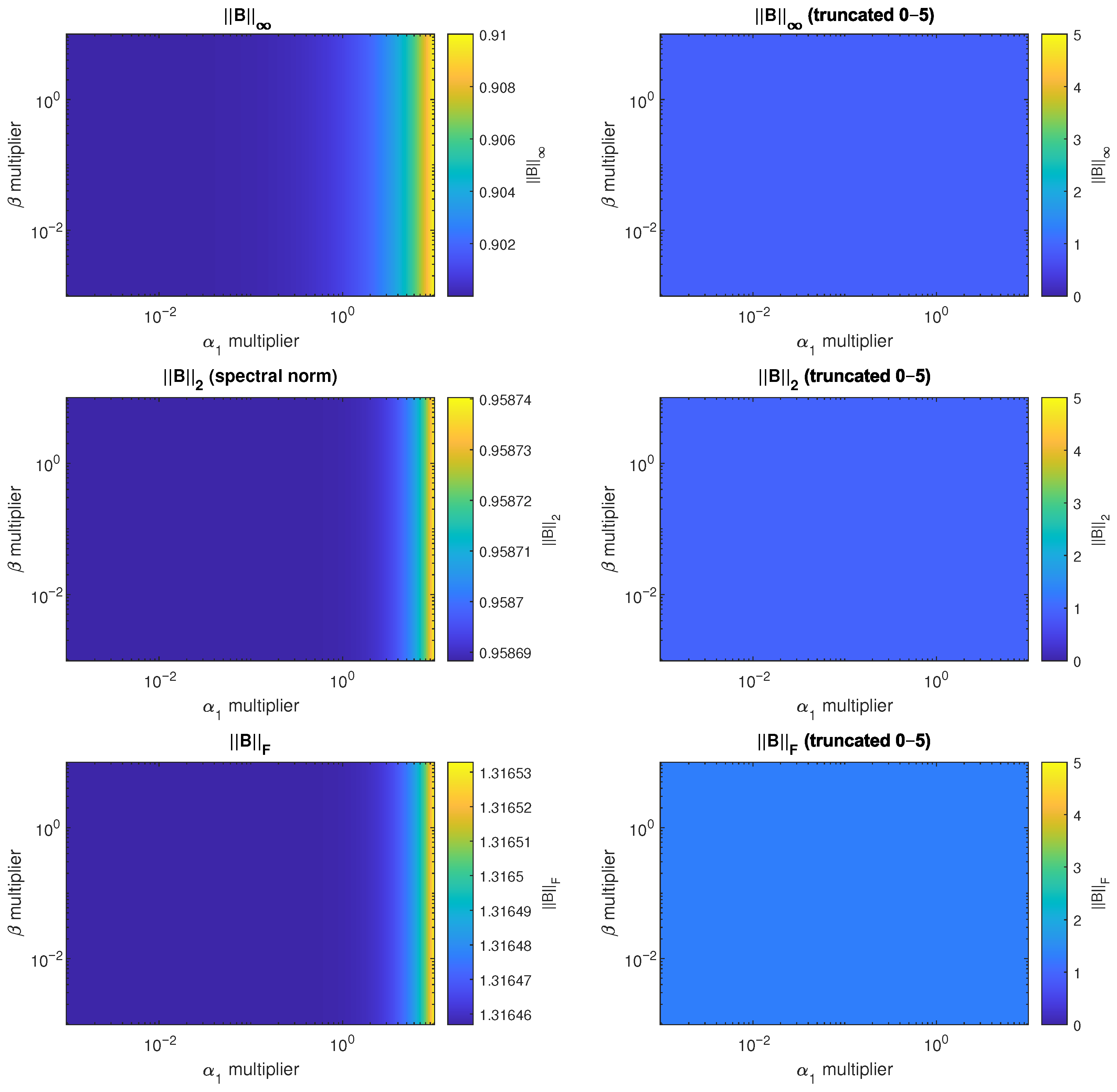
On the
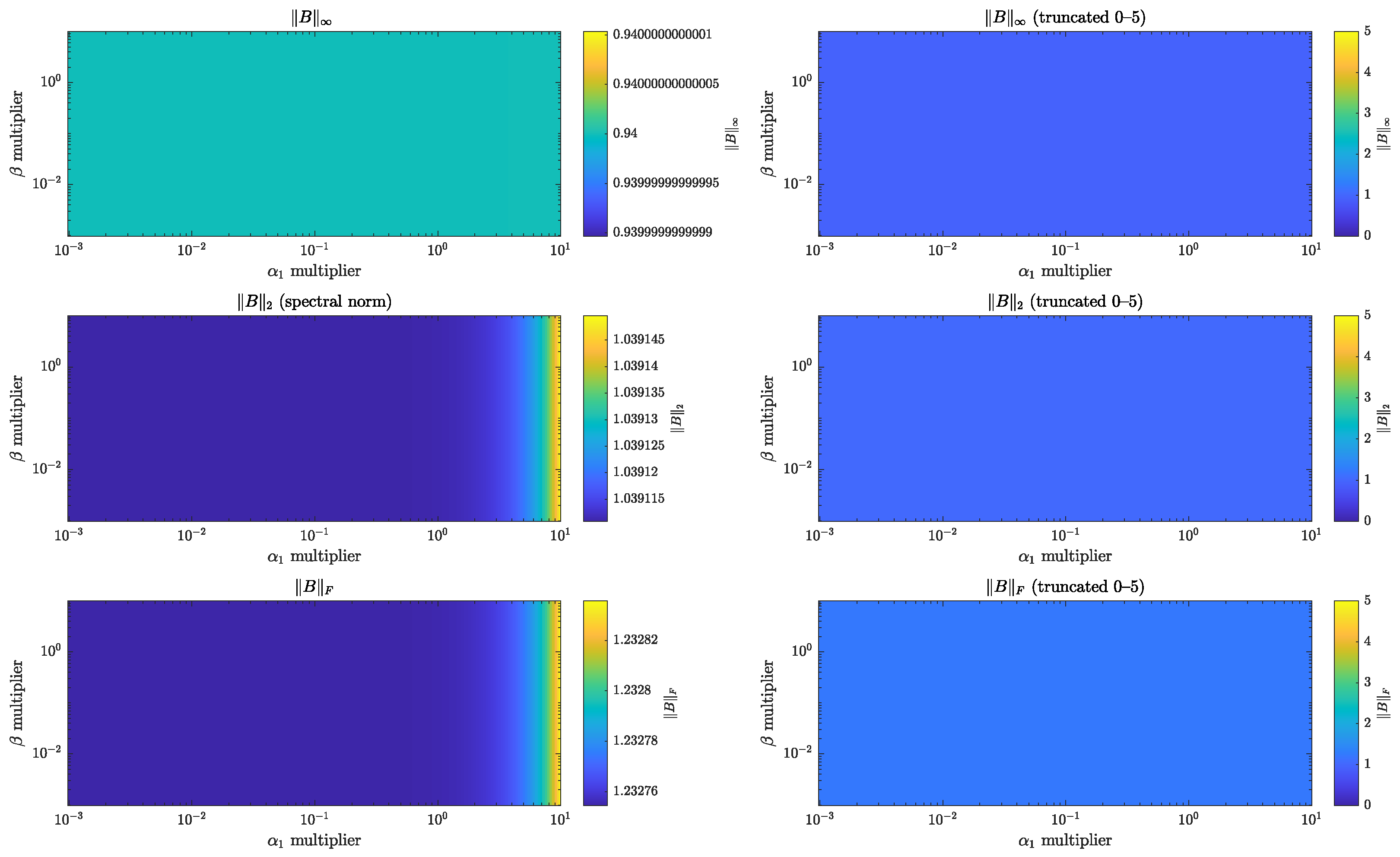
-multiplier grid, the heatmaps in
Figure 3 show that both the spectral norm
and the infinity norm
remain strictly below 1 across the entire domain, while the Frobenius norm
stays consistently above 1. Hence, stability can be certified by the
- and spectral-norm criteria, whereas the Frobenius criterion fails to do so (cf. Lemma 4).
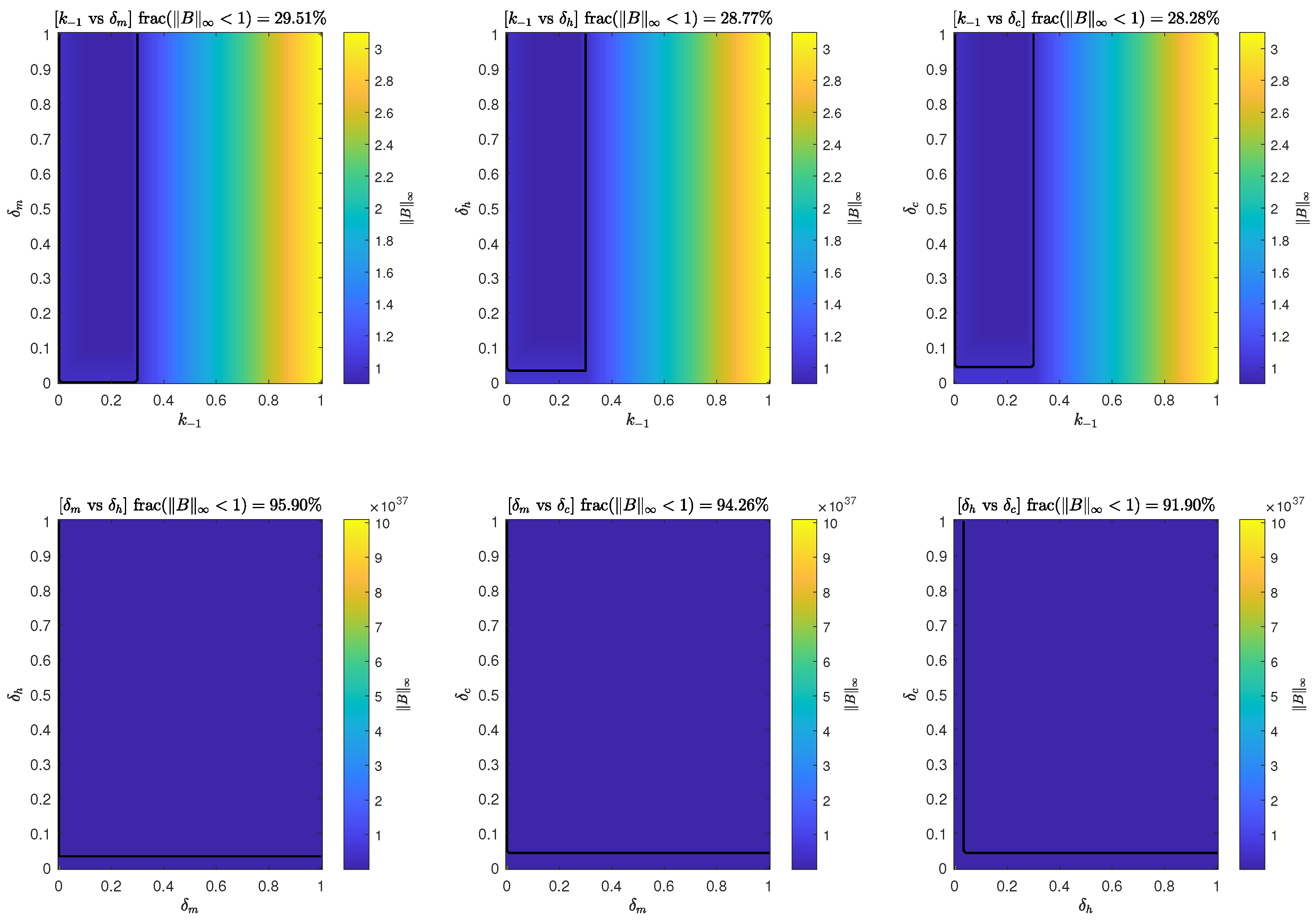
To assess parametric sensitivity,
Figure 4 shows stability fractions under pairwise variation of
. The system is found to be most sensitive to the dissociation rate
, with only about
of the sampled domain satisfying
, while the degradation fractions
exert comparatively minor influence, yielding stability fractions above
. The contour plots delineate the stability region and illustrate how the infinity-norm criterion quantitatively partitions stable versus unstable configurations.
For any parameter tuple
(e.g., grouped-rate multipliers
or a pairwise scan
), let
denote the associated interconnection matrix. We define the
stability fraction over a finite grid
by
where
is the indicator function of the event
A:
Thus each grid point contributes 1 if , and 0 otherwise. Dividing by N gives the proportion of the sampled domain in which the small-gain stability condition is satisfied.
Critical boundary. We fix the grouped multipliers
and
, and use the model’s stoichiometric exponents
(DNA binding) and
(cholesterol binding). Choose the following rate parameters (all in
):
and
With these values we obtain
placing the system near the small–gain stability threshold. On the
multiplier grid, the heatmaps in
Figure 5 show that the contour
intersects the domain, producing both stable regions (
) and unstable regions (
). In contrast,
and
throughout, so neither the spectral nor the Frobenius norm can certify stability in this regime.
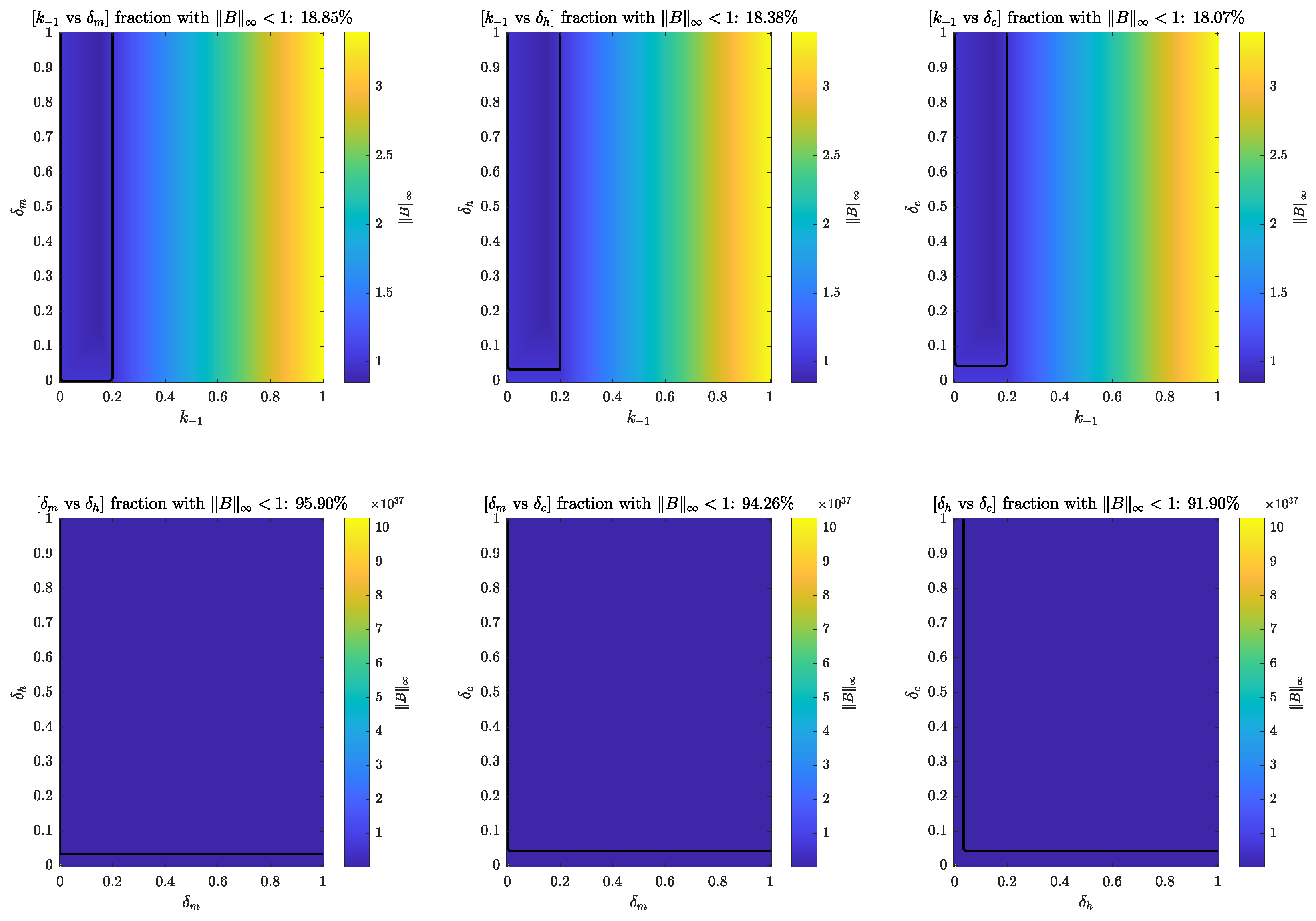
For the pairwise scans in
Figure 6, we vary
against a common degradation rate
. The dissociation rate
is the most influential: only about
of the
plane satisfies
, whereas the degradation rates have a comparatively minor effect, with stability fractions exceeding
. The resulting contours delineate the stability boundary and illustrate how the
-criterion partitions parameter space into stable and unstable regions.
These simulations are consistent with the analytical results. The Frobenius norm cannot be used to guarantee stability, whereas the infinity norm can. Moreover, the spectral norm lies between the spectral radius and the Frobenius norm , and therefore yields a sharper, yet still sufficient, stability test whenever .
5. Discussion
In this work, we developed and analyzed a comprehensive mathematical model of the SREBP-2 cholesterol biosynthesis pathway, integrating transcriptional regulation, metabolic synthesis, and feedback inhibition. Using M-matrix theory, we established sufficient norm-based conditions that guarantee stability of the equilibrium. A central outcome is the identification of the -criterion as a reliable and biologically meaningful stability test, while showing that the Frobenius norm does not guarantee stability. The transition at marks a loss of diagonal dominance and is suggestive of a bifurcation threshold (by analogy with Hopf bifurcation), a phenomenon to be investigated in detail for this large-scale model in future work. The spectral norm , lying between and , provides a sharper yet still sufficient condition whenever .
Our simulations reinforce these theoretical findings. Heatmaps across -multiplier grids confirm that stability is robustly captured by , whereas remains uninformative. Sensitivity analyses reveal that the dissociation rate is the dominant parameter influencing stability, while degradation fractions exert comparatively weaker effects. These results provide mechanistic insight into cholesterol regulation: while degradation processes ensure baseline clearance, the dynamics of transcription-factor dissociation chiefly determine whether the system remains in a homeostatic regime. Biologically, this highlights that the decision point for HMGCR transcription (active vs. silenced) depends more strongly on SREBP-2 promoter dissociation dynamics than on downstream turnover processes. In practice, even modest alterations in , whether via mutations, diet-induced signaling, or drug action, can tip the balance between stable cholesterol control and pathological dysregulation.
From a translational perspective, these findings emphasize the importance of controlling dissociation dynamics in therapeutic interventions targeting cholesterol metabolism. Pharmacological strategies that alter SREBP-2 binding affinities or modulate degradation rates may shift the system across the stability boundary. Our results therefore suggest that could serve as a critical “control knob” for homeostasis, and that drugs designed to stabilize the SREBP-2-DNA interaction might buffer against instability more effectively than those acting solely on degradation pathways. The mathematical framework developed here thus offers a predictive tool for assessing how biochemical perturbations impact homeostatic balance. More broadly, the robustness of the criterion admits a clear biological interpretation: the pathway remains stable as long as no single interaction (binding, dissociation, or synthesis) overwhelms the others. This mirrors how cells maintain cholesterol within a narrow range despite large environmental fluctuations, a property essential for membrane integrity and signaling.
Several limitations should be noted. First, the model assumes a well-mixed cellular environment and neglects stochastic fluctuations, both of which are known to affect transcriptional regulation. Second, parameter estimates are drawn from available experimental data and may vary across organisms and conditions. Future work should integrate parameter uncertainty, explore stochastic formulations, and extend the analysis to multiscale models that couple intracellular regulation with systemic lipid transport. It is also important to note that current funding support was dedicated to the full mathematical analysis of the SREBP-2 pathway. To fully validate these findings, experimental data should be collected under physiologically realistic conditions, enabling direct comparison between predicted and observed homeostatic responses. Our framework provides a solid theoretical basis for such studies, and the next step will be to perform targeted experiments to confirm and refine the model’s predictions.
Overall, our study demonstrates the utility of
M-matrix theory and norm-based stability analysis in clarifying the regulatory principles of complex biochemical networks. By connecting rigorous mathematical results with biologically interpretable conclusions, we provide a framework for future studies of cholesterol regulation and related metabolic pathways. In particular, by linking mathematical stability criteria directly to biological control points, our analysis reveals which molecular parameters govern whether cells maintain cholesterol balance or drift toward disease states. Numerical simulations and stability maps presented in
Section 4 (
Figure 3,
Figure 4,
Figure 5 and
Figure 6) illustrate stability and instability regions across parameter variations, as well as sensitivity with respect to
and degradation fractions. These results provide strong support for the proposed
M-matrix framework and norm-based criteria. An important direction for future work is the application of bifurcation theory [
38], which offers a complementary viewpoint for the analysis of this comprehensive model. Although a detailed bifurcation study lies beyond the present scope, our results already indicate that suitable parameter combinations can drive the system into instability, with the selection of appropriate norm criteria playing a central role. We therefore conclude that the present framework delivers rigorous and quantitative support for stability analysis, while bifurcation methods represent a natural extension to further characterize the dynamics of this large system.