1. Introduction
Digital topology is interested in the relations among the subsets of , where is the set of all integers. These sets are called digital images and they have some topological properties. Topological relations (such as digital homotopy, digital homology groups, etc.) between any two digital images allow us to deduce some information about one of the digital images by looking at the other one. Therefore, digital topology is used in the area of digital image processing.
At the beginning, Rosenfeld introduced digital topology [
1,
2]. In the following years, Boxer defined some algebraic topological methods on digital topology such as homotopy and fundamental groups [
3,
4,
5,
6,
7].
The notion of homotopy theory in digital spaces has been continuously expanded upon into the current day [
8,
9,
10]. Arslan et al. [
11] defined digital homology groups. Karaca and Ege expanded on digital homology theory [
12]. Karaca and Vergili [
13] introduced the digital fiber bundle, which is another algebraic topological topic [
14]. Homology groups in algebraic topology are used to classify topological spaces up to homeomorphism. Fiber bundles that are used to compute homology groups are significant tools in topology. Thus, Ege [
15] introduced the concept of digital fibration, which is a generalization of the digital fiber bundle. This work deals with some of the properties that hold in algebraic topology but do not necessarily exist in digital topology. Some of the differences arose because only integers are used in digital topology. Therefore, it is necessary to understand digital topology in order to understand the relationships between digital images. (For recent studies on digital images, see [
16,
17,
18,
19].)
In algebraic topology, fiber homotopy is a homotopy that preserves fibers [
20]. Since fibrations are not invariant under fiber homotopic equivalence, a map that is fiber homotopic to a fibration does not have to be a fibration. Thus, the homotopy lifting property (hlp) was changed and the weak homotopy lifting property was introduced by Dold [
21]. By using the notion of the weak homotopy lifting property, Tajik et al. [
22] introduced
h-fibration and presented the relations between fibrations and
h-fibrations.
These developments in algebraic topology have led us to investigate whether they are also valid in digital topology. In this work, we interpret fiber homotopy in terms of digital topology. This interpretation allows us to define digital h-fibrations. Moreover, some of the categorical properties of digital fibrations are presented.
The structure of this paper is organized as follows: In the next section, we provide the background information regarding digital topology such as adjacency relations, continuity, homotopy, fiber bundles, and fibrations. In the third section, we present the definitions and properties about digital fiber homotopy and give some new results on digital fibrations. In the final section, we introduce digital h-fibrations and prove its properties. We also provide a relation between digital h-fibrations and digital fibrations.
2. Preliminaries
Some basic definitions related to digital topology will be explained in this section.
Definition 1 ([
3]).
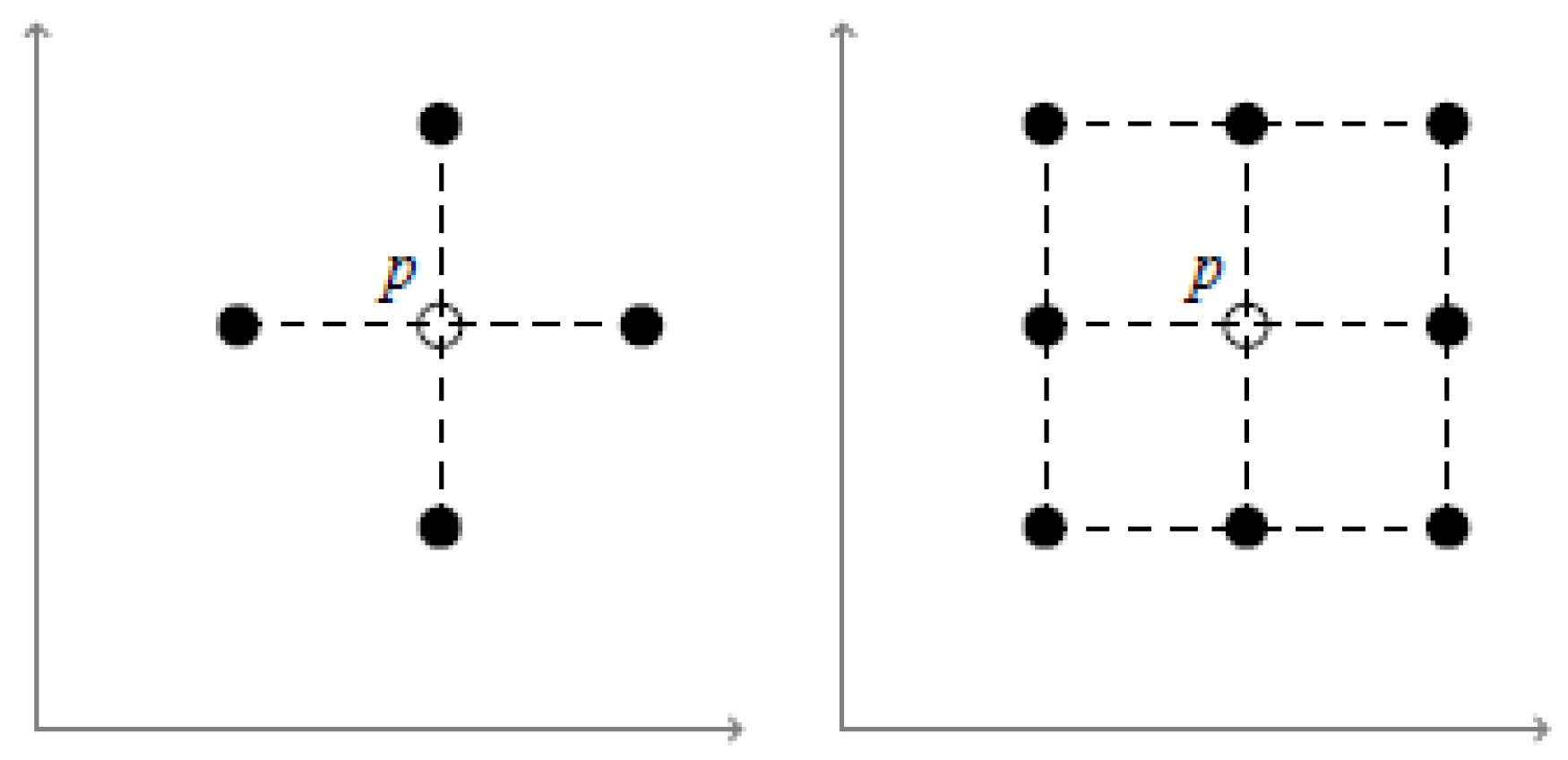
Let and be a set that equals the n-times product of . Supposing and and with . If there exist at most u indices i, such that and are consecutive integers and are otherwise equal, then we say a and b are -adjacent. In general, adjacency
is denoted by
, where
q is the number of points that are adjacent to a given point in
. As an example,
in
. Moreover in
,
and
are 4 and 8, respectively (see
Figure 1) [
6].
Consider a set X in with an adjacency relation on itself. Then, the pair is called a digital image.
Definition 2 ([
23]).
Let . In , given the two points and are adjacent if and only if any of the statements below holds:- (1)
, then and are -adjacent; or
- (2)
, then and are -adjacent; or
- (3)
and are -adjacent, and and are -adjacent.
Definition 3 ([
24]).
Let , be digital images and the be a digital map space that includes digital maps from A to B. For , we say that f and g are adjacent if and are -adjacent whenever and are -adjacent. For
, the set
is said to be a digital interval [
3].
Consider an adjacency relation
on
. Then, we say a digital image
X, which is a subset of
, is
-connected if and only if for every distinct points
, there exists a set
such that
,
and
and
are
-adjacent where
[
4].
Definition 4 ([
4]).
Let and be digital images. For a map , if for all -connected , is a -connected, then p is called to be -continuous. Definition 5 ([
25]).
Let be a digital image. is called a digital -path if it is -continuous. Consider that
and
are digital images. A function
is called
-isomorphism—and is denoted by
—if
p is one to one and onto
-continuous, and
is
-continuous [
7].
Definition 6 ([
4]).
Let , be digital images. Two -continuous map are called to be digitally -homotopic in B if there is and there exists a map that satisfies each of the statements below:- (1)
For all , and ;
- (2)
For all and every , is defined by , which is -continuous;
- (3)
For all and every , is defined by , which is -continuous.
Definition 7 ([
13]).
Let and be digital images where B is a -connected space. Then, we say is a digital bundle if the map is a -continuous surjection. B, E and p are called the base set, total set and the digital projection of the bundle, respectively. In addition, the digital fiber bundle of the bundle over t is defined by for every . Definition 8 ([
13]).
Let , and be digital images, where B is a connected space with -adjacency. Consider a surjection and a -continuous map . For a digital fiber set F, if there is a set that is -connected and p satisfies the statements below, then is a digital fiber bundle.- (1)
For each , is a -isomorphism
- (2)
For all , there is a -isomorphism that makes triangles below commutes:
In the following definition, the digital homotopy lifting property is given to define the digital fibration.
Definition 9 ([
15]).
Let i be an inclusion map and for any digital homotopy and any digital map with , where , and are digital images. Then, we say has the digital hlp with respect to if there is a digital -continuous map making the following triangles below commute: Definition 10 ([
15]).
For a digital map , p is called a digital fibration if it has the digital hlp with respect to each space . For , , it is called digital fiber. 3. Digital Fiber Homotopy
Fiber homotopy is an important topic in algebraic topology. In this section, we define digital fiber homotopy and its properties are proven. In addition, some new results about digital fibrations are given.
Definition 11. For a digital map , if and are two digital paths in A such that and implies that , then q has a digital unique path lifting property (upl).
Definition 12. Let and be three digital maps. Then, we say that f and g are digital fiber homotopic with respect to q, which is represented by , if there exists a digital homotopy such thatfor every and every . Here, K is called digital fiber homotopic between f and g. Example 1. Let be a digital map, and let be two digital maps that are digital homotopic to each other. If B is a singleton, then .
Example 2. Consider , and
. Let be defined bySuppose that satisfies the conditions below. Clearly, T is a digital homotopy.Let be defined by . Therefore, we obtainfor every and . As a result, we obtain f and g, which are fiber homotopic with respect to q. Definition 13. Let and be digital maps. If , then is called the digital fiber preserving map.
Definition 14. Let and be digital maps. If there are two digital maps and that are fiber preserving such that and , then we say and are digital fiber homotopic equivalent to each other. In addition, p and are said to be digital fiber homotopic equivalent.
Proposition 1. Let be a digital map. If and are two digital maps such that , then .
Proof. Let
. By assumption, for every
and every
, there exists a homotopy
such that
. Therefore,
As a result,
. □
Proposition 2. Digital fiber homotopy is an equivalence relation.
Proof. Consider the class .
If we choose such that , we have .
Thus, the symmetry property is clear.
Let
and
. From the hypothesis, for all
, there are two digital homotopies
G and
H satisfying the following:
By taking one of G and H as a homotopy, we have . □
Proposition 3. Let be a digital map. If and are digital maps such that , then .
Proof. As an assumption, there is a digital fiber homotopy
. Hence, we obtained
Let
be defined by
. Via the following equations,
we have
. Thus, we obtain
As a result,
. □
Proposition 4. Let be a digital map. The existing digital maps and are such that implies that .
Proof. Let
. Hence,
Let
be defined by
. As such, we have
This shows that
is digital fiber homotopic with respect to
. □
Proposition 5. Let and be digital maps. If and are digital maps such that and , then .
Proof. Let
and
. Then, we have the following:
We define
as
It is evident that
T is a digital homotopy from
to
. Using the digital fiber homotopy for
H and
K, we have the following equations. For
,
For
,
As a result, we have
. □
Definition 15. Let and be a digital image. A digital path space is defined as a set of digital paths that are from to Y and are denoted by . In addition, for a given digital map , is said to be a digital mapping path space.
Let be a digital fibration defined by , and let be a digital map. Suppose that is a digital fibration. Then, p is called a digital mapping path fibration of f, if it is induced from by f. There exists a section map from X to that is defined by . Here, is a constant path in Y at . Consider a digital map that is defined by .
Proposition 6. Let be a digital map. Let and s be defined as before. Then, there exists a commutative diagram satisfying the following: i.,
ii. is a digital fibration.
Proof. i. Consider
to be defined by
, where
Since
,
, then—via the definition of
,
—we have
. Moreover, we also have
,
,
.
ii. Let
and
be maps such that
for
. That is to say that the diagram below is commutative.
There are two digital maps
and
such that
Now, we define a lifting function
by
, where
is defined by
For
,
For
,
Thus, we have
.
For fiber homotopy, if
, then
If
, then
Hence,
, and we thus conclude that
is a digital fibration. □
Definition 16. Let and be digital maps. The digital fiber product of and E is known as , and it is defined byIt should be noted there exist two digital maps and that are defined by and , respectively. In category theory, , and are characterized as the digital product of f and p. Here, continuous maps with a range B are objects of category, and they are also morphisms of the below category commute triangle: As such, we have the following properties.
Proposition 7. Consider the above definition.
- i.
If p is injective (or surjective), then is injective (or surjective).
- ii.
Then, a digital trivial fibration from to and are digital fiber homotopic equivalent to each other, if is a digital trivial fibration.
- iii.
If p is a digital fibration (wupl), then so is .
- iv.
Suppose p is a digital fibration, then has a section if and only if f can be lifted to E.
Proof. i. Let and . Suppose that p is injective. Let . By the definition of , , . If , then .
Therefore, we have
. From the fact that
p is injective, we obtain
. As a result,
is injective. Assume that
p is surjective, then we have
From
, we can conclude that
f is surjective. For all
, there exists
such that
. Therefore,
and
. Then,
is surjective.
ii. Let
and
be defined by
. In this case, we have
and
. Let
s and
be digital maps defined by
and
. Our aim is then to show that the following diagram is commutative:
As a result,
and
are fiber homotopic equivalent.
iii. Let p be a digital fibration with a unique path lifting property. For the given digital paths , and , it implies that . Let and be defined by and , where is chosen arbitrarily.
Let
and
, then we have
Thus,
.
iv. Assume that
f can be lifted to
E, then we have
.
If
, then
. Since
is lifting,
. Consider the digital map
, which is defined by
. For
, we have
Conversely, assume that
is a section of
. Let
be defined by
. For all
, we have
Therefore, we can conclude that
f can be lifted. □
4. h-Fibrations
It is known that the homotopy lifting property is not an invariant under a fiber homotopic equivalence. Even if a digital map is digital fiber homotopic to a digital fibration, it does not have to be a digital fibration. Hence, we defined digital h-fibrations and provide its relation to fiber homotopic equivalence.
Definition 17. Let and i be an inclusion map for every digital map and digital homotopy with , where , and are digital images. Then, we say has a digital weak hlp with respect to if there is a digital -continuous map that satisfies and .
Definition 18. If p has a weak hlp with respect to every space , then it is called a digital h-fibration.
Example 3. Let B be a singleton digital image. For any digital map , we would like to show that there exists a digital continuous map that satisfies the definition of an h-fibration. If we choose , then we obtain as follows: By using Example 1, we have . Thus, p is a digital h-fibration.
Proposition 8. Let p and q be two digital h-fibrations. Then, is a digital h-fibration.
Proof. Via the assumption, for every digital homotopy
and every digital map
, there exists a digital homotopy
such that
Similarly, for every digital homotopy
and every digital map
, there is a digital homotopy
such that
We take
. Thus, we have
and the following diagram.
Now, we define
. Via Proposition 1, we have
. Moreover,
Therefore, we obtain
. □
Proposition 9. Let and be two digital h-fibrations. Then, is a digital h-fibration.
Proof. For the given assumption, the following hold.
Consider the digital continuous map
Let
. Thus, we obtain a commutative diagram.
For
, we obtain
For
, we conclude that
Therefore, we have
. From Proposition 5, we know
Thus,
is a digital
h-fibration. □
Theorem 1. Let p be a digital map. Then, the following are equivalent.
- i.
A digital fibration and p are fiber homotopic equivalent.
- ii.
p is a digital h-fibration.
Proof. Let
, and let
be a digital fibration. From the assumption, there exists
and
such that
and
, as well as
and
.
Consider a digital map
. Since
is digital fibration, there is a digital map
such that
and
.
If we choose
and
F such that
, then we have
.
We took
. Thus,
As a consequence,
p is a digital
h-fibration.
Conversely, let
p be a digital
h-fibration. Via Proposition 6, we know
is a digital fibration that is defined by
, where
Let
be a projection map and
be defined by
. Then,
Via the hypothesis,
p is a digital
h-fibration, then
and
. Note that
. Consider two maps
and
, which are defined by
and
. Therefore,
By the fact that
, we find
. Thus, the following diagram commutes.
We want to see and . For , let be defined by . Since ,
,
,
.
Then, we obtain
. Thus,
From the definition of digital fiber homotopy,
.
Define
such that
.
Hence,
. In addition, we have
The above equalities imply that
. Since
and
, we have
.
Now, it is enough to see
. Let
be a digital homotopy defined by
, where for every
, we have
because
H is a digital homotopy. Furthermore,
Therefore,
. On the other hand,
Thus, we have
. Finally, we can consider that
is defined by
. Since
, we obtained
. Additionally, we obtained the following:
By the above equations, we found that
. Since
and
, we obtained
.
As a result, p is digital fiber homotopic equivalent to a digital fibration. □