
Article

A Story of Computational Science: Colonel Titus’ Problem from the 17th Century
Department of Informatics, University of Bergen, N-5020 Bergen, Norway
Axioms 2022, 11(6), 287; https://doi.org/10.3390/axioms11060287

Submission received: 21 April 2022 / Revised: 18 May 2022 / Accepted: 22 May 2022 / Published: 14 June 2022
(This article belongs to the Special Issue 10th Anniversary of Axioms: Logic)

Abstract

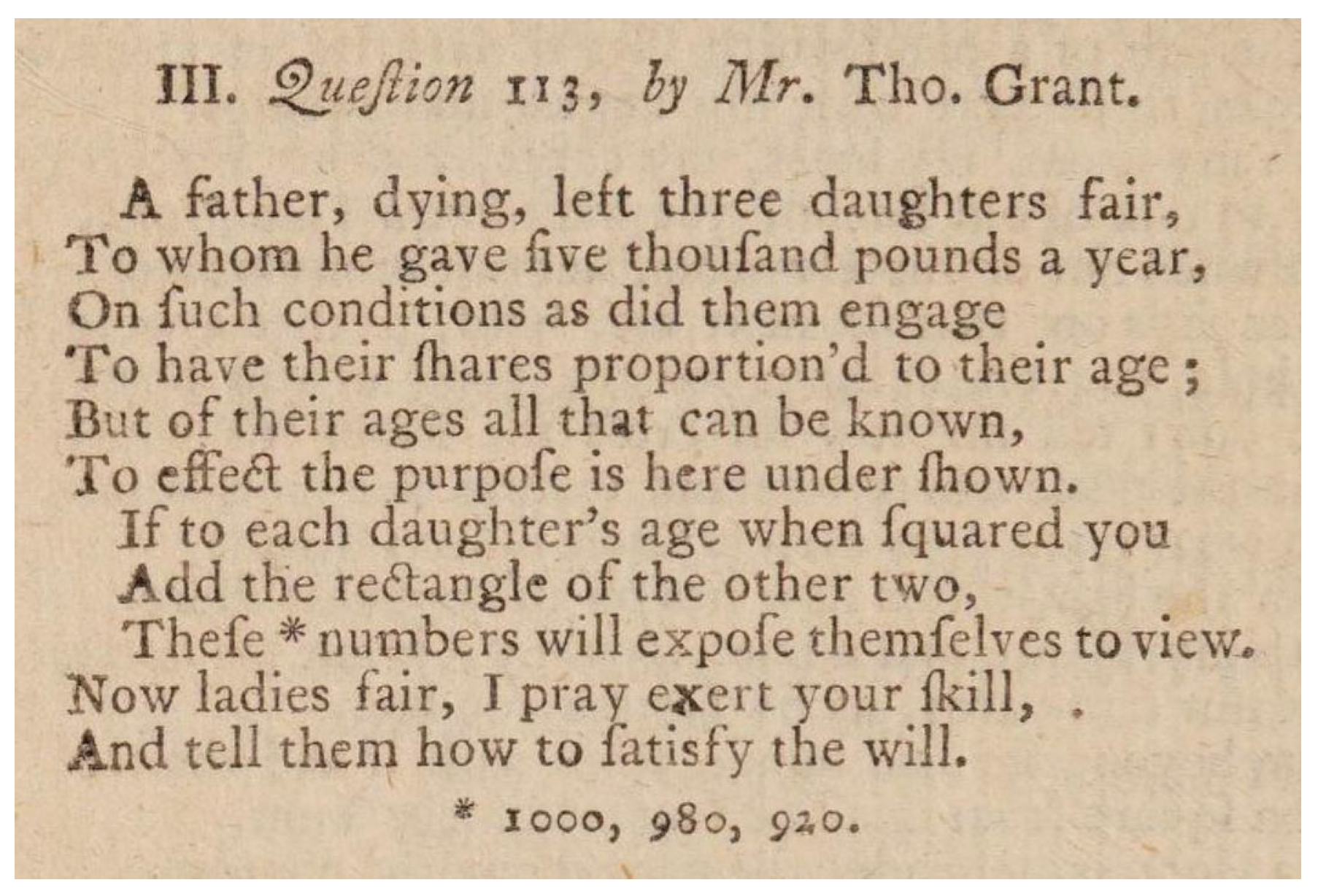
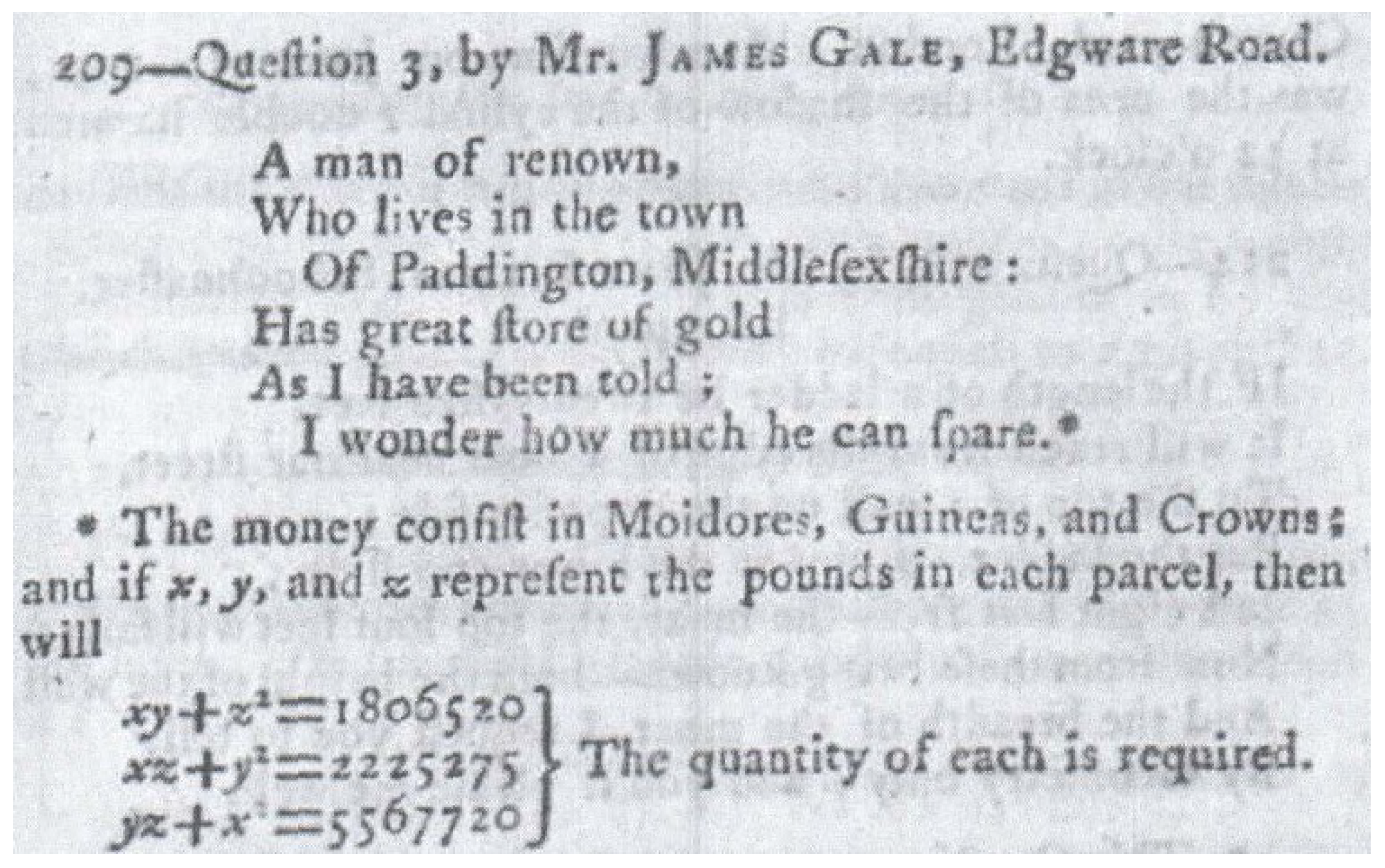
Experimentation and the evaluation of algorithms have a long history in algebra. In this paper we follow a single test example over more than 250 years. In 1685, John Wallis published A treatise of algebra, both historical and practical, containing a solution of Colonel Titus’ problem that was proposed to him around 1650. The Colonel Titus problem consists of three algebraic quadratic equations in three unknowns, which Wallis transformed into the problem of finding the roots of a fourth-order (quartic) polynomial. When Joseph Raphson published his method in 1690, he demonstrated the method on 32 algebraic equations and one of the examples was this quartic equation. Edmund Halley later used the same polynomial as an example for his new methods in 1694. Although Wallis used the method of Vietè, which is a digit–by–digit method, the more efficient methods of Halley and Raphson are clearly demonstrated in the works by Raphson and Halley. For more than 250 years the quartic equation has been used as an example in a wide range of solution methods for nonlinear equations. This paper provides an overview of the Colonel Titus problem and the equation first derived by Wallis. The quartic equation has four positive roots and the equation has been found to be very useful for analyzing the number of roots and finding intervals for the individual roots, in the Cardan–Ferrari direct approach for solving quartic equations, and in Sturm’s method of determining the number of real roots of an algebraic equation. The quartic equation, together with two other algebraic equations, have likely been the first set of test examples used to compare different iteration methods of solving algebraic equations.
Keywords: Vietè’s method; Newton–Raphson method; regula falsi method; testing of algorithms Vietè’s method; Newton–Raphson method; regula falsi method; testing of algorithms