Article

An Adaptive Three-Dimensional Improved Virtual Force Coverage Algorithm for Nodes in WSN
1
Electrical Engineering College, Guizhou University, Guiyang 550025, China
2
School of Computer Science and Engineering, South China University of Technology, Guangzhou 510006, China
3
Guizhou Provincial Key Laboratory of Internet + Intelligent Manufacturing, Guiyang 550025, China
*
Author to whom correspondence should be addressed.
Axioms 2022, 11(5), 199; https://doi.org/10.3390/axioms11050199

Submission received: 28 February 2022 / Revised: 18 April 2022 / Accepted: 22 April 2022 / Published: 24 April 2022
(This article belongs to the Special Issue Mathematical and Computational Applications)

Abstract

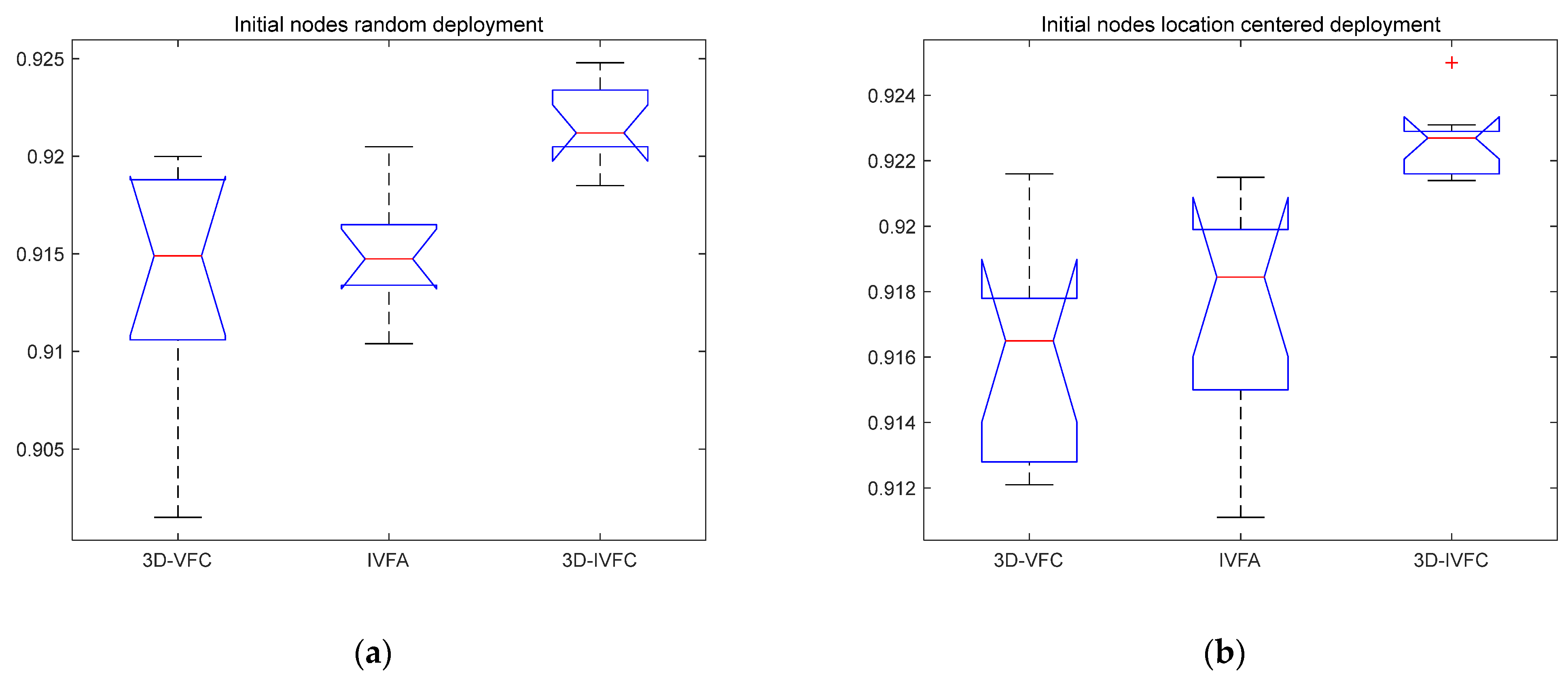
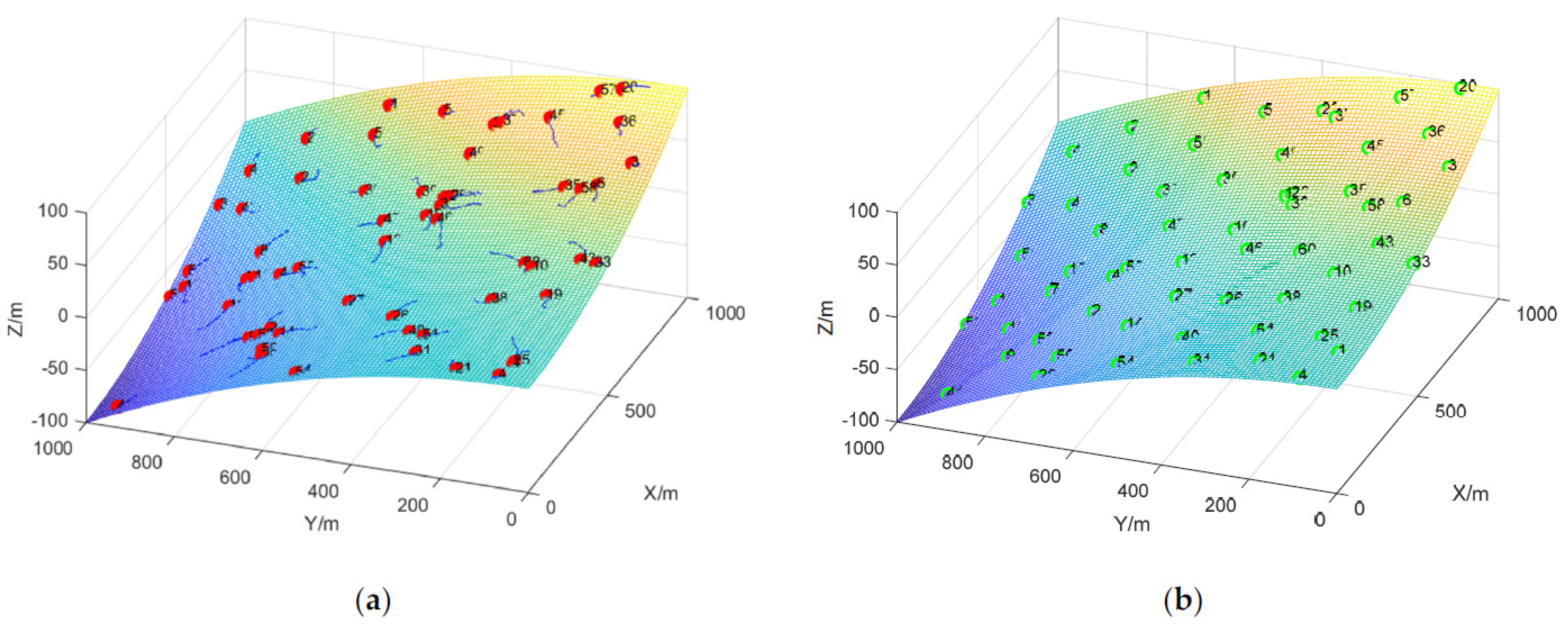
The original virtual force algorithm (VFA) is proposed for the two-dimensional node coverage and localization of wireless sensor networks (WSN). This work proposes a novel three-dimensional improved virtual force coverage (3D-IVFC) algorithm for the 3D coverage of nodes in WSN. Firstly, the node coverage theory is analyzed, which is about node coverage in three-dimensional space. Secondly, an improved three-dimensional space virtual force coverage method is proposed with an adaptive virtual force parameter control strategy. Finally, simulation experiments are utilized to verify the performance of the 3D-IVFC approach. Experimental results show that during random initialization, the average coverage rate of the improved 3D space coverage algorithm was increased by 0.76% and the deployment time was reduced by 0.1712 s; during center initialization, the average coverage rate of the improved 3D space coverage algorithm was increased by 0.65% and the coverage time increased slightly. Moreover, the proposed method is also used to solve the three-dimensional surface node coverage of the WSN.
Keywords: wireless sensor network; 3D space coverage; three-dimensional improved virtual force coverage (3D-IVFC) algorithm; covering method; three-dimensional surface wireless sensor network; 3D space coverage; three-dimensional improved virtual force coverage (3D-IVFC) algorithm; covering method; three-dimensional surface