
Article

A Study of Improved Inversion Algorithms for Surface–Borehole Transient Electromagnetic Data Based on BFGS Method

College of Geophysics and Petroleum Resources, Yangtze University, Wuhan 430100, China
*
Author to whom correspondence should be addressed.
Minerals 2025, 15(12), 1279; https://doi.org/10.3390/min15121279
Submission received: 25 October 2025 / Revised: 28 November 2025 / Accepted: 2 December 2025 / Published: 4 December 2025
(This article belongs to the Special Issue Electromagnetic Inversion for Deep Ore Explorations)

Abstract

The surface–borehole transient electromagnetic method (TEM) employs surface-based transmission and downhole reception to collect electromagnetic data. This configuration offers distinct advantages over traditional TEM approaches by effectively attenuating surface electromagnetic noise and cultural interference, leading to enhanced signal strength and vertical resolution. As a result, it has emerged as a key technique for the exploration of deep mineral resources. Although a relatively comprehensive three-dimensional (3D) theoretical system for surface–borehole TEM has been established, most existing studies remain focused on forward modelling, with inversion interpretation receiving comparatively limited attention. In this study, a one-dimensional (1D) inversion algorithm for surface–borehole TEM data is developed. The approach begins with forward modelling based on numerical simulation, followed by the integration of a prior model to formulate an objective function. Optimization is carried out using the Broyden–Fletcher–Goldfarb–Shanno (quasi-Newton) method. A parameter transformation approach was further applied to convert the constrained inversion into an unconstrained optimization problem. The effectiveness of the proposed algorithm is validated through inversions performed on synthetic data derived from theoretical models. This method offers a reliable interpretation tool for practical surface–borehole TEM applications and provides a theoretical basis for the design and optimization of related instrumentation.

1. Introduction

As a time-domain artificial source electromagnetic measurement technology, the TEM has proven to be of significant value in resource exploration. Its advantages include strong anti-interference capability, large detection depth, high vertical resolution, high sensitivity to low-resistivity targets, minimal volume effect, rapid data acquisition, and high operational efficiency [1]. Consequently, TEM has become one of the most commonly applied geophysical methods for deep mineral resource exploration. Traditional TEM surveys typically deploy both transmitting and receiving devices on the surface, which limits their ability to detect deep anomalies. This limitation arises from the weak electromagnetic signals at nano-volt levels and from restrictions imposed by instrument performance, such as signal-to-noise ratio, stability, and thermal endurance. To overcome these challenges, the surface–borehole TEM has emerged as an effective alternative. By placing the receiver in an existing borehole, surface–borehole TEM significantly reduces the distance between the receiver and the target anomaly, thereby enhancing signal strength and improving detection sensitivity and inversion resolution [2].
The surface–borehole TEM was first proposed in the 1970s and developed rapidly in the following decade [3,4,5]. It has since been widely adopted in countries such as Canada [6]. Duncan [7] pioneered its use for deep subsurface interpretation, while Karlsson and Sternberg introduced the concept of borehole receivers, which attracted extensive research attention across North America and Europe [8]. Cull et al. [9] further advanced the method by developing noise reduction techniques for three-component borehole probes, accelerating both its technological and practical applications. Hu et al. [10] investigated its forward modeling and data processing, while Zhang et al. [11] conducted successful field experiments in the Tonglushan and Huangshanling mining areas, detecting deep ore bodies and confirming the potential of surface–borehole TEM for deep resource exploration. Due to its high sensitivity to conductors near boreholes and its strong resistance to surface and anthropogenic noise, surface–borehole TEM has become a valuable tool in deep mineral prospecting and geological structure delineation [12].
In recent years, significant progress has been made in the numerical simulation and inversion interpretation of the surface–borehole TEM. Aziz et al. [13] demonstrated its great potential for reservoir monitoring. Meng et al. [14,15] employed the finite difference method to analyze the influence of low-resistivity overburden on anomaly responses, providing theoretical guidance for practical exploration. Kozhevnikov et al. [16] examined the effects of borehole metal casing on TEM responses. Subsequent studies further explored three-component field characteristics, electromagnetic diffusion behavior, overburden and terrain effects, optimized transmission waveforms, and anisotropy sensitivity [17,18,19,20,21,22,23,24]. Collectively, these investigations have confirmed the high spatial resolution and deep detection capability of surface–borehole TEM, laying a solid foundation for advanced inversion research and practical application.
In the field of surface–borehole TEM inversion, several approaches have been proposed to enhance data interpretation accuracy and computational efficiency. Researchers from Jilin University developed a non-structural finite element-based inversion strategy that integrates surface electromagnetic data using a dual-mesh scheme, effectively improving inversion efficiency and precision [25]. Su et al. [10] applied Occam’s inversion to analyze surface–borehole TEM response characteristics in 1D electromagnetic models, while Yang et al. [26] demonstrated its utility in hydrogeological and goaf surveys. At present, the theoretical system of the surface–borehole TEM and research on 3D methods are relatively mature. However, existing studies are limited to research on forward simulation, and few studies have focused on inversion interpretation [27]. Additionally, the current TEM inversion is mostly concentrated on ground methods, and there are few applications of surface–borehole TEM inversion methods. To the best of our knowledge, there is no open source code due to low computational efficiency and lack of applicability.
Given that 1D inversion provides a balance between interpretation speed and accuracy, it serves as an essential step for constructing initial reference models in 3D inversion and mitigating the non-uniqueness of inversion results, which is of great significance in data processing. Therefore, this study develops a BFGS-based inversion algorithm for surface–borehole TEM and applies it to inversion interpretation, aiming to improve the practicality and reliability of deep electromagnetic exploration.

2. Principal Theories of Surface–Borehole TEM

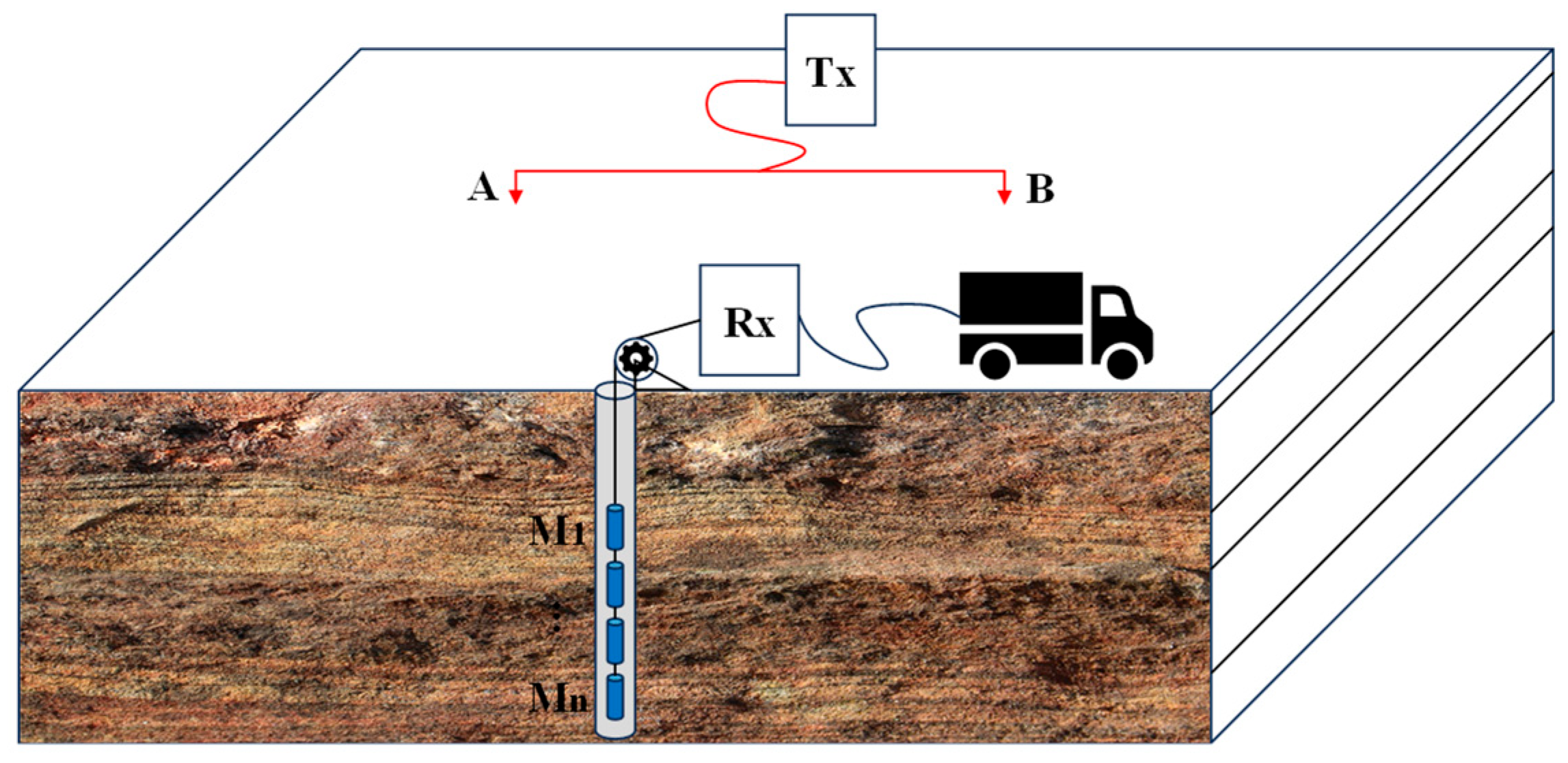
In the surface–borehole TEM method, the transmitting source—such as an ungrounded return line or a grounded electrode—is positioned above the borehole or near the surface to inject a bipolar pulse current, forming the primary electromagnetic field. The receiving probe is deployed within the borehole, where it measures the induced transient electromagnetic (secondary) field generated by subsurface geological structures at multiple depth points along the borehole or wellbore. A schematic diagram of the surface–borehole TEM configuration is shown in Figure 1. Tx denotes the grounded-wire transmitter and its associated instrumentation, whereas Rx refers to the receiving unit.

2.1. Basic Equations

It is assumed that the earth is linear and isotropic, the electrical properties of the medium are independent of time, temperature, and pressure, and the magnetic permeability of the medium is the magnetic permeability of free space. An N-layer horizontally stratified earth model, as illustrated in Figure 2, is established. The model parameters of each layer are defined by the depth of the upper boundary z p and the electrical conductivity σ p . Assuming a time-harmonic dependence of e i ω t , and introducing the magnetic vector potential A that satisfies the Coulomb gauge condition, the governing equations of the electromagnetic field can be written as follows [28]:
H = × A ,
E = i ω A 1 μ σ · A .
where i is the imaginary unit, ω is the angular frequency, and μ is the magnetic permeability. In surface–borehole TEM, if a horizontal electric dipole AB is oriented along the y-axis with its center located at (0, 0, 0) m, and the observation points are distributed either on the surface or within the borehole ( z 0 ), the components of the magnetic vector potential can be expressed as follows [29]:
A y r = 1 2 π 0 A ^ y λ ,   z J 0 λ r λ d λ ,
A z r = 1 2 π 0 A ^ z λ ,   z J 0 λ r λ d λ .
in which
A ^ y , p = a p e γ p ( z z p + 1 ) + b p e γ p ( z z p ) + δ p q μ 2 γ i e γ q z ,
A ^ z , p = c p e γ p ( z z p + 1 ) + d p e γ p ( z z p ) γ p λ 2 a p e γ p ( z z p + 1 ) b p e γ p ( z z p ) .
Here, λ denotes the wavenumber. z is the depth of the observation point. r is the horizontal offset. J 0 is the zeroth-order Bessel function of the first kind. δ represents the Dirac delta function. p is the layer index, which corresponds to the upper layer when the observation point lies on an interface, and q indicates the layer containing the source. For the source layer, the coefficients a , b , c , and d are given by
a q = e γ q z q + 1 + e γ q z q R q e γ q h q 1 R q μ 2 γ q ,
b q = R q e γ q z q + 1 + e γ q z q e γ q h q 1 R q μ 2 γ q ,
c q = ( e γ q z q + 1 + e γ q z q ) S q e γ q h q 1 S q μ 2 λ 2 ,
d q = S q e γ q z q + 1 + e γ q z q e γ q h q 1 S q μ 2 λ 2 .
where h q = z q + 1 z q is the layer thickness. R and S are the reflection coefficients for the transverse electric (TE) and transverse magnetic (TM) modes, respectively. At the top layer, R 1 = S 1 = 0 , and at the bottom layer, R N = S N = 0 . For intermediate layers, the recursive relations for the reflection coefficients are given as follows:
R p = r p + R p + 1 e γ p + 1 h p + 1 e γ p h p 1 + r p R p + 1 e γ p + 1 h p + 1 ,
S p = s p + S p + 1 e γ p + 1 h p + 1 e γ p h p 1 + s p S p + 1 e γ p + 1 h p + 1 .
in which
r p = γ q γ q + 1 γ q + γ q + 1 ,
s p = γ q σ q + 1 γ q + 1 σ q γ q σ q + 1 + γ q + 1 σ q ,
γ q 2 = λ 2 i ω μ σ q .
To ensure computational accuracy, 120-point Hankel and 140-point Hankel linear transform filters [30] are adopted. Based on Equations (1) and (2), the frequency-domain components of the electromagnetic field can be expressed as follows:
H x ω = I d s 2 π · F H T d A y d z λ J 0 λ r A z λ 3 s i n 2 θ J 0 λ r A z λ 2 c o s 2 θ J 1 λ r r ,
H y ω = s i n 2 θ I d s 4 π · F H T A z λ 3 J 0 λ r 2 A z λ 2 J 1 λ r r ,
H z ω = c o s θ I d s 2 π · F H T A y λ 2 J 1 λ r ,
E x ω = s i n 2 θ I d s 4 π μ 0 σ · F H T A y + d A z d z λ 3 J 0 λ r + 2 A y + d A z d z λ 2 J 1 λ r r ,
E y ω = I d s 2 π · F H T ω μ 0 2 A y λ J 0 λ r A y + d A z d z λ 3 s i n 2 θ 2 π μ 0 σ J 0 λ r A y + d A z d z λ 2 c o s 2 θ 2 π r μ 0 σ J 1 λ r ,
E z ω = s i n θ I d s 2 π ( σ i ω ε ) · F H T σ i ω μ 0 A z + d A y d z + d 2 A z d z 2 λ 2 μ 0 J 1 λ r .
in which
λ j = 1 ρ · 10 a + j 1 s ,   j = 1,2 , , 120   o r   140 .
I represents the magnitude of the current. d s is the dipole length. θ is the angle between the offset of the measurement point and the transmitter. ε is the dielectric constant. FHT stands for Fast Hankel Transform. a , and s are constants.
The time-domain response is obtained by cosine–sine transformation using a 250-point digital filter [31], expressed as follows:
f t = 1 t 2 π n = 149 100 R e a l F e n t / e n t · c s i n ( n ) ,
d f t d t = 1 t 2 π n = 149 100 R e a l F e n t · c c o s ( n ) .
where f represents the response in the time domain, and F represents the response in the frequency domain. t is the time. = l n ( 10 ) / 20 is the sampling interval. c s i n ( n ) and c c o s ( n ) are cosine and sine coefficients, respectively. It is noteworthy that the response when the stepping current is emitted can be calculated by subtracting Equations (13)–(18) from the response under direct current (DC) excitation ( ω = 0 Hz).
The surface–borehole TEM uses a grounded long wire to emit a stepping current. In actual applications, the length of the laid electric source can be hundreds of meters to several kilometers. When the difference between the electrode moment and the offset distance is small, and the receiver is close to the radiation source, the approximate condition of the electric dipole is not met. In this case, Equations (13)–(18) needed to be integrated along the direction of the wire. To ensure numerical accuracy, the Gaussian integral was used in this study [32]:
x m a x x m i n f x d x x m a x x m i n 2 i = 1 n A i   f x m i n + x m a x 2 + x m a x x m i n 2 x i .
where x m i n and x m a x are the upper and lower limits of the integration, i.e., the starting and ending coordinates of the long electrical wire. n is the number of integration nodes. A i is the integration coefficient. x i is the Gaussian integration node. The Gaussian integration coefficient with seventh-order accuracy was used.

2.2. Algorithm Verification

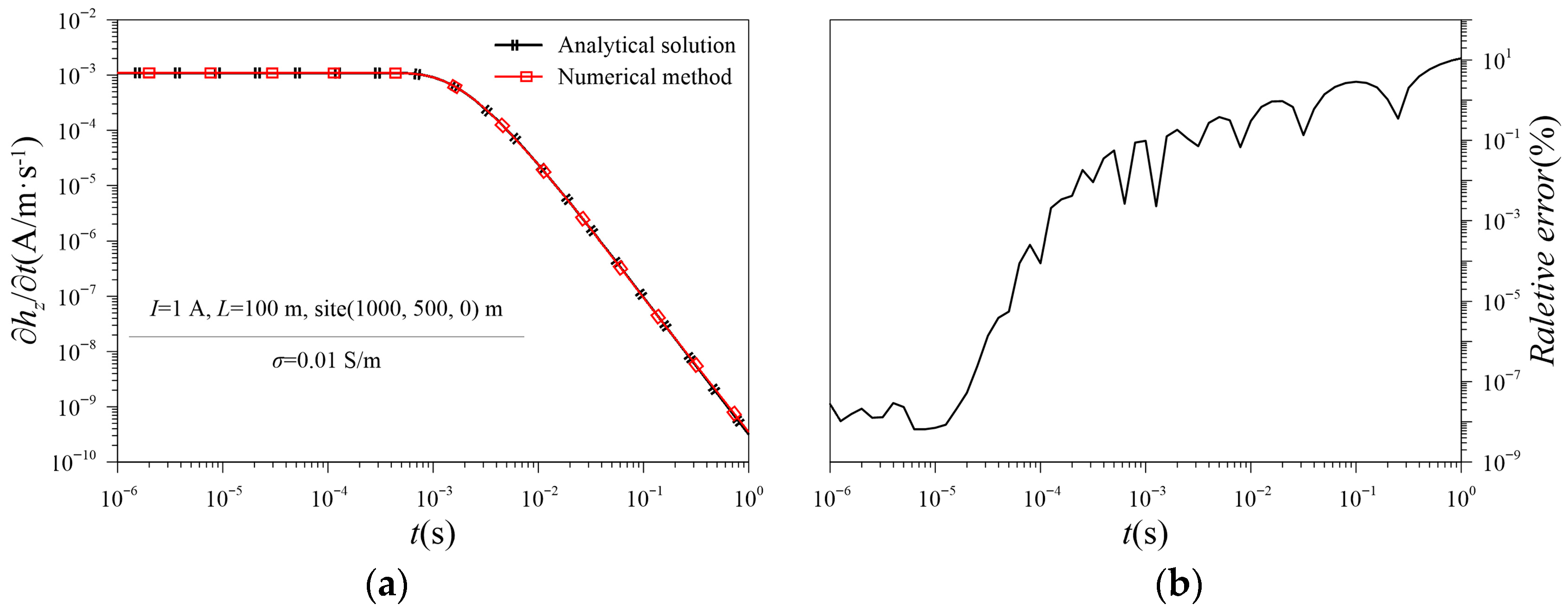
To verify the accuracy of the 1D forward modeling algorithm (i.e., numerical filtering), we utilized the analytical solution of the uniform half-space electric dipole response in the calculation. The time-domain response was calculated using the h z / t component as an example, and the calculation accuracy and error distribution were analyzed.
The resistivity of the uniform half-space model was set to 100 Ω∙m, and the stepping current was set to 1 A. The length of the dipole was 100 m, and it was arranged along the x-axis. The coordinates of the measuring point were (1000, 500, 0) m. At this time, the offset distance was much larger than the dipole moment, satisfying the point source assumption. As shown in Figure 3, the result of the numerical filtering algorithm is in good agreement with the analytical solution, with a relative error less than 0.1%, and it can calculate the response at the last 1 s.
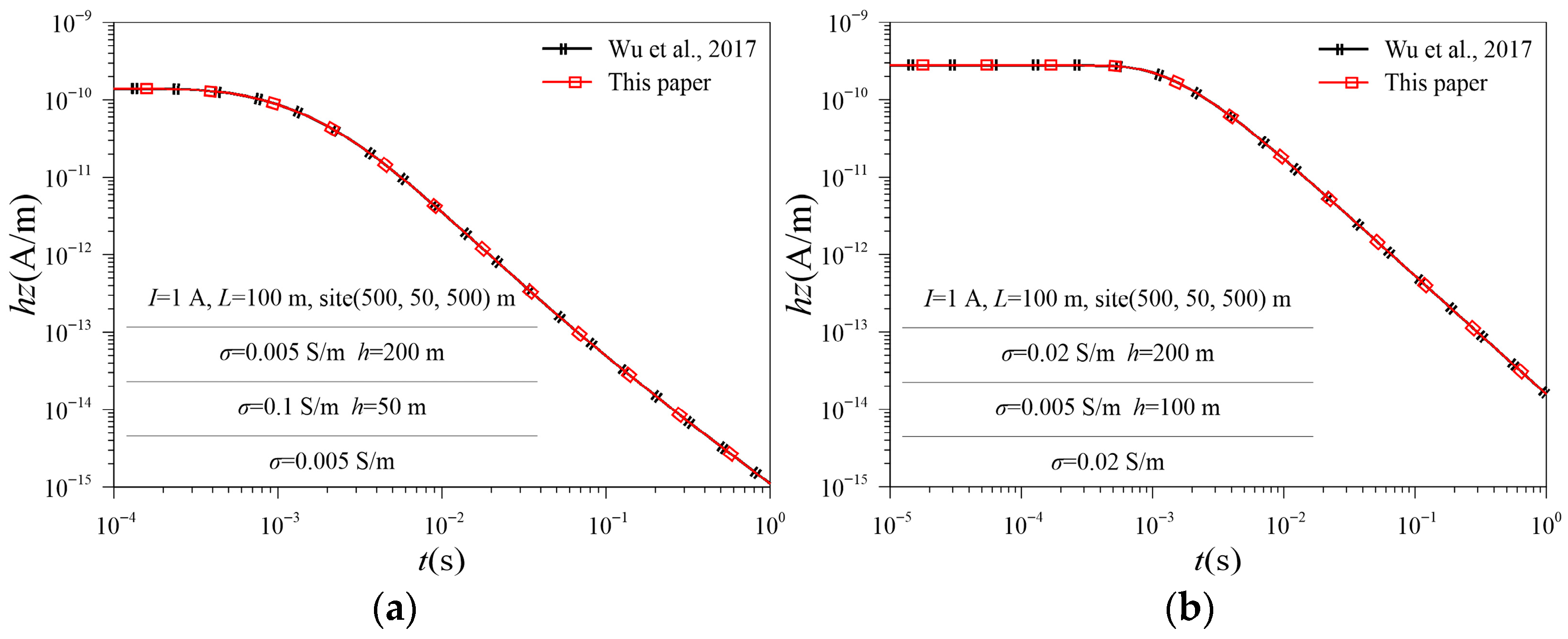
Subsequently, the calculated results obtained in this study were compared with those reported in previous literature. A layered model, shown in Figure 4, was established for this comparison. A transmitting source of length 100 m carrying a current of 1 A was aligned along the y-axis. A borehole was situated at coordinates (500, 50, 0) m, with observations taken at a depth of 500 m. The comparison shows that the results produced by the numerical filtering algorithm in this study are in good agreement with those obtained by Wu [33], thereby confirming the validity and reliability of the proposed method.

3. Inversion of Surface–Borehole TEM

3.1. Construction of Objective Function

The objective function consists of two parts [34]:
φ m = φ d d + α φ m m = C d d o b s d 2 2 + α C m m m 0 2 2 .
where φ d is the data fitting term. φ m is the model regularization term. α is the regularization factor, which functions to balance the data fitting term and the constraint term. The value of α is determined by the gradient adaptive condition during the iteration process. m is a vector of the model parameters. N m is the number of parameters. m 0 is the prior model. d o b s and d are the observation data and forward prediction data, respectively. C d is the data weighting matrix based on the observation data error. C m is the roughness matrix, which can be ignored in 1D inversion. In most Surface–Borehole TEM, a grounded long wire transmitter is used for transmission. The number of observation data in the borehole is N = N c × N d , where N c is the number of time channels, and N d is the number of measurement points.

3.2. Optimization Using BFGS Methods

Common BFGS methods include the Davidon–Fletcher–Powell (DFP) method, the Broyden–Fletcher–Goldfarb–Shanno (BFGS) method, and the limited-memory BFGS (L-BFGS) method. In practical applications, the choice of an appropriate BFGS-type algorithm depends on the specific characteristics and requirements of the inversion problem. The standard BFGS method is an unconstrained inversion approach characterized by superlinear convergence, high computational efficiency, broad applicability, and strong numerical stability. Compared with the classical Newton method, which requires direct computation of the Hessian matrix, the BFGS method offers lower computational complexity and reduced memory demand, making it widely used in geophysical inversion studies [35]. In this study, the BFGS algorithm is adopted to ensure both the convergence and computational efficiency of the surface–borehole TEM inversion.
In this paper, the BFGS method is employed to optimize the objective function. Based on information such as the gradient of the objective function, a positive definite matrix is used to approximate the inverse of the Hessian matrix, thereby simplifying the complexity of the operation. Then, the objective function is differentiated with respect to the model parameters m :
g m = φ m m = 2 J T C d T C d d o b s d + 2 α C d T C d m m 0 .
J is the sensitivity matrix, which has size N c × N m , and is the derivative of the forward response to the model parameters. It is solved using the interference method. Specifically, before the start of the k-th iteration, an increment m k is introduced to the model parameter, and the difference in the two forward results is
J k f o r w a r d m k f o r w a r d m k + m k m k m k .
In the process of the TEM inversion, prior geological information—such as drilling or well-logging data—can provide reasonable bounds for conductivity and resistivity parameters. This information is crucial for ensuring the convergence of the inversion process and for minimizing the occurrence of false anomalies. The traditional BFGS method is designed for unconstrained optimization problems. However, when constraints are required, the parameter ranges for resistivity and conductivity are first estimated using prior geological knowledge. The model parameters are then logarithmically transformed, and appropriate upper and lower bounds are applied to the physical parameters to guarantee the validity and stability of the inversion solution.
For the model parameters in the k-th inversion, the model parameters after adding constraints m k can be written as follows:
m k = l n ln m k a k ln b k m k , a k < m k < b k .
where a k and b k are the upper and lower limits, and m k ∈(−∞,+∞). The gradient of the objective function can be expressed as follows:
g m = φ m m m m = g m · m · l n b m · l n m b / l n b a .
By introducing new model parameters m , the constrained optimization problem is transformed into an unconstrained optimization problem. Thus, the model parameters updated by the BFGS algorithm can be expressed as follows:
m = e x p ln a + ln a exp m 1 + exp m .
It should be noted that when the model parameters approach their preset upper or lower limits, extreme values may occur during the gradient calculation process, potentially leading to instability or even failure of the inversion. To mitigate this issue, the permissible range of conductivity parameters should be set as wide as possible. This approach ensures a smoother inversion process and enhances the reliability of the final results.
After determining the search direction for the iteration, a variable (adaptive) step size is employed to ensure that the gradient is sufficiently reduced after each iteration. The step-size factor is defined as a positive real number. During the k-th iteration, the parameters are substituted into Equation (23) to compute the gradient of the objective function.
φ m k + 1 m k + 1 < φ m k m k .
If Equation (28) is satisfied, the current step size is considered appropriate, and the next iteration proceeds. Otherwise, the step size is reduced, and the process is repeated until the condition in Equation (28) is met.

4. Inversion Example

To obtain more comprehensive information about the electrical structure of the formation, the h z / t response signal was used to perform surface–borehole TEM 1D inversion [17] due to its sensitivity to resistivity differences [36]. A 5% Gaussian noise was added to the observation data. In the study, the upper and lower limits of the conductivity were set to 10 S/m and 0.0001 S/m, respectively. The long wire transmitter emitted a stepping current of 1 A. The initial regularization factor α was set to 1.0. To avoid negative values of the model parameters, the initial step size was set to 0.1. When the root mean square (RMS) error of two consecutive iterations decreased slowly, the constraint of the current regularization factor α was too strong, and the regularization factor was updated using Equation (29).
α = E q · g d m / g m m ,
where g d m is the gradient of φ d d ; g m m is the gradient of φ m m ; and the empirical parameter E q is equal to 0.2 [37].
The RMS is calculated as follows:
R M S = d F ( m ) T C d T C d d F ( m ) N ,

4.1. Layered Geoelectric Model

First, the accuracy and effectiveness of the 1D inversion algorithm were verified using a layered model. The model parameters are presented in Table 1. The grounded long wire transmitter was oriented along the x-axis and was 100 m long. The geometric center was located at the origin of the coordinate system. The coordinates of the wellbore were (100, 400) m. The measuring point was located at a depth of 400 m in the borehole. The initial models of all of the inversions were uniform half-space models with a resistivity of 50 Ω·m. In this study, the model calculations were performed on a laptop with a Core i5-10300M processor (2.50 GHz).
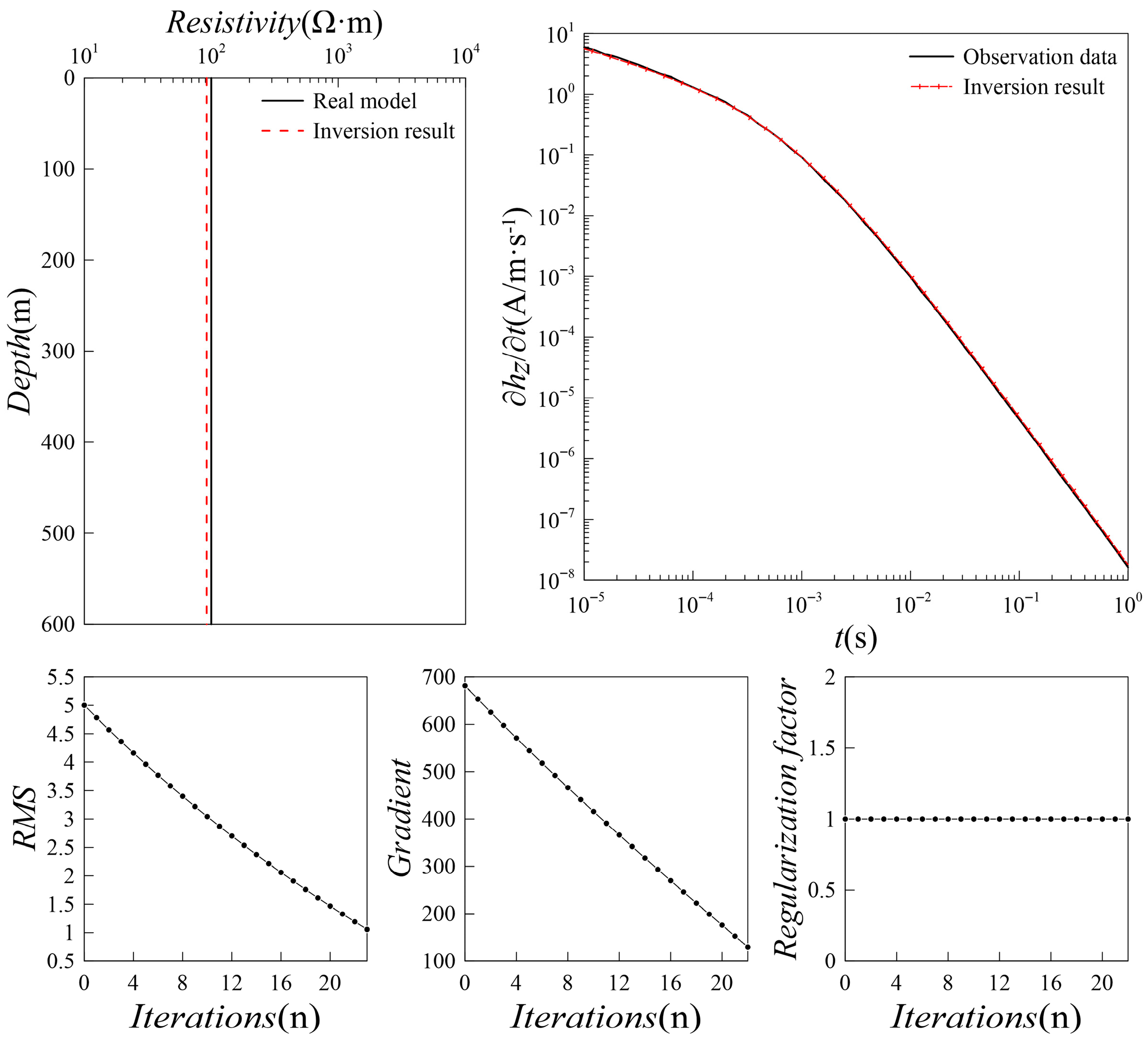
Figure 5 shows the inversion result of the uniform half-space. The RMS is 1.05576, and the objective function gradient g m is equal to 1.29573 × 10². The forward response obtained from the inversion result is consistent with the observation data.
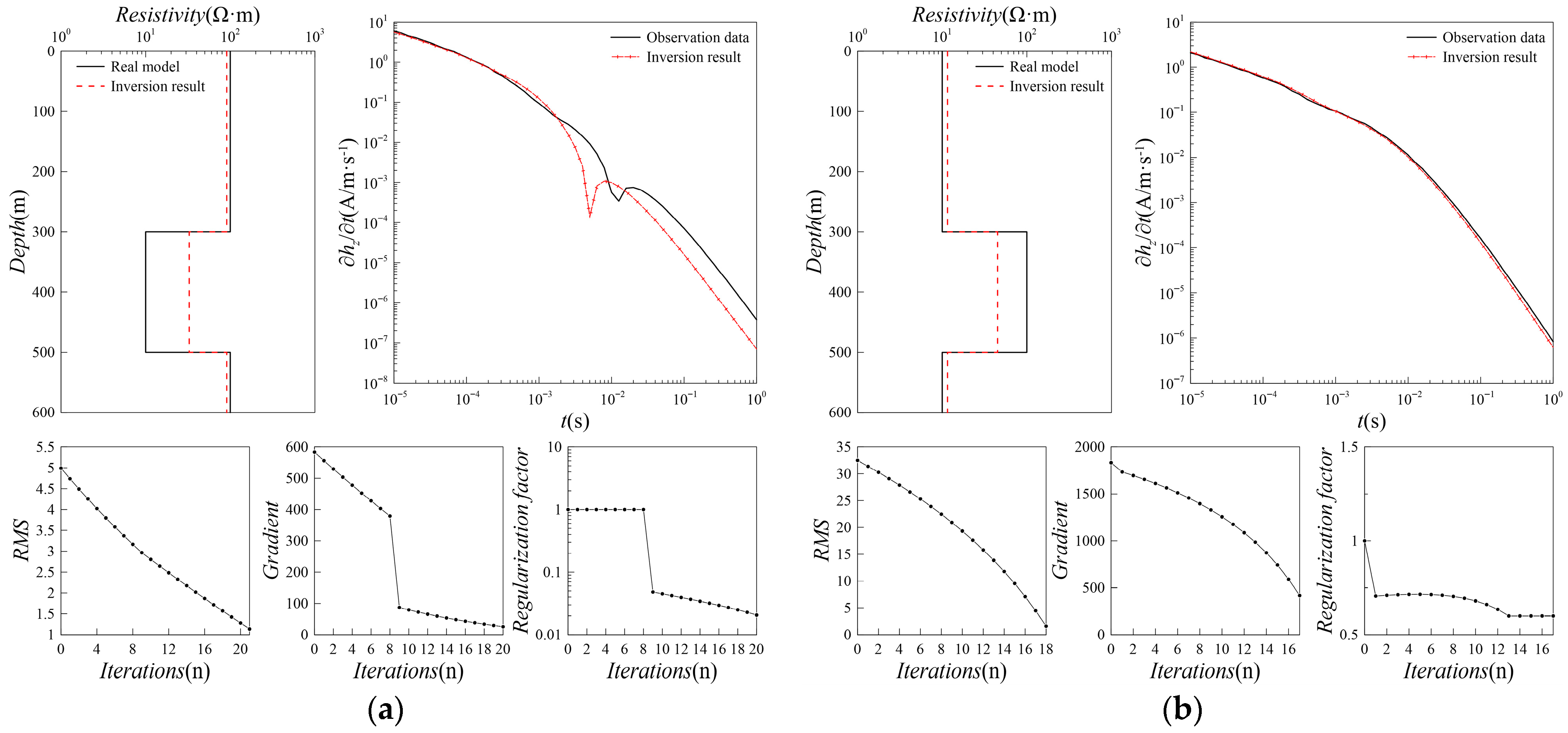
Figure 6 and Table 2 present the inversion results for the three-layer geoelectric model. It can be observed that the results of the three-layer geoelectric models closely approximate the true model. During the inversion process, both the RMS error and the objective function gradient decrease rapidly in the early iterations. At this stage, the regularization factor α is relatively large, and the inversion is primarily controlled by the model-fitting term, causing the result to converge toward the prior model. As the iterations proceed, α is gradually reduced to balance the contributions of the model and data-fitting terms. In this later stage, the inversion becomes mainly dominated by the data-fitting term, leading the results to converge toward the observed data and bringing the RMS error within an acceptable range.

4.2. Complex Geoelectric Model

To evaluate the performance of the proposed algorithm when applied to complex geological structures, a complex geoelectric model was constructed, as shown in Table 3. To ensure sufficient signal strength at the receiver, a 1000 m grounded long-wire transmitter was employed. The borehole was located at the coordinates (500, 50) m, and the measurement point was positioned at a depth of 400 m within the borehole.
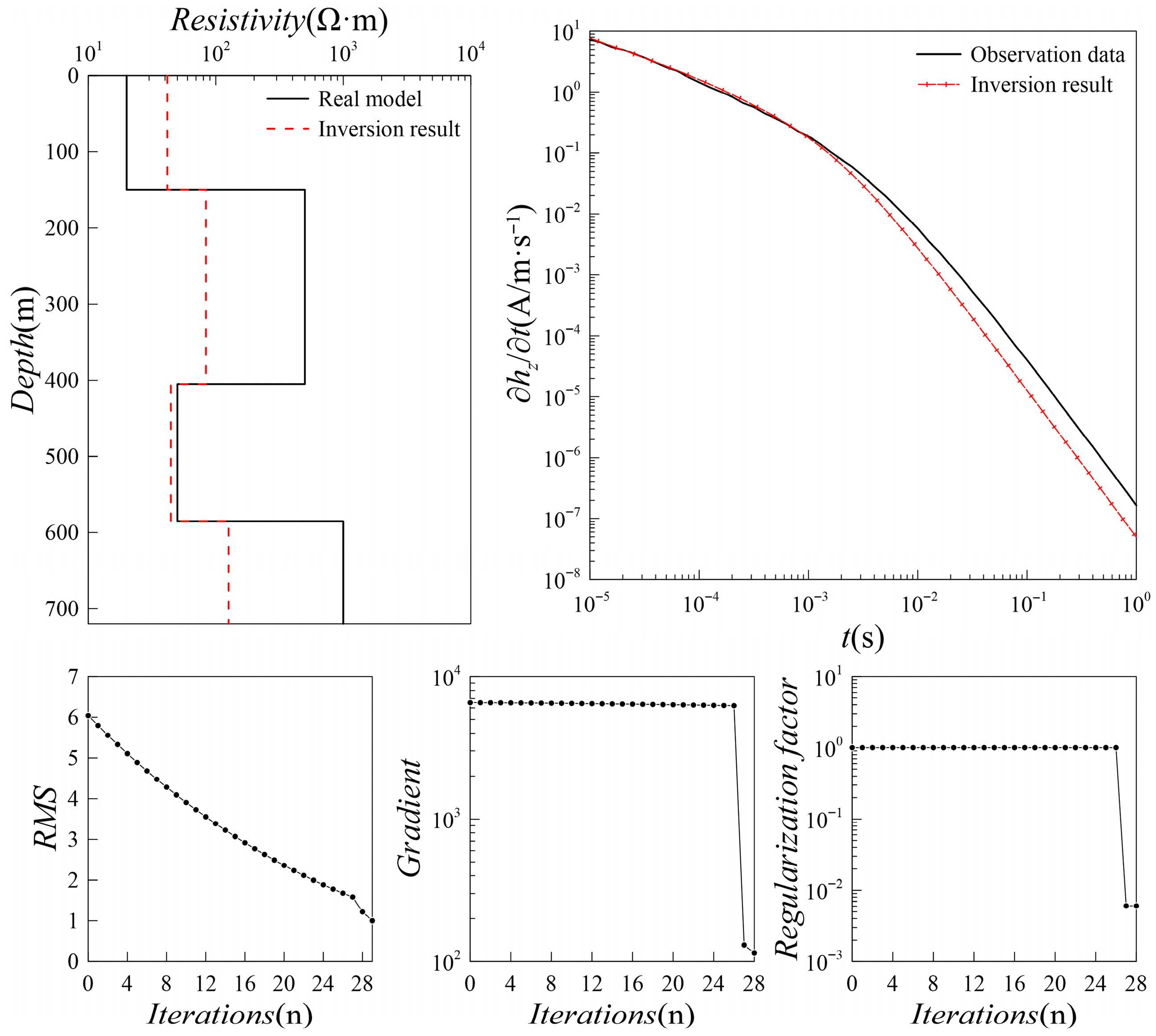
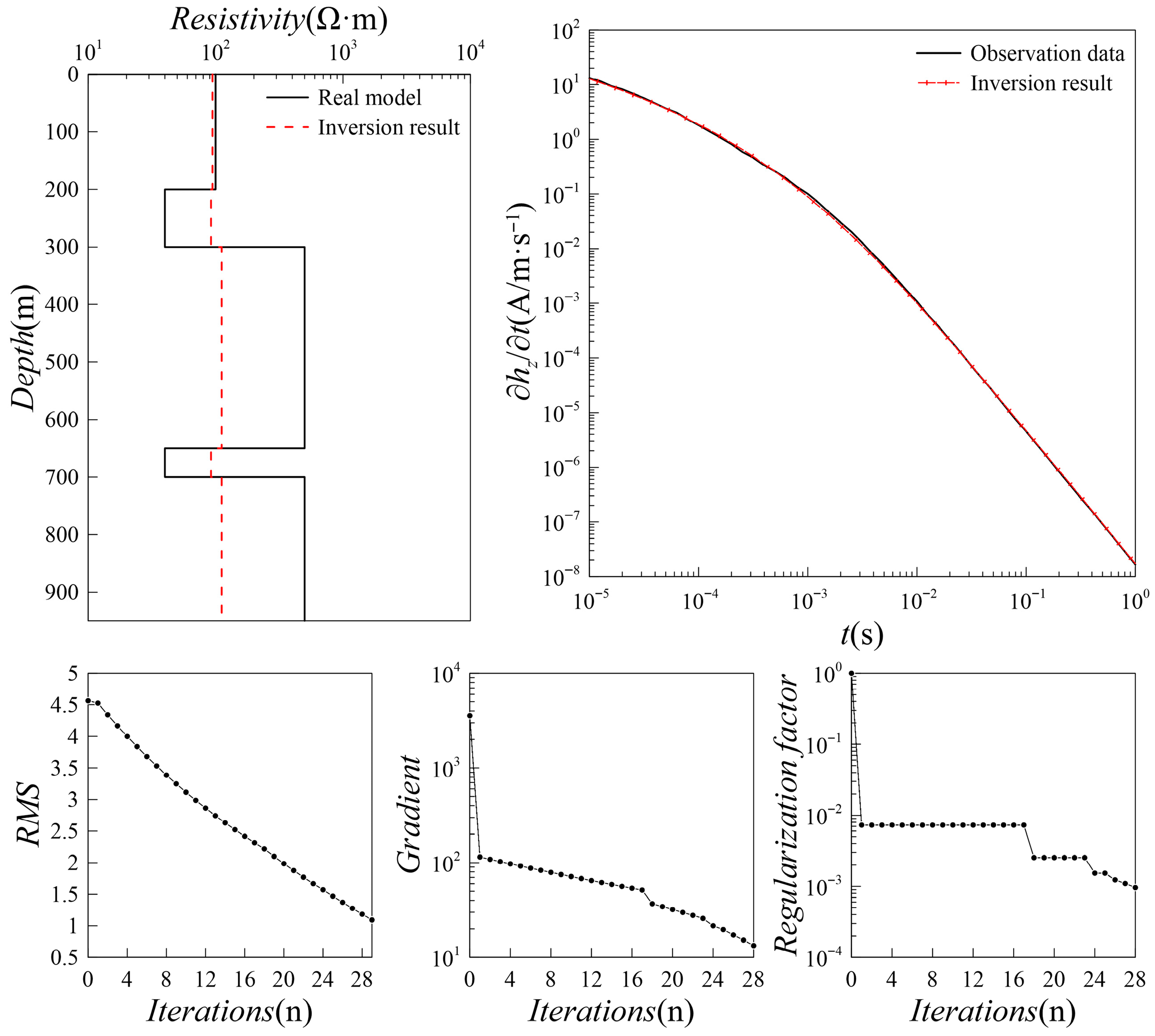
As shown in Figure 7 and Figure 8, the inversion results of the complex geoelectric model indicate that the h z / t response at the measuring point in the borehole cannot be effectively distinguished, regardless of the thickness of the low-resistivity layers, which leads to ambiguity in the inversion results.
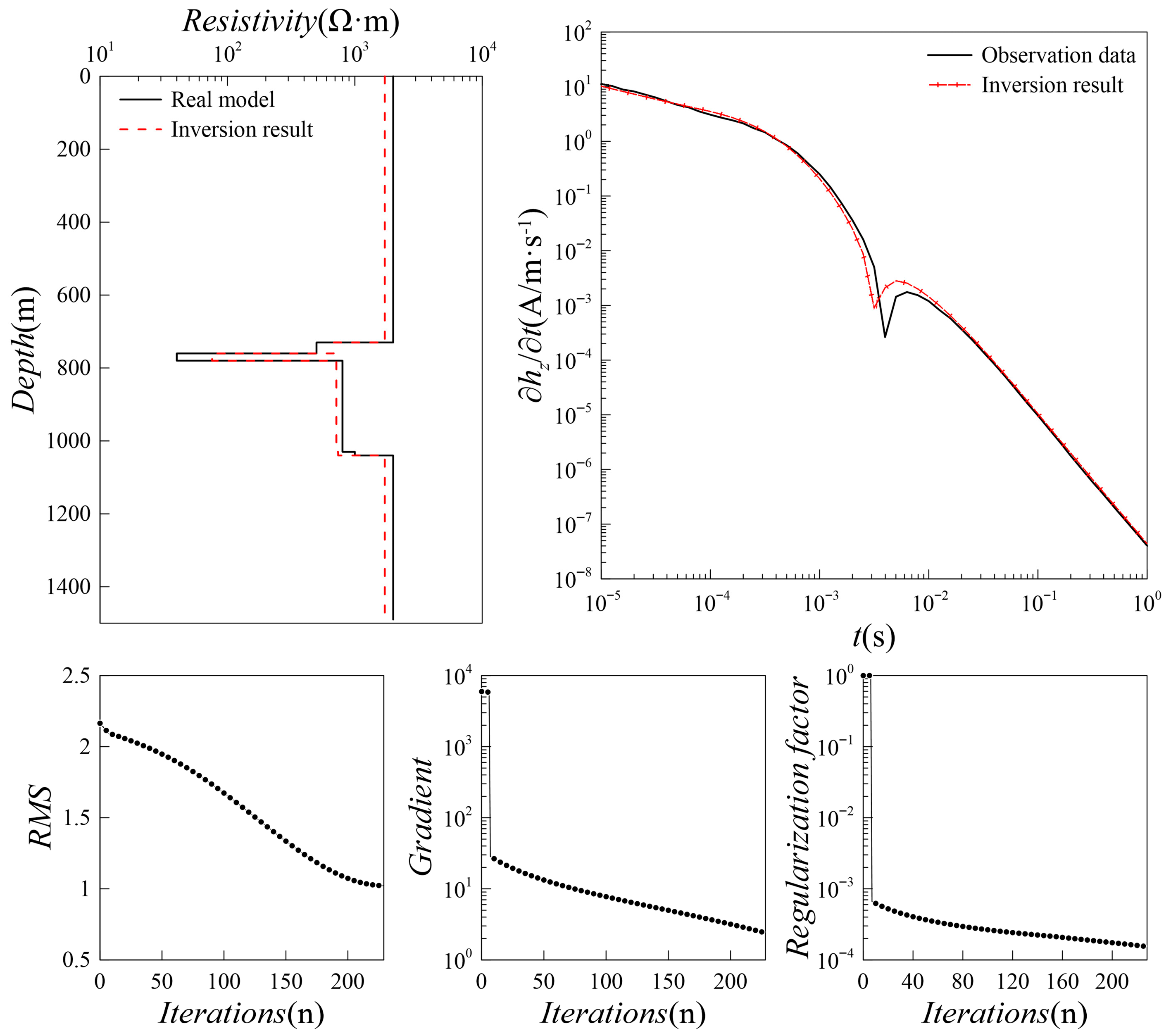
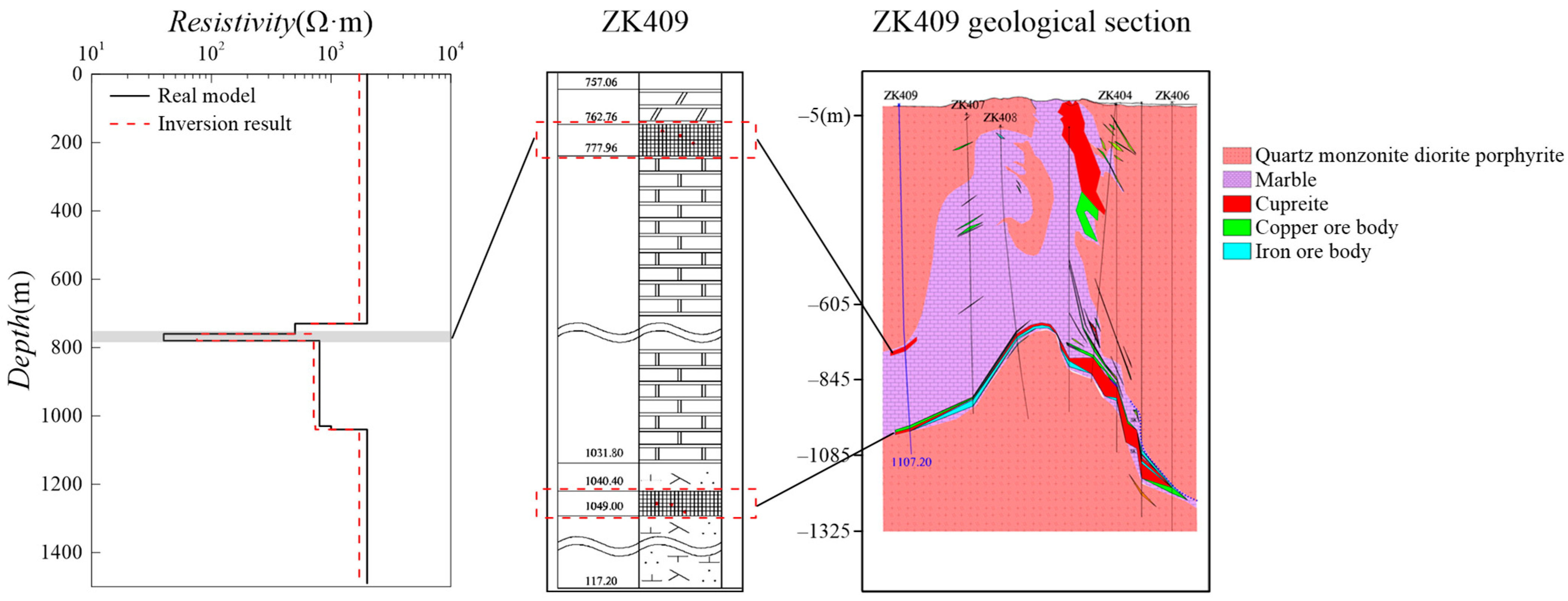
Table 4 presents the borehole geological model from borehole ZK409 in the Tonglushan mining district, located in Daye City, Huangshi, Hubei Province, China. This area features typical skarn-type copper–iron deposits, including a mineralised metallic ore layer approximately 20 m thick between depths of 760 and 780 m. Table 4 outlines the lithological and electrical properties of each stratigraphic unit. Based on this geological framework, a forward model was established to simulate the corresponding electromagnetic response. In this model, the receiver was placed inside the borehole at a depth of 800 m.
As shown in Figure 9, the inversion results obtained from the borehole-model-based forward data are compared with the geological profile in Figure 10. The comparison demonstrates that the proposed algorithm accurately reconstructs the copper–iron ore layer, which is approximately 20 m thick and located at a depth of about 760 m. However, for the deeper ore body situated near 1050 m depth with a thickness of only 10 m, the 1D inversion fails to clearly resolve the target. This limitation underscores the inherent challenge in detecting thin, deeply buried conductive layers using conventional 1D inversion methods.
Table 5 presents the inversion results of the complex geoelectric model. The variation of the regularization factor α with the number of iterations indicates that, in the later stages of the inversion, as the difference between the inverted model and the true model gradually decreases, the data-fitting term in the objective function (defined by Equation (22)) correspondingly diminishes. At this stage, the inversion results become stable and closely approximate the true formation model.

5. Discussion

The results above indicate that, due to the attenuation effects of the h z / t response intensity, the 1D inversion algorithm for surface–borehole TEM data exhibits notable limitations in accurately resolving deep, thin-layer ore bodies. Consequently, the inversion process depends strongly on prior model constraints during the early stages of iteration. As the gradient of the objective function converges rapidly, the BFGS method determines the convergence direction. Once the regularization factor α is sufficiently reduced, the inversion result converges toward the direction that minimizes the data misfit. The examples presented above demonstrate that incorporating high-quality prior information about the subsurface electrical structure effectively reduces the likelihood of non-unique solutions, thereby improving the reliability and success of the inversion.

6. Results

In this study, a numerical filtering algorithm was first applied to perform 1D forward modeling of surface–borehole TEM data. An objective function was constructed incorporating both observed data and prior model information. The BFGS method was employed to approximate the Hessian matrix, combined with adaptive step size control and parameter transformation, to constrain model parameters and accomplish the inversion of surface–borehole TEM. The proposed algorithm was validated using three representative models—a uniform half-space, a typical layered geoelectric structure, and a complex multi-layer geoelectric model—to verify its effectiveness. The principal findings are summarized as follows:
  • The proposed algorithm effectively recovers the original formation model. Even in the presence of noise or irregularities in the observed data, the BFGS method yields stable and reliable solutions. Furthermore, selecting an appropriate number of model layers significantly reduces inversion time and improves computational efficiency.
  • During the iterative process, the choice of a suitable regularization factor and the balance between data and model weights help prevent overfitting and reduce the required number of iterations. In addition, step size optimization further enhances computational performance.
  • In formations with complex electrical structures, incorporating high-quality prior information from borehole data substantially mitigates the risk of non-unique solutions and improves inversion stability.
Compared with conventional surface-based TEM array systems, surface–borehole TEM faces challenges such as limited measurement geometry and low data dimensionality. Nevertheless, the inversion algorithm developed in this study efficiently extracts key information on subsurface electrical structure, providing a valuable reference for constructing 3D surface–borehole geoelectric models. However, the practical performance of the algorithm requires further assessment, particularly in terms of resolution limits, the selection of iterative methods, and the optimization of regularization factors and step sizes, as well as the influence of anisotropy.
To further improve the performance of BFGS-based inversion, it may be integrated with other optimization strategies—such as line search, trust-region methods, the Armijo criterion, or regularized step constraints. For example, combining BFGS with global optimization techniques could increase the likelihood of locating the global optimum, while integration with constrained approaches may enhance convergence stability under model restrictions. A key direction for future research is to extend the inversion framework from single-depth data to multi-depth borehole measurements, particularly by addressing challenges related to depth-dependent sensitivity, signal attenuation, and appropriate data weighting.

Author Contributions

Conceptualization, H.L.; methodology, H.L.; software, H.L.; validation, H.L. and Y.M.; formal analysis, Y.M.; investigation, H.L.; resources, L.Y.; data curation, Y.M.; writing—original draft preparation, H.L.; writing—review and editing, Y.M.; visualization, L.Z. and X.X.; supervision, L.Z. and X.X.; project administration, L.Y.; funding acquisition, L.Z. and X.X. All authors have read and agreed to the published version of the manuscript.

Funding

This research was funded by the National Natural Science Foundation of China, grant numbers 42374091, 42274103, and 42474117.

Data Availability Statement

The original contributions presented in this study are included in the article. Further inquiries can be directed to the corresponding author.

Conflicts of Interest

The authors declare that they have no competing interests or other interests that might be perceived to have influenced the results and/or discussion reported in this paper.

References

  1. Kaufman, A.A.; Keller, G.V. Frequency and Time Domain Electromagnetic Sounding; Wang, J.M., Translator; Geological Publishing House: Beijing, China, 1987. [Google Scholar]
  2. Zhang, M.S. Deep transient electromagnetic sounding. Seismol. Geol. 1989, 11, 77–83. [Google Scholar]
  3. Eadie, T.; Staltari, G. Introduction of down hole electromagnetic methods. Explor. Geophys. 1987, 18, 247–254. [Google Scholar]
  4. Fullagar, P.K. Inversion of down hole TEM data using circular current filaments. Explor. Geophys. 1987, 18, 341–344. [Google Scholar]
  5. Mogi, T.; Kusunoki, K.; Kaieda, H.; Ito, H.; Jomori, A.; Jomori, N.; Yuuki, Y. Grounded electrical-source airborne transient electromagnetic survey of Aso Volcano, Japan. Explor. Geophys. 2014, 45, 43–48. [Google Scholar]
  6. Du, Q.F.; Feng, X.L.; Huang, Y. Research on key technical problems of surface-borehole TEM. Geophys. Geochem. Explor. 2019, 43, 143–147. [Google Scholar]
  7. Duncan, A.C. Interpretation of down-hole transient EM data using current filaments. Explor. Geophys. 1987, 18, 36–39. [Google Scholar] [CrossRef]
  8. Guo, Q.; Mao, Y.; Yan, L.; Chen, W.H.; Yang, J.P.; Xie, X.B.; Zhou, L.; Li, H.J. Key Technologies for Surface-Borehole Transient Electromagnetic Systems and Applications. Minerals 2014, 14, 793. [Google Scholar] [CrossRef]
  9. Cull, J.; Massie, D. Noise reduction of don-hole three-component TEM probes. ASEG Ext. Abstr. 2001, 1, 1–3. [Google Scholar]
  10. Su, Y.C. Response Characteristics Analysis and Occam Inversion of Ground-Well Transient Electromagnetic Method. Master’s Thesis, Xi’an Shiyou University, Xi’an, China, 2023. [Google Scholar]
  11. Zhang, J.; Deng, X.H.; Guo, X.; Guo, X.; Wu, J.J.; Wang, X.C. Typical cases of applying borehole TEM to deep prospecting in crisis mines. Geophys. Geochem. Explor. 2013, 37, 30–34. [Google Scholar]
  12. Sun, H.F.; Zhan, Y.Y.; Zhao, Y.C.; Liu, Y.C.; Zhao, H.L. Present study situation review of borehole transient electromagnetic method. Coal Geol. Explor. 2022, 50, 85–97. [Google Scholar]
  13. Aziz, A.; Strack, K.; Hanstein, T. Surface-to-borehole TEM for reservoir monitoring. SEG Tech. Program Expand. Abstr. 2011, 30, 1882–1886. [Google Scholar]
  14. Meng, Q.X.; Pan, H.P. Numerical simulation analysis of surface-hole TEM responses. Chin. J. Geophys. 2012, 55, 1046–1053. (In Chinese) [Google Scholar]
  15. Meng, Q.X.; Hu, X.Y.; Pan, H.P.; Zhou, F. Numerical analysis of multicomponent response of surface-hole transient electromagnetic methods. Appl. Geophys. 2017, 14, 175–186. [Google Scholar] [CrossRef]
  16. Kozhevnikov, N.O.; Antonov, E.Y.; Yaroslav, K.L.; Vladimir, Q.; Plotnikov, A.E.; Stefanenko, S.M.; Alexandr, S. Effects of borehole casing on TEM response. Russ. Geol. Geophys. 2014, 55, 1333–1339. [Google Scholar] [CrossRef]
  17. Wu, J.J.; Li, X.; Zhi, Q.Q.; Qi, Z.P.; Guo, J.L.; Deng, X.H. Analysis of three component TEM response characteristic of electric source dill hole TEM. Prog. Geophys. 2017, 32, 1273–1278. (In Chinese) [Google Scholar]
  18. Despina, K.; Maria, K.; Filippos, V.; Pantelis, S.; Stephen, K.; Nikos, L.S. A Transient Electromagnetic (TEM) Method Survey in North-Central Coast of Crete, Greece: Evidence of Seawater Intrusion. Geosciences 2018, 8, 107. [Google Scholar]
  19. Jun, Z.; Liu, B.X.; Wu, Y.Q.; Yi, H.C. Numerical simulation and anomalies qualification based on ground-well transient electromagnetic methods. Eur. J. Electr. Eng. 2019, 21, 235–240. [Google Scholar] [CrossRef]
  20. Chen, W.Y.; Han, S.X.; Xue, G.Q. Analysis on the full-component response and detectability of electric source surface-to-borehole TEM method. Chin. J. Geophys. 2019, 62, 1969–1980. (In Chinese) [Google Scholar]
  21. Chen, W.Y.; Han, S.; Khan, M.Y.; Chen, W.; Yiming, H.; Zhang, L.; Hou, D.Y.; Xue, G.Q. A Surface-to-Borehole TEM System Based on Grounded-wire Sources: Synthetic Modeling and Data Inversion. Pure Appl. Geophys. 2020, 177, 4207–4216. [Google Scholar]
  22. Guo, J.L.; Jiang, T.; Guo, H.; Ning, H.; Liu, H. Characteristics of axial anisotropic borehole transient electromagnetic three-component response. J. Earth Environ. 2020, 42, 737–748. [Google Scholar]
  23. Levesque, Y.; Walter, J.; Chesnaux, R. Transient Electromagnetic (TEM) Surveys as a First Approach for Characterizing a Regional Aquifer: The Case of the Saint-Narcisse Moraine, Quebec, Canada. Geosciences 2021, 11, 415. [Google Scholar] [CrossRef]
  24. Li, H.J.; Mao, Y.R.; Wang, X.Y.; Yan, L.J.; Zhou, L. Surface-borehole transient electromagnetic responses in 3D anisotropic media. Oil Geophys. Prospect. 2024, 59, 1184–1196. [Google Scholar]
  25. Wang, L.; Liu, Y.; Yin, C. Ground-Well Transient Electromagnetic Inversion Method Based on Non-Structural Finite Element Method. Invention Patent China CN202110257661.22021-06-11, 11 June 2021. [Google Scholar]
  26. Yang, Y.; Peng, S.X.; Shan, H.M.; Peng, Q.H. Numerical simulation of water-bearing coal goaf using ground-borehole TEM—A case study of Tongxin Coal Mine, Shanxi province, China. Front. Earth Sci. 2024, 12, 1289469. [Google Scholar] [CrossRef]
  27. Zhang, Y.Y. Review on the study of grounded-source transient electromagnetic method. Geophys. Geochem. Explor. 2021, 45, 809–823. [Google Scholar]
  28. Nabighian, M.N. Electromagnetic Methods for Exploration Geophysics; Zhao, J.X.; Wang, Y.J., Translators; Geological Publishing House: Beijing, China, 1992; Volume 1. [Google Scholar]
  29. Key, K. 1D inversion of multicomponent, multifrequency marine CSEM data: Methodology and synthetic studies for resolving thin resistive layers. Geophysics 2009, 74, 9–20. [Google Scholar] [CrossRef]
  30. Guptasarma, D.; Singh, B. New digital linear filters for Hankel J0 and J1 transforms. Geophys. Prospect. 1992, 45, 745–762. [Google Scholar] [CrossRef]
  31. Wang, H.J. Digital filter algorithm of the sine and cosine transform. Chin. J. Eng. Geophys. 2004, 1, 329–335. [Google Scholar]
  32. Jin, Y. Long Wire Source Transient Electromagnetic Constrained Inversion. Master’s Thesis, University of Electronic Science and Technology of China, Chengdu, China, 2019. [Google Scholar]
  33. Wu, J.J.; Li, X.; Zhi, Q.Q.; Qi, Z.P.; Guo, J.L.; Deng, X.H.; Zhang, J.; Wang, X.C.; Yang, Y. Full field apparent resistivity definition of borehole TEM with electric source. Chin. J. Geophys. 2017, 60, 1595–1605. [Google Scholar]
  34. Liu, S.B. Efficient 3D Forward Modeling Method and L-BFGS Inversion for Transient Electromagnetic Based on Backward Euler and Direct-Splitting Scheme. Master’s Thesis, Shandong University, Jinan, China, 2022. [Google Scholar]
  35. Liu, Y.H.; Yin, C.C.; Qiu, C.K.; Hui, Z.J.; Zhang, B.; Ren, X.Y.; Weng, A.H. 3-D inversion of transient EM data with topography using unstructured tetrahedral grids. Geophys. J. Int. 2019, 217, 301–318. [Google Scholar] [CrossRef]
  36. Wang, J.Y. Geophysical Inversion Theory; Higher Education Press: Beijing, China, 2002. [Google Scholar]
  37. Wang, X.Y.; Cai, H.Z.; Liu, L.C.; André, R.; Hu, X.Y. Three-Dimensional Inversion of Long-Offset Transient Electromagnetic Method over Topography. Minerals 2023, 13, 908. [Google Scholar] [CrossRef]
Figure 1. Schematic diagram of the principle of the surface–borehole TEM.
Minerals 15 01279 g001
Figure 2. Schematic diagram of the layered model.
Minerals 15 01279 g002
Figure 3. Long wire transmitter uniform half-space verification: (a) comparison of vertical induced electromotive force; (b) relative error.
Minerals 15 01279 g003
Figure 4. Long wire transmitter layered-space verification: (a) comparison with the transient response of the H model calculated by Wu et al. [33]; (b) comparison with the transient response of K model calculated by Wu et al. [33].
Minerals 15 01279 g004
Figure 5. Inversion results of the uniform half-space model.
Minerals 15 01279 g005
Figure 6. Inversion results of the typical geoelectric models: (a) H-type; (b) K-type; (c) A-type; (d) Q-type.
Minerals 15 01279 g006aMinerals 15 01279 g006b
Figure 7. Inversion results of the four-layer geoelectric model.
Minerals 15 01279 g007
Figure 8. Inversion results of the five-layer geoelectric model.
Minerals 15 01279 g008
Figure 9. Inversion results of the borehole model.
Minerals 15 01279 g009
Figure 10. Inversion results compared to the geological profile of borehole ZK409.
Minerals 15 01279 g010
Table 1. Parameters of the layered geoelectric model.
Typeρ1/Ω·mH1/mρ2/Ω·mH2/mρ3/Ω·mType
Uniform100Uniform
H10030010200100H
K1030010020010K
A130010200100A
Q100300102001Q
Table 2. Inversion results of the three-layer geoelectric model.
TypeRMSg(m)
H1.137612.53553 × 101
K1.585604.17237 × 102
A1.026891.58472 × 104
Q1.168342.66966 × 101
Table 3. Parameters of the complex geoelectric model.
Parameter12345
Four-layer modelρ/Ω·m20500501000
H/m150250200
Five-layer modelρ/Ω·m1004050040500
H/m20010035050
Table 4. Parameters of the borehole geoelectric model.
Depth/mThickness/mLithologyResistivity/Ω·m
730730Quartz monzodiorite porphyry2000
76030Chalcolithic dolomitic marble500
78020Copper–iron ore body40
1030250Marble800
104010Quartz monzodiorite porphyry1000
105010Copper–iron ore body60
Quartz monzodiorite porphyry2000
Table 5. Inversion results of the complex geoelectric model.
TypeRMSg(m)
Four-layer model1.028961.46892 × 102
Five-layer model1.092281.33252 × 101
Borehole model1.022152.39715 × 100
Disclaimer/Publisher’s Note: The statements, opinions and data contained in all publications are solely those of the individual author(s) and contributor(s) and not of MDPI and/or the editor(s). MDPI and/or the editor(s) disclaim responsibility for any injury to people or property resulting from any ideas, methods, instructions or products referred to in the content.