
Article

Origin of Redbeds in the Neoproterozoic Socheong Formation and Their Relation to the Dashigou Large Igneous Province

1
Department of Environment and Energy, Jeonbuk National University, Jeonju 54896, Republic of Korea
2
Geology and Space Division, Korea Institute of Geoscience and Mineral Resources, Daejeon 34132, Republic of Korea
3
Department of Earth and Environmental Sciences, Jeonbuk National University, Jeonju 54896, Republic of Korea
*
Author to whom correspondence should be addressed.
Minerals 2024, 14(1), 59; https://doi.org/10.3390/min14010059
Submission received: 17 November 2023 / Revised: 31 December 2023 / Accepted: 31 December 2023 / Published: 2 January 2024
(This article belongs to the Special Issue Large Igneous Provinces: Research Frontiers)

Abstract

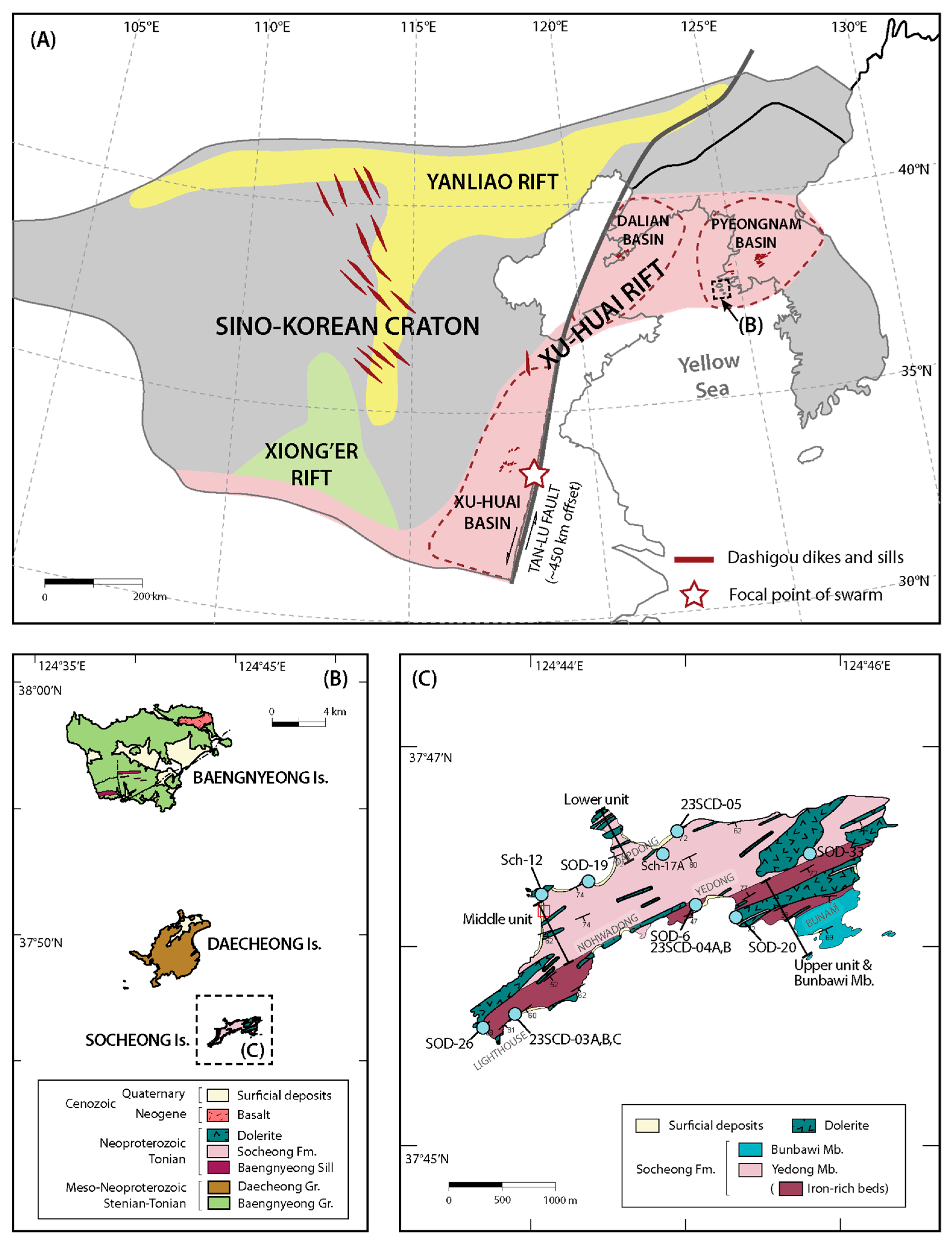
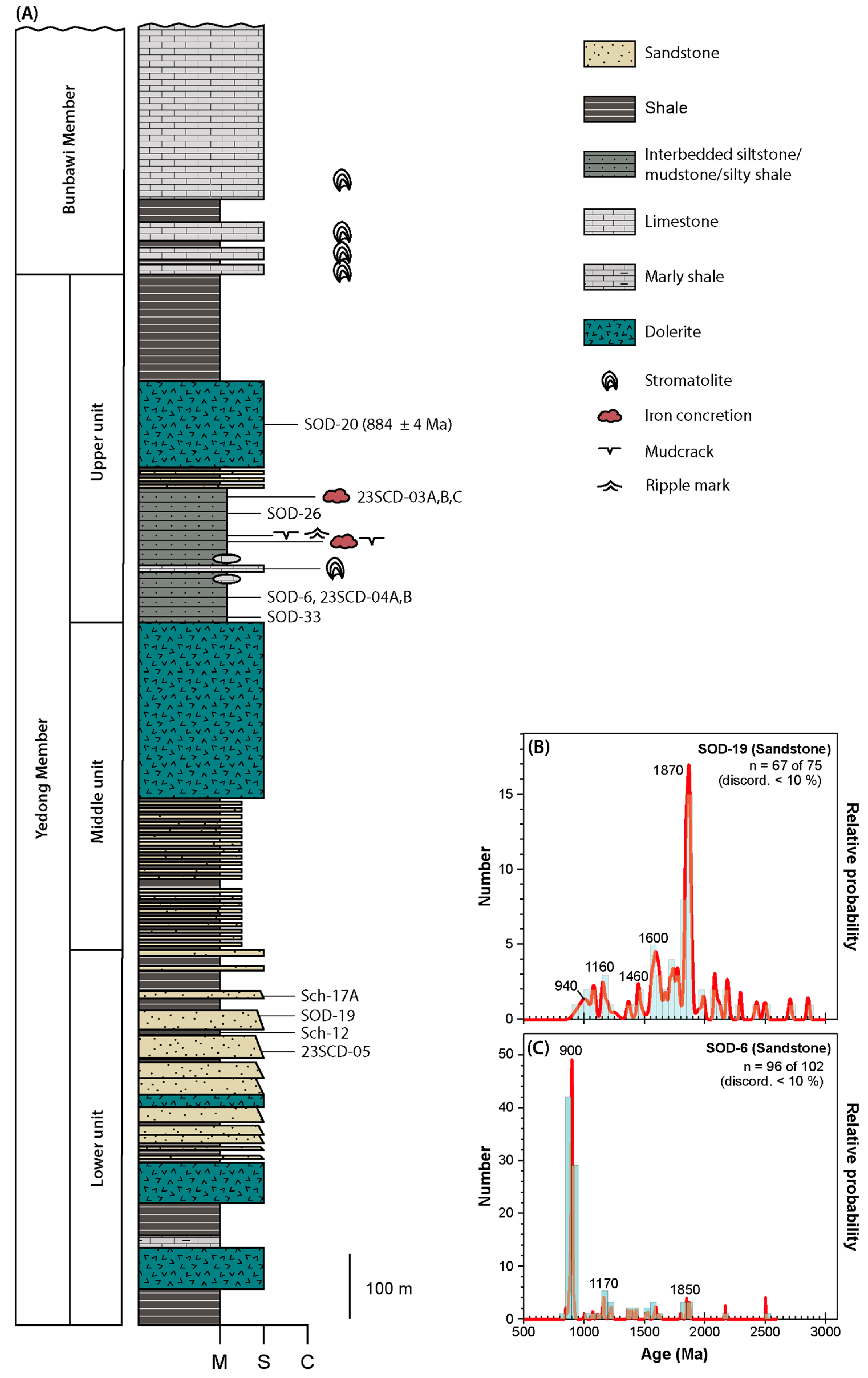
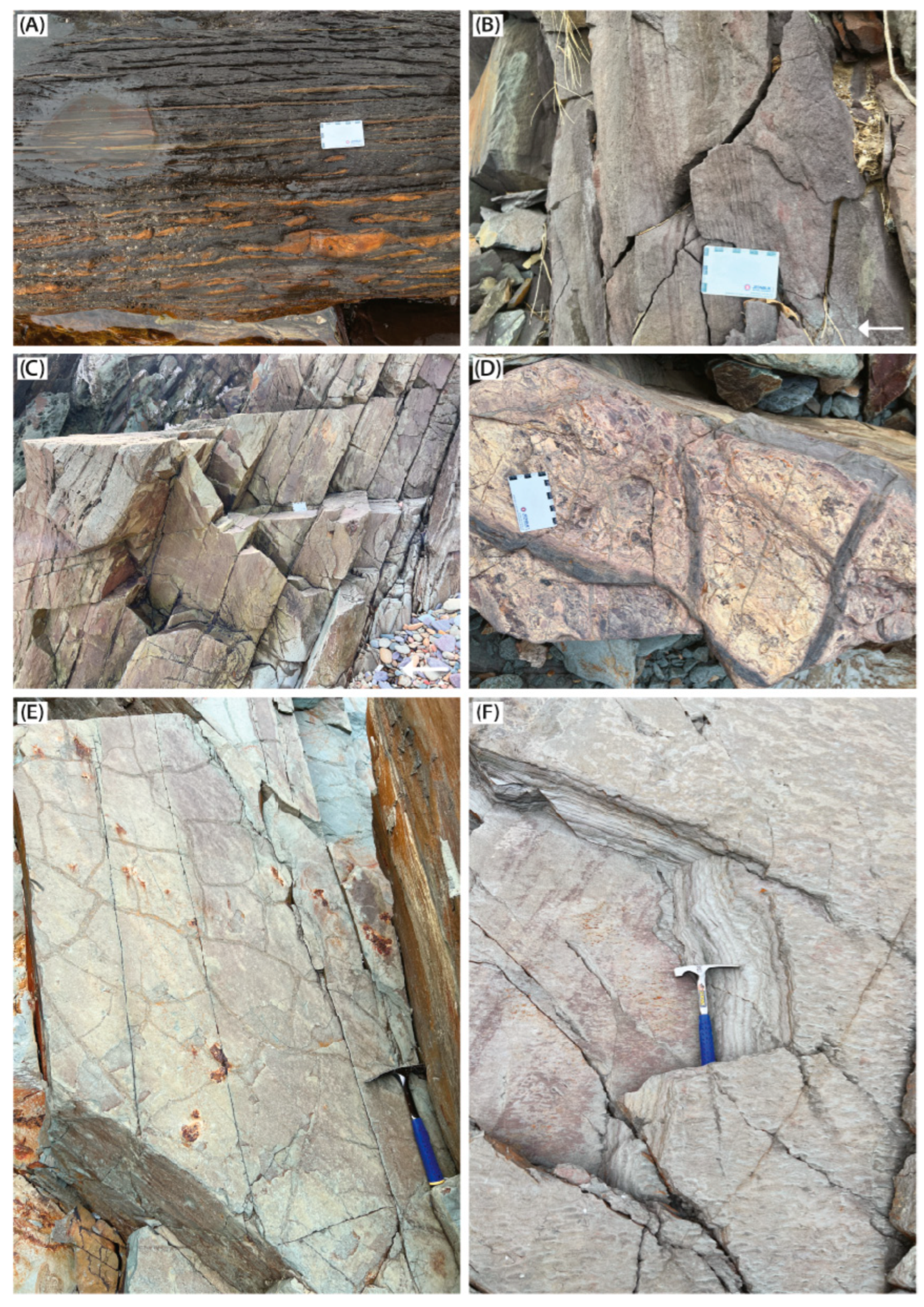
During the latest Mesoproterozoic–Early Neoproterozoic era, extensional regimes generated a number of sedimentary basins in various regions in the Sino-Korean Craton. Mantle-plume emplacements are widely recognized in the sedimentary strata as mafic dikes and sills of the Dashigou Large Igneous Province (LIP). The occurrence of Fe-rich redbeds is first reported in the Neoproterozoic Socheong Formation of the Sangwon Supergroup in the Pyeongnam Basin. Their geochemical and mineralogical characteristics indicate basin-wide Fe enrichment due to hydrothermal fluid input. The episodic yet repetitive hydrothermal injection into the basin generated short-lived anoxia, recorded as greenish-gray coloration in the ferruginous beds. This hydrothermal fluid was likely sourced from the mafic igneous activities involved in the Dashigou LIP. The redbeds can be utilized as key beds for intra- or inter-basinal stratigraphic correlation and to study the negative carbon isotope excursions that occurred in the genetically related basins in the region (e.g., the Sangwon, Xu-Huai, and Dalian basins).
Keywords: Socheong Formation; Sangwon Supergroup; Neoproterozoic; redbed; Large Igneous Province Socheong Formation; Sangwon Supergroup; Neoproterozoic; redbed; Large Igneous Province