Research on the Overburden Movement Law of Thick Coal Seam Without-Support Gangue-Filling Mining

Abstract
1. Introduction
2. Geological Mining Conditions and Coal Rock Mechanics Parameters in the Mining Area
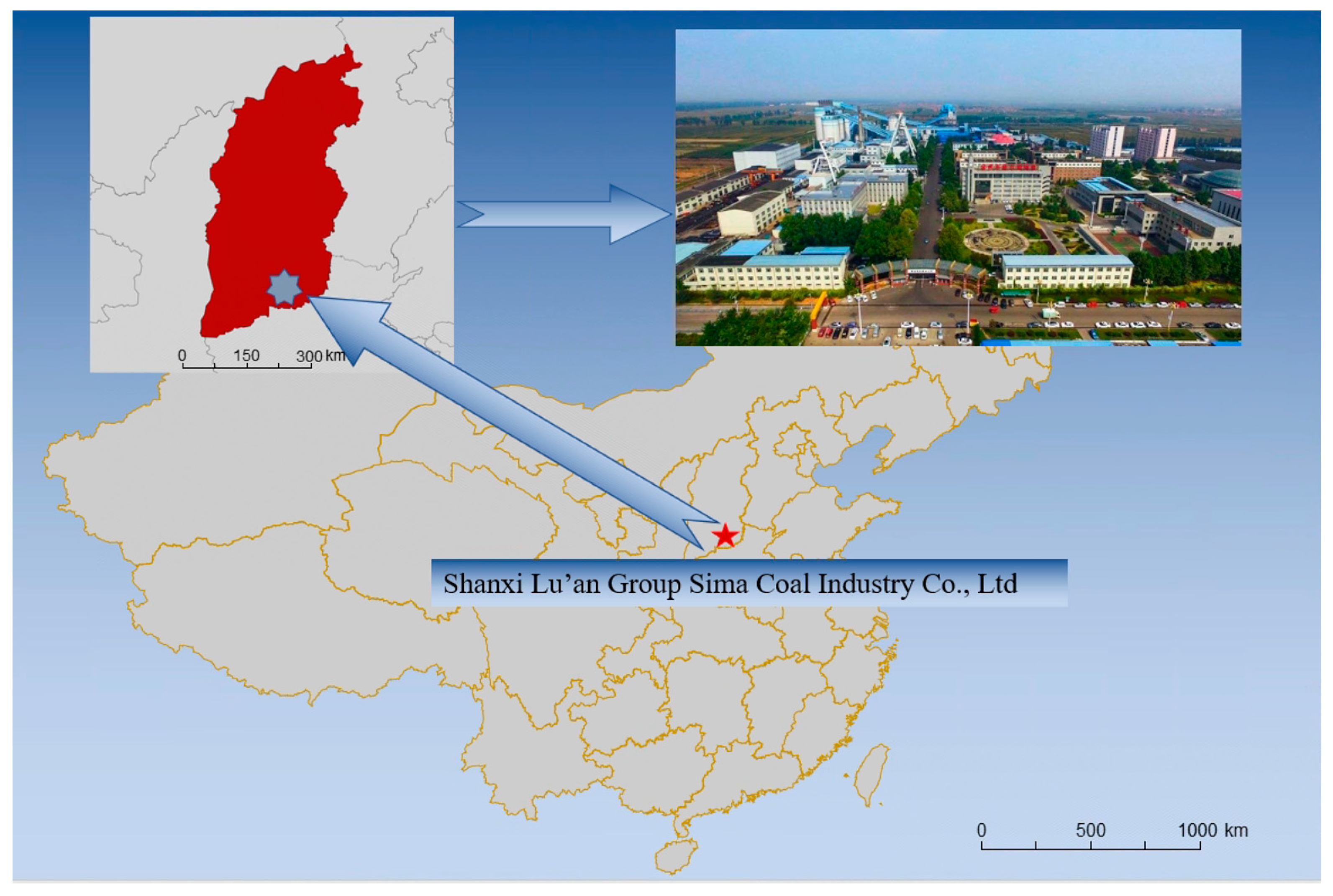
2.1. Overview of Geological Mining Conditions in the Mining Area
2.2. Rock Mechanical Property Testing
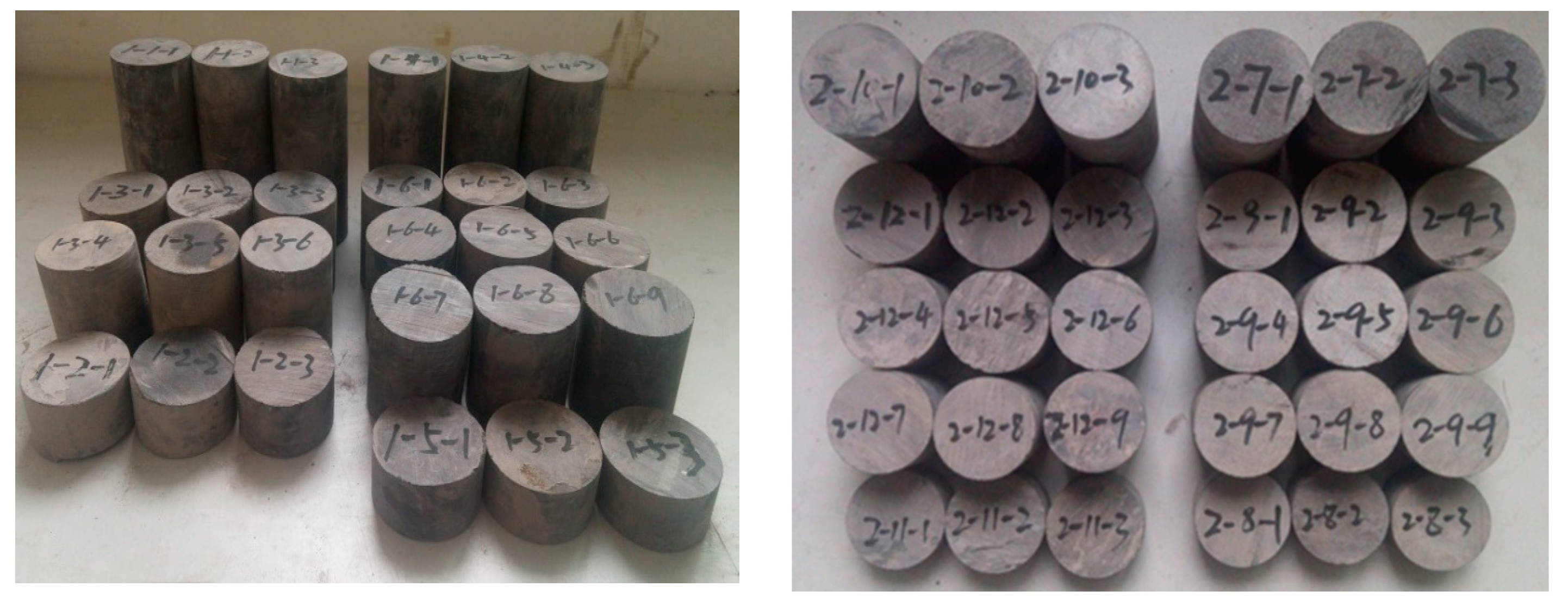
2.2.1. Experimental Specimens
2.2.2. Experimental Process
- (1)
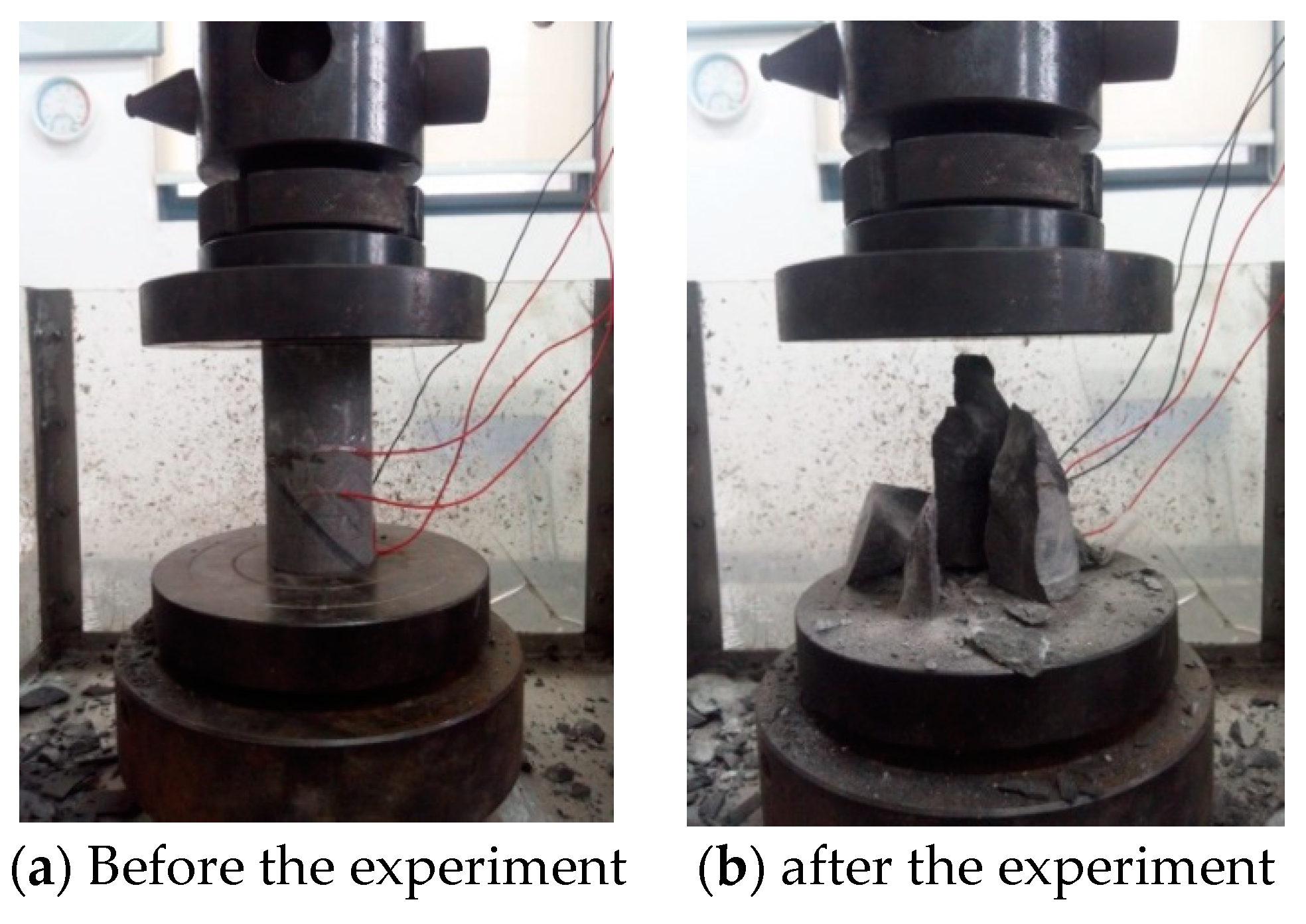
- Uniaxial compression and deformation experiments on coal rock masses were conducted to measure the uniaxial compressive strength, elastic modulus, and Poisson’s ratio of coal rock masses. Before the measurement, the strain gauges attached to the specimens were connected to the resistance strain gauge and the half-bridge circuit was used to measure the transverse and longitudinal directions of the specimens during loading. Some examples of the field experiment are shown in Figure 3.
- (2)
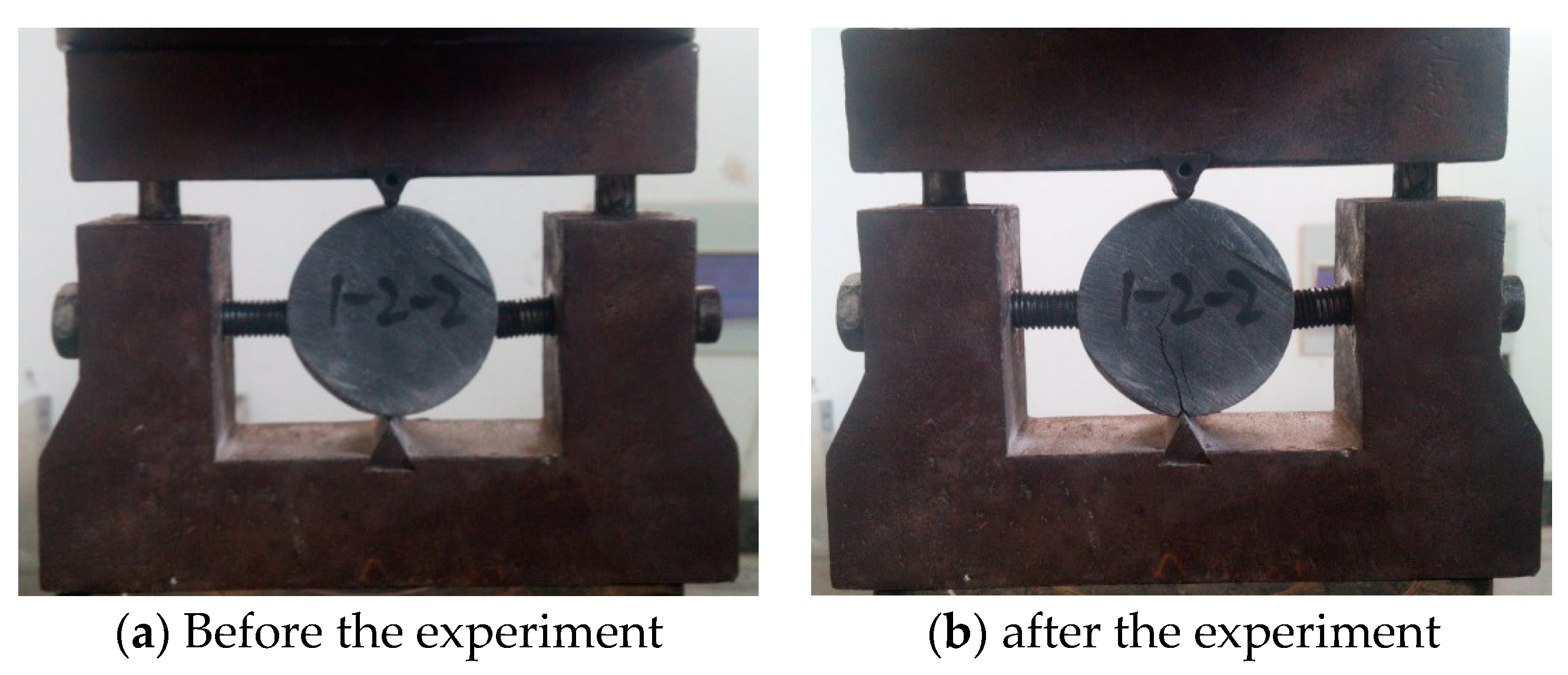
- Uniaxial tensile strength experiments of the specimens were carried out by the splitting method. The diameter and height of the specimens were also measured before the experiment, and after the measurement was completed, each specimen was placed on the tensile jig and loaded until the specimen was damaged. An example of the field experiment is shown in Figure 4.
- (3)
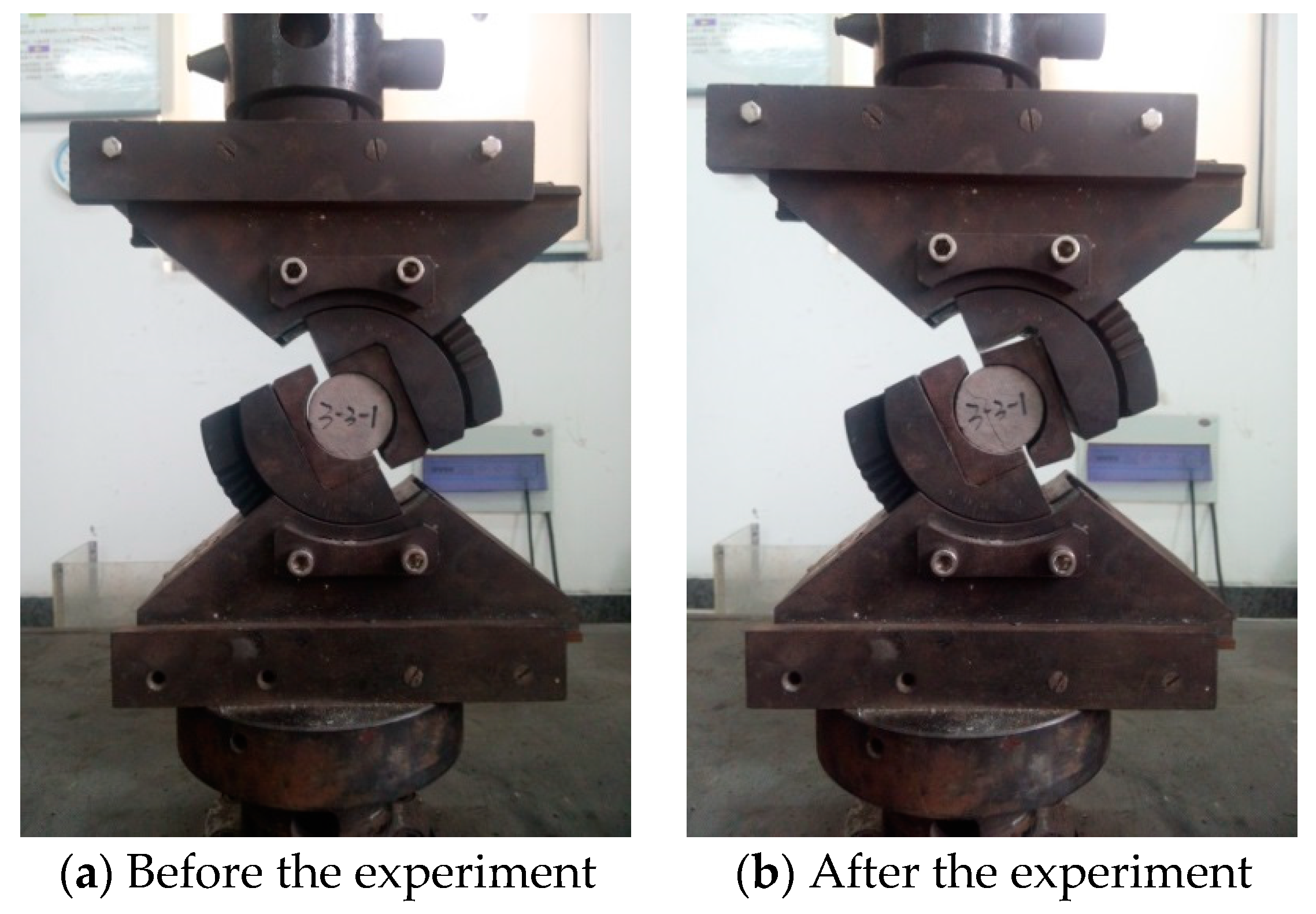
- Shear strength experiments on the coal rock body can measure the cohesion and internal friction angle of the coal rock body. After measuring the height and diameter, the specimens were placed in a variable angle plate shear apparatus and shear experiments were conducted at three different angles, loading from 45°, 50°, and 55° until the specimens were destroyed. An example of the specimen shear test is shown in Figure 5.
2.2.3. Experimental Results
2.3. Mining Width Design
- (1)
- Loads on the top rock beam
- where: E1, E2,…, En—modulus of elasticity of each rock layer of the roof slab.
- h1, h2,…, hn—thickness of each rock layer in the roof slab.
- γ1, γ2,…, γn—capacity of each rock layer of the roof slab.
- (2)
- Analysis of simply supported beams
- where: , —the bending moment and shear force in the cross-section where point A is located, respectively.
- —the distance from point A to the neutral axis.
- —thickness of the beam.
- (3)
- Calculation of fixed beam
3. Numerical Simulation Study of Without-Support Gangue-Filling Mining of Thick Coal Seams
3.1. Establishment of Numerical Simulation Modeling
3.2. Numerical Simulation Scheme
3.3. Deformation Analysis of the Surrounding Rock at the Filling Working Face
3.3.1. Deformation Analysis of the Surrounding Rock for Option I
3.3.2. Deformation Analysis of the Surrounding Rock for Option II
3.4. Stress Analysis of Surrounding Rock in Filling Face
3.4.1. Stress Analysis of the Surrounding Rock for Option I
3.4.2. Stress Analysis of the Surrounding Rock for Option II
3.5. Surface Movement Analysis
4. Similar Simulation Research on Rational Mining Width of Gangue-Filling in Thick Coal Seams without Support
4.1. Similar Material Model Design
4.2. Deformation Analysis of Overlying Rock after Four Rounds of Excavation and Filling
- (1)
- After the end of four rounds of excavation and filling, all the coal in the mining area was extracted, the overlying rock layer in the mining area was supported by the filling body, and the top plate will sink further with the compression of the filling material, but the increase of the top plate sinking was not obvious.
- (2)
- The working face was filled after mining, and the filling body effectively controlled the movement of the overlying rock layer. In addition, the sinking of the rock layer above was greatly influenced by the compression properties of the filling body.
- (3)
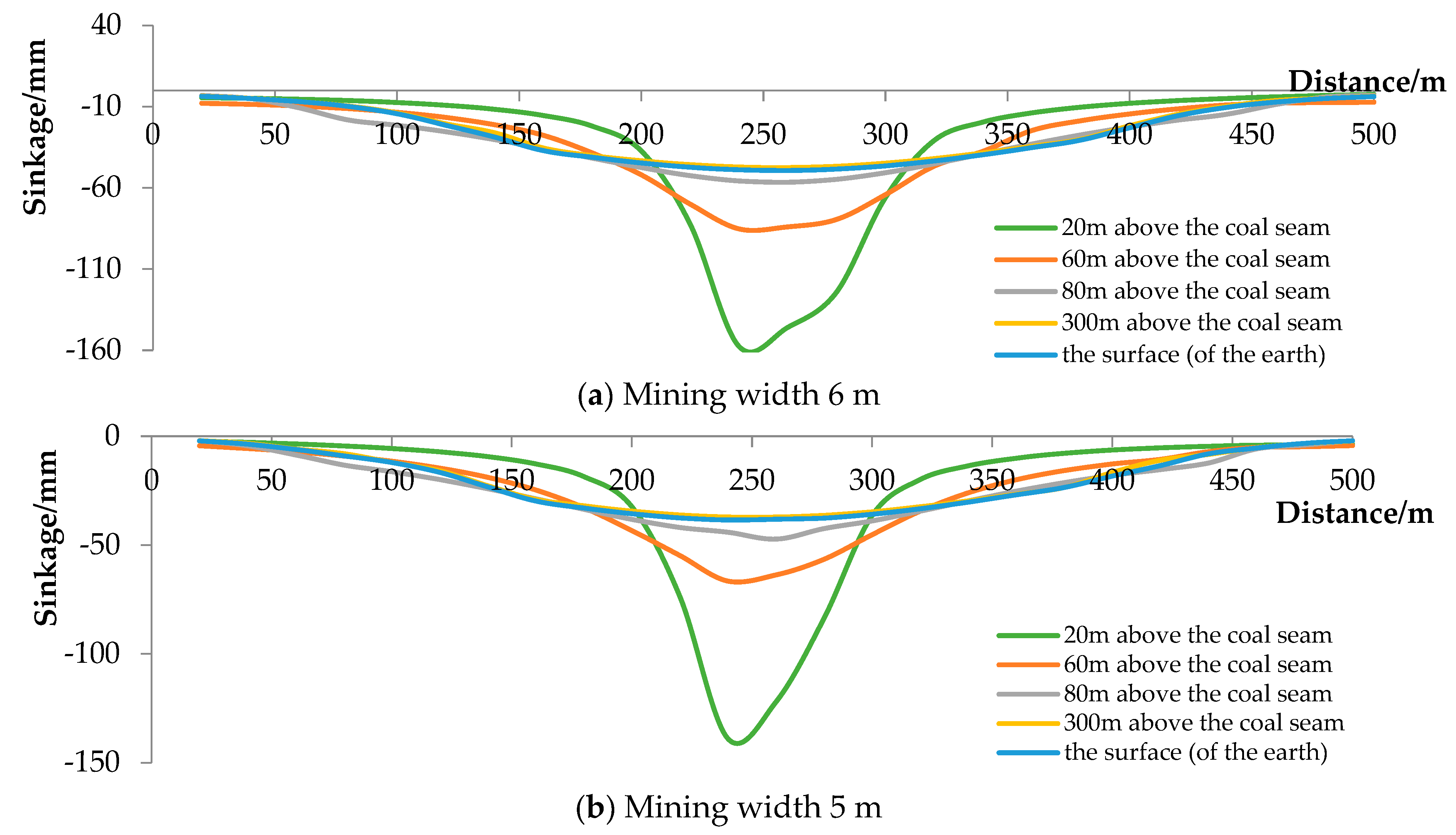
- The subsidence of the surface was still synchronized with the subsidence of the topsoil layer 300 m above the coal seam, the increase in the subsidence of the topsoil layer was less than the increase in the subsidence of the rock seam, and the influence of the mining width on the surface was gradually obvious as the mining area increased.
5. Conclusions
- (1)
- Through rock mechanics experiments, it was determined that the average compressive strength of sandstone in the study area is about 77.45 MPa and the tensile strength is about 4.52 MPa. In addition, the compressive strength of mudstone is about 19.86 MPa, and the tensile strength is about 1.56 MPa. The reasonable mining width of the mining area should be between 4 and 7 m through theoretical analysis.
- (2)
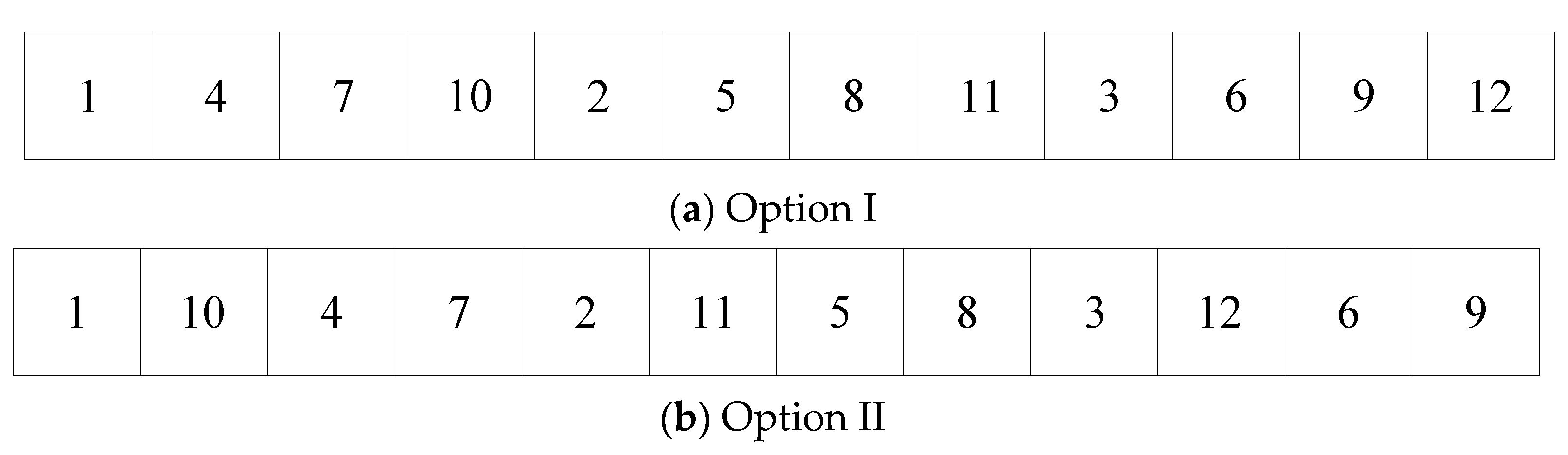
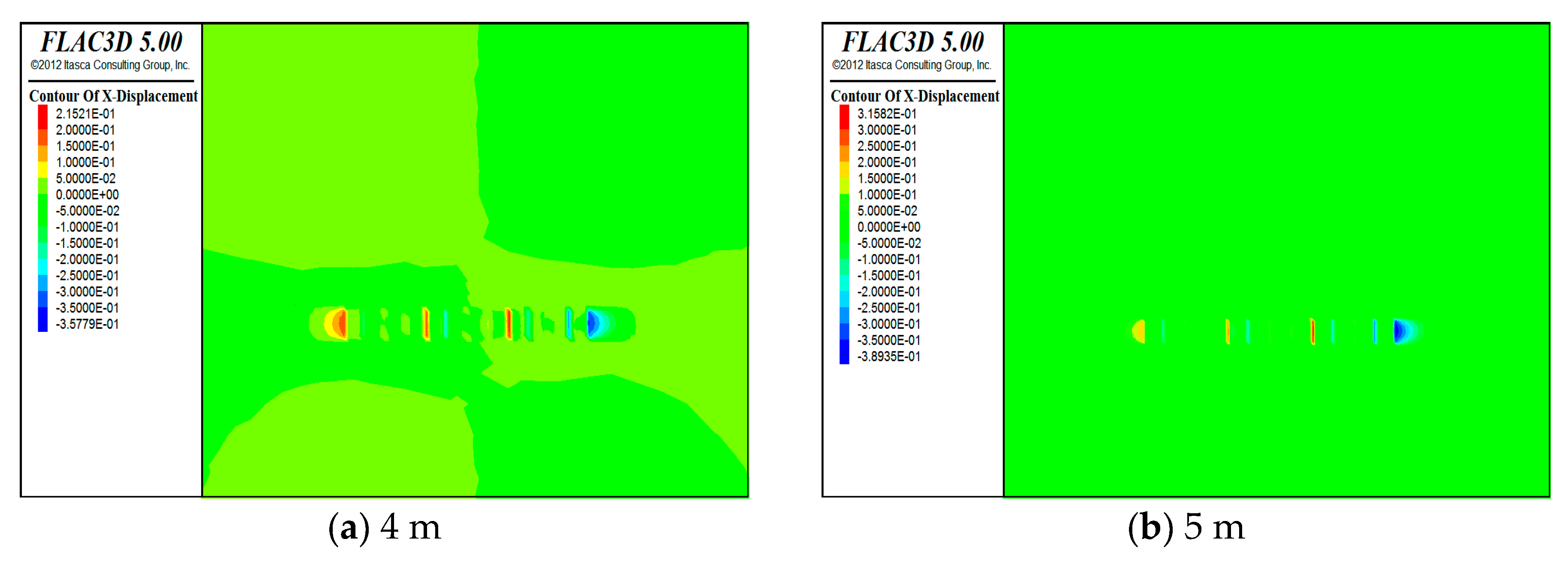
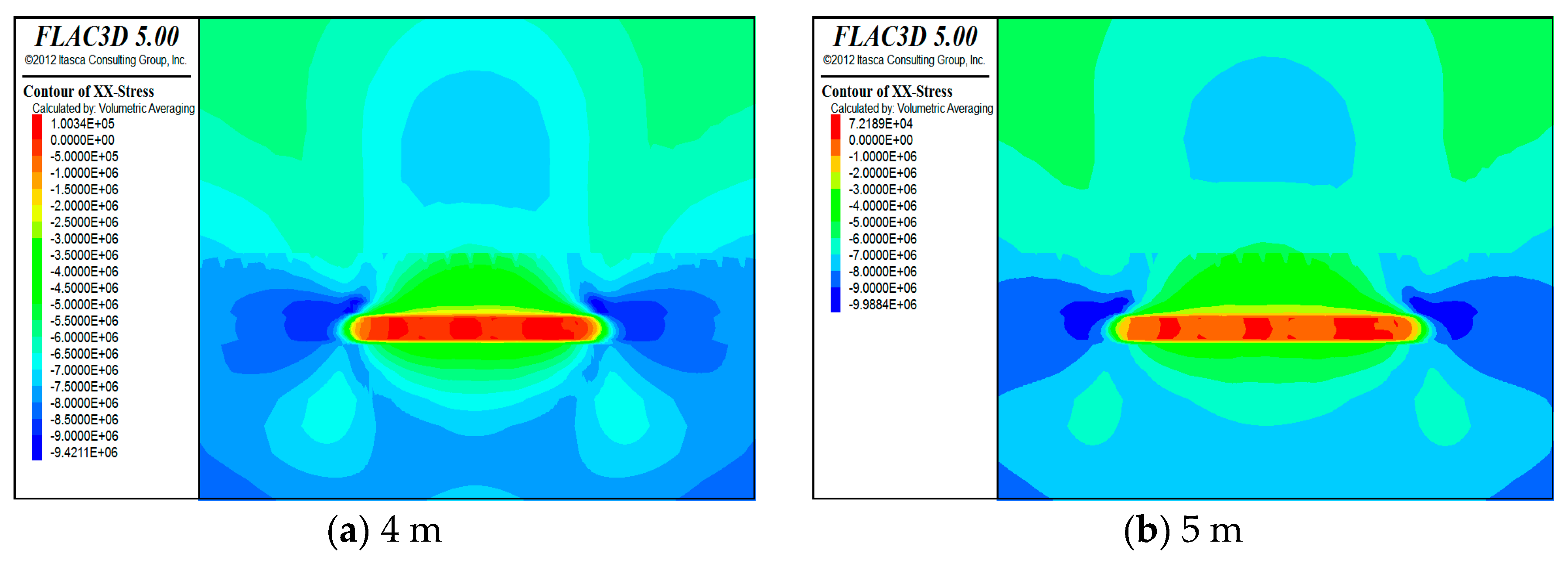
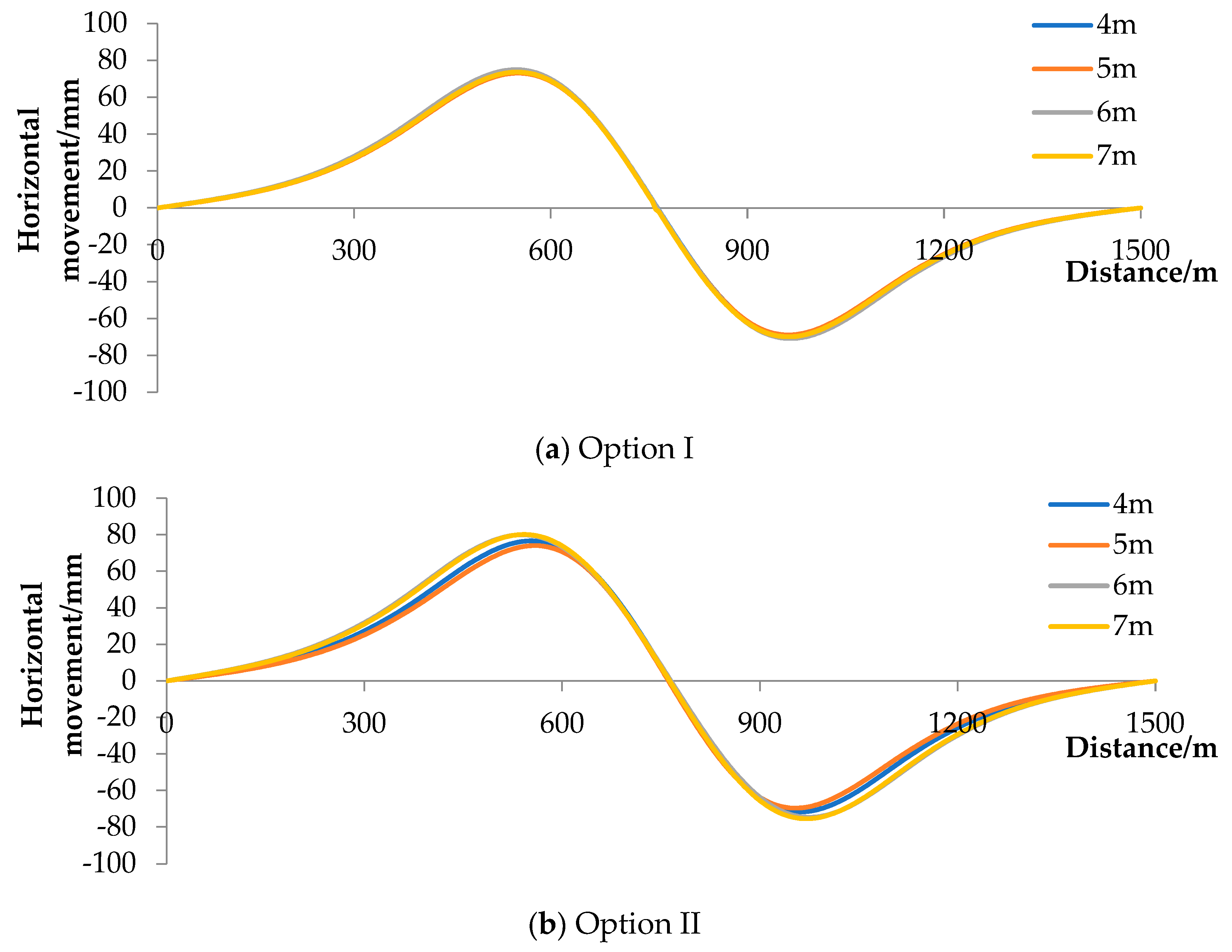
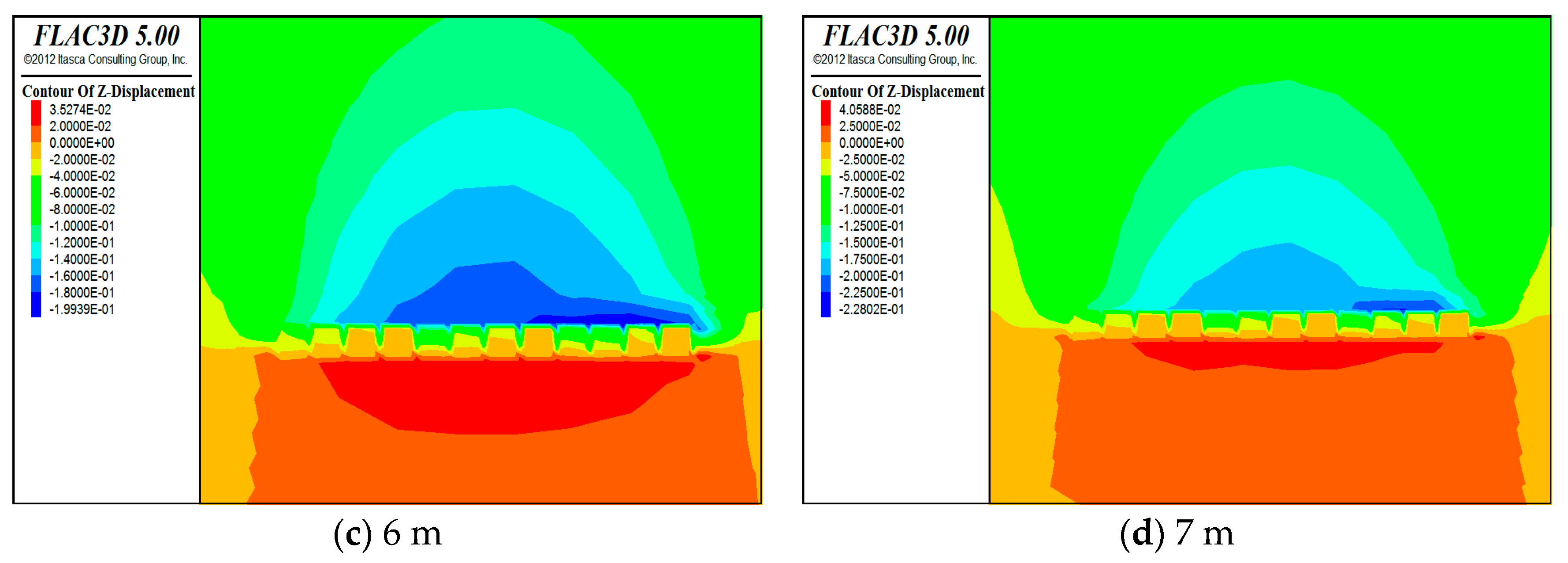
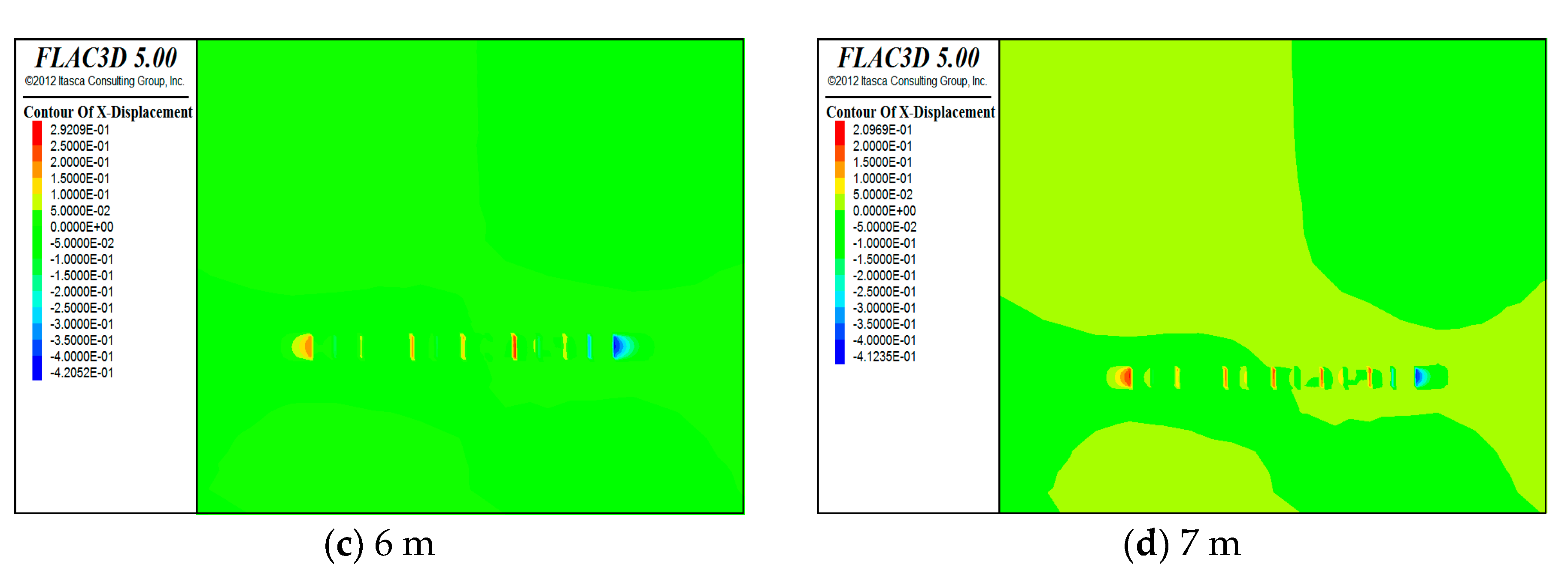
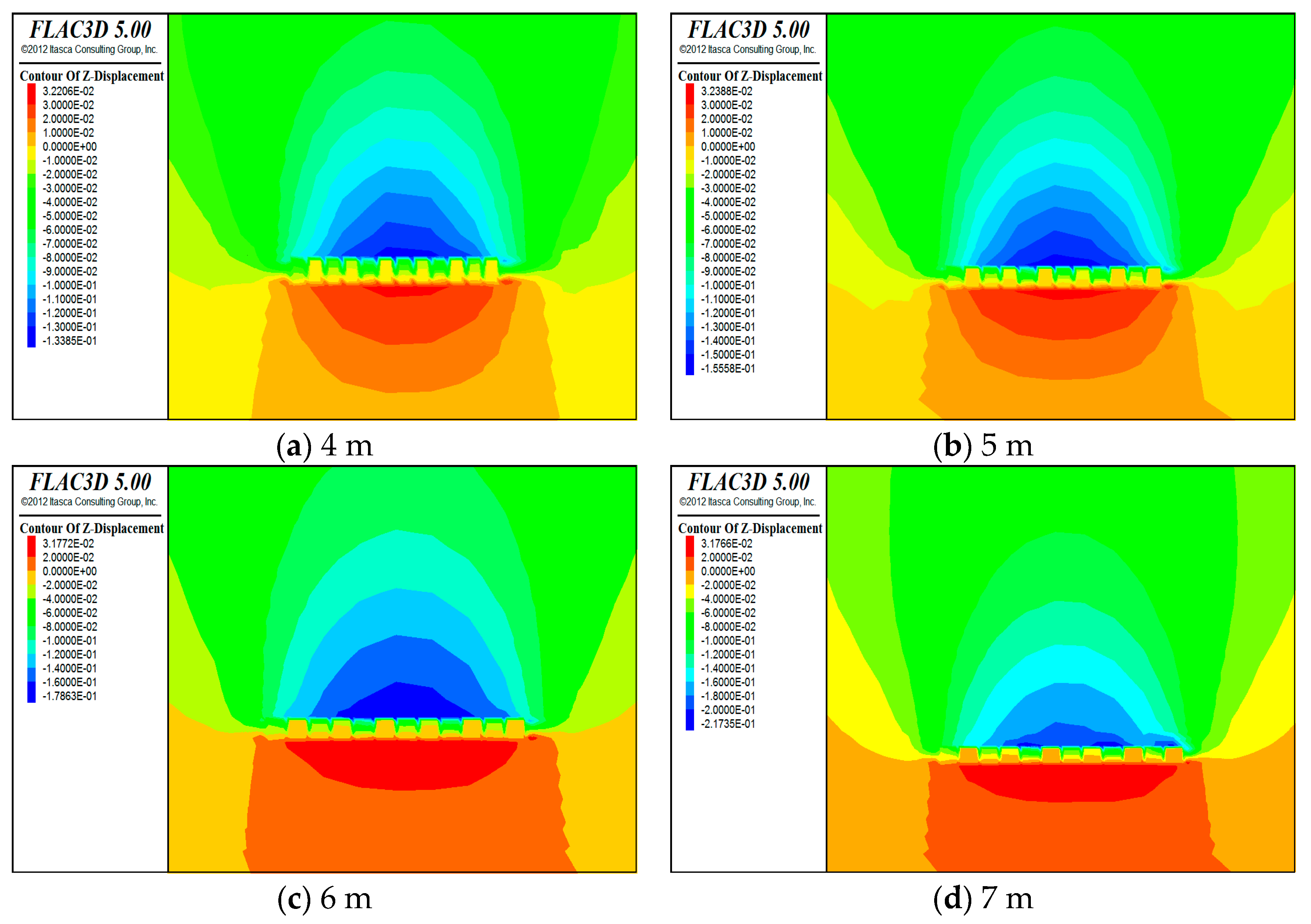
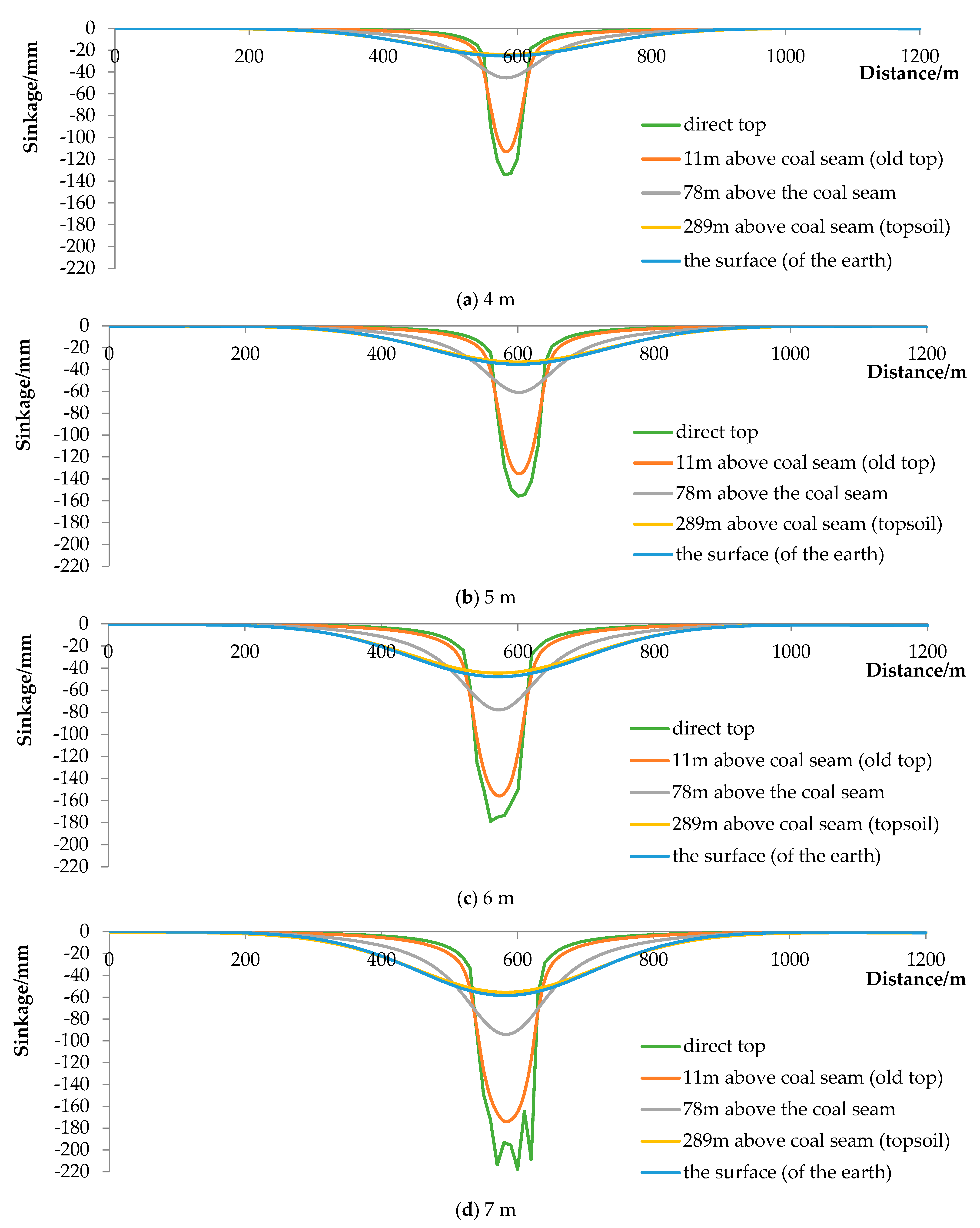
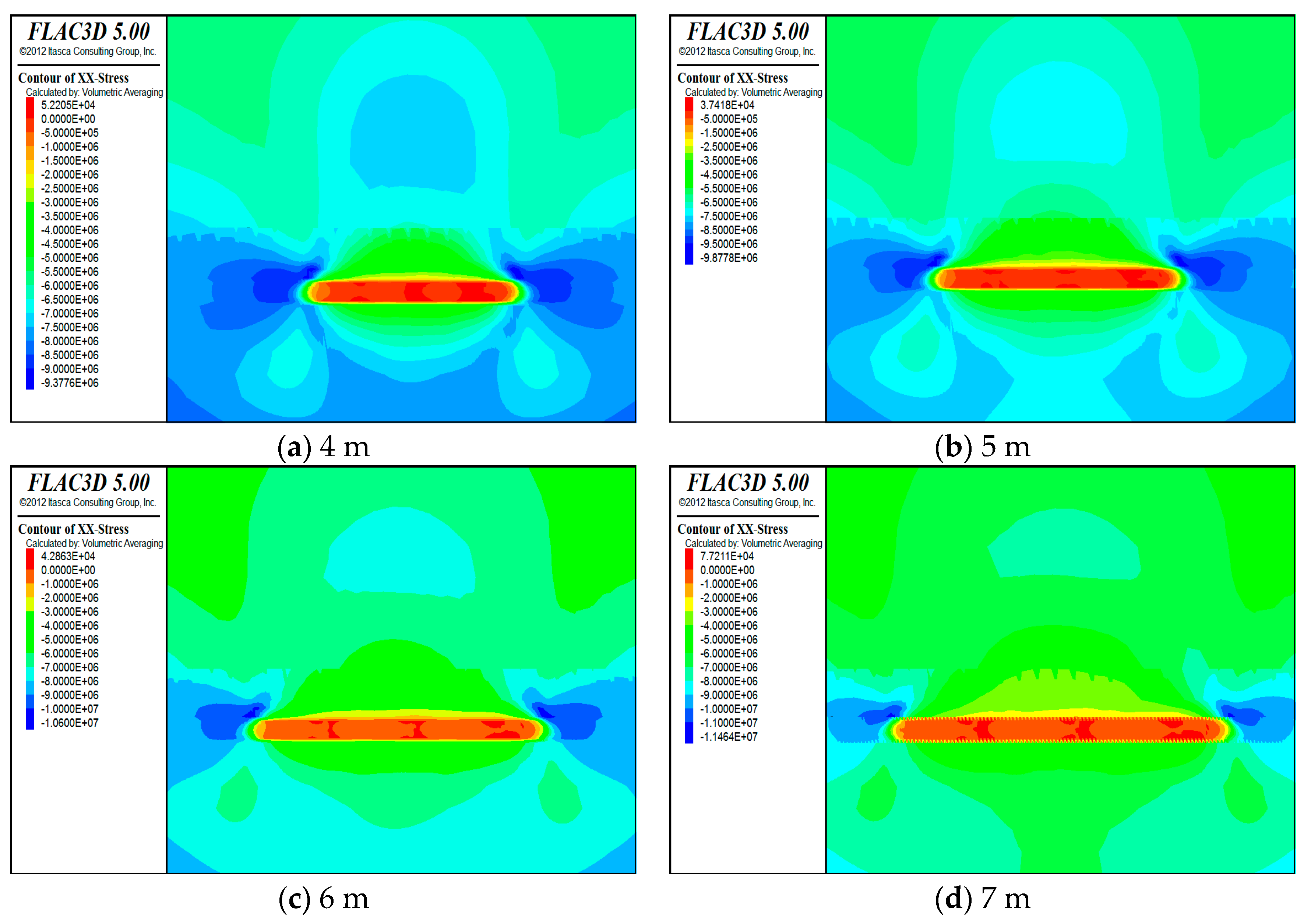
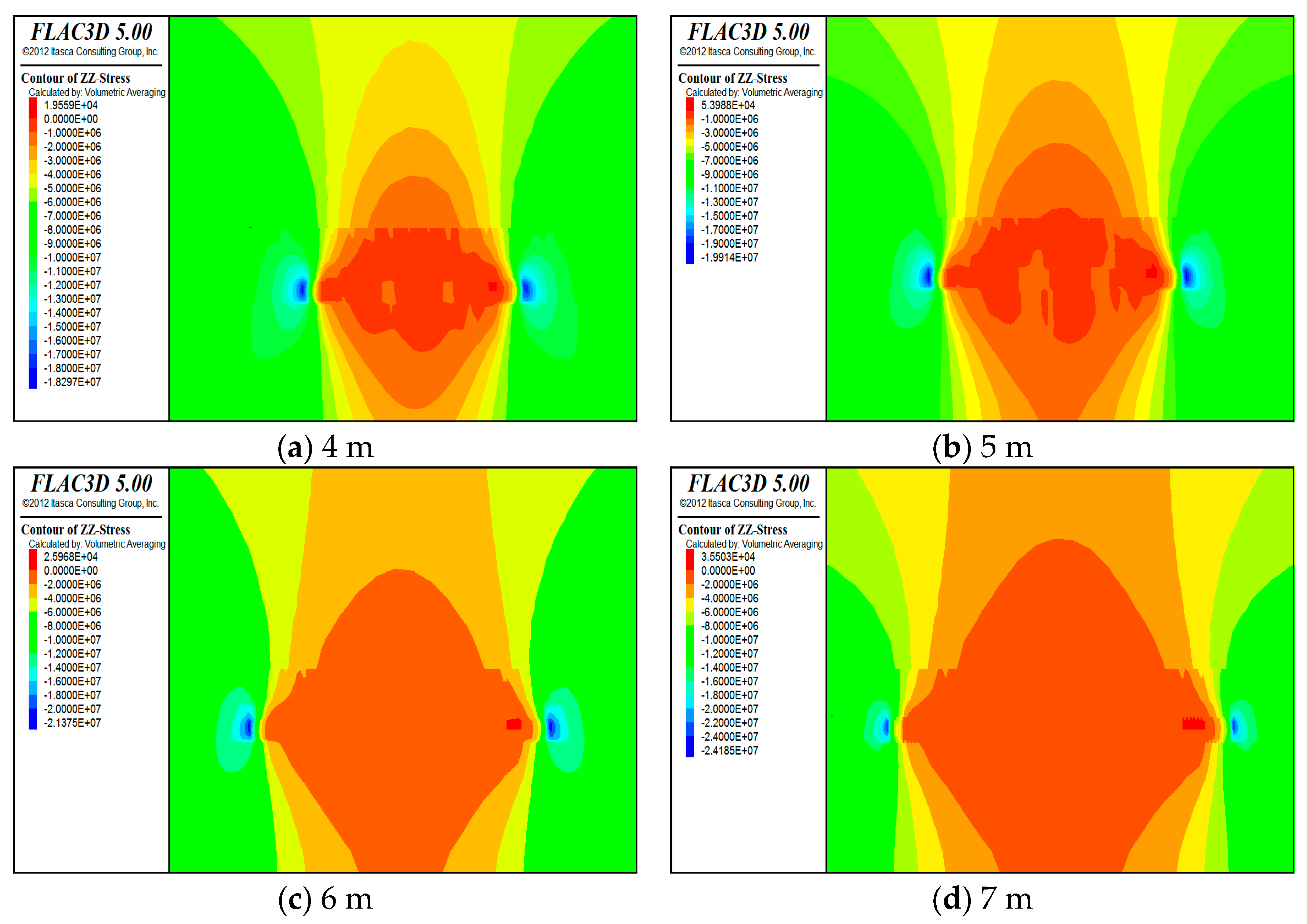
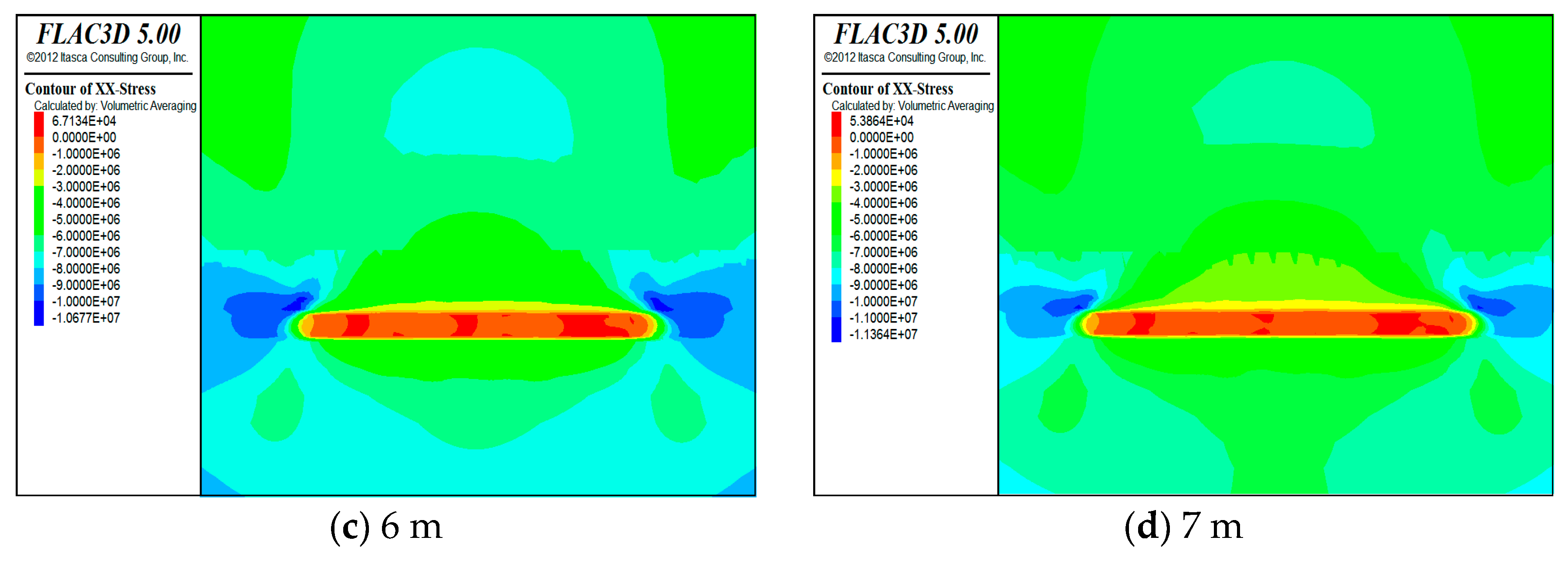
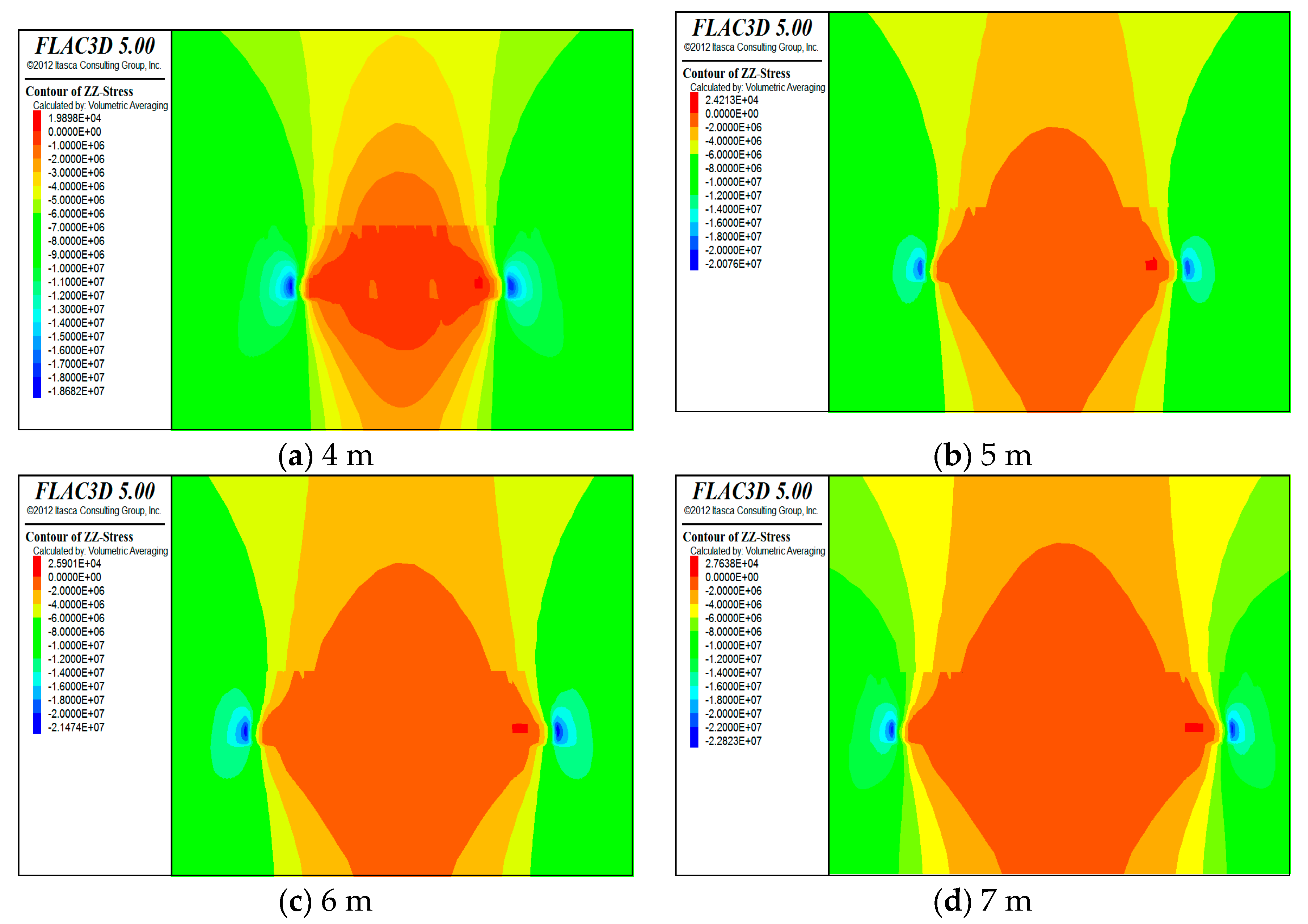
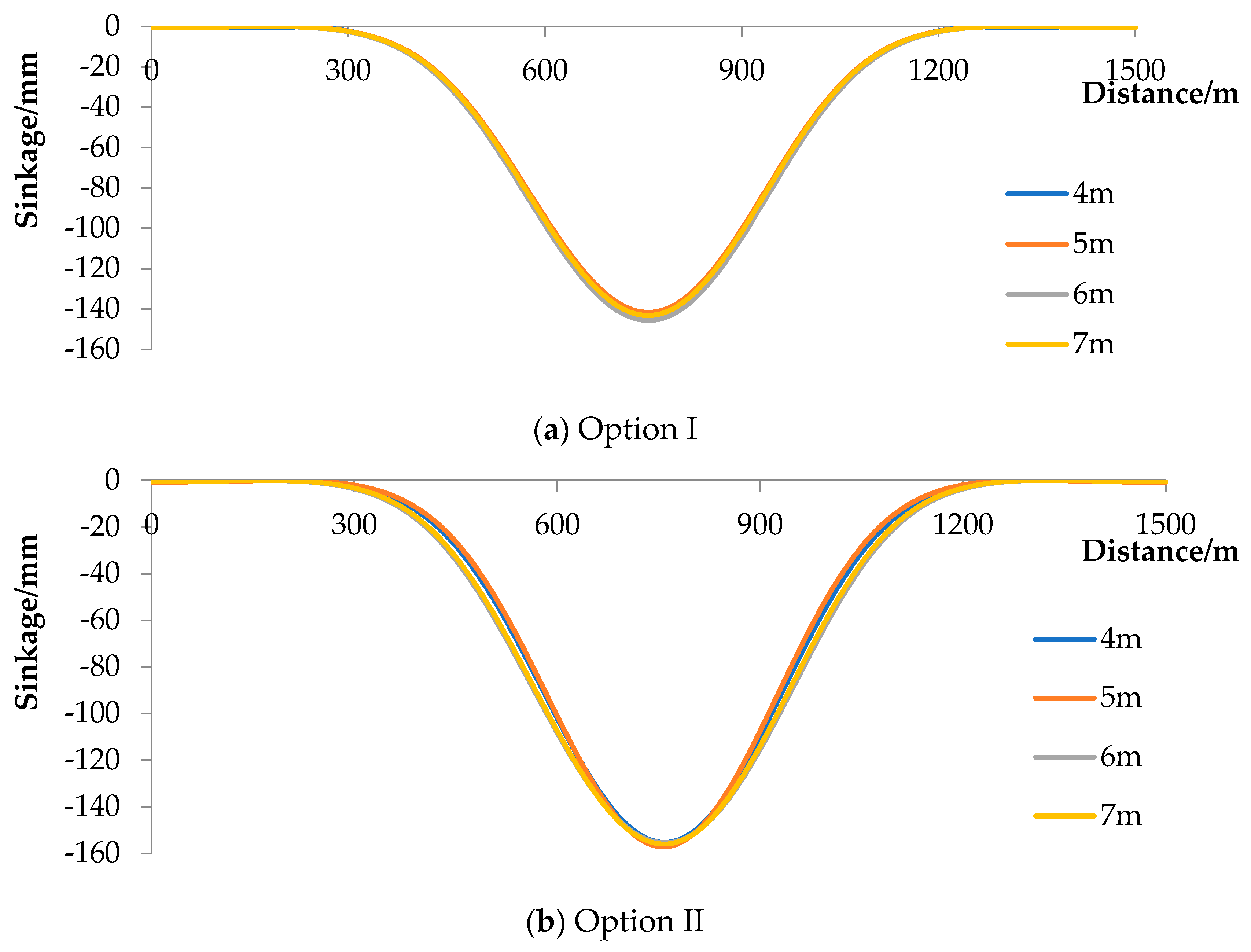
- The numerical simulation results show that, considering the control of surrounding rock deformation angle and surrounding rock stress distribution, the skip mining sequence with large intervals in option II in this paper can fully solidify the filling material and is more conducive to controlling roof and surface settlement.
- (3)
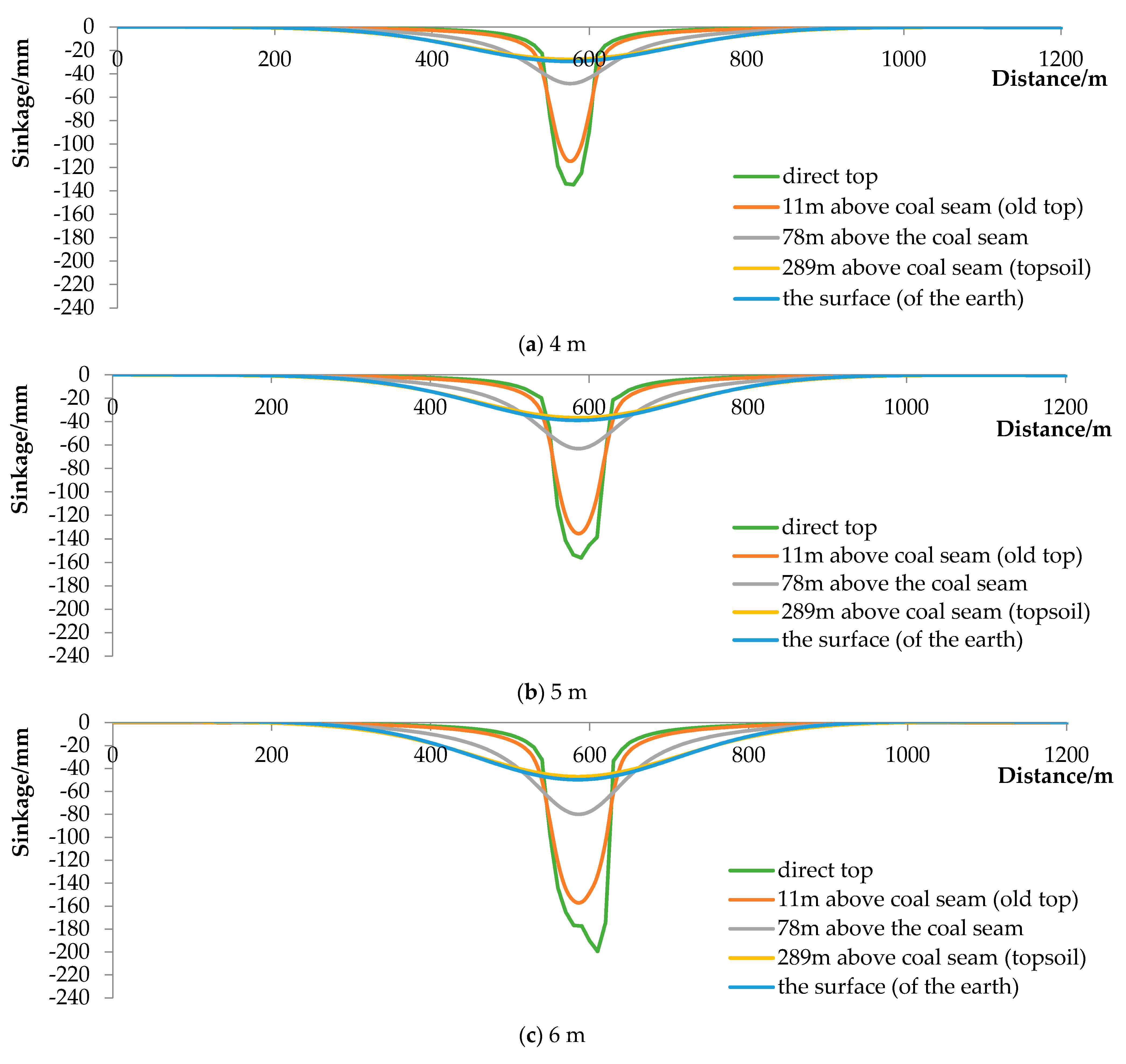
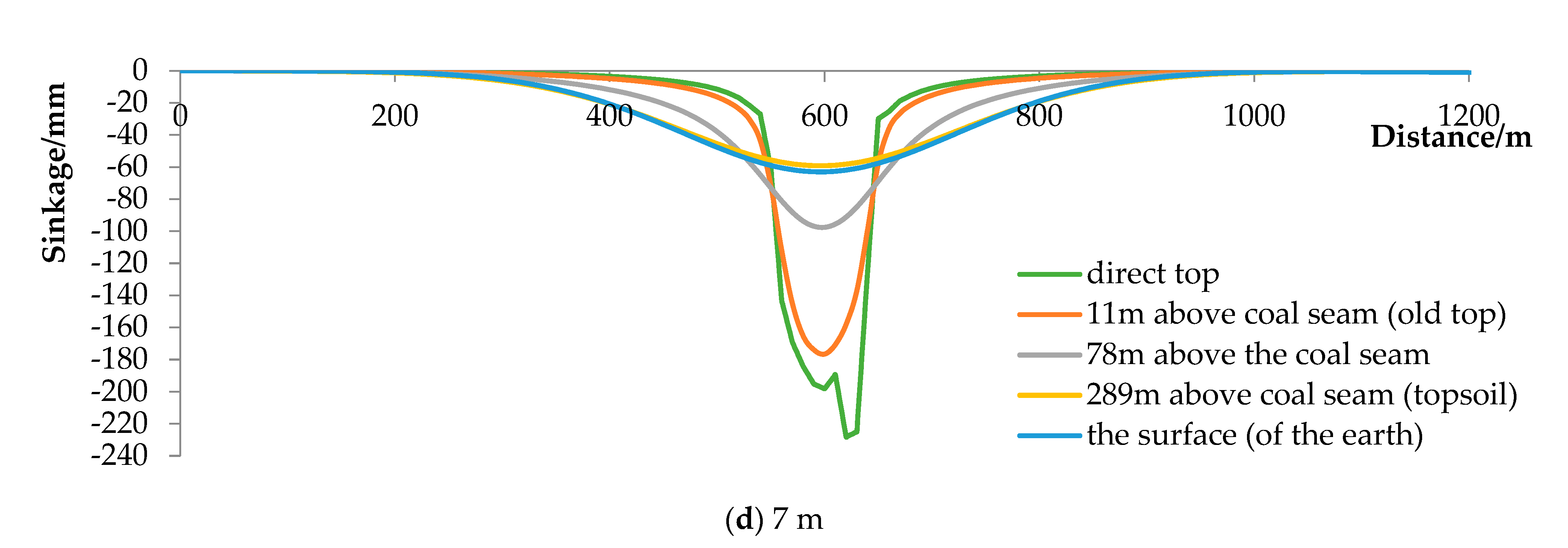
- With the increase of the number of working faces, the increase of mining width will lead to the increase of overburden and surface deformation. When the mining width reaches 7 m, the amount of overburden sinking and sinking speed will increase significantly. The smaller the mining width, the smaller the stress increase caused by digging and filling, and the more conducive it is to the support of the working face and the stability of the coal column and filling body. However, if the mining width is too small, it will significantly increase the number of working faces, and the support cost will increase greatly.
- (4)
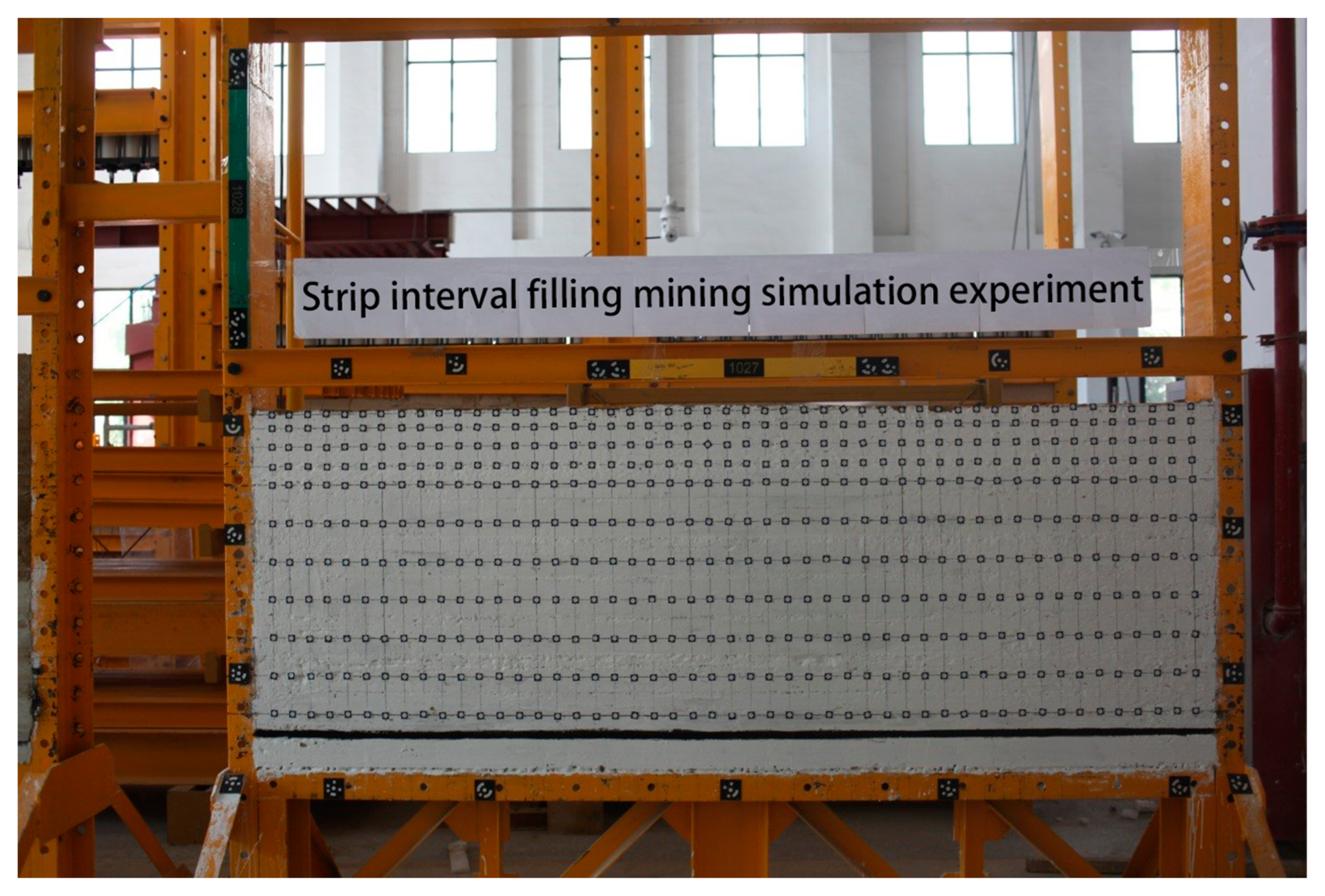
- The results of similar simulation tests show that the overburden deformation pattern is more or less the same when the mining width is 5 m and 6 m. After the working face is mined and filled, the roof is better controlled under the support of the filling body, and there is a key layer to control the deformation of the overburden and surface at 80 m above the coal seam.
Author Contributions
Funding
Data Availability Statement
Conflicts of Interest
References
- Kim, K.-D.; Lee, S.; Oh, H.-J.; Choi, J.-K.; Won, J.-S. Assessment of ground subsidence hazard near an abandoned underground coal mine using GIS. Environ. Earth Sci. 2006, 50, 1183–1191. [Google Scholar] [CrossRef]
- Bell, F.G.; Stacey, T.R.; Genske, D.D. Mining subsidence and its effect on the environment: Some differing examples. Environ. Geol. 2000, 40, 135–152. [Google Scholar] [CrossRef]
- Cui, X.; Gao, Y.; Yuan, D. Erratum to: Sudden surface collapse disasters caused by shallow partial mining in Datong coalfield, China. Nat. Hazards 2015, 75, 1005. [Google Scholar] [CrossRef]
- Ke, Y.; Xinyuan, Z.; Zhen, W.; Jiqiang, Z. Development overview of paste backfill technology in China’s coal mines: A review. Environ. Sci. Pollut. Res. Int. 2021, 28, 67957–67969. [Google Scholar]
- Liu, Z.; Zhou, N.; Zhang, J. Random gravel model and particle flow based numerical biaxial test of solid backfill materials. Int. J. Min. Sci. Technol. 2013, 23, 463–467. [Google Scholar] [CrossRef]
- Huang, Y.; Li, J.; Song, T.; Kong, G.; Li, M. Analysis on Filling Ratio and Shield Supporting Pressure for Overburden Movement Control in Coal Mining with Compacted Backfilling. Energies 2016, 10, 31. [Google Scholar] [CrossRef]
- Zhou, N.; Han, X.; Zhang, J.; Li, M. Compressive deformation and energy dissipation of crushed coal gangue. Powder Technol. Int. J. Sci. Technol. Wet Dry Part. Syst. 2016, 297, 220–228. [Google Scholar] [CrossRef]
- Qi, W.; Zhang, Q.; Zhang, J.; Zhang, J.; Zhu, C. Design of coal pillars of gob-side entry between mining faces with large differences in mining height in deep mine. Energy Sources Part A Recovery Util. Environ. Eff. 2020, 42, 2648–2663. [Google Scholar] [CrossRef]
- Emad, M.Z. Numerical modelling approach for mine backfill. Sādhanā 2017, 42, 1595–1604. [Google Scholar] [CrossRef]
- Adach-Pawelus, K.; Butra, J.; Pawelus, D. The issue of determining the size of main excavations protective pillars in deep underground copper mines. Arch. Min. Sci. 2018, 63, 935–946. [Google Scholar] [CrossRef]
- Chen, S.-H.; Zhang, Z.-H. Determination of Coal Pillar Width and Support Parameters in Deep Coal Mines—A Case Study. J. Test. Eval. 2019, 47, 3160–3173. [Google Scholar] [CrossRef]
- Guo, Y.H.; Hou, K.P. Study on Surface Subsidence Law Induced by Deep Mining of Large Steep Metal Deposit. Appl. Mech. Mater. 2013, 295–298, 2902–2905. [Google Scholar] [CrossRef]
- Li, B.; Zhou, N.; Qi, W.; Li, A.; Cui, Z. Surface Subsidence Control during Deep Backfill Coal Mining: A Case Study. Adv. Civ. Eng. 2020, 2020, 6876453. [Google Scholar] [CrossRef]
- Sun, W.; Zhang, Q.; Luan, Y.; Zhang, X.-P. A study of surface subsidence and coal pillar safety for strip mining in a deep mine. Environ. Earth Sci. 2018, 77, 627. [Google Scholar] [CrossRef]
- Li, M.; Zhang, J.X.; Peng, H.; Rui, G. Mass ratio design based on compaction properties of backfill materials. J. Cent. South Univ. 2016, 23, 2669–2675. [Google Scholar] [CrossRef]
- Zhao, G.Y.; Zhou, L.; Ju, M.A.; Yang, Q. Study on Strength Properties of Cemented Tailings Backfill under Low Temperature Condition. Min. Metall. Eng. 2013, 33, 24–26. [Google Scholar]
- Lu, R.; Ma, F.; Zhao, J.; Wang, J.; Li, G.; Dai, B. Monitoring and Analysis of Stress and Deformation Features of Boundary Part of Backfill in Metal Mine. Sustainability 2020, 12, 733. [Google Scholar] [CrossRef]
- Li, M.; Zhang, J.; Wu, Z.; Sun, K. Calculation and monitoring analysis of stress distribution in a coal mine gob filled with waste rock backfill materials. Arab. J. Geosci. 2019, 12, 418. [Google Scholar] [CrossRef]
- Hao, J.; Shi, Y.; Lin, J.; Wang, X.; Xia, H. The Effects of Backfill Mining on Strata Movement Rule and Water Inrush: A Case Study. Processes 2019, 7, 66. [Google Scholar] [CrossRef]
- Machowski, R. Changes in the Landform and Water Conditions of the Industri-Alized Urban Area as a Result of Mining Activities. Land 2022, 11, 1710. [Google Scholar] [CrossRef]
- Marschalko, M.; Yilmaz, I.; Lamich, D.; Drusa, M.; Kubečková, D.; Peňaz, T.; Burkotová, T.; Slivka, V.; Bednárik, M.; Krčmář, D.; et al. Unique documentation, analysis of origin and development of an undrained depression in a subsidence basin caused by underground coal mining (Kozinec, Czech Republic). Environ. Earth Sci. 2014, 72, 11–20. [Google Scholar] [CrossRef]
- Solarski, M.; Machowski, R.; Rzetala, M.; Rzetala, M.A. Hypsometric changes in urban areas resulting from multiple years of mining activity. Sci. Rep. 2022, 12, 2982. [Google Scholar] [CrossRef] [PubMed]
- Solarski, M. Anthropogenic transformations of the Bytom area relief in the period of 1883-1994. Environ. Socio Econ. Stud. 2015, 1, 1–8. [Google Scholar] [CrossRef]
- Harnischmacher, S.; Zepp, H. Mining and its impact on the earth surface in the Ruhr District (Germany). Z. Für Geomorphol. 2014, 58, 3–22. [Google Scholar] [CrossRef]
- Nádudvari, Á. Using radar interferometry and SBAS technique to detect surface subsidence relating to coal mining in Upper Silesia from 1993-2000 and 2003-2010. Environ. Socio Econ. Stud. 2016, 4, 24–34. [Google Scholar] [CrossRef]
- Xu, D.; Shi, L.; Qu, X.; Tian, J.; Wang, K.; Liu, J. Leaching Behavior of Heavy Metals from the Coal Gangue under the Impact of Site Ordovician Limestone Karst Water from Closed Shandong Coal Mines, North China. Energy Fuels 2019, 33, 10016–10028. [Google Scholar] [CrossRef]
- Zhu, X.; Guo, G.; Zha, J.; Chen, T.; Fang, Q.; Yang, X. Surface dynamic subsidence prediction model of solid backfill mining. Environ. Earth Sci. 2016, 75, 1007. [Google Scholar] [CrossRef]
- Zhang, J.X.; Huang, Y.L.; Li, M.; Zhang, Q.; Liu, Z. Test on mechanical properties of solid backfill materials. Mater. Res. Innov. 2014, 18, S2-960–S2-965. [Google Scholar] [CrossRef]
- Zhang, J.X.; Deng, X.J.; Zhao, X.; Ju, F.; Li, B.Y. Effective control and performance measurement of solid waste backfill in coal mining. Int. J. Mining, Reclam. Environ. 2016, 31, 91–104. [Google Scholar] [CrossRef]
- Zhang, P.; Zhang, Y.; Zhao, T.; Tan, Y.; Yu, F. Experimental Research on Deformation Characteristics of Waste-Rock Material in Underground Backfill Mining. Minerals 2019, 9, 102. [Google Scholar] [CrossRef]
- Zhang, X.; Lin, J.; Liu, J.; Li, F.; Pang, Z. Investigation of Hydraulic-Mechanical Properties of Paste Backfill Containing Coal Gangue-Fly Ash and Its Application in an Underground Coal Mine. Energies 2017, 10, 1309. [Google Scholar] [CrossRef]
- Sun, Q.; Meng, G.; Sun, K.; Zhang, J. Physical simulation experiment on prevention and control of water inrush disaster by backfilling mining under aquifer. Environ. Earth Sci. 2020, 79, 429. [Google Scholar] [CrossRef]
- Chen, S.; Wang, H.; Zhang, J.; Xing, H.; Wang, H. Experimental Study on Low-Strength Similar-Material Proportioning and Properties for Coal Mining. Adv. Mater. Sci. Eng. 2015, 2015, 696501. [Google Scholar] [CrossRef]
- Zhu, X.J.; Guo, G.L.; Qian, Z. Simulation analysis of strata movement characteristics of backfill-strip mining. J. Mines Met. Fuels 2015, 63, 411–418. [Google Scholar]





| Rock Name | Breadth | Thickness | Lithological Description |
|---|---|---|---|
| Fine-grained sandstone | 212.6 | 118.3 | Off-white, thinly laminated, quartz-dominated. |
| Mudstone | 256.55 | 43.95 | Grey-black, friable, with fossilized plants. |
| Fine-grained sandstone | 287.05 | 30.5 | Off-white, quartz and feldspar in composition, with a small amount of mica. |
| Mudstone | 325.80 | 38.75 | Grayish black, thinly laminated, with more fine sand at the base. |
| Coal | 332.15 | 6.35 | Gray-black-black with black stripes, predominantly lumpy, glassy luster, jagged fracture, semi-bright coal. |
| Fine-grained sandstone | 335.70 | 3.55 | Gray, laminar, semi-hard, mainly quartz and mica, with argillaceous structure at the top. |
| Mudstone | 345.15 | 9.45 | Grayish black, lumpy, with a flatter fracture. |
| Medium-grained sandstone | 345.75 | 0.60 | Grey, quartz-dominated, semi-hard. |
| Mudstone | 348.15 | 2.40 | Gray-black, lumpy, flat fracture. |
| Type | Compressive Strength/MPa | Tensile Strength/MPa | Modulus of Elasticity /GPa | Poisson’s Ratio | Cohesion /MPa | Internal Friction Angle /(°) |
|---|---|---|---|---|---|---|
| Average of old roof coarse grain sandstone | 76.53 | 3.59 | 33.58 | 0.217 | 9.53 | 34.69 |
| Average of immediate roof mudstone | 17.29 | 1.57 | 22.14 | 0.264 | 3.63 | 25.33 |
| Average of coal | 24.41 | 0.98 | 9.35 | 0.31 | 1.13 | 36.52 |
| Average of immediate bottom fine-grained sandstone | 78.38 | 5.46 | 36.03 | 0.199 | 9.78 | 35.32 |
| Average of old bottom mudstone | 22.42 | 1.55 | 22.35 | 0.265 | 3.59 | 24.70 |
| Rockiness | Density (kg/m3) | Bulk Modulus (GPa) | Shear Modulus (GPa) | Cohesion (MPa) | Tensile Strength (MPa) | Angle of Internal Friction (°) |
|---|---|---|---|---|---|---|
| Topsoil | 1400 | 0.017 | 0.1 | 0.4 | 0.04 | 15 |
| siltstone interbedded with fine sandstone | 2500 | 5.0 | 3.75 | 8.7 | 3.21 | 32 |
| Mudstone | 2500 | 4.464 | 3.074 | 3.7 | 1.48 | 26 |
| Mudstone-sandstone interlayer | 2500 | 4.598 | 3.306 | 3.9 | 2.42 | 30 |
| Mudstone | 2500 | 3.819 | 2.88 | 3.7 | 1.48 | 26 |
| Mudstone-sandstone interlayer | 2500 | 4.598 | 3.306 | 3.9 | 2.42 | 30 |
| Fine-grained sandstone | 2500 | 5.0 | 3.75 | 9.5 | 3.59 | 35 |
| Mudstone | 2500 | 3.819 | 2.88 | 3.5 | 1.57 | 26 |
| Coal | 1500 | 1.94 | 1.46 | 1.8 | 1.0 | 24 |
| Mudstone-sandstone interlayer | 2500 | 4.657 | 4.095 | 3.8 | 2.34 | 28 |
| Filling body | 1680 | 0.21 | 0.12 | 1.4 | 0.244 | 27 |
| Rock Location | Maximum Overburden Subsidence/mm | |||
|---|---|---|---|---|
| 4 m | 5 m | 6 m | 7 m | |
| Direct top | 135 | 156 | 199 | 228 |
| 11 m above the coal seam (old top) | 113 | 135 | 156 | 177 |
| 78 m above the coal seam | 48 | 63 | 79 | 97 |
| 289 m above the coal seam (topsoil) | 27 | 37 | 47 | 59 |
| The surface (of the earth) | 29 | 39 | 49 | 63 |
| Rock Location | Maximum Overburden Subsidence/mm | |||
|---|---|---|---|---|
| 4 m | 5 m | 6 m | 7 m | |
| Direct top | 134 | 156 | 178 | 217 |
| 11 m above the coal seam (old top) | 112 | 135 | 155 | 173 |
| 78 m above the coal seam | 45 | 61 | 78 | 94 |
| 289 m above the coal seam (topsoil) | 24 | 33 | 44 | 55 |
| The surface (of the earth) | 25 | 35 | 47 | 58 |
| Deformation Indicators | Option I | Option II | ||||||
|---|---|---|---|---|---|---|---|---|
| 4 m | 5 m | 6 m | 7 m | 4 m | 5 m | 6 m | 7 m | |
| Maximum sink/mm | −141 | −139 | −143 | −145 | −145 | −134 | −157 | −154 |
| Maximum horizontal movement/mm | 74 | 73 | 75 | 75 | 76 | 71 | 82 | 80 |
| Maximum inclination/mm/m | −0.54 | −053 | −0.54 | −0.54 | −0.56 | −0.53 | −0.58 | −0.57 |
| Maximum curvature /10-3 mm/m2 | −4.5 | −4.6 | −4.5 | −4.6 | −4.9 | −4.9 | −4.5 | −4.6 |
| Maximum horizontal deformation/mm/m | −0.56 | −0.56 | −0.56 | −0.56 | −0.59 | −0.57 | −0.58 | −0.58 |
| Number | Rockiness | Prototype Thickness/m | Model Thickness/mm |
|---|---|---|---|
| 1 | Topsoil | 76.15 | 190 |
| 2 | Siltstone interbedded with fine sandstone | 18.15 | 45 |
| 3 | Mudstone | 118.3 | 296 |
| 4 | Mudstone-sandstone interlayer | 43.95 | 110 |
| 5 | Mudstone | 30.5 | 76 |
| 6 | Mudstone-sandstone interlayer | 38.75 | 97 |
| 7 | Coal | 6.35 | 16 |
| 8 | Mudstone-sandstone interlayer | 30.05 | 75 |
| Number | Rockiness | Proportion Sign (Sand:Mica Powder:Cements) | Cement (Gypsum:Calcium Carbonate) | Sand /kg | Mica/kg | Gypsum/kg | Calcium Carbonate/kg | Sawdust/kg |
|---|---|---|---|---|---|---|---|---|
| 1 | Topsoil | 86:0:4 (sawdust 10) | 2:2 | 131.31 | 3.05 | 3.05 | 15.3 | |
| 2 | Siltstone interbedded with fine sandstone | 80:17:3 | 7:3 | 28.93 | 6.15 | 0.76 | 0.32 | |
| 3 | Mudstone | 73:23:4 | 3:7 | 173.64 | 54.71 | 2.85 | 6.66 | |
| 4 | Mudstone-sandstone interlayer | 73:23:4 | 7:3 | 64.53 | 20.33 | 2.47 | 1.06 | |
| 5 | Mudstone | 73:23:4 | 3:7 | 44.58 | 14.05 | 0.73 | 1.71 | |
| 6 | Mudstone-sandstone interlayer | 80:17:3 | 7:3 | 62.36 | 13.25 | 1.64 | 0.7 | |
| 7 | Coal | 90:0:6 (sawdust 4) | 3:3 | 11.57 | 0.39 | 0.39 | 0.51 | |
| 8 | Mudstone-sandstone interlayer | 80:18:2 | 7:3 | 48.22 | 10.85 | 0.84 | 0.36 |
| Rock Location | Maximum Overburden Subsidence/mm | |
|---|---|---|
| 5 m | 6 m | |
| 20 m above the coal seam | 139 | 157 |
| 60 m above the coal seam | 67 | 85 |
| 80 m above the coal seam | 47 | 56 |
| 300 m above the coal seam (topsoil) | 37 | 47 |
| The surface (of the earth) | 38 | 49 |
Disclaimer/Publisher’s Note: The statements, opinions and data contained in all publications are solely those of the individual author(s) and contributor(s) and not of MDPI and/or the editor(s). MDPI and/or the editor(s) disclaim responsibility for any injury to people or property resulting from any ideas, methods, instructions or products referred to in the content. |
© 2022 by the authors. Licensee MDPI, Basel, Switzerland. This article is an open access article distributed under the terms and conditions of the Creative Commons Attribution (CC BY) license (https://creativecommons.org/licenses/by/4.0/).
Share and Cite
Gu, W.; Chen, L.; Xu, D. Research on the Overburden Movement Law of Thick Coal Seam Without-Support Gangue-Filling Mining. Minerals 2023, 13, 53. https://doi.org/10.3390/min13010053
Gu W, Chen L, Xu D. Research on the Overburden Movement Law of Thick Coal Seam Without-Support Gangue-Filling Mining. Minerals. 2023; 13(1):53. https://doi.org/10.3390/min13010053
Chicago/Turabian StyleGu, Wei, Liang Chen, and Dalong Xu. 2023. "Research on the Overburden Movement Law of Thick Coal Seam Without-Support Gangue-Filling Mining" Minerals 13, no. 1: 53. https://doi.org/10.3390/min13010053
APA StyleGu, W., Chen, L., & Xu, D. (2023). Research on the Overburden Movement Law of Thick Coal Seam Without-Support Gangue-Filling Mining. Minerals, 13(1), 53. https://doi.org/10.3390/min13010053