
Article

Hydrothermal Alteration Architecture of the Pefka-Loutros High- to Intermediate-Sulfidation Epithermal Area, NE Greece: Constraints from Integrated pVNIR-SWIR Spectroscopy and XRD


by
Margarita Melfou
1,*,
Panagiotis Voudouris
2,
Jean Cauzid
3,
Marjolène Jatteau
3,
Reiner Klemd
4,
Grigorios A. Sakellaris
1,
Lambrini Papadopoulou
1,
Alexandre Tarantola
3 and
Nikolaos Kantiranis
1
1
School of Geology, Aristotle University of Thessaloniki, 54124 Thessaloniki, Greece
2
Department of Geology and Geoenvironment, National and Kapodistrian University of Athens, 15772 Athens, Greece
3
GeoRessources, Université de Lorraine, Centre National de la Recherche Scientifique (CNRS), F-54000 Vandœuvre-lès-Nancy, France
4
GeoZentrum Nordbayern, Friedrich-Alexander-Universität (FAU) Erlangen-Nürnberg, 91054 Erlangen, Germany
*
Author to whom correspondence should be addressed.
Minerals 2026, 16(9), 965; https://doi.org/10.3390/min16090965
Submission received: 14 August 2026 / Revised: 14 September 2026 / Accepted: 19 September 2026 / Published: 21 September 2026
(This article belongs to the Section Mineral Geochemistry and Geochronology)

Abstract

Hydrothermal alteration assemblages provide valuable information on epithermal mineralization, but superimposed events may obscure their relationships with ore formation. This study characterizes the gangue and alteration architecture of the Pefka-Loutros high- to intermediate-sulfidation (HS-IS) epithermal district, NE Greece, and evaluates which assemblages and spectral features distinguish higher-grade mineralization from alteration in the surrounding volcanic rocks. Particularly, the enrichment of the Pefka deposit in critical and precious metals, including In, Te, Se, Au, and Ag, provides an opportunity to assess alteration-based exploration vectors in a complex polymetallic system. We integrate 764 portable visible-near-infrared and shortwave-infrared (pVNIR-SWIR) measurements and X-ray diffraction (XRD) analyses of 60 samples with petrography, scanning electron microscopy with energy-dispersive X-ray spectroscopy (SEM-EDS), and bulk-rock geochemistry of 136 samples. At Pefka, adularia-bearing volcanic rocks surrounding the mineralized veins contain Mg-bearing muscovite with relatively long Al-OH absorption wavelengths, commonly around 2210 nm. In contrast, the white mica in the immediate vein wall rocks and ore-bearing assemblages is predominantly muscovitic, while higher-grade samples tend to exhibit shorter Al-OH wavelengths, commonly around 2200 nm. The HS quartz-barite veins contain white mica and aluminum phosphate-sulfate minerals, whereas later IS veins are associated with carbonate gangue and white mica-carbonate wall-rock alteration. Principal component analysis (PCA) of centered log-ratio-transformed bulk-rock geochemical data identifies a mineralization-related association involving Cu, In, As, Te, Au, and Ag toward negative PC1 scores, mainly related to samples containing white mica and/or carbonate. In contrast quartz-“adularia” veinlets and associated altered rocks show positive PC1 scores and represent a comparatively lower-grade mineralized stage, and the replacement of “adularia” by white mica near the HS and IS veins supports alteration overprinting. In the southern sector of the Pefka-Loutros area, alunite-bearing gangue and wall-rock alteration occur along silicified faults and hydrothermal breccias, whereas hilltop opaline silica blankets and associated kaolinite-alunite alteration indicate a shallow steam-heated environment. These results define a multistage alteration architecture in which mineral assemblages and spectral variations help distinguish mineralizing stages and guide exploration when interpreted alongside structural, textural, and geochemical evidence.

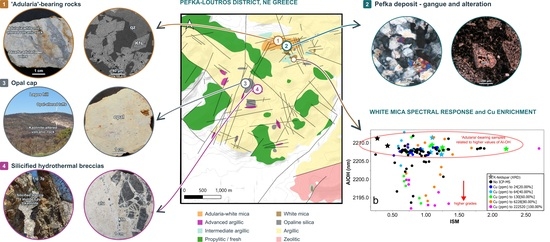
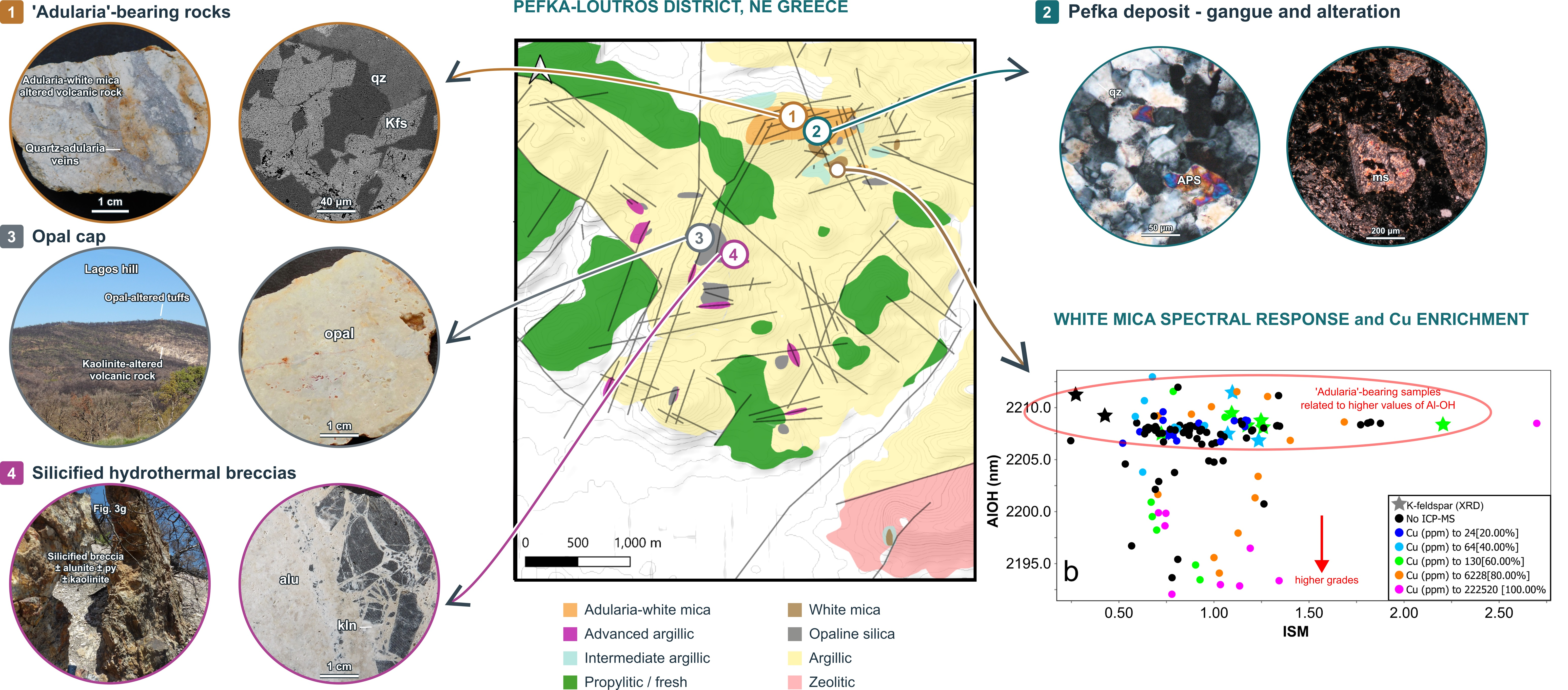
Graphical Abstract

1. Introduction

Epithermal deposits are shallow magmatic-hydrothermal ore systems that typically form at paleodepths of less than approximately 1.5 km and temperatures generally below 300 °C in volcanic and subvolcanic environments [1,2,3,4,5]. They commonly develop within extensive hydrothermal systems in which circulating fluids interact with and alter the surrounding rocks. Variations in fluid composition, temperature, pH, redox conditions, sulfidation state, and fluid–rock interaction control the resulting alteration and ore-mineral assemblages [2,6,7].
High-sulfidation mineralization is associated with strongly acidic and oxidized magmatic-hydrothermal fluids that are initially out of equilibrium with their host rocks and commonly produce advanced argillic alteration assemblages containing residual quartz, alunite, aluminum phosphate-sulfate minerals, pyrophyllite, and dickite [2,7]. In contrast, low-sulfidation systems are generally related to near-neutral, reduced, and strongly rock-buffered fluids and are commonly associated with adularia (i.e., morphologically distinctive low-temperature K-feldspar [8,9]) and illite-smectite alteration. Intermediate-sulfidation systems occupy transitional physicochemical conditions and are commonly associated with white mica (i.e., sericite) and locally adularia-bearing alteration [6,7]. However, alteration and ore minerals occurring within the same hydrothermal system are not necessarily contemporaneous because alteration may precede, accompany, or postdate the principal mineralization event [2,7].
Gangue and alteration mineralogy provide important information for evaluating mineralized systems in terms of both economic potential and subsequent geometallurgical behavior. Alteration minerals may influence ore processing, introduce deleterious phases, and affect the spatial distribution of valuable metals [10]. Alteration mapping is therefore important in both greenfield and brownfield exploration, as diagnostic minerals, mineral assemblages, and mineral-compositional variations may provide vectors toward mineralization.
Fine-grained alteration minerals, particularly clay minerals and white mica, are commonly difficult to distinguish in hand specimens but can be rapidly characterized using portable visible-near-infrared and short-wave infrared spectroscopy (pVNIR-SWIR; [11,12]). Portable VNIR-SWIR spectroscopy is a rapid, non-destructive method suitable for the analysis of large sample sets, whereas X-ray diffraction (XRD) provides more definitive mineral identification and detects phases that are weakly or not SWIR-active. These methods are therefore complementary in studies of epithermal alteration [11,13,14]. Variations in the Al-OH absorption wavelength and the spectral maturity of white mica and illite may provide information on mineral composition and hydrothermal conditions (e.g., paleotemperature), although their relationships with mineralization are deposit-specific and should be interpreted together with ore and gangue mineral assemblages, petrography, XRD, and geochemistry [13,14,15,16,17,18]. The principal Al-OH absorption feature at pVNIR-SWIR data generally shifts from shorter wavelengths in Al-rich or paragonitic compositions (approximately 2180–2195 nm), through muscovitic compositions (2200–2210 nm), to longer wavelengths in Mg-Fe-rich, phengitic compositions (2210–2228 nm) [14,15,17]. Illite spectral maturity (ISM), which is distinct from XRD-based illite crystallinity, is an absorption-depth ratio derived from pVNIR-SWIR data that reflects relative hydration and spectral ordering and may qualitatively indicate formation-temperature variations [13,14,16]. Both parameters are influenced by mineral mixtures, grain size, moisture, and overlapping absorptions, and their relationship to mineralization is deposit-specific [13,14,16].
The Pefka-Loutros area represents an important epithermal district within the Rhodope metallogenic province of northeastern Greece. It contains several volcanic centers, is affected by widespread hydrothermal alteration, and hosts the polymetallic Pefka high- to intermediate-sulfidation deposit, which is enriched in Cu, Au, Te, In, Se, and other metals [19,20,21]. Previous studies have identified silicic-, argillic-, sericitic or white mica-, advanced argillic-, and locally adularia-bearing alteration assemblages throughout the broader Pefka-Loutros area [19,22,23,24]. However, their spatial distribution and relationships with lithology, structures, hydrothermal breccias, and mineralized zones remain insufficiently constrained.
Therefore, this study investigates the hydrothermal alteration architecture of the Pefka-Loutros area by integrating pVNIR-SWIR spectroscopy, bulk-rock XRD, petrography, scanning electron microscopy with energy-dispersive X-ray spectroscopy, and bulk-rock geochemistry. The main objectives are to: (1) identify the principal alteration and gangue minerals and determine their spatial distribution; (2) evaluate compositional and spectral-maturity variations in white mica and clay minerals; (3) distinguish alteration directly associated with mineralized veins from alteration affecting the host and surrounding volcanic rocks; and (4) assess the relationships between alteration patterns and the distribution of mineralization. The resulting alteration framework provides constraints on the hydrothermal evolution of the Pefka-Loutros system and evaluates which mineralogical and spectral features may have broader exploration significance in complex, polymetallic high- to intermediate-sulfidation epithermal environments while also demonstrating the value of pVNIR-SWIR spectroscopy for investigating such complex systems.

2. Geological Context

The Pefka-Loutros area is located in the Rhodope metallogenic province in northeastern Greece within the broader Western Tethyan metallogenic belt, which hosts numerous Cenozoic porphyry and epithermal systems [24,25]. The Rhodope region is characterized by large-scale metamorphic core complexes bordered by detachment faults [26] and associated supra-detachment volcano-sedimentary basins (Figure 1a) developed during post-orogenic extension following Alpine crustal thickening [27]. In eastern Rhodope, this tectono-magmatic evolution was accompanied by the Late Eocene-Oligocene magmatism of calc-alkaline to high-K and locally shoshonitic affinity [28,29], which resulted in widespread hydrothermal alteration and epithermal mineralization [24,25,30].
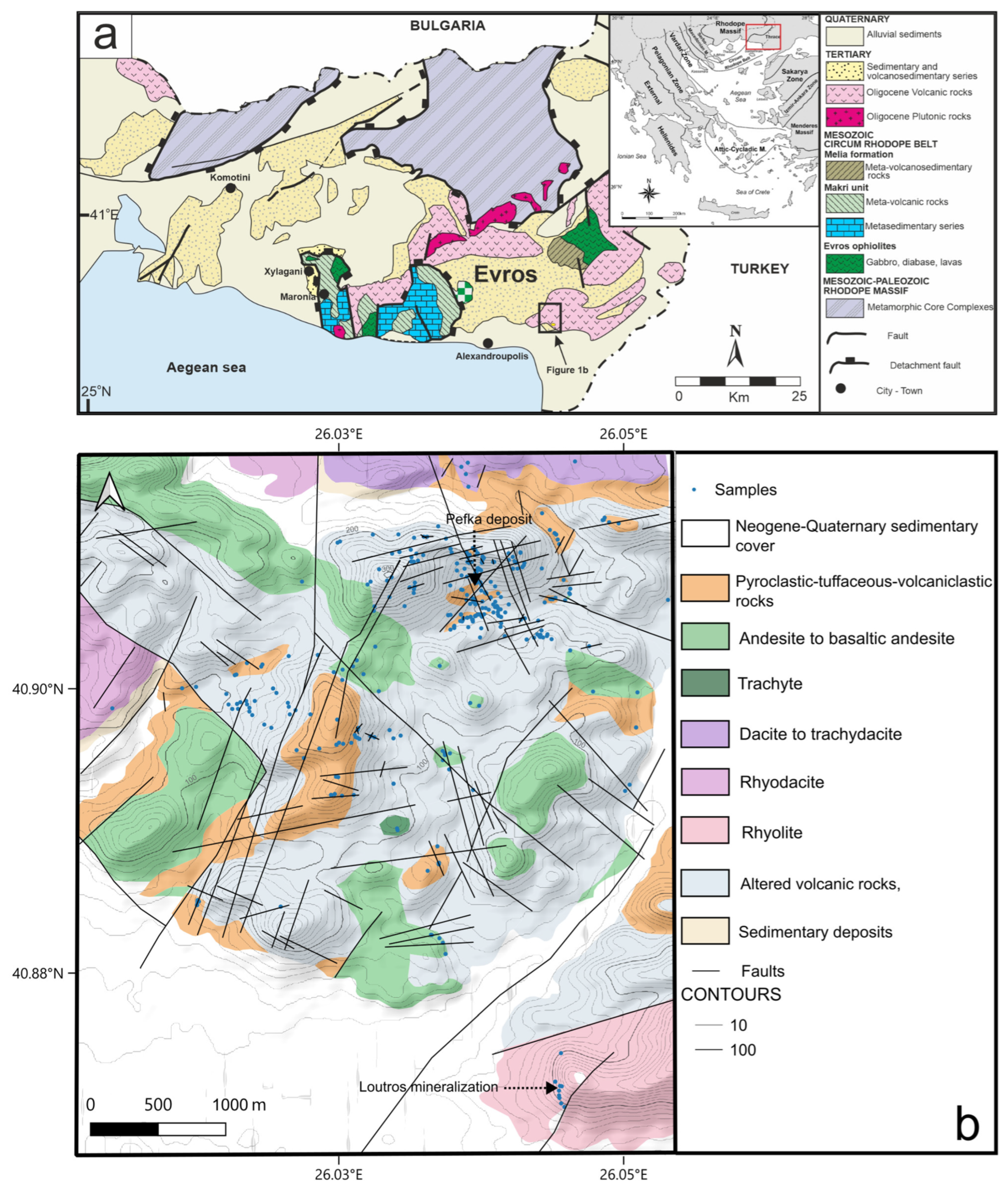
Within this regional framework, the Pefka-Loutros area forms part of the northern Hellenic Thrace Basin, a supra-detachment basin developed on the exhumed Rhodope basement during Tertiary syn- to late-orogenic extension [27]. Although the basement beneath the study area is not exposed, nearby occurrences of the Circum-Rhodope Belt indicate the presence of metasedimentary and metavolcano-sedimentary units in the surrounding region, including the Melia Formation to the north and the Makri unit to the west [31]. The study area lies within the Feres basin and the local geology is dominated by volcanic, subvolcanic, and volcaniclastic rocks of mainly intermediate to felsic composition, including lava domes, tuffs, volcanic breccias, and pyroclastic deposits (Figure 1b) [19,22]. Based on field observations and petrographic characterization conducted in this study, together with previously published geological and petrological data [19,23] at least five volcanic rock types have been identified in the area, ranging from intermediate basaltic andesite and predominantly andesitic compositions to more felsic dacite and rhyolite (Figure 1b). Minor sedimentary rocks, such as local sandstone occurrences, are also present (Figure 1b).
Figure 1. Regional and local geological setting of the Pefka-Loutros area. (a) Simplified geological map of the Rhodope metallogenic province, showing the position of the Pefka-Loutros area within the broader Cenozoic metallogenic framework of northeastern Greece. Modified after [32]. (b) Simplified geological map of the Pefka-Loutros area showing the main lithological units, structural trends, hydrothermal breccias, mineralized zones, and sample locations. Modified after [19,33]. The coordinate system is WGS84.
Minerals 16 00965 g001
The study area is structurally complex and is crosscut by several fault and fracture systems, mainly oriented NE-SW, NNW-SSE, and E-W (Figure 1b) [19,27]. Both tectonic/fault and hydrothermal breccias occur in the area, with hydrothermal breccias being particularly abundant around the Pefka deposit. Fresh volcanic rocks are locally preserved, commonly forming dome-shaped bodies, but most volcanic and volcaniclastic units are affected by variable degrees of hydrothermal alteration [22].
Two main mineralized prospects are recognized in the area: the Pefka HS-IS epithermal deposit and the Loutros IS mineralization (Figure 1b). The Pefka deposit was formerly mined for Cu and Au during the 1960s [34] and consists of structurally controlled mineralized veins and breccias hosted by altered intermediate volcanic rocks [19,20,21,35,36,37]. Bulk-rock geochemical data indicate polymetallic mineralization with enrichment in Cu, Au, Ag, Se, In, and Te [19]. The ore mineralogy is highly complex and includes luzonite/famatinite-enargite, tennantite, chalcopyrite, galena, tellurides, native Au, roquesite, and other accessory ore minerals [19]. Mineralization is mainly related to HS barite-rich quartz veins containing pyrite, luzonite/famatinite, tennantite, enargite, and locally Au-Ag-Bi tellurides, then later IS carbonate-quartz veins with chalcopyrite, tetrahedrite, pyrite, and tellurides [19], and a last stage with platy carbonate ± quartz veins. In contrast, Loutros mineralization is associated with rhyolitic volcanic rocks and represents an intermediate-sulfidation epithermal occurrence in the broader Pefka-Loutros area. The vein system is associated with quartz-barite veins with marcasite and pyrite, and later barite-galena veins [24].

3. Materials and Methods

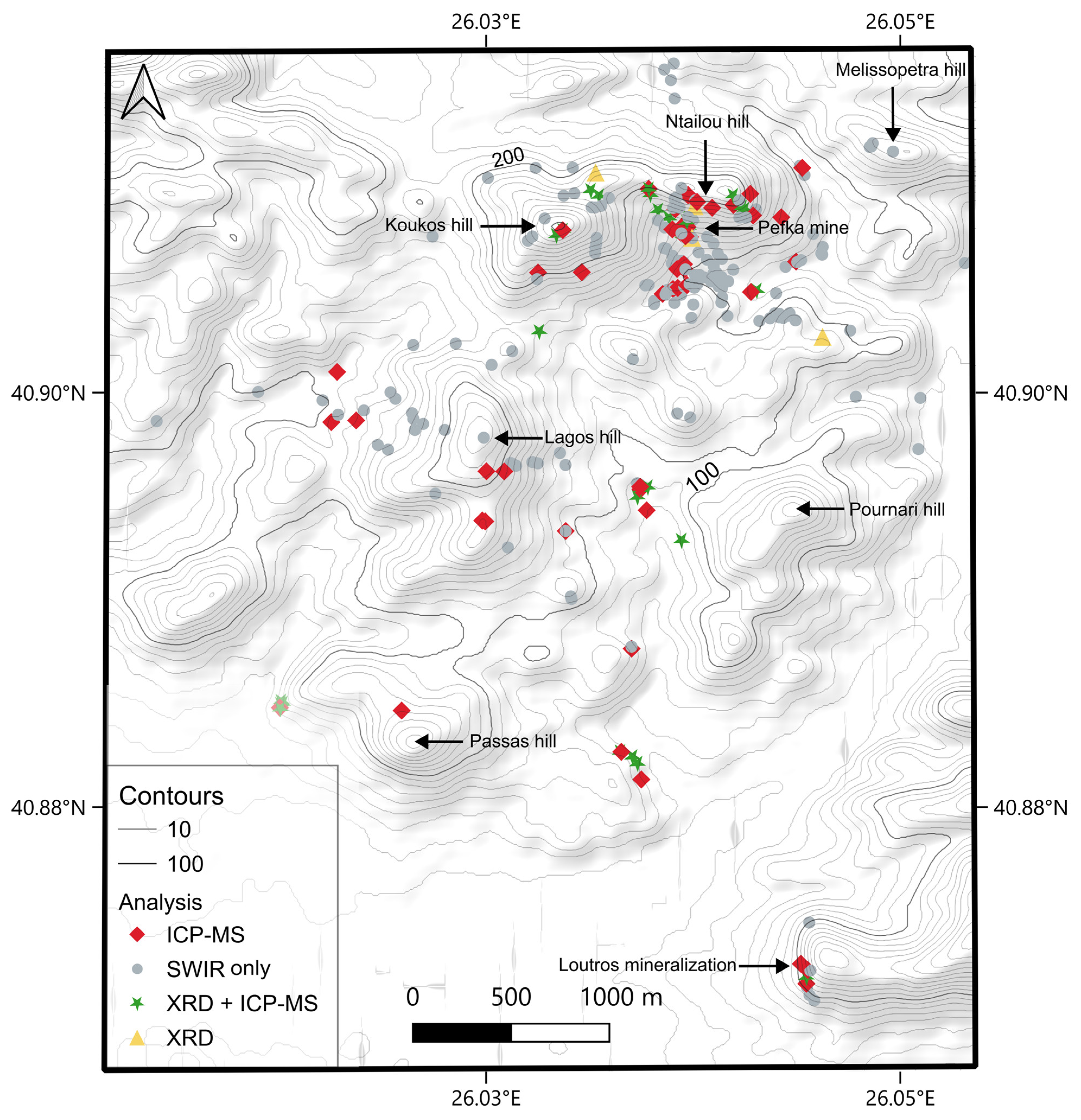
Sampling in the Pefka-Loutros area (approximately 24 km2) was carried out during several field campaigns, focusing mainly on the Pefka mine mineralized zone and the surrounding vein- and hydrothermal alteration system. Sampling was selective and outcrop-controlled rather than grid-based due to dense vegetation and irregular exposure (Figure 2). After the summer 2023 wildfire [38], additional outcrops became accessible, and further samples were collected to better cover the main lithologies, alteration types, mineralized zones, and representative vein/breccia occurrences.
Portable VNIR-SWIR reflectance analyses were performed using a Spectral Evolution SR-6500 spectroradiometer (Spectral Evolution, Haverhill, MA, USA) equipped with a contact probe, from GeoRessources (Université de Lorraine, Nancy, France). Spectra were acquired from representative fresh surfaces of hand specimens/rock chips in reflectance mode over the 350–2500 nm wavelength range, with 2151 spectral channels. For each measurement, 40 scans were averaged, with automatic dark-current correction and calibration against a white reference panel before and periodically during spectral acquisition. Spectral data were processed using primarily The Spectral Geologist software (TSG v.8.1.0.9, CSIRO, Perth, WA, Australia, https://research.csiro.au/thespectralgeologist, accessed on 10 July 2026). Mineral identifications were generated using the built-in The Spectral Assistant (TSA) algorithm, which performs automated spectral unmixing by comparing measured SWIR spectra with reference mineral spectra. Diagnostic absorption-feature positions and depths were extracted after convex-hull continuum removal, mainly around 1900 and 2200 nm. All samples were analyzed by pVNIR-SWIR spectroscopy, resulting in 764 point measurements. For the mineral-distribution maps, only system-generated TSA mineral identifications with Error sTSAS values <300 were retained, whereas values ranging from 300 to 1000 were considered poor-quality spectral fits and excluded (Table S1).
X-ray diffraction analyses focusing on the Pefka deposit and proximal alteration zones were performed on 60 selected samples. These were performed on bulk randomly oriented powder samples for mineral phase identification at the Department of Mineralogy-Petrology-Economic Geology, School of Geology, Aristotle University of Thessaloniki, Greece. Analyses were carried out using a Philips diffractometer (Philips Analytical, Almelo, The Netherlands) equipped with Ni-filtered Cu Kα radiation, operating at 40 kV and 30 mA. Samples were scanned from 3 to 63° 2θ, with a step size of 0.020° 2θ and a counting time of 1 s per step, using continuous scan mode. Mineral phases were identified and refined by full-pattern Rietveld refinement using Profex software (v.5.6.1) (Table S2) [39].
A total of 136 rock-chip samples were analyzed for trace elements, including rare earth elements (REEs), at MSALABS, Langley, British Columbia, Canada. Analyses were carried out using the IMS-131 or IMS-130 analytical packages, which determine 51 elements by ICP-MS and ICP-ES. Rock-chip samples were collected from mineralized veins and altered wall rocks showing evidence of sulfide mineralization; therefore, the term bulk-rock geochemistry is preferred over bulk-ore geochemistry. Prior to analysis, samples were pulverized, and aliquots of 0.5 g or 20 g were selected for digestion, depending on the amount of material available. The digestion was performed using aqua regia prepared from hydrochloric acid and nitric acid in a 3:1 ratio followed by dilution with a mixture of hydrochloric acid, nitric acid, and deionized water. Elements that exceeded the calibration range of the routine method, including Cu, Au, and Te, were reanalyzed using suitable overlimit techniques, such as fire assay or titration. Values reported below the analytical detection limit were substituted with 0.65 times the respective detection limit, following [40] (Table S2).
Bulk-rock geochemical data were processed and visualized using ioGAS 8.3, 64-bit version. Element distribution maps for bulk-rock samples were generated in ioGAS using the gridding tool. Sample data were interpolated onto regular grids using a cell size of 1.47 × 10⁻⁴ map units (WGS84; EPSG:4326) in both the X and Y directions. Where more than one sample occurred within a grid cell, the maximum value per cell was retained prior to gridding. A search radius of 5 cells and a minimum smoothing radius of 3 cells were applied. The resulting grids were classified using unequal percentile intervals at 30, 60, 80, 90, 95, 98, 99, and 100%, and areas without data were left uncolored.
Principal component analysis (PCA) was performed in ioGAS on selected bulk-rock geochemical data following centered log-ratio (CLR) transformation. Each elemental concentration was expressed as the logarithm of its ratio to the geometric mean of the concentrations included in the CLR transformation for the same sample [41,42]. This approach evaluates relative multielement variation within the selected geochemical composition. Geospatial data compilation, map preparation, and spatial analysis were carried out using QGIS Desktop 4.0.0 using the WGS84 geographic coordinate reference system (EPSG:4326).
Scanning electron microscopy coupled with energy-dispersive X-ray spectroscopy (SEM-EDS) was conducted on polished thin sections at two facilities. Analyses at the Faculty of Sciences, Aristotle University of Thessaloniki (AUTh), were performed using a JEOL JSM-6390LV (JEOL Ltd., Akishima, Tokyo, Japan) scanning electron microscope coupled with an Oxford INCA 300 EDS system (Oxford Instruments NanoAnalysis, High Wycombe, UK). Additional analyses were conducted at the Analytical Services Unit of Centre for Research and Technology Hellas (CERTH) using a JEOL JSM-IT500 (JEOL Ltd., Akishima, Tokyo, Japan) scanning electron microscope equipped with an Oxford INCA X-ACT EDS system (Oxford Instruments NanoAnalysis, High Wycombe, UK).

4. Results

4.1. Field and Petrographic Characteristics of Gangue and Alteration Assemblages

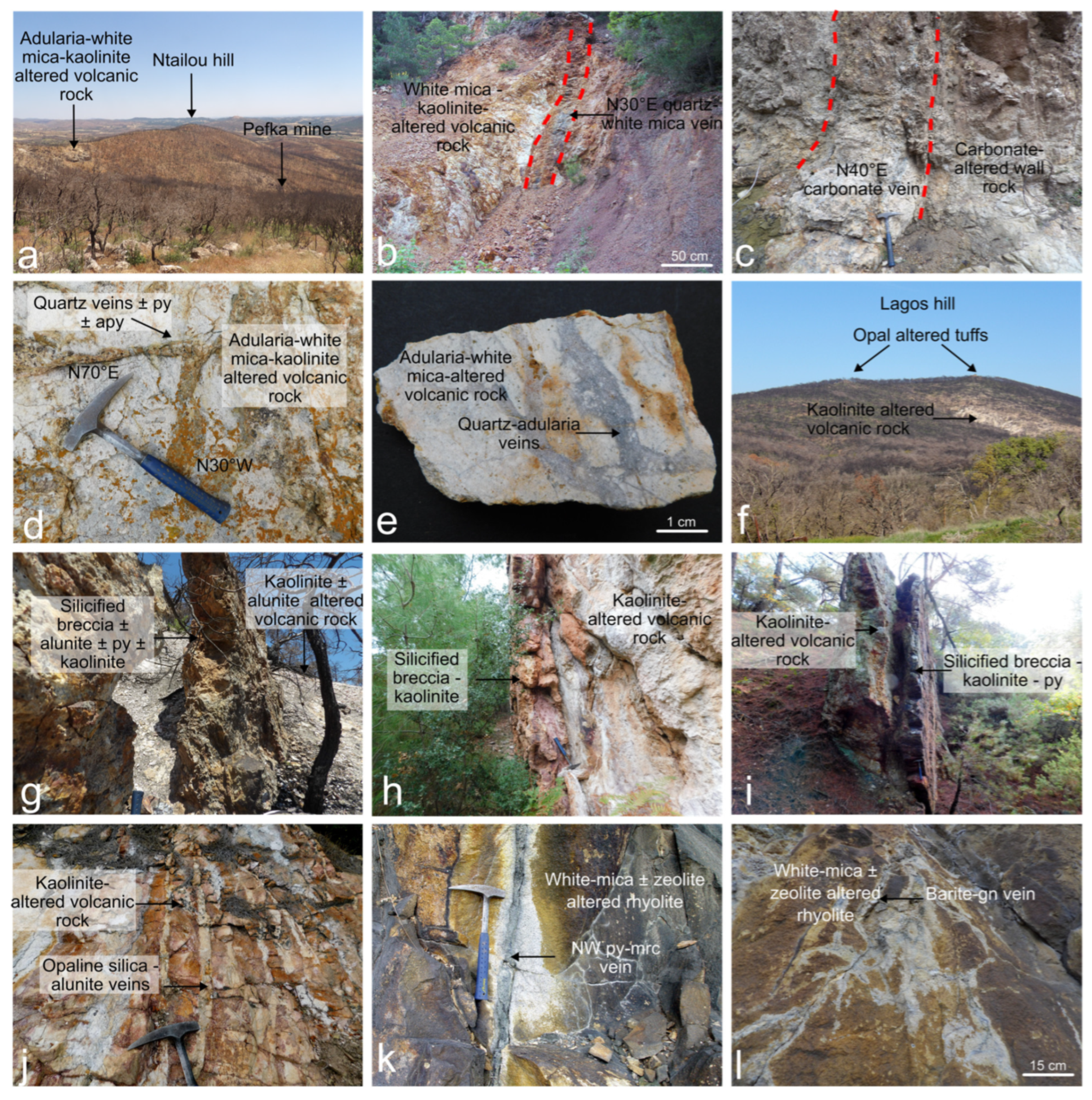
Different alteration and gangue minerals were identified across the broader Pefka-Loutros area at the field (Figure 3), macroscopic and microscopic scales (Figure 4). The alteration architecture is spatially heterogeneous and closely related to the distribution of volcanic and volcaniclastic units, dome-shaped bodies, hydrothermal breccias, and fault-controlled vein systems.
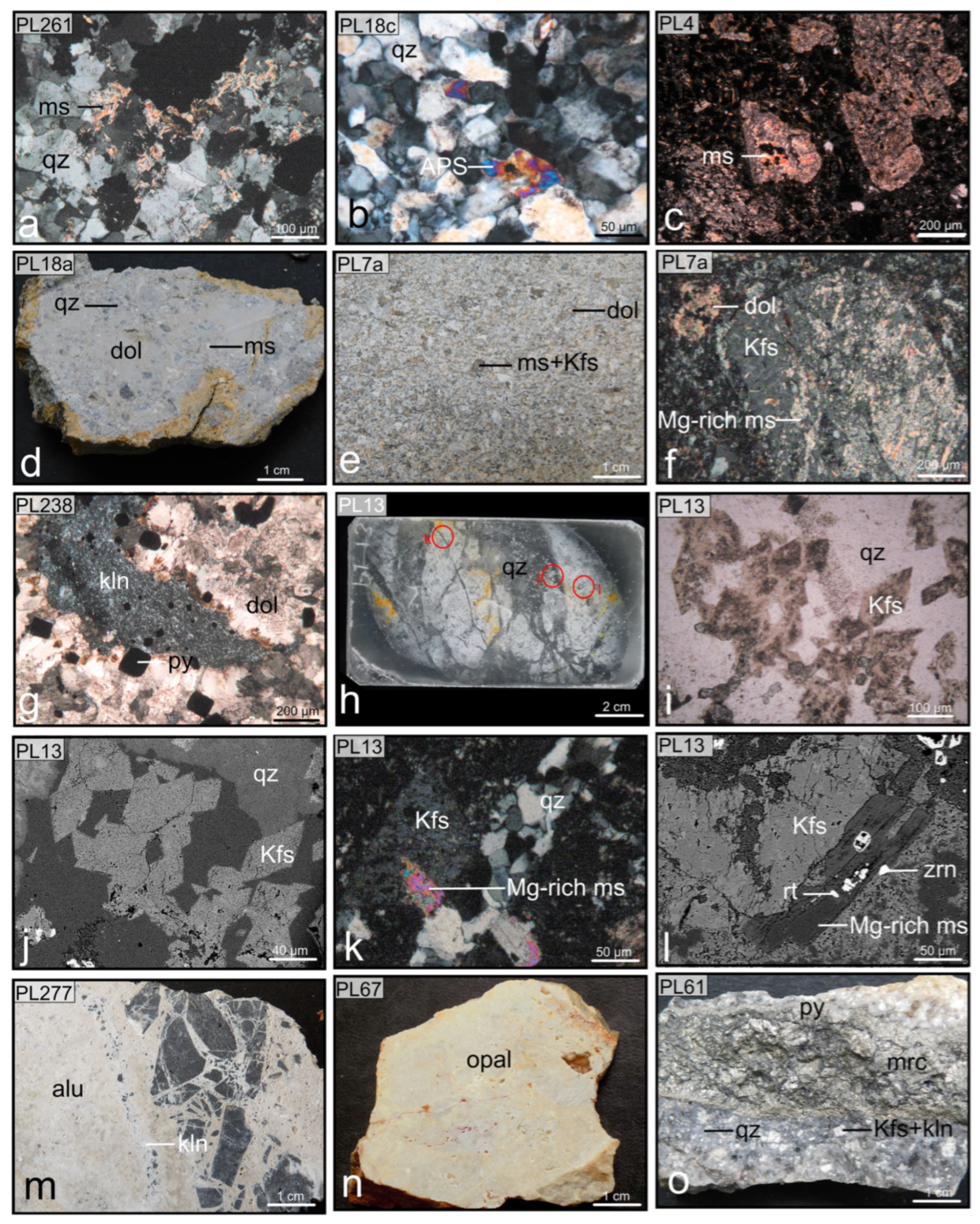
The hydrothermal alteration assemblages mainly occur as halos around mineralized veins and faults, and they display both lateral and vertical zoning. At the Pefka mine, located at the base of Ntailou hill (Figure 3a), three types of mineralized veins with distinct wall-rock alteration mineralogy occur: (1) milky grey quartz-barite veins with HS ore assemblages (NE- and NW-trending) (Figure 3b); (2) carbonate-quartz-barite veins with IS/LS ore assemblages (NE-trending) (Figure 3c); and (3) quartz-adularia veins with IS/LS ore assemblages (mostly N70E-trending) (Figure 3d,e). White mica and APS-group minerals, such as svanbergite, are present as gangue minerals in the quartz-barite veins bearing luzonite/famatinite + enargite + tennantite mineralization (Figure 4a,b).
White mica-rich alteration, rimming the luzonite/famatinite + enargite veins, consists of the assemblage white mica/illite + kaolinite ± quartz ± pyrite, which replaces feldspar and biotite phenocrysts (Figure 4c). White mica, commonly muscovite (i.e., phyllic alteration), replaces feldspar and mafic phenocrysts and also occurs disseminated in the rock matrix (Figure 4c). Carbonate-quartz-barite veins hosting IS to LS assemblages with tetrahedrite/tennantite + chalcopyrite and minor arsenopyrite, demonstrate pervasive wall-rock alteration (Figure 4d), with phenocrysts (feldspars, i.e., adularia and amphiboles) partly to completely replaced by white mica + illite + dolomite ± kaolinite (Figure 4e,f). Kaolinite can be locally present in the carbonate veins, filling vugs and occurring together with carbonate and pyrite (Figure 4g).
In the altered rocks surrounding the Pefka mine and in the surrounding Ntailou-Koukos hills, adularia is a common alteration mineral in the volcanic host rocks around quartz-adularia veins, especially at higher elevations (Figure 4h–l). However, adularia also occurs at deeper levels in altered outcrops exposed some meters away from the quartz-barite-, and carbonate-quartz-barite veins, where it accompanies white mica and carbonates.
Within the quartz-adularia veinlets, adularia occurs as pseudo-rhombohedral crystals associated with quartz veins and veinlets crosscutting the altered volcanic host rocks, breccias and tuffs (Figure 3d,e and Figure 4h–l). In the adularized wall rocks, adularia occurs as replacement of feldspar phenocrysts and in the rock matrix. In wall rocks proximal to the HS and IS veins, white mica replaces adularia (Figure 4f), whereas at the upper levels of Ntailou Hill, white mica appears to both predate and postdate adularia (Figure 4k,l). Adularia was not identified as a gangue mineral within the HS quartz-barite and IS carbonate ore-bearing veins of the Pefka deposit themselves.
At the southern part of the studied area, especially between Lagos Hill (Figure 3f) and Passas Hill, alteration mostly develops as haloes around silicified faults and veins (Figure 3g–i). Alunite and/or kaolinite are present as gangue minerals within the silicified veins/faults (black massive silica) along with pyrite ± galena. Alteration around the veins/faults is dominated by an inner alunite + kaolinite zone (or kaolinite-only) zone grading outward to kaolinite, then to a smectite-bearing zone followed by propylitic and fresh rock. Altered volcanic rocks are characterized by the replacement of phenocrysts by kaolinite and alunite. Within the veins/faults, alunite and kaolinite also occur as the matrix of hydrothermal breccias (Figure 4m), where they cement silicified rock fragments.
The upper parts of Lagos Hill (Figure 3f) and several smaller hills in the southern part of the area are characterized by opaline-silica-altered tuffs and contain blankets of opaline silica (Figure 4n). The pyroclastic and volcanic rocks beneath the opaline silicification are altered mainly to kaolinite and locally alunite and are crosscut by massive opaline ± porcellaneous alunite veins (Figure 3j).
At the Loutros mineralization, the rhyolitic host rock is pervasively silicified and crosscut by marcasite-pyrite (Figure 3k) and galena-barite (Figure 3l) veins. Phenocrysts, originally K-feldspar and biotite, are partly replaced by muscovite and kaolinite (probably supergene), especially near the massive pyrite-marcasite vein (Figure 4o). Zeolite alteration occurs in more distal positions [24].

4.2. SEM-EDS Characterization of Gangue and Alteration Minerals

SEM-BSE observations and semi-quantitative EDS analyses were used to characterize the chemistry of some alteration and gangue minerals and their textural relationships. The EDS data are used here as supportive compositional evidence and were interpreted together with petrographic, XRD, and SWIR observations.
Key observations are that white mica occurs mainly as fine-grained aggregates (i.e., sericite) replacing volcanic phenocrysts and as vein-related gangue. In samples associated with both the HS and IS veins, either disseminated in the immediate wall rocks or as gangue in vein-style mineralization, the analyzed white mica is predominantly muscovitic in composition. In contrast, white mica associated with adularized rocks mainly at the higher parts of Ntailou hill shows detectable Mg in the EDS analyses, suggesting a more Mg-bearing, phengitic component. Petrographic observations indicate that mica becomes progressively enriched in Mg within only 5–10 m from the mineralized veins at the Pefka deposit (Table S3).
In petrographic and BSE images, adularia commonly forms fine-grained aggregates or irregular replacement domains within altered phenocrysts (Figure 4f,i–l). Semi-quantitative EDS analyses generally show K-Al-Si-rich compositions typical of K-feldspar. Some domains yielded detectable Ba signals in the EDS analyses. However, because the Ba Lα and Ti Kα peaks strongly overlap and cannot be reliably distinguished under the present analytical conditions, these values are reported in Table S3 but are not interpreted further. The APS minerals identified at the Pefka deposit (Figure 4b) are characterized by Al-S-O-rich compositions, low K contents, and elevated Sr and Ca (Table S3). Based on the semi-quantitative EDS data (Table S3), they are probably classified as svanbergite and svanbergite-woodhouseite solid solutions within the alunite supergroup [44].
Most analyzed carbonates in both veins and surrounding wall rocks are Mg-bearing and are therefore interpreted as dolomite or dolomite-group carbonates. Some analyses also show detectable Fe and Mn, indicating the presence of Fe-Mn-bearing dolomite or sideritic or ankeritic compositions. These Fe-Mn-bearing carbonate compositions appear to be more common in carbonates surrounding or crosscutting the metallic assemblages within the veins.

4.3. XRD Characterization of Gangue and Alteration Mineralogy

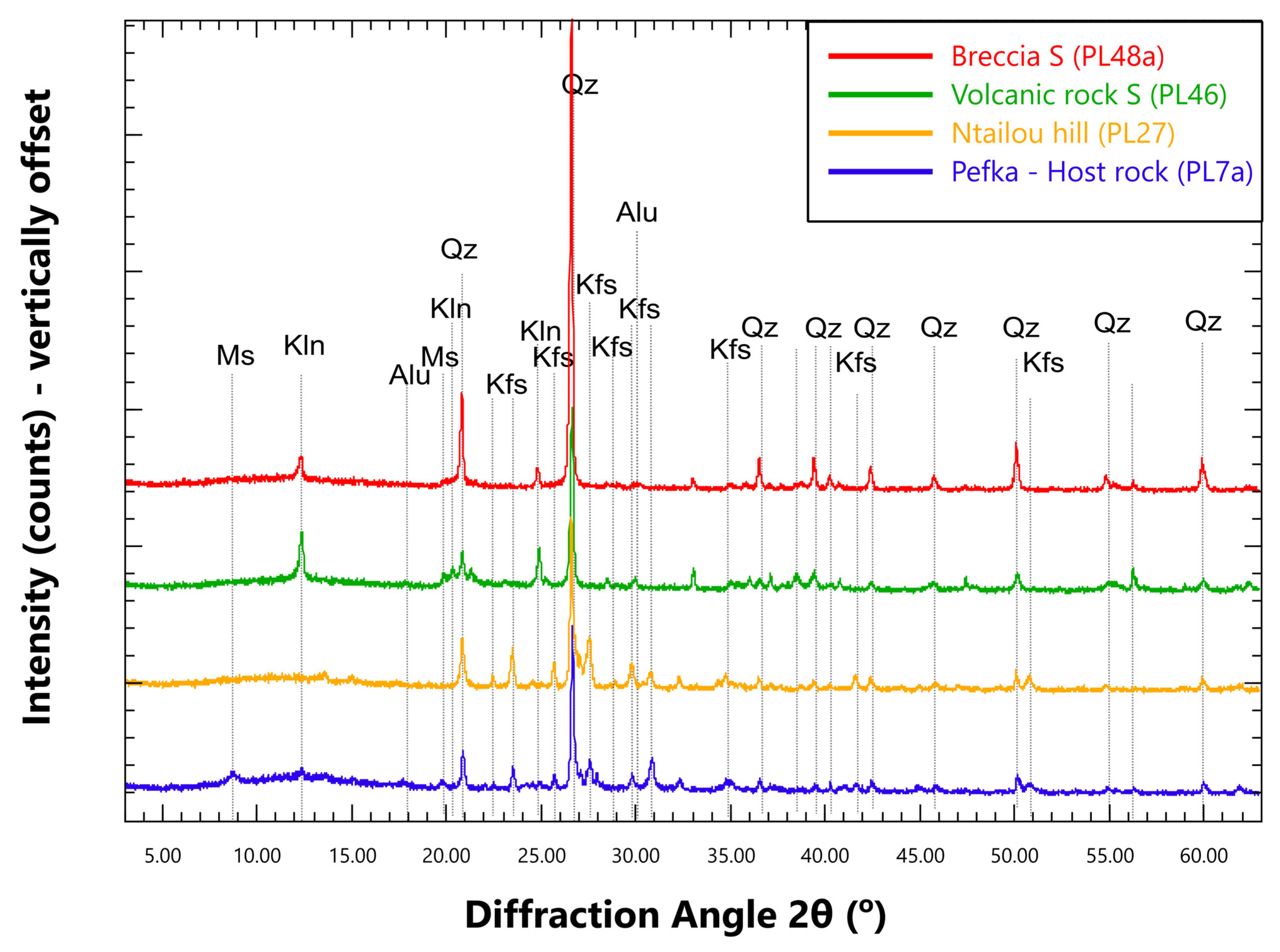
X-ray diffraction analyses from the Pefka-Loutros area identified K-feldspar, muscovite, kaolinite, alunite, chlorite, dolomite, ankerite, plagioclase, barite and pyrite (Figure 5, Table 1 and Table S2). The alteration maps of the analyzed samples with XRD indicate that the Pefka deposit area is dominated by white mica-, K-feldspar-, kaolinite- and carbonate-bearing alteration assemblages (Table S2). The XRD patterns confirm that the hydrothermally altered volcanic host rocks of the Pefka deposit are characterized by white mica, mainly muscovite, together with kaolinite and K-feldspar.
Based on petrographic observations, the K-feldspar in the Pefka mineralized area is interpreted as hydrothermal adularia. An altered volcanic rock from the Ntailou Hill area is mainly characterized by white mica and K-feldspar/adularia (Figure 5). In the southern part of the studied area, XRD analyses confirm the presence of kaolinite ± alunite ± pyrite. A hydrothermal breccia from the same southern sector, associated with disseminated pyrite and galena in a quartz vein, contains abundant kaolinite gangue (Figure 5; red pattern), while the wall-rock is also altered to kaolinite (Table 1; sample PL48a). In the Loutros area, XRD analyses also confirm the presence of white mica as an alteration product of the rhyolite (Table S2).

4.4. pVNIR-SWIR Alteration Mineralogy and Spatial Distribution

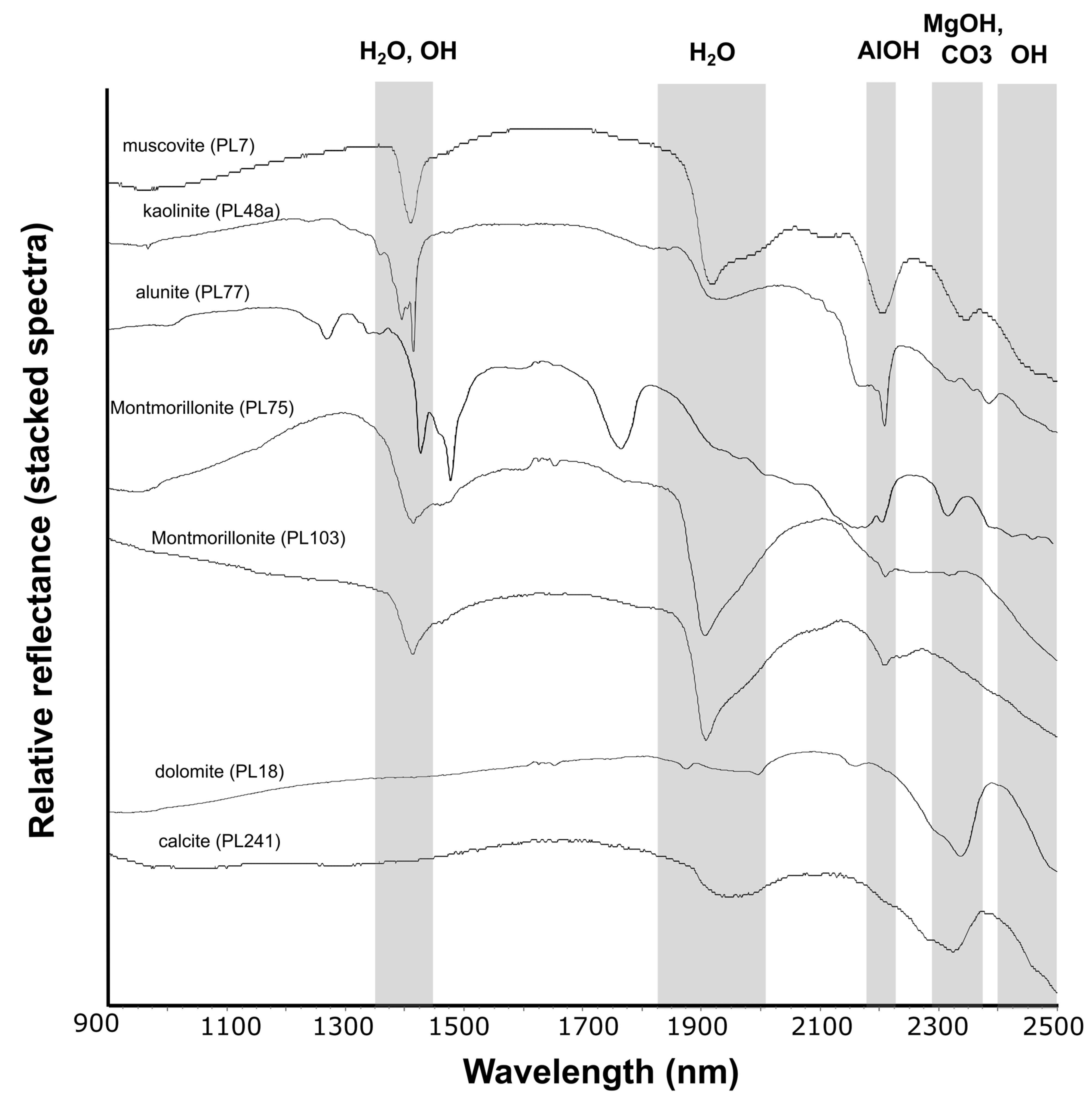
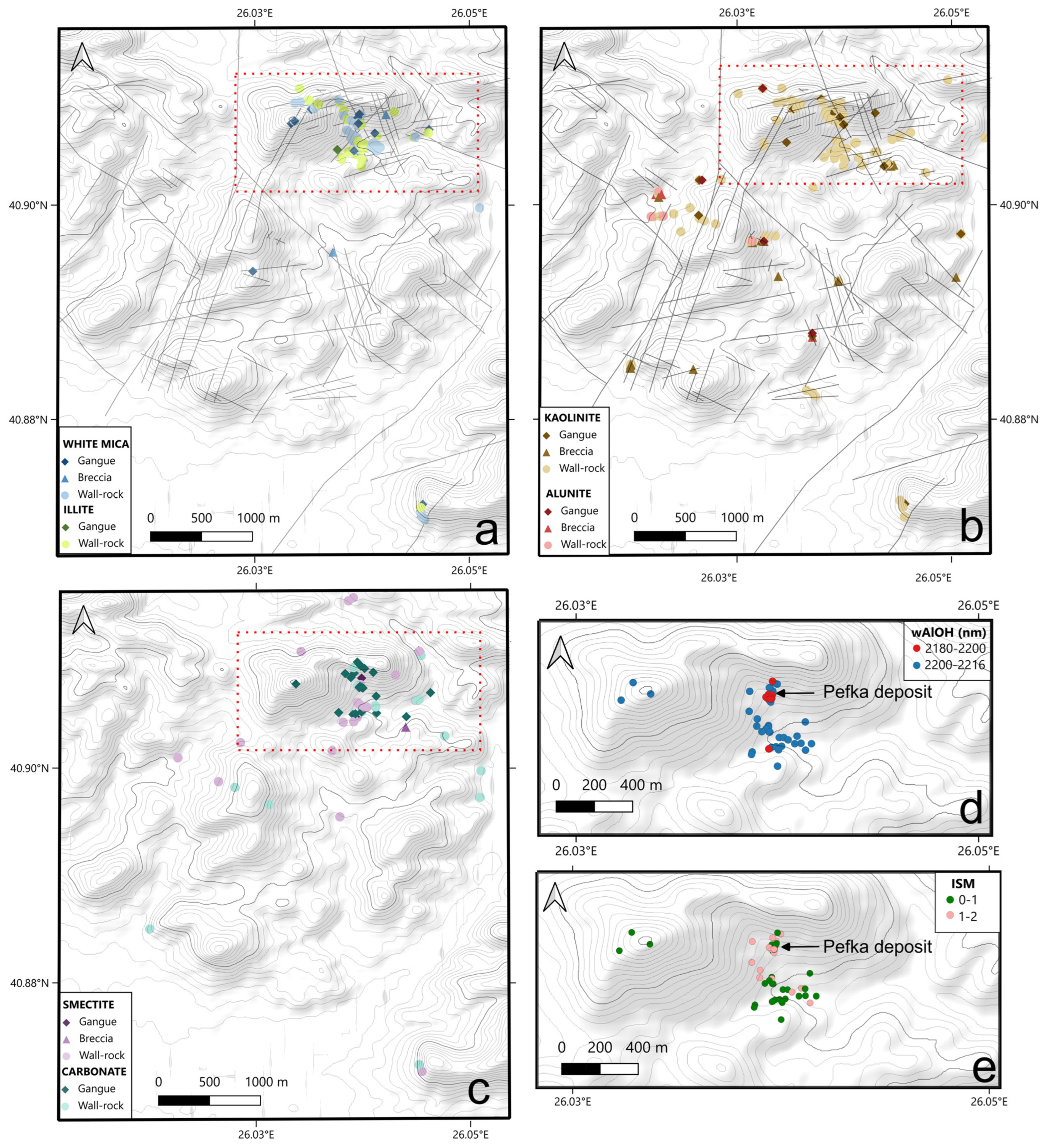
The pVNIR-SWIR indicated the presence of minerals (Figure 6) from the white mica (Figure 7a), kaolinite, sulfate (Figure 7b) smectite and carbonate mineral groups (Figure 7c). Excluding aspectral measurements (Table S1), kaolinite-group minerals constitute the dominant spectral group in TSA in nearly 40% of the SWIR analyses (Figure 7b). White mica including illite is the next most common spectral group (Figure 7a), followed by sulfate minerals and sulfate-bearing assemblages, including alunite, barite, and jarosite. The spectra indicate that white mica spectra parameters vary from low to high Al-OH absorption wavelengths (Figure 7d). Kaolinite and alunite were identified in several samples, while smectite-group minerals, mainly montmorillonite, occur in a range of altered volcanic rocks. Carbonate minerals are also clearly visible in the spectra, with variations in the carbonate absorption wavelength allowing discrimination between calcitic and more dolomitic carbonate compositions.
Kaolinite is widespread throughout the Pefka-Loutros area, where it occurs as gangue, within hydrothermal-breccia matrices, and as wall-rock alteration (Figure 7b). Outward from the Pefka mine, kaolinite is locally associated with carbonate in altered volcanic host rocks (Figure 7c). In contrast, smectite-group minerals occur mainly in the northeastern part of the study area, where they are associated with dacitic rocks (Figure 7c). Alunite is mainly concentrated around Lagos Hill and to the west of Pournari Hill (Figure 7b), where it is commonly associated with fault-controlled hydrothermal breccias containing pyrite ± galena.
According to the SWIR data, the area around the Pefka deposit is dominated by white mica alteration, whereas white mica is also identified in the Loutros mineralization (Figure 7a). Around the Pefka deposit, the white mica Al-OH absorption wavelength shows a tendency to shift toward shorter wavelengths, commonly between 2192 and 2200 nm, close to both the HS and IS mineralization (Table S1). In contrast, more peripheral and distal samples are characterized by longer Al-OH wavelengths, mostly between 2205 and 2216 nm (Figure 7d), with average values around 2208 nm suggesting a more Mg-rich composition. Illite spectral maturity values are mainly between 1 and 2 around the mineralization, whereas peripheral and distal areas are generally characterized by lower values, mostly between 0 and 1 (Figure 7e).

4.5. Bulk-Rock Geochemistry

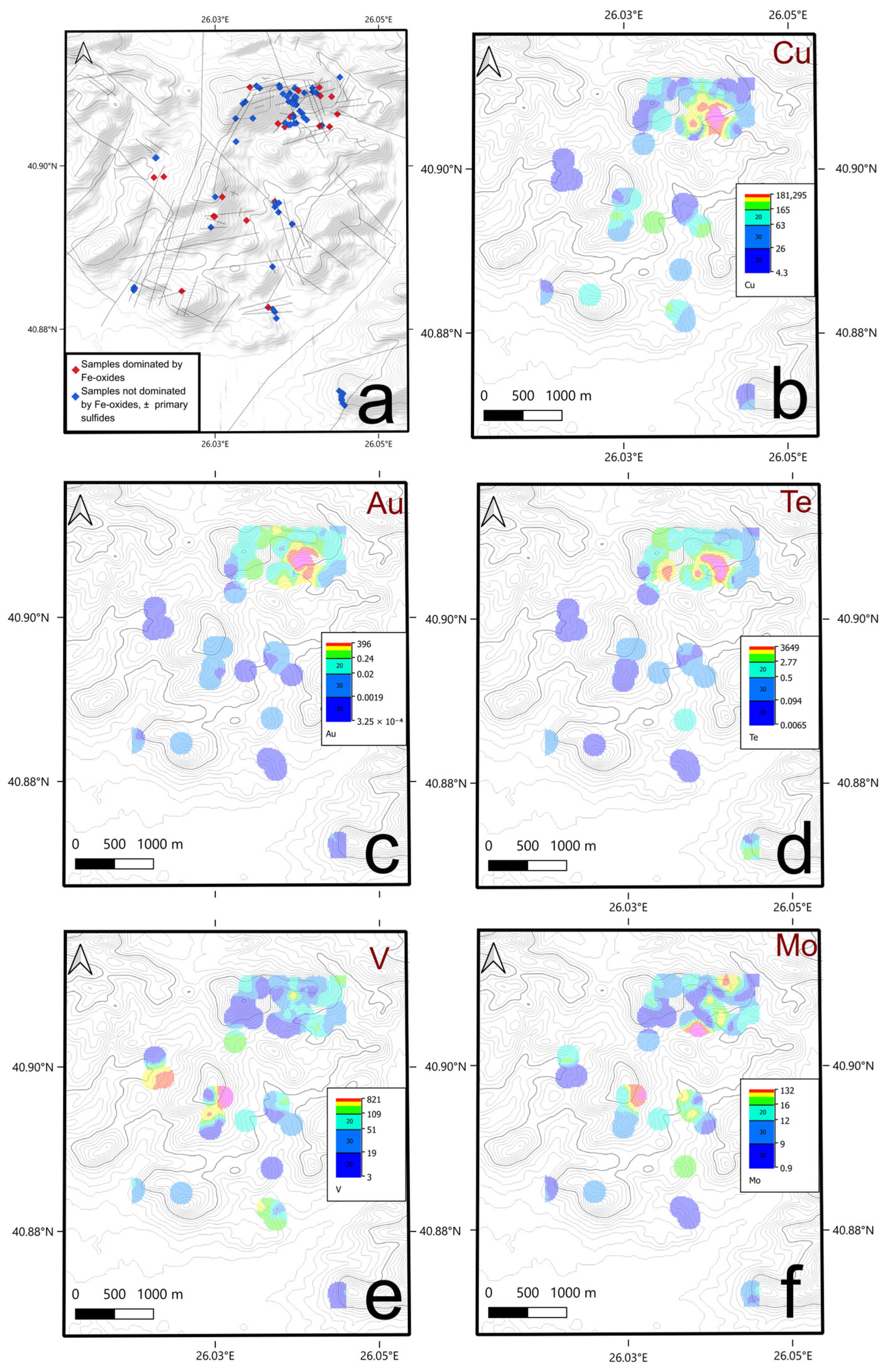
Samples analyzed for bulk-rock geochemistry were classified into two categories based on the predominance of Fe-oxides: Fe-oxide-dominated, gossaneous samples and samples not dominated by Fe-oxides, including those containing primary sulfide mineralization (Figure 8a). The interpolated geochemical maps show that the strongest Cu, Au, and Te anomalies are concentrated around the Pefka deposit (Figure 8b–d). Copper also displays moderate anomalies (up to 210 ppm) in the central part of the study area, particularly along the creek system between Pournari and Lagos Hill. In contrast, the highest Au (up to 550 ppm) and Te (up to 4000 ppm) values are more spatially restricted and are mainly focused around the Pefka deposit (Figure 8c,d).
Vanadium is elevated (up to 1150 ppm) in the Pefka mine area related to the presence of V-rich sulfosalts (i.e., colusite [19]) and at Lagos Hill (up to 820 ppm) (Figure 8e), partly overlapping with the Mo anomaly, but it also shows high values (up to 320 ppm) in the western part of the studied area (i.e., west of Lagos hill). At Lagos hill, the highest V concentrations occur mainly in samples dominated by Fe-oxides, indicating that the anomalies are preserved in oxidized ore-bearing material and probably reflect the oxidation of primary mineralization. Molybdenum shows a broader spatial distribution, with elevated values at Pefka and both north and south of the main mineralized zone. Adularia-bearing samples also contain Mo at concentrations of several tens of ppm, while a comb quartz sample is related to concentrations up to 92 ppm. An oxidized sample from a carbonate vein at the surrounding area of Pefka mine reaches up to 140 ppm (Figure 8a,f). Despite possible supergene modification, the V and Mo anomalies possibly indicate the presence of primary mineralization.

5. Discussion

5.1. Alteration Architecture, Gangue Mineralogy, and Hydrothermal Evolution

The Pefka-Loutros area comprises several volcanic centers with compositions ranging from basaltic andesite to rhyolite (Figure 1b). The volcanic rocks and associated volcaniclastic products are pervasively hydrothermally altered [19,22,23], while spatial and textural relationships indicate the overprinting of several hydrothermal events.
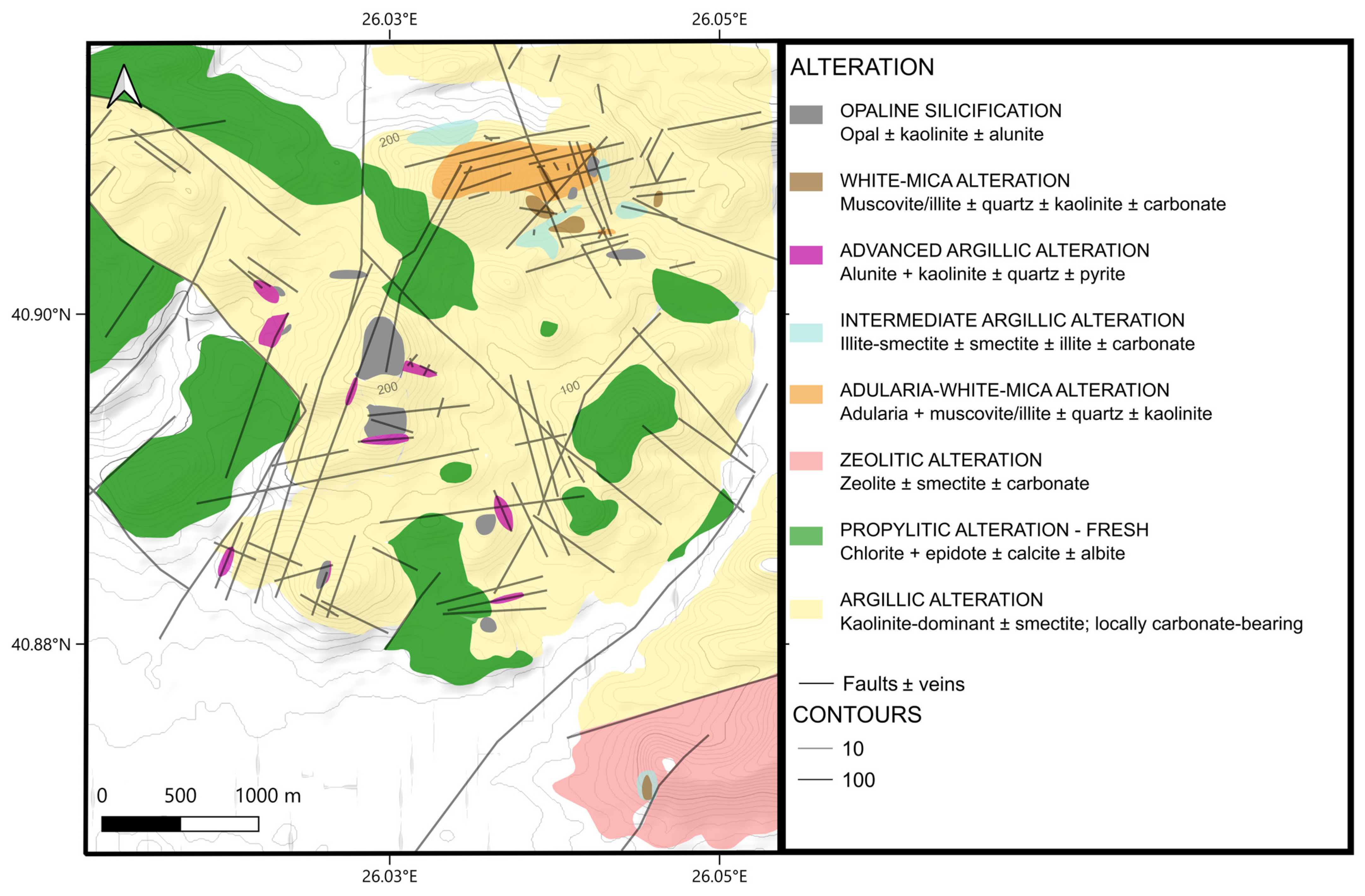
The northern part of the Pefka-Loutros area represents the principal mineralized sector and hosts the polymetallic high- to intermediate-sulfidation Pefka deposit, enriched in In, Te, Se, Au, and other metals [19]. The most intense and mineralogically complex alteration assemblages are consequently developed around the Pefka deposit and the adjacent Ntailou and Koukos Hills area (Figure 9).
The textural and crosscutting relationships suggest that adularia both predates and postdates Mg-rich white mica in the wall rocks (Figure 4f,k–l), but white mica grains with muscovitic composition totally relace adularia at the proximal wall rocks of the HS and IS veins at the Pefka mine (Figure 4c). The more phengitic composition of white mica may reflect relatively less acidic conditions with elevated Fe-Mg availability compared with more aluminous muscovitic or paragonitic compositions [14,45]. The assemblage of adularia and Mg-rich white mica is therefore interpreted as part of the early stages at the Pefka epithermal system associated with K-rich, near-neutral to weakly alkaline hydrothermal fluids. Although adularia is associated with quartz veins, veinlets, and locally brecciated veins that crosscut the adularized rocks, it has not been identified as a gangue mineral in the high-grade HS quartz-barite or IS carbonate-quartz veins. This indicates that adularia is related to an earlier, lower-grade mineralizing event rather than to the high-grade mineralization stage.
Pre-existing adularized host rocks may subsequently have contributed to buffering the more acidic- and sulfate-bearing fluids associated with barite, APS minerals and mineralization. Feldspar hydrolysis consumes H+, and, at relatively low water/rock ratios, extensive fluid–rock interaction can drive hydrothermal fluids toward near-neutral conditions [45]. This provides one possible explanation for the close local relationship between HS veins and adularia-bearing alteration. Thus, such buffering may have promoted changes in fluid chemistry favorable for mineral precipitation [45,46], although this remains a suggestion rather than direct evidence for the precipitation mechanism at Pefka.
Kaolinite and APS minerals indicate acidic, sulfate- and phosphate-bearing fluids associated with the high-grade quartz veins. The formation of white mica probably reflects progressive neutralization during fluid–rock interaction [2] and is best classified as white mica alteration. The surrounding adularia-white mica and carbonate-bearing alteration may represent earlier or overlapping events rather than contemporaneous outward zoning from the HS veins. This assemblage, developed immediately adjacent to the IS carbonate-quartz veins, is best described as white mica-carbonate alteration. However, because of its restricted occurrence only along the margins of the carbonate veins, it is shown simply as white mica alteration in Figure 9. This late development of carbonate in the veins associated with IS state metallic minerals is attributed to a further neutralization and reduction of the fluids, as already described by [19], supported from this wall-rock white mica-carbonate alteration.
Outcrops of altered volcanic rocks near the Pefka mine and the late-stage platy carbonate mineralized veins also display carbonate and kaolinite alteration. This assemblage is consistent with intermediate argillic alteration, which commonly develops along the margins of epithermal systems [47] and forms from weakly acidic, CO2-rich condensates at pH values of approximately 4–5 and temperatures of up to ~170 °C [47,48]. At Pefka, this alteration overprints the mineralized veins and is interpreted to have formed during a decrease in pH related to steam-heated CO2-rich condensates. The kaolinite-carbonate assemblages grade outward into argillic alteration characterized by kaolinite- or smectite-bearing assemblages (Figure 9).
The northeastern Pefka-Loutros area, particularly the dacitic rocks, is characterized by smectite-dominated argillic alteration (Figure 7c and Figure 9) that could be interpreted as a low-temperature peripheral halo of the Pefka hydrothermal system. Part of this alteration zone probably corresponds to the montmorillonite-rich Pefka bentonite occurrence described by [49,50].
At the southern part of the Pefka-Loutros area, especially between Lagos Hill and Passas Hill, the mineral assemblages indicate the presence of mainly advanced argillic and argillic alteration. These alteration types occur as halos around silicified faults and grade outward into kaolinite alteration (Figure 3g–i and Figure 4m), followed by argillic alteration characterized by kaolinite- or smectite-bearing assemblages, and finally by propylitic alteration and/or fresh volcanic rocks (Figure 9). Replacement textures of phenocrysts by alunite and kaolinite are not diagnostic by themselves. However, their association with pyrite and pervasive silicification in the veins provides stronger support for a hypogene advanced argillic component [47]. This alteration pattern indicates focused fluid flow along fault-, vein-, breccia-, and fracture-controlled pathways, thus representing feeder zones of an HS system rather than regionally pervasive acidic alteration.
The opaline silica alteration of tuffaceous material at the southern part is interpreted to reflect steam-heated acid-sulfate alteration formed either above the paleowater table through the condensation and oxidation of H2S-bearing vapor or in underlying permeable zones affected by the downward collapse of steam-heated acid-sulfate waters. Therefore, the opal blanket is interpreted to mark the approximate position of the paleowater table and the base of the steam-heated alteration zone, where silica accumulated along hydrological or permeability boundaries [3,47].
In the southeastern part of the study area, in the Loutros area, alteration locally includes zeolite minerals reflecting lower-temperature hydrothermal or volcano-sedimentary processes [49]. The assemblage related to the pyrite + marcasite and galena + barite veins is broadly consistent with white mica alteration grading out to intermediate argillic alteration, whereas the zeolite-bearing assemblages probably represent a separate, lower-temperature alteration stage. Zeolite occurrences elsewhere in the Feres Basin have similarly been attributed to the regional low-temperature alteration of volcanic and volcaniclastic rocks in shallow hydrothermal or locally shallow-marine environments [22,49].
Weakly altered dome-shaped volcanic bodies are locally preserved throughout the whole Pefka-Loutros district and contain minor chlorite-epidote alteration consistent with a propylitic alteration style [22].

5.2. Relationships Among Gangue Mineralogy, Alteration, and Mineralization

The following section integrates alteration mineralogy, petrographic relationships, VNIR-SWIR parameters, XRD results, and bulk-rock geochemistry to evaluate which alteration features are directly associated with the principal mineralizing event and which instead record earlier, later, or peripheral hydrothermal processes.
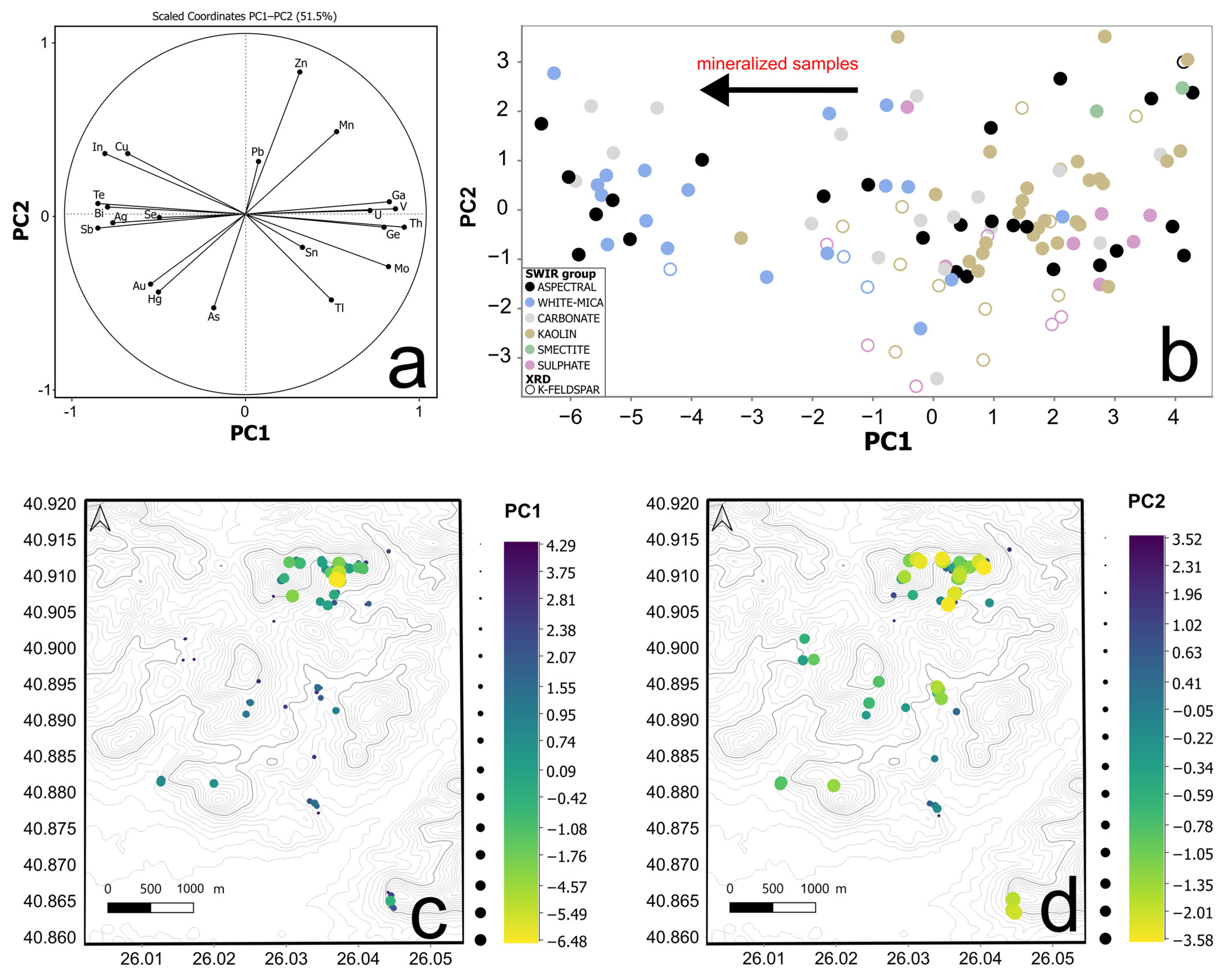
The PCA analysis of CLR-transformed bulk-rock geochemical data shows negative PC1 loadings for Cu, In, Te, Bi, Sb, Ag, Se, Au, Hg, and As, characteristic of the higher-grade HS and IS samples from the Pefka mine, and positive PC1 loadings for Ga, V, U, Th, Ge, and Mo (Figure 10a). Samples with low PC1 scores (Figure 10b) correspond to the principal mineralized samples and cluster mainly around the Pefka deposit (Figure 10c), with minor extensions toward the southern part of the area. This indicates that these elements form a coherent geochemical association related mainly to Pefka high-grade mineralization (i.e., HS and IS veins).
PC2 contrasts positive loadings for Zn and Mn, together with Cu, In, and Pb, against negative loadings for As, Hg, Au, Tl, Mo, and Sn (Figure 10a). V, Ga, and Ge are associated primarily with positive PC1 rather than defining the positive PC2 direction. PC2 therefore captures additional variation within the multielement geochemical dataset, with more variable spatial distribution across the central and southern sectors (Figure 10d). Among the higher-grade samples from the Pefka mine, those with negative PC1 scores are associated mainly with white mica in the HS veins and carbonate in the later IS veins (Figure 10b). The earlier quartz-adularia veins and their associated altered wall rocks are also mineralized, but the analyzed samples generally have lower metal concentrations and higher PC1 scores than the HS and IS samples collected from the mine. Their weaker association with PC1 therefore reflects a geochemically distinct, lower-grade mineralizing stage rather than an absence of mineralization. Kaolinite does not show the same relationship with low PC1 scores, suggesting that the higher-grade samples are generally characterized by carbonate and/or white mica rather than kaolinite as the dominant gangue mineral, even if it is present in some samples.
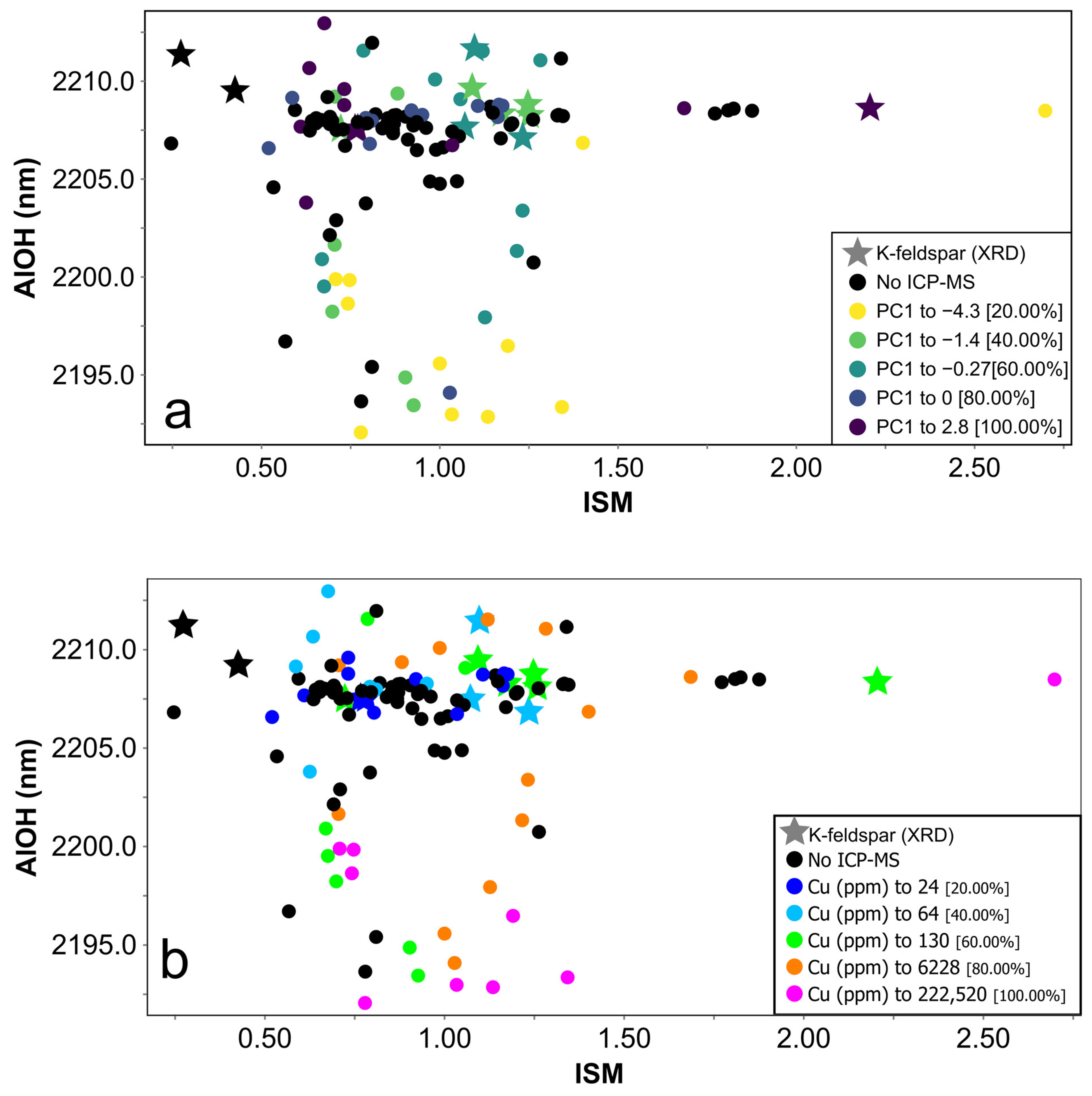
The majority of measured Al-OH wavelengths in the Pefka-Loutros area lie between approximately 2207 and 2210 nm. Samples containing adularia systematically display wavelengths above 2205 nm, and several extend toward 2210–2215 nm (Figure 11a,b). These relatively long wavelengths are consistent with Mg-bearing or phengitic white mica compositions, as independently supported by SEM-EDS detecting Mg in white mica associated (crosscutting or co-existing) with adularia-bearing parts of the rock.
In contrast, high-grade samples, including those containing >0.6 wt% Cu or with PC1 < −4.3, tend to have Al-OH wavelengths below 2200 nm (Figure 11a,b). This could reflect more aluminous white mica, mineral mixtures, or the modification of the minimum absorption by kaolinite. However, only four of these samples contain kaolinite as the secondary mineral identified by TSG/TSA (Table S1), and paragonite was not identified in direct microscopic association with the ore minerals by SEM-EDS. The muscovite association with the ore-bearing samples and the more distal parts related to more phengitic compositions has been also observed in other deposits, e.g., to the Demingding porphyry Cu-Mo deposit, Gangdese belt, Tibet [51].
ISM values are spatially higher near parts of the mineralized zone (Figure 7e), but they do not show a clear correlation with Cu grade or CLR-derived PC1 score. Similarly, ISM does not display a consistent relationship with the presence of adularia. However, the spatial association of higher ISM values with the Pefka deposit may indicate relatively higher paleotemperatures in this area, although ISM is a semi-quantitative proxy that may also be influenced by mineral mixtures, hydration, grain size, vein material, and absorption intensity [14].
Although the V and Mo anomalies in the western part of the district are mainly associated with Fe-oxide-dominated samples (Figure 8e,f) and may have been modified by supergene redistribution, they are interpreted to reflect hypogene hydrothermal processes and therefore remain indicators of primary mineralization-related geochemical anomalies.

5.3. Exploration Implications

From an exploration perspective, the mineralization exposed at the Pefka mine represents only part of a much broader hydrothermal system. Historical mining explored the deposit to depths of only a few tens of meters below the surface [34], whereas white mica alteration, fault-controlled silicification, hydrothermal brecciation, and peripheral low-temperature alteration extend beyond the known mine workings. Future exploration should focus on distinguishing the HS, IS, and earlier quartz-adularia mineralized stages and prioritize structures and hydrothermal breccias where stage-specific alteration assemblages coincide with multielement geochemical anomalies. The quartz-adularia veins and associated altered wall rocks represent an earlier, comparatively lower-grade mineralized stage.
Although the analyzed samples generally contain lower metal concentrations than the HS and IS samples collected from the deeper mine workings, they still show elevated Au, Ag, Cu, Mo, Sb, As, and Se concentrations and should therefore remain priority exploration targets (Table S2). The adularia-bearing assemblages may indicate near-neutral boiling-related conditions favorable for ore deposition [52]. Comparable adularia-bearing zones related to boiling, based on fluid-inclusion evidence, have been documented in the neighboring Kassiteres-Sapes area. There, crustiform-colloform quartz veins occur at relatively high structural levels and locally overprint massive milky quartz and white mica-carbonate veins containing chalcopyrite and tellurides [36,53].
Our data indicate that white mica proximal to the Pefka deposit, particularly in higher-grade samples, tends to exhibit shorter Al-OH absorption wavelengths, consistent with more muscovitic to paragonitic compositions. ISM values are also generally higher near the Pefka mine, commonly ranging between 1 and 2 (Figure 7e). These spectral parameters may support exploration within mineralogically comparable sample groups but should not be used as standalone vectors.
The presence of APS minerals within the white mica-altered HS veins at Pefka is compatible with acidic, sulfate- and phosphate-bearing fluids but do not independently demonstrate the presence of a concealed porphyry system. However, their presence could indicate a deep HS epithermal environment located above a porphyry-style mineralization, similar to that reported from the Melitena porphyry-epithermal prospect in the Greek Rhodope area [54].
At Lagos Hill, the blanket-like opal-kaolinite-alunite assemblages are consistent with a shallow steam-heated environment above the paleowater table [47]. The steam-heated assemblage records vapor condensation and is consistent with boiling and vapor separation at deeper levels of the hydrothermal system [47]. Associated fault-controlled silicification, kaolinite ± alunite alteration, and pyrite-bearing hydrothermal breccias therefore identify structures that warrant systematic lateral and vertical sampling, particularly beneath the steam-heated cap.
The principal exploration implication is therefore that epithermal systems should be investigated by the detailed mapping and sampling of individual faults, veins, and breccias in both lateral and vertical directions. This is particularly important because white mica may accompany enargite mineralization under relatively buffered conditions, as documented at the Colquijirca district in central Peru [55], whereas quartz-adularia veins record an earlier, comparatively lower-grade mineralized stage associated with near-neutral and potentially boiling-related fluids. Adularia-bearing structures should therefore be considered priority exploration targets; nevertheless, sulfidation state, relative timing, and exploration potential should not be inferred from a single surface alteration mineral or assemblage.

6. Conclusions

The integration of pVNIR-SWIR spectroscopy with XRD, petrography, SEM-EDS, and bulk-rock geochemistry defines a spatially heterogeneous and multistage alteration architecture across the Pefka-Loutros district. SWIR provided the spatial coverage for district-scale alteration mapping, whereas the other methods validated mineral identification and established relationships between overlapping stages. The northern sector is dominated by structurally controlled white mica alteration associated with HS mineralization and locally overprinted by white mica-carbonate alteration related to later IS veins. Quartz-adularia veinlets are also associated with adularia-bearing wall rocks and weakly mineralized outcrops. These grade outward into intermediate-argillic, argillic, smectite-dominated, and weak propylitic alteration. The southern sector preserves fault-controlled advanced argillic and shallow steam-heated alteration, whereas Loutros contains localized silicic and white mica alteration surrounded by lower-temperature zeolitic alteration. Al-OH wavelength and ISM reveal internal variations within the white mica zone. These results demonstrate that alteration architecture becomes an effective exploration tool only when its spatial distribution is linked to structures, paragenesis, and geochemistry.

Supplementary Materials

The following supporting information can be downloaded at: https://www.mdpi.com/article/10.3390/min16090965/s1, Table S1: Complete pVNIR–SWIR dataset, including all measurement points and corresponding TSG mineral-identification results. Table S2: Integrated summary of pVNIR–SWIR, XRD, and ICP-MS results for each sample; one representative pVNIR–SWIR spectrum is reported per sample, corresponding to the measurement with the lowest TSG error value. Table S3: Semi-quantitative SEM–EDS elemental compositions (wt.%) of white mica, APS-group minerals, and adularia (hydrothermal K-feldspar), including all spot analyses assigned to these mineral groups in the analytical dataset.

Author Contributions

Conceptualization, M.M. and P.V.; methodology, M.M., J.C., M.J., L.P., A.T. and N.K.; software, M.M. and G.A.S.; validation, M.M. and P.V.; formal analysis, M.M.; investigation, M.M.; resources, J.C., A.T. and N.K.; data curation, M.M.; writing—original draft preparation, M.M.; writing—review and editing, M.M., P.V., J.C., M.J., R.K., G.A.S., L.P., A.T. and N.K.; visualization, M.M.; supervision, P.V., R.K. and N.K.; project administration, M.M. and P.V.; funding acquisition, M.M. and A.T. All authors have read and agreed to the published version of the manuscript.

Funding

The Ph.D. research of M.M. was financially supported by Boliden Mineral AB through Scholarship Program 76816/669460, administered by the Research Committee of Aristotle University of Thessaloniki. The bulk-ore geochemical analyses were supported by the Society of Economic Geologists through the 2022 Student Research Grant (SRG 22-47), awarded through the Hugh E. McKinstry Fund, whereas the pVNIR-SWIR spectroscopic analyses were supported by the ARTeMIS ERASMUS+ project (Action for Research and Teaching Mineral Exploration Inclusive School; Grant Agreement No. 2021-1-FR01-KA220-HED-000029934) and the ERASMUS+ ARTeMIS_2 (ERASMUS+ ARTeMIS_2 Action for Research and Teaching Mineral exploration Inclusive School_2, project number KA220-HED-6390707C).

Data Availability Statement

The processed data supporting the findings of this study are included in the article and its Supplementary Materials. The underlying raw pVNIR-SWIR spectra, XRD data, and bulk-rock geochemical datasets are available from the corresponding author upon request.

Acknowledgments

The authors gratefully acknowledge the Department of Mineralogy, Petrology and Economic Geology, School of Geology, Aristotle University of Thessaloniki, for providing analytical and technical support for the SEM-EDS and XRD analyses. During the preparation of this manuscript, the authors used ChatGPT (OpenAI; web version 5.6 Sol max, accessed May–August 2026) solely for English-language rephrasing and editing. The authors reviewed and edited all outputs and take full responsibility for the content of this publication.

Conflicts of Interest

The authors declare no conflicts of interest.

Abbreviations

The following abbreviations are used in this manuscript:
APSAluminum phosphate-sulfate
BSEBackscattered electron
CLRCentered log-ratio
EDSEnergy-dispersive X-ray spectroscopy
EPSGEuropean Petroleum Survey Group
HSHigh sulfidation
ICP-ESInductively coupled plasma-emission spectroscopy
ICP-MSInductively coupled plasma-mass spectrometry
ISIntermediate sulfidation
ISMIllite spectral maturity
PCAPrincipal component analysis
PC1First principal component
PC2Second principal component
pVNIR-SWIRPortable visible-near-infrared and short-wave infrared spectroscopy
REERare earth element
SEMScanning electron microscopy
SEM-BSEScanning electron microscopy-backscattered electron imaging
SEM-EDSScanning electron microscopy with energy-dispersive X-ray spectroscopy
SWIRShort-wave infrared
TSAThe Spectral Assistant
TSGThe Spectral Geologist
VNIRVisible-near-infrared
WGS84World Geodetic System 1984
XRDX-ray diffraction

References

  1. Hedenquist, J.W. Variable Characteristics of Ore Deposits in the Epithermal Environment: Causes, and Exploration Implications. Acta Geol. Sin.-Engl. Ed. 2014, 88, 736–737. [Google Scholar] [CrossRef] [Scilit]
  2. Hedenquist, J.; Arribas, A.; Gonzalez-Urien, E. Exploration for Epithermal Gold Deposits. In Reviews in Economic Geology; Society of Economic Geologists: Littleton, CO, USA, 2000; Volume 13, pp. 245–277. [Google Scholar]
  3. Simmons, S.F.; White, N.C.; John, D.A. Geological Characteristics of Epithermal Precious and Base Metal Deposits. In One Hundredth Anniversary Volume; Society of Economic Geologists: Littleton, CO, USA, 2005; ISBN 978-1-887483-01-8. [Google Scholar]
  4. Sillitoe, R.H. Epithermal Paleosurfaces. Miner. Depos. 2015, 50, 767–793. [Google Scholar] [CrossRef] [Scilit]
  5. Goldfarb, R.J.; Hofstra, A.H.; Simmons, S.F. Critical Elements in Carlin, Epithermal, and Orogenic Gold Deposits. In Rare Earth and Critical Elements in Ore Deposits; Verplanck, P.L., Hitzman, M.W., Eds.; Society of Economic Geologists: Littleton, CO, USA, 2016; Volume 18, ISBN 978-1-62949-218-6. [Google Scholar]
  6. Einaudi, M.; Hedenquist, J.; Inan, E. Sulfidation State of Fluids in Active and Extinct Hydrothermal Systems: Transitions from Porphyry to Epithermal Environments. In Society of Economic Geologists Special Publication; Society of Economic Geologists: Littleton, CO, USA, 2003; Volume 10, pp. 285–313. [Google Scholar]
  7. Sillitoe, R.H.; Hedenquist, J.W. Linkages between Volcanotectonic Settings, Ore-Fluid Compositions, and Epithermal Precious Metal Deposits. In Volcanic, Geothermal, and Ore-Forming Fluids: Rulers and Witnesses of Processes Within the Earth; Simmons, S.F., Graham, I., Eds.; Society of Economic Geologists: Littleton, CO, USA, 2005; Volume 10, ISBN 978-1-62949-034-2. [Google Scholar]
  8. Deer, W.A.; Howie, R.A.; Zussman, J. An Introduction to the Rock-Forming Minerals, 2nd ed.; Longman: London, UK, 1992; ISBN 978-0-903056-33-5. [Google Scholar]
  9. Dong, G.; Morrison, G.W. Adularia in Epithermal Veins, Queensland: Morphology, Structural State and Origin. Miner. Depos. 1995, 30, 11–19. [Google Scholar] [CrossRef] [Scilit]
  10. Frenzel, M.; Baumgartner, R.; Tolosana-Delgado, R.; Gutzmer, J. Geometallurgy: Present and Future. Elements 2023, 19, 345–351. [Google Scholar] [CrossRef] [Scilit]
  11. Thompson, A.; Hauff, P.; Robitaille, A. Alteration Mapping in Exploration: Application of Short-Wave Infrared (SWIR) Spectroscopy. Soc. Econ. Geol. Newsl. 1999, 39, 16–27. [Google Scholar] [CrossRef] [Scilit]
  12. Hauff, P. An Overview of VIS-NIR-SWIR Field Spectroscopy as Applied to Precious Metals Exploration; Spectral International Inc.: Arvada, CO, USA, 2008. [Google Scholar]
  13. Simpson, M.P.; Christie, A.B. Hydrothermal Alteration Mineralogical Footprints for New Zealand Epithermal Au-Ag Deposits. N. Z. J. Geol. Geophys. 2019, 62, 483–512. [Google Scholar] [CrossRef] [Scilit]
  14. Wang, L.; Percival, J.B.; Hedenquist, J.W.; Hattori, K.; Qin, K. Alteration Mineralogy of the Zhengguang Epithermal Au-Zn Deposit, Northeast China: Interpretation of Shortwave Infrared Analyses During Mineral Exploration and Assessment. Econ. Geol. 2021, 116, 389–406. [Google Scholar] [CrossRef] [Scilit]
  15. Herrmann, W.; Blake, M.; Doyle, M.; Huston, D.; Kamprad, J.; Merry, N.; Pontual, S. Short Wavelength Infrared (SWIR) Spectral Analysis of Hydrothermal Alteration Zones Associated with Base Metal Sulfide Deposits at Rosebery and Western Tharsis, Tasmania, and Highway-Reward, Queensland. Econ. Geol. 2001, 96, 939–955. [Google Scholar] [CrossRef] [Scilit]
  16. Chang, Z.; Hedenquist, J.W.; White, N.C.; Cooke, D.R.; Roach, M.; Deyell, C.L.; Garcia, J., Jr.; Gemmell, J.B.; McKnight, S.; Cuison, A.L. Exploration Tools for Linked Porphyry and Epithermal Deposits: Example from the Mankayan Intrusion-Centered Cu-Au District, Luzon, Philippines. Econ. Geol. 2011, 106, 1365–1398. [Google Scholar] [CrossRef] [Scilit]
  17. Yang, K.; Huntington, J.F.; Gemmell, J.B.; Scott, K.M. Variations in Composition and Abundance of White Mica in the Hydrothermal Alteration System at Hellyer, Tasmania, as Revealed by Infrared Reflectance Spectroscopy. J. Geochem. Explor. 2011, 108, 143–156. [Google Scholar] [CrossRef] [Scilit]
  18. Bouzari, F.; Lee, R.G.; Hart, C.J.R.; Barker, S.; van Straaten, B.I. Mineralogical and Geochemical Vectors Within and Around Advanced Argillic-Altered Rocks of British Columbia. Econ. Geol. 2026, 1–24. [Google Scholar] [CrossRef] [Scilit]
  19. Voudouris, P.; Repstock, A.; Spry, P.; Frenzel, M.; Mavrogonatos, C.; Keith, M.; Tarantola, A.; Melfos, V.; Tombros, S.; Zhai, D.; et al. Physicochemical Constraints on Indium-, Tin-, Germanium-, Gallium-, Gold-, and Tellurium-Bearing Mineralizations in the Pefka and St Philippos Polymetallic Vein- and Breccia-Type Deposits, Greece. Ore Geol. Rev. 2022, 140, 104348. [Google Scholar] [CrossRef] [Scilit]
  20. Melfou, M.; Voudouris, P.; Klemd, R.; Keith, M.; Melfos, V.; Kantiranis, N. In-Situ Trace Element Analyses of Pyrite from the Pefka Epithermal Cu-Au-Te-In-Se Deposit, Rhodope, Northern Greece. In Proceedings of the 17th SGA Biennial Meeting, Zurich, Switzerland, 28 August–1 September 2023; Society for Geology Applied to Mineral Deposits: Geneva, Switzerland, 2023; Volume 1, pp. 32–35. [Google Scholar]
  21. Melfou, M.; Voudouris, P.; Klemd, R.; Keith, M.; Melfos, V.; Tarantola, A.; Papadopoulou, L.; Kantiranis, N. Distribution of Indium and Tellurium in the HS to IS Pefka Epithermal Deposit: Insights from LA-ICP-MS Analyses of Sulfides and Sulfosalts. In Proceedings of the 8th SGA Biennial Meeting 2025, Mineral Resources for Our Ever-Changing World, Golden, Colorado, USA, 1 August 2025; Society for Geology Applied to Mineral Deposits: Geneva, Switzerland, 2025. [Google Scholar]
  22. Marantos, I.; Markopoulos, T.; Christidis, G.E.; Perdikatsis, V. Geochemical Characteristics of the Alteration of Volcanic and Volcaniclastic Rocks in the Feres Basin, Thrace, NE Greece. Clay Miner. 2008, 43, 575–595. [Google Scholar] [CrossRef] [Scilit]
  23. Michael, C.; Katirtzoglou, K.; Perdikatsis, V.; Constantinides, D. The Polymetallic Mineralisation of the Pefka Area, Evros County, Greece. Geol. Rhodopica 1989, 1, 322–329. [Google Scholar]
  24. Voudouris, P.; Mavrogonatos, C.; Spry, P.G.; Baker, T.; Melfos, V.; Klemd, R.; Haase, K.; Repstock, A.; Djiba, A.; Bismayer, U.; et al. Porphyry and Epithermal Deposits in Greece: An Overview, New Discoveries, and Mineralogical Constraints on Their Genesis. Ore Geol. Rev. 2019, 107, 654–691. [Google Scholar] [CrossRef] [Scilit]
  25. Melfos, V.; Voudouris, P. Cenozoic Metallogeny of Greece and Potential for Precious, Critical and Rare Metals Exploration. Ore Geol. Rev. 2017, 89, 1030–1057. [Google Scholar] [CrossRef] [Scilit]
  26. Menant, A.; Jolivet, L.; Vrielynck, B. Kinematic Reconstructions and Magmatic Evolution Illuminating Crustal and Mantle Dynamics of the Eastern Mediterranean Region since the Late Cretaceous. Tectonophysics 2016, 675, 103–140. [Google Scholar] [CrossRef] [Scilit]
  27. Kilias, A.; Falalakis, G.; Sfeikos, A.; Papadimitriou, E.; Vamvaka, A.; Gkarlaouni, C. The Thrace Basin in the Rhodope Province of NE Greece—A Tertiary Supradetachment Basin and Its Geodynamic Implications. Tectonophysics 2013, 595–596, 90–105. [Google Scholar] [CrossRef] [Scilit]
  28. Schaarschmidt, A.; Klemd, R.; Regelous, M.; Voudouris, P.C.; Melfos, V.; Haase, K.M. The Formation of Shoshonitic Magma and Its Relationship to Porphyry-Type Mineralisation: The Maronia Pluton in NE Greece. Lithos 2021, 380–381, 105911. [Google Scholar] [CrossRef] [Scilit]
  29. Perkins, R.J.; Cooper, F.J.; Condon, D.J.; Tattitch, B.; Naden, J. Post-Collisional Cenozoic Extension in the Northern Aegean: The High-K to Shoshonitic Intrusive Rocks of the Maronia Magmatic Corridor, Northeastern Greece. Lithosphere 2018, 10, 582–601. [Google Scholar] [CrossRef] [Scilit]
  30. Arikas, K.; Voudouris, P. Hydrothermal Alterations and Mineralizations of Magmatic Rocks in the Southern Rhodope Massif. Acta Vulcanol. 1998, 10, 353–365. [Google Scholar]
  31. Bonev, N.; Dotseva, Z.; Chiaradia, M. Nd–Sr–Pb Isotopes Systematics of the Jurassic Evros Ophiolite, Eastern Circum-Rhodope Belt, NE Greece. Geol. Mag. 2023, 160, 198–205. [Google Scholar] [CrossRef] [Scilit]
  32. Melfos, V.; Voudouris, P.C. Geological, Mineralogical and Geochemical Aspects for Critical and Rare Metals in Greece. Minerals 2012, 2, 300–317. [Google Scholar] [CrossRef] [Scilit]
  33. Papadopoulos, P. Geological Map of Greece, Scale 1:50,000, Sheet Ferai-Peplos-Ainos; Institute of Geology and Mineral Exploration of Greece (IGME): Athens, Greece, 1980. [Google Scholar]
  34. Anastopoulos, I. On the Geological and Metallogenic Conditions of Copper-Ore Occurrences near the Village of Pefka, Alexandroupolis. Report; Institute of Geology and Subsurface Research: Athens, Greece, 1961. (In Greek) [Google Scholar]
  35. Dimou, E.; Michael, C.; Serment, R. Mineralogical Composition of Epithermal Polymetallic Mineralization at Pefka. Rhodope. Bull. Geol. Soc. Greece 1994, 30, 553–1550. [Google Scholar]
  36. Voudouris, P. A Comparative Mineralogical Study of Te-Rich Magmatic-Hydrothermal Systems in Northeastern Greece. Mineral. Petrol. 2006, 87, 241–275. [Google Scholar] [CrossRef] [Scilit]
  37. Repstock, A.; Voudouris, P.; Kolitsch, U. New Occurrences of Watanabeite, Colusite, “Arsenosulvanite” and “Cu-Excess” Tetrahedrite-Tennantite at the Pefka High-Sulfidation Epithermal Deposit, Northeastern Greece. Neues Jahrb. Mineral.-Abh. 2015, 192, 135–149. [Google Scholar] [CrossRef] [Scilit]
  38. Michailidis, K.; Garane, K.; Karagkiozidis, D.; Peletidou, G.; Voudouri, K.-A.; Balis, D.; Bais, A. Extreme Wildfires over Northern Greece during Summer 2023—Part A: Effects on Aerosol Optical Properties and Solar UV Radiation. Atmos. Res. 2024, 311, 107700. [Google Scholar] [CrossRef] [Scilit]
  39. Doebelin, N.; Kleeberg, R. Profex: A Graphical User Interface for the Rietveld Refinement Program BGMN. J. Appl. Crystallogr. 2015, 48, 1573–1580. [Google Scholar] [CrossRef] [Scilit]
  40. Palarea-Albaladejo, J.; Martín-Fernández, J.A. Values below Detection Limit in Compositional Chemical Data. Anal. Chim. Acta 2013, 764, 32–43. [Google Scholar] [CrossRef] [Scilit]
  41. Aitchison, J. The Statistical Analysis of Compositional Data. J. R. Stat. Soc. Ser. B (Methodol.) 1982, 44, 139–160. [Google Scholar] [CrossRef] [Scilit]
  42. Greenacre, M.; Grunsky, E.; Bacon-Shone, J.; Erb, I.; Quinn, T. Aitchison’s Compositional Data Analysis 40 Years On: A Reappraisal. Stat. Sci. 2023, 38, 386–410. [Google Scholar] [CrossRef] [Scilit]
  43. Warr, L.N. IMA–CNMNC Approved Mineral Symbols. Mineral. Mag. 2021, 85, 291–320. [Google Scholar] [CrossRef] [Scilit]
  44. Jambor, J.L. Nomenclature of the Alunite Supergroup: Reply. Can. Mineral. 2000, 38, 1298–1303. [Google Scholar] [CrossRef] [Scilit]
  45. Halley, S.; Dilles, J.H.; Tosdal, R.M. Footprints: Hydrothermal Alteration and Geochemical Dispersion around Porphyry Copper Deposits. SEG Discov. 2015, 100, 1–17. [Google Scholar] [CrossRef] [Scilit]
  46. Seedorff, E.; Dilles, J.H.; Proffett, J.M.; Einaudi, M.T.; Zurcher, L.; Stavast, W.J.A.; Johnson, D.A.; Barton, M.D. Porphyry Deposits: Characteristics and Origin of Hypogene Features. Econ. Geol. (Soc. Econ. Geol.) 2005, 100, 259–298. [Google Scholar] [CrossRef] [Scilit]
  47. Hedenquist, J.W.; Arribas, A. Exploration Implications of Multiple Formation Environments of Advanced Argillic Minerals. Econ. Geol. 2022, 117, 609–643. [Google Scholar] [CrossRef] [Scilit]
  48. Hedenquist, J.W. The Thermal and Geochemical Structure of the Broadlands-Ohaaki Geothermal System, New Zealand. Geothermics 1990, 19, 151–185. [Google Scholar] [CrossRef] [Scilit]
  49. Marantos, I.; Markopoulos, T.; Christidis, G.E. Zeolitic Alteration in the Tertiary Feres Volcano-Sedimentary Basin, Thrace, NE Greece. Mineral. Mag. 2007, 71, 327–345. [Google Scholar] [CrossRef] [Scilit]
  50. Koutsopoulou, E.; Christidis, G.E.; Marantos, I. Mineralogy, Geochemistry and Physical Properties of Bentonites from the Western Thrace Region and the Islands of Samos and Chios, East Aegean, Greece. Clay Miner. 2016, 51, 563–588. [Google Scholar] [CrossRef] [Scilit]
  51. Ren, H.; Zheng, Y.; Wu, S.; Wang, D.; Zuo, L.; Chen, L.; Gao, F.; Wei, J.; Wang, S.; Shu, D.; et al. Short-Wavelength Infrared Characteristics and Composition of White Mica in the Demingding Porphyry Cu-Mo Deposit, Gangdese Belt, Tibet: Implications for Mineral Exploration. Ore Geol. Rev. 2024, 164, 105833. [Google Scholar] [CrossRef] [Scilit]
  52. Simmons, S.; Mauk, J.; Simpson, M. The Mineral Products of Boiling in the Golden Cross Epithermal Deposit. In Proceedings of the 2000 New Zealand Minerals & Mining Conference Proceedings, Wellington, New Zealand, 29–31 October 2000. [Google Scholar]
  53. Voudouris, P.; Tarkian, M.; Arikas, K. Mineralogy of Telluride-Bearing Epithermal Ores in the Kassiteres-Sappes Area, Western Thrace, Greece. Mineral. Petrol. 2006, 87, 31–52. [Google Scholar] [CrossRef] [Scilit]
  54. Voudouris, P.C.; Melfos, V. Aluminum-Phosphate-Sulfate (APS) Minerals in the Sericitic-Advanced Argillic Alteration Zone of the Melitena Porphyry-Epithermal Mo-Cu ± Au ± Re Prospect, Western Thrace, Greece. Neues Jahrb. Mineral.-Abh. 2012, 190, 11–27. [Google Scholar] [CrossRef] [Scilit]
  55. Bendezú, R.; Fontboté, L. Cordilleran Epithermal Cu-Zn-Pb-(Au-Ag) Mineralization in the Colquijirca District, Central Peru: Deposit-Scale Mineralogical Patterns. Econ. Geol. 2009, 104, 905–944. [Google Scholar] [CrossRef] [Scilit]
Figure 2. Location of samples analyzed in this study and the analytical methods applied. All samples were analyzed by pVNIR-SWIR spectroscopy, whereas samples additionally analyzed by ICP-MS and/or XRD are distinguished by different symbols and colors. Grey points indicate samples for which only pVNIR-SWIR data are available. The principal hills and mineralized occurrences are labelled. Coordinates are shown in WGS84 (EPSG:4326).
Minerals 16 00965 g002
Figure 3. Field photographs of altered rocks associated with mineralization and hydrothermal brecciation. (a) Panoramic view of Ntailou hill. (b) NE-trending quartz-tennantite-luzonite/famatinite-enargite vein and altered volcanic wall-rock at the Pefka deposit. (c) NE-trending carbonate vein crosscutting tuffs at the Pefka deposit. (d) Quartz veins ± pyrite ± arsenopyrite crosscutting adularia-white mica-kaolinite-altered volcanic rock in the upper parts of the Pefka area. (e) Hand specimen of adularia -white mica-altered volcanic rock crosscut by quartz-adularia veins. (f) Panoramic view of Lagos hill. (g) Silicified breccia and adjacent altered wall rock. (h) Silicified breccia at the lower part of Passas hill. (i) Hydrothermal silicified breccia and associated altered wall rock. (j) Opal-alunite veins crosscutting volcanic rocks at Lagos hill. (k) Mineralized vein with pyrite + marcasite crosscutting rhyolite at the Loutros quarry. (l) Barite ± galena veins crosscutting rhyolite at Loutros.
Minerals 16 00965 g003
Figure 4. Hand-sample photographs (d,e,m–o), Macrophotograph of the thin section under cross-polarized light (h), transmitted-light photomicrographs in plane polarized light (i) and cross-polarized light (a–c,f,g,k), and BSE images (j,l) showing representative alteration and gangue minerals and textures from the Pefka deposit (a–g), the surroundings of Pefka deposit (h–l), Lagos Hill (m,n), and the Loutros mineralization (o). (a) Quartz vein containing opaque minerals and interstitial white mica as gangue. (b) Svanbergite, an APS-group mineral, hosted in quartz. (c) Volcanic host rock of the Pefka deposit, with phenocrysts altered to white mica. (d) Wall-rock alteration of carbonate vein with IS mineralization of the Pefka deposit. (e,f) Volcanic host rock of the Pefka vein deposit, showing feldspar phenocrysts altered to adularia and crosscut by white mica veinlets; some phenocrysts are also altered to dolomite. (g) Kaolinite-filled vug within a dolomite-dominated vein, with crystals of pyrite developed both in the kaolinite and dolomite. (h) Adularia-altered rock from the surrounding area of the Pefka veins, crosscut by quartz veinlets. Red circles mark the areas corresponding to panels (i–l). (i,j) Pseudo-rhombohedral “adularia” grains hosted in quartz, shown in plane-polarized light and BSE image, respectively. (k) Textural relationship between adularia and muscovite. (l) BSE image of the same texture as in (k), showing zircon and rutile associated with muscovite. (m) Breccia composed of fine-grained silica with pyrite fragments with a kaolinite ± alunite matrix. (n) Altered tuff to opaline silica from the Lagos Hill. (o) Marcasite-pyrite vein crosscutting zeolite altered rhyolite at Loutros; primary K-feldspar phenocrysts are replaced partially by supergene kaolinite, visible as white alteration patches. Mineral Abbreviations are after [43], and APS = aluminum phosphate-sulfate group.
Minerals 16 00965 g004
Figure 5. Stacked XRD patterns of four representative bulk-powder samples from the Pefka-Loutros area. The selected samples represent: alteration of the host rocks of the HS quartz-luzonite/famatinite-enargite vein from the Pefka deposit (PL7a), pervasively altered volcanic rock from Ntailou Hill near Pefka (PL27), altered volcanic rock from the southern part of the study area (PL46), and wall-rock alteration of the hydrothermal breccia from the southern area (PL48a). Mineral abbreviations are after [43].
Minerals 16 00965 g005
Figure 6. Representative stacked SWIR reflectance spectra of the main alteration assemblages from the Pefka-Loutros area, including white mica-bearing, kaolinite-bearing, alunite-bearing, smectite-bearing, and carbonate-bearing assemblages. Grey shaded bands indicate the main diagnostic absorption regions used for mineral identification.
Minerals 16 00965 g006
Figure 7. SWIR-based alteration maps of the Pefka-Loutros area based on all mineral identifications reported by the TSG software with an Error sTSAS value below 300. Mineral identifications were grouped into broader alteration categories: (a) white mica and illite; (b) kaolinite (includes kaolinite-PX and kaolinite-WX) and alunite (includes alunite-K); and (c) smectite includes mainly montmorillonite, whereas carbonate includes calcite, dolomite, and siderite. Symbol shape distinguishes sample material: circles represent wall-rock, triangles represent gangue, and diamonds represent breccia. The red dashed outline indicates the area around the Pefka deposit, shown in detail in panels (d,e). (d) Distribution of the white mica Al-OH absorption wavelength (WAOH), classified into 2180–2200 nm and 2200–2216 nm. (e) Illite spectral maturity index (ISM), classified into 0–1 and 1–2. Coordinates are given in WGS84 (EPSG:4326).
Minerals 16 00965 g007
Figure 8. Distribution of bulk-rock samples and interpolated geochemical maps for selected elements from the Pefka-Loutros area. (a) Location of analyzed bulk-rock samples distinguishes samples dominated by Fe-oxides (red diamonds) and samples not dominated by Fe-oxides, some of which contain primary sulfides (blue diamonds). ioGAS-generated grid maps showing the spatial distribution of (b) Cu (ppm), (c) Au (ppm), (d) Te (ppm), (e) V (ppm), and (f) Mo (ppm). The interpolated grids were generated from bulk-rock geochemical analyses using maximum cell values, a 5-cell search radius, a 3-cell smoothing radius, and unequal percentile-based classification. Warmer colors indicate higher element concentrations, whereas white areas represent areas without geochemical data. Coordinates are shown in WGS84 (EPSG:4326).
Minerals 16 00965 g008
Figure 9. Alteration map of the Pefka-Loutros area showing the interpreted district-scale distribution of the principal mineral assemblages. The geological framework and volcanic dome boundaries were compiled from [19,33], with local modifications based on field observations. Alteration polygons integrate field mapping, petrography, pVNIR-SWIR spectroscopy, and XRD results. Because sampling and exposure are discontinuous and outcrop-controlled, polygon boundaries indicate approximate interpreted extents and should not be regarded as precisely constrained alteration contacts.
Minerals 16 00965 g009
Figure 10. Principal Component analysis (PCA) results of CLR-transformed bulk-rock geochemical analyses from the Pefka-Loutros area and spatial distribution of PC1 and PC2 scores. (a) Scaled PCA loading plot of the selected elements. (b) Sample scores in PC1-PC2 space, colored according to SWIR mineral group; open circles indicate samples containing K-feldspar identified by XRD. The arrow indicates the direction associated with the principal mineralized samples. (c) Map showing the spatial distribution of PC1 scores. (d) Map showing the spatial distribution of PC2 scores. Elements with more than 50% missing values were excluded from the analysis, and values below the analytical detection limit were replaced by 0.65 × detection limit prior to PCA [40]. Coordinates of the maps are shown in WGS84 (EPSG:4326).
Minerals 16 00965 g010
Figure 11. Bulk-rock geochemical PCA and its relationship with SWIR-derived parameters for white mica in the Pefka-Loutros area. Data without ICP-MS are colored black. (a) Al-OH wavelength versus illite spectral maturity (ISM), color-coded according to PC1 values grouped in five percentile classes. (b) Al-OH wavelength versus ISM, color-coded according to Cu concentrations grouped into fivepercentile classes. Stars in (a,b) mark samples containing K-feldspar derived from XRD. Star colors indicate PC1 scores in (a) and Cu concentrations (ppm) in (b). Each point represents an individual SWIR measurement, with all qualifying measurements included rather than one representative measurement per sample. Each measurement was assigned the PC1 score derived from the corresponding sample’s bulk-rock geochemical analysis; measurements from the same sample therefore share the same PC1 score.
Minerals 16 00965 g011
Table 1. Minerals identified by XRD and pVNIR-SWIR at the Pefka-Loutros area.
Sample IDDescriptionXRD ResultspVNIR-SWIR Results
PL1Altered tuff in contact with the Pefka mineralized veinQuartz, muscoviteMuscovitic illite
PL7aAltered volcanic host rock from the Pefka depositQuartz, muscovite, microcline, ankerite, kaoliniteKaolinite, muscovite
PL5Mineralized vein from the Pefka depositQuartz, muscovite, goethite, tetrahedriteMuscovite
PL13Altered volcanic rock cut by quartz veinlets at Ntailou HillQuartz, muscovite, orthoclase, kaoliniteMuscovite
PL27Altered volcanic rock from Ntailou HillQuartz, orthoclase, muscovite, jarosite—
PL35Altered rock from the summit of Koukos HillQuartz, orthoclaseKaolinite
PL39Vein infilling a fault at Passas Hill, with peripheral wall-rock alterationQuartz, kaolinite, aluniteKaolinite
PL46Altered and silicified volcanic rock from the southern part of the study areaQuartz, kaolinite, alunite, pyriteKaolinite
PL48aAltered wall-rock of a silicified hydrothermal breccia in the southern part of the study areaQuartz, kaoliniteKaolinite
PL50aAltered volcanic rock adjacent to a silicified, pyrite-bearing zoneQuartz, augite, anorthite, albite, sanidine, goethiteAspectral
PL57Altered rhyolite containing disseminated pyrite and marcasite grains at LoutrosQuartz, orthoclase, muscovite, barite, kaoliniteKaolinite
Disclaimer/Publisher’s Note: The statements, opinions and data contained in all publications are solely those of the individual author(s) and contributor(s) and not of MDPI and/or the editor(s). MDPI and/or the editor(s) disclaim responsibility for any injury to people or property resulting from any ideas, methods, instructions or products referred to in the content.