
Article

Mechanisms of Selective Fragmentation and Mineral Liberation During the Grinding of Fine-Grained Coal Gangue


1
School of Mining and Coal, Inner Mongolia University of Science and Technology, Baotou 014010, China
2
School of Energy and Environment, Inner Mongolia University of Science and Technology, Baotou 014010, China
3
School of Rare Earth Industry, Inner Mongolia University of Science and Technology, Baotou 014010, China
*
Author to whom correspondence should be addressed.
Minerals 2026, 16(9), 940; https://doi.org/10.3390/min16090940
Submission received: 18 August 2026 / Revised: 12 September 2026 / Accepted: 12 September 2026 / Published: 14 September 2026
(This article belongs to the Section Mineral Processing and Extractive Metallurgy)

Abstract

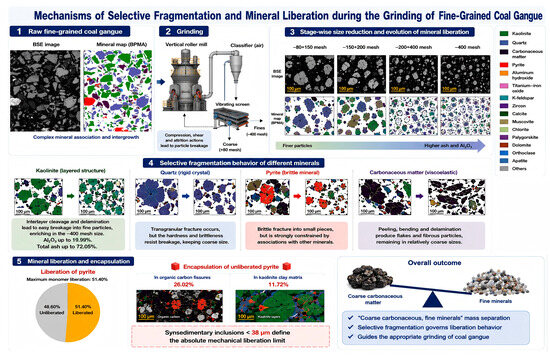
Complex mineral associations in coal gangue inhibit mineral liberation and downstream utilization. This study employed automated mineralogy to measure the mineral composition, particle size distribution, intergrowth, and liberation for four size fractions obtained after a single grinding step (−80 + 150, −150 + 200, −200 + 400, and −400 mesh). Carnauba wax embedding was used to enhance the backscattered electron contrast between carbonaceous matter and the embedding medium. Kaolinite was preferred in the highest fraction, with Al2O3 and ash contents reaching 19.99% and 72.05%, respectively, and carbonaceous matter remaining relatively coarse. Carbonaceous matter exhibited the highest liberation degree (84.91%), followed by kaolinite (69.64%) and quartz (67.08%), and pyrite had a lower liberation degree of 51.40%. Unliberated pyrite consisted of 26.02% carbonaceous matter and 11.72% kaolinite. Fine inclusions and complex mineral intergrowths restricted further liberation by grinding alone. These results reveal mineral-specific size redistribution and liberation behavior, and provide a quantitative basis for size-selective separation and for avoiding unnecessary overgrinding in coal gangue processing.

Graphical Abstract

1. Introduction

Coal gangue is a low-calorific-value rock produced in coal mining and coal preparation, accounting for 10%–20% of raw coal output and being one of the largest industrial solid wastes [1]. In recent years, the ever-increasing output of raw coal has brought about the massive accumulation of coal gangue solid wastes. Currently, there are appropriately more than 2000 coal gangue piles nationwide, with a cumulative stock of around 7 billion tons generated over the years, and the stock volume is still on the rise. The large amounts of accumulated coal gangue not only occupy large areas of land but also release considerable amounts of hazardous elements, imposing severe pressure on both energy resources and the environment [2,3]. Coal gangue contains abundant valuable elements and useful minerals, with major elements including C, H, O, S, Fe, Al, Si, and Ca, as well as trace and ultra-trace elements like Cr, Cd, As, Hg, Pb, Cu, Zn, F, and Cl, in addition to some organic matter [4,5]. Nevertheless, considering the current inefficient extraction and utilization of these elements, together with their market value, this constitutes a substantial waste of the relevant resources. Therefore, it is of great significance to remediate and comprehensively exploit the valuable elements in coal gangue [6]. However, most technologies still suffer from low resource utilization efficiency, low added value, and poor economic viability [7]. These limitations arise from the complex and heterogenous mineral composition of coal gangue, making it difficult to establish a universal activation and extraction process based only on conventional mineralogical properties [4]. Therefore, to achieve large-scale and high-value utilization, we should start with a systematic understanding of its origin and classification.
Mechanical grinding is a key pretreatment step for coal gangue because it governs particle size reduction and mineral liberation and exposes the reactive interfaces required for physical separation and chemical conversion [8,9]. A lack of grinding locks mineral-phase particles, and excessive grinding increases energy consumption and produces ultrafine particles that may affect subsequent classification and separation [10]. Thus particle size reduction is not necessarily equivalent to an increase in mineral liberation; particle classification and liberation properties should be considered together when choosing the appropriate grinding extent [11]. Recent work using automated mineralogy has shown that grinding conditions affect the presence, particle size distribution and liberation of minerals in carbon-bearing coal [12]. While conventional XRD and XRF analyses provide bulk mineralogical and chemical information, they cannot quantitatively determine phase-specific particle size distributions, mineral intergrowths, or association and liberation degrees at the individual particle scale [13]. Thus particle-scale mineralogical characterization is needed to clarify the selective fragmentation and liberation behavior of coal gangue [14].
In recent years, automated mineralogy methods based on SEM–EDS have been increasingly used in process mineralogy due to their capability to acquire high-throughput mineralogical information at the particle scale. But when applied to coal gangue analysis, this method still presents challenges on account of the carbonaceous matter [15,16]. Samples embedded in conventional epoxy resin typically exhibit backscattered electron contrast and carbon signals similar to those of carbonaceous components in coal gangue, leading to inaccurate boundary identification, misclassification of organic matter and errors in liberation calculations [17]. These limitations render it considerably difficult to accurately characterize the liberation behavior of carbon-rich coal gangue using standard automated mineralogy workflows [18]. Accordingly, it is necessary to improve sample preparation and automated mineralogical analysis methods to obtain reliable information on mineral composition, particle size distribution, mineral association and liberation characteristics, which can supply quantitative support for follow-up separation and high-value utilization of coal gangue [19,20]. In particular, we found similar limitations in automated mineralogical characterization of carbon-bearing coal. O’Brien et al. demonstrated that the preparation and imaging of coal particles containing both organic and mineral constituents require specific sample-preparation strategies for reliable optical and SEM-based characterization [21]. Wu et al. reported that Fe- and Ti-bearing impurities in coal-series kaolinite were difficult to quantify because automatic boundary recognition algorithms incorrectly identified interfaces between carbonaceous matter and the resin matrix, leading to overestimation of liberated particles [22]. These results indicate that conventional epoxy embedding introduces unavoidable errors in automated analysis of carbon-rich coal gangue [23,24]. The similar backscattered electron contrast and carbon signal between epoxy resin and carbonaceous matter could result in incorrect boundary recognition and underestimation of fine mineral deviations in elemental quantification [25].
Although there have been recent advances in coal gangue characterization, the relationships between particle size, mineral association, and liberation are not well quantified, particularly for carbon-rich samples. To address this gap, a carnauba wax-assisted BPMA method was employed to analyze high-alumina coal gangue from Dalate Banner, Ordos, Inner Mongolia. Carnauba wax improves backscattered-electron contrast between carbonaceous matter and embedding background [26]. After a single grinding operation, the sample was divided into four sizes (−80 + 150, −150 + 200, −200 + 400, and −400 mesh), and mineral composition, phase-specific particle size distribution, association and liberation degree of each fraction were quantified. We sought to clarify the size-dependent redistribution and selective fragmentation of the major mineral phases and mineral associations restricting further liberation. The combination of carnauba wax embedding and particle-scale automated mineralogy provides a quantitative basis for determining the suitable grinding extent and size-selective separation of coal gangue [27,28].

2. Materials and Methods

2.1. Materials and Sample Preparation

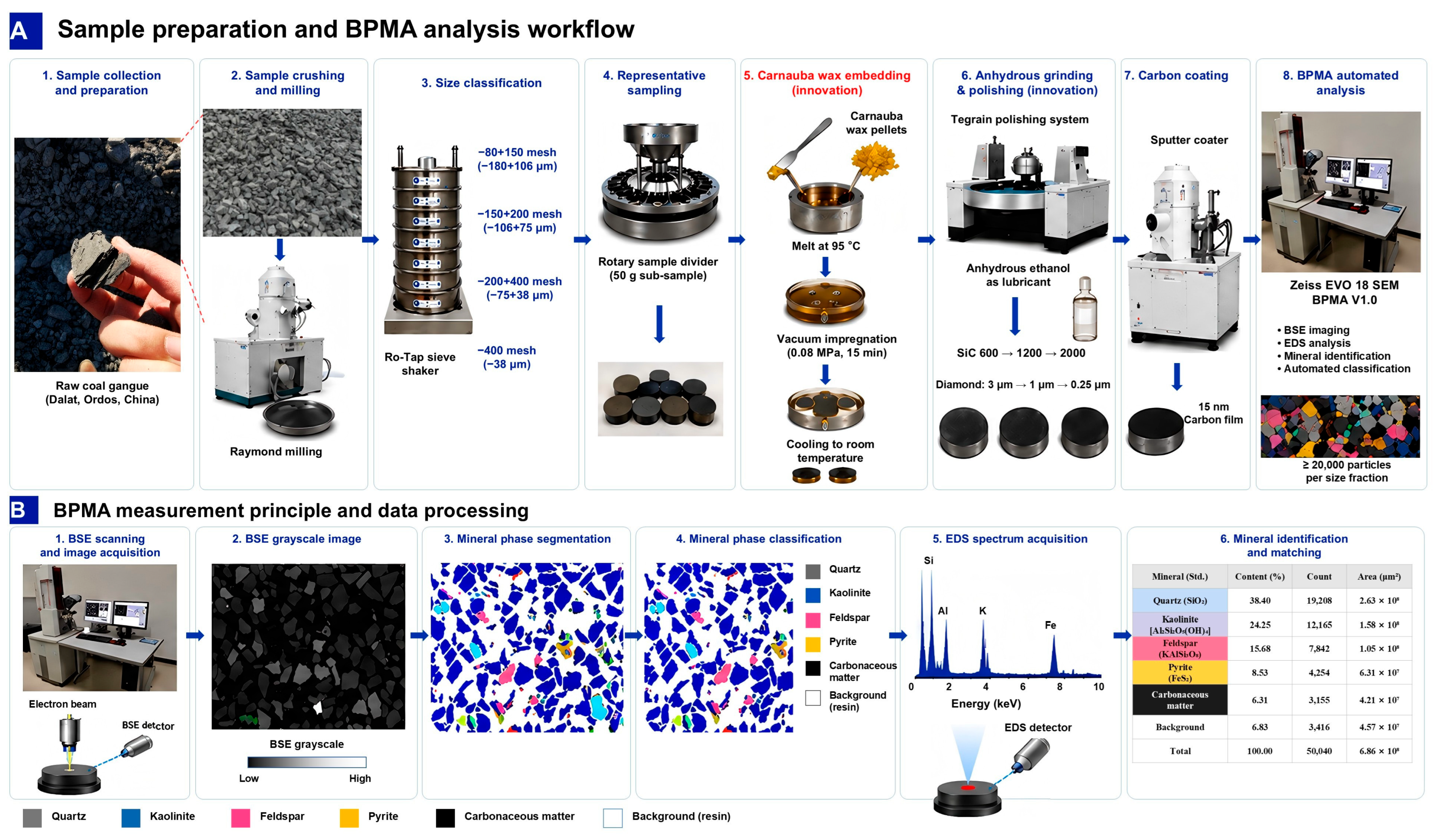
High-alumina coal gangue (CG) samples collected from the Dalate mining area in Ordos, Inner Mongolia, China, were adopted in this study. The complete experimental procedure is illustrated in Figure 1. First, the raw sample was crushed by a laboratory jaw crusher and then ground in a Raymond mill until all particles were smaller than 2 mm. The Raymond mill was operated continuously at an industrial processing capacity of approximately 12 t/h with an installed power of 130 kW. The estimated specific energy consumption of the Raymond mill was approximately 10.83 kWh/t. A standardized Bond Work Index test was not conducted in this study. After grinding, the material was thoroughly mixed and divided into representative sub-samples via a rotary sample splitter to guarantee sample homogeneity.
The prepared sample was sieved using a standard Ro-Tap shaker into four particle-size fractions: −80 + 150 mesh (180–106 μm), −150 + 200 mesh (106–75 μm), −200 + 400 mesh (75–38 μm) and -400 mesh (<38 μm), each of which was collected individually for the follow-up sample preparation and the automated mineralogical analysis. Mass-based sieve analysis: mass percentages for the >180 μm, 180–106 μm, 106–75 μm, 75–38 μm, and <38 μm fractions were 4.3%, 43.5%, 22.3%, 20.7%, and 9.2%, respectively. A detailed particle size distribution is provided in Table S4 of the Supporting Information. The four particle-size fractions were additionally analyzed by ICP-OES to independently verify the XRF results. The measured elemental compositions are provided in Table S2. The experimental procedure consisted of three steps, as shown in Figure 1: sample preparation, specimen preparation and BPMA analysis. Following size classification, the samples were embedded in carnauba wax, then subjected to vacuum impregnation, grinding, polishing, and carbon coating, and eventually analyzed by means of a BPMA system. The acquired data were employed to determine the mineral composition, particle size distribution, mineral intergrowth and liberation characteristics of each size fraction. The raw coal gangue was crushed, sieved to 80-400 mesh, and dried in air at 30℃ for 6 h to prepare the experimental specimens.
The crystalline mineral phases were characterized using a SmartLab SE X-ray diffractometer (Rigaku, Tokyo, Japan), and the bulk chemical compositions were determined using a Zetium X-ray fluorescence spectrometer (Malvern Panalytical, Almelo, the Netherlands). Proximate analysis, including moisture, ash, and volatile matter, was performed using a 5E-TGA6720 automatic proximate analyzer (CKIC, Changsha Kaiyuan Instruments Co., Ltd., Changsha, China), and the fixed-carbon content was calculated by difference. Ultimate analysis of C, H, N, S, and O was performed using a Vario EL Cube elemental analyzer (Langenselbold, Germany) based on dynamic combustion at 1150 °C. Independent elemental verification of the XRF results was conducted using an Avio 500 inductively coupled plasma optical emission spectrometer (ICP-OES; PerkinElmer, NY, USA), with the detailed results provided in Table S2 of the Supporting Information.

2.2. Carnauba Wax Embedding and Polishing

In order to enhance the contrast between carbonaceous materials and the embedding medium during automated mineralogical analysis, carnauba wax was employed instead of conventional epoxy resin for sample preparation. A comparative BPMA examination of epoxy-resin- and carnauba-wax-embedded specimens showed that carnauba wax provided clearer particle boundaries and improved the phase assignment of carbonaceous matter. Representative BSE images, phase maps, and a detailed comparison are provided in Figure S2 and Table S3 of the Supporting Information. Therefore, carnauba wax was used for the subsequent quantitative mineral association and liberation analyses. As shown in Figure 1, approximately 5 g of each particle-size fraction was blended with molten carnauba wax in a cylindrical mold at 95 °C until an even dispersion of the particles was achieved. Subsequently, the mixture was transferred into a vacuum chamber and impregnated at 0.08 MPa for 15 min to remove entrapped air and allow the molten wax to fully infiltrate the pores and micro-cracks of the particles. Upon the completion of impregnation, the samples were cooled down to room temperature (around 25 °C) and then demolded.
The embedded samples were prepared by means of an automatic Tegramin grinding and polishing system (Struers, Copenhage, Denmark). To minimize structural transformation of the clay minerals during sample preparation, all grinding and polishing processes were performed under water-free conditions, with anhydrous ethanol as both the lubricant and coolant. The sample surface was sequentially ground with 600-grit, 1200-grit, and 2000-grit SiC abrasive papers, followed by polishing with 3 μm, 1 μm and 0.25 μm diamond suspensions. The sample surface appeared smooth and flat, making it suitable for scanning electron microscope (SEM) observation and automated mineralogical analysis. Before BPMA measurement, all samples were coated with an ultra-thin conductive carbon film to avoid surface charging effects during subsequent SEM imaging.

2.3. BPMA Automated Mineralogical Analysis

Mineralogical analysis was performed using a ZEISS EVO 18 scanning electron microscope (Carl Zeiss Microscopy GmbH, Jena, Germany) equipped with a Bruker XFlash 6130 energy-dispersive X-ray spectroscopy (EDS) detector and the BGRIMM Process Mineralogy Analyzer (BPMA, Version 1.0; Beijing General Research Institute of Mining and Metallurgy, Beijing, China) software. The overall analysis is illustrated in Figure 1. The polished samples were coated with a thin conductive carbon film before analysis in order to minimize charge accumulation during SEM observation.
All measurements were performed under constant operating conditions, that is, 20 kV accelerating voltage, 10 mm working distance and 1.5 nA probe current. BSE images were acquired at a resolution of 1024 × 1024 pixels, with a calibrated pixel size of 4.88 nm/pixel. Multiple adjacent fields were automatically acquired and analyzed over a total area of 15 mm × 15 mm for each specimen. Mineral phases were identified using a peak-shape matching algorithm based on the acquired EDS spectra, with an acquisition time of 1000 ms per analysis point. The lower limit of spectral matching, the refinement threshold, and the principal-peak half-width were set to 0.7, 0.1, and 3, respectively. Automatically scanned BSE images were used for mineral phase determination based on grayscale contrast, and EDS images were also collected for chemical identification [29]. Automatic recognition of the mineral phase was achieved by matching BSE and EDS data with the mineral database contained in the BPMA system.
Collected data were processed by BPMA software to determine the quantitative mineralogical characteristics of each particle-size fraction. Mineral abundance was calculated according to the measured phase areas and mineral densities. In addition, particle segmentation and image reconstruction were used to determine the particle size distribution, mineral intergrowth and liberation degree. For the bulk coal gangue dataset summarized in Table 3, 11,741 particles were segmented, for which 12,308 mineral-phase objects were identified. The phase count was slightly higher than the particle count because individual particles can contain more than one mineral phase. The data were employed to evaluate variations in mineral composition and liberation behavior with decreasing particle size.

3. Results and Discussion

3.1. Mineralogical Characteristics of Coal Gangue

3.1.1. XRD Analysis of Different Particle-Size Fractions

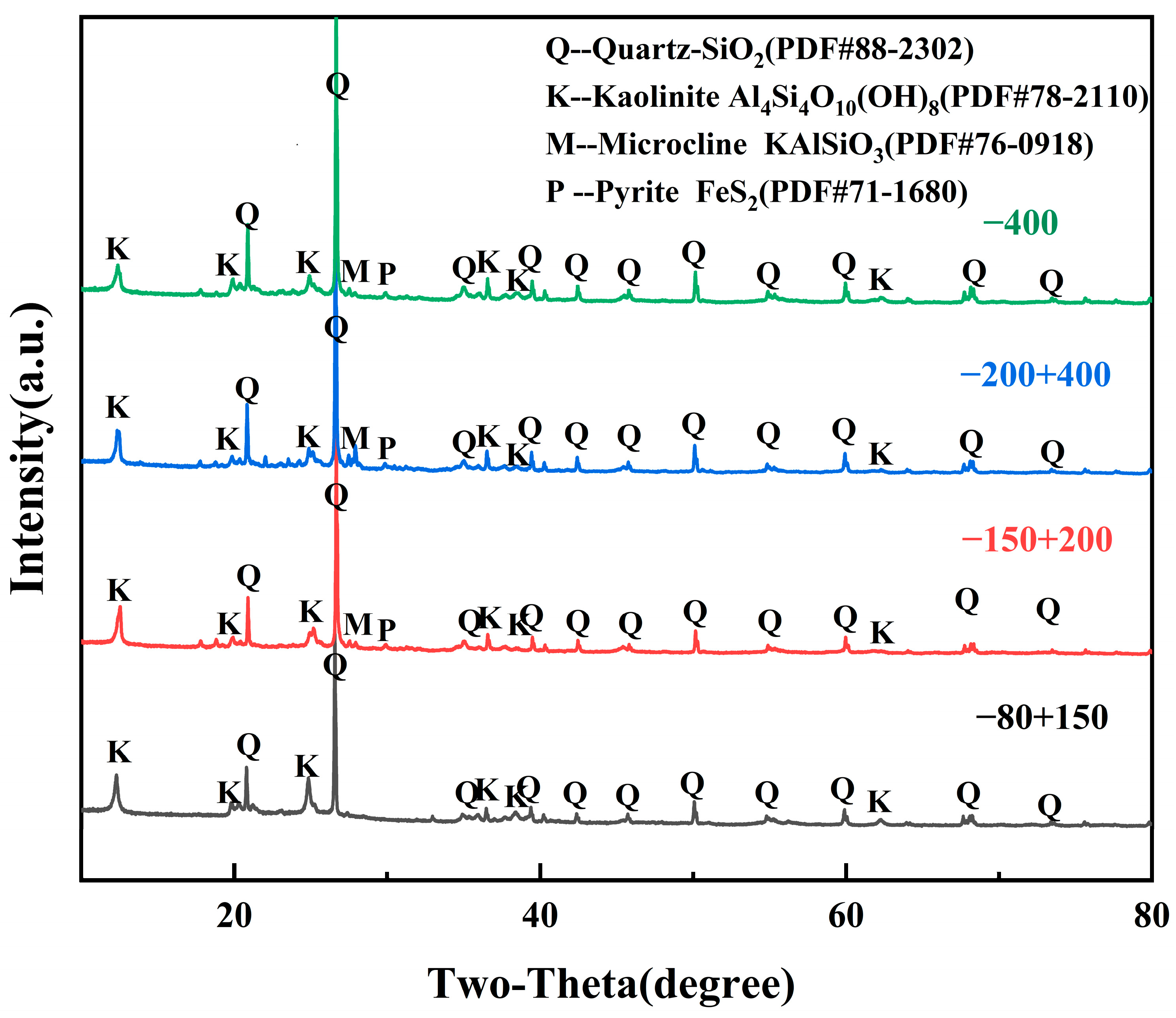
As shown in Figure 2, XRD analysis identified the crystalline mineral phases of the size-fractionated coal gangue from Dalate. The primary mineral phases are quartz, kaolinite, microcline and calcite, with a minor amount of pyrite. The characteristic peaks of kaolinite at 12.3°(001) and 24.8°(002) represent its significant role in all size fractions [30]. The prominent peak at 26.6° corresponds to quartz, which is another dominant mineral phase in the coal gangue.
The XRD patterns of the four particle sizes show striking similarities in their mineral assemblages. Mechanical grinding did not induce any obvious phase transformation or new minerals. However, with decreasing particle size, subtle but noticeable differences in peak intensity can be observed. Quartz and some minor minerals increase their relative intensity in the finer fractions, suggesting that grinding promotes exposure and liberation of these minerals to a certain degree. By comparison, the relative stability of the kaolinite peaks across the different fractions indicates that kaolinite is widely distributed within coal gangue and does not show apparent enrichment in any single particle-size fraction [31].

3.1.2. Chemical Composition of Different Particle-Size Fractions

The chemical compositions of the different particle sizes fractions are listed in Table 1. Coal gangue is mainly composed of SiO2 and Al2O3, whose total contents exceed 60 wt.% in all fractions. The SiO2 content showed an overall increase from 41.86 wt.% in the −80 + 150 mesh fraction to 43.76 wt.% in −400 mesh fraction, while the Al2O3 content increased from 18.23 wt.% to 19.99 wt.%. This result indicates that aluminosilicate minerals are relatively enriched in the finer fractions. The XRF results were further verified by independent ICP-OES measurements (Table S2). After stoichiometric conversion, the maximum relative deviations between ICP-OES and XRF were 1.6% for SiO2, 2.1% for Al2O3, and 9.2% for Fe2O3, confirming the reliability of the principal chemical compositions reported here.
A continuous decline in LOI was observed with decreasing particle size, from 29.61 wt.% to 25.64 wt.%, demonstrating that carbonaceous matter and volatile components tend to be enriched in the coarse fractions, whereas inorganic mineral phases are preferentially concentrated in the fine fractions. Fe2O3, K2O, CaO, Na2O, MgO, TiO2, and SO3 concentrations varied only in the four size fractions, indicating that the distribution of trace components is relatively dispersed in the coal gangue [32].

3.1.3. Proximate and Ultimate Analysis

The results of proximate and ultimate analyses of coal gangue are shown in Table 2. The moisture content of the four size fractions varied only marginally between 2.16 wt.% and 2.51 wt.%, so particle size has little effect on moisture content. Significant size-dependent variation was observed for ash, volatile matter and fixed carbon.
As particle size decreased, the ash content increased from 68.40 wt.% to 72.05 wt.%; fixed carbon and volatile matter fell from 13.52 wt.% to 11.33 wt.% and 15.58 wt.% to 14.47 wt.%, respectively. As a consequence of these trends, the ultimate analysis showed a decrease in carbon content from 19.17 wt.% to 17.77 wt.%. This distribution also confirms the particle size difference between organic and inorganic materials. Carbonaceous matter accumulates in the coarse fractions, while ash-forming aluminosilicate minerals are enriched in the fine fractions [33].
Overall, the results obtained by XRD and XRF and the results of proximate and ultimate analyses collectively reveal a distinct “coarse carbon and fine mineral” distribution structure. This size-dependent differentiation provides the basis for future particle-size classification, carbon removal, mineral separation, and chemical extraction of valuable aluminosilicate from coal gangue.

3.1.4. Quantitative Mineralogical Characterization by Carnauba Wax-Modified BPMA

To obtain the quantitative mineral composition and particle size distribution, automated mineralogical analysis was carried out using the BPMA system and carnauba wax embedding. Compared to the epoxy resin method, carnauba wax produces a distinct BSE contrast when combined with carbonaceous matter. This contrast allows for a more precise separation between organic and inorganic phases.
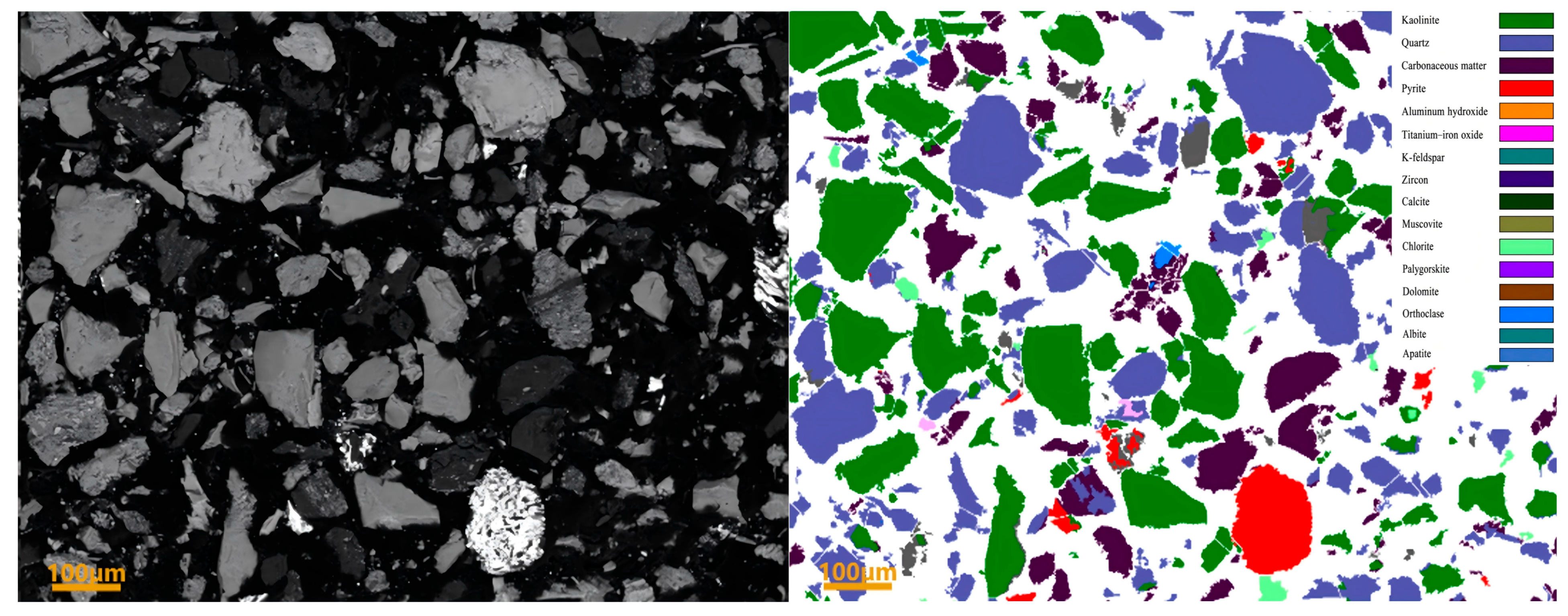
As displayed in Figure 3, the BPMA mapping shows that the main mineral phases consisted of kaolinite, quartz, carbonaceous matter and pyrite. Kaolinite and quartz play an important part in this, and usually exist either in discrete particles or composite particles, with complex intergrowth. Due to the lower average atomic number, carbonaceous matter appears darker in BSE images and is usually distributed around or between the inorganic particles. Pyrite is brighter in BSE images because of its higher atomic number, and is mostly distributed as fine grains or embedded in the aluminosilicate matrix as assemblages.
The quantitative mineralogical data from BPMA are summarized in Table 3. Kaolinite and quartz are the two main mineral phases, constituting 38.56 wt.% and 36.92 wt.% of total mass, respectively. Together they account for more than 75 wt.% of total coal gangue mass, which indicates that the sample is composed of aluminosilicate minerals. Carbonaceous matter makes up 11.18 wt.% of the total sample mass, but its area fraction is 19.48% due to its low density (1.40 g/cm3) and scattered occurrence in mineral matrix. The fraction-specific BPMA results further show that, from the −80 + 150 to the −400 mesh fraction, kaolinite increased from 33.98 to 46.41 wt.%, whereas quartz and carbonaceous matter decreased from 39.30 to 29.01 wt.% and from 13.56 to 10.94 wt.%, respectively (Table S5), confirming their selective redistribution among the particle-size fractions.
Table 3. Quantitative mineral composition of the coal gangue sample determined by BPMA.
MineralChemical FormulaDensity (g·cm−3)Weight Fraction (%)Area Fraction (%)Measured Area (μm2)Particle CountPhase Count
Kaolinite(Al1−xFex)2Si2O5(OH)42.6238.556935.90933,475,44038094029
QuartzSiO22.6536.919833.99533,290,19024972569
Carbonaceous matterC1.411.176119.4791,885,25037003812
PyriteFeS25.055.39282.6057252,193433555
DiasporeAlOOH3.350.04480.03263159.791313
Ilmenite(Mg<0.5Fe>0.5)TiO34.50.24050.130412,6242324
K-feldsparK[AlSi3O8]2.573.27412.959286,380676689
ZirconZr[SiO4]4.60.03840.02041970.9299
WollastoniteCaSiO32.9250.01260.01051013.521010
BiotiteK(Mg,Fe)3[AlSi3O10]
(OH,F)2
3.070.00320.0025245.48911
Chlorite(Mg, Fe, Al)6[(Si, Al)4O10](OH)82.982.92022.3911231423437458
MonaziteCe[PO4]5.20.05870.02762667.642525
BariteBa[SO4]4.40.07970.04424277.3535
CalciteCa[CO3]2.750.96130.85382,553.19498
AlbiteNa[AlSi3O8]2.6250.08910.08288013.4588
ApatiteCa5[F(PO4)3]3.150.01360.01051018.1933
Pyrite is a sulfurous mineral and its content is 5.39 wt.%. Although its abundance is relatively limited, its high density (5.05 g/cm3) and fine-grained mineral status can exert a significant influence on separation and liberation behaviors during grinding. Other minerals identified by BPMA are K-feldspar (3.27 wt.%), chlorite (2.92 wt.%), and calcite (0.96 wt.%), as well as some small accessory phases such as zircon, monazite, barite and apatite.
The results obtained by BPMA show that coal gangue is highly heterogeneous in particle size. Layered clay minerals, rigid silicates, carbonaceous phases, and sulfur impurities make up a complicated mineral association network. Such differences in mineral properties and spatial distribution are the basis of the selective fragmentation and liberation behavior observed in the following grinding stages.

3.2. Size-Dependent Fragmentation and Mineral Segregation

3.2.1. Particle Size Distribution of Major Mineral Phases

The size distribution of the bulk sample and the dominant mineral phases was measured using BPMA, as shown in Table 4. The grained coal gangue particles are enriched in medium to fine size fractions. About 67.36% of the particles are in the −0.147 + 0.104 range, with an average particle size of 0.114 mm for the raw sample. This indicates that the material is sufficiently ground and suitable for process mineralogy analysis.
Different mineral phases have different sizes. Quartz has an average particle size of 0.119 mm, slightly coarser than that of kaolinite (0.116 mm), which implies quartz is more resistant to fragmentation during grinding. Kaolinite is accumulated in finer fractions on account of its layered structure and easy cleavage along the basal plane. Carbonaceous matter has the coarsest size distribution, with an average particle size of 0.143 mm, which indicates it is harder to comminute than inorganic phases. This behavior probably arises from its loose structure, which can absorb some of the mechanical stress during grinding.
Among the major minerals, pyrite is the finest particle with an average particle size of 0.110 mm, and is mostly in medium–fine fractions, suggesting pyrite is brittle and fragments more easily during grinding. The average size of composite particles is 0.123 mm, suggesting some fine pyrite and aluminosilicate minerals are still locked into intergrown particles and are not fully liberated. According to these results, coal gangue comminution does not reduce the particle size uniformly. Rather, the different minerals exhibit different fragmentation and liberation behavior characteristic of the mineral phases.

3.2.2. Liberation Characteristics of Major Mineral Phases

Using BPMA, we further quantified the liberation degrees of major minerals, which are summarized in Table 5. The liberation degree refers to the percentage of target minerals contained in a particle. We found pronounced variations in the liberation behavior of ground minerals.
Carbonaceous matter is liberated most easily, with 84.91% present as free particles, suggesting that carbonaceous matter readily decomposes from the matrix of inorganic minerals during grinding, related to its low mechanical strength and weak bonding with silicate minerals. Quartz and kaolinite exhibit moderate liberation degrees, with 67.08% and 69.64% occurring as free particles, but most of these minerals remain as composite particles enriched in higher fractions of the target mineral. This implies that the intricate intergrowth of quartz, kaolinite and other aluminosilicates makes it difficult to achieve complete liberation by mechanical grinding alone.
K-feldspar and pyrite exhibit relatively low liberation degrees, with 46.26% and 51.40% as free particles, respectively. And 15.38% of pyrite is present in a high composite fraction between 90% and 100%, which means that part of pyrite is present as fine grains or tightly locked particles rather than fully liberated minerals. This is consistent with pyrite being present as fine disseminations or aggregates, embedded in clay minerals and carbonaceous matter.
On the whole, the quantitative liberation data show that carbonaceous matter can be easily liberated during grinding, whereas pyrite and K-feldspar are difficult to liberate as a result of their fine particle size and complex intergrowth association with surrounding mineral phases. Therefore, the impurities cannot be completely removed by particle size reduction alone. Additional separation or activation strategies like staged grinding, flotation or selective chemical treatment must be employed to further improve the separation efficiency of different minerals in coal gangue. Similarly to the bulk-sample results, the fraction-specific results show that from the 80 + 150 to the 400 mesh fraction, the liberation degrees of quartz, kaolinite, carbonaceous matter, pyrite and K-feldspar increased from 54.37% to 75.14%, 48.71% to 77.27%, 76.41% to 95.58%, 32.51% to 61.58%, and 35.57% to 51.86% (Table S6). Carbonaceous matter is still the most readily liberated phase, whereas pyrite and K-feldspar have the lowest liberation degrees. Their low values, even in the 400 mesh fraction, suggest that fine dissemination and complex mineral intergrowth still restrict complete liberation. Therefore, the observed sequence should not be understood as mineral hardness alone. It is controlled jointly by fracture-mode differences, the mineral–matrix interfacial strength, and the size of embedded minerals.

3.3. Mineral Association Characteristics of Major Mineral Phases

3.3.1. Mineral Association Characteristics of Quartz

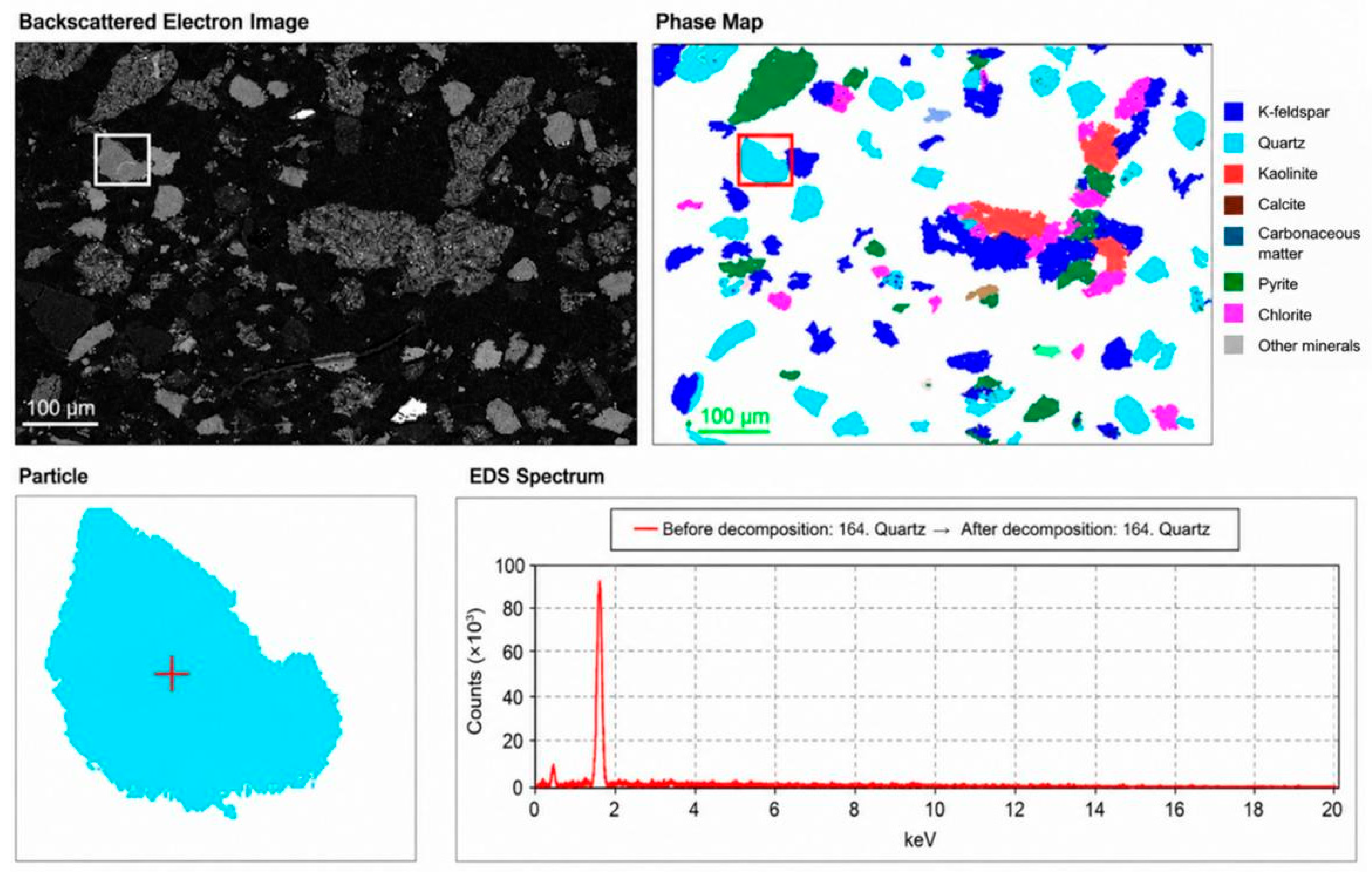
The paragenetic properties of quartz were studied quantitatively using the BPMA system, and the results are summarized in Table 6. A total of 67.08% of quartz is liberated, confirming the majority of quartz particles are free monomer crystals after grinding. In composite particles, 20.56% of quartz is associated with kaolinite, but its associations with carbonaceous matter (5.89%), K-feldspar (1.03%), and pyrite (0.66%) are weaker. These findings reveal to us that quartz is closely intergrown with clay, rather than organic matter.
The BPMA observations closely align with the BSE images and EDS analyses presented in Figure 4. Liberated quartz particles are angular to sub-angular in shape with smooth boundaries, while composite particles are very irregularly connected to adjacent kaolinite or K-feldspar minerals. The EDS spectra obtained from representative particles clearly demonstrate the higher Si and O content of quartz; however, Al and K peaks occur at quartz–K-feldspar and quartz–kaolinite interfaces.
The association between quartz and kaolinite reflects their shared sedimentary origin and prolonged geological coexistence. Fractures occur more often along existing defects and weaker interfaces during grinding rather than completely separating quartz from adjacent clay minerals [34]. This means that even though quartz possesses a relatively high liberation degree, a large portion remains locked in aluminosilicate aggregates, which limits the physical separation efficiency. Mechanically, the mechanical contrast between rigid quartz and the clay matrix causes stress concentration at existing quartz–kaolinite interfaces, which facilitates partial separation. Similarly, the quartz domains enclosed in aluminosilicate aggregates remain locked.

3.3.2. Mineral Association Characteristics of Kaolinite

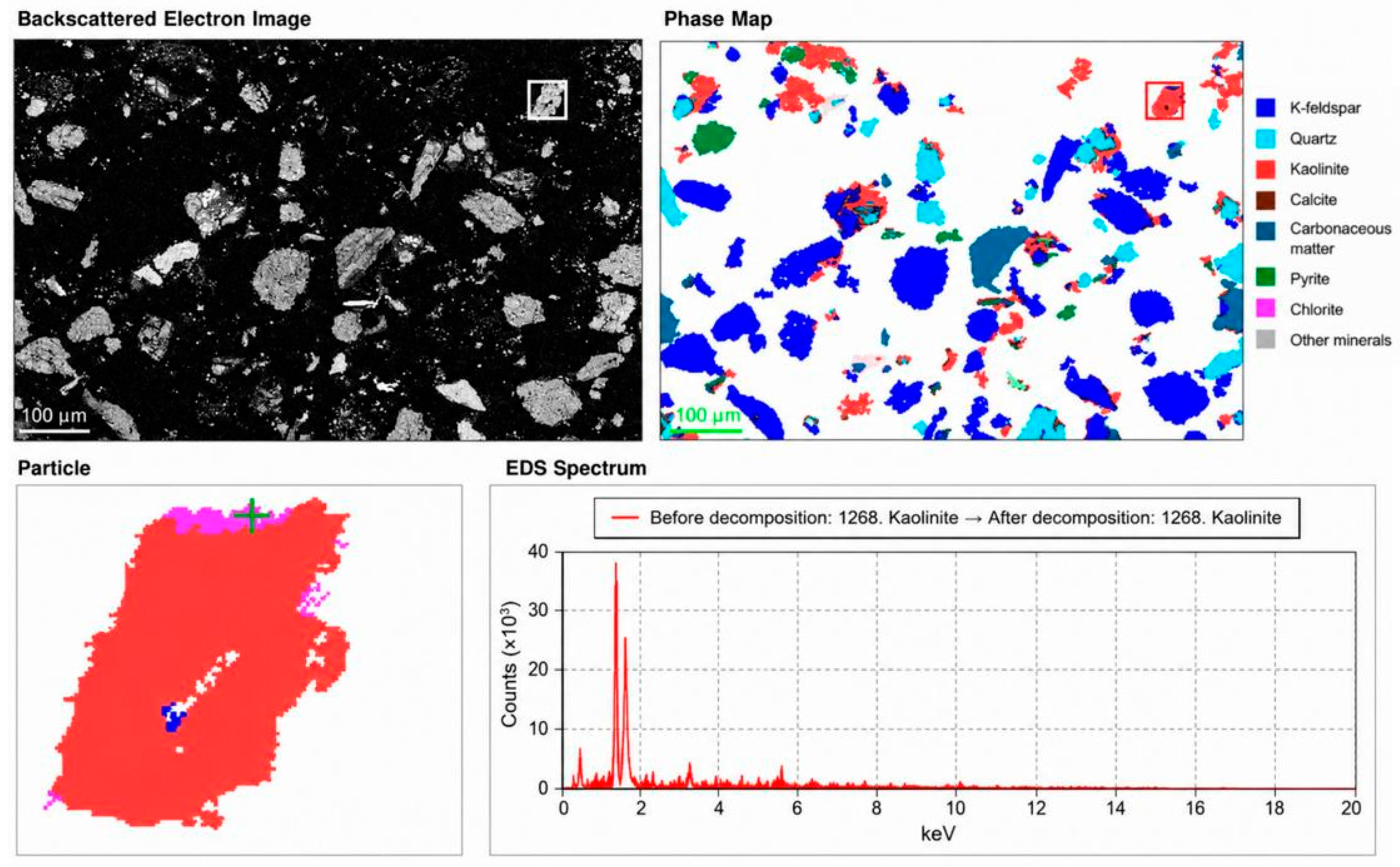
The mineral association properties of kaolinite were quantitatively measured by BPMA, and the results are shown in Table 7. The kaolinite liberation degree is 69.64%, suggesting most particles are liberated after grinding. However, a large amount of particles are intergrown with other minerals. Among these composite particles, kaolinite is most closely associated with carbonaceous matter (10.85%), followed by quartz (8.84%), K-feldspar (2.94%) and pyrite (1.76%).
The BSE images and EDS spectra in Figure 5 provide more information about the structure and composition of kaolinite. Unlike quartz, kaolinite occurs as finer particles and typically exhibits irregular flaky aggregates and layered structures. The EDS spectra show prominent Al and Si peaks and strong O signals, which indicates that kaolinite is aluminosilicate. Small variations in the elemental composition reveal that Fe substitution exists in the structure, which reflects iron-containing clay minerals in coal gangue [35].
Strong intergrowth association between kaolinite and carbonaceous matter suggests organic components are densely distributed in a matrix rich in layered structures. The coexistence of kaolinite and quartz indicates a shared mineralogical origin during sediment formation. Because of its layered structure, kaolinite tends to split between layers and undergoes particle size reduction during grinding instead of fracturing completely along mineral boundaries. While kaolinite achieves a relatively high separation degree, portions of clay minerals remain tightly bound to quartz and carbonaceous matter, which may have an influence on subsequent physical separation and chemical extraction. Although the weak basal planes of kaolinite favor shear-induced delamination, its fine flakes may remain attached to quartz or carbonaceous surfaces after breakage. Consequently, further size reduction may generate finer composite particles without producing a proportional improvement in phase purity.

3.3.3. Mineral Association Characteristics of Carbonaceous Matter

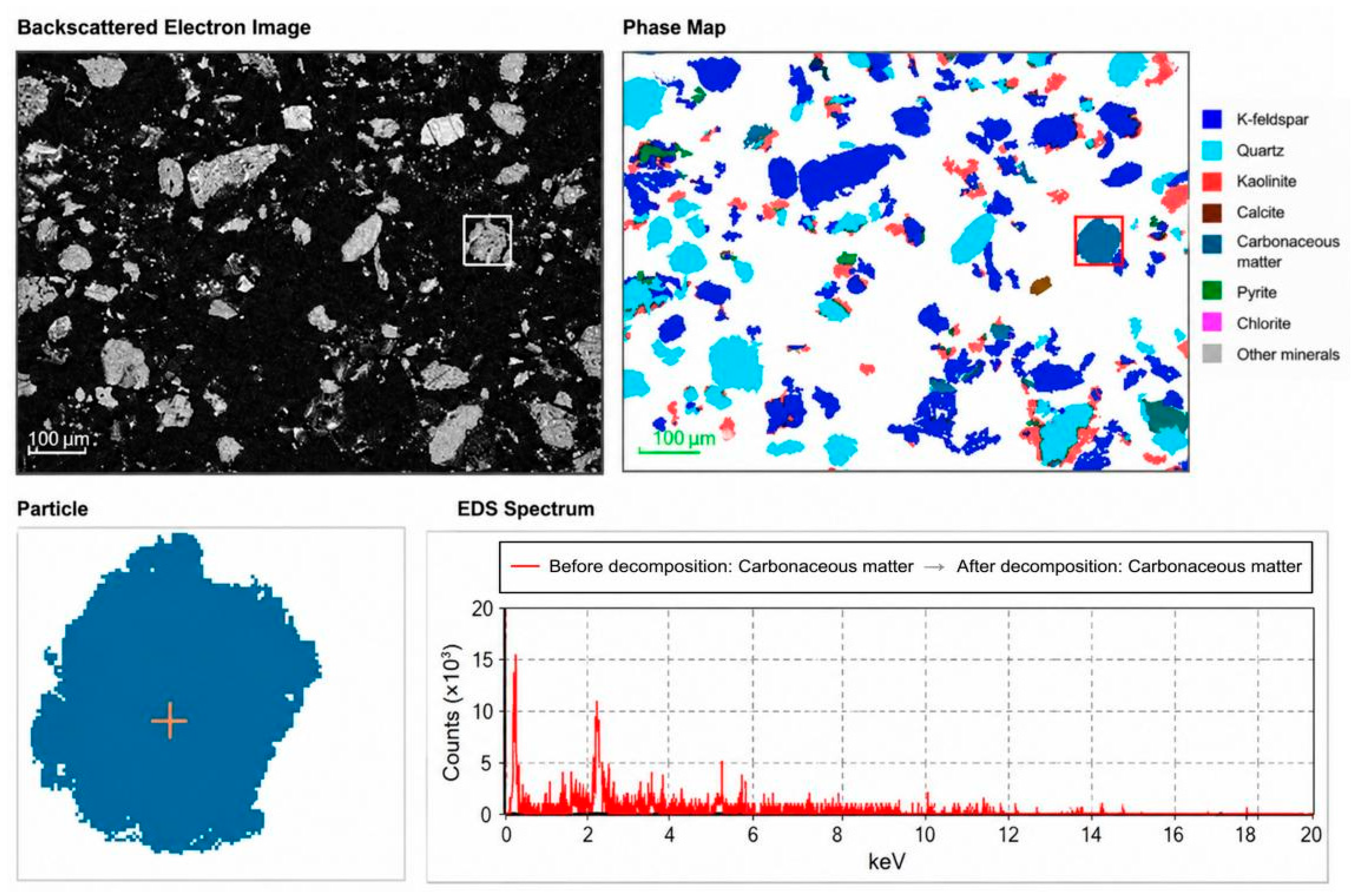
The carbonaceous matter properties determined by BPMA are summarized in Table 8. Carbonaceous matter is the most liberated phase, and 84.91% of its particles are free grains. This means that carbonaceous matter dissociates easily from the surrounding mineral matrix during grinding [36]. In composite particles, carbonaceous matter is largely associated with kaolinite (8.37%), followed by quartz (3.46%), pyrite (2.20%) and K-feldspar (0.36%).
The distribution patterns of the carbonaceous matter are presented in Figure 6. In the BSE images, the carbonaceous matter appears as dark gray to black regions, on account of its relatively low mean atomic number, and contrasts sharply with the neighboring aluminosilicate minerals. The EDS spectra mostly consist of carbon, with elevated peaks of Al, Si, Fe and S detected at the interfaces with adjacent clay minerals and pyrite, suggesting the presence of mineral inclusions or intergrowths.
Despite the fact that the majority of the carbonaceous matter occurs as free particles, local composite structures can still be observed. Fine kaolinite flakes are commonly attached to or enclosed within the carbonaceous particles, while pyrite is present as scattered grains or tiny inclusions, located at the margins and micro-fractures of the carbonaceous matrix. These observations are in good agreement with the quantitative association data from BPMA, and demonstrate that the remaining locked particles are controlled primarily by the close intergrowths among carbonaceous matter, clay minerals, and sulfide minerals. As a consequence, mechanical grinding is effective in liberating the bulk of the organic matter, while the complete separation of the residual composite particles may require additional physical or chemical processing. Its high liberation is therefore mainly attributed to preferential failure of the relatively weak organic–mineral interfaces rather than extensive internal fragmentation of the carbonaceous phase. The detached carbonaceous matter consequently tends to remain as relatively coarse, low-ash particles, providing a basis for size-selective carbon recovery.

3.3.4. Mineral Association Characteristics of K-Feldspar

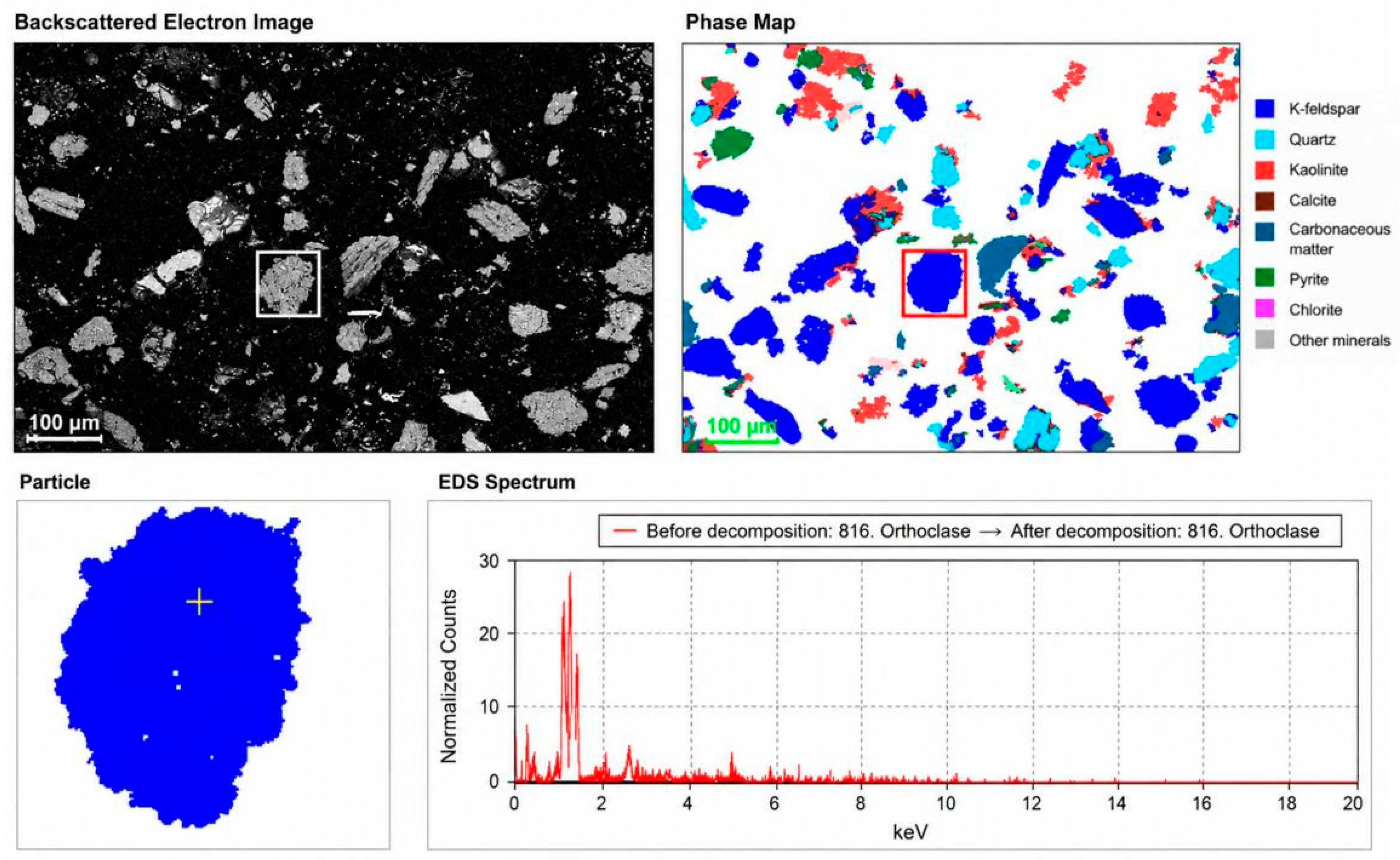
The mineral association characteristics of K-feldspar, as determined by BPMA, are summarized in Table 9. The liberation degree of K-feldspar is 46.26%, which is low among all target minerals. More than half of the particles remain strongly bound to other phases after grinding. In composite particles, K-feldspar is closely associated with quartz (23.57%) and kaolinite (18.26%), while its associations with carbonaceous matter and pyrite reach only 5.42% and 1.65%, respectively. These results suggest that K-feldspar tends to occur in aluminosilicates rather than organics [37].
Characteristic BSE images and associated EDS spectra are shown in Figure 7. K-feldspar usually occurs as irregular masses or sub-grains with close associations with quartz and clay minerals. The EDS spectra show noticeable peaks of Si, Al and K, which confirm the characteristic chemical composition of K-feldspar. Localized Na and Fe signals are observed from time to time at the grain boundaries, demonstrating that there are slight variations in composition and K-feldspar or clay minerals.
The relatively low liberation rate of K-feldspar results from its tight interplay with quartz and kaolinite. During grinding, fractures propagate mostly along weaker interfaces, but enormous quantities of K-feldspar grains remain trapped in aluminosilicate aggregates, and incomplete liberation occurs. The similar aluminosilicate framework and close textural continuity among K-feldspar, quartz, and kaolinite reduce the probability that cracks will propagate completely along the K-feldspar boundaries. Its low liberation is therefore governed primarily by structural interlocking rather than insufficient grinding intensity, indicating that indiscriminate fine grinding would provide limited additional separation.

3.3.5. Mineral Association Characteristics of Pyrite

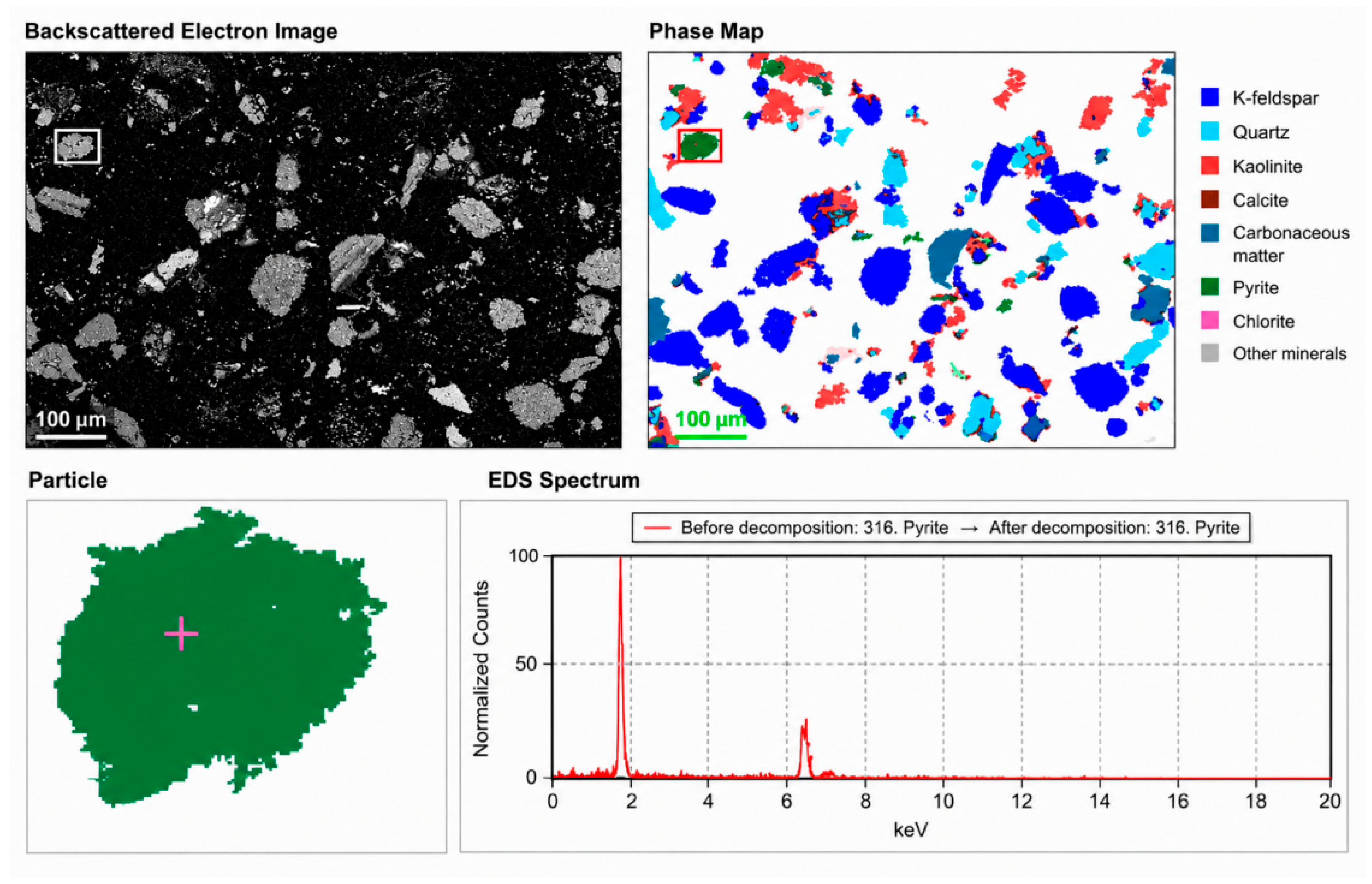
The mineral association characteristics of pyrite determined by BPMA are summarized in Table 10. Pyrite has a relatively low liberation degree (51.40%), which implies that nearly half of the particles remain tightly bound to other minerals after grinding. Among the main minerals, pyrite shows the poorest liberation performance compared to carbonaceous matter, quartz, and kaolinite. And 15.38% of the particles fall within the composite particle range of 90% ≤ x ≤ 100%, which indicates that a large portion of the particles remain tightly embedded in other minerals after grinding.
Representative BSE images and EDS spectra are shown in Figure 8. Pyrite has a high mean atomic number and appears in the form of bright white particles in the BSE images, contrasted with surrounding aluminosilicate minerals and carbonaceous matter. Pyrite is mainly finely distributed crystals, botryoidal aggregates, or irregular inclusions, embedded in clay matrices or located along the margins of carbonaceous matter. The EDS spectra show high peaks for Fe and S, which confirms the presence of pyrite.
The liberation properties obtained by BPMA indicate that pyrite, in the shape of fine grains, is distributed in the aluminosilicate particles, rather than existing as coarse particles. And in the process of grinding, cracks propagate within the surrounding clay matrix, not breaking pyrite particles or totally separating pyrite–matrix interfaces. The result is that a significant portion of the particles remain embedded in composite particles after the comminution. This intimate association with other minerals is the reason why pyrite has a low liberation rate and implies that mechanical grinding alone is not sufficient to fully remove it [38]. Thus, it may be necessary to add beneficiation or selective chemical treatment to further improve the efficiency of pyrite extraction from coal gangue. Because many pyrite grains occur as fine inclusions below the characteristic size of the surrounding composite particles, additional grinding preferentially breaks the softer host matrix rather than completely opening the pyrite–matrix boundaries. This causes locked pyrite to migrate into finer composite particles and explains the limited improvement in pyrite liberation under prolonged grinding.
The BPMA results show that the mineral liberation in coal gangue is directly affected by mineral-specific intergrowth properties. Carbonaceous matter has the highest degree of liberation (84.91%) and is best liberated by grinding, while quartz and kaolinite are moderately liberated due to their intricate intergrowths in the aluminosilicate matrix. In contrast, pyrite has a much lower degree of liberation (51.40% of particles fully liberated). Further association analysis shows that a large proportion of pyrite is tightly locked with carbonaceous matter (26.02%) and kaolinite (11.72%), suggesting that the fine sulfide particles in the organic–clay matrix are not easily exposed by grinding alone. It can be concluded from these results that the heterogeneous mineral association network governs the selective fragmentation and liberation behavior of coal gangue, and quantitatively improves grinding strategies and subsequent mineral separation.

3.4. Grain Downsizing Vectors and Mineral-Specific Fracture Mechanisms

3.4.1. Selective Fragmentation Pathways Under Mechanical Force Fields

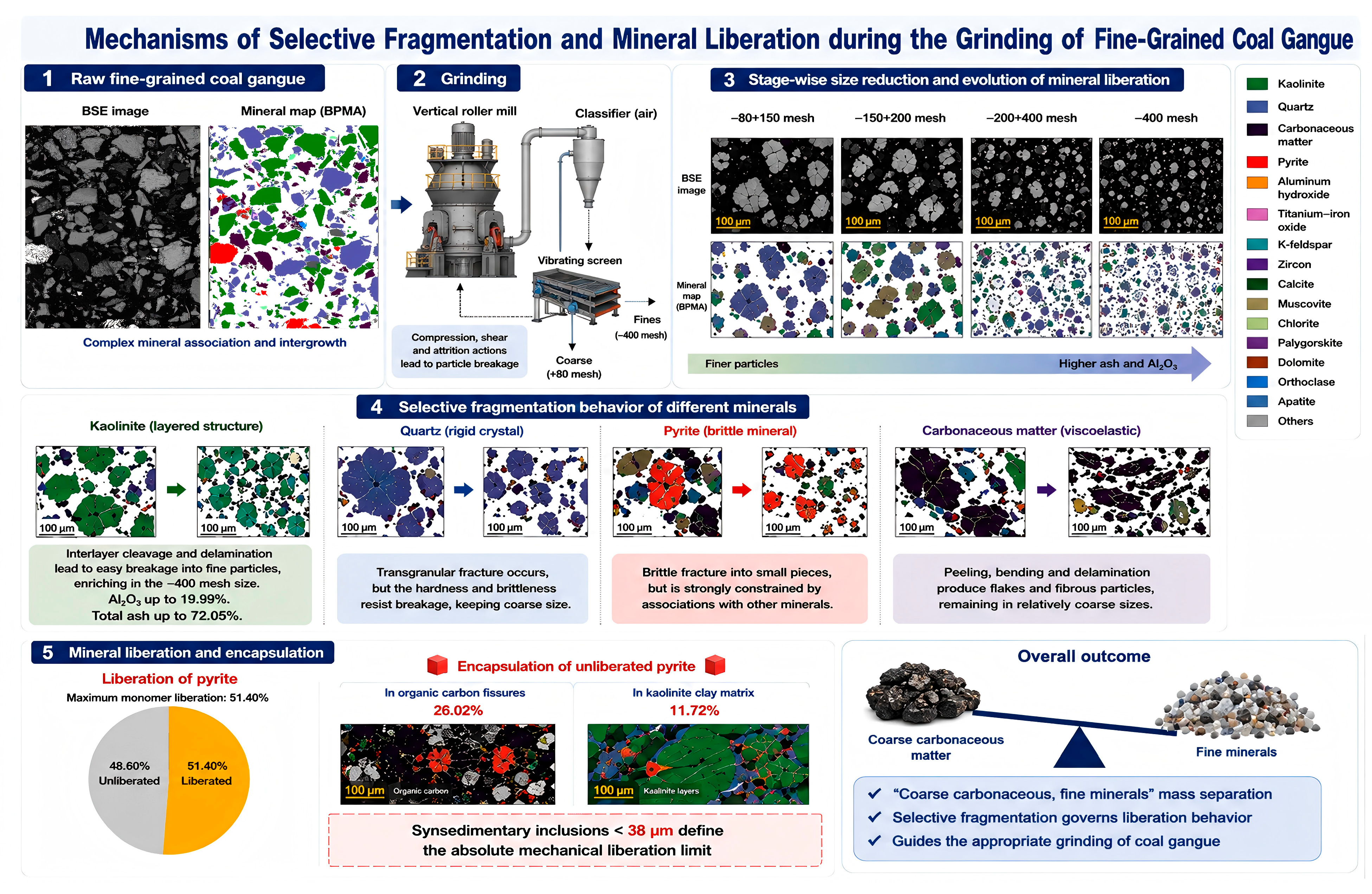
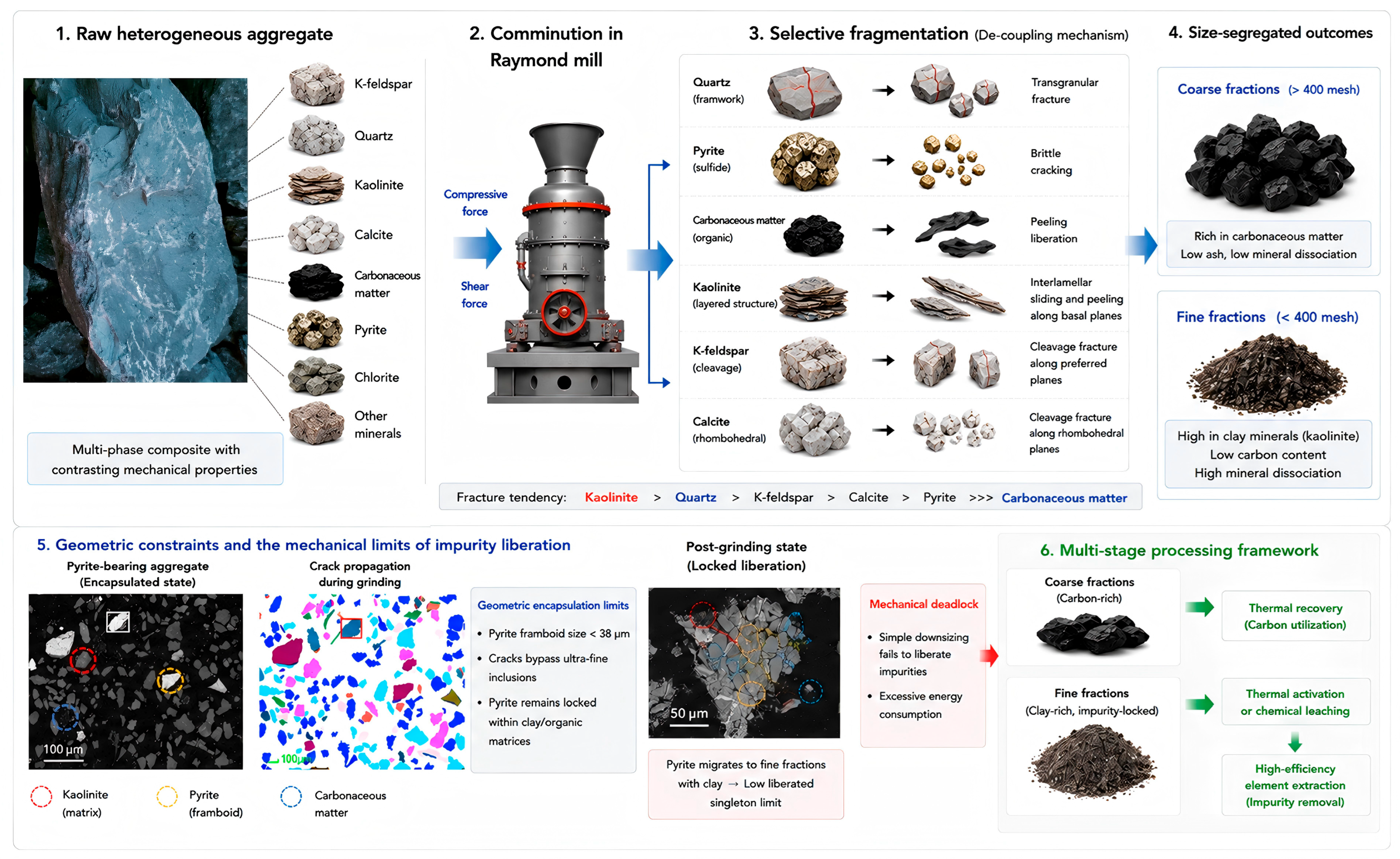
The nonlinear size reduction and systematic phase redistribution observed in coal gangue may be associated with differences in the crystal structures, occurrence modes, and mechanical responses of its mineral components (Figure 9, Stage 1). In the Raymond mill, particles are primarily subjected to compression and shear between the grinding rollers and ring, accompanied by interparticle impact and abrasion (Figure 9, Stage 2). The mineral associations suggest stress and crack propagation may preferentially occur along weaker mineral interfaces rather than uniformly through the whole matrix (Figure 9). These mineral size distributions may be explained by differences in mechanical properties, occurrence modes and response to comminution. Previous studies show that quartz, clay, sulfur minerals and organic matter behave differently during crushing and liberating due to different stiffnesses, shear resistances and mineral–matrix associations [39,40]. Therefore, the enrichment of different minerals in particular size fractions reflects selective fragmentation rather than purely random breakage.
The pronounced “coarse-grained organic retention” arose from the viscoelasticity of the amorphous carbonaceous materials. Unlike rigid inorganic components, these amorphous hydrocarbon networks are in possession of a highly elastic–plastic fracture toughness and relatively low mechanical hardness. Under abrasive impacts, these viscoelastic regions act as structural dampeners, absorb local mechanical energy from plastic deformation and inhibit propagation of trans-boundary micro-cracks [41]. The core carbonaceous structures are effectively resistant to strong comminution, remaining in the coarse fraction (+400 mesh) and becoming enriched as low-ash composites (Figure 9, Stage 4).
The inorganic matrices exhibit highly efficient brittle fracture pathways, accelerated by the intrinsic cleavage planes of the crystals. Kaolinite, a layered aluminosilicate clay mineral, has a relatively low interlayer shear resistance due to weak Van der Waals forces between layers [42]. Localized shear stresses may promote interlayer sliding and delamination along the basal planes, which may explain the enrichment and increased liberation of kaolinite in the finer fractions (Tables S5 and S6). This proposed pathway is inferred from the BPMA trends and the layered structure of kaolinite rather than from direct fracture-surface observation.
Quartz lacks well-defined cleavage and may undergo transgranular brittle fracture if the stress applied exceeds its local strength. When quartz grains are embedded within the softer kaolinite-rich matrix, the mechanical contrast may promote stress concentration at the quartz–kaolinite interfaces. Fractures may propagate through quartz grains or along quartz–kaolinite interfaces, leading to progressive liberation of quartz with decreasing particle size (Figure 9, Stage 4; Table S6).

3.4.2. Geometric Constraints and the Practical Constraints on Impurity Liberation

The quantitative interlocking parameters and the persistently poor liberation of metallic impurities are closely associated with geometric encapsulation (Figure 9, Stage 5). The BPMA results show that the relatively low liberation of pyrite is associated with its fine dissemination and persistent encapsulation within surrounding mineral phases [43].
As the size decreases, the mechanical contrast between pyrite and the surrounding matrix may influence local crack propagation. A considerable proportion of the syngenetic pyrite occurs as fine framboidal or irregular inclusions smaller than 38 μm and remains enclosed within the clay matrix or carbonaceous matter [44]. Therefore, substantially finer grinding would probably be required to further expose these inclusions. However, the continued incomplete liberation of pyrite in the −400 mesh fraction suggests that further comminution may increase energy consumption and ultrafine-particle production without a proportional improvement in liberation [45]. Fine dissemination and persistent encapsulation impose a practical constraint on pyrite liberation in the particle-size range investigated in this study.
This liberation constraint creates a physical barrier for conventional processing. Accordingly, further size reduction alone may not be the most efficient route for improving pyrite liberation [45]. Thus, multi-stage treatment based on the particle-size fraction is required to separate pure minerals (Figure 9, Stage 6). Carbon-rich coarse particles can be directed straight to the thermal recovery circuit for energy use. Additionally, clay-rich low-carbon fine particles provide ideal high-purity aluminosilicate raw materials [46]. This avoids organic contamination barriers and optimizes subsequent processes, such as selective thermal activation or chemical leaching, so as to disintegrate tightly bound networks [47,48]. From an economic point of view, the specific energy used by the Raymond grinding process was estimated at 10.83kWh/t. The incomplete liberation of finely dispersive pyrite and K-feldspar indicates that indiscriminate fine grinding would increase the energy demand without a proportional improvement in liberation. Therefore, particle size classification followed by fractional utilization may reduce grinding and processing costs. In an industrial environment, the size-dependent mineral distribution identified by BPMA can guide material routing: carbon-rich coarse fractions can be thermally used, kaolinite-rich fine fractions can be used to activate or extract and pyrite-bearing composite particles can be used for targeted separation rather than indiscriminate additional grinding.

4. Conclusions

(1)
Dalate coal gangue is a typical high-alumina argillaceous resource, and is largely composed of kaolinite (38.56 wt.%) and quartz (36.92 wt.%). Together, these two minerals account for more than 75 wt.% of the total sample. High-throughput multi-scale analysis shows that with a decrease in particle size, the density of the composite particles increases steadily from 2.18 g/cm3 to 2.41 g/cm3. This trend reflects the redistribution of low-density carbonaceous matter and denser inorganic minerals during grinding and classification.
(2)
Grinding produced a mineral-specific size redistribution associated with differences in mineral structure and occurrence. Carbonaceous matter decreased from 13.56 wt.% in the −80 + 150 mesh fraction to 10.94 wt.% in the −400 mesh fraction, demonstrating its relative retention in the coarser fractions. In contrast, kaolinite increased from 33.98 to 46.41 wt.%, demonstrating its preferential redistribution toward the −400 mesh fraction.
(3)
BPMA analysis revealed persistent liberation constraints associated with mineral intergrowth and encapsulation. Carbonaceous matter exhibited a liberation degree of 84.91%, whereas that of pyrite reached only 51.40%. BSE–EDS and BPMA observations showed that pyrite commonly occurred as fine framboidal or irregular inclusions (<38 μm) enclosed within clay minerals or carbonaceous matter, limiting its liberation under the investigated grinding conditions.
(4)
These particle-scale results support a size-fractionated processing strategy. Carbon-rich coarse fractions can be considered for thermal recovery. Clay-rich, relatively low-carbon fine fractions can serve as aluminosilicate feedstocks for subsequent utilization. This size-selective strategy can reduce unnecessary overgrinding and facilitate subsequent thermal activation or chemical extraction.

Supplementary Materials

The following supporting information can be downloaded at: https://www.mdpi.com/article/10.3390/min16090940/s1, Figure S1: Representative SEM-BSE field and corresponding point EDS spectra used to verify the major mineral phases in coal gangue. The red numbered markers in the BSE image correspond to the spectra shown on the right: quartz (1-2), K-feldspar (3-4), kaolinite (5-6), pyrite (7-8), and car-bonaceous matter (9). SEM conditions shown in the micrograph were 20.0 kV accelerating voltage, 17.90 mm working distance, BSE detection, 146x magnification, and a 1.89 mm field of view. Scale bar: 500 micrometres; Figure S2: Comparison of BPMA results obtained using epoxy resin and carnauba wax as embed-ding media: (a) BSE image of the epoxy-resin-embedded specimen; (b) corresponding BPMA phase map; (c) BSE image of the carnauba-wax-embedded specimen; and (d) corresponding BPMA phase map. In the epoxy-based output, cyan regions corresponding to carbonaceous matter were reported as "match failure", accompanied by incomplete boundary recognition and reduced BSE-phase-map correspondence. Carnauba wax produced clearer particle contours and improved phase assignment, particularly for carbonaceous matter and fine mineral inclusions. Scale bars: 100 micrometres; Table S1. phase identification by the EDS software; Table S2. Elemental compositions of the four coal-gangue particle-size fractions determined by ICP-OES; Table S3. Qualitative comparison of epoxy resin and carnauba wax embedding in BPMA analysis; Table S4. Mass-based particle-size distribution of the ground coal-gangue product; Table S5. Mineral compositions of the bulk sample and four particle-size fractions determined by BPMA (wt.%); Table S6. Liberation degrees of the major minerals in the bulk sample and four particle-size fractions determined by BPMA (%).

Author Contributions

Conceptualization, H.D.; Methodology, K.L. and Z.S.; Software, Z.S.; Validation, H.D. and T.L.; Investigation, H.D. and X.S.; Resources, K.L.; Data curation, H.D.; Writing—original draft preparation, H.D.; Writing—review and editing, Z.C.; Visualization, H.D.; Supervision, Z.C.; Project administration, J.Z.; Funding acquisition, K.L. All authors have read and agreed to the published version of the manuscript.

Funding

This research was funded by the Major Breakthrough Project under Ordos City’s “Unveiling the List and Taking the Lead” Science and Technology Initiative (grant number JBGS2024008), and the Major Science and Technology Special Project of Xinjiang Uygur Autonomous Region (grant number 2024A03008-2). The APC was funded by the Inner Mongolia University of Science and Technology.

Data Availability Statement

The data presented in this study are available in the article and the accompanying Supplementary Materials. Additional data are available from the corresponding author upon reasonable request.

Conflicts of Interest

The authors declare no conflict of interest.

References

  1. Liu, R.Z.; Wang, S.M. Research progress on the comprehensive utilization of coal gangue. Int. J. Coal Prep. Util. 2026, 46, 591–605. [Google Scholar] [CrossRef] [Scilit]
  2. Sun, Y.H.; Bai, B.H.; Yang, X.; Zhu, S.J.; Tian, J.L.; Wang, Z.Z.; Xu, L.; Xu, L.F.; Shen, B.X. Coal Gangue Utilization: Applications, Challenges, and Sustainable Development Strategies. Energies 2025, 18, 444. [Google Scholar] [CrossRef] [Scilit]
  3. Liu, X.H.; Hu, Z.Q.; Gao, J.W. Assessment of soil and groundwater pollution risks from coal gangue backfilling: A case study in Inner Mongolia mining areas. Environ. Res. 2025, 285, 122303. [Google Scholar] [CrossRef] [Scilit] [PubMed]
  4. Wang, Y.Q.; Zhu, L.; Xue, Y. A Comprehensive Review on Dual-Pathway Utilization of Coal Gangue Concrete: Aggregate Substitution, Cementitious Activity Activation, and Performance Optimization. Buildings 2026, 16, 302. [Google Scholar] [CrossRef] [Scilit]
  5. Xue, Y.; Liu, X.M.; Wang, X.C.; Zhang, W. Coal Gangue Recycling in Construction Materials: Strategies for Environmental Risk Mitigation via Heavy Metal Immobilization and Resource Utilization. Materials 2026, 19, 949. [Google Scholar] [CrossRef] [Scilit] [PubMed]
  6. Zhang, W.J.; Long, H.L.; Zhu, D.Q.; Pan, J.; Li, S.W.; Guo, Z.Q. Preparation of high-activity mineral powder from coal gangue through thermal and chemical activation. Int. J. Chem. React. Eng. 2025, 22, 1423–1432. [Google Scholar] [CrossRef] [Scilit]
  7. Snehasree, N.; Nuruddin, M.; Moghal, A.A.B. Critical Appraisal of Coal Gangue and Activated Coal Gangue for Sustainable Engineering Applications. Appl. Sci. 2025, 15, 9649. [Google Scholar] [CrossRef] [Scilit]
  8. Guo, W.; Guo, K.Q.; Xing, Y.W.; Gui, X.H. A Comprehensive Review on Evolution Behavior of Particle Size Distribution During Fine Grinding Process for Optimized Separation Purposes. Min. Proc. Ext. Met. Rev. 2026, 47, 1–20. [Google Scholar] [CrossRef] [Scilit]
  9. Adewuyi, S.O.; Ahmed, H.A.M.; Ahmed, H.M.A. Methods of Ore Pretreatment for Comminution Energy Reduction. Minerals 2020, 10, 423. [Google Scholar] [CrossRef] [Scilit]
  10. Bakil, S.N.A.; Dibrova, S.; Breitung-Faes, S.; Mucsi, G. Optimizing coal gangue reactivity for geopolymer applications: A comprehensive study on high-energy grinding parameters. Powder Technol. 2025, 466, 121441. [Google Scholar] [CrossRef] [Scilit]
  11. Tang, C.J.; Liu, W.L.; Zhuo, Q.M.; Yu, J.; Cao, X.J. Research on the quantitative characterization of Dissemination of coal Macerals. Fuel 2025, 385, 134206. [Google Scholar] [CrossRef] [Scilit]
  12. Runge, K.C.; Frausto, J.J.; Lisso, M.M.; Jokovic, V.; Yahyaei, M. Importance of considering classification and liberation when optimising comminution and flotation. Miner. Eng. 2024, 209, 108612. [Google Scholar] [CrossRef] [Scilit]
  13. Wu, Z.; Deng, J.; Xing, D.; Qin, Q.; Zhou, L.; Wang, L.; Wang, G.; Xiong, K.; Zhao, Y.; Huang, C.; et al. Ultrafine grinding induced liberation enhancement and pore structure regulation in low-rank coal. Powder Technol. 2026, 480, 122622. [Google Scholar] [CrossRef] [Scilit]
  14. Sui, S.Y.; He, G.R.; Jiang, C.Y.; Wang, H.; Kong, X.G.; Li, S.C.; Wang, F.J.; Liu, Z.Y.; Zhao, S.W.; Jiang, J.Y. Investigation on the activation of various coal gangues and the reaction mechanism with portlandite. Constr. Build. Mater. 2025, 463, 140120. [Google Scholar] [CrossRef] [Scilit]
  15. Ali, A.; Zhang, N.; Santos, R.M. Mineral Characterization Using Scanning Electron Microscopy (SEM): A Review of the Fundamentals, Advancements, and Research Directions. Appl. Sci. 2023, 13, 12600. [Google Scholar] [CrossRef] [Scilit]
  16. Han, S.; Löhr, S.C.; Abbott, A.N.; Baldermann, A.; Farkas, J.; McMahon, W.; Milliken, K.L.; Rafiei, M.; Wheeler, C.; Owen, M. Earth system science applications of next-generation SEM-EDS automated mineral mapping. Front. Earth Sci. 2022, 10, 956912. [Google Scholar] [CrossRef] [Scilit]
  17. Fu, B.; Xu, G.R.; Hower, J.C.; Cao, Y.J.; Huang, Y.K.; Si, L.; Xian, L.; Luo, G.Q.; Liu, G.J.; Hu, G.Q.; et al. Recognition and (semi-)quantitative analysis of REE-bearing minerals in coal using automated scanning electron microscopy. Int. J. Coal Geol. 2024, 282, 104443. [Google Scholar] [CrossRef] [Scilit]
  18. Schulz, B.; Sandmann, D.; Gilbricht, S. SEM-Based Automated Mineralogy and Its Application in Geo- and Material Sciences. Minerals 2020, 10, 1004. [Google Scholar] [CrossRef] [Scilit]
  19. Fu, Y.P.; Ma, X.M.; Dong, X.S.; Fan, Y.P.; Ye, G.C.; Qiao, J.P.; Liu, Z.C. Enhancement of lithium extraction from coal gangue based on the deep dissociation of coal components and acid leaching. Int. J. Min. Met. Mater. 2025, 32, 1861–1870. [Google Scholar] [CrossRef] [Scilit]
  20. De Castro, B.; Benzaazoua, M.; Chopard, A.; Plante, B. Automated mineralogical characterization using optical microscopy: Review and recommendations. Miner. Eng. 2022, 189, 107896. [Google Scholar] [CrossRef] [Scilit]
  21. O’Brien, G.; Gu, Y.; Adair, B.J.I.; Firth, B. The use of optical reflected light and SEM imaging systems to provide quantitative coal characterisation. Miner. Eng. 2011, 24, 1299–1304. [Google Scholar] [CrossRef] [Scilit]
  22. Wu, Z.H.; Chen, J.; Bao, L.X.; Jiang, Q.Q.; Cheng, Y.L. Removal of iron/titanium impurities from kaolinite: Occurrence mechanisms, elimination technologies, and future perspectives. Miner. Eng. 2026, 246, 110424. [Google Scholar] [CrossRef] [Scilit]
  23. Li, D.H.; Fan, Y.P.; Dong, X.S.; Ma, X.M.; Wu, W.J.; Xiao, W.; Yang, M.Q. Effects of carbonaceous and ash synergism on the properties of coal mine solid waste filler materials: Modulation of hydration mechanisms, strength generation mechanisms, and fine-scale damage. J. Clean. Prod. 2025, 519, 145797. [Google Scholar] [CrossRef] [Scilit]
  24. Wang, Y.H.; Kong, L.B.; Zhi, M.F.; Liu, G.Y.; Jiang, H.; Liu, S.Q. Mineralogy study and process flowsheet design for a complex molybdenum ore. Miner. Eng. 2026, 237, 110005. [Google Scholar] [CrossRef] [Scilit]
  25. Johnson, D.; Rollinson, G.K.; Arif, A.T.; Moreno, T.; Ruiz, P.T.; Lah, R.; Lubosik, Z.; Pindel, T.; Gminsk, R.; Williamson, B. QEMSCAN® automated mineralogical analysis of PM2.5 and PM4: A preliminary study of underground coal mine dust from Poland and Slovenia. Front. Earth Sci. 2022, 10, 788928. [Google Scholar] [CrossRef] [Scilit]
  26. Schulz, B. Editorial for Special Issue “Applications of SEM Automated Mineralogy: From Ore Deposits over Processing to Secondary Resource Characterization”. Minerals 2020, 10, 1103. [Google Scholar] [CrossRef] [Scilit]
  27. Guhl, A.C.; Greb, V.G.; Schulz, B.; Bertau, M. An Improved Evaluation Strategy for Ash Analysis Using Scanning Electron Microscope Automated Mineralogy. Minerals 2020, 10, 484. [Google Scholar] [CrossRef] [Scilit]
  28. Fu, C.Q.; Du, Y.; Song, W.L.; Sang, S.X.; Pan, Z.J.; Wang, N. Application of automated mineralogy in petroleum geology and development and CO2 sequestration: A review. Mar. Petrol. Geol. 2023, 151, 106206. [Google Scholar] [CrossRef] [Scilit]
  29. Desouqi, D.; Salleh, M.A.M.; Roselee, M.H.; Yahya, A.M.; Alsalam, B.A.; Rashid, S.A. Mineralogical and petrographic characterisation of flake graphite in the graphite mica schist rocks from the Nubian Desert, Sudan. Sci. Afr. 2025, 27, e02602. [Google Scholar] [CrossRef] [Scilit]
  30. Yunusa, A.; Hong, H.L.; Salim, A.; Amam, T.; Liu, C.; Xu, Y.X.; Zuo, X.C.; Li, Z.H. Mineralogical Characterization and Geochemical Signatures of Supergene Kaolinitic Clay Deposits: Insight of Ropp Complex Kaolins, Northcentral Nigeria. Minerals 2024, 14, 869. [Google Scholar] [CrossRef] [Scilit]
  31. Du, H.W.; Li, K.; Li, T.T.; Shi, X.H.; Fang, L.X.; Cao, Z. Activation Characteristics and Aluminum Recovery from Coal Gangue: Structure-Phase-Reactivity Relationships Revealed by Thermal Analysis, Kinetics, and Acid Leaching. ACS Omega 2025, 10, 59816–59828. [Google Scholar] [CrossRef] [Scilit] [PubMed]
  32. Li, H.; Liu, G.J.; Cao, Y. Content and Distribution of Trace Elements and Polycyclic Aromatic Hydrocarbons in Fly Ash from a Coal-Fired CHP Plant. Aerosol Air Qual. Res. 2014, 14, 1179–1188. [Google Scholar] [CrossRef] [Scilit]
  33. Bridgeman, T.G.; Darvell, L.I.; Jones, J.M.; Williams, P.T.; Fahmi, R.; Bridgwater, A.V.; Barraclough, T.; Shield, I.; Yates, N.; Thain, S.C.; et al. Influence of particle size on the analytical and chemical properties of two energy crops. Fuel 2007, 86, 60–72. [Google Scholar] [CrossRef] [Scilit]
  34. Li, W.C.; Ma, Z.J.; Weng, X.Y.; Zheng, Y.S.; Guo, H.; Wang, Y.S.; Xing, H.L.; Zhao, L.; Cheng, L.F. Experimental Investigation and Mechanism Analysis of Quartzite to Quartz Sand: Process Mineralogy-oriented Physical Purification Technology. Silicon 2026, 18, 1893. [Google Scholar] [CrossRef] [Scilit]
  35. Soliman, W.; Shahat, M.A. Chemical activation of kaolin-based clay bricks as a sustainable route to enhanced mechanical and thermophysical properties. Sci. Rep. 2026, 16, 4720. [Google Scholar] [CrossRef] [Scilit] [PubMed]
  36. Ariza-Rodríguez, N.; Bacas-Béjar, E.; Díaz-Verdejo, J.M.; Rodríguez-Navarro, A.B.; Calero, M.; Muñoz-Batista, M.J. Optimized multi-stage gravity separation strategy for celestine beneficiation based on integrated characterization and process simulation. Miner. Eng. 2026, 247, 110475. [Google Scholar] [CrossRef] [Scilit]
  37. Zhang, Y.; Hu, Y.H.; Sun, N.; Liu, R.Q.; Wang, Z.; Wang, L.; Sun, W. Systematic review of feldspar beneficiation and its comprehensive application. Miner. Eng. 2018, 128, 141–152. [Google Scholar] [CrossRef] [Scilit]
  38. Dong, W.C.; Liu, R.Q.; Zhang, H.; Sun, W. Achieving selective separation of galena from pyrite: Electrochemical mechanism and interfacial adsorption behavior of sodium O,O-diisopropyl dithiophosphate. Appl. Surf. Sci. 2026, 740, 167026. [Google Scholar] [CrossRef] [Scilit]
  39. Chen, A.; Zhang, T.; Fang, Z.; Wang, T.; Cheng, W.; Zhang, Q. Influence of mechanical properties on the crushing and liberation behaviors of middling coking coal: Insights from experiments and molecular simulations. Langmuir 2026, 42, 13818–13830. [Google Scholar] [CrossRef] [Scilit] [PubMed]
  40. Li, Z.; Fu, Y.; Yang, C.; Yu, W.; Liu, L.; Qu, J.; Zhao, W. Mineral liberation analysis on coal components separated using typical comminution methods. Miner. Eng. 2018, 126, 74–81. [Google Scholar] [CrossRef] [Scilit]
  41. Yu, L.L.; Xia, J.W.; Xia, Z.; Chen, M.W.; Wang, J.; Zhang, Y.H. Study on the mechanical behavior and micro-mechanism of concrete with coal gangue fine and coarse aggregate. Constr. Build. Mater. 2022, 338, 127626. [Google Scholar] [CrossRef] [Scilit]
  42. Heinz, H. Clay minerals for nanocomposites and biotechnology: Surface modification, dynamics and responses to stimuli. Clay Miner. 2012, 47, 205–230. [Google Scholar] [CrossRef] [Scilit]
  43. Song, H.C.; Dou, S.; Yang, L.; Chen, J.; Lin, G.H.; Song, H.Z.; Feng, Y.; Zhao, H.Y. Microfine occurrence characteristics of Fe/Ti impurities in coal-series kaolinite and their interfacial chemical regulation mechanisms in flotation. Colloids Surf. A Physicochem. Eng. Asp. 2026, 743, 140536. [Google Scholar] [CrossRef] [Scilit]
  44. Czerewko, M.A.; Cripps, J.C. Implications of sulfur mineralogy and consequences of pyrite oxidation for ground engineering. J. Geol. Soc. 2023, 180, jgs2022-101. [Google Scholar] [CrossRef] [Scilit]
  45. Kumar, P.; Sahoo, M.; Chakravarty, S.; Majumder, A.K. Mineral dissemination and mineral-maceral associations in high-ash North Karanpura coal: Implications for beneficiation and combustion behavior. Fuel 2027, 428, 140310. [Google Scholar] [CrossRef] [Scilit]
  46. Zancan, P.M.; De Brum, I.A.S.; Ambrós, W.M.; Sampaio, C.H.; Moncunill, J.O. Influence of Igneous Intrusions on Coal Flotation Feasibility: The Case of Moatize Mine, Mozambique. Minerals 2023, 13, 161. [Google Scholar] [CrossRef] [Scilit]
  47. Du, H.W.; Li, K.; Shi, X.H.; Sui, Z.F.; Li, T.T.; Fang, L.X.; Cao, Z. Carbonate-mediated regulation of solid-state reaction pathways for stepwise silicon and aluminum separation from coal gangue. Fuel 2027, 427, 140029. [Google Scholar] [CrossRef] [Scilit]
  48. Yang, J.J.; He, L.; Zhao, S.Q.; Shi, Y.; Dusu, W. Research progress of coal gangue-based modified materials and the sewage treatment field. Sustain. Energ. Fuels 2025, 9, 6027–6049. [Google Scholar] [CrossRef] [Scilit]
Figure 1. Experimental workflow for coal gangue sample preparation and mineralogical analysis using the carnauba wax embedding method: (A) sample preparation and BPMA analysis workflow; (B) BPMA measurement principle and data processing.
Minerals 16 00940 g001
Figure 2. X-ray diffraction (XRD) patterns of the Dalate coal gangue across different particle-size fractions: −80 + 150 mesh, −150 + 200 mesh, −200 + 400 mesh, and −400 mesh.
Minerals 16 00940 g002
Figure 3. Spatial distribution and quantitative mineral composition of coal gangue determined by BPMA.
Minerals 16 00940 g003
Figure 4. BSE image and EDS spectra showing the structural features and textural association of quartz.
Minerals 16 00940 g004
Figure 5. BSE image and EDS spectra showing the structural features and textural association of kaolinite.
Minerals 16 00940 g005
Figure 6. BSE image and EDS spectra showing the structural features and textural association of carbonaceous matter.
Minerals 16 00940 g006
Figure 7. BSE image and EDS spectra showing the structural features and textural association of K-feldspar.
Minerals 16 00940 g007
Figure 8. BSE image and EDS spectra showing the structural features and textural association of pyrite.
Minerals 16 00940 g008
Figure 9. Integrated schematic mechanism of selective fragmentation, size-dependent component segregation, and microscopic interlocking boundaries of Dalate coal gangue during progressive downsizing.
Minerals 16 00940 g009
Table 1. Chemical compositions of different coal gangue particle size products via XRF (wt.%).
Size Fraction (Mesh)SiO2Al2O3Fe2O3K2OCaONa2OTiO2MgOSO3LOI
−80 + 15041.8618.233.682.121.170.430.780.681.4429.61
−150 + 20042.1419.313.492.081.090.460.710.631.4628.63
−200 + 40042.9919.303.822.331.220.490.870.711.3526.92
−40043.7619.993.772.261.170.520.910.611.3725.64
Table 2. Proximate and ultimate analyses of different particle-size fractions of coal gangue.
Proximate Analyses (wt.%)Ultimate Analyses (wt.%)
Size FractionMoistureVolatile MatterFixed CarbonAshC %H %N %O %S %
−80 + 1502.5115.5813.5268.419.17 2.45 1.29 5.87 0.51
−150 + 2002.2515.7212.3569.6818.21 2.371.12 5.29 0.43
−200 + 4002.1714.9111.8071.1218.33 2.18 1.21 5.13 0.37
−4002.1614.4711.3372.0517.77 2.211.16 4.90 0.38
Table 4. Mineral particle size distribution and liberation characteristics.
Size Fraction
(mm)
Particle Size Distribution (%)QuartzKaoliniteCarbonaceous MatterPyriteComposite Particles
Content/%Cumulative Content/%Content
/%
Content/%Content/%Content/%Content/%
−0.020.1900.1900.0430.1050.0020.0030.045
−0.038 + 0.022.7602.9500.8781.2810.0810.0550.294
−0.043 + 0.0384.6157.5651.2561.5750.2350.0870.826
−0.053 + 0.0438.75616.3212.9303.1690.4170.2141.279
−0.074 + 0.05311.46327.7844.7655.1361.0150.4921.949
−0.104 + 0.07416.93844.7225.8226.5172.0660.8592.373
−0.147 + 0.10422.64167.3637.5317.2132.3211.1563.227
−0.180 + 0.14721.22088.5836.8107.6782.4170.8464.078
−0.25 + 0.186.58795.1702.9663.1031.5530.0421.803
+0.254.8301001.1350.8481.0130.0020.778
Average
Particle Size (mm)
0.1140.1190.1160.1430.1100.123
Table 5. Liberation degree distribution of major minerals in ground coal gangue.
MineralTarget Mineral Fraction/%
Free ParticleComposite Particle
0 < x ≤ 1010 < x ≤ 2020 < x ≤ 3030 < x ≤ 4040 < x ≤ 5050 < x ≤ 6060 < x ≤ 7070 < x ≤ 8080 < x ≤ 9090 < x < 100
Quartz67.080.220.310.360.220.844.365.647.158.065.76
Kaolinite69.640.710.610.680.411.913.405.206.926.264.27
Carbonaceous Matter84.911.701.050.760.811.091.901.952.062.601.17
Pyrite51.400.280.210.630.681.094.695.967.8411.8215.38
K-feldspar46.262.912.383.923.862.921.764.448.276.8716.42
Chlorite59.492.231.941.081.661.621.534.766.457.7311.51
Calcite64.460.210.970.150.040.391.173.628.765.8114.42
Table 6. Statistics of association relationships and binary interlocking degrees of quartz (wt.%).
MineralFree Particle/%Composite Particle/%Total/%
Associated with KaoliniteAssociated with Carbonaceous MatterAssociated with PyriteAssociated with K-FeldsparAssociated with Other Minerals
Quartz67.0820.565.890.661.034.78100
Table 7. Statistics of association relationships and binary interlocking degrees of kaolinite (wt.%).
MineralFree Particle/%Composite Particle/%Total/%
Associated with QuartzAssociated with Carbonaceous MatterAssociated with PyriteAssociated with K-FeldsparAssociated with Other Minerals
Kaolinite69.648.8410.851.762.945.97100
Table 8. Statistics of association relationships and binary interlocking degrees of carbonaceous matter (wt.%).
MineralFree Particle/%Composite Particle/%Total/%
Associated with QuartzAssociated with KaoliniteAssociated with PyriteAssociated with K-FeldsparAssociated with Other Minerals
Carbonaceous Matter84.913.468.372.200.361.06100
Table 9. Statistics of association relationships and binary interlocking degrees of K-feldspar (wt.%).
MineralFree Particle/%Composite Particle/%Total/%
Associated with QuartzAssociated with KaoliniteAssociated with Carbonaceous MatterAssociated with PyriteAssociated with Other Minerals
K-feldspar46.2623.5718.265.421.654.84100
Table 10. Statistics of association relationships and binary interlocking degrees of pyrite (wt.%).
MineralFree Particle/%Composite Particle/%Total/%
Associated with QuartzAssociated with KaoliniteAssociated with Carbonaceous MatterAssociated with K-FeldsparAssociated with Other Minerals
Pyrite51.403.4911.7226.021.465.91100
Disclaimer/Publisher’s Note: The statements, opinions and data contained in all publications are solely those of the individual author(s) and contributor(s) and not of MDPI and/or the editor(s). MDPI and/or the editor(s) disclaim responsibility for any injury to people or property resulting from any ideas, methods, instructions or products referred to in the content.