Article

Interfacial Mechanism of Microwave Pretreatment Enhanced Ilmenite Flotation—Based on OHA + HDPA Composite Collector System

1
School of Energy Engineering, Shanxi College of Technology, Shuozhou 036000, China
2
School of Resources and Civil Engineering, Northeastern University, Shenyang 110819, China
3
School of Rare Earth Industry, Inner Mongolia University of Science & Technology, Baotou 014010, China
*
Author to whom correspondence should be addressed.
Minerals 2026, 16(8), 849; https://doi.org/10.3390/min16080849
Submission received: 8 July 2026 / Revised: 12 August 2026 / Accepted: 15 August 2026 / Published: 17 August 2026
(This article belongs to the Section Mineral Processing and Extractive Metallurgy)

Abstract

Ilmenite is the core carrier of titanium resources in China. Conventional flotation systems generally have the problems of insufficient collector adsorption efficiency and limited separation index. Microwave pretreatment can strengthen the flotation process by activating the surface of minerals, but its regulation mechanism on the interface properties of ilmenite and the adsorption behavior of collectors remains to be systematically elucidated. Based on the previous research on the flotation separation effect of the ‘OHA + HDPA composite collector + microwave pretreatment (power of 800 W and irradiation time of 180s)’ system, this paper uses the OHA + HDPA (mass ratio 3:1) composite system as the collector and uses surface tension, contact angle, Zeta potential, infrared spectroscopy and X-ray photoelectron spectroscopy, and other multi-scale complementary characterization methods to systematically study the effect of microwave activation on the wettability of ilmenite surface and the adsorption of collector interface. The results show that the wettability of ilmenite surface by microwaves presents a two-way regulation characteristic. In a pure water system, microwave activation increases the surface polar active sites, the water contact angle decreases from 48.44° to 46.65°, and the hydrophilicity is slightly enhanced. Under the action of the collector, microwaves promoted the directional adsorption and orderly arrangement of reagents, the contact angle of minerals increased to 85.24°, the adhesion work reached 0.560 J/m2, and the surface hydrophobicity and solid–gas adhesion ability were significantly improved. Interfacial electrokinetic analysis showed that microwave activation enhanced the positive surface charge of ilmenite, and the isoelectric point shifted from pH 5.1 to alkaline to pH 6.3. In the range of pH 2–10, the Zeta potential of the sample after microwave treatment shifted more negatively, which was due to the synergistic enhancement of electrostatic attraction and chemical chelation sites. Microscopic characterization confirmed that the collector was attached to the surface of ilmenite in the form of chemical adsorption. Microwaves did not change the essential properties of adsorption but increased the adsorption capacity of the collector by 10.9%, and the adsorption layer was more compact and orderly. A mechanism analysis reveals that microwave irradiation induces the oxidation of surface Fe2+ to Fe3+, and its atomic proportion increases from 23.91% to 38.64%, which significantly enhances the chelation between the collector and the iron site and the stability of the chemical bond. At the same time, combined with the change of XPS coordination environment, it is speculated that microwaves can induce lattice distortion, change the coordination environment of titanium atoms, increase the proportion of Ti-O-Fe bridge oxygen structure, increase the unsaturated titanium active site, and strengthen the coordination between the collector and the titanium site. The synergistic activation of iron–titanium multi-sites together enhances the adsorption strength and adsorption capacity of the collector. This study can provide theoretical support at the interface chemical level for the development of high-efficiency ilmenite flotation process.

1. Introduction

As a key metal related to national strategic security and the development of high-end manufacturing industries, the stable supply of titanium is of great importance [1]. With the depletion of high-grade rutile resources, ilmenite has become the most important raw material for the extraction of titanium and titanium dioxide. However, primary ilmenite resources in China generally exhibit characteristics of low grade, fine dissemination, and complex mineralogy. The fine dissemination size and complex intergrowth of minerals make efficient separation difficult using conventional physical separation methods [2]. In this context, flotation technology, which relies on differences in the physicochemical properties of mineral surfaces, has become the core method for recovering ilmenite, particularly fine-grained resources (e.g., −20 μm) [3,4].
However, due to the low mass, large specific surface area, and high surface energy of ultra-fine ilmenite particles, several technical bottlenecks arise during flotation, including a low collision probability with bubbles, severe non-selective reagent adsorption, and poor recovery. Fundamentally, flotation efficiency depends on the difference in surface hydrophobicity between the target mineral and gangue minerals after collector modification. Therefore, the core scientific problem for achieving efficient flotation separation is how to selectively enhance the adsorption capacity and interaction strength of the ilmenite surface with specific collectors through effective surface pretreatment.
To overcome the above bottlenecks, researchers [5,6,7] have developed various mineral surface modification technologies aimed at preconditioning the physicochemical state of the ilmenite surface [8] to create an interfacial environment more favorable for the selective adsorption of collectors. These methods mainly include metal ion activation, oxidative modification, and physical field pretreatment. For instance, metal ions such as Pb2+ [9,10] and Cu2+ [11] can activate the mineral surface, providing new metal active sites [12] and forming chelates with collectors. Although these activation methods are effective and relatively well studied, they have certain limitations, including the introduction of toxic heavy metal ions and associated environmental concerns, as well as increased complexity of the reagent system. Oxidative modification using H2O2 [13,14] or Fenton reagent [15] promotes the conversion of surface Fe2+ to Fe3+, thereby increasing the active sites that interact with anionic collectors. This approach offers clear modification effects and relatively simple operation; however, it is sensitive to reagent conditions (e.g., pH) and may adversely affect selectivity [16]. As a physical field pretreatment, microwave irradiation [17] alters the lattice structure, energy state, and chemical environment of the mineral surface through bulk and selective heating, characterized by non-contact, integral heating, and low energy consumption. While this method exhibits obvious advantages in improving mineral surface properties, its limitations are also significant: the mechanism of action is complex, and the multi-scale structure–activity relationship remains unclear.
Among the various pretreatment methods, microwave irradiation exhibits strong application potential due to its unique bulk heating effect, selective heating capability, and non-contact processing. Studies have shown that microwave pretreatment can improve the hydrophobicity and floatability of ilmenite over a wider pH range [18]. This phenomenon suggests that the role of the microwave field extends beyond simple thermal effects and is likely to profoundly alter the multi-scale structure and environment of the ilmenite surface and interface—from the atomic/molecular level to the micromorphology—thereby affecting the thermodynamic and kinetic processes of subsequent reagent adsorption.
In the previous study, we have verified the flotation effect of the ‘OHA + HDPA composite collector + microwave pretreatment ‘ strategy through pure mineral flotation experiments. It was found that microwave pretreatment can increase the ilmenite recovery rate by 5.31% and initially revealed the activation trend of surface oxidation and active site increase [19]. However, there are still three key research gaps: one is the lack of quantitative thermodynamic evaluation of microwave-regulated surface wettability; second, the regulation mechanism of microwaves on the electrical properties of ilmenite interface is not clear. Third, the adsorption configuration of the composite collector on the mineral surface and the molecular mechanism of iron–titanium multi-site synergistic activation have not been systematically elucidated. In view of the above gaps, based on the previous research on flotation behavior, this work supplemented surface tension test, contact angle test and thermodynamic calculation, Zeta potential analysis, FTIR semi-quantitative analysis, and XPS fine peak separation research, aiming to systematically reveal the multi-scale structure–activity relationship between ilmenite interfacial evolution and collector adsorption under microwave irradiation, spanning from macroscopic wettability to mesoscopic interfacial charge characteristics to microscopic molecular adsorption. The research results can enrich the flotation separation theory of complex oxide ore and provide theoretical support for the development of high-efficiency ilmenite flotation process.

2. Materials and Methods

2.1. Materials

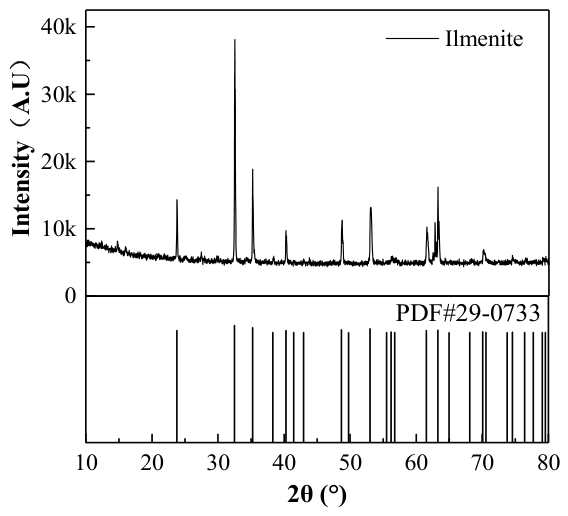
Ilmenite was sourced from an Indonesian titanium placer deposit. In the laboratory, manual sorting and magnetic separation were employed to further remove impurity minerals, and a high-grade ilmenite sample with a particle size of −74 μm was obtained after grinding and screening. The results of XRF and XRD analyses are presented in Table 1 and Figure 1, respectively.
According to the results of Table 1 and Figure 1, the content of TiO2 in the sample was 50.09%, the content of SiO2 was 1.42%, and the content of other impurity elements was less than 1.00%. The diffraction spectrum of the sample matches the standard card of ilmenite crystal, so it can be used as a pure ilmenite mineral for flotation test.
Hydrochloric acid and sodium hydroxide, used as pH modifiers, were sourced from Xi’an, China. Octyl hydroxamic acid (OHA), with a purity of 99.9%, was used as a collector and obtained from Tianjin Komio Chemical Reagent Co., Ltd., Tianjin, China. Heptyldiphosphonic acid hydrochloride (HDPA), also used as a collector, was sourced from Shanghai, China. All chemicals were of analytical grade. Type I deionized water, prepared using a Milli-Q water system with a resistivity of 18.2 MΩ·cm, was used in all tests.

2.2. Methods

(1).
X-ray fluorescence spectrometer test.
LABCENTERXRF-X-ray fluorescence spectrometer (Shimadzu, Japan) was used to detect the TiO2 grade of ilmenite ore and products at all levels after separation. Before the test, the ilmenite powder sample was ground to −74 μm accounting for more than 90%, dried in a constant temperature (90 °C) box for 6 h, and the sample was prepared by powder compression method [20].
(2).
X-ray diffraction spectrometer test.
The X-ray diffraction analyzer (Panalytical, Almelo, Netherlands) was used for detection. The working parameters of the instrument were scanning speed of 10°/min, scanning 2θ range of 20–80°, and scanning voltage of 20 kV. The mineral phase composition of ilmenite ore and products at all levels was analyzed [21]. The samples to be tested were ground to −74 μm, accounting for more than 90%.
(3).
Microwave pretreatment test.
The ilmenite ore powder 10 g to be floated was placed in a corundum magnetic boat, and microwave pretreatment was performed using a microwave oven (Galanz, Foshan City, Guangdong Province, China). The microwave treatment was performed at a fixed output power of 800 W and a frequency of 2450 MHz. The corundum boat was placed in the center of the microwave cavity, and the irradiation time was set at 180 s according to our previous optimization. Each group repeated the test three times to take the average value and calculate the absolute error.
(4).
Solution surface tension and contact angle test analysis.
KRÜSS K100 surface tension and contact angle measuring instrument was adopted for the tests. The surface tension was determined by the ring method [22,23], with the H&J method selected as the correction approach and the sampling displacement step set at 0.05 mm. For contact angle measurement, the capillary constant of n-hexane was taken as the benchmark, and data from the stable rising phase of the liquid level were selected for automatic fitting calculation to derive the final result. Prior to the contact angle test, 2.0 g of ilmenite powder was weighed and pressed into a smooth cylindrical pellet with a diameter of 13 mm using a hydraulic tablet press, held at 20 MPa for 2 min. The pellet surface was polished with 2000-grit sandpaper to ensure a flat and uniform test surface. All contact angle measurements were performed at a constant temperature of 25 ± 0.5 °C, and five different test points were selected for each sample, with the average value taken as the final result.
(5).
Zeta potentiometer analysis.
Zeta potential and nanoparticle size analyzer (Brookhaven Zeta Plus, Bruker, Brookhaven Instruments Corporation, Holtsville, USA) was employed to determine the surface charge intensity of ilmenite particles and the colloidal stability of the suspension under different pH conditions [24]. Prior to testing, the ilmenite samples were fully ground to a particle size of ≤5 μm, and 0.2000 g of the sample was accurately weighed to prepare 100 mL of mineral suspension. A 1 mmol/L KNO3 solution was used as the background electrolyte to maintain a constant ionic strength of the system, and the pH of the suspension was adjusted to the target value with 0.1 mol/L HCl and 0.1 mol/L NaOH solutions. After pH adjustment, the suspension was left to equilibrate for 5 min, and the supernatant was collected for potential measurement. Each experimental condition was tested independently in triplicate, and the final result was expressed as the average of three parallel tests.
(6).
Analysis of Fourier transform infrared spectrometer.
Fourier transform infrared spectrometer (Bruker VERTEX 70, Bruker Optik GmbH, Ettlingen, Germany) was used for detection. The particle size of the sample was ground to −10 μm, and the sample to be tested was fully mixed with the potassium bromide carrier (spectrally pure) at a ratio of 1:150. The potassium bromide carrier sheet was prepared by compression method. The infrared spectrum measurement range was 4000–400 cm−1, and the test resolution was 2 cm−1. According to the Beer–Lambert law, the absorbance of light at a given wavelength is proportional to the concentration of the absorbing species [25].
A ν = i = 1 N a i ν b c i
Based on the Beer–Lambert law, the characteristic absorption peaks of the flotation collectors in the infrared spectra were fitted and calculated, and the absorption peak area and smooth second derivative spectrum were obtained. Combined with the change of peak area, the adsorption amount of reagents on the mineral surface was semi-quantitatively calculated and analyzed.
(7).
XPS test analysis.
X-ray photoelectron spectroscopy (XPS, Thermo Fisher Scientific, East Grinstead, United Kingdom) using a Thermo Fisher Scientific instrument was employed to characterize the samples before and after microwave pretreatment as well as before and after collector adsorption. The acquired spectral lines were fitted using Avantage software, and the changes in each atomic orbital before and after treatment were qualitatively and quantitatively analyzed.

3. Results and Discussion

3.1. Effect of Microwave Activation on Wettability of Ilmenite Surface

Wettability is the core surface property that determines the flotation behavior of minerals. The interfacial activity of the collector and its adsorption behavior on the mineral surface are the key to regulating wettability. The regulation law and mechanism of microwave activation on the wettability of ilmenite surface were systematically elucidated by surface tension, wetting contact angle test, and thermodynamic parameter calculation.

3.1.1. Analysis of Surface Tension of Collector

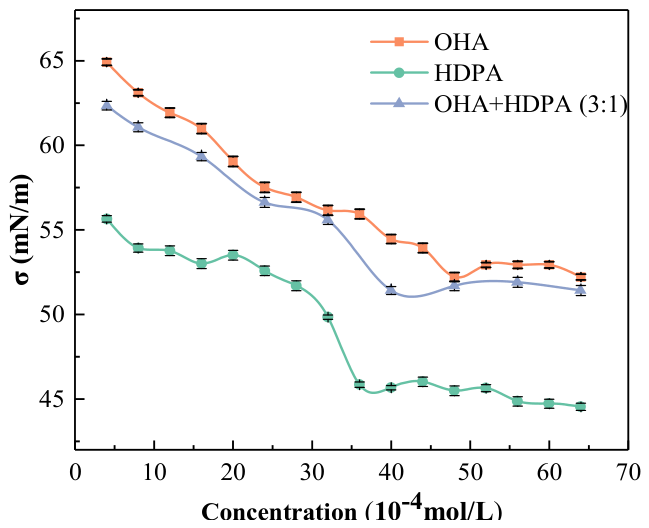
The surface activity of the collector directly determines its adsorption capacity at the gas-liquid interface and the mineral surface. Figure 2 is the surface tension curve of OHA, HDPA and OHA + HDPA (3:1) at different concentrations.
From Figure 2, it can be seen that the surface tension of the solution of the three collector systems decreases rapidly with the increase of concentration and then tends to be stable. The typical surfactant adsorption characteristics are as follows: In the low concentration range, the collector molecules preferentially migrate and enrich to the gas–liquid interface, and the hydrophobic carbon chain faces the gas phase and the polar head group faces the water phase, which rapidly reduces the interface energy. When the concentration increases to near the critical micelle concentration (CMC), the gas–liquid interface adsorption reaches saturation. Continued increase in concentration will only promote the formation of micelles in the bulk phase, and the surface tension will no longer decrease significantly.
By comparing the change rules of the three systems, it can be seen that HDPA has the strongest ability to reduce surface tension when acting alone, and the equilibrium surface tension is about 44.5 mN/m, reflecting that its molecular structure has stronger interfacial activity; the decrease in surface tension of the OHA-alone system is relatively limited, and the equilibrium value is about 52 mN/m. After OHA + HDPA was compounded at 3:1, the surface tension at the same concentration was significantly lower than that of the single OHA system, indicating that the two collectors had a synergistic adsorption effect at the gas–liquid interface. The compound system can maintain high interfacial activity in a wider concentration range, providing a favorable thermodynamic basis for its adsorption and spreading on the surface of ilmenite.

3.1.2. Wetting Contact Angle Analysis

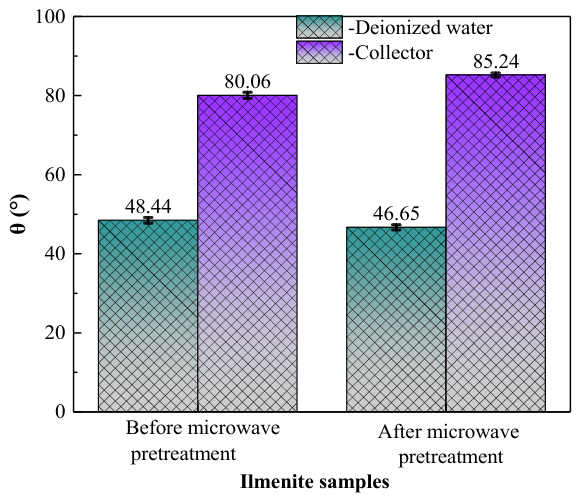
Under the condition of collector concentration of 7 × 10⁻⁴ mol/L, the wetting contact angle of deionized water and collector system on the surface of ilmenite before and after microwave pretreatment was analyzed and tested. In the experiment, KRÜSS (Germany) K100 mechanical contact angle measuring instrument was used to test the contact angle. The contact angle measurement values under different liquid phase systems are shown in Figure 3 below.
In the deionized water system, the water contact angle of ilmenite before microwave pretreatment was 48.44°. After microwave pretreatment, the water contact angle decreased slightly to 46.65°, indicating that the natural hydrophilicity of the ilmenite surface was slightly enhanced after microwave treatment. The reason is that the thermal effect and non-thermal effect of microwaves can induce the lattice activation of ilmenite surface, increase the number of polar sites (such as hydroxyl and metal active sites) exposed on the surface, and increase the surface energy, thus enhancing the adsorption of polar water molecules and improving the hydrophilicity.
In the collector system, the contact angle of ilmenite surface is significantly higher than that of pure water system, indicating that the collector can effectively improve the hydrophobicity of mineral surface through adsorption. Among them, before microwave pretreatment, the contact angle after collector action was 80.06°; after microwave pretreatment, the contact angle was further increased to 85.24°, an increase of 5.18°. This result directly proves that microwave activation can significantly strengthen the adsorption of collectors on the surface of ilmenite and further improve the degree of hydrophobicity of mineral surface. The feasibility of microwave pretreatment to strengthen ilmenite flotation is verified from the perspective of interface properties.

3.1.3. Work of Wetting and Work of Adhesion Calculation

Combined with Young’s equation, the work of wetting and work of adhesion can be calculated, as expressed in Equations (2) and (3).
W S L = γ L G ( 1 + c o s θ )
W S G = γ L G ( 1 c o s θ )
W S L represents wetting work; γ L G represents the surface tension of liquid phase. W S G represents adhesion work; θ denotes the contact angle.
The calculation results are summarized in Table 2. The wetting work can characterize the firm degree of solid-liquid interface bonding, that is, the wettability of the mineral to the solution; the work of adhesion can indicate the degree of adhesion between mineral particles and bubbles, that is, the floatability of minerals [26].
It can be seen from Table 2 that in the pure water system, the WSL of the ilmenite-water system was 1.185 J/m2 and the WSG was 0.240 J/m2 before microwave pretreatment. After microwave pretreatment, WSL increased to 1.201 J/m2, and WSG decreased to 0.223 J/m2. The change in thermodynamic parameters is completely consistent with the law of contact angle. After microwave activation, the binding energy of solid–liquid interface increases, and the spreading trend of water molecules on mineral surface is stronger. It is intuitively manifested as the decrease in water contact angle and the enhancement of hydrophilicity, which further proves the inference that microwave activation increases the polar active sites on the surface of ilmenite. In the collector system, the WSL of ilmenite decreased significantly and the WSG increased significantly after the adsorption of the collector, indicating that the hydrophobic carbon chain of the collector molecules was oriented to the outside of the mineral surface, which greatly weakened the interaction between the solid–liquid interface and enhanced the adhesion ability of the solid–gas interface so that the surface changed from hydrophilic to hydrophobic. The parameters before and after microwave pretreatment were compared: the WSL of the collector system before pretreatment was 0.716 J/m2, and the WSG was 0.505 J/m2; after pretreatment, WSL further decreased to 0.661 J/m2, and WSG further increased to 0.560 J/m2. Thermodynamic data show that the combination of collector and ilmenite surface is more stable after microwave activation, and the hydrophobicity of the adsorption layer is more significant. Finally, the macroscopic performance is that the contact angle increases and the flotation floatability is improved.
In summary, microwave activation has a two-way regulation effect on the wettability of ilmenite surface. Under pure water conditions, the hydrophilicity is slightly enhanced by activating the surface lattice sites. In the collector system, the surface hydrophobicity is significantly improved by strengthening the interfacial adsorption and directional arrangement of the collector.

3.2. Zeta Potential Analysis

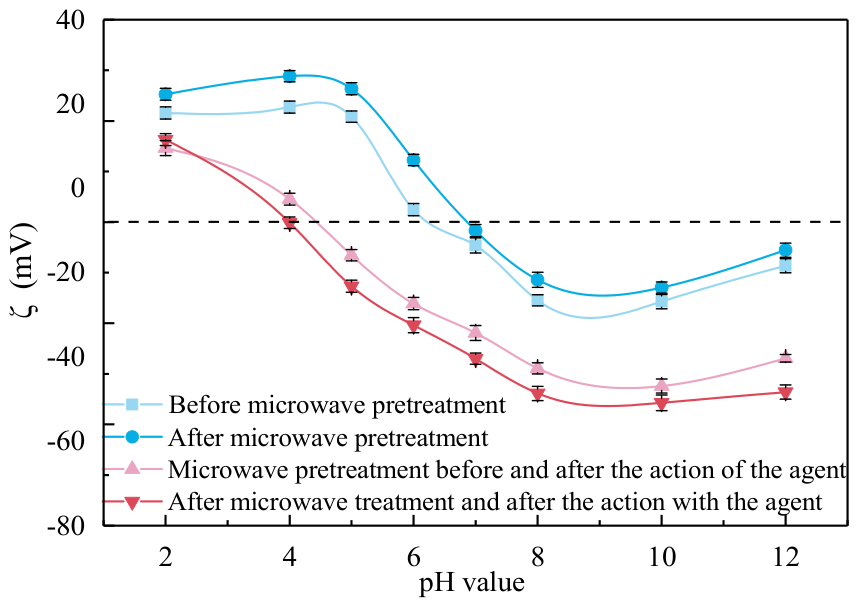
In order to clarify the mechanism of microwave activation enhanced ilmenite flotation from the perspective of interfacial electrokinetic characteristics, the surface Zeta potential of ilmenite before and after microwave pretreatment and collector action was measured under different pH conditions. The results are shown in Figure 4.
For the pure ilmenite system without the collector, the Zeta potential of the samples before and after microwave pretreatment showed a change rule of first positive and then negative with the increase in pH value, and the negative charge first increased and then decreased, which was the result of the protonation and deprotonation reaction of the hydroxyl groups (≡M-OH, M= Fe, Ti) on the surface of ilmenite. Under acidic conditions, the surface hydroxyl protonation reaction was (≡M-OH + H+ → ≡M-O H 2 + ) so that the mineral surface had a positive charge; with the increase in pH, the deprotonation reaction dominates (≡M-OH → ≡ M-O + H+), and the surface electronegativity gradually increases. When the pH exceeds the isoelectric point (IEP), the surface is negatively charged as a whole.
Comparing the curves before and after microwave pretreatment, it can be seen that after microwave activation, the Zeta potential of ilmenite at the same pH is significantly enhanced, and the isoelectric point is shifted from about pH 5.1 of the raw ore to about pH 6.3. The enhancement of positive surface charge and the increase in active sites provide a more favorable interfacial environment for the adsorption of anionic collectors.
After adding OHA + HDPA compound collector, the Zeta potential of ilmenite surface before and after microwave pretreatment shifted significantly to the negative direction, and the negative charge was stronger than that of the corresponding pure mineral system in the whole pH range. The results show that the compound collector is an anionic surfactant, and the polar functional groups (hydroxamic acid group, phosphonic acid group) in the molecule are negatively charged, which can be adsorbed on the surface of ilmenite by electrostatic attraction and chemical chelation so that the negative charge density of the mineral surface increases and the Zeta potential shifts negatively.
Further comparison of the potential changes before and after microwave pretreatment under the action of collectors shows that in the range of pH 2~10, the Zeta potential negative shift of the microwave-pretreated ilmenite after interaction with the collector is always greater than that of the untreated sample. For example, at pH = 4, the Zeta potential of the unpretreated sample decreased from 19.5 mV to −2.2 mV after collector action, with a negative shift of about 21.7 mV; the microwave pretreatment sample decreased from 26.8 mV to −8.1 mV, and the negative shift was 34.9 mV. The increase in negative shift amplitude directly reflects that the collector has higher adsorption capacity and stronger adsorption on the surface of ilmenite after microwave activation.
Under strong alkaline conditions (pH > 10), the difference in Zeta potential between the two groups of samples gradually narrowed. This is because the negative charge on the surface of ilmenite is significantly enhanced in high pH environment, and the electrostatic repulsion between ilmenite and anionic collector is intensified. At this time, the adsorption mainly depends on chemical chelation, and the contribution of electrostatic interaction is weakened, so the potential difference caused by microwave pretreatment is reduced.
In summary, the Zeta potential test results confirm that microwave activation can enhance the adsorption of anionic collectors on the surface of ilmenite from the perspective of interfacial electrokinetic characteristics, which is consistent with the previous contact angle and surface tension test results.

3.3. Fourier Transform Infrared Spectroscopy (FTIR) Analysis

3.3.1. Qualitative Analysis of Infrared Spectroscopy

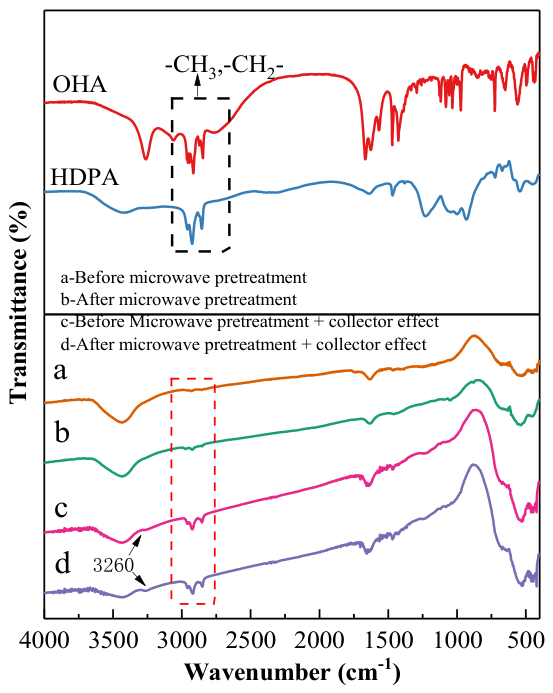
In order to investigate the adsorption difference of collectors on the surface of ilmenite before and after microwave pretreatment, the infrared spectra of samples before and after microwave pretreatment and before and after interaction with collectors were tested. The infrared spectrum test results are shown in Figure 5.
The infrared spectra of pure OHA, HDPA, and ilmenite samples under different conditions are shown in Figure 5. Among them, the spectral lines a and b are pure ilmenite samples before and after microwave pretreatment, and the spectral lines c and d are the products of the corresponding samples after the action of compound collectors.
The results of infrared spectroscopy of pure ilmenite system show that all samples have a broadened hydroxyl absorption band in the range of 3200–3600 cm−1 [27,28], which is attributed to the O-H stretching vibration of adsorbed water and surface hydroxyl (≡ M-OH) on the mineral surface. Comparing the spectra before and after microwave pretreatment, it can be seen that the intensity of the hydroxyl characteristic peak at 3260 cm−1 of the sample after microwave activation was significantly increased, indicating that the microwave action broke the original lattice structure of the ilmenite surface, exposed more fresh surfaces, and improved the surface hydroxyl site density and hydroxylation degree, which was consistent with the inference that the surface active sites increased in the Zeta potential test.
The infrared spectrum of ilmenite changed significantly after the action of OHA + HDPA composite collector. In the alkyl characteristic area of 2820–3000 cm−1, the sample showed clear hydrocarbon stretching vibration peaks. Among them, 2924 cm−1 and 2853 cm−1 correspond to the asymmetric and symmetric stretching vibration of methylene (-CH2-), and 2958 cm−1 and 2877 cm−1 correspond to the asymmetric and symmetric stretching vibration of methyl (-CH3), respectively. The position of the alkyl characteristic peak of the pure reagent OHA and HDPA is completely consistent. It is directly confirmed that both collector molecules can be successfully adsorbed on the surface of ilmenite. In the fingerprint functional group region, the peaks at ~1652 cm−1 and ~ 1078 cm−1 correspond to the C=O stretching vibration and N-O stretching vibration of the hydroxamic acid group in OHA, respectively. The peaks at ~1175 cm−1 and ~1045 cm−1 belong to the P=O stretching vibration and P-O stretching vibration of the phosphonate group in HDPA. Compared with the standard spectral peaks of pure collectors, the characteristic peak positions of the above polar functional groups are obviously shifted, which proves that the polar head group of the collector has chemical chelation with the metal sites on the surface of ilmenite.
Further comparison of the sample spectra of collectors before and after microwave pretreatment showed that no new characteristic peaks appeared after microwave treatment, indicating that microwave activation did not change the adsorption nature of collectors on the surface of ilmenite. However, the intensity of the alkyl characteristic peak increased significantly, indicating that the microwave action increased the adsorption capacity of the collector on the mineral surface, and the arrangement of the alkyl chains in the adsorption layer was more dense and orderly.

3.3.2. FTIR Semi-Quantitative Analysis

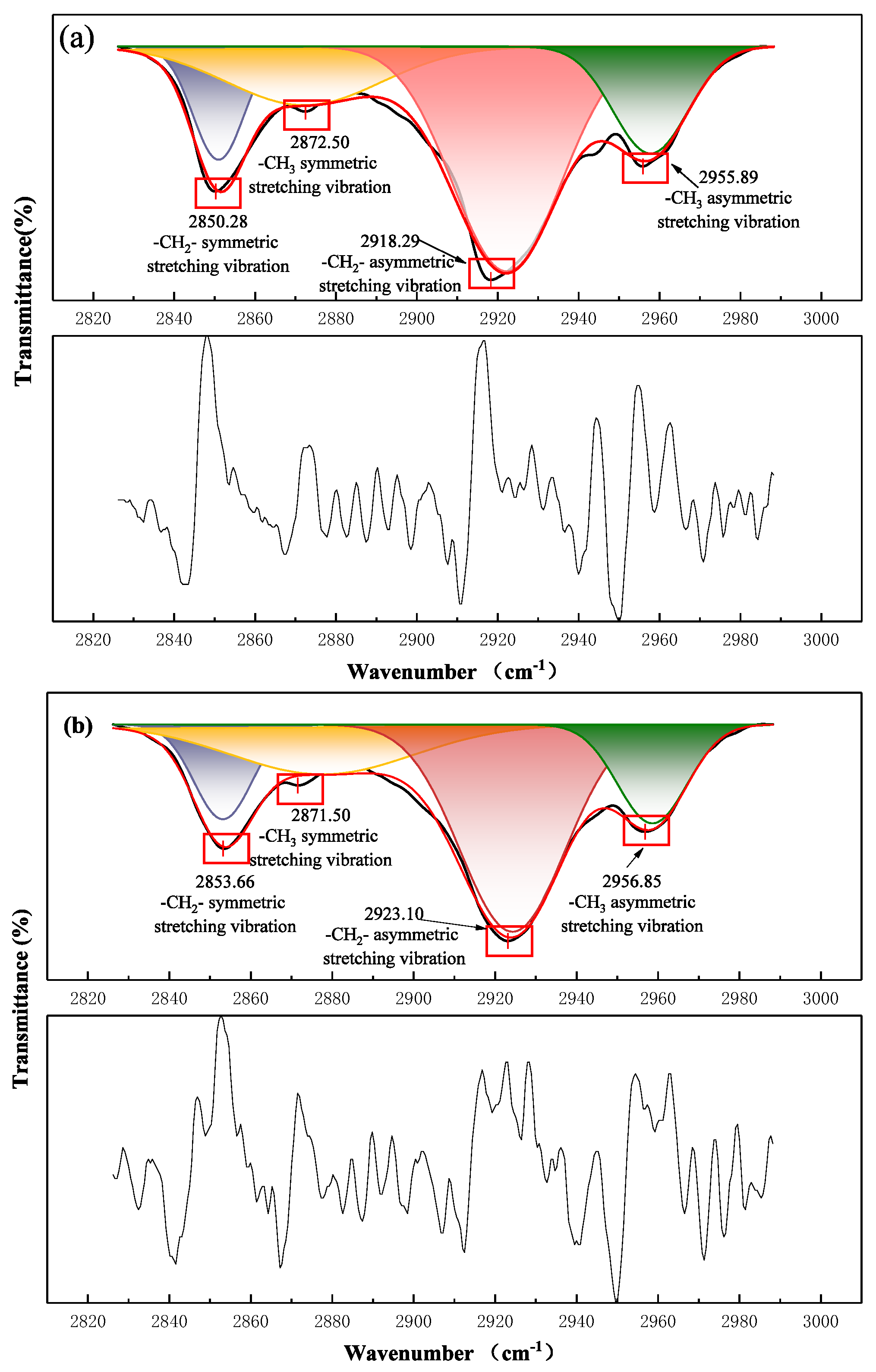
In order to more clearly characterize the changes in the adsorption of collectors on the surface of ilmenite before and after microwave pretreatment, the high-resolution spectral image segment of 3000 cm−1 −2820 cm−1 was intercepted, and the -CH3 and -CH2- characteristic peaks were semi-quantitatively analyzed. The second-order derivative spectrum can distinguish overlapping characteristic sub-peaks. Based on this, the Gaussian–Lorentz function is used to fit the absorption band. The results are shown in Figure 6, Table 3 and Table 4.
According to the second-order derivative spectrum, this region can be decomposed into four characteristic sub-peaks, which are attributed to the -CH2- symmetric stretching vibration at 2850 cm−1, the -CH3 symmetric stretching vibration at 2872 cm−1, the -CH2- asymmetric stretching vibration at 2922 cm−1, and the -CH3 asymmetric stretching vibration at 2957 cm−1 [29], respectively, which are consistent with the standard spectral attribution of alkyl hydrocarbon vibration. The fitting curve is in good agreement with the measured curve, indicating that the fitting results are reliable.
The fitting calculation results in Table 3 show that the total peak area of the alkyl characteristic peaks on the surface of ilmenite is 2.080a.u before microwave pretreatment. After microwave pretreatment, the total peak area increased to 2.306a.u, an increase of 10.9%. Because the peak area of the infrared characteristic peak is positively correlated with the number of corresponding functional groups, the results confirm from a semi-quantitative point of view that microwave activation can significantly increase the adsorption amount of collectors on the surface of ilmenite, which is completely consistent with the peak intensity change rule of qualitative analysis.
From the parameter changes of each sub-peak, after microwave pretreatment, the peak area of the characteristic peak (2922 cm−1) representing the asymmetric stretching vibration of methylene increased from 1.052 a.u to 1.195 a.u, with the largest increase in the four sub-peaks, indicating that the arrangement density of the alkyl carbon chain of the collector molecule on the surface of ilmenite was significantly improved. At the same time, the full width at half maximum (FWHM) of each sub-peak showed a decreasing trend as a whole. For example, the FWHM of the -CH2- symmetric stretching peak decreased from 16.719 cm−1 to 14.890 cm−1. The narrowing of the half-peak width indicates that the alkyl chain movement of the adsorbed collector is limited, the molecular arrangement is more regular, the interface orientation is stronger, and the hydrophobic adsorption layer structure is more compact and orderly.
In summary, the qualitative and semi-quantitative analysis of infrared spectroscopy showed that microwave pretreatment not only improved the adsorption capacity of the collector on the surface of ilmenite but also optimized the microscopic order of the adsorption layer, making the hydrophobic alkyl chain arrangement denser, thereby strengthening the hydrophobic effect of the mineral surface.

3.4. X-Ray Photoelectron Spectroscopy (XPS) Analysis

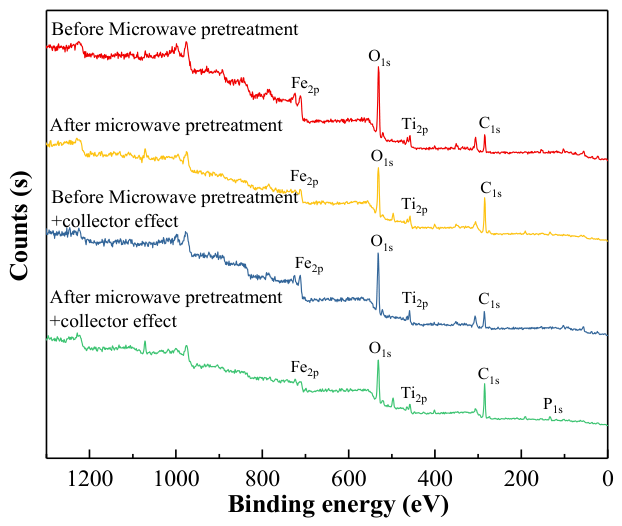
XPS analysis was performed on ilmenite samples before and after microwave pretreatment as well as after interaction with the collector. The C 1s spectrum was calibrated using the contamination carbon peak at 284.8 eV. The survey spectra and high-resolution fine spectra are shown in Figure 7 and Figure 8, respectively. The relative content changes of the corresponding elements are presented in Table 4 and Table 5.
The XPS spectra of ilmenite samples under different treatment conditions are shown in Figure 7. The statistical results of the relative content of the corresponding surface elements are shown in Table 4. It can be seen from the full spectrum that four characteristic peaks of Fe 2p, Ti 2p, O 1s, and C1s were detected on the surface of ilmenite without collector. Among them, Fe, Ti, and O were the intrinsic elements of ilmenite (FeTiO3), and the C 1s signal was mainly derived from the surface-adsorbed contaminated carbon and trace carbon-containing impurities. After the action of OHA + HDPA compound collector, a clear characteristic peak of P 1s appeared at the binding energy of ~133 eV, which directly confirmed that the collector molecules containing phosphonic acid functional groups were successfully adsorbed on the surface of ilmenite, and material adhesion occurred at the mineral-reagent interface.
Comparing the element content of pure ilmenite before and after microwave pretreatment, it can be seen that after microwave activation, the relative atomic content of Fe 2p3/2 and Ti 2p on the surface of ilmenite increased from 5.50 % and 10.35 % to 6.00 % and 10.62 %, respectively, while the relative content of O 1s decreased from 58.70 % to 54.88 %. This change is due to the selective heating and lattice activation effect of microwave: microwave action can break the original lattice ordered structure of ilmenite surface, induce surface atomic rearrangement and fresh section exposure, increase the number of active metal sites such as Fe3+ and Ti4+ exposed on the surface, increase the degree of surface hydroxylation, increase the active sites of protonation reaction, and provide more sufficient reaction sites for the chemical adsorption of collectors.
After the collector was used, the relative content of C 1s on the surface of the two groups of ilmenite samples increased significantly, while the relative content of Fe and Ti metal elements decreased significantly. Among them, the content of C 1s in the sample without pretreatment increased from 25.45% to 57.73%, and the content of C 1s in the sample after microwave pretreatment increased from 28.49% to 60.40%. Correspondingly, the relative content of Fe 2p3/2 decreased from 6.00% to 1.55% after microwave pretreatment, and the decrease was greater than that of the untreated sample. The increase in C element content and the attenuation of the substrate metal signal are essentially the shielding effect of the organic adsorption layer formed by the collector molecules on the mineral surface on the photoelectron signal of the internal metal elements. The C content of the sample after microwave is higher, and the metal signal shielding is more significant. From the perspective of surface element composition, it is quantitatively proven that microwave activation can significantly increase the adsorption amount of collector on the surface of ilmenite and form a thicker and denser organic hydrophobic layer on the mineral surface, which is consistent with the conclusion of semi-quantitative analysis of infrared spectroscopy.
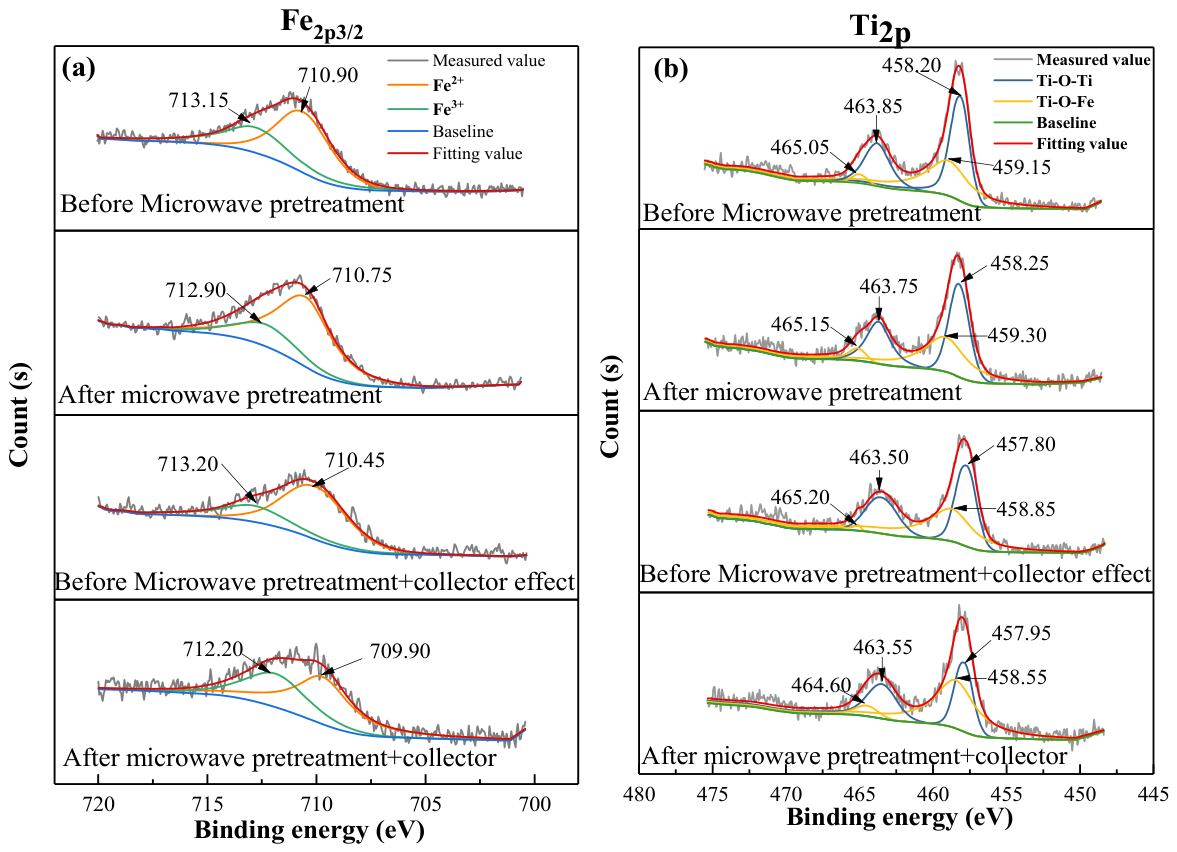
In order to further analyze the regulation of microwave action on the chemical state of iron and the mechanism of collector action at iron sites, the high-resolution spectra of Fe 2p3/2 were fitted by peak separation. The results are shown in Figure 8a and Table 5. The Fe 2p3/2 signal on the surface of ilmenite can be decomposed into two characteristic components: Fe2+ species near the binding energy of ~710.9 eV and Fe3+ species near ~713.0 eV, which correspond to the divalent iron in the ilmenite lattice and the trivalent iron formed by surface oxidation, respectively.
For the pure ilmenite system, the proportion of Fe2+ on the surface of the sample before microwave pretreatment was 76.09%, and the proportion of Fe3+ was 23.91%. After microwave activation, the proportion of Fe2+ decreased to 61.36%, and the proportion of Fe3+ increased to 38.64%. At the same time, the binding energy of the two valence states shifted slightly to the low-energy direction. The results clearly show that microwave pretreatment can induce selective oxidation of the surface of ilmenite so that part of the lattice Fe2+ is oxidized to Fe3+, and the proportion of surface trivalent iron active sites is greatly increased. The existing flotation theory generally confirms that the chelating coordination ability of hydroxamic acid and phosphonic acid anionic collectors with Fe3+ is much stronger than that of Fe2+. Therefore, the increase in surface Fe3+ ratio is one of the core mechanisms for microwave activation to enhance collector adsorption.
After the action of the collector, the binding energy of the Fe characteristic peaks of the two groups of samples was significantly shifted, which proved that the iron site was the core active site of the interaction between the collector and the ilmenite. Electron transfer occurred between the polar group of the collector and the surface iron atom, forming a chemical bond. Comparing the offset amplitude, it can be seen that the Fe2+ binding energy of the unpretreated sample decreased from 710.90 eV to 710.45 eV, and the offset was 0.45 eV. The Fe2+ binding energy of the sample after microwave pretreatment was reduced from 710.75 eV to 709.90 eV, and the offset was 0.85 eV. The difference in the binding energy offset directly reflects that the interaction between the iron site on the surface of ilmenite and the collector is stronger after microwave activation, and the formed adsorption chemical bond is more stable.
In addition, after the action of the collector, the proportion of Fe3+ atoms in the microwave-treated sample (38.55%) was still significantly higher than that of the unpretreated sample (29.07%), indicating that the highly active Fe3+ sites induced by microwave continued to play a role in the adsorption process of the collector. By forming a stable chelating coordination structure with hydroxamic acid and phosphonate groups, the interfacial adhesion of the collector was strengthened from the aspects of adsorption strength and number of sites.
The high-resolution spectrum fitting results of Ti 2p on the surface of ilmenite are shown in Figure 8b, which can be decomposed into two main characteristic components: Ti-O-Ti structure at ~458.2 eV and Ti-O-Fe structure at ~463.7 eV, corresponding to the Ti-O octahedron main structure and Ti-Fe bridged oxygen coordination structure in the ilmenite lattice, respectively.
Comparing the pure ilmenite samples before and after microwave pretreatment, it can be seen that after microwave activation, the binding energy of the characteristic peaks of Ti-O-Ti and Ti-O-Fe shifted slightly to the low-energy direction, and the relative peak area of Ti-O-Fe component increased. This phenomenon echoes with the valence oxidation behavior of iron: microwave action induces lattice distortion on the surface of ilmenite, changes the coordination environment of titanium atoms, increases the proportion of Ti-O-Fe bridge oxygen structure, and increases the number of unsaturated coordination titanium active sites, which ultimately improves the chemical reactivity of titanium sites on the surface.
The binding energy of each characteristic peak of Ti 2p of the two groups of samples shifted to different degrees after the action of the collector, indicating that the titanium site also participated in the interfacial adsorption process of the collector. The polar functional groups of the collector can form chemical coordination bonds with the surface titanium atoms. Comparing the shift degree of the two groups of samples, it can be seen that the Ti-O-Ti characteristic peak binding energy shift of the sample after microwave pretreatment is greater than that of the unpretreated sample, indicating that microwave activation also strengthens the chemical interaction between the collector and the titanium site.
Based on the high-resolution spectrum analysis of Fe 2p and Ti 2p, it can be seen that microwave activation has a multi-site synergistic effect on the enhancement of ilmenite collector adsorption: on the one hand, the proportion of Fe3+ active sites is increased by surface oxidation reaction, and the chelation between collector and iron sites is strengthened. On the other hand, the lattice distortion increases the unsaturated coordinated titanium active sites and expands the number of action sites of the collector. The synergistic effect of the two makes the chemical adsorption strength and adsorption capacity of the collector and ilmenite surface increase simultaneously and finally realizes the significant improvement of mineral surface hydrophobicity and flotation floatability.

4. Conclusions

(1).
Microwave activation has a two-way regulation on the wettability of ilmenite surface, which can significantly enhance the hydrophobic modification effect of the OHA + HDPA compound collector. The combination of the two at 3:1 has a synergistic adsorption effect on the gas–liquid interface, and the interfacial activity is better than that of the single OHA system. In the pure water system, microwave activation increased the polar active sites on the surface of ilmenite, the water contact angle decreased from 48.44° to 46.65°, and the hydrophilicity was slightly enhanced. In the collector system, microwave promoted the directional adsorption and stable arrangement of reagents on the mineral surface. The contact angle increased to 85.24°, the adhesion work increased to 0.560 J/m2, and the surface hydrophobicity and solid–gas adhesion ability were significantly improved. The feasibility of microwave pretreatment to strengthen ilmenite flotation was confirmed from the interface thermodynamics.
(2).
The Zeta potential of ilmenite surface changed from positive to negative with the increase of pH. Microwave activation can increase the active metal sites on the surface of ilmenite, enhance the surface positive electricity, and shift the isoelectric point from pH 5.1 to pH 6.3, providing better interface conditions for the adsorption of anionic OHA + HDPA collectors. After the addition of collectors, the mineral potential was significantly negatively shifted, and the negative shift of the microwave samples in the pH range of 2~10 was greater, which was due to the synergistic effect of enhanced electrostatic attraction and increased chemical chelating sites. Under strong alkaline conditions, the difference between the two is narrowed due to the increase in electrostatic repulsion.
(3).
Infrared spectroscopy and X-ray photoelectron spectroscopy showed the microscopic mechanism of microwave pretreatment to enhance the adsorption of the OHA/HDPA composite collector on the surface of ilmenite. The results show that the collector is attached to the surface of ilmenite by chemical adsorption. Microwave activation does not change the nature of adsorption. It can increase the surface active sites by destroying the lattice so that the adsorption capacity of the collector is increased by 10.9%, and the alkyl chain arrangement of the adsorption layer is more dense and orderly. The microwave-induced oxidation of Fe2+ to Fe3+ on the surface and its atomic ratio increased from 23.91% to 38.64%, which significantly enhanced the chelation between the collector and the iron site and the stability of the chemical bond. At the same time, microwave-induced lattice distortion, changed the coordination environment of titanium atoms, increased the proportion of Ti-O-Fe bridge oxygen structure, increased the unsaturated titanium active sites, and enhanced the coordination between collector and titanium sites. The synergistic activation of iron and titanium multi-sites can simultaneously enhance the adsorption strength and adsorption capacity of collectors and strengthen the surface hydrophobicity of ilmenite, which provides an interface chemical theoretical basis for microwave activation flotation of ilmenite.

Author Contributions

Conceptualization, R.L.; methodology, R.L. and Y.W.; software, R.L.; validation, Y.W. and J.L.; formal analysis, R.L.; investigation, R.L. and Y.W.; resources, R.L.; data curation, R.L. and Y.W.; writing—original draft preparation, R.L.; writing—review and editing, Y.W. and J.L.; visualization, R.L.; supervision, J.L.; project administration, R.L. and J.L.; funding acquisition, R.L. All authors have read and agreed to the published version of the manuscript.

Funding

This research was funded by the Shanxi Institute of Technology Research Start-up Fee Project (grant number 2026BSL13), the 2025 Scientific Research Funds of Shanxi Province (grant number LJ0029), the Shanxi Provincial Basic Research Program (grant number 202403021212128), the Inner Mongolia Natural Science Foundation (grant number 2025MS05088), and the Shanxi Provincial University Science and Technology Innovation Program (grant number 2024L443).

Data Availability Statement

The original contributions presented in this study are included in the article. Further inquiries can be directed to the corresponding author.

Conflicts of Interest

The authors declare no conflict of interest.

References

  1. Wang, H.; Zhang, X.; Qu, R.; Zhang, L.; Li, W. Recent technology developments in beneficiation and enrichment of ilmenite: A review. Miner. Eng. 2024, 219, 109084. [Google Scholar] [CrossRef] [Scilit]
  2. Shi, Y.; Liang, B.; Li, S.; Lu, M.; Zhang, H. Experimental Study on Combined Process of Magnetic Separationand Gravity Separation for an Ilmenite Ore. Min. Metall. Eng. 2025, 45, 68–72+78. [Google Scholar]
  3. Yan, W.; Li, W.; Yang, Y.; Zeng, X.; Deng, J.; Li, L. Research on Mineral Processing Technology of Ultrafine Ilmenite Resources in Panzhihua-Xichang Area. Multipurp. Util. Miner. Resour. 2023, 44, 55–61. [Google Scholar]
  4. Yang, Y.; Xie, B.; Zhang, S. Research Status and Progress in Beneficiation Process of Microfine Ilmenite in China. Multipurp. Util. Miner. Resour. 2025, 46, 1–9. [Google Scholar]
  5. Zhou, Y.; Zhang, H.; Zhang, C. Research progress of ilmenite flotation. J. Cent. South Univ. (Sci. Technol.) 2025, 56, 2621–2634. [Google Scholar]
  6. Yuan, J.; Lu, H.; Gong, X.; Liu, J.; Lai, H.; Bai, S.; Zheng, Y. Effects of high-efficiency depressant carboxymethyl chitosan on the flotation separation of fine-grained ilmenite and titanaugite: Experimental investigation and mechanism analysis. Appl. Surf. Sci. 2026, 718, 164881. [Google Scholar] [CrossRef] [Scilit]
  7. Zhang, F.; Dong, W.; Cai, H.; Zhang, H.; Fan, X.; Kang, Y.; Fan, G. Cavitation nanobubbles enhancing the flotation of microfine ilmenite and associated fundamentals. Ultrason. Sonochem. 2025, 120, 107510. [Google Scholar] [CrossRef] [Scilit] [PubMed]
  8. Jayalath, G.N.T.; Nishadini, U.G.T.; Wickramasooriya, H.M.B.N.; Subasinghe, H.C.S.; Ratnayake, A.S. Effect of mechanical activation and HNO3 pre-treatment of Pulmoddai ilmenite for the extraction of Ti and TiO2 using H2SO4, HCl, and KOH-assisted leaching. Hydrometallurgy 2024, 226, 106314. [Google Scholar] [CrossRef] [Scilit]
  9. Liao, R.; Wen, S.; Liu, J.; Zuo, Q.; Zheng, Y.; Luo, D. Flotation behavior and mechanism of ilmenite using ferrate as activator. Miner. Eng. 2022, 178, 107400. [Google Scholar] [CrossRef] [Scilit]
  10. Liu, H.; Zhao, W.; Zhai, J.; Lu, X.; Chen, P.; Ren, X.; Wan, S. Activation Mechanism of Lead(II) to Ilmenite Flotation Using Salicylhydroxamic Acid as Collector. Minerals 2020, 10, 567. [Google Scholar] [CrossRef] [Scilit]
  11. Yang, J.; Zhang, X.; Liu, D.; Xu, X.; Yu, J.; Chen, X.; Shen, P. Mechanistic study on the recovery of ilmenite by the synergistic combination of microwave pretreatment and copper ion activation. Appl. Surf. Sci. 2025, 713, 164648. [Google Scholar] [CrossRef] [Scilit]
  12. Lu, X.; Gao, H.; Li, F.; Wang, H.; Luo, Y.; Chen, P. Influence and mechanism of metal-organic complexes on flotationbehavior of ilmenite. J. China Univ. Min. Technol. 2023, 52, 566–575. [Google Scholar]
  13. Ye, E. Study on oxidization modification of Panzhihua ilmenite. Inorg. Chem. Ind. 2014, 46, 26–29. [Google Scholar]
  14. Yuan, J.; Lu, H.; Gong, X.; Chen, M.; Lai, H.; Wen, S.; Wu, D. Enhanced adsorption of sodium oleate on ilmenite by Fe2+-assisted H2O2 pre-oxidation: Study on flotation separation mechanism of ilmenite from titanaugite. Appl. Surf. Sci. 2025, 693, 162796. [Google Scholar] [CrossRef] [Scilit]
  15. Cai, J.; Deng, J.; Wang, L.; Hu, M.; Xu, H.; Hou, X.; Li, S. Reagent types and action mechanisms in ilmenite flotation: A review. Int. J. Miner. Metall. Mater. 2022, 29, 1656–1669. [Google Scholar] [CrossRef] [Scilit]
  16. Zhai, J.; Chen, P.; Sun, W.; Chen, W.; Wan, S. A review of mineral processing of ilmenite by flotation. Miner. Eng. 2020, 157, 106558. [Google Scholar] [CrossRef] [Scilit]
  17. Luo, L.; Wu, H.; Yang, J.; Tang, Z.; Shu, K.; Xu, Y.; Xu, L. Effects of microwave pre-treatment on the flotation of ilmenite and titanaugite. Miner. Eng. 2020, 155, 106452. [Google Scholar] [CrossRef] [Scilit]
  18. Sun, H.; Wang, J.; Zhu, R.; Sai, S.; Liu, Z.; Zhang, J.; Ciu, Y.; Qu, S.; Wang, J. Multi-mechanism-empowered single-functionallayer metasurface simultaneously with microwave scattering reduction, infrared digital camouflage, and optical transparency. Photonics Res. 2025, 13, 2520–2530. [Google Scholar] [CrossRef] [Scilit]
  19. Liu, R.; Wang, Y.; Li, J.; Li, J. Mechanism research on the influence of microwave activation on the flotation of ilmenite. Physicochem. Probl. Miner. Process. 2026, 62, 219011. [Google Scholar] [CrossRef] [Scilit]
  20. Bu, Z.; Wang, X.; Huhang, J. Determination of TFe, TiO, SiO, AlO, CaO and MgO Content inIlmenite by XRF with Powder Pressed Method. Chin. J. Inorg. Anal. Chem. 2018, 8, 17–20. [Google Scholar]
  21. Xia, C.B.; Wang, Q.; Zhang, W.J.; Jiang, Y.; Wang, Z.M.; Zhao, W. Research progress in chemical composition and phase analysis methods for titanium ore. Metall. Anal. 2021, 41, 21–30. [Google Scholar] [CrossRef]
  22. Wang, M.; Wang, H.; Zhang, G.; Zhang, A.; Han, Y. Evaluation of Uncertainty in the Error of Indication of Surface Tensiometers. Metrol. Sci. Technol. 2021, 65, 27–30. [Google Scholar]
  23. Chen, F.; Gu, W.; Zheng, Q.; Bao, M. Discussion on the Experiment “Measuration of Surface Tension by Ring-Pulling Method”. Guangdong Chem. Ind. 2011, 38, 208–209. [Google Scholar]
  24. Pan, W. Study on the Change of Zeta Potential on the Surface of Calcium Phosphate Powder. Ceramics 2020, 38–43. [Google Scholar] [CrossRef]
  25. Liu, C.; Wu, J.; Sun, X. Research on Near Infrared Spectroscopy in Food Quality Detection Methods; Machinery Industry Press: Beijing, China, 2015. [Google Scholar]
  26. Qi, J.; Tu, J.; Tong, X.; Xie, X. Flotation enrichment of ilmenite in oxidation system with a short-chain dithiocarbamate-hydroxamate collector. Appl. Surf. Sci. 2025, 15, 162855. [Google Scholar] [CrossRef] [Scilit]
  27. Chen, T.; Chen, S.; He, F.; Yang, L.; Li, J.; Guo, S. Efficient utilization of limonitic laterite through microwave pretreatment: Insights into dielectric properties and phase reconstruction. Miner. Eng. 2026, 243, 110231. [Google Scholar] [CrossRef] [Scilit]
  28. Chen, J.; Li, X.; Gao, L.; Guo, S.; He, F. Microwave Treatment of Minerals and Ores: Heating Behaviors, Applications, and Future Directions. Minerals 2024, 14, 219. [Google Scholar] [CrossRef] [Scilit]
  29. He, J.; Yuan, S.; Gao, P.; Wang, X.; Tian, P.; Tang, Z. Probing the interfacial adsorption mechanism of an ammonium salt of N-nitroso-N-phenylhydroxylamine in bastnaesite flotation by FT-IR, XPS and DFT. Appl. Surf. Sci. 2025, 719, 165103. [Google Scholar] [CrossRef] [Scilit]
Figure 1. X-ray diffraction spectrum of ilmenite [19].
Minerals 16 00849 g001
Figure 2. Effect of collector concentration on surface tension.
Minerals 16 00849 g002
Figure 3. Effect of microwave pretreatment on wetting contact angle.
Minerals 16 00849 g003
Figure 4. The Zeta potential on the surface of ilmenite before and after microwave pretreatment before and after the reaction with the reagent.
Minerals 16 00849 g004
Figure 5. FTIR spectra of ilmenite before and after microwave pretreatment before and after reaction with reagent.
Minerals 16 00849 g005
Figure 6. Absorption peak fitting and second derivative spectrum. (a) Second-order infrared spectra before microwave treatment; (b) Second-order infrared spectra after microwave treatment.
Minerals 16 00849 g006
Figure 7. XPS full spectrum of ilmenite sample.
Minerals 16 00849 g007
Figure 8. High-resolution spectra of Fe2p3/2 and Ti2p. (a) High-resolution diagram of Fe2p3/2; (b) Ti2p high resolution image.
Minerals 16 00849 g008
Table 1. XRF element analysis results of ilmenite [19].
ElementTiO2Fe2O3SiO2MgOAl2O3MnOSO3CaOV2O5P2O5
wt%50.0945.711.420.810.530.520.110.440.380.10
Table 2. Calculation results of wetting work and adhesion work.
Ilmenite SamplesLiquid Phase W S L (J/m2) W S G (J/m2)
Before microwave pretreatmentH2O1.1850.240
Collector0.7160.505
After microwave pretreatmentH2O1.2010.223
Collector0.6610.560
Table 3. Fitting calculation results.
CategoryAbsorption
Peak-Position/cm−1
FMHMFitting Peak Area/a.uSum of Peak Area/a.u
Before microwave pretreatment2850.2816.7190.2642.080
2872.5052.8180.434
2918.2930.4481.052
2955.8920.0560.330
After microwave pretreatment2853.6614.8900.2832.306
2871.5044.9430.439
2923.1031.6811.195
2956.8521.7260.389
Table 4. Changes of relative content of elements before and after microwave pretreatment.
SpecimenComparative Content /%
C1sO1sFe2p3/2Ti2p
Before microwave pretreatment25.4558.705.5010.35
After microwave pretreatment28.4954.886.0010.62
Microwave pretreatment before + collector57.7335.441.755.07
After microwave pretreatment + collector60.4032.411.555.63
Table 5. Fe2+/Fe3+ relative content and binding energy change.
SpecimenFe2+Fe3+
Atom
(%)
Area
CPS
Binding Energy (eV)Atom
(%)
Area
CPS
Binding Energy (eV)
Before microwave pretreatment76.094686.46710.9023.911471.92713.15
After microwave pretreatment61.364317.48710.7538.642716.38712.90
Microwave pretreatment before + collector70.932770.52710.4529.071131.23713.20
After microwave pretreatment + collector61.452051.52709.9038.551286.03712.20
Disclaimer/Publisher’s Note: The statements, opinions and data contained in all publications are solely those of the individual author(s) and contributor(s) and not of MDPI and/or the editor(s). MDPI and/or the editor(s) disclaim responsibility for any injury to people or property resulting from any ideas, methods, instructions or products referred to in the content.