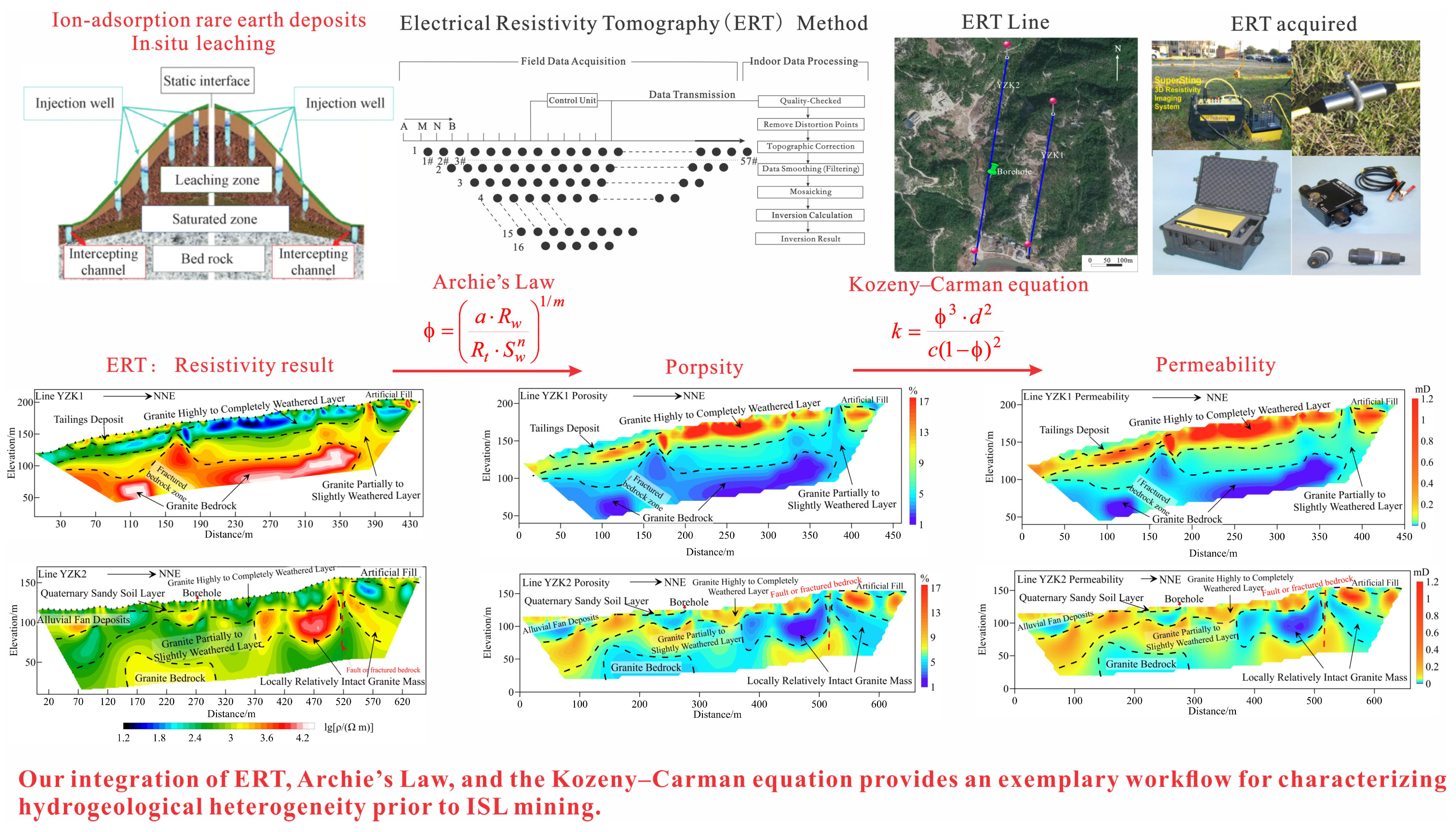



Imaging Detailed Structures and Estimating Permeability of the Weathered Crust in Ion-Adsorption Rare Earth Deposits via Electrical Resistivity Tomography
 ,
,
Abstract
1. Introduction
2. Geological Setting and Physical Property Characteristics
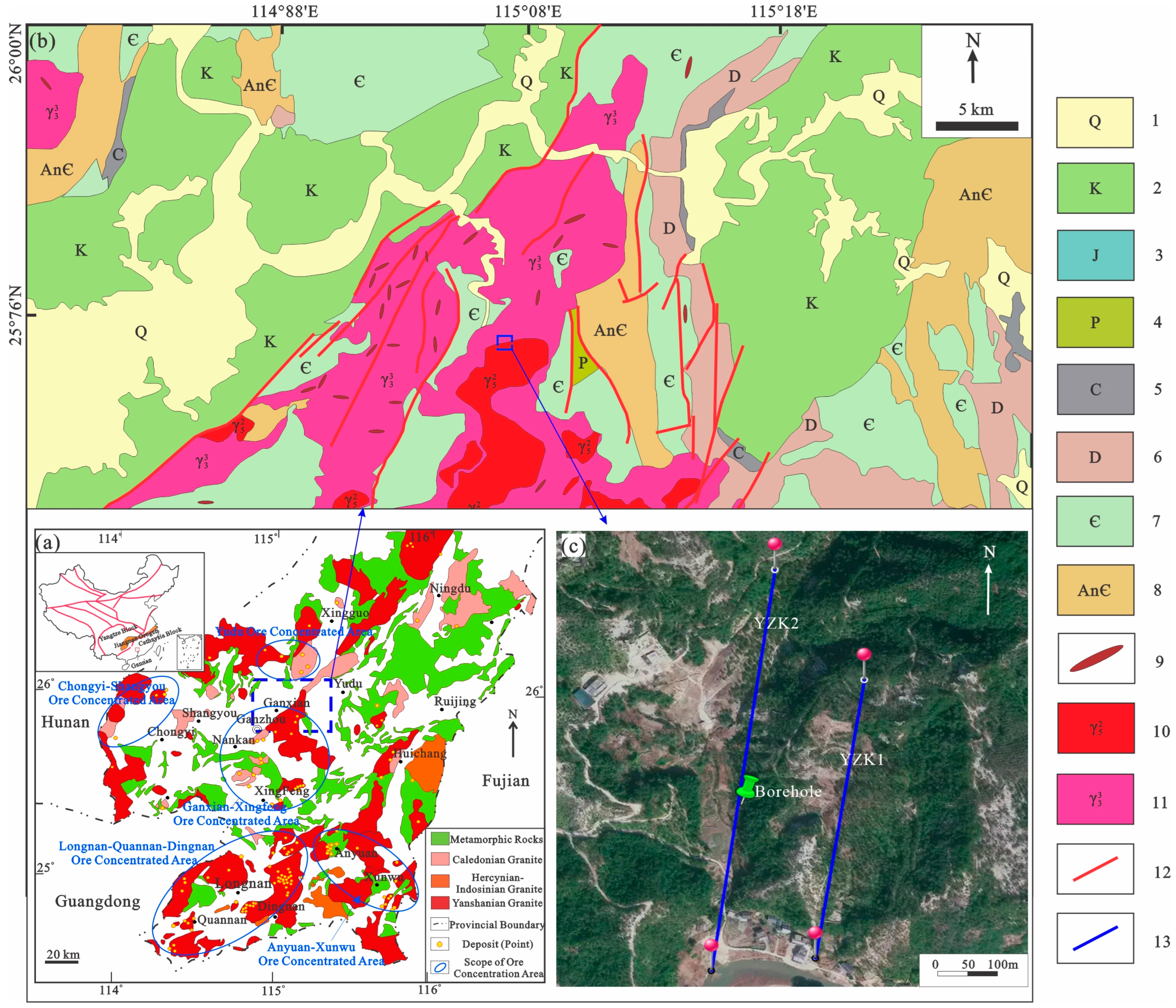
2.1. Geological Setting
2.2. Physical Property Characteristics
3. Methodology
3.1. Electrical Resistivity Tomography Method
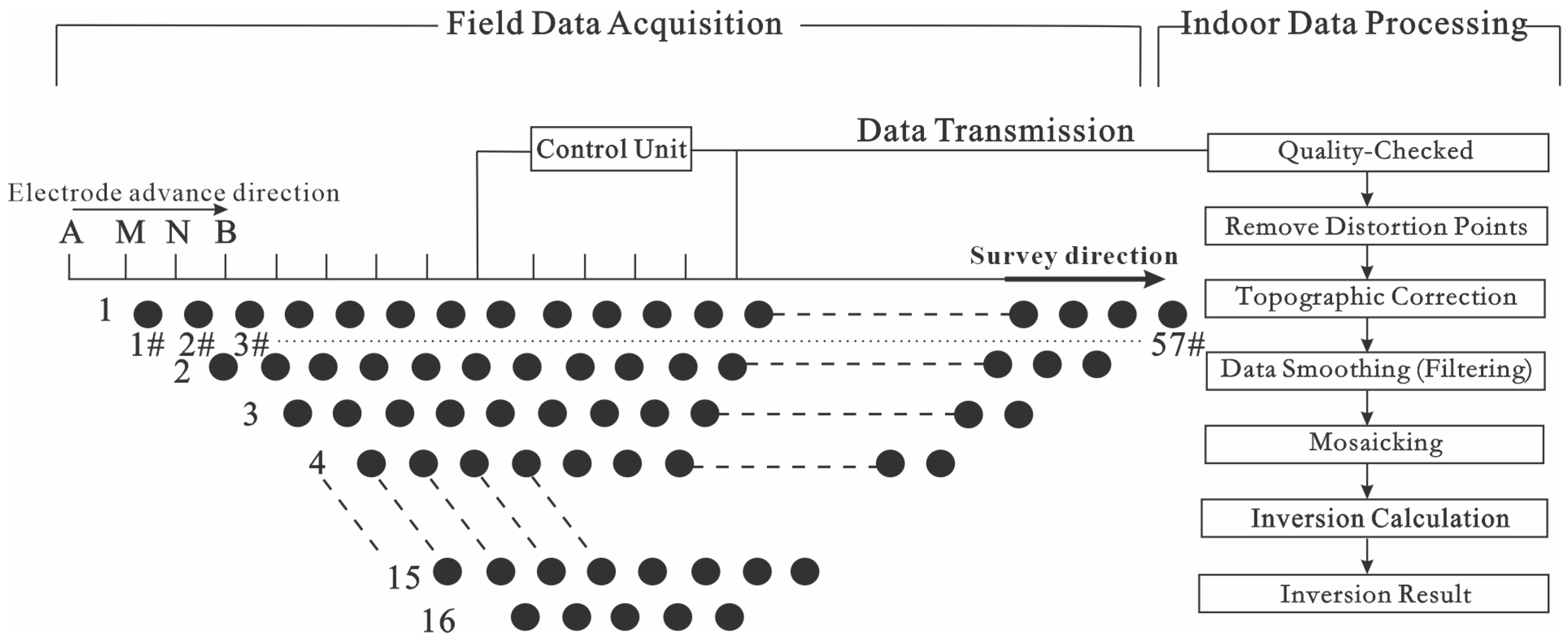
3.2. ERT Data Acquisition, Processing, and Inversion
3.3. Relationships Between Resistivity, Porosity, and Permeability
4. Evaluation of Inversion Results and Borehole Validation
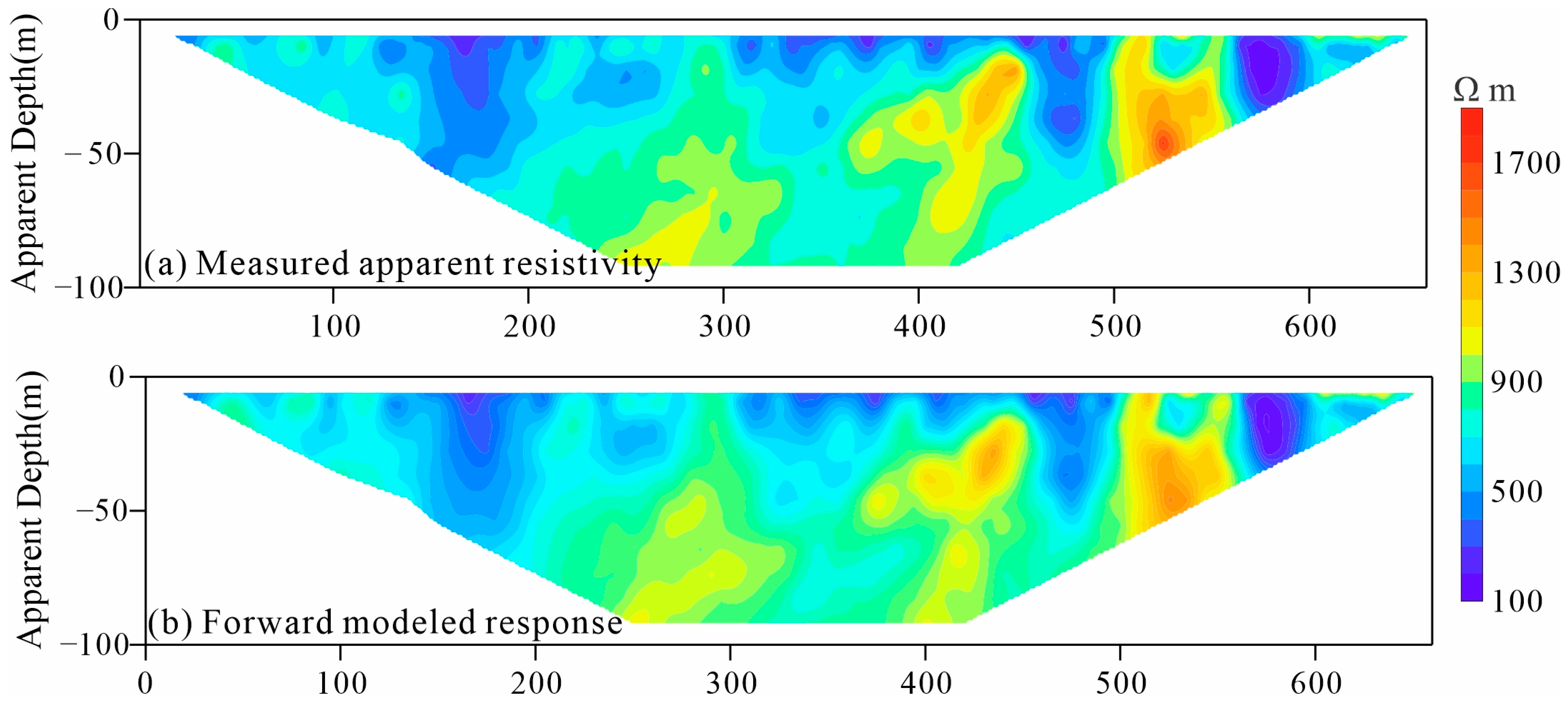
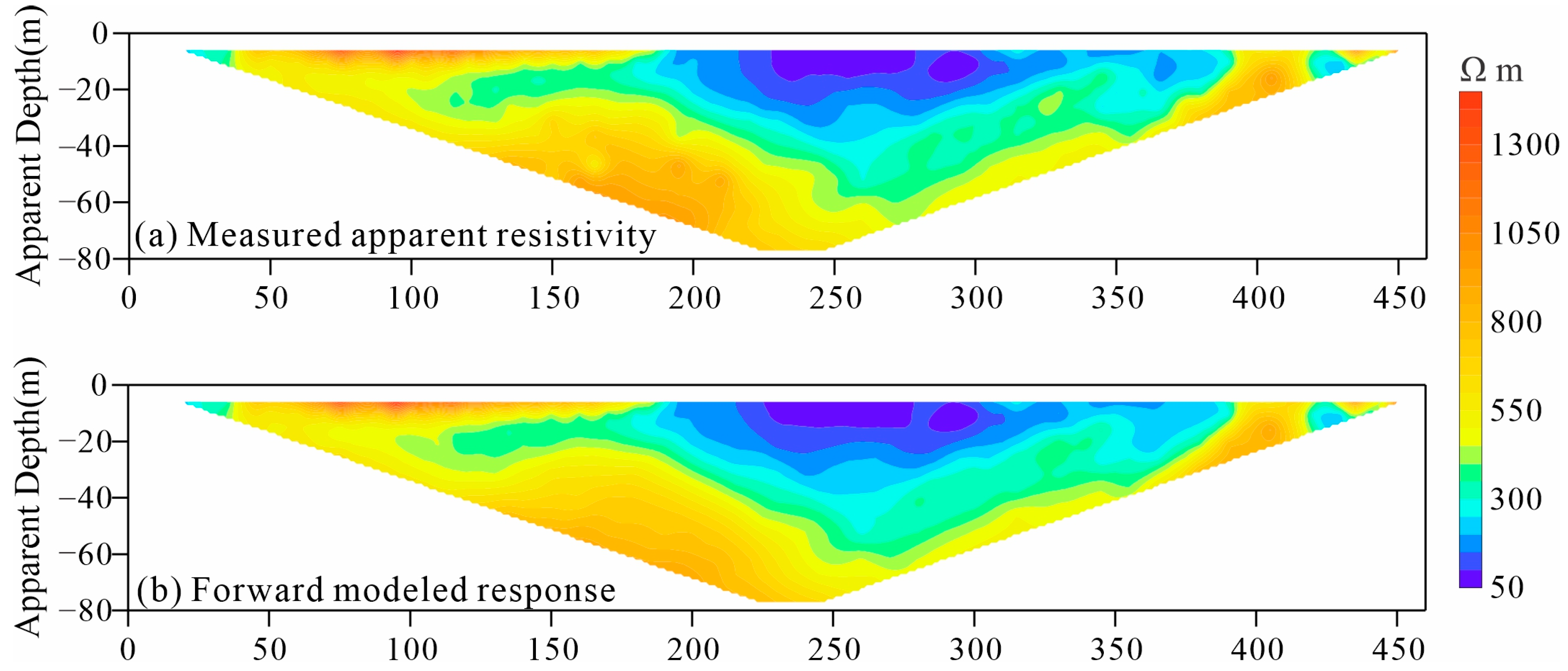
4.1. Data Inversion and Quality Assessment
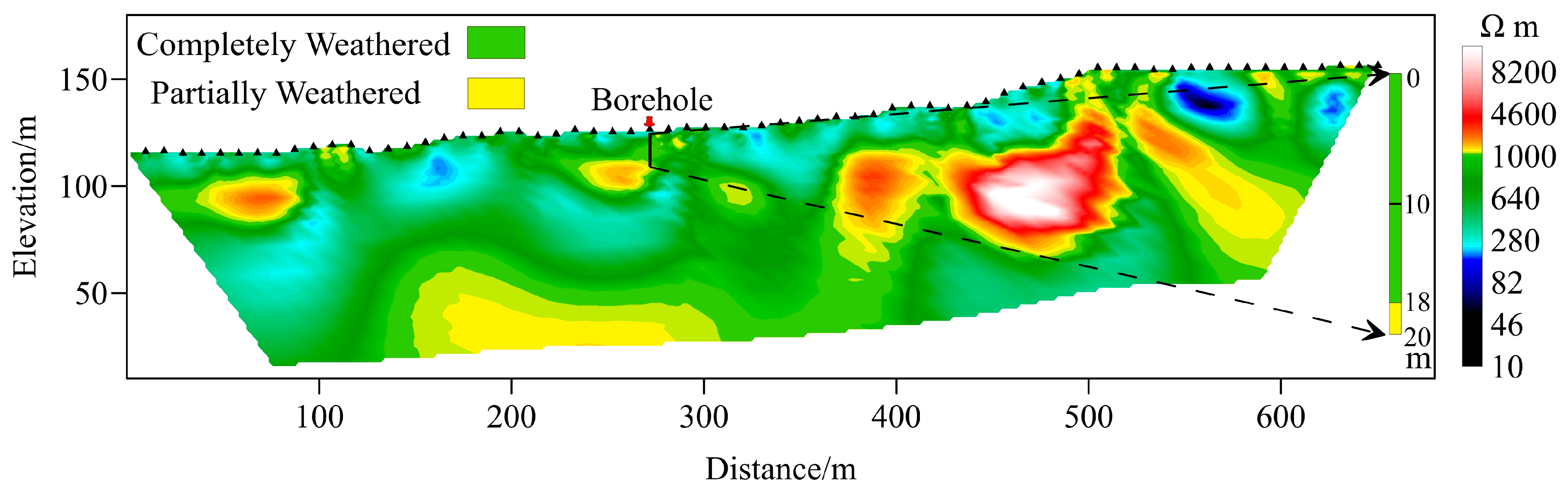
4.2. Verification of Inversion Results by Boreholes
5. Discussion
5.1. Detailed Interpretation of the Resistivity Structure of the Weathered Layer
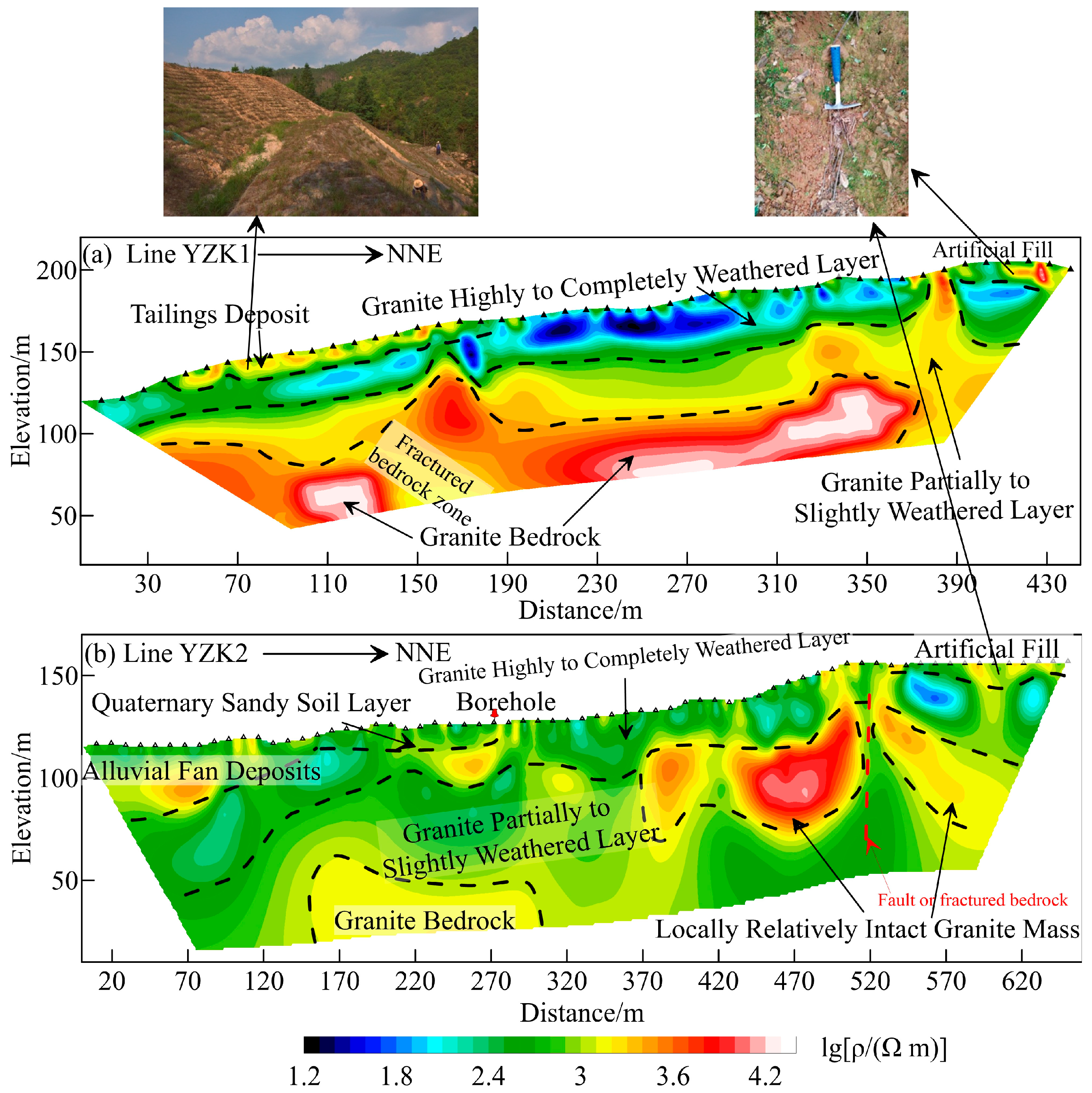
5.1.1. Resistivity Profile of the YZK1 Survey Line
- (1)
- Tailings Accumulation
- (2)
- Completely to Highly Weathered Layer
- (3)
- Colluvial/Eluvial Deposits
- (4)
- Slightly to Moderately Weathered Layer
- (5)
- Granite Bedrock
5.1.2. Resistivity Profile of the YZK2 Survey Line
- (1)
- Alluvial Fan Deposits
- (2)
- Artificial Fill
- (3)
- Quaternary Sediments
- (4)
- Weathered Layer Distribution
- (5)
- Slightly to Moderately Weathered Layer
- (6)
- Localized Intact Granite Bodies
- (7)
- Granite Bedrock
5.2. Quantitative Interpretation of Porosity and Permeability from ERT Data
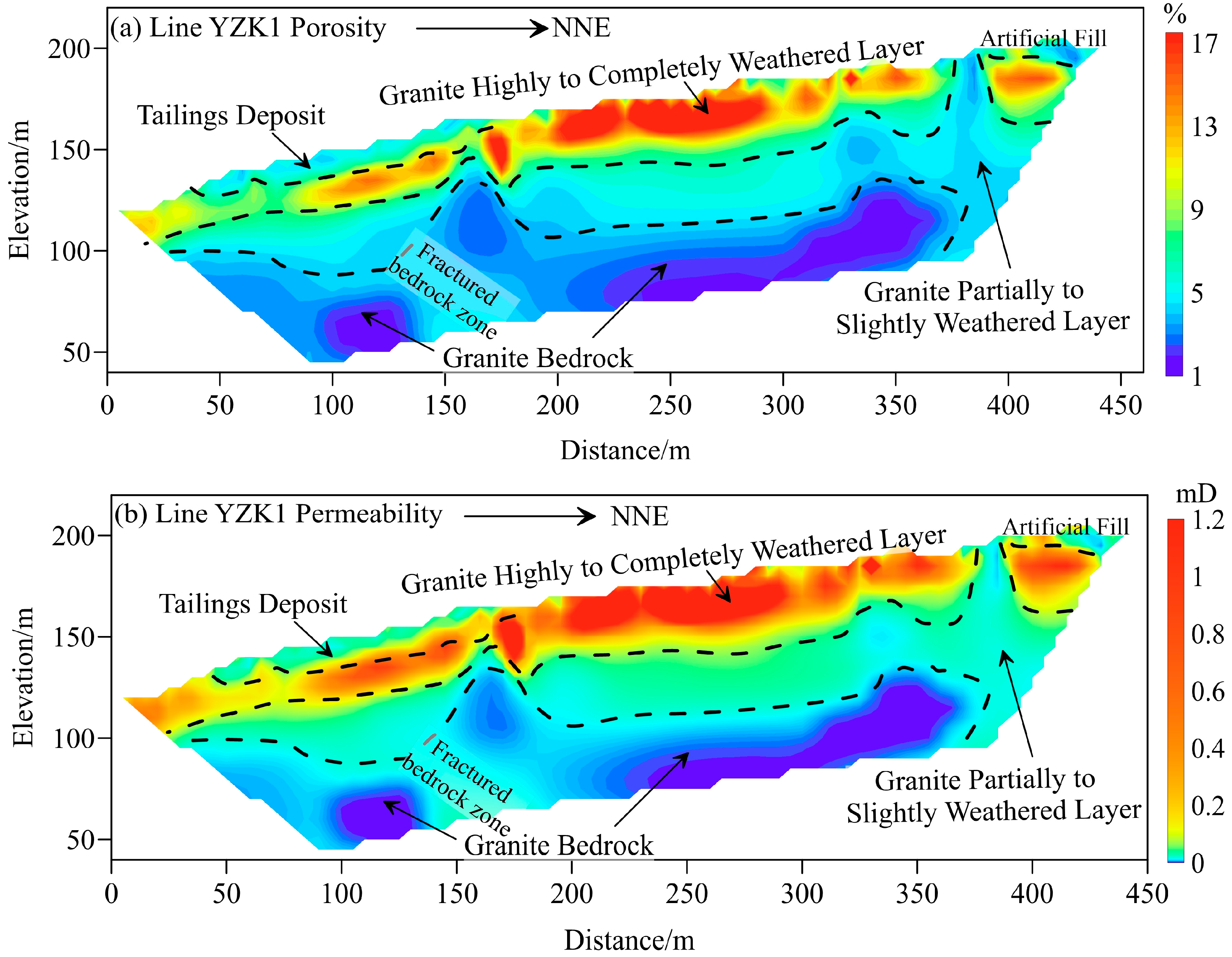
5.2.1. Porosity and Permeability of the YZK1 Survey Line
- (1)
- Surface Tailings Accumulation
- (2)
- Colluvial–Eluvial Loose Deposits
- (3)
- Completely to Highly Weathered Granite
- (4)
- Slightly to Moderately Weathered Granite
- (5)
- Granite Bedrock
5.2.2. Porosity and Permeability of the YZK2 Survey Line
- (1)
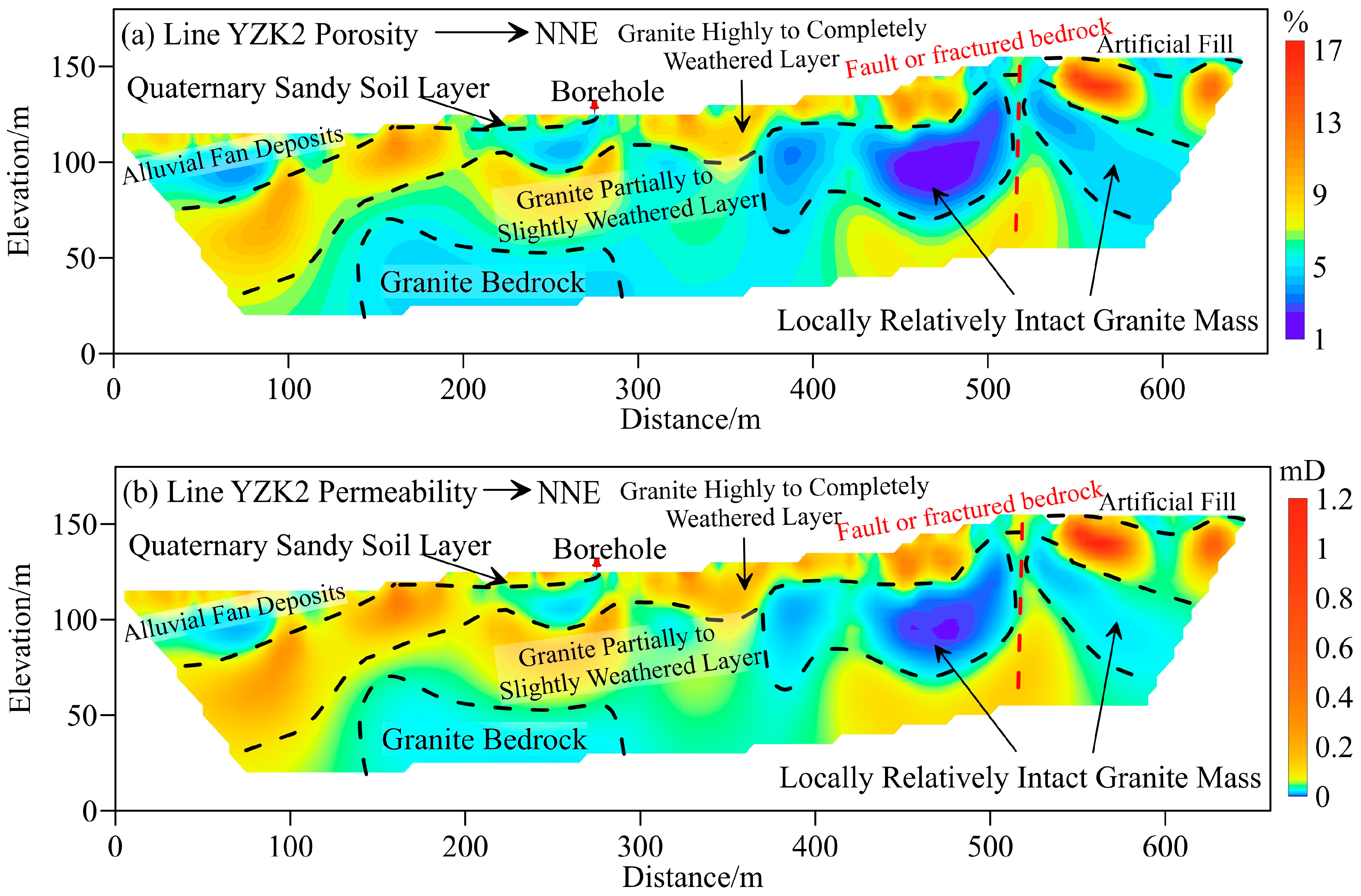
- Alluvial Fan Deposits
- (2)
- Quaternary Overburden
- (3)
- Completely to Highly Weathered Granite
- (4)
- Fractured bedrock zone or Fault
- (5)
- Slightly to Moderately Weathered Granite
- (6)
- Granite Bedrock
5.3. Coupling Characteristics of Resistivity, Porosity, and Permeability in the Weathered Layer and Their Geological Implications
- (1)
- “Low Resistivity–High Porosity–High Permeability” Mode in the Completely to Highly Weathered Layer
- (2)
- “High Resistivity–Low Porosity–Low Permeability” Transitional Mode in Shallow Accumulations and Slightly to Moderately Weathered Layers
- (3)
- “High Resistivity–Low Porosity–Extremely Low Permeability” Sealing Mode of the Bedrock
- (4)
- Disturbance of the “Resistivity–Porosity–Permeability” Coupling by Fractured bedrock zone
6. Conclusions
- (1)
- ERT Enables Quantitative Characterization of Hydrogeological Heterogeneity
- (2)
- A “Low Resistivity–High Porosity–High Permeability” Mode Identifies the Leachable Reservoir
- (3)
- Fractured Bedrock Zones Exhibit Segmented Hydraulic Behavior
- (4)
- The “Resistivity–Porosity–Permeability” Model Optimizes ISL Operations
Author Contributions
Funding
Data Availability Statement
Acknowledgments
Conflicts of Interest
References
- He, H.P.; Yang, W.B. REE Mineral Resources in China: Review and perspective. Geotecton. Metallog. 2022, 46, 829–841, (In Chinese with English abstract). [Google Scholar]
- Williams-Jones, A.E.; Migdisov, A.A.; Samson, I.M. Hydrothermal Mobilization of the Rare Earth Elements—A Tale of “Ceria” and “Yttria”. Elements 2012, 8, 355–360. [Google Scholar] [CrossRef]
- Zhou, B.; Li, Z.; Chen, C. Global Potential of Rare Earth Resources and Rare Earth Demand from Clean Technologies. Minerals 2017, 7, 203. [Google Scholar] [CrossRef]
- Habib, K.; Wenzel, H. Exploring Rare Earths supply constraints for the emerging clean energy technologies and the role of recycling. J. Clean. Prod. 2014, 84, 348–359. [Google Scholar] [CrossRef]
- Sanematsu, K.; Watanabe, Y. Characteristics and genesis of ion adsorption-type rare earth element deposits. In Rare Earth and Critical Elements in Ore Deposits; Verplanck, P.L., Hitzman, M.W., Eds.; Society of Economic Geologists: Littleton, CO, USA, 2016; Volume 18, pp. 55–79. [Google Scholar]
- Borst, A.M.; Smith, M.P.; Finch, A.A.; Estrade, G.; Villanova-de-Benavent, C.; Nason, P.; Marquis, E.; Horsburgh, N.J.; Goodenough, K.M.; Xu, C.; et al. Adsorption of rare earth elements onto clays: A review. Nat. Commun. 2020, 11, 5549. [Google Scholar] [CrossRef]
- Estrade, G.; Marquis, E.; Boulvais, P.; Le Carlier de Veslud, C.; Tartèse, R.; Poujol, M.; Smith, M. Rare earth element mobility during deep weathering of granite in a tropical environment: The Ambohimirahavavy complex, Madagascar. Ore Geol. Rev. 2019, 107, 103027. [Google Scholar] [CrossRef]
- Yamaguchi, A.; Minami, M.; Hoshino, M.; Takahashi, Y. Geochemical characteristics of ion-adsorption type REE deposits in the Higashi-Akaishi granitic body, western Japan. Geochem. J. 2018, 52, 415–425. [Google Scholar] [CrossRef]
- Li, Y.H.M.; Zhao, W.W.; Zhou, M.F. Nature of parent rocks, mineralization styles and ore genesis of regolith-hosted REE deposits in South China: An integrated genetic model. J. Asian Earth Sci. 2017, 148, 65–95. [Google Scholar] [CrossRef]
- Wu, C.; Bai, G.; Huang, D.; Zhu, Z. Characteristics and significance of heavy rare earth element (HREE)-rich granitoids of the Nanling Mountain area. Bull. Chin. Acad. Geol. Sci. 1992, 25, 46–61, (In Chinese with English abstract). [Google Scholar]
- Ram, R.; Choubey, P.K.; Gupta, S.K.; Pandey, B.D. Characterization and leaching of ion-adsorption type rare earth deposits: A review. Chem. Geol. 2019, 511, 221–237. [Google Scholar]
- Wang, D.; Zhao, Z.; Yu, Y.; Wang, C.; Dai, J.; Sun, Y.; Zhao, T.; Li, J.; Huang, F.; Chen, Z.; et al. A Review of the Achievements in the Survey and Study of Ion-Absorption-Type REE Deposits in China. Acta Geosci. Sin. 2017, 38, 317–325, (In Chinese with English abstract). [Google Scholar]
- Luo, F.; Yan, J.Y.; Liang, J.; Zhang, S.; Wu, D.H.; Rao, G.W.; Hu, W.Q.; Fu, G.M. Application Status and Prospect of Geophysical Technology in the Rare-Earth Resources Field. J. Rare Earths 2024, 42, 1088–1101, (In Chinese with English abstract). [Google Scholar]
- Chen, C.; Bei, Y.; Li, Y.; Zhou, W. Effect of Interpolation Methods on Quantifying Terrain Surface Roughness under Different Data Densities. Geomorphology 2022, 417, 108448. [Google Scholar] [CrossRef]
- Oliver, M.A.; Webster, R. A tutorial guide to geostatistics: Computing and modelling variograms and kriging. Catena 2014, 113, 56–69. [Google Scholar] [CrossRef]
- Xie, W.Q.; Long, P.; Hu, S.L. Determination of the Bottom Plate of Ion-Adsorption Rare Earth Ore Body Based on Spatial Interpolation Algorithm. Nonferrous Met. Sci. Eng. 2023, 14, 700–705, (In Chinese with English abstract). [Google Scholar] [CrossRef]
- Loke, M.H.; Barker, R.D. Rapid least-squares inversion of apparent resistivity pseudosections by a quasi-Newton method. Geophys. Prospect. 1996, 44, 131–152. [Google Scholar] [CrossRef]
- Russo, C.J.; Fayek, M.; Migdisov, A.A.; Silva, A.G.; Janasi, V.A. Formation of ion-adsorption rare earth element deposits in a paleo-weathering profile, Brazil. J. Geochem. Explor. 2025, 268, 107621. [Google Scholar]
- Moldoveanu, G.A.; Papangelakis, V.G. Recovery of rare earth minerals from clay minerals: I. Leaching studies. Hydrometallurgy 2012, 117, 71–78. [Google Scholar] [CrossRef]
- Yang, X.J.; Lin, A.; Li, X.; Wu, Y.; Zhou, Q.; Chen, S.; Wang, H. China’s ion-adsorption rare earth resources, mining consequences and preservation. Environ. Dev. 2013, 8, 131–136. [Google Scholar] [CrossRef]
- Xiao, Y.; Guo, G.; Li, H.; Chi, R.; Xu, H.; Zhou, X. A discussion on the leaching process of the ion-adsorption type rare earth ore with the electrical double layer model. Miner. Eng. 2018, 120, 35–43. [Google Scholar] [CrossRef]
- Yin, S.; Chen, X.; Yan, R.; Wang, L. Pore Structure Characterization of Undisturbed Weathered Crust Elution-Deposited Rare Earth Ore Based on X-ray Micro-CT Scanning. Minerals 2021, 11, 236. [Google Scholar] [CrossRef]
- Wang, X.; Zhuo, Y.; Zhao, K.; Zhong, W. Experimental measurements of the permeability characteristics of rare earth ore under the hydro-chemical coupling effect. RSC Adv. 2018, 8, 11652–11660. [Google Scholar] [CrossRef] [PubMed]
- Stockdale, A.; Banwart, S.A. Impact of particle size on the leaching kinetics of ion-adsorption rare earth ores. Miner. Eng. 2021, 160, 106652. [Google Scholar]
- Zhong, J.; Ye, D.; Wu, Y.; Chen, B.; Deng, Y.; Qi, F. Comprehensive Application of High-Density Resistivity Method and Drilling Data in Ion-Adsorption Rare Earth Mines. Chin. Rare Earths 2023, 44, 82–91, (In Chinese with English abstract). [Google Scholar]
- Chen, S.; Shu, R.; Min, G.; Liu, K.; Yuan, H.; Cheng, R. High-Density Electrical Exploration Test of Hidden Fault Zone in Southern Rare Earth Mining Area. Multipurp. Util. Miner. Resour. 2022, 1, 79–85, (In Chinese with English abstract). [Google Scholar] [CrossRef]
- Min, G.; Shu, R.; Liu, K.; Cheng, R.; Chen, S.; Yuan, H. Exploration Test of 3D Deep Structure and Floor Fracture Zone in Ion-Type Rare Earth Ore District. Chin. J. Nonferrous Met. 2022, 32, 1833–1843, (In Chinese with English abstract). [Google Scholar] [CrossRef]
- Liu, Y.; Cheng, R.; Gong, D.; Dai, L.; Zhu, Z. Application of Integrated Geophysical Methods in In-Situ Leaching of Ion-Adsorption REE Deposits. Sediment. Geol. Tethyan Geol. 2025, 45, 776–787, (In Chinese with English abstract). [Google Scholar]
- Niu, Q.; Zhang, C. Physical Explanation of Archie’s Porosity Exponent in Granular Materials: A Process-Based, Pore-Scale Numerical Study. Geophys. Res. Lett. 2018, 45, 1870–1877. [Google Scholar] [CrossRef]
- Griffiths, D.H. Application of Electrical Resistivity Mseasurements for the Determination of Porosity and Permeability in Sandstones. Geoexploration 1976, 14, 207–213. [Google Scholar] [CrossRef]
- Civan, F. Porosity and Permeability Relationships of Geological Formations. In Reservoir Formation Damage, 2nd ed.; Chapter 5; Gulf Professional Publishing: Burlington, MA, USA, 2007; pp. 125–153. [Google Scholar]
- Tong, M.; Tao, H. Permeability estimating from complex resistivity measurement of shaly sand reservoir. Geophys. J. Int. 2008, 173, 733–739. [Google Scholar] [CrossRef][Green Version]
- Najib, A.; Bertin, H. Revolutionary approach for mapping hydraulic conductivity in coastal aquifers using 2D electrical resistivity tomography calibrated by borehole data. Near Surf. Geophys. 2011, 9, 345–357. [Google Scholar]
- Sudo, H.; Ehara, K.; Takakura, S.; Murakami, Y.; Ushijima, K. Permeability Imaging in Granitic Rocks Based on Surface Resistivity Profiling. Explor. Geophys. 2004, 35, 56–61. [Google Scholar] [CrossRef]
- Knorsch, L.; Küster, T.; Möller, P.; Schwinn, G.; Zimányi, L.; Gaupp, R. Geochemical and mineralogical controls on REE mobilization in tropical weathering profiles. Geosci. Front. 2025, 16, 101892. [Google Scholar] [CrossRef]
- Shu, L.; Yao, J.; Wang, B.; Faure, M.; Charvet, J.; Chen, Y. Neoproterozoic plate tectonic process and Phanerozoic geodynamic evolution of the South China Block. Earth-Sci. Rev. 2021, 216, 103596. [Google Scholar] [CrossRef]
- Luo, F.; Yan, J.; Zhang, S.; Liang, J.; Fu, G.; Wu, D.; Reng, G. Discussion of the W-Sn-REE Metallogenic Background in the Nanling Region of South China: Evidence from Satellite Gravity and Magnetic Data. Minerals 2024, 14, 215. [Google Scholar] [CrossRef]
- Xie, M.; Zhou, J.; Du, X.; Wang, X.; Zhang, B.; Wu, H.; Hu, Q.; Wang, W.; Tian, M.; Chen, B.; et al. The Characteristics and Enrichment Process of Dabu Ion-Adsorption Heavy Rare-Earth Element (HREE) Deposits in Jiangxi Province, South China. Minerals 2024, 14, 857. [Google Scholar] [CrossRef]
- Xiao, X.; Guo, M.; Tan, J.; Shao, X.; Wang, L.; Qiu, X. Comparison of Geochemical Characteristics and Occurrence Modes of Rare Earth Elements in Ion-Adsorption Rare Earth Ores from Weathering Crust Profiles of Different Granite Types in Southern China. Geochimicain 2026, in press (In Chinese with English abstract). [Google Scholar] [CrossRef]
- Huang, Y.; He, H.; Liang, X.; Bao, Z.; Tan, W.; Ma, L.; Zhu, J.; Huang, J.; Wang, H. Characteristics and Genesis of Ion-Adsorption-Type REE Deposits in the Weathering Crusts of Metamorphic Rocks in Ningdu, Ganzhou, China. Ore Geol. Rev. 2021, 135, 104173. [Google Scholar] [CrossRef]
- Guo, D.; Zhao, Z.; Hou, Z.; Tao, J.; Yin, J.; Duan, C. Spatio-temporal structure and prospecting of Dabu tungsten polymetallic ore field, Ganxian, Jiangxi Province. Miner. Depos. 2024, 43, 578–598, (In Chinese with English abstract). [Google Scholar]
- Li, J.F.; Fu, J.M.; Lu, Y.Y.; Cheng, S.B.; Ma, L.Y.; Chen, X.Q.; Quan, H.Y.; Ma, K.M. Early Yanshanian metallogenesis of the Banjing tungsten deposit in Ganxian, Jiangxi province, China: Constraints from geochemistry, Sr–Nd isotopes, zircon U–Pb, molybdenite Re–Os, and mica 40Ar–39Ar dating. Geol. J. 2023, 58, 1366–1383. [Google Scholar]
- Zhao, X.; Li, N.B.; Huizenga, J.M.; Zhang, Q.B.; Yang, Y.Y.; Yan, S.; Yang, W.B.; Niu, H.C. Granitic magma evolution to magmatic-hydrothermal processes vital to the generation of HREEs ion-adsorption deposits: Constraints from zircon texture, U–Pb geochronology, and geochemistry. Ore Geol. Rev. 2022, 146, 104931. [Google Scholar] [CrossRef]
- Zhang, Q. Investigation and Evaluation Report on the Rare Earth Resources in Ganxian District, Ganzhou City, Jiangxi Province; Jiangxi Provincial Geological and Mineral Exploration and Development Bureau, Gannan Geological Survey Brigade: Ganzhou, China, 2017; pp. 1–112. (In Chinese) [Google Scholar]
- Dahlin, T.; Zhou, B. Multiple-gradient array measurements for multichannel 2D resistivity imaging. Near Surf. Geophys. 2006, 4, 113–123. [Google Scholar]
- Pidlisecky, A.; Haber, E.; Knight, R. RESINVM3D: A 3D Resistivity Inversion Package. Geophysics 2007, 72, H1–H10. [Google Scholar] [CrossRef]
- Archie, G.E. The Electrical Resistivity Log as an Aid in Determining Some Reservoir Characteristics. Trans. AIME 1942, 146, 54–62. [Google Scholar] [CrossRef]
- Kozeny, J. Über Kapillare Leitung des Wassers im Boden (On Capillary Conduction of Water in Soil). Sitzungsber. Akad. Wiss. Wien Math.-Naturwiss. Kl. Abt. IIa 1927, 136, 271–306. [Google Scholar]
- Mavko, G.; Nur, A. The Effect of a Percolation Threshold in the Kozeny–Carman Relation. Geophysics 1997, 62, 1480–1482. [Google Scholar] [CrossRef]
- Mavko, G.; Mukerji, T.; Dvorkin, J. The Rock Physics Handbook: Tools for Seismic Analysis of Porous Media; Cambridge University Press: Cambridge, UK, 1997. [Google Scholar]
- Worthington, P.H. The Uses of the Archie Formation Factor in the Petrophysical Characterization of Reservoirs. Log Anal. 1993, 34, 22–38. [Google Scholar]
- Moldoveanu, G.A.; Papangelakis, V.G. Recovery of rare earth minerals from clay minerals: II. Precipitation stripping of rare earths from acid leach liquors. Hydrometallurgy 2013, 131–132, 158–166. [Google Scholar] [CrossRef]
- Moldoveanu, G.A.; Papangelakis, V.G. Mineralogical analysis of rare earth bearing clay minerals by SEM-EDS and EPMA. Mineral. Mag. 2016, 80, 329–343. [Google Scholar] [CrossRef]
- Liu, D.; Zhang, Z.; Chi, R. Seepage mechanism during in-situ leaching process of weathered crust elution-deposited rare earth ores with magnesium salt. Physicochem. Probl. Miner. Process. 2020, 56, 117925. [Google Scholar]
- Wang, X.; Wang, Y.; Hu, K. Wetting front migration model of ion-adsorption rare earth during the multi-hole unsaturated liquid injection. J. Rock Mech. Geotech. Eng. 2024, 16, 483–496. [Google Scholar] [CrossRef]
- Zhang, L.; Wen, B.; Chen, L.; Wang, L. Variations in Pore Structures and Permeabilities of Ion-Adsorption Rare Earth Ores in Zones with Different Weathering Degrees before and after Leaching. Hydrogeol. Eng. Geol. 2024, 51, 117–124, (In Chinese with English abstract). [Google Scholar]
- Costabel, S.; Weidner, C.; Müller-Petke, M.; Houben, G. Hydraulic characterisation of iron-oxide-coated sand and gravel based on nuclear magnetic resonance relaxation mode analyses. Hydrol. Earth Syst. Sci. 2018, 22, 1713–1729. [Google Scholar] [CrossRef]
- Xu, T.; Wang, X.; Zhang, Y.; Zhao, X.; Bao, Y. Clay Minerals in Petroliferous Basins of China; Science Press: Beijing, China, 2003. (In Chinese) [Google Scholar]
- Jiang, F.; Huang, Y.; Lin, J.; Chen, L.; Liao, H.; Wang, Z. Analysis of Soil Infiltration Characteristics of Benggang Colluvium. J. Soil Water Conserv. 2013, 27, 49–54, (In Chinese with English abstract). [Google Scholar]
- Jiang, H.; Zhao, X.; Zhao, Y. Cross-Hole Resistivity CT Method Based on Borehole Radar and Its Application. Prog. Geophys. 2024, 39, 1285–1292, (In Chinese with English abstract). [Google Scholar]
- Wu, Y.; Huang, Z.; Gu, Q.; Lin, Y.; Moyo, D.; Wu, Y.; Zou, C.; Zhao, K. Experimental investigation on the pore structure and water inrush evolution law of weakly cemented fault fracture zone with different filling gradations. Geomech. Geophys. Geo-Energy Geo-Resour. 2023, 9, 162. [Google Scholar] [CrossRef]
- Li, Y.; Lan, J.; Li, R.; Wang, J.; Mo, Q. Permeability Coefficient of Weathered Zones of the Huashan Granite Body, Guangxi. J. Guilin Univ. Technol. 2016, 36, 681–687, (In Chinese with English abstract). [Google Scholar]





| Lithology/Stratum | Resistivity (Ω·m) | Remarks | Source |
|---|---|---|---|
| Quaternary sandy clay | 50–300 | Highly influenced by moisture content | [28] |
| Granite weathered layer | 300–800 | Highly influenced by water content | [26] |
| Granite bedrock | 1000–10,000 | Highly influenced by water content | [27] |
| Fault fracture zone | 20–400 | Highly influenced by water content | [28] |
| Groundwater/Surface water | ~100 | / | [28] |
| Survey Line | Azimuth | Length (m) | Electrode Spacing (m) | Number of Electrodes |
|---|---|---|---|---|
| YZK1 | NNE | 470 | 10 | 47 |
| YZK2 | NNE | 670 | 10 | 67 |
| Parameter | Symbol | Value | Unit | Source/Description |
|---|---|---|---|---|
| Cementation Exponent | m | 2.5 | / | Empirical data for unconsolidated kaolinitic sandstone |
| Saturation Exponent | n | 2.0 | / | Standard Archie equation assumption |
| Average Grain Diameter | d | 0.01 | mm | Grain size analysis of typical weathered crust samples |
| Kozeny Constant | c | 5000 | / | Kozeny–Carman model fitting (Mavko et al., 1997) [49,50] |
| Pore Water Resistivity | Rw | 0.1 | Ω·m | Assumed average saturation during in situ leaching |
| Water Saturation | Sw | 0.5 | / | Assumed average saturation during in situ leaching |
| Archie constant | a | 1.8 | / | Empirical tortuosity factor for weathered crust (Worthington, 1993) [51] |
| Vertical Zone | Resistivity Range (Ω·m) | Porosity (%) | Permeability (mD) | Support Evidence (Figure 6, Figure 7 and Figure 8) |
|---|---|---|---|---|
| Tailings/ Colluvium | >800 | 3.6–6.4 | 0.01–0.04 | e.g., High-resistivity anomalies (800–1500 Ω·m) at shallow depths (0–10 m) on YZK1. |
| Completely Weathered | 10–700 | 8.7–17 | 0.04–1.2 | e.g., Low-resistivity anomalies (10–200 Ω·m) at depths of 0–20 m on YZK1, thinning to 10 m at Sta. 160 m. |
| Moderately Weathered | 1000–2000 | 2.2–6.0 | 0.02–0.05 | e.g., High-resistivity transition (>1000 Ω·m) at depths > 20 m on YZK1. |
| Fresh Bedrock | >1500 | <4.0 | <0.02 | e.g., Extremely high-resistivity zone (>8000 Ω·m) below 50 m on YZK1, truncating conductive pathways. |
Disclaimer/Publisher’s Note: The statements, opinions and data contained in all publications are solely those of the individual author(s) and contributor(s) and not of MDPI and/or the editor(s). MDPI and/or the editor(s) disclaim responsibility for any injury to people or property resulting from any ideas, methods, instructions or products referred to in the content. |
© 2026 by the authors. Licensee MDPI, Basel, Switzerland. This article is an open access article distributed under the terms and conditions of the Creative Commons Attribution (CC BY) license.
Share and Cite
Lu, S.; Luo, F.; Zhang, S.; Wang, Y.; Zhang, D.; Liang, J.; Liu, G.; Chen, X.; Fu, G. Imaging Detailed Structures and Estimating Permeability of the Weathered Crust in Ion-Adsorption Rare Earth Deposits via Electrical Resistivity Tomography. Minerals 2026, 16, 773. https://doi.org/10.3390/min16080773
Lu S, Luo F, Zhang S, Wang Y, Zhang D, Liang J, Liu G, Chen X, Fu G. Imaging Detailed Structures and Estimating Permeability of the Weathered Crust in Ion-Adsorption Rare Earth Deposits via Electrical Resistivity Tomography. Minerals. 2026; 16(8):773. https://doi.org/10.3390/min16080773
Chicago/Turabian StyleLu, Siming, Fan Luo, Sheng Zhang, Yufei Wang, Defu Zhang, Jian Liang, Guocheng Liu, Xiaofei Chen, and Guangming Fu. 2026. "Imaging Detailed Structures and Estimating Permeability of the Weathered Crust in Ion-Adsorption Rare Earth Deposits via Electrical Resistivity Tomography" Minerals 16, no. 8: 773. https://doi.org/10.3390/min16080773
APA StyleLu, S., Luo, F., Zhang, S., Wang, Y., Zhang, D., Liang, J., Liu, G., Chen, X., & Fu, G. (2026). Imaging Detailed Structures and Estimating Permeability of the Weathered Crust in Ion-Adsorption Rare Earth Deposits via Electrical Resistivity Tomography. Minerals, 16(8), 773. https://doi.org/10.3390/min16080773