
Lithium Recovery from Smectite Clays via Sulphate Roasting and Water Leaching


Abstract
1. Introduction
2. Materials and Methods
2.1. Materials
2.2. Experimental Design
2.2.1. Screening Tests
2.2.2. Optimisation Tests
2.3. Equipment and Procedures
2.4. Analytical
2.5. Thermodynamic Modelling
3. Results and Discussion
3.1. Screening Tests
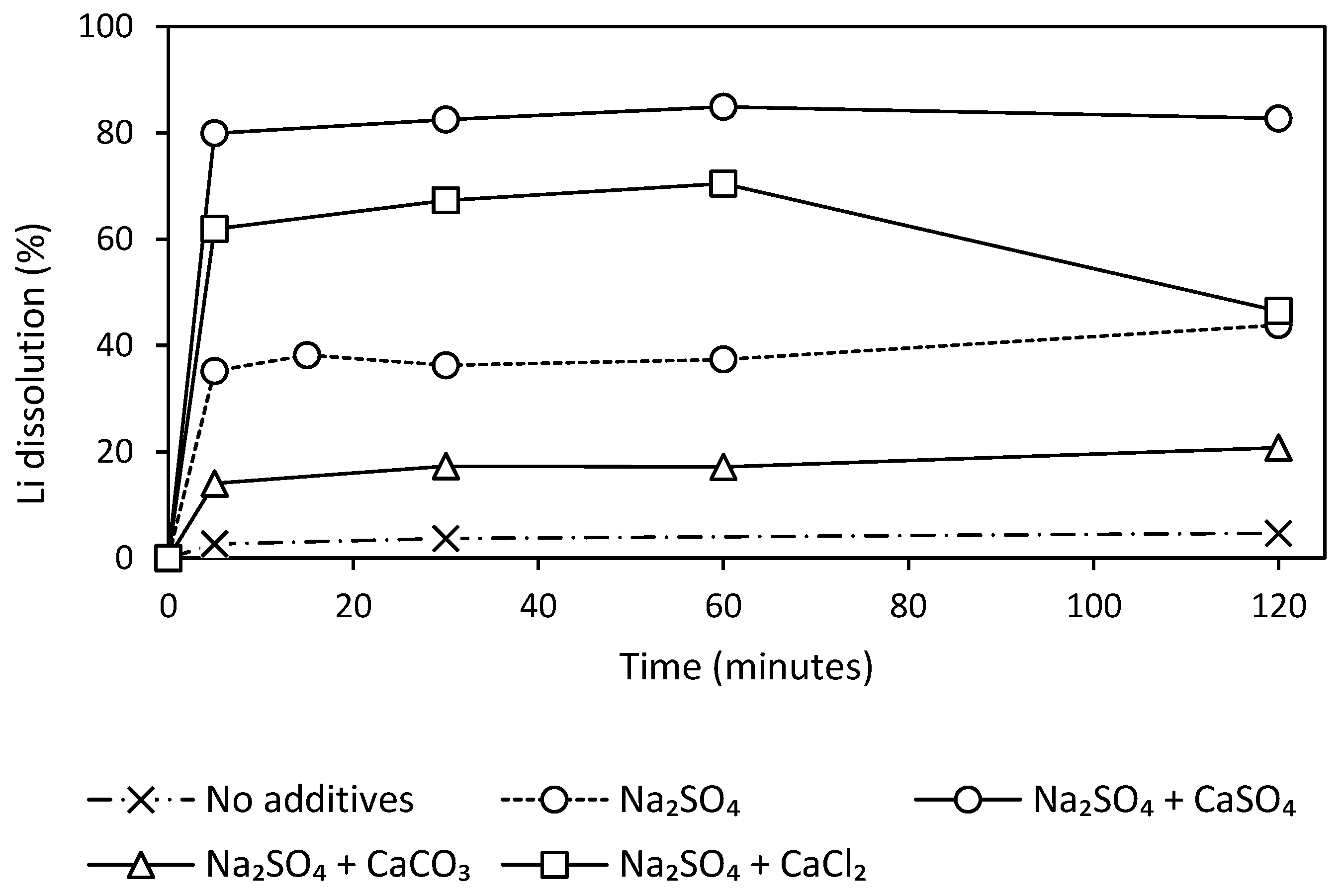
3.1.1. Effect of Additive Composition
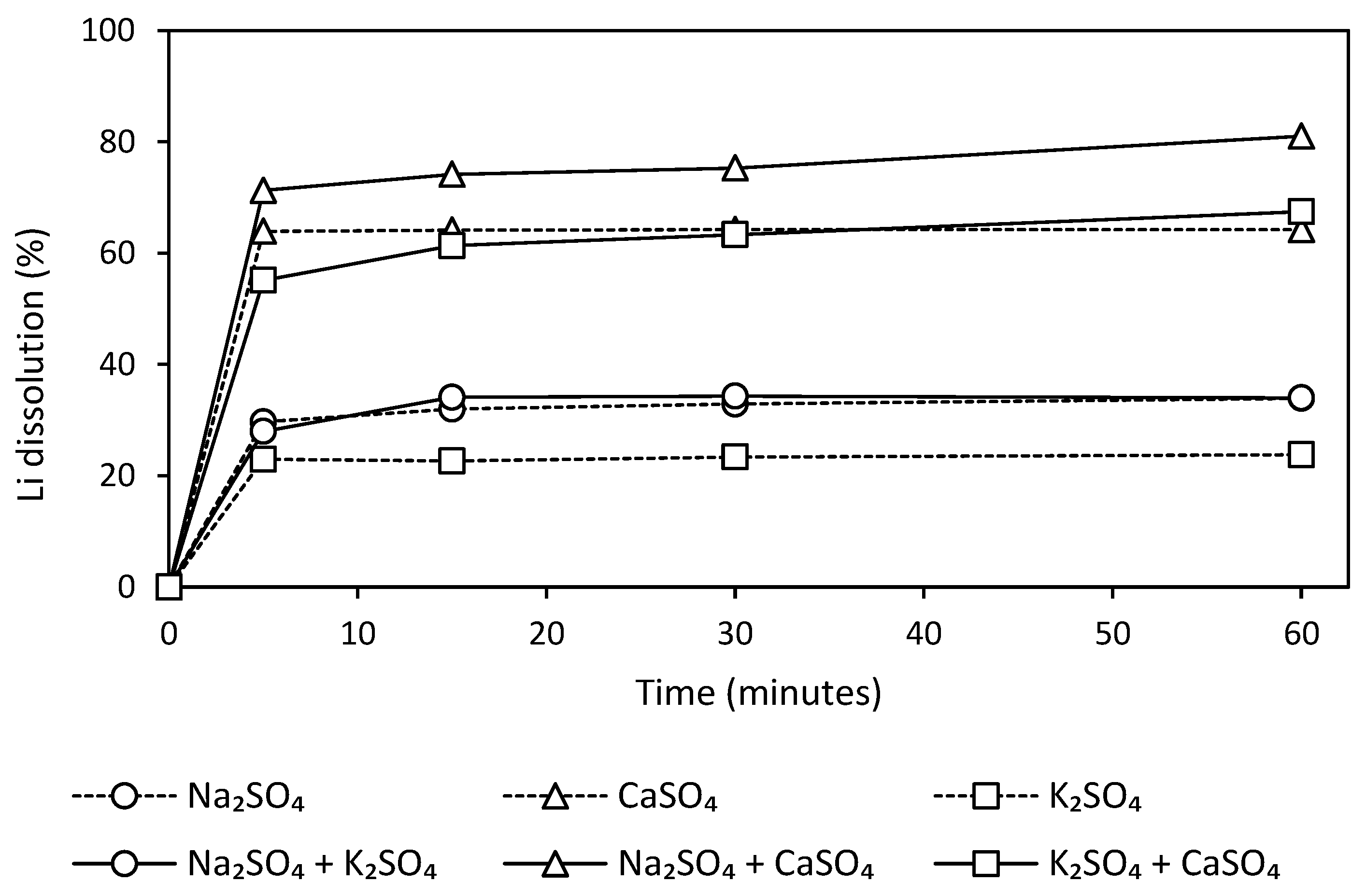
3.1.2. Effect of Sulphate Salt Systems
3.2. Optimisation Tests
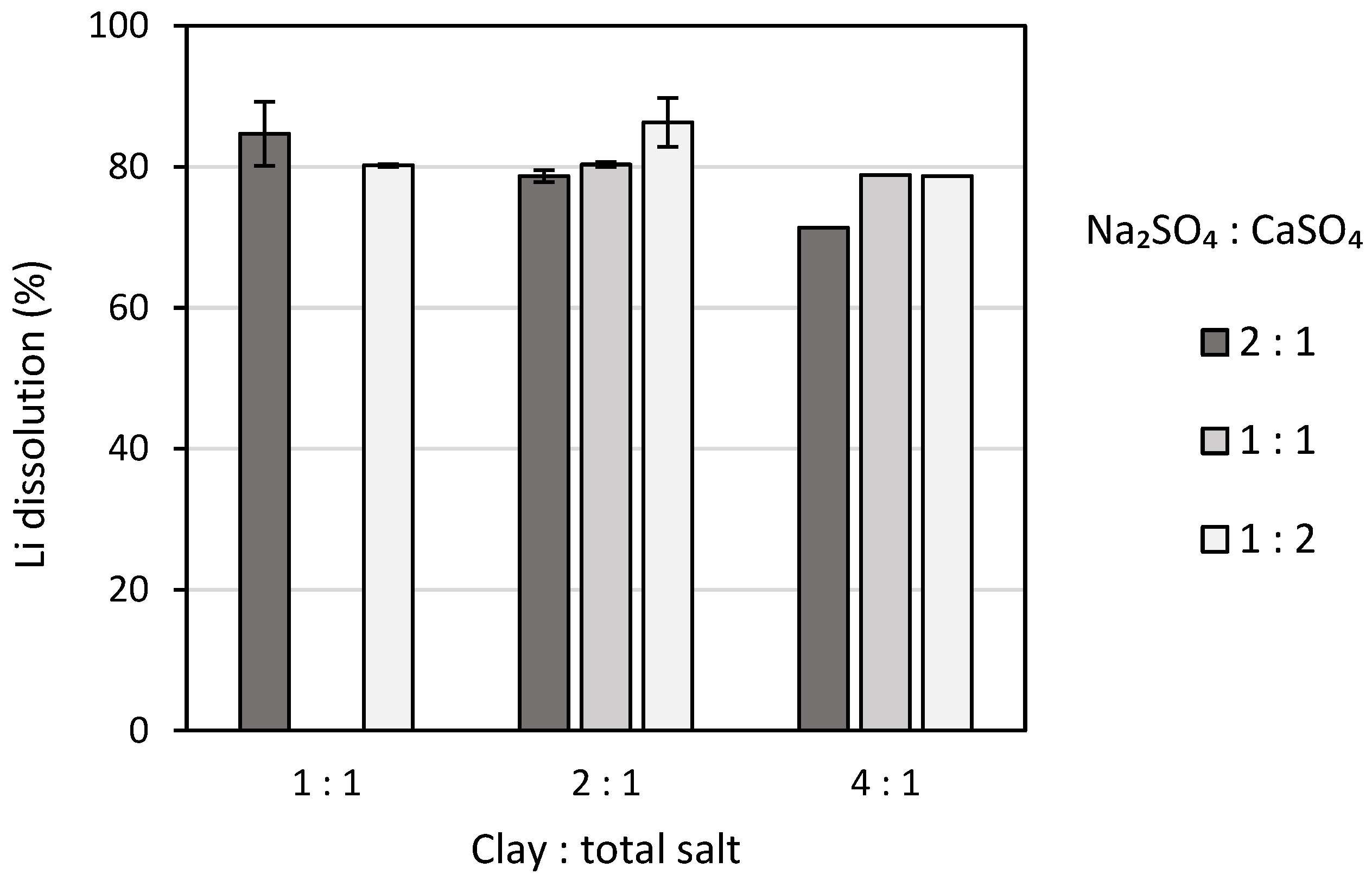
3.2.1. Effect of Clay-Salt Ratio
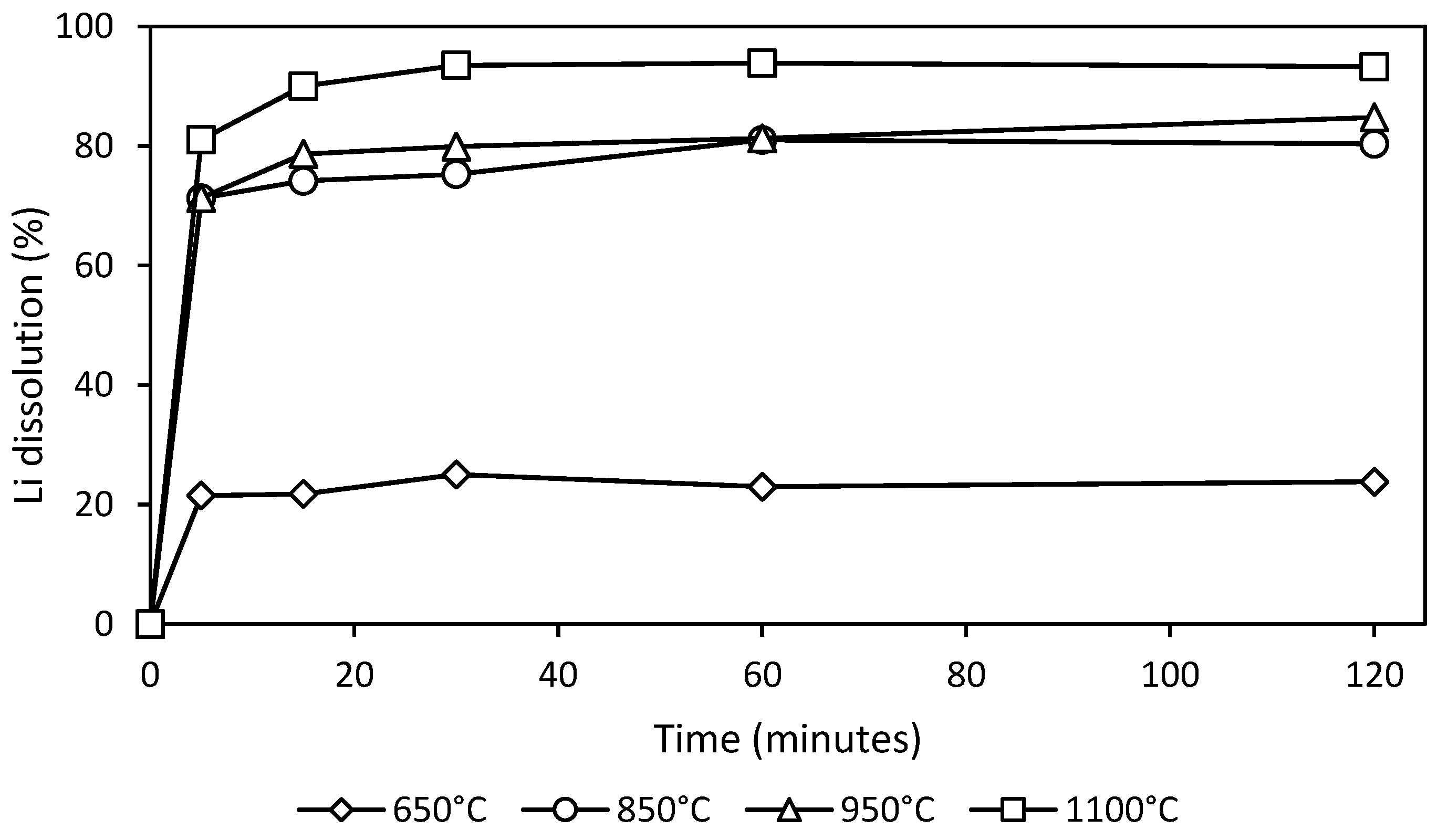
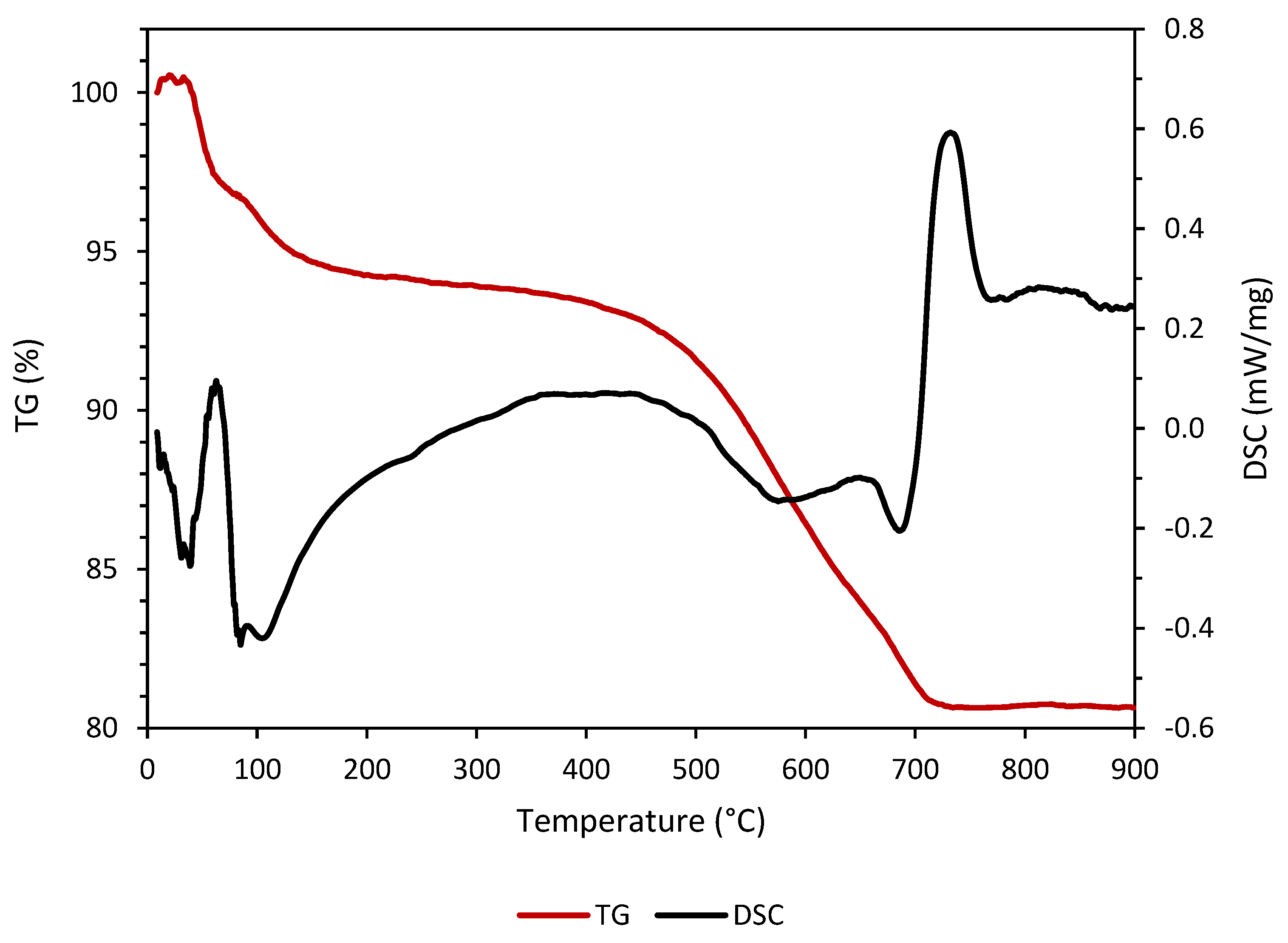
3.2.2. Effect of Roasting Temperature and Duration
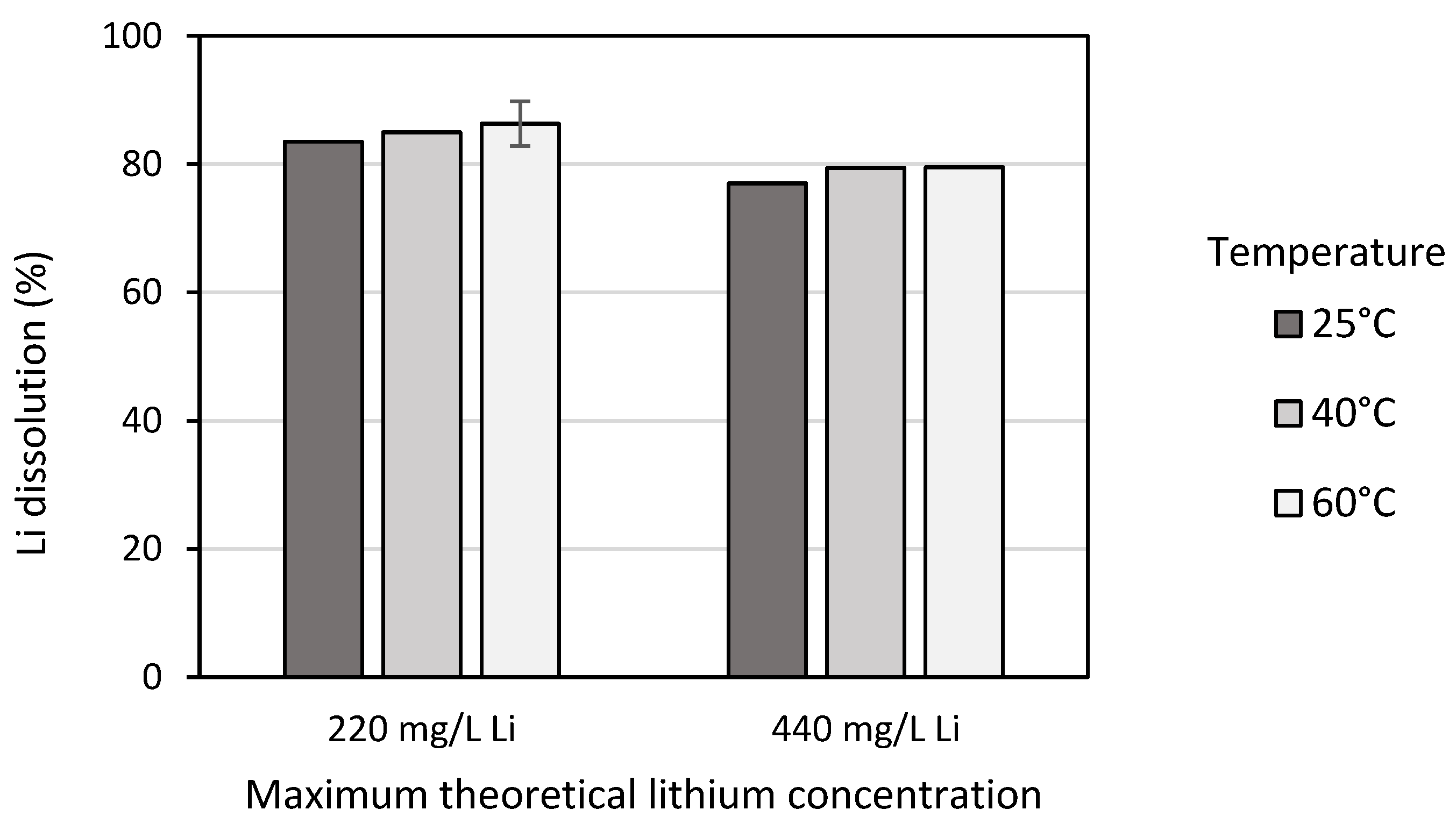
3.2.3. Effect of Leaching Conditions
3.3. Comparison to Acid Leaching
4. Conclusions
- The roast–leach process results in minimal co-dissolution of aluminium, iron, and magnesium (<5 mg/L), reducing the complexity of downstream solution purification.
- Roasting alters the clay’s swelling behaviour, enabling leaching at higher solids content, which yields higher lithium concentrations in the leach solution (up to 350 mg/L).
- The alkaline nature of the leach solution from the roast–leach process eliminates the need for neutralisation during downstream processing, thereby reducing chemical consumption.
Author Contributions
Funding
Data Availability Statement
Conflicts of Interest
Abbreviations
| DSC | Differential scanning calorimetry |
| GC-MS | Gas chromatography–mass spectrometry |
| ICP-OES | Inductively coupled plasma–optical emission spectroscopy |
| PLS | Pregnant leach solution |
| TGA | Thermogravimetric analysis |
| XRD | X-ray diffraction |
| XRF | X-ray fluorescence |
References
- Grant, A.; Goodenough, K. Is There Enough Lithium to Make All the Batteries? Jade Cove Partners: San Francisco, CA, USA, 2021. [Google Scholar]
- Grant, A. The Sedimentary Lithium Opportunity; Jade Cove Partners: San Francisco, CA, USA, 2019. [Google Scholar]
- Li, H.; Eksteen, J.; Kuang, G. Recovery of lithium from mineral resources: State-of-the-art and perspectives—A review. Hydrometallurgy 2019, 189, 105129. [Google Scholar] [CrossRef] [Scilit]
- American Battery Technology Company. ABTC Publishes Pre-Feasibility Study for Tonopah Flats Lithium Project. Available online: https://cleantechnica.com/2025/10/17/american-battery-technology-company-publishes-milestone-pre-feasibility-study-accelerating-commercialization-of-its-tonopah-flats-lithium-project-one-of-the-largest-lithium-resources-in-the-united-st/ (accessed on 25 October 2025).
- Madhiraju, P. Top 5 Sedimentary Lithium Projects to Watch in the U.S. After 2025. Available online: https://business-news-today.com/top-5-sedimentary-lithium-projects-to-watch-in-the-u-s-after-2025 (accessed on 20 October 2025).
- Plante, M.; Tseng, I. Rush for U.S. Lithium Production Encounters Tough Economics; Federal Reserve Bank of Dallas: Dallas, TX, USA, 2025; Available online: https://www.dallasfed.org/research/economics/2025/1014-plante-lithium (accessed on 21 October 2025).
- Iyer, R.K.; Kelly, J.C. Life-cycle analysis of lithium chemical production in the United States. RSC Sustain. 2024, 2, 3929–3945. [Google Scholar] [CrossRef] [Scilit]
- Garcia-Romero, E.; Lorenzo, A.; Garcia-Vicente, A.; Morales, J.; Garcia-Rivas, J.; Suarez, M. On the structural formula of smectites: A review and new data on the influence of exchangeable cations. J. Appl. Crystallogr. 2021, 54, 251–262. [Google Scholar] [CrossRef] [Scilit] [PubMed]
- Al-Ani, T.; Sarapää, O. Clay and Clay Mineralogy: Physical-Chemical Properties and Industrial Uses; Geological Survey of Finland: Espoo, Finland, 2008. [Google Scholar]
- Brindley, G.W.; Brown, G. Crystal Structures of Clay Minerals and Their X-Ray Identification; Mineralogical Society: London, UK, 1984. [Google Scholar]
- Odom, I.E. Smectite clay minerals: Properties and use. Philos. Trans. R. Soc. Lond. Ser. A Math. Phys. Sci. 1984, 311, 391–409. [Google Scholar] [CrossRef] [Scilit]
- Haller, C.P.; Dorfling, C. Evaluating environmentally friendly lixiviants for lithium recovery from montmorillonite clays. In Proceedings of the XXXI International Mineral Processing Congress, Washington, DC, USA, 29 September–3 October 2024; pp. 3387–3394. [Google Scholar]
- Samari, H.; Lane, T.; Harvey, J.T.; Moritz, R.; Rentschler, S. Preliminary Economic Assessment NI 43-101 Technical Report: Bonnie Claire Lithium Project, Nye County, Nevada, USA; Nevada Lithium Resources Inc.: Vancouver, BC, Canada, 2022. [Google Scholar]
- American Lithium Corp. American Lithium Obtains 82% Lithium Extraction Using Roasting and Water Leaching on TLC Claystones. Available online: https://americanlithiumcorp.com/american-lithium-obtains-82-lithium-extraction-using-roasting-and-water-leaching-on-tlc-claystones/ (accessed on 10 October 2025).
- Feng, B.; An, D.; Cheng, H.; Zhang, X.; Zhao, J. Leaching behavior and mechanisms of Li, Rb, K, Sr, and Mg in clay-type lithium ore via a roasting–water leaching process. Minerals 2025, 15, 944. [Google Scholar] [CrossRef] [Scilit]
- Qiu, H.; Shao, S.; Zhang, B.; Li, B.; Wang, H.; Wei, Y. A promising approach for efficient and selective extraction of lithium from clay-type lithium resource: Process optimization and reaction mechanism. Process Saf. Environ. Prot. 2025, 202, 106848. [Google Scholar] [CrossRef] [Scilit]
- Ran, Y.; Qu, G.; Yang, J.; Zhou, S.; Li, B.; Wang, H.; Wei, Y. Efficient separation and extraction of lithium from low-grade claystone by chloride salt-enhanced roasting process. J. Clean. Prod. 2024, 434, 140156. [Google Scholar] [CrossRef] [Scilit]
- Zhong, W.; Feng, H.; Tong, L.; Li, D.; Zhang, J. Lithium extraction from a Li-rich kaolin resource through Na2SO4 roasting and water leaching. Miner. Eng. 2024, 218, 109004. [Google Scholar] [CrossRef] [Scilit]
- Setoudeh, N.; Nosrati, A.; Welham, N.J. Lithium recovery from mechanically activated mixtures of lepidolite and sodium sulfate. Miner. Process. Extr. Metall. 2021, 130, 354–361. [Google Scholar] [CrossRef] [Scilit]
- Swain, B. Recovery and recycling of lithium: A review. Sep. Purif. Technol. 2017, 172, 388–403. [Google Scholar] [CrossRef] [Scilit]
- Vieceli, N.; Nogueira, C.A.; Pereira, M.F.C.; Dias, A.P.S.; Durão, F.O.; Guimarães, C.; Margarido, F. Optimisation of lithium extraction from lepidolite by roasting using sodium and calcium sulfates. Miner. Process. Extr. Metall. Rev. 2017, 38, 62–72. [Google Scholar] [CrossRef] [Scilit]
- Siame, E.; Pascoe, R.D. Extraction of lithium from micaceous waste from China clay production. Miner. Eng. 2011, 24, 1595–1602. [Google Scholar] [CrossRef] [Scilit]
- American Lithium Corp. Improved Salt Roast–Water Leaching Yields 89.4% Lithium Extraction. Available online: https://americanlithiumcorp.com/improved-salt-roast-water-leaching-yields-89-4-lithium-extraction/ (accessed on 10 October 2025).
- Crocker, L.; Lien, R.H.; May, J.T.; Witkowsky, D.S.; Seidel, D.C.; Davidson, C.F. Lithium and Its Recovery from Low-Grade Nevada Clays; Bulletin 691; U.S. Department of the Interior, Bureau of Mines: Washington, DC, USA, 1988.
- Edlund, V.E. Lime Gypsum Processing of McDermitt Clay for Lithium Recovery; No. 8832; US Department of the Interior, Bureau of Mines: Washington, DC, USA, 1983.
- Obut, A.; Aktosun, Z.; Girgin, İ.; Deveci, H.; Yörükoğlu, A. Characterization and treatment of clayey waste using a sulfuric acid roasting–water leaching process for the extraction of lithium. Physicochem. Probl. Miner. Process. 2022, 58, 149635. [Google Scholar] [CrossRef] [Scilit]
- Deng, Q.; Feng, J.-R. Systematic review of sulfate roasting for lithium extraction from lepidolite: From fundamental mechanisms to industrial application. Results Chem. 2026, 20, 103035. [Google Scholar] [CrossRef] [Scilit]
- Derkowski, A.; Kuligiewicz, A. Thermal analysis and thermal reactions of smectites: A review of methodology, mechanisms and kinetics. Clays Clay Miner. 2023, 70, 946–972. [Google Scholar] [CrossRef] [Scilit]
- Fang, Y.; Ritter, C.; White, T. The crystal chemistry of Ca10−y(SiO4)3(SO4)3Cl2−x−2yFx ellestadite. Inorg. Chem. 2011, 50, 12641–12650. [Google Scholar] [CrossRef] [Scilit] [PubMed]
- Krejsová, J.; Kužel, R.; Keppert, M.; Scheinherrová, L.; Vimmrová, A. New insight into the phase changes of gypsum. Mater. Struct. 2024, 57, 128. [Google Scholar] [CrossRef] [Scilit]
- Velraj, G.; Seetha, D.; Hemamalini, R. FT-IR, XRD, porosity and TG-DTA analysis of archaeological potteries excavated from Kottapuram, Kerala, South India. Vib. Spectrosc. 2014, 66, 208–215. [Google Scholar]
- Trindade, M.J.; Dias, M.I.; Coroado, J.; Rocha, F. Mineralogical transformations of calcareous rich clays with firing: A comparative study between calcite- and dolomite-rich clays from Algarve, Portugal. Appl. Clay Sci. 2009, 42, 345–355. [Google Scholar] [CrossRef] [Scilit]



| Phase Amount (wt%) | ||||||
|---|---|---|---|---|---|---|
| Dolomite | Calcite | Quartz | Orthoclase | Smectite | Muscovite | Anorthite |
| 38.6 | 16.3 | 5.3 | 4.5 | 18.0 | 2.5 | 15.0 |
| Metal Composition (wt%) | ||||||
|---|---|---|---|---|---|---|
| Al | Ca | Fe | K | Li | Mg | Na |
| 2.3 | 8.2 | 1.5 | 1.7 | 0.065 | 10.1 | 2.2 |
| Parameter | Roast–Leach 1 | Sulphuric Acid Leach | Oxalic Acid Leach | |
|---|---|---|---|---|
| % Solids | 30 | 46 | 12 | 12 |
| Acid conc. (M) | - | - | 2 | 1.5 |
| Temperature (°C) | 60 | 60 | 60 | 60 |
| Leaching time (h) | 2 | 2 | 6 | 6 |
| % Li dissolution | 86.3% | 79.5% | 93% | 68% |
| Final pH | 10.5 | 10.8 | 0.5 | 1.2 |
| Li (mg/L) | 191 | 351 | 129 | 108 |
| Al (mg/L) | <5 | <5 | 1480 | 1713 |
| Ca (mg/L) | 676 | 644 | 641 | 68 |
| Fe (mg/L) | <5 | <5 | 1760 | 2120 |
| K (mg/L) | 4240 | 7900 | 1100 | 1100 |
| Mg (mg/L) | <5 | <5 | 17,800 | 1850 |
| Na (mg/L) | 22,200 | 38,600 | 3000 | 2440 |
Disclaimer/Publisher’s Note: The statements, opinions and data contained in all publications are solely those of the individual author(s) and contributor(s) and not of MDPI and/or the editor(s). MDPI and/or the editor(s) disclaim responsibility for any injury to people or property resulting from any ideas, methods, instructions or products referred to in the content. |
© 2026 by the authors. Licensee MDPI, Basel, Switzerland. This article is an open access article distributed under the terms and conditions of the Creative Commons Attribution (CC BY) license.
Share and Cite
Haller, C.P.; Dorfling, C. Lithium Recovery from Smectite Clays via Sulphate Roasting and Water Leaching. Minerals 2026, 16, 760. https://doi.org/10.3390/min16070760
Haller CP, Dorfling C. Lithium Recovery from Smectite Clays via Sulphate Roasting and Water Leaching. Minerals. 2026; 16(7):760. https://doi.org/10.3390/min16070760
Chicago/Turabian StyleHaller, Cara Philipa, and Christie Dorfling. 2026. "Lithium Recovery from Smectite Clays via Sulphate Roasting and Water Leaching" Minerals 16, no. 7: 760. https://doi.org/10.3390/min16070760
APA StyleHaller, C. P., & Dorfling, C. (2026). Lithium Recovery from Smectite Clays via Sulphate Roasting and Water Leaching. Minerals, 16(7), 760. https://doi.org/10.3390/min16070760