Oolitic Ironstones and Carbonate Mn Ores of the Marsyaty Deposit (Northern Urals, Russia): A Key Study of Mineralogy and Geochemistry
 , , and
Abstract
1. Introduction
2. Geological Background
3. Materials and Methods
4. Results
- -
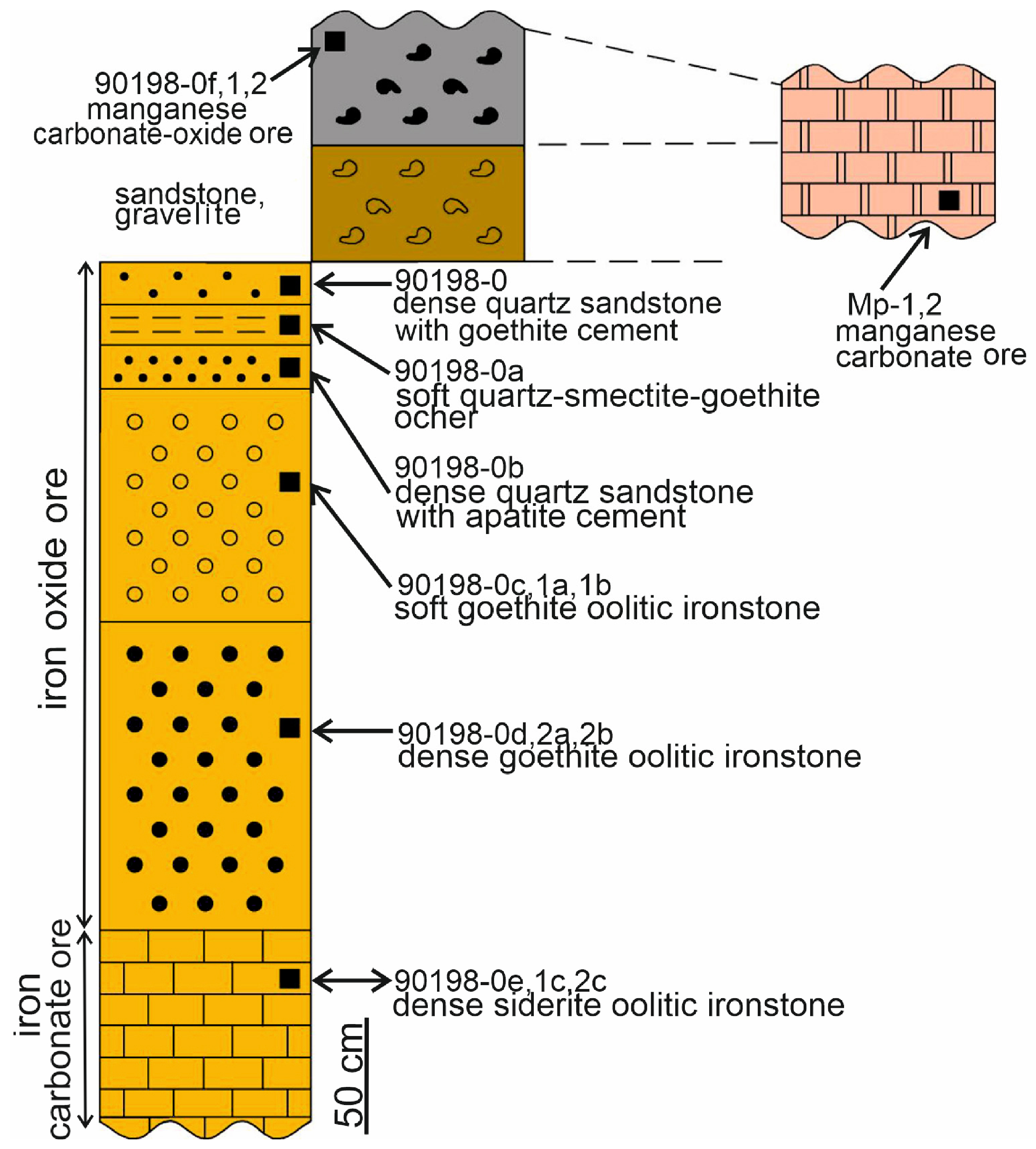
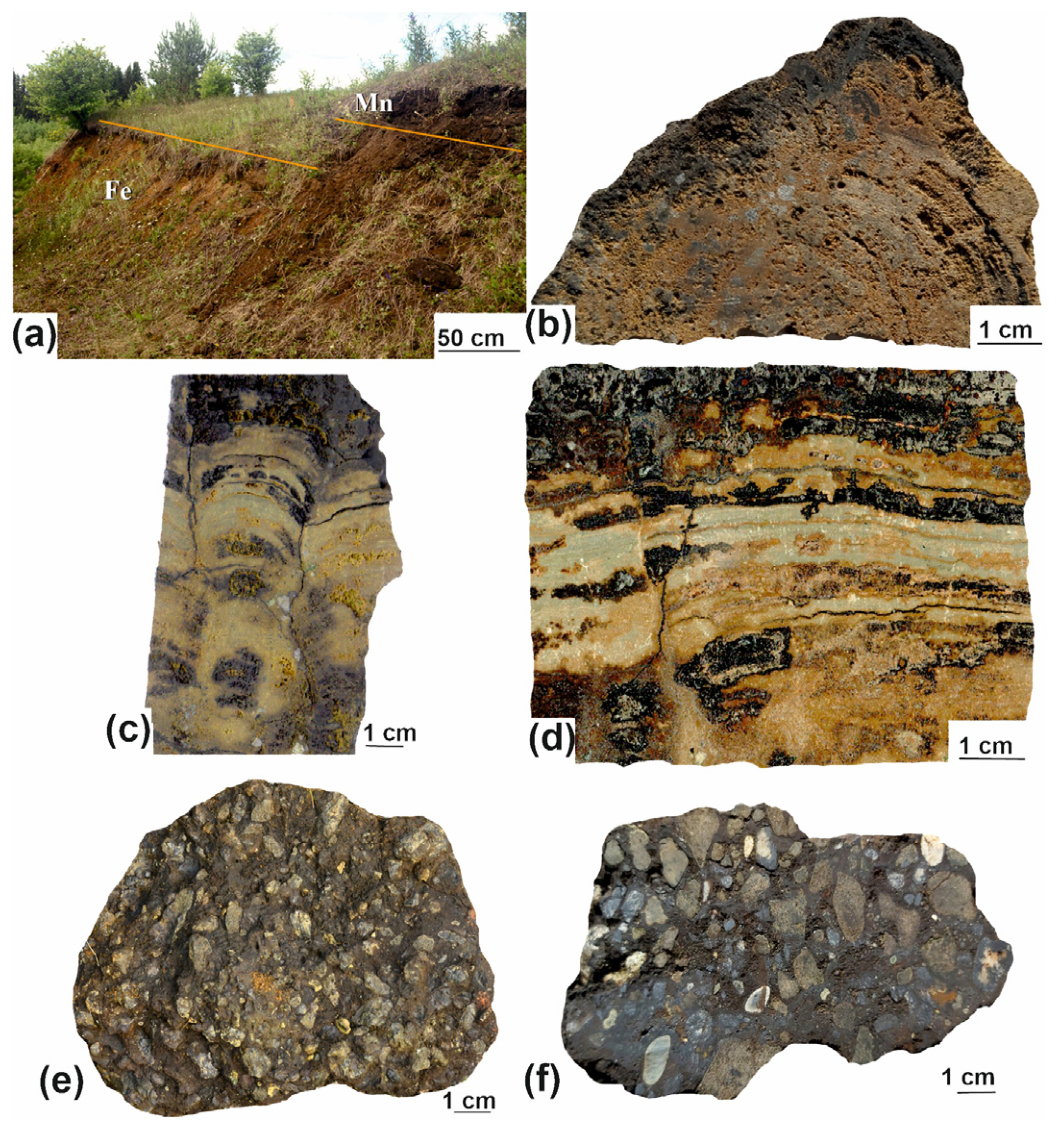
- Dense, unsorted, medium- to fine-grained mostly quartz sandstone with limonite (a mixture of goethite and amorphous Fe oxihydroxides) cement and rare glauconite grains (15 cm thick),
- -
- Loose quartz–smectite–limonite ocher (20 cm thick);
- -
- Dense, mostly quartz sandstone with apatite–goethite cement, goethite and apatite–goethite ooids, and rare bean-like bauxite grains (20 cm thick);
- -
- Loose goethite oolitic ironstone (1 m thick);
- -
- Dense platy goethite oolitic ironstone (1.2 m thick);
- -
- Dense, mostly siderite oolitic ironstone with calcite veinlets along fractures (visible thickness: 0.5 m).
4.1. Petrography and Mineralogy
4.1.1. Iron Ores
4.1.2. Manganese Ores
4.2. Chemical Composition of Ores
5. Discussion
- The ores are sedimentary, as evidenced by their textural features: alternating coarse- and fine-clastic beds with varying contents of unaltered detritus and abundant organic remains with preserved cellular texture, as well as colloform, water-bearing Fe oxyhydroxides and phyllosilicates.
- The iron and manganese ores have different ages because they are separated by a bed of unsorted coarse-clastic sediments with detrital fragments of Mn carbonates.
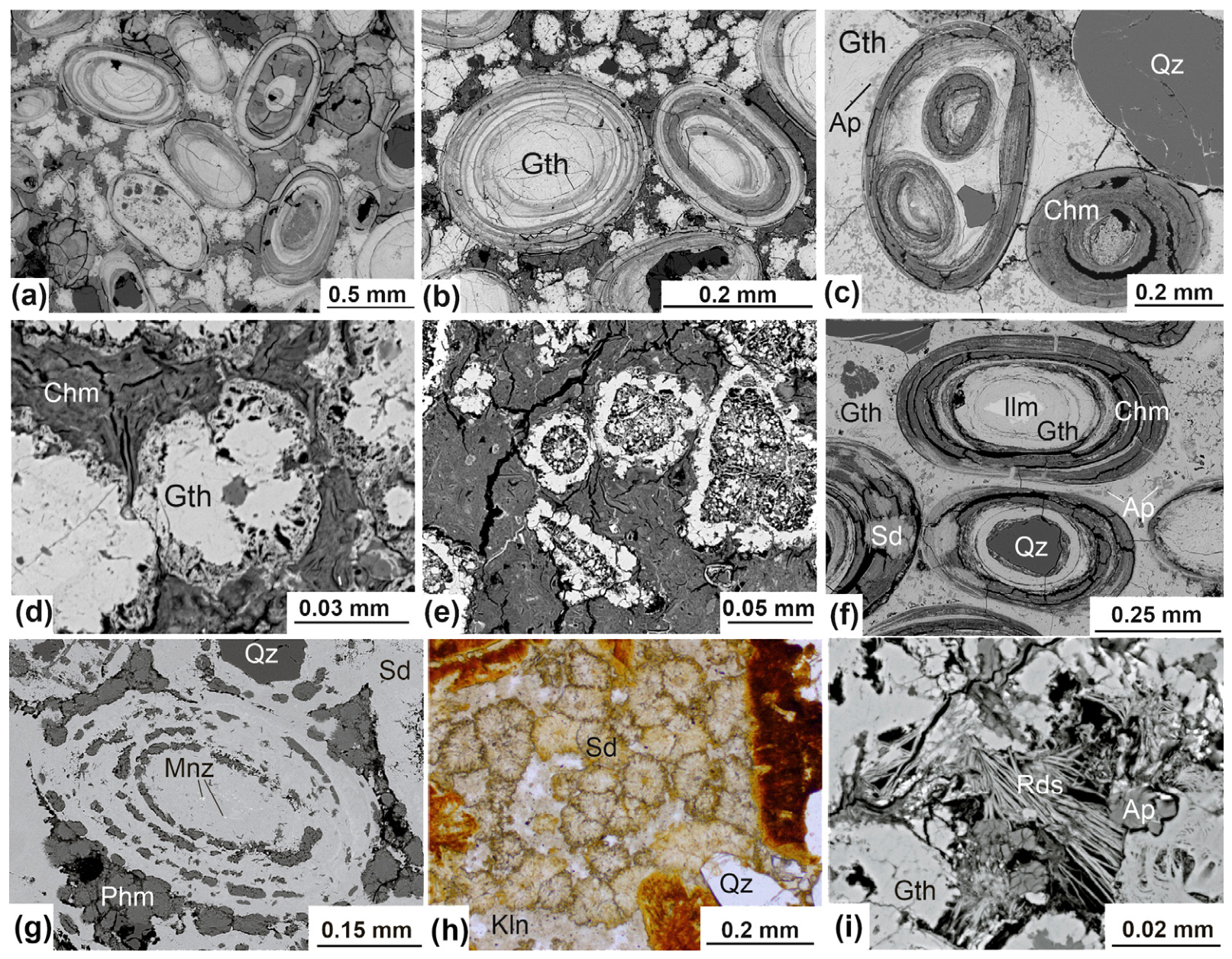
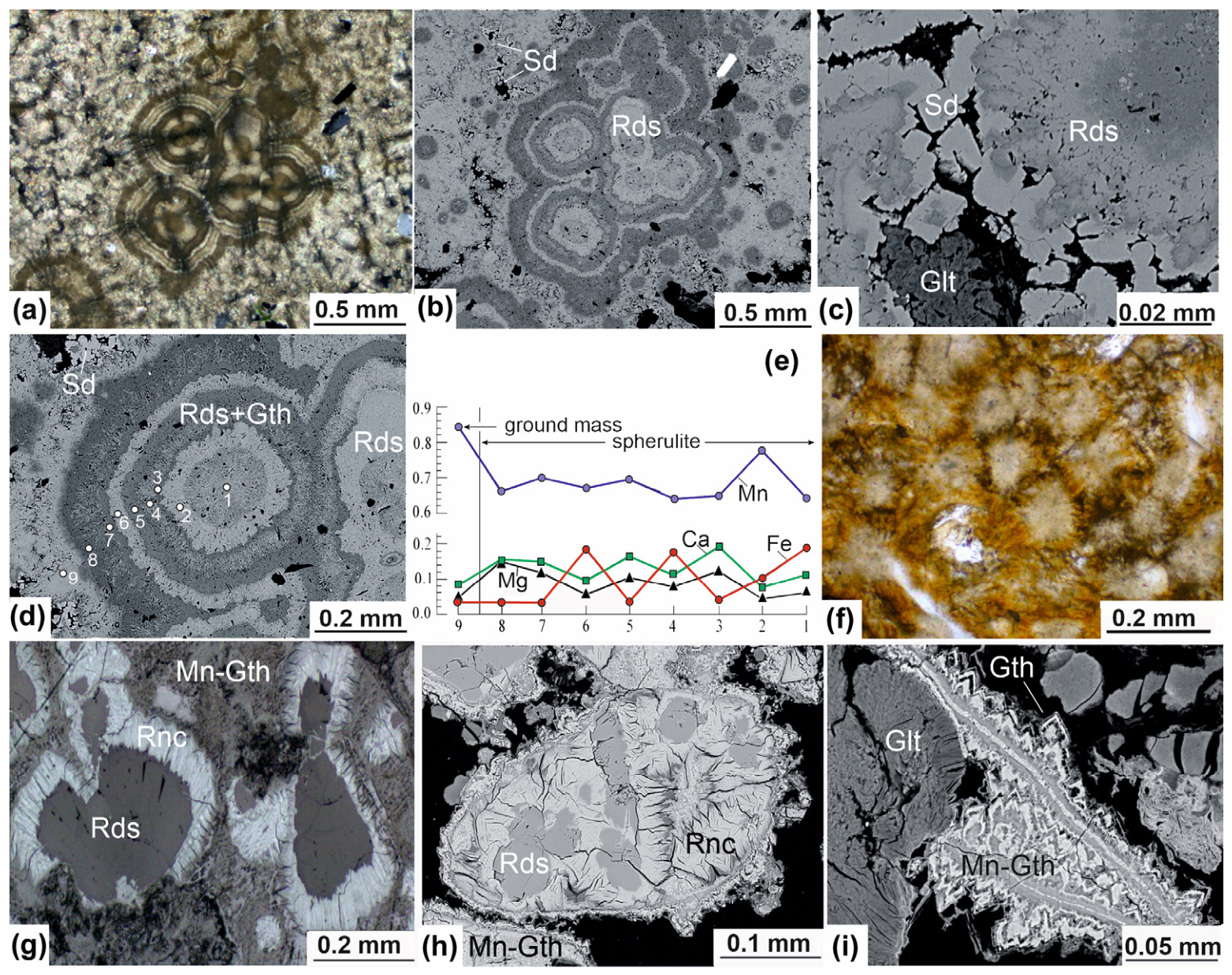
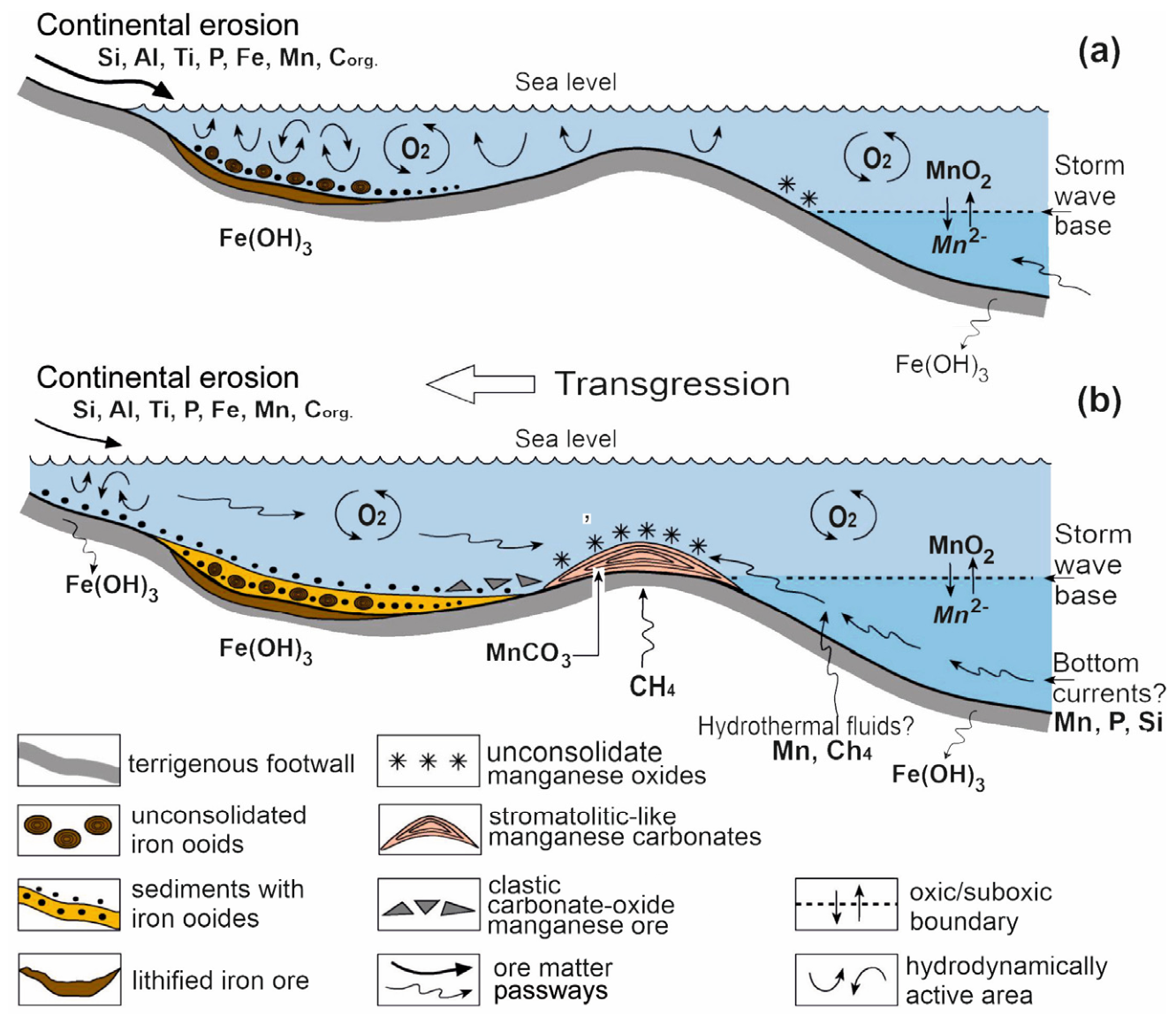
- The earliest minerals of the iron ores include Fe oxyhydroxides (goethite) and chamosite, which compose the ooids. The presence of ooid clasts as the cores of new ooids suggests their formation under active hydrodynamic conditions. The authigenic minerals of the ooids and cement have similar compositions but different structures. These differences are likely due to different dynamic conditions during primary accumulation: more mobile ooids and more stable cement. In the manganese ores, the rhodochrosite spherulites are the earliest minerals.
- Siderite in the iron carbonate ores formed after the Fe oxyhydroxides and chamosite in the ooids. Siderite microspherulites in the cement show no signatures of replacement of the primary oxide and silicate–iron substrate, i.e., they could have formed in porous non-lithified sediment. The manganese carbonate–oxide ores contain fragments of rhodochrosite spherulites, which are similar to those in the manganese carbonate ores. The rhodochrosite spherulites were apparently sourced from the eroded carbonate–manganese strata.
6. Conclusions
Supplementary Materials
Author Contributions
Funding
Data Availability Statement
Acknowledgments
Conflicts of Interest
Abbreviations
References
- Varentsov, I.M.; Rakhmanov, V.P. Manganese deposits. In Ore Deposits of the USSR, 2nd ed.; Smirnov, V.I., Ed.; Nedra: Moscow, Russia, 1978; Volume 1, pp. 112–171. (In Russian) [Google Scholar]
- Maynard, B. Geochemistry of Sedimentary Ore Deposits; Springer: Berlin, Germany, 1983; 306p. [Google Scholar]
- Roy, S. Manganese Deposits; Academic Press: London, UK, 1981; 458p. [Google Scholar]
- Brusnitsyn, A. Geochemistry and genetic model of the ore-bearing sediments of the Parnok ferromanganese deposit, Polar Urals. Geochem. Int. 2013, 51, 623–645. [Google Scholar] [CrossRef] [Scilit]
- Kuleshov, V.N. Manganese Rocks and Ores: Geochemistry of Isotopes, Genesis, Evolution of Ore Genesis; Scientific World: Moscow, Russia, 2013; 506p. (In Russian) [Google Scholar]
- Maynard, J.B. Manganiferous sediments, rocks and ores. In Treatise on Geochemistry, 2nd ed.; Holland, H., Turekian, K., Eds.; Elsevier: Amsterdam, The Netherlands, 2014; Volume 9, pp. 327–349. [Google Scholar]
- Kholodov, V.N.; Nedumov, R.I.; Golubovskaya, E.V. Facies types of sedimentary iron ore deposits and their geochemical features: Communication 2. Problems of the geochemistry of phanerozoic iron ores. Lithol. Min. Resour. 2013, 48, 14–47. [Google Scholar] [CrossRef] [Scilit]
- Baioumy, H.M.; Ahmed, A.H.; Khedr, M.Z. A mixed hydrogenous and hydrotermal origin of the Bahariya iron ores, Egypt: Evidences from the trance and rare earth element geochemistry. J. Geochem. Explor. 2014, 146, 149–162. [Google Scholar] [CrossRef] [Scilit]
- Ramanaidou, E.R.; Wells, M.A. Sedimentary hosted iron ores. In Treatise on Geochemistry, 2nd ed.; Holland, H., Turekian, K., Eds.; Elsevier: Amsterdam, The Netherlands, 2014; Volume 13, pp. 313–355. [Google Scholar]
- Sokol, E.V.; Kokh, S.N.; Kozmenko, O.A.; Nekipelova, A.V.; Rudmin, M.; Khvorov, P.V.; Artemyev, D.A. Geochemistry and mineralogy of rate elements in high-phosphorus ooidal ironstones: A case study of the Kamysh-Burun deposits (Azov-Black sea privince). Ore Geol. Rev. 2020, 127, 103827. [Google Scholar] [CrossRef] [Scilit]
- Rabinovich, S.D. North Ural Manganese Ore Basin; Nedra: Moscow, Russia, 1971; 264p. (In Russian) [Google Scholar]
- Kontar, E.S.; Savelyeva, K.P.; Surganov, A.V.; Aleshin, B.M.; Shishkin, M.A.; Gerasimov, N.N.; Kostromin, D.A.; Papulova, O.B.; Sergeeva, V.V. Manganese Deposits of the Urals; Uralgeolkom: Ekaterinburg, Russia, 1999; 120p. (In Russian) [Google Scholar]
- Mikhailov, B.M. Actual Problems of Prediction of Manganese Deposits in the Urals. Lithol. Min. Resour. 2001, 36, 1–12. [Google Scholar] [CrossRef] [Scilit]
- Rudmin, M.; Mazurov, A.; Banerjee, S. Origin of ooidal ironstones in relation to warming events: Cretaceous-Eocene Bakchar deposit, south-east Western Siberia. Mar. Pet. Geol. 2019, 100, 309–325. [Google Scholar] [CrossRef] [Scilit]
- Maximov, P.; Rudmin, M. Origin of Upper Cretaceous marine ironstones of Ayat Formation (Turgay depression, Northern Kazakhstan). Solid. Earth Sci. 2023, 8, 1–11. [Google Scholar] [CrossRef] [Scilit]
- Surkov, V.S.; Korobeynikov, V.P.; Smirnov, L.V. Atlas of Paleotectonic and Paleogeological-Landscape Maps of Hydrocarbon Provinces of Siberia; Surkov, V.S., Ed.; SNIIGG&MS: Novosibirsk, Russia, 1995. [Google Scholar]
- Umova, L.A. Petrographic Study of Cretaceous and Paleogene Deposits Containing Iron and Manganese Ores in the Northern Urals (Marsyaty Deposit); Ural Geological Directorate for Metal Prospecting and Exploration: Sverdlovsk, Russia, 1949; 136p. (In Russian) [Google Scholar]
- Belogub, E.V.; Novoselov, K.A.; Brusnitsyn, A.I.; Rassomakhin, M.A.; Bocharov, V.N. Mineral forms of phosphorus in oolitic iron ores of the Marsyaty deposit (Northern Urals). Geol. Ore Depos. 2026, 68, 518–537. [Google Scholar] [CrossRef] [Scilit]
- Brusnitsyn, A.I.; Belogub, E.V.; Novoselov, K.A.; Platonova, N.V.; Vlasenko, N.S.; Bocharov, V.N. Perchamite from oolitic iron ores of the Marsyaty deposit (Northern Urals). Proc. Russ. Mineral. Soc. 2025, 154, 58–75. (In Russian) [Google Scholar]
- Lisov, N.S.; Korovin, N.F. State Geological Map of the USSR, Scale 1:200,000; Middle Ural Series. Sheet O-41-I; All-Union Geological Institute (VSEGEI): St. Petersburg, Russia, 1971; 173p. (In Russian) [Google Scholar]
- Li, Y.-H.; Schoonmaker, J.E. Chemical composition and mineralogy of marine sediments. In Treatise on Geochemistry. Sediments, Diagenesis, and Sedimentary Rocks; Mackenzie, F.T., Ed.; Elsevier: Amsterdam, The Netherlands, 2003; Volume 7, pp. 1–35. [Google Scholar]
- Kontorovich, A.E.; Ershov, S.V.; Kazanenkov, V.A.; Karogodin, Y.U.N.; Kontorovich, V.A.; Lebedeva, N.K.; Nikitenko, B.L.; Popova, N.I.; Shurygin, B.N. Cretaceous paleogeography of the West Siberian sedimentary basin. Russ. Geol. Geophys. 2014, 55, 582–609. [Google Scholar] [CrossRef] [Scilit]
- Novoselov, K.A.; Belogub, E.V.; Kotlyarov, V.V.; Filippova, K.A.; Sadykov, S.A. Mineralogical and geochemical features of oolitic ironstones from the Sinara-Techa deposit, Kurgan district, Russia. Geol. Ore Depos. 2018, 60, 265–276. [Google Scholar] [CrossRef] [Scilit]
- Umova, L.A.; Tsaur, G.I.; Shatrov, V.P. Paleogeography of the Eastern Slope of the Urals and Trans-Urals in Cretaceous and Paleocene Times; Ufa Branch of the USSR Academy of Sciences: Sverdlovsk, Russia, 1968; 84p. (In Russian) [Google Scholar]
- Sigov, A.P. Metallogeny of the Mesozoic and Cenozoic of the Urals; Nedra: Moscow, Russia, 1969; 296p. (In Russian) [Google Scholar]
- Papulov, G.N. Cretaceous Deposits of the Urals (Stratigraphy, Paleogeography, Paleotectonics); Nauka: Moscow, Russia, 1974; 203p. (In Russian) [Google Scholar]
- Amon, E.O. Marine waters of the Ural region in the Middle and Late Cretaceous. Geol. Geophys. 2001, 42, 471–483. (In Russian) [Google Scholar]
- Kholodov, V.N. Geochemistry of the Sedimentary Process; GEOS: Moscow, Russia, 2006; 680p. (In Russian) [Google Scholar]
- Bentor, Y.; Kastner, M. Notes on the mineralogy and origin of glauconite. J. Sediment. Petrol. 1965, 35, 155–166. [Google Scholar] [CrossRef] [Scilit]
- Banerjee, S.; Bansal, U.; Thorat, A.V. A review on palaeogeographic implications and temporal variation in glaucony composition. J. Palaeogeogr. 2016, 5, 43–71. [Google Scholar] [CrossRef] [Scilit]
- Velde, B. Green clay minerals. In Treatise on Geochemistry. Sediments, Diagenesis, and Sedimentary Rocks; Mackenzie, F.T., Ed.; Elsevier: Amsterdam, The Netherlands, 2003; Volume 7, pp. 309–324. [Google Scholar]
- Belousov, P.E.; Chupalenkov, N.M.; Rudmin, M.A.; Krupskaya, V.V. Glauconite deposits in Russia; geological position, formation conditions, and development perspectives. Lithol. Miner. Resour. 2022, 3, 234–247. [Google Scholar] [CrossRef] [Scilit]
- Johnson, H.D.; Baldwin, C.T. Shallow siliciclastic seas. In Sedimentary Environments and Facies; Reading, H.G., Ed.; Blackwell Scientific Publications: Hoboken, NJ, USA, 1985; pp. 229–282. [Google Scholar]
- Yudovich, Y.E.; Ketris, M.P. Mineral Indicators of Lithogenesis; Geoprint: Syktyvkar, Russia, 2008; 564p. (In Russian) [Google Scholar]
- Betekhtin, A.G. Industrial Manganese Ores of the USSR; Publishing House of the USSR Academy of Sciences: Moscow, Russia, 1946; 315p. [Google Scholar]
- Puchkov, V.N. General features relating to the occurrence of mineral deposits in the Urals: What, where, when and why. Ore Geol. Rev. 2017, 85, 4–29. [Google Scholar] [CrossRef] [Scilit]
- Asochakova, E.M. Mineralogical and Geochemical Characteristics of Iron Accumulation in the Cretaceous–Palaeogene Strata of Western Siberia, as Illustrated by the Bakchar Deposit. Ph.D. Thesis, Tomsk State University, Tomsk, Russia, 2013; 193p. (In Russian) [Google Scholar]
- Elliott, T. Siliciclastic shorelines. In Sedimentary Environments and Facies, 2nd ed.; Reading, H.G., Ed.; Blackwell Scientific Publications: Hoboken, NJ, USA, 1986; pp. 155–228. [Google Scholar]
- Baioumy, H.; Omran, M.; Fabritius, T. Minqralogy, geochemistry and origin of high-phosphorus oolitic iron ores of Aswan, Egypt. Ore Geol. Rev. 2017, 80, 185–199. [Google Scholar] [CrossRef] [Scilit]
- Han, K.; Han, Z.; Garzanti, E.; Zhu, S.; Yao, H.; Guo, H.; Liu, X.; Wang, C. Middle Jurassic ooidal ironstones (southern Tibet): Formation processes and implications for the paleoceanography of eastern Neo-Tethys. Front. Earth Sci. 2023, 10, 1055957. [Google Scholar] [CrossRef] [Scilit]
- Yudovich, Y.A.E.; Ketris, M.P. Geochemistry and Mineralogy of Phosphorus as Indicators of Geological Processes; GEOPRINT: Syktyvkar, Russia, 2023; 196p. (In Russian) [Google Scholar]
- Kalinina, N.; Maximov, P.; Molukpayeva, D.; Sherstyukov, M.; Kerimov, A.; Rudmin, M. Depositional paleoenvironment of the Middle Jurassic (Aalenian) ooidal ironstones in Labino-Malkin zone (north-western Caucasus). Mar. Pet. Geol. 2024, 162, 106744. [Google Scholar] [CrossRef] [Scilit]
- Dubinin, A.V. Geochemistry of Rare Earth Elements in the Ocean; Nauka: Moscow, Russia, 2006; 359p. (In Russian) [Google Scholar]
- Bau, M.; Scmidt, K.; Koschinsky, A.; Hein, J.; Kuhn, T.; Usui, A. Discriminating between different genetic types of marine ferro-manganese crusts and nodules on rare earth elements and yttrium. Chem. Geol. 2014, 381, 1–9. [Google Scholar] [CrossRef] [Scilit]
- Tostevin, R.; Shields, A.G.; Tarbuck, G.M.; He, T.; Clarkson, M.O.; Wood, R.A. Effective use of cerium anomalies as a redox proxy in carbonate-dominated marine settings. Chem. Geol. 2016, 438, 146–162. [Google Scholar] [CrossRef] [Scilit]
- Brusnitsyn, A.I.; Zhukov, I.G.; Letnikova, E.F. Geochemistry of rare and Rare-Earth elements in manganiferous sediments of the Polar Urals and Pai-Khoi. Lithol. Min. Resour. 2020, 55, 36–54. [Google Scholar] [CrossRef] [Scilit]
- Nekipelova, A.V. Rare earth elements in Kerch iron ores: Distribution features and occurrence forms. In Abstract of Dissertation of Candidate of Science; IGM SB RAS: Novosibirsk, Russia, 2023. (In Russian) [Google Scholar]
- Sasmaz, A.; Sasmaz, B.; Hein, J. Geochemical approach to the genesis of the Oligocene-stratiform manganese-oxide deposit, Chiatura (Georgia). Ore Geol. Rev. 2021, 128, 103910. [Google Scholar] [CrossRef] [Scilit]
- Sasmaz, A.; Zagnitko, V.; Sasmaz, B. Major, trace and rare earth element (REE) geochemistry of the Oligocene stratiform manganese oxide-hydroxide deposits in the Nikopol, Ukraine. Ore Geol. Rev. 2020, 126, 103772. [Google Scholar] [CrossRef] [Scilit]
- Afify, M.; Sanz-Montero, M.E.; Calvo, J.P. Differentiation of ironstone types by using rare earth elements and yttrium geochemistry—A case study from the Bahariya region, Egypt. Ore Geol. Rev. 2018, 96, 247–281. [Google Scholar] [CrossRef] [Scilit]
- Li, D.; Zhang, Z.; Chi, R.; Chen, Z.; Wu, H.; Deng, X.; Liu, D.; Guo, W. Adsorption Behavior Mechanism of Rare Earths by Iron Oxide–Clay. Miner. Compos. 2026, 16, 198. [Google Scholar] [CrossRef] [Scilit]
- Borst, A.M.; Smith, M.P.; Finch, A.A.; Estrade, G.; Villanova-de-Benavent, C.; Nason, P.; Marquis, E.; Horsburgh, N.J.; Goodenough, K.M.; Xu, C.; et al. Adsorption of rare earth elements in regolith-hosted clay deposits. Nat. Commun. 2020, 11, 4386. [Google Scholar] [CrossRef] [Scilit] [PubMed]
- Liu, H.; Pourret, O.; Guo, H.; Bonhoure, J. Rare earth elements sorption to iron oxyhydroxide: Model development and application to groundwater. Appl. Geochem. 2017, 87, 158–166. [Google Scholar] [CrossRef] [Scilit]
- Kuleshov, V.N. Evolution of isotopic carbon dioxide-water systems in lithogenesis: Comminication 1. Sedimentogenesis and diagenesis. Lithol. Min. Resour. 2001, 36, 429–444. [Google Scholar] [CrossRef] [Scilit]
- Hoefs, J. Stable Isotope Geochemistry; Springer: Berlin/Heidelberg, Germany, 2018; 437p. [Google Scholar]
- Rudmin, M.; Banerjee, S.; Sinkina, E.; Ruban, A.; Kalinina, N.; Smirnov, P. A study of iron carbonates and clay minerals for understanding the origin of marine ooidal ironstone deposits. Mar. Pet. Geol. 2022, 142, 105777. [Google Scholar] [CrossRef] [Scilit]
- Fairbridge, R.W. Phases of diagenesis and authigenesis. In Diagenesis in Sediments; Larsen, G., Chilingar, G.V., Eds.; Elsevier: Amsterdam, The Netherlands, 1967; pp. 19–89. [Google Scholar]
- Hein, J.R.; Koski, R.A. Bacterially mediated diagenetic origin for chert-hosted manganese deposits in the Franciscan Complex, California Coast Ranges. Geology 1987, 15, 722–726. [Google Scholar] [CrossRef] [Scilit]
- Lein, A.Y.; Gorshkov, A.I.; Pimenov, N.V.; Bogdanov, Y.A.; Vogt, P.; Bogdanova, O.Y.; Kuptsov, V.M.; Ul’anova, N.V.; Sagalevich, A.M.; Ivanov, M.V. Authigenic carbonates in methane seeps from the Norwegian sea: Mineralogy, geochemistry, and genesis. Lithol. Min. Resour. 2000, 35, 295–310. [Google Scholar] [CrossRef] [Scilit]
- Belenkaya, I.Y. Influence of hydrocarbon gases on authigenic mineral formation in cold seep sediments. Bull. Mosc. Univ. Ser. 4 Geol. 2003, 3, 15–21. (In Russian) [Google Scholar]
- Kuleshov, V.N.; Brusnitsyn, A.I. Isotopic composition (δC13, δO18) and the origin of carbonates from manganese deposits of the Southern Urals. Lithol. Min. Resour. 2005, 40, 416–429. [Google Scholar] [CrossRef] [Scilit]
- Hiruta, A.; Klugel, A.; Matsumoto, R. Increase in methane flux and dissociation of iron and manganese oxides recorded in a methane-derived carbonate nodule in the eastern margin of the Sea of Japan. GeoResJ 2016, 9–12, 104–116. [Google Scholar] [CrossRef] [Scilit]
- Ruban, A.; Rudmin, M.; Mazurov, A.; Chernykh, D.; Dudarev, O.; Semiletov, I. Cold-seep carbonates of the Laptev Sea continental slope: Constraints from fluid sources and environment of formation. Chem. Geol. 2022, 610, 121103. [Google Scholar] [CrossRef] [Scilit]
- Kimberley, M.M. Origin of oolitic iron formations. J. Sediment. Petrol. 1979, 49, 111–131. [Google Scholar] [CrossRef] [Scilit]
- Van Houten, F.; Bhattacharyya, D. Phanerozoic Oolitic Ironstones—Geologic Record and Facies Model. Annu. Rev. Earth Planet. Sci. 1982, 10, 441–457. [Google Scholar] [CrossRef] [Scilit]
- Pavlov, D.I. Relationship of sedimentary deposits of iron and manganese with oil and gas basins. Geol. Ore Depos. 1989, 2, 80–91. (In Russian) [Google Scholar]
- Frakes, L.; Bolton, B. Effects of oceanic chemistry, sea level, and climate on the formation of primary sedimentary manganese ore deposits. Econ. Geol. 1992, 87, 1207–1217. [Google Scholar] [CrossRef] [Scilit]
- Kimberley, M.M. Debate about ironstone: Has solute supply been surficial weathering, hydrothermal convection, or exhalation of deep fluids? Terra Nova 1994, 6, 116–132. [Google Scholar] [CrossRef] [Scilit]
- Young, T.P. Phanerozoic ironstones: An introduction and review. In Phanerozoic Ironstones; Young, T.P., Tailor, W.E.G., Eds.; GSL: London, UK, 1989; pp. 9–25. [Google Scholar]
- Kholodov, V.N.; Nedumov, R.I. Association of manganese ore and phosphorite-bearing facies in sedimentary sequences: Communication 1. Parastereses and parageneses of phosphorus and manganese in Mesozoic-Cenozoic and Upper Paleozoic rocks. Lithol. Min. Resour. 2009, 44, 1–18. [Google Scholar] [CrossRef] [Scilit]
- Dellwig, O.; Leipe, T.; Marz, C.; Glockzin, M.; Pollehne, F.; Schnetger, B.; Yakushev, E.V.; Bottcher, M.E.; Brumsack, H.-J. A new particulate Mn–Fe–P at the redoxcline of anoxic basin. Geochim. Cosmochim. Acta 2010, 74, 7100–7115. [Google Scholar] [CrossRef] [Scilit]
- Ossa, F.O.; Hofmann, A.; Wille, M.; Spangenberg, J.E.; Bekker, A.; Poulton, S.W.; Eickmann, B.; Schoenberg, R. Aerobic iron and manganese cycling in a redox-stratified Mesoarchean epicontinental sea. Earth Planet. Sci. Lett. 2018, 500, 28–40. [Google Scholar] [CrossRef] [Scilit]
- Matheson, E.J.; Malone, J.D.; Pufahl, P.K.; Hiatt, E.E. Late Ordovician ironstone and its relation to ocean redox instability, climate and glaciation. Sedimentology 2024, 72, 631–665. [Google Scholar] [CrossRef] [Scilit]
- Kalinina, N.; Rudmin, M.; Sherstyukov, M.; Maximov, P.; Kerimov, A. Origin of iron-rich minerals, ooids and pisoids in the Jurassic ooidal ironstones of the Labino-Malkin region (Caucasus). J. Palaeogeogr. 2024, 13, 475–494. [Google Scholar] [CrossRef] [Scilit]
- Brusnitsyn, A.I.; Kuleshov, V.N.; Perova, E.N.; Zaitsev, A.N. Ferromanganese carbonate metasediments of the Sob area, Polar Urals: Bedding conditions, composition, and genesis. Lithol. Min. Resour. 2017, 52, 192–213. [Google Scholar] [CrossRef] [Scilit]
- Calvert, S.E.; Pedersen, T.F. Sedimentary geochemistry of manganese: Implications for the environment of formation of manganiferous black shale. Econ. Geol. 1996, 91, 36–47. [Google Scholar] [CrossRef] [Scilit]
- Konhauser, K. Introduction to Geomicrobiology; Blackwell Publishing: Hoboken, NJ, USA, 2007; 425p. [Google Scholar]
- Pinevich, A.V. Microbiology of Iron and Manganese; St. Petersburg State University Press: St. Petersburg, Russia, 2005; 374p. (In Russian) [Google Scholar]
- Tebo, B.M.; Johnson, H.A.; McCarthy, J.K.; Templeton, A.S. Geomicrobiology of manganese(II) oxidation. Trends Microbiol. 2005, 13, 421–428. [Google Scholar] [CrossRef] [Scilit] [PubMed]
- Learman, D.R.; Wankel, S.D.; Webb, S.M.; Martinez, N.; Madden, A.S.; Hansel, C.M. Coupled biotic–abiotic Mn(II) oxidation pathway mediates the formation and structural evolution of biogenic Mn oxides. Geochim. Cosmochim. Acta 2011, 75, 6048–6063. [Google Scholar] [CrossRef] [Scilit]
- Bodor, S.; Polgari, M.; Szentpetery, I.; Foldessy, J. Microbially mediated iron ore formation, Silicic Superunit, Rudabanya, Hungary. Ore Geol. Rev. 2016, 72, 391–401. [Google Scholar] [CrossRef] [Scilit]
- Polgari, M.; Gyollai, I. Geochemical constraints on the element enrichments of microbially mediated manganese and iron ores—An overview. Ore Geol. Rev. 2021, 136, 104203. [Google Scholar] [CrossRef] [Scilit]



| Mineral | Methods | Fe_ox | Fe_cb | Mn_cb | Mn_cb-ox |
|---|---|---|---|---|---|
| Sphalerite/wurtzite ZnS | 2 | + | + | + | |
| Galena PbS | 1, 2 | + | + | ||
| Pyrite FeS2 | 1, 2 | + | + | ||
| Chalcopyrite CuFeS2 | 1, 2 | + | |||
| Quartz/Opal SiO2 | 1, 2, 3 | ■ | ■ | ● | ● |
| Rutile/Anatase TiO2 | 2 | + | + | + | + |
| Ilmenite (Fe,Mn)TiO3 | 2 | + | + | + | + |
| Goethite FeO(OH) | 1, 2, 3, 4 | ■ | ● | ■ | |
| Ferrihydrite Fe5O7(OH) | 3 | + | |||
| Rancieite CaMn5O10 · 3H2O | 1, 2, 3, 4 | ■ | |||
| Gibbsite/boehmite AlO(OH) | 1, 2, 3 | + | + | ||
| Zircon Zr(SiO4) | 1, 2 | + | + | + | |
| Titanite CaTi(SiO4)O | 2 | + | |||
| Epidote Ca2FeAl2(SiO4)(Si2O7)O(OH) | 1, 2 | + | + | + | + |
| Kaolinite Al2(Si2O5)(OH)4 | 2 | + | ● | ||
| Caryopilite ? Mn5(Si4O10)(OH)6 | 2 | + | |||
| Chamosite/Berthierine Fe5Al(AlSi3O10)(OH)8 | 1, 2, 3 | ■ | + | ||
| Glauconite K0.8(Fe,Mg,Al)2[(Si,Al)4O10](OH)2 | 1, 2, 3 | ● | + | ● | + |
| Muscovite–phengite K(Al,Mg,Fe,Mn)2[(Si,Al)4O10)](OH)2 | 1, 2, 3 | + | + | ||
| Parsettensite ? KMn7(AlSi9O24](OH)6 · nH2O | 2 | ● | |||
| Montmorillonite K0.5(Fe,Al,Mg)2(Si4O10)(OH)2 · nH2O | 2, 3 | + | + | ● | ● |
| Albite Na(AlSi3O8) | 2, 3 | + | + | ||
| K-feldspar K(AlSi3O8) | 1, 2, 3 | + | + | + | |
| Calcite CaCO3 | 1, 2, 3 | + | + | ||
| Rhodochrosite MnCO3 | 1, 2, 3 | + | ■ | ■ | |
| Siderite (Fe,Mn)CO3 | 1, 2, 3 | + | ■ | + | |
| Dolomite CaMg(CO3)2 | 1, 2 | + | |||
| Apatite Ca5(PO4)3(OH,F) | 1, 2, 3 | + | + | + | + |
| Monazite/rabdophane Ce(PO4) | 2 | + | + | + | + |
| Xenotime Y(PO4) | 2 | + | |||
| Perhamite (Ca,Sr)3Al7.7(Si3P4O23.5)(OH)14.1 · 8H2O | 1, 2, 4 | + |
| No | Sample No | Ores/Lithological Variety | δ13Ccarb ‰, VPDB |
|---|---|---|---|
| Iron oxide ores | |||
| 1 | 90198-0 | Loose quartz–smectite–goethite ochre | −21.2 |
| 2 | 90198-0b | Dense quartz sandstone with apatite–goethite cement | −21.2 |
| 3 | 90198-1c | Dense siderite oolitic ironstone | −22.7 |
| 4 | 90198-2b | Dense goethite oolitic ironstone | −24.8 |
| Iron carbonate ores | |||
| 5 | 90198-0e | Dense siderite oolitic ironstone | −23.3 |
| 6 | 90198-2c | −18.5 | |
| Manganese carbonate ores | |||
| 7 | Mr-1 | Rhodochrosite ore with stromatolitic texture | −10.0 |
| 8 | Mr-2 | −12.2 | |
| Manganese carbonate–oxide ores | |||
| 9 | 90198-0f-1 | Coarse-clastic rock with rancieite–goethite cement | −39.4 |
| 10 | 90198-0f-2 | −41.0 | |
Disclaimer/Publisher’s Note: The statements, opinions and data contained in all publications are solely those of the individual author(s) and contributor(s) and not of MDPI and/or the editor(s). MDPI and/or the editor(s) disclaim responsibility for any injury to people or property resulting from any ideas, methods, instructions or products referred to in the content. |
© 2026 by the authors. Licensee MDPI, Basel, Switzerland. This article is an open access article distributed under the terms and conditions of the Creative Commons Attribution (CC BY) license.
Share and Cite
Belogub, E.; Brusnitsyn, A.; Novoselov, K.; Filippova, K.; Sadykov, S. Oolitic Ironstones and Carbonate Mn Ores of the Marsyaty Deposit (Northern Urals, Russia): A Key Study of Mineralogy and Geochemistry. Minerals 2026, 16, 756. https://doi.org/10.3390/min16070756
Belogub E, Brusnitsyn A, Novoselov K, Filippova K, Sadykov S. Oolitic Ironstones and Carbonate Mn Ores of the Marsyaty Deposit (Northern Urals, Russia): A Key Study of Mineralogy and Geochemistry. Minerals. 2026; 16(7):756. https://doi.org/10.3390/min16070756
Chicago/Turabian StyleBelogub, Elena, Alexey Brusnitsyn, Konstantin Novoselov, Ksenia Filippova, and Sergey Sadykov. 2026. "Oolitic Ironstones and Carbonate Mn Ores of the Marsyaty Deposit (Northern Urals, Russia): A Key Study of Mineralogy and Geochemistry" Minerals 16, no. 7: 756. https://doi.org/10.3390/min16070756
APA StyleBelogub, E., Brusnitsyn, A., Novoselov, K., Filippova, K., & Sadykov, S. (2026). Oolitic Ironstones and Carbonate Mn Ores of the Marsyaty Deposit (Northern Urals, Russia): A Key Study of Mineralogy and Geochemistry. Minerals, 16(7), 756. https://doi.org/10.3390/min16070756