1. Introduction
Cemented backfill mining is an important technical approach for green coal mining, goaf stability control, and the resource utilization of coal-based solid waste [
1,
2,
3]. As a typical particle–cemented composite material, cemented coal gangue backfill is subjected to long-term overburden loading, mining-induced disturbance, and groundwater-related environmental effects during service, and its deformation and failure behavior exhibits a pronounced time-dependent characteristic [
4,
5]. Compared with natural rock masses, cemented backfill is composed of coal gangue aggregates, cementitious matrix, pores, and interfacial transition zones, resulting in more significant structural heterogeneity [
6]. Under sustained loading, particle rearrangement, pore compaction, interfacial damage, and microcrack propagation may occur progressively, leading to creep deformation and continuous damage accumulation [
7,
8]. Once the creep deformation develops beyond the long-term bearing capacity of the backfill, strength degradation, local instability, or even coupled failure of the backfill and surrounding rock may occur [
9,
10]. Therefore, understanding the time-dependent deformation mechanism and long-term creep resistance of cemented coal gangue backfill is essential for material design, stability evaluation, and the safe application of backfill mining technology.
In recent years, extensive studies have been conducted on the creep characteristics of cemented backfill materials [
11,
12,
13,
14]. Fall et al. [
15] found through long-term rheological tests that binder content and curing conditions have significant effects on the creep deformation of cemented backfill, and increasing the binder content can effectively improve creep resistance. Li et al. [
16] reported that stress level is a key factor controlling creep deformation and instability failure; when the applied stress approaches the peak strength or long-term strength, specimens gradually transform from steady-state creep to accelerating creep. Yu et al. [
17] suggested that pore structure, crack propagation, and damage accumulation are the main factors governing the long-term stability of cemented backfill, and that creep deformation is closely associated with damage evolution. In addition, the effects of confining pressure, water-to-binder ratio, tailings properties, moisture content, and curing age on the creep behavior of cemented backfill have also been widely investigated [
18,
19,
20]. In terms of constitutive modeling, the Burgers model, Nishihara model, generalized Kelvin model, and viscoelastic–plastic models have been widely used to describe the rheological response of cemented backfill [
21,
22,
23]. With the development of fractional calculus, fractional-order elements can better characterize the transitional mechanical behavior of materials between ideal elasticity and ideal viscosity [
24]. Accordingly, fractional-order Burgers and Nishihara models have been increasingly applied to the creep analysis of rocks and cemented materials, showing good fitting performance [
25,
26]. However, although these constitutive models generally provide satisfactory fitting performance for creep curves, most of them mainly focus on reproducing macroscopic deformation behavior. The relationship between aggregate structural characteristics and the evolution of constitutive parameters has received much less attention, making it difficult to interpret the creep behavior of cemented backfill from the perspective of internal particle gradation.
Coal gangue, as the main aggregate of cemented backfill, has a particle size distribution that directly determines the particle skeleton structure, pore distribution, and stress transfer path [
27,
28]. Numerous studies have shown that the particle size distribution of granular media usually exhibits distinct fractal characteristics, and the fractal dimension can effectively characterize the spatial filling capacity and gradation structure of particle systems [
29,
30,
31,
32]. Fractal theory has been widely used to characterize particle gradation, pore structure, and mechanical behavior in concrete and cemented backfill materials [
33,
34]. Related studies have demonstrated that aggregate fractal gradation plays an important role in regulating particle packing characteristics, stress transfer paths, and pore distribution, thereby affecting the macroscopic mechanical behavior of cement-based geomaterials. Specifically, an appropriate fractal gradation can increase particle contact numbers, enhance the filling and interlocking effects between coarse and fine particles, and improve pore structure and skeleton continuity, thereby increasing material strength, stiffness, and deformation resistance [
35]. In recent years, some researchers have begun to investigate the influence of aggregate fractal dimension on the static mechanical properties, fracture behavior, and failure modes of cemented backfill [
36,
37]. Previous studies have shown that aggregate gradation significantly influences the strength, elastic modulus, failure behavior, and energy dissipation characteristics of cemented backfill, with intermediate gradations generally exhibiting better overall mechanical performance [
38,
39].
Although these studies have provided an important basis for understanding the mechanical behavior of cemented backfill, several issues remain unresolved. On the one hand, existing studies have mainly focused on short-term strength, post-peak failure, and dynamic response, while the evolution of creep deformation, steady-state creep rate, and long-term strength under different fractal gradations has not been systematically clarified. On the other hand, although fractional-order constitutive models have shown excellent fitting capability for creep curves, the relationship between aggregate fractal gradation and constitutive parameter evolution has rarely been discussed. Therefore, although these models can fit experimental curves, they are still unable to fully reflect the regulatory mechanism of particle gradation structure on long-term stability. Consequently, the role of particle gradation in regulating the creep behavior of cemented coal gangue backfill remains insufficiently understood.
In this study, cemented coal gangue backfill was selected as the research object. Specimens with different aggregate fractal dimensions were designed and prepared based on mass fractal theory, and multi-stage loading creep tests were carried out to investigate the effects of aggregate fractal dimension on creep deformation, creep rate, and long-term strength. On this basis, an improved fractional-order Burgers creep constitutive model incorporating a fractional Abel dashpot was established to account for the fractal characteristics of the aggregate gradation, and model parameters were identified and validated using experimental data. Furthermore, the regulatory mechanism of aggregate fractal gradation on the long-term deformation and stability evolution of cemented backfill was revealed by analyzing the variation in model parameters. Rather than simply combining fractal gradation with fractional-order modeling, this study attempts to establish a quantitative relationship among aggregate fractal dimension, creep response, long-term strength, and constitutive parameters. The results can provide a theoretical reference for aggregate gradation optimization, creep-resistance evaluation, and engineering design of cemented coal gangue backfill under laboratory multi-stage loading conditions.
2. Materials and Methods
2.1. Experimental Materials and Characterization
The cemented coal gangue backfill used in this study was composed of coal gangue aggregate, ordinary Portland cement, fly ash, and tap water. The coal gangue was collected from a mine in Xinjiang, China, rather than purchased as a commercial material. Before specimen preparation, it was naturally dried, crushed, and sieved for use as the main aggregate. To ensure specimen homogeneity and reduce the influence of size effects, the maximum particle size of the coal gangue aggregate was controlled within 10.00 mm. The coal gangue particles were generally irregular and angular, with rough surfaces, which was beneficial for particle interlocking and the formation of a stable aggregate skeleton.
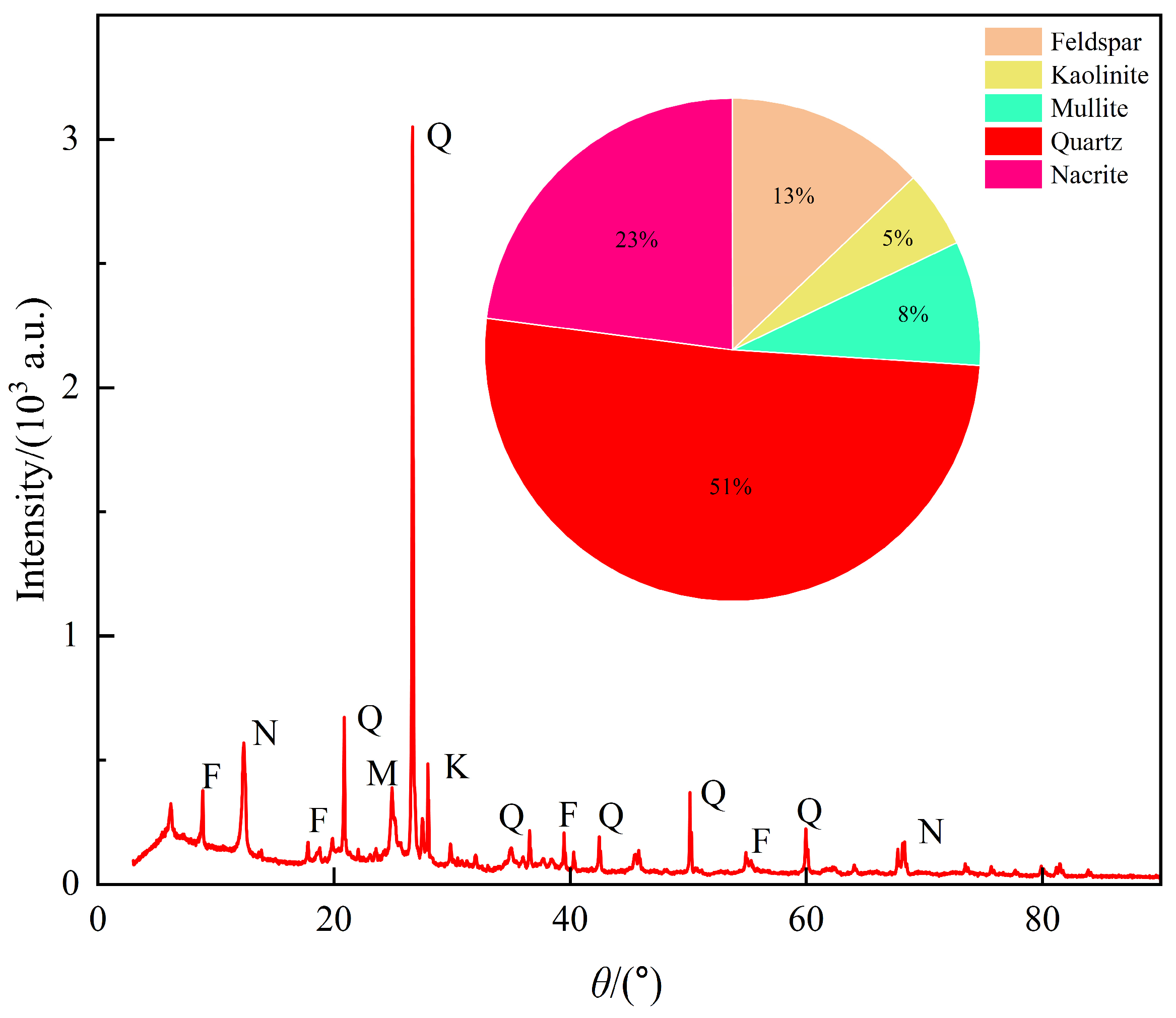
The mineral composition of the coal gangue was characterized using a D8 ADVANCE X-ray diffractometer (Bruker AXS GmbH, Karlsruhe, Germany), as shown in
Figure 1. The XRD results indicate that the coal gangue was mainly composed of quartz, feldspar, and a small amount of clay minerals. Quartz, as the dominant mineral phase, can provide a relatively stable skeleton for the backfill. Feldspar and clay minerals may affect the surface properties of the aggregate and the interaction between the aggregate and cementitious matrix, thereby influencing the overall mechanical behavior of the cemented backfill.
Ordinary Portland cement (P.O. 42.5; Xuzhou Zhonglian Cement Co., Ltd., Xuzhou, China) and Grade II fly ash (Guoneng Xuzhou Power Generation Co., Ltd., Xuzhou, China) were used as cementitious materials. Cement acted as the primary binder and generated hydration products such as calcium silicate hydrate gel and calcium hydroxide during hydration, providing the main strength source for the backfill. Fly ash was used as a supplementary cementitious material with potential pozzolanic activity. Its incorporation can improve slurry fluidity and particle packing, and it can also react with cement hydration products through secondary pozzolanic reactions, thereby promoting later-age strength development. In addition, replacing part of the cement with fly ash can reduce binder consumption and backfilling cost, while improving the resource utilization of coal-based solid waste.
2.2. Fractal Gradation Design of Aggregates
To investigate the effect of aggregate fractal gradation on the creep behavior of cemented coal gangue backfill, coal gangue aggregate gradations with different particle size distributions were designed based on mass fractal theory. Before specimen preparation, the crushed coal gangue was sieved using standard sieves with apertures of 1.00, 2.00, 4.00, 6.00, 8.00, and 10.00 mm. The mass fraction of each particle size interval was then determined according to the fractal model.
According to mass fractal theory, when
, the cumulative mass fraction
of aggregate particles smaller than
can be expressed as [
40]:
where
is the cumulative mass fraction of aggregate particles smaller than
,
is the mass of aggregate particles smaller than
,
is the total mass of aggregates,
and
are the minimum and maximum particle sizes, respectively, and
is the aggregate fractal dimension.
By adjusting the fractal dimension
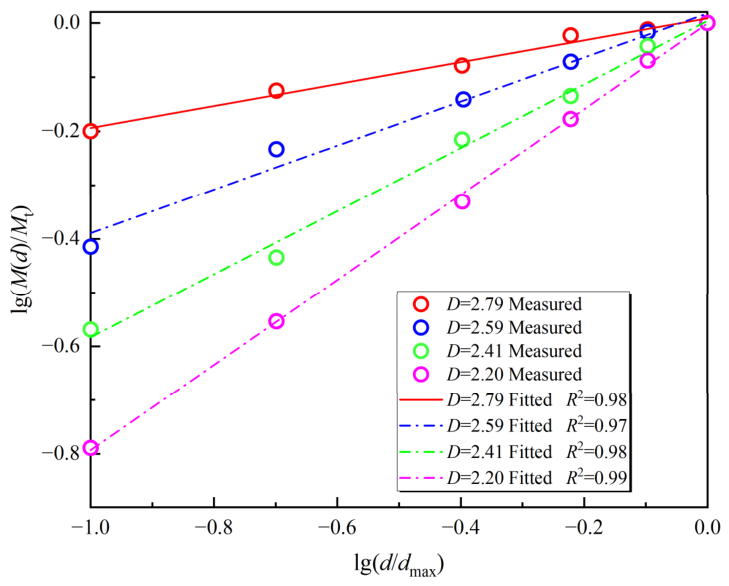
, aggregate gradations with different proportions of coarse and fine particles can be obtained. When the fractal dimension is relatively small, the proportion of coarse particles is higher. With increasing fractal dimension, the fine particle content gradually increases. Based on Equation (1), four aggregate gradations were designed, with fractal dimensions of 2.20, 2.41, 2.59, and 2.79. The particle size distributions of the coal gangue aggregates are shown in
Figure 2, and the theoretical mass fractions of each particle size interval are listed in
Table 1.
In this study, the term aggregate fractal dimension refers to the designed fractal dimension value (D), whereas aggregate fractal gradation refers to the corresponding particle size distribution determined by the fractal dimension. Unless otherwise specified, these two terms are used consistently throughout the manuscript.
2.3. Mix Proportions and Specimen Preparation
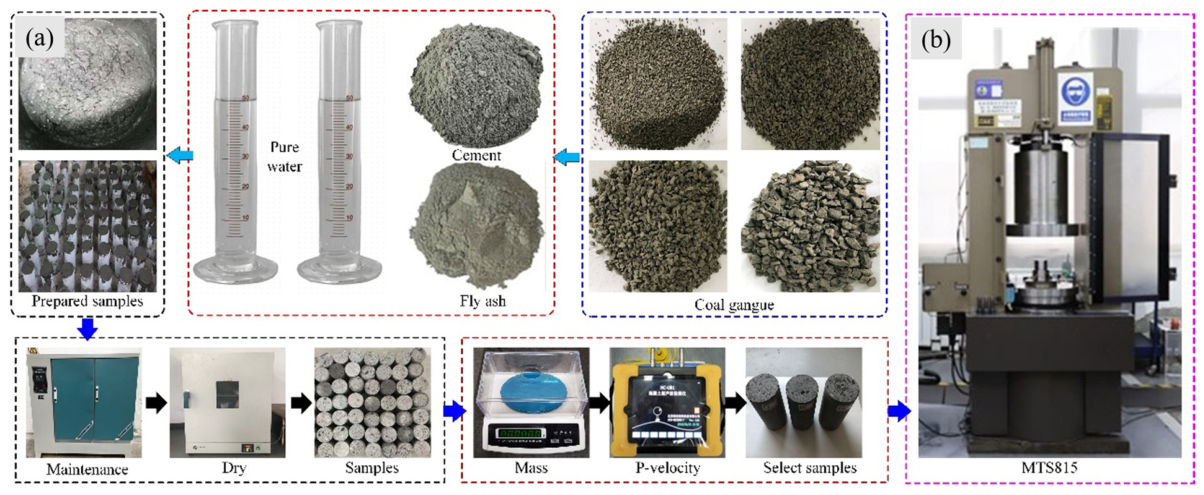
The specimen preparation process is shown in
Figure 3. First, the coal gangue aggregate, cement, and fly ash were weighed according to the designed mix proportions and dry-mixed thoroughly. Then, tap water was added, and the mixture was continuously stirred to ensure that the slurry uniformly coated the aggregate particles, forming a homogeneous mixture. To ensure comparability among specimens with different fractal dimensions, the mass fractions of coal gangue aggregate, cement, fly ash, and water were kept constant at 65.00%, 16.00%, 4.00%, and 15.00%, respectively.
The cement content of 16.00% was selected to ensure sufficient cementation and specimen integrity during multi-stage creep loading, especially considering the relatively angular morphology and coarse particle characteristics of the coal gangue aggregates used in this study. This mixture proportion was designed for controlled laboratory investigation of the influence of aggregate fractal gradation, rather than representing a universal engineering mix proportion. In practical backfill applications, the binder content should be further optimized according to engineering requirements, economic considerations, slurry transportability, and mine-specific geological conditions.
After mixing, the slurry was placed into cylindrical molds with dimensions of mm 100.00 mm in layers and compacted using a vibrating table to remove entrapped air and improve specimen uniformity. After casting, the specimens were kept at room temperature for 24.00 h, demolded, and then placed in a standard curing chamber. The curing conditions were maintained at a temperature of 25.00 °C and a relative humidity of 95.00%, and the curing age was 28.00 d.
After curing, both ends of each specimen were ground to ensure that the end-face unevenness was less than 0.02 mm, satisfying the requirements of the creep tests. To reduce the influence of material dispersion, no fewer than five specimens were prepared for each group. Before testing, the mass, dimensions, and longitudinal wave velocity of the specimens were measured, and specimens with relatively large deviations were excluded. Finally, three parallel specimens with relatively consistent physical properties were selected from each group for creep testing. Unless otherwise specified, the quantitative results presented in this study were obtained from the average values of the three parallel specimens, while the repeatability of the experiments was evaluated based on the consistency of their deformation responses. The physical and mechanical properties of specimens with different aggregate fractal dimensions are listed in
Table 2.
2.4. Testing Equipment and Creep Loading Scheme
The creep tests were conducted using an MTS815.02 electro-hydraulic servo-controlled rock mechanics testing system (MTS Systems Corporation, Eden Prairie, MN, USA), as shown in
Figure 3b. The maximum axial load of the system is 1700 kN, the confining pressure range is 0–45.00 MPa, and the axial loading rate can be controlled within the range of
–1.00 mm/s. The system can be used for uniaxial compression, triaxial compression, creep, and seepage–creep tests of rocks and cemented materials. During testing, axial stress, axial strain, and radial strain were continuously recorded to ensure the continuity and accuracy of the creep deformation data.
Multi-stage loading triaxial creep tests were carried out in this study. Before formal loading, a preload of 0.50 kN was applied to ensure full contact between the specimen ends and the loading platens. Subsequently, the confining pressure was increased to 0.50 MPa and kept constant throughout the test. Considering that cemented backfill in shallow goafs or local lateral confinement conditions is often subjected to a low-confinement stress state, a confining pressure of 0.50 MPa was selected to characterize the long-term deformation behavior of cemented backfill under low lateral confinement.
Axial loading was applied under displacement control at a loading rate of 0.02 kN/s. When the axial stress reached the prescribed stress level, the load was maintained for 7200.00 s to fully record the creep deformation at that stress level. After each constant-load stage, loading was continued to the next stress level. The load increment of each stage was 4.00 kN, corresponding to an axial stress increment of approximately 2.04 MPa. Loading was continued until the specimen entered the accelerating creep stage and failed. The same loading procedure, including the confining pressure, axial load increment, loading duration, and loading sequence, was applied to all specimens to ensure direct comparison of the creep responses under identical loading conditions.
During the test, axial stress, axial strain, and loading time were continuously recorded and used to analyze the creep deformation, creep rate, and long-term strength of specimens with different aggregate fractal dimensions. After specimen failure, the axial load and confining pressure were unloaded sequentially, and the complete stress–strain–time data were exported for subsequent creep behavior analysis and constitutive model parameter identification.
It should be noted that the creep duration of 7200 s at each loading stage was adopted to characterize the time-dependent deformation behavior of cemented coal gangue backfill under laboratory multi-stage loading conditions. Therefore, the creep behavior presented in this study reflects the laboratory creep response within the adopted loading scheme, rather than the direct long-term service performance of field backfill structures over months or years.
2.5. Creep Data Processing and Long-Term Strength Determination
To quantitatively analyze the creep deformation characteristics of cemented coal gangue backfill under multi-stage loading, the total axial strain at each stress level was divided into instantaneous strain and creep strain. The instantaneous strain refers to the strain increment generated during loading to the target stress level, whereas the creep strain refers to the time-dependent strain increment during the constant-load stage. The instantaneous strain mainly reflects the immediate deformation response of the specimen, while the creep strain reflects time-dependent deformation induced by particle rearrangement, pore compaction, interfacial damage, and crack propagation.
At the
-th loading stage, the creep strain is defined as [
41]:
where
is the creep strain at time
during the constant-load stage of the
-th stress level,
is the axial strain at time
, and
is the axial strain at the beginning of the constant-load stage.
The creep rate is expressed as:
where
is the creep rate at time
under the
-th stress level.
The steady-state creep rate was determined from the approximately linear segment in the middle-to-late period of each constant-load stage and can be calculated as:
where
is the steady-state creep rate at the
-th stress level, and
and
are the initial and final times of the selected steady-state creep segment, respectively.
To determine the long-term strength, the reciprocal of the steady-state creep rate is introduced as:
where
is the reciprocal steady-state creep rate corresponding to the
-th stress level.
The relationship between
and the applied axial stress
was then established. The stable creep stage and unstable creep stage were fitted separately using two straight lines:
The stress corresponding to the intersection of the two fitted lines was defined as the long-term strength of the specimen:
where
is the long-term strength,
and
are the fitting parameters of the stable creep stage, and
and
are the fitting parameters of the unstable creep stage. This method can effectively characterize the critical stress state corresponding to the transition from stable creep to accelerating creep.
In this study, stress levels exhibiting relatively stable steady-state creep rates were identified as the stable creep stage, whereas stress levels showing a rapid increase in steady-state creep rate together with obvious accelerating deformation were classified as the unstable creep stage. The reciprocal steady-state creep rate data corresponding to these two stages were fitted separately using linear regression, and the intersection of the fitted lines was taken as the long-term strength.
The term long-term strength adopted in this study refers to the critical stress determined by the reciprocal steady-state creep rate method under the present laboratory loading conditions. It should not be interpreted as the direct long-term service strength of engineering backfill structures under actual field conditions.
3. Creep Characteristics of Cemented Coal Gangue Backfill with Different Aggregate Fractal Dimensions
3.1. Overall Creep Behavior
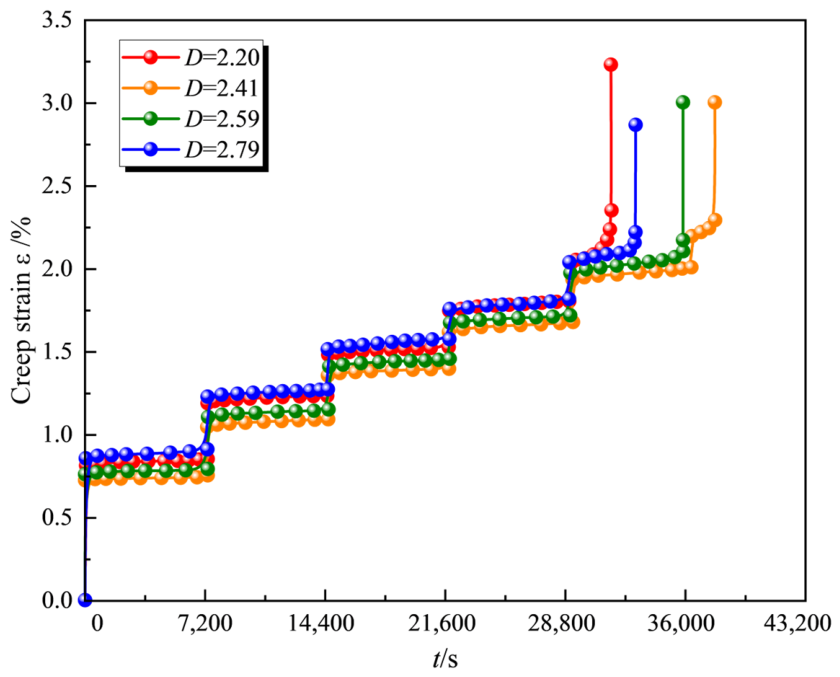
Unless otherwise specified, the creep curves and quantitative results presented in this section are based on the average responses of three parallel specimens for each aggregate fractal dimension. The three parallel specimens in each group showed consistent deformation trends, indicating acceptable repeatability of the creep tests. The multi-stage loading creep curves of cemented coal gangue backfill specimens with different aggregate fractal dimensions are shown in
Figure 4. It can be observed that all specimens exhibited typical multi-stage creep responses under sustained loading. At relatively low stress levels, the specimens mainly showed instantaneous strain followed by decelerating creep. The creep rate gradually decreased with time and then tended to stabilize. With increasing axial stress, the specimens successively experienced decelerating creep, steady-state creep, and accelerating creep. When the applied stress reached a critical level, the creep strain increased rapidly, eventually leading to creep instability and failure. These results indicate that cemented coal gangue backfill has pronounced time-dependent and stress-dependent deformation characteristics.
The creep response varied significantly with aggregate fractal dimension. Under the same stress level and loading duration, the axial creep strain generally first decreased and then increased with increasing fractal dimension. Among the four groups, the specimen with exhibited the smallest creep strain, whereas the specimen with showed the largest creep strain. This difference became more evident at relatively high stress levels. For example, during the fifth loading stage, the specimen with still maintained a relatively low strain growth rate, while the specimen with had already entered an obvious accelerating creep stage. This indicates that, among the tested aggregate fractal gradations, the specimen with had weaker resistance to long-term deformation, whereas the exhibited stronger creep resistance under the present laboratory multi-stage loading condition.
From the failure process, the specimen with entered the accelerating creep stage earliest and failed first, whereas the specimen with failed later and exhibited stronger creep resistance under the adopted laboratory loading conditions. This difference indicates that aggregate fractal dimension has an important influence on the creep instability process of cemented coal gangue backfill. The relatively better performance of the group may be associated with a more favorable coarse–fine particle proportion and load-bearing structure. However, because direct microstructural characterization was not conducted in this study, the related mechanism should be regarded as an inference from the macroscopic creep response rather than direct evidence of microstructural improvement.
3.2. Instantaneous Strain and Creep Strain
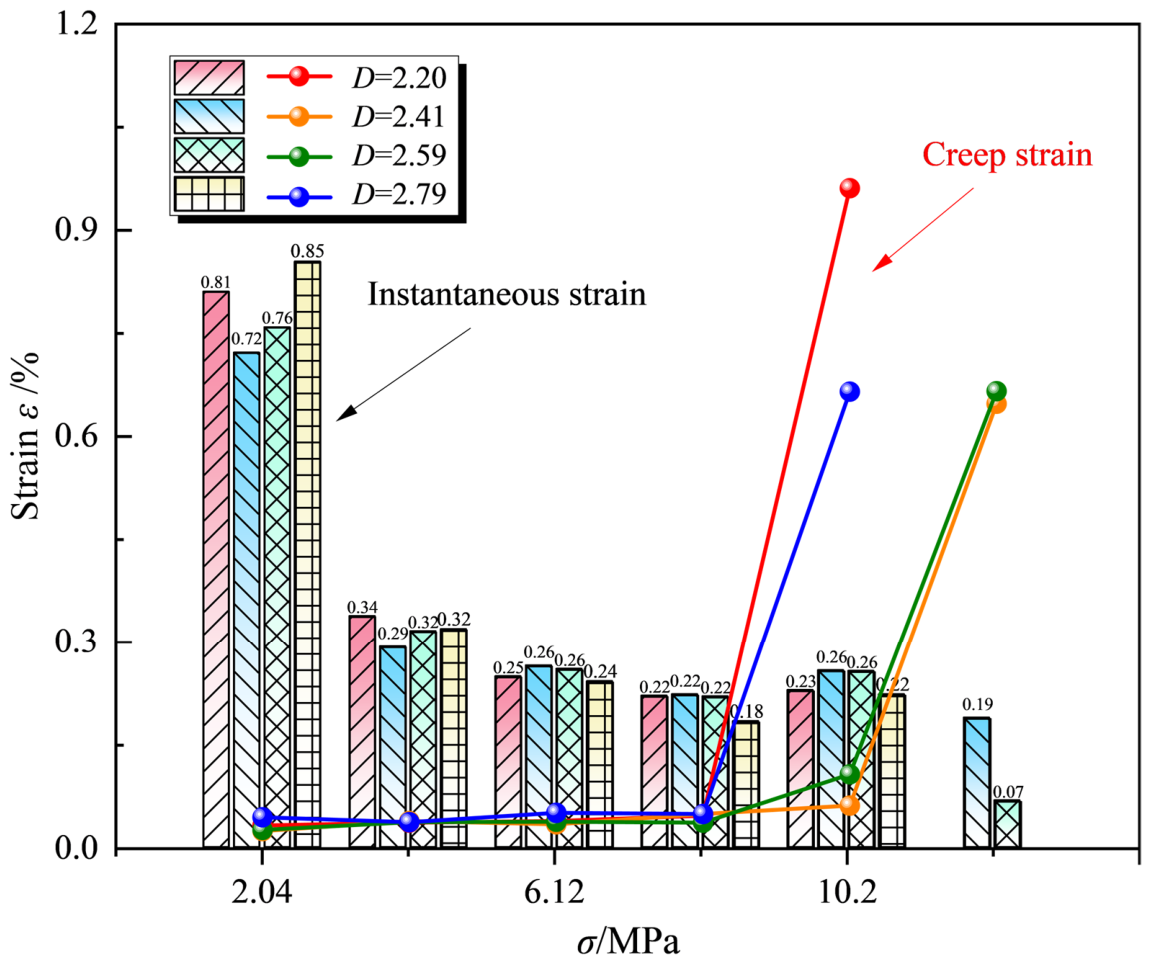
To further clarify the influence of aggregate fractal dimension on the deformation mechanism of cemented coal gangue backfill, the total strain at each loading stage was divided into instantaneous strain and creep strain. The instantaneous strain represents the strain increment generated during loading to the target stress level, reflecting the immediate load-bearing response of the specimen skeleton. The creep strain represents the time-dependent strain increment generated during the constant-load stage, reflecting particle rearrangement, pore compaction, interfacial damage, and microcrack propagation. The variations in instantaneous strain and creep strain with stress level are shown in
Figure 5.
As shown in
Figure 5, the instantaneous strain of all specimens increased gradually with increasing stress level, but the increase was relatively limited. At low stress levels, the instantaneous strain of different specimens was relatively close, indicating that the immediate deformation response was not strongly affected by aggregate fractal dimension at the initial loading stage. As the stress level approached the critical failure stress, the instantaneous strain continued to increase, but its variation remained much smaller than that of the creep strain. This suggests that the total deformation of cemented coal gangue backfill under multi-stage loading was mainly governed by time-dependent creep strain rather than instantaneous elastic–plastic strain.
Compared with instantaneous strain, creep strain was more sensitive to stress level and aggregate fractal dimension. At low stress levels, the creep strain of all groups remained relatively small, indicating that internal pores and particle contacts gradually reached a stable state after initial adjustment. However, as the stress level increased and approached the long-term strength, the creep strain increased sharply. For the specimen with , the creep strain increased rapidly at approximately 10.20 MPa, indicating the transition from stable crack growth to unstable crack propagation. In contrast, the specimen with showed a delayed increase in creep strain and entered the accelerating creep stage at a higher stress level, indicating stronger resistance to long-term deformation.
The creep strain showed a nonlinear variation with aggregate fractal dimension. With increasing , the creep strain first decreased and then increased. The specimen with had the lowest creep strain, while the specimen with had the highest creep strain. This result suggests that an appropriate aggregate fractal dimension may improve the particle packing state and skeleton continuity of cemented backfill, thereby reducing time-dependent deformation under sustained loading. For the group, the relatively balanced proportion of coarse and fine particles may have contributed to a more continuous load-bearing skeleton and more uniform stress transfer. By contrast, when the fractal dimension was relatively low or high, the aggregate skeleton may have become less stable due to insufficient fine-particle filling or excessive fine-particle content, resulting in increased stress concentration, particle sliding, and interfacial damage. Because direct microstructural characterization was not conducted in this study, the above mechanism should be regarded as a mechanical inference based on the observed creep strain evolution and macroscopic mechanical response.
3.3. Creep Rate Evolution
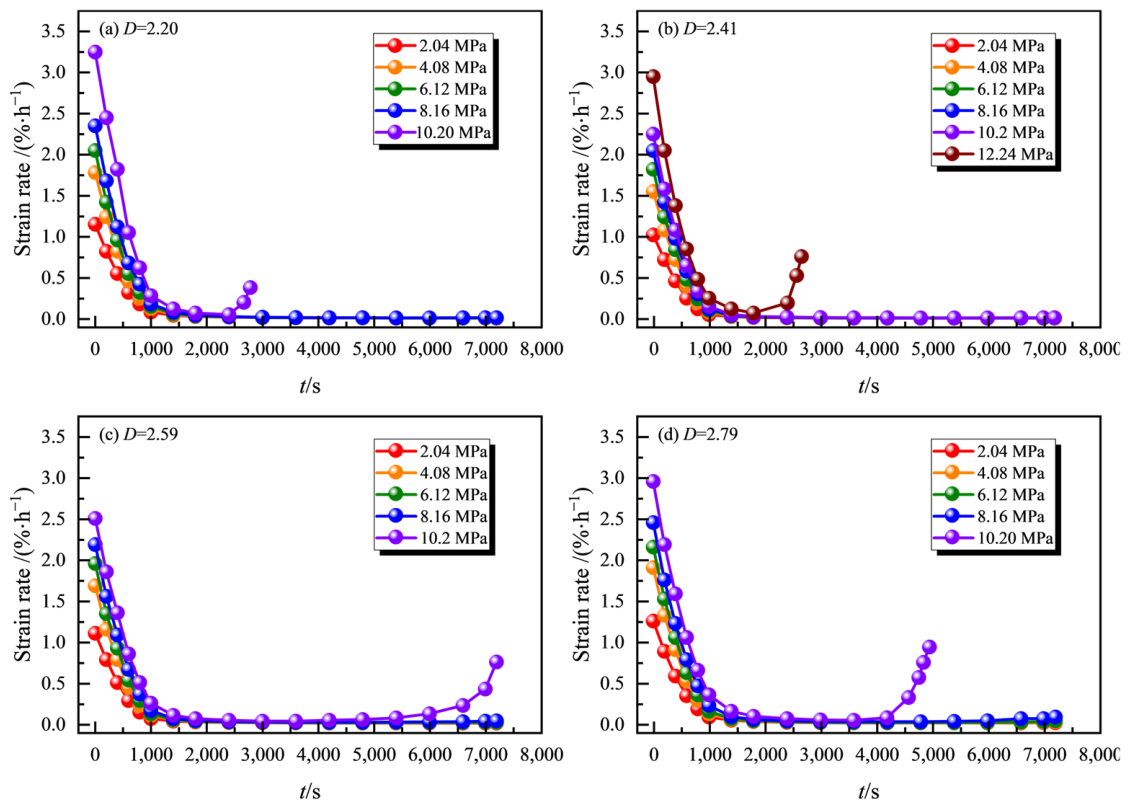
Creep rate is a key indicator for evaluating the deformation development and long-term stability of cemented backfill under sustained loading. The axial creep rate curves of specimens with different aggregate fractal dimensions are shown in
Figure 6. The creep rate evolution of all specimens showed similar stage characteristics, including rapid attenuation, stable development, and unstable growth. At the beginning of each constant-load stage, the creep rate was relatively high and then decreased rapidly with time. After a certain loading duration, the creep rate gradually stabilized, indicating that pore compaction, particle rearrangement, and local crack closure had basically reached a relatively balanced state.
With increasing stress level, both the initial creep rate and the steady-state creep rate increased. At low stress levels, the creep rate of each specimen decreased rapidly to a low and stable level, indicating that internal damage development was effectively restrained and the specimen remained in a stable creep state. When the stress level further increased and approached the long-term strength, the creep rate curves began to show significant differences among the different fractal dimensions.
For the specimen with , the creep rate increased rapidly after a short stable period at approximately 10.20 MPa, indicating that internal microcracks changed from stable propagation to unstable propagation and that the specimen entered the accelerating creep stage. The specimens with and showed similar behavior, but their accelerating creep stages occurred slightly later than that of . In contrast, the specimen with maintained a relatively low steady-state creep rate at 10.20 MPa and showed a significant increase in creep rate only when the stress level reached approximately 12.24 MPa. This indicates that provided a more stable particle skeleton and stronger resistance to creep instability.
The differences in creep rate among specimens with different aggregate fractal dimensions further indicate that aggregate fractal gradation has an important influence on the development of time-dependent deformation. The relatively low steady-state creep rate of the D = 2.41 group suggests that a suitable coarse-fine particle proportion may help improve skeleton continuity and stress-transfer uniformity, thereby delaying the transition from stable creep to accelerating creep. In contrast, when the fractal dimension was relatively low or high, the less favorable particle gradation may have promoted local stress concentration and faster damage accumulation, resulting in a higher creep rate and earlier creep instability. This interpretation is consistent with the creep strain evolution discussed above, but it should be understood as an inference from macroscopic creep behavior rather than direct microstructural evidence.
3.4. Long-Term Strength Evolution
Long-term strength, as determined by the reciprocal steady-state creep rate method, is an important parameter for evaluating the creep resistance and critical stress state of cemented coal gangue backfill under the adopted laboratory loading scheme. It is generally defined as the critical stress at which the specimen transforms from stable creep to accelerating creep under sustained loading. In this study, the long-term strength
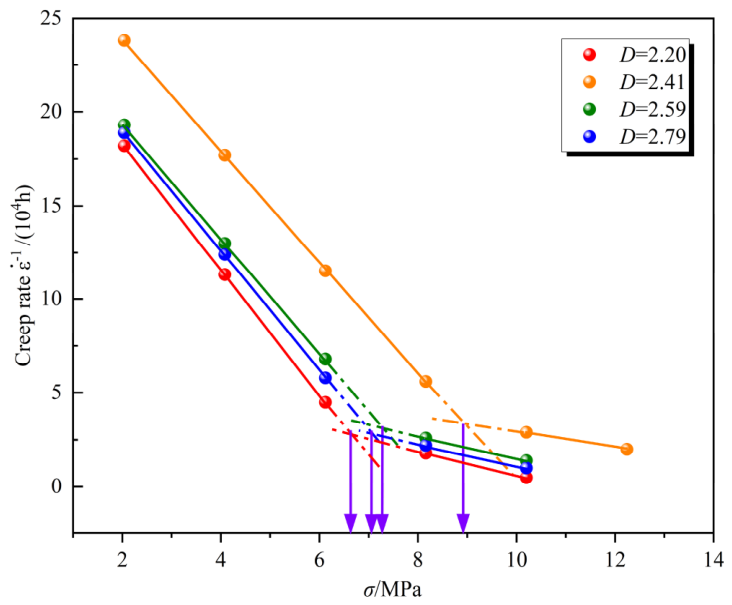
was determined using the reciprocal steady-state creep rate method. The relationship between the reciprocal of the steady-state creep rate and the applied axial stress is shown in
Figure 7.
As shown in
Figure 7, the relationship between the reciprocal steady-state creep rate and axial stress exhibited a clear bilinear characteristic. In the low-stress region, the reciprocal steady-state creep rate decreased rapidly with increasing stress, indicating that the specimens remained in a stable creep state and internal damage developed slowly. When the stress exceeded a certain critical value, the slope of the curve changed significantly, indicating that microcracks began to propagate rapidly and gradually coalesced. The intersection of the two fitted straight lines was therefore taken as the long-term strength
of the specimen.
The long-term strengths of the specimens with , , , and were 6.62 MPa, 8.83 MPa, 7.34 MPa, and 7.07 MPa, respectively. Overall, the long-term strength first increased and then decreased with increasing aggregate fractal dimension. The specimen with exhibited the highest long-term strength, which was 33.38% higher than that of the specimen with . When the fractal dimension further increased to , the long-term strength decreased by 19.93% compared with that of . This trend is consistent with the variations in uniaxial compressive strength, elastic modulus, creep strain, and creep rate, indicating that aggregate fractal gradation significantly influences both the short-term mechanical properties and the creep resistance of cemented coal gangue backfill under the present laboratory loading conditions.
To further describe the relationship between long-term strength and aggregate fractal dimension, the experimental results were fitted using a quadratic polynomial:
where
is the long-term strength of the cemented coal gangue backfill, and
is the aggregate fractal dimension.
The fitting result indicates that the long-term strength has a nonlinear relationship with aggregate fractal dimension. Among the tested aggregate fractal gradations, the specimen with exhibited the highest long-term strength. This behavior suggests that a relatively balanced coarse–fine particle proportion may contribute to a more favorable load-bearing structure and improved resistance to time-dependent deformation. However, because direct microstructural characterization was not performed in this study, the above interpretation should be regarded as a mechanical inference. When the aggregate fractal dimension further increased, the long-term strength decreased again. This phenomenon may be associated with changes in the aggregate skeleton and load-transfer characteristics caused by excessive fine-particle content. Under such conditions, the cementitious matrix and aggregate–matrix interfaces may become more susceptible to local deformation and damage accumulation during sustained loading. Nevertheless, this interpretation requires further verification through direct microstructural observations.
Therefore, the experimental results indicate that aggregate fractal gradation has a significant influence on the creep behavior of cemented coal gangue backfill. Among the tested aggregate fractal gradations, the specimen with exhibited the highest long-term strength and the strongest creep resistance under the adopted laboratory loading conditions. However, this favorable fractal dimension should be understood within the tested material system and aggregate fractal dimension range, rather than as a universally optimal gradation.
4. Creep Constitutive Model
4.1. Fractional Abel Dashpot
Traditional creep models are commonly composed of springs, dashpots, and plastic elements. The spring element is used to describe instantaneous elastic deformation, the dashpot element is used to represent linear viscous flow, and the plastic element is introduced to characterize irreversible deformation after yielding. However, cemented coal gangue backfill is a typical particle–cemented composite material, and its creep behavior exhibits obvious nonlinearity and time dependence. Therefore, an integer-order Newtonian dashpot is usually insufficient to accurately describe the full creep process, especially the transition from decelerating creep to steady-state creep and accelerating creep.
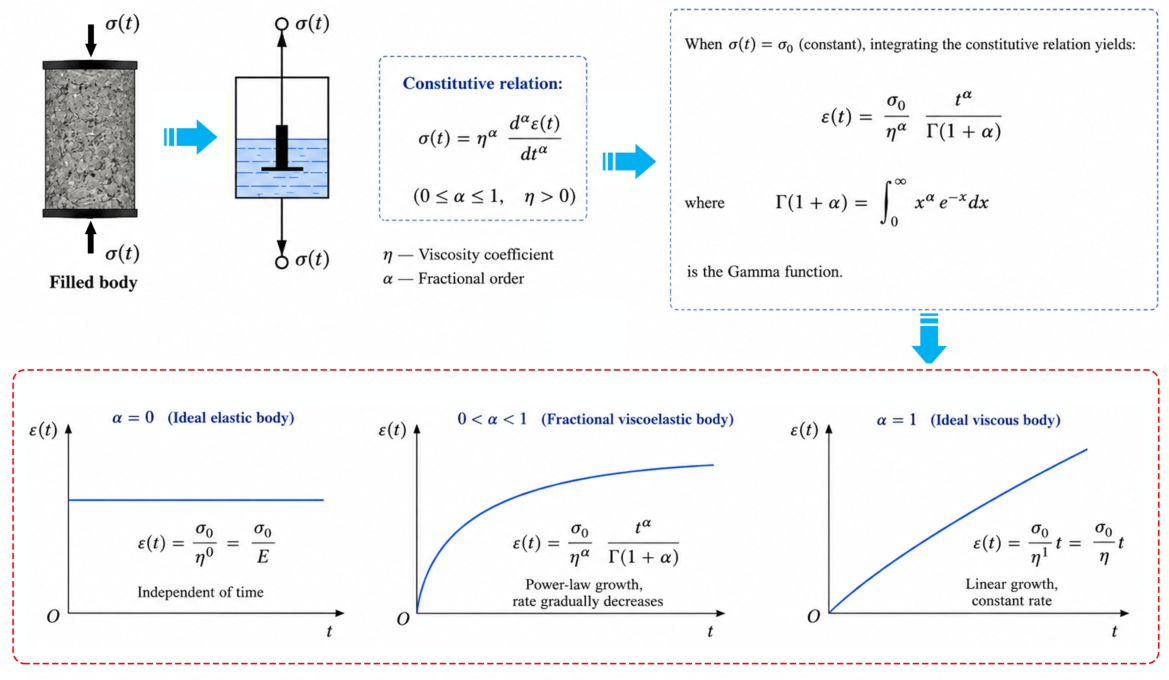
Fractional calculus provides an effective approach for describing the mechanical behavior of materials between ideal elasticity and ideal viscosity. Therefore, a fractional Abel dashpot was introduced to characterize the nonlinear time-dependent creep behavior of cemented coal gangue backfill. The schematic diagram of the fractional Abel dashpot is shown in
Figure 8.
The constitutive relation of the fractional Abel dashpot can be expressed as [
42]:
where
is the applied stress,
is the creep strain,
is the viscosity coefficient of the fractional Abel dashpot,
is time, and
is the fractional order.
For a constant stress condition,
, integration of Equation (10) based on the Riemann–Liouville fractional integral gives:
where
is the constant applied stress and
is the Gamma function.
Equation (11) indicates that the creep strain of the Abel dashpot follows a power-law relationship with time. Therefore, the fractional Abel dashpot can describe the nonlinear variation in creep strain and creep rate during the time-dependent deformation process. When , the Abel dashpot degenerates into a traditional Newtonian dashpot, representing linear viscous flow. When , it degenerates into an ideal elastic element, and the strain becomes independent of time. When , the element exhibits viscoelastic behavior between an ideal elastic solid and an ideal viscous fluid, which is suitable for describing decelerating creep and steady-state creep. When , the power-law strain increases more rapidly with time and can be used to describe the nonlinear growth tendency in the accelerating creep stage.
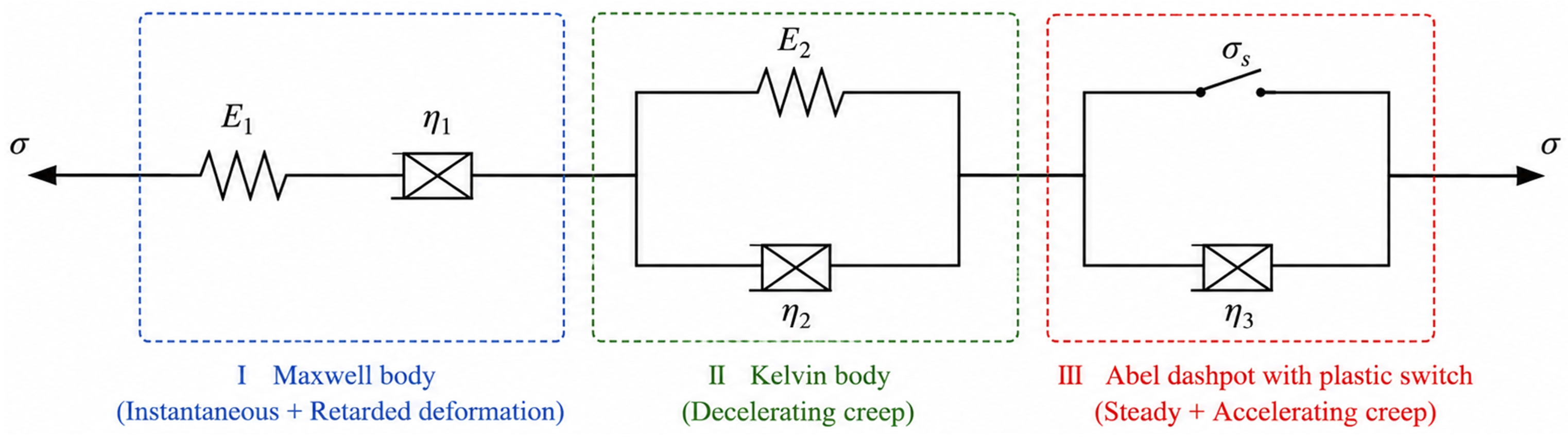
For cemented coal gangue backfill, the aggregate fractal dimension changes the particle contact state, pore structure, and interfacial bonding condition, thereby affecting the internal damage accumulation rate and viscoelastic deformation characteristics. Therefore, in the following model construction, the fractional Abel dashpot is introduced into the traditional Burgers model, and a plastic switch is further incorporated to establish an improved fractional-order Burgers model capable of describing the whole creep process, including decelerating creep, steady-state creep, and accelerating creep.
4.2. Improved Fractional-Order Burgers Model
The creep test results show that cemented coal gangue backfill with different aggregate fractal dimensions experiences instantaneous deformation, decelerating creep, steady-state creep, and accelerating creep during multi-stage loading. The traditional Burgers model, which consists of a Maxwell body and a Kelvin body connected in series, can describe instantaneous deformation, decelerating creep, and steady-state creep. However, it is difficult to capture the nonlinear accelerating creep stage when the applied stress exceeds the long-term strength. Therefore, in this study, a fractional Abel dashpot with a plastic switch was introduced into the traditional Burgers model to establish an improved fractional-order Burgers model for describing the whole creep process, as shown in
Figure 9.
The improved model consists of three parts connected in series: a fractional Maxwell body, a fractional Kelvin body, and an accelerating creep element controlled by a plastic switch. The fractional Maxwell body is used to describe instantaneous elastic strain and steady-state viscous strain. The fractional Kelvin body is used to describe decelerating creep. The fractional Abel dashpot with a plastic switch is activated only when the applied stress exceeds the long-term strength , and is used to describe accelerating creep.
The total creep strain can be expressed as:
where
is the total creep strain,
is the strain of the fractional Maxwell body,
is the strain of the fractional Kelvin body, and
is the accelerating creep strain controlled by the plastic switch.
For the fractional Maxwell body, the creep strain under a constant stress
can be written as [
43]:
where
is the elastic modulus of the spring in the Maxwell body,
is the viscosity coefficient of the fractional Abel dashpot in the Maxwell body, and
is the corresponding fractional order.
For the fractional Kelvin body, the creep strain can be expressed as [
44]:
where
is the elastic modulus of the spring in the Kelvin body,
is the viscosity coefficient of the fractional Abel dashpot in the Kelvin body,
is the corresponding fractional order, and
is the Mittag–Leffler function.
The accelerating creep element is controlled by the long-term strength
. When the applied stress is lower than
, the plastic switch remains closed and the accelerating creep element does not work. When the applied stress reaches or exceeds
, the plastic switch is activated and the accelerating creep strain is generated. Therefore, the accelerating creep strain can be expressed as:
where
is the viscosity coefficient of the fractional Abel dashpot in the accelerating creep element, and
is the fractional order controlling the nonlinear accelerating creep behavior.
By substituting Equations (13)–(15) into Equation (12), the creep equation of the improved fractional-order Burgers model can be obtained as:
where
is the applied constant stress, and
is the long-term strength determined by the reciprocal steady-state creep rate method. The first term in Equation (16) represents the instantaneous elastic strain, the second term represents the steady-state viscous strain, the third term describes the decelerating creep strain, and the fourth term describes the nonlinear accelerating creep strain after the stress exceeds the long-term strength.
Compared with the traditional Burgers model, the improved fractional-order Burgers model introduces fractional-order elements and a stress-dependent plastic switch. Therefore, it can describe not only the decelerating and steady-state creep stages, but also the accelerating creep stage caused by damage accumulation and crack propagation. This model is suitable for characterizing the whole creep process of cemented coal gangue backfill with different aggregate fractal dimensions.
4.3. Model Parameter Identification
The improved fractional-order Burgers model contains several parameters, including the elastic modulus , viscosity coefficient , and fractional order of the fractional Maxwell body; the elastic modulus , viscosity coefficient , and fractional order of the fractional Kelvin body; and the viscosity coefficient and fractional order of the accelerating creep element. These parameters are difficult to determine directly from conventional mechanical tests. Therefore, nonlinear least-squares fitting was used to identify the model parameters based on the creep test curves of specimens with different aggregate fractal dimensions.
The basic principle of parameter identification is to minimize the difference between the experimental creep strain and the calculated creep strain. The objective function can be expressed as:
where
is the objective function,
is the number of data points,
is the experimental creep strain of the
-th data point, and
is the calculated creep strain obtained from the improved fractional-order Burgers model.
To evaluate the fitting accuracy, the coefficient of determination
was introduced:
where
is the average value of the experimental creep strain. A value of
closer to 1 indicates a better agreement between the model calculation and the experimental data.
During parameter identification, the long-term strength
determined in
Section 3.4 was used as the critical stress threshold in the improved fractional-order Burgers model. The creep curves below
were mainly used to determine the viscoelastic parameters
,
,
,
,
, and
, whereas the accelerating creep stage above
was used to further identify the parameters
and
. The fitting was performed using MATLAB R2023a (The MathWorks, Inc., Natick, MA, USA), and the identified parameters are listed in
Table 3.
The identified parameters have clear physical meanings. mainly reflects the instantaneous elastic deformation resistance of the specimen, while represents the deformation resistance during the decelerating creep stage. The viscosity coefficients and characterize the viscous resistance during the steady-state creep and decelerating creep stages, respectively. The parameters and are closely related to nonlinear deformation and damage development during the accelerating creep stage.
As shown in
Table 3, the specimen with
exhibited the highest
,
,
,
, and
, indicating that this gradation provided the strongest resistance to instantaneous deformation, viscoelastic deformation, and accelerating creep deformation. Meanwhile, its fractional orders were relatively low, suggesting weaker time-dependent nonlinearity and slower damage accumulation. The
values of all groups were greater than 0.97, indicating that the improved fractional-order Burgers model showed good fitting performance for the creep process of cemented coal gangue backfill with different aggregate fractal dimensions.
4.4. Model Fitting Verification and Discussion
To evaluate the fitting performance of the improved fractional-order Burgers model, the identified parameters listed in
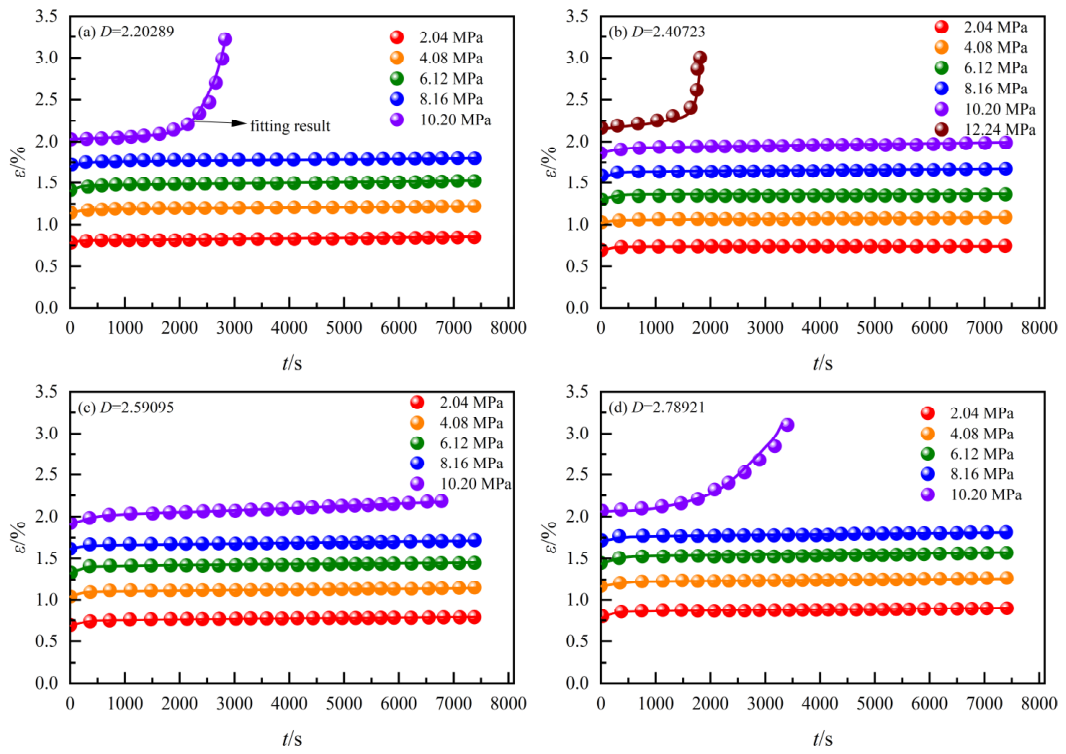
Table 3 were substituted into Equation (16), and the calculated creep responses were compared with the experimental data of cemented coal gangue backfill specimens with different aggregate fractal dimensions. The comparison results are shown in
Figure 10, where the symbols represent the experimental data and the solid lines represent the model fitting results.
As shown in
Figure 10, the theoretical curves are generally in good agreement with the experimental creep curves for all fractal dimensions, indicating that the improved fractional-order Burgers model can effectively describe the whole creep process of cemented coal gangue backfill under multi-stage loading. At relatively low stress levels, ranging from 2.04 MPa to 8.16 MPa, the specimens mainly exhibited decelerating creep and steady-state creep. In this stage, the model curves almost coincided with the experimental data, suggesting that the fractional Maxwell body and fractional Kelvin body can accurately capture the instantaneous strain, decelerating creep strain, and steady-state creep strain.
As the stress level increased and gradually approached the long-term strength
, the creep strain increased more obviously. When the applied stress exceeded
, the specimens entered the accelerating creep stage, and the creep strain increased rapidly until failure. For the specimen with
, a rapid increase in creep strain occurred at approximately 10.20 MPa, indicating earlier creep instability. For the specimen with
, the accelerating creep stage appeared at a higher stress level of approximately 12.24 MPa, demonstrating stronger resistance to creep failure. The specimens with
and
showed intermediate behavior, entering the unstable creep stage at stress levels close to 10.20 MPa. These results are consistent with the long-term strength evolution discussed in
Section 3.4.
The model also showed good fitting performance in the accelerating creep stage. This indicates that the fractional Abel dashpot with a plastic switch can effectively describe the nonlinear strain growth caused by internal damage accumulation, interfacial debonding, particle sliding, and microcrack propagation after the applied stress exceeds the long-term strength. Compared with the traditional Burgers model, the improved fractional-order Burgers model can better represent the transition from stable creep to accelerating creep.
Among the four groups, the specimen with exhibited the highest fitting accuracy, and its calculated curve was almost consistent with the experimental curve throughout the creep process. The specimens with and also maintained good fitting performance during the accelerating creep stage, indicating that the model has good adaptability to different aggregate gradations. The coefficients of determination for all groups were greater than 0.97, further confirming the good fitting performance of the model.
The improved fractional-order Burgers model can reproduce the decelerating creep, steady-state creep, and accelerating creep stages of cemented coal gangue backfill and reflect the differences in creep response caused by aggregate fractal dimension. The model parameters provide a useful quantitative description of creep resistance under the adopted laboratory loading conditions. Therefore, the proposed model can serve as a theoretical reference for creep behavior analysis and gradation optimization of cemented coal gangue backfill, while further independent validation using additional experimental or field data is still needed.
4.5. Relationship Between Model Parameters and Aggregate Fractal Dimension
As shown in
Table 3, the parameters of the improved fractional-order Burgers model varied significantly with aggregate fractal dimension. To further quantify the relationship between aggregate fractal dimension and model parameters, quadratic polynomial functions were used to describe the variation trends of the elastic parameters, viscosity coefficients, and fractional orders. The fitting relationships are expressed as follows.
For the elastic parameters:
For the viscosity coefficients:
For the fractional orders:
where
is the aggregate fractal dimension;
and
are the elastic moduli of the Maxwell body and Kelvin body, respectively;
,
, and
are the viscosity coefficients of the fractional dashpots; and
,
, and
are the corresponding fractional orders.
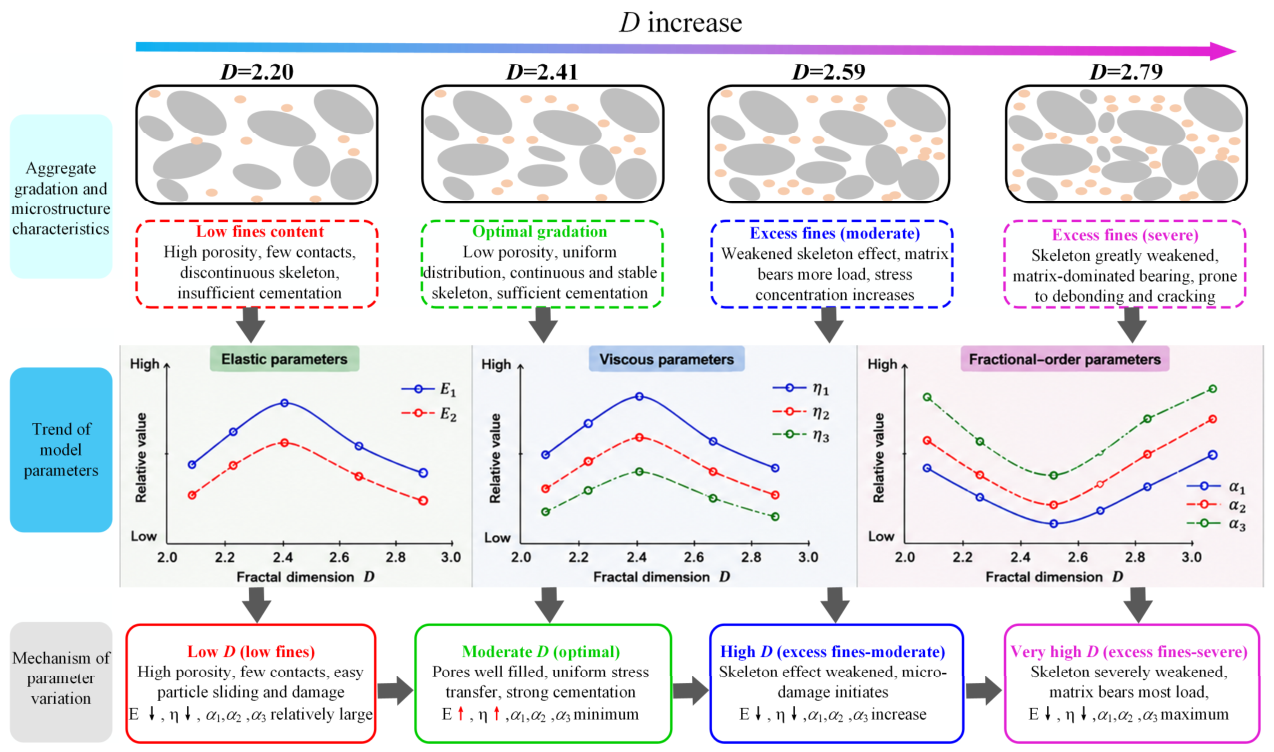
The fitting results indicate that the model parameters exhibit clear nonlinear relationships with aggregate fractal dimension. The elastic parameters and , as well as the viscosity coefficients , , and , first increased and then decreased with increasing fractal dimension. In contrast, the fractional orders , , and first decreased and then increased. This indicates that aggregate fractal dimension not only affects the macroscopic creep behavior of cemented coal gangue backfill, but also regulates the internal time-dependent deformation and damage evolution reflected by the model parameters.
When the fractal dimension increased from to , and increased significantly, indicating enhanced resistance to instantaneous elastic deformation and decelerating creep deformation. Meanwhile, , , and also reached relatively high values, suggesting that the internal viscous resistance of the specimen increased and that the creep deformation was more effectively restrained under sustained loading. In this stage, the fractional orders decreased, indicating that the nonlinear time-dependent effect and damage accumulation tendency were weakened.
However, when the fractal dimension further increased to and , the elastic moduli and viscosity coefficients gradually decreased. This suggests that excessive fine particles weakened the load-bearing role of the coarse aggregate skeleton and reduced the structural stability of the backfill. Correspondingly, the fractional orders increased again, indicating stronger nonlinear time-dependent deformation and faster damage accumulation during creep.
The mechanism underlying the above parameter evolution is closely related to the change in aggregate gradation structure, as illustrated in
Figure 11. When the fractal dimension was relatively low, the coarse-particle content was high, while the fine-particle content was insufficient to effectively fill the voids between coarse particles. As a result, more pores and weak contact regions existed inside the specimen. Under loading, stress was concentrated in limited particle contact zones, which promoted local damage and particle sliding. Therefore, the specimen exhibited relatively low elastic moduli and viscosity coefficients, as well as a higher tendency for creep deformation.
As the fractal dimension increased to an appropriate value, fine particles gradually filled the voids between coarse particles, increasing the number of particle contacts and improving the continuity of the load-bearing skeleton. At the same time, hydration products of the cementitious materials could better fill the remaining pores and bond the aggregate particles, resulting in a denser and more stable cemented structure. Consequently, the specimen with showed the highest elastic moduli and viscosity coefficients, the lowest fractional orders, and the strongest creep resistance.
When the fractal dimension continued to increase, the excessive fine-particle content weakened the coarse-particle skeleton effect, and the load-bearing mechanism gradually shifted from skeleton-dominated bearing to matrix-dominated bearing. Since the cementitious matrix and aggregate–matrix interfaces are more susceptible to debonding, microcrack propagation, and local plastic deformation under long-term loading, the elastic moduli and viscosity coefficients decreased, while the fractional orders increased. This explains why the creep strain and creep instability risk increased again at higher fractal dimensions.
Overall, the evolution of model parameters indicates that aggregate fractal gradation has a significant influence on the creep resistance of cemented coal gangue backfill. Among the tested aggregate fractal gradations, the specimen with exhibited the highest elastic moduli and viscosity coefficients, as well as relatively low fractional orders, suggesting the strongest resistance to time-dependent deformation under the adopted laboratory loading conditions. This result may be associated with a more favorable coarse–fine particle proportion and load-bearing skeleton. However, because direct microstructural characterization was not conducted in this study, this interpretation should be regarded as a mechanical inference based on model parameter evolution and macroscopic creep behavior, rather than direct evidence of microstructural improvement.