Article

Coupled Zircon Trace Element Systematics and Whole-Rock Geochemistry in Neoproterozoic A-Type Granites

1
Faculty of Sciences, Geology Department, Ain Shams University, Cairo 11566, Egypt
2
Department of Geosciences, College of Petroleum Engineering & Geosciences (CPG), King Fahd University of Petroleum and Minerals (KFUPM), Dhahran 31261, Saudi Arabia
3
Geological Sciences Department, National Research Centre, 33 Al-Behoos St., Cairo 12622, Egypt
4
State Key Laboratory for Mineral Deposits Research, School of Earth Sciences and Engineering, Nanjing University, Zhugongshan Building A256, Xianlin Avenue 163#, Qixia District, Nanjing 210023, China
5
Department of Earth and Planetary Sciences, 610 Taylor Road, Piscataway, NJ 08854-8066, USA
*
Authors to whom correspondence should be addressed.
Minerals 2026, 16(7), 715; https://doi.org/10.3390/min16070715 (registering DOI)
Submission received: 22 March 2026 / Revised: 6 May 2026 / Accepted: 8 May 2026 / Published: 8 July 2026
(This article belongs to the Section Mineral Geochemistry and Geochronology)

Abstract

A-type granites represent high-temperature, highly differentiated felsic magmas formed in post-collisional and intraplate tectonic settings. While whole-rock geochemistry constrains bulk melt evolution, zircon trace element systematics provide higher-resolution insights into crystallization conditions, including temperature, oxidation state, and differentiation intensity. This study integrates whole-rock geochemical data with zircon trace element analyses to evaluate the extent to which zircon records magmatic evolution in Neoproterozoic A-type granites from Sinai, Egypt. Whole-rock compositions define a high-silica, ferroan differentiation trend characterized by enrichment in high-field-strength elements (HFSE) and pronounced negative Ba–Sr–Ti anomalies, indicating advanced fractional crystallization. Zircon trace element patterns exhibit strong heavy rare earth element (HREE) enrichment (Yb up to 1757 ppm), systematically negative Eu anomalies (mean Eu/Eu* = 0.32), and elevated Hf concentrations (up to 14,453 ppm; mean = 4763 ppm), reflecting progressive melt differentiation. Ti-in-zircon thermometry yields crystallization temperatures ranging from 562 °C to 1384 °C. However, most values cluster between 757 °C and 872 °C (mean ≈ 837 °C), indicating sustained high-temperature magmatic conditions. The broader temperature range likely reflects analytical uncertainties, assumptions in Ti activity, and possible outliers. Positive Ce anomalies indicate moderately oxidized crystallization environments. Systematic relationships among zircon Hf, Eu/Eu*, Yb/Gd, Th/U, and Ti-in-zircon temperatures demonstrate a strong coupling between zircon chemistry and whole-rock differentiation trends. These relationships are supported by statistically significant correlations, indicating that zircon trace element systematics provide a robust, semi-quantitative framework for interpreting melt evolution, while preserving independent constraints on temperature and redox state.

1. Introduction

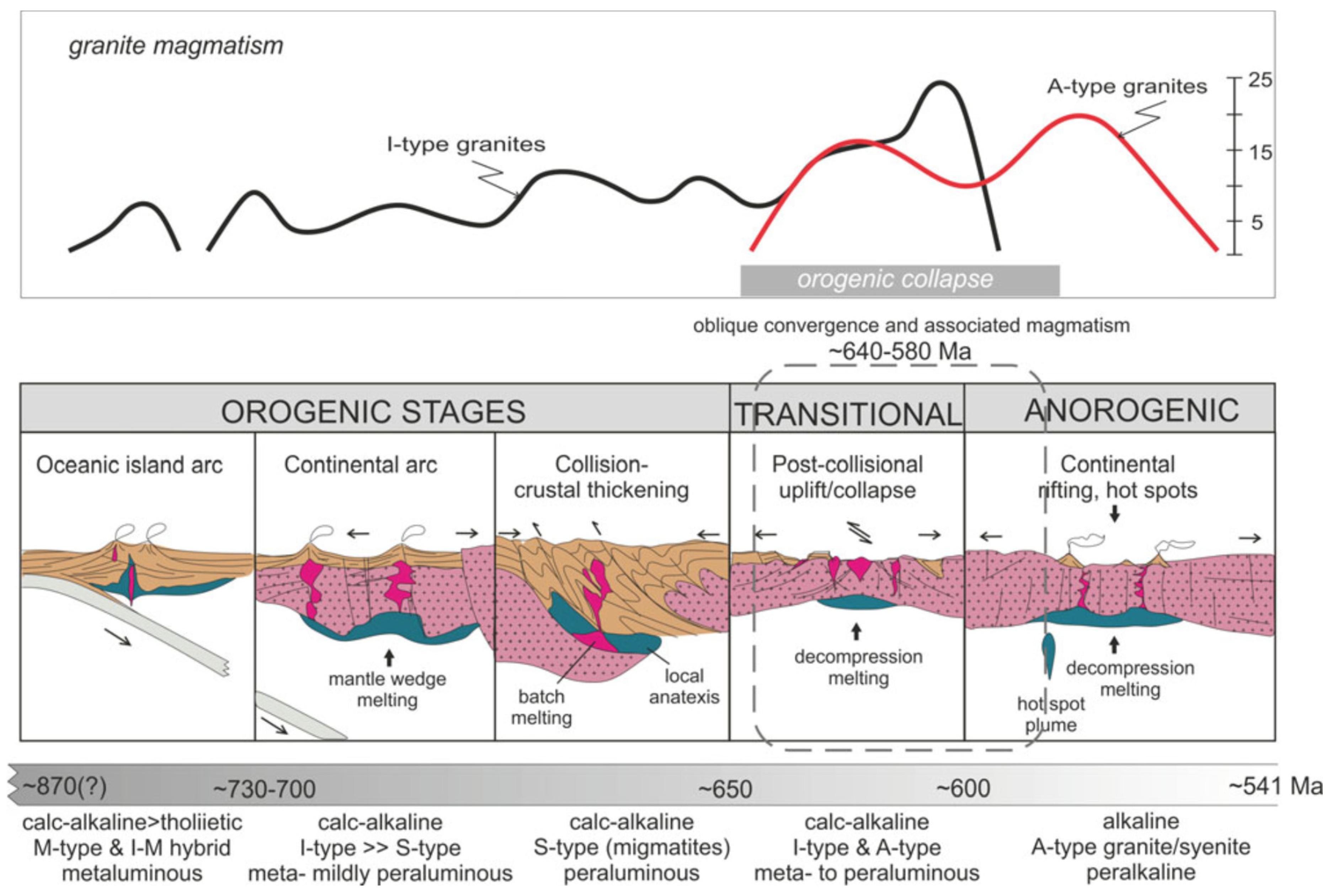
Neoproterozoic Arabian–Nubian Shield (ANS) preserves a well-constrained transition from subduction-related arc magmatism to post-collisional and anorogenic magmatic regimes during the terminal stages of the Pan-African orogeny. This transition is characterized by widespread emplacement of late- to post-orogenic granitoids, including ferroan A-type granites, generated during lithospheric extension, orogenic collapse, and thermal relaxation of previously thickened crust (Figure 1). These processes are closely associated with oblique convergence along major shear systems, followed by decompression melting and crustal thinning during post-collisional uplift [1].
Within this geodynamic framework, A-type granites represent high-temperature felsic magmatic systems derived from partial melting of dehydrated lower crust and/or hybrid mantle–crust sources, followed by extensive fractional crystallization [2,3]. Their geochemical signature is characterized by high SiO2 contents, ferroan affinity, enrichment in high-field-strength elements (HFSE; Zr, Nb, Y), elevated Ga/Al ratios, and depletion in CaO and MgO [2,4,5]. These features reflect crystallization under relatively low water activity and elevated thermal gradients typical of post-collisional extensional environments.
The G. Serbal and G. El Homra granitic suites constitute two representative examples of late Neoproterozoic granitoid magmatism in Sinai developed within this tectonic framework. Both systems display mineralogical and geochemical characteristics consistent with A-type affinity, including alkaline compositions and HFSE enrichment [6]. However, they differ in their magmatic evolution. The Serbal granites represent highly evolved compositions, whereas the El Homra suite preserves a broader compositional spectrum indicative of less advanced differentiation. Despite these differences, both suites exhibit pronounced negative Ba–Sr and Ti anomalies, reflecting extensive feldspar and Fe–Ti oxide fractionation. Such geochemical features are widely interpreted as signatures of evolved, high-temperature melts and late-stage crustal reworking during post-orogenic thermal rejuvenation [1,4,7].
Whole-rock geochemistry provides essential constraints on bulk magma evolution; however, it integrates multiple crystallization stages and may obscure discrete physicochemical processes. In contrast, accessory minerals crystallize directly from the melt and preserve high-resolution geochemical information. Zircon (ZrSiO4) is particularly valuable in this context due to its chemical durability, high closure temperature, and ability to incorporate trace elements such as REE, Hf, U, Th, and Ti over a wide range of magmatic conditions [8,9]. These properties enable zircon to retain detailed records of melt differentiation, crystallization temperature, and oxidation state.
Experimental and empirical studies have demonstrated systematic relationships between zircon trace element chemistry and magmatic evolution. Hafnium incorporation in zircon increases during progressive melt differentiation as Zr becomes depleted in the residual melt [8]. Europium anomalies (Eu/Eu*) reflect plagioclase fractionation and redox-dependent partitioning of Eu2+ and Eu3+ [10], whereas Ce anomalies provide a proxy for oxygen fugacity through Ce4+/Ce3+ partitioning [10,11]. In addition, Ti concentrations in zircon constrain crystallization temperatures via the temperature-dependent solubility of Ti in the zircon lattice [9]. Consequently, zircon trace element systematics have become powerful tools for evaluating magma differentiation, redox conditions, and thermal regimes [12,13].
Despite these advances, the quantitative integration of zircon trace element systematics with whole-rock geochemical trends in high-temperature A-type systems remains insufficiently constrained. The northern segment of the ANS in Sinai provides an ideal natural laboratory to address this issue. The ANS represents a Neoproterozoic accretionary orogen formed during the Pan-African tectono-magmatic cycle and records the transition from subduction-related arc magmatism to post-collisional extensional plutonism (Figure 1). Within this framework, late Neoproterozoic granitoid magmatism includes both calc-alkaline suites and ferroan A-type intrusions emplaced during the closing stages of orogenesis [1,14].
The Serbal pluton (~605–580 Ma) represents a post-collisional A-type granite characterized by high silica contents, ferroan affinity, HFSE enrichment, and pronounced negative Ba–Sr–Ti anomalies, consistent with advanced high-temperature differentiation. In contrast, the El Homra granitoid suite (~548 Ma) exhibits metaluminous to weakly peraluminous compositions and more variable geochemical trends, reflecting less evolved magmatic conditions and transitional affinities between calc-alkaline and A-type systems.
In this study, we integrate whole-rock geochemistry with zircon trace element data to (i) quantify the relationship between zircon chemistry and melt differentiation, (ii) constrain crystallization temperatures using Ti-in-zircon thermometry, (iii) evaluate redox conditions through Ce anomalies, and (iv) assess melt evolution and fractionation processes. By coupling bulk-rock and mineral-scale geochemical datasets, we establish a thermodynamically consistent framework for interpreting zircon trace element signatures in A-type granitoid systems and evaluate their broader applicability as quantitative recorders of post-collisional crustal evolution.

2. Methods

Fieldwork and sample collection formed the foundation of this study, involving systematic geological mapping and targeted sampling across the G. Serbal and G. El Homra areas. Detailed field investigations documented lithological variations, structural relationships, and spatial distribution of rock units. Based on these observations, a total of 50 representative samples were collected, encompassing the range of exposed lithologies, including granitic and associated volcanic rocks. This integrated field dataset provides the basis for subsequent mineralogical and geochemical analyses.

2.1. Whole-Rock Geochemistry

XRF and ICP–MS analyses were conducted at the GeoAnalytical Laboratory, Washington State University (USA). Major oxides and selected trace elements were determined using a Thermo ARL XRF spectrometer (Thermo Fisher Scientific (formerly ARL—Applied Research Laboratories), Ecublens, Switzerland). Rock samples were initially crushed in an agate grinding bowl to pebble-sized fragments and subsequently pulverized to ~40 mesh. Whole-rock major element compositions were obtained by X-ray fluorescence spectrometry following lithium tetraborate fusion, whereby samples were fused with lithium tetraborate flux to produce homogeneous glass beads. Analytical precision for major oxides is better than ±1% (2σ), as verified by duplicate analyses and international reference standards.
Trace elements, including rare earth elements (REE) and high field strength elements (HFSE), were analyzed by inductively coupled plasma–mass spectrometry (ICP–MS). Approximately 50 mg of the powdered sample was digested in Teflon vessels using a HF–HNO3 mixture at 250 °C to ensure complete dissolution. After evaporation and re-dissolution, the solutions were diluted to appropriate concentrations for analysis. Analytical uncertainties for trace elements and REE are better than ±5% (2σ). Loss on ignition (LOI) was determined gravimetrically following ignition at 1000 °C. All measurements were conducted in duplicate to ensure analytical reproducibility.

2.2. Zircon Trace Element Analysis

Zircon grains were separated from crushed samples using standard density and magnetic separation techniques. Selected grains were mounted in epoxy resin, polished to expose internal sections, and imaged using cathodoluminescence (CL) imaging to identify internal zoning patterns and select analysis points representative of magmatic growth domains.
In situ zircon trace element analyses were performed using laser ablation inductively coupled plasma–mass spectrometry (LA–ICP–MS), following the analytical protocol (6). A 193 nm ArF excimer laser was employed with a spot diameter of 30 μm and a repetition rate of 6–10 Hz. NIST 610 glass was used as the external calibration standard, and zircon 91500 served as a reference material for quality control. Each analysis consisted of a background acquisition (typically ~30 s) followed by signal integration (~60 s). Data reduction included background subtraction, correction for instrumental drift, normalization to internal standards, and calibration using reference materials.
Zircon crystallization temperatures were calculated using the Ti-in-zircon thermometer (10), assuming aSiO2 = 1 and aTiO2 = 0.8. The assumption of aSiO2 = 1 is justified by quartz-saturated conditions typical of evolved granitic systems. The value of aTiO2 = 0.8 reflects Ti activity buffered by Fe–Ti oxides in felsic magmas and is consistent with values commonly adopted in comparable studies. Europium and cerium anomalies (Eu/Eu* and Ce/Ce*) were calculated from chondrite-normalized REE values using standard equations. After quality screening and removal of analyses affected by inclusions or analytical artifacts, a total of 204 zircon analyses were retained for statistical evaluation.

3. Results

3.1. Geochemical Characteristics of the Studied Granitic Rocks

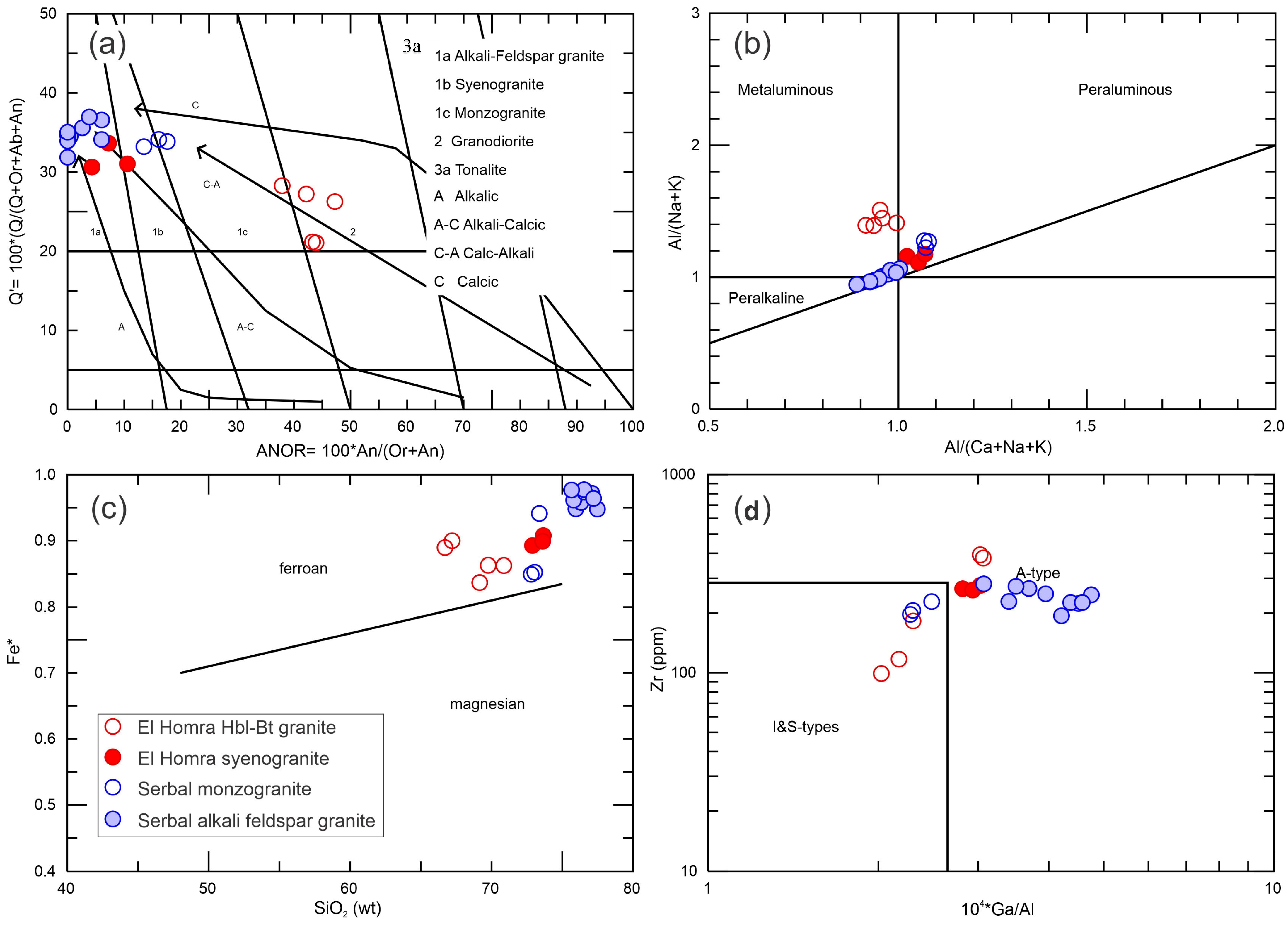
The investigated granitic rocks show a systematic compositional evolution (Figure 2), with the Serbal suite restricted to high SiO2 contents (72.8–77.4 wt.%) and plotting within the alkali-feldspar granite and syenogranite fields on the Q–ANOR classification diagram (Figure 2a). In contrast, the El Homra granites display a broader compositional range (≈66.7–73 wt.% SiO2 for less evolved samples), extending from monzogranite to granodiorite compositions. This distinction reflects a wider range of differentiation states preserved in El Homra relative to the more evolved Serbal suite.
Alumina saturation indices (Figure 2b) indicate predominantly metaluminous to weakly peraluminous compositions for both granitoid suites. The El Homra samples tend toward slightly higher Al/(Ca + Na + K) ratios, consistent with their comparatively lower degree of fractionation. Ferroan affinity is clearly expressed in Fe* systematics (Figure 2c), particularly in the Serbal granites, indicating iron enrichment under relatively high-temperature and low water activity conditions typical of A-type magmatism. Trace element discrimination further supports this interpretation: the studied samples plot within the A-type granite field on the 104*Ga/Al versus Zr diagram (Figure 2d) [12], consistent with enrichment in incompatible elements and HFSE.
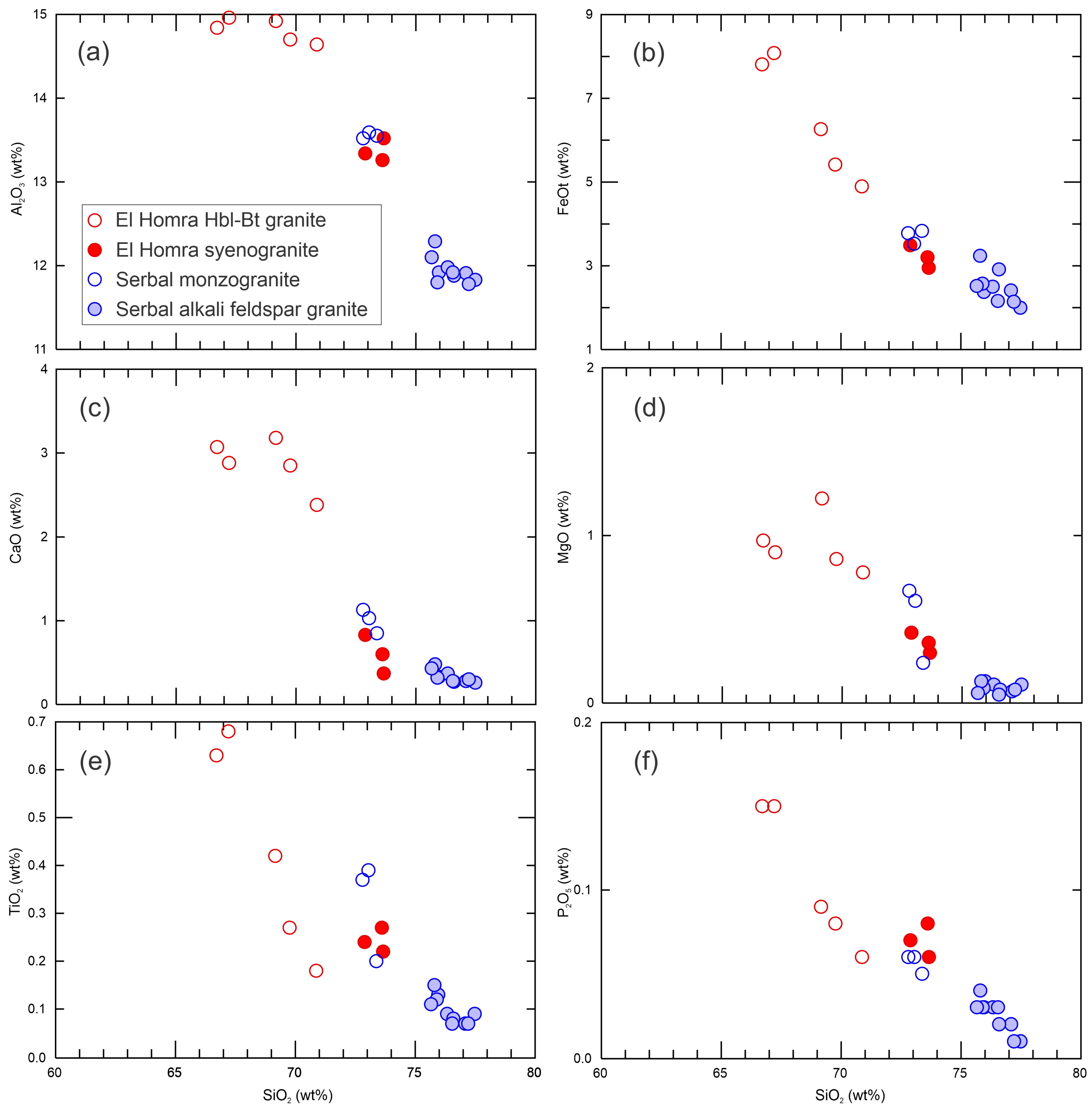
Major element variation diagrams (Figure 3) display well-defined and continuous differentiation trends, providing strong evidence for fractional crystallization as the dominant magmatic process. Systematic decreases in Al2O3, CaO, FeOt, MgO, TiO2, and P2O5 with increasing SiO2 (Figure 3a–f) reflect progressive removal of plagioclase, alkali feldspar, mafic silicates, Fe–Ti oxides, and apatite. The higher CaO (up to ~3 wt.%) and FeOt contents in less evolved El Homra samples compared to the low values in the Serbal granites (CaO < 1 wt.%) further support early-stage plagioclase and mafic mineral fractionation. The linear and coherent nature of these trends, without significant scatter, indicates closed-system evolution and argues against magma mixing.
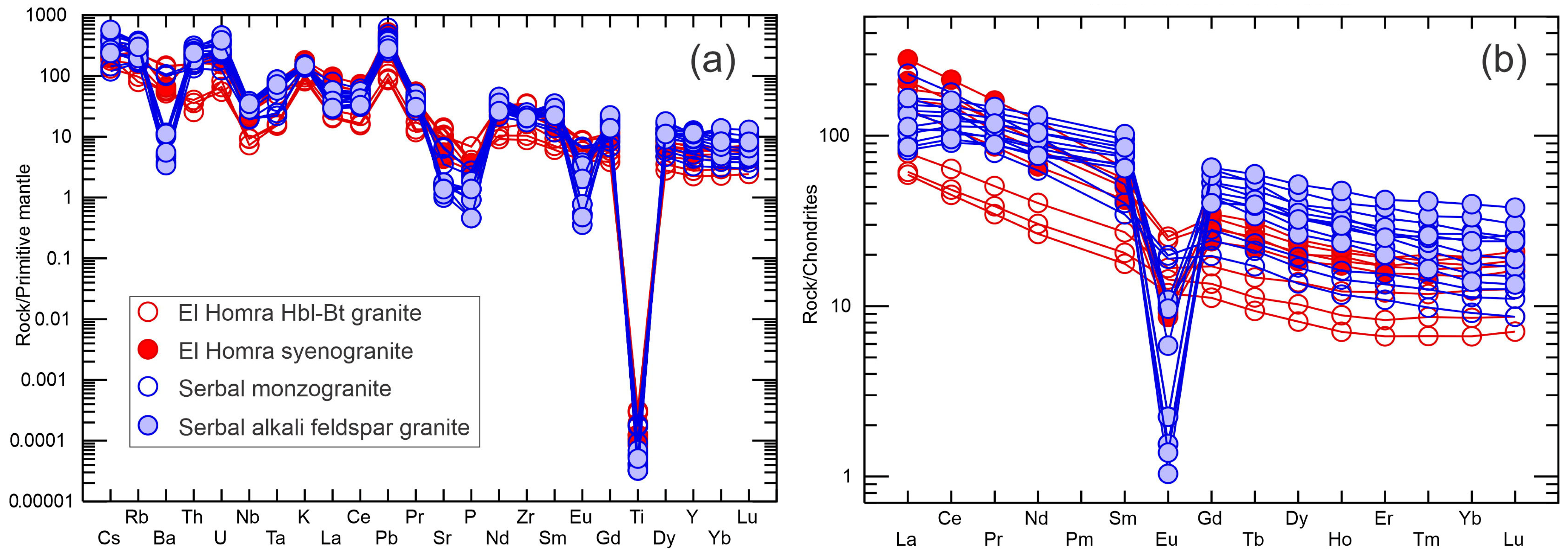
Primitive mantle–normalized multi-element patterns (Figure 4a) exhibit the characteristic geochemical signature of A-type granites, including enrichment in HFSE (Zr, Nb, Y) and pronounced negative Ba, Sr, and Ti anomalies. The progressive depletion of Ba (from >1000 ppm in less evolved El Homra samples to <500 ppm in evolved compositions) and Sr (from ~300 ppm to <100 ppm) reflects continuous feldspar fractionation, whereas the strong Ti anomaly indicates the crystallization of Fe–Ti oxides during melt evolution.
Chondrite-normalized REE patterns (Figure 4b) are characterized by strong LREE enrichment, relatively flat to moderately fractionated HREE segments, and well-developed negative Eu anomalies. The magnitude of the Eu anomaly increases with differentiation, consistent with progressive plagioclase removal. Serbal granites display higher HREE contents and steeper HREE slopes relative to El Homra, indicating more advanced fractionation and efficient partitioning of HREE into accessory phases such as zircon.

3.2. Zircon Characteristics and Trace Element Geochemistry

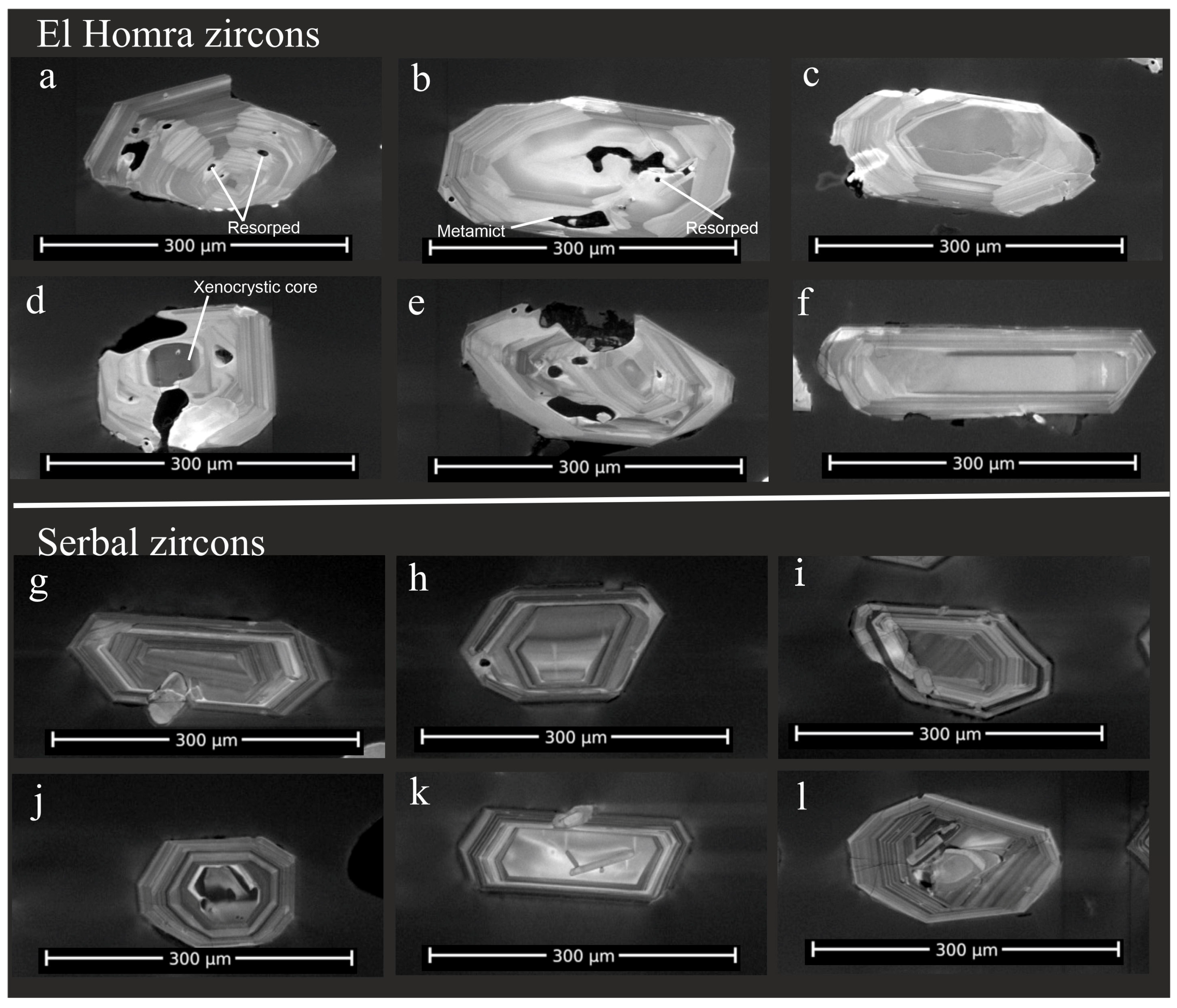
Zircon crystals from both the El Homra and Serbal granites exhibit well-developed prismatic morphologies typical of magmatic zircon, although they differ significantly in internal structure and growth history (Figure 5). El Homra zircons (Figure 5a–f) are predominantly subhedral to anhedral and display complex internal textures, including resorbed margins (Figure 5a,b), patchy and irregular zoning, metamict domains (Figure 5b), and locally preserved xenocrystic cores (Figure 5d). These features indicate multi-stage zircon growth involving repeated dissolution–reprecipitation processes, consistent with crystallization in a dynamic magmatic system characterized by melt interaction and possible early-formed cumulate components.
In contrast, zircons from the Serbal granites (Figure 5g–l) are typically euhedral, elongated prismatic crystals with sharp crystal faces and well-developed oscillatory zoning (Figure 5h,j). Such regular zoning patterns reflect steady-state magmatic growth under relatively stable physicochemical conditions. In both granitoid suites, zircon grains commonly contain abundant mineral inclusions, predominantly apatite (Figure 5e,k,l), indicating co-crystallization with accessory phases during magma evolution.

3.2.1. Trace Element Systematics

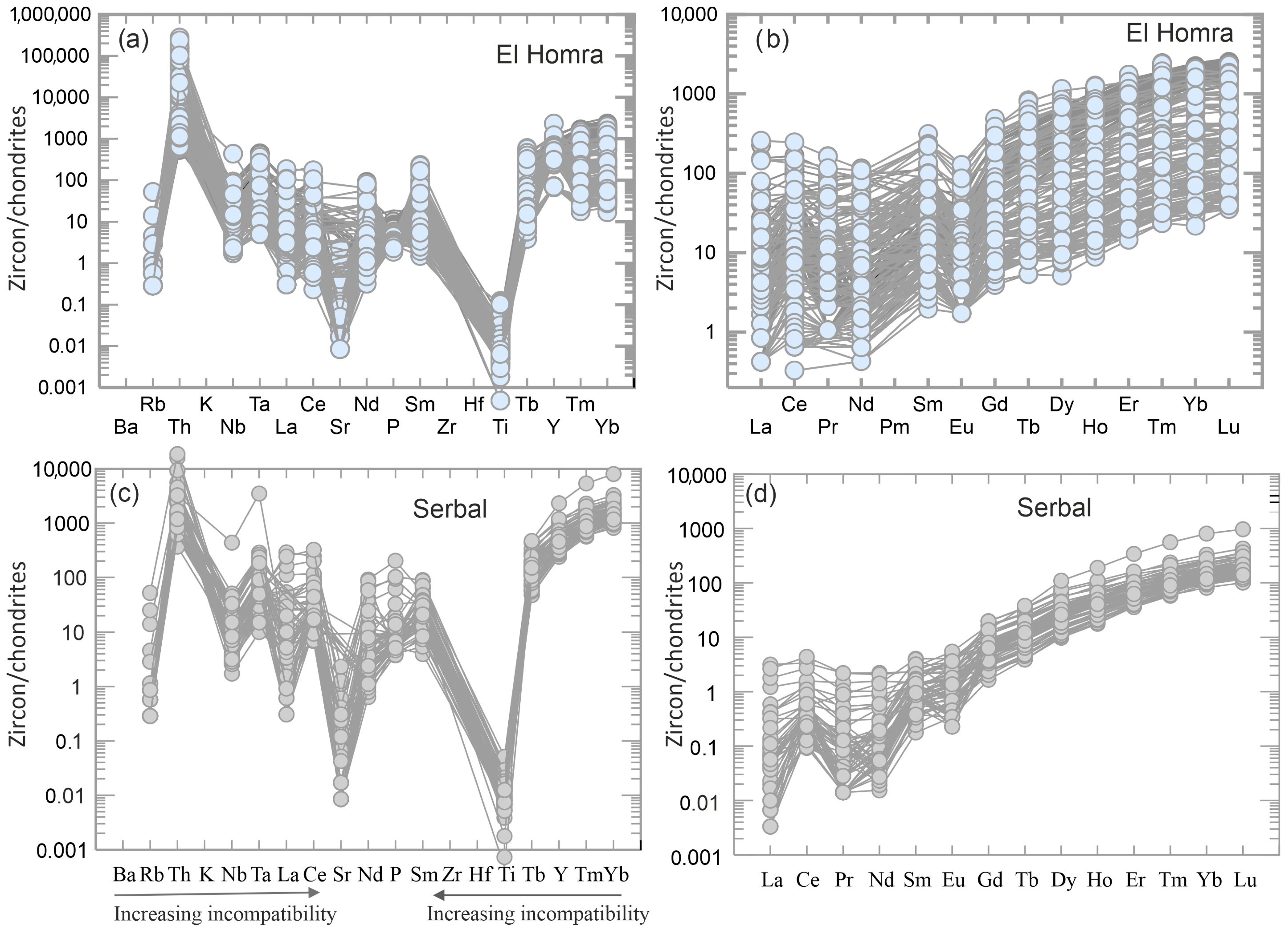
The trace element composition of zircon is characterized by strongly fractionated REE patterns, with pronounced enrichment in HREE relative to LREE (Figure 6). This pattern reflects the crystal-chemical preference of zircon for smaller ionic radius elements, leading to preferential incorporation of HREE. The dataset shows a wide range in Yb and Dy concentrations, resulting in elevated and variable Yb/Gd ratios that are consistent with progressive differentiation of the host melt.
A prominent feature of the REE patterns is the presence of well-developed negative Eu anomalies (Figure 6). These anomalies reflect plagioclase fractionation, as Eu2+ is preferentially incorporated into feldspar, leading to depletion of Eu in the residual melt from which zircon crystallizes. The persistence of negative Eu anomalies across the dataset indicates that feldspar fractionation was a continuous and dominant process during magma evolution.
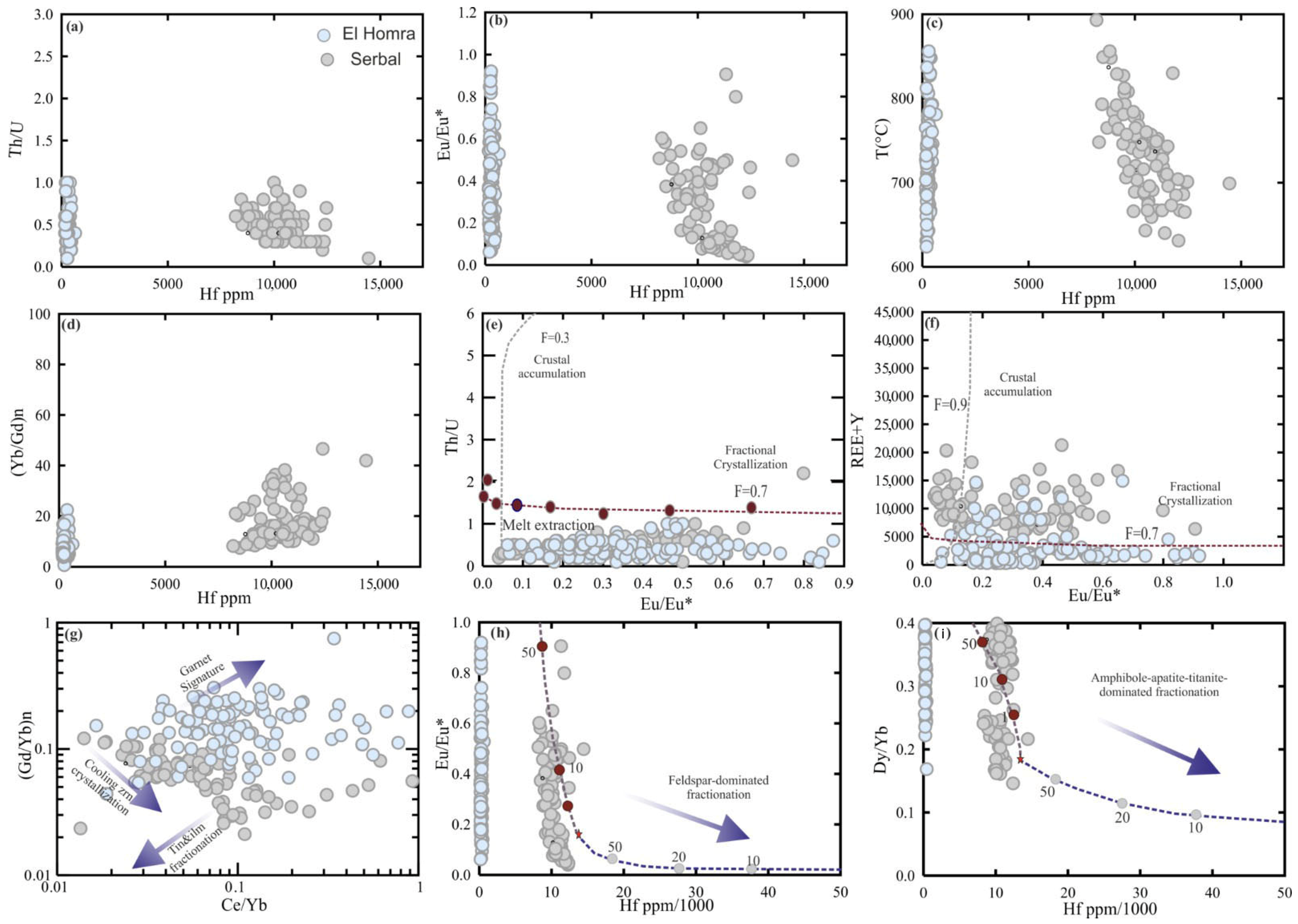
Relationships among key trace element ratios (Figure 7) provide further constraints on melt evolution. Eu/Eu* shows a systematic decrease with increasing Hf, consistent with progressive depletion of Eu during differentiation. Similarly, increasing Yb/Gd ratios reflect continued enrichment of HREE in evolved melts. These relationships are supported by statistically significant correlations: Hf exhibits a strong negative correlation with Eu/Eu* (R2 ≈ 0.7) and a positive correlation with Yb/Gd (R2 ≈ 0.6–0.7). In addition, Ti-in-zircon temperatures display a moderate positive correlation with Hf (R2 ≈ 0.5), indicating a coupled evolution of thermal conditions and melt composition.
Although these correlations are robust, some scatter is present in the data, likely reflecting analytical uncertainty, local compositional variability within zircon domains, and potential effects of inclusions or zoning. Therefore, the observed relationships should be interpreted as systematic trends rather than strictly deterministic relationships.
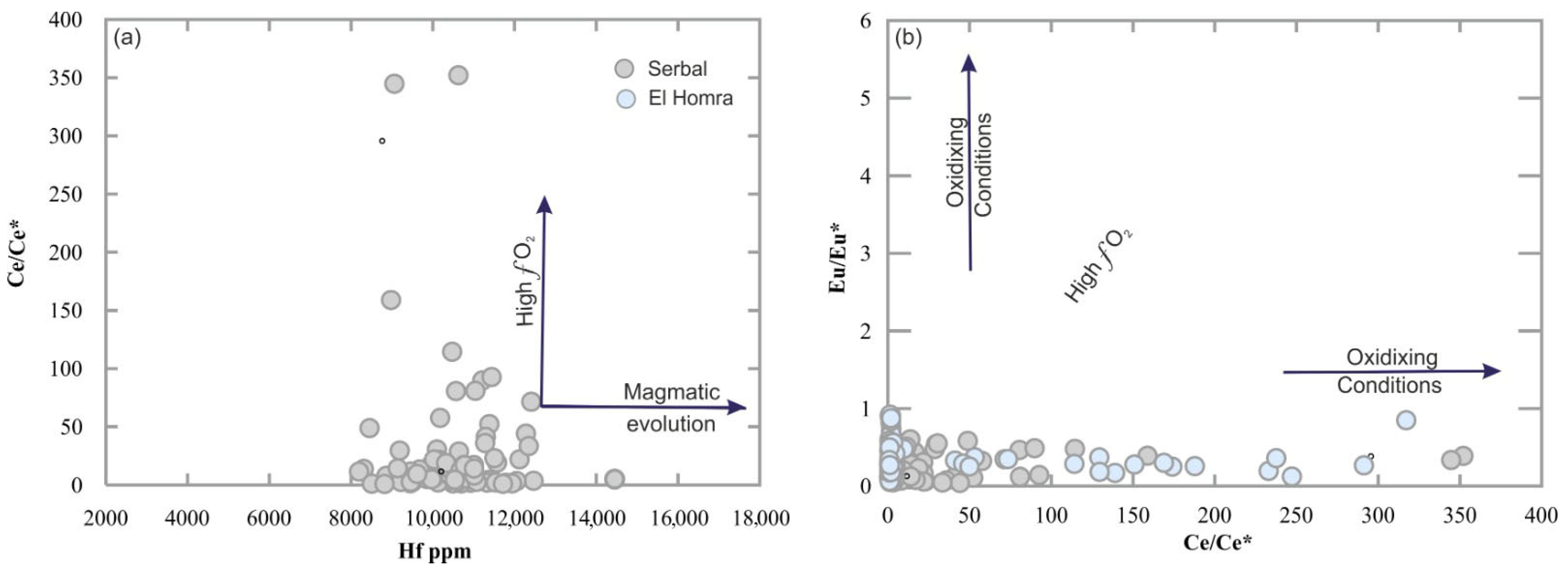
Cerium anomalies provide additional insight into redox conditions. Zircons consistently display positive Ce anomalies (Figure 8), reflecting oxidation of Ce3+ to Ce4+ in the melt and its preferential incorporation into zircon. However, Ce/Ce* values are influenced not only by oxygen fugacity but also by temperature and melt composition, and their calculation involves propagation of analytical uncertainties. Consequently, Ce anomalies are interpreted in a semi-quantitative sense and in conjunction with other geochemical indicators.
To further evaluate the relationships between zircon trace element systematics and melt evolution, linear regression analyses were applied to key geochemical parameters (Figure 7). The statistically supported correlations between Hf, Eu/Eu*, Yb/Gd, and Ti-in-zircon temperature indicate that zircon compositions systematically track melt differentiation. These results demonstrate that zircon trace element systematics provide quantitatively supported, though not strictly predictive, constraints on magmatic evolution.

3.2.2. Hf Evolution, Incompatible Element Behavior, and Thermal Constraints

Zircon Hf contents show a wide range, from low values typical of early crystallization stages to very high concentrations associated with evolved melts. The increase in Hf with differentiation reflects progressive depletion of Zr in the melt, which enhances the relative incorporation of Hf into zircon. This behavior is well expressed in the relationship between Hf and Th/U ratios (Figure 7), where higher Hf values correspond to increased incompatible element enrichment.
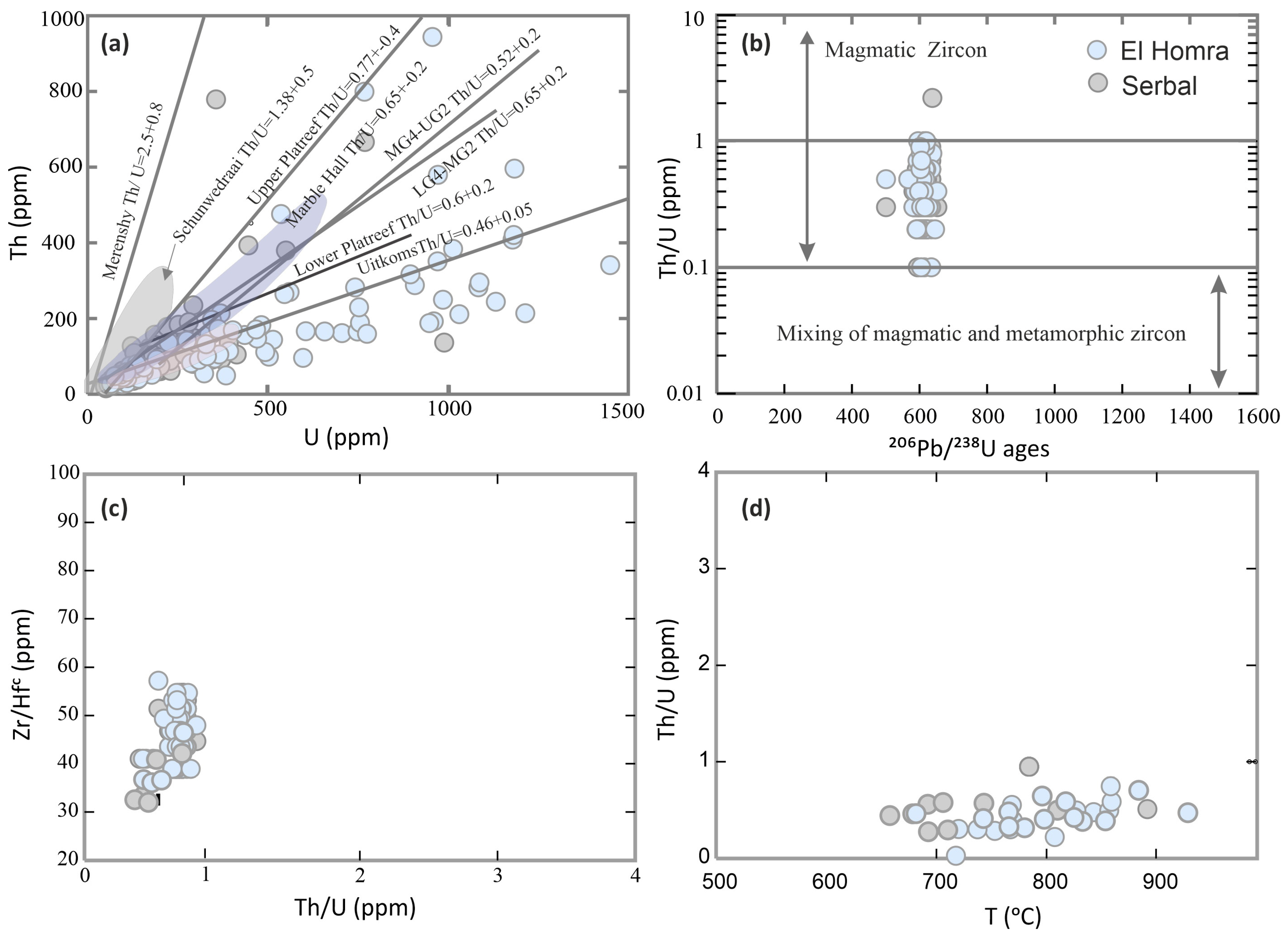
The variability in U and Th concentrations (Figure 9) further illustrates the changing chemical environment during zircon growth. These elements are highly sensitive to melt composition and partitioning behavior, and their wide range suggests that zircon crystallization occurred over an extended interval of magmatic evolution rather than during a single crystallization stage.
Zircons from El Homra are distinguished by relatively low Hf contents and low Th/U ratios, consistent with crystallization from less evolved melts. These characteristics support a model in which part of the El Homra zircon population formed early, possibly within crystal-rich or cumulate-dominated domains. In contrast, the Serbal zircons, with higher Hf contents, reflect crystallization from more evolved melts.
Temperature estimates derived from Ti-in-zircon thermometry indicate crystallization under high-temperature conditions typical of A-type granites. Most values cluster within a relatively narrow range, suggesting that zircon growth occurred under sustained thermal conditions rather than during short-lived thermal events (Figure 9). The relationship between temperature and Th/U ratios indicates that higher temperatures are associated with more evolved magmatic conditions, consistent with progressive differentiation under decreasing water activity.
The link between Hf enrichment and temperature (Figure 7) further supports a coupled evolution of melt chemistry and thermal conditions. As differentiation proceeds, the melt becomes both chemically evolved and thermally stable, allowing zircon to record a continuous evolution rather than discrete crystallization episodes.
The relationships between Hf, Eu/Eu*, Yb/Gd, and temperature (Figure 7, Figure 8 and Figure 9) indicate that zircon crystallization captures a tightly coupled evolution of melt composition and thermal state. This reinforces the interpretation that zircon trace element systematics provide a reliable and continuous record of magmatic differentiation in these granitic systems.

4. Discussion

4.1. Magmatic Differentiation Recorded by Whole-Rock and Zircon Geochemistry

Whole-rock geochemical trends (Figure 2, Figure 3 and Figure 4) define a coherent high-silica differentiation trajectory characteristic of evolved A-type granitoid systems. Elevated SiO2 contents (72.8–77.4 wt.%), ferroan affinity (Figure 2), and enrichment in HFSE collectively indicate advanced melt evolution under high-temperature and low water activity conditions [2,23]. The pronounced negative Ba–Sr–Ti anomalies observed in primitive mantle–normalized patterns (Figure 4) reflect progressive removal of feldspar and Fe–Ti oxides, consistent with advanced fractional crystallization [4,7]. A direct quantitative comparison between zircon Hf concentrations and whole-rock SiO2 and HFSE contents reveals consistent positive correlations, demonstrating that zircon chemistry quantitatively tracks bulk-rock differentiation trends.
These whole-rock trends are systematically mirrored by zircon trace element systematics, demonstrating strong coupling between melt evolution and accessory mineral chemistry. The wide range of zircon Hf concentrations (162–14,453 ppm; Figure 8) reflects progressive Zr depletion in the melt during differentiation, consistent with experimental constraints on zircon–melt partitioning [8,21]. The positive correlation between Hf and Th/U ratios (Figure 8a) further indicates progressive enrichment of incompatible elements during late-stage melt evolution.
Zircon Eu anomalies provide an independent and robust record of feldspar-controlled fractionation. The predominance of Eu/Eu* values well below unity (mean = 0.32; Figure 7) closely parallels whole-rock Eu depletion (Figure 4), confirming extensive plagioclase removal during magma evolution. The systematic decrease in Eu/Eu* with increasing Hf (Figure 8) demonstrates synchronous evolution of feldspar fractionation and melt differentiation. This relationship highlights the capacity of zircon to preserve differentiation signals that may be partially obscured in bulk-rock compositions [8,13].
Furthermore, the covariance among Hf enrichment, decreasing Eu/Eu*, and increasing Yb/Gd ratios (Figure 8) indicates that zircon trace element chemistry records a continuous differentiation process rather than discrete magmatic pulses or mixing events. This is consistent with the linear and coherent trends observed in Harker diagrams (Figure 3), which argue against significant magma mixing and instead support closed-system fractional crystallization as the dominant evolutionary process.

4.2. Redox Evolution Constrained by Zircon Ce Anomalies

Zircon Ce anomalies provide a robust proxy for constraining magmatic redox conditions during crystallization. The consistently positive Ce/Ce* values observed in this study (Figure 9) indicate relatively oxidized magmatic environments, reflecting stabilization of Ce4+ in the melt and its preferential incorporation into [10,11]. Such behavior is characteristic of evolved felsic magmas formed under moderately oxidizing conditions typical of post-collisional A-type systems [1]. However, Ce anomalies are not controlled solely by oxygen fugacity. Temperature, melt composition, and crystal–melt partitioning behavior can also influence Ce incorporation in zircon. In addition, the calculation of Ce/Ce* involves normalization to neighboring REE and is therefore subject to analytical uncertainties associated with REE measurements and propagation of errors during normalization. Consequently, Ce/Ce* values should be interpreted as semi-quantitative indicators of redox conditions rather than precise measures of oxygen fugacity.
To reduce ambiguity, Ce anomalies are evaluated here in conjunction with Eu anomalies and Ti-in-zircon temperatures. The coexistence of positive Ce anomalies and strongly negative Eu anomalies provides complementary constraints on redox and fractionation processes. While Eu anomalies primarily reflect plagioclase fractionation through Eu2+ partitioning, Ce anomalies provide an independent constraint on oxidation state through Ce4+ enrichment.
Recent developments in zircon-based oxybarometry allow quantitative estimation of oxygen fugacity (ƒO2) directly from trace element systematics. In particular, the formulation of [21] provides an empirical relationship linking zircon Ce, U, and Ti concentrations to magmatic ƒO2, without requiring independent constraints on melt composition or pressure. The relationship is expressed as:
l o g f O 2 ( sample ) l o g f O 2 ( FMQ ) = 3.998 ( ± 0.124 ) l o g l o g ( C e ) U i T i + 2.284 ( ± 0.101 )
where C e , U i , and T i represent zircon trace element concentrations and temperature-dependent parameters. This formulation yields oxygen fugacity relative to the fayalite–magnetite–quartz (FMQ) buffer, with an uncertainty of approximately ±0.6 log units and a correlation coefficient of R = 0.963 [24].
Application of this approach to the studied samples indicates generally oxidized conditions, with Serbal granitoids yielding ΔFMQ values of ~1.1 to 6.67 (mean ≈2.55), whereas El Homra samples display a wider range (≈−0.8 to 5.5). This variability likely reflects differences in melt evolution, with El Homra preserving earlier-stage or locally heterogeneous magmatic conditions, consistent with its lower Hf contents and broader geochemical variability. Importantly, the observed spread in ƒO2 estimates should be interpreted cautiously, as it may partly reflect analytical uncertainty and sensitivity to input parameters rather than exclusively representing true magmatic variability.
The combined behavior of Ce/Ce*, Eu/Eu*, and Ti-in-zircon temperatures indicates that redox conditions evolved concurrently with melt differentiation (Figure 8 and Figure 9). Although individual parameters carry inherent uncertainties, their consistent covariation provides a robust, internally coherent framework for interpreting redox evolution in these A-type granitoid systems.

4.3. Thermal Regime from Ti-in-Zircon Thermometry

Ti-in-zircon thermometry provides an important constraint on zircon crystallization temperatures that is largely independent of whole-rock composition [9]. The calculated temperatures for the studied zircons range from 562 °C to 1384 °C, with most values clustering between 757 °C and 872 °C and a mean of approximately 837 °C. This dominant temperature interval is consistent with crystallization from high-temperature felsic melts typical of A-type granitoid systems [7,25].
However, the full temperature range should be interpreted with caution. The lowest and highest calculated values may not necessarily represent the main crystallization conditions of the magma. Instead, they may reflect analytical scatter, minor effects of mineral inclusions, local chemical heterogeneity within zircon domains, or uncertainties related to the assumed activities of SiO2 and TiO2 in the melt. In particular, Ti-in-zircon temperatures are sensitive to the adopted Ti activity, and variations in aTiO2 can shift calculated temperatures. Therefore, the clustered temperature population between 757 °C and 872 °C is considered more representative of the dominant zircon crystallization interval than the total calculated range.
The high-temperature cluster agrees well with the whole-rock geochemical characteristics of the studied granites, including ferroan affinity, high SiO2 contents, HFSE enrichment, and pronounced negative Ti anomalies. These features collectively indicate crystallization from hot, relatively dry, and evolved felsic magmas. Such conditions are favorable for extensive fractional crystallization, enrichment of incompatible elements, and progressive development of A-type geochemical signatures.
The relationship between Ti-in-zircon temperature and zircon trace element composition further supports a coupled thermal and chemical evolution. Zircons with higher Hf contents and higher Th/U ratios generally correspond to more evolved melt compositions, suggesting that zircon growth occurred during progressive differentiation rather than during a single crystallization stage. Nevertheless, these relationships should be regarded as systematically constrained rather than strictly predictive, because temperature estimates and trace element ratios are both affected by analytical uncertainty and local crystal-scale variability.
El Homra zircons with relatively low Hf contents and low Th/U ratios generally record lower temperature estimates, consistent with crystallization from less evolved or crystal-rich melts. In contrast, Serbal zircons commonly show higher Hf contents and temperatures within the main high-temperature cluster, indicating crystallization from more evolved, HFSE-enriched melts. This contrast supports the interpretation that El Homra and Serbal represent different stages along a shared differentiation pathway.
Although the total calculated range is broad, the outlying values are best treated cautiously and likely reflect a combination of analytical, thermodynamic, and crystal-scale effects rather than discrete magma-wide thermal events. This interpretation supports the petrogenetic model of prolonged high-temperature differentiation during post-collisional extensional magmatism in the northern Arabian–Nubian Shield [14].

4.4. Integrated Petrogenetic Framework for A-Type Granite Systems

The integration of whole-rock and zircon geochemical data provides a coherent and internally consistent framework for understanding the petrogenesis of A-type granitoid systems. Whole-rock geochemistry establishes the bulk differentiation trends (Figure 2, Figure 3 and Figure 4), whereas zircon trace element systematics (Figure 6, Figure 7, Figure 8 and Figure 9) provide high-resolution constraints on the physicochemical evolution of the magma.
The combined dataset demonstrates that magma evolution is controlled primarily by progressive fractional crystallization, with zircon chemistry recording key aspects of this process. Specifically, zircon trace elements provide quantitatively supported constraints on:
  • Differentiation intensity, reflected by systematic Hf enrichment [8,21];
  • Feldspar-controlled fractionation, recorded by negative Eu anomalies (Figure 6 and Figure 7) [10];
  • Redox evolution, constrained by positive Ce anomalies (Figure 8) [10,11];
  • Thermal regime, quantified by Ti-in-zircon temperatures (Figure 8 and Figure 9) [9].
Importantly, these relationships arise from crystal–melt partitioning processes and are therefore largely independent of regional geological variability. This makes zircon trace element systematics a powerful and transferable tool for interpreting magmatic evolution across a wide range of granitoid systems.
Within the ANS context, the Sinai granitoids record high-temperature, post-collisional magmatism associated with lithospheric extension and orogenic collapse (Figure 1). The geochemical differences between the Serbal and El Homra granitoids reflect different stages along a shared evolutionary pathway. El Homra preserves less evolved, early-stage melts characterized by lower Hf, lower temperatures, and more variable redox conditions, whereas Serbal represents highly fractionated, HFSE-enriched melts formed under sustained high-temperature conditions.
The strong coupling between zircon trace element systematics and whole-rock geochemistry confirms that zircon faithfully records melt evolution while preserving independent constraints on temperature and redox state. This dual sensitivity enables zircon to serve as a quantitative recorder of magmatic processes, bridging the gap between bulk-rock geochemistry and mineral-scale thermodynamics.

5. Conclusions

Integrated whole-rock geochemistry and in situ zircon trace element data provide a coherent framework for constraining magmatic differentiation, thermal regime, and redox evolution in Neoproterozoic A-type granitoids from Sinai, Egypt. Whole-rock compositions define a high-temperature differentiation trajectory (Figure 2, Figure 3 and Figure 4) characterized by ferroan affinity, enrichment in high-field-strength elements (HFSE), and pronounced negative Ba–Sr–Ti anomalies, indicating progressive fractional crystallization dominated by feldspar and Fe–Ti oxide removal.
Zircon trace element systematics closely reproduce these differentiation processes at the mineral scale. Hafnium enrichment (162–14,453 ppm; mean = 4763 ppm) tracks progressive melt evolution, reflecting increasing Hf/Zr ratios during advanced fractionation. Strongly negative Eu anomalies (mean Eu/Eu* = 0.32) record extensive plagioclase fractionation and parallel whole-rock Eu depletion, while steep HREE enrichment (Yb up to 1757 ppm) indicates crystallization from highly evolved felsic melts.
Ti-in-zircon thermometry yields crystallization temperatures between 562 °C and 1384 °C (mean ≈ 837 °C), confirming high-temperature magmatic conditions typical of A-type systems. Positive Ce anomalies indicate moderately oxidized crystallization environments, demonstrating that redox evolution accompanied melt differentiation. The combined behavior of Eu and Ce anomalies indicates that feldspar fractionation and oxidation state evolved concurrently during magma evolution.
Systematic relationships among zircon Hf, Eu/Eu*, Yb/Gd, Th/U, and Ti-in-zircon temperatures demonstrate strong coupling between zircon chemistry and whole-rock differentiation trends, while preserving independent constraints on temperature and oxygen fugacity. This dual sensitivity highlights zircon as a robust multi-parameter recorder of magmatic processes.
The contrasting geochemical characteristics of the Serbal and El Homra granites reflect different stages along a common differentiation pathway, with El Homra preserving less evolved melts and Serbal representing highly fractionated, HFSE-enriched end members. These variations emphasize the sensitivity of zircon trace element systematics to melt evolution and crystallization history.
Zircon trace element systematics provide a thermodynamically consistent and transferable framework for quantifying differentiation, thermal conditions, and redox evolution in A-type granitoid systems, offering new insights into crustal reworking processes during post-collisional tectonic evolution.


Author Contributions

Conceptualization, A.D. and B.Z.; methodology, B.Z.; software, A.D.; validation, A.D., R.Z., M.F. and A.F.O.; formal analysis, B.Z.; investigation, A.D.; resources, A.D.; data curation, M.A.; writing—original draft preparation, A.D.; writing—review and editing, B.Z.; visualization, A.D.; supervision, B.Z.; project administration, B.Z.; funding acquisition, B.Z. All authors have read and agreed to the published version of the manuscript.

Funding

This research received no external funding.

Data Availability Statement

The geochemical datasets used for this study will be made available when requested by communicating with the corresponding authors.

Conflicts of Interest

The authors declare no conflicts of interest.

References

  1. Zoheir, B.; Diab, A. Origin of the Volcanic-Arc Signature in Late-Orogenic Granitoids from the Arabian–Nubian Shield. In The Geology of the Arabian-Nubian Shield; Hamimi, Z., Ed.; Springer: Cham, Switzerland, 2021; pp. 439–450. [Google Scholar]
  2. Whalen, J.B.; Currie, K.L.; Chappell, B.W. A-type granites: Geochemical characteristics, discrimination and petrogenesis. Contrib. Mineral. Petrol. 1987, 95, 407–419. [Google Scholar] [CrossRef]
  3. Frost, B.R.; Barnes, C.G.; Collins, W.J.; Arculus, R.J.; Ellis, D.J.; Frost, C.D. A Geochemical Classification for Granitic Rocks. J. Petrol. 2001, 42, 2033–2048. [Google Scholar] [CrossRef]
  4. Eby, G.N. The A-type granitoids: A review of their occurrence and chemical characteristics and speculations on their petrogenesis. Lithos 1990, 26, 115–134. [Google Scholar] [CrossRef]
  5. Eby, G.N. Chemical Subdivision of the A-Type Granitoids: Petrogenetic and Tectonic Implications. Geology 1992, 20, 641–644. [Google Scholar] [CrossRef]
  6. Samuel, M.D.; Moussa, H.E.; Azer, M.K. A-type volcanics in Central Eastern Sinai, Egypt. J. Afr. Earth Sci. 2007, 47, 203–226. [Google Scholar] [CrossRef]
  7. Bonin, B. A-Type Granites and Related Rocks: Evolution of a Concept, Problems and Prospects. Lithos 2007, 97, 1–29. [Google Scholar] [CrossRef]
  8. Hoskin, P.W.O.; Schaltegger, U. The Composition of Zircon and Igneous and Metamorphic Petrogenesis. Rev. Mineral. Geochem. 2003, 53, 27–62. [Google Scholar] [CrossRef]
  9. Watson, J.C.; Clement, D.; Harris, B.; Leffingwell, T.R.; Hurst, J. Teacher–Practitioner Multiple-Role Issues in Sport Psychology. Ethics Behav. 2006, 16, 41–59. [Google Scholar]
  10. Trail, D.; Watson, E.B.; Tailby, N.D. Ce and Eu anomalies in zircon as proxies for the oxidation state of magmas. Geochim. Cosmochim. Acta 2012, 97, 70–87. [Google Scholar] [CrossRef]
  11. Ballard, J.R.; Palin, J.M.; Campbell, I.H. Relative Oxidation States of Magmas Inferred from Ce (IV)/Ce(III) in Zircon: Application to Porphyry Copper Deposits of Northern Chile. Contrib. Mineral. Petrol. 2002, 144, 347–364. [Google Scholar]
  12. Grimes, C.B.; John, B.E.; Kelemen, P.B.; Mazdab, F.K.; Wooden, J.L.; Cheadle, M.J.; Hanghøj, K.; Schwartz, J.J. The Trace Element Chemistry of Zircons from Oceanic Crust: A Method for Distinguishing Detrital Zircon Provenance. Geology 2007, 35, 643–646. [Google Scholar] [CrossRef]
  13. Belousova, E.A.; Griffin, W.L.; O’Reilly, S.Y.; Fisher, N.I. Igneous zircon: Trace element composition as an indicator of source rock type. Contrib. Mineral. Petrol. 2002, 143, 602–622. [Google Scholar] [CrossRef]
  14. Johnson, P.R.; Woldehaimanot, B. Development of the Arabian–Nubian Shield: Perspectives on accretion and deformation in the northern East African Orogen and the assembly of Gondwana. Geol. Soc. Lond. Spec. Publ. 2003, 206, 289–325. [Google Scholar] [CrossRef]
  15. Streckeisen, A. To Each Plutonic Rock Its Proper Name. Earth-Sci. Rev. 1976, 12, 1–33. [Google Scholar] [CrossRef]
  16. Le Maitre, R.W.; Le Bas, M.J.; Bonin, B.; Bateman, P.; Bellieni, G.; Dudek, A.; Efremova, S.; Keller, J.; LaMeyre, J.; Sabine, P.A.; et al. Igneous Rocks: A Classification and Glossary of Terms; Cambridge University Press: Cambridge, UK, 2002; 236p. [Google Scholar]
  17. Maniar, P.D.; Piccoli, P.M. Tectonic Discrimination of Granitoids. Geol. Soc. Am. Bull. 1989, 101, 635–643. [Google Scholar] [CrossRef]
  18. Harker, A. The Natural History of Igneous Rocks; Methuen & Co.: London, UK, 1909. [Google Scholar]
  19. Rollison, H.R. Using Geochemical Data: Evaluation, Presentation, Interpretation; Longman Scientific & Technical: Harlow, UK, 1993. [Google Scholar]
  20. Sun, S.S.; McDonough, W.F. Chemical and isotopic systematics of oceanic basalts: Implications for mantle composition and processes. In Magmatism in the Ocean Basins; Saunders, A.D., Norry, M.J., Eds.; Geological Society, London, Special Publications; The Geological Society: London, UK, 1989; Volume 42, pp. 313–345. [Google Scholar]
  21. Claiborne, L.L.; Miller, C.F.; Walker, B.A.; Wooden, J.L.; Mazdab, F.K.; Bea, F. Tracking magmatic processes through Zr/Hf ratios in rocks and Hf and Ti zoning in zircons: An example from the Spirit Mountain batholith, Nevada. Mineral. Mag. 2006, 70, 517–543. [Google Scholar] [CrossRef]
  22. De Waal, S.A.; Armstrong, R.A. The age of the Marble Hall Diorite, its relationship to the Uitkomst Complex and evidence for a new magma type associated with the Bushveld Igneous Event. S. Afr. J. Geol. 2000, 103, 128–140. [Google Scholar] [CrossRef]
  23. De Waal, S.A.; Maier, W.D.; Armstrong, R.A.; Gauert, C.D.K. Parental magma and emplacement of the stratiform Uitkomst Complex, South Africa. Can. Mineral. 2001, 39, 557–571. [Google Scholar] [CrossRef]
  24. Loucks, R.R.; Fiorentini, M.L.; Henríquez, G.J. New magmatic oxybarometer using trace elements in zircon. J. Petrol. 2020, 61, egaa034. [Google Scholar] [CrossRef]
  25. Frost, C.D.; Frost, B.R. On ferroan (A type) granitoids: Their compositional variability and modes of origin. J. Petrol. 2011, 52, 39–53. [Google Scholar]
Figure 1. Generalized tectono-magmatic model for the Neoproterozoic Arabian–Nubian Shield (ANS), illustrating A-type granite emplacement during the late-orogenic to post-collisional transition associated with transpressional activity and orogenic collapse [1].
Minerals 16 00715 g001
Figure 2. Whole-rock classification and geochemical discrimination diagrams for the studied granites: (a) Q–ANOR classification diagram for plutonic rocks (after [15,16]), (b) alumina saturation diagram (Al/(Na + K) vs. Al/(Ca + Na + K)) [17], (c) Fe* vs. SiO2 diagram distinguishing ferroan and magnesian granites [3], (d) 104*Ga/Al vs. Zr diagram for A-type granite discrimination [2].
Minerals 16 00715 g002
Figure 3. Harker variation diagrams for major oxides versus SiO2 (wt.%) for the studied granites: (a) Al2O3, (b) FeOt, (c) CaO, (d) MgO, (e) TiO2, and (f) P2O5, illustrating systematic differentiation trends [18,19].
Minerals 16 00715 g003
Figure 4. Trace element characteristics of the studied granites: (a) primitive mantle–normalized multi-element patterns (normalization values after [20]), (b) chondrite-normalized REE patterns after [20], showing LREE enrichment, relatively flat HREE patterns, and negative Eu anomalies.
Minerals 16 00715 g004
Figure 5. Cathodoluminescence (CL) images of representative zircon grains from the El Homra (af) and Serbal (gl) granites. El Homra zircons commonly exhibit complex internal structures, including oscillatory zoning, resorbed margins, xenocrystic cores, and metamict domains, indicative of multi-stage growth and partial resorption during magmatic evolution. In contrast, Serbal zircons are generally euhedral with well-developed oscillatory zoning, reflecting more stable magmatic crystallization conditions. Mineral inclusions are abundant in both suites and are dominantly apatite, suggesting co-crystallization with accessory phases during magma differentiation.
Minerals 16 00715 g005
Figure 6. Chondrite-normalized trace element patterns of zircon: (a) multi-element (spider) diagram showing LILE–HFSE distribution (after [20]); (b) REE patterns highlighting strong HREE enrichment, LREE depletion, and pronounced Eu anomalies (after [20]). (c) multi-element (spider) diagram showing LILE–HFSE distribution (after [20]); (d) REE patterns highlighting strong HREE enrichment, LREE depletion, and pronounced Eu anomalies (after [20].
Minerals 16 00715 g006
Figure 7. Zircon trace element systematics and differentiation trends: (a) Hf vs. Th/U; (b) Hf vs. Eu/Eu*; (c) Hf vs. Ti-in-zircon temperature; (d) Hf vs. Yb/Gd. Additional panels illustrate, (e) Eu/Eu* ratios vs. Hf/Th, (f) Eu/Eu* ratios vs. REE+Y, (g) Ce/Yb vs. Gd/Yb relationships, (h) Eu/Eu* vs. Hf/1000, and (i) Dy/Yb vs. Hf/1000, highlighting feldspar fractionation, melt evolution, and accessory phase controls (after [19]).
Minerals 16 00715 g007
Figure 8. Redox indicators in zircon: (a) Ce/Ce* vs. Hf; (b) Eu/Eu* vs. Ce/Ce*, illustrating oxidation state variations during zircon crystallization.
Minerals 16 00715 g008
Figure 9. Zircon geochemical relationships: (a) U vs. Th compared with global magmatic fields (after [20]); (b) Th/U vs. age indicating magmatic origin (after [21,22]); (c) Zr/Hf vs. Th/U reflecting progressive fractionation (after [20]); (d) Th/U vs. Ti-in-zircon temperature showing temperature–composition relationships.
Minerals 16 00715 g009
Disclaimer/Publisher’s Note: The statements, opinions and data contained in all publications are solely those of the individual author(s) and contributor(s) and not of MDPI and/or the editor(s). MDPI and/or the editor(s) disclaim responsibility for any injury to people or property resulting from any ideas, methods, instructions or products referred to in the content.