Article

Metallogenic Potential and Ore-Forming Fluid Evolution of the Dadonggou Molybdenum Deposit in Northwest Hebei, China: Geochemical and Isotopic Constraints


1
College of Earth Sciences, Jilin University, Changchun 130061, China
2
Hebei Institute of Geological Survey, Shijiazhuang 050227, China
3
Hebei Province Collaborative Innovation Center for Strategic Critical Mineral Research, Hebei GEO University, Shijiazhuang 050031, China
4
Institute of Resources and Environment, Hebei GEO University, Shijiazhuang 050031, China
5
Hebei Provincial Institute of Hydrogeology and Engineering Geology Exploration, Shijiazhuang 050019, China
*
Author to whom correspondence should be addressed.
Minerals 2026, 16(6), 635; https://doi.org/10.3390/min16060635 (registering DOI)
Submission received: 13 May 2026 / Revised: 10 June 2026 / Accepted: 11 June 2026 / Published: 15 June 2026
(This article belongs to the Section Mineral Deposits)

Abstract

The Dadonggou Mo deposit in Western Hebei, within the Yanshan–Liaoning Mo metallogenic belt, is a newly recognized medium-sized porphyry Mo system. Exploration has delineated 126 orebodies, most of which are blind, with identified resources of ~22,000 t Mo at an average grade of 0.071% Mo. Integrated lithogeochemistry, zircon U-Pb chronology, molybdenite Re-Os geochronology, quartz fluid-inclusion microthermometry, and H-O-S isotope analyses constrain the mineralization age, ore-fluid evolution, and sources of ore-forming materials. The zircon U-Pb dating of the ore-bearing granite porphyry and quartz porphyry from the Dadonggou molybdenum deposit yields ages ranging from 135.8 Ma to 141.5 Ma. The low Ti content in zircons indicates that they are super-wet magmatic rocks. The magmatic evolution experienced a change in oxygen fugacity from oxidizing to reducing conditions, which facilitated the initial enrichment of molybdenum. Molybdenite yields a Re-Os isochron age of 135.9 ± 4.0 Ma and a weighted mean model age of 134.2 ± 1.6 Ma, indicating Early Cretaceous mineralization. Ore fluids evolved from an early CO2-H2O-NaCl system with relatively high temperature and salinity to a later H2O-NaCl system with lower temperature and salinity. Isotopic data indicate progressive meteoric-water incorporation into dominantly magmatic fluids. Sulfur isotopes and high Re contents in molybdenite indicate a mixture of mantle magma mixed with some seawater. Lower late-stage trapping pressures record post-ore depressurization and hydrothermal-system shallowing.

1. Introduction

The molybdenum metallogenic belt along the northern margin of the North China Craton (also called the Yanshan–Liaoning Mo metallogenic belt) is distributed across northern Hebei, the Yanshan area, and western Liaoning. It is the second-largest Mo metallogenic belt in China after the East Qinling Mo metallogenic belt [1,2]. The belt hosts abundant Mo and Cu resources and includes a full spectrum of deposit types, chiefly porphyry, porphyry–skarn, skarn, hydrothermal vein, and breccia-hosted deposits. Representative deposits include Yangjiazhangzi and Lanjiagou (western Liaoning), Xiaoyingzi Mo-Fe, Sadaigoumen and Dazhuangke (northern Hebei), and Dasuji, Caosiyao, and Quanzigou (Inner Mongolia) [3,4,5]. Western Hebei is an important component of the Yanshan–Liaoning Mo metallogenic belt. In recent years, several large- to medium-sized Mo deposits have been discovered there, including Zhujiawa, Qiandongdamiao, and Dadonggou, highlighting strong exploration potential.
The Dadonggou Mo deposit was discovered during mineral exploration in Western Hebei by the Hebei Provincial Geological Survey between 2021 and 2024. According to the 2024 exploration report, 126 Mo orebodies have been delineated, with a total identified resource of 22,000 t Mo at an average grade of 0.071%, placing the deposit in the medium-sized category and indicating considerable resource potential. Although preliminary studies have documented the deposit geology and geophysical–geochemical exploration signatures [6,7], systematic research on deposit type, mineralization age, ore-forming materials, deposit genesis, and the regional metallogenic framework remains limited.
Based on detailed field geological investigation of the deposit, lithogeochemical and zircon U-Pb geochronological analyses were conducted on the host rocks, molybdenite Re-Os isotope dating was performed on representative ore samples, fluid inclusion microthermometry was carried out on quartz from different mineralization stages of the Dadonggou molybdenum deposit, and hydrogen, oxygen, and sulfur isotope analyses were conducted on the main ore minerals. Based on the above work, we determined the mineralization age of the Dadonggou molybdenum deposit, investigated the fluid composition, properties, and evolution during different mineralization stages, traced the source of the ore-forming materials, and discussed the deposit genesis and mineralization mechanism. These results provide a theoretical basis for studying the metallogenic regularity of similar deposits in this region.

2. Regional Geological Setting

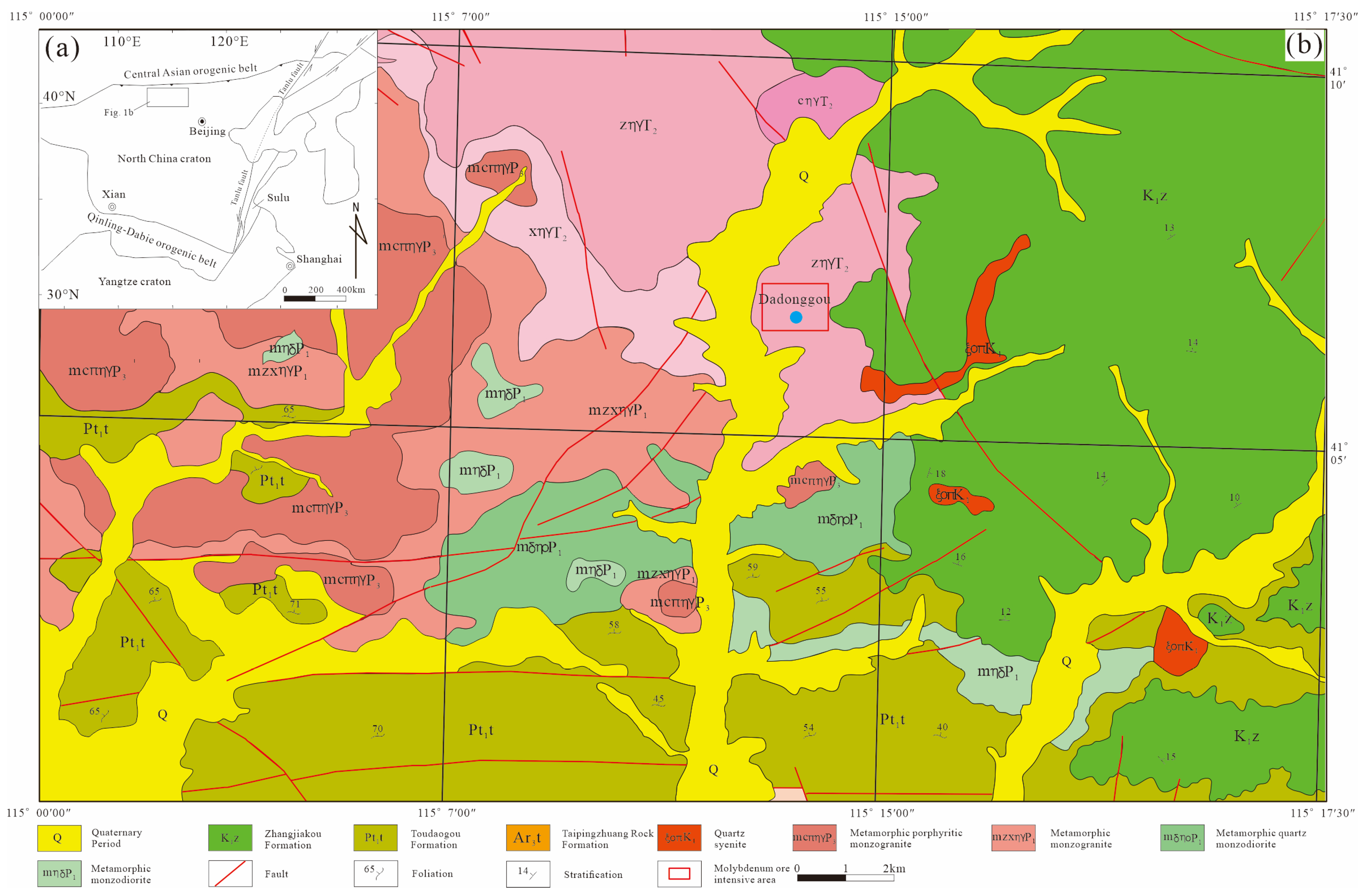
Western Hebei lies in the central segment of the northern margin of the North China Craton, at the junction of the Yanshan and Taihang Mountains. It is an important part of the Yanshan–Liaoning Mo metallogenic belt (Figure 1a). Precambrian basement is widely exposed in the area and consists mainly of Archean to Paleoproterozoic amphibolite- to granulite-facies metamorphic rocks (Figure 1b; [8]). Mesozoic strata are dominated by intermediate to felsic volcanic and clastic rocks that unconformably overlie the Precambrian basement. Faults are well-developed, with NE- and NW-trending sets predominating; the NE-trending faults formed earlier and were later offset by NW-trending faults. Magmatism in Western Hebei was multiphase and can be grouped into four principal episodes: Paleoproterozoic, Permian, Triassic, and Cretaceous. The Early Cretaceous magmatic activity is closely related to mineralization, which is associated with the extensional setting resulting from the subduction of the Paleo-Pacific Plate [9,10].

3. Geology of the Dadonggou Mo Deposit

3.1. Lithology and Structure

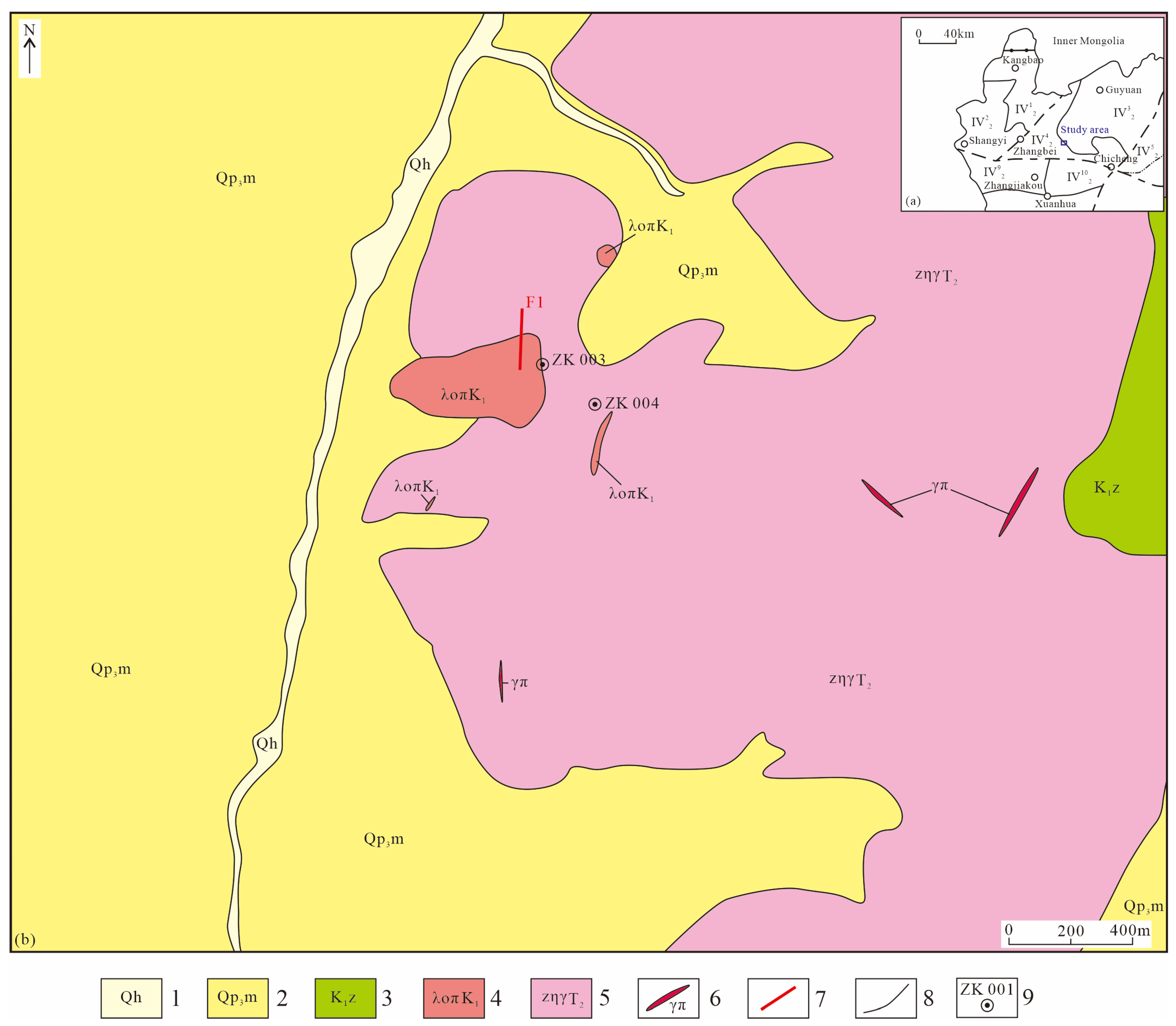
The Dadonggou Mo deposit is located near Xiaoxiwan Village, Chongli District, Zhangjiakou. Exposed strata in the ore district are dominated by rhyolitic welded tuff of the Cretaceous Zhangjiakou Formation and are locally covered by Quaternary loess (Figure 2). Faulting is well-developed, with three principal sets striking NW, NE, and nearly N-S.
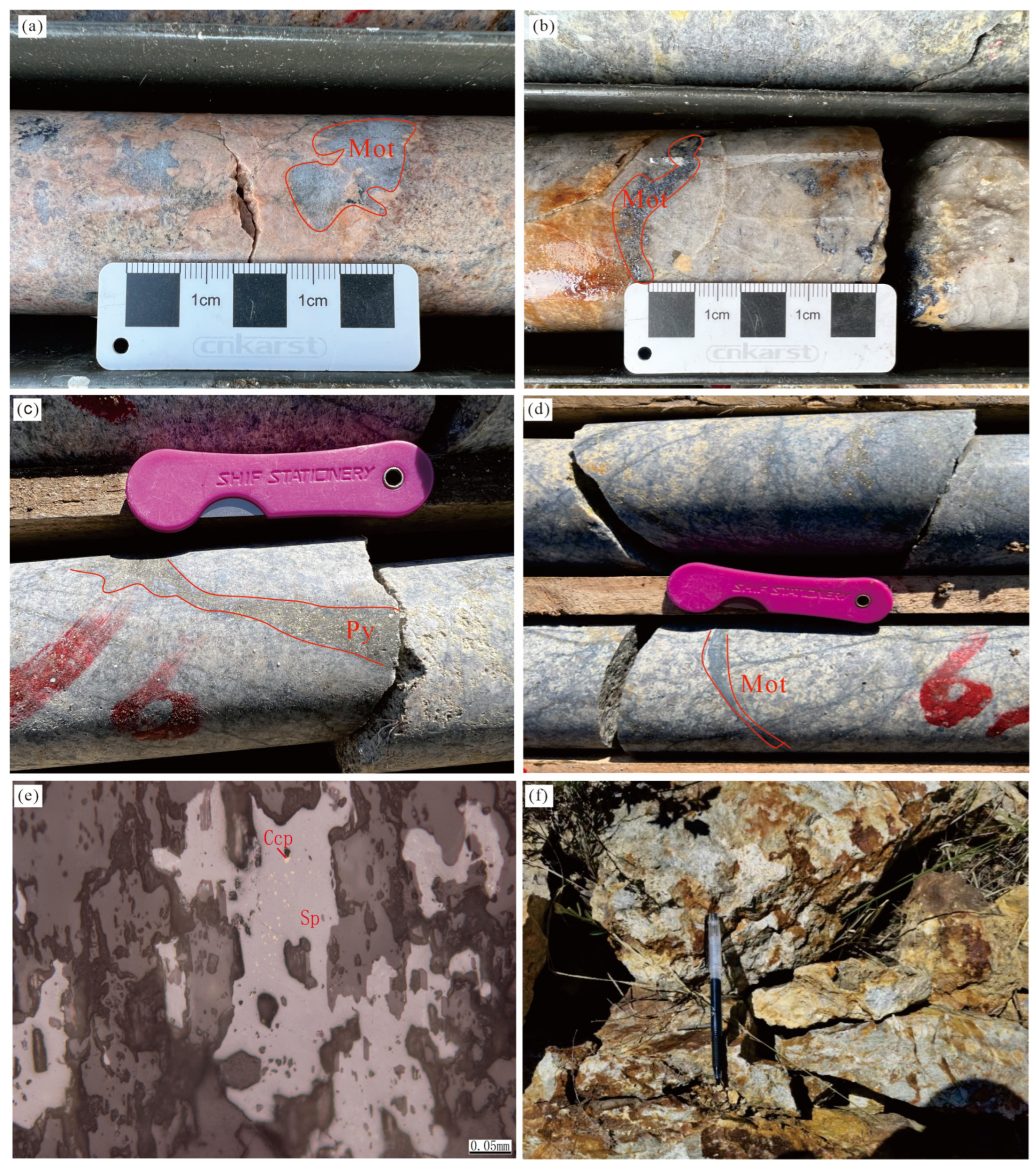
Magmatism is well-developed in the district, with exposed igneous units including Late Triassic monzogranite and Early Cretaceous quartz porphyry, granite porphyry, and cryptoexplosive breccia (Figure 2). Among these units, the granite porphyry and quartz porphyry are most closely associated with Mo mineralization and are interpreted as the principal ore-related intrusions. The granite porphyry is light flesh-red in color, with a porphyritic texture and massive structure, consisting of phenocrysts and a groundmass. The phenocrysts are mainly potassium feldspar and quartz, while the groundmass is cryptocrystalline. The quartz porphyry is grayish-white in color, with a porphyritic texture and massive structure, consisting of phenocrysts and groundmass. The phenocrysts are mainly quartz, while the groundmass is cryptocrystalline. The cryptoexplosive breccia is developed at the margins of the quartz porphyry and the top of the granite porphyry. The breccia clasts are mainly composed of quartz porphyry and granite porphyry, with minor amounts of monzogranite. In the cryptoexplosive breccia, siliceous veinlets and stockworks are pervasive, typically 1–5 mm wide and locally up to 2 cm, and commonly contain Mo mineralization (Figure 3).

3.2. Mineralization and Alteration

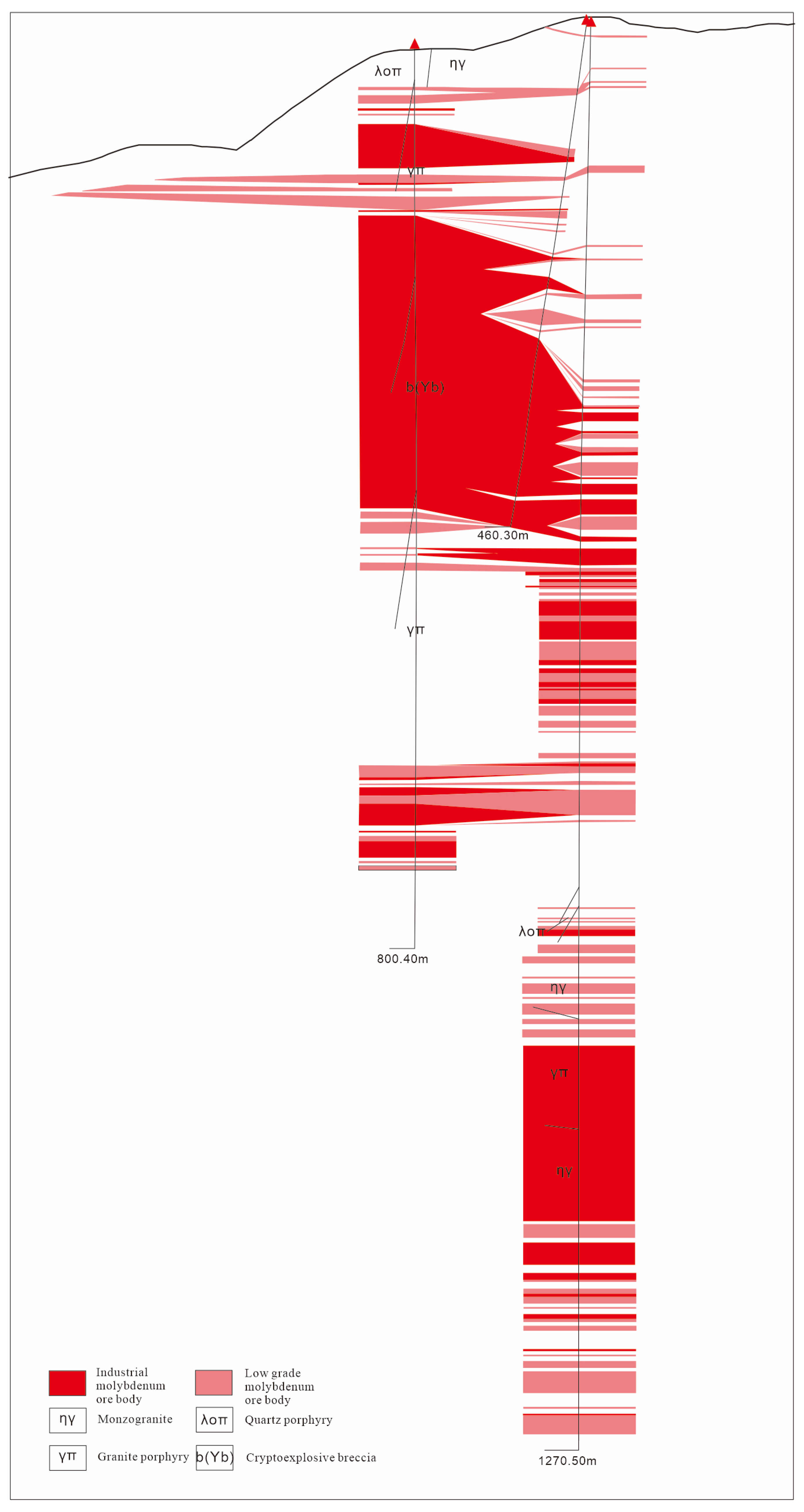
At Dadonggou, the principal ore-host rocks are granite porphyry, quartz porphyry, silicified cryptoexplosive breccia at the porphyry roof, and marginal monzogranite. Orebodies are generally layered to stratiform, strike nearly N-S, and dip gently. Molybdenite mineralization occurs as irregular concentrations, mainly in fine veins and stockworks, as thin films, and as disseminations. Orebody contacts with wall-rocks are difficult to recognize in hand specimens. The intensity and scale of fine vein and stockwork mineralization, together with the abundance of film type molybdenite, directly control orebody size and grade (Figure 4).
A total of 126 Mo orebodies have been delineated, most of which are blind and defined by drilling. The main orebodies are Mo4, Mo10, Mo85, and Mo100. They have down-dip extents of 100.0–247.5 m, strike lengths of 87.6–271.8 m, and thicknesses of 36.0–260.0 m (average 129.4 m), with an average grade of 0.091% Mo.
Mineralization is dominated by pyritization, molybdenite mineralization, silicification, and sericitization. Molybdenite occurs mainly as fine flakes along the margins of siliceous veinlets, chiefly in veinlet and stockwork forms, with minor film like occurrences along fractures.
The primary metal minerals in the molybdenum ore are mainly pyrite and molybdenite, with minor amounts of magnetite. The gangue minerals are predominantly feldspar, quartz, and sericite, followed by biotite, zircon, titanite, sericite, fluorite, etc. The ore structures mainly include veinlet, disseminated, spotted, and stockwork structures.
The wall-rock alteration in the mining area exhibits an alteration zoning. From the center of the intrusive body outward, the alteration zones are successively quartz–sericitization → kaolinization and iron–manganese mineralization → chloritization and weak kaolinization.

3.3. Mineralization Stages

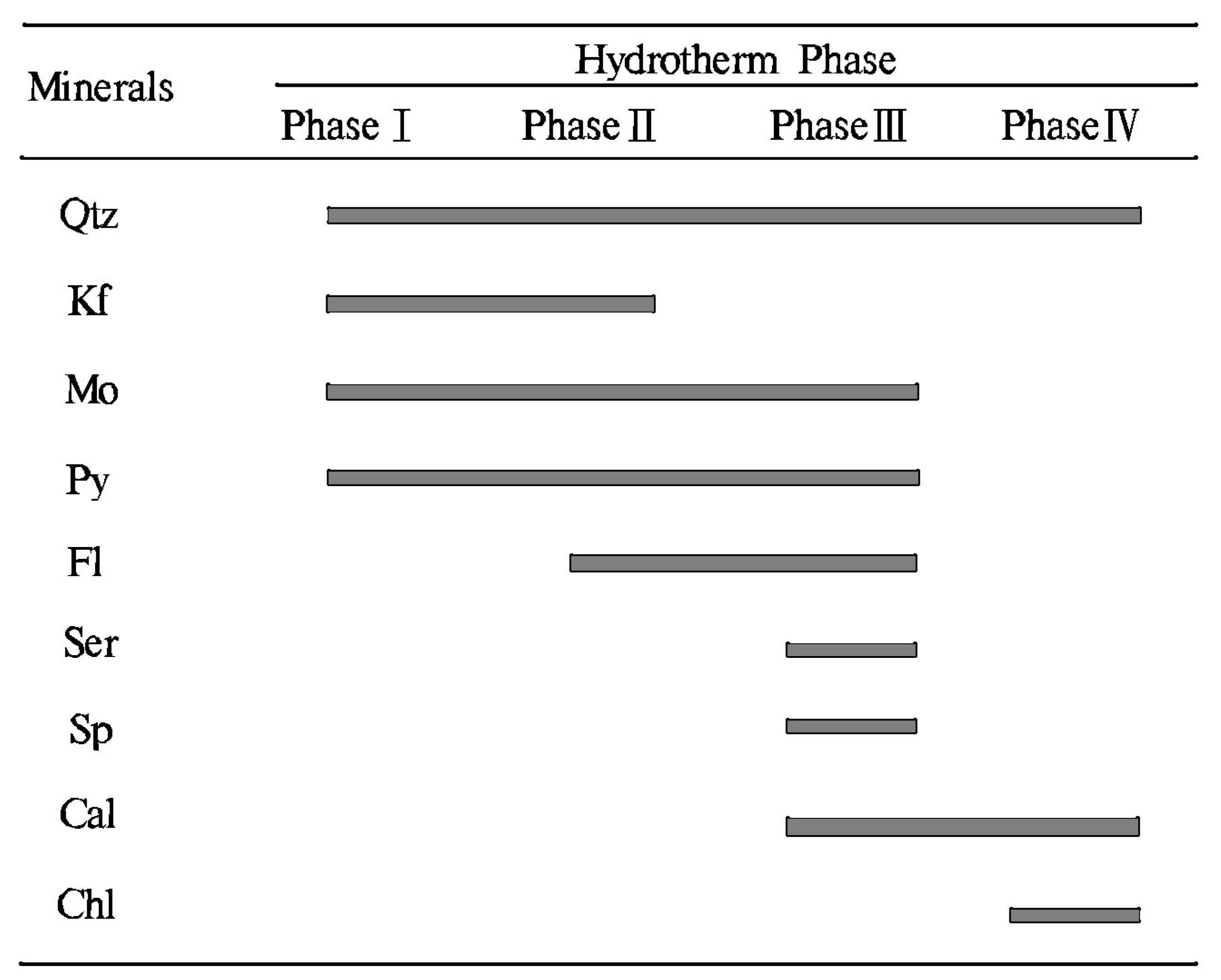
Based on vein crosscutting relationships, the hydrothermal mineralization process can be divided into four stages: (I) Quartz–K-feldspar alteration stage, (II) Pyrite–molybdenite–quartz mineralization stage, (III) phyllic alteration stage, and (IV) quartz carbonate stage (Figure 3 and Figure 5).
(1) Quartz–K-feldspar alteration stage (I)
This stage is characterized mainly by K-feldspar–quartz veinlets and barren quartz veins. Mineralization is weak, with only minor disseminated and speckled molybdenite and pyrite; quartz clots or veins occur locally. The main minerals are quartz, K-feldspar, molybdenite, and pyrite.
(2) Pyrite–molybdenite–quartz mineralization stage (II)
Molybdenite-bearing quartz veins occur mainly as veinlets and stockworks along microfractures and joints, and as molybdenite–quartz veinlets along fault zones. Breccia-like molybdenite and minor clot-like molybdenite also occur in fractured granite porphyry and monzogranite near the cryptoexplosive breccia pipe. Wall-rock alteration is dominated by silicification, with minor potassic alteration, fluoritization, and sericitization. This is the principal ore-forming stage, characterized by abundant molybdenite and pyrite. Representative assemblages are quartz ± pyrite, pyrite + molybdenite + fluorite + quartz, and molybdenite + quartz. This stage is the main mineralization stage.
(3) Phyllic alteration stage (III)
Phyllic alteration develops along microfractures and joints and in wall-rocks adjacent to early molybdenite–quartz veinlets, typically as banded concentrations; locally, it forms larger scale filling-replacement zones accompanied by fine-grained quartz veinlets. Films occur on fault-slip surfaces, and fluorite–quartz clots occur in cavities within fragmented granite porphyry above the cryptoexplosive breccia pipe. Wall-rock alteration includes silicification, sericitization, pyritization, pyrite–sericite alteration, sphaleritization, fluoritization, and calcitization. This stage represents an important superimposed mineralization stage. Representative assemblages are pyrite + sericite + fluorite + quartz, and molybdenite + pyrite + sphalerite + sericite + quartz.
(4) Quartz–carbonate stage (IV)
Quartz–calcite veins are formed mainly along fault zones, especially within late structural fractures. This terminal stage lacks molybdenite mineralization and crosscuts veins formed in earlier stages. The representative assemblage is calcite + quartz + chlorite.
Figure 5. Paragenetic sequence diagram of the main minerals in the Dadonggou Mo deposit.
Minerals 16 00635 g005

4. Sampling and Analytical Methods

4.1. Re-Os Isochron Geochronology

Six molybdenite samples for Re-Os dating were collected from drill holes ZK003 and ZK004 at the Dadonggou deposit. Molybdenite occurs in molybdenite–quartz veins mainly as fine veinlets, thin films, and disseminations. Molybdenite separates were prepared at Kehui Testing (Tianjin) Co., Ltd. (Tianjin, China). After crushing, mineral separation, pre-concentration, and hand-picking, high-purity molybdenite separates (>99%) were obtained. The separates are fine grained (0.03–0.10 mm), which minimizes potential age bias related to Re-Os decoupling in coarse grains. Only fresh and unoxidized grains free of visible contamination were used for analysis.
Re-Os isotopic analyses were carried out at the State Key Laboratory, China University of Geosciences (Wuhan), using sealed Carius-tube digestion. Analytical principles and procedures followed those of previous studies [12,13,14,15,16]. Isotope ratios were measured on a TJA X-series ICP-MS (Thermo). For Re, masses 185 and 187 were monitored, with mass 190 used to monitor Os; for Os, masses 186, 187, 188, 189, 190, and 192 were monitored, with mass 185 used to monitor Re. Procedural blanks were 0.0024 ± 0.0003 ng for Re, 0.00036 ± 0.00005 ng for Os, and 0.00002 ± 0.00002 ng for 187Os. These values are far lower than the Re and Os contents of samples and standards and are therefore negligible for the final results. The obtained Re-Os isotopic data were processed using Isoplot [17] for 187Re–187Os isochron regression to obtain isochron ages. Re-Os model ages were calculated using t = 1/λ[ln(1 + 187Os/187Re)], where λ = 1.666 × 10⁻¹¹a−1 [18].

4.2. Fluid-Inclusion Microthermometry

Systematic fluid-inclusion microthermometry was carried out on quartz from the principal mineralization stages (Table S3). Analyses were performed at the Hebei Regional Geological Survey Laboratory using a LINKAM THMSG 600 heating–freezing stage (Linkam Scientific Instruments Ltd., Redhill, Surrey, United Kingdom), with an operating range of 196 to 600 °C. Heating and cooling rates were 20–30 °C/min and were reduced to 0.1–0.5 °C/min near phase transitions. Analytical uncertainties were ±1 °C for homogenization temperature (Th) and ±0.1 °C for ice-melting temperature (Tm-ice). Phase transitions in CO2-H2O-NaCl and H2O-NaCl inclusions were carefully observed and recorded. Salinity and density were calculated using standard equations [19,20,21]. For H2O-NaCl inclusions, trapping pressures were estimated using HOKIEFLINCS_H2O-NaCl [22].

4.3. Isotope Geochemical Analyses

(1) H-O isotope analysis
Six quartz separates from molybdenite-bearing quartz veins representing different mineralization stages were analyzed for H and O isotopes. Samples were crushed and sieved to 40–60 mesh, then hand-picked under a stereomicroscope to >99% purity. After cleaning and pretreatment to remove adsorbed water and secondary inclusions, oxygen isotopes were measured using the BrF5 method [23]: 12 mg purified quartz was reacted with BrF5 for 15 h, and the extracted oxygen was converted to CO2 at 700 °C for 12 min. Hydrogen isotopes were determined from fluid-inclusion water extracted by decrepitation, followed by Zn reduction at 400 °C to generate H2 [24], with cryogenic collection of the product gas. Analyses were performed at the Isotope Laboratory, Institute of Mineral Resources, Chinese Academy of Geological Sciences, using a Finnigan MAT 251 EM (Finnigan MAT GmbH, Bremen, Germany) for H and a MAT 252 EM (Finnigan MAT GmbH, Bremen, Germany) for O. Results are reported relative to SMOW, with analytical precisions of ±2‰ for δD and ±0.2‰ for δ18O.
(2) In situ sulfur isotope analysis by LA-MC-ICP-MS (Coherent, California State, United States; Thermo Fisher Scientific, Bremen, Germany)
In situ sulfur isotope analyses were performed on 12 molybdenite spots and five pyrite spots from four polished mounts of molybdenite–quartz vein samples. Measurements were conducted at Kehui Testing (Tianjin) Co., Ltd. (Tianjin, China), using a Thermo Scientific Neoma MC-ICP-MS (Thermo Fisher Scientific, Bremen, Germany) coupled to a RESOlution SE 193 nm laser-ablation system (Applied Spectra, Fremont, CA, USA). Analytical conditions were maintained at 18–22 °C and relative humidity < 65%. Spot ablation was used, with beam diameters of 30–38 μm for molybdenite and 20–30 μm for pyrite, at 3 J/cm2 and 5 Hz. Ablated aerosols were transported by high-purity He into the MC-ICP-MS. 32S and 34S were collected simultaneously in static mode on Faraday cups, with 0.1 s integration and 300 cycles per analysis (about 30 s total). Instrument tuning was performed with sulfide reference materials, and matrix effects were minimized using matrix-matched sulfide standards with standard–sample–standard bracketing for mass-bias correction.

4.4. Zircon U-Pb Dating

Three samples of granite porphyry and quartz porphyry closely related to mineralization were selected for zircon U-Pb dating. The zircon U-Pb dating was performed at Kehui Testing (Tianjin) Technology Co., Ltd. (Tianjin, China). The analyses were conducted using an AnalytikJena PQMS ICP-MS (Analytik Jena GmbH+Co. KG, Jena, Germany) coupled with a RESOLution 193 nm excimer laser ablation system. The laser ablation spot size was 26 μm in diameter, with a repetition rate of 5 Hz and an energy density of ~5 J/cm2, using He as the carrier gas. Single-spot ablation was adopted for LA-ICP-MS sampling. Prior to analysis, the instrument was tuned to optimal performance using the zircon standard GJ-1. Zircon U-Pb dating used GJ-1 as the external standard, and trace element concentrations were quantitatively calculated using NIST610 as the external standard and Zr as the internal standard. During the analytical session, two GJ-1 standards were measured before and after every ten sample spots for calibration, and one Plesovice zircon was measured to monitor instrument stability and ensure analytical accuracy. Data processing was carried out using the Iolite 4 software. Most analytical spots yielded 206Pb/204Pb > 1000, and thus no common Pb correction was applied. Spots with abnormally high 204Pb contents, which might be influenced by common Pb from inclusions, were discarded during calculation. Zircon concordia diagrams were constructed using the Isoplot 4.15 program. During the sample analysis, the Plesovice reference material, analyzed as an unknown, gave an age of 337.0 ± 2.5 Ma (n = 6, 2σ), which is consistent within error with the recommended age of 337.13 ± 0.37 Ma (2σ).

4.5. Analysis of Major and Trace Elements in Whole Rock

Whole-rock major and trace element analyses were conducted at Kehui Testing (Tianjin) Technology Co., Ltd. (Tianjin, China). Rock samples were coarsely crushed and ground in an agate grinder, and then pulverized to <200 mesh in an agate ring mill. X-ray fluorescence (XRF) and inductively coupled plasma mass spectrometry (ICP-MS, Agilent 7500a (Agilent Technologies, Santa Clara, CA, USA)) were used for major and trace element analyses, respectively. National standards G07103 (granite) and G07105 (basalt) [25,26] were used as reference materials to monitor analytical accuracy and precision. The analytical error for major elements was within 5%. For trace element analysis, approximately 60 mg of sample powder was digested in Teflon bombs using HF + HNO3, and then analyzed on an Agilent 7500a ICP-MS. The analytical error was less than 5% for trace element concentrations exceeding 10 μg/g, and less than 10% for concentrations below 10 μg/g.

5. Analytical Results

5.1. Zircon U-Pb Dating Results

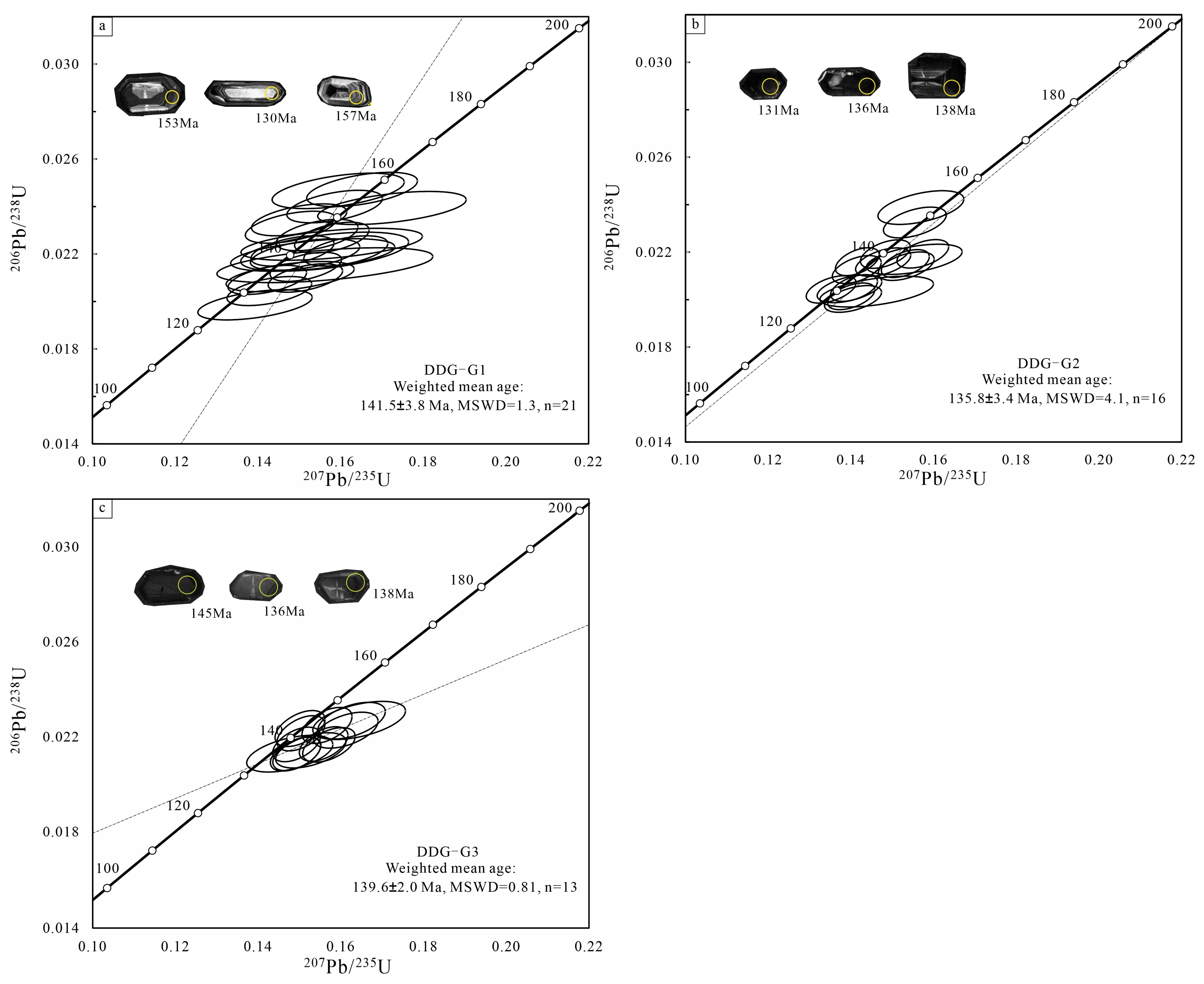
Zircon U-Pb dating was performed on two granite porphyry samples (DDG-G1 and DDG-G2) and one quartz porphyry sample (DDG-G3), all closely related to mineralization (Table S1 and Figure 6). A total of 21 spots were analyzed for sample DDG-G1, yielding a weighted mean age of 141.5 ± 3.8 Ma (MSWD = 1.3). Sample DDG-G2 yielded a weighted mean age of 135.8 ± 3.4 Ma (MSWD = 4.1) based on 16 analyzed spots. Sample DDG-G3 yielded a weighted mean age of 139.6 ± 2.0 Ma (MSWD = 0.81) based on 13 analyzed spots.

5.2. Rock Geochemical Results

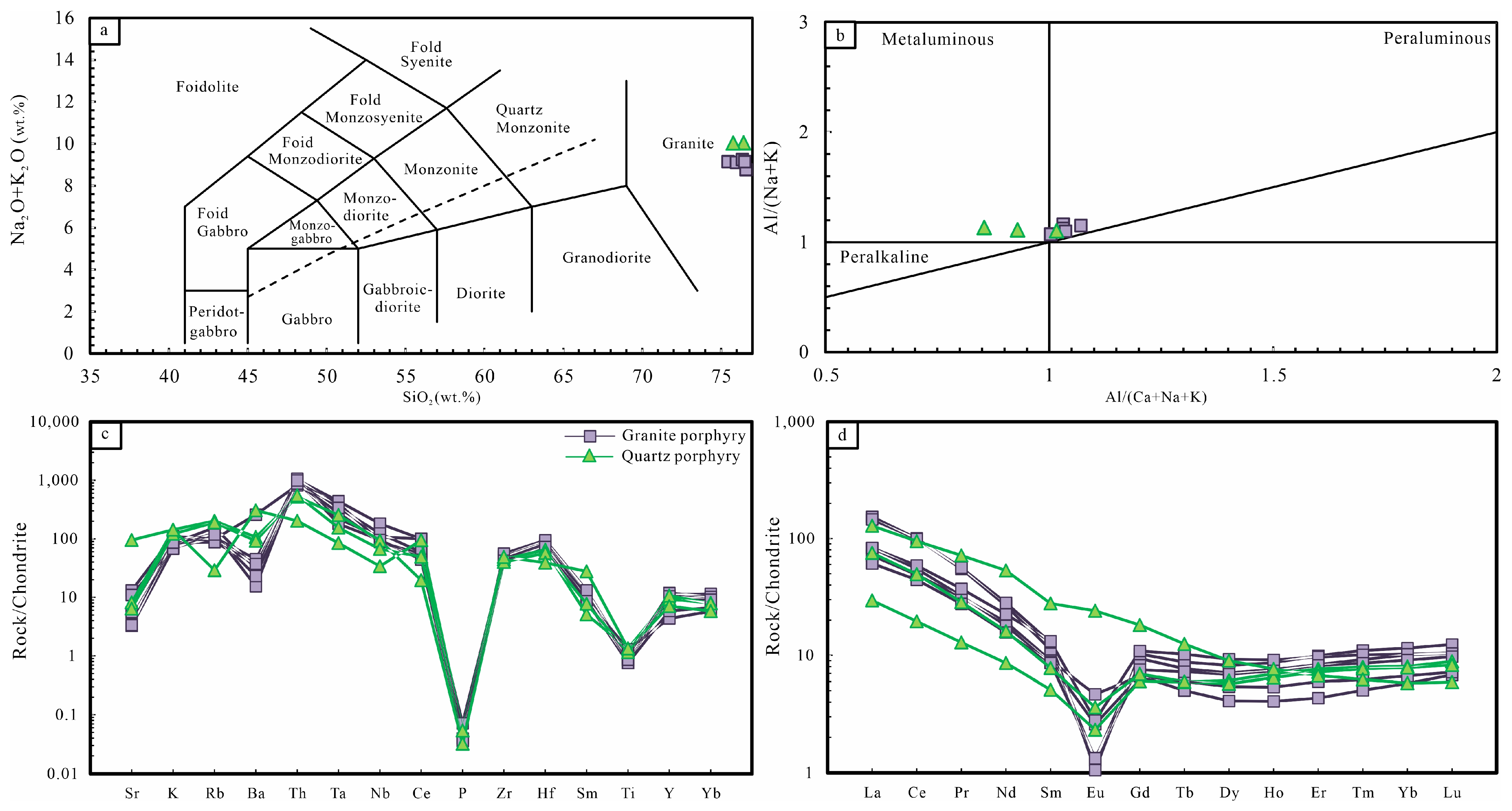
The geochemical characteristics of the ore-hosting granite porphyry and quartz porphyry in the Dadonggou mining area are presented in Table S2. The granite porphyry has SiO2 contents of 73.66–76.00 wt.%, Al2O3 of 12.09–13.39 wt.%, CaO of 0.38–0.75 wt.%, MgO of 0.09–0.21 wt.%, and TFe2O3 of 0.89–1.09 wt.%, belonging to the peraluminous series. The quartz porphyry has SiO2 contents of 74.18–75.31 wt.%, Al2O3 of 10.42–12.06 wt.%, CaO of 0.51–1.65 wt.%, MgO of 0.12–0.13 wt.%, and TFe2O3 of 0.4–1.14 wt.%, belonging to the aluminous series.
Both the granite porphyry and quartz porphyry show enrichment in light rare earth elements (LREEs), depletion in heavy rare earth elements (HREEs), and strong fractionation between LREEs and HREEs. The granite porphyry exhibits a strongly negative Eu/Eu anomaly. Except for a few samples with insignificant negative Eu/Eu anomalies, the quartz porphyry also displays obvious negative Eu/Eu* anomalies. On the chondrite-normalized trace element spider diagrams, both the granite porphyry and quartz porphyry show depletions in Sr, P, Ti, and enrichments in Th, Hf (Figure 7).

5.3. Re-Os Geochronology

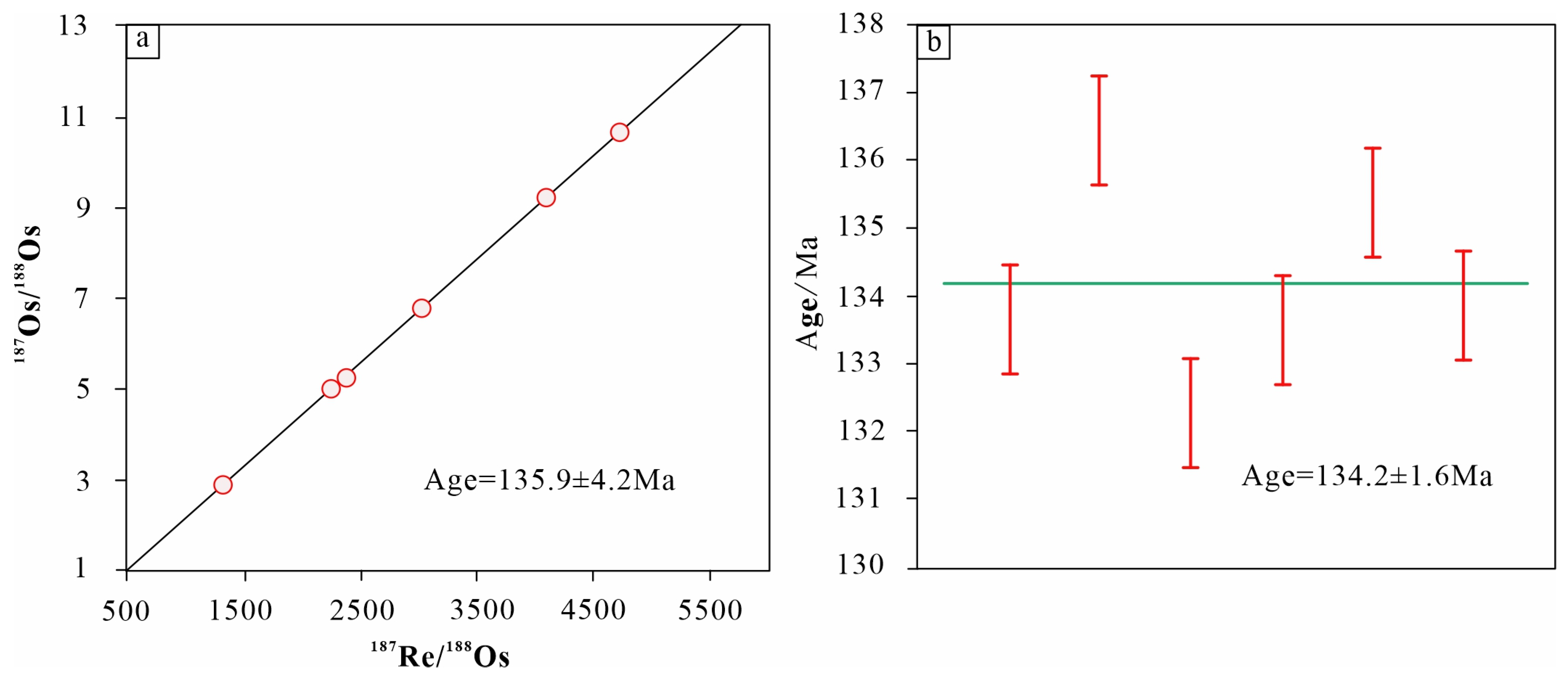
Re-Os analytical data for molybdenite are summarized in Table S3. The six molybdenite separates yield w(Re) values of 2070–7523 ppm, with an average of 4694 ppm. Model ages range from 132.3 to 136.5 Ma. Isochron regression of the six analyses yields a Re-Os age of 135.9 ± 4.0 Ma (MSWD = 0.29, n = 6; Figure 8a), whereas the weighted mean age is 134.2 ± 1.6 Ma (MSWD = 0.12, n = 6; Figure 8b).

5.4. Fluid Inclusion Petrography

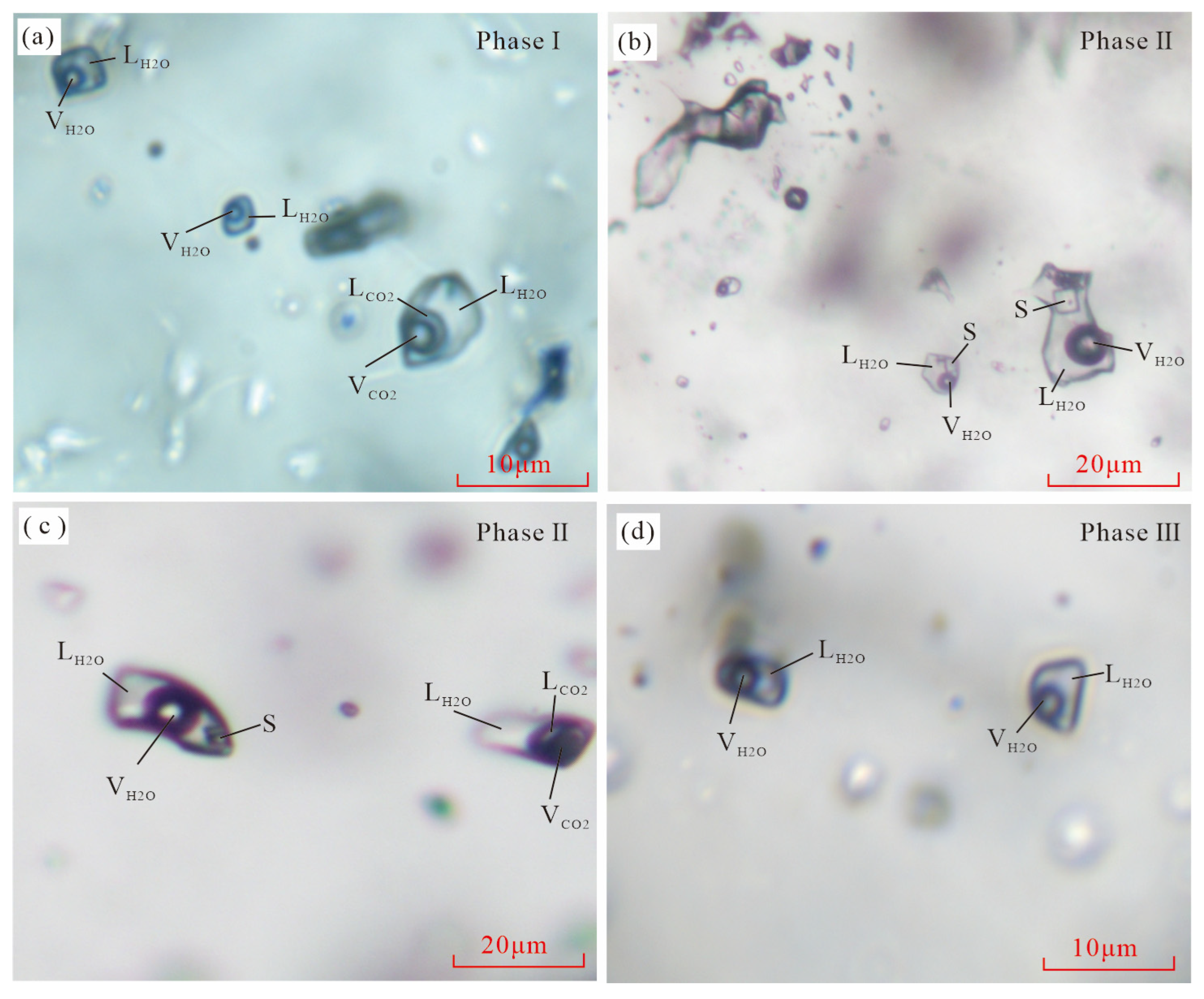
Based on room-temperature phase assemblages and homogenization behavior during heating, fluid inclusions in the Dadonggou Mo deposit are classified into three types: Type I, CO2-bearing three-phase inclusions; Type II, daughter-mineral-bearing multiphase inclusions (dominantly halite); and Type III, two-phase aqueous vapor-liquid inclusions. According to vapor proportion, Type III inclusions are further subdivided into Type IIIa (>50 vol% vapor) and Type IIIb (<50 vol% vapor). Characteristics of each type are summarized in Figure 9, Tables S4 and S5.
(1) Type I inclusions
Type I inclusions are CO2-bearing three-phase inclusions composed of vapor CO2 (VCO2), liquid CO2 (LCO2), and aqueous liquid (LH2O). They occur as negative-crystal, ellipsoidal, elongate, subquadrangular, and irregular forms, with sizes of 6–12 μm. The combined CO2 volume accounts for 5–15 vol% of the total inclusion volume. Upon heating, these inclusions homogenize to the H2O-rich liquid phase. Type I inclusions occur in quartz veins of stages I and II.
(2) Type II inclusions
Type II inclusions are daughter mineral-bearing multiphase inclusions composed of a vapor phase (VCO2 or VH2O), a liquid phase (L), and solid phases (S). They occur as negative-crystal, ellipsoidal, elongated, subquadrangular, and irregular forms, with sizes of 5–15 μm. The vapor phase generally occupies 5–10 vol% of the total inclusion volume. Solid phases are dominated by halite and K-salt daughter minerals, with rare hematite daughter minerals (Figure 9b,c). During heating, the vapor phase disappears first, followed by dissolution of daughter minerals. Halite-bearing inclusions homogenize to the liquid phase. In hematite-bearing inclusions, daughter-mineral disappearance occurs above the instrumental upper limit of 600 °C. Type II inclusions are common in quartz veins of stages I and II, but are absent in stage III.
(3) Type III inclusions
Type III inclusions are H2O-rich two-phase inclusions composed of vapor H2O (VH2O) and liquid H2O (LH2O). They occur as negative-crystal, ellipsoidal, elongate, stretched-elongate, subquadrangular, and irregular forms. Based on the vapor-volume proportion, Type III inclusions are subdivided into Type IIIa (>50%) and Type IIIb (<50%) (Figure 7). Type IIIa inclusions are relatively small, with sizes of 5–10 μm, dark rims, and vapor fractions of 50–70 vol%. They homogenize to either vapor or liquid and are mainly distributed in quartz veins of stages I and II. Type IIIb inclusions are the dominant subtype, with sizes of 5–12 μm and a main population at 10–30 μm. Their vapor fractions are 5–20 vol%, and they homogenize to the liquid phase. Type IIIb inclusions are widely distributed and occur in quartz veins throughout all mineralization stages.

5.5. Microthermometric Results

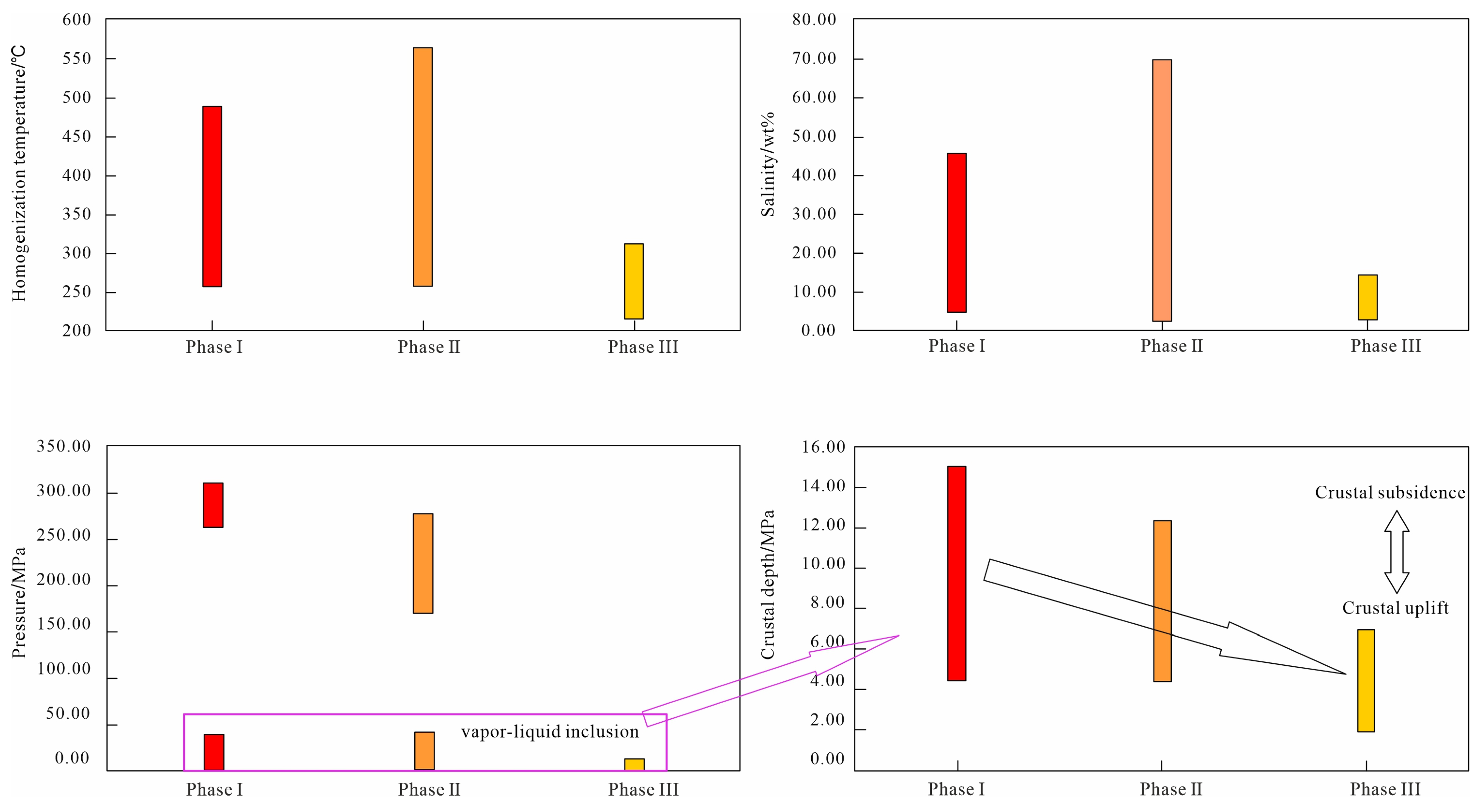
Fluid-inclusion microthermometry was carried out using fluid-inclusion assemblages. In each field of view, inclusions with comparable morphology, phase proportions, and inclusion type were selected for measurement. Salinities and fluid densities were calculated from microthermometric data using published methods ([19,20,21]; Figure 10).
(1) Quartz–K-feldspar alteration stage (I)
All inclusion types are developed in the quartz–K-feldspar alteration stage. During freezing and subsequent heating, the inclusions show the following characteristics:
Type I inclusions yield solid CO2 melting temperatures of −56.9 to −56.8 °C, clathrate melting temperatures of 6.0 to 6.5 °C, and partial CO2 homogenization temperatures of 29.1 to 29.7 °C, with final homogenization to the H2O-rich liquid phase. Homogenization temperatures range from 296.5 to 298.6 °C, with an average of 297.6 °C. Salinities are 6.54 to 7.38 wt% NaCl eqv., averaging 6.94 wt% NaCl eqv.
In Type II inclusions, halite is the dominant soluble daughter mineral. Daughter-mineral melting temperatures are 270.1 to 362.3 °C, and hematite is locally observed without obvious change during heating. Homogenization temperatures range from 385.5 to 478.5 °C, with an average of 435.6 °C. Salinities calculated from daughter-mineral melting are 35.90 to 43.40 wt% NaCl eqv., averaging 41.04 wt% NaCl eqv.
Type IIIa inclusions are small and dark-edged, and their ice-melting temperatures are difficult to determine. Only homogenization temperatures were obtained, ranging from 327.6 to 330.8 °C, and most homogenize to vapor. Type IIIb inclusions have ice-melting temperatures of −8.5 to −6.2 °C and homogenization temperatures of 265.8 to 345.6 °C, corresponding to salinities of 9.47 to 12.28 wt% NaCl eqv. For Type III inclusions, the main homogenization-temperature peak is 290–340 °C, with an average of 306.2 °C, and the average salinity is 10.45 wt% NaCl eqv.
Overall, homogenization temperatures show a principal peak at 290–340 °C. Salinity displays a bimodal distribution, with peaks at 8–12 and 40–42 wt% NaCl eqv. Calculated fluid densities are 0.76–1.02 g/cm^3, with an average of 0.85 g/cm3.
(2) Pyrite–molybdenite–quartz stage (II)
All inclusion types are also developed in the pyrite–molybdenite–quartz stage. During freezing and subsequent heating, the inclusions show the following characteristics:
Type I inclusions yield solid CO2 melting temperatures of −57.1 to −56.6 °C, clathrate melting temperatures of 5.5 to 7.2 °C, and partial CO2 homogenization temperatures of 27.5 to 30.2 °C, with final homogenization to the H2O-rich liquid phase. Homogenization temperatures range from 279.6 to 296.8 °C, with a reported average of 297.6 °C. Salinities are 5.33 to 8.19 wt% NaCl eqv., averaging 7.14 wt% NaCl eqv.
In Type II inclusions, halite is the dominant soluble daughter mineral, and daughter-mineral melting temperatures are 225.0 to 353.3 °C. Homogenization temperatures range from 356.7 to 441.2 °C, with an average of 392.1 °C. Salinities derived from daughter-mineral melting are 33.10 to 42.60 wt% NaCl eqv., averaging 36.93 wt% NaCl eqv.
Type IIIa inclusions are small and dark-edged, and ice-melting data are limited, with only two values of −7.2 and −2.4 °C. Their homogenization temperatures are 294.1 to 330.8 °C, with homogenization to vapor. Type IIIb inclusions have ice-melting temperatures of −9.3 to −3.8 °C and homogenization temperatures of 265.3 to 330.2 °C, corresponding to salinities of 6.16 to 13.20 wt% NaCl eqv. For Type III inclusions, the main homogenization-temperature peak is 270–310 °C, with an average of 297.0 °C, and the average salinity is 10.51 wt% NaCl eqv.
Overall, homogenization temperatures show a principal peak at 270–310 °C. Salinity is bimodal, with peaks at 6–12 and 34–42 wt% NaCl eqv. Calculated fluid densities are 0.73–1.01 g/cm3, averaging 0.86 g/cm3.
(3) Phyllic alteration stage (III)
In the sericitization stage, Type IIIb inclusions are mainly observed in quartz and fluorite. During freezing and subsequent heating, these inclusions show the following characteristics:
Type IIIb inclusions have ice-melting temperatures of −8.7 to −2.6 °C, corresponding to salinities of 4.34 to 12.51 wt% NaCl eqv., and homogenization temperatures of 234.8 to 306.2 °C. For Type III inclusions, the principal homogenization-temperature peak is 230–270 °C, with an average of 256.9 °C, and the average salinity is 9.59 wt% NaCl eqv. Calculated fluid densities are 0.80–1.04 g/cm3, with an average of 0.89 g/cm3.

5.6. H-O Isotopic Composition

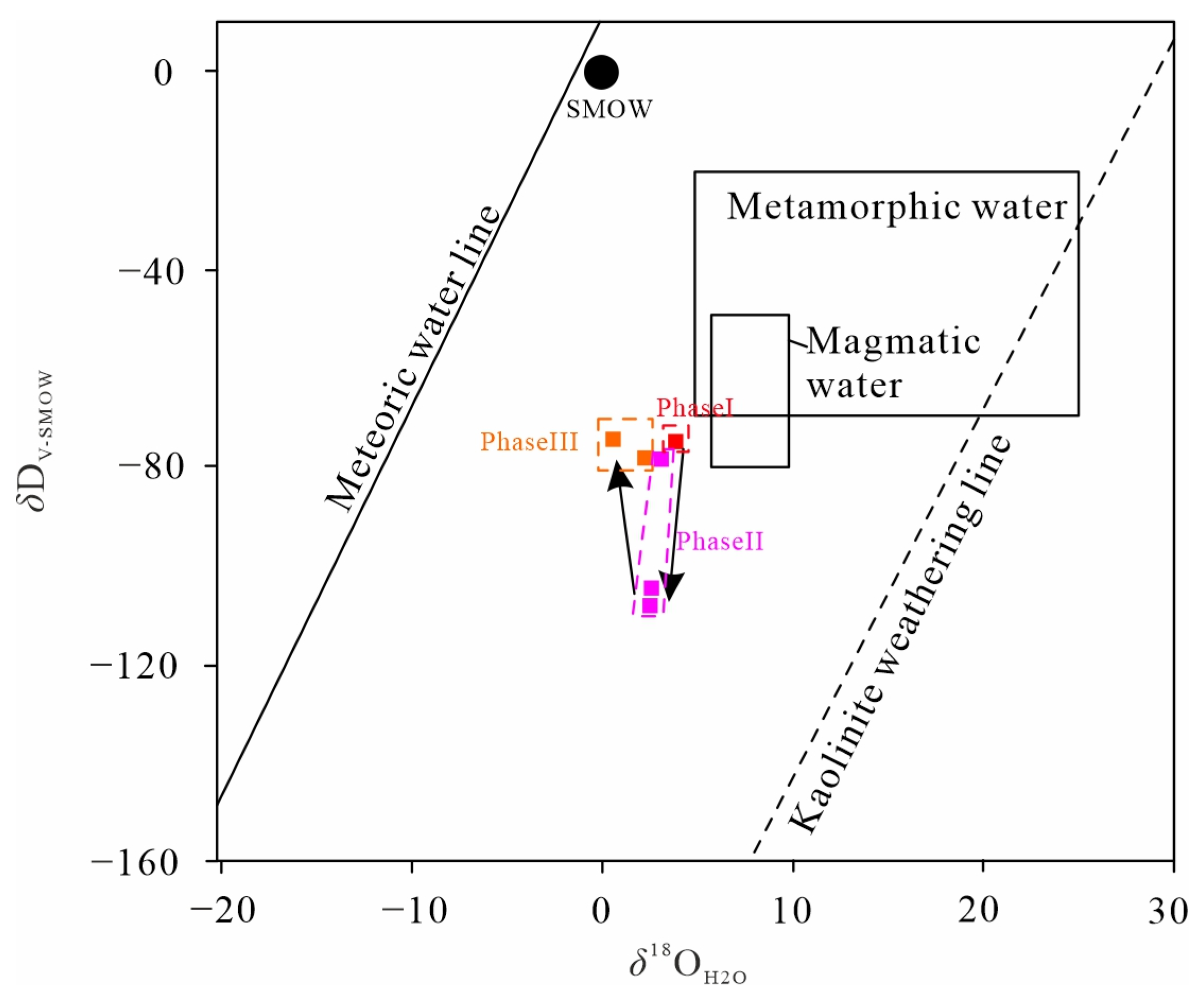
Based on the H-O isotopic data from the Dadonggou Mo deposit, together with the fluid-inclusion homogenization temperatures measured in vein quartz in this study, δ18Ofluid values for individual veins were calculated using the quartz–water oxygen-isotope fractionation equation, 1000 lnaquartz-water = 3.38 × 10⁶/T2 − 3.4 [27]. The results are shown in Table S6 and Figure 11. δ18OV-SMOW values range from 10.23‰–11.36‰, and the calculated δ18OH2O values range from 0.69‰–3.86‰. δDV-SMOW values range from −108.4‰–−74.5‰.

5.7. In Situ Sulfur Isotopic Composition

A total of 17 in situ sulfur isotope analyses were obtained from four samples from the Dadonggou Mo deposit (Table S7). Pyrite yields δ34S values of 10.65‰–12.78‰, with an average of 11.38‰, whereas molybdenite shows δ34S values of 7.00‰–8.96‰, with an average of 7.54‰.
The molybdenite δ34S values define a narrow range (7.00‰–8.96‰), consistent with sulfur-isotope characteristics of magmatic–hydrothermal deposits and within the typical sulfur-isotope range of granitic magmas (5‰–15‰). These data indicate that sulfur in the ore-forming fluid was predominantly derived from a deep-seated granitic intrusion.

6. Discussion

6.1. Mineralization Age

Molybdenite has a high isotopic closure temperature (~500 °C) and is therefore relatively resistant to post-mineralization hydrothermal alteration and tectonic overprinting [29]. Accordingly, the molybdenite Re-Os system is widely regarded as one of the most robust chronometers for constraining mineralization timing in metallic ore deposits [30]. This robustness reflects the geochemical characteristics of molybdenite: Re is typically enriched at ppm levels (on the order of 10−6), whereas common Os is negligible, such that measured Os is dominantly radiogenic 187Os. Consequently, molybdenite Re-Os ages provide high-precision constraints on the timing of mineralization and regional metallogenic evolution [31].
All samples used for Re-Os dating in this study were collected from the principal ore types. Accordingly, the molybdenite Re-Os isochron age of 134.2 ± 1.6 Ma is interpreted to represent the main mineralization age of the Dadonggou Mo deposit, indicating an Early Cretaceous mineralization event. Zircon U-Pb dating was also performed on the ore-hosting granite porphyry and quartz porphyry, yielding formation ages ranging from 135.8 Ma to 141.5 Ma for these porphyries, suggesting that a continuous magmatic process occurred prior to mineralization in the study area.

6.2. Analysis of Magmatic Mineralization Potential

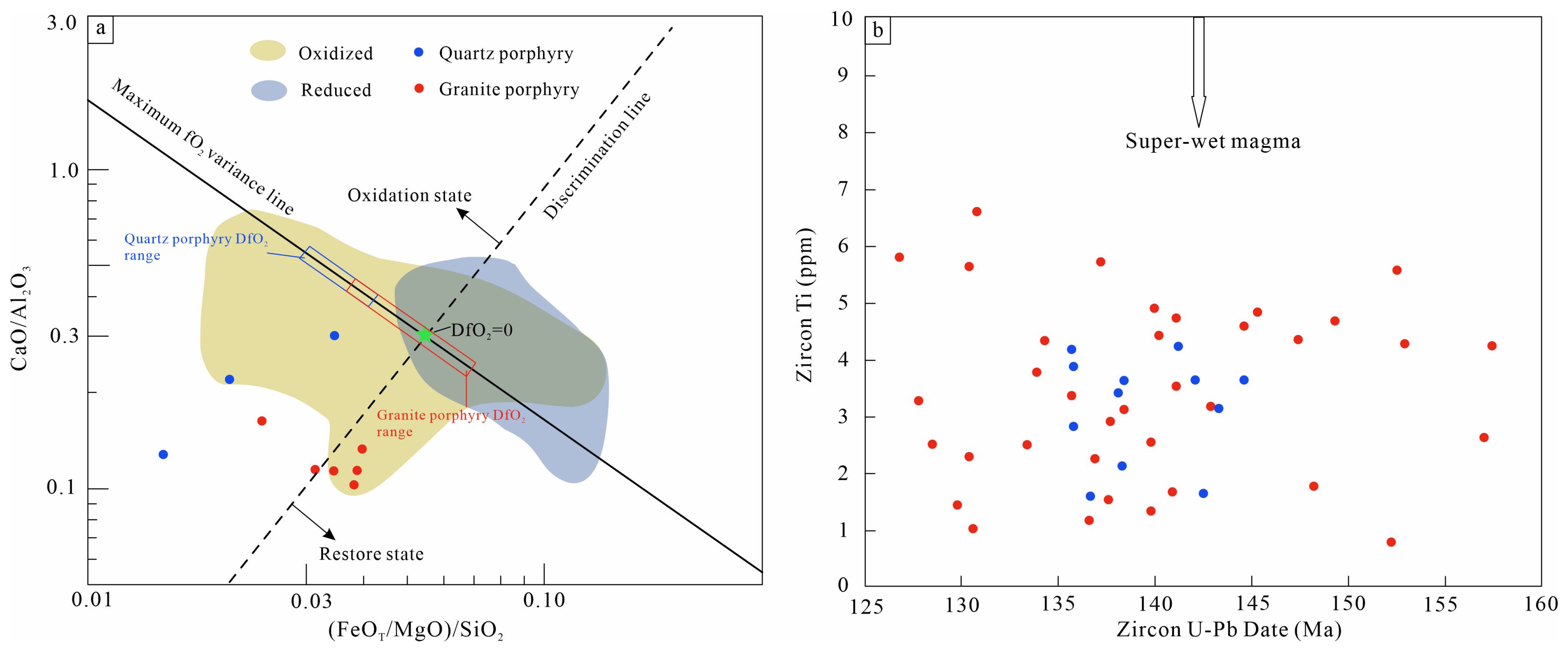
Oxygen fugacity plays a critical role in mineralization by controlling the valence state and solubility of elements during magmatic processes. In this study, the oxygen fugacity of the ore-hosting granite porphyry and quartz porphyry was calculated using the method of [32] (Figure 12). The calculations reveal that the quartz porphyry mainly falls in the high oxygen fugacity field (blue box in Figure 12), whereas the granite porphyry shows a wide range of oxygen fugacity, mostly in the reduced field (red box in Figure 12). Although the granite porphyry and quartz porphyry in the Dadonggou molybdenum deposit do not exhibit a clear evolutionary sequence, their oxygen fugacity distribution relationships reflect the influence of both oxidizing and reducing conditions. It is generally accepted that higher oxygen fugacity favors the initial enrichment of Mo [32,33], whereas a relatively reduced environment facilitates the precipitation of ore-forming elements [33,34]. For example, the Weideshan pluton in the Jiaodong area has a relatively high oxygen fugacity (average ΔFMQ = 2.27) and a much higher Mo mineralization potential than the Linglong and Guojialing plutons, which have lower oxygen fugacity [35]. Similarly, the ore-forming porphyry of the Shibaogou Mo deposit in Henan Province exhibits ΔFMQ values ranging from +1.25 to +3.56, indicating a clear oxidizing nature favorable for porphyry Mo mineralization [36]. The variation in oxygen fugacity between the granite porphyry and quartz porphyry in the Dadonggou Mo deposit suggests that the oxygen fugacity of magmatic activity in the study area during the Early Cretaceous fluctuated from oxidizing to reducing (Figure 12), a process that favored both the initial enrichment and subsequent precipitation of Mo. Furthermore, Nathwani et al. [37] proposed that super-wet magmas (H2O > 6 wt.%) are closely related to porphyry-type deposits. Through thermodynamic simulations, it was found that as the water content of magma increases, the saturation temperature of zircon will significantly decrease, resulting in zircons with low Ti content (Ti < 10 ppm) [37]. The granite porphyry and quartz porphyry in the Dadonggou Mo deposit are typical super-wet magmatic rocks (Figure 12). Combined with the molybdenite Re-Os dating of the ore and the geochronology of the host rocks, these results indicate that pre-ore magmatism may have also played a role in the initial enrichment of ore-forming elements (Figure 12).

6.3. Characteristics and Evolution of Ore-Forming Fluids

Fluid inclusions in the Dadonggou Mo deposit comprise multiple types. Stages I and II are dominated by CO2-bearing inclusions and daughter-mineral-bearing multiphase inclusions, indicating an initial CO2-H2O-NaCl ore-fluid system. In contrast, stage III is characterized mainly by aqueous two-phase inclusions, recording evolution to an H2O-NaCl system. From stage I to stage III, peak homogenization temperatures decrease progressively from 290–340 °C to 270–310 °C and then to 230–270 °C, while salinity peaks shift from 8–12 wt% and 40–42 wt% in stage I to 6–14 wt% in stage III. These trends indicate relatively high-temperature fluids with a stronger magmatic contribution in the early stages; with progressive cooling and depletion of ore-forming components, the hydrothermal system evolved toward a lower-temperature, fluid-dominated regime, further supporting a magmatic affinity of the ore-forming materials. Overall, the ore-forming fluid evolved from a high-temperature, high-salinity CO2-H2O-NaCl system to a medium- to low-temperature, medium- to low-salinity H2O-NaCl system, with greater magmatic-fluid input in the early stage and increasing external-fluid mixing in the late stage. Pressure estimates from fluid inclusions further show that CO2-bearing and daughter-mineral-bearing multiphase inclusions were trapped at significantly higher pressures than aqueous two-phase inclusions. Only aqueous two-phase inclusions occur in stage III, and their trapping pressures are distinctly lower than those of comparable inclusions in stages I-II, indicating deeper trapping during the main mineralization stage, followed by uplift and shallowing (Figure 10).
H-O isotope data from the Dadonggou Mo deposit show δ18OV-SMOW values of 10.23‰–11.36‰ and calculated δ18OV-SMOW values of 0.69‰–3.86‰, which are lower than the typical range of magmatic water (ca. 5.0‰–10.0‰; [38]). δDV-SMOW values range from −108.4‰ to −74.5‰, plotting mainly on the low-δD side of both magmatic–hydrothermal fluids (δDV-SMOW = −80‰ to −40‰) and metamorphic fluids (δDV-SMOW = −65‰ to −20‰). Because water–rock interaction generally exerts a much stronger effect on δ18O than on δD, the depleted δD values are unlikely to be explained by water–rock interaction alone, whereas the involvement of organic matter significantly reduces the δD content of the fluid. Together with the occurrence of regional graphite mineralization, these data support organic-matter involvement during fluid migration.
Furthermore, based on the fluid inclusion characteristics of different stages, with the evolution of the ore-forming fluid (gradual evolution from stage I to stage III), the δ18OV-SMOW values remained relatively stable, whereas the δDV-SMOW values decreased significantly at stage II, and the δ18OH2O values gradually decreased during fluid evolution. This indicates that the contribution of meteoric water or paleo-groundwater increased progressively with fluid evolution. A study by Hoefs [39] revealed that an increase in the reducing nature of the system significantly reduces the solubility of molybdenum, suggesting that the reducing state of the ore-forming fluid in the Dadonggou molybdenum deposit is closely related to the precipitation of Mo. CO2-rich fluid inclusions are commonly developed in stages I and II of the study area, indicating a relatively oxidizing environment during the early stage of fluid evolution. As the fluid evolved, its reducing nature increased, leading to a decrease in Mo mobility and subsequent precipitation and enrichment (Figure 11). The repeated changes in the oxidation–reduction state of the fluid observed in this study are consistent with the variations in redox conditions reflected by the ore-hosting intrusions (Figure 12).

6.4. Source of Ore-Forming Materials

6.4.1. Re Isotopes

The Re-Os isotope system is a powerful tracer of sulfide formation and an effective indicator of crustal contribution during mineralization [40]. From mantle-derived to crust–mantle mixed and then to crust-derived systems, Re contents in molybdenite decrease stepwise by orders of magnitude [41]. Mao et al. [42] and Li et al. [43] proposed that if ore-forming materials are mantle-derived or mantle-dominated, molybdenite w(Re) is mostly in the range of (n × 10~103) × 10−6; for crust-mantle mixed sources, w(Re) is around (n × 10) × 10−6; and for purely crustal sources, w(Re) is significantly lower, at (1–10) × 10−6.
As shown in Table S3, molybdenite from the Dadonggou Mo deposit contains 2070–7523 ppm Re, indicating that the ore-forming materials were mantle-derived.

6.4.2. Sulfide S Isotopes

Sulfur is one of the most important ore-forming elements in most ore deposits. Therefore, constraining sulfur sources provides key evidence for identifying ore-forming materials and ore genesis. Sulfur is generally considered to reside in three major reservoirs [44]: mantle/deep sulfur (δ34S = 0 ± 3‰), seawater sulfur (δ34S = +20‰), and crustal sulfur. Crustal sulfur is complex in origin and isotopically variable, commonly characterized by relatively negative values.
Sulfides are abundant in the Dadonggou Mo deposit, whereas sulfate minerals are absent. Therefore, sulfide S isotopes can be used to approximate the isotopic composition of total sulfur in the ore-forming fluid [45]. In this study, δ34S values of pyrite and molybdenite range from 7.00‰ to 12.78‰, with a narrow overall spread, indicating a relatively stable sulfur source. In general, mantle sulfur is associated with magmatism and has δ34S values close to 0‰, typically 0 ± 3‰ (Hoefs, 1988), and rarely exceeds 8‰ [46]. Seawater and marine evaporites typically have δ34S values around 20‰ [47]. Sulfur isotopic values of the Dadonggou deposit lie between mantle-derived sulfur and seawater sulfur, overall consistent with a mixture of mantle magma mixed with some seawater.
Combined with the Re isotope and H-O isotope (Figure 11), the ore-forming materials of the Dadonggou molybdenum deposit were likely derived primarily from the mantle (Section 6.4.1), whereas seawater was progressively incorporated into the ore-forming fluid during fluid evolution, which may have altered the fluid properties and led to the precipitation of ore-forming elements (Figure 11 and Section 6.3).

7. Conclusions

(1)
Molybdenite from the Dadonggou Mo deposit yields a weighted mean Re-Os age of 134.2 ± 1.6 Ma and an isochron age of 135.9 ± 4.2 Ma, indicating that the deposit formed during the Early Cretaceous. Zircon U-Pb dating of the ore-hosting granite porphyry and quartz porphyry yields ages ranging from 135.8 Ma to 141.5 Ma, indicating continuous magmatic activity prior to and during the main mineralization event.
(2)
The host rocks of the Dadonggou molybdenum deposit are super-wet magmatic rocks, and their oxygen fugacity evolved from oxidizing to reducing, which facilitated the initial enrichment of molybdenum.
(3)
Ore-forming fluids evolved from a high-temperature, high-salinity CO2-H2O-NaCl system to a medium- to low-temperature, medium- to low-salinity H2O-NaCl system. During fluid evolution, the contribution of meteoric water or paleo-groundwater progressively increased, whereas organic matter mainly participated in the principal mineralization stage and was closely related to mineralization. The late mineralization stage recorded late-stage depressurization and shallowing of trapping depth.
(4)
Re isotopes of molybdenite and sulfide S isotopes indicate that ore-forming materials in the Dadonggou Mo deposit were dominantly derived from a mixture of mantle magma mixed with some seawater.

Supplementary Materials

The following supporting information can be downloaded at: https://www.mdpi.com/article/10.3390/min16060635/s1, Table S1: Zircon LA-ICP-MS U-Pb data for granite porphyry and quartz porphyry; Table S2: Major (wt%) and trace elements (ppm) data of granite porphyry and quartz porphyry in Dadonggou; Table S3: Re-Os isotopic data for molybdenite from the Dadonggou Mo deposit; Table S4: Fluid inclusion types and occurrence, Dadonggou Mo deposit; Table S5: Fluid inclusion microthermometric data for the Dadonggou Mo deposit; Table S6: Hydrogen and oxygen isotope composition of the Dadonggou Mo deposit; Table S7: LA-ICP-MS sulfur isotopic compositions of sulfides from the Dadonggou Mo deposit.

Author Contributions

Conceptualization, writing—original draft, investigation, G.T.; writing—review and editing, D.S. and F.L.; methodology, D.S.; data curation, X.J.; investigation, X.Z., Z.F. and G.W. All authors have read and agreed to the published version of the manuscript.

Funding

This research was supported by the National Key Technology Research and Development Program (2025ZD1006406), the Hebei Key Laboratory for Porphyry Deposit Research (Grant No. HBBY202405), the Fund Project of the Department of Natural Resources of Hebei Province (13000026P00F2D410745X), the Central-guided Local Science and Technology Development Fund of Hebei Province (246Z4205G), and the Open Project Program of Hebei Province Collaborative Innovation Center for Strategic Critical Mineral Research, Hebei GEO University, China (No. HGUXT-2025-5).

Data Availability Statement

The original contributions presented in this study are included in the article/Supplementary Materials. Further inquiries can be directed to the corresponding author.

Conflicts of Interest

The authors declare no conflicts of interest.

References

  1. Chen, Y.C.; Xu, C.J.; Wang, D.H.; Li, H.Q.; Lu, Y.F. A discussion on the regional mineralizing pedigree of the ore deposits in the northern margin of the North China Landmass. Geol. J. China Univ. 2003, 9, 520–535, (In Chinese with English abstract). [Google Scholar]
  2. Huang, F.; Liu, X.X.; Wang, D.H.; Wang, C.H. A Preliminary Review of Metallogenic Regularity of Molybdenum Deposits in China. Acta Geol. Sin. (Engl. Ed.) 2015, 89, 972–1001. [Google Scholar]
  3. Chen, P.W.; Zeng, Q.D.; Guo, W.K.; Chen, J.Q. The source, enrichment and precipitation of ore-forming elements for porphyry Mo deposit: Evidences from melt inclusions, biotite and fluorite in Dasuji deposit, China. Ore Geol. Rev. 2021, 135, 104205. [Google Scholar] [CrossRef]
  4. Wang, G.R.; Wu, G.; Xu, L.Q.; Li, X.Z.; Zhang, T.; Quan, Z.X.; Wu, H.; Li, T.G.; Liu, J.; Chen, Y.C. Molybdenite Re–Os age, H–O–C–S–Pb isotopes, and fluid inclusion study of the Caosiyao porphyry Mo deposit in Inner Mongolia, China. Ore Geol. Rev. 2017, 81, 728–744. [Google Scholar] [CrossRef]
  5. Wu, G.; Li, X.Z.; Xu, L.Q.; Wang, G.R.; Liu, J.; Zhang, T.; Quan, Z.X.; Wu, H.; Li, T.G.; Zeng, Q.T.; et al. Age, geochemistry, and Sr–Nd–Hf–Pb isotopes of the Caosiyao porphyry Mo deposit in Inner Mongolia, China. Ore Geol. Rev. 2017, 81, 706–727. [Google Scholar] [CrossRef]
  6. Fan, Y.P.; Li, S.W.; Wang, Z.Y.; Liu, D. A study of ore-forming conditions and mineralization mechanism of Xiaoxiwan intrusive rocks in Chongli District of Zhangjiakou City. Geophys. Geochem. Explor. 2018, 42, 111–117, (In Chinese with English abstract). [Google Scholar]
  7. Wang, G.; Zhang, X.K.; Tao, G.H.; Sun, Z.W.; Liu, G.Y. Application effectiveness of integrated geophysical-geochemical prospecting methods in the exploration of the Dadonggou Molybdenum Deposit, Northwestern Hebei. Gold 2025, 46, 85–91, (In Chinese with English abstract). [Google Scholar]
  8. Liu, D.Y.; Geng, Y.S.; Song, B. Late Archean crustal accetion and reworking in Northwestern Hebei Province: Isochronology evidence. Acta Geosci. Sin. 1997, 18, 3–9, (In Chinese with English abstract). [Google Scholar]
  9. Wu, H.Y.; Zhang, L.C.; Pirajno, F.; Shu, Q.H.; Zhang, M.; Zhu, M.T.; Xiang, P. The Mesozoic Caosiyao giant porphyry Mo deposit in Inner Mongolia, North China and Paleo-Pacific subduction-related magmatism in the northern North China Craton. J. Asian Earth Sci. 2016, 127, 281–299. [Google Scholar] [CrossRef]
  10. Wang, Y.C.; Wang, R.G.; Ai, Y. Geochemical characteristics and prospecting significance of Early Cretaceous rhyolite porphyry in the Yangjiayingzi area, northern Hebei. Geosyst. Geoenviron. 2026, 5, 100515. [Google Scholar] [CrossRef]
  11. Song, R.X.; Wei, M.H.; He, Y.Q.; Li, J.C. Zhangjiakou Geology and Mineral Resources; Geological Publishing House: Beijing, China, 2013; (In Chinese with English abstract). [Google Scholar]
  12. Li, Y.; Glorie, S.; Selby, D. Re-Os geochronology for sulfides and organic-rich sediments. Natl. Sci. Rev. 2025, 12, nwaf300. [Google Scholar] [CrossRef]
  13. Hogmalm, K.J.; Dahlgren, I.; Fridolfsson, I.; Zack, T. First in situ Re-Os dating of molybdenite by LA-ICP-MS/MS. Miner. Depos. 2019, 54, 821–828. [Google Scholar] [CrossRef]
  14. Li, C.; Du, A.D.; Qu, W.J. Decoupling of Re and Os and migration model of 187Os in coarse-grained molybdenite. Miner. Depos. 2009, 28, 707–712, (In Chinese with English abstract). [Google Scholar]
  15. Li, C.; Qu, W.J.; Du, A.D. Comprehensive study on extraction of rhenium with acetone in Re-Os isotopic dating. Rock Miner. Anal. 2009, 28, 233–238, (In Chinese with English abstract). [Google Scholar]
  16. Li, C.; Qu, W.J.; Zhou, L.M.; Du, A.D. Rapid separation of osmium by direct distillation with Carius Tube. Rock Miner. Anal. 2010, 29, 14–16, (In Chinese with English abstract). [Google Scholar]
  17. Ludwig, K. Isoplot/Ex, Version 2.0: A Geochronogical Toolkit for Micros of Excel; Berkeley Geochronology Center: Berkeley, CA, USA, 2009. [Google Scholar]
  18. Smoliar, M.I.; Walker, R.J.; Morgan, J.W. Re-Os ages of groupIIA, IIIA, IVA and VIB iron meteorites. Science 1996, 271, 1099–1109. [Google Scholar] [CrossRef]
  19. Collins, P.L.F. Gas hydrates in CO2-bearing fluid inclusion and the use of freezing data for estimation of salinity. Econ. Geol. 1979, 74, 1435–1444. [Google Scholar] [CrossRef]
  20. Hall, D.L.; Sterner, S.M.; Bodnar, R.J. Freezing point depression of NaCl-KCl-H2O solutions. Econ. Geol. 1988, 83, 197–202. [Google Scholar] [CrossRef]
  21. Bodnar, R.J. A method of calculating fluid inclusion volumes based of vapor bubble diameters and PVTX properties of inclusion fluids. Econ. Geol. 1983, 78, 535–542. [Google Scholar] [CrossRef]
  22. Matthew, S.M.; Pilar, L.S.; Robert, J.B. HOKIEFLINCS_H2O-NaCl: A Microsoft Excel spreadsheet for interpreting microthermometric data from fluid inclusions based on the PVTX properties of H2O–NaCl. Comput. Geosci. 2012, 49, 334–337. [Google Scholar]
  23. Clayton, R.N.; Mayeda, T.K. The use of bromine pentafluoride in the extraction of oxygen from oxides and silicates for isotopic analysis. Geochim. Cosmochim. Acta 1963, 27, 43–52. [Google Scholar] [CrossRef]
  24. Coleman, M.L.; Sheppard, T.J.; Durham, J.J.; Rouse, J.E.; Moore, G.R. Reduction of water with zinc for hydrogen isotope analysis. Anal. Chem. 1982, 54, 993–995. [Google Scholar] [CrossRef]
  25. 10000152, GBW07103 (GSR-1); Standard Material for Analysis of Granite Rock Composition. Institute of Geophysical and Geochemical Exploration (IGGE): Langfang, China, 1988.
  26. 10000152, GBW07105 (GSR-3); Standard Material for Analysis of Basalt Rock Composition. Institute of Geophysical and Geochemical Exploration (IGGE): Langfang, China, 1988.
  27. Clayton, R.N.; Mayeda, T.K.; O’Neil, J.R. Oxygen isotope exchange between quartz and water. J. Geophys. Res. 1972, 77, 3057–3067. [Google Scholar] [CrossRef]
  28. Taylor, H.P. The application of oxygen and hydrogen isotope studies to problems of hydrothermal alteration and ore deposition. Econ. Geol. 1974, 69, 843–883. [Google Scholar] [CrossRef]
  29. Suzuki, K.; Shimizu, H.; Masuda, A. Re-Os dating of molybdenites from ore deposits in Japan: Implication for the closure temperature of Re-Os system for molybdenite and the cooling history of molybdenum ore deposits. Geochim. Cosmochim. Acta 1996, 60, 3151–3159. [Google Scholar] [CrossRef]
  30. Stein, H.J.; Markey, R.J.; Morgan, J.W.; Hannah, L.; Schersten, A. The remarkable Re-Os chronometer in molybdenite: How and why it works. Terra Nova 2001, 13, 479–486. [Google Scholar] [CrossRef]
  31. Zhang, W.; Leng, C.B.; Chen, W.T.; Chen, M.X.; Yang, M.L.; Tian, Z.D.; Zhang, X.C. Genesis of the Seleteguole reduced porphyry-skarn Cu-Mo deposit in Western Tianshan, NW China: Insight from molybdenite Re-Os geochronology, in-situ sulfide trace elemental and sulfur isotopic compositions. Ore Geol. Rev. 2025, 184, 106764. [Google Scholar] [CrossRef]
  32. Liu, Z.; Jagoutz, O.; Rezeau, H.; Zhang, H.L.L.; Klein, B.; Molitor, Z.; Meng, X.Y.; Zhu, D.C. A whole-rock geochemistry-based semi-quantitative proxy for magmatic oxygen fugacity. Earth Planet. Sci. Lett. 2026, 673, 119742. [Google Scholar] [CrossRef]
  33. Liu, Y.; Yang, Z.M.; Brzozowski, M.J.; Hao, H.D.; Sun, J.G.; Zhang, Y. Magma fO2 and volatiles in the sub-economic ermi porphyry Cu system in Northeastern China: Implications for porphyry Cu fertility. J. Petrol. 2025, 66, egaf038. [Google Scholar] [CrossRef]
  34. Zhang, F.F.; Wang, Y.H.; Liu, J.J.; Wang, J.C. Ore genesis and hydrothermal evolution of the Wulandele Mo deposit, Inner Mongolia, Northeast China: Evidence from geology, fluid inclusions and H–O–S–Pb isotopes. Ore Geol. Rev. 2018, 93, 181–199. [Google Scholar] [CrossRef]
  35. Yan, M.Q.; Li, J.; Zhang, L.P.; Sun, W.D.; Li, C.Y. The oxidized granitoids facilitated the formation of Early Cretaceous molybdenum mineralization in the Jiaodong region, China. Ore Geol. Rev. 2024, 166, 105931. [Google Scholar] [CrossRef]
  36. Yang, Z.L.; Ren, L.; Deng, M.G. Pluton age and minerallogenic significance of oxygen fugacity of Shibaogou Mo deposit in Luanchuan, Henan. Nonferrous Met. (Min. Sect.) 2023, 75, 134–145, (In Chinese with English abstract). [Google Scholar]
  37. Nathwani, C.; Blundy, J.; Large, S.J.E.; Wilkinson, J.J.; Buret, Y.; Loader, M.A.; Tavazzani, L.; Michou, C.C. A zircon case for super-wet arc magmas. Nat. Commun. 2024, 15, 8982. [Google Scholar] [CrossRef] [PubMed]
  38. Ohmoto, H. Formation of volcanogenic massive sulfide deposits: The kuroko perspective. Ore Geol. Rev. 1996, 10, 135–177. [Google Scholar] [CrossRef]
  39. Hoefs, J. Stable Isotope Geochemistry, 6th ed.; Springer: Berlin/Heidelberg, Germany; New York, NY, USA, 2009. [Google Scholar]
  40. Foster, J.G.; Lambert, D.D.; Frick, L.R.; Maas, R. Re-Os isotopic evidence for genesis of Archaean nickel ores from uncontaminated komatiites. Nature 1996, 382, 703. [Google Scholar] [CrossRef]
  41. Mao, J.W.; Wang, Y.T.; Zhang, Z.H.; Yu, J.J.; Niu, B.G. Geodynamic settings of Mesozoic large-scale mineralization in North China and adjacent areas: Implication from the highly precise and accurate ages of metal deposits. Sci. China (Ser. D) 2003, 46, 838–851. [Google Scholar]
  42. Mao, J.W.; Zhang, Z.C.; Zhang, Z.H.; Du, A.D. Re-Os isotopic dating of molybdenite in the Xiaoliugou W(Mo) deposit in the northern Qilian mountains and its geological significance. Geochim. Cosmochim. Acta 1999, 63, 1815–1818. [Google Scholar]
  43. Li, W.C.; Yu, H.J.; Yin, G.H.; Cao, X.M.; Huang, D.Z.; Dong, T. Re-Os dating of molybdenite fromTongchanggou Mo-polymetallic deposit in northwest Yunnan and its metallogenic environment. Miner. Depos. 2012, 31, 282–292, (In Chinese with English abstract). [Google Scholar]
  44. Rollinson, H.R. Using Geochemical Data: Evaluation, Presentation, and Interpretation; Longman Scientific and Technical: Singapore, 1993. [Google Scholar]
  45. Seal, I.R. Sulfur isotope geochemistry of sulfide minerals. Rev. Mineral. Geochem. 2006, 61, 633–677. [Google Scholar]
  46. Cui, K.; Qu, Y.; Xie, Y.; Yang, K.; Huang, Z. Ore genesis of the Langcun porphyry W-Mo deposit, South China: Constraints from fluid inclusion and H-O-S isotopics. Minerals 2025, 15, 109. [Google Scholar]
  47. Raab, M.; Friedman, G.M.; Spiro, B.; Starinsky, A.; Zak, I. The geological history of pliocene-pleistocene evaporites in Mount Sedom (Israel) and how strontium and sulfur isotopes relate to their origin. Carbonates Evaporites 2000, 15, 93–114. [Google Scholar] [CrossRef]
Figure 1. (a) Simplified tectonic map of the Northern Margin of the North China Craton; (b) simplified geological map of the Dadonggou area. (after [11]).
Minerals 16 00635 g001
Figure 2. (a) Regional structural map. The numbers represent the tectonic levels; (b) Geological sketch map of the Dadonggou Mo deposit area. 1—Quaternary, 2—Malan Formation, 3—Zhangjiakou Formation, 4—Early Cretaceous quartz porphyry, 5—Late Triassic monzonitic granite, 6—Granite porphyry, 7—Fault, 8—Geological boundary, 9—Drilling.
Minerals 16 00635 g002
Figure 3. Field photographs and photomicrographs of the Dadonggou Mo deposit. (ad) Molybdenite-bearing granite porphyry. (e) Reflected-light photomicrograph of Mo ore showing molybdenite and pyrite. (f) Outcrop showing yellow molybdite coating. (a) Molybdenite intergrown with contemporaneous potassic alteration (Phase I). (b) Molybdenite (Phase III) crosscuts quartz veins (Phase I). (c) Pyrite veins (Phase II) crosscut the granite porphyry. Abbreviations: Mot, molybdenite; Py, pyrite; Ccp, chalcopyrite exsolution; Sp, sphalerite.
Minerals 16 00635 g003
Figure 4. Simplified cross-section along exploration line 0 of the Dadonggou Mo deposit.
Minerals 16 00635 g004
Figure 6. Zircon U-Pb concordia diagrams of the dated zircons for granite porphyry and quartz porphyry from Dadonggou. (a) DDG-G1; (b) DDG-G2, (c) DDG-G3.
Minerals 16 00635 g006
Figure 7. (a) TAS diagram, (b) Al/(Ca + Na + K) vs. Al/(Na + K) diagram, (c) chondrite-normalized trace element spider diagram, and (d) chondrite-normalized rare earth element (REE) pattern diagram for the granite porphyry and quartz porphyry from the Dadonggou deposit.
Minerals 16 00635 g007
Figure 8. Molybdenite Re-Os geochronology for the Dadonggou Mo deposit: (a) Re-Os isochron; (b) weighted mean model age.
Minerals 16 00635 g008
Figure 9. Photomicrographs of fluid inclusion types from the Dadonggou Mo deposit. (a) Phase I; (b,c) Phase II; (d) Phase III.
Minerals 16 00635 g009
Figure 10. Statistical distributions of microthermometric parameters of fluid inclusions.
Minerals 16 00635 g010
Figure 11. δ18OH2O-δD diagram for ore-forming fluids from the Dadonggou Mo deposit. (Base diagram after [28]).
Minerals 16 00635 g011
Figure 12. Diagram of CaO/Al2O3 vs. (FeOᵀ/MgO)/SiO2 and zircon Ti content for the Dadonggou molybdenum deposit. Base map after [33]. (a) CaO/Al2O3 vs. (FeOᵀ/MgO)/SiO2; (b) Zircon Ti vs. Zircon U-Pb date.
Minerals 16 00635 g012
Disclaimer/Publisher’s Note: The statements, opinions and data contained in all publications are solely those of the individual author(s) and contributor(s) and not of MDPI and/or the editor(s). MDPI and/or the editor(s) disclaim responsibility for any injury to people or property resulting from any ideas, methods, instructions or products referred to in the content.