
Article

Titanite U-Pb Ages and Multi-Staged Alteration Processes in Mesoproterozoic Granitoids from Southern Lithuania

1
Laboratory of Bedrock Geology, State Scientific Research Institute Nature Research Centre, LT-08412 Vilnius, Lithuania
2
Department of Geology, School of Natural Sciences, Trinity College Dublin, D02 PN40 Dublin, Ireland
3
Department of Geology, Lund University, 22362 Lund, Sweden
*
Author to whom correspondence should be addressed.
Minerals 2026, 16(6), 634; https://doi.org/10.3390/min16060634 (registering DOI)
Submission received: 8 May 2026 / Revised: 5 June 2026 / Accepted: 8 June 2026 / Published: 14 June 2026
(This article belongs to the Special Issue Advances in Granite Geochronology and Geochemistry)

Abstract

Titanite is widely used in geochronology and petrogenetic studies, yet its behaviour during fluid-mediated alteration remains insufficiently constrained. This study investigates titanite alteration and element redistribution in the Mesoproterozoic Kabeliai granitoids (southern Lithuania) to evaluate their response to magmatic and hydrothermal processes. Petrography, EPMA, LA-ICP-MS, U-Pb geochronology, and mass balance modeling were combined to characterise titanite textures, chemistry, and isotopic evolution. Three titanite types were distinguished. Type 1 titanite preserves magmatic compositions and yields U-Pb ages of 1508 ± 19 (MSWD = 0.91; 2σ) and 1527 ± 9 Ma (MSWD = 0.54; 2σ), consistent with late magmatic crystallisation. Type 2 titanite represents a transitional fluid-altered stage, characterised by a porous texture. Type 3 titanite is interpreted to record hydrothermal recrystallisation, trace element depletion (Y, REE, Nb, Zr), and U-Pb resetting, with ages of 1454 ± 14 Ma (MSWD = 0.48; 2σ) and 1475 ± 23 Ma (MSWD = 0.63; 2σ) partially overlapping molybdenite mineralisation at ca. 1486 Ma. Mass balance modeling indicates that alteration was dominated by coupled albitisation and chloritisation, and by the redistribution of Ca, Si, and REE. In contrast, Ti remained relatively immobile at the rock scale and was locally redistributed among secondary phases via dissolution–reprecipitation. These results suggest that different titanite domains may preserve distinct stages of magmatic and hydrothermal evolution and highlight the importance of microstructural context when interpreting U-Pb ages in altered granitoid systems.

1. Introduction

High rare earth element (REE) concentrations are often encountered in A-type granites [1]. In highly oxidised granitic systems, REEs are typically hosted by accessory minerals such as zircon, apatite, monazite, xenotime, allanite, and titanite [2]. Among these phases, titanite is common in Ti-rich oxidised anorogenic granitoids [3,4,5]. Due to its relatively high closure temperature (>660–700 °C, [4,6], and ca. 600–670 °C [7]) and sensitivity to redox conditions and fluid composition [3,8,9], titanite is widely used as a petrogenetic and geochronological indicator [4,10]. Several aspects of titanite behaviour remain insufficiently constrained, particularly the mechanisms controlling REE redistribution during post-magmatic alteration and the role of fluid–rock interaction.
Magmatic titanite is a characteristic accessory phase of oxidised, metaluminous to weakly peraluminous I-type and A-type granitoids [3,5,11]. It crystallises under relatively high oxygen fugacity, near or above the FMQ buffer [3,4,12], and under elevated Ca/Al ratios [4]. In such environments, titanite typically forms during late-magmatic stages through reactions involving Fe-Ti oxides, biotite, and Ca-rich plagioclase in the presence of a fluid. Titanite can incorporate significant amounts of Ti, HFSE, and REEs and may act as a major host for these elements [5,10]. It is sensitive to post-magmatic fluid–rock interaction [8,9,13]. Mineral-scale hydrothermal alteration, often driven by F- and Cl-bearing fluids [14], occurs over a broad temperature range (180–320 °C; [8,9,15]) and commonly proceeds via coupled dissolution–reprecipitation mechanisms [16]. These processes may produce porous or pseudomorphic textures and lead to the formation of secondary phases, such as anatase and ilmenite [5,17], as well as carbonate and REE–fluorocarbonate minerals [14,18]. At the grain scale, element redistribution may occur even for relatively immobile components, such as Ti and Al [8,14]. Domains of reprecipitated titanite are commonly depleted in REE, Nb, Th, and Zr and may record partial resetting of the U-Pb isotopic system [19].
The Mesoproterozoic Marcinkonys granitoid massif, located in southeastern Lithuania within the crystalline basement of the East European Craton (EEC; [20]), provides an opportunity to investigate these processes. Although the broader Marcinkonys granitoid massif shows similarities to other nearby Mesoproterozoic A-type and AMCG-related magmatic intrusions, i.e., the Mazury Complex [21], the Marcinkonys granitoids formed under oxidised conditions [22]. None of the studied samples contain primary igneous ilmenite; instead, titanite and magnetite represent the dominant oxide phases. The massif also contains local accumulations of Cu-Fe sulphides and molybdenite and zones of sodic and potassic alteration [20]. These characteristics suggest that significant post-magmatic fluid–rock interaction affected the intrusion.
The diversity of titanite textures in the studied Kabeliai granitoids, including the preservation of magmatic cores and secondary alteration products within single crystals, provides a valuable opportunity to investigate titanite-forming and titanite-altering processes. The present study aims to reconstruct the sequence of post-magmatic reactions affecting titanite and to evaluate their implications for REE redistribution and fluid evolution in the oxidised granitoid systems.
Although titanite is widely used for petrochronological studies, the response of its U-Pb isotopic system to fluid-mediated alteration remains incompletely understood and is still debated [8,9,19]. Previous studies have shown that hydrothermal processes may induce dissolution–reprecipitation, recrystallisation, trace element redistribution, and partial-to-complete isotopic resetting [14,16,19]. In contrast, in other cases, titanite preserves primary magmatic signatures despite significant textural modification [8,9]. Distinguishing between these processes is essential for interpreting titanite ages and geochemical records in altered granitoid systems.
The present study aims to determine how fluid-mediated alteration affected titanite textures, chemistry, and U-Pb systematics in the Kabeliai granitoids. Special attention is given to (i) identifying distinct titanite generations, (ii) evaluating trace element redistribution during alteration, and (iii) assessing the extent to which hydrothermal processes modified or reset the U-Pb isotopic record. The results are used to reconstruct the sequence of titanite-forming and titanite-altering processes and their implications for fluid evolution in oxidised granitoid systems.

2. Geological Setting and Sample Location

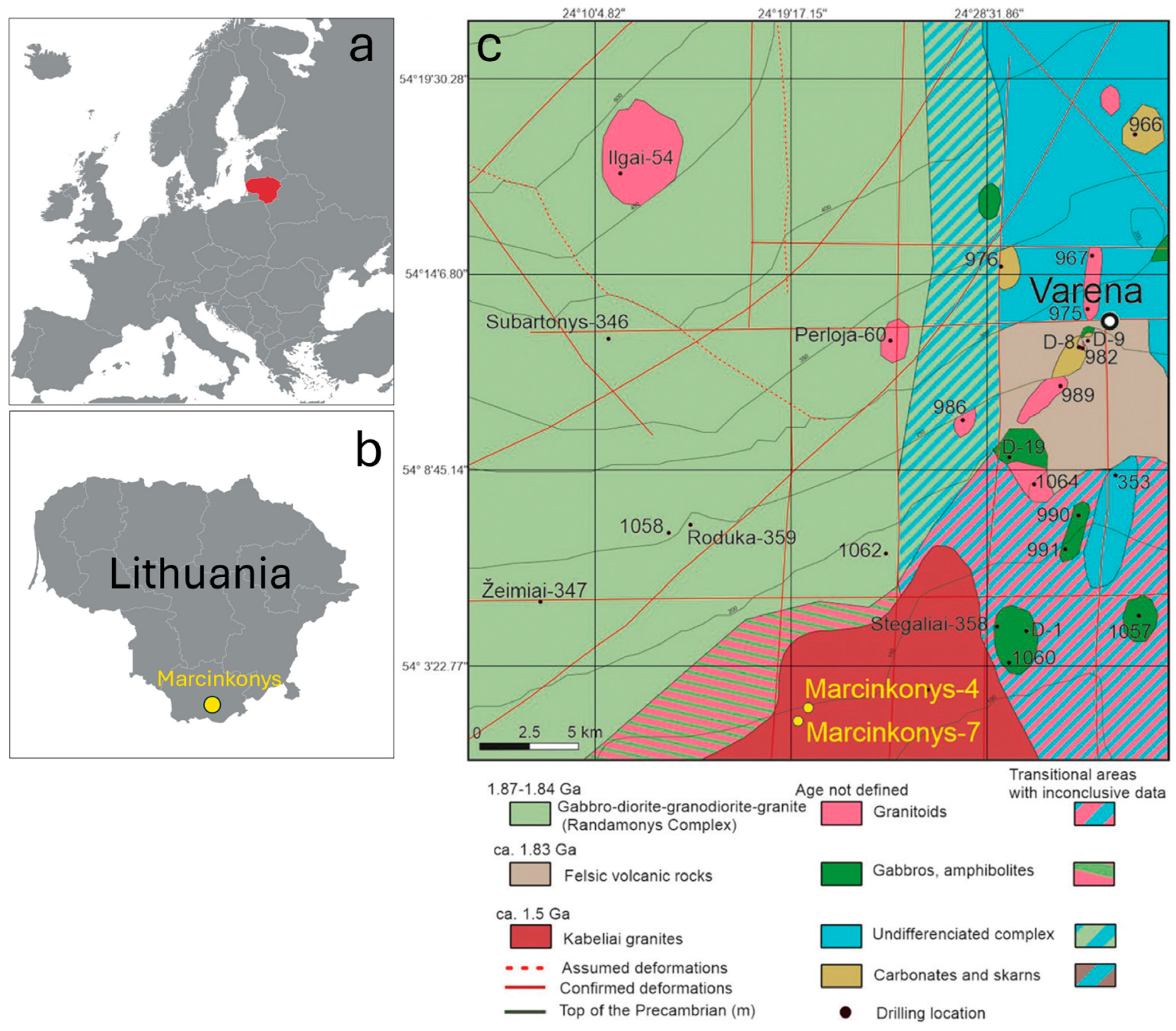
The Marcinkonys granitoid massif (Figure 1a) cross-cuts two major Paleoproterozoic crustal domains of southeastern Lithuania: the East Lithuanian Belt (ELB; ca. 1.89 Ga, [23], belonging to the Latvian–East Lithuanian domain, [24]), and the southeastern Mid-Lithuanian Domain (SE MLD; ca. 1.87–1.84 Ga, belonging to the Mid-Baltic Belt; [25]). The ELB is dominated by metamorphosed granitoid to dioritic rocks (orthogneisses) with subordinate bodies of metamorphosed gabbro and metasediments hosting iron ores (cf. [24]), while the SE MLD consists of weakly metamorphosed granodiorites, diorites, and gabbros [25].
The Marcinkonys massif exhibits a wide lithological variety, including leucocratic granites, plagioclase–microcline granites, and pegmatitic facies, showing many intrusive pulses and a complex magmatic evolution (Figure 1 and Figure 2; e.g., [20,22,24,26,27,28]). It is mainly composed of plagioclase, alkali feldspar, quartz, biotite, magnetite, and titanite [20]. Late-stage muscovite can be found in more peraluminous varieties, while calcic amphiboles are most common in the albitised zones near partly assimilated xenoliths of melanocratic diorites and gabbros [22,28]. Remnants of paragneisses can be found locally as xenoliths or enclaves. Because the studied boreholes are located near the village of Kabeliai, the granitoids investigated in this study are referred to here as the Kabeliai granitoids, representing part of the broader Marcinkonys granitoid massif. The term “Kabeliai granites” has been used in the previous literature [20] to describe the dominant red-coloured granitoids of this part of the massif and is retained only when referring to earlier studies.
The studied Kabeliai granites are A-type, K-feldspar-bearing granitoids [29] with compositions ranging from metaluminous to slightly peraluminous and consisting predominantly of quartz, plagioclase, K-feldspar, and biotite [20,28]. Zircon U-Pb dating from the M–4 borehole yielded a crystallisation age of 1505 ± 11 Ma [20], interpreted as the timing of granitoid emplacement. Parts of the massif were affected by later hydrothermal activity, resulting in local ore mineralisation. Molybdenite Re-Os dating from mineralised granites produced an age of 1486 ± 5 Ma, considered as the timing of post-magmatic hydrothermal processes [27].
Figure 1. (a) Location of Lithuania within Europe; (b) the position of the borehole within Lithuania; (c) the M–7 and M–4 drill sites are shown on a sketch map of the southern Lithuanian crystalline basement (modified after Siliauskas, from Skridlaitė et al.) [30]. Published in Lithos by Elsevier, 2024; reproduced with permission).
Minerals 16 00634 g001
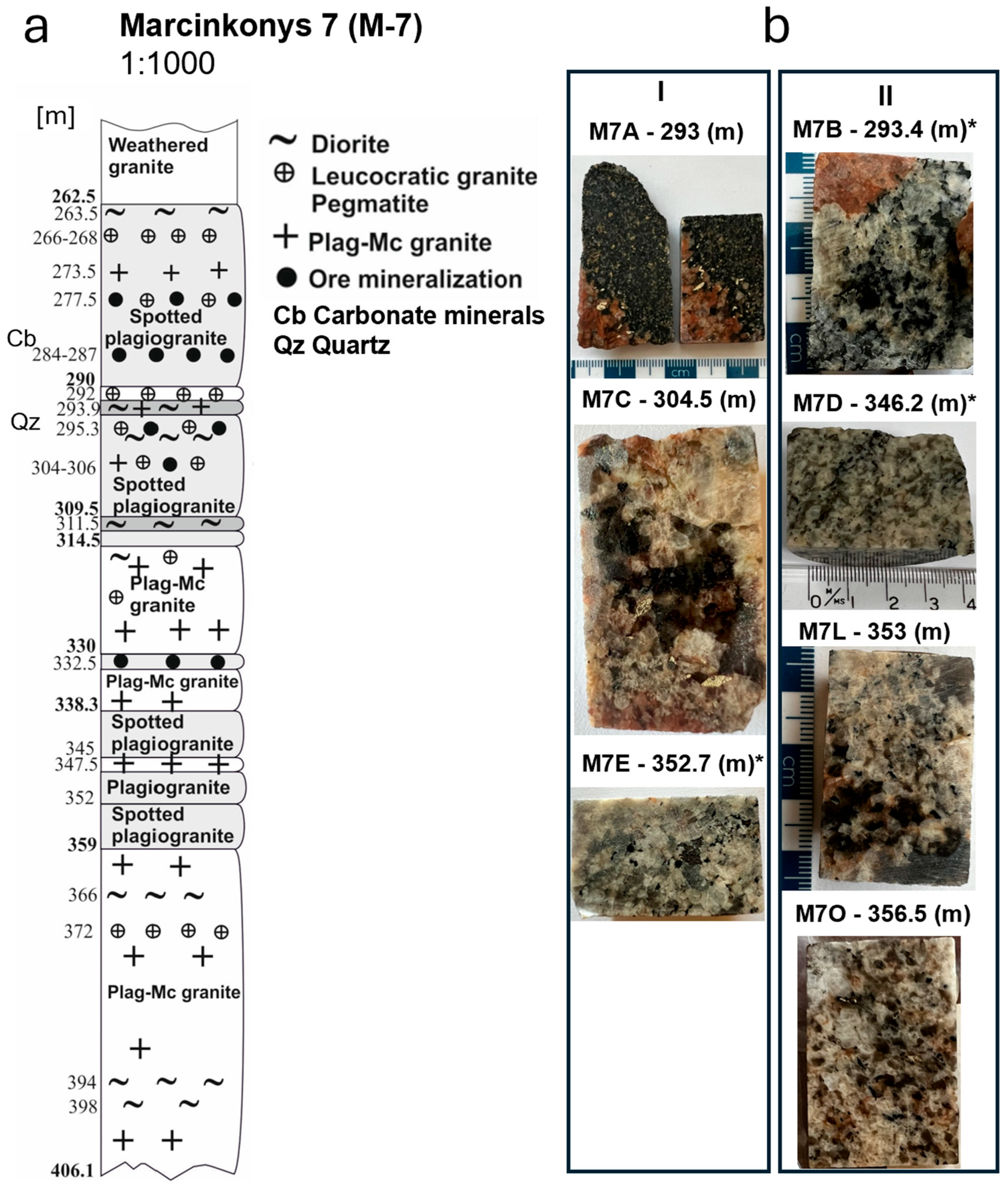
The M–7 borehole cross-cuts different lithologies of the Kabeliai granitoids: main intrusive phases, pegmatitic intervals, dioritic lenses, and hydrothermally altered and mineralised zones (Figure 2a). Demina et al. [28] provide a full lithological description of the borehole, which is briefly summarised below.
Beneath the weathered zone, the borehole is dominated by plagioclase–microcline granites and spotted plagiogranites, which are locally interlayered with leucocratic pegmatitic granites, diorites, and gabbros (Figure 2a), in addition to the previously studied samples (M7A 293 m, M7C 304.5 m, and M7E 352.7 m; Figure 2b, marked—I), which were described in detail by Demina et al. [28]. Four samples (M7B 293.4 m, M7D 346.2 m, M7L 353 m, M7O 356.6 m; Figure 2b, marked—II) were selected for the present study. They were added to represent the range of main lithologies and different degrees of alteration. Titanite U-Pb dating was performed on the least-altered sample from the previously published dataset (M7E, Figure 2b, marked *) and supplemented by two new age estimates from the highly altered group (M7B, M7D, Figure 2b, marked *).
Figure 2. (a) Cross-section of the M-–7 borehole (reproduced with permission from Demina et al., Baltica; published by Nature Research Centre, 2025 [28]). (b) Photographs of analysed rock samples; panel I adapted from Demina et al. [28], Baltica; published by Nature Research Centre, 2025. II—Samples newly investigated in this study; *—samples selected for U-Pb titanite dating.
Minerals 16 00634 g002

3. Analytical Methods

Mineral chemical data processing and visualisation were performed using MinPlot v.2.0 [31] and GCDkit v. 6.3.0 (Czech Geological Survey, Prague, Czech Republic) [32], while final figures were compiled and edited in Adobe Illustrator v.30.5.1 (Adobe Inc., San Jose, CA, USA). Whole-rock geochemical data are presented in Table 1, whereas representative mineral chemical compositions are summarised in Table 2.

3.1. Optical Microscopy

Petrographic analysis was carried out using a polarising microscope, a Nikon Eclipse LV100N POL (Nikon Corporation, Tokyo, Japan) with an epi-illumination attachment at the State Scientific Research Institute, Nature Research Centre in Vilnius, Lithuania, to investigate mineral textures, microstructures, alteration patterns, and the presence of dateable crystals of titanite. From these petrographic observations, representative minerals were selected for electron probe microanalysis (EPMA) and scanning electron microscopy (SEM).

3.2. Scanning Electron Microscopy (SEM) and Electron Probe Microanalysis (EPMA)

Sample microstructures and mineral compositions were investigated using a FEI Quanta 250 scanning electron microscope (SEM; FEI Company, Hillsboro, OR, USA) at the State Scientific Research Institute Nature Research Centre, Vilnius, Lithuania. Qualitative chemical compositions of rock-forming minerals were determined using an energy-dispersive spectroscopy (EDS) system comprising an X-Max large-area (20 mm2) silicon drift detector, an INCA X-stream digital pulse processor, and INCA Energy software v. 4.15 (Oxford Instruments, Abingdon, UK). Analyses were performed at an accelerating voltage of 20 kV and a beam current of 1.1–1.2 nA. Analytical procedures, including operating conditions, calibration standards, and element-specific detection limits (in ppm), are consistent with those described in Demina et al. [28], as the samples were prepared and analysed during the same analytical campaign.
Quantitative mineral analyses were carried out using a Cameca SX100 electron microprobe analyser (EPMA; CAMECA, Gennevilliers, France) at the Laboratory of Electron Microscopy, Microanalysis and X-ray Diffraction, Faculty of Geology, University of Warsaw, Poland (results in Table 2). Detailed analytical conditions, calibration standards, and element-specific detection limits are reported in Demina et al. [28].

3.3. Whole-Rock Geochemistry

Whole-rock chemical analyses were performed at Bureau Veritas (Mississauga, ON, Canada) using lithium borate fusion followed by ICP-MS for trace elements and REE determination. Part of the dataset was previously reported in Demina et al. [28], whereas additional samples analysed in this study are presented here for the first time. The analytical results are provided in Table 1.

3.4. LA-ICP-MS U-Pb Dating

3.4.1. LA-ICP-MS U-Pb Dating (Lund University)

Analytical procedures generally followed those reported in Siliauskas et al. [33], as the samples were prepared and analysed within the same analytical workflow. U-Pb isotopic analyses were carried out by LA-ICP-MS at the Department of Geology, Lund University. A Teledyne Photon Machines G2 (Photon Machines Inc., Bozeman, MT, USA) laser ablation system was used, coupled to a Bruker Aurora Elite quadrupole ICP-MS (Bruker Corporation, Billerica, MA, USA). Before entering the plasma, the ablated material was mixed downstream with argon and N2 (0.8 L/min and 6.5 mL/min, respectively) with the He carrier gas (ca. 0.8 L/min) from the HelEx 2-volume sample cell.
In order to achieve high and consistent signal counts on lead isotopes, low oxide production (below 0.5% monitoring 238U16O/238U and 232Th16O/232Th), and Th/U ratios around 1, the ICP-MS apparatus was tuned using line-scan ablations on NIST SRM 612. Using natural titanite MKED1 [34] as the primary reference material and natural titanite ONT2 ([35], age reported as 1053 ± 3 Ma) and Khan ([36], age reported as 522 ± 2 Ma) as secondary standards, the analytical session was configured to run automatically with standard–sample–standard bracketing.
During the analytical session, the secondary standards ONT2 and Khan yielded Concordia ages of 1037 ± 4 Ma (n = 19, MSWD = 3.7) and 520 ± 3 Ma (n = 19, MSWD = 9.9), respectively. The ONT2 age is approximately 1.5% lower than the published reference age (1053 ± 3 Ma). All reported U-Pb age uncertainties are presented at the 2σ level. The analysis was conducted using 300 shots at 10 Hz and a fluence of 2.5 J/cm2, with a spot size of 32 × 32 μm (or a comparable rectangular region with an aspect ratio up to 1:3). The following isotopes were measured (with their respective dwell times in milliseconds listed in parentheses): 202Hg (10 ms), 204Pb (59 ms), 206Pb (11 ms), 207Pb (75 ms), 208Pb (8 ms), 232Th (9 ms), 235U (10 ms), and 238U (9 ms). A step-forward method of subtraction was used, and baseline compositions were measured 30 s before each analysis. By measuring 202Hg and mass 204 (204Hg + 204Pb), common Pb was monitored. Signal levels on mass 204 were approximately 300 cps with an uncertainty of ca. 4%–5%. Iolite was used for data reduction using the X_U_Pb_Geochron4 data reduction scheme [37,38], and the “VizualAge” data reduction scheme [39] was used for the common Pb correction using the terrestrial Pb model developed by Stacey and Kramers [40]. IsoplotR v. 6.5 (University College London, London, UK) was used for the plotting and final age estimates. The data are presented with two standard errors that include overdispersion [41]. The dating results are presented in Table S1.

3.4.2. LA-ICP-MS U-Pb Dating and Trace Element Analysis (Trinity College, Dublin)

U-Pb titanite ages were determined using a Photon Machines Iridia 193 nm ArF Excimer laser ablation system with a Cobalt 2-volume ablation cell coupled to an Agilent 7900 ICPMS at the Department of Geology, Trinity College Dublin. The ICP-MS was tuned using NIST 612 standard glass to yield Th/U ratios of unity and low oxide production rates (ThO+/Th+ typically <0.15%). A total of 0.45 L/min He carrier gas was fed into the cell, and the aerosol was subsequently mixed with 0.6 L/min Ar make-up gas and a small volume of N2 (ca. 10 mL/min) in a signal smoothing device (LP Interface made by Glass Expansion). The following 32 isotopes were measured (with their respective dwell times in milliseconds listed in parentheses), 27Al (3), 43Ca (3), 49Ti (3), 57Fe (30), 88Sr (30), 89Y (3), 90Zr (3), 93Nb (3), 139La (3), 140Ce (3), 141Pr (3), 146Nd (3), 147Sm (3), 153Eu (3), 157Gd (3), 159Tb (3), 163Dy (3), 165Ho (3), 166Er (3), 169Tm (3), 172Yb (3), 175Lu (3), 178Hf (3), 181Ta (3), 182W (1), 204Pb (1), 206Pb (60), 207Pb (80), 208Pb (20), 232Th (5), 235U (30), and 238U (30), corresponding to a total sweep cycle of 467.5 ms. For all analyses, the laser fluence was 2.5 J/cm2, with a repetition rate of 13 Hz, a 40 μm spot size, and an analysis time of 21 s, followed by an 8 s washout. Baseline measurements (20 s) were made once every c. 7 analyses.
The raw isotope data were reduced using the “VizualAge UcomPbine” data reduction scheme (DRS) of Chew et al. [42], a modification of the U-Pb geochronology “VizualAge” DRS of Petrus & Kamber [39] that can account for the presence of variable common Pb in the primary age reference material. The DRS runs within the freeware IOLITE package of Paton et al. [38]. In IOLITE, user-defined time intervals are established for the baseline correction procedure to calculate session-wide baseline-corrected values for each isotope. The time-resolved fractionation response of individual standard analyses is then characterised using a user-specified down-hole correction model (such as an exponential curve, a linear fit, or a smoothed cubic spline). The “VizualAge” data reduction scheme then fits this appropriate session-wide “model” U-Th-Pb fractionation curve to the time-resolved standard data and the unknowns. Sample-standard bracketing is applied after the correction of down-hole fractionation to account for long-term drift in isotopic or elemental ratios by normalising all ratios to those of the U-Pb age reference material. Common Pb in the primary age reference material was corrected using the 207Pb-based correction method [43]. All reported U-Pb age uncertainties are presented at the 2σ level.
Blocks of six titanite ages and one NIST612 glass reference material were followed by 20 unknown samples. The primary age reference material for titanite analysis was MKED1 titanite (207Pb/206Pb TIMS age of 1521.02 ± 0.55 Ma; [34]). The secondary U-Pb age reference material was OLT-1 titanite (U-Pb TIMS concordia age of 1014.8 ± 2.0 Ma; [44]), which produced a weighted average 207Pb-corrected age of 1017.4 ± 6.7 Ma (n = 17, MSWD = 3.4). Titanite trace element analyses employed NIST612 glass as the primary trace element reference material and 43Ca (20.44 wt.%) as the internal elemental standard. The results of U-Pb titanite dating are presented in Table S2, whereas the corresponding trace element data are given in Table S3.

4. Results

4.1. Sample Petrography

The studied samples (M7B, M7D, M7E, M7L, and M7O) represent granitoids ranging from medium- to coarse-grained plagiogranites to leucocratic granites with varying amounts of biotite (Figure 2b). The samples were selected to reflect the diversity of titanite textures, ranging from primary magmatic crystals to strongly altered and secondary varieties.
The rocks are mostly unequally grained and contain abundant lens-shaped domains. The primary magmatic assemblage is best preserved in samples M7E, M7B, M7O, and M7L, consisting of plagioclase (An20–26), quartz, biotite (Mg# of 0.54–0.61, Ti of 0.19–0.31 apfu), and minor K-feldspar (Figure 2b).
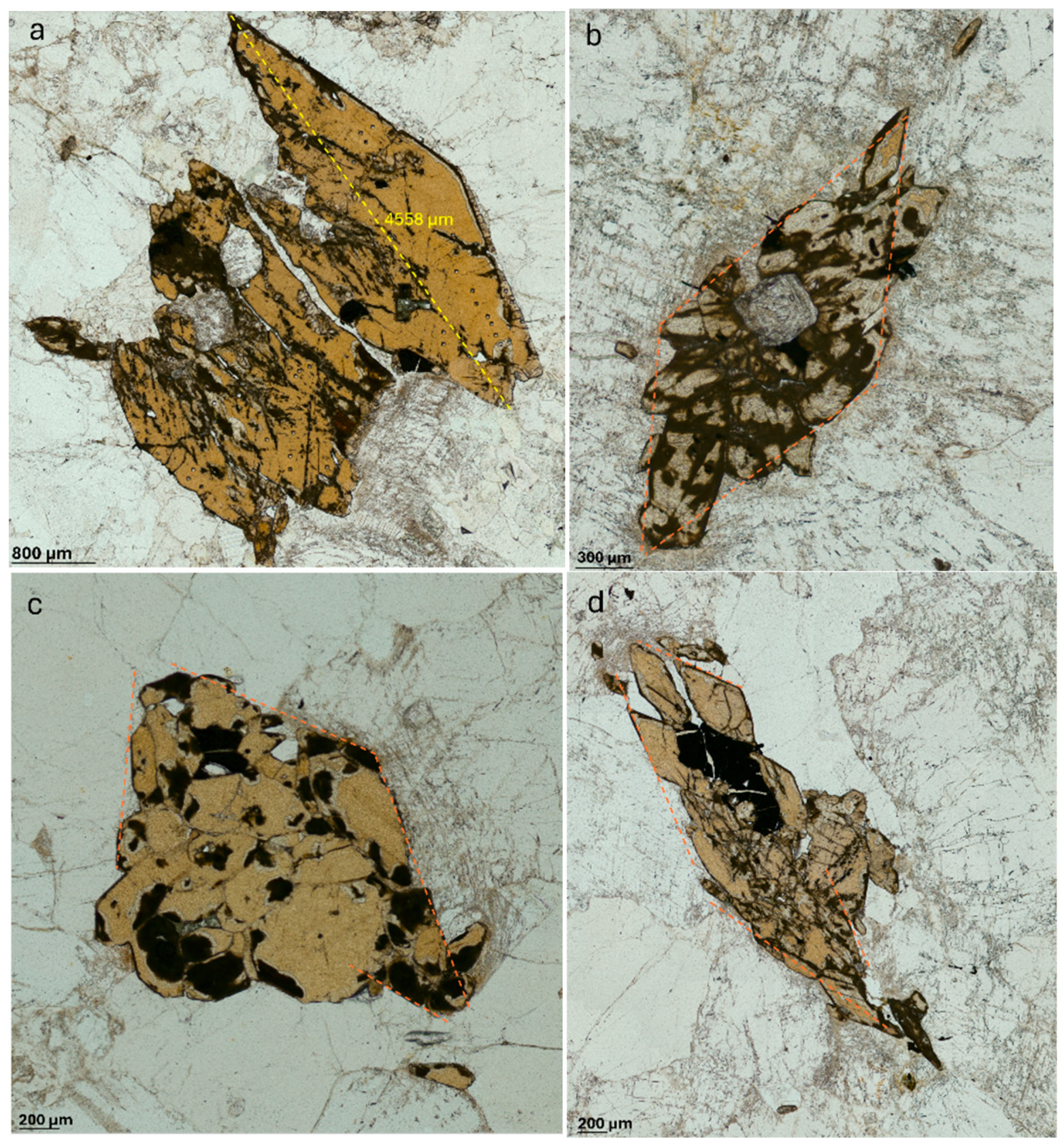
The main accessory phases are titanite, zircon, and locally altered halos of allanite that are rich in thorite. The large (up to 4.5 mm) primary titanites are best preserved in sample M7E. The samples M7O, M7L, and M7B contain abundant titanite aggregates intergrown with Fe oxides. The aggregate size varies from 2 mm (M7B) to 6 mm (M7O). Fe oxides are represented mostly by magnetite. Sulphide minerals include pyrite and chalcopyrite.
Petrographic observations suggest that samples M7D and M7C underwent more intensive hydrothermal alteration than the other samples studied. The alteration starts with feldspar sericitisation, accompanied by replacement of oligoclase (An20–26) by albite (An2–10). Biotite is partially to completely replaced by chlorite (Mg# values of 0.37–0.63), ranging from chamosite to clinochlore [28]. Secondary muscovite and epidote are well preserved in sample M7E (see Figures 4 and 5 in Demina et al. [28]).
The altered titanite crystals display dissolution textures and partial replacement by anatase and carbonate phases. In sample M7D, primary titanite is preserved as relic crystals in association with secondary anatase and hematite. The completely replaced titanite in sample M7C is spongy and intergrown with other secondary minerals (see Figure 4c in Demina et al. [28]). The magnetite is replaced by hematite and goethite (see Figure 9 in Demina et al. [28]).

4.2. Whole-Rock Geochemistry

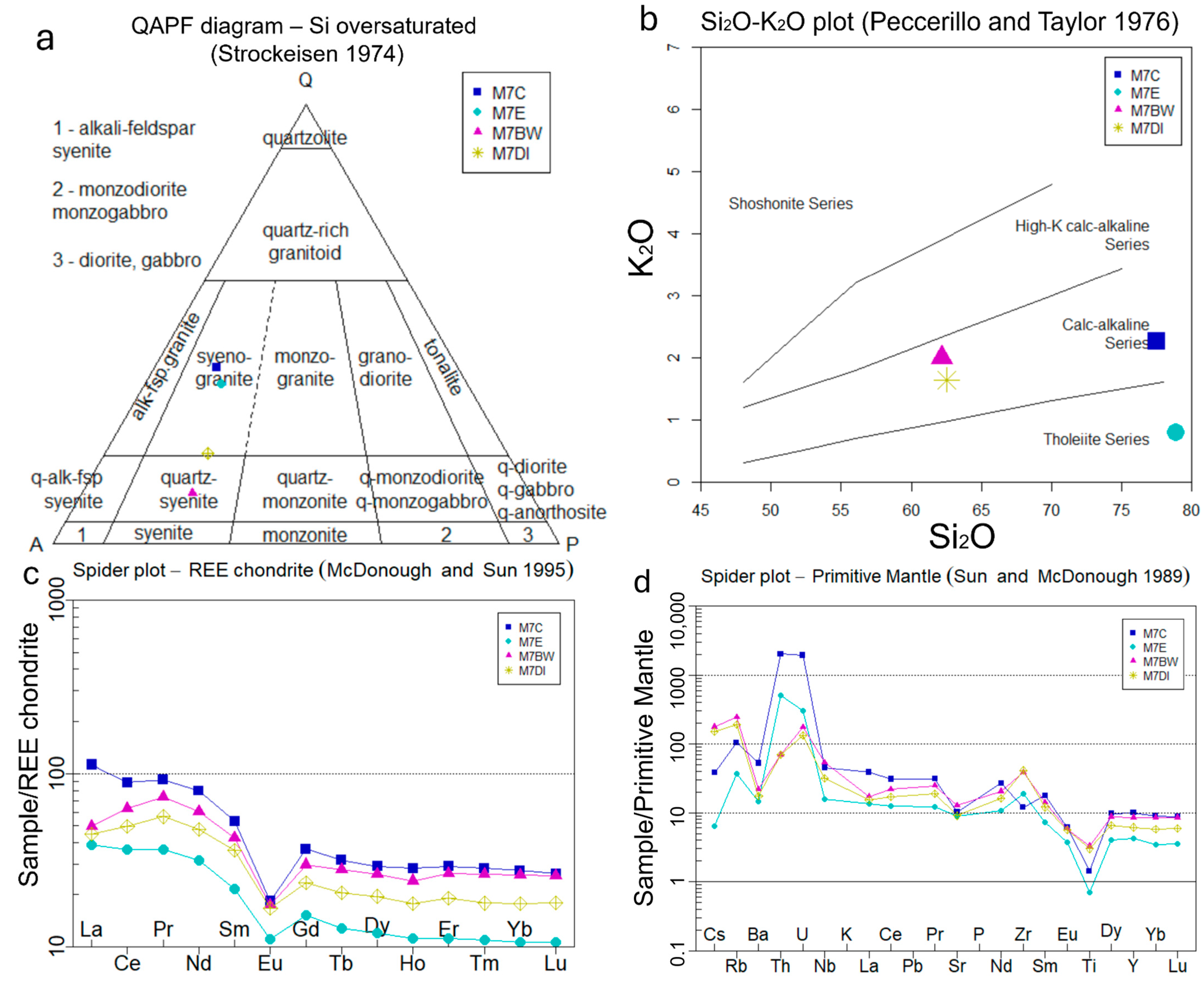
Whole-rock major and trace element compositions of the studied samples are summarised in Table 1. The samples vary in SiO2 contents (ca. 62–79 wt.%). According to the QAPF classification [45], the samples plot mainly in the syenogranite field, with some data points extending towards the quartz syenite field (Figure 3a). Most of the granites are calc–alkaline in composition (Figure 3b), except for the albitised leucocratic granite sample M7E, which plots in the tholeiitic field. The rocks are metaluminous to weakly peraluminous, with the A/CNK values ranging from 0.99 to 1.02 (Table 1). The modified alkali–lime index (MALI = Na2O + K2O − CaO; [46]) ranges from 2.71 to 4.25, further supporting calc–alkaline affinities of the studied rocks.
Chondrite-normalised [48] REE patterns (Figure 3c) are characterised by moderate enrichment of LREEs relative to HREEs, with (La/Yb)n values ranging from 1.94 to 4.14, and relatively flat HREE segments, with the (Sm/Yb)n values of 1.63 to 2.04. All samples display distinct negative Eu anomalies (Eu/Eu* = 0.42–0.61), indicating plagioclase fractionation during magmatic evolution and/or subsequent fluid-related redistribution [50].
Primitive mantle-normalised [49] multi-element patterns (Figure 3d) are similar and show an enrichment in large-ion lithophile elements (LILEs) relative to high field strength elements (HFSEs). All samples display pronounced negative Ti and small negative Sr anomalies. The two samples with higher SiO2 content are enriched in Th and U.
The silica-poorer samples with higher Zr content (429 and 462 ppm) have a slightly higher Nb/Ta ratio of 14, compared to the silica-rich granites (Nb/Ta of 12) with lower Zr content (134 and 211 ppm). The Zr/Hf ratio in most samples is in the range of 31–37, similar to that of average continental crust (Zr/Hf 34–37, [51]), and it is much higher in sample M7D (Zr/Hf = 41). Fluorine contents vary significantly among the samples (189–2245 ppm). They generally decrease with increasing SiO2 content and total REE content (ΣREE = 64–118 ppm), except for the pegmatitic granite sample M7C, which has the highest total REE of 163 ppm at a relatively low F content of 282 ppm.
Table 1. Whole-rock major element (wt.%) and trace element (ppm) composition of the studied samples. Data for samples M7E and M7C were previously published in Demina et al. [28] and are reproduced here with permission; additional samples are reported here for the first time.
wt.%/SampleM7C Pegmatitic GraniteM7E Leucocratic PlagiograniteM7B Biotite GraniteM7D Biotite Plagiogranite
SiO277.4678.8662.1862.53
Al2O313.8915.5119.8817.26
Fe2O31.081.264.749.61
MgO0.340.182.171.55
CaO2.53.383.953.54
Na2O4.15.36.215.33
K2O2.260.791.991.64
TiO20.310.150.710.65
P2O50.02<0.010.030.01
MnO0.020.020.060.07
Cr2O3<0.002<0.0020.0040.005
LOI−2.2<−5.1−2.2−2.4
Sum99.8799.9299.7699.82
ppm
Ba369102152123
Ni<20<20<20<20
Sc<1<143
Be3447
Co1.10.510.39.6
Cs0.3<0.11.41.2
Ga16.718.127.726.8
Hf4.35.71211.2
Nb32.211.138.422.6
Rb66.523.6155.6121.2
Sn<1<121
Sr217.1188.1267.8191.2
Ta2.80.92.71.6
Th171.443.35.95.9
U40.66.43.72.8
V101747127
W<0.50.80.7<0.5
Zr134.1211428.9462.4
Y45.519.238.828
La26.69.211.810.6
Ce54.622.338.730.5
Pr8.573.376.815.24
Nd36.414.427.621.8
Sm7.853.196.285.34
Eu1.030.620.980.94
Gd7.293.025.934.65
Tb1.140.461.010.74
Dy7.182.946.434.8
Ho1.550.611.310.97
Er4.671.784.233.04
Tm0.70.270.650.44
Yb4.421.74.182.86
Lu0.650.260.630.44
F28218922451621
A/NK1.511.621.611.64
A/CNK1.010.991.021.02
MALI [46]3.862.714.253.43
Sum REE162.6564.12116.5492.36
(La/Yb)n4.143.721.942.55
Eu/Eu*0.420.610.490.58
Zr/Hf31.1937.0235.7441.29
Nb/Ta11.5012.3314.2214.13
Y/Ho29.3531.4829.6228.87

4.3. Titanite Description

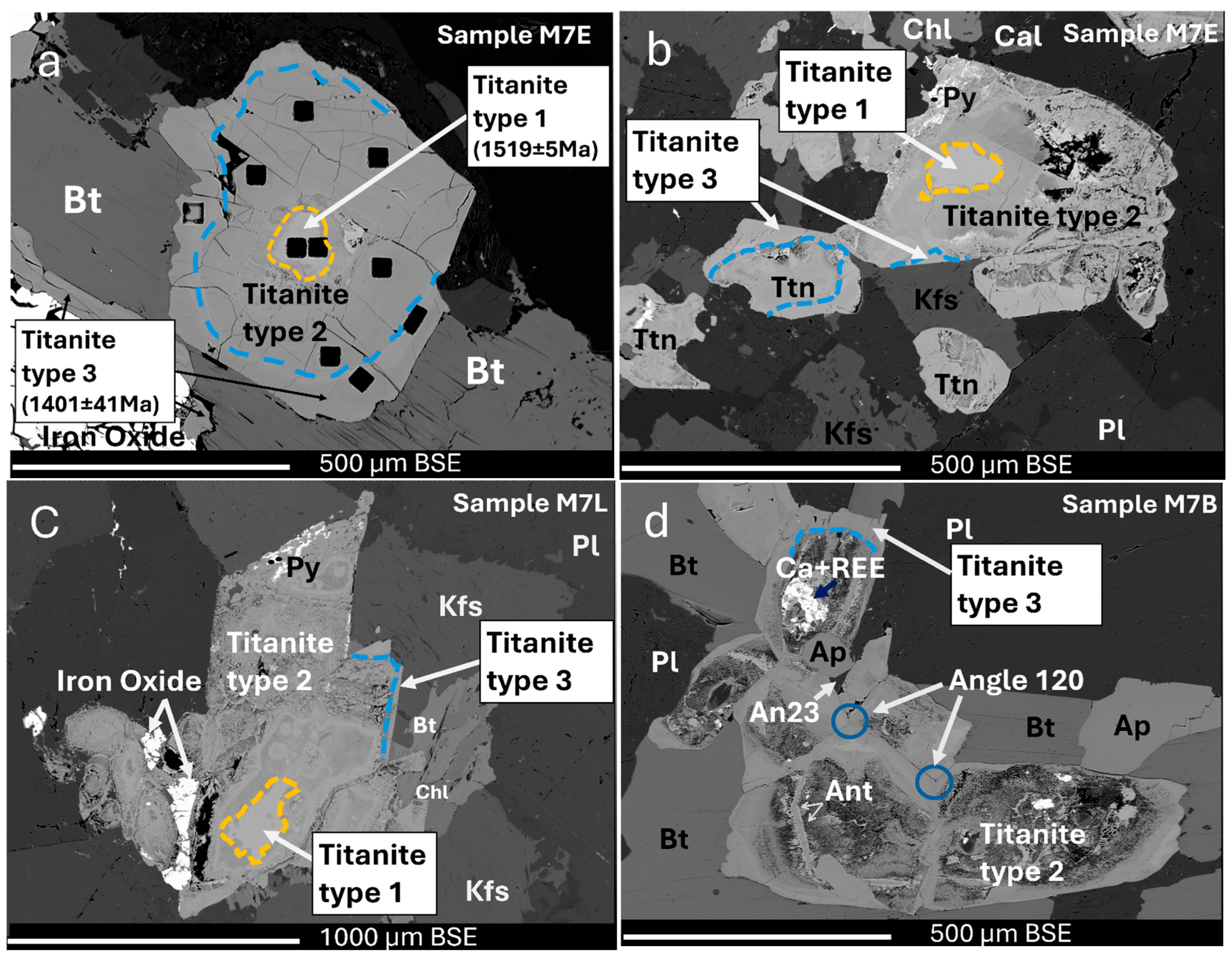
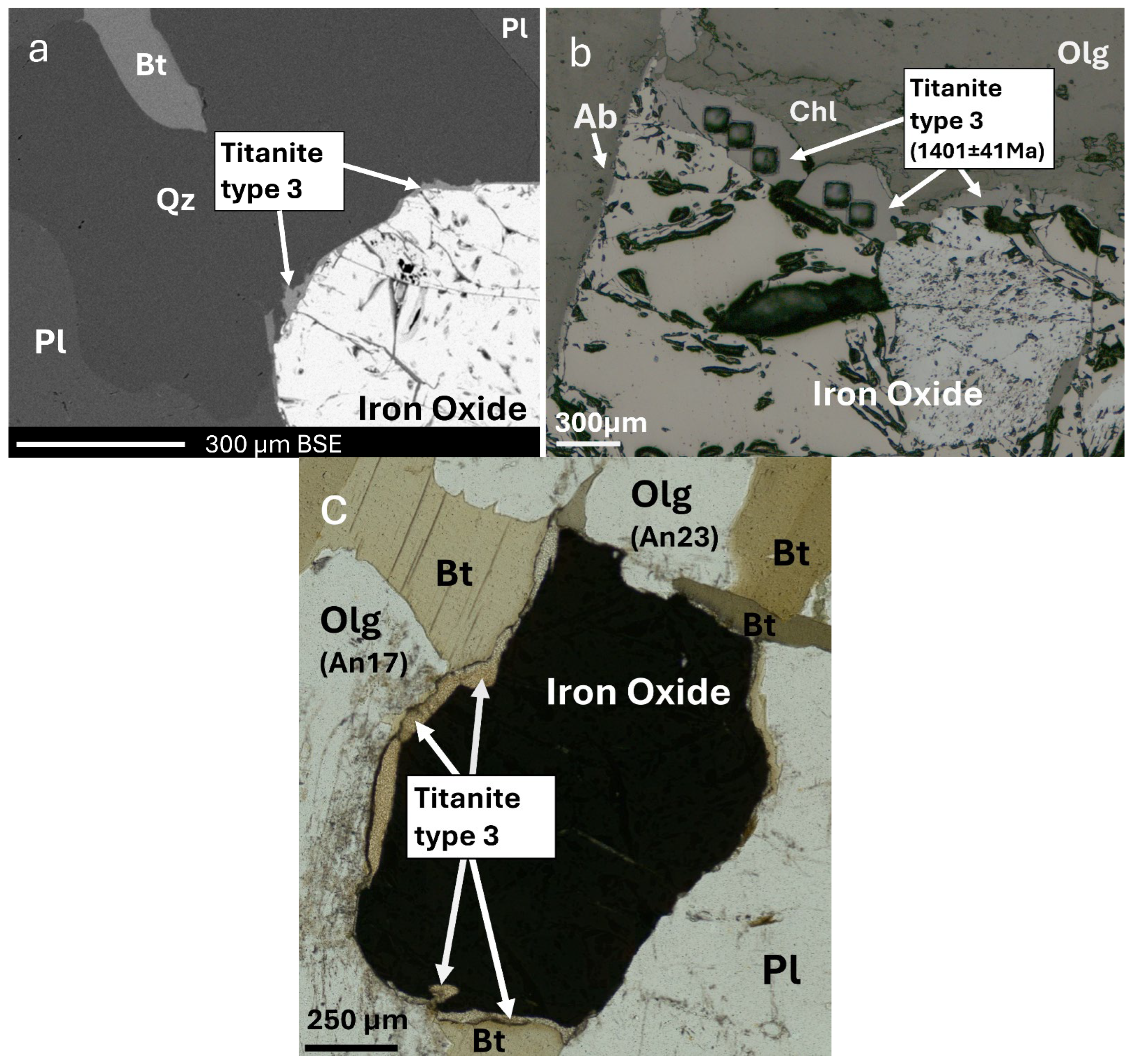
Titanite is abundant in all the studied samples, but its mode of occurrence, shape, size, chemical composition, and extent of alteration vary considerably. It can be subdivided into three groups (types). The first group consists either of large (up to 4.5 mm) euhedral to subhedral crystals (Figure 4a) or complex mosaic aggregates preserving rhombic to wedge-shaped crystals (Figure 4b–d), classified as type 1 titanites. It is surrounded by porous, highly altered titanites of type 2 (Figure 5a–c,e). Titanite type 2 is, in turn, overgrown by a homogeneous secondary titanite generation, and it is assigned to type 3 (Figure 5a–e).

4.3.1. Type 1 Titanite: Primary Magmatic (Least Altered)

Type 1 titanite represents the homogeneous, patchy inner domains of titanite crystals. In BSE images, these domains appear pore-free and homogeneous, showing a consistent light grey colour in back-scattered electron (BSE) images, distinct from surrounding altered (darker) zones (Figure 5a–c).

4.3.2. Type 2 Titanite: Porous (“Sponge-like”) Titanite

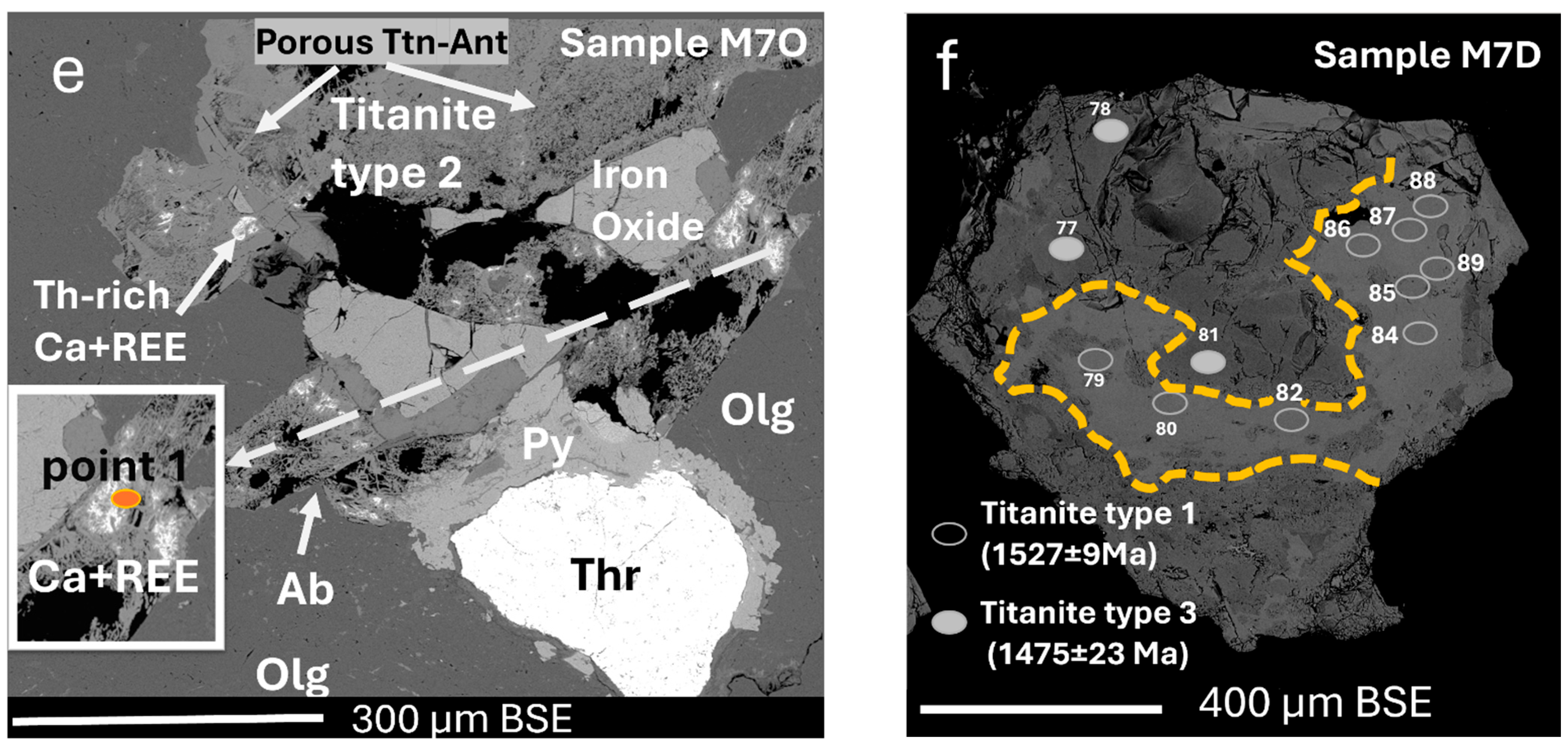
The patchy, irregularly zoned type 2 titanite surrounds the preserved magmatic cores of type 1 (Figure 5a–c) or completely replaces the earlier type 1 titanite (Figure 5d–e). The porosity in type 2 titanite varies from slightly porous (e.g., Figure 5a) to highly porous (Figure 5d), forming dendritic, net-like textures (Figure 5e, point 1). Some of the pores are filled with secondary anatase (Figure 5d). Anatase typically forms fine-grained aggregates, rims, or irregular replacement domains along fractures, pores, and crystal margins (Figure 5d,e). The most evolved type 2 titanites locally host secondary Ca- and REE-rich phases within their porous domains, forming a heterogeneous mixture of primary titanite and newly formed secondary components (Figure 5e). The porous (sponge-like) type 2 titanite is transitional between the magmatic titanite type 1 and recrystallised secondary titanite (type 3), which commonly occurs as rims and overgrowths.

4.3.3. Type 3: Recrystallised Secondary Titanite

Type 3 titanite is present as thin rims on earlier titanite generations (Figure 5a,b) or nucleates on the margins of Fe-oxide crystals in contact with albitised plagioclase and biotite (Figure 6a–c). In BSE images, type 3 titanite appears relatively homogeneous, inclusion- and pore-free (Figure 6b). In some cases, type 3 titanite forms polygonal aggregates with 120° triple junctions, consistent with textural equilibration during late-stage recrystallisation (Figure 5d).

4.4. Titanite Chemistry: EPMA and LA-ICP-MS Data

Electron microprobe analyses (EPMAs) reveal systematic compositional differences between the three texturally defined titanite types (Table 2).
Type 1 titanite is chemically the most homogeneous and closest to stoichiometric composition, with relatively narrow ranges of Si (3.70–3.74 apfu), Ti (2.98–3.13 apfu), and Ca (3.54–3.59 apfu). Minor Al (0.31–0.35 apfu) and moderate to low Fe2+ (0.18–0.23 apfu) substitute for Ti [53], whereas Na is below the detection limit or up to 0.02 apfu. Type 1 titanite contains relatively low but consistent concentrations of Y (0.50–0.87 wt.%) and LREEs (Ce 0.56–0.69 wt.%, Nd 0.40–0.57 wt.%), as well as Nb (0.42–0.75 wt.%), and moderate F contents (0.81–1.01 wt.%).
The transitional type 2 titanite exhibits the widest compositional variability, consistent with its strongly altered and porous textures. Major cation contents show broad variability in Si (3.16–4.08 apfu), Ti (2.87–4.00 apfu), Ca (2.58–3.69 apfu), and Al (0.25–0.38 apfu). Unlike type 1, type 2 titanite is characterised by elevated and highly variable Na (0.01–0.16 apfu) and locally increased Fe2+ (up to 0.34 apfu), together with variable contents of Y (up to 0.97 wt.%), LREEs (up to 0.33 wt.%, Ce up to 1.30 wt.%, Pr up to 0.21 wt.%, Nd up to 0.79 wt.%), Zr (up to 0.49 wt.% with one analysis at 1.13 wt.%), and Nb (up to 0.67 wt.%). In summary, this titanite type hosts the highest REE concentrations, except in places where REEs may have been redistributed into associated carbonate-bearing alteration assemblages [14,18,54]. Fluorine content remains moderate (0.57–0.93 wt.%) but displays a wider spread than in type 1.
In contrast, type 3 titanite exhibits a more uniform and internally consistent composition. It is characterised by the lowest contents of incompatible elements and the highest F concentrations (Table 2). Compared to type 1, type 3 titanite contains high Ca contents (3.65–3.79 apfu), low Na (0.01–0.04 apfu), slightly higher Al contents (0.33–0.44 apfu, consistent with previous observations [8]), and moderate to low Fe2+ (0.12–0.25 apfu). The amounts of Y and REEs are generally low but locally reach measurable concentrations (La b.d.l. (below limit of detection)−0.07 wt.%, Ce 0.08–0.29 wt.%, Pr b.d.l.−0.03 wt.%, Nd b.d.l.−0.09 wt.%, Nb up to 0.30 wt.%), and Zr is mostly below the detection limit. Notably, type 3 titanite displays the highest F concentrations among the three types (1.01–1.21 wt.%), while Cl is mostly below the detection limit, reaching up to 0.08 wt.%.
Table 2. Chemical composition ranges (wt.%, apfu) of texturally defined titanite types based on EPMA analyses.
wt.%Type 1Type 2Type 3
SiO229.60–30.1424.54–31.5230.06–30.73
TiO231.45–33.6529.41–41.9731.69–34.56
Al2O32.13–2.371.66–2.522.26–3.00
FeO Total1.97–2.421.69–3.521.30–2.63
MgOup to 0.06up to 0.16up to 0.02
MnO0.11–0.200.10–0.210.04–0.15
V2O30.05–0.13up to 0.140.07–0.16
Cr2O3up to 0.03up to 0.09up to 0.05
CaO26.35–27.0619.88–28.2127.23–29.04
Na2Oup to 0.060.03–0.640.01–0.05
SrOb.d.l.up to 0.13b.d.l.
Y2O30.50–0.87up to 0.97b.d.l.–0.17
La2O30.05–0.15up to 0.33b.d.l.–0.07
Ce2O30.56–0.69up to 1.300.08–0.29
Pr2O30.09–0.15up to 0.21b.d.l.–0.03
Nd2O30.40–0.57up to 0.79b.d.l.–0.09
ZrO2up to 0.08up to 0.49 (one 1.13)b.d.l.
Nb2O50.42–0.75up to 0.67b.d.l.–0.30
F0.81–1.010.57–0.931.01–1.21
Clb.d.l.up to 0.05b.d.l.–0.08
Total96.01–98.2591.16–95.5196.69–99.32
O = F, Cl0.34–0.430.28–0.410.43–0.59
Total95.67–97.8290.88–98.1296.10–99.32
Titanite (based on 18 O)Type 1Type 2Type 3
Si3.70–3.743.16–4.083.69–3.80
Ti2.98–3.132.87–4.002.98–3.16
Al0.31–0.350.25–0.380.33–0.44
Fe2+ all ferrous0.18–0.230.16–0.340.12–0.25
Mn0.01–0.020.01–0.02b.d.l.–0.02
Mgb.d.l.–0.01b.d.l.-0.03b.d.l.
Ca3.54–3.592.58–3.693.65–3.79
Nab.d.l.–0.020.01–0.160.01–0.04
Srb.d.l.b.d.l.b.d.l.
Y0.03–0.06b.d.l.–0.07b.d.l.–0.01
Crb.d.l.b.d.l.–0.01b.d.l.–0.01
V0.01b.d.l.–0.010.01–0.02
Lab.d.l.–0.01b.d.l.–0.02b.d.l.
Ce0.030.01–0.06b.d.l.–0.01
Prb.d.l.–0.01b.d.l.–0.01b.d.l.
Nd0.02–0.03b.d.l.–0.04b.d.l.
Zrb.d.l.–0.01b.d.l.–0.07b.d.l.
Nb0.02–0.040.01–0.04b.d.l.–0.02
F0.32–0.400.23–0.380.40–0.56
Clb.d.l.b.d.l.–0.01b.d.l.–0.02
Total11.40–11.3710.92–11.3111.67–11.70
b.d.l.—below detection limit; apfu values were calculated with MinPlot [31].
Titanites from samples M7B and M7D were additionally analysed for their trace element contents by LA-ICP-MS at Trinity College, Dublin, Ireland.
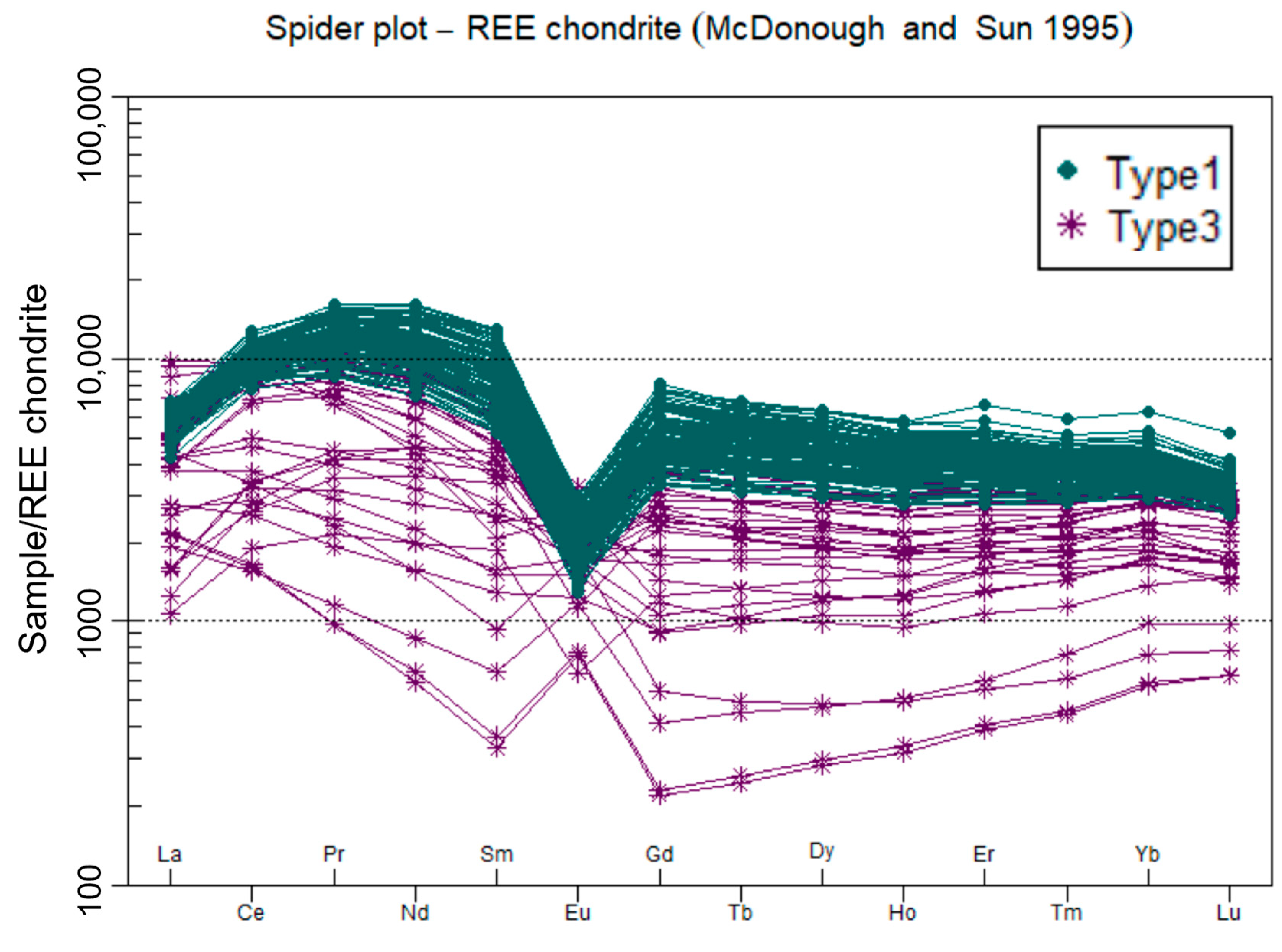
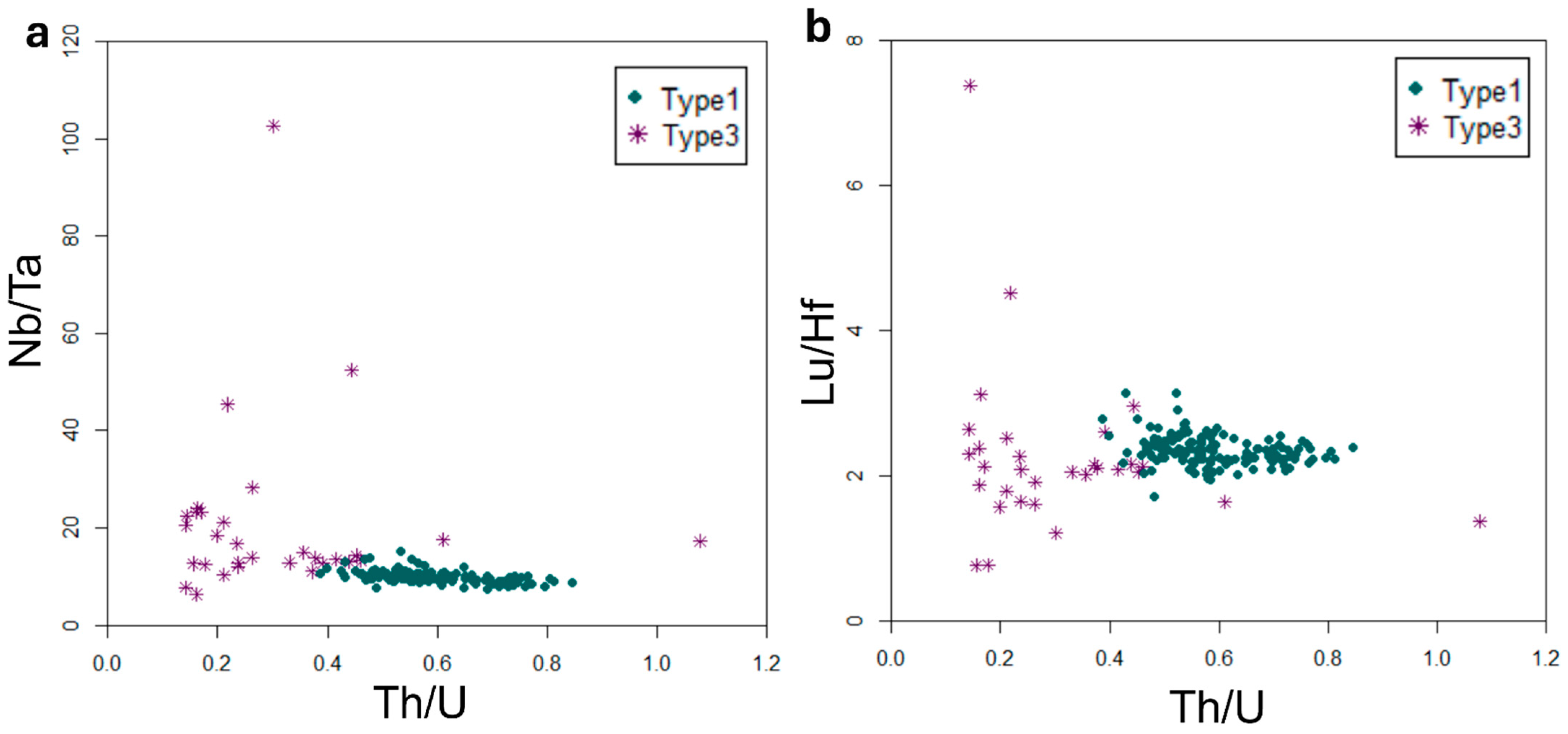
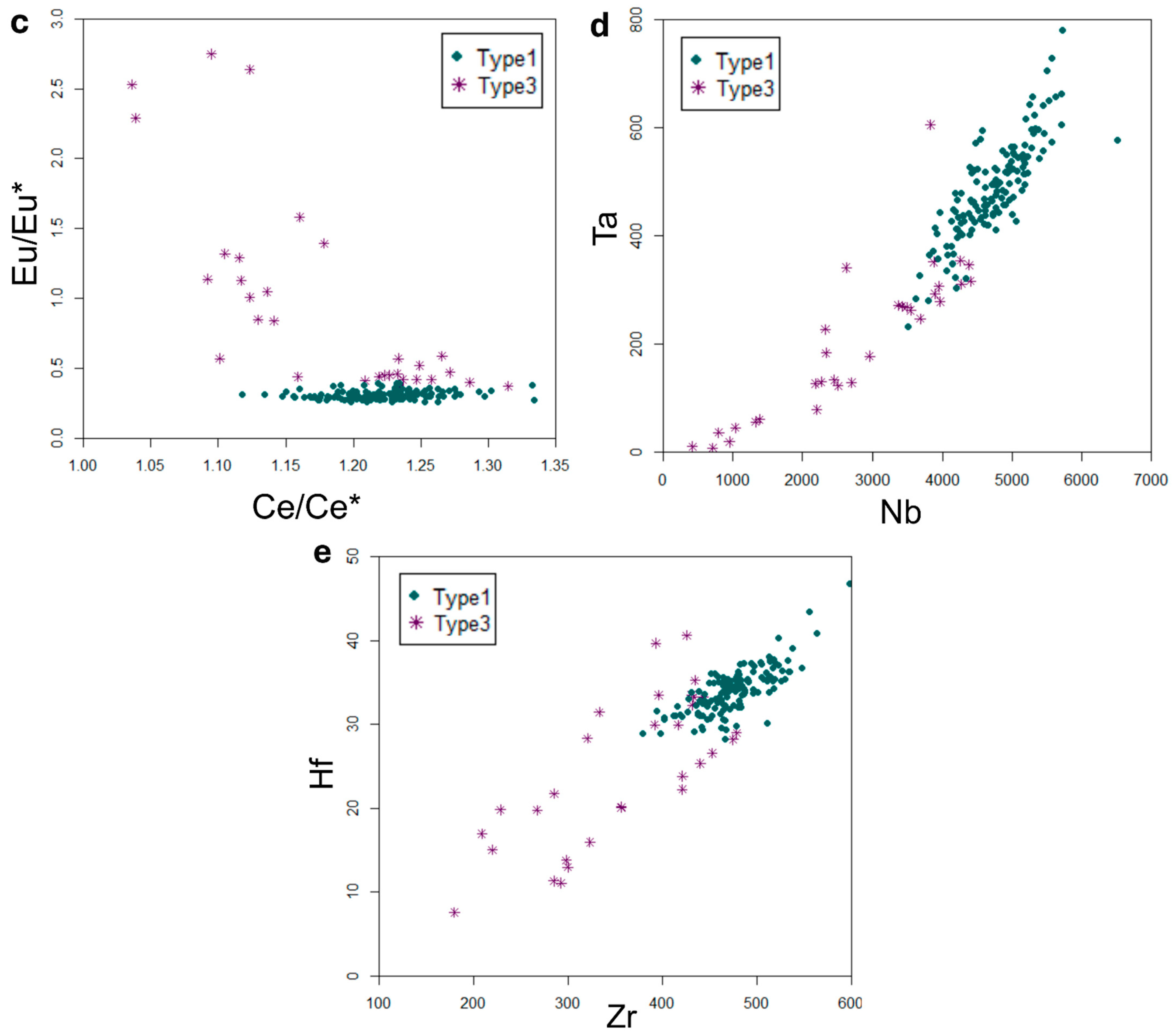
The trace elements reveal compositional differences between type 1 and type 3 (Figure 7, Table S3). The type 2 titanite did not yield meaningful data due to its high porosity (Figure 5) and significant overlap with neighbouring domains, owing to the large beam size. Types 1 and 3 titanites differ markedly in their trace element compositions (Table S3). Type 1 titanite is characterised by high concentrations of REEs (Table S3), including La (1400–1636 ppm), Ce (4764–7933 ppm), Nd (3311–7374 ppm), and Yb (430–1016 ppm), as well as elevated HFSE contents, such as Nb (4780–6508 ppm) and Ta (232–782 ppm). Type 3 titanite shows generally lower and more variable REE concentrations (Table S3), with La ranging from 252 to 2330 ppm, Ce from 956 to 6001 ppm, Nd from 268 to 4361 ppm, and Yb from 92 to 583 ppm. The HFSE display lower and more variable contents in type 3 titanite (e.g., Nb 415–4401 ppm, Ta 7–606 ppm). Actinide elements (Th, U) follow a similar pattern. Chondrite-normalised REE patterns (Figure 7) show that type 1 titanite displays LREE-enriched profiles with high REE contents, relatively flat HREE segments, and a uniformly negative Eu anomaly. In contrast, type 3 titanite exhibits lower and more variable REE abundances, has less pronounced LREE enrichment, and has Eu anomalies ranging from negative to positive.

4.5. U-Pb Geochronology

The first set of U-Pb titanite dating was performed on sample M7E at the Department of Geology, Lund University. Crystals for analysis were selected based on microtextural differences (Figure 5 and Figure 6), targeting distinct domains corresponding to titanite types 1–3 (Figure 5a–e and Figure 6a–c) to evaluate potential age heterogeneity and to distinguish primary crystallisation from later overgrowth or alteration.
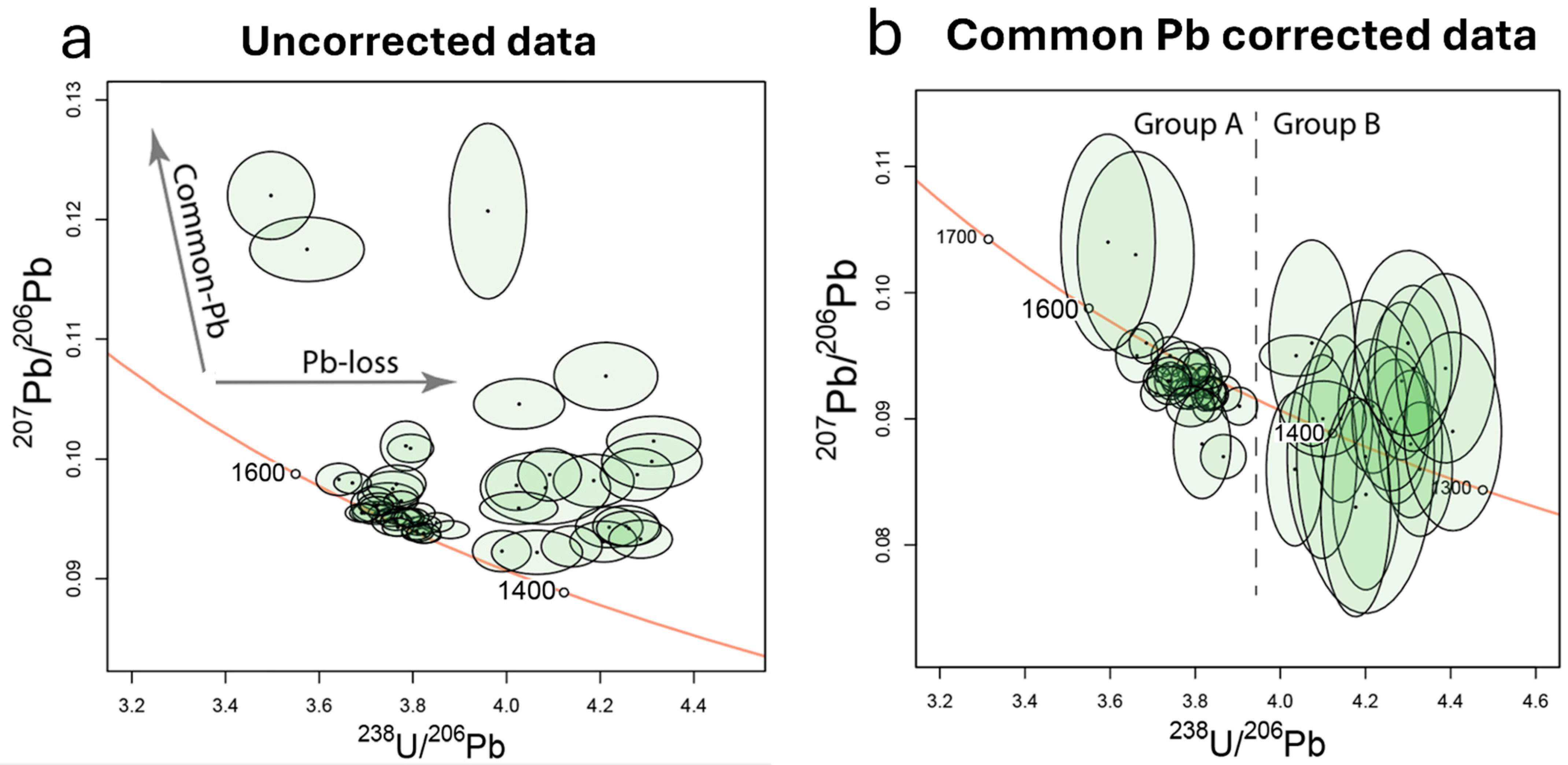
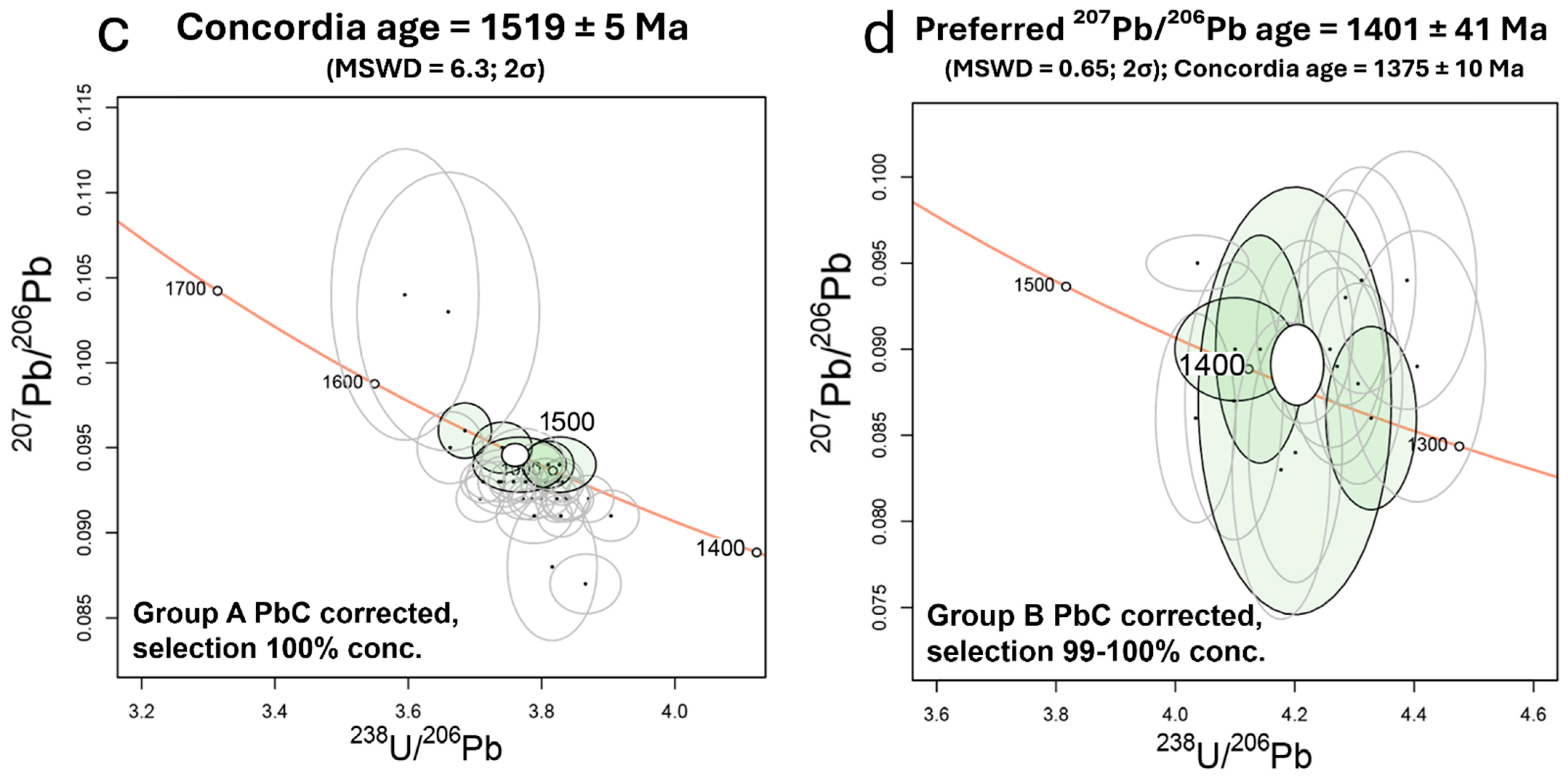
Uncorrected and PbC-corrected U-Pb titanite data are plotted in Figure 8a and Figure 8b, respectively. Data apparently plot into two groups (Figure 8b). The data forming group A (Figure 8c) comprises analyses of type 1 titanite (cores). The common lead (PbC)-corrected data are slightly reverse-discordant and form a relatively coherent group (Figure 8c). Selecting the PbC-corrected analyses that plot concordantly within analytical uncertainties, we calculate a Concordia age of 1519 ± 5 Ma (MSWD = 6.3, 2σ) (Figure 8c). The relatively high MSWD value may reflect minor geological scatter, local isotopic heterogeneity among the analysed titanite domains, and/or analytical dispersion.
Group B (Figure 8c) comprises analyses of altered titanite domains, including rims and overgrowths (type 3, Figure 5a–d and Figure 6a–c), commonly developed around porous intermediate zones (type 2, Figure 5a–e). Using the 98%–102% concordant PbC-corrected analyses, we obtain a Concordia age of 1375 ± 10 Ma (MSWD = 4.5; 2σ; Figure 8d). The Concordia age constrained by the PbC-corrected data might likely be too young due to the recent Pb loss observed in the uncorrected dataset. To reduce the effect of recent Pb loss, we calculate a 207Pb/206Pb age for the same data selection, which yields an age of 1401 ± 41 Ma (n = 4, MSWD = 0.65; 2σ). Although the complexity of the dataset makes the interpretation uncertain, we interpret the younger titanite population as likely reflecting hydrothermal recrystallisation and isotopic resetting. Nevertheless, the data remain more complex than the older magmatic titanite population and may partially reflect mixed or incompletely reset isotopic domains. Therefore, the obtained 1401 Ma ages are interpreted as geologically meaningful but potentially affected by partial Pb loss and local isotopic heterogeneity.
Further U-Pb titanite dating was performed on samples M7B and M7D at Trinity College Dublin. The analysed titanites are more uniform than those previously dated, forming euhedral to subhedral larger crystals or clusters of smaller euhedral crystals that form aggregates resembling larger phenocrysts (with no evidence of deformation), often in close association with magnetite. The combined dataset reveals a well-defined discordia trend, with a lower intercept age of ca. 1500 Ma when anchored to a common Pb composition derived from the Stacey and Kramers [40] terrestrial Pb evolution model. In both samples, analyses were performed homogeneously and were brighter in the BSE images (Figure 5f), primary titanite (type 1), and the thin outer rims (type 3). The trends obtained (Figure 9) are similar to those observed in sample M7E (Figure 8), with type 1 titanite older than the altered type 3 titanite.
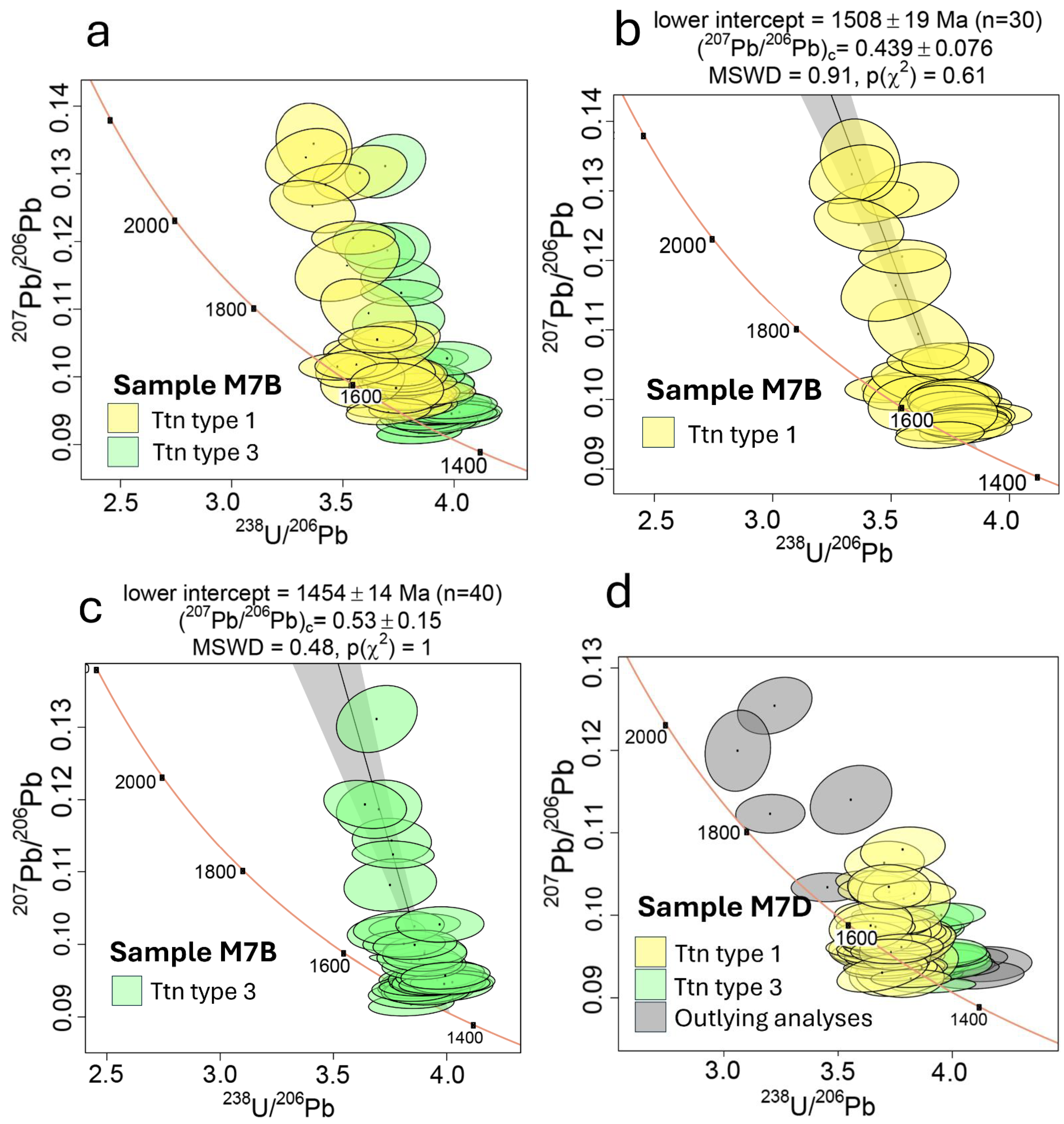
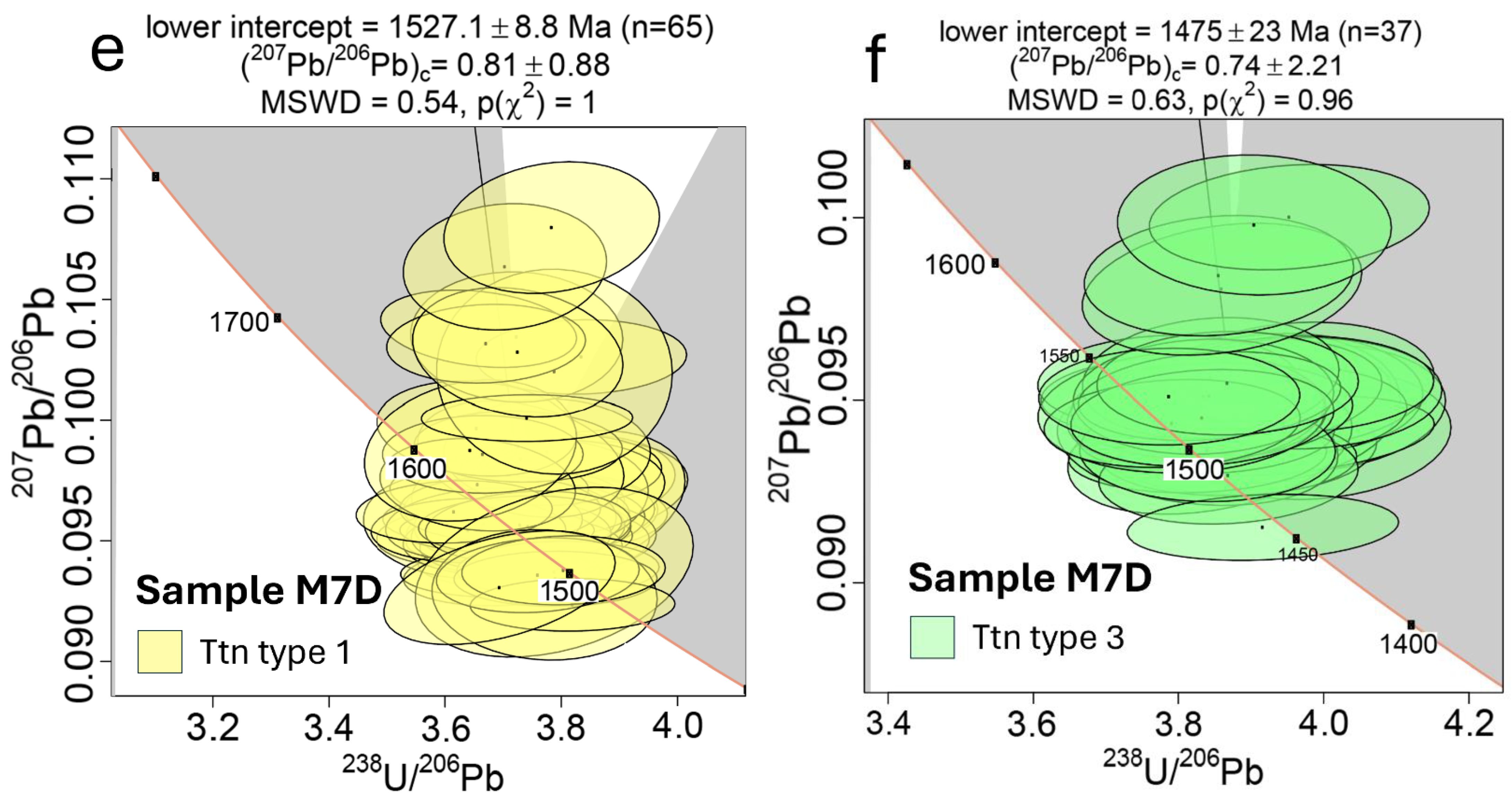
The results from sample M7B show a well-defined common Pb trend with a lower intercept of ca. 1460 Ma (Figure 9a), with about half of the analyses (37 out of 70) concordant. Following the subdivision of the titanite crystals (according to their microtextural characteristics) into type 1 (n = 30) and type 3 (n = 40), the age data form two subparallel trends (Figure 9b,c). The calculated discordia lower intercept ages are 1508 ± 19 Ma (n = 30; MSWD = 0.91; 2σ) and 1454 ± 14 Ma (n = 40; MSWD = 0.48; 2σ) for type 1 and type 3 titanites, respectively.
The data from sample M7D are, in general, less discordant, lying on a clear common Pb trend (n = 112; Figure 9d). Five discordant points to the left of the main cluster were not used in the age calculation. They were treated as outliers (Figure 9d), as were an additional five analyses with younger ages indicative of Pb loss (Figure 9d). Although the data clusters partially overlap, they were separated into two groups based on microtextural characteristics. The older group (type 1 titanite, n = 70) yields a lower intercept age of 1527 ± 9 Ma (MSWD = 0.54; 2σ; Figure 9e), and the younger group (type 3 titanite, n = 42) yields a lower intercept age of 1475 ± 23 Ma (MSWD = 0.63; 2σ; Figure 9f).

5. Discussion

The results provide constraints on the origin of the studied granitoids and the nature of hydrothermal alteration. Titanite provides an effective tool for dating magmatic crystallisation and hydrothermal reworking. It also allows for a comparison of the studied rocks with the surrounding geological units.

5.1. Granite Emplacement and Post-Magmatic Alterations

The studied granitoids range from leucocratic granites to biotite-rich plagiogranites, with a primary mineral assemblage of plagioclase (An20–26), quartz, biotite, and K-feldspar. They exhibit geochemical characteristics consistent with oxidised A-type affinity, with SiO2 contents ranging from ca. 62 to 79 wt.% and predominantly calc–alkaline compositions (Figure 3; Table 1). Their metaluminous to weakly peraluminous character (A/CNK = 0.99–1.02) supports emplacement in an anorogenic, within-plate setting typical of Mesoproterozoic magmatism of the East European Craton [55,56]. The absence of primary ilmenite and the dominance of magnetite-bearing assemblages indicate elevated oxygen fugacity, which favours the stability of titanite over ilmenite [3,4,12]. Systematic variations in the whole-rock SiO2, Zr (134–462 ppm), and incompatible trace elements (Figure 3d, Table 1) indicate progressive magmatic evolution, while elevated Zr/Hf ratios (up to 41 in sample M7D) suggest local interaction with mafic materials [57], consistent with the presence of gabbroic lenses and enclaves in the massif.
Chondrite-normalised REE patterns show moderate LREE enrichment and distinct negative Eu anomalies (Eu/Eu* = 0.42–0.61) (Figure 7, Table 2), reflecting plagioclase fractionation during magmatic differentiation [50,58]. The persistence of these anomalies in altered samples suggests that Eu was not significantly redistributed during late alteration, consistent with limited mobility of Eu under oxidising conditions [9,59,60], as also shown for similar systems by Yousefi et al. [61]. For additional constraints on crystallisation conditions, temperature and pressure were calculated using the equations of [62,63], respectively. The two compositional types of titanite yield slightly different but overlapping P-T ranges (Table S3). Type 1 titanite records more constrained temperatures of ca. 660–700 °C and pressures of ca. 180–260 MPa, whereas type 3 titanite yields a wider range of lower temperatures of ca. 600–680 °C and similar pressures of ca. 130–250 MPa. This systematic decrease in temperature and pressure suggests progressive cooling and a slight decompression during the late stages of magmatic evolution. The overlap between the two types, which is consistent with titanite crystallisation occurring within a relatively restricted interval near solidus conditions, marks the transition from magmatic to hydrothermal processes.
Petrographic evidence indicates that the primary magmatic assemblage is variably overprinted by hydrothermal alteration. Feldspar sericitisation, replacement of oligoclase by albite (An2–10), and chloritisation of biotite are widespread, particularly in the more altered samples (e.g., M7D and M7C). These processes are accompanied by the development of secondary muscovite, epidote, and carbonate phases, as well as oxidation of magnetite to hematite and goethite [28].
The whole-rock geochemical variability likely reflects both primary magmatic differentiation and subsequent hydrothermal overprint. However, because the whole-rock dataset is limited, these data alone do not allow a detailed quantitative separation of magmatic differentiation from hydrothermal modification. In particular, albitisation and fluorine enrichment appear closely associated with fluid-mediated titanite alteration and recrystallisation processes. The redistribution of HFSE and REE observed in titanite textures is therefore interpreted as part of a broader hydrothermal re-equilibration affecting both accessory minerals and the host granitoid assemblage.
The widespread development of albitisation represents a key process of chemical modification. This alteration reflects Na-rich fluid influx and results in systematic redistribution of Ca, Na, and K between mineral phases. Concurrent chloritisation of biotite releases K and Si into the fluid, while Ca liberated from plagioclase is locally immobilised as calcite in the presence of CO2-bearing fluids. The strong variability in the whole-rock fluorine contents (189–2245 ppm, Table 1) further supports the involvement of chemically evolving hydrothermal fluids, likely of magmatic origin, with possible external contributions.
The association of albitisation with elevated fluorine contents may reflect evolving fluid compositions during hydrothermal alteration. Such fluids may have contributed to both feldspar re-equilibration and titanite recrystallisation, although the available data do not allow direct reconstruction of fluid composition. To sum up, the Kabeliai granitoids record a complex history involving, firstly, the emplacement of oxidised, evolved A-type magmas, and extensive post-magmatic fluid–rock interaction dominated by albitisation and chloritisation.

5.2. Mass Balance Constraints on Fluid–Rock Interaction

Quantitative mass balance calculations based on the EPMA data allowed us to constrain the stoichiometry of mineral reactions and element mobility during hydrothermal alteration (Table 2, R1). Although several secondary phases (e.g., anatase and calcite) yield low analytical totals (83–95 wt.%), reflecting micro-scale intergrowths and porosity typical of metasomatic systems [16], the calculated coefficients remain robust. This is primarily due to the effective immobility of Al and Ti, which act as internal reference elements [64,65] and ensure mass balance consistency.
Mass balance calculations indicate that albitisation of plagioclase and chloritisation of biotite represent the dominant rock-forming alteration processes in the studied granitoids. These processes are tightly coupled and control the redistribution of major elements during fluid–rock interaction.
The calculated bulk reaction can be expressed as:
Olg(An24) + Bt + 0.02Na+(aq) + 0.04CO2 + H2O → 0.98Olg(An16) + 0.83Chl + 0.04Cal + 0.18K+(aq) + Si(aq)/Qz
The derived coefficients are supported by internal mass balance constraints. Aluminium is conserved between reactants and products (0.76 moles), indicating that the system remained effectively closed with respect to framework elements. Calcium released from oligoclase is redistributed between albite, chlorite, and calcite, with a significant proportion immobilised as calcite, consistent with interaction with CO2-bearing fluids.
R1 was calculated based on a set of idealised component reactions: albitisation (Figure 5e and Figure 6c) and chloritisation (Figure 5b,c). The presence of Si(aq) or quartz is consistent with silica being largely transported by the fluid phase. However, local quartz precipitation cannot be excluded. The system has operated as open to Na and CO2 and partially open to Si and K, reflecting their mobility during fluid circulation. In contrast, Al and Ti appear to have been less mobile than alkalis and volatile components, providing a relatively stable framework for the mass balance constraints. The preservation of anatase, secondary titanite, and other Ti-bearing alteration phases within the altered domains suggests that Ti was largely redistributed locally during alteration rather than extensively removed from the system. Although the present study does not include a full whole-rock mass balance model for Ti mobility, the observed reaction textures and mineral associations are consistent with relative Ti immobility at the rock scale during hydrothermal overprinting.

5.3. Titanite Evolution

5.3.1. Types of Titanite

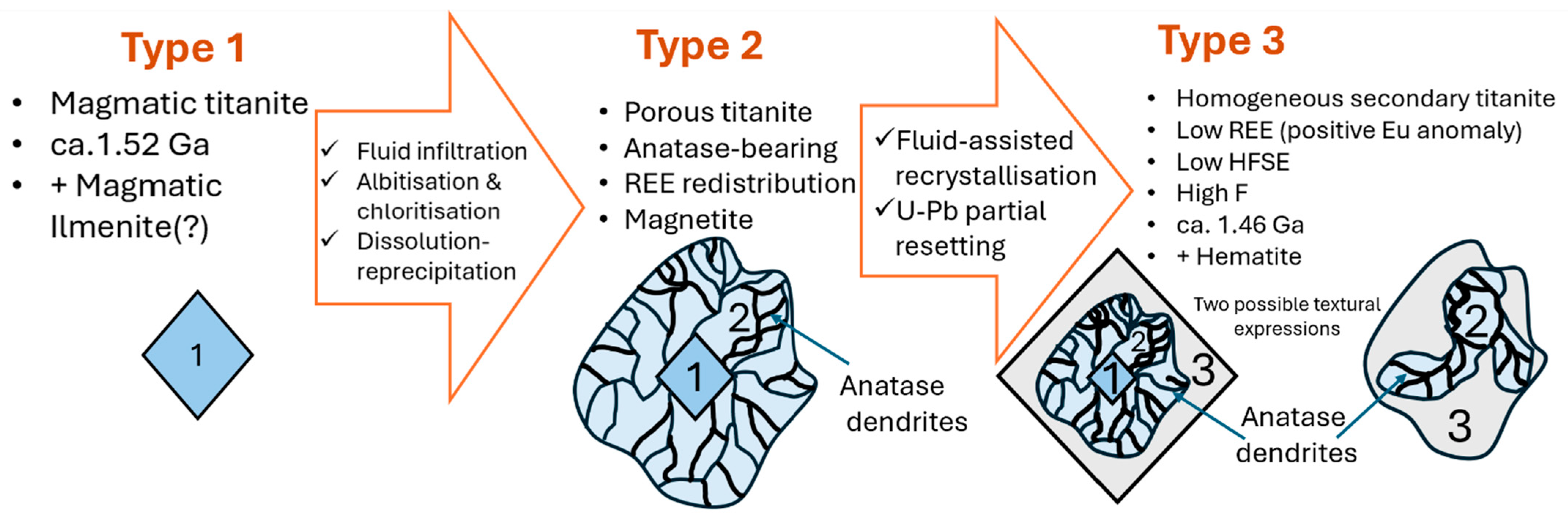
Three titanite types were identified, reflecting successive stages of evolution. Type 1 represents primary magmatic titanite with homogeneous, pore-free textures. Type 2 developed from type 1 during fluid-mediated alteration and is characterised by partial dissolution of type 1 and the development of porosity and irregular domains (type 2), evident in small-scale fluid heterogeneity [66]. Type 2 titanite was identified based on petrographic and geochemical characteristics; however, the available U-Pb dataset does not contain sufficient analyses to define a separate age population for this titanite type. Consequently, its age could not be independently constrained, although textural relationships suggest that it formed between the primary magmatic type 1 and the secondary hydrothermal type 3 titanite. The latter commonly occurs as secondary overgrowths formed during fluid-assisted recrystallisation. These features are interpreted to reflect localised element redistribution and isotopic resetting rather than simple annealing of the primary titanite. Partial dissolution of type 1 titanite (R2) during fluid-mediated alteration produced anatase (Ant) [17] and facilitated porosity development accompanied by anatase and carbonate filling of the pores [16]. The presence of micro-fractures facilitates the infiltration of hydrothermal fluids into the titanite structure [54]. Such textures are interpreted as products of interface-coupled dissolution–reprecipitation and are referred to here as type 2 titanite [16,17,67]. The strong chemical variability of type 2 titanite suggests that this alteration mechanism facilitated local mass transfer during hydrothermal alteration. The calculated coefficient (0.39) is significantly lower than the theoretical value of 1.0, indicating that Ti is partitioned between multiple secondary phases rather than being fully transformed to anatase. This discrepancy suggests that, although Ti is commonly considered immobile under hydrothermal conditions [68], it was redistributed among multiple secondary phases at the mineral scale. However, in the absence of a full whole-rock Ti mass balance model, significant Ti loss from the system cannot be quantitatively assessed.
A similar mechanism may explain the depletion of REE, Nb, Ta, and Zr in type 3 titanite relative to type 1 titanite. These patterns likely reflect fluid-assisted recrystallisation under changing hydrothermal conditions accompanied by local element redistribution. Although fluid-mediated leaching of incompatible elements may have contributed to the observed depletion patterns, the available data do not allow a clear distinction between open-system element removal and redistribution into associated secondary phases, such as carbonates or anatase-bearing assemblages. The occurrence of secondary REE-bearing phases within porous titanite domains suggests that at least part of the REE inventory released during titanite alteration was redistributed locally rather than completely removed from the system. The development of porous replacement textures may have facilitated short-range mass transfer and local precipitation of REE-bearing secondary assemblages during hydrothermal alteration.
However, the available data do not allow quantitative assessment of the relative proportions of REEs removed from titanite and REEs retained locally in secondary alteration assemblages.
The overall transformation can be expressed in a simplified mass balance form:
Ttn1 → 0.39 Ant + 0.48 Cal + Qz + Ti(Ilm)
where Ti(Ilm) denotes Ti incorporated into secondary Mn-bearing ilmenite [5]. These coefficients represent scaled phase proportions rather than strict thermodynamic stoichiometry and reflect the partitioning of Ti between multiple secondary sinks.
The formation of calcite associated with titanite breakdown suggests local redistribution of Ca released from the titanite lattice [8,9]. However, while Ca is sourced internally, the precipitation of calcite necessitates an external source of carbon (e.g., dissolved CO2 or HCO3), as titanite does not host carbon in its crystal structure [5,69]. Omitting the minor Ti (Ilm) sink for clarity produces the following reaction:
Ttn1 → Ant + Cal + Qz
This transformation serves as a clear indicator of interaction with CO2-bearing hydrothermal fluids, which facilitate the coupled dissolution–reprecipitation process [14,16]. The presence of secondary REE–fluorocarbonates is consistent with the involvement of CO2- and F-bearing fluids during the advanced stages of alteration [9,18,54]. Rare earth elements released during titanite breakdown are locally redistributed and may be incorporated into secondary Ca-REE-bearing phases, particularly in the presence of F-bearing fluids [9,14]):
Ca2+(aq) + REE3+(aq) + F(aq) → Ca-REE phase
Such behaviour is consistent with the known sensitivity of REE to fluid composition and the formation of secondary REE-bearing phases during hydrothermal alteration of accessory minerals [9,14,18].
The transformation from porous type 2 titanite to homogeneous type 3 titanite is interpreted to reflect fluid-assisted recrystallisation of an earlier alteration product formed through dissolution–reprecipitation and replacement processes [16]. This transformation is characterised by selective element mobility, with Ti being redistributed locally among secondary phases, whereas the observed mineral associations and reaction textures are consistent with relative Ti immobility at the rock scale. In contrast, other elements were redistributed between the mineral and fluid phases [16,68].
In simplified form, the reaction producing type 3 titanite from type 2 can be generalised as:
Ttn2 + Ca(aq) + Si(aq) + F(aq) → Ttn3 + Fe(aq) + Mn(aq) + Nb(aq) + Cr(aq) + V(aq) + REE(aq)
This relationship highlights the contrasting behaviour of major and trace elements during alteration. Titanium appears to have been mainly redistributed among Ti-bearing phases at the mineral scale, whereas trace elements such as REE, Nb, and transition metals were more readily transferred between titanite, secondary phases, and the fluid phase (R5). Such behaviour is consistent with previous studies demonstrating that dissolution–reprecipitation processes can lead to significant redistribution of trace elements, even when major structural components remain relatively immobile [8,16].
The released Mn is locally sequestered in Mn-bearing ilmenite, which forms in direct association with recrystallised titanite and Fe-Ti oxide assemblages [5]. This reaction can be expressed as:
Fe-Ti phase + Mn(aq) → Mn-bearing ilmenite
The spatial association between titanite, ilmenite, and Fe-Ti oxides defines a local sink-source system linking titanite breakdown, fluid-mediated transport, and secondary mineral formation. The presence of Mn-bearing ilmenite, therefore, provides independent mineralogical evidence for Mn mobility and supports the inferred redistribution of elements beyond titanite chemistry alone (R6).

5.3.2. Titanite Chemistry

REE patterns of type 1 titanite (Figure 7) are consistent with crystallisation from an oxidised magma before or concurrent with plagioclase fractionation [50]. In the Eu/Eu* vs. Ce/Ce* diagram (Figure 10c), type 1 titanite is characterised by low Eu/Eu* and positive Ce/Ce* values, supporting oxidised magmatic conditions and high fO2 during type 1 titanite crystallisation [70]. The magmatic origin of type 1 titanite is further supported by its low Nb/Ta, restricted Lu/Hf, and moderate Th/U ratios (Figure 10b), reflecting stable trace element partitioning under equilibrium conditions in a chemically homogeneous magmatic system [14]. Positive relationships in Ta-Nb and Hf-Zr diagrams and relatively constant Zr/Hf ratios (Figure 10a,e) with relatively high HFSE concentrations are consistent with high-temperature magmatic growth under near-equilibrium conditions [14].
The chemistry of type 3 titanite is consistent with formation under heterogeneous, fluid-influenced conditions, accompanied by fluctuating redox states. Their wide range of Eu/Eu* and Ce/Ce* values and the positive Eu anomalies in some crystals (Figure 10c) suggest locally reduced conditions and fluctuating redox during late-stage fluid influx [61,70]. Alternatively, the concurrent plagioclase alteration has liberated Eu2+ [14]. Strongly dispersed Nb/Ta and Lu/Hf ratios at systematically lower Th/U values (Figure 10a,b,d) for type 3 titanite show the influence of the hydrothermal fluid [66,71]. The subsolidus fluid interaction and variable element availability in the fluid–rock system during type 3 titanite formation are suggested by low HFSE abundance and decoupled Nb-Ta and Zr-Hf behaviour (Figure 10e; [72]). The latter is best explained by zircon dissolution–reprecipitation during type 3 titanite formation, as zircon represents the principal reservoir of Zr and Hf in granitoid systems and becomes increasingly soluble in F- and Cl-bearing fluids (Figure 10e; [16,66]).
The elevated F concentrations in type 3 titanite likely reflect recrystallisation under evolving hydrothermal conditions in the presence of F-bearing fluids. Fluorine may have preferentially partitioned into the secondary titanite generation during fluid-assisted alteration. However, the available data do not allow distinction between external F influx and local redistribution during recrystallisation.
Fluorine-bearing fluids may have enhanced titanite dissolution–reprecipitation by increasing the solubility and mobility of REE- and HFSE-bearing complexes during fluid–rock interaction. This process could have facilitated local redistribution of REEs from altered titanite domains into adjacent secondary alteration assemblages.
To sum up, titanite chemistry records a transition from stable magmatic crystallisation to fluid-controlled recrystallisation. Type 1 titanite preserves signatures of high-temperature growth under oxidised, chemically homogeneous conditions. This reflects stable magmatic crystallisation typical of anorogenic granites [29] and is manifested in consistent trace element ratios and well-defined REE systematics. In contrast, type 3 titanite records subsolidus fluid–rock interaction under heterogeneous conditions, characterised by variable redox states, depletion in HFSEs, and decoupling of trace element pairs, such as Nb-Ta and Zr-Hf. These features suggest that late-stage hydrothermal fluids not only modified titanite composition but also controlled element redistribution within the granitoid system, including mobilisation of REEs and interaction with accessory phases, such as zircon.
Comparison of the three titanite types reveals a systematic geochemical evolution from the compositionally homogeneous type 1 through the highly variable type 2 to the chemically more uniform type 3 titanite. Type 2 titanite exhibits the widest range of REE, Nb, Ta, Zr, and F contents, consistent with heterogeneous fluid–rock interaction and incomplete chemical re-equilibration during alteration. In contrast, type 3 titanite is characterised by depletion of incompatible elements and elevated F contents, suggesting more extensive chemical re-equilibration under hydrothermal conditions.

5.4. Titanite Age

The integration of U-Pb titanite ages into the framework of the zircon (1505 ± 11 Ma, [20]) and Re-Os molybdenite (1486 ± 5 Ma, [27]). Geochronology defines a coherent temporal framework for the evolution of the Kabeliai granitoids. Type 1 titanite yields consistent U-Pb ages in the range of 1508–1527 Ma (Figure 8 and Figure 9) across multiple samples. In sample M7E, concordant, PbC-corrected analyses define a Concordia age of 1519 ± 5 Ma (MSWD = 6.3; 2σ; Figure 8c), whereas samples M7B and M7D yield lower intercept ages of 1508 ± 19 Ma (n = 30, MSWD = 0.91; 2σ) and 1527 ± 9 Ma (MSWD = 0.54; 2σ), respectively (Figure 9b,e). These ages are interpreted to record primary magmatic crystallisation or very early post-magmatic equilibration under near closed-system conditions. These ages represent separate pulses of granitic magma emplacement within the upper crust. The previously published zircon U-Pb ages [20] constrain one of the granitoid crystallisation stages.
Type 2 titanite does not form a separate group on the age diagrams (Figure 8 and Figure 9) because it is transitional between titanite types 1 and 3. An alternative explanation is that sample M7E type 1 titanite is partially reset during its transition to titanite type 2 (Figure 5a,b) because of a subsequent pulse of granitic magma emplacement, fluid–rock interaction associated with the crystallising granitic melt, and reheating. This is consistent with the petrological patterns described earlier. Petrographic and geochemical evidence suggests that its development was initiated during the late-magmatic to earliest post-magmatic stages and records the onset of dissolution–reprecipitation processes [16]. This stage likely represents the transition from equilibrium magmatic crystallisation to fluid-mediated alteration. The hydrothermal type 3 titanite is interpreted to reflect an average age of ca. 1460 Ma (1454 ± 14, n = 40, MSWD = 0.48; 2σ to 1475 ± 23 Ma, n = 37, MSWD = 0.63; 2σ), which partially overlaps with the molybdenite age of 1486 ± 5 Ma [27].
The youngest titanite population identified in sample M7E, with characteristics ascribed to type 3 titanite, yields an age of 1401 ± 41 Ma (MSWD = 0.65; 2σ; Figure 8d). This age is significantly younger than the main hydrothermal stage and is interpreted to reflect a later lead loss event. Titanite is known to undergo isotopic resetting at relatively moderate temperatures, particularly in fluid-rich environments [7,73]. The presence of several points from sample M7D showing similarly young trends (Figure 9d) supports the interpretation of a younger disturbance.
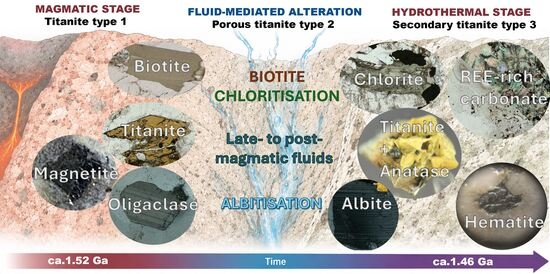
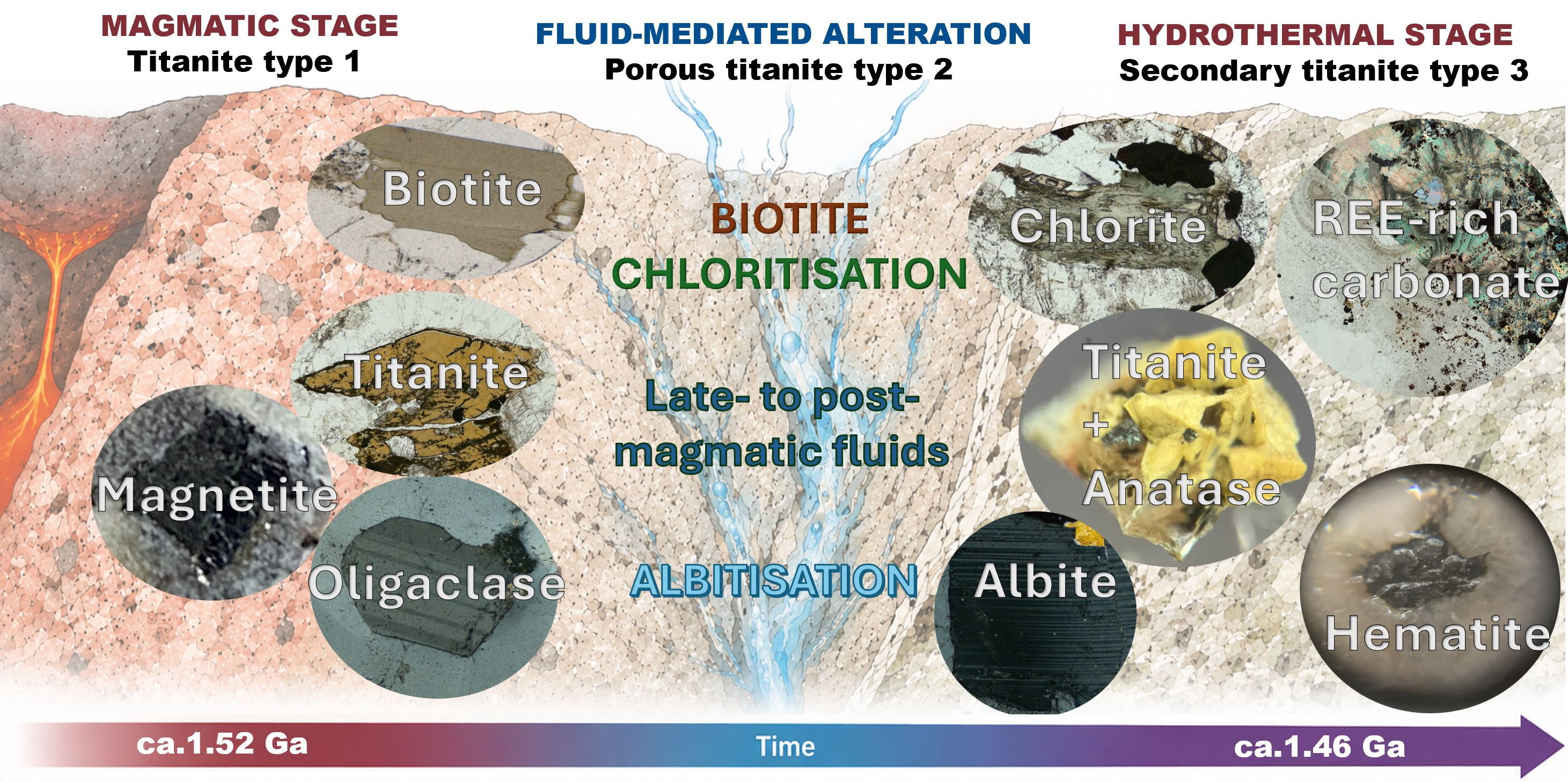
Together, these data define a revised multi-stage evolutionary model summarised in Figure 11.

5.5. Regional Implications

The age and evolution of the studied M–7 granitoids may provide constraints on the broader Marcinkonys granitoid massif (more than 20 km in diameter, Figure 1c). However, extrapolation beyond the studied borehole should be treated cautiously. The massif contains similar varieties of granitoids and their alteration products. Zircon U-Pb dating yields an age of ca. 1.51 Ga for the alkali feldspar granites of M4 [20] as well as a ca. 1.50 Ga age for a similar granite from the M1 drill core (unpublished data). The petrographic observations indicate that the rocks and titanite underwent coupled dissolution–reprecipitation processes at decreasing temperature associated with a transition from magmatic to hydrothermal conditions. Relatively high temperatures recorded by much younger type 3 titanite, its relation to larger-scale sodic and potassic alterations, and similarity to the ca. 1.48 Ga molybdenite mineralisation [27] may be consistent with the development of a long-lived, high-temperature hydrothermal system during this period.
There are some leucogranite and alkali feldspar granite veins cross-cutting the skarns and ores of the Varena Iron Ore deposit (Figure 1c) at 1.49–1.52 Ga [74]. Similarly aged reworking of the Varėna ores has also been reported [33,75]. These data may indicate that Kabeliai-type magmatic–hydrothermal processes extended farther north. Comparable ca. 1.50 Ga monazite ages in gedrite–cordierite schists may suggest that similar Mesoproterozoic reworking also affected rocks farther west. While the initial ore-forming processes and mineral reactions in the Varėna skarns are dated at ca. 1.71 Ga [30], younger monazite rim formation at ca. 1.54 Ga [75] may record later fluid-assisted modification rather than a single regionally synchronous hydrothermal event.
The Kabeliai granitoids formed in oxidised and fluid-rich environments, linking them to other Mesoproterozoic AMCG complexes, such as the Mazury Complex in NE Poland (e.g., [13,76]), during the breakup of the Columbia supercontinent. The 1.50–1.45 Ga period is marked by a voluminous granitic magma emplacement in the upper crust throughout the region. The heat and fluid flux associated with granitoid crystallisation may have contributed to fluid circulation across parts of the craton. In the studied samples, such fluid activity may have promoted titanite alteration and the formation of secondary titanite, whereas similar Mesoproterozoic fluid-related processes have been proposed for Cl remobilisation from scapolite further north [33].
The younger titanite age population, particularly the age of 1401 ± 41 Ma (MSWD = 0.65; 2σ) obtained from M7E, is treated cautiously because it may be affected by partial Pb loss and local isotopic heterogeneity. Nevertheless, the younger age estimates from M7B and M7D are consistent with late Mesoproterozoic hydrothermal reworking and may be temporally associated with regional shearing, cooling, and molybdenite mineralisation. Therefore, the 1401 ± 41 Ma age is not used here as a firm regional event age but rather as evidence for disturbance of the titanite U-Pb system during later fluid-assisted modification.
These ages overlap, within uncertainty, with regional shearing and cooling events dated at 1427 ± 10 [77] and 1452 ± 4 Ma ([78]). Granitoid magmatism of ca. 1.45 Ga [79,80] is prominent in western Lithuania.
Although the titanite age populations obtained are consistent with the observed petrographic relationships and regional geological evolution, several methodological factors inherent to LA-ICP-MS titanite geochronology should be considered when interpreting the ages.
The simultaneous acquisition of trace element and U-Pb data collected in Dublin resulted in only a minor reduction in age precision while providing geochemical constraints on the titanite alteration system. Nevertheless, potential matrix-related effects should be considered when interpreting the ages obtained. The titanite generations identified in this study display compositional differences that may potentially influence ablation behaviour relative to the reference materials. In addition, natural titanite grains analysed in polished thin sections may ablate differently from the large gem-quality titanite crystals commonly used as standards. Although such effects are difficult to quantify, they may contribute to minor age offsets and should be considered when evaluating the obtained U-Pb ages.

6. Conclusions

  • Hydrothermal alteration was controlled by coupled albitisation and chloritisation, accompanied by redistribution of Ca, Si, and REE. Titanium was redistributed locally among anatase, secondary titanite, and Mn-bearing ilmenite, whereas the observed mineral associations and reaction textures are consistent with relative Ti immobility at the rock scale.
  • Titanite records a three-stage evolution involving magmatic crystallisation (type 1; ca. 1520 Ma), transitional alteration (type 2), and later hydrothermal modification of type 3 titanite, associated with younger U-Pb ages of ca. 1.46 Ga that may partly reflect isotopic resetting.
  • Coupled dissolution–reprecipitation mechanisms and interphase interaction facilitate the efficient removal of radiogenic lead and trace elements from magmatic titanite, resulting in U-Pb ages that record episodes of hydrothermal recrystallisation and fluid-assisted modification rather than simple thermal cooling through a closure temperature.
  • Rare earth elements released during the hydrothermal breakdown of magmatic titanite in the Kabeliai granitoids are locally redistributed, either being incorporated into secondary REE-bearing carbonates or remaining as a depleted signature in recrystallised type 3 titanite domains.
  • In the studied part of the Marcinkonys massif, titanite serves as a sensitive petrogenetic indicator that links the 1.53–1.50 Ga magmatic emplacement under oxidised conditions with a subsequent 1.47–1.45 Ga titanite ages, which may reflect hydrothermal modification of the titanite U-Pb system and may be temporally associated with regional molybdenum mineralisation.

Supplementary Materials

The following supporting information can be downloaded at: https://www.mdpi.com/article/10.3390/min16060634/s1. Table S1: LA-ICP-MS U–Pb titanite data for sample M7E (Lund University). Table S2: LA-ICP-MS U–Pb titanite data for samples M7B and M7D (Trinity College Dublin). Table S3: Trace element compositions of titanite from samples M7B and M7D (LA-ICP-MS, Trinity College Dublin).

Author Contributions

Conceptualisation, G.S. and O.D.; data curation, all authors; formal analysis, all authors; methodology, all authors; funding acquisition, O.D., D.C., and G.S.; investigation, all authors; visualisation, O.D. and L.S.; writing—original draft preparation, all authors; writing—review and editing, all authors. All authors have read and agreed to the published version of the manuscript.

Funding

This research was supported by the Nature Research Centre doctoral study funds. The Nikon Eclipse LV100N POL polarising microscope with epi-illumination used to investigate mineral textures, microstructures, and alteration patterns at the Nature Research Centre (Lithuania) was purchased within the PALEO project funded by the Research Council of Lithuania (LMTLT), agreement No. P-MIP-23-129. Whole-rock chemical analyses were also funded by the Research Council of Lithuania (LMTLT) under the same agreement (No. P-MIP-23-129). D.C. acknowledges support from Research Ireland through research grant 13/RC/2092_P2 (iCRAG Research Centre).

Data Availability Statement

The data presented in this study are available in the Supplementary Materials (Tables S1 and S2). Additional data are available from the corresponding author upon reasonable request.

Acknowledgments

The authors acknowledge the Department of Geology at Trinity College Dublin for extensive analytical support and access to LA-ICP-MS facilities, including U-Pb dating and trace element analyses. We also acknowledge Lund University for access to LA-ICP-MS facilities for U-Pb dating. We are grateful to Beata Marciniak-Maliszewska, Petras Jokubauskas, Bogusław Bagiński, and the staff of the Laboratory of Electron Microscopy, Microanalysis and X-Ray Diffraction at the Faculty of Geology, University of Warsaw, for their valuable technical assistance and support during the EPMA analyses. As well, we acknowledge Anna Cichon-Pupienis (State Scientific Research Institute Nature Research Centre, Laboratory of Bedrock Geology, Vilnius, Lithuania) for providing access to the optical microscope.

Conflicts of Interest

The authors declare no conflicts of interest.

Abbreviations

The following abbreviations are used in this manuscript:
REEsRare Earth Elements
LREEsLight Rare Earth Elements
HREEsHeavy Rare Earth Elements
HFSEs High Field Strength Elements
LILEsLarge Ion Lithophile Elements
EPMAElectron Probe Microanalysis
SEMScanning Electron Microscopy
EDSEnergy-Dispersive Spectroscopy
BSEBack-Scattered Electron
PPLPlane-Polarised Light
RLReflected Light
LA-ICP-MSLaser Ablation Inductively Coupled Plasma Mass Spectrometry
MSWDsMean Square of Weighted Deviates
A/CNK Alumina Saturation Index
MALI Modified Alkali–Lime Index
FMQ Fayalite–Magnetite–Quartz buffer
apfuAtoms per Formula Unit
b.d.l.Below Detection Limit
AbAlbite
AnAnorthite component in plagioclase
AntAnatase
Bt Biotite
Cal Calcite
ChlChlorite
IlmIlmenite
OlgOligoclase
QzQuartz
Thr Thorite
TtnTitanite

References

  1. Whalen, J.B.; Currie, K.L.; Chappell, B.W. A-Type Granites: Geochemical Characteristics and Petrogenesis. Contrib. Mineral. Petrol. 1987, 95, 407–419. [Google Scholar] [CrossRef]
  2. Bea, F. Residence of REE, Y, Th and U in Granites and Crustal Protoliths: Implications for the Chemistry of Crustal Melts. J. Petrol. 1996, 37, 521–552. [Google Scholar] [CrossRef]
  3. Wones, D.R. Significance of the Assemblage Titanite + Magnetite + Quartz in Granitic Rocks. Am. Mineral. 1989, 74, 744–749. [Google Scholar]
  4. Frost, B.R.; Chamberlain, K.R.; Schumacher, J.C. Sphene (Titanite): Phase Relations and Role as a Geochronometer. Chem. Geol. 2000, 172, 131–148. [Google Scholar] [CrossRef]
  5. Broska, I.; Harlov, D.; Tropper, P.; Siman, P. Formation of Magmatic Titanite and Titanite–Ilmenite Phase Relations during Granite Alteration in the Tribeč Mountains, Western Carpathians, Slovakia. Lithos 2007, 95, 58–71. [Google Scholar] [CrossRef]
  6. Scott, D.J.; St-Onge, M.R. Constraints on Pb Closure Temperature in Titanite Based on Rocks from the Ungava Orogen, Canada: Implications for U-Pb Geochronology and PTt Path Determinations. Geology 1995, 23, 1123–1126. [Google Scholar] [CrossRef]
  7. Cherniak, D.J. Lead Diffusion in Titanite and Preliminary Results on the Effects of Radiation Damage on Pb Transport. Chem. Geol. 1993, 110, 177–194. [Google Scholar] [CrossRef]
  8. Morad, S.; El Ghali, M.; Caja, M.; Al Ramadan, K.; Mansurbeg, H. Hydrothermal Alteration of Magmatic Titanite: Evidence from Proterozoic Granites of Southeastern Sweden. Can. Mineral. 2009, 47, 801–811. [Google Scholar] [CrossRef]
  9. Pan, Y.; Fleet, M.E.; Macrae, N.D. Late Alteration in Titanite (CaTiSiO5): Redistribution and Remobilization of Rare Earth Elements and Implications for Geochronology. Geochim. Cosmochim. Acta 1993, 57, 355–367. [Google Scholar] [CrossRef]
  10. Tiepolo, M.; Oberti, R.; Vannucci, R. Trace-Element Incorporation in Titanite. Chem. Geol. 2002, 191, 105–119. [Google Scholar] [CrossRef]
  11. Piccoli, P.; Candela, P.; Rivers, M. Interpreting Magmatic Processes from Accessory Phases: Titanite—A Small-Scale Recorder of Large-Scale Processes. Earth Environ. Sci. Trans. R. Soc. Edinb. 2000, 91, 257–267. [Google Scholar]
  12. Xirouchakis, D.; Lindsley, D.H. Equilibria among Titanite-Bearing Assemblages. Am. Mineral. 1998, 83, 712–725. [Google Scholar] [CrossRef]
  13. Harlov, D.; Tropper, P.; Seifert, W.; Nijland, T.; Förster, H. Formation of Al Rich Titanite (CaTiSiO4O–CaAlSiO4OH) Reaction Rims on Ilmenite in Metamorphic Rocks as a Function of fH2O and fO2. Lithos 2006, 88, 72–84. [Google Scholar] [CrossRef]
  14. Kontonikas Charos, A.; Ehrig, K.; Cook, N.; Ciobanu, C. Crystal Chemistry of Titanite from the Roxby Downs Granite, South Australia: Insights into Petrogenesis, Subsolidus Evolution and Hydrothermal Alteration. Contrib. Mineral. Petrol. 2019, 174, 59. [Google Scholar] [CrossRef]
  15. Enami, M.; Suzuki, K.; Liou, J.G.; Bird, D.K. Al–Fe3+ and F–OH Substitutions in Titanite and Constraints on Their P–T Dependence. Eur. J. Mineral. 1993, 5, 219–231. [Google Scholar] [CrossRef]
  16. Putnis, A. Mineral Replacement Reactions. Rev. Mineral. Geochem. 2009, 70, 87–124. [Google Scholar] [CrossRef]
  17. Vance, E.; Doern, D. The Properties of Anatase Pseudomorphs after Titanite. Can. Mineral. 1989, 27, 495–498. [Google Scholar]
  18. Gmochowska, W.; Harlov, D.; Słaby, E.; Jokubauskas, P.; Sláma, J.; Łącki, M. Experimental Metasomatic Alteration of Titanite in a Series of Metamorphic Fluids at 700 °C and 200 MPa. Mineral. Petrol. 2024, 118, 321–344. [Google Scholar] [CrossRef]
  19. Slaby, E.; Anczkiewicz, R.; Gros, K.; Simon, K.; Kozub Budzyn, G. High Temperature Fluids in Granites during the Neoarchaean–Palaeoproterozoic Transition. Lithos 2021, 386, 106039. [Google Scholar] [CrossRef]
  20. Sundblad, K.J.; Mansfeld, J.; Motuza, G.; Ahl, M.; Claesson, S. Geology, Geochemistry and Age of a Cu–Mo Bearing Granite at Kabeliai, southern Lithuania. Mineral. Petrol. 1994, 50, 43–57. [Google Scholar] [CrossRef]
  21. Wiszniewska, J.; Krzeminska, E. Advances in Geochronology in the Suwałki Anorthosite Massif. Precambrian Res. 2021, 361, 106265. [Google Scholar] [CrossRef]
  22. Baltulytė, A. Microstructural Analysis of Granites and Their Alterations in Kabeliai Granites: Implications from Mineral Chemical Composition. Master’s Thesis, Vilnius University, Vilnius, Lithuania, 2025. [Google Scholar]
  23. Skridlaite, G.; Motuza, G. Precambrian Domains in Lithuania: Evidence of Terrane Tectonics. Tectonophysics 2001, 339, 113–133. [Google Scholar] [CrossRef]
  24. Bogdanova, S.; Gorbatschev, R.; Skridlaite, G.; Soesoo, A.; Taran, L.; Kurlovich, D. Trans-Baltic Palaeoproterozoic Correlations towards the Reconstruction of Supercontinent Columbia/Nuna. Precambrian Res. 2015, 259, 5–33. [Google Scholar] [CrossRef]
  25. Skridlaite, G.; Siliauskas, L.; Whitehouse, M.J.; Johansson, A.; Rimsa, A. On the Origin and Evolution of the 1.86–1.76 Ga Mid Baltic Belt in the Western East European Craton. Precambrian Res. 2021, 367, 106403. [Google Scholar] [CrossRef]
  26. Marfin, S.; Miksys, R.B.; Motuza, G.; Skripkina, T. The Structure of the Marcinkonys Granitic Massif and Properties of Rocks. Geologija 1982, 3, 3–16. (In Russian) [Google Scholar]
  27. Stein, H.; Sundblad, K.; Markey, R.J.; Morgan, E.R.; Motuza, G. Re–Os Ages for Archean Molybdenite and Pyrite and Proterozoic Molybdenite. Miner. Depos. 1998, 33, 329–345. [Google Scholar] [CrossRef]
  28. Demina, O.; Skridlaite, G.; Siliauskas, L.; Lacki, M.; Marciniak Maliszewska, B.; Baginski, B. Post Magmatic Alteration in the Kabeliai Granite, Lithuania: Evidence from Petrography, Mineral Chemistry, and Accessory Minerals. Baltica 2025, 38, 143–159. [Google Scholar] [CrossRef]
  29. Frost, C.D.; Frost, B.R. On Ferroan (A-Type) Granitoids: Their Compositional Variability and Modes of Origin. J. Petrol. 2011, 52, 39–53. [Google Scholar] [CrossRef]
  30. Skridlaite, G.; Siliauskas, L.; Söderlund, U.; Næraa, T. Iron Rich Ca–Mg Skarns from the SW East European Craton (Lithuania): Microstructural Study and Age Constraints. Lithos 2024, 482, 107736. [Google Scholar] [CrossRef]
  31. Walters, J.B. MinPlot: A Mineral Formula Recalculation and Plotting Program. Mineralogia 2022, 53, 51–66. [Google Scholar] [CrossRef]
  32. Janoušek, V.; Farrow, C.M.; Erban, V. Interpretation of Whole Rock Geochemical Data in Igneous Geochemistry: Introducing Geochemical Data Toolkit (GCDkit). J. Petrol. 2006, 47, 1255–1259. [Google Scholar] [CrossRef]
  33. Siliauskas, L.; Gumsley, A.; Skridlaite, G.; Whitehouse, M.J.; Næraa, T.; Ene, V.-V.; Birmanaitė, U. Ca. 1.89 Ga Orthogneisses Underlying the Varena Iron Ore Deposit in SE Lithuania, East European Craton–Implications for Fluid Evolution and Cl Remobilization. Precambrian Res. 2026, 439, 108093. [Google Scholar] [CrossRef]
  34. Spandler, C.; Hammerli, J.; Sha, P.; Hilbert-Wolf, H.; Hu, Y. MKED1: A New Titanite Standard for in Situ Analysis of Sm–Nd Isotopes and U–Pb Geochronology. Chem. Geol. 2016, 425, 110–126. [Google Scholar] [CrossRef]
  35. Spencer, K.J.; Hacker, B.R.; Kylander-Clark, A.R.C.; Andersen, T.B. Campaign-Style Titanite U–Pb Dating by Laser Ablation ICP. Chem. Geol. 2013, 341, 84–101. [Google Scholar] [CrossRef]
  36. Heaman, L.M. The Application of U–Pb Geochronology to Mafic, Ultramafic and Alkaline Rocks: An Evaluation of Three Mineral Standards. Chem. Geol. 2009, 261, 43–53. [Google Scholar] [CrossRef]
  37. Paton, C.; Woodhead, J.; Hellstrom, J.; Hergt, J.; Greig, A.; Maas, R. Improved Laser Ablation U–Pb Zircon Geochronology through Robust down Hole Fractionation Correction. Geochem. Geophys. Geosyst. 2010, 11. [Google Scholar] [CrossRef]
  38. Paton, C.; Hellstrom, J.; Paul, B.; Woodhead, J.; Hergt, J. Iolite: Freeware for the Visualisation and Processing of Mass Spectrometric Data. J. Anal. At. Spectrom. 2011, 26, 2508–2518. [Google Scholar] [CrossRef]
  39. Petrus, J.A.; Kamber, B.S. VizualAge: A Novel Approach to Laser Ablation ICP-MS U-Pb Geochronology Data Reduction. Geostand. Geoanalytical Res. 2012, 36, 247–270. [Google Scholar] [CrossRef]
  40. Stacey, J.S.; Kramers, J.D. Approximation of Terrestrial Lead Isotope Evolution by a Two-Stage Model. Earth Planet. Sci. Lett. 1975, 26, 207–221. [Google Scholar] [CrossRef]
  41. Vermeesch, P. IsoplotR: A Free and Open Toolbox for Geochronology. Geosci. Front. 2018, 9, 1479–1493. [Google Scholar] [CrossRef]
  42. Chew, D.M.; Petrus, J.A.; Kamber, B.S. U–Pb LA–ICPMS Dating Using Accessory Mineral Standards with Variable Common Pb. Chem. Geol. 2014, 363, 185–199. [Google Scholar] [CrossRef]
  43. Williams, I.S. U-Th-Pb Geochronology by Ion Microprobe. In Applications of Microanalytical Techniques to Understanding Mineralizing Processes; Society of Economic Geologists: Littleton, CO, USA, 1997; pp. 1–35. ISBN 978-1-887483-51-3. [Google Scholar]
  44. Kennedy, A.K.; Kamo, S.L.; Nasdala, L.; Timms, N.E. Grenville Skarn Titanite: Potential Reference Material for SIMS U–Th–Pb Analysis. Can. Mineral. 2010, 48, 1423–1443. [Google Scholar] [CrossRef]
  45. Streckeisen, A. Classification and Nomenclature of Plutonic Rocks. Geol. Rundsch. 1974, 63, 773–786. [Google Scholar] [CrossRef]
  46. Frost, B.R.; Barnes, C.G.; Collins, W.J.; Arculus, R.J.; Ellis, D.J.; Frost, C.D. A Geochemical Classification for Granitic Rocks. J. Petrol. 2001, 42, 2033–2048. [Google Scholar] [CrossRef]
  47. Peccerillo, A.; Taylor, S.R. Geochemistry of Eocene Calc-Alkaline Volcanic Rocks from the Kastamonu Area, Northern Turkey. Contrib. Mineral. Petrol. 1976, 58, 63–81. [Google Scholar] [CrossRef]
  48. McDonough, W.F.; Sun, S.S. The Composition of the Earth. Chem. Geol. 1995, 120, 223–253. [Google Scholar] [CrossRef]
  49. Sun, S.S.; McDonough, W.F. Chemical and Isotopic Systematics of Oceanic Basalts. Geol. Soc. Spec. Publ. 1989, 42, 313–345. [Google Scholar] [CrossRef]
  50. Drake, M.J.; Weill, D.F. Partition of Sr, Ba, Ca, Y, Eu2+, Eu3+ and Other REE between Plagioclase Feldspar and Magmatic Liquid: An Experimental Study. Geochim. Cosmochim. Acta 1975, 39, 689–712. [Google Scholar] [CrossRef]
  51. Rudnick, R.; Gao, S. 3.01–The Composition of the Continental Crust. In Treatise On Geochemistry; Volume 3: The Crust; Elsevier Ltd.: Amsterdam, The Netherlands, 2003; pp. 1–65. [Google Scholar]
  52. Whitney, D.L.; Evans, B.W. Abbreviations for Names of Rock-Forming Minerals. Am. Mineral. 2010, 95, 185–187. [Google Scholar] [CrossRef]
  53. Oberti, R.; Smith, D.C.; Rossi, G.; Caucia, F. The Crystal-Chemistry of High-Aluminium Titanites. Eur. J. Mineral. 1981, 3, 777–792. [Google Scholar] [CrossRef]
  54. Gmochowska, W.; Wirth, R.; Słaby, E.; Anczkiewicz, R.; Krzątała, A.; Roddatis, V.; Sláma, J.; Kozub Budzyń, G.; Bhattacharya, S.; Schreiber, A. Hydrothermal Alteration of Accessory Minerals (Allanite and Titanite) in the Late Archean Closepet Granitoid (Dharwar Craton, India): A TEM Study. Geochemistry 2024, 84, 126130. [Google Scholar] [CrossRef]
  55. Skridlaite, G.; Wiszniewska, J.; Duchesne, J.C. Ferro-Potassic A-Type Granites and Related Rocks in NE Poland and S Lithuania. Precambrian Res. 2003, 124, 305–326. [Google Scholar] [CrossRef]
  56. Wiszniewska, J.; Claesson, S.; Stein, H.; Van den Auwera, J.; Duchesne, J.C. The North-Eastern Polish Anorthosite Massifs: Petrological and Isotopic Evidence. Terra Nova 2002, 14, 451–460. [Google Scholar] [CrossRef]
  57. David, K.; Schiano, P.; Allègre, C.J. Assessment of the Zr/Hf Fractionation in Oceanic Basalts and Continental Materials during Petrogenetic Processes. Earth Planet. Sci. Lett. 2000, 178, 285–301. [Google Scholar] [CrossRef]
  58. Schnetzler, C.; Philpotts, J.A. Partition Coefficients of Rare-Earth Elements between Igneous Matrix Material and Rock-Forming Mineral Phenocrysts—II. Geochim. Cosmochim. Acta 1970, 34, 331–340. [Google Scholar] [CrossRef]
  59. Sverjensky, D.A. Europium Redox Equilibria in Aqueous Solution. Earth Planet. Sci. Lett. 1984, 67, 70–78. [Google Scholar] [CrossRef]
  60. Bau, M. Rare Earth Element Mobility during Hydrothermal and Metamorphic Fluid Rock Interaction and the Significance of the Oxidation State of Europium. Chem. Geol. 1991, 93, 219–230. [Google Scholar] [CrossRef]
  61. Yousefi, F.; Lentz, D.R.; McFarlane, C.R.M.; Walker, J.A.; Thorne, K.G. Titanite Geochemistry of Devonian Oxidized I-Type Granodiorites in New Brunswick, Canada: Implications for Exploration for Porphyry Cu-Mo-Au Deposits in the Northern Appalachians. Lithos 2026, 528–529, 108464. [Google Scholar] [CrossRef]
  62. Hayden, L.A.; Watson, E.B.; Wark, D.A. A Thermobarometer for Sphene (Titanite). Contrib. Mineral. Petrol. 2008, 155, 529–540. [Google Scholar] [CrossRef]
  63. Erdmann, S.; Wang, R.; Huang, F.; Scaillet, B.; Zhao, K.; Liu, H.; Chen, Y.; Faure, M. Titanite: A Potential Solidus Barometer for Granitic Magma Systems. Comptes Rendus Geosci. 2019, 351, 551–561. [Google Scholar] [CrossRef]
  64. Gresens, R.L. Composition–Volume Relationships of Metasomatism. Chem. Geol. 1967, 2, 47–65. [Google Scholar] [CrossRef]
  65. MacLean, W.H.; Barrett, T.J. Lithogeochemical Techniques Using Immobile Elements. J. Geochem. Explor. 1993, 48, 109–133. [Google Scholar] [CrossRef]
  66. Lucassen, F.; Franz, G.; Dulski, P.; Romer, R.L.; Rhede, D. Element and Sr Isotope Signatures of Titanite as Indicator of Variable Fluid Composition in Hydrated Eclogite. Lithos 2011, 121, 12–24. [Google Scholar] [CrossRef]
  67. Putnis, A. Mineral Replacement Reactions: From Macroscopic Observations to Microscopic Mechanisms. Mineral. Mag. 2002, 66, 689–708. [Google Scholar] [CrossRef]
  68. Van Baalen, M.R. Titanium Mobility in Metamorphic Systems: A Review. Chem. Geol. 1993, 110, 233–249. [Google Scholar] [CrossRef]
  69. Deer, W.A.; Howie, R.A.; Zussman, J. Rock Forming Minerals. Volume 1: Orthosilicates; Longman: London, UK, 1982. [Google Scholar]
  70. Storey, C.; Smith, M.; Jeffries, T. In Situ LA ICP MS U–Pb Dating of Metavolcanics of Norrbotten, Sweden. Chem. Geol. 2007, 240, 163–181. [Google Scholar] [CrossRef]
  71. Hu, H.; Li, J.W.; McFarlane, C.R.M. Hydrothermal Titanite from the Chengchao Iron Skarn Deposit: Temporal Constraints on Iron Mineralization, and Its Potential as a Reference Material for Titanite U–Pb Dating. Mineral. Petrol. 2017, 111, 593–608. [Google Scholar] [CrossRef]
  72. Lucassen, F.; Dulski, P.; Abart, R.; Franz, G.; Rhede, D.; Romer, R.L. Redistribution of HFSE Elements during Rutile Replacement by Titanite. Contrib. Mineral. Petrol. 2010, 160, 279–295. [Google Scholar] [CrossRef]
  73. Holder, R.M.; Hacker, B.R. Fluid Driven Resetting of Titanite Following Ultrahigh Temperature Metamorphism in Southern Madagascar. Chem. Geol. 2019, 504, 38–52. [Google Scholar] [CrossRef]
  74. Skridlaite, G.; Siliauskas, L.; Whitehouse, M.; Dunkley, D.J. Radiation Damaged Zircon and Its Dating: A Case Study of ca. 1.50 Ga Granitoid Veins Crosscutting Skarns. In Proceedings of the Goldschmidt Conference, Lyon, France, 9–14 July 2023. [Google Scholar]
  75. Skridlaite, G.; Šiliauskas, L.; Prušinskienė, S.; Bagiński, B. Petrography and Mineral Chemistry of the Varena Iron Ore Deposit, Southeastern Lithuania. Baltica 2019, 32, 107–126. [Google Scholar] [CrossRef]
  76. Duchesne, J.C.; Martin, H.; Baginski, B.; Wiszniewska, J.; Van den Auwera, J. The Origin of Ferroan-Potassic A-Type Granitoids: The Case of the Hornblende–Biotite Granite Suite of the Mesoproterozoic Mazury Complex, Northeastern Poland. Can. Mineral. 2010, 48, 947–968. [Google Scholar] [CrossRef]
  77. Skridlaite, G.; Bogdanova, S.; Page, L. Mesoproterozoic Events in Eastern and Central Lithuania as Recorded by 40Ar/39Ar Ages. Baltica 2006, 19, 91–98. [Google Scholar]
  78. Bogdanova, S.V.; Page, L.M.; Skridlaite, G.; Taran, L.N. Proterozoic Tectonothermal History in the Western Part of the East European Craton: 40Ar/39Ar Geochronological Constraints. Tectonophysics 2001, 339, 39–66. [Google Scholar] [CrossRef]
  79. Motuza, G.; Čečys, A.; Kotov, A.B.; Salnikova, E.B. The Žemaičių Naumiestis Granitoids: New Evidence for Mesoproterozoic Magmatism in Western Lithuania. GFF 2006, 128, 243–254. [Google Scholar] [CrossRef]
  80. Skridlaite, G.; Whitehouse, M.; Rimša, A. Evidence for a Pulse of 1.45 Ga Anorthosite-Mangerite-Charnockite-Granite Plutonism in Lithuania. Terra Nova 2007, 19, 294–301. [Google Scholar] [CrossRef]
Figure 3. Whole-rock geochemical characteristics of the studied samples. Here and throughout the paper, all geochemical diagrams were produced using GCDkit software [32]. (a) QAPF diagram—Si oversaturated [45]; (b) SiO2-K2O diagram [47]; (c) chondrite-normalised REE patterns [48]; (d) primitive mantle-normalised multi-element patterns [49].
Minerals 16 00634 g003
Figure 4. PPL images of euhedral to subhedral titanite crystals from sample M7E (a). Aggregates from samples M7L (b), M7B (c), and M7O (d). Aggregates show mosaic textures and preserve rhombic to wedge shapes (dashed lines).
Minerals 16 00634 g004
Figure 5. BSE images of representative M-–7 titanite crystals from samples: (a,b) M7E, (c) M7L, (d) M7B, (e) M7O, and (f) M7D. Type 1: magmatic cores (ac,f). Type 2: altered, porous titanite commonly associated with anatase, Ca + REE phases (ae), and type 3 (ad,f): secondary overgrowths depleted in incompatible elements. Mineral abbreviations used in figures and tables follow the recommendations of Whitney and Evans [52].
Minerals 16 00634 g005aMinerals 16 00634 g005b
Figure 6. Type 3 titanite. (a) BSE image of sample M7B type 3 titanite forming a narrow domain along the contact between iron oxide and surrounding quartz and plagioclase. (b) Reflected light image (RL; magnification ×10) sample M7E. Type 3 titanite forms a rim around an iron oxide crystal in contact with plagioclase (Olg-Ab). (c) Plane-polarised light (PPL; magnification ×10) image of sample M7B showing type 3 titanite rims developed along the contact of iron oxide crystals with adjacent biotite and albitised plagioclase.
Minerals 16 00634 g006
Figure 7. Trace element characteristics of the studied titanites. Chondrite-normalised REE patterns [48] showing coherent, LREE-enriched patterns with a negative Eu anomaly in type 1 titanite, and more variable, lower-abundance patterns in type 3 titanite.
Minerals 16 00634 g007
Figure 8. Tera–Wasserburg Concordia diagrams for the selected titanite crystals from sample M7E. (a) Uncorrected and (b) 204Pb-based common lead corrected data display older (A) and younger (B) groups of titanite ages. (c) Concordant analyses from group A yielded a Concordia age of 1519 ± 5 Ma (MSWD = 6.3; 2σ). (d) Group B analyses yielded a Concordia age of 1375 ± 10 Ma and a preferred 207Pb/206Pb age of 1401 ± 41 Ma (MSWD = 0.65; 2σ).
Minerals 16 00634 g008aMinerals 16 00634 g008b
Figure 9. TW Concordia diagrams for titanite crystals from samples M7B (ac) and M7D (df). (a) Results of the sample M7B. Discordia age calculations for titanite types 1 (a) and 3 (b). (d) Results of the sample M7D. The grey ellipses are unused analyses (see text). Sample M7D discordia age calculations of the titanite type 1 (e) and type 3 (f). The orange curve represents the TW Concordia, whereas the grey shaded bands indicate the confidence envelopes of the discordia regression lines used for lower-intercept age calculations.
Minerals 16 00634 g009aMinerals 16 00634 g009b
Figure 10. Selected trace element variation diagrams for the studied titanites: (a) Nb/Ta vs. Th/U; (b) Lu/Hf vs. Th/U; (c) Eu/Eu* vs. Ce/Ce*; (d) Ta vs. Nb; (e) Hf vs. Zr. Type 1 titanite forms consistent trends, whereas type 3 titanite shows increased scatter and partial decoupling of element pairs.
Minerals 16 00634 g010aMinerals 16 00634 g010b
Figure 11. Schematic model of the titanite evolution in the Kabeliai granitoids. (The question mark (?) indicates that the presence of a primary magmatic ilmenite precursor is inferred rather than directly observed.)
Minerals 16 00634 g011
Disclaimer/Publisher’s Note: The statements, opinions and data contained in all publications are solely those of the individual author(s) and contributor(s) and not of MDPI and/or the editor(s). MDPI and/or the editor(s) disclaim responsibility for any injury to people or property resulting from any ideas, methods, instructions or products referred to in the content.