Titanite U-Pb Ages and Multi-Staged Alteration Processes in Mesoproterozoic Granitoids from Southern Lithuania


Abstract
1. Introduction
2. Geological Setting and Sample Location


3. Analytical Methods
3.1. Optical Microscopy
3.2. Scanning Electron Microscopy (SEM) and Electron Probe Microanalysis (EPMA)
3.3. Whole-Rock Geochemistry
3.4. LA-ICP-MS U-Pb Dating
3.4.1. LA-ICP-MS U-Pb Dating (Lund University)
3.4.2. LA-ICP-MS U-Pb Dating and Trace Element Analysis (Trinity College, Dublin)
4. Results
4.1. Sample Petrography
4.2. Whole-Rock Geochemistry

| wt.%/Sample | M7C Pegmatitic Granite | M7E Leucocratic Plagiogranite | M7B Biotite Granite | M7D Biotite Plagiogranite |
|---|---|---|---|---|
| SiO2 | 77.46 | 78.86 | 62.18 | 62.53 |
| Al2O3 | 13.89 | 15.51 | 19.88 | 17.26 |
| Fe2O3 | 1.08 | 1.26 | 4.74 | 9.61 |
| MgO | 0.34 | 0.18 | 2.17 | 1.55 |
| CaO | 2.5 | 3.38 | 3.95 | 3.54 |
| Na2O | 4.1 | 5.3 | 6.21 | 5.33 |
| K2O | 2.26 | 0.79 | 1.99 | 1.64 |
| TiO2 | 0.31 | 0.15 | 0.71 | 0.65 |
| P2O5 | 0.02 | <0.01 | 0.03 | 0.01 |
| MnO | 0.02 | 0.02 | 0.06 | 0.07 |
| Cr2O3 | <0.002 | <0.002 | 0.004 | 0.005 |
| LOI | −2.2 | <−5.1 | −2.2 | −2.4 |
| Sum | 99.87 | 99.92 | 99.76 | 99.82 |
| ppm | ||||
| Ba | 369 | 102 | 152 | 123 |
| Ni | <20 | <20 | <20 | <20 |
| Sc | <1 | <1 | 4 | 3 |
| Be | 3 | 4 | 4 | 7 |
| Co | 1.1 | 0.5 | 10.3 | 9.6 |
| Cs | 0.3 | <0.1 | 1.4 | 1.2 |
| Ga | 16.7 | 18.1 | 27.7 | 26.8 |
| Hf | 4.3 | 5.7 | 12 | 11.2 |
| Nb | 32.2 | 11.1 | 38.4 | 22.6 |
| Rb | 66.5 | 23.6 | 155.6 | 121.2 |
| Sn | <1 | <1 | 2 | 1 |
| Sr | 217.1 | 188.1 | 267.8 | 191.2 |
| Ta | 2.8 | 0.9 | 2.7 | 1.6 |
| Th | 171.4 | 43.3 | 5.9 | 5.9 |
| U | 40.6 | 6.4 | 3.7 | 2.8 |
| V | 10 | 17 | 47 | 127 |
| W | <0.5 | 0.8 | 0.7 | <0.5 |
| Zr | 134.1 | 211 | 428.9 | 462.4 |
| Y | 45.5 | 19.2 | 38.8 | 28 |
| La | 26.6 | 9.2 | 11.8 | 10.6 |
| Ce | 54.6 | 22.3 | 38.7 | 30.5 |
| Pr | 8.57 | 3.37 | 6.81 | 5.24 |
| Nd | 36.4 | 14.4 | 27.6 | 21.8 |
| Sm | 7.85 | 3.19 | 6.28 | 5.34 |
| Eu | 1.03 | 0.62 | 0.98 | 0.94 |
| Gd | 7.29 | 3.02 | 5.93 | 4.65 |
| Tb | 1.14 | 0.46 | 1.01 | 0.74 |
| Dy | 7.18 | 2.94 | 6.43 | 4.8 |
| Ho | 1.55 | 0.61 | 1.31 | 0.97 |
| Er | 4.67 | 1.78 | 4.23 | 3.04 |
| Tm | 0.7 | 0.27 | 0.65 | 0.44 |
| Yb | 4.42 | 1.7 | 4.18 | 2.86 |
| Lu | 0.65 | 0.26 | 0.63 | 0.44 |
| F | 282 | 189 | 2245 | 1621 |
| A/NK | 1.51 | 1.62 | 1.61 | 1.64 |
| A/CNK | 1.01 | 0.99 | 1.02 | 1.02 |
| MALI [46] | 3.86 | 2.71 | 4.25 | 3.43 |
| Sum REE | 162.65 | 64.12 | 116.54 | 92.36 |
| (La/Yb)n | 4.14 | 3.72 | 1.94 | 2.55 |
| Eu/Eu* | 0.42 | 0.61 | 0.49 | 0.58 |
| Zr/Hf | 31.19 | 37.02 | 35.74 | 41.29 |
| Nb/Ta | 11.50 | 12.33 | 14.22 | 14.13 |
| Y/Ho | 29.35 | 31.48 | 29.62 | 28.87 |
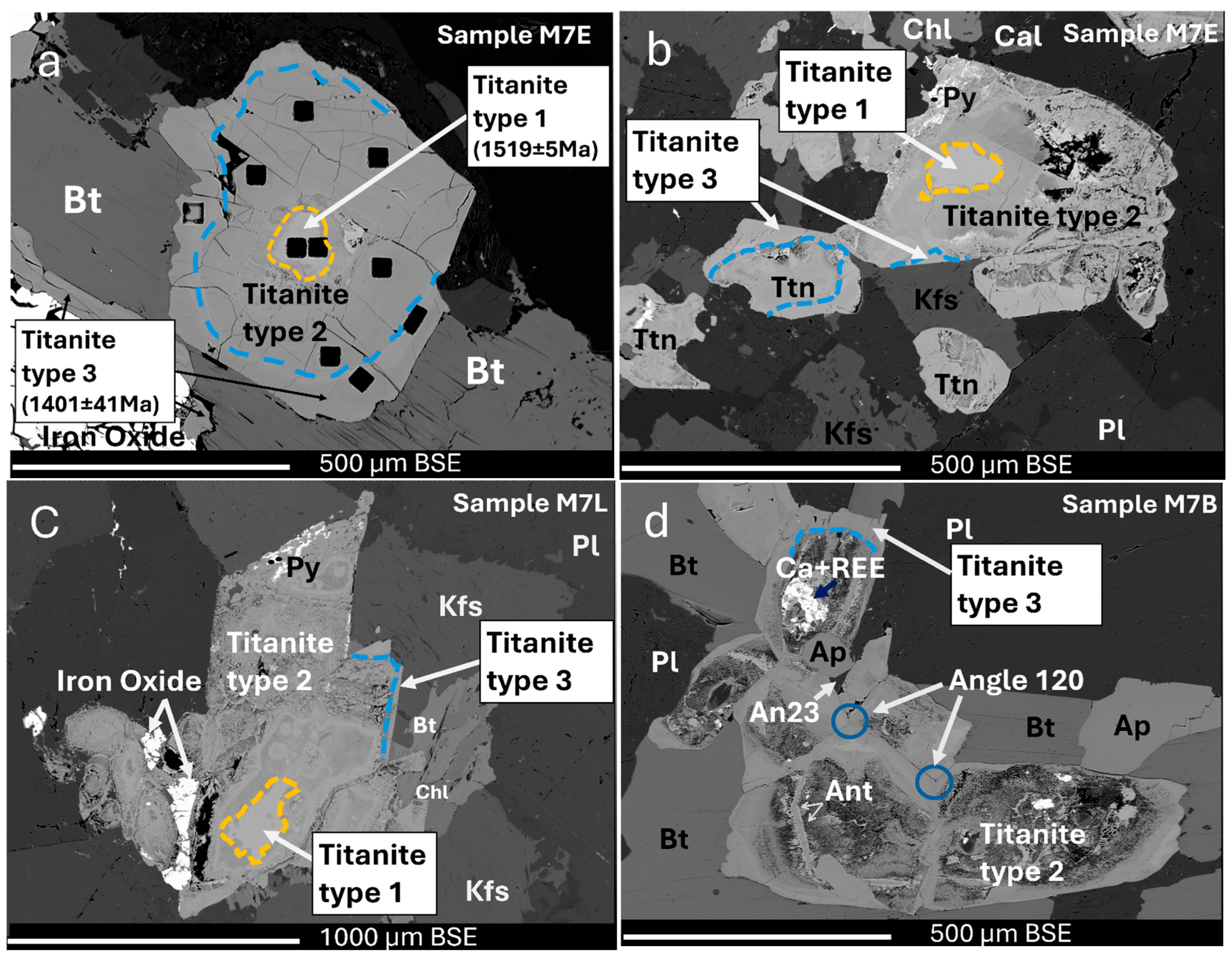
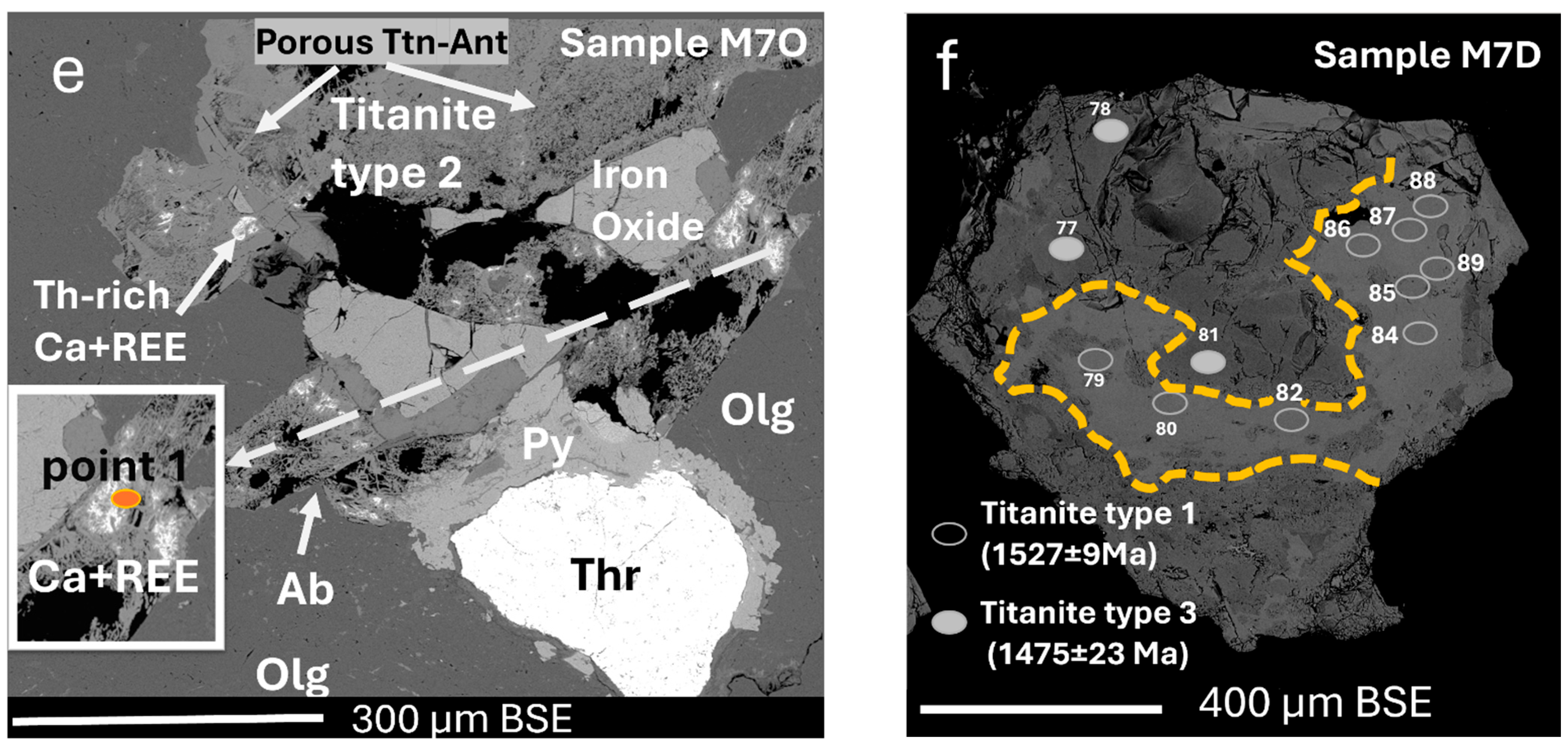
4.3. Titanite Description
4.3.1. Type 1 Titanite: Primary Magmatic (Least Altered)
4.3.2. Type 2 Titanite: Porous (“Sponge-like”) Titanite
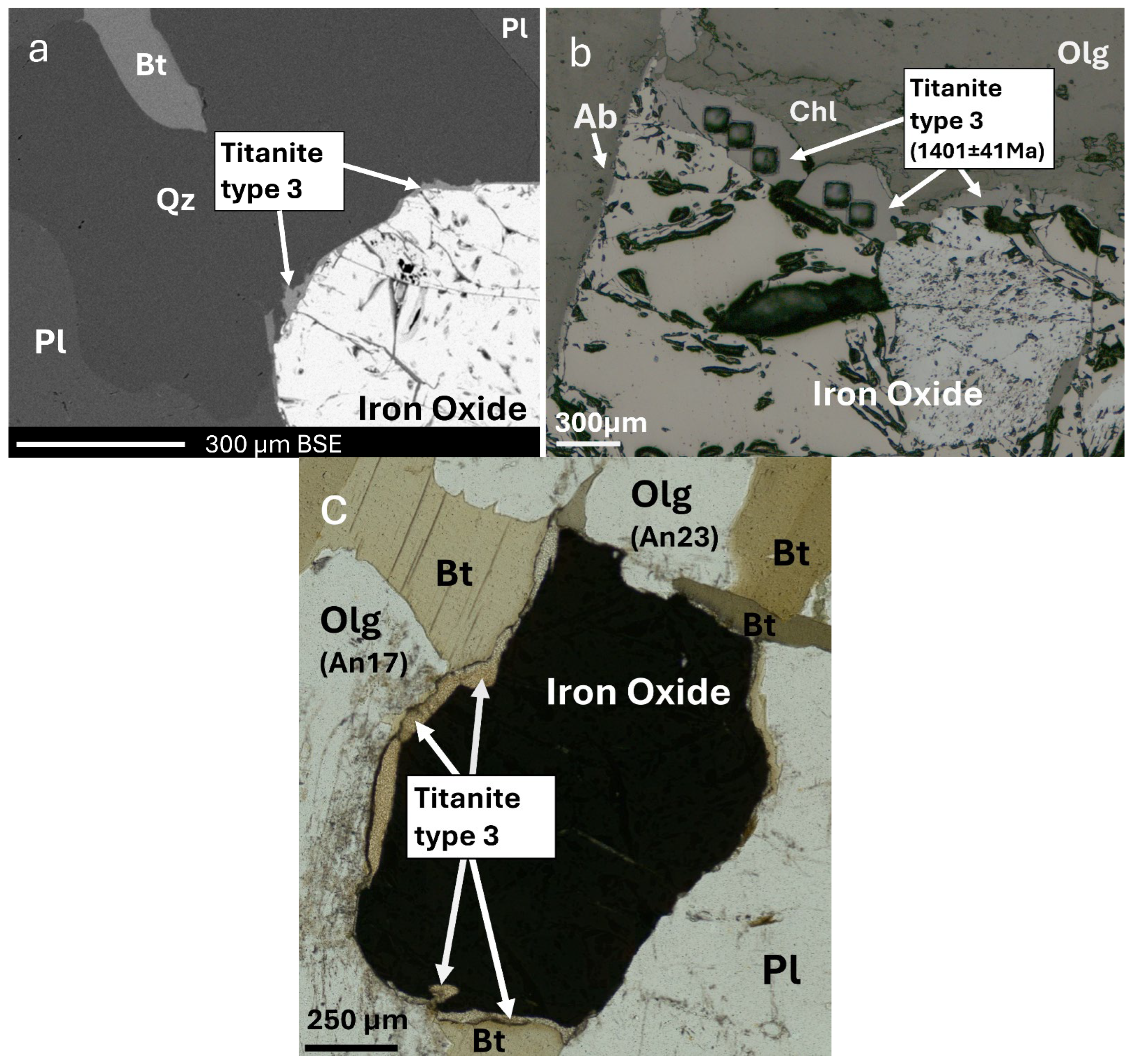
4.3.3. Type 3: Recrystallised Secondary Titanite
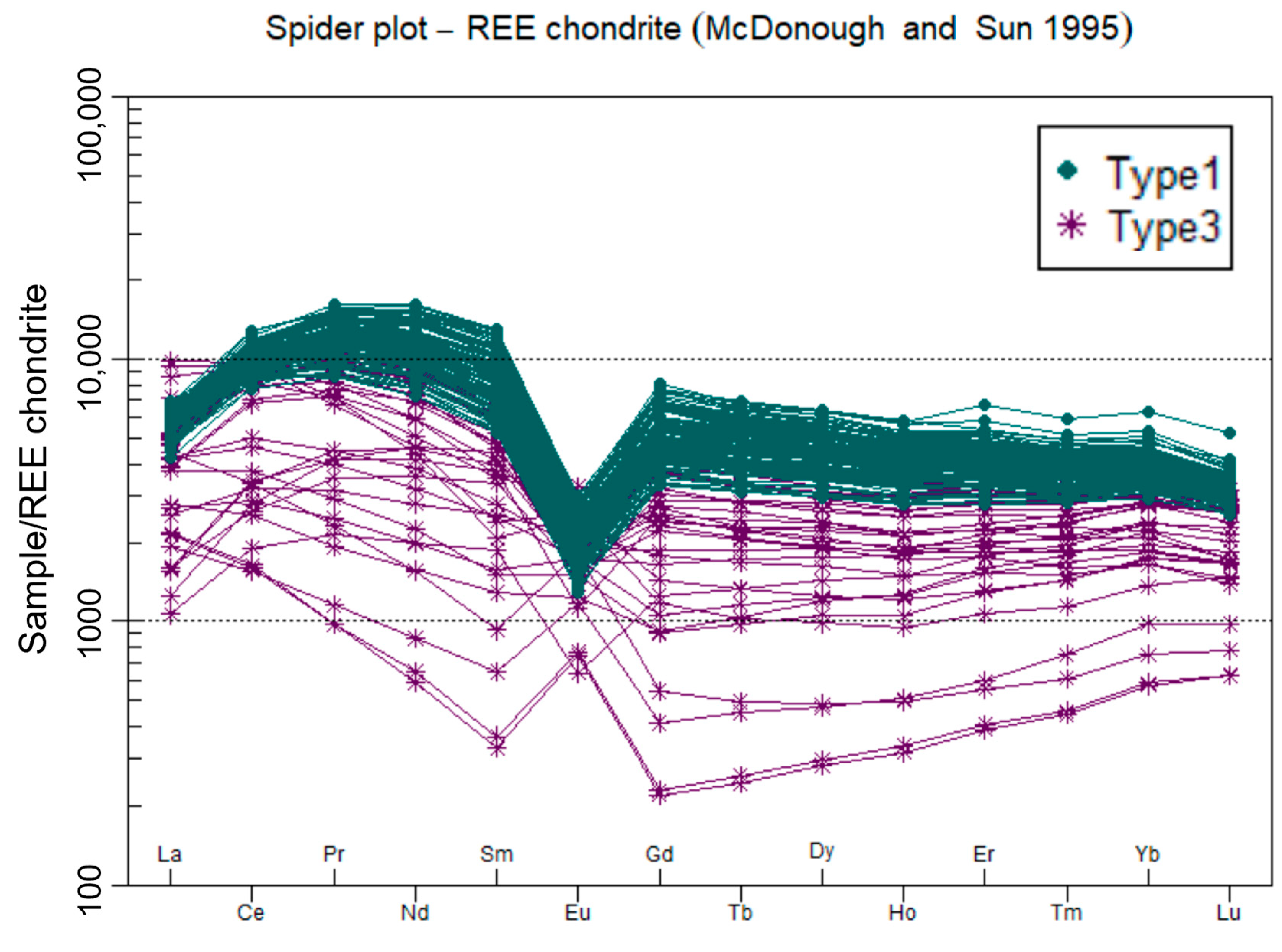
4.4. Titanite Chemistry: EPMA and LA-ICP-MS Data
| wt.% | Type 1 | Type 2 | Type 3 |
|---|---|---|---|
| SiO2 | 29.60–30.14 | 24.54–31.52 | 30.06–30.73 |
| TiO2 | 31.45–33.65 | 29.41–41.97 | 31.69–34.56 |
| Al2O3 | 2.13–2.37 | 1.66–2.52 | 2.26–3.00 |
| FeO Total | 1.97–2.42 | 1.69–3.52 | 1.30–2.63 |
| MgO | up to 0.06 | up to 0.16 | up to 0.02 |
| MnO | 0.11–0.20 | 0.10–0.21 | 0.04–0.15 |
| V2O3 | 0.05–0.13 | up to 0.14 | 0.07–0.16 |
| Cr2O3 | up to 0.03 | up to 0.09 | up to 0.05 |
| CaO | 26.35–27.06 | 19.88–28.21 | 27.23–29.04 |
| Na2O | up to 0.06 | 0.03–0.64 | 0.01–0.05 |
| SrO | b.d.l. | up to 0.13 | b.d.l. |
| Y2O3 | 0.50–0.87 | up to 0.97 | b.d.l.–0.17 |
| La2O3 | 0.05–0.15 | up to 0.33 | b.d.l.–0.07 |
| Ce2O3 | 0.56–0.69 | up to 1.30 | 0.08–0.29 |
| Pr2O3 | 0.09–0.15 | up to 0.21 | b.d.l.–0.03 |
| Nd2O3 | 0.40–0.57 | up to 0.79 | b.d.l.–0.09 |
| ZrO2 | up to 0.08 | up to 0.49 (one 1.13) | b.d.l. |
| Nb2O5 | 0.42–0.75 | up to 0.67 | b.d.l.–0.30 |
| F | 0.81–1.01 | 0.57–0.93 | 1.01–1.21 |
| Cl | b.d.l. | up to 0.05 | b.d.l.–0.08 |
| Total | 96.01–98.25 | 91.16–95.51 | 96.69–99.32 |
| O = F, Cl | 0.34–0.43 | 0.28–0.41 | 0.43–0.59 |
| Total | 95.67–97.82 | 90.88–98.12 | 96.10–99.32 |
| Titanite (based on 18 O) | Type 1 | Type 2 | Type 3 |
| Si | 3.70–3.74 | 3.16–4.08 | 3.69–3.80 |
| Ti | 2.98–3.13 | 2.87–4.00 | 2.98–3.16 |
| Al | 0.31–0.35 | 0.25–0.38 | 0.33–0.44 |
| Fe2+ all ferrous | 0.18–0.23 | 0.16–0.34 | 0.12–0.25 |
| Mn | 0.01–0.02 | 0.01–0.02 | b.d.l.–0.02 |
| Mg | b.d.l.–0.01 | b.d.l.-0.03 | b.d.l. |
| Ca | 3.54–3.59 | 2.58–3.69 | 3.65–3.79 |
| Na | b.d.l.–0.02 | 0.01–0.16 | 0.01–0.04 |
| Sr | b.d.l. | b.d.l. | b.d.l. |
| Y | 0.03–0.06 | b.d.l.–0.07 | b.d.l.–0.01 |
| Cr | b.d.l. | b.d.l.–0.01 | b.d.l.–0.01 |
| V | 0.01 | b.d.l.–0.01 | 0.01–0.02 |
| La | b.d.l.–0.01 | b.d.l.–0.02 | b.d.l. |
| Ce | 0.03 | 0.01–0.06 | b.d.l.–0.01 |
| Pr | b.d.l.–0.01 | b.d.l.–0.01 | b.d.l. |
| Nd | 0.02–0.03 | b.d.l.–0.04 | b.d.l. |
| Zr | b.d.l.–0.01 | b.d.l.–0.07 | b.d.l. |
| Nb | 0.02–0.04 | 0.01–0.04 | b.d.l.–0.02 |
| F | 0.32–0.40 | 0.23–0.38 | 0.40–0.56 |
| Cl | b.d.l. | b.d.l.–0.01 | b.d.l.–0.02 |
| Total | 11.40–11.37 | 10.92–11.31 | 11.67–11.70 |
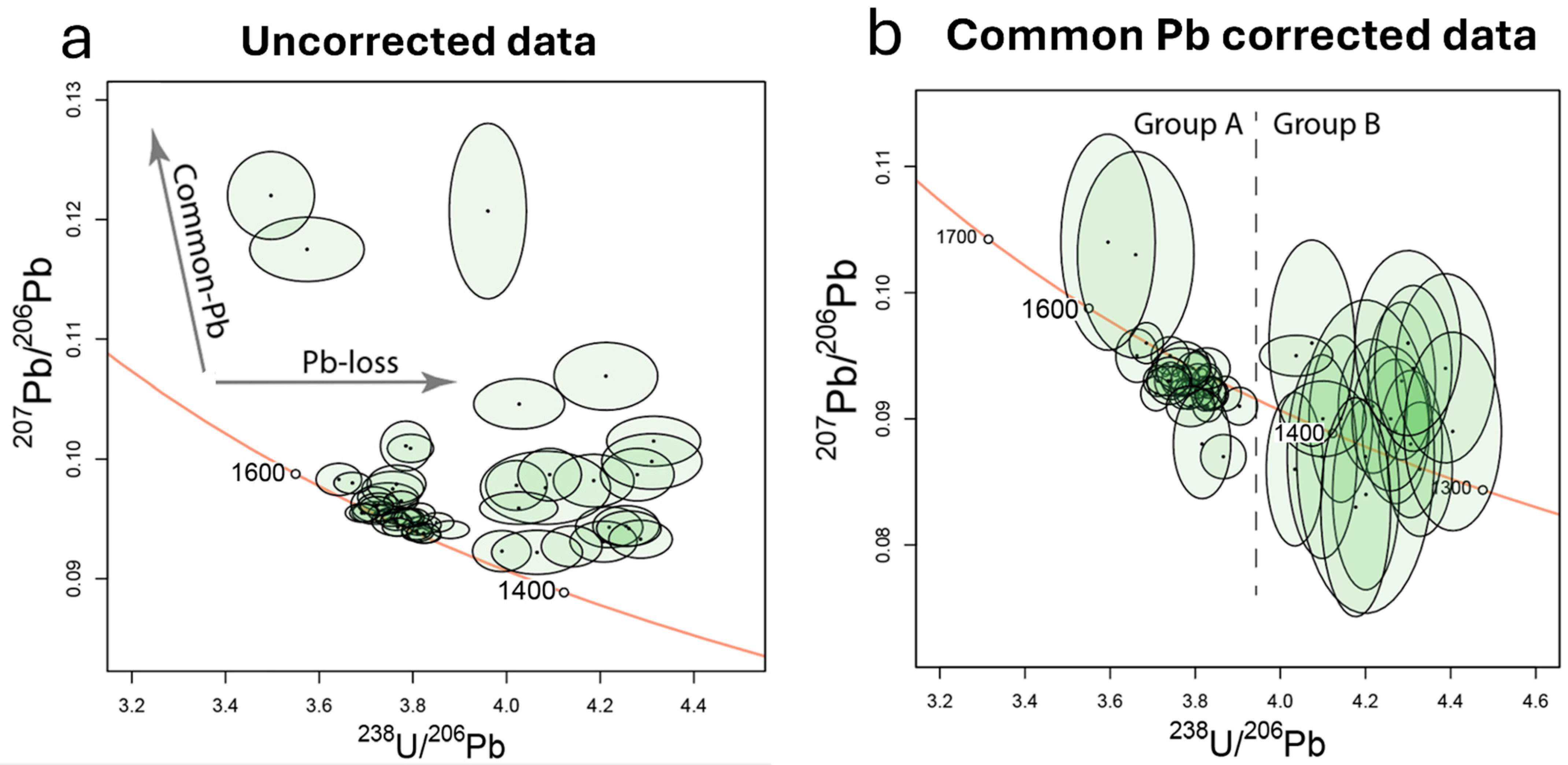
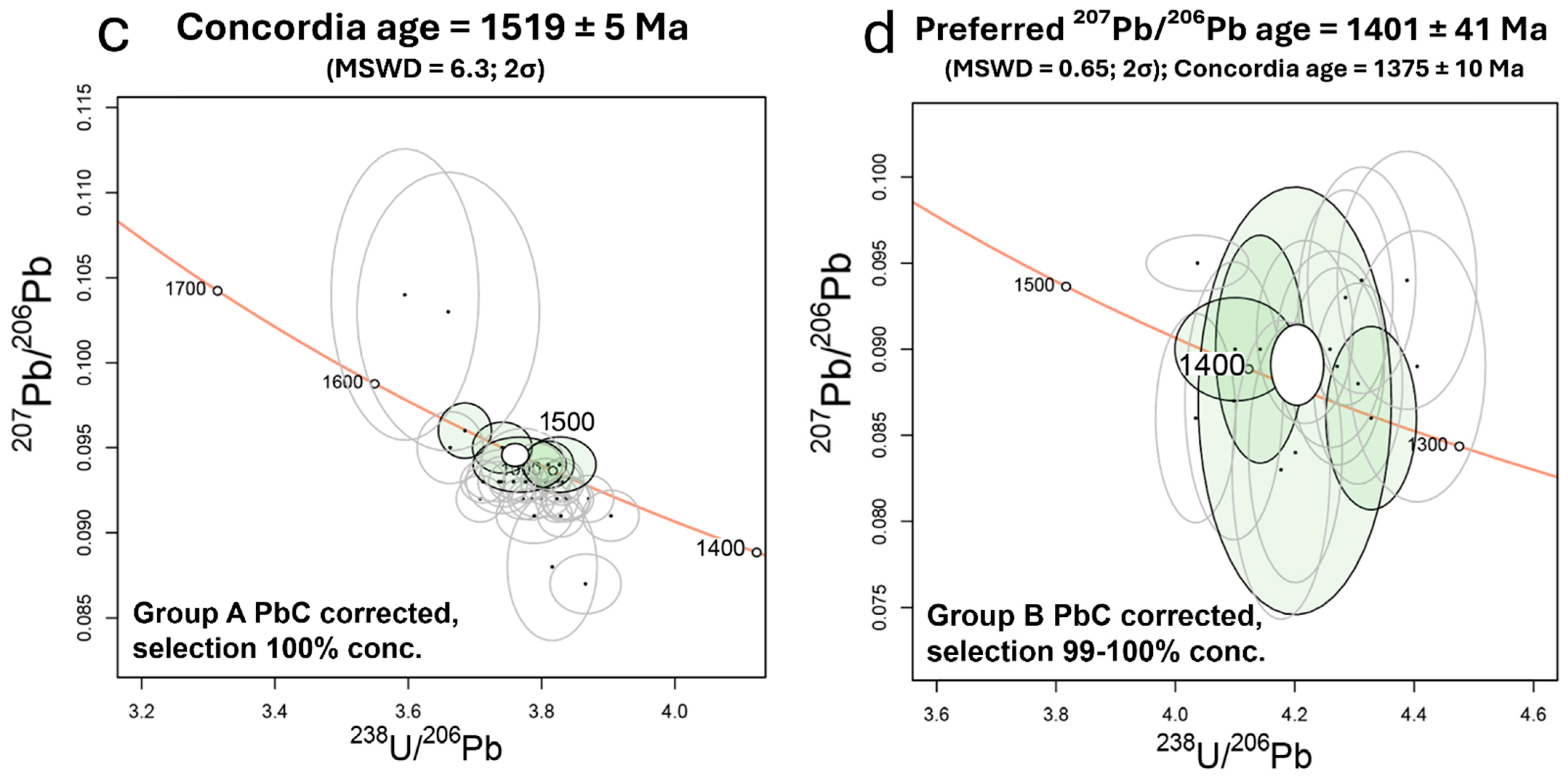
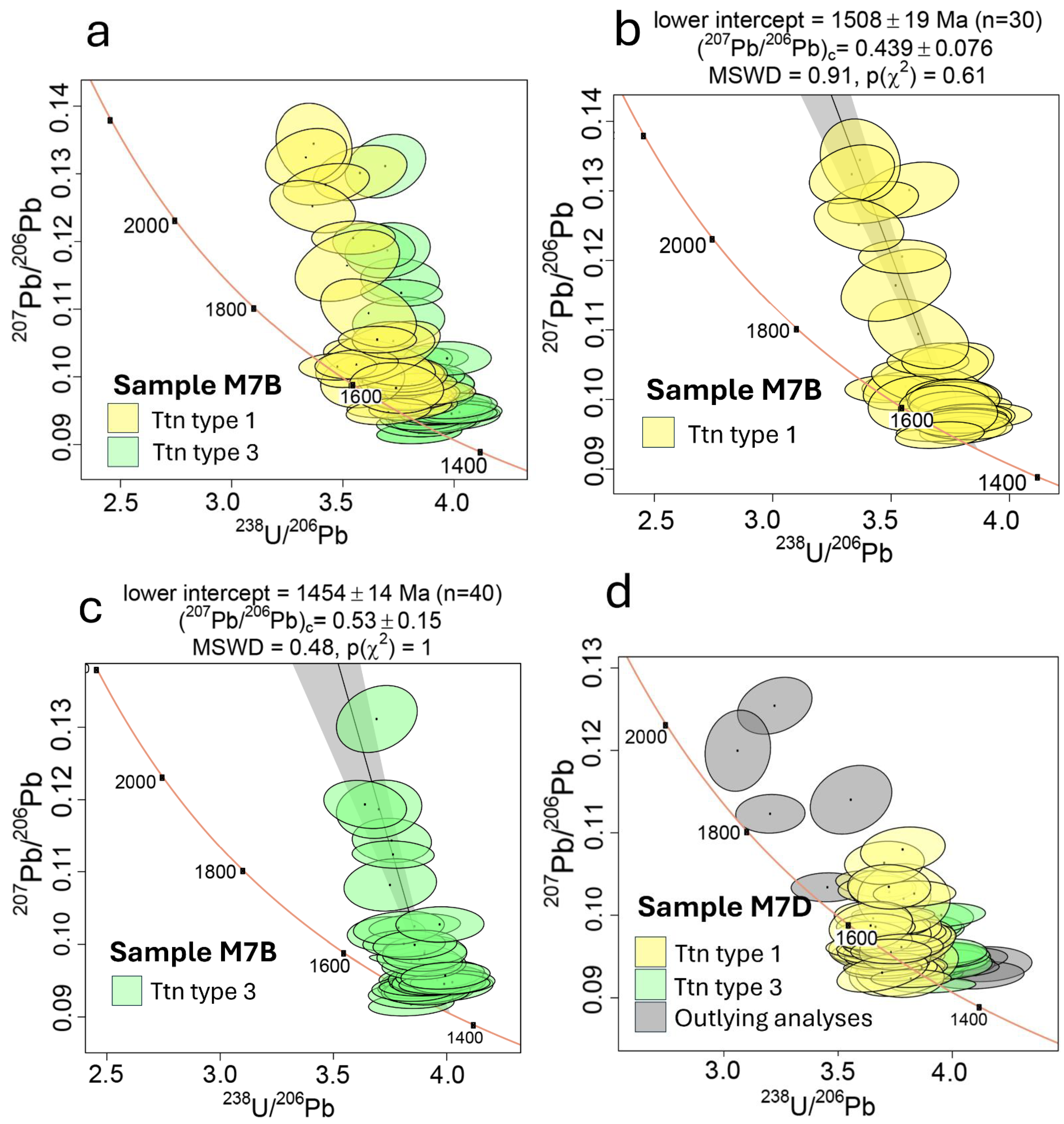
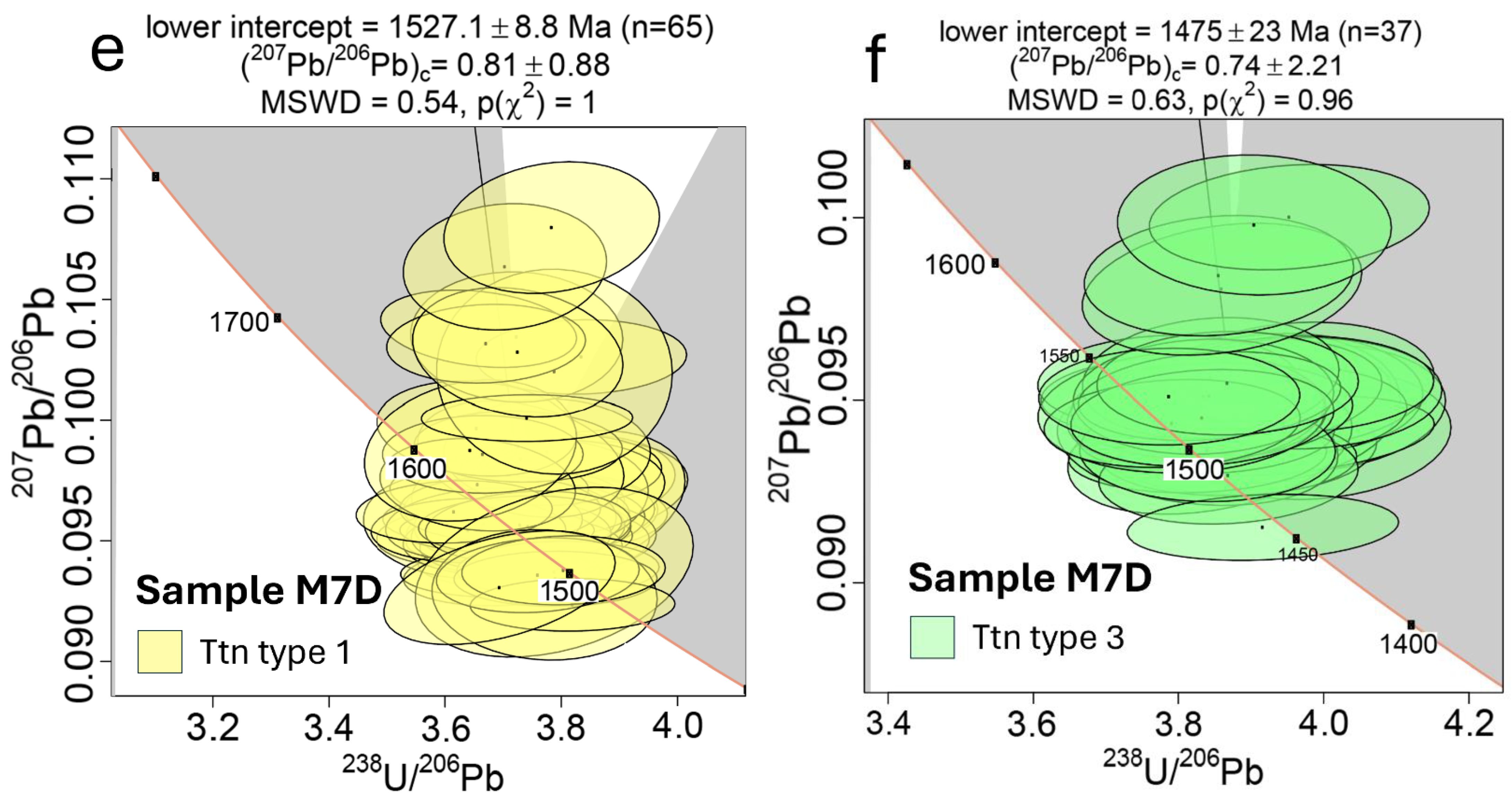
4.5. U-Pb Geochronology
5. Discussion
5.1. Granite Emplacement and Post-Magmatic Alterations
5.2. Mass Balance Constraints on Fluid–Rock Interaction
5.3. Titanite Evolution
5.3.1. Types of Titanite
5.3.2. Titanite Chemistry
5.4. Titanite Age
5.5. Regional Implications
6. Conclusions
- Hydrothermal alteration was controlled by coupled albitisation and chloritisation, accompanied by redistribution of Ca, Si, and REE. Titanium was redistributed locally among anatase, secondary titanite, and Mn-bearing ilmenite, whereas the observed mineral associations and reaction textures are consistent with relative Ti immobility at the rock scale.
- Titanite records a three-stage evolution involving magmatic crystallisation (type 1; ca. 1520 Ma), transitional alteration (type 2), and later hydrothermal modification of type 3 titanite, associated with younger U-Pb ages of ca. 1.46 Ga that may partly reflect isotopic resetting.
- Coupled dissolution–reprecipitation mechanisms and interphase interaction facilitate the efficient removal of radiogenic lead and trace elements from magmatic titanite, resulting in U-Pb ages that record episodes of hydrothermal recrystallisation and fluid-assisted modification rather than simple thermal cooling through a closure temperature.
- Rare earth elements released during the hydrothermal breakdown of magmatic titanite in the Kabeliai granitoids are locally redistributed, either being incorporated into secondary REE-bearing carbonates or remaining as a depleted signature in recrystallised type 3 titanite domains.
- In the studied part of the Marcinkonys massif, titanite serves as a sensitive petrogenetic indicator that links the 1.53–1.50 Ga magmatic emplacement under oxidised conditions with a subsequent 1.47–1.45 Ga titanite ages, which may reflect hydrothermal modification of the titanite U-Pb system and may be temporally associated with regional molybdenum mineralisation.
Supplementary Materials
Author Contributions
Funding
Data Availability Statement
Acknowledgments
Conflicts of Interest
Abbreviations
| REEs | Rare Earth Elements |
| LREEs | Light Rare Earth Elements |
| HREEs | Heavy Rare Earth Elements |
| HFSEs | High Field Strength Elements |
| LILEs | Large Ion Lithophile Elements |
| EPMA | Electron Probe Microanalysis |
| SEM | Scanning Electron Microscopy |
| EDS | Energy-Dispersive Spectroscopy |
| BSE | Back-Scattered Electron |
| PPL | Plane-Polarised Light |
| RL | Reflected Light |
| LA-ICP-MS | Laser Ablation Inductively Coupled Plasma Mass Spectrometry |
| MSWDs | Mean Square of Weighted Deviates |
| A/CNK | Alumina Saturation Index |
| MALI | Modified Alkali–Lime Index |
| FMQ | Fayalite–Magnetite–Quartz buffer |
| apfu | Atoms per Formula Unit |
| b.d.l. | Below Detection Limit |
| Ab | Albite |
| An | Anorthite component in plagioclase |
| Ant | Anatase |
| Bt | Biotite |
| Cal | Calcite |
| Chl | Chlorite |
| Ilm | Ilmenite |
| Olg | Oligoclase |
| Qz | Quartz |
| Thr | Thorite |
| Ttn | Titanite |
References
- Whalen, J.B.; Currie, K.L.; Chappell, B.W. A-Type Granites: Geochemical Characteristics and Petrogenesis. Contrib. Mineral. Petrol. 1987, 95, 407–419. [Google Scholar] [CrossRef]
- Bea, F. Residence of REE, Y, Th and U in Granites and Crustal Protoliths: Implications for the Chemistry of Crustal Melts. J. Petrol. 1996, 37, 521–552. [Google Scholar] [CrossRef]
- Wones, D.R. Significance of the Assemblage Titanite + Magnetite + Quartz in Granitic Rocks. Am. Mineral. 1989, 74, 744–749. [Google Scholar]
- Frost, B.R.; Chamberlain, K.R.; Schumacher, J.C. Sphene (Titanite): Phase Relations and Role as a Geochronometer. Chem. Geol. 2000, 172, 131–148. [Google Scholar] [CrossRef]
- Broska, I.; Harlov, D.; Tropper, P.; Siman, P. Formation of Magmatic Titanite and Titanite–Ilmenite Phase Relations during Granite Alteration in the Tribeč Mountains, Western Carpathians, Slovakia. Lithos 2007, 95, 58–71. [Google Scholar] [CrossRef]
- Scott, D.J.; St-Onge, M.R. Constraints on Pb Closure Temperature in Titanite Based on Rocks from the Ungava Orogen, Canada: Implications for U-Pb Geochronology and PTt Path Determinations. Geology 1995, 23, 1123–1126. [Google Scholar] [CrossRef]
- Cherniak, D.J. Lead Diffusion in Titanite and Preliminary Results on the Effects of Radiation Damage on Pb Transport. Chem. Geol. 1993, 110, 177–194. [Google Scholar] [CrossRef]
- Morad, S.; El Ghali, M.; Caja, M.; Al Ramadan, K.; Mansurbeg, H. Hydrothermal Alteration of Magmatic Titanite: Evidence from Proterozoic Granites of Southeastern Sweden. Can. Mineral. 2009, 47, 801–811. [Google Scholar] [CrossRef]
- Pan, Y.; Fleet, M.E.; Macrae, N.D. Late Alteration in Titanite (CaTiSiO5): Redistribution and Remobilization of Rare Earth Elements and Implications for Geochronology. Geochim. Cosmochim. Acta 1993, 57, 355–367. [Google Scholar] [CrossRef]
- Tiepolo, M.; Oberti, R.; Vannucci, R. Trace-Element Incorporation in Titanite. Chem. Geol. 2002, 191, 105–119. [Google Scholar] [CrossRef]
- Piccoli, P.; Candela, P.; Rivers, M. Interpreting Magmatic Processes from Accessory Phases: Titanite—A Small-Scale Recorder of Large-Scale Processes. Earth Environ. Sci. Trans. R. Soc. Edinb. 2000, 91, 257–267. [Google Scholar]
- Xirouchakis, D.; Lindsley, D.H. Equilibria among Titanite-Bearing Assemblages. Am. Mineral. 1998, 83, 712–725. [Google Scholar] [CrossRef]
- Harlov, D.; Tropper, P.; Seifert, W.; Nijland, T.; Förster, H. Formation of Al Rich Titanite (CaTiSiO4O–CaAlSiO4OH) Reaction Rims on Ilmenite in Metamorphic Rocks as a Function of fH2O and fO2. Lithos 2006, 88, 72–84. [Google Scholar] [CrossRef]
- Kontonikas Charos, A.; Ehrig, K.; Cook, N.; Ciobanu, C. Crystal Chemistry of Titanite from the Roxby Downs Granite, South Australia: Insights into Petrogenesis, Subsolidus Evolution and Hydrothermal Alteration. Contrib. Mineral. Petrol. 2019, 174, 59. [Google Scholar] [CrossRef]
- Enami, M.; Suzuki, K.; Liou, J.G.; Bird, D.K. Al–Fe3+ and F–OH Substitutions in Titanite and Constraints on Their P–T Dependence. Eur. J. Mineral. 1993, 5, 219–231. [Google Scholar] [CrossRef]
- Putnis, A. Mineral Replacement Reactions. Rev. Mineral. Geochem. 2009, 70, 87–124. [Google Scholar] [CrossRef]
- Vance, E.; Doern, D. The Properties of Anatase Pseudomorphs after Titanite. Can. Mineral. 1989, 27, 495–498. [Google Scholar]
- Gmochowska, W.; Harlov, D.; Słaby, E.; Jokubauskas, P.; Sláma, J.; Łącki, M. Experimental Metasomatic Alteration of Titanite in a Series of Metamorphic Fluids at 700 °C and 200 MPa. Mineral. Petrol. 2024, 118, 321–344. [Google Scholar] [CrossRef]
- Slaby, E.; Anczkiewicz, R.; Gros, K.; Simon, K.; Kozub Budzyn, G. High Temperature Fluids in Granites during the Neoarchaean–Palaeoproterozoic Transition. Lithos 2021, 386, 106039. [Google Scholar] [CrossRef]
- Sundblad, K.J.; Mansfeld, J.; Motuza, G.; Ahl, M.; Claesson, S. Geology, Geochemistry and Age of a Cu–Mo Bearing Granite at Kabeliai, southern Lithuania. Mineral. Petrol. 1994, 50, 43–57. [Google Scholar] [CrossRef]
- Wiszniewska, J.; Krzeminska, E. Advances in Geochronology in the Suwałki Anorthosite Massif. Precambrian Res. 2021, 361, 106265. [Google Scholar] [CrossRef]
- Baltulytė, A. Microstructural Analysis of Granites and Their Alterations in Kabeliai Granites: Implications from Mineral Chemical Composition. Master’s Thesis, Vilnius University, Vilnius, Lithuania, 2025. [Google Scholar]
- Skridlaite, G.; Motuza, G. Precambrian Domains in Lithuania: Evidence of Terrane Tectonics. Tectonophysics 2001, 339, 113–133. [Google Scholar] [CrossRef]
- Bogdanova, S.; Gorbatschev, R.; Skridlaite, G.; Soesoo, A.; Taran, L.; Kurlovich, D. Trans-Baltic Palaeoproterozoic Correlations towards the Reconstruction of Supercontinent Columbia/Nuna. Precambrian Res. 2015, 259, 5–33. [Google Scholar] [CrossRef]
- Skridlaite, G.; Siliauskas, L.; Whitehouse, M.J.; Johansson, A.; Rimsa, A. On the Origin and Evolution of the 1.86–1.76 Ga Mid Baltic Belt in the Western East European Craton. Precambrian Res. 2021, 367, 106403. [Google Scholar] [CrossRef]
- Marfin, S.; Miksys, R.B.; Motuza, G.; Skripkina, T. The Structure of the Marcinkonys Granitic Massif and Properties of Rocks. Geologija 1982, 3, 3–16. (In Russian) [Google Scholar]
- Stein, H.; Sundblad, K.; Markey, R.J.; Morgan, E.R.; Motuza, G. Re–Os Ages for Archean Molybdenite and Pyrite and Proterozoic Molybdenite. Miner. Depos. 1998, 33, 329–345. [Google Scholar] [CrossRef]
- Demina, O.; Skridlaite, G.; Siliauskas, L.; Lacki, M.; Marciniak Maliszewska, B.; Baginski, B. Post Magmatic Alteration in the Kabeliai Granite, Lithuania: Evidence from Petrography, Mineral Chemistry, and Accessory Minerals. Baltica 2025, 38, 143–159. [Google Scholar] [CrossRef]
- Frost, C.D.; Frost, B.R. On Ferroan (A-Type) Granitoids: Their Compositional Variability and Modes of Origin. J. Petrol. 2011, 52, 39–53. [Google Scholar] [CrossRef]
- Skridlaite, G.; Siliauskas, L.; Söderlund, U.; Næraa, T. Iron Rich Ca–Mg Skarns from the SW East European Craton (Lithuania): Microstructural Study and Age Constraints. Lithos 2024, 482, 107736. [Google Scholar] [CrossRef]
- Walters, J.B. MinPlot: A Mineral Formula Recalculation and Plotting Program. Mineralogia 2022, 53, 51–66. [Google Scholar] [CrossRef]
- Janoušek, V.; Farrow, C.M.; Erban, V. Interpretation of Whole Rock Geochemical Data in Igneous Geochemistry: Introducing Geochemical Data Toolkit (GCDkit). J. Petrol. 2006, 47, 1255–1259. [Google Scholar] [CrossRef]
- Siliauskas, L.; Gumsley, A.; Skridlaite, G.; Whitehouse, M.J.; Næraa, T.; Ene, V.-V.; Birmanaitė, U. Ca. 1.89 Ga Orthogneisses Underlying the Varena Iron Ore Deposit in SE Lithuania, East European Craton–Implications for Fluid Evolution and Cl Remobilization. Precambrian Res. 2026, 439, 108093. [Google Scholar] [CrossRef]
- Spandler, C.; Hammerli, J.; Sha, P.; Hilbert-Wolf, H.; Hu, Y. MKED1: A New Titanite Standard for in Situ Analysis of Sm–Nd Isotopes and U–Pb Geochronology. Chem. Geol. 2016, 425, 110–126. [Google Scholar] [CrossRef]
- Spencer, K.J.; Hacker, B.R.; Kylander-Clark, A.R.C.; Andersen, T.B. Campaign-Style Titanite U–Pb Dating by Laser Ablation ICP. Chem. Geol. 2013, 341, 84–101. [Google Scholar] [CrossRef]
- Heaman, L.M. The Application of U–Pb Geochronology to Mafic, Ultramafic and Alkaline Rocks: An Evaluation of Three Mineral Standards. Chem. Geol. 2009, 261, 43–53. [Google Scholar] [CrossRef]
- Paton, C.; Woodhead, J.; Hellstrom, J.; Hergt, J.; Greig, A.; Maas, R. Improved Laser Ablation U–Pb Zircon Geochronology through Robust down Hole Fractionation Correction. Geochem. Geophys. Geosyst. 2010, 11. [Google Scholar] [CrossRef]
- Paton, C.; Hellstrom, J.; Paul, B.; Woodhead, J.; Hergt, J. Iolite: Freeware for the Visualisation and Processing of Mass Spectrometric Data. J. Anal. At. Spectrom. 2011, 26, 2508–2518. [Google Scholar] [CrossRef]
- Petrus, J.A.; Kamber, B.S. VizualAge: A Novel Approach to Laser Ablation ICP-MS U-Pb Geochronology Data Reduction. Geostand. Geoanalytical Res. 2012, 36, 247–270. [Google Scholar] [CrossRef]
- Stacey, J.S.; Kramers, J.D. Approximation of Terrestrial Lead Isotope Evolution by a Two-Stage Model. Earth Planet. Sci. Lett. 1975, 26, 207–221. [Google Scholar] [CrossRef]
- Vermeesch, P. IsoplotR: A Free and Open Toolbox for Geochronology. Geosci. Front. 2018, 9, 1479–1493. [Google Scholar] [CrossRef]
- Chew, D.M.; Petrus, J.A.; Kamber, B.S. U–Pb LA–ICPMS Dating Using Accessory Mineral Standards with Variable Common Pb. Chem. Geol. 2014, 363, 185–199. [Google Scholar] [CrossRef]
- Williams, I.S. U-Th-Pb Geochronology by Ion Microprobe. In Applications of Microanalytical Techniques to Understanding Mineralizing Processes; Society of Economic Geologists: Littleton, CO, USA, 1997; pp. 1–35. ISBN 978-1-887483-51-3. [Google Scholar]
- Kennedy, A.K.; Kamo, S.L.; Nasdala, L.; Timms, N.E. Grenville Skarn Titanite: Potential Reference Material for SIMS U–Th–Pb Analysis. Can. Mineral. 2010, 48, 1423–1443. [Google Scholar] [CrossRef]
- Streckeisen, A. Classification and Nomenclature of Plutonic Rocks. Geol. Rundsch. 1974, 63, 773–786. [Google Scholar] [CrossRef]
- Frost, B.R.; Barnes, C.G.; Collins, W.J.; Arculus, R.J.; Ellis, D.J.; Frost, C.D. A Geochemical Classification for Granitic Rocks. J. Petrol. 2001, 42, 2033–2048. [Google Scholar] [CrossRef]
- Peccerillo, A.; Taylor, S.R. Geochemistry of Eocene Calc-Alkaline Volcanic Rocks from the Kastamonu Area, Northern Turkey. Contrib. Mineral. Petrol. 1976, 58, 63–81. [Google Scholar] [CrossRef]
- McDonough, W.F.; Sun, S.S. The Composition of the Earth. Chem. Geol. 1995, 120, 223–253. [Google Scholar] [CrossRef]
- Sun, S.S.; McDonough, W.F. Chemical and Isotopic Systematics of Oceanic Basalts. Geol. Soc. Spec. Publ. 1989, 42, 313–345. [Google Scholar] [CrossRef]
- Drake, M.J.; Weill, D.F. Partition of Sr, Ba, Ca, Y, Eu2+, Eu3+ and Other REE between Plagioclase Feldspar and Magmatic Liquid: An Experimental Study. Geochim. Cosmochim. Acta 1975, 39, 689–712. [Google Scholar] [CrossRef]
- Rudnick, R.; Gao, S. 3.01–The Composition of the Continental Crust. In Treatise On Geochemistry; Volume 3: The Crust; Elsevier Ltd.: Amsterdam, The Netherlands, 2003; pp. 1–65. [Google Scholar]
- Whitney, D.L.; Evans, B.W. Abbreviations for Names of Rock-Forming Minerals. Am. Mineral. 2010, 95, 185–187. [Google Scholar] [CrossRef]
- Oberti, R.; Smith, D.C.; Rossi, G.; Caucia, F. The Crystal-Chemistry of High-Aluminium Titanites. Eur. J. Mineral. 1981, 3, 777–792. [Google Scholar] [CrossRef]
- Gmochowska, W.; Wirth, R.; Słaby, E.; Anczkiewicz, R.; Krzątała, A.; Roddatis, V.; Sláma, J.; Kozub Budzyń, G.; Bhattacharya, S.; Schreiber, A. Hydrothermal Alteration of Accessory Minerals (Allanite and Titanite) in the Late Archean Closepet Granitoid (Dharwar Craton, India): A TEM Study. Geochemistry 2024, 84, 126130. [Google Scholar] [CrossRef]
- Skridlaite, G.; Wiszniewska, J.; Duchesne, J.C. Ferro-Potassic A-Type Granites and Related Rocks in NE Poland and S Lithuania. Precambrian Res. 2003, 124, 305–326. [Google Scholar] [CrossRef]
- Wiszniewska, J.; Claesson, S.; Stein, H.; Van den Auwera, J.; Duchesne, J.C. The North-Eastern Polish Anorthosite Massifs: Petrological and Isotopic Evidence. Terra Nova 2002, 14, 451–460. [Google Scholar] [CrossRef]
- David, K.; Schiano, P.; Allègre, C.J. Assessment of the Zr/Hf Fractionation in Oceanic Basalts and Continental Materials during Petrogenetic Processes. Earth Planet. Sci. Lett. 2000, 178, 285–301. [Google Scholar] [CrossRef]
- Schnetzler, C.; Philpotts, J.A. Partition Coefficients of Rare-Earth Elements between Igneous Matrix Material and Rock-Forming Mineral Phenocrysts—II. Geochim. Cosmochim. Acta 1970, 34, 331–340. [Google Scholar] [CrossRef]
- Sverjensky, D.A. Europium Redox Equilibria in Aqueous Solution. Earth Planet. Sci. Lett. 1984, 67, 70–78. [Google Scholar] [CrossRef]
- Bau, M. Rare Earth Element Mobility during Hydrothermal and Metamorphic Fluid Rock Interaction and the Significance of the Oxidation State of Europium. Chem. Geol. 1991, 93, 219–230. [Google Scholar] [CrossRef]
- Yousefi, F.; Lentz, D.R.; McFarlane, C.R.M.; Walker, J.A.; Thorne, K.G. Titanite Geochemistry of Devonian Oxidized I-Type Granodiorites in New Brunswick, Canada: Implications for Exploration for Porphyry Cu-Mo-Au Deposits in the Northern Appalachians. Lithos 2026, 528–529, 108464. [Google Scholar] [CrossRef]
- Hayden, L.A.; Watson, E.B.; Wark, D.A. A Thermobarometer for Sphene (Titanite). Contrib. Mineral. Petrol. 2008, 155, 529–540. [Google Scholar] [CrossRef]
- Erdmann, S.; Wang, R.; Huang, F.; Scaillet, B.; Zhao, K.; Liu, H.; Chen, Y.; Faure, M. Titanite: A Potential Solidus Barometer for Granitic Magma Systems. Comptes Rendus Geosci. 2019, 351, 551–561. [Google Scholar] [CrossRef]
- Gresens, R.L. Composition–Volume Relationships of Metasomatism. Chem. Geol. 1967, 2, 47–65. [Google Scholar] [CrossRef]
- MacLean, W.H.; Barrett, T.J. Lithogeochemical Techniques Using Immobile Elements. J. Geochem. Explor. 1993, 48, 109–133. [Google Scholar] [CrossRef]
- Lucassen, F.; Franz, G.; Dulski, P.; Romer, R.L.; Rhede, D. Element and Sr Isotope Signatures of Titanite as Indicator of Variable Fluid Composition in Hydrated Eclogite. Lithos 2011, 121, 12–24. [Google Scholar] [CrossRef]
- Putnis, A. Mineral Replacement Reactions: From Macroscopic Observations to Microscopic Mechanisms. Mineral. Mag. 2002, 66, 689–708. [Google Scholar] [CrossRef]
- Van Baalen, M.R. Titanium Mobility in Metamorphic Systems: A Review. Chem. Geol. 1993, 110, 233–249. [Google Scholar] [CrossRef]
- Deer, W.A.; Howie, R.A.; Zussman, J. Rock Forming Minerals. Volume 1: Orthosilicates; Longman: London, UK, 1982. [Google Scholar]
- Storey, C.; Smith, M.; Jeffries, T. In Situ LA ICP MS U–Pb Dating of Metavolcanics of Norrbotten, Sweden. Chem. Geol. 2007, 240, 163–181. [Google Scholar] [CrossRef]
- Hu, H.; Li, J.W.; McFarlane, C.R.M. Hydrothermal Titanite from the Chengchao Iron Skarn Deposit: Temporal Constraints on Iron Mineralization, and Its Potential as a Reference Material for Titanite U–Pb Dating. Mineral. Petrol. 2017, 111, 593–608. [Google Scholar] [CrossRef]
- Lucassen, F.; Dulski, P.; Abart, R.; Franz, G.; Rhede, D.; Romer, R.L. Redistribution of HFSE Elements during Rutile Replacement by Titanite. Contrib. Mineral. Petrol. 2010, 160, 279–295. [Google Scholar] [CrossRef]
- Holder, R.M.; Hacker, B.R. Fluid Driven Resetting of Titanite Following Ultrahigh Temperature Metamorphism in Southern Madagascar. Chem. Geol. 2019, 504, 38–52. [Google Scholar] [CrossRef]
- Skridlaite, G.; Siliauskas, L.; Whitehouse, M.; Dunkley, D.J. Radiation Damaged Zircon and Its Dating: A Case Study of ca. 1.50 Ga Granitoid Veins Crosscutting Skarns. In Proceedings of the Goldschmidt Conference, Lyon, France, 9–14 July 2023. [Google Scholar]
- Skridlaite, G.; Šiliauskas, L.; Prušinskienė, S.; Bagiński, B. Petrography and Mineral Chemistry of the Varena Iron Ore Deposit, Southeastern Lithuania. Baltica 2019, 32, 107–126. [Google Scholar] [CrossRef]
- Duchesne, J.C.; Martin, H.; Baginski, B.; Wiszniewska, J.; Van den Auwera, J. The Origin of Ferroan-Potassic A-Type Granitoids: The Case of the Hornblende–Biotite Granite Suite of the Mesoproterozoic Mazury Complex, Northeastern Poland. Can. Mineral. 2010, 48, 947–968. [Google Scholar] [CrossRef]
- Skridlaite, G.; Bogdanova, S.; Page, L. Mesoproterozoic Events in Eastern and Central Lithuania as Recorded by 40Ar/39Ar Ages. Baltica 2006, 19, 91–98. [Google Scholar]
- Bogdanova, S.V.; Page, L.M.; Skridlaite, G.; Taran, L.N. Proterozoic Tectonothermal History in the Western Part of the East European Craton: 40Ar/39Ar Geochronological Constraints. Tectonophysics 2001, 339, 39–66. [Google Scholar] [CrossRef]
- Motuza, G.; Čečys, A.; Kotov, A.B.; Salnikova, E.B. The Žemaičių Naumiestis Granitoids: New Evidence for Mesoproterozoic Magmatism in Western Lithuania. GFF 2006, 128, 243–254. [Google Scholar] [CrossRef]
- Skridlaite, G.; Whitehouse, M.; Rimša, A. Evidence for a Pulse of 1.45 Ga Anorthosite-Mangerite-Charnockite-Granite Plutonism in Lithuania. Terra Nova 2007, 19, 294–301. [Google Scholar] [CrossRef]


Disclaimer/Publisher’s Note: The statements, opinions and data contained in all publications are solely those of the individual author(s) and contributor(s) and not of MDPI and/or the editor(s). MDPI and/or the editor(s) disclaim responsibility for any injury to people or property resulting from any ideas, methods, instructions or products referred to in the content. |
© 2026 by the authors. Licensee MDPI, Basel, Switzerland. This article is an open access article distributed under the terms and conditions of the Creative Commons Attribution (CC BY) license.
Share and Cite
Demina, O.; Siliauskas, L.; Skridlaite, G.; Chew, D.; Naeraa, T. Titanite U-Pb Ages and Multi-Staged Alteration Processes in Mesoproterozoic Granitoids from Southern Lithuania. Minerals 2026, 16, 634. https://doi.org/10.3390/min16060634
Demina O, Siliauskas L, Skridlaite G, Chew D, Naeraa T. Titanite U-Pb Ages and Multi-Staged Alteration Processes in Mesoproterozoic Granitoids from Southern Lithuania. Minerals. 2026; 16(6):634. https://doi.org/10.3390/min16060634
Chicago/Turabian StyleDemina, Olga, Laurynas Siliauskas, Grazina Skridlaite, David Chew, and Tomas Naeraa. 2026. "Titanite U-Pb Ages and Multi-Staged Alteration Processes in Mesoproterozoic Granitoids from Southern Lithuania" Minerals 16, no. 6: 634. https://doi.org/10.3390/min16060634
APA StyleDemina, O., Siliauskas, L., Skridlaite, G., Chew, D., & Naeraa, T. (2026). Titanite U-Pb Ages and Multi-Staged Alteration Processes in Mesoproterozoic Granitoids from Southern Lithuania. Minerals, 16(6), 634. https://doi.org/10.3390/min16060634