
Article

Mesozoic Dykes in the Xingcheng Area, Western Liaoning Province, NE China: Phases, Petrogenesis, and Tectonic Setting
1
College of Earth Sciences, Jilin University, Changchun 130061, China
2
Key Laboratory of Mineral Resources Evaluation in Northeast Asia, Ministry of Natural Resources, Changchun 130061, China
*
Author to whom correspondence should be addressed.
Minerals 2026, 16(6), 586; https://doi.org/10.3390/min16060586 (registering DOI)
Submission received: 23 April 2026 / Revised: 24 May 2026 / Accepted: 26 May 2026 / Published: 30 May 2026
(This article belongs to the Special Issue Advances in Granite Geochronology and Geochemistry)

Abstract

The Mesozoic dykes in the Xingcheng area of western Liaoning Province in China were investigated through an integrated study involving zircon U–Pb geochronology, whole-rock geochemistry, and zircon Hf isotopic compositions to elucidate their emplacement phases, petrogenesis, and tectonic setting. The dykes are classified into two groups: felsic (granite porphyry, granite aplite) and mafic (diabase, lamprophyre). Emplacement occurred in four discrete phases: Late Triassic (229–212 Ma), Early Jurassic (ca. 179 Ma), Late Jurassic (162–152 Ma), and Early Cretaceous (133–102 Ma). The felsic dykes are characterized by high SiO2 and alkali contents, low TFeO and MgO abundances, and belong to the high-K calc-alkaline I-type granite series. The mafic dykes exhibit low SiO2, elevated MgO, and high Na2O contents, displaying both alkaline and calc-alkaline affinities. Both dyke suites are consistently enriched in light rare earth elements (LREEs) and large-ion lithophile elements (LILEs), and depleted in heavy rare earth elements (HREEs) and high field-strength elements (HFSEs). Zircon εHf(t) values for the felsic dykes range from −22.3 to −7.4, corresponding to two-stage model ages (TDM2) of 2613–1729 Ma, indicating derivation from partial melting of Neoarchean to Paleoproterozoic crustal material. Late Jurassic mafic dykes yield εHf(t) values between −27.8 and −20.2, consistent with an origin from partial melting of enriched lithospheric mantle. In contrast, Early Cretaceous mafic dykes display a bimodal εHf(t) distribution (−12.9 to −9.5 and +4.3 to +8.4), suggesting a predominant enriched mantle source with variable inputs from depleted mantle components. Integrated with regional tectonic reconstructions, the data indicate that the Xingcheng area evolved within a post-collisional extensional regime following the amalgamation of the North China Craton and the Central Asian Orogenic Belt during the Late Triassic. The Jurassic magmatic pulses are attributed to an active continental margin setting associated with subduction of the Paleo-Pacific Plate, whereas the Early Cretaceous phase reflects regional extension triggered by rollback of the subducting Paleo-Pacific slab.

1. Introduction

The North China Craton (NCC) remained tectonically stable from the Paleoproterozoic through the Late Paleozoic. However, since the Mesozoic, it has undergone intense destruction and modification, resulting in widespread crustal reactivation and a pronounced magmatic–tectonic–metallogenic response [1,2,3]. This geodynamic transformation generated numerous extensional basins [4,5], metamorphic core complexes [6], and large-scale ore deposits [7,8]. The NCC consists of an Archean–Paleoproterozoic crystalline basement overlain by an unmetamorphosed sedimentary cover sequence deposited since the Mesoproterozoic. It comprises both a strongly modified eastern block and a largely stable western block, providing an exceptional natural laboratory for investigating continental formation and evolution [9].
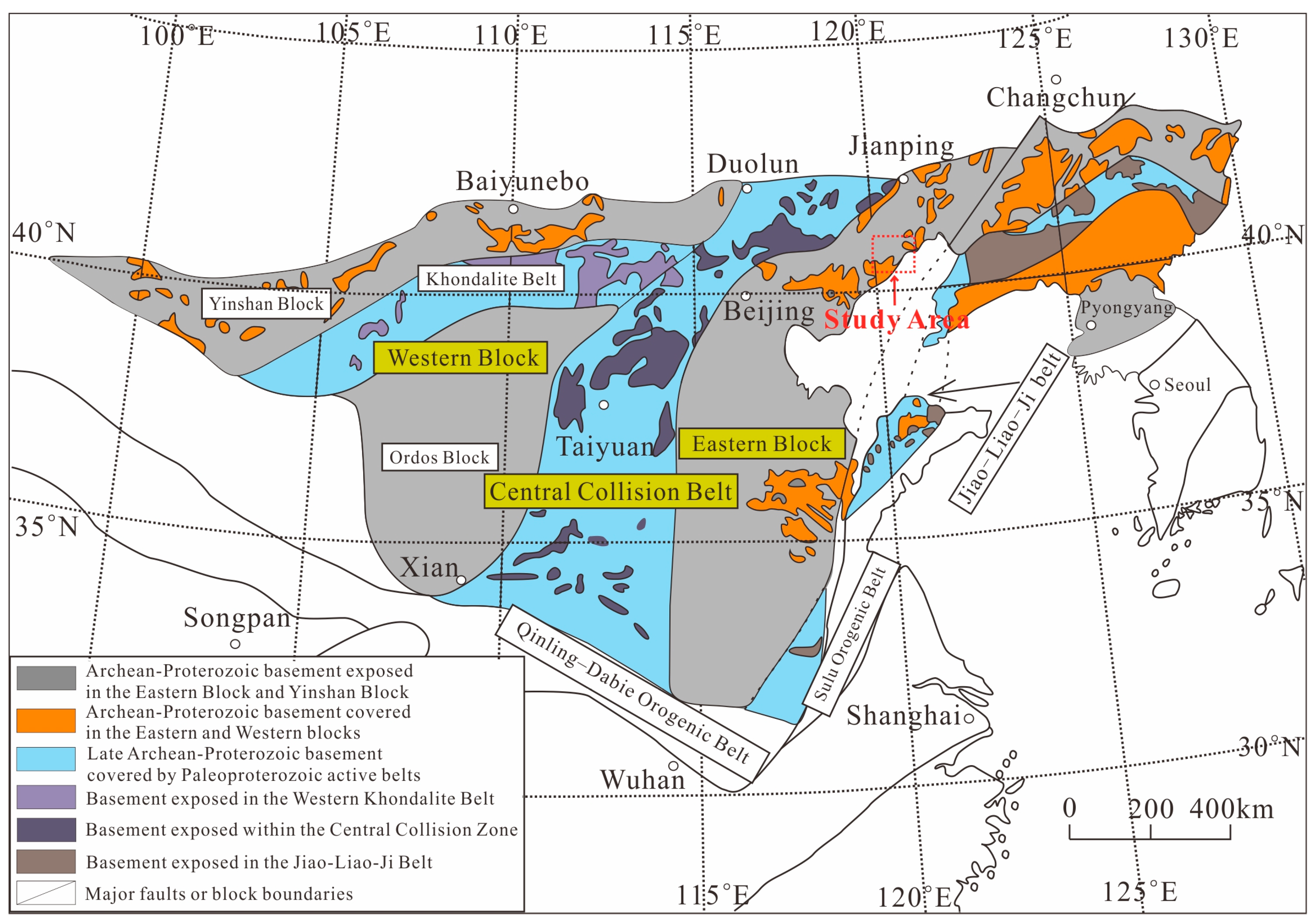
The Xingcheng area is situated within the highly disrupted eastern segment of the NCC (Figure 1) [10]. Mesozoic magmatism in this region is intense, characterized by multiple phases of intrusive rocks, volcanic sequences, and associated dyke swarms. Dykes serve as critical indicators for investigating magmatic evolution, tectonic regimes, and metallogenesis, providing insights into the compositional nature of their source regions and related magmatic processes [11]. Mafic dykes typically form under continental extensional settings; they represent mantle-derived material and can effectively record the deep structural stress field [12]. In contrast, felsic dykes primarily originate through partial melting of crustal or upper mantle material, with significant fractional crystallization occurring during magma ascent along major fault zones and their subsidiary fractures [13].
Previous investigations have documented in detail the Mesozoic granitic and volcanic rocks of the Xingcheng region. Granitic magmatism exhibits distinct polyphase intrusive characteristics, which can be subdivided into four principal stages [14]: (1) Late Triassic (230–212 Ma) activity, represented by monzogranite, syenogranite, and granite aplite concentrated at Baimashi, Taili, and Songshumao [15,16,17,18]; (2) Early Jurassic (193–174 Ma) intrusions, dominated by granite porphyry, granodiorite, and monzogranite, including representative bodies at Jianchang, Kuanbang, Yangjiazhangzi, Yaowangmiao–Mopanshan, Guojiatunzhan, Lanjiagou, and Dahongluoshan [16,17,19]; (3) Late Jurassic (161–152 Ma) plutons, marking the peak emplacement period, exemplified by monzogranite, granite porphyry, and gneissic quartz monzonite at Xiaozhangjiatun, Moshigou, and Taili [18,19]; and (4) Early Cretaceous (139–125 Ma) magmatism, comprising monzogranite, granite porphyry, and monzodiorite at Hongyazi, Zhaolitouzi, and Tangwangdong [17]. Collectively, these geochronological data demonstrate that Mesozoic granitic magmatism in the Xingcheng area persisted for approximately 105 Ma. With respect to volcanic activity, Mesozoic volcanic rocks are primarily belong to the Middle–Late Jurassic Tiaojishan Formation (165–149 Ma) and the Early Cretaceous Yixian Formation (132–112 Ma). The Tiaojishan Formation is lithologically dominated by andesite and trachyandesite, whereas the Yixian Formation consists mainly of basaltic andesite and andesite, with localized rhyolite occurrences.
In summary, although the Mesozoic granitic and volcanic sequences of western Liaoning have been extensively studied, coeval dyke swarms have received comparatively limited attention. The Xingcheng area hosts a diverse array of Mesozoic dykes spanning a broad temporal range, representing a critical window for constraining regional tectonic evolution. High-precision geochronological data from these dykes can precisely delineate the timing of tectonic regime transitions and the peak phase of cratonic destruction. Furthermore, mafic dykes serve as deep lithospheric probes, effectively tracing material contributions from both the lithospheric mantle and the asthenosphere, thereby providing key constraints on the mechanisms of lithospheric thinning in the eastern NCC. In addition, volcanic rocks are products of extrusive magmatism, intrusive rocks are products of plutonic intrusion, whereas dykes, as hypabyssal intrusions, can faithfully record magmatic processes and yield high-precision ages. Accordingly, this study focuses on the Mesozoic mafic and felsic dykes of the Xingcheng area, employing an integrated approach encompassing petrology, zircon U–Pb geochronology, whole-rock geochemistry, and zircon Hf isotopic analysis. The objectives are to define the emplacement phases and petrogenesis of these dykes and to reconstruct their tectonic setting.

2. Geological Setting and Petrographic Characteristics

2.1. Geological Setting

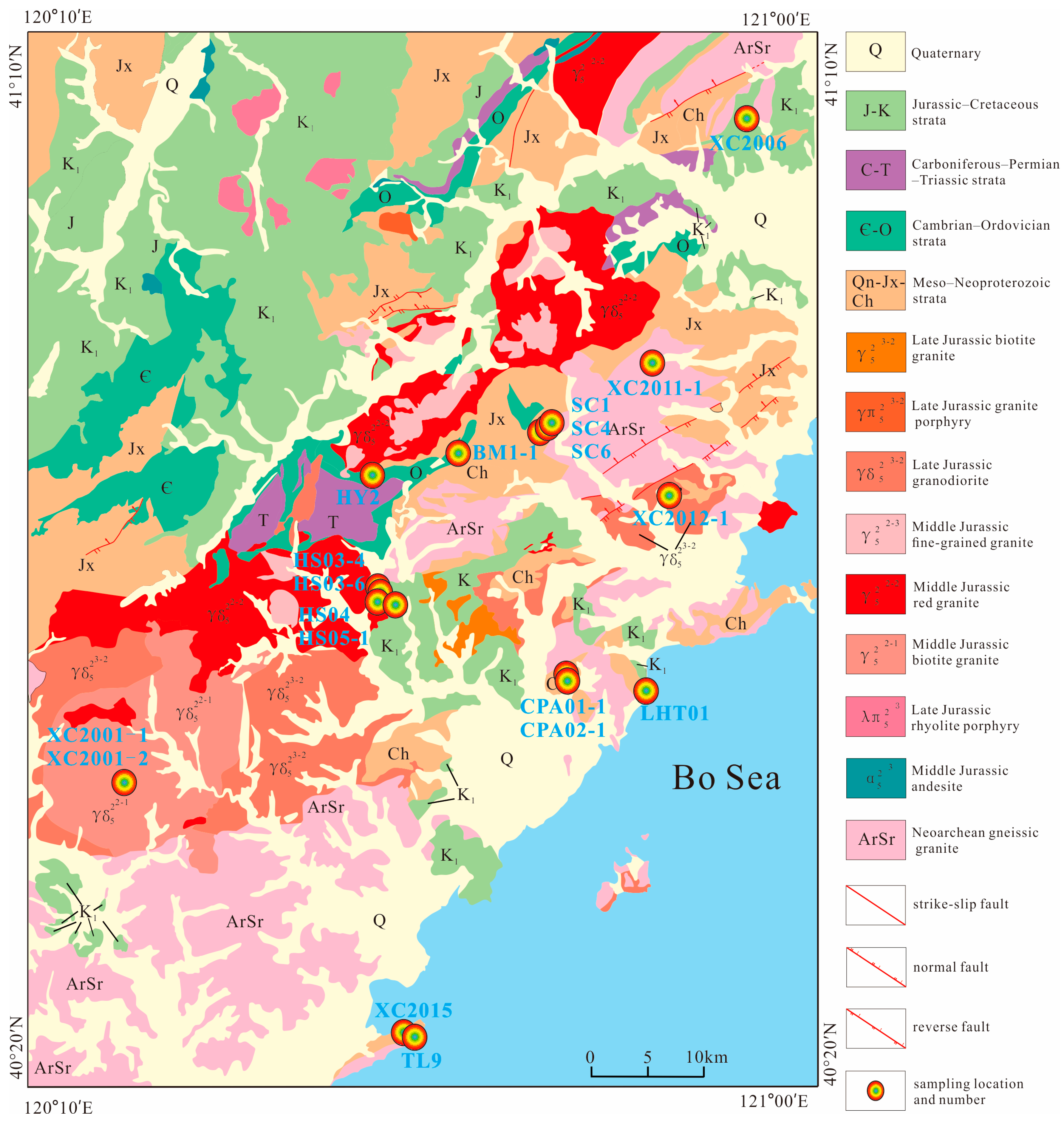
The Xingcheng area of western Liaoning Province is located at the junction of the eastern part of the northern NCC margin, the Yanshan Platform Fold Belt, and the Shanhaiguan Platform Anticlinorium, bordering the Liaodong Bay of the Bohai Sea to the east. The ancient crystalline basement in the region is dominated by the Neoarchean Suizhong Granite (ArSr) with minor occurrences of metamorphosed supracrustal xenoliths, which were emplaced during the late Archean (ca. 2.5 Ga; Figure 2). The Meso–Neoproterozoic succession includes the Changcheng, Jixian, and Qingbaikou systems, which form a thick, platformal marine sedimentary cover. This period is characterized by intracontinental rift activity, establishing a tectonic framework of alternating Shanhaiguan Uplift and Yanshan Aulacogen structural domains. During the Paleozoic, the study area remained in a stable tectonic environment, with widespread deposition of Cambrian, Ordovician, Carboniferous, and Permian strata in the northwestern sector; coeval tectonic deformation and magmatic activity were largely absent.
The Mesozoic era witnessed intense crustal reactivation. From the late Early Triassic to the Late Triassic, the region was influenced by the Indosinian Orogeny, resulting from the collision and assembly of the North China Craton and Yangtze cratons and the closure of the Paleo-Asian Ocean to the north. This event generated regionally extensive, approximately east–west-trending structures. During the Jurassic to Cretaceous, a more intense Yanshanian Orogeny was superimposed, producing a series of NE- to NNE-trending faults and associated small- to medium-scale fault-bound basins. Concomitant with this pronounced structural deformation, frequent magmatic activity occurred, forming widespread volcanic rocks, intrusive bodies, and dyke swarms. The volcanic succession includes basalt, basaltic andesite, andesite, rhyolite, and rhyolitic tuff breccia. The intrusive suite is compositionally diverse, comprising pyroxene diorite, diorite, syenite, granodiorite, and monzogranite. The dyke assemblage is dominated by granite porphyry, granite aplite, hornblende diabase, and olivine diabase.

2.2. Geological and Petrological Characteristics of the Dykes

The Mesozoic dykes in the study area intrude the Archean crystalline basement, Proterozoic and Paleozoic strata, with later phases cutting through Late Jurassic granitic plutons and sedimentary sequences of the Middle Jurassic Haifanggou Formation. The dyke suite is lithologically dominated by granite porphyry, granite aplite, diabase, and lamprophyre. Based on cross-cutting relationships observed in the field and geochronological results, emplacement can be subdivided into four discrete phases: Late Triassic, Early Jurassic, Late Jurassic, and Early Cretaceous.
(1)
Late Triassic Dykes
Late Triassic dykes consist of two varieties: granite aplite and granite porphyry.
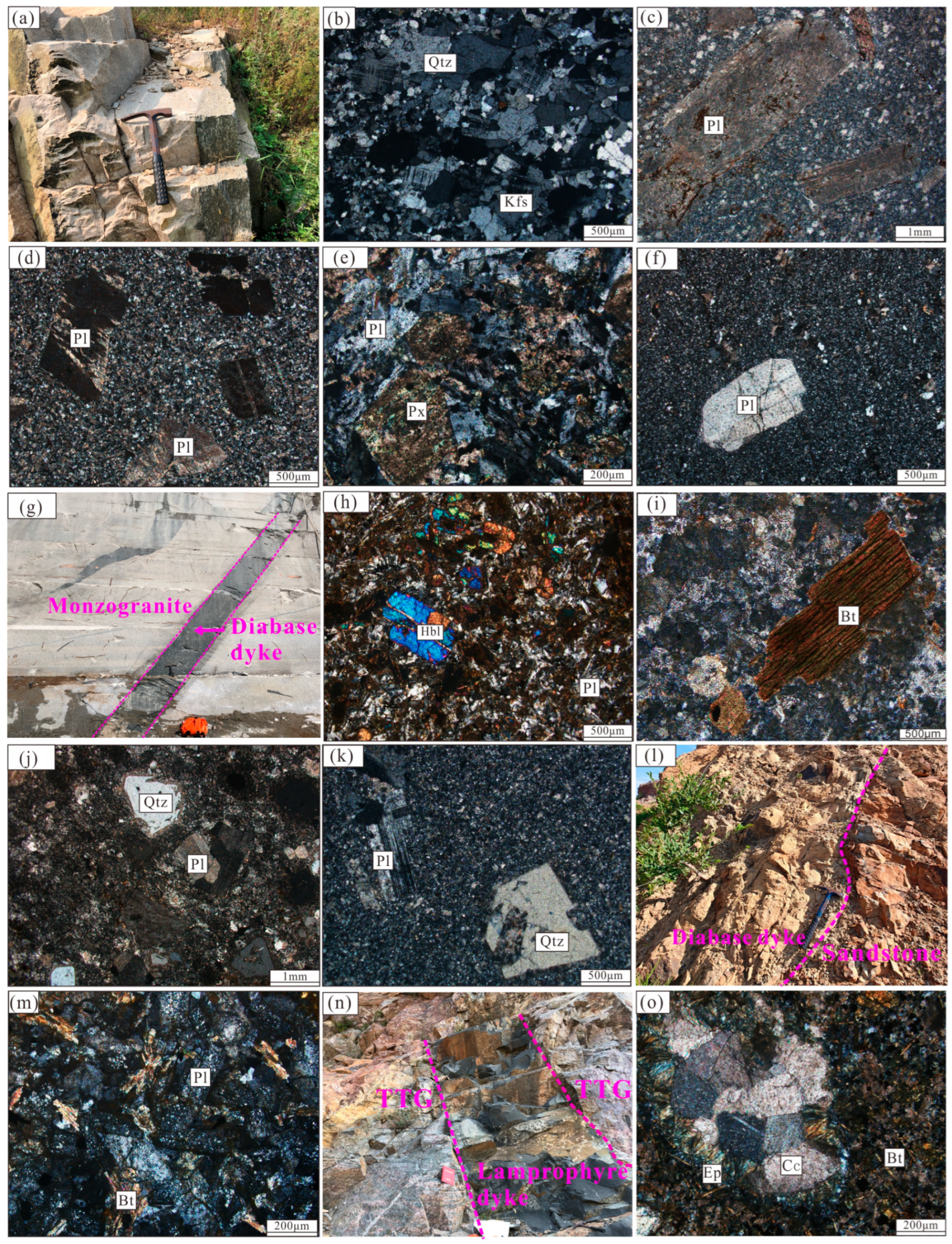
Granite aplite is exposed at Taili Village, where it intrudes the Archean Suizhong Granite. The dyke strikes 70°, dips south, and exhibits a width of approximately 6 m. The rock is grayish-white, characterized by a fine-grained granitic texture and massive structure (Figure 3a). The primary mineral assemblage consists of quartz (25%): anhedral granular, 0.5–1 mm in diameter; plagioclase (45%): grayish-white, predominantly anhedral granular with local, slightly lath-like habits; alkali feldspar (35%): subhedral tabular, 0.1–0.5 mm (Figure 3b); biotite (5%).
Granite porphyry is exposed at Shangchangmao, where it intrudes limestone of the Mesoproterozoic Wumishan Formation. The rock is flesh-red, displaying a porphyritic texture and massive structure. Phenocrysts comprise plagioclase, quartz, and alkali feldspar, constituting 20–25 vol.%. Quartz phenocrysts are anhedral granular (0.5–2 mm); plagioclase phenocrysts are subhedral tabular, exhibit polysynthetic twinning (2–5 mm), and show localized sericitization. Alkali feldspar phenocrysts display Carlsbad twinning. Feldspar and quartz dominate the groundmass assemblage, and biotite with a grain size <0.05 mm.
(2)
Early Jurassic Dykes
Only granite porphyry has been identified from the Early Jurassic phase. It is exposed in the Huashanzhen pluton, intruding Paleozoic sedimentary strata. The dyke strikes 290°, dips south, and is approximately 10 m wide. The rock is pale red with a porphyritic texture and massive structure. Phenocrysts of K-feldspar, biotite, and quartz account for 10–15 vol.%. K-feldspar phenocrysts exhibit subhedral tabular habits and display Carlsbad twinning (1–5 mm); biotite phenocrysts are flaky and brown (0.5–1 mm); quartz phenocrysts are anhedral granular (0.5–1 mm). Feldspar and quartz constitute the principal groundmass phases (<0.05 mm) (Figure 3d).
(3)
Late Jurassic Dykes
Late Jurassic dykes include hornblende diabase, olivine diabase, and granite porphyry.
Hornblende diabase crops out near Huashanzhen, intruding limestone of the Mesoproterozoic Wumishan Formation. The dyke strikes 215°, dips 75° E, and is approximately 3.5 m wide. The rock is grayish-green (Figure 3e), exhibiting a diabase texture and massive structure. Clinopyroxene (15–20%): pale green, anhedral granular, 0.1–0.5 mm; plagioclase (50–55%): subhedral lath-shaped with polysynthetic twinning, 0.1–0.5 mm; hornblende (25–30%): dark green, prismatic, 0.5–1 mm.
Granite porphyry is exposed at Qingshui village, intruding limestone of the Cambrian Changping Formation. The dyke is approximately 5 m wide. The rock is pale red with a porphyritic texture and massive structure (Figure 3f). The phenocryst assemblage is composed of alkali feldspar, plagioclase, quartz, and biotite. 20–30 vol.%. Quartz phenocrysts are anhedral granular (0.1–0.5 mm); plagioclase phenocrysts are subhedral tabular with polysynthetic twinning (0.5–1 mm), partially sericitized. Alkali feldspar displays Carlsbad twinning; biotite phenocrysts are brown and flaky. The groundmass is dominated by feldspar, quartz, and biotite (<0.05 mm).
Olivine diabase is exposed at Jianchang, where it intrudes Middle Jurassic monzogranite. The dyke is vertical and massive, striking 350° and dipping SE, with a width of approximately 2 m (Figure 3g). The rock is grayish-green with a diabase texture and massive structure. Clinopyroxene (20–25%): pale green, anhedral granular, 0.5–1 mm; plagioclase (50–55%): grayish-white, subhedral lath-shaped with polysynthetic twinning, 0.1–1 mm; olivine (5%): yellowish-green, short-prismatic, 0.2–1.0 mm; biotite (20–25%): brown, prismatic, 0.5–1 mm (Figure 3h).
(4)
Early Cretaceous Dykes
Early Cretaceous dykes include granite porphyry, diabase, and lamprophyre.
Granite porphyry occurs at Heiyugou, Shangchangmao, and Huashanzhen (Figure 3j,k,i). At Heiyugou, the rock exhibits a flesh-red, porphyritic texture and massive structure, with phenocrysts alkali feldspar, plagioclase, quartz, and biotite comprising 20–30 vol.%. Quartz phenocrysts are anhedral granular (~0.5 mm); plagioclase phenocrysts are subhedral tabular with polysynthetic twinning (0.5–1 mm) and exhibit sericitic alteration. Alkali feldspar phenocrysts display Carlsbad twinning. Biotite phenocrysts are brown and flaky. The groundmass consists of feldspar, quartz, and biotite (<0.05 mm) (Figure 3j).
Diabase is exposed at Chapeng’an, where it intrudes sandstone of the Mesoproterozoic Changzhougou Formation (Figure 3l). The dyke has a dip direction is 260°, dip angle is 80° and a width of ~15 m. The rock exhibits a grayish-green color, a diabase texture, and a massive structure, exhibiting strong alteration. Clinopyroxene (25–30%): pale green, anhedral granular or short-prismatic, 0.5–1 mm; plagioclase (45–50%): grayish-white, locally chloritized, subhedral lath-shaped with polysynthetic twinning, 0.1–1 mm; biotite (20–25%): brown, flaky, 0.5–1 mm (Figure 3m).
Lamprophyre is exposed at Xibao village, striking 320–350° and intruding Archean TTG gneisses (Figure 3n). The dyke is approximately 1.5 m wide. The rock is pale green with a lamprophyric texture and massive structure. Radiating epidote aggregates are commonly observed around vesicle margins, infilled by carbonate amygdules. Phenocrysts of biotite and hornblende constitute 30–35 vol.%. Hornblende phenocrysts are subhedral (0.5–1 mm); biotite phenocrysts are brown and flaky (0.5–1 mm). Feldspar and fine-grained mafic phases constitute the groundmass (<0.05 mm) (Figure 3o).

3. Analytical Methods

3.1. Zircon U–Pb Dating and Lu–Hf Isotope Analysis

Zircon LA-ICP-MS U–Pb dating analyses were undertaken at the Key Laboratory of Mineral Resources Evaluation in Northeast Asia, Ministry of Natural Resources. Measurements employed an ThermoFisher Neptune (Bremen, Germany) and Agilent 7900 ICP-MS in Singapore coupled to a GeoLas Pro laser ablation system, with a laser spot diameter of 32 μm. Data reduction for isotopic ratios and elemental concentrations utilized the 4.0 GLITTER software [21] and age calculations and U–Pb concordia diagrams were generated using the 3.0 Isoplot program [21]. Discordant data points and analyses of xenocrystic zircon were excluded from the concordia plots.
The in situ zircon Lu–Hf isotopic analyses were performed at the Key Laboratory of Metallogeny and Mineral Resource Assessment, Ministry of Land and Resources, Chinese Academy of Geological Sciences. The instrumentation comprised a Neptune multi-collector ICP-MS (ThermoFisher in Bremen, Germany) linked to a NewWave UP213 ultraviolet laser ablation system (Electro Scientific Industries Portland, OR, USA). Analytical conditions included a laser spot diameter of 60 μm and a repetition rate of 10 Hz. The analytical spots for Hf isotopes were positioned directly over the previously dated U–Pb analysis pits to ensure spatial correspondence.

3.2. Whole-Rock Element Analyses

Whole-rock major and trace element compositions, together with zircon Hf isotopic analyses, were determined for Mesozoic dyke samples collected from the Xingcheng area of western Liaoning Province. Major and trace element determinations were carried out at the Key Laboratory of Mineral Resources Evaluation in Northeast Asia, Ministry of Natural Resources. Following petrographic examination, nineteen samples were selected for bulk rock geochemical analysis. Initially, the fresh rock samples were fragmented into smaller pieces before being finely ground into a powder using an agate swing mill to achieve a particle size of approximately 200 mesh. The powdered samples were sent to the Key Laboratory of Mineral Resources Evaluation in Northeast Asia. The major components were analyzed using an X-ray fluorescence spectrometer on glass disks. The disks were formed through the process of melting a mixture of rock dust and lithium metaborate. Trace elements were analyzed in samples subjected to acid digestion (HF, HNO3) using an Agilent 7500a ICP-MS instrument in Singapore. The precision of the analysis is greater than 5% for major components and 10% for trace elements. Whole-rock major oxides were quantified by X-ray fluorescence (XRF) spectrometry, achieving precision better than 5% relative. Trace element concentrations, encompassing the rare earth elements (REEs), were acquired via inductively coupled plasma–mass spectrometry (ICP-MS), with accuracy and precision both better than 10%. The resulting datasets are compiled in Supplementary Table S2 (major elements) and (trace elements).

4. Zircon U–Pb Geochronology

A total of nineteen dyke samples collected from Taili Village, Huashanzhen, Jianchang, Longhuitou, and other localities were selected for zircon U–Pb dating. Sample numbers, lithologies, and sampling locations are summarized in Table 1.
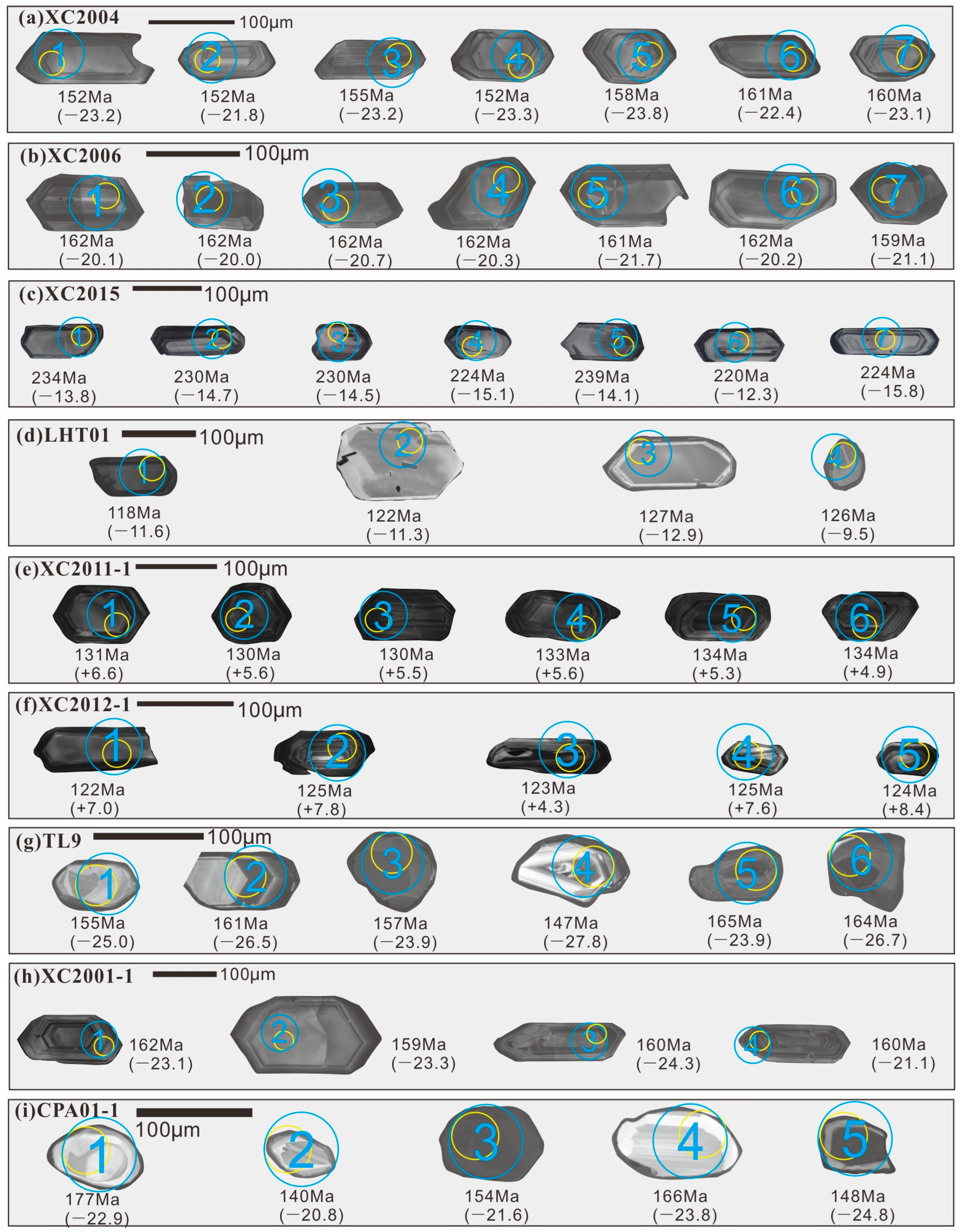
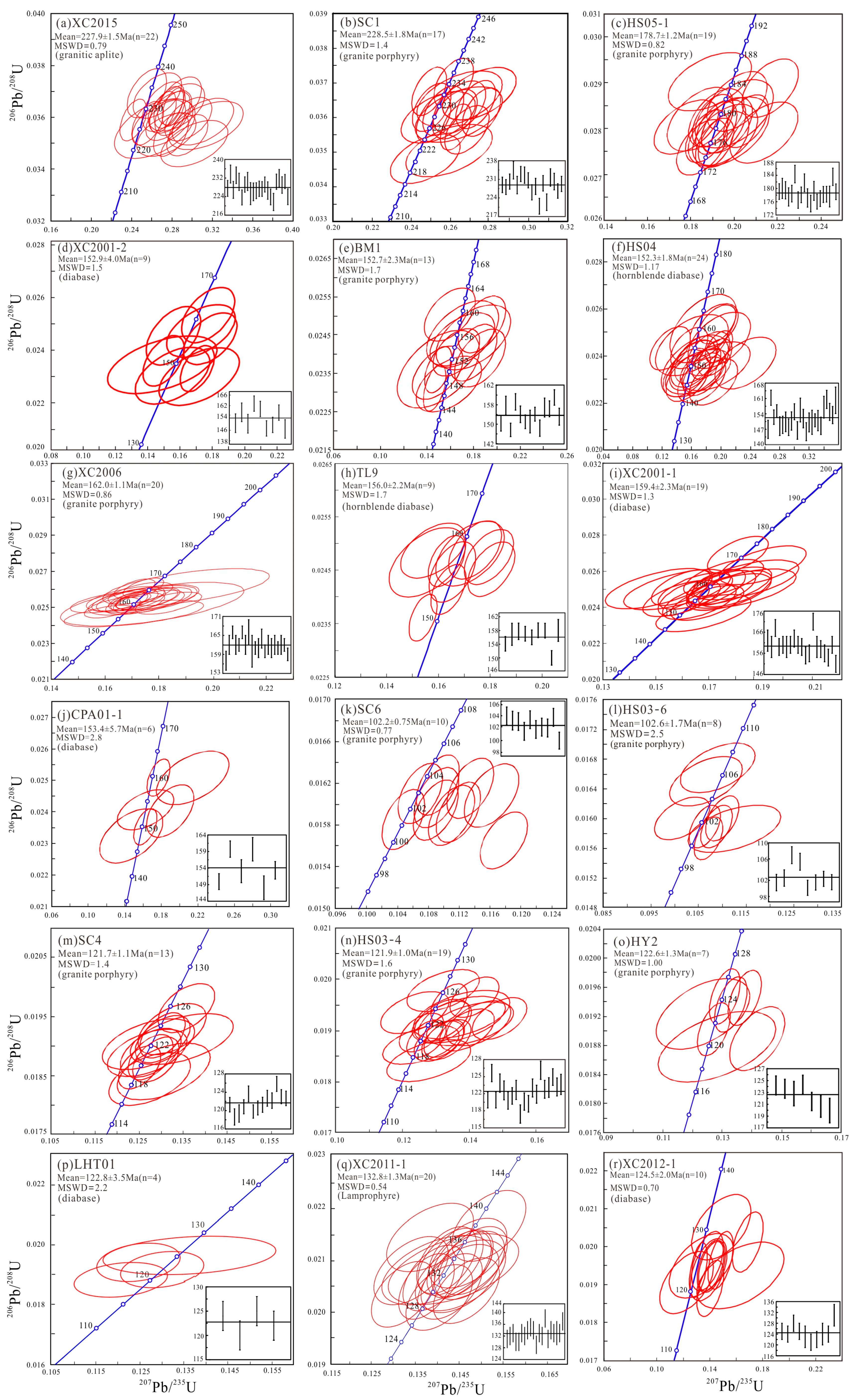
Cathodoluminescence (CL) imaging reveals that the zircons are predominantly elongate prismatic in habit. Well-developed oscillatory zoning is exhibited by the grains (Figure 4), consistent with a magmatic origin. Furthermore, all samples are characterized by elevated Th/U ratios (0.35–2.73), further corroborating their derivation from magmatic sources. Analytical results are presented in Supplementary Table S1, and representative cathodoluminescence (CL) images along with U–Pb concordia diagrams are shown in Figure 5.
Zircons from the Mesozoic felsic dykes in the Xingcheng area, western Liaoning, are predominantly subhedral to euhedral, short-prismatic crystals, with minor anhedral grains; some crystal margins are slightly resorbed. Cathodoluminescence (CL) images (Figure 4a–c) reveals well-developed oscillatory zoning, indicating a magmatic origin. On the 206Pb/238U-207Pb/235U concordia diagram, all analyses plot on or near the concordia, and the weighted mean 206Pb/238U ages (Table 1) represent the crystallization ages of the Mesozoic felsic dykes.
Zircons from the Mesozoic mafic dykes in the Xingcheng area are likewise dominated by subhedral to euhedral, short-prismatic forms, with a minor proportion of anhedral grains and occasional marginal resorption. CL images (Figure 4d–i) show that these zircons are characterized by broad, widely spaced zoning, suggesting a magmatic origin. All analyses plot on or near the concordia. Among them, amphibole diabase (e.g., TL9) contain no inherited zircons, and their CL images (Figure 4g) display features typical of mafic magmatic zircons. Diabase samples (e.g., LHT01) have captured some ancient zircons, yet the younger zircons in these rocks also exhibit CL characteristics of mafic zircons. The weighted mean 206Pb/238U ages (Table 1) therefore represent the crystallization ages of the Mesozoic mafic dykes.
Based on the existing geochronological results, the felsic dykes were emplaced during four distinct episodes: Late Triassic, Early Jurassic, Late Jurassic, and Early Cretaceous, whereas mafic dykes were emplaced during two episodes: the Late Jurassic and Early Cretaceous.

5. Geochemical Characteristics

5.1. Major and Trace Element Characteristics

5.1.1. Felsic Dykes

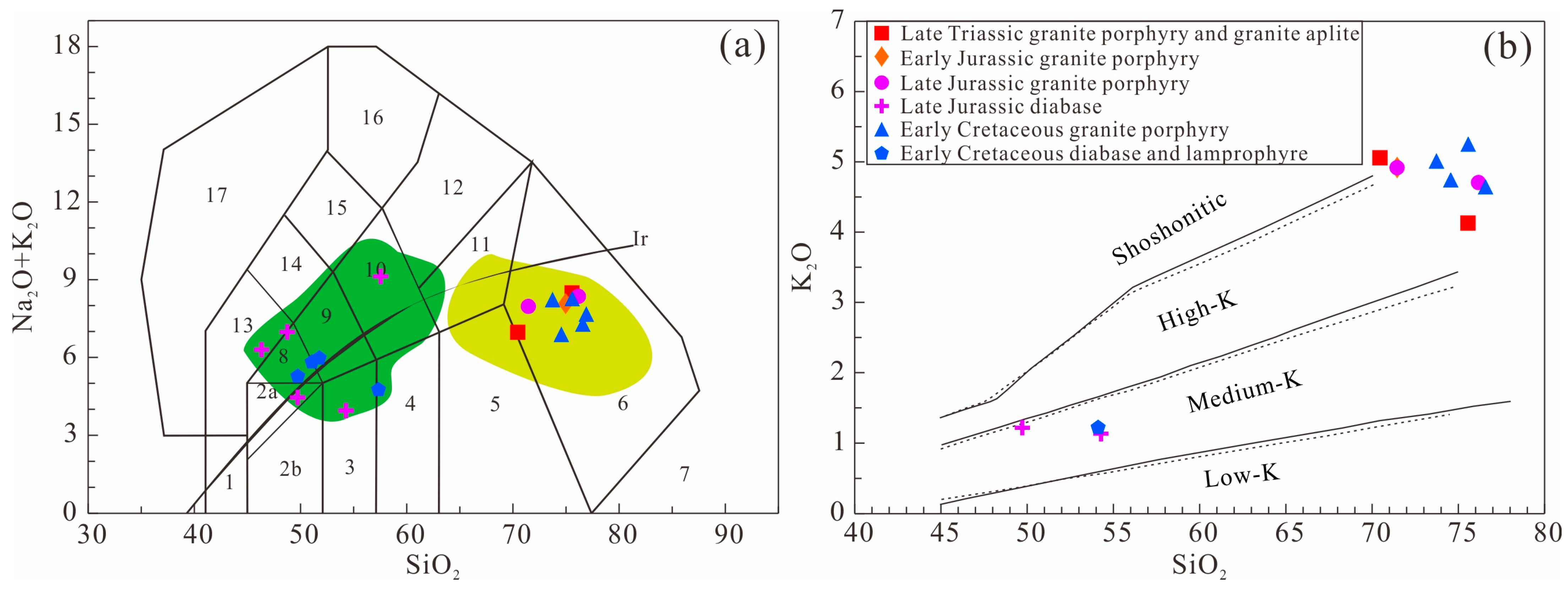
The felsic dykes in the Xingcheng area exhibit high SiO2 concentrations, ranging from 72.72 to 77.53 wt%. Total alkali (Na2O + K2O) contents vary between 7.01 and 8.53 wt% (Figure 5a), indicative of an alkali-rich affinity. Al2O3 concentrations are relatively high (12.62–15.35 wt%), whereas MgO (0.07–0.75 wt%), CaO (0.10–1.96 wt%), TFeO (0.94–2.17 wt%), and TiO2 (0.09–0.22 wt%) abundances are uniformly low. K2O/Na2O ratios range from 0.95 to 2.64. The samples yield A/CNK values of 1.03–1.44 and A/NK values of 1.13–1.72, demonstrating a peraluminous character, and they dominantly plot within the high-K calc-alkaline series (Figure 6b).
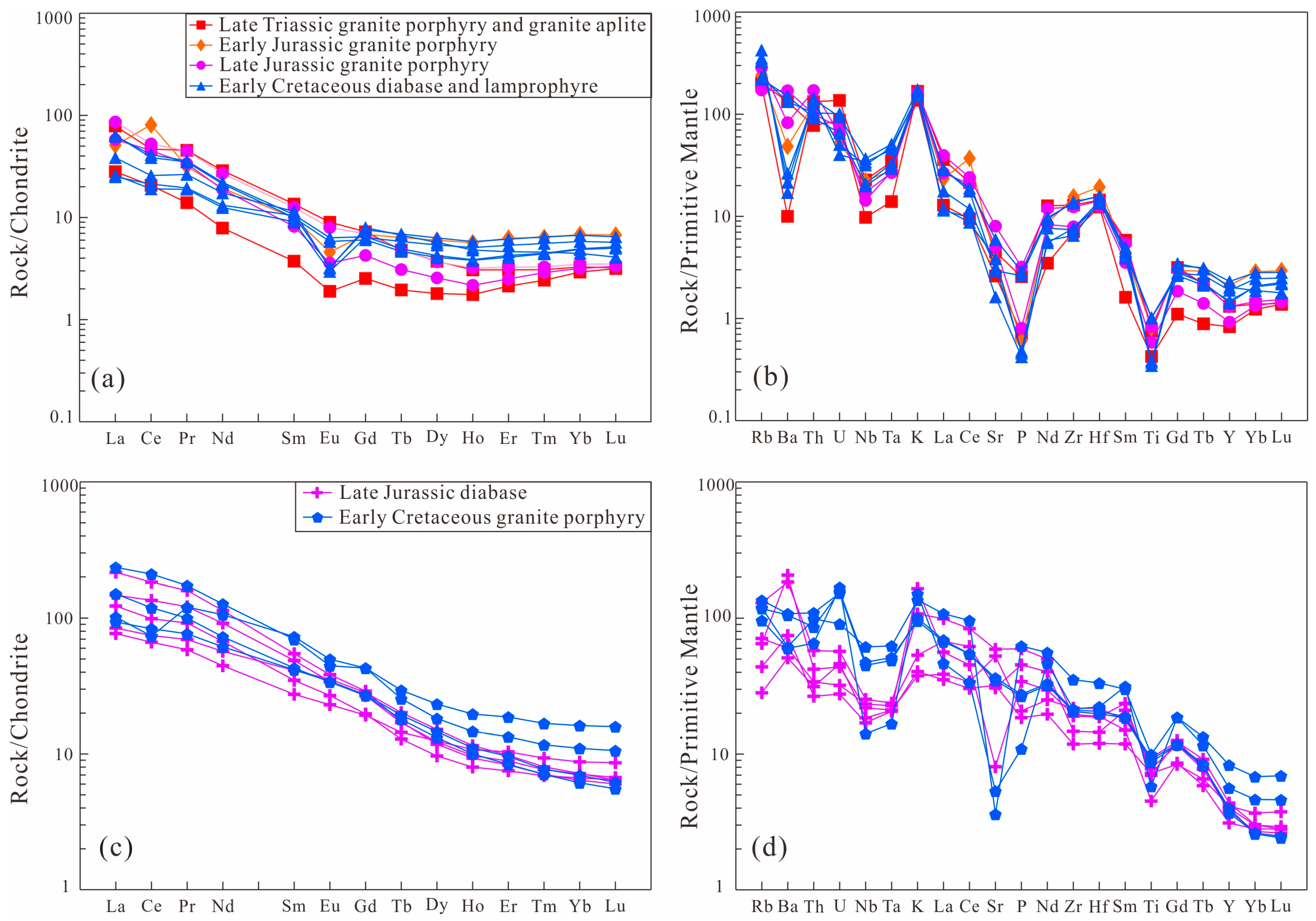
Total rare earth element (∑REE) concentrations span 35 to 106 ppm (average 70 ppm). Chondrite-normalized rare earth element (REE) (Figure 7a) patterns exhibit right-dipping profiles, signifying light REE (LREE) enrichment relative to heavy REE (HREE) depletion. Europium anomalies range from mildly to moderately negative, with δEu values spanning 0.33 to 0.86. Primitive mantle-normalized trace element diagrams (Figure 7b) further show pronounced enrichment in large-ion lithophile elements (LILEs; e.g., K, Rb) concomitant with depletion in high field-strength elements (HFSEs; e.g., Nb, Ta, Ti), as well as a relative deficit in P, collectively indicative of a crustal source signature.

5.1.2. Mafic Dykes

The mafic dykes of the Xingcheng area exhibit SiO2 contents between 50.12 and 60.84 wt%. Total alkali (Na2O + K2O) abundances range from 4 to 9 wt% (average 6.16 wt%), indicating an alkali-rich character. Al2O3 contents are moderate (13.00–18.20 wt%, average 15.54 wt%). K2O/Na2O ratios vary from 0.38 to 3.42. MgO concentrations are (1.84–8.13 wt%), CaO contents are (0.94–8.12 wt%), and TFeO abundances (6.79–10.12 wt%) reflect an iron-enriched signature. TiO2 contents are relatively low (1.00–2.30 wt%). The rocks belong to both the calc-alkaline and alkaline series (Figure 6).
Total REE concentrations (∑REE) range from 134 to 386 ppm (average 235 ppm). High (La/Yb)N ratios (3.74–24.56, average 11.59) point to an enriched lithospheric mantle source and imply a substantial melting depth. Chondrite-normalized rare earth element (REE) patterns exhibit consistent right-inclined slopes (Figure 7c), reflecting marked light REE (LREE) enrichment coupled with heavy REE (HREE) depletion. Europium anomalies are minimal (δEu = 0.79–1.02), precluding significant plagioclase fractionation. Primitive mantle-normalized multi-element spectra (Figure 7d) show pronounced large-ion lithophile element (LILE) enrichment (e.g., K, Ba) alongside strong depletions in high field-strength elements (HFSEs; e.g., Nb, Ta, Ti).

5.2. Zircon Hf Isotopic Compositions

Zircon εHf(t) values for the Late Triassic granite aplite sample XC2015 range from −15.8 to −12.3, corresponding to two-stage Hf model ages (TDM2) of 2258–2040 Ma. The Late Triassic granite porphyry sample SC1 yields εHf(t) values between −9.6 and −7.4, with TDM2 ages of 1866–1729 Ma. The Early Jurassic granite porphyry HS05-1 is characterized by εHf(t) values from −14.7 to −11.8 and TDM2 ages of 2152–1970 Ma. Late Jurassic granite porphyry samples XC2006 and BM1-1 exhibit εHf(t) values spanning −22.3 to −19.8, with corresponding TDM2 ages of 2613–2454 Ma. Early Cretaceous granite porphyry samples HY2, SC4, SC6, and HS03-4 display εHf(t) values ranging from −18.8 to −13.3 and TDM2 ages of 2371–2005 Ma.
For the Late Jurassic diabase samples XC2001-1, XC2001-2, HS04, and TL9, εHf(t) values vary between −27.8 and −20.2, yielding one-stage Hf model ages (TDM1) of 1914–1636 Ma. The Early Cretaceous diabase sample LHT01-1 from Longhuitou yields εHf(t) values between −12.9 to −9.5. In contrast, the Early Cretaceous diabase sample XC2012-1 from Jianchang exhibits εHf(t) values from +4.3 to +8.4, and the Early Cretaceous lamprophyre XC2011-1 from Xibao village displays εHf(t) values of +4.9 to +6.6.

6. Discussion

6.1. Petrogenetic Type and Source Characteristics of the Felsic Dykes

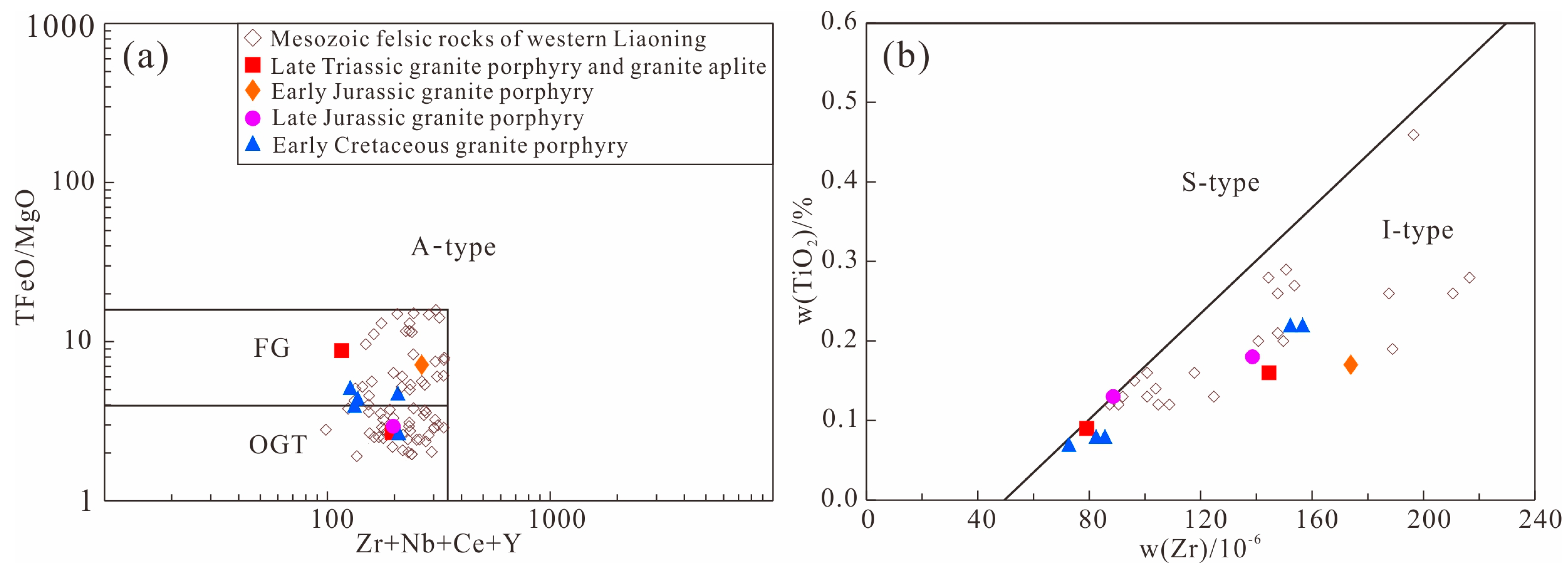
The felsic dykes in the Xingcheng area of western Liaoning are dominated by granite porphyry and granite aplite. They exhibit elevated SiO2 (72.72–77.53 wt%) and total alkali (K2O + Na2O = 7.01–8.53 wt%) and the rocks exhibit high K2O abundances and plot largely within the high-K calc-alkaline field. Total iron contents, expressed as TFe2O3, are relatively low (1.16–2.41 wt%), distinguishing them from the iron-enriched character typical of A-type granites. Furthermore, the whole-rock zircon saturation temperatures (TZr) for the felsic dykes range from 730 °C and 817 °C, which are lower than those characteristic of A-type granitic magmas 830 °C. In the (Zr + Nb + Ce + Y) versus (TFeO/MgO) discrimination diagram (Figure 8a; [30]), the samples plot within the fields of I- and S-type granites. The mafic mineral assemblage consists of biotite, with an absence of peraluminous index minerals typical of S-type granites, such as cordierite. In the Zr versus TiO2 discrimination diagram (Figure 8b), all sample points fall within the I-type granite field. The elevated aluminum saturation index values may be attributed to an Al-rich source composition, low-pressure, high-temperature melting conditions, or minor contributions from mantle-derived material. Taken together, these characteristics and collected data support a petrogenetic affinity with the I-type granites that constitute the Mesozoic magmatic suite of western Liaoning.
The felsic dykes are distinguished by high SiO2 and alkali abundances, coupled with low TFeO and MgO. Enrichment in large-ion lithophile elements (LILEs; e.g., K, Rb, Th) and light rare earth elements (LREEs; e.g., La, Ce) is observed, whereas high field-strength elements (HFSEs; e.g., Nb, Ti) are notably depleted. Such signatures are consistent with those of synchronous magmatic rocks in western Liaoning and collectively imply a crustal source affinity. The average Nb/Ta ratio of the felsic dykes is 11.77, which is lower than the primitive mantle value of 17.5 and more closely approximates the average crustal ratio of 11. Similarly, the average Nd/Th ratio is 1.20, significantly lower than the primitive mantle value of 15 and akin to the average crustal value of 3. These trace element ratios further support derivation through partial melting of crustal rocks.
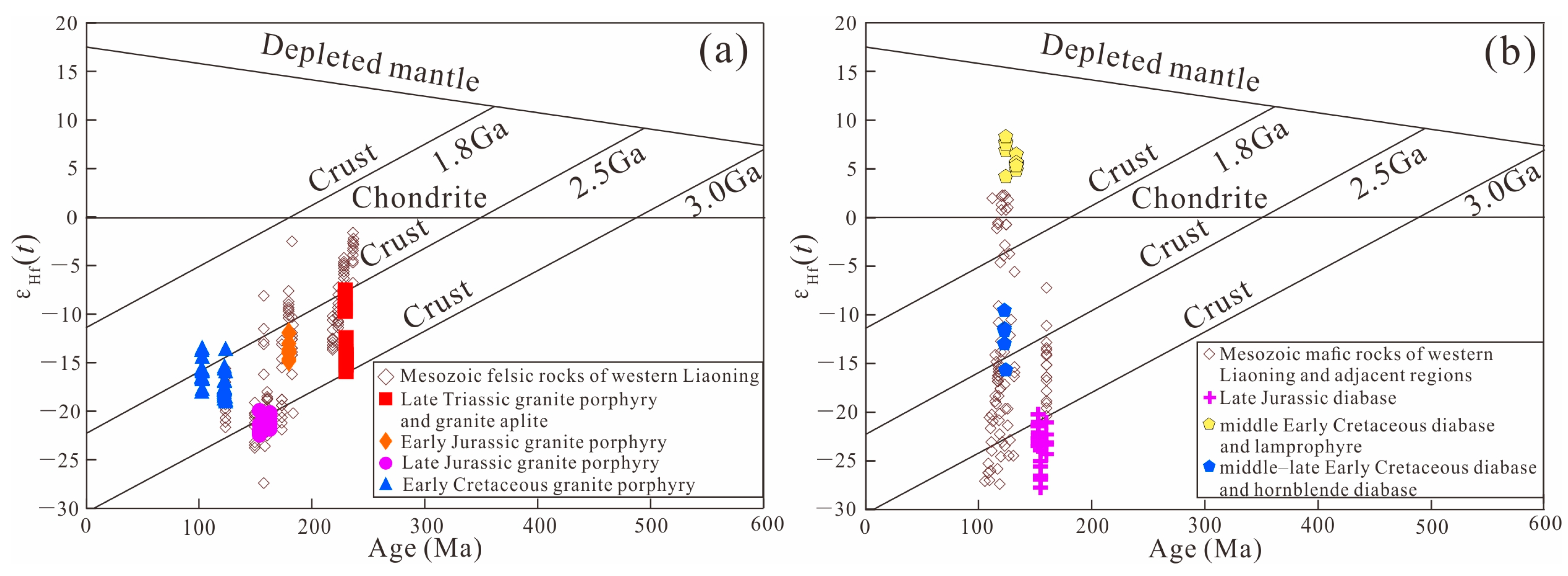
Additionally, the felsic dykes yield an average zircon εHf(t) value of −16.6. In the εHf(t) versus age (Ma) diagram (Figure 9a), previously published data for Mesozoic felsic rocks in western Liaoning plot in a region broadly coincident with the dyke samples analyzed in this study. This overlap implies a common source region for the felsic dykes and the regional felsic magmatism, both derived from partial melting of ancient crust. The data points plot far from the depleted mantle Hf evolution line, and the two-stage zircon Hf model ages (TDM2 = 2613–1729 Ma) suggest that the Late Triassic to Early Cretaceous felsic magmas in the Xingcheng area of western Liaoning were generated by partial melting of Paleoproterozoic to Neoarchean crustal material.

6.2. Source Characteristics of the Mafic Dykes
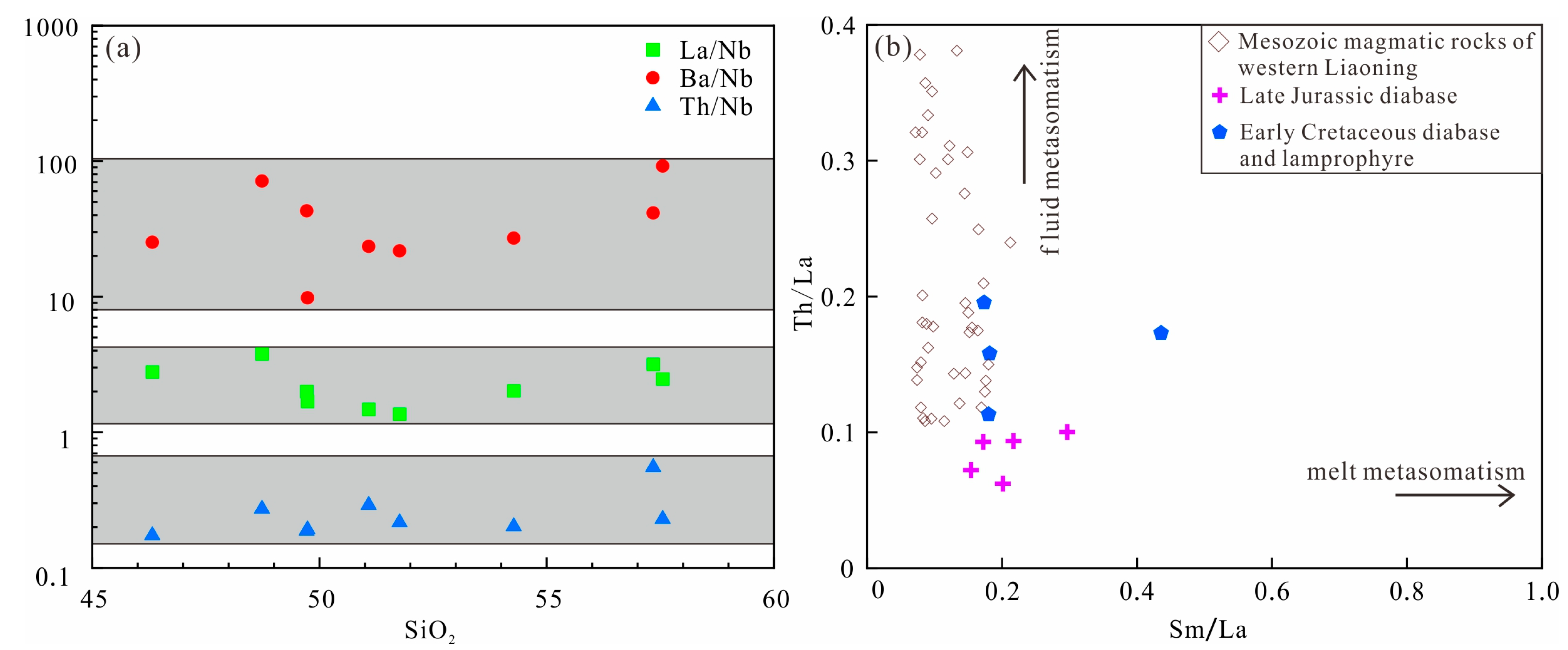
The average Sr content of the mafic dykes (616 ppm) is substantially higher than the average crustal value of the North China Craton (Sr = 286 ppm; [33]). Crustal contamination typically elevates Lu/Yb ratios (0.16–0.18; [29]); however, the mafic dykes exhibit relatively low Lu/Yb ratios (0.14–0.15). Ratios of La/Nb, Ba/Nb, and Th/Nb serve as effective tracers of crustal assimilation. These ratios in the mafic dykes are remarkably uniform and display no systematic variation with SiO2 content (Figure 10b). However, abundant ancient xenocrystic zircons occur in the samples, these observations indicate that crustal contamination has exerted a certain degree of modification on the major-element composition of the mantle-derived magmas.
The Late Jurassic diabase samples are characterized by SiO2 contents of 50.12–59.39 wt%, elevated MgO (4.75–6.60 wt%), and high Na2O (2.89–5.07 wt%), indicative of a mantle source affinity [34]. Zr/Hf ratios range from 35.82 to 36.84 (average 36.45), and Ba/Rb ratios vary from 9.32 to 19.85 (average 15.88). Both values approximate primitive mantle estimates of 36.27 and 11, respectively [35]. These geochemical signatures further support a mantle-derived origin. Large-ion lithophile elements (e.g., K, Rb) are elevated, whereas high field-strength elements (e.g., Nb, Ta, Ti) are depleted. Zircon εHf(t) values ranging from −20.2 to −27.8 provide evidence that the Late Jurassic diabase originated via partial melting of an enriched lithospheric mantle source.
Early Cretaceous mafic dykes exhibit Nb/Ta ratios of 14.69–18.09, consistent with mantle-derived magmas (17.5), implying a mantle origin. The enrichment in LREEs and LILEs, coupled with depletion in Nb, Ta, and Ti, contrasts with the depleted LREE and LILE signatures typical of asthenospheric mantle. Consequently, the lithospheric mantle is inferred to be the dominant magma source region for this episode.
The Jianchang diabase and Xibao lamprophyre (Early Cretaceous) yield positive εHf(t) values (+4.4 to +8.4), indicating a dominant source of ancient enriched lithospheric mantle within the North China Craton. These positive εHf(t) values correspond to ages of 132.8–123.5 Ma, coinciding with positive εHf(t) signatures recorded in coeval mafic rocks across western Liaoning and adjacent regions. This temporal correlation suggests a shared source characteristic. During the Early Cretaceous (ca. 132.8–123.5 Ma), rollback of the subducting Paleo-Pacific Plate may have triggered lithospheric delamination, resulting in a peak of magmatic activity and a transition to a regional extensional regime. Asthenospheric upwelling associated with this event may have depleted mantle components into the source region. In contrast, the Longhuitou diabase (late Early Cretaceous, 122.3 Ma) exhibits negative εHf(t) values (−12.9 to −9.5), indicating waning magmatic activity and a magma source dominated by enriched lithospheric mantle with only limited asthenospheric input.
Extensive research has established that fluids dehydrated from subducting slabs selectively transport LILEs (e.g., Ba, Rb) into the mantle wedge, while HFSEs (e.g., Nb, Zr) are retained in residual phases. Partial melting of metasomatized mantle therefore produces magmas with distinct enrichment–depletion patterns [36,37]. Trace element ratios such as elevated Ba/La and Rb/Y, coupled with low Nb/Y, are effective indicators of subduction-related fluid contributions [38]. The Early Cretaceous mafic dykes in the Xingcheng area display Sm/La = 0.17–0.43, Th/La = 0.06–0.19, (Figure 10b), collectively suggesting that the mantle source was metasomatized by subduction-derived fluids.
In summary, the Early Cretaceous mafic magmas in the study area originated largely from enriched lithospheric mantle that had undergone metasomatic modification by subducted oceanic slabs and a perceptible influence of crustal contamination. Magmatic activity was particularly vigorous between ca. 132.8 and 123.5 Ma, during which localized intense extension facilitated the incorporation of asthenospheric depleted mantle components into the source region.
Figure 10. Diagrams of basic dyke rocks in the Xingcheng area ((a) modified after [39], (b) modified after [40]): La/Nb. Ba/Nb. Th/Nb- SiO2 (a), Sm/La-Th/La (b). The published data are derived from references [17,24,25,26].
Minerals 16 00586 g010

6.3. Geological Implications

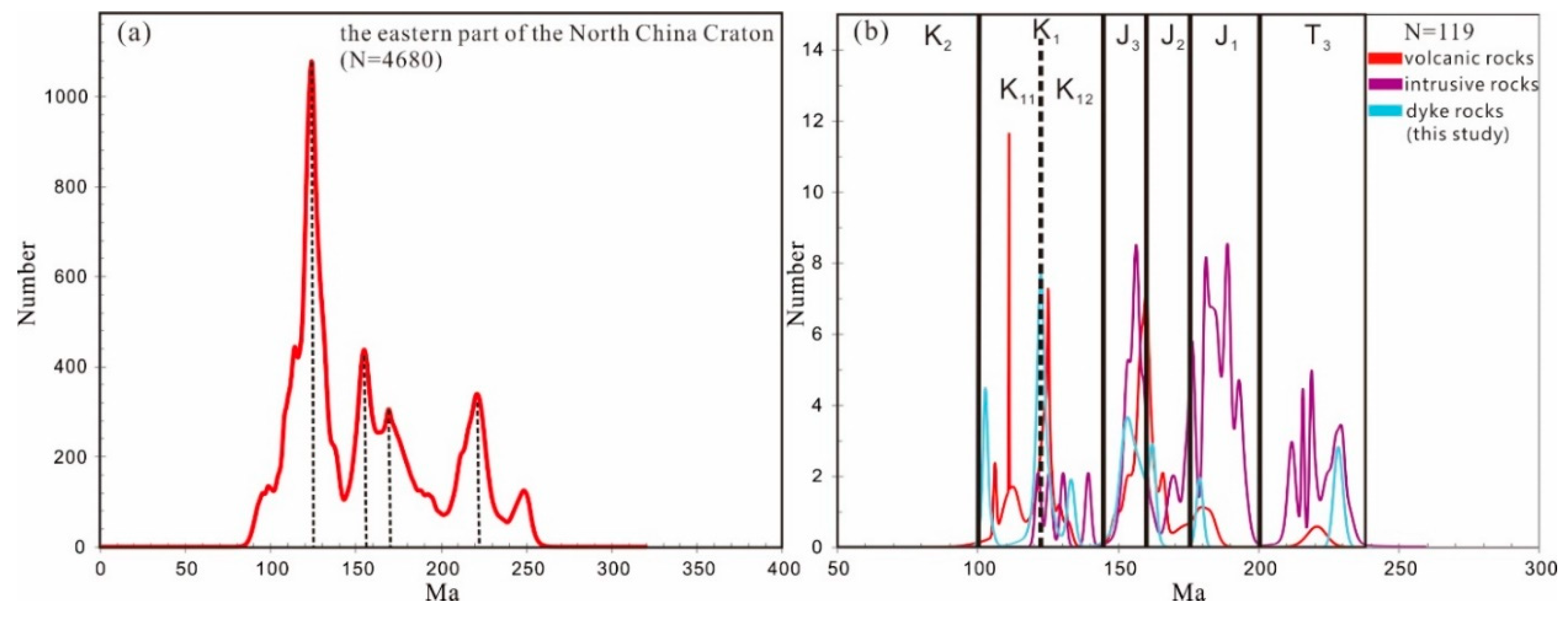
A frequency histogram of published ages for Mesozoic magmatic rocks in the eastern North China Craton has been compiled for comparison (Figure 11a). Geochronological results from the Xingcheng area demonstrate that Mesozoic dyke emplacement occurred in four discrete episodes. Late Triassic dykes (229–228Ma) consist predominantly of granite porphyry and granite aplite. Early Jurassic dykes (ca. 178 Ma) are exclusively represented by granite porphyry. Both Late Jurassic (162–152Ma) and Early Cretaceous (132–102Ma) dykes are characterized by bimodal assemblages comprising granite porphyry and diabase, with lamprophyre additionally appearing during the Early Cretaceous. By integrating the isotopic ages obtained from the dykes in this study with previously published geochronological data for Mesozoic magmatic rocks from the western Liaoning (totaling 119 age determinations), a Mesozoic age frequency diagram for the western Liaoning has been constructed (Figure 11b). These age distributions are used to constrain the tectonic settings corresponding to distinct pulses of Mesozoic magmatic activity and to elucidate the Mesozoic magmato-tectonic evolution of both the eastern North China Craton and the Xingcheng area.
(1)
Tectonic Setting of Late Triassic Dyke Emplacement
An approximately east–west-trending Triassic alkaline igneous belt is recognized along the northern margin of the North China Craton, accompanied by coeval Late Triassic mafic magmatism. These occurrences demonstrate that the northern NCC was subject to an extensional tectonic regime during the Late Triassic. Furthermore, a second Triassic alkaline belt and associated mafic magmatism are identified along the eastern margin of the NCC. The geochemical and isotopic characteristics of these alkaline rocks and mafic dykes resemble those of post-orogenic alkaline suites, similarly indicating an extensional setting along the eastern NCC [43].
Regionally documented Late Triassic alkaline belts and intrusive rocks, together with the Late Triassic dykes reported in this study, display consistent geochemical signatures characterized by LILE enrichment, whereas high field-strength elements (HFSEs) are depleted, indicative of a crustal source affinity. Regional Sr–Nd–Hf isotopic data further suggest that the eastern NCC margin received contributions not only from crustal materials but also from enriched lithospheric mantle and asthenospheric components. During this period, following the collision between the North China Plate and the South Mongolian composite terranes along the Solonker suture zone, the North China Craton (NCC) occupied a post-orogenic tectonic setting. Lithospheric delamination is considered the likely mechanism for asthenospheric upwelling in this extensional orogenic setting [44].
It is widely accepted that the Paleo-Asian Ocean finally closed along the Xilamulun–Changchun suture during the latest Permian to earliest Triassic, resulting in collision and amalgamation of the North China and Siberian cratons [45,46,47,48,49]. Mu Baolei and Yan Guohan [50,51] proposed that the east–west-trending Late Triassic alkaline belt originated under extensional tectonic conditions subsequent to this collisional amalgamation. Additionally, Late Triassic A-type granites in central and eastern Jilin Province, together with coeval mafic–ultramafic intrusions at Hongqiling and Piaohechuan in the eastern segment of the northern NCC margin, constitute a bimodal igneous assemblage [52]. Both the Late Triassic alkaline igneous suites and bimodal associations attest to an extensional regime along the northern NCC margin during the Late Triassic. The Triassic east–west-trending structures in western Liaoning are attributed to the influence of the Paleo-Asian Ocean tectonic domain [53]. Following the terminal closure of the Paleo-Asian Ocean at the Solonker suture zone before the Late Triassic (Late Permian to Middle Triassic), the Xingcheng area, situated on the northern NCC margin, experienced post-collisional compressional–extensional overprinting. This period marks the transition from the Paleo-Asian Ocean tectonic regime to the circum-Pacific domain, accompanied by vigorous cratonic reactivation.
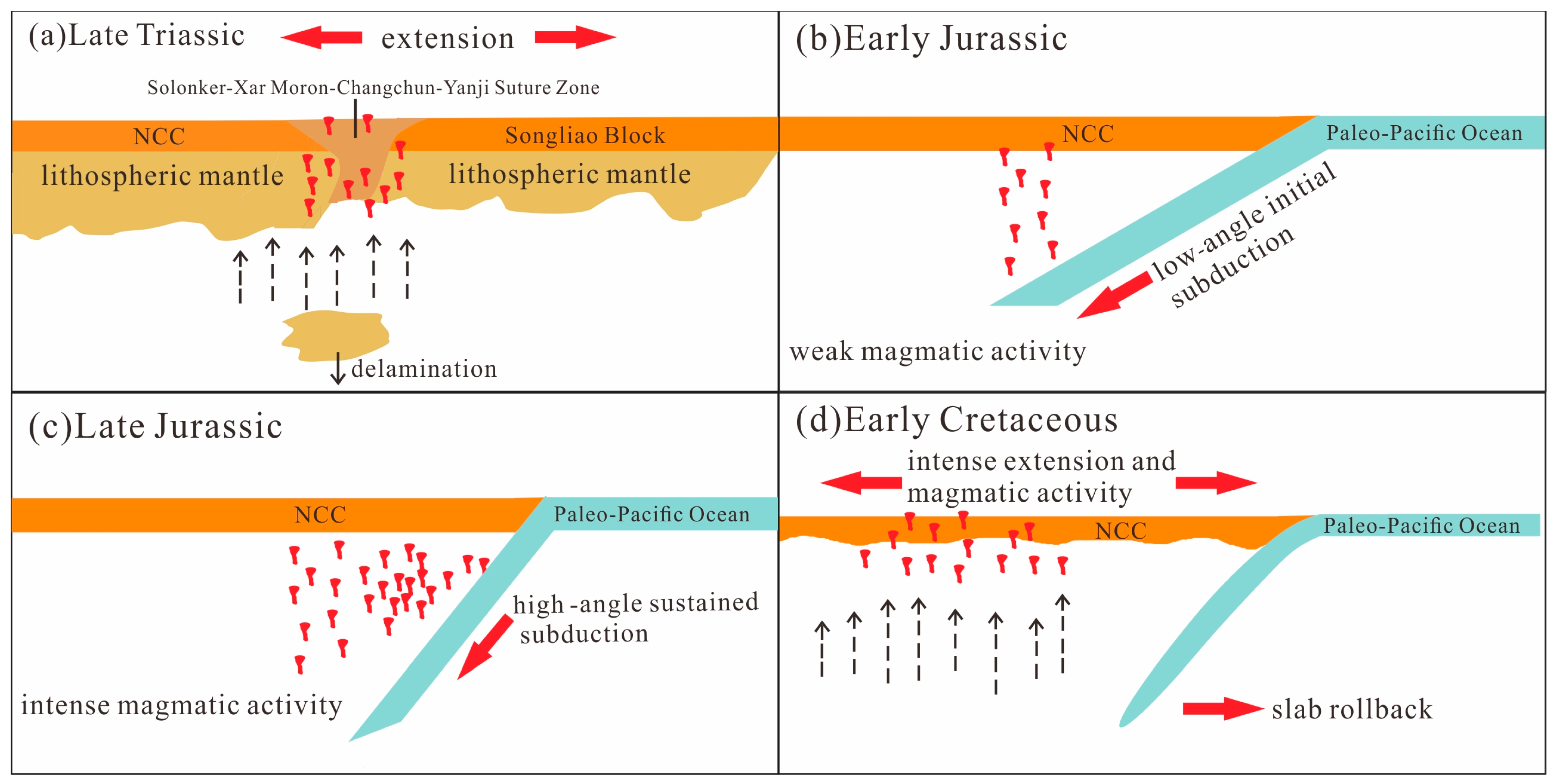
In summary, during the Late Triassic, subduction and ultimate closure of the Paleo-Asian Ocean exerted a profound influence on the western Liaoning region, which induced lithospheric delamination and asthenospheric upwelling. The area consequently evolved within a post-collisional extensional setting following the amalgamation of the North China Craton and the Central Asian Orogenic Belt. The formation of Late Triassic igneous rocks across the region is linked to this extensional environment following final closure of the Paleo-Asian Ocean, consistent with the overall tectonic framework of the eastern North China Craton (Figure 12a).
(2)
Tectonic Setting of Early Jurassic Dyke Emplacement
The Paleo-Pacific Ocean descended from Panthalassa, the global ocean that encircled Pangea from the Late Paleozoic through the Early Mesozoic. The closure of Paleo-Tethyan oceanic basins, combined with the breakup of Pangea, drove the sequential assembly of the Paleo-Pacific Plate—alongside the nascent Atlantic, Arctic, and Indian Ocean plates. Guo [54] proposed that the Paleo-Pacific (or Izanagi) Plate commenced its descent beneath the northeastern Asian continental margin in the Early Jurassic. With the subduction zone migrating eastward over time and incorporating microcontinental fragments or terranes, thereby producing an archipelago-type tectonic configuration.
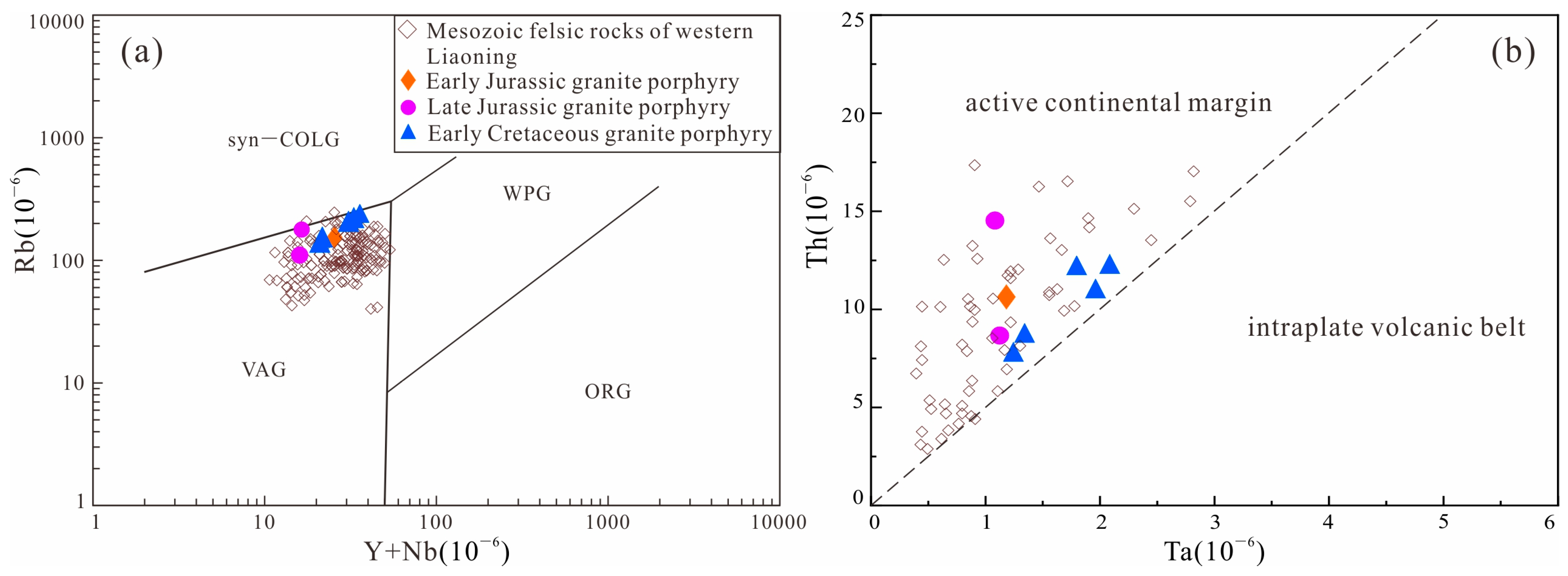
During the Early Jurassic, the northeastern margin of the North China Craton constituted an active continental margin. Evidence supporting Paleo-Pacific Plate subduction beneath Eurasia at this time includes: (1) the belt-parallel distribution of Early Jurassic igneous rocks along the northeastern Asian continental margin; (2) the identification of Early Jurassic calc-alkaline igneous rocks along the eastern margin of the Jiamusi Massif [55]; and (3) systematic landward variations in K2O content of Early Jurassic igneous rocks [54,55,56,57]. Early Jurassic dykes in the Xingcheng area consist predominantly of granite porphyry and exhibit I-type, weakly peraluminous, high-K calc-alkaline signature, characteristic of granitoids produced in active continental margin settings. On tectonic discrimination diagrams, the samples project into the volcanic arc and active continental margin fields—specifically, in the (Y + Nb) versus Rb plot (Figure 13a) and the Th versus Ta plot (Figure 13b). Collectively, these geochemical attributes support an origin within an active margin environment.
The tectonic discrimination diagrams thus indicate that the Xingcheng Early Jurassic granite porphyry possesses a volcanic-arc granite affinity. Such geochemical signatures implicate Early Jurassic subduction of the Paleo-Pacific Plate beneath the Asian continental margin in the genesis of this rock. The marked depletion in HFSEs (e.g., Nb, Ta, Ti) further corroborates a subduction-related tectonic setting [58,59].
Collectively, these observations indicate that Early Jurassic magmatism in the Xingcheng area records an active continental margin setting, coincident with the onset of Paleo-Pacific Plate subduction beneath Eurasia (Figure 12b).
(3)
Tectonic Setting of Late Jurassic Dyke Emplacement
Late Jurassic dykes in the Xingcheng area are dominated by granite porphyry and diabase. They exhibit I-type, weakly peraluminous, high-K calc-alkaline affinities. The characteristics of Late Jurassic granitic rocks exhibit a geochemical affinity with granitoids typical of active continental margins. Their trace-element inventory is distinguished by enrichment in large-ion lithophile elements (LILEs, e.g., K, Rb) and conspicuous depletion in high field-strength elements (HFSEs, e.g., Nb, Ta, Ti), features consistent with a subduction-related origin and akin to those of the Early Jurassic phase.
Cui [17] noted that although Early Jurassic granitic rocks in western Liaoning possess negative εHf(t) values and ancient Hf model ages—indicating derivation from ancient crustal sources—contemporaneous regional structures indicative of significant intra-crustal ductile deformation, such as metamorphic core complexes, have not been documented. This implies that while some degree of lithospheric thinning may have occurred beneath the eastern North China Craton during the Early Jurassic, unambiguous cratonic destruction had not yet manifested. In contrast, Late Jurassic granitic rocks not only exhibit negative εHf(t) and low εNd(t) values [60,61,62,63], but are also spatially associated with extensional deformation features such as the Yiwulüshan metamorphic core complex and granitic mylonite belts in western Liaoning [64]. These observations indicate that lithospheric thinning was more pronounced and cratonic destruction had commenced by the Late Jurassic relative to the Early Jurassic.
Previous studies have demonstrated that the North China Craton experienced an intense tectono-thermal event during the Mesozoic, characterized by lithospheric thinning and large-scale magmatic activity in its eastern region [65,66]. Subduction of the Paleo-Pacific Plate beneath the North China Craton triggered vigorous magmatism along the eastern segment of the northern NCC margin, generating voluminous granitic rocks. Li [64] proposed that sustained Paleo-Pacific subduction during the Late Jurassic induced crustal-scale tectonic deformation in areas such as Yiwulüshan. Furthermore, Sun and Yang [67] documented widespread Late Jurassic magmatic rocks across the Liaodong Peninsula, Jiaodong Peninsula, and the Yanshan–western Liaoning region. Age frequency histograms for Mesozoic magmatic rocks in western Liaoning and the eastern NCC (Figure 11) reveal markedly higher magmatic activity during the Late Jurassic compared to the Early Jurassic. The Xingcheng area of western Liaoning thus records a marked intensification of Paleo-Pacific Plate subduction from the Early Jurassic into the Late Jurassic. The Early Jurassic volcanic rocks in western Liaoning, exemplified by the Xinglonggou Formation, exhibit limited distribution and relatively thin thickness, and consist predominantly of a basic–intermediate volcanic assemblage. In marked contrast, the Late Jurassic volcanic rocks of the Tiaojishan and Lanqi formations are regionally extensive and constitute a voluminous intermediate–felsic volcanic sequence, commonly spatially associated with regional thrust-nappe structures. Studies of the Early Mesozoic tectonic deformation in western Liaoning have demonstrated that the regional thrust-nappe structures are angularly unconformably overlain by the Late Jurassic Tiaojishan a0nd Lanqi volcanic rocks. This critical geological relationship indicates that an intense phase of compressional deformation took place prior to the Late Jurassic volcanic eruptions, likely triggered by intensified subduction of the Pacific Plate. Collectively, the Xingcheng area of western Liaoning records a marked intensification of Paleo-Pacific Plate subduction from the Early Jurassic into the Late Jurassic.
Integrated analysis suggests that Late Jurassic magmatism in the Xingcheng area occurred within an active continental margin setting under intensified Paleo-Pacific subduction (Figure 12c).
(4)
Tectonic Setting of Early Cretaceous Dyke Emplacement
During the Early Cretaceous, the Paleo-Pacific oceanic lithosphere subducted beneath the eastern North China Craton. Lithospheric delamination induced a series of intermediate–mafic magmatic pulses. The rollback of the subducting Paleo-Pacific Plate resulted in extensional thinning and facilitated the emplacement of multiple basalt dyke swarms. Magmatic sources for the Xingcheng basaltic rocks record fractional crystallization of ilmenite and rutile, along with assimilation of minor crustal material. The Early Cretaceous diabase and lamprophyre in the Xingcheng area are depleted in HFSEs (e.g., Nb, Ta, Ti) and enriched in LILEs (e.g., K, Ba), features characteristic of arc-type magmas [42]. The Xingcheng diabase and lamprophyre are metaluminous and belong to both calc-alkaline and alkaline series. Lamprophyre sample XC2011-1 and diabase sample XC2012-1 yield positive εHf(t) values (+4.4 to +8.4), which are attributed to Paleo-Pacific Plate rollback that triggered lithospheric delamination. This process drove magmatic activity to a peak, shifted the regional tectonic regime to extension, and promoted asthenospheric upwelling with concomitant input of depleted mantle components. In contrast, the Early Cretaceous diabase sample LHT01-1 exhibits negative εHf(t) values (−12.9 to −9.5). The shift to negative εHf(t) indicates waning magmatic activity after the Middle–Late Early Cretaceous (122.3Ma), with magmas predominantly sourced from enriched lithospheric mantle, albeit with minor depleted mantle contributions.
Previous investigations have documented intense Early Cretaceous tectono-magmatic activity across the eastern North China Craton, reflecting strong regional extension. Examples include the Early Cretaceous sinistral strike-slip ductile shear zone in the Taili area of western Liaoning, formed under extensional tectonism [18], metamorphic core complexes such as the Yiwulüshan complex [68], and core complexes in western and southern Liaoning [64]. These structures consistently trend NE or NNE, and Early Cretaceous extensional fault-bounded basins also exhibit an NNE orientation subparallel to the Pacific subduction zone [69]. Felsic–mafic magmatic associations include A-type granites emplaced between 130 and 120 Ma on the Liaodong Peninsula and bimodal magmatic suites in southern Liaoning [67,70]. Widespread Early Cretaceous intrusive rocks (140–110Ma) and volcanic rocks (135–122Ma) are exposed throughout western Liaoning [71]. These felsic–mafic igneous rocks, the presence of metamorphic core complexes and ductile shear zones in the Xingcheng area of western Liaoning provide compelling evidence for a strongly extensional tectonic regime during the Early Cretaceous.
As discussed above, the Xingcheng area experienced Paleo-Pacific Plate subduction during the Jurassic, accompanied by widespread and intense magmatism. The positive εHf(t) values (+4.4 to +8.4) obtained for Early Cretaceous lamprophyres and diabase (132.8–123.5Ma) mirror those of Cretaceous mafic rocks in the adjacent Jiaobei terrane (εHf(t) = −5.9 to +7.8), demonstrating that intense extension in the eastern NCC facilitated the addition of depleted mantle material. Mesozoic magmatic age frequency histograms for western Liaoning and the eastern NCC (Figure 11) reveal that magmatic activity peaked at ca. 125 Ma, corresponding to the climax of cratonic destruction [72]. Furthermore, geophysical evidence from mantle tomography beneath the NCC reveals high-velocity anomalies in the mantle transition zone or lower mantle that are spatially and temporally linked to Early Cretaceous Paleo-Pacific subduction [73,74]. This further substantiates a causal relationship between the westward subduction of the Paleo-Pacific Plate and NCC destruction, with the principal contribution occurring during the Early Cretaceous.
Integrated analysis indicates that the Early Cretaceous dykes in the Xingcheng area of western Liaoning were emplaced in a regional extensional setting driven by rollback of the subducting Paleo-Pacific Plate. Extension peaked at ca. 125 Ma, coinciding with the climax of North China Craton destruction. Intense extension also triggered asthenospheric upwelling and the addition of depleted mantle components (Figure 12d).
Figure 13. Discrimination diagrams of Y+Nb-Rb (a) and Ta-Th (b) ((a,b) modified after [75]) for Early Jurassic–Early Cretaceous dykes in the Xingcheng area. The published data are derived from references [17,24,25,26].
Minerals 16 00586 g013

7. Conclusions

(1)
The felsic dykes (granite aplite and granite porphyry) and mafic dykes (diabase and lamprophyre) in the Xingcheng area were emplaced at 228.5–227.9 Ma, 178.7 ± 1.8 Ma, 162.0–152.3 Ma, and 132.8–102.2 Ma. Magmatic activity in the region is thus divisible into four distinct episodes: Late Triassic, Early Jurassic, Late Jurassic, and Early Cretaceous.
(2)
The felsic dykes are classified as I-type granites and were derived through partial melting of Paleoproterozoic to Neoarchean crustal material. The mafic dykes originated from an enriched lithospheric mantle source, with a contribution of depleted mantle components during the Early Cretaceous.
(3)
The Late Triassic dykes in the Xingcheng area occurred within a post-collisional extensional setting following the amalgamation of the North China Craton and the Central Asian Orogenic Belt. The Early Jurassic dykes were emplaced in an initial subduction setting along an active continental margin. The Late Jurassic dykes formed within an active continental margin environment characterized by intensified magmatism associated with Paleo-Pacific Plate subduction. The Early Cretaceous dykes were emplaced in a regional extensional regime triggered by the rollback of the subducting Paleo-Pacific Plate. Extension peaked at ca. 125 Ma, corresponding to the climax of the North China Craton destruction. This intense extension facilitated the addition of asthenospheric depleted mantle components to the magmatic source region.

Supplementary Materials

The following supporting information can be downloaded at: https://www.mdpi.com/article/10.3390/min16060586/s1, Table S1: Zircon U-Pb Data; Table S2: Major and Trace Element; Table S3: Zircon Hf isotopic analysis.

Author Contributions

Investigation, D.S., J.G., W.L. (Weimin Li)., C.Z. and Z.T.; Formal analysis, Z.T., W.L. (Wenqing Li). and Y.H.; Software, Z.T. and W.L. (Wenqing Li).; Writing—Original Draft, Z.T. and D.S.; Writing—review & editing, D.S. and J.G.; Visualization, Z.T.; Funding Acquisition, D.S. and J.G. All authors have read and agreed to the published version of the manuscript.

Funding

This work was supported by the Geological Ideological and Political Social Practice of the National First-Class Undergraduate Course and the Self-Determined Foundation of the Key Laboratory of Mineral Resources Evaluation in Northeast Asia, Ministry of Land and Resources of China [Grant No. DBY-ZZ-18-10].

Data Availability Statement

The original contributions presented in this study are included in the article/supplementary material. Further inquiries can be directed to the corresponding author.

Acknowledgments

We sincerely appreciate the reviewers for dedicating their valuable time to thoroughly review our manuscript. Their insightful comments and detailed suggestions have significantly contributed to enhancing the quality of our paper. We thank Li Tian, Duo Zhang, and Chao Sun for participating in part of the zircon U–Pb dating experiments.

Conflicts of Interest

The authors declare no conflicts of interest.

References

  1. Wu, F.Y.; Yang, J.H.; Simon, S.A. Geochronology, petrogenesis and tectonic implications of Jurassic granites in the Liaodong Peninsula, NE China. Chem. Geol. 2005, 221, 127–156. [Google Scholar] [CrossRef]
  2. Wu, F.Y.; Lin, J.Q.; Wilde, S.A. Nature and significance of the Early Cretaceous giant igneous event in eastern China. Earth Planet. Sci. Lett. 2005, 233, 103–119. [Google Scholar] [CrossRef]
  3. Yang, J.H.; Wu, F.Y.; Wilde, S.A. A review of the geodynamic setting of large-scale Late Mesozoic gold mineralization in the North China Craton: An association with lithospheric thinning. Ore Geol. Rev. 2003, 23, 125–152. [Google Scholar] [CrossRef]
  4. Meng, Q. What drove late Mesozoic extension of the northern China–Mongolia tract? Tectonophysics 2003, 369, 155–174. [Google Scholar] [CrossRef]
  5. Zhang, Y.; Dong, S. Mesozoic tectonic evolution of the Tan-Lu fault zone: Progress and new understanding. Geol. Bull. China 2008, 27, 1371–1390, (In Chinese with English abstract). [Google Scholar]
  6. Liang, C.Y.; Liu, Y.J.; Li, W.M. Ductile deformation and rock rheological characteristics from southern Yiwulüshan metamorphic core complex. Acta Petrol. Sin. 2016, 32, 2656–2676. [Google Scholar]
  7. Zhao, Z.; Xu, W.; Dong, G. Granitic magmatism associated with gold mineralization: Evidence from the Baizhangzi gold deposit, in the northern North China Craton. Geol. Mag. 2023, 160, 1211–1227. [Google Scholar] [CrossRef]
  8. Huang, H.; Liu, Y.; Zheng, J. Discussion on ore-forming fluid characteristics and genesis of gold deposits in western Liaoning. China Min. Mag. 2025, 34, 608–612, (In Chinese with English abstract). [Google Scholar]
  9. Zhu, R.; Zheng, T. Destruction mechanism of the North China Craton and Paleoproterozoic plate tectonic system. Chin. Sci. Bull. 2009, 54, 1950–1961, (In Chinese with English abstract). [Google Scholar] [CrossRef]
  10. Zhao, G.C.; Sun, M.; Wilde, S.A. Late Archean to Paleoproterozoic evolution of the North China Craton: Key issues revisited. Precambrian Res. 2005, 136, 177–202. [Google Scholar] [CrossRef]
  11. Feng, Q.; Gao, M.; Fu, C.; Li, S.; Li, Y.; Gao, J.; Ma, M.; Wang, Z.; Zhu, Y.; Wu, B.; et al. Phlogopite 40Ar/39Ar Geochronology for Guodian Skarn Fe Deposit in Qihe–Yucheng District, Luxi Block, North China Craton: A Link between Craton Destruction and Fe Mineralization. Minerals 2024, 14, 690. [Google Scholar] [CrossRef]
  12. Sun, J.; Hu, S.; Ling, H. Study onthe geochemistry and subduction-crust mantle interaction of the high potassium-potassiumdike rocks in gold deposits concentration zone of east Shandong, China. Acta Petrol. Sin. 2000, 16, 401–412. [Google Scholar] [CrossRef]
  13. Xu, X.; Wang, L.; Ma, C. Petrogenesis and geological significance of intermediate-acidic dykes in the Yangfengou area, Balong, East Kunlun Orogenic Belt. Bull. Mineral. Petrol. Geochem. 2021, 40, 653–676, (In Chinese with English abstract). [Google Scholar] [CrossRef]
  14. Yang, J.; Wu, F.; Zhung, S. The extensional geodynamic setting of Early Cretaceous granitic intrusions in the eastern North China Craton: Evidence from laser ablation 40Ar/39 Ar dating of K-bearing minerals. Acta Petrol. Sin. 2008, 24, 1175–1184. [Google Scholar]
  15. Li, J.; Zhang, X.; Jin, W. Porphyritic Granitic Gneiss in the Taili Area, Western Liaoning Province: Characteristics and Geological Significance. Geol. J. China Univ. 2013, 19, 259–273, (In Chinese with English abstract). [Google Scholar] [CrossRef]
  16. Xu, X.; Zhang, H.; Zheng, C. Geochemistry and geochronology of the Yangjiazhangzi intrusive rocks in western Liaoning and their relation to mineralization. J. Jilin Univ. (Earth Sci. Ed.) 2015, 45, 804–819, (In Chinese with English abstract). [Google Scholar] [CrossRef]
  17. Cui, F.H.; Xu, X.C.; Zheng, C.Q. Subduction and Rollback of the Paleo-Pacific Plate in the Eastern North China Craton: Records and Implications from Late Mesozoic Granitic Rocks in the Xingcheng Area, Western Liaoning Province. Acta Petrol. Sin. 2020, 36, 2463–2492. [Google Scholar] [CrossRef]
  18. Liang, C.Y.; Liu, Y.J.; Neubauer, F. Structural characteristics and LA-ICP-MS U-Pb zircon geochronology of the deformed granitic rocks from the Mesozoic Xingcheng-Taili ductile shear zone in the North China Craton. Tectonophysics 2015, 650, 80–103. [Google Scholar] [CrossRef]
  19. Wu, F.; Yang, J.; Zhang, Y. Emplacement ages of the Mesozoic granites in southeastern part of the Western Liaoning Province. Acta Petrol. Sin. 2006, 22, 315–325. [Google Scholar]
  20. Hu, P.; Liang, C.; Zheng, C.; Zhou, X.; Yang, Y.; Zhu, E. Tectonic Transformation and Metallogenesis of the Yanshan Movement during the Late Jurassic Period: Evidence from Geochemistry and Zircon U-Pb Geochronology of the Adamellites in Xingcheng, Western Liaoning, China. Minerals 2019, 9, 518. [Google Scholar] [CrossRef]
  21. Ludwing, K.R. ISOPLOT 3: A geochronological tookit for Microsoft Excel. Geochronol. Cent. 2003, 4, 1–72. [Google Scholar]
  22. Irvine, T.N.; Baragar, W.R.A. A guide to the chemical classification of the common volcanic rocks. Can. J. Earth Sci. 1971, 8, 523–548. [Google Scholar] [CrossRef]
  23. Peccerillo, A.; Taylor, S.R. Geochemistry of Eocene calc-alkaline volcanic rocks from the Kastamonu area, Northern Turkey. Contrib. Mineral. Petrol. 1976, 58, 63–81. [Google Scholar] [CrossRef]
  24. Xiong, L. Geochemistry, Sr-Nd-Hf Isotopic Characteristics and Petrogenesis of the Middle–Late Triassic Baizhangzi Granitic Intrusive Rocks in the Eastern Hebei–Western Liaoning Region. Earth Sci.-J. China Univ. Geosci. 2017, 42, 207. [Google Scholar] [CrossRef]
  25. Chang, Z. Geochronology, Petrogenesis and Geological Significance of Early Mesozoic Magmatic Rocks in the Eastern Hebei–Western Liaoning Region. Ph.D. Thesis, China University of Geosciences (Beijing), Beijing, China, 2022. [Google Scholar] [CrossRef]
  26. Song, Y.; Xu, X.; Zheng, C. Petrology, isotopic geochronology and geochemistry of Jurassic volcanic rocks in the Baita area, western Liaoning. Glob. Geol. 2018, 37, 70–87. [Google Scholar]
  27. Middlemost, E.A.K. Naming materials in the magma/igneous rock system. Earth Sci. Rev. 1994, 37, 215–224. [Google Scholar] [CrossRef]
  28. Boynton, W.V. Geochemistry of the rare earth elements: Meteorite studies. In Rare Earth Element Geochemistry; Henderson, P., Ed.; Elsevier: Amsterdam, The Netherlands, 1984. [Google Scholar]
  29. Sun, S.S.; McDonough, W.F. Chemical and isotopic systematics of oceanic basalts: Implications for mantle composition and processes. Geol. Soc. Lond. Spec. Publ. 1989, 42, 313–345. [Google Scholar] [CrossRef]
  30. Whalen, J.B.; Currie, K.L.; Chappell, B.W. A-type granites: Geochemical characteristics, discrimination and petrogenesis. Contrib. Mineral. Petrol. 1987, 95, 407–419. [Google Scholar] [CrossRef]
  31. Collins, W.J.; Beams, S.D.; White, A.J.R.; Chappell, B.W. Nature and origin of A-type granites with particular reference to south-eastern Australia. Contrib. Mineral. Petrol. 1982, 80, 189–200. [Google Scholar] [CrossRef]
  32. Yang, J.; Wu, F.; Shao, J. Constraints on the timing of uplift of the Yanshan Fold and Thrust Belt, North China. Earth Planet. Sci. Lett. 2006, 246, 336–352. [Google Scholar] [CrossRef]
  33. Gao, S.; Zhang, J.; Xu, W.; Liu, Y. Delamination and destruction of the North China Craton. Chin. Sci. Bull. 2009, 54, 3367–3378. [Google Scholar] [CrossRef]
  34. Rapp, R.P.; Watson, E.B. Dehydration melting of metabasalt at 8–32 kbar: Implications for continental growth and crust-mantle recycling. J. Petrol. 1995, 36, 891–931. [Google Scholar] [CrossRef]
  35. McDonough, W.F.; Sun, S.S. The composition of the Earth. Chem. Geol. 1995, 120, 223–253. [Google Scholar] [CrossRef]
  36. Hawkesworth, C.J.; Turner, S.P.; McDermott, F. U-Th isotopes in arc magmas: Implications for element transfer from the subducted crust. Science 1997, 276, 551–555. [Google Scholar] [CrossRef] [PubMed]
  37. Prelevic, D. Ultrapotassic mafic rocks as geochemical proxies for post-collisional dynamics of orogenic lithospheric mantle: The case of southwestern Anatolia, Turkey. J. Petrol. 2012, 53, 1019–1055. [Google Scholar] [CrossRef]
  38. Liang, Y.; Wang, H.; Shu, L. Petrogenesis of Mesozoic mafic dykes in the Jiaodong Peninsula: Implications for the evolution of lithospheric mantle beneath the eastern North China Craton. Acta Petrol. Sin. 2026, 42, 767–783. [Google Scholar]
  39. Cai, Y.-C.; Fan, H. Subduction-related metasomatism of the lithospheric mantle beneath the southeastern North China Craton: Evidence from mafic to intermediate dykes in the northern Sulu orogen. Tectonophysics 2015, 659, 137–151. [Google Scholar] [CrossRef]
  40. Plank, T. Constraints from Thorium/Lanthanum on Sediment Recycling at Subduction Zones and the Evolution of the Continents. J. Petrol. 2005, 46, 921–944. [Google Scholar] [CrossRef]
  41. Keevil, H.A.; Monecke, T.; Goldfarb, R.J.; Möller, A.; Kelly, N.M. Geochronology and geochemistry of Mesozoic igneous rocks of the Hunjiang basin, Jilin Province, NE China: Constraints on regional tectonic processes and lithospheric delamination of the eastern North China block. Gondwana Res. 2019, 68, 127–157. [Google Scholar] [CrossRef]
  42. Yao, S.; Wang, H.; Geng, J. LA-ICP-MS U-Pb age of basalt dykes in Xingcheng, Liaoning, North China Craton and its geological significance. Geol. Resour. 2024, 33, 291–299+279, (In Chinese with English abstract). [Google Scholar] [CrossRef]
  43. Yuan, J.-G.; Zhang, H.-F.; Tong, Y.; Qu, Y.-Y.; Liu, R.-B.; Li, R.-W. Contrasting Sources and Related Metallogeny of the Triassic and Jurassic Granitoids in the Chifeng–Chaoyang District, Northern Margin of the North China Craton: A Review with New Data. Minerals 2022, 12, 1117. [Google Scholar] [CrossRef]
  44. Wu, D. Granitic Magmatic Records of the Permian Subduction-Accretion to Triassic Collision Along the Southeastern margin of the Central Asian Orogenic Belt. Ph.D. Thesis, Chinese Academy of Geological Sciences, Beijing, China, 2021. [Google Scholar] [CrossRef]
  45. Chen, B.; Jahn, B.M.; Wilde, S. Two contrasting Paleozoic magmatic belts in northern Inner Mongolia, China: Petrogenesis and tectonic implications. Tectonophysics 2000, 328, 157–182. [Google Scholar] [CrossRef]
  46. Li, J.Y. Permian geodynamic setting of Northeast China and adjacent regions: Closure of the Paleo-Asian Ocean and subduction of the Paleo-Pacific Plate. J. Asian Earth Sci. 2006, 26, 207–224. [Google Scholar] [CrossRef]
  47. Windley, B.F.; Alexeiev, D.; Xiao, W.J. Tectonic models for accretion of the Central Asian Orogenic Belt. J. Geol. Soc. 2007, 164, 31–47. [Google Scholar] [CrossRef]
  48. Wu, F.Y.; Zhao, G.C.; Sun, D.Y. The Hulan Group: Its role in the evolution of the Central Asian Orogenic Belt of NE China. J. Asian Earth Sci. 2007, 30, 542–556. [Google Scholar] [CrossRef]
  49. Xiao, W.J.; Windley, B.F.; Huang, B.C. End-Permian to mid-Triassic termination of the accretionary processes of the southern Altaids: Implications for the geodynamic evolution, Phanerozoic continental growth, and metallogeny of Central Asia. Int. J. Earth Sci. 2009, 98, 1189–1217. [Google Scholar] [CrossRef]
  50. Mou, B.; Yan, G. Geochemical characteristics and significance of Triassic alkaline to subalkaline complexes in the Yan-Liao area. Acta Geol. Sin. 1992, 5, 108–121, (In Chinese with English abstract). [Google Scholar] [CrossRef]
  51. Yan, G.; Mu, B.; Xu, B. Triassic alkaline intrusives in the Yanliao-Yinshan area: Their chronology, Sr, Nd and Pb isotopic characteristics and their implication. Sci. China Ser. D-Earth Sci. 1999, 42, 582–587. [Google Scholar] [CrossRef]
  52. Cao, H. Geochronology and Geochemistry of Late Paleozoic to Early Mesozoic Igneous Rocks in the Eastern Segment of the Northern Margin of the North China Craton. Ph.D. Thesis, Jilin University, Changchun, China, 2013. (In Chinese with English abstract). [Google Scholar]
  53. Zhao, Y. Mesozoic Tectonic Superposition in Southwestern Liaoning and Its Significance. Ph.D. Thesis, China University of Geosciences (Beijing), Beijing, China, 2012. (In Chinese with English abstract). [Google Scholar]
  54. Guo, F. A review of geological records of Pacific Plate subduction in the northeastern Asian continental margin. Bull. Mineral. Petrol. Geochem. 2016, 35, 1082–1089+1071. [Google Scholar]
  55. Wang, Z.H.; Ge, W.C.; Yang, H. Petrogenesis and tectonic implications of Early Jurassic volcanic rocks of the Raohe accretionary complex, NE China. J. Asian Earth Sci. 2017, 134, 262–280. [Google Scholar] [CrossRef]
  56. Yu, J.J.; Wang, F.; Xu, W.L. Early Jurassic mafic magmatism in the Lesser Xing’an-Zhangguangcai Range, NE China, and its tectonic implications: Constraints from zircon U-Pb chronology and geochemistry. Lithos An. Int. J. Mineral. Petrol. Geochem. 2012, 142–143, 256–266. [Google Scholar] [CrossRef]
  57. Wang, F.; Xu, Y.G.; Xu, W.L. Early Jurassic calc-alkaline magmatism in northeast China: Magmatic response to subduction of the Paleo-Pacific Plate beneath the Eurasian continent. J. Asian Earth Sci. 2017, 143, 249–268. [Google Scholar] [CrossRef]
  58. Kelemen, P.; Johnson, K.; Kinzler, R.; Irving, A.J. High-field-strength element depletions in arc basalts due to mantle–magma interaction. Nature 1990, 345, 521–524. [Google Scholar] [CrossRef]
  59. Stolz, A.J.; Jochum, K.P.; Spettel, B.; Hofmann, A.W. Fluid- and melt-related enrichment in the subarc mantle: Evidence from Nb/Ta variations in island-arc basalts. Geology 1996, 24, 587–590. [Google Scholar] [CrossRef]
  60. Xu, W.; Yang, C.; Yang, D. Mesozoic high-Mg diorites in eastern North China Craton: Constraints on lithospheric thinning mechanism. Earth Sci. Front. 2006, 13, 120–129. [Google Scholar]
  61. Shao, J.; Lu, F.; Li, W. Andesites formed by Mesozoic intracontinental underplating in western Liaoning. Acta Petrol. Sin. 2007, 23, 701–708. [Google Scholar]
  62. Li, Y.; Han, F.; Ling, M. Geochronology, geochemistry and tectonic implications of the Jingshan and Tushan plutons in Bengbu. Geotecton. Metallog. 2010, 34, 114–124, (In Chinese with English abstract). [Google Scholar] [CrossRef]
  63. Ma, Q. Triassic–Jurassic Volcanic Rocks in Western Liaoning: Lower Crustal Reworking and Craton Destruction at the Eastern Segment of the Northern Margin of the North China Craton. Ph.D. Thesis, China University of Geosciences, Wuhan, China, 2013. (In Chinese with English abstract). [Google Scholar]
  64. Li, G.; Xu, Z.; Liu, Z. Early Cretaceous extensional deformation of the Yiwulüshan metamorphic core complex. Acta Petrol. Sin. 2013, 29, 938–952. [Google Scholar]
  65. Deng, J.; Wu, Z.; Zhao, G. Precambrian granitoids, continental crustal evolution and craton formation of the North China Platform. Acta Petrol. Sin. 1999, 15, 31–39. [Google Scholar]
  66. Wang, Y.; Sun, L.; Zhou, L. On the relationship between the Yanshanian orogeny and destruction of the North China Craton. Sci. China Earth Sci. 2018, 48, 521–535, (In Chinese with English abstract). [Google Scholar]
  67. Sun, J.; Yang, J. Mesozoic magmatism and decratonization in North China. J. Petrol. Mineral. 2013, 32, 577–592, (In Chinese with English abstract). [Google Scholar]
  68. Zhang, H.F.; Sun, M.; Zhou, X.H. Mesozoic lithosphere destruction beneath the North China Craton: Evidence from major-, trace-element and Sr–Nd–Pb isotope studies of Fangcheng basalts. Contrib. Mineral. Petrol. 2002, 144, 241–254. [Google Scholar] [CrossRef]
  69. Li, S.Z.; Zhao, G.C.; Dai, L.M. Mesozoic basins in eastern China and their bearing on the deconstruction of the North China Craton. J. Asian Earth Sci. 2012, 47, 64–79. [Google Scholar] [CrossRef]
  70. Pei, F. Zircon U-Pb Geochronology and Geochemistry of Mesozoic Intrusive Rocks in Southern Liaoning–Southern Jilin: Constraints on the Spatiotemporal Extent of North China Craton Destruction. Ph.D. Thesis, Jilin University, Changchun, China, 2008. [Google Scholar]
  71. Wu, F.-Y.; Sun, D.-Y.; Ge, W.-C.; Zhang, Y.-B.; Grant, M.L.; Wilde, S.A.; Jahn, B.-M. Geochronology of the Phanerozoic granitoids in northeastern China. J. Asian Earth Sci. 2011, 41, 1–30. [Google Scholar] [CrossRef]
  72. Qin, Q.-C.; Hong, L.-B.; Zhang, Y.-H.; Yu, H.-X.; Wang, D.; Zhang, L.; He, P.-L. Olivine and Whole-Rock Geochemistry Constrain Petrogenesis and Geodynamics of Early Cretaceous Fangcheng Basalts, Eastern North China Craton. Minerals 2025, 15, 928. [Google Scholar] [CrossRef]
  73. Zhu, R.; Fan, H.; Li, J. Decratonic gold deposits. Sci. China Earth Sci. 2015, 58, 1523–1537. [Google Scholar] [CrossRef]
  74. Xue, F.; Santosh, M.; Tsunogae, T.; Yang, F. Geochemical and isotopic imprints of Early Cretaceous mafic and felsic dyke suites track lithosphereasthenosphere interaction and craton destruction in the North China Craton. Lithos 2019, 326–327, 174–199. [Google Scholar] [CrossRef]
  75. Pearce, J.A.; Harris, N.B.W.; Tindle, A.G. Trace element discrimination diagrams for the tectonic interpretation of granitic rocks. J. Petrol. 1984, 25, 956–983. [Google Scholar] [CrossRef]
Figure 1. Schematic tectonic map of the North China Craton and the location of the study area (modified from [10]).
Minerals 16 00586 g001
Figure 2. Geological map of the Xingcheng area, western Liaoning Province (Base map modified after [17,20] and referrence therein).
Minerals 16 00586 g002
Figure 3. Field photographs and photomicrographs of representative Mesozoic dykes from the Xingcheng area. (a,b) Late Triassic granite aplite from Taili Village (XC2015); (c) Late Triassic granite porphyry from Shangchangmao (SC1); (d) Early Jurassic granite porphyry from Huashanzhen (HS05-1); (e) Late Jurassic hornblende diabase from Huashanzhen (HS04); (f) Late Jurassic granite porphyry from Qingshui village (XC2006); (g,h) Late Jurassic olivine diabase from Jianchang (XC2001-2); (i) Early Cretaceous granite porphyry from Shangchangmao (SC4); (j) Early Cretaceous granite porphyry from Heiyugou (HY2); (k) Early Cretaceous granite porphyry from Shangchangmao (SC6); (l,m) Late Jurassic diabase from Chapeng’an (CPA01-1); (n,o) Early Cretaceous lamprophyre from Xibao village quarry (XC2011-1). Mineral abbreviations: Qtz—quartz; Kfs—K-feldspar; Pl—plagioclase; Px—pyroxene; Hbl—hornblende; Bt—biotite; Ep—epidote; Cc—calcite.
Minerals 16 00586 g003
Figure 4. Representative cathodoluminescence (CL) images of zircons from Mesozoic dykes in the Xingcheng area. Blue circles denote locations of Hf isotopic analyses; yellow circles indicate U–Pb dating spots.
Minerals 16 00586 g004
Figure 5. Concordia diagram of U-Pb ages of Mesozoic dyke zircons in the Xingcheng area. (a,b) Late Triassic Dykes. (c) Early Jurassic Dykes. (dj), Late Jurassic Dykes. (kr) Early Cretaceous Dykes. The error ellipse is 2σ.
Minerals 16 00586 g005
Figure 6. TAS ((a), modified after [22]) and SiO2–K2O ((b), modified after [23]) diagrams of the Mesozoic dykes in the Xingcheng area. Green and yellow shaded fields denote the compositional ranges of Mesozoic felsic and intermediate–mafic magmatic rocks in the Xingcheng area, respectively. The published data are derived from references [17,24,25,26]. The nomenclature fields are from [27].
Minerals 16 00586 g006
Figure 7. Chondrite-normalized REE diagram ((a), (c), chondrite-normalized values after [28]) and primitive mantle-normalized trace elements spider diagram ((b), (d), primitive mantle-normalized values after [29]) of the Mesozoic dyke in the Xingcheng area.
Minerals 16 00586 g007
Figure 8. The discrimination diagrams of the granite. (a) Zr+Nb+Ce+Y vs. TFeO/MgO, diagram [30] (b) Zr vs. TiO2 diagram [31]. FG—Fractionated I-type granite field, OGT—Unfractionated I-type granite field. The data are derived from references [17,24,25,26].
Minerals 16 00586 g008
Figure 9. Hf isotopic characteristics of the Mesozoic vein rocks in the Xingcheng area. ((a,b) modified after [32]). The U–Pb ages and Hf isotopic composition of zircon in magmatic rocks from the other Xingcheng area are derived from references [17,24,25,26]).
Minerals 16 00586 g009
Figure 11. (a) Frequency histogram of published ages for Mesozoic magmatic rocks in the eastern North China Craton. The data are derived from reference [25,41,42] and the references therein. (b) Frequency histogram of ages for Mesozoic intrusive rocks, volcanic rocks, and dykes (this study) in the western Liaoning region. The data are derived from references [17,24,25,26] and the references therein.
Minerals 16 00586 g011
Figure 12. Simplified schematic diagram display: Mesozoic tectonic evolution of the Xingcheng area, western Liaoning.
Minerals 16 00586 g012
Table 1. Sample numbles and sampling locations of the Mesozoic dykes in the Xingcheng area.
SampleLocationGPS CoordinatesLithologyIntrusions into Strata or Rock BodiesAge (Ma)
SC1Shangchangmao40°76′58″, 120°56′28″granite porphyryMesoproterozoic Wumishan Formation228.5 ± 1.8
XC2015Tailicun40°22′33″, 120°35′14″granitic apliteArchean Suizhong Granite227.9 ± 1.5
HS05-1Huashanzhen40°43′35″, 120°32′39″granite porphyryPaleozoic strata178.7 ± 1.2
XC2006Qingshuicun40°65′78″, 120°55′49″granite porphyryPaleozoic Changping Formation162.0 ± 1.1
XC2001-1Jianchang40°34′03″, 120°16′49″diabaseMiddle Jurassic monzogranite159.4 ± 2.3
TL9Taili40°37′13″, 120°59′34″hornblende diabaseArchean Suizhong Granite156.0 ± 2.2
CPA01-1Chapengan40°38′47″, 120°44′18″diabaseMesoproterozoic Changzhougou Formation153.4 ± 5.7
XC2001-2Jianchang40°34′03″, 120°16′49″diabaseMiddle Jurassic monzogranite152.9 ± 4.0
BM1-1Baimiaozi40°64′68″, 120°31′19″granite porphyryPaleozoic strata152.7 ± 2.3
HS04Huashanzhen40°43′54″, 120°32′39″hornblende diabaseMesoproterozoic Wumishan Formation152.3 ± 1.8
XC2011-1Xibaocun40°54′36″, 120°49′49″lamprophyre
dyke
Archean Suizhong Granite132.8 ± 1.3
XC2012-1Taishan40°48′18″, 120°50′52″diabaseArchean Suizhong Granite124.5 ± 2.0
HY2Heiyugou40°49′20″, 120°32′39″granite porphyryPaleozoic strata122.9 ± 1.3
LHT01Longhuitou40°38′39″, 120°49′36″diabaseMesoproterozoic Dahongyu Formation122.3 ± 6.8
HS03-4Huashanzhen40°43′59″, 120°32′34″granite porphyryMiddle Jurassic Granite121.9 ± 1.0
SC4Shangchangmao40°76′51″, 120°56′30″granite porphyryMesoproterozoic Wumishan Formation121.7 ± 1.1
CPA02-1Chapengan40°38′52″, 120°44′13″diabaseMesoproterozoic Changzhougou Formation120.7 ± 1.8
2435 ± 24
HS03-6Huashanzhen40°43′59″, 120°32′34″granite porphyryMiddle Jurassic Granite102.6 ± 1.7
SC6Shangchangmao40°76′51″, 120°56′30″granite porphyryMesoproterozoic Wumishan Formation102.2 ± 0.75
Disclaimer/Publisher’s Note: The statements, opinions and data contained in all publications are solely those of the individual author(s) and contributor(s) and not of MDPI and/or the editor(s). MDPI and/or the editor(s) disclaim responsibility for any injury to people or property resulting from any ideas, methods, instructions or products referred to in the content.