Article

CNN and Transformer-Based Mineral Prospectivity Mapping for Gold Exploration in the Sandstone Greenstone Belt, Yilgarn Craton, Western Australia


1
Geovision AI Mining Pty Ltd. Unit 5, 110 Hay Street, Subiaco, WA 6008, Australia
2
School of Earth and Environmental Sciences, The University of Queensland, Brisbane, QLD 4072, Australia
3
School of Earth and Planetary Sciences, Curtin University, GPO Box U1987, Perth, WA 6845, Australia
*
Author to whom correspondence should be addressed.
Minerals 2026, 16(6), 627; https://doi.org/10.3390/min16060627
Submission received: 23 April 2026 / Revised: 27 May 2026 / Accepted: 9 June 2026 / Published: 11 June 2026
(This article belongs to the Topic Big Data and AI for Geoscience)

Abstract

The Yilgarn Craton hosts some of the world’s largest orogenic gold deposits, yet discovery rates have declined sharply as near-surface resources approach exhaustion. Exploring deeper, covered terrains demands new predictive tools that transcend the limitations of conventional mineral prospectivity mapping (MPM). Here we integrate convolutional neural networks (CNNs) and Vision Transformers to construct a data-driven MPM framework trained on 6028 gold occurrences across 16 map sheets in the Yilgarn Craton. The CNN achieves 79.3% classification accuracy by capturing local structural features; the Vision Transformer attains 74.0% but identifies prospective zones in data-sparse regions that the CNN misses. An empirical test was conducted in the untrained Sandstone Greenstone Belt to verify the model’s generalization ability. The results reveal that most known gold deposits lie within the high metallogenic potential zones defined by the model. Meanwhile, three prospective targets are newly delineated in this area based on model prediction, including northwest-trending ultramafic units, a basalt-sediment transition zone and NW-SE trending amphibolite units along the Edale Shear Zone. These targets are hardly identifiable by conventional exploration techniques and merit further field investigation. These results demonstrate that CNN–Transformer integration provides a robust, complementary framework for orogenic gold exploration in covered terrains.

1. Introduction

Orogenic gold deposits account for at least 30% of global gold reserves [1,2,3]. The Yilgarn Craton in Western Australia has been a premier producer since the 1890s, contributing a disproportionate share of this endowment [4,5]. However, progressive depletion of shallow resources has driven discovery rates to historic lows, creating an urgent need for exploration tools capable of targeting concealed deposits at depth.
Mineral prospectivity mapping (MPM) translates geological, geophysical, and geochemical variables into spatial predictions of mineralization potential [6,7,8,9]. This approach has been applied extensively across the Yilgarn Craton, including district-scale targeting atlases that quantify relationships between gold mineralization and structural features such as faults and lithological boundaries [10,11,12]. Nevertheless, conventional MPM methods remain constrained by fundamental limitations. Knowledge-driven methods (e.g., fuzzy logic, index overlay) encode expert judgment but lack spatial predictive power [13,14]. Data-driven methods—including weights of evidence [15,16], logistic regression [17,18,19], random forests [20,21,22], and support vector machines [23,24]—capture complex patterns but struggle with nonlinear geological relationships and limited training data.
Convolutional neural networks (CNNs) have recently demonstrated strong performance in MPM across diverse deposit types [25,26,27,28]. Their convolutional architecture excels at extracting local spatial features—precisely the scale at which structural controls on mineralization operate. Transformers, originally developed for natural language processing [29], capture global contextual dependencies through self-attention mechanisms [30]. Crucially, these two architectures are complementary: CNNs detect localized patterns tied to fault systems and lithological contacts, whereas Transformers model long-range dependencies across geological domains. Their combined application to MPM remains virtually unexplored.
This study takes the Yilgarn Craton as the training area to train CNN and Vision Transformer models using multi-source exploration data. The trained models are then applied to the poorly explored Sandstone Greenstone Belt for mineral prospectivity prediction [31]. The high-potential zones delineated by the models well match the known gold deposits, and three new prospective areas are newly identified, which verifies the application value of the complementary combined model.

2. Geological Setting

2.1. Orogenic Gold Systems in the Yilgarn Craton

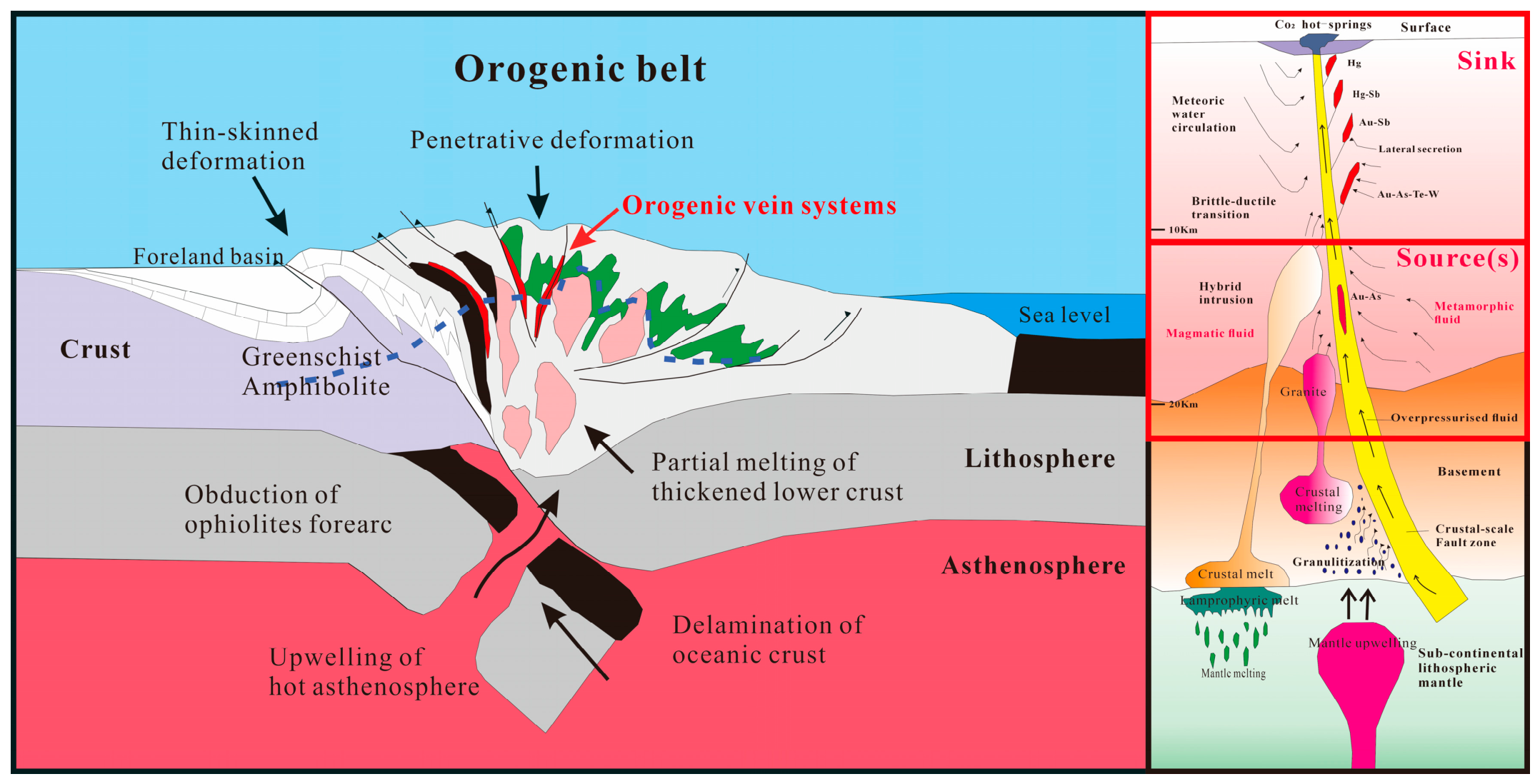
Orogenic gold deposits form during crustal shortening and are controlled by both structural architecture and host-rock reactivity (Figure 1) [32]. Mineralization concentrates along shear zones and faults that channelize auriferous fluids upward through the crust [2,3,33]. In the Yilgarn Craton, these deposits occur in three principal settings: (1) shear zone-hosted deposits in greenschist- to granulite-facies metamorphic rocks; (2) stratabound deposits in turbidites and banded iron formations; and (3) granitoid-hosted deposits [4,32,34]. Deposit styles include disseminated, vein-type, and replacement ores [32]. A minority of gold occurrences lack direct orogenic affiliation; these exert negligible influence on regional-scale modeling.

2.2. The Sandstone Greenstone Belt

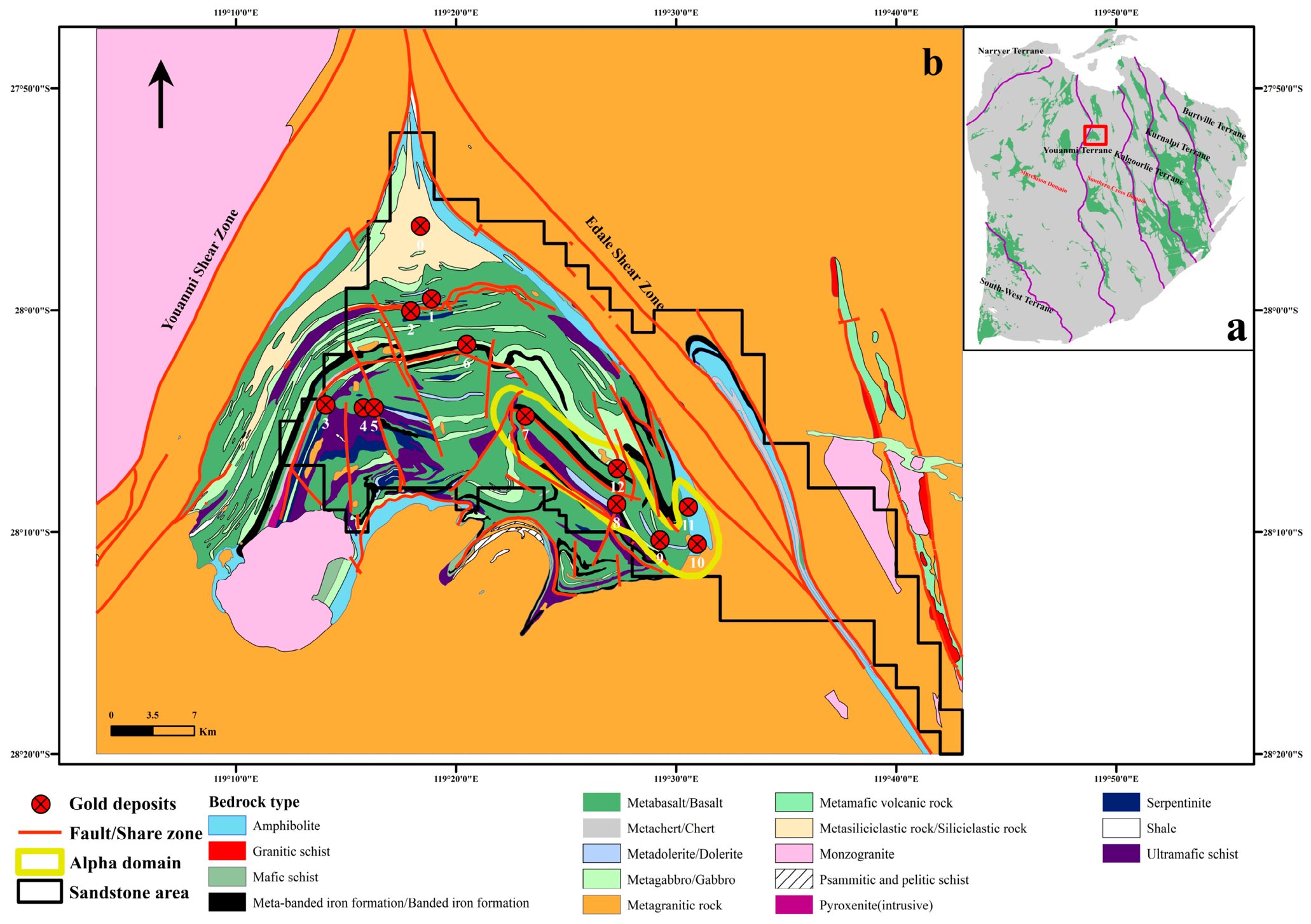
The Sandstone Greenstone Belt, striking NW–SE, occupies the northern Yilgarn Craton (Figure 2a). It comprises Neoarchean mafic–ultramafic volcanic rocks, clastic sedimentary sequences, and syn- to late-tectonic granitoids—a lithological assemblage typical of Archean granite–greenstone terranes [35,36]. The belt hosts at least 13 named gold deposits and occurrences, concentrated along the Alpha Domain—a 20 km metallogenic corridor that includes the Havilah, Lord Henry, and Lord Nelson deposits (Figure 2b) [37]. Immobile trace element studies confirm substantial exploration potential [37], yet extensive areas, particularly amphibolite units east of the Edale Shear Zone, remain largely untested by drilling, leaving considerable room for further exploration.
Figure 1. Schematic cross-section illustrating orogenic gold formation in a subduction–accretion setting. Metamorphic and magmatic fluids ascend along crustal-scale shear zones; gold precipitates where decreasing temperature, pressure, and wall-rock reactions destabilize Au-bearing sulfide complexes. The diagram emphasizes structural controls (shear zones, fault intersections) and chemical traps (reactive host rocks, redox boundaries) that constitute first-order exploration criteria. The framework is modified from Groves and Santosh [38] and Goldfarb and Pitcairn [39].
Minerals 16 00627 g001
Figure 2. (a) Location of the Sandstone Greenstone Belt within the Yilgarn Craton. (b) Geological map showing lithological units, major shear zones, and gold deposits numbered 0–12: 0—Sandstone North, 1—Oroya, 2—Hacks, 3—Bulchina, 4—Shillington, 5—Two Mile Hill, 6—Bull Oak, 7—Indomitable, 8—Vanguard, 9—Havilah, 10—Lord Henry, 11—Lord Nelson, 12—Ladybird. Deposits 7–12 define the Alpha Domain gold corridor. Modified from the Geological Survey of Western Australia [40,41] and Alto Metals Ltd. [42].
Minerals 16 00627 g002
Table 1 summarizes the geological characteristics of the principal deposits, including host structures, lithologies, mineralization styles, alteration assemblages, and ore mineral associations. These attributes define the mappable criteria that underpin the AI training framework.

3. Materials and Methods

3.1. Training Data

To develop a generalized prediction model for orogenic gold deposits across the Yilgarn region, training data were compiled from 16 geological map sheets spanning the Yilgarn Craton (Figure 3). These sheets—Cheritons Find, Southern Cross, Jackson, Reedy, Norseman, Kalgoorlie, Kanowna, Gindalbie, Edjudina, Davyhurst, Riverina, Mount Mason, Melita, Minerie, Duketon, and Darlot—cover 42,857 km2 and contain 6028 gold occurrences sourced from the Western Australian Mindex database [43,44].

3.1.1. Bedrock Data

Bedrock geology derives from the 1:100,000 and 1:500,000 State Interpreted Bedrock Geological Maps [40,41]. Lithologies were classified into 13 categories spanning siliciclastic sedimentary rocks through ultramafic schists and granitic gneisses. These categories follow the lithological vocabulary used in the Geological Survey of Western Australia (GSWA) Interpreted Bedrock Geology dataset [40,41], with several composite labels that warrant brief definitions. Siliciclastic sedimentary rock comprises the GSWA detrital sedimentary suite—dominated by sandstone, mudstone, siltstone, conglomerate, wacke, and diamictite, together with their interbedded combinations—and is kept distinct from chert and banded iron formations, which form the BIF and chert category, and from the shale and slate units, which are grouped as shale and slate. Among the schist-bearing categories, argillaceous schist denotes pelitic (mud-grade) metasedimentary mica schist with muscovite–biotite–quartz ± garnet–staurolite–andalusite assemblages; quartz schist (felsic volcanic) denotes quartzofeldspathic mica schist derived from felsic volcanic and volcaniclastic protoliths; mafic schist denotes greenschist-facies chlorite–actinolite ± tremolite schist derived from basaltic to gabbroic protoliths; and ultramafic schist denotes talc–tremolite–chlorite ± serpentine schist derived from komatiitic protoliths characteristic of Archean greenstone belts. Normalized weights were computed as the ratio of gold occurrence density to areal proportion for each lithological unit (Equation (1)). This weighting scheme assigns the highest scores to lithologies that host disproportionately abundant gold occurrences—notably ultramafic schist (weight = 1.000) and amphibolite (weight = 0.525), consistent with their established roles as reactive host rocks for orogenic gold (Table 2).
Nᵢ = (Eᵢ/Sᵢ)/max(Eⱼ/Sⱼ)
where i represents various bedrock categories, Ni is the normalized weight of the i-th lithology, Ei refers to the quantity of gold deposits within the corresponding lithology, and Si stands for the actual distribution area of the i-th lithology. max(Ej/Sj) indicates the maximum value of the ratio across all lithological types, where j specifically corresponds to ultramafic schist.

3.1.2. Structural Data

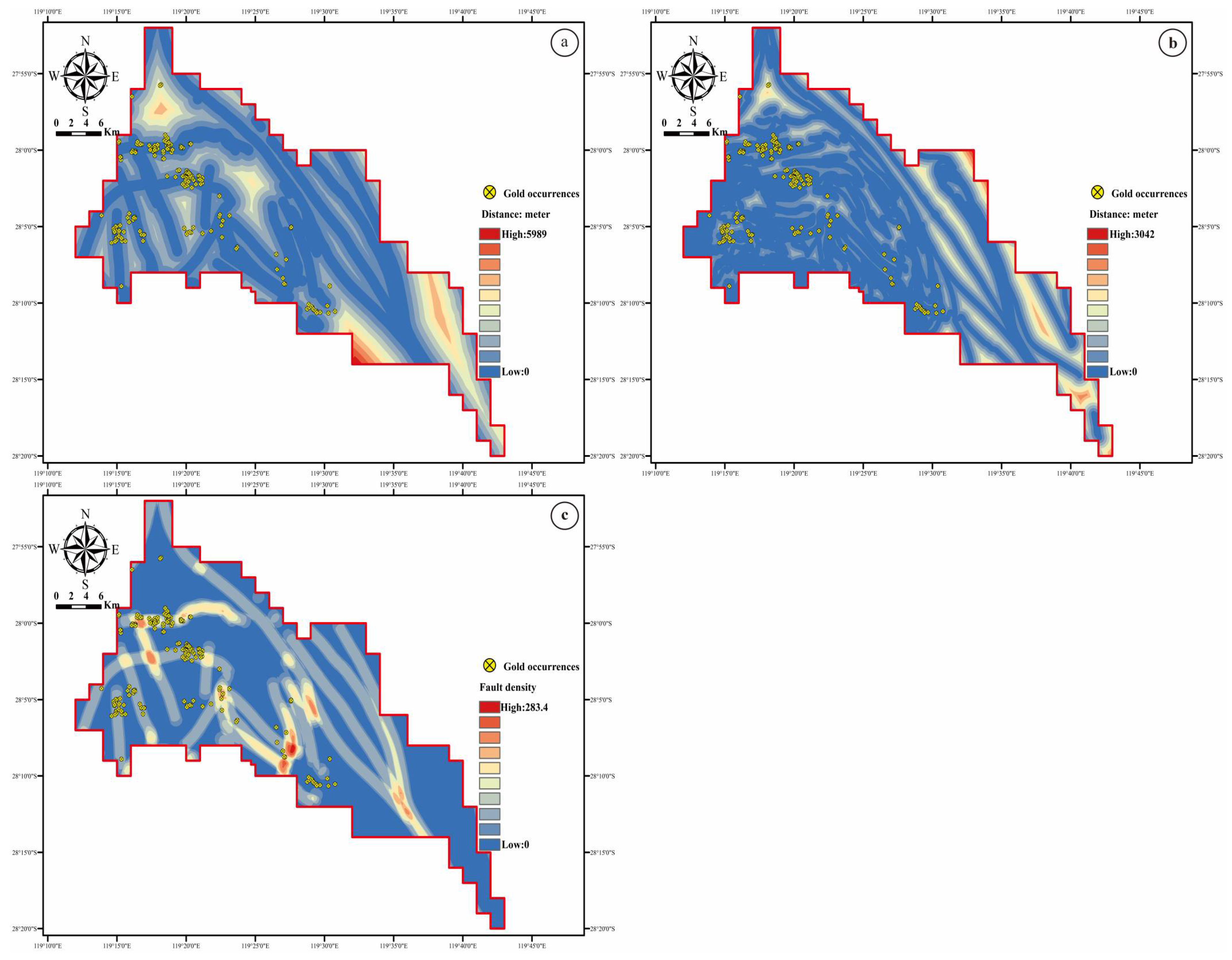
Faults and lithological boundaries serve as proxies for fluid pathways. Fault data derive from the 16 1:100,000 map sheets, supplemented by the 1:500,000 State Interpreted Bedrock Geological Map. The latter identifies concealed structures through geophysical interpretation, which are absent from the larger-scale 1:100,000 maps [40,41]. Fault density was calculated within an 800 m radius (Equation (2)):
FD = L/(8002π)
where L is total fault length within the circular area. Distance to the nearest fault and lithological boundary was normalized on a 0–1 scale (10,000 m = 1), and the weight was defined as 1 minus this normalized distance. This scheme preserves relative spatial information and captures the empirical observation that gold occurrence frequency decays exponentially with distance from structures (Figure 4).

3.1.3. Geophysical Data

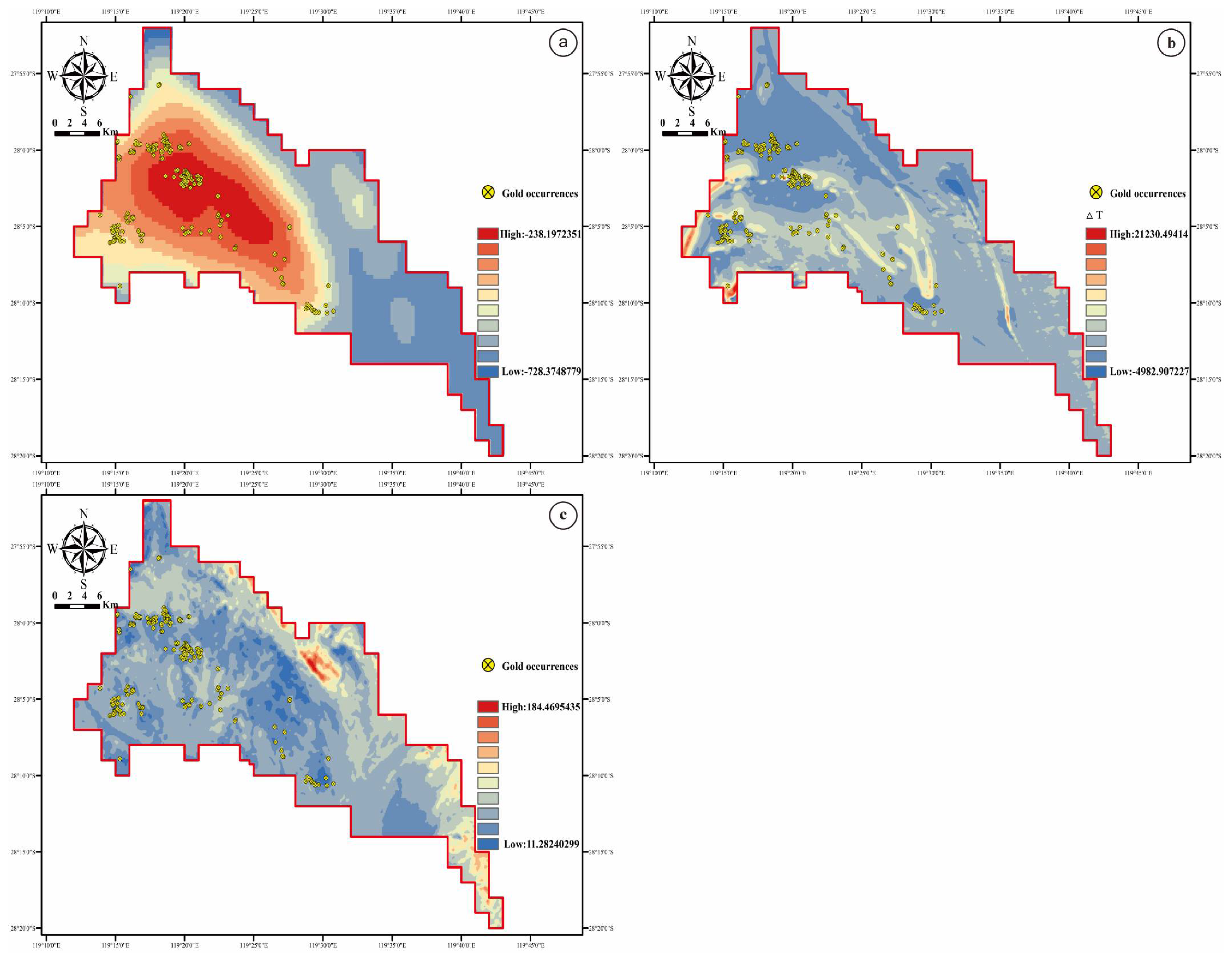
Geophysical inputs comprise Bouguer gravity (400 m resolution), magnetic anomaly (80 m), and radiometric data (80 m), sourced from AUKT Pty Ltd. (Figure 5). These data constrain subsurface lithological architecture and reveal structural entities not expressed at the surface. The resolution discrepancy between gravity and magnetic/radiometric data represents a known limitation addressed in Section 5.5.

3.2. Data Preprocessing

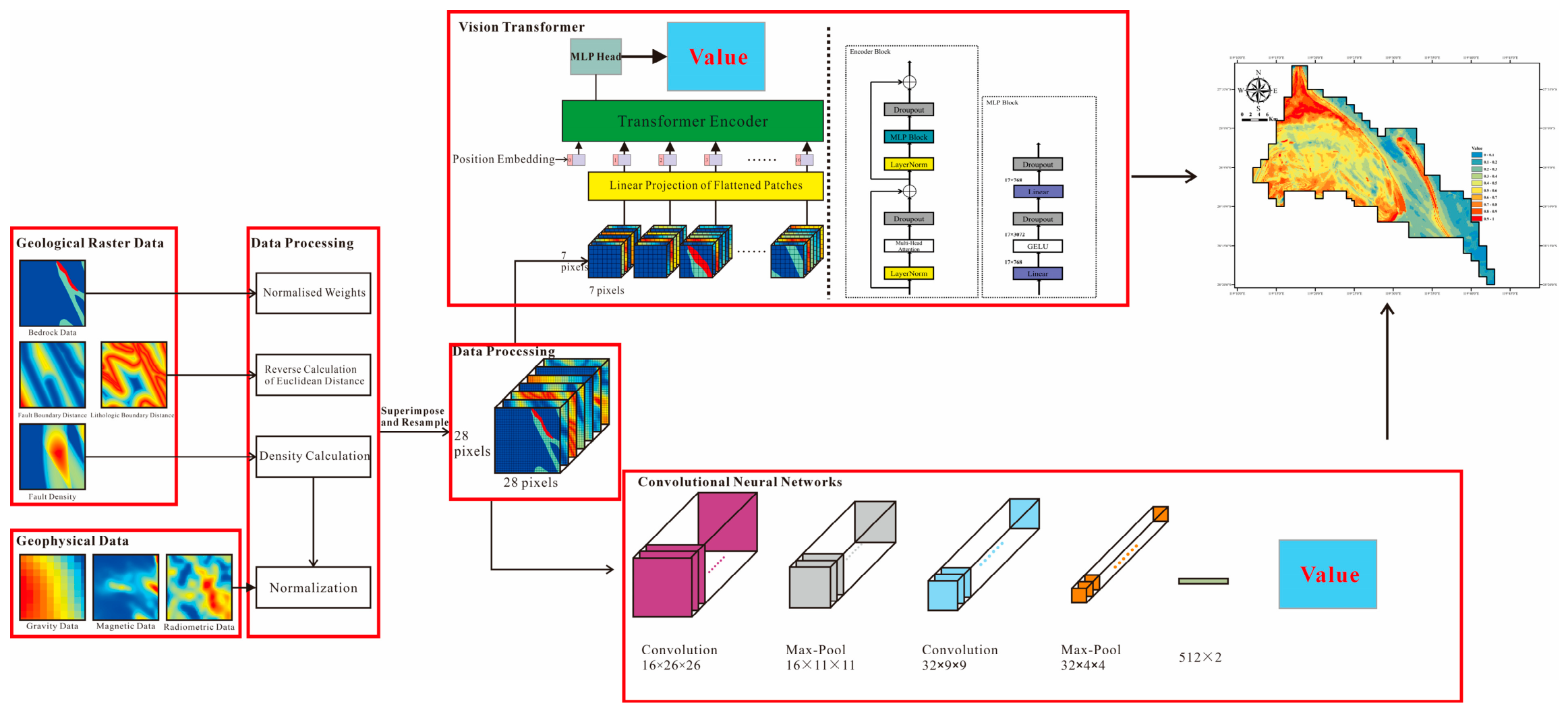
Raw data were transformed into mappable criteria following the mineral systems approach [45,46]. All layers were resampled to a uniform 5 × 5 m pixel resolution. Geophysical values were linearly scaled to a 0–1 range. The resulting multi-layer stack was segmented into 28 × 28 pixel patches (seven channels: bedrock weight, fault distance, boundary distance, fault density, gravity, magnetics, radiometrics), enhanced by a sliding window to increase sample density. Screening yielded >100,000 samples, split 70:30 into training and validation sets. Non-mineralized samples were drawn in equal number from barren areas to ensure class balance (Figure 6).

3.3. CNN Architecture

Convolutional neural networks (CNNs) have gained significant attention for their exceptional performance in computer vision tasks. Representative classic architectures include LeNet-5, AlexNet, ResNet and GoogleNet. A typical CNN is composed of convolutional layers, pooling layers and fully connected layers. Weight sharing strategy helps decrease trainable parameters and improve data generalization performance [47,48,49,50,51].
In this study, the CNN structure is customized according to the input image size listed in Table 3. The model contains two convolutional layers and a subsequent fully connected classifier. Taking the 28 × 28 × 7 original data as input, the first convolutional layer outputs 16 feature maps, whose spatial dimension is downscaled to 12 × 12 after max pooling. The second layer raises the feature channel number to 32 and conducts another pooling operation for dimension compression. The extracted 512 feature parameters are mapped into two categories via the fully connected layer. Finally, the Softmax function is adopted to calculate binary mineralization probability for classification prediction.
Softmax(xₙ) = exp(xₙ)/Σ exp(xᵢ)

3.4. Vision Transformer Architecture

The Vision Transformer (ViT) captures global dependencies through self-attention [30]. We adapted the implementation of Rwightman [52], replacing the original 16 × 16 tokenization with 7 × 7 patches to match our input dimensions. Patch Embedding maps each 7 × 7 patch into a 768-dimensional space via convolution (kernel = 7, stride = 7). A 12-head self-attention mechanism then computes inter-patch relationships (Equation (4); Figure 6).
Attention(Q, K, V) = softmax(QKᵀ/√dₖ) V
where Q, K, and V are query, key, and value projections, and dₖ is the scaling factor. The ViT’s lack of inductive bias renders it less prone to overfitting than CNNs, though it requires larger datasets to reach peak performance.

3.5. Evaluation Metrics

Model performance was assessed using confusion matrix-derived accuracy (Equation (5)) and cross-entropy loss (Equation (6)):
True Positive (TP), False Positive (FP), False Negative (FN) and True Negative (TN) refer to instances where both predicted and actual results are positive, where the prediction is positive while the actual result is negative, where the prediction is negative while the actual result is positive, and where both predicted and actual results are negative respectively.
The model’s accuracy is determined using the following equation:
Accuracy = (TP + TN)/(TP + TN + FP + FN)
Additionally, the cross-entropy loss function is a widely used metric to evaluate the difference between the predicted probability distribution and the actual distribution, particularly in classification tasks. It is typically paired with the Softmax function. In this study, the data were processed through a fully connected layer, followed by the Softmax function, to produce a probability score. This score was then integrated with the cross-entropy loss function to calculate the loss, facilitating a more accurate assessment and refinement of the model’s performance. The cross-entropy loss is expressed as:
L = −Σ pᵢ log(qᵢ)
where p and q denote the true and predicted probability distributions, respectively.

3.6. Hyperparameter Configuration

Both models were implemented in PyTorch (Python 3.9) on the AutoDL cloud platform, equipped with two NVIDIA RTX 4090 GPUs for computation. Each sample comprised a 28 × 28 pixel array with 7 channels, where each pixel corresponds to 25 m2, yielding 19,600 m2 coverage per sample. The training process was completed within 3 h after hyperparameter tuning. After systematic experimentation, final hyperparameters were determined (Table 4).

4. Results

4.1. Model Training

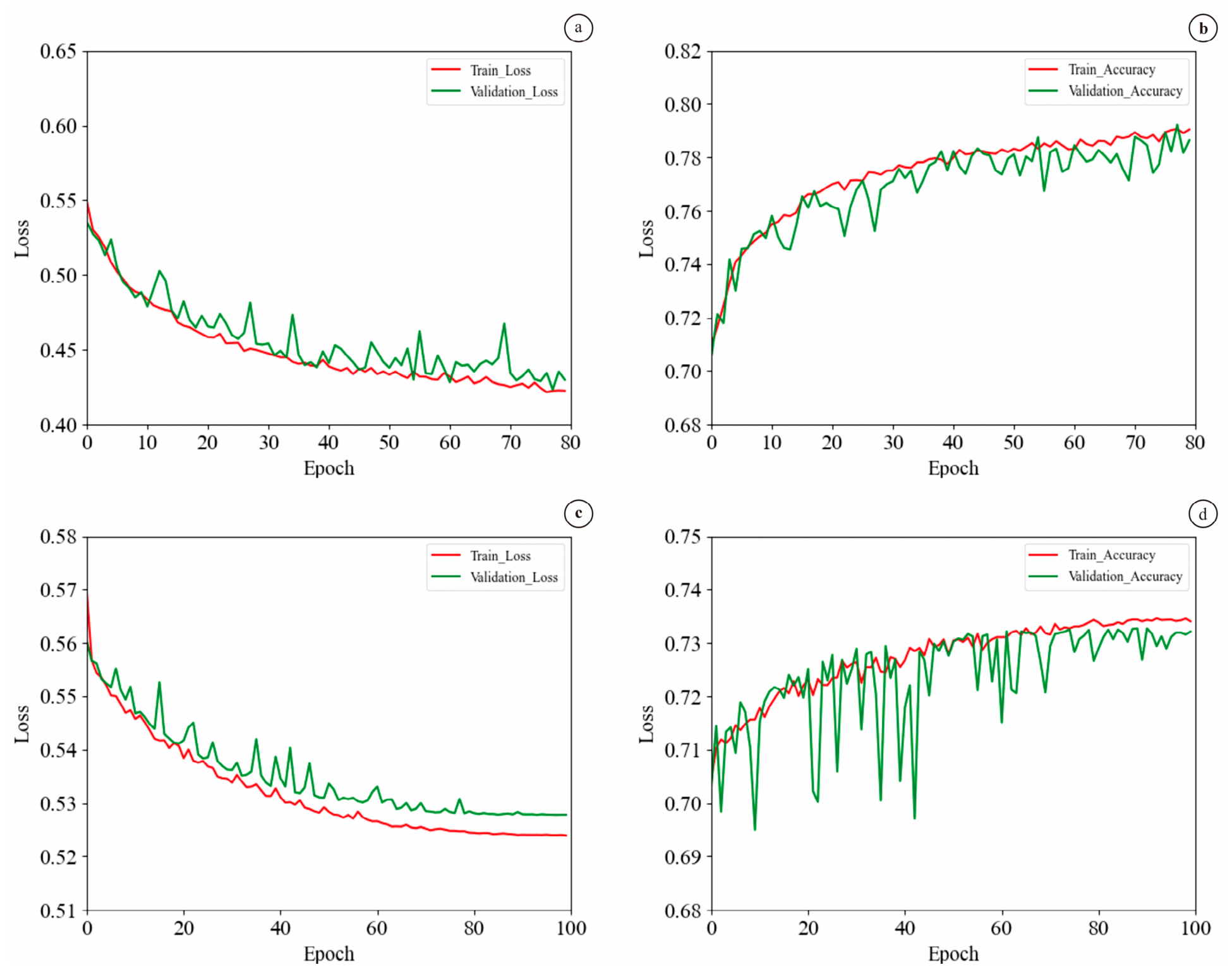
The CNN converged by the 75th epoch, with training and validation losses stabilizing at 0.42–0.436. Accuracy plateaued at 79.3% for training and 75.0%–79.3% for validation (Figure 7a,b). The Vision Transformer required 85 epochs to stabilize, with losses of 0.52–0.53 and accuracy of 72.5%–74.0% (Figure 7c,d). The CNN thus outperforms the Transformer by 5.3 percentage points in overall accuracy. Notably, both models exhibit minimal overfitting, as training–validation accuracy gaps remain below 4%.

4.2. Spatial Predictions

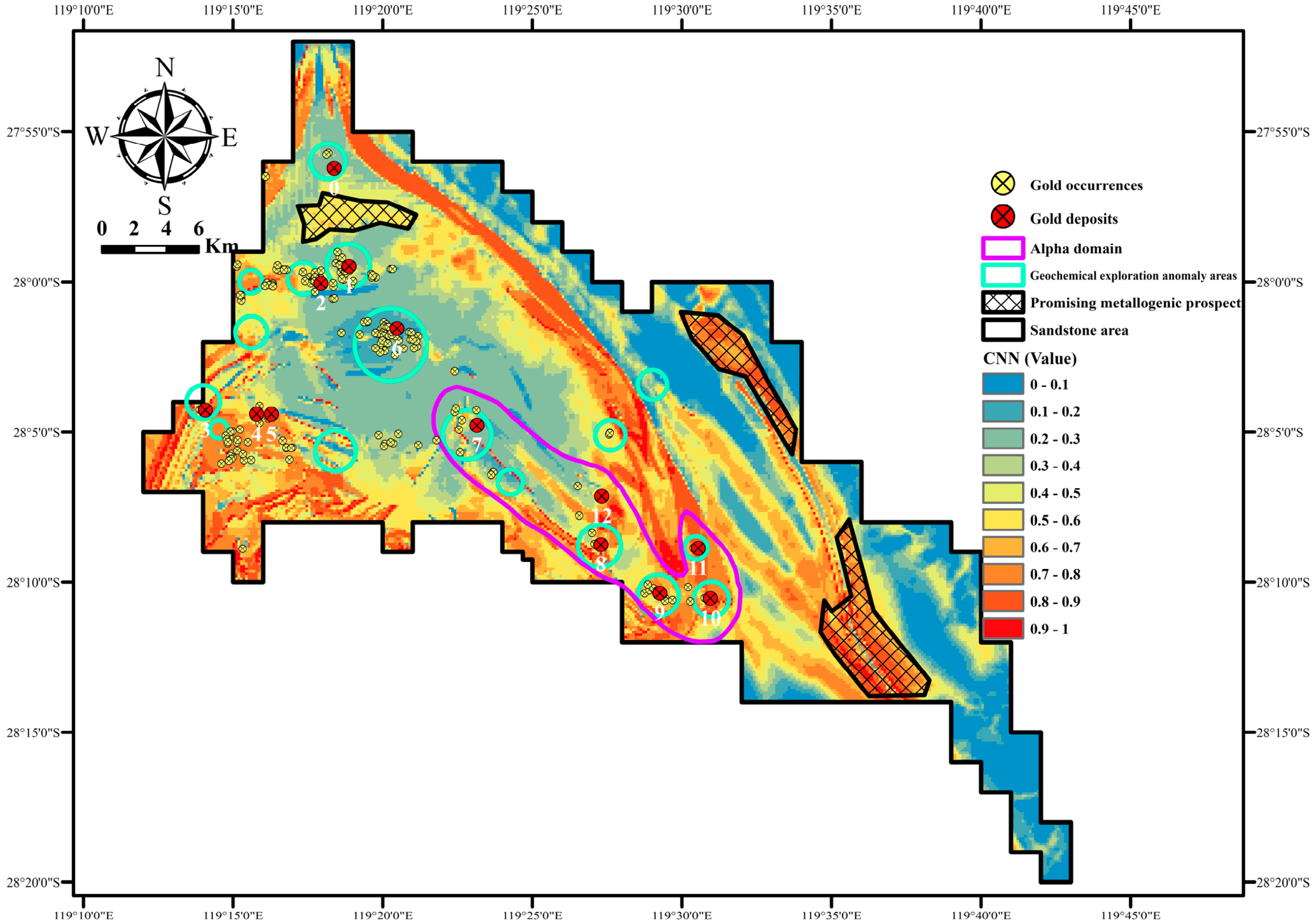
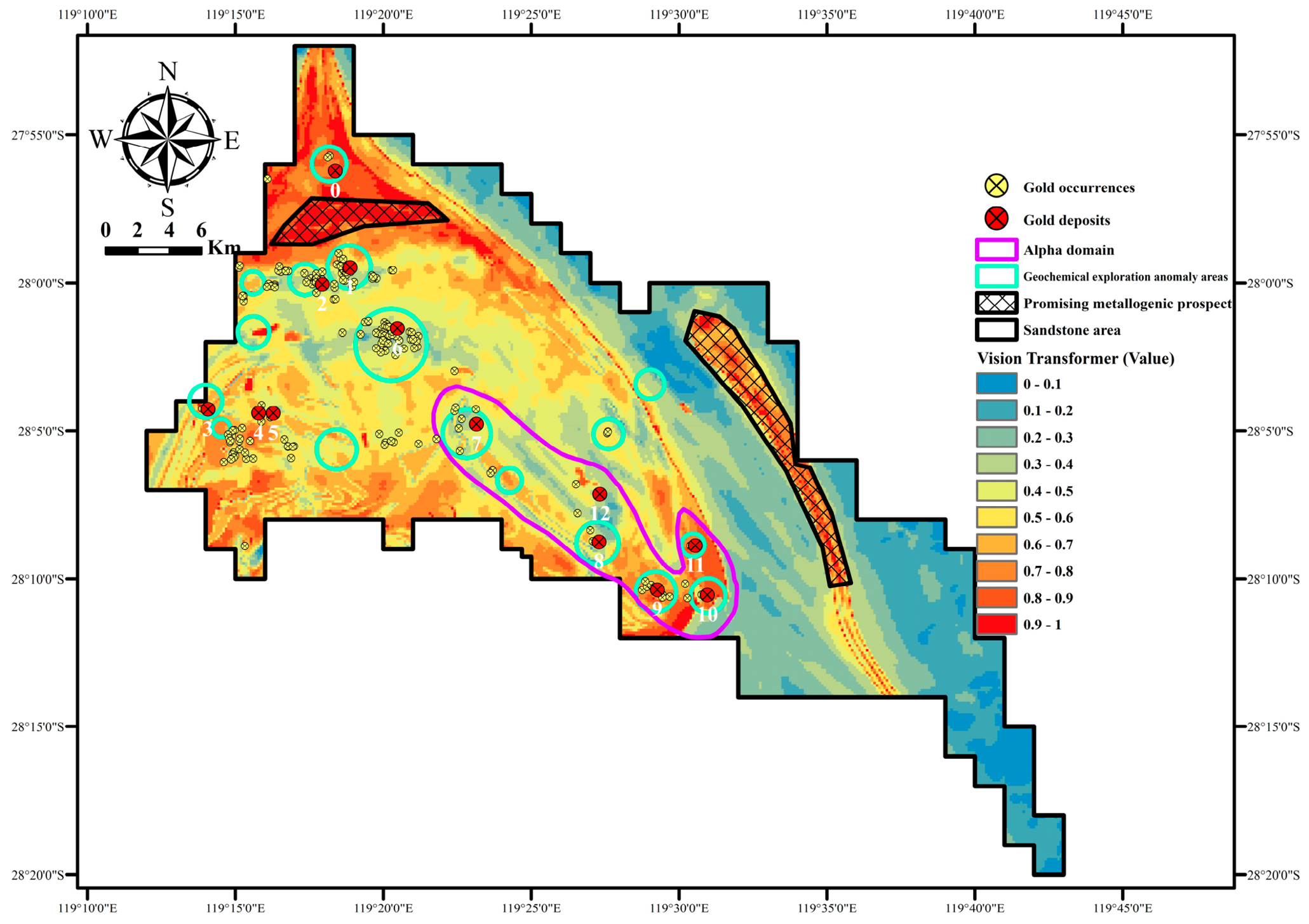
When applied to the Sandstone Greenstone Belt, both models produce spatially coherent mineralization probability maps (Figure 8 and Figure 9). Predicted high-probability zones (>0.5) coincide with the majority of known gold deposits, confirming the models’ geological validity.
The CNN excels where structural controls are well defined. In areas with fault density >0.5 km/km2, predicted probabilities consistently exceed 0.5, reflecting the CNN’s strength in detecting spatially correlated, local geological patterns. The Vision Transformer, by contrast, identifies prospective zones that the CNN misses—most notably at the Sandstone North deposit (Transformer: p = 0.82; CNN: p = 0.25) and in NW-SE trending amphibolite units along the Edale Shear Zone. These regions are characterized by sparse training data, where the Transformer’s global attention mechanism provides a decisive advantage.

5. Discussion

5.1. Consensus in Known Mineralized Areas

Both models identify the Alpha Domain as the highest-priority target, with predicted probabilities exceeding 0.5 at the Havilah, Lord Henry, and Lord Nelson deposits (Table 5). This prediction is independently validated by drill data from Alto Metals Ltd. [42], which document gold grades >5 g/t at 100–200 m depth throughout the corridor. The convergence of independent model predictions and drill-confirmed mineralization demonstrates the geological robustness of the machine learning framework.
Elevated probabilities also characterize the southern portions of the Bulchina, Shillington, and Two Mile Hill deposits, where ultramafic schist dominates the host lithology (Table 6). The data are consistent with the established association between ultramafic host rocks and orogenic gold mineralization in the Yilgarn Craton [32,34]. Crucially, the NW-SE trending amphibolite units along the Edale Shear Zone emerges as a consensus target from both models—an area with no prior systematic exploration.
The Bull Oak deposit (deposit 6) represents an instructive exception: both models assign probabilities below 0.5 despite documented gold resources. This discrepancy indicates that mineralization at Bull Oak is controlled by factors not captured in the current feature set—possibly local alteration, vein geometry, or unresolved structural complexity. Such anomalies constrain the boundary conditions of the models and highlight areas where additional data layers could improve predictions.

5.2. Differential Model Performance

The two architectures exhibit systematic performance differences that illuminate their respective strengths (Table 7). At Sandstone North, the CNN predicts p = 0.25 while the Transformer assigns p = 0.82. Alto Metals Ltd. [42] identified a 6 km north–south Au anomaly zone in this area, corroborating the Transformer’s assessment. This result demonstrates that global attention mechanisms can detect mineralization signals in regions where local training data are insufficient for CNN-based pattern recognition.
Along the Edale Shear Zone, the CNN delineates a broad high-probability region, reflecting its sensitivity to the spatially extensive structural signal. The Transformer, by contrast, resolves a smaller, more focused anomaly within the adjacent amphibolite—a prediction that aligns more closely with the expected scale of orogenic gold mineralization at the deposit level.
At the Oroya and Hacks deposits, the CNN outperforms the Transformer (CNN: 0.41 and 0.69; Transformer: 0.35 and 0.27, respectively). Documented production of 233,000 oz Au at Oroya and 206,000 oz at Hacks [37] validates the CNN’s predictions in these structurally controlled, well-characterized settings. Across gold geochemical anomaly zones more broadly, CNN probabilities consistently exceed 0.5, whereas Transformer probabilities frequently fall below this threshold.

5.3. New Prospective Zones

The integrated CNN–Transformer analysis reveals three previously unrecognized targets. First, northwest-trending ultramafic schist and metadolerite units within the Alpha Domain yield high probabilities in both models (Figure 2 and Figure 8), consistent with the established lithological control on gold mineralization in the Yilgarn Craton. Second, the transitional zone between northern sedimentary siliceous rocks and southern basalt constitutes a redox boundary—a chemical trap configuration that commonly hosts orogenic gold [34]. Third, NW-SE trending amphibolite units along the Edale Shear Zone represents the most compelling target: both models predict elevated probabilities, the area lies adjacent to a crustal-scale fluid conduit, and no prior drilling has tested this lithology. These three targets merit immediate field follow-up.

5.4. ML-Driven Exploration

Neither the CNN nor the Transformer is universally superior. The CNN excels where structural and geochemical indicators are strong and training data are abundant. The Transformer compensates in data-sparse domains through global attention. Deploying both models in tandem mitigates individual blind spots and provides a more reliable basis for exploration targeting—analogous to the multi-method approach advocated in conventional mineral systems analysis [45,46].
A practical consideration concerns sample balance. Using equal numbers of mineralized and non-mineralized training samples inflates predicted probabilities, because mineralized areas are intrinsically rare. Future implementations should explore ratio-adjusted sampling, cost-sensitive loss functions, or synthetic data augmentation via generative adversarial networks (GANs) to better reflect the natural rarity of gold deposits.

5.5. Limitations and Future Directions

Three limitations warrant acknowledgment. First, the resolution mismatch between gravity (400 m) and magnetic/radiometric (80 m) data constrains precision in fault-adjacent areas where structural control operates at sub-400 m scales. Second, the current seven-channel feature set omits potentially discriminative layers such as geochemistry, alteration mapping, and high-resolution structural interpretations. Third, the Bull Oak anomaly demonstrates that localized geological complexity can fall below the models’ detection threshold.
Future work should pursue three directions. (1) Hybrid CNN–Transformer architectures that fuse local and global feature extraction within a single model, particularly for terrains with complex alteration patterns. (2) GAN-based data augmentation to address class imbalance and improve generalization. (3) Transfer learning from well-characterized provinces to frontier terranes with limited data availability—a strategy that could substantially reduce the exploration data barrier in covered terrains worldwide.

6. Conclusions

This study demonstrates that integrating CNNs and Vision Transformers provides a robust framework for orogenic gold prospectivity mapping. The main findings are:
(1)
The CNN achieves 79.3% accuracy, outperforming the Transformer (74.0%), owing to its strength in capturing local structural features at scales where fault density exceeds 0.5 km/km2.
(2)
The Transformer’s global attention mechanism identifies prospective areas in data-sparse regions that the CNN misses—most notably Sandstone North (p = 0.82 vs. 0.25)—demonstrating its capacity to model long-range geological dependencies.
(3)
Both models converge on the Alpha Domain as the highest-priority corridor and delineate three new targets: (a) northwest-trending ultramafic units in the Alpha Domain; (b) the basalt–sediment transition zone; and (c) NW-SE trending amphibolite units along the Edale Shear Zone.
(4)
Data imbalance and resolution inconsistencies represent the principal limitations. Overrepresentation of ultramafic schist inflates predictions in these lithologies; gravity–magnetic resolution mismatch (400 m vs. 80 m) reduces fault-proximal precision.
(5)
CNN–Transformer integration outperforms either model alone, positioning AI-driven MPM as a decision-support tool capable of reducing exploration costs and guiding greenfield discovery in covered orogenic gold terrains.

Author Contributions

Conceptualization, X.W.; methodology, X.W. and J.T.; software, J.T.; validation, J.T.; formal analysis, J.T.; data curation, J.T.; writing—original draft, J.T.; writing—review and editing, X.Z., X.W., S.A.W., Y.S. and Y.L.; funding acquisition, X.W. All authors have read and agreed to the published version of the manuscript.

Funding

This work was supported by Geovision AI Mining Pty Ltd. (self-funded).

Data Availability Statement

The Python/PyTorch code is available at https://github.com/Jiaxu-Tang/Yilgarn-Gold (accessed on 8 June 2026). Geological and geophysical data are publicly available from the Geological Survey of Western Australia (https://dasc.dmirs.wa.gov.au, accessed on 8 June 2026).

Acknowledgments

We thank Wenhong Jin (Wildsky Resources Inc.) for constructive suggestions. AUKT Pty Ltd. provided geophysical data and field support.

Conflicts of Interest

Jiaxu Tang, Xinyu Zou, Xuance Wang, Yue Song and Yang Luo are employees of Geovision AI Mining Pty Ltd. The paper reflects the views of the scientists and not the company.

References

  1. Goldfarb, R.J.; Groves, D.I. Orogenic Gold: Common or Evolving Fluid and Metal Sources through Time. Lithos 2015, 233, 2–26. [Google Scholar] [CrossRef]
  2. Wang, Q.; Deng, J.; Zhao, H.; Yang, L.; Ma, Q.; Li, H. Review on Orogenic Gold Deposits. Earth Sci. 2019, 44, 2155–2186. [Google Scholar]
  3. Weatherley, D.K.; Henley, R.W. Flash Vaporization during Earthquakes Evidenced by Gold Deposits. Nat. Geosci. 2013, 6, 294–298. [Google Scholar] [CrossRef]
  4. Robert, F.; Brommecker, R.; Bourne, B.; Dobak, P.; McEwan, C.; Rowe, R.; Zhou, X. Models and Exploration Methods for Major Gold Deposit Types. In Proceedings of the Exploration 07, Toronto, ON, Canada, 9–12 September 2007; pp. 691–711. [Google Scholar]
  5. Phillips, G.N.; Vearncombe, J.R.; Eshuys, E. Gold Production and the Importance of Exploration Success: Yilgarn Craton, Western Australia. Ore Geol. Rev. 2019, 105, 137–150. [Google Scholar] [CrossRef]
  6. Almasi, A.; Yousefi, M.; Carranza, E.J.M. Prospectivity Analysis of Orogenic Gold Deposits in Saqez-Sardasht Goldfield, Zagros Orogen, Iran. Ore Geol. Rev. 2017, 91, 1066–1080. [Google Scholar] [CrossRef]
  7. Bonham-Carter, G.F. Geographic Information Systems for Geoscientists: Modelling with GIS; Pergamon: Oxford, UK, 1994. [Google Scholar]
  8. Yousefi, M.; Carranza, E.J.M.; Kreuzer, O.P.; Nykänen, V.; Hronsky, J.M.; Mihalasky, M.J. Data Analysis Methods for Prospectivity Modelling as Applied to Mineral Exploration Targeting: State-of-the-Art and Outlook. J. Geochem. Explor. 2021, 229, 106839. [Google Scholar] [CrossRef]
  9. Zuo, R.G.; Yang, F.F.; Cheng, Q.M.; Kreuzer, O.P. A Novel Data-Knowledge Dual-Driven Model Coupling Artificial Intelligence with a Mineral Systems Approach for Mineral Prospectivity Mapping. Geology 2024, 53, 284–288. [Google Scholar] [CrossRef]
  10. Kreuzer, O.P.; Yousefi, M.; Nykänen, V. Introduction to the Special Issue on Spatial Modelling and Analysis of Ore-Forming Processes in Mineral Exploration Targeting. Ore Geol. Rev. 2020, 119, 103391. [Google Scholar] [CrossRef]
  11. Witt, W.K.; Ford, A.; Hanrahan, B. District-Scale Targeting for Gold in the Yilgarn Craton: Part 2 of the Yilgarn Gold Exploration Targeting Atlas; Report 132; Geological Survey of Western Australia: Perth, Australia, 2015. [Google Scholar]
  12. Witt, W.K.; Ford, A.; Hanrahan, B.; Mamuse, A. Regional-Scale Targeting for Gold in the Yilgarn Craton: Part 1 of the Yilgarn Gold Exploration Targeting Atlas; Report 125; Geological Survey of Western Australia: Perth, Australia, 2013. [Google Scholar]
  13. Boadi, B.; Raju, P.S.; Wemegah, D.D. Analysing Multi-Index Overlay and Fuzzy Logic Models for Lode-Gold Prospectivity Mapping in the Ahafo Gold District—Southwestern Ghana. Ore Geol. Rev. 2022, 148, 105059. [Google Scholar] [CrossRef]
  14. Tao, J.; Yuan, F.; Zhang, N.; Chang, J. Three-Dimensional Prospectivity Modeling of Honghai Volcanogenic Massive Sulfide Cu–Zn Deposit, Eastern Tianshan, Northwestern China Using Weights of Evidence and Fuzzy Logic. Math. Geosci. 2021, 53, 131–162. [Google Scholar] [CrossRef]
  15. Agterberg, F.P.; Bonham-Carter, G.F.; Wright, D.F. Statistical Pattern Integration for Mineral Exploration. In Computer Applications in Resource Estimation; Gaál, G., Merriam, D.F., Eds.; Pergamon: Oxford, UK, 1990; pp. 1–21. [Google Scholar]
  16. Porwal, A.; Gonzalez-Alvarez, I.; Markwitz, V.; McCuaig, T.C.; Mamuse, A. Weights-of-Evidence and Logistic Regression Modeling of Magmatic Nickel Sulfide Prospectivity in the Yilgarn Craton, Western Australia. Ore Geol. Rev. 2010, 38, 184–196. [Google Scholar] [CrossRef]
  17. Agterberg, F.P. Automatic Contouring of Geological Maps to Detect Target Areas for Mineral Exploration. Math. Geol. 1974, 6, 373–395. [Google Scholar] [CrossRef]
  18. Porwal, A.; Carranza, E.; Hale, M. Knowledge-Driven and Data-Driven Fuzzy Models for Predictive Mineral Potential Mapping. Nat. Resour. Res. 2003, 12, 1–25. [Google Scholar] [CrossRef]
  19. Xiao, F.; Chen, W.; Wang, J.; Erten, O. A Hybrid Logistic Regression: Gene Expression Programming Model and Its Application to Mineral Prospectivity Mapping. Nat. Resour. Res. 2021, 31, 2041–2064. [Google Scholar] [CrossRef]
  20. Carranza, E.J.M.; Laborte, A.G. Data-Driven Predictive Mapping of Gold Prospectivity, Baguio District, Philippines: Application of Random Forests Algorithm. Ore Geol. Rev. 2015, 71, 777–787. [Google Scholar] [CrossRef]
  21. Parsa, M.; Maghsoudi, A. Assessing the Effects of Mineral Systems-Derived Exploration Targeting Criteria for Random Forests-Based Predictive Mapping of Mineral Prospectivity in Ahar-Arasbaran Area, Iran. Ore Geol. Rev. 2021, 138, 104399. [Google Scholar] [CrossRef]
  22. Rodriguez-Galiano, V.; Sanchez-Castillo, M.; Chica-Olmo, M.; Chica-Rivas, M. Machine Learning Predictive Models for Mineral Prospectivity: An Evaluation of Neural Networks, Random Forest, Regression Trees and Support Vector Machines. Ore Geol. Rev. 2015, 71, 804–818. [Google Scholar] [CrossRef]
  23. Abedi, M.; Norouzi, G.H.; Bahroudi, A. Support Vector Machine for Multi-Classification of Mineral Prospectivity Areas. Comput. Geosci. 2012, 46, 272–283. [Google Scholar] [CrossRef]
  24. Shabankareh, M.; Hezarkhani, A. Application of Support Vector Machines for Copper Potential Mapping in Kerman Region, Iran. J. Afr. Earth Sci. 2017, 128, 116–126. [Google Scholar] [CrossRef]
  25. Ding, K.; Xue, L.F.; Ran, X.J.; Wang, J.B.; Yan, Q. Siamese Network Based Prospecting Prediction Method: A Case Study from the Au Deposit in the Chongli Mineral Concentrate Area. Ore Geol. Rev. 2022, 148, 105024. [Google Scholar] [CrossRef]
  26. McMillan, M.; Haber, E.; Peters, B.; Fohring, J. Mineral Prospectivity Mapping Using a VNet Convolutional Neural Network. Lead. Edge 2021, 40, 99–105. [Google Scholar] [CrossRef]
  27. Parsa, M.; Carranza, E.J.M.; Ahmadi, B. Deep GMDH Neural Networks for Predictive Mapping of Mineral Prospectivity in Terrains Hosting Few but Large Mineral Deposits. Nat. Resour. Res. 2022, 31, 37–50. [Google Scholar] [CrossRef]
  28. Yang, N.; Zhang, Z.; Yang, J.; Hong, Z.; Shi, J. A Convolutional Neural Network of GoogLeNet Applied in Mineral Prospectivity Prediction Based on Multi-Source Geoinformation. Nat. Resour. Res. 2021, 30, 3905–3923. [Google Scholar] [CrossRef]
  29. Vaswani, A.; Shazeer, N.; Parmar, N.; Uszkoreit, J.; Jones, L.; Gomez, A.N.; Kaiser, Ł.; Polosukhin, I. Attention Is All You Need. In Proceedings of the NeurIPS, Long Beach, CA, USA, 4–9 December 2017; pp. 6000–6010. [Google Scholar]
  30. Dosovitskiy, A.; Beyer, L.; Kolesnikov, A.; Weissenborn, D.; Zhai, X.; Unterthiner, T.; Dehghani, M.; Minderer, M.; Heigold, G.; Gelly, S.; et al. An Image Is Worth 16×16 Words: Transformers for Image Recognition at Scale. arXiv 2020, arXiv:2010.11929. [Google Scholar]
  31. Davies, R.S.; Groves, D.I.; Trench, A.; Sykes, J.; Standing, J.G. Entering an Immature Exploration Search Space: Assessment of the Potential Orogenic Gold Endowment of the Sandstone Greenstone Belt, Yilgarn Craton. Ore Geol. Rev. 2018, 94, 326–350. [Google Scholar] [CrossRef]
  32. Groves, D.I.; Goldfarb, R.J.; Gebre-Mariam, M.; Hagemann, S.; Robert, F. Orogenic Gold Deposits: A Proposed Classification in the Context of Their Crustal Distribution. Ore Geol. Rev. 1998, 13, 7–27. [Google Scholar] [CrossRef]
  33. Wang, R.; Zeng, Q.; Zhang, Z.; Zhou, L.; Qin, K. Extensive Mineralization in the Eastern Segment of the Xingmeng Orogenic Belt, NE China. Ore Geol. Rev. 2021, 135, 104204. [Google Scholar] [CrossRef]
  34. Groves, D.I.; Goldfarb, R.J.; Robert, F.; Hart, C.J. Gold Deposits in Metamorphic Belts: Overview of Current Understanding. Econ. Geol. 2003, 98, 1–29. [Google Scholar]
  35. Witt, W.K.; Vanderhor, F. Diversity within a Unified Model for Archaean Gold Mineralization in the Yilgarn Craton. Ore Geol. Rev. 1998, 13, 29–64. [Google Scholar] [CrossRef]
  36. Thurston, P.C. Igneous Rock Associations 19. Greenstone Belts and Granite–Greenstone Terranes. Geosci. Can. 2015, 42, 437–484. [Google Scholar]
  37. Jia, C.; Groves, D.I.; Kammermann, M.S.; Ryan, D.M.; Davies, R.S. Use of Immobile Trace Elements in Gold Exploration in the Neoarchean Sandstone Greenstone Belt. Miner. Depos. 2020, 55, 241–256. [Google Scholar] [CrossRef]
  38. Groves, D.I.; Santosh, M. The Giant Jiaodong Gold Province: The Key to a Unified Model for Orogenic Gold Deposits? Geosci. Front. 2016, 7, 409–417. [Google Scholar] [CrossRef]
  39. Goldfarb, R.J.; Pitcairn, I. Orogenic Gold: Is a Genetic Association with Magmatism Realistic? Miner. Depos. 2023, 58, 5–35. [Google Scholar] [CrossRef]
  40. Geological Survey of Western Australia. 1:500,000 State Interpreted Bedrock Geology of Western Australia; Department of Mines, Industry Regulation and Safety: Perth, Australia, 2020. [Google Scholar]
  41. Geological Survey of Western Australia. Update of 1:100,000 State Interpreted Bedrock Geology Digital Map Layer; Department of Mines, Industry Regulation and Safety: Perth, Australia, 2022. [Google Scholar]
  42. Alto Metals Ltd. Sandstone Gold Project|Western Australia: Rediscovering an Entire Gold Field. 2023. Available online: https://wcsecure.weblink.com.au/pdf/AME/02675731.pdf (accessed on 8 June 2026).
  43. Geological Survey of Western Australia. 1:100,000 Geological Series Maps; Department of Mines, Industry Regulation and Safety: Perth, Australia, 2024; Available online: https://dasc.dmirs.wa.gov.au/ (accessed on 10 January 2024).
  44. Geological Survey of Western Australia. Mindex Database; Department of Mines, Industry Regulation and Safety: Perth, Australia, 2024; Available online: https://dasc.dmirs.wa.gov.au/ (accessed on 10 January 2024).
  45. McCuaig, T.C.; Beresford, S.; Hronsky, J. Translating the Mineral Systems Approach into an Effective Exploration Targeting System. Ore Geol. Rev. 2010, 38, 128–138. [Google Scholar] [CrossRef]
  46. McCuaig, T.C.; Hronsky, J.M.A. The Mineral System Concept: The Key to Exploration Targeting. In Building Exploration Capability for the 21st Century; Kelly, K.D., Golden, H.C., Eds.; SEG: Littleton, CO, USA, 2014; pp. 153–175. [Google Scholar]
  47. Krizhevsky, A.; Sutskever, I.; Hinton, G.E. ImageNet Classification with Deep Convolutional Neural Networks. Commun. ACM 2017, 60, 84–90. [Google Scholar] [CrossRef]
  48. LeCun, Y.; Boser, B.; Denker, J.S.; Henderson, D.; Howard, R.E.; Hubbard, W.; Jackel, L.D. Backpropagation Applied to Handwritten Zip Code Recognition. Neural Comput. 1989, 1, 541–551. [Google Scholar] [CrossRef]
  49. LeCun, Y.; Bottou, L.; Bengio, Y.; Haffner, P. Gradient-Based Learning Applied to Document Recognition. Proc. IEEE 1998, 86, 2278–2324. [Google Scholar] [CrossRef]
  50. Mahajan, D.; Girshick, R.; Ramanathan, V.; He, K.; Paluri, M.; Li, Y.; Bharambe, A.; van der Maaten, L. Exploring the Limits of Weakly Supervised Pretraining. In Proceedings of the ECCV, Munich, Germany, 8–14 September 2018; pp. 181–196. [Google Scholar]
  51. Szegedy, C.; Liu, W.; Jia, Y.; Sermanet, P.; Reed, S.; Anguelov, D.; Erhan, D.; Vanhoucke, V.; Rabinovich, A. Going Deeper with Convolutions. In Proceedings of the IEEE CVPR, Boston, MA, USA, 7–12 June 2015; pp. 1–9. [Google Scholar]
  52. Rwightman. PyTorch Image Models. 2022. Available online: https://github.com/huggingface/pytorch-image-models (accessed on 20 June 2023).
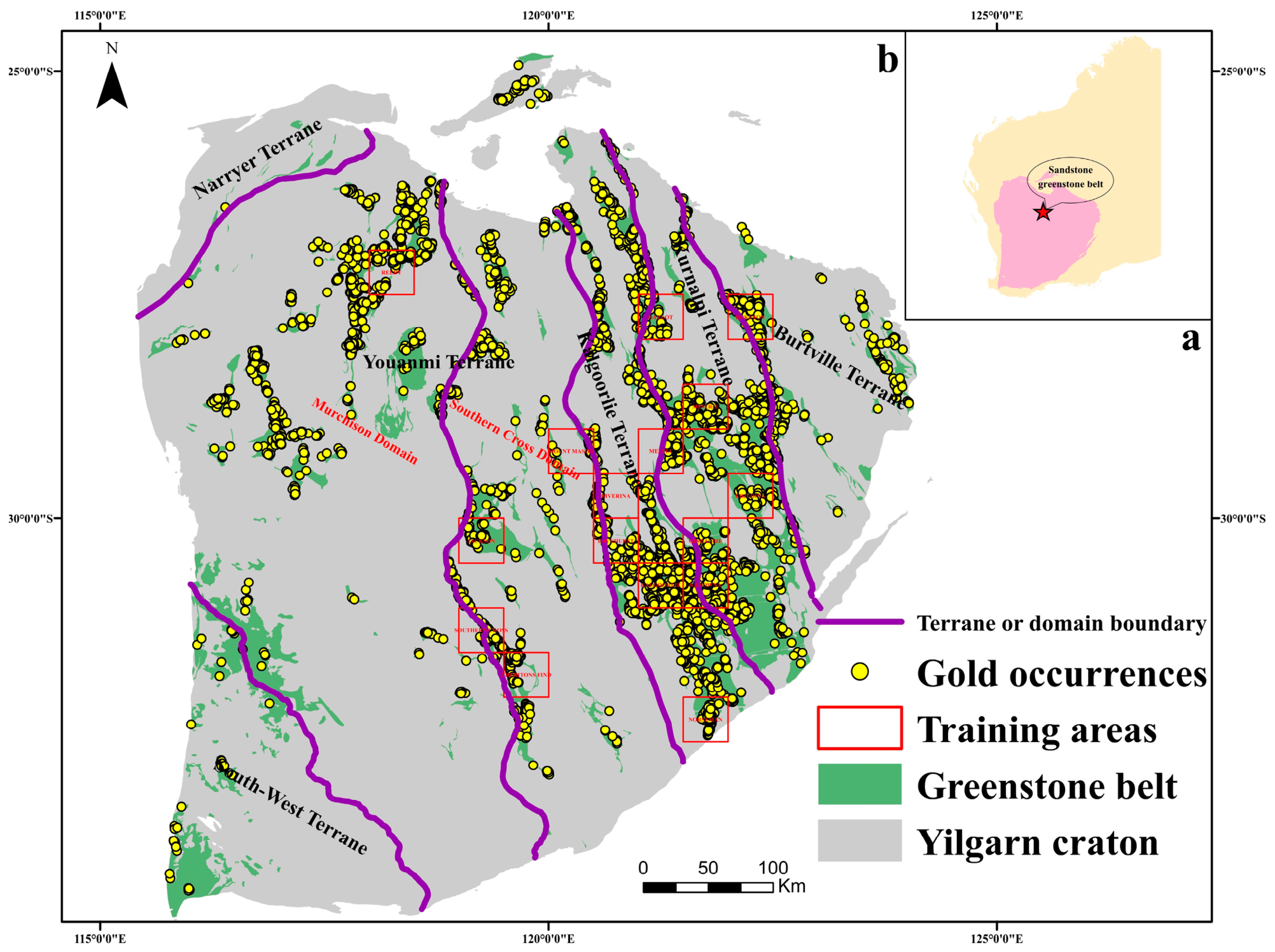
Figure 3. (a) Location of the Yilgarn Craton in Western Australia. (b) Distribution of greenstone belts and 6028 gold occurrences, with the 16 training areas highlighted. These training areas span the major gold camps of the craton, ensuring that the models capture the full spectrum of orogenic gold settings. Modified from the Geological Survey of Western Australia [40,41,43,44].
Minerals 16 00627 g003
Figure 4. Spatial relationships between structural features and gold occurrences in the Sandstone Greenstone Belt. (a) Distance from faults. (b) Distance from lithological boundaries. (c) Fault density. Gold occurrences cluster within 2 km of faults and lithological contacts, consistent with structurally controlled fluid flow as the primary mineralization driver.
Minerals 16 00627 g004
Figure 5. Geophysical data for the Sandstone Greenstone Belt. (a) Bouguer gravity anomalies delineate density contrasts between greenstone and granitic domains. (b) Magnetic anomalies highlight mafic–ultramafic units and structural corridors. (c) Total count radiometric data discriminate surface lithological units. Gold occurrences are superimposed; note the spatial correlation between Au distribution and geophysical anomaly gradients.
Minerals 16 00627 g005
Figure 6. Model training workflow. Left: data preprocessing from raw geological and geophysical inputs to 28 × 28 × 7 image patches. Center: CNN and Vision Transformer architectures. Right: application of trained models to the Sandstone Greenstone Belt. The CNN extracts local features through hierarchical convolution; the Transformer captures global context through multi-head self-attention.
Minerals 16 00627 g006
Figure 7. Training convergence curves. (a,b) CNN loss and accuracy; (c,d) Vision Transformer loss and accuracy. The CNN converges faster and achieves higher accuracy (79.3% vs. 74.0%), but both models demonstrate stable convergence with minimal overfitting.
Minerals 16 00627 g007
Figure 8. CNN-predicted mineralization probability map for the Sandstone Greenstone Belt. Numbered zones 0–12 correspond to those presented in Figure 2. High-probability zones (red) concentrate along the Alpha Domain corridor and in ultramafic units south of Bulchina. Gold occurrences from the Geological Survey of Western Australia [44] and geochemical anomaly zones (Au > 10 ppb) from Alto Metals Ltd. [42] are superimposed. Note the concordance between predicted and observed mineralization in structurally controlled areas.
Minerals 16 00627 g008
Figure 9. Vision Transformer-predicted mineralization probability map for the Sandstone Greenstone Belt. Numbered zones 0–12 correspond to those presented in Figure 2. Compared to the CNN (Figure 8), the Transformer identifies additional prospective zones in data-sparse regions, including Sandstone North (p = 0.82) and NW-SE trending amphibolite units along the Edale Shear Zone. These areas warrant priority follow-up exploration.
Minerals 16 00627 g009
Table 1. Geological characteristics of principal gold deposits in the Sandstone Greenstone Belt, including host structure, strike, host rock, mineralization style, alteration assemblage, and ore mineral association. Data compiled from Alto Metals Ltd. [42] and Jia et al. [37].
DepositHost StructureStrikeHost RockMineralizationAlterationOre Assemblage
OroyaN–SDoleriteSulfide and gold in shear veins and vein arraysWhite mica–carbonatePyrite–gold
HacksN–S Hack’s Creek Fault ZoneN–SDolerite within graphitic shaleSulfide and gold in shear veinsWhite mica–carbonatePyrite–gold
BulchinaNNE Bulchina Shear ZoneNNE–SSWQuartz porphyry; ultramafic FWSulfide and gold in shear veinsGoethite–white mica–fuchsite–carbonatePyrite–gold
ShillingtonN–S Fault ZoneNW–SEBIF flanked by doleriteShear veins and disseminated sulfideWhite mica–chlorite–carbonate–magnetitePyrite–gold
Two Mile HillN–S Fault ZoneSubverticalTonalite cross-cutting BIF/basaltVein arrays and disseminated sulfideWhite mica–carbonatePy–Gn–Mo–Ccp–Au
Bull OakN–S Fault ZoneNW–SEGranodiorite within BIF; basalt FW/HWSulfide and gold in shear veinsWhite mica–carbonatePyrite–gold
Lord HenryENE Trafalgar Shear ZoneENE–WSWGranodiorite; ultramafic FWSulfide and gold in shear veinsWhite mica–chloritePy–Gn–Aspy–Sp–Ccp–Au
Lord NelsonNNW Trafalgar Shear ZoneNNW–SSEGranodiorite/basalt; ultramafic FWSulfide and gold in shear veinsAct–Tr–Chl–BtPyrite–hematite–gold
HavilahWNW–ESEDifferentiated dolerite sills
Table 2. Gold occurrence counts, areal extent, and normalized lithological weights for the 13 bedrock categories across the training areas. Ultramafic schist yields the highest weight (1.000), followed by ultramafic rock (0.650) and amphibolite (0.525).
Bedrock TypeGold OccurrencesArea (km2)Normalized Weight
Siliciclastic sedimentary rock5492501.50.292
Banded iron formation (BIF) and chert126325.50.514
Shale and slate013.20.000
Argillaceous schist153688.10.295
Quartz schist (felsic volcanic)2011112.10.240
Mafic schist38101.40.498
Ultramafic schist196260.41.000
Granite103225,935.00.053
Andesite55293.60.249
Mafic rock28769266.70.412
Ultramafic rock6731376.60.650
Granitic gneiss0656.70.000
Amphibolite (mafic-derived)129326.60.525
Total602842,857.4
Table 3. CNN layer configuration. Each convolutional layer is followed by max pooling to reduce spatial dimensions while preserving the most discriminative features.
LayerKernel Size/Stride/PaddingOutput Size
Conv13 × 3/1/016 × 26 × 26
Max Pool13 × 3/2/016 × 12 × 12
Conv23 × 3/1/032 × 10 × 10
Max Pool23 × 3/2/032 × 4 × 4
Fully Connected5122
Table 4. Hyperparameter configurations for the CNN and Vision Transformer models.
ParameterCNNVision Transformer
Epochs80100
Batch Size256256
OptimizerAdamSGD
Table 5. Predicted mineralization probabilities and documented resources for Alpha Domain deposits. Both models assign probabilities >0.5, consistent with drill-confirmed gold grades >5 g/t at 100–200 m depth [42].
DepositCNN ProbabilityTransformer ProbabilityResource (oz Au)Historical Production (oz Au)
9-Havilah0.680.6851,000 (1.4 g/t)34,000 (24.7 g/t)
10-Lord Henry0.510.8690,000 (1.4 g/t)48,000 (3.6 g/t)
11-Lord Nelson0.820.89267,000 (1.6 g/t)207,000 (4.6 g/t)
Table 6. Predicted mineralization probabilities and documented resources for southern deposits. Ultramafic schist-dominated areas yield consistently high probabilities.
DepositCNN ProbabilityTransformer ProbabilityResource (oz Au)Historical Production (oz Au)
3-Bulchina0.800.82250,000 (fully produced)
4-Shillington0.550.50553,800 (combined with TMH)43,000
5-Two Mile Hill0.530.76See ShillingtonSee Shillington
Table 7. Comparative predictions of the CNN and Vision Transformer models at key deposits and regions. The CNN dominates in structurally controlled settings; the Transformer excels in data-sparse regions.
RegionCNN ProbabilityTransformer ProbabilityNotes
0-Sandstone North0.250.82Transformer aligns with Au anomalies
Edale Shear ZoneHigh (broad)High (concentrated)See Figure 8 and Figure 9
1-Oroya0.410.35CNN reflects known 233,000 oz resource
2-Hacks0.690.27CNN reflects known 206,000 oz resource
Disclaimer/Publisher’s Note: The statements, opinions and data contained in all publications are solely those of the individual author(s) and contributor(s) and not of MDPI and/or the editor(s). MDPI and/or the editor(s) disclaim responsibility for any injury to people or property resulting from any ideas, methods, instructions or products referred to in the content.