Article

Geochemical Characterisation of Late Neolithic Penha-Type Pottery from NW Spain

by
Antonio Martínez Cortizas
1,2,*,
Olalla López-Costas
3,4,
Ainé Francos-Golán
3,4 and
Pilar Prieto Martínez
5
1
EcoPast (GI-1553), Facultade de Bioloxía, Universidade de Santiago de Compostela, 15782 Santiago de Compostela, Spain
2
Bolin Centre for Climate Research, Stockholm University, 10691 Stockholm, Sweden
3
EcoPast (GI-1553), Cross-Disciplinary Research Center on Environmental Technologies (CRETUS), Área de Arqueología, Departamento de Historia, Universidade de Santiago de Compostela, 15782 Santiago de Compostela, Spain
4
Archaeological Research Laboratory, Stockholm University, Wallenberglaboratoriet, 10691 Stockholm, Sweden
5
EcoPast (GI-1553), Interuniversity Research Center for Atlantic Cultural Landscapes (CISPAC), Facultade de Xeografía e Historia, Universidade de Santiago de Compostela, 15782 Santiago de Compostela, Spain
*
Author to whom correspondence should be addressed.
Minerals 2026, 16(6), 623; https://doi.org/10.3390/min16060623
Submission received: 6 May 2026 / Revised: 25 May 2026 / Accepted: 26 May 2026 / Published: 10 June 2026

Abstract

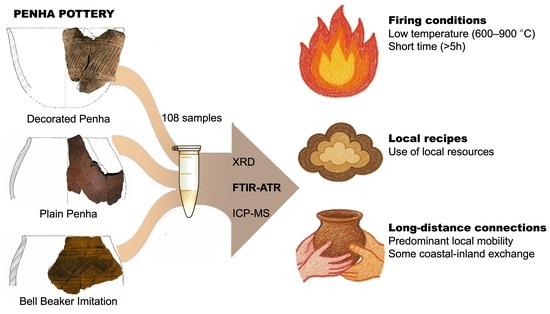
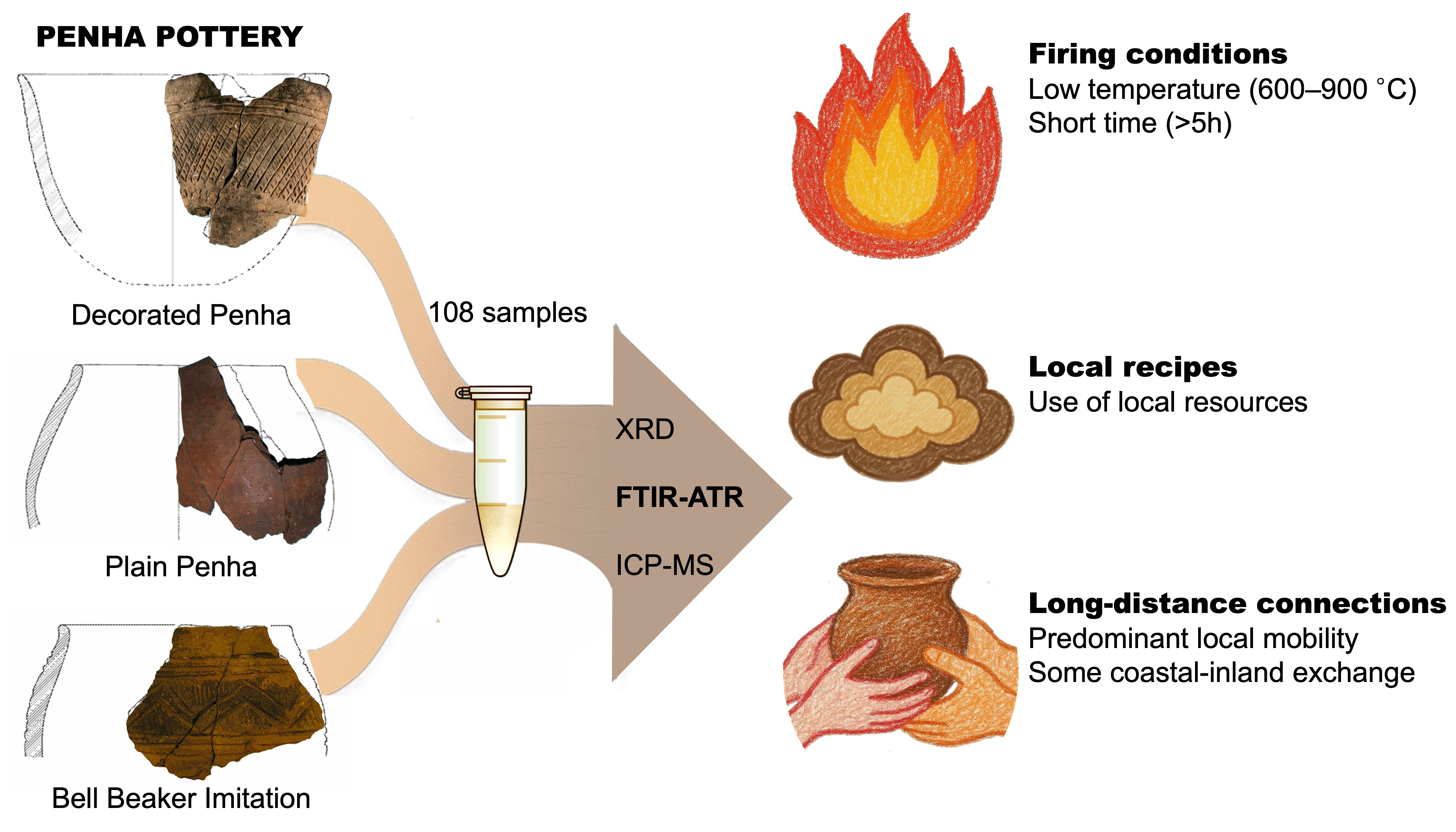
This paper presents the geochemical characterisation of Penha-type ceramics, one of the most iconic prehistoric ceramics in Western Iberia. Penha pottery was a widespread material expression in Late Neolithic communities who displayed significant socio-cultural transformation before the advent of the Metal Ages. Samples (108) from seven archaeological sites in Galicia (NW Spain) were analysed by XRD, FTIR-ATR and ICP-MS to determine their mineral, molecular and elemental composition, respectively. The results indicate that most vessels are compositionally consistent with local geological sources, whether mafic or felsic, pointing to strong intra-site production. The use of raw materials seems to have been selective, and there are minor discordances and mixed compositions in almost all sites. The selected methods were effective in determining temper composition, while FTIR-ATR was also informative of clay transformations due to firing. The firing conditions were generally low-temperature (600–900 °C) with relatively short times (<5 h), compatible with simple kiln technology. Archaeometric evidence suggests two scales of mobility: predominant local mobility and limited long-distance exchange (coastal/inland). The geochemical characterisation reveals that individual communities seem to have developed their own customised recipes for pottery production using a profound knowledge of available local resources.

Graphical Abstract

1. Introduction

Archaeometric characterisation of pottery has expanded our understanding of manufacturing processes and technical choices [1,2,3]. Ceramic technological studies have undoubtedly led to advances in archaeometric research [4,5,6,7] due to a combination of detailed prior typological studies, availability of material, and outstanding unresolved questions. The first attempts aimed to understand the selection of raw materials in order to reconstruct manufacturing traditions and patterns of circulation [8]. Later on, the Chaîne Opératoire, developed by a Francophone school, enabled researchers to better comprehend how ceramics were made [9,10]. Accordingly, scholars believed that by understanding the production of pottery, they could unravel its function, relying on the theoretical background of functionalism and processual archaeology (see discussions in [11,12]). However, they did not consider that the final users were probably not the manufacturers themselves [6]. This is why other processes started to be considered, such as the identity related to the objects [13] or the social aspects behind the selection of raw materials and use of the vessels [14,15]. Finally, the focus was placed on understanding the “biography of the object” [16,17], including, in the case of ceramics, production, use, reuse and also abandonment.
Many of these “biographic” moments are hidden in the pottery’s composition or in microscopic marks that can be assessed with different analytical techniques selected to best resolve specific questions [18]. Therefore, archaeometry soon started to complement the conclusions derived from anthropological and ethnological studies about manufacturing and raw material selection [3,19]. Recent studies show the increased uptake of archaeometry. Some have linked archaeometric changes in pottery to cultural discontinuities observed in monument architecture in Switzerland [20], social changes and cultural persistence in Croatia [21], and continuity and change in the selection and processing of raw materials in North Italy, which is, according to the authors, related to the decisions made by the individual pottery maker [22]. The amount of archaeometric studies on pottery increases every year, as well as the number of techniques that have been employed. Today, rather than complementing archaeometric studies with typological characterisations, archaeometric research focuses on designing analytical strategies to solve specific questions [18]. Emerging methods include minimally destructive analyses, chemometrics and the use of multistatistical analyses to understand the object’s biography.
These types of studies are scarce for the prehistoric pottery of NW Spain. The Late Neolithic in NW Spain (3100–2400 BC) was a period of intense changes that left little archaeological materiality, limiting our comprehension of social structures [23]. Most preserved constructions had a funerary function, although less monumental than in previous times. Burials were much smaller (cists or dolmens) or reused Middle Neolithic large Megalithic graves [24]. In contrast, the few preserved settlements show increased spatial organisation, including several house foundations surrounding fireplaces [25]. The archaeological record also includes a few ritual places, hidden in the landscape and mainly characterised by their connection to funerary and settlement sites [25]. Nevertheless, this period was characterised by a specific typology of pottery called “Penha-type” or simply Penha, as the first pieces described were found at the Portuguese site of Monte da Penha in Guimarâes [26,27].
Penha-type pottery is scarcely described. The first attempts were done by Jorge [28], who identified it as a style primarily confined to Northern Portugal. Our team has recently developed a much more detailed identification, description, and locational study of Penha pottery. Penha is a homogeneous-looking, bowl-shaped pottery type characterised by its matte reddish, brownish and blackish pastes [23]. Other shapes have been identified, but they are not abundant. Three categories have been described. The first and most frequent one was the decorated Penha typology, which is usually found in funerary sites [29]. Decorated Penha vessels have large-scale incised or stamped geometric motifs, which often appear to be carelessly manufactured [23]. Undecorated Penha pots are most commonly found in settlements [29]. Imitation vessels are produced by combining the techniques used in other Penha pieces with new technological advances from the Bell Beaker style, and they are likely the result of an individual choice rather than an established social know-how [30].
Penha-type pottery can be found throughout western Iberia, from northern Spain to southern Portugal and even western Andalucía in southern Spain, and the assemblage is often fragmented. NW Spain shows the most intriguing and varied assemblage of Penha vessels, and the style appears to have remained dominant throughout the Late Neolithic [30]. However, the shallow soils characteristic of Galicia (NW Iberia) are prone to intense fragmentation in the ceramic, which makes its description difficult. Thus, an archaeometric study complements the typological description. Several archaeometric techniques have been previously employed to characterise Prehistorical pottery from NW Spain, among others on Bell Beaker production [31,32,33], organic matter composition [34], and phosphorus content [35]. Our research has always employed analytical techniques in combination with chemometrics (i.e., multivariate statistical analyses), such as pyrolysis–GC/MS [34], analytical colour [33], and FTIR-ATR, to unravel the composition and structure of crystalline and amorphous materials [35]. In this work, we combine mineralogical (XRD), elemental (ICP-MS), spectroscopic (FTIR-ATR), and chemometric (principal components analysis, PCA, and discriminant analysis, DA) analyses to understand the composition of Neolithic Penha-type pottery from NW Spain.

2. Materials and Methods

2.1. Material

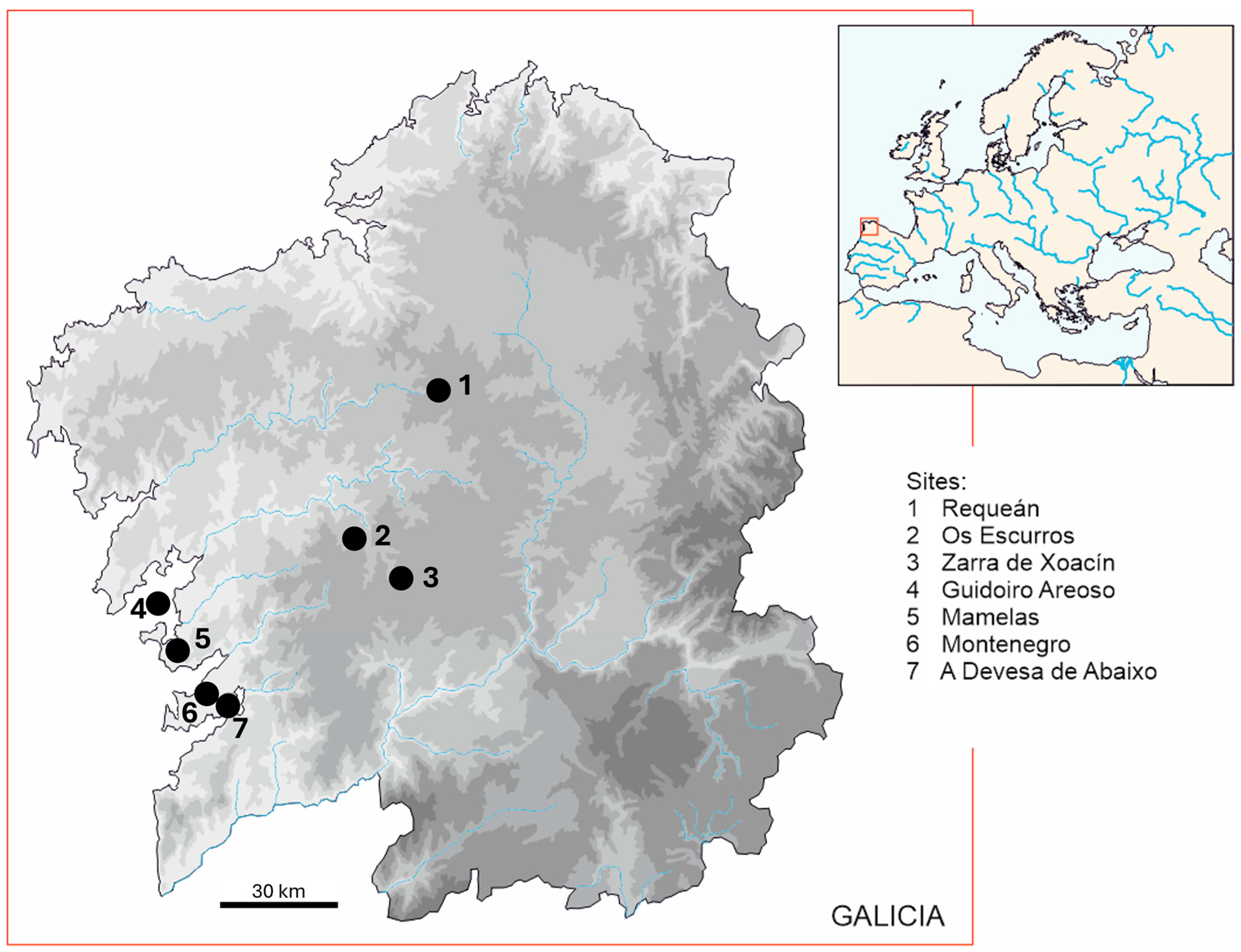
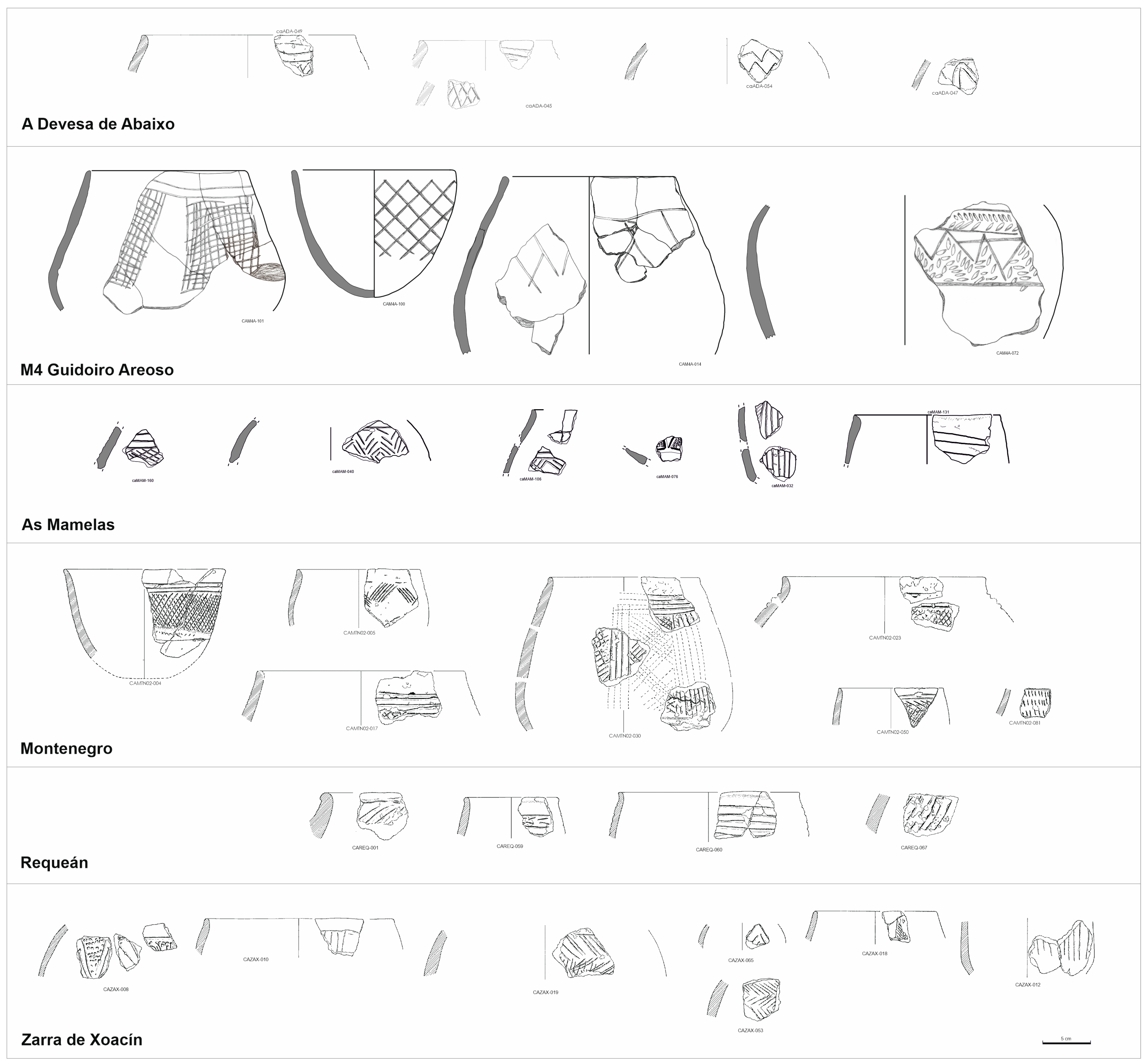
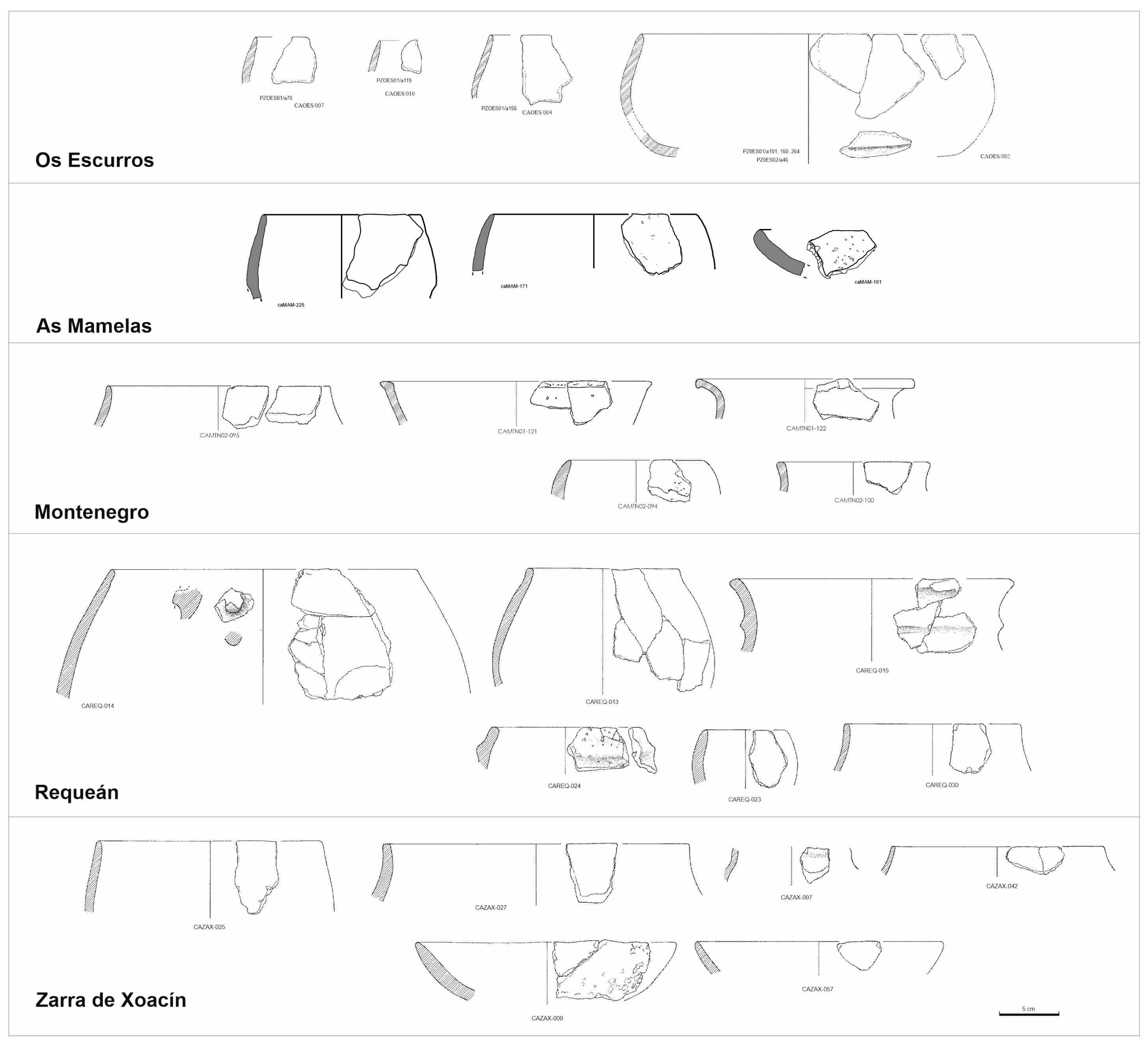
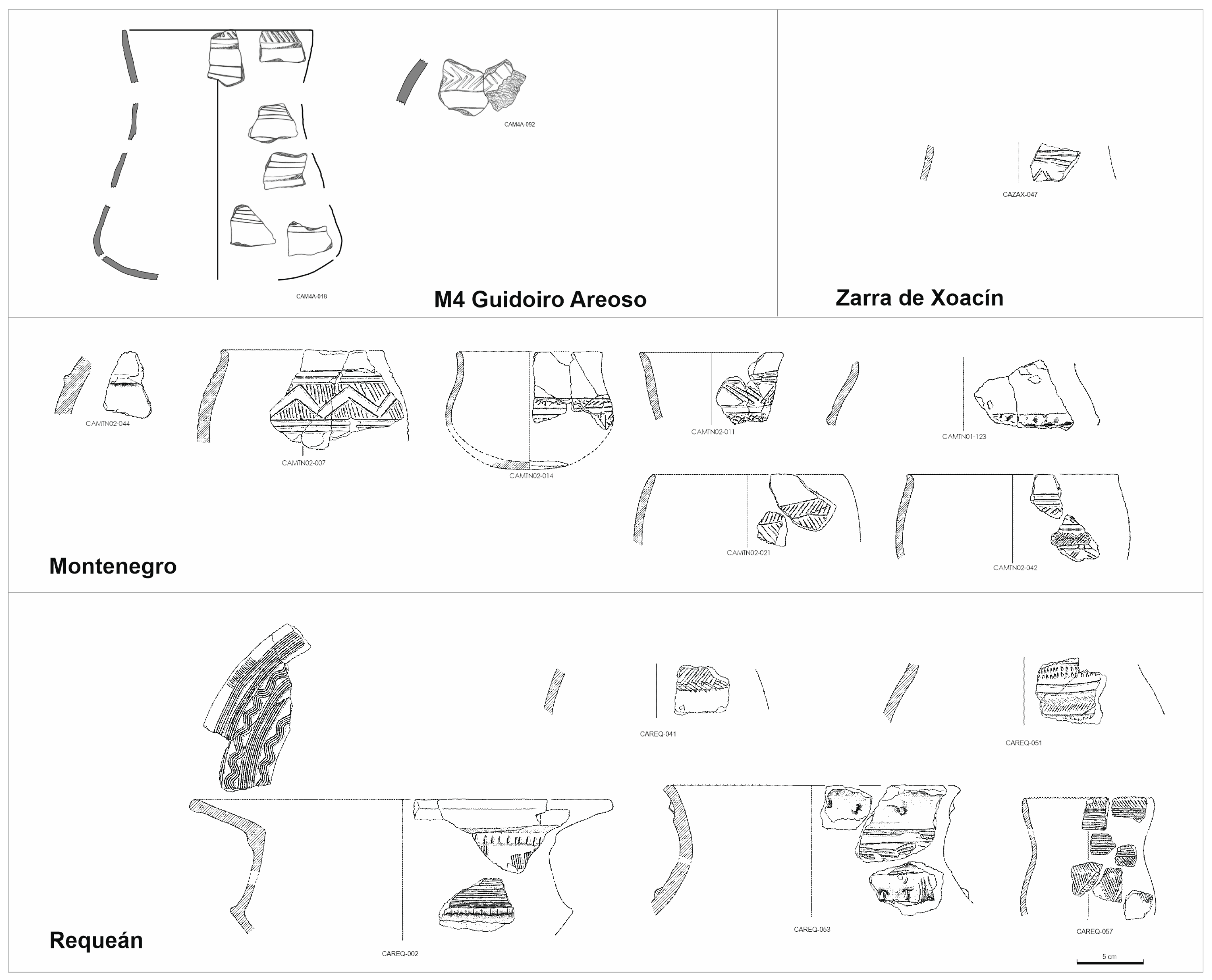
This study comprises 108 samples from seven archaeological sites in central and southwestern Galicia (NW Spain). Their geographical distribution was determined by the areas with the highest concentrations of Penha-type pottery (Figure 1). The selection was designed to include the full range of archaeological contexts: funerary sites (two), settlement sites (four), and sites with both funerary and settlement contexts (one) (Table 1). The overall ensemble is representative of Late Neolithic NW Spain (see Appendix A, Figure A1, Figure A2 and Figure A3). Although most sites include one or several later occupation phases from the Bronze Age, the analysed ceramics belong to Late Neolithic contexts and stratigraphic layers. These ceramics have been widely studied in terms of shape and operative chain (see references in Table 1), and lithological information for the sites is provided in Table A1. The samples were dried, fine-milled (<50 μm), and homogenised before the analyses.

2.2. Mineralogical Composition (XRD)

All samples were analysed by X-ray diffraction (XRD) to determine their mineralogical composition. Measurements were performed at the Unidade de Raios X of the Área de Infraestruturas de Investigación (RIAIDT, Universidade de Santiago de Compostela, Spain), using a Philips PW1710 diffractometer operating in Bragg–Brentano θ/2θ goniometer. The instrument was equipped with a Cu anode X-ray tube, a graphite monochromator and a PW1711/10 proportional detector (Malvern Panalytical, Malvern, UK). Mineral identification was carried out using DIFFRACplus EVA (Bruker AXS, Billerica, MA, USA) and HighScore Plus (Malvern Panalytical, Malvern, UK). The mineralogical results correspond to the crystalline fraction detectable by XRD. The facility complies with ISO 9001:2015 standards; https://assets.usc.gal/sites/default/files/paragraphs/more_info_service/2023-06/DNV_Certificate-English_v2023.pdf (accessed on 21 April 2026).

2.3. Molecular Characterisation (FTIR-ATR)

The samples were analysed using Fourier transform infrared spectroscopy with attenuated total reflectance (FTIR-ATR). Measurements were conducted in the mid-infrared (MIR) region using a Cary 630 spectrometer (Agilent Technologies Inc., Santa Clara, CA, USA), located at the EcoPast research group facilities (Universidade de Santiago de Compostela, Spain). Spectral data were collected in the 4000 to 400 cm−1 range, with a resolution of 4 cm−1 and performing 100 scans per sample to improve reproducibility and the signal-to-noise ratio. Spectral processing was done with Orange data mining software v3.40.0 [42].

2.4. Elemental Composition (ICP-MS)

Approximately 0.2 g (dry weight) of each sample was subjected to microwave-assisted acid digestion in Teflon vessels using a mixture of 3 mL HCl (37%, Panreac), 1 mL HNO3 (69%, Panreac) and 1 mL HF (48%, Panreac). Digestion was performed in an Ultrawave system (Milestone SpA, Sorisole, Italy) at 250 °C for 20 min, following a program specifically optimised for silicate matrices: microwave treatment for 20 min at 1500 W, 250 °C and 110 bar. The resulting solutions were brought to a final volume of 50 mL with type-1 MilliQ water. Concentrations for 25 major, minor and trace elements were determined using an Agilent 7700x ICP-MS (Agilent Technologies, Santa Clara, CA, USA), equipped with an introduction system comprising a Micromist glass low-flow nebuliser, a Scott spray chamber with Peltier (2 °C) and quartz torch. Sample digestion and ICP-MS analyses were carried out at the Unidade de Análise Instrumental, Área de Infraestruturas de Investigación (RIAIDT, Lugo, Universidade de Santiago de Compostela, Spain). All materials were measured within the same analytical run and in triplicate with nine procedural blanks. Calibrations were performed daily by analysis of fresh standard solutions.
Three standard reference materials (SRMs) were used to assess analytical accuracy: Flint Clay (NIST 97b), Basalt Rock (NIST 688-2) and Sewage Sludge. Good recoveries (within ±10% of the certified values) were obtained for P, Ca, Fe, Mg, Na, K, Ba, Cr, Mn, and Ni; acceptable recoveries (within ±25%) for Al, Ti, V, Rb, Sr, and Cu; and lower recoveries (within ± 30%–50%) for Si, Sc, Zr, Pb, and U. SRMs had no certified values for Ga, Y, Nb, or Sn.

3. Results

3.1. Mineralogical Composition (XRD)

Quartz was found in all weathering products (i.e., saprolites) of the geological materials located close to the archaeological sites, while K-feldspar, plagioclase, and mica were found in most of them—despite both K-feldspar and plagioclase sometimes appearing together in some granitic materials (calc-alkaline or alkaline) (Table A1). Amphibole (mainly actinolite and tremolite), chlorite, and talc, as well as some trace minerals (epidote, serpentine, and anatase), were only found in saprolites of mafic (i.e., ultramafic and serpentinised) rocks of the Requeán and Os Escurros areas. Amphibole was also present in amphibolites of the A Devesa de Abaixo area. All weathering products contained kaolinite.
Table 2 synthesises the main minerals detected by XRD in the analysed Neolithic ceramics from NW Spain. Quartz was found in all samples, while K-feldspar, plagioclase, and mica were found in a large majority of the samples (90%, 88%, 70%, respectively). Amphibole, chlorite, and talc were only found in samples from archaeological sites located in areas of mafic rocks. Epidote, serpentine, anatase and garnet were occasionally found in single samples and in trace amounts, also in sites from areas with mafic geological materials. Kaolinite was only found in one sample from Zarra de Xoacín and two samples from A Devesa de Abaixo. These minerals were present in the temper (i.e., coarse-grained) and pastes (i.e., clays) of the ceramics.

3.2. Elemental Composition (ICP-MS)

Average concentrations and standard deviations for the 25 chemical elements analysed by ICP-MS are provided in Table 3 (concentration data for all elements and samples can be found in Supplementary Material Table S1); averages for groups based on surrounding lithology (mafic vs. felsic) are also provided. Very high variability (CV > 100) was found for P, Ca, Mg, Rb, Y, Cr, Ni, and Cu; high variability (CVA 50–100) was shown by Al, Na, K, Sc, Sr, Zr, Ba, Mn, Sn, and U; only Si, Fe, Ti, Ga, V, Nb, and Pb, showed relatively low variability. Archaeological sites located in areas dominated by mafic rocks tended to show above-average concentrations of Al, Fe, Ca, Mg, Na, Ti, V, Y, Cr, Mn, Ni, and Cu. Archaeological sites in areas dominated by felsic rocks tended to show above-average concentrations of P, Si, K, Sc, Ga, Rb, Sr, Zr, Nb, Ba, Sn, Pb, and U.
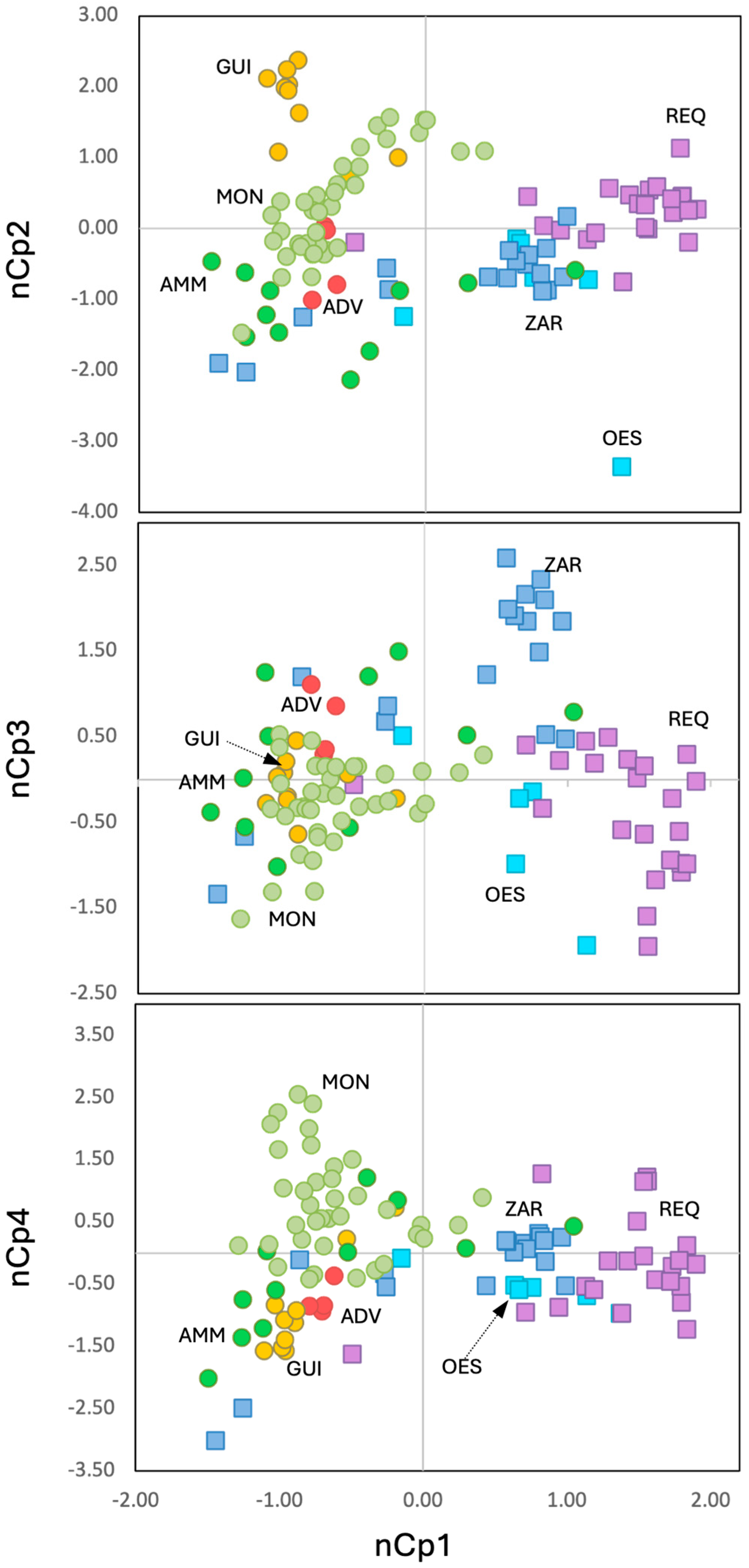
The PCA analysis performed on the clr-transformed elemental data resulted in four main components (nCp1 to nCp4), accounting for 78.5% of the total variance (51.9, 11.6, 9.0, and 6.1%, respectively). The first component, nCp1, presented high (>0.7) positive loadings for Mg, Ni, Cr, Fe, Y, Al, Mn, and Ca; a moderate (0.7–0.5) positive loading for V and Cu; high negative (<−0.7) loadings for K, Sn, Rb, U, Pb, Zr, Nb, and Ga; and moderate negative loadings (−0.7 to −0.5) for Ba and P (Table A2). The second component, nCp2, showed a high positive loading for Sr and moderate positive loadings for Na, Ca and Ba. The third component, nCp3, presented a high positive loading for Ti and a moderate positive loading for Nb. The fourth component, nCp4, showed a high positive loading for Sc and a moderate positive loading for V.
Given the chemical associations of the principal components, nCp1 reflects the main geochemical signal of the elemental dataset, since positive loadings correspond to elements typically associated with mafic materials and negative loadings to elements associated with felsic materials. nCp2 reflects Sr and part of the Ca, Ba and Na variance, pointing to variations in Sr- and Ca-bearing minerals. nCp3 and nCp4 mainly account for variations in elements (Ti, Nb, and V) that are usually hosted in fine grain size mineral [43].
The nCp1/nCp2 score projection shows a quite distinctive separation of the samples (Figure 2). Samples from archaeological sites in areas of mafic materials plot to the right, i.e., they are enriched in Mg, Ni, Cr, Fe, Y, Al, Mn, Ca, V and Cu; while samples from sites in areas of felsic materials plot to the left, i.e., they are enriched in K, Sn, Rb, U, Pb, Zr, Nb, Ga, Ba, and P. The projection also shows a certain degree of separation between sites in mafic areas, with Requeán samples showing higher nCp1 scores than Os Escurros and Zarra de Xoacín. For the sites in felsic areas, a separation is also seen, with Guidoiro Areoso and most Montenegro samples showing positive nCp2 scores (enriched in Sr and Ca), while A Devesa de Abaixo and As Mamelas samples tend to show negative nCp2 scores. It is also noticeable that some samples of sites from mafic areas showed an elemental composition compatible with felsic materials: five samples from Zarra de Xoacín, one sample from Os Escurros, and one sample from Requeán. Similarly, a few samples of sites from areas of felsic materials showed a composition compatible with mafic materials: two samples from As Mamelas and two samples from Montenegro (Figure 2). The nCp1/nCp3 projection essentially separates samples of sites with mafic compositions, with samples from Zarra de Xoacín showing higher nCp3 scores (i.e., Ti and Nb enrichment). The nCp1/nCp4 projection essentially separates Montenegro samples (enriched in Sc and V) from the other sites from felsic areas.

3.3. FTIR-ATR

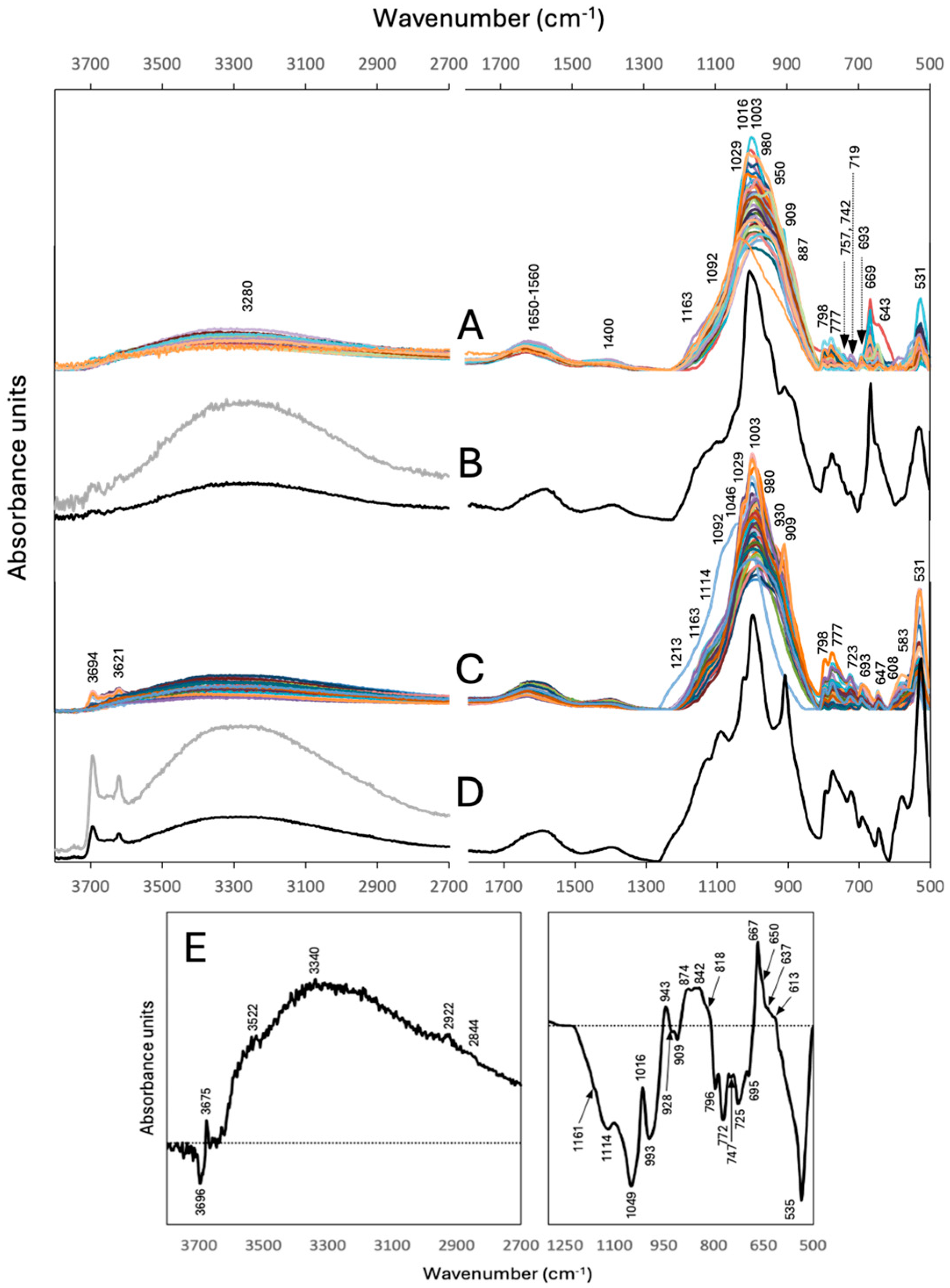
The FTIR-ATR spectra of the samples are represented in Figure 3 (raw spectra of all samples can be found in Supplementary Material Table S2). The samples are grouped based on the previous PCA results as samples with mafic elemental composition (Figure 3A) and samples with felsic elemental composition (Figure 3C). The spectra can be divided into four main regions based on the intensity of absorbances: I, 3800–2700 cm−1; II, 1800–1200 cm−1; III, 1200–850 cm−1; and IV, 850–500 cm−1. Overall absorbance is low to very low in regions I and II, high to moderate in region III, and moderate to low in region IV (Figure 3). In region I, weak absorbances were found at 3694 and 3621 cm−1 and a large shoulder centred at 3280 cm−1, while in region II, two small shoulders were found centred at 1650–1560 cm−1 and 1400 cm−1. In region III, well-defined peaks appeared at 1046, 1029, 1016, 1003, 980, 950, and 909 cm−1. The second derivative also detected shoulders at 1213, 1163, 1114, 1092, 990, and 930 cm−1. In region IV, low-intensity peaks were found at 798, 777, 757, 742, 719, 693, 669, 643, 647, 608, 583, and 531 cm−1. In some samples, the peaks at 798, 777, 669, and 531 cm−1 were of moderate intensity.
In agreement with the absorbance spectra, the standard deviation spectra of the samples showed low to very low variability in regions I and II and large to moderate variability in regions III and IV (Figure 3B,C). The samples from sites located in mafic areas showed high to very high variability for peaks at 1003, 990, 1016, 950, 1029, 669, 909, and 887 cm−1 (in decreasing order; Figure 3C). The samples from sites located in felsic areas showed high to very high variability for peaks at 1003, 980, 531, 909, 1029, 1046, 1092, and 930 cm−1. Thus, the largest compositional differences within each group should be related to the minerals accounting for these vibrations (see below). We also calculated the MIR average difference spectrum of the two groups of samples (Figure 3E). The samples from sites located in mafic areas showed higher absorbance at 3675, 3522, 3340, 943, 874, 842, 818, 667, 650, 637, and 613 cm−1, and lower absorbance at 3696, 1161, 1114, 1049, 928, 909, 798, 777, 747, 725, 695, and 535 cm−1, when compared to the samples from archaeological sites located in felsic areas.
The main vibrations found in the absorbance spectra and the standard deviation spectra can be attributed to silicates (see Table A3 and reference therein). Vibrations from primary silicates as quartz (1163, 1088, 1061, 965, 798, 777, and 693 cm−1), K-feldspar (mainly microcline: 1133, 1092, 1046, 999, 770, 729, 650, and 576 cm−1) and plagioclase (mainly albite: 1146, 1098, 1034, 988, 742, 723, 650, 611, and 587 cm−1) were found in all or almost all pottery samples. Mica (muscovite: 3621, 1019, 988, 926, 827, 742, 645, 611, and 527 cm−1; and biotite, e.g., 988, 965, 911, 645, and 611 cm−1), amphibole (mainly tremolite: 3690, 3673, 1098, 1042, 1018, 999, 957, 921, 759, 686, 669, 645, 606, 583, 542, and 508 cm−1; and actinolite: 1053, 1005, 999, 949, 759, 686, 645, and 539 cm−1), and chlorite (e.g., 3675, 1088, 1059, 999, 957, 818, 790, 645, 524 cm−1) were found in a smaller number of samples. As for the clay minerals, kaolinite (3694, 3619, 1114, 1029, 999, 932, 911, 790, 751, 677, 645, 527 cm−1) and talc (3677, 1046, 1018, 777, 729, 669, 531 cm−1) were identified. The vibrations found here for these minerals are similar to those found in other investigations and reference spectra of these minerals (Table A3 and reference therein).
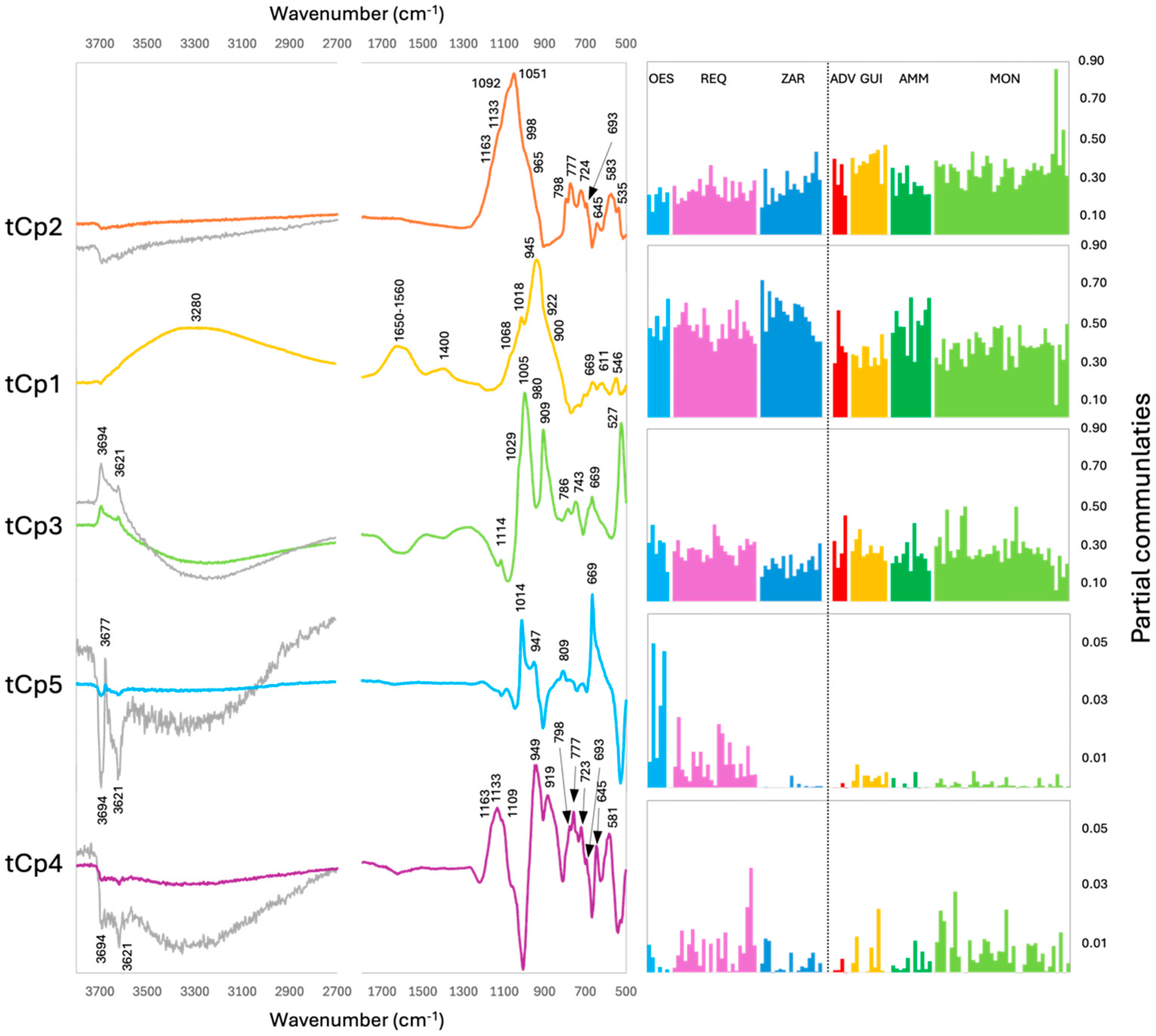
The principal components analysis was performed on transposed data matrices (i.e., spectra in columns, tPCA) using the selected regions of the MIR spectra (3800–2700 cm−1 and 1800–500 cm−1). It enabled us to synthesise the MIR spectral signal into five components, which accounted for more than 99% of the spectral variability in the samples (Figure 4). The first principal component (tCp1) scores’ spectrum shows a main peak at 945 cm−1 and a secondary peak at 1018 cm−1. Shoulders are also evident at 3280, 1650–1560, 1400, 1068, 1036, 922, and 900 cm−1, with low scores at 669, 611, and 546 cm−1. This component dominates the MIR signal (over 0.5 partial communality) of the samples from sites located in areas of mafic rocks (OES, REQ, ZAR), and its contribution is lower (<0.5) for the samples from archaeological sites in areas of felsic rocks (ADV, GUI, MON), except for As Mamelas (AMM) (Figure 4).
The second component (tCp2) spectrum has a main peak centred at 1051 cm−1 and shoulders at 1163, 1133, 1092, 1077, 1034, 998, and 965 cm−1. Smaller peaks appear at 798, 777, 724, 693, 645, 583, and 535 cm−1. This component has a higher contribution (>0.4) in samples from archaeological sites from areas of felsic rocks, apart from As Mamelas, than in those from areas of mafic rocks (<0.3) (Figure 4). The contribution is particularly high for two samples from Montenegro.
The third component (tCp3) scores’ spectrum shows well-resolved peaks at 3694, 3621, 1005, 980, 909, 786, 753, 743, 699, and 527 cm−1 and a shoulder at 1029 cm−1. The contribution to the MIR signal is quite uniform across samples (0.2–0.3), with higher values (0.3–0.5) in a few samples from every site. Montenegro is the site with a larger number of samples with relatively high tCp3 contribution (six samples) (Figure 4).
The other two components have a much lower contribution to the spectral signal (<0.05). The scores’ spectrum of the fourth component (tCp4) shows peaks at 1163, 1133, 1109, 949, 919, 890, 798, 777, 756, 741, 723, 693, 645, 608, 594, and 581 cm−1, and shoulders at 919, 881, and 844 cm−1. The highest contributions to the MIR signal were found for samples from the Requeán and Montenegro sites. While the scores’ spectrum of the fifth component (tCp5) shows well-defined peaks at 1014 and 669 cm−1 and minor peaks at 3677, 947, and 809 cm−1. The largest contributions of this component correspond to samples from Os Escurros and Requeán. In the Guidoiro Areoso and Montenegro samples, tCp5 also shows minor but consistent contributions (Figure 4).
Peaks of the tCp1 scores’ spectrum can be assigned to amphiboles (1018, 945, 669, 546 cm−1; Table A3), muscovite (1066, 1018, 611 cm−1), OH vibrations (3280 cm−1), and adsorbed water (1650–1560 cm−1). Peaks in the tCp2 spectrum can be assigned to K-feldspar (1133, 1092, 1049, 996, 727, 645, 583, 535 cm−1; mainly microcline) and quartz (1163, 798, 777 cm−1). Almost all peaks in the tCp3 spectrum can be attributed to kaolinite (3694, 3621, 1114, 1029, 909, 786, 527 cm−1); muscovite (743 cm−1) and talc (669 cm−1) could also be present. The tCp4 peaks can be attributed to amphiboles (1109, 949, 919, 756, 741, 723, 645, 581 cm−1; Table A3), quartz (1163, 798, 777, 693 cm−1), K-feldspar (1133 cm−1), and possibly mica (920, 741, 645, and 608 cm−1). The main tCp5 spectrum peaks can be assigned to talc (3677, 1014, 669 cm−1).

3.4. Chemometric Classification of the Pottery of the Studied Sites

To determine to which degree the pottery of each site has a specific chemical signature, we performed a discriminant analysis using the scores of the principal components extracted on the elemental composition (nCp1 to nCp4) and the partial communalities of the principal components extracted on the MIR data (tCp1 to tCp5) as input variables. Samples that were not consistent with the main composition of the pottery of each site (felsic nature in areas of mafic rocks, and mafic nature in areas of felsic rocks) were left unassigned, so the assignment was provided by the analysis.
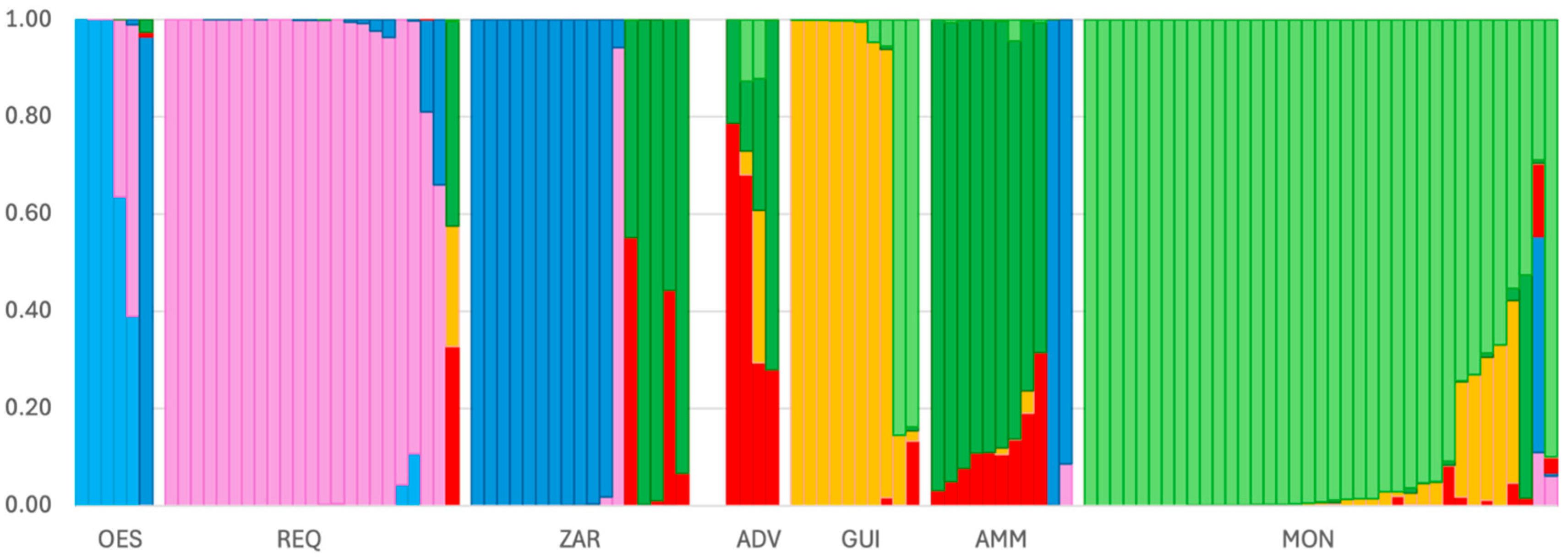
Four canonical functions were found to be significant for the discrimination between archaeological sites, and they included six out of the nine input variables: mafic vs. felsic compositions (nCp1), Sr and Ca content (nCp2), elements hosted in trace minerals (nCp3: Ti and Nb; nCp4: V), kaolinite content (tCp3) and talc content (tCp5). The overall percentage of correct classification (i.e., samples assigned to the same group they belonged to) was 94%. Figure 5 shows, for each sample, the fractionation of the probability of belonging to each archaeological site. The probability of belonging to the archaeological site was very high for Os Escurros (average 0.91), Requeán (avg 0.97), Zarra de Xoacín (avg 1.00), Guidoiro Areoso (avg 0.98), and Montenegro (avg 0.93); high for As Mamelas (avg 0.86); and moderate for A Devesa de Abaixo (avg 0.51).
Of the unassigned samples from sites of mafic rocks but with felsic elemental composition, Os Escurros showed a large similarity (p = 0.96) to samples from Zarra de Xoacín; the sample from Requeán showed a mixed probability with As Mamelas (p = 0.44), A Devesa (p = 0.33) and Guidoiro Areoso (p = 0.25); and samples from Zarra de Xoacín showed large similarity (p = 1.00–0.56) to samples from As Mamelas and to samples from A Devesa (p = 0.55). The samples from sites in areas of felsic rocks that had a mafic elemental composition were found to be affine to those from Zarra de Xoacín (two samples from As Mamelas, p > 0.90; and one sample from Montenegro, p = 0.44), but one sample from Montenegro was reassigned to the same site despite the elemental data pointing to a mafic elemental composition.
Of the reassigned samples, Requeán and Zarra de Xoacín showed the most homogeneous compositions (i.e., all samples had high probability of being classified as from the site). Although most samples from Montenegro were classified as from the site, 10 samples showed increasing transition (i.e., probability) to those from Guidoiro Areoso; equally, two samples from Guidoiro Areoso were reclassified as from Montenegro with large probabilities (p > 0.84). Mamelas samples showed affinity with A Devesa de Abaixo samples (Figure 5). The low number of samples available for Os Escurros and A Devesa de Abaixo prevents a proper comparison for these two sites.

4. Discussion

4.1. Mineralogical Composition: XRD and ATR-FTIR

The XRD analyses indicate that the mineralogy of the investigated Late Neolithic Penha-type pottery samples from NW Spain was consistent with that of the weathering products (saprolites) of the geological materials found in the surroundings of the archaeological sites. Both primary (quartz, K-feldspar, plagioclase, amphibole, mica, and chlorite) and secondary (kaolinite and talc) silicates were identified. Most of the samples from each site had a mineralogy highly compatible with that of the dominant geological materials, whether mafic or felsic, suggesting that local resources were used to produce the ceramics.
Sourcing raw materials from areas immediately surrounding inhabited settlements is a widespread trend among pottery-making communities across the globe. Archaeological research indicates maximum distances of 10 km, depending on the region [31,32,37,44], although these distances are somewhat shorter in communities studied directly by anthropologists [4,45]. We know of only a couple of exceptions, including Rhenish stoneware in the modern era. Potters, fleeing war or high taxes, and after moving to a distant city, still used raw materials from the original source areas many kilometres away to produce pottery in their own workshops [46]. The increase in demand for Chinese porcelain manufacture during the Yuan and Ming dynasties is another exception. This led to the depletion of nearby porcelain stone deposits, forcing artisans to seek resources in more distant areas or to mix different types of clay to improve quality [47].
It is important to emphasise that raw materials are sought by assessing the quality of a clay, and this assessment goes beyond its strictly physical properties to form part of a broader relationship with the natural environment—a relationship based on geographical, social, and symbolic representations [48]. We must recognise the use of local raw materials as a predominant trend across all sites because the environment provided suitable material for making pottery and the territory was very well known to the people who lived there.
The mineral diversity of the studied ceramics was larger in samples from archaeological sites in areas dominated by mafic rocks than in those from sites dominated by felsic rocks. Up to eight minerals were found in the ceramics from sites in mafic areas and four (five in A Devesa de Abaixo) in the ceramics from sites with felsic mineralogies. This mineralogical diversity could be linked to the rich and complex lithology of inland NW Spain, where Os Escurros, Zarra de Xoacín and Requeán are located (Table A1). This fact highlights the importance of the lithology in ceramic production. Despite the availability of both mafic and felsic rocks, it seems that at every site, a few sources were mainly used. For example, amphibolites are found in the area at A Devesa de Abaixo, but none of the four pottery samples from this site contained amphibole. Alkaline granites (containing only K-feldspar) are found in areas of felsic rocks, but all samples from sites in these areas contain both K-feldspar and plagioclase.
The mixing of materials is common during the ceramic production process. The addition of organic and inorganic materials can be beneficial for the manufacture or use of the vessel, whilst removing impurities present in the raw material or unwanted substances improves the final product. Selection of raw materials (through experimentation, tradition, socialisation, etc.) was evidenced in some communities in Africa, studied from an ethnoarchaeological perspective [13,48]. The mixing of materials was usually the result of potters’ experience, representing a functional, social or symbolic solution. This know-how—that is, in this case, the preference for using greater quantities of plagioclase—has already been previously observed in Bell Beaker-period ceramic assemblages in NW Spain [32]. Therefore, here, it is likely that the recipe originated at least in the Late Neolithic, with its importance so deeply rooted that it persisted for at least another millennium. Perhaps Neolithic communities had already realised that plagioclase offers specific properties superior to other feldspars (such as K-feldspars) in pottery production, mainly due to its greater fluxing capacity and thermal behaviour [49]. Other mixtures were documented outside NW Spain; for example, the introduction of calcite as temper in pottery from the Early Neolithic period on the Spanish Mediterranean coast [50]. From an archaeological perspective, it is truly difficult to pinpoint why certain raw materials were chosen over others, as the choice of techniques for preparing ceramic bodies is based on a multitude of technical, social and symbolic factors [48].
The elemental composition of the pots was also consistent with the local geology. The first principal component (nCp1) reflected a gradient from felsic (i.e., enriched in K, Rb, Ga, Nb, Zr, Sn, Pb, and U) to mafic (i.e., enriched in Mg, Ca, Fe, Mn, Ni, Cr, Y, and Al) compositions. The elemental composition also showed that, except for A Devesa de Abaixo and Guidoiro Areoso, the pottery samples from the other five sites included compositions that varied within each site and from the dominant local geology (felsic in mafic areas and mafic in felsic areas). This is discussed in Section 4.2.
The FTIR-ATR results are also in line with the XRD and elemental composition results. The studied samples showed vibrations typical of the silicates detected by XRD and agreed with the geological materials of the areas where the sites are located. FTIR-ATR also enabled us to obtain detailed identification of the minerals. K-feldspars are represented mainly by microcline, but the presence of orthoclase is also suggested. Albite and anorthite were the plagioclases detected. Amphiboles were mainly represented by actinolite and tremolite, but hornblende and glaucophane are also compatible. And within the mica, although muscovite seems to be more frequent, some vibrations also point to the presence of biotite. As for the secondary silicates, kaolinite was only detected by XRD in three samples (one from Zarra de Xoacín and two from A Devesa de Abaixo) and talc in eight samples (five from Os Escurros and three from Requeán). Despite this, the tPCA data suggests that kaolinite (tCp3), or part of the kaolinite structure, was present in all samples (Figure 4), while talc was detected in all samples from Os Escurros and Requeán, and even in samples from Guidoiro Areoso and Montenegro—although with weak intensities (Figure 4). The presence of these secondary minerals may provide information on firing temperature and time, as discussed in more detail in Section 4.3.

4.2. How Specific Is the Composition of Each Archaeological Site?

The analytical results suggest that the composition of the ceramics is highly related to the geological materials in close proximity to the archaeological sites, but not all available materials seem to have been used. The results of the discriminant analysis also support this interpretation, as the percentage of correct classification is very high (94%). This means that most samples have a chemical and mineralogical composition that is specific to each site, i.e., the same pottery-making recipe, implying that potters may have had profound knowledge of the available geological resources and were quite selective in their use. This interpretation is consistent with the ethnoarchaeological research cited above [13,48]. The specific lithology associated with each site would help to highlight the distinctiveness of one site compared to another in the vicinity. It allows us to better understand the landscape as a “taskscape” [51]. This differs, for example, from Neolithic sites in North Italy, where the selection of raw material seems to have been homogeneous between sites [22], but similar responses to Penha were found in other European sites, highlighting the existence of cultural discontinuities between sites [20]. In our particular case, the pottery reveals a dynamic mobility between the region’s populations during the Late Neolithic, which had not been observed until now and is not apparent through the study of ceramic typology.
The results also indicate that in most sites, some ceramics did not conform with the composition of the majority of the samples. Three situations can be distinguished: (i) samples that show a quite distinctive composition regarding the dominant one in the site, (ii) samples that have compositions in line with the local geology but highly affine to samples from other sites, and (iii) samples showing a compositional transition (i.e., mixed probability) (Figure 5). The first situation was found for five samples of Zarra de Xoacín with felsic compositions in common with As Mamelas and A Devesa de Abaixo samples, and two samples from As Mamelas and one from Montenegro that are very similar to Zarra de Xoacín samples. There appears to be a certain connection between the sites in the Zarra de Xoacín area and those of the west coast, which are some 60 km apart (in a straight line; Figure 1).
The second situation was found for one sample from Os Escurros, with Zarra de Xoacín, one sample of Zarra de Xoacín, with Requeán, and two samples from Guidoiro Areoso, with Montenegro. The distance between the sites, in these cases, is greater than 50 km, except between Zarra de Xoacín and Os Escurros (~15 km). This opens the possibility that these ceramics could have been transported from various locations for the purpose of trade (i.e., long-distance trade) or exchange for a variety of reasons, or they were locally produced but with different clay resources, perhaps because the potter might have belonged to a different pottery-making tradition (for example, potters that moved to live in another community and took their know-how with them). In the case of Guidoiro Areoso, all the vessels had to be brought to the islet (area ~5 hectares) as there are no materials to produce pottery in it.
This islet offers an exceptional context, as it was a vast necropolis dating from the Middle and Late Neolithic (burial mounds) to the Late Bronze Age (cists). From the Late Neolithic onwards, a large midden formed and continued to be used into the Middle Bronze Age. Clearly, the activity carried out on the islet was of a ritual–funerary nature. The vessels deposited there, both inside and outside the tombs, were placed as part of a ritual landscape, likely associated with a single territory in which various communities within this area employed slightly different ceramic processing techniques, possibly linked to maritime mobility. Furthermore, it is worth noting that during the Late Neolithic, Guidoiro Areoso was probably part of a small peninsula connected to the Island of Arousa or even to the mainland [52], meaning walking access could have been easier from the east. Although these conditions changed by the end of the third millennium BC, the use of the islet remained intense and focused on funerary and ritual activities, demonstrating the site’s importance to nearby communities.
The third situation, compositional transitions, was found in all studied sites. Although this could also be related to exchanges, it is more likely that compositions compatible with the local geology and mixed compositions indicate small variations in the materials used to produce the pottery or the existence of different recipes in the same site. The variety of techniques could be linked to people moving from place to place with their pottery, or they could be a blend of materials based on techniques used by neighbouring potters. In any case, movement between neighbouring villages is evident at all the sites. This appears to reflect the logic of Late Neolithic societies, which were more homogeneous within a local environment (suggesting that each village possessed its own know-how) and, at the same time, heterogeneous between neighbouring communities (evidenced by different ceramic recipes that may correspond to sites in the surrounding area).

4.3. Clay Transformation Products and Firing: Kaolinite and Talc Content

Kaolinite is the main secondary mineral in all weathering products and soils of NW Spain, and talc is a weathering product of amphibole. Thus, kaolinite can be assumed to have been present in all clay sources and talc only in clays from mafic areas. Both clays undergo structural changes with increasing temperature and, thus, their presence can provide information on firing temperature and time of firing. Kaolinite starts to transform from 500 to 550 °C and follows a progressive structural change with increasing temperature and time: the interlayer OH (3694 and 3620 cm−1) disappears, i.e., kaolinite dehydroxylation, after 2 h of firing at 500 °C, 40 min at 550 °C, and 10 min at 600 °C [53]. With increasing firing temperature and time, the peaks at 1005, 1029, and 527 cm−1 decrease in intensity (even disappear), and the main peak shifts to a higher wavenumber [53,54]. Deju et al. [55] found that after 3 h of firing at a temperature of 750 °C, the main peak shifted to 1053 cm−1 and kaolinite was completely transformed into metakaolinite, as also found in other investigations [54,56,57,58,59]. As for talc, Meng et al. [60] found that little structural change occurred below 800 °C, independent of the time of firing. From 800 °C, the peak at 669 cm−1 decreased, and the peaks at 3676 cm−1 and 1018 cm−1 shifted to lower wavenumbers. Also, between 900 and 800 °C, the 669 cm−1 peak disappeared and fragmented into smaller, multiple peaks [60].
The tPCA results obtained on the FTIR-ATR data can be interpreted as reflecting changes in the clays of the pots due to firing. tCp1 was found to be related to amphibole content, but it also reflects changes in kaolinite structure: dehydroxylation is attested by the absence of the surface and internal hydroxyl bands (3694 and 3620 cm−1) and the appearance of bands related to adsorbed water (1650–1560 cm−1). The presence of peaks related to talc (1018 and 669 cm−1) suggests temperatures lower than 800 °C. The component most probably indicates partially modified kaolinite. On the other hand, tCp2 shows a flat spectrum from 4000 cm−1 to 1200 cm−1, indicative of total dehydroxylation and loss of adsorbed water, and a main peak at 1051 cm−1, which agrees with the shift observed when kaolinite is fired at 750–800 °C for more than 2 h [55]. Also, component tCp3 was associated with the presence of intact, or relatively intact, kaolinite. High values of tCp3 could be associated with low firing temperatures and/or short firing times; thus, tCp3 partial communalities should decrease as kaolinite is transformed into metakaolinite.
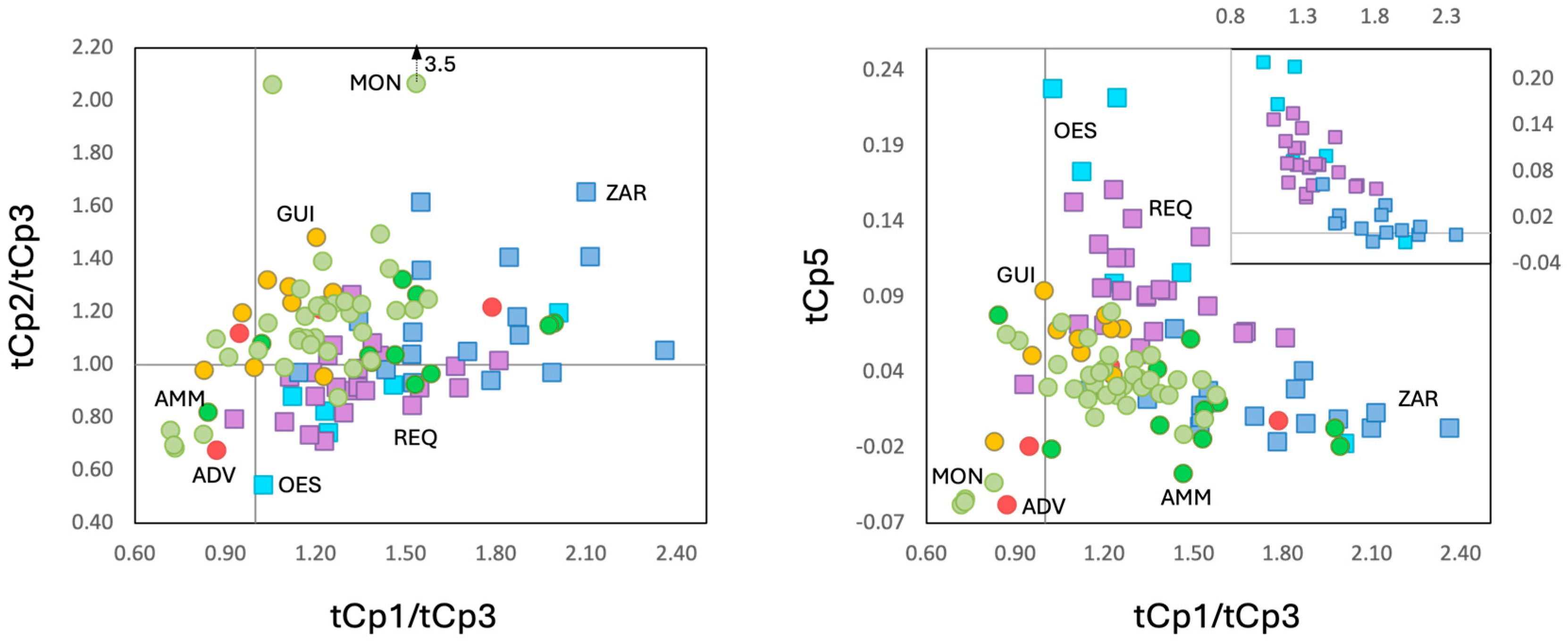
We calculated the ratios of tCp1 and tCp2 to tCp3, assuming that tCp3 can be used as a reference for the lowest degree of kaolinite transformation (Figure 6). Both ratios tend to increase simultaneously, suggesting that the increase in temperature and firing time produced both partial and total structural transformations of kaolinite. In general, samples from mafic areas plot below samples from felsic areas. Two samples from Montenegro show the most elevated values for tCp2/tCp3, and their spectra present a clear shift of the main absorbance peak, as well as the appearance of an absorbance shoulder at 1200 cm−1 (Figure 3), characteristic of metakaolinite formed above 800 °C and complete disappearance of kaolinite [56,57]. tCp2 values are higher in samples with felsic composition, and tCp1 values are higher in samples with mafic composition, pointing to a higher degree of kaolinite conversion to metakaolinite in pottery of sites in felsic areas, likely because of higher firing temperature and/or firing time. An aspect to consider here is that soils and weathering products of mafic areas in NW Spain have higher clay content than those of felsic areas. Thus, the same firing conditions may have resulted in lower total kaolinite transformation for mafic pastes due to the larger clay content.
The plot of the talc signal (tCp5) versus kaolinite conversion (tCp1/tCp3) also provides interesting results. For samples with mafic composition, the talc signal decreases with increasing kaolinite conversion (tCp1/tCp3). Samples from Os Escurros cover the whole range of variation, while Requeán samples show intermediate values, and Zarra de Xoacín samples show the lowest values (i.e., talc is very low or absent), also pointing to variations in firing temperature/time. A few samples of sites from felsic areas (A Devesa, Montenegro, Guidoiro Areoso, and As Mamelas) have very low tCp1/tCp3 and tCp5 values (Figure 6), but the other samples show a similar decreasing trend as those with mafic compositions—but with lower talc content.
The temperature ranges resulting from the analyses are consistent with the information available for prehistoric societies. The firing temperatures of the ceramics analysed fall within a low-temperature range (below 950 °C), which also indicates that these communities possessed the technology to fire ceramics at a sufficient temperature to make them functional. Although no kilns have yet been found for prehistoric NW Spain, our hypothesis is that potters may have used pit kilns, which are well known from an ethnographic perspective [13]. These kilns operate at temperatures between 600 °C and 900 °C for between 1 and 5 h, so both the temperature and the duration are consistent with our estimations.
The diversity observed between sites is noteworthy; different trends are observed at each site, which could correspond to the customised recipes of each community, and furthermore, they likely indicate that the firing technique was not yet properly controlled, given the variety of temperatures within the 600–900 °C range. It should also be borne in mind that the position of the piece within the kiln can result in it receiving heat to a greater or lesser extent; consequently, temperatures within a single firing can vary.

5. Conclusions

The mineralogical (XRD) and geochemical (ICP-MS and FTIR-ATR) analyses of the Late Neolithic Penha-type pottery from NW Spain provided consistent and complementary information on the composition of the ceramics. XRD, ICP-MS, and FTIR-ATR provided information on the mineralogical composition of the temper, while FTIR-ATR also provided information on the pastes (i.e., clays), with insights into firing temperature and firing time. Temper minerals were more informative of the geological composition of the source materials, whereas the paste’s minerals were more informative of the ceramic processing (firing temperature and time).
The mineralogical composition of the ceramics was similar to that of the potential geological sources found in the surroundings of the archaeological sites, whether mafic or felsic. ICP-MS analyses identified both mafic and felsic elemental compositions, pointing to a large imprint of the local geological sources. Chemometric analyses further revealed a high degree of ceramic compositional specificity, with higher within-site affinity than between-site affinity. Despite this, not all potential local sources seem to have been used, and a few discordant and mixed compositions were present on almost all sites.
In other words, the analyses revealed that there are nuances in the processing methods, resulting in homogeneity within each site (except for a few samples) and heterogeneity between sites. The case of plagioclase is particularly striking: its primary use in mixtures became established by at least the Late Neolithic and became a regional tradition for the following hundreds of years. The low temperatures (600–900 °C) and firing times of less than 5 h are consistent with other prehistoric sites and archaeological communities that use kilns based on simple technologies. FTIR-ATR is the technique that has enabled us to document these nuances in the data on firing temperature and duration, which other analytical methods commonly used in archaeological ceramics failed to achieve. It should also be noted that the archaeometric study enabled the identification of various levels of mobility; alongside local mobility, mobility over greater distances was also detected between coastal sites and between inland and coastal areas. Both aspects suggest that potters had a profound knowledge of local resources (their taskscape), although the firing conditions (temperature and time) were not fully controlled. Each community seems to have had its own customised recipe for pottery production. However, knowledge of other communities at large distances also seems to be confirmed by this study, as exchanges of finished vessels were not uncommon.
These aspects of the characterisation of Late Neolithic pottery from NW Spain offer us a new and unprecedented picture, broader and more complete than that available until now, thanks to the application and combination of geochemical analytical techniques and chemometrics, which expands our understanding of the Late Neolithic Penha-type pottery.

Supplementary Materials

The following supporting information can be downloaded at: https://www.mdpi.com/article/10.3390/min16060623/s1. Table S1: Elemental analysis data (ICP-MS); Table S2: spectroscopy raw data (FTIR-ATR).

Author Contributions

Conceptualisation, A.M.C. and P.P.M.; methodology, A.M.C. and A.F.-G.; validation, A.M.C., A.F.-G. and O.L.-C.; investigation, A.M.C., A.F.-G., O.L.-C. and P.P.M.; resources, A.M.C. and O.L.-C.; data curation, A.F.-G. and O.L.-C.; writing—original draft preparation, A.M.C., A.F.-G., O.L.-C. and P.P.M.; writing—review and editing, A.M.C., A.F.-G., O.L.-C. and P.P.M.; visualisation, A.M.C. and P.P.M.; project administration, A.M.C., O.L.-C. and P.P.M.; funding acquisition, A.M.C., O.L.-C. and P.P.M. All authors have read and agreed to the published version of the manuscript.

Funding

This research was funded by Fundación Palarq (2019-PO013), Xunta de Galicia (PGIDIT07PXIB236075PR), the project RODAS—Ministerio de Ciencia, Innovación y Universidades (PID2024-155893NB-I00), Grupos de Referencia Competitiva—Xunta de Galicia (ED431C 2025/018), and ERC Consolidator Grant, PollutedPast (101087832). Views and opinions expressed are however those of the author(s) only and do not necessarily reflect those of the European Union or the European Research Council. Neither the European Union nor the granting authority can be held responsible for them. OLC is funded by Ramón y Cajal 2020 (RYC2020-030531-I)—Ministerio de Ciencia e Innovación.

Data Availability Statement

Most data used to produce this research is included in the main text, Appendix A, and the Supplementary Materials.

Acknowledgments

The authors thank Dirección Xeral de Patrimonio Xunta de Galicia, Museo Provincial de Pontevedra and Museo Provincial de A Coruña for providing access to the analysed samples. We also thank Tim Mighall for reviewing and helping to improve a previous version of this paper.

Conflicts of Interest

The authors declare no conflicts of interest. The funders had no role in the design of the study; in the collection, analyses, or interpretation of data; in the writing of the manuscript; or in the decision to publish the results.

Appendix A

Figure A1. Examples of decorated Penha-type pottery for each studied archaeological site. Credits of the drawings: Anxo Rodríguez, A Devesa da Abaixo, Montenegro, Requeán, and Zarra de Xoacín; Eric Carlsson, As Mamelas; Guadalupe Castro, Guidoiro Areoso.
Minerals 16 00623 g0a1
Figure A2. Examples of plain Penha-type pottery for each studied archaeological site. Credits of the drawings: Anxo Rodríguez, A Devesa da Abaixo, Montenegro, Requeán, and Zarra de Xoacín; Eric Carlsson, As Mamelas; Guadalupe Castro, Guidoiro Areoso.
Minerals 16 00623 g0a2
Figure A3. Examples of Bell Beaker-imitation Penha-type pottery for each studied archaeological site. Credits of the drawings: Anxo Rodríguez, A Devesa da Abaixo, Montenegro, Requeán, and Zarra de Xoacín; Eric Carlsson, As Mamelas; Guadalupe Castro, Guidoiro Areoso.
Minerals 16 00623 g0a3
Table A1. Minerals present in the weathering products of the main geological materials of the surroundings of the archaeological sites. Obtained from [61,62,63,64,65,66,67,68].
SiteLithology—Main Minerals
RequeánBasic/Ultrabasic—quartz, plagioclase, mica, chlorite, amphibole, kaolinite, talc
Schist—quartz, plagioclase, mica, chlorite, kaolinite
Os EscurrosUltrabasic—quartz, plagioclase, amphibole, chlorite, kaolinite, talc
Orthogneis—quartz, K-feldspar, mica, serpentine, kaolinite
Amphibolite—quartz, amphibole, chlorite, kaolinite
Zarra de XoacínAmphibolite—quartz, plagioclase, amphibole, chlorite, kaolinite
Paragneis—quartz, plagioclase, mica, kaolinite
Guidoiro AreosoGranodiorite—quartz, plagioclase, K-feldspar, mica, kaolinite
As MamelasGranite—quartz, K-feldspar, mica, kaolinite
Granodiorite—quartz, plagioclase, K-feldspar, mica, kaolinite
Schist—quartz, K-feldspar, mica, kaolinite
MontenegroGneiss—quartz, plagioclase, K-feldspar, mica, kaolinite
Granite—quartz, K-feldspar, mica, kaolinite
Granodiorite—quartz, plagioclase, K-feldspar, mica, kaolinite
A DevesaGranite—quartz, plagioclase, K-feldspar, mica, kaolinite
Paragneiss—quartz, plagioclase, K-feldspar, mica, kaolinite
Amphibolite—quartz, plagioclase, amphibole, mica, kaolinite
Table A2. Loadings for the elements on the four extracted principal components. The largest loading for each element is in bold.
nCp1nCp2nCp3nCp4
Mg0.960.06–0.04–0.10
NI0.88–0.17–0.13–0.01
Cr0.82–0.05–0.220.16
Fe0.79–0.160.210.20
Y0.780.410.18–0.23
Al0.780.470.040.01
Mn0.77–0.140.35–0.04
Ca0.740.570.04–0.03
V0.68–0.150.280.49
Cu0.59–0.380.280.13
P–0.570.46–0.090.21
Ba–0.610.55–0.010.30
Ga–0.72–0.130.47–0.18
Nb–0.720.060.600.00
Zr–0.800.310.340.14
Pb–0.83–0.050.160.04
U–0.85–0.07-0.020.01
Rb–0.860.05–0.27–0.04
Sn–0.86–0.110.14–0.03
K–0.910.23–0.110.10
Sr0.250.91–0.05–0.10
Na0.340.510.19–0.28
Ti0.220.120.850.33
Sc0.040.14–0.380.82
Table A3. Representative peak absorbances of the main minerals detected by FTIR-ATR. After [58,60,69,70,71,72,73,74,75,76,77,78,79,80,81,82] and reference spectra obtained in the RRUFF database (https://www.rruff.net/; accessed on 19 March 2026).
MineralWavenumbers (cm−1)
Quartz1165, 1082, 1061, 963, 797, 779, 694, 517, 455
K-FeldsparMicrocline—1134, 1092, 1048, 999, 770, 727, 648, 606, 579, 536, 469, 417
Orthoclase—1131, 1060, 971, 792, 770, 716, 641, 574, 540, 425
PlagioclaseAlbite—1150, 1100, 1030, 988, 787, 764, 745, 723, 650, 608, 588, 530, 476, 463, 417
Anorthite—1140, 1096, 1075, 1022, 990, 914, 772, 756, 727, 685, 669, 621, 604, 581, 567, 538, 484, 469
MicaMuscovite—3621, 1067, 1019, 986, 924, 826, 806, 747, 646, 613, 527, 453
Biotite—990, 963, 911, 808, 644, 610, 430
AmphiboleActinolite—3673, 3659, 3644, 1104, 1056, 1012, 996, 952, 757, 686, 642, 538, 466, 444, 418
Tremolite—3690, 3673, 3659, 1100, 1041, 1017, 995, 953, 920, 757, 738, 726, 684, 669, 643, 603, 583, 542, 507, 466, 443, 401
Hornblende—3687, 3667, 3646, 3612, 1090, 1057, 1047, 987, 952, 917, 868, 755, 726, 686, 659, 642, 507, 461, 440, 417
Glaucophane—3693, 3680, 3662, 3648, 3632, 3616, 3608, 1152, 1104, 1056, 1040, 999, 977, 912, 882,
789, 730, 693, 674, 645, 573, 551, 512, 472, 445, 404
Epidote3362, 1113, 1076, 1038, 970, 953, 901, 888, 831, 722, 673, 646, 594, 569, 539, 469, 454, 411
ChloriteClinochlore—3675, 3583, 3428, 1086, 1059, 996, 958, 818, 791, 644, 524, 457, 442, 413
Talc3677, 3661, 2644, 1047, 1018, 774, 728, 669, 533, 465, 450, 440, 424
Kaolinite3694, 3619, 1114, 1029, 1005, 998, 935, 910, 788, 751, 678, 645, 527, 460, 412

References

  1. Rice, P.M. Recent ceramic analysis: 1. Function, style, and origins. J. Archaeol. Res. 1996, 4, 133–163. [Google Scholar] [CrossRef]
  2. Rice, P.M. Recent ceramic analysis: 2. Composition, production, and theory. J. Archaeol. Res. 1996, 4, 165–202. [Google Scholar] [CrossRef]
  3. Sillar, B.; Tite, M.S. The challenge of ‘technological choices’ for materials science approaches in archaeology. Archaeometry 2000, 42, 2–20. [Google Scholar] [CrossRef]
  4. Arnold, D.E. Does the Standardization of Ceramic Pastes Really Mean Specialization? J. Archaeol. Method Theory 2000, 7, 333–375. [Google Scholar] [CrossRef]
  5. Kuijpers, M. An Archaeology of Skill: Metalworking Skill and Material Specialization in Early Bronze Age Central Europe; Routledge: London, UK; New York, NY, USA, 2017. [Google Scholar]
  6. Roux, V. Ceramics and Society: A Technological Approach to Archaeological Assemblages; Springer: Suiza, Switzerland, 2019. [Google Scholar]
  7. Soressi, M.; Geneste, J.-M. Reduction sequence, chaîne opératoire, and other methods: The epistemologies of different approaches to lithic analysis. The history and efficacy of the chaîne opératoire approach to lithic analysis: Studying techniques to reveal past societies in an evolutionary perspective. PaleoAnthropology 2011, 2011, 334–350. [Google Scholar]
  8. Shepard, A.O. Ceramics for the Archaeologist; Carnegie Institution of Washington: Washington, DC, USA, 1956; Volume 609. [Google Scholar]
  9. Balfet, H. Observer L’action Technique: Des Chaînes Opératoires, Pour Quoi Faire? Éditions du centre national de la recherche scientifique: París, France, 1991. [Google Scholar]
  10. Cresswell, R. Techniques et culture, les bases d’un programme de travail. Technol. Cult. Rev. Semest. D’anthropologie Des Technol. 1976, 1, 7–59. [Google Scholar]
  11. Stockhammer, P.W. Performing the practice turn in archaeology. J. Transcult. Stud. 2012, 3, 7–42. [Google Scholar]
  12. Heitz, C.; Stapfer, R. Mobility and pottery production, what for? Introductory remarks. In Mobility and Pottery Production: Archaeological and Anthropological Perspectives; Heitz, C., Stapfer, R., Eds.; Sidestone Press: Leiden, The Netherlands, 2017; pp. 11–38. [Google Scholar]
  13. Gosselain, O. Poteries du Cameroun Méridional: Styles Techniques et Rapports à L’identité; CNRS Éditions: Paris, France, 2002. [Google Scholar]
  14. Guille-Escuret, G. Technical innovation and cultural resistance: The social weight of plowing in the vineyards of Les Corbieres (Languedoc). In Technological Choices; Routledge: London, UK, 1993; pp. 214–226. [Google Scholar]
  15. Lemonnier, P. Technological Choices: Transformation in Material Cultures Since the Neolithic; Routledge: New York, NY, USA, 1993. [Google Scholar]
  16. Gosden, C.; Marshall, Y. The cultural biography of objects. World Archaeol. 1999, 31, 169–178. [Google Scholar] [CrossRef]
  17. Appadurai, A. The Social Life of Things: Commodities in Cultural Perspective; Cambridge University Press: Cambridge, UK, 1986. [Google Scholar]
  18. Eramo, G.; Mangone, A. Archaeometry of ceramic materials. Phys. Sci. Rev. 2019, 4, 20180014. [Google Scholar] [CrossRef]
  19. Killick, D. Social constructionist approaches to the study of technology. World Archaeol. 2004, 36, 571–578. [Google Scholar] [CrossRef]
  20. Carloni, D.; Šegvić, B.; Sartori, M.; Zanoni, G.; Moscariello, A.; Besse, M. Raw material choices and material characterization of the 3rd and 2nd millennium BC pottery from the Petit-Chasseur necropolis: Insights into the megalith-erecting society of the Upper Rhône Valley, Switzerland. Geoarchaeology 2021, 36, 1009–1044. [Google Scholar] [CrossRef]
  21. Kudelić, A.; Neral, N. Selection of raw material through the history of pottery production in Istria (Croatia): Social implications of paste variability. Archaeol. Anthr. Sci. 2025, 17, 67. [Google Scholar] [CrossRef]
  22. Deimichei, G.; Amicone, S.; Armellini, J.; Pedrotti, A. When the potter has a choice: New insights into Neolithic pottery production in the Adige Valley (northeastern Italy). J. Archaeol. Sci. Rep. 2026, 69, 105520. [Google Scholar] [CrossRef]
  23. Prieto Martínez, M.P. From Galicia to the Iberian Peninsula: Neolithic ceramics and traditions. In Early Farmers, Late Foragers and Ceramic Traditions: On the Beginning of Pottery in Europe; Dragos, G., Ed.; Cambridge Scholars Publishing: Cambridge, UK, 2009; pp. 116–149. [Google Scholar]
  24. Vázquez Liz, P.; Nonat, L.; Priero Martínez, M.P. Dynamism and complexity of the funerary models: The north-west Iberian peninsula during the 3rd–2nd millennia BC. In The Bell Beaker Transition in Europe: Mobility and Local Evolution During the 3rd Millennium BC; Priero Martínez, M.P., Salanova, L., Eds.; Oxbow Books: Oxford, UK, 2015; pp. 195–210. [Google Scholar]
  25. Prieto-Martínez, M.P. Places to Be, or Places to Live? Transformations in Prehistoric Dwellings in the North-Western Iberian Peninsula. In Contrasts of the Nordic Bronze Age, Essays in Honour of Christopher Prescot; Austvoll, K.I., Eriksen, M.H., Fredriksen, P.D., Melheim, L., Prosch-Danielsen, L., Skogstrand, L., Eds.; Brepols Online: Turnhout, Belgium, 2020; pp. 83–97. [Google Scholar]
  26. Cardozo, M. A estação pré-histórica da serra da Penha (Guimarães). In Proceedings of the Actas do II. º Congresso Nacional de Arqueologia, Coimbra 1971; Ministério da Educação Nacional: Lisboa, Portugal; pp. 239–268.
  27. Silva, M.S.; da Mota Santos, P. As cerâmicas tipo Penha do Museu da Sociedade Martins Sarmento-Guimarães:(estudo tipológico). Portvgalia 1988, 9, 63–72. [Google Scholar]
  28. Jorge, S.O. Povoados da Pré-História Recente (IIIo-Inícios do IIo Milénios AC) da Região de Chaves-Va Pa de Aguiar (Trás-os-Montes Ocidental); Instituto de Arqueologia da Facultade de Letras do Porto: Porto, Portugal, 1986. [Google Scholar]
  29. Prieto Martínez, M.P. Funerary sites during the Bell Beaker period in Galicia (Spain). In SAGVNTVM. Papeles del Laboratorio de Arqueología de Valencia; Universitat de València: Valencia, Spain, 2023; Volume 55, pp. 91–116. [Google Scholar]
  30. Prieto Martínez, M.P.; Vázquez Collazo, S. Campaniformes singulares, ¿imitación u ocultación [diferenciación] de la identidad? In Las Comunidades Campaniformes en Galicia. Cambios Sociales en el III y II Milenios BC en el NW de la Península Ibérica; Prieto Martínez, M.P., Salanova, L., Eds.; Deputación Provincial de Pontevedra: Pontevedra, Spain, 2011; pp. 267–274. [Google Scholar]
  31. Salanova, L.; Prieto-Martínez, M.P.; Clop-García, X.; Convertini, F.; Lantes-Suárez, O.; Martínez-Cortizas, A. What are large-scale Archaeometric programmes for? Bell beaker pottery and societies from the third millennium BC in Western Europe. Archaeometry 2016, 58, 722–735. [Google Scholar] [CrossRef]
  32. Martínez-Cortizas, A.; Lantes-Suárez, O.; Prieto-Martínez, M.P. Cerámica campaniforme del NW de la Península Ibérica: Indagando en sus materias primas, elecciones tecnológicas y procedencia. In Las Comunidades Campaniformes en Galicia: Cambios Sociales en el III y II Milenios BC en el NW de la Península Ibérica; Prieto-Martínez, M.P., Salanova, L., Eds.; Diputación de Pontevedra: Pontevedra, Spain, 2011; pp. 309–331. [Google Scholar]
  33. Lantes-Suárez, Ó.; Prieto, B.; Prieto-Martínez, M.P.; Ferro-Vázquez, C.; Martínez-Cortizas, A. The colour of ceramics from Bell Beaker contexts in NW Spain: Relation to elemental composition and mineralogy. J. Archaeol. Sci. 2015, 54, 99–109. [Google Scholar] [CrossRef]
  34. Kaal, J.; Lantes-Suárez, O.; Martínez Cortizas, A.; Prieto, B.; Prieto Martínez, M.P. How Useful is Pyrolysis-GC/MS for the Assessment of Molecular Properties of Organic Matter in Archaeological Pottery Matrix? An Exploratory Case Study from North-West Spain. Archaeometry 2014, 56, 187–207. [Google Scholar] [CrossRef]
  35. Castro González, M.G.; Prieto Martínez, M.P.; Martínez Cortizas, A. The Role of Mineral and Organic Composition on the Phosphorus Content of Prehistoric Pottery (Middle Neolithic to Late Bronze Age) from NW Spain. Minerals 2024, 14, 880. [Google Scholar] [CrossRef]
  36. Parga Castro, A.; Prieto Martínez, M.P. La Necrópolis de Monte de Os Escurros. In Reconstruyendo la Historia de la Comarca del Ulla-Deza (Galicia-España): Escenarios Arqueológicos del Pasado; Prieto Martínez, M.P., Criado Boado, F., Eds.; Traballos de Arqueoloxía e Patrimonio; CSIC: Madrid, Spain, 2010; Volume 41, pp. 29–41. [Google Scholar]
  37. Prieto Martínez, M.P.; Lantes Suárez, O. Mobility in late Prehistory in Galicia: A preliminary interpretation from pottery. In Proceedings of the Materials, Productions, Exchange Network and Their Impact on the Societies of Neolithic Europe, Proceedings of the XVII UISPP World Congress, Burgos, Spain, 1–7 September 2014; pp. 51–67. [Google Scholar]
  38. Aboal-Fernández, R.; Baqueiro Vidal, S.; Castro Hierro, V.; Prieto-Martínez, M.P.; Tabarés Domínguez, M. El yacimiento del III milenio BC de Zarra de Xoacín (Lalín, Pontevedra). Lancia 2004, 6, 37–58. [Google Scholar]
  39. Cano Pan, J.; Prieto Martínez, M.P.; Vázquez Liz, P. El yacimiento de As Mamelas (Sanxenxo, Pontevedra): Las fases de actividad en la prehistoria reciente. In Proceedings of the Actas del Congreso de Cronometrías Para la Historia de la Península Ibérica (IberCrono 2016), Barcelona, Spain, 17–19 September 2016; Barceló, J.A., Bogdanovic, I., Morell, B., Eds.; Universidad Autónoma de Barcelona = Universitat Autònoma de Barcelona: Barcelona, Spain, 2016; pp. 67–87. [Google Scholar]
  40. Mañana Borrazás, P.; Blanco Chao, R.; Bóveda Fernández, M.J.; Cajade Pascual, D.; Costa Casais, M.; Güimil Fariña, A.; Vánzquez Collazo, S.; Vilaseco Vázquez, X.I. Lo que nos cuenta la marea: Prehistoria en el islotede Guidoiro Areoso (A Illa de Arousa, Galicia) a la luz de las últimas intervenciones. In Proceedings of the Actualidad de la Investigación Arqueológica en España I (2018–2019): Conferencias Impartidas en el Museo Arqueológico Nacional, Madrid; Ministerio de Cultura y Deporte: Madrid, Spain, 2020; pp. 159–176. [Google Scholar]
  41. Gianotti, C.; Mañana-Borrazás, P.; Criado-Boado, F.; López-Romero, E. Deconstructing Neolithic Monumental Space: The Montenegro Enclosure in Galicia (Northwest Iberia). Camb. Archaeol. J. 2011, 21, 391–406. [Google Scholar] [CrossRef]
  42. Demšar, J.; Zupan, B. Orange: Data mining fruitful and fun-a historical perspective. Informatica 2013, 37, 55–60. [Google Scholar]
  43. Taboada, T.; Martínez Cortizas, A.; García, C.; García-Rodeja, E. Particle-size fractionation of titanium and zirconium during weathering and pedogenesis of granitic rocks in NW Spain. Geoderma 2006, 131, 218–236. [Google Scholar] [CrossRef]
  44. Prieto-Martínez, M.P.; Martínez-Cortizas, A.; Lantes-Suárez, Ó.; Guimarey, B. Bell Beaker pottery from Galicia (NW Spain): An archaeometric characterization and provenance study of some rep-resentative sites. Cuad. Prehist. Y Arqueol. Univ. Autón. Madr. 2015, 41, 109–125. [Google Scholar] [CrossRef][Green Version]
  45. García Alén, L. La estimación de la olería tradicional: Formas y usos. In Proceedings of the La cerámica en Galicia. De los Castros a Sargadelos. XIV Congreso Anual, Asociación de Ceramología, A Coruña 2009; Asociación de Ceramología: La Rioja, Spain, 2011; pp. 11–18. [Google Scholar]
  46. Gaimster, D.R. German Stoneware, 1200–1900: Archaeology and Cultural History: Containing a Guide to the Collections of the British Museum, Victoria & Albert Museum, and Museum of London; British Museum Press: London, UK, 1997. [Google Scholar]
  47. Tite, M.S.; Freestone, I.C.; Wood, N. An investigation into the relationship between the raw materials used in the production of chinese porcelain and stoneware bodies and the resulting microstructures. Archaeometry 2012, 54, 37–55. [Google Scholar] [CrossRef]
  48. Livingstone Smith, A. Reconstitution de la chaîne opératoire de la poterie. Bilan Perspect. En Afr. Sub-Saharienne. Les Nouv. L’archéologie 2010, 119, 9–12. [Google Scholar]
  49. Fuertes, V.; Reinosa, J.J.; Fernández, J.F.; Enríquez, E. Engineered feldspar-based ceramics: A review of their potential in ceramic industry. J. Eur. Ceram. Soc. 2022, 42, 307–326. [Google Scholar] [CrossRef]
  50. Clop i Garcia, X. Tierras, pastas y vasos: Algunas cuestiones en torno a la investigación sobre la gestión de las materias primas para hacer cerámica. Treb. D’arqueologia 2019, 23, 13–35. [Google Scholar] [CrossRef]
  51. Ingold, T. The temporality of the landscape. World Archaeol. 1993, 25, 152–174. [Google Scholar] [CrossRef]
  52. Blanco-Chao, R.; Cajade-Pascual, D.; Costa-Casais, M. Rotation, sedimentary deficit and erosion of a trailing spit inside ria of Arousa (NW Spain). Sci. Total Environ. 2020, 749, 141480. [Google Scholar] [CrossRef]
  53. Gasparini, E.; Tarantino, S.C.; Ghigna, P.; Riccardi, M.P.; Cedillo-González, E.I.; Siligardi, C.; Zema, M. Thermal dehydroxylation of kaolinite under isothermal conditions. Appl. Clay Sci. 2013, 80–81, 417–425. [Google Scholar] [CrossRef]
  54. Kassa, A.E.; Shibeshi, N.T.; Tizazu, B.Z. Characterization and Optimization of Calcination Process Parameters for Extraction of Aluminum from Ethiopian Kaolinite. Int. J. Chem. Eng. 2022, 2022, 5072635. [Google Scholar] [CrossRef]
  55. Deju, R.; Mazilu, C.; Stanculescu, I.; Tuca, C. Fourier transform infrared spectroscopic characterization of thermal treated kaolin. Rom. Rep. Phys. 2020, 72, 806. [Google Scholar]
  56. Onutai, S.; Osugi, T.; Sone, T. Alumino-Silicate Structural Formation during Alkali-Activation of Metakaolin: In-Situ and Ex-Situ ATR-FTIR Studies. Materials 2023, 16, 985. [Google Scholar] [CrossRef]
  57. Erasmus, E. The influence of thermal treatment on properties of kaolin. Hem. Ind. 2016, 70, 595–601. [Google Scholar] [CrossRef]
  58. Sengyang, P.; Rangsriwatananon, K.; Chaisena, A. Preparation of zeolite N from metakaolinite by hydrothermal method. J. Ceram. Process. Res. 2015, 16, 111–116. [Google Scholar]
  59. Derkani, M.H.; Bartlett, N.J.; Koma, G.; Carter, L.A.; Geddes, D.A.; Provis, J.L.; Walkley, B. Mechanisms of dispersion of metakaolin particles via adsorption of sodium naphthalene sulfonate formaldehyde polymer. J. Colloid Interface Sci. 2022, 628, 745–757. [Google Scholar] [CrossRef]
  60. Meng, Y.; Xie, W.; Wu, H.; Tariq, S.M.; Yang, H. Evolution of Black Talc upon Thermal Treatment. Minerals 2022, 12, 155. [Google Scholar] [CrossRef]
  61. Abril Gómez, H.; Abril Hurtado, J.; Pliego Dones, D.V.; Corretge Castañón, L.G.; Floor, P.; Zapardiel Palenzuela, J.M.; García Salinas, F. Pontevedra. Hoja 185. Mapa geológico de España E. 1:50.000; Instituto Geologico y Minero de España: Madrid, Spain, 1981. [Google Scholar]
  62. Abril Hurtado, J.; Corretge Castañón, L.G.; Floor, P.; Zapardiel Palenzuela, J.M.; García Salinas, F. Grove. Hoja 184. Mapa Geológico de España E. 1:50.000; Instituto Geologico y Minero de España: Madrid, Spain, 1981. [Google Scholar]
  63. Galán Arias, J.; Aldaya Valverde, F.; Ruiz Arias, F.; Suárez, O.; Iglesias Ponce de León, M.; Arps, C.E.S.; Hilgen, J.D.; Huerga Rodríguez, A. Betanzos. Hoja 45. Mapa Geológico de España E. 1:50.000; Instituto Geologico y Minero de España: Madrid, Spain, 1981. [Google Scholar]
  64. Galán Arias, J.; Fernández Rodríguez Arango, R.; Aldaya Valverde, F.; Ruiz Arias, F.; González Lodeiro, F.; Peón Pe-láez, A.; Hilgen, J.D.; Arps, C.E.S. Puebla del Caramiñal. Hoja 151. Mapa Geológico de España E. 1:50.000; Instituto Geologico y Minero de España: Madrid, Spain, 1981. [Google Scholar]
  65. García Salinas, F.; Abril Hurtado, J.; Huerta Rodríguez, A.; Apalategui Isasa, O.; Pliego Dines, D.; Martínez García, E.; Iglesias, P.; de León, M. Arzúa. Hoja 96. Mapa Geológico de España E. 1:50.000; Instituto Geologico y Minero de España: Madrid, Spain, 1978. [Google Scholar]
  66. González Lodeiro, F.; Iglesias Ponce de León, M.; Martínez Catalán, J.R. Ourense. Hoja 187. Mapa Geológico de España E. 1:50.000; Instituto Geologico y Minero de España: Madrid, Spain, 1974. [Google Scholar]
  67. Klein, E.; Aldaya Valverde, F.; González Lodeiro, F.; Hilgen, J.D.; de Pablo Maciá, J.G.; Ruíz García, C.; Huerga Rodríguez, A. La Estrada. Hoja 121. Mapa Geológico de España E. 1:50.000; Instituto Geologico y Minero de España: Madrid, Spain, 1982. [Google Scholar]
  68. Rubio Navas, J.; Abril Hurtado, J.; García Salinas, F.; Corretge Castañón, L.G.; Floor, P. Vigo. Hoja 223. Mapa Geológico de España E. 1:50.000; Instituto Geologico y Minero de España: Madrid, Spain, 1981. [Google Scholar]
  69. Udvardi, B.; Kovács, I.J.; Kónya, P.; Földvári, M.; Füri, J.; Budai, F.; Falus, G.; Fancsik, T.; Szabó, C.; Szalai, Z.; et al. Application of attenuated total reflectance Fourier transform infrared spectroscopy in the mineralogical study of a landslide area, Hungary. Sediment. Geol. 2014, 313, 1–14. [Google Scholar] [CrossRef]
  70. Jozanikohan, G.; Abarghooei, M.N. The Fourier transform infrared spectroscopy (FTIR) analysis for the clay mineralogy studies in a clastic reservoir. J. Pet. Explor. Prod. Technol. 2022, 12, 2093–2106. [Google Scholar] [CrossRef]
  71. Della Ventura, G.; Robert, J.-L.; Sergent, J.; Hawthorne, F.C.; Delbove, F. Constraints on F vs. OH incorporation in synthetic [6] Al-bearing monoclinic amphiboles. Eur. J. Mineral. 2001, 13, 841–847. [Google Scholar] [CrossRef]
  72. Martínez Cortizas, A.; López-Merino, L.; Silva-Sánchez, N.; Sjöström, J.K.; Kylander, M.E. Investigating the Mineral Composition of Peat by Combining FTIR-ATR and Multivariate Analysis. Minerals 2021, 11, 1084. [Google Scholar] [CrossRef]
  73. Della Ventura, G.; Vigliaturo, R.; Gieré, R.; Pollastri, S.; Gualtieri, A.F.; Iezzi, G. Infra Red Spectroscopy of the Regulated Asbestos Amphiboles. Minerals 2018, 8, 413. [Google Scholar] [CrossRef]
  74. Ersoy, B.; Dikmen, S.; Yildiz, A.; Gören, R.; Elitok, Ö. Mineralogical and physicochemical properties of talc from Emirdağ, Afyonkarahisar, Turkey. Turk. J. Earth Sci. 2013, 22, 632–644. [Google Scholar] [CrossRef]
  75. Batista, J.P.B.; Silva, A.A.; Cordeiro, G.C.; Moraes, J.C.B. Production and characterization of magnesium cement using kaolinite clay. Mater. Res. 2023, 26, e20220593. [Google Scholar] [CrossRef]
  76. Bosch-Reig, F.; Gimeno-Adelantado, J.V.; Bosch-Mossi, F.; Doménech-Carbó, A. Quantification of minerals from ATR-FTIR spectra with spectral interferences using the MRC method. Spectrochim. Acta Part A Mol. Biomol. Spectrosc. 2017, 181, 7–12. [Google Scholar] [CrossRef]
  77. Makreski, P.; Jovanovski, G.; Gajović, A. Minerals from Macedonia: XVII. Vibrational spectra of some common appearing amphiboles. Vib. Spectrosc. 2006, 40, 98–109. [Google Scholar] [CrossRef]
  78. Makreski, P.; Jovanovski, G.; Kaitner, B.; Gajović, A.; Biljan, T. Minerals from Macedonia: XVIII. Vibrational spectra of some sorosilicates. Vib. Spectrosc. 2007, 44, 162–170. [Google Scholar] [CrossRef]
  79. Makreski, P.; Jovanovski, G.; Kaitner, B. Minerals from Macedonia. XXIV. Spectra-structure characterization of tectosilicates. J. Mol. Struct. 2009, 924–926, 413–419. [Google Scholar] [CrossRef]
  80. Šontevska, V.; Jovanovski, G.; Makreski, P. Minerals from Macedonia. Part XIX. Vibrational spectroscopy as identificational tool for some sheet silicate minerals. J. Mol. Struct. 2007, 834–836, 318–327. [Google Scholar] [CrossRef]
  81. Saikia, B.J.; Parthasarathy, G.; Gorbatsevich, F.F.; Borah, R.R. Characterization of amphiboles from the Kola super-deep borehole, Russia by Raman and infrared spectroscopy. Geosci. Front. 2021, 12, 101134. [Google Scholar] [CrossRef]
  82. Müller, C.M.; Pejcic, B.; Esteban, L.; Piane, C.D.; Raven, M.; Mizaikoff, B. Infrared Attenuated Total Reflectance Spectroscopy: An Innovative Strategy for Analyzing Mineral Components in Energy Relevant Systems. Sci. Rep. 2014, 4, 6764. [Google Scholar] [CrossRef]
Figure 1. Location of the analysed archaeological sites in Galicia (NW Spain). See also Table 1. Red box in the top right inset: location of Galicia region in NW Spain.
Minerals 16 00623 g001
Figure 2. Projection of the principal components extracted with the elemental composition dataset. Archaeological sites are identified by marker and colour. Squares: sites in areas of mafic rocks; circles: sites in areas of felsic rocks. Sites: OES, Os Escurros; REQ, Requeán; ZAR, Zarra de Xoacín; ADV, A Devesa de Abaixo; GUI, Guidoiro Areoso; AMM, As Mamelas; MON, Montenegro.
Minerals 16 00623 g002
Figure 3. FTIR-ATR spectra of the samples grouped by geochemical nature after PCA: mafic (A) and felsic (C)—main peaks and shoulders are indicated by wavenumber. (B,D): standard deviation spectra: mafic (B) and felsic (D). The lower panel (E) represents the average difference spectrum of the two groups of samples (mafic minus felsic), with indication of some of the main wavenumbers. Grey lines in (B,D) are magnified absorbances to enhance visualisation.
Minerals 16 00623 g003
Figure 4. Results of the tPCA performed on MIR data. Left, scores’ spectra of the extracted principal components with indication of the main peaks. The grey lines are scores values multiplied by 4 to enable visualisation of peaks in the 3800–2700 cm−1 region. Components tCp1–tCp3 are organised depending on kaolinite structural change (higher to lower; see discussion below). Right, partial communalities for the samples (i.e., contribution of each principal component’s scores’ spectrum to the sample spectrum). Sites: OES, Os Escurros, REQ: Requeán, ZAR: Zarra de Xoacín, ADV: A Devesa de Abaixo, GUI: Guidoiro Areoso, AMM: AS Mamelas, and MON: Montenegro.
Minerals 16 00623 g004
Figure 5. Probability that a given sample belongs to one of the seven archaeological sites investigated here, obtained by discriminant analysis. Bars with a single colour indicate a probability of 1 to belong to a site; bars with more than one colour have mixed compositions. Sites: OES, Os Escurros; REQ, Requeán; ZAR, Zarra de Xoacín; ADV, A Devesa de Abaixo, GUI, Guidoiro Areoso; AMM, As Mamelas; MON, Montenegro.
Minerals 16 00623 g005
Figure 6. Clay transformations. Left, ratios of tCp1 and tCp2 (FTIR-ATR data) to tCp3 (kaolinite signal) related to kaolinite transformations; right, tCp5 vs. tCp1/tCp3, related to talc transformations. Vertical and horizontal grey lines indicate a ratio value of 1.
Minerals 16 00623 g006
Table 1. Late Neolithic archaeological sites, contexts (funerary and settlement), and typologies of the samples. For chronology, Late Neolithic indicates one phase in this period; Late Neolithic–Late Bronze Age means different phases from Late Neolithic until Late Bronze Age; Late Neolithic and Late Bronze Age means only two phases have been described, one in Late Neolithic and another in Late Bronze Age.
Site NameChronologyCodeNo.
Samples
ContextReferences
Os EscurrosLate NeolithicOES6Settlement[36]
RequeánLate NeolithicREQ23Settlement[37]
Zarra de XoacínLate Neolithic and Late Bronze AgeZAR17Settlement[38]
A Devesa de AbaixoLate Neolithic–Late Bronze AgeADV4Funerary[24]
As MamelasLate Neolithic–Late Bronze AgeAMM11Settlement and funerary[39]
Guidoiro AreosoLate Neolithic–Late Bronze AgeGUI10Funerary[40]
MontenegroLate Neolithic and Late Bronze AgeMON37Settlement[41]
Table 2. Main minerals detected in Penha-type Late Neolithic ceramics from NW Spain: number of samples from each site in which the minerals were detected. Minerals: QTZ, quartz; KFD, K-feldspar; PGC, plagioclase; MIC, mica; AMP, amphibole; CHL, chlorite; TAL, talc; KAO, kaolinite. Sites: OES, Os Escurros; REQ, Requeán; ZAR: Zarra de Xoacín; ADV, A Devesa de Abaixo; GUI, Guidoiro Areoso; AMM: As Mamelas; MON, Montenegro.
SiteQTZKFDPGCMICAMPCHLTALKAO
OES6454555
REQ231523221163
ZAR17171717122 1
ADV4444 2
GUI1010810
AMM111079
MON37373132
Table 3. Concentrations (in mg kg−1) of the 25 chemical elements analysed for the Penha-type Late Neolithic pottery samples from NW Spain. Sites: OES, Os Escurros; REQ, Requeán; ZAR, Zarra de Xoacín; ADV, A Devesa de Abaixo; GUI, Guidoiro Areoso; AMM, As Mamelas; MON, Montenegro. CV: coefficient of variation. Mafic and felsic refer to the geological nature of the surroundings of the archaeological sites (see below).
n PSiAlFeCaMgNaKTiScGaVRbSrYZrNbBaCrMnNICuSnPbU
OES6avg419136,08116,58253,2665280726446368872282011188931353621121813774415332374515
std8347,03210,09110,559360357652838555213652714371823661021883261538631811
REQ23avg59311,952637,37356,51113,83413,28374885668379819151086807448243744600440463182
std76422,25716,45315,67469397814212933521176152311333428585724396405592171
ZAR17avg906126,44922,67740,08695405146561111,3234953919111335747916265162567783211315
std232728,39814,46818,67710,92080082353885722054546416744251392503531355810145
ADV4avg11,653124,90722,80032,7299346731263524,994370472172622246122206064985912103510
std389713,775358614,3643587104198158455201259299044571753450464187
GUI10avg6001123,03317,08129,77459191367415021,13441669227175117311625413611852214123912
std615923,039920114,17948842520258810,3051846365951105343112076114122145156
AMM11avg648134,26514,31225,65538731458574717,0473048102164544629214388901603214103810
std38025,971746912,57247382275396263301122333747384426227971075475129
MON37avg1356156,83816,19529,01841301289550221,59937182919824552112116520992142114104710
std97818,885602612,07545241767281272771354153213334132416953246103241210
All108avg1810136,34421,88237,82774454786568815,5013852181989387039115384311352148249368
std3303282513,75318,241740969802877961215691443840634467200649337295426188
CV 1832163481001465162417923431049011651495220996199174704999
Mafic44avg475118,07030,20051,82511,86310,1976438652442481516109126365010221644617335336234
std56820,24516,96516,19085518187257642802075123372243426685924366394397143
Felsic64avg2728148,90716,16328,20444071066517221,67235802021765774112017496821692018114511
std402626,255657612,4614505158129787032102915433397323571785313816434149
Disclaimer/Publisher’s Note: The statements, opinions and data contained in all publications are solely those of the individual author(s) and contributor(s) and not of MDPI and/or the editor(s). MDPI and/or the editor(s) disclaim responsibility for any injury to people or property resulting from any ideas, methods, instructions or products referred to in the content.