Article

Age and Genesis of the Ore-Forming Intrusions in the Taipingcun Molybdenum Deposit, Eastern Hebei

1
Hebei Key Laboratory of Strategic Critical Mineral Resources, Hebei GEO University, Shijiazhuang 050031, China
2
The Eighth Geological Brigade of Hebei Provincial Bureau of Geology and Mineral Resources Exploration (Hebei Marine Geological Survey Center), Qinhuangdao 066001, China
3
Hebei Province Collaborative Innovation Center for Strategic Critical Mineral Research, Hebei GEO University, Shijiazhuang 050031, China
4
The Fourth Geological Brigade of North China Geological Exploration Bureau, Qinhuangdao 066001, China
5
Zhejiang Institute of Geosciences, Hangzhou 310007, China
*
Author to whom correspondence should be addressed.
Minerals 2026, 16(6), 622; https://doi.org/10.3390/min16060622 (registering DOI)
Submission received: 1 April 2026 / Revised: 28 May 2026 / Accepted: 30 May 2026 / Published: 10 June 2026
(This article belongs to the Section Mineral Geochemistry and Geochronology)

Abstract

Taipingcun molybdenum deposit is a recently discovered large-scale deposit in eastern Hebei, located within the Yanshan orogenic belt of eastern China. This study integrates LA-ICP-MS zircon U-Pb geochronology and trace-element analyses, whole-rock geochemical analyses, magma redox state estimation, and crustal thickness calculations for the concealed porphyritic monzogranite closely associated with Mo mineralization. Zircon U–Pb dating yields a weighted mean 206Pb/238U age of 163 ± 3 Ma, which is consistent with the Re-Os molybdenite mineralization age of 164 ± 1 Ma. These results indicate that both magmatism and mineralization occurred during the late Middle Jurassic and formed as part of a tectono–magmatic–metallogenic event within the Yan–Liao Mo (Cu) metallogenic belt. Petrographic and geochemical data indicate that the Taipingcun porphyritic monzogranite is a fractionated, relatively reduced (average ΔFMQ of −2.44) high-K calc-alkaline I-type granite, characterized by pronounced silica and alkali enrichment. Combined analyses of Mo contents in granitic intrusions, regional Mo geochemical anomalies, and crustal thickness variations indicate that Mo mineralization in eastern Hebei is closely associated with Yanshanian granitic magmatism, including Taipingcun, Wangpingshi, Maoshan, Luowenyu, and Gaojiadian plutons. Moreover, Mo anomaly intensity shows a strong positive correlation with crustal thickness, which systematically decreases from west to east across the regions. The Taipingcun intrusion likely formed during the compressional–extensional transition associated with the first phase of Yanshan Orogeny, coeval with advancing subduction of the Paleo-Pacific Plate.

1. Introduction

Eastern Hebei, Nothern China, located in the central-southern part of the Yan-Liao Mo(-Cu) Metallogenic Belt, is traditionally recognized for its sedimentary-metamorphic iron and gold resources [1,2,3,4]. In contrast to the northern Hebei and western Liaoning segments, where large-scale molybdenum mineralization is well developed, eastern Hebei was previously regarded as containing only minor Mo occurrences or by-products [4,5,6,7,8,9,10,11,12,13,14,15,16]. Recent discoveries of Middle Jurassic Mo deposits, including Taipingcun, Taiyanggou, and Sibozi-Liubozi, together with earlier recognized occurrences such as Huashi and Xichanggou [3,6,7,8,12], demonstrate that eastern Hebei constitutes a major molybdenum district within the belt. Porphyry-type molybdenum deposits in eastern China are predominantly concentrated during the Middle Jurassic–Early Cretaceous interval (ca. 170–140 Ma), a period characterized by widespread and superimposed mineralization episodes. Previous studies have generally linked this metallogenic event to lithospheric thinning associated with rollback and/or oblique subduction of the Paleo-Pacific Plate, which caused partial melting of the lower crust, crust–mantle interaction, and the development of volatile-rich granitic magmatic-hydrothermal systems [17,18].
As the first large-scale Mo deposit identified in central-eastern Hebei, the Taipingcun deposit represents a key target for both regional metallogenic studies and ongoing exploration. Field relationships and drill core observations indicate that mineralization is closely associated with a concealed porphyritic monzogranite. Nevertheless, several fundamental issues regarding the petrogenesis of the monzogranite and the mechanisms of Mo mineralization remain unresolved. These include: (1) the nature of the crustal source components involved in magma generation (e.g., amphibolite, metagreywacke, or pelitic rocks), and whether mantle-derived materials contributed beyond thermal input; (2) whether emplacement of the ore-forming intrusion occurred during crustal thickening under a compressional regime or during the transition to lithospheric extension; and (3) the crustal thickness conditions recorded by the granitic magma and their implications for Mo mineralization.
To address these questions, this study integrates zircon U–Pb geochronology, and whole-rock geochemistry of the ore-forming porphyritic monzogranite recovered from drill cores. The aims are to constrain the timing of magmatism and mineralization, elucidate the magma sources, quantify crustal thickness and magmatic redox conditions, and reconstruct the tectonic framework of magma generation and ore formation. The results provide new insights into the petrogenesis–metallogenesis linkage and contribute to a broader understanding of Mo metallogeny and exploration potential in the eastern Hebei segment of the northern North China Craton.

2. Regional Geological Setting and Ore Deposit Characteristics

2.1. Regional Geological Setting

Tectonically, the study area lies within the Malanyu Compound Anticline, located on the northern North China Craton (NCC) in Eastern Hebei. The stratigraphic framework comprises an Archean metamorphic basement that constitutes the axial core of the Malanyu anticline. This crystalline basement is unconformably overlain by Mesoproterozoic–Neoproterozoic and Phanerozoic sedimentary cover sequences, which are predominantly exposed on the northern and southern limbs of the fold [6,7,8,19,20]. The regional tectonic architecture is characterized by the superposition and intersection of early-stage E–W-trending faults and late-stage NE-trending fault systems. Genetically linked to the uplift of the Malanyu Compound Anticline, these structures not only dictated Mesoproterozoic–Neoproterozoic sedimentation but also exerted a strong influence on the distribution of Mesozoic magmatic intrusions. In central Eastern Hebei, where Mesozoic magmatism was particularly intense, this structural grid effectively channeled and constrained intrusive belts to specific orientations.
Mesozoic magmatic activity culminated during the Middle–Late Jurassic, although intrusion emplacement ages span from the Late Triassic to the Early Cretaceous (223–113 Ma) [5,6,7,8,9,10,11,12,13,14,15,16,17,18]. Within the magmatic belt, granitoid plutons display in a prominent E–W–trending, evenly spaced, and bead-like spatial configuration along the anticlinal core. From west to east, the principal plutons include Wangpingshi, Madi, Qianfenshuiling, Maoshan, Luowenyu, Gaojiadian, Qingshankou, Xiaoyingzi, and Dushan, interspersed with numerous smaller intrusive bodies. These plutons exhibit a diachronic younging trend from east to west. The majority of these composite plutons were emplaced during multiple intrusive episodes and vary significantly in size, with smaller intrusions showing relatively stronger mineralization potential. These coupled structural and magmatic events triggered extensive migration of ore-forming fluids and multiple episodes of mineralization, collectively constituting the premier metallogenic epoch for endogenous metallic mineralization in the region [7,13,16].

2.2. Ore Deposit Characteristics

2.2.1. Stratigraphy of the Mining District

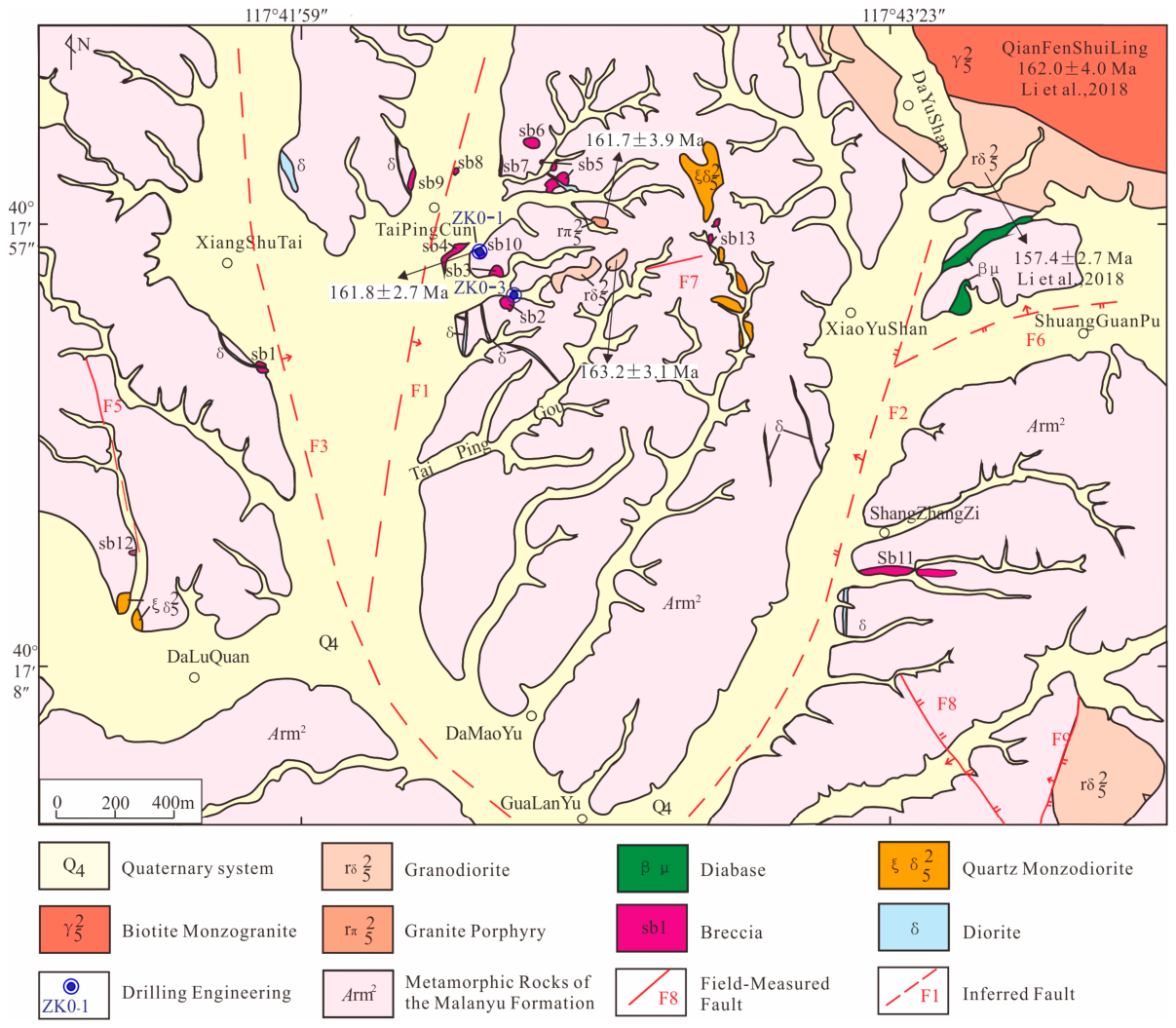
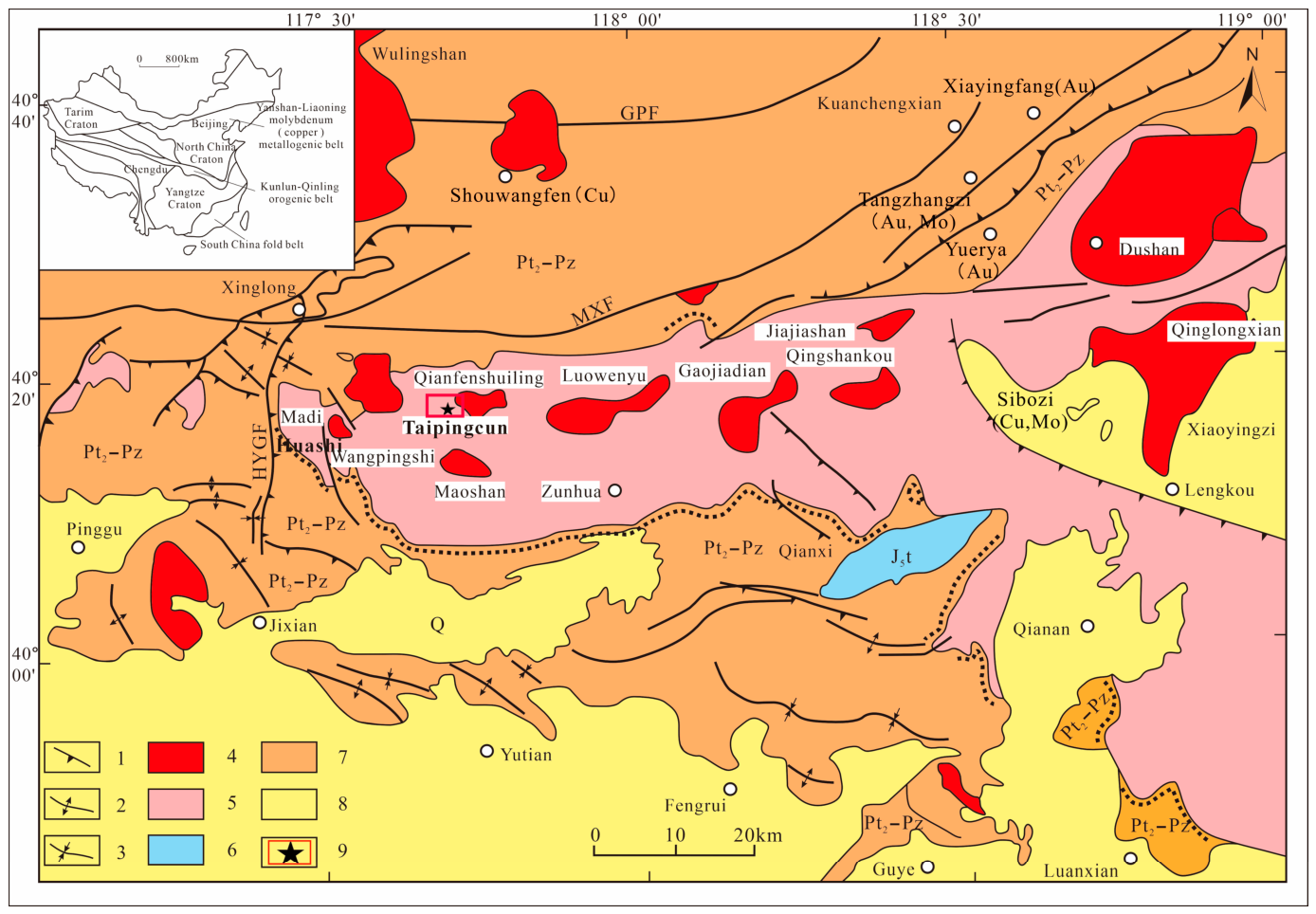
The Taipingcun Molybdenum Deposit sits within the western core zone of the Malanyu Compound Anticline in Eastern Hebei, flanking the western margin of the Qianfenshuiling Pluton (Figure 1). The supracrustal succession exposed within the mining district is dominated by the Archean Qianxi Group, specifically represented by the metamorphic rocks of the Second Member of the Malanyu Formation (Figure 2). This complex locally comprises amphibole-plagioclase gneiss, garnet–pyroxene amphibole-plagioclase gneiss, plagioclase gneiss, amphibolite, magnetite-bearing gneiss, and migmatitic gneiss.

2.2.2. Tectonic of the Mining District

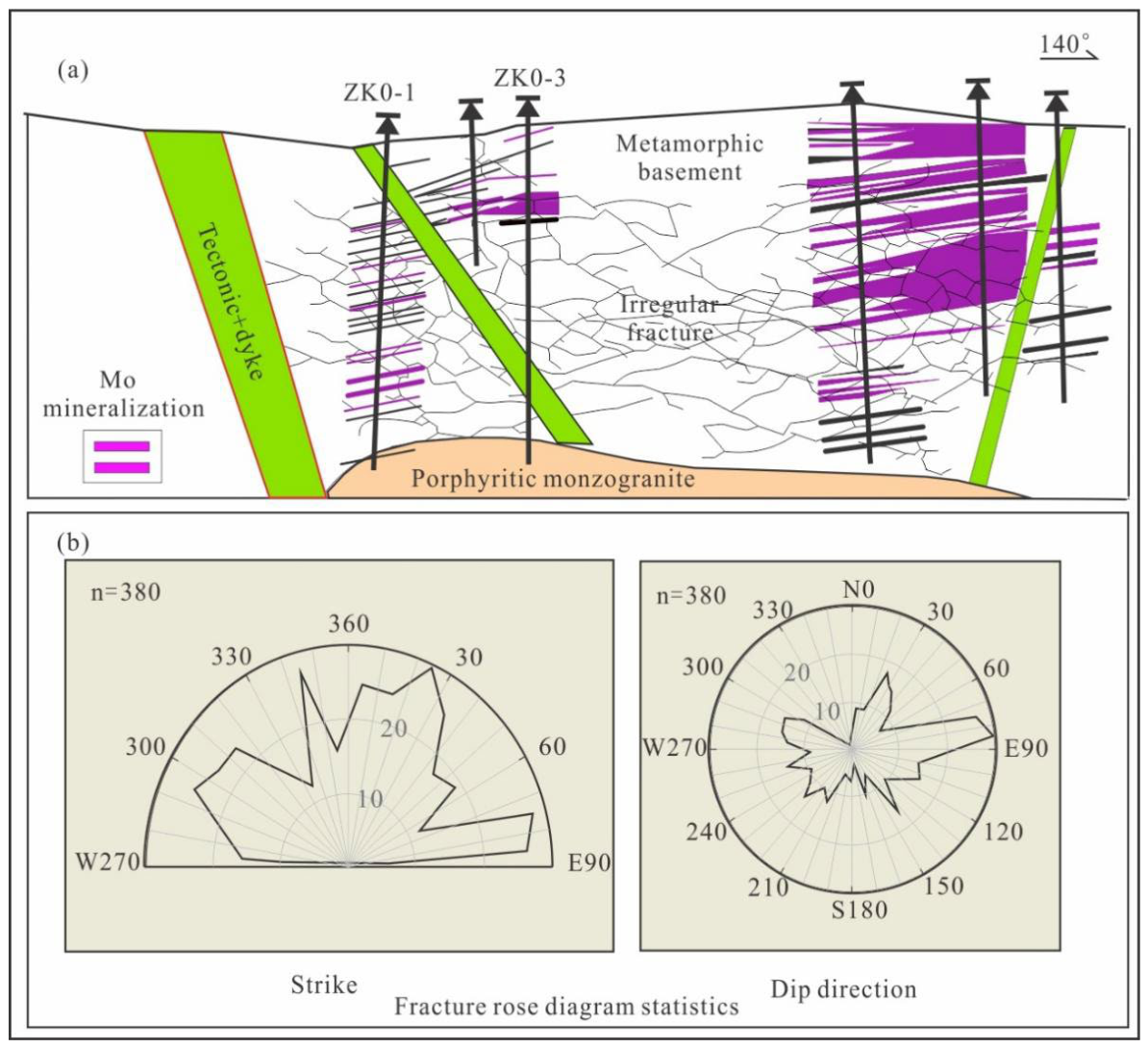
Fault structures are highly developed within the mining district, typically being topographically expressed as linear valleys. Based on their spatial orientations, these structures can be classified into three principal sets: NNE-, NEE-, and NW-trending systems. The NE-trending faults develop relatively early and serve as the principal ore-controlling areas. Conversely, the younger NW-trending structures dictated the emplacement of late-stage diorite dikes and locally disrupted the continuity of the molybdenum orebodies. Furthermore, driven by polyphase tectonic and magmatic events, the host rocks underwent recurrent stress concentration and fracturing. This deformation regime resulted in a highly dense and complex fracture network characterized by the superposition of multiple generations of joints and fissures. This interconnected fracture system not only facilitated highly efficient pathways for hydrothermal fluid migration but also provided ideal plumbing channels for ore deposition, thereby governing the spatial distribution of hydrothermal alteration and mineralization as the principal ore-hosting structural system (Figure 3a).
To constrain the structural control, approximately 300 surface exposures of Mo-mineralized quartz veins and fractures were systematically measured in the central and northeastern parts of the area, where intense magmatic activity and the main orebodies coincide and were compiled into a joint rose diagram (Figure 3b). Structural analysis reveals that the orientations of joints and fissures are generally coaxial with the regional structural trends, exhibiting a predominant NE strike, with subordinate NW and NEE directions. Dip directions are mainly concentrated toward the NEE, NE, NWW, SW, and SE (Figure 3b).

2.2.3. Magmatic Rocks of the Mining District

Magmatic activity in the area was dominated by Early Yanshanian calc-alkaline intermediate-felsic intrusions, primarily comprising quartz diorite, granodiorite (157 ± 3 Ma), and monzogranite (162 ± 4 Ma) [8]. The Qianfenshuiling Pluton outcrops in the northeastern part of the mining area and is satellited by seven small stocks of diverse geometries (Figure 2). Deep exploration via boreholes ZK0-1 and ZK0-3 (below −510 m elevation) unveiled a concealed porphyritic monzogranite, hosting minor disseminated molybdenite. These intrusive bodies are mainly concentrated in the central–northern part of the mining area and are surrounded by numerous cryptic explosive breccias, all of which exhibit pervasive hydrothermal alteration and mineralization.

2.2.4. Molybdenum Mineralization Characteristic

The molybdenum orebodies are primarily hosted within Archean metamorphic rocks inhabiting the outer contact zone of Yanshanian intrusions (Figure 3a), with minor mineralization locally extending into cryptic explosive breccias, altered diabases, and concealed plutons. This spatial distribution underscores a strict structural-magmatic control, where polyphase brittle deformation generated a superimposed fracture-joint network. This plumbing system served as both primary conduits and depositional space for hydrothermal fluids, directly dictating the geometry, thickness, and grade of the orebodies. Mineralization manifests as irregular yet dense aggregations of molybdenite-quartz veins, stockworks, and disseminated molybdenite. The orebodies lack both sharp megascopic boundaries with their host rocks and discernible lithological selectivity; they typically define concealed, clustered, or belt-like economic zones. Morphologically, the orebodies display lenticular, thick tabular, or ramified geometries characterized by prominent pinching, swelling and bifurcation behaviors. These mineralized zones strike predominantly northeast with moderate dips (15°–45°) toward either the southeast or northwest. Individual orebodies extend 100–1250 m along strike, possess true thicknesses of 1.05 to 167.57 m, and yield Mo grades of 0.03%–1.54%.
Statistical analysis of 380 quartz veins in the surface mineralization zone (Figure 3b), reveals that fracture orientations are coaxial with regional structural lineaments, dominated by NE strikes, with subordinate NW and NEE trends. Dip directions cluster toward the NEE, NE, NWW, SW and SE. Dip angles are predominantly gentle (5°–30°) with localized steep exceptions (70°–90°), and most joints obliquely cross the gneissosity. Vein widths range from 1 mm to 50 cm (over 95% are less than 5 cm). These fractures are sealed by molybdenite-quartz, molybdenite, pyrite, and pyrite-quartz veinlets, serving as the primary conduits and hosts for Mo mineralization. Notably, alternative intrusive phases within the district lack discernible metallic mineralization, particularly molybdenite.
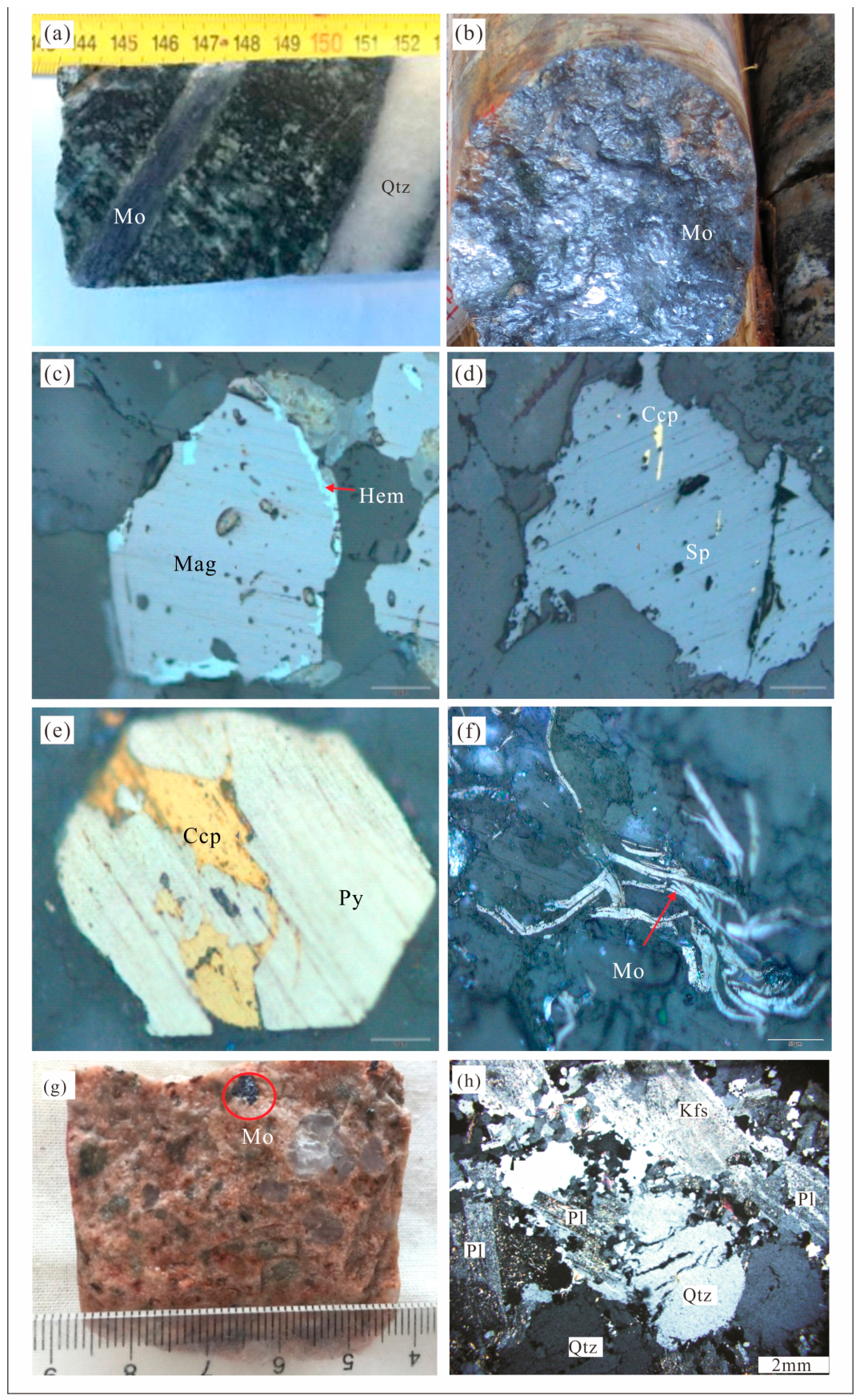
The ores are dominated by fine stockwork-vein mineralization (Figure 4a,b). The metallic mineral assemblage comprises principal molybdenite and pyrite, with subordinate magnetite (Figure 4c), chalcopyrite, sphalerite (Figure 4d,e), galena, and pyrrhotite. Magnetite is commonly replaced by hematite (Figure 4c). Molybdenite typically occurs as isolated grains without obvious intergrowth, displaying predominantly euhedral to subhedral platy forms and anhedral platy textures (Figure 4f), and minor euhedral–anhedral granular and replacement textures. Ore structures include veinlet, disseminated, and brecciated types, whereas gangue minerals consist mainly of quartz, with lesser alkali feldspar, plagioclase, sericite, chlorite, and epidote.
Hydrothermal alteration centers around the magmatic-breccia complex in the central–northern district, defining a semi-concentric outward zonation: K-feldspar–silicification → silicification–sericitization → propylitic alteration. These alteration zones display gradational boundaries with widespread mutual overprints; among them, Mo mineralization is most intimately linked to silicification and potassic alteration.
The concealed porphyritic monzogranite, intersected at depth (boreholes ZK0-1, ZK0-3) underlies the shallow magmatic-breccia center, situated directly beneath explosive breccia pipes SB2 and SB3. This monzogranite exhibits a massive structure and porphyritic texture. Phenocrysts (10–20 vol%) consist mainly of quartz (5%–10%) and alkali feldspar (5%–10%), embedded within a microcrystalline matrix (80–90 vol%) of quartz, alkali feldspar, plagioclase, biotite, and minor secondary muscovite (Figure 4g,h).

3. Analytical Methods

Zircon separation was conducted by Langfang Hongxin Geological Exploration Technology Service Co., Ltd., Langfang, China. Cathodoluminescence (CL) imaging, transmitted/reflected light microscopy, and zircon U–Pb dating were performed at the State Key Laboratory of Continental Dynamics, Northwest University. Analyses employed laser ablation–inductively coupled plasma–mass spectrometry (LA-ICP-MS). The system consisted of a GeoLas 200M laser ablation unit (MicroLas, Göttingen, Germany) coupled with an Elan 6100DRC quadrupole ICP-MS (PerkinElmer, Norwalk, CT, USA). We used the NIST610 standard [21] as the elemental reference material, while zircon standards 91500 [22] and GJ-1 [23] served as calibration and monitor references, respectively. Individual analytical errors are reported at the 1σ level. Weighted mean 206Pb/238U ages are quoted with 1σ uncertainties at the 95% confidence level. Concordia and weighted mean age diagrams were generated using Isoplot R (Version 4.15) online.
Whole-rock geochemical analyses were carried out at the Geological Experiment and Testing Center, Jilin University. Major elements were determined by X-ray fluorescence spectrometry (XRF-3080E, Rigaku, Tokyo, Japan). The whole rock ferrous oxide analysis was completed by using the potassium dichromate volumetric method. Trace and rare earth elements were analyzed by inductively coupled plasma–mass spectrometry (ICP-MS, Agilent Technologies, Santa Clara, CA, USA).

4. Analytical Results

4.1. Zircon LA-ICP-MS U-Pb Dating

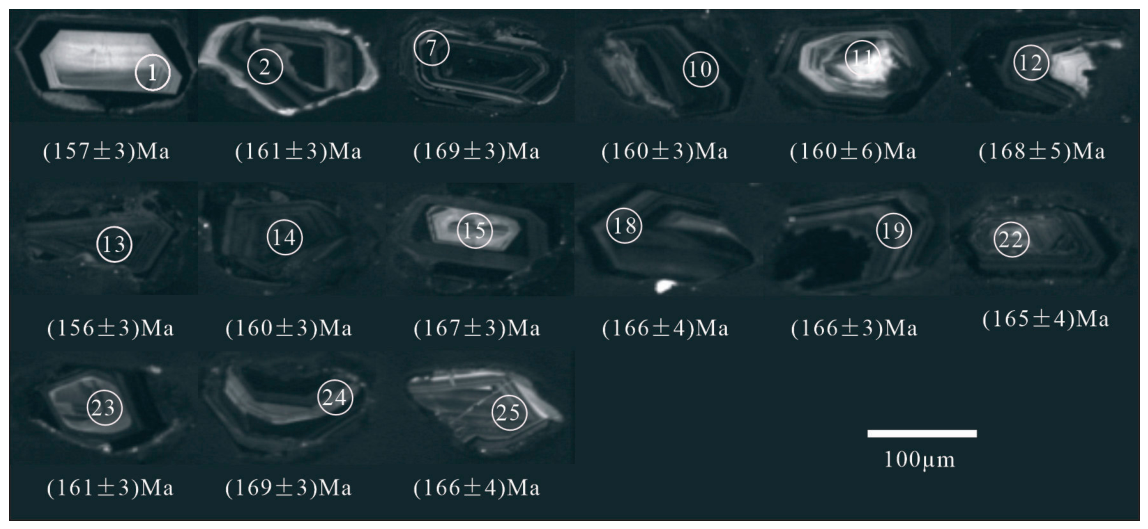
Zircons grains separated from the porphyritic monzogranite (sample HB6) are predominantly colorless and transparent. They exhibit subhedral to euhedral, short-to-long prismatic morphologies with sharp crystal faces, measuring 100–200 µm along the major axis with aspect ratios of 1:1 to 2.5:1. The 15 analyzed domains exhibit highly variable U (119–3918 ppm) and Th (84.6–1482 ppm) contents, yielding Th/U ratios of 0.33–0.80 (>0.1). These high Th/U values, together with the pronounced oscillatory zoning and the absence of inherited cores, confirm a magmatic origin for all analyzed grains. Concurrently, thin, structureless rims discernible in some grains (Figure 5) implied a subsequent overprint by late hydrothermal events.
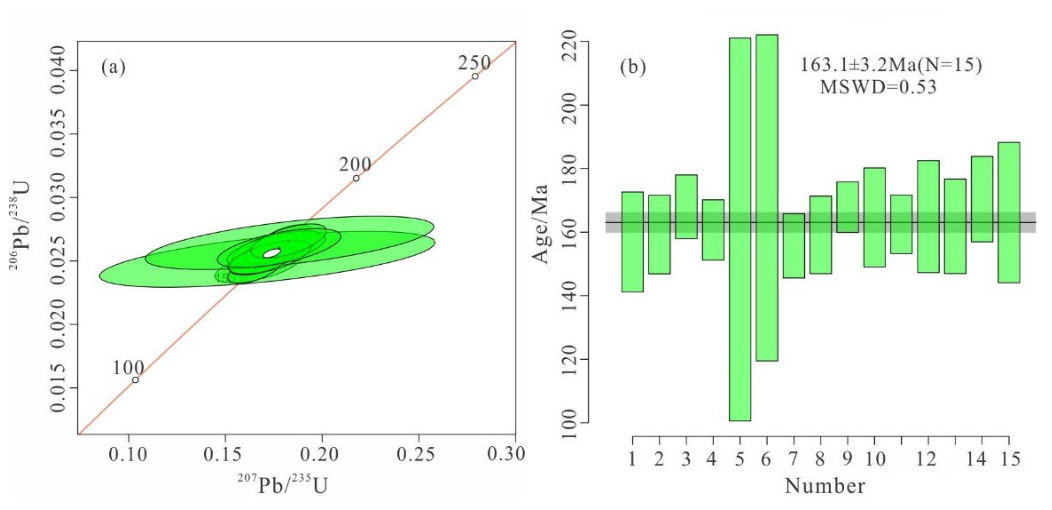
U–Pb isotopic results for porphyritic monzogranite samples (HB6) are presented in Table 1. All fifteen analytical spots yield concordant to near-concordant U–Pb data (Figure 6a). They yield a weighted mean 206Pb/238U age of 163.1 ± 3.2 Ma (MSWD = 0.53, n = 15), with individual spot ages ranging from 156 Ma to 169 Ma. This age is interpreted as the crystallization time of the porphyritic monzogranite, constraining its magmatism to the late Middle Jurassic (Figure 6b).

4.2. Major and Trace Elements

4.2.1. Major Elements

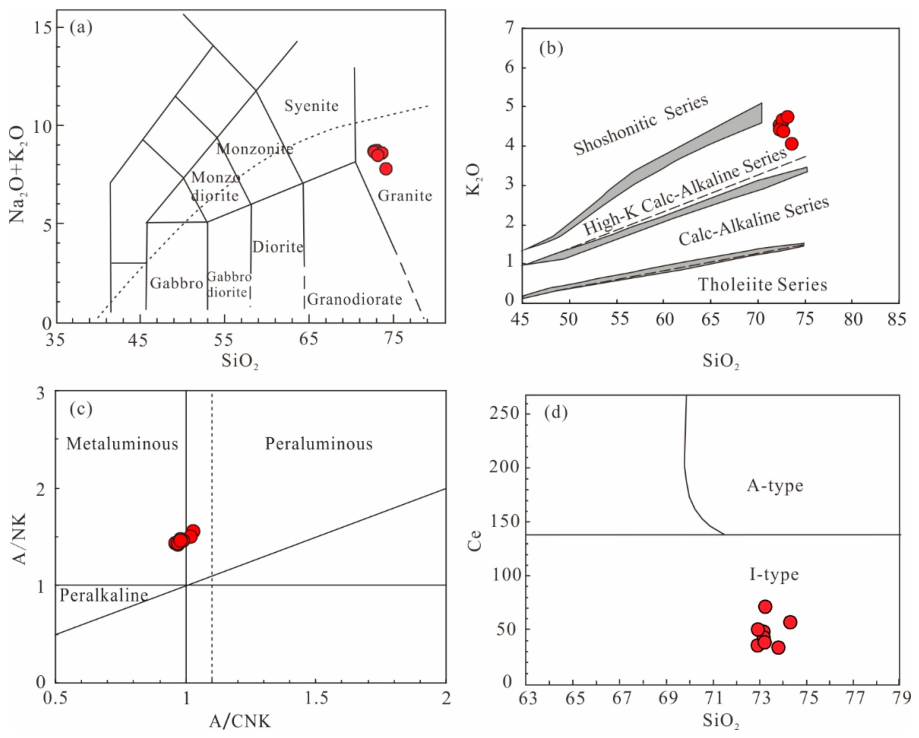
The porphyritic monzogranites contain 72.5–73.9 wt% SiO2 and 7.57–8.61 wt% total alkalis (K2O + Na2O), with K2O/Na2O ratios of 0.99–1.77, and their Rittmann indices (δ = (Na2O + K2O)/(SiO2 − 43)) are 1.85–2.49 (Table 2), assigning them to the high-K calc-alkaline granites (Figure 7a,b). They possess low MgO (0.34–0.41 wt%) and Fe2O3 (0.76 wt% to 1.08 wt%), coupled with Al2O3 abundances spanning 12.90 wt% to 14.3 wt%. They belong to metaluminous to weakly peraluminous, as indicated by the A/CNK = 0.96–1.03, A/NK = 1.16–1.26 (Figure 7c). Furthermore, all samples plot consistently within the I-type granite field on the Ce vs. SiO2 discrimination diagrams, revealing their I-type geochemical signature (Figure 7d).

4.2.2. Trace Elements

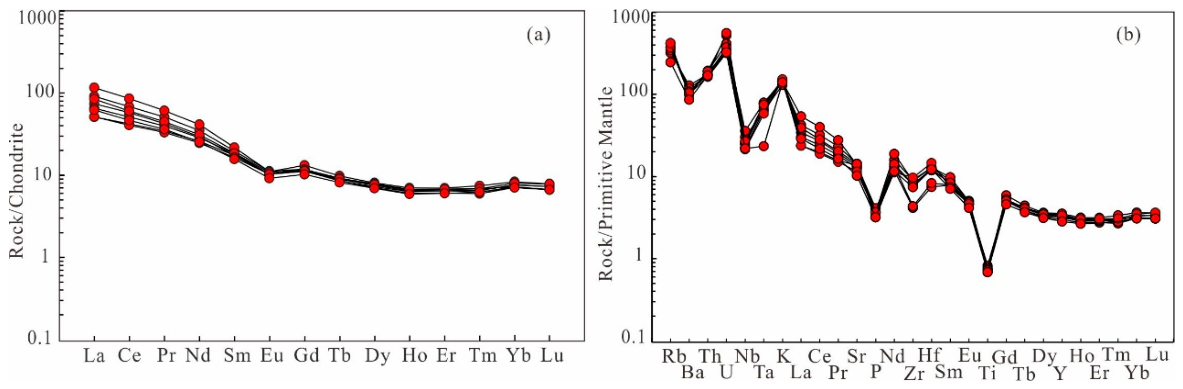
The Taipingcun porphyritic monzogranites have total rare earth element (ΣREE) contents of 83.8–157 ppm, and show relatively light rare earth element (LREE) enrichment, with LREE/HREE ratios of 7.21–13.2 (Table 2). Their chondrite-normalized REE patterns are characterized by relatively flat HREE patterns and moderately negative Eu anomalies (δEu = 0.64–0.74; Figure 8a). On the primitive-mantle-normalized trace-element spider diagram, they display relative enrichments in Rb, Th and U, but depletion in Ba, Nb, Ta, P, Zr, Ti (Figure 8b). Additionally, non-synchronous depletion of Nb-Ta and Zr-Hf pairs indicates a geochemical decoupling between these HFSEs. Collectively, these signature features signify a highly evolved magmatic system. The negative Eu anomalies, together with depletions in Sr, Ba, and positive correlations between δEu and Sr, Ba and Sr, and the negative trend of Sr and Rb/Sr, are attributed to fractional crystallization of plagioclase, whereas their low Zr/Hf ratios (19–25) were primarily driven by fractional crystallization of zircon [28,29,30].

5. Discussion

5.1. Petrogenetic and Metallogenic Ages

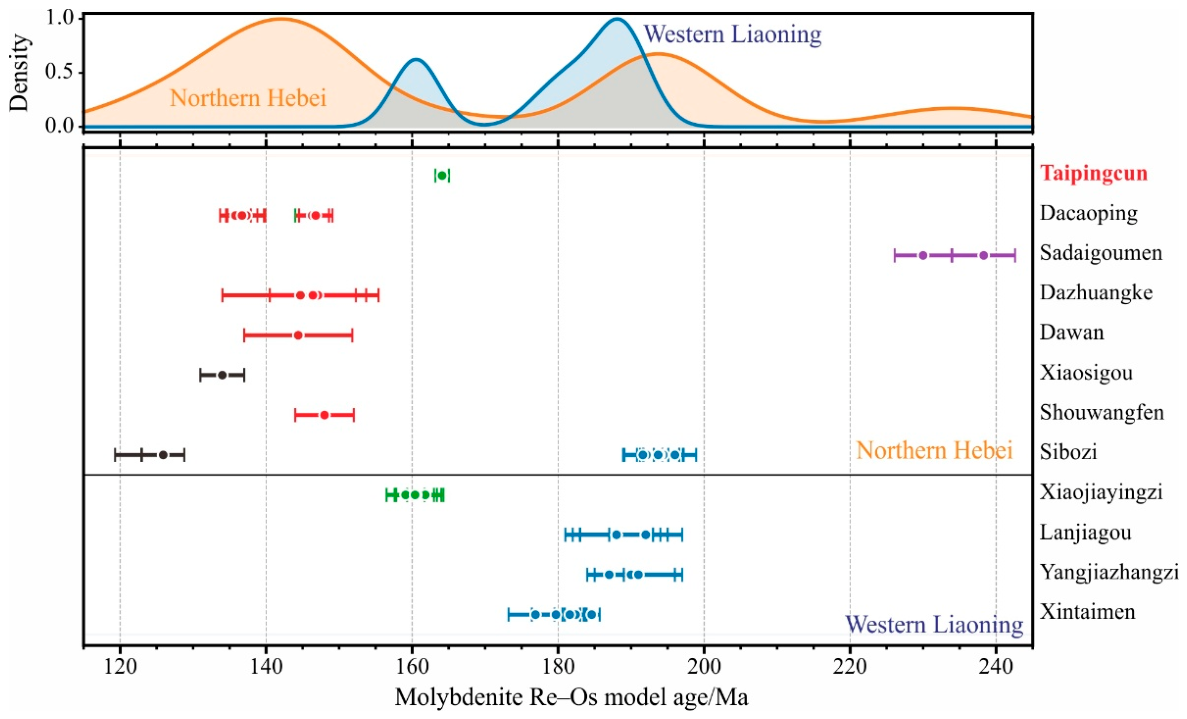
Spatially, the drilled porphyritic monzogranite is located vertically beneath the central-northern part of the mining area, which hosts the orebodies, granitoid intrusions, and cryptic explosive breccias. Petrographic observations reveal sparse, disseminated molybdenite within this pluton, occurring as flake crystals scattered among transparent rock-forming minerals. This study shows that the magmatic zircons from the concealed, Mo mineralized porphyritic monzogranite yield a weighted mean 206Pb/238U age of 163 ± 3 Ma, indicating the crystallization age of porphyritic monzogranite, i.e., late Middle Jurassic. Within analytical uncertainty, this temporal constraint is indistinguishable from the reported emplacement ages of the Qianfenshuiling granodiorite and monzogranite to ~157–162 Ma [8]. Previously, molybdenite Re–Os isotopic dating of seven samples of Archaean rock-hosted ore veins from various boreholes within the Taipingcun deposit yielded model ages spanning 162.5 ± 2.5 Ma to 165.7 ± 2.5 Ma, defining a weighted mean age of 164.11 ± 0.92 Ma (MSWD = 0.82) and an isochron age of 164.4 ± 2.5 Ma (MSWD = 1.7) [6]. Crucially, the new magmatic crystallization age is coeval with the Re–Os mineralization age with error and underscores an intimate temporal–spatial link, confirming that plutonism and the associated Mo mineralization occurred synchronously during the late Middle Jurassic.
Previous geochronological frameworks have categorized the large-scale Mesozoic tectono-magmatic events and associated mineralization in the Yanliao Mo (Cu) metallogenic belt into five temporal stages within three geodynamic episodes. Specifically, the Mo (Cu) metallogenic evolution spans the Middle–Late Triassic (240–205 Ma), Early Jurassic (204–175 Ma), Middle–Late Jurassic (175–154 Ma), Late Jurassic (154–135 Ma), and Early Cretaceous (135–110 Ma). Within this chronological framework, the Taipingcun mineralization (~164 Ma) correlates with the third-stage metallogenic pulse, coinciding with Episode A of Yanshan Orogeny (Figure 9). These stages evolved under three fundamental geodynamic regimes: (1) the Middle–Late Triassic post-collisional phase after the final closure of the Paleo Asian Ocean, (2) a Jurassic compression driven by subduction and closure of the Mongol–Okhotsk Ocean and Yanshan Orogeny, and (3) the Early Cretaceous late-stage lithospheric thinning in eastern China [15,32,33,34,35].
Regionally, the Taipingcun Mo deposit is contemporaneous with other major Mo deposits in the Yanliao Mo(-Cu) Metallogenic Belt, notably the Chaijiagou Mo deposit in northern Hebei (163.7 ± 2.4 Ma) [10], and the Xiaojiayingzi molybdenum deposit in western Liaoning (165.5 ± 4.6 Ma) [9]. These temporally clustered deposits are collectively interpreted as expressions of the Middle–Late Jurassic episode of magmatic-mineralization pulse within the Yanliao belt. Consequently, establishing a precise chronological constraint for the Taipingcun deposit not only clarifies its deposit-scale genesis but also provides a robust anchor to refine the regional spatiotemporal architecture and metallogenic regularity of the Middle Jurassic mineralization pulse within the regional belt.

5.2. Petrogenesis

The porphyritic monzogranites are characterized by high SiO2 (72.5–73.9 wt%), elevated K2O (3.91–4.57 wt%) and Na2O (3.66–4.28 wt%), moderate Al2O3 (12.9–14.3 wt%), and low Fe2O3 and MgO contents. These features, coupled with enriched LREEs and LILEs, are indicative of a crustal-melting derivation. Addtionally, the absence of mafic microgranular enclaves (MMEs), and their low MgO contents (0.34–0.41 wt%), low Mg# values (33–43), and low Cr, Co, and Ni concentrations collectively argue against significant direct contribution from mantle-derived mafic magma.
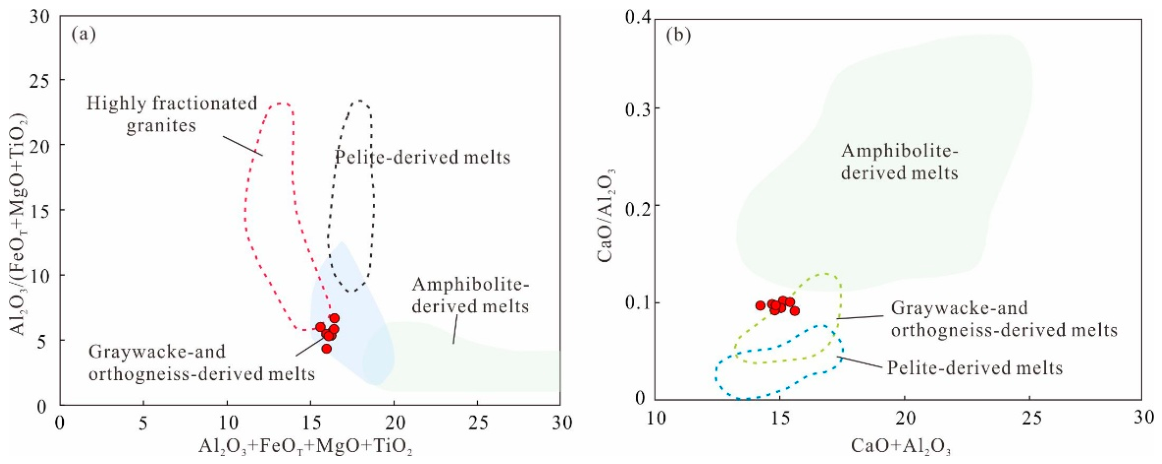
Their metaluminous affinity (A/CNK < 1.1) and the absence of alkali minerals, and peraluminous minerals (e.g., garnet or muscovite), closely align with typical I-type granite characteristics [25,26,27,36]. Furthermore, the samples exhibit relatively low Sr (216–303 ppm) and Yb (1.54–1.80 ppm) contents, yielding low Sr/Yb ratios (15.7–22.1, averaging ~18.6) and relatively flat HREE patterns. These geochemical criteria suggest the absence of residual garnet in the source, further implying magma generation under amphibolite- to plagioclase-stable conditions [36,37,38]. Furthermore, their low Al2O3/(FeO + MgO + TiO2) and medium CaO/Al2O3 ratios, are consistent with experimental melts derived from orthogneiss and greywacke sources (Figure 10). Previously published data reported the negative zircon εHf(t) values (−16.3 to −22.9) and Paleoproterozoic TDM2 ages of coeval Qianfenshuiling granite in the Taipingcun area, indicating their magma was generated by partial melting of Paleoproterozoic crustal materials [39,40]. Crucially, the porphyritic monzogranites lack obvious Archean wall-rock xenoliths rich in amphibole or biotite, and thin-section observations display no textural evidence for large-scale crustal assimilation. Concurrently, the remarkably homogeneous whole-rock geochemical compositions and Paleoproterozoic TDM2 ages also rule out the extensive shallow-level contamination of Archean wall rocks during magma emplacement.
The relatively high Rb/Sr ratios (0.67–1.09), low Zr/Hf ratios (19–25), moderate negative Eu anomalies, and distinct depletions in Sr, P, and Ti collectively indicate significant fractional crystallization of plagioclase, apatite, Fe–Ti oxides during magmatic evolution, and possibly zircon saturation and progressive zircon fractionation [41]. Variations in LREE contents are modulated by varying degrees of fractional crystallization of LREE-rich accessory minerals (e.g., allanite, monazite, and apatite) [28,29]. In conjunction with the high silica content (SiO2 = 72.5–73.9 wt%), these features confirm a highly differentiated nature for the granitic magma. The calculated zircon saturation temperatures for this porphyritic monzogranite range from 795 °C to 809 °C (averaging 798 °C) [41], signifying a high-temperature magma genesis and crystallization.
Rhenium (Re) is a moderately incompatible chalcophile and siderophile element that preferentially concentrates in the mantle, sharing similar behavior with molybdenum (Mo). Consequently, the Re content in molybdenite serves as a sensitive tracer for ore-forming material sources, effectively fingerprinting the degree of crustal contribution [42]. In molybdenum deposits, Re contents typically decline systematically across orders of magnitude from 10−4 (mantle-derived) to 10−5 (mantle–crust mixed) and down to 10−6 (crust-derived) [42,43,44,45]. Molybdenite from the Taipingcun deposit yields Re contents of 18.8–66.7 ppm Re (averaging 41.86 ppm) [6], pointing to a predominantly crustal source for the ore-forming materials.

5.3. Metallogenic Specialization

To assess metallogenic potential, Mo concentrations were determined for five intrusive bodies from the Taipingcun ore district (Table 3). Notably, the porphyritic monzogranite from borehole ZK0-3 exhibits significantly higher Mo contents than alternative local plutons, approximately doubling the values of remaining intrusive rocks. Consistently, disseminated molybdenite mineralization is hosted exclusively within this porphyritic monzogranite. The coexistence of pronounced Mo enrichment and primary molybdenite mineralization strongly indicates that this intrusion served as the principal source of Mo for mineralization in the district.
Syntheses of Mo deposits across the the North China Craton indicate that intrusive rocks associated with molybdenum deposits typically exhibit diagnostic geochemical signatures, including SiO2 > 70 wt%, total alkalis (K2O + Na2O) = 6.25–9.59 wt% (avg. 8.12%), K2O > Na2O, K2O/Na2O = 1.3–6.7 (avg. 2.51), and Rittmann index (δ) = 1.12–2.83, and depleted CaO, FeO, and Fe2O3 abundances. The molybdenum porphyritic monzogranite linked to the Taipingcun deposit conforms closely to these diagnostic parameters [33,34]. Furthermore, previously published stable isotope data show that the δD and δ18O values of molybdenite-quartz vein samples from the Taipingcun molybdenum deposit cluster within the typical magmatic fluid reservoir [7].
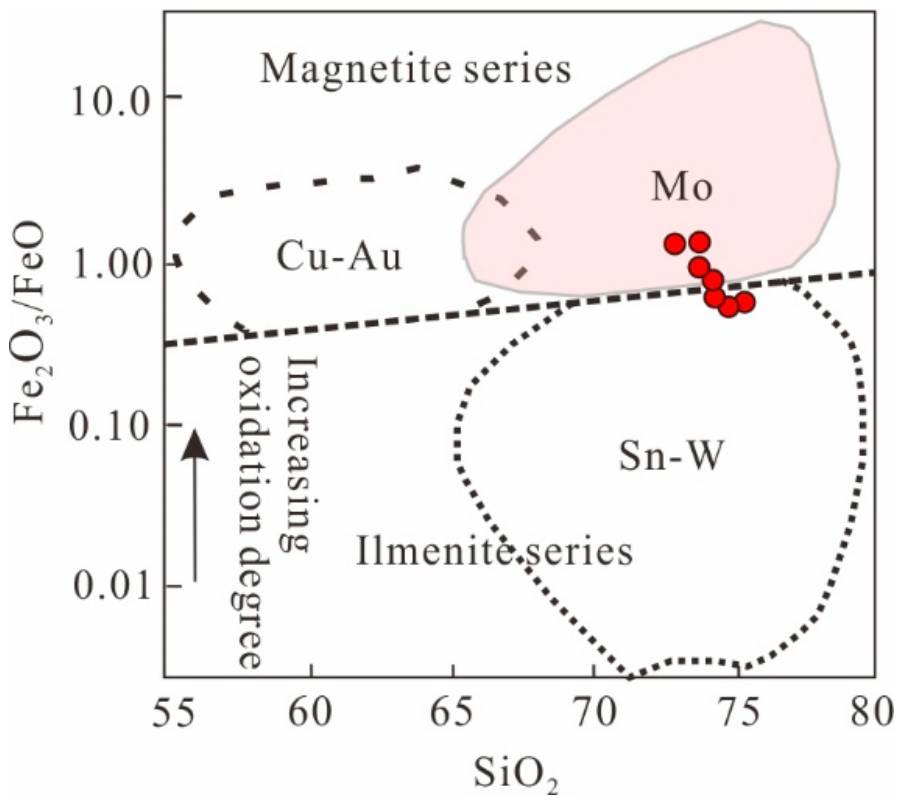
Although both Mo and Sn deposits are ubiquitously associated with highly differentiated granites, their respective magmatic redox conditions differ fundamentally. Granitoids linked to Mo mineralization typically belong to the magnetite series (Figure 11) [46,47]. The geochemical signature of the Taipingcun porphyritic monzogranite registers a transition form ilmenite to magnetite series, and aligns with typical Mo-mineralizing intrusions. Furthermore, zircons from the Taipingcun porphyritic monzogranite yield highly heterogeneous oxygen fugacity values, with ΔFMQ values ranging from −3.39 to −1.66, and +1.29, with a mean value of −2.45 (Table 4 [48]). These values imply a relatively reduced magmatic conditions during early-stage zircon crystallization, substantially lower than the oxidized conditions commonly inferred for classic porphyry Mo systems. Conversely, the bulk-rock Fe2O3/FeO ratios may have been modified by late-stage magmatic differentiation, and sulfide saturation and Mo precipitation during the late magmatic–hydrothermal stage [49,50,51]. Under such reduced conditions, Mo occurs predominantly as Mo4+ in silicate melts; this lower valence state decreases its incompatibility, thereby facilitating early direct crystallization of molybdenite from the melt [49,50,51]. Globally, an increasing number of porphyry Mo-bearing systems are recognized to exhibit relatively reduced characteristics. Prominent examples include the Suyunhe porphyry Mo deposit in West Junggar, Xinjiang [52], the Catface Cu–Mo deposit in Canada, the 17 Mile Hill Cu–Au system in Australia, and parts of the Endako- and Thompson Creek-type Mo systems in North America. These reduced systems are characteristically defined by pyrrhotite-bearing mineral assemblages, CH4-rich hydrothermal fluids, ilmenite-series granitoid affinities, and inherently low oxygen fugacity conditions [53,54].

5.4. Mo Mineralization in Moderately Thick Crust and Post-Collisional Setting

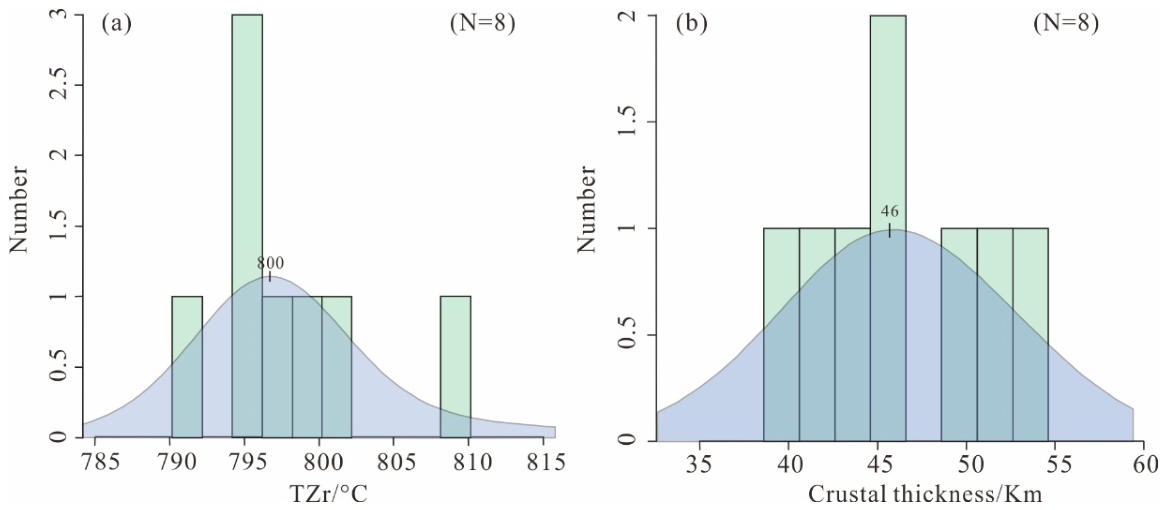
The porphyritic monzogranite exhibits a relatively flat heavy rare earth element (HREE) pattern and high contents, consistent with amphibole ± plagioclase stable conditions. This suggests that the magma did not form under conditions involving residual garnet in a thickened crust. Furthermore, the relatively high zircon saturation temperatures (TZr = 795–809 °C, peak at 800 °C, Figure 12a) are highly indicative of extensional or post-collisional settings, where lithospheric thinning enhance the thermal input required to trigger crustal anatexis. This tectonic setting is further supported by calculated crustal thicknesses, using three independent geochemical formulations: DSr/Y = 0.67 × Sr/Y + 28.21 [55], DLa/YbN = 27.78 × ln(0.34 × La/YbN) [56,57], and Dtot = 10.3 × ln(Sr/Y) + 8.8 × ln(La/Yb) − 10.6) [58]. The resulting paleocrustal thicknesses are calculated as DSr/Y = 30 to 37 Km (average 33 Km), DLa/YbN = 39–53 Km (average of 46 Km, Figure 12b), and Dtot = 35–44 Km with an average of 40 Km (Table 2). Notably, the Sr/Y-based estimations may be significantly biased in fractionated granitic magma systems due to the fractional crystallization of plagioclase, while La/YbN ratios are generally less sensitive to such effects. Consequently, the average DLa/YbN value of 46 Km provides a more reliable constraint on the crustal thickness, a value that is highly consistent with the global average crustal thickness of orogenic belts [59].
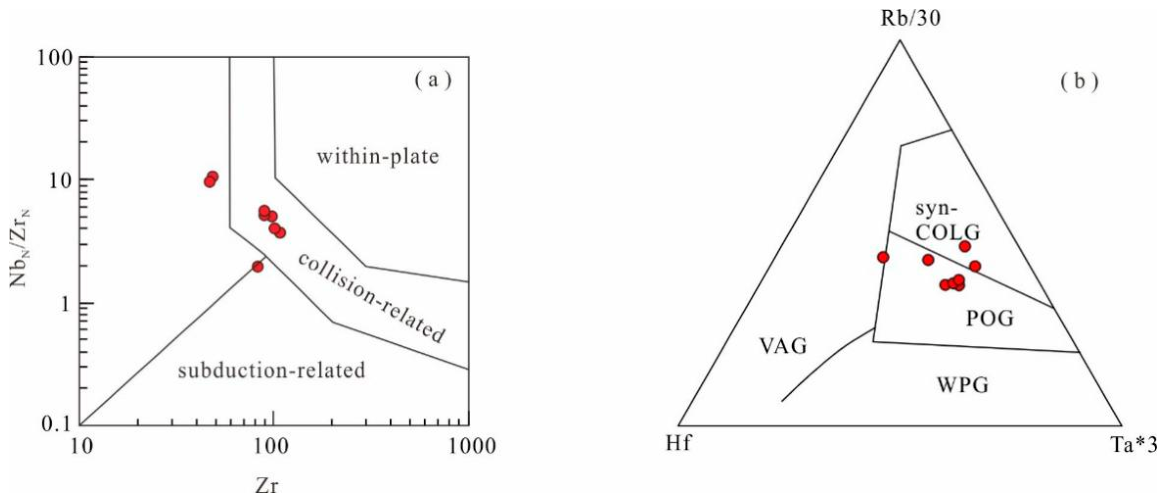
In addition, the Taipingcun porphyritic monzogranites show relatively high NbN/ZrN ratios and Zr (Figure 13a), and plot mainly in the post-collisional granite (POG) field (Figure 13b), reinforcing a magma generation in a post-collisional tectonic environment. This scenario is highly consistent with the timing of the compression–extension transition during the first/A episode of Yanshan Orogeny, the calculated moderately crustal thickness, and the structural transition from thrusting to normal and detachment faulting, collectively indexing a post-collisional extensional geodynamic regime [13,15,32,35]. Post-collisional high-K calc-alkaline rocks typically manifest during the transitional stage from extensional collapse following syn-collisional lithospheric thickening to intraplate anorogenic settings, and their magma sources were typically inheriting geochemical signatures from prior subduction or collisional processes [26,60,61,62,63].
Within the Yanshan orogenic belt, episode A of Yanshan Orogeny (175–160 Ma) is stratigraphically marked by a prominent angular unconformity beneath the Tiaojishan Formation volcanic sequence, recording a first-order tectonic regime shift. During this interval, westward advancing subduction of the Paleo-Pacific Plate beneath eastern Asia triggered regional crustal thickening, imposing a dominant NE–NNE-trending compressional structural grain [63]. Subsequent to peak compression and orogenic uplift, post-orogenic lithospheric extension triggered crustal thinning and underplating of mantle-derived magmas. This mantle-derived heat flux thermally induced partial melting of ancient middle-lower crustal rocks, which potentially contained Mo-rich metasedimentary or metamorphic protoliths.
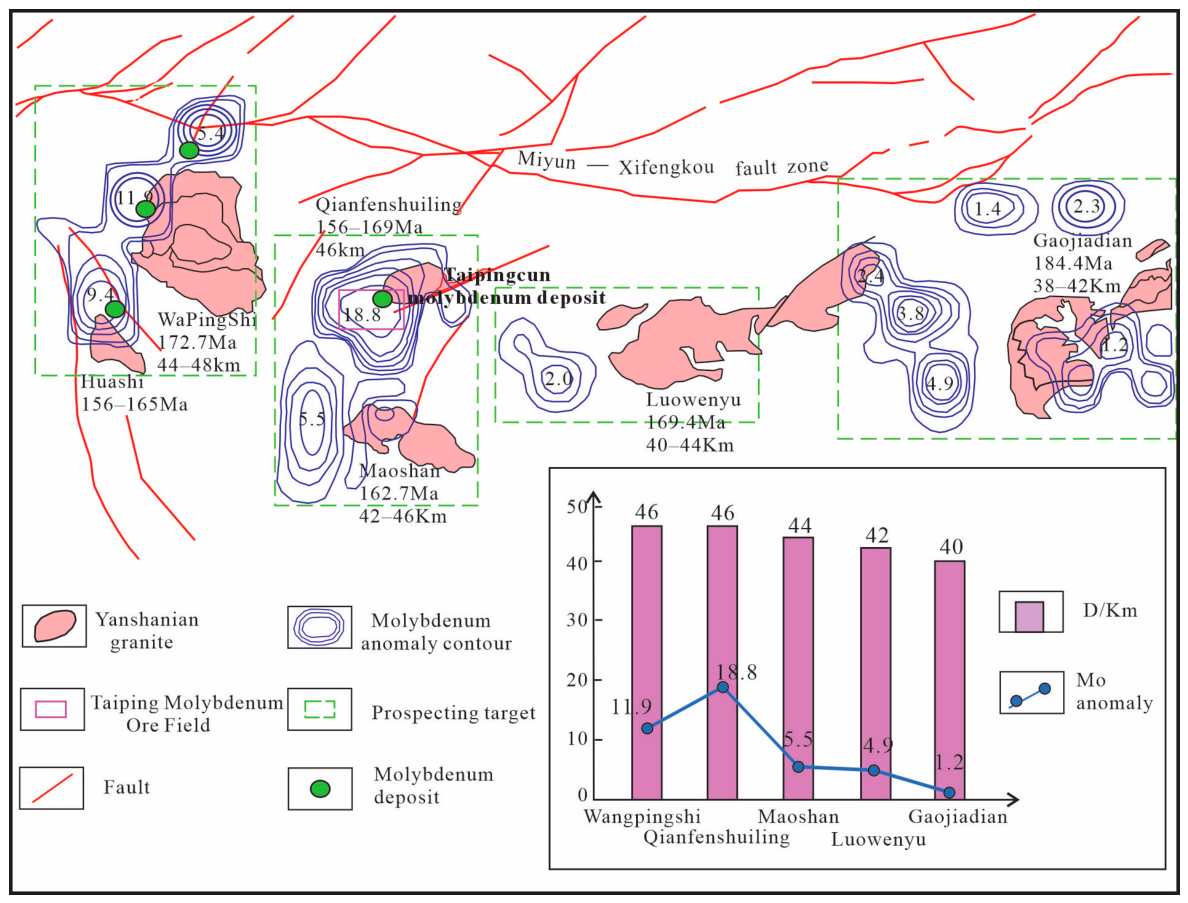
The regional Mo mineralization is genetically tied to this Yanshanian granitic magmatism, as exemplified by the Taipingcun, Wangpingshi, Maoshan, Luowenyu, and Gaojiadian plutons. Regional geochemical datasets reveal that Mo anomalies are robustly concentrated along the margins of these intrusions, highlighting a tight pluton-ore metallogenic coupling (Figure 14). Importantly, our synthesis reveals that variations in crustal thickness exerted a crucial control on magma differentiation and intensity of Mo mineralization. Crustal thickness calculated from whole-rock La/YbN ratios indicate that the Taipingcun ore-forming intrusion (164 Ma) was emplaced at a crustal thickness of ~46 km. Comparable values were retrieved for adjacent mineralized plutons, including the Wangpingshi pluton (173 Ma, 44–48 km), Maoshan pluton (163 Ma, 42–46 km), Luowenyu pluton (169 Ma, 40–44 km), and Gaojiadian pluton (184 Ma, 38–42 km) [33,39], showing a systematic thinning trend from west to east (Figure 13). According to the empirically established crustal-thickness classification for metallogenic setting (>40 Km: thick crust; 25–40 Km: moderately thick crust; <25 Km: thin crust) [56], these ore-forming intrusions were uniformly emplaced within the moderately thick to thick crustal setting.
In addition, regional geochemical exploration datasets demonstrate a strong positive correlation between Mo anomaly intensity and crustal thickness (Figure 14). Specifically, the Taipingcun intrusion exhibits a robust Mo anomaly (18.8) and hosts a large Mo deposit, whereas the neighboring Wangpingshi intrusion, characterized by a Mo anomaly of 11.9, accommodates multiple economically significant Mo ore bodies [64,65,66]. Crucially, the Taipingcun and Wangpingshi intrusions were emplaced within the thickest crustal domains among the above plutons. They are characteristically defined by high-silica, alkali-rich, weakly peraluminous compositions, accompanied by slightly negative Eu anomalies, and the relatively high degrees of magmatic differentiation, and relatively reduced redox conditions [33,67]. In contrast, the Maoshan and Luowenyu plutons, which were generated under a moderately thick crustal condition, belong to the high-K calc-alkaline series and share similar geochemical features to the Taipingcun pluton [33,67], indicating that they preserve favorable conditions for Mo mineralization. Their respective Mo anomaly values (5.5 and 4.9, respectively) are elevated above regional background levels, suggesting substantial potential for medium- to large-scale mineralization and rendering them priority exploration targets. Conversely, the Gaojiadian pluton was emplaced within a relatively thinner crust, and exhibits lower SiO2 and K contents, as well as a low Mo anomaly (1.2), which collectively heralds limited metallogenic potential.
Based on these comprehensive constraints, a coherent genetic model for the Taipingcun Mo deposit is established. The metallogenic event occurred during the late stage of the first episode of the Yanshan Orogeny (ca. 175–160 Ma), when the regional tectonic regime transitioned from prior compressional crustal thickening to post-collisional extension [17,18,63]. The Mo-mineralizing magma represents a fractionated, high-silica granitic melt (SiO2 = 72–75 wt%), generated at relatively high temperatures within a moderately thick crust (39–53 km, average ~46 km). Such deep-seated conditions suppressed early plagioclase crystallization, thereby facilitating protracted magmatic differentiation within a large, long-lived magma chamber, and driving enrichment of Mo in the residual melt [68]. The prevailing reduced condition of magma favored the dominance of Mo4+, which reduced its incompatibility and permitted the early direct crystallization of magmatic molybdenite. With progressive differentiation, the remaining Mo budget partitioned strongly into F-rich hydrothermal fluids [49]. During subsequent volatile exsolution and decompression-driven fluid boiling, these ore-forming fluids migrated along structurally controlled fracture networks. This hydro-mechanical process resulted in disseminated and veinlet-type molybdenite mineralization within the intrusion, as well as quartz vein-type and pyrite–molybdenite–fluorite quartz vein-type mineralization within the surrounding metamorphic country rocks [69,70,71,72].
In summary, Mo mineralization in eastern Hebei is jointly controlled by a relatively thickened crustal setting and fractionated granitic magmatism. Consequently, a crustal thickness ≥40 km, high Sr/Y ratios, and strongly fractionated high-K calc-alkaline granites can serve as effective exploration indicators for Mo deposits in this region. Recent exploration breakthroughs around the Wangpingshi intrusion further validate the robustness of this model and highlight its significance for future Mo exploration in eastern Hebei.

6. Conclusions

(1)
The ore-forming Taipingcun porphyritic monzogranite was emplaced at 163 ± 3 Ma, which coincides with the prominent Middle–Late Jurassic magmatic–hydrothermal metallogenic episode in the Yanliao Molybdenum (Copper) Metallogenic Belt.
(2)
The high-K calc-alkaline I-type porphyritic monzogranite was generated from magma that formed by partial melting of Paleoproterozoic orthogneiss and greywacke. The confluence of a relatively low oxidation state and high-degree differentiation collectively governs its strong metallogenic specialization for Mo mineralization.
(3)
Crustal thickness (≥40 km) exerts a fundamental control on magma differentiation, redox state, and Mo fertility in eastern Hebei, serving as a robust exploration indicator.

Author Contributions

Conceptualization, Z.W.; methodology, Z.W.; software, Z.L., Y.C., Y.W. and D.W.; investigation, Z.L. and C.L.; data curation, Z.L., Y.C., Y.W., D.W., L.W. and X.X.; writing—original draft preparation, Z.L., Z.W., Y.C., Y.W., D.W., C.L. and Y.Z.; writing—review and editing, Z.L. and Z.W.; visualization, Z.W.; supervision, Z.W.; project administration, Z.W.; funding acquisition, Z.W. and Z.L. All authors have read and agreed to the published version of the manuscript.

Funding

This research was funded by the Natural Science Foundation of Hebei Province (D2023403023), Yanzhao Huangjintai Jucai Key Talent Project (Education Platform) of Hebei Province (HJYB202502), Hebei Provincial Outstanding Experts Overseas Training Program (202403), 333 Talent Project Foundation of Hebei Province (C2024022), Foundation of Hebei GEO University (JQ202402), Geological Exploration Fund Project of Hebei Bureau of Geology and Mineral Resources, Study on Metallogenic Regularities and Regional Prospecting Directions of Mo-Au-Rare Polymetallic Deposits in the Taipingcun Ore Concentration Area, Xinglong County, Hebei Province, Ji Di Di Shen [2017] No. 32, Student Scientific Research Projects of Hebei GEO University (KBG202504), and Opening Foundation of Hebei Key Laboratory of Strategic Critical Mineral Resources (HGU-SCRM25).

Data Availability Statement

The data presented in this study are available in this paper.

Acknowledgments

We are grateful to the handling editor, and thank the two reviewers for their constructive comments.

Conflicts of Interest

The authors declare no conflicts of interest.

References

  1. Yang, J.H.; Wu, F.Y.; Wilde, S.A. A review of the geodynamic setting of large-scale Late Mesozoic gold mineralization in the North China Craton: An association with lithospheric thinning. Ore Geol. Rev. 2003, 23, 125–152. [Google Scholar] [CrossRef]
  2. Yang, W.J.; Cheng, T.S.; Zhang, X.B.; Guo, L.J.; Gao, H.S.; Duo, X.F.; Tu, L.P.; Zhang, X.Z. The H-O-S isotope characteristics and diagenetic, mineralization ages of the Zhueryu Au deposit from the Jidong gold belt, China. Minerals 2024, 14, 1068. [Google Scholar] [CrossRef]
  3. Han, C.M.; Xiao, W.J.; Zhao, G.C.; Sun, M.; Qu, W.J.; Du, A.D. A Re–Os study of molybdenites from the Lanjiagou Mo deposit of North China Craton and its geological significance. Gondwana Res. 2009, 16, 264–271. [Google Scholar] [CrossRef]
  4. Mao, J.W.; Wang, Y.T.; Zhang, Z.H.; Yu, J.J.; Niu, B.Q. Geodynamic settings of Mesozoic large-scale mineralization in North China and adjacent areas: Implication from the highly precise and accurate ages of metal deposits. Sci. China Ser. D Earth Sci. 2003, 46, 838–851. [Google Scholar] [CrossRef]
  5. Zeng, Q.D.; Liu, J.M.; Xiao, W.J.; Chu, S.X.; Wang, Y.B.; Duan, X.X.; Sun, Y.; Zhou, L.L. Mineralizing types, geological characteristics and geodynamic background of Triassic molybdenum deposits in the northern and southern margins of the North China Craton. Acta Petrol. Sin. 2012, 28, 357–371, (In Chinese with English abstract). [Google Scholar]
  6. Sun, J.L.; Ren, Y.S.; Yang, Y.S.; Wang, Q.; Liu, J.B.; Zhang, J.J.; Nie, W.D.; Wang, A.C.; Qu, W.J. Re-Os isotopic dating of molybdenite from Taipingcun Mo deposit in eastern Hebei and its geological significance. Glob. Geol. 2016, 3, 738–751, (In Chinese with English abstract). [Google Scholar] [CrossRef]
  7. Sun, J.L.; Cheng, Y.; Liu, X.X.; Meng, G.A.; Dong, X.T. Molybdenum mineralization in eastern Hebei, China: Evidence from geochronology and isotopic composition. Minerals 2024, 14, 662. [Google Scholar] [CrossRef]
  8. Li, Y.J.; Wang, Y.F.; Xu, G.X.; Li, Z.B.; Qi, Y.F.; Sun, J.L.; Zhao, B.G.; Zhang, B.; Zhao, Y. Geochronology and geochemical characteristics of the Fenshuiling Complex in the Eastern Hebei Province and its significance. Acta Geol. Sin. 2018, 92, 1904–1917, (In Chinese with English abstract). [Google Scholar] [CrossRef]
  9. Dai, J.Z.; Mao, J.W.; Du, A.D.; Xie, G.Q.; Bai, J.; Yang, F.Q.; Qu, W.J. Re-Os Dating of Molybdenum from the Xiaojiayingzi Mo(Fe) Deposit in Western Liaoning and Its Geological Significance. Acta Geol. Sin. 2007, 81, 917–923, (In Chinese with English abstract). [Google Scholar] [CrossRef]
  10. Xie, W.; Jin, C.; Zeng, Q.; Zhou, L.; Dong, R.; Wang, Z.; Wang, K.Y. Multisystem (S-Pb-He-Ar-H-O) isotopic and fluid inclusion constraints on the genesis of the Chaijiagou porphyry Mo deposit, North China Craton. Minerals 2026, 16, 71. [Google Scholar] [CrossRef]
  11. Li, Z.Y.; Ye, H.S.; He, W.; Cao, J.; Zhang, X.K.; Wang, S.; Lu, D.Y.; Li, C. Geological Characteristics and Re-Os Isotopic Age of Molybdenite from the Tangzhangzi Gold (Molybdenum) Deposit in Eastern Hebei and Its Geological Significance. Miner. Depos. 2014, 33, 1366–1378, (In Chinese with English abstract). [Google Scholar] [CrossRef]
  12. Wang, C.G.; Ren, J.H.; Wang, F.X.; Zhang, F.X.; Luan, Z.R.; Huang, K. Geological Characteristics and Current Research Status of Xiaosigou Porphyry Copper (Molybdenum) Deposit in Pingquan, Eastern Hebei. J. Hebei GEO Univ. 2024, 47, 19–26, (In Chinese with English abstract). [Google Scholar] [CrossRef]
  13. Goldfarb, R.J.; Mao, J.W.; Qiu, K.F.; Goryachev, N. The great Yanshanian metallogenic event of eastern Asia: Consequences from 100 million years of plate margin geodynamics. Gondwana Res. 2021, 100, 223–250. [Google Scholar] [CrossRef]
  14. Zou, T.; Wang, Y.W.; Wang, J.B.; Zhang, H.Q.; Zhao, L.T.; Shi, Y.; Liu, Y.Z. Zircon U-Pb chronology and geochemistry of Late Carboniferous alkali-rich intrusive rocks in the Xiayingfang area, eastern Hebei Province, and its geological significance. Acta Geol. Sin. 2017, 91, 2423–2442, (In Chinese with English abstract). [Google Scholar] [CrossRef]
  15. Dai, J.Z.; Mao, J.W.; Yang, F.Q.; Ye, H.S.; Zhao, C.S.; Xie, G.Q.; Zhang, C.Q. Geological characteristics and geodynamic background of molybdenum (copper) deposits along Yanshan-Liaoning metallogenic belt on northern margin of North China block. Miner. Depos. 2006, 25, 598–612, (In Chinese with English abstract). [Google Scholar] [CrossRef]
  16. Huang, F.; Chen, Y.C.; Wang, D.H.; Yuan, Z.X.; Chen, Z.H. A discussion on the major molybdenum ore concentration areas in China and their resource potential. Geol. China 2011, 38, 1111–1134, (In Chinese with English abstract). [Google Scholar]
  17. Zhang, Q. Large-Scale Mesozoic Magmatism and Felsic Large Igneous Provinces in Eastern China. Acta Petrol. Mineral. 2013, 32, 557–564, (In Chinese with English abstract). [Google Scholar] [CrossRef]
  18. Zhao, Y.; Xu, G.; Zhang, S.H.; Yang, Z.Y.; Zhang, Y.Q.; Hu, J.M. Yanshan Orogeny and Conversion of Tectonic Regimes in East Asia. Earth Sci. Front. 2004, 11, 319–328, (In Chinese with English abstract). [Google Scholar] [CrossRef]
  19. Li, H.L.; Zhang, C.H.; Zou, Y.; Deng, H.L.; Ma, J. Tectonic deformations of the cover in the southern limb and western plunging crown of the Malanyu anticlinorium, eastern Hebei, and its tectonic implications. Geol. Bull. China 2008, 27, 1698–1708, (In Chinese with English abstract). [Google Scholar]
  20. Jin, L.; Wang, J.; Qin, P.; Li, C.; Xu, S.; Han, Z.; Wang, W.; Liu, W.; Wang, Z.; Gao, J.; et al. Petrogenesis of diorite-porphyrite in the southern Xintai area of the mid-western Shandong Peninsula, North China Craton: Insights from geochronology, mineralogy, geochemistry, and Sr-Nd-Hf isotopes. Minerals 2024, 14, 1220. [Google Scholar] [CrossRef]
  21. Pearce, N.J.G.; Perkins, W.T.; Westgate, J.A.; Gorton, M.P.; Jackson, S.E.; Neal, C.R.; Chenery, S.P. A compilation of new and published major and trace element data for NIST SRM 610 and NIST SRM 612 glass reference materials. Geostand. Newsl. 1997, 21, 115–144. [Google Scholar] [CrossRef]
  22. Wiedenbeck, M.; Hanchar, J.M.; Peck, W.H.; Sylvester, P.; Valley, J.; Whitehouse, M.; Kronz, A.; Morishita, Y.; Nasdala, L.; Fiebig, J.; et al. Further characterisation of the 91500 zircon crystal. Geostand. Geoanal. Res. 2004, 28, 9–39. [Google Scholar] [CrossRef]
  23. Jackson, S.E.; Pearson, N.J.; Griffin, W.L.; Belousova, E.A. The application of laser ablation-inductively coupled plasma-mass spectrometry to in situ U–Pb zircon geochronology. Chem. Geol. 2004, 211, 47–69. [Google Scholar] [CrossRef]
  24. Irvine, T.H.; Baragar, W.R.A. A guide to the chemical classification of the common volcanic rocks. Can. J. Earth Sci. 1971, 8, 523–548. [Google Scholar] [CrossRef]
  25. Peccerillo, A.; Taylor, S. Geochemistry of Eocene calc-alkaline volcanic rocks from the Kastamonu area, northern Turkey. Contrib. Mineral. Petrol. 1976, 58, 63–81. [Google Scholar] [CrossRef]
  26. Maniar, P.D.; Piccoli, P.M. Tectonic discrimination of granitoids. Geol. Soc. Am. Bull. 1989, 101, 635–643. [Google Scholar] [CrossRef]
  27. Whalen, J.B.; Currie, K.L.; Chappell, B.W. A-type granites: Geochemical characteristics, discrimination and petrogenesis. Contrib. Mineral. Petrol. 1987, 95, 407–419. [Google Scholar] [CrossRef]
  28. Bea, F.; Pereira, M.D.; Stroh, A. Mineral/Leucosome Trace-Element Partitioning in a Peraluminous Migmatite(a laser ablation-ICP-MS study). Chem. Geol. 1994, 117, 291–312. [Google Scholar] [CrossRef]
  29. Bea, F. Residence of REE, Y, Th and U in granites and crustal protoliths: Implications for the chemistry of crustal melts. J. Petrol. 1996, 37, 521–552. [Google Scholar] [CrossRef]
  30. Li, H.; Li, X.; Xin, J.; Yang, Y. Zircon U-Pb and Whole-Rock Geochemistry of the Aolunhua Mo-Associated Granitoid Intrusion, Inner Mongolia, NE China. Minerals 2024, 14, 226. [Google Scholar] [CrossRef]
  31. Sun, S.S.; McDonough, W.F. Chemical and isotopic systematics of oceanic basalts: Implications for mantle composition and processes. In Magmatism in Ocean Basins; Norry, M.J., Saunders, A.D., Eds.; Geological Society, London, Special Publications; Geological Society: London, UK, 1989; Volume 42, pp. 313–345. [Google Scholar]
  32. Jiang, S.H.; Liang, Q.L.; Bagas, L. Re–Os ages for molybdenum mineralization in the Fengning region of northern Hebei Province, China: New constraints on the timing of mineralization and geodynamic setting. J. Asian Earth Sci. 2014, 79, 873–883. [Google Scholar] [CrossRef]
  33. Liu, Q.F.; Zhao, J.L.; Li, X.L.; Bai, M.; Xiao, S.Y.; Zhang, K.; Cao, L.; Jiang, C.W.; Fu, L.B. Geochemical characteristics of ore-forming intrusions of porphyry molybdenum deposits in Yanshan-Liaoning metallogenic belt. Resour. Environ. Eng. 2025, 39, 248–257, (In Chinese with English abstract). [Google Scholar] [CrossRef]
  34. Huang, F.; Wang, D.H.; Wang, C.H. Resource Characteristics and Metallogenic Regularities of Mo Deposits in China. Acta Geol. Sin. 2014, 88, 2296–2314, (In Chinese with English abstract). [Google Scholar]
  35. Zeng, Q.D.; Liu, J.M.; Zhang, Z.L.; Chen, W.J.; Qin, F.; Zhang, R.B.; Yu, W.B.; Zhang, X.H.; Zhai, M.G. Mineralizing types, geological characteristics and geodynamic background of molybdenum deposits in Xilamulun molybdenum polymetal metallogenic belt on northern margin of North China Craton. Acta Petrol. Sin. 2009, 25, 1225–1238, (In Chinese with English abstract). [Google Scholar]
  36. Wu, F.Y.; Jahn, B.M.; Wilde, S.A.; Lo, C.H.; Yui, T.F.; Lin, Q.; Ge, W.C.; Sun, D.Y. Highly fractionated I-type granites in NE China (I): Geochronology and petrogenesis. Lithos 2003, 66, 241–273. [Google Scholar] [CrossRef]
  37. Ma, Z.J.; Chai, F.M.; Cao, M.J.; Song, X.D.; Wang, H.P.; Qi, D.M.; Mao, Q.G. The Petrogenesis of Devonian Volcanism and Its Tectonic Significance in the Kalatag Area, Eastern Tianshan, Xinjiang, China. Minerals 2024, 14, 1195. [Google Scholar] [CrossRef]
  38. Shi, S.; Chen, S.; Luo, S.; Ren, H.; Jiang, X. Petrogenesis and metallogenic significance of the Demingding Mo-Cu porphyry deposit in the Gangdese belt, Xizang: Insights from U-Pb and Re-Os geochronology and geochemistry. Minerals 2024, 14, 1232. [Google Scholar] [CrossRef]
  39. Jiang, S.H.; Bagas, L.; Liu, Y.F.; Zhang, L.L. Geochronology and Petrogenesis of the Granites in Malanyu Anticline in Eastern North China Block. Lithos 2018, 312–313, 21–37. [Google Scholar] [CrossRef]
  40. Patino Douce, A.E. What Do Experiments Tell Us about the Relative Contributions of Crust and Mantle to the Origin of Granitic Magmas? Geol. Soc. Lond. Spec. Publ. 1999, 168, 55–75. [Google Scholar] [CrossRef]
  41. Boehnke, P.; Watson, E.B.; Trail, D.; Harrison, T.M.; Schmitt, A.K. Zircon Saturation Re-Revisited. Chem. Geol. 2013, 351, 324–334. [Google Scholar] [CrossRef]
  42. Yang, Z.F.; Luo, Z.H.; Lu, X.X.; Cheng, L.L.; Huang, F. Discussion on Significance of Re Content of Molybdenite in Tracing Source. Miner. Depos. 2011, 30, 654–674, (In Chinese with English abstract). [Google Scholar] [CrossRef]
  43. Mao, J.W.; Wang, Y.T.; Lehmann, B.; Yu, J.J.; Du, A.D.; Mei, Y.X.; Li, Y.F. Molybdenite Re-Os and Albite 40Ar/39Ar Dating of Cu-Au-Mo and Magnetite Porphyry Systems in the Yangtze River Valley and Metallogenic Implications. Ore Geol. Rev. 2006, 29, 307–324. [Google Scholar] [CrossRef]
  44. Raith, J.G.; Stein, H.J. Re-Os Dating and Sulfur Isotope Composition of Molybdenite from Tungsten Deposits in Western Namaqualand, South Africa: Implications for Ore Genesis and the Timing of Metamorphism. Miner. Depos. 2000, 35, 741–753. [Google Scholar] [CrossRef]
  45. Li, Y.F.; Mao, J.W.; Guo, B.J.; Shao, Y.J.; Fei, H.C.; Hu, H.B. Re-Os Dating of Molybdenite from the Nannihu Mo(-W) Orefield in the East Qinling and Its Geodynamic Significance. Acta Geol. Sin. Engl. Ed. 2004, 78, 463–470. [Google Scholar] [CrossRef]
  46. Ishihara, S. The magnetite-series and ilmenite-series granitic rocks. Min. Geol. 1977, 27, 293–305. [Google Scholar] [CrossRef]
  47. Lehmann, B. Metallogeny of Tin: Magmatic Differentiation versus Geochemical Heritage. Econ. Geol. 1982, 77, 50–59. [Google Scholar] [CrossRef]
  48. Loucks, R.R.; Fiorentini, M.L.; Henríquez, G.J. New Magmatic Oxybarometer Using Trace Elements in Zircon. J. Petrol. 2020, 61, 1–30. [Google Scholar] [CrossRef]
  49. Keppler, H. Influence of fluorine on the enrichment of high field strength trace elements in granitic rocks. Contrib. Mineral. Petrol. 1993, 114, 479–488. [Google Scholar] [CrossRef]
  50. Audétat, A. Source and Evolution of Molybdenum in the Porphyry Mo(Nb) Deposit at Cave Peak, Texas. J. Petrol. 2010, 51, 1739–1760. [Google Scholar] [CrossRef]
  51. Farmer, L.P. Trace Element Characteristics of Zircon: A Means of Assessing Mineralization Potential of Intrusions in Northern Nevada. Master’s Thesis, Oregon State University, Corvallis, OR, USA, 2012. [Google Scholar]
  52. Cao, C.; Shen, P.; Pan, H.D.; Zheng, L.M.; Li, C.H.; Feng, H.X. The Formation Mechanism of Reduced Porphyry Mo Deposits in the West Junggar Region, Xinjiang: The Suyunhe Example. Ore Geol. Rev. 2020, 117, 103286. [Google Scholar] [CrossRef]
  53. Rowins, S.M. Reduced Porphyry Copper-Gold Deposits: A New Variation on an Old Theme. Geology 2000, 28, 491–494. [Google Scholar] [CrossRef]
  54. Emsbo, P. Arc-Related Porphyry Molybdenum Deposit Model. In Mineral Deposit Models for Resource Assessment; U.S. Geological Survey Scientific Investigations Report 2010-5070-D; U.S. Geological Survey: Reston, VA, USA, 2016. [Google Scholar]
  55. Sundell, K.E.; Laskowski, A.K.; Kapp, P.A.; Ducea, M.N.; Chapman, J.B. Jurassic to Neogene Quantitative Crustal Thickness Estimates in Southern Tibet. GSA Today 2021, 31, 4–10. [Google Scholar] [CrossRef]
  56. Hu, F.Y.; Ducea, M.N.; Liu, S.W.; Chapman, J.B. Quantifying Crustal Thickness in Continental Collisional Belts: Global Perspective and a Geologic Application. Sci. Rep. 2017, 7, 7058. [Google Scholar] [CrossRef] [PubMed]
  57. Chapman, J.B.; Ducea, M.N.; Decelles, P.G.; Profeta, L. Tracking Changes in Crustal Thickness during Orogenic Evolution with Sr/Y: An Example from the North American Cordillera. Geology 2015, 43, 919–922. [Google Scholar] [CrossRef]
  58. Profeta, L.; Ducea, M.N.; Chapman, J.B.; Paterson, S.R.; Gonzales, S.M.H.; Kirsch, M.; Petrescu, L.; DeCelles, P.G. Quantifying Crustal Thickness over Time in Magmatic Arcs. Sci. Rep. 2015, 5, 17786. [Google Scholar] [CrossRef]
  59. Mooney, W.D.; Barrera-Lopez, C.; Suarez, M.G.; Castelblanco, M.A. Earth Crustal Model 1 (ECM1): A 1º×1º Global Seismic and Density Model. Earth-Sci. Rev. 2023, 243, 104493. [Google Scholar] [CrossRef]
  60. Thiéblemont, D.; Tégyey, M. Une discrimination géochimique des roches différenciées témoin de la diversité d’origine et de situation tectonique des magmas calco-alcalins. C. R. Acad. Sci. Paris Ser. 1994, 319, 87–94. [Google Scholar]
  61. Defant, M.J.; Drummond, M.S. Derivation of some modern arc magmas by melting of young subducted lithosphere. Nature 1990, 347, 662–665. [Google Scholar] [CrossRef]
  62. Harris, N.B.W.; Pearce, J.A.; Tindle, A.G. Geochemical characteristics of collision-zone magmatism. In Collision Tectonics; Coward, M.P., Ries, A.C., Eds.; Geological Society, London, Special Publications; Geological Society: London, UK, 1986; Volume 19, pp. 67–81. [Google Scholar] [CrossRef]
  63. Zeng, J.P. Late Jurassic-Early Cretaceous Extensional Tectonics and Its Dynamic Mechanism in Eastern North China Craton; University of Chinese Academy of Sciences: Beijing, China, 2018; (In Chinese with English abstract). [Google Scholar]
  64. Cai, Y.H.; Miao, Q.F. Geological Characteristics and Genesis of the Huashi Molybdenum Deposit in Xinglong County, Hebei Province. Nonferrous Met. Min. Sect. 2020, 72, 92–98, (In Chinese with English abstract). [Google Scholar] [CrossRef]
  65. Xu, G.X.; Li, Y.J.; Sun, J.L.; He, Y.; Zhao, D.; Liu, X.B.; Wang, D. Genesis of the Taiyanggou molybdenum deposit in the eastern Hebei Province: Evidence from chronology, geochemistry and S, Pb isotopic compositions. Acta Geol. Sin. 2020, 94, 3343–3360, (In Chinese with English abstract). [Google Scholar]
  66. Feng, Y.L.; Li, J.Y.; Xu, S.P.; Li, C.L.; Wang, F.X.; Liu, Y. Geochemistry and Mineralization of the Eastern and Northern Hebei Regions within the Yanshan-Liaoning Copper-Molybdenum Polymetallic Belt. J. Hebei GEO Univ. 2024, 47, 9–18, (In Chinese with English abstract). [Google Scholar] [CrossRef]
  67. Yang, B. Early and Middle Jurassic Intermediate-Acidic Intrusive Rocks Geochronology and Hf Isotope Study in Eastern Hebei. Master’s Thesis, China University of Geosciences (Beijing), Beijing, China, 2022. [Google Scholar]
  68. Ai, Y.M.; Chiaradia, M.; Wu, C. Crustal Magmatic Oxidation and Porphyry Cu Deposit Metallogenic Potential. Sci. China Earth Sci. 2025, 55, 227–238, (In Chinese with English abstract). [Google Scholar] [CrossRef]
  69. Gao, J.; Zhu, M.T.; Wang, X.S.; Hong, T.; Li, G.M.; Li, J.L.; Xiao, W.J.; Qin, K.Z.; Zeng, Q.D.; Shen, P.; et al. Large-scale porphyry-type mineralization in the Central Asian metallogenic domain: Tectonic background, fluid feature and metallogenic deep dynamic mechanism. Acta Geol. Sin. 2019, 93, 24–71, (In Chinese with English abstract). [Google Scholar] [CrossRef]
  70. Barber, N.D.; Edmonds, M.; Jenner, F.; Audétat, A.; Williams, H. Amphibole Control on Copper Systematics in Arcs: Insights from the Analysis of Global Datasets. Geochim. Cosmochim. Acta 2021, 307, 192–211. [Google Scholar] [CrossRef]
  71. Sillitoe, R.H. Porphyry copper systems. Econ. Geol. 2010, 105, 3–41. [Google Scholar] [CrossRef]
  72. Hurtig, N.; Williams-Jones, A.E.; Migdisov, A.A. Numerical Simulation of Au-Cu-Ag-Mo Vapor-Transport Applied to Magmatic-Hydrothermal Ore Formation. Goldschmidt Abstr. 2021, 7965. [Google Scholar] [CrossRef]
Figure 1. Tectonic sketch map of China and regional geological sketch map of Eastern Hebei, modified after [7]. Q—Quaternary, J3t—Late Jurassic Tuchengzi Formation, CH–Pz—Mesoproterozoic– Paleozoic Cover Sequence, GPF—Gubeikou–Pingquan Fault, HYGF—Huangyaguan Fault, LKF—Lengkou Fault, MXF—Miyun–Xifengkou Fault, XL TH—Xinglong Thrust Fault, MLY-A—Malanyu Anticline. 1—Thrust Fault, 2—Anticline Axis Trace, 3—Syncline Axis Trace, 4—Mesozoic pluton, 5—Archean–Paleoproterozoic Crystalline Basement, 6—Jurassic volcanic rocks, 7—Proterozoic–Palaeozoic strata, 8—Quaternary, 9—Taipingcun Molybdenum Deposit.
Minerals 16 00622 g001
Figure 2. Simplified geological map of Taipingcun Mo deposit, published ages from [8].
Minerals 16 00622 g002
Figure 3. Cross section of Taipingcun Mo deposit (a), fracture rose diagram (b).
Minerals 16 00622 g003
Figure 4. Hand specimen and photomicrograph of ore-related rocks (ah). (a) Grayish-black molybdenite–quartz veins and white quartz veins cutting the gneissic foliation; (b) thin molybdenite veinlets displaying metallic luster; (c) magnetite rims replaced by limonite; (d) pyrrhotite inclusions within sphalerite; (e) chalcopyrite cutting pyrite; (f) platy molybdenite distributed within transparent gangue minerals; (g) disseminated molybdenite occurring as spots within porphyritic monzogranite; (h) porphyritic monzogranite. Ccp—Chalcopyrite, Hem—Hematite, Kfs—K-feldspar, Mag—Magnetite, Mo—Molybdenite, Pl—Plagioclase, Py—Pyrite, Qtz—Quartz, Sp—Sphalerite.
Minerals 16 00622 g004
Figure 5. CL images of zircon grains from the porphyritic monzogranite. The numbers within circles are analysis numbers, and values below the images indicate corresponding zircon U–Pb ages.
Minerals 16 00622 g005
Figure 6. Zircon U-Pb Concordia (a) and weighted mean age (b) diagrams of the porphyritic monzogranite.
Minerals 16 00622 g006
Figure 7. (a) TAS diagram, (b) K2O–SiO2 diagram, (c) A/CNK-A/NK diagram, (d) Ce–SiO2 diagram for the porphyritic monzogranites, modified after [24,25,26,27].
Minerals 16 00622 g007
Figure 8. Chondrite-normalized REE patterns (a) and primitive-mantle-normalized trace element spider diagram (b) for the porphyritic monzogranites. Normalization values from [31].
Minerals 16 00622 g008
Figure 9. Five stages of Mo mineralization in the Yanliao Mo metallogenic belt [3,4,5,6,7,8,9,10,11,12,13,14,15,16,32,33,34,35].
Minerals 16 00622 g009
Figure 10. (a) Whole-rock Al2O3/(FeOT + MgO + TiO2) vs. Al2O3/(FeOT + MgO + TiO2), (b) CaO/Al2O3 vs. CaO +Al2O3 plot of the porphyritic monzogranite, modifed after [40].
Minerals 16 00622 g010
Figure 11. Fe2O3/FeO vs. SiO2 diagram of the porphyritic monzogranite, modified after [46].
Minerals 16 00622 g011
Figure 12. Zircon saturation temperatures (a) and KDE plots of crustal thickness calculated by whole-rock La/YbN (b).
Minerals 16 00622 g012
Figure 13. (a) NbN/ZrN-Zr and (b) Rb/30-Hf-Ta × 3 discrimination diagrams of the porphyritic monzogranite, modifed after [60,62], The subscript “N” indicates primitive mantle normalization, values are from [31].
Minerals 16 00622 g013
Figure 14. Spatial distribution of Mo anomalies and crustal thickness variations in eastern Hebei.
Minerals 16 00622 g014
Table 1. LA-ICP-MS zircon U-Pb dating results for the porphyritic monzogranite.
Spot
No.
PbThUIsotopic RatiosAge (Ma)
ppmppmppm207Pb/206Pb207Pb/235U206Pb/238U208Pb/232Th232Th/238U207Pb/206Pb207Pb/235U206Pb/238U208Pb/232Th
HB-6-013.684.6119.20.04930.00280.16710.00920.02460.00050.00950.00030.709916287157815731926
HB-6-0259.9763.11998.30.04880.00220.16980.00730.02520.00050.00870.00020.381913962159616131765
HB-6-0715.6314.1475.60.04910.00170.17990.00590.02660.00050.00920.00020.660415342168516931844
HB-6-1061.71260.72018.40.04940.00170.17150.00560.02520.00050.00870.00020.624616741161516031764
HB-6-1177.91346.62661.90.04950.01030.17160.03550.02510.00090.00740.00070.505917332816131160614915
HB-6-129.5215.0305.20.05030.00850.18320.03050.02640.00090.00900.00060.704520728817126168518212
HB-6-1327.1460.6915.60.04920.00180.16570.00590.02440.00050.00800.00020.503015747156515631614
HB-6-1460.5888.51974.00.04890.00210.16970.00720.02520.00050.00930.00020.450114361159616031874
HB-6-1566.3884.82197.70.04980.00140.17980.00470.02620.00050.00970.00020.402618629168416731954
HB-6-1867.01481.72030.30.04900.00260.17600.00920.02610.00060.00920.00040.729814680165816641859
HB-6-19119.01426.83918.10.04830.00160.17360.00540.02600.00050.00840.00020.364211539162516631693
HB-6-2247.4883.51567.30.04930.00300.17630.01040.02590.00060.00920.00040.563716394165916541857
HB-6-2312.6246.4459.20.04960.00260.17280.00880.02530.00050.00890.00030.536717478162816131785
HB-6-2441.7480.11447.50.04990.00220.18270.00800.02660.00060.00930.00030.331718864170716931866
HB-6-2528.8694.5867.90.04960.00370.17780.01310.02600.00060.00890.00040.80021741211661116641798
Table 2. Compositions of major (wt%) and trace elements (10−6/ppm) of the porphyritic monzogranites.
Sample No.HB-6-1HB-6-2HB-6-3HB-6-4HB-6-5HB-6-6HB-6-7HB-6-8
SiO272.573.972.972.872.972.673.573.0
Al2O313.712.914.313.713.513.913.313.5
Fe2O31.021.080.821.040.950.930.760.93
FeO0.981.470.900.981.021.021.061.23
CaO1.381.241.291.281.231.391.301.30
MgO0.410.400.360.400.370.390.340.35
K2O4.373.914.454.254.504.264.574.21
Na2O4.203.664.164.214.124.283.904.13
TiO20.180.170.150.160.160.160.150.15
P2O50.090.080.070.080.080.080.080.07
MnO0.170.230.160.160.160.160.170.19
LOI0.590.570.460.680.490.580.520.39
Total99.699.799.999.799.499.799.799.4
Na2O + K2O8.577.578.618.468.618.538.478.34
K2O/Na2O1.041.071.071.011.090.991.171.02
δ2.491.852.482.402.482.462.352.32
A/CNK0.961.031.020.990.970.980.970.98
A/NK1.171.261.221.191.161.201.171.19
Mg#42.732.741.642.139.340.536.433.7
Rb265202256235217233264155
Sr289303283293265301242216
Y15.713.814.616.215.014.415.413.0
Zr46.910148.998.890.490.410983.4
Nb28.325.733.131.829.632.125.710.4
Ba704895717690819749722601
La16.328.923.536.920.826.816.419.8
Ce35.056.647.971.042.450.033.738.6
Pr4.336.395.327.655.005.614.174.54
Nd16.121.618.225.517.719.215.215.7
Sm3.503.953.494.363.683.743.313.16
Eu0.780.850.780.840.780.820.780.70
Gd3.103.192.993.543.143.123.012.74
Tb0.450.420.420.480.450.440.440.40
Dy2.612.352.422.692.622.522.562.32
Ho0.500.450.470.520.490.480.500.44
Er1.471.331.401.521.461.411.471.31
Tm0.230.200.220.250.220.210.230.21
Yb1.561.541.651.801.641.561.731.53
Lu0.230.230.250.270.250.230.270.23
Hf2.313.992.573.973.823.674.523.78
Ta2.622.583.193.242.843.052.380.96
Th13.814.816.316.114.614.616.014.3
U6.657.1410.88.637.8011.66.716.78
Zr/Hf20.325.519.124.923.624.724.122.1
Na/Ta10.89.9610.49.8010.410.610.810.8
Rb/Sr0.920.670.900.800.820.781.090.72
ΣREE86.112810915710111683.891.7
LREE/HREE7.4812.210.113.28.8010.77.218.99
δEu0.710.710.720.640.680.710.740.71
δCe1.491.411.451.411.441.341.411.37
D/Km(Sr/Y)33.037.034.033.032.036.030.031.0
D/Km(La/Yb)41.051.046.053.044.050.039.045.0
D/Km(tot)37.044.040.043.038.043.035.038.0
TZr/°C832844839836835836836838
Note: Mg# = 100 Mg2+/(Mg2+ + Fe2+).
Table 3. Mo contents in intrusive rocks from the Taipingcun Mo deposit district.
Sample LithoMo Content (ppm/10−6)
Granodiorite HB-10.58
Biotite monzogranite HB-20.49
Granite porphyry HB-30.83
Monzodiorite HB-40.56
Porphyritic monzogranite HB-6 (ZK0-3)1.04
Table 4. Compositions of trace elements (10−6/ppm) of zircons fom the porphyritic monzogranites.
HB-6-01HB-6-02HB-6-07HB-6-08HB-6-09HB-6-10HB-6-11HB-6-12HB-6-13
Si153,225153,225153,225153,225153,225153,225153,225153,225153,225
P11617416,688580272210335171300
Ca1569134758,006121113121228248914291567
Ti2.294.482.471.911.983.423.193.232.49
Sr0.181.0423.81.581.000.540.900.150.44
Y66518731651286123082524314313211976
Nb3.5549.218.262.255.659.01008.3421.5
La0.040.0891.80.550.110.060.730.060.08
Ce30.154.534146.456.579.669.148.645.1
Pr0.080.0751.30.450.170.050.530.100.19
Nd1.640.432894.431.791.543.372.592.45
Sm3.222.4996.64.843.734.526.815.695.67
Eu0.990.525.170.750.751.000.731.330.93
Gd15.016.711336.325.435.944.725.031.1
Tb5.326.8721.814.911.715.518.39.2912.6
Dy55.5103174198154190244110159
Ho21.348.555.279.665.974.993.641.659.6
Er96.5260229394323357437191272
Tm21.167.547.288.976.979.394.640.960.3
Yb212771450939815791936411582
Lu44.016990.218617015718385.2114
Hf10,14513,58912,78112,77212,81912,49811,58810,24010,441
Ta0.6910.34.5412.410.412.415.91.484.30
ΔFMQ−1.70−3.201.29−3.55−2.94−2.52−2.99−1.73−2.78
HB-6-14HB-6-15HB-6-18HB-6-19HB-6-22HB-6-23HB-6-24HB-6-25
Si153,225153,225153,225153,225153,225153,225153,225153,225
P435269430575492383228345
Ca17081459247613211778168713951736
Ti2.362.785.531.674.662.634.572.26
Sr1.190.621.164.690.650.401.430.42
Y27572366294527373160147018012180
Nb66.382.774.770.163.47.9754.428.6
La2.280.070.635.050.080.071.050.07
Ce73.049.411265.673.335.043.883.3
Pr1.240.060.232.160.100.080.810.09
Nd7.390.593.9913.41.451.514.142.14
Sm8.892.939.559.804.913.952.206.43
Eu1.180.401.762.501.081.410.681.42
Gd44.724.947.326.749.623.719.037.3
Tb17.711.919.611.120.68.937.6714.7
Dy234167234143262111110184
Ho81.268.689.366.110345.247.970.2
Er367338406365459218247321
Tm75.576.988.995.397.248.560.768.0
Yb7247908531065927496665657
Lu137160172231177106142131
Hf11,76613,79310,62712,17412,38911,14312,54210,854
Ta14.518.111.013.111.31.6710.25.44
ΔFMQ−2.60−3.39−1.99−3.34−2.48−2.63−3.30−1.66
Note: ΔFMQ = logfO2(sample) − logfO2(FMQ) = 3.99(±0.12) × log(Ce/Ti × U) + 2.28(±0.10) [48].
Disclaimer/Publisher’s Note: The statements, opinions and data contained in all publications are solely those of the individual author(s) and contributor(s) and not of MDPI and/or the editor(s). MDPI and/or the editor(s) disclaim responsibility for any injury to people or property resulting from any ideas, methods, instructions or products referred to in the content.