
Article

Mineralogical and Geochemical Features of Sulphide Mineralization: A Comparative Study of Pb-Zn Deposits in the Laki Ore District, Central Rhodopes, Bulgaria

Geological Institute, Bulgarian Academy of Sciences, 1113 Sofia, Bulgaria
*
Author to whom correspondence should be addressed.
Minerals 2026, 16(6), 616; https://doi.org/10.3390/min16060616 (registering DOI)
Submission received: 14 May 2026 / Revised: 28 May 2026 / Accepted: 4 June 2026 / Published: 8 June 2026

Abstract

The Djurkovo and Govedarnika deposits represent hydrothermal Pb-Zn systems spatially associated with the Eocene–Oligocene tectono-magmatic evolution of the Rhodope Metamorphic Complex. This study presents new mineralogical and geochemical data for galena, sphalerite, pyrite, and chalcopyrite obtained by electron probe microanalysis (EPMA) and LA-ICP-MS in order to evaluate the compositional variations of sulphides among the vein and metasomatic mineralization types and between the two deposits. The analysed sulphides exhibit distinct compositional signatures reflecting the different mineralization stages and hydrothermal environments. Sphalerite from the Govedarnika metasomatic ores is enriched in Mn (up to 5200 ppm), Fe (up to 5.13 wt.%) and Co due to interaction with Mn-rich skarn assemblages, whereas Djurkovo sphalerite shows elevated Cd (up to 3000 ppm), In and Hg concentrations. Trace-element systematics indicate coupled Fe-Mn incorporation, competitive Cd-Fe substitution and local re-equilibration processes associated with “chalcopyrite disease” textures. Late pyrite from the quartz-carbonate stage is enriched in As (up to 3.87 wt.%), Au (up to 78 ppm), Ag, Se, Sb and Tl, with positive Au-As and Au-Ag correlations suggesting invisible gold and possible submicroscopic precious-metal inclusions. The obtained data demonstrate prolonged hydrothermal evolution and highlight the potential role of the studied sulphides as concentrators of economically important elements.

1. Introduction

The Central Rhodopes in southern Bulgaria represent one of the most significant polymetallic Pb-Zn metallogenic provinces in the Balkan Peninsula and contain numerous hydrothermal deposits spatially related to the Eocene–Oligocene tectono-magmatic evolution of the Rhodope Massif [1,2,3,4]. The deposits from the Laki ore district form part of this large ore province and are characterized by structurally controlled vein, metasomatic and skarn-related mineralization hosted predominantly by marbles and high-grade metamorphic rocks. Previous investigations in the region have focused mainly on the regional geology, ore-forming processes, fluid evolution, isotope geochemistry and skarn mineralogy of the deposits [5,6,7,8,9,10]. Particular attention has been paid to the relationship between hydrothermal mineralization and the extensional tectonic regime associated with the post-collisional evolution of the Rhodope Metamorphic Complex, as well as to the role of magmatic and metamorphic fluids during ore formation [1,2,9,11].
The Djurkovo and Govedarnika deposits represent two of the main currently operating Pb-Zn mines within the Laki ore district and display contrasting styles of mineralization despite their similar regional setting. The Djurkovo deposit is dominated by quartz–sulphide veins and local carbonate replacement bodies developed mainly within gneisses and marbles, whereas the Govedarnika deposit is characterized predominantly by Mn-rich skarn-hosted metasomatic mineralization developed within carbonate lithologies [4,8,10]. Although the mineralogy and paragenesis of the deposits have been previously described, detailed studies on the trace-element geochemistry of the major sulphides remain limited, particularly regarding crystal-chemical controls, trace-element incorporation mechanisms, and the distribution of economically significant trace elements during hydrothermal evolution.
Trace-element signatures in sulphides provide significant information regarding ore-forming processes, physicochemical conditions, fluid evolution and metal sources in hydrothermal systems. In recent years, increasing attention has been paid to the role of sulphides as carriers of critical and strategic raw materials, including Cu, Co, Ag, In, Ga and other technologically important elements [12,13,14]. Sulphides such as pyrite, sphalerite and chalcopyrite may act as essential concentrators of these elements through both structural incorporation and micro- to nano-scale mineral inclusions. Furthermore, arsenian pyrite is widely recognized as one of the principal hosts for invisible gold in hydrothermal systems and can preserve vital geochemical signatures related to fluid evolution and precious-metal enrichment [15,16,17].
The present study investigates the mineral chemistry and trace-element composition of the main sulphides from the Djurkovo and Govedarnika deposits using electron probe microanalysis (EPMA) and LA-ICP-MS. Special attention is given to the distribution of trace and critical elements in sphalerite, pyrite and chalcopyrite, their substitution mechanisms, and the relationship between sulphide chemistry, host-rock interaction and hydrothermal evolution. The obtained data provide new constraints on the ore-forming processes within the Laki ore district and highlight the metallogenic significance of skarn-related Pb-Zn systems in the Central Rhodopes as potential carriers of critical and strategic raw materials.

2. Geological Setting

2.1. Regional Geology

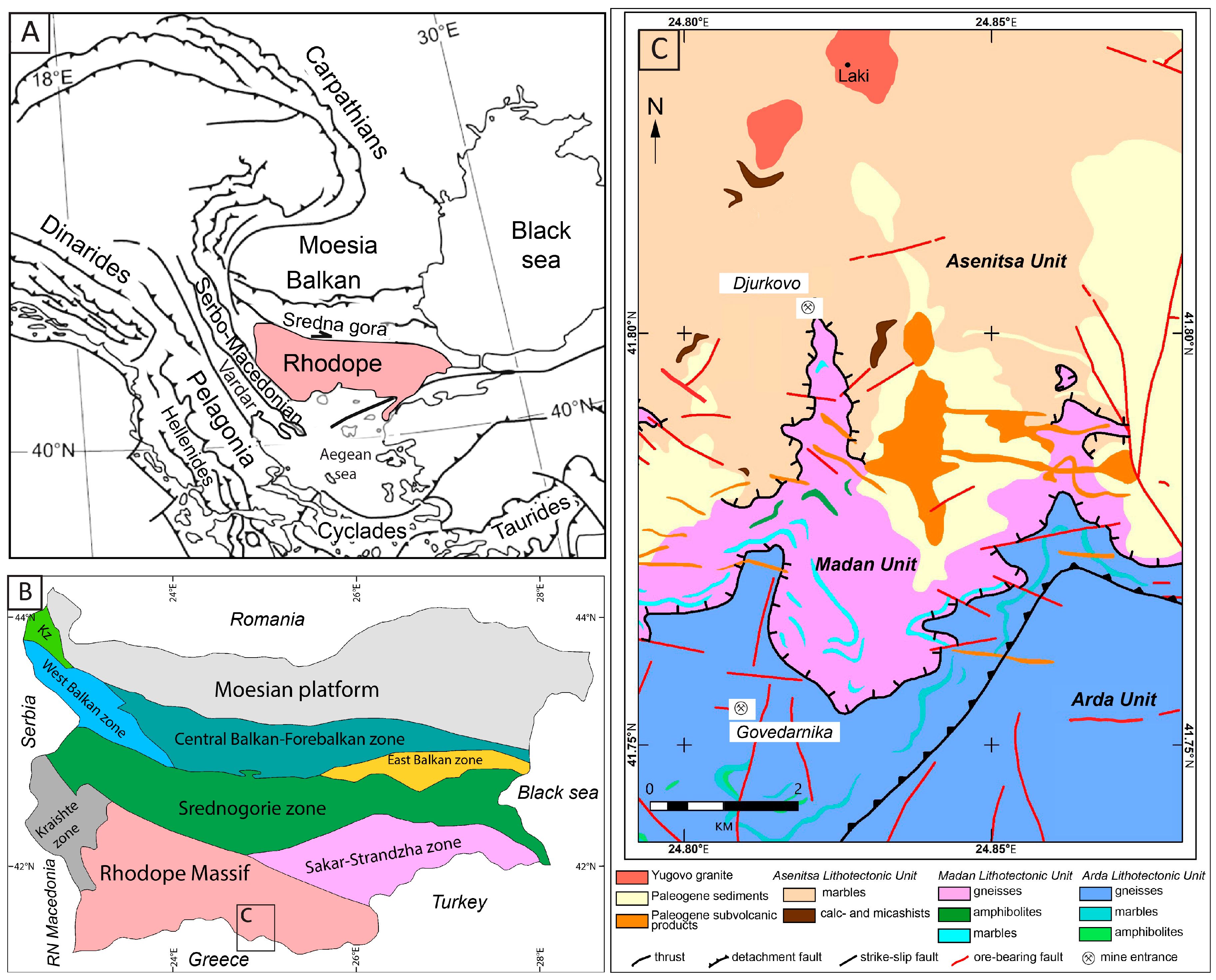
The studied area is located in the Central Rhodopes (southern Bulgaria), within the Rhodope Massif, which represents an internal segment of the Alpine–Himalayan orogenic system [3,18] (Figure 1A,B). The Pb-Zn deposits in this region are grouped into several ore districts, including Madan, Laki, Ardino and Davidkovo, forming a large hydrothermal metallogenic province related to the Eocene tectono-magmatic evolution of the complex [1,4].
The tectonic evolution of the Rhodope Metamorphic Complex is characterized by an initial compressional stage related to the northward subduction of the African plate beneath the European margin, resulting in crustal thickening and high-grade metamorphism [19,20,21]. This was followed by post-collisional extension beginning in the Late Cretaceous and reaching its peak during the Eocene–Oligocene (ca. 50–30 Ma), accompanied by exhumation of metamorphic units, development of detachment systems, and widespread magmatism [1,22,23]. The late Alpine magmatism includes granitoids, felsic volcanics, and rhyolitic dykes, interpreted as products of crust–mantle interaction and closely related to ore formation [2,24].
Within the Central Rhodopes, the Laki ore district is situated along the northern flank of the Central Rhodopean Dome and at the western margin of the Eastern Rhodope Paleogene depression. The area is built of high-grade metamorphic rocks, predominantly biotite gneisses, amphibolites, marbles and pegmatites, belonging to the Madan and Arda lithotectonic units [4,25,26] (Figure 1C). Both the gneisses and the marbles represent the main host for the hydrothermal ore mineralization. In the studied area, the geological setting is additionally influenced by Paleogene volcano-sedimentary sequences related to the Borovitsa caldera, formed during intense volcanic activity between ca. 33.5 and 31 Ma [24,27,28].
Figure 1. (A) Sketch map of the Balkan peninsula, indicating the studied area. (B) Tectonic map of Bulgaria (modified after [3]). The rectangle labelled "C" outlines the area enlarged in Figure 1C. (C) Detailed geological map of the Laki district (modified after [26]).
Minerals 16 00616 g001
Ore formation in both the Madan and Laki ore districts is strongly structurally controlled. In the Laki ore district, mineralization is related to a system of major N-NE-trending fault zones that acted as conduits for hydrothermal fluids [25]. Within this structural framework, the Djurkovo and Govedarnika deposits represent two of the main ore occurrences, developed under similar regional conditions but displaying different styles of mineralization [29]. Additional NW- and NE-striking faults form conjugate systems that further localize ore bodies [30,31].
Geochronological data constrain the main ore-forming event in the Central Rhodope metallogenic province to the Eocene–Oligocene interval (ca. 32–30 Ma), coeval with regional extension, magmatism, and hydrothermal activity [7,9]. Muscovite associated with galena from the Djurkovo deposit yielded 40Ar/39Ar ages of ca. 29–30 Ma, whereas hydrothermal K-feldspar from different Pb-Zn assemblages provided ages between 32 and 30 Ma [7,9]. In contrast, older U-Pb ages obtained from skarn garnets in the Djurkovo deposit (39.5 ± 4.6 Ma and 38.56 ± 3.60 Ma) indicate a pre-ore hydrothermal event related to early Eocene magmatism and the onset of extensional tectonics in the region [10]. Consequently, the origin of the ore-forming fluids remains debated. Current models propose either fluid generation related to syn-extensional metamorphic processes or a magmatic–hydrothermal source involving magmatic fluids mixed with meteoric waters [1,2,6,7,11,32]. Lead isotope compositions of galena and pyrite, together with fluid inclusion data from quartz, support a significant magmatic contribution to the hydrothermal system, whereas Sr isotope data indicate interaction with the surrounding metamorphic rocks and possible involvement of metamorphic fluids [2,33].

2.2. Geology of Djurkovo and Govedarnika Deposits

The Djurkovo and Govedarnika deposits, investigated in the current study, are located within the Laki ore district in the northern part of the Central Rhodopes and represent the only currently active underground Pb-Zn mines in the region. According to industrial data reported by Laki Invest AD, the Djurkovo mine processed approximately 99,500 t of ore with average grades of 3.64 wt.% Pb, 1.91 wt.% Zn and 78 g/t Ag, whereas the Govedarnika mine processed approximately 77,900 t of ore with average grades of 3.07 wt.% Pb, 4.80 wt.% Zn and 24 g/t Ag, highlighting the economic significance of the studied mineralization within the Central Rhodopes. Despite their close spatial relationship and similar tectonic setting, the two deposits display distinct styles of mineralization controlled by lithology, structural setting, and fluid–rock interaction [4].
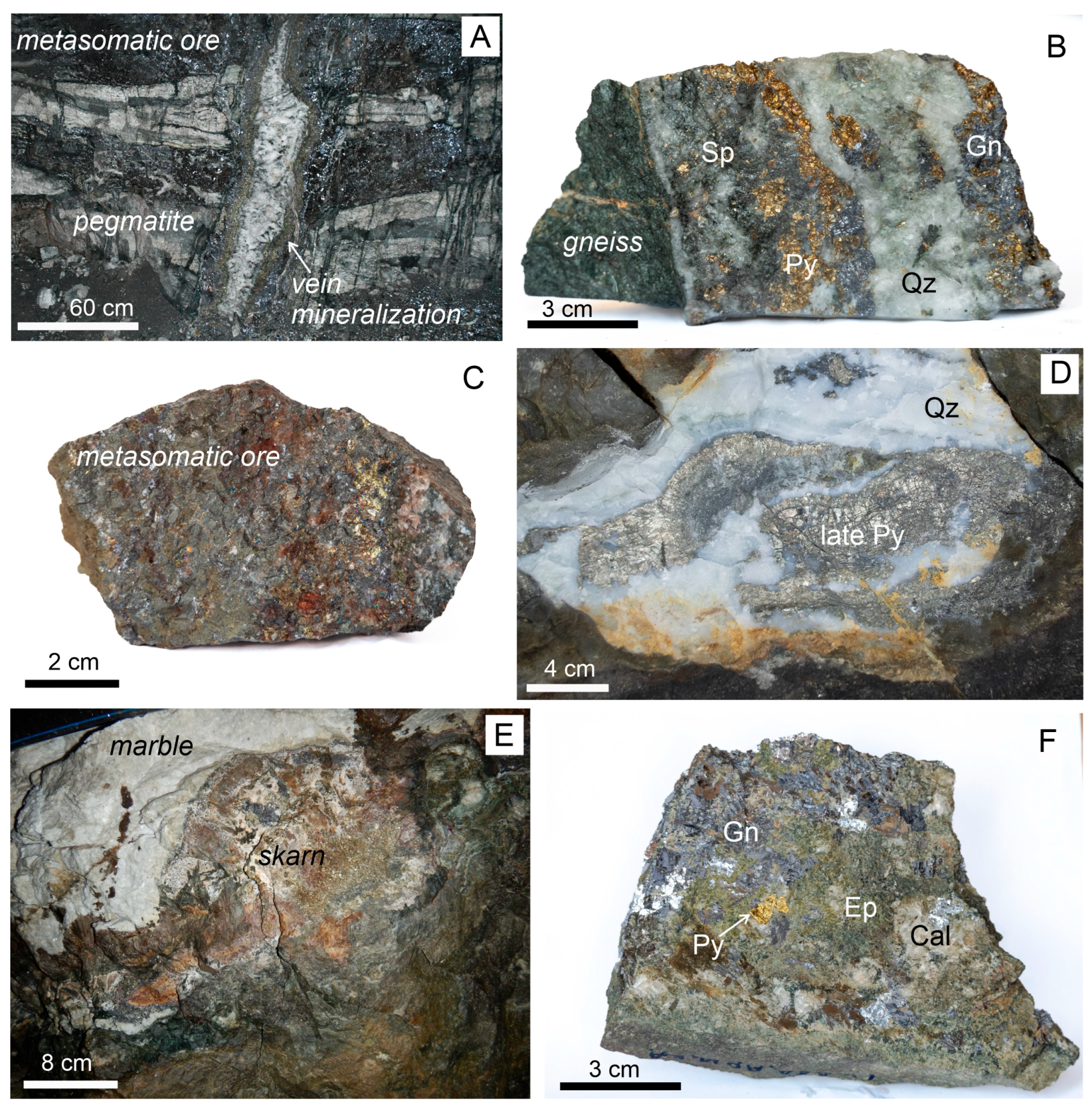
In the Djurkovo deposit, ore mineralization is hosted predominantly by high-grade metamorphic rocks, mainly biotite gneisses and local marble intercalations. Mineralization occurs mainly as subvertical quartz–sulphide veins controlled by NNE-SSW-trending fault systems and hosted predominantly by aluminosilicate rocks (Figure 2A,B) [10,33]. The ore veins vary from tens of centimetres to several meters in thickness and may reach several kilometres in length [8]. The vein assemblages are dominated by pyrite, sphalerite, galena, and subordinate chalcopyrite, occurring as massive aggregates, disseminations, and fracture-controlled mineralization within quartz gangue (Figure 2B). According to [33], the mineralization evolved through three major stages: (1) the quartz–pyrite, (2) polymetallic sulphide, and (3) late quartz–carbonate stages. Hydrothermal alteration associated with the Pb-Zn mineralization is characterized by the formation of adularia, epidote–chlorite–hematite assemblages, sericitization, and late-stage carbonatization of the host rocks. Metasomatic ore bodies are formed at the intersection of the fluid-conducting faults and marbles [4] (Figure 2A). Within the marbles, direct carbonate replacement by sulphides and quartz–carbonate assemblages (Figure 2C) are more common than skarn formation, which occurs mainly in the deeper levels of the system [10]. Late-stage pyrite and marcasite sporadically occur within metasomatic assemblages (Figure 2D), representing a distinct late hydrothermal sulphide generation associated with the latest stages of fluid evolution (hereafter referred to as late pyrite generation).
In contrast, the Govedarnika deposit is characterized predominantly by metasomatic and skarn-hosted mineralization developed within marble sequences (Figure 2E,F). The ore bodies occur as metasomatic replacement bodies and subordinate veins controlled by NNE-trending fault systems [8]. Intense fluid–rock interaction in the carbonate environment resulted in the formation of Mn-rich skarn assemblages composed mainly of clinopyroxenes (johannsenite–hedenbergite series), pyroxenoids (rhodonite and bustamite), manganilvaite, garnet, epidote, chlorite, and carbonate minerals [4,5,8]. These skarns act as favourable host rocks for the overprinted economic Pb-Zn sulphide mineralization. Sulphides occur mainly as massive to disseminated aggregates of galena, sphalerite, pyrite, and minor chalcopyrite within the metasomatic matrix (Figure 2F).
The observed mineralogical and textural relationships in both deposits indicate a complex multistage hydrothermal evolution controlled by structurally focused fluids interacting with compositionally contrasting host rocks. While Djurkovo is dominated by structurally controlled quartz–sulphide veins and carbonate-replacement ores, Govedarnika represents a skarn-dominated metasomatic system developed in carbonate lithologies.

3. Materials and Methods

Representative ore samples from the Djurkovo and Govedarnika Pb-Zn deposits (Laki ore district) were collected from active underground workings, targeting representative sulphide mineralization and associated gangue assemblages. Petrographic observations were carried out using transmitted and reflected light microscopy with a Leica DM750P polarizing microscope (Leica Microsystems, Wetzlar, Germany) at the Geological Institute, Bulgarian Academy of Sciences (GI-BAS). Mineral identification, textural relationships, and paragenetic sequences were established based on standard optical methods. Scanning electron microscopy (SEM) investigations were performed at the University of Mining and Geology “St. Ivan Rilski”, Sofia, Bulgaria, using a JEOL JSM-6010PLUS/LA instrument (JEOL Ltd., Tokyo, Japan). SEM analyses were used for detailed imaging, phase identification, and characterization of mineral associations. A Cameca SX100 electron microprobe (Laboratory of Electron Microscopy and Microanalysis, Department of Geological Sciences, Masaryk University, Brno, The Czech Republic) was applied to determine the major chemical composition of the minerals. Analytical conditions in wavelength-dispersive mode comprised an accelerating voltage of 15 kV, a beam current of 20–40 nA and a beam size of 5 μm. X-ray Kα, Lα, Lβ, Mα and Mβ lines in natural and synthetic standards were used: FeS2 (Fe, S), ZnS (Zn), PbSe (Se, Pb), InAs (As), Tl(BrI) (Tl), Bi, Sb, Cu, Ag, Co, Ni, and Cd. Minor and trace element signatures were acquired by a New Wave Research 193 nm Excimer laser UP-193FX attached to a Perkin-Elmer ELAN DRC-e quadrupole inductively coupled plasma mass spectrometer (Revvity Inc., Waltham, MA, USA) at the Geological Institute, BAS. The LA-ICP-MS system operated at a 7–8 Hz repetition rate; a spot size of 35 and 50 μm was set. Data were refined based on the external (MASS1 and NIST610 glasses) and internal (from EPMA) standards using the SILLS program (version 1.3.2).

4. Results

4.1. Mineral Association

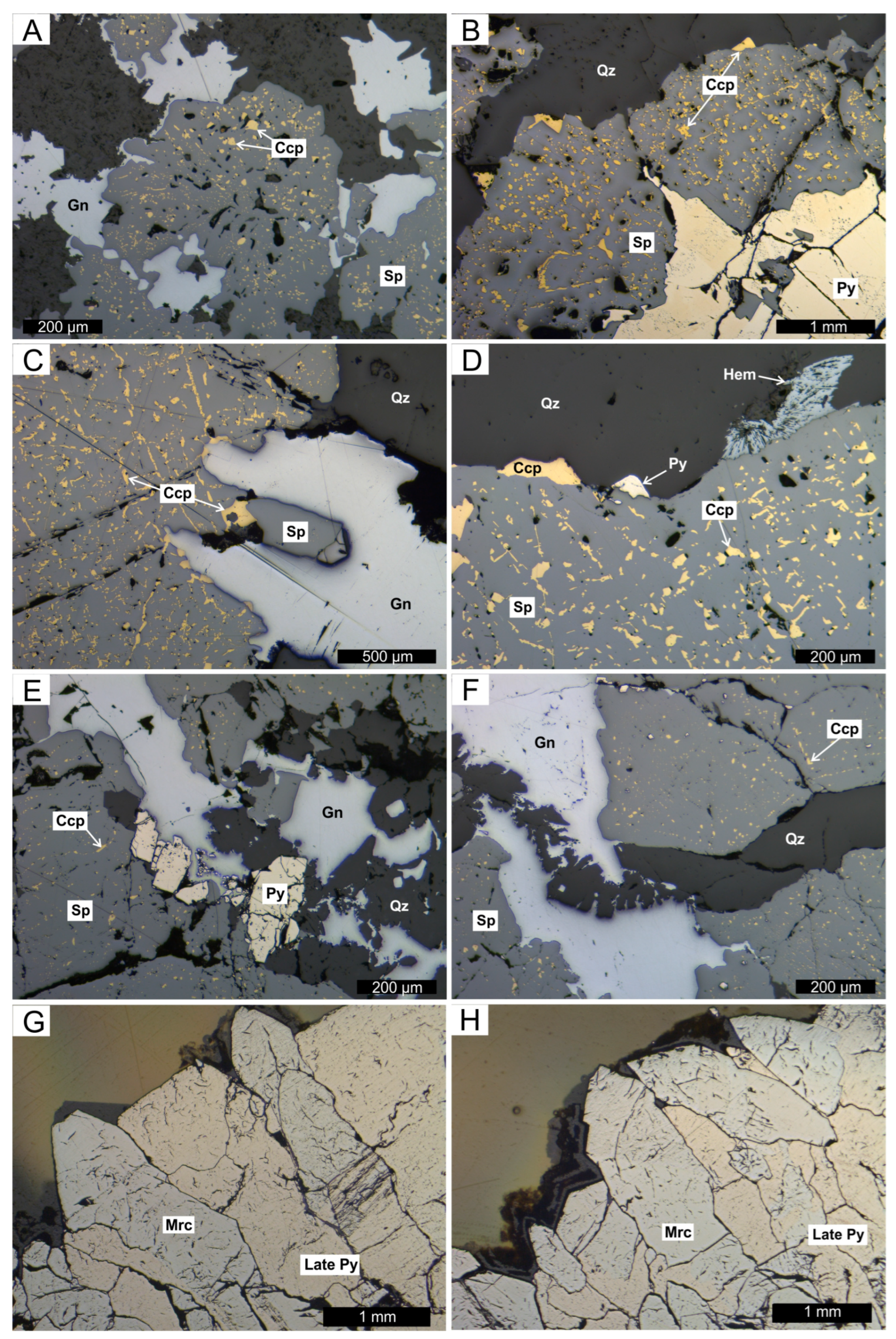
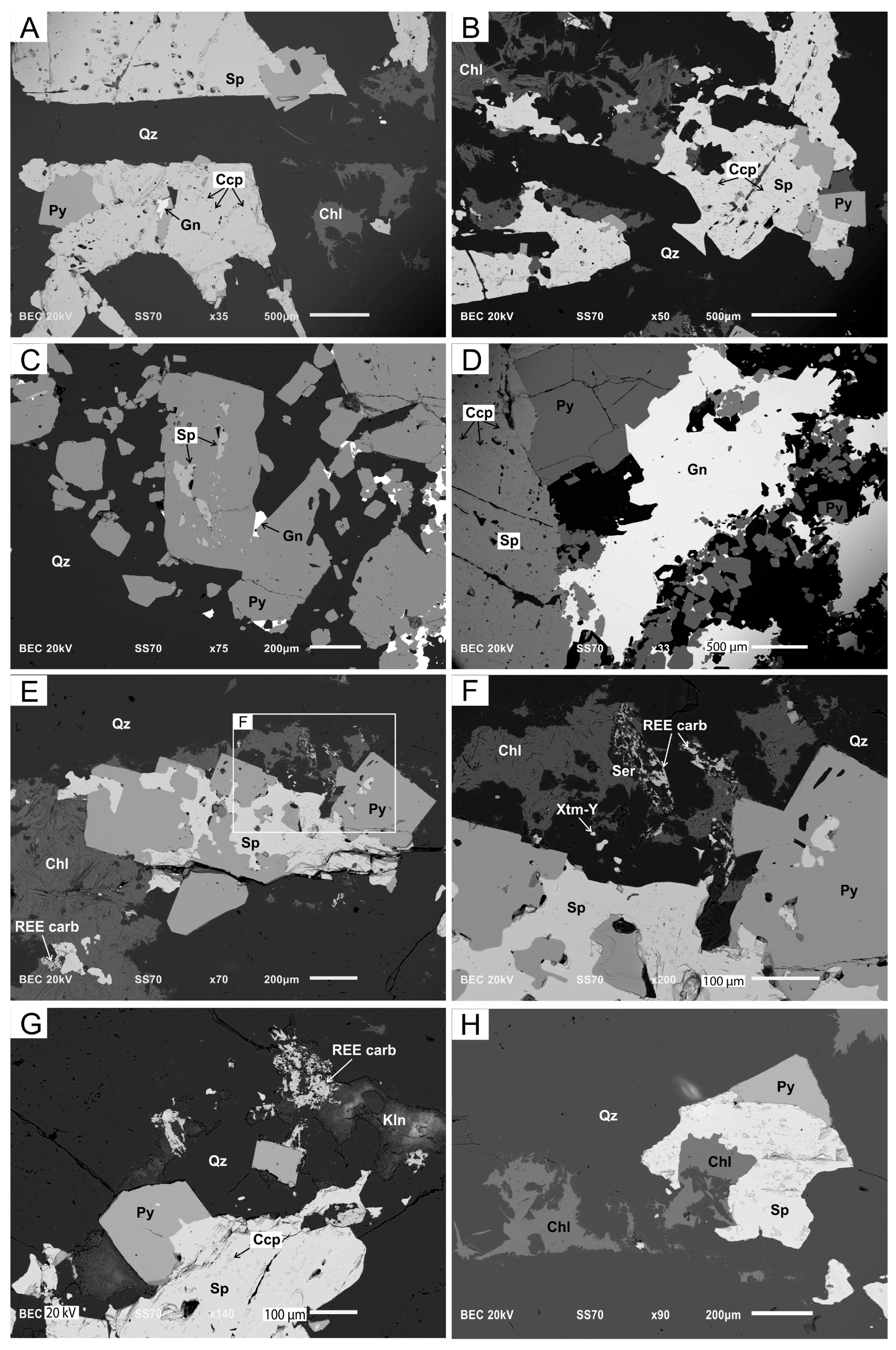
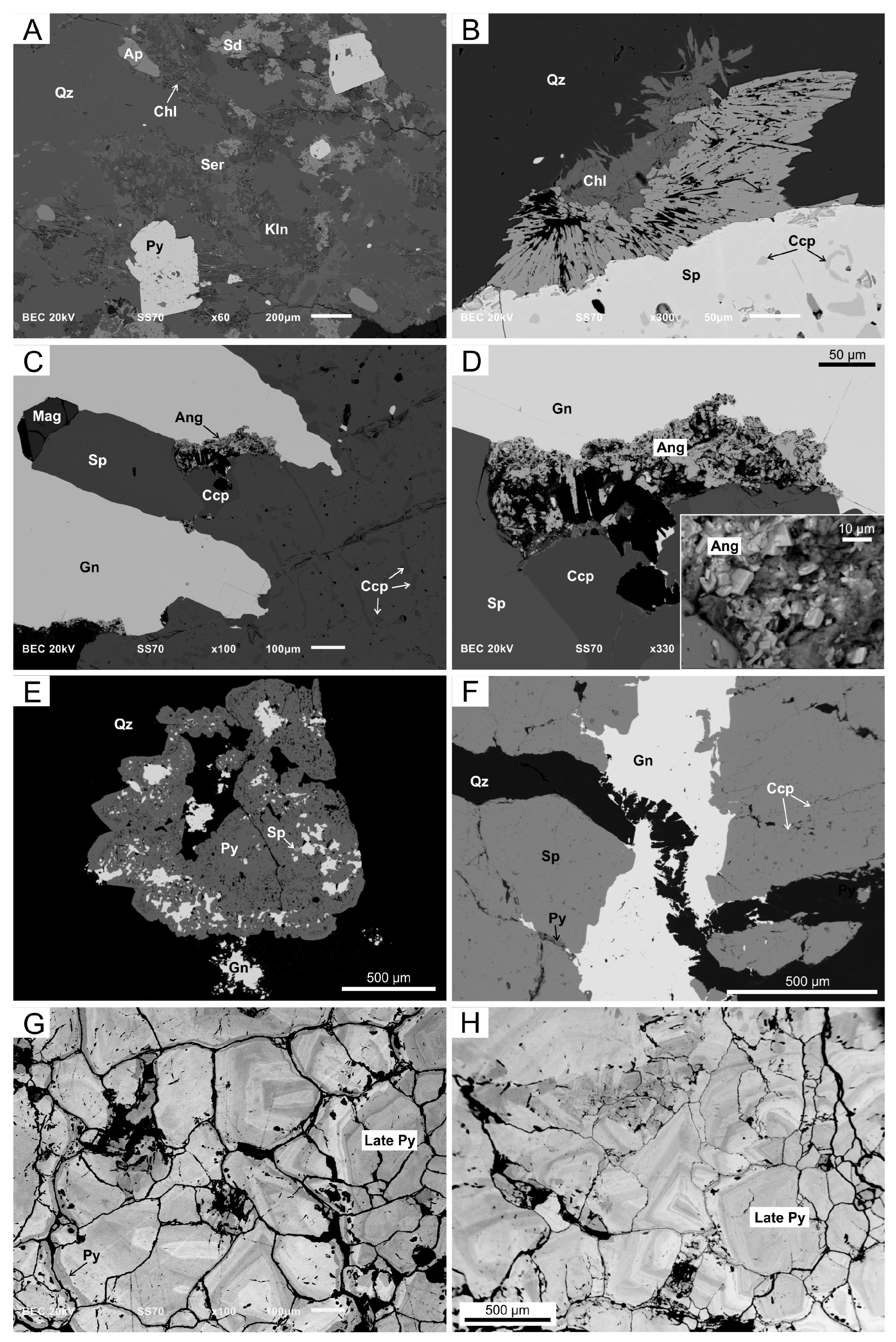
The studied ore mineralization from the polymetallic stage in both the Djurkovo and Govedarnika deposits is developed predominantly as vein-type mineralization and metasomatic replacement bodies (Figure 3, Figure 4 and Figure 5). In the Djurkovo deposit, late sphalerite (cleiophane type) and pyrite–marcasite assemblages belonging to the quartz–carbonate stage occur as thin veinlets and irregular nests (Figure 3G,H and Figure 5G,H). Although both deposits record a broadly similar hydrothermal evolution, they differ in the relative abundance and distribution of the main ore minerals. In the Djurkovo deposit, galena is the dominant sulphide in the vein ores, whereas sphalerite predominates in the metasomatic replacement bodies. In contrast, the Govedarnika deposit is characterized mainly by skarn-related metasomatic replacement mineralization with abundant sphalerite precipitation (Figure 3E,F and Figure 5E,F). The vein mineralization, best developed in the Djurkovo deposit, is characterized by abundant pyrite commonly intergrown with sphalerite. Pyrite generally forms euhedral crystals, suggesting contemporaneous precipitation with sphalerite, as indicated by the widespread sphalerite inclusions and intergrowth textures (Figure 4). Sphalerite occurs predominantly as anhedral aggregates and is characterized by abundant chalcopyrite exsolutions (“chalcopyrite disease”) (Figure 3A–F). The chalcopyrite inclusions commonly form irregular teardrop-shaped blebs, thin veinlets, or align along sphalerite growth zones (Figure 3A–F). In some samples, chalcopyrite also occurs as subhedral grains located at the boundary between sphalerite and quartz (Figure 3B). Galena forms irregular interstitial aggregates surrounding the earlier pyrite and sphalerite assemblages (Figure 3A and Figure 4D). The late hydrothermal stages are marked by the precipitation of quartz, chlorite, and more rarely sericite, kaolinite, xenotime, and REE carbonates, which crosscut or surround the earlier sulphide mineralization (Figure 4).
Metasomatic replacement mineralization from both the Djurkovo and Govedarnika deposits exhibits similar ore assemblages and textural characteristics (Figure 3C–F and Figure 5A–F). Compared to the vein-type ores, these metasomatic bodies are characterized by the predominance of sphalerite over galena and pyrite. As in the vein mineralization, sphalerite commonly contains abundant chalcopyrite exsolutions (“chalcopyrite disease”). Inclusions of sphalerite and galena within pyrite are also frequently observed (Figure 5E). The metasomatic ores are additionally characterized by the presence of magnetite, hematite, carbonates, and anglesite formed during the late stages of hydrothermal evolution (Figure 3D and Figure 5B–D). Magnetite occurs locally as subhedral grains intergrown with galena and sphalerite (Figure 5C). Hematite forms blade-shaped aggregates overgrowing sphalerite and pyrite (Figure 3D and Figure 5B), whereas anglesite occurs as interstitial fillings surrounded by sphalerite-, chalcopyrite-, and galena-rich assemblages (Figure 5C,D). In contrast to the vein-type mineralization, gangue minerals are less abundant in the metasomatic ore bodies.
The studied pyrite–marcasite aggregates, reaching up to 4 cm in size, occur within veins associated with the quartz–carbonate stage (Figure 2D, Figure 3G,H and Figure 5G,H). The aggregates exhibit well-developed rhythmic zoning expressed by alternating bright and dark zones in BSE images. This zoning reflects variations in chemical composition, mainly related to As enrichment and associated trace elements. Pyrite and marcasite form colloform to rhythmically layered aggregates, indicating fluctuating physicochemical conditions during crystal growth (Figure 2D). Late microfractures and intergranular spaces filled by late pyrite generations are also commonly observed (Figure 5G,H).
Figure 3. Microphotographs showing the main occurrence and relationships of the polymetallic ore mineralization: (A,B) vein polymetallic mineralization, Djurkovo deposit; (C,D) metasomatic mineralization, Djurkovo deposit; (E,F) metasomatic mineralization, Govedarnika deposit; (G,H) late pyrite–marcasite aggregates from the quartz–carbonate stage, Djurkovo deposit. Abbreviations.: Sp—sphalerite; Gn—galena; Py—pyrite; Ccp—chalcopyrite; Qz—quartz; Hem—hematite; Mrc—marcasite.
Minerals 16 00616 g003
Figure 4. (AH) BSE images of occurrence and textural relationships between ore mineralization and gangue minerals in the vein polymetallic mineralization, Djurkovo deposit. Abbreviations: Sp—sphalerite; Gn—galena; Py—pyrite; Ccp—chalcopyrite; Qz—quartz; Chl—chlorite; REE carb—REE carbonates; Xtm-Y—xenotime-Y; Ser—sericite; Kln—kaolinite.
Minerals 16 00616 g004
Figure 5. (AD) BSE images of occurrence and textural relationships between ore mineralization and gangues in the metasomatic polymetallic mineralization, Djurkovo deposit; (E,F) BSE images of occurrence and textural relationships between ore mineralization and gangue minerals in the metasomatic polymetallic mineralization, Govedarnika deposit; (G,H) BSE images showing textural features of the late pyrite aggregates from the quartz–carbonate stage, Djurkovo deposit.Abbreviations: Sp—sphalerite; Gn—galena; Py—pyrite; Ccp—chalcopyrite; Ang—anglesite; Hem—hematite; Mag—magnetite; Qz—quartz; Chl—chlorite; Sd—siderite; Ser—sericite; Kln—kaolinite; Ap—apatite.
Minerals 16 00616 g005

4.2. Major and Trace Element Composition of Sulphides

The studied sulphide assemblages from the Djurkovo and Govedarnika deposits include sphalerite, pyrite, chalcopyrite, and galena from the main ore stage, and late sphalerite and pyrite aggregates associated with the quartz–carbonate stage. The mineral chemistry and trace-element distribution were investigated by EPMA and LA-ICP-MS analyses in order to characterize the compositional variability between the different ore types and mineral generations.

4.2.1. Galena

Electron microprobe analyses show that galena from both deposits is compositionally close to ideal PbS. In the vein-type ores from the Djurkovo deposit, Pb contents range from 85.40 to 87.29 wt.% (0.973–1.021 apfu Pb), whereas S varies between 13.17 and 13.85 wt.% (0.999–1.000 apfu S) (Table 1). Galena from the metasomatic ores in the Govedarnika deposit shows a comparable composition, with Pb contents between 85.33 and 87.02 wt.% (0.980–1.009 apfu Pb) and S between 13.27 and 13.70 wt.% (0.998–1.000 apfu S). Minor elements are generally present in low concentrations. In Djurkovo vein galena, Zn is the most variable minor component and reaches up to 2.46 wt.%, whereas Cu locally reaches 0.59 wt.% and Fe up to 0.31 wt.%. Silver is consistently detected in the analysed grains and ranges from 0.15 to 0.24 wt.% Ag (0.003–0.005 apfu Ag). Other elements, including Sb, Se, As, In, Co, Ni, Mn, and Cd, occur only in minor amounts, commonly below 0.1 wt.%. Galena composition from the Govedarnika metasomatic ores is similarly close to stoichiometric PbS but shows slightly more variable Ag contents in the analysed grains, ranging from 0.14 to 0.44 wt.% Ag (0.003–0.010 apfu Ag). Most minor elements remain low, with Sb up to 0.10 wt.%, As up to 0.12 wt.%, Se up to 0.07 wt.%, and In up to 0.08 wt.%. Zinc incorporation is generally low, although in one analysis, it reached 1.97 wt.%. Iron and Cu contents are mostly minor, below 0.31 and 0.05 wt.%, respectively.

4.2.2. Sphalerite

Major element analyses (Table 1) indicate that sphalerite from the studied mineralizations is heterogeneous and exhibits systematic differences between vein-type, metasomatic, and late-stage mineralization. Zinc and sulphur contents in all analysed sphalerite generations remain close to the ideal stoichiometric composition of ZnS. Cadmium is commonly detected, generally between 0.19 and 0.54 wt.% Cd, whereas Cu locally reaches elevated concentrations, especially in sphalerite reflecting the typical presence of chalcopyrite exsolutions in sphalerite. Despite these enrichments, Cd and Cu remain subordinate components relative to Fe, which represents the principal variable minor element in the studied sphalerite. Vein sphalerite from the Djurkovo deposit contains 0.69–2.00 wt.% Fe (average 1.10 wt.%) (0.012–0.034 apfu Fe), whereas sphalerite from the metasomatic ores in the same deposit shows a wider Fe range of 0.58–3.39 wt.% Fe (average 1.43 wt.%) (0.010–0.060 apfu Fe) (Table 1). Late sphalerite associated with the quartz–carbonate stage in Djurkovo is distinctly Fe-poor and corresponds compositionally to a cleiophane-type variety, containing 0.14–0.65 wt.% Fe (average 0.32 wt.%) (0.003–0.011 apfu Fe). In comparison, sphalerite from the metasomatic ores in the Govedarnika deposit is more Fe-rich, with Fe contents ranging from 1.46 to 4.72 wt.% Fe (average 3.53 wt.%) (0.025–0.082 apfu Fe).
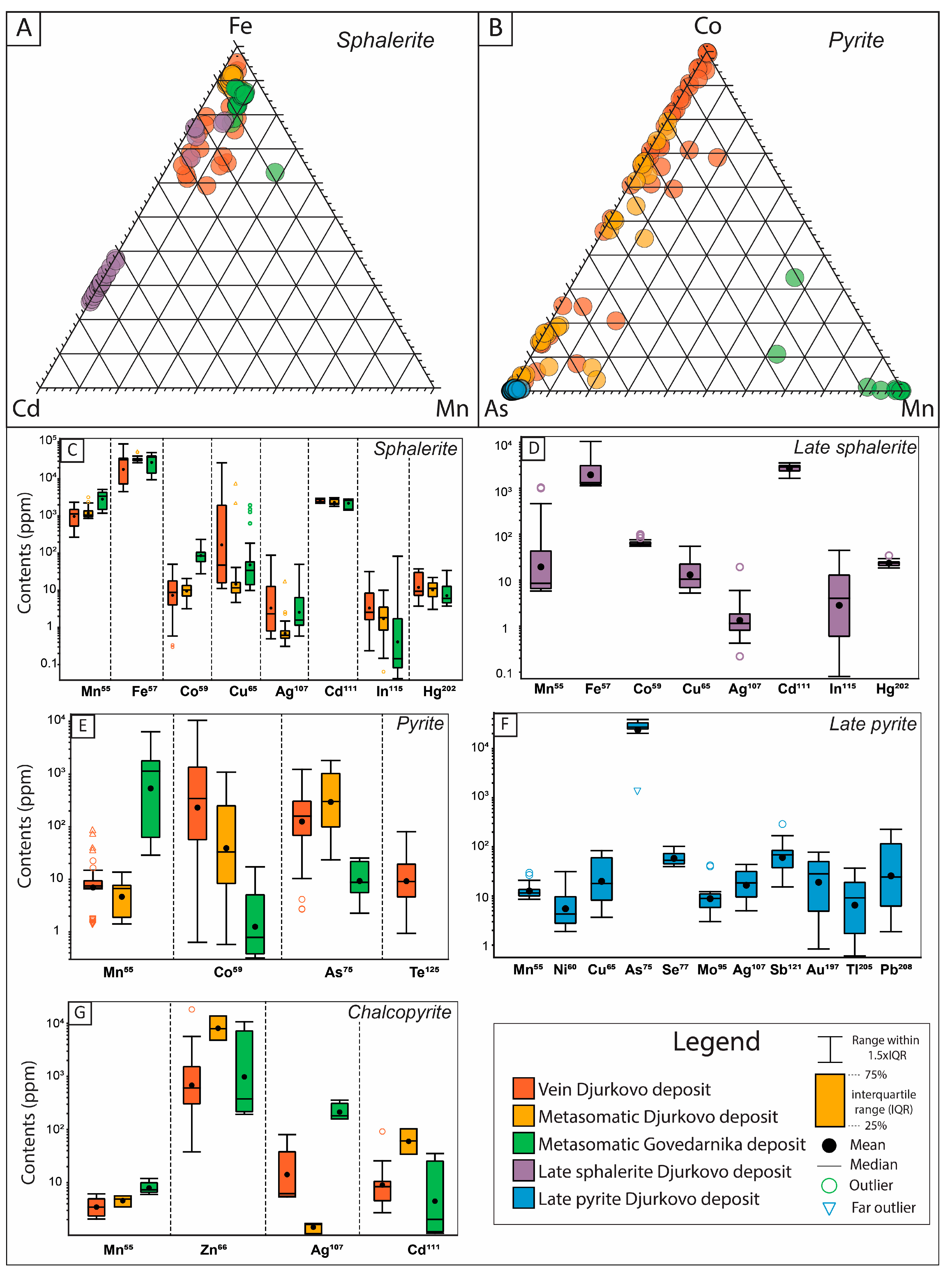
LA-ICP-MS analyses confirm the major variations in Fe, Cd and Cu concentrations observed by EPMA and additionally reveal significant enrichment in Mn, Co, In, and Hg (Figure 6A,C,D), whereas the other elements are commonly below detection limit (Table 1 and Table 2). Vein sphalerite from the Djurkovo deposit contains Fe concentrations ranging from 4556 to 87,588 ppm (average 24,964 ppm), Mn from 269 to 2349 ppm, Cd from 2202 to 3001 ppm, and Cu from 11 to 27,222 ppm (average 4187 ppm). Cobalt concentrations are generally low and commonly remain below several tens of ppm.
Metasomatic sphalerite from the Djurkovo deposit is characterized by the highest mean Fe content, varying between 27,321 and 54,202 ppm (average 33,912 ppm). The Mn ranges between 860 and 3202 ppm, while Cd is between 1821 and 3087 ppm. Copper contents are highly variable, from 5 to 7374 ppm (average 204 ppm). Silver and In incorporations are generally low in most analyses, below 10 ppm.
Late sphalerite from the quartz–carbonate stage in the Djurkovo deposit differs significantly from the earlier sphalerite generations (Figure 6D). The mineral is characterized by distinctly lower Fe contents ranging from 1136 to 10,465 ppm (average 2782 ppm), low Mn incorporation in most analyses (6–1040 ppm, average 123 ppm), and consistently elevated Cd concentrations between 1644 and 3555 ppm (average 2756 ppm). Traces of Hg commonly range between 20 and 34 ppm, whereas Cu concentrations are generally lower than in the earlier sphalerite generations and commonly remain below several tens of ppm, an average of 17 ppm.
Sphalerite from the metasomatic ores in the Govedarnika deposit displays somewhat different trace-element characteristics. Iron ranges from 9502 to 51,290 ppm (average 31,735 ppm), while Mn contents are generally higher than in the Djurkovo sphalerite and vary from 1198 to 5193 ppm (average 3162 ppm). Cadmium concentrations remain consistently elevated and range between 1452 and 2850 ppm. Cobalt contents vary from 28 to 234 ppm, whereas Cu concentrations show strong variations: 10–1956 ppm (average 246 ppm).
The Fe-Mn-Cd ternary diagram (Figure 6A) demonstrates clear compositional differences between the sphalerite populations from the different ore types. Vein and metasomatic sphalerite from the Djurkovo deposit plot predominantly toward the Fe-rich field, whereas sphalerite from the metasomatic ores in the Govedarnika deposit shows a relative trend toward the Mn-rich compositions. In contrast, the late cleiophane-type sphalerite from the Djurkovo quartz–carbonate stage is clearly displaced toward the Cd apex, reflecting its very low Fe contents and comparatively high Cd concentrations.

4.2.3. Pyrite

The pyrite from the studied mineralizations is generally close to the ideal FeS2 composition, but with variable As contents depending on the ore type and mineral generation. The analyses from the vein ores in the Djurkovo deposit are compositionally homogeneous, with Fe contents of 45.39–46.83 wt.% (0.981–1.009 apfu Fe) and S contents of 52.18–54.82 wt.% (1.998–2.000 apfu S). Minor amounts of Cu, Co, Ni, Mn, Zn, and As are locally detected, but generally remain below 0.1 wt.%. Pyrite from the metasomatic ores in the Djurkovo deposit shows broader compositional variation. Iron ranges from 42.62 to 46.79 wt.% (0.956–1.015 apfu Fe), whereas S varies between 48.26 and 53.18 wt.% (1.885–1.999 apfu S). The main deviation from ideal stoichiometry is related to As enrichment, reaching up to 6.89 wt.% As (0.115 apfu As) and averaging at 2.79 wt.%. Minor amounts of Pb, Cu, Ni, Co, and Mn are locally detected, but mostly remain below 0.1 wt.%, except for individual analyses with elevated Ni and Pb. Late pyrite aggregates from the quartz–carbonate stage show various As incorporation, from 0.06 to 10.78 wt.%, whereas the average value is similar to that of the metasomatic pyrite of the deposit—2.69 wt.%. Besides As, slight elevation in Sb and Pb contents are detected, in which Sb reaches up to 0.97 wt.% (average 0.13 wt.%), and Pb is up to 0.17 wt.% (average 0.10 wt.%). Pyrite from the metasomatic ores in the Govedarnika deposit is close to stoichiometric FeS2, with Fe contents of 46.19–47.37 wt.% (0.981–0.999 apfu Fe) and S contents of 53.92–54.84 wt.% (1.998–2.000 apfu S). Minor amounts of As, Cu, Ni, and Mn are present only in low concentrations.
LA-ICP-MS analyses reveal distinct trace-element distributions between the different ore types in both deposits (Figure 6B,E,F). Pyrite from the vein ores in the Djurkovo deposit is characterized by variable Co contents ranging from 1 to 10,471 ppm (average 1152 ppm). Arsenic varies from 3 to 1238 ppm (average 233 ppm), whereas Mn ranges from 1 to 87 ppm (average 12 ppm). Tellurium is detected only within the vein-type mineralization. Its contents range from 1 to 81 ppm (average 17 ppm).
Pyrite from the metasomatic ores in the Djurkovo deposit contains lower Co concentrations, ranging from 1 to 1094 ppm (average 141 ppm), but shows higher As content relative to the vein pyrite. Arsenic ranges from 24 to 1828 ppm (average 577 ppm), whereas Mn is very low and varies from 1 to 14 ppm (average 6 ppm).
Late pyrite aggregates show the strongest enrichment in As and several associated trace elements (Figure 6F), most of which were not detected in the other ore types. Arsenic ranges from 1301 to 38,681 ppm (average 27,260 ppm). Selenium varies from 40 to 102 ppm, Sb from 15 to 291 ppm, Au from 1 to 78 ppm, Tl from 1 to 37 ppm, and Pb from 2 to 227 ppm. Additional elements include Cu (4–84 ppm), Mo (3–42 ppm), Ag (5–44 ppm), Ni (2–31 ppm), and Mn (9–30 ppm).
Pyrite from the metasomatic ores in the Govedarnika deposit is distinguished by elevated Mn concentrations, ranging from 29 to 6359 ppm (average 1726 ppm). In contrast, Co contents are low, between b.d.l. and 17 ppm (average 3 ppm), similar to As, which range from 2 to 25 ppm (average 12 ppm).
The Co-As-Mn ternary diagram (Figure 6B) clearly separates the analysed pyrite populations. Vein pyrite from the Djurkovo deposit plots mainly toward the Co-rich field, whereas pyrite from the metasomatic ores in Govedarnika is shifted toward the Mn apex. Pyrite from the Djurkovo metasomatic ores occupies an intermediate position with variable As contribution, while the late pyrite aggregates are displaced toward the As-rich field due to their high As content.

4.2.4. Chalcopyrite

Major element contents indicate that chalcopyrite from the studied mineralizations remains compositionally close to the ideal CuFeS2 stoichiometry. Copper contents range between 33.70 and 35.28 wt.% Cu (0.97–1.04 apfu Cu), Fe between 28.67 and 30.08 wt.% Fe (0.94–0.99 apfu Fe), and S between 33.90 and 35.45 wt.% S (Table 1). Minor amounts of Zn are consistently detected in most analyses and locally reach up to 0.74 wt.% Zn (0.02 apfu Zn), particularly in chalcopyrite associated with sphalerite-rich metasomatic ores, similar to the vein mineralization. The rest of the analysed elements remain insignificant, below 0.1 wt.%.
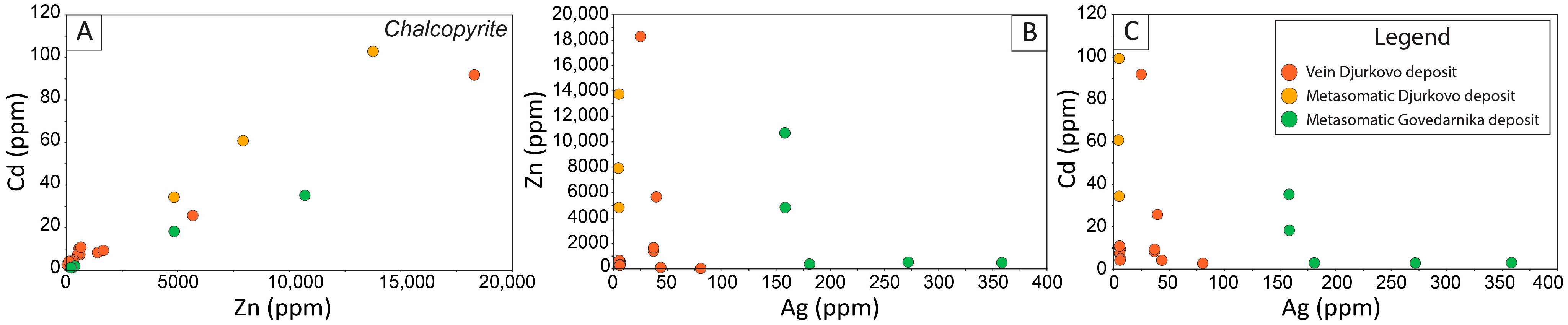
LA-ICP-MS analyses reveal elevated concentrations and high variations in Zn, Ag, Cd, and Mn (Figure 6G), while the other elements remain below detection limit (Table 2). Chalcopyrite from the vein ores in the Djurkovo deposit contains Zn concentrations ranging from 38 to 18,297 ppm (average 2365 ppm), Ag between 5 and 80 ppm (average 23 ppm), Cd from 3 to 92 ppm (average 15 ppm), and very low Mn contents, averaging below 10 ppm.
Chalcopyrite from the metasomatic ores in the Djurkovo deposit is characterized by elevated Zn concentrations ranging from 4833 to 13,757 ppm (average 8838 ppm). Silver and Mn incorporations are uniformly low, below 10 ppm, whereas Cd concentrations range from 34 to 103 ppm (average 66 ppm). One analysis with anomalously high Zn contents (45,012 ppm) was excluded from the statistical processing because it most likely reflects contribution from a sphalerite micro-inclusion.
The studied mineral within the metasomatic ores in the Govedarnika deposit contains Zn concentrations between 194 and 10,699 ppm (average 3270 ppm). Silver contents range from 158 to 358 ppm (average 225 ppm), Cd between 1 and 35 ppm (average 12 ppm), whereas Mn contents are low, averaging 8 ppm. Compared to the Djurkovo metasomatic chalcopyrite, the Govedarnika chalcopyrite displays lower Zn and Cd concentrations and more restricted compositional variability.

5. Discussion

5.1. Geochemical Characteristics of Sphalerite

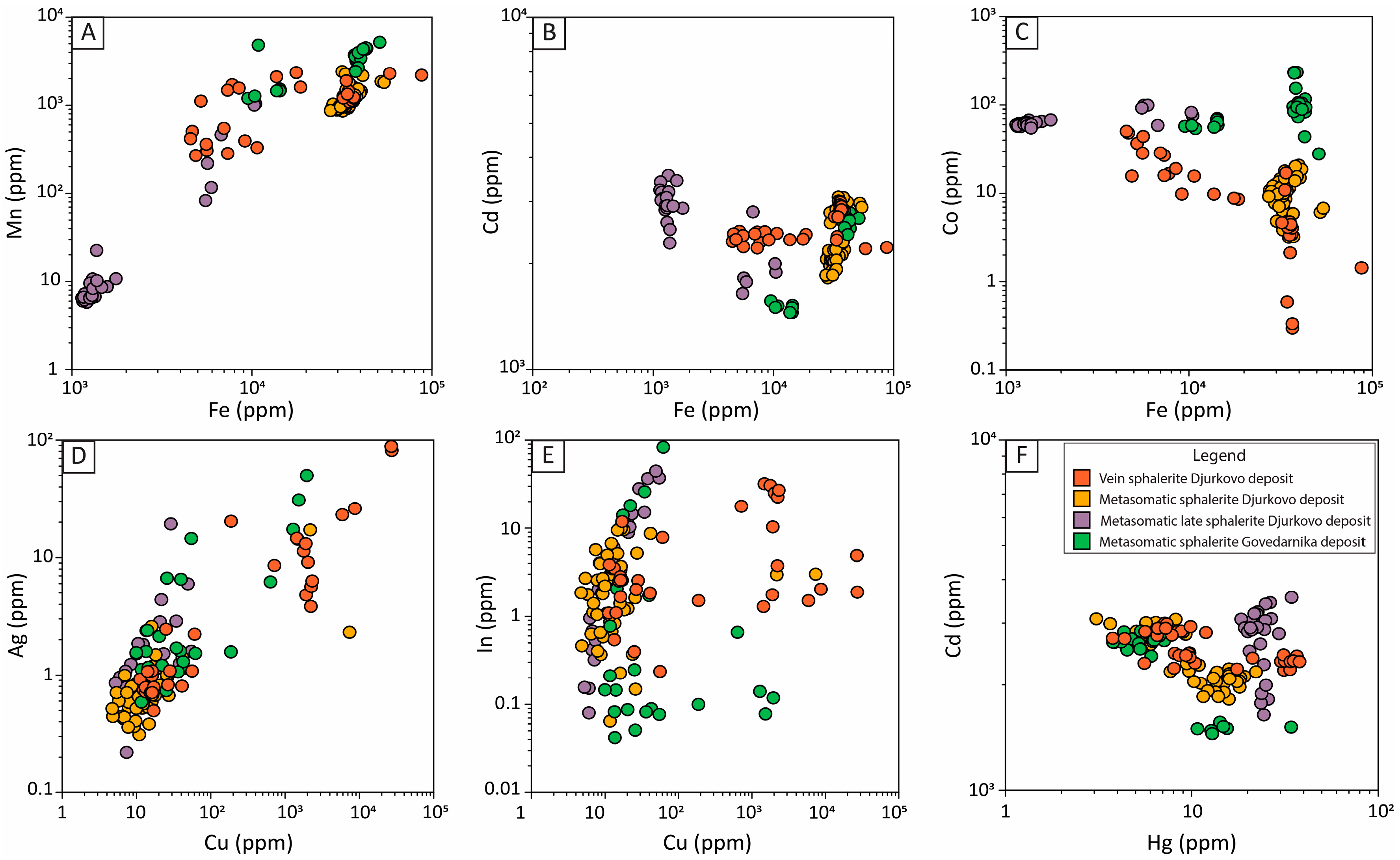
Sphalerites from the Djurkovo and Govedarnika deposits display significant variations in Fe, Mn, Cd, Cu, Ag, In, Co and Hg contents (Figure 7), reflecting differences in fluid composition, host-rock interaction and physicochemical conditions during ore formation. The positive Fe-Mn correlation observed in the metasomatic sphalerites indicates coupled incorporation through the substitution (Fe2+ + Mn2+) ↔ 2Zn2+ (Figure 7A), similar to other skarn-related Pb-Zn systems [12,34,35].
The highest Mn concentrations occur in the Govedarnika sphalerites and are interpreted as reflecting the strong influence of the Mn-rich skarn environment developed in the area (Figure 7A). Sulphide mineralization is superimposed on Mn-bearing skarn calc-silicate assemblages, suggesting extensive fluid interaction with Mn-enriched host rocks during ore deposition. In contrast, sphalerites from Djurkovo generally contain lower Mn contents and show stronger enrichment in Cu, Ag, In and Hg (Figure 7A,D–F).
Cadmium shows a distinct negative correlation with Fe, indicating competitive incorporation between Cd2+ and Fe2+ for the Zn structural site (Figure 7B). Such behaviour is characteristic of medium- to high-temperature hydrothermal sphalerite and reflects the inhibitory effect of Fe on Cd incorporation [12,35,36].
Cobalt displays a more heterogeneous relationship with Fe compared to Mn and Cd (Figure 7C). The highest Co concentrations are observed in the Govedarnika and late Djurkovo sphalerites, whereas the metasomatic sphalerites from Djurkovo are generally Co-poor despite their relatively elevated Fe contents. This distribution suggests that Co incorporation was controlled not only by Fe availability in the sphalerite structure, but also by variations in fluid composition and local physicochemical conditions during sulphide crystallization.
Several Cu-rich analyses additionally show elevated Ag and In contents, suggesting coupled substitutions involving Cu and In, most likely through 2Zn2+ ↔ Cu+ + In3+ (Figure 7D,E). The positive Cu-Ag relationship, together with the petrographically observed chalcopyrite disease textures, indicates local re-equilibration and exsolution processes within Fe-rich sphalerite during cooling. Similar Cu-In substitution mechanisms and associated Cu-Ag-In enrichment in sphalerite have been reported from skarn, carbonate-replacement, and magmatic–hydrothermal systems worldwide [37,38,39].
Mercury contents are variable among the studied sphalerite populations and show a general negative relationship with Cd. The highest Hg concentrations are observed locally in the Djurkovo vein and late sphalerites, whereas the metasomatic sphalerites are generally characterized by lower Hg contents (Figure 7F). This relationship likely reflects complex competition and redistribution processes involving Cd and Hg incorporation in sphalerite during hydrothermal evolution. The sphalerite chemistry suggests that the metasomatic sphalerites formed in a more stable skarn-related environment characterized by elevated Fe and Mn activities, whereas the vein sphalerites likely formed during relatively high-temperature and more chemically dynamic stages of the main polymetallic mineralization, enriched in Cu, Ag, In and Hg. The systematic Mn enrichment in Govedarnika may additionally indicate a more distal position relative to the hydrothermal source and stronger interaction with Mn-rich skarn host rocks, a feature that will be further discussed in the context of the overall evolution of the Laki ore district. In this context, the trace-element signatures of sphalerite may provide useful indicators for differentiating between the Mn-rich skarn-controlled mineralization of Govedarnika and the more chemically evolved polymetallic hydrothermal system developed in Djurkovo. Elevated Mn contents may therefore represent a useful vector toward Mn-skarn environments, whereas enrichment in Cu, Ag, In and Hg appears to characterize the more dynamically evolving sulphide assemblages within the Djurkovo hydrothermal system.

5.2. Geochemical Characteristics of Pyrite

Pyrite from the Djurkovo and Govedarnika deposits shows significant variations in Co, Ni, As, Cu, Mn and trace-element contents related to similar processes and host environments discussed in the sphalerite section. The Co-Ni-As relationships are particularly informative because these elements are widely regarded as typomorphic indicators for hydrothermal sulphides and are commonly used to discriminate between different ore-forming environments [40,41,42]. The pyrites from the studied deposits display predominantly Co- and As-enriched compositions relative to Ni (Figure 6B), suggesting precipitation from magmatic–hydrothermal fluids rather than sedimentary or metamorphic–hydrothermal environments [41,42]. Similar Co-dominant trends have been reported from magmatic–hydrothermal and skarn-related sulphide systems, where Co readily substitutes for Fe in the pyrite structure through Fe2+ ↔ Co2+ substitution [41,42]. The elevated Co contents observed in several pyrite populations additionally correlate with Fe-rich sphalerite assemblages, suggesting precipitation under relatively higher-temperature conditions. Arsenic contents show strong variability between the pyrite generations and likely reflect fluctuations in sulphur fugacity and fluid chemistry during ore formation. Arsenic commonly enters pyrite through coupled substitutions involving As1− ↔ S2− and is widely regarded as one of the principal trace elements associated with hydrothermal pyrite evolution and invisible gold incorporation [15,17]. The variable As enrichment observed in the studied pyrites therefore indicates dynamic physicochemical conditions during sulphide precipitation rather than equilibrium crystallization from a single fluid pulse.
Pyrites associated with the Mn-skarn-hosted mineralization at Govedarnika additionally display elevated Mn contents (up to 6359 ppm), reflecting strong interaction between the hydrothermal fluids and Mn-rich calc-silicate host rocks. This relationship is consistent with the geochemical signature observed in sphalerite and further supports the important role of Mn-skarns in controlling the local ore-forming environment. In contrast, pyrites from Djurkovo are more commonly associated with vein-type mineralization and direct sulphide replacement of marbles. These pyrites display stronger geochemical variability and locally elevated Cu and As contents, suggesting a more evolved and chemically dynamic hydrothermal regime. The association with chalcopyrite-bearing assemblages additionally indicates repeated fluid overprinting and remobilization processes during successive mineralizing stages.
The pyrite chemistry supports a multi-stage hydrothermal evolution involving variable temperature conditions, fluctuating sulphur fugacity and strong host-rock control during sulphide mineralization in the Laki ore district.
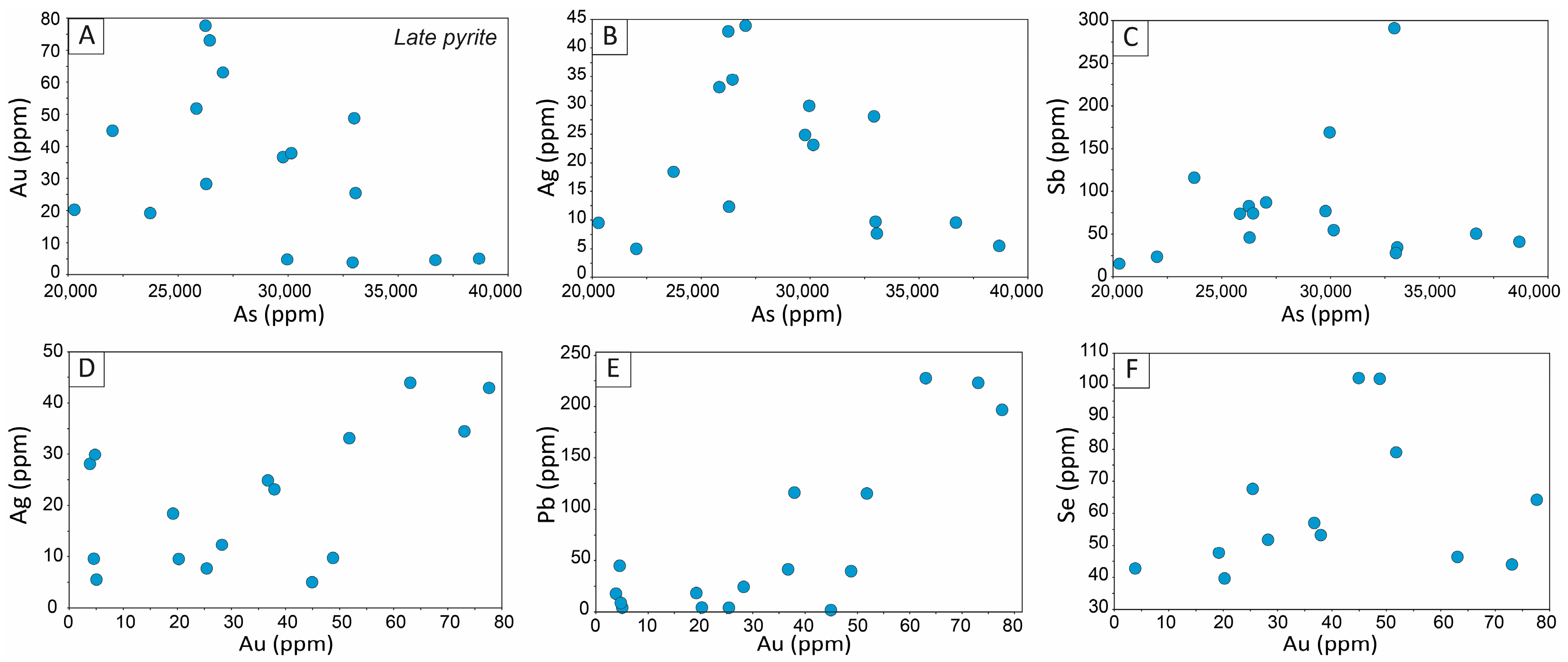
The late pyrite generation is characterized by enrichment in As, Au, Ag, Se and locally Pb, indicating a distinct precious-metal-bearing hydrothermal stage. The positive As-Au relationship (Figure 8A) suggests that Au was preferentially incorporated in As-rich pyrite, most likely as structurally bound or “invisible” gold. Similar relationships are widely reported from hydrothermal arsenian pyrite, where As promotes Au incorporation into the pyrite structure and controls the solubility of invisible gold [15,16,17]. The elevated As concentrations in the studied pyrites therefore indicate that late-stage pyrite acted as an efficient trap for hydrothermal Au.
Silver shows a comparable association with both As and Au (Figure 8B,D), suggesting that Ag enrichment may have accompanied the same late hydrothermal event responsible for Au introduction. The Au-Ag relationship may reflect coupled precious-metal enrichment during late hydrothermal fluid evolution, although the presence of submicroscopic Au-Ag inclusions cannot be excluded. Furthermore, electrum and acanthite have been previously described in the area [8].
The Au-Se relationship (Figure 8F) additionally suggests that precious-metal enrichment was linked to a chemically evolved hydrothermal pulse enriched in Se. Selenium in pyrite is considered sensitive to fluid composition and redox conditions and commonly increases during late hydrothermal stages in polymetallic systems [43].
A positive relationship is also observed between Au and Pb (Figure 8E). Because Pb is poorly accommodated in the pyrite lattice, this trend most likely reflects the presence of micro- to nano-scale galena inclusions or local spatial association with Pb-bearing sulphides rather than direct structural substitution in pyrite.
The trace-element composition of the late pyrite from the Djurkovo Pb-Zn deposit supports a multi-stage hydrothermal evolution characterized by late As-rich and precious-metal-bearing fluids capable of concentrating invisible Au in As-rich pyrite.

5.3. Geochemical Characteristics of Chalcopyrite

Chalcopyrite from the Djurkovo and Govedarnika deposits shows variable concentrations of Zn, Cd and Ag, reflecting both crystal-chemical controls and close intergrowth relationships with sphalerite. The clearest geochemical relationship is the strong positive correlation between Zn and Cd (Figure 9A), indicating that these elements are controlled by a common Zn-Cd-rich component. Because Cd is preferentially partitioned into sphalerite, the coupled Zn-Cd enrichment in chalcopyrite most likely reflects the presence of microscopic sphalerite inclusions, fine intergrowths, or local re-equilibration between chalcopyrite and sphalerite during hydrothermal evolution. Similar trace-element behaviour has been described in chalcopyrite associated with sphalerite-bearing hydrothermal systems, where Zn and Cd are commonly controlled by submicroscopic sphalerite domains rather than by direct structural incorporation in chalcopyrite [12,44].
The Zn-Cd-enriched chalcopyrites are most strongly developed in the metasomatic ores from the Djurkovo deposit, whereas chalcopyrites from the Govedarnika metasomatic ores generally display lower Cd contents despite locally elevated Zn concentrations. Vein-hosted chalcopyrites from Djurkovo show broader geochemical variability and locally elevated Cd concentrations, indicating stronger hydrothermal re-equilibration and trace-element redistribution during the later stages of mineralization. This interpretation is additionally supported by petrographic and SEM observations, which show frequent chalcopyrite–sphalerite intergrowths, local inclusion textures and overgrowth relationships between the two sulphides. In several cases, chalcopyrite occurs as tiny inclusions within sphalerite or along grain boundaries, consistent with disequilibrium crystallization and subsequent re-equilibration during cooling.
In contrast, Ag displays a different geochemical behaviour relative to Zn and Cd (Figure 9B,C). The highest Ag concentrations are mainly associated with chalcopyrites from the Govedarnika metasomatic ores, where Ag enrichment occurs despite comparatively low Zn and Cd contents. This decoupling indicates that Ag enrichment is not primarily controlled by sphalerite-related micro-inclusions. Previous mineralogical observations from the studied deposits additionally documented the occurrence of Ag-bearing minerals such as acanthite and electrum associated with late quartz–carbonate assemblages and fissure-controlled mineralization in sphalerite [8]. Therefore, the observed Ag enrichment most likely reflects localized late-stage hydrothermal redistribution processes and may occur as discrete Ag-bearing micro- to nano-scale inclusions or be partly incorporated into the chalcopyrite structure. The contrasting distribution of Ag relative to the Zn-Cd-rich component therefore suggests that Ag enrichment reflects a geochemically distinct process compared to the sphalerite-controlled Zn and Cd incorporation.
Overall, the chalcopyrite chemistry and textural relationships indicate repeated interaction and partial re-equilibration between Cu-Fe sulphides and Zn-bearing sphalerite during successive stages of hydrothermal mineralization, accompanied by later Ag redistribution during evolving hydrothermal conditions.

5.4. Paragenetic Sequence

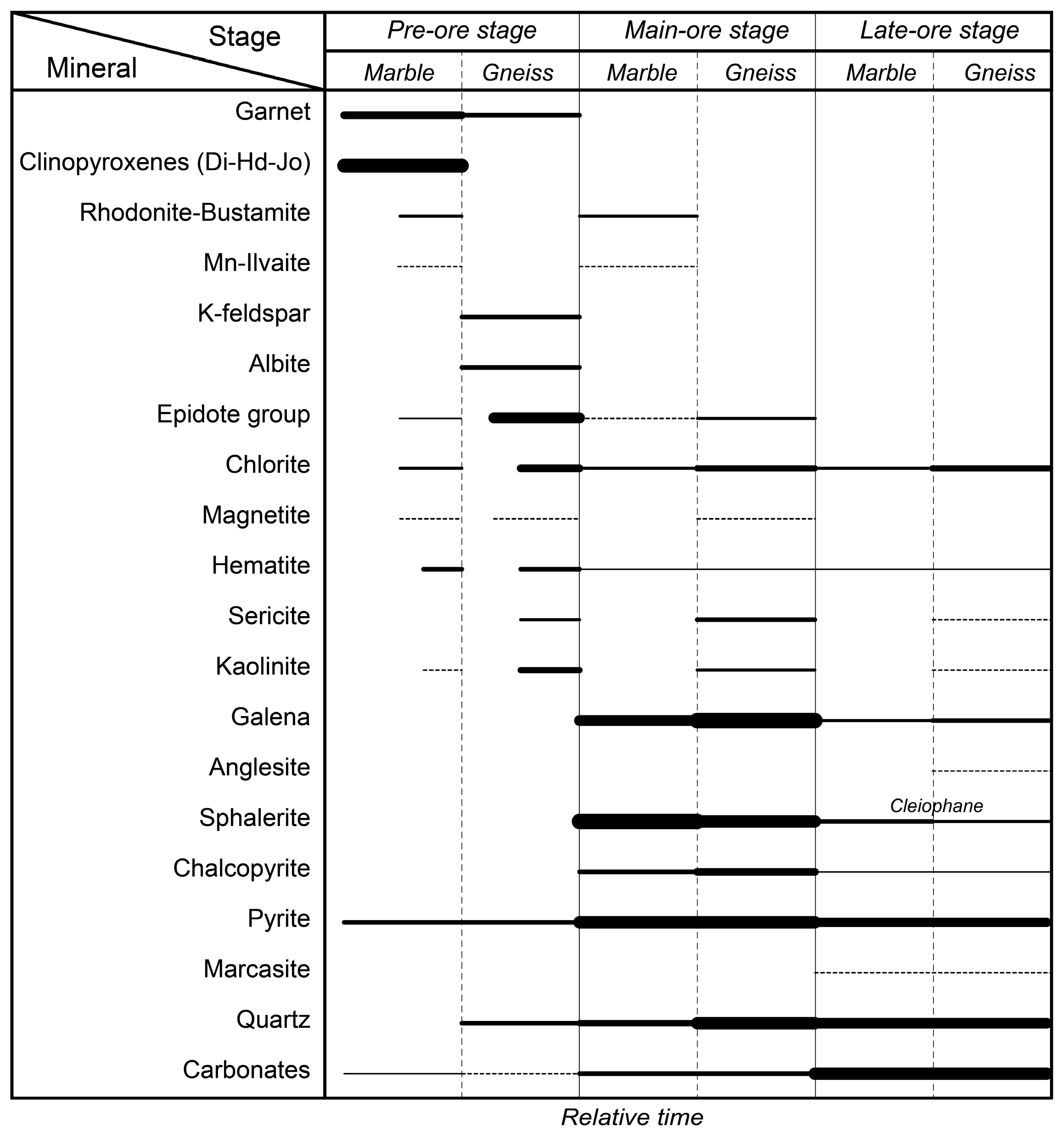
The paragenetic sequence of the Djurkovo and Govedarnika deposits indicates a complex and multi-stage hydrothermal evolution involving early skarn formation, subsequent sulphide metasomatism and structurally controlled vein mineralization developed within both marble and gneiss host rocks (Figure 10). The pre-ore stage is dominated by calc-silicate and skarn-forming assemblages represented by garnet and clinopyroxene (Di-Hd-Jo) in the prograde stage, and rhodonite–bustamite and Mn-ilvaite in the retrograde stage. These mineral associations are most strongly developed within the marble-hosted portions of the system and reflect high-temperature metasomatic processes related to intense fluid–carbonate interaction. The occurrence of Mn-rich silicates and Mn-ilvaite is particularly important because it demonstrates the strong influence of Mn-skarn formation, especially in the Govedarnika area, and explains the elevated Mn contents subsequently recorded in the sulphide minerals.
Within the gneiss-hosted zones, the pre-ore evolution is characterized by K-feldspar alteration, albitization and epidote-group mineral formation, followed by widespread chloritization. The persistence of chlorite through nearly all stages indicates prolonged hydrothermal activity and repeated fluid circulation within structurally controlled zones. Magnetite appears only locally and discontinuously, whereas hematite is more persistent and probably reflects fluctuating redox conditions during progressive hydrothermal evolution. The formation of sericite and kaolinite becomes increasingly important during the transition toward the ore stage, indicating decreasing temperature and more evolved hydrothermal fluids.
The main ore stage is dominated by pyrite, sphalerite, galena and chalcopyrite, although the relative abundance of the sulphides differs markedly between the metasomatic marble-hosted ores and the structurally controled gneiss-hosted vein mineralization. The marble-hosted metasomatic ores are characterized predominantly by sphalerite-rich assemblages with comparatively subordinate galena, whereas the gneiss-hosted vein systems contain proportionally more abundant galena and relatively less sphalerite. This relationship is consistent with both the observed mineral textures and the trace-element geochemistry, suggesting stronger skarn control and host-rock interaction within the metasomatic ores, in contrast to the more evolved and structurally controlled vein-related mineralization. Pyrite represents the most persistent sulphide phase and remains stable throughout nearly all stages of mineralization, indicating long-lived sulphide deposition and repeated hydrothermal reactivation. Chalcopyrite is closely associated with sphalerite during the main ore stage and commonly forms intergrowths and inclusion textures, consistent with the observed chalcopyrite disease and local sulphide re-equilibration during cooling. The appearance of late cleiophane-type sphalerite during the late ore stage reflects decreasing Fe availability and changing physicochemical conditions, likely related to lower-temperature and more sulphur-rich hydrothermal fluids relative to the earlier Fe-rich sphalerite generations.
The late ore stage is characterized by continued quartz and carbonate deposition together with low-Fe sphalerite, pyrite and local marcasite formation, reflecting progressively lower-temperature hydrothermal conditions. The late pyrite generation, identified only in the Djurkovo deposit, provides additional evidence for the physicochemical evolution of the late ore-stage fluids and is characterized by enrichment in As, Au and Ag, indicating an important role in precious- and trace-metal redistribution during the final hydrothermal stages. The observed enrichment in As, Au and Ag within the late pyrite generation additionally indicates progressive evolution and local remobilization within the late hydrothermal fluids. Such trace-element signatures may represent useful indicators for evolved precious-metal-bearing hydrothermal stages within structurally controlled Pb-Zn systems. The formation of marcasite is also associated with this event and likely reflects lower-temperature and more acidic fluid conditions. However, marcasite remains insufficiently studied in the investigated mineralization and represents an important target for future mineralogical and geochemical investigations. In general, the paragenetic sequence demonstrates prolonged and dynamic hydrothermal evolution involving repeated fluid re-equilibration, host-rock interaction and metal remobilization during the development of the Laki ore district.

5.5. Critical and Strategic Element Enrichment in Sulphides

The obtained trace-element data demonstrate that the sulphide mineralization from the Laki ore district acted as an effective concentrator of several technologically important and critical elements during the hydrothermal evolution of the deposits. Besides the economically important Pb-Zn-Cu mineralization and the well-known Ag-bearing galena assemblages, elevated concentrations of elements such as As, Co and Mn were identified in pyrite and sphalerite, reflecting complex metal redistribution processes during successive mineralizing stages. Copper, occurring mainly in chalcopyrite, is of particular importance because it is currently classified as a strategic raw material within the European Union due to its essential role in electrification, renewable energy technologies and modern infrastructure. Although the concentrations of elements such as In, Hg, Co and Ag are variable and locally limited, their systematic occurrence within the studied sulphides demonstrates the potential for enrichment of technologically important trace elements within the hydrothermal system. These data additionally highlight the metallogenic complexity of the Laki ore district and its potential significance as a polymetallic system capable of concentrating both major and critical raw materials.
The strong Mn enrichment observed in the Govedarnika sulphides additionally reflects the direct influence of the Mn-skarn environment on ore formation and highlights the role of host-rock interaction in controlling trace-element incorporation within the sulphides. The combined mineralogical, textural and geochemical characteristics therefore indicate prolonged and dynamic hydrothermal evolution involving repeated remobilization, re-equilibration and concentration of economically and technologically significant elements.
In this context, further detailed investigation of the late pyrite, marcasite and trace-element distribution in the major sulphides may provide important constraints on the mechanisms responsible for precious- and trace-metal enrichment in the Laki ore district, as well as on the potential significance of skarn-related Pb-Zn-Cu systems as carriers of critical and strategic raw materials within the European Union framework.

6. Conclusions

(1)
The Djurkovo and Govedarnika Pb-Zn deposits represent a complex multi-stage hydrothermal system controlled by Eocene–Oligocene extensional tectonics, structurally focused fluid circulation and strong host-rock interaction within the Laki ore district. The mineralization evolved from early skarn and metasomatic stages toward structurally controlled vein and quartz–carbonate assemblages under progressively changing physicochemical conditions.
(2)
Sulphide chemistry demonstrates clear compositional differences between the two deposits and ore types. Sphalerite, pyrite and chalcopyrite from the Govedarnika metasomatic ores are strongly enriched in Mn due to interaction with host Mn-rich skarn assemblages, whereas the Djurkovo sulphides display higher Cu, Ag, In, Hg and Co contents, reflecting a more chemically evolved and dynamic hydrothermal environment.
(3)
Trace-element systematics in the studied sulphides reveal several important substitution mechanisms and re-equilibration processes, including coupled Fe-Mn incorporation in sphalerite, competitive Cd-Fe substitution, Cu-Ag enrichment related to chalcopyrite exsolutions, and Co incorporation in pyrite. Petrographic and geochemical data indicate repeated hydrothermal overprinting and sulphide re-equilibration during cooling.
(4)
Late-stage pyrite associated with the quartz–carbonate stage from the Djurkovo deposit is characterized by strong enrichment in As, Au, Ag, Se, Sb and Tl, indicating a distinct late hydrothermal event capable of concentrating precious and trace metals. The positive Au-As, Ag-As and Au-Ag relationships suggest that Au and Ag were preferentially associated with As-rich pyrite, either as structurally bound invisible gold or as submicroscopic precious-metal inclusions. The observed correlations may additionally indicate the presence of electrum, acanthite or other Ag-Au-bearing phases previously reported from the deposit [8].
(5)
The obtained mineralogical and trace-element data demonstrate that the sulphide mineralization from the Laki ore district acted as an efficient concentrator of economically important elements, including As, Co, Mn and the strategic metal Cu. These results highlight the metallogenic significance of the Rhodope Pb-Zn-Ag systems and their potential importance as carriers of critical and strategic raw materials within the European Union framework.

Author Contributions

Conceptualization, G.M., R.D.V. and S.G.; methodology, G.M., R.D.V., S.G., Y.G. and E.S.; software, G.M., R.D.V., S.G., Y.G. and E.S.; validation, G.M., R.D.V., S.G. and Y.G.; formal analysis G.M., R.D.V., S.G. and E.S.; resources, G.M., R.D.V. and S.G.; data curation, G.M., R.D.V., S.G., Y.G. and E.S.; writing—original draft preparation, G.M.; writing—review and editing, G.M., R.D.V., S.G., Y.G. and E.S.; visualization, G.M.; supervision, G.M., R.D.V., S.G., Y.G. and E.S.; project administration, G.M.; funding acquisition, G.M. All authors have read and agreed to the published version of the manuscript.

Funding

This study is supported by REXPro project, contract BG-RRP-2.011-0040-C01/02, financed by NextGeneration EU, investment C2.I2. “Increasing the innovation capacity of the Bulgarian Academy of Sciences in the field of green and digital technologies” of the Recovery and Resilience Mechanism. All responsibility for the content is borne by the authors, and the views expressed herein can in no way be taken to reflect the official opinion of the European Union and the Bulgarian Academy of Sciences.

Data Availability Statement

Data are contained within the article.

Acknowledgments

We are grateful to Laki Invest AD for providing access to the Djurkovo and Govedarnika deposits. We would also like to thank Emil Shondrev and Oleg Kutinchev for their logistical assistance, valuable information, and constructive discussions regarding the geology of both deposits.

Conflicts of Interest

The authors declare no conflicts of interest.

References

  1. Marchev, P.; Kaiser-Rohrmeier, M.; Heinrich, C.A.; Ovtcharova, M.; von Quadt, A.; Raicheva, R. Hydrothermal ore deposits related to post-orogenic extensional magmatism and core complex formation: The Rhodope Massif of Bulgaria and Greece. Ore Geol. Rev. 2005, 27, 53–89. [Google Scholar] [CrossRef]
  2. Marchev, P.; Moritz, R. Isotopic composition of Sr and Pb in the Central Rhodopean ore fields: Inferences for the genesis of the base-metal deposits. Geol. Balc. 2006, 35, 49–61. [Google Scholar] [CrossRef]
  3. Ivanov, Z. Tectonics of Bulgaria; Sofia University Press: Sofia, Bulgaria, 2017; p. 331. (In Bulgarian) [Google Scholar]
  4. Vassileva, R.; Georgieva, S.; Milenkov, G.; Georgieva, Y.; Škoda, R.; Cempírek, J.; Yovchev, D. Magnesian skarns from the Djurkovo Pb-Zn deposit: Mineral composition and retrograde alteration. C. R. Acad. Bulg. Sci. 2025, 78, 1655–1668. [Google Scholar] [CrossRef]
  5. Vassileva, R.D.; Bonev, I.K. Manganoan amphiboles from the skarn-ore Pb-Zn deposits in the Madan district, Central Rhodope Mountains, Bulgaria. Geochem. Mineral. Petrol. 2001, 38, 45–53. [Google Scholar]
  6. Ovtcharova, M.; von Quadt, A.; Heinrich, C.A.; Frank, M.; Kaiser-Rohrmeier, M.; Peytcheva, I.; Cherneva, Z. Triggering of hydrothermal ore mineralization in the Central Rhodopean Dome, Bulgaria: Constraints from U-Pb zircon geochronology. In Mineral Exploration and Sustainable Development, 1st ed.; Eliopoulos, D.G., Ed.; Millpress: Rotterdam, The Netherlands, 2003; pp. 367–370. [Google Scholar]
  7. Kaiser-Rohrmeier, M.; Handler, R.; von Quadt, A.; Heinrich, C.A. Hydrothermal Pb-Zn ore formation in the Central Rhodopian Dome, south Bulgaria: Review and new time constraints from Ar-Ar geochronology. Schweiz. Mineral. Petrogr. Mitt. 2004, 84, 37–58. [Google Scholar]
  8. Vangelova, V.; Stanimirova, T.; Iliev, T. New mineralogical and geochemical data on the Goranska Padina deposit, Laki ore field. In Annual of Sofia University “St. Kliment Ohridski”, Faculty of Geology and Geography; Sofia University “St. Kliment Ohridski”: Sofia, Bulgaria, 2007; Volume 100, pp. 131–154, (In Bulgarian with English abstract). [Google Scholar]
  9. Buret, Y.; Kouzmanov, K.; Spikings, R.; Gerdjikov, Y. Timing of polymetallic Pb-Zn mineralisation in the Laki district, southern Bulgaria: Constraints from 40Ar/39Ar dates. In Proceedings of the Swiss Geoscience Meeting; SCNAT: Lausanne, Switzerland, 2013; Abstract Volume 49–50. [Google Scholar]
  10. Vassileva, R.; Grozdev, V.; Peytcheva, I.; von Quadt, A. Andradite from the Pb-Zn Djurkovo deposit, Central Rhodopes: Chemical composition and U/Pb dating. Rev. Bulg. Geol. Soc. 2020, 81, 58–60. [Google Scholar]
  11. Singer, B.; Marchev, P. Temporal evolution of arc magmatism and hydrothermal activity, including epithermal gold veins, Borovitsa caldera, southern Bulgaria. Econ. Geol. 2000, 95, 1155–1164. [Google Scholar] [CrossRef]
  12. Cook, N.J.; Ciobanu, C.L.; Pring, A.; Skinner, W.; Shimizu, M.; Danyushevsky, L.; Saini-Eidukat, B.; Melcher, F. Trace and minor elements in sphalerite: A LA-ICP-MS study. Geochim. Cosmochim. Acta 2009, 73, 4761–4791. [Google Scholar] [CrossRef]
  13. George, L.L.; Cook, N.J.; Ciobanu, C.L. Trace and minor elements in galena: A reconnaissance LA-ICP-MS study. Am. Mineral. 2015, 100, 548–569. [Google Scholar] [CrossRef]
  14. Frenzel, M.; Hirsch, T.; Gutzmer, J. Gallium, germanium, indium, and other trace and minor elements in sphalerite as a function of deposit type—A meta-analysis. Ore Geol. Rev. 2016, 76, 52–78. [Google Scholar] [CrossRef]
  15. Reich, M.; Kesler, S.E.; Utsunomiya, S.; Palenik, C.S.; Chryssoulis, S.L.; Ewing, R.C. Solubility of gold in arsenian pyrite. Geochim. Cosmochim. Acta 2005, 69, 2781–2796. [Google Scholar] [CrossRef]
  16. Large, R.R.; Danyushevsky, L.; Hollit, C.; Maslennikov, V.; Meffre, S.; Gilbert, S.; Bull, S.; Scott, R.; Emsbo, P.; Thomas, H.; et al. Gold and trace element zonation in pyrite using a laser imaging technique: Implications for the timing of gold in orogenic and Carlin-style sediment-hosted deposits. Econ. Geol. 2009, 104, 635–668. [Google Scholar] [CrossRef]
  17. Deditius, A.P.; Reich, M.; Kesler, S.E.; Utsunomiya, S.; Chryssoulis, S.L.; Walshe, J.; Ewing, R.C. The coupled geochemistry of Au and As in pyrite from hydrothermal ore deposits. Geochim. Cosmochim. Acta 2014, 140, 644–670. [Google Scholar] [CrossRef]
  18. Ricou, L.-E.; Burg, J.-P.; Godfriaux, I.; Ivanov, Z. Rhodope and Vardar: The metamorphic and the olistostromic paired belts related to the Cretaceous subduction under Europe. Geodin. Acta 1998, 11, 285–309. [Google Scholar] [CrossRef]
  19. Ivanov, Z. Structure and tectonic evolution of the Rhodope Massif. In Guide to Excursion E-3, XIV Congress of the Carpatho-Balkan Geological Association (CBGA); Ivanov, Z., Ed.; CBGA: Sofia, Bulgaria, 1989; pp. 56–96. [Google Scholar]
  20. Janák, M.; Froitzheim, N.; Georgiev, N.; Sarov, S.; Nagel, T.J.; Pleuger, J. P-T evolution of kyanite eclogite from the Pirin Mountains (SW Bulgaria): Implications for the Rhodope UHP metamorphic complex. J. Metamorph. Geol. 2011, 29, 317–332. [Google Scholar] [CrossRef]
  21. Jahn-Awe, S.; Pleuger, J.; Frei, D.; Georgiev, N.; Froitzheim, N.; Nagel, T.J. Time constraints for low-angle shear zones in the Central Rhodopes (Bulgaria), and their significance for the exhumation of high-pressure rocks. Int. J. Earth Sci. 2012, 101, 1971–2004. [Google Scholar] [CrossRef]
  22. Kounov, A.; Seward, D.; Burg, J.-P.; Stockli, D.; Wüthrich, E. Cenozoic thermal evolution of the Central Rhodope Metamorphic Complex, Southern Bulgaria. Int. J. Earth Sci. 2020, 109, 1589–1611. [Google Scholar] [CrossRef]
  23. Kounov, A.; Gerdjikov, I. On the Rhodopean protoliths and their Middle Jurassic to Early Cretaceous evolution: A review. Geol. Balc. 2024, 53, 29–85. [Google Scholar] [CrossRef]
  24. Marchev, P.; Georgiev, S.; Raicheva, R.; Peytcheva, I.; von Quadt, A.; Ovtcharova, M.; Bonev, N. Adakitic magmatism in post-collisional setting: An example from the Early–Middle Eocene magmatic belt in southern Bulgaria and northern Greece. Lithos 2013, 180–181, 159–180. [Google Scholar] [CrossRef]
  25. Ivanov, Z.; Dimov, D.; Sarov, S. Structure, Alpine evolution and mineralizations of the Central Rhodopes area, (South Bulgaria). In Guide to Excursion B, ABCD-GEODE Workshop; University Press “St. Kliment Ohridski”: Sofia, Bulgaria, 2000; pp. 6–20. [Google Scholar]
  26. Sarov, S.; Yordanov, B.; Georgiev, N.; Naydenov, K.; Marinova, R.; Voinova, E. Geological Map of the Republic of Bulgaria, Scale 1:50,000; Bulgarian Geological Survey: Sofia, Bulgaria, 2007. (In Bulgarian) [Google Scholar]
  27. Dhont, D.; Chorowicz, J.; Yanev, Y.; Stoykova, K. Evolution and relationships between volcanism and tectonics in the central-eastern part of the Oligocene Borovitsa caldera, Eastern Rhodopes, Bulgaria. J. Volcanol. Geotherm. Res. 2008, 171, 269–284. [Google Scholar] [CrossRef]
  28. Yanev, Y. On the geology and volcanology of the Paleogene Borovitsa caldera and its frame (Eastern Rhodopes, Bulgaria). Rev. Bulg. Geol. Soc. 2017, 78, 97–128, (In Bulgarian with English abstract). [Google Scholar]
  29. Vassileva, R.D.; Atanassova, R.; Bonev, I.K. A review of the morphological varieties of ore bodies in the Madan Pb-Zn deposits, Central Rhodopes, Bulgaria. Geochem. Mineral. Petrol. 2009, 47, 31–49. [Google Scholar]
  30. Atanassov, A.; Kolkovski, B.; Dobrev, D.; Eliev, Z. Movements and Mineralization Along Spoluka-Laikov Cucar Fault, Madan District; University Press “St. Kliment Ohridski”: Sofia, Bulgaria, 1972; Volume 65, pp. 137–153. [Google Scholar]
  31. Manev, D. On the significance of west-northwest faults for the localization of lead-zinc mineralization in the Madan ore field. In Ore-Forming Process and Mineral Deposits; Bulgarian Academy of Sciences: Sofia, Bulgaria, 1975; Volume 1, pp. 20–28. (In Bulgarian) [Google Scholar]
  32. Kaiser-Rohrmeier, M.; von Quadt, A.; Driesner, T.; Heinrich, C.; Handler, R.; Ovtcharova, M.; Ivanov, Z.; Petrov, P.; Sarov, S.; Peytcheva, I. Post-orogenic extension and hydrothermal ore formation: High-precision geochronology of the Central Rhodopian Metamorphic Core complex (Bulgaria-Greece). Econ. Geol. 2013, 108, 691–718. [Google Scholar] [CrossRef]
  33. Buret, Y. Polymetallic Mineralization of the Djurkovo Deposit, Laki Mining District, Southern Bulgaria: Paragenesis and Fluid Evolution. Master’s Thesis, University of Geneva, Geneva, Switzerland, 2012; pp. 1–151. [Google Scholar]
  34. Zhou, C.; Yang, Z.; Sun, H.; Koua, K.A.; Lyu, C. LA-ICP-MS trace element analysis of sphalerite and pyrite from the Beishan Pb-Zn ore district, south China: Implications for ore genesis. Ore Geol. Rev. 2022, 150, 105128. [Google Scholar] [CrossRef]
  35. Cheng, X.; Zhou, Y.; Wang, J.; Zhao, C.; Huang, J.; Li, P.; Wang, H.; Chen, F. Sources and Ore-Forming Environment of the Jinchanghe Pb-Zn Polymetallic Skarn Deposit, Baoshan Block, SW China: Constraints from Cu-S Isotopic and Trace Elemental Compositions of Sulfides. Minerals 2024, 14, 644. [Google Scholar] [CrossRef]
  36. Yang, Q.; Zhang, X.J.; Ulrich, T.; Zhang, J.; Wang, J. Trace element compositions of sulfides from Pb-Zn deposits in the Northeast Yunnan and northwest Guizhou Provinces, SW China: Insights from LA-ICP-MS analyses of sphalerite and pyrite. Ore Geol. Rev. 2022, 141, 104639. [Google Scholar] [CrossRef]
  37. Closs, L.G.; Schwarz-Schampera, U.; Herzig, P.M. Indium: Geology, Mineralogy, and Economics; Springer: Berlin/Heidelberg, Germany, 2002. [Google Scholar] [CrossRef]
  38. Xu, J.; Cook, N.J.; Ciobanu, C.L.; Li, X.; Kontonikas-Charos, A.; Gilbert, S.; Lv, Y. Indium distribution in sphalerite from sulfide–oxide–silicate skarn assemblages: A case study of the Dulong Zn–Sn–In deposit, Southwest China. Miner. Depos. 2021, 56, 307–324. [Google Scholar] [CrossRef]
  39. Xu, J.; Cook, N.J.; Ciobanu, C.L.; Zhao, T.; Li, J.; Zhu, Q.; Jiang, W. Indium mineralization in the world-class Dachang Sn-polymetallic district, Southwest China. Miner. Depos. 2026, 61, 433–458. [Google Scholar] [CrossRef]
  40. Abraitis, P.K.; Pattrick, R.A.D.; Vaughan, D.J. Variations in the compositional, textural and electrical properties of natural pyrite: A review. Int. J. Miner. Process. 2004, 74, 41–59. [Google Scholar] [CrossRef]
  41. Yan, Y.; Li, S.; Jia, B.; Zhang, N.; Jiang, L.; Yan, L. Composition typomorphic characteristics of pyrite in various genetic type gold deposits. Adv. Mater. Res. 2012, 463–464, 25–29. [Google Scholar] [CrossRef]
  42. Cao, R.; Xie, F.; Jia, M.; Cao, Y.; Gao, L. In Situ LA-ICP-MS Trace-Element and Sulfur Isotope Characteristics of Sulfides from Pb-Zn Ore Bodies in the Gariatong W-Mo Polymetallic Metallogenic System, Xizang, and Their Geological Implications. Minerals 2026, 16, 424. [Google Scholar] [CrossRef]
  43. Keith, M.; Smith, D.J.; Jenkin, G.R.T.; Holwell, D.A.; Dye, M.D. A review of Te and Se systematics in hydrothermal pyrite from precious metal deposits: Insights into ore-forming processes. Ore Geol. Rev. 2018, 96, 269–282. [Google Scholar] [CrossRef]
  44. George, L.L.; Cook, N.J.; Ciobanu, C.L.; Wade, B. Trace elements in hydrothermal chalcopyrite. Mineral. Mag. 2018, 82, 59–88. [Google Scholar] [CrossRef]
Figure 2. Representative field relationship and ore textures from the Djurkovo (AD) and Govedarnika (E,F) Pb–Zn deposits, Laki ore district, Central Rhodopes. Abbreviation: Sp—sphalerite; Py—pyrite; Qz—quartz; Gn—galena; Ep—epidote; Cal—calcite.
Minerals 16 00616 g002
Figure 6. LA-ICP-MS trace-element signatures of the studied sulphides from the Djurkovo and Govedarnika deposits. (A) Fe-Mn-Cd ternary diagram for sphalerite. (B) Co-As-Mn ternary diagram for pyrite. Tukey-type box-and-whisker plots showing trace-element distributions in: (C) sphalerite; (D) late sphalerite; (E) pyrite; (F) late pyrite aggregates; and (G) chalcopyrite.
Minerals 16 00616 g006
Figure 7. Binary plots of (A) Mn vs. Fe; (B) Cd vs. Fe; (C) Co vs. Fe; (D) Ag vs. Cu; (E) In vs. Cu; (F) Cd vs. Hg in sphalerite from Djurkovo and Govedarnika Pb-Zn deposits.
Minerals 16 00616 g007
Figure 8. Binary plots of (A) Au vs. As; (B) Ag vs. As; (C) Sb vs. As; (D) Ag vs. Au; (E) Au vs. Pb; (F) Se vs. Au in late pyrite from the Djurkovo Pb-Zn deposit.
Minerals 16 00616 g008
Figure 9. Binary plots of: (A) Cd vs. Zn; (B) Zn vs. Ag; (C) Cd vs. Ag in chalcopyrite.
Minerals 16 00616 g009
Figure 10. Paragenetic sequence of Djurkovo and Govedarnika Pb-Zn ore deposits.
Minerals 16 00616 g010
Table 1. Representative EPMA data for major and trace elements in sulphides from different types of mineralizations in both deposits.
DepositDjurkovoDjurkovoDjurkovoGovedarnika
TypeVeinMetasomaticMetasomaticMetasomatic
MineralPyPyLate PyPy
Sample No.DJ 24 400 2DJ 24 400 2DJ 24 400 4aDJ 24 4572-7aDJ 24 4572-7aDJ 24 4572-7aDJ_Py_17DJ_24_572_7aDJ_24_572_7aGV-3GV-3GV 24 4
Id No.11/116/122/1 58/1 63/1 72/1 12/128/1 42/1 120/1 127/1 23/1
Bib.d.l.b.d.l.0.15b.d.l.0.05b.d.l.b.d.l.b.d.l.b.d.l.b.d.l.b.d.l.b.d.l.
S52.9753.1352.9652.3652.3251.7252.3751.4552.8754.6054.3854.25
Sb0.050.010.020.01b.d.l.1.430.110.790.020.01b.d.l.0.02
Cu0.02b.d.l.0.06b.d.l.b.d.l.0.120.010.02b.d.l.0.010.04b.d.l.
Fe46.1745.8645.9946.2146.2044.8446.2645.6745.9247.0647.3246.35
Zn0.010.01b.d.l.b.d.l.b.d.l.b.d.l.b.d.l.b.d.l.0.020.090.010.50
Seb.d.l.0.03b.d.l.0.01b.d.l.b.d.l.0.01b.d.l.b.d.l.b.d.l.b.d.l.0.02
Asb.d.l.b.d.l.b.d.l.1.200.870.790.922.241.190.04b.d.l.b.d.l.
Pbb.d.l.b.d.l.b.d.l.0.080.080.230.090.080.09b.d.l.b.d.l.b.d.l.
Tl 0.01b.d.l0.250.040.050.01
Inb.d.l.0.010.01b.d.l.b.d.l.b.d.l.b.d.l.b.d.l.b.d.l. b.d.l.
Agb.d.l.b.d.l.b.d.l.0.030.020.080.010.020.01b.d.l.b.d.l.0.02
Co0.130.19b.d.l.b.d.l.b.d.l.b.d.l.b.d.l.b.d.l.b.d.l.b.d.l.b.d.l.b.d.l.
Ni0.02b.d.l.0.02b.d.l.0.040.14b.d.l.0.01b.d.l.b.d.l.b.d.l.0.04
Mnb.d.l.b.d.l.0.03b.d.l.b.d.l.0.03b.d.l.0.01b.d.l. b.d.l.
Cdb.d.l.b.d.l.b.d.l.b.d.l.b.d.l.b.d.l.b.d.l.b.d.l.b.d.l. b.d.l.
Total99.499.299.299.999.699.699.8100.3100.1101.8101.7101.2
apfu
Bi0.0000.0000.0010.0000.0000.0000.0000.0000.0000.0000.0000.000
S2.0001.9992.0001.9811.9861.9871.9851.9631.9811.9992.0002.000
Sb0.0000.0000.0000.0000.0000.0140.0010.0080.0000.0000.0000.000
Cu0.0000.0000.0010.0000.0000.0020.0000.0000.0000.0000.0010.000
Fe1.0010.9910.9971.0041.0070.9891.0071.0010.9880.9890.9990.981
Zn0.0000.0000.0000.0000.0000.0000.0000.0000.0000.0020.0000.009
Se0.0000.0010.0000.0000.0000.0000.0000.0000.0000.0000.0000.000
As0.0000.0000.0000.0190.0140.0130.0150.0370.0190.0010.0000.000
Pb0.0000.0000.0000.0000.0000.0010.0010.0000.0010.0000.0000.000
Tl0.0000.0000.0000.0000.0000.0010.0000.0000.0000.0000.0000.000
In0.0000.0000.0000.0000.0000.0000.0000.0000.0000.0000.0000.000
Ag0.0000.0000.0000.0000.0000.0010.0000.0000.0000.0000.0000.000
Co0.0030.0040.0000.0000.0000.0000.0000.0000.0000.0000.0000.000
Ni0.0000.0000.0000.0000.0010.0030.0000.0000.0000.0000.0000.001
Mn0.0000.0000.0010.0000.0000.0010.0000.0000.0000.0000.0000.000
Cd0.0000.0000.0000.0000.0000.0000.0000.0000.0000.0000.0000.000
DepositDjurkovoDjurkovoDjurkovoGovedarnika
TypeVeinMetasomaticMetasomaticMetasomatic
MineralSpSpLate SpSp
Sample No.Dj 24 400 7aDj 24 400 7aDj 24 400 7aDJ-572-12DJ-572-12DJ-572-12DJ24-7DJ24-7DJ24-7GV 24 4GV 24 4GV 24 4
Id No.3/14/17/11.11.21.321/123/124/119/120/121/1
Bi0.11b.d.l.b.d.l.b.d.l.b.d.l.b.d.l.b.d.l.0.010.10b.d.l.b.d.l.b.d.l.
S33.1433.1433.6432.8333.5533.5233.1433.2332.9333.0033.2433.15
Sbb.d.l.b.d.l.0.03b.d.l.b.d.l.b.d.l.b.d.l.b.d.l.b.d.l.b.d.l.0.010.06
Cu0.040.061.020.01b.d.l.0.030.030.01b.d.l.0.04b.d.l.0.12
Fe0.751.062.001.483.390.580.160.140.653.964.653.72
Zn65.9865.8461.8765.5862.8365.8967.4167.0666.7462.4861.2461.87
Se0.01b.d.l.b.d.l.b.d.l.b.d.l.b.d.l.b.d.l.b.d.l.b.d.l.b.d.l.b.d.l.b.d.l.
Asb.d.l.0.05b.d.l.0.02b.d.l.b.d.l.0.03b.d.l.0.04b.d.l.b.d.l.b.d.l.
Pbb.d.l.b.d.l.b.d.l.b.d.l.b.d.l.b.d.l.0.050.010.02b.d.l.b.d.l.b.d.l.
Inb.d.l.b.d.l.0.01b.d.l.b.d.l.b.d.l.b.d.l.b.d.l.b.d.l.0.01b.d.l.b.d.l.
Ag0.01b.d.l.b.d.l.b.d.l.0.020.01b.d.l.b.d.l.b.d.l.b.d.l.0.030.01
Co0.010.030.01b.d.l.b.d.l.0.010.020.010.010.03b.d.l.0.03
Ni0.01b.d.l.0.03b.d.l.b.d.l.0.01b.d.l.b.d.l.b.d.l.0.01b.d.l.0.01
Mn0.090.160.060.110.230.01b.d.l.b.d.l.b.d.l.0.360.540.27
Cd0.310.350.330.200.370.320.540.520.330.260.300.35
Total100.48100.6699.00100.23100.39100.38101.38100.98100.82100.16100.0099.59
apfu
Bi0.0010.0000.0000.0000.0000.0000.0000.0000.0000.0000.0000.000
S1.0000.9991.0000.9991.0001.0001.0001.0001.0001.0001.0001.000
Sb0.0000.0000.0000.0000.0000.0000.0000.0000.0000.0000.0000.001
Cu0.0010.0010.0150.0000.0000.0010.0000.0000.0000.0010.0000.002
Fe0.0130.0180.0340.0260.0600.0100.0030.0030.0110.0690.0800.065
Zn0.9760.9740.9020.9710.9360.9860.9970.9900.9940.9290.9040.915
Se0.0000.0000.0000.0000.0000.0000.0000.0000.0000.0000.0000.000
As0.0000.0010.0000.0010.0000.0000.0000.0000.0010.0000.0000.000
Pb0.0000.0000.0000.0000.0000.0000.0000.0000.0000.0000.0000.000
In0.0000.0000.0000.0000.0000.0000.0000.0000.0000.0000.0000.000
Ag0.0000.0000.0000.0000.0000.0000.0000.0000.0000.0000.0000.000
Co0.0000.0000.0000.0000.0000.0000.0000.0000.0000.0010.0000.001
Ni0.0000.0000.0010.0000.0000.0000.0000.0000.0000.0000.0000.000
Mn0.0020.0030.0010.0020.0040.0000.0000.0000.0000.0060.0090.005
Cd0.0030.0030.0030.0020.0030.0030.0050.0050.0030.0020.0030.003
DepositDjurkovoGovedarnikaDjurkovoGovedarnika
TypeVeinMetasomaticVeinMetasomatic
MineralGnGnCcpCcp
Sample No.Dj 24 400 7aDJ 24 400 4aDJ 24 400 4aGV 24 1GV 24 1GV 24 4Dj 24 400 7aDj 24 400 7aDj 24 400 7aGV-9AGV-9AGV-9A
Id No.8/1 38/1 39/1 5/16/1 17/1 5/1 6/1 15/1 117/1 118/1 119/1
Bib.d.l.b.d.l.b.d.l.b.d.l.b.d.l.b.d.l.b.d.l.0.08b.d.l.b.d.l.0.02b.d.l.
S13.4613.1713.3813.4013.5713.3435.4535.2435.1834.7634.8734.94
Sbb.d.l.0.02b.d.l.0.07b.d.l.0.07b.d.l.b.d.l.b.d.l.b.d.l.b.d.l.b.d.l.
Cu0.590.01b.d.l.0.020.05b.d.l.34.5134.8034.8034.4033.7034.71
Fe0.310.01b.d.l.0.01b.d.l.0.0329.4129.5529.8229.6628.6730.08
Zn0.10b.d.l.0.01b.d.l.0.04b.d.l.0.740.620.05b.d.l.b.d.l.0.01
Seb.d.l.0.02b.d.l.0.03b.d.l.0.03b.d.l.b.d.l.0.020.030.08b.d.l.
As0.070.08b.d.l.0.080.060.03b.d.l.b.d.l.0.03b.d.l.0.01b.d.l.
Pb85.4086.9586.0185.7986.0985.73b.d.l.b.d.l.b.d.l.b.d.l.b.d.l.b.d.l.
In0.01b.d.l.0.03b.d.l.b.d.l.b.d.l.b.d.l.b.d.l.b.d.l.
Ag0.190.190.220.220.440.300.020.01b.d.l.0.010.020.03
Cob.d.l.b.d.l.0.02b.d.l.0.01b.d.l.b.d.l.b.d.l.b.d.l.b.d.l.b.d.l.b.d.l.
Nib.d.l.0.02b.d.l.0.04b.d.l.b.d.l.0.02b.d.l.b.d.l.b.d.l.0.01b.d.l.
Mnb.d.l.0.02b.d.l.0.03b.d.l.0.03b.d.l.b.d.l.b.d.l.
Cd0.020.040.02b.d.l.0.070.05b.d.l.b.d.l.b.d.l.
Total100.14100.5499.6799.69100.3399.59100.15100.2999.8898.8697.3899.77
apfu
Bi0.0000.0000.0000.0000.0000.0000.0000.0010.0000.0000.0000.000
S0.9980.9971.0000.9970.9980.9982.0002.0001.9991.9991.9982.000
Sb0.0000.0000.0000.0010.0000.0010.0000.0000.0000.0000.0000.000
Cu0.0220.0000.0000.0010.0020.0000.9820.9960.9980.9980.9751.003
Fe0.0130.0000.0000.0000.0000.0010.9530.9630.9730.9790.9430.988
Zn0.0040.0000.0000.0000.0010.0000.0210.0170.0010.0000.0000.000
Se0.0000.0010.0000.0010.0000.0010.0000.0000.0000.0010.0020.000
As0.0020.0030.0000.0030.0020.0010.0000.0000.0010.0000.0000.000
Pb0.9801.0180.9950.9870.9800.9930.0000.0000.0000.0000.0000.000
In0.0000.0000.0010.0000.0000.0000.0000.0000.0000.0000.0000.000
Ag0.0010.0000.0000.0000.0000.0000.0000.0000.0000.0000.0000.000
Co0.0000.0000.0010.0000.0000.0000.0000.0000.0000.0000.0000.000
Ni0.0000.0010.0000.0020.0000.0000.0000.0000.0000.0000.0000.000
Mn0.0000.0010.0000.0010.0000.0010.0000.0000.0000.0000.0000.000
Cd0.0000.0010.0000.0000.0010.0010.0000.0000.0000.0000.0000.000
Note: b.d.l. = below detection limit.
Table 2. Representative LA-ICP-MS data for trace elements in sulphides from different types of mineralizations in both deposits. Tantalum, W, Re, Pt, Sr, V, Nb, and Mo are measured but are b.d.l. Ge* measured using isotope 74Ge.
DepositDjurkovoDjurkovoDjurkovoGovedarnika
TypeVeinMetasomaticMetasomaticMetasomatic
MineralPyPyLate PyPy
Sample No.DJ24-400-2DJ24-400-2DJ24-400-2DJ24-1mDJ23-mDJ23-mDJ24-572-7DJ24-572-7DJ24-572-7GV-3GV-3GV-3
Id No.26ap16a0826ap16a1026ap16a1224se26b2123jl24a0523jl24a1325fe13b3525fe13b3625fe13c1026ap17b0726ap17b0826ap17b01
Cr7.606.836.12b.d.l.b.d.l.b.d.l.b.d.l.b.d.l.11.6910.455.807.28
Mn7.396.996.8812.891.732.4111.6010.3010.0758466359152.53
Fe460,000460,000453,900469,800469,800469,800466,400469,300469,300472,000472,000472,000
Co92.1314161691148.93278.4512.950.50b.d.l.0.900.381.110.32
Nib.d.l.25.6721.764.53b.d.l.b.d.l.4.772.837.83b.d.l.b.d.l.b.d.l.
Cub.d.l.b.d.l.b.d.l.2.68b.d.l.12.4460.1841.1470.9315.3815.81b.d.l.
Znb.d.l.b.d.l.b.d.l.b.d.l.b.d.l.b.d.l.b.d.l.b.d.l.b.d.l.b.d.l.3.88b.d.l.
Gab.d.l.b.d.l.b.d.l.b.d.l.b.d.l.b.d.l.b.d.l.b.d.l.b.d.l.b.d.l.b.d.l.b.d.l.
Ge1.74b.d.l.1.32b.d.l.b.d.l.b.d.l.---b.d.l.b.d.l.b.d.l.
Ge*b.d.l.b.d.l.b.d.l.b.d.l.b.d.l.b.d.l.b.d.l.b.d.l.0.58b.d.l.b.d.l.b.d.l.
As421.00393.39379.16111.5197.71792.8930,14527,03726,43825.4121.828.79
Seb.d.l.b.d.l.6.14b.d.l.b.d.l.b.d.l.53.2646.3443.973.41b.d.l.b.d.l.
Ag0.17b.d.l.0.31b.d.l.b.d.l.0.6723.1343.9234.502.081.88b.d.l.
Cdb.d.l.b.d.l.b.d.l.b.d.l.b.d.l.b.d.l.b.d.l.b.d.l.b.d.l.b.d.l.b.d.l.b.d.l.
Inb.d.l.b.d.l.b.d.l.b.d.l.b.d.l.b.d.l.b.d.l.b.d.l.b.d.l.b.d.l.b.d.l.b.d.l.
Snb.d.l.b.d.l.b.d.l.b.d.l.b.d.l.b.d.l.b.d.l.b.d.l.b.d.l.b.d.l.0.180.25
Sbb.d.l.b.d.l.b.d.l.9.75b.d.l.22.8054.7387.0074.223.303.790.44
Te5.057.162.19b.d.l.b.d.l.b.d.l.b.d.l.b.d.l.3.65b.d.l.b.d.l.b.d.l.
Aub.d.l.b.d.l.b.d.l.b.d.l.b.d.l.b.d.l.37.9463.0673.07b.d.l.b.d.l.b.d.l.
Hgb.d.l.0.18b.d.l.b.d.l.b.d.l.b.d.l.b.d.l.b.d.l.b.d.l.b.d.l.b.d.l.0.38
Tlb.d.l.b.d.l.b.d.l.b.d.l.b.d.l.b.d.l.4.6312.819.18b.d.l.b.d.l.b.d.l.
Pb1.195.662.32153.093.45365.30116.17227.47222.97112.46115.759.68
Bi0.350.760.27b.d.l.b.d.l.0.83b.d.l.b.d.l.b.d.l.b.d.l.b.d.l.b.d.l.
DepositDjurkovoDjurkovoDjurkovoGovedarnika
TypeVeinMetasomaticMetasomaticMetasomatic
MineralSpSpLate SpSp
Sample No.DJ24-400-7DJ24-400-7DJ24-1VDJ24-572-2CDJ24-572-2CDJ24-572-2CDJ24-7DJ24-7DJ24-7GV-14GV24-4GV24-4
Id No.25fe13d1025fe13d1124se26a2026ap16c0526ap16c0626ap16c1224se27a2124se27a2324se27a2422ma02c0926ap17a0726ap17a18
Crb.d.l.b.d.l.b.d.l.b.d.l.b.d.l.2.59b.d.l.b.d.l.b.d.l.b.d.l.b.d.l.b.d.l.
Mn419.07305.9713371862144618146.9510.758.57483024422680
Fe4556561833,88252,24440,40254,20212931755146210,84937,53838,902
Co50.5344.1717.016.1014.956.7961.7667.9063.7454.29234.26234.49
Nib.d.l.b.d.l.b.d.l.b.d.l.b.d.l.b.d.l.b.d.l.b.d.l.b.d.l.1.403.413.66
Cu1775203227,22212.2925.9016.2654.5828.9449.13128334.4722.03
Zn660,900660,900581,400632,900632,900632,900632,200632,200632,200640,600624,800645,200
Gab.d.l.b.d.l.b.d.l.1.220.622.107.22b.d.l.b.d.l.b.d.l.0.610.27
Ge b.d.l.b.d.l.b.d.l.b.d.l.4.07b.d.l.b.d.l.b.d.l.b.d.l.b.d.l.
Ge*b.d.l.b.d.l.b.d.l.b.d.l.0.38b.d.l.0.96b.d.l.b.d.l.b.d.l.b.d.l.b.d.l.
Asb.d.l.b.d.l.b.d.l.b.d.l.0.78b.d.l.b.d.l.b.d.l.b.d.l.b.d.l.b.d.l.b.d.l.
Seb.d.l.b.d.l.b.d.l.b.d.l.b.d.l.b.d.l.b.d.l.b.d.l.b.d.l.b.d.l.b.d.l.b.d.l.
Ag11.359.1381.610.840.951.181.6019.335.9717.381.701.21
Cd230922302385296527902889287828702911151627582835
In30.5925.151.880.670.153.3837.2328.1544.530.1425.9918.03
Snb.d.l.b.d.l.b.d.l.b.d.l.b.d.l.1.1110.867.3812.841.00b.d.l.b.d.l.
Sbb.d.l.b.d.l.b.d.l.b.d.l.b.d.l.b.d.l.0.64b.d.l.b.d.l.b.d.l.b.d.l.b.d.l.
Teb.d.l.b.d.l.b.d.l.b.d.l.b.d.l.b.d.l.b.d.l.b.d.l.b.d.l.b.d.l.b.d.l.b.d.l.
Aub.d.l.b.d.l.b.d.l.b.d.l.b.d.l.b.d.l.b.d.l.b.d.l.b.d.l.b.d.l.b.d.l.b.d.l.
Hg10.438.0421.267.159.295.9524.5921.0020.6834.276.714.33
Tlb.d.l.b.d.l.b.d.l.b.d.l.b.d.l.b.d.l.b.d.l.b.d.l.b.d.l.b.d.l.b.d.l.b.d.l.
Pb69.5220.871.01b.d.l.0.35b.d.l.0.225.14b.d.l.9.750.760.31
Bib.d.l.b.d.l.b.d.l.b.d.l.b.d.l.b.d.l.b.d.l.b.d.l.b.d.l.b.d.l.b.d.l.b.d.l.
DepositDjurkovoDjurkovoGovedarnika
TypeVeinMetasomaticMetasomatic
MineralCcpCcpCcp
Sample No.DJ24-400-7DJ24-400-7DJ24-400-7DJ24-572-2CDJ24-572-2CDJ24-572-2CGV-14GV-14GV-14
Id No.25fe13d2525fe13d2625fe13d2926ap16c0726ap16c0826ap16c0922ma02c0522ma02c0622ma02c17
Crb.d.l.b.d.l.b.d.l.b.d.l.b.d.l.b.d.l.b.d.l.b.d.l.b.d.l.
Mnb.d.l.b.d.l.b.d.l.3.494.895.617.2211.998.25
Fe283,476268,711288,684294,561296,018296,071244,724246,788259,379
Cob.d.l.b.d.l.1.27b.d.l.0.33b.d.l.0.60b.d.l.b.d.l.
Nib.d.l.b.d.l.b.d.l.b.d.l.b.d.l.b.d.l.3.42b.d.l.b.d.l.
Cu350,700350,700350,700348,000348,000348,000346,300346,300346,300
Zn1400567018,297483313,757792510,699377.264838
Gab.d.l.b.d.l.b.d.l.b.d.l.b.d.l.b.d.l.b.d.l.b.d.l.b.d.l.
Ge b.d.l.2.51b.d.l.b.d.l.2.85b.d.l.
Ge*b.d.l.b.d.l.b.d.l.b.d.l.b.d.l.b.d.l.b.d.l.b.d.l.b.d.l.
Asb.d.l.b.d.l.b.d.l.b.d.l.b.d.l.b.d.l.b.d.l.b.d.l.b.d.l.
Seb.d.l.b.d.l.b.d.l.b.d.l.b.d.l.b.d.l.b.d.l.b.d.l.b.d.l.
Ag36.8239.5024.891.681.611.08158.05180.82158.33
Cd8.3925.7491.8834.40102.8660.8735.282.0218.29
In1.071.211.360.620.670.670.07b.d.l.b.d.l.
Snb.d.l.0.992.030.47b.d.l.0.48b.d.l.b.d.l.1.30
Sbb.d.l.b.d.l.b.d.l.b.d.l.0.62b.d.l.b.d.l.1.290.60
Teb.d.l.b.d.l.b.d.l.b.d.l.b.d.l.b.d.l.b.d.l.b.d.l.b.d.l.
Aub.d.l.b.d.l.b.d.l.b.d.l.b.d.l.0.19b.d.l.b.d.l.b.d.l.
Hgb.d.l.b.d.l.b.d.l.b.d.l.0.65b.d.l.b.d.l.b.d.l.b.d.l.
Tlb.d.l.b.d.l.b.d.l.0.07b.d.l.b.d.l.b.d.l.b.d.l.b.d.l.
Pb2.643.433.521.883.472.052.396.391.35
Bib.d.l.b.d.l.b.d.l.b.d.l.b.d.l.b.d.l.b.d.l.b.d.l.b.d.l.
Note: b.d.l. = below detection limit.
Disclaimer/Publisher’s Note: The statements, opinions and data contained in all publications are solely those of the individual author(s) and contributor(s) and not of MDPI and/or the editor(s). MDPI and/or the editor(s) disclaim responsibility for any injury to people or property resulting from any ideas, methods, instructions or products referred to in the content.