Compaction and Pressure Solution of Mixed Mineral Assemblages: Implications for Granite Fracture Sealing in the Near-Field of High-Level Radioactive Waste Repository


Abstract
1. Introduction
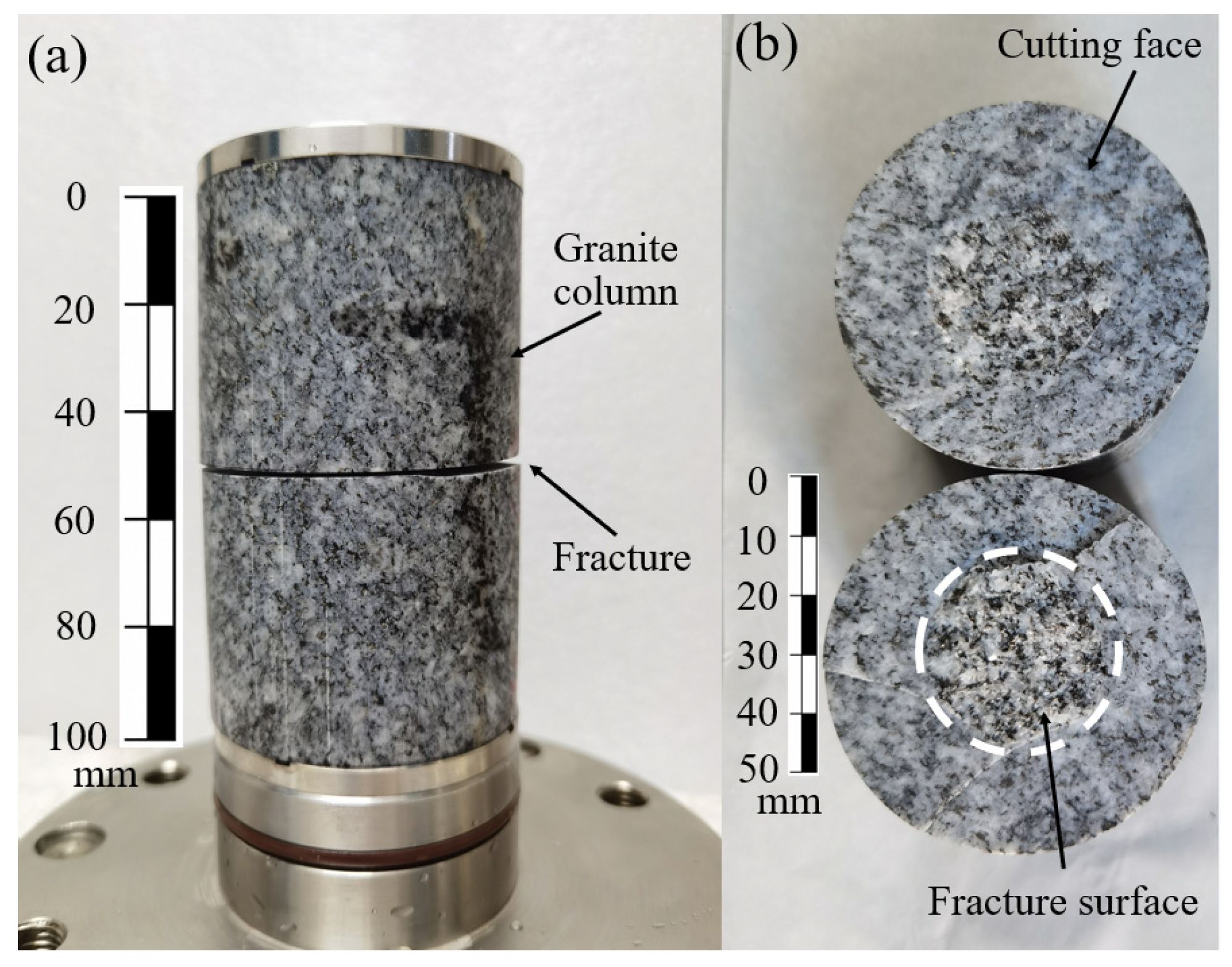
2. Sample Collection and Preparation
3. Test Methodology
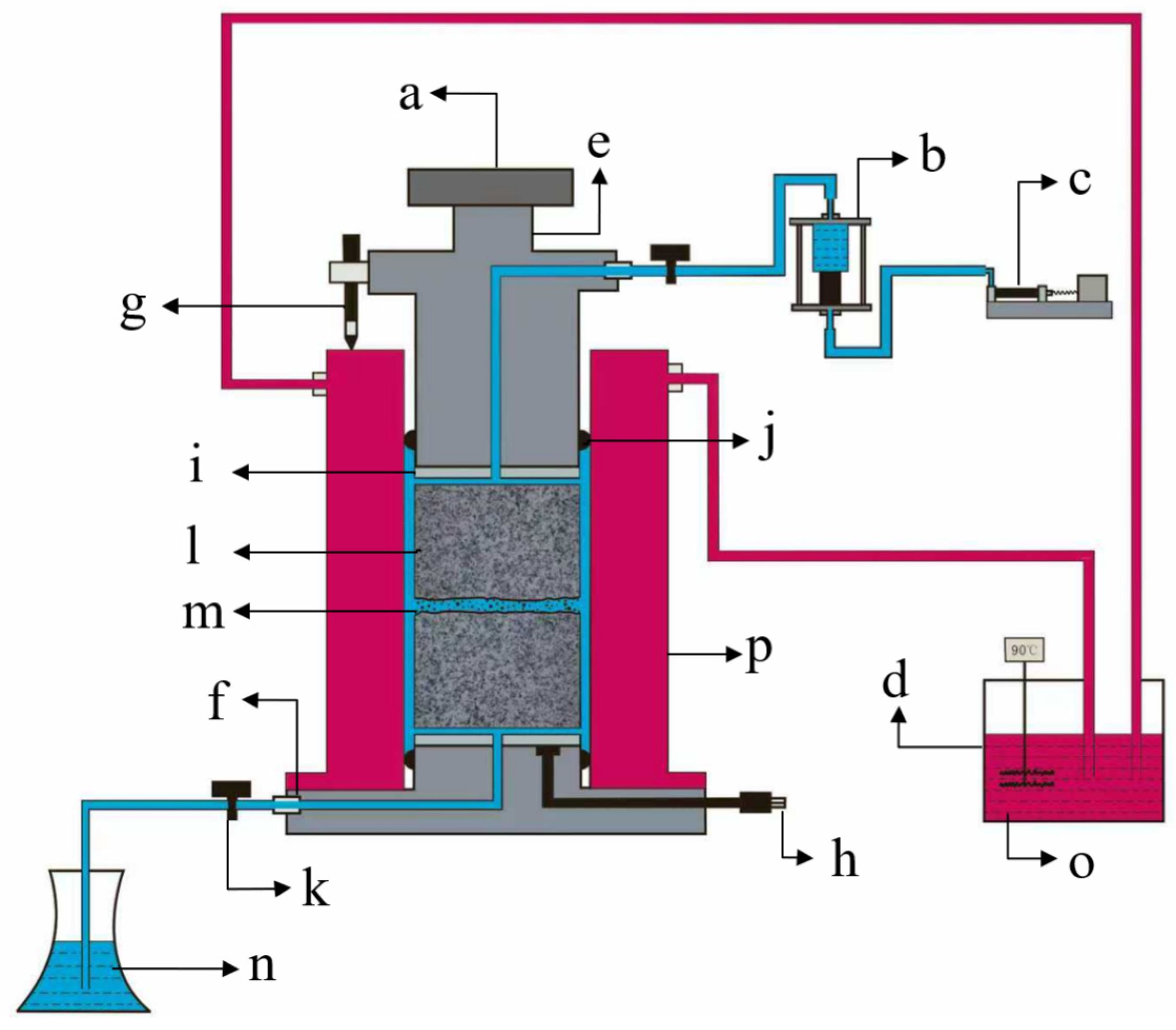
3.1. Test Facility
3.2. Test Procedure
3.3. Data Analysis
4. Test Results
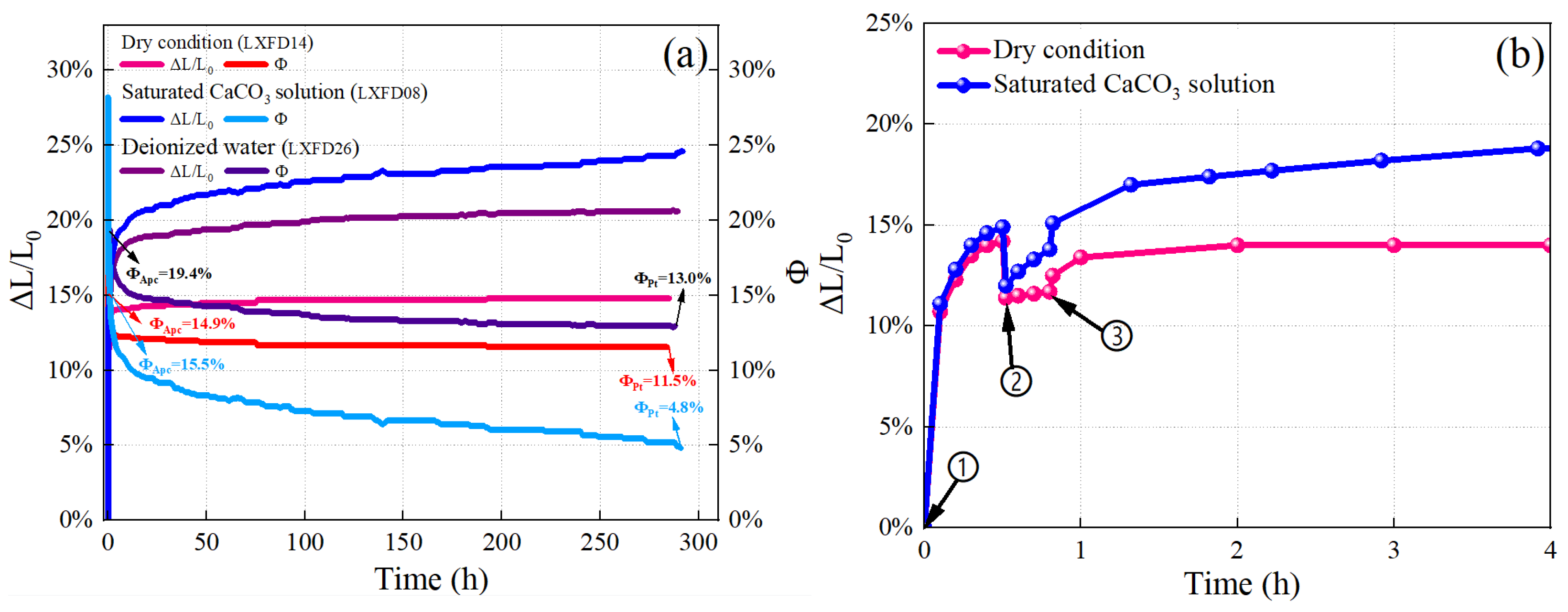
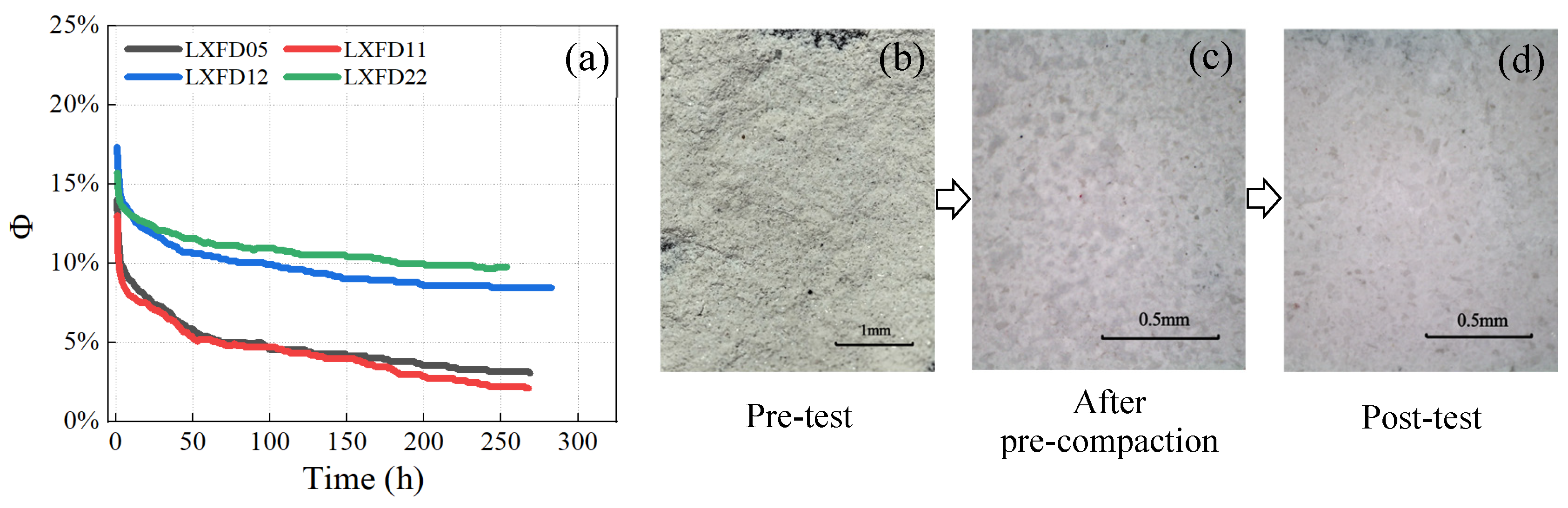
4.1. Compaction Behavior and Multi-Stage Evolution
4.1.1. Pre-Compaction Stage (0–0.5 h)
4.1.2. Early Stage of Solution Involvement (0.5 h to Several Tens of Hours)
4.1.3. Equilibrium-Approaching Stage (After Several Tens of Hours)
4.2. Role of Pore Fluid
4.3. Grain-Size Effect
4.4. Effects of Mineral Composition
5. Discussion
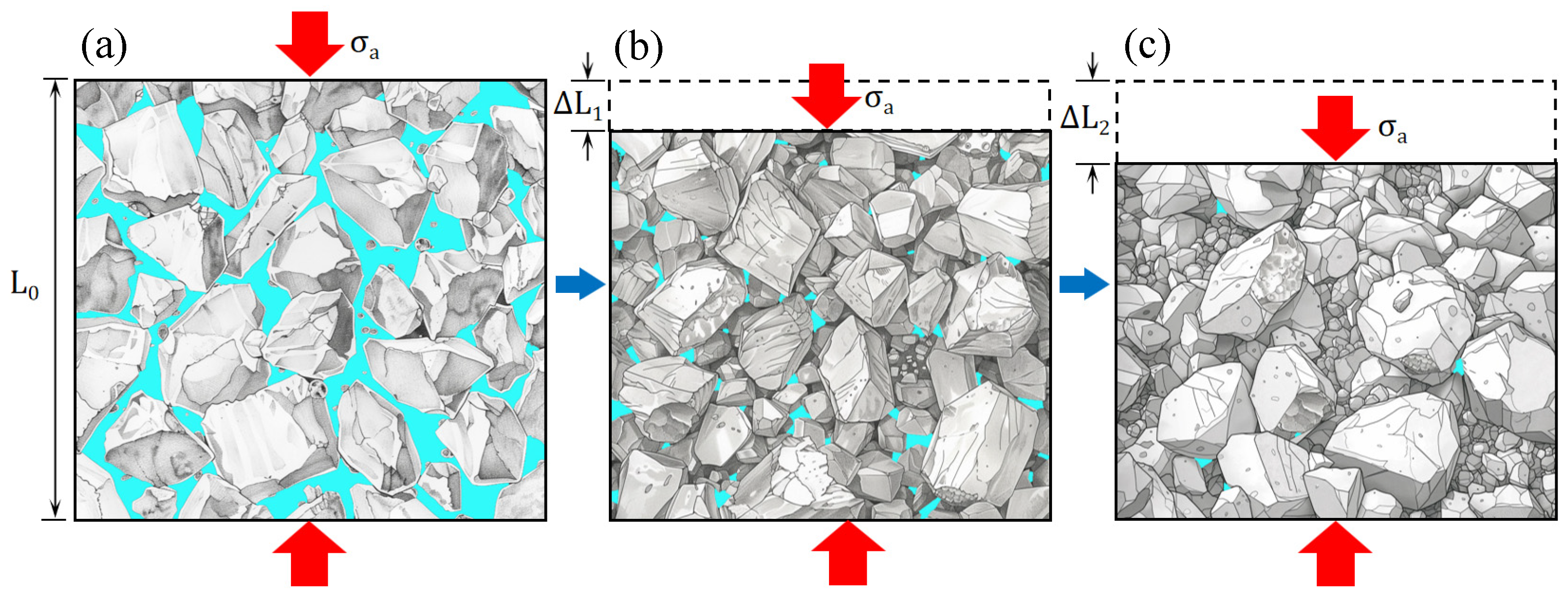
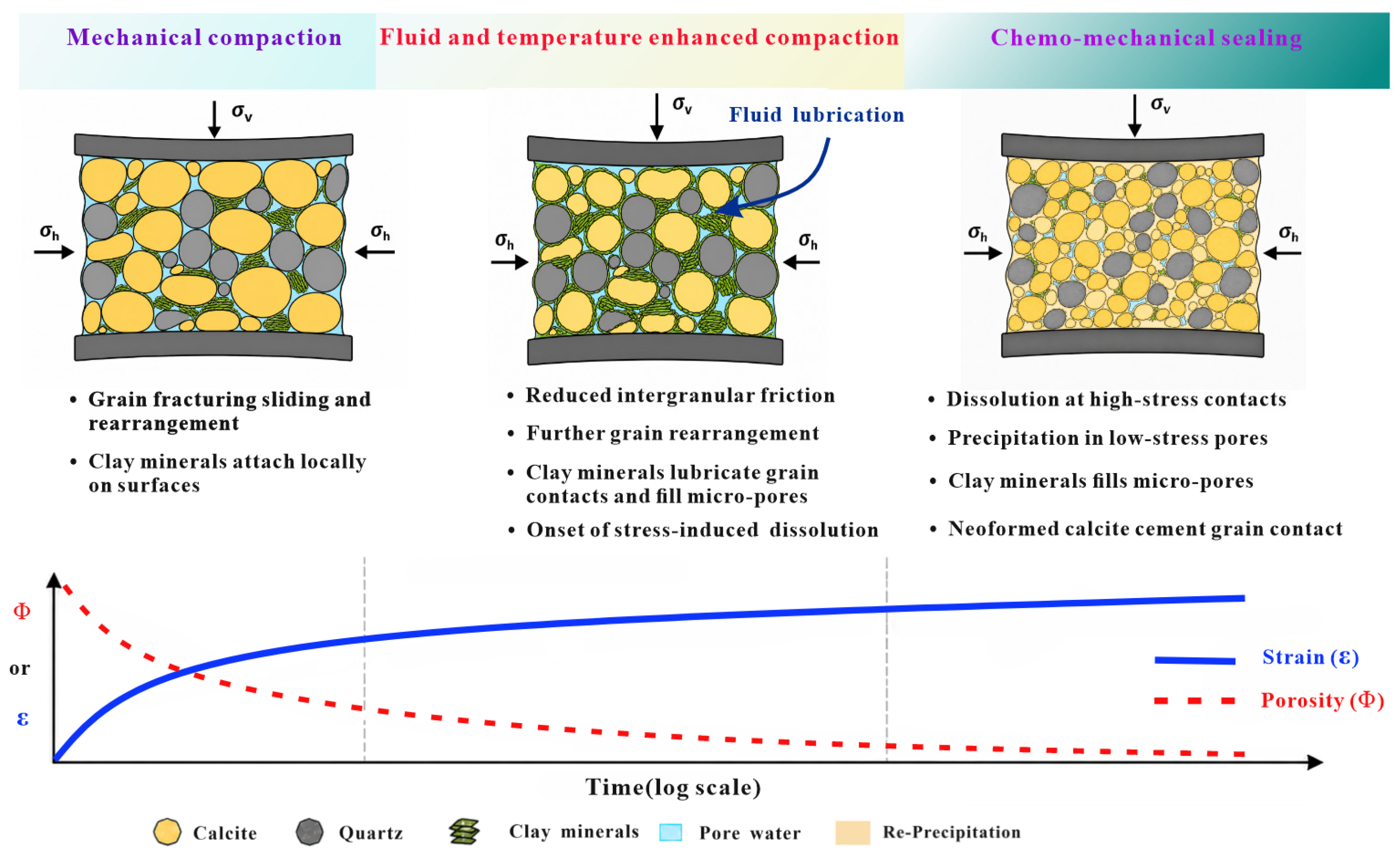
5.1. A Multi-Stage Process: From Mechanical Compaction to Chemo-Mechanical Sealing
5.2. Contrasting Mechanical and Chemical Behaviors of Mineral Phases in Mixed Assemblages
5.3. Implications for Long-Term Fracture Sealing in HLW Repositories
6. Conclusions
Author Contributions
Funding
Data Availability Statement
Acknowledgments
Conflicts of Interest
Abbreviations
| HLW | High-level Radioactive Waste |
| THMC | Thermal–Hydraulic–Mechanical–Chemical |
| URL | Underground Research Laboratory |
| DGR | Deep Geological Repository |
References
- Wang, J. Key scientific challenges in geological disposal of high level radioactive waste. In Proceedings of the 2nd Academic Seminar on Waste Underground Disposal, Dunhuang, China, 24–27 September 2008. [Google Scholar]
- Wang, J.; Chen, L.; Su, R.; Zhao, X. The Beishan underground research laboratory for geological disposal of high-level radioactive waste in China: Planning, site selection, site characterization and in situ tests. J. Rock. Mech. Geotech. Eng. 2018, 10, 411–435. [Google Scholar] [CrossRef]
- Ojovan, M.I.; Steinmetz, H.J. Approaches to disposal of nuclear waste. Energies 2022, 15, 7804. [Google Scholar] [CrossRef]
- Yan, B.-Q.; Ren, F.-H.; Cai, M.-F.; Guo, Q.-F.; Qiao, C. A review of the research on physical and mechanical properties and constitutive model of rock under THMC multi-field coupling. Chin. J. Eng. 2020, 42, 1389–1399. [Google Scholar]
- Wang, J.; Ahmed, B.; Huang, J.; Nong, X.; Xiao, R.; Abbasi, N.S.; Alidekyi, S.N.; Li, H. Physical and mechanical properties and constitutive model of rock mass under THMC coupling: A comprehensive review. Appl. Sci. 2025, 15, 2230. [Google Scholar] [CrossRef]
- Wang, B.; Liu, Z.; Chen, L.; Ma, H.; Lu, B.; Jian, S.; Du, X. Analysis and layout parameter optimization study for high-level radioactive waste disposal units in granite host rock. Tunn. Undergr. Space Technol. 2026, 171, 107474. [Google Scholar] [CrossRef]
- Wang, Q.; Lei, K.; Zhu, Z.; Zhang, A. A review of multiphysics coupling numerical modeling techniques for risk assessment in geological disposal of high-level radioactive waste. J. Environ. Radioact. 2026, 293, 107902. [Google Scholar] [CrossRef]
- Li, N.; Duan, X.; Wang, J.; Cheemaa, N.; Nazish, H.T.; Peng, G. Bentonite and its modified derivatives: Application and factors influencing radioactive nuclide adsorption. Prog. Nucl. Energy 2026, 191, 106104. [Google Scholar] [CrossRef]
- Wang, J.-W.; Wang, J.; Tian, X.; Zhou, Z.; Zhang, J.; Li, N.; Wang, B.; Duan, X. Enhancing barriers for high-level radioactive waste: The role of microbially induced calcium carbonate precipitation in ecological sustainability. Renew. Sustain. Energy Rev. 2026, 229, 116666. [Google Scholar] [CrossRef]
- Chang, C.; Nakagawa, S.; Dong, W.; Zheng, L. Coupled Thermo-Hydrological-Mechanical-Chemical Behavior of Anisotropic Granite for Geologic Disposal of High-Level Radioactive Waste: A Core-Scale Laboratory Investigation. Rock. Mech. Rock. Eng. 2025, 58, 12969–12983. [Google Scholar] [CrossRef]
- Li, N.; Duan, X.; Cheemaa, N.; Nazish, H.T.; Peng, G. Stability and transformation of neptunium (Np) species under geological disposal conditions of high-level radioactive waste (HLW). J. Contam. Hydrol. 2025, 276, 104739. [Google Scholar] [CrossRef]
- Tian, X.; Wang, J.; Wang, J.-W. Review on the study of fracture closure behavior in host rock for high-level radioactive waste disposal. World Nucl. Geosci. 2024, 41, 1226–1234. [Google Scholar]
- Wang, J. On area-specific underground research laboratory for geological disposal of high-level radioactive waste in China. J. Rock. Mech. Geotech. Eng. 2014, 6, 99–104. [Google Scholar] [CrossRef]
- Tian, X.; Wang, J.; Jin, Y.; Li, J. The Isotopic Geochemistry of Filling Calcite in Jiujiang and Xinchang Granite in the Beishan Site for High-Level Radioactive Waste Disposal. Uranium Geol. 2014, 30, 23–29. [Google Scholar]
- Wang, J.-W.; Wang, J.; Tian, X.; Duan, X.; Cheemaa, N.; Nazish, H.T. Key geological, mineralogical, and geochemical evidence for the sealing properties of the F34-1 fracture zone in the Xinchang, Beishan and its implications for high-level radioactive waste disposal. China Geol. 2026, 1–29. [Google Scholar] [CrossRef]
- Zeng, W.; Wu, Y.; Hu, L.; Li, X.; Huang, Z.; Zhao, P.; Lin, J.; Yu, J. Micro-mechanisms of temperature-dependent triaxial strength in Beishan granite and implications for high-level radioactive waste disposal. Sci. Rep. 2025, 15, 38092. [Google Scholar] [CrossRef]
- Weyl, P.K. Pressure solution and the force of crystallization: A phenomenological theory. J. Geophys. Res. 1959, 64, 2001–2025. [Google Scholar] [CrossRef]
- Tada, R.; Maliva, R.; Siever, R. A new mechanism for pressure solution in porous quartzose sandstone. Geochim. Cosmochim. Acta 1987, 51, 2295–2301. [Google Scholar] [CrossRef]
- Llana-Fúnez, S.; Wheeler, J.; Faulkner, D.R. Metamorphic reaction rate controlled by fluid pressure not confining pressure: Implications of dehydration experiments with gypsum. Contrib. Mineral. Petrol. 2012, 164, 69–79. [Google Scholar] [CrossRef]
- Putnis, A. Fluid–mineral interactions: Controlling coupled mechanisms of reaction, mass transfer and deformation. J. Petrol. 2021, 62, egab092. [Google Scholar] [CrossRef]
- Ruiz-Agudo, E.; Putnis, C.; Putnis, A. Coupled dissolution and precipitation at mineral–fluid interfaces. Chem. Geol. 2014, 383, 132–146. [Google Scholar] [CrossRef]
- Rutter, E.; Elliott, D. The Kinetics of Rock Deformation by Pressure Solution (and Discussion). Philos. T. Roy. Soc. A 1976, 283, 203–219. [Google Scholar]
- Gratier, J.-P.; Dysthe, D.K.; Renard, F. The role of pressure solution creep in the ductility of the Earth’s upper crust. Adv. Geophys. 2013, 54, 47–179. [Google Scholar]
- Zhang, X.; Salemans, J.; Peach, C.; Spiers, C. Compaction experiments on wet calcite powder at room temperature: Evidence for operation of intergranular pressure solution. In Geological Society; Special Publications: London, UK, 2002. [Google Scholar]
- Zhang, X.; Spiers, C.J.; Peach, C.J. Compaction creep of wet granular calcite by pressure solution at 28 °C to 150 °C. J. Geophys. Res. Solid Earth 2010, 115, B09217. [Google Scholar] [CrossRef]
- Zhang, X.; Spiers, C. Compaction of granular calcite by pressure solution at room temperature and effects of pore fluid chemistry. Int. J. Rock. Mech. Min. Sci. 2005, 42, 950–960. [Google Scholar] [CrossRef]
- Renard, F.; Røyne, A.; Putnis, C.V. Timescales of interface-coupled dissolution-precipitation reactions on carbonates. Geosci. Front. 2019, 10, 17–27. [Google Scholar] [CrossRef]
- Ellis, A. The solubility of calcite in sodium chloride solutions at high temperatures. Am. J. Sci. 1963, 261, 259–267. [Google Scholar] [CrossRef]
- Hilgers, C.; Tenthorey, E. Fracture sealing of quartzite under a temperature gradient: Experimental results. Terra Nova 2004, 16, 173–178. [Google Scholar] [CrossRef]
- Zhang, X.; Spiers, C.; Peach, C. Effects of pore fluid flow and chemistry on compaction creep of calcite by pressure solution at 150 C. Geofluids 2011, 11, 108–122. [Google Scholar] [CrossRef]
- Rimstidt, J.D.; Newcomb, W.D.; Shettel, D.L. A vertical thermal gradient experiment to simulate conditions in vapor dominated geothermal systems, epithermal gold deposits, and high level radioactive repositories in unsaturated media. In Water-Rock Interaction (WRI-6); CRC Press: Boca Raton, FL, USA, 2026; pp. 585–588. [Google Scholar]
- Dobson, P.F.; Kneafsey, T.J.; Sonnenthal, E.L.; Spycher, N.; Apps, J.A. Experimental and numerical simulation of dissolution and precipitation: Implications for fracture sealing at Yucca Mountain, Nevada. J. Contam. Hydrol. 2003, 62, 459–476. [Google Scholar] [CrossRef]
- Zhang, C.-L. Sealing of fractures in claystone. J. Rock. Mech. Geotech. Eng. 2013, 5, 214–220. [Google Scholar] [CrossRef]
- Niemeijer, A. Velocity-dependent slip weakening by the combined operation of pressure solution and foliation development. Sci. Rep. 2018, 8, 4724. [Google Scholar] [CrossRef] [PubMed]
- Hu, M.; Steefel, C.I.; Rutqvist, J.; Gilbert, B. Microscale THMC modeling of pressure solution in salt rock: Impacts of geometry and temperature. Rock. Mech. Rock. Eng. 2023, 56, 7071–7089. [Google Scholar] [CrossRef]
- Wheeler, J. A unifying basis for the interplay of stress and chemical processes in the Earth: Support from diverse experiments. Contrib. Mineral. Petrol. 2020, 175, 116. [Google Scholar] [CrossRef]
- Madsen, F. Clay mineralogical investigations related to nuclear waste disposal. Clay Miner. 1998, 33, 109–129. [Google Scholar] [CrossRef]
- Lee, J.; Kim, K.; Kim, I.; Ju, H.; Jeong, J.; Lee, C.; Kim, J.-W.; Cho, D. High-efficiency deep geological repository system for spent nuclear fuel in Korea with optimized decay heat in a disposal canister and increased thermal limit of bentonite. Nucl. Eng. Technol. 2023, 55, 1540–1554. [Google Scholar] [CrossRef]
- Zhao, X.; Cai, M.; Wang, J.; Ma, L. Damage stress and acoustic emission characteristics of the Beishan granite. Int. J. Rock. Mech. Min. Sci. 2013, 64, 258–269. [Google Scholar] [CrossRef]
- Tulley, C.; ten Thij, L.; Niemeijer, A.; Hamers, M.; Fagereng, Å. Activation of dissolution-precipitation creep causes weakening and viscous behavior in experimentally deformed antigorite. J. Geophys. Res. Solid Earth 2024, 129, e2024JB029053. [Google Scholar] [CrossRef]
- Shi, X.; Misch, D.; Vranjes-Wessely, S. A comprehensive assessment of image processing variability in pore structural investigations: Conventional thresholding vs. machine learning approaches. Gas. Sci. Eng. 2023, 115, 205022. [Google Scholar] [CrossRef]
- Bai, J.; Li, W.; Li, C.-Z.; Bai, Z.; Li, B. Influences of minerals transformation on the reactivity of high temperature char gasification. Fuel Process. Technol. 2010, 91, 404–409. [Google Scholar] [CrossRef]
- Schepers, A.; Milsch, H. Dissolution–precipitation reactions in hydrothermal experiments with quartz–feldspar aggregates. Contrib. Mineral. Petrol. 2013, 165, 83–101. [Google Scholar] [CrossRef]
- Sellin, P.; Leupin, O.X. The use of clay as an engineered barrier in radioactive-waste management a review. Clays Clay Miner. 2013, 61, 477–498. [Google Scholar] [CrossRef]
- Wang, W.; Tian, Y. Study on Self-Healing and Sealing Technology of Fractured Geothermal Reservoir. Processes 2025, 13, 3817. [Google Scholar] [CrossRef]
- Lin, C.; Taleghani, A.D.; Kang, Y.; Xu, C. A coupled CFD-DEM simulation of fracture sealing: Effect of lost circulation material, drilling fluid and fracture conditions. Fuel 2022, 322, 124212. [Google Scholar] [CrossRef]
- Mo, C.; Zhao, J.; Zhang, D. Real-time measurement of mechanical behavior of granite during heating–cooling cycle: A mineralogical perspective. Rock. Mech. Rock. Eng. 2022, 55, 4403–4422. [Google Scholar] [CrossRef]
- Luo, C.; Yang, X.; Li, J. Mechanical properties of single-crystal calcite and their temperature and strain-rate effects. Materials 2022, 15, 4613. [Google Scholar] [CrossRef] [PubMed]
- Zhou, X.; Chen, Q.; Tang, X.; He, R.; Yan, Z.; Xiong, J.; Zhou, Y.; Li, L. Effects of temperature, pressure, and hydration on the microstructural characteristics and mechanical properties of calcite. Front. Chem. 2025, 13, 1568585. [Google Scholar] [CrossRef]
- Croizé, D.; Renard, F.; Bjørlykke, K.; Dysthe, D.K. Experimental calcite dissolution under stress: Evolution of grain contact microstructure during pressure solution creep. J. Geophys. Res. Solid Earth 2010, 115, B09207. [Google Scholar] [CrossRef]
- Zhan, L.; Wang, Q.; Ku, J.; Shang, H.; Shen, Z. Purification technologies for high-purity quartz: From mineralogy to applications. Sep. Purif. Rev. 2026, 55, 209–226. [Google Scholar] [CrossRef]
- Choi, J.-H.; Seo, Y.-S.; Chae, B.-G. A study of the pressure solution and deformation of quartz crystals at high pH and under high stress. Nucl. Eng. Technol. 2013, 45, 53–60. [Google Scholar] [CrossRef]
- Wang, Q.J.; Zhu, D. Hertz theory: Contact of spherical surfaces. In Encyclopedia of Tribology; Springer: New York, NY, USA, 2013; pp. 1654–1662. [Google Scholar]
- El-Zein, A.; Airey, D.; Yu, B.; Esgandani, G.A.; Proust, G.; Dias-da-Costa, D.; Gao, Y.; Gan, Y.; Chen, S. Self-repair of cracks and defects in clay: A review of evidence, mechanisms, theories and nomepnclature. Acta Geotech. 2021, 16, 3741–3760. [Google Scholar] [CrossRef]
- Wagner, J.-F. Mechanical properties of clays and clay minerals. In Developments in Clay Science; Elsevier: Amsterdam, The Netherlands, 2013; Volume 5, pp. 347–381. [Google Scholar]
- Samper, J.; Mon, A.; Montenegro, L. Reactive transport model of the long-term geochemical evolution in a HLW repository in granite at the disposal cell scale: Variants, sensitivities, and model simplifications. Apppl. Geochem. 2024, 175, 106188. [Google Scholar] [CrossRef]
- Zheng, L.; Rutqvist, J.; Xu, H.; Birkholzer, J.T. Coupled THMC models for bentonite in an argillite repository for nuclear waste: Illitization and its effect on swelling stress under high temperature. Eng. Geol. 2017, 230, 118–129. [Google Scholar] [CrossRef]
- Ogata, S.; Yasuhara, H.; Kinoshita, N.; Kishida, K. Coupled thermal–hydraulic–mechanical–chemical modeling for permeability evolution of rocks through fracture generation and subsequent sealing. Comput. Geosci. 2020, 24, 1845–1864. [Google Scholar] [CrossRef]



| Test No. | Duration (h) | Axial Pressure (kN) | Fracture Surface Area (mm2) | Pore Solution | Initially Added Fracture-Filling Minerals | Compaction Strain (ΔL/L0) | Porosity (Φ) | ||||||
|---|---|---|---|---|---|---|---|---|---|---|---|---|---|
| Thickness (mm) | Mass (g) | Mineral Components: Average Grain Size, Mass Ratio | Apc | Pt | ΔS | Apc | Pt | ΔΦ | |||||
| LXFD08 | 294.6 | 13.2 | 660.2 | CaCO3 | 0.7 | 0.90 | CAL: 75 μm, 100% | 15.1% | 24.6% | +9.5% | 15.5% | 4.8% | −10.7% |
| LXFD05 | 270.6 | 14.3 | 716.0 | CaCO3 | 0.7 | 0.98 | CAL: 75 μm, 80% QTZ: 75 μm, 10% CLAY: 10% | 13.5% | 23.3% | +9.8% | 14.0% | 3.0% | −11.0% |
| LXFD09 | 286.3 | 11.4 | 572.3 | CaCO3 | 0.5 | 0.49 | CAL: 150 μm, 100% | 21.5% | 31.9% | +10.4% | 19.6% | 7.3% | −12.3% |
| LXFD11 | 269.4 | 13.2 | 660.2 | CaCO3 | 0.7 | 0.93 | CAL: 75 μm, 80% CLAY: 20% | 13.1% | 22.8% | +9.7% | 13.0% | 2.1% | −10.9% |
| LXFD12 | 284.3 | 13.2 | 660.2 | CaCO3 | 0.3 | 0.89 | CAL: 75 μm, 78% QTZ: 75 μm, 22% | 12.5% | 21.0% | +8.5% | 17.4% | 8.5% | −8.9% |
| LXFD15 | 277.7 | 16.6 | 829.2 | CaCO3 | 0.3 | 0.48 | CAL: 75 μm, 49% QTZ: 75 μm, 51% | 10.1% | 15.5% | +5.4% | 19.9% | 14.8% | −5.1% |
| LXFD21 | 264.0 | 18.2 | 907.5 | CaCO3 | 0.7 | 1.02 | CAL: 250 μm, 100% | 23.8% | 34.1% | +10.3% | 22.3% | 10.2% | −12.1% |
| LXFD22 | 255.8 | 17.6 | 881.0 | CaCO3 | 0.8 | 1.04 | CAL: 75 μm, 60% QTZ: 75 μm, 20% CLAY: 20% | 10.6% | 16.5% | +5.9% | 15.7% | 9.8% | −5.9% |
| LXFD23 | 268.9 | 14.4 | 720.7 | CaCO3 | 0.4 | 0.92 | CAL: 250 μm, 50% CAL: 75 μm, 50% | 16.9% | 29.1% | +12.2% | 20.0% | 6.2% | −13.8% |
| LXFD24 | 269.2 | 13.2 | 660.2 | CaCO3 | 0.8 | 1.03 | CAL: 75 μm, 20% QTZ: 75 μm, 80% | 7.2% | 10.4% | +3.2% | 22.1% | 19.4% | −2.7% |
| LXFD26 | 289.4 | 12.9 | 646.6 | D-water | 0.8 | 0.97 | CAL: 75 μm, 100% | 14.3% | 20.6% | +6.3% | 19.4% | 13.0% | −6.4% |
| LXFD14 | 285.0 | 9.9 | 660.2 | / | 0.4 | 0.90 | CAL: 75 μm, 100% | 11.4% | 14.8% | +3.4% | 14.9% | 11.5% | −3.4% |
Disclaimer/Publisher’s Note: The statements, opinions and data contained in all publications are solely those of the individual author(s) and contributor(s) and not of MDPI and/or the editor(s). MDPI and/or the editor(s) disclaim responsibility for any injury to people or property resulting from any ideas, methods, instructions or products referred to in the content. |
© 2026 by the authors. Licensee MDPI, Basel, Switzerland. This article is an open access article distributed under the terms and conditions of the Creative Commons Attribution (CC BY) license.
Share and Cite
Tian, X.; Wang, J.; Wang, J.-W.; Xie, J.-L.; Zhou, Z.-C.; Li, K. Compaction and Pressure Solution of Mixed Mineral Assemblages: Implications for Granite Fracture Sealing in the Near-Field of High-Level Radioactive Waste Repository. Minerals 2026, 16, 603. https://doi.org/10.3390/min16060603
Tian X, Wang J, Wang J-W, Xie J-L, Zhou Z-C, Li K. Compaction and Pressure Solution of Mixed Mineral Assemblages: Implications for Granite Fracture Sealing in the Near-Field of High-Level Radioactive Waste Repository. Minerals. 2026; 16(6):603. https://doi.org/10.3390/min16060603
Chicago/Turabian StyleTian, Xiao, Ju Wang, Jia-Wei Wang, Jing-Li Xie, Zhi-Chao Zhou, and Ke Li. 2026. "Compaction and Pressure Solution of Mixed Mineral Assemblages: Implications for Granite Fracture Sealing in the Near-Field of High-Level Radioactive Waste Repository" Minerals 16, no. 6: 603. https://doi.org/10.3390/min16060603
APA StyleTian, X., Wang, J., Wang, J.-W., Xie, J.-L., Zhou, Z.-C., & Li, K. (2026). Compaction and Pressure Solution of Mixed Mineral Assemblages: Implications for Granite Fracture Sealing in the Near-Field of High-Level Radioactive Waste Repository. Minerals, 16(6), 603. https://doi.org/10.3390/min16060603