


Abstract
In most cases, columbite-supergroup minerals are characterized by partial ordering of cations, which makes their identification based only on chemical composition and powder diffraction data difficult. Columbite-supergroup minerals with partially ordered cations were studied by means of electron microprobe analyses, powder and single-crystal X-ray diffraction, including crystal structure refinement in ixiolite-type and wolframine-type models. The samples originate from the Sakhanaiskiy granite massif, Eastern Siberia, Russia, (Sample 1) and from the Heftetjern pegmatite, Telemark, Norway (Sample 2). Their representative empirical formulae are (Fe2+0.81Mn2+0.53)Σ1.34Fe3+0.07(Ti0.23Zr0.11Sn0.02)Σ0.36(Nb1.45Ta0.26)Σ1.71W0.52O8 (Sample 1) and (Mn2+0.28Fe2+0.25)Σ0.53Sc1.08(Sn0.32Ti0.04)Σ0.36(Ta1.41Nb0.52)Σ1.93W0.10O8 (Sample 2). Based on these data and the results of the crystal structure refinement, the studied samples can be considered as columbite-supergroup minerals in which cations are partially ordered in accordance with the wolframite mechanism. An approach is suggested according to which the degree of cation ordering in such columbite-supergroup minerals can be estimated based on the electron contents refined for different sites in a monoclinic model. According to this criterion, the degree of cation ordering of Samples 1 and 2 is 91% and 26%, respectively. Despite a significant degree of cation disordering, transition from the wolframite to ixiolite model results in a significant enhancement of the R-factor of the structure refinement (from 0.0365 to 0.0764 and from 0.0207 to 0.0610, respectively).
1. Introduction
The columbite supergroup whose nomenclature was approved recently [1] includes oxides with MO2 stoichiometry (M = Ti4+, Sn4+, Ge4+, Si, Mn4+, Pb4+, Te4+, Nb, Ta, Sb5+, Mo6+, W6+), octahedral coordination of M cations (except members of the samarskite group containing a relatively large cation with 6 + 2-fold coordination) and columbite-type topology. In the crystal structures of these minerals, layers of parallel zigzag chains of edge-sharing octahedra are combined via common vertices of octahedra. In columbite-supergroup members belonging to the ixiolite group, all cations are disordered and occur at a single site. These minerals are orthorhombic and belong to space group Pbcn, with the unit-cell parameters a = 4.1–5.0, b = 5.5–5.8, c = 4.5–5.4 Å and basic unit-cell vectors a0, b0 and c0.
Other mineral groups belonging to the columbite supergroup are characterized by different schemes of cation ordering, different symmetry (monoclinic or orthorhombic) and different unit-cell dimensions. These are the following: wolframite group (P2/c, a = a0, b = b0, c = c0); samarskite group (P2/c, a = 2a0, b = b0, c = c0); columbite group (Pbcn, a = 3a0, b = b0, c = c0); and wodginite group (C2/c, a = 2a0, b = 2b0, c = c0), as well as two ungrouped species, lithiotantite, LiTa3O8 (P21/c, a = 7.444, b = 5.044, c = 15.255 Å, β = 107.18°) and dmitryvarlamovite, Ti2(Fe3+Nb)O8 (P21212, a = 4.9825, b = 4.6268, c = 5.5952 Å) [1,2].
In other words, ixiolite AO2 structure has one cation site. Wolframite ABO4 and columbite AB2O6 structures have two cation sites and are characterized by different mechanisms of cation ordering, and so on.
As a rule, cation ordering in these minerals is not complete. For example, columbite from the Kings Mountain district, North Carolina, shows chemical zoning with respect to Nb and Ta, and partial disordering of divalent and pentavalent cations, which are stronger in primary columbite than in columbite from the hydrothermally altered part of the pegmatite [3].
Annealing of ixiolite results in a partial or complete cation ordering. In a number of experiments, the transformation of ixiolite into cation-ordered phases of the wodginite or columbite type was observed [4,5].
According to [5,6], completely disordered ixiolite usually contains more tri- and tetravalent cations than partially ordered columbite-supergroup minerals (so-called “pseudoixiolite”). However, in some cases, the conclusion about the complete disorder of the ixiolite-group minerals may be a consequence of the insufficient accuracy of the X-ray structural analysis due to the low intensity of superstructure reflections and/or reflections lowering symmetry to a monoclinic one.
Partially ordered ixiolite is rather common. As is indicated in [7] with a reference to unpublished data by M.A. Wise and coworkers, a refinement of the structure of scandian ixiolite from the Heftetjern locality, Norway, shows a slight monoclinic (wolframite-type) distortion.
As a criterion of the degree of cation ordering in columbite-group minerals, the value Qh = 1 – (h/0.166) was used [8,9]. In this formula, h = [(au − ah)2 + [(bu − bh)2 + [(cu − ch)2]1/2 , au, bu and cu are unit-cell parameters of an unheated sample, and ah, bh and ch are those of a sample heated at a temperature at which complete transformation to the ixiolite-type structure takes place.
Among the nine samples of columbite-(Fe2+) and columbite-(Mn2+)—with low contents of Ti and Sn and different degrees of cation ordering from several world-wide pegmatitic occurrences—studied in [8], a sample from Ramskjær Mine, Søndeled, Norway, with the highest content of Ti, has an order parameter Qh—derived based on the comparison of the initial and heated samples [9]—equal to 0.15. This sample can be considered as partially ordered ixiolite. The two samples with Qh ≈ 0.5 can be interpreted as “pseudoixiolite”, and for the other samples, Qh values are in the limits from 0.76 to 0.98.
Among minerals belonging to the columbite group, the more disordered samples are those with the higher c/a values [9,10]. The order parameter Q based on this criterion can be calculated from the unit-cell parameters a and c (Å) using the formula Q (%) = 1727 − 941.6(c − 0.2329a). For minerals belonging to the ixiolite and wolframite groups, a triple value of the a parameter should be used:
Q (%) = 1727 − 941.6(c − 0.2329 × 3a)
In particular, for the holotype sample of the wolframite-group mineral heftetjernite, ideally ScTaO4 (space group P2/c; a = 4.784, b = 5.693, c = 5.120 Å, β = 91.15°) [11], the Q value calculated using this formula is 53%, which actually corresponds to “pseudoixiolite-(Sc)”. In the new mineral species ixiolite-(Sc) (space group Pbcn, a = 4.7673, b = 5.7113, c = 5.1564 Å) [12], dimorphous with heftetjernite, cations are almost completely disordered (Q ≈ 5%). In another new ixiolite-group mineral, nioboixiolite-(Fe2+) (ideally, Nb0.67Fe2+0.33O2, space group Pbcn, a = 4.7368, b = 5.7155, c = 5.0831 Å) [13], Q = 57%, which corresponds to “pseudoixiolite-(Fe2+)” and is closer to the Q value of a monoclinic columbite-supergroup mineral than that of a member of the ixiolite group.
In this work, the chemical composition, crystal structures, and some physical properties of minerals, which can be considered as partially ordered varieties of ixiolite-(Sc) and a potentially new Fe2+- and Nb-dominant wolframite-group mineral, are studied. (Re-)classification of these two specimens was not a goal of this work. The main goal was to show that partial cation ordering in columbite-supergroup minerals can occur not only in accordance with the columbite mechanism (which is a common case described in several literature sources), but also after the wolframite mechanism. Another purpose is to suggest a criterion for the estimation of the degree of cation ordering based on structural data instead of the empirical criteria (Q and Qh) used in the publications cited above.
2. Studied Samples
Sample 1, studied in this work, was extracted from the specimens collected in 1966 by Dr. Valeria A. Kornetova, who worked in the Fersman Mineralogical Museum of the USSR Academy of Sciences. Both specimens originate from a granitic pegmatite related to the Sakhanaiskiy granite massif, Duldurginskiy region, Zabaykalskiy Krai, Eastern Siberia, Russia, situated 12 km to the northeast of the township of Duldurga, between 50°23’ and 50°31’ N, and between 113°35’ and 113°48’ E.
The Sakhanaiskiy massif belongs to the Kukulbey complex of Jurassic age and includes a group of chamber and miarolitic granite pegmatites. It is composed of rocks of the main intrusive phase (medium- and coarse-grained biotite granite and fine- and medium-grained mica granite) and dyke phase (aplites, muscovite granites, granitic pegmatites, quartz porphyries, quartz and quartz-fluorite veins). Medium- and coarse-grained granites are most common and are composed of potassic feldspar, plagioclase (albite–oligoclase), quartz and biotite. The fine- and medium-grained mica granites are much rarer. Pegmatites are localized directly in the granites and belong to the chamber schlieren type. They have a distinct zonation from the contact with host parent granites to the center: aplite or fine-grained granites, and apographic, graphic and blocky zones with a quartz core in the center. The main mineral of the pegmatites that is promising for mining is beryl [14,15].
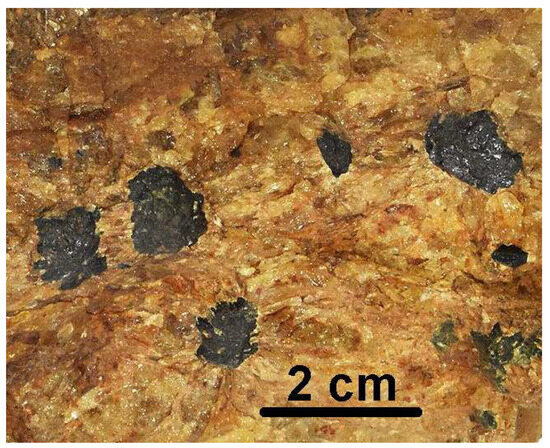
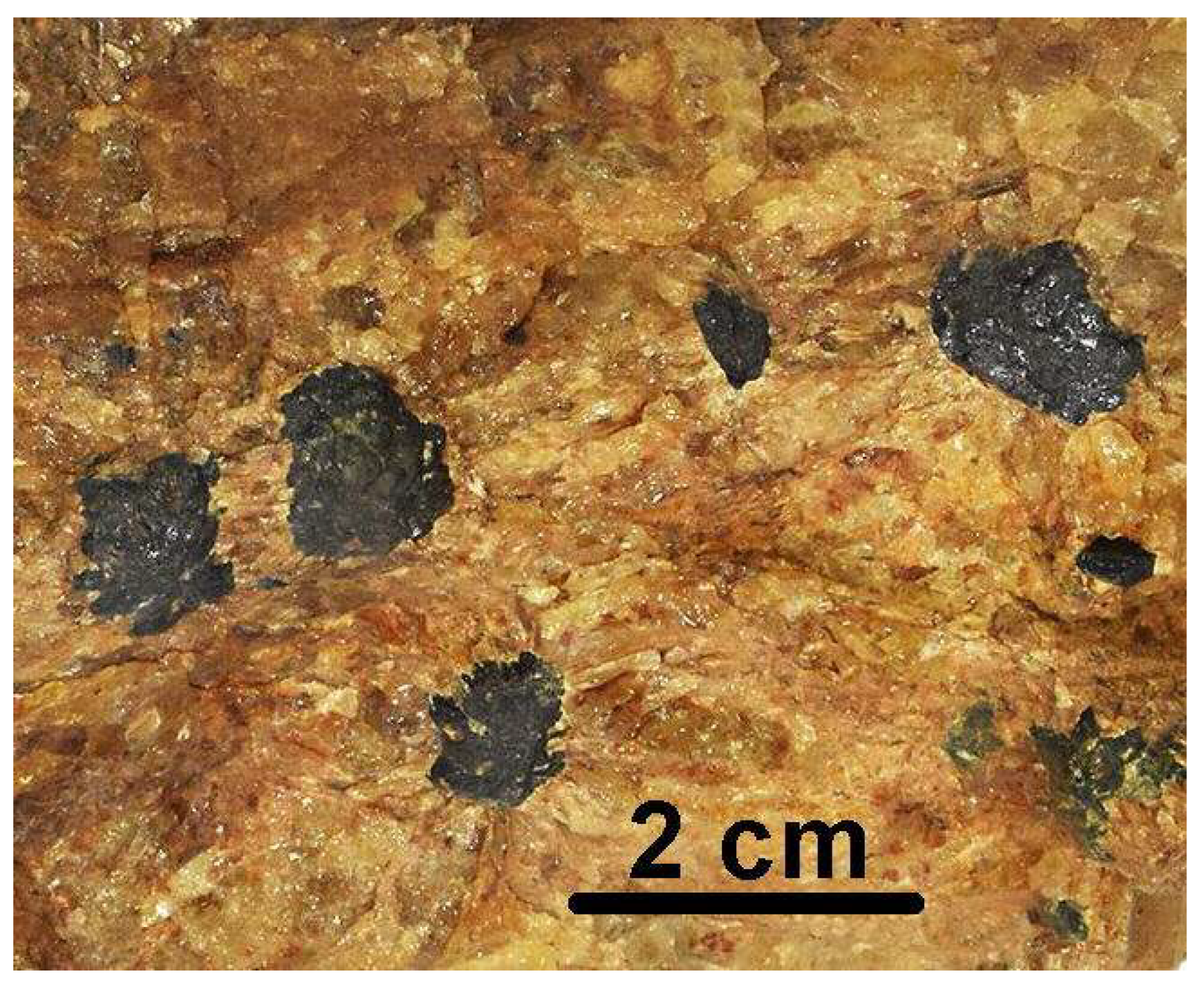
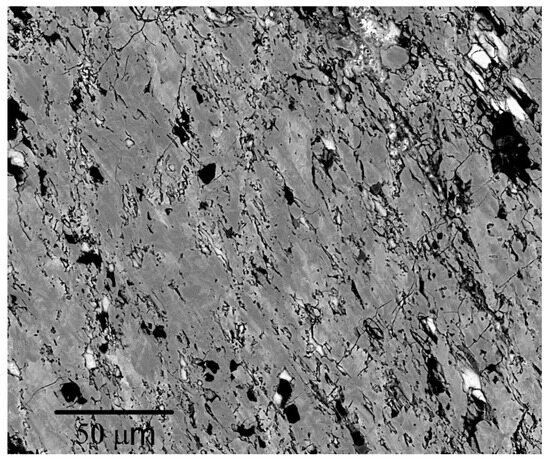
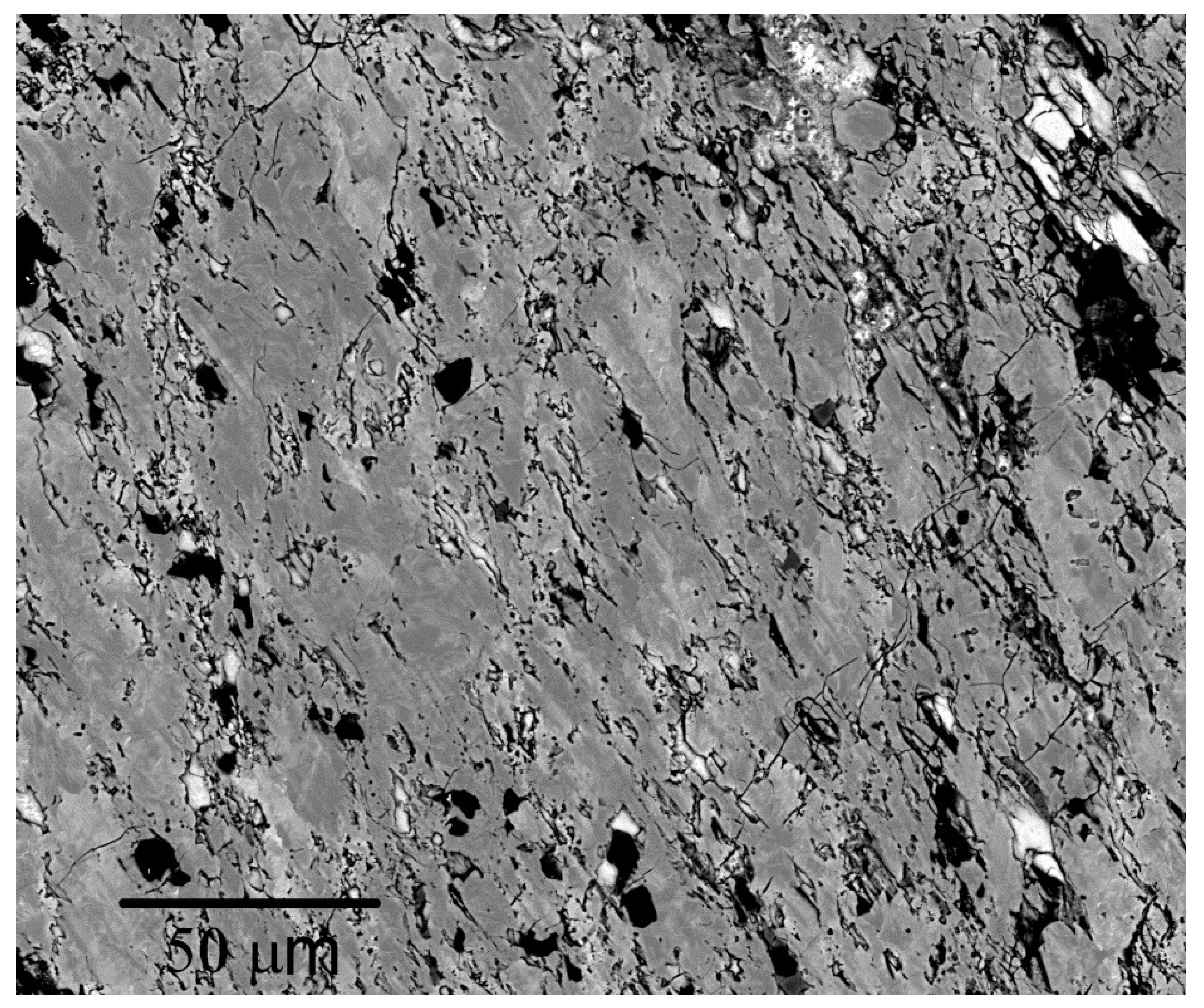
Sample 1 originates from the specimen deposited in the systematic collection of the Fersman Mineralogical Museum of the Russian Academy of Sciences, Moscow, with the catalog number 83,763. A columbite-supergroup mineral occurs as grains up to 2 mm that are irregular in shape (typically elongated, prismatic), forming compact nests, in which they are randomly oriented or radiated aggregates up to 1 cm across, embedded in beryl (Figure 1). Other associated minerals are quartz, albite, microcline, muscovite, a U-dominant pyrochlore-group mineral, Nb- and Fe-bearing rutile (“ilmenorutile”), columbite-(Fe), ilmenite, and zircon. The U-dominant pyrochlore-group mineral and rutile form numerous microscopic inclusions in the main phase (Figure 2).
Figure 1.
A photo of Sample 1: black grains of a columbite-supergroup mineral embedded in beryl (colored brownish by thin films of secondary Fe hydroxides).
Figure 2.
Fragment of Sample 1 with inclusions of Fe- and Nb-bearing rutile (black spots) and U-dominant pyrochlore-group mineral (white spots). Dark-, medium-, and light-gray areas correspond to a columbite-supergroup mineral with different Nb:W ratios. SEM image in back-scattered electrons (BSE) of a polished section.
Sample 2 originates from the Heftetjern pegmatite, Tørdal, Telemark, Norway. Its geological setting and mineralogy are described in detail elsewhere [7,11]. This pegmatite is a part of a large-scale pegmatite system considered to branch out from the Sveconorwegian Tørdal A-type granite pluton. The main minerals of the pegmatite are albite, quartz, fluorite and spessartine. Numerous Ta-bearing oxides occur there as primary, accessory phases crystallized from a Sc-rich pegmatitic fluid; the scandium enrichment could be due to anatexis and incorporation of a Sc-rich country rock. Heftetjern is the type locality of four Sc minerals, heflikite, kristiansenite, oftedalite, heftetjernite and ixiolite-(Sc).
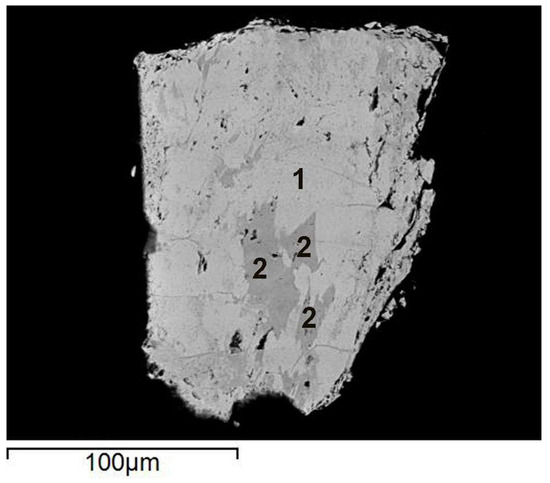
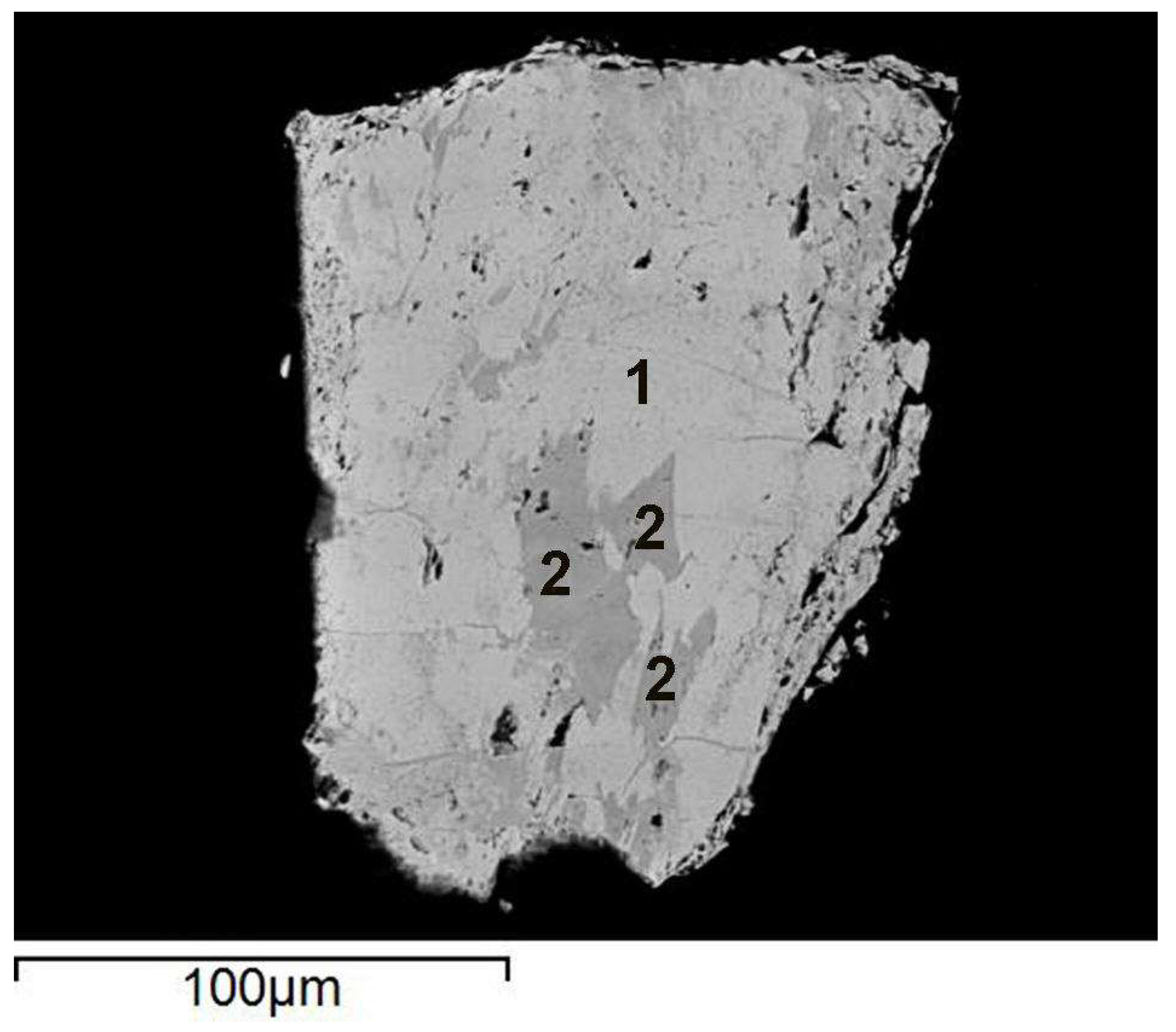
Sample 2 is presented as several grains up to 0.2 mm across with inclusions of Sn-bearing hydroxycalciomicrolite (Figure 3). The main rock-forming minerals of the pegmatite are albite, quartz and fluorite. The empirical formula of associated hydroxycalciomicrolite is (Ca1.37Na0.24Mn2+0.01)Σ1.62(Ta1.37Sn0.21Nb0.15W0.12Sc0.07Ti0.05Fe3+0.02)Σ2[O5.71(OH)1.26F0.02]Σ2.
Figure 3.
Grain of Sample 2: columbite-supergroup mineral (1) with inclusions of Sn-bearing hydroxycalciomicrolite (2). SEM (BSE) image of a polished section.
3. Methods
Wave-dispersive X-ray spectroscopy (WDS) analyses were carried out at the Faculty of Geology, Lomonosov Moscow State University, using a Jeol JSM-6480LV scanning electron microscope (EOL LTD, Welwyn Garden, UK) equipped with an INCA-Wave 500 wavelength-dispersive spectrometer (Tescan Orsay Hld., Brno, Czech Republic), at an acceleration voltage of 20 kV, a beam current of 20 nA, and a 3 μm beam diameter.
Energy-dispersive X-ray spectroscopy (EDS) analyses were performed at the Fersman Mineralogical Museum with a JEOL 773 electron microprobe (EOL LTD, Welwyn Garden, UK) at an acceleration voltage of 20 kV, a beam current of 20 nA, and a 3 μm beam diameter.
Powder X-ray diffraction data were collected at St. Petersburg State University using a Rigaku R-AXIS Rapid II diffractometer (image plate) (Rigaku Corporation, Tokyo, Japan), with CoKα, 40 kV, 15 mA, a rotating anode with microfocus optics, Debye-Scherrer geometry, r = 127.4 mm, and exposure of 15 min. The raw powder XRD data were collected using the program suite designed by Britvin et al. [16]. Calculated intensities were obtained by means of the STOE WinXPOW v. 2.08 program suite based on the atomic coordinates and unit-cell parameters.
Single-crystal XRD data for both samples were collected at the Faculty of Geology, Lomonosov Moscow State University, at room temperature using an Xcalibur S CCD diffractometer (Oxford Diffraction, Oxford, UK) (MoKα radation). More than a hemisphere of three-dimensional data was collected. Data reduction was performed using the CrysAlisPro program system, version 1.171.42.49 [17]. The data were corrected for Lorentz factor and polarization effects. Single-crystal structure analysis was performed using SHELX (version 2018/3) [18].
Reflectance values were measured in air using an MSF-R microspectrophotometer (LOMO, St. Petersburg, Russia). Silicon was used as a standard.
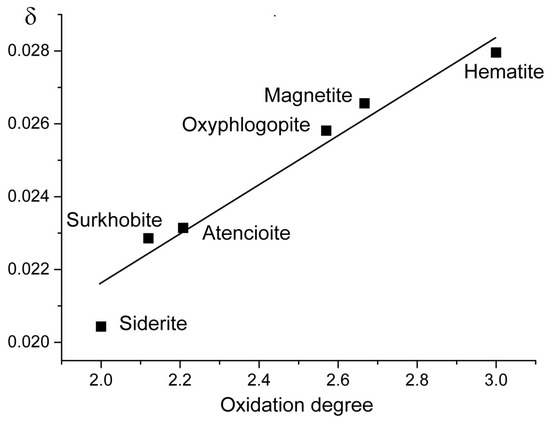
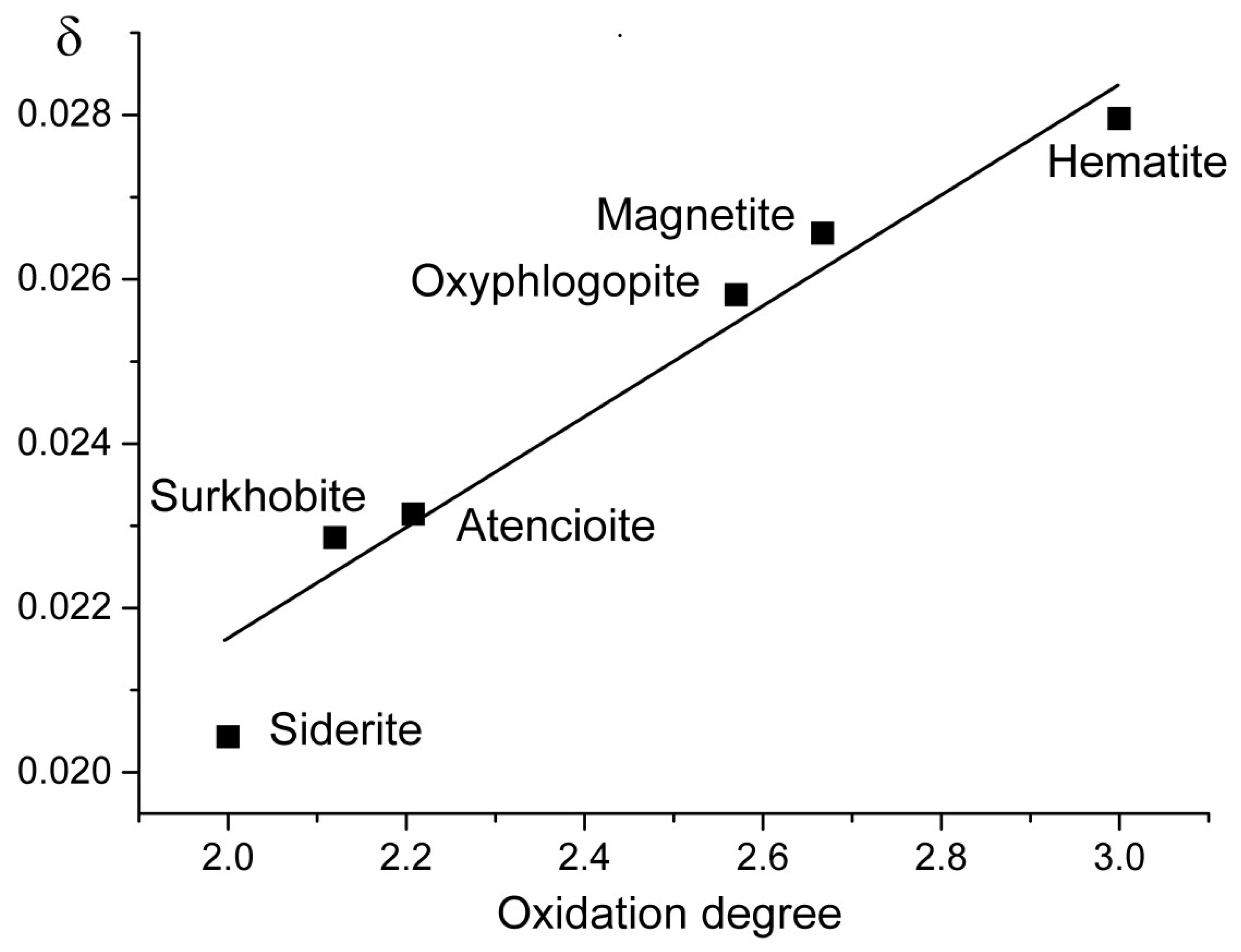
Oxidation degree of iron in Sample 1 was determined by X-ray spectroscopy using a method based on the dependences of relative intensities of the FeKβ5 and FeKβ1 lines, described in [19]. The correlation between δ = I(FeKβ5)/I(FeKβ1) and oxidation degree of iron x is given in Figure 4. It corresponds to the equation x = 140.85δ − 1.014. For Sample 1, the I(FeKβ5)/I(FeKβ1) ratio is equal to 0.02146, which corresponds to x = 2.009.
Figure 4.
Correlation between oxidation degree of iron in minerals and the δ-ratio of intensities of the FeKβ5 and FeKβ1 lines in their X-ray spectra.
4. Results
4.1. Chemical Composition
The analytical data are given in Table 1, Table 2 and Table 3. Contents of other elements with atomic numbers higher than that of C are below detection limits. The oxidation degree of iron x in Sample 1, determined from the correlation x = 140δ − 1.01 where δ = 0.0216 is the ratio of intensities of the FeKβ5 and FeKβ1 lines in the X-ray spectrum, is equal to 2.014. Thus, all or almost all iron in Sample 1 is divalent.
Table 1.
Chemical composition of Sample 1 (WDS-mode analyses, mean over 11 spots).
Table 2.
Chemical composition of Sample 2 (EDS-mode analyses, mean over 12 spots).
Table 3.
Chemical composition of Sample 2 (WDS-mode analyses, mean over 5 spots).
The charge-balanced empirical formulae calculated on four cations and eight oxygen atoms are (for the WDS-mode analyses, the cations are grouped in accordance with their charge):
- (Fe2+0.81Mn2+0.53)Σ1.34Fe3+0.07(Ti0.23Zr0.11Sn0.02)Σ0.36(Nb1.45Ta0.26)Σ1.71W0.52O8 (Sample 1);
- Na0.02(Ca0.01Mg0.07Mn2+0.26Fe2+0.04)Σ0.38(Sc1.07Fe3+0.20)Σ1.27(Sn0.30Ti0.03)Σ0.33(Ta1.40Nb0.50)Σ1.90W0.10O8 (Sample 2, EDS-mode analyses);
- (Mn2+0.28Fe2+0.25)Σ0.53Sc1.08(Sn0.32Ti0.04)Σ0.36(Ta1.41Nb0.52)Σ1.93W0.10O8 (Sample 2, WDS-mode analyses).
4.2. Optical Properties
The columbite-supergroup mineral in Sample 1 is gray, slightly darker than the associated Nb,Ta-bearing rutile but lighter than U-dominant pyrochlore. Bireflectance is very weak, with ∆R = 0.5% (589 nm). Pleochroism is not observed. Anisotropy is distinct, in gray tones. Abundant red internal reflections are observed.
Sample 2 is white in contrast with light-gray hydroxycalciomicrolite, with abundant, orange-brown internal reflections. Bireflectance is weak, with ΔR = 0.8% (589 nm). Anisotropy is moderate, in gray and dark-gray rotation tints.
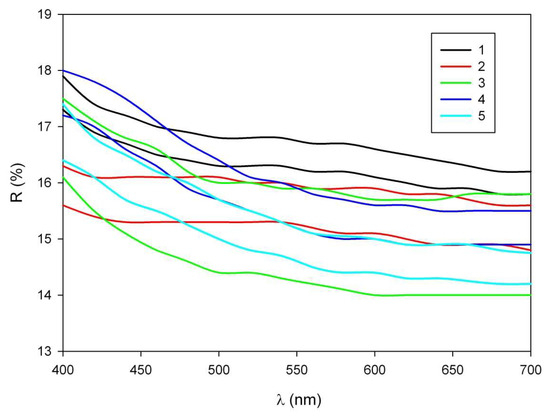
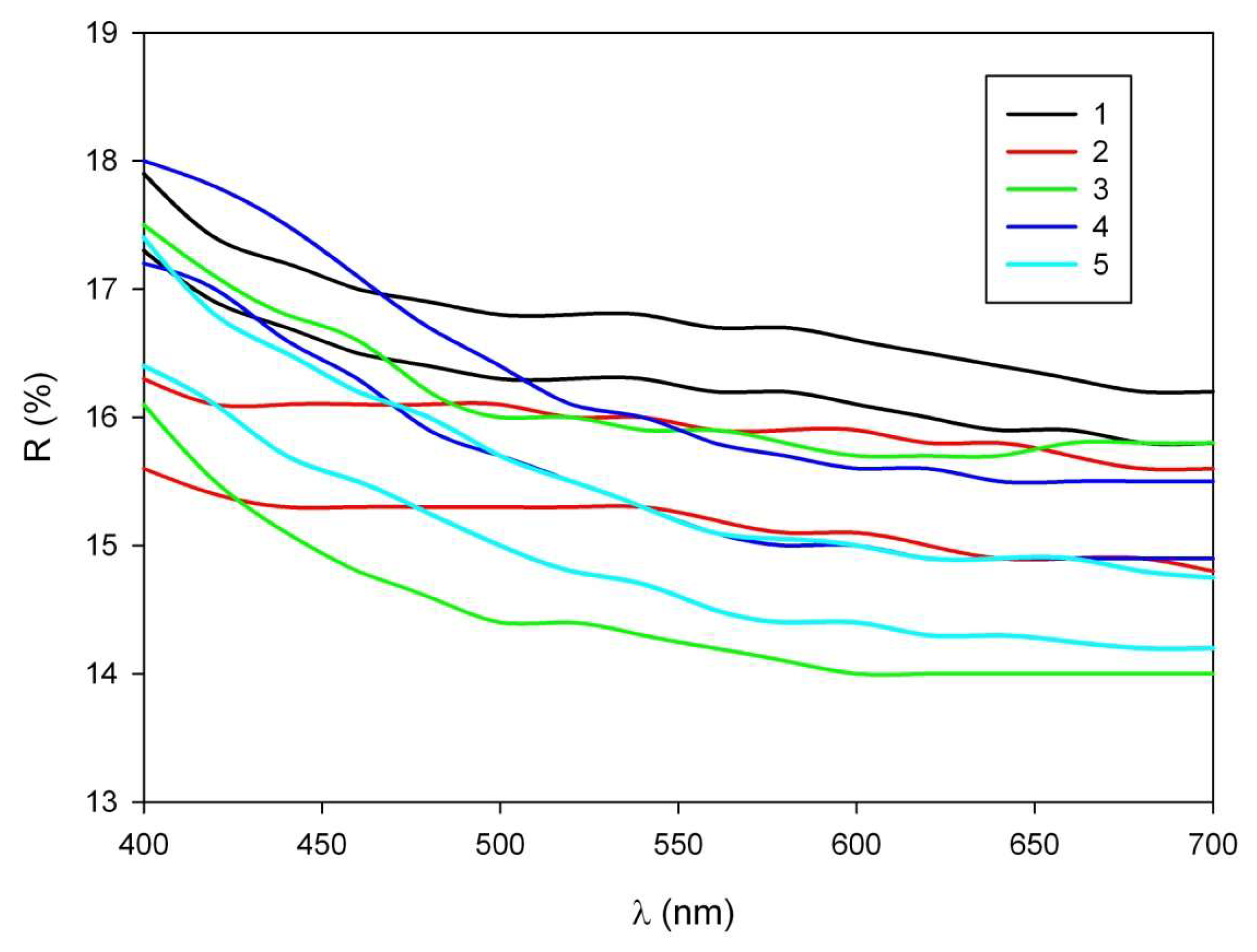
The reflectance values (Rmax/Rmin) are given in Table 4. COM standard wavelengths are given in bold. Figure 5 shows the reflectance curves of Sample 1 and Sample 2 compared with published data for columbite-supergroup minerals.
Table 4.
Reflectance values of studied samples.
Figure 5.
Reflectance curves for Sample 1 (1, this work), Sample 2 (2, this work), compared with published data for nioboixiolite-(Fe3+) from Laach Lake volcano, Eifel region, Rhineland-Palatinate, Germany [19] (3), nioboixiolite-(Mn2+) from Sosedka vein, Malkhan pegmatite field, Transbaikalia, Russia [20] (4), and ixiolite-(Mn2+) from Wodgina, Pilbara, Australia [21] (5).
4.3. Powder X-Ray Diffraction
The powder XRD data for the studied samples were obtained from grains previously studied by SEM and electron microprobe: they were extracted from the above-described polished samples. The minerals chemically corresponding to nioboixiolite-(Fe2+) in Sample 1 and ixiolite-(Sc) in Sample 2 demonstrate phase homogeneity under the scanning electron microscope, i.e., do not contain inclusions of other minerals with close chemical composition larger than 50–100 nm in size.
The powder XRD patterns of the studied samples (Table 5 and Table 6) correspond to columbite-supergroup members and, in general, are significantly closer to those of minerals with ixiolite-type structure than to other representatives of this supergroup. However, in each case, several additional, in comparison with the “ideal” ixiolite-type model, reflections are observed. Both powder XRD diagrams contain reflections definitely corresponding to the monoclinic wolframite-type structure. For this, the low-angle region (d > 3.7 Å) is especially informative because in this region there are no reflections corresponding to orthorhombic ixiolite-type structure, due to systematic absences in the space group Pbcn. In the low-angle region, Sample 1 shows weak characteristic reflections with d = 4.74 and 3.79 Å (Table 5) and Sample 2 shows the reflections with d = 5.71, 4.78 and 3.82 Å (Table 6).
Table 5.
Powder X-ray diffraction data (d in Å) of Sample 1.
Table 6.
Powder X-ray diffraction data (d in Å) of Sample 2.
4.4. Single-Crystal X-Ray Diffraction
For Samples 1 and 2, the crystal structure refinement was carried out within the frames of three models: orthorhombic, space group Pbcn; monoclinic, space group P2/c, without taking into account possible twinning and monoclinic, space group P2/c, taking into account twinning on |100 0-10 00-1|. The results are given in Table 7, Table 8 and Table 9.
Table 7.
Crystal data, data collection information and structure refinement details for Sample 1.
Table 8.
Crystal data, data collection information and structure refinement details for Sample 2.
Table 9.
Number of electrons in octahedral sites of studied samples according to chemical data and in different refinement modes.
In accordance with the correlation in (1), Sample 1 and Sample 2 are partially ordered columbite-supergroup minerals with the order parameter Q equal to 75% and 20%, respectively. For both samples, transition from the orthorhombic ixiolite-type model to the monoclinic wolframite-type one (especially taking into account twinning in the case of Sample 1) results in a significant lowering of R-factor.
The best agreement between the number of electrons per formula unit calculated from the empirical formulae and refined in the crystal structures was achieved for the monoclinic models with twinning (Table 9). Based on these data, one can conclude that Sample 1 has a higher degree of cation ordering than Sample 2, in accordance with the Q values calculated from Equation (1).
5. Discussion
The crystal structures of Samples 1 and 2 in the orthorhombic ixiolite-type model were refined to the R-factors of 0.0764 and 0.0606, respectively, which could be considered as an acceptable result taking into account the poor quality of the studied single-crystal fragments. However, the transition to the monoclinic model with twinning made it possible to significantly lower the R-factor (see Table 7 and Table 8). Thus, according to generally accepted criteria, Samples 1 and 2 could be considered minerals belonging to the wolframite structural type. However, the powder XRD patterns calculated from the structural data differ significantly from the measured ones. In particular, in the measured powder XRD patterns, the reflection intensities forbidden in the orthorhombic model are an order of magnitude weaker than those calculated from single-crystal structural data.
Low intensities of the violating reflections in the powder XRD patterns may be a consequence of the very small size of coherent scattering regions in the areas with the wolframite-type cation ordering. Thus, intensities of reflections which are forbidden for the ixiolite-type structure cannot be used as a criterion of the degree of cation ordering because they depend not only on the fraction of cation-ordered fragments but also on their sizes. The empirical criterion-based oт Formula (1) is not very reliable because some samples, especially those with high contents of tri- and tetravalent cations, show significant deviation from this correlation.
It appears that the most reliable criterion for classifying a mineral as an ixiolite or wolframite structural type is the degree of separation of small high-valence (Nb, Ta, W) and larger lower-valence cations (Fe2+, Fe3+, Mn2+, Ti, Zr, Sn) between different positions (independent) in the wolframite structural model. As one can see from Table 9, Sample 1 with Q = 75% is characterized by a larger difference between the refined numbers of electrons (eref) at the sites M1 and M2 than Sample 3 with Q = 20%.
In particular, maximum cation ordering in Sample 2 would correspond to the idealized formula M1(Mn2+0.28Fe2+0.25Sc1.08Sn0.32Ti0.04Ta0.03)Σ2M2(Ta1.38Nb0.52W0.10)O8.00 for which the difference eref(M2) − eref(M1) is equal to 36.37 (see Table 9), whereas the refined difference eideal(M2) − eideal(M1) is equal to 9.47, with the ratio of these values being 0.26, which nearly corresponds to Q = 20% as estimated using Formula (1). Thus, Sample 2 is characterized by a significant cation disordering and, by this characteristic, it is close to ixiolite-group minerals, including ixiolite-(Sc).
For Sample 1, maximum cation ordering with the smallest cations placed in M2 and the largest ones in M1 would lead to the formula M1(Fe2+0.81Mn2+0.53Ta0.23Fe3+0.07Ti0.23Zr0.11Sn0.02)Σ2M2(Nb1.45W0.52Ta0.03)Σ2O8, corresponding to eideal(M2) = 50.06, eideal(M1) = 31.69 and eideal(M2) − eideal(M1) = 18.37, whereas the refined eref(M2) − eref(M1) value is equal to 16.70 (see Table 9). The ratio of these values is equal to 0.91 which exceeds the Q value of 75% calculated using Formula (1). Taking a high degree of cation ordering, Sample 1 can be considered a solid solution of four members of the wolframite group, (M2+0.36M4+0.36)M5+0.72O2.88 (36%), (M2+0.46M5+0.23)M5+0.69O2.76 (34.5%), M2+0.52M6+0.52O2.08 (26%) and M3+0.07M5+0.07O0.28 (3.5%). The first component, corresponding to the ideal stoichiometry (M2+M4+)M5+2O4 (with Fe2+ predominant among M2+, Ti4+ predominant among M4+ and Nb5+ predominant among M5+), prevails over other components. Consequently, in accordance with the current rules of the Commission on New Minerals, Nomenclature and Classification of the International Mineralogical Association, as well as nomenclature of columbite-supergroup minerals [1], Sample 1 is close to the solid solution of wolframite-group minerals with the end-member formulae (M2+Ti)Nb2O8, (M2+2/3Ta1/3)NbO4 and M2+WO4 where M = Fe, Mn. One can suppose that the presence of a significant amount of tungsten facilitates cation ordering in accordance with the wolframite scheme.
The following criterion based on the δ = [eref(M2) − eref(M1)]/[eideal(M2) − eideal(M1)] value can be suggested for the assignment of a partially ordered (in accordance with the wolframite scheme) columbite-supergroup mineral to a mineral group.
The meaning of the parameter δ is that it shows how much the difference in the number of electrons in two cation positions of the monoclinic model, found as a result of the structure refinement, differs from the value at the maximum ordering of cations according to their ionic radii. Thus, the δ parameter is based not only on SEM microanalytical data but is also calculated using structural data and based on crystal-chemical criteria.
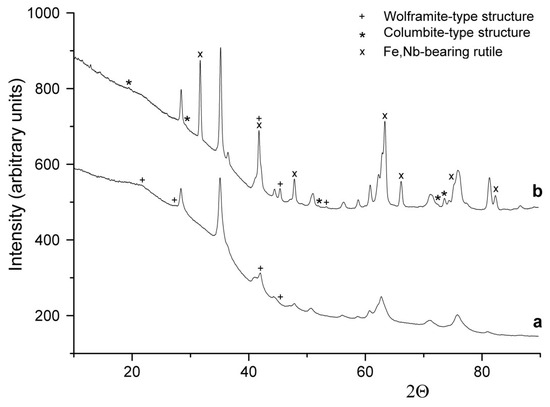
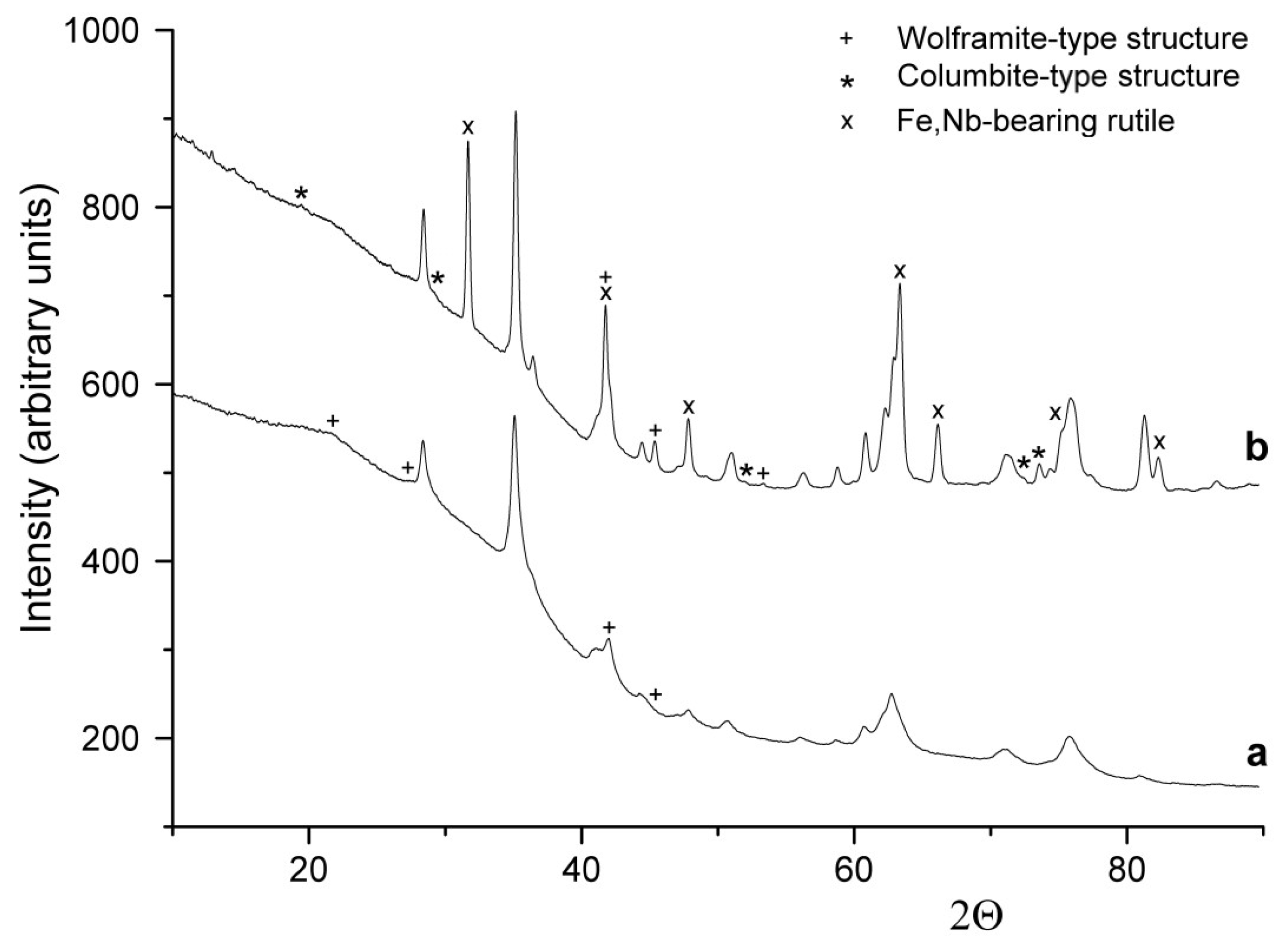
It is to be noted that cation ordering in ixiolite-group minerals can also occur according to the columbite-type mechanism. An example of cation ordering involving this mechanism is presented in Table 10 and Figure 6. The reflections with d = 5.30 and 3.56 Å in the powder XRD pattern of a columbite-group mineral from the same mineral association as Sample 1 undoubtedly correspond to the columbite-type structure. Note that this sample is polluted with Ti- and Nb-rich rutile (“ilmenorutile”): we observe its strongest reflections with d = 3.28 and 1.705 Å and some weaker ones. The presence of significant “ilmenorutile” admixture also causes the strong intensity increase in reflections with d = 2.51 and 1.46 Å (Table 10) due to the overlap of its strong reflections with reflections of a columbite-supergroup mineral.
Table 10.
The powder X-ray diffraction data (d in Å) of a columbite-supergroup mineral from the association with Sample 1.
Figure 6.
Powder XRD patterns of Sample 1 (a) and columbite-supergroup mineral from the association with Sample 1 (b). Unmarked reflections correspond to nioboixiolite-(Fe2+).
Reflections of admixed Nb- and Fe-enriched rutile (“ilmenorutile”: the data from JCPDS ICDD 31-0646) in Sample 2 are marked in italics (significant increase in reflections with d = 2.512 and 1.464 Å is caused by the overlap with strong reflections of Nb- and Fe-enriched rutile).
6. Conclusions and Implications
Partial cation ordering is typical for columbite-supergroup minerals. According to single-crystal and powder XRD data as well as a criterion based on Formula (1), the samples studied in this work are members of the columbite supergroup with incomplete cation ordering in accordance with the wolframite- and columbite-type schemes.
The obtained data show that the assignment of a partially ordered mineral of the columbite supergroup to a particular group cannot be reliably made based on powder X-ray diffraction data because of the low intensities of reflections forbidden for the ixiolite group members due to the small size of the coherent scattering in cation-ordered areas. The most reliable criterion for the degree of cation ordering in these minerals is the degree of deviation of the difference in electron number at the M1 and M2 sites in the refined wolframite structure model from the analogous value calculated under the assumption of maximum cation ordering.
Author Contributions
Conceptualization, N.V.C. and N.V.Z.; Methodology, N.V.Z., D.A.K., A.A.V., A.A.A., A.V.K. and S.N.B.; Investigation, N.V.C., N.V.Z., I.V.P., A.V.K., V.O.Y., A.A.V. and A.A.A.; Original Manuscript Draft Preparation, N.V.C.; Manuscript Review and Editing, N.V.Z., I.V.P. and A.V.K.; Figures, I.V.P., N.V.C. and A.A.A. All authors have read and agreed to the published version of the manuscript.
Funding
This work was carried out in accordance with the state tasks, registration numbers 124013100858-3 (for N.V.C) and 121061600049-4 (for I.V.P.).
Data Availability Statement
The raw data supporting the conclusions of this article will be made available by the authors on request.
Acknowledgments
The authors thank the X-ray Diffraction Center of St. Petersburg State University for instrumental and computational resources.
Conflicts of Interest
The authors declare no conflicts of interest.
References
- Chukanov, N.V.; Pasero, M.; Aksenov, S.M.; Britvin, S.N.; Zubkova, N.V.; Yike, L.; Witzke, T. Columbite supergroup of minerals: Nomenclature and classification. Mineral. Mag. 2023, 87, 18–33. [Google Scholar] [CrossRef] [Scilit]
- Udoratina, O.V.; Panikorovskii, T.L.; Chukanov, N.V.; Voronin, M.V.; Lutoev, V.P.; Agakhanov, A.A.; Isaenko, S.I. Dmitryvarlamovite, Ti2(Fe3+Nb)O8, a new columbite-supergroup mineral related to the wolframite group. Mineral. Mag. 2024, 88, 147–154. [Google Scholar] [CrossRef] [Scilit]
- Wegner, M.; Armbruster, T.; Geiger, C.A. Cation distribution in partially ordered columbite from the Kings Mountain pegmatite, North Carolina. Am. Mineral. 1991, 76, 1897–1904. [Google Scholar]
- Khvostova, V.A.; Maximova, N.V. On the minerals of the tantalite-columbite group. Mineral. Sb. L’vov State Univ. 1969, 23, 38–52. (In Russian) [Google Scholar]
- Nickel, E.H.; Rowland, J.F.; McAdam, R.C. Ixiolite–A columbite substructure. Am. Mineral. 1963, 48, 961–979. [Google Scholar]
- Nickel, E.H.; Rowland, J.F.; McAdam, R.C. Wodginite, a new tin-manganese tantalite from Wodgina, Australia and Bernic Lake, Manitoba. Can. Mineral. 1963, 7, 390–402. [Google Scholar]
- Kristiansen, R. A unique assemblage of scandium-bearing minerals from the Heftetjern-pegmatite, Tørdal, south Norway. Nor. Bergverksmus. Skr. 2009, 41, 75–104. [Google Scholar]
- Balassone, G.; Danisi, R.M.; Armbruster, T.; Altomare, A.; Moliterni, A.G.; Petti, C.; Mondillo, N.; Ghiara, M.R.; Saviano, M. An insight into crystal chemistry and cation order of columbite-(Fe) and columbite-(Mn) from worldwide occurrences. Neues Jahrb. Mineral. Abh. 2015, 192, 275–287. [Google Scholar] [CrossRef] [Scilit]
- Ercit, T.S.; Wise, M.A.; Černý, P. Compositional and structural systematics of the columbite group. Am. Mineral. 1995, 80, 613–619. [Google Scholar] [CrossRef] [Scilit]
- Dos Santos, C.A.; Zawislak, L.I.; Kinast, E.J.; Antonietti, V.; da Cunha, J.B.M. Crystal chemistry and structure of the orthorhombic (Fe,Mn)(Ta,Nb)2O6 family of compounds. Braz. J. Phys. 2001, 31, 616–631. [Google Scholar] [CrossRef] [Scilit]
- Kolitsch, U.; Kristiansen, R.; Raade, G.; Tillmanns, E. Heftetjernite, a new scandium mineral from the Heftetjern pegmatite, Tørdal, Norway. Eur. J. Mineral. 2010, 22, 309–316. [Google Scholar] [CrossRef] [Scilit]
- Taddei, A.; Holtstam, D.; Kristiansen, R.; Bindi, L. Ixiolite-(Sc), IMA 2025-054, CNMNC Newsletter. Eur. J. Mineral. 2025, 88, 37. [Google Scholar] [CrossRef] [Scilit]
- Zelek-Pogudz, S.; Gołębiowska, B.; Rutkowski, B.; Nejbert, K.; Stadnicka, K.M.; Pieczka, A. Nioboixiolite-(Fe2+), IMA 2025-016, CNMNC Newsletter 88. Mineral. Mag. 2025, 89. [Google Scholar] [CrossRef] [Scilit]
- Kosals, Y.A.; Temnikov, Y.I. Pegmatite-Bearing Granitoids of Transbaikalia; Nauka: Novosibirsk, Russia, 1983; 232p. (In Russian) [Google Scholar]
- Yurgenson, G.A. Jewelry and Ornamental Stones of Transbaikalia; Nauka: Novosibirsk, Russia, 2001; 390p. (In Russian) [Google Scholar]
- Britvin, S.N.; Dolivo-Dobrovolsky, D.V.; Krzhizhanovskaya, M.G. Software for processing the X-ray powder diffraction data obtained from the curved image plate detector of Rigaku RAXIS Rapid II diffractometer. Zap. Ross. Mineral. Obs. (Proc. Russ. Mineral. Soc.) 2017, 146, 104–107. (In Russian) [Google Scholar]
- Rigaku Oxford Diffraction. CrysAlisPro Software System; v. 1.171.39.46; Rigaku Corporation: Oxford, UK, 2018. [Google Scholar]
- Sheldrick, G.M. XPREP, version 2008/2; Bruker-AXS: Madison, WI, USA, 2008. [Google Scholar]
- Chukanov, N.V.; Zubkova, N.V.; Pekov, I.V.; Kasatkin, A.V.; Agakhanov, A.A.; Virus, A.A.; Vigasina, M.F.; Ternes, B.; Schüller, W.; Britvin, S.N. Nioboixiolite-(Fe3+), (Nb0.5Fe3+0.5)O2, a new ixiolite-group mineral from the Eifel paleovolcanic region, Germany. Mineral. Mag. 2025, 89, 602–608. [Google Scholar] [CrossRef] [Scilit]
- Chukanov, N.V.; Pekov, I.V.; Zubkova, N.V.; Yapaskurt, V.O.; Shelukhina, Y.S.; Britvin, S.N.; Pushcharovsky, D.Y. Nioboixiolite-(Mn2+), (Nb2/3Mn2+1/3)O2, a new ixiolite-group mineral from the Malkhan pegmatite field, Transbaikal region, Russia. Zap. Ross. Mineral. Obs. (Proc. Russ. Mineral. Soc.) 2023, 152, 8–17. (In Russian) [Google Scholar] [CrossRef] [Scilit]
- Criddle, A.J.; Stanley, C.J. Quantitative Data Files for Ore Minerals, 3rd ed.; Springer Science & Business Media: Berlin/Heidelberg, Germany, 1993; 635p. [Google Scholar]

Disclaimer/Publisher’s Note: The statements, opinions and data contained in all publications are solely those of the individual author(s) and contributor(s) and not of MDPI and/or the editor(s). MDPI and/or the editor(s) disclaim responsibility for any injury to people or property resulting from any ideas, methods, instructions or products referred to in the content. |
© 2026 by the authors. Licensee MDPI, Basel, Switzerland. This article is an open access article distributed under the terms and conditions of the Creative Commons Attribution (CC BY) license.