Article

DU-Net: A Dual-Path Architecture for High-Contrast Velocity Anomaly Detection in Seismic Inversion


by
Maksim Nikishin
1,
Alexey Vasyukov
1 and
Nikolay Khokhlov
1,2,3,*
1
Laboratory of Applied Computational Geophysics, Moscow Institute of Physics and Technology (MIPT), Dolgoprudny 141701, Russia
2
Scientific Research Institute for System Analysis of the National Research Centre “Kurchatov Institute”, Moscow 117312, Russia
3
Center for Top-Level Educational Programs in the Field of Artificial Intelligence, Autonomous Noncommercial Organization of Higher Education “Innopolis University”, Innopolis 420500, Russia
*
Author to whom correspondence should be addressed.
Minerals 2026, 16(5), 530; https://doi.org/10.3390/min16050530
Submission received: 19 March 2026 / Revised: 8 May 2026 / Accepted: 13 May 2026 / Published: 15 May 2026
(This article belongs to the Section Mineral Exploration Methods and Applications)

Abstract

Full-waveform inversion (FWI) is a powerful interpretation method in geophysics for inferring high-resolution subsurface models by minimizing the difference between observed and simulated seismic data. In mineral exploration, FWI has shown particular promise for delineating complex ore bodies in hard-rock environments where conventional reflection seismic methods often fail. However, traditional FWI remains computationally expensive due to the iterative solution of forward and adjoint problems. The integration of deep learning, particularly the U-Net architecture, has recently emerged as a promising approach to address these computational challenges. Originally developed for biomedical image segmentation, U-Net employs a symmetric encoder–decoder structure with skip connections, enabling precise localization and efficient feature extraction from complex data. This paper proposes a modified dual-path architecture, termed DU-Net, specifically designed for the simultaneous detection and extraction of high-contrast velocity anomalies (representing potential ore bodies) and reconstruction of the background velocity model. The key innovation lies in parallel processing branches—one dedicated to anomaly segmentation and another to background reconstruction—combined with a specialized composite loss function, SeismoLoss, that independently supervises each component. This design allows the network to focus on the distinctive features of the anomaly while filtering out background complexity that typically degrades prediction quality in single-path approaches. We provide a detailed description of the DU-Net architecture and evaluate its performance on two synthetic datasets representing different styles of mineralization and host-rock complexity. Experimental results demonstrate that DU-Net achieves superior accuracy in localizing anomalous bodies and reconstructing background geology compared to the standard U-Net baseline, with a substantial reduction in boundary blurring artifacts.

1. Introduction

Seismic technologies have become an essential tool in modern mining exploration, particularly for detecting deep and structurally complex ore deposits. Unlike conventional geophysical methods such as magnetic, gravity, or electrical surveys, whose efficiency decreases significantly below depths of about 500 m, seismic methods provide high-resolution imaging of subsurface geological structures at depths reaching several kilometers [1]. Recent studies demonstrate that both 2D and 3D seismic reflection surveys are highly effective for mapping faults, lithological boundaries, ore-bearing horizons, and massive sulfide mineralization [2]. Advanced seismic imaging techniques, including pre-stack depth migration (PSDM) and reverse time migration (RTM), further improve the delineation of complex geological targets in hard-rock environments and enhance the reliability of geological models used to guide exploration drilling [3].
In recent years, the development of high-resolution 3D seismic surveys and passive seismic approaches based on ambient noise interferometry has further expanded the application of seismics in mineral exploration. These technologies enable the identification of tectonic disturbances, fracture systems, and mineralized zones while reducing exploration risks and drilling costs [4]. Case studies from Kazakhstan demonstrate that integrating seismic methods with geological and petrophysical data substantially increases the efficiency of deep mineral exploration and improves the prediction of ore-bearing structures [5]. In addition, passive seismic and surface-wave imaging techniques have shown strong potential for characterizing hard-rock environments and detecting fault-controlled mineralization in crystalline terrains [6]. As a result, modern seismic workflows are now considered one of the most promising approaches for the exploration of concealed and deep-seated ore deposits, which is particularly important in the context of the growing global demand for critical raw materials.
Full-waveform inversion (FWI) has emerged as a high-resolution seismic imaging technique with significant potential for mineral exploration. In contrast to conventional reflection seismics, which often struggle in complex hard-rock environments due to weak impedance contrasts and strong scattering, FWI leverages the full information content of seismic waveforms to reconstruct detailed subsurface velocity models. This capability is particularly valuable for the direct detection and delineation of ore bodies, such as volcanogenic massive sulfides (VMS), iron-oxide formations, or gold-bearing quartz veins, where velocity contrasts between the mineralized zone and the host rock can be substantial. Recent case studies have demonstrated that FWI, especially when integrating active and passive seismic sources, can provide the high-fidelity velocity models and structural frameworks essential for resource estimation and mine planning [7,8,9].
Despite its demonstrated potential, the widespread adoption of FWI in exploration geophysics is hindered by its immense computational demands. The method relies on the iterative minimization of a misfit functional [10], typically regularized to ensure stability [11]. Each iteration requires solving a pair of forward and adjoint wave equations to compute the gradient of the misfit function, a process that remains computationally prohibitive for large-scale 3D surveys or real-time monitoring applications, even with recent algorithmic advancements [12].
In response to these computational bottlenecks, deep learning has emerged as a paradigm-shifting approach [13]. Recent studies have shown that deep-learning-based methods can achieve accuracy comparable to, and in some cases exceeding, that of traditional FWI on specific datasets [14,15]. Among the myriad of neural network architectures, the U-Net [16] has proven exceptionally well-suited for seismic inversion tasks. Its symmetric encoder–decoder structure, augmented by skip connections, enables it to efficiently extract multi-scale features from seismic data while preserving the spatial resolution required for accurate localization of subsurface structures [17,18]. This has led to a proliferation of U-Net variants—including 3D and nested architectures—for processing complex geophysical datasets [19]. While other architectures such as autoencoders and GANs have been explored [20,21], the U-Net family remains a cornerstone of deep-learning-based geophysical inversion.
In the context of seismic applications, the U-Net architecture has been developed and adapted for a number of key problem classes. One of the most active areas is the prediction of missing data in seismic records, where U-Net-based networks are trained to interpolate gaps in seismograms [22,23]. In such formulations, obtaining a physically consistent prediction implicitly requires solving an inverse problem, but the use of a neural network allows this inverse mapping to be learned directly from data, which in turn greatly expands the amount of usable training material. Another important direction is the treatment of noisy data. Here, two main problem formulations are considered: the first aims at suppressing noise in recorded seismograms [24] or in the inferred subsurface properties [25], whereas the second seeks to recover the geological model itself from noisy observations [26]. This line of research is particularly critical for the practical deployment of neural-network methods in mineral exploration, where field data are often characterized by low signal-to-noise ratios. A further large body of work focuses on fault detection [27,28,29,30,31], in which U-Net-like architectures are used to extract and classify discontinuities directly from seismic images. Although these fault-detection studies do not solve the full inversion problem, they provide valuable insight into how networks learn to represent geological structure and therefore offer concepts that can be transferred and cross-validated in inversion-oriented settings.
In addition to these mainstream applications, U-Net architectures have been explored in a variety of non-standard formulations that modify both the input data representation [32,33] and the way the seismic information is analyzed [34] to tackle inverse problems. In parallel with this diversification of problem setups, systematic benchmarking of U-Net variants has been carried out, both in comparisons among different encoder–decoder designs [35] and in direct comparisons with classical inversion methods [36]. Collectively, these studies indicate that, in certain scenarios, the prediction accuracy of U-Net-based architectures can approach or even match that of conventional FWI, while requiring substantially less computational effort to obtain an inverse solution.
A central challenge in mineral exploration is the detection and characterization of high-contrast velocity anomalies representing potential ore bodies. These targets are often characterized by a sharp impedance contrast with the surrounding lithology but are embedded within a complex, often layered, background velocity field. Recent studies have successfully applied modified U-Nets to this problem, demonstrating their ability to directly predict velocity models from seismic data [37,38]. However, these approaches typically treat the inversion as a monolithic, end-to-end mapping from seismic shot gathers to the full velocity model. This strategy can be fundamentally suboptimal for the “anomaly-in-background” problem inherent to mineral exploration. The network is forced to learn competing representations simultaneously: the subtle, layered variations in the host rock and the sharp, localized contrast of the ore body. This often results in a compromise where the anomaly’s boundaries are blurred by the background signal, and the fine lithological detail of the host stratigraphy is degraded in the vicinity of the anomaly—a critical loss of information for geological interpretation.
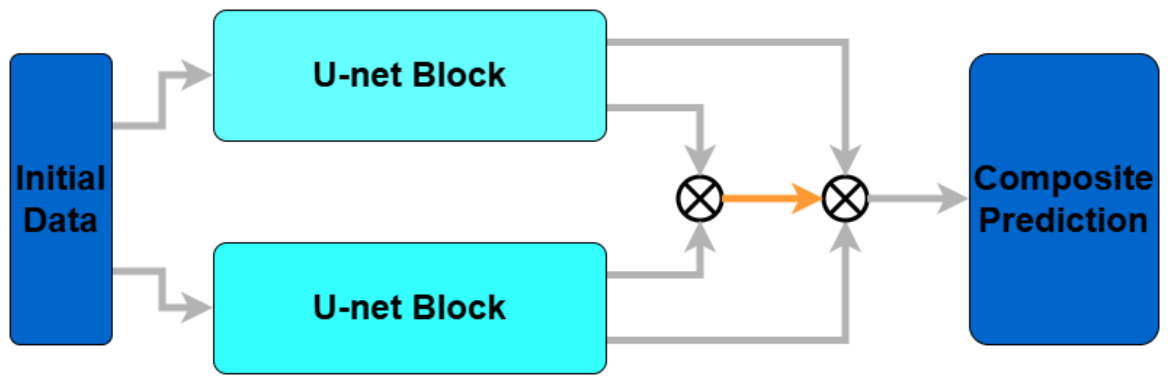
To directly address this limitation, we propose a novel dual-path architecture, DU-Net, specifically designed for the joint but decoupled reconstruction of the background velocity model and the detection of high-contrast ore-related anomalies. Our core innovation is to reframe the inversion not as a single image-to-image translation, but as a parallel task of separate reconstruction and subsequent fusion. The DU-Net comprises two parallel U-Net-based branches: one dedicated to reconstructing the background velocity field (with the anomaly region intentionally masked out during loss computation), and another focused purely on detecting and segmenting the velocity anomaly itself. These two outputs are then seamlessly combined to produce the final, full velocity model. This architectural separation is enforced by a novel composite loss function, SeismoLoss, which independently weights the contributions of the background, anomaly, and final combined predictions. This design allows each branch to specialize, preventing the background’s complexity from contaminating the anomaly prediction and vice-versa.
From the perspective of mineral exploration, the problem considered here can be viewed as detecting and characterizing ore-related high-velocity bodies embedded in a geologically plausible host-rock background. Typical targets include compact sulfide or iron-oxide accumulations and quartz-vein networks, which generate strong impedance contrasts but are often surrounded by layered or structurally complex country rocks. In such settings, it is crucial not only to delineate the ore body itself but also to preserve the continuity and velocity trends of the host-rock stratigraphy, since both components are essential for subsequent resource estimation and mine planning.
The main methodological contribution of this work is to reformulate the seismic inversion task for mineral exploration as an explicitly decoupled “background-plus-anomaly” problem and to encode this decomposition directly in both the network architecture and the training objective. Instead of learning a single mapping from seismic data to the full velocity model, the proposed DU-Net uses a shared encoder followed by two specialized decoder branches: one reconstructs the background velocity field, while the other focuses on segmenting high-contrast anomalies associated with potential ore bodies. A composite, masked loss function (SeismoLoss) separately supervises the background, anomaly, and final fused outputs, ensuring that the background branch is not penalized inside the anomaly region. To the best of our knowledge, such a combination of a dual-path architecture and masked composite supervision tailored to ore-related velocity anomalies has not been reported in the literature.
In this paper, we present the DU-Net architecture and rigorously validate its performance against a standard U-Net baseline on two distinct synthetic datasets, each designed to emulate different styles of mineralization and host-rock complexity. Our results demonstrate that DU-Net achieves superior accuracy in localizing anomalous bodies and reconstructing the background geology, effectively mitigating the blurring artifacts observed with the single-path approach. We also analyze the sensitivity of the model to the hyperparameters of the SeismoLoss function, providing practical guidelines for its application. The remainder of this paper is organized as follows: Section 2 details the methodology, Section 3 presents and discusses the experimental results, and Section 4 concludes the work and outlines directions for future research, including the path toward application on field data.

2. Materials and Methods

This section describes the workflow, from the generation of synthetic seismic data to the specifics of training the proposed neural network architecture.

2.1. Problem Formulation and Data Generation

The core task is to estimate a 2D subsurface velocity model, m , from a set of observed seismic shot gathers, d . In this work, d comprises multiple common-shot gathers simulated from known synthetic models m . We frame this as a supervised image-to-image translation problem: the input is a composite image formed by stacking several shot gathers, and the output is the corresponding velocity model.
Forward Modeling: All seismic data were generated using an acoustic isotropic 2D finite-difference solution to the wave equation. The sources were Ricker wavelets with a peak frequency of 15 Hz and were positioned at nine equally spaced locations along the top surface. Receivers were fixed at all surface grid points for every shot. The computational grid had a spacing of 10 m in both dimensions, with a time step satisfying the Courant–Friedrichs–Lewy (CFL) condition. Perfectly matched layer (PML) absorbing boundaries were applied on the sides and bottom to simulate an infinite domain, while the top surface was modeled as a free surface.
Input Representation: For a given geological model, the nine simulated shot gathers were normalized and stacked channel-wise to form a single 3D input tensor of shape ( N x , N t , N s ) , where N x is the number of receivers, N t is the number of time samples, and N s = 9 is the number of shots. This tensor serves as the input to the neural networks.

2.2. Synthetic Datasets

Two synthetic datasets were created to evaluate the proposed method under different geological complexities. Both feature a high-velocity anomaly embedded in a lower-velocity layered background, mimicking an ore body in host rock.
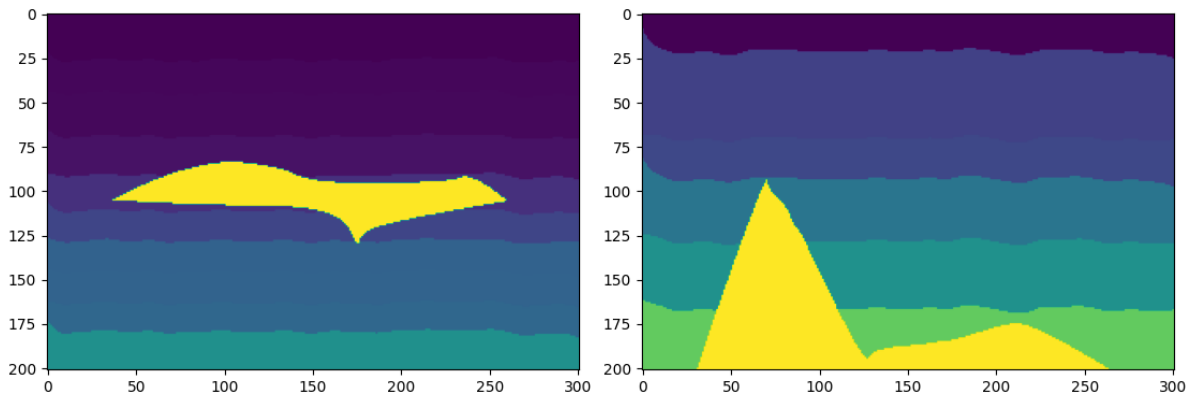
  • SET_1 (Complex Anomaly): Adapted from [36], this dataset consists of 1600 models with dimensions 200 × 300 pixels (2000 m depth, 3000 m width). Background velocities increase with depth from 2500 to 4200 m/s. The anomalies are irregularly shaped bodies with velocities up to 4500 m/s (Figure 1).
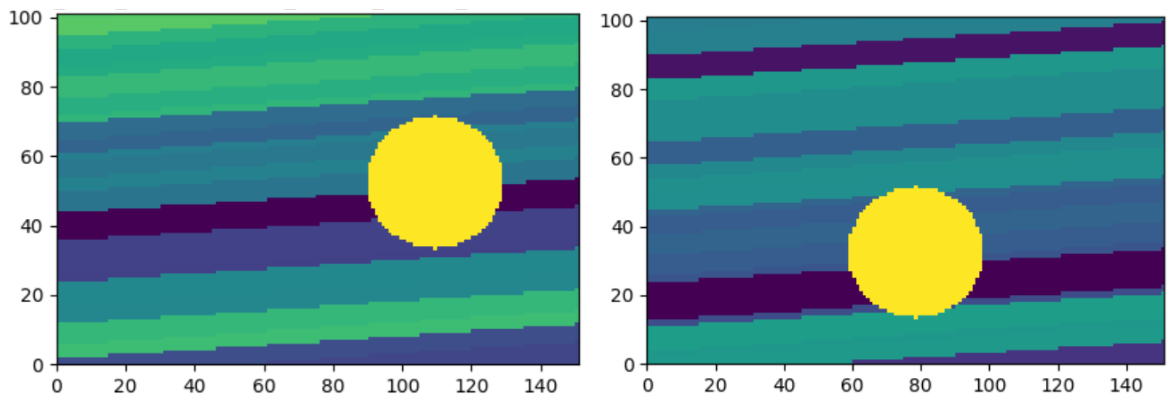
  • SET_2 (Simple Anomaly): This dataset contains 1600 models of size 100 × 150 pixels (1000 m depth, 1500 m width). Each model has a single, spherical high-velocity inclusion within a layered background. Layer velocities are randomly perturbed to add variability (Figure 2).
Geologically, SET_1 can be interpreted as a stylized analog of massive or semi-massive ore accumulations hosted in a structurally complex environment, such as volcanogenic massive sulfides or iron-oxide deposits within deformed volcanic–sedimentary sequences. The irregular anomaly geometry and vertically increasing background velocity mimic the combined effects of lithological heterogeneity, burial depth, and compaction that are typical of mature hard-rock provinces.
SET_2, in turn, represents a simplified but practically relevant exploration scenario, in which a single compact high-velocity inclusion is embedded in a predominantly layered host. This setting approximates early-stage exploration targets, such as isolated sulfide lenses or dense ore pods within relatively uniform country rocks, where the primary objective is robust detection and approximate delineation of the anomaly rather than detailed mapping of complex structures.
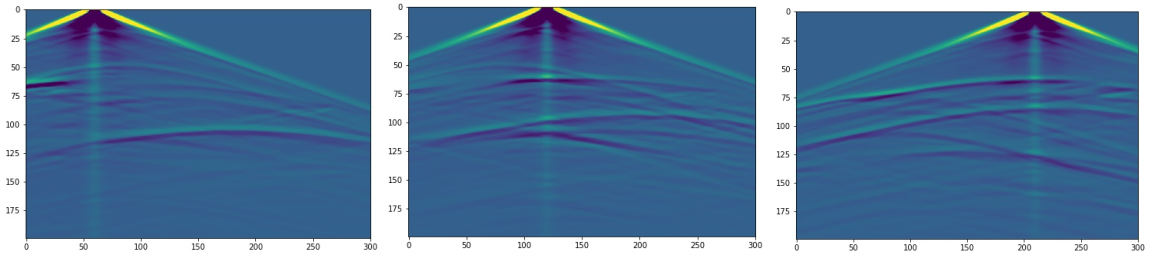
For each geological model in both datasets, nine common-shot gathers were simulated as described above. Examples of these gathers are shown in Figure 3. These gathers, after stacking, serve as the input to our neural networks.

2.3. Network Architectures

2.3.1. Baseline: U-Net

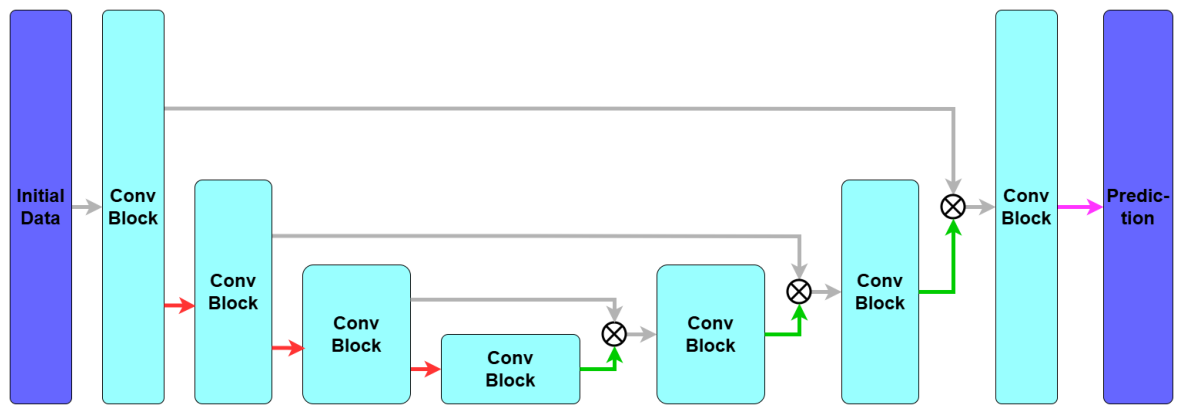
The baseline architecture is a standard U-Net [16] with zero-padded convolutions (Figure 4), where Conv Block denotes the sequential application of Convolutional layer with a 2 × 2 kernel and Relu layer twice in a row. It takes the stacked shot gather tensor as input and outputs a single image representing the predicted full velocity model. A key modification in our implementation, deviating from the classical U-Net, is the use of zero-padding in all convolutional and pooling layers. This padding was found to significantly impact the final prediction accuracy, as discussed in our previous work [39].

2.3.2. Proposed: DU-Net

The proposed Dual U-Net (DU-Net) architecture (Figure 5) consists of three main components:
  • Shared Encoder: A single encoder processes the input shot gathers to extract a rich feature representation.
  • Dual Decoders: The encoded features are fed into two independent decoders.
    • Anomaly Decoder: Outputs a single-channel image, m a n o m , representing the probability of a pixel belonging to an anomaly (a binary segmentation mask of the ore body).
    • Background Decoder: Outputs a single-channel image, m b a c k , representing the reconstructed background velocity model. During training, the loss for this branch is masked to ignore the anomaly region.
  • Fusion Layer: The outputs of the two decoders are combined via element-wise summation to produce the final, full velocity model prediction, m f u l l = m b a c k + m a n o m .
This dual-decoder design forces the network to learn separate, specialized representations for the anomaly and the background.

2.4. Training Strategy

2.4.1. SeismoLoss

To train the DU-Net, we designed a composite loss function, SeismoLoss, which supervises each of the three outputs:
L t o t a l = a 1 · L M S E ( m b a c k , m ˜ b a c k ) + a 2 · L M S E ( m a n o m , m m a s k ) + a 3 · L M S E ( m f u l l , m t r u e )
where:
  • m t r u e is the true full velocity model.
  • m m a s k is a binary mask of the anomaly (1 for anomaly, 0 elsewhere).
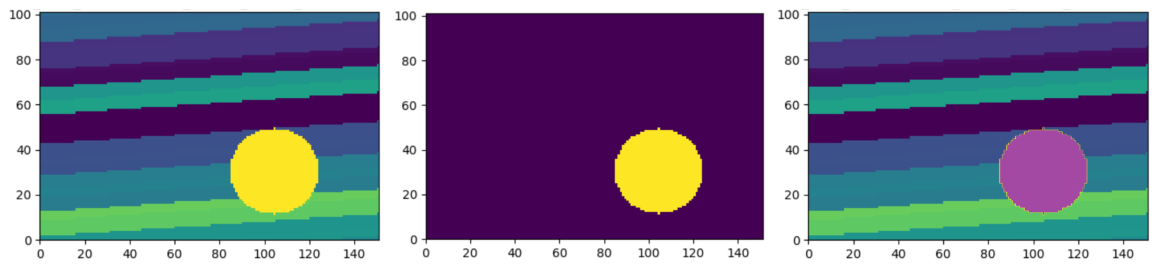
  • m ˜ b a c k is the true background model, identical to m t r u e except that the anomaly region is masked out. Crucially, L M S E ( m b a c k , m ˜ b a c k ) is only evaluated on pixels outside the anomaly mask. This prevents the background decoder from being penalized for inaccurate predictions inside the anomaly, allowing it to focus purely on the background.
  • a 1 , a 2 , a 3 are hyperparameters that balance the loss terms.
A schematic of the ground truth data is provided in Figure 6.

2.4.2. Optimization and Data Split

All models were trained using the AdamW optimizer [40] with parameters ϵ = 10 8 , β 1 = 0.9 , β 2 = 0.99 , and weight decay λ = 0.01 . The learning rate was fixed at α = 0.001 . The 1600 samples in each dataset were randomly split into training (80%), validation (10%), and test (10%) sets. The validation set was used to monitor for overfitting and to select the best model checkpoint during training.

3. Results

This section presents the experimental results, comparing the proposed DU-Net architecture against the baseline U-Net, analyzing the characteristics of the DU-Net predictions, and investigating the sensitivity of the model to the hyperparameters of the SeismoLoss function.

3.1. Comparison of U-Net and DU-Net Architectures

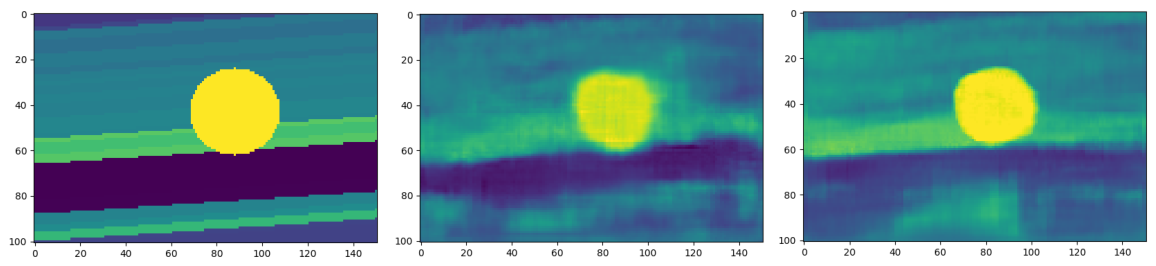
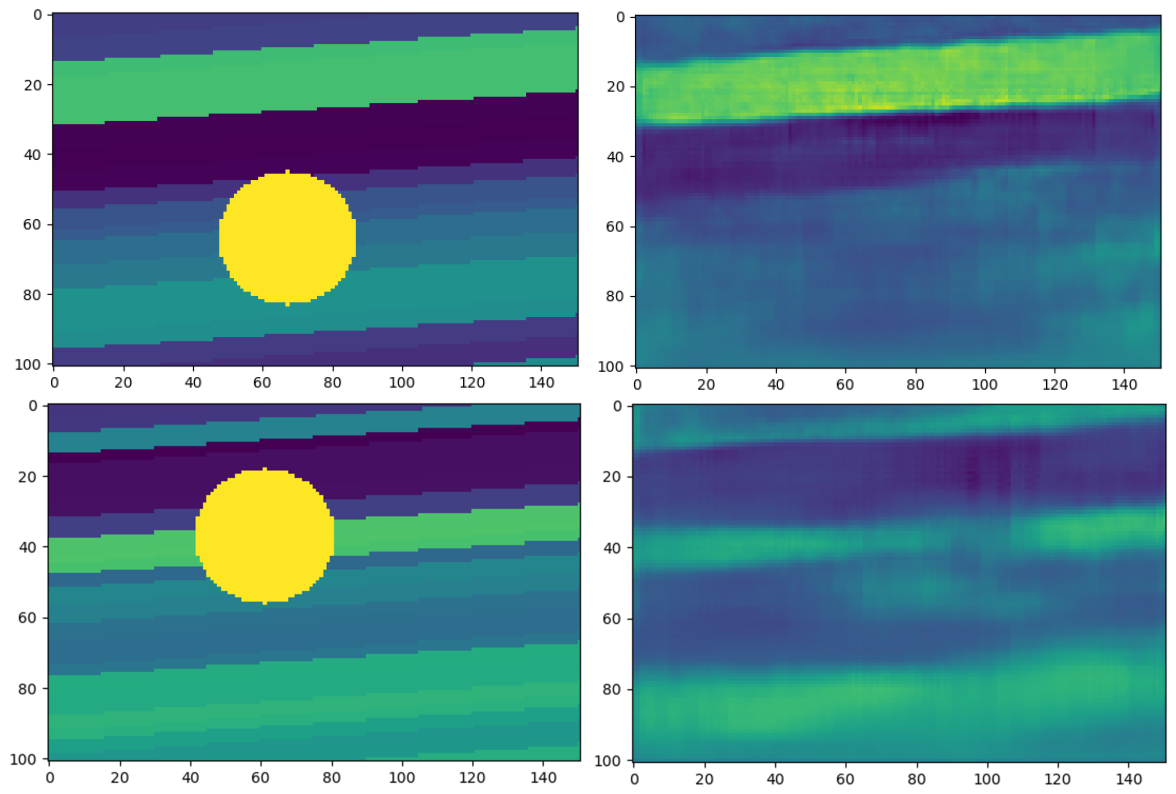
The baseline U-Net architecture demonstrates inherent difficulties in separating overlapping features due to the local nature of convolutional operations, which struggle to integrate the long-range contextual information required to distinguish between responses from the anomaly and those from the layered background. In complex datasets, this limitation manifests as a blurring of the anomaly boundaries, as can be observed in Figure 7. The network attempts to balance the reconstruction of both components, leading to a compromised solution where the anomaly is not sharply delineated.
In contrast, the DU-Net architecture, by dedicating separate branches to the anomaly and the background, allows the network to focus exclusively on the distinctive features of each component. During training, this design effectively filters out environmental features that would otherwise complicate simultaneous prediction. The result, as shown in Figure 7 (right), is precise localization of the anomalous body and a substantial reduction in the blurring caused by interference from the background response.

3.2. Characteristics of DU-Net Predictions

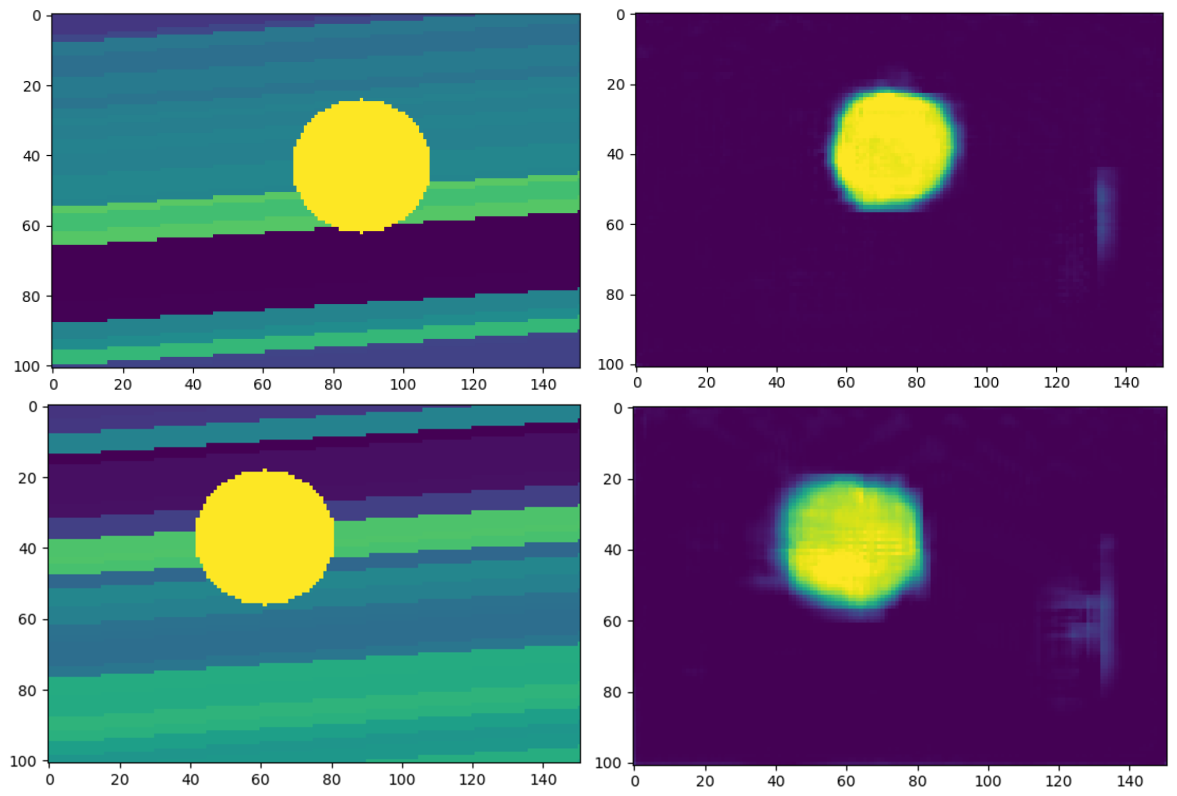
While the DU-Net architecture provides significant improvements, it also exhibits specific characteristics stemming from its dual-path design. As noted in the previous section, the separation of responses is not perfect. In the DU-Net model, this can lead to the emergence of low-amplitude “echo” anomalies (Figure 8). These artifacts arise from the network misinterpreting certain background features as weak anomaly responses. However, due to the comparatively weak amplitude of waves originating from density variations within the background, such “echo” anomalies are typically faint and can be easily removed through simple post-processing techniques or are effectively obscured by the reconstructed background model.
Regarding background reconstruction, the DU-Net predicts the layered velocity structure with high fidelity. The primary challenges lie in resolving fine layer boundaries, which is inherently limited by the resolution of the input seismograms. Additionally, a slight underestimation of background velocity is occasionally observed in the immediate vicinity of the anomaly (Figure 9). This is explained by the network’s deliberate ignoring of the anomaly’s response in the background branch; due to the overlap of wave responses, this leads to a marginal underestimation of the background contribution near the anomaly-hosting region. This trade-off is acceptable given the substantial improvement in anomaly localization.
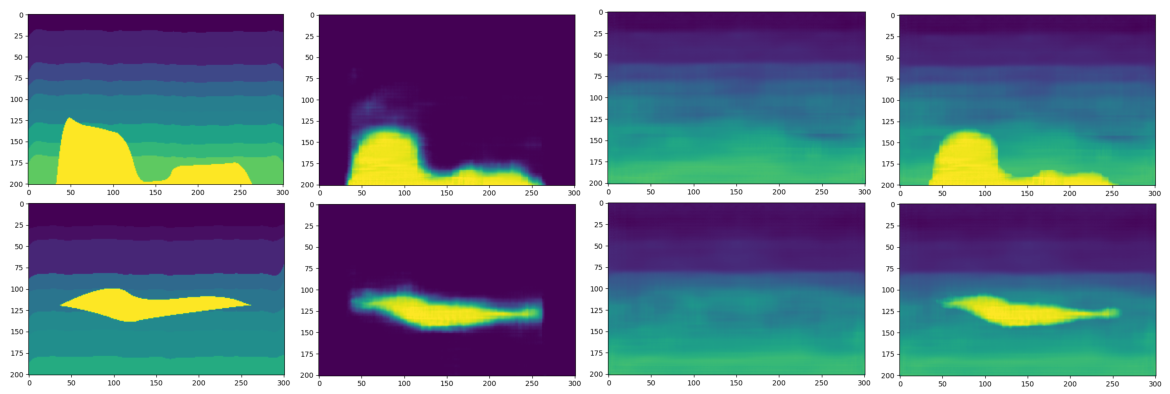
We also examine the architecture’s behavior on the more geologically complex SET_1 dataset, which features a more intricate background and an irregularly shaped anomaly. As shown in Figure 10, the background predictions remain stable, and the layered structure is clearly reconstructed. The anomaly is also predicted with good accuracy, although a slight decrease in the sharpness of the final prediction is observable. This is attributed to the upsampling process within the anomaly branch, which can introduce minor smoothing.

3.3. Hyperparameter Sensitivity Analysis

A significant portion of the DU-Net architecture’s effectiveness is derived from the weighting parameters ( a 1 , a 2 , a 3 ) in the SeismoLoss function. By adjusting these weights, training can be biased toward accurate background reconstruction, precise anomaly segmentation, or the final combined result. In extreme cases, focusing solely on the final result (e.g., setting a 3 high and a 1 , a 2 low) negates much of the DU-Net’s advantage, as the network will prioritize fitting the final image rather than learning the disentangled representations of the anomaly and background.
Table 1 presents the results of experiments on the SET_1 dataset, varying the total contribution of the background and anomaly branches relative to the final prediction. The triple ( a 1 ,   a 2 ,   a 3 ) indicates the weights for the background, anomaly, and final prediction losses, respectively. As can be seen, the optimum, as measured by both MSE and SSIM, is located near approximately equal contributions from all three terms (e.g., 0.4 ,   0.4 ,   0.2 ). Ignoring the final prediction altogether ( 0.5 ,   0.5 ,   0.0 ) results in a noticeable drop in accuracy according to the MSE metric and a slight decrease in the SSIM index. It is worth noting that the optimal balance may shift depending on the dataset characteristics; for the more complex background of SET_2, the optimum is shifted toward a greater total contribution from the background and anomaly branches (not shown in table).
The influence of the individual background and anomaly contributions near the optimum was also investigated. The results of these experiments are presented in Table 2. They suggest that the background prediction accuracy ( a 1 ) contributes significantly to the overall prediction quality, particularly in terms of the SSIM metric, which is sensitive to structural similarity. While the isolated contribution of the anomaly branch ( a 2 ) appears less critical for overall accuracy in the SET_1 dataset, its importance becomes more pronounced as the anomaly complexity increases (e.g., in datasets with multiple or irregularly shaped bodies). This highlights the value of the DU-Net’s modular design, which allows for task-specific tuning.

3.4. Comparison of Architectures

A cross-comparison with the W-net architecture [39] without dilation. This comparison framework is necessary for analyzing the results of the basic architecture without additional features that can be added to the DU-net architecture. The comparison results on the SET_1 dataset are summarized in Table 3.
Based on these results, both the W-net and DU-net architectures significantly outperform the baseline U-net in terms of the SSIM metric, while the proposed DU-net achieves the highest mean SSIM. It is worth noting that the accuracy of the W-net architecture is accompanied by a larger variance in prediction quality across the test set, whereas DU-net exhibits the most stable behavior. This suggests that DU-net provides a better balance between accuracy and robustness.
Combining advanced architectures is also possible, as they improve prediction accuracy through different principles. Exploring hybrid designs that integrate the strengths of W-net and DU-net is an interesting direction that we plan to investigate in future work.

3.5. Convergence Analysis

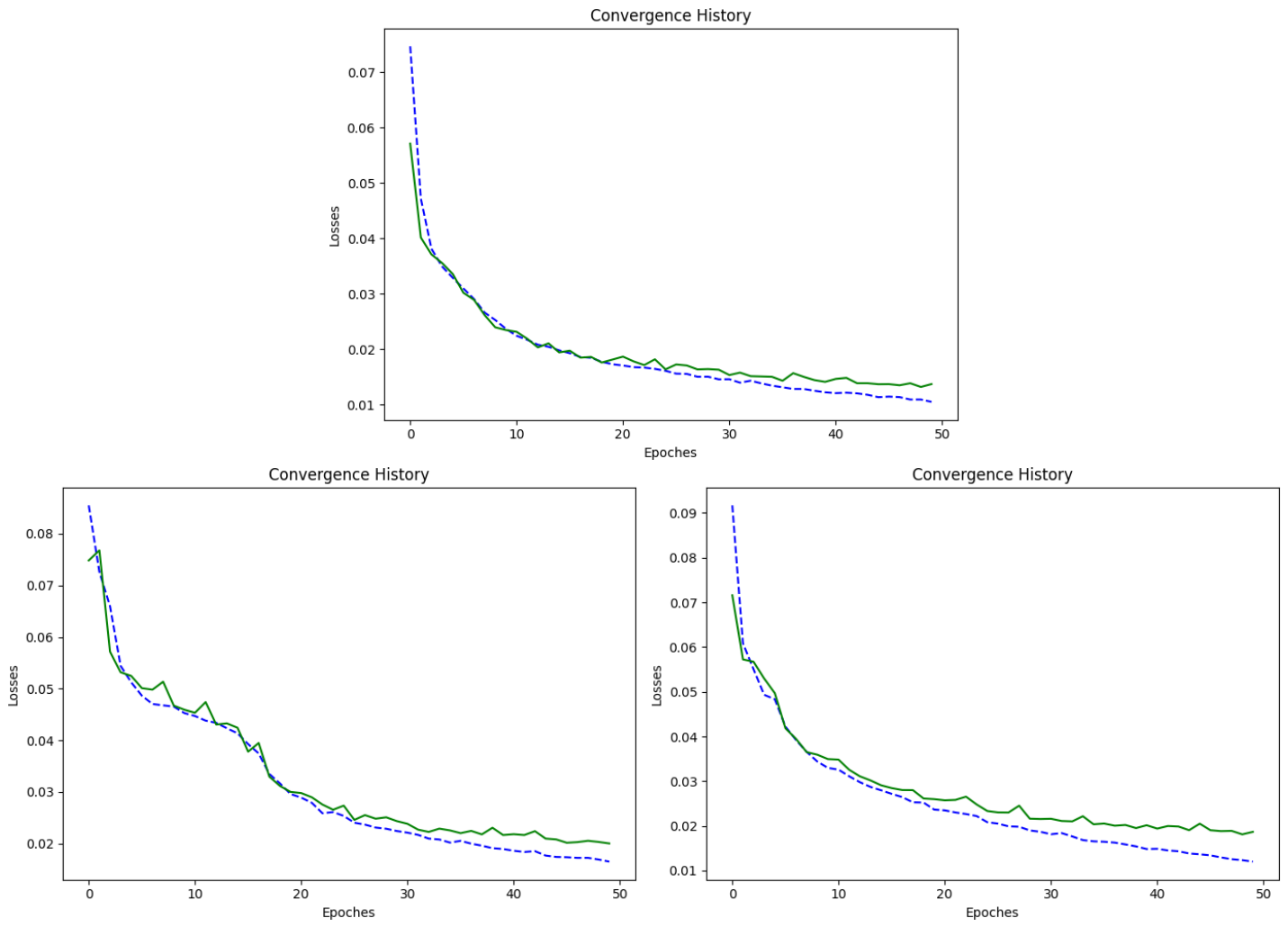
Regarding the convergence behavior of the DU-Net architecture, it demonstrates characteristics similar to the baseline U-Net but with some dependencies on the hyperparameter choice. Specifically, when the SeismoLoss weights are further from the optimum, the network tends to reach an overfitting plateau earlier in training. This phenomenon is illustrated in Figure 11.
As can be observed, when the hyperparameters are near the optimum (e.g., top plot and bottom right plot), overfitting begins around epochs 40–45. In contrast, when the parameters are suboptimal (e.g., bottom left plot), the validation error plateaus and begins to increase as early as epochs 30–35. This observation further supports the selection of hyperparameters near the equal-contribution regime as providing not only better final accuracy but also more stable and robust training dynamics.

4. Conclusions

This paper presented a novel dual-path neural network architecture, DU-Net, designed specifically for the joint reconstruction of background velocity models and the detection of high-contrast velocity anomalies from seismic data—a task of direct relevance to mineral exploration, where ore bodies often manifest as such anomalies within complex host rocks.
The proposed DU-Net employs two parallel decoder branches, one dedicated to background reconstruction and another to anomaly segmentation, followed by a simple fusion layer. This design explicitly decouples the learning of these two distinct geological components. To train this architecture, we introduced SeismoLoss, a composite loss function that independently supervises the background, anomaly, and final outputs. A key feature of this loss is the masking of the anomaly region during background loss computation, which prevents the network from wasting capacity on the anomaly when learning the background and eliminates contradictory gradient signals.
Through systematic experiments on two synthetic datasets representing different geological complexities, we demonstrated that DU-Net significantly outperforms the standard U-Net baseline. The proposed architecture achieves more precise localization of anomalous bodies and substantially reduces the blurring artifacts at anomaly boundaries caused by interference from the background response, as illustrated in Figure 7. We also identified and analyzed characteristic behaviors of the DU-Net, including the occasional appearance of low-amplitude “echo” anomalies (Figure 8) and a slight underestimation of background velocity near the anomaly (Figure 9). These effects are well-understood consequences of the architectural design and do not detract from the overall improvement in prediction quality.
Furthermore, we investigated the sensitivity of the DU-Net to the weighting parameters ( a 1 , a 2 , a 3 ) in the SeismoLoss function, as presented in Table 1 and Table 2. The results indicate that a balanced contribution from all three terms yields the best overall performance, while the optimal balance may shift depending on the relative complexity of the background and the anomaly. This tunability provides a practical mechanism for adapting the model to different exploration targets. Taken together with the cross-comparisons against other architectures, these findings highlight the importance and effectiveness of the proposed adaptation mechanism for tailoring the method to specific geological settings.
The DU-Net architecture, developed with mineral exploration applications in mind, demonstrates a clear advantage over conventional single-path approaches. By enabling the simultaneous, yet decoupled, identification of ore-related anomalies and mapping of geological layers, it provides a pathway toward more accurate and geologically meaningful velocity models from seismic data.
Several promising directions for future research emerge from this study. The most immediate and critical next step is to validate the DU-Net architecture on real field data from active mining or exploration sites, which will require addressing challenges related to data noise, source wavelet estimation, and the gap between synthetic and real-world physics. While the current work is limited to 2D, extending the DU-Net architecture to handle 3D seismic volumes is a natural progression that would enable the generation of full 3D velocity models of ore bodies, providing invaluable information for resource estimation and mine planning. The performance of the DU-Net could be further improved by integrating more advanced components into its branches, such as attention mechanisms or multi-scale feature fusion modules, to better capture fine details and long-range dependencies. The current framework detects a single class of anomaly, but an important extension would be to modify the anomaly branch for multi-class segmentation, allowing the network to differentiate between various types of mineralized zones or lithological units based on their distinct velocity signatures. In future work, we also plan to investigate hybrid designs that combine DU-Net with other advanced architectures and to evaluate its applicability to additional synthetic benchmarks and publicly available datasets, such as GeoFWI [41]. Finally, incorporating Bayesian methods or ensemble techniques to provide uncertainty estimates alongside the velocity predictions would greatly enhance the value of the output for risk-aware decision-making in exploration.
In summary, the DU-Net architecture represents a significant step forward in applying deep learning to seismic inversion for mineral exploration, offering a flexible and powerful tool for extracting high-resolution information about both ore bodies and their geological context.

Author Contributions

Conceptualization, A.V. and N.K.; Methodology, M.N., A.V. and N.K.; Software, M.N. and A.V.; Validation, M.N.; Data curation, M.N. and A.V.; Writing—original draft, M.N. and N.K.; Writing—review & editing, M.N. and N.K.; Visualization, M.N.; Supervision, A.V. and N.K.; Project administration, N.K. All authors have read and agreed to the published version of the manuscript.

Funding

The work was carried out within the framework of the state task of the NRC “Kurchatov Institute”—SRISA on the topic No. FNEF-2024-0002 “Mathematical modeling of multi-scale dynamic processes and virtual environment systems” (1023032900401-5-1.2.1).

Data Availability Statement

The synthetic data generated during this study are available from the corresponding author upon reasonable request.

Conflicts of Interest

The authors declare no conflicts of interest.

References

  1. Eaton, D.W.; Milkereit, B.; Salisbury, M. Seismic methods for deep mineral exploration: Mature technologies adapted to new targets. Lead. Edge 2003, 22, 580–585. [Google Scholar] [CrossRef]
  2. Malehmir, A.; Durrheim, R.; Bellefleur, G.; Urosevic, M.; Juhlin, C.; White, D.J.; Milkereit, B.; Campbell, G. Seismic methods in mineral exploration and mine planning: A general overview of past and present case histories and a look into the future. Geophysics 2012, 77, WC173–WC190. [Google Scholar] [CrossRef]
  3. Singh, B.; Malinowski, M. Seismic Imaging of Mineral Exploration Targets: Evaluation of Ray- vs. Wave-Equation-Based Pre-Stack Depth Migrations for Crooked 2D Profiles. Minerals 2023, 13, 264. [Google Scholar] [CrossRef]
  4. Kassymkanova, K.K.; Istekova, S.; Rysbekov, K.; Amralinova, B.; Kyrgizbayeva, G.; Soltabayeva, S.; Dossetova, G. Improving a geophysical method to determine the boundaries of ore-bearing rocks considering certain tectonic disturbances. Min. Miner. Depos. 2023, 17, 17–27. [Google Scholar] [CrossRef]
  5. Sirazhev, A.; Istekova, S.; Tolybaeva, D.; Togizov, K.; Temirkhanova, R. Methodology and Results of Detailed 3D Seismic Exploration in the Zhezkazgan Ore District. Appl. Sci. 2025, 15, 567. [Google Scholar] [CrossRef]
  6. Wilczynski, Z.; Kaslilar, A.; Malehmir, A.; Manzi, M.; Vivin, L.; Lepine, J.; Valishin, O.; Högdahl, K. Ambient noise surface-wave imaging in a hardrock environment: Implications for mineral exploration. Geophys. J. Int. 2025, 240, 571–590. [Google Scholar] [CrossRef]
  7. Bell, J.B.; Bell, R.E.; Warner, M. Cross-Hole Full-Waveform Inversion—A New Approach for Imaging Quartz Vein-Hosted Gold Deposits. Mining 2024, 5, 2. [Google Scholar] [CrossRef]
  8. Zhang, F.; Zhang, P.; Xu, Z.; Gong, X.; Han, L. Multisource Seismic Full Waveform Inversion of Metal Ore Bodies. Minerals 2021, 12, 4. [Google Scholar] [CrossRef]
  9. Singh, B.; Malinowski, M.; Gorszczyk, A.; Malehmir, A.; Buske, S.; Sito, L.; Marsden, P. 3D high-resolution seismic imaging of the iron-oxide deposits in Ludvika (Sweden) using full-waveform inversion and reverse-time migration. Solid Earth 2021, 13, 1065–1085. [Google Scholar] [CrossRef]
  10. Zhdanov, M.S. Inverse Theory and Applications in Geophysics; Elsevier: Amsterdam, The Netherlands, 2015; Volume 36. [Google Scholar]
  11. Virieux, J.; Operto, S. An overview of full-waveform inversion in exploration geophysics. Geophysics 2009, 74, WCC1–WCC26. [Google Scholar] [CrossRef]
  12. Malovichko, M.; Khokhlov, N.; Yavich, N.; Zhdanov, M. Approximate solutions of acoustic 3D integral equation and their application to seismic modeling and full-waveform inversion. J. Comput. Phys. 2017, 346, 318–339. [Google Scholar] [CrossRef]
  13. Li, M.; Yan, X.S.; Zhang, M.Z. A comprehensive review of seismic inversion based on neural networks. Earth Sci. Inform. 2023, 16, 2991–3021. [Google Scholar] [CrossRef]
  14. Li, S.; Liu, B.; Ren, Y.; Chen, Y.; Yang, S.; Wang, Y.; Jiang, P. Deep-Learning Inversion of Seismic Data. IEEE Trans. Geosci. Remote Sens. 2020, 58, R2135–R2149. [Google Scholar] [CrossRef]
  15. Liu, F.; Li, Y.X.; Su, R.; Huang, J.P.; Bai, L. Deep reparameterization for full waveform inversion: Architecture benchmarking, robust inversion, and multiphysics extension. Pet. Sci. 2025, 23, 1890–1907. [Google Scholar] [CrossRef]
  16. Ronneberger, O.; Fischer, P.; Brox, T. U-net: Convolutional networks for biomedical image segmentation. In Proceedings of the International Conference on Medical Image Computing and Computer-Assisted Intervention; Springer: Berlin/Heidelberg, Germany, 2015; pp. 234–241. [Google Scholar]
  17. Minaee, S.; Boykov, Y.; Porikli, F.; Plaza, A.; Kehtarnavaz, N.; Terzopoulos, D. Image Segmentation Using Deep Learning: A Survey. IEEE Trans. Pattern Anal. Mach. Intell. 2020, 44, 3523–3542. [Google Scholar] [CrossRef] [PubMed]
  18. Zhang, Q.; Zhang, M.; Chen, T.; Sun, Z.; Ma, Y.; Yu, B. Recent Advances in Convolutional Neural Network Acceleration. arXiv 2018, arXiv:1807.08596. [Google Scholar]
  19. Dhilleswararao, P.; Boppu, S.; Manikandan, M.; Cenkeramaddi, L.R. Efficient Hardware Architectures for Accelerating Deep Neural Networks: Survey. IEEE Access 2022, 10, 131788–131828. [Google Scholar] [CrossRef]
  20. Zhang, R.; Li, H.; Shen, Y.; Yang, J.; Li, W.; Zhao, D.; Hu, A. Deep Learning Applications in Ionospheric Modeling: Progress, Challenges, and Opportunities. Remote Sens. 2025, 17, 124. [Google Scholar] [CrossRef]
  21. Cao, P.; Zhu, Z.; Wang, Z.; Zhu, Y.; Niu, Q. Applications of graph convolutional networks in computer vision. Neural Comput. Appl. 2022, 34, 13387–13405. [Google Scholar] [CrossRef]
  22. Mahzad, M.; Bagheri, M. Predictive reconstruction of missing geological events and patterns in real-life 3D post-stack seismic images: A novel U-Net based deep learning approach. Carbonates Evaporites 2025, 40, 12. [Google Scholar] [CrossRef]
  23. Traversa, A.; Cui, Y.; Waheed, U.B.; Chen, Y. SeisReconNO: Leveraging a U-Net-Enhanced Fourier neural operator for 3D seismic reconstruction. Artif. Intell. Geosci. 2026, 7, 100212. [Google Scholar] [CrossRef]
  24. Banjade, T.P.; Zhou, C.; Chen, H.; Li, H.; Deng, J.; Zhou, F.; Adhikari, R. Seismic Random Noise Attenuation Using DARE U-Net. Remote Sens. 2024, 16, 4051. [Google Scholar] [CrossRef]
  25. Qin, D.; Li, J.; Jiang, Y.; Yin, W.; Jiang, X.; Tan, J.; Li, Q.; Zhang, J.; Wang, Y. Seismic Noise Attenuation in Imaging Gathers Using a Residual U-Net: Application to Seismic Data from the Xihu Sag. J. Ocean Univ. China 2026, 25, 433–443. [Google Scholar] [CrossRef]
  26. Cai, J.; Sun, Z.; Zhang, M.; Yan, F.; Wang, L.; Li, L. Seismic phase recognition model with low SNR based on U-net. Geomat. Nat. Hazards Risk 2025, 16, 2481992. [Google Scholar] [CrossRef]
  27. Wu, J.; Shi, Y.; Wang, W. Fault Imaging of Seismic Data Based on a Modified U-Net with Dilated Convolution. Appl. Sci. 2022, 12, 2451. [Google Scholar] [CrossRef]
  28. Cui, L.; Huang, Y.; Niu, Y.; Cui, H.; Tao, Y.; Qian, L.; Zhao, J. MS-Unet: A Multi-Scale Feature Fusion U-Net for 3D Seismic Fault Detection. Processes 2025, 13, 1976. [Google Scholar] [CrossRef]
  29. Chen, M.; Cao, H.; Jia, L. AG-Net3D: Embedding Attention Gate Into U-Net for 3D Seismic Data Fault Detection. IEEE Access 2025, 13, 139267–139274. [Google Scholar] [CrossRef]
  30. Ren, W.; Chen, X.; Zhu, X.; Bao, D.; He, X.; Zhao, Y.; Zhao, M. Fault Identification of Seismic Data Based on SEU-Net Approach. Appl. Sci. 2025, 15, 10152. [Google Scholar] [CrossRef]
  31. Tang, Y.; Wang, H.; Zhang, L.; Shan, Y. LightGEUnet: A Lightweight U-Net for 3D Seismic Fault Detection. J. Geophys. Res. Mach. Learn. Comput. 2025, 2, e2025JH000933. [Google Scholar] [CrossRef]
  32. Huang, W.; Zhang, P.; Zhao, B.; Zhang, D.; Han, L. Retrieval of Passive Seismic Virtual Source Data Under Non-Ideal Illumination Conditions Based on Enhanced U-Net. Remote Sens. 2025, 17, 1813. [Google Scholar] [CrossRef]
  33. Sun, Y.; Denel, B.; Daril, N.; Evano, L.; Williamson, P.; Araya-Polo, M. Deep learning joint inversion of seismic and electromagnetic data for salt reconstruction. In SEG International Exposition and Annual Meeting; Society of Exploration Geophysicists: Houston, TX, USA, 2020; p. D031S026R003. [Google Scholar] [CrossRef]
  34. Sutirtha Biswas, K.K.Y. A physics-informed U-Net-LSTM network for nonlinear structural response under seismic excitation. arXiv 2025, arXiv:2511.21276. [Google Scholar]
  35. Hasan, M. Seismic Velocity Inversion from Multi-Source Shot Gathers Using Deep Segmentation Networks: Benchmarking U-Net Variants and SeismoLabV3+. arXiv 2025, arXiv:2509.21331. [Google Scholar]
  36. Yang, F.; Ma, J. Deep-learning inversion: A next-generation seismic velocity model building method. Geophysics 2019, 84, R583–R599. [Google Scholar] [CrossRef]
  37. Li, Z.; Jia, J.; Lu, Z.; Jiao, J.; Yu, P. Seismic Velocity Anomalies Detection Based on a Modified U-Net Framework. Appl. Sci. 2022, 12, 7225. [Google Scholar] [CrossRef]
  38. Zhou, Y.; Han, L.; Zhang, P.; Zeng, J.; Shang, X.; Huang, W. Microseismic Data-Direct Velocity Modeling Method Based on a Modified Attention U-Net Architecture. Appl. Sci. 2023, 13, 11166. [Google Scholar] [CrossRef]
  39. Nikishin, M.; Vasyukov, A. Dilated W-net for geological inversion problems. In Proceedings of the International Conference on Mathematical Modeling and Supercomputer Technologies; Springer: Berlin/Heidelberg, Germany, 2023; pp. 266–279. [Google Scholar]
  40. Loshchilov, I.; Hutter, F. Decoupled weight decay regularization. arXiv 2017, arXiv:1711.05101. [Google Scholar]
  41. Li, C.; Shen, Y.; Fomel, S.; Waheed, U.B.; Savvaidis, A.; Chen, Y. GeoFWI: A Large Velocity Model Data Set for Benchmarking Full Waveform Inversion Using Deep Learning. J. Geophys. Res. Mach. Learn. Comput. 2026, 3, e2025JH001037. [Google Scholar] [CrossRef]
Figure 1. Examples of geological models from the set SET_1. Colors indicate P-wave velocity values.
Minerals 16 00530 g001
Figure 2. Examples of geological models from the set SET_2. Colors indicate P-wave velocity values.
Minerals 16 00530 g002
Figure 3. Examples of synthetic seismograms. Colors indicate the amplitude of the vertical component of velocity.
Minerals 16 00530 g003
Figure 4. Baseline U-Net architecture. Gray arrows denote translation, red arrows denote Max Pooling with a 2 × 2 kernel, green arrows denote Up-Convolutional Pooling with a 2 × 2 kernel, and purple ones denote Convolution with a 1 × 1 kernel. Concatenation denotes the union of tensors.
Minerals 16 00530 g004
Figure 5. Proposed DU-Net architecture. Gray arrows denote translation and orange ones denote Max function with a 1 × 1 kernel. Concatenation denotes the union of tensors.
Minerals 16 00530 g005
Figure 6. Ground truth examples for SeismoLoss. Colors indicate P-wave velocity values. (Left): Ground truth for the final prediction ( m t r u e ). (Center): Ground truth for the anomaly ( m m a s k ). (Right): Ground truth for the background ( m ˜ b a c k , with purple indicating the masked anomaly zone where the loss is not computed).
Minerals 16 00530 g006
Figure 7. Typical predictions on the SET_2 dataset. Colors indicate P-wave velocity values. (Left): ground truth model. (Center): prediction from the baseline U-Net architecture. (Right): prediction from the proposed DU-Net architecture. The DU-Net produces a sharper, more accurately localized anomaly.
Minerals 16 00530 g007
Figure 8. Influence of background complexity on the occurrence of “echo” anomalies in the SET_2 dataset. Colors indicate P-wave velocity values. Left column: original geological model (top) and anomaly mask (bottom). Right column: predicted full model (top) and predicted anomaly map (bottom). Faint “echo” anomalies are visible in the anomaly prediction.
Minerals 16 00530 g008
Figure 9. Effect of the anomaly on background reconstruction near the anomaly in the SET_2 dataset. Colors indicate P-wave velocity values. Left: original geological model (top) and anomaly mask (bottom). Right: predicted full model (top) and predicted background (bottom). A slight underestimation of background velocity is visible near the anomaly location.
Minerals 16 00530 g009
Figure 10. Examples of DU-Net behavior on the SET_1 dataset. Colors indicate P-wave velocity values. For each row (two different models): leftmost is the original geological model; subsequent images show the anomaly prediction, the background prediction, and the final combined prediction, respectively.
Minerals 16 00530 g010
Figure 11. Convergence plots for different SeismoLoss hyperparameters on the SET_1 dataset. The blue dotted line denotes training error, and the solid green line denotes validation error. (Top): parameters (0.4, 0.2, 0.4). (Bottom left): (0.2, 0.4, 0.4). (Bottom right): (0.4, 0.4, 0.2).
Minerals 16 00530 g011
Table 1. Results of training DU-Net with varying total contributions of background and anomaly branches on the SET_1 dataset. The tuple ( a 1 , a 2 , a 3 ) represents the weights for background, anomaly, and final prediction errors in the SeismoLoss function. MSE (lower is better) and SSIM (higher is better) metrics are reported on the test set.
Params ( a 1 ,   a 2 ,   a 3 )(0.2, 0.2, 0.6)(0.3, 0.3, 0.4)(0.4, 0.4, 0.2)(0.5, 0.5, 0.0)
MSEmean0.0105560.0123770.0125650.013844
std0.0015560.0023490.0020640.002120
min0.0076770.0091530.0080540.010987
25%0.0096460.0108070.0112470.012215
50%0.0104990.0116580.0126690.013636
75%0.0110990.0141950.0139750.015576
max0.0138430.0182080.0168300.018203
SSIMmean0.7862260.7909880.7978730.799835
std0.0103910.0101420.0109210.013278
min0.7623490.7601800.7715210.767550
25%0.7821610.7878200.7933670.795582
50%0.7875730.7927630.7991600.803113
75%0.7930270.7964040.8040220.808789
max0.8038780.8076360.8182540.819693
Table 2. Results of training DU-Net with varying individual contributions of background and anomaly branches near the optimum on the SET_1 dataset. The tuple ( a 1 , a 2 , a 3 ) represents the weights in the SeismoLoss function.
Params ( a 1 , a 2 , a 3 )(0.2, 0.4, 0.4)(0.4, 0.4, 0.2)(0.4, 0.2, 0.4)
MSEmean0.0106950.0125650.011097
std0.0020380.0020640.001580
min0.0080690.0080540.008221
max0.0158620.0168300.014432
SSIMmean0.7947010.7978730.801254
std0.0120710.0109210.008393
min0.7666710.7715210.783392
max0.8141390.8182540.817821
Table 3. Results of training various architectures on the SET_1 dataset. For DU-net, the SeismoLoss weights are set to ( 0.4 , 0.2 , 0.4 ) .
Params ( a 1 , a 2 , a 3 )U-NetW-NetDU-Net
MSEmean0.0101640.0102570.011097
std0.0019460.0020150.001580
min0.0074550.0066300.008221
max0.0146380.0152050.014432
SSIMmean0.7825210.7986590.801254
std0.0115260.0151570.008393
min0.7519640.7718230.783392
max0.7978950.8287280.817821
Disclaimer/Publisher’s Note: The statements, opinions and data contained in all publications are solely those of the individual author(s) and contributor(s) and not of MDPI and/or the editor(s). MDPI and/or the editor(s) disclaim responsibility for any injury to people or property resulting from any ideas, methods, instructions or products referred to in the content.