
Article

Multi-Stage Origins of Dolomite in the Lower Permian Fengcheng Formation and Its Implication for pH Fluctuations in the Alkaline Lake

1
School of Earth and Space Sciences, Peking University, Beijing 100871, China
2
Petroleum Exploration and Development Institute, Xinjiang Oilfield Company, PetroChina, Karamay 834000, China
3
China ZhenHua Oil Co., Ltd., Beijing 100037, China
*
Author to whom correspondence should be addressed.
Minerals 2026, 16(5), 519; https://doi.org/10.3390/min16050519
Submission received: 14 February 2026 / Revised: 22 April 2026 / Accepted: 12 May 2026 / Published: 14 May 2026
(This article belongs to the Special Issue Advances in Carbonate Sedimentology: From Deposition to Diagenesis)

Abstract

The Fengcheng Formation in the Mahu Sag of the Junggar Basin represents one of the oldest and most significant alkaline lacustrine systems, hosting abundant dolomite that serves as a key unconventional reservoir. However, the formation mechanism of dolomite remains unclear. This study integrates detailed petrography, geochemistry and cyclostratigraphy to elucidate the origin and distribution of dolomite. Petrographic characteristics indicate a penecontemporaneous origin for the dolomite, with no apparent hydrothermal influence. Mineralogical features exhibit a multi-zonation structure of dolomite, aligning with in situ Fe content, jointly indicating that a multi-stage formation process of dolomite from core to rim. Microbial methanogenesis likely played an important role in the dolomite formation. Spatially, dolomite is enriched in the transition zone but scarce in the depocenter zone, where sodium carbonate prevails. This distribution is primarily controlled by pH differentiation between the transition zone and the depocenter zone of the Mahu Sag. In the transition zone, orbitally driven wet–dry cycles regulated the lake-level change, which, in turn, controlled pH fluctuation, as revealed by the silica precipitation during humid phases and dissolution during arid intervals. In the depocenter zone, lake water remained at a high-pH state, which was unfavorable for dolomite formation. These findings highlight that pH dynamics, linked to orbital climate cycles, played a critical role in governing dolomite formation and distribution in this ancient alkaline lake, providing new insights for the formation of dolomite in alkaline lacustrine environments.

1. Introduction

Lacustrine dolomite has attracted broad interest over the past two decades for its scientific and economic importance in both conventional and unconventional hydrocarbon systems. In China, such dolomite deposits are key reservoirs in multiple basins, including the Junggar, Qaidam, Songliao, and Bohai Bay Basins [1]. Dolomite content is a critical control on unconventional reservoir quality, influencing both porosity and brittleness [2]. Dolomite formation has also been a long-standing focus in sedimentology and mineralogy, with research spanning over two centuries and producing diverse genetic models [3]. Although volumetrically less significant than marine dolomite, lacustrine settings, with their dynamic hydrochemical conditions, provide unique natural laboratories for investigating dolomite formation at the Earth’s surface.
Globally, high salinity and alkalinity, together with microbial activity, are widely recognized as key factors favoring dolomite precipitation in modern saline lakes [4,5,6,7,8]. In the modern alkaline Deep Springs Lake, fine-grained dolomite is interpreted to precipitate directly from highly alkaline brine in the well-aerated water column, a process attributed to high carbonate alkalinity rather than to microbial alkalinity production or pH increase [9]. By comparison, dolomite in the Eocene Green River Formation likely formed through evaporation concentration in alkaline waters [10,11]. Alternatively, it may have been mediated by microbial activity [12], wherein the degradation of organic matter under low-oxygen conditions created alkaline waters that promoted dolomite precipitation. Genetically, ancient dolomite-rich lakes fall into four categories: non-alkaline brackish, non-alkaline saline, alkaline (pH > 9) brackish, and alkaline saline lakes [1]. In all these systems, early dolomite (primary and early diagenetic) formation consistently results from a significant increase in Mg2+ concentration and alkalinity within the bulk lake water and/or porewater. In alkaline water systems, dolomite can be primary in origin [1]. Consequently, alkaline lakes represent a unique environment that integrates both physicochemical and microbial pathways for dolomite formation.
The Fengcheng Formation in the Mahu Sag represents a typical ancient alkaline lacustrine deposit and is considered one of the oldest and highest-quality alkaline source rocks [13]. In addition to abundant alkaline minerals [14], it also contains significant amounts of dolomite. In this study, we apply integrated petrological observation methods to provide a detailed petrological and mineralogical description of dolomite in the Fengcheng Formation, thereby constraining its formation mechanism. By leveraging the XRD analysis of chert and its paragenesis with dolomite, we also assess potential pH fluctuations and their role in controlling dolomite distribution.

2. Geological Background

The Junggar Basin, located in northern Xinjiang, China, is a large-scale petroliferous basin situated in the southern part of the Paleo-Asian Ocean tectonic domain and constitutes a significant component of the Central Asian Orogenic Belt [15,16]. Enclosed by the Zhayier and Hala’alate Mountains on its northwestern margin, the Altay and Kelameili Mountains on its northeastern margin, and the North Tianshan and Bogda Mountains on its southern margin (Figure 1A), the basin covers an area of approximately 134,000 km2. Following the subduction of the Paleo-Asian Ocean, the Junggar Basin completed its amalgamation by the Late Carboniferous, with the peripheral orogenic processes culminating in the formation of the East and West Junggar bounding mountains and the North Tianshan during the Late Paleozoic [17,18]. The relative subsidence of the Junggar Basin, bounded by the uplift of these surrounding ranges, led to its formation. During the Permian the basin entered a post-collisional extensional stage, where N-S compressive forces generated major NW-trending uplifts and sags [16].
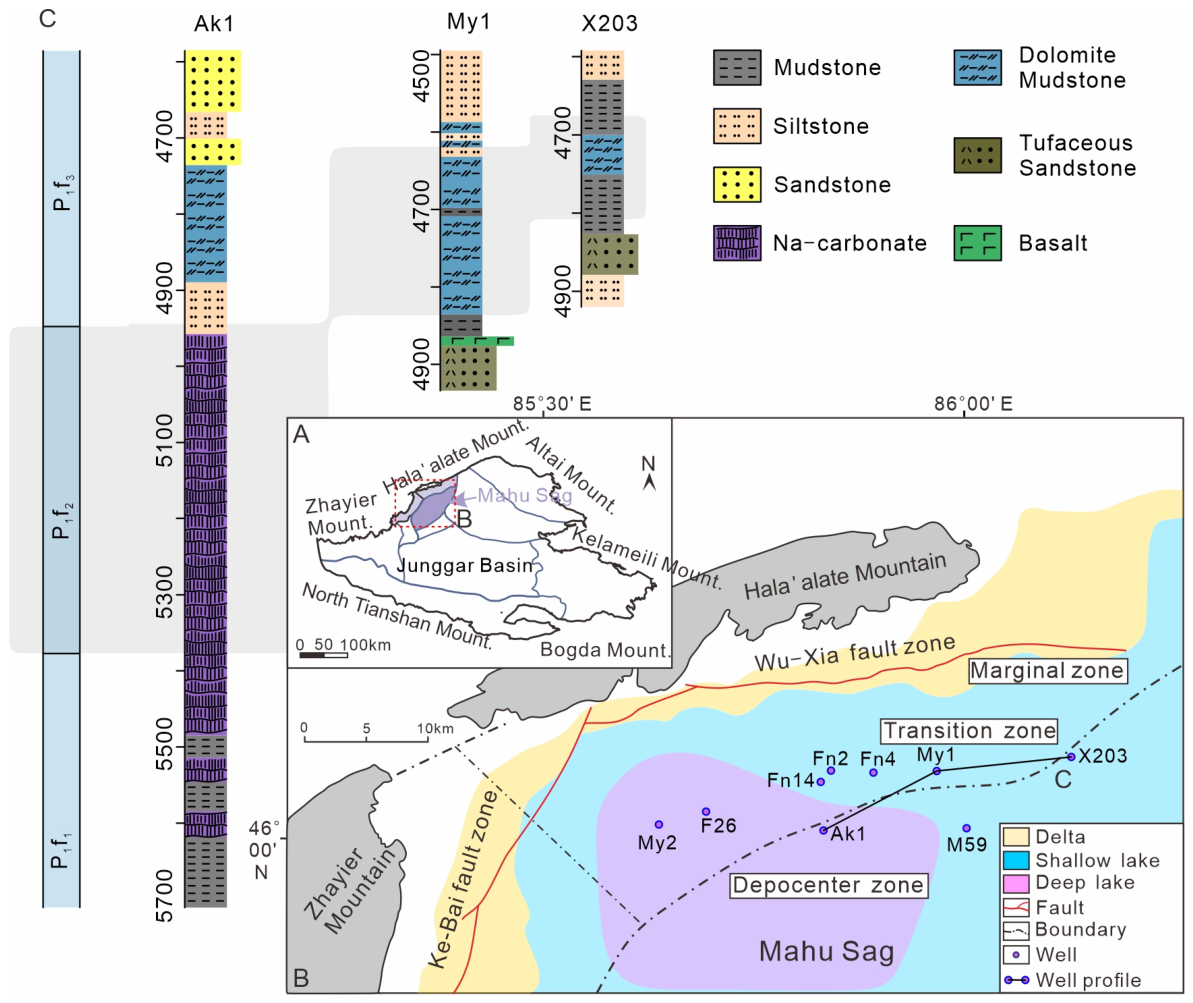
The Lower Permian Fengcheng Formation in the Mahu Sag contains high-quality lacustrine source rocks. The Fengcheng Formation was deposited in a post-orogenic extensional fault depression that developed on Paleozoic basement in the western Junggar Basin [19]. It is bounded by the Kebai–Wuxia fault zone to the northwest, and the seismic profile shows that the Fengcheng Formation exhibits a wedge-shaped structure with increasing thickness from the eastern edge to the boundary fault (Figure 1B) [20,21]. The Fengcheng Formation source rocks are characterized by abundant alkaline minerals such as wegscheiderite [Na2CO3·3NaHCO3], nahcolite [NaHCO3], trona [Na2CO3·NaHCO3·2H2O], northupite [Na2CO3·MgCO3·NaCl], and shortite [Na2CO3·2CaCO3] [14,22]. Laterally, the Mahu Sag can be subdivided into three zones (Figure 1B): (a) a depocenter zone dominated by sodium carbonate deposits; (b) a transition zone characterized by dolomitic deposits; and (c) a marginal zone composed mainly of tuffaceous and calcareous rocks [13,23]. Vertically, the Fengcheng Formation is divided into three members. The lower member (P1f1) consists primarily of coarse-grained clastic rocks, intermediate-mafic volcanic rocks, and intercalated tuff layers. The middle member (P1f2) is mainly composed of organic-rich mudstone and dolomitic mudstone, interbedded with alkaline minerals. The upper member (P1f3) consists of interbedded mudstone and dolomitic mudstone in its lower part and transitions to terrigenous clastic sedimentary rocks in its upper part (Figure 1C) [13,14,23].
Figure 1. (A) Geographic location of Mahu Sag; (B) tectonic and sedimentary background of the Fengcheng Formation in Mahu Sag and distribution of wells, after Tang et al. (2022) [24]. (C) Stratigraphy characteristics of the Fengcheng Formation, see the profile in (B).
Minerals 16 00519 g001

3. Materials and Methods

3.1. Materials

Core samples of wells My1, X203, Fn14, and M59 and logging data of well My1 were obtained from the Exploration and Development Research Institute, Xinjiang, CNPC. Core samples were made into thin sections for petrographic and mineralogical observation. The natural gamma-ray (GR) logging data is an effective tool for cyclostratigraphy analysis. The GR intensity of sediments reflects the content of K, U, and Th elements. Higher GR values are typically associated with clay-rich sediments, whereas lower GR values correspond to sandstone- or carbonate-rich lithologies [25]. As clay minerals and organic-rich sediments in lake basins are sensitive to environmental and climatic changes, GR intensity can serve as a reliable archive of paleoclimatic signals [26].

3.2. Scanning Electron Microscope (SEM) and Cathodoluminescence Analysis (CL)

Thin section samples were observed by an FEI Quanta 650 FEG SEM (thermos Fisher Scientific Inc., Hillsboro, OR, USA) equipped with an Oxford INCA Synergy Energy-Dispersive Spectroscopy (EDS) instrument (Oxford Instrument plc, Abingdon, UK) at the Key Laboratory of Orogenic Belts and Crustal Evolution, School of Earth and Space Sciences, Peking University, China. Imaging and preliminary detection of mineral phases were performed on polished thin section surfaces with a carbon coating under the following conditions: 10–15 kV beam voltage, 5 μm spot size, and vacuum < 10−3 Pa. Microphotographs were obtained with a backscattered electron (BSE) detector in chemical gradient mode. Cathodoluminescence of dolomite was observed at the Key Laboratory of Orogenic Belts and Crustal Evolution, School of Earth and Space Sciences, Peking University, China, equipped with Carl Zeiss Axioskop 40 (Carl Zeiss AG, Oberkochen, Germany) and Nikon transmission/reflection optical microscope + camera (photography) systems (Nikon Corporation, Tokyo, Japan), a THMSG 600 cold/hot table and a TS1500 high-temperature hot table produced by Linkam in the Salfords, UK.

3.3. Electron Microprobe Analyzer (EPMA)

In situ major element content of dolomite was measured by Raman spectroscopy and JEOL 8100/8230 electron microprobe analyzer (EMPA, JEOL Ltd., Akishima, Tokyo, Japan) at the Key Laboratory of Orogenic Belts and Crustal Evolution, MOE, Peking University, as described by Li, et al. [27]. Both EMPAs were equipped with four spectrometers (CH1-CH4). The PETJ crystal (CH1) was used for K, Ca and Ti; the two TAP crystals (CH2, CH4) were used for Na, Si, Mg and Al; and the LIFH crystal (CH3) was used for Cr, Mn, Fe and Ni. For all elements, the Kα line was utilized. The acceleration voltage and the beam current were 15 kV and 10 nA, respectively. The beam was set to diameters of 1–2 μm, and counting times were 10–15 s. The SPI 53 minerals standard (U.S.) was utilized for the quantitative analysis [27]. At the final calibration stage, the PRZ correction was performed. Compositional X-ray maps and line scans were completed with an OXFORD 51-XMS1033 EDS analyzer (Oxford Instrument plc, Abingdon, UK) connected to a JEOL 8230 microprobe, operated at the same conditions (15 kV, 10 nA).

3.4. Cyclostratigraphy Analysis

Quantitative cyclostratigraphy analysis is needed to acquire astronomical signals from spectral noise. In this study, the software Acycle (v2.8) is used for the identification of potential astronomical signals in stratigraphic data series [28], involving the following major steps: (1) Power spectral analysis is used to identify dominant frequencies. (2) Correlation coefficient (COCO) analysis is used to determine the optimal sedimentation rate. (3) A filtering tool is applied to isolate specific frequency bands. Then, based on the wavelengths (stratigraphic thicknesses, which are the reciprocal of frequency) of prominent cycles in a stratigraphic data series, and an assumed sedimentation rate, the duration of each high-significant cycle is calculated. (4) Astronomical tuning is applied to transform original data in the depth domain to tuned data in the time domain.

4. Results

4.1. Petrographic Characteristics of Dolomite

Dolomite in the transition zone of the Mahu Sag primarily occurs as isolated crystals disseminated within the matrix (Figure 2A), or as aggregates in either lenticular (Figure 2B) or laminated (Figure 2C) forms. Laminated texture of dolomite-bearing rock exhibits well-preserved, undisturbed alternating organic-rich, tuff-rich, and calcite-rich laminae, retaining primary sedimentary structures (Figure 2C). Lenticular aggregates show evidence of soft-sediment deformation structures (Figure 2B). Dolomite crystals predominantly occur as spherical (Figure 2A,C,G), euhedral rhombic (Figure 2D,E,H), and irregular forms (Figure 2B,F), hosted within a muddy to tuffaceous matrix. Some coarse-grain dolomites show a cloudy core and clear rim structure, but with an outermost cloudy rim (Figure 2E). The grain size of dolomite in the Fengcheng Formation ranges from 20 to 400 μm, with a dominant concentration between 40 and 100 μm. In general, dolomite mainly coexists with calcite (Figure 2C,G), reedmergnerite (Figure 2F), and chert (Figure 2H,I). In Figure 2H, coarser dolomite crystals occur adjacent to chert, whereas some dolomite crystals are present within the chert. In Figure 2I, dolomite-bearing rocks exhibit interlayering of chert- and albite-rich layers, with evenly sized dolomite crystals distributed throughout the matrix and both layers.
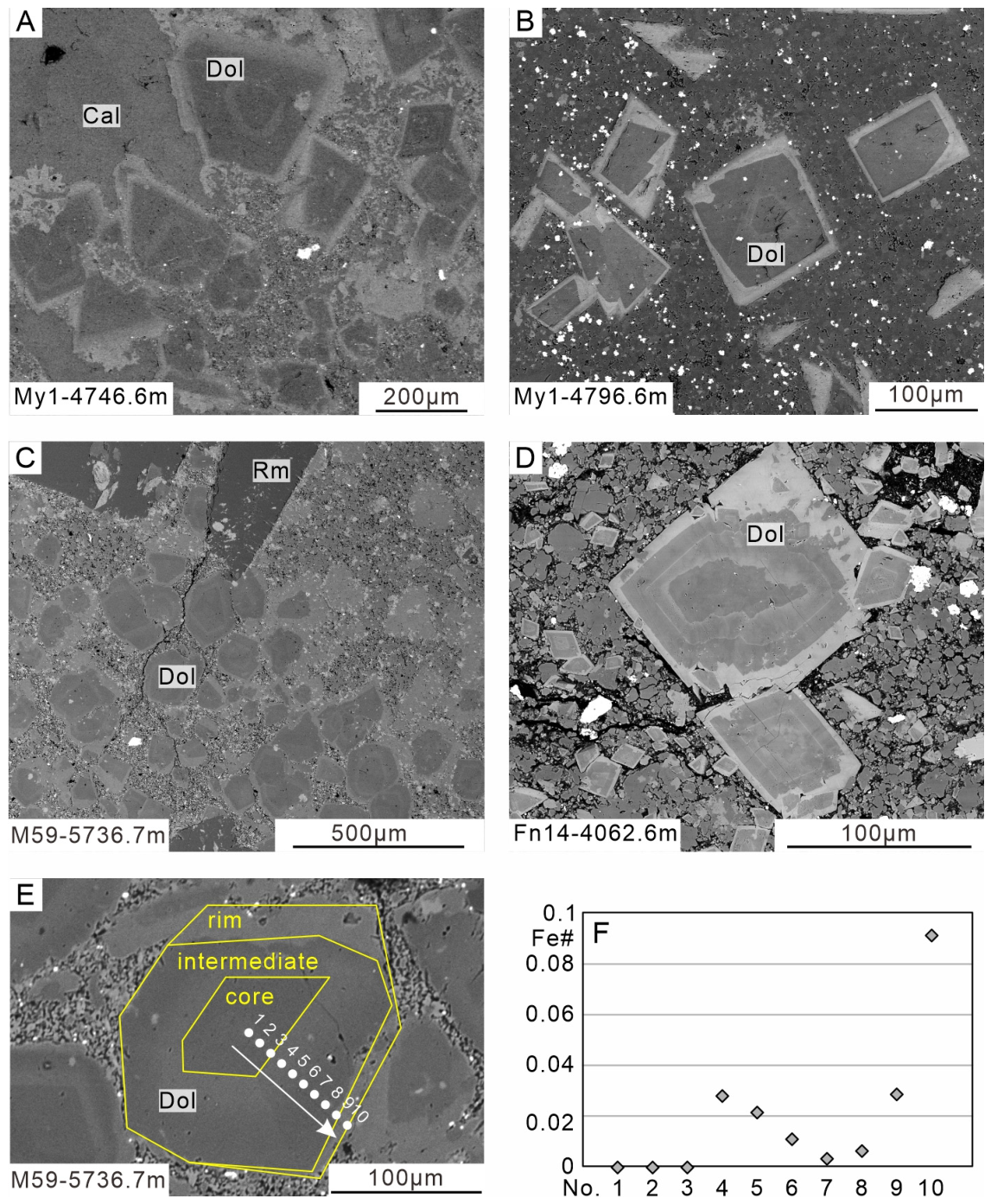
Scanning electron microscope (SEM) observations reveal that dolomite in the transition zone of the Fengcheng Formation commonly exhibits distinct zonation (Figure 3), characterized by a dolomite core and an Fe-enriched rim, with significant variations in the thickness of the Fe-enriched rim. Some dolomite crystals in the transition zone exhibit exceptionally complex zonation under SEM imaging, displaying three or more distinct growth zones in backscattered electron (BSE) images. The most common pattern is a three-layer structure comprising a core, an intermediate zone, and a rim (Figure 3A–E). The core is predominantly composed of dolomite and appears as euhedral rhombs (Figure 3A,B) or irregular forms (Figure 3D). Based on electron microprobe data, the zonation observed in the dolomite is attributed to variations in iron content. The dolomite in the Fengcheng Formation typically exhibits a Fe-free core. Surrounding the core is a zone with variable iron content, showing either gradual or abrupt changes from the interior outward (Figure 3E,F). This intermediate zone has a relatively low iron content, with Fe# generally not exceeding 0.05. The outermost part is an iron-rich rim, with Fe# commonly exceeding 0.1 (Table 1).
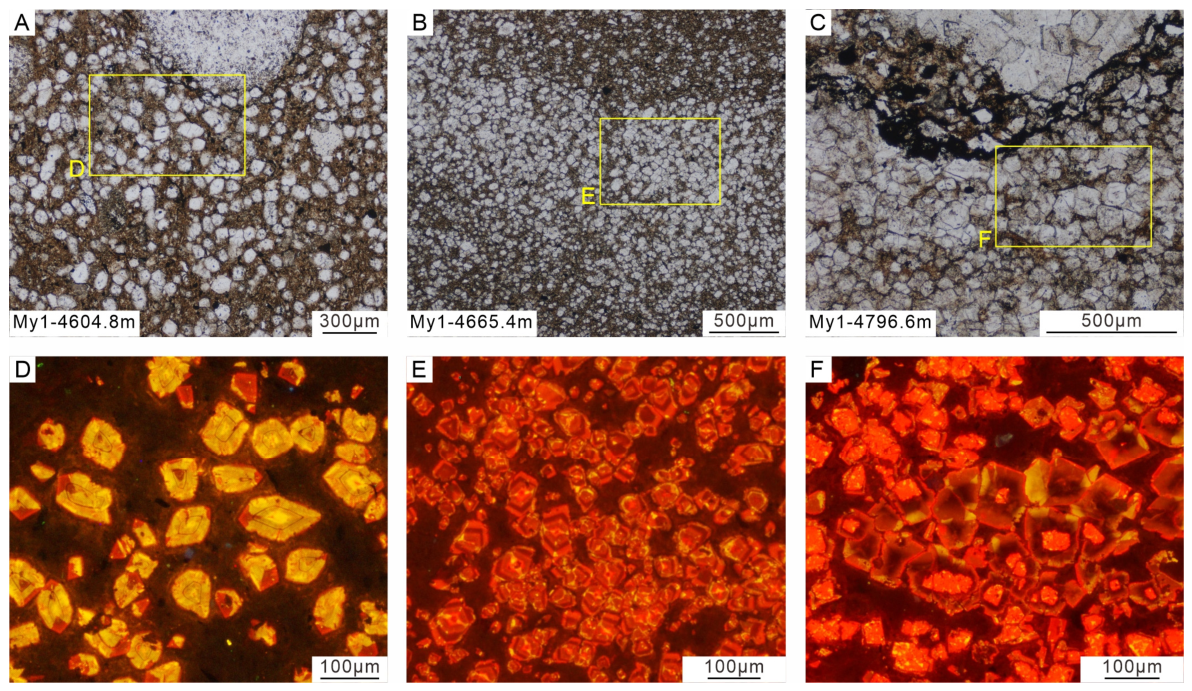
Dolomite in the transition zone exhibits pronounced cathodoluminescence (CL) characteristics (Figure 4). CL imaging reveals that dolomite crystals display intense luminescence, consisting of a luminescent core and a non-luminescent rim. This pattern aligns with the grayscale zonation observed in SEM images and is related to variations in iron content within the zones, as Fe2+ strongly inhibits luminescence (the quenching effect of iron). Smaller dolomite grains (around 50 μm) show relatively uniform luminescence, with cores emitting yellow to orange light (Figure 4D). In contrast, the luminescence in larger grains (50–200 μm) is more complex: some coarse-grained dolomite crystals display oscillatory (Figure 4E) or gradually varied (Figure 4F) cathodoluminescence zones.

4.2. Results of Cyclostratigraphy Analysis

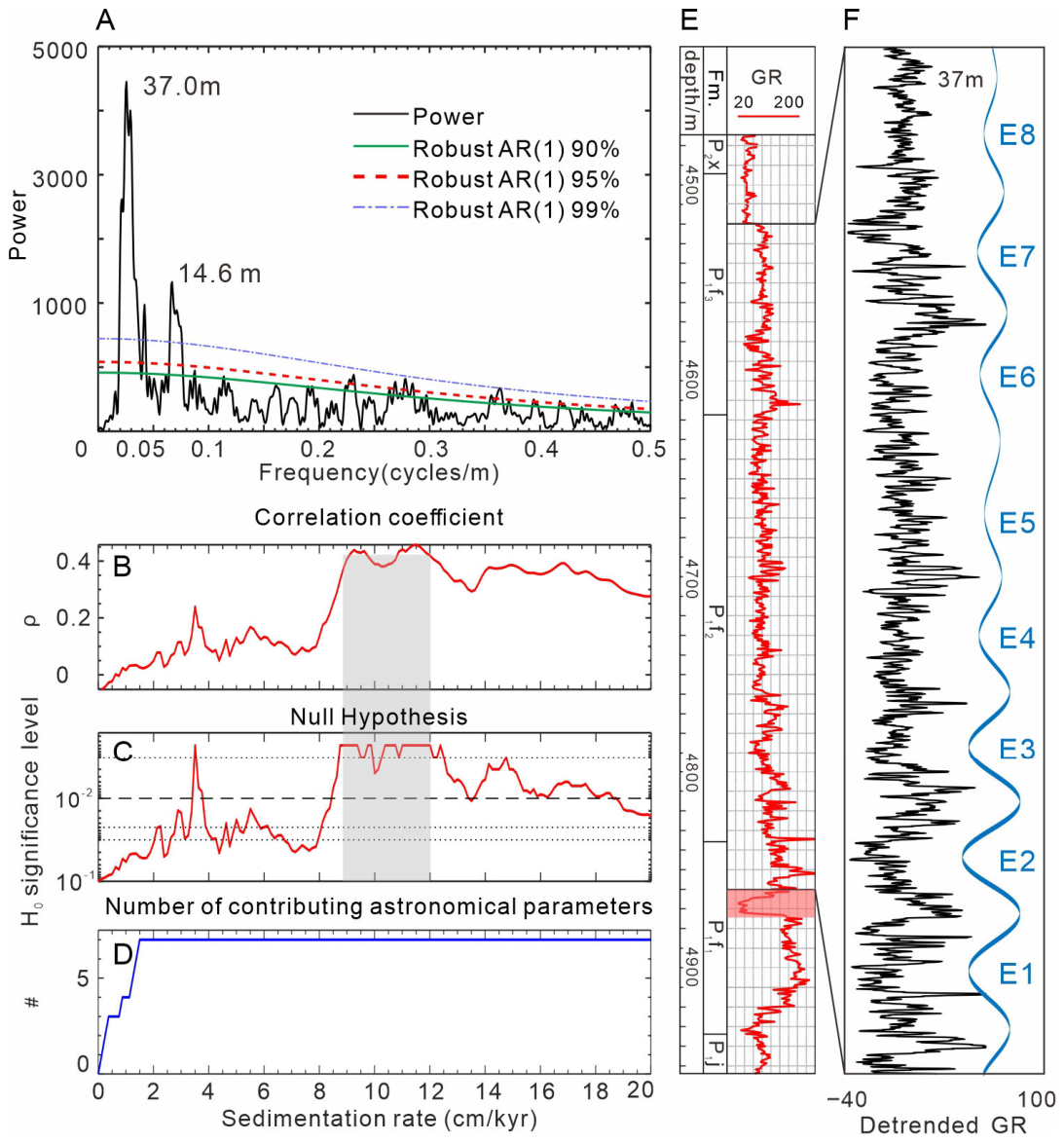
Spectral analysis of the untuned GR series of the well My1 from the Fengcheng Formation revealed significant peaks (>99%) at 37.0 m and 14.6 m (Figure 5A). Correlation coefficient (COCO) analysis of the GR series resulted in a consistent optimal sedimentation rate ranging from 9 to 12 cm/kyr, with a null hypothesis significant level lower than 0.01, and a number of contributing astronomical parameters equal to 7 (Figure 5B–D). We adopted the optimal sedimentation rates of 9–12 cm/kyr to calculate the durations of each high-significance cycle from the spectral analysis results, which yielded tentative durations of 308–411 kyr for a ~37.0 m cycle. According to the astronomical model proposed by Berger et al. (1992), the astronomical targets for the astronomical cycles during the ~300 Ma period are 1/405 (E), 1/100 (e), 1/42.9 (o1), 1/34.2 (o2), 1/20.7 (p1), and 1/17.4 (p2) [29]. Numerical models indicate that the 405 kyr long-eccentricity cycle was stable through the early Mesozoic geological time [30,31]. Geological records from the Paleozoic and Proterozoic also confirmed the stability of long eccentricity [32,33]. In the present paper, we tuned the ~37.0 m cycles extracted from the eGR series by fixing their duration to 405 kyr long-eccentricity cycles (Figure 5F).

5. Discussion

5.1. Petrographic Implication for Dolomite Origin

The petrological and mineralogical characteristics of dolomite-bearing rocks usually provide important constraints for genesis explanation. Dolomite in the transition zone of the Fengcheng Formation is commonly dispersed in the mudstone matrix as isolated crystals (Figure 2A,D,G), or occurs as aggregates in laminated- or lenticular-shaped formations (Figure 2B,C,I). In samples from well X203, dolomite occurs in association with calcite within a well-preserved laminated structure, characterized by the periodic alternation of feldspar-rich, calcite-rich, and clay-rich lamellae at the millimeter scale. Dolomite crystals are dispersed and distributed within the clay-rich lamellae, in a “floating” manner (Figure 2C), indicating that they formed in a sedimentary framework supported by the matrix. In some samples from well My1, dolomite crystals also exhibit laminated structures, and some lens-shaped dolomite aggregates show soft sediment deformation characteristics (Figure 2B), indicating that they formed during the penecontemporaneous stage, before solidification of the rock. The petrological characteristics of the dolomite in the Fengcheng Formation are highly consistent with those of classic ancient evaporative environment dolomite or dolomite formed during the shallow burial stage [3]. Studies have shown that dolomite that has undergone extensive recrystallization or significant hydrothermal alteration typically exhibits a densely packed mosaic structure [34,35,36]. Some dolomite crystals in the Fengcheng Formation exhibit spherical or irregular shapes, indicating that there is no apparent hydrothermal alteration.
SEM and CL images show that the dolomite in the transition zone of the Fengcheng Formation had developed a multi-zonation structure (Figure 3 and Figure 4). Combined with Fe# data from EPMA analysis (Figure 3E,F and Table 1), we consider that dolomite in the Fengcheng Formation experienced a multi-stage formation process from core to rim, indicating the variation in sedimentary-diagenetic environments. In lakes with insignificant sulfate, methanogenic activities during the early stages of diagenesis can lead to locally fluctuating oxygen conditions, thereby facilitating the precipitation of zoned dolomite rhombs [37]. This mechanism well explains the zoned luminescence of isolated dispersed dolomite in the Fengcheng Formation, as well as its much larger crystal size (>20 μm) compared to those reported in other non-alkaline lake deposits (<10 μm) [1]. Similarly, large isolated dolomite crystals (20–70 μm) are also the dominant dolomite type in the saline alkaline lacustrine Wilkins Peak Member of the Green River Formation, and their size is significantly larger than the dolomite crystals (5–10 μm) in the overlying meromictic brackish lacustrine Laney Member [5]. These large dolomite crystals of the Wilkins Peak Member were interpreted to have undergone overgrowth on tiny primary nuclei [5].
In summary, the dolomite in the Fengcheng Formation of the Mahu Sag is not a product of a single origin. Petrological characteristic reveals its potential penecontemporaneous origin. The multi-zonation structure of dolomite and corresponding Fe content variation jointly indicate a multi-stage formation process of dolomite from core to rim. Both individual crystal and diverse dolomite occurrences record a multi-stage sedimentary-diagenetic process.

5.2. Controls on Dolomite Formation

5.2.1. Potential Methanogenesis

Dolomites in the Fengcheng Formation exhibit distinct variation in Fe content in the zoned structure (Figure 3E,F). The variations in the content of trace elements, particularly Sr, Na, Fe, and Mn, are often utilized to constrain the reaction conditions and fluid properties during the formation process of dolomite [38]. The content of Fe is mainly controlled by microbial metabolic activities [38] and hydrothermal fluids [39]. During the microbial respiration process, Fe (III) and Mn (IV, III) have been incorporated in their divalent state in dolomite by the partial substitution of Mg2+ and minor Ca2+ [40]. Specifically, in the suboxic zone, iron-reducing bacteria dominate the reduction of Fe (III), resulting in a slight enrichment of iron in the early dolomite. In the sulfate reduction zone, H2S will preferentially combine with Fe2+ to form pyrite. Even if the total iron content is high, it will lead to a relative iron-poor condition of the co-precipitated dolomite. In a deeper burial depth, it has been observed that dolomite overgrowths formed under the influence of methanogenic processes are relatively enriched in Fe, like the Miocene Monterey Formation of California [41,42]. Fe content from the core to the rim of dolomite in the Fengcheng Formation shows an increasing but fluctuating trend. As the burial depth increases, the content of Fe in multi-generation dolomite often shows an increasing trend [3]. The fluctuating trend of Fe content of dolomite from the core to the rim is consistent with the results of different microbial activities: slight enrichment of Fe is related to the iron-reducing bacteria in the suboxic zone, and the distinct enrichment in the rim is related to the methanogenesis.
Previous studies have reported the carbon and oxygen isotopic data of dolomite in the Fengcheng Formation. Lu et al. (2015) reported that dolomite mudstone and argillaceous dolomite exhibit positive δ13CVPDB ranging from −1‰ to 5.2‰ [43]. Yu et al. (2019) reported the positive δ13CVPDB of fine crystalline dolomites ranging from 2‰ to 8‰ [44]. Generally, extremely heavy δ13Ccarb values (usually 5‰ to 15‰) are indicative of heterotrophic methanogenic archaea, which convert biomass into isotopically light CH4 and isotopically enriched CO2 [38,45,46]. Dolomitic samples from the California Gulf exhibit δ13CVPDB values from +3 to +14‰ [47], and dolomitic samples from the Ocean Drilling Program (ODP) in the Peru Margin exhibit δ13CVPDB up to +15‰ [48], representing the active methanogenesis zones in shallow burial environments. Previous studies reported intensive methanogenesis activities in the Fengcheng Formation [49], as evidenced by carbonate δ13C (δ13Ccarb) values of >5‰, +0.6‰ offsets between pristane δ13C (δ13CPr) and phytane δ13C (δ13CPh) values, a 3β-methylhopane index of 9.5% ± 3.0%, and highly negative δ13C values of hopanes (−44‰ to −61‰). Guo et al. (2023) proposed that dolomite in the Fengcheng Formation is formed under the influence of methanogenesis [50], as evidenced by positive δ13C values of dolomite, which range from +1 to +7‰. Therefore, positive δ13C of dolomites in the Fengcheng Formation may support a methanogenesis origin. However, δ18OVPDB values of dolomite exhibit a decreasing trend from 0 to −14‰, indicating the increase in burial depth or the effects of hydrothermal fluids, thus supporting multiple origins from penecontemporaneous dolomitization, burial dolomitization, to hydrothermal dolomitization [43,44].
Therefore, based on the integrated evidence of Fe content variation and carbon and oxygen isotopes, microbial activities—particularly methanogenesis—played a significant role throughout the formation of dolomite in the Fengcheng Formation.

5.2.2. pH Fluctuation and Dolomite Distribution

Laterally, dolomite in the Fengcheng Formation is abundant in the transition zone but extremely rare in the depocenter, where sodium carbonate minerals (e.g., nahcolite and trona) dominate (Figure 1). This distribution indicates that the strong hydration of magnesium ions—a kinetic barrier often cited for low-temperature dolomite formation—was not the primary limiting factor here, as substantial alkaline mineral deposits in the depocenter attest to sufficient free Mg2+ availability in the paleolake. Therefore, the zonation between dolomite (transition zone) and sodium carbonates (depocenter) implies that distinct hydrochemical conditions, especially pH value, rather than Mg2+ supply alone, controlled this spatial pattern.
Based on petrographic observations of well My1 core samples from the transition zone, detrital quartz is rare, and SiO2 is predominantly present as authigenic chert coexisting with dolomite (Figure 2H,I). The paragenetic relationship between dolomite and chert suggests that they formed contemporaneously, as some dolomite crystals are evenly distributed within the chert layer, and coarser dolomite grains tend to occur adjacent to chert relative to finer-grained dolomite (Figure 2H,I). Chert is widely distributed in Precambrian to Cenozoic strata [51]. Notably, lacustrine chert is frequently interbedded with evaporative trona, represented by the lake Magadi in the East African rift valley lakes in the Late Pleistocene [52,53], or with shallow-water dolomite, like the Paleogene lacustrine carbonates in Madrid Basin and the Middle Proterozoic Fjord Group of eastern North Greenland [54,55]. This type of chert is often interpreted as inorganic Magadi-type chert, resulting from evaporative concentration of silica and subsequent precipitation in response to pH fluctuations in the lake water [52,53]. In the Eocene Green River Formation, a previous study showed alternating chert-dolomite beds and centennial- to millennial-scale periodicities in chert layer deposition [56]. Kuma et al. (2019) hypothesized that the decomposition of algal organic matter lowered the pH of sediment pore waters and caused silica precipitation, and suggested that the formation of rhythmically bedded chert–dolomite may be linked to centennial- to millennial-scale climatic/environmental factors [56].
In addition, high-concentration dissolved silica is an inherent characteristic of alkaline lakes [52,53]. We infer that the alkaline condition in the Fengcheng Formation promoted extensive dissolution of detrital quartz or volcanic glass, which served as a major source of silica. This interpretation is consistent with evidence of volcanic material input [23,57]. Previous work has suggested that dissolved silica may facilitate disordered dolomite precipitation: molecules with low dipole moments adsorbed on dolomite surfaces can reduce the dehydration energy barrier of surface Mg2+–H2O complexes, thereby promoting dolomite nucleation and growth [58,59,60]. In Deep Spring Lake, California, transmission electron microscopy imaging found a co-precipitation relationship between the fine-grained dolomite and Mg-rich smectite clays, indicating that the nanodolomite crystals formed through surface-induced nucleation and growth processes in the presence of dissolved silica as a catalyst [58]. In the Great Salt Lake, Utah, dissolved silica concentration was suggested as the primary control for dolomite distribution between the South Arm and the North Arm of the Great Salt Lake [60].
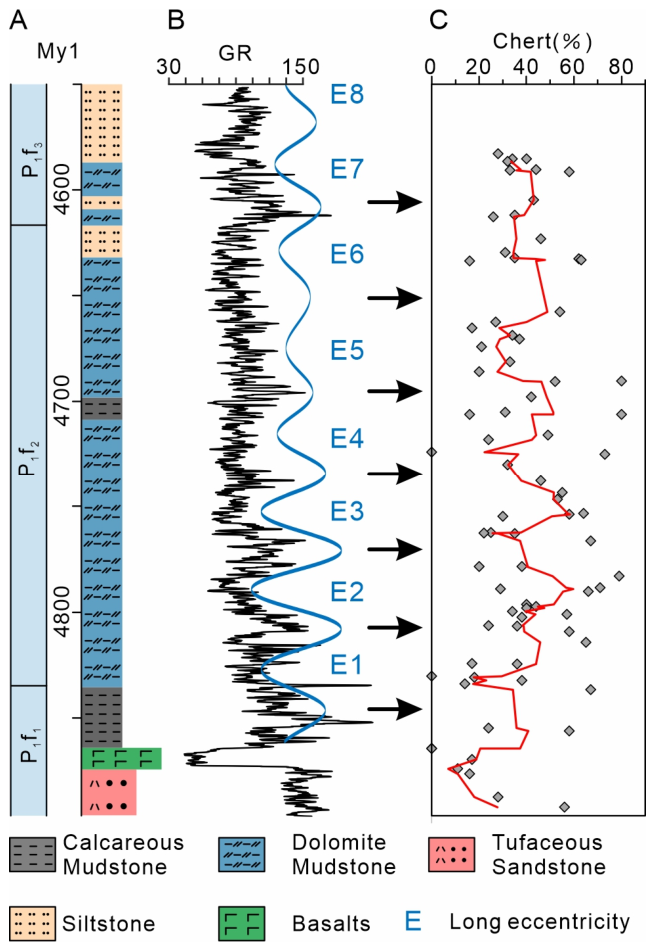
Therefore, the co-precipitation relationship between dolomite and chert in the Fengcheng Formation indicates that dissolved silica may play a critical role in catalyzing dolomite formation in the transition zone of the Fengcheng Formation. Furthermore, the chert layer is suggested as a significant pH indicator in alkaline lakes. To accurately represent the chert abundance, a correction was applied to the XRD-derived quartz content by subtracting the proportion of crystalline quartz identified petrographically. The corrected chert content profile is shown in Figure 6C. Robust cyclostratigraphy analysis shows a strong 405 kyr long-eccentricity signal in the GR series of the My1 well, indicating the influence of eccentricity-forced depositional processes for the Fengcheng Formation. These cyclic alternations controlled dry–wet oscillations and consequent changes in the hydrologic budget of the sedimentary basin. Typically, high GR values indicate fine-grained, deeper-water facies, while low GR values indicate coarser-grained, shallower-water facies [25]. In well My1, natural gamma-ray peaks generally correspond to peaks in chert abundance (Figure 6C). Cycle E3 corresponds to the depth interval with the high abundance of alkaline minerals in the central zone (Figure 1), likely representing the period of potentially high alkalinity in the Fengcheng Formation. The elevated background alkalinity here may have overridden pH fluctuations driven by orbital cycles, leading to a weaker correlation in this depth range (E3).
In the transition zone, this correlation supports that the long-eccentricity cycle (405 kyr) controls lake-level changes, and the consequent changes in the hydrological budget of the sedimentary basin likely govern pH variations. However, strong salinity stratification likely created different water chemistry conditions at the sediment–water interface between the depocenter and transition zone. As a result, astronomically forced lake-level fluctuations caused a distinct pH decrease in the transition zone, as evidence by the chert formation; however, they may not have caused significant pH declines in the depocenter zone, which remained in a high-pH state. Studies indicate that under high-pH conditions (pH > 9.5), magnesium silicates typically co-precipitate with calcite, whereas dolomite does not form [61,62].

5.3. Model of Dolomite Formation

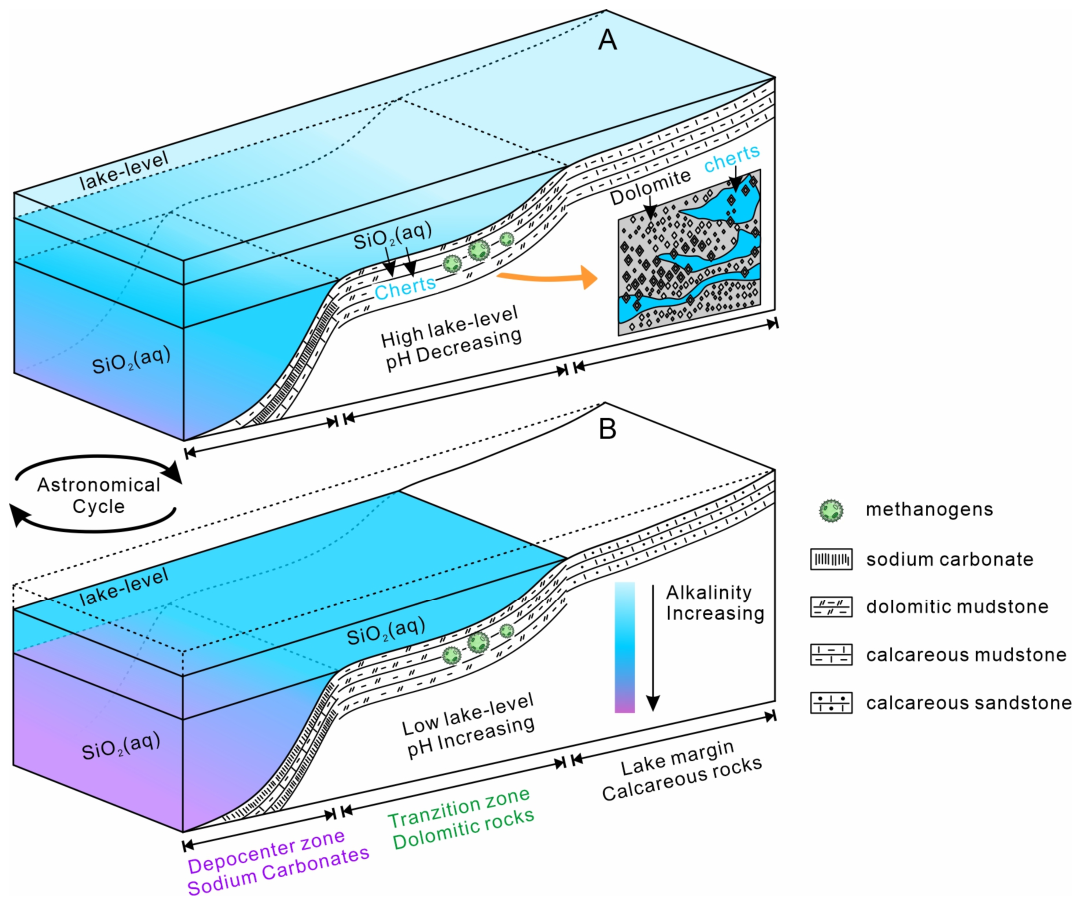
Integrating the petrographic, geochemical, and cyclostratigraphic constraints presented above, we propose a multi-factor genetic model for dolomite formation in the Fengcheng Formation of the Mahu Sag (Figure 7).
On 405 kyr long-eccentricity timescales, alternating humid and arid periods drove cyclical lake-level changes that directly modulated pH in the transition zone. During humid highstands, pH decreased, triggering chert precipitation; during arid lowstands, pH increased, enriching the water column in dissolved silica. This orbitally forced pH fluctuation is recorded as chert-bearing cyclothems in the sedimentary succession. In the transition zone, the petrological characteristics revealed a potential penecontemporaneous origin. Dissolved silica played a critical catalytic role by lowering the kinetic barrier to dolomite precipitation. Subsequently, during early burial, microbial activity—particularly methanogenesis—further promoted dolomite formation. As diagenesis progressed, complex fluids modified the primary dolomite, producing the observed multi-stage zoned structure. The systematic variation in Fe content from the core to the rim independently confirms this multi-stage growth history. In contrast, the depocenter remained in a persistently high-pH state, which is unfavorable for dolomite formation. Therefore, pH differentiation between the depocenter and the transition zone is the primary control on the spatial distribution of dolomite in the Fengcheng Formation.
Studies show that the variation in dolomite abundance in the Phanerozoic eon is related to the concentration of dissolved silica in seawater, which is controlled by silica input through silicate weathering and silica removal through clay mineral formation and silica-secreting organisms like diatoms [59,60]. The dolomite in the Fengcheng Formation provides an ancient case for dolomite formation in alkaline conditions, where alkaline conditions (high pH, alkalinity, and dissolved silica) may provide significant insights into the dolomite problem in near-surface environments.

6. Conclusions

(1)
Petrographic characteristics of dolomite in the Fengcheng Formation indicate a penecontemporaneous origin, with no apparent evidence of hydrothermal processes. The mineralogical features of dolomite reveal a well-developed multi-zonation structure, which, coupled with in situ Fe content variations, jointly record a multi-stage formation process from the core to the rim. Fe content oscillations of dolomite might indicate that microbial activities, especially methanogenesis, played an important role in its origin.
(2)
The distribution of dolomite in the Fengcheng Formation is primarily controlled by the pH differentiation between the transition and depocenter zones. A genetic model was proposed to explain the formation mechanism and distribution pattern: in the transition zone, orbitally forced lake-level changes cyclically modulated pH, promoting silica precipitation during lake-level highstands (lower pH) and silica dissolution during lake-level lowstands (higher pH). Along this process, appropriate alkalinity and dissolved silica facilitated the dolomite formation. However, the chemically buffered depocenter remained consistently under high-pH conditions, inhibiting dolomite formation.

Author Contributions

Z.Y.: Investigation, data curation, formal analysis, writing—original draft preparation. Y.Z.: Conceptualization, validation, resources, funding acquisition, writing—review and editing. X.Y.: Supervision, methodology, project administration. W.H.: Supervision, methodology, resources. W.L.: Methodology, resources. All authors have read and agreed to the published version of the manuscript.

Funding

This research was funded by the Natural Science Foundation of China (NSFC) Project, grant number 42272157.

Data Availability Statement

The data for this study are available in this manuscript.

Conflicts of Interest

Authors Xincai You, Wenjun He were employed by the company Xinjiang Oilfield Company. Author Wei Li was employed by the company China ZhenHua Oil Co., Ltd. The remaining authors declare that the research was conducted in the absence of any commercial or financial relationships that could be con-strued as a potential conflict of interest.

References

  1. Guo, P.; Wen, H.; Li, C.; He, H.; Sánchez-Román, M. Lacustrine dolomite in deep time: What really matters in early dolomite formation and accumulation? Earth-Sci. Rev. 2023, 246, 104575. [Google Scholar] [CrossRef]
  2. Tang, Y.; Zheng, M.; Wang, X.; Wang, T.; Cheng, H.; Hei, C. The floating astronomical time scale for the terrestrial Early Permian Fengcheng Formation from the Junggar Basin and its stratigraphic and palaeoclimate implications. Geol. J. 2022, 57, 4842–4856. [Google Scholar] [CrossRef]
  3. Warren, J. Dolomite: Occurrence, evolution and economically important associations. Earth-Sci. Rev. 2000, 52, 1–81. [Google Scholar] [CrossRef]
  4. Casado, A.I.; Alonso-Zarza, A.M.; La Iglesia, Á. Morphology and origin of dolomite in paleosols and lacustrine sequences. Examples from the Miocene of the Madrid Basin. Sediment. Geol. 2014, 312, 50–62. [Google Scholar] [CrossRef]
  5. Murphy, J.T.; Lowenstein, T.K.; Pietras, J.T. Preservation of primary lake signatures in alkaline earth carbonates of the Eocene Green River Wilkins Peak-Laney Member transition zone. Sediment. Geol. 2014, 314, 75–91. [Google Scholar] [CrossRef]
  6. Dupraz, C.; Reid, R.P.; Braissant, O.; Decho, A.W.; Norman, R.S.; Visscher, P.T. Processes of carbonate precipitation in modern microbial mats. Earth-Sci. Rev. 2009, 96, 141–162. [Google Scholar] [CrossRef]
  7. Sánchez-Román, M.; McKenzie, J.A.; de Luca Rebello Wagener, A.; Rivadeneyra, M.A.; Vasconcelos, C. Presence of sulfate does not inhibit low-temperature dolomite precipitation. Earth Planet. Sci. Lett. 2009, 285, 131–139. [Google Scholar] [CrossRef]
  8. Sanz-Montero, M.E.; Cabestrero, Ó.; Sánchez-Román, M. Microbial Mg-rich Carbonates in an Extreme Alkaline Lake (Las Eras, Central Spain). Front. Microbiol. 2019, 10, 148. [Google Scholar] [CrossRef]
  9. Meister, P.; Reyes, C.; Beaumont, W.; Rincon, M.; Collins, L.; Berelson, W.; Stott, L.; Corsetti, F.; Nealson, K.H. Calcium and magnesium-limited dolomite precipitation at Deep Springs Lake, California. Sedimentology 2011, 58, 1810–1830. [Google Scholar] [CrossRef]
  10. Eugster, H.P.; Hardie, L.A. Sedimentation in an Ancient Playa-Lake Complex: The Wilkins Peak Member of the Green River Formation of Wyoming. Geol. Soc. Am. Bull. 1975, 86, 319–334. [Google Scholar] [CrossRef]
  11. Manche, C.J.; Kaczmarek, S.E. Dolomite mineralogy as a proxy record for lake level fluctuations: A case study from the Eocene Uteland Butte Member of the Green River Formation, Uinta Basin, Utah, U.S.A. J. Sediment. Res. 2023, 93, 431–452. [Google Scholar] [CrossRef]
  12. Pommer, M.; Sarg, J.F.; McFarlin, F. Environmental and microbial influence on chemistry and dolomite formation in an ancient lake, Green River Formation (Eocene), Uinta basin, Utah, U.S.A. J. Sediment. Res. 2023, 93, 213–242. [Google Scholar] [CrossRef]
  13. Cao, J.; Xia, L.; Wang, T.; Zhi, D.; Tang, Y.; Li, W. An alkaline lake in the Late Paleozoic Ice Age (LPIA): A review and new insights into paleoenvironment and petroleum geology. Earth-Sci. Rev. 2020, 202, 103091. [Google Scholar] [CrossRef]
  14. Yu, K.; Cao, Y.; Qiu, L.; Sun, P.; Jia, X.; Wan, M. Geochemical characteristics and origin of sodium carbonates in a closed alkaline basin: The Lower Permian Fengcheng Formation in the Mahu Sag, northwestern Junggar Basin, China. Palaeogeogr. Palaeoclimatol. Palaeoecol. 2018, 511, 506–531. [Google Scholar] [CrossRef]
  15. Han, B.F.; Guo, Z.J.; Zhang, Z.C.; Zhang, L.; Chen, J.F.; Song, B. Age, geochemistry, and tectonic implications of a late Paleozoic stitching pluton in the North Tian Shan suture zone, western China. Geol. Soc. Am. Bull. 2009, 122, 627–640. [Google Scholar] [CrossRef]
  16. Han, Y.; Zhao, G. Final amalgamation of the Tianshan and Junggar orogenic collage in the southwestern Central Asian Orogenic Belt: Constraints on the closure of the Paleo-Asian Ocean. Earth-Sci. Rev. 2018, 186, 129–152. [Google Scholar] [CrossRef]
  17. Carroll, A.R.; Liang, Y.; Graham, S.A.; Xiao, X.; Hendrix, M.S.; Chu, J.; McKnight, C.L. Junggar basin, northwest China: Trapped Late Paleozoic ocean. Tectonophysics 1990, 181, 1–14. [Google Scholar] [CrossRef]
  18. Liu, B.; Han, B.F.; Chen, J.F.; Ren, R.; Zheng, B.; Wang, Z.Z.; Feng, L.X. Closure Time of the Junggar-Balkhash Ocean: Constraints From Late Paleozoic Volcano-Sedimentary Sequences in the Barleik Mountains, West Junggar, NW China. Tectonics 2017, 36, 2823–2845. [Google Scholar] [CrossRef]
  19. Zhang, Y.Y.; Li, W.; Tang, W.B. Tectonic setting and environment of alkaline lacustrine source rocks in the Lower Permian Fengcheng Formation of Mahu Sag. Xinjiang Pet. Geol. 2018, 39, 48–54. [Google Scholar] [CrossRef]
  20. Tang, W.; Zhang, Y.; Pe-Piper, G.; Piper, D.J.W.; Guo, Z.; Li, W. Permian rifting processes in the NW Junggar Basin, China: Implications for the post-accretionary successor basins. Gondwana Res. 2021, 98, 107–124. [Google Scholar] [CrossRef]
  21. Tang, W.; Zhang, Y.; Pe-Piper, G.; Piper, D.J.W.; Guo, Z.; Li, W. Permian to early Triassic tectono-sedimentary evolution of the Mahu sag, Junggar Basin, western China: Sedimentological implications of the transition from rifting to tectonic inversion. Mar. Petrol. Geol. 2021, 123, 104730. [Google Scholar] [CrossRef]
  22. Cao, J.; Lei, D.; Li, Y.; Tang, Y.; Abulimit; Chang, Q.; Wang, T. Ancient high-quality alkaline lacurtrine source rocks dicovered in the Lower Permian Fengcheng Formation, Junggar Basin. Acta Petrol. Sin. 2015, 36, 781–790. [Google Scholar] [CrossRef]
  23. Yu, K.; Cao, Y.; Qiu, L.; Sun, P. Depositional environments in an arid, closed basin and their implications for oil and gas exploration: The lower Permian Fengcheng Formation in the Junggar Basin, China. AAPG Bull. 2019, 103, 2073–2115. [Google Scholar] [CrossRef]
  24. Tang, Y.; He, W.; Zheng, M.; Chang, Q.; Jin, Z.; Li, J.; Zhang, Y. Shale Lithofacies and Its Effect on Reservoir Formation in Lower Permian Alkaline Lacustrine Fengcheng Formation, Junggar Basin, NW China. Front. Earth Sci. 2022, 10, 930890. [Google Scholar] [CrossRef]
  25. Cantalejo, B.; Pickering, K.T. Orbital forcing as principal driver for fine-grained deep-marine siliciclastic sedimentation, Middle-Eocene Ainsa Basin, Spanish Pyrenees. Palaeogeogr. Palaeoclimatol. Palaeoecol. 2015, 421, 24–47. [Google Scholar] [CrossRef]
  26. Huang, H.; Gao, Y.; Ma, C.; Niu, L.; Dong, T.; Tian, X.; Cheng, H.; Hei, C.; Tao, H.; Wang, C. Astronomical constraints on the development of alkaline lake during the Carboniferous-Permian Period in North Pangea. Glob. Planet. Change 2021, 207, 103681. [Google Scholar] [CrossRef]
  27. Li, X.; Zhang, L.; Wei, C.; Slabunov, A.I.; Bader, T. Quartz and orthopyroxene exsolution lamellae in clinopyroxene and the metamorphic P–T path of Belomorian eclogites. J. Metamorph. Geol. 2017, 36, 1–22. [Google Scholar] [CrossRef]
  28. Li, M.; Hinnov, L.; Kump, L. Acycle: Time-series analysis software for paleoclimate research and education. Comput. Geosci. 2019, 127, 12–22. [Google Scholar] [CrossRef]
  29. Berger, A.; Loutre, M.F.; Laskar, J. Stability of the Astronomical Frequencies Over the Earth’s History for Paleoclimate Studies. Science 1992, 255, 560–566. [Google Scholar] [CrossRef]
  30. Laskar, J.; Fienga, A.; Gastineau, M.; Manche, H. La2010: A new orbital solution for the long-term motion of the Earth. Astron. Astrophys. 2011, 532, A89. [Google Scholar] [CrossRef]
  31. Laskar, J.; Robutel, P.; Joutel, F.; Gastineau, M.; Correia, A.C.M.; Levrard, B. A long-term numerical solution for the insolation quantities of the Earth. Astron. Astrophys. 2004, 428, 261–285. [Google Scholar] [CrossRef]
  32. Li, M.; Huang, C.; Hinnov, L.; Ogg, J.; Chen, Z.-Q.; Zhang, Y. Obliquity-forced climate during the Early Triassic hothouse in China. Geology 2016, 44, 623–626. [Google Scholar] [CrossRef]
  33. Huang, H.; Gao, Y.; Jones, M.M.; Tao, H.; Carroll, A.R.; Ibarra, D.E.; Wu, H.; Wang, C. Astronomical forcing of Middle Permian terrestrial climate recorded in a large paleolake in northwestern China. Palaeogeogr. Palaeoclimatol. Palaeoecol. 2020, 550, 109735. [Google Scholar] [CrossRef]
  34. Ryan, B.H.; Kaczmarek, S.E.; Rivers, J.M.; Manche, C.J.; Betzler, C. Extensive recrystallization of Cenozoic dolomite during shallow burial: A case study from the Palaeocene–Eocene Umm er Radhuma formation and a global meta-analysis. Sedimentology 2022, 69, 2053–2079. [Google Scholar] [CrossRef]
  35. Koeshidayatullah, A.; Corlett, H.; Stacey, J.; Swart, P.K.; Boyce, A.; Hollis, C. Origin and evolution of fault-controlled hydrothermal dolomitization fronts: A new insight. Earth Planet. Sci. Lett. 2020, 541, 116291. [Google Scholar] [CrossRef]
  36. Koeshidayatullah, A.; Corlett, H.; Stacey, J.; Swart, P.K.; Boyce, A.; Robertson, H.; Whitaker, F.; Hollis, C.; Qing, H. Evaluating new fault-controlled hydrothermal dolomitization models: Insights from the Cambrian Dolomite, Western Canadian Sedimentary Basin. Sedimentology 2020, 67, 2945–2973. [Google Scholar] [CrossRef]
  37. Southgate, P.N.; Lambert, I.B.; Donnelly, T.H.; Henry, R.; Etminan, H.; Weste, G. Depositional environments and diagenesis in Lake Parakeelya: A Cambrian alkaline playa from the Officer Basin, South Australia. Sedimentology 1989, 36, 1091–1112. [Google Scholar] [CrossRef]
  38. Petrash, D.A.; Bialik, O.M.; Bontognali, T.R.R.; Vasconcelos, C.; Roberts, J.A.; McKenzie, J.A.; Konhauser, K.O. Microbially catalyzed dolomite formation: From near-surface to burial. Earth-Sci. Rev. 2017, 171, 558–582. [Google Scholar] [CrossRef]
  39. Searl, A.; Fallick, A.E. Dinantian dolomites from East Fife: Hydrothermal overprinting of early mixing-zone stable isotopic and Fe/Mn compositions. J. Geol. Soc. 1990, 147, 623–638. [Google Scholar] [CrossRef]
  40. Kastner, M. Oceanic minerals: Their origin, nature of their environment and significance. Proc. Natl. Acad. Sci. USA 1999, 96, 3380–3387. [Google Scholar] [CrossRef]
  41. Burns, S.J.; Baker, P.A. A Geochemical Study of Dolomite in the Monterey Formation, California. J. Sediment. Res. 1987, 57, 128–139. [Google Scholar] [CrossRef]
  42. Loyd, S.J.; Berelson, W.M.; Lyons, T.W.; Hammond, D.E.; Corsetti, F.A. Constraining pathways of microbial mediation for carbonate concretions of the Miocene Monterey Formation using carbonate-associated sulfate. Geochim. Cosmochim. Acta 2012, 78, 77–98. [Google Scholar] [CrossRef]
  43. Lu, X.; Shi, J.; Zhang, S.; Zou, N.; Sun, G.; Zhang, S. The origin and formation model of Permian dolostones on the northwestern margin of Junggar Basin, China. J. Asian Earth Sci. 2015, 105, 456–467. [Google Scholar] [CrossRef]
  44. Yu, K.; Qiu, L.; Cao, Y.; Sun, P.; Qu, C.; Yang, Y. Hydrothermal origin of early Permian saddle dolomites in the Junggar Basin, NW China. J. Asian Earth Sci. 2019, 184, 103990. [Google Scholar] [CrossRef]
  45. Curtis, C.D.; Coleman, M.L.; Love, L.G. Pore Water Evolution during Sediment Burial from Isotopic and Mineral Chemistry of Calcite, Dolomite and Siderite Concretions. Geochim. Cosmochim. Acta 1986, 50, 2321–2334. [Google Scholar] [CrossRef]
  46. Furnes, H.; Mcloughlin, N.; Muehlenbachs, K.; Banerjee, N.; Staudigel, N.; Dilek, Y.; de Wit, M.; Van Kranendonk, M.; Schiffma, P. Oceanic Pillow Lavas and Hyaloclastites as Habitats for Microbial Life Through Time—A Review. In Links Between Geological Processes, Microbial Activities&Evolution of Life. Modern Approaches in Solid Earth Sciences; Dilek, Y., Furnes, H., Muehlenbachs, K., Eds.; Springer: Dordrecht, The Netherlands, 2008; Volume 4, pp. 1–68. [Google Scholar]
  47. Kelts, K.; McKenzie, J.A. Diagenetic dolomite formation in Quaternary anoxic diatomaceous muds of DSDP Leg-64, Gulf of California. In Initial Reports of the Deep Sea Drilling Project; Curray, J.R., Moore, D.G., Eds.; U.S. Govt. Printing Office: Washington, DC, USA, 1982; Volume 64, pp. 553–569. [Google Scholar]
  48. Meister, P.; Gutjahr, M.; Frank, M.; Bernasconi, S.M.; Vasconcelos, C.; McKenzie, J.A. Dolomite formation within the methanogenic zone induced by tectonically driven fluids in the Peru accretionary prism. Geology 2011, 39, 563–566. [Google Scholar] [CrossRef]
  49. Xia, L.; Cao, J.; Hu, W.; Stüeken, E.E.; Wang, X.; Yao, S.; Zhi, D.; Tang, Y.; Xiang, B.; He, W. Effects on global warming by microbial methanogenesis in alkaline lakes during the Late Paleozoic Ice Age (LPIA). Geology 2023, 51, 935–940. [Google Scholar] [CrossRef]
  50. Guo, P.; Wen, H.; Sánchez-Román, M. Constraints on dolomite formation in a Late Palaeozoic saline alkaline lake deposit, Junggar Basin, north-west China. Sedimentology 2023, 70, 2302–2330. [Google Scholar] [CrossRef]
  51. Zhang, B.; Cao, J.; Mu, L.; Yao, S.; Hu, W.; Huang, H.; Lang, X.; Liao, Z. The Permian Chert Event in South China: New geochemical constraints and global implications. Earth-Sci. Rev. 2023, 244, 104513. [Google Scholar] [CrossRef]
  52. Hesse, R. Silica diagenesis: Origin of inorganic and replacement cherts. Earth-Sci. Rev. 1989, 26, 253–284. [Google Scholar] [CrossRef]
  53. Eugster, H.P. Hydrous sodium silicates from lake magadi, kenya: Precursors of bedded chert. Science 1967, 157, 1177–1180. [Google Scholar] [CrossRef]
  54. Bustillo, M.A.; Arribas, M.E.; Bustillo, M. Dolomitization and silicification in low-energy lacustrine carbonates (Paleogene, Madrid Basin, Spain). Sediment. Geol. 2002, 151, 107–126. [Google Scholar] [CrossRef]
  55. Collinson, J.D. Sedimentology of unconformities within a fluvio-lacustrine sequence; Middle Proterozoic of Eastern North Greenland. Sediment. Geol. 1983, 34, 145–166. [Google Scholar] [CrossRef]
  56. Kuma, R.; Hasegawa, H.; Yamamoto, K.; Yoshida, H.; Whiteside, J.H.; Katsuta, N.; Ikeda, M. Biogenically induced bedded chert formation in the alkaline palaeo-lake of the Green River Formation. Sci. Rep. 2019, 9, 16448. [Google Scholar] [CrossRef] [PubMed]
  57. Li, W.; Zhang, Y.; He, W.; Tang, Y. Subaqueous felsic volcanic sequence and its contribution to the ancient alkaline lacustrine deposits in the Mahu Sag, Junggar Basin, NW China. Geol. J. 2023, 58, 3819–3839. [Google Scholar] [CrossRef]
  58. Hobbs, F.W.C.; Fang, Y.; Lebrun, N.; Yang, Y.; Xu, H. Co-precipitation of primary dolomite and Mg-rich clays in Deep Springs Lake, California. Sedimentology 2024, 71, 1363–1383. [Google Scholar] [CrossRef]
  59. Fang, Y.; Xu, H. Dissolved silica-catalyzed disordered dolomite precipitation. Am. Mineral. 2022, 107, 443–452. [Google Scholar] [CrossRef]
  60. Fang, Y.; Hobbs, F.; Yang, Y.; Xu, H. Dissolved silica-driven dolomite precipitation in the Great Salt Lake, Utah, and its implication for dolomite formation environments. Sedimentology 2023, 70, 1328–1347. [Google Scholar] [CrossRef]
  61. Tutolo, B.M.; Tosca, N.J. Experimental examination of the Mg-silicate-carbonate system at ambient temperature: Implications for alkaline chemical sedimentation and lacustrine carbonate formation. Geochim. Cosmochim. Acta 2018, 225, 80–101. [Google Scholar] [CrossRef]
  62. Wright, V.P.; Barnett, A.J. An abiotic model for the development of textures in some South Atlantic early Cretaceous lacustrine carbonates. Geol. Soc. Lond. Spec. Publ. 2015, 418, 209–219. [Google Scholar] [CrossRef]
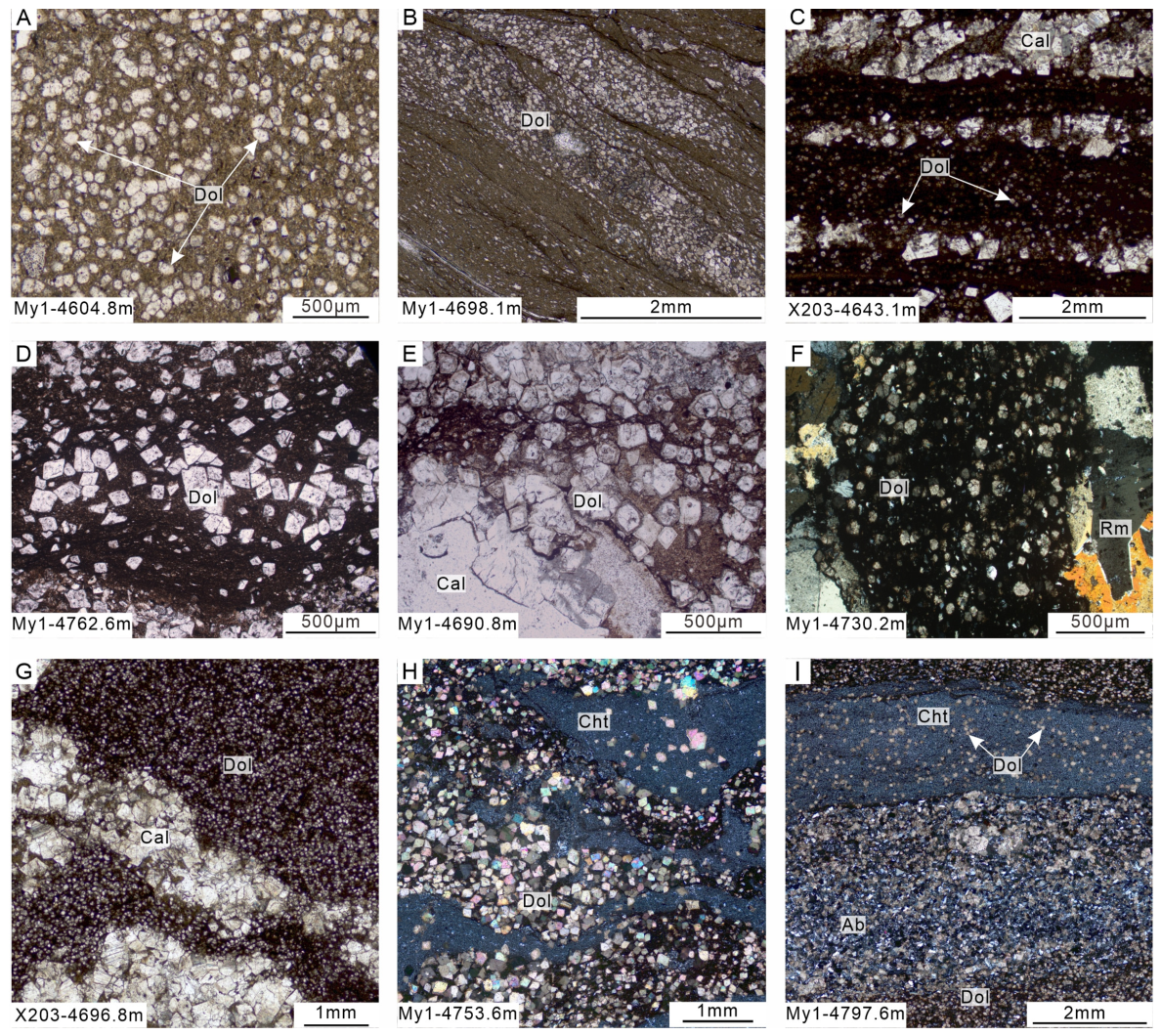
Figure 2. Petrographic characteristics of dolomite-bearing rocks in the Fengcheng Formation. (A) Disseminated distribution of spherical dolomite crystals, PPL and (B) dolomite lenses, PPL. (C) Laminae texture of dolomite-bearing rocks exhibits a cyclic alternation of millimeter-thick, calcite-rich and clay-rich layers. Note the disseminated dolomite in the matrix, PPL. (D) Disseminated dolomite crystals in rhombic form, PPL; (E) coarse-grain dolomite with a “cloudy core and clear rim” structure, but with an outermost Fe-rich dolomite, PPL; (F) disseminated dolomite coexists with reedmergnerite, CPL; (G) disseminated spherical dolomite coexists with calcite, PPL; (H) coarse-grain dolomite coexists with chert. Note that some dolomite crystals occur inside chert, CPL. (I) Laminae texture of dolomite-bearing rocks exhibits a cyclic alternation of albite-rich and chert layers. Note the disseminated dolomite in the matrix and both layers, CPL. Dol: Dolomite; Cal: calcite; Rm: reedmergnerite; Cht: chert; Ab: albite.
Minerals 16 00519 g002
Figure 3. Mineralogical features of dolomite in the Fengcheng Formation. (A) Dolomite crystals exhibit multi-compositional bands from the inside out. (B,C) Dolomite crystal shows a typical core-intermediate-core structure. Note the gradually varied color of the intermediate zone. (D) Dolomite exhibits multi-compositional bands from the inside out. Note the irregular core zone. (E) Dolomite crystal shows a typical core-intermediate-rim texture, numbers and dot line are corresponding to the profile of Fe# variation in (F). Dol: Dolomite; Cal: calcite; Rm: reedmergnerite.
Minerals 16 00519 g003
Figure 4. Cathodoluminescence (CL) images of dolomite in the Fengcheng Formation. (A,D) Dolomite crystals exhibit a homogeneous yellow-luminescent core and a dark orange luminescent rim. Note the non-luminescent (dark) line within the yellow core. (B,E) Dolomite crystals display oscillatory CL zoning; (C,F) dolomite crystals display a bright orange luminescent core and a rim with gradually varied CL zoning.
Minerals 16 00519 g004
Figure 5. Results of cyclostratigraphy analysis. (A) Spectral analysis reveals significant peaks (>99%) at 37.0 m and 14.6 m; (BD) correlation coefficient (COCO) analysis resulted in an optimal sedimentation rate ranging from 9 to 12 cm/kyr of the Fengcheng Formation, the gray zone means the optimal range of sedimentation rate; (E) raw GR data of the Fengcheng Formation, red zone means the identification of volcanism; (F) filtering results of the Fengcheng Formation showed 8 long-eccentricity cycles (405 kyr). E: Long-eccentricity.
Minerals 16 00519 g005
Figure 6. Relationship between the chert content and long-eccentricity cycle (405 kyr) in the Fengcheng Formation. (A) Stratigraphic information of well My1; (B) gamma ray (GR) logging data of My1 during the Fengcheng Formation and cyclostratigraphy analysis of well My1; (C) chert content of well My1 from XRD analysis; data were compiled from Tang et al., 2022 [24]. The red line represents the moving average results with a window size of four data points.
Minerals 16 00519 g006
Figure 7. Schematic model of alkaline lake dolomite sedimentation in the Fengcheng Formation. (A) Humid period—high lake level, low pH, and chert precipitation coexisting with dolomite. (B) Arid period—low lake level, high pH, no chert precipitation, and dissolved silica is the dominant aqueous silica phase. Methanogenesis and dissolved silica catalyzing play important roles in dolomite formation.
Minerals 16 00519 g007
Table 1. EPMA data of dolomite (unit: wt%, refer to sample in Figure 3E, Fe# = molar Fe/(Fe + Mg)).
No.SiO2Al2O3FeOMnOMgOCaONa2OK2OTotalFe#
M59_1BDL *BDLBDL0.1320.930.490.15BDL51.750
M59_20.03BDLBDL0.1121.3330.860.2BDL52.550
M59_30.03BDLBDL0.0621.6229.870.15BDL51.90
M59_40.090.021.040.0720.1929.110.2BDL50.860.03
M59_50.02BDL0.840.0821.2830.390.130.0152.940.02
M59_60.010.010.430.0421.4630.170.09BDL52.290.01
M59_70.02BDL0.130.121.2129.030.130.0250.80
M59_80.090.030.250.0821.5830.160.090.0452.450.01
M59_90.08BDL1.110.2220.9830.720.120.0153.350.03
M59_100.05BDL3.390.1118.8729.64BDL0.0352.130.09
* BDL: Below detection limit.
Disclaimer/Publisher’s Note: The statements, opinions and data contained in all publications are solely those of the individual author(s) and contributor(s) and not of MDPI and/or the editor(s). MDPI and/or the editor(s) disclaim responsibility for any injury to people or property resulting from any ideas, methods, instructions or products referred to in the content.