Article

Variability of Crushability and Grindability of Iron Ores in an Itabirite Deposit

by
Luís Marcelo Tavares
1,*,
Gabriel K. P. Barrios
1,
Luciana P. Alves
1,2,
Elias F. de Castro
2 and
José N. S. Silva
2
1
Department of Metallurgical and Materials Engineering, COPPE, Universidade Federal do Rio de Janeiro, Rio de Janeiro 21941-972, RJ, Brazil
2
Anglo American, Belo Horizonte 30360-740, MG, Brazil
*
Author to whom correspondence should be addressed.
Minerals 2026, 16(5), 473; https://doi.org/10.3390/min16050473
Submission received: 13 February 2026 / Revised: 26 April 2026 / Accepted: 29 April 2026 / Published: 30 April 2026
(This article belongs to the Section Mineral Processing and Extractive Metallurgy)

Abstract

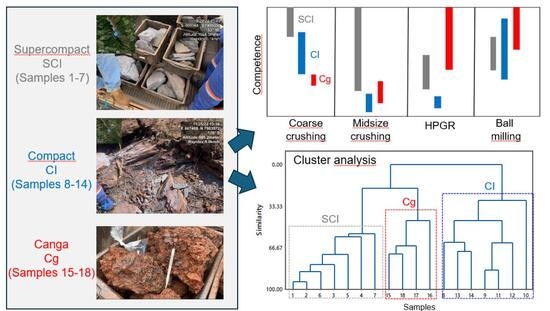
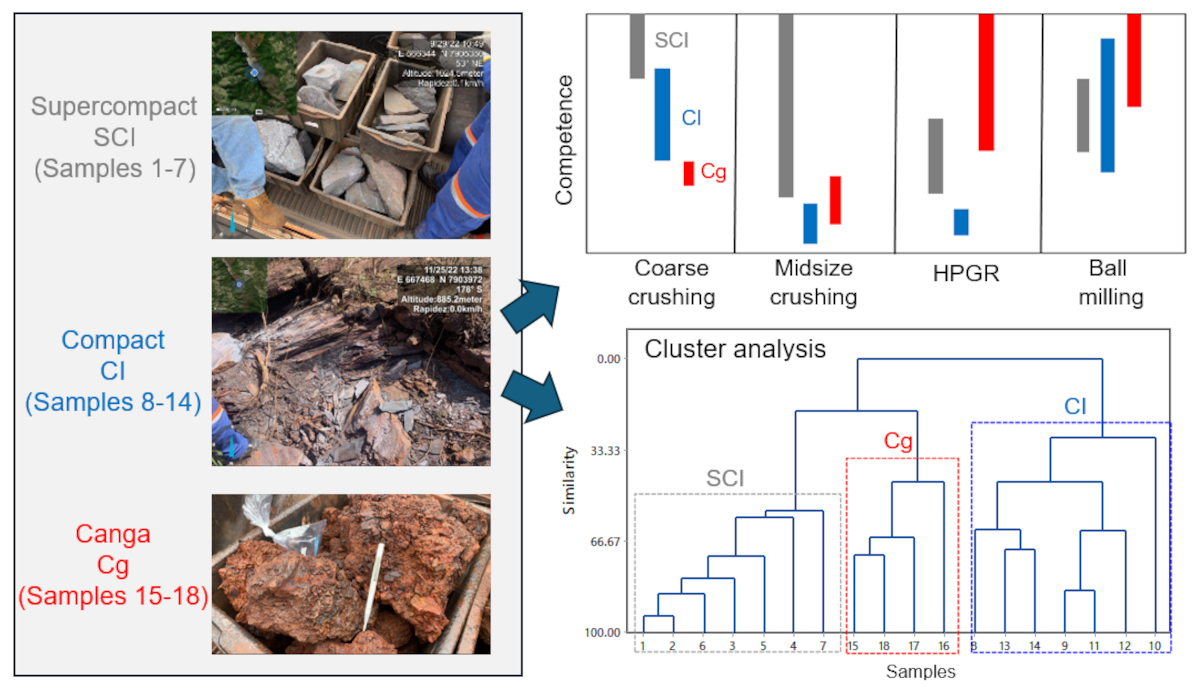
The identification of ore types that share similar geological characteristics and metallurgical performance in a deposit is of great relevance in mine planning. In the case of a low-grade iron ore from Brazil, called itabirite, ore types are usually classified as compact and friable, in addition to canga. As itabirites become more widely exploited, friable itabirites have become scarcer, leaving more competent ores to be processed. The work investigates the response of 19 iron ore samples from the Serra do Sapo deposit (Minas Gerais, Brazil), through a variety of bench-scale comminution tests. In the context of crushing (>25 mm), one subtype of compact itabirite, called supercompact, presented substantially higher resistance to fragmentation than those of compact itabirite and canga. In the context of grinding (<19 mm), an inversion occurs, with canga presenting the highest resistance to comminution, followed by the itabirites (friable, compact, and supercompact), nearly indistinctively. This demonstrates that the relative competence of iron ores to withstand comminution in the studied mineral deposits varies significantly as a function of particle size and, therefore, size reduction stage. Finally, grouping of the samples using cluster analysis demonstrated the relevance of discrimination between compact and supercompact itabirites, besides canga, with supercompact itabirite having a greater affinity to canga than with its compact counterpart. This shows the importance of further discriminating itabirites, particularly in the context of comminution at coarser sizes.

Graphical Abstract

1. Introduction

Several reports in the literature have demonstrated the significant variations in processing performance caused by variability of the ores fed to a processing plant [1,2,3,4]. As such, identifying ore types in a mineral deposit and understanding their response in the processing circuit is invaluable when planning production at the mine site [5]. When these ore types present identifiable differences in comminution response, then such discrimination and proper blending can be crucial to guarantee maintenance in circuit performance [6,7,8].
Iron ore is the main mineral export product from Brazil, with the most significant provinces found in the states of Pará and Minas Gerais [9]. The major iron deposits in the state of Minas Gerais are found in three provinces, those being Quadrilátero Ferrífero, the most relevant one on a global scale, followed by the smaller Conceição do Mato Dentro and Nova Aurora Provinces [10]. Itabirites are a specific type of metamorphic banded iron formation from these provinces, of Paleoproterozoic age. These rocks are characterized by their highly oxidized profiles and discontinuous occurrences of high-grade ore bodies, typically lenticularly shaped, with dimensions that may range from decimeters to hundreds of meters [9].
One of the formations that are part of the Conceição do Mato Dentro Province, appearing at maximum depths of 100 m [11,12], is Serra do Sapo, which hosts the most important banded iron formation (BIF) deposits in this province. The ore bodies underwent metamorphism and intense shearing, which reflects directly on their mineralogy and texture, evidenced by the preponderance of hematite over magnetite and significant schistosity of their fabric [13]. The BIFs are predominantly associated with quartzites and, unlike other similar deposits in the state of Minas Gerais, carbonates are scarce [13]. The main iron-containing mineral in itabirites found in this deposit is hematite, with quartz being the main gangue mineral [12]. Along the geological profile of the Serra do Sapo formation, significant variations in ore types are identified. Closer to the surface, contact with intense rainfall and ground waters resulted in leaching of quartz from the BIFs, increasing the iron content and the degree of fracturing and porosity, consequently making them less competent [14,15]. In the particular case of the Serra do Sapo BIFs, these supergene processes were responsible for generating ore types that are very particular and may be classified according to their competency [4,16]. Closer to the surface, the most weathered material, called canga, has an earthy texture. This ore type contains variable amounts of detritic fragments from other rock types that have been lithified [14], resulting in the presence of foreign contaminants. Unlike the other ore types, canga does not contain the characteristic layered structure of the banded-iron formations, being composed mostly of supergene hydrated iron minerals and alumina-rich clay minerals [4]. This competent ferruginous layer preserves the underlying BIF from physical erosion, favoring the development of thick weathering profiles that generate high-grade ore bodies [17]. In depths that range from a few meters to about 20 m, the weathered itabirite, called friable itabirite (FI), predominates. Below these, the deposit contains a thick layer of itabirite (I), whose level of competence generally increases with depth. Inside the itabirite pack, there are, occasionally, layers of semi-friable itabirite (SFI) [16].
In a recent study, one sample of each ore type from the Serra do Sapo deposit, namely, canga, friable itabirite (FI), besides two samples of itabirite (I), one of which had apparently higher competence [4], were collected and tested. It was demonstrated that the response of the samples to breakage at coarser sizes, within the domain of crushing, differed significantly, whereas their response at finer sizes and within the traditional domain of grinding could not be discriminated. From that work, it was proposed to further distinguish itabirite into compact (CI) and supercompact itabirite (SCI). In a more recent study [18], the difference in comminution response between these two varieties of itabirite was further examined through detailed single-particle breakage testing and detailed microstructural analyses. That work demonstrated that, although both CI and SCI share the same mineralogy, the intense fracturing of CI explains its greater amenability to comminution at coarser sizes. On the other hand, the apparently relatively preserved grains result in a comparative increase in the resistance of CI, as well as of FI, at fine sizes.
The present work further analyzes the different responses of ore types in the Serra do Sapo deposit, but now with a much greater number of samples subjected to a variety of bench-scale comminution tests, with the primary aim of demonstrating if the further discrimination of itabirites in CI and SCI is justified. For comparative purposes, additional samples of canga were also collected for testing. The suitability of discriminating the different ore types regarding comminution is assessed and analyses of variability within and between ore types are carried out using statistical techniques.

2. Materials and Methods

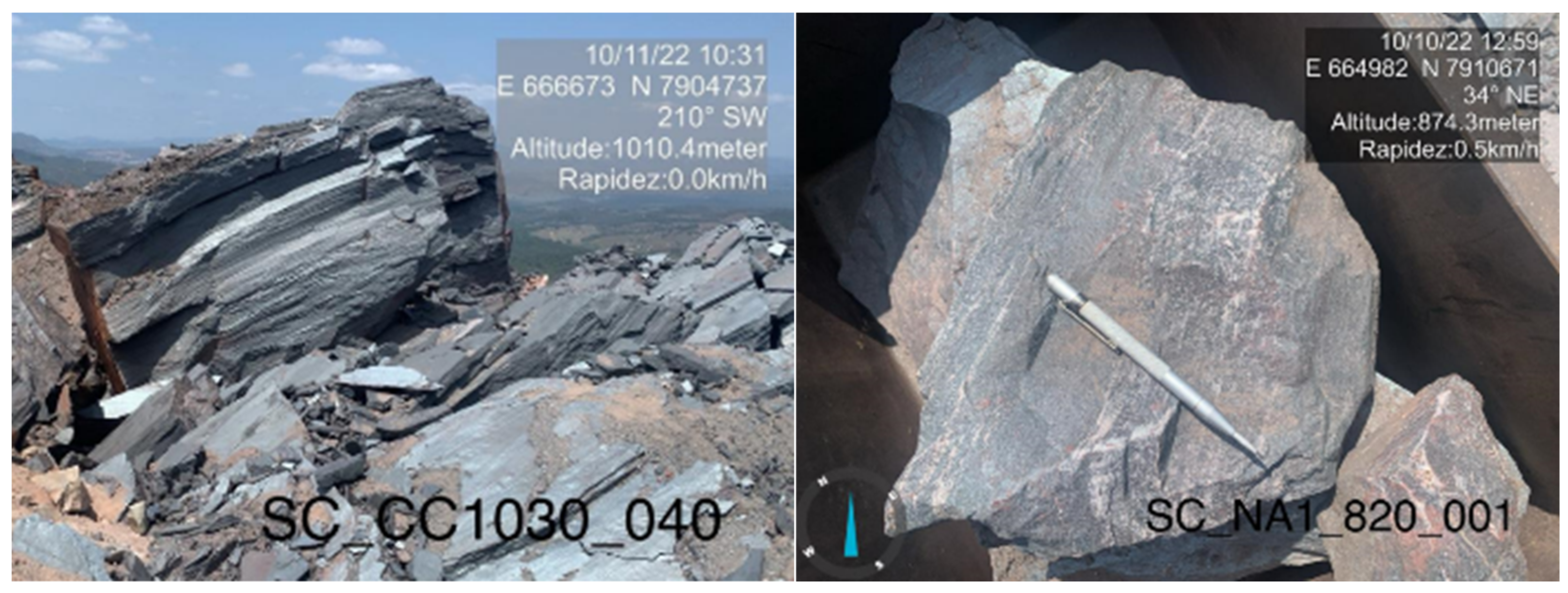
A total of 19 georeferenced samples containing 200–300 kg of ore from different mine faces of the Serra do Sapo deposit, located at Conceição do Mato Dentro (Minas Gerais, Brazil), were collected (Figure 1). After being placed in 200 L drums, they were sent to the laboratory for testing. Based on their characteristics in the field, they were classified tentatively by the mine geology team as compact itabirite—CI (7), supercompact itabirite—SCI (7), besides canga—Cg (4), and friable itabirite—FI (1). In the case of the latter, only a fraction of the tests was carried out, owing to its fine in situ size distribution. Discrimination of CI and SCI in the field was primarily associated with the greater fracturing of the former.
In the laboratory, the samples were staged-crushed in a jaw crusher (Denver number 7) and classified into specified size ranges for testing. Besides measurement of specific gravity, the samples were subjected to a variety of standard tests aiming to characterize their response to comminution, as listed in Table 1. It shows that the different tests cover the behavior of the ore in a wide range of sizes in the feed.
Briefly, the drop weight test followed the standard procedure [19], through which particles contained in five size ranges (53.0–63.0 mm to 13.3–16.0 mm) were impacted at specific impact energies ranging from 0.05 to 2.5 kWh/t, and their size distributions were analyzed by dry sieving. The percentage passing one tenth of the mean size of each narrow-size range test was computed (t10), and its relationship with specific impact energy described by:
t 10 = A 1 e x p ( b E c s )
where A and b are parameters to be fitted to experimental data, whereas Ecs is the specific impact energy (in kWh/t). The product A×b has been widely used as an indicator for susceptibility to fragmentation by impact [19,20].
The point-load test was conducted in a universal press (Instron® model 33R5567, Norwood, MA, USA) equipped with a 5000 N load cell, with an accuracy of 1 N. The press was fitted with hardened steel conical tips, according to the standard test method for determination of the point-load strength [21], and loads were applied at a deformation rate of 5 mm/min until each particle failed. Lots containing 30 particles within the size range 31.5–37.5 mm were tested. This size was selected given the availability of material for all the ore types tested. The point-load strength of irregular particles can be described according to Equation (2) [22]:
I s = π P 4 L D
where P is the maximum force where fracture occurs, L is the mean width and D is the load application diameter [23]. One additional requirement from the test is that particles with geometry within the range 0.3 L < D < L were required. The standard point-load test (PLT) strength of the reference 50 mm size is:
I s ( 50 ) = I s 4 L D 50 π 0.45
where the term in parentheses represents the correction factor.
The Bond impact work index test was carried out using Bond’s twin pendulum device [24], in which 20 particles contained in the 50.0–75.0 mm size range were tested. In the test, two free-fall hammers are simultaneously released in a pendulum trajectory that impacts particles one-by-one. Initially, the hammers are released from a 10° angle with respect to the vertical direction. When a particle does not break, the angle is increased by 5°, and the particle is struck again until breakage eventually occurs [25,26]. Particle breakage is defined as the loss of at least 10% of the initial particle mass. The crushing or impact work index is then given by [26]:
W i c = 6258 ( 1 c o s   ϕ ) ρ s w
where ϕ is the angle in which each particle fractured, w is the particle width (mm), and ρs is the specific gravity of the sample (g/cm3). The mean value for the lot represents the Wic of the sample.
The piston-and-die (P&D) tests were conducted in a servo-hydraulic press (Shimadzu®, Kyoto, Japan), with a maximum load capacity of 1000 kN and accuracy of 0.5 kN, equipped with an LVDT sensor with 10 µm precision. The loading rate was 5 mm/min. In each test, the initial and final heights of the bed were measured and compared to the LVDT measurements. Tests were conducted with particles contained in size ranges 26.5–31.5 mm, 5.6–6.7 mm, and 1.70–2.36 mm. Lots from each size were tested in 170 mm diameter dies at loads varying from 50 to 1000 kN, corresponding to pressures ranging from 0.1 to 44 MPa. The sample mass followed the guidelines suggested by Schönert to avoid wall effects [27]. They consisted in ensuring that the piston diameter is 12 times larger than the top size of particles tested, that the bed height is larger than four times the particle top size and that the piston diameter is larger than three times the initial bed height [27]. After each compression test was completed, the material was analyzed by sieving using a √2 series. Using the force versus displacement measurements, the energy absorbed by the bed of particles is calculated by numerical integration. The outcome of the test was analyzed in the same manner as the drop weight test, using Equation (1).
The Los Angeles abrasion test is often used in construction and building to assess the response of rocks to low-energy impacts, to mimic the response of the pavement containing the aggregate during usage [28]. This mode of fragmentation also approaches the ones that occur in comminution machines, and the result from this test has been used to assess susceptibility to crushing [29]. The test is carried out with a drum of 700 mm diameter and 500 mm length, equipped with a single 90 mm lifter bar. The test is standardized for different feed sizes, also called gradings [28]. In the present work, grading C is used, consisting of a sample in the range 9.5–19.0 mm, whereas the grinding load is made up of 11 steel balls measuring 48 mm in diameter. To guarantee a more uniform size range, the sample is made up of two 2.5 kg batches, one in the range 12.5–19.0 mm, and the other 9.5–12.5 mm. After 500 revolutions at 31 rpm, the drum contents are emptied and the product analyzed. The LA abrasion index is the percent passing the 1.70 mm sieve.
The Bond abrasiveness test is conducted in the Pennsylvania drum, which has a 305 mm internal diameter and 114 mm length and operates at a frequency of 70 rpm [24]. Inside the drum, a paddle, measuring 75 × 25 × 40 mm, is firmly fixed to a rotor, which rotates approximately 9 times faster than the drum. The ore sample is contained in the 12.5–19.0 mm size range, half of which is in the range 16.0–19.0 mm, and the rest in the 12.5–16.0 mm size range. The paddle, of AISI 4340 steel with hardness 50 ± 2 HRc, is weighed in a precision scale, tightly fixed to the rotor, and 400 g batches of sample are introduced in the drum. After running for 15 min, the drum is emptied and the sample replaced until a total of one hour of test is completed. At the end of the test, the paddle is cleaned and weighed again in the precision scale and the difference in weight represents the Bond abrasion index Ai. The test is run in duplicate and the average value is recorded. In addition, the product of the test is subject to size analyzes by sieving, and the percent passing 1 mm is used as a proxy for resistance to fragmentation [20,30].
The batch grinding tests were carried out in a 580 × 240 mm batch ball mill equipped with a torque sensor (model DR-3000, manufactured by Lorenz Messtechnik GmbH from Alfdorf, Germany). The mill is fitted with eight rectangular lifter bars 15 mm in height and 25 mm in width. Table 2 summarizes the conditions used in all experiments.
Samples were stage-crushed below 19 mm for the tests, resulting in different size distributions, owing to the significantly distinct crushing responses of the ores. In each test, slurry concentration was set to a constant percentage in volume (Table 2), owing to the different specific gravities of the samples and the important effect of solids concentration in grinding [31,32]. As such, from the 55% percent solids in the volume selected, percentages of solids varied from 81.2 to 85.1% in weight for the different samples. Tests were carried out in a batch mode, and a total of four grinding times were used, namely 1, 4, 8, and 16 min. Upon completion of each grinding stage, the slurry and the grinding charge were carefully emptied from the mill, through introduction of additional water to ensure all contents were removed. After the slurry was separated from the grinding media, it was subjected to filtering and drying. Each dried sample was subdivided using a Jones splitter for collection of a representative sample for size analysis by wet sieving. Upon completion of all these analyzes, each sample was recomposed, water was added to match the initial percent solids, and the mill was operated for the additional time desired. Mill power for each grinding interval was measured from the product of the mill speed and the torque, this later measured by the sensing device [32].
One popular metric that has been used to assess the amenability of ores to comminution is the size-specific energy (SSE) [33]. It represents the specific energy required to generate each ton of material finer than a selected sieve, taken as 150 μm in the present work, since concentration by flotation is often conducted with material below this size for this ore type [4]. It may be computed using the expression:
S S E = 100 ×   S p e c i f i c   e n e r g y %   p a s s i n g   150   μ m   i n   t h e   p r o d u c t %   p a s s i n g   150   μ m   i n   t h e   f e e d
Although often regarded as a constant [33] for the pair ore-comminution machine, it is sometimes found to also vary as a function of product fineness [4]. As such, the value of SSE is calculated by taking a reference specific energy in the industrial mill equal to 2.15 kWh/t, represented by the ratio between the mill power and the total solids flowrate through the mill in the plant in question [34].
With the aim of exploring in detail the results of all tests, they were plotted in graphs using order statistics [35], which allows identification of the individual experimental results. Through these, results were plotted in ascending order and a rank i was assigned to each of the observations. The percentile for each sample is then obtained by:
P i = 100 i 0.5 N
where N is the number of observations. Results from each of the tests were analyzed using one-way ANOVA, using the logarithm transformation whenever necessary to maintain a constant variance and/or ensuring normality of the data [35]. These were analyzed graphically using dot plots and normal probability plots, respectively, omitted for brevity. When the null hypothesis for equality of the means was rejected, Tukey’s multiple comparison procedure [35] was used to identify the ore types that exhibited different responses. Overall results were then analyzed using cluster observations, which use hierarchical methods to group observations (samples) based on some similarities among them [36]. The Euclidean distance was selected, and Minitab® 22 was used to build clusters that allow assessing the suitability of discriminating the ore types and also identification of similarities among them. Results from FI were excluded from both statistical analyzes, since data from only one sample were available.

3. Results and Discussion

3.1. Preliminary Analysis of Data

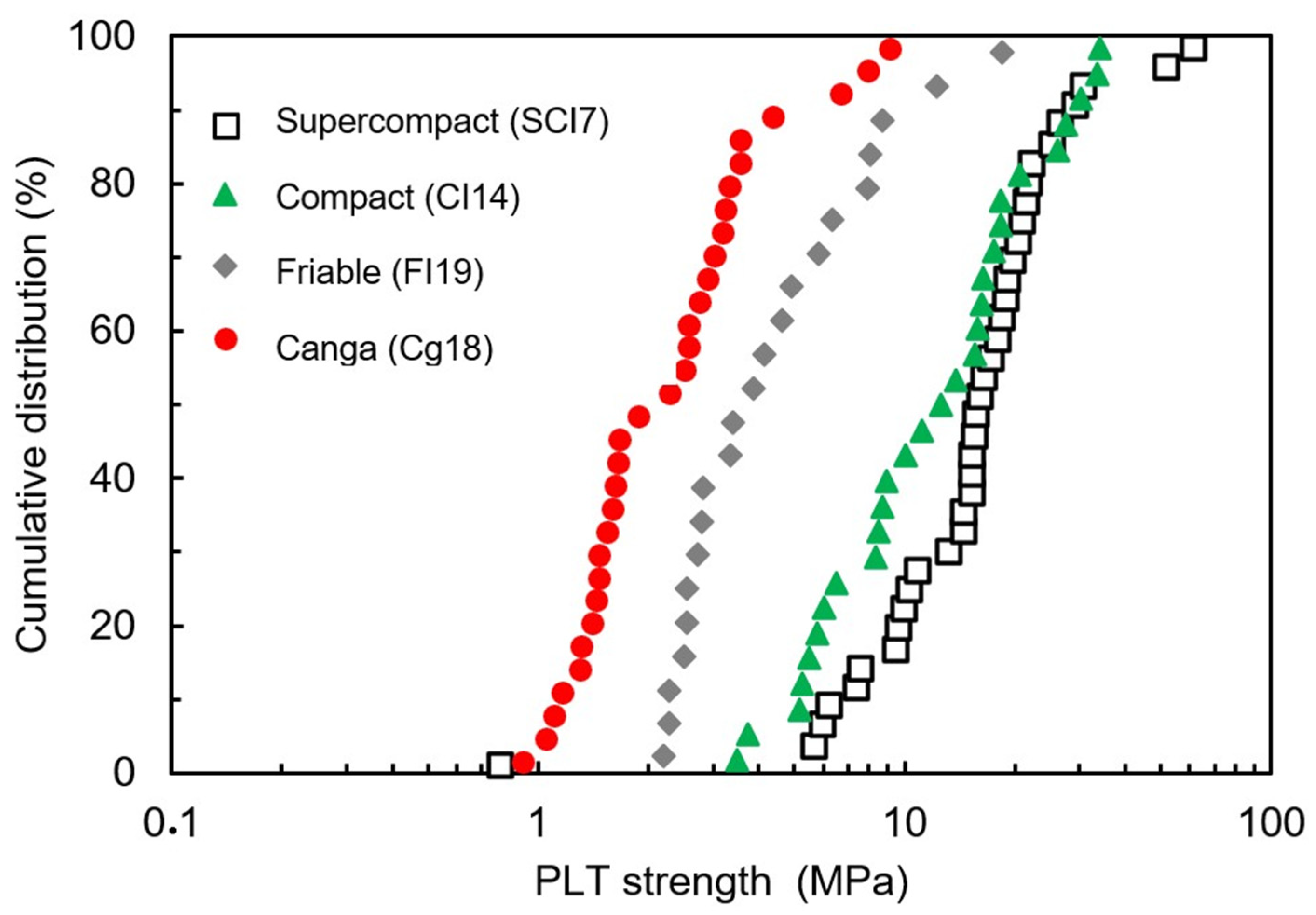
Typical results from the tests that resulted in measurements for each individual particle are presented in Figure 2, for Is(50). It shows that variability in the data is substantial, owing to variation in particle shape and orientation in the test. However, it shows that the higher anisotropy of the itabirites (supercompact, compact, and friable) in comparison to the nearly isotropic structure of canga did not result in lower variability of the data, demonstrating the key role played by the internal flaw structure in each particle in their resistance to fragmentation. For tests that generated results for each particle tested, namely point-load and crushing work index tests, mean values for each sample were recorded.
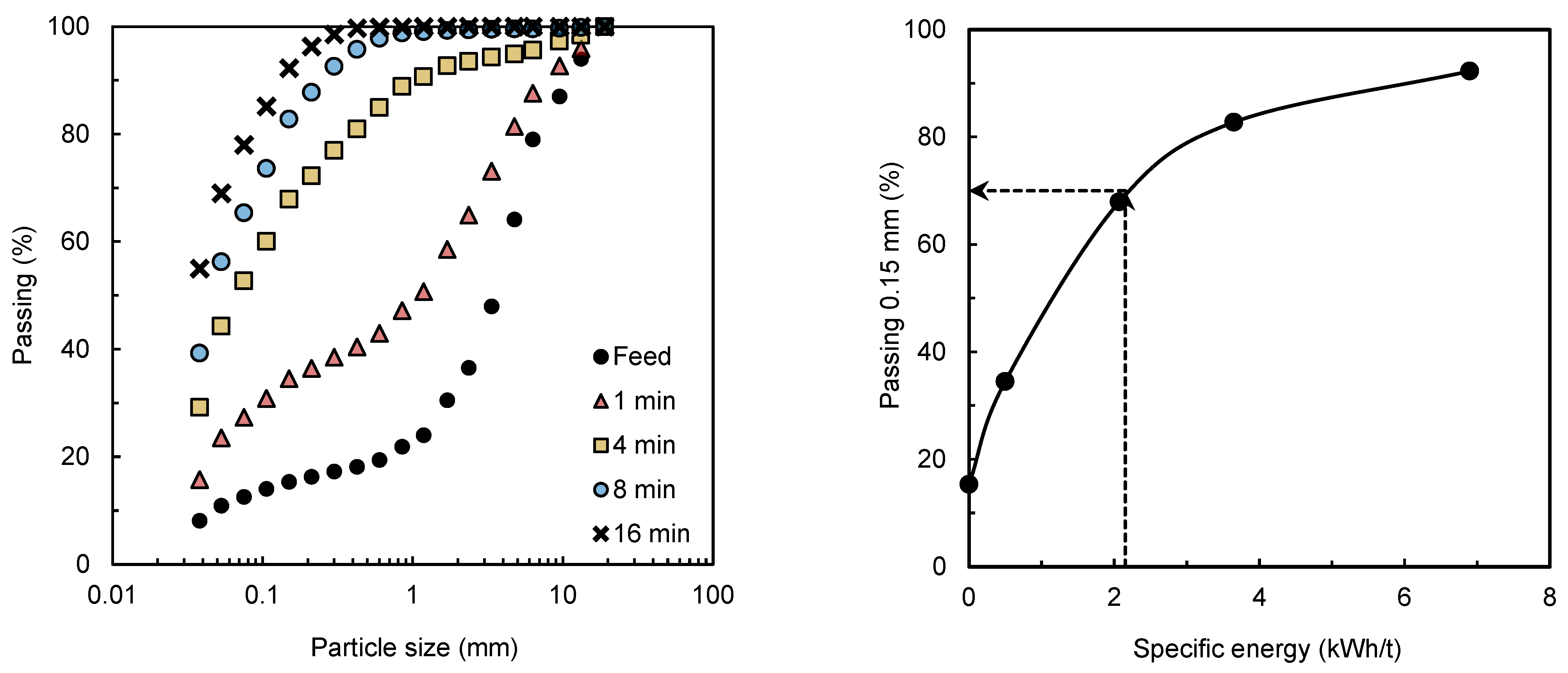
A typical result from a batch grinding test is presented in Figure 3 (left) for sample SCI4. It shows the increase in fineness as grinding time progresses, which becomes less pronounced for longer grinding times. To calculate the size-specific energy (SSE) using Equation (5), the percentage passing the 0.15 mm sieve has been plotted as a function of specific energy in the batch mill (Figure 3, right). The percentage passing the selected sieve at the specific energy of 2.15 kWh/t is used to calculate the fineness of the product for computing the SSE.

3.2. Distributions of Data from Ore Samples

In this section, the results from each of the tests for the individual samples are summarized and compared using order statistics.
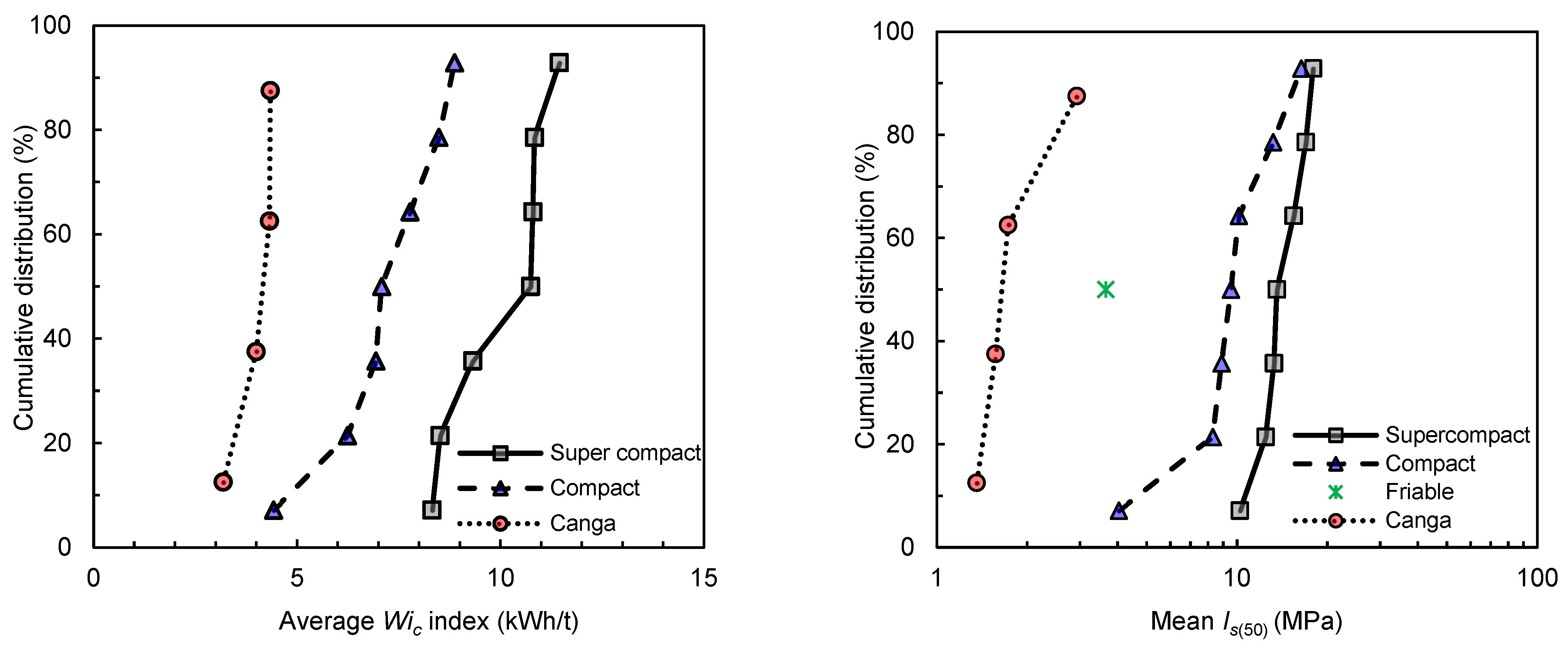
Values of the impact work index (Wic) are presented in Figure 4 (left). Data from friable itabirite were not presented, since material was not available in the required size range for testing. The figure shows that a clear distinction appears among the different ore types, with very limited superposition among them. While samples of canga present low resistance to fragmentation by impact, compact itabirite presents an intermediate value, whereas samples of supercompact itabirite present an average value of 10.0 kWh/t. The lower competence of compact itabirite was attributed, in a previous work [18], to its widespread internal fracture network in comparison to the supercompact itabirite. Table 3 shows that the three ore types are discriminated with high confidence (>99.9%) using this test.
Measurements of fracture strength of particles from the PLT (Figure 4, right) show even greater distinction among the results for Cg (average 1.9 MPa) and the other itabirites. While SCI presents higher values than CI, the differences in means are only moderate (14.3 MPa and 10.1 MPa). The only datum available for FI places it between those of Cg and CI. Table 3 shows that the same discrimination of ore types was possible using one-way ANOVA, although results needed to be subjected to a logarithmic transformation, given the apparent lognormal distribution of the data and their different variances (Figure 4, right).
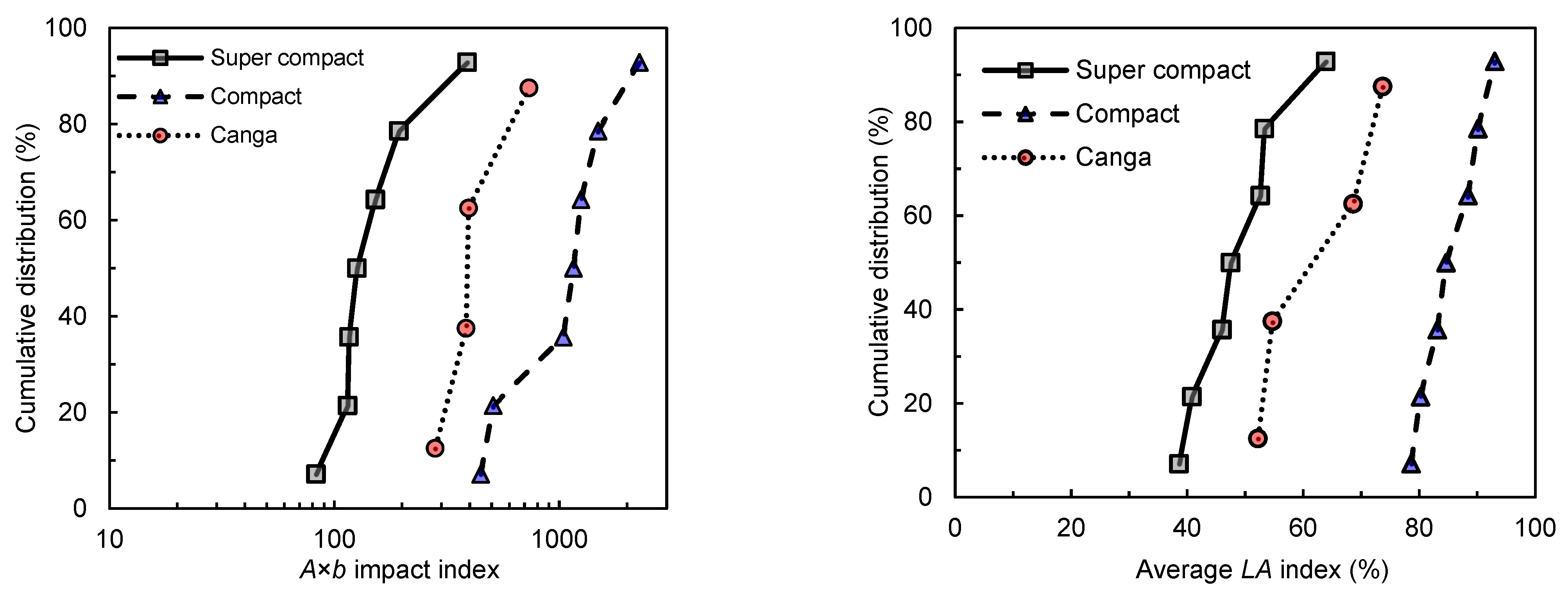
Values that characterize the resistance of particles to impact (A×b DWT) in the intermediate size range are presented in Figure 5 (left). Within the size range of the test, it becomes evident that Cg presents an intermediate response in comparison to the itabirites, with SCI presenting the smallest mean value of A×b index in the DWT, followed by Cg and CI. The same pattern is observed for the LA abrasion test, with SCI presenting the lowest value, followed by Cg and CI. In both cases (Table 3), the differences are statistically different for the ore types.
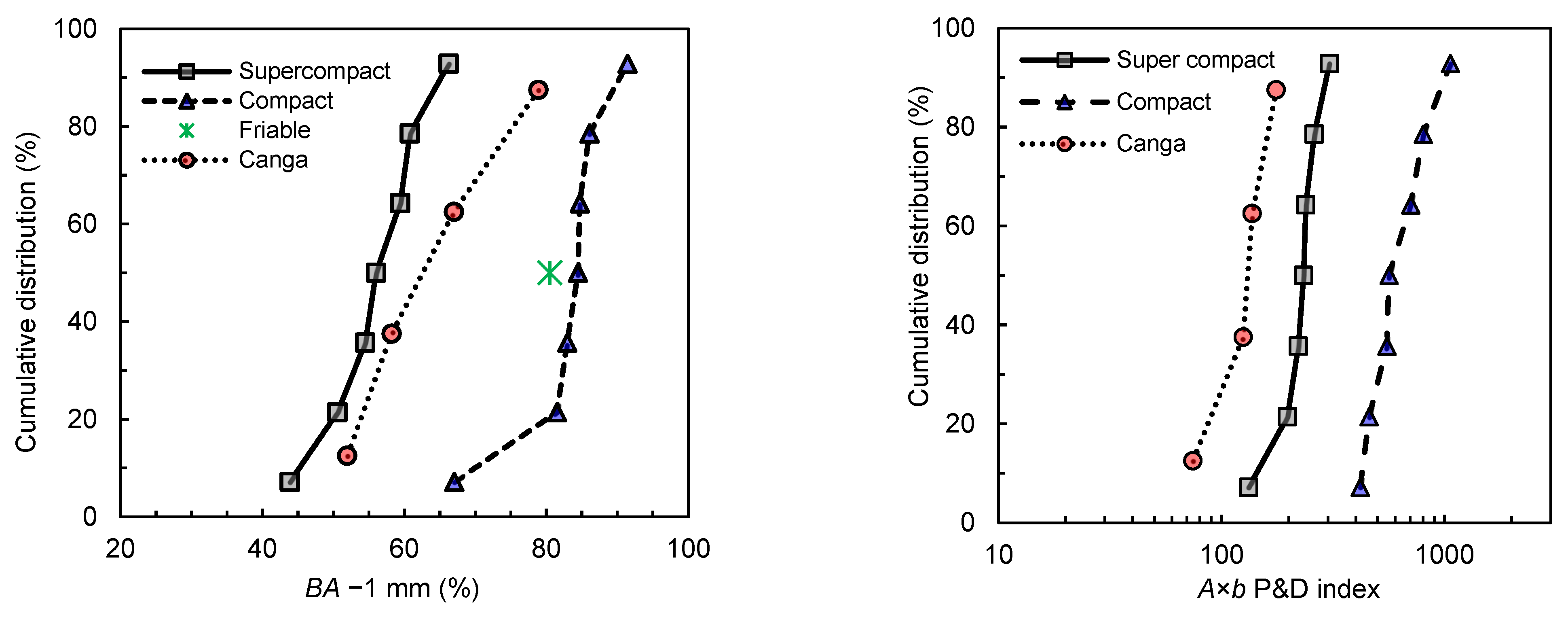
This same general behavior is also observed in the results of the proportion of fines (−1 mm) in the Bond abrasiveness (BA) test (Figure 6 left). SCI remains a highlight for its comparatively higher resistance to fragmentation (55.9%), followed by Cg (64.0%), with CI presenting the highest value (82.6%). While of no statistical significance, the datum from FI appeared consistent with that of CI. Although a statistically significant effect has been observed in the analysis of variance (Table 3), the difference between the average values for SCI and Cg is not. Figure 6 (right) for the piston-and-die test shows that, in its sizes, Cg presents itself as the ore type with the highest resistance to comminution, followed by SCI, with CI presenting an even lower resistance. The differences between the averages were found to be statistically significant (after a logarithmic transformation), with canga presenting the highest resistance.
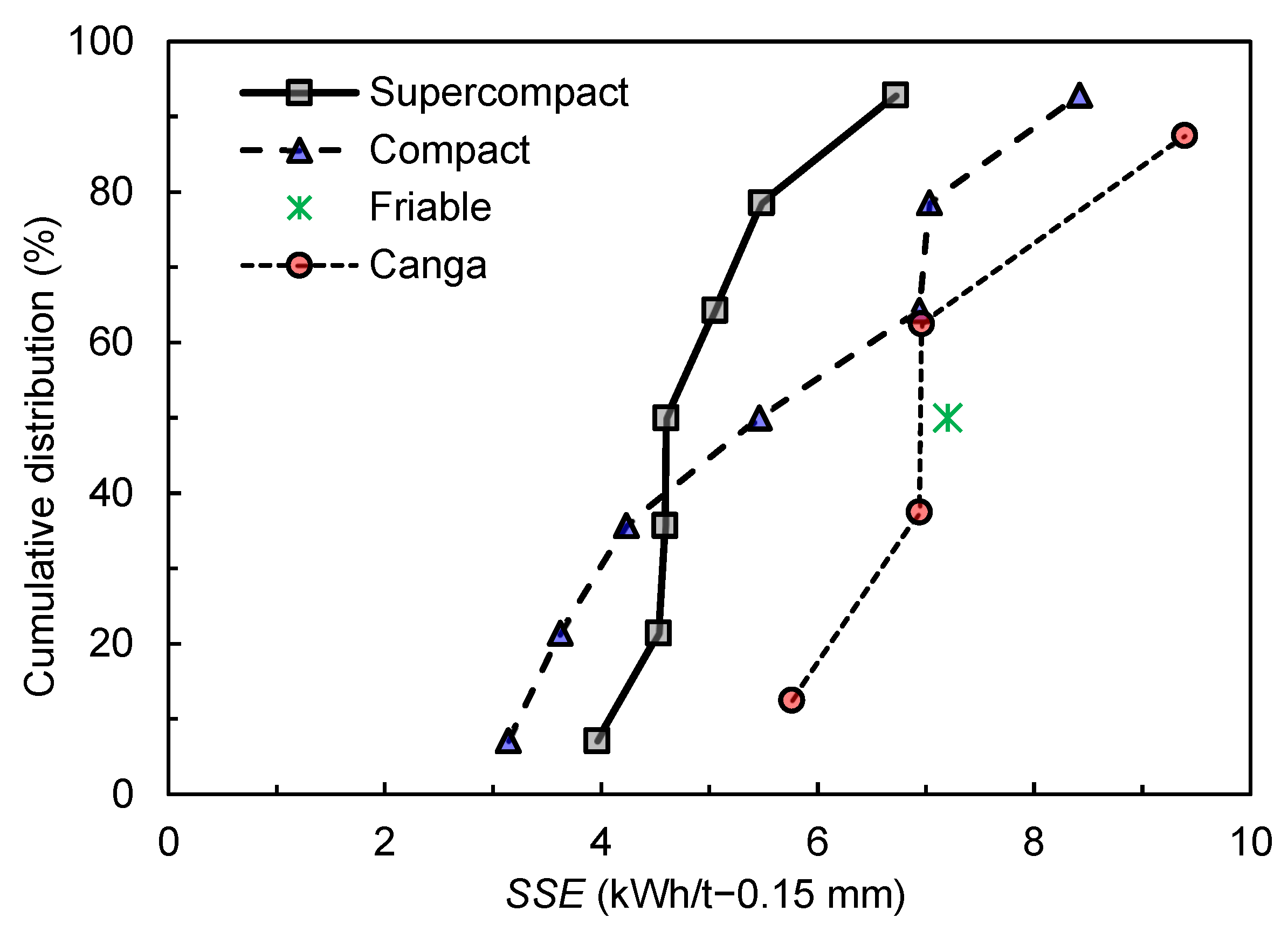
In the case of ball milling, results shown in Figure 7 demonstrate that no straightforward discrimination among the ore types is possible based on SSE, which presents mean values of 5.0 kWh/t −150 μm for SCI, and 5.6 kWh/t −150 μm for CI, being even higher for Cg (7.3 kWh/t −150 μm). The only datum available for FI (7.2 kWh/t −150 µm), with no statistical relevance, places it close to Cg; that is, with the greatest resistance to grinding than the remaining itabirites. No statistically significant differences were identified at 95% confidence among the averages, while at 90% confidence, it is possible to state that canga demands more energy in grinding than supercompact itabirite (Table 3), whereas the SSE of compact itabirite could not be discriminated from the other ore types. This highest specific energy demanded by Cg may be explained by its anisotropic structure and very fine grain sizes, which contrasts with the bedding of the itabirites and the fact that the marker size used to compute SSE is close to the grain size of its component minerals.
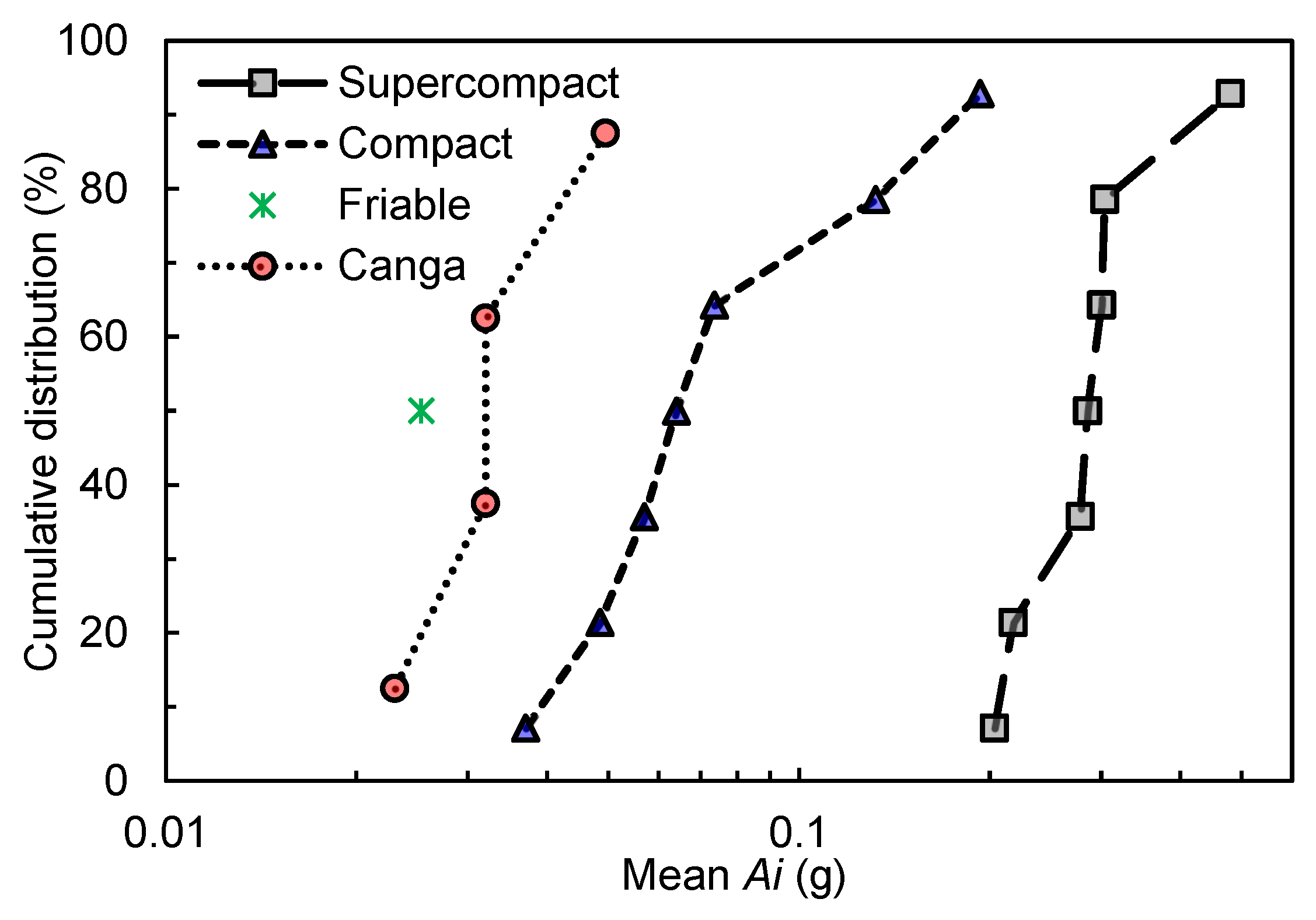
Results from the abrasiveness tests are presented in Figure 8. In it, the substantially higher abrasiveness of SCI in comparison to the remaining ore types, with an average value of Ai of 0.30 g, is shown. Substantially lower values are found for CI, with a mean Ai value of 0.086 g, and Cg, with a mean of 0.034 g. The sample FI is a highlight for its low abrasiveness, which may be partially explained by the significant mechanical degradation of the sample during the test, owing to its low strength (Figure 5 right) [30]. Table 3 shows that, after logarithmic transformation, the differences in the average values of Ai were found to be statistically significant.
Finally, Table 3 shows that no statistically significant differences appeared between the specific gravities of the samples, demonstrating that it is not a suitable measure for discriminating the ore types.
A summary of the descriptive statistics of the data is presented in Table 4. Analyzes of correlation of the different measures are presented in Appendix A.

3.3. Cluster Analysis of Samples

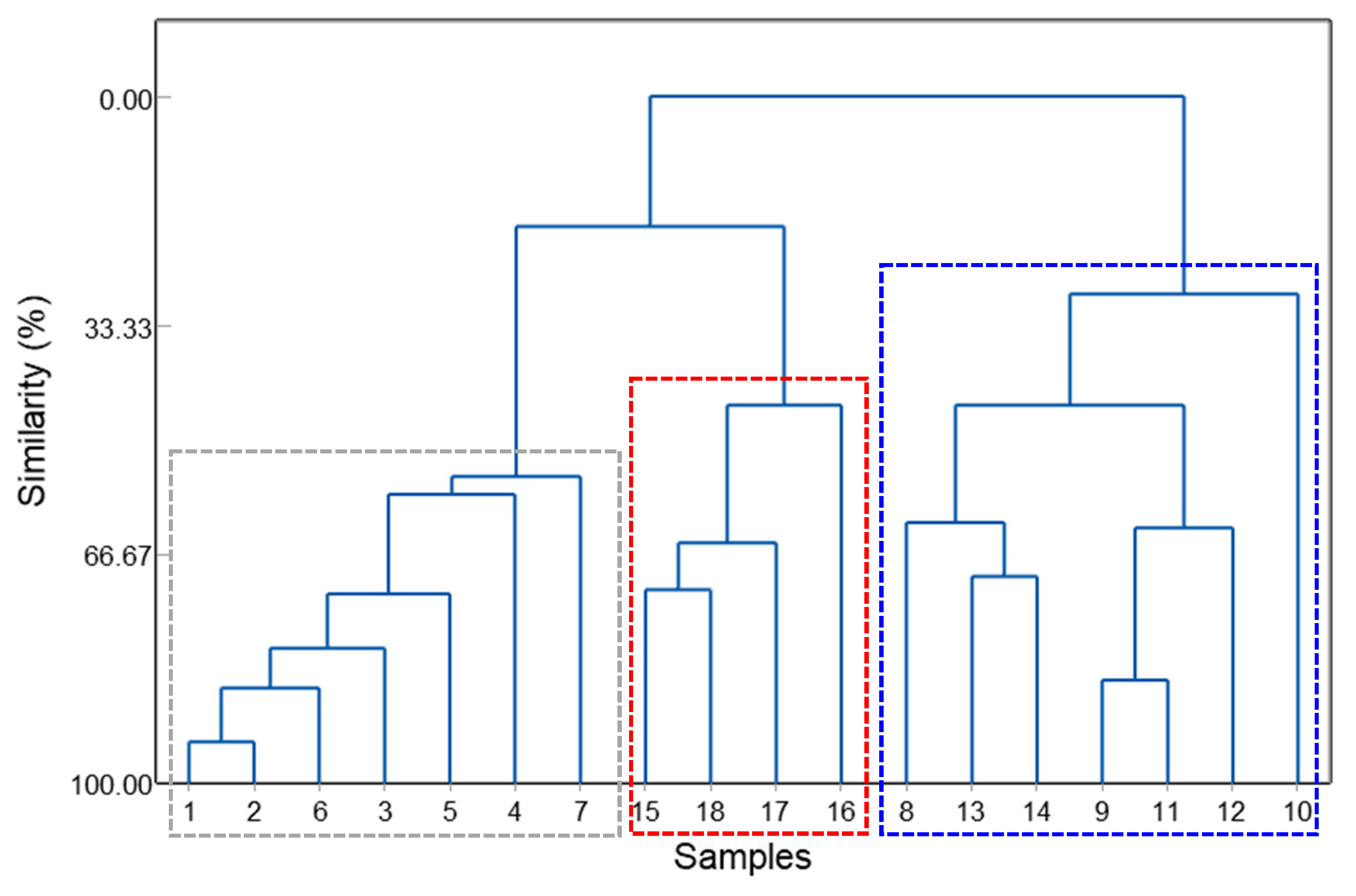
With the aim of assessing how the samples analyzed naturally grouped themselves with respect to the results from the various tests, the multivariate technique, cluster analysis, was used in Minitab® 22. In this case, sample FI was not included, since the full suite of tests could not be conducted. The results are summarized in Figure 9. It shows that the technique places all SCI in a single group with the highest similarity (55.4%), followed by Cg, which forms a group with moderately lower similarity (45.0%). Finally, samples of CI also form another group; however, with much lower similarity (28.8%), demonstrating its comparatively higher heterogeneity. It is worth noting that the samples of SCI formed a supergroup with the samples of Cg (similarity of 18.9%) and not with CI, as would have been otherwise expected, which demonstrates the importance of discriminating CI and SCI with respect to their response in comminution.

4. Conclusions

Detailed analyzes of 19 samples of mine faces from the Serra do Sapo iron ore deposit (Minas Gerais, Brazil) allowed us to conclude that:
  • At coarse sizes, that is, those that are consistent with the initial crushing stages, particles of supercompact itabirite presented substantially higher resistance to comminution than those identified as compact, both of which had higher resistance than canga.
  • At the intermediate size ranges, that is, those consistent with roller pressing at the Minas Rio plant [4] (tests with average feed sizes from about 5 to 30 mm), canga progressively increases its competence, first surpassing that of compact itabirite and, then, at finer sizes, that of supercompact itabirite. Yet, supercompact remains consistently more competent than compact itabirite in these size ranges.
  • At the finer size range, that is, in sizes which are fed to grinding stages at the plant, the variability within each of the ore types was higher than that between ore types, with canga presenting higher resistance, followed by compact and supercompact itabirite, exhibiting the opposite trend when compared to that observed at the coarser size range.
  • The abrasiveness was higher for supercompact than compact itabirite, whereas abrasiveness of canga was very low.
  • Cluster analysis of samples allowed identifying strong grouping of samples classified as supercompact, as well as of canga and compact itabirite. However, these last two had a lower similarity. Indeed, it was observed that supercompact presented greater affinity in comminution response to canga and not to compact itabirite, further justifying its discrimination from the latter, in particular, when dealing with coarse comminution and abrasiveness. Such grouping, however, should be regarded as only preliminary, since cluster validation with independent samples was not yet possible.

Author Contributions

Conceptualization, L.M.T.; methodology, L.M.T. and G.K.P.B.; formal analysis, L.M.T.; investigation, L.M.T., G.K.P.B., L.P.A., E.F.d.C. and J.N.S.S.; resources, L.P.A., E.F.d.C. and J.N.S.S.; data curation, L.M.T. and G.K.P.B.; writing—original draft preparation, L.M.T.; writing—review and editing, L.M.T., G.K.P.B., L.P.A. and J.N.S.S.; visualization, L.M.T.; supervision, L.M.T.; project administration, L.M.T., L.P.A. and J.N.S.S.; funding acquisition, L.M.T., E.F.d.C. and J.N.S.S. All authors have read and agreed to the published version of the manuscript.

Funding

This research was funded by Conselho Nacional de Desenvolvimento Científico e Tecnológico (CNPq), grant number 313425/2021-3.

Data Availability Statement

The data presented in this study are available on request from the corresponding author. The data are not publicly available due to restrictions imposed by the mine site.

Acknowledgments

The authors would like to thank Anglo American for technically and financially supporting the work and also for permission to publish the work.

Conflicts of Interest

Authors L.P.A., E.F.d.C. and J.N.S.S. were employed by the company Anglo American. The remaining authors declare that the research was conducted in the absence of any commercial or financial relationships that could be construed as a potential conflict of interest.

Appendix A. Correlation Between Comminution Measures

Results from various tests were then analyzed using Pearson correlation [35], to identify tests that provide redundant responses.
A summary of the Pearson correlation matrix among the various tests for the 18 samples (FI excluded) is presented in Table A1. A highlight is the strong correlation between the LA abrasion index and the percentage of fines in the Bond abrasiveness test, as already demonstrated in a previous study [30]. Such strong correlation (97%) demonstrates that the Bond abrasion index test not only provides a suitable measure of abrasiveness, but also a measure that may be directly used to estimate the LA abrasion. For the ore types studied, good direct correlation (90%) was also found for both of these and the traditional A×b DWT index, further demonstrating the suitability of the percentage −1 mm in estimating this popular index. The poor correlation of SSE with all measures demonstrates the importance of estimating it directly, at least for the iron ores of interest.
Table A1. Pearson correlation matrix.
WicPLT 1A×b DWT 1LABa−1 mmA×b P&D 1
PLT 10.79
A×b DWT 1−0.50−0.24
LA−0.40−0.160.90
Ba−1 mm−0.35−0.140.900.97
A×b P&D 10.150.410.680.690.71
SSE−0.45−0.560.040.180.11−0.40
1 Analysis of correlation conducted after logarithmic transformation.

References

  1. Lamberg, P.; Rosenkranz, J.; Wanhainen, C.; Lund, C.; Minz, F.; Mwanga, A.; Parian, M.A. Building a geometallurgical model in iron ores using a mineralogical approach with liberation data. In Proceedings of the 2nd AusIMM International Geometallurgy Conference, Brisbane, Australia; AusIMM: Carlton, Australia, 2013; pp. 317–324. [Google Scholar]
  2. Wright, B.; Carroll, T.; Flanagan, M.; Sua, T.; Van Dijken, B. BHP Billiton West Australian Iron Ore Geometallurgy—Past, Present and Future. In Proceedings of the 2nd AusIMM International Geometallurgy Conference, Brisbane, Australia; AusIMM: Carlton, Australia, 2013; pp. 105–110. [Google Scholar]
  3. Tøgersen, M.K.; Kleiv, R.A.; Ellefmo, S.; Aasly, K. Mineralogy and texture of the Storforshei iron formation, and their effect on grindability. Miner. Eng. 2018, 125, 176–189. [Google Scholar] [CrossRef]
  4. França, J.R.; Barrios, G.K.; Turrer, H.D.; Tavares, L.M. Comminution and liberation response of iron ore types in a low-grade deposit. Miner. Eng. 2020, 158, 106590. [Google Scholar] [CrossRef]
  5. Dominy, S.C.; O’Connor, L.; Parbhaka-Fox, A.; Glass, H.J.; Purevgerel, S. Geometallurgy—A Route to more resilient mineral operations. Minerals 2018, 8, 560. [Google Scholar] [CrossRef]
  6. Amelunxen, P. The Effects of Ore Variability on HPGR Trade-Off Economics; Canadian Institute of Mining, Metallurgy and Petroleum: Westmount, QC, Canada, 2012. [Google Scholar]
  7. Kabemba, A.M.; Mutombo, K.; Waters, K.E. Towards a dynamic optimisation of comminution circuit under geological uncertainties. Processes 2025, 13, 443. [Google Scholar] [CrossRef]
  8. Guillen, M.; Iriarte, G.; Montes, H.; San Martín, G.; Fantini, N. Comparative analysis of throughput prediction models in SAG mill circuits: A Geometallurgical Approach. Mining 2025, 5, 37. [Google Scholar] [CrossRef]
  9. Hagemann, S.G.; Angerer, T.; Duuring, P.; Rosière, C.A.; Silva, R.F.; Lobato, L.; Hensler, A.S.; Walde, D.H.G. BIF-hosted iron mineral system: A review. Ore Geol. Rev. 2016, 76, 317–359. [Google Scholar] [CrossRef]
  10. Caxito, F.; Dias, T.G.F. Recursos Minerais de Minas Gerais: Recursos Minerais no Cenário Geológico de Minas Gerais; Lobato, L.M., Costa, M.A., Eds.; UFMG: Belo Horizonte, Brazil, 2018. [Google Scholar]
  11. Almeida-Abreu, P.A.; Renger, F.E. Stratigraphy and facies of the southern Serra do Espinhaço, Minas Gerais, Brazil. Zzeitschrift-Dtsch. Ges. Geowiss. 2007, 158, 9–29. [Google Scholar] [CrossRef]
  12. Rolim, V.K. As Formações Ferríferas da Região de Conceição do Mato Dentro—MG: Posicionamento Estratigráfico, Evolução Tectônica, Geocronologia, Características Geoquímicas e Gênese dos Minérios. Doctoral Thesis, Federal University of Minas Gerais, Minas Gerais, Brazil, 2016. [Google Scholar]
  13. Silveira-Braga, F.C.; Rosière, C.A.; Queiroga, G.N.; Rolim, V.K.; Santos, J.O.S.; Mcnaughton, N.J. The Statherian itabirite-bearing sequence from the Morro Escuro Ridge, Santa Maria de Itabira, Minas Gerais, Brazil. J. S. Am. Earth Sci. 2015, 58, 33–53. [Google Scholar] [CrossRef]
  14. Dorr, J.V.N. Supergene iron ores of Minas Gerais, Brazil. Econ. Geol. 1964, 54, 1204–1240. [Google Scholar] [CrossRef]
  15. Rosière, C.A.; Chemale, J.R.F. Itabiritos e minérios de ferro de alto teor do Quadrilátero Ferrífero—Uma visão geral e discussão. Geonomos 2000, 8, 27–43. [Google Scholar] [CrossRef]
  16. Souza, A.A.P.; Silva, R.C.F.; Rosière, C.A.; Dias, G.S.; Morais, F.P. Estudos geoquímicos de itabiritos da Serra do Sapo, Espinhaço meridional, Minas Gerais. Geonomos 2015, 22, 1–17. [Google Scholar] [CrossRef]
  17. Spier, C.A.; Levett, A.; Rosière, C.A. Geochemistry of canga (ferricrete) and evolution of the weathering profile developed on itabirite and iron ore in the Quadrilátero Ferrífero, Minas Gerais, Brazil. Miner. Depos. 2019, 54, 983–1010. [Google Scholar] [CrossRef]
  18. Moutinho, V.F.; Neumann, R.; Tavares, L.M. Influence of mineralogy and microstructure on single-particle breakage behavior of iron ores. Miner. Eng. 2026, 237, 109988. [Google Scholar] [CrossRef]
  19. Napier-Munn, T.J.; Morrel, S.; Morrison, R.D.; Kojovic, T. Mineral Comminution Circuits: Their Operation and Optimization; Julius Kruttschnitt Mineral Research Centre: Brisbane, Australia, 1996. [Google Scholar]
  20. Tavares, L.M.; Silveira, M.A.W. Comparison of measures of rock crushability. In Fine Particle Technology and Characterization; Yekeler, M., Ed.; Research Signpost: Kerala, India, 2008; pp. 1–20. [Google Scholar]
  21. ASTM 5731; Standard Test Method for Determination of the Point Load Strength Index of Rock. ASTM International: West Conshohocken, PA, USA, 2002.
  22. Tavares, L.M. Breakage of Particles: Quasi-static. In Handbook of Powder Technology: Particle Breakage; Ghadiri, M., Hounslow, M., Eds.; Elsevier: Amsterdam, The Netherlands, 2007; pp. 3–68. [Google Scholar]
  23. ISRM. Suggested method for determination point load strength. Int. J. Rock Mech. Min. Sci. Geomech. Abstr. 1985, 22, 51–60. [Google Scholar] [CrossRef]
  24. Bergstrom, B.H. Crushability and grindability. In SME Mineral Processing Handbook; Weiss, N.L., Ed.; Society of Mining Engineers: Littleton, CO, USA, 1985; Volume 2, pp. 30-65–30-68. [Google Scholar]
  25. Bond, F.C. Crushing tests by pressure and impact. Trans. AIME 1947, 169, 58–66. [Google Scholar]
  26. Tavares, L.M.; Carvalho, R.M. Impact work index prediction from continuum damage model of particle fracture. Miner. Eng. 2007, 20, 1368–1375. [Google Scholar] [CrossRef]
  27. Schönert, K. The influence of particle bed configurations and confinements on particle breakage. Int. J. Miner. Process. 1996, 44, 1–16. [Google Scholar] [CrossRef]
  28. ASTM C535-16; Standard Test Method for Resistance to Degradation of Large-Size Coarse Aggregate by Abrasion and Impact in the Los Angeles Machine. ASTM: West Conshohocken, PA, USA, 2006.
  29. Kahraman, S.; Toraman, O.Y. Predicting Los Angeles abrasion loss of rock aggregates from crushability index. Bull. Mater. Sci. 2008, 31, 173–177. [Google Scholar] [CrossRef]
  30. Tino, A.A.; Barrios, G.K.P.; Tavares, L.M. Insights into metal wear and particle breakage using Bond’s abrasiveness test. Miner. Eng. 2024, 210, 108673. [Google Scholar] [CrossRef]
  31. Austin, L.G.; Klimpel, R.R.; Luckie, P.T. The Process Engineering of Size Reduction: Ball Milling; SME-AIME: New York, NY, USA, 1984. [Google Scholar]
  32. Faria, P.M.C.; Rajamani, R.K.; Tavares, L.M. Optimization of solids concentration in iron ore ball milling through modeling and simulation. Minerals 2019, 9, 366. [Google Scholar] [CrossRef]
  33. Ballantyne, G.R.; Peukert, W.; Powell, M.S. Size specific energy (SSE)—Energy required to generate minus 75 micron material. Int. J. Miner. Process. 2015, 136, 2–6. [Google Scholar] [CrossRef]
  34. Rocha, B.N.; Campos, T.M.; Alves, L.P.; Tavares, L.M. Multicomponent simulation of an industrial closed–circuit ball mill in size reduction of an iron ore. Miner. Eng. 2026, 235, 109825. [Google Scholar] [CrossRef]
  35. Morrison, J. Statistics for Engineers: An Introduction; Wiley: Hoboken, NJ, USA, 2009; 192p. [Google Scholar]
  36. Everitt, B.S.; Landau, S.; Leese, M.; Stahl, D. Cluster Analysis; John Wiley & Sons: Hoboken, NJ, USA, 2011. [Google Scholar]
Figure 1. Images depicting a mine face (left) and the collection and storage of ore sample SCI3 (right).
Minerals 16 00473 g001
Figure 2. Distribution of results from point-load testing (Is(50)) for selected samples.
Minerals 16 00473 g002
Figure 3. Batch grinding test result for sample SCI4 (left) and plot of percentage passing the 0.15 mm sieve as a function of specific energy, depicting the specific energy selected (right), for the same test, used to compute the SSE.
Minerals 16 00473 g003
Figure 4. Distributions of crushing impact work index (Wic) (left) and point-load test strength (right). Each data point represents result from one of the samples.
Minerals 16 00473 g004
Figure 5. Distributions of values of drop weight tests (A×b DWT) (left) and Los Angeles abrasion (right).
Minerals 16 00473 g005
Figure 6. Distribution of Bond abrasion test −1 mm (left) and values of A×b from piston-and-die tests (right).
Minerals 16 00473 g006
Figure 7. Distribution of values of specific energy demanded in the generation of each ton of material in the product size range.
Minerals 16 00473 g007
Figure 8. Distribution of values of Bond abrasiveness of the samples.
Minerals 16 00473 g008
Figure 9. Dendogram from cluster observations for samples of SCI (1–7), CI (8–14), and Cg (15–18) by standardizing the variables.
Minerals 16 00473 g009
Table 1. Range of particle sizes in the feed to the various tests.
TestSize Range (Mean Size) (mm)Main OutputCondition
Bond impact work index50.0–75.0 (61.2)WicSingle-particle
Point-load 31.5–37.5 (34.4)Is(50)Single-particle
Drop weight 13.3–63.0 (28.9)A×bDWTSingle-particle
Los Angeles abrasion12.5–19.0 (14.5)LA indexBulk
Bond abrasiveness9.5–19.0 (13.4)Ba−1 mmBulk
Piston-and-die1.70–31.5 (7.3)A×bP&DParticle bed
Batch grinding−19.0 (1.7 1)SSEBulk
1 Mean 50% passing size in the feed.
Table 2. Summary of conditions used in the batch grinding tests.
Operating VariableValueUnit
Rotation speed 40rpm
Percentage of critical speed76%
Solids concentration (v/v)55%
Mass of grinding charge23.8kg
Ball filling24%
Percentage of voids occupied by ore100%
Ball size distributionDiameter (mm)Mass (kg)
6529.1
5033.1
3813.7
254.8
Table 3. Summary of ANOVA and Tukey’s multiple comparisons procedure (α = 0.05).
Measurep-ValueTukey’s Pairwise ComparisonsData Transformation
Wic<0.001SCI > CI > CgNone
Point-load strength<0.001SCI > CI > CgLog
A×b DWT<0.001SCI > Cg > CILog
LA Index<0.001SCI > Cg > CINone
Bond abrasion—1 mm<0.001SCI ≈ Cg > CINone
A×b P&D<0.001Cg > SCI > CILog
SSE0.089Cg ≈ CI ≈ SCI 1None
Bond abrasiveness—Ai<0.001SCI > CI > CgLog
Specific gravity0.726SCI ≈ CI ≈ CgNone
1 With α = 0.1: Cg > SCI.
Table 4. Mean (and standard deviation in parentheses) values of the measures.
MeasureUnitSCICICgFI
WickWh/t10.0 (1.3)7.1 (1.5)4.0 (0.5)Na 1
Point-load strengthMPa14.3 (2.7)10.1 (3.9)1.9 (0.7)3.7 (-)
A×b DWT-168 (104)1165 (618)449 (197)Na 1
LA Index%49.0 (8.6)85.4 (5.3)62.3 (10.5)Na 1
Bond abrasion—1 mm %55.9 (7.3)82.6 (7.6)64.0 (11.7)80.5 (-)
A×b P&D-227 (54)652 (225)128 (42)Na 1
SSEkWh/t—0.15 mm4.99 (0.90)5.55 (1.99)7.27 (1.52)7.20 (-)
Bond abrasivenessg0.296 (0.090)0.086 (0.056)0.034 (0.011)0.025 (-)
Specific gravityg/cm33.29 (0.17)3.36 (0.18)3.39 (0.33)4.01 (-)
Number of samples-7741
1 Not available due to insufficient samples.
Disclaimer/Publisher’s Note: The statements, opinions and data contained in all publications are solely those of the individual author(s) and contributor(s) and not of MDPI and/or the editor(s). MDPI and/or the editor(s) disclaim responsibility for any injury to people or property resulting from any ideas, methods, instructions or products referred to in the content.