Article

Petrogenesis and Magma Evolution of the Hornblende Gabbro from Northwest Elazığ, Eastern Türkiye: Constraints from Geochemistry, Sr–Nd Isotopes, and Mineral Chemistry


by
Mehmet Ali Ertürk
Department of Geological Engineering, Fırat University, 23119 Elazığ, Türkiye
Minerals 2026, 16(5), 444; https://doi.org/10.3390/min16050444
Submission received: 17 March 2026 / Revised: 20 April 2026 / Accepted: 22 April 2026 / Published: 24 April 2026
(This article belongs to the Section Mineral Geochemistry and Geochronology)

Abstract

The hornblende gabbro investigated in this study crops out in northwestern Elazığ, eastern Türkiye, within the Southeastern Anatolian Orogenic Belt (SAOB), where Late Cretaceous ophiolitic, volcanic, plutonic, and metamorphic units are widely exposed. This study examines the petrology, whole-rock geochemistry, Sr–Nd isotopic composition, mineral chemistry, and crystallisation conditions of these gabbroic bodies to constrain their petrogenesis and tectonomagmatic significance. Field observations show that the rock occurs as rounded to sub-rounded blocks with fresh inner cores and altered outer rims. Petrographic and XRD data indicate that the fresh gabbro mainly consists of plagioclase and amphibole, whereas the altered outer rims contain quartz and minor secondary phases. Whole-rock geochemical data classify the samples as low- to medium-K, tholeiitic, and predominantly metaluminous gabbro. Primitive mantle-normalised trace-element patterns display enrichment in large-ion lithophile elements and depletion in high-field-strength elements, whereas chondrite-normalised REE patterns show slight LREE enrichment, relatively flat HREE patterns, and weak Eu anomalies. Sr–Nd isotopic compositions are characterised by positive εNd(T) values (+4.4 to +5.3) and moderately radiogenic initial 87Sr/86Sr ratios (0.704792–0.705344), indicating a predominantly mantle-derived magma source affected by subduction-related modification, with limited crustal contribution. Mineral chemistry data show that amphiboles belong to the calcic amphibole group and plot in the magnesio-hornblende field. Amphibole thermobarometric calculations yielded temperatures of 873–991 °C and pressures of 1.49–3.26 kbar, corresponding to crystallisation depths of 5.1–15.3 km. Overall, the results indicate that the hornblende gabbro was derived from a mafic magma generated from a spinel lherzolite mantle source and crystallised in a subduction-related tectonomagmatic setting.

1. Introduction

Mafic plutonic rocks preserve important information on magma generation, differentiation, and emplacement processes because they record both whole-rock geochemical signatures and mineral-scale crystallisation histories. In particular, hornblende-bearing gabbros are especially valuable for petrogenetic studies, as they commonly preserve evidence of hydrous magmatism, mantle-source characteristics, and crystallisation conditions in subduction-related systems. Previous studies have shown that gabbroic magmas may develop in a variety of tectonomagmatic environments, including intra-oceanic arc, arc–nascent back-arc, active continental-margin, and arc-to-active continental-margin settings, and that their petrogenesis can be effectively constrained by integrating petrography, whole-rock geochemistry, radiogenic isotopes, mineral chemistry, and thermobarometric data [1,2,3,4,5,6]. In such systems, amphibole and plagioclase compositions provide critical information on magma evolution and crystallisation conditions, whereas trace-element and isotopic signatures help to distinguish depleted, enriched, crustally contaminated, and subduction-modified magma sources [2,3,5,6]. Therefore, integrated investigations of hornblende gabbros are essential for reconstructing both local magma evolution and the broader tectonomagmatic development of orogenic belts.
The Southeastern Anatolian Orogenic Belt (SAOB) represents one of the key tectonomagmatic domains of eastern Türkiye and preserves the record of the closure of the southern branch of the Neo-Tethys Ocean. Late Cretaceous magmatism in this belt has commonly been linked to northward subduction, supra-subduction-zone ophiolite formation, and arc-related magmatism, although the regional evolution has also been interpreted to include active continental-margin and, locally, collisional-to-post-collisional stages [7,8,9,10,11,12,13,14,15,16,17,18,19]. Within the Elazığ–Malatya–Tunceli region, Late Cretaceous ophiolitic units, volcanic rocks, plutonic intrusions, and metamorphic basement assemblages occur together and collectively record a complex subduction-related magmatic history [7,8,12,13,14]. Previous studies in the SAOB have mainly focused on regional ophiolites, large plutonic complexes, and associated volcanic suites. These studies have shown that Late Cretaceous magmatism in the belt includes mafic to felsic intrusive phases, arc-related volcanic rocks, and late shoshonitic to alkaline intrusions, indicating a multi-stage tectonomagmatic evolution [12,13,14,15,16,20,21]. However, the petrogenesis of discrete hornblende gabbro bodies exposed in northwestern Elazığ has not yet been investigated in detail using an integrated dataset that combines field observations, petrography, whole-rock geochemistry, Sr–Nd isotopes, mineral chemistry, and thermobarometric constraints. In particular, the magma source, crystallisation conditions, and tectonomagmatic significance of these gabbroic bodies remain poorly constrained. This study addresses that gap by investigating hornblende gabbro bodies exposed around the Hal–Hıdırbaba area in northwestern Elazığ.
The study aims to: (i) determine the petrographic and mineralogical characteristics of the rocks; (ii) constrain their whole-rock geochemical affinity and mantle source features; (iii) evaluate their Sr–Nd isotopic characteristics; (iv) define amphibole compositions; and (v) estimate magma crystallisation conditions using amphibole-based thermobarometric calculations. By integrating these datasets, the study seeks to clarify the petrogenesis and magma evolution of the hornblende gabbro and to evaluate its significance within the Late Cretaceous subduction-related magmatic framework of the SAOB.

2. Geological Setting

The study area is located in eastern Türkiye within the Southeastern Anatolian Orogenic Belt (SAOB) (Figure 1a), which preserves the record of the closure of the southern branch of the Neo-Tethys Ocean and the related Late Cretaceous–Cenozoic tectonomagmatic evolution of the region [9,11]. In the Elazığ–Malatya–Tunceli region of the SAOB, Late Cretaceous ophiolitic units, arc-related volcanic rocks, plutonic intrusions, and metamorphic basement assemblages are widely exposed and are generally interpreted as products of subduction-related magmatism associated with the northward subduction of Neo-Tethyan oceanic lithosphere [7,8,12]. Late Cretaceous ophiolitic units in the SAOB are widely regarded as supra-subduction-zone assemblages associated with this northward subduction [22,23]. The metamorphic units of the region constitute the basement and are represented mainly by low-grade recrystallised carbonate and metasedimentary rocks, locally accompanied by metaconglomerate and amphibolite [24]. The petrogenetic and geochemical characteristics of the plutonic and volcanic rocks have been considered comparable to those of modern intra-oceanic arc systems, indicating a relationship with the subduction of the southern branch of the Neo-Tethys beneath the Taurides [12]. Intra-oceanic northward subduction during the Late Cretaceous led to the formation of ophiolites and arc-related magmatic rocks above the subduction zone [13,25,26]. In the Elazığ–Baskil–Keban area, these units form a heterogeneous geological assemblage in which Late Cretaceous plutonic rocks are spatially associated with Late Cretaceous volcanic rocks, ophiolitic units, metamorphic rocks, and younger sedimentary to volcano-sedimentary successions (Figure 1b). The investigated area is situated north of Baskil and west of Keban, around the Hal–Hıdırbaba area (Figure 1b,c). At the local scale, gabbro samples analysed in this study were collected from discrete plutonic bodies exposed within a broader metamorphic basement domain and surrounded by Late Cretaceous volcanic, ophiolitic, and sedimentary–volcano-sedimentary units (Figure 1c). These plutonic bodies constitute part of the Late Cretaceous magmatic assemblage of the SAOB and occur within the regional subduction-related magmatic framework of the Elazığ region [8,19].

3. Sample Description and Petrography

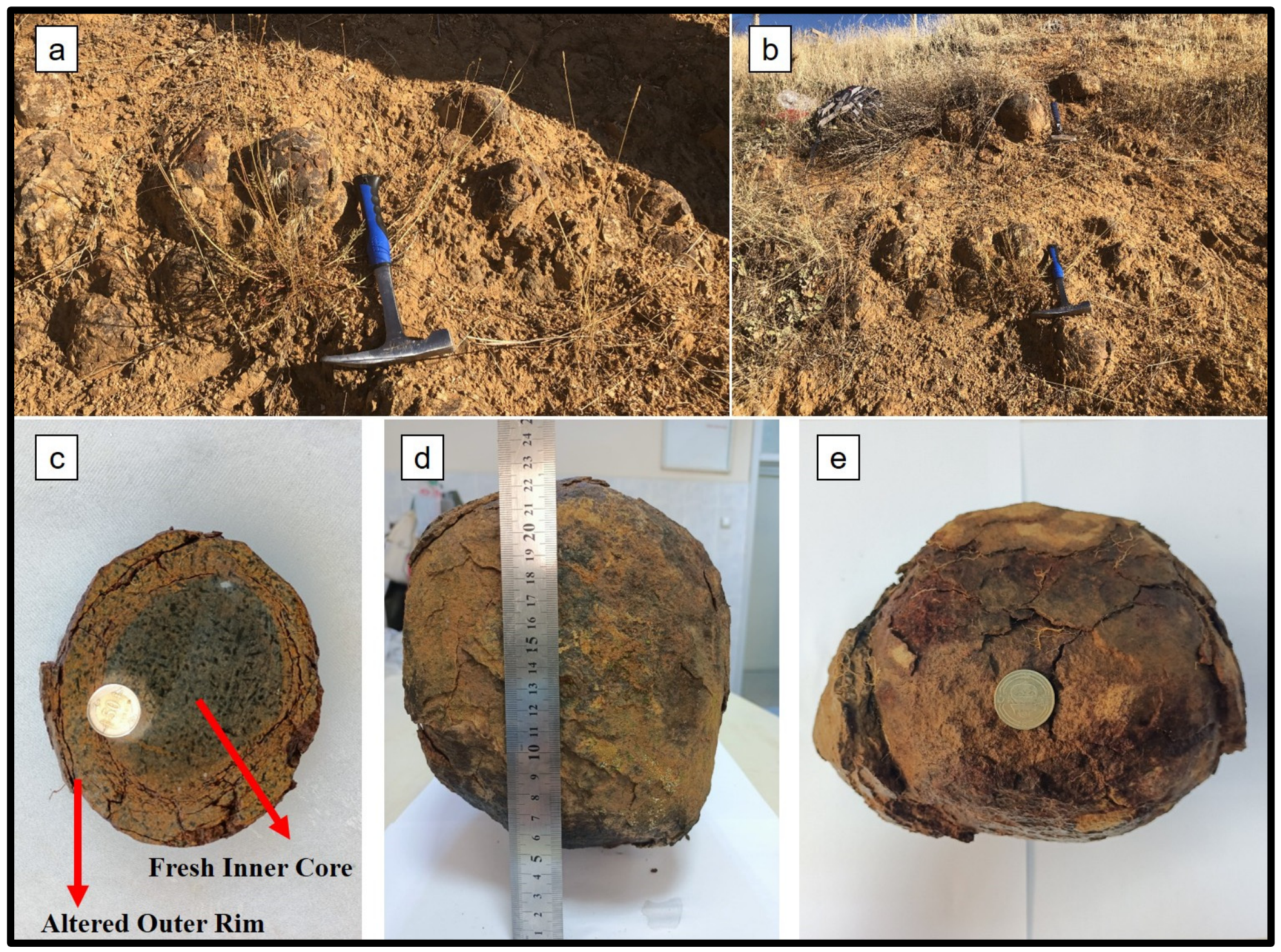
Field observations indicate that the hornblende gabbro occurs as rounded to sub-rounded, locally oval-shaped blocks (Figure 2a,b). The outer surfaces of these blocks display well-developed concentric, shell-like exfoliation structures. In cut sections, a clear colour and textural contrast is observed between the fresh inner core and the altered outer rim (Figure 2c). The inner portions are dark greenish-grey in colour and preserve a coherent, fresh gabbroic texture. In contrast, the outer shell is brown to reddish in colour, has a relatively loose, friable texture, and shows evident signs of alteration. The blocks are generally decimetre-scale, ranging from approximately 15 to 25 cm in diameter (Figure 2d,e).
A total of twelve samples were analysed in this study. Ten samples (G1–G10) were collected from the fresh inner cores of the blocks and represent the primary gabbroic texture. Two additional samples (G11 and G12) were obtained from the altered outer rims of blocks G1 and G2, respectively, and display a macroscopically more weathered and altered character.
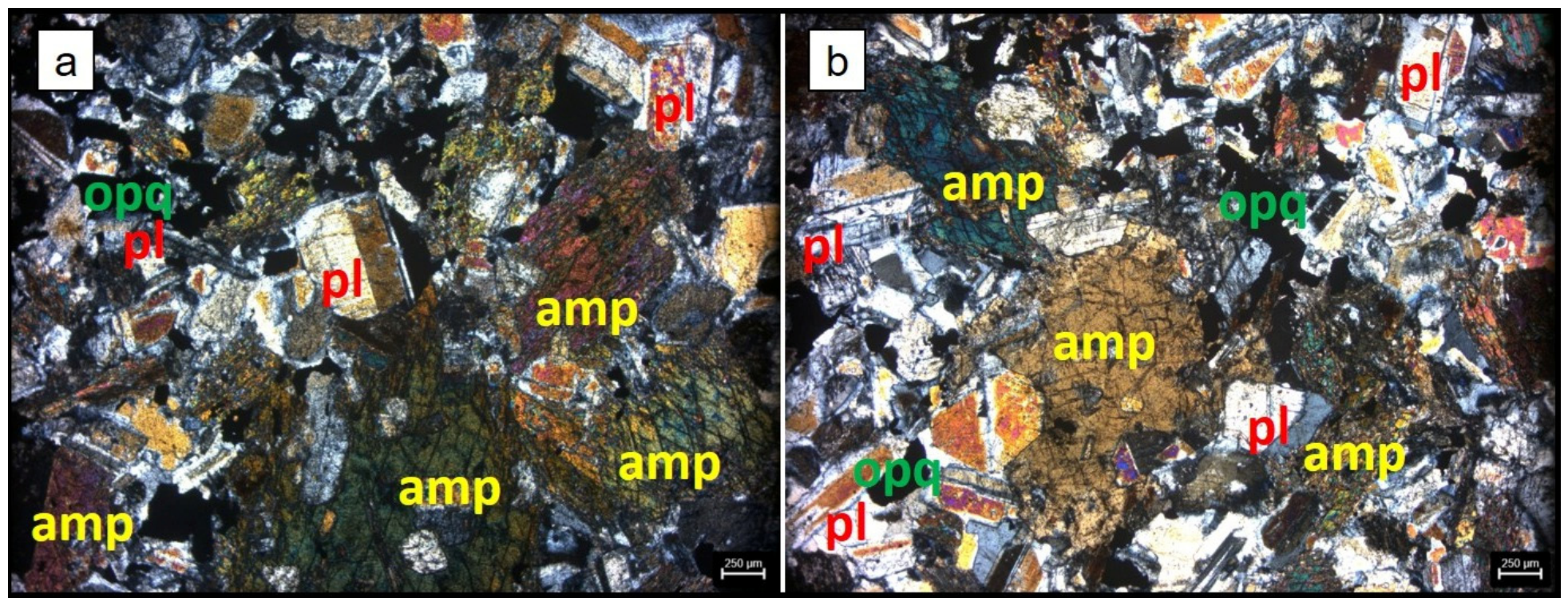
Petrographic thin sections were prepared from the fresh inner parts of the investigated rocks for detailed examination. The thin sections were studied under a polarising microscope. The investigated hornblende gabbro displays a massive structure and a granular texture. The rock is composed predominantly of plagioclase (60–65%), amphibole (30–35%) and opaque minerals (3–5%). It generally exhibits a medium- to coarse-grained texture, with locally conspicuous coarse crystals (Figure 3a). Plagioclase crystals occur as subhedral to anhedral grains and are characterised by well-developed polysynthetic (albite) twinning (Figure 3a). Zoning is observed in some crystals, and the grains show a relatively homogeneous distribution within the rock fabric. Amphibole minerals predominantly occur as coarse, elongated prismatic crystals and display distinct pleochroism (Figure 3b). Two well-developed cleavage directions are clearly visible. Amphiboles are distributed among the plagioclase grains and constitute a major component of the rock. Clinopyroxene was not observed in the thin sections examined. Opaque minerals occur as light-absorbing black grains dispersed throughout the rock.

4. Analytical Methods

Petrographic analyses were carried out using a Leica DM 2500 P polarising microscope (Leica Microsystems, Wetzlar, Germany) at the Thin Section Laboratory of the Department of Geological Engineering, Fırat University (Elazığ, Türkiye), and thin section photomicrographs were captured using a Leica Camera C3 (Leica Microsystems, Wetzlar, Germany).
X-ray diffraction (XRD) analyses were carried out at Istanbul Technical University using a Bruker D8 Advance powder diffractometer equipped with CuKα radiation (λ = 1.5406 Å), operated at 35 kV and 40 mA. Data were collected over a 2θ range of 20–90° with a step size of 0.02° and a scanning rate of 2°/min. Phase identification was performed based on characteristic diffraction peak positions and relative intensities.
Mineral chemistry analyses were carried out at the Geochronology and Geochemistry Laboratory of Istanbul University–Cerrahpaşa (IUC-GGL) using a PerkinElmer NexION 2000 ICP–MS (PerkinElmer Inc., Waltham, MA, USA) coupled with an ESI NWR-213 (ESI—Elemental Scientific Lasers, Bozeman, MT, USA) solid-state laser ablation system. A laser spot size of 80 μm was employed for all analyses. Each analytical session consisted of approximately 20 s of background acquisition, 30 s of ablation, and 50 s of washout. The laser repetition rate was set to 5 Hz, with an energy density of 3–5 J/cm2. Helium was used as the carrier gas at a flow rate of 0.6 L/min. Prior to analysis, the instrument was tuned to achieve a ThO+/Th+ ratio of <0.05%. The quadrupole ion deflector (QID) settings were optimised to maximise signal intensity across light, medium and heavy masses. The ICP–MS system is equipped with both analogue and pulse detectors, providing a wide dynamic range (up to 109) and enabling the determination of major and trace element concentrations. Analytical accuracy was monitored by repeated analyses of the BCR-2g glass standard. The 43Ca and 29Si contents were independently verified by SEM–EDS measurements, yielding reproducibility better than 1 wt.% for major oxides. NIST 610 and NIST 612 standards were analysed for calibration and drift correction. In addition, BCR-2g and AGV-2g were used as secondary control standards. Data reduction was performed using the ICPMSDATACAL software (version 9.0) package, following the data-reduction protocol in [29].
A portion of the whole-rock geochemical analyses was carried out at the Geochronology and Geochemistry Laboratory, Istanbul University–Cerrahpaşa (IUC-GGL). Major element concentrations were determined by Inductively Coupled Plasma–Optical Emission Spectrometry (ICP–OES) using a PerkinElmer Avio 200 instrument (PerkinElmer Inc., Waltham, MA, USA). Trace elements, including rare earth elements (REEs), were measured by Inductively Coupled Plasma–Mass Spectrometry (ICP–MS) with a PerkinElmer NexION 2000 (PerkinElmer Inc., Waltham, MA, USA) system at the same laboratory. Following the analytical procedure described by [30], reported RSD values are 0.0–1.5 wt.% for major oxides, whereas precision for trace and REE measurements is generally better than 10%. Loss-on-ignition (LOI) values were determined by heating the powdered samples in a muffle furnace at 1050 °C for 2 h.
The remaining whole-rock analyses were conducted at Wuhan Sample Solution Analytical Technology Co., Ltd. (Wuhan, China). For major-element determinations, powdered samples were prepared using the lithium borate fusion method. The flux consisted of a mixture of lithium tetraborate, lithium metaborate, and lithium fluoride in a ratio of 45:10:5. Approximately 0.6000 ± 0.0001 g of sample powder was mixed with 6.0000 ± 0.0002 g of flux, together with 0.30 ± 0.001 g of NH4NO3 as an oxidising agent, while lithium bromide was used as a releasing agent. Fusion was performed at 1050 °C for 15 min to obtain homogeneous glass beads. Major element concentrations were measured using a ZSX Primus II wavelength-dispersive X-ray fluorescence (WDXRF) spectrometer (Rigaku, Tokyo, Japan) equipped with a 4.0 kW Rh-target end-window X-ray tube operated at 50 kV and 60 mA. All major elements were analysed using Kα emission lines. Calibration curves were established using Chinese national certified reference materials, including rock standards (GBW07101–14), soil standards (GBW07401–08), and stream sediment standards (GBW07302–12). Matrix corrections were applied using the theoretical alpha coefficient method, and analytical precision was better than 2% relative standard deviation (RSD). Analytical precision, as monitored by repeated analyses of the BCR-2, BHVO-1, and AGV-1 standards, was better than 5% for major elements and better than 10% for trace elements. Trace element concentrations were determined using an Agilent 7700e ICP–MS instrument (Agilent Technologies, Santa Clara, CA, USA) at the same laboratory. Approximately 50 mg of 200-mesh powder was dried at 105 °C for 12 h prior to digestion. The sample was then transferred into a Teflon vessel, and a mixture of concentrated HNO3 and HF was added. The sealed vessel was placed within a stainless-steel pressure jacket and heated at 190 °C for more than 24 h. After cooling, the solution was evaporated to near dryness at 140 °C, followed by repeated addition and evaporation of HNO3 to ensure complete dissolution. Subsequently, HNO3, ultrapure water, and an internal standard solution (1 ppm In) were added, and the vessel was reheated at 190 °C for more than 12 h. The final solution was transferred to a polyethylene bottle and diluted to 100 g with 2% HNO3 prior to ICP–MS measurement.
Strontium and neodymium isotope analyses were conducted at the Radiogenic Isotope Laboratory of the Central Laboratory of Middle East Technical University (METU), following internal laboratory protocols based on the analytical procedures described by [31]. All weighing, chemical dissolution and chromatographic procedures were performed under Class 100 clean laboratory conditions using ultrapure reagents and deionised water. Approximately 80 mg of the powdered sample was weighed into PFA beakers for Sr and Nd isotope analyses. Samples were dissolved in 4 mL of 52% HF at >100 °C on a hotplate for four days to ensure complete digestion. After near-dry evaporation, residues were re-dissolved in 4 mL of 6 N HCl and heated for one additional day. Following a second evaporation to near dryness, the samples were taken up in 1 mL of 2.5 N HCl prior to chromatographic separation. Strontium was separated using 2 mL of cation-exchange resin (AG50W-X8, 100–200 mesh; Bio-Rad Laboratories, Hercules, CA, USA) in Teflon columns with 2.5 N HCl. After Sr collection, the rare earth element (REE) fraction was eluted using 6 N HCl. Strontium was loaded onto a single Re filament with a Ta activator and 0.005 N H3PO4 and analysed in static mode. The 87Sr/86Sr ratios were normalised to 86Sr/88Sr = 0.1194. During the analytical session, the NBS 987 Sr standard yielded a value of 0.710268 ± 0.000012 (n = 3). Neodymium was separated from the remaining REEs using 0.22 N HCl in Teflon columns containing 2 mL of HDEHP-coated Bio-Beads resin (Bio-Rad, Hercules, CA, USA). The purified Nd fraction was loaded onto Re filaments with 0.005 N H3PO4 and analysed using a double-filament configuration in static mode. The 143Nd/144Nd ratios were normalised to 146Nd/144Nd = 0.7219. The La Jolla Nd standard yielded a value of 0.511852 ± 0.000005 (n = 2). All isotope ratio measurements were performed using a Triton Thermal Ionisation Mass Spectrometer (TIMS) (Thermo Fisher Scientific, Bremen, Germany) in multi-collector mode. Analytical uncertainties are reported at the 2σ level. No additional bias correction was applied to the measured isotope ratios.

5. Results

5.1. X-Ray Diffraction (XRD) Results

The identified mineral phases, their chemical formulas and crystal systems are summarised in Table 1. X-ray diffraction (XRD) analyses were conducted to compare the mineralogical compositions of the inner and outer portions of the hornblende gabbro (Figures S1 and S2). Sample G1 (Figure S1) is dominated by plagioclase phases, comprising 42.7% andesine and 34.1% anorthite, together with 22.8% amphibole. In contrast, sample G11 (Figure S2) contains 33.2% andesine, 22.5% anorthite, 24.7% amphibole and 18.6% quartz, with minor faujasite (1.0%).

5.2. Mineral Chemistry

Mineral chemical analyses of amphibole from the hornblende gabbro are presented in Table 2.
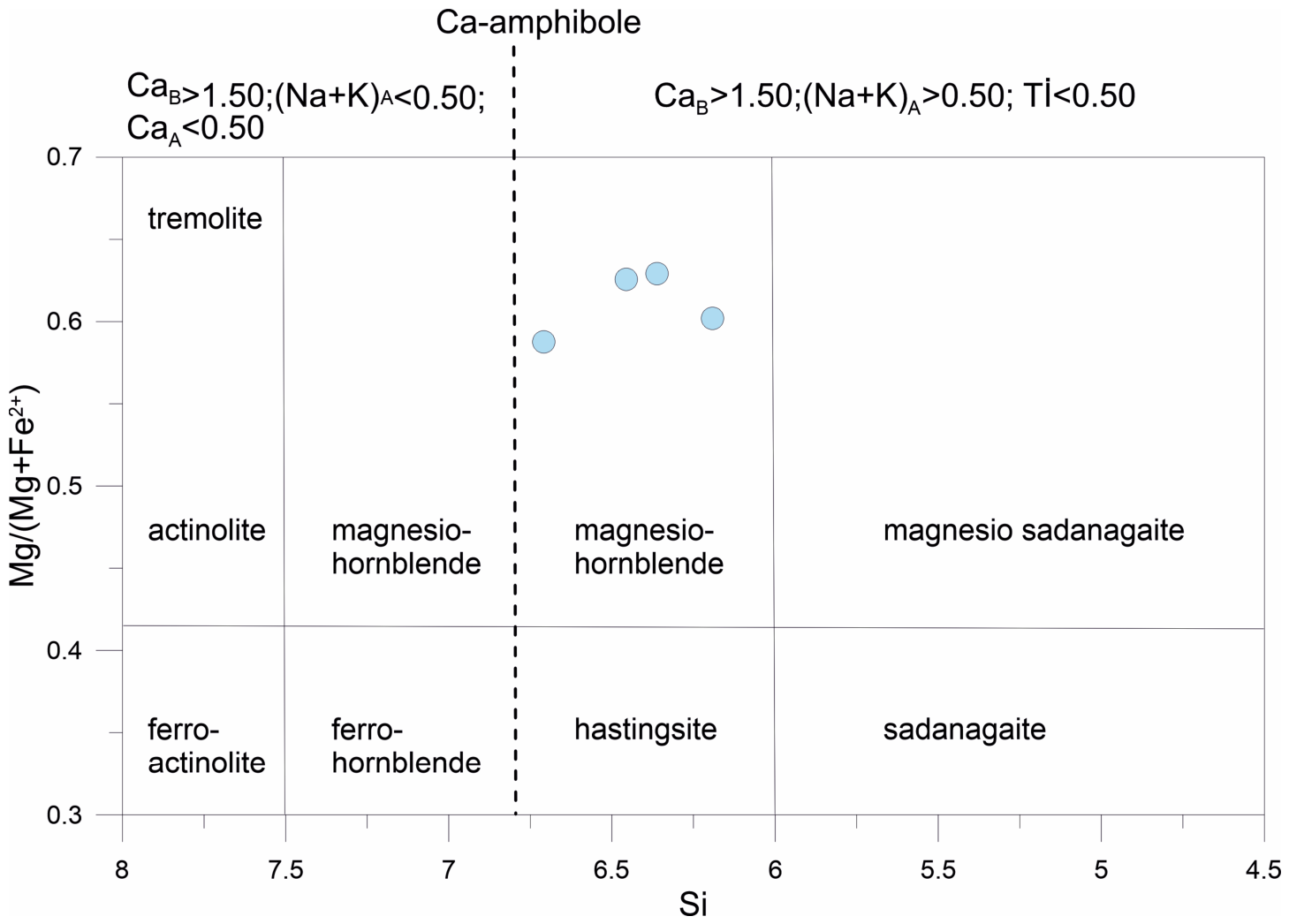
Amphibole compositions were classified using the Ca-amphibole diagram (Figure 4), and the analysed amphiboles fall within the calcic amphibole group, plotting in the magnesio-hornblende field following the nomenclature of [32].

5.3. Whole-Rock Major and Trace Elements

The whole-rock major and trace element compositions of the hornblende gabbro samples are presented in Table 3. The analysed samples show limited variation in major element compositions. SiO2 contents range from 46.72 to 49.69 wt.%. Total alkalis (Na2O + K2O) vary between 2.34 and 2.71 wt.%. TiO2 contents range from 0.76 to 1.00 wt.%, whereas total iron expressed as Fe2O3 varies between 12.04 and 15.50 wt.%. MgO contents range from 4.67 to 5.02 wt.%, and Mg# values range between 37.42 and 44.97. CaO contents range from 7.35 to 9.66 wt.%, and Al2O3 from 17.30 to 18.24 wt.%. Loss-on-ignition (LOI) values range from 1.44 to 4.26 wt.%.
Trace element concentrations also show relatively restricted ranges. V varies between 284.77 and 321.63 ppm, Co between 30.31 and 34.73 ppm, and Ni between 3.15 and 48.42 ppm. Sr contents range from 174.73 to 208.56 ppm, and Ba from 36.32 to 67.75 ppm. Zr varies between 23.72 and 30.58 ppm, whereas Nb ranges from 0.94 to 1.66 ppm. Rare earth element concentrations are consistent across all samples. La ranges from 1.93 to 2.34 ppm, Sm from 1.68 to 2.38 ppm, and Yb from 2.05 to 2.49 ppm. Eu/Eu* values vary between 0.91 and 1.20.
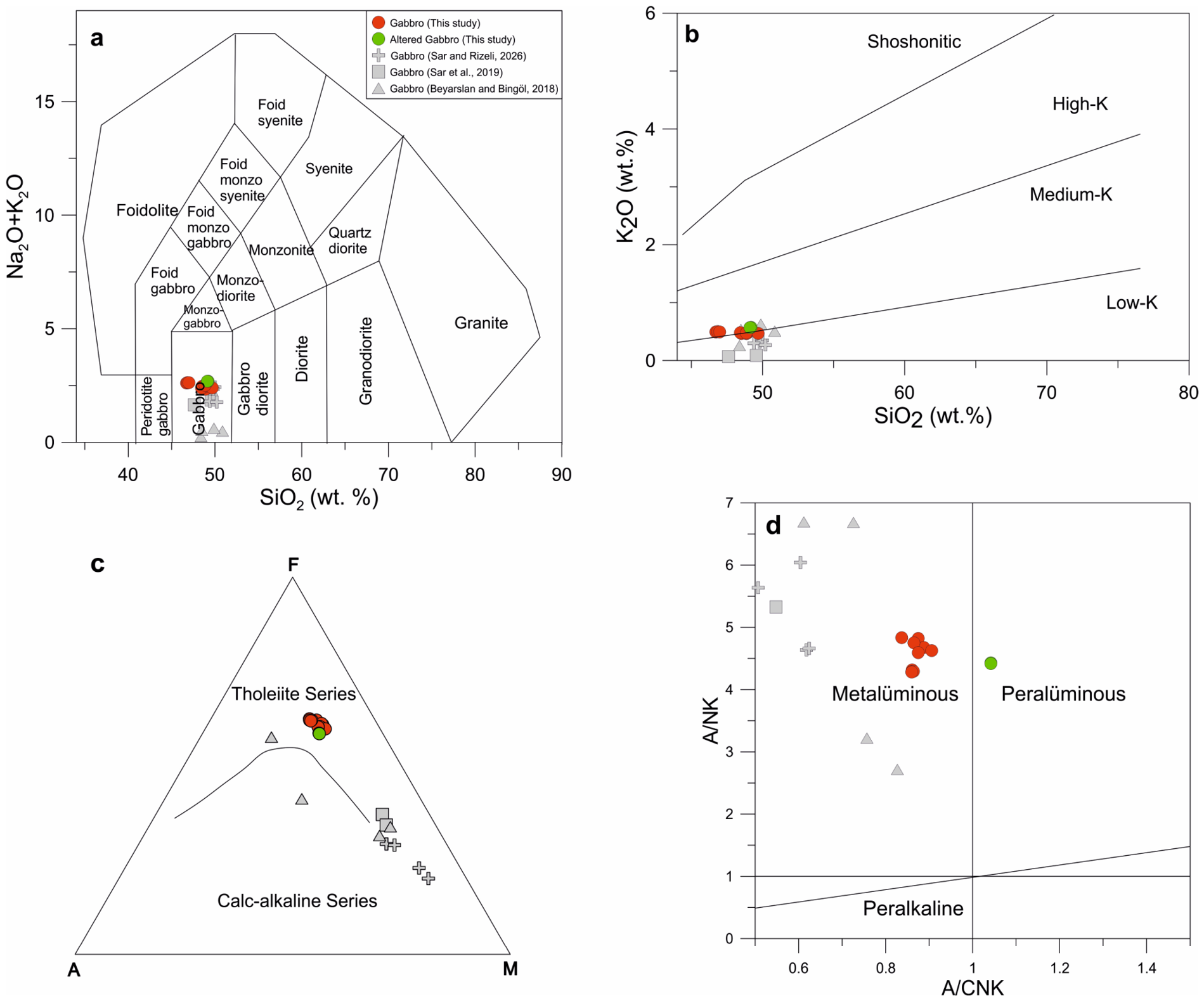
In the total alkali (Na2O + K2O) versus silica (SiO2) classification diagram of [33] (Figure 5a), the hornblende gabbro samples plot within the gabbro field. In the K2O versus SiO2 diagram of [34] (Figure 5b), the hornblende gabbro samples plot within the low- to medium-K field. All samples cluster at SiO2 values of approximately 47–50 wt.%. The hornblende gabbro samples plot within the tholeiitic field in the AFM diagram of [35] (Figure 5c). In the A/NK versus A/CNK diagram of [36] (Figure 5d), the majority of the hornblende gabbro samples plot within the metaluminous field. In contrast, the altered outer-rim samples (G11 and G12) fall within the peraluminous field.
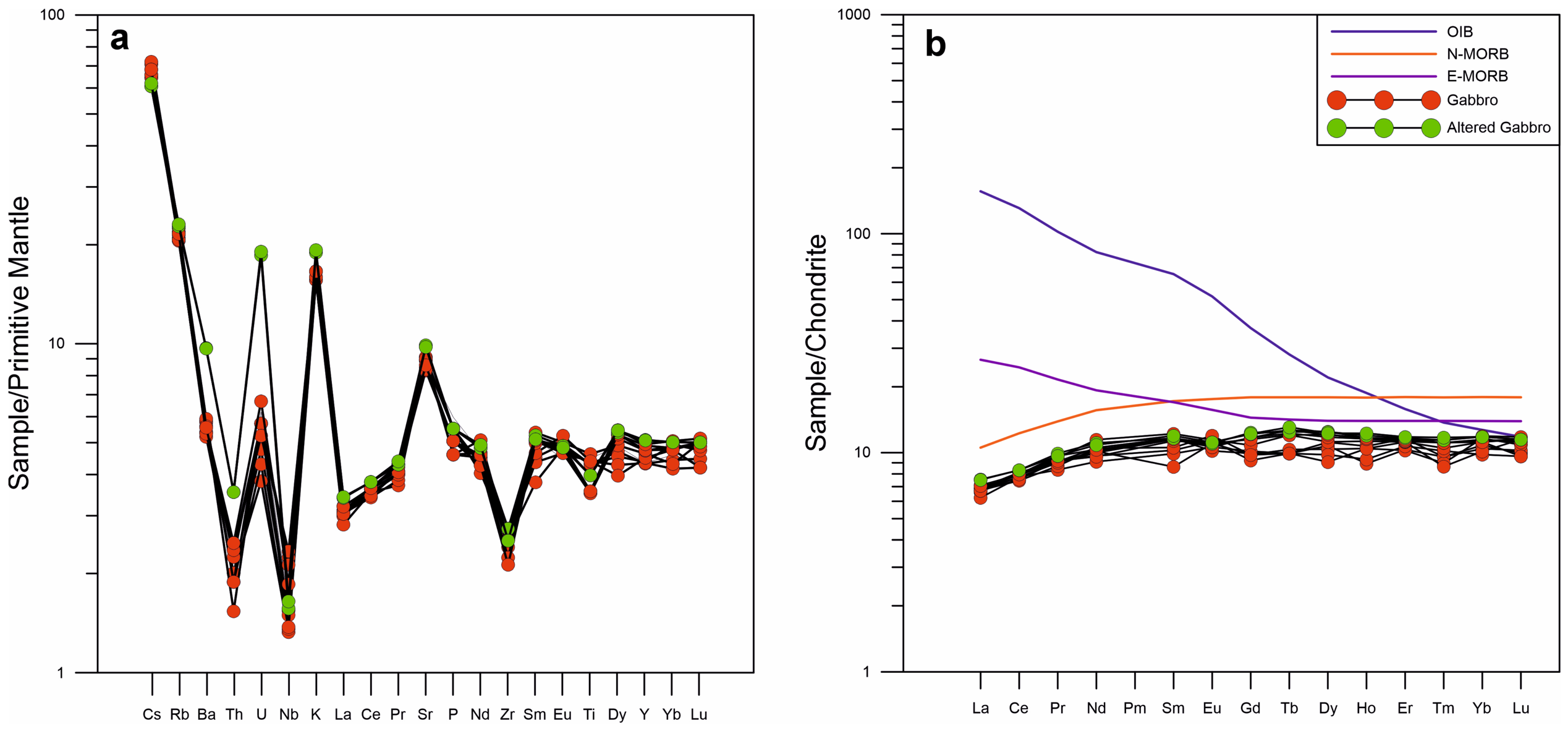
Primitive mantle-normalised multi-element patterns of the hornblende gabbro samples [37] are presented in Figure 6a. The samples display broadly similar trace element patterns. Large ion lithophile elements (LILE; Cs, Rb, Ba, U and K) exhibit pronounced positive anomalies. In contrast, high-field-strength elements (HFSE; Nb and Zr) show negative anomalies. Th also displays relatively low values.
Chondrite-normalised rare earth element (REE) patterns [38] are shown in Figure 6b. The samples exhibit relative enrichment of light rare earth elements (LREE) compared to heavy rare earth elements (HREE). The LREE display a gently inclined trend, whereas the HREE show a relatively flat distribution. Eu anomalies are weak, with Eu/Eu* values ranging between 0.91 and 1.20.

5.4. Sr–Nd Isotope Geochemistry

The Sr and Nd isotopic compositions of selected hornblende gabbro samples are presented in Table 4. The analysed samples were selected from the relatively fresh inner-core parts of the hornblende gabbro samples. Rb and Sr concentrations range between 13.20–13.76 ppm and 184.92–188.43 ppm, respectively. The measured 87Rb/86Sr ratios vary from 0.204 to 0.212, whereas measured 87Sr/86Sr ratios range from 0.704966 ± 0.000015 to 0.705522 ± 0.000016 (2σm). Calculated initial 87Sr/86Sr ratios vary from 0.704792 to 0.705344, and the calculated εSr(T) values range from 5.1 to 12.9.
Sm and Nd concentrations range from 1.68 to 2.27 ppm and 5.80 to 6.32 ppm, respectively. The 147Sm/144Nd ratios range from 0.1668 to 0.2170, whereas measured 143Nd/144Nd ratios range from 0.512876 ± 0.000005 to 0.512892 ± 0.000005 (2σm). Calculated initial 143Nd/144Nd ratios vary from 0.512757 to 0.512800, and the calculated εNd(T) values range from +4.4 to +5.3. The initial isotopic ratios and εNd(T) values were calculated assuming an age of 83.93 Ma [19].

6. Discussion

6.1. Effects of Weathering and Alteration

In the A/NK versus A/CNK diagram (Figure 5d), the fresh samples plot within the metaluminous field, whereas the altered samples shift toward the peraluminous domain, as defined by [36]. This displacement is most plausibly related to secondary fluid-mediated alteration rather than primary magma chemistry. Peraluminosity (A/CNK > 1) may develop through the relative depletion of CaO and Na2O during plagioclase breakdown, as Ca and Na are more mobile under hydrothermal conditions, whereas Al remains comparatively immobile. Consistent with this interpretation, the altered samples (G11–G12) display lower CaO contents (7.35–7.36 wt.%) and higher LOI values (4.17–4.26 wt.%) than the fresh samples (CaO = 8.76–9.66 wt.%; LOI = 1.44–3.62 wt.%).
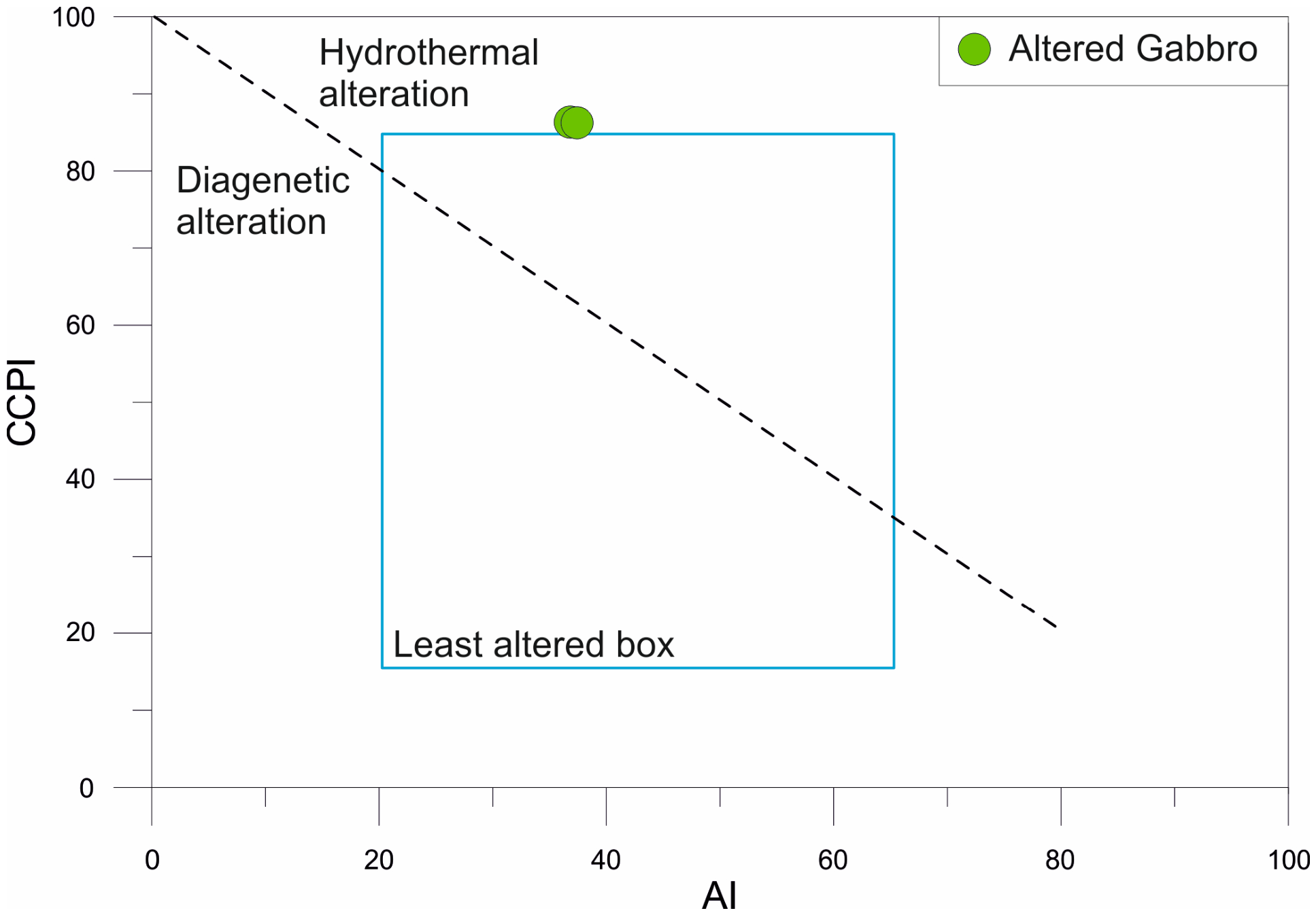
The AI–CCPI discrimination diagram (Figure 7) further supports this interpretation. The altered samples (G11–G12) plot within the hydrothermal alteration field and are characterised by elevated AI and CCPI values. Field observations also show a concentric, rind-like alteration pattern, with altered outer rims and relatively fresh inner cores. Such an externally concentrated alteration geometry suggests that fluid–rock interaction was focused along the outer margins of the blocks, possibly enhanced by fluid ingress through fractures and microcracks, consistent with concentric alteration features interpreted as products of inward fluid penetration and reaction-front migration [42,43].
XRD data are consistent with this interpretation, as the altered outer rim contains secondary quartz and minor zeolitic phases in addition to the primary plagioclase–amphibole assemblage (Figures S1 and S2).

6.2. Fractional Crystallisation and Magma Evolution

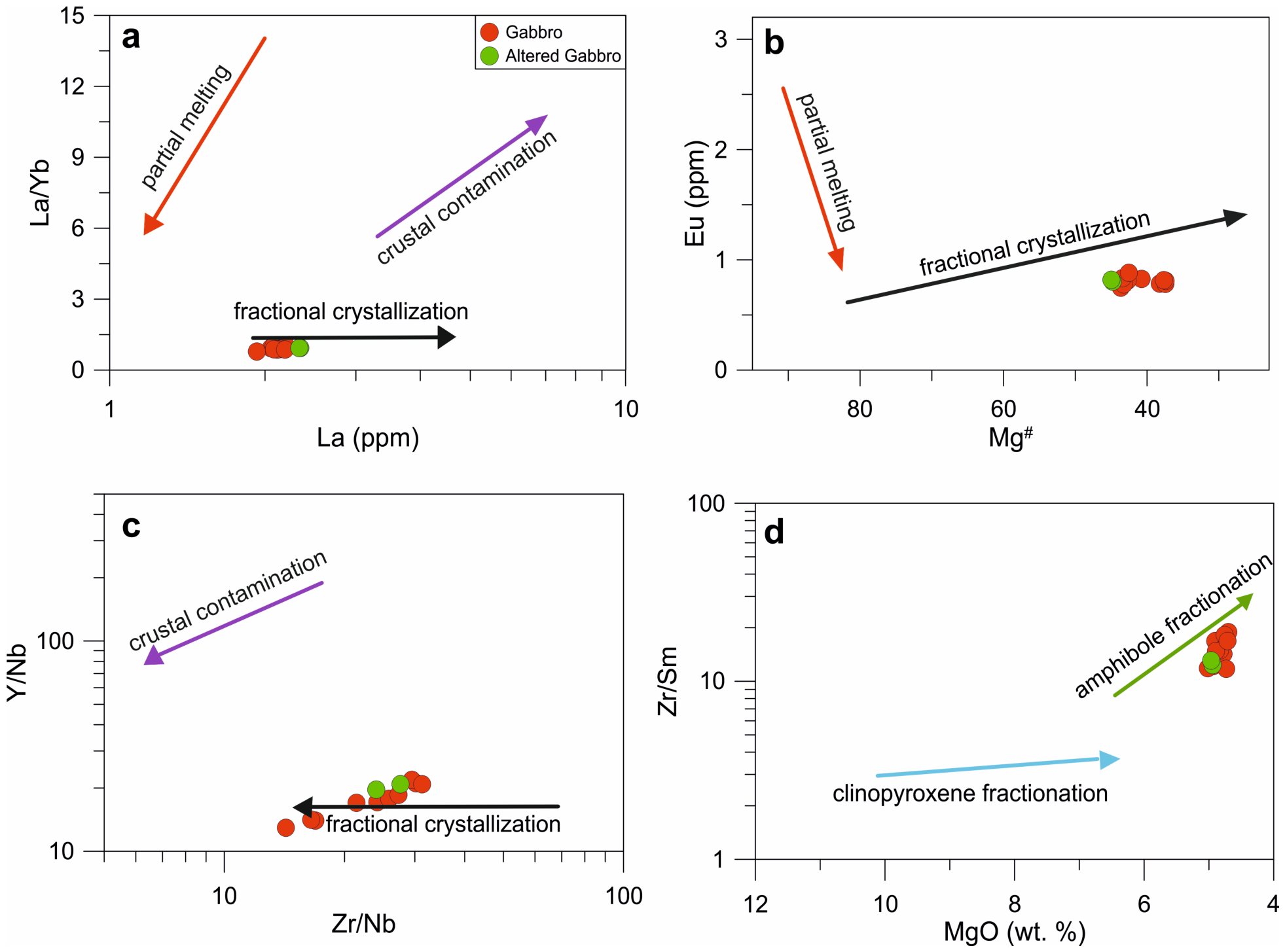
The trace element variation diagrams shown in Figure 8a–d provide insights into the magmatic evolution of the studied hornblende gabbros. In the La/Yb versus La diagram (Figure 8a), the samples form a narrow cluster consistent with fractional crystallisation, indicating limited compositional dispersion during magma evolution. A similar trend is observed in the Eu versus Mg# diagram (Figure 8b), where decreasing Mg# values with relatively constant Eu concentrations further support progressive differentiation. Likewise, the Y/Nb versus Zr/Nb diagram (Figure 8c) shows a coherent distribution of the samples along the fractional crystallisation trend, suggesting that magmatic differentiation processes largely controlled the evolution of the hornblende gabbros. In contrast, the Zr/Sm versus MgO diagram (Figure 8d) indicates a trend consistent with amphibole fractionation during magma evolution. The distribution of the samples along the amphibole fractionation vector suggests that hornblende played an important role in controlling trace-element behaviour during differentiation. This interpretation is consistent with petrographic observations, which show that hornblende is one of the dominant mineral phases in the hornblende gabbros and that its textural relationships with plagioclase reflect an important stage in magma evolution.

6.3. Geochemical Framework and Nature of the Magma Source

Major and trace element data are presented in Table 3. The whole-rock geochemical compositions of the hornblende gabbros provide important constraints on their magmatic affinity and source characteristics. Major element classification diagrams define the fundamental magmatic character of the suite. In the total alkali versus silica diagram (Figure 5a), all samples plot within the gabbro field, indicating a mafic intrusive composition. The narrow compositional range further suggests derivation from a common parental magma. In the K2O versus SiO2 diagram (Figure 5b), the samples fall within the low- to medium-K field. On the AFM (Na2O + K2O–FeOT–MgO) triangular diagram (Figure 5c), all samples plot along the tholeiitic evolutionary trend, indicating that the suite belongs to the subalkaline magma series.
The primitive mantle-normalised multi-element patterns (Figure 6a) provide important insights into the geochemical characteristics of the parental magma. The hornblende gabbros display pronounced enrichment in LILE such as Cs, Rb, Ba, U and K, whereas negative Th and Nb anomalies are observed. Sr exhibits a relatively positive anomaly. Such enrichment of LILE relative to HFSE may indicate the influence of slab-derived fluids in the mantle source [46,47]. Chondrite-normalised rare earth element (REE) patterns (Figure 6b) show relatively smooth distributions across the REE series. The samples display relatively uniform REE patterns characterised by LREEs (LaN/SmN = 0.58–0.72) and HREEs (TbN/YbN = 0.89–1.19). Overall, the REE patterns display some similarities to N-MORB–type compositions.
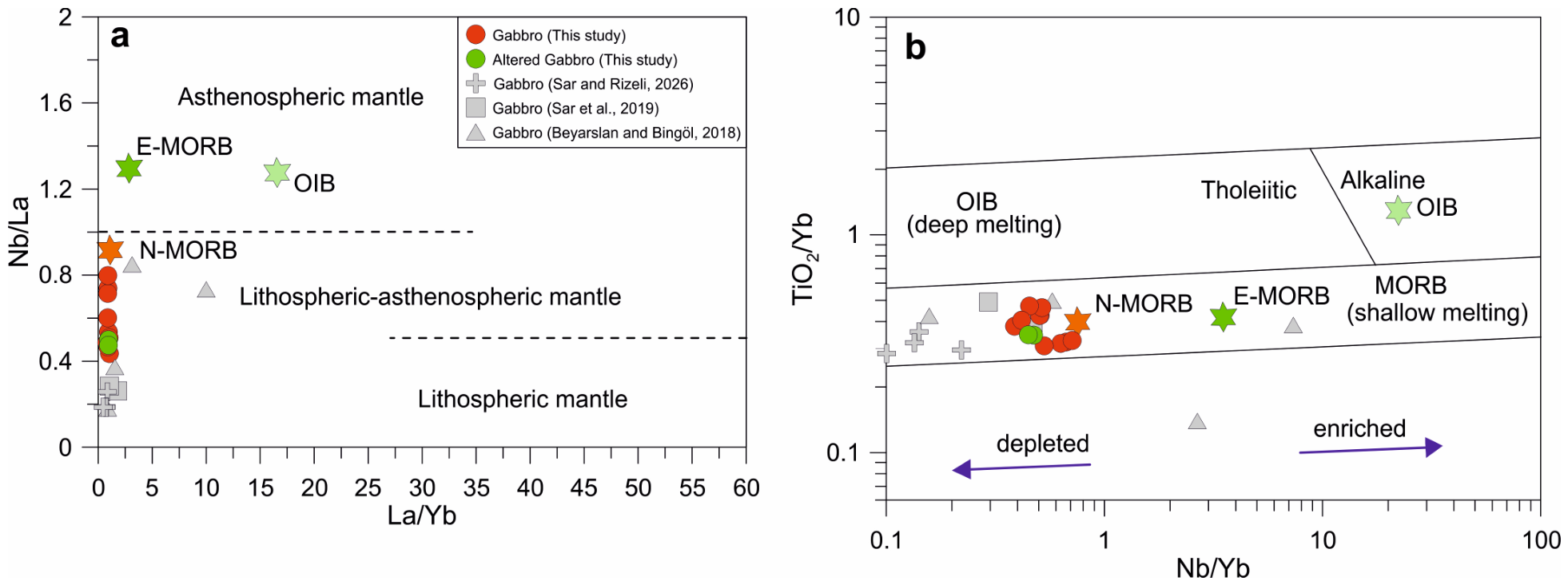
Trace element ratios provide important constraints on mantle source characteristics. Lower Nb/La ratios (generally <0.5) are typically interpreted to reflect magmas derived from lithospheric mantle sources, whereas higher Nb/La ratios (>1) indicate an OIB-like asthenospheric mantle source [48]. Intermediate values (Nb/La ≈ 0.5–1) may reflect mixing between lithospheric and asthenospheric mantle components. In the Nb/La versus La/Yb diagram (Figure 9a), the studied hornblende gabbros display Nb/La ratios ranging from 0.44 to 0.80, plotting predominantly within the lithospheric mantle field with minor distribution in the lithosphere–asthenosphere transition field. Their position near the N-MORB reference composition further suggests a mantle source with geochemical characteristics comparable to those of N-MORB magmas. The Nb/Yb versus TiO2/Yb diagram (Figure 9b) provides further constraints on the characteristics of the mantle source. In this diagram, the studied hornblende gabbros plot primarily within the N-MORB array, indicating derivation from a mantle source with geochemical characteristics comparable to those of N-MORB magmas. The relatively limited dispersion of the data suggests that the samples were derived from a chemically coherent mantle source, without significant contribution from an enriched OIB-type mantle component. This distribution supports the interpretation that the parental magma was predominantly derived from a lithospheric mantle source.
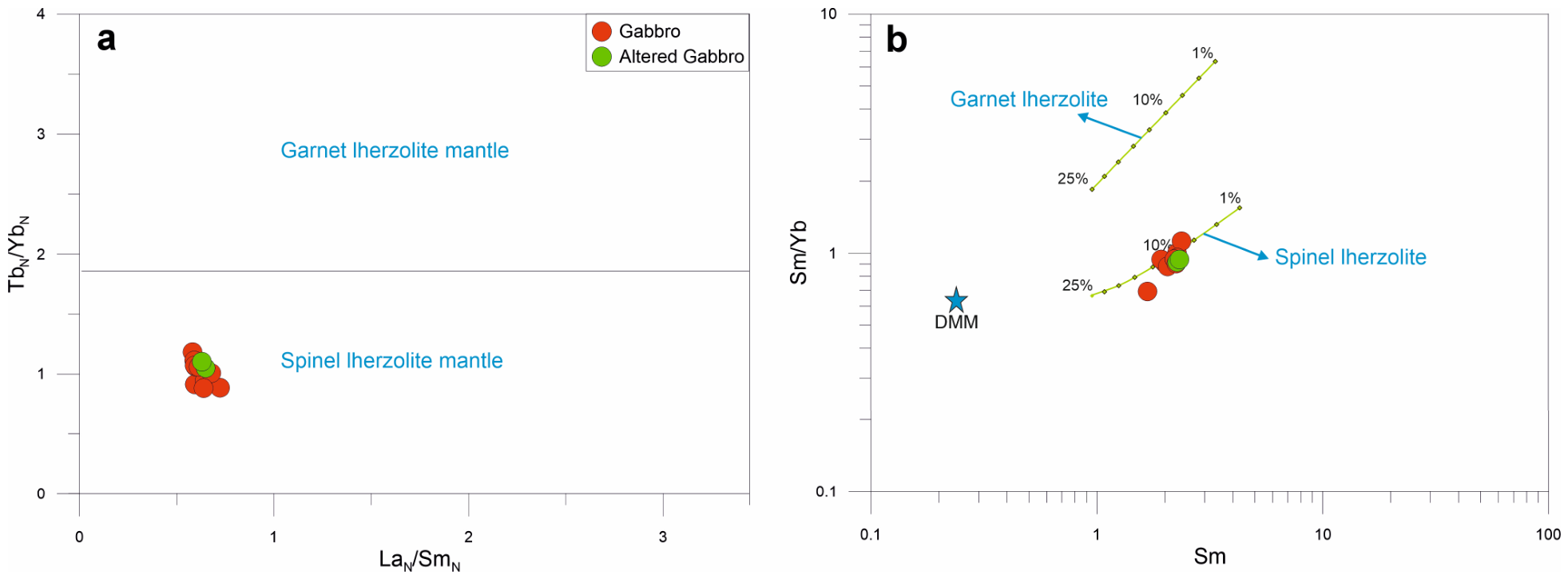
Ratios of rare-earth elements such as Tb/Yb and Dy/Yb are widely used to constrain mantle source characteristics because they are relatively insensitive to fractional crystallisation and metasomatic modification compared with LREE and large-ion lithophile elements [50]. Metasomatic processes may significantly modify LREE and other fluid-mobile elements in mantle peridotites; therefore, partial melting evaluations commonly rely on relatively immobile REE ratios involving elements such as Gd, Dy and Yb [51]. The presence or absence of residual garnet during mantle melting strongly influences these ratios, as garnet preferentially retains heavy rare earth elements such as Yb relative to Dy [52]. Consequently, melts derived from the garnet stability field typically display elevated Dy/Yb ratios (>2.5), whereas melts generated from spinel-bearing mantle sources generally show lower Dy/Yb ratios (<1.5; [53]). The predominantly low Dy/Yb ratios (<1.5–1.7) are consistent with derivation from a spinel-facies mantle source, with limited evidence for significant garnet retention. In addition, the samples display relatively low TbN/YbN ratios (≈0.9–1.2; Figure 10a), further supporting derivation from a spinel-lherzolite mantle source.
The Sm/Yb ratio is widely used to distinguish between mantle melting regimes involving garnet- and spinel-lherzolite sources because residual garnet preferentially retains heavy rare earth elements such as Yb during melting, producing relatively high Sm/Yb ratios in melts derived from garnet-bearing sources. In contrast, melts generated from spinel-lherzolite mantle sources typically display lower and relatively uniform Sm/Yb ratios due to the absence of residual garnet [54]. In the Sm versus Sm/Yb modelling diagram (Figure 10b), primitive mantle (PM) composition is used as the mantle source, whereas spinel- and garnet-lherzolite compositions represent the mantle facies. The studied hornblende gabbro samples exhibit Sm/Yb ratios ranging from 0.69 to 1.12 and plot close to the spinel-lherzolite melting trend, suggesting that their parental magma was likely derived from partial melting of a spinel-lherzolite mantle source. The sample distribution is consistent with a moderate degree of partial melting (approximately 10–20%) from a primitive mantle-like spinel-lherzolite source.
Figure 10. (a) TbN/YbN versus LaN/SmN diagram for the studied hornblende gabbro samples. (b) Sm/Yb versus Sm diagram showing non-modal fractional melting curves for spinel and garnet lherzolite sources. Melting curves represent closed-system non-modal fractional melting for spinel lherzolite (Ol 0.53/0.06 + Opx 0.27/0.28 + Cpx 0.17/0.67 + Spl 0.03/0.11) after [55]. Fractional melting coefficients are from [56,57]. Non-modal fractional melting curves were calculated using the PETROMODELER software (version 1.0) [58].
Minerals 16 00444 g010
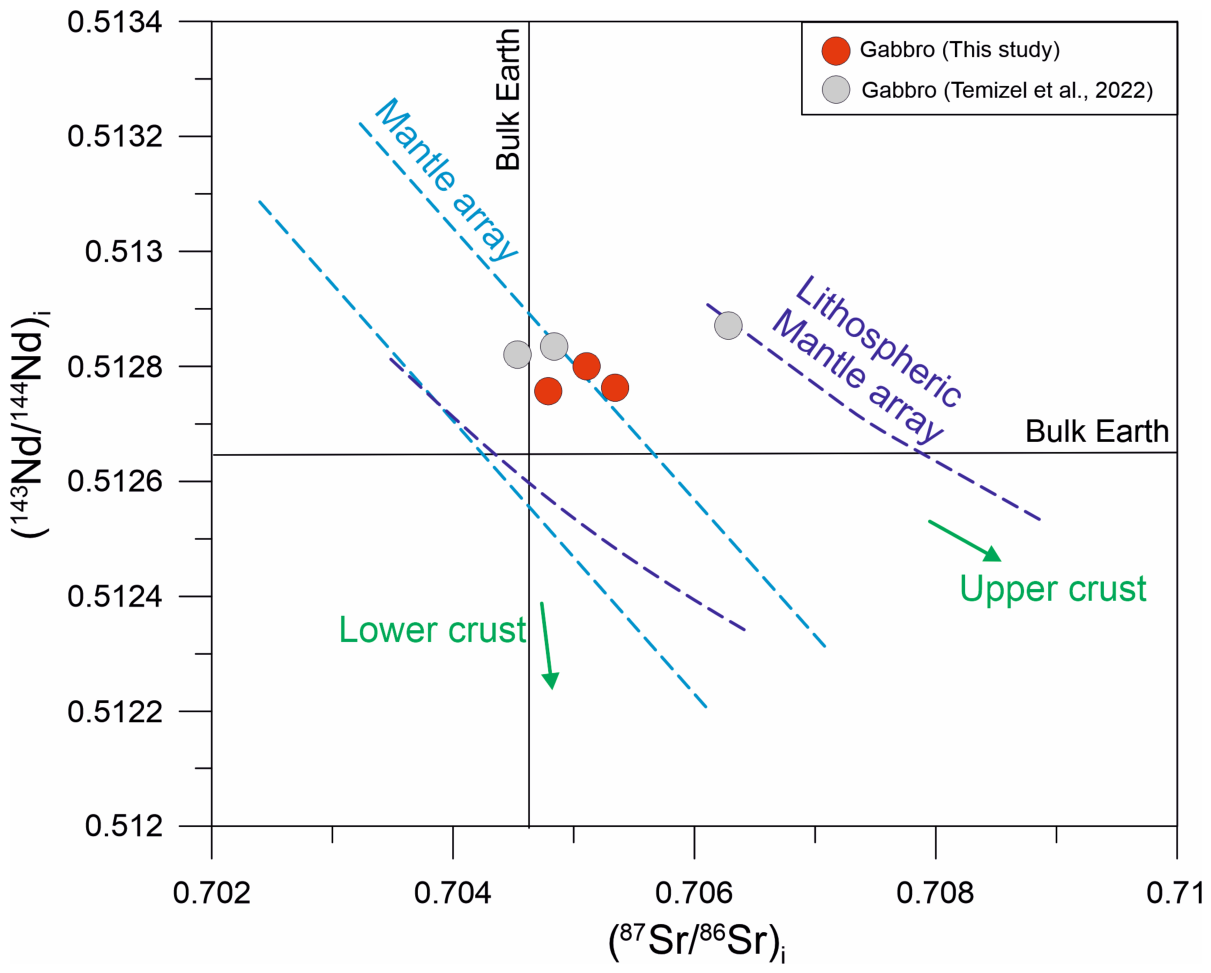
The hornblende gabbro samples are characterised by positive εNd(T) values of +4.4 to +5.3 and moderately radiogenic initial 87Sr/86Sr ratios ranging from 0.704792 to 0.705344. On the Sr–Nd isotope diagram, these samples plot within the lithospheric mantle array and exhibit isotopic features similar to those of mafic lithologies from the Eastern Pontides (Figure 11). In this context, the isotopic composition of the hornblende gabbros points to a predominantly mantle-derived magma source, modified by subduction-related processes, with limited crustal contribution. This interpretation is consistent with Sr–Nd isotope systematics, in which positive εNd(T) values and moderately radiogenic initial 87Sr/86Sr ratios are commonly taken to indicate juvenile to mantle-dominated magma sources affected by subduction-related modification [59].

6.4. Tectono-Thermal Implications and Regional Tectonic Evolution

The thermobarometric results indicate that amphibole in the hornblende gabbro crystallised under pressure and temperature conditions corresponding to shallow- to mid-crustal levels [60,61]. Amphibole thermobarometry yielded temperatures of 873–991 °C and pressures of 1.49–3.26 kbar, corresponding to crystallisation depths of 5.1–15.3 km (Table 5). These values suggest crystallisation from a hydrous mafic magma during emplacement and cooling within the crust.
The study area is situated within the Southeastern Anatolian Orogenic Belt (SAOB), which preserves the record of the closure of the southern branch of the Neo-Tethys Ocean and the related Late Cretaceous–Cenozoic tectonomagmatic evolution of eastern Türkiye [9,11,13,14,20,21]. In the Elazığ–Malatya–Tunceli region of the SAOB, Late Cretaceous ophiolitic units, arc-related magmatic rocks, and plutonic intrusions are widely distributed and are generally interpreted as products of subduction-related magmatism associated with the northward subduction of the southern branch of the Neo-Tethys oceanic lithosphere [7,8,9,12,13,14].
The Late Cretaceous tectonomagmatic evolution of the SAOB has been discussed in several regional studies. The Kömürhan Ophiolite represents a supra-subduction zone (SSZ) unit developed above a north-dipping subduction zone at approximately 90 Ma, whereas the ensuing ensimatic arc assemblage was later intruded by the Baskil granitic rocks around 85 Ma [7]. These interpretations are also consistent with the results of Sapancı et al. [63], who proposed that the Guleman Ophiolite preserves forearc and initial back-arc spreading signatures formed within an intra-oceanic subduction system in the Berit Ocean. Similarly, Robertson et al. [9] interpreted the Late Cretaceous evolution of the Eastern Taurides as involving northward intra-oceanic subduction initiated at about 90 Ma, accompanied by SSZ ophiolite formation and arc-related magmatism. Rızaoğlu et al. [8] reported laser 40Ar/39Ar biotite and hornblende ages of 81.9–81.5 Ma for biotite and 84.0–81.5 Ma for hornblende from the Baskil granitoid and, by assigning the granitoid emplacement to 85–82 Ma, interpreted these rocks as I-type, calc-alkaline, Andean-type volcanic arc granitoids developed along the Tauride active continental margin. Parlak et al. [10], based on LA-MC-ICP-MS zircon U–Pb and 40Ar/39Ar data from the Inner Tauride belt, constrained the crystallisation of SSZ oceanic crust and intra-oceanic thrusting/subduction to approximately 89 Ma, and discussed this process in a forearc and intra-oceanic subduction framework. Karaoğlan et al. [11], using a combination of U–Pb, 40Ar/39Ar, and fission-track data, proposed that the active-margin evolution and the onset of initial continental collision along the SAOB took place between 84 and 74 Ma along an oblique subduction zone.
Subsequent studies further refined this regional framework based on Late Cretaceous magmatic and plutonic rocks exposed along the Elazığ–Tunceli–Malatya belt. Beyarslan and Bingöl [12], based on zircon U–Pb ages and geochemical data, reported ages of 84–82 Ma for volcanic rocks and 84–72 Ma for plutonic rocks, and interpreted the first two intrusive phases as intra-oceanic arc magmatism, whereas the late shoshonitic phase was related to a collisional setting. Sar et al. [13] obtained LA-ICP-MS zircon U–Pb ages of 80.6–77.2 Ma for the Pertek intrusions and similarly interpreted the first two phases as intra-oceanic arc magmatism and the third shoshonitic phase as collision-related. Nurlu et al. [14] presented LA-ICP-MS zircon U–Pb ages of 84.3–81.5 Ma for the Baskil Intrusive Complex and regarded this unit as a product of short-lived volcanic arc magmatism developed along the margin of the Tauride Platform, carrying a clear supra-subduction signature. Examining nearby equivalents within the same tectonomagmatic belt, Ertürk [19] reported an LA-ICP-MS zircon U–Pb age of 83.93 Ma for Late Cretaceous volcanic rocks and interpreted them as intra-oceanic arc magmatism associated with north-dipping subduction. In contrast, Ertürk et al. [16] reported LA-ICP-MS zircon U–Pb ages of 77.4–76.3 Ma for the Keban magmatic rocks and interpreted these syenitic to quartz monzonitic rocks as A1-type post-collisional intrusions. Sar [20] determined an LA-ICP-MS zircon U–Pb age of 78.01 Ma for the Gemici granitoid and interpreted it as a subduction-related, I-type volcanic arc granite. Sar and Rizeli [21] reported LA-ICP-MS zircon U–Pb ages of 78.86 Ma for diorite and 73.58 Ma for granodiorite, and interpreted these rocks as products of arc magmatism formed in a subduction-zone environment.
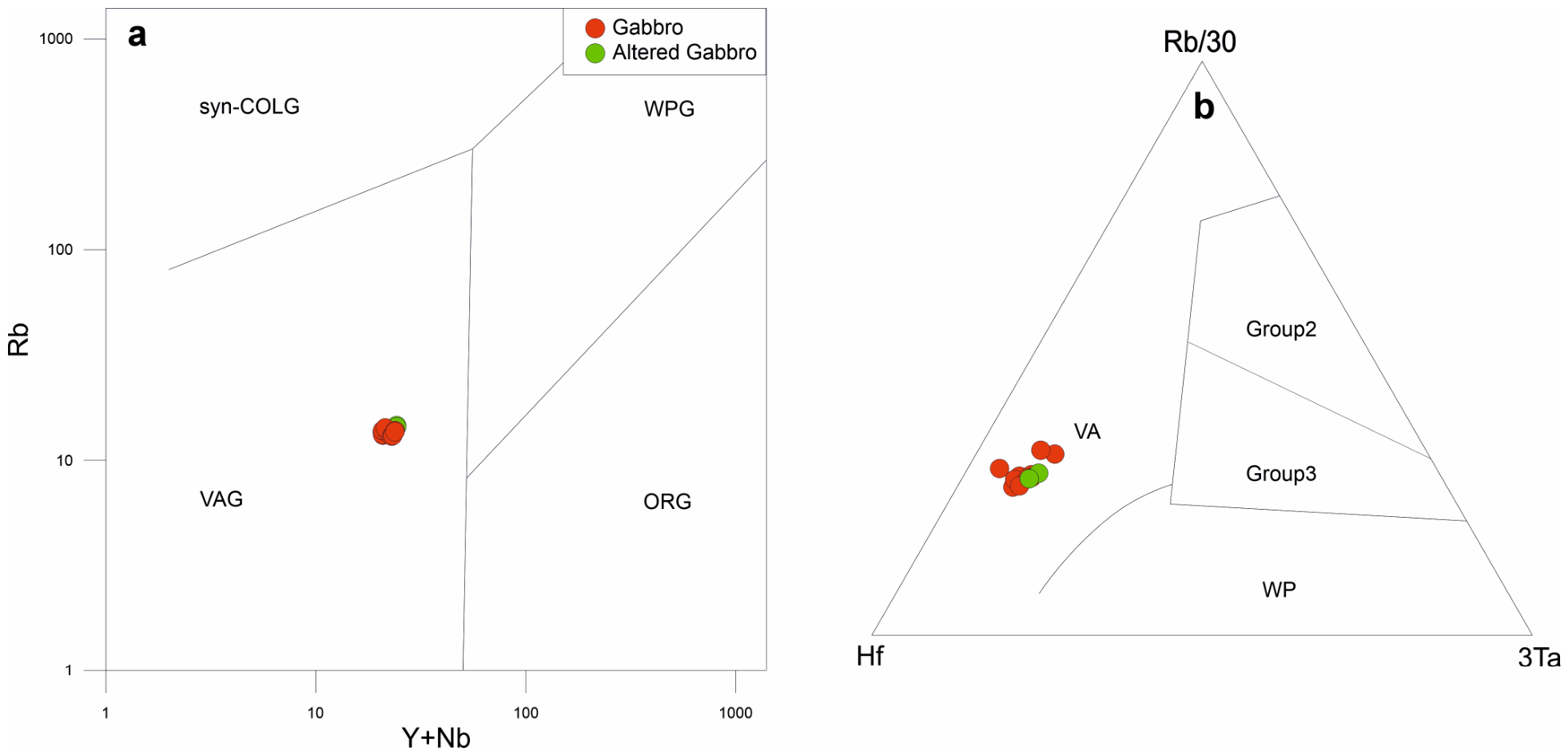
Taken together, these studies indicate that Late Cretaceous magmatism in the SAOB has largely been interpreted within a subduction-related magmatic framework. Nevertheless, the tectonic interpretations do not converge on a single model. While some studies interpret the early- to middle-stage magmatism as intra-oceanic arc or SSZ arc magmatism, others interpret plutonic assemblages within the same belt as evidence for an active continental margin or volcanic arc setting, with the later intrusive phases interpreted as collisional or post-collisional. Therefore, the available literature suggests that Late Cretaceous magmatism in the SAOB reflects a multi-stage tectonomagmatic evolution extending from intra-oceanic arc magmatism to active continental-margin arc magmatism and, locally, to collisional and post-collisional intrusions, rather than a single-stage process. To constrain the tectonic setting of the studied rocks, the Rb versus Y+Nb diagram of Pearce et al. [64] and the Hf–Rb/30–3Ta ternary diagram of Harris et al. [65] were used. In the Rb versus Y+Nb diagram, all samples fall within the VAG field (Figure 12a), whereas in the Hf–Rb/30–3Ta ternary diagram, the samples are grouped within the VA field (Group 1; Figure 12b). The consistency between these two discrimination diagrams indicates volcanic-arc affinity and suggests that the hornblende gabbros were emplaced in an arc-related tectonomagmatic setting. Together with the regional geological framework and the whole-rock geochemical and isotopic data, this interpretation is compatible with Late Cretaceous subduction-related mafic magmatism in the SAOB.

7. Conclusions

The hornblende gabbro exposed in northwestern Elazığ represents a Late Cretaceous mafic intrusive body within the Southeastern Anatolian Orogenic Belt. Petrographic and XRD data show that the fresh rocks are dominated by plagioclase and amphibole, whereas the altered outer rims record secondary quartz-bearing assemblages and local hydrothermal overprinting. Whole-rock geochemical characteristics classify the studied rocks as low- to medium-K, tholeiitic, and predominantly metaluminous gabbro. Primitive mantle-normalised trace-element patterns and chondrite-normalised REE distributions indicate a subduction-related geochemical affinity and suggest derivation from a mafic magma generated from a spinel lherzolite mantle source. Sr–Nd isotope data, characterised by positive εNd(T) values and moderately radiogenic initial 87Sr/86Sr ratios, suggest a predominantly mantle-derived magma source affected by subduction-related modification, with limited crustal contribution. Amphibole mineral chemistry indicates that the analysed amphiboles belong to the calcic amphibole group and plot in the magnesio-hornblende field. Amphibole thermobarometry yielded temperatures of 873–991 °C and pressures of 1.49–3.26 kbar, corresponding to crystallisation depths of 5.1–15.3 km. Together with regional tectonic discrimination and comparison with previous studies, these data indicate that the hornblende gabbro formed within the Late Cretaceous subduction-related arc magmatic system of the Southeastern Anatolian Orogenic Belt.

Supplementary Materials

The following supporting information can be downloaded at: https://www.mdpi.com/article/10.3390/min16050444/s1, Figure S1: X-ray diffraction (XRD) pattern of sample G1 representing the fresh inner core of the hornblende gabbro. Figure S2: X-ray diffraction (XRD) pattern of sample G11 representing the altered outer rim of the hornblende gabbro.

Funding

I thank the Fırat University Scientific Research Projects Coordination Unit (FÜBAP) of Fırat University, Elazığ/Türkiye, for its financial support (No: MF.24.121).

Data Availability Statement

The original contributions presented in this study are included in the article/Supplementary Material. Further inquiries can be directed to the author.

Acknowledgments

I am grateful for the critical reviews, constructive comments, and suggestions by anonymous reviewers and the editors.

Conflicts of Interest

The author declares no conflicts of interest.

References

  1. Abdel-Karim, A.-A.M. Petrology, geochemistry and petrogenetic aspects of Younger gabbros from south Sinai: A transition from arc to active continental margin. Geochemistry 2013, 73, 89–104. [Google Scholar] [CrossRef]
  2. Yan, S.; Shan, Q.; Niu, H.-C.; Yang, W.-B.; Li, N.-B.; Zeng, L.-J.; Jiang, Y.-H. Petrology and geochemistry of late Carboniferous hornblende gabbro from the Awulale Mountains, western Tianshan (NW China): Implication for an arc–nascent back-arc environment. J. Asian Earth Sci. 2015, 113, 218–237. [Google Scholar] [CrossRef]
  3. Fanka, A.; Tsunogae, T.; Daorerk, V.; Tsutsumi, Y.; Takamura, Y.; Endo, T.; Sutthirat, C. Petrochemistry and mineral chemistry of Late Permian hornblendite and hornblende gabbro from the Wang Nam Khiao area, Nakhon Ratchasima, Thailand: Indication of Palaeo-Tethyan subduction. J. Asian Earth Sci. 2016, 130, 239–255. [Google Scholar] [CrossRef]
  4. Cai, Y.; Liu, H.; Feng, Z.; Zhou, Y.; Liu, X.; Wang, Z.; Ma, L.; Li, Z.; Xue, J. Neoproterozoic active margin of the SW South China Block: Constraints from U–Pb ages, Sr–Nd isotopes and geochemical data for the gabbro and granodiorite along the Ailaoshan tectonic belt. Lithos 2020, 358–359, 105387. [Google Scholar] [CrossRef]
  5. Mahdy, N.M.; Abd El-Rahman, Y.; Frische, M.; Ondrejka, M.; Mira, H.I.; Iizuka, T.; Skublov, S.G.; Saleh, G.M.; Ghoniem, M.M.; Mitwally, M.; et al. A remnant root of a Neoproterozoic island arc in the Northern Eastern Desert of Egypt: Evidence from the whole-rock and amphibole chemistry of the Gattar gabbro. Geochemistry 2024, 84, 126113. [Google Scholar] [CrossRef]
  6. Yang, H.; Yao, J.; Zhao, G.; Han, Y.; Wang, X.; Zhang, Q. Permo-Triassic lithospheric reactivation in South China triggered by subduction of the Paleo-Pacific Plate: Constraints from hornblende gabbro in the Yunkai Massif. Lithos 2025, 518–519, 108337. [Google Scholar] [CrossRef]
  7. Rızaoğlu, T.; Parlak, O.; Höck, V.; İşler, F. Nature and significance of Late Cretaceous ophiolitic rocks and their relation to the Baskil granitic intrusions of the Elazığ region, SE Turkey. In Tectonic Development of the Eastern Mediterranean Region; Robertson, A.H.F., Mountrakis, D., Eds.; Special Publications; Geological Society: London, UK, 2006; Volume 260, pp. 327–350. [Google Scholar]
  8. Rızaoğlu, T.; Parlak, O.; Höck, V.; Koller, F.; Hames, W.E.; Billor, Z. Andean-type active margin formation in the eastern Taurides: Geochemical and geochronological evidence from the Baskil granitoid (Elazığ, SE Turkey). Tectonophysics 2009, 473, 188–207. [Google Scholar] [CrossRef]
  9. Robertson, A.H.F.; Parlak, O.; Rızaoğlu, T.; Ünlügenç, U.C.; İnan, N.; Taslı, K.; Ustaömer, T. Tectonic evolution of the South Tethyan ocean: Evidence from the Eastern Taurus Mountains (Elazığ region, SE Turkey). In Tectonic Development of the Eastern Mediterranean Region; Robertson, A.H.F., Mountrakis, D., Eds.; Special Publications; Geological Society: London, UK, 2007; Volume 272, pp. 231–270. [Google Scholar]
  10. Parlak, O.; Karaoğlan, F.; Rızaoğlu, T.; Klötzli, U.; Koller, F.; Billor, Z. U–Pb and 40Ar–39Ar geochronology of the ophiolites and granitoids from the Tauride belt: Implications for the evolution of the Inner Tauride suture. J. Geodyn. 2013, 65, 22–37. [Google Scholar] [CrossRef]
  11. Karaoğlan, F.; Parlak, O.; Hejl, E.; Neubauer, F.; Klötzli, U. The temporal evolution of the active margin along the Southeast Anatolian Orogenic Belt (SE Turkey): Evidence from U–Pb, Ar–Ar and fission track chronology. Gondwana Res. 2016, 33, 190–208. [Google Scholar] [CrossRef]
  12. Beyarslan, M.; Bingöl, A.F. Zircon U–Pb age and geochemical constraints on the origin and tectonic implications of Late Cretaceous intra-oceanic arc magmatics in the Southeast Anatolian Orogenic Belt (SE Turkey). J. Afr. Earth Sci. 2018, 147, 477–497. [Google Scholar] [CrossRef]
  13. Sar, A.; Ertürk, M.A.; Rizeli, M.E. Genesis of Late Cretaceous intra-oceanic arc intrusions in the Pertek area of Tunceli Province, eastern Turkey, and implications for the geodynamic evolution of the southern Neo-Tethys: Results of zircon U–Pb geochronology and geochemical and Sr–Nd isotopic analyses. Lithos 2019, 350–351, 105263. [Google Scholar]
  14. Nurlu, N.; Köksal, S.; Kohút, M. Late Cretaceous volcanic arc magmatism in southeast Anatolian Orogenic Belt: Constraints from whole-rock, mineral chemistry, Sr–Nd isotopes and U–Pb zircon ages of the Baskil Intrusive Complex (Malatya, Turkey). Geol. J. 2022, 57, 3048–3073. [Google Scholar] [CrossRef]
  15. Ertürk, M.A.; Beyarslan, M.; Chung, S.-L.; Lin, T.-H. Eocene magmatism (Maden Complex) in the Southeast Anatolian Orogenic Belt: Magma genesis and tectonic implications. Geosci. Front. 2018, 9, 1829–1847. [Google Scholar] [CrossRef]
  16. Ertürk, M.A.; Sar, A.; Rizeli, M.E. Petrology, zircon U–Pb geochronology and tectonic implications of the A1-type intrusions: Keban region, eastern Turkey. Geochemistry 2022, 82, 125882. [Google Scholar] [CrossRef]
  17. Ertürk, M.A.; Kara, H.; Kalender, L. Oxygen Isotope Composition of the Silicate Minerals and Chrome Ores in the Guleman Ophiolite in Southeastern Türkiye. Dokl. Earth Sci. 2024, 515, 722–733. [Google Scholar] [CrossRef]
  18. Kara, H.; Yalçın, C.; Ertürk, M.A.; Kalender, L. Mineral chemistry and iron isotope characteristics of magnetites in Pertek Fe-skarn Deposit (Türkiye). Minerals 2025, 15, 369. [Google Scholar] [CrossRef]
  19. Ertürk, M.A. Geochronology and petrology of Late Cretaceous subduction-related volcanics from Elazığ, SE Türkiye: Insights into deciphering petrogenesis and magma generation processes. Geochemistry 2025, 85, 126234. [Google Scholar] [CrossRef]
  20. Sar, A. Petrogenesis of Late Cretaceous granitoids in Gemici (Elazığ–Türkiye): Evidence from whole-rock geochemistry, Sr–Nd isotopes, zircon U–Pb dating, and trace elements. J. Afr. Earth Sci. 2025, 231, 105782. [Google Scholar] [CrossRef]
  21. Sar, A.; Rizeli, M.E. Geochronology and geochemistry of Late Cretaceous plutonic rocks in the Southeastern Anatolian Orogenic Belt, eastern Türkiye: Implications for petrogenesis and tectonic evolution. Minerals 2026, 16, 173. [Google Scholar] [CrossRef]
  22. Parlak, O.; Rızaoğlu, T.; Bağcı, U.; Karaoğlan, F.; Höck, V. Tectonic significance of the geochemistry and petrology of ophiolites in southeast Anatolia, Turkey. Tectonophysics 2009, 473, 173–187. [Google Scholar] [CrossRef]
  23. Rizeli, M.E.; Bingöl, A.F.; Wang, K.L.; Lee, H.Y. Abyssal and forearc features of mantle peridotites in the Guleman ophiolite in SE Turkey. Lithos 2023, 436, 106958. [Google Scholar] [CrossRef]
  24. Kipman, E. Keban’ın Jeolojisi ve Volkanitlerinin Petrolojisi. Ph.D. Thesis, İstanbul University, Istanbul, Türkiye, 1976; p. 91. [Google Scholar]
  25. Ural, M.; Arslan, M.; Göncüoğlu, M.C.; Kürüm, S. Late Cretaceous arc and back-arc formation within the Southern Neotethys: Whole-rock, trace element and Sr-Nd-Pb isotopic data from basaltic rocks of the Yüksekova Complex (Malatya-Elazığ, SE Turkey). Ofioliti 2015, 40, 57–72. [Google Scholar]
  26. Ural, M.; Sayıt, K.; Tekin, U.K. Whole-Rock and Nd-Pb isotope geochemistry and radiolarian ages of the volcanics from the Yüksekova Complex (Maden Area, Elazığ, E Turkey): Implications for a Late Cretaceous (Santonian-Campanian) Back-Arc basin in the southern Neotethys. Ofioliti 2022, 47, 65–83. [Google Scholar]
  27. Robertson, A.H.F.; Ustaömer, T. Upper Palaeozoic subduction/accretion processes in the closure of Palaeotethys: Evidence from the Chios Melange (E Greece), the Karaburun Melange (W Turkey) and the Teke Dere Unit (SW Turkey). Sediment. Geol. 2009, 220, 29–59. [Google Scholar] [CrossRef]
  28. General Directorate of Mineral Research and Exploration (MTA). 1:500,000 Geological Map of Türkiye; General Directorate of Mineral Research and Exploration (MTA): Ankara, Türkiye, 2002. [Google Scholar]
  29. Liu, Y.S.; Hu, Z.C.; Gao, S.; Günther, D.; Xu, J.; Gao, C.G.; Chen, H.H. In situ analysis of major and trace elements of anhydrous minerals by LA-ICP-MS without applying an internal standard. Chem. Geol. 2008, 257, 34–43. [Google Scholar] [CrossRef]
  30. Göçmengil, G.; Şişman Tükel, F.; Uzun, F.; Guillong, M.; Yılmaz, İ.; Aysal, N.; Hanilçi, N. Accurate whole-rock geochemistry analysis by combined ICP-OES and LA-ICP-MS instruments. Bull. Min. Res. Explor. 2022, 168, 157–165. [Google Scholar] [CrossRef]
  31. Köksal, S. The Upper Cretaceous intrusive rocks with extensive crustal contribution in Hacımahmutuşagı Area (Aksaray/Turkey). Geol. Carpathica 2019, 70, 261–276. [Google Scholar] [CrossRef]
  32. Leake, B.E.; Woolley, A.R.; Arps, C.E.S.; Birch, W.D.; Gilbert, M.C.; Grice, J.D.; Hawthorne, F.C.; Kato, A.; Kisch, H.J.; Krivovichev, V.G.; et al. Nomenclature of amphiboles: Report of the subcommittee on amphiboles of the International Mineralogical Association, Commission on New Minerals and Mineral Names. Can. Mineral. 1997, 35, 219–246. [Google Scholar]
  33. Cox, K.G.; Bell, J.D.; Pankhurst, R.J. The Interpretation of Igneous Rocks; Allen and Unwin: London, UK, 1979; 450p. [Google Scholar]
  34. Peccerillo, A.; Taylor, S.R. Geochemistry of Eocene calc-alkaline volcanic rocks from the Kastamonu area, north Turkey. Contrib. Mineral. Petrol. 1976, 58, 63–81. [Google Scholar] [CrossRef]
  35. Irvine, T.N.; Baragar, W.R.A. A guide to the chemical classification of the common volcanic rocks. Can. J. Earth Sci. 1971, 8, 523–548. [Google Scholar] [CrossRef]
  36. Shand, S.J. Eruptive Rocks: Their Genesis, Composition, Classification, and Their Relation to Ore-Deposits, with a Chapter on Meteorite; John Wiley & Sons: New York, NY, USA, 1943. [Google Scholar]
  37. Sun, S.S.; McDonough, W.F. Chemical and isotopic systematics of oceanic basalts: Implications for mantle composition and processes. In Magmatism in the Ocean Basins; Saunders, A.D., Norry, M.J., Eds.; Special Publication; Geological Society: London, UK, 1989; Volume 42, pp. 313–345. [Google Scholar]
  38. Boynton, W.V. Geochemistry of the rare earth elements: Meteorite studies. In Rare Earth Element Geochemistry; Henderson, P., Ed.; Elsevier: New York, NY, USA, 1984; pp. 63–114. [Google Scholar]
  39. Faure, G.; Mensing, T.M. Isotopes: Principles and Applications, 3rd ed.; John Wiley and Sons: Hoboken, NJ, USA, 2005; p. 897. [Google Scholar]
  40. Steiger, R.H.; Jäger, E. Subcommission on geochronology: Convention on the use of decay constants in geo- and cosmochronology. Earth Planet. Sci. Lett. 1977, 36, 359–362. [Google Scholar] [CrossRef]
  41. Lugmair, G.W.; Marti, K. Lunar initial 143Nd/144Nd: Differential evolution of the lunar crust and mantle. Earth Planet. Sci. Lett. 1978, 39, 349–357. [Google Scholar] [CrossRef]
  42. Nishimoto, S.; Yoshida, H. Hydrothermal alteration of deep fractured granite: Effects of dissolution and precipitation. Lithos 2010, 115, 153–162. [Google Scholar] [CrossRef]
  43. Yoshida, H.; Katsuta, N.; Sirono, S.; Nishimoto, S.; Kawahara, H.; Metcalfe, R. Concentric Fe-oxyhydroxide bands in dacite cobbles: Rates of buffering chemical reactions. Chem. Geol. 2020, 552, 119786. [Google Scholar] [CrossRef]
  44. Large, R.R.; Allen, R.L.; Blake, M.D.; Herrmann, W. Hydrothermal alteration and volatile element halos for the Rosebery K lens volcanic-hosted massive sulfide deposit, western Tasmania. Econ. Geol. 2001, 96, 1055–1072. [Google Scholar] [CrossRef]
  45. Temizel, İ.; Arslan, M.; Abdioğlu Yazar, E.; Aslan, Z.; Kaygusuz, A.; Baki Eraydın, T. Zircon U–Pb geochronology and petrology of the tholeiitic gabbro from the Kovanlık (Giresun) area: Constraints for the Late Cretaceous bimodal arc magmatism in the Eastern Pontides Orogenic Belt, NE Turkey. Lithos 2022, 428–429, 106840. [Google Scholar] [CrossRef]
  46. Zheng, Y.-F. Subduction zone geochemistry. Geosci. Front. 2019, 10, 1223–1254. [Google Scholar] [CrossRef]
  47. Zheng, Y.-F.; Hermann, J. Geochemistry of continental subduction-zone fluids. Earth Planets Space 2014, 66, 93. [Google Scholar] [CrossRef]
  48. Smith, E.I.; Sánchez, A.; Walker, J.D.; Wang, K. Geochemistry of mafic magmas in the Hurricane Volcanic Field, Utah: Implications for small- and large-scale chemical variability of the lithospheric mantle. J. Geol. 1999, 107, 433–448. [Google Scholar] [CrossRef]
  49. Pearce, J.A. Geochemical fingerprinting of oceanic basalts with applications to ophiolite classification and the search for Archean oceanic crust. Lithos 2008, 100, 14–48. [Google Scholar] [CrossRef]
  50. Tang, G.J.; Chung, S.L.; Wang, Q.; Wyman, D.A.; Dan, W.; Chen, H.Y.; Zhao, Z.H. Petrogenesis of a late Carboniferous mafic dike–granitoid association in the western Tianshan: Response to the geodynamics of oceanic subduction. Lithos 2014, 202–203, 85–99. [Google Scholar] [CrossRef]
  51. Yu, J.-H.; O’Reilly, S.Y.; Zhang, M.; Griffin, W.L.; Xu, X. Roles of melting and metasomatism in the formation of the lithospheric mantle beneath the Leizhou Peninsula, South China. J. Petrol. 2006, 47, 355–383. [Google Scholar] [CrossRef]
  52. Shaw, J.E.; Baker, J.A.; Menzies, M.A.; Thirlwall, M.F.; Ibrahim, K.M. Petrogenesis of the largest intraplate volcanic field on the Arabian Plate (Jordan): A mixed lithosphere-asthenosphere source activated by lithospheric extension. J. Petrol. 2003, 44, 1657–1679. [Google Scholar] [CrossRef]
  53. Yang, W.-B.; Niu, H.-C.; Shan, Q.; Luo, Y.; Sun, W.-D.; Li, C.-Y.; Li, N.-B.; Yu, X.-Y. Late Paleozoic calc-alkaline to shoshonitic magmatism and its geodynamic implications, Yuximolegai area, western Tianshan, Xinjiang. Gondwana Res. 2012, 22, 325–340. [Google Scholar] [CrossRef]
  54. Aldanmaz, E.; Pearce, J.A.; Thirlwall, M.F.; Mitchell, J.G. Petrogenetic evolution of late Cenozoic, post-collision volcanism in western Anatolia, Turkey. J. Volcanol. Geotherm. Res. 2000, 102, 67–95. [Google Scholar] [CrossRef]
  55. Kinzler, R.J. Melting of mantle peridotite at pressures approaching the spinel to garnet transition: Application to mid-ocean ridge basalt petrogenesis. J. Geophys. Res. 1997, 102, 853–874. [Google Scholar] [CrossRef]
  56. McKenzie, D.; O’Nions, R.K. Partial melt distributions from inversion of rare earth element concentrations. J. Petrol. 1991, 32, 1021–1091. [Google Scholar] [CrossRef]
  57. Adam, J.; Green, T. Trace element partitioning between mica- and amphibole-bearing garnet lherzolite and hydrous basanitic melt: 1. Experimental results and the investigation of controls on partitioning behaviour. Contrib. Mineral. Petrol. 2006, 152, 1–17. [Google Scholar] [CrossRef]
  58. Ersoy, E.Y. PETROMODELER (Petrological Modeler): A Microsoft® Excel© spreadsheet program for modelling melting, mixing, crystallisation and assimilation processes in magmatic systems. Turk. J. Earth Sci. 2013, 22, 115–125. [Google Scholar] [CrossRef]
  59. Zindler, A.; Hart, S. Chemical geodynamics. Annu. Rev. Earth Planet. Sci. 1986, 14, 493–571. [Google Scholar] [CrossRef]
  60. Putirka, K.D. Thermometers and barometers for volcanic systems. In Reviews in Mineralogy and Geochemistry; Putirka, K.D., Tepley, F.J., Eds.; Mineralogical Society of America and Geochemical Society: Chantilly, VA, USA, 2008; Volume 69, pp. 61–120. [Google Scholar]
  61. Putirka, K.D. Amphibole thermometers and barometers for igneous systems and some implications for eruption mechanisms of felsic magmas at arc volcanoes. Am. Mineral. 2016, 101, 841–858. [Google Scholar] [CrossRef]
  62. Ridolfi, F. Amp-TB2: An Updated Model for Calcic Amphibole Thermobarometry. Minerals 2021, 11, 324. [Google Scholar] [CrossRef]
  63. Sapancı, O.; Tokat, G.; Eraslan, N.K.; Karakaya, A.O.; Gücer, M.A.; Çimen, O. Geochemical and Radiometric Data for Mafic Rocks from the Guleman Ophiolite (SE, Turkey): New Insights on the Geodynamic Evolution of the Southern Neo-Tethyan Ocean. Lithos 2023, 442–443, 107071. [Google Scholar] [CrossRef]
  64. Pearce, J.A.; Harris, N.B.W.; Tindle, A.G. Trace element discrimination diagrams for the tectonic interpretation of granitic rocks. J. Petrol. 1984, 25, 956–983. [Google Scholar] [CrossRef]
  65. Harris, N.B.W.; Pearce, J.A.; Tindle, A.G. Geochemical characteristics of collision-zone magmatism. In Collision Tectonics; Coward, M.P., Ries, A.C., Eds.; Geological Society Special Publication; Geological Society: London, UK, 1986; Volume 19, pp. 67–81. [Google Scholar]
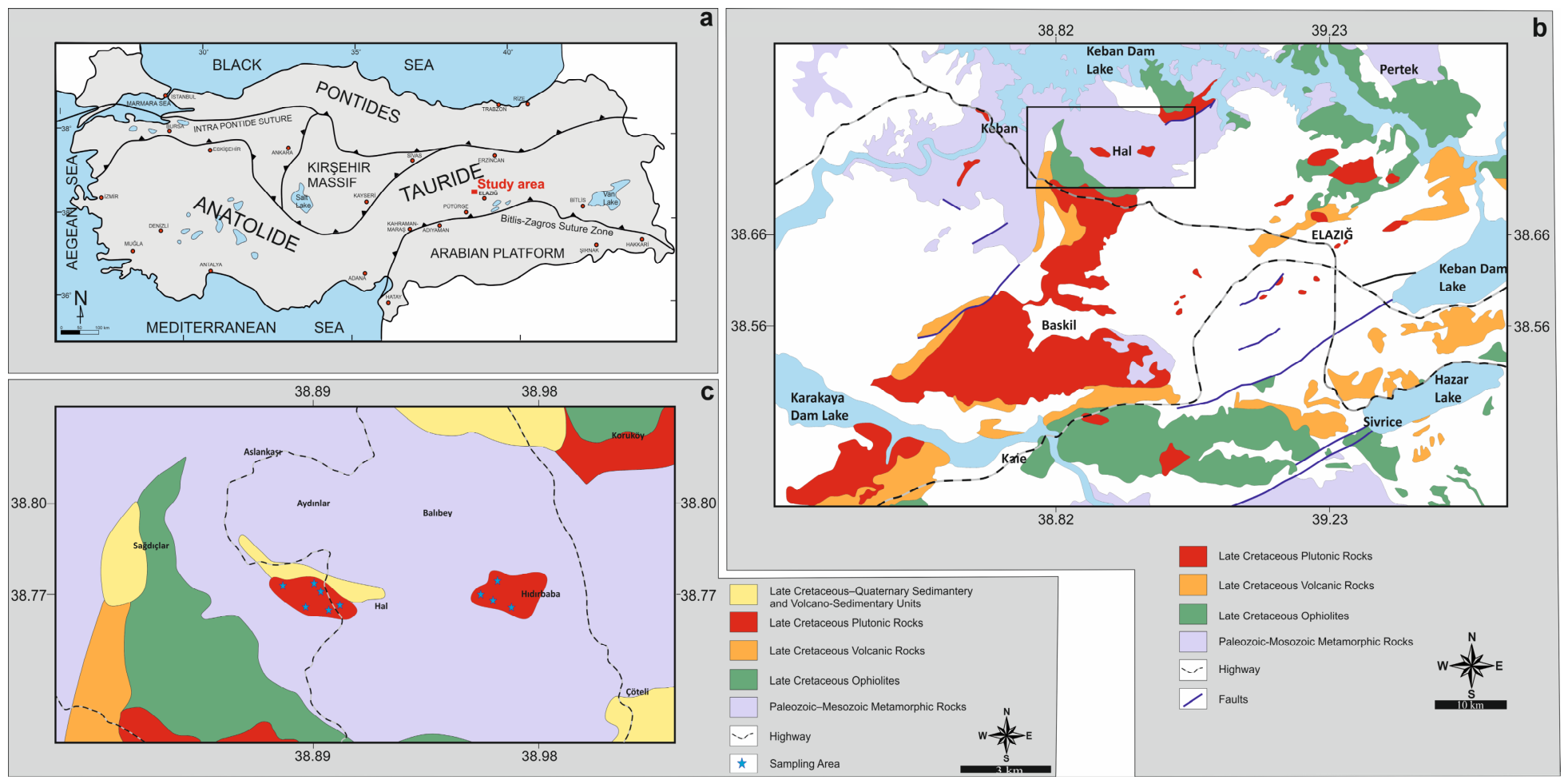
Figure 1. (a) Outline tectonic map of Türkiye showing the main tectonic settings, including the study area and the Southeastern Anatolian Orogenic Belt (SAOB) simplified from [27]. (b) Geological map of the Elazığ–Baskil–Keban region and (c) detailed geological map of the Hal–Hıdırbaba area showing the main lithological units, sampled plutonic bodies, and sample locations (compiled from the 1:500,000 scale Geological Map of Türkiye sheets published by the General Directorate of Mineral Research and Exploration, [28]).
Minerals 16 00444 g001
Figure 2. Field and hand-specimen photographs of hornblende gabbro blocks. (a,b) Rounded to sub-rounded, locally oval-shaped blocks in the field displaying concentric, shell-like exfoliation surfaces. (c) Cross-section of a block showing the sharp boundary between the fresh inner core and the altered outer rim. (d,e) Hand specimens illustrating the decimetre-scale size (approximately 15–25 cm in diameter) and the external morphology of the blocks.
Minerals 16 00444 g002
Figure 3. Photomicrographs of the hornblende gabbro thin sections under cross-polarised light. (a) Medium- to coarse-grained granular texture showing subhedral plagioclase and coarse amphibole crystals, with dispersed opaque minerals. (b) Coarse prismatic amphibole crystals are distributed among plagioclase grains and associated opaque phases. Abbreviations: Pl, plagioclase; Amp, amphibole; Opq, opaque mineral.
Minerals 16 00444 g003
Figure 4. Ca-amphibole classification diagram used for amphibole nomenclature, after [32].
Minerals 16 00444 g004
Figure 5. (a) Total alkali (Na2O + K2O) versus SiO2 classification diagram of [33]; (b) K2O versus SiO2 diagram of [34]; (c) AFM diagram of [35]; and (d) A/NK versus A/CNK diagram of [36] for the hornblende gabbro samples [12,13,21].
Minerals 16 00444 g005
Figure 6. (a) Primitive mantle-normalised multi-element diagram of the hornblende gabbro samples; (b) chondrite-normalised rare earth element (REE) diagram. Primitive mantle, OIB, N-MORB and E-MORB reference compositions are from [37], and chondrite normalisation values are from [38].
Minerals 16 00444 g006
Figure 7. AI–CCPI alteration box plot after [44] showing the alteration characteristics of the hornblende gabbros from northwest Elazığ, eastern Türkiye. AI = 100 × (K2O + MgO)/(K2O + MgO + Na2O + CaO), CCPI = 100 × (MgO + FeO)/(MgO + FeO + K2O + Na2O).
Minerals 16 00444 g007
Figure 8. Selected trace element diagrams illustrating magmatic processes affecting the studied hornblende gabbros. (a) La/Yb versus La, (b) Eu versus Mg#, (c) Y/Nb versus Zr/Nb, and (d) Zr/Sm versus MgO diagrams showing the effects of partial melting, fractional crystallisation, crustal contamination, and mineral fractionation trends. Process vectors modified after [45].
Minerals 16 00444 g008
Figure 9. (a) Nb/La versus La/Yb diagram illustrating mantle source characteristics after [48]. (b) Nb/Yb versus TiO2/Yb diagram showing MORB–OIB mantle array relationships after [49]. For comparison, literature data for gabbroic rocks from the SAOB are also plotted, including datasets from [12,13,21].
Minerals 16 00444 g009
Figure 11. Initial Sr–Nd isotope diagram showing the hornblende gabbro samples of this study and comparative gabbro data from [45].
Minerals 16 00444 g011
Figure 12. Tectonic discrimination diagrams for the hornblende gabbro samples. (a) Rb versus Y+Nb diagram after [64]. (b) Hf–Rb/30–3Ta ternary diagram after [65].
Minerals 16 00444 g012
Table 1. XRD-identified mineral phases, chemical formulae, and crystal systems of representative hornblende gabbro samples from Northwest Elazığ, Eastern Türkiye.
SampleChemical FormulaMineral NameCrystal System
G1 (Fresh Inner Core)
Na0.622Ca0.368Al1.29Si2.71O8AndesineTriclinic
CaAl2Si2O8AnorthiteTriclinic
NaAlSi3O8AlbiteTriclinic
CaFeSi2O6HedenbergiteMonoclinic
Ca2SiO4Calcio-olivineOrthorhombic
Na0.15Ca0.075Al0.3Si0.7O2.22.xH2OFaujasiteCubic
Ca2Mg5Si8O22(OH)2TremoliteMonoclinic
K0.956Fe2.918AlSi3O12(OH)2AnniteMonoclinic
G11 (Altered Outer Rim)
SiO2QuartzTrigonal
Na0.622Ca0.368Al1.29Si2.71O8AndesineTriclinic
Na0.15Ca0.075Al0.3Si0.7O2.22.xH2OFaujasiteCubic
CaAl2Si2O8AnorthiteTriclinic
Al2Si2O5(OH)4Kaolinite-1ATriclinic
Ca2Mg5Si8O22(OH)2TremoliteMonoclinic
Table 2. Major-oxide (wt.%) and trace-element (ppm) mineral chemistry data for amphibole.
Sample G1-AmpG1-AmpG1-AmpG1-Amp
Major oxides (wt.%)
SiO243.1145.2243.6241.55
TiO22.381.491.742.36
Al2O39.226.948.179.76
FeO16.3919.1317.2619.03
MnO0.350.520.410.59
MgO15.6115.3016.1916.16
CaO9.779.0310.208.17
Na2O1.961.041.171.09
K2O0.180.210.190.20
P2O50.020.010.010.02
Total98.9898.9098.9698.93
Trace elements (ppm)
Sc175.60130.37164.28136.10
V486.93414.96519.77531.43
Co59.2763.2848.7341.57
Ni9.538.077.2210.65
Ga14.0714.8613.3817.09
Ge1.611.651.792.22
Rb0.670.570.660.72
Sr60.5823.2543.2236.93
Y46.6049.5351.8148.78
Zr16.8438.4121.1018.67
Nb0.881.640.841.41
Cs0.010.020.020.06
Ba9.315.757.797.14
La0.881.931.131.61
Ce4.7210.385.677.10
Pr1.102.261.331.51
Nd8.2113.479.4210.06
Sm4.155.594.814.87
Eu1.501.651.421.35
Gd6.426.917.346.64
Tb1.191.291.301.22
Dy8.829.079.979.13
Ho1.831.942.111.88
Er5.355.745.775.97
Tm0.730.740.720.77
Yb4.565.425.025.12
Lu0.580.790.660.72
Hf0.911.731.131.11
Ta0.040.030.040.05
Pb1.651.261.502.38
Th0.050.110.060.19
U0.060.080.030.11
B3.932.303.564.64
Zn109.67143.01132.53195.88
Table 3. Whole-rock major oxides and trace element data for the hornblende gabbros from Northwest Elazığ, Eastern Türkiye.
SampleG1G2G3G4G5G6G7G8G9G10G11G12
Major oxides (wt.%)
SiO248.9348.8749.6948.5248.4448.8646.8446.7246.8446.9949.1949.12
TiO20.970.930.930.951.000.950.770.760.770.770.860.86
Al2O317.3517.7017.5917.4617.7917.9417.4017.3017.4517.4018.2418.22
Fe2O3 a12.6013.7513.0312.5612.9513.0915.1515.5015.4815.4812.0712.04
MnO0.220.210.210.230.220.230.200.210.200.210.190.20
MgO4.934.774.904.835.024.894.734.684.674.724.944.97
CaO8.938.889.158.889.668.768.908.838.888.907.367.35
Na2O1.871.991.942.001.922.042.122.122.142.142.122.13
K2O0.480.470.470.470.480.480.500.500.500.500.580.57
P2O50.130.120.100.120.100.100.110.110.110.110.120.12
LOI3.211.841.533.621.962.201.571.441.481.524.174.26
Sum99.6199.5399.5599.6499.5599.5598.2998.1798.5198.7399.8499.81
Trace elements (ppm)
Sc43.0540.4341.1840.3642.9142.0538.4637.4837.2438.5241.7342.48
V317.33302.23304.46314.33321.63315.21300.97284.77288.49290.59298.43303.83
Co34.4830.3131.9132.1834.1234.7334.5332.9933.7733.4032.4533.90
Ni4.685.475.146.626.9639.6145.7144.5448.4233.453.153.33
Zn79.9577.6284.7982.7388.7188.6474.4072.6971.3571.9379.6879.01
Ga18.6718.1717.6918.0217.4518.6417.5416.9817.2217.4817.4817.47
Rb13.2013.7613.2913.8813.6414.2913.8613.0613.1613.7214.6614.46
Sr184.92187.61188.43191.59192.10189.47178.32174.73175.99181.17205.90208.56
Y19.7219.6319.8319.7121.0220.4222.2721.4721.5822.4723.0723.15
Zr27.7628.5028.3728.9328.2930.5826.8324.9923.7228.2428.1330.58
Nb1.151.100.941.060.960.981.591.511.661.321.171.11
Cs0.480.480.510.520.560.570.540.510.520.540.490.48
Ba41.5537.4136.3240.2640.6341.2339.1637.6337.1738.7967.5267.75
La2.142.051.932.082.202.092.142.122.082.192.342.33
Ce6.576.536.246.266.406.036.406.256.106.446.736.73
Pr1.111.131.101.021.161.061.111.101.121.181.211.18
Nd6.325.806.095.466.886.296.096.005.766.206.656.51
Sm2.272.001.681.932.382.062.282.242.212.252.272.33
Eu0.750.830.810.780.840.880.790.780.810.820.810.82
Gd2.572.392.542.632.802.533.033.042.983.153.203.16
Tb0.470.470.490.470.570.470.600.580.570.600.590.62
Dy3.593.463.343.153.612.923.893.793.904.024.013.95
Ho0.770.640.750.670.810.750.840.830.830.840.860.88
Er2.432.172.152.252.352.352.432.362.382.412.452.48
Tm0.310.310.290.330.280.340.360.360.360.370.370.38
Yb2.262.182.432.052.122.342.372.402.342.492.472.47
Lu0.320.330.350.310.370.310.370.360.370.380.370.37
Hf1.120.820.801.061.031.051.100.981.001.131.051.10
Ta0.050.060.040.050.030.060.050.050.050.050.060.06
Pb4.734.384.904.424.265.214.344.504.484.524.464.53
Th0.160.170.170.130.160.160.200.190.200.210.300.30
U0.130.100.080.120.090.120.120.120.110.140.400.39
Mg#43.6640.7542.7043.2343.4142.5338.2337.4437.4237.6644.7944.97
TbN/YbN0.920.950.891.011.190.891.121.071.071.061.051.11
LaN/SmN0.590.640.720.680.580.640.590.600.590.610.650.63
Eu/Eu*0.951.161.201.060.991.180.920.910.970.940.920.92
a Total iron as Fe2O3; Mg# = [molar 100 × Mg/(Mg + Fe2+)]; Eu/Eu* = (Eu)cn/[(Sm)cn × (Gd)cn]0.5.
Table 4. Sr–Nd isotopic data for representative hornblende gabbro samples from Northwest Elazığ, Eastern Türkiye.
SampleRb a (ppm)Sr (ppm)87Rb/86Sr87Sr/86Sr±2σm b(87Sr/86Sr)I c,d,eεSr(T)Sm (ppm)Nd (ppm)147Sm/144Nd143Nd/144Nd±2σm(143Nd/144Nd)iεNd(T) f
G113.20184.920.2070.7049660.0000150.7047925.12.276.320.21700.5128760.0000050.5127574.4
G213.76187.610.2120.7055220.0000160.70534412.925.800.20800.5128770.0000050.5127634.5
G313.29188.430.2040.7052800.0000110.7051089.61.686.090.16680.5128920.0000050.5128005.3
a The concentration data are the same as in Table 3, and the 87Rb/86Sr and 147Sm/144Nd values were derived from the relations Rb/Sr × 2.8956 and Sm/Nd × 0.60456, respectively. b The 2σm values are the mean standard deviations of the measurements. c The initial isotopic ratios were calculated using this formula (87Sr/86Sr)i = (87Sr/86Sr) − (87Rb/86Sr) × (e^λt − 1), (143Nd/144Nd)i = (143Nd/144Nd) − (147Sm/144Nd) × (e^λt − 1) [39]. d The decay constants used for calculating the initial isotopic ratios are after [40], (λRb) = 1.393 × 10⁻¹¹/year) and [41], (λSm) = 6.54 × 10⁻¹²/year). e The present-day chondritic uniform reservoir: 87Rb/86Sr = 0.0827, 87Sr/86Sr = 0.7045, 147Sm/144Nd = 0.1967, 143Nd/144Nd = 0.512638. f εNd(T) = [(143Nd/144Nd)Sample (T)/(143Nd/144Nd)CHUR(T) − 1] × 104. CHUR: Chondritic Uniform Reservoir; DM: Depleted Mantle.
Table 5. Amphibole crystallisation temperatures and pressures were calculated using the updated amphibole-only thermobarometric model of [62].
SampleG1-AmpG1-AmpG1-AmpG1-AmpMean ± SD (n = 4)
T (°C)941873901991926.5 ± 51.3
σₜ (°C)22222222
P (MPa)226149181326220.5 ± 77.1
Max_Error_P (MPa)27182239
Continental_Depth (km)5.111.39.415.310.3 ± 4.3
Disclaimer/Publisher’s Note: The statements, opinions and data contained in all publications are solely those of the individual author(s) and contributor(s) and not of MDPI and/or the editor(s). MDPI and/or the editor(s) disclaim responsibility for any injury to people or property resulting from any ideas, methods, instructions or products referred to in the content.