Article

Genesis and Tectono-Metallogenetic Setting of the Dongwujiiazi Gold Deposit, NE China: Insights from Whole-Rock Geochemistry and H–O–S–Pb Isotopes
1
Harbin Center for Integrated Natural Resources Survey, China Geological Survey, Harbin 150086, China
2
Observation and Research Station of Earth Critical Zone in Black Soil, Harbin, Ministry of Natural Resources, Harbin 150086, China
3
Liaoning Nonferrous Geology No. 109 Team Co., Ltd., Chaoyang 122000, China
4
Ore Deposit and Exploration Center (ODEC), School of Resources and Environmental Engineering, Hefei University of Technology, Hefei 230009, China
5
Anhui Province Engineering Research Center for Mineral Resources and Mine Environments, Hefei 230009, China
6
Anhui Provincial Key Laboratory for Deep Exploration, Evaluation and Utilization of Strategic Mineral Resources, Hefei 230009, China
7
Department of Geology, Faculty of Science, Kafrelsheikh University, Kafrelsheikh 33516, Egypt
*
Author to whom correspondence should be addressed.
Minerals 2026, 16(5), 435; https://doi.org/10.3390/min16050435
Submission received: 28 March 2026 / Revised: 18 April 2026 / Accepted: 21 April 2026 / Published: 23 April 2026

Abstract

The Dongwujiiazi deposit is a structurally controlled orogenic gold deposit situated in the eastern part of the Chifeng–Chaoyang gold belt along the northern boundary of the North China Craton. This study establishes a comprehensive metallogenic model for the Dongwujiiazi gold deposit by integrating whole-rock geochemistry (major and trace elements), in situ trace elements and REEs in zircon, multi-isotope systems (H, O, S, Pb), and precise zircon U–Pb geochronology. Five types of intrusive and associated rocks are identified within the main biotite-pyroxene gneiss host of the Dongwujiiazi gold deposit: mylonitized granitic pegmatite, mylonitized porphyritic monzogranite, propylitized fine-grained quartz monzodiorite, quartz monzonite, and porphyritic dolerite. The gold-bearing polymetallic sulfide ores are composed of pyrite, chalcopyrite, sphalerite, galena, digenite, and native gold. Zircon grains in the Dongwujiiazi gold ore (2502 ± 15 to 2539 ± 18 Ma) are inherited from surrounding Neoarchean gneiss, recording older crustal sources rather than forming contemporaneously with the gold mineralization. H–O isotopes indicate that the ore-forming fluids were mixed in origin, involving both magmatic and metamorphic components. S and Pb isotopes suggest that the mineralizing sulfur was mainly derived from a magmatic source, while lead originated predominantly from lower crustal materials associated with the surrounding high-grade metamorphic rocks. In this study, we present a new metallogenic model for the Dongwujiiazi gold deposit, in which slab-derived and lower-crustal metamorphic fluids interacted with ascending magmas, resulting in fluid mixing and gold precipitation within structurally controlled zones of gneissic host rocks. Combined geochemical and isotopic evidence (H–O, S, Pb) indicates contributions from both magmatic and metamorphic sources, supporting formation as an intracontinental orogenic gold system in an active continental margin.

1. Introduction

The North China Craton (NCC) represents one of the Earth’s most ancient continental cores and records a long and intricate history of tectonic reworking, marked by repeated episodes of collision and accretion. Its northern margin, in particular, constitutes a highly prospective metallogenic zone, where extensive gold mineralization is concentrated within the Chifeng–Chaoyang belt. This region is regarded as one of China’s principal gold-producing provinces and provides an exceptional geological framework for examining the formation of orogenic gold systems within an intracontinental regime. Within this belt, the Dongwujiazi gold deposit occupies a position in its eastern segment and forms part of a broader cluster of more than 200 documented gold occurrences [1]. Notable deposits in this metallogenic province include Jinchanggouliang and Xiaotazigou [2], highlighting the regional-scale significance and continuity of gold mineralization.
Most gold deposits are widely recognized as orogenic in origin [3,4]. They are interpreted to have formed in convergent tectonic environments, particularly during the late stages of craton evolution when tectono-magmatic activity wanes [3,5,6]. These deposits are typically epigenetic and structurally controlled, occurring within deformed metamorphic belts across a wide range of crustal levels. They are most commonly associated with greenschist facies conditions and are frequently hosted by metamorphosed volcanic rocks [3,4,7,8,9].
Orogenic gold deposits commonly occur in rocks that have experienced metamorphism ranging from lower to upper greenschist facies [10]. The precise source of hydrothermal fluids responsible for transporting gold remains a topic of ongoing debate and investigation. Over the years, several mechanisms have been proposed to explain the origin of auriferous fluids in orogenic gold systems. According to [11], these include (1) release of fluids from greenstone rocks during progressive regional metamorphism, (2) fluid release from the lower and/or middle crust, with or without contributions from the mantle [3,12,13,14], (3) magmatic fluids derived from widespread or localized granitic intrusions, (4) addition of fluids during crystallization of lamprophyric magmas enriched with gold [12,15,16], and (5) extensive infiltration and deep circulation of meteoric fluids within the crust [17].
Nevertheless, the literature on orogenic gold deposits worldwide suggests that the most reasonable sources are metamorphic fluids generated through devolatilization reactions and fluids derived from felsic magmatic sources [8,11,18]. This perspective is particularly relevant for intracontinental orogenic settings, where interactions between lower crustal metamorphic fluids and magmatic contributions likely play a central role in ore formation.
This study aims to unravel the origin and evolution of the Dongwujiiazi gold deposit by integrating whole-rock geochemistry, H–O–S–Pb isotopes, and zircon U–Pb dating. It focuses on constraining the sources of metals and fluids, evaluating the role of lower crustal metamorphic and magmatic processes, and elucidating fluid migration and gold deposition within gneissic host rocks, providing new insights into intracontinental orogenic gold formation.

2. Geologic Setting

The Dongwujiiazi gold deposit is located along the northern edge of the North China Craton (NCC). It lies at the boundary between the Yanliao Depression Zone and the Inner Mongolia Uplift, and is controlled by the Chifeng–Kaiyuan and Chengde–Beipiao fault zones (Figure 1a). Regionally, the study area is underlain by Archean metamorphic rocks belonging to the Jianping Group, which are extensively distributed across the Chifeng–Chaoyang region [19]. These rocks constitute an ancient crustal basement and form the principal host for gold mineralization (Figure 1b). Lithologically, the metamorphic assemblage is mainly composed of gneiss, amphibolite, and banded magnetite–quartzite. Magmatic activity is represented predominantly by granitoid intrusions emplaced within the metamorphic basement. Structurally, the region is characterized by a well-developed fault system, with dominant trends in the NE and N–S directions, reflecting strong tectonic control on both magmatism and mineralization (Figure 1c).
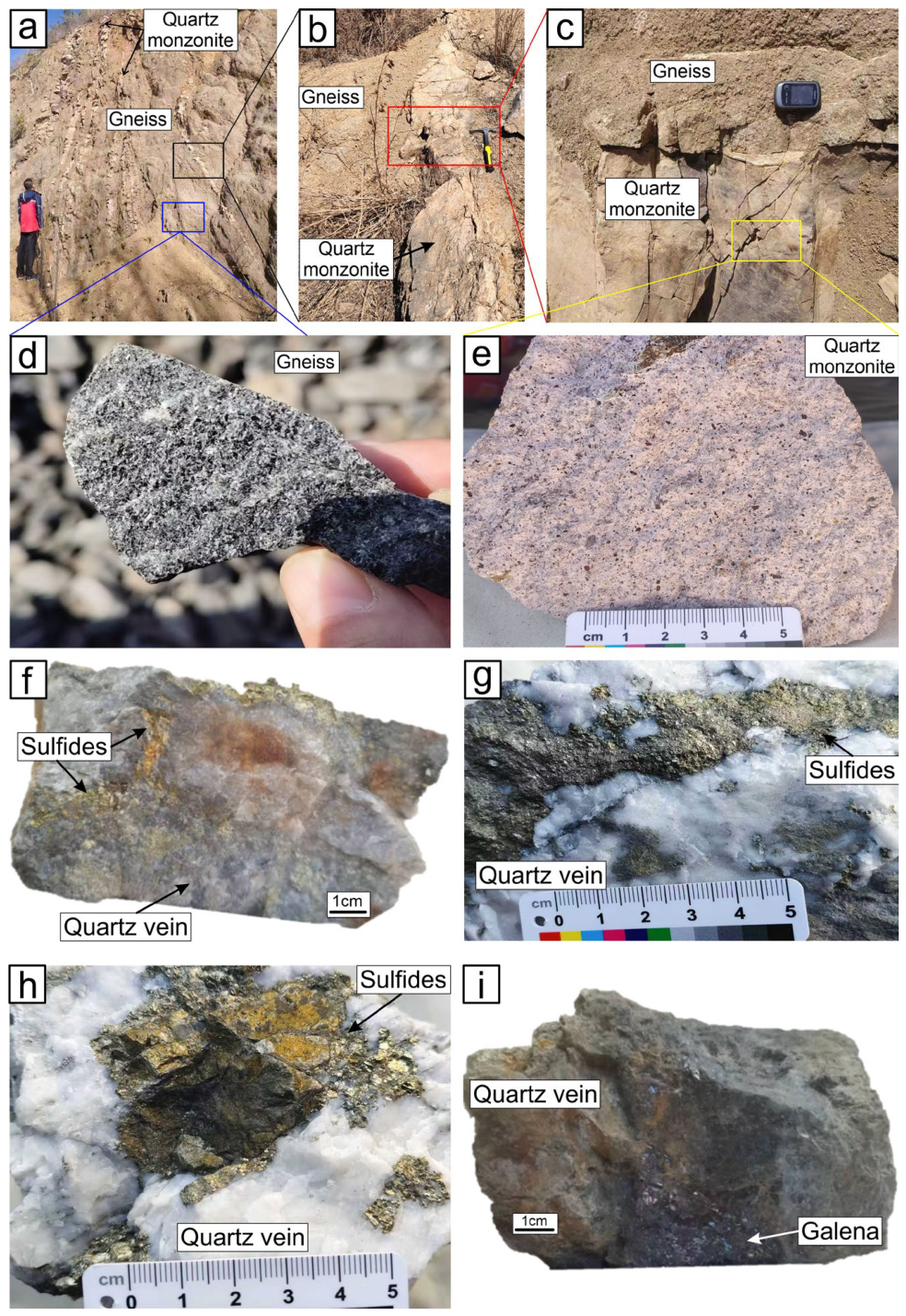
The study area is characterized by a crystalline basement dominated by gneissic rocks intruded by multiple intrusive rocks. Field observations indicate that the gneiss exhibits well-developed foliation and ductile deformation features, suggesting a high-grade metamorphic origin and subsequent tectonic overprinting (Figure 2a–c). It is composed mainly of pyroxene, biotite, feldspar and quartz, which define the overall mineral assemblage of the rock. Quartz is found in the form of recrystallized crystals, and in some areas, in the form of veins. Minor accessory opaque minerals, mainly magnetite and pyrite, are sparsely distributed. The contact between the gneiss and quartz monzonite is clearly exposed and locally sharp, although minor transitional zones may occur, reflecting magmatic emplacement into pre-existing metamorphic rocks. The quartz monzonite is typically massive and medium- to coarse-grained, showing a relatively homogeneous texture compared to the surrounding foliated gneiss (Figure 2d,e).
Hydrothermal activity is widely distributed throughout the study area, mainly in the form of quartz veins that cut across both the gneiss and quartz monzonite (Figure 2f–i). These veins vary in thickness and are commonly associated with sulfide mineralization. The sulfides occur as disseminations (Figure 2f), vein infillings (Figure 2g), and locally massive aggregates within the quartz veins (Figure 2h). Their distribution suggests multiple stages of fluid flow and mineral precipitation.
The mineral assemblage observed in the veins includes abundant sulfides, with visible metallic minerals such as galena occurring locally (Figure 2i). The presence of galena, along with other sulfides, indicates a polymetallic hydrothermal system. Textural relationships, such as sulfides filling fractures and occurring along vein margins, suggest that mineralization postdates both deformation and magmatic intrusion.
Overall, the geological features of the area point to a multi-stage evolution system, involving (1) formation of the metamorphic basement (gneiss); (2) emplacement of multiple intrusive rocks within the gneissic basement; and (3) subsequent hydrothermal activity responsible for quartz veining and sulfide mineralization. This sequence reflects a structurally controlled hydrothermal system, where faults and fractures acted as conduits for mineralizing fluids, ultimately leading to the formation of ore-bearing quartz veins.

3. Petrography of Dongwujiiazi Gold Deposit

3.1. Host Rocks

Six types of host rocks and intrusions are identified in the Dongwujiiazi gold deposit, including (1) mylonitized granitic pegmatite; (2) mylonitized porphyritic monzogranite; (3) propylitized fine-grained quartz monzodiorite; (4) quartz monzonite; (5) biotite-pyroxene gneiss; (6) porphyritic dolerite.
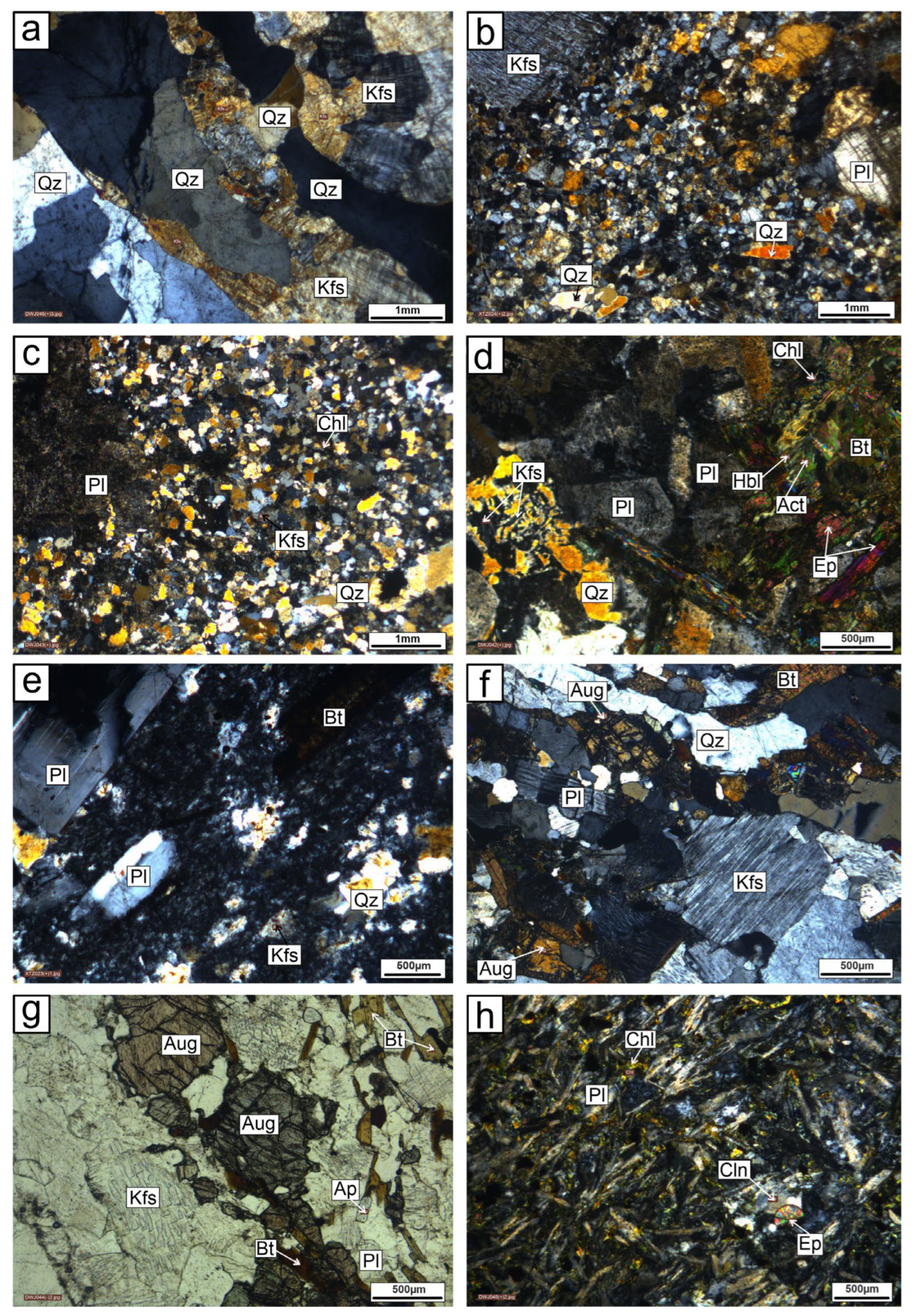
The mylonitized granitic pegmatite exhibits a combination of mylonitic and pegmatitic textures, with a distinct banded structure in certain portions. The rock is dominated by K-feldspar (~50%), forming subhedral tabular-prismatic crystals, with grain sizes range from 0.2 to 30 mm (Figure 3a). Some feldspar occurs as granular aggregates, with argillic alteration and sericitization. Plagioclase (~15%), interpreted as andesine, occurs as subhedral tabular-prismatic crystals, with grain sizes range from 0.2 to 15 mm and some recrystallized portions form granular aggregates. It is locally oriented in banded aggregates, with signatures of argillic alteration and sericitization. Quartz (~35%) is present as anhedral granular crystals (0.5 to 12 mm grain size range), displaying undulose extinction. Minor accessory minerals include magnetite and apatite. The rock preserves evidence of strong ductile deformation, manifested in its mylonitic texture.
The mylonitized porphyritic monzogranite has mylonitic, porphyritic, and banded textures, with a fine-grained hypidiomorphic granular groundmass and localized metasomatic pseudomorphic textures (Figure 3b,c). Porphyroclasts, including K-feldspar, quartz, and hornblende, are embedded in the fine-grained groundmass. K-feldspar (~10%; grain size: 1.5 to 5 mm) occur as subhedral tabular-prismatic crystals, with argillic alteration and sericitization. Quartz (~10%; grain size: 1.5 to 5 mm) is elongated and occurs as banded and irregular crystals, with undulose extinction. Hornblende (~6%; grain size: 1.5 to 5 mm) is present as subhedral prismatic-columnar and irregular crystals, almost completely replaced by actinolite and epidote, showing metasomatic pseudomorphic textures. The groundmass (~74%; grain size: 0.1 to 1.5 mm) of porphyritic monzogranite exhibits a fine-grained hypidiomorphic granular texture, consisting mainly of plagioclase, K-feldspar, and quartz, with minor epidote and actinolite formed during alteration. Minor accessory minerals include magnetite, limonite, apatite, and zircon.
The propylitized fine-grained quartz consists of plagioclase, hornblende, biotite, and K-feldspar (Figure 3d). Plagioclase (~44%, grain size: 0.2 to 2.0 mm), predominantly of andesine composition, occurs as medium-sized subhedral tabular-prismatic crystals, with argillic alteration, sericitization, and epidotization. Hornblende (~25%; grain size: 0.2–2.0 mm, with a few reaching 2.5 mm.) occurs as subhedral prismatic to columnar crystals. Most grains are extensively altered to epidote and actinolite. Biotite (~10%; grain size: 0.2 to 1.5 mm) occurs as subhedral to irregular flakes that partially altered to chlorite and epidote, and contains exsolved sphene (titanite) as an accessory mineral. K-feldspar (~10%; grain size: 0.2 to 1.5 mm) occurs as subhedral to anhedral tabular-prismatic and granular crystals, with argillic alteration. Quartz (~10%; grain size: 0.2 and 1.5 mm) is present as anhedral granular to irregular crystals, showing graphic intergrowths with K-feldspar, resulting graphic texture (Figure 3d). Minor accessory minerals (<1%) include magnetite, sphene (titanite), and apatite.
The quartz monzonite displays a porphyritic texture with microcrystalline groundmass (Figure 3e). Phenocrysts include plagioclase, biotite, and hornblende, set in a fine-grained groundmass of feldspar and quartz microlites forming oriented bands. Plagioclase (andesine; ~14%; grain size: 0.2 to 1.8 mm) is euhedral to subhedral, with evidence of argillic alteration and clear polysynthetic twinning. Biotite (~4%; grain size: 0.2 to 2 mm) and hornblende (~2%; grain size: 0.2 to 1 mm) are partially altered, with hornblende exhibiting metasomatic replacement. The groundmass (~78%; grain size: less than 0.2 mm) composed of fine feldspar and quartz, and minor accessory minerals (~2%), including magnetite and limonite, are observed.
The biotite-pyroxene gneiss exhibits gneissose texture, defined by the oriented arrangement of major minerals (Figure 3f,g). Pyroxene (augite, ~20%; grain size: 0.1 to 1.5 mm) occurs as subhedral to anhedral prismatic and granular crystals, and locally altered to chlorite. Biotite (~10%), K-feldspar (~28%), plagioclase (~20%), and quartz (~20%) are all oriented as granular aggregates, collectively defining the gneissic fabric. Quartz locally displays myrmekitic intergrowths with plagioclase, and larger grains represent early quartz vein occurrence. Minor accessory minerals (~2%) include magnetite, pyrite, apatite, and zircon.
The porphyritic dolerite is characterized by ophitic and sub-ophitic textures, and locally amygdaloidal structures (Figure 3h). Phenocrysts consist mainly of plagioclase (~4%; grain size: 0.5 to 1.5 mm), euhedral to subhedral, with argillic alteration and sericitization. The groundmass (~90%, grain size: 0.1 to 0.5 mm) displays the characteristic diabasic texture, composed of tabular plagioclase laths, with interstitial chlorite and epidote derived from pyroxene alteration. Amygdules (~4%; grain size: 0.5 to 5.0 mm) are irregular, filled with chalcedony, calcite, and epidote. Minor accessory minerals (~2%) include magnetite, limonite, and apatite.

3.2. Gold-Bearing Polymetallic Sulfide Ore

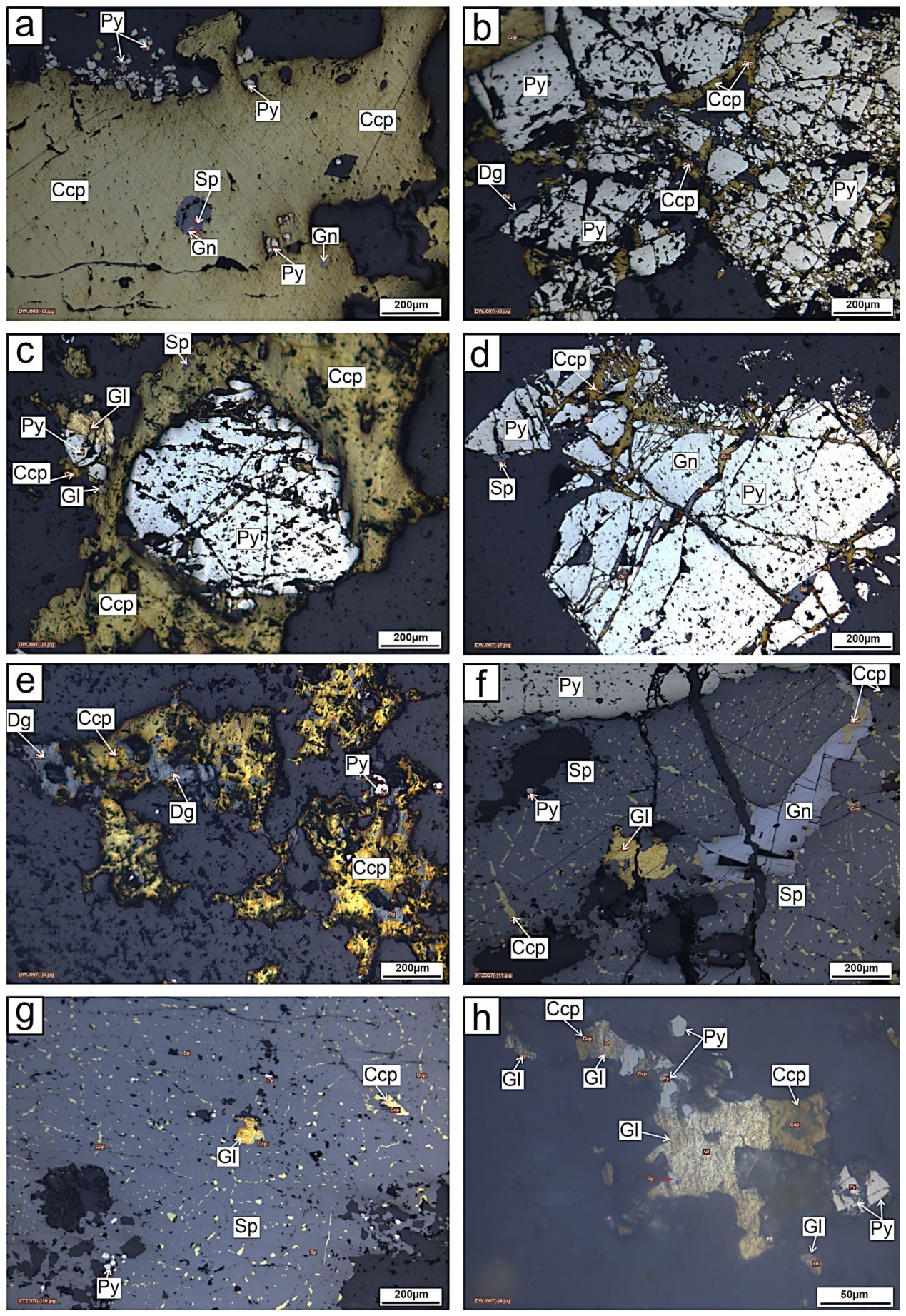
The gold-bearing polymetallic sulfide ore comprises pyrite, chalcopyrite, sphalerite, galena, digenite, and native gold (Figure 4). Pyrite occurs predominantly as euhedral to subhedral granular crystals, displaying cubic to pyritohedral forms, with occasional anhedral grains (Figure 4b–d). Grain sizes range from 0.001 to 4.0 mm and are unevenly distributed within the mineralized quartz veins, with an estimated content of ~5%–14%. Most pyrite grains are fractured or fragmented, exhibiting brecciation (Figure 4b–d). Chalcopyrite, galena, and sphalerite commonly replace and enclose pyrite along fractures, forming fine veinlets and networks, indicative of a metasomatic corrosion texture. A few late-stage fine pyrite veinlets (Py II) replace sphalerite, representing post-formation hydrothermal remobilization.
Chalcopyrite (~8%–20%) occurs as anhedral to irregular grains with sizes ranging from 0.001 to 20 mm, and is unevenly distributed within quartz and sulfide veins (Figure 4a,e). It commonly occurs in association with galena and sphalerite and locally appears as fine blebs and intergrowths within sphalerite.
Sphalerite (~40%) also occurs as anhedral to irregular grains with sizes ranging from 0.01 to 20 mm, and is disseminated within sulfide veins. It is commonly intergrown with chalcopyrite. Locally, chalcopyrite occurs as fine inclusions and thin veinlets along grain boundaries of sphalerite, indicating late-stage replacement.
Galena (~10%–18%; grain size: 0.01 to 15 mm) occurs as anhedral granular to irregular crystals, unevenly distributed in the mineralized quartz and metal sulfide veins and often intergrown with chalcopyrite (Figure 4d,f). Star-like and wedge-shaped replacements of chalcopyrite by galena are common, and local fracturing indicates at least two deformation events. Digenite occurs as anhedral granular to irregular crystals, with grain sizes range from 0.01 to 0.3 mm and are mostly intergrown with chalcopyrite. Star-like and wedge-shaped replacements of chalcopyrite by digenite are observed, reflecting post-crystallization metasomatic modification. The mineral occurs in minor amounts within the polymetallic sulfide veins. Native gold (grain size: 0.01 to 0.3 mm) occurs as anhedral granular to irregular crystals (Figure 4c,f–h). It is typically intergrown with chalcopyrite, or hosted within transparent minerals, sphalerite, or fractures in pyrite, occurring in minor amounts within the polymetallic sulfide veins.

4. Analytical Methods and Results

4.1. Analytical Methods

Whole-rock major, trace, and rare earth element compositions were analyzed at the Analytical Laboratory using X-ray fluorescence (XRF) and ICP-based techniques. Major elements were determined by XRF following fusion preparation of powdered samples into glass beads under high-temperature conditions (~1150–1250 °C). Trace and rare earth elements were measured by ICP–OES after acid digestion of powdered samples using HF–HNO3 in sealed vessels at elevated temperatures (130–185 °C). These analytical procedures ensured complete sample dissolution and high-precision elemental determinations (for detailed methodological descriptions, see Supplementary Text S1).
In situ sulfur isotope compositions of sulfides were determined by LA–MC–ICP–MS at Beijing Kehui Testing Technology Co., Ltd. (Beijing, China) using a 193 nm laser system coupled with a Neptune Plus instrument (Thermo Fisher Scientific Inc., Waltham, MA, USA). Analyses were performed under controlled laser conditions, and isotopic ratios were corrected using matrix-matched standards and standard–sample–standard bracketing.
Hydrogen (δD) and oxygen (δ18O) isotopes were analyzed using a Thermo Scientific 253 Plus IRMS coupled with a Flash EA elemental analyzer (Thermo Fisher Scientific Inc., Waltham, MA, USA) and Conflo IV interface at Beijing Kehui Testing Technology Co., Ltd. (Beijing, China). Samples were dried at 90 °C, pyrolyzed at 1380 °C, and the released gases were separated and measured under high-purity helium flow, with isotopic compositions calibrated against international standards.
Lead isotopes were measured using a Neptune Plus multi-collector ICP–MS in static mode following chemical purification at Beijing Kehui Testing Technology Co., Ltd. (Beijing, China). Instrumental mass bias was corrected using Tl normalization, and analyses were calibrated against NIST 981 Pb standard [21] with optimized plasma and ion lens settings to ensure high precision.
U–Pb zircon dating and trace/REE analyses were performed by LA–ICP–MS at Createch Testing (Tianjin) Technology Co., Ltd. (Beijing, China). using a 193 nm laser ablation system coupled with an ICP–MS, with He as the carrier gas and Ar as a make-up gas. Data reduction and age calculations were carried out using Iolite 4, with zircon GJ-1 used for external calibration and Plesovice for quality control.

4.2. Results

4.2.1. Whole-Rock Major and Trace Elements

Major Oxides
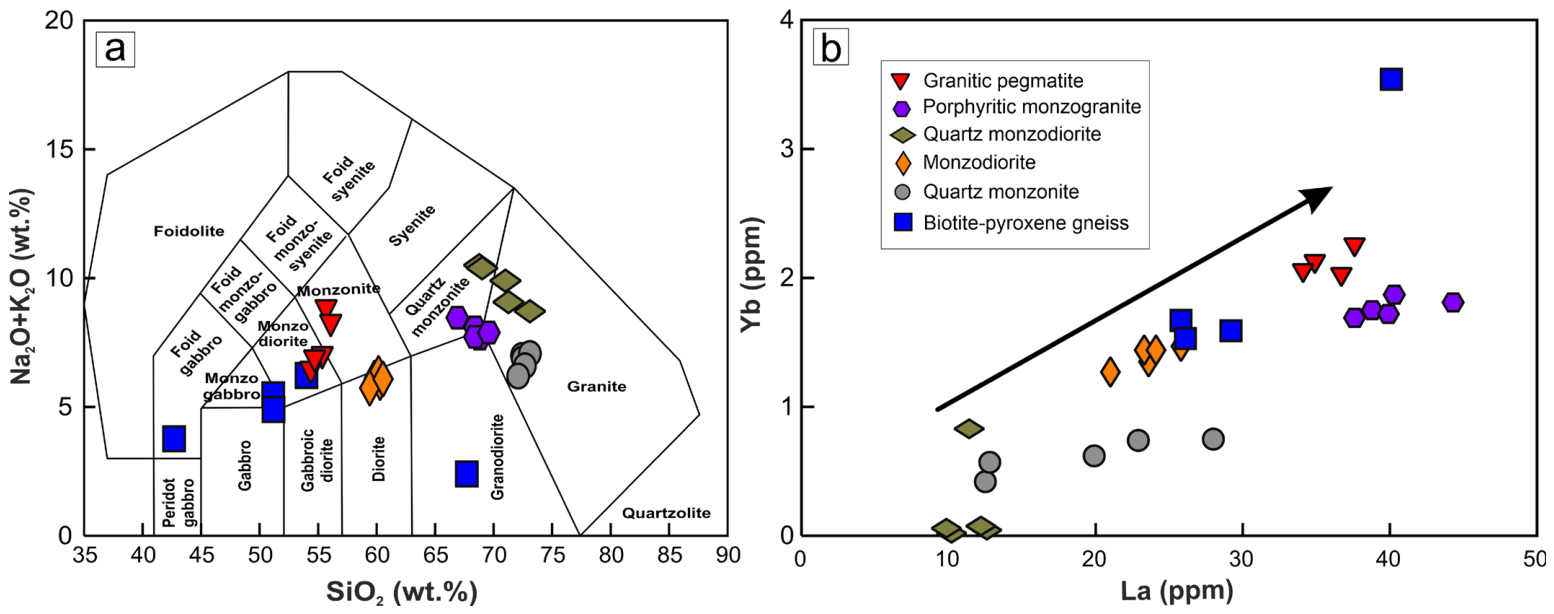
Samples from both ore and host rocks were analyzed. Geochemical classification of the studied host rocks was carried out using the SiO2 versus (Na2O + K2O) diagram (Figure 5a) proposed by [22]. The Dongwujiiazi host rocks plot within the fields of monzodiorite, monzonite, diorite, quartz monzonite, granodiorite and granite (Figure 5a). The host rocks contain SiO2 (42.69–73.11 wt.%), K2O (1.03–8.39 wt.%), Na2O (0.41–4.92 wt.%), MgO (0.43–5.46 wt.%; except some gneiss samples with 8.72–10.61 wt.%) and CaO (0.22–5.14 wt.%; gneiss: 6.04–8.67 wt.%). MnO and P2O5 are 0.21 and 0.44, respectively (Table 1, Supplementary Table S1). The host rocks are generally fresh, although some samples exhibit alteration, as indicated by low loss on ignition (LOI) values (0.24–3.44 wt.%), with a few samples showing higher values of 5–11.6 wt.% (Table 1, Supplementary Table S1).
Gold ore samples exhibit a high Fe2O3(t) content, reaching up to 43.97 wt.% (Table 1). SiO2 ranges from 30.43 to 76.83 wt.%, while Na2O (0.13 wt.%), K2O (0.2 wt.%), MgO (1.53 wt.%), CaO (0.69 wt.%), and MnO (>0.02 wt.%) occur at relatively low concentrations (Table 1). They are characterized by high LOI values, reaching up to 22.22 wt.%, indicating a significant volatile content in the gold ore. This likely reflects intense alteration and/or the presence of hydrous minerals, carbonates, or oxidized sulfides.
Trace and REEs
Barium (Ba), strontium (Sr), and zirconium (Zr) are highly enriched in the Dongwujiiazi host rocks, reaching concentrations of up to 2043, 881, and 200 ppm, respectively (Table 1, Supplementary Table S1). These rocks display moderate total REE contents (ΣREE = 119.39 ppm, on average), characterized by enrichment in LREEs (ΣLREE = 111.26 ppm) relative to HREEs (ΣHREE = 8.13 ppm) (Table 1, Supplementary Table S1). There is a positive correlation between La and Yb (Figure 5b).
Gold ores exhibit elevated copper (Cu) concentrations, reaching up to 8964 ppm. Cobalt (Co) shows moderate enrichment, ranging from 74.8 to 202 ppm, whereas nickel (Ni) is comparatively lower, with values between 46.5 and 146 ppm. The gold ore is very poor in REEs, ranging from 3.55 to 5.37 ppm. LREEs (3.26–4.88 ppm) are enriched relative to HREEs (0.28–0.49 ppm) (Table 1).
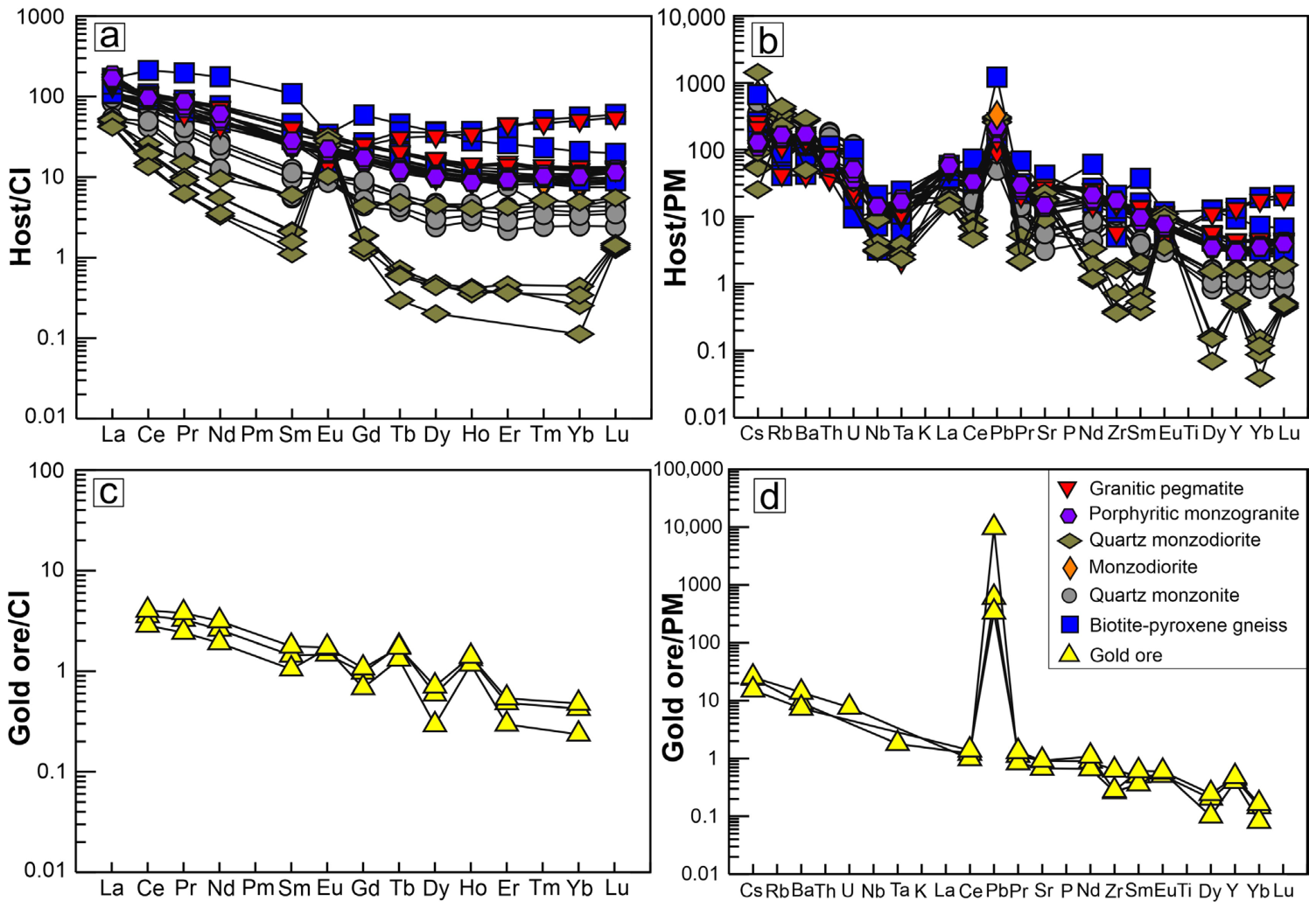
Chondrite-normalized REE patterns of the studied host rocks (Figure 6a) show a pronounced LREE-enriched and HREE-depleted trend with gently sloping patterns and positive Eu anomalies. Primitive mantle-normalized trace element patterns indicate enrichment in Pb and depletion in Dy and Yb (Figure 6b). In the gold ore samples (Figure 6c,d), REE and trace element patterns are characterized by LREE and Pb enrichment, with depletion of HREE.

4.2.2. Mineral Chemistry

In Situ Trace and REEs in Zircon
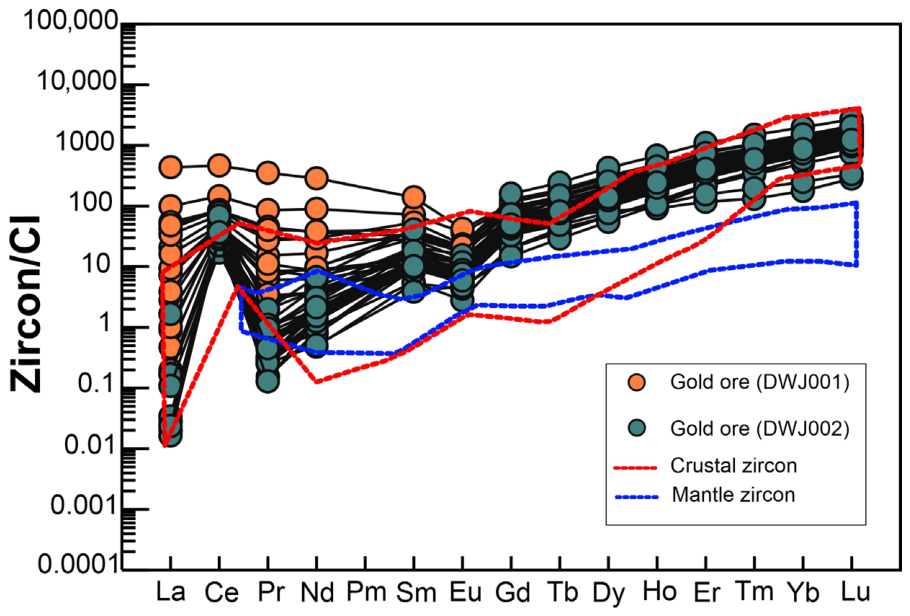
The concentrations of rare earth elements in zircon are presented in Supplementary Table S2. The chondrite-normalized REE patterns of zircon from gold ore (Figure 7) show strong enrichment in HREEs (Tb–Lu) and depletion in LREEs (La–Gd). The patterns display a smooth increase from LREEs to HREEs, with a pronounced positive Ce anomaly and a distinct negative Eu anomaly. The zircon REE pattern is similar to those of crustal zircon [24].

4.2.3. H–O Isotopes

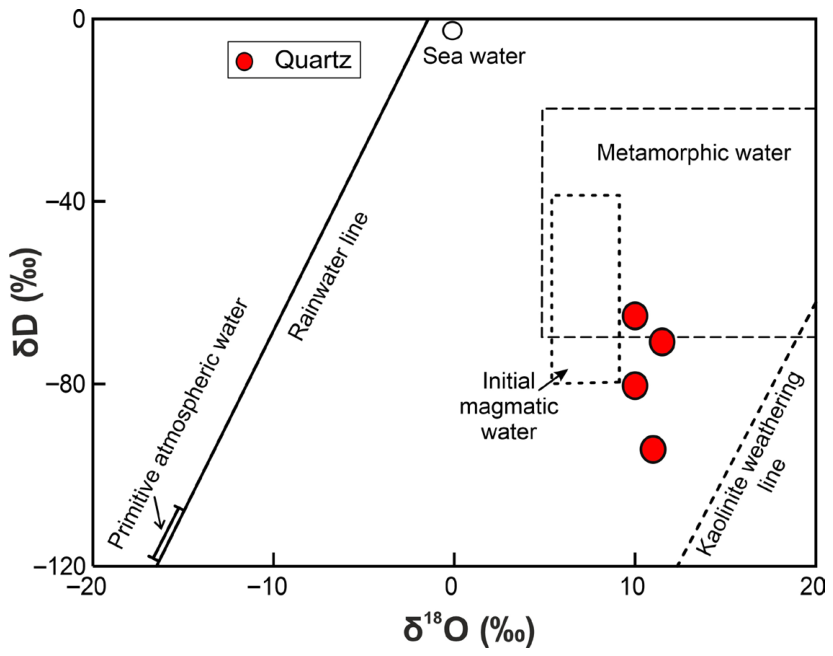
The δD values of the studied quartz samples from the Dongwujiiazi deposit range from −63.9 to −94.6‰, while the calculated δ18Ofluid values range from approximately 10 to 11.5‰ (Table 2). The hydrogen isotopic composition of the ore-forming fluids was directly obtained from the host minerals, whereas the oxygen isotopic composition was calculated from quartz, considering the estimated mineralization temperature of 300 °C, as reported by [26]. These isotopic signatures indicate that the ore-forming fluids were predominantly derived from magmatic–metamorphic sources, with minimal contribution from meteoric water.

4.2.4. S Isotopes

The δ34S values of the sulfide minerals from the Dongwujiiazi deposit range from 2.06 to 3.98‰ (Table 3). These relatively narrow values indicate a homogeneous sulfur source, suggesting that the ore-forming sulfur was primarily derived from the magmatic–metamorphic host rocks rather than from external or sedimentary sources.

4.2.5. Pb Isotopes

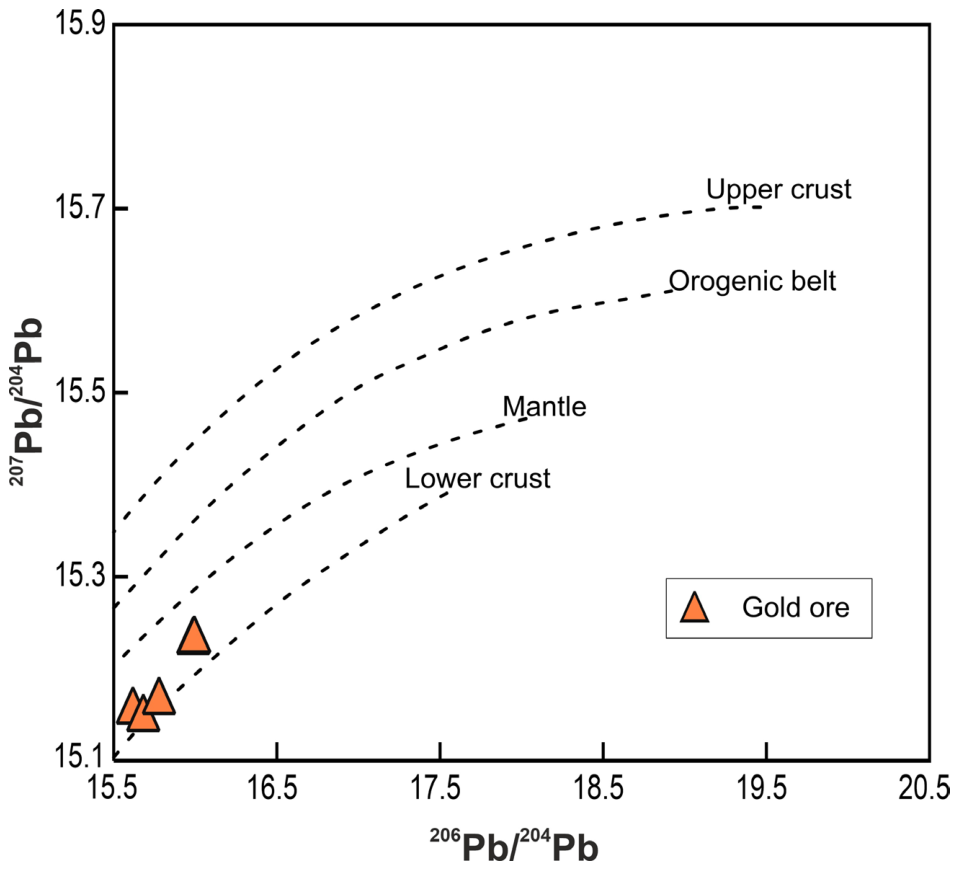
The Pb isotopic compositions of gold ore are presented in Table 4, with 206Pb/204Pb ratios ranging from 15.6183 to 15.9940, 207Pb/204Pb from 15.1452 to 15.2304, and 208Pb/204Pb from 35.7950 to 36.1942. These relatively restricted isotopic ranges suggest a homogeneous lead source.

4.2.6. Zircon U-Pb Age Dating

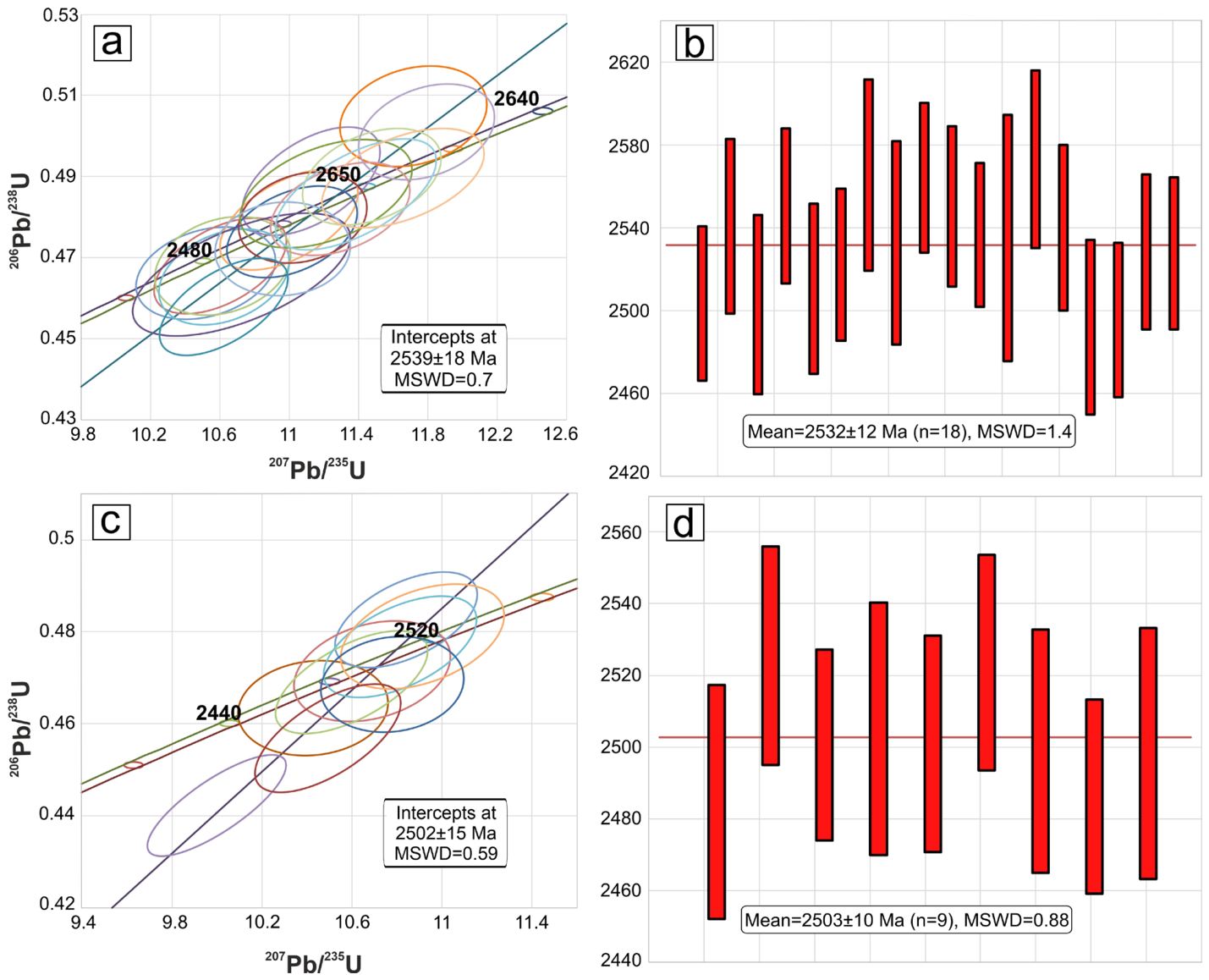
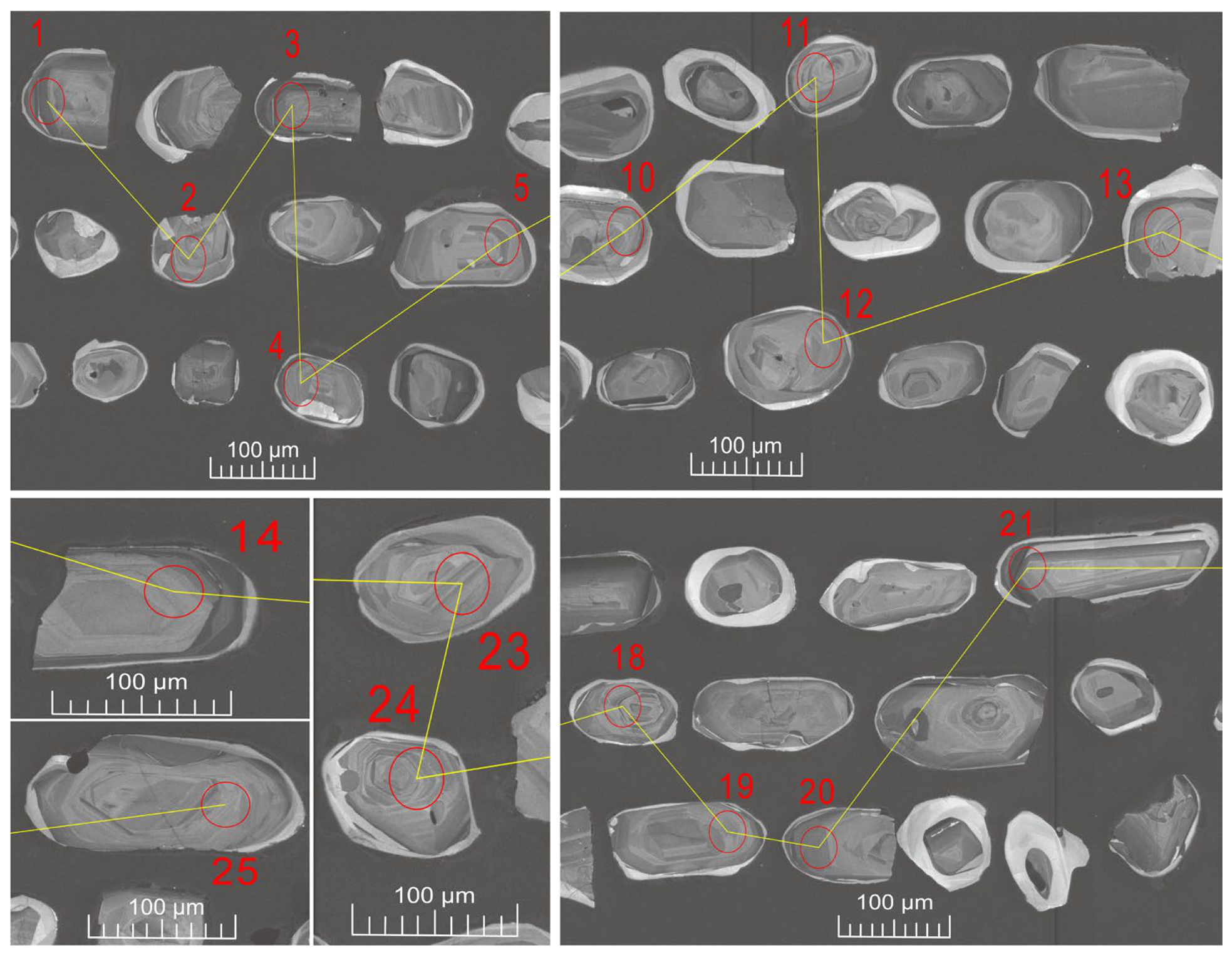
Measured 207Pb/235U ratios in zircon range from 5.6743 to 38.7263 (Supplementary Table S3), indicating a wide range of ages, with higher ratios corresponding to older ages. U-Pb zircon dating using the conventional Concordia method yielded four ages corresponding to the upper and lower intercepts, ranging from 2502 ± 15 and 2539 ± 18 Ma (Figure 8). Cathodoluminescence (CL) images of representative zircon grains separated from the gold ore reveal euhedral to subhedral prismatic crystals, typically 80–150 µm in length. Most grains exhibit well-preserved oscillatory zoning, indicative of a magmatic origin, while some domains display homogeneous overgrowths and minor recrystallization features, suggesting localized thermal metamorphism or alteration. A few grains contain inclusions and fractures, predominantly along the rims (Figure 9).

5. Discussion

5.1. Provenance of Zircon in Gold Ore

Zircon is an uncommon accessory mineral in gold ore deposits; however, it provides invaluable insights into the timing and source of ore-forming processes. Its robust crystal structure preserves geochemical and isotopic information, making it ideal for U–Pb age dating [27]. In the studied gold ore from the Dongwujiiazi deposit, zircon crystals were identified. Therefore, to constrain the provenance of zircon, in situ trace element and REE analyses, along with U–Pb dating, were conducted.
As mentioned above, the gold ore occurs within the intrusions (Figure 1 and Figure 2). The North China Craton (NCC) experienced multiple, successive stages of hydrothermal alteration, as indicated by ages of 1720–1703 Ma and approximately 1648 Ma. In contrast, the zircons studied here yield ages of 2502 ± 15 Ma and 2539 ± 18 Ma (Figure 8), which clearly predate the emplacement of the intrusions hosting the gold mineralization. Therefore, these zircons cannot represent the age of the ore-bearing intrusions, but instead reflect inheritance from older crustal sources.
Zircon grains separated from the gold ore are euhedral to subhedral, prismatic, and range from 80 to 150 µm in length. CL imaging shows that most grains possess well-defined oscillatory zoning, characteristic of magmatic crystallization, whereas some domains exhibit homogeneous overgrowths and minor recrystallization, indicating localized thermal metamorphism. Several grains also contain inclusions and fractures, particularly along the rims (Figure 9). Overall, these textures and internal structures suggest that the zircons originated from pre-existing metamorphic rocks, reflecting a crustal inheritance rather than formation contemporaneous with the gold mineralization. The REE distribution in the zircon closely resembles that observed in crustal zircons (Figure 7).
The primary host rocks of the ore are Neoarchean metamorphic rocks, particularly gneiss. Textural and geochemical evidence indicates that zircon grains were derived from the surrounding gneiss and subsequently transported into the ore, suggesting mobilization from the country rock during metamorphic processes rather than in situ formation within the ore.

5.2. H–O Isotopic Evidence for Fluid Origins

Hydrogen and oxygen isotopes are commonly used to trace the sources of ore-forming fluids [28,29,30,31]. In the δD–δ18O diagram, the ore-forming fluids of the Dongwujiiazi gold deposit plot within both the primary magmatic and metamorphic water fields (Figure 10), indicating contributions from multiple fluid sources. These results reveal that the mineralizing fluids were mixed in origin, reflecting interaction between magmatic and metamorphic components. Field and petrographic investigations (Figure 2 and Figure 3) reveal transitional alteration zones and interactions between altered rocks, including chloritized and sericitized domains, and surrounding granites. These features suggest the possible mixing of magmatic and metamorphic fluids during mineralization, and the transfer of zircon crystals from gneiss to gold ore is strong evidence of this mixing.

5.3. Sulfur and Lead Origins

At temperatures below 350 °C and under reducing conditions, where H2S dominates, the δ34S values of sulfide minerals reflect the overall sulfur composition of the hydrothermal fluid [33]. Since the Dongwujiiazi deposit is located adjacent to the Xiaotazigou gold deposit, it is likely that the ore-forming fluids experienced similar conditions, forming from reducing, medium–low temperature NaCl–H2O–CO2 hydrothermal solutions [2]. Mineralogical observations show that the ores are dominated by pyrite, chalcopyrite, and sphalerite, which typically form under reducing conditions. The absence of sulfate minerals further supports a reduced hydrothermal environment. Accordingly, the average δ34S values of the sulfide minerals can be considered representative of the sulfur isotopic composition of the ore-forming fluid.
The δ34S values of sulfide minerals from the studied gold ores range between 2.06‰ and 3.98‰. These values are comparable to those reported for the Dongpuzi deposit (δ34S = +2.39‰ to +7.99‰; [34]) and fall within the typical range of magmatic sulfur (0‰ ± 3‰; [33]). In contrast, they are significantly lower than the values reported for schist and granulite rocks (+10.0‰ to +17.0‰; [35]). This isotopic signature suggests that sulfur in the studied ores was mainly sourced from a magmatic reservoir, with a minor contribution from metamorphic materials.
The Pb isotopic compositions of the studied sulfides, when plotted on the 206Pb/204Pb versus 207Pb/204Pb diagram, cluster predominantly within the lower crust field. This distribution indicates that the lead was mainly derived from a lower crustal source rather than from the mantle or upper crust. The relatively low Pb isotopic ratios suggest a contribution from evolved U- and Th-depleted crustal materials, which are characteristic of deep crustal reservoirs. Such signatures are commonly associated with ancient, high-grade metamorphic rocks, which are biotite-pyroxene gneiss that host mineralization in the study area (Figure 11).

5.4. Tectonic Setting of the Dongwujiiazi Deposit

Ref. [2] identified the Xiaotazigou gold deposit, located in close proximity to the present study area, as an orogenic gold system developed in an intracontinental orogenic setting following the collision between the North China Craton and the Siberian Plate. This close spatial and tectonic relationship suggests that the studied mineralization was likely formed under similar geodynamic conditions and may share a comparable genetic origin.
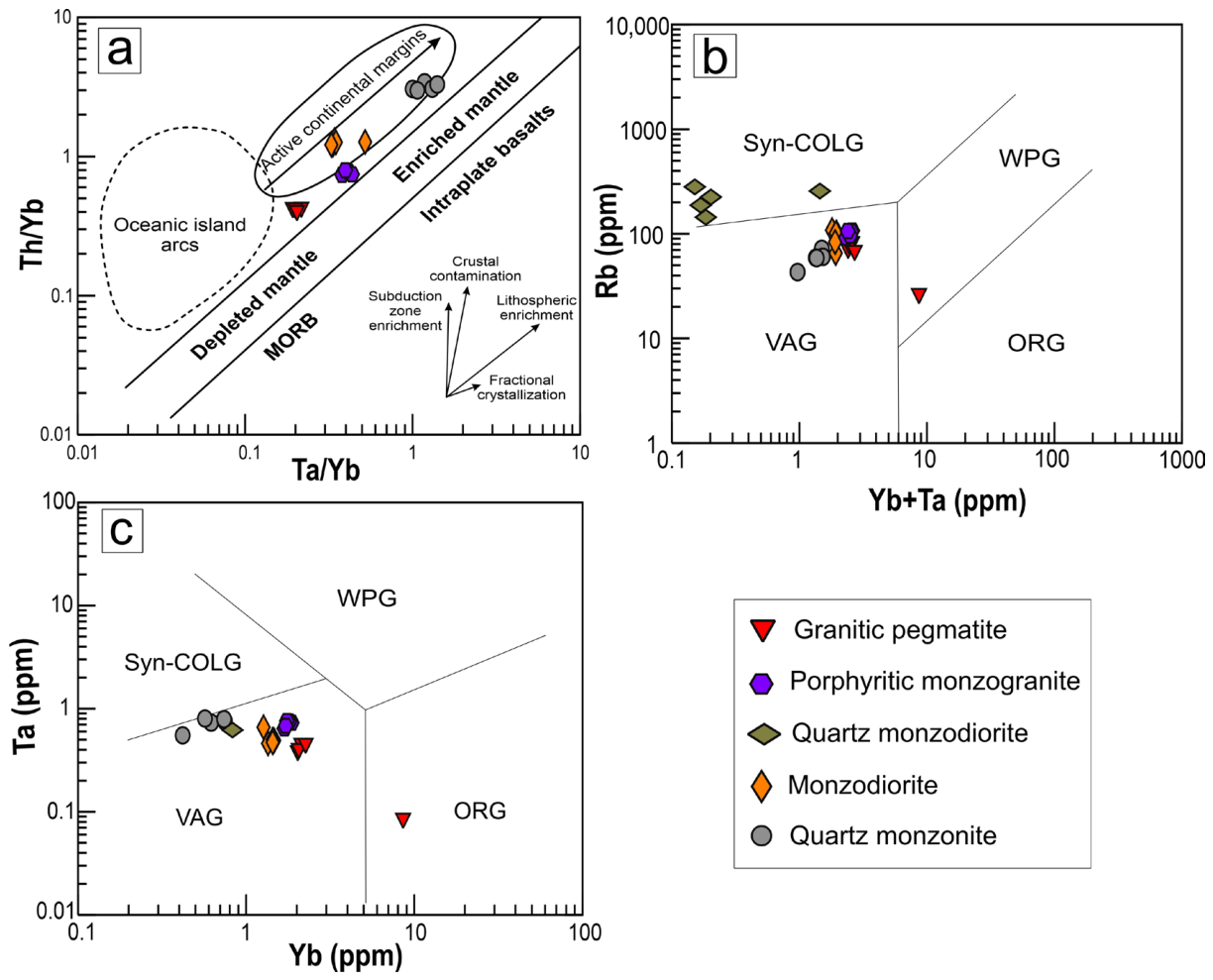
On the Ta/Yb versus Th/Yb diagram, the Dongwujiiazi host rocks plot within the field of active continental margins (Figure 12a), while the (Yb + Ta)–Rb and Yb–Ta diagrams show their affinity to volcanic arc granites (Figure 12b,c), collectively suggesting that the host rocks were emplaced in an active continental margin setting and formed through arc-related magmatism.
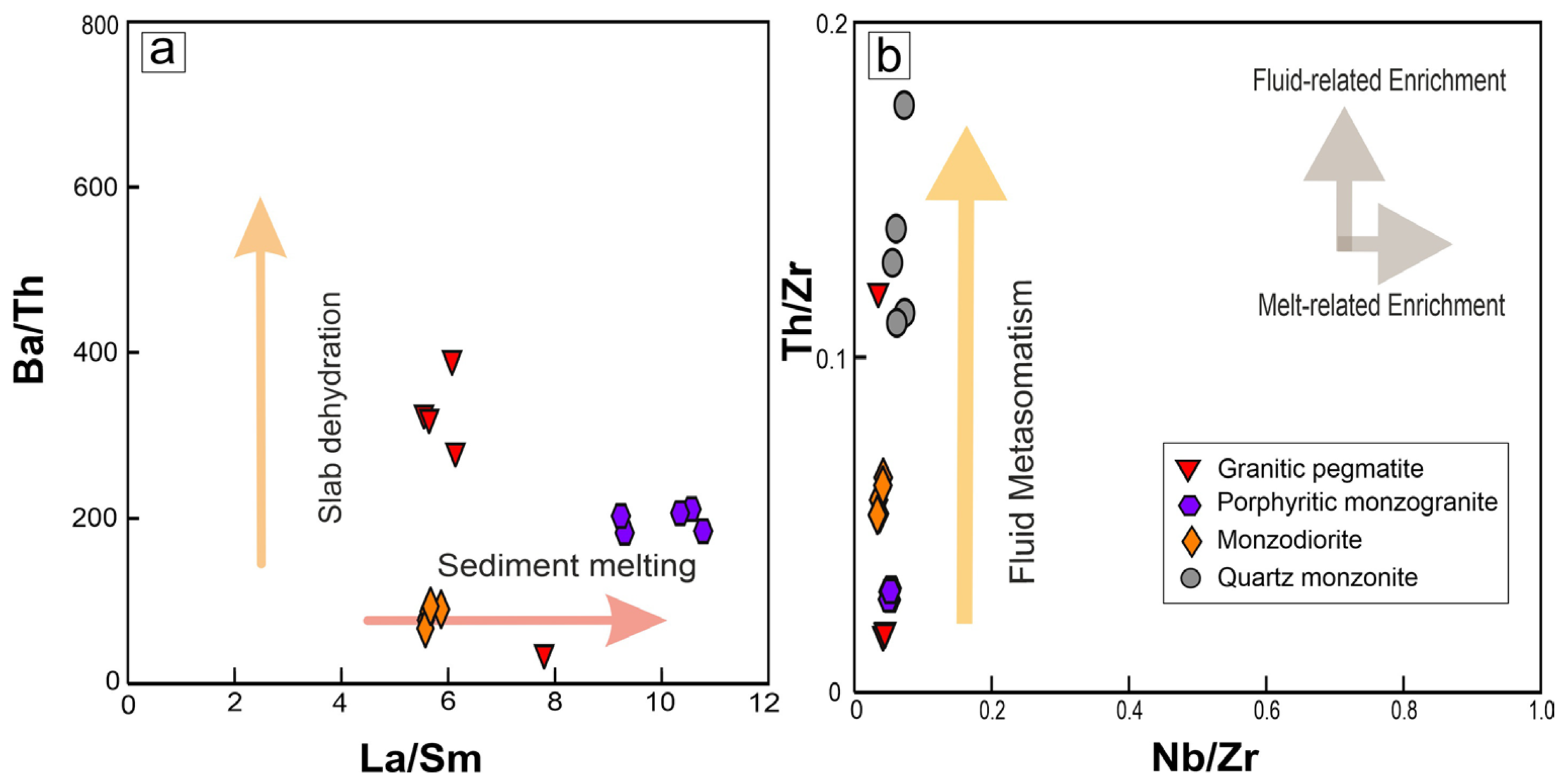
The La/Sm versus Ba/Th diagram (Figure 13a) shows that the studied samples follow two trends related to slab dehydration and sediment melting, indicating the involvement of both slab-derived fluids and partial melting of subducted oceanic sediments in magma generation. In addition, the Nb/Zr versus Th/Zr diagram (Figure 13b) reveals a trend of fluid metasomatism, suggesting that metasomatic fluids played an important role in modifying the mantle source. Furthermore, the positive correlation between La and Yb (Figure 5b) reflects coupled enrichment of LREEs and HREEs, consistent with magma evolution involving mixed mantle and crustal/sedimentary contributions. These combined features indicate interaction between mantle-derived melts and crustal/sedimentary components, and collectively support a subduction-related tectonic setting, consistent with formation in an active continental margin and an intracontinental orogenic environment.

5.5. Metallogenic Model

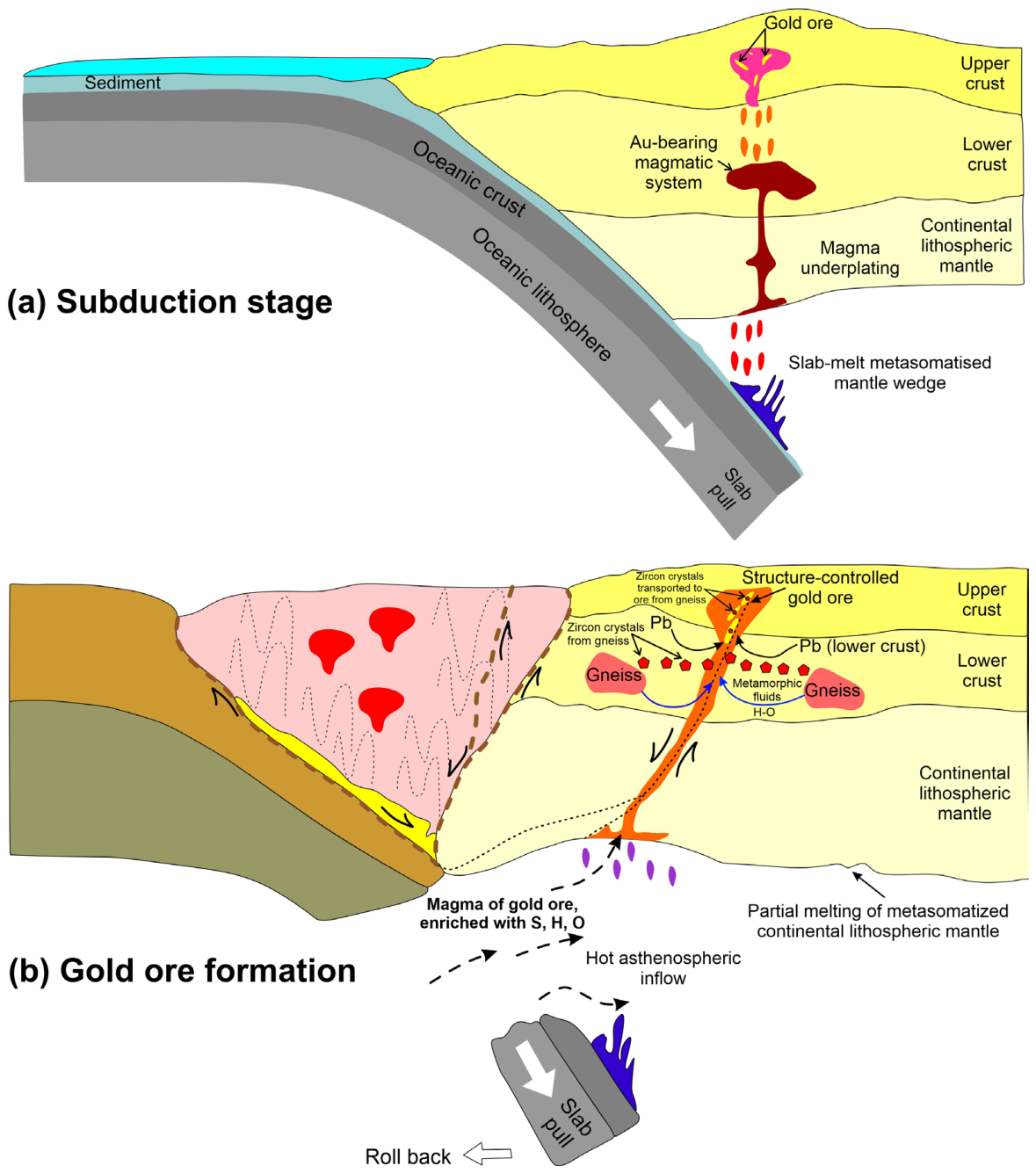
The formation of the Dongwujiiazi gold deposit can be interpreted within a subduction-related tectonic setting involving fluid generation, migration, and gold precipitation (Figure 14). During subduction, dehydration of the oceanic slab and associated sediments released H2O- and CO2-rich fluids into the overlying mantle wedge, leading to metasomatism and partial melting. These processes generated magmas enriched in volatile components and metals, including Au, S, and Pb. Simultaneously, high-grade metamorphism within the lower crust, particularly in gneissic rocks, produced additional metamorphic fluids through dehydration reactions. These fluids interacted with the ascending magmas, altering their composition and enhancing metal enrichment, as supported by Pb and H–O isotopic signatures indicating a lower crustal source with mixed magmatic–metamorphic characteristics.
The ore-forming fluids subsequently migrated upward along deep-seated faults and shear zones, driven by tectonic deformation and thermal gradients. During ascent, interaction between magmatic and metamorphic fluids led to fluid mixing and chemical evolution, and some zircon crystals were transported from gneiss into the ore fluid. Gold precipitation occurred in structurally controlled zones within the upper crust, particularly in fractured and altered gneissic host rocks, where changes in temperature, pressure, and fluid composition led to mineral deposition. Overall, this model (Figure 14) highlights a coupled system involving slab-derived processes, lower crustal fluid generation, and upward fluid transport, consistent with an intracontinental orogenic gold system formed in an active continental margin setting.

6. Conclusions

  • The Dongwujiiazi deposit represents a structurally controlled orogenic gold system, hosted mainly in biotite-pyroxene gneiss.
  • Five types of intrusions were identified in the deoposit: mylonitized granitic pegmatite, mylonitized porphyritic monzogranite, propylitized fine-grained quartz monzodiorite, quartz monzonite, and porphyritic dolerite.
  • The ore consists of polymetallic sulfides including pyrite, chalcopyrite, sphalerite, galena, digenite, and native gold.
  • Zircon grains in the gold ore are inherited from surrounding Neoarchean gneiss, with age of 2502 ± 15 to 2539 ± 18 Ma.
  • Isotopic data (H–O, S, Pb) indicate that ore-forming fluids were derived from a mixture of magmatic and lower-crustal metamorphic sources.
  • A metallogenic model is proposed in which slab-derived and lower-crustal fluids interacted with ascending magmas, resulting in fluid mixing and gold precipitation along structurally controlled zones, consistent with formation as an intracontinental orogenic gold system in an active continental margin.
  • This study refines previous metallogenic models for orogenic gold systems by demonstrating that gold mineralization in the Dongwujiiazi deposit is not solely metamorphic- or magmatic-driven, but results from a hybrid system involving interaction between slab-derived fluids, lower crustal metamorphic components, and ascending magmas. This integrated interpretation provides a more complete understanding of gold precipitation processes in active continental margin settings.

Supplementary Materials

The following supporting information can be downloaded at: https://www.mdpi.com/article/10.3390/min16050435/s1, Table S1: Major (wt.%), trace and rare earth elements (ppm) abundances of granitic host rocks and gold ore of the Dongwujiiazi gold deposit, NE China; Table S2: Trace and rare earth elements of zircon from gold ore of Dongwujiiazi gold deposits; Table S3: Zircon U-Pb dating data from gold ore of Dongwujiiazi gold deposit; Text S1: Analytical methods.

Author Contributions

Conceptualization: F.W. and A.S.M.; Methodology: L.F., G.C., H.Y. and Y.P.; Data curation: A.S.M.; Investigation: A.S.M.; Funding acquisition: L.F.; Supervision: G.C., H.Y., Y.P. and F.W.; Software: L.F., H.Y., Q.W. and A.S.M.; Visualization: A.S.M.; Formal analysis: A.S.M.; Validation: F.W.; Writing—original draft: L.F., G.C., H.Y., Q.W., F.W. and A.S.M.; Writing—review & editing: L.F., H.Y., F.W. and A.S.M. All authors have read and agreed to the published version of the manuscript.

Funding

This research was funded by the Natural Science Foundation of Liaoning Province, China (Grant No. 2024-MSLH-484), Deep Earth Probe and Mineral Resources Exploration—National Science and Technology Major Project (Grant No. 2025ZD1006500) and the China Geological Survey (Grant No. DD20242939).

Data Availability Statement

All data derived from this research are presented in the enclosed figures and tables and Supplementary Materials.

Acknowledgments

The authors sincerely thank the Academic Editors, as well as the anonymous reviewers for their insightful comments and constructive suggestions, which greatly improved the quality and clarity of this manuscript.

Conflicts of Interest

Author Qiang Wei was employed by the company Liaoning Nonferrous Geology No. 109 Team Co., Ltd. The remaining authors declare that the research was conducted in the absence of any commercial or financial relationships that could be construed as a potential conflict of interest.

References

  1. Poulsen, K.H.; Taylor, B.E.; Mortensen, J.K. Observations on Gold Deposits in North China Platform; Current research, part A; Geological Survey of Canada: Ottawa, ON, Canada, 1990; pp. 33–44.
  2. Yuan, H.; Fu, L.; Bai, Y.; Wei, Q.; Wang, Z.; Zhao, Y.; Sun, J. Genesis of the Xiaotazigou Gold Deposit in the Northern Margin of the North China Craton: Constraints from Sulfur Isotopes, Rare Earth Elements, and Trace Elements. Front. Earth Sci. 2026, 13, 1739854. [Google Scholar] [CrossRef]
  3. Groves, D.I.; Goldfarb, R.J.; Gebre-Mariam, M.; Hagemann, S.G.; Robert, F. Orogenic Gold Deposits: A Proposed Classification in the Context of Their Crustal Distribution and Relationship to Other Gold Deposit Types. Ore Geol. Rev. 1998, 13, 7–27. [Google Scholar] [CrossRef]
  4. Groves, D.I. The Crustal Continuum Model for Late-Archaean Lode Gold Deposits of the Yilgarn Block, Western Australia. Miner. Depos. 1993, 28, 366–374. [Google Scholar] [CrossRef]
  5. Barley, M.E.; Eisenlohr, B.N.; Groves, D.I.; Perring, C.S.; Vearncombe, J.R. Late Archean Convergent Margin Tectonics and Gold Mineralization: A New Look at the Norseman-Wiluna Belt, Western Australia. Geology 1989, 17, 826. [Google Scholar] [CrossRef]
  6. Blewett, R.S.; Czarnota, K.; Henson, P.A. Structural-Event Framework for the Eastern Yilgarn Craton, Western Australia, and Its Implications for Orogenic Gold. Precambrian Res. 2010, 183, 203–229. [Google Scholar] [CrossRef]
  7. Colvine, A.C. An Empirical Model for the Formation of Archean Gold Deposits: Products of Final Cratonization of the Superior Province, Canada; Society of Economic Geologists: Littleton, CO, USA, 1989; Volume 6, pp. 33–53. [Google Scholar]
  8. Hagemann, S.G.; Cassidy, K.F. Archean Orogenic Lode Gold Deposits; Society of Economic Geologists: Littleton, CO, USA, 2000; Volume 13, pp. 9–68. [Google Scholar]
  9. Goldfarb, R.J.; Groves, D.I.; Gardoll, S. Orogenic Gold and Geologic Time: A Global Synthesis. Ore Geol. Rev. 2001, 18, 1–75. [Google Scholar] [CrossRef]
  10. Campbell McCuaig, T.; Kerrich, R. P—T—T—Deformation—Fluid Characteristics of Lode Gold Deposits: Evidence from Alteration Systematics. Ore Geol. Rev. 1998, 12, 381–453. [Google Scholar] [CrossRef]
  11. Goldfarb, R.J.; Groves, D.I. Orogenic Gold: Common or Evolving Fluid and Metal Sources through Time. Lithos 2015, 233, 2–26. [Google Scholar] [CrossRef]
  12. Kerrich, R. Mesothermal Gold Deposits: A Critique of Genetic Hypothesis. In Greenstone Gold and Crustal Evolution, NUNA Conference Volume; Robert, F., Sheahan, P.A., Green, S.B., Eds.; Geological Association of Canada: St Johns, NL, Canada, 1991; pp. 13–31. [Google Scholar]
  13. Powell, R.; Will, T.M.; Phillips, G.N. Metamorphism in Archaean Greenstone Belts: Calculated Fluid Compositions and Implications for Gold Mineralization. J. Metamorph. Geol. 1991, 9, 141–150. [Google Scholar] [CrossRef]
  14. Groves, D.I.; Goldfarb, R.J.; Robert, F.; Hart, C.J.R. Gold Deposits in Metamorphic Belts: Overview of Current Understanding, Outstanding Problems, Future Research, and Exploration Significance. Econ. Geol. 2003, 98, 1–29. [Google Scholar] [CrossRef]
  15. Kerrich, R. Archean Gold-Relationship to Granulite Formation or Felsic Intrusions? Geology 1989, 17, 1011–1015. [Google Scholar] [CrossRef]
  16. Kerrich, R. Geochemistry of Gold Deposits in the Abitibi Greenstone Belt; Canadian Institute of Mining and Metallurgy: Montreal, QC, Canada, 1983; p. 75. [Google Scholar]
  17. Nesbitt, B.E. Phanerozoic Gold Deposits in Tectonically Active Continental Margins. In Gold Metallogeny and Exploration; Foster, R.P., Ed.; Blackie and Sons Ltd.: Glasgow, UK, 1991; pp. 104–132. [Google Scholar]
  18. Ridley, J.R.; Diamond, L.W. Fluid Chemistry of Orogenic Lode Gold Deposits and Implications for Genetic Models; Society of Economic Geologists: Littleton, CO, USA, 2000; Volume 13, pp. 141–162. [Google Scholar]
  19. Jia, S.S.; Wang, E.D.; Fu, J.F.; Song, J.C.; Xi, X.F. The Differences of Geological Characteristics and the Unity of Mineralization in the Major Gold Concentrated Areas of Eastern Hebei-Western Liaoning. Acta Geol. Sin. 2011, 85, 1493–1506. [Google Scholar]
  20. Mao, J.; Li, Y.; Goldfarb, R.; He, Y.; Zaw, K. Fluid Inclusion and Noble Gas Studies of the Dongping Gold Deposit, HebeiProvince, China: A Mantle Connection for Mineralization? Econ. Geol. 2003, 98, 517–534. [Google Scholar] [CrossRef]
  21. Taylor, R.N.; Ishizuka, O.; Michalik, A.; Milton, J.A.; Croudace, I.W. Evaluating the Precision of Pb Isotope Measurement by Mass Spectrometry. J. Anal. At. Spectrom. 2015, 30, 198–213. [Google Scholar] [CrossRef]
  22. Middlemost, E.A.K. Naming Materials in the Magma/Igneous Rock System. Earth-Sci. Rev. 1994, 37, 215–224. [Google Scholar] [CrossRef]
  23. Sun, S.-s.; McDonough, W.F. Chemical and Isotopic Systematics of Oceanic Basalts: Implications for Mantle Composition and Processes. Geol. Soc. 1989, 42, 313–345. [Google Scholar] [CrossRef]
  24. Whitehouse, M.J.; Kamber, B.S. A Rare Earth Element Study of Complex Zircons from Early Archaean Amı^tsoq Gneisses, Godthåbsfjord, South-West Greenland. Precambrian Res. 2003, 126, 363–377. [Google Scholar] [CrossRef]
  25. Belousova, E.A.; Griffin, W.L.; Pearson, N.J. Trace Element Composition and Cathodoluminescence Properties of Southern African Kimberlitic Zircons. Mineral. Mag. 1998, 62, 355–366. [Google Scholar] [CrossRef]
  26. Fabricio-Silva, W.; Frimmel, H.E.; Emília Shutesky, M.; Rosière, C.A.; Massucatto, A.J. Temperature-Controlled Ore Evolution in Orogenic Gold Systems Related to Synchronous Granitic Magmatism: An Example from the Iron Quadrangle Province, Brazil. Econ. Geol. 2021, 116, 937–962. [Google Scholar] [CrossRef]
  27. Mi, K.-F.; Wang, Z.-L.; Nie, X.; Jia, W.-B. Machine Learning Coupled with Zircon Trace Elements Revealing the Diverse Mineralization Styles in the Southern Great Xing’an Range. Ore Geol. Rev. 2025, 186, 106863. [Google Scholar] [CrossRef]
  28. Qiu, K.-F.; Taylor, R.D.; Song, Y.-H.; Yu, H.-C.; Song, K.-R.; Li, N. Geologic and Geochemical Insights into the Formation of the Taiyangshan Porphyry Copper–Molybdenum Deposit, Western Qinling Orogenic Belt, China. Gondwana Res. 2016, 35, 40–58. [Google Scholar] [CrossRef]
  29. Yang, L.Q.; Deng, J.; Wang, Z.L.; Zhang, L.; Guo, L.N.; Song, M.C.; Zheng, X.L. Mesozoic Gold Metallogenic System of the Jiaodong Gold Province, Eastern China. Acta Petrol. Sin. 2014, 30, 2447–2467. [Google Scholar]
  30. Yang, L.; Deng, J.; Guo, C.; Zhang, J.; Jiang, S.; Gao, B.; Gong, Q.; Wang, Q. Ore-Forming Fluid Characteristics of the Dayingezhuang Gold Deposit, Jiaodong Gold Province, China. Resour. Geol. 2009, 59, 181–193. [Google Scholar] [CrossRef]
  31. Monnier, L.; Lach, P.; Salvi, S.; Melleton, J.; Bailly, L.; Béziat, D.; Monnier, Y.; Gouy, S. Quartz Trace-Element Composition by LA-ICP-MS as Proxy for Granite Differentiation, Hydrothermal Episodes, and Related Mineralization: The Beauvoir Granite (Echassières District), France. Lithos 2018, 320–321, 355–377. [Google Scholar] [CrossRef]
  32. Taylor, H.P. The Application of Oxygen and Hydrogen Isotope Studies to Problems of Hydrothermal Alteration and Ore Deposition. Econ. Geol. 1974, 69, 843–883. [Google Scholar] [CrossRef]
  33. Ohmoto, H.; Rye, R.O. Isotopes of Sulfur and Carbon. In Geochemistry of Hydrothermal Ore Deposits; Barnes, H.L., Ed.; John Wiley & Sons Inc.: New York, NY, USA, 1979; pp. 509–567. [Google Scholar]
  34. Zhang, B.C.; Qin, G.J.; Wang, F.G. Fluid Inclusions of Dongpuzi Gold Deposit in Xiuyan County, Liaoning Province. Geoscience 2002, 16, 26–31. [Google Scholar] [CrossRef]
  35. Zhao, H.Z.; Yang, S.S.; Li, H. Geologic Features of Baiyun Gold Deposit and Discussion of the Genesis. Non-Ferr. Min. Metall. 2009, 25, 4–8. [Google Scholar]
  36. Stacey, J.S.; Kramers, J.D. Approximation of Terrestrial Lead Isotope Evolution by a Two-Stage Model. Earth Planet. Sci. Lett. 1975, 26, 207–221. [Google Scholar] [CrossRef]
  37. Zartman, R.E.; Doe, B.R. Plumbotectonics—The Model. Tectonophysics 1981, 75, 135–162. [Google Scholar] [CrossRef]
  38. Pearce, J.A. Role of the Sub-Continental Lithosphere in Magma Genesis at Active Continental Margins. In Continental Basalts and Mantle Xenoliths; Hawkesworth, C.J., Norry, M.J., Eds.; Shiva: Cheshire, UK, 1983; pp. 230–249. [Google Scholar]
  39. Pearce, J.A.; Harris, N.B.W.; Tindle, A.G. Trace Element Discrimination Diagrams for the Tectonic Interpretation of Granitic Rocks. J. Petrol. 1984, 25, 956–983. [Google Scholar] [CrossRef]
  40. Labanieh, S.; Chauvel, C.; Germa, A.; Quidelleur, X. Martinique: A Clear Case for Sediment Melting and Slab Dehydration as a Function of Distance to the Trench. J. Petrol. 2012, 53, 2441–2464. [Google Scholar] [CrossRef]
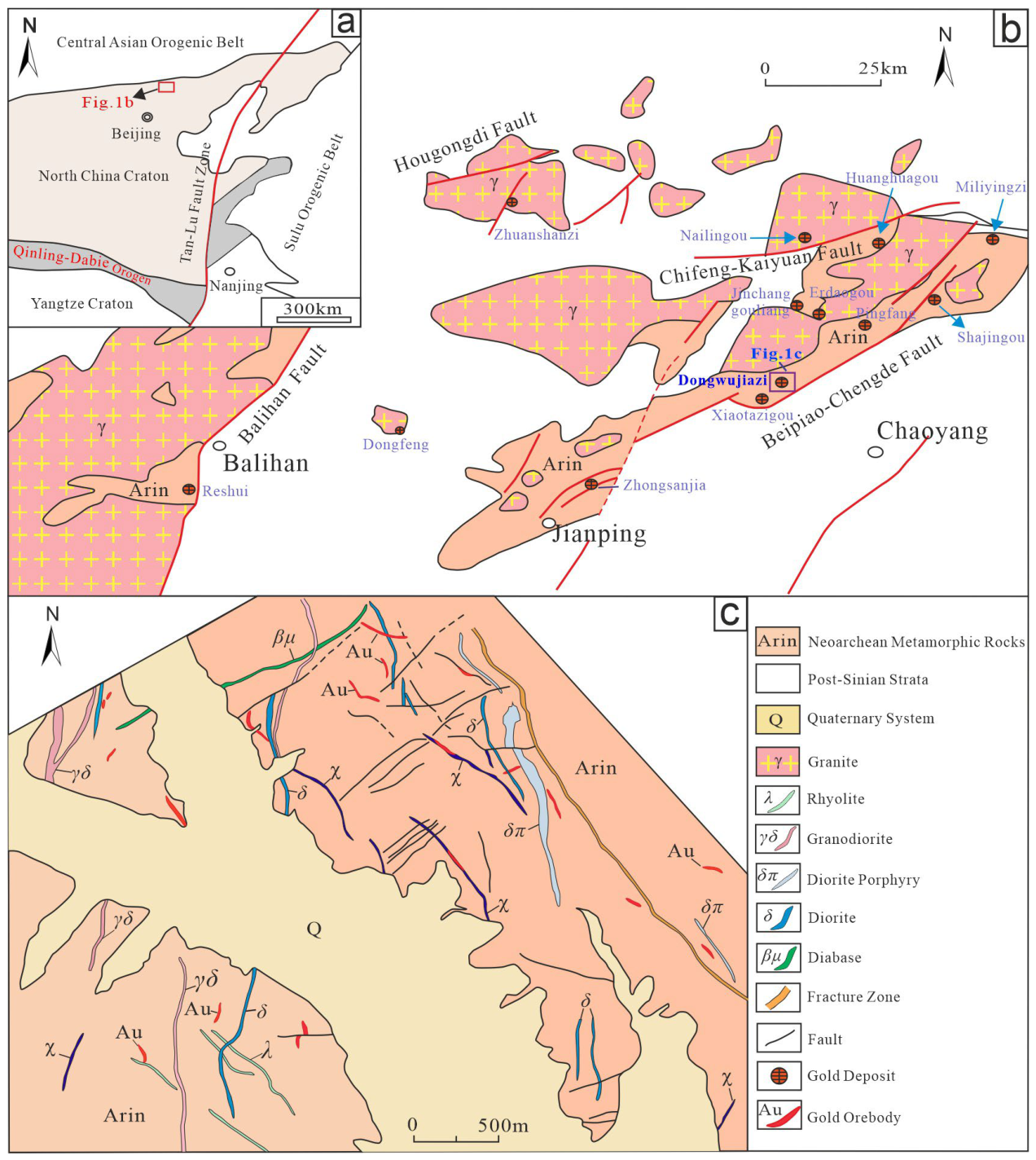
Figure 1. Location and geological maps of the Dongwujiiazi gold deposit. (a) Location of the study area. (b) Chifeng–Chaoyang geological map (modified from [20]). (c) Detailed geological map of the Dongwujiiazi gold deposit.
Minerals 16 00435 g001
Figure 2. Field and hand specimen photographs from the Dongwujiiazi gold deposit. (ac) Field photographs showing quartz monzonite intruding gneissic rocks with sharp contacts. (di) Hand specimen photographs of representative lithologies, including gneiss (d), quartz monzonite (e), sulfide-bearing quartz veins (fh), and galena-bearing quartz veins (i).
Minerals 16 00435 g002
Figure 3. Photomicrographs of different host rocks and intrusions from the Dongwujiiazi gold deposit. (a) Coarse-grained quartz and K-feldspar in mylonitized granitic pegmatite. (b,c) Fine-grained quartz, plagioclase, K-feldspar and chlorite in mylonitized porphyritic monzogranite. (d) Quartz and K-feldspar intergrowth displaying graphic texture; plagioclase is altered to epidote, biotite to chlorite, and hornblende to actinolite in propylitized, fine-grained quartz monzodiorite. (e) Quartz, feldspar and biotite in quartz monzonite. (f,g) Aligned augite, biotite, quartz, and K-feldspar, resulting foliation in biotite–pyroxene gneiss. (h) Plagioclase and amygdules filled with chalcedony, epidote and chlorite in porphyritic dolerite. Abbreviations: Qz = quartz; Kfs = K-feldspar; Pl = plagioclase; Chl = chlorite; Hbl = hornblende; Act = actinolite; Bt = biotite; Ep = epidote; Aug = augite; Ap = apatite; Cln = chalcedony.
Minerals 16 00435 g003
Figure 4. Reflected-light photomicrographs of sulfides from the Dongwujiiazi gold deposit. (a) Chalcopyrite hosted by pyrite, galena, sphalerite. (bd) Fragmented euhedral to subhedral granular crystals of pyrite, hosted by chalcopyrite, with some inclusions of sphalerite, digenite, and native gold. (e) Disseminated sulfides of chalcopyrite with minor pyrite and digenite. (f,g) Exsolution of pyrite, chalcopyrite, and galena in sphalerite, with native gold. (h) Native gold crystal with pyrite and chalcopyrite. Abbreviations: Py = pyrite; Ccp = chalcopyrite; Sp = sphalerite; Gn = galena; Dg = digenite; Gl = gold.
Minerals 16 00435 g004
Figure 5. Whole-rock geochemistry binary diagrams of host rocks of the Dongwujiiazi deposit. (a) SiO2 vs. NaO + K2O intrusive rocks classification diagram [22]. (b) Positive correlation between La and Yb.
Minerals 16 00435 g005
Figure 6. Bulk geochemistry of Dongwujiiazi host rocks and ore: (a,c) Chondrite-normalized REE patterns; (b,d) primitive mantle-normalized trace element patterns (after [23]).
Minerals 16 00435 g006
Figure 7. Chondrite-normalized REE patterns of zircon from Dongwujiiazi gold ore deposit. The data of crustal and mantle zircon are from [24,25], respectively.
Minerals 16 00435 g007
Figure 8. Conventional U–Pb Concordia diagrams (a,c) and corresponding plots of weighted mean age (b,d) for zircon in Dongwujiiazi ore.
Minerals 16 00435 g008
Figure 9. Cathodoluminescence (CL) images for zircons from Dongwujiiazi gold ore.
Minerals 16 00435 g009
Figure 10. δ18O‰–δD‰ distribution of ore-forming fluids in the Dongwujiiazi gold deposit (after [32]).
Minerals 16 00435 g010
Figure 11. 206Pb/204Pb vs. 207Pb/204Pb diagram. Mantle, lower crust, upper crust, and orogenic fields (μ~7.5–10) are shown for comparison (after [36,37]).
Minerals 16 00435 g011
Figure 12. Diagrams of tectonic setting discrimination. (a) Ta/Yb vs. Th/Yb diagram [38]. (b) Yb + Ta vs. Rb. (c) Yb vs. Ta [39].
Minerals 16 00435 g012
Figure 13. (a) Plot of La/Sm vs. Ba/Th. (b) Nb/Zr vs. Th/Zr diagram (after [40]).
Minerals 16 00435 g013
Figure 14. Proposed genetic model for the formation of the Dongwujiiazi gold deposit.
Minerals 16 00435 g014
Table 1. Representative major (wt.%) and trace elements (ppm) abundances of host rocks and gold ore of the Dongwujiiazi gold deposit, NE China.
Rock TypeMonzodioriteQuartz DioriteBiotite-Pyroxene GneissFine-Grained DioriteDioritePorphyritic DioriteGold Ore
Sample #DWJ012DWJ013DWJ017DWJ020DWJ022DWJ026DWJ027DWJ031DWJ032DWJ034DWJ037DWJ041DWJ009DWJ010DWJ011
SiO259.8160.3172.4372.6854.0167.7255.6856.0873.1168.7866.9169.630.4360.8176.83
TiO20.60.630.170.180.710.0660.950.970.0390.0470.330.310.0480.0290.028
Al2O314.8514.9612.9613.0215.289.4216.9517.313.3515.4816.515.380.970.570.42
Na2O3.63.363.663.793.211.374.884.922.482.494.54.180.13<0.1<0.1
Fe2O3(t)8.636.995.325.1911.0113.338.258.193.333.983.152.8943.9726.2915.8
MgO4.925.461.441.415.323.122.492.420.70.610.990.431.530.760.63
MnO<0.02<0.02<0.02<0.02<0.020.21<0.020.088<0.02<0.02<0.020.025<0.02<0.02<0.02
CaO4.064.20.430.354.322.823.272.820.540.422.061.880.50.430.69
K2O2.512.593.342.813.011.033.983.376.238.013.963.70.20.180.13
P2O50.170.190.0580.0630.290.180.380.410.0330.0240.140.120.0340.0170.024
LOI0.831.310.240.532.840.753.173.440.210.231.51.4822.2210.925.37
Total99.98100.00100.05100.02100.00100.02100.00100.01100.02100.07100.04100.00100.032100.00699.922
Li29.936.231.332.7219.85826.91.551.8619.825.31.553.14<1.0
Cs2.292.582.842.752.062.061.980.8811.20.420.861.020.190.20.12
Rb65.410271.64385.826.226.769.1256224107106<10<10<10
Be1.751.872.373.591.740.58<0.51.413.90.732.182.13<0.5<0.5<0.5
Ba6267737849041022299285124234619261098119664.19751.4
Th8.148.8515.58.74<2.09.677.753.17<2.0<2.06.025.9<2.0<2.0<2.0
U1.691.922.51.260.20.410.40.520.67<0.10.751.07<0.10.16<0.1
Nb5.356.16.745.668.622.262.277.846.382.1410.410.2<2.0<2.0<2.0
Ta0.660.490.750.550.360.230.0860.460.620.160.730.680.073<0.05<0.05
Sn1.611.481.522.451.3811.421.421.21<1.01.351.05<1.01.261.11
Pb12.223.48.533.5113.57.096.439.92120.212.215.642.869123.8
Sr54957612765.963422922956419039830431219.114.219.4
Zr12716612177.212955.664.91778.024.31941956.992.963.11
Hf4.184.924.623.784.382.162.115.180.60.175.825.820.280.110.13
Tl0.530.640.550.520.450.30.270.570.960.860.40.4<0.1<0.1<0.1
Y12.314.37.224.0616.560.859.720.27.32.4714.813.42.051.812.18
La2125.82812.529.233.931.937.611.412.640.339.9<5.0<5.0<5.0
Ce37.951.149.825.565.761.456.964.315.812.560.459.22.171.742.46
Pr5.076.024.261.98.566.115.588.41.460.958.298.290.310.230.36
Nd19.623.3135.7235.922.119.433.64.472.628.228.61.210.891.47
Sm3.764.581.910.847.14.464.096.190.920.334.334.320.220.160.27
Eu1.141.360.560.51.780.860.81.950.591.641.31.30.0850.0970.1
Gd3.273.91.840.95.425.465.025.180.90.383.713.550.20.140.22
Tb0.490.560.220.140.741.361.150.770.180.0270.50.450.0660.0490.064
Dy2.623.011.20.613.869.048.144.271.130.122.82.550.150.0740.18
Ho0.510.570.230.160.692.081.930.820.230.020.550.490.0750.0660.079
Er1.321.570.690.361.886.767.462.330.70.0641.681.520.080.0490.089
Tm0.210.250.110.0620.271.311.180.350.13<0.020.280.26<0.02<0.02<0.02
Yb1.271.470.750.421.599.468.592.260.830.0431.871.720.0720.040.081
Lu0.190.240.130.0620.251.521.380.340.140.0340.320.29<0.016<0.016<0.016
Sc15.816.23.722.4117.515.818.113.61.141.313.964.123.14<1.0<1.0
V91.312031.528.217447.748.514113.313.636.328.618.916.114.9
Cr22924745.755.3310103<5.0<5.011.36.81<5.0<5.0<5.0<5.0<5.0
Co21.223.96.949.8931.519.720.215.72.72.112.872.9720213174.8
Ni10913527.923.210241.343.54.648.473.076.724.525746.5146
Cu4026.159.840.110510811517.24.374.84.825.5925689641094
Zn72.285.959.737.593.841.642.189.3<4.04.5752.362.815.228213.3
Ga17.419.5161220.78.899.142014.911.817.317.2<2.0<2.0<2.0
ΣREE98.35123.73102.749.67162.94165.82153.52168.3638.8831.32154.53152.449.698.5810.41
ΣLREE88.47112.1697.5346.96148.24128.83118.67152.0434.6430.62142.82141.6198.129.66
ΣHREE9.8811.575.172.7114.736.9934.8516.324.240.711.7110.830.690.460.75
LREE/HREE8.959.6918.8617.3310.083.483.419.318.1743.7412.19613.0813.0417.6512.88
LaN/YbN11.8612.5926.7821.3513.172.572.6611.939.85225.9515.4616.6451.2489.6644.83
δEu0.970.960.91.750.840.530.541.021.9614.120.970.991.291.991.22
δCe0.870.9711.151.010.970.960.850.810.650.770.760.290.240.32
Table 2. H–O isotopes of quartz from Dongwujiiazi gold deposit, NE China.
Sample No.NameδDV-SMOWδ18OV-SMOWTemperatureδ18Ofluid
DWJ003Quartz−65.1 12.49 30010
DWJ003−63.9 -300-
DWJ004−94.4 13.43 30011
DWJ004−94.6 -300-
DWJ005−70.8 14.08 30011.5
DWJ005−71.1 -300-
DWJ006−80.4 12.52 30010
DWJ006-12.26 30010
Temperature values of orogenic gold deposit are taken from [26].
Table 3. Sulfur isotopes of sulfides, Dongwujiiazi deposit.
Sample No.Sample Nameδ34SV-CDT
DWJ003Sulfides2.06
DWJ0042.23
DWJ0053.89
DWJ0053.98
DWJ0062.08
DWJ0062.07
Table 4. Lead isotopes of gold ore from Dongwujiiazi gold deposit.
Sample No.Name206Pb/204Pb207Pb/204Pb208Pb/204Pb
DWJ003Gold ore15.98820.000415.22940.000436.18920.0011
DWJ00315.99400.000415.23040.000536.19420.0012
DWJ00415.77760.000315.16390.000435.92970.0012
DWJ00515.61830.000315.15340.000435.79500.0010
DWJ00615.68230.000415.14520.000435.81930.0010
206Pb/204Pb = 16.9412 ± 0.0010 (2SD, n = 46)
207Pb/204Pb = 15.4988 ± 0.0006 (2SD, n = 46)
208Pb/204Pb = 36.7232 ± 0.0017 (2SD, n = 46)
Disclaimer/Publisher’s Note: The statements, opinions and data contained in all publications are solely those of the individual author(s) and contributor(s) and not of MDPI and/or the editor(s). MDPI and/or the editor(s) disclaim responsibility for any injury to people or property resulting from any ideas, methods, instructions or products referred to in the content.