Apatite as an Indicator of Sedimentary Environment and Diagenesis for the Hengyang Neoproterozoic Iron Formation, South China

Abstract
1. Introduction
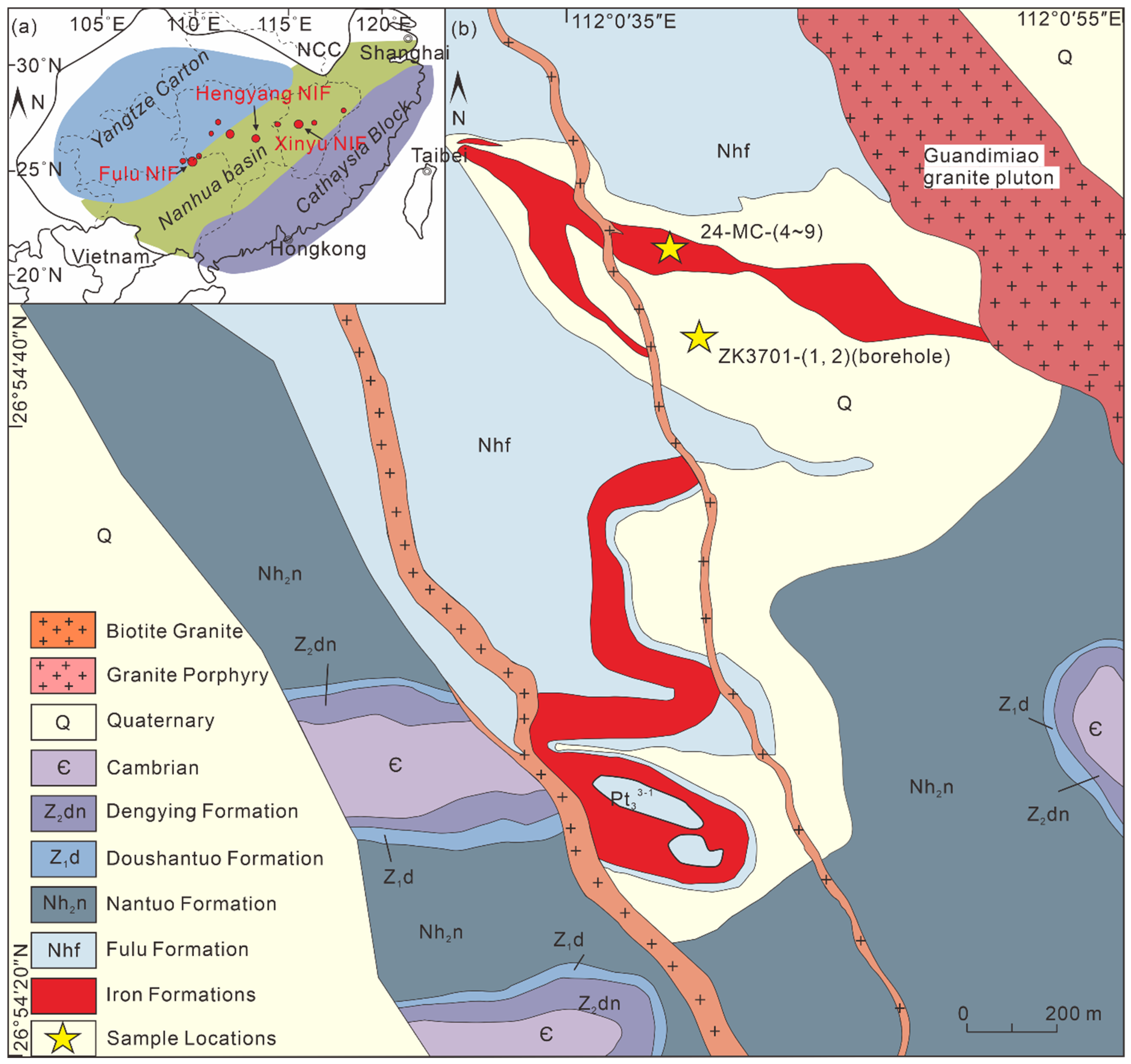
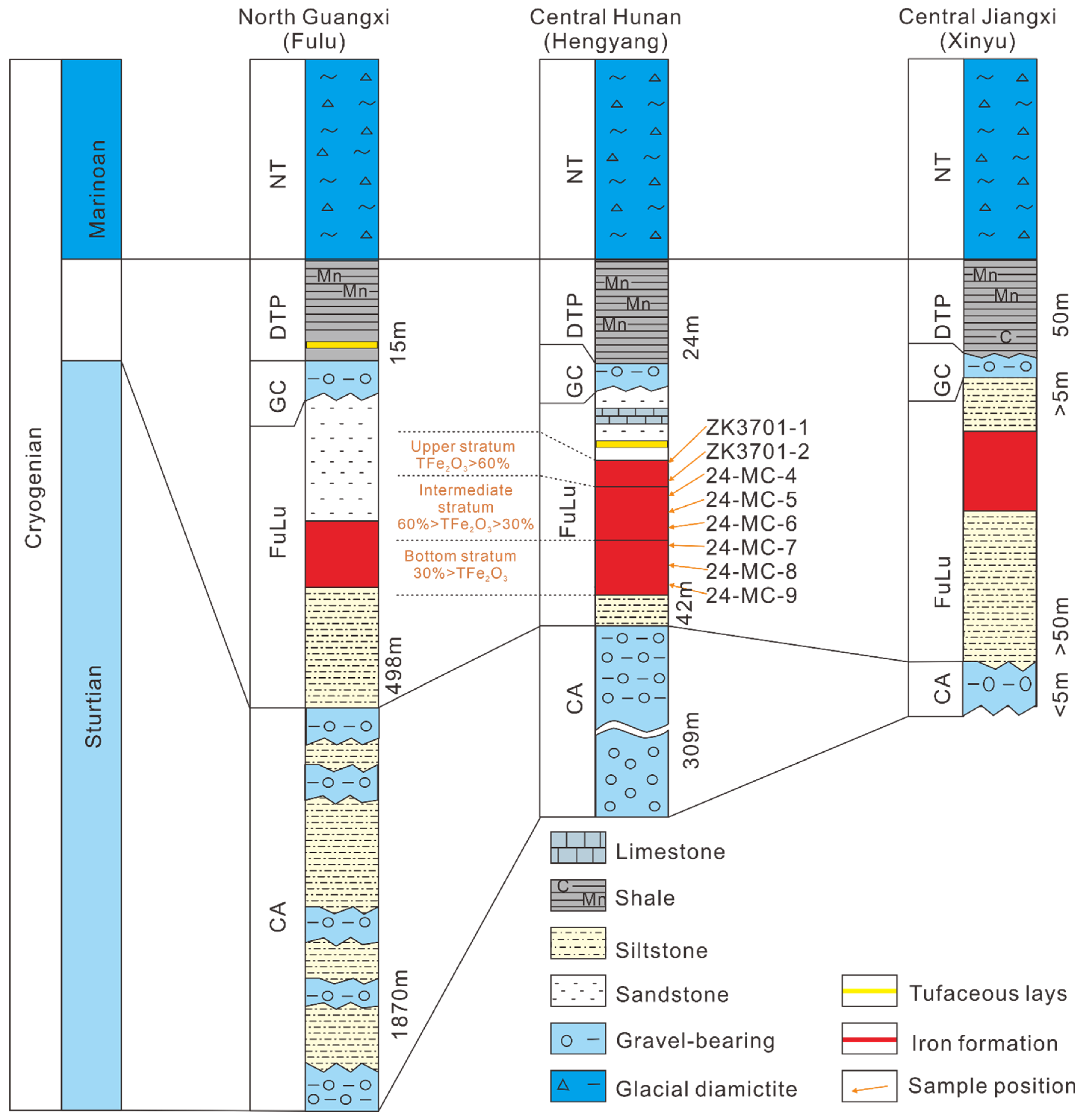
2. Geological Setting and Samples
3. Analytical Methods
3.1. Whole-Rock Geochemical Analyses
3.2. Backscattered Electron Imaging and Apatite Element Analysis
4. Results
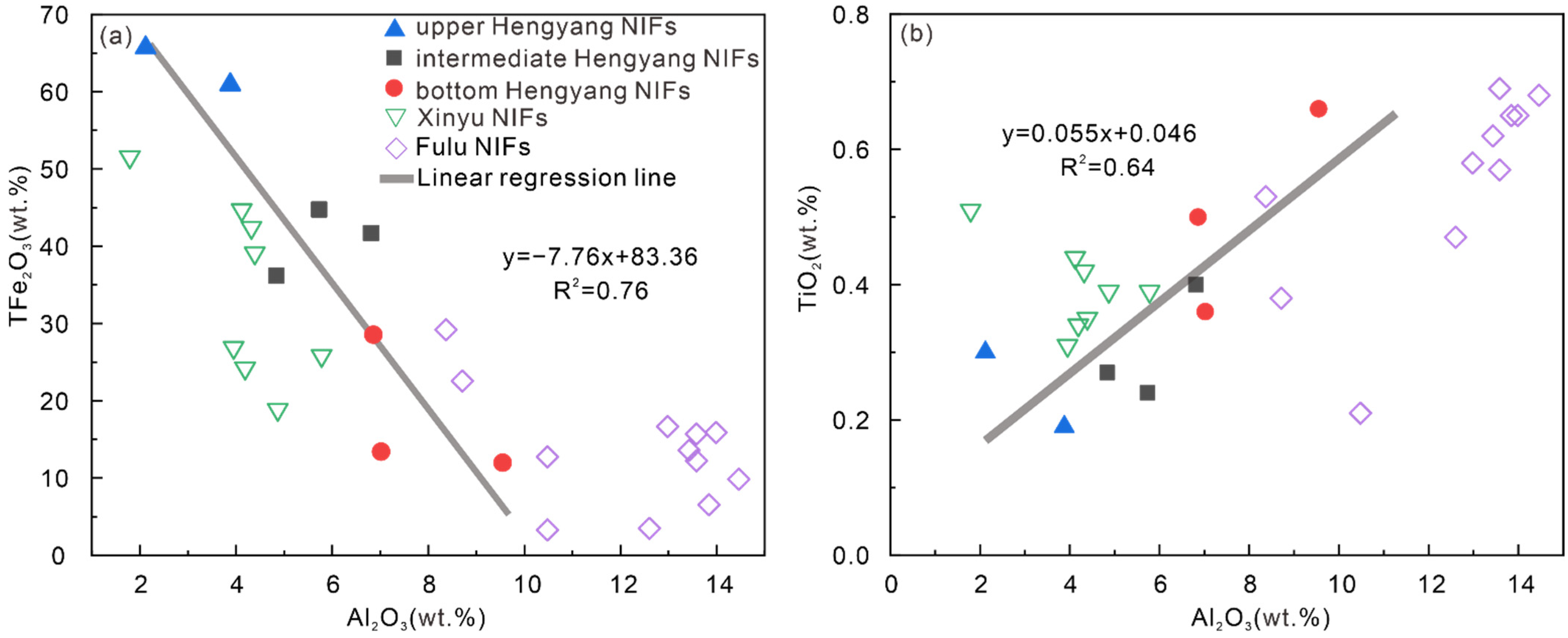
4.1. Whole-Rock Major and Trace Elements
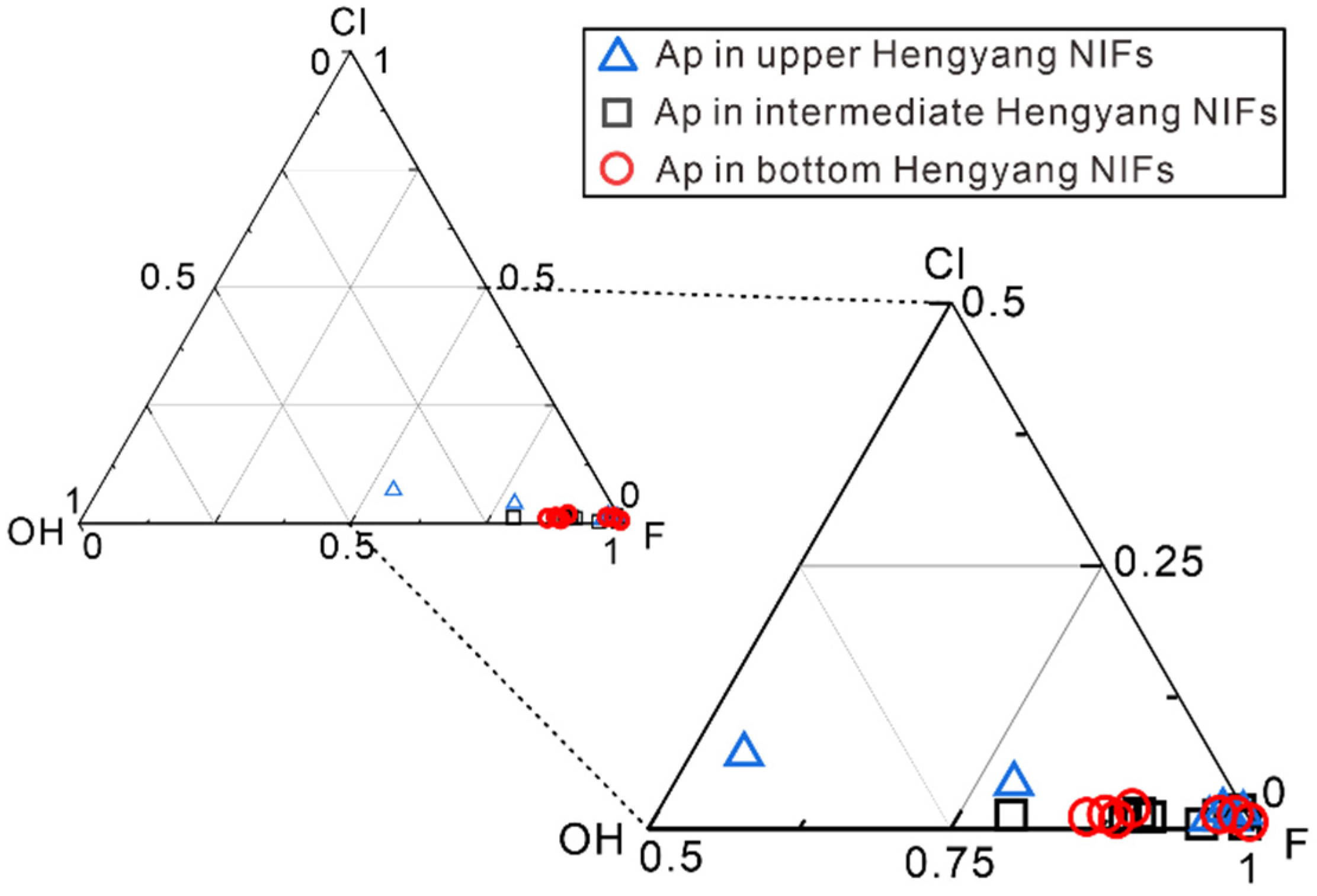
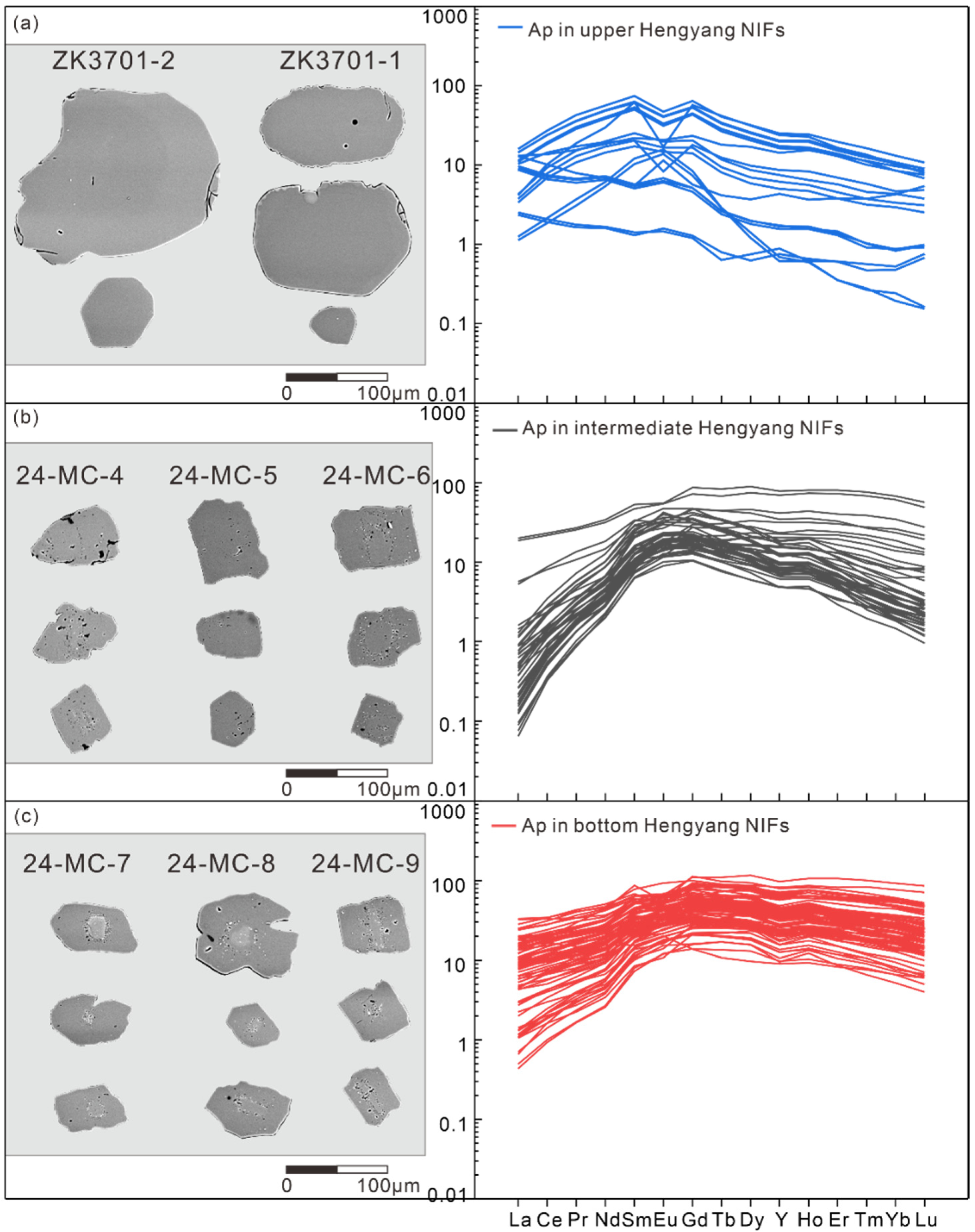
4.2. Textures and Element Compositions of Apatite
5. Discussion
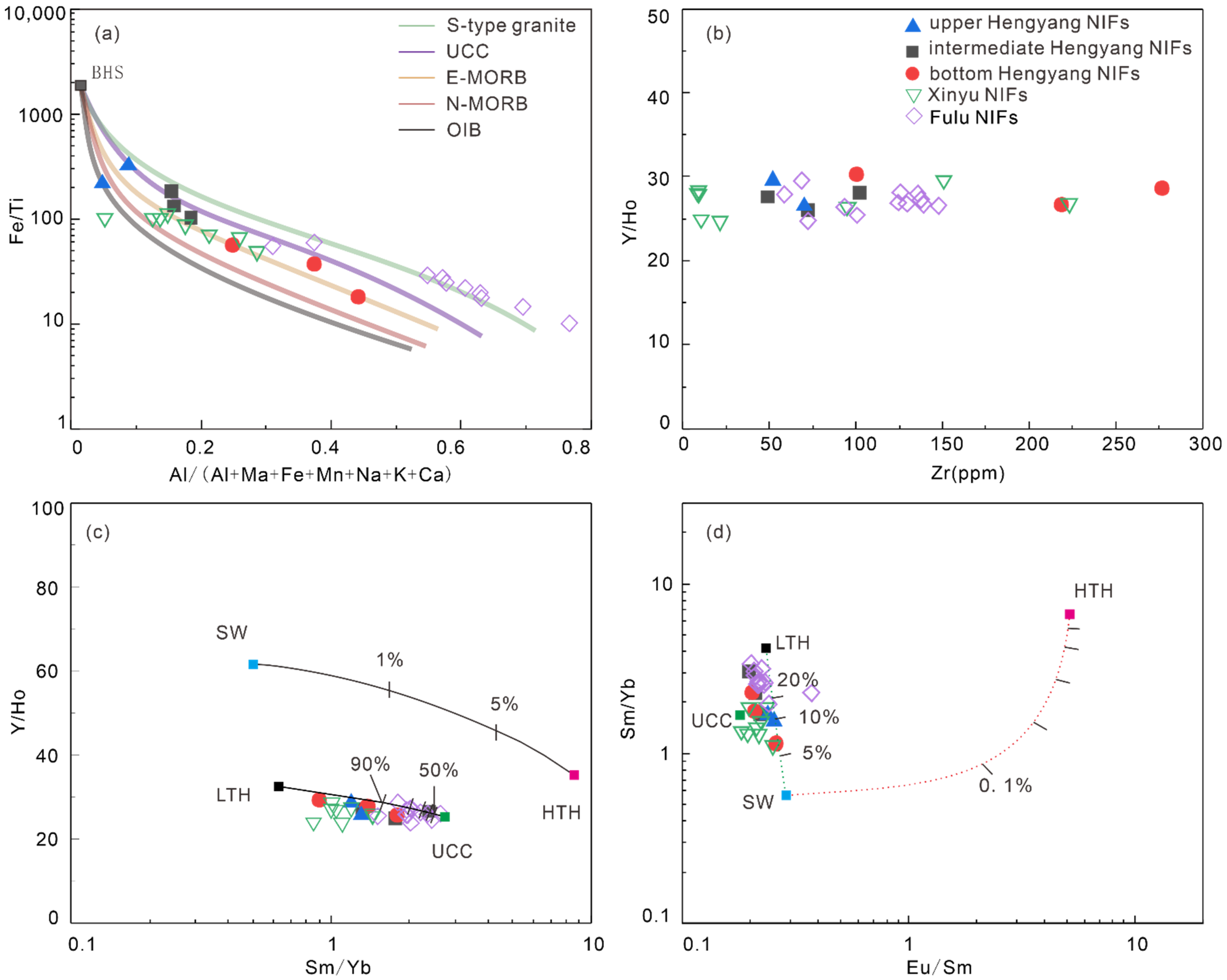
5.1. Source of the Hengyang NIF

5.2. The Genesis and REY Feature of Apatite
5.3. Response to Diagenetic Processes from Apatite and Whole-Rock Geochemistry
6. Conclusions
- (1)
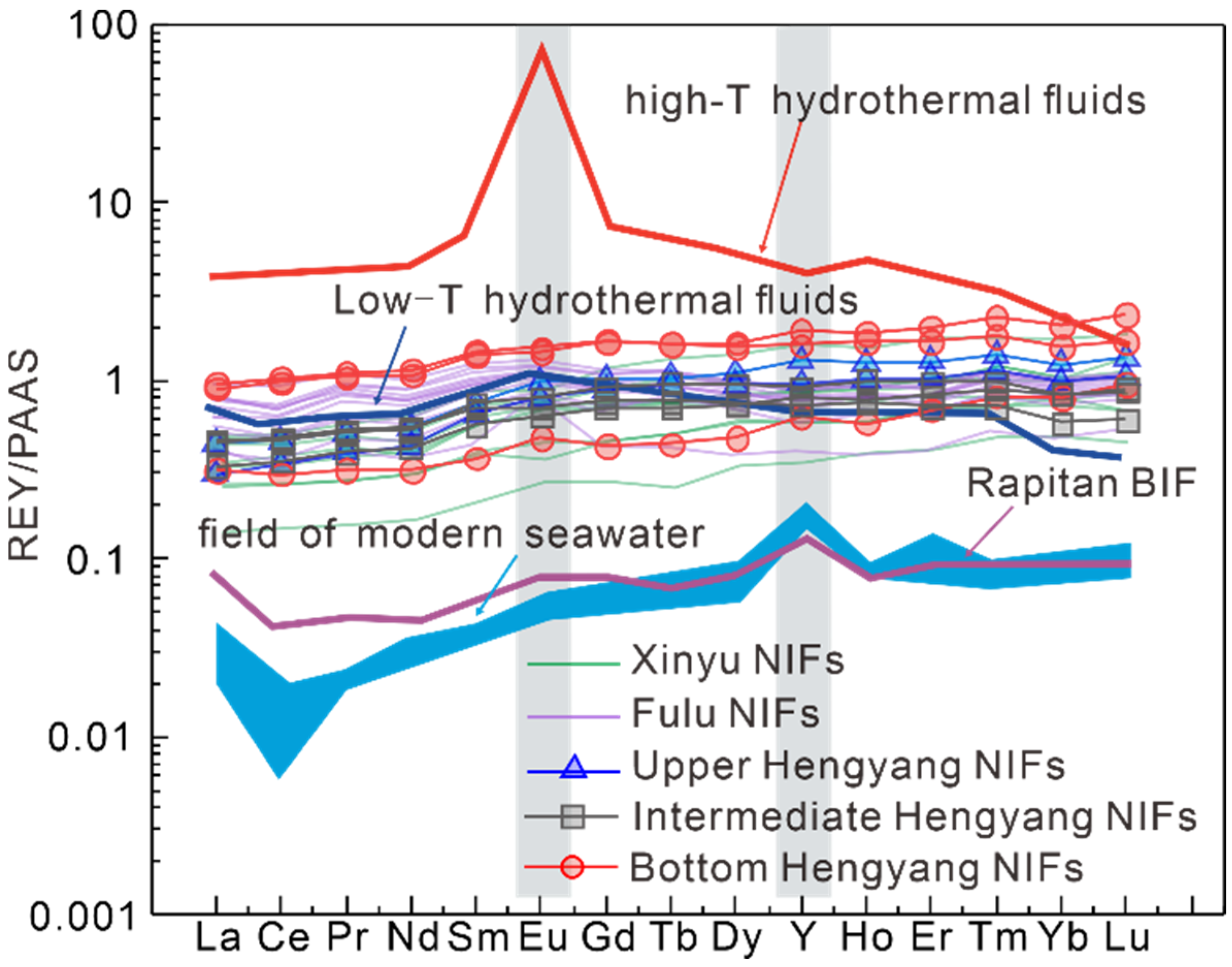
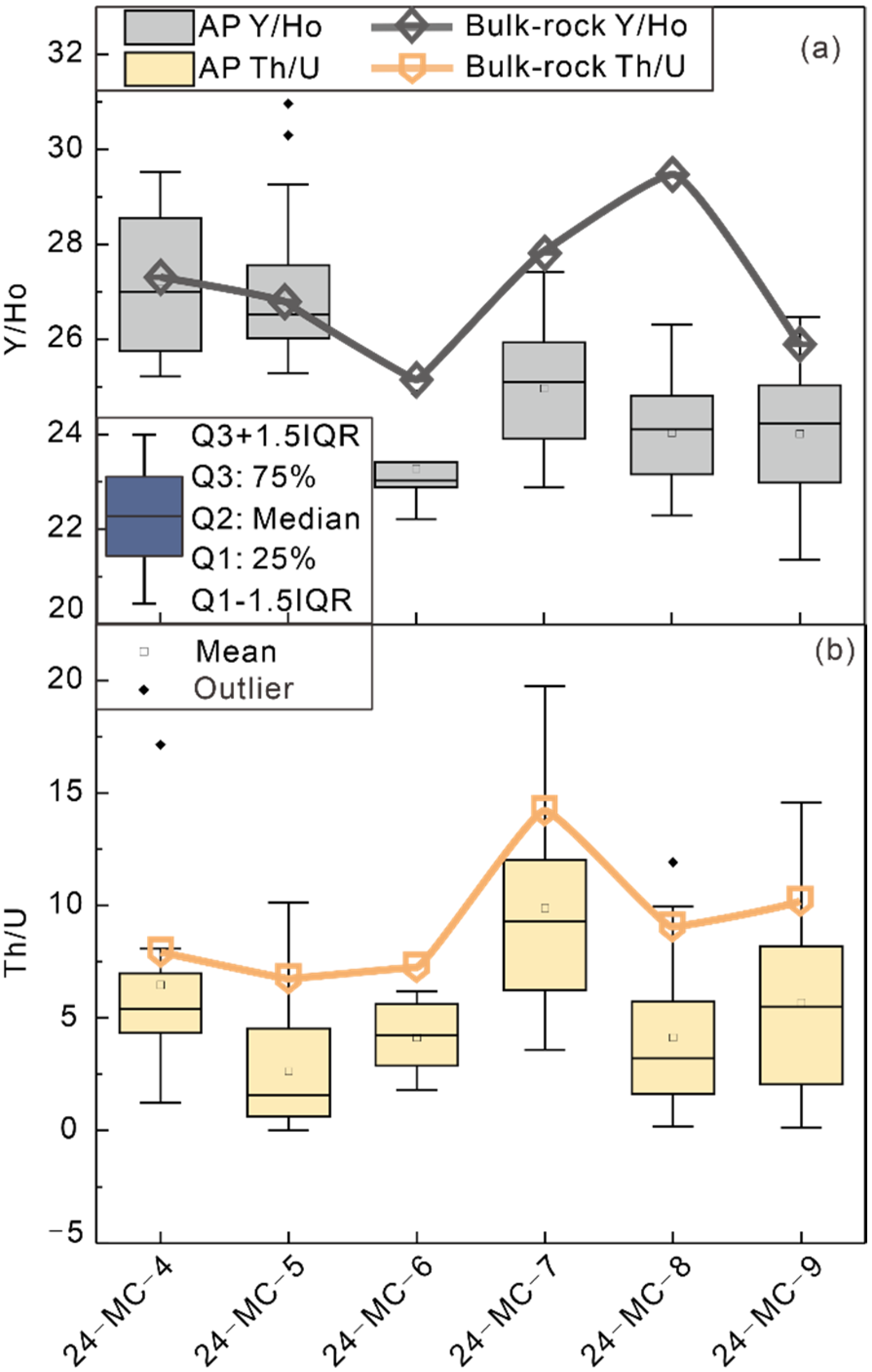
- The absence of Eu anomalies, relative enrichment in HREE, and near-chondritic Y/Ho ratios (~27.8) in the Hengyang NIF collectively constrain low-temperature hydrothermal fluids and seawater as a critical contributor to the Hengyang NIF. However, significant detrital input likely masked the original seawater-derived Y/Ho signature.
- (2)
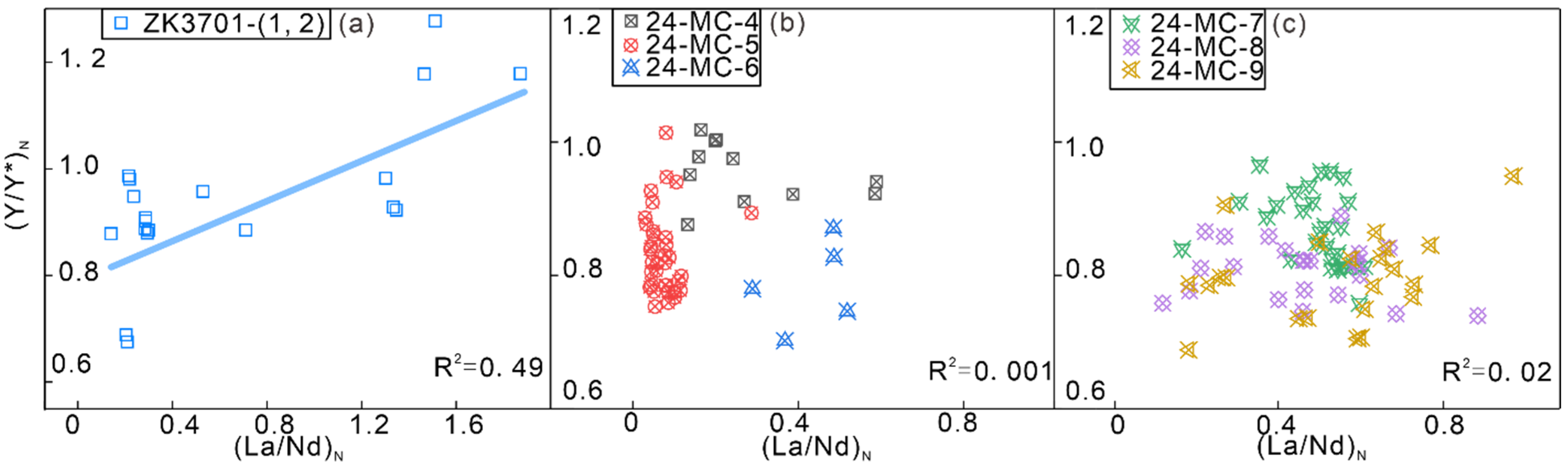
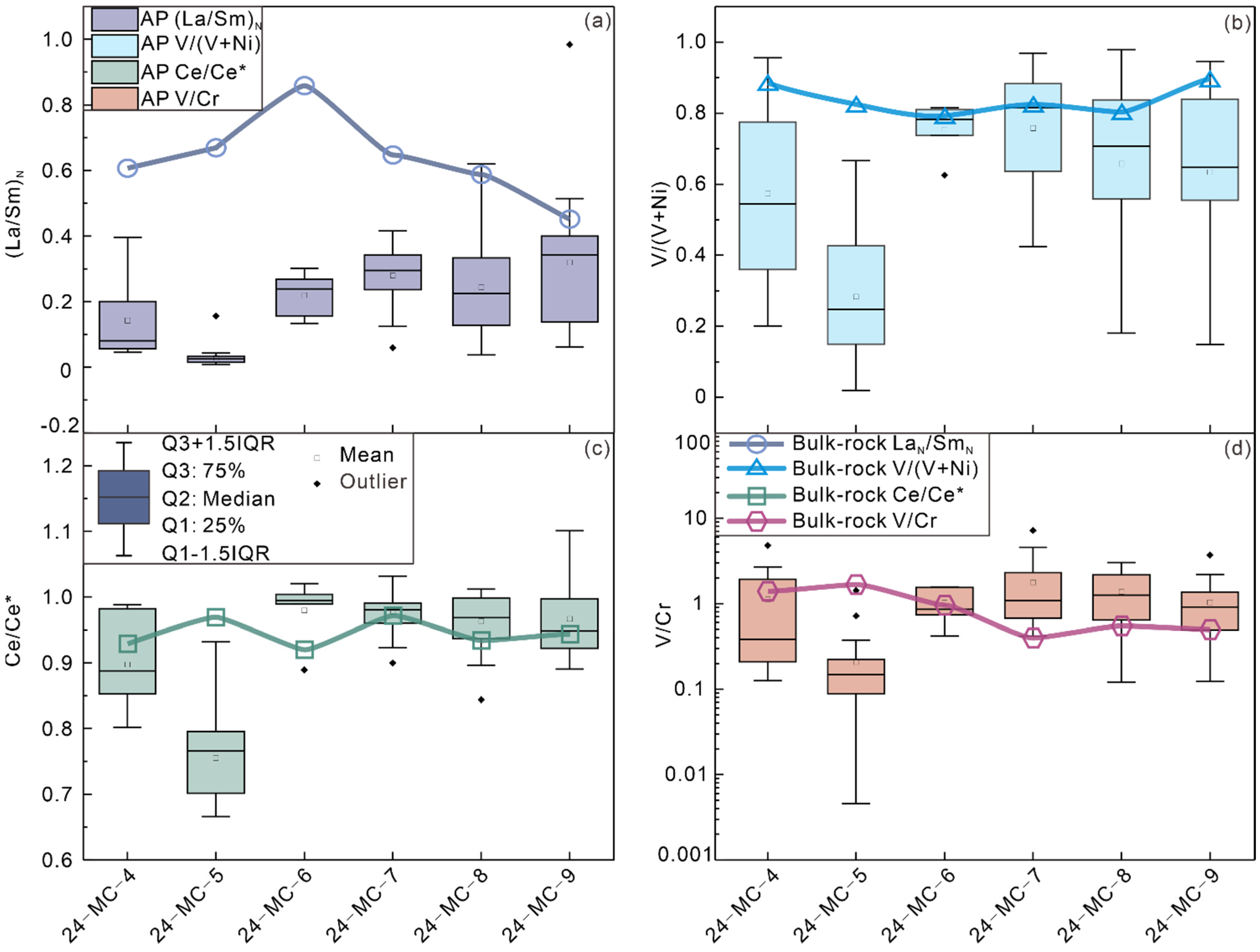
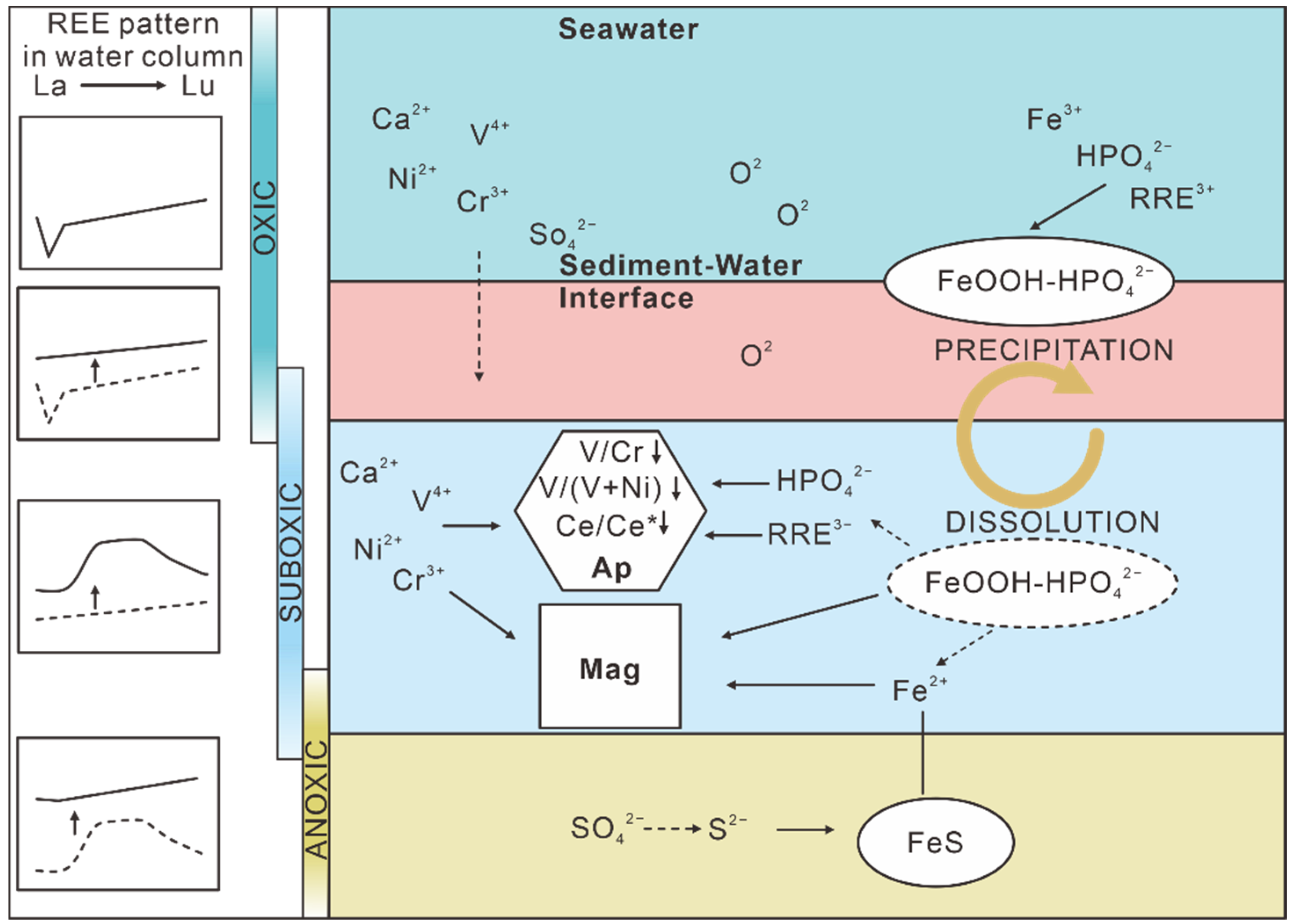
- Apatite from the bottom and intermediate stratigraphic units of the Hengyang NIF is interpreted to be primarily syndepositional. Its variable REE patterns, including HREE enrichment and pronounced MREE enrichment, were mainly controlled by pore water chemistry during diagenesis. These patterns likely reflect processes such as the dissolution of Fe–Mn hydroxides, releasing MREEs, and the degradation of organic matter. The positive correlation between Ce anomalies and (La/Sm)N in apatite further indicates strong diagenetic modification.
- (3)
- Trace element characteristics of both whole-rock and apatite collectively record an evolution from relatively oxic to weakly reducing conditions from the base to the top of the deposit. Systematic decreases in Th/U ratios in both whole-rock and apatite reliably indicate a reduction in bottom-water oxygenation. However, Ce anomalies, V/Cr, and V/(V + Ni) ratios in apatite, influenced by magnetite recrystallization and pore water interactions during diagenesis, cannot be directly used for paleoenvironmental reconstruction.
Supplementary Materials
Author Contributions
Funding
Data Availability Statement
Acknowledgments
Conflicts of Interest
References
- James, H.L. Sedimentary facies of iron-formation. Econ. Geol. 1954, 49, 235–293. [Google Scholar] [CrossRef]
- Klein, C.; Ladeira, E.A. Geochemistry and mineralogy of Neoproterozoic banded iron-formations and some selected, siliceous manganese formations from the Urucum District, Mato Grosso do Sul, Brazil. Econ. Geol. 2004, 99, 1233–1244. [Google Scholar] [CrossRef]
- Bekker, A.; Slack, J.F.; Planavsky, N.; Krapez, B.; Hofmann, K.O.; Konhauser, O.J. Rouxel, Iron formation: The sedimentary product of a complex interplay among mantle, tectonic, oceanic, and biospheric processes. Econ. Geol. 2010, 105, 467–508. [Google Scholar] [CrossRef]
- Konhauser, K.O.; Planavsky, N.J.; Hardisty, D.S.; Robbins, L.J.; Warchola, T.J.; Haugaard, R.; Lalonde, S.V.; Partin, C.A.; Oonk, P.B.H.; Tsikos, H.; et al. Iron formations: A global record of Neoarchaean to Palaeoproterozoic environmental history. Earth-Sci. Rev. 2017, 172, 140–177. [Google Scholar] [CrossRef]
- Frei, R.; Gaucher, C.; Poulton, S.W.; Canfield, D.E. Fluctuations in Precambrian atmospheric oxygenation recorded by chromium isotopes. Nature 2009, 461, 250–253. [Google Scholar] [CrossRef] [PubMed]
- Lyons, T.W.; Reinhard, C.T.; Planavsky, N.J. The rise of oxygen in Earth’s early ocean and atmosphere. Nature 2014, 506, 307–315. [Google Scholar] [CrossRef]
- Kirschvink, J.L.; Schopf, J. Late Proterozoic low-latitude global glaciation: The snowball Earth. Proterozoic Biosph. 1992, 52, 51–52. [Google Scholar]
- Hoffman, P.F.; Kaufman, A.J.; Halverson, G.P.; Schrag, D.P. A Neoproterozoic snowball earth. Science 1998, 281, 1342–1346. [Google Scholar] [CrossRef]
- Hoffman, P.F.; Schrag, D.P. The snowball Earth hypothesis: Testing the limits of global change. Terra Nova 2002, 14, 129–155. [Google Scholar] [CrossRef]
- Halverson, G.P.; Poitrasson, F.; Hoffman, P.F.; Nédélec, A.; Montel, J.-M.; Kirby, J. Fe isotope and trace element geochemistry of the Neoproterozoic syn-glacial Rapitan iron formation. Earth Planet. Sci. Lett. 2011, 309, 100–112. [Google Scholar] [CrossRef]
- Lechte, M.; Wallace, M. Sub–ice shelf ironstone deposition during the Neoproterozoic Sturtian glaciation. Geology 2016, 44, 891–894. [Google Scholar] [CrossRef]
- Eyles, N.; Januszczak, N. Zipper-rift’: A tectonic model for Neoproterozoic glaciations during the breakup of Rodinia after 750 Ma. Earth-Sci. Rev. 2004, 65, 1–73. [Google Scholar] [CrossRef]
- Lei, R.-X.; Zhang, K.; Muhtar, M.N.; Wu, C.-Z. Neoproterozoic non-glaciogenic iron formation: Insights from Fe isotope and elemental geochemistry of the Shalong iron formation from the Central Tianshan block, southern Altaids. Precambrian Res. 2020, 351, 105959. [Google Scholar] [CrossRef]
- Yang, X.; Mao, J.; Zhang, Z.; Robbins, L.J.; Planavsky, N.J.; Jiang, Z.; Duan, S.; Chen, Z. Episodic ferruginous conditions associated with submarine volcanism led to the deposition of a Late Carboniferous iron formation. Geochim. Cosmochim. Acta 2021, 292, 1–23. [Google Scholar] [CrossRef]
- Li, H.; Zhang, Z.; Li, L.; Zhang, Z.; Chen, J.; Yao, T. Types and general characteristics of the BIF-related iron deposits in China. Ore Geol. Rev. 2014, 57, 264–287. [Google Scholar] [CrossRef]
- Feng, L.; Huang, J.; Lu, D.; Zhang, Q. Major and trace element geochemistry of the Neoproterozoic syn-glacial Fulu iron formation, South China. Geol. Mag. 2017, 154, 1371–1380. [Google Scholar] [CrossRef]
- Busigny, V.; Planavsky, N.J.; Goldbaum, E.; Lechte, M.A.; Feng, L.; Lyons, T.W. Origin of the Neoproterozoic Fulu iron formation, South China: Insights from iron isotopes and rare earth element patterns. Geochim. Cosmochim. Acta 2018, 242, 123–142. [Google Scholar] [CrossRef]
- Zhu, X.-K.; Sun, J.; Li, Z.-H. Iron isotopic variations of the Cryogenian banded iron formations: A new model. Precambrian Res. 2019, 331, 105359. [Google Scholar] [CrossRef]
- Wu, C.-Z.; Zhao, F.-F.; Yang, T.; Lei, R.-X.; Ye, H.; Gao, B.-F.; Li, W. Genesis of the Fulu Cryogenian iron formation in South China: Synglacial or interglacial? Precambrian Res. 2022, 376, 106689. [Google Scholar] [CrossRef]
- Ye, H.; Wu, C.-Z.; Li, W.; Lei, R.-X.; Sun, X.; Hao, W.; Konhauser, K.O. Deposition and termination of Neoproterozoic iron formations (NIFs): New insights from NIFs in China. Earth-Sci. Rev. 2024, 256, 104861. [Google Scholar] [CrossRef]
- Wang, X.; Ye, H.; Gao, Y.; Brzozowski, M.J.; Li, X.; Lei, R.-X.; Wu, C.-Z. Depositional age and environment of the Xinyu iron deposit in the Nanhua Basin, South China. Precambrian Res. 2025, 417, 107671. [Google Scholar] [CrossRef]
- Li, Y.-L.; Konhauser, K.O.; Cole, D.R.; Phelps, T.J. Mineral ecophysiological data provide growing evidence for microbial activity in banded-iron formations. Geology 2011, 39, 707–710. [Google Scholar] [CrossRef]
- Alibert, C. Rare earth elements in Hamersley BIF minerals. Geochim. Cosmochim. Acta 2016, 184, 311–328. [Google Scholar] [CrossRef]
- Dodd, M.S.; Papineau, D.; She, Z.-B.; Manikyamba, C.; Wan, Y.-S.; O’Neil, J.; Karhu, J.A.; Rizo, H.; Pirajno, F. Widespread occurrences of variably crystalline 13C-depleted graphitic carbon in banded iron formations. Earth Planet. Sci. Lett. 2019, 512, 163–174. [Google Scholar] [CrossRef]
- Yang, X.; Mao, J.; Li, R.; Huang, F.; He, C.; Zhao, C.; Wei, W.; Yang, G.; Xiong, Y.; Poulton, S.W. Fluctuating oxygenation and dynamic iron cycling in the late Paleoproterozoic ocean. Earth Planet. Sci. Lett. 2024, 626, 118554. [Google Scholar] [CrossRef]
- Hu, T.; Robbins, L.J.; Konhauser, K.O.; Liu, L.; Bishop, B.A.; Chi, G.; Xu, L. Apatite and magnetite as probes into dissimilatory iron reduction in banded iron formations. Chem. Geol. 2025, 678, 122676. [Google Scholar] [CrossRef]
- Lan, Z.; Glorie, S.; Löhr, S.C.; Wang, R.; Shen, B. Apatite Lu–Hf dating of late Archean banded iron formations. Geology 2025, 53, 338–342. [Google Scholar] [CrossRef]
- Guénet, H.; Demangeat, E.; Davranche, M.; Vantelon, D.; Pierson-Wickmann, A.-C.; Jardé, E.; Coz, M.B.-L.; Lotfi, E.; Dia, A.; Jestin, J. Experimental evidence of REE size fraction redistribution during redox variation in wetland soil. Sci. Total Environ. 2018, 631–632, 580–588. [Google Scholar] [CrossRef]
- Lécuyer, C.; Reynard, B.; Grandjean, P. Rare earth element evolution of Phanerozoic seawater recorded in biogenic apatites. Chem. Geol. 2004, 204, 63–102. [Google Scholar] [CrossRef]
- Surya Prakash, L.; Ray, D.; Paropkari, A.L.; Mudholkar, A.V.; Satyanarayanan, M.; Sreenivas, B.; Chandrasekharam, D.; Kota, D.; Raju, K.A.K.; Kaisary, S.; et al. Distribution of REEs and yttrium among major geochemical phases of marine Fe–Mn-oxides: Comparative study between hydrogenous and hydrothermal deposits. Chem. Geol. 2012, 312–313, 127–137. [Google Scholar] [CrossRef]
- Wang, X.-C.; Li, X.-H.; Li, Z.-X.; Li, Q.-L.; Tang, G.-Q.; Gao, Y.-Y.; Zhang, Q.-R.; Liu, Y. Episodic Precambrian crust growth: Evidence from U–Pb ages and Hf–O isotopes of zircon in the Nanhua Basin, central South China. Precambrian Res. 2012, 222–223, 386–403. [Google Scholar] [CrossRef]
- Li, Z.X.; Li, X.H.; Kinny, P.D.; Wang, J.; Zhang, S.; Zhou, H. Geochronology of Neoproterozoic syn-rift magmatism in the Yangtze Craton, South China and correlations with other continents: Evidence for a mantle superplume that broke up Rodinia. Precambrian Res. 2003, 122, 85–109. [Google Scholar] [CrossRef]
- Li, Z.X.; Bogdanova, S.V.; Collins, A.S.; Davidson, A.; De Waele, B.; Ernst, R.E.; Fitzsimons, I.C.W.; Fuck, R.A.; Gladkochub, D.P.; Jacobs, J.; et al. Assembly, configuration, and break-up history of Rodinia: A synthesis. Precambrian Res. 2008, 160, 179–210. [Google Scholar] [CrossRef]
- Song, G.; Wang, X.; Shi, X.; Jiang, G. New U-Pb age constraints on the upper Banxi Group and synchrony of the Sturtian glaciation in South China. Geosci. Front. 2017, 8, 1161–1173. [Google Scholar] [CrossRef]
- Lan, Z.; Li, X.-H.; Zhang, Q.; Li, Q.-L. Global synchronous initiation of the 2nd episode of Sturtian glaciation: SIMS zircon U–Pb and O isotope evidence from the Jiangkou Group, South China. Precambrian Res. 2015, 267, 28–38. [Google Scholar] [CrossRef]
- Wang, D.; Zhu, X.-K.; Zhao, N.; Yan, B.; Li, X.-H.; Shi, F.; Zhang, F. Timing of the termination of Sturtian glaciation: SIMS U-Pb zircon dating from South China. J. Asian Earth Sci. 2019, 177, 287–294. [Google Scholar] [CrossRef]
- Prave, A.R.; Condon, D.J.; Hoffmann, K.H.; Tapster, S.; Fallick, A.E. Duration and nature of the end-Cryogenian (Marinoan) glaciation. Geology 2016, 44, 631–634. [Google Scholar] [CrossRef]
- Zhou, C.; Huyskens, M.H.; Lang, X.; Xiao, S.; Yin, Q.-Z. Calibrating the terminations of Cryogenian global glaciations. Geology 2019, 47, 251–254. [Google Scholar] [CrossRef]
- Jiang, G.; Shi, X.; Zhang, S.; Wang, Y.; Xiao, S. Stratigraphy and paleogeography of the Ediacaran Doushantuo Formation (ca. 635–551Ma) in South China. Gondwana Res. 2011, 19, 831–849. [Google Scholar] [CrossRef]
- Wang, J.; Li, Z.-X. History of Neoproterozoic rift basins in South China: Implications for Rodinia break-up. Precambrian Res. 2003, 122, 141–158. [Google Scholar] [CrossRef]
- Shen, W.; Zhu, X.; Li, J.; Yan, B. Mechanism of organic matter accumulation in black shale of the Datangpo Formation: Insights from paleo-environmental variation during the Cryogenian non-glaciation. Precambrian Res. 2022, 383, 106889. [Google Scholar] [CrossRef]
- Hu, J.; Li, S.; Wang, S.-J.; Peckmann, J.; Guan, H.; Jiang, S.-Y.; Chen, W.; Cui, H.; Qin, Z.; Liu, P.; et al. Metal-driven anaerobic oxidation of methane and the Sturtian deglaciation. Nat. Commun. 2025, 16, 7249. [Google Scholar] [CrossRef]
- Zhao, Z.; Miao, B.; Xu, Z.; Lu, J.; Liu, L.; Zuo, C.; Lu, R.; Wang, H. Petrogenesis of two types of Late Triassic granite from the Guandimiao Complex, southern Hunan Province, China. Lithos 2017, 282–283, 403–419. [Google Scholar] [CrossRef]
- Griffin, W.; Powell, W.; Pearson, N.; O’reilly, S. Appendix A2: Glitter: Data Reduction Software for Laser Ablation ICP–MS. In Laser Ablation-ICP-MS in the Earth Sciences: Current Practices and Outstanding Issues; Mineralogical Association of Canada: Quebec City, QC, Canada, 2008. [Google Scholar]
- Huang, K.X.; Hu, T.Y.; Zhuang, C.Y.; Liu, L.; Lan, Z.J. 2025 Geological features and metallogenic regularities of the Miaochong iron deposit in Neoproterozoic, Hunan Province. Chin. J. Geol. 2025, 60, 1465–1475, (In Chinese with English Abstract). [Google Scholar] [CrossRef]
- Cox, G.M.; Halverson, G.P.; Minarik, W.G.; Le Heron, D.P.; Macdonald, F.A.; Bellefroid, E.J.; Strauss, J.V. Neoproterozoic iron formation: An evaluation of its temporal, environmental and tectonic significance. Chem. Geol. 2013, 362, 232–249. [Google Scholar] [CrossRef]
- Bau, M.; Dulski, P. Comparing yttrium and rare earths in hydrothermal fluids from the Mid-Atlantic Ridge: Implications for Y and REE behaviour during near-vent mixing and for the Y/Ho ratio of Proterozoic seawater. Chem. Geol. 1999, 155, 77–90. [Google Scholar] [CrossRef]
- Michard, A.; Michard, G.; Stüben, D.; Stoffers, P.; Cheminée, J.-L.; Binard, N. Submarine thermal springs associated with young volcanoes: The Teahitia vents, Society Islands, Pacific Ocean. Geochim. Cosmochim. Acta 1993, 57, 4977–4986. [Google Scholar] [CrossRef]
- Klein, C.; Beukes, N.J. Sedimentology and geochemistry of the glaciogenic late Proterozoic Rapitan iron-formation in Canada. Econ. Geol. 1993, 88, 542–565. [Google Scholar] [CrossRef]
- Li, Z.H.; Zhu, X.K.; Sun, J. Geochemical characters of Banded Iron Formations from Xinyu and North China. Acta Petrol. Sin. 2014, 30, 1279–1291, (In Chinese with English Abstract). [Google Scholar]
- McLennan, S.; McCulloch, M.; Taylor, S.; Maynard, J. Effects of sedimentary sorting on neodymium isotopes in deep-sea turbidites. Nature 1989, 337, 547–549. [Google Scholar] [CrossRef]
- Planavsky, N.; Bekker, A.; Rouxel, O.J.; Kamber, B.; Hofmann, A.; Knudsen, A.; Lyons, T.W. Rare earth element and yttrium compositions of Archean and Paleoproterozoic Fe formations revisited: New perspectives on the significance and mechanisms of deposition. Geochim. Cosmochim. Acta 2010, 74, 6387–6405. [Google Scholar] [CrossRef]
- Planavsky, N.J.; Rouxel, O.J.; Bekker, A.; Lalonde, S.V.; Konhauser, K.O.; Reinhard, C.T.; Lyons, T.W. The evolution of the marine phosphate reservoir. Nature 2010, 467, 1088–1090. [Google Scholar] [CrossRef]
- Hu, J.; Wang, H.; Wang, M. Geochemistry and origin of the Neoproterozoic Dahongliutan banded iron formation (BIF) in the Western Kunlun orogenic belt, Xinjiang (NW China). Ore Geol. Rev. 2017, 89, 836–857. [Google Scholar] [CrossRef]
- Sun, J.; Zhu, X.; Li, Z. Confirmation and global significance of a large-scale early Neoproterozoic banded iron formation on Hainan Island, China. Precambrian Res. 2018, 307, 82–92. [Google Scholar] [CrossRef]
- Basta, F.F.; Maurice, A.E.; Fontboté, L.; Favarger, P.-Y. Petrology and geochemistry of the banded iron formation (BIF) of Wadi Karim and Um Anab, Eastern Desert, Egypt: Implications for the origin of Neoproterozoic BIF. Precambrian Res. 2011, 187, 277–292. [Google Scholar] [CrossRef]
- Marchig, V.; Gundlach, H.; Möller, P.; Schley, F. Some geochemical indicators for discrimination between diagenetic and hydrothermal metalliferous sediments. Mar. Geol. 1982, 50, 241–256. [Google Scholar] [CrossRef]
- Cribb, J.W.; Barton, M. Geochemical effects of decoupled fractional crystallization and crustal assimilation. Lithos 1996, 37, 293–307. [Google Scholar] [CrossRef]
- Bau, M.; Dulski, P. Distribution of yttrium and rare-earth elements in the Penge and Kuruman iron-formations, Transvaal Supergroup, South Africa. Precambrian Res. 1996, 79, 37–55. [Google Scholar] [CrossRef]
- Danielson, A.; Möller, P.; Dulski, P. The europium anomalies in banded iron formations and the thermal history of the oceanic crust. Chem. Geol. 1992, 97, 89–100. [Google Scholar] [CrossRef]
- Viehmann, S.; Bau, M.; Hoffmann, J.E.; Münker, C. Geochemistry of the Krivoy Rog Banded Iron Formation, Ukraine, and the impact of peak episodes of increased global magmatic activity on the trace element composition of Precambrian seawater. Precambrian Res. 2015, 270, 165–180. [Google Scholar] [CrossRef]
- Bolhar, R.; Kamber, B.S.; Moorbath, S.; Fedo, C.M.; Whitehouse, M.J. Characterisation of early Archaean chemical sediments by trace element signatures. Earth Planet. Sci. Lett. 2004, 222, 43–60. [Google Scholar] [CrossRef]
- Alexander, B.W.; Bau, M.; Andersson, P.; Dulski, P. Continentally-derived solutes in shallow Archean seawater: Rare earth element and Nd isotope evidence in iron formation from the 2.9 Ga Pongola Supergroup, South Africa. Geochim. Cosmochim. Acta 2008, 72, 378–394. [Google Scholar] [CrossRef]
- Taylor, S.R.; McLennan, S. Planetary Crusts: Their Composition, Origin and Evolution; Cambridge University Press: Cambridge, UK, 2009; Volume 10. [Google Scholar]
- Whalen, J.B.; Currie, K.L.; Chappell, B.W. A-type granites: Geochemical characteristics, discrimination and petrogenesis. Contrib. Mineral. Petrol. 1987, 95, 407–419. [Google Scholar] [CrossRef]
- Nozaki, Y.; Zhang, J.; Amakawa, H. The fractionation between Y and Ho in the marine environment. Earth Planet. Sci. Lett. 1997, 148, 329–340. [Google Scholar] [CrossRef]
- Bau, M.; Dulski, P. Comparative study of yttrium and rare-earth element behaviours in fluorine-rich hydrothermal fluids. Contrib. Mineral. Petrol. 1995, 119, 213–223. [Google Scholar] [CrossRef]
- Li, R.; Hu, J.; Li, S.; Li, Y.; Qin, Z.; Dong, R.; Cui, H.; Liang, X.; Konhauser, K.O. Continental weathering and redox dynamics modulated marine phosphorus availability during the Sturtian deglaciation. Geochim. Cosmochim. Acta 2026, 418, 179–197. [Google Scholar] [CrossRef]
- Ye, R.; Zhao, J.; Wang, Z.; Li, W.; He, J.; Chen, F. Single-Grain Detrital Apatite Sr Isotopic Composition as an Indicator to Trace Sedimentary Sources: A Case Study of Sedimentary Rocks in the Hui-Cheng Basin, South Qinling, China. Minerals 2023, 13, 1010. [Google Scholar] [CrossRef]
- Piccoli, P.M.; Candela, P.A. Apatite in igneous systems. Rev. Mineral. Geochem. 2002, 48, 255–292. [Google Scholar] [CrossRef]
- Hughes, J.M.; Rakovan, J.F. Structurally robust, chemically diverse: Apatite and apatite supergroup minerals. Elements 2015, 11, 165–170. [Google Scholar] [CrossRef]
- Lepland, A.; Arrhenius, G.; Cornell, D. Apatite in early Archean Isua supracrustal rocks, southern West Greenland: Its origin, association with graphite and potential as a biomarker. Precambrian Res. 2002, 118, 221–241. [Google Scholar] [CrossRef]
- O’Sullivan, G.J.; Chew, D.M.; Morton, A.C.; Mark, C.; Henrichs, I.A. An Integrated Apatite Geochronology and Geochemistry Tool for Sedimentary Provenance Analysis. Geochem. Geophys. Geosyst. 2018, 19, 1309–1326. [Google Scholar] [CrossRef]
- Aubineau, J.; Parat, F.; Fru, E.C.; El Bamiki, R.; Mauguin, O.; Baron, F.; Poujol, M.; Séranne, M. Geodynamic seawater-sediment porewater evolution of the east central Atlantic Paleogene ocean margin revealed by U-Pb dating of sedimentary phosphates. Front. Earth Sci. 2022, 10, 997008. [Google Scholar] [CrossRef]
- Cappellen, P.V.; Berner, R.A. Fluorapatite crystal growth from modified seawater solutions. Geochim. Cosmochim. Acta 1991, 55, 1219–1234. [Google Scholar] [CrossRef]
- Kato, Y.; Fujinaga, K.; Nakamura, K.; Takaya, Y.; Kitamura, K.; Ohta, J.; Toda, R.; Nakashima, T.; Iwamori, H. Deep-sea mud in the Pacific Ocean as a potential resource for rare-earth elements. Nat. Geosci. 2011, 4, 535–539. [Google Scholar] [CrossRef]
- Haley, B.A.; Klinkhammer, G.P.; McManus, J. Rare earth elements in pore waters of marine sediments. Geochim. Cosmochim. Acta 2004, 68, 1265–1279. [Google Scholar] [CrossRef]
- Chen, J.; Algeo, T.J.; Zhao, L.; Chen, Z.-Q.; Cao, L.; Zhang, L.; Li, Y. Diagenetic uptake of rare earth elements by bioapatite, with an example from Lower Triassic conodonts of South China. Earth-Sci. Rev. 2015, 149, 181–202. [Google Scholar] [CrossRef]
- Byrne, R.H.; Kim, K.-H. Rare earth precipitation and coprecipitation behavior: The limiting role of PO43− on dissolved rare earth concentrations in seawater. Geochim. Cosmochim. Acta 1993, 57, 519–526. [Google Scholar] [CrossRef]
- Abbott, A.N.; Löhr, S.C.; Payne, A.; Kumar, H.; Du, J. Widespread lithogenic control of marine authigenic neodymium isotope records? Implications for paleoceanographic reconstructions. Geochim. Cosmochim. Acta 2022, 319, 318–336. [Google Scholar] [CrossRef]
- Ren, J.; Jiang, X.; He, G.; Wang, F.; Yang, T.; Luo, S.; Deng, Y.; Zhou, J.; Deng, X.; Yao, H. Enrichment and sources of REY in phosphate fractions: Constraints from the leaching of REY-rich deep-sea sediments. Geochim. Cosmochim. Acta 2022, 335, 155–168. [Google Scholar] [CrossRef]
- Gadd, M.G.; Layton-Matthews, D.; Peter, J.M. Non-hydrothermal origin of apatite in SEDEX mineralization and host rocks of the Howard’s Pass district, Yukon, Canada. Am. Mineral. 2016, 101, 1061–1071. [Google Scholar] [CrossRef]
- Reynard, B.; Lécuyer, C.; Grandjean, P. Crystal-chemical controls on rare-earth element concentrations in fossil biogenic apatites and implications for paleoenvironmental reconstructions. Chem. Geol. 1999, 155, 233–241. [Google Scholar] [CrossRef]
- Morad, S.; Felitsyn, S. Identification of primary Ce-anomaly signatures in fossil biogenic apatite: Implication for the Cambrian oceanic anoxia and phosphogenesis. Sediment. Geol. 2001, 143, 259–264. [Google Scholar] [CrossRef]
- Arthur, M.A.; Sageman, B.B. Marine shales: Depositional mechanisms and environments of ancient deposits. Annu. Rev. Earth Planet. Sci. 1994, 22, 499–551. [Google Scholar] [CrossRef]
- Kimura, H.; Watanabe, Y. Oceanic anoxia at the Precambrian-Cambrian boundary. Geology 2001, 29, 995–998. [Google Scholar] [CrossRef]
- Lewan, M.D. Factors controlling the proportionality of vanadium to nickel in crude oils. Geochim. Cosmochim. Acta 1984, 48, 2231–2238. [Google Scholar] [CrossRef]
- Jones, B.; Manning, D.A. Comparison of geochemical indices used for the interpretation of palaeoredox conditions in ancient mudstones. Chem. Geol. 1994, 111, 111–129. [Google Scholar] [CrossRef]
- Wen, G.; Li, J.-W.; Hofstra, A.H.; Harlov, D.E.; Zhao, X.-F.; Lowers, H.A.; Koenig, A.E. Trace element fractionation in magnetite as a function of Fe depletion from ore fluids at the Baijian Fe-(Co) skarn deposit, eastern China: Implications for Co mineralization in Fe skarns. Am. Mineral. 2024, 109, 1657–1669. [Google Scholar] [CrossRef]
- Zou, Y.; Luo, Q.; Zou, H.; Chen, J.; Ji, W.; Wu, J.; Du, T.; Liu, X.; Fang, Z.; Hu, W.; et al. Mechanisms of Uranium and Thorium Accumulation in the Lower Ediacaran Marine Sediments from the Upper Yangtze Platform, China: Implications for Helium Exploration. J. Mar. Sci. Eng. 2025, 13, 413. [Google Scholar] [CrossRef]
- Jiménez-Arroyo, Á.; Gabitov, R.; Migdisov, A.; Lui, J.; Strzelecki, A.; Zhao, X.; Guo, X.; Paul, V.; Mlsna, T.; Perez-Huerta, A.; et al. Uranium uptake by phosphate minerals at hydrothermal conditions. Chem. Geol. 2023, 634, 121581. [Google Scholar] [CrossRef]
- Elderfield, H.; Hawkesworth, C.; Greaves, M.; Calvert, S. Rare earth element geochemistry of oceanic ferromanganese nodules and associated sediments. Geochim. Cosmochim. Acta 1981, 45, 513–528. [Google Scholar] [CrossRef]
- Bau, M.; Koschinsky, A. Oxidative scavenging of cerium on hydrous Fe oxide: Evidence from the distribution of rare earth elements and yttrium between Fe oxides and Mn oxides in hydrogenetic ferromanganese crusts. Geochem. J. 2009, 43, 37–47. [Google Scholar] [CrossRef]
- Lu, Z.; Jenkyns, H.C.; Rickaby, R.E. Iodine to calcium ratios in marine carbonate as a paleo-redox proxy during oceanic anoxic events. Geology 2010, 38, 1107–1110. [Google Scholar] [CrossRef]
- Kim, J.-H.; Torres, M.E.; Haley, B.A.; Kastner, M.; Pohlman, J.W.; Riedel, M.; Lee, Y.-J. The effect of diagenesis and fluid migration on rare earth element distribution in pore fluids of the northern Cascadia accretionary margin. Chem. Geol. 2012, 291, 152–165. [Google Scholar] [CrossRef]
- Pufahl, P.K.; Groat, L.A. Sedimentary and Igneous Phosphate Deposits: Formation and Exploration: An Invited Paper. Econ. Geol. 2017, 112, 483–516. [Google Scholar] [CrossRef]




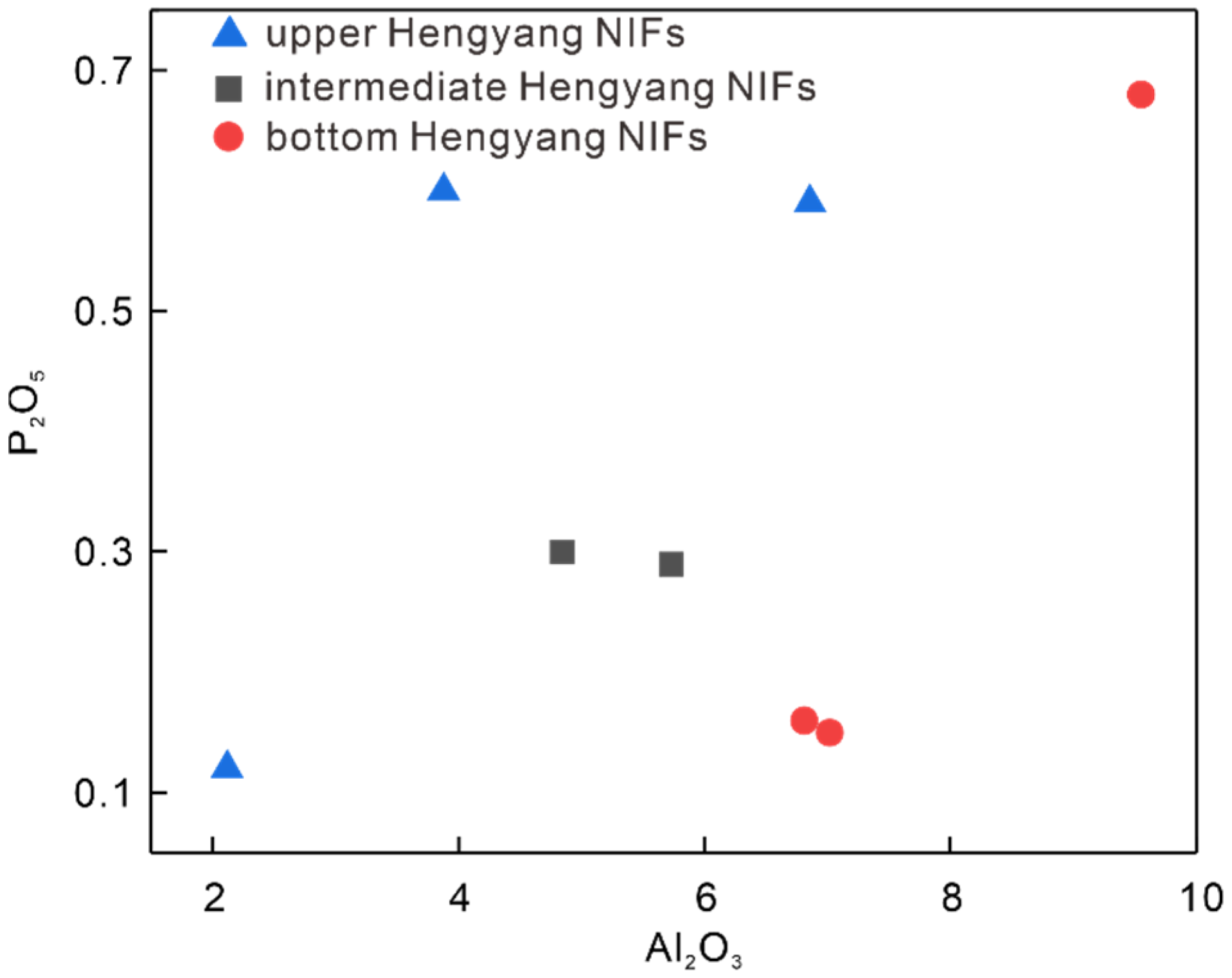

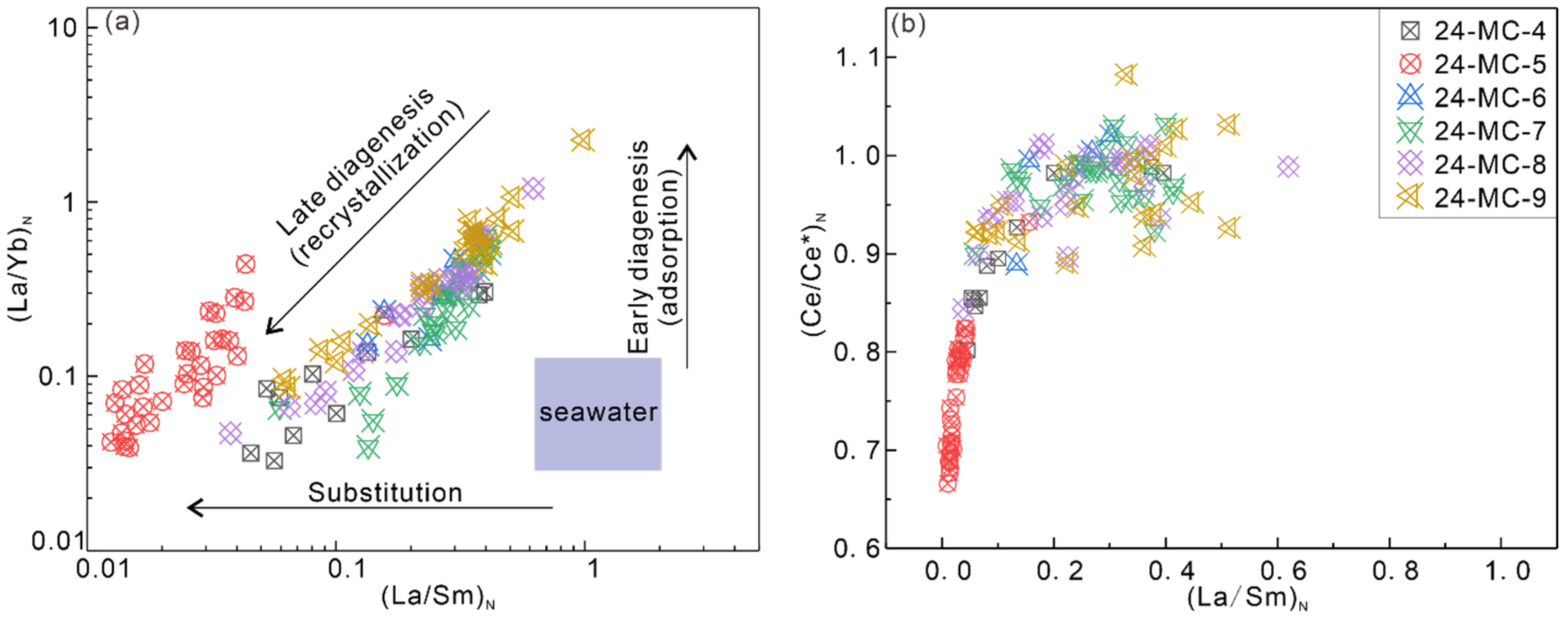
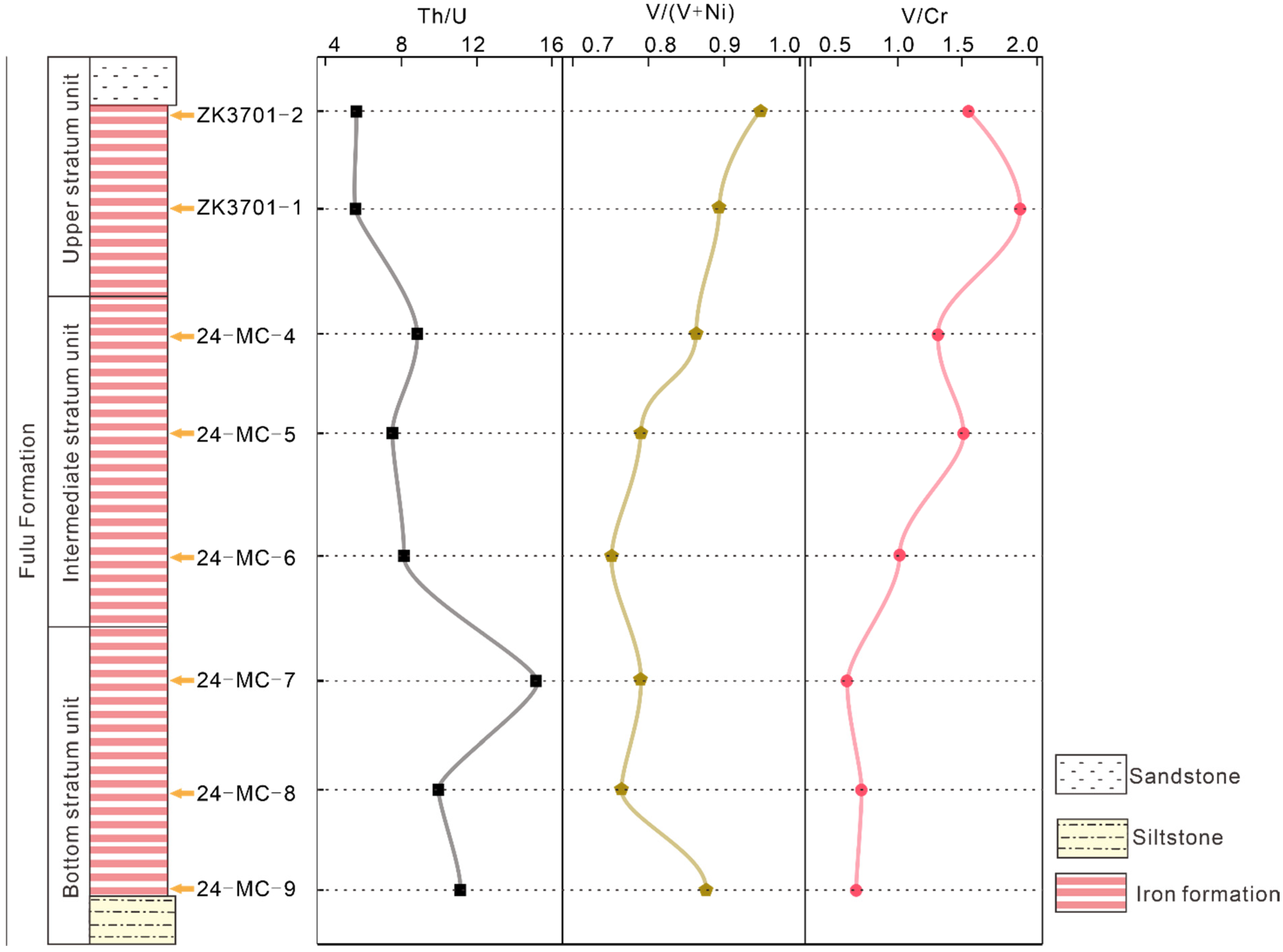


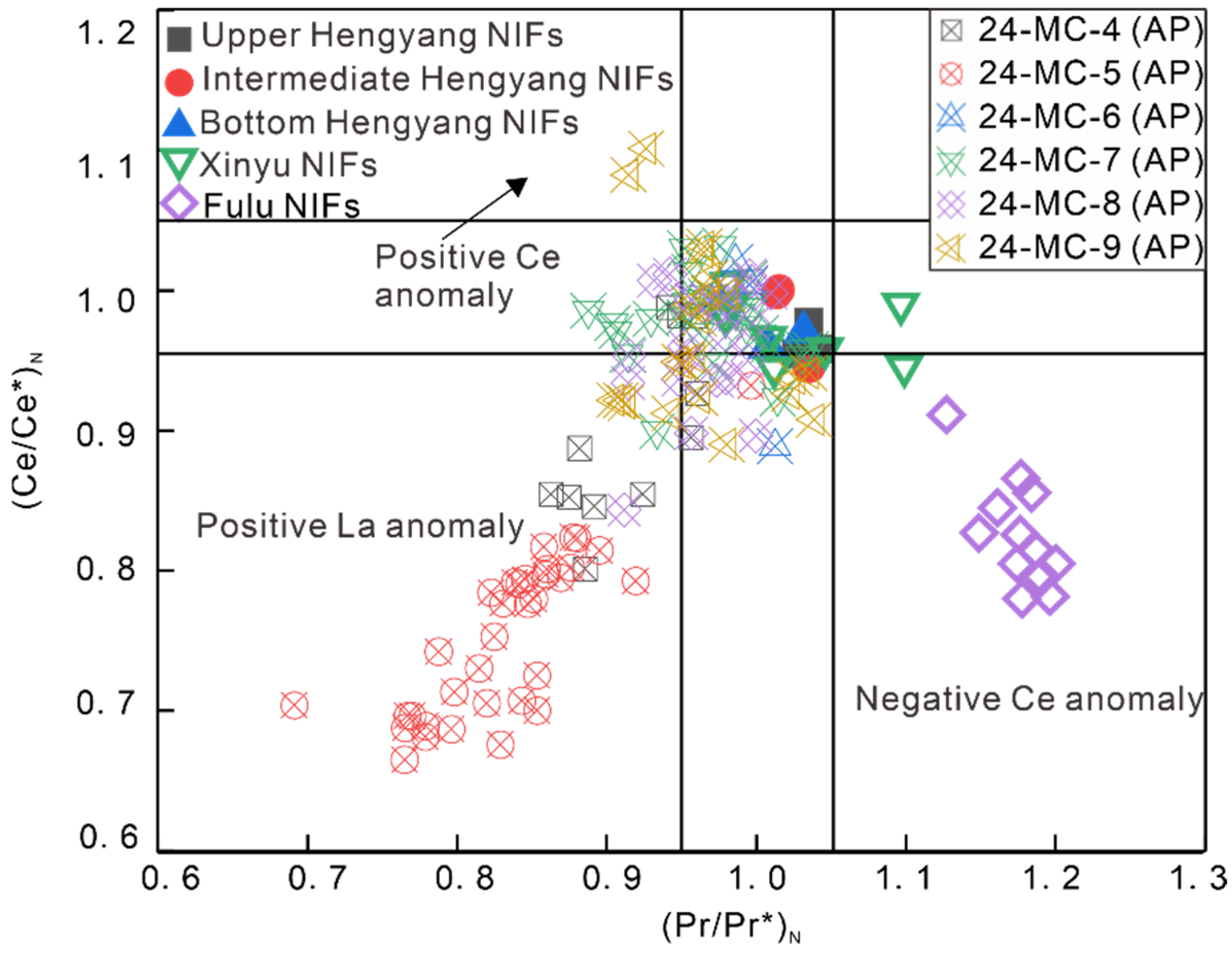


| Upper Stratum Unit | Intermediate Stratum Unit | Bottom Stratum Unit | ||||||
|---|---|---|---|---|---|---|---|---|
| Elements | ZK3701-1 | ZK3701-2 | 24-MC-4 | 24-MC-5 | 24-MC-6 | 24-MC-7 | 24-MC-8 | 24-MC-9 |
| SiO2 | 29.93 | 29.23 | 51.63 | 43.02 | 43.83 | 66.44 | 72.67 | 56.35 |
| TiO2 | 0.19 | 0.30 | 0.27 | 0.24 | 0.40 | 0.66 | 0.36 | 0.50 |
| Al2O3 | 3.88 | 2.12 | 4.84 | 5.73 | 6.81 | 9.55 | 7.02 | 6.86 |
| TFe2O3 | 60.92 | 65.68 | 36.17 | 44.75 | 41.71 | 11.98 | 13.42 | 28.56 |
| MnO | 0.03 | 0.04 | 0.09 | 0.07 | 0.14 | 0.14 | 0.09 | 0.09 |
| MgO | 2.06 | 1.61 | 3.50 | 2.47 | 3.21 | 2.46 | 2.12 | 2.10 |
| CaO | 0.88 | 0.33 | 1.11 | 0.91 | 1.27 | 2.36 | 1.47 | 0.90 |
| Na2O | 0.07 | 0.02 | 0.17 | 0.43 | 0.34 | 0.02 | 0.04 | 0.04 |
| K2O | 0.57 | 0.28 | 1.32 | 1.28 | 1.79 | 2.04 | 1.63 | 1.64 |
| P2O5 | 0.60 | 0.12 | 0.30 | 0.29 | 0.16 | 0.68 | 0.15 | 0.59 |
| LOI | 0.72 | 0.51 | 0.96 | −0.18 | −0.01 | 3.35 | 1.39 | 1.54 |
| Li | 60.2 | 17 | 21 | 12.7 | 43.4 | 48.7 | 29 | 27.6 |
| Be | 0.97 | 0.38 | 0.79 | 1.42 | 1.29 | 2.36 | 1.62 | 1.52 |
| Sc | 6 | 5.9 | 10.4 | 6.1 | 7.3 | 16.8 | 9.4 | 13.6 |
| V | 92 | 104 | 84 | 84 | 87 | 64 | 50 | 85 |
| Cr | 40 | 60 | 60 | 50 | 90 | 160 | 90 | 170 |
| Co | 4.9 | 3.7 | 6.2 | 6.1 | 7.9 | 5.5 | 3.1 | 3.2 |
| Ni | 9 | 4.7 | 10.8 | 17.8 | 22.7 | 13.6 | 12.2 | 9.8 |
| Cu | 0.4 | 0.4 | 1.4 | 1.4 | 0.8 | 2.2 | 0.9 | 1.1 |
| Zn | 54 | 63 | 66 | 53 | 85 | 52 | 38 | 52 |
| Ga | 6 | 4.9 | 6.9 | 8.4 | 9.3 | 13.4 | 9 | 9.8 |
| Ge | 0.28 | 0.27 | 0.23 | 0.28 | 0.35 | 0.22 | 0.16 | 0.25 |
| As | 0.8 | 0.3 | <0.2 | <0.2 | <0.2 | 0.4 | 0.2 | 1.1 |
| Rb | 20.9 | 11.9 | 46.1 | 47 | 61 | 103 | 59.1 | 60.6 |
| Sr | 57.9 | 21.6 | 63.3 | 72.5 | 191.5 | 73.6 | 89.8 | 124 |
| Y | 35.3 | 25.9 | 21.3 | 19.8 | 24.9 | 51 | 16.8 | 42.7 |
| Zr | 52 | 70 | 102 | 49 | 72 | 276 | 100 | 218 |
| Nb | 4.6 | 7.1 | 6.4 | 5.3 | 6.1 | 18.6 | 7.8 | 10.6 |
| Mo | 0.45 | 0.48 | 0.61 | 0.72 | 0.63 | 0.39 | 0.49 | 0.52 |
| Ag | <0.01 | 0.01 | 0.06 | 0.03 | 0.02 | 0.02 | 0.01 | <0.01 |
| Cd | <0.02 | 0.02 | 0.03 | 0.02 | 0.03 | 0.02 | <0.02 | 0.06 |
| In | 0.036 | 0.03 | 0.03 | 0.035 | 0.047 | 0.062 | 0.033 | 0.054 |
| Sn | 1 | 1.4 | 1.3 | 2.1 | 1.7 | 2 | 0.9 | 1.3 |
| Sb | 12.5 | 7.73 | 0.48 | 0.63 | 3.79 | 1.29 | 2.4 | 2.27 |
| Cs | 9.42 | 2.51 | 7.03 | 6.16 | 5.28 | 7.69 | 4.98 | 3.11 |
| Ba | 386 | 61.2 | 438 | 355 | 350 | 1160 | 737 | 1825 |
| La | 16.8 | 11.3 | 12.6 | 17 | 17.4 | 36.6 | 12 | 34.6 |
| Ce | 36.1 | 26.6 | 27.7 | 37.9 | 36.5 | 82 | 23.7 | 77.5 |
| Pr | 4.46 | 3.47 | 3.5 | 4.67 | 4.46 | 9.77 | 2.79 | 9.19 |
| Nd | 18.6 | 14.5 | 14 | 18.5 | 17.8 | 39.1 | 10.6 | 36.5 |
| Sm | 4.15 | 3.63 | 3.11 | 3.87 | 4.16 | 7.94 | 2.03 | 7.76 |
| Eu | 1.05 | 0.87 | 0.68 | 0.76 | 0.87 | 1.65 | 0.52 | 1.57 |
| Gd | 4.78 | 4.09 | 3.3 | 3.59 | 4.29 | 7.67 | 2.02 | 7.62 |
| Tb | 0.8 | 0.73 | 0.54 | 0.59 | 0.75 | 1.23 | 0.34 | 1.25 |
| Dy | 5.17 | 4.4 | 3.37 | 3.46 | 4.48 | 7.61 | 2.23 | 7.31 |
| Ho | 1.23 | 1.01 | 0.78 | 0.74 | 0.99 | 1.83 | 0.57 | 1.65 |
| Er | 3.64 | 2.94 | 2.34 | 2.03 | 2.78 | 5.69 | 1.95 | 4.68 |
| Tm | 0.56 | 0.46 | 0.36 | 0.29 | 0.4 | 0.91 | 0.33 | 0.72 |
| Yb | 3.46 | 2.78 | 2.36 | 1.63 | 2.37 | 5.78 | 2.28 | 4.35 |
| Lu | 0.58 | 0.46 | 0.39 | 0.26 | 0.37 | 1.01 | 0.41 | 0.72 |
| Hf | 1.3 | 2 | 2.2 | 1.3 | 2.2 | 5.9 | 3.1 | 3.8 |
| Ta | 0.25 | 0.31 | 0.34 | 0.32 | 0.46 | 0.79 | 0.43 | 0.42 |
| W | 2.9 | 2 | 4.2 | 1.9 | 0.7 | 2 | 0.6 | 0.9 |
| Tl | 0.08 | 0.05 | 0.18 | 0.22 | 0.22 | 0.43 | 0.21 | 0.21 |
| Pb | 9 | 9.7 | 24.3 | 12.4 | 15.4 | 14 | 15.7 | 6.1 |
| Bi | 0.16 | 0.16 | 0.25 | 0.08 | 0.13 | 0.09 | 0.12 | 0.16 |
| Th | 2.42 | 3.03 | 3.49 | 3.31 | 5.48 | 9.79 | 4.89 | 6.64 |
| U | 0.42 | 0.53 | 0.38 | 0.42 | 0.65 | 0.61 | 0.47 | 0.57 |
Disclaimer/Publisher’s Note: The statements, opinions and data contained in all publications are solely those of the individual author(s) and contributor(s) and not of MDPI and/or the editor(s). MDPI and/or the editor(s) disclaim responsibility for any injury to people or property resulting from any ideas, methods, instructions or products referred to in the content. |
© 2026 by the authors. Licensee MDPI, Basel, Switzerland. This article is an open access article distributed under the terms and conditions of the Creative Commons Attribution (CC BY) license.
Share and Cite
Zhang, C.; Liu, L.; Huang, K.; Hu, T. Apatite as an Indicator of Sedimentary Environment and Diagenesis for the Hengyang Neoproterozoic Iron Formation, South China. Minerals 2026, 16, 392. https://doi.org/10.3390/min16040392
Zhang C, Liu L, Huang K, Hu T. Apatite as an Indicator of Sedimentary Environment and Diagenesis for the Hengyang Neoproterozoic Iron Formation, South China. Minerals. 2026; 16(4):392. https://doi.org/10.3390/min16040392
Chicago/Turabian StyleZhang, Chuangye, Lei Liu, Kuanxin Huang, and Tianyang Hu. 2026. "Apatite as an Indicator of Sedimentary Environment and Diagenesis for the Hengyang Neoproterozoic Iron Formation, South China" Minerals 16, no. 4: 392. https://doi.org/10.3390/min16040392
APA StyleZhang, C., Liu, L., Huang, K., & Hu, T. (2026). Apatite as an Indicator of Sedimentary Environment and Diagenesis for the Hengyang Neoproterozoic Iron Formation, South China. Minerals, 16(4), 392. https://doi.org/10.3390/min16040392