Geochemical Fingerprints of Magnetite in Yechangping Super-Large Mo-W Deposit, Western Henan, China: Constraints on Ore-Forming Evolution and Prospecting Implications

Abstract
1. Introduction
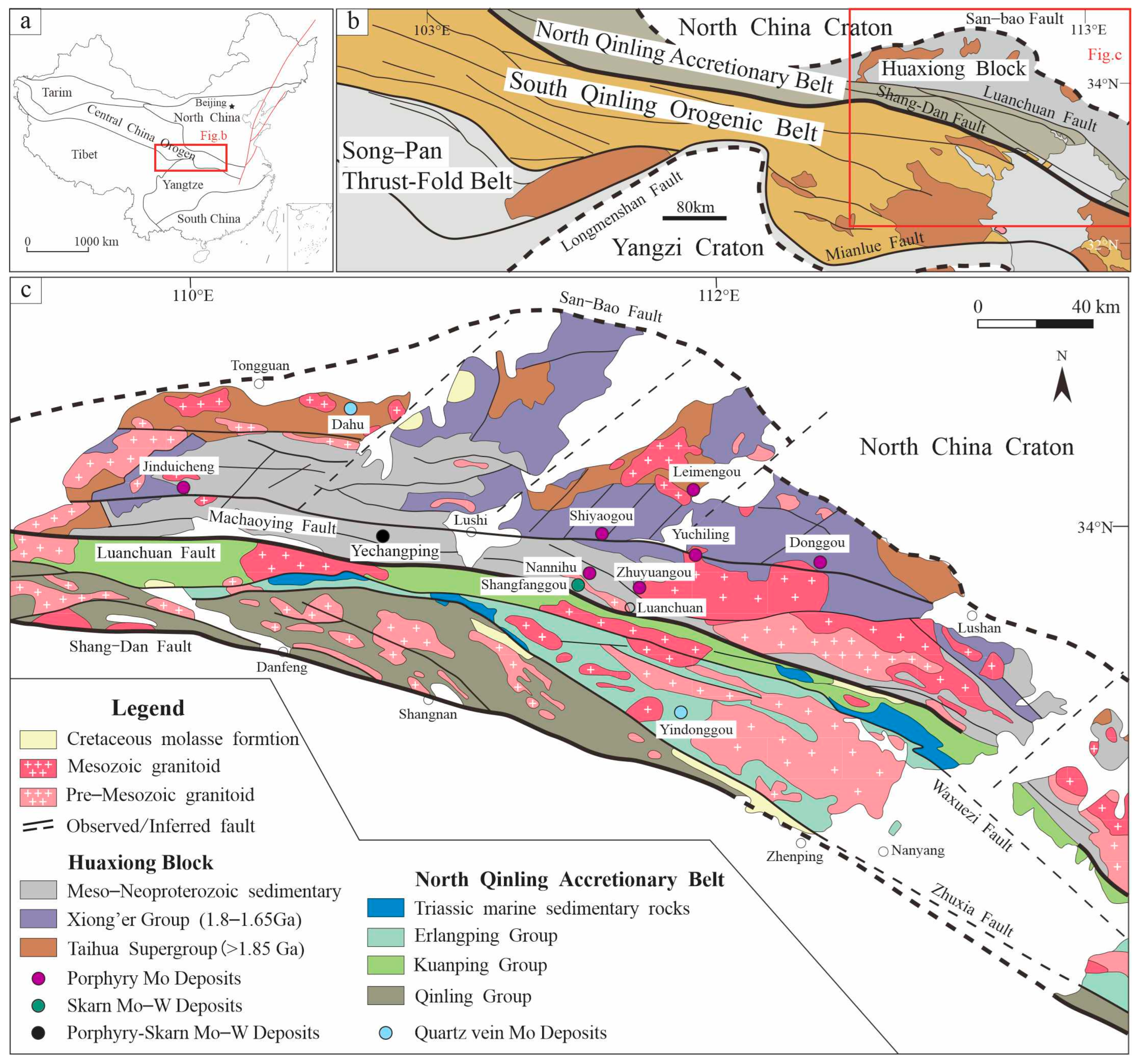
2. Regional Metallogenic Background
3. Deposit Geology
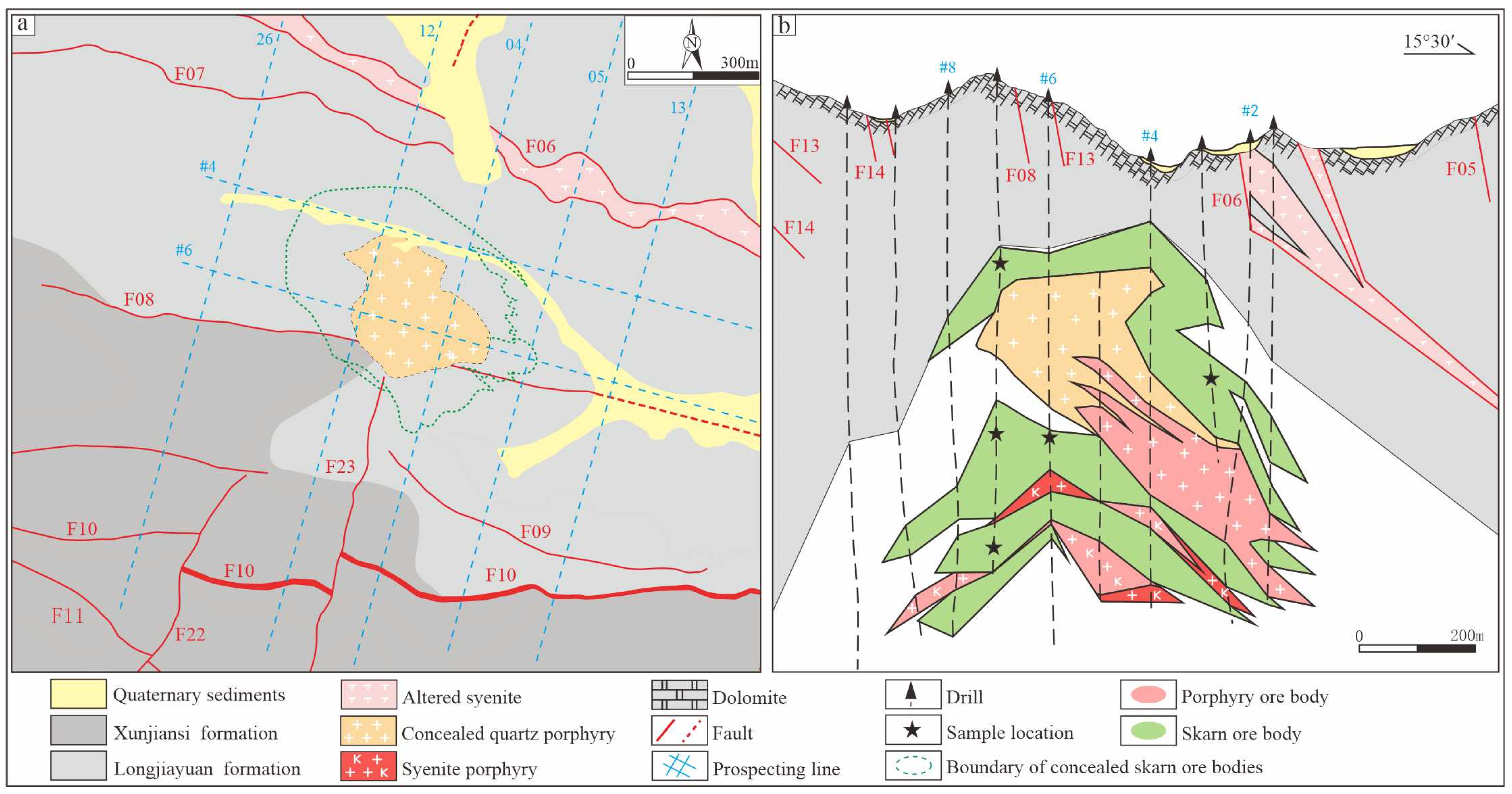
3.1. Geological Features of the Mining Area
3.2. Ore Bodies and Features
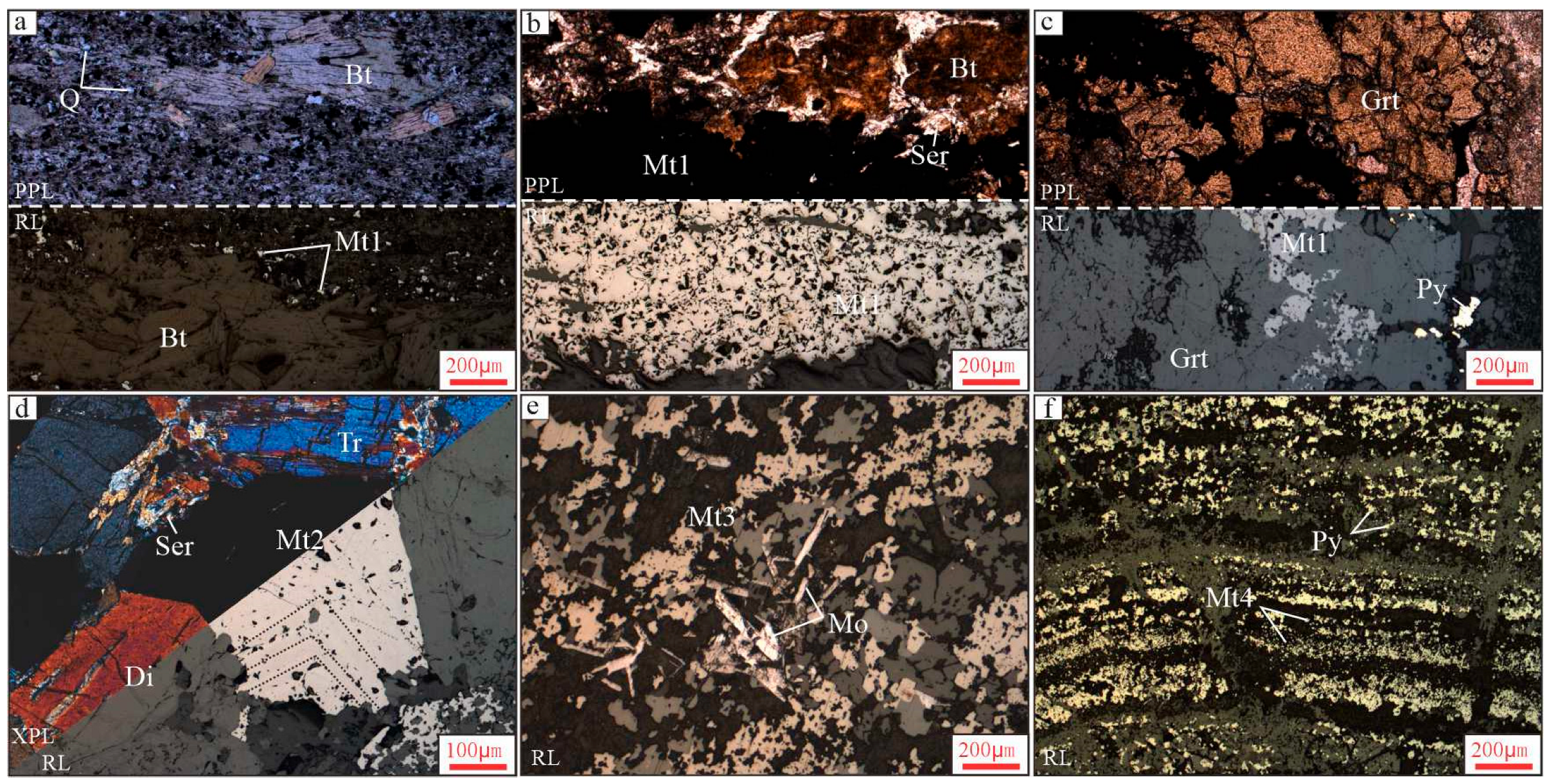
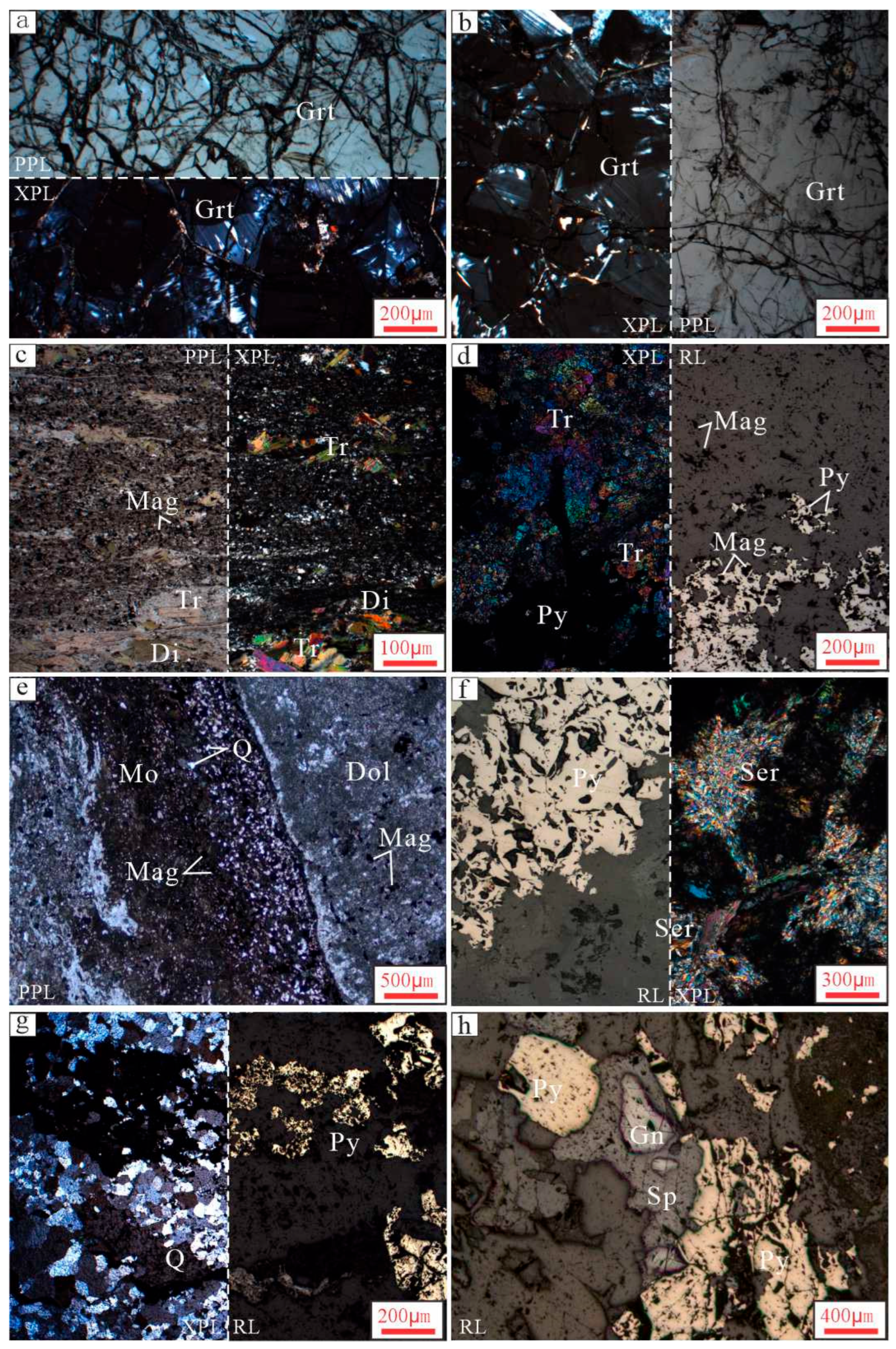
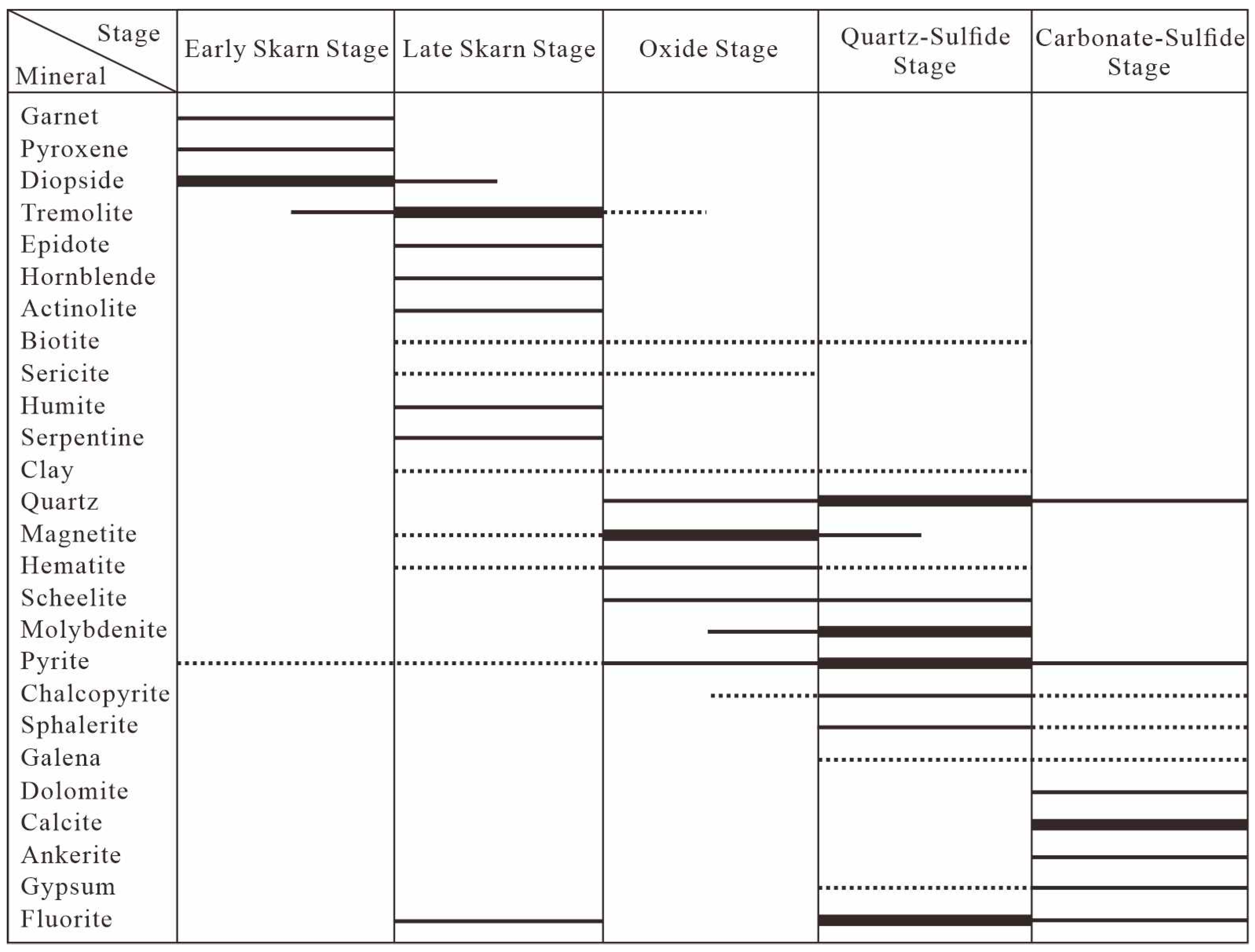
3.3. Paragenetic Sequence
3.4. Magnetite Features
4. Sampling and Analytical Methods
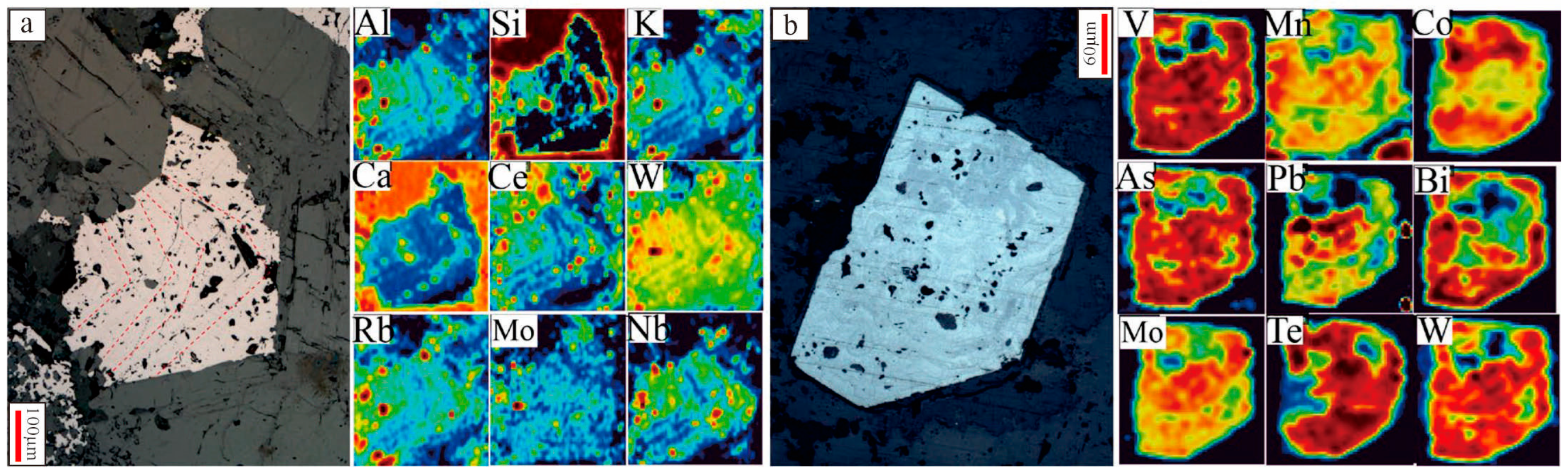
5. Results
6. Discussion
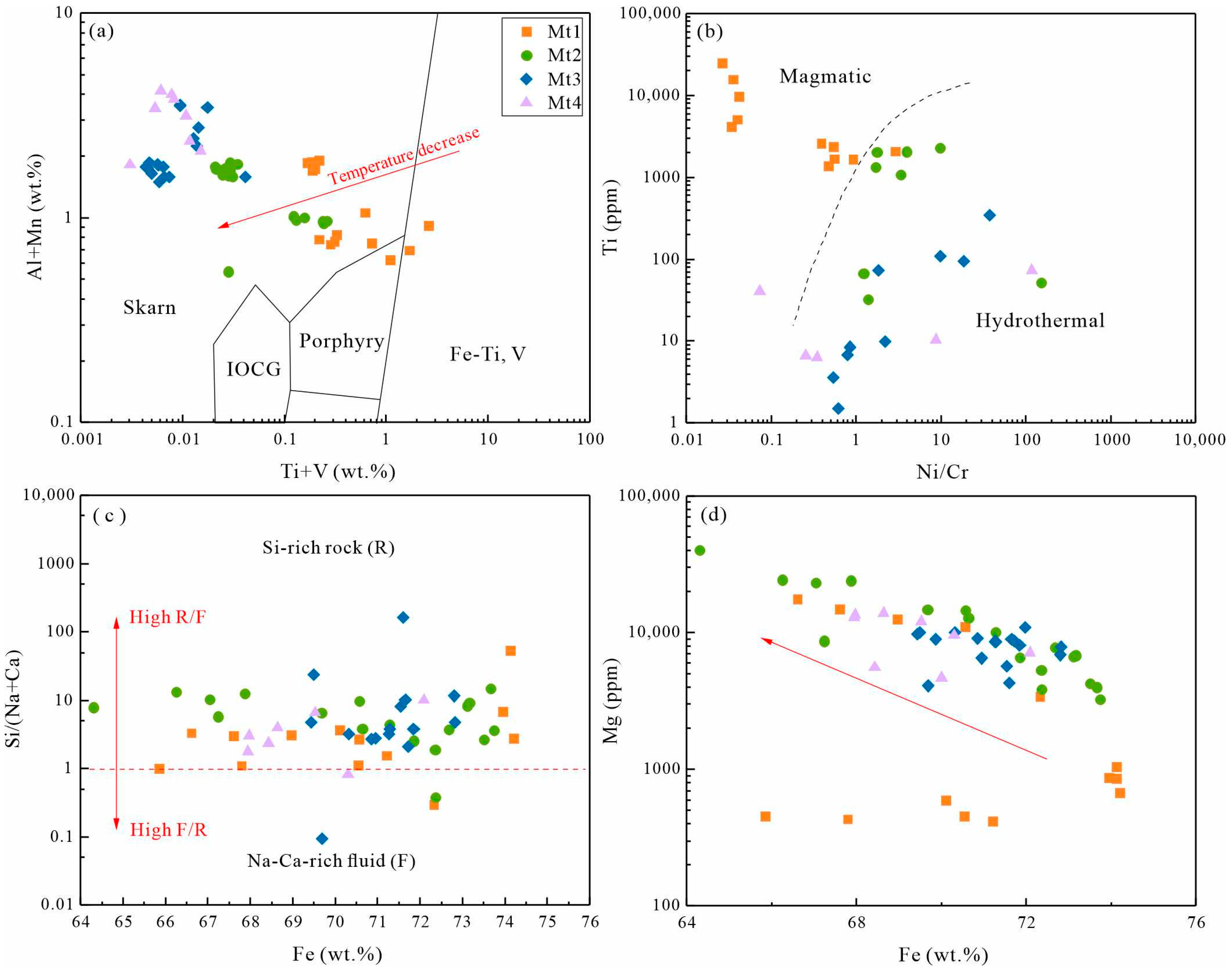
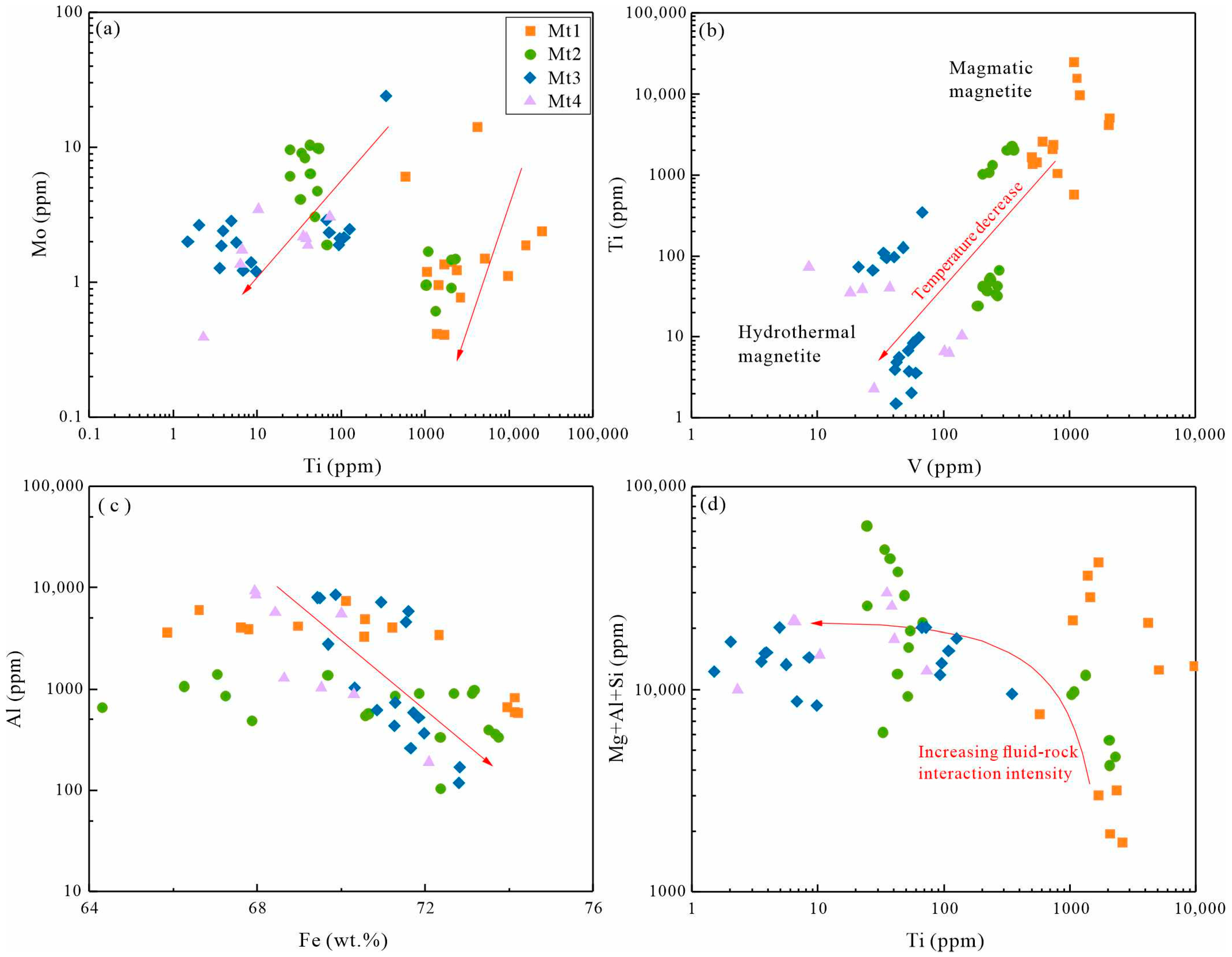
6.1. Genesis of Magnetites
6.2. Ore-Forming Conditions
6.3. Implications for Mineralization and Exploration
7. Conclusions
- (1)
- Magnetite from the Yechangping Mo–W deposit in Henan Province exhibits a complex, multi-stage genesis involving multiple material sources. Magnetite formation spans from the late skarn stage to the polymetallic sulfide stage, during which the ore-forming fluids evolved from a magmatic–hydrothermal system to a contact metasomatic hydrothermal system. The primary material sources include silica-rich intrusions and dolomitic rocks. Isomorphic substitution within the magnetite lattice, together with variations in temperature, pressure, and oxygen fugacity, collectively controlled the compositional characteristics of magnetite.
- (2)
- Magnetite records a systematic evolution of mineralization conditions. Mineralization temperatures decreased progressively with declining Ti contents, whereas oxygen fugacity was relatively high during the early stages and became more variable at later stages. The ore-forming fluids evolved from Si-, Al-, Na-, and K-rich magmatic–hydrothermal fluids to Mg- and Mn-rich contact metasomatic hydrothermal fluids, consistent with a porphyry–skarn system characterized by multi-stage hydrothermal overprinting.
- (3)
- Magnetite provides clear indications for mineralization. Its close association with polymetallic ore assemblages and genetic discrimination results confirms that the Yechangping deposit represents a porphyry–skarn-type polymetallic system. Systematic variations in magnetite composition, characterized by decreasing Ti, Al, and V contents and increasing Fe, Mo, and W contents, effectively mark the main mineralization stage, making magnetite an effective indicator mineral for exploration.
Supplementary Materials
Author Contributions
Funding
Data Availability Statement
Acknowledgments
Conflicts of Interest
References
- Wilkinson, J.J.; Cooke, D.R.; Baker, M.; Chen, H.Y. Magnetite chemistry in the Bagio porphyry Cu-Au district. In Proceedings of the AMIRA 1060-Enhanced Geochemistry Targeting in Magmatic-Hydrothermal Systems: 5th Sponsors Meeting, Hobart, Australia, 15–17 July 2013. [Google Scholar]
- Dare, S.A.; Barnes, S.J.; Beaudoin, G.; Méric, J.; Boutroy, E.; Potvin-Doucet, C. Trace elements in magnetite as petrogenetic indicators. Miner. Depos. 2014, 49, 785–796. [Google Scholar]
- Nadoll, P.; Angerer, T.; Mauk, J.L.; French, D.; Walshe, J.L. The chemistry of hydrothermal magnetite: A review. Ore Geol. Rev. 2014, 61, 1–32. [Google Scholar] [CrossRef]
- Hu, X.; Chen, H.; Beaudoin, G.; Zhang, Y. Textural and compositional evolution of iron oxides at Mina Justa (Peru): Implications for mushketovite and formation of IOCG deposits. Am. Mineral. 2020, 105, 397–408. [Google Scholar]
- Wen, G.; Li, J.W.; Hofstra, A.H.; Li, G.; Beaudoin, G.; Zhao, X.; Yang, X. Hydrothermal reequilibration of igneous magnetite in altered granitic plutons and its implications for magnetite classification schemes: Insights from the Handan-Xingtai iron district, North China Craton. Geochim. Cosmochim. Acta 2017, 213, 255–270. [Google Scholar]
- Qi, Y.; Hu, R.; Gao, J.; Ye, L.; Sun, G.; Tang, Z.; Bi, X. Trace element characteristics of magnetite: Constraints on the genesis of the Lengshuikeng Ag-Pb-Zn deposit, China. Ore Geol. Rev. 2021, 129, 103943. [Google Scholar] [CrossRef]
- Hu, H.; Lentz, D.; Li, J.W.; McFarlane, C.R.M. Reequilibration processes in magnetite from iron skarn deposits. Econ. Geol. 2015, 110, 1–8. [Google Scholar]
- Zhang, S.; Chen, H.; Xiao, B.; Liu, Y.; Zhang, L.; Li, W. Textural and chemical evolution of magnetite from the Paleozoic Shuanglong Fe-Cu deposit: Implications for tracing ore-forming fluids. Am. Mineral. 2023, 108, 178–191. [Google Scholar] [CrossRef]
- Zarasvandi, A.; Rezaei, M.; Raith, J.G.; Karimzadeh Somarin, A.; Pourkaseb, H. Magnetite chemistry of the Sarkuh Porphyry Cu deposit, Urumieh-Dokhtar Magmatic Arc (UDMA), Iran: A record of deviation from the path sulfide mineralization in the porphyry copper systems. J. Geochem. Explor. 2023, 249, 107213. [Google Scholar]
- Wang, Y.; Lai, J.; Cao, Y.; Zhang, M.; Tao, Y.; Li, C.; Ripley, E.M. Compositional variations of magnetite in different sulfide ore types in the Jinchuan Ni-Cu-PGE sulfide deposit, NW China: Insights into the mineralizing processes of conduit-type systems. Chem. Geol. 2023, 637, 121679. [Google Scholar]
- Wagner, C.; Villeneuve, J.; Boudouma, O.; Weber, B.P.; Fazel, N.; Moein, R.K.; Ahadnejad, V. In Situ Trace Element and Fe-O Isotope Studies on Magnetite of the Iron-Oxide Ores from the Takab Region, North Western Iran: Implications for Ore Genesis. Minerals 2023, 13, 774. [Google Scholar]
- Uwamungu, P.; Chen, W.; Zhao, X.; Liu, Y.; Fan, H.; Wang, Q. Evolution of Fe-Ti oxides within the Tiechagou carbonatite-related iron deposit: Insights from texture and in situ chemical compositions of magnetite and ilmenite. Ore Geol. Rev. 2023, 157, 105439. [Google Scholar] [CrossRef]
- Chen, H.J.; Chen, Y.J. Zircon U-Pb ages and Hf isotope characteristics of granitic rocks from the Shapinggou molybdenum deposit, Dabie Shan, China. Ore Geol. Rev. 2022, 150, 105151. [Google Scholar] [CrossRef]
- Zhou, T.C.; Zeng, Q.D.; Gao, S.; Li, W.; Chen, S.Y.; Liu, J.L. Geochronology, geochemistry and fluid inclusions of the Yechangping giant porphyry-skarn Mo-W deposit, East Qinling, China. Ore Geol. Rev. 2020, 127, 103823. [Google Scholar] [CrossRef]
- Ma, L.; Jiang, S.Y.; Dai, B.Z.; Jiang, Y.H.; Ling, H.F. Multiple sources for the origin of Late Jurassic Linglong adakitic granite in the Shandong Peninsula, eastern China: Zircon U-Pb geochronological, geochemical and Sr-Nd-Hf isotopic evidence. Lithos 2013, 162–163, 251–263. [Google Scholar] [CrossRef]
- Mao, J.W.; Xie, G.Q.; Bierlein, F.; Pirajno, F.; Zhang, Z.H.; Li, Y.F. Tectonic implications from Re-Os dating of Mesozoic molybdenum deposits in the East Qinling-Dabie orogenic belt. Geochim. Cosmochim. Acta 2008, 72, 4607–4626. [Google Scholar] [CrossRef]
- Dong, Y.P.; Santosh, M. Tectonic architecture and multiple orogeny of the Qinling Orogenic Belt, Central China. Gondwana Res. 2016, 29, 1–40. [Google Scholar] [CrossRef]
- Zhang, Z.W.; Yang, X.Y.; Dong, Y.; Li, J.W.; Pirajno, F. Molybdenum deposits in the eastern Qinling, central China: Constraints on the geodynamics. Int. Geol. Rev. 2009, 53, 261–290. [Google Scholar] [CrossRef]
- Li, D.; Zhang, S.T.; Yan, C.H.; Zhou, L.W.; Yang, Y.C. Late Mesozoic time constraints on tectonic changes of the Luanchuan Mo belt, East Qinling orogen, Central China. J. Geodyn. 2012, 61, 94–104. [Google Scholar] [CrossRef]
- Bao, Z.W.; Xiong, M.F.; Li, Q. Mo-rich source and protracted crystallization of Late Mesozoic granites in the East Qinling porphyry Mo belt (central China): Constraints from zircon U/Pb ages and Hf-O isotopes. J. Asian Earth Sci. 2018, 160, 322–333. [Google Scholar] [CrossRef]
- Chen, Y.J.; Wang, P.; Li, N.; Pirajno, F.; Chen, H.Y. The collision-type porphyry Mo deposits in Dabie Shan, China. Ore Geol. Rev. 2017, 81, 405–430. [Google Scholar] [CrossRef]
- Li, N.; Chen, Y.J.; Zhang, H.; Li, Y.K. Geological characteristics and metallogenic tectonic setting of the East Qinling porphyry molybdenum belt. Earth Sci. Front. 2007, 14, 186–198, (In Chinese with English abstract). [Google Scholar]
- Li, N.; Pirajno, F. The genesis of the giant Yechangping Mo-W deposit, East Qinling, China: Constraints from geology, fluid inclusions and H-O-S-Pb isotopes. Ore Geol. Rev. 2017, 81, 912–927. [Google Scholar]
- Li, Y.; Chen, Y.J.; Li, N.; Pirajno, F.; Wang, J.P. Magnetite geochemistry of the giant Sandaozhuang porphyry-skarn Mo-W deposit, East Qinling, China: Implications for ore-forming processes. Ore Geol. Rev. 2018, 101, 344–358. [Google Scholar]
- Nie, F.J. Rare earth element geochemistry of the molybdenum-bearing granitoids in the Jinduicheng-Huanglongpu district, Shaanxi Province, northwest China. Miner. Depos. 1994, 29, 488–498. [Google Scholar] [CrossRef]
- Stein, H.J.; Markey, R.J.; Morgan, J.W.; Wooden, J.L. Highly precise and accurate Re-Os ages for molybdenite from the East Qinling molybdenum belt, Shaanxi Province, China. Econ. Geol. 1997, 92, 827–835. [Google Scholar] [CrossRef]
- Mao, J.W.; Pirajno, F.; Xiang, J.F.; Li, Z.Q.; Li, Y.C. Mesozoic molybdenum deposits in the east Qinling-Dabie orogenic belt: Characteristics and tectonic settings. Ore Geol. Rev. 2011, 43, 264–293. [Google Scholar] [CrossRef]
- Cao, H.W.; Zhang, S.T.; Santosh, M.; Li, D.; Zhang, R.Q.; Zhao, G.C. The Luanchuan Mo-W-Pb-Zn-Ag magmatic-hydrothermal system in the East Qinling metallogenic belt, China: Constrains on metallogenesis from C-H-O-S-Pb isotope compositions and Rb-Sr isochron ages. J. Asian Earth Sci. 2015, 111, 751–780. [Google Scholar] [CrossRef]
- Li, N.; Chen, Y.J.; Santosh, M.; Wang, Q.F.; Yang, Y.H. Late Mesozoic granitoids in the Qinling Orogen, Central China, and tectonic significance. Earth-Sci. Rev. 2018, 182, 141–173. [Google Scholar]
- Yang, F.; Xue, F.; Santosh, M.; Zhao, Y.; Li, C.Y. Late Mesozoic magmatism in the East Qinling Orogen, China and its tectonic implications. Geosci. Front. 2019, 10, 1803–1821. [Google Scholar] [CrossRef]
- Chen, K.; Tang, M.; Hu, Z.; Zhan, W.H.; Li, S.; Zhong, H.; Yang, Y.H. Generation of tholeiitic and calc-alkaline arc magmas and its implications for continental growth. Geochim. Cosmochim. Acta 2023, 355, 173–183. [Google Scholar] [CrossRef]
- Tang, L.; Chen, P.L.; Santosh, M.; Zhao, Y.; Li, C.Y.; Lu, J.J. Geology and genesis of auriferous porphyritic monzogranite and its correlation with the Qiyugou porphyry-breccia system in East Qinling, Central China. Ore Geol. Rev. 2022, 142, 104709. [Google Scholar] [CrossRef]
- Miao, X.B.; Wang, R.; Hou, Z.Q.; Tian, S.H.; Yang, X.Y.; Li, Z. Mo endowment of porphyry deposits in the southern margin of the North China Craton controlled by magmatic water content. Miner. Depos. 2023, 58, 1499–1518. [Google Scholar]
- Yan, G.L.; Qi, X.J.; Xiao, C.; Miao, G.; Dong, G.C.; Jiang, H.Y. Genesis types and indications of magnetite in Yechangping porphyry-skarn type Mo-W deposit, East Qinling Mo polymetallic metallogenic belt. Gold 2024, 45, 34–44, (In Chinese with English abstract). [Google Scholar]
- Luan, Y.; Sun, X.H.; Liu, M.W.; He, K. Study on in-situ LA-ICP-MS trace element analytical method for magnetite. Bull. Geol. Sci. Technol. 2021, 40, 167–175, (In Chinese with English abstract). [Google Scholar]
- Nadoll, P.; Mauk, J.L.; Leveille, R.A.; French, D.; Walshe, J.L. Geochemistry of magnetite from porphyry Cu and skarn deposits in the southwestern United States. Miner. Depos. 2015, 50, 493–515. [Google Scholar]
- You, G.Q.; Cui, Y.C.; Sun, Y.; Gao, S.R.; Feng, L.J. Enrichment mechanism of tellurium in cobalt-rich crusts from the Pacific Ocean: Constraints from paleoceanographic redox conditions. Miner. Depos. 2014, 49, 1023–1035. [Google Scholar]
- Guo, X.Z.; Li, Y.; Zhang, Y.; Wang, J.; Li, J.; Liu, H.F. Discovery of tellurium minerals in the Shuanghuwan gold deposit, Sanjiang Metallogenic Belt, and their geological significance. Acta Petrol. Sin. 2025, 41, 589–602. [Google Scholar]
- Ding, G.M.; Yan, G.L.; Wang, K.M.; Qi, X.J.; Xiao, C.; Dong, G.C. Characteristics of Fluid Inclusions and Mineralization Indications of the Yechangping Mo Deposit, East Qinling. Geoscience 2024, 38, 1177–1191, (In Chinese with English abstract). [Google Scholar]
- Deditius, A.P.; Reich, M.; Simon, A.C.; Suvorova, A.; Knipping, J.; Roberts, M.P.; Rubanov, S.; Dodd, A.; Saunders, M. Nanogeochemistry of hydrothermal magnetite. Contrib. Mineral. Petrol. 2018, 173, 46. [Google Scholar]
- Spencer, K.J.; Lindsley, D.H. A solution model for coexisting iron–titanium oxides. Am. Mineral. 1981, 66, 1189–1201. [Google Scholar]
- Ghiorso, M.S.; Sack, R.O. Fe–Ti oxide geothermometry: Thermodynamic formulation and the estimation of temperature and oxygen fugacity. Contrib. Mineral. Petrol. 1991, 108, 485–510. [Google Scholar] [CrossRef]
- Sauerzapf, U.; Lattard, D.; Burchard, M.; Engelmann, R. Titanomagnetite–ilmenite equilibrium: New experimental data and thermo-oxybarometric application. J. Petrol. 2008, 46, 521–542. [Google Scholar]
- Canil, D.; Grondahl, C.; Lacourse, T.; Lawley, C. Trace elements in magnetite from porphyry Cu-Mo-Au deposits in British Columbia, Canada. Ore Geol. Rev. 2016, 72, 1116–1128. [Google Scholar]
- Li, Y.; Chen, Y.J.; Pirajno, F.; Li, N.; Wang, J.P. Trace element geochemistry of magnetite from the giant Sandaozhuang porphyry-skarn Mo-W deposit, East Qinling, China: Implications for ore-forming evolution and exploration. Ore Geol. Rev. 2021, 135, 104218. [Google Scholar]
- Wang, Z.L.; Mao, J.W.; Pirajno, F.; Yang, F. Magnetite geochemistry of the Nannihu giant porphyry Mo deposit, East Qinling, China: Constraints on ore genesis and exploration implications. J. Asian Earth Sci. 2022, 226, 105078. [Google Scholar]
- Dare, S.A.S.; Barnes, S.-J.; Beaudoin, G. Variation in trace element content of magnetite crystallized from porphyry systems: Implications for ore deposit classification. Miner. Depos. 2014, 49, 785–804. [Google Scholar] [CrossRef]
- Huang, X.W.; Sappin, A.A.; Boutroy, É.; Beaudoin, G.; Makvandi, S.; Corriveau, L. Trace element composition of igneous and hydrothermal magnetite from porphyry deposits: Relationship to deposit subtypes and magmatic affinity. Econ. Geol. 2019, 114, 917–952. [Google Scholar] [CrossRef]
- Sossi, P.A.; Prytulak, J.; O’neill, H.S.C. Experimental calibration of vanadium partitioning and stable isotope fractionation between hydrous granitic melt and magnetite at 800 °C and 0.5 GPa. Contrib. Mineral. Petrol. 2018, 173, 27. [Google Scholar] [CrossRef]
- Sun, W.D.; Liang, H.Y.; Ling, M.X.; Ding, X.; Li, C.Y.; Ireland, T.R. The link between reduced porphyry copper deposits and oxidized magmas. Geochim. Cosmochim. Acta 2013, 103, 263–275. [Google Scholar] [CrossRef]
- Knipping, J.L.; Bilenker, L.D.; Simon, A.C.; Reich, M.; Barra, F.; Deditius, A.P.; Wälle, M.; Heinrich, C.A.; Holtz, F.; Munizaga, R. Trace elements in magnetite from massive iron oxide–apatite deposits indicate a combined formation by igneous and magmatic-hydrothermal processes. Geochim. Cosmochim. Acta 2015, 171, 15–38. [Google Scholar] [CrossRef]
- Tian, J.; Zhang, Y.; Gong, L.; White, N.C.; Chang, Z.S.; Li, J.W. Genesis, geochemical evolution and metallogenic implications of magnetite: Perspective from the giant Cretaceous Atlas porphyry Cu-Au deposit (Cebu, Philippines). Ore Geol. Rev. 2021, 133, 104084. [Google Scholar] [CrossRef]
- Zhao, Z.; Jin, M.Q.; Yang, X.Y.; Liu, L.; Hu, Z.K.; Liu, X.Y. Apatite and scheelite geochemistry constraints on the properties and evolution of the Yechangping Mo-W Deposit, East Qinling, central China. Ore Geol. Rev. 2025, 188, 107055. [Google Scholar] [CrossRef]
- Li, Y.; Chen, Y.J.; Zhou, M.F.; Li, N.; Pirajno, F.; Wang, J.P. Hydrothermal Evolution and Ore Genesis of the Piaotang Tungsten-Molybdenum Deposit, East Qinling Orogen, China: Constraints from Fluid Inclusions and Trace Elements. Ore Geol. Rev. 2020, 122, 103586. [Google Scholar]



Disclaimer/Publisher’s Note: The statements, opinions and data contained in all publications are solely those of the individual author(s) and contributor(s) and not of MDPI and/or the editor(s). MDPI and/or the editor(s) disclaim responsibility for any injury to people or property resulting from any ideas, methods, instructions or products referred to in the content. |
© 2026 by the authors. Licensee MDPI, Basel, Switzerland. This article is an open access article distributed under the terms and conditions of the Creative Commons Attribution (CC BY) license.
Share and Cite
Miao, G.; Dong, G.; Yan, G.; Qi, X.; Xiao, C.; Jiang, H.; Shi, Z. Geochemical Fingerprints of Magnetite in Yechangping Super-Large Mo-W Deposit, Western Henan, China: Constraints on Ore-Forming Evolution and Prospecting Implications. Minerals 2026, 16, 374. https://doi.org/10.3390/min16040374
Miao G, Dong G, Yan G, Qi X, Xiao C, Jiang H, Shi Z. Geochemical Fingerprints of Magnetite in Yechangping Super-Large Mo-W Deposit, Western Henan, China: Constraints on Ore-Forming Evolution and Prospecting Implications. Minerals. 2026; 16(4):374. https://doi.org/10.3390/min16040374
Chicago/Turabian StyleMiao, Guang, Guochen Dong, Guolong Yan, Xiaojun Qi, Chun Xiao, Haoyuan Jiang, and Zhiwei Shi. 2026. "Geochemical Fingerprints of Magnetite in Yechangping Super-Large Mo-W Deposit, Western Henan, China: Constraints on Ore-Forming Evolution and Prospecting Implications" Minerals 16, no. 4: 374. https://doi.org/10.3390/min16040374
APA StyleMiao, G., Dong, G., Yan, G., Qi, X., Xiao, C., Jiang, H., & Shi, Z. (2026). Geochemical Fingerprints of Magnetite in Yechangping Super-Large Mo-W Deposit, Western Henan, China: Constraints on Ore-Forming Evolution and Prospecting Implications. Minerals, 16(4), 374. https://doi.org/10.3390/min16040374