Abstract
Shale lithofacies is a key geological factor controlling the hydrocarbon generation capacity and fracturing effectiveness of shale reservoirs. Current research on lithofacies remains insufficient for the exploration and evaluation of shallow shale gas in complex structural areas of southern China. This study focuses on the shale of the Wufeng-Longmaxi Formation in the Taiyang anticlinal structure within the Zhaotong National Shale Gas Demonstration Zone. By utilizing logging data to calculate mineral content characteristics in the study area and identifying lithofacies types based on the DEI (Dual-Energy Index) derived from dual-energy computed tomography scanning analysis of full-diameter core samples, this paper comprehensively analyzes the control of different lithofacies on key reservoir attributes. The results indicate that the target shale in the Taiyang area exhibits high brittle mineral content (averaging 66.07%), while the clay mineral content averages 30.89%, and the content of other minerals is only 3.04%, showing distinct regularity in both vertical and planar distribution. Based on the DEI method, lithofacies are classified into biogenic siliceous shale, argillaceous shale, calcareous shale, and limestone. Among these, biogenic siliceous shale, characterized by abundant brittle minerals and bioclast laminations, has the highest brittleness index and the richest organic matter content, making it the optimal lithofacies for reservoirs. Calcareous shale exhibits moderate brittleness and low organic matter content, while argillaceous shale, dominated by clay matrix, has the lowest brittleness index and moderate organic matter content. The findings highlight the critical influence of lithofacies on reservoir quality and provide important guidance for the preferential selection and exploration of favorable lithofacies in shallow shale gas reservoirs in similar complex structural regions in southern China.
1. Introduction
As a green, clean, efficient, and low-carbon energy source, shale gas plays a crucial role in optimizing China’s energy structure and achieving the “dual carbon” goals by intensifying its exploration and development [1,2,3]. The unconventional natural gas resources from marine hydrocarbon source rocks in the complex structural areas of southern China hold immense potential. After more than a decade of exploration and practice, PetroChina Zhejiang Oilfield Company has successfully achieved a commercial breakthrough in shale gas across the region. Notably, the Taiyang anticlinal structure within the Zhaotong National Shale Gas Demonstration Zone achieved a breakthrough in shallow shale gas exploration in 2019, with proven geological reserves exceeding 1 × 10 × 12 m3, along with the identification of a 300 km2 production development area. Over 40 horizontal wells already in operation have shown steadily increasing test production rates, indicating abundant resource potential [4,5,6].
Current research in this area primarily focuses on structural evolution, reservoir characteristics, geochemical features, and extraction technologies, while studies on shale lithofacies characteristics and their evaluation remain relatively scarce. Shale lithofacies significantly influence shale reservoirs, controlling to some extent their hydrocarbon generation capacity and fracturing performance, as different lithofacies types exhibit distinct sedimentary origins and mineral compositions [7,8,9]. Previous studies have often relied on outcrop characteristics combined with core descriptions, thin-section observations, and geochemical data to investigate lithofacies features [10,11,12]. However, due to limited outcrop data and high coring costs, systematic lithofacies descriptions at the single-well scale are often lacking. Therefore, this study focuses on the Longmaxi Formation shale in the Zhaotong Taiyang area. By utilizing logging data to calculate mineral content characteristics and identifying lithofacies types based on the DEI derived from dual-energy computed tomography scanning analysis of full-diameter core samples, we systematically analyze the mineral and lithofacies characteristics. Furthermore, we summarize the differences in reservoir brittleness index and organic matter content across various lithofacies. The findings aim to provide valuable references for the exploration and evaluation of shallow shale gas in similar complex structural regions in southern China.
2. Geological Background
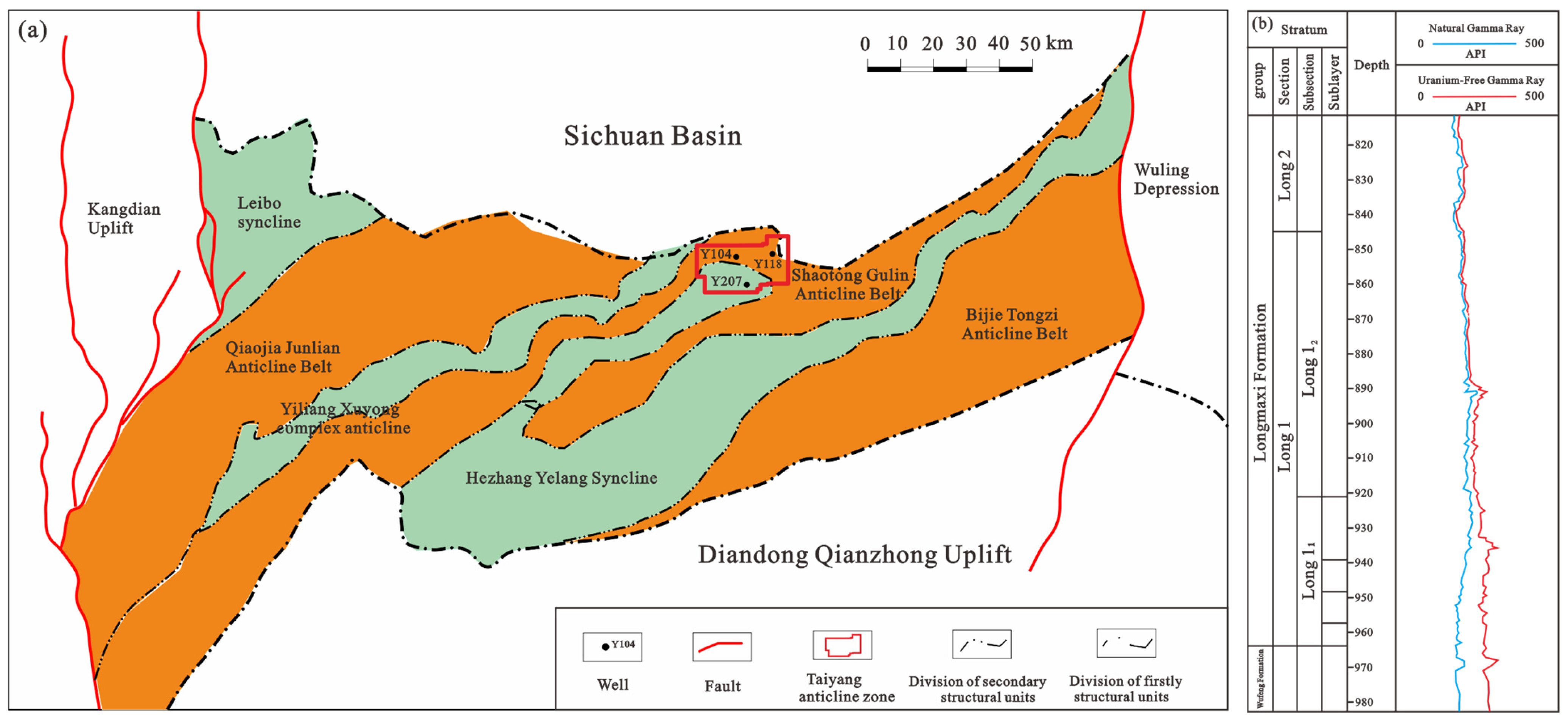
The Zhaotong Demonstration Zone is located in the Wumeng Mountain area, tectonically situated in the southwestern part of the Upper Yangtze Block. It primarily belongs to the complex residual structural depression zone outside the Sichuan Basin (the Dianqianbei Depression). In the north, it spans the low-steep fold belt of the southern marginal platform depression of the Sichuan Basin, while in the south, it borders the Dianqianbei Uplift. The Taiyang shallow shale gas field lies in the northeastern part of the demonstration zone [13,14,15] [Figure 1a]. The Zhaotong exploration area has undergone multiple phases of intraplate deformation and superposition due to orogenic movements since the Caledonian period, resulting in a structural deformation pattern dominated by compartmentalized fold belts, combined with thrust and strike-slip movements. Large faults, fracture zones, and through-going faults are well-developed. Shale formations in anticlinal zones have been largely eroded, leaving shale gas reservoirs preserved only in synclinal areas. The preservation conditions here are generally poorer compared to the more stable Sichuan Basin region to the north, forming shale gas geological characteristics typical of complex structural areas, including “strong reformation, over-maturity, and shear stress,” as well as the unique conditions of mountain shale gas [16,17]. Regional sedimentary and structural studies in South China indicate that during the Middle to Late Ordovician, a hard collision occurred between the Cathaysia Block and the Yangtze Block, forming an orogenic belt in the Xuefeng-Jiangnan region that continuously thrust northwestward. Influenced by the Kangdian Paleo-uplift to the west and the central Sichuan uplift to the northwest, a foreland basin belt of the Yangtze River developed during the Late Ordovician to Early Silurian in the southern Sichuan-Chongqing, northern Guizhou, and western Hunan-Hubei regions [18,19].
Figure 1.
Location and stratigraphic diagram of the Taiyang shallow shale gas field in the Zhaotong Demonstration Zone. (a) Location plan of the Taiyang shallow shale gas field in the Zhaotong Demonstration Zone; (b) Stratigraphic diagram of the target interval.
In the Zhaotong Demonstration Zone, the Upper Ordovician Wufeng Formation consists of black graptolitic shale and argillaceous shelly limestone, with relatively thin thickness. The Lower Silurian Longmaxi Formation can be divided into the first member (Long1 Member) and the second member (Long2 Member). Based on lithofacies associations and logging response characteristics, the Long1 Member is further subdivided into the Long11 Submember and the Long12 Submember. The Long11 Submember represents the high-quality shale development interval, which, according to shale gas production requirements, can be further divided from bottom to top into four sub-layers: Long111, Long112, Long13, and Long114 [20] [Figure 1b].
3. Mineral Characteristics
The mineral composition of rocks serves as the foundation for studying shale reservoir conditions [21,22]. Building upon the understanding of the sedimentary background and developmental characteristics of organic-rich shale in the Taiyang area, this study utilizes logging data to calculate the contents of brittle minerals and clay minerals, thereby conducting an analysis and discussion of the mineral fabric characteristics.
3.1. Brittle Minerals
Systematic sampling was conducted in the coring interval of the study area. The percentage contents of siliceous and calcareous minerals were obtained through XRD experiments, while conventional logging data (deep lateral resistivity RT, compensated neutron CNL, uranium-free gamma KTH, etc.) corresponding to the depths were extracted. Subsequently, multiple linear regression or stepwise regression methods were employed, with the XRD-measured mineral content as the dependent variable and the logging response values as independent variables. The regression coefficients were fitted using the least squares method, and their significance was tested. Finally, a mineral content calculation model was established, with the calculation formula as follows:
VSi = 0.03017 × CNL−0.814 + 0.04473 × RT0.1787 + 2.0454 × KTH−0.516 + 0.049
VCAR = 4.1683 × KTH−0.815 + 0.01915 × CNL−1.296 − 0.02918
In the formula, VSi represents the total amount of siliceous minerals, %; V CAR is the total amount of carbonate minerals, %; CNL is the neutron logging value, pu; KTH is the uranium-free gamma logging value, API; RT is the deep resistivity logging value, Ω·m.
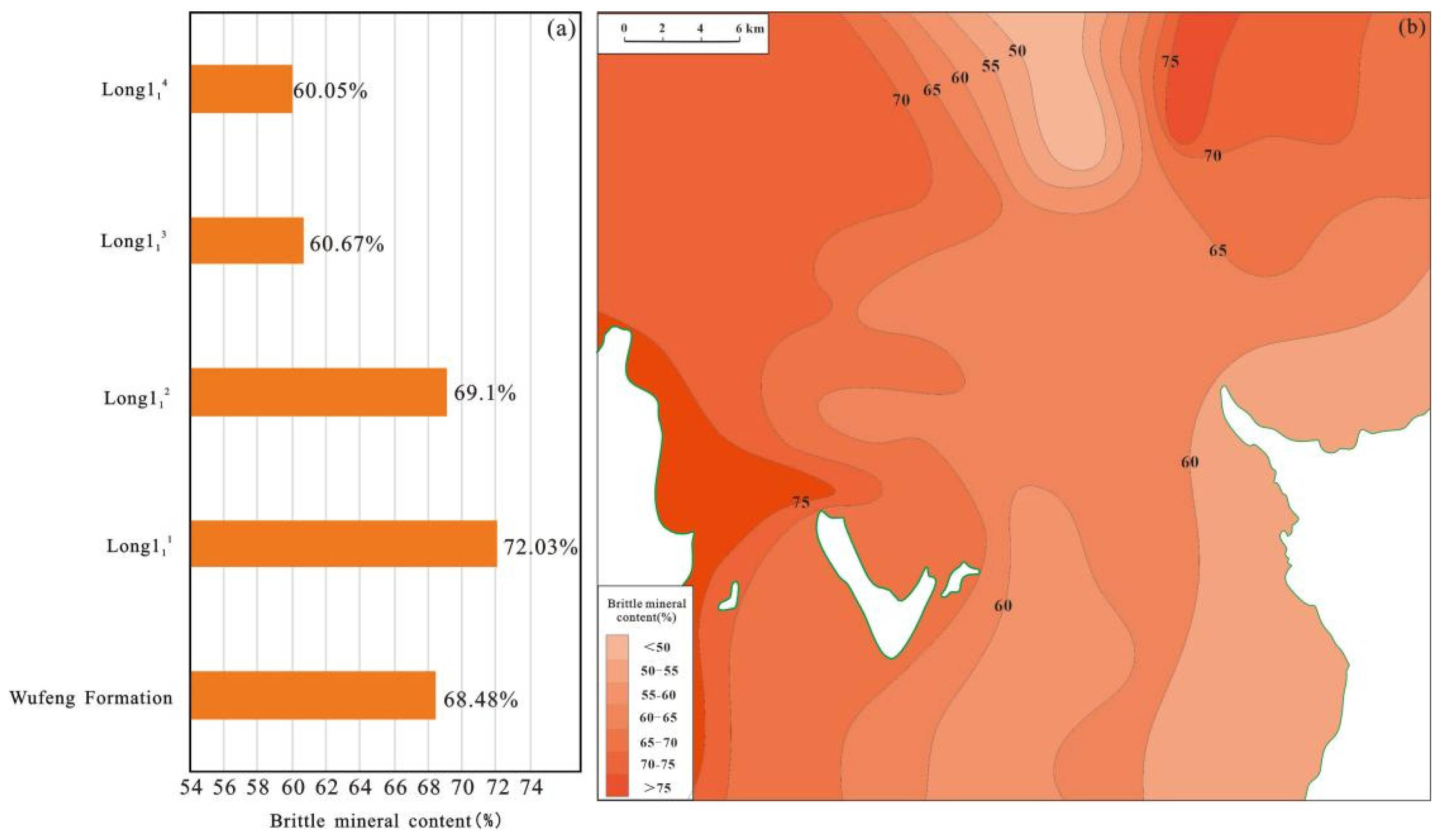
Based on the calculations using the above formulas, the brittle mineral content in the Wufeng Formation to the Long11 Member of the Taiyang shale gas field is generally high, ranging from 50.82% to 84.64%, with an average of 66.07%. The vertical variation in brittle mineral content follows the sequence Long111 (72.03%) > Long112 (69.10%) > Wufeng Formation (68.48%) > Long113 (60.67%) > Long114 (60.05%) [Figure 2a]. Overall, the content exhibits an increasing trend from east to west [Figure 2b].
Figure 2.
Vertical and Planar Distribution Characteristics of Brittle Mineral Content in the Wufeng Formation to Long11 Member of the Taiyang Shale Gas Field. (a) Vertical distribution diagram of brittle mineral content from the Wufeng Formation to the Long11 Member in the Taiyang Shale Gas Field; (b) Planar distribution map of brittle mineral content from the Wufeng Formation to the Long11 Member in the Taiyang Shale Gas Field.
3.2. Clay Minerals
Based on the correlation analysis between X-ray diffraction whole-rock mineral analysis samples and conventional logging curves from the Wufeng Formation to Longmaxi Formation in the Taiyang shale gas field, a good correlation was observed between clay content and logging curves such as resistivity and uranium-free gamma ray. Consequently, a calculation model for clay content in the Wufeng Formation to Longmaxi Formation of the Taiyang shale gas field was established, with the formula as follows:
VCALY = 0.004669 × KTH0.7147 + 0.8119 × RT−0.272 − 0.03661
In the formula, VCALY is the total amount of clay, %; KTH is the uranium-free gamma logging value, %; RT is the deep resistivity logging value, Ω·m.
Based on calculations using the above formula, the clay mineral content in the study area ranges from 9.6% to 64.3%, with an average value of 30.89%. The clay minerals are predominantly composed of illite (15%–84%, average 50.81%) and illite/smectite mixed-layer minerals (1%–71%, average 33.12%), followed by chlorite (4%–30%, average 15.79%) and kaolinite (1%–9%, average 4.14%). The clay mineral content in the Wufeng Formation to Long11 Member similarly exhibits a gradual downward decrease, ranging from 9.6% to 44%, with an average of 29.8%. In contrast, the clay mineral content in the Long12 Member mainly ranges from 27% to 42.1%, with an average of 36.16%.
4. Lithofacies Identification and Thin-Section Characteristics
4.1. DEI Method for Lithofacies Identification
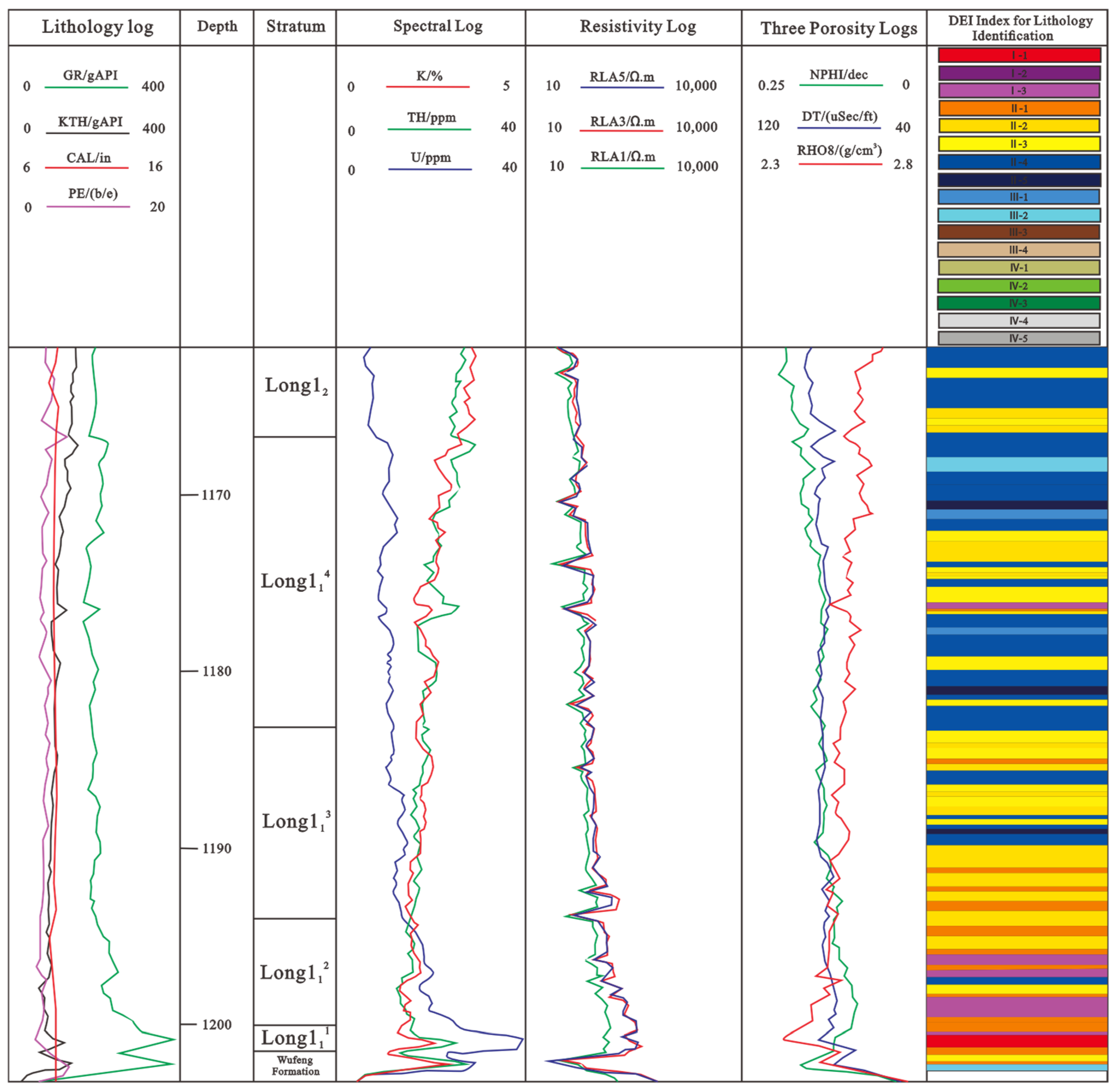
The DEI obtained through dual-energy computed tomography (CT) scanning analysis of full-diameter cores can accurately identify lithofacies. Therefore, using the core DEI as a calibration standard, a computational model between the DEI and various logging curves is established to calculate a continuous DEI curve. This serves as the basis for automatically identifying shale reservoir lithofacies. Figure 3 illustrates the automatic identification of lithofacies in the shale gas reservoir of Well Y104 using the DEI. The lithology log in track 7 includes four major categories subdivided into 17 minor lithology types: ① biogenic siliceous shale (subdivided into I-1, I-2, I-3); ② argillaceous shale (subdivided into II-1, II-2, II-3, II-4, II-5); ③ calcareous shale (subdivided into III-1, III-2, III-3, III-4); and ④ limestone, among others (subdivided into IV-1, IV-2, IV-3, IV-4, IV-5).
Figure 3.
Log-based lithology identification diagram of Well Y104.
Four lithofacies are developed in the shallow shale gas reservoirs of the Taiyang area. Among these, biogenic siliceous shale is predominantly distributed in the Long111 and Long112 members, with minor occurrences in the Wufeng Formation and the base of the Long113 member. Argillaceous shale is mainly found in the Long113, Long114, and Long12 members. Calcareous shale primarily occurs in the Long2 member and the top of the Long12 member, while limestone is distributed within the Long2 member (Table 1). Biogenic siliceous shale, argillaceous shale, and calcareous shale constitute the main lithofacies types in the Wufeng-Longmaxi formations of the Taiyang area.
Table 1.
Distribution Table of Major Lithofacies in the Wufeng-Longmaxi Formation, Taiyang Area.
4.2. Lithofacies Thin-Section Characteristics of Shale
Based on the lithofacies identification method using the DEI, four lithofacies are developed in the Taiyang area, with biogenic siliceous shale, argillaceous shale, and calcareous shale being the predominant types. This study focuses on the shale gas reservoirs of the Ordovician Wufeng Formation to the Silurian Longmaxi Formation in the Taiyang area. Experimental samples were selected according to the aforementioned lithofacies classification, with representative core samples of biogenic siliceous shale, argillaceous shale, and calcareous shale chosen for optical thin-section and SEM analyses. All samples were collected from key cored wells in the study area (52 samples from Well Y104, 50 samples from Well Y118, and 54 samples from Well Y207), covering major intervals such as Long111, Long112, Long113, Long114, the Wufeng Formation, and Long12, ensuring systematic and representative coverage in terms of stratigraphy and lithofacies.
4.2.1. Biogenic Siliceous Shale
- (1)
- Optical Thin-Section Characteristics
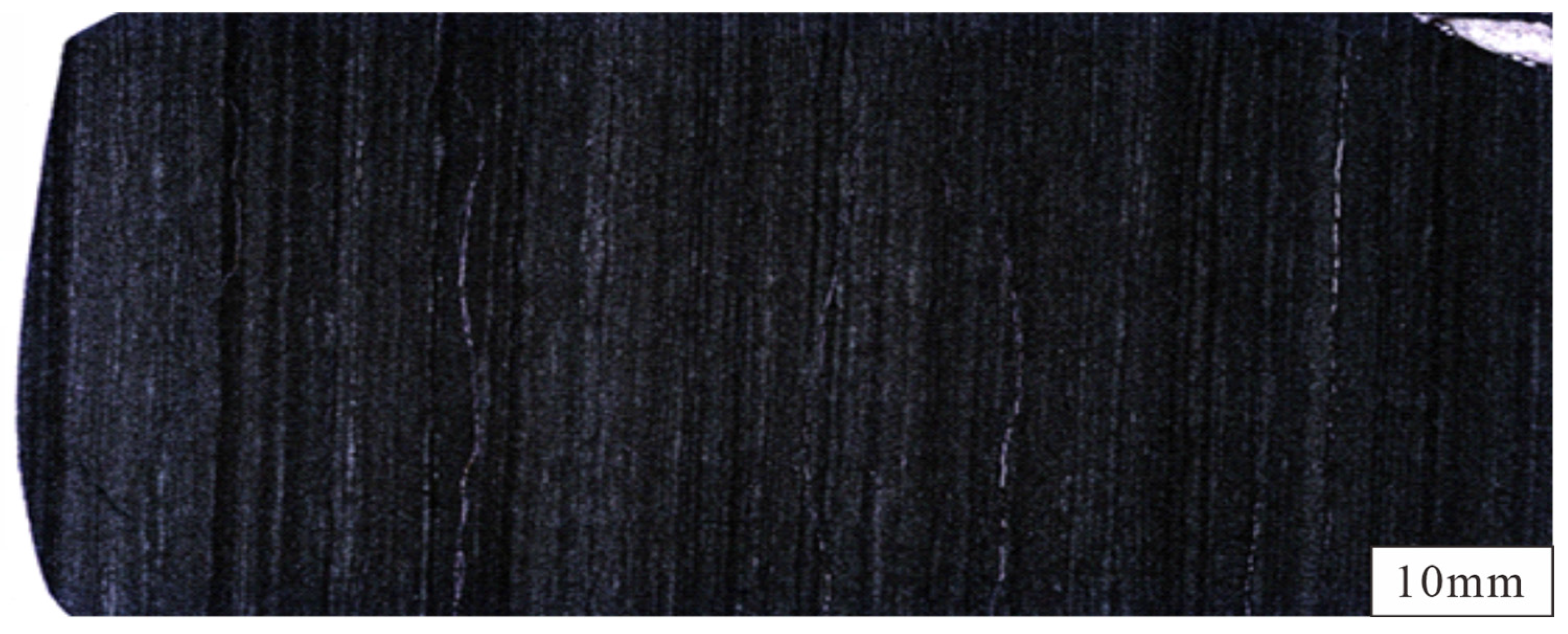
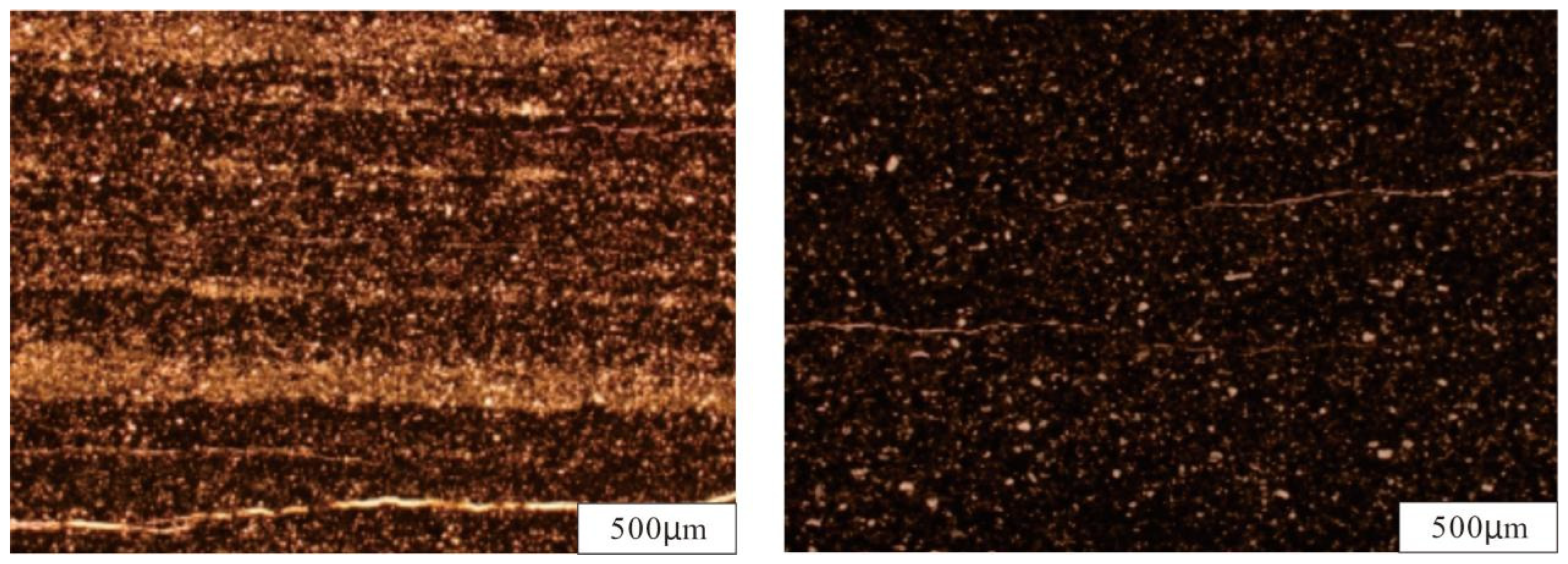
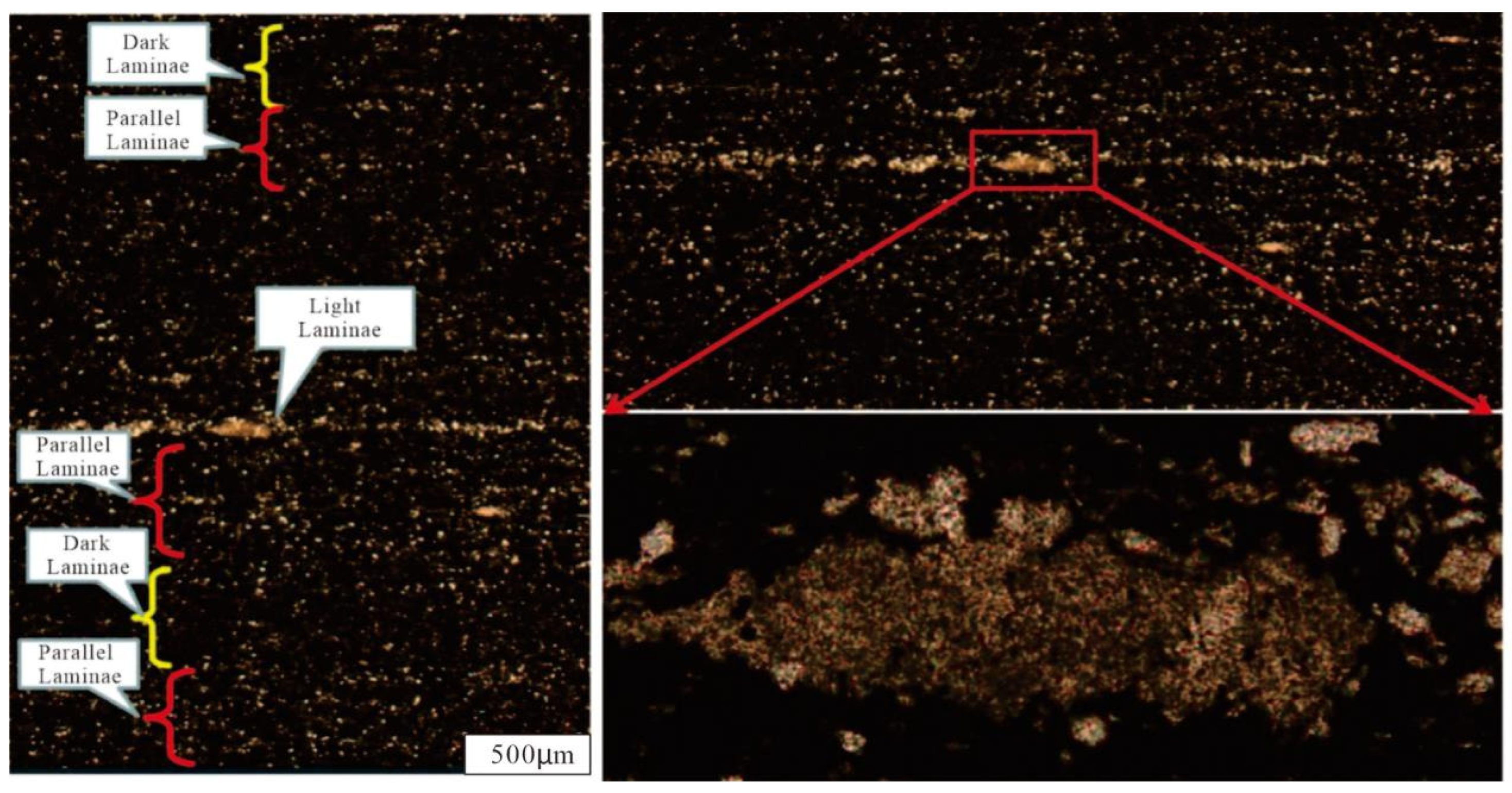
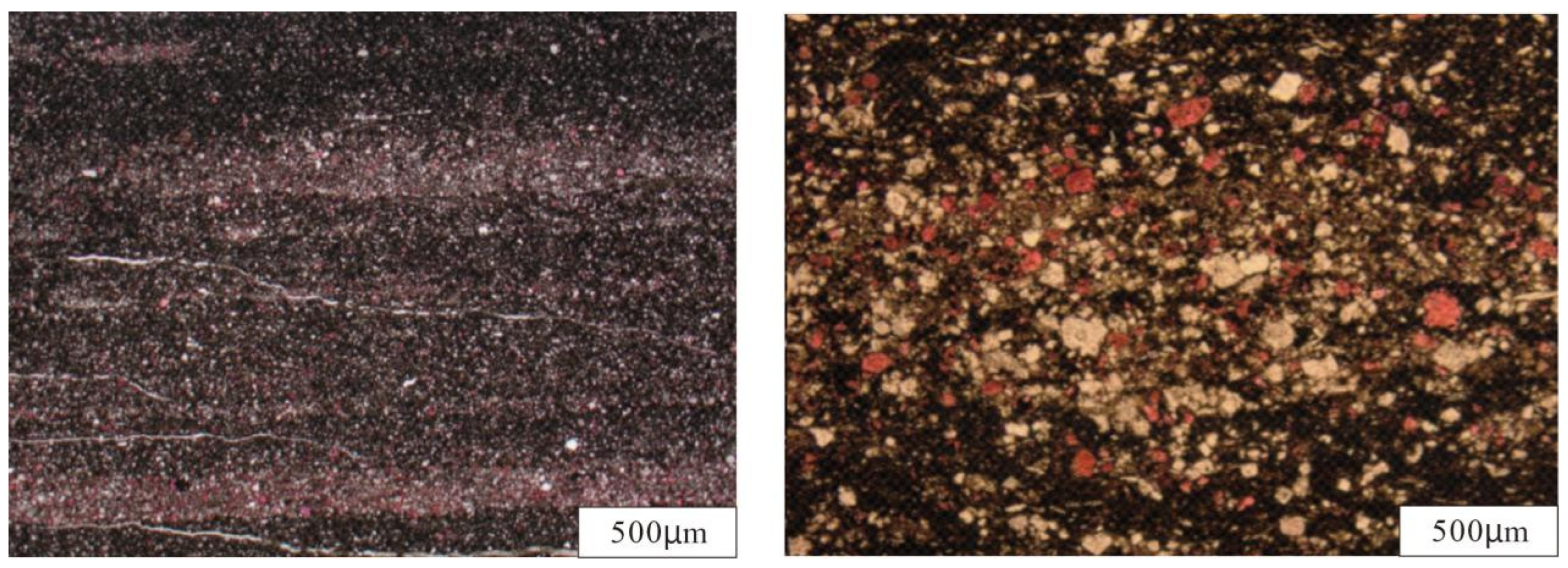
Biogenic siliceous shale typically develops in deep-water environments beyond the outer shelf, near the continental slope (water depth >100 m), or within shelf rift-trough areas influenced by volcanic activity [23,24,25]. This lithofacies is concentrated in the middle-upper Wufeng Formation and the Long111 and Long112 sub-members of the Longmaxi Formation. It primarily consists of siliceous shale (dark laminations) and biogenic laminations (bright laminations). Overall, the shale appears dark, rich in organic matter, graptolite fossils, and bentonite. Well-developed horizontal laminations and fractures, along with sedimentary micro-structures such as bedding-parallel pyrite, indicate a quiet depositional environment [26,27] (Figure 4).
Figure 4.
Optical thin-section photomicrograph of biogenic siliceous shale from Well Y104 (1195.62 m).
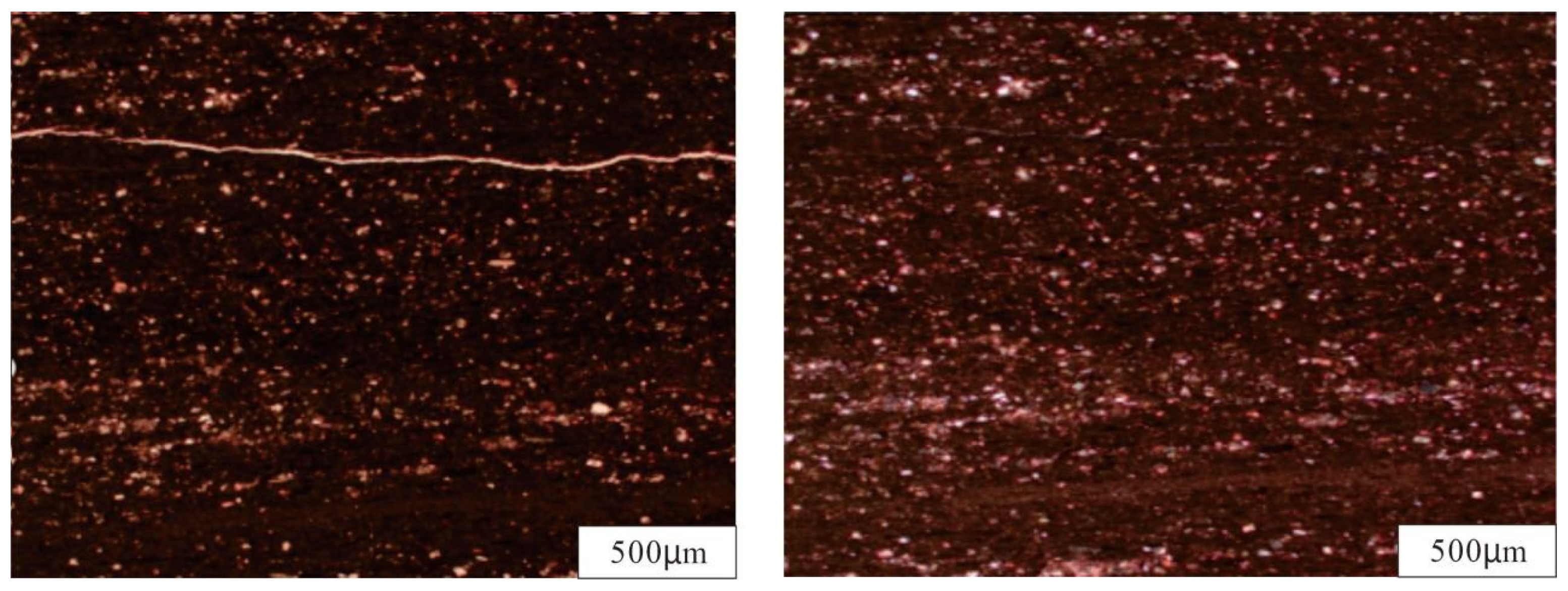
Within biogenic siliceous shale, the bright laminations correspond to intervals densely populated by diatoms, calcareous algae, and radiolarians, typically ranging from 0.1 to 0.3 mm in thickness. Sublaminations are composed of multiple bright laminations, representing zones of relatively concentrated development of diatoms, calcareous algae, and radiolarians. The dark laminations represent intervals where these organisms are relatively less developed (Figure 5 and Figure 6).
Figure 5.
Optical thin-section photomicrograph of biogenic siliceous shale from Well Y104 (4098.86 m).
Figure 6.
Optical thin-section photomicrograph of biogenic siliceous shale from Well Y118 (1175.46 m).
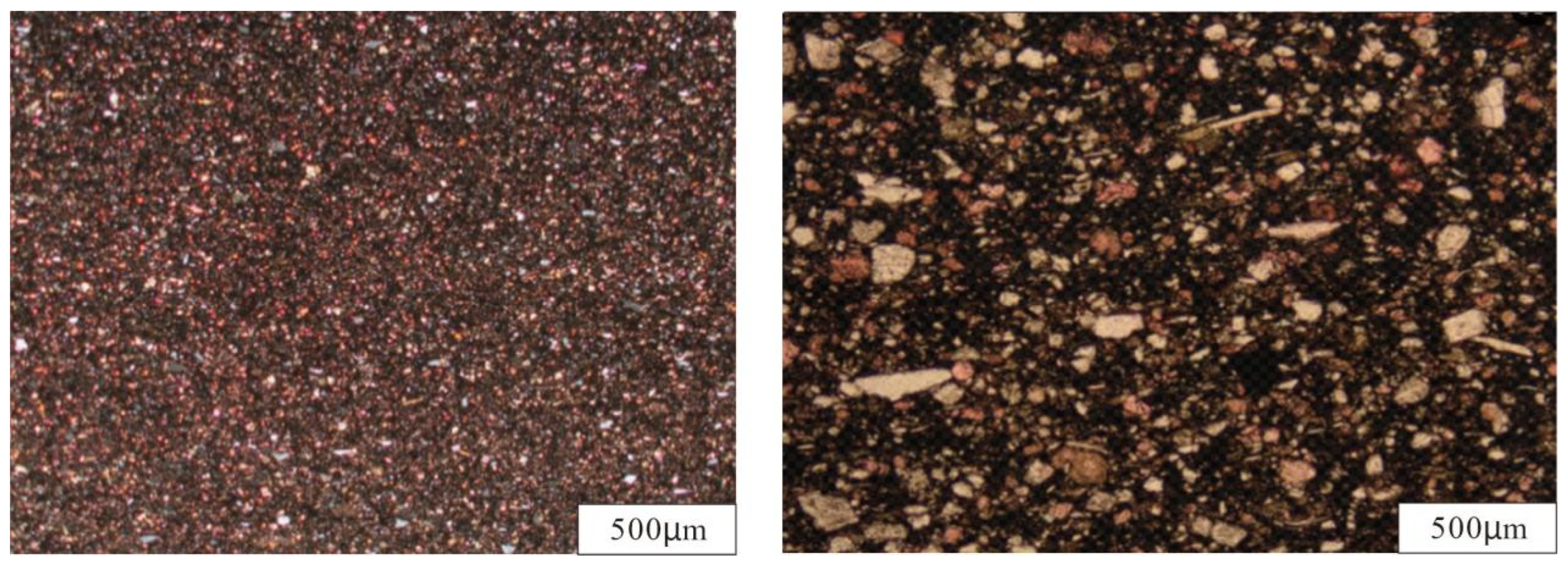
The siliceous shale (dark laminations) is dominated by black, parallel laminations, exhibiting a thinly layered structure. The mineral composition is primarily quartz, followed by illitic clay minerals. Microscopic observation reveals irregular, angular to sub-angular detrital quartz grains (10–30 μm in diameter) in a dispersed form. In addition to the main minerals, clay minerals appear cryptocrystalline and flaky, locally intermixed with black bitumen in a disseminated form within the minerals and clay matrix. Authigenic pyrite is also common, often occurring as framboidal aggregates within the siliceous shale. Sometimes, pyrite forms distinct bands, primarily related to the strongly reducing conditions of the deep-water facies environment [26,27] (Figure 7).
Figure 7.
Optical thin-section photomicrograph of biogenic siliceous shale from Well Y118 (1202.13 m).
- (2)
- SEM Characteristics
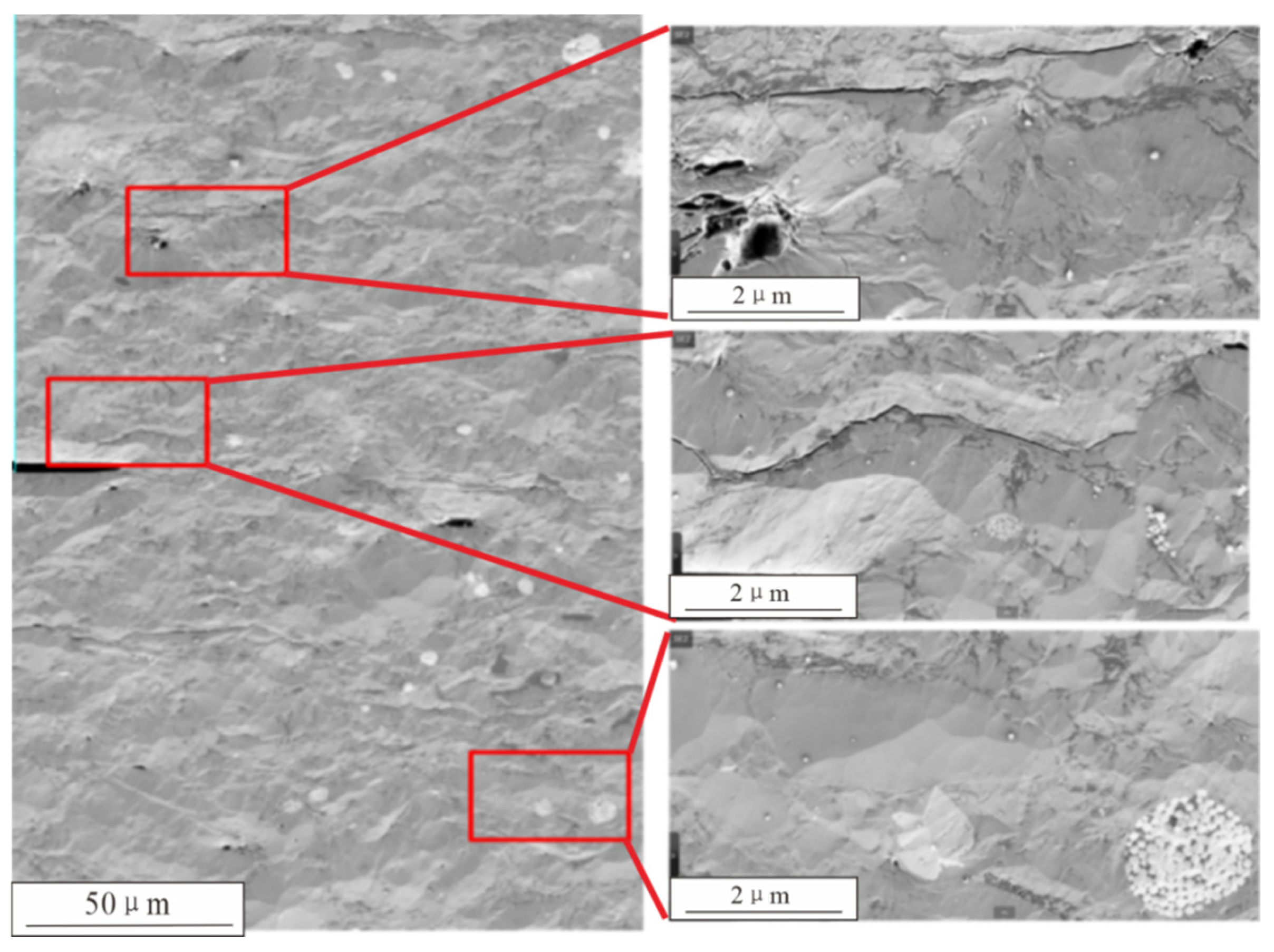
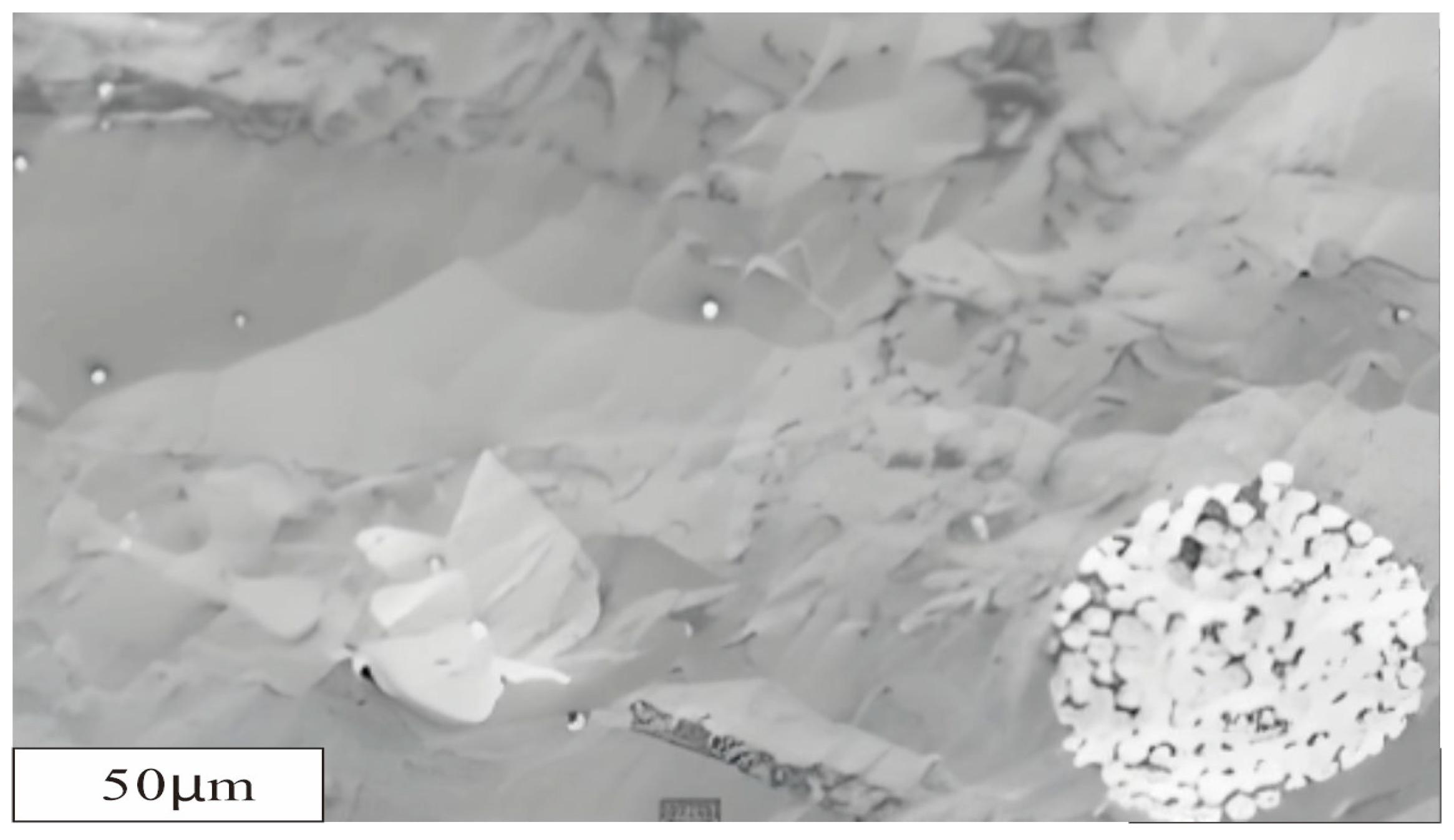
The dominant mineral grains in this lithofacies are quartz and calcite (dolomite), with minor amounts of volcanic ash-grade feldspar. Quartz exhibits good crystallinity, and mineral particles primarily exist in a “suspended” state. Notably, biogenic quartz is closely associated with organic matter enrichment, often controlling the enrichment and high productivity of shale gas. Scanning Electron Microscope (SEM) images (Figure 8) reveal continuous micro-layers representing “blooms” of diatoms, calcareous algae, and radiolarians.
Figure 8.
Scanning Electron Microscope (SEM) image from Well Y104 (1201.18 m).
4.2.2. Argillaceous Shale
- (1)
- Optical Thin-Section Characteristics
Argillaceous shale is developed in the Long114 sub-member of Well Y104 (Figure 9). The laminations are influenced by hydrodynamic controls, with wave-formed laminations being particularly evident. These laminations are a response to alternating coarse-grained (silt-sized-bright layers) and fine-grained (clay-sized-dark layers) sediment input.
Figure 9.
Optical thin-section photomicrograph characteristics from the Long12 member of Well Y104.
Argillaceous shale laminations consist of fine-grained, dark-colored sediment, typically developing horizontal or massive bedding. Individual laminae thickness ranges from approximately 50 to 300 μm. The mineralogy is dominated by illite, followed by quartz and calcite. Clay minerals primarily consist of illite, illite/smectite mixed-layer clays, and minor chlorite. Quartz, exhibiting good sorting, appears to “float” within the clay matrix. This lithofacies belongs to a deep-water shelf depositional setting characterized by strongly reducing conditions and high organic matter abundance. Framboidal pyrite is observable (Figure 10).
Figure 10.
Microscopic Characteristics of Clayey Shale from the Long113 Interval in Well Y207 Under Scanning Electron Microscope.
- (2)
- SEM Characteristics
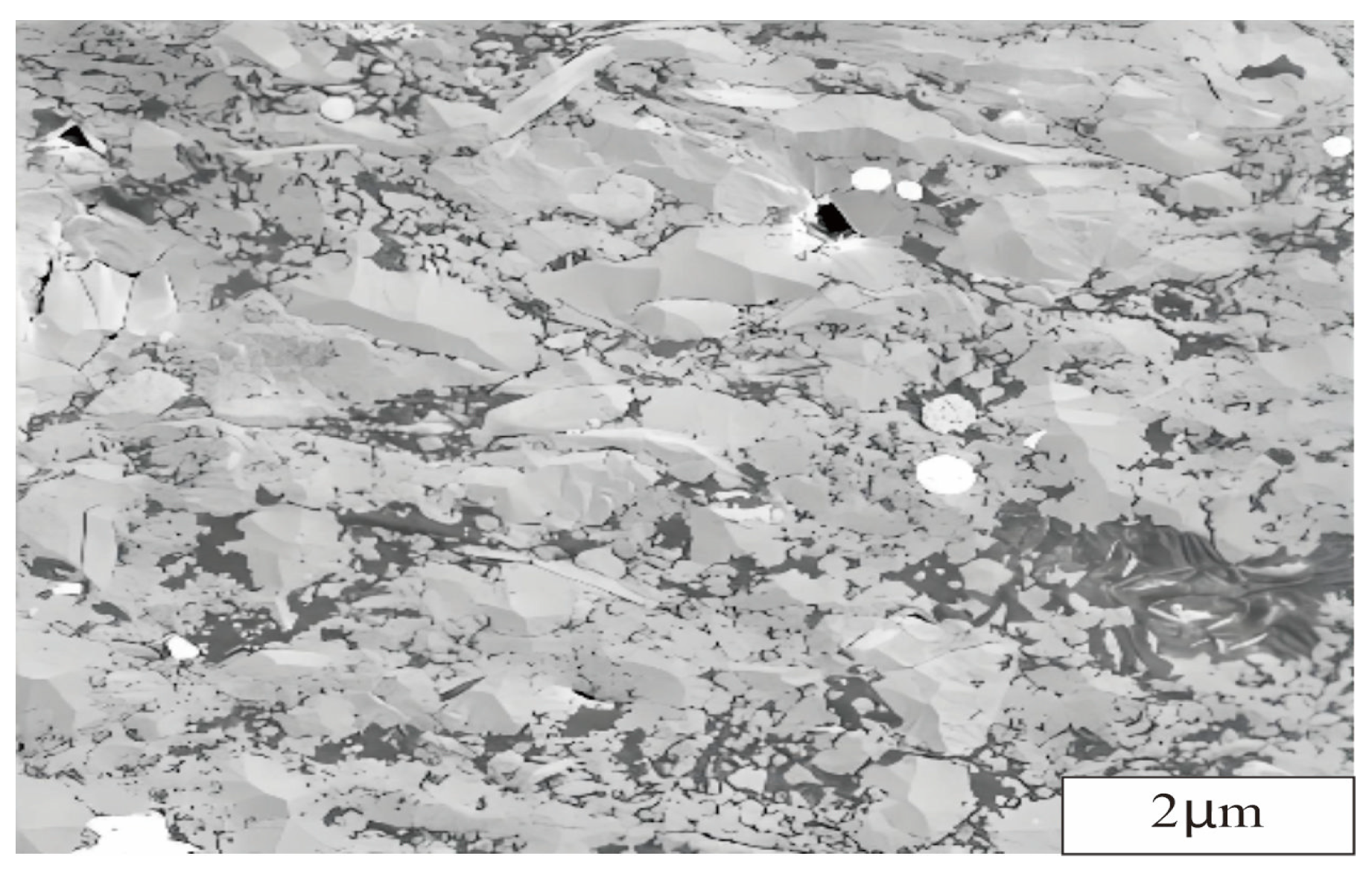
This lithofacies is overall dominated by a clay matrix (Figure 11). Particles appear suspended within this clay mineral matrix. Locally, structures of calcareous algae with clear outlines, later replaced by calcite, can be observed.
Figure 11.
Scanning Electron Microscope (SEM) image of argillaceous shale from Well Y104 (2992.16 m).
4.2.3. Calcareous Shale
Calcareous shale formed during the late Wufeng and late Longmaxi periods due to shallowing water depths and increased influx of calcareous and marly material. It is concentrated in the Guanyinqiao Bed at the top of the Wufeng Formation and in the Long12 and Long2 members.
Sparry crystalline laminations are generally 50–800 μm thick. Their widths vary, but the morphologies are straight, primarily composed of calcite, dolomite, quartz, and feldspar grains. The calcite is mainly derived from calcareous algae, varying in size but predominantly spherical, with a minor portion showing circular morphologies. Dolomite grains are primarily inorganic minerals, mostly anhedral crystals, with a minor algal component. Quartz and feldspar appear dispersed, with sharp, angular shapes (Figure 12).
Figure 12.
Optical thin-section photomicrograph of calcareous shale from the Long12 sub-member of Well Y207.
The matrix of calcareous shale is dolomitic mud, appearing as dark, thin, banded layers with a cryptocrystalline structure. Dark laminations are generally 50–600 μm thick. The matrix is mainly composed of micritic dolomite, bitumen, and unstructured fusinite. Bitumen is distributed in patches or fine bands, while fusinite appears as detrital fragments with low abundance.
5. Effect of Lithofacies on Key Reservoir Properties
5.1. Effect of Lithofacies on Reservoir Brittleness Index
Studies indicate that high contents of brittle minerals such as quartz and feldspar facilitate fracture generation during subsequent hydraulic fracturing. Additionally, intervals with high dolomite content within carbonate minerals are prone to dissolution, creating dissolution pores [28,29]. In the Taiyang shale gas field, brittle minerals primarily include quartz, feldspar, dolomite, and calcite. The brittleness index calculated using the mineral composition method is expressed by the following formula:
BRIT = (Vquarz + Vcalcite)/(Vquarz + Vclay + Vcalcite)
In the formula, BRIT is the mineral method brittleness index, %; Vquarz is quartz + feldspar content, %; Vcalcite is calcite + dolomite content, %; Vclay is clay content, %.
According to the numerical range of the brittleness index, the brittleness characteristics of shale can be classified into three grades: high brittleness (brittleness index >50), medium brittleness (brittleness index between 40 and 50), and low brittleness (brittleness index <40). The rock brittleness index of Well Y104 in the Suning Shale Gas Field was calculated using the aforementioned formula. The brittleness index is generally high (all greater than 50), indicating that the shale gas reservoir exhibits favorable brittleness characteristics (Table 2).
Table 2.
Brittleness index calculation for Well Y104.
Biogenic siliceous shale exhibits the highest brittleness index (67.9, 68.4). Its high brittleness originates from a rigid mineral framework and an intraclastic structure. Mineralogically, it is rich in quartz, calcite, and dolomite, which together form a continuous rigid support network. Structurally, it consists of frequent interbedding of siliceous shale (dark laminae) and bioclastic laminae (bright laminae). The biogenic laminae (containing radiolarians, calcareous algae fossils, and their diagenetic authigenic minerals) are themselves zones enriched with brittle particles. This mineral–structural combination makes the rock prone to brittle failure under stress, with fractures readily propagating along lamina interfaces, providing an optimal mechanical foundation for forming complex fracture networks [30].
Calcareous shale shows a moderate brittleness index (59.3), primarily controlled by the dominance of carbonate minerals and its distinct laminated structure. The rock is dominated by silt- to fine-crystalline calcite and dolomite, and is rich in calcareous algae fossils (spherical, circular morphologies). While these carbonate minerals are brittle to some extent, they are more prone to plastic deformation or dissolution compared to quartz. The characteristic interbedded structure of sparry limestone and cryptocrystalline calcareous shale leads to heterogeneous mechanical properties at the micro-scale, exhibiting an alternating “hard-soft” pattern. This characteristic means that during fracturing, main fractures may initiate along the brittle limestone layers, but the vertical propagation and penetration of fractures across layers can be hindered by the intervening plastic layers [31].
Argillaceous shale has the lowest brittleness index (54.2). Its low brittleness is rooted in the dominant role of the clay matrix. The mineral composition is primarily clay minerals such as illite (content > 50%), while brittle grains like quartz and calcite are dispersed in a “floating” state within the clay matrix. This structure causes stress to be more readily absorbed and dissipated by the ductile clay mineral matrix when the rock is under load, thereby inhibiting the propagation of brittle fractures [32].
5.2. Control of Lithofacies on Reservoir Organic Matter Content
Based on correlation analysis between core TOC and logging curves in the Taiyang shale gas field, uranium content and compensated density showed the best correlation with core TOC. Therefore, a multivariate TOC calculation model was established for the area using spectral gamma-ray uranium content and compensated density logs:
TOC = 0.10197 × U12.0388 × DEN + 33.2648
In the formula, U represents the uranium content, ×10−6; DEN is rock density, g/cm3.
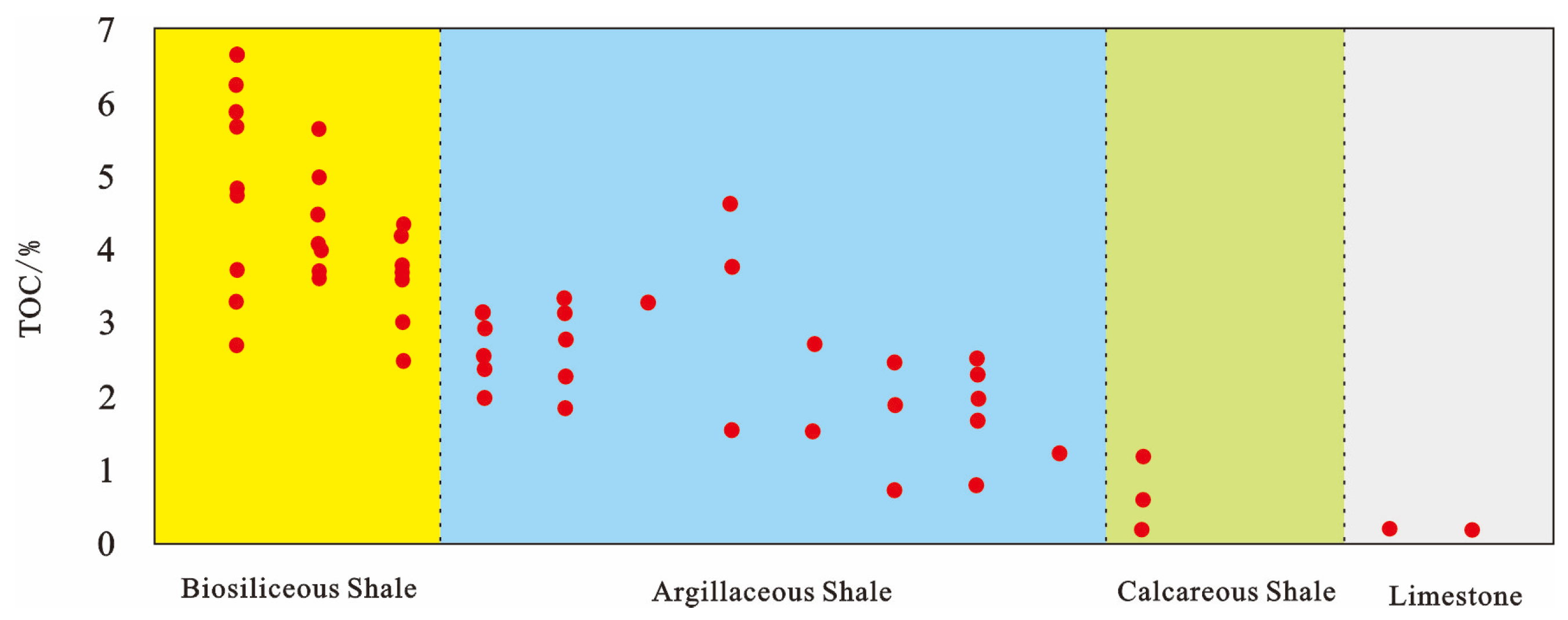
Calculations of TOC for different lithofacies in Well Y104 revealed that biogenic siliceous shale has an organic matter content (TOC) ranging from 2.51% to 6.69%, with an average of 4.26%, indicating overall high organic richness. Argillaceous shale has a TOC range of 1.53% to 4.63%, averaging 2.72%. Calcareous shale has lower organic matter content, ranging from 0.19% to 1.20%, with an average of 0.67%. Limestone essentially contains no organic matter.
Biogenic siliceous shale is the most organic-rich lithofacies in the study area. Its high TOC characteristics are primarily attributed to the coupling mechanism of deep-water anoxic environments and high primary productivity. This lithofacies formed in deep-water settings such as the outer shelf or rift troughs, characterized by quiet, strongly reducing water conditions favorable for organic matter preservation. Simultaneously, blooms of planktonic organisms like diatoms, radiolarians, and calcareous algae formed organic-rich biogenic laminae, providing abundant original organic input. The high siliceous content also indicates weak dilution by terrigenous clastics during deposition, further promoting the in situ enrichment of organic matter [25].
Argillaceous shale shows moderate enrichment. It formed in a shallow-water shelf environment, intermittently reworked by hydrodynamic processes like storm and tidal currents, leading to sediment resuspension and sorting. Although clay minerals offer some adsorption and protection for organic matter, the stronger hydrodynamic conditions and relatively weaker reducing environment partially compromised the depositional preservation conditions for organic matter, resulting in lower organic richness compared to biogenic siliceous shale [33].
Calcareous shale formed during late highstand stages characterized by shallowing water and increased carbonate deposition. The high content of carbonate minerals like calcite and dolomite exerts a significant “dilution effect” on organic matter. Concurrently, the shallower water environment likely coincided with increased oxygenation, which is unfavorable for organic matter preservation, further reducing the final organic richness (Figure 13) [34].
Figure 13.
Scatter plot of organic matter content for different lithofacies in Well Y104.
6. Conclusions
- (1)
- Based on logging data from the Wufeng-Longmaxi Formation in the Taiyang area, the contents of brittle minerals and clay minerals were calculated using an established multiple regression model. The brittle mineral content ranges from 50.82% to 84.64%, with an average of 66.07%. Vertically, it is highest in the Long111 sub-member and lowest in the Long114 sub-member, while horizontally it shows an increasing trend from east to west. The clay mineral content ranges from 9.6% to 64.3%, with an average of 30.89%, primarily consisting of illite and illite/smectite mixed layers. The content gradually decreases from top to bottom, averaging 29.8% in the Wufeng-Long11 interval and 36.16% in the Long12 interval.
- (2)
- Using the DEI method, four lithofacies—biogenic siliceous shale, argillaceous shale, calcareous shale, and limestone—were identified in the Wufeng-Longmaxi Formation shale gas reservoirs of the Taiyang area, with the first three being the main types. Under the microscope, biogenic siliceous shale exhibits well-developed alternating bright and dark laminae rich in siliceous bioclasts, commonly featuring horizontal laminations, pyrite, and organic matter, with quartz grains often in a suspended state. Argillaceous shale is predominantly composed of clay minerals such as illite, displaying horizontal or massive bedding, with quartz grains floating within the clay matrix. Calcareous shale is characterized by alternating bright laminae composed of calcareous particles like calcite and dolomite and dark laminae consisting of micritic matrix.
- (3)
- The brittleness index calculated based on the mineral composition method reveals significant differences in brittle characteristics among different lithofacies in the Taiyang shale gas field. Biogenic siliceous shale has the highest brittleness index (67.9–68.4), primarily due to its continuous rigid framework enriched with quartz and carbonate minerals and its bioclastic laminated structure. Calcareous shale exhibits a moderate brittleness index (59.3), influenced by its carbonate-dominated composition and alternating soft-hard layered structure. Argillaceous shale has the lowest brittleness index (54.2), resulting from its clay matrix-dominated structure with brittle particles dispersed within.
- (4)
- Different lithofacies have a clear influence on organic matter content (TOC). Biogenic siliceous shale has the highest average TOC (4.26%), which is closely related to the deep-water anoxic environment, high biological productivity, and weak terrigenous dilution during its formation. Argillaceous shale shows a moderate average TOC (2.72%), constrained by hydrodynamic reworking and preservation conditions. Calcareous shale has the lowest average TOC (0.67%), primarily due to the dilution effect of carbonate minerals and the relatively more oxidizing shallow-water environment.
Author Contributions
Methodology, J.M.; Validation, C.Z. (Chen Zou); Formal analysis, X.Z.; Investigation, X.G.; Resources, C.Z. (Chao Zhang); Writing—original draft, G.W.; Writing—review & editing, H.S., Z.J., H.W. and L.J. All authors have read and agreed to the published version of the manuscript.
Funding
Science and Technology Project of PetroChina Company Limited, Research on Shale Gas Large-scale Reserve Growth, Production Increase and Exploration & Development Technology (No. 2023ZZ21); Supporting Project of National Science and Technology Program, Demonstration of Distributed Optical Fiber Seismic Monitoring in Zhaotong Shale Gas Development Site and Surrounding Areas (No. 2022DQ0519).
Data Availability Statement
The original contributions presented in this study are included in the article. Further inquiries can be directed to the corresponding author.
Conflicts of Interest
Authors Gaocheng Wang, Honglin Shu, Liwei Jiang, Xinsheng Zhao, Xiaomin Gu, Chao Zhang, Chen Zou and Jue Mei were employed by the Zhejiang Oilfield Company of China National Petroleum Corporation. The remaining authors declare that the research was conducted in the absence of any commercial or financial relationships that could be construed as a potential conflict of interest.
References
- He, Y.B.; He, J.M.; Xie, Q.B. Characteristics and developability of shallow shale gas reservoirs in the Longmaxi Formation, Zhaotong area. J. Eng. Geol. 2024, 32, 1209–1233. [Google Scholar]
- Zhao, Y.; Li, L.; Si, Y.H.; Wang, H.M. Fractal characteristics and controlling factors of pore structure in shallow shale gas reservoirs: A case study of the Longmaxi Formation in Zhaotong area, Yunnan. J. Jilin Univ. (Earth Sci. Ed.) 2022, 52, 1813–1829. [Google Scholar]
- Ren, G.B.; Chen, L.; Ji, Y.B.; Liang, X.; Zhang, Z.; Shan, C.A.; Xu, Z.Y.; Xu, J.B.; Liu, C.; Zhang, J.H.; et al. Lithofacies types and reservoir characteristics of the Long-1 sub-member of the Wufeng-Longmaxi formations in northeastern Zhaotong. Pet. Exp. Geol. 2023, 45, 443–454. [Google Scholar]
- Liang, X.; Shan, C.A.; Wang, W.X.; Li, Z.F.; Zhu, D.X.; Xu, J.B.; Zhang, Z.; Zhang, C.; Luo, Y.F.; Yuan, X.J. Exploration and development progress and prospect of the Zhaotong National Shale Gas Demonstration Zone. Nat. Gas Ind. 2022, 42, 60–77. [Google Scholar]
- Huang, X.Q.; He, Y.; Cui, H.; Ji, Y.C.; Wang, X.; Han, Y.S.; Wang, C.C. Practice and understanding of the three-dimensional development of shallow shale gas in the Taiyang gas field, Zhaotong demonstration zone. China Pet. Explor. 2023, 28, 70–80. [Google Scholar]
- Wang, P.W.; Jiao, P.F.; He, X.Y.; Jia, D.; Mei, J.; Liu, S.Q.; Zhang, L.; Li, C.; Zhang, L.; Wang, J. Enrichment model of shallow shale gas in the Taiyang-Haiba area, Zhaotong demonstration zone. J. China Univ. Pet. 2023, 47, 45–54. [Google Scholar]
- Wang, M.; Yu, X.N.; Liu, S.; Cheng, Y.L.; Guo, J.J.; Wang, Z.L.; Duan, X.M. Sedimentary Paleo-Environment and Reservoir Heterogeneity of Shale Revealed by Fractal Analysis in the Inter-Platform Basin: A Case Study of Permian Shale from Outcrop of Nanpanjiang Basin. Fractal Fract. 2025, 9, 795. [Google Scholar] [CrossRef]
- Wang, C.C.; Xu, Q.H.; Xu, L.T.; Zeng, F.C.; Li, H.; Huang, Z.C.; Li, J.Y.; Wang, K.; Li, M.Y. Reservoir Characteristics and Influencing Factors of Different Lithofacies of WF-LMX Formation Shale in Zigong Area, Sichuan Basin. Fractal Fract. 2025, 9, 706. [Google Scholar] [CrossRef]
- Liu, Y.; Liu, Y.Y.; Zhao, S.X.; Yin, M.X.; Li, B.; Chen, L.; Wu, S.C.; Xie, S.Y. Paleogeomorphic characteristics and their control on reservoirs during the deposition of the Silurian Longmaxi Formation in the Luzhou-Yuxi area. Lithol. Reserv. 2025, 37, 49–59. [Google Scholar]
- Zhan, Y.N.; Wen, Z.; Weiqing, L. Lithofacies Characteristics of Marine Shale and Its Influence on Pore Structure: A Case Study of Lower Silurian Longmaxi Formation in Changning Area, Southern Sichuan Basin, China. Geol. J. 2025, 60, 2825–2844. [Google Scholar] [CrossRef]
- Han, Z.Y.; Wang, G.W.; Wu, H.L.; Feng, Z.; Tian, H.; Xie, Y.Y.; Wu, H. Lithofacies Characteristics of Gulong Shale and Its Influence on Reservoir Physical Properties. Energies 2024, 17, 779. [Google Scholar] [CrossRef]
- Liang, C.; Jiang, Z.X.; Yang, Y.T.; Wei, X.J. Lithofacies and reservoir space characteristics of the Wufeng-Longmaxi shales in the Sichuan Basin. Pet. Explor. Dev. 2012, 39, 691–698. [Google Scholar] [CrossRef]
- Liang, X.; Shan, C.A.; Zhang, C.; Xu, Z.Y.; Xu, J.B.; Wang, W.X.; Zhang, J.H.; Xu, Y.J. Enrichment and accumulation model of shallow shale gas in the “three-dimensional sealing system” of the Taiyang anticline in Zhaotong. Acta Geol. Sin. 2021, 95, 3380–3399. [Google Scholar] [CrossRef]
- He, Y.; Huang, X.Q.; Wang, J.J.; Liu, C.; Li, L.; Liang, X. Three-dimensional development of shallow shale gas in the Taiyang block of the Zhaotong National Shale Gas Demonstration Zone. Nat. Gas Ind. 2021, 41, 138–144. [Google Scholar]
- Huang, X.Q.; Han, Y.S.; Yang, F.; Li, L.; Wang, J.J.; Liu, C. Flowback law of horizontal well testing in shallow shale gas in the Taiyang block, Zhaotong. Xinjiang Pet. Geol. 2020, 41, 457–463+470. [Google Scholar]
- Liang, X.; Xu, Z.Y.; Zhang, J.H.; Zhang, Z.; Li, Z.F.; Jiang, P.; Jiang, L.W.; Zhu, D.X.; Liu, C. Key technologies for efficient exploration and development of shallow shale gas: A case study of the Taiyang anticline area in the Zhaotong National Shale Gas Demonstration Zone. Acta Pet. Sin. 2020, 41, 1033–1048. [Google Scholar]
- Liang, X.; Zhang, Z.; Shan, C.A.; Zhang, J.H.; Xu, Z.Y.; Wang, J.J.; Li, Z.F.; Xu, J.B.; Liu, C. Challenges, countermeasures, and prospects for exploration of shallow shale gas in mountainous areas: A case study of the Zhaotong National Shale Gas Demonstration Zone. Nat. Gas Ind. 2021, 41, 27–36. [Google Scholar]
- Luo, X.; Zhang, S.D.; Wang, Y.G.; Liang, X.; Liu, C.; Zhang, J.H.; Li, L. Geosteering technology under complex geological conditions in the Zhaotong shale gas demonstration zone. Drill. Prod. Technol. 2018, 41, 29–32+6–7. [Google Scholar]
- Wang, P.W.; Li, C.; Zhang, L.; Zhang, J.H.; Li, L.; Shan, C.A. Reservoir characteristics and sweet spot evaluation of the Wufeng-Longmaxi formations: A case study of Well A in the Zhaotong shale gas demonstration zone. J. China Coal Soc. 2017, 42, 2925–2935. [Google Scholar] [CrossRef]
- Liang, X.; Wang, G.C.; Xu, Z.Y.; Zhang, J.H.; Shan, C.A.; Zhang, Z.; Liu, C.; Zhang, L.; Li, L.; Wang, J.J. Comprehensive evaluation technology for sweet spots in complex marine shale gas reservoirs in southern China: A case study of the Zhaotong National Shale Gas Demonstration Zone. Nat. Gas Ind. 2016, 36, 33–42. [Google Scholar]
- Yin, S.; Zhang, Z.; Huang, Y. Geochemical Characteristics and Chemostratigraphic Analysis of Wufeng and Lower Longmaxi Shales, Southwest China. Minerals 2022, 12, 1124. [Google Scholar] [CrossRef]
- Wang, Y.; Zhang, Y.L.; Dong, T. Pore Structure and Fractal Characteristics of the Middle and Upper Permian Dalong and Gufeng Shale Reservoirs, Western Hubei Province, South China. Minerals 2023, 14, 10. [Google Scholar] [CrossRef]
- Liu, G.X.; Zhai, G.M.; Zou, C.N.; Zhang, D.W.; Zhang, L.; Li, J.Z.; Wang, L.; Zhang, G.S.; Liu, K.S.; Zhou, W.; et al. A comparative discussion of the evidence for biogenic silica in Wufeng-Longmaxi siliceous shale reservoir in the Sichuan basin, China. Mar. Pet. Geol. 2019, 109, 70–87. [Google Scholar] [CrossRef]
- Du, A.Y.; Ye, Y.H.; Liu, S.G.; Liu, W.; Zhang, E.T.; Wang, G.W.; Chen, S.Y.; Xu, Z.L. Siliceous origin and its coupling relationship with organic matter enrichment in the Upper Permian Dalong Formation shale in eastern Sichuan. Geol. Rev. 2025, 1–20. [Google Scholar] [CrossRef]
- Liang, X.; Zhao, J.Z.; Zhang, H.B.; Zhang, Z.; Shan, C.A.; Xu, J.B.; Liu, C.; Zhang, J.H.; Li, L.; Wang, J.J. Characteristics and genetic mechanism of biogenic siliceous shale in the Wufeng-Longmaxi formations in the Upper Yangtze region: A case study of southern Sichuan, Zhaotong area. J. Palaeogeogr. 2025, 27, 1434–1451. [Google Scholar]
- Yang, R.X.; Liao, J.J.; Zhang, G.C. Research on pyrite characteristics in organic-rich shales of the Wufeng-Longmaxi formations in southern Sichuan. Petrochem. Ind. Technol. 2025, 32, 255–257. [Google Scholar]
- Gu, Y.; Chang, X.; Liu, X.T.; Zhang, E.T.; Liu, S.G.; Du, A.Y. Geochemical insights into authigenic pyrite formation in central Yellow Sea sediments: Influence of sedimentary environment and microbial sulfate reduction. Mar. Pet. Geol. 2025, 182, 107587. [Google Scholar] [CrossRef]
- Cong, P.; Yan, J.P.; Jing, C.; Liu, C.; Zhang, L. Logging evaluation and distribution characteristics of fracability levels in shale gas reservoirs: A case study of the Wufeng-Longmaxi formations in Area X, southern Sichuan. Lithol. Reserv. 2021, 33, 177–188. [Google Scholar]
- Li, G.X.; Liu, G.Q.; Hou, Y.T.; Liu, X.S.; Wang, J.; Li, B.; Zhang, J.L.; Zhao, Z.J. Optimal selection of favorable lithofacies and optimization method of fracturing parameters for continental shale oil. Acta Pet. Sin. 2021, 42, 1405–1416. [Google Scholar]
- Wang, W.; Liu, Z.J.; Wei, F.B.; Li, F.S. Characteristics and main controlling factors of Permian Dalong Formation shale reservoirs in northeastern Sichuan. Oil Gas Geol. 2024, 45, 1355–1367. [Google Scholar]
- Wang, J.; Qin, J.Z.; Rao, D.; Wang, Y.M.; Zhang, C.C.; Li, X.Q.; Huang, Z.L. Simulation experiments on the hydrocarbon gas enrichment capacity of different types of shales and their microstructural characteristics. Nat. Gas Geosci. 2013, 24, 652–658. [Google Scholar]
- Zhao, D.F.; Xie, D.L.; Zang, J.C.; Zhang, L. Mineral composition of shale reservoirs and related discussions. Coal Technol. 2014, 33, 92–95. [Google Scholar] [CrossRef]
- Fang, Z.W.; Liu, H.M.; Tian, W.; Xu, Z.H.; Zhang, S.N.; Liu, Z.; Zhang, E.T. Lithofacies characteristics and distribution patterns of shales in the steep-slope deep-depression area of a continental rift basin. J. China Univ. Pet. (Nat. Sci. Ed.) 2025, 49, 57–70. [Google Scholar]
- Han, Y.; Cao, Y.C.; Liang, C.; Wang, L.N.; Zhao, M.; Liu, F.; Liang, X.; Wang, Z.T.; Chen, Q. Sedimentary environment evolution and its control on shale development in the Wufeng-Longmaxi formations in southern Sichuan. J. China Univ. Pet. (Nat. Sci. Ed.) 2024, 48, 11–23. [Google Scholar]
Disclaimer/Publisher’s Note: The statements, opinions and data contained in all publications are solely those of the individual author(s) and contributor(s) and not of MDPI and/or the editor(s). MDPI and/or the editor(s) disclaim responsibility for any injury to people or property resulting from any ideas, methods, instructions or products referred to in the content. |
© 2026 by the authors. Licensee MDPI, Basel, Switzerland. This article is an open access article distributed under the terms and conditions of the Creative Commons Attribution (CC BY) license.