Article

Numerical Simulation of Air-Water-Mineral Three-Phase Flow in a Flotation Column for Graphite

School of Minerals Processing & Bioengineering, Central South University, Changsha 410083, China
*
Authors to whom correspondence should be addressed.
Minerals 2026, 16(3), 254; https://doi.org/10.3390/min16030254
Submission received: 20 January 2026 / Revised: 16 February 2026 / Accepted: 24 February 2026 / Published: 28 February 2026

Abstract

This study aims to clarify the influence mechanism of air–water–mineral three-phase flow behavior on separation efficiency in a graphite flotation column, addressing the issues of over-breaking of coarse graphite flakes and low recovery of fine particles caused by mismatched flow fields and operating parameters in traditional flotation columns. Using CFD numerical simulations based on the Eulerian multiphase flow model, the standard k-ε turbulence model, and scalable wall functions, the effects of feed velocity (0.8–2.4 m/s) and aeration velocity (1–5 m/s) on the flow field structure, gas holdup distribution, and weighted average bubble–particle collision probability inside the column were systematically analyzed. Key quantitative results show that under the synergistic condition of a feed velocity of 2 m/s and an aeration velocity of 3 m/s, an internal circulation flow field conducive to particle retention is formed. Under these conditions, the gas holdup in the collection zone reaches an optimal range (0.26–0.27), and the weighted average collision probability increases by approximately 22% compared to the baseline condition. Aeration velocity shows a significant positive correlation with gas holdup in the collection zone (~0.235 at 1 m/s, rising to ~0.285 at 5 m/s). While an increase in feed velocity reduces the overall gas volume fraction, it enhances turbulence and promotes uniform bubble dispersion through the spatial distribution of regions with high collision probability from the upper part to the upper–middle part of the column and improves the uniformity of distribution. The novelty of this study lies in being the first to quantitatively reveal, through CFD simulation, the coupled regulatory effects of feed velocity and aeration velocity on the stratified flow field structure and mineralization probability in a flotation column and to identify the key optimization threshold of “2 m/s feed velocity”. The practical significance is that it provides a clear theoretical basis and operational window for energy saving, consumption reduction, and process intensification in industrial flotation columns. It offers directly applicable parameter optimization strategies for the efficient recovery of fine-flake graphite and the protection of coarse flakes.

1. Introduction

Flotation, as a key separation technology in mineral processing, fundamentally relies on differences in the physicochemical properties of mineral particle surfaces to achieve efficient separation of valuable minerals from gangue through selective bubble attachment [1]. Among various flotation equipment, the flotation column has been widely used and studied since the mid-20th century due to its advantages such as simple structure, high enrichment ratio, and particularly suitability for fine particle separation [2,3]. Compared to traditional mechanical flotation cells, the internal flow field of a flotation column is more stable, and the counter-current collision and contact path between mineral particles and bubbles is longer, providing favorable conditions for creating an ideal mineralization environment [4]. However, the interior of a flotation column is a complex flow system involving gas, liquid, and solid phases. Its separation efficiency is closely dependent on the hydrodynamic state within the column, including bubble size distribution and dispersion, the suspension and transport behavior of solid particles, and the intensity of interactions among the three phases [5,6,7]. Therefore, deeply revealing and quantifying the macroscopic laws and microscopic mechanisms of air–water–mineral three-phase flow in flotation columns is a core scientific issue for optimizing their operational parameters and improving separation performance. Graphite ore is mainly associated with gangue minerals such as quartz, feldspar, and calcite, and flotation commonly employs kerosene as a collector. The core distinction between traditional “full-cell” flotation and column flotation lies in flake protection and process efficiency: the former, involving multiple stages of regrinding and re-cleaning, tends to cause over-liberation of graphite flakes, whereas column flotation or a “column-cell hybrid” circuit, by reducing the number of stages, better preserves large graphite flakes. This approach significantly increases the yield of the +0.15 mm size fraction while offering comprehensive advantages in energy consumption and operational costs [8]. Zhang [9] applied a novel flotation column to fine-flake graphite from Luobei. Under optimized conditions, the concentrate yield exceeded 90%, with the recovery of the +0.15 mm fraction reaching nearly 80%. Its performance in coarse particle protection and enrichment was significantly superior to that of traditional flotation machines, demonstrating promising potential for industrial application. Although the natural hydrophobicity of graphite grants it good floatability, particle size significantly affects recovery efficiency. Fine particles, due to their large specific surface area and high surface energy, exhibit reduced floatability, necessitating the use of efficient separation equipment to improve their recovery [10].
With the rapid development of Computational Fluid Dynamics (CFD) technology, numerical simulation has become an indispensable and powerful tool for studying complex multiphase flow in flotation columns [11,12]. By constructing reasonable mathematical models, CFD can non-invasively reproduce detailed internal flow field information of equipment, such as velocity distribution, phase holdup distribution, and turbulent kinetic energy dissipation, thereby providing deeper and more comprehensive insights into process mechanisms beyond traditional experimental research [13,14,15]. In multiphase flow simulation, the Eulerian–Eulerian approach is widely adopted due to its good balance between computational efficiency and accuracy for engineering-scale problems. It treats each phase as interpenetrating continua and characterizes multiphase flow behavior by solving respective continuity and momentum equations for each phase, coupled with interphase force models [16]. Among these, the accurate selection and calibration of models for interphase momentum exchange coefficients, turbulent dispersion forces, lift forces, and virtual mass forces are key to determining the reliability of simulation results [17,18]. Vadlakonda et al. [19] specifically used the Eulerian model combined with the Population Balance Model (PBM) to predict bubble dynamics in a flotation column and innovatively validated it extensively using Electrical Resistance Tomography (ERT) experimental data. Yan et al. [20] investigated the internal flow field for the specific structure of a packed flotation column. This study employed Particle Image Velocimetry (PIV) technology to experimentally validate the CFD simulation results, demonstrating methodological rigor. For micro-scale events unique to the flotation process, such as bubble–particle collision, attachment, and detachment, studies often introduce collision probability models based on turbulence theory and combine them with Population Balance Models (PBMs) to describe bubble size variation, thereby establishing the relationship between the macroscopic flow field and microscopic mineralization kinetics [21,22,23].
Graphite, as a strategic non-metallic mineral with a layered structure, possesses good natural floatability. However, its ores are often associated with various gangue minerals, and the crystal structure, particle size distribution, and surface properties of graphite from different origins vary, posing challenges for its efficient flotation separation [9,24]. The recovery of fine graphite particles, in particular, is more susceptible to limitations imposed by flow field stability, bubble size matching, and mineralization probability [25]. Therefore, conducting specialized hydrodynamic simulation research targeting graphite flotation columns holds significant theoretical value and practical guiding significance. This study aims to, through systematic CFD numerical simulation, deeply investigate the influence of operational parameters (primarily feed velocity and aeration velocity) on the air–water–mineral three-phase flow field structure, phase distribution characteristics, and bubble–particle collision probability within a graphite flotation column. The research employs the Eulerian multiphase model, combined with the standard k-ε turbulence model and scalable wall functions, to conduct three-dimensional transient simulations of a flotation column with a specific geometry [10,13,26]. By analyzing liquid/solid phase velocity vector and streamline distributions, gas volume fraction contours, radial distribution of gas holdup in the collection zone, and spatial distribution of weighted average collision probability under different operating conditions, this study aims to elucidate the intrinsic mechanism by which key operational parameters regulate flow field characteristics and the fundamental probability of mineralization. The anticipated outcomes of this research are expected to provide direct data support and theoretical basis for optimizing the structural design and operational parameters (such as determining suitable ranges for feed and aeration intensity) of graphite flotation columns, thereby contributing to the improvement of graphite resource flotation recovery and concentrate quality, and serving the high-quality development needs of related industries.

2. Materials and Methods

This chapter introduces the theoretical models and computational methods for numerical simulation. The Eulerian multiphase model is used to describe air–water–mineral three-phase flow, encompassing continuity equations, momentum equations, and the standard k-ε turbulence model, coupled with a bubble–particle collision probability model to link the macroscopic flow field with microscopic mineralization. Key implementation details such as geometric modeling, meshing, boundary conditions, and solver settings are also explained, providing the foundation for subsequent analysis.

2.1. Continuity Equation

The continuity equation, also known as the mass conservation equation, is applicable in a general form for both incompressible and compressible flows [27] and can be expressed as follows:
ρ t   +   ( ρ ν )   =   S m
where ρ is density, kg/m3; ∇ is the nabla operator; ν is the total velocity vector, m/s; Sm is the source term representing mass added to the continuous phase from the dispersed secondary phase.

2.2. Momentum Equation

In an inertial reference frame, the momentum conservation equation can be expressed as follows [23]:
t ρ ν + ρ ν ν = p + τ ̿ + ρ g + F
τ ̿ = μ ( ν + ν T ) 2 3 ν I
where p is static pressure, Pa; τ is the stress tensor, Pa; g is gravitational acceleration, m/s2; F is external force, N; μ is dynamic viscosity, Pa·s; T is static temperature, K; I is the unit tensor, Pa.

2.3. Turbulence Model

For the standard k-ε turbulence model, the turbulent kinetic energy and its dissipation rate can be obtained from the following transport equations [28]:
t ρ k + x i ρ k u i = x j μ + μ t σ k k x j + G k + G b ρ ε Y M + S k
t ρ ε + x i ρ ε u i = x j μ + μ t σ ε ε x j + C 1 ε ε k G k + C 3 ε G b C 2 ε ρ ε 2 k + S ε
μ t = ρ C μ k 2 ε
where k is turbulent kinetic energy, J/kg; ε is turbulent dissipation rate, m2/s3; Gk represents the turbulent kinetic energy generation rate per unit fluid volume due to mean velocity gradients, Pa·s; Gb represents the turbulent kinetic energy generation rate per unit fluid volume due to buoyancy, m2/s3; YM represents the contribution to the dissipation rate per unit volume, m2/s3; C = 1.44, C = 1.92, and C = 0.09 are constants; σk = 1.0 is the turbulent Prandtl number for k; σε = 1.3 is the turbulent Prandtl number for ε; Sk is the source term generation rate of turbulent kinetic energy per unit volume, Pa·s; Sε is the source term generation rate of turbulent dissipation rate per unit volume, m2/s3; μt is turbulent dynamic viscosity, Pa·s; Cμ is a constant.

2.4. Volume Fraction Equation

Multiphase flow is described as interpenetrating continua, where the phase volume fraction represents the space occupied by each phase, and each phase individually satisfies mass and momentum conservation [29]. The volume fraction for each phase in the derived conservation equations can be obtained by averaging the local instantaneous balances:
V q = V α q d V
q = 1 n α q = 1
ρ ^ q = α q ρ q
where αq represents the volume fraction of phase Vq is the volume of phase, m3; V is the volume of the entire multiphase system, m3; q denotes a specific phase in the multiphase system; n is the total number of phases in the multiphase flow; ρq is the effective density of phase q, kg/m3; ρq is the physical density of phase q, kg/m3.

2.5. Multiphase Flow Continuity Equation

The volume fraction for each phase is calculated from the continuity equation:
1 ρ r q t α q ρ q + α q ρ q v q = p = 1 n m ˙ p q m ˙ q p
where ρrq is the reference density of phase q, kg/m3; vq is the velocity vector of phase q, m/s; mpq is the mass transfer rate from phase p to phase q, kg/s; mqp is the mass transfer rate from phase q to phase p, kg/s.

2.6. Fluid–Fluid Momentum Equation

The momentum conservation for fluid phase q is:
t α q ρ q v q + α q ρ q v q v q   = α q p + τ ̿ q + α q ρ q g   + p = 1 n K p q v p v q + m ˙ p q v p q m ˙ q p v q p     + F q + F l i f t , q + F w l , q + F v m , q + F t d , q
where Fq denotes the external volume force acting on phase q, N; Flift,q denotes the lift force acting on phase q, N; Fwl,q denotes the wall lubrication force acting on phase q, N; Fvm,q denotes the virtual mass force acting on phase q, N; Ftd,q denotes the turbulent dispersion force acting on phase q, N; Kpq represents the interfacial momentum exchange coefficient; p represents the pressure shared by all phases, Pa.

2.7. Collision Probability Model

The collision probability equation for intermediate bubble Reynolds number is as follows:
U b = 0.4 ε 4 / 9 d b 7 / 9 v 1 / 3 ρ b ρ f ρ f 2 / 3
U b = 0.4 ε 4 / 9 d b 7 / 9 v 1 / 3 ε v 1 / 2
R e b = d b U b v
P c = 1.5 + 4 15 R e b 0.72 d p 2 d b 2
φ i = i i = 1 n i
P ¯ c = i = 1 n φ i P c , i
where Ub is the bubble turbulent fluctuation velocity, m/s; ε is the turbulent dissipation rate, m2/s3; db is the bubble diameter, mm; dp is the particle diameter, mm; v is the slurry kinematic viscosity, m2/s; ρb is the bubble density, kg/m3; ρf is the slurry density, kg/m3; Reb is the bubble Reynolds number; Pc is the collision probability between bubble and particle; i is the sequential number representing the bubble characteristic size; n is the total number of bubble characteristic sizes; φi is the volume fraction of the bubble characteristic size within the air–water–mineral system; φi is the relative volume fraction of the bubble characteristic size within the gas phase system; Pc is the weighted average collision probability based on bubble characteristic sizes.

2.8. Model Grid Division and Boundary Condition Setting

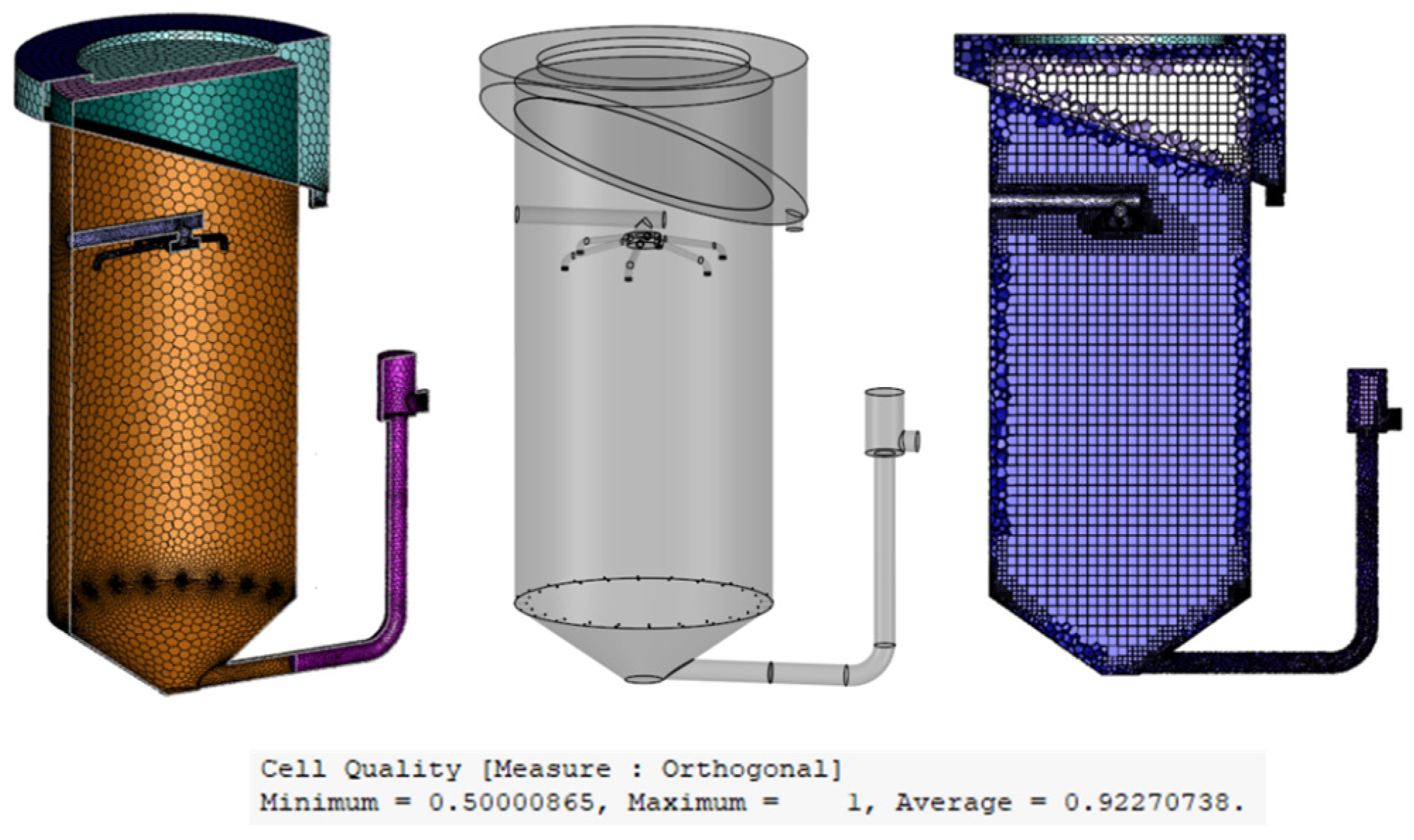
Due to the structural complexity, Fluent Meshing software (version: ANSYS Student 2022 R2) was used for grid generation of the flotation column. Mesh refinement was applied to regions with complex features, ultimately producing an unstructured grid with a polyhedral + hexahedral core. The volume mesh quality was above 0.5. The mesh generation is shown in Figure 1, and the process parameters are listed in Table 1.
The flotation column was first simulated using a two-phase flow model to obtain a stable air–water flow field. The stability criterion was consistent with the method mentioned above and will not be reiterated here. After stabilization, the solid phase was introduced to perform air–water–mineral three-phase flow simulation. The calculation continued until a new steady state was reached. This process was repeated cyclically until all phases representing the characteristic sizes of the gas phase were included. Under-relaxation factors were adjusted at each stage to ensure convergence accuracy. Finally, the air–water–mineral multiphase flow simulation was conducted.
The Eulerian model [16] was used for the multiphase flow simulation, with seven Eulerian phases set up. Interphase interaction and contact area models were adjusted based on experience. The standard k-ε turbulence model [30,31] along with scalable wall functions was employed.
A pressure-based solver was used with a segregated pressure–velocity coupling algorithm. Gradients were calculated using the Least Squares Cell Based method, pressure used the PRESTO! scheme, and momentum, volume fraction, turbulent kinetic energy, and turbulent dissipation rate used the first-order upwind scheme. The boundary condition settings are shown in Table 2 [32].
The residual convergence criterion was set to 1 × 10⁻⁶. To ensure fully developed flow, a total of 308,000 iterations were performed, guaranteeing the attainment of a steady flow field state.

3. Results and Discussion

3.1. Three-Phase Velocity Vector and Streamline Distributions

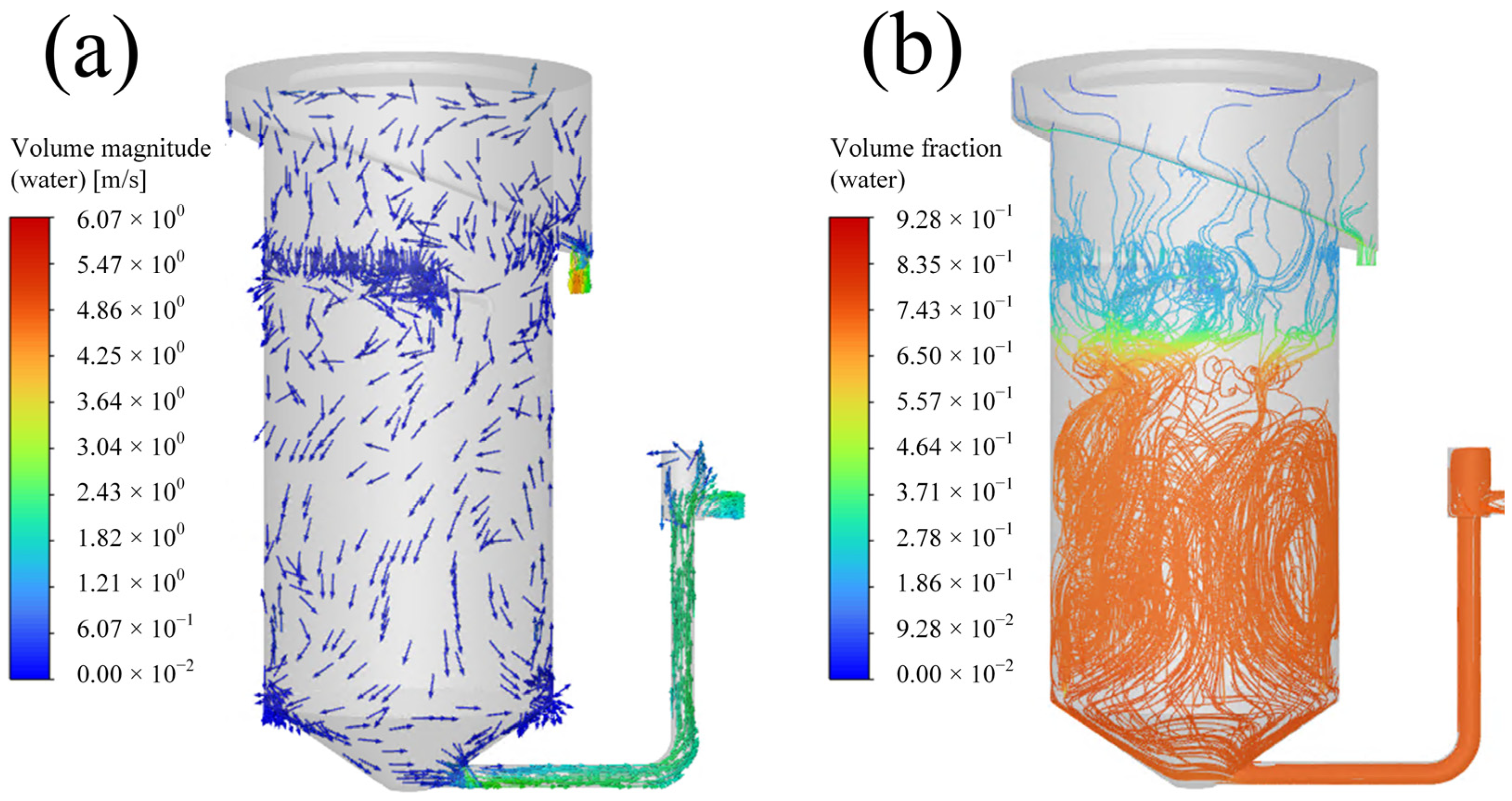
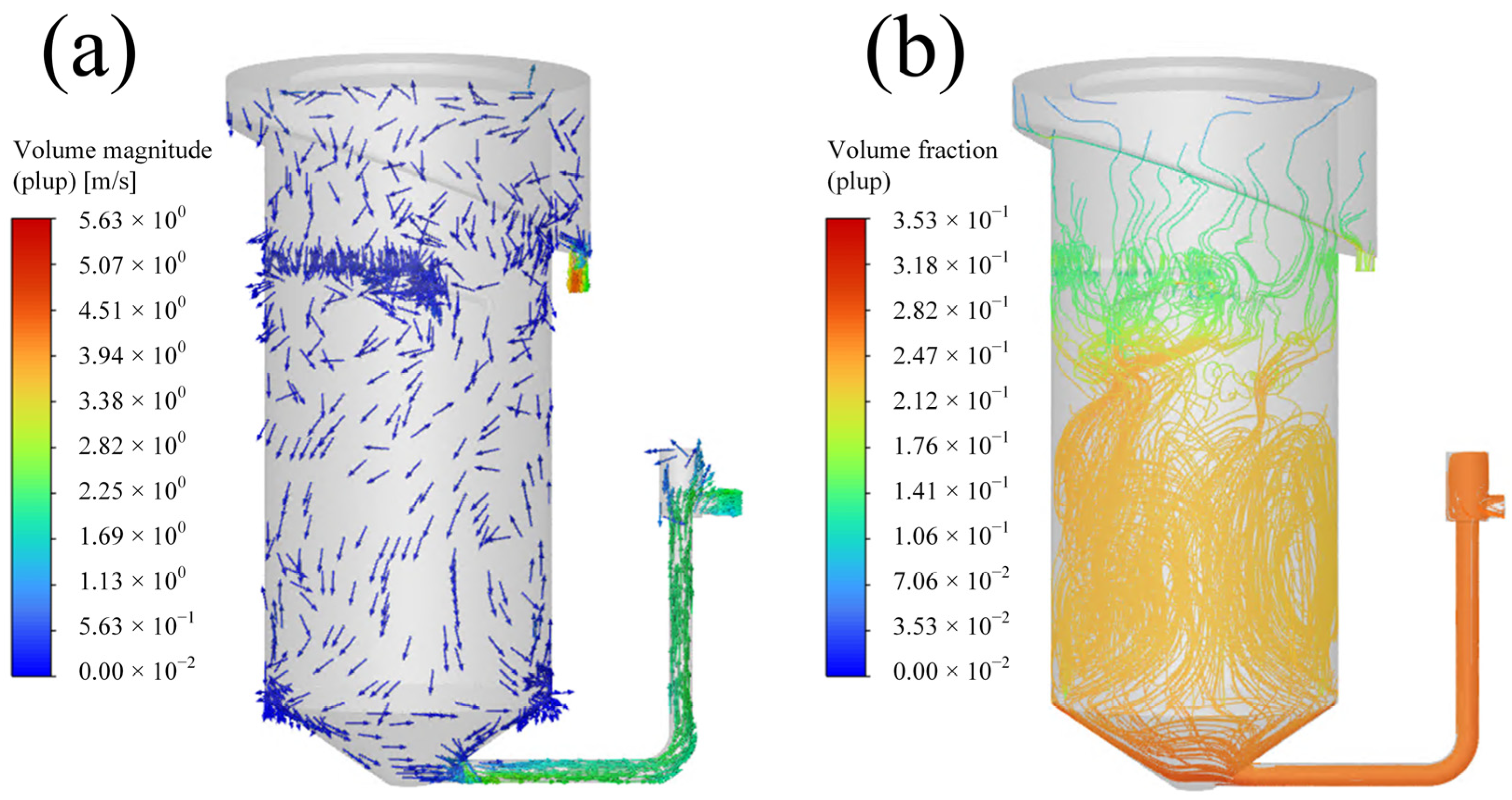
Figure 2a,b present the liquid-phase velocity vector distribution and streamline distribution in the flotation column, respectively. The flow field exhibits a distinct layered structure and can be divided into four core regions according to flow behavior and flotation function: the bottom tailings discharge zone, the high-speed shear intensification zone, the upper-middle turbulent mixing zone, and the main body low-to-medium velocity stabilization zone. The velocity direction and magnitude gradient directly reflect the regional differences in the aqueous phase flow inside the flotation column. The disordered distribution of velocity vectors in the upper-middle part of the column indicates intense turbulent mixing characteristics in this region. Such a turbulent environment provides the dynamic conditions necessary for efficient bubble dispersion and adequate particle suspension. In contrast, the directional arrangement of velocity vectors in the bottom region aligns well with the feed direction from the inlet pipes, demonstrating the dominant role of bottom inflow in initiating liquid-phase flow and consequently forming a vertically stratified flow structure. Examining the velocity gradient distribution reveals that high-velocity zones are concentrated around the inlets and at local narrow cross-sections of the column. As the primary input zones for liquid-phase kinetic energy, these areas exhibit strong shear effects that effectively promote bubble breakup and dispersion, significantly increasing the bubble specific surface area. On the other hand, the medium- to low-velocity regions occupying the main volume of the column are more conducive to bubble–mineral particle attachment and mineralization. These regions help prevent the detachment of already mineralized bubbles, ensuring the continuity of the mineralization process. The streamline distribution in Figure 2b also intuitively reveals the layered structure of the flow inside the flotation column: the streamline distortion in the high-speed shear zone can drive bubble breakage, the disordered streamlines in the upper-middle zone enhance bubble dispersion and particle suspension, and the gentle streamlines in the main body zone ensure the stable upward movement of mineralized bubbles. Overall, the regionalized layered structure of the flow field in the flotation column exerts a crucial regulatory effect on bubble evolution and flotation behavior, providing an important theoretical basis for optimizing the structural design and operating parameters of the flotation column.
The solid-phase velocity vector distribution and streamline distribution are shown in Figure 3. The vector plot reveals that the dispersed vector distribution in the upper-middle part of the column reflects a strong turbulent environment, providing the driving force for particle suspension and multi-directional collisions. The directional arrangement of vectors in the bottom region illustrates the guiding effect of the inflow on solid-phase movement. High-velocity zones are concentrated near the inlets and narrow sections, where their high kinetic energy can enhance the collision vigor between mineral particles and bubbles. Medium- to low-velocity zones cover the main body of the column, creating conditions for stable attachment between particles and bubbles, thereby avoiding detachment of mineralized particles and maintaining collision probability. The streamline plot on the right, combined with the solid-phase volume fraction, shows the macroscopic trajectory of mineral particles: an internal circulating flow field forms within the column, with particles in the upper low-volume-fraction region moving downward along the wall, and particles in the lower high-volume-fraction region converging toward the center and returning upward. This circulation significantly prolongs particle residence time, which is particularly crucial for the adequate flotation of fine particles. Streamlines are densely curved in high-volume-fraction regions, indicating the core interaction zones where particle–bubble collisions and mineralization occur. Streamlines are smooth in low-volume-fraction regions, serving the function of steadily transporting mineralized particles to the froth layer and reducing particle detachment losses.

3.2. Feed Velocity

Feed velocity is one of the core operational parameters for flotation columns, directly determining the pulp residence time, the contact efficiency among air, water, and minerals, and ultimately the flotation performance. Both excessively high and low feed velocities can lead to decreased flotation efficiency. The effects of feed velocities of 0.8 m/s, 1.2 m/s, 1.6 m/s, 2 m/s, and 2.4 m/s on flow field characteristics and collision probability were investigated. The feed solid mass concentration was set to 0.1%, and the aeration velocity was set to 3 m/s.
(1)
Gas-phase volume distribution (central cross-section and axial distribution)
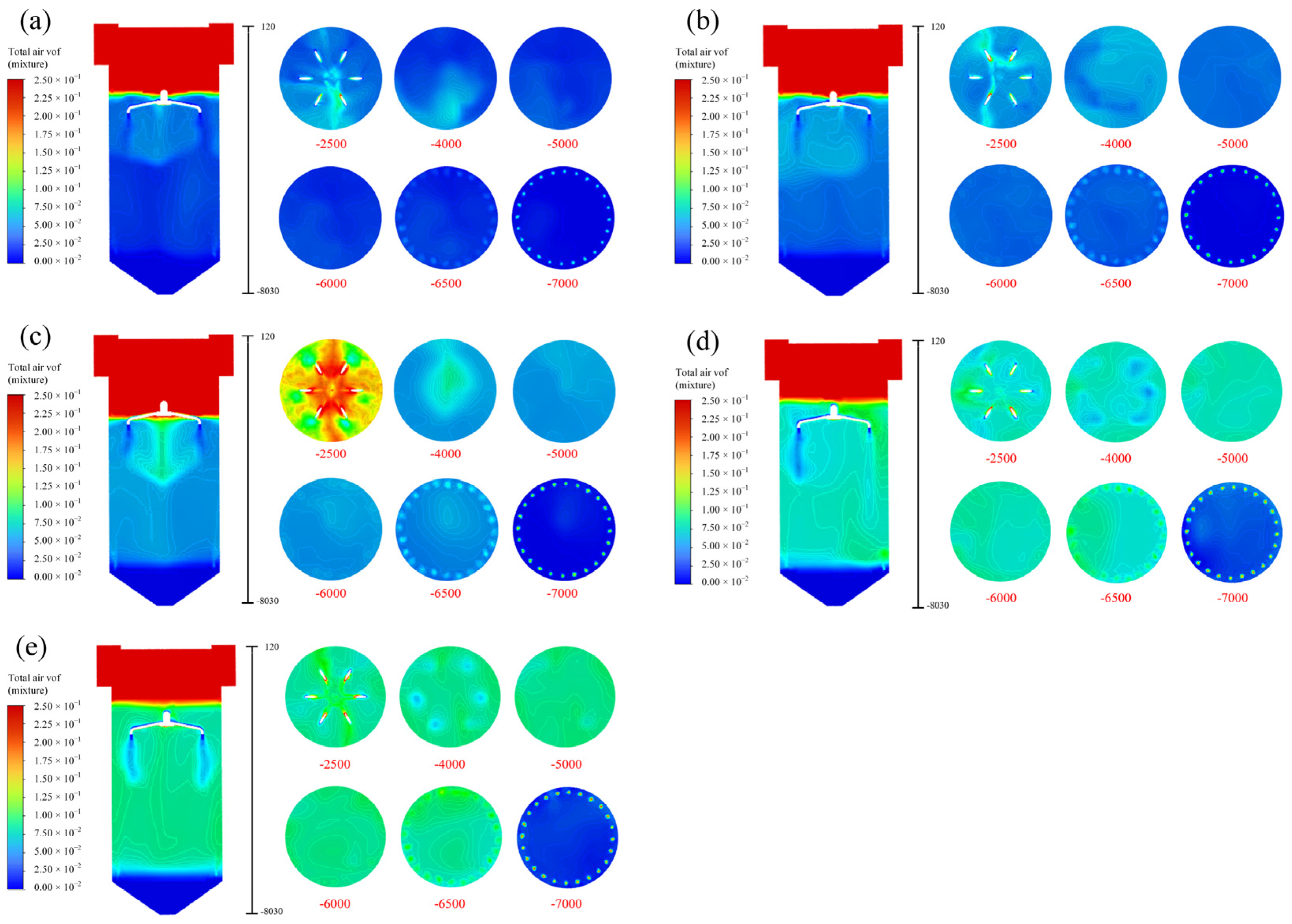
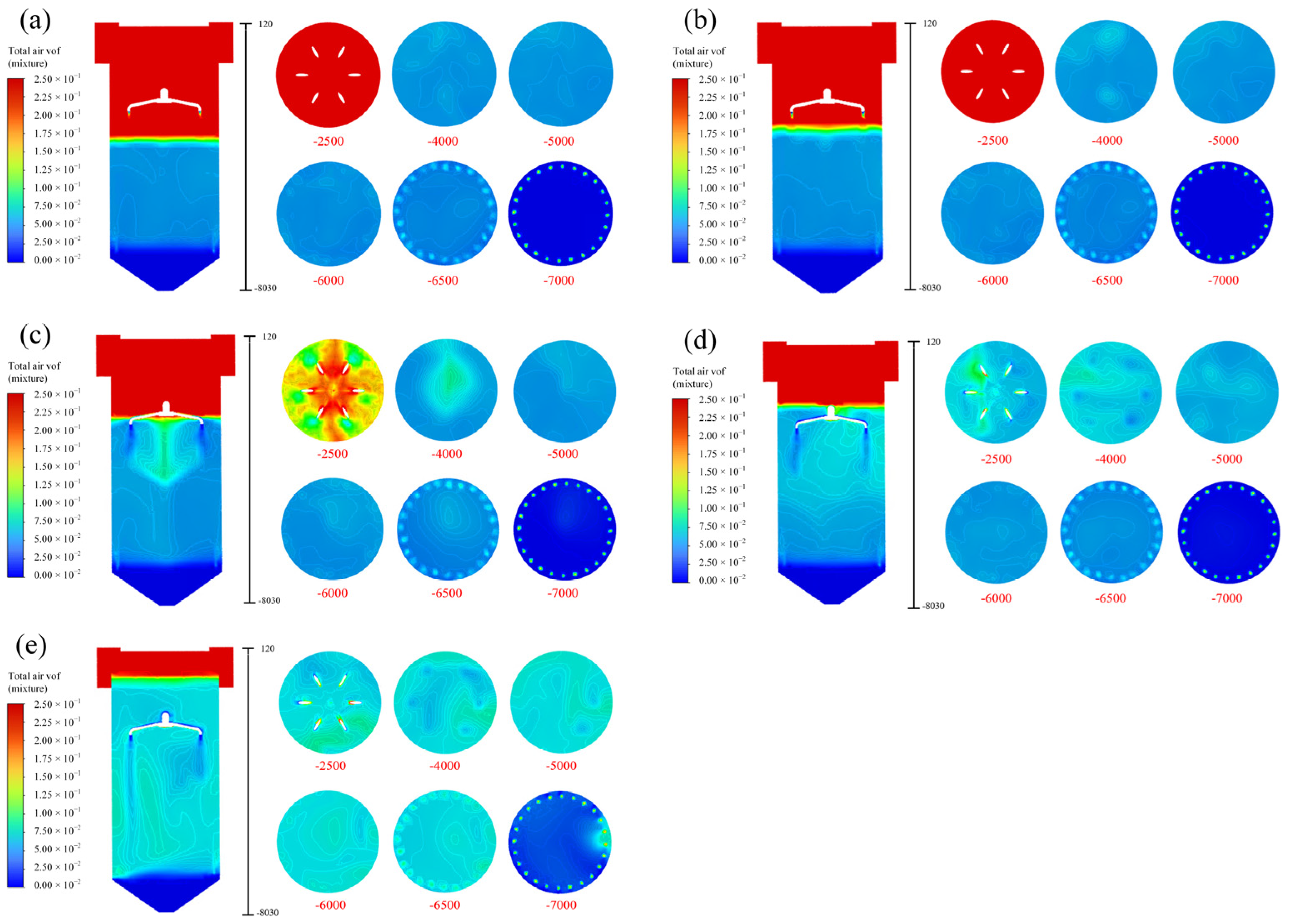
The variation in gas volume fraction with changing feed velocity was observed, as shown in Figure 4. As seen in Figure 4, as the feed velocity increases, the solid-phase volume fraction gradually increases, while the gas-phase volume fraction significantly decreases. At the feed pipe location, obstruction by the pipe wall generates a downward shock wave that displaces the rising solid phase, leading to a localized increase in gas volume fraction directly below the feed pipe—this localized gas enrichment can enhance collision probability near the feed pipe, providing additional mineralization sites for particles entering the column. As the feed velocity continues to increase, the solid-phase bed rises above the feed pipe, and the flow field below the feed pipe gradually stabilizes. At a feed velocity of 2 m/s, the bed height just submerges the feed pipe, corresponding to the collection zone of the flotation column. Therefore, 2 m/s was selected as the feed velocity for subsequent simulation experiments.
At low feed velocities (e.g., 0.8 m/s, Figure 4a), gas volume fraction exhibits pronounced aggregation in the upper column, with high-value zones (red/yellow, gas volume fraction ≥ 0.28) concentrated near the top. This pattern arises from weak pulp turbulence, which allows bubbles to rise and accumulate under buoyancy, consistent with the stratified flow field characteristics identified in this study. As feed velocity increases (e.g., 2.4 m/s, Figure 4e), high gas volume fraction zones gradually extend to the upper-middle column, and the overall distribution becomes more uniform (blue/green, gas volume fraction was 0.24–0.26). This transition is driven by enhanced turbulence intensity at higher feed velocities, which promotes bubble breakup and homogeneous dispersion in the aqueous phase. In terms of the overall pattern, the lower the feed velocity, the more pronounced the aggregation of gas volume fraction in the upper region of the flotation column, with high-volume-fraction zones mainly concentrated near the column top. As the feed velocity increases, the distribution of high gas volume fraction regions gradually extends toward the upper-middle part of the column, and overall dispersion increases. This trend originates from the regulation of turbulence intensity by feed velocity: at low feed velocities, pulp turbulence is weaker, and bubbles tend to accumulate in the upper region; at high feed velocities, turbulence intensity increases, leading to more uniform bubble dispersion in the water phase and a more homogeneous spatial distribution of gas volume fraction. Under low feed velocity, the upper cross-section (−2500 mm) shows a high and concentrated gas volume fraction, while the lower cross-section (−7000 mm) is significantly lower, reflecting the migration characteristic of bubble accumulation in the upper part and sparsity in the lower part. In contrast, under high feed velocity, the gas-phase distribution in the upper-middle cross-sections (−2500 mm, −4000 mm) is more uniform, and the extent of high-volume-fraction zones is wider, demonstrating the promoting effect of high-velocity turbulence on bubble dispersion. Increased feed velocity enhances pulp kinetic energy, leading to more thorough bubble breakup and dispersion in the water phase, consequently forming a more uniform gas volume fraction distribution within the column. From a flotation kinetics perspective, this cross-sectional evolution difference directly affects bubble–mineral particle collision and mineralization: localized bubble aggregation at low feed velocity can create a high mineralization zone at the column top, but overall collision uniformity is insufficient. The uniform dispersion of bubbles at high feed velocity provides more abundant collision units for particles throughout the entire column volume, particularly benefiting the mineralization of fine particles.
(2)
Gas holdup distribution in the collection zone
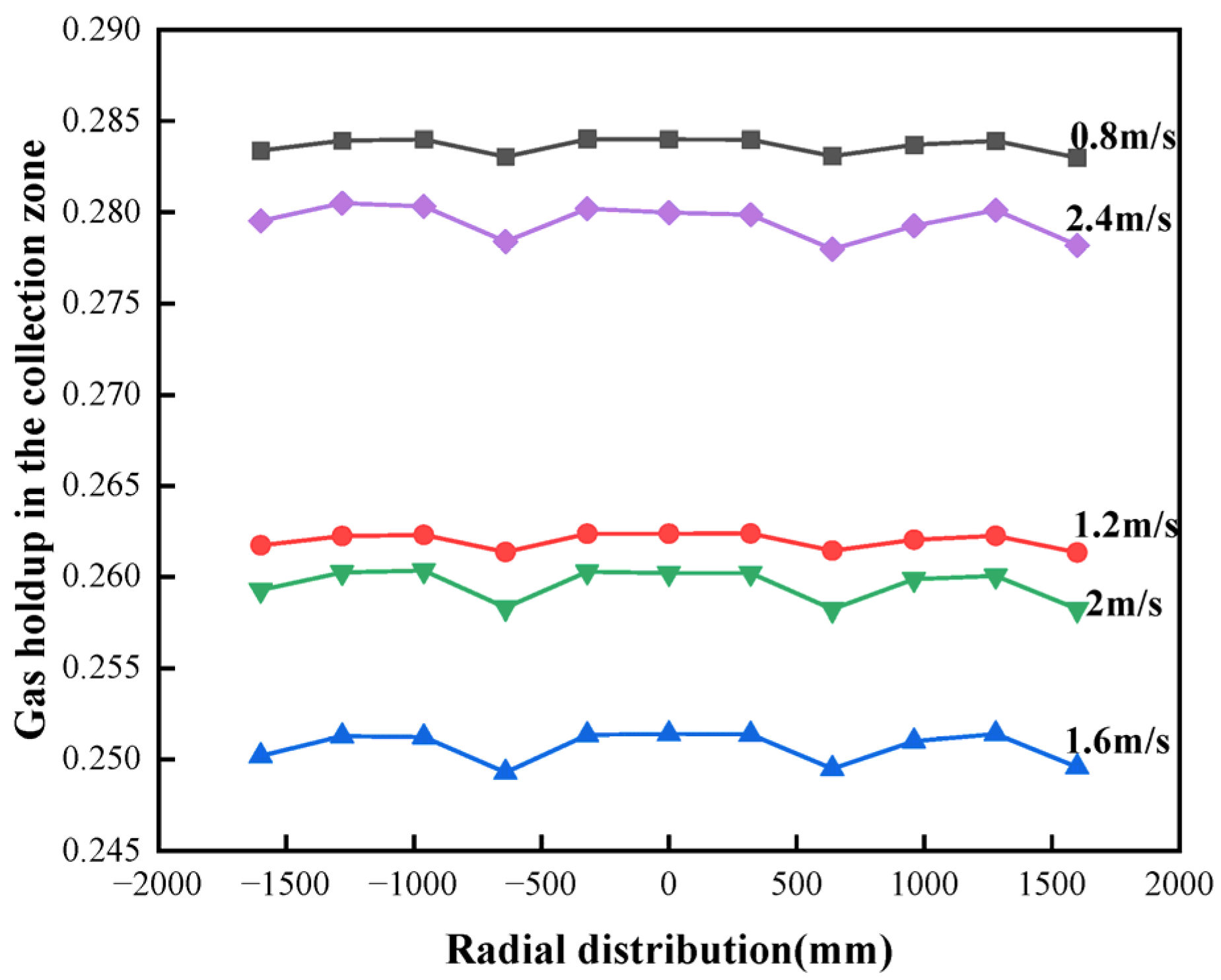
As the feed velocity increases, the gas holdup first decreases and then rises, as shown in Figure 5. Both excessively low (0.8 m/s) and high (2.4 m/s) feed velocities result in excessively high gas holdup. However, the gas volume fraction at low feed velocities fails to meet the flotation requirements, while at high feed velocity, the solid-phase content exceeds the limit [33]. The gas holdup at the intermediate feed velocity (1.6 m/s) is too low. The gas holdups at 1.2 m/s and 2 m/s are similar, and the gas volume fraction at 2 m/s is closer to the standard for the flotation column collection zone. The lower the feed velocity (e.g., 0.8 m/s), the higher the overall gas holdup in the collection zone (approximately 0.283–0.285). At low feed velocities, although the overall gas holdup in the entire column is relatively high, the gas distribution is poor in the bottom and middle regions of the column, which is unfavorable for flotation separation. As the feed velocity increases (from 1.2 m/s to 2.4 m/s), the gas holdup is lowest at 1.6 m/s (approx. 0.245–0.250), while at 2 m/s and 2.4 m/s, it remains in the ranges of 0.255–0.260 and 0.275–0.280, respectively. This trend stems from the regulation of pulp turbulence and bubble dispersion behavior by feed velocity. At low feed velocity, pulp turbulence intensity is weaker, and bubbles are less disturbed and tend to accumulate in the collection zone, resulting in higher gas holdup. At high feed velocity, turbulence intensity increases, leading to more thorough bubble dispersion in the liquid phase. Although gas holdup decreases, the uniformity of bubble distribution improves, creating conditions for extensive particle collisions. Examining the details of radial distribution, the fluctuation amplitude of gas holdup with radial distance varies under different feed velocities. Under low feed velocity (0.8 m/s), the radial fluctuation of gas holdup is minimal, indicating highly uniform bubble distribution in the collection zone, which is conducive to rapid mineralization. Under high feed velocity (e.g., 1.6 m/s), although the gas holdup is low, regularity in radial distribution still exists, reflecting the directional regulation of bubble dispersion by strong turbulence. Although bubbles are dispersed, they still distribute along specific flow field trajectories. This distribution allows fine, difficult-to-float minerals to contact bubbles across the entire radial range.
(3)
Weighted average collision probability distribution
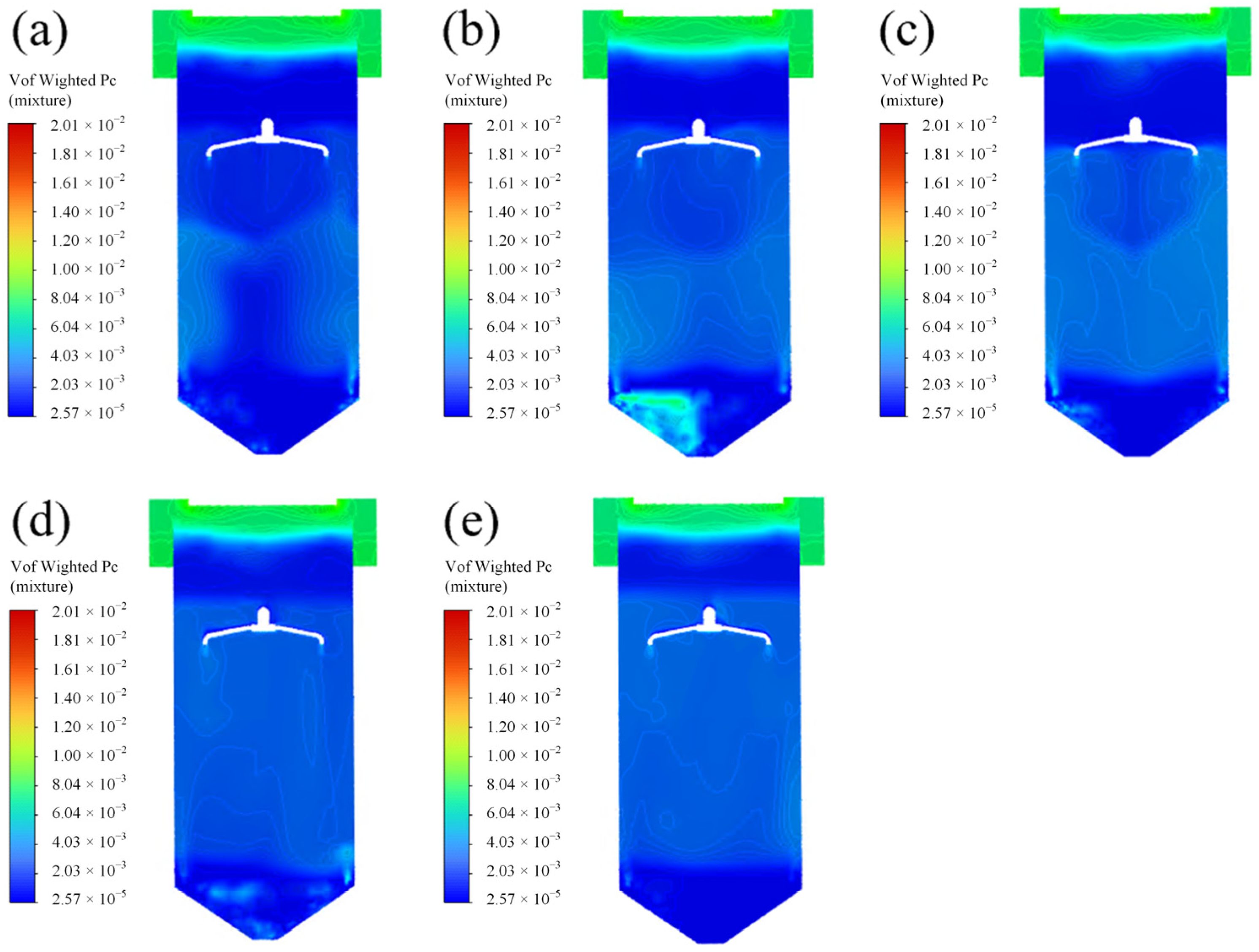
The trend in volume fraction variation is also reflected in the average collision probability distribution, as shown in Figure 6. As the feed velocity increases, the range of average collision probability gradually increases. In terms of the overall pattern, the lower the feed velocity, the more concentrated the distribution of high collision probability regions within the column, with pronounced localization characteristics. As the feed velocity increases, the spatial distribution of high collision probability regions gradually becomes more extensive. Although the probability peaks of individual regions fluctuate, the overall uniformity of collision probability distribution improves significantly. This regularity stems from the regulatory effect of feed velocity on the turbulence field. At low feed velocity, pulp turbulence intensity is weak, the motion of bubbles and particles is more constrained, and collision behavior tends to concentrate in local regions. At high feed velocity, turbulence intensity increases, and bubble dispersion and particle suspension become more uniform, providing more sufficient dynamic conditions for collision reactions throughout the entire column. Feed velocity indirectly regulates the initiation efficiency of mineralization reactions by altering the spatial distribution of collision probability. Under low feed velocity conditions (Figure 6a, 0.8 m/s), localized high collision probability regions enable rapid mineralization of easily floatable minerals. Bubbles and particles can complete collision and attachment in a short time, making this suitable for flotation scenarios aiming for rapid separation. Under high feed velocity conditions (Figure 6e, 2.4 m/s), the widely distributed collision probability field allows fine, difficult-to-float minerals to fully contact bubbles throughout the entire column volume. Even if the kinetic energy of individual collisions is somewhat reduced, it can be compensated by high contact frequency, significantly improving the mineralization efficiency of difficult-to-float minerals. From a flow field dynamics perspective, localized collision concentration at low velocity originates from the stability of the pulp flow field, making the motion trajectories of bubbles and particles more predictable. The uniform collision across the entire domain at high velocity is the result of turbulent disturbance. Bubbles break up and disperse more thoroughly in strong turbulence, particle suspension is also more uniform, and the motion interaction between them becomes more frequent throughout the entire column volume. This coupling relationship between velocity and collision probability reveals the velocity adaptability during the initial stage of flotation mineralization. It is necessary to seek a balance between collision concentration and collision extensiveness, considering both mineral floatability (easily floatable/difficult-to-float) and particle size composition (coarse/fine).

3.3. Aeration Velocity

Aeration velocity is a core operational parameter that controls the air–water–minerals three-phase flow regime and bubble characteristics within a flotation column. It directly affects the collision and attachment efficiency between bubbles and mineral particles, ultimately influencing flotation performance. Its adjustment requires balancing bubble quantity and bubble stability; both excessively high and low values can lead to decreased flotation efficiency. The effects of aeration velocities of 1 m/s, 2 m/s, 3 m/s, 4 m/s, and 5 m/s on flow field characteristics and collision probability were investigated. The feed solid mass concentration was set to 0.1, and the feed velocity was set to 2 m/s.
(1)
Gas-phase volume distribution (central cross-section and axial distribution)
The variation in gas volume fraction with changing aeration velocity is observed, as shown in Figure 7. In terms of the overall spatial distribution, the lower the aeration velocity, the more pronounced the aggregation of gas volume fraction in the upper region of the flotation column, with high-volume-fraction zones mainly concentrated near the column top. As the aeration velocity increases, the distribution of high gas volume fraction regions gradually extends toward the middle-lower part of the column, and overall dispersion significantly increases. This regularity stems from the direct regulation of bubble dispersion behavior by aeration velocity. At low aeration velocity, bubble generation is low and dominated by buoyancy, leading to easy accumulation in the upper region. At high aeration velocity, bubble generation increases dramatically and, entrained by turbulence, disperses more easily throughout the entire column volume, transforming the spatial distribution of gas volume fraction from upper concentration to overall uniformity. Under low aeration velocity conditions (as in Figure 7a), the upper cross-section (−2500 mm) shows a high but extremely uneven gas volume fraction, while the lower cross-section (−7000 mm) shows almost no gas phase distribution, reflecting the migration limitation of bubble accumulation in the upper part and absence in the lower part. Under high aeration velocity conditions (as in Figure 7e), the gas-phase distribution in the upper-middle cross-sections (−2500 mm, −4000 mm) becomes relatively uniform. Even the lower cross-sections (−6000 mm, −6500 mm) show significant gas phase presence. This demonstrates that at high aeration rates, bubbles can overcome buoyancy limitations and, driven by strong turbulence, penetrate into the lower part of the column, providing collision units for particles throughout the entire column volume. From a flotation kinetics perspective, the regulatory effect of aeration velocity is directly related to mineralization efficiency. Low aeration velocity is suitable for rapid flotation of easily floatable coarse minerals, where bubbles accumulated in the upper region can complete collision, mineralization, and flotation separation with minerals in a short time. High aeration velocity (as in Figure 7e) is more suitable for fine, difficult-to-float minerals. Bubbles dispersed throughout the entire domain can fully contact fine minerals, compensating for the lack of kinetic energy in individual collisions with high collision frequency, significantly improving the recovery of difficult-to-float minerals [34,35].
(2)
Gas holdup distribution in the collection zone
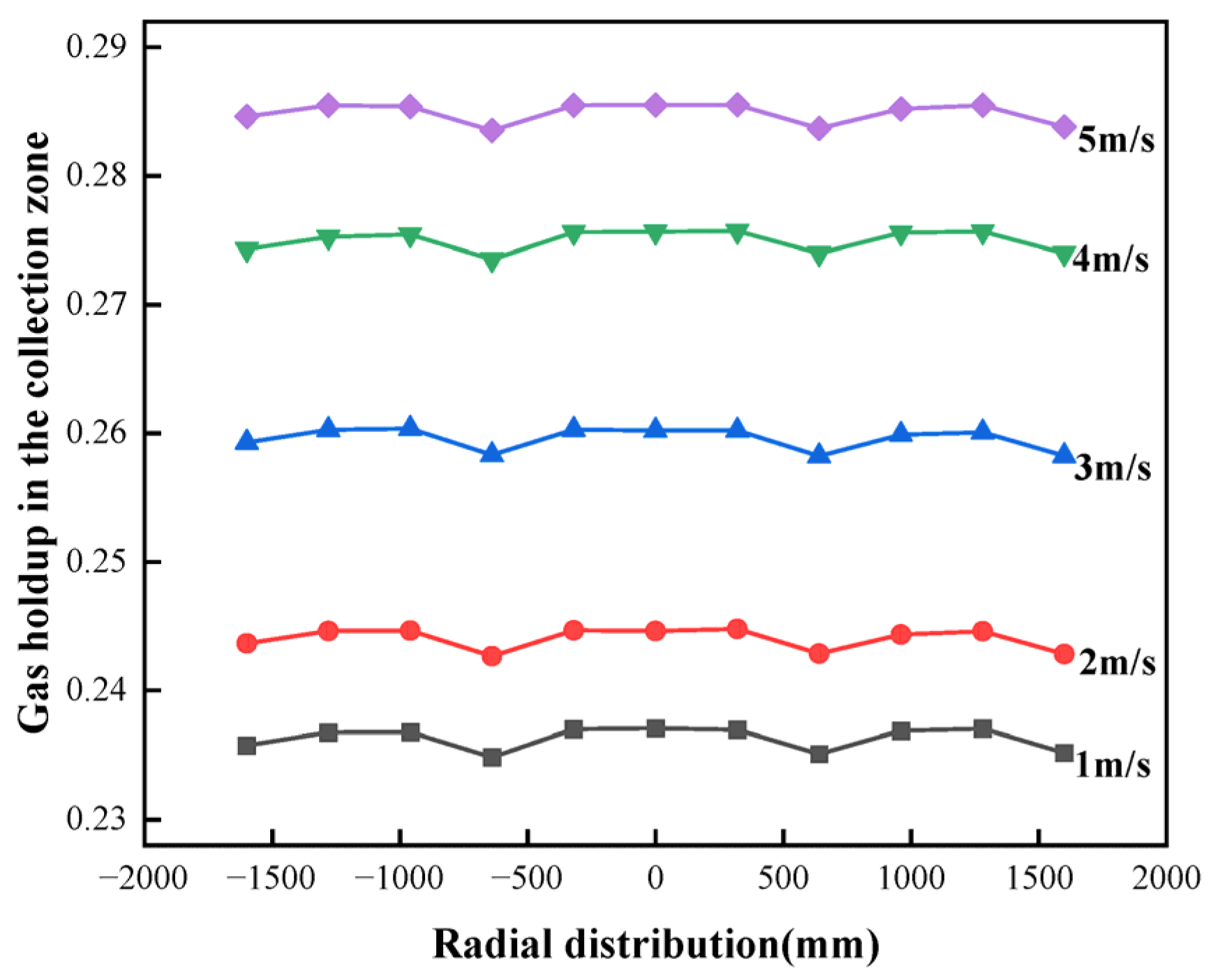
As shown in Figure 8, the radial distribution of gas holdup in the collection zone at different aeration velocities indicates a significant positive correlation between aeration velocity and gas holdup in the collection zone: When the aeration velocity is 5 m/s, the gas holdup is at its highest overall level (approximately 0.28–0.285). As the aeration velocity decreases, the gas holdup gradually decreases, reaching its lowest level at 1 m/s (approximately 0.23–0.235). Higher aeration velocity results in more bubbles injected per unit time, and the strong aeration force leads to more thorough bubble dispersion in the collection zone, thereby increasing gas holdup. Conversely, low aeration velocity results in fewer injected bubbles, which tend to accumulate locally due to buoyancy, leading to an overall lower gas holdup [36]. Examining the details of radial distribution, under high aeration velocity (e.g., 5 m/s), the radial distribution of gas holdup becomes more uniform, maintaining high gas holdup levels across almost the entire radial range. This is particularly suitable for the flotation requirements of fine, difficult-to-float minerals. Under low aeration velocity (e.g., 1 m/s), not only is the absolute gas holdup low, but radial fluctuations are minimal, reflecting highly concentrated bubble distribution in the collection zone. Although mineralization may be easier in this region, the overall collision range is limited, making it more suitable for rapid mineralization and separation of easily floatable, coarse minerals.
(3)
Weighted average collision probability distribution
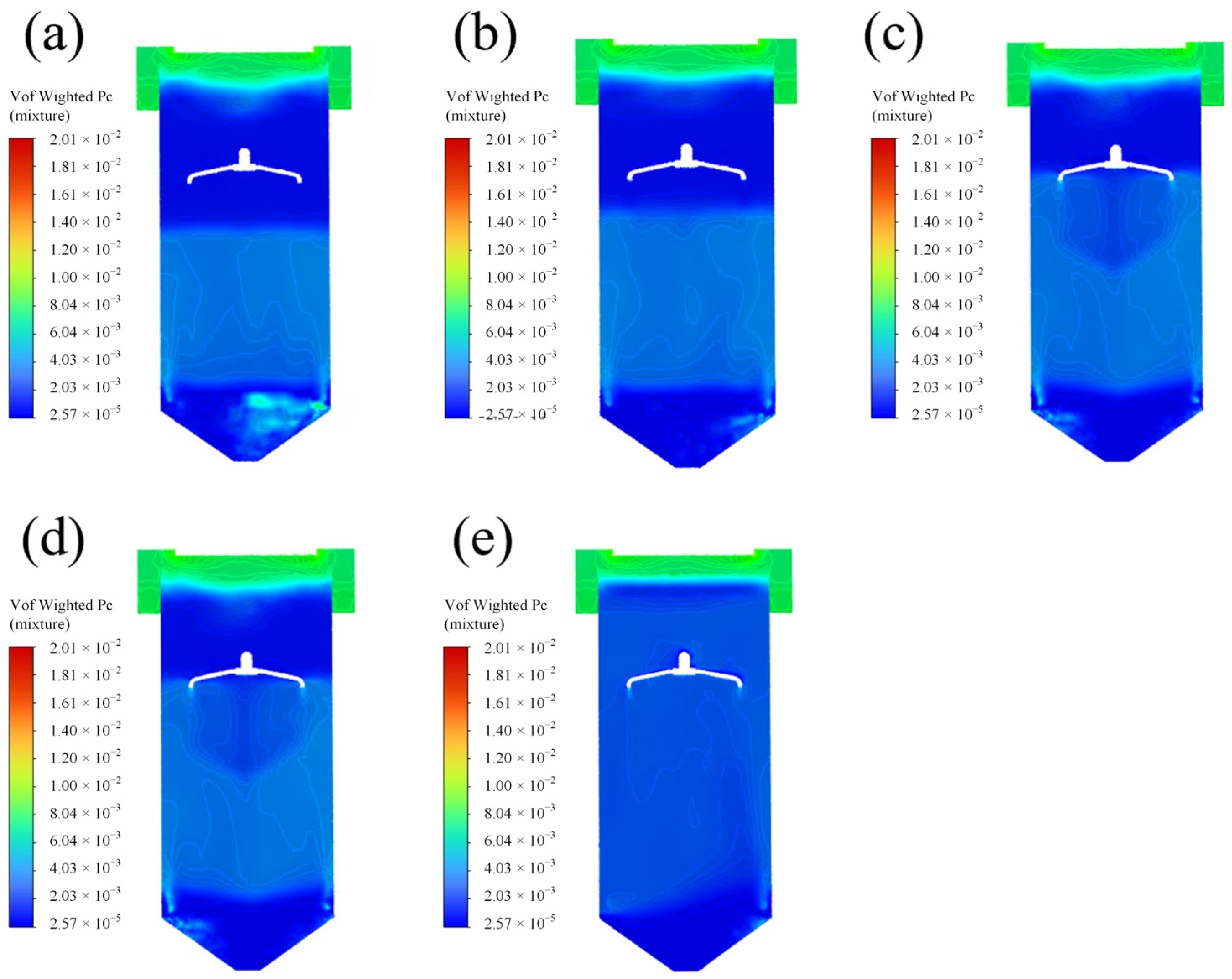
The trend in volume fraction variation is also reflected in the average collision probability distribution, as shown in Figure 9. As the aeration velocity increases, the range of average collision probability gradually increases. The lower the aeration velocity, the sparser and more concentrated the distribution of high collision probability regions within the column. As the aeration velocity increases, the spatial distribution of high collision probability regions gradually becomes more extensive, and the overall level of collision probability increases significantly. This regularity stems from the dual regulation of bubble dispersion and flow field turbulence by aeration velocity. At low aeration velocity, bubble generation is low and dispersion is poor, limiting the collision opportunities between mineral particles and bubbles. At high aeration velocity, a large number of bubbles are uniformly dispersed under the action of strong turbulence, thereby increasing the weighted average collision probability.

4. Conclusions

Based on the CFD method, this study systematically investigated the characteristics of the air–water–minerals three-phase flow field in a graphite flotation column, as well as the regulatory laws of feed velocity and aeration velocity, and clarified the parameter adaptation mechanism. The research provides theoretical and practical guidance for the optimization of flotation columns. The main conclusions are as follows:
(1)
The flow field in the graphite flotation column exhibits a distinct vertical stratified structure, which is divided into four core zones: the bottom tailings discharge zone, high-speed shear enhancement zone, upper-middle turbulent mixing zone, and main medium-low speed stable zone. Intense turbulence in the upper-middle zone facilitates bubble dispersion and particle suspension, while directional inflow at the bottom dominates the initial flow. The solid-phase flow field features an internal circulation flow with upward and downward movement, which can prolong the particle residence time in the column. The stratified structure of the flow field plays a key regulatory role in bubble evolution and flotation mineralization
(2)
Feed velocity exerts a significant regulatory effect on the flow field, gas phase distribution, and mineralization efficiency, and its optimal value should be determined in combination with mineral characteristics. With the increase in feed velocity, the solid volume fraction increases and the gas volume fraction decreases, with 2 m/s being the optimal feed velocity (the solid bed is matched with the collection zone of the flotation column). The gas holdup in the collection zone first decreases and then increases with the rise of feed velocity; the gas holdup at 2 m/s is moderate and the gas volume fraction is close to the standard of the collection zone. Low feed velocity is suitable for the flotation of easily floatable coarse-grained minerals, while high feed velocity is conducive to the mineralization of fine-grained refractory minerals. The feed velocity in this study is determined based on the operation of the actual flotation column and cannot be referenced to studies on other types of flotation columns.
(3)
Aeration velocity is significantly correlated with bubble characteristics and mineralization efficiency, and it is necessary to balance the bubble quantity, stability and energy consumption. Aeration velocity is positively correlated with the gas holdup in the collection zone: the gas holdup reaches the maximum (0.28~0.285) at 5 m/s and the minimum (0.23~0.235) at 1 m/s. High aeration velocity is suitable for fine-grained refractory minerals, while low aeration velocity is applicable to easily floatable coarse-grained minerals. The weighted average collision probability increases with the rise of aeration velocity.
(4)
The efficient operation of the graphite flotation column requires the collaborative adaptation of the flow field and operating parameters. The combination of a feed velocity of 2 m/s and a reasonable aeration velocity can achieve a balance between mineralization efficiency and energy consumption. Furthermore, the gas distribution in the column can be further optimized by combining the radial distribution characteristics of gas holdup and the regulatory laws of aeration velocity, which provides technical support for the industrial optimization of graphite flotation.

Author Contributions

Investigation, B.Y. and H.L.; Resources, G.Q.; Supervision, J.W.; Writing—original draft, Z.L. and R.L.; Writing—review and editing, Z.L., D.L. and L.W. All authors have read and agreed to the published version of the manuscript.

Funding

This work was supported by Hunan Provincial Natural Science Foundation of China (2023JJ40756).

Data Availability Statement

The original contributions presented in this study are included in the article. Further inquiries can be directed to the corresponding author.

Conflicts of Interest

The authors declare no conflicts of interest.

References

  1. Cheng, G.; Xiong, L.; Lu, Y.; Zhang, Z.G.; Lv, C.; Lau, E.V. Advancements in the application of surface roughness in mineral flotation process. Sep. Sci. Technol. 2024, 59, 592–611. [Google Scholar] [CrossRef]
  2. Bouchard, J.; Desbiens, A.; Del Villar, R.; Nunez, E. Column flotation simulation and control: An overview. Miner. Eng. 2009, 22, 519–529. [Google Scholar] [CrossRef]
  3. Yianatos, J.B. Fluid flow and kinetic modelling in flotation related processes: Columns and mechanically agitated cells—A review. Chem. Eng. Res. Des. 2007, 85, 1591–1603. [Google Scholar] [CrossRef]
  4. Finch, J.A.; Dobby, G.S. Column Flotation. In Flotation Science and Engineering; CRC Press: Boca Raton, FL, USA, 1990; pp. 291–329. [Google Scholar]
  5. Ding, S. Study on Turbulent Detachment Mechanism and Detachment Probability Model of Flotation Particle-Bubble. Ph.D. Thesis, China University of Mining and Technology, Xuzhou, China, 2024. [Google Scholar]
  6. Wang, M. Numerical Simulation of Multiphase Flow in a Cyclonic Micro-bubble Flotation Column. Master’s Thesis, China University of Mining and Technology, Xuzhou, China, 2023. [Google Scholar]
  7. Wang, W.; Li, D. Application Status and Development Trend of Flotation Column Technology. Nonferrous Met. (Min. Process. Sect.) 2023, 2, 19–29. [Google Scholar]
  8. Gao, J.; Bu, X.; Dong, L.; Qiu, Y.; Xie, G.; Chelgani, S.C. Natural graphite froth flotation—An overview. Miner. Process. Extr. Metall. Rev. 2025, 46, 306–323. [Google Scholar] [CrossRef]
  9. Zhang, F.; Li, H.; Zhang, Y.; Gao, X.; Qian, Z. Experimental research on flotation of crystalline graphite ore by flotation column. Nonferrous Met. (Miner. Process. Sect.) 2024, 9, 80–86+104. [Google Scholar] [CrossRef]
  10. Vasumathi, N.; Sarjekar, A.; Chandrayan, H.; Chennakesavulu, K.; Reddy, G.R.; Kumar, T.V.V.; El-Gendy, N.S.; Gopalkrishna, S.J. A mini review on flotation techniques and reagents used in graphite beneficiation. Int. J. Chem. Eng. 2023, 2023, 1007689. [Google Scholar] [CrossRef]
  11. Zhang, M.; Li, T.; Wang, G. A CFD Study of the Flow Characteristics in a Packed Flotation Column: Implications for Flotation Recovery Improvement. Int. J. Miner. Process. 2017, 159, 60–68. [Google Scholar] [CrossRef]
  12. Sarhan, A.R.; Naser, J.; Brooks, G. CFD Analysis of Solid Particles Properties Effect in Three-Phase Flotation Column. Sep. Purif. Technol. 2017, 185, 1–9. [Google Scholar] [CrossRef]
  13. Wang, H.; Yan, X.; Li, D.; Zhou, R.; Wang, L.; Zhang, H.; Liu, Q. Recent Advances in Computational Fluid Dynamics Simulation of Flotation: A Review. Asia-Pac. J. Chem. Eng. 2021, 16, e2704. [Google Scholar] [CrossRef]
  14. Xie, X.; Zheng, M.; Wen, D.; Li, Y.; Xie, S. A New CFD Based Non-Invasive Method for Functional Diagnosis of Coronary Stenosis. BioMed. Eng. 2018, 17, 36. [Google Scholar] [CrossRef]
  15. Dong, H.; Wang, F.; He, D.; Liu, Y. Flotation Equipment Automation and Intelligent Froth Feature Extraction in Flotation Process: A Review. Rev. Chem. Eng. 2025, 41, 225–239. [Google Scholar] [CrossRef]
  16. Gao, Y.; Geng, L.; Wang, Z.; Zhang, Z.; Geng, D. A Review on the Development of Gas-Liquid Two-Phase Flow Numerical Models Based on Euler-Euler Approach. Mech. Pract. 2022, 44, 1021–1036. [Google Scholar]
  17. Bagherzadeh, A.; Darbandi, M.; Barezban, M.B. Numerical Simulation of Particle Separation in a Two-Phase Flow Passing through a Vortex-Based Air Classifier Using Eulerian–Lagrangian DDPM Approach. Powder Technol. 2024, 445, 120036. [Google Scholar] [CrossRef]
  18. Liu, M.; Cao, S.; Cao, S. Numerical Analysis for Interphase Forces of Gas-Liquid Flow in a Multiphase Pump. Eng. Comput. 2018, 35, 2386–2402. [Google Scholar] [CrossRef]
  19. Vadlakonda, B.; Kopparthi, P.; Mangadoddy, N. Numerical Modelling of Two-Phase Flow Hydrodynamics of Column Flotation—Validation Against ERT Data. Int. J. Coal Prep. Util. 2024, 44, 1378–1413. [Google Scholar] [CrossRef]
  20. Yan, X.; Chen, Z.; Wang, L. Computational Fluid Dynamics (CFD) Numerical Simulation and Particle Image Velocimetry (PIV) Measurement of a Packed Flotation Column. Physicochem. Probl. Miner. Process. 2018, 54, 395–405. [Google Scholar]
  21. Wang, C.; Sun, C.; Kou, J. Mechanism and Research Progress of Particle-Bubble Adhesion in Flotation Process. J. Eng. Sci. 2018, 40, 1423–1433. [Google Scholar]
  22. Zhou, R.; Li, X.; Li, D.; Wang, H.; Song, Z.; Yan, X.; Zhang, H. The Effect of Energy Input on Bubble-Particle Collision, Attachment, Detachment, and Collection Efficiencies in a Mechanical Flotation Cell. Powder Technol. 2025, 453, 120659. [Google Scholar] [CrossRef]
  23. Chen, A.; Yang, W.; Geng, S.; Gao, F.; He, T.; Wang, Z.; Huang, Q. Modeling of Microbubble Flow and Coalescence Behavior in the Contact Zone of a Dissolved Air Flotation Tank Using a Computational Fluid Dynamics–Population Balance Model. Ind. Eng. Chem. Res. 2019, 58, 16989–17000. [Google Scholar] [CrossRef]
  24. Shen, Y.; Huai, J.; Peng, C.; Li, F.; Hu, C.; Li, Z. Characteristics of Graphite Resources and Progress in Differentiated Applications in China. Conserv. Util. Miner. Resour. 2020, 40, 171–178. [Google Scholar]
  25. Dong, X.; Guo, C.; Peng, D.; Jiang, Y. Numerical Simulation of Air–Water–Flake Graphite Triple-Phase Flow Field in a Homemade Double-Nozzle Jet Micro-Bubble Generator. Minerals 2024, 14, 533. [Google Scholar] [CrossRef]
  26. Zhao, Y.; Zhang, M.; Wang, C. Study on the Dispersion Characteristics of Slurry and the Distribution Law of Bubble Velocity in Flotation Column. Conserv. Util. Miner. Resour. 2023, 43, 66–72. [Google Scholar]
  27. Darcovich, K. A Hydrodynamic Simulation of Mineral Flotation. Part I: The Numerical Model. Powder Technol. 1995, 83, 211–224. [Google Scholar] [CrossRef][Green Version]
  28. Gong, M.; Li, C.; Li, Z. Numerical Analysis of Flow in a Highly Efficient Flotation Column. Asia-Pac. J. Chem. Eng. 2015, 10, 84–95. [Google Scholar] [CrossRef]
  29. Rahman, R.M.; Ata, S.; Jameson, G.J. The Effect of Flotation Variables on the Recovery of Different Particle Size Fractions in the Froth and the Pulp. Int. J. Miner. Process. 2012, 106–109, 70–77. [Google Scholar] [CrossRef]
  30. Xu, W.; Li, W.; Wang, J.; Song, Y.; Wu, B.; Wen, J.; Li, K.; Li, B. Numerical simulation of gas–liquid two-phase flow CFD–PBM model in a micro–nanobubble generator. Minerals 2022, 12, 1270. [Google Scholar] [CrossRef]
  31. Alam, H.S.; Sutikno, P.; Fauzi Soelaiman, T.A.; Sugiarto, A.T. CFD-PBM Coupled modeling of bubble size distribution in a swirling-flow nanobubble generator. Eng. Appl. Comput. Fluid Mech. 2022, 16, 677–693. [Google Scholar] [CrossRef]
  32. Ren, F.; Noda, N.A.; Ueda, T.; Sano, Y.; Takase, Y.; Umekage, T.; Yonezawa, Y.; Tanaka, H. CFD-PBM approach for the gas-liquid flow in a nanobubble generator with honeycomb structure. J. Dispers. Sci. Technol. 2019, 40, 306–317. [Google Scholar] [CrossRef]
  33. Demuner, L.R.; Reis, A.S.; Barrozo, M.A.S. Effect of Gas Holdup on the Performance of Column Flotation of a Low-Grade Apatite Ore. Minerals 2025, 15, 901. [Google Scholar] [CrossRef]
  34. Rushdi, S.; Rushdi, T.S.; Al-Sharify, N.T. Effect of Gas Holdup and Gas Velocity on Volumetric Mass Transfer Coefficient in Bubble Column. Sustain. Eng. Technol. Sci. 2025, 1, 14–20. [Google Scholar] [CrossRef]
  35. Nesset, J.E.; Tan, Y.H.; Finch, J.A. Gas holdup and flotation rate. Miner. Eng. 2025, 234, 109770. [Google Scholar] [CrossRef]
  36. Silva, A.C.B.; Esperança, M.N.; Pereira, R.D.; Badino, A.C.; Bettega, R. Numerical and experimental estimation of global gas holdup in a bubble column using computational fluid dynamics (CFD). J. Braz. Soc. Mech. Sci. Eng. 2023, 45, 531. [Google Scholar] [CrossRef]
Figure 1. Mesh generation of the flotation column.
Minerals 16 00254 g001
Figure 2. (a) Liquid-phase velocity vector distribution and (b) streamline distribution.
Minerals 16 00254 g002
Figure 3. (a) Solid-phase velocity vector distribution and (b) streamline distribution.
Minerals 16 00254 g003
Figure 4. Gas volume fraction distribution contours at feed velocities of (a) 0.8 m/s; (b) 1.2 m/s; (c) 1.6 m/s; (d) 2.0 m/s; (e) 2.4 m/s.
Minerals 16 00254 g004
Figure 5. Gas volume fraction distribution contours at feed velocities.
Minerals 16 00254 g005
Figure 6. Weighted average collision probability distribution at feed velocities of (a) 0.8 m/s; (b) 1.2 m/s; (c) 1.6 m/s; (d) 2.0 m/s; (e) 2.4 m/s.
Minerals 16 00254 g006
Figure 7. Gas volume fraction distribution contours at aeration velocities of (a) 1 m/s; (b) 2 m/s; (c) 3 m/s; (d) 4 m/s; (e) 5 m/s.
Minerals 16 00254 g007
Figure 8. Radial distribution of gas holdup in the collection zone at different aeration velocities.
Minerals 16 00254 g008
Figure 9. Weighted average collision probability distribution at aeration velocities of (a) 1 m/s; (b) 2 m/s; (c) 3 m/s; (d) 4 m/s; (e) 5 m/s.
Minerals 16 00254 g009
Table 1. Geometric structure and mesh parameters of the flotation column.
GeometryMesh Generation
Height/mmFlotation Column Radius/mmFeed Inlet Radius/mmOverflow Outlet Radius/mmUnderflow Outlet Radius/mmMinimum Mesh Volume/mm3Maximum Mesh Volume/mm3Number of Mesh Cells
8150166044.6109.5136.51.646,030,361527,537
Table 2. Simulation conditions for air–water–mineral multiphase flow in the flotation column.
CategoryParameter Settings
Material PropertiesDensityAir1.225 kg/m3
Mineral1910 kg/m3
Water998.2 kg/m3
ViscosityAir1.7894 × 10−5 kg/(m·s)
Mineral0.02 kg/(m·s)
Water0.001003 kg/(m·s)
Particle DiameterAir0.6 mm, 0.7 mm, 0.8 mm, 0.9 mm, 1 mm
Mineral0.074 mm
Boundary ConditionsFeed Inlet 1–6Velocity Inlet1.2 m/s
Aeration Inlet 1–24Velocity Inlet3 m/s
Overflow OutletPressure Outlet0 Pa
Underflow OutletPressure Outlet20,000 Pa
Free SurfacePressure Outlet0 Pa
WallNo-Slip Wall
Disclaimer/Publisher’s Note: The statements, opinions and data contained in all publications are solely those of the individual author(s) and contributor(s) and not of MDPI and/or the editor(s). MDPI and/or the editor(s) disclaim responsibility for any injury to people or property resulting from any ideas, methods, instructions or products referred to in the content.