


Abstract
The southern Central Asian Orogenic Belt (CAOB) underwent a major Early Paleozoic tectonic transition, yet its timing and mechanisms remain unclear. We present zircon U-Pb-Hf, whole-rock geochemical, and Sr–Nd isotopic data for newly identified Early Silurian (ca. 439–431 Ma) granitoids from the Liuyuan area of the southern Beishan Orogenic Belt. These high-silica, high-K calc-alkaline intrusions not only show arc-like trace-element patterns but also display elevated Ga/Al ratios and enriched Sr–Nd isotopic compositions ((87Sr/86Sr)i = 0.7158–0.7189; εNd(t) = −4.6 to −3.9), consistent with aluminous A2-type granites derived mainly from ancient crust. Their heterogeneous zircon εHf(t) values (−6.3 to +3.7) suggest a minor, localized input from mantle-derived mafic magmas superimposed on the dominant crustal signature. Integrating regional metamorphic constraints, we interpret this magmatism to have formed during the transition from oceanic subduction to incipient collision/continent involvement and subsequent post-subduction extension, plausibly triggered by slab break-off at the slab root (ocean–continent transition). Slab-window-related asthenospheric inflow and localized thermal perturbation could have promoted high-temperature crustal melting and facilitated Early Silurian crustal reworking in the southern CAOB.
1. Introduction
The CAOB is the largest Phanerozoic accretionary orogen on Earth, formed by long-lived subduction and final closure of the Paleo-Asian Ocean (PAO), and consisting of amalgamated arcs, oceanic plateaus, and micro-continents [1,2,3,4]. Within the southern CAOB, the Beishan Orogenic Belt (BOB) is a key segment for reconstructing Paleozoic accretionary processes, yet the timing and geodynamic nature of PAO closure remain debated. While many studies argue for a Late Permian–Early Triassic terminal collision [5,6,7], others suggest a Mid-Paleozoic closure followed by intracontinental rifting [7,8]. This debate is most prominent in the Liuyuan area, where interpretations of the Permian Liuyuan Complex diverge sharply between an ophiolitic suture and a rift-related sequence [9,10]. A clearer understanding of the earlier Paleozoic framework is therefore required to resolve these contrasting tectonic models.
The Ordovician–Silurian evolution of the southern Beishan belt is particularly contentious, with competing models proposing opposite subduction polarities and distinct interactions with the Dunhuang Block. One model invokes southward subduction of the Beishan Ocean beneath the Dunhuang Block, producing an active continental margin and Silurian collision [11,12,13]. Alternatively, a northward subduction model suggests progressive arc accretion involving the Huaniushan and Gongpoquan arcs onto the Beishan margin [7,14,15]. The presence of high-pressure (HP) granulites and eclogites (ca. 460–430 Ma) in the nearby Gubaoquan area further complicates interpretations: these rocks may record deep continental subduction and Beishan–Dunhuang collision [16,17] or reflect subduction-channel processes within a long-lived accretionary wedge [18]. Constraining the nature and timing of Silurian magmatism in Liuyuan is therefore crucial for distinguishing between these conflicting tectonic scenarios.
Beyond the geodynamic models, uncertainties also persist regarding crustal growth processes and basement composition in the southern BOB during the Early Paleozoic. The CAOB is widely regarded as a major locus of juvenile crust formation [1,19,20]; however, geochemical and isotopic constraints on Silurian granitoids from the Liuyuan area remain scarce, making it unclear whether they reflect mantle–oceanic components or reworked ancient continental materials. Determining their petrogenesis is essential for reconstructing the Early Paleozoic crustal architecture prior to extensive Permian magmatism.
To address the aforementioned gaps, this paper presents a systematic investigation of the newly identified granites in the Liuyuan area, combining zircon U-Pb geochronology, zircon Hf isotopes, whole-rock geochemistry, and Sr–Nd isotopic data. Our results reveal a distinct Early Silurian (ca. 431–439 Ma) magmatic event, providing a crucial but previously missing snapshot of the Early Paleozoic evolution of the region. Based on these data, we constrain the petrogenesis and magma sources of these rocks. Furthermore, we discuss the implications of these findings for the subduction polarity of the Paleo-Asian Ocean and the tectonic evolution of southern Beishan.
2. Geological Background
2.1. Regional Tectonic Framework
The CAOB, situated between the Siberian Craton to the north and the Tarim–North China cratons to the south, represents one of the largest Phanerozoic accretionary orogens on Earth (Figure 1a) [7]. The BOB, located in the southern limb of the CAOB, connects the Tianshan Orogen to the west and the Alxa Block to the east. It was assembled through the Paleozoic amalgamation of island arcs, ophiolitic mélanges, and micro-continental fragments during the subduction and closure of the PAO [6,10,11].
In this study, we adopt the widely accepted tectonic scheme of Xiao et al. (2010) (Figure 1b) [7], which delineates the orogen using major E–W trending sutures: the Hongshishan, Shibanjing–Xiaohuangshan, Hongliuhe–Niujuanzi–Xichangjing, and Liuyuan ophiolitic mélange belts. These sutures separate a collage of discrete micro-continental blocks and arcs, including the Queershan Arc, Heiyingshan–Hanshan Arc, Mazongshan Arc, Shuangyingshan–Huaniushan Arc, and Shibanshan Arc. The study area is situated within the southernmost tectonic unit, the Huaniushan–Liuyuan belt, bounded to the south by the Liuyuan–Daqishan Fault, a major crustal discontinuity separating the orogenic collage from the Precambrian Dunhuang Block [12,13,17].
Figure 1.
(a) Simplified tectonic framework of the Eurasian continent showing the position of the Beishan orogenic collage within the CAOB (modified after Sengör et al., 1993, Xiao et al., 2013) [2,21]. TC: Tarim Craton; NCC: North China Craton, SCC: South China Craton; (b) geological map of the Beishan orogenic collage showing the major lithostratigraphic framework and major thrust faults, with Figure 2 outlined, modified after Song et al. (2016) [22], The age labels shown in Figure 1b are compiled from published sources: the eclogite age (467 Ma) is from Qu et al. (2011) [18] and Saktura et al. (2017) [16], whereas the other ages are from Song et al. (2016) [22].
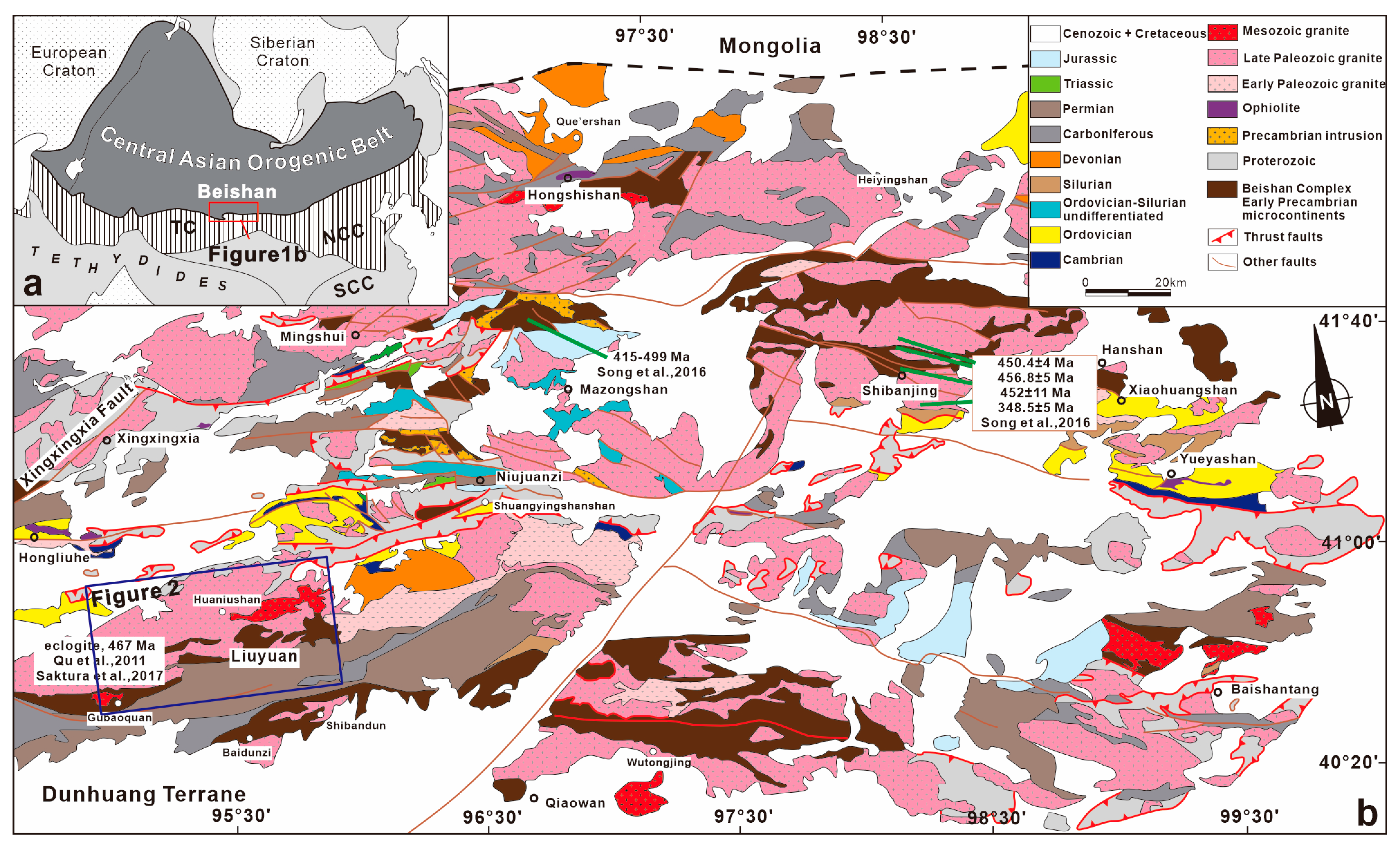
Figure 2.
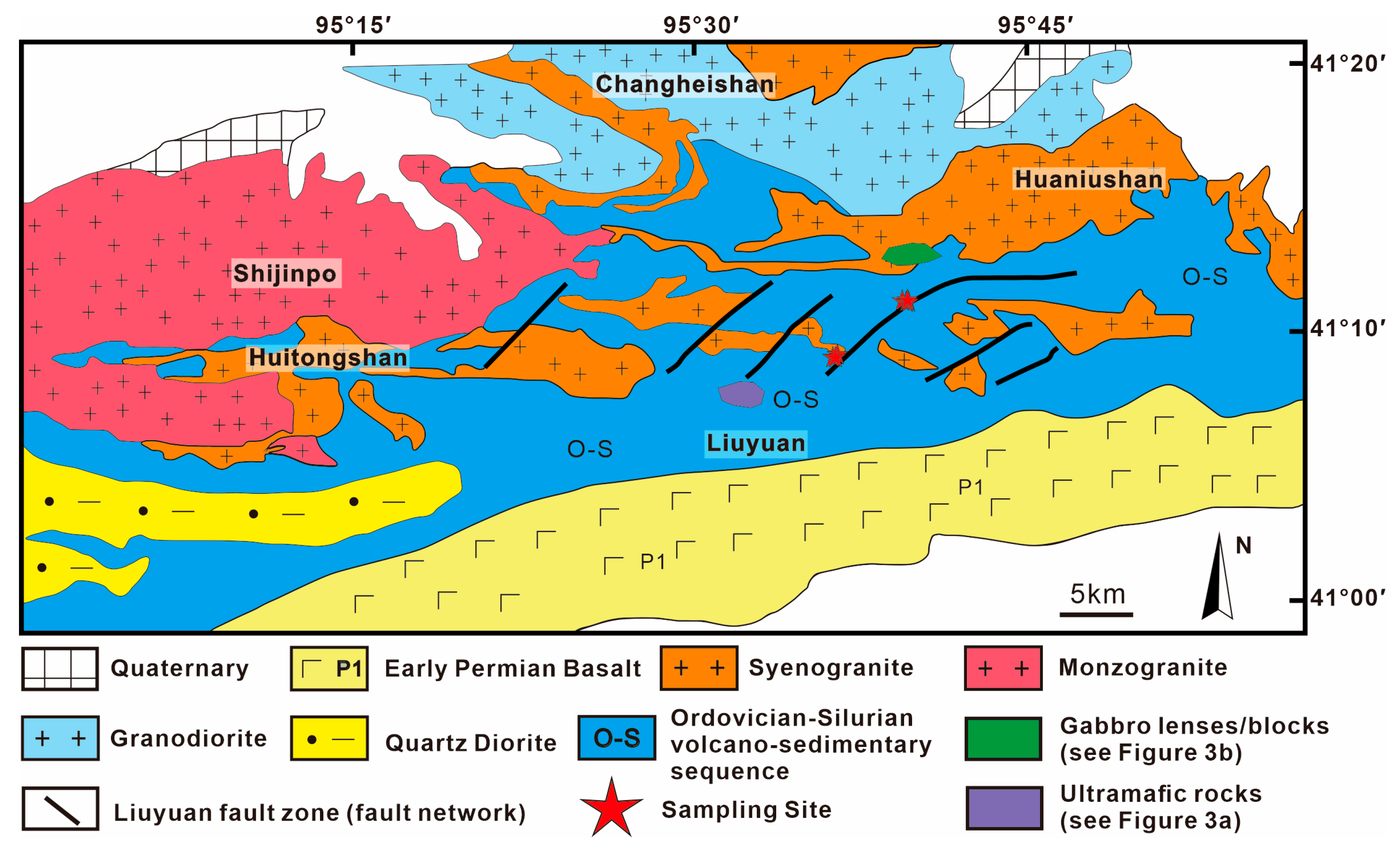
Geology of the Liuyuan area in the Huaniushan arc, southern Beishan region (modified after Zhu et al., 2016) [23].
2.2. Geology of the Liuyuan Area
The Liuyuan area is located at the southern margin of the BOB, a key tectonic segment of the southern CAOB [1,7]. The region is characterized by the widespread development of the Liuyuan ophiolitic mélange belt, which preserves a record of subduction-related accretion and the terminal closure of the Southern Beishan Ocean [10,15].
The mélange consists of an Ordovician to Early Silurian volcano-sedimentary matrix (commonly referred to as the Liuyuan Group) [11] and a variety of tectonically entrained blocks representing remnants of oceanic lithosphere and related magmatic suites [10,12]. The block assemblage includes mantle peridotites, cumulate gabbros, diabase swarms, and basaltic lavas with MORB- to OIB-like geochemical affinities [6,10]. Structurally, the area is dominated by the Liuyuan fault zone, an E–W-trending shear system that facilitated tectonic assembly of the mélange and exerted primary control on the distribution and emplacement of the studied granitoid bodies [7,10]. The Early Silurian granitoids investigated in this study intruded the mélange belt during the late stage of orogenesis and locally show intrusive/thermal interactions with adjacent mafic–ultramafic bodies (Figure 2 and Figure 3) [12,23]. The locations of all granitoid samples analyzed in this study are shown in Figure 2.
Figure 3.
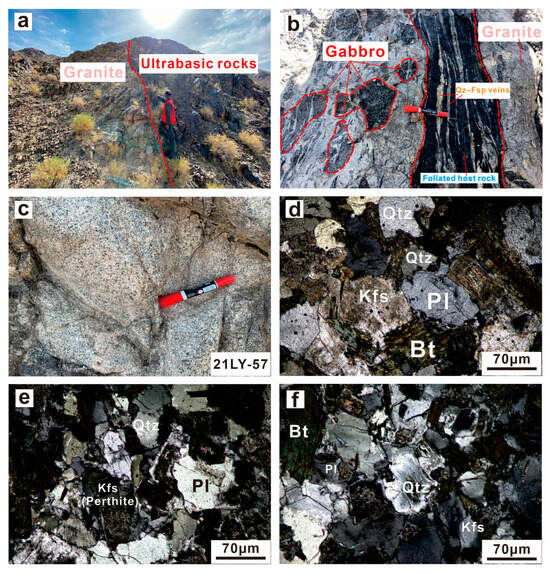
Field photographs and photomicrographs of the Early Paleozoic Liuyuan granites. (a,b) Field outcrops showing the massive granite and its intrusive contact with foliated host rocks (Ordovician–Silurian volcano–sedimentary sequence); light layers in (b) are quartz–feldspar veins parallel to foliation. (c) Representative hand specimen of the fl+esh-red granite. (d–f) Photomicrographs (cross-polarized light) showing the mineral assemblage and texture (Kfs = alkali feldspar; Pl = plagioclase; Qtz = quartz; Bt = biotite).
2.3. Petrography
Seven representative granite samples (21LY-51, -53, -57, -63, -81, -83 and -86) were collected from the Liuyuan area for detailed analysis. The sampling locations are marked in Figure 2, with coordinates ranging from 41°09′08′′ N to 41°11′14′′ N and from 95°36′08′′ E to 95°39′50′′ E (see Supplementary Table S2 for details).
Field investigations reveal significant intrusive relationships between the granitic plutons and regional mafic–ultramafic rocks. Sharp, irregular intrusive contacts are observed between the light-colored granites and dark-colored pyroxenites (Figure 3a), with granitic veins occasionally cutting through the mafic host. Similarly, clear contact boundaries exist between the granites and gabbros (Figure 3b). These field relationships imply that the felsic magmatism was spatially and temporally associated with mantle-derived mafic intrusions. The granite samples collected are typically grey to light flesh-red in color and exhibit a massive structure (Figure 3c).
Microscopically, the samples display a medium- to coarse-grained allotriomorphic granular texture (Figure 3d). The modal composition is dominated by alkali feldspar (35–40 vol.%), quartz (30–35 vol.%), and plagioclase (25–30 vol.%), with minor amounts of biotite (3–5 vol.%) and accessory minerals (zircon, apatite). Alkali feldspar is commonly perthitic (Figure 3e), consistent with the high-K affinity of the rocks. Quartz occurs as anhedral interstitial grains exhibiting distinct undulatory extinction (Figure 3f). Plagioclase forms subhedral prismatic crystals characterized by polysynthetic twinning and local sericitization.
3. Analytical Methods
The various types of analyses were all undertaken at the Guangxi Key Laboratory of Hidden Metallic Ore Deposits Exploration, Guilin University of Technology, Guangxi, China.
3.1. Zircon U-Pb Dating and Trace Element Analyses
Zircon crystals were extracted by conventional crushing, heavy liquid, and magnetic separation techniques, and then handpicked. Prior to isotopic analysis, cathodoluminescence (CL) images were obtained to assess internal structures and select optimal sites for U-Pb dating. The CL imaging was conducted at Langfang Yuhong Rock and Mineral Technology Co., Ltd., using a TESCAN MIRA LMS high-vacuum scanning electron microscope (SEM) equipped with a Sunny CL detector (Jinjing Technology, Beijing, China). The imaging was performed with an accelerating voltage of 10–15 keV, a filament emission current of 80 μA, a beam current of 2–3 nA, and a working distance of 20 mm.
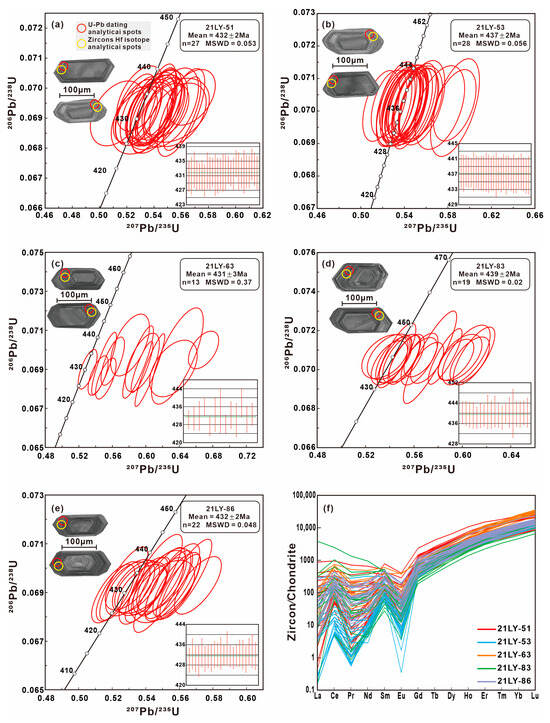
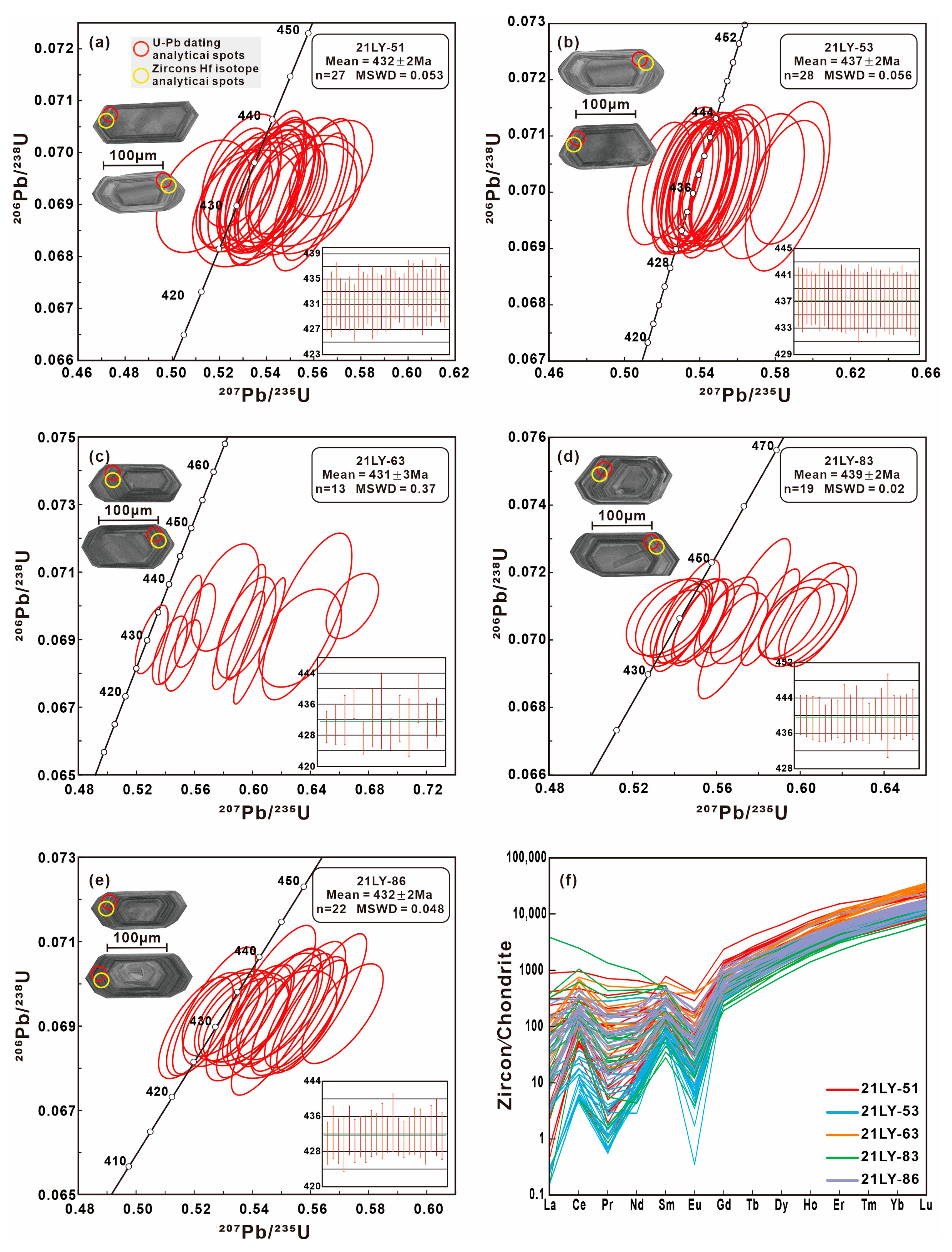
The zircon U-Pb dating and mineral trace element analyses were undertaken at the Guangxi Key Laboratory of Hidden Metallic Ore Deposits Exploration, Guilin University of Technology (GLUT), China. These analyses were performed using a 193 nm Coherent GEOLAS HD Excimer ArF laser ablation (LA) system (Coherent, Göttingen, Germany) coupled with an Agilent 7900 inductively coupled plasma mass spectrometer (ICP–MS) (Agilent Technologies, Santa Clara, CA, USA). A laser beam diameter of 44 μm was used for zircon U-Pb analyses (the same spot size as that used for zircon Hf isotope analyses; see Figure 4). Zircon 91,500 and NIST610 glass were used as external standards for U-Pb dating and trace element analyses, respectively. The zircon standard TEMORA (417 Ma) [24] was used as a secondary standard to assess the data quality. The ICPMSDataCal (version 12.2) software was used to process the data and obtain the trace element contents and U-Pb isotope ratios. Concordia ages and diagrams were obtained with the Isoplot/Ex (3.0) software [25]. A common Pb correction was applied following Andersen (2002) [26].
Figure 4.
(a–e) Zircon U-Pb concordia diagrams and representative cathodoluminescence (CL) images for the Liuyuan granites. Solid circles on CL images indicate analysis spots. (f) Chondrite-normalized rare earth element (REE) patterns for the analyzed zircons. Normalization values are from Sun and McDonough (1989) [27]. The lower-right inset shows a weighted mean age plot for the analyses shown, with error bars at 2σ; the weighted mean age and MSWD are reported in the panel.
3.2. Zircon Lu-Hf Isotope Analyses
Representative igneous zircons from the samples with concordant U-Pb isotope data (≥95%) were selected for LA-multiple-collector (MC)–ICP–MS Hf isotope analysis. These analyses were conducted with a Neptune MC–ICP–MS coupled to a Geolas-193 nm LA system. The laser beam diameter was 44 µm, and the repetition rate was 10 Hz. Helium was used as a carrier gas. The analytical sites were the same as or adjacent to the U-Pb dating locations. Zircons 91,500 and GJ-1 were used as external standards. Calculation of εHf(t) values was undertaken using the present-day chondrite values of 176Hf/177Hf = 0.282772 and 176Lu/177Hf = 0.0332 [28] and the 176Lu decay constant of 1.867 × 10⁻¹¹ yr−1 [29]. Calculation of single-stage model ages (TDM1) used the present-day depleted mantle values of 176Hf/177Hf = 0.28325 and 176Lu/177Hf = 0.0384 [30]. The present-day continental crust 176Lu/177Hf ratio of 0.015 [30] was used for calculation of the two-stage model ages (TDM2).
3.3. Whole-Rock Major and Trace Element Analyses
Fresh samples were collected and crushed, and then the chips were soaked in 4 N HCl for 30 min to remove any altered material. A total of seven representative granitoid samples were collected for this study (Figure 2). To ensure the integrity of the primary magmatic compositions, care was taken during field sampling to select fresh granitoids from the pluton interior, strictly avoiding the immediate contact margins and any visibly associated mafic–ultramafic inclusions/enclaves observed in several localities. The rock chips were then powdered in an alumina ceramic shatter box. Prior to major element analyses, loss-on-ignition (LOI) values were measured by heating in a muffle furnace at 1000 °C. The ignited powders were fused into glass beads using Na2B4O7·10H2O as a flux at ~1150 °C. Major-element concentrations were determined by X-ray fluorescence (XRF) using a ZSX Primus II spectrometer.
Trace element analysis was undertaken with an Agilent 7900cx ICP–MS, following the procedures described by Liu et al. (2020) [31] and Zhang et al. (2021) [32]. Approximately 50 mg of sample powder was dissolved in a bomb with 0.5 mL of purified HNO3 and 1.0 mL of HF, placed in a high-pressure bomb, and held at 190 °C for 48 h. An internal standard solution containing Rh and Re was used to monitor the signal drift. Data were standardized by reference to analyses of the United States Geological Survey (USGS) standards BHVO, AGV, W-2, and G-2, and Chinese national rock standards GSR-1, -2, and -3. The precisions of the major and trace element contents were better than ±2% to ±5%.
3.4. Whole-Rock Sr–Nd Isotope Analyses
Whole-rock Sr–Nd isotopic compositions were determined with a Neptune Plus MC–ICP–MS. Strontium was separated with SR-B50-A (100–150 µm) resin. The rare earth elements (REEs) were separated using cation exchange resin (AG50-X8). Neodymium was purified on HDEHP resin. Mass fractionation corrections for the Sr and Nd isotope ratios were based on 88Sr/86Sr = 8.375209 and 146Nd/144Nd = 0.7219, respectively. The USGS reference material BCR-2 was used to monitor the data accuracy and yielded a 87Sr/86Sr ratio of 0.704900 ± 0.000012 (n = 10) and a 143Nd/144Nd ratio of 0.512633 ± 0.000013 (n = 10) [33].
4. Results
Analytical data are presented in Table 1 and Table 2 and Supplementary Tables S1–S3 (S1: zircon U-Pb; S2: sampling coordinates; S3: zircon Lu-Hf).
Table 1.
Whole-rock major and trace element analysis of Liuyuan granites from the Beishan region.
Table 2.
Whole-rock Sr–Nd isotopic compositions and concentrations for representative Liuyuan granites from the Beishan region.
4.1. Zircon U-Pb Geochronology
Five granite samples (21LY-51, -53, -63, -83, and -86) were selected for zircon U-Pb dating analyses. The results of the zircon U-Pb geochronology and trace element compositions are presented in Supplementary Table S1, and representative zircon CL images are presented in Figure 4. Zircon grains from all samples are euhedral, and long and prismatic in shape with length: width ratios of 2:1–4:1. They generally had varying but high Th (122–10,079 ppm) and U (418–27,349 ppm) contents and high Th/U ratios (0.07–1.07). Their chondrite-normalized REE distribution patterns showed relative depletion of light rare earth elements (LREEs), enrichment in heavy rare earth elements (HREEs), positive Ce anomalies, and negative Eu anomalies (Figure 4f), as is typical for zircon. All above-mentioned characteristics indicate a magmatic origin, and the zircon U-Pb ages represent the formation ages of the Liuyuan granites.
The zircon ages of samples 21LY-51 and 21LY-86 yielded weighted mean 206Pb/238U ages of 432 ± 2 Ma (MSWD = 0.053) and 432 ± 2 Ma (MSWD = 0.048), respectively. The three samples (21LY-53, 21LY-63, and 21LY-83) yielded weighted mean 206Pb/238U ages of 437 ± 2 Ma (1σ, MSWD = 0.056), 431 ± 3 Ma (MSWD = 0.37), and 439 ± 2 Ma (MSWD = 0.02), respectively (Figure 4a–e), representing Early Silurian crystallization.
4.2. Whole-Rock Geochemistry
The whole-rock major and trace element compositions of the Liuyuan granites are listed in Table 1.
4.2.1. Major Elements
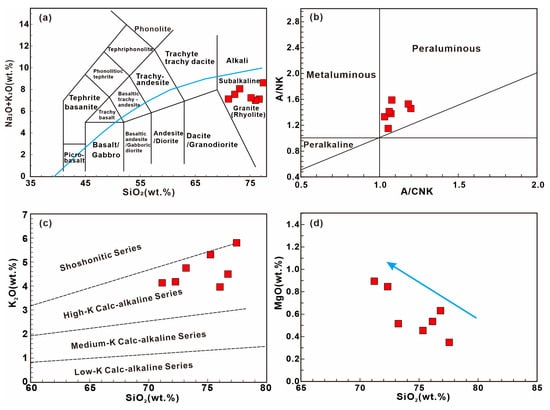
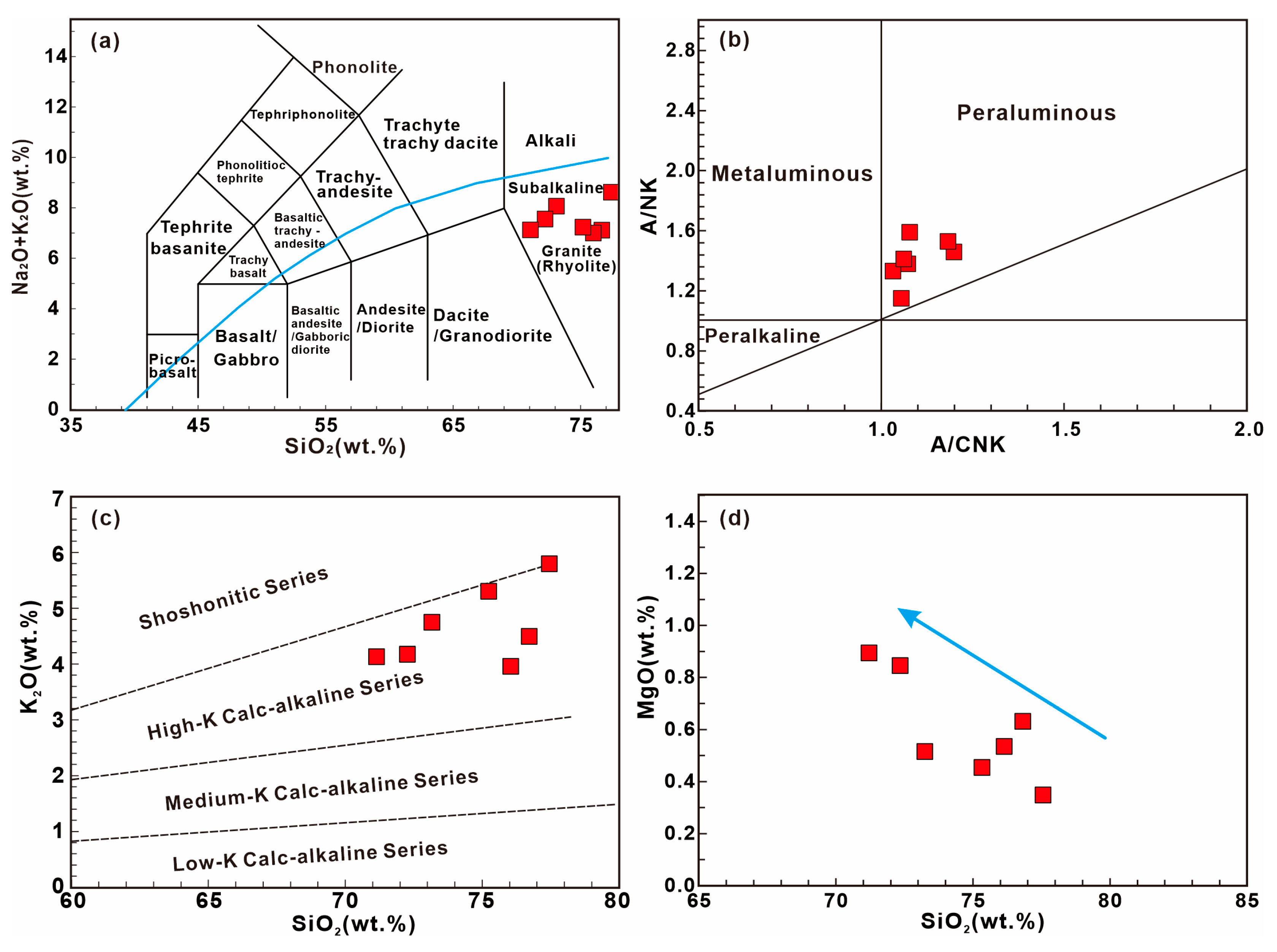
The Liuyuan granites exhibit a coherent geochemical affinity characterized by high silica contents, ranging from 71.20 to 77.55 wt.% (mean = 74.66 wt.%). They are rich in total alkalis (Na2O + K2O = 7.02–8.63 wt.%; mean = 7.55 wt.%). In the Total Alkali–Silica (TAS) classification diagram (Figure 5a), all samples plot tightly within the granite field.
Figure 5.
Major element diagrams for the Liuyuan granites. (a) Total Alkali–Silica (TAS) classification diagram [34]. (b) A/NK vs. A/CNK diagram [35]. (c) SiO2 vs. K2O diagram [36]. (d) Harker variation diagram of MgO vs. SiO2.
Regarding aluminum saturation, the samples show A/CNK values ranging from 1.03 to 1.20 (mean = 1.10). On the A/NK vs. A/CNK diagram (Figure 5b), most samples plot in the peraluminous field, with a few straddling the boundary with the metaluminous field. In terms of magmatic series, the rocks display high K2O contents (4.00–5.86 wt.%; mean = 4.71 wt.%) and K2O/Na2O ratios of 1.25–2.83. On the SiO2 vs. K2O diagram (Figure 5c), they fall exclusively into the high-K calc-alkaline series. In the Harker variation diagram (Figure 5d), MgO contents (0.35–0.89 wt.%; mean = 0.60 wt.%) display a robust negative correlation with increasing SiO2. This linear trend is consistent with the fractionation of ferromagnesian minerals, particularly biotite, during magma evolution. A similar decreasing trend is observed for other compatible elements (e.g., TiO2, Fe2O3T, CaO, and P2O5; see Table 1), which generally reflects the concurrent separation of plagioclase and accessory phases (e.g., Fe–Ti oxides and apatite).
The Loss on Ignition (LOI) values are uniformly low, ranging from 0.49 to 1.75 wt.% (mean = 0.90 wt.%). These values (≤1.75 wt.%) indicate that the samples are petrographically fresh and have undergone minimal post-magmatic alteration or weathering, ensuring the reliability of the geochemical data.
4.2.2. Trace Elements
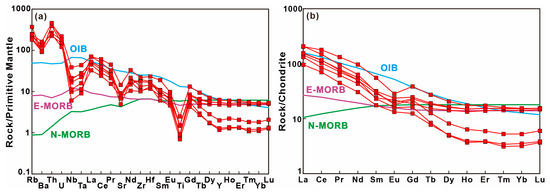
Chondrite-normalized rare earth element (REE) patterns (Figure 6b) display significant fractionation between light and heavy REEs. The samples are enriched in LREEs and exhibit relatively flat HREE profiles, with (La/Yb) N ratios ranging from 9.32 to 47.7 (mean = 22.2). A prominent feature is a moderate negative to near-absent Eu anomaly (Eu/Eu * = 0.62–1.03; mean = 0.81). This range is consistent with variable degrees of plagioclase fractionation and/or residual plagioclase in the source.
Figure 6.
(a) Primitive mantle-normalized incompatible element spidergram and (b) chondrite-normalized REE patterns for the Liuyuan granites. Normalization values are from Sun and McDonough (1989) [27].
In the primitive mantle-normalized spider diagram (Figure 6a), the granites show enrichment in large ion lithophile elements (LILEs; e.g., Rb, Th, U) relative to high field strength elements (HFSEs). Notably, all samples exhibit pronounced negative anomalies of Nb, Ta and Ti. The depletion of Nb and Ta is characteristic of subduction-related magmatism, while the negative Ti anomalies are consistent with the fractionation of apatite and Fe–Ti oxides, respectively, as implied by the major element trends.
4.3. Zircon Lu-Hf Isotopes
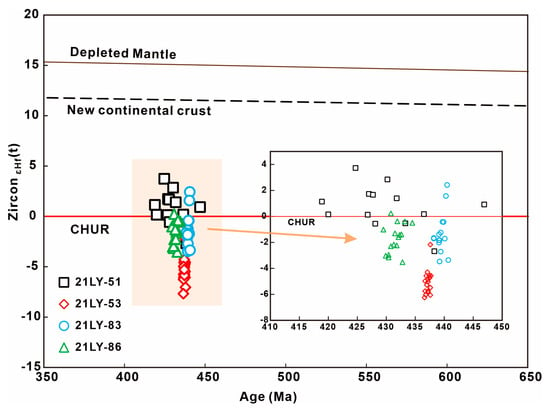
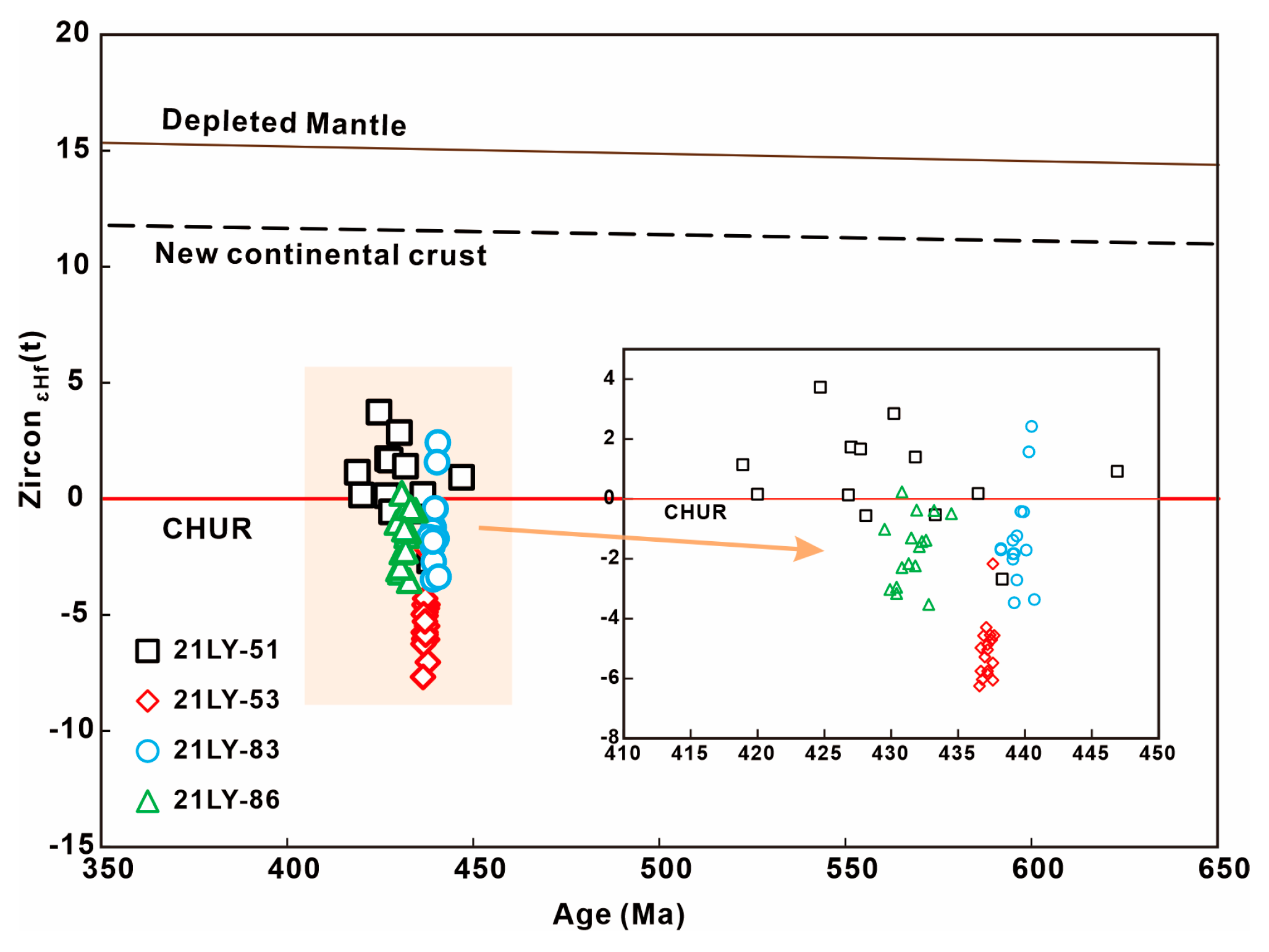
In situ zircon Lu-Hf isotopic data are listed in Supplementary Table S3. Analyses were conducted on dated magmatic domains to ensure temporal linkage. The measured 176Hf/177Hf ratios range from 0.282333 to 0.282623, representing the initial magmatic compositions. Correspondingly, the εHf(t) values display a restricted range from −6.3 to +3.7, with a weighted mean of −2.0. In the εHf(t) versus U-Pb crystallization age diagram (Figure 7), the data form a tight cluster straddling the Chondritic Uniform Reservoir evolution line, plotting significantly below the Depleted Mantle (DM) line. This distribution is distinct from the highly positive values typical of newly accreted crust in the CAOB. The two-stage crustal model ages (TDM2) range from 1.16 to 1.80 Ga (mean = 1.53 Ga). These isotopic signatures indicate a dominant Mesoproterozoic crustal source with minor, localized mantle-derived mafic contributions.
Figure 7.
Plot of εHf(t) versus U-Pb crystallization age for the Liuyuan granites. Reference fields and evolution lines are modified after Wu et al. (2007) [37].
4.4. Whole-Rock Sr–Nd Isotopes
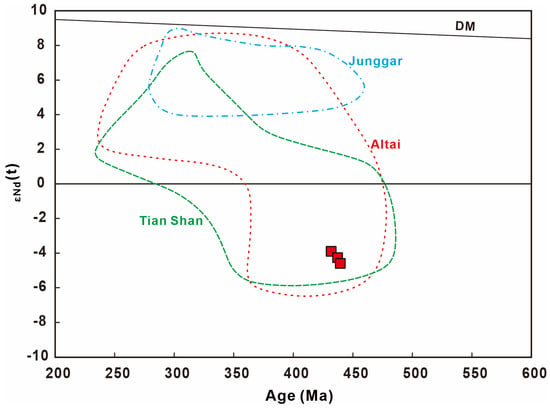
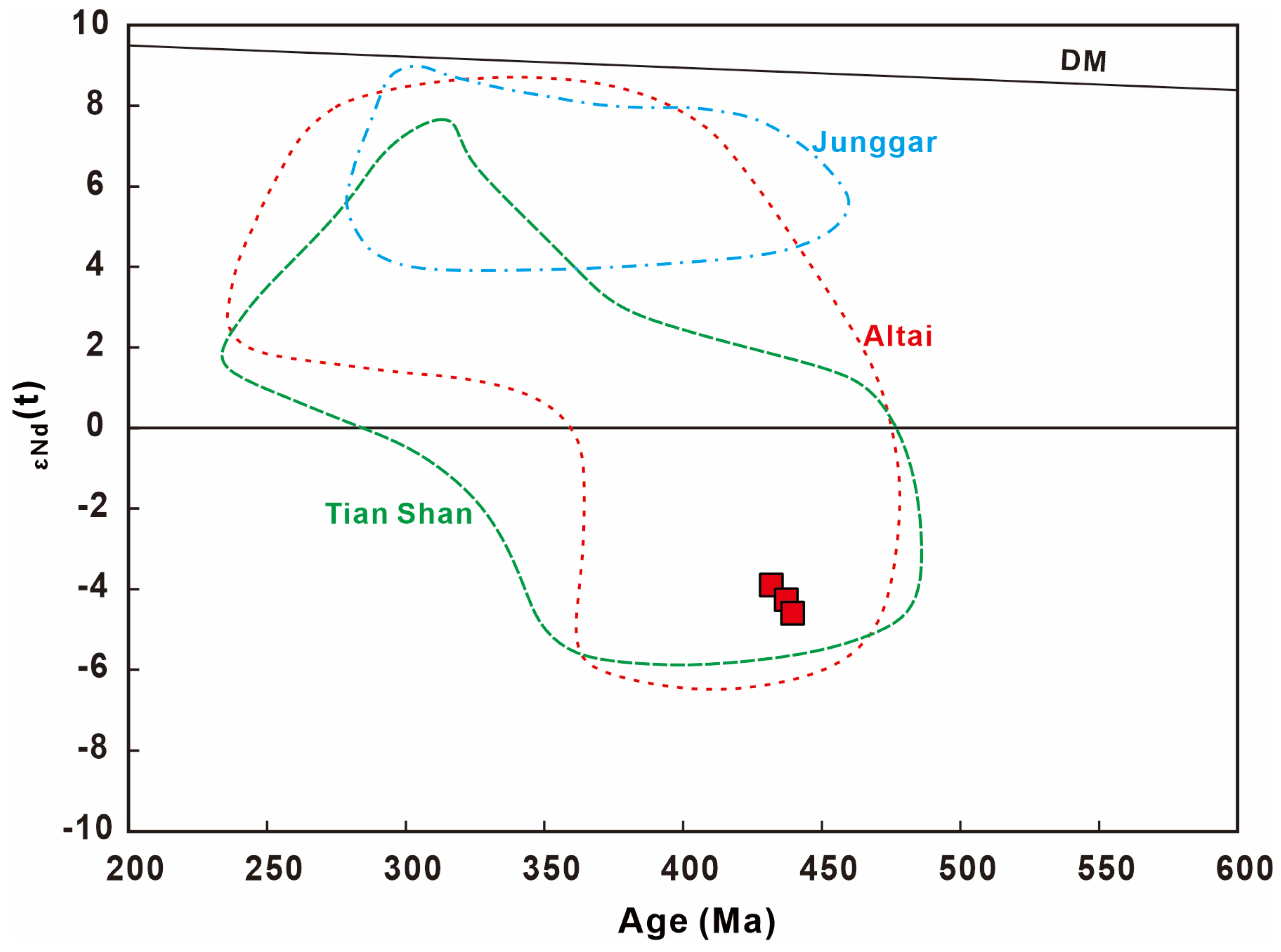
Whole-rock Sr–Nd isotopic data are presented in Table 2. Initial isotopic ratios were calculated based on the zircon U-Pb crystallization age of ca. 435 Ma. The Liuyuan granites display highly evolved isotopic compositions. Initial ratios (87Sr/86Sr)i are significantly radiogenic, ranging from 0.7158 to 0.7189. The εNd(t) values are exclusively negative, varying from −4.6 to −3.9 (mean = −4.3).
In the εNd(t) versus U-Pb crystallization age diagram (Figure 8), the Liuyuan granitoids fall within the overlapping compositional fields of the Tianshan and Altai terranes. Their moderately negative εNd(t) values and Mesoproterozoic TDM2 ages (1.50–1.55 Ga) indicate involvement of evolved crustal sources comparable to both terranes. This positioning suggests that the magmas most likely originated from reworked Precambrian basement in a transitional zone between the Tianshan and Altai crustal domains.
Figure 8.
Plot of εNd (t) versus U-Pb crystallization age for the Liuyuan granites. The εNd(t) fields for the Junggar and Tianshan regions are taken from Tang et al. (2017) [38], and the εNd(t) field for the Altai region is taken from Wang et al. (2009) [39].
5. Discussion
5.1. Early Silurian Magmatic Pulse
Our new zircon U-Pb ages constrain the crystallization of the Liuyuan granitoids to a tight interval of 439–431 Ma (Llandovery–Wenlock). This finding is pivotal because it fills the previously inferred “magmatic gap” in the Southern BOB that was thought to separate Ordovician arc construction from the widespread Late Paleozoic rift-related magmatism [11]. Far from being a period of tectonic quiescence, the Early Silurian represents a critical phase of thermal rejuvenation. The ca. 435 Ma magmatism in Liuyuan was not an isolated event but part of a macro-regional thermal episode along the southern CAOB margin. It correlates temporally with high-K calc-alkaline magmatism in the adjacent Dunhuang Block [40] and arc-related/adakitic intrusions in Eastern Tianshan [41], implying a coordinated geodynamic mechanism operating over a strike length exceeding 1000 km.
Crucially, this magmatic flare-up exhibits a remarkable temporal coupling with the metamorphic evolution of the adjacent Gubaoquan complex. The emplacement of these high-temperature granitoids is strictly synchronous with the retrograde cooling and rapid exhumation of high-pressure (HP) granulites and eclogites in the region (cooling ages ca. 430–428 Ma) [16,18]. Such a tight temporal link between vigorous magmatism and the rapid unroofing of deep-crustal rocks suggests a fundamental shift in lithospheric dynamics, potentially marking the transition from a compressive collisional regime to an extensional post-collisional setting.
5.2. Petrogenesis and Classification
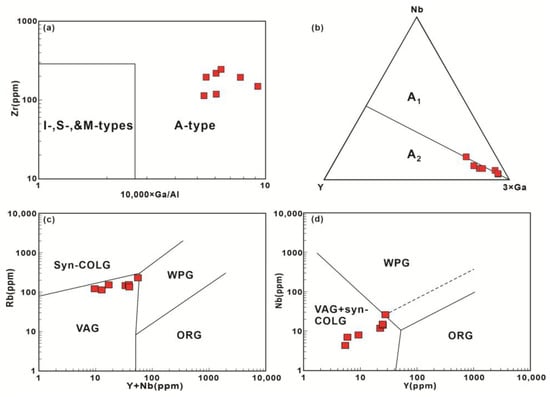
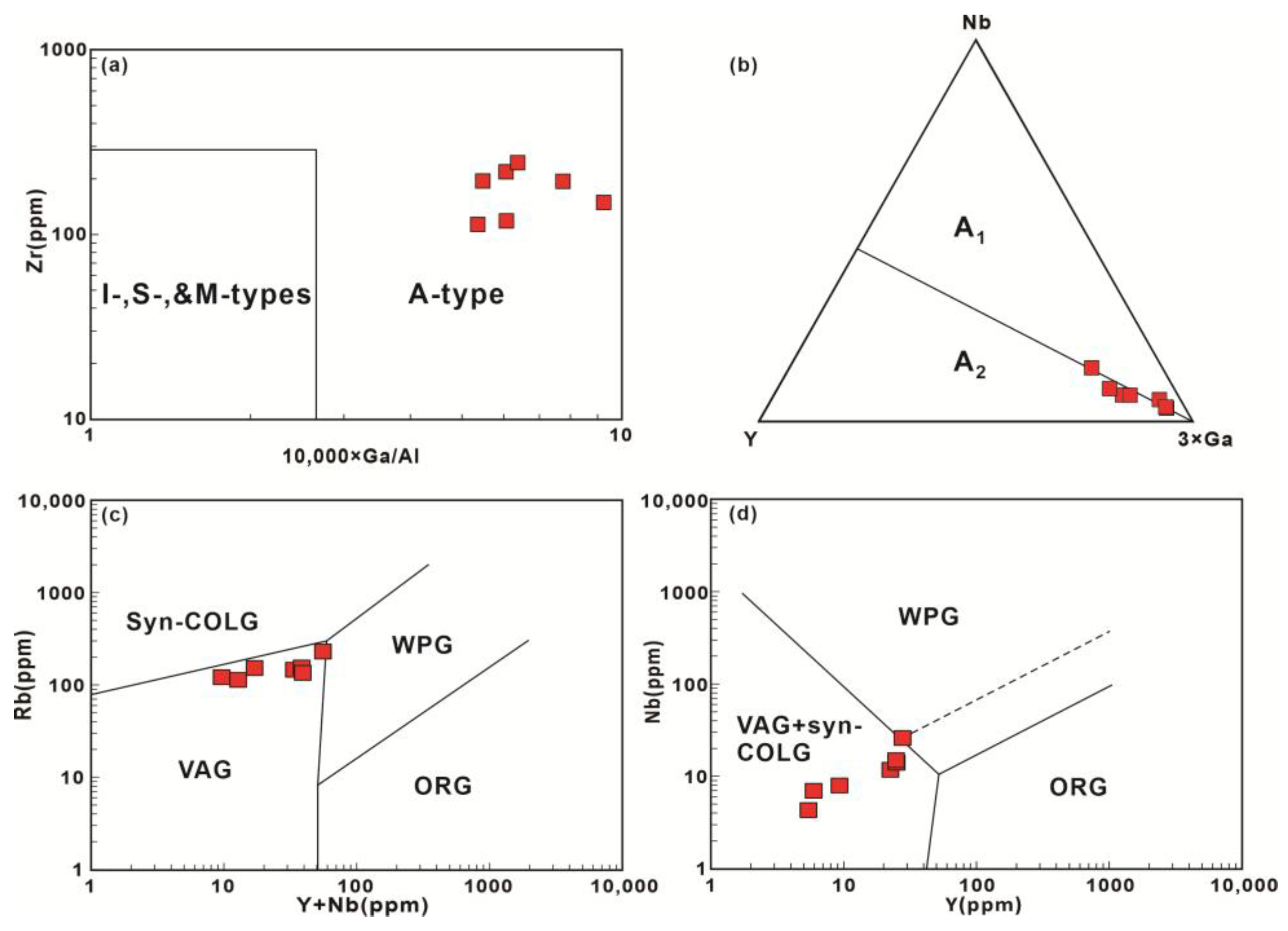
The Liuyuan granitoids are characterized by high silica contents (SiO2 > 71 wt.%) and elevated alkali levels, placing them firmly within the high-K calc-alkaline series (Figure 5c). Their mineral assemblages lack primary Al-rich phases such as muscovite and garnet, and their metaluminous to weakly peraluminous compositions (A/CNK < 1.20) argue against an S-type affinity [42]. Instead, several geochemical indicators point convincingly to an A-type origin. On the conventional 10,000 × Ga/Al–Zr discrimination diagram (Figure 9a) [43], all samples plot entirely within the A-type granite field. They show markedly elevated 10,000 × Ga/Al ratios relative to typical I- and S-type granites, a key characteristic of high-temperature A-type magmatism [43,44]. Collectively, their enrichment in high field strength elements (HFSEs) and high Ga/Al ratios supports the classification of the Liuyuan granitoids as A-type granites.
Figure 9.
Geochemical discrimination diagrams for the Liuyuan granites. (a) 10,000 × Ga/Al vs. Zr classification diagram [43] (b) Nb–Y–3 × Ga ternary discrimination diagram [45] (c) Rb vs. (Y + Nb) and (d) Nb vs. Y tectonic discrimination diagrams [46]. (VAG = volcanic arc granites; syn-COLG = syn-collisional granites; WPG = within-plate granites; ORG = ocean-ridge granites; A1 = anorogenic settings; A2 = post-collisional or arc-related settings).
To refine their tectonic affinity, we further employ the Nb–Y–3 × Ga ternary discrimination scheme of Eby (1992) [45] (Figure 9b). All samples fall within the A2-type field. According to Eby (1992) [45], A1-type granites commonly evolve from OIB-like basaltic sources in intraplate rift or hotspot environments, whereas A2-type granites reflect partial melting of continental crust or underplated crust previously modified by subduction-related magmatism. The A2 classification aligns well with the “arc-like” features observed in other diagrams. For example, the samples lie within the Volcanic Arc Granite (VAG) field on the Rb vs. (Y + Nb) diagram (Figure 9c) [46] and exhibit pronounced negative Nb, Ta, and Ti anomalies—the typical “TNT” pattern—on spider diagrams (Figure 6a). These characteristics do not contradict their A-type nature; rather, they reflect the inherited subduction signatures expected from A2-type magmas derived from arc-modified crustal sources [44,45].
Taken together, these observations indicate that the Liuyuan granitoids represent A2-type granites emplaced in a post-collisional setting. Their formation was most likely driven by dehydration melting of a subduction-modified lower crustal source under enhanced thermal conditions [47], consistent with crustal heating associated with asthenospheric upwelling following slab break-off.
5.3. Crustal Architecture and Source
The isotopic compositions of the Liuyuan granitoids offer important insights into the deep crustal structure of the southern BOB and point to a petrogenesis dominated by reworking of ancient continental crust with a subordinate but meaningful input from mantle-derived mafic magmas. The whole-rock Sr–Nd isotopic data show a consistently evolved signature, with negative εNd(t) values (−4.5 to −3.9) and Mesoproterozoic two-stage model ages (TDM2 ≈ 1.55 Ga). These features indicate that the parental magmas were derived mainly from Precambrian metamorphic basement—likely the concealed continuation of the Dunhuang or Beishan microcontinental blocks [17]—rather than from the juvenile Paleozoic accretionary crust typical of the northern Beishan [1,20].
5.3.1. Evaluation of Upper-Crustal Contamination
The potential for assimilation of the surrounding Ordovician–Silurian volcano-sedimentary host rocks during magma ascent and emplacement was evaluated. Field observations indicate generally sharp pluton–host contacts and a lack of abundant metasedimentary xenoliths within the main granitoid body. Moreover, samples used for whole-rock Sr–Nd and zircon Hf analyses were collected from the interior of the pluton, away from exposed contacts, to minimize localized wall-rock effects. The whole-rock Nd isotope compositions are relatively homogeneous (εNd(t) = −4.5 to −3.9; TDM2 ≈ 1.55 Ga), which argues against substantial and variable upper-crustal assimilation. In addition, the granitoids are only weakly peraluminous (A/CNK = 1.03–1.20; mean = 1.10) and do not show strongly peraluminous/S-type characteristics expected from extensive incorporation of metasedimentary material. Significant contamination by heterogeneous host rocks would be expected to increase sample-to-sample isotopic scatter and/or produce systematic shifts in isotopic compositions and peraluminosity during differentiation. Therefore, although minor localized assimilation cannot be entirely excluded, the Sr–Nd–Hf isotopic characteristics of the Liuyuan granitoids are interpreted to primarily reflect source signatures and deep-crustal magma evolution rather than extensive upper-crustal contamination.
5.3.2. Hf–Nd Isotopic Decoupling and the MASH Model
A more complex picture emerges from the in situ zircon Hf isotopes. In contrast to the relatively uniform whole-rock Nd signatures, zircon Hf values show pronounced variability, with εHf(t) spanning from strongly evolved (−6.3) to moderately radiogenic (+3.7) (Figure 7). Taken together, the whole-rock Nd isotopes define the dominant, integrated source signature of the magma, whereas the in situ zircon Hf isotopes potentially record finer-scale processes during melt generation, recharge, and crystallization [37,38]. Accordingly, the apparent mismatch between homogeneous whole-rock Nd isotopes and heterogeneous zircon Hf isotopes warrants more detailed evaluation.
The decoupling between heterogeneous zircon Hf isotopes and relatively homogeneous whole-rock Nd isotopes likely reflects the different sensitivities of these isotope systems to localized magma recharge, source heterogeneity, and isotopic homogenization during magma evolution [38]. We suggest that the zircon Hf variability may record (i) heterogeneity within the ancient crustal source and/or cryptic inheritance (if present), and (ii) minor, localized inputs of mantle-derived mafic magmas during MASH-type processes. Whereas whole-rock Nd isotopes represent a bulk, integrated signature of the magma batch that can be efficiently homogenized during storage and mixing, zircon Hf isotopes are acquired during discrete crystal-growth events and may therefore be more sensitive to small-volume mafic pulses or locally mixed melt domains [37]. Petrographically fresh textures (Figure 3) and uniformly low LOI values (≤1.75 wt.%; mean = 0.90 wt.%) make significant late-stage hydrothermal overprinting unlikely, and zircon Hf isotopes are generally robust against such alteration. Therefore, the Hf–Nd decoupling is most parsimoniously explained by a dominant ancient crustal component overprinted by spatially and temporally localized mantle-derived thermal input and minor chemical contributions.
To quantitatively test the feasibility of the MASH model, we performed a simple Nd isotope mass-balance calculation using the samples for which whole-rock Nd isotopes are available (n = 3; Supplementary Table S4). Using the most crust-dominated granite (sample 21LY-83; εNd(t) = −4.6; Nd = 14.2 ppm) as the crustal reference endmember and a plausible range for contemporaneous mantle-derived basaltic/mafic melts (εNd(t) = +6.0 to +8.0; Nd = 10–25 ppm) as the mantle endmember, the mixing results suggest that the Liuyuan granitoids can be produced with only a minor mantle-derived basaltic/mafic contribution. For example, reproducing the shift from 21LY-83 to the most radiogenic sample 21LY-51 (εNd(t) = −3.9; Nd = 20.1 ppm) requires only ~3–9% mantle-derived input depending on the assumed mantle Nd concentration and εNd(t) (Supplementary Table S4). This modest input is consistent with a scenario in which underplated basaltic/mafic magmas provide the heat required for extensive crustal melting while introducing only a limited chemical signature into the resulting felsic melts.
This combination of features is most consistent with a MASH (Melting, Assimilation, Storage, and Homogenization) process operating near the crust–mantle boundary [48]. We infer that the underplating of hot mantle-derived basaltic magmas supplied the heat necessary to partially melt the overlying refractory basement [49]. Field evidence strengthens this interpretation: the granites are locally in direct contact with contemporaneous mafic–ultramafic bodies, including ultramafic rocks (Figure 3a) and gabbroic blocks/lenses (Figure 3b), supporting close spatial association between mantle-derived mafic magmas and the crustal source region. To minimize potential effects of localized contact-level processes, all samples selected for zircon Hf isotope analyses were collected from fresh granitoid domains in the pluton interior and strictly avoided the immediate contact margins with these mafic–ultramafic bodies (Figure 2). Therefore, the zircon Hf isotopic variability discussed here is interpreted to reflect magmatic-scale processes (e.g., localized mafic recharge and MASH-type interaction) rather than shallow-level wall-rock contamination during final emplacement. These mantle-derived mafic magmas likely acted both as the thermal driver and as a minor chemical contributor, potentially providing a radiogenic Hf component locally recorded by zircon. The Liuyuan granitoids can therefore be regarded as the differentiated products of an ancient microcontinental block, generated through extensive crustal melting induced by a focused input of mantle heat during the Early Silurian.
5.4. Geodynamic Model: Slab Break-Off
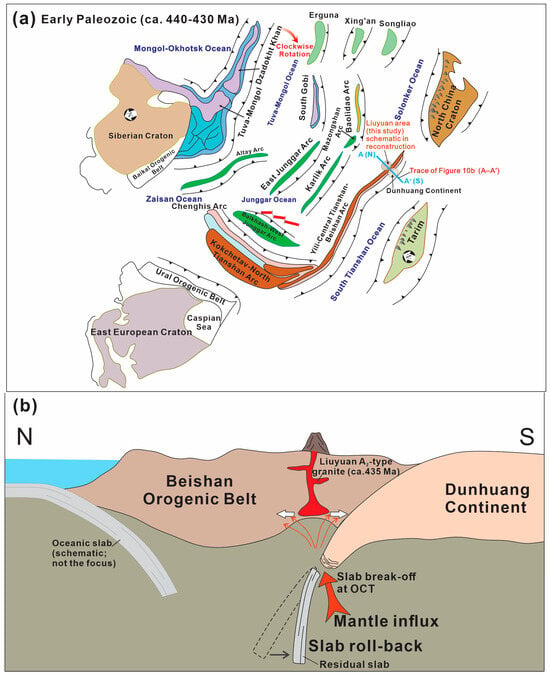
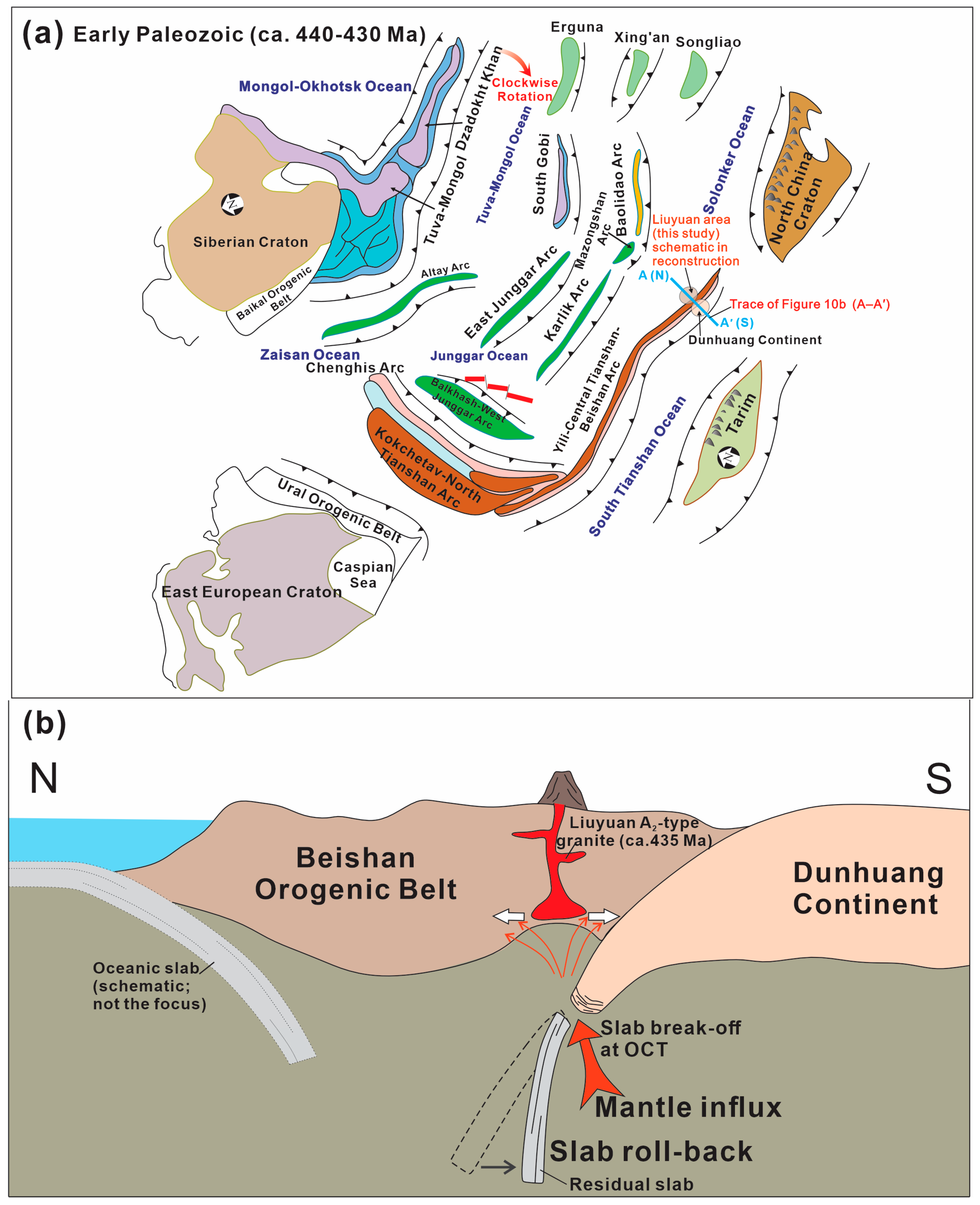
Integrating the geochronological constraints, the high-temperature A2-type magmatic characteristics, and the regional metamorphic framework, we propose that the Early Silurian magmatism in the Liuyuan area is best explained by slab break-off during the transition from subduction to incipient collision/continent involvement (Figure 10b) [49]. The regional paleogeographic framework used to contextualize and place this cross-section model is summarized in Figure 10a. Continuous subduction alone does not readily account for the abrupt appearance of high-temperature felsic magmatism nor its temporal overlap with the rapid exhumation of high-pressure (HP) rocks documented in the region [18].
Figure 10.
(a) Sketch map showing the paleogeographic framework of the Paleo-Asian Ocean during the late Early Paleozoic, modified after Gao et al. (2022) [50] and Xiao et al. (2015) [51]. The Liuyuan area (this study) and the Dunhuang continent are highlighted schematically (not to scale), and the trace of the cross-section shown in Figure 10b is indicated by line A–A′ (A = N; A′ = S). (b) Geodynamic model for the Early Silurian evolution and A2-type granite petrogenesis in the Liuyuan area.
During the Late Ordovician, ongoing consumption and progressive narrowing of the Beishan oceanic domain (or the HNX branch; subduction polarity debated) beneath the Dunhuang–Beishan margin led to crustal thickening and deep burial of rocks to eclogite-facies conditions (>50 km), as constrained by the regional HP metamorphic record at ca. 467–450 Ma [12,14,16,18]. The involvement of buoyant continental material (microcontinental fragments/continental margin) in the subduction system marks an incipient collisional stage in southern Beishan. In such a setting, the strong buoyancy contrast between the incoming (micro)continental lithosphere and the dense, already-subducted oceanic slab would favor slab detachment at the ocean–continent transition (OCT; slab root), rather than within an actively subducting oceanic plate.
We interpret slab break-off in the Early Silurian (ca. 439–431 Ma) as a plausible trigger for the magmatic and tectonic changes observed in the Liuyuan region. Detachment at the slab root would have opened a slab window, enabling asthenospheric inflow and localized thermal perturbation beneath the overriding lithosphere (Figure 10b). The resulting increase in basal heat flux could facilitate partial melting of the lower crust and the generation of high-temperature A2-type felsic magmas, potentially accompanied by limited input of mantle-derived melts [38,49] (see Section 5.3 for magma evolution processes). In addition, slab break-off and related tectonic reorganization (including reduced slab pull) could promote uplift and contribute to the fast cooling and exhumation of the Gubaoquan eclogites, which record cooling ages around ca. 430–428 Ma [16,18], broadly overlapping with the Liuyuan granite emplacement. Together, these processes signal a fundamental tectonic shift in the southern CAOB during the Early Silurian, marking the transition from subduction/incipient collision to post-collisional extension [11,12,13,17].
Although back-arc extension remains a possible broader context for the Early Silurian evolution of southern Beishan [7,14,15], back-arc extension alone does not readily explain the short-lived, high-temperature A2-type magmatic pulse in Liuyuan and its near-synchronous association with rapid HP-rock exhumation within a narrow ~20 Myr window. We therefore suggest that slab break-off at the OCT acted as a local trigger superimposed on a regional extensional regime. This staged evolution is broadly consistent with the framework proposed by Saktura et al. (2017; Ref. [16]; their Figure 10c–e) [16], in which continent involvement and subsequent slab-root break-off together account for an Early Silurian thermal pulse (Liuyuan A2-type magmatism) and the terminal-stage exhumation/cooling of regional HP rocks.
6. Conclusions
- (1)
- Zircon U-Pb dating identifies a distinct Early Silurian magmatic pulse (439–431 Ma), bridging the gap between Ordovician arc construction and Late Paleozoic rift-related magmatism in southern Beishan.
- (2)
- The Liuyuan intrusions are aluminous A2-type granites with high SiO2–alkalis and elevated Ga/Al ratios. Negative Nb–Ta–Ti anomalies are consistent with melting of a previously subduction-modified crustal source, potentially inherited from arc-related subduction prior to slab break-off, and therefore do not necessarily require syn-emplacement arc-related subduction.
- (3)
- Whole-rock Sr–Nd isotopes indicate a dominant contribution from ancient Precambrian basement, whereas zircon εHf(t) values suggest only limited juvenile input. Collectively, the isotopic data support predominantly crustal magma sources, with a subordinate mantle component at most.
- (4)
- The A2-type magmatism records a transition from subduction to incipient collision/continent involvement and subsequent post-subduction extension. Slab break-off at the slab root (ocean–continent transition) is a plausible trigger, providing slab-window-related thermal input for crustal melting.
- (5)
- The Silurian granitoids mark an early post-subduction thermal pulse (slab break-off), whereas younger granitoids likely reflect later tectono-magmatic stages and do not necessarily require ongoing Silurian break-off; the Silurian event may have precondi-tioned the crust for subsequent re-melting.
Supplementary Materials
The following supporting information can be downloaded at https://www.mdpi.com/article/10.3390/min16020198/s1, Table S1. LA–ICP–MS zircon U-Pb isotopic compositions of Liuyuan granites from the Beishan region. Table S2. Sampling location coordinates (latitude and longitude) of Liuyuan granites from the Beishan region. Table S3. Zircon Lu-Hf isotopic compositions and concentrations for representative Liuyuan granites from the Beishan region. Table S4. Nd isotope mass-balance mixing calculations used to evaluate the mantle-derived basaltic/mafic input required by the MASH model.
Author Contributions
Conceptualization, Y.Y. and X.L. (Xijun Liu); methodology, Y.L. and Z.B.; validation, Y.L., Y.Y. and X.L. (Xijun Liu); formal analysis, Y.L.; investigation, resources, Y.Y. and Y.S.; data curation, Y.L. and P.L. (Peng Lu); writing—original draft preparation, Y.L.; writing—review and editing, P.L. (Pengde Liu) and Y.X.; visualization, G.C., X.L. (Xiao Liu) and R.H.; supervision, Y.Y.; project administration and funding acquisition, X.L. (Xijun Liu). All authors have read and agreed to the published version of the manuscript.
Funding
This study was supported by the National Natural Science Foundation of China (42473063), Guike AD24010023; the Seventh Guangxi Zhuang Autonomous Region Bagui Scholars Program (to Liu Xijun); the Capacity Enhancement Program for Guangxi Higher Education Institutions Young and Middle-aged Teachers in 2025 (Grant No. 2025KY0305) (to Yang Yang); and the Guangxi Young Elite Scientist Sponsorship Program (Grant No. GXYESS2025009) (to Liu Xiao).
Data Availability Statement
The data in this paper are reliable and have not been published elsewhere.
Acknowledgments
We would like to express our sincere gratitude to the editors and reviewers for their careful review and constructive comments, which have significantly improved the quality of this manuscript.
Conflicts of Interest
The authors declare that they have no known competing financial interests or personal relationships that could have appeared to influence the work reported in this paper.
References
- Jahn, B.M.; Wu, F.; Chen, B. Massive granitoid generation in Central Asia: Nd isotope evidence and implication for continental growth in the Phanerozoic. Episodes 2000, 23, 82–92. [Google Scholar] [CrossRef] [Scilit] [PubMed]
- Şengör, A.M.C.; Natal’in, B.A.; Burtman, V.S. Evolution of the Altaid tectonic collage and Palaeozoic crustal growth in Eurasia. Nature 1993, 364, 299–307. [Google Scholar] [CrossRef] [Scilit]
- Windley, B.F.; Alexeiev, D.; Xiao, W.; Kröner, A.; Badarch, G. Tectonic models for accretion of the Central Asian Orogenic Belt. J. Geol. Soc. 2007, 164, 31–47. [Google Scholar] [CrossRef] [Scilit]
- Xiao, W.; Windley, B.F.; Han, C.; Liu, W.; Wan, B.; Zhang, J.; Ao, S.; Zhang, Z.; Song, D. Late Paleozoic to early Triassic multiple roll-back and oroclinal bending of the Mongolia collage in Central Asia. Earth-Sci. Rev. 2018, 186, 94–128. [Google Scholar] [CrossRef] [Scilit]
- Eizenhöfer, P.R.; Zhao, G.C.; Zhang, J.; Sun, M. Final closure of the Paleo-Asian Ocean along the Solonker Suture Zone: Constraints from geochronological and geochemical data of Permian volcanic and sedimentary rocks. Tectonics 2014, 33, 441–463. [Google Scholar] [CrossRef] [Scilit]
- Mao, Q.; Xiao, W.; Fang, T.; Wang, J.; Han, C.; Sun, M.; Yuan, C. Late Ordovician to early Devonian adakites and Nb-enriched basalts in the Liuyuan area, Beishan, NW China: Implications for early Paleozoic slab-melting and crustal growth in the southern Altaids. Gondwana Res. 2012, 22, 534–553. [Google Scholar] [CrossRef] [Scilit]
- Xiao, W.J.; Mao, Q.G.; Windley, B.F.; Han, C.M.; Qu, J.F.; Zhang, J.E.; Ao, S.J.; Guo, Q.Q.; Cleven, N.R.; Lin, S.F.; et al. Paleozoic multiple accretionary and collisional processes of the Beishan Orogenic collage. Am. J. Sci. 2010, 310, 1553–1594. [Google Scholar] [CrossRef] [Scilit]
- Wang, Y.U.; Luo, Z.; Santosh, M.; Wang, S.; Wang, N.A. The Liuyuan Volcanic Belt in NW China revisited: Evidence for Permian rifting associated with the assembly of continental blocks in the Central Asian Orogenic Belt. Geol. Mag. 2016, 154, 265–285. [Google Scholar] [CrossRef] [Scilit]
- Su, B.-X.; Qin, K.-Z.; Sakyi, P.A.; Li, X.-H.; Yang, Y.-H.; Sun, H.; Tang, D.-M.; Liu, P.-P.; Xiao, Q.-H.; Malaviarachchi, S.P.K. U-Pb ages and Hf–O isotopes of zircons from Late Paleozoic mafic–ultramafic units in the southern Central Asian Orogenic Belt: Tectonic implications and evidence for an Early-Permian mantle plume. Gondwana Res. 2011, 20, 516–531. [Google Scholar] [CrossRef] [Scilit]
- Mao, Q.G.; Xiao, W.J.; Windley, B.F.; Han, C.M.; Qu, J.F.; Ao, S.J.; Zhang, J.; Guo, Q.Q. The Liuyuan complex in the Beishan, NW China: A Carboniferous-Permian ophiolitic fore-arc sliver in the southern Altaids. Geol. Mag. 2012, 149, 483–506. [Google Scholar] [CrossRef] [Scilit]
- Zuo, G.C. Tectonic Framework and Metallogenic Regularities of the Beishan Area; Peking University Press: Beijing, China, 1990; (In Chinese with English Abstract). [Google Scholar]
- He, Z.; Zhang, Z.; Zong, K.; Xiang, H.; Klemd, R. Metamorphic P–T–t evolution of mafic HP granulites in the northeastern segment of the Tarim Craton (Dunhuang block): Evidence for early Paleozoic continental subduction. Lithos 2014, 196–197, 1–13. [Google Scholar] [CrossRef] [Scilit]
- Xu, G.; Duan, J.; Gao, W.; Wang, R.; Shi, Z.; Ma, B.; Sun, J. Geochronological and Geochemical Constraints on the Petrogenesis of Permian Dolerite Dyke Swarms in the Beishan Orogenic Belt, NW China. Front. Earth Sci. 2021, 9, 657716. [Google Scholar] [CrossRef] [Scilit]
- Song, D.; Xiao, W.; Han, C.; Li, J.; Qu, J.; Guo, Q.; Lin, L.; Wang, Z. Progressive accretionary tectonics of the Beishan orogenic collage, southern Altaids: Insights from zircon U-Pb and Hf isotopic data of high-grade complexes. Precambrian Res. 2013, 227, 368–388. [Google Scholar] [CrossRef] [Scilit]
- Cleven, N.R.; Lin, S.; Xiao, W. The Hongliuhe fold-and-thrust belt: Evidence of terminal collision and suture-reactivation after the Early Permian in the Beishan orogenic collage, Northwest China. Gondwana Res. 2015, 27, 796–810. [Google Scholar] [CrossRef] [Scilit]
- Saktura, W.M.; Buckman, S.; Nutman, A.P.; Belousova, E.A.; Yan, Z.; Aitchison, J.C. Continental origin of the Gubaoquan eclogite and implications for evolution of the Beishan Orogen, Central Asian Orogenic Belt, NW China. Lithos 2017, 294, 20–38. [Google Scholar] [CrossRef] [Scilit]
- He, Z.Y.; Klemd, R.; Yan, L.L.; Zhang, Z.M. The origin and crustal evolution of microcontinents in the Beishan orogen of the southern Central Asian Orogenic Belt. Earth-Sci. Rev. 2018, 185, 1–14. [Google Scholar] [CrossRef] [Scilit]
- Qu, J.F.; Xiao, W.J.; Windley, B.F.; Han, C.M.; Mao, Q.G.; Ao, S.J.; Zhang, J.E. Ordovician eclogites from the Chinese Beishan: Implications for the tectonic evolution of the southern Altaids. J. Metamorph. Geol. 2011, 29, 803–820. [Google Scholar] [CrossRef] [Scilit]
- Jahn, B.-M.; Capdevila, R.; Liu, D.; Vernon, A.; Badarch, G. Sources of Phanerozoic granitoids in the transect Bayanhongor–Ulaan Baatar, Mongolia: Geochemical and Nd isotopic evidence, and implications for Phanerozoic crustal growth. J. Asian Earth Sci. 2004, 23, 629–653. [Google Scholar] [CrossRef] [Scilit]
- Kröner, A.; Kovach, V.; Belousova, E.; Hegner, E.; Armstrong, R.; Dolgopolova, A.; Seltmann, R.; Alexeiev, D.V.; Hoffmann, J.E.; Wong, J.; et al. Reassessment of continental growth during the accretionary history of the Central Asian Orogenic Belt. Gondwana Res. 2014, 25, 103–125. [Google Scholar] [CrossRef] [Scilit]
- Xiao, W.; Windley, B.F.; Allen, M.B.; Han, C. Paleozoic multiple accretionary and collisional tectonics of the Chinese Tianshan orogenic collage. Gondwana Res. 2013, 23, 1316–1341. [Google Scholar] [CrossRef] [Scilit]
- Song, D.; Xiao, W.; Windley, B.F.; Han, C.; Yang, L. Metamorphic complexes in accretionary orogens: Insights from the Beishan collage, southern Central Asian Orogenic Belt. Tectonophysics 2016, 688, 135–147. [Google Scholar] [CrossRef] [Scilit]
- Zhu, J.; Lv, X.B.; Peng, S.G. U-Pb zircon geochronology, geochemistry and tectonic implications of the early Devonian granitoids in the Liuyuan area, Beishan, NW China. Geosci. J. 2016, 20, 609–625. [Google Scholar] [CrossRef] [Scilit]
- Black, L.P.; Kamo, S.L.; Allen, C.M.; Aleinikoff, J.N.; Davis, D.W.; Korsch, R.J.; Foudoulis, C. TEMORA 1: A new zircon standard for Phanerozoic U-Pb geochronology. Chem. Geol. 2003, 200, 155–170. [Google Scholar] [CrossRef] [Scilit]
- Ludwig, K.R. User’s Manual for Isoplot 3.00: A Geochronological Toolkit for Microsoft Excel; Berkeley Geochronology Center, Special Publication No. 4: Berkeley, CA, USA, 2003. [Google Scholar]
- Andersen, T. Correction of common lead in U-Pb analyses that do not report 204Pb. Chem. Geol. 2002, 192, 59–79. [Google Scholar] [CrossRef] [Scilit]
- Sun, S.-S.; McDonough, W. Chemical and isotopic systematics of oceanic basalts: Implications for mantle composition and processes. Geol. Soc. Lond. Spec. Publ. 1989, 42, 313–345. [Google Scholar] [CrossRef] [Scilit]
- Blichert-Toft, J.; Albarède, F. The Lu-Hf isotope geochemistry of chondrites and the evolution of the mantle-crust system. Earth Planet. Sci. Lett. 1997, 148, 243–258. [Google Scholar] [CrossRef] [Scilit]
- Söderlund, U.; Patchett, P.J.; Vervoort, J.D.; Isachsen, C.E. The 176Lu decay constant determined by Lu-Hf and U-Pb isotope systematics of Precambrian mafic intrusions. Earth Planet. Sci. Lett. 2004, 219, 311–324. [Google Scholar] [CrossRef] [Scilit]
- Griffin, W.L.; Wang, X.; Jackson, S.E.; Pearson, N.J.; O’Reilly, S.Y.; Xu, X.; Zhou, X. Zircon chemistry and magma mixing, SE China: In-situ analysis of Hf isotopes, Tonglu and Pingtan igneous complexes. Lithos 2002, 61, 237–269. [Google Scholar] [CrossRef] [Scilit]
- Liu, X.-J.; Zhang, Z.-G.; Xu, J.-F.; Xiao, W.-J.; Shi, Y.; Gong, X.-H.; Tan, Z.-J.; Li, R. The youngest Permian Ocean in Central Asian Orogenic Belt: Evidence from Geochronology and Geochemistry of Bingdaban Ophiolitic Mélange in Central Tianshan, northwestern China. Geol. J. 2020, 55, 2062–2079. [Google Scholar] [CrossRef] [Scilit]
- Zhang, Z.; Liu, X.; Xiao, W.; Xu, J.-F.; Shi, Y.; Gong, X.; Hu, R.; Liu, P.; Song, Y.; Xiao, Y.; et al. Geochemistry and Sr–Nd–Hf–Pb isotope systematics of late Carboniferous sanukitoids in northern West Junggar, NW China: Implications for initiation of ridge-subduction. Gondwana Res. 2021, 99, 204–218. [Google Scholar] [CrossRef] [Scilit]
- Yuan, Y.-H.; Yang, F.; Yu, H.-X.; Liu, X.-J.; Xu, J.-F. High-precision Measurement of Strontium and Neodymium Isotopic Composition by Multi-collector Inductively Coupled Plasma-Mass Spectrometry with Microwave Digestion. Rock Miner. Anal. 2018, 37, 356–363, (In Chinese with English Abstract). [Google Scholar]
- Middlemost, E.A.K. Naming materials in the magma/igneous rock system. Earth-Sci. Rev. 1994, 37, 215–224. [Google Scholar] [CrossRef] [Scilit]
- Maniar, P.D.; Piccoli, P.M. Tectonic discrimination of granitoids. GSA Bull. 1989, 101, 635–643. [Google Scholar] [CrossRef] [Scilit]
- Peccerillo, A.; Taylor, S.R. Geochemistry of eocene calc-alkaline volcanic rocks from the Kastamonu area, Northern Turkey. Contrib. Mineral. Petrol. 1976, 58, 63–81. [Google Scholar] [CrossRef] [Scilit]
- Wu, F.Y.; Li, X.H.; Zheng, Y.F.; Gao, S. Lu-Hf isotopic systematics and their applications in petrology. Acta Petrol. Sin. 2007, 23, 185–220. [Google Scholar]
- Tang, G.-J.; Chung, S.-L.; Hawkesworth, C.J.; Cawood, P.A.; Wang, Q.; Wyman, D.A.; Xu, Y.-G.; Zhao, Z.-H. Short episodes of crust generation during protracted accretionary processes: Evidence from Central Asian Orogenic Belt, NW China. Earth Planet. Sci. Lett. 2017, 464, 142–154. [Google Scholar] [CrossRef] [Scilit]
- Wang, T.; Jahn, B.-M.; Kovach, V.P.; Tong, Y.; Hong, D.-W.; Han, B.-F. Nd–Sr isotopic mapping of the Chinese Altai and implications for continental growth in the Central Asian Orogenic Belt. Lithos 2009, 110, 359–372. [Google Scholar] [CrossRef] [Scilit]
- Zhao, Y.; Sun, Y.; Diwu, C.; Guo, A.-L.; Ao, W.-H.; Zhu, T. The Dunhuang block is a Paleozoic orogenic belt and part of the Central Asian Orogenic Belt (CAOB), NW China. Gondwana Res. 2016, 30, 207–223. [Google Scholar] [CrossRef] [Scilit]
- Mao, Q.; Wang, J.; Xiao, W.; Windley, B.F.; Schulmann, K.; Ao, S.; Yu, M.; Zhang, J.; Fang, T. From Ordovician nascent to early Permian mature arc in the southern Altaids: Insights from the Kalatage inlier in the Eastern Tianshan, NW China. Geosphere 2021, 17, 647–683. [Google Scholar] [CrossRef] [Scilit]
- Chappell, B.W. Aluminium saturation in I- and S-type granites and the characterization of fractionated haplogranites. Lithos 1999, 46, 535–551. [Google Scholar] [CrossRef] [Scilit]
- Whalen, J.B.; Currie, K.L.; Chappell, B.W. A-type granites: Geochemical characteristics, discrimination and petrogenesis. Contrib. Mineral. Petrol. 1987, 95, 407–419. [Google Scholar] [CrossRef] [Scilit]
- Bonin, B. A-type granites and related rocks: Evolution of a concept, problems and prospects. Lithos 2007, 97, 1–29. [Google Scholar] [CrossRef] [Scilit]
- Eby, G.N. Chemical subdivision of the A-type granitoids:Petrogenetic and tectonic implications. Geology 1992, 20, 641–644. [Google Scholar] [CrossRef] [Scilit]
- Pearce, J.A.; Harris, N.B.W.; Tindle, A.G. Trace Element Discrimination Diagrams for the Tectonic Interpretation of Granitic Rocks. J. Petrol. 1984, 25, 956–983. [Google Scholar] [CrossRef] [Scilit]
- Douce, A.E.P. What do experiments tell us about the relative contributions of crust and mantle to the origin of granitic magmas? Underst. Granites Integr. New Class. Tech. 1999, 168, 55–75. [Google Scholar] [CrossRef] [Scilit]
- Hildreth, W.; Moorbath, S. Crustal contributions to arc magmatism in the Andes of Central Chile. Contrib. Mineral. Petrol. 1988, 98, 455–489. [Google Scholar] [CrossRef] [Scilit]
- Huw Davies, J.; von Blanckenburg, F. Slab breakoff: A model of lithosphere detachment and its test in the magmatism and deformation of collisional orogens. Earth Planet. Sci. Lett. 1995, 129, 85–102. [Google Scholar] [CrossRef] [Scilit]
- Gao, J.; Jiang, T.; Wang, X.; Li, J.; Qingguo, Z.; Hu, P.; Qian, Q. The Junggar, Tianshan and Beishan ophiolites: Constraint on the evolution of oceanic and continental framework along the southwestern margin of the Central-Asian Orogenic Belt. Chin. J. Geol. 2022, 57, 1–42, (In Chinese with English abstract). [Google Scholar]
- Xiao, W.; Windley, B.F.; Sun, S.; Li, J.; Huang, B.; Han, C.; Yuan, C.; Sun, M.; Chen, H. A Tale of Amalgamation of Three Permo-Triassic Collage Systems in Central Asia: Oroclines, Sutures, and Terminal Accretion. Annu. Rev. Earth Planet. Sci. 2015, 43, 477–507. [Google Scholar] [CrossRef] [Scilit]

Disclaimer/Publisher’s Note: The statements, opinions and data contained in all publications are solely those of the individual author(s) and contributor(s) and not of MDPI and/or the editor(s). MDPI and/or the editor(s) disclaim responsibility for any injury to people or property resulting from any ideas, methods, instructions or products referred to in the content. |
© 2026 by the authors. Licensee MDPI, Basel, Switzerland. This article is an open access article distributed under the terms and conditions of the Creative Commons Attribution (CC BY) license.