Article

Pegmatites of the Kalba–Narym Batholith (East Kazakhstan): Origin and Classification

by
Marina A. Mizernaya
1,
Saltanat S. Aitbayeva
1,*,
Pavel D. Kotler
2,
Alla V. Dolgopolova
3,
Reimar Seltmann
3,
Yerkebulan Bekishev
1,
Oxana N. Kuzmina
1,
Tatyana A. Oitseva
1,
Zhuldyz A. Shayakhmetova
1,
Yerlan Y. Akbarov
4,5 and
Akmaral O. Baisalova
5
1
Faculty of Earth Sciences, D. Serikbayev East Kazakhstan Technical University, 19, Serikbayev Str., Ust’-Kamenogorsk 070000, Kazakhstan
2
V.S. Sobolev Institute of Geology and Mineralogy Siberian Branch of the Russian Academy of Sciences, Koptyug Ave., 3, Novosibirsk 630090, Russia
3
Centre for Russian and Central EurAsian Mineral Studies (CERCAMS), Natural History Museum, Cromwell Road, London SW7 5BD, UK
4
Ministry of Energy of the Republic of Kazakhstan, 19 Qabanbay Batyr Ave., Astana 020000, Kazakhstan
5
Department of Geological Survey, Prospecting and Exploration of Mineral and Petroleum Industries, Institute of Geology and Petroleum Science Named after K. Turysov, K. I. Satbayev Kazakh National Research Technical University, 22 Satbaev str., Almaty 050013, Kazakhstan
*
Author to whom correspondence should be addressed.
Minerals 2026, 16(2), 187; https://doi.org/10.3390/min16020187
Submission received: 12 December 2025 / Revised: 31 January 2026 / Accepted: 3 February 2026 / Published: 9 February 2026
(This article belongs to the Section Mineral Geochemistry and Geochronology)

Abstract

This study investigates the trace-element geochemistry of rare-metal pegmatites from the Kalba–Narym Batholith, Eastern Kazakhstan, to establish geochemical indicators of zonation and subtype differentiation within pegmatite fields. Detailed ICP-MS analyses of muscovite and K-feldspar reveal systematic variations in Li, Cs, Rb, Ta, Nb, P, and Ga contents that reflect progressive melt fractionation during the evolution of granitic magmas. These data allow the identification of four main pegmatite subtypes, including barren, beryl, albite–spodumene, and albite, representing successive stages of LCT (Li-Cs-Ta) pegmatite evolution. Both vertical and lateral geochemical zonation are recognized across the Kalba–Narym Batholith, controlled by magmatic differentiation and volatile enrichment. The results highlight the diagnostic value of trace-element systematics in rock-forming minerals as reliable indicators of fractionation and ore potential, and they provide quantitative criteria for the classification and exploration of rare-metal pegmatites within the Kalba–Narym Batholith.

1. Introduction

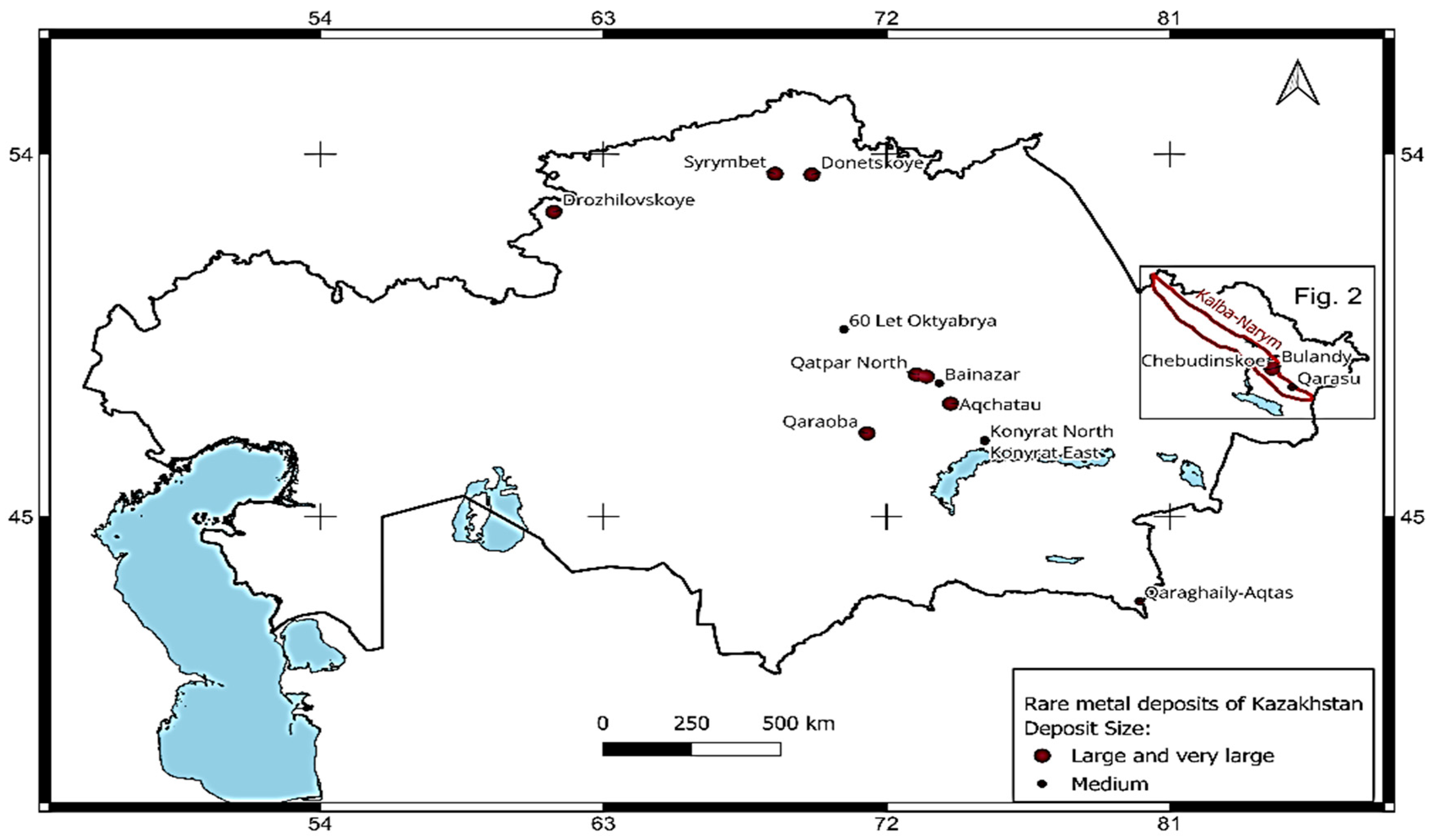
The global demand for critical metals, essential to modern energy systems, advanced electronics, and high-technology manufacturing, is increasing rapidly. Many of these metals, including Li, Be, Ta, Nb, and rare-earth elements (REE), are classed as critical and produced in limited quantities and often recovered as by-products from rare-metal deposits. Kazakhstan hosts more than 120 identified deposits of rare metals (Table 1), among which vanadium, titanium, tantalum, niobium, lithium, beryllium, and rare-earth elements are the most promising for further exploration and development (Figure 1).
East Kazakhstan, in particular, contains highly prospective deposits of titanium and zirconium (Karaotkel), tantalum (Verkhne-Baymurzinskoye and others), and lithium (Yubileynoye, Bakennoye, Belogorskoye, etc.), all of which are genetically associated with the rare-metal pegmatites of the Kalba–Narym Batholith (Figure 2).
Pegmatites are coarse-grained igneous rocks with complex textures, pronounced mineralogical zonation, and distinctive skeletal or graphic crystal intergrowths (London, 1992, 2008). Economically significant pegmatites are predominantly granitic in composition and represent major sources of lithophile rare elements (Li, Cs, Be, Nb, Ta, Sn, Ga, etc.) and strategic minerals such as phosphates and fluorite [2].
Following the classification of Cerný (1991) and Cerný and Ercit (2005), granitic rare-metal pegmatites are divided into two principal families: Li–Cs–Ta (LCT) and Nb–Y–F (NYF), based on diagnostic petrogenetic elements [3,4]. This classification reflects fundamental differences in the geochemical processes responsible for rare-element mineralization.
LCT pegmatites are enriched in Li, Cs, Ta, Be, B, F, and P, and typically form at relatively low temperatures (350–550 °C) in close association with peraluminous, dominantly S-type granites and leucogranites [5]. NYF pegmatites are enriched in Nb, Y, F, Be, REE, Sc, Ti, Zr, Th, and U. They are considered to be derived from A-type and I-type granites that were relatively low in aluminum (subaluminous to metaluminous granites) and originated from melting of depleted crust or from mantle rocks [4]. Simple LCT pegmatites are weakly mineralized and contain only common rock-forming minerals (quartz, feldspar, muscovite), whereas highly fractionated pegmatites comprise beryl, columbite–tantalite, Li-aluminosilicates (spodumene, petalite, lepidolite), and, in the most evolved types, pollucite. Well-known LCT pegmatite examples include Tin Mountain (USA), Tanco (Canada), Altai No. 3 (China), Greenbushes, Wodgina, and Pilgangoora (Western Australia), Bikita (Zimbabwe), and Kenticha (Ethiopia) [6].
The rare-metal pegmatites of the Kalba–Narym zone in Eastern Kazakhstan display mineralogical and geochemical features typical of the LCT family, namely high concentrations of Li, Cs, Ta, Be, Ga, Rb, Nb, and Sn, coupled with low REE contents. Previous studies [7,8,9,10,11] refined the absolute ages of the major granitoid massifs of the Kalba–Narym Batholith and described the mineralogical features of key ore nodes (e.g., Kvartsevoye and Tochka). However, the geochemical criteria for zonation and subtype differentiation of these pegmatite ore fields remain insufficiently substantiated.
This study focuses on the geochemical implications of trace-element systematics in pegmatites of the Kalba–Narym Batholith, with particular emphasis on melt fractionation trends and pegmatite subtype differentiation. Variations in Li, Cs, Rb, Ta, Nb, P, Ga, Sr, and Y in muscovite and K-feldspar record progressive enrichment of incompatible elements during the evolution of granitic melts and provide a basis for distinguishing barren, beryl-bearing, albite–spodumene, and albite pegmatites as successive stages of LCT pegmatite evolution. These geochemical relationships further allow reconstruction of both vertical and lateral zonation patterns within rare-metal pegmatite fields and provide a framework for assessing their mineralization potential.

2. Geological Setting

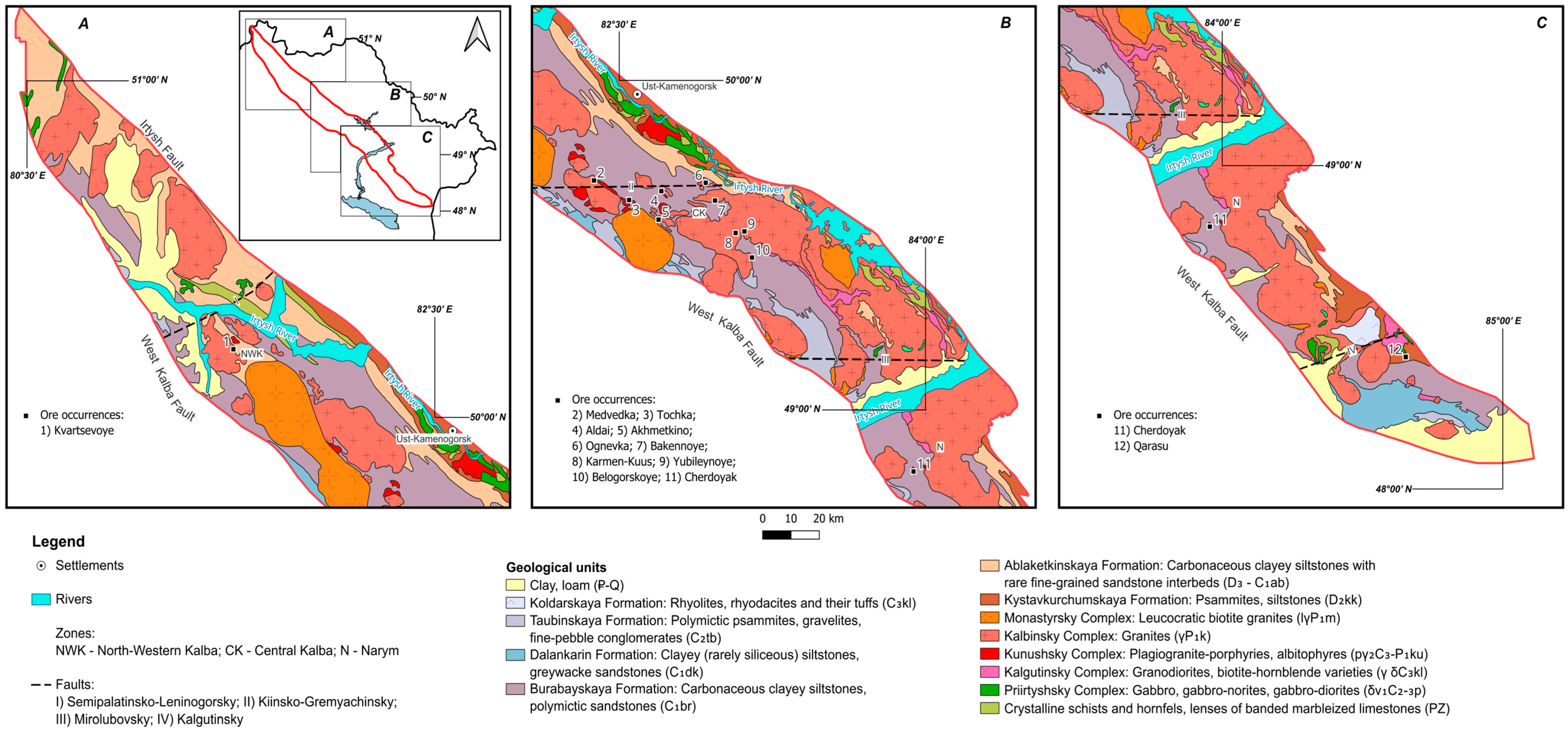
The study area is situated within the Ob-Zaysan (or Irtysh–Zaysan) Fold System (IZFS), located in the western segment of the Central Asian Orogenic Belt (CAOB) (Figure 2). The principal features of the tectonic evolution of the Ob-Zaysan Ocean have been discussed in detail [12,13,14,15]. In summary, the formation of the IZFS resulted from the progressive convergence of the Siberian and Kazakhstan paleocontinents, accompanied by the subduction of oceanic lithosphere beneath the continental margins along two subduction zones—the Rudny Altai zone in the east and the Zharma–Saur zone in the west [16].
The structural and lithological assemblages of the IZFS are most fully developed in East Kazakhstan, particularly in the basins of the Irtysh River and Lake Zaysan. To the northwest, these complexes dip beneath the cover of the West Siberian Plain, and to the southeast, they extend into Chinese territory. The structures have a predominant northwest strike and are bounded by faults separating them from adjacent Early Paleozoic fold systems—the Boshchekul–Chingiz system to the west and the Altai system to the east.
The pegmatite deposits considered in this study are localized within the Kalba–Narym Zone (KNZ), which represents a flysch-type basin filled with metasedimentary rocks of the Takyr Series (Burabay and Ablaketka Formations, D3–C1), Dalankarin Formation (C1s), and Taubin Formation (C2b) (Figure 2). The northeastern boundary of the KNZ is defined by the major Irtysh Shear Zone, which exposes metamorphosed blocks of metabasalts and metapelites. The southwestern margin of the zone borders the Charsk Zone, where a mélange of various Paleo-oceanic fragments is exposed.
A key structural element of the KNZ is the Kalba–Narym granitoid batholith, which forms a chain of NW-trending intrusions extending over approximately 450 km. The geological structure and composition of granitoids have been discussed in a large number of modern publications, as well as in a number of monographs based on data obtained during the USSR [7,17,18,19]. Therefore, all data on the composition of granitoids and their classification are accepted according to published data (Supplements S1 and S2) [20,21,22,23,24,25,26,27,28]. Summarizing all the previously obtained data, three intrusive complexes are distinguished within the batholith: the Kunush tonalite–granodiorite complex, the Kalba granodiorite–granite complex, and the Monastery leucogranite complex.
Rocks of the Kunush Complex occur as NW-trending dike swarms and small stock-like bodies composed of tonalite–granodiorite (formerly described as plagiogranite) assemblages throughout the zone; their U-Pb zircon age is 305–292 Ma. The rocks consist of plagioclase (55%), quartz (30%–35%), biotite (5%–10%), and minor amounts of K-feldspar. Kunush rocks are characterized by very high εNd(T) values (+7 to +9), indicating that their generation resulted from the partial melting of metabasic basement rocks of the Kalba–Narym Zone (KNZ) [18].
The main volume of the batholith is composed of granodiorite-to-granite I–S-type rocks of the Kalba Complex, forming large batholithic intrusions that commonly coalesce into composite bodies dated at 297–286 Ma. On average, these rocks consist of 25%–40% plagioclase, 20%–30% K-feldspar, 30%–35% quartz, and 5%–10% biotite. Rocks of the Kalba Complex display peraluminous (ASI = 1.0–1.2), ferroan–magnesian, alkali–calcic, and calc–alkaline compositions with a wide range of SiO2 contents, and εNd(T) values varying between +1 and +3.5. Petrological modeling suggests that the Kalba Complex magmas were produced by the melting of mixed accretionary–complex substrates consisting of heterogeneous sedimentary and volcanic rocks forming the lower crustal section of the KNZ [18]. These granites are spatially and genetically associated with major Ta–Nb and Li–Rb–Cs rare-metal pegmatite deposits.
The youngest intrusive phase, the Monastery Complex, presented by leucogranites with plagioclase (15%–25%), tabular and perthitic K-feldspar (35%–40%), quartz (30%–40%), and biotite (3%–6%) but lacks aegirine and riebeckite. Nevertheless, these rocks have some affinity to A-type granites due to enrichment in HFSE (Hf, Zr, Nb, Ta, Y), REE (except for Eu), Li, and F, ferroan trends in bulk rock composition. Leucogranites form several discrete batholithic bodies predominantly in the western part of the zone. The age of the Monastery Complex is 288–276 Ma. These leucogranites are characterized by intermediate εNd(T) values ranging from +3.5 to +5, and their formation is interpreted as resulting from partial melting of mixed crustal substrates of the KNZ, potentially with the involvement of mantle-derived fluids [18].
The Kalba–Narym I-S type batholith and its hosted LCT pegmatites represent an unusual association and geodynamic situation. Since the study of pegmatites alone cannot directly indicate the geodynamic situation, the authors adopted the geodynamic interpretation according to the previously published data [17,18,19]. The majority of pegmatite veins hosting Ta–Nb, Be, and Li–Rb–Cs mineralization are located within the central part of the Kalba–Narym Batholith. These veins form the Bakennoye, Yubileynoye, Belogorskoye, Akhmetkino, Tochka, and Medvedka deposits. It is assumed that their localization is controlled by the intersection of the sub-meridional Kiya–Gremyachinsk fault zone and a series of northwest-trending faults [29]. Within the northwestern part of the Kalba–Narym zone, the Kvartsevoye deposit with beryllium–lithium mineralization and several smaller occurrences are known. In contrast, within the southern part of the Kalba–Narym zone, rare-metal pegmatite deposits have not yet been identified.
Previous studies [30,31,32,33,34,35,36,37] elaborated that the Kalba–Narym Batholith formed in the post-collisional extensional setting of the continental lithosphere, accompanied by mantle activation via asthenospheric upwellings related to the far-field influence of the Tarim mantle plume (Pennsylvanian C2—Lower Permian P1). Such a geodynamic setting is particularly favorable for pegmatite generation within the sialic crust, and is analogous to the conditions of the world’s largest rare-metal pegmatite provinces, such as Greenbushes (Australia), Tanco (Canada), and the spodumene-bearing pegmatite deposits of Central Asia (Tajikistan, Uzbekistan—Angren spodumene field), and other rare-metal pegmatite provinces (e.g., Etyka and Orlovka in Transbaikalia, Russia).
The distribution of granitoids and associated rare-metal pegmatites within the Kalba–Narym Batholith is structurally controlled by deep-seated northwest- and latitudinal-trending faults, which acted over a long time as major magma conduits. The most ore-productive intrusions were emplaced in tectonically active zones characterized by high crustal mobility, where the interaction of fault systems promoted intensified magmatic and hydrothermal activity.
A typical example is provided by the Kalba–Narym pegmatite fields, spatially associated with post-collisional extensional domains, where regional faults and structural nodes controlled both the localization of ore bodies and the morphology of the pegmatite fields.
In the case of the Kalba–Narym zone, the association of LCT pegmatites involving intermediate I-S type granites as hosts of LCT pegmatites, rather than the expected common S-type granites, creates an exceptional case. The formation of S-type granites is the result of partial melting of sedimentary formations. While partial melting of sedimentary formations occurred in the Kalba–Narym zone, granites also carry traces of igneous substrates that participated in the melting. Despite the leucogranites of Monastery Complex displaying some A-type element signatures, in the Kalba–Narym zone, there are no proper A-type granites by definition. The riebeckite A-type granites at Verkhnee Espe and related ring and dike intrusions in the Tarbagatay zone are located far outside of the Kalba–Narym zone. Notably, the Kalba LCT pegmatites always intersect the granite outcrops, and the existence of any causative purely S-type intrusion [deep crustal or anatectic source?] remains so far speculative. The exceptional features and late/post-collisional tectonic setting of the Kalba LCT pegmatites represent a more complex evolution in the form of vectors rather than delineating distinct fields with strictly defined boundaries. Appended Electronic Supplements [S1—granite classification diagrams, S2—whole-rock geochemical data] support the characterization of the tectonic settings of the Kunush, Kalba, and Monastery granitoid complexes as an evolutionary sequence, shaping the complex architecture of the composite Kalba–Narym Batholith that is evolving in space and time over ~30 My [305–275 Ma]. This reflects the switch of tectonic regime from compression [subduction, accretion] to late-/post-collisional extension.
Pegmatite veins associated with granites cut through the granites of the Kalba Complex and are controlled by a superimposed fracture system trending NW 310°–NE 80°, with dip angles of 10–50° southward, forming part of a fault network that branches from a major sub-latitudinal deep-seated fault. The formation of the main ore bodies within the deposits is associated with the reactivation of a gently dipping fracture system, which occupies an autonomous structural position within the granites. Some of the pegmatites locally intrude into graphitic [carbonaceous] rocks, common for accretionary profiles, whereas occasional hornfels reflects the contact thermal aureole of the host granites. In addition, the granites exhibit fault zones of northwest, northeast, and sub-meridional orientation.
Based on mineral composition and structural–textural characteristics, the pegmatites are subdivided into three groups: (a) oligoclase–microcline pegmatites with inequigranular texture, occurring as irregular tabular bodies, composed of quartz, albite–oligoclase, microcline, muscovite, schorl (crystals up to 5 cm), and biotite; (b) muscovite–microcline pegmatites with zonal-symmetrical or zonal-asymmetrical textures, composed of quartz, microcline, albite–oligoclase, albite, garnet, schorl, and apatite. At the contacts between quartz and microcline blocks, greenish-gray beryl, large platy muscovite, and small columbite crystals are observed; and (c) rare-metal pegmatites of microcline–quartz–albite, albitic, and albite–spodumene composition, characterized by a colored mineral assemblage including cleavelandite, lepidolite, spodumene, pollucite, colored tourmalines, beryl, and cassiterite.
The pegmatite veins from the above-mentioned deposit types will serve as key study objects in the present work.

3. Materials and Methods

The fieldwork involved systematic sampling (a total of 60 samples) from different parts of pegmatite bodies (35 samples) and their host rocks, including granitoids and metasedimentary rocks. Overall, 25 samples were taken from the surrounding host granites and metasedimentary rocks (including 12 meta-siltstones and meta-sandstones). The chemical composition of pegmatites was investigated to assess the degree of their magmatic fractionation, whereas sampling and analysis of the host metasedimentary rocks—namely meta-siltstones, metapelites, quartz–mica schists, and graphitic metasedimentary lithologies—were aimed at evaluating the impact of pegmatitic melts and related fluids on the surrounding host rocks. In addition, more than 100 monomineralic separates of micas and K-feldspar (Kfs) were collected from pegmatites for subsequent geochemical analyses.
Sample preparation for mineralogical investigations (optical and electron microscopy) and for trace-element analysis of pegmatites by ICP-MS was carried out at the sample preparation facility of the Center of Excellence “VERITAS”, D. Serikbayev East Kazakhstan Technical University (EKTU).
Preparation for zircon separation was performed at the Shared Research Facility for Multielement and Isotopic Studies, Institute of Geology and Mineralogy SB RAS (Novosibirsk, Russia). The procedure included crushing of rock samples in a jaw crusher, washing, and heavy-liquid separation using sodium heteropolytungstate with a density of 3.0 g/cm3. Zircon grains were hand-picked, mounted in epoxy resin, and polished to expose internal structures. Cathodoluminescence (CL) imaging was obtained using a LEO 1430 VP scanning electron microscope (Carl Zeiss, Oberkochen, Germany) to reveal internal zoning and growth features.
Analytical work was conducted in accredited laboratories, including the Center of Excellence “VERITAS” (EKTU), the Laboratory of Petrology and Ore Potential of Magmatic Formations (IGM SB RAS, Novosibirsk), and the branch of the National Center for Complex Processing of Mineral Raw Materials “VNIItsvetmet” (Kazakhstan).
Trace-element analyses of pegmatites were performed using an Agilent 7500cx ICP-MS inductively coupled plasma mass spectrometer(Agilent Technologies, Santa Clara, CA, USA), capable of detecting up to 73 elements with sensitivities down to 1 ppb. Mineralogical analyses were carried out on a JEOL JSM-6390LV scanning electron microscope (JEOL, Tokyo, Japan) equipped with an Oxford Instruments INCA Energy PentaFETx3 energy-dispersive microanalysis system (Oxford Instruments Analytical Limited, Oxford, UK). Petrographic studies of magmatic and pegmatitic rocks of the Kalba Complex were conducted using an Olympus BX-51 optical microscope at VNIItsvetmet.
U–Pb isotope dating of zircons was performed at the Shared Research Facility for Multielement and Isotopic Studies, IGM SB RAS (Novosibirsk), using laser ablation–inductively coupled plasma mass spectrometry (LA-ICP-MS). Analyses employed a Thermo Fisher Scientific Element XR high-resolution mass spectrometer coupled with an Analyte Excite 193 nm excimer laser. The laser spot size was 35 µm, repetition rate 5 Hz, and energy fluence 3.0 J/cm2. Calibration was performed against two international zircon standards: Plešovice (337 ± 0.4 Ma) as the primary external standard and 91,500 (1065 ± 0.6 Ma) as a quality-control reference. Elemental fractionation, mass discrimination, and instrumental drift were corrected relative to the external standard. Analytical accuracy and reproducibility were monitored by repeated analyses of the NIST SRM 612 synthetic glass standard at the beginning, middle, and end of each analytical session. A secondary control sample was also used to verify measurement precision. U–Pb isotopic ratios were normalized to the reference values of standards 91,500 and Plešovice. Reported uncertainties for individual analyses and concordia ages correspond to a 2σ confidence level. Discordance was calculated by the Concordia distance, according to [38]. The measurements where discordance was <–1.4 or >1.6% were removed from the sample (corresponding to −3% < relative age discordance < 3%). Concordia diagrams were constructed using IsoplotR software and can be accessed from http://isoplotr.london-geochron.com (accessed on 1 December 2025) [39].
For geochemical discrimination and pegmatite zoning, trace-element ratio diagrams were employed, including K/Rb–Cs, K/Rb–Ba, K/Cs–Rb, P–Ga, and Al/Ga–Ga for K-feldspar, as well as K/Rb–Cs, K/Rb–Li, and Al/Ga–Ga for muscovite from pegmatites of the Kalba Complex. These diagrams were used to delineate pegmatite types within ore fields—barren, beryl, albite–spodumene, spodumene, and albite—and to assess their fractionation trends.

4. Results and Discussion

4.1. Geochronology of Rare-Metal Pegmatite Formation

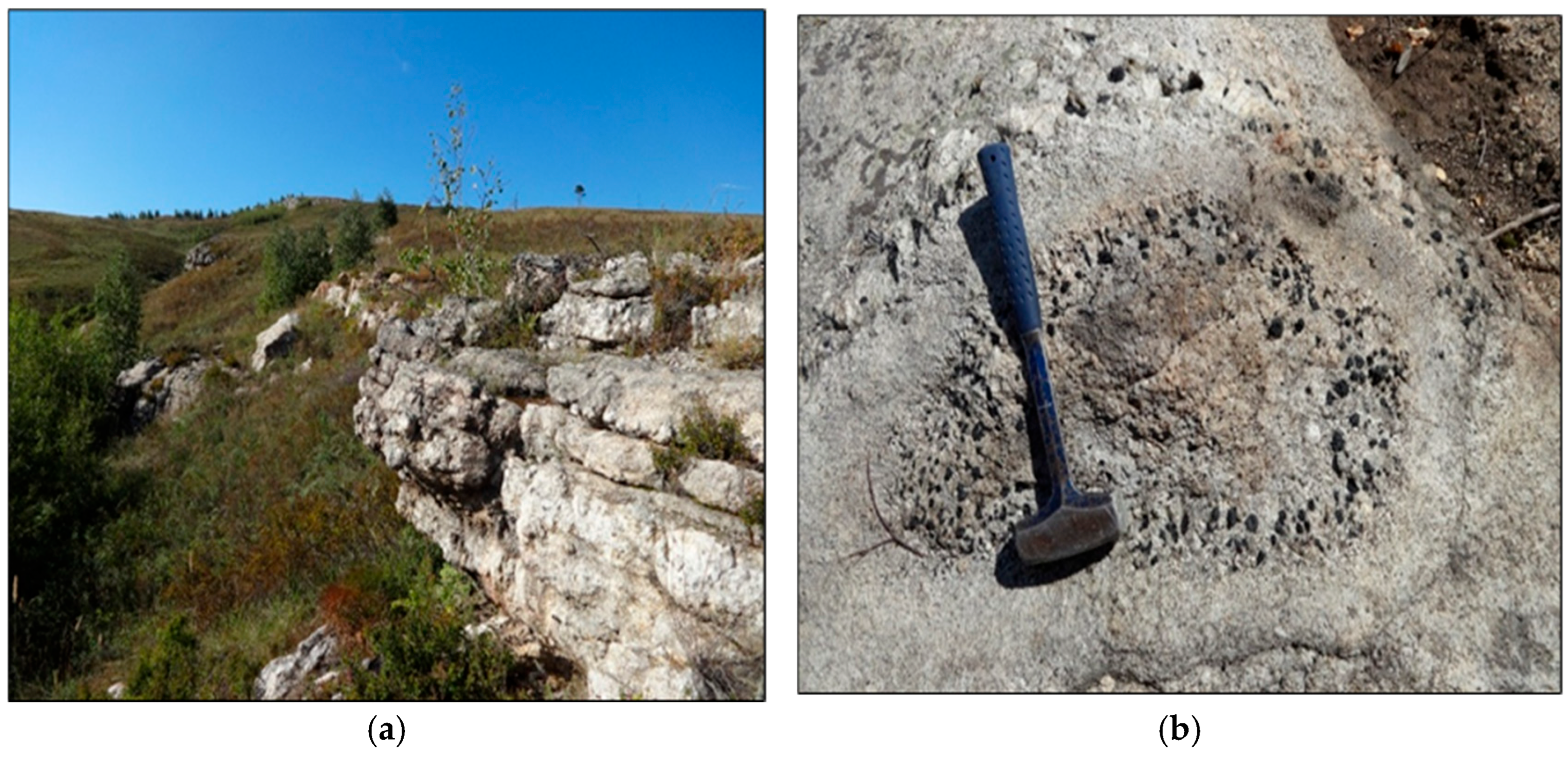
To better constrain the age of the pegmatites and evaluate their genetic links with one or another granitoid complex of the Kalba–Narym batholith, U–Pb zircon geochronology was undertaken. A representative hand specimen (3–5 kg) was collected from an Ab–Tur–Ms–Q ± Spd pegmatitic vein situated within the Ognevskoye ore field. The vein forms a gently dipping body with an approximate thickness of 5 m and can be traced for ~300 m along a west–northwest strike (Figure 3). The overall morphology and internal structure of the pegmatite vein are shown in Figure 3a, whereas the mineralogical features, including tourmaline- and garnet-bearing aggregates, are illustrated in Figure 3b. It is composed predominantly of coarse-grained albite, quartz, and tourmaline, locally transitioning into fine- to medium-grained leucogranitic facies. The vein contains abundant tourmaline- and garnet-rich clusters, which are characteristic features of the studied pegmatitic system.
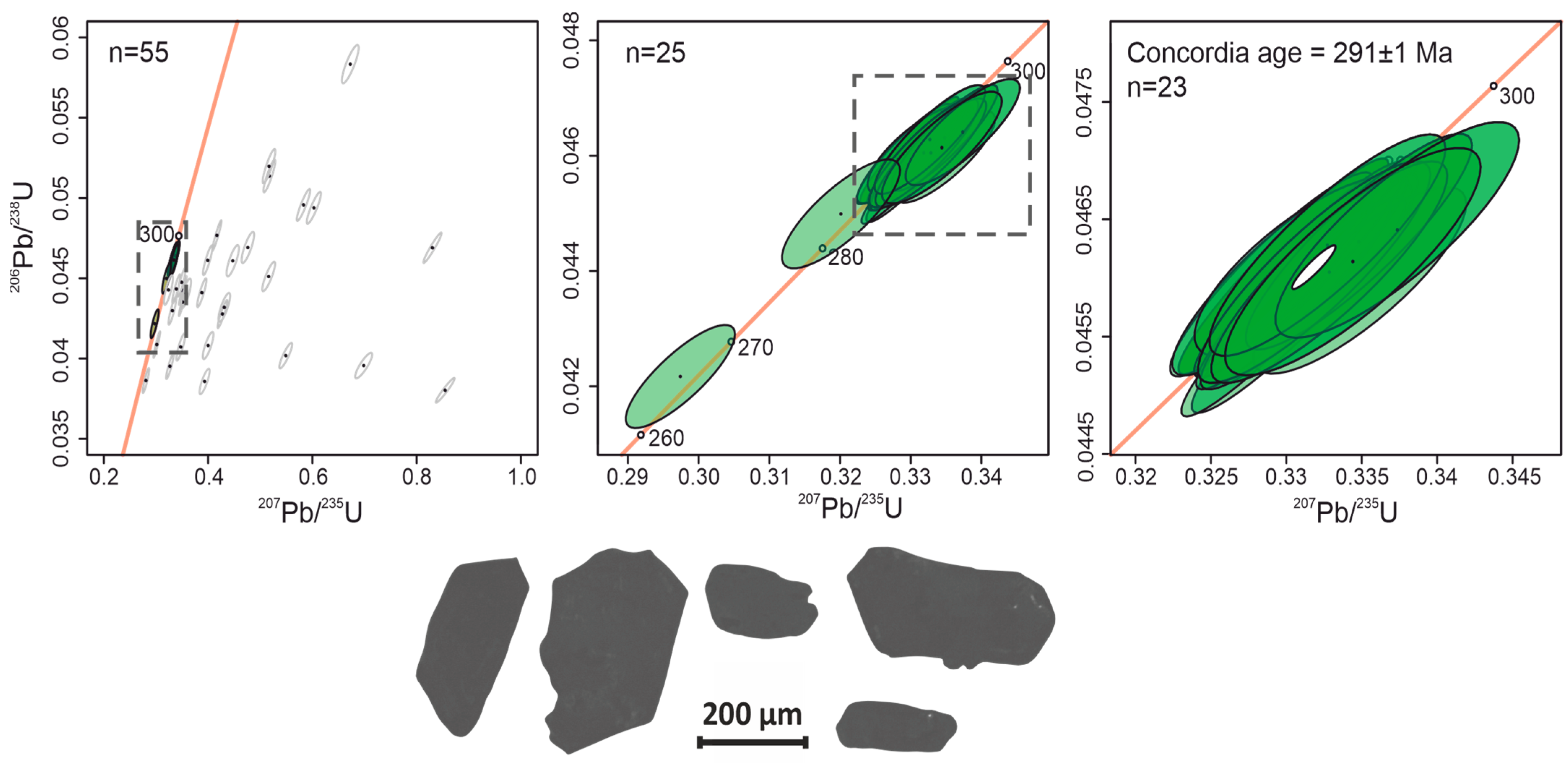
A monofraction of large zircon crystals, 250–400 μm in size, was successfully separated from the pegmatite vein (Figure 4). The grains exhibit a short prismatic habit with a well-developed dipyramid, although some grains display diffuse or poorly defined outlines. Cathodoluminescence imaging reveals that these zircons lack internal zoning and show a uniformly homogeneous internal structure.
The results of U–Pb zircon dating from the pegmatite vein are presented on the concordia diagram (Figure 4) and in Table 2. A total of 55 zircon grains were analyzed, of which only 23 yielded concordant age determinations. The remaining analyses are characterized by elevated contents of non-radiogenic lead (204Pb), resulting in extremely high degrees of discordance. Two relatively young points with slightly reverse discordance were also excluded from the sample. Since pegmatites are relatively fluid-saturated components of magmatic systems, it can be assumed that high concentrations of non-radiogenic lead in zircons and a significant number of discordant ages are presumably the result of metasomatic alterations under the influence of fluoride fluid according to experiments [40]. The concordant age obtained from the dataset is 290.5 ± 1 Ma.
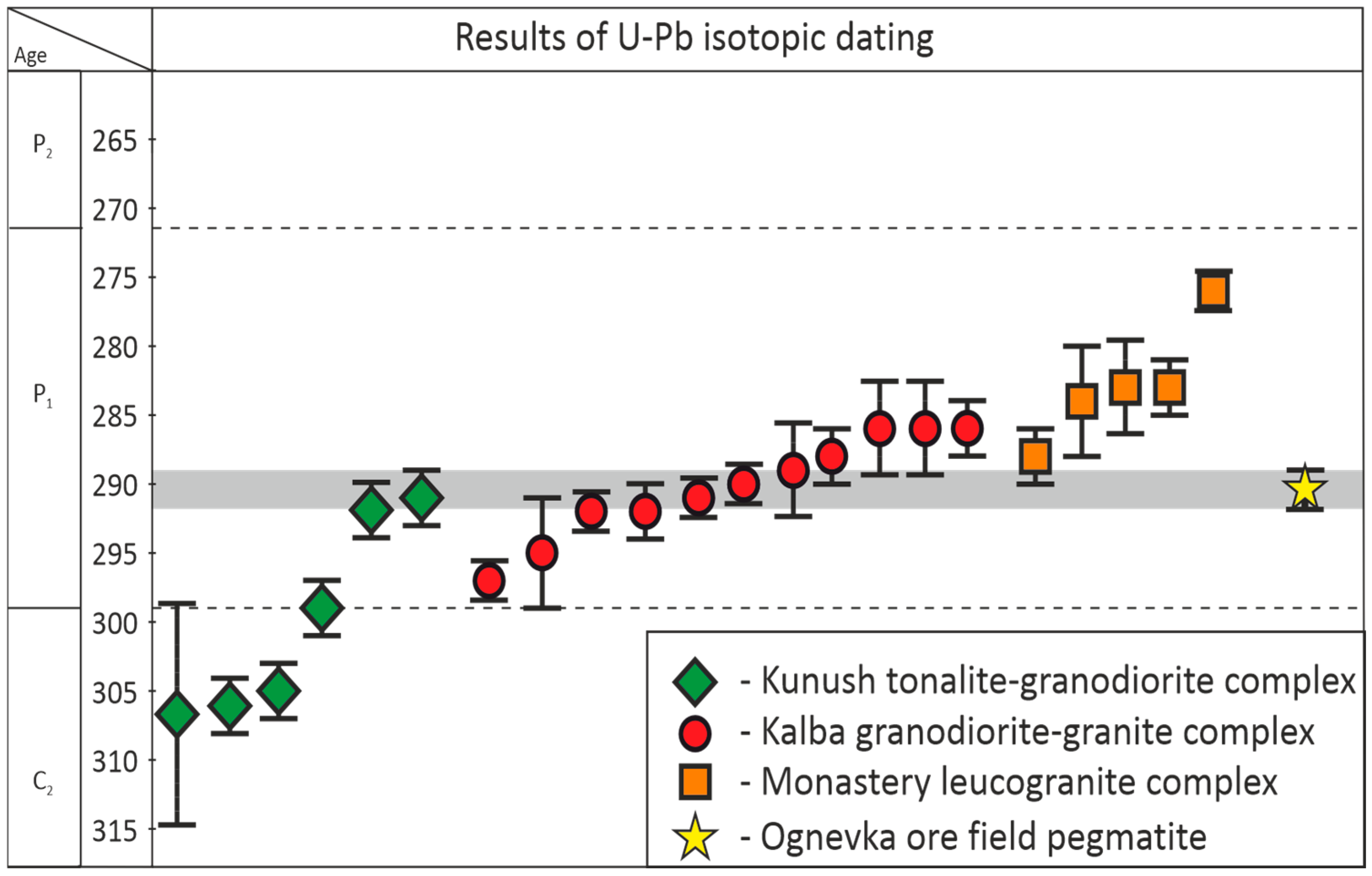
A comparison of the obtained pegmatite age with published U–Pb ages of the granitoid complexes of the Kalba–Narym Batholith is shown in Figure 5. The data indicate that the emplacement of the main volumes of granodiorites of the Kunush Complex preceded the formation of the pegmatites, whereas the leucogranites of the Monastery Complex were emplaced after the pegmatite intrusion. The inferred age of the Ognevskoye pegmatite veins falls within the time interval of granite formation associated with the Kalba Complex.
For a number of pegmatite bodies located remotely from granitoid bodies, their connection with the dike belts of the Kunush Complex granodiorites was assumed; however, the obtained U-Pb data do not confirm this connection. These results support earlier conclusions regarding the temporal relationship between the ore-bearing pegmatite veins and the Kalba Complex granitoids, previously inferred from Ar–Ar dating [41].

4.2. Systematics and Zoning of Rare-Metal Pegmatites of the Kalba–Narym Batholith

4.2.1. Zoning Based on Trace-Element Composition of Pegmatites

Most granite pegmatites do not contain economically significant concentrations of rare elements or lithium; however, in pegmatite melts that have undergone advanced rare-element fractionation, lithium–tantalum–tin mineralization may develop. Such mineralization is characterized by the appearance of lithium aluminosilicates (spodumene, petalite, lepidolite), cassiterite, columbite, tantalite, and related minerals [42,43].
Pegmatites associated with the emplacement of the multiphase Kalba–Narym Batholith are mainly confined to the Kalba–Narym metallogenic zone, with several minor occurrences documented in Western Kalba and the Zharma–Saur region. The main rare-metal and lithium deposits are concentrated within the following ore districts: Northwestern Kalba, Central Kalba, and Narym [11,30]. Within the Central Kalba zone, two major mineralized subzones are recognized, including the Gremyachinsk–Kiin and Karagoin–Saryozek subzones, as well as numerous ore clusters. The pegmatites are spatially and genetically associated with the granitoids of the Kalba Complex and were formed in a post-collisional orogenic geodynamic environment [9,11,30].
Previous studies established a spatial relationship between the main pegmatite types of Central Kalba (e.g., Bakennoye, Ognevskoye, Belaya Gora, Yubileynoye deposits) and the Tochka, Alday, and Akhmetkino deposits, with the medium- to coarse-grained porphyritic biotite granites of Phase I of the Kalba Complex (represented by contaminated granites and granodiorites of the Priirtysh, Belogorsk, Eshkelmes, Sorokin, and Tochka massifs (Figure 2), belonging to the normal petrochemical series of the calc-alkaline association.
The Phase II leucocratic two-mica granites of the Kalba Complex (Alypkel massif) are considered by most authors to be related to the formation of pegmatites at the Kvartsevoye deposit (Northwestern Kalba) and the Akhmetkino deposit (in the Karagoin–Saryozek zone of Central Kalba, Dvoryansky massif; Figure 2A,B).
Within the ore districts and major ore fields, a distinct zonal distribution of mineral assemblages is observed, ranging from oligoclase–microcline (barren) pegmatites to microcline–albite pegmatites with beryl, tantalite–columbite, and quartz–albite pegmatites with beryl. Occasional tantalite crystals, and rare spodumene, occur in quartz–albite–muscovite (greisenized) pegmatites containing spodumene and lepidolite, and extend further to albite–spodumene and quartz–albite–lepidolite varieties.
The pegmatites display intense metasomatic replacement processes, including microclinization, albitization, muscovitization, spodumenization, and multiple stages of silicification. They host characteristic colored lithium-bearing minerals (lepidolite, rubellite, verdelite, indicolite) and Li–Cs mineral associations (spodumene, amblygonite, pollucite, cleavelandite, etc.).
The principal ore minerals include tantalite–columbite, beryl, spodumene, pollucite, and cassiterite. Average concentrations of rare elements in economic ores are as follows: Ta—125 g/t, Nb—117 g/t, Li2O—0.1–0.3 wt %, Sn—0.06 wt % [44].
According to the prevailing mineral parageneses, the pegmatites of the Kalba–Narym granitoid massif belong to the LCT family of granitic pegmatites (Li–Cs–Ta type). Mineralogical investigations have revealed a wide variety of tantalum-bearing minerals, including tantalite–columbite, manganotantalite, ixiolite, and microlite.
In their mineralogical characteristics, the Kalba pegmatites are comparable to major rare-metal pegmatite deposits worldwide, such as Bernic Lake (Canada), Koktogay (China), Bikita (Zimbabwe), and Kolmogor (Russia), thus confirming their genetic and metallogenic similarity to classic LCT-type pegmatite systems [6,32,45].
The principal economic type of mineralization within the Kalba–Narym metallogenic zone is the rare-alkali tantalum–tin pegmatite type (Ta, Nb, Be, Li, Cs, Sn). It is represented by the rare-metal pegmatite deposits of Central Kalba, such as Bakennoye, Belogorskoye, and Yubileynoye, which were actively mined in the 1950 [46]. Other genetic and economically relevant types are also recognized: the tantalum–niobium type with columbite–beryl mineralization (Nizhniy Laibulak); the tin–tungsten greisen–quartz–vein type (Kaindy, Palattsy, and Cherdoyak deposits); and the tin–tantalum albite–greisen (apogranitic) type, regarded as potentially prospective for large-scale, non-pegmatitic rare-metal mineralization (Karasu type). In addition, clastogenic (placer-derived) types are represented by tin–tungsten, rare-earth, and tantalum–tin associations.
To confirm the classification of the Kalba–Narym rare-metal pegmatites as belonging to the LCT (Li–Cs–Ta) family, and to determine the mineralogical subtypes of the principal pegmatite fields, representative mineral samples were analyzed from different structural zones of the Kalba–Narym Batholith.
In Northwestern Kalba, pegmatites, albite rocks, and greisenized pegmatites of the Kvartsevoye deposit were investigated. In the Western Kalba belt, several individual samples were collected, and the composition of Early Permian pegmatites related to the Monastery granitoid complex (K-feldspar and muscovite of the Delbegetey massif) was analyzed.
The chemical analyses of pegmatites from the Kalba–Narym Batholith (Table 3) made it possible to evaluate the behavior of trace elements and to establish the geochemical evolution trends of pegmatites following the systematics of Cerný (1991) and Cerný and Ercit [3,4].
The geochemistry of trace elements in the pegmatites was analyzed based on the concentrations of Ga, Ba, Cs, Rb, and Sr [3,4,47,48,49]. The K/Cs–Cs and Al/Ga–Ga relationships proposed for pegmatites of the Central Alps [50] were also found to be highly informative.
Using these published and well-cited approaches together with newly obtained analytical data, a distinct geochemical evolution trend was established for the pegmatite ore fields of the Kalba–Narym granitoid batholith, ranging from barren → beryl → spodumene-bearing → albite pegmatites within the studied domains.
The discrimination diagrams based on average pegmatite compositions are used here to illustrate first-order geochemical trends at the scale of pegmatite fields. Such averaged values inevitably smooth internal compositional variability and should therefore not be interpreted as strict classifiers for individual pegmatite bodies. Apparent inconsistencies, where mineralized pegmatites plot within barren fields, reflect internal heterogeneity and the averaging of mineral-chemistry data. Consequently, these diagrams are complemented by mineral-scale geochemical data from K-feldspar and muscovite, which provide a more robust basis for assessing fractionation degree and pegmatite evolution.
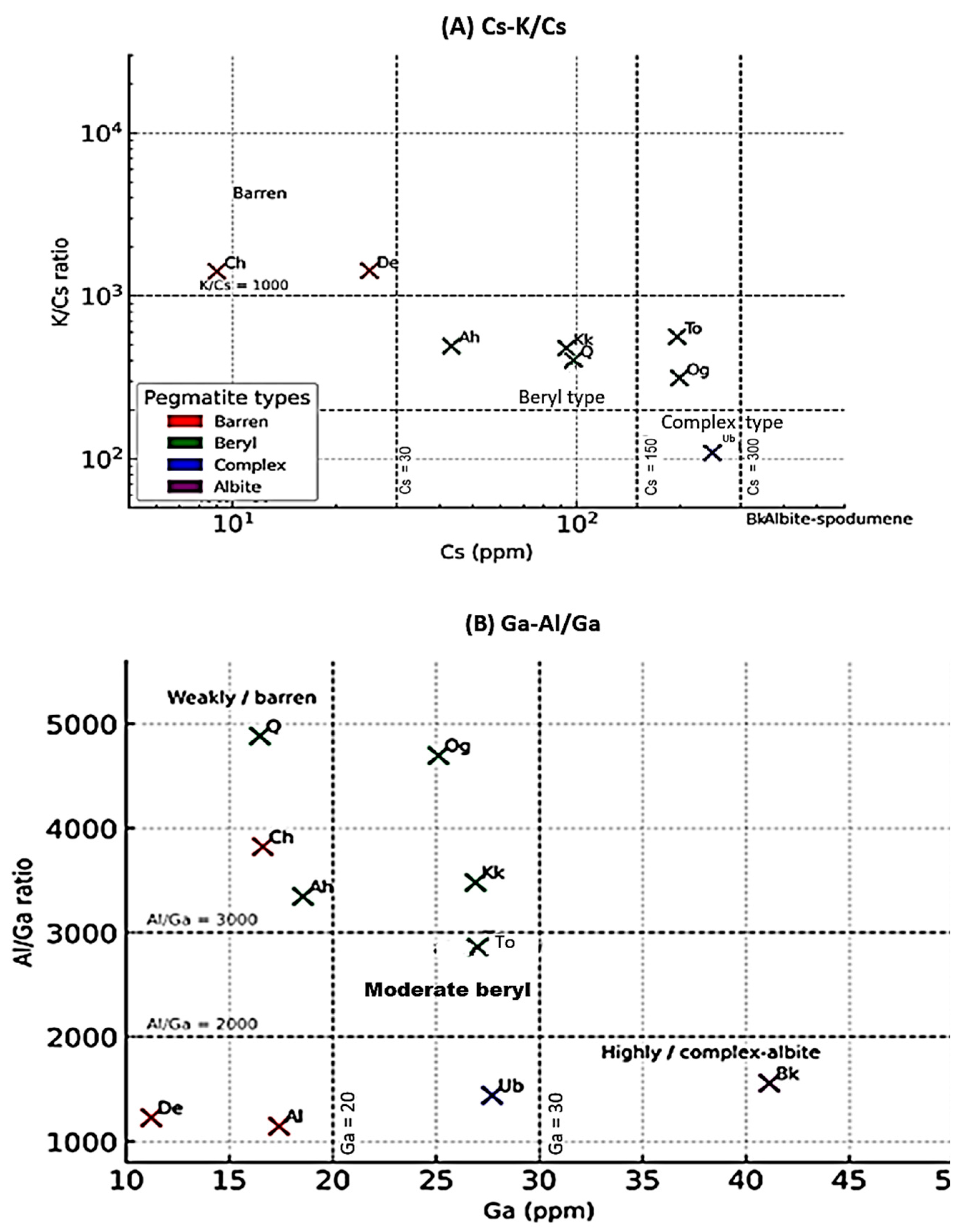
For the construction of the diagram (Figure 6), average chemical compositions of pegmatites determined by ICP–MS analyses were used.
The dashed boundaries shown in the Cs–K/Cs and Ga–Al/Ga diagrams are based on published empirical threshold values for Cs concentration, K/Cs, and Al/Ga ratios in LCT-type pegmatites [3,4]. They represent approximate, semi-quantitative limits used to illustrate progressive melt fractionation from barren through beryl and complex to albite–spodumene pegmatites, rather than rigid classification criteria.
The K/Cs–Cs diagram (Figure 6A) illustrates the relationship between Cs concentration and the K/Cs ratio in pegmatites of the Kalba–Narym Batholith, compared with the fractionation fields proposed by Cerný (1991) [3]. A distinct decrease in the K/Cs ratio with increasing Cs content is observed, indicating progressive fractionation of the granitic melt and a transition from barren to rare-metal pegmatites.
Based on the minimum and maximum trace element ratios defined by Cerný, the authors delineated the evolutionary zones of the studied pegmatites. In Figure 6A, the “Barren type” (red symbols) is characterized by high K/Cs > 1000 and low Cs < 50 ppm; the Beryl type (green symbols) occupies an intermediate position (K/Cs = 300–1000; Cs = 50–200 ppm); the “Complex type” (blue symbols) displays K/Cs = 100–300 with Cs = 200–500 ppm; whereas the “Albite type” (violet symbols) corresponds to K/Cs < 100 and Cs > 500 ppm. This trend clearly reflects the evolutionary sequence of LCT-type pegmatites from barren to albite–spodumene varieties.
The Al/Ga–Ga relationship (Figure 6B) demonstrates the dependence between the Al/Ga ratio and gallium content. Pegmatites from Bakennoye, Ognevskoye, and Karmen–Kuus are characterized by elevated Ga (30–40 ppm) and low Al/Ga (1000–2000) ratios, while Delbegetey pegmatites show high Al/Ga > 3500 and moderate Ga (15–20 ppm) contents. The Kvartsevoye and Akhmetkino pegmatites plot within the barren field, likely due to analytical uncertainty related to the use of average pegmatite compositions.
The overall trend conforms to the model of Cerný and Ercit [3] for LCT-type pegmatites, where increasing Ga contents are associated with albite and muscovite enrichment. The distribution of the data points on both K/Cs–Cs and Al/Ga–Ga diagrams confirms the common magmatic origin and successive fractional evolution of the pegmatites of the Kalba–Narym rare-metal belt.

4.2.2. Zoning of Pegmatites Based on the Trace-Element Composition of K-Feldspar and Muscovite

Following the approach of Oyarzábal, Miguel, and Perino (2009) in their study of the Totoral pegmatite field (San Luis, Argentina), detailed geochemical investigations of K-feldspar and muscovite were carried out for pegmatites of Central, Northwestern, and Southwestern Kalba (Narym area) in order to clarify petrogenetic relationships between granites and pegmatites and to characterize the degree of geochemical evolution of the pegmatite systems [51].
K-feldspar and muscovite crystallize over prolonged periods during the solidification of pegmatitic and granitic melts. These minerals are capable of incorporating and retaining a wide range of trace elements such as Rb, Cs, Ca, Sr, Pb, Ba, Eu, La, and Li, as well as B, Ga, Ge, Fe, Mg, Ti, and P [47,48,49,52,53]. It has been demonstrated [43,51] that the trace-element contents of feldspars and micas from pegmatites are reliable geochemical markers for distinguishing between chemically primitive, moderately fractionated, and highly evolved rare-element-enriched pegmatites. Among these elements, Rb, Cs, Sr, Ba, and Pb have long been recognized as sensitive indicators of pegmatite evolution.
Wise et al. used concentrations of Rb, Cs, and Ta, as well as the ratios K/Rb, K/Cs, and Nb/Ta, to evaluate the degree of rare-element fractionation in granitic and pegmatitic bodies. They concluded that these parameters are effective rapid-assessment tools for estimating both the extent of magmatic fractionation and the ore potential of granite–pegmatite systems [43].
Similarly, Szuszkiewicz and Wälle demonstrated, in their study of the Strzegom–Sobótka massif (Sudetes, Poland), that K/Rb vs. Cs and Ga plots derived from trace-element data for pegmatitic K-feldspars are powerful tools for analyzing petrogenetic relationships among different granite–pegmatite systems [54].
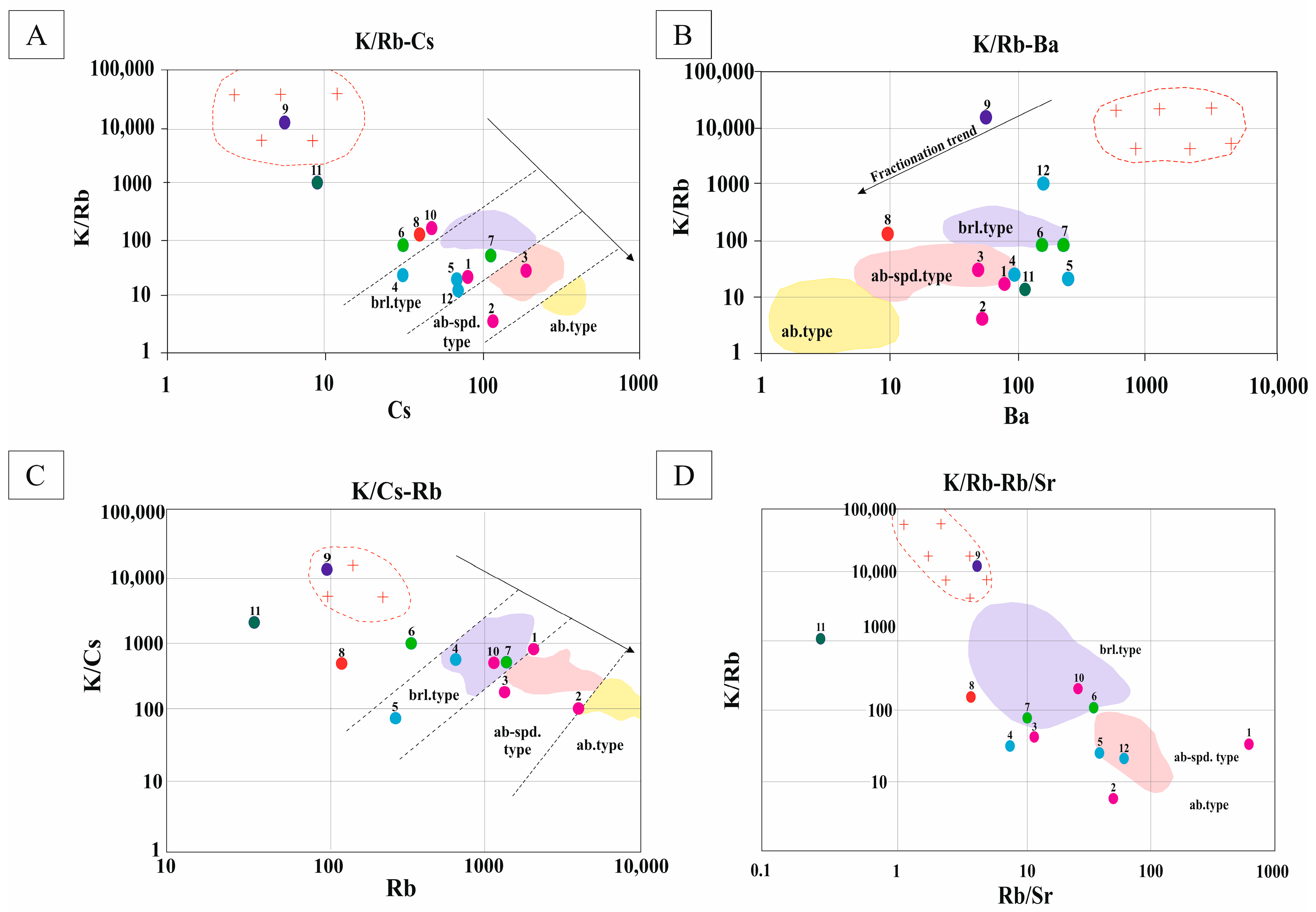
Guided by these and other studies, the authors analyzed trace-element compositions of K-feldspars from pegmatites in the investigated region and constructed a series of trace-element ratio diagrams, including K/Rb–Cs, K/Rb–Ba, P–Ga, and K/Cs–Rb, for K-feldspars from the main ore fields of the study area [50,51,54]. The resulting dataset provides insight into the fractionation degree of the pegmatites and enables a tentative classification of their types and subtypes within the LCT pegmatite family (Figure 7). The analytical data used for constructing the discrimination diagrams were obtained by ICP–MS at the VERITAS Advanced Development Center, East Kazakhstan Technical University (Table 4).
The K/Rb ratio is widely used to characterize the degree of geochemical evolution of pegmatites, ranging from barren and transitional varieties (beryl-type) to albite–spodumene and albite pegmatites [51]. For comparison with previous studies, the fractionation fields of pegmatites proposed by Oyarzábal et al. for the Totoral pegmatite field (San Luis, Argentina) were also added to the diagrams. These fields are shown using color coding and symbolic representations: isometric fields with appropriate labels indicate the granite field, the lilac-colored field corresponds to the beryl subtype, the pink field to the albite–spodumene subtype, and the yellow field to the albite subtype. Arrows on the diagrams indicate the direction of magmatic fractionation and the progressive transition from weakly fractionated microcline–beryl pegmatites to albite–spodumene and albite pegmatites (Figure 7A–D) [51].
The K/Rb–Cs diagram (Figure 7A) is often regarded as one of the most reliable indicators of pegmatite evolution. In this plot, the K/Rb–Cs data points correspond to pegmatite groups from the Kalba–Narym region and from the Totoral pegmatite field, San Luis, Argentina [51]. The analysis reveals that the Cherdoyak pegmatite data plot within the granite field, while the Akhmetkino and Nizhniy Laibulak pegmatites lie near the boundary of the weakly mineralized field. The beryl-type field includes pegmatites from Kvartsevoye, Yubileynoye, Tochka, Medvedka, and Alday, whereas the spodumene-type field is represented by Bakennoye and Karmen–Kuus pegmatites.
When comparing the obtained distribution fields of pegmatites from the Kalba–Narym region with those of the Totoral pegmatite field, it becomes evident that the beryl- and spodumene-type pegmatites of the Kalba–Narym ore fields are characterized by significantly lower Cs concentrations in K-feldspar. The measured Cs contents range from 5.52 ppm in barren or weakly mineralized pegmatites of Delbegetey to 196.3 ppm in K-feldspar from the Bakennoye deposit, yet still fall within the fractionation fields defined by J. Oyarzábal et al. [51].
The dashed evolutionary fields shown in Figure 7 are adopted from the pegmatite zonation scheme of the Totoral pegmatite field (Argentina) proposed by Oyarzábal et al. [51]. In this study, these fields are applied for comparative purposes only, to illustrate similarities and differences in geochemical fractionation trends between the Kalba–Narym pegmatite fields and the reference Totoral LCT pegmatite system.
Anomalously high K/Rb ratios are observed in samples from the Akhmetkino and Nizhniy Laibulak pegmatites, which contain considerable beryl, but plot within the field of barren or poorly mineralized pegmatites. Similarly, the Yubileynoye pegmatites show relatively low Cs contents and elevated K/Rb ratios, resulting in their position within the beryl-type field, despite the presence of abundant spodumene in the main pegmatite mass.
Minor discrepancies in the position of some pegmatites relative to the fractionation fields defined after Cerný and those adopted from the Totoral pegmatite model indicate that geochemical classification based solely on discrimination diagrams may not always be unequivocal. In such cases, robust interpretation requires a combined approach integrating trace-element geochemistry with mineralogical and textural observations. In particular, the classification of the Yubileynoye deposit as a spodumene-type pegmatite follows earlier published interpretations [55]; however, the coexistence of both beryl and spodumene, together with the new geochemical data presented here, supports its attribution to a complex beryl–spodumene pegmatite type. This refinement does not affect the general fractionation trends but highlights the importance of integrated criteria in the classification of pegmatites within the Kalba–Narym Batholith.
The K/Cs–Ba diagram (Figure 7B) distinctly separates fields corresponding to specific pegmatite types: barren, beryl-bearing, spodumene-enriched, and albite types. The average Ba content in pegmatites varies from 49.11 ppm in the spodumene-bearing pegmatites of Karmen–Kuus to 277.8 ppm in the beryl-type pegmatites of Alday. The K/Rb–Ba relationship shows a consistent decrease in Ba concentration with progressive geochemical evolution from beryl-type to albite-type pegmatites.
Based on Ba content in K-feldspar, the Delbegetey pegmatites plot within the granitoid field, whereas Cherdoyak falls into the barren (non-mineralized) field. The beryl-type field includes pegmatites of Tochka, Alday, Akhmetkino, Kvartsevoye, and Nizhniy Laibulak. The albite–spodumene-type field contains pegmatites from Yubileynoye, Bakennoye, Tochka, Medvedka, and Karmen–Kuus, while no occurrences plot within the pure albite-type field.
The K/Rb– Cs diagram (Figure 7C) also clearly demonstrates the differentiation trend of the Kalba–Narym pegmatites. Their distribution across the fractionation fields generally mirrors the pattern observed on the K/Rb–Cs diagram, except for the Yubileynoye pegmatites, which, as expected, plot within the spodumene-type field. When compared with the pegmatites of the Totoral pegmatite field (Argentina), the fractionation fields of the Kalba–Narym pegmatites show a remarkable similarity to the Argentinian distribution fields [51].
The K/Rb–Rb/Sr diagram (Figure 7D) displays several overlapping fields. Among the pegmatite fields of the Kalba–Narym Belt, most ore-bearing fields plot within the complex beryl and beryl–spodumene-type domains, which correspond well with the mineralogical characteristics previously established for these pegmatites.
The trace-element composition of muscovite, like that of K-feldspar, is also recognized as an informative geochemical indicator for identifying potentially Li-rich pegmatite bodies [43,56]. Muscovite occurs in various types of pegmatites and crystallizes during different stages of pegmatite evolution. It is abundant in granitic pegmatites, representing the third most common mineral after quartz and feldspar [51].
The trace-element geochemistry of muscovite from granitic pegmatites has been extensively investigated by Selway et al., Maneta and Baker, and Wise et al., among others [43,49,57,58].
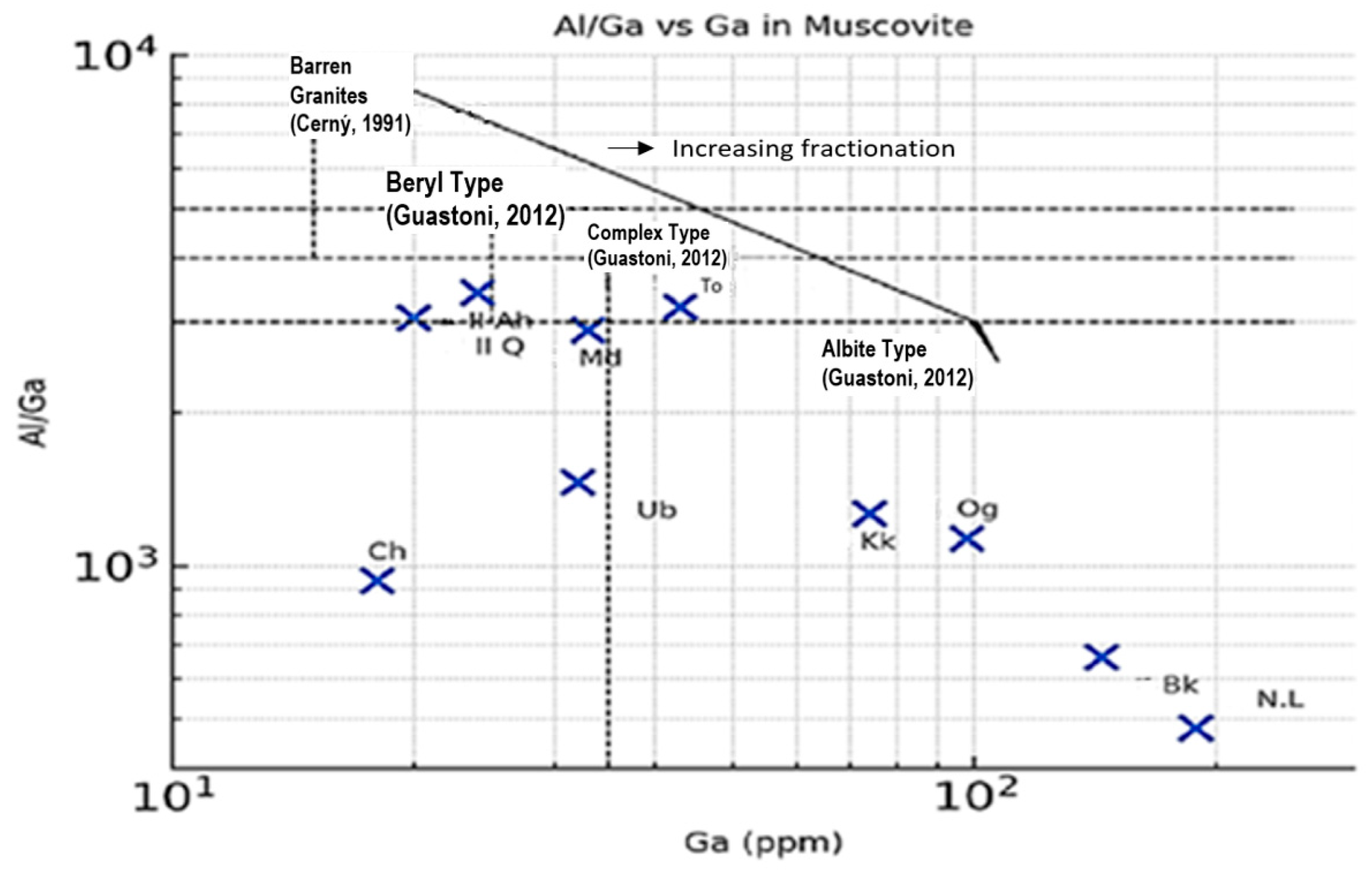
The Al/Ga–Ga diagram (Figure 8), constructed after [43,50,59], demonstrates a consistent negative correlation between the Al/Ga ratio and Ga content (ppm), which is a classical indicator of the degree of fractionation in granitoid and pegmatitic systems. Most data (Table 5) points fall within the field characterized by low Al/Ga values (~500–3000) and elevated Ga concentrations (20–190 ppm), indicating a high degree of magmatic fractionation of the parental melt.
This geochemical behavior is typical of rare-metal pegmatites of the Li–Ta–Nb–Be type, where Ga becomes concentrated in the residual phases, while Al/Ga ratios decrease systematically. The observed increase in Ga with a decrease in Al/Ga reflects the progressive accumulation of Ga in late-stage residual phases, a feature characteristic of LCT-type pegmatites [3,59].
The trend from the upper right corner (Barren field) toward the lower left corner (Albite field) illustrates the sequential magmatic evolution from granitoid sources to highly fractionated rare-metal pegmatites. The distribution of data points along this trend confirms a genetic relationship among the different pegmatite groups within the Kalba–Narym Batholith.
The geochemical parameters of the pegmatites, K-feldspar, and muscovite from the analyzed samples confirm that the pegmatites of the studied ore fields belong to the LCT series, exhibiting an evolutionary trend from barren to beryl-bearing → albite–spodumene → albite types.
The results demonstrate that pegmatites of the Kalba–Narym Batholith generally follow the evolutionary trends of LCT systems but exhibit a region-specific fractionation pathway. In contrast to the Totoral reference field, the transition to beryl (violet fields) and albite–spodumene (pink fields) pegmatites in Kalba–Narym occurs at systematically lower Cs contents in K-feldspar, as documented by Table 3 and Table 4 and Figure 7. The Cs–K/Cs and Ga–Al/Ga diagrams (Figure 6) show that advanced fractionation stages are reached at moderate Cs concentrations and relatively high K/Cs ratios, partly overlapping but not fully coinciding with the classical thresholds proposed by Cerný. These features reflect the influence of multiphase granitoid magmatism within the Kalba–Narym Batholith and provide practical regional criteria for targeting Li–Ta–Nb–Cs mineralization.

5. Conclusions and Recommendations

This study shows that large rare-metal pegmatite fields of the Kalba–Narym Batholith display discernible vertical and lateral zonation that is related to progressive fractionation of granitic melts. This zonation is consistently recorded by the trace-element composition of pegmatites and their major rock-forming minerals, particularly K-feldspar and muscovite, which preserve detailed geochemical information on melt evolution. The combined mineralogical and geochemical data indicate that the pegmatites of the Kalba–Narym Batholith belong to the LCT (Li–Cs–Ta) family and form a continuous evolutionary sequence from barren through beryl and beryl–spodumene to albite and albite–spodumene types. The development of these pegmatite varieties is associated with increasing degrees of melt fractionation and progressive enrichment in volatile components.
The results further demonstrate that, although Kalba–Narym pegmatites broadly follow the evolutionary trends of LCT systems, they exhibit a region-specific fractionation pathway. In contrast to the Totoral reference field, the transition to beryl and albite–spodumene pegmatites in the Kalba–Narym Batholith occurs at systematically lower Cs contents in K-feldspar. The Cs–K/Cs and Ga–Al/Ga diagrams show that advanced fractionation stages are reached at moderate Cs concentrations and relatively high K/Cs ratios, partly overlapping but not fully coinciding with the classical thresholds proposed by Cerný. These features likely reflect the influence of multiphase granitoid magmatism and melt–rock interaction within the Kalba–Narym Batholith and provide refined regional criteria for targeting Li–Ta–Nb–Cs mineralization.
The trace-element systematics of K-feldspar and muscovite provide robust, mineralogically controlled criteria for pegmatite classification and for distinguishing barren from ore-bearing bodies. Elemental relationships, such as K/Rb–Cs, K/Cs–Rb, K/Rb–Ba, P–Ga, and Al/Ga–Ga, allow objective pegmatite typification even within structurally complex ore fields containing numerous mineralogically diverse bodies. Importantly, the mineral-chemical composition of these rock-forming phases alone may be sufficient to predict lithium enrichment and overall ore potential, even where diagnostic Li minerals are absent at the surface. This significantly improves the effectiveness of early-stage exploration in covered or weakly exposed areas.
Pegmatite emplacement within the Kalba–Narym Batholith is commonly associated with pre-existing dyke swarms and small magmatic bodies and is accompanied by the development of dispersion halos enriched in Li, Rb, Cs, B, and Be in the host rocks. These features reflect the combined influence of structural controls and fluid–rock interaction and may serve as additional exploration indicators that complement mineral-geochemical criteria and help to refine exploration and evaluation strategies.
The data presented in Table 6 show that Li, Rb, and Cs contents, as well as K/Rb ratios in muscovite from rare-metal pegmatites of Eastern Kazakhstan, are broadly comparable to those reported for major productive pegmatite deposits worldwide. This correspondence supports the applicability of the proposed geochemical criteria for predicting Be–Nb–Ta–P–Li-bearing prospects within the Kalba–Narym region.
From a methodological perspective, the integration of detailed mineral-chemical analysis (ICP-MS) with rapid field-based analytical techniques, including portable LIBS analyzers, provides an efficient and scalable framework for the exploration and evaluation of rare-metal pegmatite systems. The proposed mineral–geochemical criteria and zoning approach are not restricted to the Kalba–Narym Batholith and may be successfully applied to other LCT-type pegmatite provinces.
The data presented in Table 6 indicate that the Li, Rb, Cs contents and K/Rb ratios in muscovite from rare-metal pegmatites of Eastern Kazakhstan are broadly comparable to those reported for major productive pegmatite deposits worldwide [35]. This correspondence supports the potential applicability of these geochemical criteria for predicting Be–Nb–Ta–P–Li–bearing prospects within the Kalba–Narym.
Overall, the results emphasize the value of mineral chemistry as a quantitative and reproducible tool for assessing the degree of melt fractionation, reconstructing pegmatite evolution, and predicting the distribution of Li, Ta, Nb, and associated critical metals in granitic–pegmatitic systems.

Supplementary Materials

The following supporting information can be downloaded at: https://www.mdpi.com/article/10.3390/min16020187/s1, Figure S1. Granites of the Kalba–Narym batholith in tectonic discrimination diagrams. a: SiO2-FeOtot/(FeOtot + MgO) [22]; b: SiO2-MALI [22]; c: Al2O3/(CaO+Na2O+K2O)-ASI, molecular amounts [22]; d: Na2O+K2O-Fe2O3tot×5-(CaO+MgO)×5, molecular amounts [23]; e, f: Zr+Nb+Ce+Y vs. FeOtot/MgO (e) and (Na2O+K2O)/CaO (f) [24], FG = fractionated granites, OGT = unfractionated M-, I- and S-type granites, A = A-type granites; g = SiO2-P2O5 [25]; h = Rb-Th [25], arrows show evolution trends of S- and I-type granites. Figure S2. Classification diagrams for granitoids of Kunush, Kalba, and Monastery complexes compiled using GCDkit [26]. (a) TAS, Middlemost, 1994 [27]; red line shows projected boundary between alkaline series and calc–alkaline series; (b) Pearce et al., 1984 [28].

Author Contributions

Conceptualization, M.A.M. and S.S.A.; methodology, P.D.K., A.V.D., R.S. and M.A.M.; software, Y.B.; validation P.D.K., O.N.K.,T.A.O. and Z.A.S.; formal analysis, S.S.A., O.N.K. and Z.A.S.; investigation, M.A.M.; resources, S.S.A.; data curation, M.A.M.; writing—original draft preparation, M.A.M., A.V.D., R.S. and S.S.A.; writing—review and editing, M.A.M., A.V.D., R. S., S.S.A., A.O.B. and Y.Y.A.; visualization, M.A.M., A.V.D., R.S. and T.A.O.; supervision, M.A.M.; project administration, M.A.M.; funding M.A.M. and S.S.A. All authors have read and agreed to the published version of the manuscript.

Funding

This research was supported by the Ministry of Science and Higher Education of the Republic of Kazakhstan (Grant No. BR24992854 “Development and implementation of competitive, science-based technologies to ensure the sustainable development of the mining and metallurgical industry of East Kazakhstan Region”). The research was also supported by the Ministry of Science and Higher Education of the Republic of Kazakhstan (Grant No. AP14870387 “Assessment of the lithium potential of Kazakhstan, criteria controlling deposit formation and guiding exploration”). U-Pb isotopic dating of pegmatites was carried out with the financial support of the Russian Science Foundation grant № 24-77-10050.

Data Availability Statement

The data presented in this study are available on request from the corresponding author.

Acknowledgments

The research has been performed by members of the Central Asia Task Group under the auspices of the Deep-time Digital Earth (DDE) big data program. The authors gratefully acknowledge the contributions of colleagues and collaborators who assisted with analytical work. Special thanks are extended to the staff of VERITAS Engineering Laboratory (EKTU) for ICP-MS and the Analytical Center (IGM) for the U–Pb zircon dating. We appreciate the constructive comments from four reviewers and from the editors that helped to improve this manuscript.

Conflicts of Interest

The authors declare no conflicts of interest.

References

  1. Seltmann, R.; Shatov, V.; Yakubchuk, A. Mineral Deposits Database and Thematic Maps of Central Asia, Scale 1:1 500 000, ArcGIS 10.1 Package and Explanatory Notes: Centre for Russian and Central Eurasian Mineral Studies (CERCAMS); Natural History Museum: London, UK, 2014; 120p. [Google Scholar]
  2. Linnen, R.L.; Van Lichtervelde, M.; Cerný, P. Granitic pegmatites as sources of strategic metals. Elements 2012, 8, 275–280. [Google Scholar] [CrossRef] [Scilit]
  3. Cerny, P. Rare-element granitic pegmatites. Part I: Anatomy and internal evolution of pegmatite deposits. Geosci. Can. 1991, 18, 49–67. [Google Scholar]
  4. Cerny, P.; Ercit, S. The classification of granitic pegmatites revisited. Can. Mineral. 2005, 43, 2005–2026. [Google Scholar] [CrossRef] [Scilit]
  5. London, D. Ore-forming processes within granitic pegmatites. Ore Geol. Rev. 2018, 101, 349–383. [Google Scholar] [CrossRef] [Scilit]
  6. Duuring, P. Rare–Element Pegmatites: A Mineral Systems Analysis; Geological Survey of Western Australia Record 2020/7; Geological Survey of Western Australia: East Perth, Australia, 2020; 6p. [Google Scholar] [CrossRef]
  7. Kuibida, M.L.; Dyachkov, B.A.; Vladimirov, A.G.; Kruk, N.N.; Khromykh, S.V.; Kotler, P.D.; Rudnev, S.N.; Kruk, E.A.; Kuibida, Y.V.; Oitseva, T. Contrasting granitic magmatism of the Kalba fold belt (East Kazakhstan): Evidence for late Paleozoic postorogenic events. J. Asian Earth Sci. 2019, 175, 178–198. [Google Scholar] [CrossRef] [Scilit]
  8. Khromykh, S.V.; Kotler, P.D.; Izokh, A.E.; Kruk, N.N. A review of Early Permian (300–270 Ma) magmatism in Eastern Kazakhstan and implications for plate tectonics and plume interplay. Geodyn. Tectonophys. 2019, 10, 79–99. [Google Scholar] [CrossRef] [Scilit]
  9. Zimanovskaya, N.A.; Oitseva, T.A.; Khromykh, S.V.; Travin, A.V.; Bissatova, A.Y.; Annikova, I.Y.; Aitbayeva, S.S. Geology, Mineralogy, and Age of Li-Bearing Pegmatites: Case Study of Tochka Deposit (East Kazakhstan). Minerals 2022, 12, 1478. [Google Scholar] [CrossRef] [Scilit]
  10. Baisalova, A.O.; Dolgopolova, A.V.; Seltmann, R.; Akbarov, E.E.; Mashrapova, M.A. Petrographic and mineralogical features of the Karagaily-Aktas rare metal deposit (South Kazakhstan region). News Natl. Acad. Sci. Repub. Kaz. 2024, 5, 6–22. [Google Scholar] [CrossRef] [Scilit]
  11. Oitseva, T.A.; Khromykh, S.V.; Naryzhnova, A.V.; Kotler, P.D.; Mizernaya, M.A.; Kuzmina, O.N.; Dremov, A.K. Rare Metal (Li–Ta–Nb) Mineralization and Age of the Kvartsevoye Pegmatite Deposit (Eastern Kazakhstan). Minerals 2025, 15, 737. [Google Scholar] [CrossRef] [Scilit]
  12. Vladimirov, A.G.; Kruk, N.N.; Rudnev, S.N.; Khromykh, S.V. Geodynamics and granitoid magmatism of collision orogens. Russ. Geol. Geophys. 2003, 44, 1321–1338. [Google Scholar]
  13. Vladimirov, A.G.; Kruk, N.N.; Khromykh, S.V.; Polyansky, O.P.; Chervov, V.V.; Vladimirov, V.G.; Travin, A.V.; Babin, G.A.; Kuibida, M.L.; Khomyakov, V.D. Permian magmatism and lithospheric deformation in the Altai caused by crustal and mantle thermal processes. Russ. Geol. Geophys. 2008, 49, 468–479. [Google Scholar] [CrossRef] [Scilit]
  14. Buslov, M.M.; Watanabe, T.; Fujiwara, Y.; Iwata, K.; Smirnova, L.V.; Safonova, I.Y.; Semakov, N.N.; Kiryanova, A.P. Late Paleozoic faults of the Altai region, Central Asia: Tectonic pattern and model of formation. J. Asian Earth Sci. 2004, 23, 655–671. [Google Scholar] [CrossRef] [Scilit]
  15. Xiao, W.J.; Huang, B.; Han, C.; Sun, S.; Li, J. A review of the western part of the Altaids: A key to understanding the architecture of accretionary orogens. Gondwana Res. 2010, 18, 253–273. [Google Scholar] [CrossRef] [Scilit]
  16. Kruk, N.N.; Safonova, I.Y.; Kuibida, M.L.; Khromykh, S.V. Evolution of the Ob-Zaisan Paleocean: New data and unresolved problems. In Proceedings of the 3rd International Scientific Conference “Correlation of Altaids and Uralids: Magmatism, Metamorphism, Stratigraphy, Geochronology, Geodynamics and Metallogeny”, IGM SB RAS, Novosibirsk, Russia, 18 May 2016; pp. 111–113. (In Russian) Available online: https://www.academia.edu/download/72686535/hlthaff.2015.pdf (accessed on 22 April 2025).
  17. Khromykh, S.V.; Tsygankov, A.A.; Kotler, P.D.; Navozov, O.V.; Kruk, N.N.; Vladimirov, A.G.; Travin, A.V.; Yudin, D.S.; Burmakina, G.N.; Khubanov, V.B.; et al. Late paleozoic granitoid magmatism of Eastern Kazakhstan and Western Transbaikalia: Plume model test. Russ. Geol. Geophys. 2016, 57, 773–789. [Google Scholar] [CrossRef] [Scilit]
  18. Kotler, P.D.; Khromykh, S.V.; Kruk, N.N.; Sun, M.; Li, P.; Khubanov, V.B.; Semenova, D.V.; Vladimirov, A. Granitoids of the Kalba batholith, Eastern Kazakhstan: U–Pb zircon age, petrogenesis and tectonic implications. Lithos 2021, 388–389, 106056. [Google Scholar] [CrossRef] [Scilit]
  19. Tsygankov, A.A.; Burmakina, G.N.; Kotler, P.D. Petrogenesis of Granitoids from Silicic Large Igneous Provinces (Central and Northeast Asia). Petrology 2024, 32, 772–803. (In Russian) [Google Scholar] [CrossRef] [Scilit]
  20. Martin, R.F.; Vito, C.D. The Patterns of Enrichment in Felsic Pegmatites Ultimately Depend on Tectonic Setting. Can. Mineral. 2005, 43, 2027–2048. [Google Scholar] [CrossRef] [Scilit]
  21. Eby, G.N. Chemical subdivision of the A-type granitoids: Petrogenetic and tectonic implications. Geology 1992, 20, 641–644. [Google Scholar] [CrossRef] [Scilit]
  22. Frost, B.R.; Barnes, C.G.; Collins, W.J.; Arculus, R.J.; Ellis, D.J.; Frost, C.D. A geochemical classification for granitic rocks. J. Petrol. 2001, 42, 2033–2048. [Google Scholar] [CrossRef] [Scilit]
  23. Grebennikov, A.V. A-type granites and related rocks: Petrogenesis and classification. Russ. Geol. Geophys. 2014, 55, 1353–1366. [Google Scholar] [CrossRef] [Scilit]
  24. Whalen, J.B.; Currie, K.L.; Chappell, B.W. A-type granites: Geochemical characteristics, discrimination and petrogenesis. Contrib. Mineral. Petrol. 1987, 95, 407–419. [Google Scholar] [CrossRef] [Scilit]
  25. Chappell, B.W. Aluminium Saturation in I- and S-Type Granites and the Characterization of Fractionated Haplo granites. Lithos 1999, 46, 535–551. [Google Scholar] [CrossRef] [Scilit]
  26. Janoušek, V.; Farrow, C.M.; Erban, V. Interpretation of whole-rock geochemical data in igneous geochemistry: Introducing Geochemical Data Toolkit (GCDkit). J. Petrol. 2006, 47, 1255–1259. [Google Scholar] [CrossRef] [Scilit]
  27. Middlemost, E.A.K. Naming materials in the magma/igneous rock system. Earth Sci. Rev. 1994, 37, 215–224. [Google Scholar] [CrossRef] [Scilit]
  28. Pearce, J.A.; Harris, N.B.; Tindle, A.G. Trace element discrimination diagrams for the tectonic interpretation of granitic rocks. J. Petrol. 1984, 25-4, 956–983. [Google Scholar] [CrossRef] [Scilit]
  29. Yarmolyuk, V.V.; Kuzmin, M.I.; Ernst, R.E. Intraplate geodynamics and magmatism in the evolution of the Central Asian Orogenic Belt. J. Asian Earth Sci. 2014, 93, 158–179. [Google Scholar] [CrossRef] [Scilit]
  30. D’yachkov, B.A.; Mizernaya, M.A.; Khromykh, S.V.; Bissatova, A.Y.; Oitseva, T.A.; Miroshnikova, A.P.; Frolova, O.V.; Kuzmina, O.N.; Zimanovskaya, N.A.; Pyatkova, A.P.; et al. Geological History of the Great Altai: Implications for Mineral Exploration. Minerals 2022, 12, 744. [Google Scholar] [CrossRef] [Scilit]
  31. Annikova, I.Y.; Vladimirov, A.G.; Gavryushkina, O.A.; Smirnov, S.Z. Geology and mineralogy of the Alakhinsky deposit of spodumene granite porphyry (Gorny Altai). Geol. Ore Depos. 2016, 58, 451–475. (In Russian) [Google Scholar] [CrossRef] [Scilit]
  32. Dittrich, T.; Seifert, T.; Schulz, B.; Hagemann, S.; Gerdes, A.; Pfänder, J. Archean Rare-Metal Pegmatites in Zimbabwe and Western Australia; Springer Briefs in World Mineral Deposits; Springer: Cham, Switzerland, 2019; 125p. [Google Scholar]
  33. Khromykh, S.V.; Sokolova, E.N.; Smirnov, S.Z.; Travin, A.V.; Annikova, I.Y. Geochemistry and age of rare-metal dyke belts in Eastern Kazakhstan. Dokl. Earth Sci. 2014, 459, 1587–1591. [Google Scholar] [CrossRef] [Scilit]
  34. Gavryushkina, O.A.; Travin, A.V.; Kruk, N.N. Duration of granitoid magmatism in peripheral parts of large igneous provinces (based on 40Ar/39Ar isotopic study of Altai Permian-Triassic granitoids). Geodyn. Tectonophys. 2017, 8, 1035–1047. [Google Scholar] [CrossRef] [Scilit]
  35. Gavryushkina, O.A.; Kruk, N.N.; Semenov, I.V.; Vladimirov, A.G.; Kuibida, Y.V.; Serov, P.A. Petrogenesis of Permian-Triassic intraplate gabbro-granitic rocks in the Russian Altai. Lithos 2019, 326–327, 71–89. [Google Scholar] [CrossRef] [Scilit]
  36. Redin, Y.O.; Borisenko, A.S.; Redina, A.A.; Malyutina, A.V.; Dultsev, V.F. The main stages of the formation of the gold and rare metal mineralization of Eastern Transbaikalia and related magmatism: New U-Pb and Ar-Ar data. Geospheric. Res. 2024, 2, 77–100. (In Russian). Available online: https://scholar.google.com/scholar?hl=ru&as_sdt=0%2C5&q=%D0%A0%D0%B5%D0%B4%D0%B8%D0%BD+%D0%AE.%D0%9E&btnG= (accessed on 20 May 2025).
  37. Kotler, P.D.; Khromykh, S.V.; Degtyarev, K.E.; Kulikova, A.V.; Tsareva, M.D.; Penkina, V.A. Stages of granitoid magmatism in the eastern part of the Kazakhstan composite continent in the Early-Middle Paleozoic. Rep. Russ. Acad. Sci. Earth Sci. 2024, 518, 1415–1422. [Google Scholar] [CrossRef] [Scilit]
  38. Vermeesch, P. IsoplotR: A free and open toolbox for geochronology. Geosci. Front. 2018, 9, 1479–1493. [Google Scholar] [CrossRef] [Scilit]
  39. Vermeesch, P. On the treatment of discordant detrital zircon U-Pb data. Geochronology 2021, 3, 247–257. [Google Scholar] [CrossRef] [Scilit]
  40. Harlov, D.E.; Anczkiewicz, R.; Dunkley, D.J. Metasomatic alteration of zircon at lower crustal PT conditions utilizing alkali- and F-bearing fluids: Trace element incorporation, depletion, and resetting the zircon geochronometer. Geochim. Cosmochim. Acta. 2023, 352, 222–235. [Google Scholar] [CrossRef] [Scilit]
  41. Khromykh, S.V.; Oitseva, T.A.; Kotler, P.D.; D’yachkov, B.A.; Smirnov, S.Z.; Travin, A.V.; Vladimirov, A.G.; Sokolova, E.N.; Kuzmina, O.N.; Mizernaya, M.A.; et al. Rare-Metal Pegmatite Deposits of the Kalba Region, Eastern Kazakhstan: Age, Composition and Petrogenetic Implications. Minerals 2020, 10, 1017. [Google Scholar] [CrossRef] [Scilit]
  42. Trueman, D.L.; Cerný, P. Exploration for Rare-Element Granitic Pegmatites. In Granitic Pegmatites in Science and Industry, Short Course Handbook; Cerný, P., Ed.; Mineralogical Association of Canada: Winnipeg, MB, Canada, 1982; Volume 8, pp. 463–493. [Google Scholar]
  43. Wise, M.A.; Curry, A.C.; Harmon, R.S. Reevaluation of the K/Rb-Li Systematics in Muscovite as a Potential Exploration Tool for Identifying Li Mineralization in Granitic Pegmatites. Minerals 2024, 14, 117. [Google Scholar] [CrossRef] [Scilit]
  44. D’yachkov, B.A.; Nikitina, T.I.; Ermolenko, A.E. Geology and Mineral Potential of Yubileynoe Pegmatitic Deposits in Central Kalba; VKGTU: Ust-Kamenogorsk, Kazakhstan, 1987; 262p. (In Russian) [Google Scholar]
  45. D’yachkov, B.A.; Bissatova, A.Y.; Mizernaya, M.A.; Khromykh, S.V.; Oitseva, T.A.; Kuzmina, O.N.; Zimanovskaya, N.A.; Aitbayeva, S.S. Mineralogical Tracers of Gold and Rare-Metal Mineralization in Eastern Kazakhstan. Minerals 2021, 11, 253. [Google Scholar] [CrossRef] [Scilit]
  46. Oitseva, T.A. Features of geology and metallogeny and predictive search criteria of the Kalba-Narym rare metal belt. In Proceedings of the XXI International Symposium: Problems of geology and subsoil development, Tomsk, Russia, 3–7 April 2017; TPU: Tomsk, Russia, 2017; (In Russian). Available online: http://earchive.tpu.ru/handle/11683/44426 (accessed on 25 April 2025).
  47. Beus, A.A. Beryllium: Geochemistry of Beryllium and Genetic Types of Beryllium Deposits; Freeman: San Francisco, CA, USA, 1966; 411p, Available online: https://archive.org/details/geochemistryofbe0000beus (accessed on 19 April 2025).
  48. Gordiyenko, V.V. Concentrations of Li, Rb, and Cs in potash feldspar and muscovite as criteria for assessing the rare-metal mineralization in granite pegmatites. Int. Geol. Rev. 1971, 13, 134–142. (In Russian) [Google Scholar] [CrossRef] [Scilit]
  49. Selway, J.B.; Breaks, F.W.; Tindle, A.G. A review of rare-element (Li-Cs-Ta) pegmatite exploration techniques for the Superior Province, Canada, and large worldwide tantalum deposits. Explor. Min. Geol. 2005, 14, 1–30. [Google Scholar] [CrossRef] [Scilit]
  50. Guastoni, A. LCT (Lithium, Cesium, Tantalum) and NYF (Niobium, Yttrium, Fluorine) Pegmatites in the Central Alps. Proxies of Exhumation History of the Alpine Nappe Stack in the Lepontine Dome. Ph.D. Thesis, University of Padova, Padova, Italy, 2012. Available online: https://www.research.unipd.it/retrieve/e14fb26f-adc5-3de1-e053-1705fe0ac030/Tesi_completa.pdf (accessed on 20 April 2025).
  51. Oyarzábal, J.; Galliski, M.Á.; Perino, E. Geochemistry of K-feldspar and Muscovite in Rare-element Pegmatites and Granites from the Totoral Pegmatite Field, San Luis, Argentina. Resour. Geol. 2009, 59, 315–329. [Google Scholar] [CrossRef] [Scilit]
  52. Cerný, P. Magmatic vs. metamorphic derivation of rare-element granitic pegmatites. J. Czech Geol. Soc. 1994, 39, 17–18. Available online: https://www.jgeosci.org/detail/JCGS.348 (accessed on 15 April 2025).
  53. Rieder, M.; Cavazzini, G.; D’Yakonov, Y.S.; Frank-Kamenetskii, V.A.; Gottardi, G.; Guggenheim, S.; Koval, P.V.; Muller, G.; Neiva, A.M.R.; Radoslovich, E.W.; et al. Nomenclature of the micas. Can. Mineral. 1998, 36, 41–48. Available online: https://www.sciencedirect.com/science/article/pii/S0169136816300580 (accessed on 20 April 2025). [CrossRef] [Scilit]
  54. Szuszkiewicz, A.; Wälle, M. Trace elements in K-feldspar from NYF and LCT pegmatite Softhestrzegom–Sobótka granitic massif, Sudetes, SW Poland. A reconnaissance study. In Proceedings of the 7th International Symposium on Granitic Pegmatites: Book of Abstracts, Ksiaz, Poland, 17–21 June 2015; Available online: https://www.researchgate.net/publication/215580643_Granitic_Pegmatites_the_state_of_the_art_Book_of_Abstracts (accessed on 30 April 2025).
  55. Oitseva, T.A.; Dyachkov, B.A.; Bissatova, A.Y.; Orazbekova, G.B.; Zinyakin, S.S. Features of formation, material composition and geological structure of rare metal and pegmatite deposits of the Kalba region on the example of the Yubileinoye deposit. Bull. Tomsk. Polytech. Univ. Geo Assets Eng. 2023, 334, 164–176. [Google Scholar] [CrossRef] [Scilit]
  56. Beurlen, H.; Thomas, R.; da Silva, M.R.R.; Müller, A.; Rhede, D.; Soares, D.R. Perspectives for Li- and Ta-mineralization in the Borborema Pegmatite Province, NE-Brazil: A review. J. South Am. Earth Sci. 2014, 56, 110–127. [Google Scholar] [CrossRef] [Scilit]
  57. Maneta, V.; Baker, D.R. The potential of lithium in alkali feldspars, quartz, and muscovite as a geochemical indicator in the exploration for lithium-rich granitic pegmatites: A case study from the spodumene-rich Moblan pegmatite, Quebec, Canada. J. Geochem. Explor. 2019, 205, 106336. [Google Scholar] [CrossRef] [Scilit]
  58. Cerný, P.; Burt, D. Paragenesis, Crystallochemical Characteristics, and Geochemical Evolution in Micas in Granite Pegmatites. In Micas, Reviews in Mineralogy; Bailey, S.W., Ed.; Mineralogical Society of America: Chantilly, VA, USA, 1984; Volume 13, pp. 257–297. [Google Scholar]
  59. Curry, A.C.; Wise, M.A.; Harmon, R.S. Trace element geochemistry of Li-rich pegmatites in the Carolina tin–spodumene belt, North Carolina, USA: Implications for petrogenesis and exploration. Econ. Geol. 2025, 120, 715–743. [Google Scholar] [CrossRef] [Scilit]
Figure 1. Map of the distribution of rare-metal deposits of Kazakhstan.
Minerals 16 00187 g001
Figure 2. Geological setting and structure of the Kalba–Narym Batholith (East Kazakhstan). (A) Tectonic position of the Kalba–Narym Batholith within the Ob–Zaysan (Irtysh–Zaysan) Fold System in the western segment of the Central Asian Orogenic Belt (CAOB); inset shows the location of the study area within Kazakhstan. (B) Geological structure of the western and central parts of the Kalba–Narym Batholith (North-Western and Central Kalba zones), showing major lithological units, faults, and locations of rare-metal pegmatite occurrences. (C) Geological structure of the southern part of the Kalba–Narym Batholith (Narym zone), including major intrusive complexes, sedimentary units, and known ore occurrences. The map is based on the 1:500,000 geological map compiled by the “Topaz” Geological Exploration Company, with authors’ modifications.
Minerals 16 00187 g002
Figure 3. (a) Photograph of the pegmatite vein sampled at the Ognevskoye deposit (Figure 2B, occurrence 6) for zircon U–Pb isotopic dating (left); (b) tourmaline aggregation within the vein (right).
Minerals 16 00187 g003
Figure 4. U–Pb zircon dating results from a pegmatite vein of the Ognevskoye ore field plotted on a concordia diagram. Analytical uncertainties are reported at the 2σ level. Bottom: cathodoluminescence (CL) images of representative zircon grains from the analyzed sample.
Minerals 16 00187 g004
Figure 5. A comparison of the obtained age of the pegmatite vein from the Ognevskoye ore field with the various granitoid complexes that constitute the Kalba–Narym Batholith [17,18,19].
Minerals 16 00187 g005
Figure 6. Cs–K/Cs (A) and Ga–Al/Ga (B) diagrams for pegmatites of the Kalba–Narym Batholith [3,4,47,48,49]. Dashed lines indicate approximate boundaries between barren, beryl, complex, and albite–spodumene pegmatite fields. Data points represent average trace-element compositions of pegmatites from different fields of the Kalba–Narym Batholith.
Minerals 16 00187 g006
Figure 7. Discrimination diagrams for LCT-family granitic pegmatites illustrating fractionation trends based on: (A) K/Rb vs. Cs, (B) K/Rb vs. Ba, (C) K/Cs vs. Rb and (D) K/Rb vs. Rb/Sr relationships in K-feldspar; modified after [43]. Comparative fractionation fields of the Totoral pegmatite field (San Luis, Argentina), after Oyarzábal et al. [51], are shown by color-coded and symbolic fields: isometric fields with corresponding labels represent granites, the lilac field corresponds to the beryl-type pegmatites, the pink field to the albite–spodumene subtype, and the yellow field to the albite subtype. Arrows indicate the direction of magmatic fractionation from weakly fractionated microcline–beryl pegmatites toward albite–spodumene and albite pegmatites.
Minerals 16 00187 g007
Figure 8. Al/Ga vs. Ga diagram for muscovites from rare-metal pegmatites of the Kalba–Narym batholith [3,50]. Zone labels refined; points shown in saturated blue color.
Minerals 16 00187 g008
Table 1. List of selected rare-metal deposits of Kazakhstan (coordinates in WGS84; from Seltmann et al., 2014) [1].
NNameMajor
Commodity
Minor
Commodity
LatitudeLongitudeReserves,
Thousand Tons [1]
160 Let OktyabryaSnCu, Bi, B49.86671770.561200-
2AqchatauW, Be, MoBi47.99081674.04775124,983.7
3BainazarW, MoBi, Cu48.51314973.68112220,546.0
4DonetskoyeSnW, Mo, Ta, Nb, REE53.53766869.63203316,850.0
5Katpar North (Qatpar)W, MoBi, Be, Cu48.73626372.95034035,208.0
6QaraobaW, MoBi, Be, Sn, Cu, Pb47.22385571.394226234,607.0
7Verkhnee QairaqtyWMo, Bi, Be, Cu, Pb, Sn, REE48.68080473.2727022,649,946.0
8Qaraghaily AqtasSnW, Be, Li, Ta, Nb, REE42.66643180.0440545737.0
9SyrymbetSnW, Bi, Be, Mo53.56978568.46372923,617.6
10Konyrat NorthW, MoBi, Be, Sn47.04122775.1256943970.9
11Konyrat EastMoW, Be, Bi, Sn, Cu47.01579875.1235673404.0
12DrozhilovskoyeMoW, Cu, Bi52.68373161.42056737,174.0
13QarasuSn, WMo48.41665984.9049717255.6
14ChebudinskoyeW, Sn-48.86419784.224826-
15BulandySnW48.88825084.265012-
16BakennoyeSn, Be-49.41719082.5941737812.0
17BelogorskoyeSn, Be-49,28145483.7593303312.0
18Verkhne-
Baymurzinskoye
Be-49.27354083.8245102209.0
19KaragoinSn, Be-49.29358582.524671412.0
20Bayash (Tochka)Li, TaSn, Be49.40199582.313862-
21KenebaySn, BeTa49.41675082.2148092193.9
22ChernevinskoyeW-49.19293183.274083409.3
23KvartsevoeSn, BeTa50.12205381.311576803.6
24YubileinoyeSn, Be-49.24700083.158700186.0
Table 2. Results of U-Pb dating of zircon from the pegmatite vein of the Ognevkoye ore field.
№Isotopic RatiosRhoIsotopic RatiosD, %
Pb207/
U235
1σ Pb206/
U238
1σPb207/
U235
2σ Pb206/
U238
2σ
10.32980.00280.04610.000370.95289.44.2290.54.5−0.34
20.33080.00290.04580.000370.94290.24.3288.54.50.46
30.33160.00270.04610.000370.99290.84290.74.50.13
40.32900.00270.04600.000350.92288.84.1290.14.2−0.34
50.33090.00280.04610.000370.94290.34.2290.34.5−0.03
60.32910.00270.04600.000330.88288.94289.94−0.26
70.33000.00280.04570.000370.95289.64.2288.34.50.38
80.33110.00290.04610.000310.77290.44.4290.53.7−0.03
90.33100.00280.04600.000370.94290.34.2289.74.50.17
100.33150.00290.04600.000370.92290.74.3289.74.50.26
110.33490.00280.04600.000320.82293.34.2289.83.90.99
120.33480.00300.04630.000370.89293.24.5291.84.50.37
130.33180.00310.04610.000380.882914.6290.24.60.20
140.33280.00320.04610.000380.87291.74.7290.24.60.41
150.33270.00320.04630.000380.87291.64.7291.64.60.00
160.33740.00330.04640.000370.83295.24.8292.44.50.76
170.33440.00340.04610.000390.83292.95.1290.84.70.60
180.33480.00300.04630.000370.89293.24.5291.84.50.37
190.33180.00310.04610.000380.882914.6290.24.60.20
200.33280.00320.04610.000380.87291.74.7290.24.60.41
210.33270.00320.04630.000380.87291.64.7291.64.60.00
220.33740.00330.04640.000370.83295.24.8292.44.50.76
230.33440.00340.04610.000390.83292.95.1290.84.70.60
Table 3. Average trace-element contents (ppm) and geochemical ratios (K/Cs, Al/Ga) in pegmatites of the Kalba–Narym Batholith (KNB).
Pegmatite Field/DepositCsGaBaSrRbK/CsAl/Ga
Yubileynoye (Ub)248.027.793.027.6882.61091440
Bakennoye (Bk)296.441.196.748.31289.7381556
Akhmetkino (Ah)43.318.6207.655.8414.04943346
Karmen–Kuus (Kk)93.326.922.372.92898.14803481
Ognevskoye (Og)199.025.1167.882.31284.43144698
Tochka (To)196.427.0470.0331.9513.95642863
Alday (Al)10.017.4214.823.388.72371145
Delbegetey (De)25.011.251.890.151.814301226
Cherdoyak (Ch)9.016.6156.4110.030.414173824
Kvartsevoye (Q)97.716.47251.4136.2599.74044883
Note: Concentrations are given in ppm. Pegmatites are ordered by location from the Central Kalba to the Northwestern and Western Kalba zones. Abbreviations: Ub—Yubileynoye, Bk—Bakennoye, Ah—Akhmetkino, Kk—Karmen–Kuus, Og—Ognevskoye, To—Tochka, Al—Alday, De—Delbegetey, Ch—Cherdoyak, Q—Kvartsevoye.
Table 4. Analytical data used for the construction of discrimination diagrams based on the trace-element composition of K-feldspar from the Kalba–Narym and Western Kalba zones, obtained by ICP–MS analysis.
DepositGaPBaRbKCsSrLiK/CsRb/SrK/Rb
Nizhniy Laibulak17.0040.20-1200.0019,600.0047.10--416.10-163.30
Yubileynoye13.20418.0093.902230.0048,168.0079.006.702143.55609.70117.5021.60
Bakennoye24.50220.0052.274362.0017,472.00196.3091.309631.008.9647.804.10
Karmen–Kuus21.003593.0049.111360.0041,488.00256.20118.302778.02161.9011.5030.50
Tochka36.60244.4097.02663.5016,056.0031.4097.803400.80511.306.8024.20
Alday14.8075.40277.80267.004806.0068.9037.301097.0269.757.1318.00
Medvedka27.9640.00112.301300.0018,800.0069.9060.0071.94268.9021.6614.46
Kvartsevoye9.70743.00247.201433.0082,254.00190.40131.103090.59432.0010.9057.40
Akhmetkino16.90673.00149.90341.8028,866.0030.9034.704225.33934.1031.7584.45
Cherdoyak5.901939.00156.0030.409758.009.00124.3010.8184.200.86321.00
Delbegetey26.601371.0061.0790.1068,475.0084.3023.6045.55759.003.80206.00
Nizhniy Laibulak17.0040.20-1200.0019,600.0047.10--416.10-163.30
Table 5. Trace-element composition of muscovite from ore fields of Eastern Kazakhstan (author’s analytical data, ICP–MS).
Location and Sample IDLi, ppmRb, ppmCs, ppmNb, ppmTa, ppmSn, ppmGa, ppmAl/GaK/RbY, ppmW, ppm
Akhmetkino-4108.30522.6024.6459.9222.1475.2736.593060.9565.303.220.56
Akhmetkino-5388.00697.2054.0541.342.5069.5731.112362.5836.370.640.35
Akhmetkino-61399.00399.1018.6764.7332.4057.8332.403253.0968.852.210.40
Akhmetkino-8760.60786.90132.0015.762.93212.0020.433631.9154.4724.231.67
Bakennoyee-1267.003270.00253.30193.7024.03435.40119.401209.3817.500.492.97
Bakennoye-22125.004751.00407.60159.509.95423.90141.90930.9413.101.692.18
Bakennoye-33799.003079.00245.40227.8013.02399.50111.901381.5920.002.185.62
Bakennoye-434,500.0074.7054.708.572.67210.0059.512033.2722.500.640.23
Ognevskoye-11046.402134.00380.50126.60102.20868.7080.021385.9024.991.0168.30
Ognevskoye-22006.101629.00370.50113.4050.37471.0063.371720.0636.435.4866.35
Yubileynoye 2143.541366.70674.3040.0027.62180.0095.401903.2036.205.401.50
(13 samples)622.0015,990.0026.9014.8716.6950.9019.282728.21132.460.701.85
Tochka T-6T-73130.00961.00308.6026.709.02101.4025.913107.2940.587.792.08
Tochka T-214.59103.507.0411.140.510.7728.811518.57130.245.230.15
Tochka TO-514.2998.507.429.390.451.0323.911724.38125.085.200.21
Tochka TO-6390.951285.00458.8266.2023.3552.8443.721231.0113.5523.361.15
Tochka T-3407.451354.50369.4239.252.9340.8330.361269.7611.6638.081.01
Tochka T-15645.101482.00113.3060.7365.7240.9039.211240.4326.7325.602.25
Medvedka T-18277.004969.00162.20120.818.87275.4096.702715.0412.571.701.86
Medvedka T-2227.5737.904.7985.720.9213.2618.4592.1252.2713.730.37
Medvedka T-25 208.701239.0093.49112.674.0716.5052.151148.3628.442.121.59
Medvedka T-25-1452.601166.00176.7090.8459.50299.1063.972040.0048.650.4252.90
Kvartsevoye 5-24M120.201200.0047.1044.009.20500.00--16.33--
Nizhniy Laibulak
(10 samples)
108.30522.6024.6459.9222.1475.2736.593060.9565.303.220.56
Table 6. Trace-element composition of muscovite from pegmatites of selected regions worldwide and Eastern Kazakhstan, based on the author’s data and published results from [35].
Element Grades, ppmPegmatite TypeAuthor’s and Published Data
Li 72.81Ordinary (Be–Nb–Ta–P)Delbegetey, Eastern Kazakhstan
Rb 248.90
Cs 6.52
K/Rb 207.7
Li 388–1389Li-enrichedAkhmetkino, Eastern Kazakhstan
Rb 399.1–697.2
Cs 18.67–132
K/Rb 36.37–68.85
Li 452.6Li-enrichedKvartsevoye, Eastern Kazakhstan
Rb 1166
Cs 176.7
K/Rb 48.65
Li 1048–3799Spodumene-enrichedOgnevskoye–Bakennoye,
Eastern Kazakhstan
Rb 1629–4751
Cs 245.4–407.6
K/Rb 36.37
Li 1010–9478Spodumene-enrichedYubileynoye, Eastern Kazakhstan
Rb 748–5837
K/Rb 82.3–16
Cs 99.7–1023
Li 208–645Li-enrichedMedvedka, Eastern Kazakhstan
Rb 1170–4969
K/Rb 26.7–52.3
Cs 93.5–176.6
Li 390.9–3130Li-enrichedTochka, Eastern Kazakhstan
Rb 103–1354
K/Rb 41–133
Cs 27–370
Li 11–16OrdinaryAgo-Iwoye area, Nigeria (n = 4) [43]
Rb 349–679
K/Rb 617–61
Cs 15–40
Li 14–678OrdinaryCross Lake field, Manitoba, Canada
(n = 38) [43]
Rb 158–2528
K/Rb 508–34
Cs 9–741
Li 232–743Li-enrichedPanceiros pegmatite, Spain (n = 5) [43]
Rb 2133–3308
K/Rb 39–26
Cs 1660–2204
Li 1208–17187REE–F-enrichedVolta Grande, Minas Gerais, Brazil
(n = 11) [43]
Rb 689–48372
K/Rb 3–1
Cs 754–6414
Disclaimer/Publisher’s Note: The statements, opinions and data contained in all publications are solely those of the individual author(s) and contributor(s) and not of MDPI and/or the editor(s). MDPI and/or the editor(s) disclaim responsibility for any injury to people or property resulting from any ideas, methods, instructions or products referred to in the content.