
Article

Phosphorite Ore Enrichment Due to Secondary Alteration in the Jhamarkotra Stromatolitic Phosphorites, Aravalli Supergroup, Northwestern India


by
Rajeev Kumar
1,2,*,†,
Bulusu Sreenivas
1,2,
Teeda Vijaya Kumar
1,2,
Shikha Dixit
1,2,
Gugulothu Balu
1 and
Andrey Bekker
3,4
1
CSIR-National Geophysical Research Institute, Hyderabad 500007, India
2
Academy of Scientific and Innovative Research (AcSIR), Ghaziabad 201002, India
3
Department of Earth and Planetary Sciences, University of California, Riverside, Riverside, CA 92521, USA
4
Department of Geology, University of Johannesburg, P.O. Box 524, Auckland Park, Johannesburg 2006, South Africa
*
Author to whom correspondence should be addressed.
Current address: Inter-University Accelerator Centre (IUAC), New Delhi 110067, India.
Minerals 2026, 16(1), 97; https://doi.org/10.3390/min16010097
Submission received: 5 July 2025 / Revised: 7 December 2025 / Accepted: 22 December 2025 / Published: 20 January 2026
(This article belongs to the Section Mineral Deposits)

Abstract

The Paleoproterozoic Aravalli Supergroup in northwest India hosts one of the oldest phosphorite deposits on Earth, located in the Jhamarkotra Formation, which was deposited after ca. 1762 Ma. Secondary enrichment is identified in the eastern region, resulting in upgradation of phosphate content, while primary stromatolitic columns are well-preserved in the western area of the Jhamarkotra mines. In this study, drill-core samples were collected from the unaltered western Block B and the upgraded eastern Block E to understand the alteration process. Petrographic studies reveal evidence of structural deformation and alteration. Elemental mapping of petrographic thin sections, employing SEM-EDS, indicates that dolomite has been leached out, resulting in phosphorite upgrading in the E-block. The major element oxide data support the leaching of dolomite. In the upgraded E-block, the weighted average P2O5 content nearly doubled (from 21% to 38%), while the MgO content decreased from 21% to 4% compared to the B-block. REE+Y contents in Block E are increased with minor Ce and Eu anomalies developed compared to the B Block. The U and Sr concentrations are also increased in Block E phosphorites. The petrographic and geochemical studies indicate that phosphorite enrichment was driven by structurally controlled, low-temperature hydrothermal alteration in the Jhamarkotra mines.

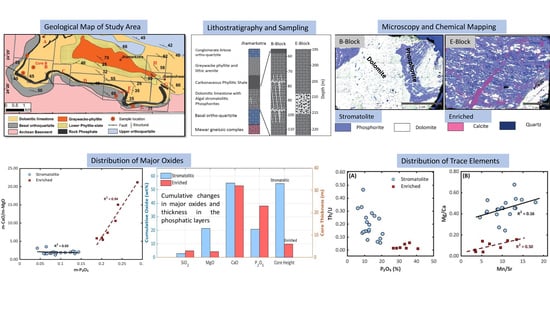
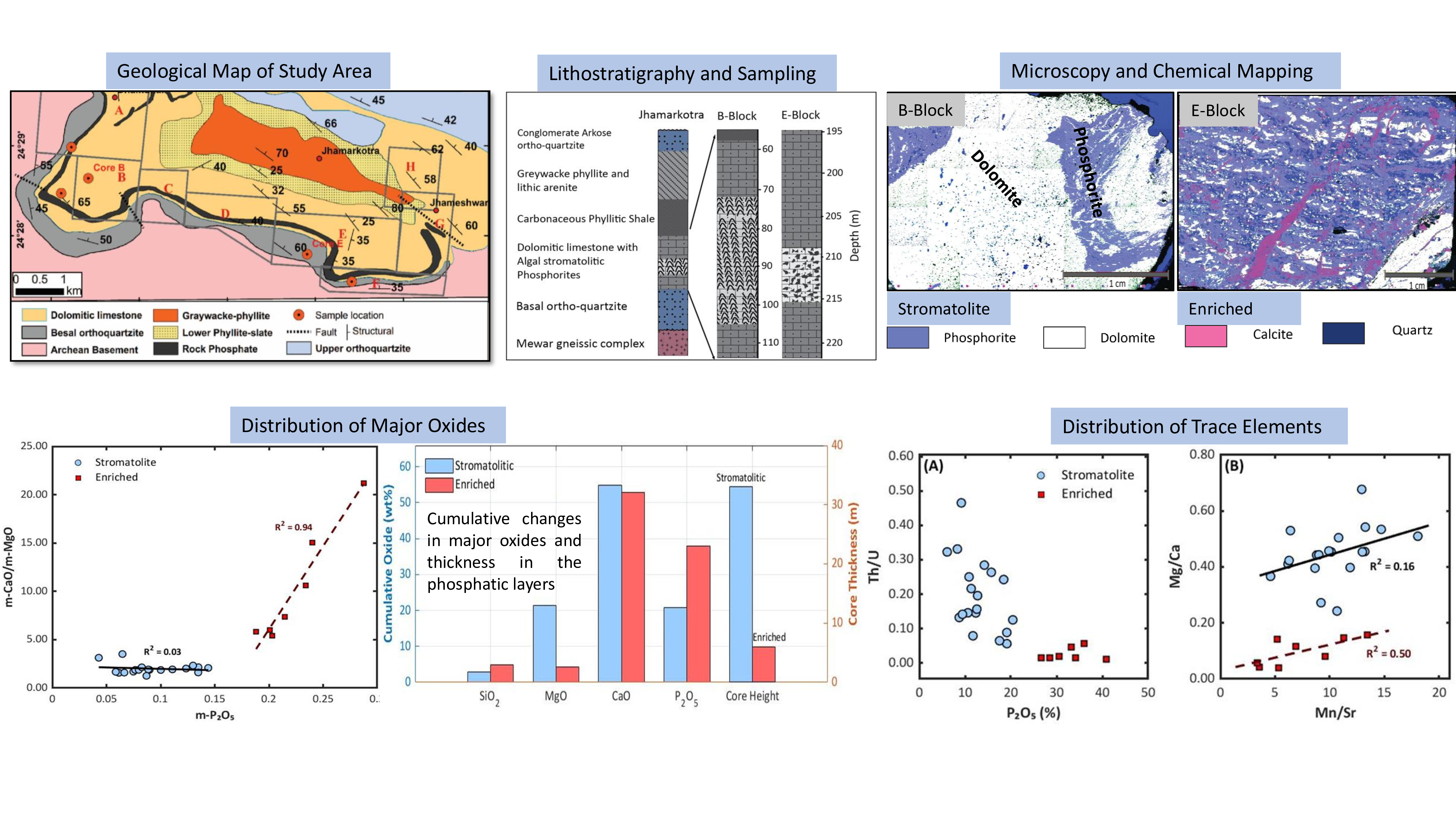
Graphical Abstract

1. Introduction

Sedimentary phosphorite deposits constitute 80% of the world’s phosphate resources [1,2] that are critical for agriculture, animal nutrition, and industrial applications, as well as potential sources of rare earth elements. The key process involved in the formation of phosphorites is deep-ocean upwelling. They first appeared ca. 2.0 Gyr ago, suggesting a genetic linkage to the global biogeochemical changes that transpired during the early Paleoproterozoic, such as the Great Oxidation Episode (GOE; [3,4]), carbon isotope excursions, and glaciations. The earliest known sedimentary phosphorites date back to the end of the Lomagundi carbon isotope excursion at ca. 2.06 Ga, shortly after the GOE, and ca. 1.88 Ga [1,5,6,7]. The GOE significantly altered the redox state of Earth’s surface environments, including the atmosphere and shallow oceans [3,8]. The increase in atmospheric oxygen following the GOE enhanced oxidative weathering of redox-sensitive elements such as iron (Fe), uranium (U), and manganese (Mn), which were transported and eventually precipitated in marine basins. Oxygenation also stimulated biological activity, increasing organic productivity [9] and facilitating phosphorite formation through microbial and diagenetic processing of organic matter in deep-water settings. Although phosphorite deposition declined during the Mesoproterozoic “Boring Billion”, it expanded again during the Neoproterozoic to Cambrian interval in association with the Neoproterozoic Oxygenation Event [10,11,12].
The Precambrian sedimentary phosphorite deposits in India have been extensively studied over the years, with their presence documented in Proterozoic sedimentary basins. The earliest record dates back to 1884, when the Geological Survey of India discovered phosphate nodules near Mussoorie in Uttar Pradesh [13,14]. Since then, numerous sedimentary basins across the country have been identified as containing phosphorite deposits, as evidenced by various studies [14,15,16,17,18,19,20,21,22]. These deposits are mainly found within the Aravalli Supergroup and the Bijawar Group, dating back to the Paleoproterozoic Era. The Sonrai Formation in Lalitpur, Uttar Pradesh, part of the Bijawar Group, contains rocks rich in phosphorite [23]. The Purana basins of Cuddapah and Vindhyan feature minor occurrences of phosphorite. Notably, in the Cuddapah Basin, the Ediacaran phosphatic layers within the Owk Shale Formation of the Kurnool Group include thin beds of phosphorite interbedded with shale [24]. The Tummalapalle region in southwestern Cuddapah hosts one of India’s largest uranium-bearing phosphatic carbonate deposits, primarily within the Vempalle Formation of the Papaghni Group, which consists of dolostone, stromatolitic limestone, carbonaceous shale, and phosphatic carbonate layers [25]. Apart from the Purana basins, phosphate-rich sedimentary rocks are present in the Masrana and Kimoi blocks of the Mussoorie Syncline, where Early Cambrian Tal Group strata contain phosphatic bands associated with chert, shale, carbonate, and minor pyrite [23,26]. Furthermore, Cretaceous phosphorites are a significant part of India’s geological record, exemplified by the Uttatur Formation of the Cauvery Basin, which developed within extensive Cretaceous marine sediments [27]. Extensive geochemical and stable isotope research has been carried out to analyze the redox conditions, climate, and salinity in these basins [6,16,28,29,30,31,32,33]. Additionally, phosphorite deposits contain reserves of critical trace elements and rare earth elements [33].
The Jhamarkotra Formation phosphorite deposit in Rajasthan’s Udaipur district, within the lower Aravalli Supergroup, is recognized as the region’s most significant phosphate-rich sedimentary deposit [6,14,17]. These deposits are associated with stromatolites, ancient microbial structures. Petrological, geochemical, and mineralogical studies have been conducted on the phosphorites around Matoon, Kanpur, and Jhamarkotra to describe their stromatolite structures, grade of metamorphism, mode of occurrence, and origin (e.g., [17,28,34,35,36,37,38]).
Available geochronological data indicate that the Jhamarkotra Formation dates back to the Paleoproterozoic [39,40,41]. Detrital zircon dating constrains the host sequence to be younger than ca. 1772 Ma [42], placing the deposit within the late Paleoproterozoic. This deposit predates the major late Neoproterozoic to early Cambrian phosphogenesis event, making the Jhamarkotra mines one of the oldest, economic-grade stromatolitic phosphorite deposits. The unusual association with stromatolites and secondary enrichment features raise important questions about the timing and nature of phosphogenesis, as well as the processes involved in its upgrading. While current evidence supports a primary Paleoproterozoic origin, the possibility of a later modification, via diagenetic or hydrothermal reworking in association with tectonic events, remains plausible.
Petrographic studies indicate the presence of unicellular algal structures within the stromatolitic columns, with evidence suggesting an algal affinity [15]. The formation is thought to have been deposited on a passive margin under low-energy conditions. The western part of the Jhamarkotra Mines preserves stromatolitic and columnar structures. In contrast, the eastern part exhibits a secondary enrichment of phosphorite, where the primary stromatolites were destroyed by dolomite dissolution and the phosphate content increased, resulting in a high-grade phosphate ore [15,34]. A study has been conducted on drill-core samples from the Jhamarkotra mines, focusing on petrographic and geochemical analyses to understand the origin of P enrichment in the eastern part of the mine area through secondary processes.

2. Geological Setting

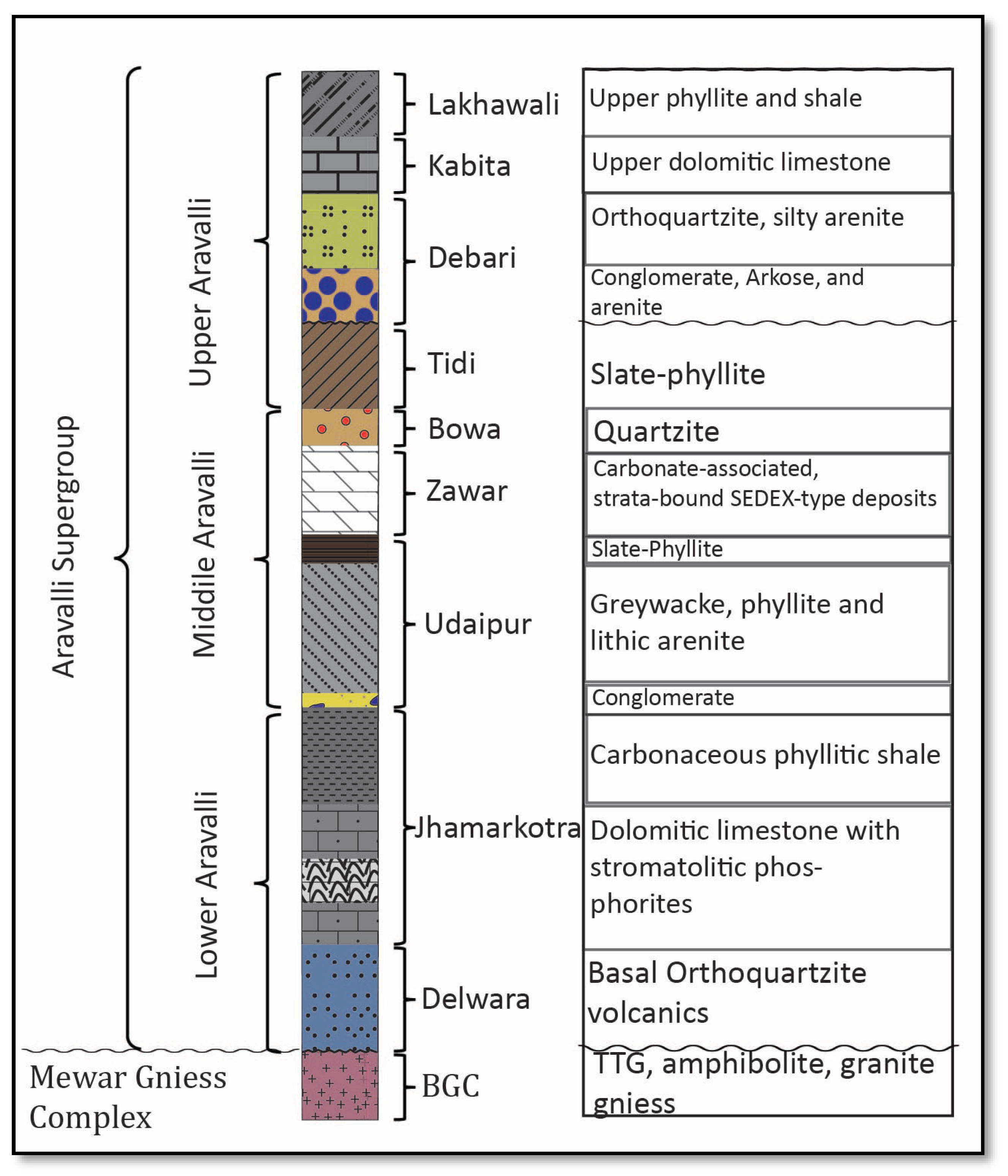
The Aravalli Supergroup is part of the Aravalli Mountain Belt in Rajasthan, northwestern India (Figure 1a). The Aravalli Supergroup sits unconformably on the basement granites, gneisses, amphibolites, and mica-chlorite schists, collectively referred to as the Banded Gneissic Complex (BGC; also known as the Mewar Gneiss Complex, MGC [43,44,45], and the Berach Granite [46]). The Aravalli Supergroup comprises a thick succession of shale, sandstone, mafic volcanics, and carbonates. The Aravalli region has been divided into three areas: Bhilwara, Udaipur, and Lunavada sectors. The Udaipur sector is the type area for the Aravalli Supergroup, where a complete stratigraphic succession is well-preserved (Figure 1b). The Aravalli Supergroup in the Udaipur sector is divided into three subgroups: Lower, Middle, and Upper Aravallis [45,47].
In the Udaipur sector, the MGC is overlain by meta-basalts and quartzites, which constitute the basal Delwara Formation of the Aravalli Supergroup. The lithostratigraphy of the Delwara Formation indicates a rift-basin tectonic setting. The Delwara Formation is overlain by the Jhamarkotra Formation, containing stromatolitic carbonates enriched in phosphorite (Figure 1c). The Lower Aravalli Group was deposited in shallow-marine depositional environments on a passive continental margin [48]. The Middle Aravalli Group, unconformably overlying the Jhamarkotra Formation, contains deep-water, turbidite sequences of the Udaipur Formation, characterized by metagreywackes and phyllites, indicating a drawdown of the carbonate platform and a change in the tectonic regime. The overlying dolostones and calc-silicate rocks of the Zawar, Bowa, and Tidi formations host SEDEX-type mineral deposits, as well as quartzite and phyllite–dolostone–quartzite intervals, indicating shallow-marine depositional conditions. The Debari Formation quartzites, Kabita Dolomite, and Lakahawali phyllites of the Upper Aravalli Group represent shallow-water sedimentation on the eastern shelf. In contrast, mica schists and ultramafic rocks of the Jharol Formation represent deep-sea sedimentation in the western, open-marine basin (Figure 2; [45]).

Age of the Jhamarkotra Formation

The timing of the initiation of Aravalli sedimentation is not well constrained. Pb-Pb ages of 2175 and 2070 Ma obtained on galenas associated with the basal volcanic rocks of the Delwara Formation limit the minimum age for initiation of deposition of the Aravalli Supergroup to ca. 2150 Ma [49,50,51]. The reported Nd model isotope ages for the Aravalli Supergroup volcanic rocks range from 2300 to 1800 Ma [52]. Additionally, micritic dolostones with high δ13C values (up to +12‰ V-PDB) from Ghasiar have been correlated with the global Lomagundi δ13C excursion event, which occurred between ca. 2260 and 2060 million years ago [28,53,54,55]. These Ghasiar dolostones yielded a Pb-Pb whole-rock isochron age of 1921 ± 67 Ma, interpreted as the time of diagenesis or low-grade metamorphism [39], confirming that the initiation of Aravalli sedimentation must have occurred before ca. 2.0 Ga. The Aravalli Supergroup has two distinct sedimentary sequences suggested by C isotope chemostratigraphy. In the northern Aravalli Mountain Belt (north of Udaipur), high δ13C carbonates were reported, while in the southern and eastern domains, the carbonate rocks have δ13C values close to 0‰ [28]. A significant peak of 1772 Ma ages was reported for the detrital zircons from the Jhamarkotra Formation quartzite, with the youngest zircons yielding an age of 1762 ± 9 Ma [40]. The basal Delwara Formation quartzites, in the northern part of the Aravalli Mountain Belt, have the youngest detrital zircon grain population with an age of 2446 ± 27 Ma [40]. Based on the youngest detrital zircons from the Delwara Formation and the Pb-Pb age for the Ghasiar dolostones, the lower Aravalli Supergroup has been deposited between 2446 and 1921 Ma [51,56,57]. The detrital zircons provide a larger age range from <2500 to 1700 Ma for the Middle Aravalli Group [40,41]. The detrital zircon grains for Udaipur, Bowa, and Debari formations yielded the youngest age populations of 1803 ± 27, 1729 ± 19, and 1673 ± 33 Ma, respectively [41]. Based on detrital zircon ages, the phosphorite-bearing Jhamarkotra Formation, south of Udaipur, has been deposited after ca. 1762 Ma.

3. Materials and Methods

3.1. Field Observations

The basal Delwara Formation orthoquartzites overlie the Mewar Gneiss Complex (MGC). Sitting on these orthoquartzites, the Jhamarkotra Formation dolostones, containing a stromatolitic phosphorite, are overlain by a phyllite and greywacke succession [45]. The Jhamarkotra phosphorite mining area is divided into blocks A to H, forming a syncline, and was affected by faulting, especially in blocks F and G (Figure 1c). Samples were collected in the field, where stromatolitic phosphates are exposed (Figure 3a–c). Generally, the stromatolitic phosphate columns are dark-gray, while the intercolumnar dolostones are light-gray. Hydrothermal alteration zones are also present, with veins and fractures observed in dolostone and phosphate layers. Sulfide veins have been observed in association with faults (Figure 3c). In the F-block, botryoidal phosphates are developed (Figure 3e). Blocks E and F are rich in altered phosphorites with completely obliterated stromatolitic columns, yielding the highest-grade phosphate ore.

3.2. Sampling

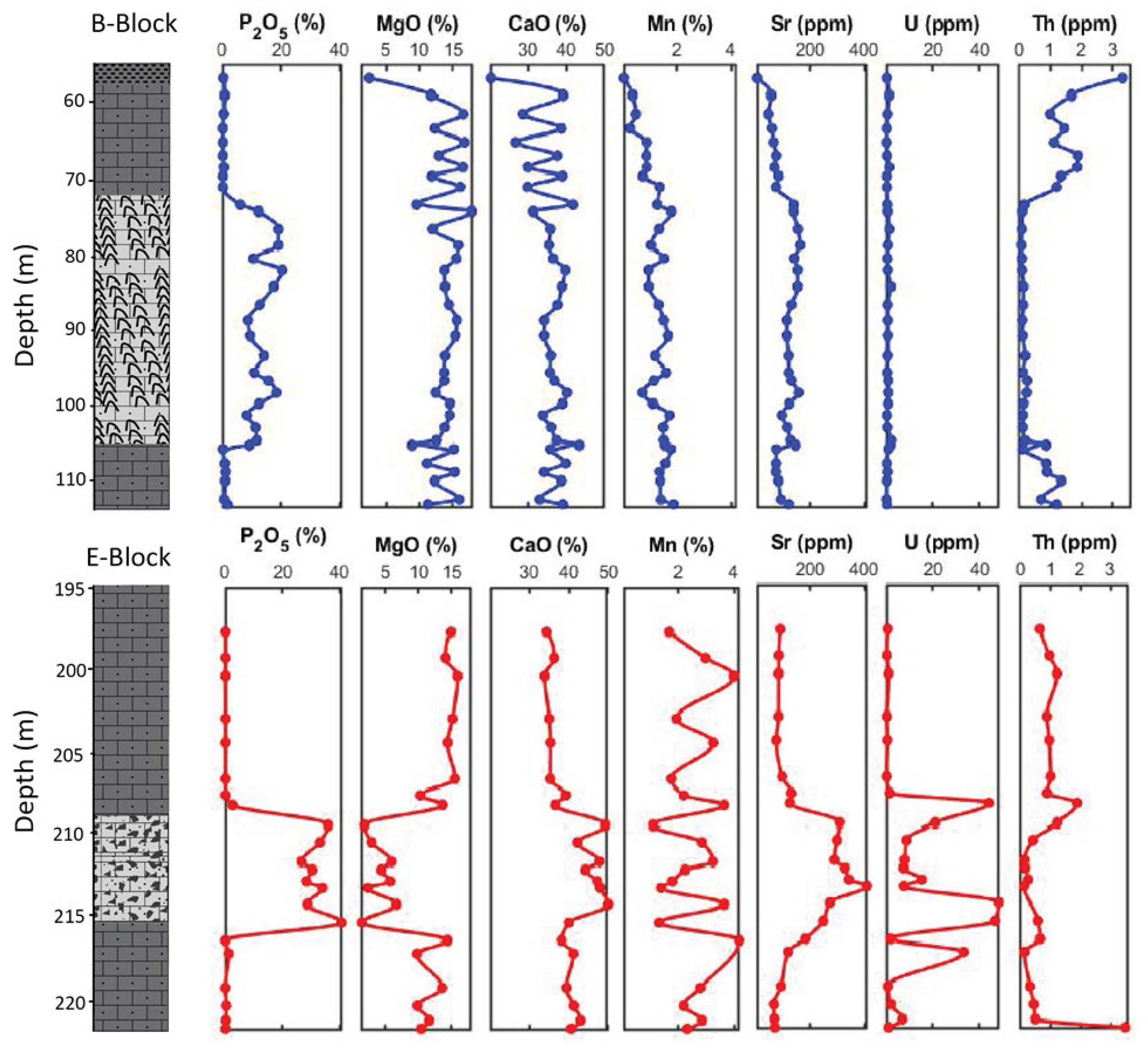
Samples are collected from the surface exposures of the Jhamarkotra Mines. Apart from the surface outcrop samples, two drill-cores from blocks B and E, containing phosphorites, have also been sampled (Figure 1c). The depth of samples collected from the B-block drill-core ranges from 55 to 115 m, while for the E block, it ranges from 195 to 225 m (Figure 4). The phosphorites are interbedded with dolostones in the drill-cores from the B and E blocks. The thickness of the phosphorite interval in the B-block is 34.3 m (from 71.9 to 106.2 m), whereas in the E-block, the phosphorite interval thickness is only 6.5 m (from 208.9 to 215.4 m; Figure 4). Lithologically, the drill-core sections from both blocks were subdivided into the lower dolostone (LD), phosphorite interval (PH), and upper dolostone (UD).

3.3. Analytical Procedures

The drill-core samples collected from the Jhamarkotra Mines were analyzed at the Council of Scientific and Industrial Research—National Geophysical Research Institute (CSIR-NGRI), Hyderabad, India. These analyses were conducted utilizing Scanning Electron Microscopy—Energy Dispersive Spectroscopy (SEM-EDS) and microscopic studies for petrographic examination, as well as X-Ray Fluorescence (XRF) and Inductively Coupled Plasma Mass Spectrometry (ICP-MS) to determine major and trace elements.
Samples from the Jhamarkotra Mines drill-cores were sectioned into blocks with dimensions of 3.5 × 2.5 cm and affixed to glass with epoxy to prepare both petrographic thin (30 μm) and thick (150 and 200 μm) sections. The sections were cut along and perpendicular to bedding, while drill-core samples were sectioned perpendicular to bedding. The Nikon ECLIPSE LV-100POL microscope was used for petrographic observations at magnifications ranging from 2× to 40×, utilizing cross-polar light microscopy for identification of minerals, grain boundaries, and cross-cutting veins. Reflected light was used to check the surface relief of the samples before scanning electron microscopy (SEM) analysis. SEM-BSE-EDS analysis was performed at the CSIR-NGRI, utilizing VEGA3 Tescan SEM with a Bruker EDS system at HV 21, Beam Intensity set to 10, and a working distance between 16 and 19 mm. The EDS system was equipped with an Xflash detector and operated with ESPRIT Compact software (Version 2.3). ImageJ software (Version 4.1) was used for image processing, areal mapping, and modeling. To calculate percentage distributions of minerals, elemental mapped images were obtained using SEM-EDS. The ImageJ software was used with false color coding (FCC) to calculate percentage distributions of minerals and evaluate compositional changes between phosphoritic stromatolites and upgraded phosphorite horizons.
Following the petrographic study, the samples were weighed, crushed, and subjected to ultrasonic cleaning with deionized water. They were subsequently ground to a mesh size of 200 (less than 74 microns) using an agate mortar and pestle. For XRF analysis of major elements, 40 mm diameter pressed pellets were produced from 2 g of powdered samples and mixed with boric acid in collapsible aluminum cups. The pellets were compressed under a hydraulic pressure of 25 tons to ensure homogeneity, resulting in less than 1% variation in X-ray intensity counts. The samples were analyzed using a Philips MagiX PRO Model PW 2440, PANalytical, Almeo, The Netherlands, equipped with an automatic sampler changer and SUPER Q 3.0 software [58]. Calibration was performed utilizing phosphate rock standards SRM120C (Phosphate Rock, Florida), SRM694 (Western Phosphate Rock), and BCR-32 (Natural Moroccan Phosphorite).
The trace element analysis was performed on sample solutions using an Agilent 7800, Agilent Technologies, Singapore, inductively coupled plasma-mass spectrometer (ICP-MS), with rhodium (Rh) as the internal standard to correct for drift. The online MassHunter™ software, v. 4.6. of M/s Agilent was used to process the data. High-purity Milli-Q™ water (18 MΩ cm) was used for sample preparation and to clean all the glassware and digestion vessels. 50 mg of sample powder was acidified using a concentrated ultrapure HF + HNO3 + HClO4 + H2O2 acid mixture in screw-capped Sevillex® Teflon vials for 5–7 days at 70 °C to ensure complete removal of organic matter from the samples, followed by evaporation and redissolution in HNO3 via the open digestion method at CSIR-NGRI. In this procedure, 50 mg of the powdered sample was digested using a mixture of HF, HNO3, and HClO4 at a ratio of 7:3:1, and was also treated with aqua regia and H2O2 [58]. International Standard Reference Materials, SRM120C (Phosphate Rock, Florida), SRM694 (Western Phosphate Rock), BCR-32 (Natural Moroccan Phosphorite), SCo-1 (Cody Shale, USA), JDo-1 (Dolomite, Japan), GSR6 (Carbonate rock, Chinese geochemical standard reference sample), and GSR4 Sandstone (Chinese geochemical standard reference sample) were used as reference standards. A procedural blank was also processed using the same batch of acids. Replicate analysis of samples and reference rock standards (SCo-1, GSR6, and JDo-1) was carried out through analytical sessions to cross-check the results and instrument performance. A total process blank was run, and blank-corrected data were used in elemental abundance calculations. Overall, an accuracy better than ±4% was obtained for most analyses with a precision of ±6% RSD.

4. Results

4.1. Petrographic Observations

The Jhamarkotra Formation stromatolitic phosphorites have been extensively studied petrographically, including their stromatolitic morphologies [15,34,59]. Stromatolitic phosphorites dominate the Jhamarkotra Formation phosphorite deposit. The Jhamarkotra Formation phosphorite horizon stretches for 16 km along the E-W strike with varying thickness of 5 to 45 m. Phosphorite occurs in distinct morphologies, including columnar and stratiform stromatolites, and botryoids [34]. The stromatolitic columns are cone-shaped, with convex laminations, ranging in height from 8 mm to 30 cm. Differential weathering of dolostones and stromatolitic phosphatic columns is visible in many areas of the Jhamarkotra Mines (Figure 3a).
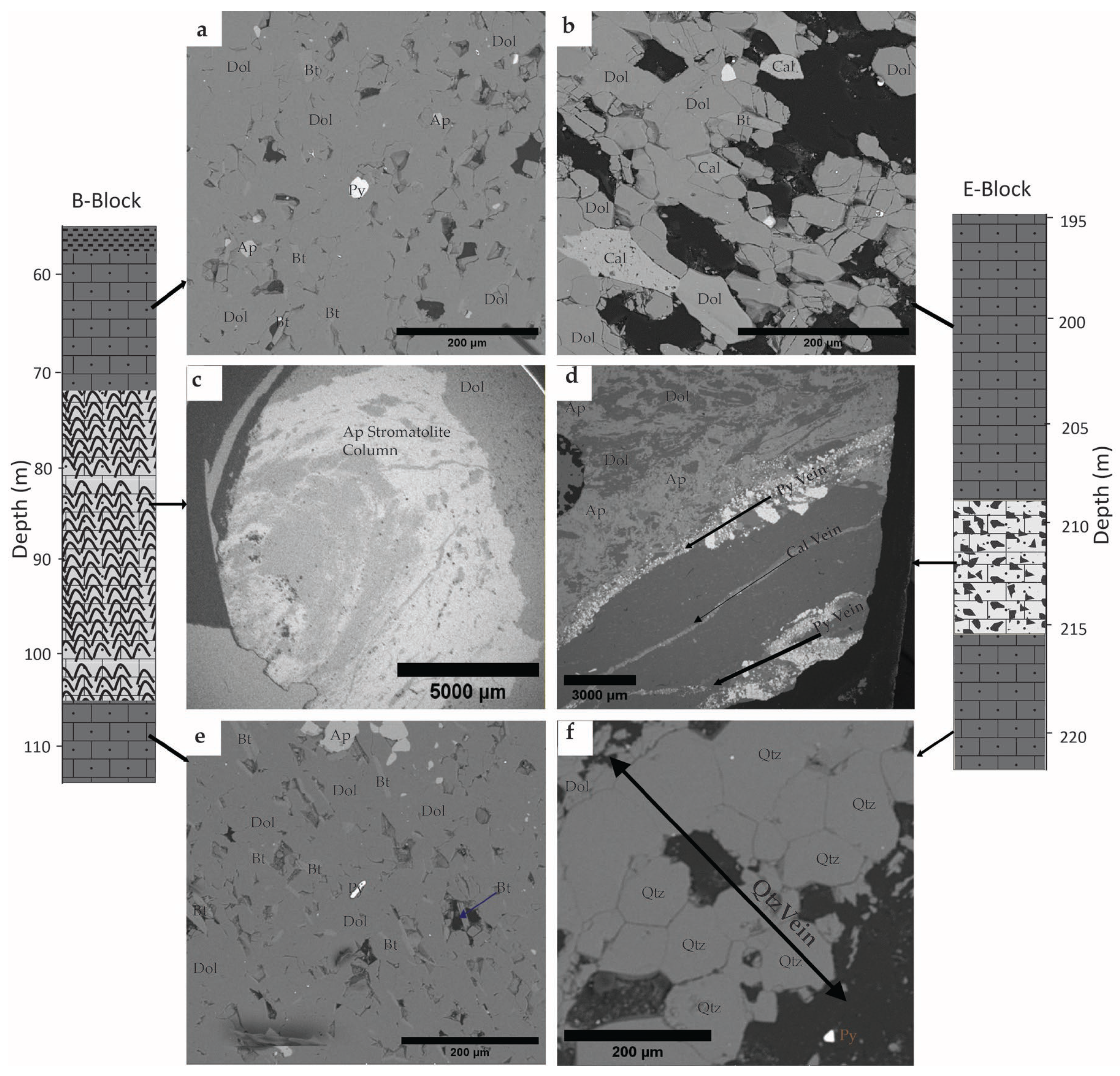
Lithologies and their thicknesses in drill-cores of the B- and E-block phosphorite intervals have been identified, measured, and further described through hand specimen and thin section examination. The phosphorites are interbedded with upper and lower dolostones. In terms of sedimentary facies, all the carbonate units indicate a shallow-marine, protected subtidal to intertidal depositional setting on a continental margin. The transition from underlying quartzites to dolostones, stromatolitic phosphorites, and overlying carbonaceous phyllites, as well as the uppermost arenites (Figure 4), indicates that depositional conditions varied during the filling of the Jamarkotra basin. Absence of conglomerates or any major disconformities suggest that the transitions among sedimentary facies were gradual. The appearance of stromatolites may indicate deepening of depositional conditions to intertidal conditions with enhanced algal activity. The origin of phosphorites has been attributed to the upwelling of the cold, deep seawater. The eastern and western sectors of the Jhamarkotra mines represented by E and B blocks, respectively, show distinct differences in terms of their petrographic facies. The petrographic facies, mineralogy, and textural differences in the drill-cores from B and E blocks are illustrated in Figure 5 with representative samples.
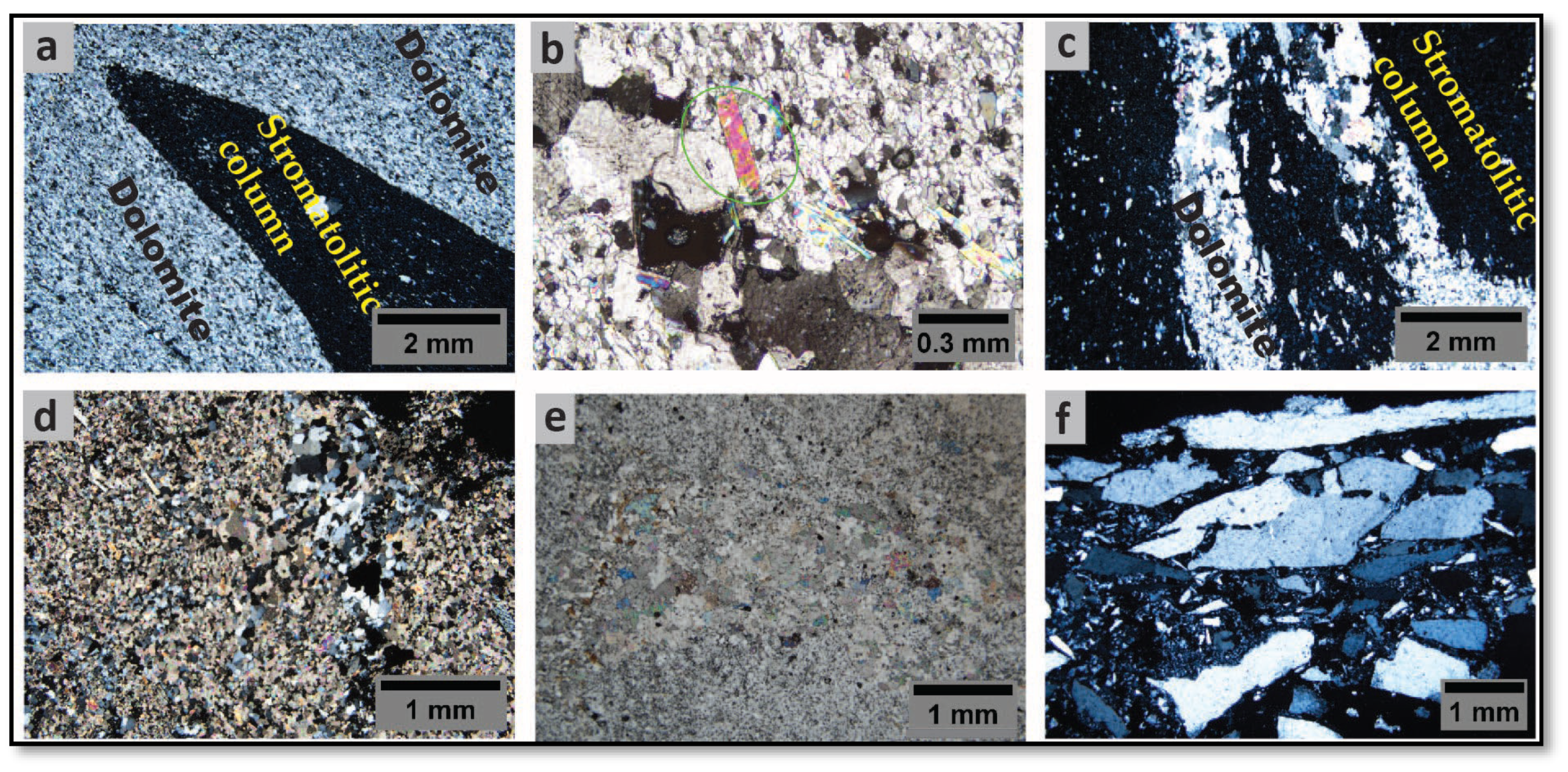
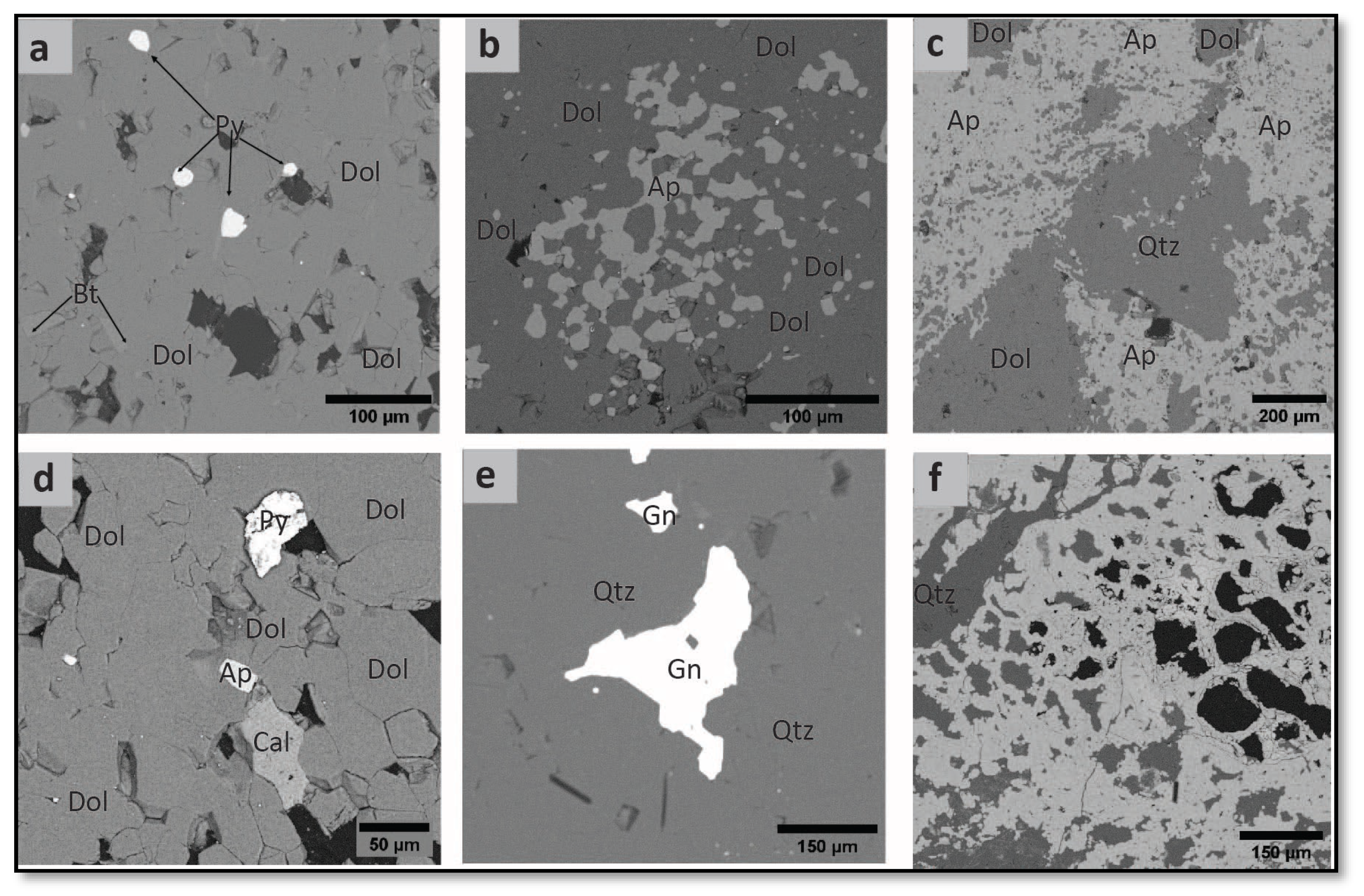
Stromatolitic, phosphatic intervals consist of fluorapatite minerals and dolomite, which can be found both within and between the columns (Figure 6a,c). Accessory minerals such as quartz, mica, and sulfide are present in the phosphorite layers (Figure 7a,d,e). The western part of the mines preserves intact stromatolite columns, whereas the eastern part shows significant alteration and phosphorite enrichment. Calcite and mica grains are seen in the recrystallized E-block samples, indicating dedolomitization (Figure 7d). Conversely, B-block samples do not show any calcite grains in thin sections. Dolomite and phosphorite grains show fine, micritic texture.
The SEM-EDS datapoint analysis gives the average composition of apatites (Ca5(PO4)3F) as [P2O5:CaO:F = 37.65:57.72:3.74]) in all the grains present in the stromatolite and upgraded phosphorite thin sections. In addition, accessory phases such as galena, chalcopyrite, rutile, pyrite, and arsenopyrite were also identified. However, sulfide grains are abundant in the upgraded zone of the E-block (Figure 7a,d,e), as well as calcite veins. In the case of the B-block, stromatolite columns are well-preserved with no calcite veins and little structural disturbance (Figure 8). Quartz and calcite veins were observed in the B- and E-blocks in microscopic studies (Figure 8a,d, respectively).
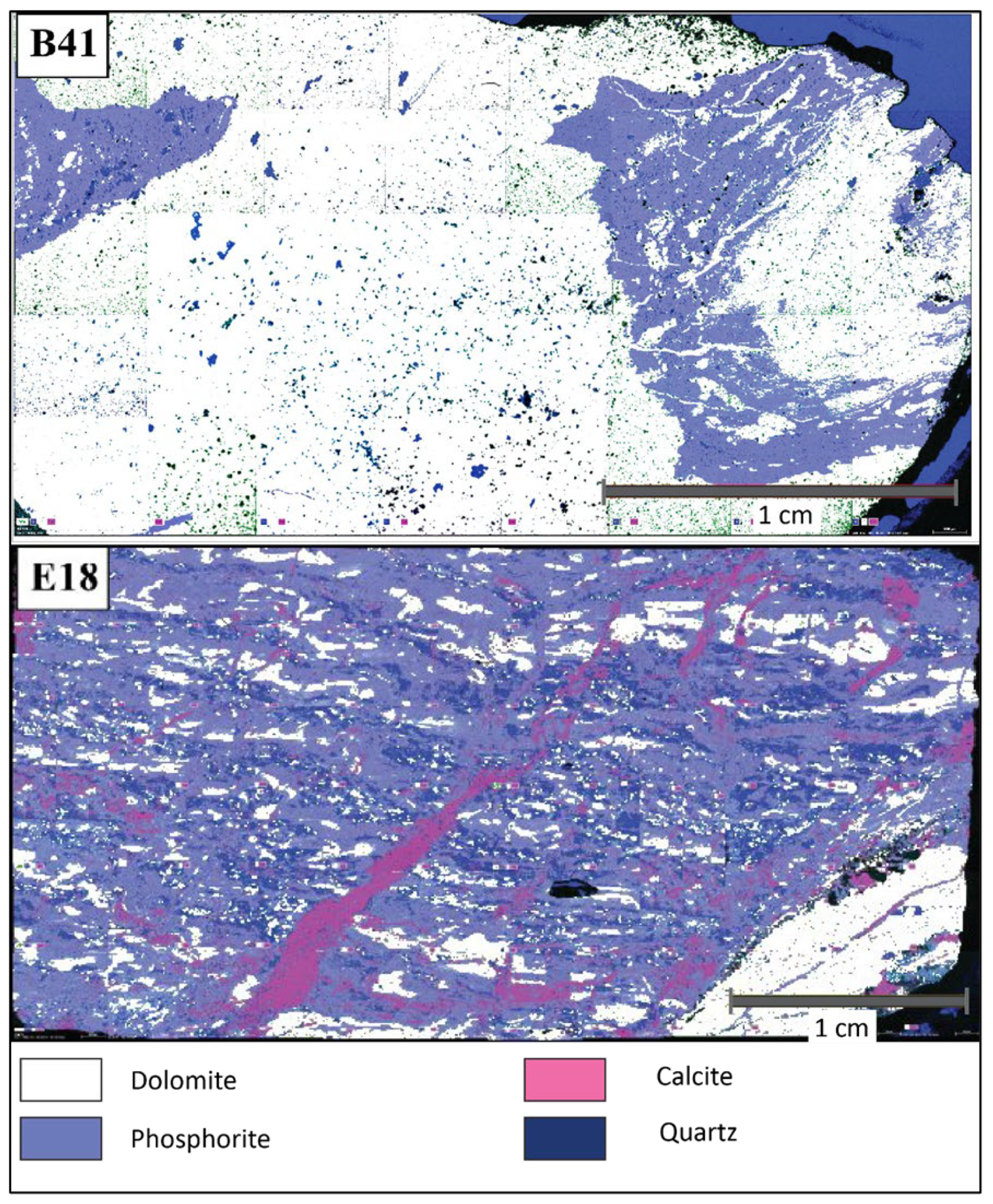
A comparative study was conducted using SEM-EDS mapping to analyze the mineral distribution in two representative thin sections, B14 and E18, of the stromatolitic and upgraded phosphorite zones in the B- and E-blocks, respectively. Multiple SEM-EDS images were captured, stacked, and processed using ImageJ software to color-code the distribution of major minerals and calculate the percentage of mineral distribution. The observations suggest that dolomite was leached out, and their modal % dropped from 69% to 19%. There is a corresponding increase in quartz concentration from 3.17 to 17.75%, fluorapatite (from 20.96 to 47.14%), and calcite (from 1.65 to 13.75%) in the E-block sample compared to the B-block sample (Figure 9; Table 1).

4.2. Geochemistry

The major element data for bulk sample analyses are presented in Table 2. The stratigraphic distribution of major and selected trace elements, based on drill-core samples from the B- and E-blocks, is shown in Figure 10. The stromatolitic phosphorites contain moderate P2O5 enrichment, ranging from 8.32 to 20.44%. In contrast, the upgraded phosphorites exhibit significantly higher contents, ranging from 26.71% to 40.80%. The upgraded phosphorites from the E-block exhibit lower MgO (less than 10%) and higher CaO concentrations compared to the B-block samples. All E-block samples consistently display higher CaO levels, regardless of lithology, indicating that CaO enrichment is not solely due to apatite (phosphorite) content. Instead, increased calcite concentrations also contribute to the overall high CaO level, consistent with microscopic observations. Molar P2O5 concentrations (m-P2O5) and the ratio of molar concentrations of CaO (m-CaO) to MgO (m-MgO) for the upgraded phosphorite are strongly correlated (R2 = 0.95); this correlation is lacking for stromatolitic phosphorite (R2 = −0.01) (Figure 11).
Cumulative (i.e., weighted average) distribution of major elements in stromatolitic and upgraded phosphorites is given in Table 3. For cumulative data, major element data for 19 drill-core samples, collected at depths ranging from 73.2 to 106.3 m (samples B10 to B44), were used for the stromatolitic phosphorites, and for eight samples, collected at depth of 209.5 to 215.4 m (samples E17 to E24), were used for the upgraded phosphorite. The weighted average P2O5 concentration increases in the upgraded phosphorites. While the stromatolitic phosphorite of the B-blocks shows a weighted average P2O5 of 20.74%, the upgraded E-block phosphorite has a higher value of 37.87%. The cumulative MgO content decreases from 21.43% in the B-block to 4.22% in the E-block. Changes in other major elements are not as pronounced as for P2O5, MgO, and CaO (Figure 12).

4.3. Rare Earth Elements+Yttrium (REE+Y)

The REE+Y concentration of Jhamarkotra bytroidal and enriched phosphorite (in ppm) is given in the Table 4. REE+Y are normalized to Post-Archean Australian Average Shale (PAAS, denoted by subscript PAAS) values [60]. The lanthanum (La) anomaly was calculated using Pr and Nd, as defined by [61], to avoid using other anomalous REEs in the calculation. The cerium (Ce) anomaly was calculated using a Lagrangian extrapolation method, developed by [62]. The equations used to calculate LREE/HREE and Eu anomaly follow.
The Eu anomaly was calculated using SmPAAS rather than GdPAAS, as positive Gd anomalies are typical of seawater [63,64]. The equation used to calculate the MREE anomaly, after [65] uses the sum of LREE (La, Ce, Pr, and Nd), MREE (Sm, Eu, Gd, Tb, Dy, and Ho), and HREE (Er, Tm, Yb, and Lu) rather than just one representative element for each. For the MREE anomaly, Ce*PAAS and Eu*PAAS are used in place of CePAAS and EuPAAS, respectively, to exclude anomalous values from the calculation. The equations are:
L a   a n o m a l y   ( L a / L a P A A S ) : [ L a ] P A A S [ P r ] P A A S 3 / [ N d ] P A A S 2
  C e   a n o m a l y   ( C e / C e P A A S ) :   [ C e ] P A A S [ P r ] P A A S 2.571 [ N d ] P A A S 1.931 [ S m ] P A A S 0.360
L R E E / H R E E : [ P r ] P A A S [ Y b ] P A A S
E u   a n o m a l y   ( E u / E u P A A S ) :   [ E u ] P A A S 0.67 [ S m ] P A A S + 0.33 [ T b ] P A A S
M R E E   a n o m a l y   ( M R E E / M R E E P A A S ) : 2 Σ [ M R E E ] P A A S Σ [ L R E E ] P A A S + Σ [ H R E E ] P A A S
Following the accepted practice, we refer to “positive” and “negative” REEPAAS anomalies where values are >1 and <1, respectively.
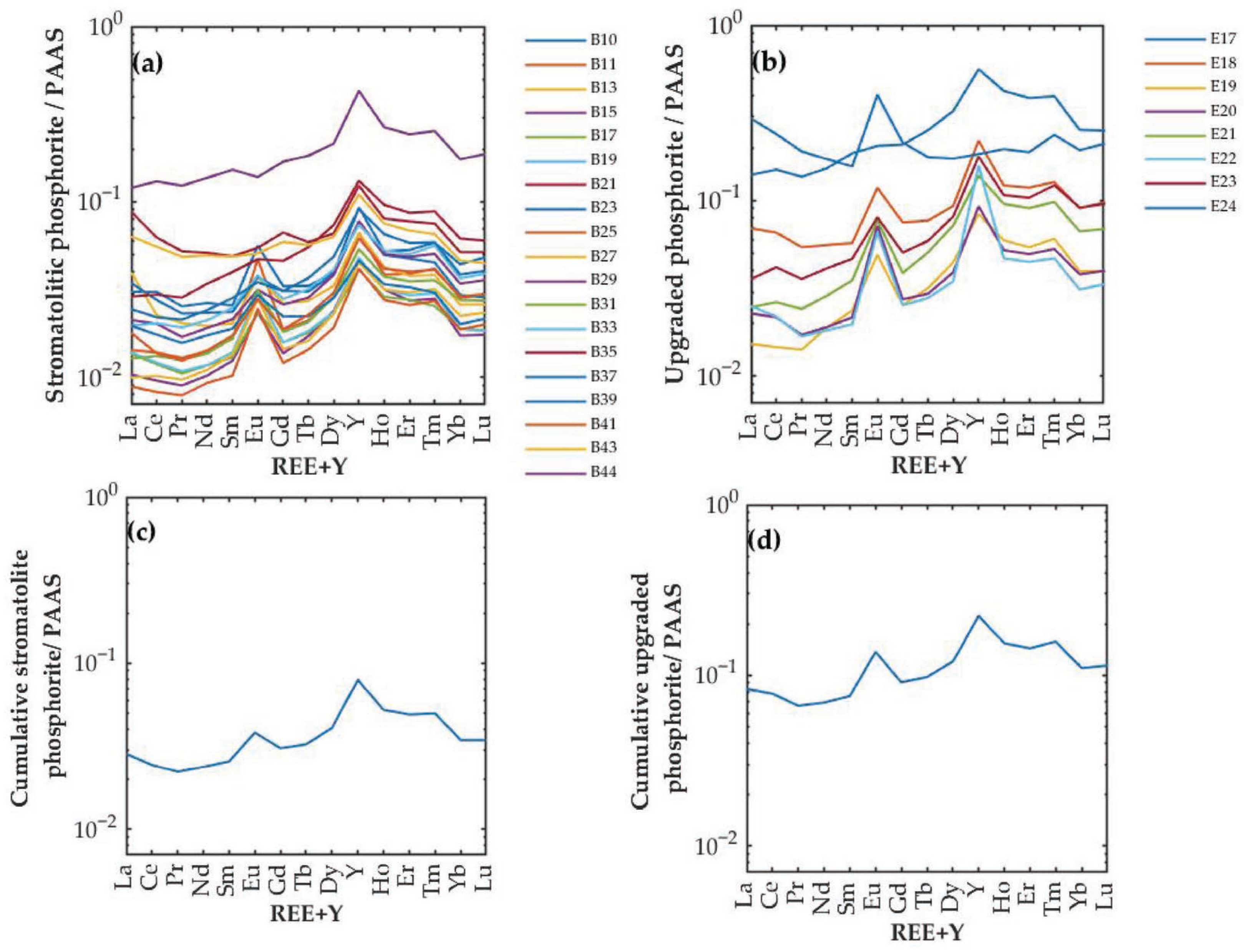
Total rare earth element ( Σ REE) concentrations in stromatolitic phosphorites range from 2.03 to 28.54 ppm (with an average of 6.22 ± 6.23 ppm). In comparison, the upgraded phosphorites have a wider concentration range of 3.86 to 38.55 ppm (with an average of 14.44 ± 13.91 ppm). In both lithologies, REE+Y, normalized to PAAS, distribution patterns are characterized by heavy REE (HREE) enrichment with respect to light REE (LREE). The REE+Y distribution patterns are similar for upgraded and stromatolitic phosphorite (Figure 13). The PAAS-normalized cumulative values indicate that the La anomaly (~1.5) remains consistent across both stromatolitic and upgraded phosphorite, showing no significant variation. In contrast, Ce exhibits a positive anomaly in all phosphorite samples, with slightly higher values in the upgraded phosphorite (1.33 ± 0.13) compared to the stromatolitic phosphorite (1.22 ± 0.08). Similarly, Eu shows a pronounced positive anomaly in all samples, being notably higher in the upgraded phosphorite (2.07 ± 0.68) than in the stromatolitic phosphorite (1.55 ± 0.45). The upgraded section also displays relative enrichment in HREEs, as reflected by a lower LREE/HREE ratio (0.53 ± 0.20) compared to the stromatolitic phosphorite (0.61 ± 0.19). In contrast, the MREE anomaly remains largely uniform between the two phosphorite types, with values around 3.30 (Table 5).

4.4. Trace Element Data

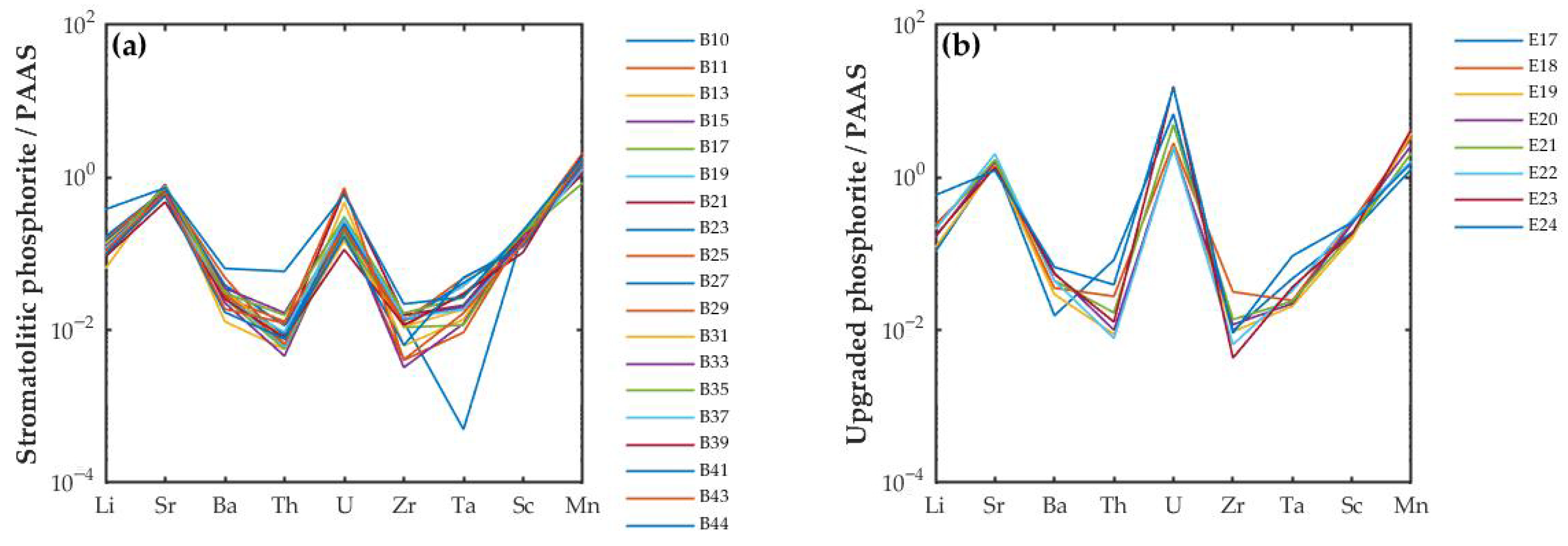
Trace element concentrations in stromatolitic and upgraded phosphorite samples, normalized to Post-Archean Australian Shale (PAAS), are illustrated in Figure 14a and Figure 14b, respectively. The analyzed elements include Li, Sr, Ba, Th, U, Zr, Ta, Sc, and Mn. Both phosphorite types display similar spider diagram patterns with alternating positive and negative anomalies. Stromatolitic phosphorites show moderate to high Sr concentrations (113.95–163.19 ppm), indicating substitution of Sr for Ca in apatite. Ba concentrations are variable (8.43–41.86 ppm). Sc contents are consistently low (1.68–3.26 ppm), suggesting minimal input from mafic detrital materials. Th and U concentrations are also low (0.07–0.86 ppm and 0.35–2.27 ppm, respectively), reflecting limited uranium incorporation. Zr concentrations range from 0.68 to 4.63 ppm. In contrast, upgraded phosphorites display significantly higher Sr concentrations (247.04–407.72 ppm), which are much higher than those in stromatolitic phosphorites. Ba content ranges from 10.09 to 43.65 ppm. Sc content is low (2.57–4.48 ppm), as is Th content (0.11–1.22 ppm). U concentrations are markedly elevated (7.49–48.46 ppm). Zr concentrations vary from 0.91 to 6.68 ppm.
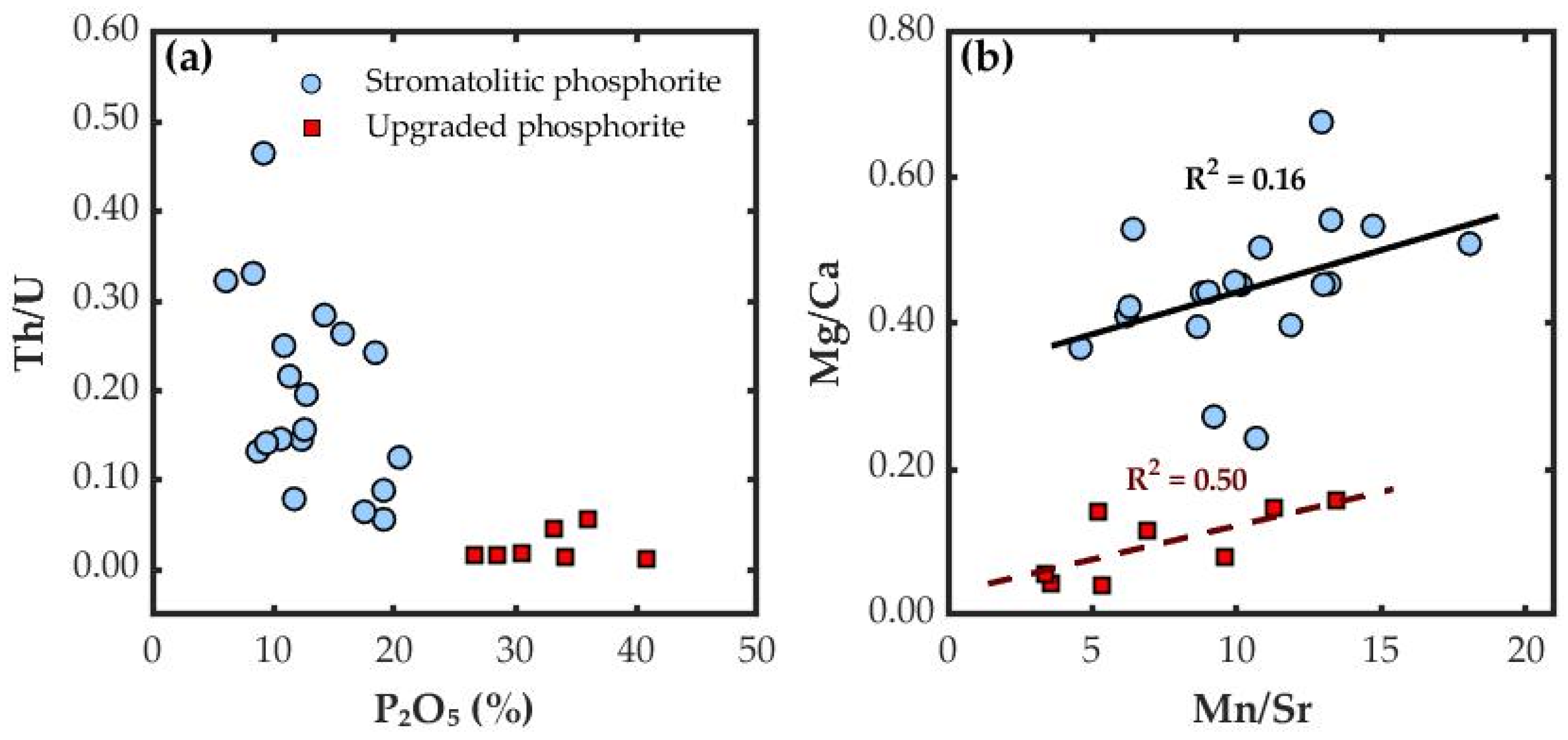
Trace element data (Table 5) indicate substantially higher uranium levels in the E-block samples (6.70–41.52 ppm) compared to the B-block samples (0.29–1.97 ppm), along with slightly higher Th concentrations in the upgraded phosphorite (0.11–1.22 ppm) than in the stromatolitic phosphorite (0.07–0.25 ppm). The Th/U ratio ranges from 0.06 to 0.47 in stromatolitic phosphorites and from 0.01 to 0.06 in upgraded phosphorites (Figure 14a).
Marked variation in Mn and Sr content occurs in phosphorite horizons. Mn content averages 2198.3 ± 963.2 ppm in upgraded phosphorites, compared to 1342.9 ± 295.7 ppm in stromatolitic phosphorites. Sr concentration is consistently higher in upgraded phosphorites (311.1 ± 49.0 ppm) than in stromatolitic phosphorites (133.8 ± 18.3 ppm). Despite an increase in both Mn and Sr, the Mn/Sr ratio is slightly lower in upgraded phosphorites (7.34 ± 3.71) than in stromatolitic phosphorites (10.41 ± 3.35). Stratigraphic variations in major elements (P2O5, MgO, and CaO) and trace elements (U, Th, Sr, and Mn) for both drill-cores are illustrated in Figure 10.

4.5. Relative Enrichment in Upgraded Phosphorite

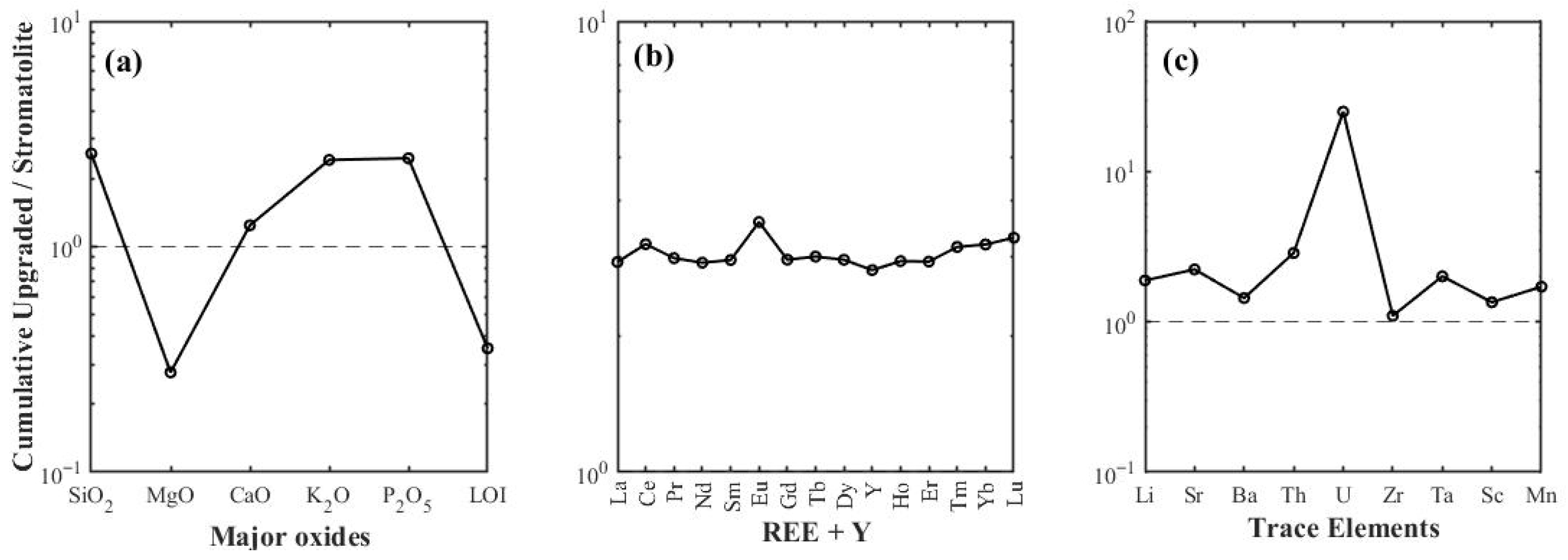
The cumulative, upgraded phosphorite, normalized to cumulative stromatolitic phosphorite, demonstrates a clear enrichment of several major and trace elements, as well as REEs (Figure 15). The SiO2 ratios are predominantly above one, with the cumulative value showing approximately 2.6 times enrichment in SiO2. There is a 3.61-fold decrease in MgO, a 1.24-fold enrichment in CaO, a 2.42-fold increase in K2O, and a significant 2.46-fold enrichment in P2O5 in the upgraded phosphorite compared with stromatolitic phosphorite (Figure 15a).
The REE+Y ratio plot of cumulative, upgraded phosphorite normalized to cumulative, stromatolitic phosphorite shows nearly a 3-fold increase in all REE-Y concentrations, with exceptionally high levels of Ce, Eu, and some HREEs like Tm, Yb, and Lu exhibiting only slight enrichment (Figure 16b). The distribution pattern exhibits positive Ce and Eu anomalies, as well as HREE enrichment. The cumulative, upgraded phosphorite normalized to cumulative stromatolitic phosphorite shows a slightly positive Ce (1.05), and Eu anomalies (1.21).
The plot of the data for cumulative, upgraded phosphorite normalized to cumulative stromatolitic phosphorite (Figure 15) shows that most elements plot near or above the unity line, indicating significant enrichment. To better constrain the cumulative enrichment in the upgraded phosphorite, several trace elements, including Li, Sr, Ba, Th, U, Zr, Ta, Sc, and Mn, have been used (Figure 15c). Uranium (U) and strontium (Sr) notably exceed ratios of 10 to 50 in some samples, indicating substantial enrichment in the upgraded phosphorites. Quantitatively, the concentrations of these elements increase in the upgraded phosphorite relative to stromatolitic phosphorite: uranium by 25 times, thorium by 2.87 times, strontium by 2.23 times, tantalum by 2 times, lithium by 1.89 times, manganese by 1.71 times, barium by 1.44 times, and scandium by 1.35 times, while zirconium remains nearly unchanged.

5. Discussion

5.1. Basin Evolution History

A Paleoproterozoic tectonic evolutionary model has been proposed for the Aravalli Supergroup basins [41,42]. The rifting began around 1830 Ma ago, leading to the development of the Aravalli Basin above the Archean Banded Gneiss Complex. Extensively developed, rift-related Delwara volcanic flows correspond to this rifting event. The rift basin gradually transitioned to a passive continental margin, on which the Jhamarkotra Formation stromatolitic phosphorite and pelitic rocks were deposited after ca. 1772 Ma [42]. Accretionary orogenesis was induced by eastward (present orientation) oceanic subduction, resulting in ca. 1500 Ma arc-related igneous rocks and deposition of immature sandstones of the Udaipur Formation.

5.2. Petrography

Under the microscope, micro-fractures cutting across stromatolite lamina show selective alteration, further highlighting the role of fluid-driven processes. Detailed petrographic analysis, SEM-EDS, and bulk geochemical data collectively indicate a pronounced hydrothermal overprint, most evident in the E-block (Figure 5). A clear lithological transition is observed from dolomite-dominated composition (~69%) to fluorapatite-rich assemblages (~47%), accompanied by a reduction in dolomite content to ~19% (Figure 9). This shift reflects the replacement of early diagenetic dolomite by secondary fluorapatite and calcite, characteristic of dedolomitization reactions. These reactions were driven by hydrothermal fluids enriched in CaO, CO2, and SiO2, which facilitated the dissolution of dolomite and the subsequent precipitation of calcite, quartz, and sulfides, also increasing phosphate concentration. The SEM-EDS point analysis study on apatite grains has not shown compositional differences between upgraded and stromatolitic phosphorites. Furthermore, both U and Sr, elements mobilized in hydrothermal systems that pass through granitic basement rocks [66], are enriched in the E-block samples. The occurrence of accessory minerals such as chalcopyrite, galena, native copper, and ilmenite within the E-block phosphatic zone further suggests a mineralizing, hydrothermal fluid source [67]. The major-oxide data in this study support the above interpretation. The data effectively differentiates between B- and E-block samples, illustrating upgrading of fluorapatite and neomorphism of calcite due to the selective leaching of dolomite by hydrothermal alteration, which was structurally controlled. In particular, the m-P2O5 vs. m-CaO/m-MgO plot highlights MgO leaching associated with phosphate upgrading. The geochemical trends show a consistent decrease in the MgO concentration, from 21% to 4%, and a corresponding increase in P2O5 content, from 21% to 38%, between the B- and E-blocks. The thickness of phosphorite differs significantly between B- (33 m) and E-blocks (6 m) (Figure 12). This difference in thickness could be due to both lateral variations and compaction following dolomite leaching in association with hydrothermal alteration.

5.3. Trace Elements

Sr and Mn enrichments in both stromatolitic and upgraded phosphorites reflect their incorporation into carbonate-fluorapatite during precipitation and early diagenesis [6,68]. The higher Sr contents, 2.23 times greater in the cumulative upgraded phosphorite than in the cumulative stromatolitic phosphorite, suggest that recrystallization, likely facilitated by hydrothermal fluid circulation, contributed to this upgrading [6,68,69,70,71]. The observed Ba enrichment, with a cumulative increase of 1.44 times in some samples, might be attributed to barite precipitation, where Ba is delivered with hydrothermal, sulfate-poor fluids and sulfate is released during phosphate recrystallization. Elevated U concentrations, up to 25 times higher in upgraded phosphorites, and low Th/U ratios indicate uranium mobility with oxidized, hydrothermal fluids. The low Th/U values also indicate uranium mobility and U delivery with oxidized hydrothermal fluids, followed by its subsequent incorporation into apatite upon reduction. Structurally controlled fluid pathways were likely crucial for this process. The relatively uniform PAAS-normalized patterns for lithophile elements such as Sc, Zr, and Th across both phosphorite types suggest minimal detrital influence [68].

5.4. Rare Earth Elements

The REE+Y trends in PAAS-normalized stromatolitic and upgraded phosphorites exhibit similar patterns (Figure 13). The cumulative REE concentrations of the upgraded phosphorite are normalized to the cumulative REE abundances in the stromatolite phosphorite (Figure 16) to illustrate the effect of secondary alteration, resulting in an increase in phosphate content. The cumulative concentrations of REE+Y show a nearly threefold increase in the upgraded phosphorites compared to stromatolitic phosphorites, similar to the increase in P2O5 content. REE concentrations in apatite range between 100 and 1000 ppm, whereas sedimentary carbonate typically contains less than 10 ppm [70]. The elevated REE+Y concentrations in upgraded phosphorite are primarily attributed to increased concentration of fluorapatite. A slightly positive Ce anomaly (1.08) observed in the cumulative stromatolite-normalized upgraded phosphorite likely reflects the oxidative conditions resulting in transformation of Ce3+ to Ce4+ [63,72]. Further, a slight positive Eu anomaly (1.21) in the cumulative upgraded phosphorite suggests hydrothermal influence. Similar REE patterns of upgraded and stromatolitic phosphorites suggest that fluid-rock ratio was low during hydrothermal leaching of dolomites in the eastern section of the Jhamarkotra mining district [71,73], while REE content in fluorapatite increased through dolomite dissolution.
The upgraded phosphorite clearly shows a stronger hydrothermal imprint, as evidenced by significantly higher Sr concentrations and radiogenic Sr isotope values [56]. The increase in Mn/Sr values, widely used to distinguish diagenetic processes [74,75,76,77,78], provides further insight into the alteration pathways. The cumulative Mn concentration in upgraded phosphorites is 1.71 times higher than that in stromatolitic phosphorites. The data show that Mn concentrations increase with depth, irrespective of lithology, suggesting a progressive syndepositional change in the water column redox state. In contrast, Sr concentrations increase mainly in the upgraded zone, reducing the Mn/Sr ratio from ~10.41 in stromatolitic phosphorites to roughly 7.34 in the upgraded zone. This pattern indicates that varying degrees of hydrothermal alteration affected the original lithologies. Hydrothermal alteration is structurally controlled, exerting a more significant influence in tectonically disturbed areas, particularly in the eastern part of the Jhamarkotra Mines [78].
Thorium and uranium concentrations serve as valuable indicators of paleoredox conditions. Thorium is generally immobile under low-temperature surface conditions in contrasts to uranium, which is mobile under oxidizing conditions [79] and with oxidized hydrothermal fluids in hexavalent state [80]. The observed uranium enrichment in the E-block, upgraded phosphorites suggests that hydrothermal fluids delivered U6+, which was subsequently reduced to U4+ and incorporated into fluoroapatite via Ca substitution as they have similar ionic radii [81]. The moderate correlation between U and P2O5 (R2 = 0.37) suggests that uranium co-precipitates from oxidized hydrothermal fluids with P in upgraded phosphorites.
Additionally, the total organic carbon (TOC) in the phosphatic samples ranges from 1.9 to 2.7%, indicating reducing water-column and pore-water conditions that facilitated U6+ reduction to U4+. Reduction enhanced uranium accumulation in upgraded phosphorites (cf., [82]). The notably lower Th/U ratios for the upgraded phosphorites, ranging from 0.01 to 0.06, compared to 0.06 to 0.47 for the stromatolitic phosphorites, further point to secondary uranium enrichment processes. These patterns reflect redox-driven uranium dynamics characteristic of modern and ancient phosphogenic systems, supporting a hydrothermal origin of the observed mineralization.
Strontium and uranium in sediment-hosted, redox front deposits are often derived via leaching of the underlying granitic basement [83]. Granitic rocks are typically enriched in Sr-bearing plagioclase and accessory, U-bearing minerals such as zircon, monazite, and uraninite [63]. During weathering or low-temperature hydrothermal alteration, Sr2+ and U6+ are released into circulating fluids and subsequently incorporated into secondary carbonates and phosphate minerals [68]. Sr readily substitutes for Ca2+ in the carbonate lattice due to its similar ionic radius and charge [57,84]. In contrast, U mobility depends on redox conditions; it is immobile as U4+ under reducing conditions, but becomes soluble as the uranyl ion (UO22+) under oxidizing conditions [68]. Such basement-derived fluids can serve as an important source of Sr and U enrichment in overlying sedimentary rocks, recording fluid–rock interaction processes in the granitic basement and the sedimentary cover. The enrichment of Sr and U in the upgraded phophorite thus points to the source of hydrothermal fluids in the granitic basement.
The major oxide, REE+Y, and trace element ratios for cumulative, upgraded phosphorite normalized to cumulative, stromatolitic phosphorite consistently indicate that upgraded phosphorites experienced more intense, post-depositional modification than stromatolitic phosphorites. These data point to upgrading of P2O5, addition of Sr and U, and MgO depletion, highlighting uranium and strontium as sensitive tracers of hydrothermal overprinting of the upgraded phosphorites.
Alkaline metasomatism has been reported in the Udaipur region in association with faulting, potentially due to the breakup of the Columbia supercontinent [51] at ca. 1400 Ma. Similarly, the ca. 2540 Ma Jahajpur Granite [85] has undergone hydrothermal alteration at the same time, as indicated by the Rb-Sr dates of 1423 ± 52 and 1393 ± 33 Ma [86]. A comparable age of ca. 1400 Ma has been reported for the Mangalwar Complex using monazite dating [87]. The ca. 1400 Ma dates, from the northern part of the Aravalli Mountain Belt, based on Rb-Sr isotope systematics of the Delwara volcanics and paleosols [51], also indicate K-metasomatism at ca. 1400 Ma. The Jhamarkotra mines phosphorite deposit might have also been affected by the post-depositional, tectono-thermal event that delivered hydrothermal fluids derived from the felsic basement.

5.5. Origin of Stromatolitic Phosphorite of the Jhamarkotra Formation

The Jhamarkotra Formation stromatolitic phosphorite is the oldest known, stromatolitic sedimentary phosphorite deposit on Earth [6] and is among the richest phosphorite deposits in India, with P2O5 contents of 15 to 30%. This stromatolitic phosphorite was deposited in a restricted, shallow-marine setting, on tidal to intertidal flats, during a transgression [17]. Its depositional pattern suggests epicontinental sea sedimentation [42]. The presence of unicellular, algal-like forms supports an algal affinity for these stromatolites [15,34]. Radiometric dating of the youngest detrital zircons from the Jhamarkotra Formation quartzites indicates that they are younger than ca. 1762 Ma. The stromatolites show diverse morphologies, including laminated, conical, and branching forms, ranging in size from millimeters to decimeters [15,34].
Phosphate mining is ongoing at the Jhamarkotra mines, with the eastern mine blocks having brecciated ore rich in phosphate and lacking stromatolitic columns. Petrographic analysis reveals preservation differences: well-preserved stromatolites in the western B-block versus relic textures in the eastern E-block, reflecting post-depositional alterations influenced by tectonic and hydrothermal activity. The eastern sector, comprising the E- and F-blocks, is structurally complex, characterized by folding, faulting, and high fracture density, with a regional lineament that facilitated hydrothermal fluid flow. Fault zones are marked with botryoidal phosphorite associated with brecciated quartz, indicating syn-deformational alteration. The eastward dip (>60°) of lithological units supports the idea that structural tilting directed hydrothermal activity (Figure 1).

6. Conclusions

Stromatolitic phosphorites were deposited in a shallow-marine environment. A detailed mineralogical and geochemical study indicates that the stromatolitic columns consist of phosphorite; however, the whole-rock phosphorite content is low, ranging from 6 to 20%, to be economically viable. In contrast, the upgraded phosphorites in the eastern sector have undergone hydrothermal alteration with both dolomite and phosphate components being altered, albeit to a different extent, by hydrothermal fluids derived from the basement and delivered along structurally controlled pathways.
Primary columnar, stromatolitic phosphorites have been modified with dolomite being leached, and phosphorite content increased from ~20 to 40 wt%. Sulfide minerals and elevated uranium content suggest that hydrothermal fluids are basement-derived.
Both hydrothermal and diagenetic processes have likely played a role in altering and enriching stromatolitic phosphorite to varying extents. However, high Sr concentrations in the upgraded phosphorite support a significant role for hydrothermal alteration. Similar REE patterns for upgraded and stromatolitic phosphorites suggest a low fluid-rock ratio. Upgraded phosphorites are enriched in REEs and have positive Ce and Eu anomalies, indicating hydrothermal activity involved in upgrading.
Increased uranium and strontium concentrations in the upgraded phosphorites suggest that hydrothermal fluids, which altered stromatolitic phosphorites, were derived from a felsic basement, had low temperature, and were oxidizing. These hydrothermal fluids have altered the stromatolitic phosphorites along major faults observed in the eastern section, leading to the formation of a phosphate ore zone.

Author Contributions

Conceptualization, B.S. and A.B.; methodology, R.K. and T.V.K.; software, R.K.; validation, T.V.K., R.K., and B.S.; formal analysis, R.K.; investigation, R.K.; resources, B.S.; data curation, T.V.K., R.K., G.B., and S.D.; writing—original draft preparation, R.K., S.D., and B.S.; writing—review and editing, R.K., B.S., and A.B.; visualization, B.S.; supervision, B.S.; project administration, B.S.; funding acquisition, B.S. All authors have read and agreed to the published version of the manuscript.

Funding

This work was supported by the CSIR Critical Minerals Mission Project “Mapping & Tapping of Critical Minerals and Metals” (MMP085202).

Data Availability Statement

The data generated in this study are provided in the manuscript and will be made available upon request to the corresponding author.

Acknowledgments

R.K. would like to thank the UGC for its financial support with the doctoral research fellowship. R.K., B.S., T.V.K., and S.D. acknowledge the support received from AcSIR. The authors sincerely thank Keshav Krishna for the XRF analyses. R.K., B.S., T.V.K., S.D., and G.B. thank E.V.S.S.K. Babu, Head, Geochronology Group, and Prakash Kumar, Director of the CSIR—NGRI, for supporting the experimental facilities. The help and support provided by the Jhamarkotra Mines Authority and Pradeep Kothari during fieldwork and drill-core sample collection are highly appreciated. This work is part of the Critical Minerals Mission Project “Mapping & Tapping of Critical Minerals and Metals MLP project of CSIR (MMP085202).

Conflicts of Interest

The authors declare no conflicts of interest.

References

  1. Pufahl, P.K.; Groat, L.A. Sedimentary and Igneous Phosphate Deposits: Formation and Exploration: An Invited Paper. Econ. Geol. 2017, 112, 483–516. [Google Scholar] [CrossRef]
  2. Broom-Fendley, S.; Siegfried, P.R.; Wall, F.; O′Neill, M.; Brooker, R.A.; Fallon, E.K.; Pickles, J.R.; Banks, D.A. The Origin and Composition of Carbonatite-Derived Carbonate-Bearing Fluorapatite Deposits. Miner. Depos. 2021, 56, 863–884. [Google Scholar] [CrossRef]
  3. Bekker, A.; Holland, H.D.; Wang, P.L.; Rumble, D.; Stein, H.J.; Hannah, J.L.; Coetzee, L.L.; Beukes, N.J. Dating the Rise of Atmospheric Oxygen. Nature 2004, 427, 117–120. [Google Scholar] [CrossRef] [PubMed]
  4. Bekker, A.; Krapež, B.; Karhu, J.A. Correlation of the Stratigraphic Cover of the Pilbara and Kaapvaal Cratons Recording the Lead up to Paleoproterozoic Icehouse and the GOE. Earth-Sci. Rev. 2020, 211, 103389. [Google Scholar] [CrossRef]
  5. Bekker, A.; Karhu, J.A.; Eriksson, K.A.; Kaufman, A.J. Chemostratigraphy of Paleoproterozoic Carbonate Successions of the Wyoming Craton: Tectonic Forcing of Biogeochemical Change? Precambrian Res. 2003, 120, 279–325. [Google Scholar] [CrossRef]
  6. Papineau, D. Global Biogeochemical Changes at Both Ends of the Proterozoic: Insights from Phosphorites. Astrobiology 2010, 10, 165–181. [Google Scholar] [CrossRef]
  7. Woolley, A.R.; Kjarsgaard, B.A. Paragenetic Types of Carbonatite as Indicated by the Diversity and Relative Abundances of Associated Silicate Rocks: Evidence from a Global Database. Can. Mineral. 2008, 46, 741–752. [Google Scholar] [CrossRef]
  8. Holland, H.D. The Oxygenation of the Atmosphere and Oceans. Philos. Trans. R. Soc. B Biol. Sci. 2006, 361, 903–915. [Google Scholar] [CrossRef]
  9. Bekker, A.; Holland, H.D. Oxygen Overshoot and Recovery during the Early Paleoproterozoic. Earth Planet. Sci. Lett. 2012, 317, 295–304. [Google Scholar] [CrossRef]
  10. Cook, P.J.; Shergold, J.H. Phosphorus, Phosphorites and Skeletal Evolution at the Precambrian—Cambrian Boundary. Nature 1984, 308, 231–236. [Google Scholar] [CrossRef]
  11. Cook, P.J. Phosphogenesis around the Proterozoic-Phanerozoic Transition. J. Geol. Soc. 1992, 149, 615–620. [Google Scholar] [CrossRef]
  12. Och, L.M.; Shields-Zhou, G.A. The Neoproterozoic Oxygenation Event: Environmental Perturbations and Biogeochemical Cycling. Earth-Sci. Rev. 2012, 110, 26–57. [Google Scholar] [CrossRef]
  13. King, W. Phosphatic beds, Musuri; Geological Survey of India (GSI): Kolkata, India, 1884; Volume 17, pp. 198–199. [Google Scholar]
  14. Choudhuri, R. Two decades of phosphorite investigations in India. Geol. Soc. Lond. Spec. Publ. 1990, 52, 305–311. [Google Scholar] [CrossRef]
  15. Banerjee, D.M. Precambrian Stromatolitic Phosphorites of Udaipur, Rajasthan, India. Bull. Geol. Soc. Am. 1971, 82, 2319–2330. [Google Scholar] [CrossRef]
  16. Banerjee, D.M.; Schidlowski, M.; Arneth, J.D. Genesis of upper Proterozoic-Cambrian phosphorite deposits of India: Isotopic inferences from carbonate fluorapatite, carbonate and organic carbon. Precambrian Res. 1986, 33, 239–253. [Google Scholar] [CrossRef]
  17. Banerjee, D.M.; Basu, P.C.; Srivastava, N. Petrology, Mineralogy, Geochemistry, and Origin of the Precambrian Aravallian Phosphorite Deposits of Udaipur and Jhabua, India. Econ. Geol. 1980, 75, 1181–1199. [Google Scholar] [CrossRef]
  18. Khan, H.H.; Ghosh, D.B.; Soni, M.K.; Sonakia, A.; Zafar, M. Phosphorite Deposits of the Jhabua District, Madhya Pradesh, India; Geological Survey of India (GSI): Kolkata, India, 1989. [Google Scholar]
  19. Pant, A. Resource Status of Rock Phosphate Deposits in India and Areas of Future Potential; Geological Survey of India (GSI): Kolkata, India, 1980. [Google Scholar]
  20. Choudhuri, R.; Roy, A.B.; Cook, P.J.; Shergold, J.H. Proterozoic and Cambrian phosphorites deposits: Jhamarkotra, Rajasthan, India. In Proterozoic and Cambrian Phosphorite; Cambridge University Press: Cambridge, UK, 1986; pp. 209–210. [Google Scholar]
  21. Sant, V.N. Geology of the Indian Platform and its Phosphate Occurrences; Geological Survey of India (GSI): Kolkata, India, 1980. [Google Scholar]
  22. Chauhan, D.S.; Sisodia, M.S. Phosphorites of Rajasthan. Mem.-Geol. Soc. India 1989, 13, 9–23. [Google Scholar]
  23. Khan, S.; Dar, S.A.; Khan, K.F.; Shuaib, M. Rare Earth Element Signatures of Paleoproterozoic Sallopat Phosphorites of Aravalli Basin, India: Implications for Diagenetic Effects and Depositional Environment. Acta Geochim. 2023, 42, 726–738. [Google Scholar] [CrossRef]
  24. Harshitha, G.; Gonz, I.; Manikyamba, C.; Andres, D.; Yadav, J.K.; Kanti, M. Critical Mineral Potential of Indian Phosphorites: Evidence of REE Enrichment in Ediacaran Sediments from the Cuddapah Basin. J. Geochem. Explor. 2026, 280, 107918. [Google Scholar] [CrossRef]
  25. Agarwal, D.K.; Sreenivas, B. An Appraisal of Uranium Deposits of India and Their Style of Deposition with Reference to the Paleoproterozoic Great Oxidation Event. Int. Geol. Rev. 2021, 63, 571–584. [Google Scholar] [CrossRef]
  26. Mazumdar, A.; Banerjee, D.M. Genesis of Early Cambrian phosphorite of Krol Belt, Lesser Himalaya. Curr. Sci. 2015, 1247–1252. Available online: https://link.springer.com/content/pdf/10.1007/s12040-007-0048-9.pdf (accessed on 1 July 2025).
  27. Rao, V.P.; Kessarkar, P.M. Origin of Cretaceous Phosphorites from the Onshore of Tamil Nadu, India. J. Earth Syst. Sci. 2007, 116, 525–536. [Google Scholar] [CrossRef]
  28. Sreenivas, B.; Sharma, S.D.; Kumar, B.; Patil, D.J.; Roy, A.B.; Srinivasan, R. Positive Δ13C Excursion in Carbonate and Organic Fractions from the Paleoproterozoic Aravalli Supergroup, Northwestern India. Precambrian Res. 2001, 106, 277–290. [Google Scholar] [CrossRef]
  29. Papineau, D.; Purohit, R.; Fogel, M.L.; Shields-Zhou, G.A. High Phosphate Availability as a Possible Cause for Massive Cyanobacterial Production of Oxygen in the Paleoproterozoic Atmosphere. Earth Planet. Sci. Lett. 2013, 362, 225–236. [Google Scholar] [CrossRef]
  30. Papineau, D.; Gregorio, B.D.E.; Fearn, S.; Kilcoyne, D.; Mcmahon, G. Nanoscale Petrographic and Geochemical Insights on the Origin of the Palaeoproterozoic Stromatolitic Phosphorites from Aravalli Supergroup, India. Geobiology 2016, 14, 3–32. [Google Scholar] [CrossRef]
  31. Pufahl, P.K.; James, N.P.; Dalrymple, R.W. Bioelemental sediments. Facies Models 2010, 4, 477–503. [Google Scholar]
  32. Dar, S.A.; Khan, K.F. Depositional Environment of Phosphorites of the Sonrai Basin, Lalitpur District, Uttar Pradesh, India. Appl. Stud. Coast. Mar. Environ. 2016, 301–319. [Google Scholar] [CrossRef]
  33. Dar, S.A.; Balaram, V.; Roy, P.; Mir, A.R.; Javed, M.; Teja, M.S. Geoscience Frontiers Phosphorite Deposits: A Promising Unconventional Resource for Rare Earth Elements. Geosci. Front. 2025, 16, 102044. [Google Scholar] [CrossRef]
  34. Chauhan, D.S. Phosphate-Bearing Stromatolites of the Precambrian Aravalli Phosphorite Deposits of the Udaipur Region, Their Environmental Significance and Genesis of Phosphorite. Precambrian Res. 1979, 8, 95–126. [Google Scholar] [CrossRef]
  35. Papineau, D.; Purohit, R.; Goldberg, T.; Pi, D.; Shields, G.A.; Bhu, H.; Steele, A.; Fogel, M.L. High Primary Productivity and Nitrogen Cycling after the Paleoproterozoic Phosphogenic Event in the Aravalli Supergroup, India. Precambrian Res. 2009, 171, 37–56. [Google Scholar] [CrossRef]
  36. Maheshwari, A.; Sial, A.N.; Chittora, V.K.; Bhu, H. A Positive Δ13C Carb Anomaly in Paleoproterozoic Carbonates of the Aravalli Craton, Western India: Support for a Global Isotopic Excursion. J. Asian Earth Sci. 2002, 21, 59–67. [Google Scholar] [CrossRef]
  37. Maheshwari, A.; Sial, A.N.; Gaucher, C.; Bossi, J.; Bekker, A.; Ferreira, V.P.; Romano, A.W. Global Nature of the Paleoproterozoic Lomagundi Carbon Isotope Excursion: A Review of Occurrences in Brazil, India, and Uruguay. Precambrian Res. 2010, 182, 274–299. [Google Scholar] [CrossRef]
  38. Purohit, R.; Sanyal, P.; Roy, A.B.; Bhattacharya, S.K. 13C Enrichment in the Palaeoproterozoic Carbonate Rocks of the Aravalli Supergroup, Northwest India: Influence of Depositional Environment. Gondwana Res. 2010, 18, 538–546. [Google Scholar] [CrossRef]
  39. Sarangi, S.; Gopalan, K.; Roy, A.B.; Sreenivas, B.; Sharma, S. Das Pb-Pb Age of Carbonates of Jhamarkotra Formation: Constraints on the Age of Aravalli Supergroup, Rajasthan. J. Geol. Soc. India 2006, 67, 442–446. [Google Scholar] [CrossRef]
  40. Mckenzie, N.R.; Hughes, N.C.; Myrow, P.M.; Banerjee, D.M. Author′ s Personal Copy New Age Constraints for the Proterozoic Aravalli—Delhi Successions of India and Their Implications. Precambrian Res. 2013, 238, 120–128. [Google Scholar] [CrossRef]
  41. Wang, W.; Cawood, P.A.; Pandit, M.K.; Zhou, M.F.; Zhao, J.H. Evolving Passive- and Active-Margin Tectonics of the Paleoproterozoic Aravalli Basin, NW India. Bull. Geol. Soc. Am. 2018, 131, 426–443. [Google Scholar] [CrossRef]
  42. Absar, N.; Sreenivas, B. Petrology and Geochemistry of Greywackes of the ~1.6 Ga Middle Aravalli Supergroup, Northwest India: Evidence for Active Margin Processes. Int. Geol. Rev. 2015, 57, 134–158. [Google Scholar] [CrossRef]
  43. Roy, A.B. Stratigraphic and Tectonic Framework of the Aravalli Mountain Range. Open J. Geol. 1988, 2, 3–31. [Google Scholar]
  44. Roy, A.B.; Kröner, A. Single Zircon Evaporation Ages Constraining the Growth of the Archaean Aravalli Craton, Northwestern Indian Shield. Geol. Mag. 1996, 133, 333–342. [Google Scholar] [CrossRef]
  45. Roy, A.B.; Jakhar, S.R. Geology of Rajasthan (Northwest India) Precambrian to Recent; Scientific Publishers: New York, NY, USA, 2002. [Google Scholar]
  46. Geological Survey of India. Heron The Geology of Central Rajputana: Memoirs of the Geological Survey of India; Geological Survey of India: Kolkata, India, 1953; Volume 79, p. 2. [Google Scholar]
  47. Roy, A.B. Department of Geology, M.U. Tectonic Study of the Archaean-Greenstone Association from Rakhiawal, East of Udaipur, Southern Rajasthan. In Proceedings of National Seminar Tectonomagmatism, Geochemistry Metamorphism of Precambrian Terrains; Department of Geology, MLS University: Udaipur, India; 2000, pp. 143–157.
  48. Roy, A.B.; Paliwal, B.S. The Aravalli Rocks, Exposed over a Wide Area in Central and Southern Rajasthan Are Perhaps the Most Ancient Group of Sediments in India in Which Evidence of Life (Stromatolites) Has Been Recorded. Resting on the Gneissic Basement, the Ba. Precambrian Res. 1981, 14, 49–74. [Google Scholar] [CrossRef]
  49. Deb, M.; Kataria, P. Metallic mineral deposits of Rajasthan. Proc. Sem. Geol. Rajasthan Status Perspect. 1999, 213–237. [Google Scholar]
  50. Dev, M. Geochronological Constraints in the Precambrian Geology of Rajasthan and Their Metallogenic Implications. In Sediment-Hosted Lead-Zinc Sulfide Deposits with Emphasis on the Deposits in the Northwestern Indian Shield; Deb, M., Goodfellow, W.D., Eds.; New Delhi Narosa Publ. House: Geology Department MLSU: Udaipur, India, 2004; pp. 246–263. [Google Scholar]
  51. Sreenivas, B.; Vijaya Kumar, T.; Babu, E.V.S.S.K.; Bhaskar Rao, Y.J.; Chugaev, A.V.; Lebedev, V.A.; Vrevsky, A.B. Zircon U-Pb, Whole-Rock Rb-Sr and K-Ar Ages of Metamorphosed and Metasomatized Paleosol at the Base of the Paleoproterozoic Aravalli Supergroup, NW India: A Two-Billion-Year Record of Tectono-Thermal Events. J. Asian Earth Sci. 2023, 246, 105584. [Google Scholar] [CrossRef]
  52. Ahmad, T.; Dragusanu, C.; Tanaka, T. Provenance of Proterozoic Basal Aravalli Mafic Volcanic Rocks from Rajasthan, Northwestern India: Nd Isotopes Evidence for Enriched Mantle Reservoirs. Precambrian Res. 2008, 162, 150–159. [Google Scholar] [CrossRef]
  53. Karhu, J.A.; Holland, H.D. Carbon Isotopes and the Rise of Atmospheric Oxygen. Geology 1996, 24, 867–870. [Google Scholar] [CrossRef]
  54. Rasmussen, B.; Fletcher, I.R.; Bekker, A.; Muhling, J.R.; Gregory, C.J.; Thorne, A.M. Deposition of 1.88-Billion-Year-Old Iron Formations as a Consequence of Rapid Crustal Growth. Nature 2012, 484, 498–501. [Google Scholar] [CrossRef]
  55. Bekker, A. Great Oxidation Event. In Encyclopedia of Astrobiology, 3rd ed.; Springer: Berlin/Heidelberg, Germany, 2023; pp. 1219–1227. [Google Scholar]
  56. Roy, A.B. Geophysical Modelling of the Crust of the Aravalli Mountain and Its Neighbourhood-Evidence of Mesozoic-Cenozoic Reconstitution. In Crustal Evolution and Metallogeny in the Northwestern Indian Shield. A Festschrift for Asoke Mookherjee; Narosa Publishing House: New Delhi, India, 2000; pp. 203–216. [Google Scholar]
  57. Fareeduddin; Banerjee, D.M. Aravalli Craton and Its Mobile Belts: An Update. EPA 2020, 43, 88–108. [Google Scholar] [CrossRef]
  58. Mallick, M.; Banerjee, B.; Hassan, T.; Vijaya Kumar, T.; Babu, E.V.S.S.K.; Krishna, K.; Kumar, R. Geochemistry of Permian Carbonaceous Shales from Raniganj Sub-Basin, Damodar Valley, India: Implications for Provenance, Weathering, Tectonics and Source of Organic Matter. Appl. Geochemistry 2022, 146, 105469. [Google Scholar] [CrossRef]
  59. Crosby, C.H.; Bailey, J.V.; Sharma, M. Fossil Evidence of Iron-Oxidizing Chemolithotrophy Linked to Phosphogenesis in the Wake of the Great Oxidation Event. Geology 2014, 42, 1015–1018. [Google Scholar] [CrossRef]
  60. Pourmand, A.; Dauphas, N.; Ireland, T.J. A Novel Extraction Chromatography and MC-ICP-MS Technique for Rapid Analysis of REE, Sc and Y: Revising CI-Chondrite and Post-Archean Australian Shale (PAAS) Abundances. Chem. Geol. 2012, 291, 38–54. [Google Scholar] [CrossRef]
  61. Lawrence, M.G.; Greig, A.; Collerson, K.D.; Kamber, B.S. Rare Earth Element and Yttrium Variability in South East Queensland Waterways. Aquat. Geochem. 2006, 12, 39–72. [Google Scholar] [CrossRef]
  62. Heard, A.W.; Bekker, A.; Kovalick, A.; Tsikos, H.; Ireland, T.; Dauphas, N. Oxygen Production and Rapid Iron Oxidation in Stromatolites Immediately Predating the Great Oxidation Event. Earth Planet. Sci. Lett. 2022, 582, 117416. [Google Scholar] [CrossRef]
  63. Bau, M.; Dulski, P. Distribution of Yttrium and Rare-Earth Elements in the Penge And Kuruman iron-formations, Transvaal Supergroup, South Africa. Precambrian Res. 1996, 79, 37–55. [Google Scholar] [CrossRef]
  64. De Baar, H.J.W.; Bacon, M.P.; Brewer, P.G.; Bruland, K.W. Rare Earth Elements in the Pacific and Atlantic Oceans. Geochim. Cosmochim. Acta 1985, 49, 1943–1959. [Google Scholar] [CrossRef]
  65. Chen, W.T.; Zhou, M.F. Mineralogical and Geochemical Constraints on Mobilization and Mineralization of Rare Earth Elements in the Lala Fe-Cu-(Mo, REE) Deposit, SW China. Am. J. Sci. 2015, 315, 671–711. [Google Scholar] [CrossRef]
  66. Chen, X.; Wen, C.; Meng, D.; Li, B.; Jiang, B.; Qin, J. Implications of Major and Trace Element Migration in Altered Granites for Hydrothermal Alteration and Granite-Related Uranium Mineralization in the Sanjiu Ore Field, South China. Mineral 2022, 12, 144. [Google Scholar] [CrossRef]
  67. Large, R.R.; Bull, S.W.; Maslennikov, V.V. A Carbonaceous Sedimentary Source-Rock Model for Carlin-Type and Orogenic Gold Deposits. Econ. Geol. 2011, 106, 331–358. [Google Scholar] [CrossRef]
  68. Mishra, P.K.; Mohanty, S.P. Geochemistry of Carbonate Rocks of the Chilpi Group, Bastar Craton, India: Implications on Ocean Paleoredox Conditions at the Late Paleoproterozoic Era. Precambrian Res. 2021, 353, 106023. [Google Scholar] [CrossRef]
  69. Mcarthur, J.M.; Walsh, J.N. Rare-earth geochemistry of phosphorites. Chem. Geol. 1984, 47, 191–220. [Google Scholar] [CrossRef]
  70. Jarvis, I. Phosphorite geochemistry: State-of-the-art and environmental concerns. Oceanogr. Lit. Rev. 1995, 8, 639. [Google Scholar]
  71. Banner, J.A.Y.L.; Hanson, G.N. Calculation of Simultaneous Isotopic and Trace Element Variations during Water-Rock Interaction with Applications to Carbonate Diagenesis. Geochim. Cosmochim. Acta 1990, 54, 3123–3137. [Google Scholar] [CrossRef]
  72. German, R.; Elderfield, H. Application of the Ce anomaly as a paleoredox indicator: The ground rules. Paleoceanography 1990, 5, 823–833. [Google Scholar] [CrossRef]
  73. Banner, J.L.; Hanson, G.N.; Meyers, W.J. Rare earth element and Nd isotopic variations in regionally extensive dolomites from the Burlington-Keokuk Formation (Mississippian); implications for REE mobility during carbonate diagenesis. J. Sediment. Res. 1988, 58, 415–432. [Google Scholar] [CrossRef]
  74. Kaufman, A.J.; Knoll, A.H.; Awramik, S.M. Biostratigraphic and Chemostratigraphic Correlation of Neoproterozoic Sedimentary Successions: Upper Tindir Group, Northwestern Canada, as a Test Case. Geology 1992, 20, 181–185. [Google Scholar] [CrossRef] [PubMed]
  75. Kaufman, A.J.; Jacobsen, S.B.; Knoll, A.H. The Vendian Record of Sr and C Isotopic Variations in Seawater: Implications for Tectonics and Paleoclimate. Earth Planet. Sci. Lett. 1993, 120, 409–430. [Google Scholar] [CrossRef]
  76. Korte, C.; Jasper, T.; Kozur, H.W.; Veizer, J. 87Sr/86Sr Record of Permian Seawater. Palaeogeogr. Palaeoclimatol. Palaeoecol. 2006, 240, 89–107. [Google Scholar] [CrossRef]
  77. Huang, S.J.; Qing, H.R.; Huang, P.P.; Hu, Z.W.; Wang, Q.D.; Zou, M.L.; Liu, H.N. Evolution of Strontium Isotopic Composition of Seawater from Late Permian to Early Triassic Based on Study of Marine Carbonates, Zhongliang Mountain, Chongqing, China. Sci. China Ser. D Earth Sci. 2008, 51, 528–539. [Google Scholar] [CrossRef]
  78. Xiong, L.; Yao, G.; Xiong, S.; Wang, J.; Shen, A.; Hao, Y.; Yao, G.; Xiong, S.; Wang, J.; Ni, C.; et al. Origin of Dolomite in the Middle Devonian Guanwushan Formation of the Western Sichuan Basin, Western China Lianqiao. Palaeogeogr. Palaeoclimatol. Palaeoecol. 2017, 495, 113–126. [Google Scholar] [CrossRef]
  79. Partin, C.A.; Bekker, A.; Planavsky, N.J.; Scott, C.T.; Gill, B.C.; Li, C.; Podkovyrov, V.; Maslov, A.; Konhauser, K.O.; Lalonde, S.V.; et al. Large-Scale Fluctuations in Precambrian Atmospheric and Oceanic Oxygen Levels from the Record of U in Shales. Earth Planet. Sci. Lett. 2013, 369, 284–293. [Google Scholar] [CrossRef]
  80. Langmuir, D. Uranium Solution-Mineral Equilibria at Low Temperatures with Applications to Sedimentary Ore Deposits. Geochim. Cosmochim. Acta 1978, 42, 547–569. [Google Scholar] [CrossRef]
  81. Gabitov, R.; Migdisov, A.; Nguyen, A.; Van Hartesveldt, N.; Perez-Huerta, A.; Sadekov, A.; Sauer, K.B.; Baker, J.; Paul, V.; Caporuscio, F.; et al. Uptake of Uranium by Carbonate Crystallization from Reduced and Oxidized Hydrothermal Fluids. Chem. Geol. 2021, 564, 120054. [Google Scholar] [CrossRef]
  82. Wignall, P.B.; Twitchett, R.J. Oceanic Anoxia and the End Permian Mass Extinction. Science 1996, 272, 1155–1158. [Google Scholar] [CrossRef]
  83. Bonnetti, C.; Cuney, M.; Bourlange, S.; Deloule, E.; Poujol, M.; Liu, X.; Peng, Y.; Yang, J. Primary Uranium Sources for Sedimentary-Hosted Uranium Deposits in NE China: Insight from Basement Igneous Rocks of the Erlian Basin. Miner. Depos. 2017, 52, 297–315. [Google Scholar] [CrossRef]
  84. Banner, J.L. Application of the Trace Element and Isotope Geochemistry of Strontium to Studies of Carbonate Diagenesis. Sedimentology 1995, 42, 805–824. [Google Scholar] [CrossRef]
  85. Dey, B.; Das, K.; Dasgupta, N.; Bose, S.; Hidaka, H.; Ghatak, H. Zircon U–Pb (SHRIMP) Ages of the Jahazpur Granite and Mangalwar Gneiss from the Deoli-Jahazpur Sector, Rajasthan, NW India: A Preliminary Reappraisal of Stratigraphic Correlation and Implications to Crustal Growth. In Geological Evolution of the Precambrian Indian shield; Springer International Publishing: Cham, Switzerland, 2019; pp. 39–56. [Google Scholar] [CrossRef]
  86. Sengupta, S.; Basak, K. Mesoproterozoic Orogeny along the Eastern Boundary of Aravalli Craton, Northwestern India: A Structural and Geochronological Study of Hindoli–Jahazpur Group of Rocks. J. Earth Syst. Sci. 2021, 130, 203. [Google Scholar] [CrossRef]
  87. Ozha, M.K.; Mishra, B.; Hazarika, P.; Jeyagopal, A.V.; Yadav, G.S. EPMA Monazite Geochronology of the Basement and Supracrustal Rocks within the Pur-Banera Basin, Rajasthan: Evidence of Columbia Breakup in Northwestern India. J. Asian Earth Sci. 2016, 117, 284–303. [Google Scholar] [CrossRef]
Figure 1. (a) Geological map of the Aravalli Mobile Belt, illustrating the distribution of the Mewar Gneiss Complex and the Aravalli and Delhi supergroups. The insert shows the location of the Aravalli Mobile Belt in India. The rectangular area corresponds to the Udaipur region, the central part of the Aravalli Basin; (b) Geological map of the Udaipur region along with the regional lineaments deduced from satellite imagery; (c) Geological map of the Jhamarkotra Mines showing mining blocks (A–H) with rectangles and distribution of phosphorite and the drill core location ‘Core B’ and ‘Core E’.
Minerals 16 00097 g001
Figure 2. Lithostratigraphic column of the Aravalli Supergroup (not to scale) that shows its lithostratigraphic subdivision into the lower, middle, and upper groups and the formations.
Minerals 16 00097 g002
Figure 3. Field photographs of Jhamarkotra Mines phosphorites: (a) shows dark-colored, phosphatic stromatolitic branching columns; (b,c) display stromatolitic columns, across and along the bedding, respectively, in the A-block; (d) shows calcite veins in dolostones of the E-block; (e) features botryoidal phosphorite in the F-block and veins associated with brecciated rocks; and (f) shows upgraded phosphorites.
Minerals 16 00097 g003
Figure 4. Lithostratigraphy of the Jhamarkotra Formation (not to scale) and drill-cores from the Jhamarkotra Mines in B- and E-blocks (depths in meters). The B-block section consists of lower dolostone, stromatolitic phosphorite, upper dolostone, and phyllite. The E-block section comprises lower dolostone, upgraded phosphorite (brecciated), and upper dolostone intervals. No observable facies changes were noticed. The studied samples were collected from the drill-cores.
Minerals 16 00097 g004
Figure 5. Shows thin-section photomicrographs of representative upper and lower dolostones, and phosphorite rock units in the B- and E-blocks’ drill-cores on the left and right panels, respectively: (a) shows the upper dolostone unit of Block B containing predominantly dolomite (Dol), with minor biotite (Bt), pyrite (Py), and apatite (Ap); (b) presents the upper dolostone unit, which includes coarse-grained, recrystallized dolomite and calcite (Cal); (c) illustrates a stromatolitic, phosphorite column with dolomite in the intercolumnar part (bedding-plane view); (d) displays upgraded phosphorite with largely dissolved dolostone and floating dolomite relicts cemented by coarse-grained apatite, truncated by coarse-grained calcite and pyrite veins, indicating dissolution and recrystallization via interaction with hot fluids; (e) shows the lower dolostone unit of Block B, containing predominantly dolomite, with minor biotite, pyrite, and other minerals; (f) depicts the lower dolostone unit of Block E, containing coarse-grained, recrystallized dolomite, apatite in veins and voids, and coarse-grained quartz (Qtz) vein, indicating again dissolution and recrystallization via interaction with hot fluids.
Minerals 16 00097 g005
Figure 6. Thin-section photographs of phosphorite samples: (a) shows the stromatolite column, surrounded by micritic dolostone; (b) shows biotite (in the green circle) and dolomite minerals; (c) shows intercolumnar dolomite in the E-block sample; (d) shows quartz filling fractures in the E-block sample; (e) highly altered zone sample without any stromatolitic structures preserved; and (f) quartz breccia in the F-block surface sample.
Minerals 16 00097 g006
Figure 7. (a) Pyrite (Py), dolomite (Dol), and biotite (Bt) grains in the upper dolostone; (b) shows dolomites (Dol) and phosphate minerals (Ap); (c) indicates the presence of apatite (Ap) associated with dolomite (Dol) and quartz (Qtz); (d) reveals recrystallized calcite (Cal) grains typical for the E-block samples and traces of pyrite; (e) shows galena (Gn) in the lower dolostone of the E-block, and (f) B-block surface sample with quartz-filled veins in dolomite.
Minerals 16 00097 g007
Figure 8. (a,b) Quartz veins along the green line in (a) and blue arrows in (b) are observed in thin sections of the B-block samples. (c,d) Secondary minerals, including quartz, calcite, and mica, are associated with calcite veins in the E-block samples. (d) showing the calcite vein in cm scale marked by the black lines.
Minerals 16 00097 g008
Figure 9. Photomicrographs of thin sections of samples from the B- and E-blocks (B41 and E18, respectively). Multiple images of thin sections are taken and stacked to determine mineral distribution and its change in the upgrading zone. Mineral mapping was performed on representative samples of the stromatolitic phosphorite zone (B41) and the upgraded phosphorite zone (E18). In modeling, multiple images of chemical maps were taken, and then, using color codes, the surface distribution of minerals was calculated.
Minerals 16 00097 g009
Figure 10. Stratigraphic distribution of selected major (P2O5, MgO, CaO) and trace (Mn, Sr, U, Th) elements, emphasizing difference between the upgraded (E-block) and stromatolitic (B-block) phosphorites.
Minerals 16 00097 g010
Figure 11. Molar ratio of CaO to MgO vs. number of moles of P2O5.
Minerals 16 00097 g011
Figure 12. Cumulative weighted average of major elements in the stromatolitic (B-block) and upgraded (E-block) phosphorites. An increase in P2O5 and a decrease in MgO indicate dolomite loss in the upgraded phosphorite (E-block). Significant reduction in thickness in the E-block is likely also attributed to dolomite loss.
Minerals 16 00097 g012
Figure 13. The PAAS-normalized distribution patterns of REE+Y for stromatolitic phosphorites (a), upgraded phosphorites (b), cumulative stromatolite phosphorite (c), and cumulative upgraded phosphorite (d).
Minerals 16 00097 g013
Figure 14. Multi-element spider diagrams for the phosphorite samples from the Jhamarkotra Formation. (a) Stromatolitic phosphorites and (b) upgraded phosphorites. Note: PAAS-normalized concentrations are plotted on a logarithmic scale.
Minerals 16 00097 g014
Figure 15. Multi-element spider diagrams of weighted average of major oxides (a), REE+Y (b), and trace elements (c) in upgraded phosphorite normalized to the weighted average concentration of stromatolite phosphorite from the Jhamarkotra Formation. Note: The normalized concentrations are plotted on a logarithmic scale and the dotted horizontal lines of a, c represents a unity reference (ratio = 1).
Minerals 16 00097 g015
Figure 16. (a) Th/U ratio variations vs. P2O5 content and (b) Mg/Ca vs. Mn/Sr plot showing a significant decrease in Mg/Ca due to dolomite dissolution the best fit line shows that upgraded phosphorite have more correlation (red dotted line; R2 = 0.50) Mg/Ca vs. Mn/Sr, than the stromatolite phosphorite (black line; R2 = 0.16).
Minerals 16 00097 g016
Table 1. Mineral distribution percentages (cumulative; i.e., weighted average value) in stromatolitic and upgraded phosphorite thin-sections, using SEM-EDS chemical mapping and ImageJ software.
Cumulative wt%PhosphoriteDolomiteCalciteQuartzOthers
B4120.9669.071.653.175.15
E1847.1419.3913.7517.751.97
Table 2. Major element data for the Jhamarkotra Mines drill-core and outcrop samples based on XRF analysis.
Sample NumberDepth (in m)SiO2
(%)
MgO
(%)
CaO
(%)
K2O
(%)
P2O5
(%)
LOI
(%)
m-CaO/m-MgOm-P2O5Rock TypeBlock
B155.866.452.4620.191.250.283.005.890.00Carbonaceous Phyllite
B258.14.4011.7739.170.290.7241.132.390.01Upper Dolostone
B360.69.5216.6128.670.310.4142.001.240.00
B462.63.0612.3238.770.300.0943.362.260.00
B564.59.3916.7826.700.340.1544.001.140.00
B666.42.8712.9037.700.360.0943.662.100.00
B7687.8016.5729.920.470.4841.001.300.00
B869.22.9811.9038.990.290.1442.892.360.00
B970.79.5616.1629.860.310.1642.001.330.00
B1073.20.559.5941.770.056.0940.953.130.04Stromatolitic phosphorite intervalB
B1174.14.7417.9031.320.0812.3533.001.260.09
B1376.57.6211.9935.890.0019.1425.002.150.13
B1578.83.8315.8635.480.0119.1224.001.610.13
B1780.61.9915.5736.590.0210.6234.001.690.07
B1982.21.3313.7839.770.0220.4423.002.070.14
B2184.51.5613.8838.880.0217.5326.002.010.12
B23870.6214.4637.770.0312.7434.001.880.09
B2589.20.5215.6634.220.048.7339.001.570.06
B2791.20.4515.4234.210.069.4439.001.590.07
B2993.90.4813.8835.980.0214.2234.001.860.10
B3196.20.4113.7435.780.0410.8837.001.870.08
B3397.30.6913.7736.890.0515.7432.001.930.11
B35992.3112.4440.220.0318.4425.002.320.13
B37100.52.3914.6139.040.0312.5831.001.920.09
B39102.11.3914.5733.880.048.3241.001.670.06
B41103.80.6413.8136.060.0311.3436.001.880.08
B43105.61.4512.5837.470.0311.7335.002.140.08
B44106.30.568.8943.440.079.1936.383.510.06
B45106.85.1015.2035.870.010.1043.001.700.00Lower Dolostone
B46108.84.3811.1439.870.200.8241.012.570.01
B471107.0215.3434.200.231.1339.001.600.01
B48111.24.1312.3238.740.360.9340.952.260.01
B49113.82.0716.0233.050.340.5944.001.480.00
B50114.53.4711.2839.140.261.6741.122.490.01
E1195.14.2115.6035.070.290.1642.001.620.00Upper Dolostone
E3197.73.9714.9534.310.230.0643.001.650.00
E5199.32.2914.1036.250.320.0944.001.850.00
E7200.43.1815.9533.830.390.0743.001.520.00
E92034.1215.1735.030.290.1243.001.660.00
E11204.51.8614.4335.330.280.0945.001.760.00
E13206.73.4415.5335.260.320.1243.001.630.00
E14207.79.9510.2739.210.140.0937.622.740.00
E15208.36.7013.6636.550.212.5938.001.920.02 E
E17209.53.641.7749.250.0436.008.0020.010.25Upgraded Phosphorite
E18210.53.902.8642.140.0433.1814.2110.600.23
E19211.74.705.8747.720.0426.7114.005.840.19
E20212.22.754.3144.120.0230.5017.857.360.21
E21212.95.405.6847.210.1028.4811.005.980.20
E22213.30.282.2947.900.0334.0813.9315.030.24
E23214.33.996.6149.940.0728.8410.005.430.20
E24215.48.241.3640.010.2140.808.9821.160.29
E25216.57.5514.3938.140.170.0338.001.910.00Lower Dolostone
E26217.31.979.7741.110.011.1843.573.020.01
E27219.49.8913.5939.370.300.0234.002.080.00
E28220.511.639.8241.210.090.3334.833.020.00
E29221.418.4811.6142.910.130.1925.002.660.00
E30221.98.6210.4140.550.200.1138.322.800.00
Table 3. Cumulative weight percentage of major elements in the stromatolitic (B-block) and upgraded (E-block) phosphorites, as calculated from the major element data obtained with XRF analyses.
Cumulative wt%SiO2MgOCaOK2OP2O5
Stromatolitic phosphorite2.8621.4354.920.0520.74
Upgraded phosphorite4.964.2252.860.0837.87
Table 4. Rare earth element concentrations (in ppm) of the Jhamarkotra Mines stromatolitic phosphorite and upgraded phosphorite samples collected from drill cores and measured with ICP-MS analysis.
NameLaCePrNdSmEuGdTbDyYHoErTmYbLu
B101.372.710.260.990.180.070.200.030.212.540.050.160.030.130.02
B110.641.220.130.530.110.060.110.020.151.820.040.120.020.090.01
B131.771.990.210.730.140.050.160.020.181.820.040.120.020.080.01
B150.460.840.090.380.090.030.080.020.131.300.030.080.010.050.01
B170.611.050.110.440.090.030.100.020.121.120.030.080.010.060.01
B190.621.070.110.440.100.040.100.020.131.310.030.090.010.060.01
B213.915.520.531.910.340.070.400.050.353.370.080.240.030.160.02
B231.542.430.230.870.160.050.190.030.212.100.050.150.020.090.01
B250.390.730.080.350.070.030.070.010.101.140.030.080.010.060.01Stromatolitic phosphorite
B270.440.900.100.410.090.030.090.010.121.230.030.090.010.070.01
B290.511.030.170.710.150.040.160.030.202.120.050.150.020.100.01
B310.571.170.130.510.120.040.110.020.151.470.040.110.020.080.01
B330.881.790.200.790.170.050.170.030.222.020.060.150.030.110.02
B351.292.610.291.280.270.060.280.050.393.600.100.270.040.190.03
B371.091.940.220.900.190.040.190.030.262.480.070.180.030.120.02
B390.881.550.160.650.130.040.130.020.151.260.040.100.010.060.01
B410.801.210.130.530.120.030.110.020.161.690.040.120.020.090.01
B432.834.890.491.840.340.060.360.050.343.010.080.210.030.140.02
B445.3511.531.255.111.050.171.020.161.1411.740.280.750.110.530.08
E176.2413.251.395.701.280.251.260.231.7315.330.451.180.180.760.11
E183.105.800.552.080.390.140.450.070.506.010.130.360.060.270.04
E190.681.290.140.710.160.060.150.030.242.290.060.170.030.120.02Upgraded phosphorite
E201.011.910.170.710.150.090.170.030.212.530.050.150.020.110.02
E211.102.330.241.070.240.090.230.050.383.770.100.280.040.200.03
E221.121.930.170.680.140.080.150.020.184.320.050.140.020.090.01
E231.593.680.361.530.320.100.310.050.434.860.110.320.060.270.04
E2410.4816.951.555.150.860.391.040.130.745.030.170.460.090.470.07
Table 5. Concentration of trace elements (ppm) and their ratios for the Jhamarkotra Mines stromatolitic and upgraded phosphorite samples, collected from drill-cores and analyzed using ICP-MS. Ce and Eu anomalies, and LREE and HREE ratios were calculated using Equation (5). To mitigate the effect of La anomalies in seawater composition, the Ce anomaly (Ce/Ce*) was calculated with Ce* defined as in Equation (2). The Eu anomaly (Eu/Eu*) was calculated as in Equation (4).
Sample NumberLiSrBaThUZrTaScMnMn/SrTh/U Σ REEY/HoCe/Ce*Eu/Eu*LREE/HREE
B102.69138.8725.450.170.522.680.003.0612789.210.326.4046.171.311.990.58Stromatolitic phosphorite
B112.46138.7831.880.100.650.850.012.95179512.930.153.2644.781.172.610.45
B131.03155.178.430.081.451.320.023.0713438.650.065.5240.661.041.650.79
B151.61163.1914.830.070.750.680.013.1410466.410.092.3139.051.221.670.52
B171.57140.9116.890.080.572.290.012.88152410.810.152.7537.051.301.610.55
B191.65154.3619.500.090.702.870.052.889566.190.132.8139.231.191.960.58
B211.75154.0719.210.132.033.300.032.809686.290.0613.6139.911.181.051.01
B232.15131.2320.270.130.642.880.032.42133010.130.206.0240.081.211.440.78
B252.20113.9519.890.090.722.380.042.07151113.260.132.0339.061.312.120.42
B272.39114.0822.000.110.782.750.052.08167914.710.142.4237.011.191.950.43
B291.99120.9817.530.190.672.770.002.0212019.930.283.3440.021.371.330.50
B312.19121.2121.150.120.462.340.022.25160113.210.253.0737.221.131.750.46
B331.99130.5123.030.250.932.990.022.4511498.810.264.6636.441.161.400.53
B351.70157.5419.960.230.953.500.032.977234.590.247.1435.571.311.050.46
B371.91123.3016.490.140.883.030.022.2211109.010.165.2736.071.191.120.55
B391.4795.7916.580.120.352.450.041.68173018.060.333.9235.361.271.470.78
B411.59115.3111.160.110.521.340.062.01149812.990.223.4038.651.271.460.43
B431.74127.2812.320.182.270.860.022.19151111.870.0811.6838.021.180.991.05
B446.14146.4241.860.861.854.630.033.26156210.670.4728.5441.781.200.850.71
E171.71308.0910.091.2221.122.070.063.0710983.560.0634.0234.441.220.990.54Upgraded phosphorite
E183.87297.5523.150.418.746.680.034.2028549.590.0513.9546.841.251.850.60
E191.95287.9919.180.137.952.000.022.57325411.300.023.8636.591.501.870.36
E202.65326.6936.650.157.492.490.033.9322476.880.024.8146.161.412.970.45
E213.46341.5029.140.2515.272.900.032.9017825.220.026.4037.481.341.910.36
E223.33407.7229.040.117.681.370.044.4813823.390.014.79NA1.432.940.54
E232.77272.3535.19NA48.460.910.042.93365413.42NA9.1943.051.391.590.39
E249.42247.0443.650.5846.861.920.114.1313175.330.0138.5530.331.112.460.98
Disclaimer/Publisher’s Note: The statements, opinions and data contained in all publications are solely those of the individual author(s) and contributor(s) and not of MDPI and/or the editor(s). MDPI and/or the editor(s) disclaim responsibility for any injury to people or property resulting from any ideas, methods, instructions or products referred to in the content.