Article

Contribution from Subducted Continental Materials to Ultrapotassic Lamprophyre Dykes Associated with Gold Mineralization in the Baiyun Area, Liaodong Peninsula, NE China


by
Chenggui Lin
1,2,3,*,
Jingwen Mao
2,3,
Zhicheng Lv
1,
Xin Chen
4,
Tingjie Yan
1,
Zhizhong Cheng
1,
Zhenshan Pang
1 and
Jianling Xue
1
1
Development and Research Center, China Geological Survey, Beijing 100037, China
2
MNR Key Laboratory for Exploration Theory & Technology of Critical Mineral Resources, China University of Geosciences, Beijing 100083, China
3
MNR Key Laboratory of Metallogeny and Mineral Assessment, Institute of Mineral Resources, Chinese Academy of Geological Sciences, Beijing 100037, China
4
State Key Laboratory of Geological Processes and Mineral Resources, China University of Geosciences, Wuhan 430074, China
*
Author to whom correspondence should be addressed.
Minerals 2026, 16(1), 96; https://doi.org/10.3390/min16010096
Submission received: 4 December 2025 / Revised: 6 January 2026 / Accepted: 8 January 2026 / Published: 19 January 2026
(This article belongs to the Section Mineral Geochemistry and Geochronology)

Abstract

Ultrapotassic lamprophyre dykes are spatially closely related to gold deposits in collision tectonic belts. However, the potential implication of these lamprophyre dykes to gold deposits remains poorly constrained. Abundant ultrapotassic lamprophyre dykes in the Baiyun gold deposit of Liaodong Peninsula, NE China, are closely associated with Au orebodies. This presents an excellent opportunity to investigate the genesis and tectonic significance of these dykes, as well as their potential connection to gold mineralization. Here, based on LA-ICPMS zircon U-Pb age, petrogeochemistry, and Sr-Nd-Hf isotopic composition characteristics, we studied the ultrapotassic lamprophyre dykes in the Baiyun gold deposit. Zircon U-Pb dating of lamprophyre dykes is 225.7 ± 1.3 Ma, which is consistent with the previous auriferous pyrite Re-Os data results within error, indicating that the lamprophyre dykes and gold deposits formed simultaneously in the Late Triassic, which coincided with the exhumation of the deeply subducted South Chin Block (SCB). The lamprophyre dykes belong to the shoshonitic series (K2O + Na2O = 6.39–7.57 wt.%, K2O/Na2O = 3.99–8.74) and are enriched with magnesium (MgO = 5.33–6.40 wt.%, Mg# = 58–65), barium (Ba = 2225–3046 ppm), and strontium (Sr = 792–927 ppm), and their (87Sr/86Sr)i isotopic composition ranges from 0.712514 to 0.714831, εNd(t) ranges from −15.4 to −14.1, and zircon εHf(t) values range from −14.3 to −12.5. These correspond to Paleoproterozoic model ages between 2.1 and 2.3 Ga, which are comparable to the ultra-high-pressure metamorphic rocks with the SCB nature found in the Dabie–Sulu orogenic belt. The results demonstrate that the overlying lithospheric mantle was possibly metasomatized by subducted SCB-derived melts before magma generation under the North China Block (NCB) in the Late Triassic. The lamprophyre dykes with high Nb/U and Th/Yb values, enriched Ba, Sr, REE, Na2O + K2O, K2O/Na2O, and the LOI demonstrate that the metasomatic agents were hydrous, high-pressure melts. These melts likely resulted from the partial melting of subducted continental crust, which is attributed to phengite breakdown in the subduction continental channel. The silica-rich melts migrate from the plate into the sub-continental lithospheric mantle (SCLM) and form potassic- and volatile-enriched metasomatized SCLM. Subsequently, the partial melting of metasomatized SCLM due to the decompression and thinning may be the main mechanism to generate the syn-exhumation ultrapotassic magma in a post-collision setting. This study suggests that the SCLM, metasomatized by melts derived from continental crust, plays a key role in generating volatile-rich hydrous SCLM during the continental subduction and collision stage. In contrast, during the post-collision stage, as tectonic forces transition from compressional to extensional, the abundant volatiles and ultrapotassic magma produced from the partially melted and metasomatized lithospheric mantle may significantly contribute to the transportation, enrichment, and precipitation of gold through magmatic-hydrothermal processes, facilitating the formation of gold deposits.

1. Introduction

Lode gold deposits are predominantly found in orogenic belts along converging plate boundaries [1,2,3,4,5,6,7]. The model for lode gold deposits have been disputed, including (1) metamorphic devolatilization model from metamorphic dehydration of greenschist to amphibolite facies metamorphism [8,9]; (2) magmatic–hydrothermal models [10]); (3) mixed magmatism involving a metasomatized SCLM [3,11,12]; (4) meteoric-fluid model [13]; and (5) devolatilization of SCLM [1,14,15,16]. Recently, Groves et al. [1] summarized the advantages and disadvantages of different gold deposit models and suggested a holistic model to explain their origin, which emphasized the significance of dehydration of oceanic crust, mantle metasomatism, and metasomatized SCLM devolatilization during subduction to the contribution of giant Au deposits or ore-concentrated areas in collisional tectonic zones [7,17]. However, this hypothetical model still required further testing, especially regarding slab contributions of materials to the SCLM associated with gold deposit formation.
Potassic or ultrapotassic lamprophyre dykes are spatially and temporally linked to gold mineralization and extensional faults in many large or super-large gold deposits or ore-concentrated areas, such as the Abitibi Subprovince, Canada [18]; the Yilgarn Craton, Western Australia [19]; the Linglong gold ore-concentrated area, Jiaodong Peninsula [16,20,21]; and the Wulong and Qingchengzi mineralized area, Liaodong Peninsula [22,23]. Accordingly, the genesis and tectonic setting of these Au deposit-associated lamprophyre dykes, and their potential relationship with gold mineralization, have been the focus of attention of petrologists and economic geologists [7,24,25] and could provide new insights into establishing a practical model for Au sources and their significance. At present, there are different opinions about the relationship between various kinds of lamprophyre dykes and gold mineralization: (1) lamprophyre dykes and gold mineralization are close in time, interdependent in space, and have homologous in-depth sources of genesis and mineralization, and these lamprophyre dykes provide part of the ore-forming materials and ore-forming fluids [26,27,28]; (2) lamprophyre dykes are strongly reducing and provide a good geochemical trap for gold precipitation [29]; (3) lamprophyre dykes provide a structural channel for gold ore-forming fluids migration [16]; and (4) there is no genetic relationship between lamprophyre dykes and gold deposits [24,30]. Many researchers believe that lamprophyric magma may not directly contribute Au or ore-forming fluids to gold mineralization [30,31,32]. However, recent studies show that lamprophyric magma and Au mineralization have a common mantle source [5,7,33]. Alkali and volatile enrichment in mantle-derived magmas is conducive to the migration of gold to hydrothermal fluids [34]. Hence, decoding the age and genesis of lamprophyre dykes may be important for understanding the origin and tectonic setting of giant Au deposits in collisional tectonic belts.
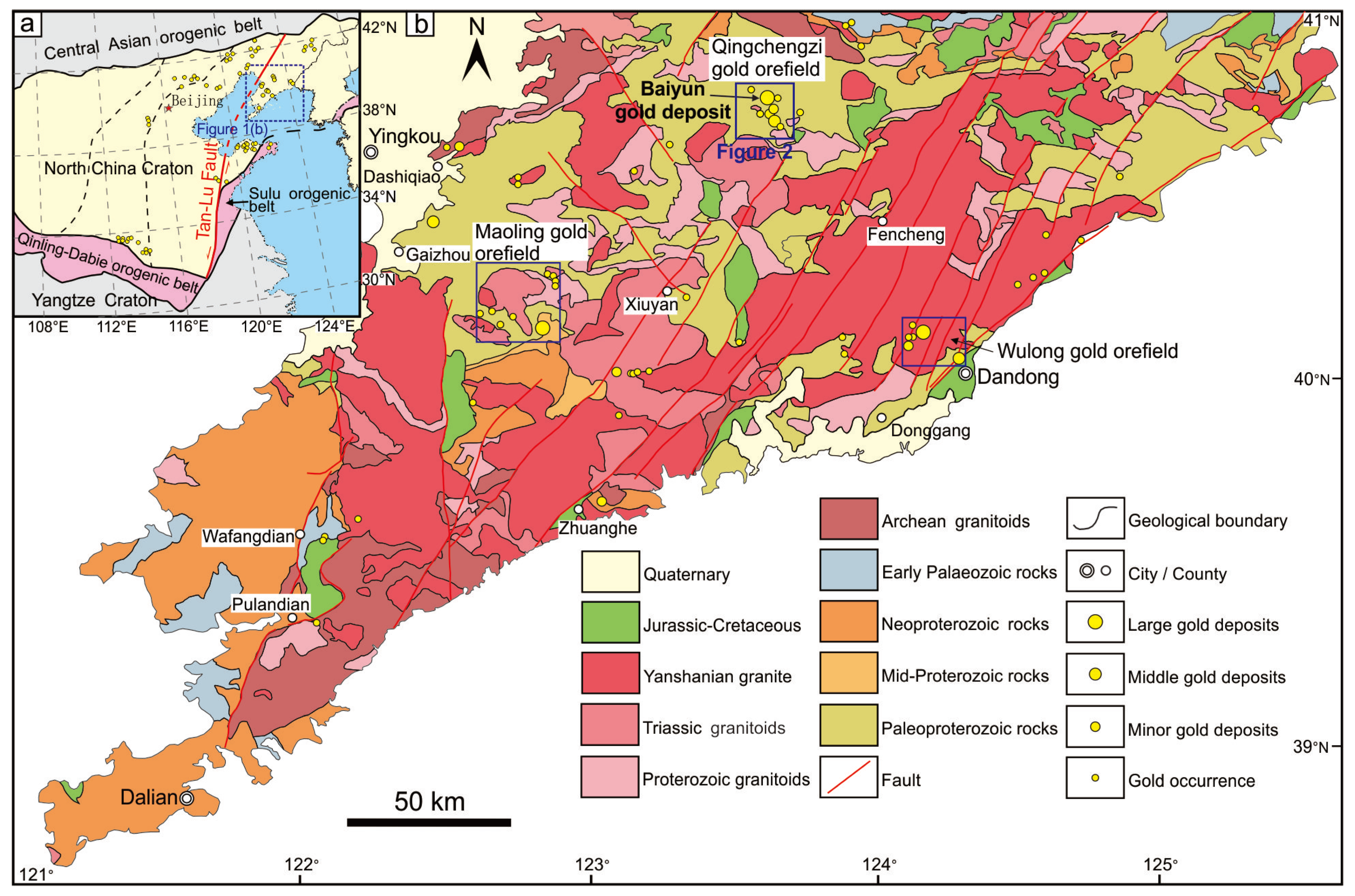
The Liaodong Peninsula is one of the most important Au polymetallic metallogenic belts in the northeastern North China Block (NCB), China (Figure 1a). There are abundant gold ore-concentrated areas in this district, for example, Qingchengzi, Wulong, and Maoling [35] (Figure 1b). These gold deposits occur in the Liaohe Group, are spatially controlled by fault zones, and their mineralization is related to magmatic-hydrothermal activities [22,36,37]. It is still controversial whether the gold deposits are controlled by Late Triassic or Early Cretaceous magmas [38,39,40]. Zhou et al. [38] determined the formation age of granitic porphyries in the Baiyun gold deposit to be Late Triassic. Jia et al. [40] measured an age of lamprophyre dykes in the Baiyun gold deposit of 126.8 ± 0.7 Ma, which is considered to be the product of the extensional tectonic domain formed by subduction of the Paleo-Pacific oceanic lithosphere in the Early Cretaceous. These two periods correspond to different tectonic environments. The northeast margin of the North China Plate in the Late Triassic is an important period of exhumation after deep subduction of the South China Block (SCB) [41]. However, in the Early Cretaceous, a large-scale lithospheric thinning event occurred in the eastern NCB [35,42]. Recently, it has been suggested that Late Triassic ultrapotassic lamprophyre dykes are spatially and temporally related to mineralization in the Baiyun gold deposit [38,43]. The petrogenesis of these Late Triassic lamprophyre dykes is significant to understanding the origin and tectonic setting of the gold deposit. In this study, we conducted detailed field investigations and petrological observations of the Baiyun gold deposit, analyzed whole-rock major and trace elements, and examined Sr-Nd-Hf isotopes of the lamprophyre dykes. In situ zircon U-Pb dating was employed to accurately determine the crystallization age of the lamprophyre dykes. By integrating these new findings with previous research, we aimed to clarify the relationship between the lamprophyre dykes and gold deposits. Our findings offer important insights into the tectonic setting, mantle source, and formation processes of ultrapotassic lamprophyric magma during the Late Triassic, as well as the possible contribution of ultrapotassic lamprophyric magma to the formation of large gold ore-concentrated regions.

2. Geological Background

The Liaodong Peninsula, located in the northeast of the North China Block (NCB), is part of the northern Sulu–Dabie orogenic belt (Figure 1a). The Peninsula consists of Archean metamorphic, magmatic, or sedimentary rocks, Mesoproterozoic to Neoproterozoic and Paleozoic volcanic and sedimentary rocks, collectively known as the Liaohe Group [36]. During the Mesozoic, significant magmatic activity occurred in the Triassic, Late Jurassic, and Early Cretaceous periods across the Liaodong Peninsula, contemporaneous with similar events in the Jiaodong Peninsula [41,42,43]. The Late Triassic igneous rocks of the Liaodong Peninsula include mafic dykes (227–210 Ma) [44], nepheline syenites and syenites (231–223 Ma) [45], as well as diorites and monzogranites with mafic enclaves (224–210 Ma) [46,47]. Several models, for example, continental lower crust delamination, oceanic slab break-off, and asthenosphere upwelling, are used to clarify the genesis of Triassic igneous rocks [45,48].
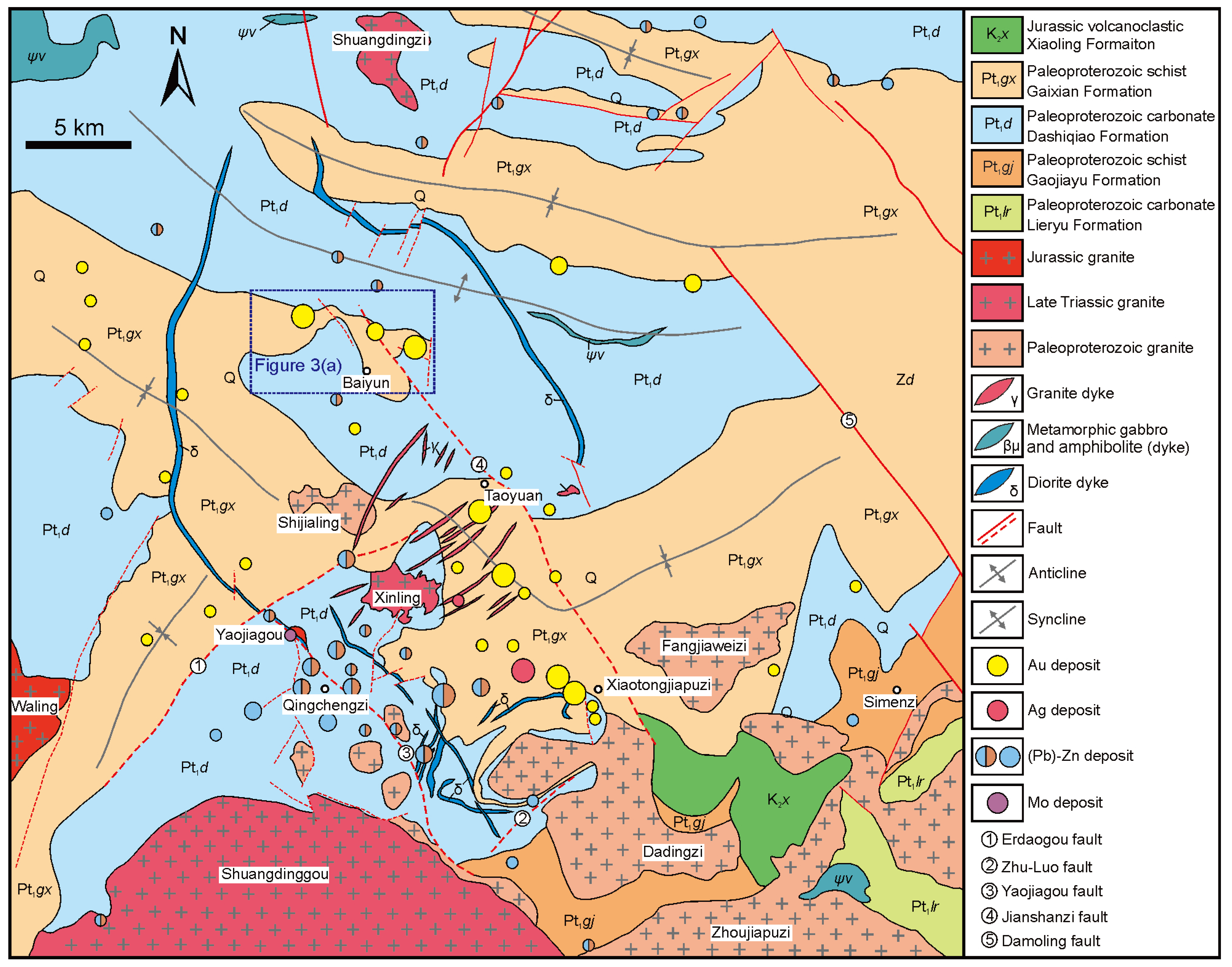
The Qingchengzi mineralized area hosts several large to medium-sized deposits of gold (Au), silver (Ag), and lead–zinc (Pb-Zn), with more than 300 tonnes of gold and 4000 tonnes of silver, along with 1.6 million tonnes of lead-zinc resources (Figure 2). The primary exposed strata in the region belong to the Paleoproterozoic Liaohe Group, which includes the Gaojiayu, Lieryu, Dashiqiao, and Gaixian Formations. These formations are predominantly composed of clastic sedimentary and carbonate rocks. Additionally, a small amount of Mesozoic volcanic rocks from the Xiaoling Formation is found in the area. The regional intrusions can be classified into three stages based on their formation ages: (1) Paleoproterozoic granites: Found in Dadingzi, Zhoujiapuzi, Fangjiawaizi, and Shijialing, these granites have ages ranging from 1.8 to 2.2 billion years [49]. (2) Late Triassic granites: Present in Shuangdinggou, Shuangdingzi, and Xinling, these granites date from 220 to 228 Ma [36,50]. (3) Late Cretaceous granites: Found in Waling and Yaojiagou, these granites range in age from 140 to 168 Ma [46]. In addition, lamprophyres and other mafic dykes are commonly observed in the Baiyun gold deposit [22,36,47]. The Qingchengzi mineralized field is rich in metal resources, containing more than four large gold deposits along with numerous smaller ones.
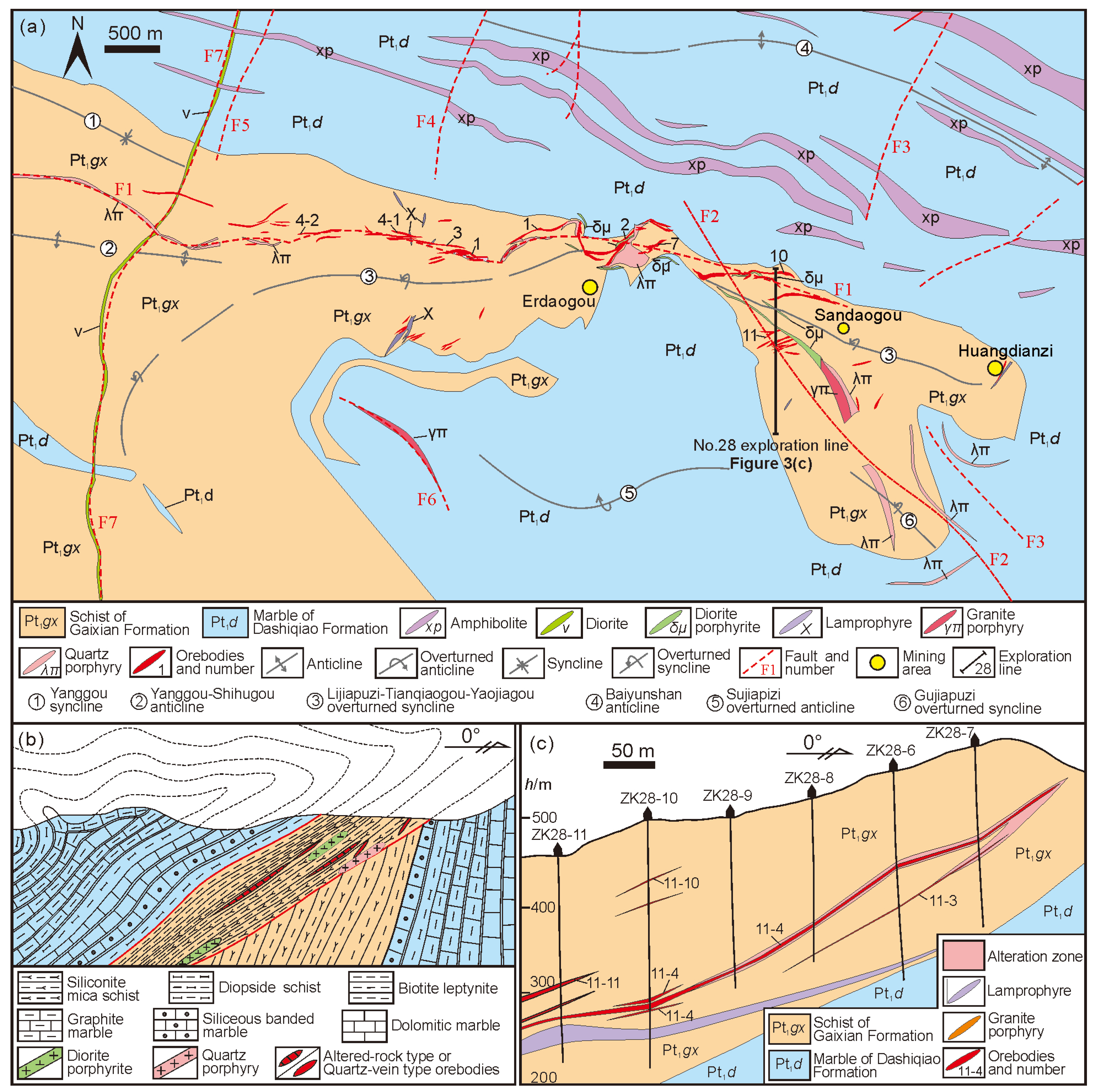
The Baiyun gold deposit is located in the north of the Qingchengzi mineralized area (Figure 2), and its gold reserves are about 70 t with an average grade of 3 g/t [52]. The exposed strata are mainly the Gaixian Formation and Dashiqiao Formation of the Liaohe Group. The ore bodies occur in schists and the interbedded marbles (Figure 3c). A series of overturned folds and faults is mainly oriented NWW (Figure 3a,b). The Lijiapuzi–Tianjiagou–Yaojiagou overturned syncline, and the EW-trending nappe structure belts control the occurrence and distribution of gold ore bodies and lamprophyre dykes. The ore bodies and lamprophyre dykes were cut by NS and NNE trending structures. The lamprophyre dykes are commonly distributed in Gaixian and Dashiqiao Formation strata, formed in the Late Triassic, with a few dykes being Late Cretaceous in age [40]. The mineralization occurs mainly within altered rocks and quartz veins, forming quartz or network sulfide vein orebodies with different thicknesses. The main orebodies are No. 1, No. 2, No. 10, No. 11, No. 60, and No. 70, and their extension can exceed 1000 m (Figure 3a). The thickness generally ranges from 1 to 4 m, and the ore grade mainly ranges from 1.39 to 5.58 g/t. The Re-Os isotope dating of pyrite, SIMS U–Pb dating of hydrothermal rutile, and LA-ICP-MS U–Pb dating of xenotime associated with auriferous pyrite indicate that gold mineralization occurred at 230–225 Ma [52,53]. The ore-forming fluid is characterized by low salinity and low density, and is CO2-rich [54]. Isotopic studies indicate that its ore-forming material source may be dominated by mantle-derived magma [22,54]. Pyrite in situ S and Pb isotopes indicated that gold mainly came from metal-rich magmatic fluids rather than reactivation of metamorphic fluids [55]. However, the tectonic setting under which the Baiyun deposit formed is still unclear, and the potential implication of these lamprophyre dykes to gold deposition remains poorly constrained. Hence, we focused on lamprophyre dykes in this study to clarify their relationship with the gold deposit and regional tectonism.

3. Occurrence and Petrography of the Lamprophyre Dykes

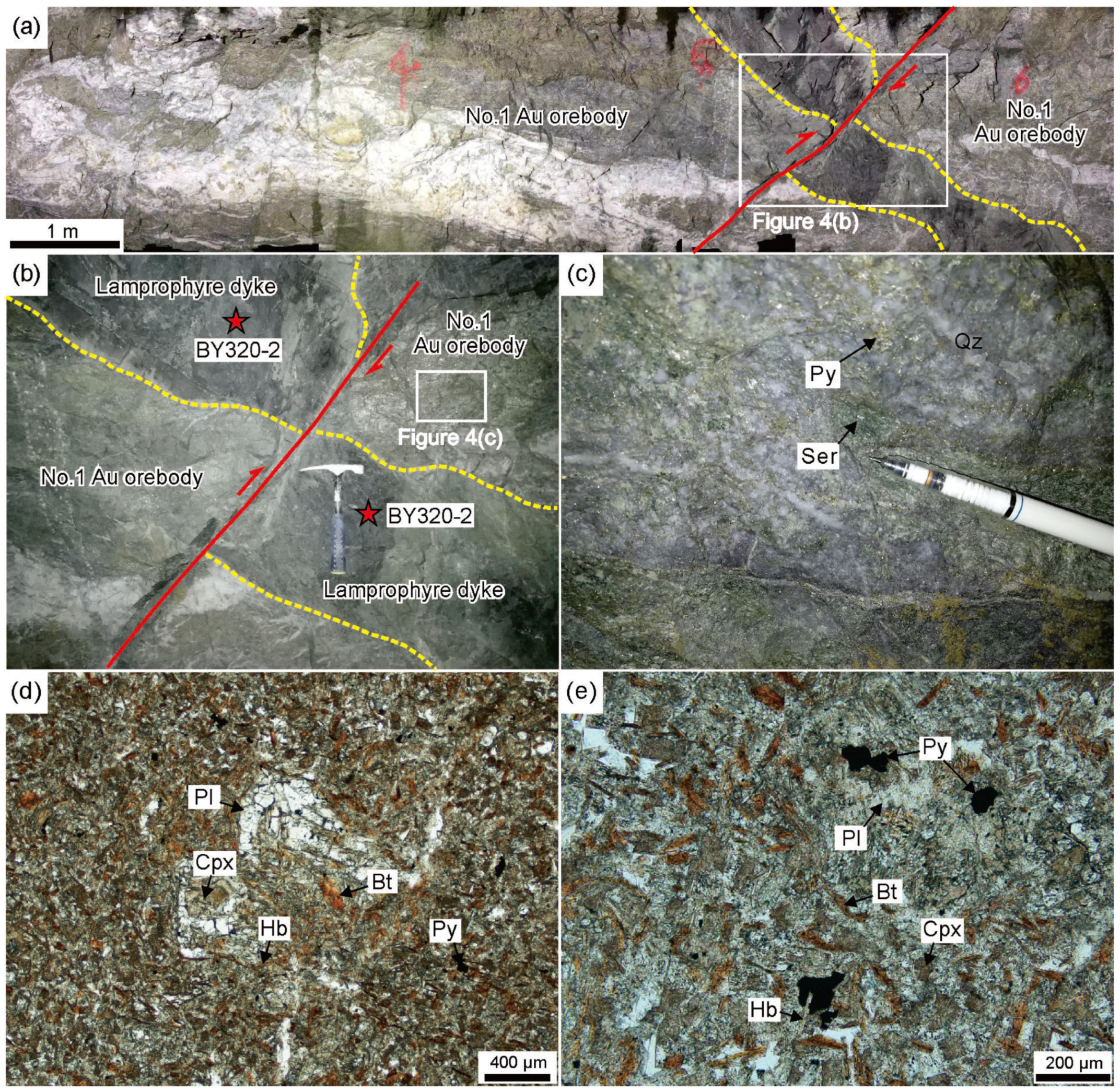
The lamprophyre dykes in the Erdaogou and Sandaogou ore sections are well developed. The lamprophyre dykes range from several meters to tens of meters, and mainly trend along EW, NW, and NE directions (Figure 3a and Figure 4a). The relation between lamprophyre dykes and gold ore bodies can be divided into parallel and cutting types (Figure 4b). The large-scale dykes are generally concordant with gold mineralization. Some dykes and gold ore bodies occur in the same fault zone, and they are distributed in the surrounding rock on one side or near the ore bodies as a layer or lens, which indicates that there is a certain spatial relationship between the ore bodies and dykes (Figure 3c). Hydrothermal alteration is extensive in the wall rocks and ore bodies with K-feldspar, quartz, sericite, chlorite, and carbonate. Sulfides are mainly pyrite (Figure 4c), with a small amount of chalcopyrite, galena, sphalerite, and native gold.
The lamprophyre samples in this study were collected in the −320 m roadway of the Erdaogou ore section. The lamprophyre dykes obviously cut through the No. 1 gold ore body, and then were cut through by NW-trending faults (Figure 4a,b). The No. 1 gold ore body includes quartz vein type and altered rock type. A large number of sulfides dominated by pyrite appear in the quartz vein and its periphery. In addition to abundant pyrite, the altered rock type gold ore body also develops strong silicification and sericitization (Figure 4c). The lamprophyre dykes are relatively fresh with no obvious alteration or mineralization. They are grayish-black, with typical lamprophyric texture and dense massive structure, and they contain small amounts of feldspar and mafic minerals phenocrysts (Figure 4d,e). The mafic minerals are idiomorphic to hypidiomorphic granular and consist of hornblende (30%~40%), biotite (20%~30%), and clinopyroxene (15%~20%) (Figure 4d,e). The light-colored minerals have a poor degree of idiomorphy, mainly including plagioclase (10%–15%), quartz (5%–8%), and calcite (3%–5%), which are distributed in the matrix (Figure 4e).

4. Samples and Methods

Seven samples (BY320-2-2, BY320-2-3, BY320-2-4, BY320-2-5, BY320-2-6, BY320-2-7, and BY320-2-8) were collected from the tunnel in the Erdaogou ore section of the Baiyun gold deposit. All samples were analyzed for both major and trace elements. Zircon U-Pb dating and Hf isotopic analyses were presented on the sample (BY320-2-8). All samples were used for Sr-Nd isotope analyses.
Separation of zircons from the lamprophyre dykes was completed at the Shougang Geological Exploration Institute (SGGEI), Beijing, China. After crushing the rocks, zircons were selected by gravity and magnetic separation. Zircon U-Pb dating and Hf isotopic analyses were carried out at the Wuhan Sample Solution Analytical Technology Co., Ltd. (WSSAT), Wuhan, China. The whole-rock major elements, trace elements, and Sr-Nd isotopic compositions of the samples were measured at the Beijing Research Institute of Uranium Geology (BRIUG), Beijng, China. The detailed methods and analysis data are presended in Supplementary Material A and Supplementary Tables S1–S4, respectively.

5. Results

5.1. Lamprophyre Dyke Zircon U-Pb Ages

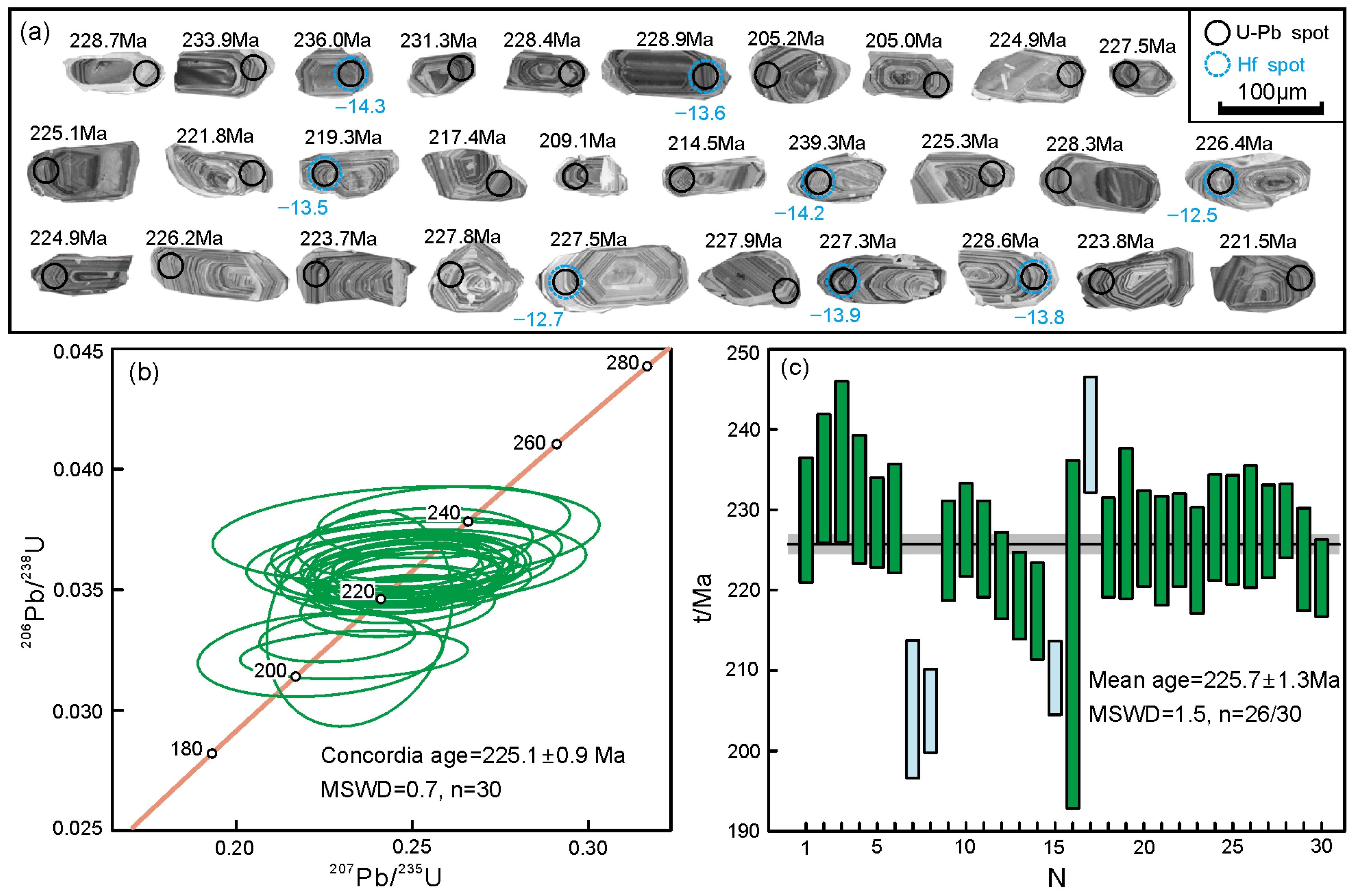
The zircons in the lamprophyre sample (BY320-2-8) are mostly subhedral and transparent; their diameters range from 50 to 120 μm. Cathodoluminescence (CL) images of the zircons are grayish-white to grayish-black, and the internal structure is clear, showing obvious oscillatory zoning (Figure 5a), which indicates that they are magmatic. The results of 30 zircon analyses show that Th and U contents are 865–4086 ppm and 1151–3437 ppm, respectively, and the Th/U value ranges from 0.64 to 1.72 (Table S1), indicating that these zircons are of magmatic origin [56]. The ages of the 30 zircons range from 205.2 ± 4.3 Ma to 239.3 ± 3.6 Ma; the concordia age is 225.1 ± 0.9 Ma (MSWD = 0.7, n = 30) (Figure 5b). A total of 4 points with high variability were not used for average value calculation, and the remaining 26 data points yielded a calculated 206Pb/238U weighted mean age of 225.7 ± 1.3 Ma (MSWD = 1.5, n = 26) (Figure 5c).

5.2. Lamprophyre Dyke Geochemical Characteristics

5.2.1. Major Elements

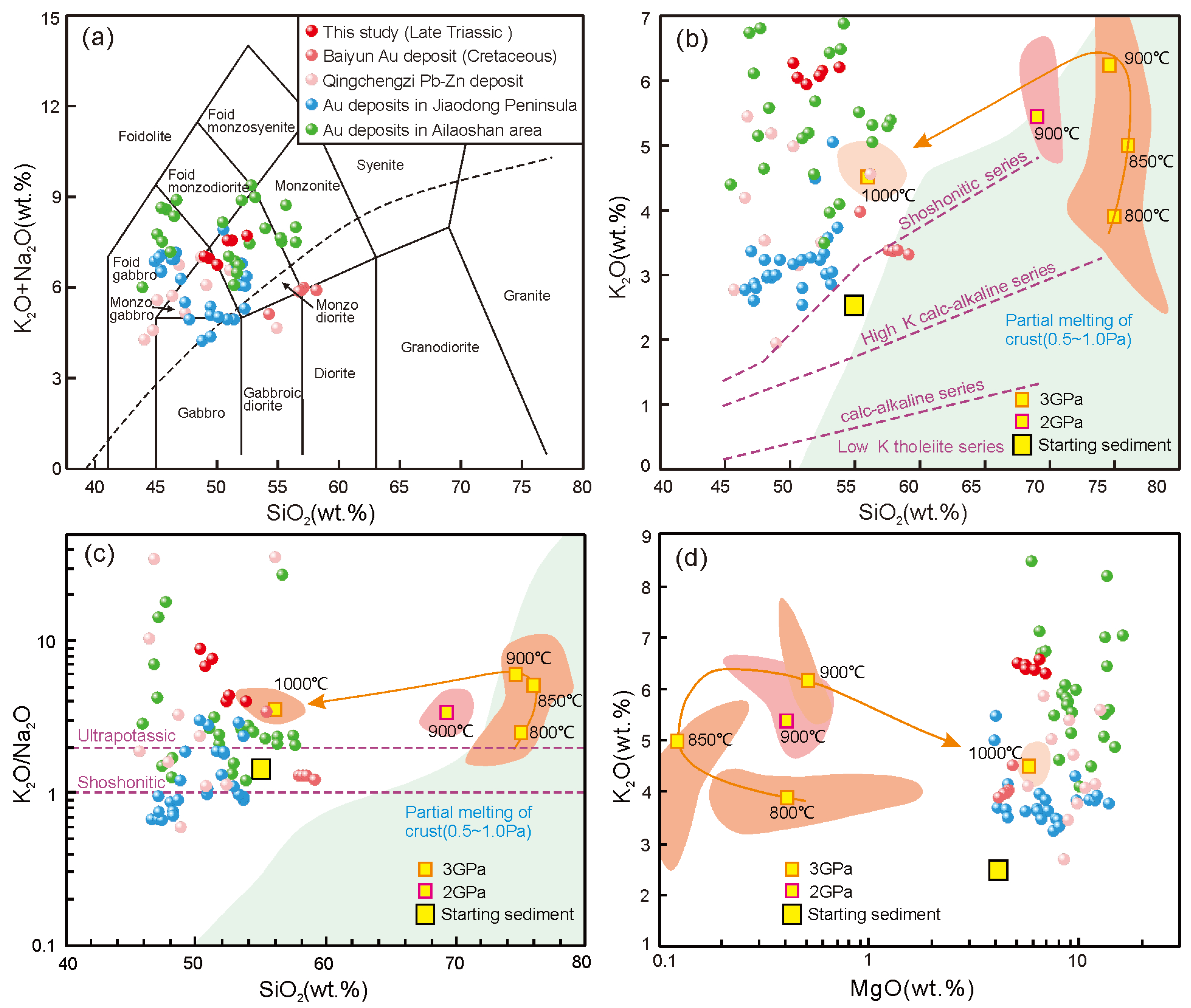
The results of major elements for the six lamprophyre samples are shown in Table S2. The loss on ignition of the lamprophyre dyke varies greatly (LOI = 7.20–10.29 wt.%), which may be related to carbonate minerals. Therefore, the major element concentrations were corrected after accounting for the loss on ignition. The lamprophyre dykes have moderate SiO2 (50.22–53.72 wt.%), high MgO (5.05–6.74 wt.%), and high Mg# values (58–65). They have enriched K2O (5.96–6.29 wt.%) with high K2O/Na2O values (3.99–8.74), indicating that they belong to the ultrapotassic series. The sample points fall in the alkaline series region in the SiO2 vs. Na2O + K2O (TAS) diagram (Figure 6a). The samples plot in the shoshonitic series from SiO2 vs. K2O content (Figure 6b). Therefore, the lamprophyre dykes in the Baiyun gold deposit belong to alkaline and ultrapotassic lamprophyre.

5.2.2. Trace and Rare-Earth Elements

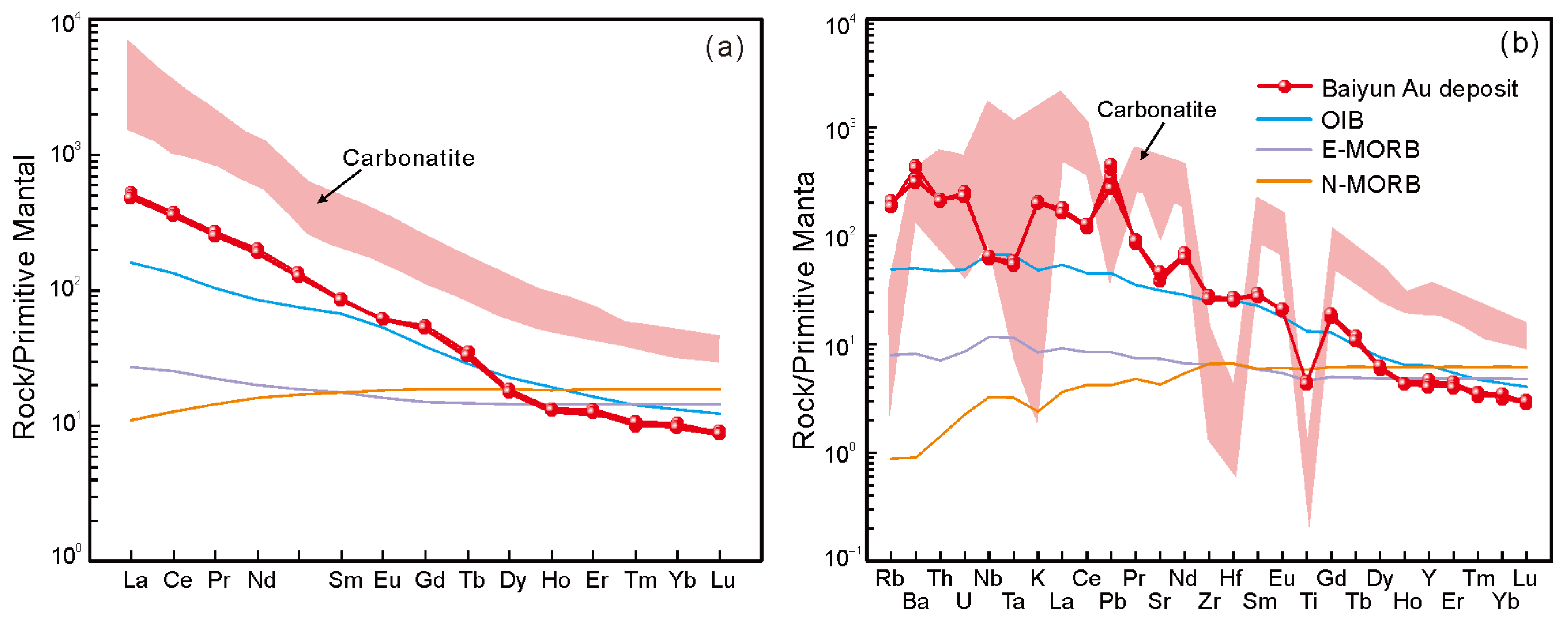
Rare-earth elements (REEs) contents in the lamprophyre dykes range from 465 to 500 ppm, light rare-earth elements (LREEs) range from 444 to 478 ppm, and heavy rare-earth elements (HREEs) range from 20.5 to 22.0 ppm. The (La/Yb)N values are between 48.7 and 53.0, indicating LREE enrichment and HREE depletion (Figure 7a; Table S2). All the samples show unremarkable Ce and Eu anomalies between carbonatite and OIB in the chondrite-normalized REE diagram [65,66,67] (Figure 7a). The incompatible element content (Rb, Ba, and Sr) in the lamprophyre dykes is higher than in primitive mantle and OIB (Figure 7b). Some LILEs (for example, Rb, Ba, K, and Sr) are enriched and show obvious peaks in the spider diagram (Figure 7b), whereas Nb, Ta, and Ti are depleted and show obvious troughs relative to the primitive mantle. They are consistent with the variation trend of the chondrite-normalized REE distribution pattern and primitive mantle-normalized nature of typical carbonatites in the world, indicating that they have similar characteristics.

5.3. Whole-Rock Sr-Nd Isotopes and Hf Isotopes of Zircon

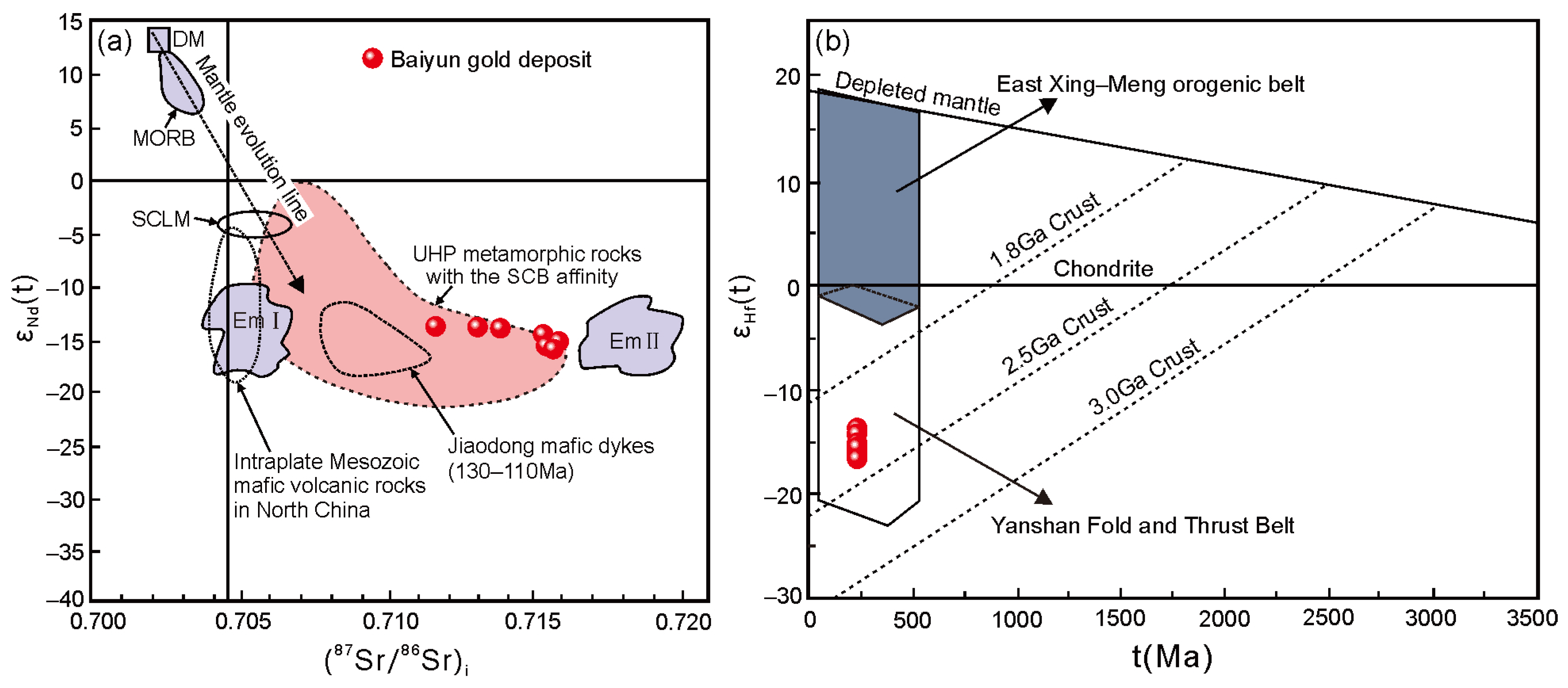
The initial 87Sr/86Sr(t) values of seven samples vary from 0.7139594 to 0.716466, and εNd(t) values range from −15.4 to −14.1, and Nd model ages range from 2.1 to 2.3 Ga (Table S3; Figure 8a). Eight zircons from the lamprophyre dyke sample (BY320-2-8) that had been U-Pb dated were chosen for in situ analysis of Hf isotopes (Table S4). The initial 176Hf/177Hf values at eight test points are uniform and range from 0.282243 to 0.282293. The εHf(t) values range from −14.3 to −12.5, and the TDM values range from 2.01 to 2.12 Ga (Figure 8b).

6. Discussion

6.1. Emplacement Age of the Lamprophyre Dykes and Tectonic Setting

LA-ICP-MS U-Pb dating of zircons from the lamprophyre dykes in the Baiyun gold deposit shows that its weighted average age is 225.7 ± 1.3 Ma. Recently, Zhang et al. [53] reported the Re-Os isotopic dating results of auriferous pyrite in the Baiyun gold deposit, and determined that its mineralization age was 225.3 ± 7.0 Ma. Feng et al. [52] found xenotimes and rutile with close structural correlation with auriferous pyrite in the Baiyun gold deposit, and the U-Pb ages are 231 ± 1 Ma and 229 ± 4 Ma, respectively. In summation, these evidences indicate that the Baiyun gold deposit formed around 231–225 Ma in the Late Triassic. Through field investigation, it is found that the lamprophyre dykes cut through some dykes, such as gabbro and diorite porphyry dykes. They were formed late, but coexisted with gold veins of different sizes, and some gold veins were cut by lamprophyre veins [40]. These results indicate that the Late Triassic lamprophyric magma is temporally related to gold mineralization. According to the previous geochronological data, the metallogenic age of the Qingchengzi mineralized area field can be divided into three periods: (1) 232–210 Ma [36,53], (2) 166–169 Ma [74], and (3) 125–127 Ma [39]. There is increasing evidence suggesting that Late Triassic magmatism may have played a key role in the mineralization of the area. Liu et al. [22] obtained zircon U-Pb ages of 224–221 Ma for granitic porphyry from the Late Triassic, which are associated with the Au-bearing silicon–potassium alteration zone in the Baiyun gold deposit (Figure 3c).
The tectonic evolution of the Liaodong Peninsula in the Late Triassic was likely influenced by three tectonic domains: (1) the northern Xingmeng tectonic belt, (2) the southern Sulu–Dabie tectonic belt, and (3) the eastern Pacific tectonic domain [45,52,75]. Yang et al. [47] found that the impact of Pacific lithosphere subduction during the Late Triassic was relatively weak in the Liaodong Peninsula. In contrast, the εHf(t) values of the lamprophyre dykes differed from those of Late Triassic magmatic rocks in the Xingmeng orogenic belt (Figure 8b).
Therefore, the formation of ultrapotassic lamprophyre dykes in the Liaodong Peninsula is likely linked to the Sulu–Dabie orogenic belt [72]. These dykes display Paleoproterozoic two-stage Nd ages and zircon Hf model ages, similar to UHP metamorphic rocks in the Dabie-Sulu tectonic belt (Figure 8a). Neoproterozoic magmatic events are common in the SCB but rare in the NCC basement [76]. Neoproterozoic zircons found in a Late Triassic diabase from the southern Liaodong Peninsula [45,47] indicate the presence of SCB material in the magmatic source. The Sulu–Dabie orogenic belt formed from the Triassic collision between the SCB and NCB, with peak UHP metamorphism at 241–224 Ma and uplift at 224–204 Ma [77]. The age of the lamprophyre dykes coincides with the exhumation of UHP rocks, suggesting they formed during the syn-exhumation phase of convergent to extensional tectonics.

6.2. The Origin and Nature of Ultrapotassic Lamprophyres

The lamprophyre dykes are relatively unique among magmatic rocks. Mantle sources of lamprophyre magma have been widely proposed, including metasomatized SCLM or asthenospheric mantle [78]. The genetic process is very complex and represents the information of the deep mantle source area. They are obviously different from other dikes, such as gabbro and diorite porphyries. The lamprophyre dykes in the Baiyun gold deposit exhibit low SiO2 (50.22–53.72 wt.%) and high MgO (5.05–6.74 wt.%), Mg# (58–65), Cr (303–354 ppm), and Ni (151–153 ppm) contents. Their whole-rock and Sr-Nd-Pb isotopic compositions are also similar, suggesting a common mantle source. However, the lamprophyre dykes also show enrichment in incompatible elements, such as LREE, Sr, K, Ba, and depletion in Nb, Ta, and Ti, resembling characteristics of continental crust-derived magma. This decoupling phenomenon means that the rocks enrich these incompatible elements in a special way. The melt source is likely initially fertile, such as an enriched SCLM, or it may source from the depleted mantle and undergo modification through crustal contamination [50]. Rock et al. [79] believe that the contents of Cr, Ni, Mg, Sc, Co, and other elements in mantle-derived primary lamprophyres have a unique range. The lamprophyre samples from the Baiyun gold deposit show high Cr (303–354 ppm), Ni (151–153 ppm), and Mg# (58–65) contents and moderate Sc (16.6–17.5 ppm) and Co (28.4–29.3 ppm). The high Mg#, Cr, and low SiO2 contents of these lamprophyres are different from continental crustal-derived melt [80], indicating that the lamprophyre dykes are mantle-derived primary lamprophyres. The ultrapotassic lamprophyre dykes in the Baiyun deposit show a negative correlation between SiO2 and 87Sr/86Sr, and a positive correlation between SiO2 and εNd(t), suggesting that while some crustal contamination occurred, it differs from typical mantle-derived magmas [81]. The geochemical characteristics, including enriched initial 87Sr/86Sr, negative εNd(t) values, and island arc basalt (IAB)-like trace element signatures, suggest that the ultrapotassic lamprophyre dykes derived from the metasomatized SCLM [41,82]. These features are similar to coeval lamprophyres and other basic rocks in the Liaodong and Jiaodong Peninsulas [41,81,83].
The timing of mantle metasomatism by crust-derived melts/fluids remains uncertain. Generally, mantle metasomatism associated with subduction shows spatial heterogeneity, influenced by the distance from the subduction zone. In the NCB, εNd(t) values of Mesozoic basic rocks increase progressively from the Sulu–Dabie orogenic belt to the NCB, which may reflect the subduction of different continental crustal materials from the SCB. In addition, kimberlites and their mantle xenolith are important for tracking the evolution of SCLM [73]. The Paleozoic kimberlites in the eastern NCB can identify whether there was mantle metasomatism before the Paleozoic. The εNd(460 Ma) values of these kimberlites range from −3.2 to +0.9, and the εNd(220 Ma) values of the metasomatic mantle that evolved into the Triassic range from −6.9 to −3.3 [73] (Figure 8a). This cannot explain the εNd(t) (−15.4 to −14.1) isotopic features of the ultrapotassic lamprophyre dykes, indicating that crust-derived materials, which were not obvious before the Paleozoic, metasomatized the mantle. The Paleoproterozoic model ages of Nd-Hf isotope ranging from 2.1 to 2.2 Ga, which is similar to UHP metamorphic rocks with SCB affinity in the Sulu–Dabie orogenic belt, indicating that lamprophyre dyke formation was more likely to be controlled by SCB subduction than by other ancient metasomatism events.

6.3. Nature of the Subducted Crustal Materials

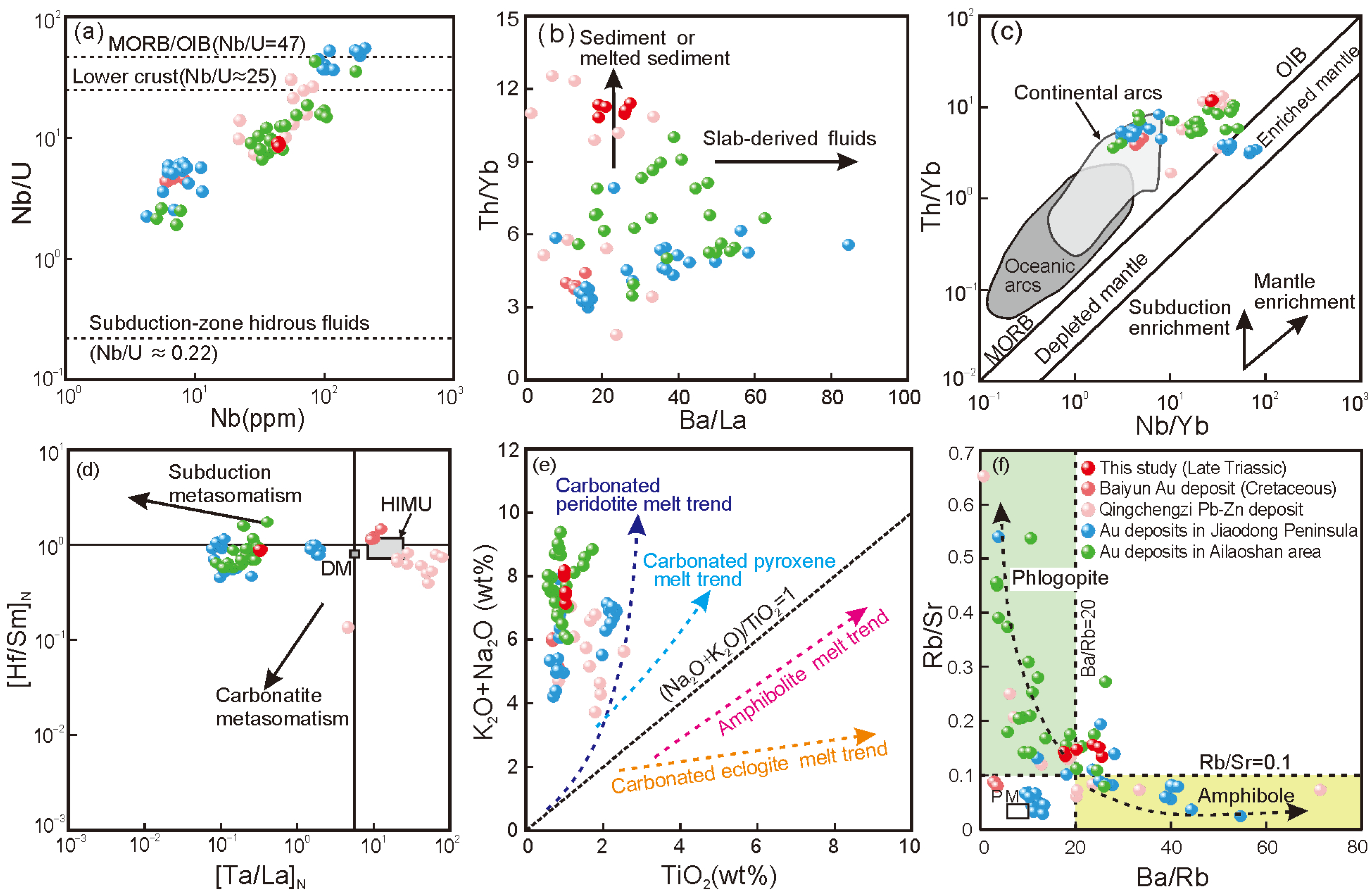
Magma sources, magma mixing, or crustal assimilation can be well suggested by magmatic Nb/U values [84]. The Nb/U values from lamprophyre dykes in the Baiyun gold deposit range from 8.42 to 9.12, which is similar to the lamprophyres from the Jiaodong Peninsula and Ailaoshan gold mineralized area (Figure 9a). In contrast, oceanic basalts have a Nb/U value of 47 [82]. The lamprophyre Nb/U value is lower than depleted mantle, which can be attributed to the contribution of continental crust materials. However, the Nb/U values of lamprophyre dykes are lower than those of the lower continental crust (Nb/U = 25) [80], which rules out the possibility of mixing crustal materials. Furthermore, these lamprophyres are enriched with Sr-Nd-Hf isotopic signatures and incompatible elements, and depleted in Nb, Ta, and Ti, showing that they were most likely modified by subduction-derived melts. Finally, the high Th/Yb and [Hf/Sm]N values (Figure 9b–d) demonstrate that their source may be metasomatized by subduction crust-associated melt. This signal of subduction-related metasomatism also exists in the Jiaodong Peninsula and Ailaoshan gold ore-concentrated area (Figure 9c,d), indicating that gold deposit formation requires the contribution of subduction-related melts/fluids. During continental subduction and collision, the fluids or melts derived from the subducted crust cause metasomatism of the SCLM. The dehydration of muscovite, amphibole, biotite, and epidote is an important mechanism behind the generation of subduction zone fluids/melts at low to medium pressures [85]. Under HP-UHP conditions of greater than 3 GPa, when crustal material is subducted to >100 km depths with a mineral assemblage of garnet + coesite + omphacite + rutile + phengite [86], phengite is the main hydrous mineral under these conditions. Thus, at 700–800 °C, the breakdown of phengite can cause fluid-present melting, while above 900–1000 °C, it will lead to fluid-absent melting [87]. The high K2O/Na2O values and LILEs (Ba and Sr) of ultrapotassic lamprophyre dykes [88,89] further support this hypothesis that the breakdown of phengite is the main mechanism in the production of subducted, crust-derived fluids or melts.
Studies have demonstrated that partial melting of crustal rocks cannot produce melts with a high K2O/Na2O ratio and low SiO2 (<66 wt.%) content at pressures around 1.0 GPa [61,95]. The lamprophyre dykes, similar to those found in various gold ore-concentrated areas, exhibit melt characteristics generated by sediment and peridotite interaction at high-temperature conditions and pressures exceeding 2.0 GPa. Their K2O, MgO, and SiO2 contents, as well as K2O/Na2O ratios, are comparable [96], indicating that high-silica sediment melts were added to their source under UHP conditions (Figure 6b–d). The lamprophyre dykes in the Baiyun gold deposit have very high Ba, Sr, and CaO, and total REE higher than typical OIB, which is consistent with the chondrite-normalized REE of typical carbonatite in the world [67]. However, the total REE is slightly less than that of typical carbonitite (Figure 7a). Based on these characteristics, we believe that lamprophyre dykes are probably products of metasomatism by subduction, sediment-dominated, and carbonate-bearing melts. The metasomatism by carbonate melt in their source is also confirmed by the high Na2O + K2O, Sr contents, loss on ignition, and low TiO2 content (Figure 9d). In addition, the subduction of continental crustal materials into the mantle generally results in enriched Sr-Nd-Hf isotopic compositions, whereas melts derived from oceanic crust have depleted isotopic compositions, which is inconsistent with the studied ultrapotassic lamprophyre dykes [70]. These lamprophyre dykes have enriched Sr-Nd-Hf isotopic features, favoring recycled subducted continental crust rather than oceanic crust for the metasomatic agent. In conclusion, we believe that the lamprophyre dykes are derived from the SCLM, which was metasomatized by subducted continental materials. Furthermore, the whole-rock Nd and zircon Hf model ages (2.0–2.3 Ga) of Late Triassic ultrapotassic lamprophyre dykes in the Liaodong Peninsula are consistent with UHP rocks from the Sulu–Dabie orogen belt (Figure 8) and differ from the NCB basement rocks [73]. This suggests that the lamprophyre dykes originated from an SCLM source that was metasomatized by subducted SCB continental crust during continental collision.

6.4. Metasomatism and Partial Melting of the Mantle

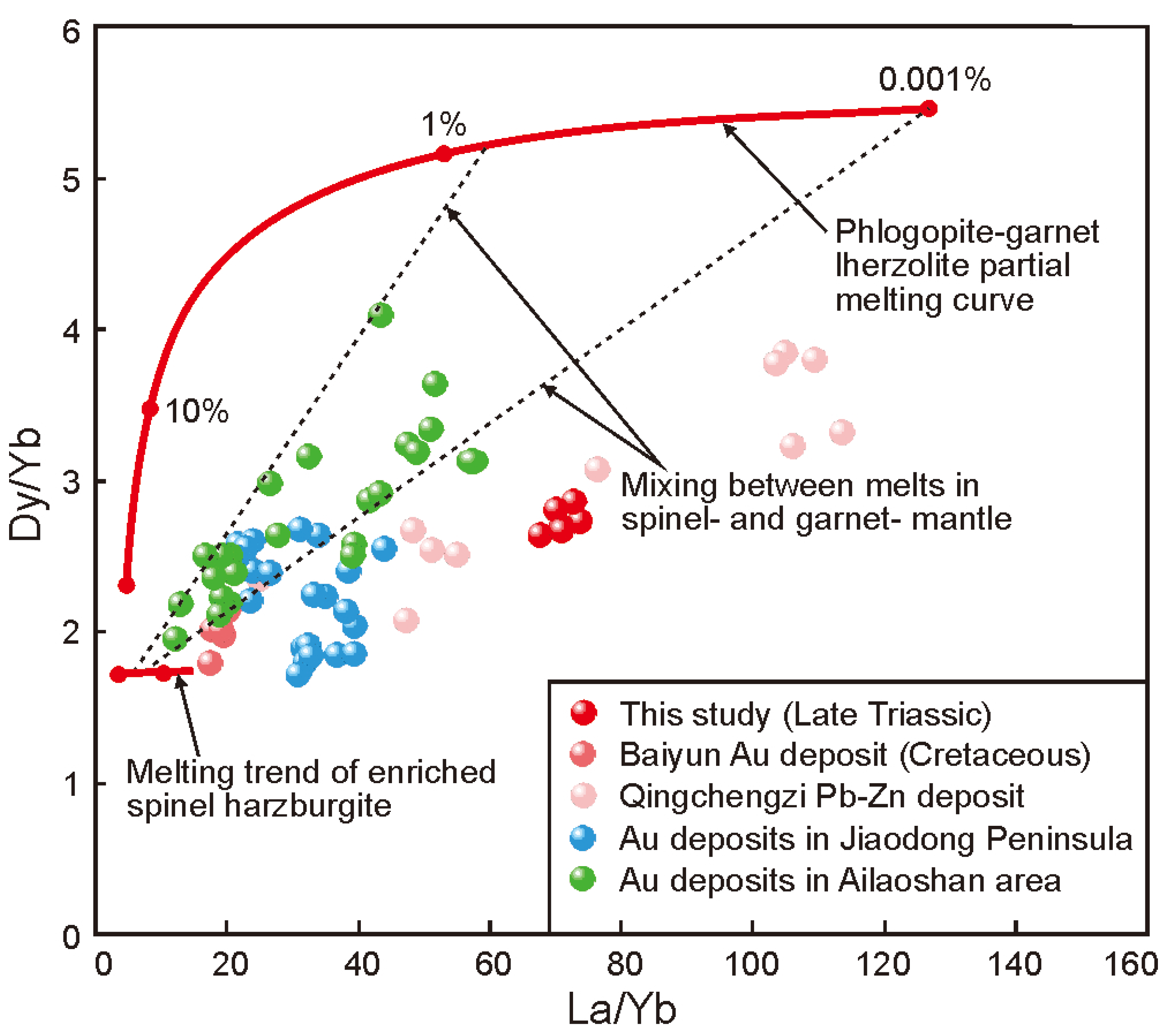
Silica-rich melt migrates from the dehydrated and partially melted subducted slab into the overlying lithospheric mantle and generates metasomatic mantle rocks. Major and trace element characteristics of lamprophyres can well reflect their source [89]. The Late Triassic lamprophyre dykes in the Baiyun gold deposit have high K2O (5.96–6.29 wt.%) and high K2O/Na2O values (3.99–8.74), which are much higher than the continental crust average (1.1). This indicates that there may have been potassium-rich minerals (such as phlogopite, hornblende, and K-richterite) in the mantle source. The Rb/Sr value of lamprophyre dykes from the Baiyun gold deposit are 0.13–0.15, and the Ba/Rb values are 17.64–25.60, which fall between the phlogopite and hornblende area [94], similar to lamprophyres from the Jiaodong Peninsula and Ailaoshan Au ore-concentrated area (Figure 9f), indicating that the source area of lamprophyres may be the location where phlogopite and amphibole coexist. The Yb contents of the initial melt of mantle peridotite during partial melting are mainly controlled by the residual garnet in the source area [62]. In general, the values of La/Yb and Dy/Yb vary widely, and Dy/Yb values are generally greater than 2.5 in a melt formed by partial melting with garnet. For melts formed by partial melting of spinel mantle, the La/Yb values vary within a very small range, and Dy/Yb values are almost constant, generally less than 1.5 [96]. La/Yb and Dy/Yb values in the lamprophyre are 67.88–73.89 and 2.64–2.80, respectively. It can be seen from the Dy/Yb-La/Yb diagram (Figure 10) that the lamprophyre dykes of the Baiyun gold deposit fall along a mixing curve of partial melting of garnet and spinel-bearing olivine, indicating that the partial melting of garnet and spinel-bearing mantle can form the original mafic magma in the Baiyun gold deposit lamprophyre dykes. In addition, these lamprophyre dykes have high CaO, K2O + Na2O, REE, and Sr, and carbonate in their source area cannot be excluded [87]. Therefore, we consider that the metasomatized SCLM lamprophyre source contains a primary mineral assemblage of phlogopite, hornblende, carbonate, spinel, garnet, and olivine.
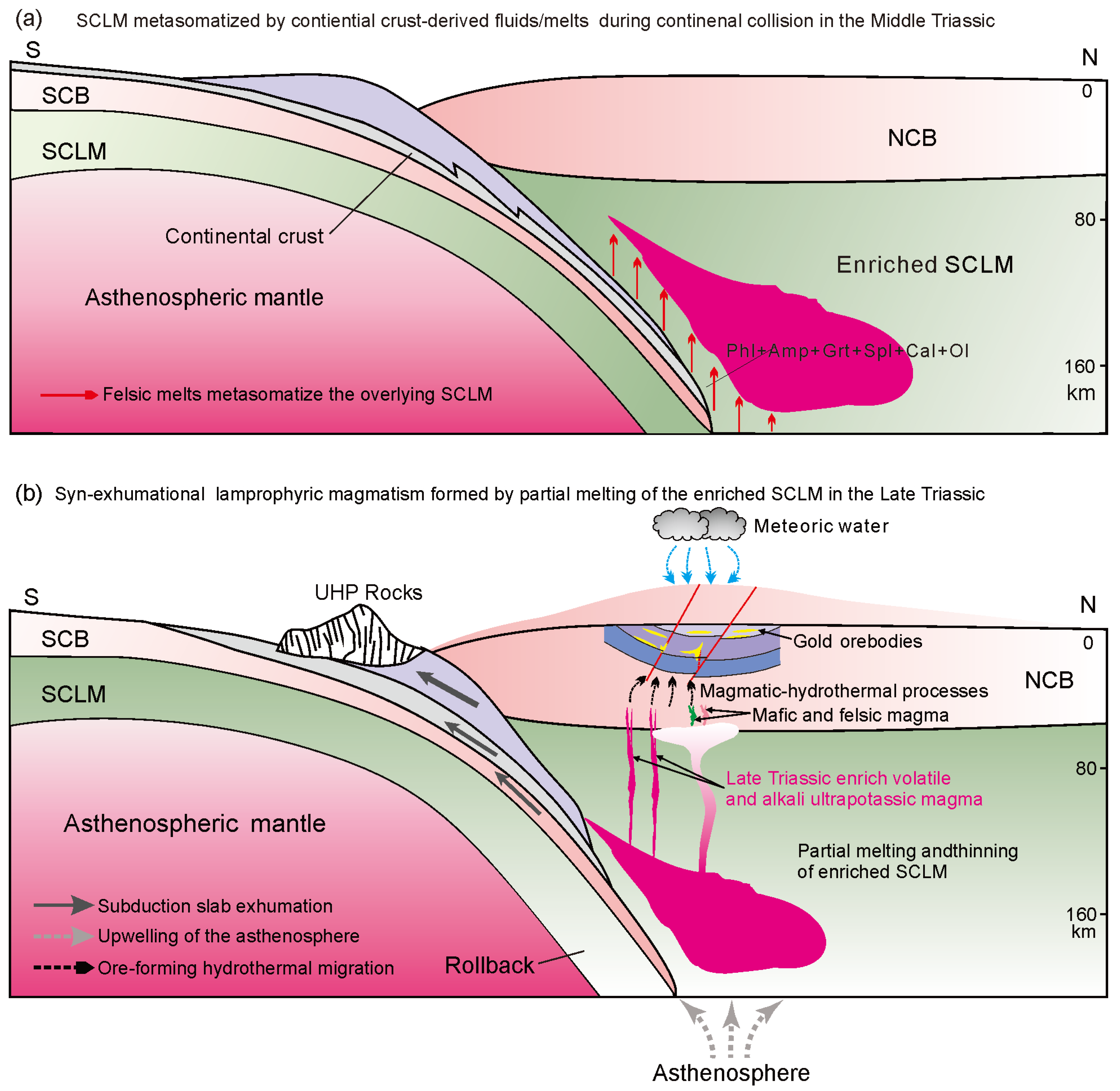
The following possible mechanism can explain the processes of partial melting of the metasomatized SCLM and the generation of gold-related ultrapotassic magma. In the Late Triassic, during the syn-exhumation stage of deeply subducted SCB continental crust, the crust uplifted along the continental subduction channel as the subducted plate rolled back. The active continental margin passed from convergent to an extensional regime [72]. The decompression causes partial melting of metasomatized SCLM due to the breakdown of hydrous phases. Meanwhile, the decompression resulted in asthenosphere upwelling with the thinning of the lithosphere. The increasing temperature within the lithospheric root due to asthenosphere upwelling provides a heat source for partial melting of metasomatized SCLM. The mineral sequence for melting in metasomatized SCLM, from easy to refractory, is phlogopite, amphibole, pyroxene, garnet, and olivine [88]. The melting of amphibole and phlogopite could produce alkali-rich melts during the low degree of partial melting. Our samples, which were similar to other lamprophyres in different gold mineralized areas, are very alkali enriched (Figure 6a–d); they exhibit melt characteristics generated by sediment and peridotite interaction at high-temperature conditions and pressures exceeding 2.0 GPa (Figure 6b–d), suggesting that a low degree of partial melting of the metasomatized SCLM takes place in the Late Triassic. These mantle-derived melts infiltrated into the bottom of the thickened lower crust, causing partial melting of the thickened lower crust and forming granitic magma (Figure 11). Therefore, the Late Triassic lamprophyric magma and felsic magmatism in the Baiyun deposit, which represent syn-exhumation magmatism, may have formed in the exhumation stage of deeply subducted continental crust between the SCB and NCB.

6.5. Linking Metasomatic Mantle to Giant Gold Deposits During Continental Collision

The Liaodong and Jiaodong Peninsulas are China’s most important gold provinces [33]. In the Jiaodong Peninsula, previous studies have found that the partial melting of metasomatized SCLM occurred and activated at 130–120 Ma, coeval with the peak period of gold mineralization in the NCB [5,6,42,98]. We consider that the source of the studied lamprophyre dykes may have been revised by recycling subducted continental lithosphere materials in the Late Triassic during the syn-exhumation stage of the subducted SCB in the Baiyun deposit, Liaodong Peninsula. The S-Pb-H-O-He-Ar isotope of the Baiyun deposit suggests that the ore-forming fluids are of mantle nature [22,53]. Thus, devolatilization of metasomatized SCLM plays a key role in providing abundant volatiles (H2O, SO2, and CO2), which can buffer the pH of the fluids to a level at which high concentrations of gold can be transported [99]. Gold mobility in the mantle is also controlled by redox conditions. The continental melts derived from crustal recycling in the continental subduction channel, in general, are oxidizing [100,101], which results in the formation of oxidized metasomatized SCLM. The oxidized volatiles from the subsequent partial melting of the metasomatized mantle facilitate the efficient extraction of Au [102]. The formation of ultrapotassic lamprophyre dyke implies a low degree of alkali mantle source melting. The volatile- and alkali-rich oxidizing melt derived from a low degree of melting may increase the solubility of gold, facilitating its activation, transport, enrichment, and mineralization as it moves from the metasomatized mantle to the crust in the NCB.
This study proposes a model to explain the formation of Au deposits in a collision orogenic belt (Figure 11). Abundant hydrous high-pressure melt is generated by the partial melting of subducted continental crust, which is triggered by the breakdown of phengite in deeply subducted continental channels. The slab-derived silica-rich melts migrate into the SCLM and form phlogopite, amphibole, and volatile-enriched metasomatites. The relatively low degree of partial melting of metasomatites may be the main mechanism for forming potassic or ultrapotassic lamprophyric magma and volatiles, which may be vital for transportation, enrichment, and precipitation of gold, contributing to the formation of gold deposits. Thus, both the metasomatized SCLM and the deeply subducted continental crust play a critical role in the formation of ultrapotassic rocks and gold deposits. The activation of metasomatized SCLM may be critical to the formation of large lode gold deposits in collisional tectonic zones. Abundant lode gold deposits mainly form in the collisional orogenic belt during the exhumation stage after peak metamorphism or without any spatial–temporal link to regional metamorphism [33,103]. The metamorphic fluid removal model, in which the deposits formed in a prograde metamorphic stage with different sources from evolving regional upper crust, has been widely questioned [1]. Thus, the new model may offer some guidance for the exploration of gold deposits in collisional tectonic zones.

7. Conclusions

  • Zircon U-Pb dating shows that ultrapotassic lamprophyre dykes in the Baiyun gold deposit were formed at 225.7 ± 1.3 Ma, which is similar to the auriferous pyrite Re-Os dating of previous results.
  • The ultrapotassic lamprophyre dykes of the Baiyun gold deposit represent syn-exhumation magmatism during the transition from collisional to extensional tectonics between the SCB and the NCB. Decompressional melting and thinning of the metasomatized SCLM may be the main mechanism to generate the syn-exhumation Ba-Sr-rich alkaline magmas.
  • The source of the ultrapotassic lamprophyre dykes may have been metasomatized by subducted continental crust-derived, silicate-dominated, and carbonate-bearing components, which have imprinted the enriched alkali, Ba, Sr, REE, and Sr-Nd isotopic signature and Hf isotopic compositions for zircon with conspicuous negative Nb-Ta-Ti anomalies.
  • This study proposes that the partial melting of SCLM, which was metasomatized by subducted continental-derived melt, during the post-collision setting, may provide volatiles for the formation of gold deposits. This model could provide valuable and important insights for exploration, which emphasizes that gold deposits formed in post-collisional settings of collisional orogenic belts along the plate boundary are associated with lamprophyre dykes.

Supplementary Materials

The following supporting information can be downloaded at: https://www.mdpi.com/article/10.3390/min16010096/s1. Supplementary Material A: Analytical methods [104,105,106,107,108]; Table S1: Zircon LA-ICP-MS U-Pb dating results of lamprophyre from the Baiyun gold deposit; Table S2: Major (%) and trace element data of lamprophyres from the Baiyun gold deposit; Table S3: Whole-rock Sr-Nd isotopic composition of lamprophyres from the Baiyun gold deposit; and Table S4: LA-MC-ICP-MS Lu-Hf isotope data for zircons from lamprophyres in the Baiyun gold deposit.

Author Contributions

Conceptualization, T.Y. and Z.P.; methodology, C.L.; software, J.X.; validation, J.M., Z.L., and Z.P.; formal analysis, X.C.; investigation, C.L., T.Y., Z.P., and Z.C.; resources, T.Y.; data curation, J.X.; writing—original draft preparation, C.L.; writing—review and editing, X.C. and C.L.; supervision, J.M.; project administration, T.Y.; funding acquisition, T.Y. All authors have read and agreed to the published version of the manuscript.

Funding

This research was funded by the Deep Earth probe and Mineral Resources Exploration-National Science and Technology Major Project (2024ZD1001304), the National Key Research and Development Program (2018YFC0603806), the Postdoctoral Science Foundation of China (BX20220277), and the Geological Surveying Project of China Geological Survey (DD20230357).

Data Availability Statement

Data are contained within the article.

Acknowledgments

We would like to thank the staff of BRIUG and WHSSAT for helping with whole-rock major elements and trace elements, zircon U-Pb dating, and Hf isotope analysis.

Conflicts of Interest

The authors declare no conflicts of interest.

References

  1. Groves, D.I.; Zhang, L.; Santosh, M. Subduction, mantle metasomatism, and gold: A dynamic and genetic conjunction. Geol. Soc. Am. Bull. 2020, 132, 1419–1426. [Google Scholar] [CrossRef]
  2. Yang, L.; Wang, Q.F.; Groves, D.I.; Li, H.J.; Zhai, D.G.; Wang, X.; Deng, J. Mineral assemblages, fluid inclusions, pyrite trace elements, and S-O isotopes of gold ores from the Cenozoic Daping deposit, SW China: Implications for the genesis of complex orogenic lode gold systems. Econ. Geol. 2023, 118, 903–926. [Google Scholar] [CrossRef]
  3. Goldfarb, R.J.; Qiu, K.F.; Deng, J.; Chen, Y.J.; Yang, L.Q. Orogenic gold deposits of China. Soc. Econ. Geol. Spec. Publ. 2019, 22, 263–324. [Google Scholar]
  4. Goldfarb, R.J. Lode Gold Deposits in Time and Space. In Encyclopedia of Geology, 2nd ed.; Elias, S., Alderton, D., Eds.; Academic Press: London, UK, 2021; pp. 663–679. [Google Scholar]
  5. Wang, Z.C.; Cheng, H.; Zong, K.Q.; Geng, X.L.; Liu, Y.S.; Yang, J.H.; Wu, F.Y.; Becker, H.; Foley, S.; Wang, C.Y. Metasomatized lithospheric mantle for Mesozoic giant gold deposits in the North China craton. Geology 2020, 48, 169–173. [Google Scholar] [CrossRef]
  6. Wang, C.Y.; Wei, B.; Tan, W.; Wang, Z.; Zeng, Q. The distribution, characteristics and fluid sources of lode gold deposits: An overview. Sci. China Earth Sci. 2021, 64, 1463–1480. [Google Scholar] [CrossRef]
  7. Wang, X.; Wang, Z.C.; Cheng, H.; Zong, K.Q.; Wang, C.Y.; Ma, L.; Cai, Y.C.; Foley, S.; Hu, Z.C. Gold endowment of the metasomatized lithospheric mantle for giant gold deposits: Insights from lamprophyre dykes. Geochim. Cosmochim. Acta 2022, 316, 21–40. [Google Scholar] [CrossRef]
  8. Phillips, G.N.; Powell, R. Formation of gold deposits—A metamorphic devolatilization model. J. Metamorph. Geol. 2010, 28, 689–718. [Google Scholar] [CrossRef]
  9. Tomkins, A.G. Windows of metamorphic sulfur liberation in the crust: Implications for gold deposit genesis. Geochim. Cosmochim. Acta 2010, 74, 3246–3259. [Google Scholar] [CrossRef]
  10. Xue, Y.; Campbell, I.H.; Ireland, T.R.; Holden, P.; Armstrong, R. No mass-independent sulfur isotope fractionation in auriferous fluids supports a magmatic origin for Archean gold deposits. Geology 2013, 41, 791–794. [Google Scholar] [CrossRef]
  11. Goldfarb, R.J.; Groves, D.I. Orogenic gold: Common vs evolving fluid and metal sources through time. Lithos 2015, 233, 2–26. [Google Scholar] [CrossRef]
  12. Wang, Y.N.; Wang, Q.F.; Groves, D.I.; Xue, S.C.; Wang, T.Y.; Yang, L.; Deng, J. Volatile budgets and gold mobilizationin metasomatized sub-continental lithospheric mantle. Geochim. Cosmochim. Acta 2024, 376, 1–13. [Google Scholar] [CrossRef]
  13. Nesbitt, B.E. Phanerozoic gold deposits in tectonically active continental margins. In Gold Metallogeny and Exploration; Foster, R.P., Ed.; Blackie and Sons Ltd.: Glasgow, Scotland, 1991; pp. 104–132. [Google Scholar]
  14. Hronsky, J.M.A.; Groves, D.I.; Loucks, R.R.; Begg, G.C. A unified model for gold mineralisation in accretionary orogens and implications for regional-scale exploration targeting methods. Miner. Depos. 2012, 47, 339–358. [Google Scholar] [CrossRef]
  15. Tassara, S.; González-Jiménez, J.M.; Reich, M.; Schilling, M.E.; Morata, D.; Begg, G.; Corgne, A. Plume-subduction interaction forms large auriferous provinces. Nat. Commun. 2017, 8, 843. [Google Scholar] [CrossRef]
  16. Qiu, K.F.; Romer, R.L.; Long, Z.Y.; Williams-Jones, A.E.; Yu, H.C.; Turner, S.; Wang, Q.F.; Li, S.S.; Zhang, J.Y.; Duan, H.R.; et al. The role of an oxidized lithospheric mantle in gold mobilization. Sci. Adv. 2024, 10, eado6262. [Google Scholar] [CrossRef]
  17. Holwell, D.A.; Fiorentini, M.; Mcdonald, I.; Lu, Y.J.; Locmelis, M. A metasomatized lithospheric mantle control on the metallogenic signature of post-subduction magmatism. Nat. Commun. 2019, 10, 3511. [Google Scholar] [CrossRef]
  18. Hastie, E.C.G.; Kontak, D.J.; Lafrance, B. Gold remobilization: Insights from gold deposits in the Archean Swayze Greenstone Belt, Abitibi Subprovince, Canada. Econ. Geol. 2020, 115, 241–277. [Google Scholar] [CrossRef]
  19. Vielreicher, N.M.; Groves, D.I.; McNaughton, N.J.; Fletcher, I. The timing of gold mineralization across the eastern Yilgarn craton using U-Pb geochronology of hydrothermal phosphate minerals. Miner. Depos. 2015, 50, 391–428. [Google Scholar] [CrossRef]
  20. Ma, L.; Jiang, S.Y.; Hofmann, A.W.; Dai, B.Z.; Hou, M.L.; Zhao, K.D.; Chen, L.H.; Li, J.W.; Jiang, Y.H. Lithospheric and asthenospheric sources of lamprophyres in the Jiaodong Peninsula: A consequence of rapid lithospheric thinning beneath the North China Craton? Geochim. Cosmochim. Acta 2014, 124, 250–271. [Google Scholar] [CrossRef]
  21. Bo, J.W.; Ding, Z.J.; Deng, J.; Sun, F.Y.; Qiu, K.F.; Song, M.C. Metallogenic characteristics and mineralization of supergiant gold deposits (223 t) in the northeastern margin of the Jiaolai Basin, Shandong Province: A review. China Geol. 2025, 8, 806–842. [Google Scholar] [CrossRef]
  22. Liu, J.; Liu, F.X.; Li, S.H.; Lai, C.K. Formation of the Baiyun gold deposit, Liaodong gold province, NE China: Constraints from zircon U-Pb age, fluid inclusion, and C-H-O-Pb-He isotopes. Ore Geol. Rev. 2019, 104, 686–706. [Google Scholar] [CrossRef]
  23. Yao, X.F.; Yan, T.J.; Lin, C.G.; Li, S.H.; Mi, K.F.; Li, J.P.; Li, Y.; Du, W.G. New sight for gold forming system in Wulong deposit: Indicated by the distal Pb-Zn mineralization in hydrothermal breccia. Acta Petrol. Sin. 2021, 37, 1883–1900, (In Chinese with English Abstract). [Google Scholar]
  24. Müller, D.; Groves, D.I. Indirect associations between lamprophyres and gold-copper deposits. In Potassic Igneous Rocks and Associated Gold-Copper Mineralization; Müller, D., Groves, D.I., Eds.; Mineral Resource Reviews; Springer: Cham, Switzerland, 2019; pp. 203–226. [Google Scholar]
  25. Yu, H.Z.; Deng, J.; Wang, Q.F.; Yang, L.; Li, H.; Wang, X. Petrogenesis of Paleogene lamprophyres in the Ailaoshan tectonic belt, western Yangtze Craton: Implications for the mantle source of orogenic gold deposits. Ore Geol. Rev. 2020, 122, 103507. [Google Scholar] [CrossRef]
  26. Mao, J.W.; Li, H.M.; Wang, Y.T.; Zhang, C.Q.; Wang, R.T. The relationship between mantle-derived fluid and gold ore-formation in the eastern Shandong Peninsula: Evidences from D-O-C-S isotopes. Acta Geol. Sin.-Engl. 2005, 79, 839–857, (In Chinese with English Abstract). [Google Scholar]
  27. Chen, Y.H.; Yao, S.Z.; Pan, Y.M. Geochemistry of lamprophyres at the Daping gold deposit, Yunnan Province, China: Constraints on the timing of gold mineralization and evidence for mantle convection in the eastern Tibetan Plateau. J. Asian Earth Sci. 2014, 93, 129–145. [Google Scholar] [CrossRef]
  28. Wu, Y.F.; Li, J.W.; Evans, K.; Koenig, A.E.; Li, Z.K.; O’Brien, H.; Lahaye, Y.; Rempel, K.; Hu, S.Y.; Zhang, Z.P.; et al. Ore-forming processes of the Daqiao epizonal Orogenic gold deposit, West Qinling Orogen, China: Constraints from textures, trace elements, and sulfur isotopes of pyrite and marcasite, and Raman Spectroscopy of carbonaceous material. Econ. Geol. 2018, 113, 1093–1132. [Google Scholar] [CrossRef]
  29. Zhu, G.T.; Zhu, S.R. Discussion on lamprophyres and their relations to mineralization of gold deposits. Miner. Resour. Geol. 1996, 10, 9–17, (In Chinese with English Abstract). [Google Scholar]
  30. Taylor, W.R.; Rock, N.M.S.; Groves, D.I.; Perring, C.S.; Golding, S.D. Geochemistry of Archean shoshonitic lamprophyres from the Yilgarn Block, Western Australia: Au abundance and association with gold mineralization. Appl. Geochem. 1994, 9, 197–222. [Google Scholar] [CrossRef]
  31. Yeats, C.J.; McNaughton, N.J.; Ruettger, D.; Bateman, R.; Groves, D.I.; Harris, J.L.; Kohler, E. Evidence for diachronous Archean lode gold mineralization in the Yilgarn Craton, Western Australia; a SHRIMP U-Pb study of intrusive rocks. Econ. Geol. 1999, 94, 1259–1276. [Google Scholar] [CrossRef]
  32. Wyman, D.A.; Hollings, P.; Conceio, R.V. Geochemistry and radiogenic isotope characteristics of xenoliths in Archean diamondiferous lamprophyres: Implications for the Superior Province cratonic keel. Lithos 2015, 233, 111–130. [Google Scholar] [CrossRef]
  33. Deng, J.; Wang, Q.F.; Zhang, L.; Xue, S.C.; Liu, X.F.; Yang, L.; Yang, L.Q.; Qiu, K.F.; Liang, Y.Y. Metallogenetic model of Jiaodong-type gold deposits, eastern China. Sci. China Earth Sci. 2023, 66, 2287–2310. [Google Scholar] [CrossRef]
  34. Blanks, D.E.; Holwell, D.A.; Fiorentini, M.L.; Moroni, M.; Ferrari, E. Fluxing of mantle carbon as a physical agent for metallogenic fertilization of the crust. Nat. Commun. 2020, 11, 4342. [Google Scholar] [CrossRef] [PubMed]
  35. Zhu, R.X.; Yang, J.H.; Wang, G.W.; Zeng, Q.D.; Xue, G.Q.; Xu, T.; Li, X.H.; Zhang, P.; Lei, D.; Zhu, G. The genesis and resource potential of gold deposits in the Liaodong Peninsula. Sci. China Earth Sci. 2024, 67, 657–672. [Google Scholar] [CrossRef]
  36. Yu, G.; Chen, J.F.; Xue, C.J.; Chen, Y.C.; Chen, F.K.; Du, X.Y. Geochronological framework and Pb, Sr isotope geochemistry of the Qingchengzi Pb-Zn-Ag-Au orefield, Northeastern China. Ore Geol. Rev. 2009, 35, 367–382. [Google Scholar] [CrossRef]
  37. Lin, C.G.; Yao, X.F.; Mao, J.W.; Yan, T.J.; Cheng, Z.Z.; Mi, K.F.; Jia, H.X.; Lin, L.J. Source of Ore-Forming Fluid and Material in the Baiyun Gold Deposit, Liaoning Province, NE China: Constraints from H-O-S-Pb Isotopes and in-situ Analyses of Au-Bearing Pyrites. J. Earth Sci.-China 2023, 34, 1–19. [Google Scholar] [CrossRef]
  38. Zhou, G.C.; Wang, Y.W.; Li, D.D.; Shi, Y.; Xie, H.J. LA-ICP-MS Zircon U-Pb Dating of Dykes from the Baiyun Gold Deposit in Eastern Liaoning. Bull. Mineral. Petrol. Geochem. 2017, 36, 620–627, (In Chinese with English Abstract). [Google Scholar]
  39. Sun, G.T.; Zeng, Q.D.; Li, T.Y.; Li, A.; Wang, E.Y.; Xiang, C.S.; Wang, Y.; Chen, P.W.; Yu, B. Ore genesis of the Baiyun gold deposit in Liaoning province, NE China: Constraints from fluid inclusions and zircon U-Pb ages. Arab. J. Geosci. 2019, 12, 299. [Google Scholar] [CrossRef]
  40. Jia, H.X.; Chen, R.Y.; Pang, Z.S.; Lin, L.J.; Li, A.; Sha, D.M.; Xie, J.L.; Chen, H. Petrogenesis of lamprophyres from the Baiyun gold deposit in Qingchengzi ore concentration area, eastern Liaoning Province: Constraints from geochronology, geochemistry and Pb, Hf isotopes. Geol. China 2020, 49, 1–27, (In Chinese with English Abstract). [Google Scholar]
  41. Fang, W.; Dai, L.Q.; Zheng, Y.F.; Zhao, Z.F.; Chen, Q.; Zhou, Y. Syn-exhumation magmatism in an active continental margin above a continental subduction zone: Evidence from Late Triassic mafic igneous rocks in the southeastern North China Block. Geol. Soc. An. Bull. 2021, 133, 1267–1282. [Google Scholar] [CrossRef]
  42. Zhu, R.X.; Fan, H.R.; Li, J.W.; Meng, Q.R.; Li, S.R.; Zeng, Q.D. Decratonic gold deposits. Sci. China Earth Sci. 2015, 58, 1523–1537. [Google Scholar] [CrossRef]
  43. Li, D.D.; Wang, Y.W.; Wang, W.; Qiu, J.Z.; Li, S.H.; Zhang, Z.C.; Zhou, G.C. Lamprohpyres and ore predition in Qingchengzi area, Liaoning pronince. Contrib. Geol. Miner. Resour. Res. 2020, 35, 814–823. [Google Scholar]
  44. Yang, J.H.; Wu, F.Y.; Wilde, S.A.; Belousova, E.; Griffin, W.L. Mesozoic decratonization of the North China block. Geology 2008, 36, 467–470. [Google Scholar] [CrossRef]
  45. Yang, J.H.; Wu, F.Y.; Wilde, S.A.; Liu, X.M. Petrogenesis of Late Triassic granitoids and their enclaves with implications for pos-collisional lithospheric thinning of the Liaodong Peninsula, North China Craton. Chem. Geol. 2007, 242, 155–175. [Google Scholar] [CrossRef]
  46. Wu, F.Y.; Yang, J.H.; Liu, X.M. Geochronological Framework of the Mesozoic Granitic Magmatism in the Liaodong Peninsula, Northeast China. Geol. J. China Univ. 2005, 11, 305–317, (In Chinese with English Abstract). [Google Scholar]
  47. Yang, J.H.; Sun, J.F.; Chen, F.K.; Widle, S.A.; Wu, F.Y. Sources and petrogenesis of Late Triassic dolerite dikes in the Liaodong Peninsula: Implications for post collisional lithosphere thinning of the eastern north China Craton. J. Petrol. 2007, 48, 1973–1997. [Google Scholar] [CrossRef]
  48. Xie, H.J.; Wang, Y.W.; Li, D.D.; Zhou, G.C.; Zhang, Z.C. Late Triassie Magma Mxing and Fractional Crystallization inthe Qingchengzi Orefield, Eastern Liaoning Province: Regional Petrogenetic and Metallogenic Implications. J. Earth Sci.-China 2021, 32, 144–157. [Google Scholar] [CrossRef]
  49. Song, Y.H.; Yang, F.C.; Yan, G.L.; Wei, M.H.; Shi, S.S. SHRIMP U-Pb ages and Hf isotopic compositions of Paleoproterozoic granites from the Eastern part of Liaoning Province and their tectonic significance. Acta Geol. Sin. 2016, 90, 2620–2636, (In Chinese with English Abstract). [Google Scholar]
  50. Duan, X.X.; Zeng, Q.D.; Yang, J.H.; Liu, J.M.; Wang, Y.B.; Zhou, L.L. Geochronology, geochemistry and Hf isotope of Late Triassic magmatic rocks of Qingchengzi district in Liaodong peninsula, Northeast China. J. Asian Earth Sci. 2014, 91, 107–124. [Google Scholar] [CrossRef]
  51. Lin, C.G.; Cheng, Z.Z.; Yao, X.F.; Yan, T.J.; Li, Y.; Wang, W.; Guo, Q. Feasibility of Prospecting Based on PMGRA Gas Geochemical Survey in Shallow Covered Area of Liaodong Area. Earth Sci. 2020, 45, 4038–4053, (In Chinese with English Abstract). [Google Scholar]
  52. Feng, H.; Shen, P.; Zhu, R.; Zi, J.W.; Groves, D.I.; Li, C.; Li, T. Precise ages of gold mineralization and pre-gold hydrothermal activity in the Baiyun gold deposit, northeastern China: In situ U–Pb dating of hydrothermal xenotime and rutile. Miner. Depos. 2022, 57, 1001–1022. [Google Scholar] [CrossRef]
  53. Zhang, P.; Li, B.; Li, J.; Chai, P.; Wang, X.; Sha, D.; Shi, J. Re-Os isotopic dating and its geological implication of gold bearing pyrite from the Baiyun gold deposit in Liaodong Rift. Geotecton. Metallog. 2016, 40, 731–738, (In Chinese with English Abstract). [Google Scholar]
  54. Zhang, P.; Kou, L.L.; Zhao, Y.; Bi, Z.W.; Sha, D.M.; Li, Z.M.; Han, R.P. Fluid inclusions, H-O, S, Pb, and noble gas isotope studies of the Baiyun gold deposit in the Qingchengzi orefield, NE China. J. Geochem. Explor. 2019, 200, 37–53. [Google Scholar] [CrossRef]
  55. Sun, G.T.; Zeng, Q.D.; Zhou, L.L.; Wang, Y.B.; Chen, P.W. Trace element contents and in situ sulfur isotope analyses of pyrite in the Baiyun gold deposit, NE China: Implication for the genesis of intrusion related gold deposits. Ore Geol. Rev. 2020, 118, 103330. [Google Scholar] [CrossRef]
  56. Hoskin, P.W.; Schaltegger, U. The composition of zircon and igneous and metamorphic petrogenesis. Rev. Miner. Geochem. 2003, 53, 27–62. [Google Scholar] [CrossRef]
  57. Middlemost, E.A.K. Naming materials in the magma/igneous rock system. Earth-Sci. Rev. 1994, 37, 215–224. [Google Scholar] [CrossRef]
  58. Roberts, M.P.; Clemens, J.D. Origin of high-potassium, calcalkaline, I-type granitoids. Geology 1993, 21, 825–828. [Google Scholar] [CrossRef]
  59. Irvine, T.N.; Baragar, W.R.A. A guide to the chemical classification of the common volcanic rocks. Can. J. Earth Sci. 1971, 8, 523–548. [Google Scholar] [CrossRef]
  60. Zhu, D.C.; Xu, Q.L.; Lu, D.W.; Yang, S.P.; Yang, Z.Y.; Yang, Q.; Shen, X.L. The Relationship between Lamprophyre and Gold Mineralization in the Denggezhuang Gold Deposit along the Northern Section of the Mouping–Rushan Metallogenic Belt, Shandong Province. Acta Geosci. Sin. 2018, 39, 319–328, (In Chinese with English Abstract). [Google Scholar]
  61. Gao, P.; Zheng, Y.F.; Zhao, Z.F. Experimental melts from crustal rocks: A lithochemical constraint on granite petrogenesis. Lithos 2016, 266–267, 133–157. [Google Scholar] [CrossRef]
  62. Förster, M.W.; Buhre, S.; Xu, B.; Prelević, D.; Mertz-Kraus, R.; Foley, S.F. Two-Stage Origin of K-Enrichment in Ultrapotassic Magmatism Simulated by Melting of Experimentally Metasomatized Mantle. Minerals 2019, 10, 41. [Google Scholar] [CrossRef]
  63. Förster, M.W.; Prelević, D.; Buhre, S.; Mertz-Kraus, R.; Foley, S.F. An experimental study of the role of partial melts of sediments versus mantle melts in the sources of potassic magmatism. J. Asian Earth Sci. 2019, 177, 76–88. [Google Scholar] [CrossRef]
  64. Condamine, P.; Médard, E.; Devidal, J.L. Experimental melting of phlogopite-peridotite in the garnet stability field. Contrib. Mineral. Petrol. 2016, 171, 95. [Google Scholar] [CrossRef]
  65. Sun, S.S.; McDonough, W.F. Chemical and isotopic systematics of oceanic basalts: Implications for mantle composition and processes. In Magmatism in the Ocean Basins; Saunders, A.D., Norry, M.J., Eds.; Geological Society of London Special Publications: London, UK, 1989; Volume 42, pp. 313–345. [Google Scholar]
  66. Hoernle, K.; Tilton, G.; Le Bas, M.J.; Duggen, S.; Garbe-Schönberg, D. Geochemistry of oceanic carbonatites compared with continental carbonatites: Mantle recycling of oceanic crustal carbonate. Contrib. Mineral. Petrol. 2002, 142, 520–542. [Google Scholar] [CrossRef]
  67. Bizimis, M.; Salters, V.; Dawson, J. The brevity of carbonatite sources in the mantle: Evidence from Hf isotopes. Contrib. Mineral. Petrol. 2003, 145, 281–300. [Google Scholar] [CrossRef]
  68. Hawkesworth, C.J.; Marsh, J.S.; Duncan, A.R.; Erlank, A.J.; Norry, M.J. The role of continental lithosphere in the generation of the Karoo volcanic rocks: Evidence from combined Nd- and Sr-isotope studies. In Petrogenesis of the Volcanic Rocks of the Karoo Province; Erlank, A.J., Ed.; Geological Society of South Africa: Johannesburg, South Africa, 1984; Volume 13, pp. 341–354. [Google Scholar]
  69. Hart, S.R. Heterogeneous mantle domains: Signature, genesis, and mixing chronoiogies. Earth Planet. Sci. Lett. 1988, 90, 273–296. [Google Scholar] [CrossRef]
  70. Zindler, A.; Hart, S. Chemical geodynamics. Annu. Rev. Earth Planet. Sci. 1986, 14, 493–571. [Google Scholar] [CrossRef]
  71. Dickin, A.P. Radiogenic Isotope Geology; Cambridge University Press: Cambridge, UK, 1995. [Google Scholar]
  72. Zheng, Y.F.; Zhao, Z.F.; Chen, R.X. Ultrahigh pressure metamorphic rocks in the Dabie-Sulu orogenic belt. In HP-UHP Metamorphism and Tectonic Evolution of Orogenic Belts: Compositional Inheritance and Metamorphic Modification; Zhang, L., Zhang, Z., Schertl, H.-P., Wei, C., Eds.; Geological Society of London Special Publications: London, UK, 2019; Volume 474, pp. 89–132. [Google Scholar]
  73. Zhang, H.F.; Yang, Y.H. Emplacement age and Sr-Nd-Hf isotopic characteristics of the diamondiferous kimberlites from the eastern North China Craton. Acta Petrol. Sin. 2007, 23, 285–294, (In Chinese with English Abstract). [Google Scholar]
  74. Fang, J.Q.; Nie, F.J.; Zhang, K.; Liu, Y.; Xu, B. Re-Os isotopic dating on molybdenite separates and its geologicalsignificance from the Yaojiagou molybdenum deposit, Liaoning Province. Acta Petrol. Sin. 2012, 28, 372–378. [Google Scholar]
  75. Yang, J.H.; Wu, F.Y.; Shao, J.A.; Wilde, S.A.; Xie, L.W.; Liu, X.M. Constraints on the timing of uplift of the Yanshan Fold and Thrust Belt, North China. Earth Planet. Sci. Lett. 2006, 246, 336–352. [Google Scholar] [CrossRef]
  76. Zheng, Y.F. Neoproterozoic magmatic activity and global change. Chin. Sci. Bull. 2003, 48, 1639–1656. [Google Scholar] [CrossRef]
  77. Liu, F.L.; Liou, J.G. Zircon as the best mineral for P-T-time history of UHP metamorphism: A review on mineral inclusions and U-Pb SHRIMP ages of zircons from the Dabie-Sulu UHP rocks. J. Asian Earth Sci. 2011, 40, 1–39. [Google Scholar] [CrossRef]
  78. Fowler, M.B.; Henney, P.J. Mixed caledonian appinite magmas: Implications for lamprophyre fractionation and high Ba-Sr granite genesis. Contrib. Mineral. Petrol. 1996, 126, 199–215. [Google Scholar] [CrossRef]
  79. Rock, N.M.S.; Groves, D.I. Do lamprophyres carry gold as well as diamonds? Nature 1988, 332, 253–255. [Google Scholar] [CrossRef]
  80. Rudnick, R.L.; Gao, S. Composition of the Continental Crust. In Treatise on Geochemistry; Elsevier: Amsterdam, The Netherlands, 2003; Volume 3, pp. 1–64. [Google Scholar]
  81. Hu, Z.; Zeng, L.; Förster, M.W.; Zhao, L.; Gao, L.; Li, H.; Li, S. Recycling of subducted continental crust: Geochemical evidence from syn-exhumation Triassic alkaline mafic rocks of the southern Liaodong Peninsula. Lithos 2021, 400, 106353. [Google Scholar] [CrossRef]
  82. Hofmann, A.W.; Jochum, K.P.; Seufert, M.; White, W.M. Nb and Pb in oceanic basalts: New constraints on mantle evolution. Earth Planet. Sci. Lett. 1986, 79, 33–45. [Google Scholar] [CrossRef]
  83. Dai, L.Q.; Zhao, Z.F.; Zheng, Y.F.; Zhang, J. The nature of orogenic lithospheric mantle: Geochemical constraints from postcollisional mafic-ultramafic rocks in the Dabie orogen. Chem. Geol. 2012, 334, 99–121. [Google Scholar] [CrossRef]
  84. Duggen, S.; Hoernle, K.; Van den Bogaard, P.; Garbe-Schönberg, D. Post-collisional transition from subduction-to intraplate-type magmatism in the westernmost mediterranean: Evidence for continental-edge delamination of subcontinental lithosphere. J. Petrol. 2005, 46, 1155–1201. [Google Scholar] [CrossRef]
  85. Hermann, J.; Green, D. Experimental constraints on high pressure melting in subducted crust. Earth Planet. Sci. Lett. 2001, 188, 149–168. [Google Scholar] [CrossRef]
  86. Schmidt, M.W.; Vielzeuf, D.; Auzanneau, E. Melting and dissolution of subducting crust at high pressures: The key role of white mica. Earth Planet. Sci. Lett. 2004, 228, 65–84. [Google Scholar] [CrossRef]
  87. Auzanneau, E.; Vielzeuf, D.; Schmidt, M.W. Experimental evidence of decompression melting during exhumation of subducted continental crust. Contrib. Mineral. Petrol. 2006, 152, 125–148. [Google Scholar] [CrossRef]
  88. Palmer, M.R.; Ersoy, E.Y.; Akal, C.U.; Zhao, K.D. A short, sharp pulse of potassium-rich volcanism during continental collision and subduction. Geology 2019, 47, 1079–1082. [Google Scholar] [CrossRef]
  89. Soder, C.G.; Romer, R.L. Post-collisional potassic-ultrapotassic magmatism of the Variscan Orogen: Implications for mantle metasomatism during continental subduction. J. Petrol. 2018, 59, 1007–1034. [Google Scholar] [CrossRef]
  90. Woodhead, J.D.; Hergt, J.M.; Davidson, J.P. Hafnium isotope evidence for conservative element mobility during subduction zone processes. Earth Planet. Sci. Lett. 2001, 192, 331–346. [Google Scholar] [CrossRef]
  91. Pearce, J.A.; Peate, D.W. Tectonic implications of the composition of volcanic arc magmas. Annu. Rev. Earth Planet. Sci. 1995, 23, 251–285. [Google Scholar] [CrossRef]
  92. La Flèche, M.R.; Camiré, G.; Jenner, G.A. Geochemistry of post-Acadian Carboniferous continental intraplate basalts from the Maritimes Basin Magdalen Islands Québec Canada. Chem. Geol. 1998, 148, 115–136. [Google Scholar] [CrossRef]
  93. Huang, J.; Li, S.G.; Xiao, Y.L.; Ke, S.; Li, W.Y.; Tian, Y. Origin of low-δ26Mg Cenozoic basalts from South China Block and their geodynamic implications. Geochim. Cosmochim. Acta 2015, 164, 298–317. [Google Scholar] [CrossRef]
  94. Furman, T.; Graham, D. Erosion of lithospheric mantle beneath the East African rift system: Geochemical evidence from the kivu volcanic province. Lithos 1999, 48, 237–262. [Google Scholar] [CrossRef]
  95. Gao, R.; Lu, Z.W.; Klemperer, S.L.; Wang, H.Y.; Dong, S.W.; Li, W.H.; Li, H.Q. Crustal-scale duplexing beneath the Yarlung Zangbo suture in the western Himalaya. Nature Geosci. 2016, 9, 555–560. [Google Scholar] [CrossRef]
  96. Johnson, K. Experimental determination of partition coefficients for rare earth and high-field-strength elements between clinopyroxene, garnet, and basaltic melt at high pressures. Contrib. Mineral. Petrol. 1998, 133, 60–68. [Google Scholar] [CrossRef]
  97. Miller, C.; Schuster, R.; Klotzli, U.; Frank, W.; Purtsgheller, F. Post-collisional potassic and ultrapotassic magmatism in SW Tibet: Geochemical and Sr-Nd-Pb-O isotopic constraints for mantle source characteristics and petrogenesis. J. Petrol. 1999, 40, 1399–1424. [Google Scholar] [CrossRef]
  98. Wu, F.Y.; Yang, J.H.; Xu, Y.G.; Wilde, S.A.; Walker, R.J. Destruction of the North China Craton in the Mesozoic. Annu. Rev. Earth Planet. Sci. 2019, 47, 173–195. [Google Scholar] [CrossRef]
  99. Phillips, G.N.; Evans, K.A. Role of CO2 in the formation of gold deposits. Nature 2004, 429, 860–863. [Google Scholar] [CrossRef]
  100. Kelley, K.A.; Cottrell, E. Water and the Oxidation State of Subduction Zone Magmas. Science 2009, 325, 605–607. [Google Scholar] [CrossRef] [PubMed]
  101. Debret, B.; Sverjensky, D.A. Highly oxidising fluids generated during serpentinite breakdown in subduction zones. Sci. Rep. 2017, 7, 10351. [Google Scholar] [CrossRef]
  102. Trigub, A.L.; Tagirov, B.R.; Kvashnina, K.O.; Lafuerza, S.; Nickolsky, M.S. Experimental determination of gold speciation in sulfide-rich hydrothermal fluids under a wide range of redox conditions. Chem. Geol. 2017, 471, 52–64. [Google Scholar] [CrossRef]
  103. Deng, J.; Wang, Q.F.; Liu, X.F.; Zhang, L.; Yang, L.Q.; Yang, L.; Qiu, K.F.; Guo, L.N.; Liang, Y.Y.; Ma, Y. The formation of the Jiaodong gold province. Acta Geol. Sin. 2022, 96, 1801–1820. [Google Scholar] [CrossRef]
  104. Zong, K.Q.; Klemd, R.; Yuan, Y.; He, Z.Y.; Guo, J.L.; Shi, X.L.; Liu, Y.S.; Hu, Z.C.; Zhang, Z.M. The assembly of Rodinia: The correlation of early Neoproterozoic (ca. 900 Ma) high-grade metamorphism and continental arc formation in the southern Beishan Orogen, southern Central Asian Orogenic Belt (CAOB). Precambrian Res. 2017, 290, 32–48. [Google Scholar] [CrossRef]
  105. Hu, Z.C.; Zhang, W.; Liu, Y.S.; Gao, S.; Li, M.; Zong, K.Q.; Chen, H.H.; Hu, S.H. “Wave” signal smoothing and mercury removing device for laser ablation quadrupole and multiple collector ICP-MS analysis: Application to lead isotope analysis. Anal. Chem. 2015, 87, 1152–1157. [Google Scholar] [CrossRef]
  106. Liu, Y.S.; Gao, S.; Hu, Z.C.; Gao, C.G.; Zong, K.Q.; Wang, D.B. Continental and oceanic crust recycling-induced melt-peridotite interactions in the Trans-North China Orogen: U-Pb dating, Hf isotopes and trace elements in zircons of mantle xenoliths. J. Petrol. 2010, 51, 537–571. [Google Scholar] [CrossRef]
  107. Vermeesch, P. IsoplotR: A free and open toolbox for geochronology. Geosci. Front. 2018, 9, 1479–1493. [Google Scholar] [CrossRef]
  108. Fisher, C.M.; Vervoort, D.J.; Hanchar, J.M. Guidelines for reporting zircon Hf isotopic data by LA-MC-ICPMS and potential pitfalls in the interpretation of these data. Chem. Geol. 2014, 363, 125–133. [Google Scholar] [CrossRef]
Figure 1. (a) Simplified geotectonic map of North China craton (NCC) (modified from [42]); (b) Simplified geological map of Liaodong Peninsula (modified from [22]).
Minerals 16 00096 g001
Figure 2. Geological sketch map of Qingchengzi ore field (modified from [51]).
Minerals 16 00096 g002
Figure 3. Geological map of Baiyun area (modified from [37]). (a) Geological sketch map of Baiyun gold deposit; (b) schematic diagram of Baiyun nappe structure; and (c) the No. 28 profile of exploration line.
Minerals 16 00096 g003
Figure 4. Photographs showing field occurrences of No. 1 quartz vein type orebody and lamprophyre dykes in Baiyun gold deposit. (a) Photographs of the 320 m section in Erdaogou orebody, the lamprophyre dyke cut through No. 1 quartz vein type orebody; (b) Photographs of lamprophyre dykes in the field; (c) Altered rock type gold orebody, consists of pyrite, sericite, and quartz; (d) Microscopic photos of lamprophyre, single polarization; (e) The lamprophyre with mineral assemblage of biotite + amphibole + plagioclase + pyroxene + pyrite. Bt—biotite; Hb—amphibole; Pl—plagioclase; Cpx—clinopyroxene; Py—pyrite; Qz—quartz.
Minerals 16 00096 g004
Figure 5. Age of the lamprophyre dyke in the Baiyun gold deposit. (a) Cathodoluminescence images of zircons from the lamprophyre dyke, (b) LA-ICP-MS zircon U-Pb concordance age of the lamprophyre dyke, and (c) weighted mean age.
Minerals 16 00096 g005
Figure 6. (a) (K2O + Na2O) vs. SiO2 (modified from [57]), (b) K2O vs. SiO2, (c) K2O/Na2O vs. SiO2, and (d) K2O vs. MgO for lamprophyre dykes from the Baiyun gold deposit, Qingchengzi Pb-Zn deposit, Au deposits in the Jiaodong Peninsula and Ailaoshan area in addition to experimental melts of crust, as well as sediment melt–peridotite interaction (modified from [58]). The dividing line between the alkaline series and sub-alkaline series follows [59]. Data of Cretaceous lamprophyre dyke in the Baiyun Au deposit are from [40], data of lamprophyre dyke in Qingchengzi Pb-Zn deposit are from [43], data of lamprophyre dyke in the Jiaodong Peninsula Au deposits are from [20,60], and the data of lamprophyre dyke in the Ailaoshan Au deposit are from [25,27]. Data on the experimental melts of crust (0.5–1.0 GPa) are from [61]. Data on the experimental melts of sediment–peridotite reaction are from [62,63]. Data on the experimental melts of phlogopite-bearing pyroxenite are from [63]. Data on the experimental melts of phlogopite-bearing peridotite are from [64].
Minerals 16 00096 g006
Figure 7. (a) Chondrite-normalized rare-earth element (REE) distribution pattern for the lamprophyre dykes from the Baiyun gold deposit; (b) primitive mantle-normalized spider diagram for the lamprophyre dykes from the Baiyun gold deposit (normalizing values are from [65]; OIB—oceanic island basalt; E-MORB—enriched mid-oceanic ridge basalt; N-MORB—normal mid-oceanic ridge basalt. Carbonitite data are from [66,67].
Minerals 16 00096 g007
Figure 8. (a) Sr-Nd isotope diagram of the lamprophyre dykes in the Baiyun gold deposit and (b) εHf(t) vs. age (Ma) diagram of lamprophyres in the Baiyun gold deposit. MORB data according to [68]; EM1-type enriched mantle data according to [69]; and EMII-type enriched mantle data [70]. The mantle evolution lines according to [71]. The Sr-Nd isotope data for ultra-high-pressure (UHP) metamorphic rocks with the South China Block (SCB) affinity are from [72]; the ancient subcontinental lithosphere mantle (SCLM) is based on Mengyin kimberlites in the North China Block from [73]. DM—depleted mantle; CHUR—chondritic uniform reservoir; and CC—continental crust.
Minerals 16 00096 g008
Figure 9. (a) Nb/U vs. Nb diagram of lamprophyre dykes (after [90]); (b) diagram of Th/Yb vs. Ba/La (after [90]); (c) diagram of Th/Yb vs. Nb/Yb (after [91]); (d) diagram of [Hf/Sm]N vs. [Ta/La]N (after [92]). (e) diagram of Na2O + K2O vs. TiO2 (after [93]); and (f) diagram of Rb/Sr vs. Ba/Rb (after [94]). Data on the Cretaceous lamprophyre dyke in the Baiyun Au deposit are from [40], data on the lamprophyre dyke in the Qingchengzi Pb-Zn deposit are from [43], data on the lamprophyre dyke in the Jiaodong Peninsula Au deposits are from [20,60], and the data on the lamprophyre dyke in the Ailaoshan Au deposit are from [25,27].
Minerals 16 00096 g009
Figure 10. Diagrams of La/Yb-Dy/Yb for the lamprophyre dykes from the Baiyun gold deposit, the Qingchengzi Pb-Zn deposit, and Au deposits in the Jiaodong Peninsula and Ailaoshan area [97]. Data of Cretaceous lamprophyre dyke in the Baiyun Au deposit are from [40], data of lamprophyre dyke in Qingchengzi Pb-Zn deposit are from [43], data of lamprophyre dyke in the Jiaodong Peninsula Au deposits are from [20,60], and the data of lamprophyre dyke in the Ailaoshan Au deposit are from [25,27].
Minerals 16 00096 g010
Figure 11. Metallogenic dynamics–deposit genesis comprehensive model of the Baiyun gold deposit (after [41]). (a) In the early stage of continental collision, felsic melts derived from the subducting continental crust would metasomatize the overlying SCLM wedge peridotite of the NCB, generating Phl+Amp+Grt+Spl+Cal+Ol-rich metasomatized SCLM as the mantle sources of ultrapotassic lamprophyre dykes; (b) the metasomatic SCLM underwent partial melting in response to the tectonic extension in the active continental margin above the continental subduction zone, giving rise to the syn-exhumation ultrapotassic lamprophyric magmatism in the southeastern NCB. Phl: phlogopite; Amp: amphibole; Grt: garnet; Spl: spinel; Cal: calcite; Ol: olivine; NCB: North China Block; SCB: South China Block; UHP: ultra high pressure.
Minerals 16 00096 g011
Disclaimer/Publisher’s Note: The statements, opinions and data contained in all publications are solely those of the individual author(s) and contributor(s) and not of MDPI and/or the editor(s). MDPI and/or the editor(s) disclaim responsibility for any injury to people or property resulting from any ideas, methods, instructions or products referred to in the content.