


Abstract
This study focuses on the mineralogy and mineral chemistry of the accessory minerals occurring in the Kastoria pluton situated in NW Greece, which intrudes the Pelagonian nappe having crystallized during the Late Paleozoic (~300 Ma). The pluton consists of porphyritic granite (GR) that hosts mafic microgranular enclaves (MME) of monzonitic composition. Both lithologies contain quartz, microcline, plagioclase, biotite, secondary white mica, hornblende, and actinolite along with accessory minerals including titanite, epidote, allanite, apatite, zircon, and magnetite. Compared to the granite, the enclaves are richer in biotite, amphibole, and plagioclase but poorer in quartz and microcline. Mineral chemistry indicates a calc–alkaline affinity, consistent with the observed magmatic trends. Crystallization pressure, estimated at 3 kbar from Al in a hornblende barometer, suggests emplacement at mid-crustal levels. During the Alpine deformation, the pluton underwent low-grade greenschist to amphibolite-facies metamorphism, which partially overprinted the primary mineral assemblages. Magmatic titanite and allanite crystals are well preserved, showing only recrystallization features. Metamorphism produced tiny titanite needles and epidote replacing primary minerals (plagioclase, amphibole, and biotite). Later, hydrothermal alteration produced another generation of secondary epidote. Only a couple of epidote crystals preserve potential magmatic relict characteristics (euhedral habit, zircon inclusions, positive Eu anomaly, and sharp contact with primary minerals). These results provide insights into both the primary magmatic features and the subsequent metamorphic modification of the I-type Kastoria pluton within the Pelagonian domain.
1. Introduction
The Late Paleozoic era was a time of widespread tectonic activity [1]. Major magmatic processes took place during that period and are mainly recorded in Greece in the Late Carboniferous period. The closure of the Tethys Ocean led to subduction and collisional processes resulting in I-type calc–alkaline magmatism along the Gondwana margin [1]. This magmatic activity produced numerous granitoid bodies that intruded the Pelagonian nappe, many of which contain mafic enclaves [2,3,4,5,6], which provide evidence of interactions between mafic and felsic magmas.
One of the largest plutonic bodies that formed during Late Paleozoic magmatism is the Kastoria pluton, located in the NW of the Pelagonian zone. It was subsequently affected by Alpine deformation under low-grade greenschist to amphibolite-facies metamorphism. The first mineralogical study of this pluton was conducted by Grigoriadou et al. [7]; however, the present study expands on that work by adding new data and performing LA-ICP-MS analyses of trace elements and rare earth elements (REE) on titanite, allanite, and epidote. The main objectives are to assess the extent and effects of metamorphism on these minerals and to identify preserved magmatic features. A thorough understanding of the mineralogy and chemistry of these rocks is essential for reconstructing the magmatic evolution of the pluton and providing insights into the broader tectonic history of the Pelagonian nappe [3,7].
This study investigates the transition from magmatic crystallization to subsolidus alteration in the Kastoria pluton through combined textural, trace element, and REE data of titanite, allanite, and epidote. The specific objectives are to (i) characterize their mineralogy and mineral chemistry, (ii) distinguish magmatic from subsolidus-metamorphic generations, and (iii) assess their implications for Late Paleozoic magmatism and subsequent metamorphic overprint. Beyond its regional significance, this study offers insights that contribute to understanding more about the evolution from magmatic to post-magmatic processes.
2. Geological Setting
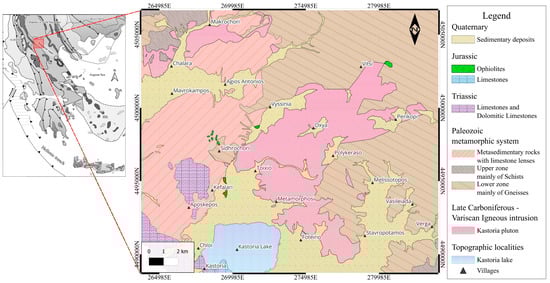
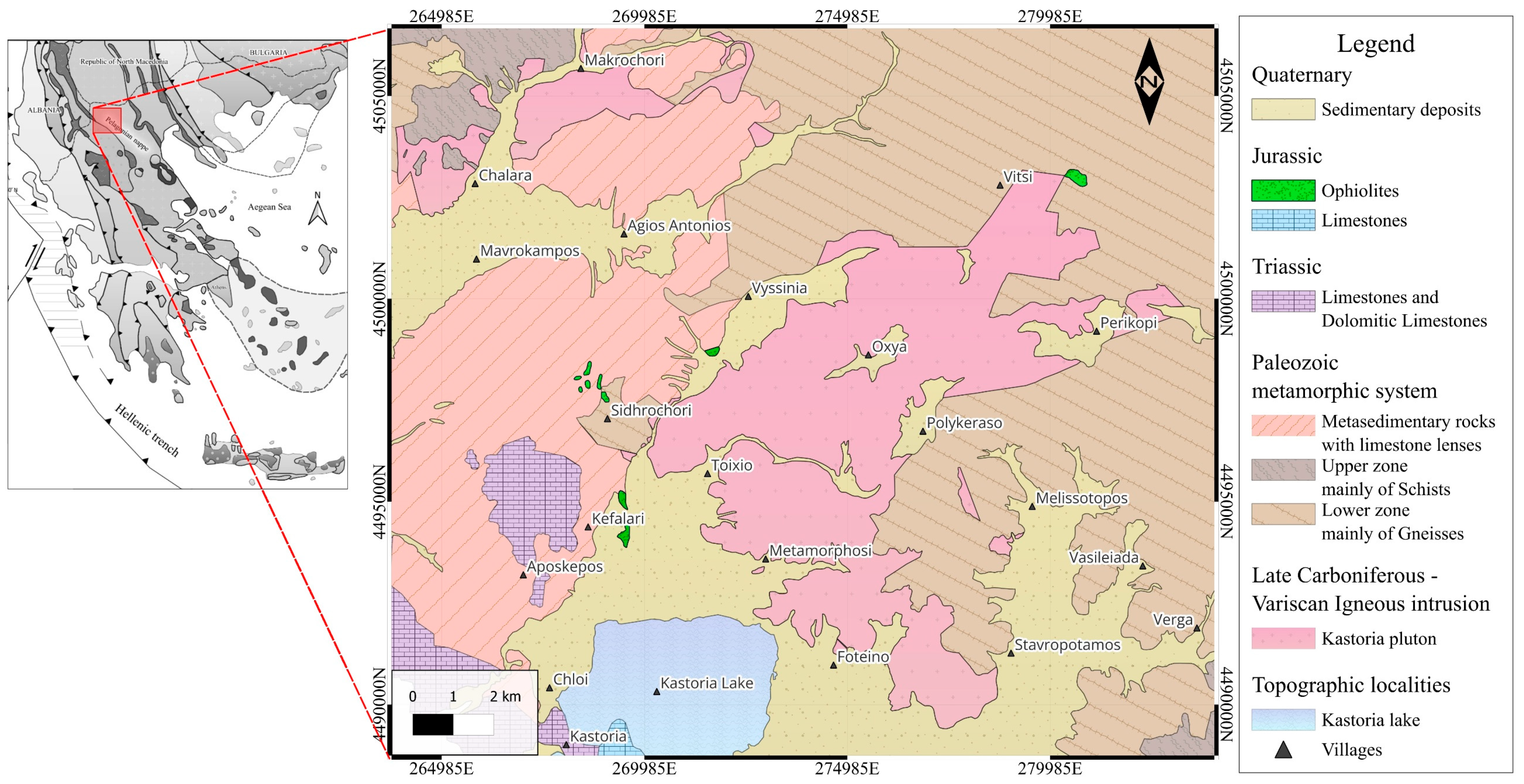
The Kastoria pluton is emplaced within the northwestern Pelagonian Zone, a Gondwana-derived continental fragment forming part of the Internal Hellenides. Regionally, the Pelagonian basement consists of polymetamorphic gneisses, amphibolites, schists, and marbles, which are intruded by Paleozoic to Mesozoic granitoids (Figure 1). The Kastoria intrusion is part of the Variscan magmatic suite and crystallized at 300 ± 2 Ma [8].
Figure 1.
Geological map of the Kastoria pluton (modified after [9]). Upper left corner, geological map of Greece, modified after [1] with red square indicating the study area.
Pluton is prominently exposed on Mt. Verno, where it intrudes Paleozoic schists and amphibolites of the Kleisoura Series [10]. Its present structural configuration is strongly controlled by Alpine tectonism: mylonitization, foliation development, and gneissification. Particularly, on the borders of the pluton, many outcrops now appear augen gneissic, leaving behind some local primary magmatic fabrics. Earlier studies described contact metamorphic assemblages around the pluton [10]; however, recent field observations indicate that tectonic contacts dominate, with no clear evidence of primary contact aureoles.
3. Materials and Methods
Samples from the Kastoria pluton were collected, covering an area of approximately 90 km2, prioritizing unweathered rocks where possible. This was challenging because the weathering and vegetation in the area is extensive. In addition to the newly collected material [I.G.], previously sampled rocks from earlier fieldwork by [A.K.] were also included. First, thin sections from GR and MME were examined under a polarizing light microscope.
Major element compositions of all observed minerals were determined using Scanning Electron Microscopy–Energy Dispersive Spectroscopy (SEM-EDS) at the Interdepartmental Electron Microscopy Laboratory of Aristotle University of Thessaloniki with a JEOL JSM-6390LV (Tokyo, Japan), coupled with an Energy Dispersive Spectrometer (EDS), model INCA 300 (Oxford, UK). Pure cobalt (Co) was used as a standard. The analytical conditions included an operating voltage of 20 kV, a beam current of 0.4 mA, a counting time of 80 s, and an electron beam diameter of approximately 1 μm. Standards were used as follows: sanidine for Si-Kα, Al-Kα and K-Kα; diopside for Ca-Kα, and Mg-Kα; hematite for Fe-Kα; tephroite for Mn-Kα; rutile for Ti-Kα; albite for Na-Kα; sylvite for Cl-Kα, and synthetic compounds for La, Ce, Nd, Y, U, and Th. Multiple spot analyses (typically 3 to 5 per grain) were acquired on each mineral phase to assess intra-grain variability. Both unaltered and altered domains (including alteration rims) were targeted to evaluate compositional differences. Samples were carbon-coated.
For trace elements, including REEs, analyses for titanite, allanite, and epidote were carried out using a laser ablation–inductively coupled plasma–mass spectrometry (LA-ICP-MS) system installed at the Centre for Instrument Sharing of University of Pisa (CISUP). The system is composed of an Elemental Scientific (Omaha, NE, USA) NWR-193 (ArF) excimer laser equipped with a TwoVol2 two-volume cell, coupled with a PerkinElmer (Shelton, CT, USA) NexION 2000 ICP-MS. The laser was operated at a repetition rate of 10 Hz, using a spot size of 40 μm and a fluence of 2.7 J/cm2. Helium was used as the gas carrier, with a flow rate of 700 mL/min. The ICP-MS was operated with an RF power of 1300 W and with a flow rate of the Ar nebulizer of 900 mL/min. A total of 36 masses were collected (Li7, Si29, Ca43, Sc45, Ti49, V51, Cr53, Mn55, Co59, Ni60, Cu65, Zn66, Rb85, Sr88, Y89, Zr90, Nb93, Cs133, Ba137, La139, Ce140, Pr141, Nd146, Sm147, Eu151, Gd157, Tb159, Dy163, Ho165, Er166, Tm169, Yb172, Lu175, Hf178, Ta181, Pb208, Th232, and U238), using a dwell time of 8 ms. Signals were acquired for 30 s during ablation and 50 s with laser off (background). The synthetic glass standard NIST612 was used for tuning of the ICP-MS and as calibration standard, whereas the synthetic glass standard NIST610 and an in-house basaltic glass standard (BE-N) were used as quality monitor. Standard glasses were measured every 6–8 spots. Silicon concentration (previously measured by SEM-EDS) was used as internal standard. Accuracy and precision were better than 5% and 10%, respectively, for most of the elements (Ti, Cu, and Zn had accuracy and precision better than 10% and 20%, respectively). Limits of detection were calculated according to Howell et al. [11]. Data processing was conducted using the commercial software Iolite v4 [12,13].
4. Results—Discussion
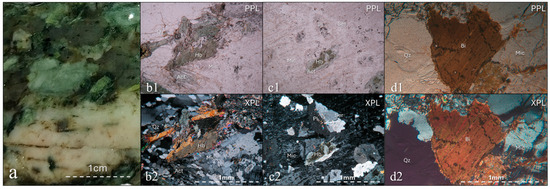
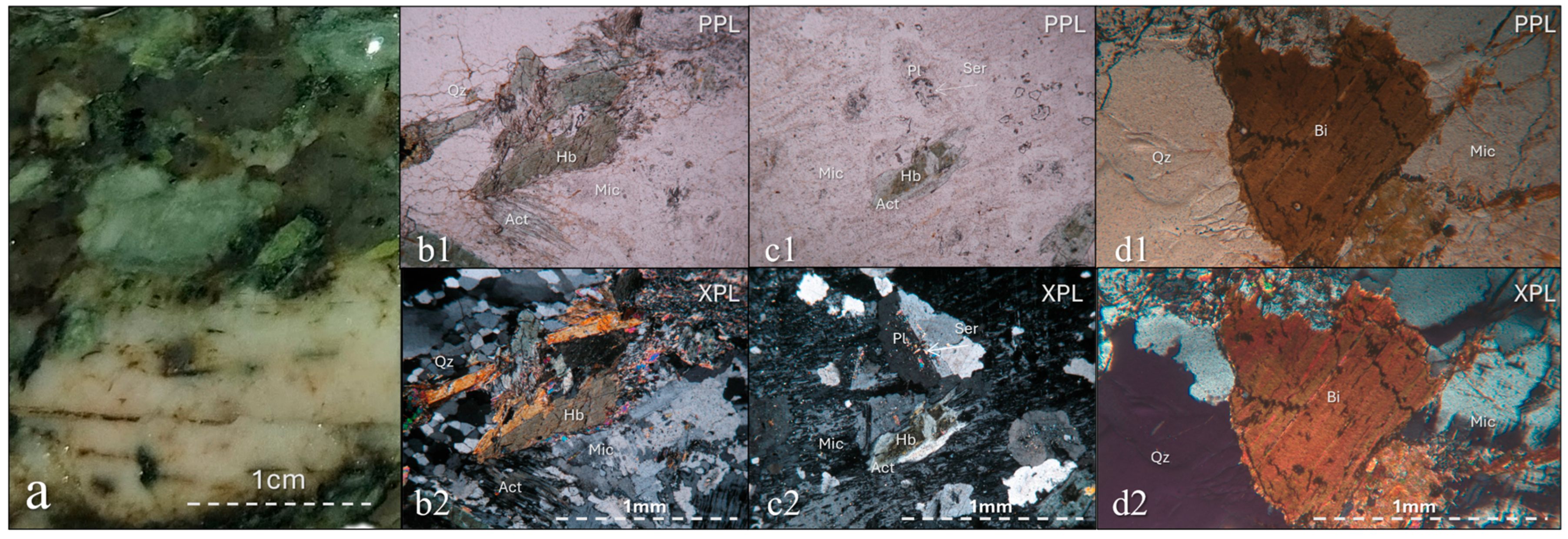
Petrographically, the Kastoria intrusion consists mainly of porphyritic monzogranite to granodiorite (GR), characterized by K-feldspar megacrysts of microcline within a matrix of quartz, plagioclase, biotite, and hornblende (Figure 2). Accessory phases include titanite, epidote, allanite, apatite, zircon, and magnetite. Metamorphism produced secondary muscovite, chlorite, actinolite, and caused kaolinization, sericitization, and saussuritization to the feldspars.
Figure 2.
(a) Macroscopic photo of GR. (b1–d2) Microphotographs of (a) under the polarizing microscope. PPL: plane-polarized light; XPL: cross-polarized light.
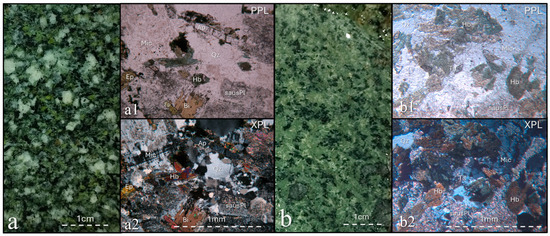
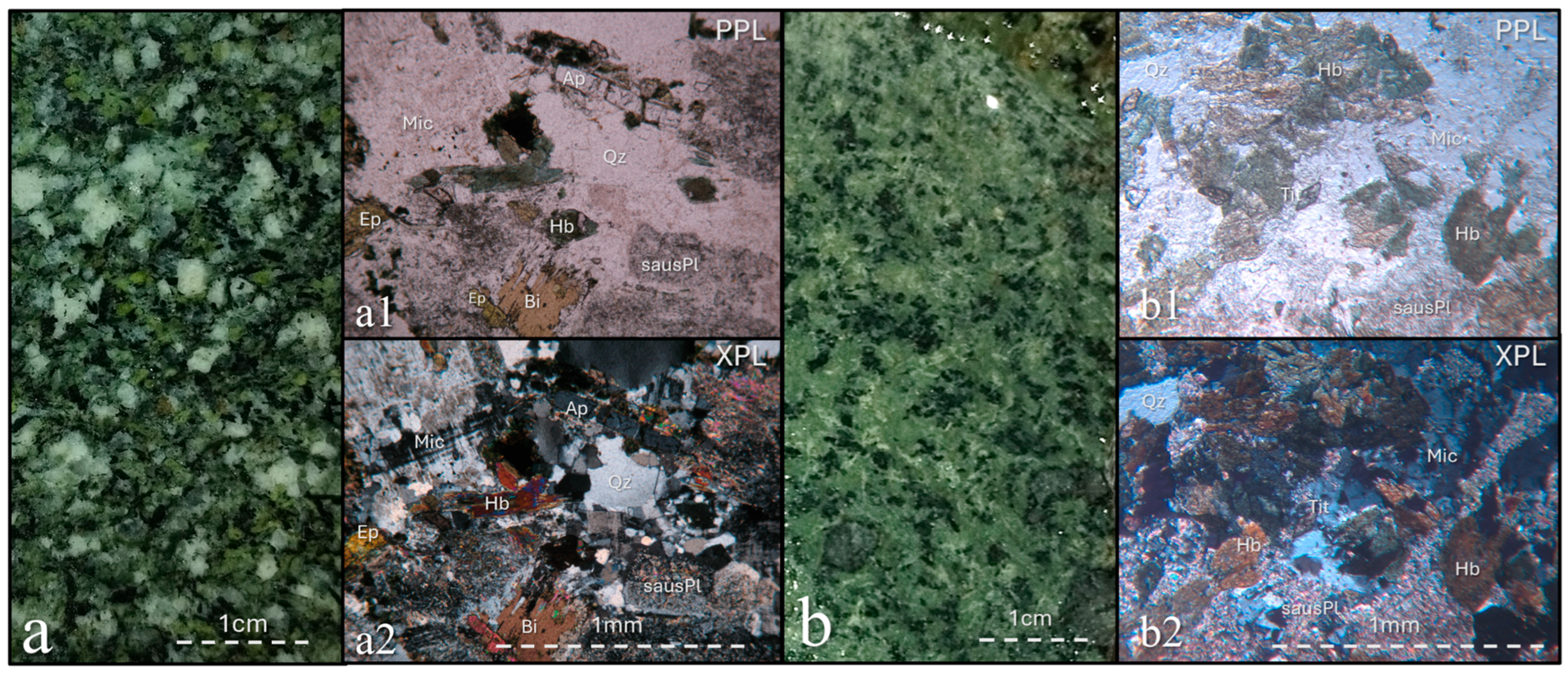
The GR hosts mafic microgranular enclaves (MME) of quartz–monzonitic to monzonitic composition with the same mineral assemblage, which are finer grained and enriched in biotite and amphibole relative to the host (Figure 3). Their crenulated contacts and mixing textures provide clear evidence of magma mingling processes.
Figure 3.
(a) Macroscopic photo of Qz-rich coarse grained EN. (a1,a2) Microphotographs of (a) under the polarizing microscope. (b) Macroscopic photo of finer grained EN. (b1,b2) Microphotographs of (b) under the polarizing microscope. PPL: plane-polarized light; XPL: cross-polarized light.
4.1. Titanite
4.1.1. Titanite Textures
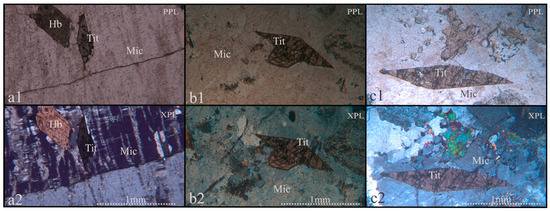
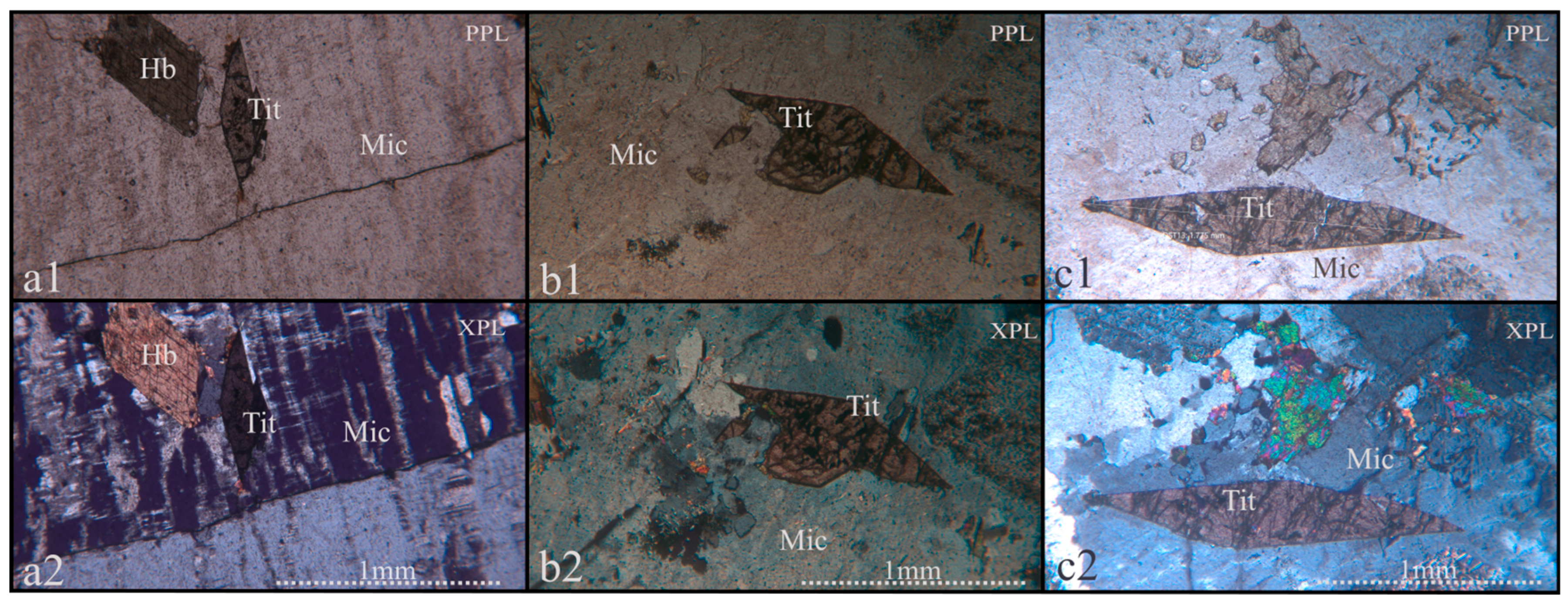
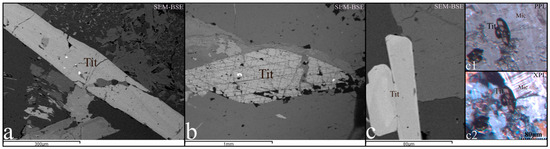
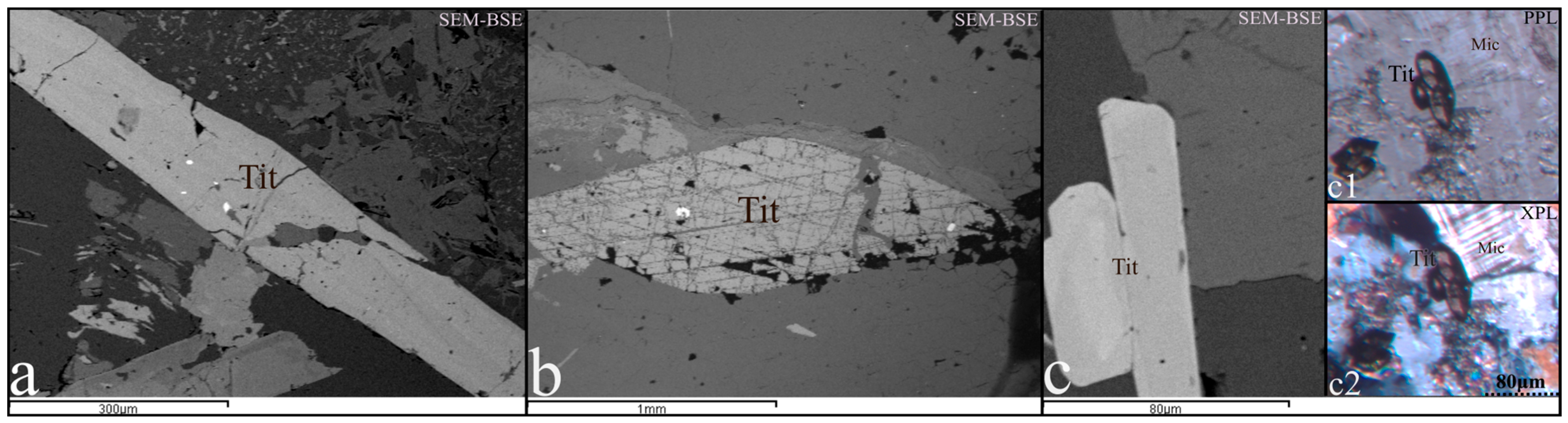
Titanite is present in both GR and EN, occurring in several distinct textural forms. The most common habit consists of large, brown, euhedral wedge-shaped (sphenes) crystals, reaching up to 2 mm in length. It is commonly enclosed in microcline megacrysts (Figure 4(a1–c2)) or dispersed within the groundmass.
Figure 4.
(a1–c2) Microphotographs of titanite enclosed in microcline megacrysts. (1) PPL: plane-polarized light; (2) XPL: cross-polarized light.
The large titanite crystals enclosed in the microcline megacrysts appear better preserved, whereas those that are dispersed in the mass show a lot of cracks, disturbing their crystal form (Figure 5a,b).
Figure 5.
(a,b) SEM-BSE images of large titanite crystals, showing cracks, (c) SEM-BSE image of small titanite crystals, and (c1,c2) corresponding microphotographs of (c) under the polarizing microscope. (1) PPL: plane-polarized light; (2) XPL: cross-polarized light.
Smaller titanite crystals, typically from 100 to 300 μm length, appear also as euhedral brown sphenes (Figure 5c). In addition, very fine acicular titanite crystals occur locally as needles or thin laths <40 μm in length, forming small clusters or marginal aggregates around epidote, amphibole, and biotite.
4.1.2. Titanite Origin Criteria
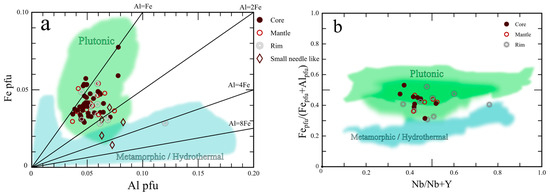
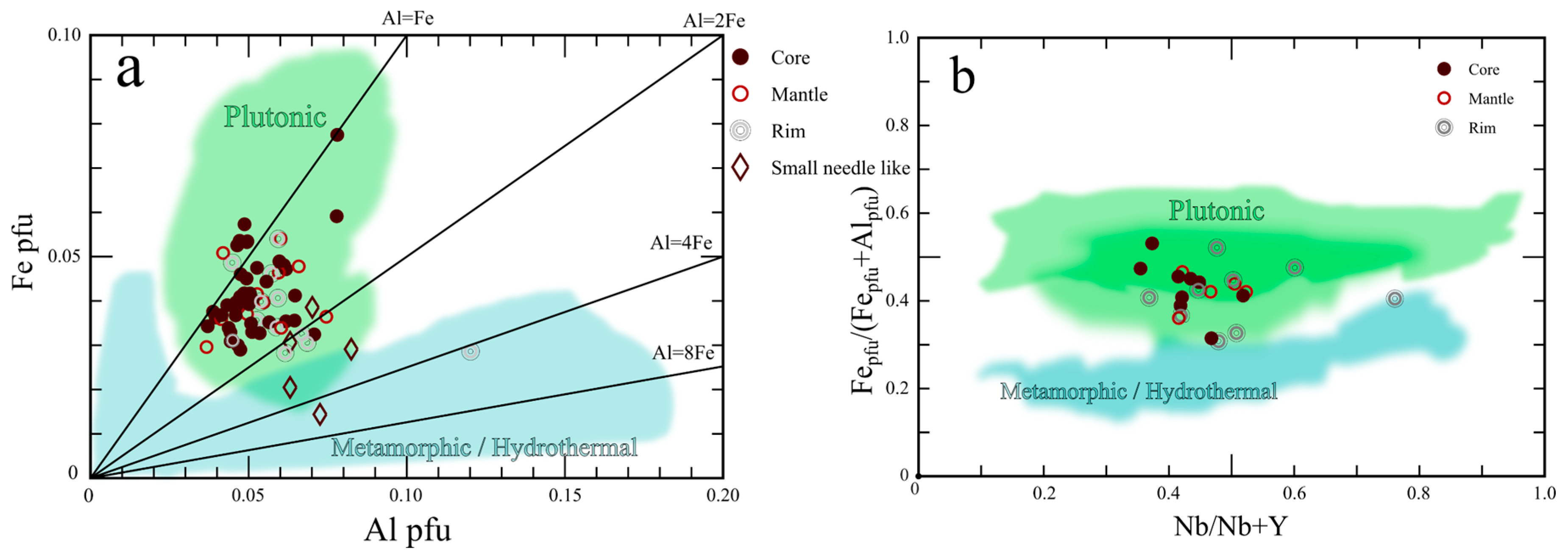
The distinction between magmatic and metamorphic/hydrothermal titanite has been examined by numerous studies [14,15,16,17,18,19,20,21,22,23]. Typically, a combination of texture and elemental composition has been used with Fe vs. Al (apfu) being one of the most applied discriminators. More recently, data from various tectonic environments have been incorporated by Kowallis et al. [18] to refine the plutonic and metamorphic fields (Figure 6a).
Figure 6.
Geochemical variation diagrams for titanite. (a) Fe vs. Al (apfu) (modified after [18,23]), and (b) Fepfu/(Fe + Al)apfu vs. Nb/Nb+Y (modified after [18]).
In the present study, no clear distinction was observed between the chemical composition of large and small titanite crystals, so in the diagrams following, they are grouped as core, mantle, rim, and small needle-like titanites. Although there is an overlap between the plutonic and metamorphic/hydrothermal fields, analyses of cores and mantles generally plot in the plutonic field, whereas some rims, especially rims of Tit not enclosed in Mic megacrysts, plot closer to the metamorphic field, along with the tiny needle-like titanites (Figure 6a).
Due to their size, the needle-like titanites could not be analyzed by LA-ICP-MS, as the analytical spot size used exceeded their dimensions. Therefore, only the large and small titanites were analyzed for trace elements using LA-ICP-MS. On the Fepfu/(Fe + Al)apfu vs. Nb/Nb+Y diagram [18], titanite rims and cores plot mainly in the plutonic field with a few values extending to the metamorphic field (Figure 6b). In the diagram itself, the plutonic field overlaps slightly with the metamorphic field.
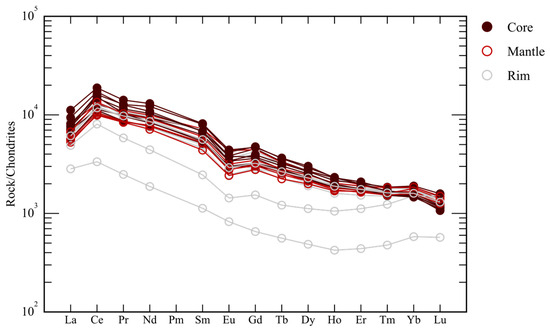
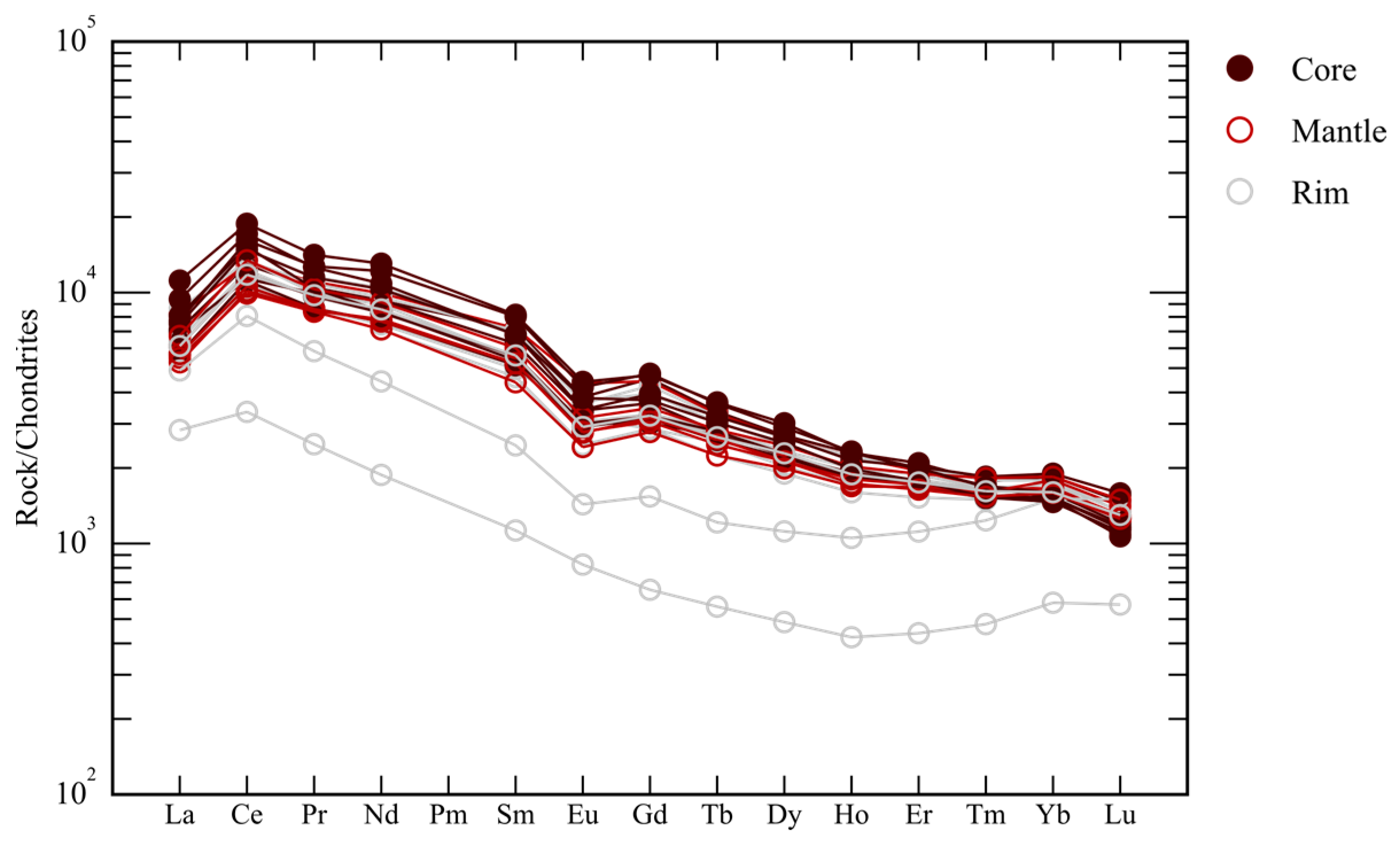
Chondrite-normalized REE patterns for titanite (Figure 7) show steep LREE enrichment and two weak anomalies at Eu (0.66–0.96) and Ce (1.26–1.66). The negative Eu anomaly has been related to magmatic titanites and attributed to plagioclase fractionation during melt evolution [14,19]. The positive Ce anomaly suggests crystallization under oxidizing conditions, where Ce4+ is stabilized. This is consistent with the I-type, subduction-related character [24] of the Kastoria pluton.
Figure 7.
Chondrite-normalized REE patterns for titanite, normalized after [25].
The REE patterns show a particular trend. Titanite cores display the highest total REE contents, the values decrease toward the mantles, and the rims show the lowest concentrations, producing more downward flatter patterns. A comparable pattern was reported by Zhao et al. [14]. They considered the REE-rich cores and mantles of magmatic origin, with the outermost rims representing recrystallized titanite formed during later subsolidus alteration.
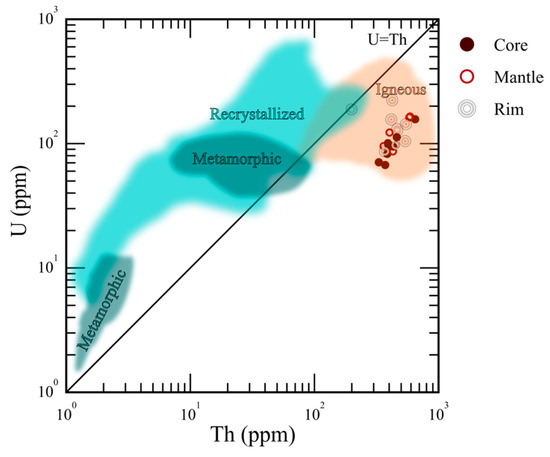
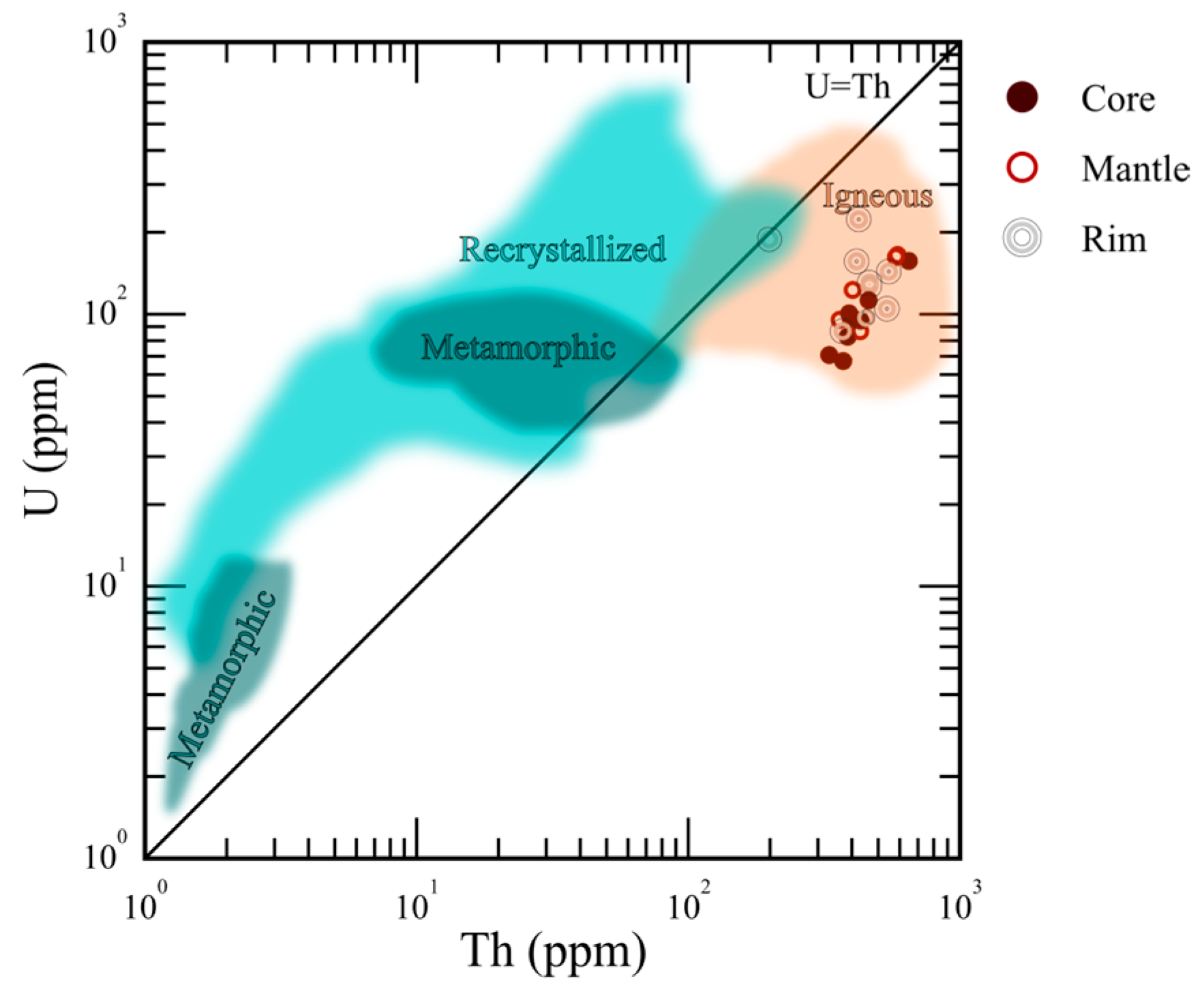
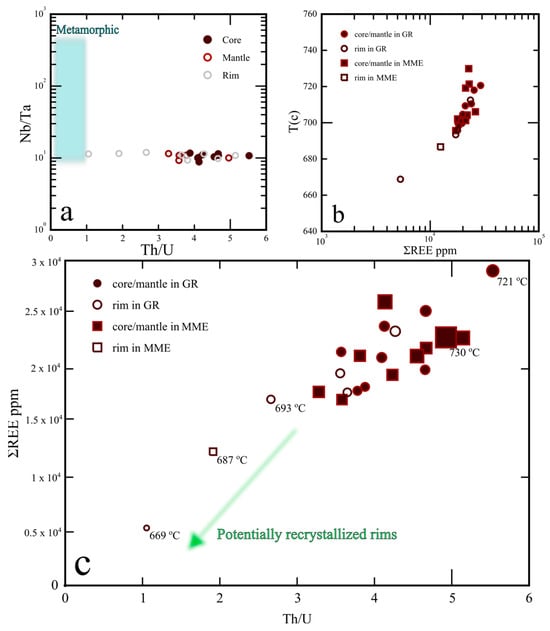
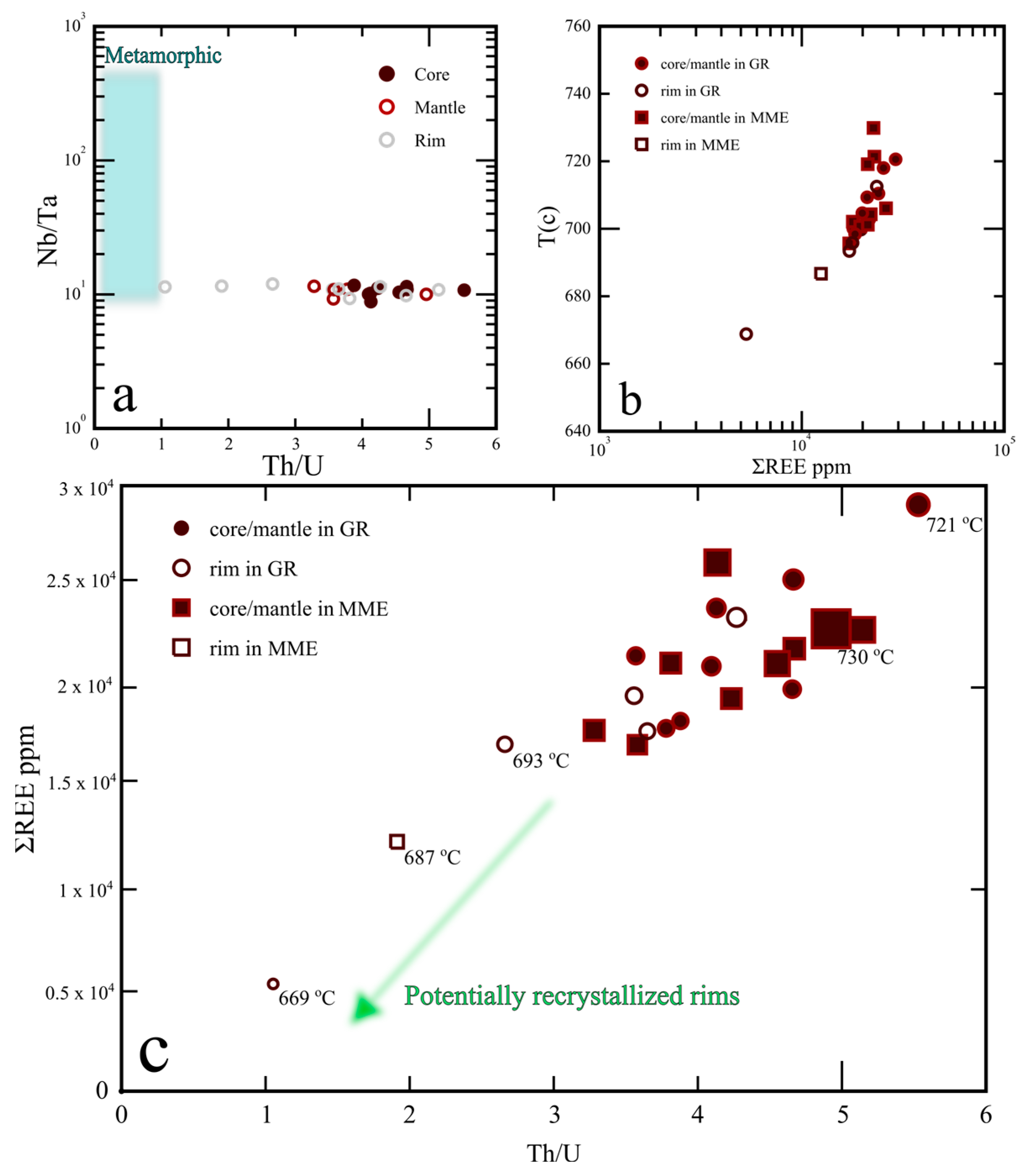
Another elemental indicator commonly used to distinguish magmatic from metamorphic titanite is the behavior of U and Th. Metamorphic or recrystallized titanite typically shows depletion in Th relative to igneous titanite. In Figure 8, the cores and mantles plot within the igneous field and a few rims shift towards the recrystallized domain. A similar trend is shown in Figure 9a, with rims plotting towards the metamorphic field.
Figure 8.
Geochemical variation diagram for titanite, U (ppm) vs. Th (ppm), modified after [16]. Igneous field from [22,26,27,28], metamorphic field from [22,26], and recrystallized field from [27,28].
Figure 9.
(a) Nb/Ta vs. Th/U, modified after [14,21], (b) T(c) vs. ΣREE (ppm), T(c) calculated from [29], and (c) ΣREE (ppm) vs. Th/U; symbols are scaled to the T(c). Arrow showing the trend of the recrystallized rims with decreasing temperatures.
Application of the Zr-in-titanite thermometer of Hayden et al. [29] at the measured Amphibole barometry pressure of 0.3 GPa using Mutch et al. [30] barometer, yields crystallization temperatures ranging from 669 to 730 °C (for aTiO2 = 0.5 and aSiO2 = 1). As shown in Figure 9b,c, three analyzed spots correspond to rims and display low Th/U (1–3) and the lowest temperatures: 669, 687, and 693 °C, respectively. These temperatures are mostly below the water-saturated granite solidus suggesting subsolidus growth [14]. By excluding these three rims, the remaining titanites in the GR show temperatures ranging from 696 to 721 °C, with an average of 706 °C. In MME, titanite temperatures range from 696 to 730 °C, with an average of 708 °C.
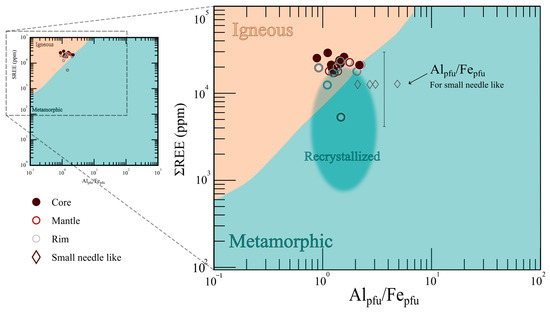
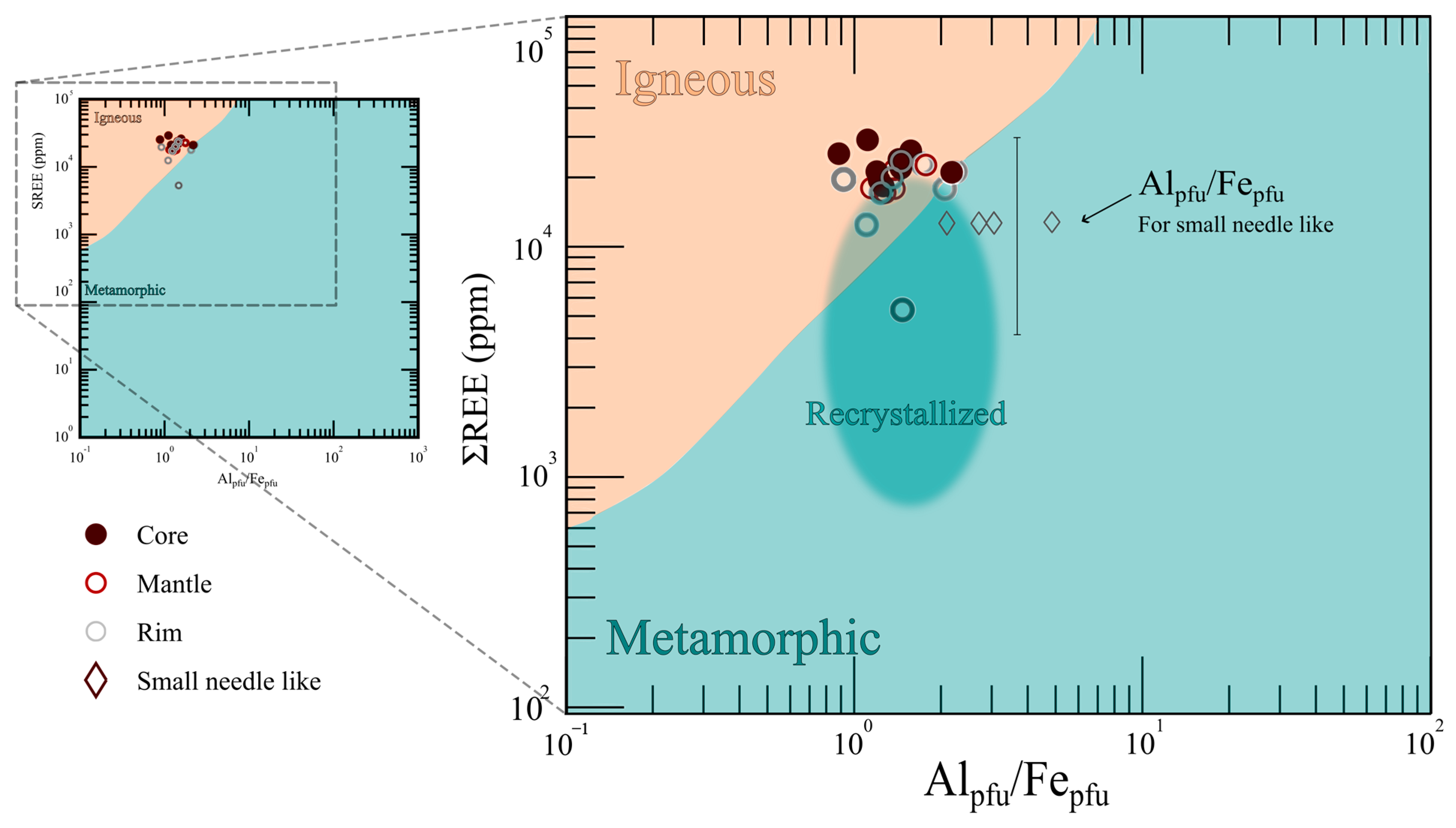
To further assess potential differences between cores, mantles, and rims, and to evaluate whether any metamorphic origin has gone unnoticed, the comparative framework of Scibiorski and Cawood [16] was applied. Their compilation of data defined statistically robust fields for igneous, metamorphic, and an overlapping field of recrystallized titanite on a ΣREE (ppm) versus Al/Fe (apfu) diagram (Figure 10).
Figure 10.
Geochemical variation diagram for titanite, ΣREE (ppm) vs. Al/Fe (apfu), modified after [16].
In this scheme, the Kastoria titanites show a consistent pattern. Cores and mantles fall within the igneous field, whereas some rims plot within the recrystallized overlap (Figure 10). The small needle-like titanites, which could not be analyzed for REE due to their size, were placed on the diagram using their (Al/Fe)apfu values with a line indicating the expected ΣREE range. Because their ΣREE is unlikely to exceed that of the cores, these tiny titanite needles would most probably fall toward the metamorphic field (Figure 10).
4.1.3. Titanite—Discussion
The large and small euhedral crystals, particularly those enclosed within Mic megacrysts, show well-developed wedge-shaped habits, continuous magmatic zoning, and elevated ΣREE and Th/U values. Their positions on the (Fe vs. Al)apfu; Fepfu/(Fe + Al)apfu vs. Nb/Nb+Y and ΣREE vs. (Al/Fe)apfu diagrams consistently fall within the igneous stability fields defined in previous studies, supporting their interpretation as magmatic titanite.
Where titanite crystals are fractured, rims depart from magmatic signatures. These domains show lower ΣREE, lower Th/U, higher (Al/Fe)apfu, and systematically lower Zr-in-titanite temperatures. Such trends match reported effects of low-grade recrystallization, where lattice disruption, fluid influx, or partial dissolution–reprecipitation preferentially deplete REE and Th while promoting Al-rich, lower-temperature titanite growth. The rims plot toward the “recrystallized” or “metamorphic/hydrothermal” fields in several discrimination diagrams, indicating subsolidus modification rather than a completely new metamorphic generation.
The small needle-like titanites form a separate population. Their distinctive acicular habit, high Al/Fe ratios, and occurrence along cracks or adjacent to altered plagioclase and biotite suggest formation during subsolidus alteration, consistent with descriptions by [20] and others for hydrothermal titanite. Their size prevented LA-ICP-MS analysis, but when projected conceptually onto the ΣREE–Al/Fe diagram, their compositions align with metamorphic titanite fields rather than the igneous domain defined by the larger crystals. Notably, these titanite needles are interpreted as metamorphic rather than recrystallized magmatic titanite because of their habit and spatial association with late-stage metamorphic fabrics, rather than continuous overgrowths on larger magmatic crystals.
Overall, the titanite population records a largely magmatic assemblage subsequently modified by localized greenschist-facies overprinting. Magmatic cores and mantles preserve primary signatures, whereas rims capture the mineralogical footprint of a potential subsolidus recrystallization. Needle-like titanites are newly formed metamorphic grains.
4.2. Allanite
4.2.1. Allanite Textures
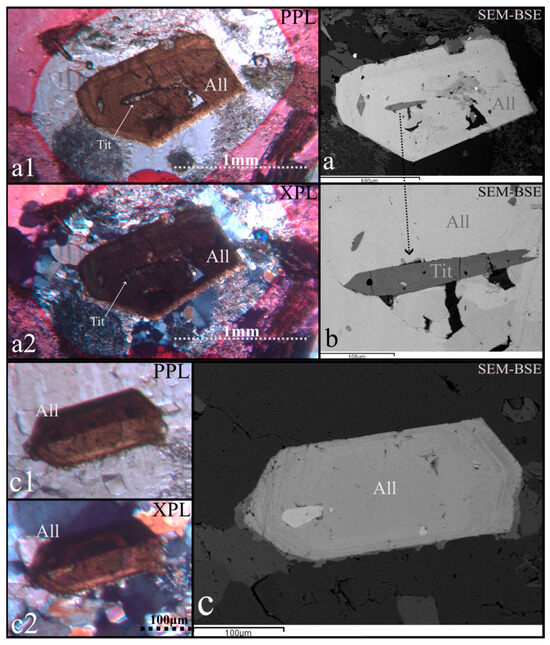
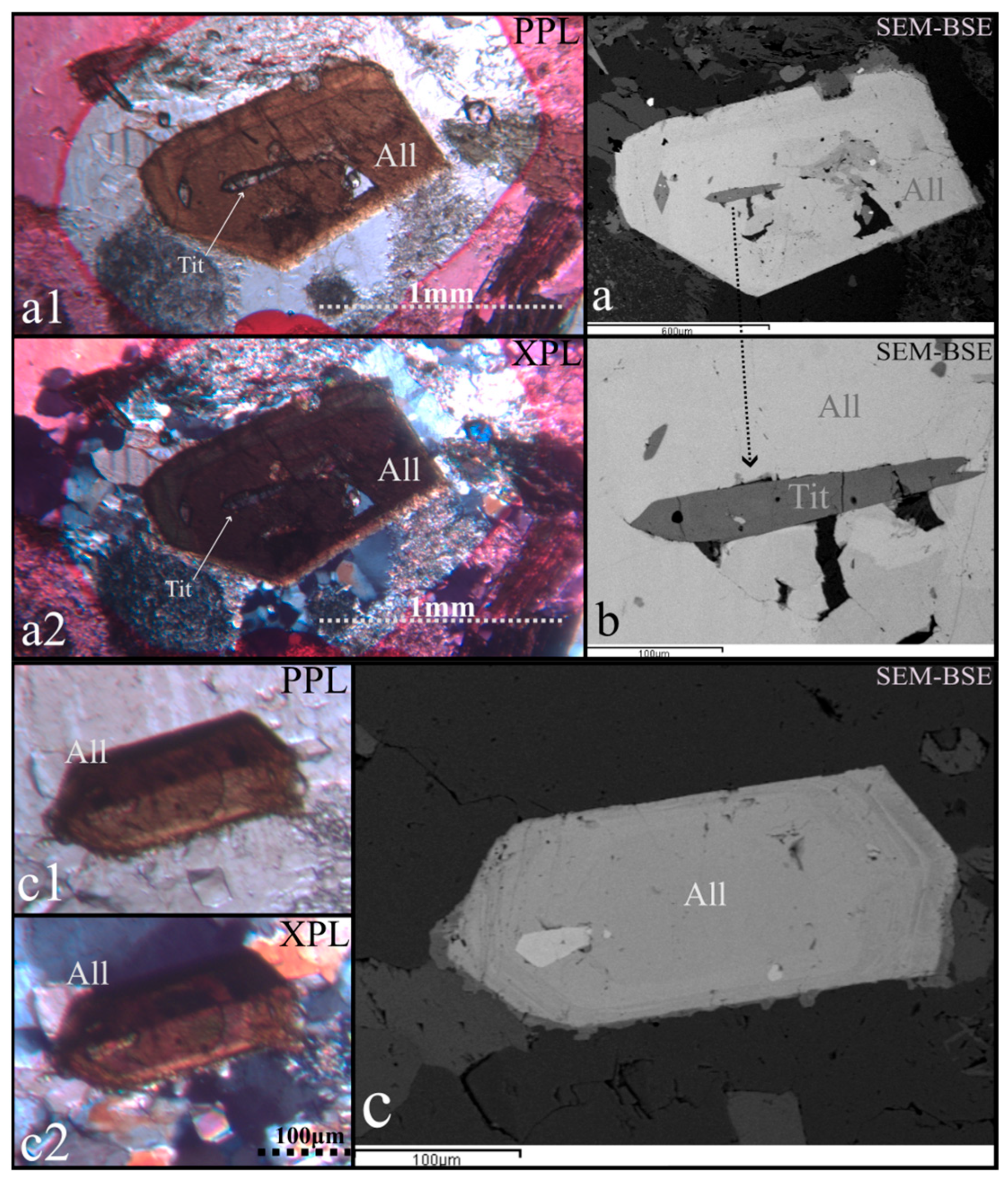
Allanite occurs as both small (100 μm along the longest axis) and larger euhedral crystals (1.5 mm along the longest axis) in the two petrographic types. In well-preserved grains, zoning is visible under polarizing light (Figure 11(a1,a2)) and appears as weak compositional zonation under SEM imaging (Figure 11a). Twinning is more common in the smaller prismatic crystals (Figure 11(c1,c2)). Titanite inclusions are locally present within allanite (Figure 11b). Even in intact crystals, mild lattice disturbance is visible toward the rims, interrupting the continuous zonation (Figure 11c).
Figure 11.
Microphotographs and SEM-BSE images of well-preserved allanites. (a) SEM-BSE image of a large euhedral crystal, (a1,a2) corresponding polarized-light images of crystal (a), (b) titanite inclusion in crystal (a), (c) SEM-BSE image of a small euhedral crystal, and (c1,c2) corresponding polarized-light images of crystal (c). (1) PPL: plane-polarized light; (2) XPL: cross-polarized light.
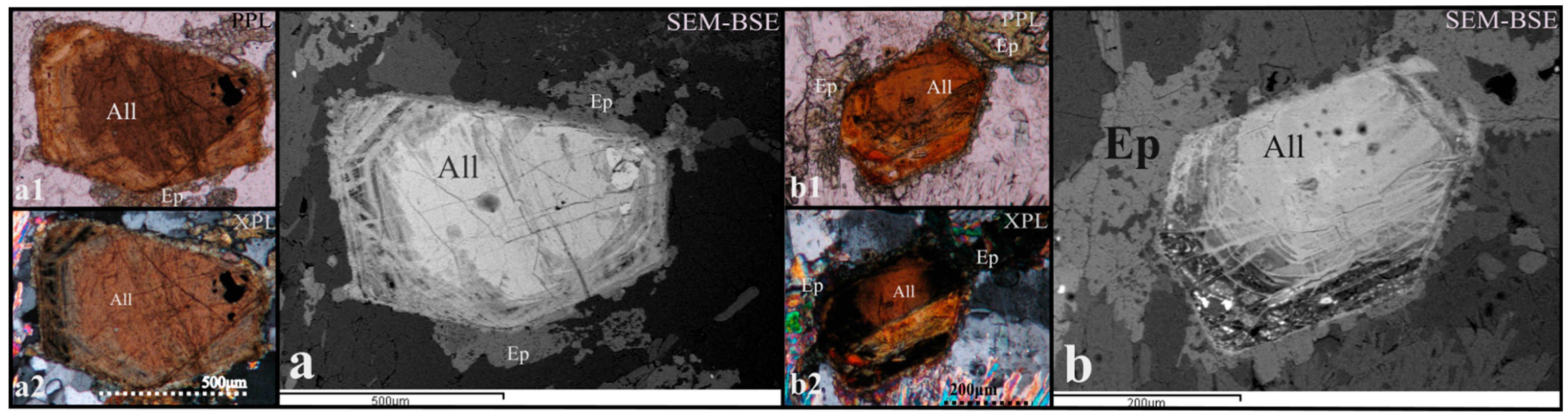
In contrast to the well-preserved allanite crystals described above, several grains display clear signs of post-magmatic deterioration (Figure 12). Large euhedral crystals show disrupted or weakened zonation in SEM–BSE images, with porous epidote developing along their rims. In some examples (Figure 12a), the internal zoning is still partly recognizable, whereas others exhibit more extensive rim breakdown and loss of structural continuity (Figure 12b). The corresponding polarized-light images (Figure 12(a1–b2)) show similarly cloudy and irregular rims, marking a shift from the intact textures observed in the better-preserved allanite.
Figure 12.
Microphotographs and SEM-BSE images of deteriorated allanite. (a) SEM-BSE image of a large euhedral crystal with disrupted zonation and spongy epidote around the rim, (a1,a2) corresponding polarized-light images of crystal (a), (b) SEM-BSE image of a large euhedral crystal with more intense zonation disruption and complete rim breakdown, surrounded by spongy epidote, and (b1,b2) corresponding polarized-light images of crystal (b). (1) PPL: plane-polarized light; (2) XPL: cross-polarized light.
4.2.2. Allanite Origin Criteria
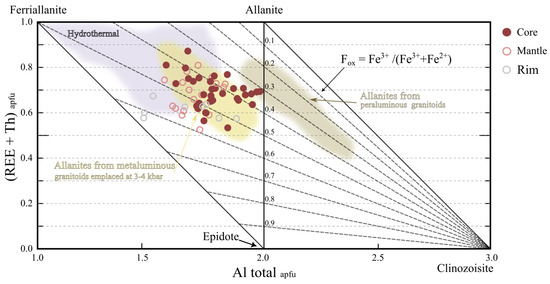
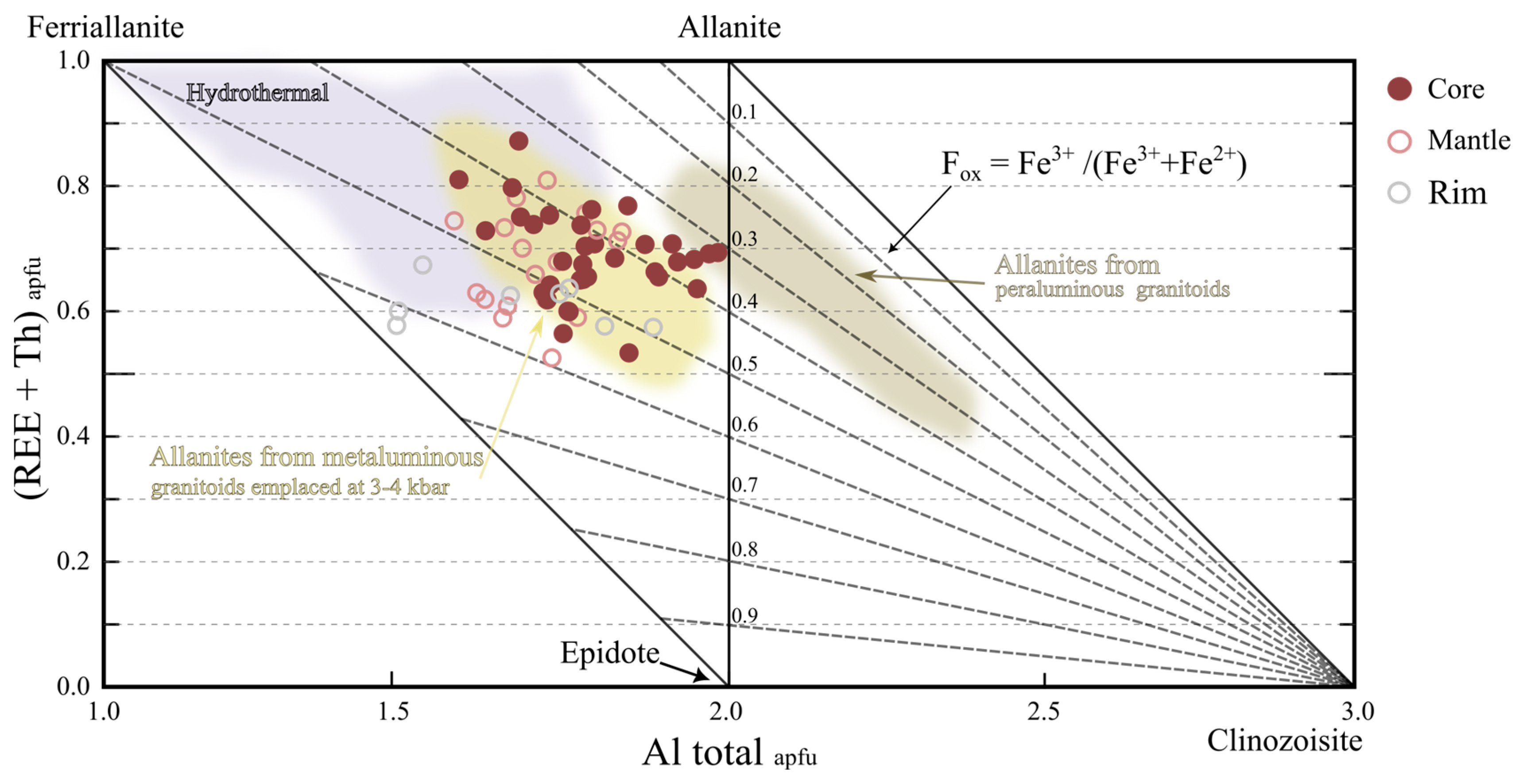
The chemical variations of the allanites were evaluated using atom per formula unit data for the cores, mantles, and rims. No comparable differences were noticed between allanites from MME and GR. Variations in REE, Th, and Al reflect shifts in oxidation state and substitution mechanisms within the epidote-group minerals. On the (REE + Th)apfu versus total Alapfu diagram (Figure 13), most analyses plot in the allanite field, with a subset plotting toward the Ferriallanite field.
Figure 13.
Plot of (REE + Th)apfu vs. Al total apfu for allanite modified after [31]. Shaded fields after [32].
The Fox isolines indicate redox conditions, between 0.3 and 0.6, with most analyses clustering around 0.4–0.5. According to Petřík et al. [31], allanites from I-type granites commonly plot within this range, and the shaded fields from Mellado et al. [32] in Figure 13 are consistent with the distribution observed in this study. Cores and mantles plot uniformly within the igneous allanite field, corresponding to compositions of metaluminous to peraluminous granitoids. In contrast, some rims deviate toward the hydrothermal and Ferriallanite field.
Likewise, similar distributions of magmatic allanites have been documented by [33,34,35,36,37], reinforcing the interpretation that the core and mantle compositions in this study reflect primary igneous signatures. Work by Giere and Sorensen [38] reports magmatic alanites plotting around Fox values of 0.4–0.5, though with lower (REE + Th)apfu and higher Al total apfu (2.1–2.4). In parallel, the work of Gros et al. [19] provides a detailed study of the different areas of allanite crystals. Their detailed micro-analytical mapping of allanite reveals discrete magmatic cores overprinted by progressively altered mantles and rims, with compositions drifting toward the hydrothermal field. This pattern is similar to what is seen in this study, where magmatic cores also grade into more altered rims.
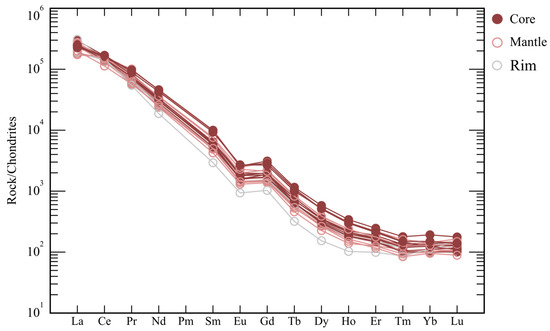
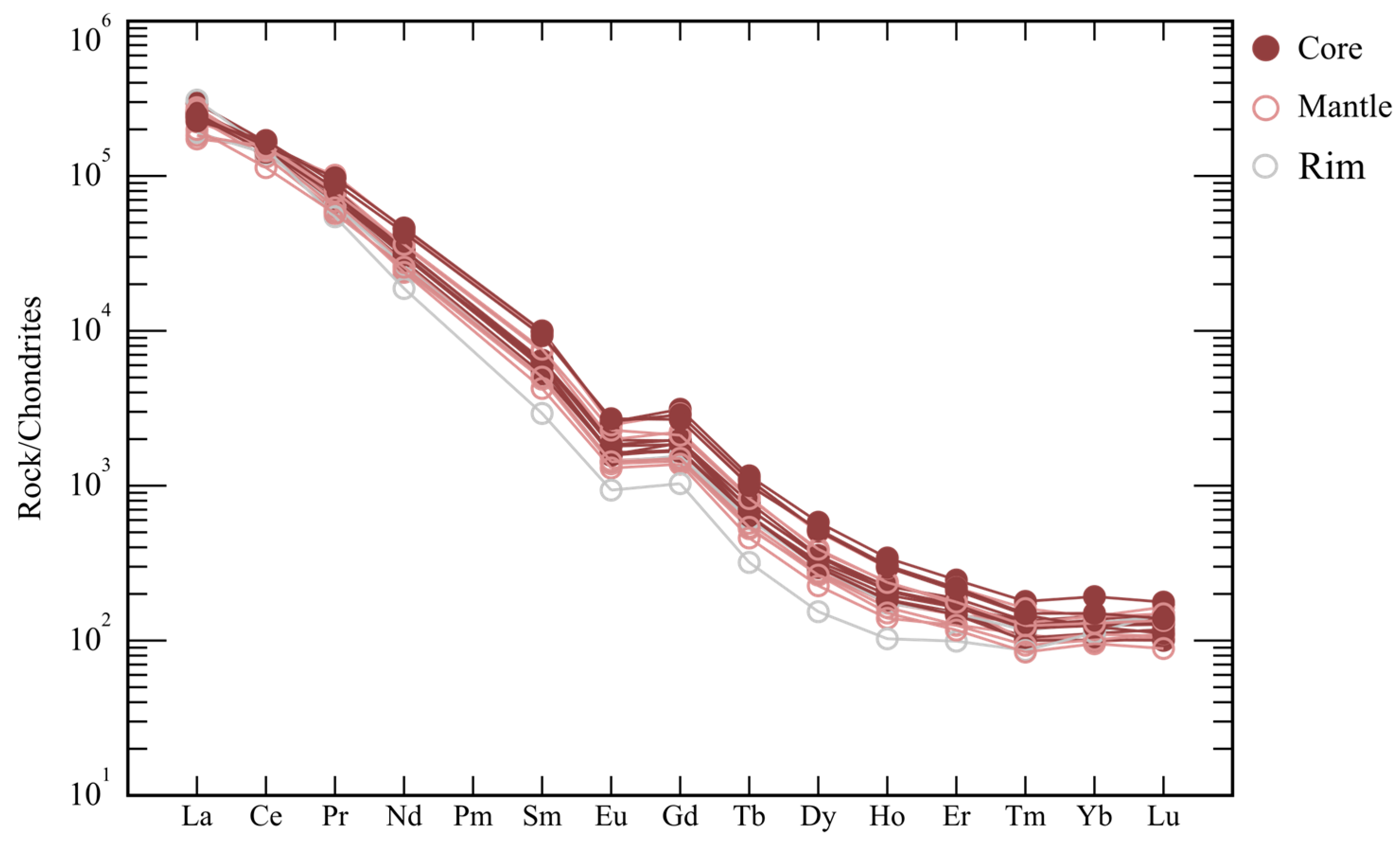
Chondrite-normalized REE patterns for allanite (Figure 14) display strong LREE enrichment and a negative Eu anomaly (0.46–0.57). From core to rim, the overall REE content decreases, with the main drop in the HREE.
Figure 14.
Chondrite-normalized REE patterns for allanite, normalized after [25].
Magmatic allanites typically display LREE-enriched patterns with a negative Eu anomaly, consistent with earlier observations by [31,38], and more recent studies by [19,34,37]. In contrast, metamorphic/hydrothermal allanites show much broader REE ranges, flatter patterns, and generally lack an Eu anomaly, sometimes even developing positive one [32]. Doley et al. [39] reported anhedral allanites with unusually low Al (down to 1.5 apfu) and high (REE + Th)apfu contents plotting in the upper-left part of the (REE + Th vs. Al)apfu diagram; their altered allanites extend to even lower Alpfu as low as 1 and lower (REE + Th)apfu as low as 0.4. Although they interpret these as magmatic grains later altered, their magmatic All lie close to the hydrothermal domain, implying stronger alteration than observed in this study. Their REE patterns show a negative Sm anomaly and lack the Eu anomaly that has not been reported before, while they mention metamictization and not metamorphism. This difference helps sharpen the distinction between the well-preserved magmatic signatures in the present samples and the more variably modified allanites reported elsewhere.
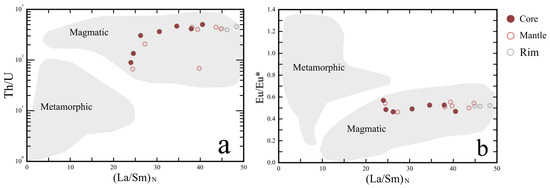
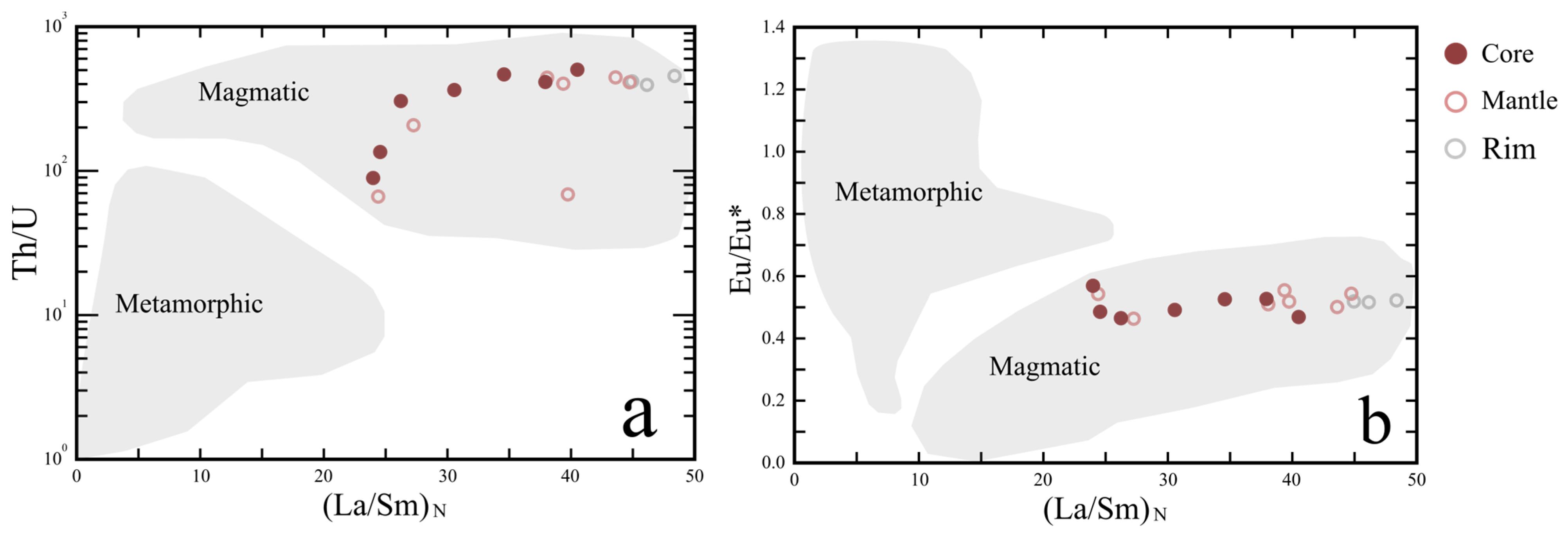
To examine the origin of the allanites, two widely used discrimination diagrams were used, the Th/U versus La/Sm (Figure 15a) and the Eu/Eu* versus La/Sm (Figure 15b). First proposed by Gregory et al. [40], these diagrams define separate fields for «Magmatic (Pre-Alpine)» and «Metamorphic (Alpine)» allanites. These diagrams have been applied in several studies, e.g., [34,41,42,43] for both magmatic and metamorphic allanites. Their usefulness lies in the contrasting geochemical behavior of allanite in different settings, since magmatic compositions typically show elevated LREE relative to MREE, higher Th/U ratios linked to U mobility [44], and stronger negative Eu anomalies.
Figure 15.
Discrimination diagrams for allanite modified after [40]. (a) Th/U vs. LaN/SmN, and (b) Eu/Eu vs. LaN/SmN.
The allanites analyzed in this study plot are within the magmatic field of both diagrams (Figure 15a,b), although they display noticeable dispersion across the magmatic range. A subtle trend toward higher La/Sm ratios is observed, particularly for mantles and rims. This shift is consistent with the REE patterns (Figure 14), where the outer zones show depletion mainly in the MREE rather than the LREE. Such selective depletion elevates the La/Sm ratio without requiring a metamorphic origin. It likely reflects mild recrystallization effects that preferentially mobilize MREE, while the overall REE profile, Eu anomaly, and Th/U behavior remain characteristic of magmatic allanite. This interpretation aligns the chemical variation of mantles and rims with modification of an initially magmatic signature rather than formation of new metamorphic allanite.
4.2.3. Allanite—Discussion
The well-preserved euhedral shapes, oscillatory zoning in cores and mantles and chemistry of the allanites indicate that the crystals are primarily magmatic, with only limited late-stage modification. In the (REE + Th)apfu vs. Alpfu diagram, most analyses plot in the allanite field, and trend towards ferriallanite. Fox values between 0.4 and 0.5 correspond to typical magmatic redox conditions. Cores and mantles fall within igneous compositions, whereas some rims shift toward the hydrothermal/ferriallanite side, reflecting zoning patterns reported in other studies where outer domains were mildly altered but not fully metamorphosed. Chondrite-normalized REE patterns support this interpretation: all analyses show strong LREE enrichment and clear negative Eu anomalies. The decrease in total REE from core to rim, mainly due to MREE–HREE depletion [40,44], indicates limited recrystallization or fluid overprinting that modified rims without producing the flattened REE patterns characteristic of metamorphic allanite. On the Th/U–La/Sm and Eu/Eu*–La/Sm diagrams, all analyses fall in the magmatic field, although dispersed toward higher La/Sm. This rightward shift reflects the MREE loss seen in rims rather than metamorphic growth.
Altogether, the allanites record magmatic crystallization, with only modest rim-scale recrystallization during late-stage cooling or weak fluid interaction. The primary igneous signal remains dominant across the dataset, with alteration effects restricted to subtle chemical shifts at the mineral margins.
4.3. Epidote
4.3.1. Epidote Origin Criteria
Discrimination between magmatic and metamorphic epidote has been a long-examined topic of research, largely because the presence of magmatic epidote provides a constraint on crystallization pressure. Early experimental and petrographic work [45,46,47,48,49,50,51] set the foundation by defining the pressure–temperature stability of epidote in igneous systems. First, Liu [45] introduced the Pistacite component (Ps = Fe3+/(Fe3+ + Al) × 100) as a quantitative parameter intended to distinguish high-pressure igneous epidote from metamorphic, making this approach widely used in the following decades. Tulloch [46], using Liu’s [45] experimental work, established a Ps range of 25%–29% to correspond to magmatic epidote. Johnston and Wyllie [49], also relying on Liu’s [45] experiments on synthetic epidotes, defined Ps= 0%–25% for epidote produced by plagioclase alteration and Ps = 36%–48% for epidote derived from biotite alteration, leaving a threshold of Ps = 25%–35% for magmatic epidote, with the latter value pointing to higher oxygen fugacity conditions [45]. Liu [45] emphasized the limitations of his experimental work and noted that natural environments, where Mg, K, Na, and variable CO2 activity is present, would modify phase relations.
Nomenclature and crystal–chemical refinements from Franz and Liebscher [52] and later from Armbruster et al. [53] developed the classification of the epidote group, while contemporary studies began reviewing trace-element data of magmatic and metamorphic epidotes. Early studies, including Frei et al. [54] and Grapes and Hoskin [55], attempted to identify chemical signatures but found inconsistent results and recommended the use of REE patterns as a potentially more accurate diagnostic tool.
Despite these developments, Ps and TiO2 became the two most widely applied discriminants in the literature. Numerous studies [42,56,57,58,59,60,61] continued to use various Ps thresholds and/or TiO2 content as primary indicators of magmatic origin or coupled with epidote texture observations. Evans and Vance [48] are frequently cited for the content of TiO2 < 0.2%, indicating magmatic epidote, and this criterion has been repeatedly adopted, although this is not clear in their work. This is confirmed by the low TiO2 values, approaching zero, that have been repeatedly reported for metamorphic and hydrothermal epidotes [54,62,63,64].
However, several authors have directly questioned the validity of these parameters. Schmidt and Poli [65] were among the first to challenge the reliability of Ps for source discrimination, and later work of Pandit et al. [66] reinforced that Ps values overlap extensively between magmatic and metamorphic epidote. More recently, Narduzzi et al. [67] demonstrated that magmatic epidotes can show very low Ps values (9%–22%), eliminating Ps as a diagnostic metric and focusing on the epidote textures. Similarly, Meek et al. [68] explicitly avoided using Ps discrimination and relied instead on petrography and REE patterns.
Texture criteria have proven to be more reliable for discriminating magmatic from metamorphic epidote. Commonly, magmatic epidotes are euhedral to subhedral with sharp grain boundaries, and occur in association with primary minerals and sometimes in sharp contact with accessory phases such as apatite, titanite, and zircon. They also frequently display oscillatory zoning and allanite-rich cores [65,66].
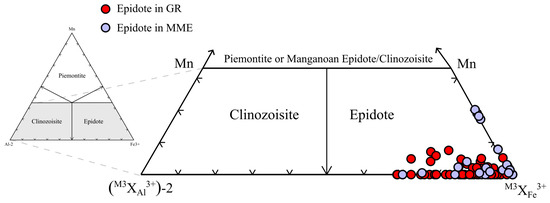
In the present study, Ps values range from 11 to 38%, with most analyses clustering at 27%–30%, values that would traditionally be interpreted as magmatic and low TiO2 (0%–1%) with an average of 0.12%. However, petrographic evidence contradicts this interpretation, because textures show clear metamorphic and hydrothermal growth, demonstrating that Ps and TiO2 alone cannot resolve origin. This discrepancy reinforces why textural criteria and REE patterns are used here as the primary discriminators.
4.3.2. Prograde Metamorphic Epidote Generation
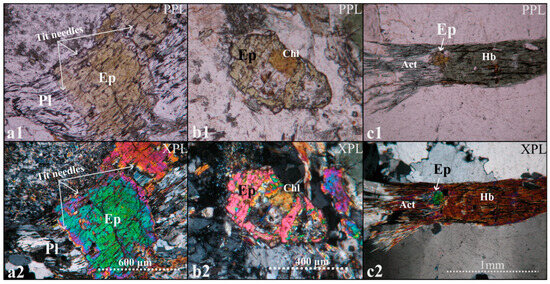
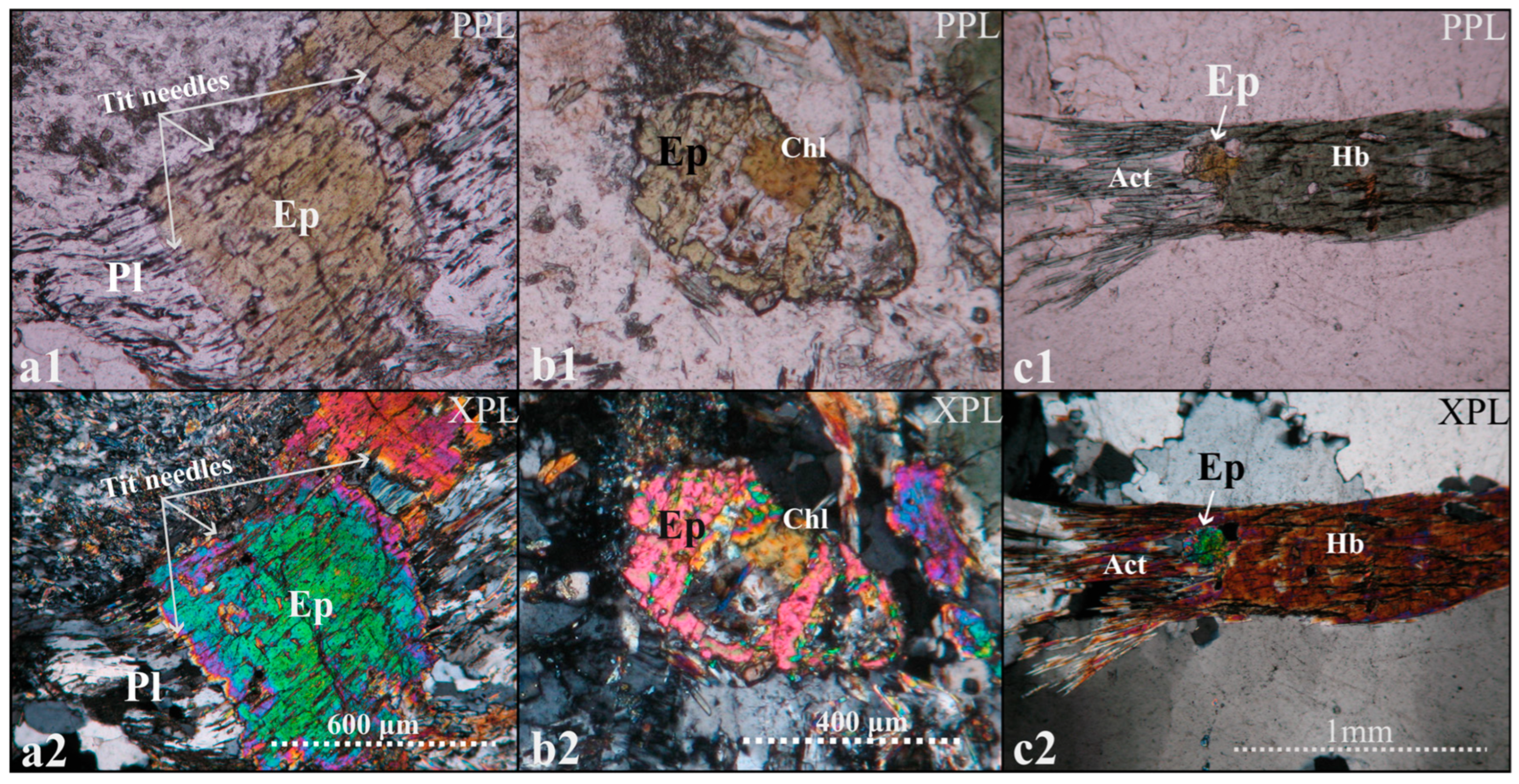
Epidote is abundant, occurring mostly as large crystals up to 1 mm, and to a lesser extent, as smaller grains around 100 μm along the longest axis. It is anhedral, porous/spongy looking, and yellowish. In many cases, it replaces plagioclase (Figure 16(a1,a2)), forming larger crystals. Epidote also forms during the alteration of biotite and amphibole. In Figure 16(b1,b2), biotite (in the core) is altered to chlorite and epidote forms on the rim. In Figure 16(c1,c2), hornblende alters to epidote and actinolite. These grains are smaller, more irregular, and disrupted.
Figure 16.
Microphotographs of epidote. (a1,a2) Plagioclase altered to epidote, (b1,b2) biotite altered to chlorite and epidote, and (c1,c2) hornblende altered to epidote and actinolite. (1) PPL: plane-polarized light; (2) XPL: cross-polarized light.
Overall, plagioclase alteration is the main source of epidote in the studied rocks, to which the macroscopically green tint of plagioclase, is attributed to.
Using the epidote discrimination diagram (Figure 17), all analyses plot within the epidote field but display variation in Alpfu. The majority of crystals are Fe-rich, indicating dominance of Fe in the M3 site. Mnpfu is also variable, with epidotes from MME showing higher Mn concentrations. For the classification of the epidote-group minerals the Windows program WinEpclas developed by Yavuz and Yildirim [69] was used.
Figure 17.
Discrimination diagram for epidote. Modified after [52].
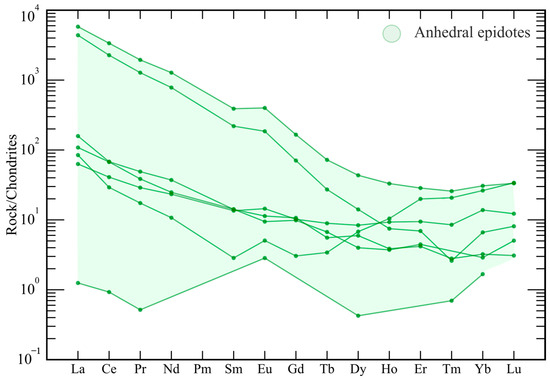
Chondrite-normalized REE patterns for the anhedral metamorphic epidotes (Figure 18) span a wide range, from relatively flat to more LREE-enriched lines, and display weak to absent positive Eu anomalies. Comparable patterns have been reported by Stuart et al. [62] and Frei et al. [54] for metamorphic epidotes. This generation of epidotes is attributed to the prograde regional low-grade greenschist to amphibolite-facies regional metamorphism associated with the Alpine deformation [1].
Figure 18.
Chondrite normalized REE pattern for anhedral large epidotes attributed to prograde metamorphism. Normalized after [25].
4.3.3. Retrograde Hydrothermal Epidote Generation
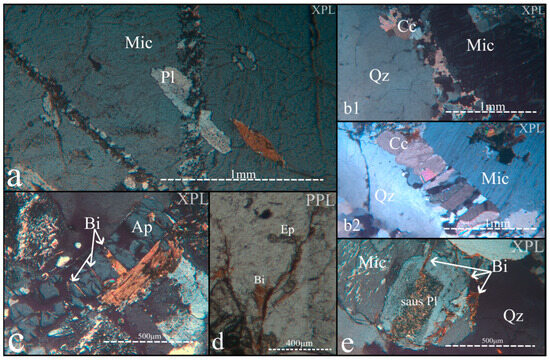
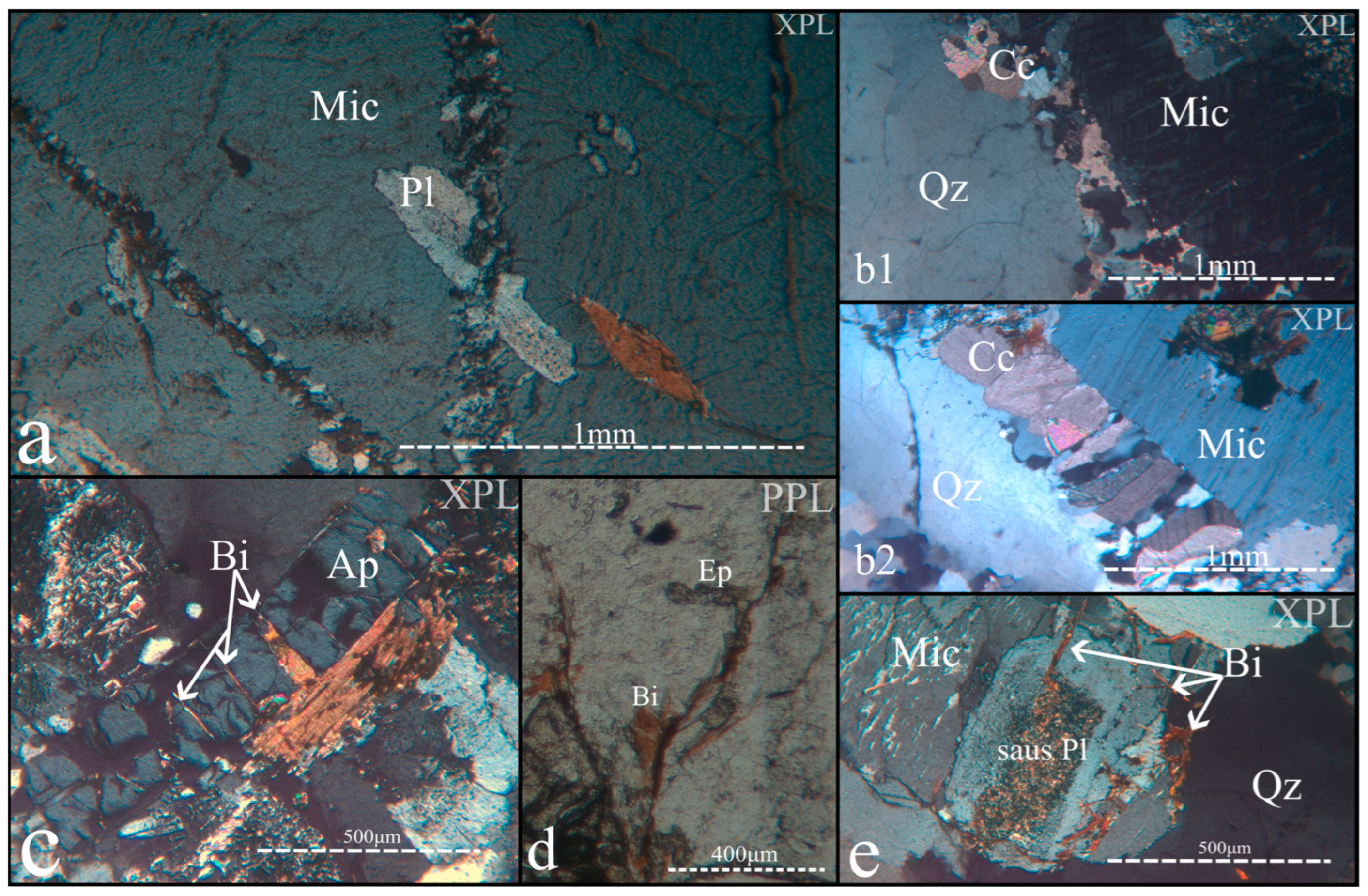
Apart from the prograde metamorphic assemblage, the rocks show evidence of retrograde hydrothermal alteration, expressed by biotite filling fractures, spongy epidote around allanite and titanite, and veins of calcite and quartz. In Figure 19a, cracks cutting through a microcline megacryst and a plagioclase inclusion are filled with quartz and fine recrystallized K-feldspar. Figure 19(b1,b2) shows fractures along the microcline–quartz contact that are filled with calcite, showing larger calcite crystals in b2 than b1, along with quartz grains. Secondary biotite is filling cracks in a needle-like form as, e.g., in a broken apatite crystal (Figure 19c), or in a random manner (Figure 19d,e). Epidote also forms under these conditions, with small anhedral crystals filling fractures (Figure 19d), or forming spongy crystals around allanite and titanite.
Figure 19.
Microphotographs of texture evidence of hydrothermal alteration. (a) Cracks in a microcline megacryst cutting both the crystal and a plagioclase inclusion, filled with quartz and recrystallized K-feldspar. (b1,b2) Cracks between microcline and quartz filled with calcite. (c–e) Needle-like Biotite filling cracks along with small epidote in (d). (d) PPL: plane-polarized light; (a–c,e) XPL: cross-polarized light.
These features indicate open-system fluid-mediated mineral growth and replacement at lower temperatures. These fluids added Ca and CO2 while also redistributing Fe and Mg.
Hydrothermal epidote has been the focus of recent studies [37,63,64,70], as it was overlooked in earlier work. It is an important topic in metallogeny where epidotes are investigated for trace elements indicative of ore proximity. Textures and REE patterns are commonly used to characterize these epidotes and discriminate their origin.
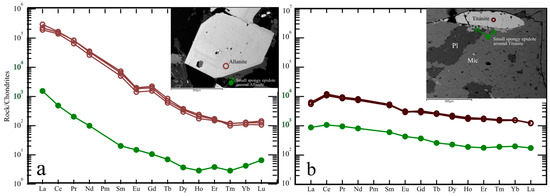
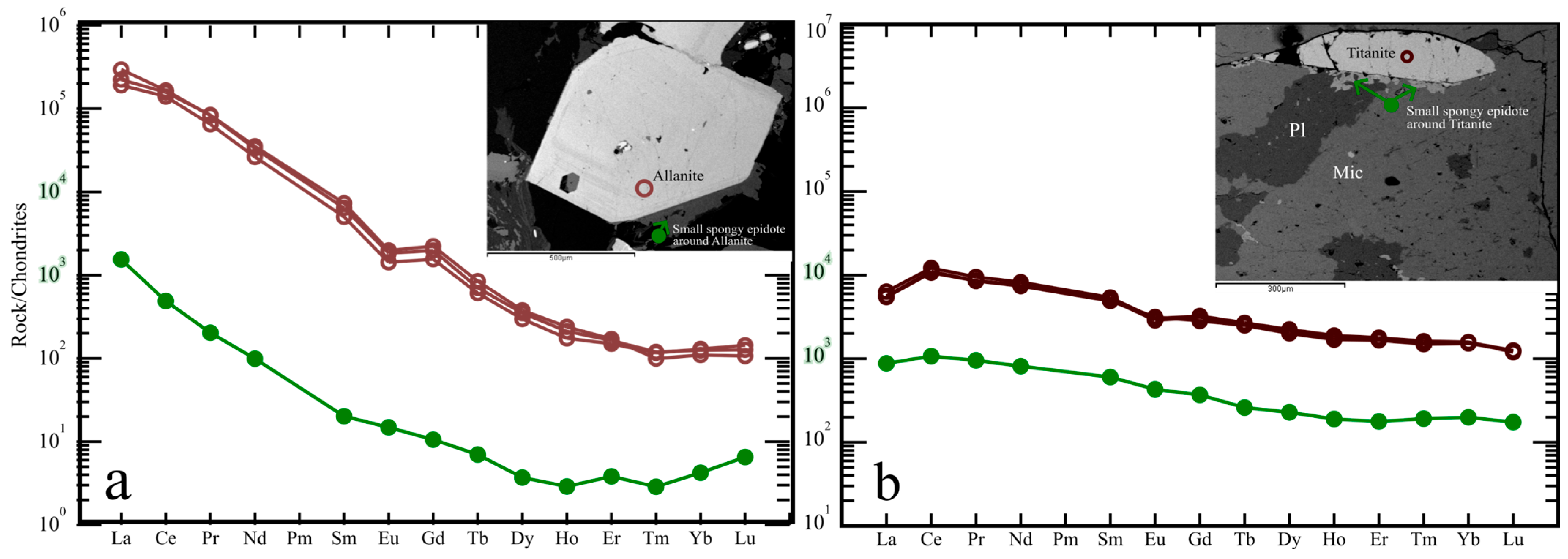
Previous studies have shown that metamorphic epidote overgrowths around allanite often display REE patterns closely correlated with the allanite core [40,43]. In contrast, the epidote in Figure 20a exhibits very low REE concentrations and no correlation with the adjacent allanite. Similarly, epidote, which fills the crack around the titanite (Figure 20b), displays flat REE patterns opposing with magmatic signature. These observations indicate that both epidote overgrowths are products of hydrothermal alteration, formed under lower temperature conditions with limited element exchange. Comparable REE characteristics for hydrothermal epidote close to magmatic allanite and titanite have been reported by Georgieva et al. [37], supporting this interpretation.
Figure 20.
Chondrite-normalized REE pattern for anhedral spongy epidote around (a) allanite (SEM-BSE image of the corresponding grains on the upper right corner) and (b) titanite (SEM-BSE image of the corresponding grains on the upper right corner). Normalized after [25].
4.3.4. Potential Magmatic Epidote Relict
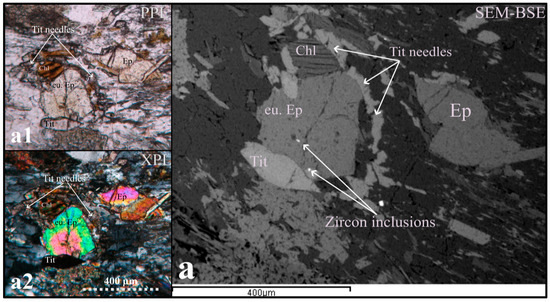
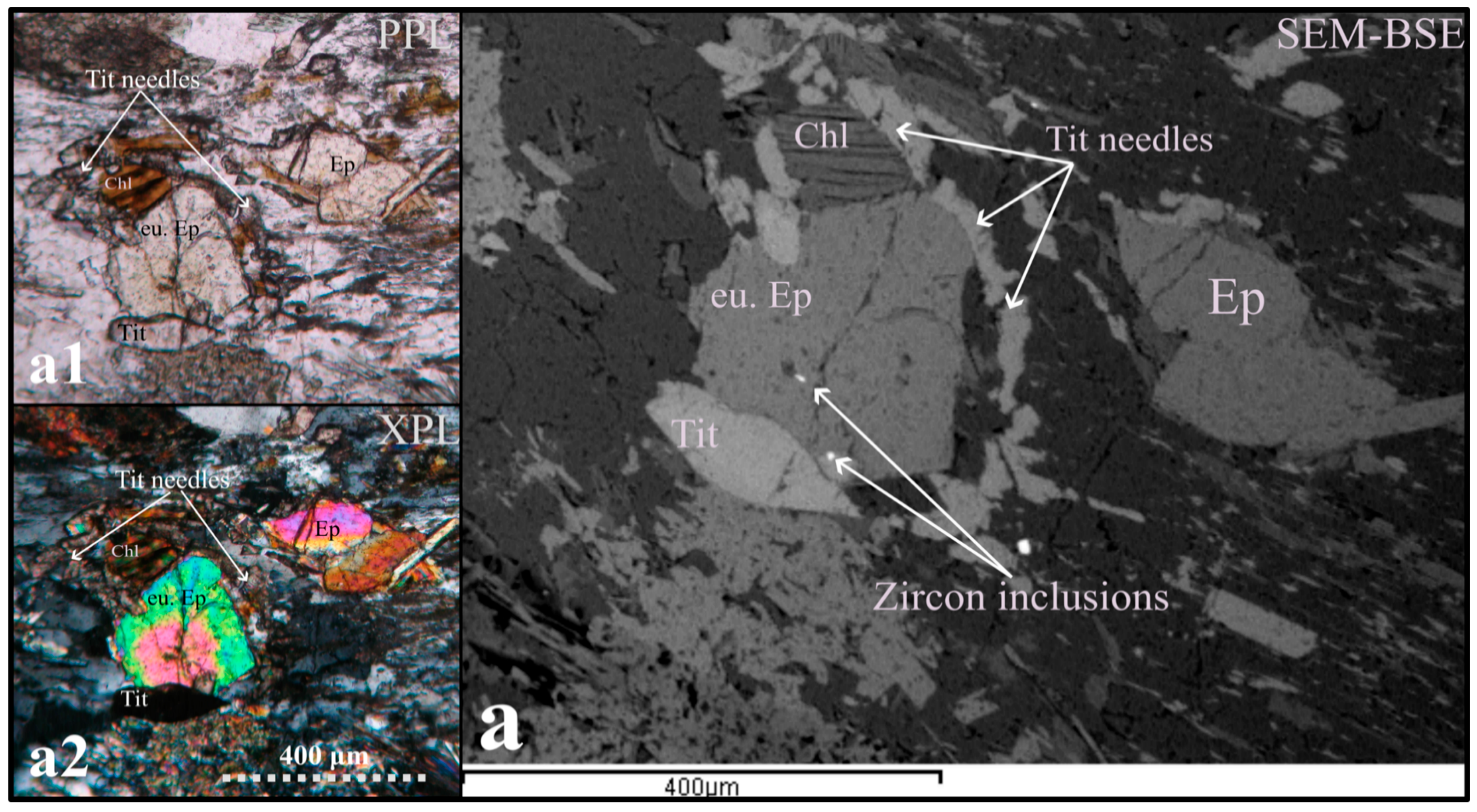
An epidote grain in the samples studied shows features that differ from the dominant metamorphic/hydrothermal epidote generations. This crystal (Figure 21) is euhedral, in sharp contact with titanite and borders biotite that is now chloritized. Similar texture has been reported for magmatic epidote by several researchers, e.g., [56,61]. The epidote contains tiny zircon inclusions, a textural feature widely considered supporting argument of magmatic growth [71]. It shows corroded contact with felsic minerals, which has been interpreted as an indication of magmatic origin because of resorption [65]. Contact with chlorite would suggest metamorphic origin [65], but it does not show the expected pseudomorph replacement after biotite, a texture described by Masumoto et al. [58] and as seen in Figure 16(b1,b2).
Figure 21.
(a) SEM-BSE image of euhedral epidote (eu. Ep), a potential magmatic relict (a1,a2), and corresponding polarized-light images of (a). (1) PPL: plane-polarized light; (2) XPL: cross-polarized light.
Even so, the epidote is not preserved in a fully magmatic state. The chloritized biotite at its contact and the titanite needles around it show that the grain was later affected by the metamorphic overprint. Similar overgrowths, but of subsolidus short prismatic epidote crystals around magmatic zoisite, have been described by Schmidt and Poli [65]. Its Cr contents (0.16–0.18 wt.%) also point to alteration, since chromium commonly increases during metamorphic or hydrothermal re-equilibration [72]. These suggest that the epidote is a potential magmatic relict that has undergone partial metamorphic chemical re-equilibration.
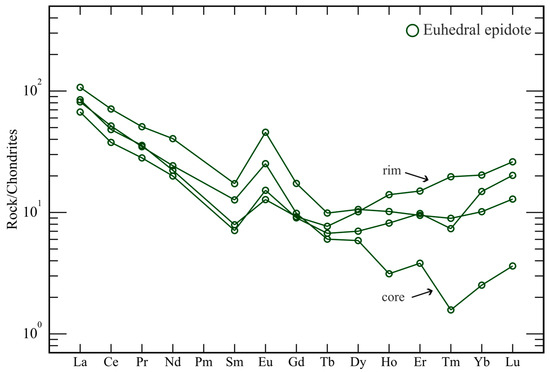
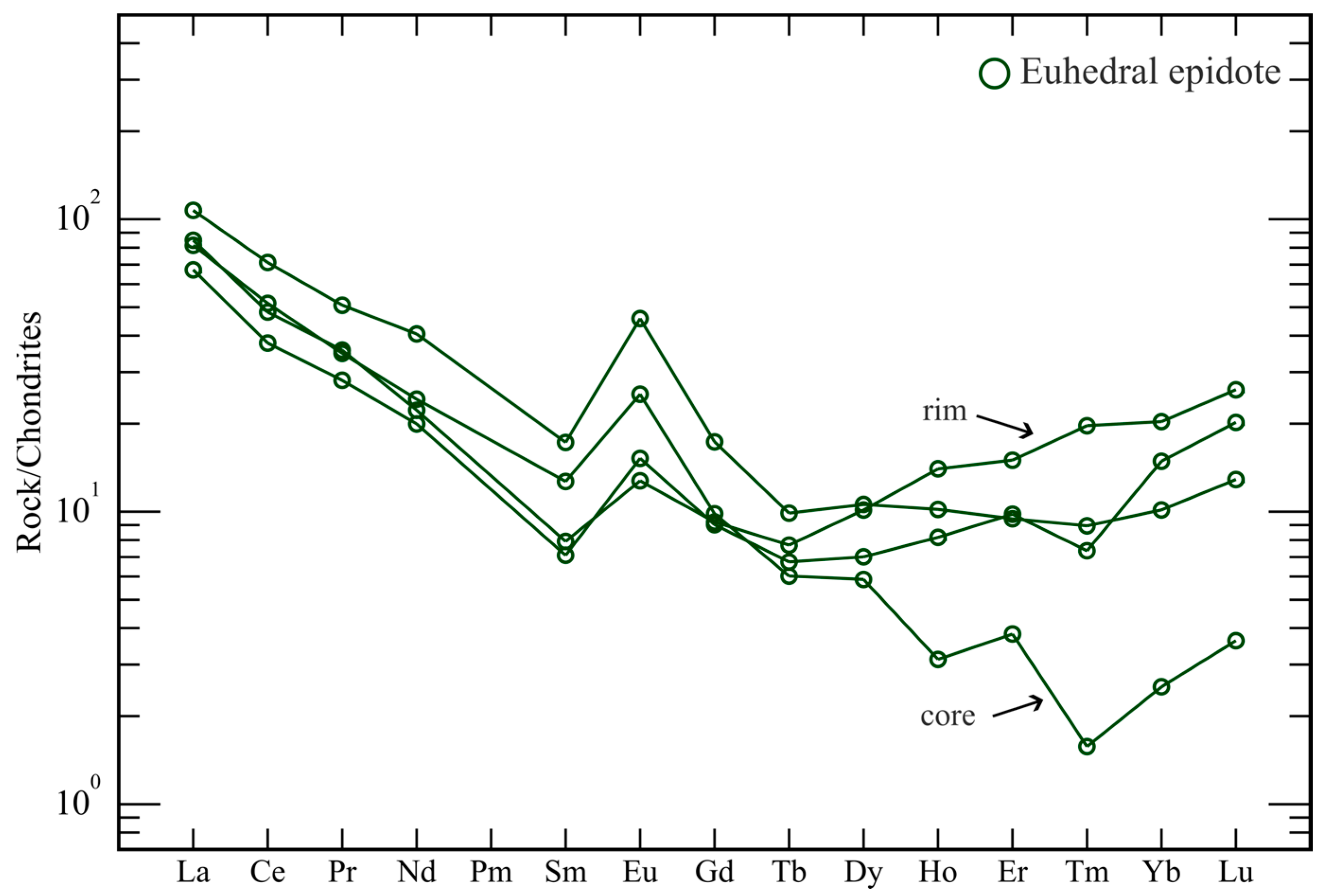
Chondrite normalized REE patterns for the euhedral epidote (Figure 22) differ greatly from those of the anhedral metamorphic epidotes (Figure 18) and of the hydrothermal epidotes (Figure 20). In Figure 22, a consistent positive Eu anomaly is observed with variable HREE. Positive Eu anomalies with elevated LREE and comparatively lower HREE are commonly reported for magmatic epidote [54,62]. The core displays the expected lower HREE, whereas the rim shows a slight HREE increase, which can be explained by the suggested later re-equilibration.
Figure 22.
Chondrite-normalized REE pattern for euhedral epidote from Figure 21. Normalized after [25].
4.3.5. Epidote—Discussion
The epidotes in this pluton fall into two main secondary origin generations, prograde metamorphic and retrograde hydrothermal. There are only a couple of epidote crystals that preserve a potential primary magmatic origin. The metamorphic epidotes are anhedral, porous, and clearly replacing plagioclase, biotite, and amphibole. Their REE patterns are broad, close to flat, and generally lack Eu anomalies. The retrograde hydrothermal epidotes occur along fractures with calcite, needle-like biotite and quartz, with flat REE patterns.
The suggested potential magmatic epidote relict shows a different texture. It is euhedral, in sharp contact with titanite and chloritized biotite with resorption evidence in contact with felsic minerals. It shows a positive Eu anomaly together with elevated LREE and lower HREE, consistent with reported magmatic epidote. Towards the rim, HREE increase, reflecting partial subsolidus re-equilibration. The increased Cr is also an indication of the re-equilibration.
Magmatic epidote was traditionally considered a high-pressure mineral [47], but evidence from various plutons indicates it can crystallize at lower pressures than previously assumed. Earlier experimental work focused on QFM buffered conditions for granites and granodiorites, whereas higher fO2 conditions (towards NNO+) shift epidote crystallization to lower pressures [65]. For instance, Basak et al. [60] report crystallization pressures of 1.2–4.8 kbar for a calc–alkaline, K-feldspar megacrystic pluton, Pandit [20] finds 2.07–3.58 kbar crystallization pressures, and Schmidt and Poli [65] reports pressures as low as 2.8 kbar for magmatic epidote-bearing monzogranites. Thus, for the I-type calc–alkaline Kastoria pluton with an estimated Al-in hornblende crystallization pressure of 3 kbar, the presence of magmatic epidote is consistent with those constraints.
5. Conclusions
Altogether, the textural relationships and mineral chemistry for the Kastoria pluton define the following evolutionary sequence:
- (1)
- Crystallization of a hydrous, oxidized calc–alkaline melt.
- (2)
- Development of a prograde metamorphic assemblage with alteration of Hb to Act and Ep; Bi to Chl and Ep; and Pl to Ep. This stage also includes the formation of needle-like Tit and recrystallized rims on magmatic Tit and All. These features are consistent with growth under low-grade greenschist-facies to amphibolite conditions during the Alpine deformation.
- (3)
- Retrograde hydrothermal alteration producing metasomatic Ep, Chl, Cc, Qz, and fine Bi along fractures. This reflects an open-system, fluid-mediated overprint.
Magmatic titanite and allanite are well preserved, showing only limited recrystallization, reflecting their higher resistance to alteration [40] than epidote. Epidote records a more complex history. A potential magmatic epidote relict is suggested by a grain retaining euhedral boundaries, containing zircon inclusions, and exhibiting LREE-enriched, HREE-depleted patterns with a positive Eu anomaly, signatures distinct from the prograde or hydrothermal epidote generations. Pistacite (Ps) values and TiO2 content were evaluated as unreliable discriminants. Published constraints show that magmatic epidote can form at moderate pressures (2–4 kbar) under oxidizing conditions for calc–alkaline granitoids, consistent with the estimated 3 kbar crystallization conditions for the Kastoria pluton.
The contrasting behavior of the accessory minerals titanite, allanite, and epidote constrains the tectonometamorphic overprint to low-medium-grade conditions. The study of these accessory minerals provides insights into regional tectonic evolution, as the extended preservation of magmatic titanite and allanite alongside abundant metamorphic epidote and only minor needle-like metamorphic titanite indicates moderate Alpine deformation and fluid circulation during crustal thickening.
Supplementary Materials
The following supporting information can be downloaded at https://www.mdpi.com/article/10.3390/min16010083/s1. File S1: SEM and LA-ICP-MS analytical data [7,25,29,69].
Author Contributions
Data curation, I.G.; writing—original draft, I.G.; writing—review and editing, A.K., L.P., A.C., M.M. and S.K. All authors have read and agreed to the published version of the manuscript.
Funding
This research received no external funding.
Data Availability Statement
Data is contained within the article and Supplementary Materials.
Conflicts of Interest
The authors declare no conflicts of interest.
Abbreviations
The following abbreviations are used in this manuscript:
| Act | Actinolite |
| All | Allanite |
| Ap | Apatite |
| Bi | Biotite |
| Cc | Calcite |
| Chl | Chlorite |
| Ep | Epidote |
| Hb | Hornblende |
| Mic | Microcline |
| Pl | Plagioclase |
| Qz | Quartz |
| SausPl | Saussuritized Plagioclase |
| Tit | Titanite |
References
- Kilias, A. The Alpine Geological History of the Hellenides from the Triassic to the Present—Compression vs. Extension, a Dynamic Pair for Orogen Structural Configuration: A Synthesis. Geosciences 2023, 14, 10. [Google Scholar] [CrossRef] [Scilit]
- Katerinopoulos, A. Contribution in the Study of Plutonic Rocks from Western Varnountas, School of Geology. Ph.D. Thesis, University of Athens, Athens, Greece, 1983. [Google Scholar]
- Koroneos, A. Mineralogy, Petrology and Geochemistry of Eastern Varnountas Pluton (NW Macedonia). Ph.D. Thesis, Aristotle University of Thessaloniki, Thessaloniki, Greece, 1991. [Google Scholar]
- Pe-Piper, G.; Doutsos, T.; Mijara, A. Petrology and regional significance of the Hercynian granitoid rocks of the Olympiada area, northern Thessaly, Greece. Chem. Erde 1993, 53, 21–36. [Google Scholar]
- Pe-Piper, G.; Doutsos, T.; Mporonkay, C. Structure, geochemistry and mineralogy of Hercynian granitoid rocks of the Verdikoussa area, Northern Thessaly, Greece and their regional significance. Neues Jahrb. Mineral.–Abh. 1993, 165, 267–296. [Google Scholar]
- Kotopouli, C.N.; Pe-Piper, G.; Piper, D.J.W. Petrology and Evolution of the Hercynian Pieria Granitoid Complex (Thessaly, Greece): Paleogeographic and Geodynamic Implications. Lithos 2000, 50, 137–152. [Google Scholar] [CrossRef] [Scilit]
- Grigoriadou, A.; Koroneos, A.; Eleftheriadis, G. Mineralogy of The Kastoria pluton (W. Macedonia). Bull. Geol. Soc. Greece 2003, 35, 46–60. [Google Scholar]
- Zlatkin, O.; Avigad, D.; Gerdes, A. The Pelagonian Terrane of Greece in the Peri-Gondwanan Mosaic of the Eastern Mediterranean: Implications for the Geological Evolution of Avalonia. Precambr. Res. 2017, 290, 163–183. [Google Scholar] [CrossRef] [Scilit]
- EAGME. Geological Mapping of Greece 1:50,000, 1980—Map: Kastoria. Available online: https://www.eagme.gr/site/services (accessed on 20 November 2025).
- Mountrakis, D.M. Structural Geology of the North Pelagonian Zone s.l. and Geotectonic Evolution of the Internal Hellenides (Macedonia, Greece). Ph.D. Thesis, Aristotle University of Thessaloniki, Thessaloniki, Greece, 1983. [Google Scholar]
- Howell, D.; Griffin, W.L.; Pearson, N.J.; Powell, W.; Wieland, P.; O’Reilly, S.Y. Trace Element Partitioning in Mixed-Habit Diamonds. Chem. Geol. 2013, 355, 134–143. [Google Scholar] [CrossRef] [Scilit]
- Paton, C.; Hellstrom, J.; Paul, B.; Woodhead, J.; Hergt, J. Iolite: Freeware for the Visualisation and Processing of Mass Spectrometric Data. J. Anal. At. Spectrom. 2011, 26, 2508. [Google Scholar] [CrossRef] [Scilit]
- Woodhead, J.D.; Hellstrom, J.; Hergt, J.M.; Greig, A.; Maas, R. Isotopic and Elemental Imaging of Geological Materials by Laser Ablation Inductively Coupled Plasma-Mass Spectrometry. Geostand. Geoanalytical Res. 2007, 31, 331–343. [Google Scholar] [CrossRef] [Scilit]
- Zhao, Z.; Wang, B.; Wu, S.; Li, J. Titanite Textures, U-Pb Dating, Chemistry, and In Situ Nd Isotopes of the Lalingzaohuo Mafic Magmatic Enclaves and Host Granodiorites in the East Kunlun Orogen Belt: Insights into Magma Mixing Processes. Minerals 2025, 15, 886. [Google Scholar] [CrossRef] [Scilit]
- Li, M.; Gao, X.; Gu, G.; Guan, S. Magmatic–Hydrothermal Processes of the Pulang Giant Porphyry Cu (–Mo–Au) Deposit, Western Yunnan: A Perspective from Different Generations of Titanite. Minerals 2025, 15, 263. [Google Scholar] [CrossRef] [Scilit]
- Scibiorski, E.A.; Cawood, P.A. Titanite as a Petrogenetic Indicator. Terra Nova 2022, 34, 177–183. [Google Scholar] [CrossRef] [Scilit]
- Qu, P.; Niu, H.-C.; Weng, Q.; Yang, W.-B.; Yang, Y.-Y.; Zhang, D. In Situ U-Pb Geochronology, Elemental and Nd Isotopic Compositions of Titanite from the Mesozoic Porphyry Mo Deposits, NE China. Ore Geol. Rev. 2022, 144, 104817. [Google Scholar] [CrossRef] [Scilit]
- Kowallis, B.J.; Christiansen, E.H.; Dorais, M.J.; Winkel, A.; Henze, P.; Franzen, L.; Mosher, H. Variation of Fe, Al, and F Substitution in Titanite (Sphene). Geosciences 2022, 12, 229. [Google Scholar] [CrossRef] [Scilit]
- Gros, K.; Słaby, E.; Birski, Ł.; Kozub-Budzyń, G.; Sláma, J. Geochemical Evolution of a Composite Pluton: Insight from Major and Trace Element Chemistry of Titanite. Mineral. Petrol. 2020, 114, 375–401. [Google Scholar] [CrossRef] [Scilit]
- Pandit, D. Crystallization Evolution of Accessory Minerals in Palaeoproterozoic Granites of Bastar Craton, India. Curr. Sci. 2018, 114, 2329. [Google Scholar] [CrossRef] [Scilit]
- Chen, Y.-X.; Zheng, Y.-F. Extreme Nb/Ta Fractionation in Metamorphic Titanite from Ultrahigh-Pressure Metagranite. Geochim. Cosmochim. Acta 2015, 150, 53–73. [Google Scholar] [CrossRef] [Scilit]
- Aleinikoff, J.N.; Wintsch, R.P.; Fanning, C.M.; Dorais, M.J. U–Pb Geochronology of Zircon and Polygenetic Titanite from the Glastonbury Complex, Connecticut, USA: An Integrated SEM, EMPA, TIMS, and SHRIMP Study. Chem. Geol. 2002, 188, 125–147. [Google Scholar] [CrossRef] [Scilit]
- Kowallis, B.J.; Christiansen, E.H.; Griffen, D.T. Compositional variations in titanite. Geol. Soc. Am. Abstr. Programs 1997, 29, 402. [Google Scholar]
- Sawaki, Y.; Asanuma, H.; Sakata, S.; Abe, M.; Ueda, H.; Fujisaki, W.; Ohno, T. Zircon Trace-Element Compositions in Cenozoic Granitoids in Japan: Revised Discrimination Diagrams for Zircons in I-Type, S-Type, and A-Type Granites. Isl. Arc 2024, 33, e12539. [Google Scholar] [CrossRef] [Scilit]
- Sun, S.S.; McDonough, W.F. Chemical and isotopic systematics of oceanic basalts: Implications for mantle composition and processes. In Magmatism in the Ocean Basins; Special Publications; Saunders, A.D., Norry, M.J., Eds.; Geological Society: London, UK, 1989; Volume 42, pp. 313–345. [Google Scholar]
- Gao, X.-Y.; Zheng, Y.-F.; Chen, Y.-X.; Guo, J. Geochemical and U–Pb Age Constraints on the Occurrence of Polygenetic Titanites in UHP Metagranite in the Dabie Orogen. Lithos 2012, 136–139, 93–108. [Google Scholar] [CrossRef] [Scilit]
- Garber, J.M.; Hacker, B.R.; Kylander-Clark, A.R.C.; Stearns, M.; Seward, G. Controls on Trace Element Uptake in Metamorphic Titanite: Implications for Petrochronology. J. Petrol. 2017, 58, 1031–1057. [Google Scholar] [CrossRef] [Scilit]
- Olierook, H.K.H.; Taylor, R.J.M.; Erickson, T.M.; Clark, C.; Reddy, S.M.; Kirkland, C.L.; Jahn, I.; Barham, M. Unravelling Complex Geologic Histories Using U–Pb and Trace Element Systematics of Titanite. Chem. Geol. 2019, 504, 105–122. [Google Scholar] [CrossRef] [Scilit]
- Hayden, L.A.; Watson, E.B.; Wark, D.A. A Thermobarometer for Sphene (Titanite). Contrib. Mineral. Petrol. 2008, 155, 529–540. [Google Scholar] [CrossRef] [Scilit]
- Mutch, E.J.F.; Blundy, J.D.; Tattitch, B.C.; Cooper, F.J.; Brooker, R.A. An Experimental Study of Amphibole Stability in Low-Pressure Granitic Magmas and a Revised Al-in-Hornblende Geobarometer. Contrib. Mineral. Petrol. 2016, 171, 85. [Google Scholar] [CrossRef] [Scilit]
- Petřík, I.; Broska, I.; Lipka, J.; Siman, P. Granitoid Allanite-(Ce): Substitution relations, redox conditions and REE distributions (on an example of I-Type Granitoids, Western Carpathians, Slovakia). Geol. Carpathica 1995, 46, 79–94. [Google Scholar]
- Mellado, E.; Corbella, M.; Kylander-Clark, A. Allanite in Variscan Post-Collisional Lamprophyre Dykes from Les Guilleries (NE Iberia) as a Part of Rare Earth Elements Recycling in Collisional Orogens. Minerals 2022, 12, 954. [Google Scholar] [CrossRef] [Scilit]
- Gmochowska, W.; Wirth, R.; Słaby, E.; Anczkiewicz, R.; Krzątała, A.; Roddatis, V.; Sláma, J.; Kozub-Budzyń, G.A.; Bhattacharya, S.; Schreiber, A. Hydrothermal Alteration of Accessory Minerals (Allanite and Titanite) in the Late Archean Closepet Granitoid (Dharwar Craton, India): A TEM Study. Geochemistry 2024, 84, 126130. [Google Scholar] [CrossRef] [Scilit]
- Zhang, H.-X.; Jiang, S.-Y.; Yuan, F.; Liu, S.-Q. LA-(MC)-ICP-MS U-Th-Pb Dating and Nd Isotopes of Allanite in NYF Pegmatite from Lesser Qingling Orogenic Belt, Central China. Ore Geol. Rev. 2022, 145, 104893. [Google Scholar] [CrossRef] [Scilit]
- René, M. Allanite from Granitic Rocks of the Moldanubian Batholith (Central European Variscan Belt). In Rare Earth Elements and Their Minerals; Aide, M., Nakajima, T., Eds.; IntechOpen: London, UK, 2020. [Google Scholar] [CrossRef] [Scilit]
- Ondrejka, M.; Putiš, M.; Uher, P.; Schmiedt, I.; Pukančík, L.; Konečný, P. Fluid-Driven Destabilization of REE-Bearing Accessory Minerals in the Granitic Orthogneisses of North Veporic Basement (Western Carpathians, Slovakia). Mineral. Petrol. 2016, 110, 561–580. [Google Scholar] [CrossRef] [Scilit]
- Georgieva, S.; Vassileva, R.; Milenkov, G.; Stefanova, E. Major and Trace Element Signature of Epidote-Group Minerals in Altered Pegmatites from the Petrovitsa Pb–Zn Deposit of the Madan Ore Region, Central Rhodopes, Bulgaria: Evidence of Allanite/Epidote Transformation. Geol. Carpathica 2022, 73, 365–380. [Google Scholar] [CrossRef] [Scilit]
- Giere, R.; Sorensen, S.S. Allanite and Other REE-Rich Epidote-Group Minerals. Rev. Mineral. Geochem. 2004, 56, 431–493. [Google Scholar] [CrossRef] [Scilit]
- Doley, D.; Bhagabaty, B.; Borah, P. Fluid-Induced Alteration and Associated Rare-Earth Elements (REEs) Distribution in Accessory Minerals in Mayong Granite, Shillong Plateau, Northeast India. Int. J. Earth Sci. 2025, 114, 841–854. [Google Scholar] [CrossRef] [Scilit]
- Gregory, C.J.; Rubatto, D.; Hermann, J.; Berger, A.; Engi, M. Allanite Behaviour during Incipient Melting in the Southern Central Alps. Geochim. Cosmochim. Acta 2012, 84, 433–458. [Google Scholar] [CrossRef] [Scilit]
- Janák, M.; Petrík, I.; Plašienka, D.; Froitzheim, N.; Konečný, P. Allanite to Monazite Transition and Dating of Prograde Eo-Alpine Metamorphism in the Veporic Unit, Western Carpathians (Slovakia). Geol. Carpathica 2025, 76, 171–188. [Google Scholar] [CrossRef] [Scilit]
- Meshram, T.; Rao, S.B.; Sai, V.V.S.; Narahari, S.T.; Mishra, M.; Soni, L.K.; Naitam, A.; Dora, M.L.; Meshram, R. Rapid Magma Ascent and Genesis of the Neoproterozoic Granite Pluton in Sausar Belt, CITZ, India: Evidence of Epidote Dissolution, Allanite Trace Elements and Amphibole Thermobarometry. Indian J. Geosci. 2024, 78, 289–310. [Google Scholar]
- Guo, H.; Xiao, Y.; Xu, L.; Sun, H.; Huang, J.; Hou, Z. Origin of Allanite in Gneiss and Granite in the Dabie Orogenic Belt, Central East China. J. Asian Earth Sci. 2017, 135, 243–256. [Google Scholar] [CrossRef] [Scilit]
- Fu, Y.; Sun, X.; Li, D.; Lin, H.; Lai, C. LA-ICP-MS U-Th-Pb Dating and Trace Element Geochemistry of Allanite: Implications on the Different Skarn Metallogenesis between the Giant Beiya Au and Machangqing Cu-Mo-(Au) Deposits in Yunnan, SW China. Minerals 2017, 7, 251. [Google Scholar] [CrossRef] [Scilit]
- Liou, J.G. Synthesis and Stability Relations of Epidote, Ca2Al2FeSi3O12 (OH). J. Petrol. 1973, 14, 381–413. [Google Scholar] [CrossRef] [Scilit]
- Tulloch, A.J. Secondary Ca-Al Silicates as Low-Grade Alteration Products of Granitoid Biotite. Contrib. Mineral. Petrol. 1979, 69, 105–117. [Google Scholar] [CrossRef] [Scilit]
- Zen, E.; Hammarstrom, J.M. Magmatic Epidote and Its Petrologic Significance. Geology 1984, 12, 515–518. [Google Scholar] [CrossRef] [Scilit]
- Evans, B.W.; Vance, J.A. Epidote Phenocrysts in Dacitic Dikes, Boulder County, Colorado. Contrib. Mineral. Petrol. 1987, 96, 178–185. [Google Scholar] [CrossRef] [Scilit]
- Johnston, A.D.; Wyllie, P.J. Constraints on the origin of Archean trondhjemites based on phase relationships of Nûk gneiss with H2O at 15 kbar. Contrib. Mineral. Petrol. 1988, 100, 35–46. [Google Scholar] [CrossRef] [Scilit]
- Sial, A.N. Epidote-bearing calc-alkalic granitoids in northeast Brazil. Rev. Bras. Geociências 1990, 20, 88–100. [Google Scholar] [CrossRef] [Scilit]
- Schmidt, M.W.; Thompson, A.B. Epidote in Calcalkaline Magmas; an Experimental Study of Stability, Phase Relationships, and the Role of Epidote in Magmatic Evolution. Am. Mineral. 1996, 81, 462–474. [Google Scholar] [CrossRef] [Scilit]
- Franz, G.; Liebscher, A. Physical and Chemical Properties of the Epidote Minerals-An Introduction-. Rev. Mineral. Geochem. 2004, 56, 1–81. [Google Scholar] [CrossRef] [Scilit]
- Armbruster, T.; Bonazzi, P.; Akasaka, M.; Bermanec, V.; Chopin, C.; Gieré, R.; Heuss-Assbichler, S.; Liebscher, A.; Menchetti, S.; Pan, Y.; et al. Recommended Nomenclature of Epidote-Group Minerals. Eur. J. Mineral. 2006, 18, 551–567. [Google Scholar] [CrossRef] [Scilit]
- Frei, D.; Liebscher, A.; Franz, G.; Dulski, P. Trace Element Geochemistry of Epidote Minerals. Rev. Mineral. Geochem. 2004, 56, 553–605. [Google Scholar] [CrossRef] [Scilit]
- Grapes, R.H.; Hoskin, P.W.O. Epidote Group Minerals in Low-Medium Pressure Metamorphic Terranes. Rev. Mineral. Geochem. 2004, 56, 301–345. [Google Scholar] [CrossRef] [Scilit]
- Sial, A.N.; Vasconcelos, P.M.; Ferreira, V.P.; Pessoa, R.R.; Brasilino, R.G.; Morais Neto, J.M. Geochronological and Mineralogical Constraints on Depth of Emplacement and Ascencion Rates of Epidote-Bearing Magmas from Northeastern Brazil. Lithos 2008, 105, 225–238. [Google Scholar] [CrossRef] [Scilit]
- Chang, J.M.; Andronicos, C.L. Constraints on the Depth of Generation and Emplacement of a Magmatic Epidote-bearing Quartz Diorite Pluton in the Coast Plutonic Complex, British Columbia. Terra Nova 2009, 21, 480–488. [Google Scholar] [CrossRef] [Scilit]
- Masumoto, Y.; Enami, M.; Tsuboi, M.; Hong, M. Magmatic Zoisite and Epidote in Tonalite of the Ryoke Belt, Central Japan. Eur. J. Mineral. 2014, 26, 279–291. [Google Scholar] [CrossRef] [Scilit]
- Dall’Agnol, R.; Cunha, I.R.V.D.; Guimarães, F.V.; Oliveira, D.C.D.; Teixeira, M.F.B.; Feio, G.R.L.; Lamarão, C.N. Mineralogy, Geochemistry, and Petrology of Neoarchean Ferroan to Magnesian Granites of Carajás Province, Amazonian Craton: The Origin of Hydrated Granites Associated with Charnockites. Lithos 2017, 277, 3–32. [Google Scholar] [CrossRef] [Scilit]
- Basak, A.; Goswami, B.; Singha, A.; Das, S.; Bhattacharyya, C. Magmatic Epidote in the Grenvillian Granitoids of North Purulia Shear Zone, Chhotanagpur Gneissic Complex, India and Its Significance. Curr. Sci. 2019, 117, 298. [Google Scholar] [CrossRef] [Scilit]
- Da Cunha, I.R.V.; Dall’Agnol, R.; Scaillet, B.; De Sousa, L.A.M. Magmatic Epidote in Archean Granitoids of the Carajás Province, Amazonian Craton, and Its Stability during Magma Rise and Emplacement. J. S. Am. Earth Sci. 2021, 112, 103570. [Google Scholar] [CrossRef] [Scilit]
- Stuart, C.A.; Meek, U.; Daczko, N.R.; Piazolo, S.; Huang, J.-X. Chemical Signatures of Melt–Rock Interaction in the Root of a Magmatic Arc. J. Petrol. 2018, 59, 321–340. [Google Scholar] [CrossRef] [Scilit]
- Pacey, A.; Wilkinson, J.J.; Cooke, D.R. Chlorite and Epidote Mineral Chemistry in Porphyry Ore Systems: A Case Study of the Northparkes District, New South Wales, Australia. Econ. Geol. 2020, 115, 701–727. [Google Scholar] [CrossRef] [Scilit]
- Chen, J.; Liu, W.; Xu, J.; Zhou, X.; Wu, W.; Rao, D.; Wang, H. Geochemical Characteristics and Implications of Epidote in South Dulan and Vlaska Exploration Greenfield in North of Bor Metallogenic Zone, Serbia. Ore Geol. Rev. 2023, 163, 105798. [Google Scholar] [CrossRef] [Scilit]
- Schmidt, M.W.; Poli, S. Magmatic Epidote. Rev. Mineral. Geochem. 2004, 56, 399–430. [Google Scholar] [CrossRef] [Scilit]
- Pandit, D.; Panigrahi, M.K.; Moriyama, T. Constrains from Magmatic and Hydrothermal Epidotes on Crystallization of Granitic Magma and Sulfide Mineralization in Paleoproterozoic Malanjkhand Granitoid, Central India. Geochemistry 2014, 74, 715–733. [Google Scholar] [CrossRef] [Scilit]
- Narduzzi, F.; Farina, F.; Stevens, G.; Lana, C.; Nalini, H.A. Magmatic Garnet in the Cordilleran-Type Galiléia Granitoids of the Araçuaí Belt (Brazil): Evidence for Crystallization in the Lower Crust. Lithos 2017, 282–283, 82–97. [Google Scholar] [CrossRef] [Scilit]
- Meek, U.; Piazolo, S.; Daczko, N.R. The Field and Microstructural Signatures of Deformation-assisted Melt Transfer: Insights from Magmatic Arc Lower Crust, New Zealand. J. Metamorph. Geol. 2019, 37, 795–821. [Google Scholar] [CrossRef] [Scilit]
- Yavuz, F.; Yıldırım, K. A Windows Program for Calculation and Classification of epidote–supergroup minerals. Period. Mineral. 2018, 87, 269–285. [Google Scholar]
- Xiao, Q.; Zhou, T.; White, N.C.; Wang, S.; Liu, J.; Li, X. Epidote Geochemistry of the Chating Porphyry Cu-Au Deposit, Eastern China: Metallogenic and Exploration Implications for Porphyry Cu Deposits Associated with Carbonate Wall Rocks. Ore Geol. Rev. 2025, 179, 106546. [Google Scholar] [CrossRef] [Scilit]
- Wu, H.; He, Y.; Li, S.; Zhu, C.; Hou, Z. Partial Melts of Intermediate–Felsic Sources in a Wedged Thickened Crust: Insights from Granites in the Sulu Orogen. J. Petrol. 2020, 61, egaa053. [Google Scholar] [CrossRef] [Scilit]
- Nagashima, M.; Akasaka, M.; Sakurai, T. Chromian Epidote in Omphacite Rocks from the Sambagawa Metamorphic Belt, Central Shikoku, Japan. J. Mineral. Petrol. Sci. 2006, 101, 157–169. [Google Scholar] [CrossRef] [Scilit]
Disclaimer/Publisher’s Note: The statements, opinions and data contained in all publications are solely those of the individual author(s) and contributor(s) and not of MDPI and/or the editor(s). MDPI and/or the editor(s) disclaim responsibility for any injury to people or property resulting from any ideas, methods, instructions or products referred to in the content. |
© 2026 by the authors. Licensee MDPI, Basel, Switzerland. This article is an open access article distributed under the terms and conditions of the Creative Commons Attribution (CC BY) license.