A Stochastic Model Approach for Modeling SAG Mill Production and Power Through Bayesian Networks: A Case Study of the Chilean Copper Mining Industry
 ,
,  ,
,  ,
,  ,
,  ,
,  ,
, 

Abstract
1. Introduction
2. Background
2.1. Grinding Modeling
2.2. Handling Uncertainty and Conditional Dependencies
- BN for Conditional Structure and Uncertainty: Bayesian graphical models explicitly encode conditional dependencies and provide probabilistic predictions and sensitivity paths that help explain the causes of events in grinding circuits, as shown in the SAG BN case study, where the fresh ore feed rate is modeled [61].
- Hierarchical Bayesian Formulations and Event/Measurement Uncertainty: Recent hierarchical Bayesian applications to SAG performance incorporate nested structure (e.g., ore-level hardness, operational set values) to improve uncertainty quantification and resilience to different conditions [62]. Additionally, the process mining literature emphasizes that many industrial event records suffer from time-stamp/value inaccuracy and that representing uncertainty increases model expressiveness but also computational complexity. Graph-based approximation or representations can mitigate combinatorial explosion [63].
- Practical guidance and challenges: Reviews of Bayesian methods for mineral processing and broader studies note that Bayesian approaches allow for principled uncertainty quantification and model comparison, but require careful prior/domain integration and reliable sensor data [64].
- Probabilistic methods at the controller level: Probabilistic model predictive control using Gaussian processes has been proposed for flotation circuits to propagate uncertainty through control decisions, illustrating viable probabilistic control paths for metallurgical units [65].
2.3. Model Comparisons, Hybrid Dynamics, Digital Twins and Optimization
- Temporal/sequence data: In power prediction in SAG circuits, recurrent architectures outperformed static regression models in an industrial study [15].
- Hybridization of digital twins and data-driven models: Several reviews advocate the integration of instrument measurements, machine learning-based simulation models, and digital twins for process control and scenario analysis in the mineral beneficiation chain [69].
- System-level coupling: Mining-metallurgical and techno-economic assessments combine stochastic (long-term) mine planning with SED (medium-term) and predictive models to evaluate technological improvements in the face of geological uncertainty, demonstrating practical hybrid workflows for decision making [70].
- Probabilistic control loop: A study proposing probabilistic methods using Gaussian processes for flotation shows how predictive uncertainty estimates can be integrated into control constraints and cost/objective functions of metallurgical units [65].
3. Materials and Methods
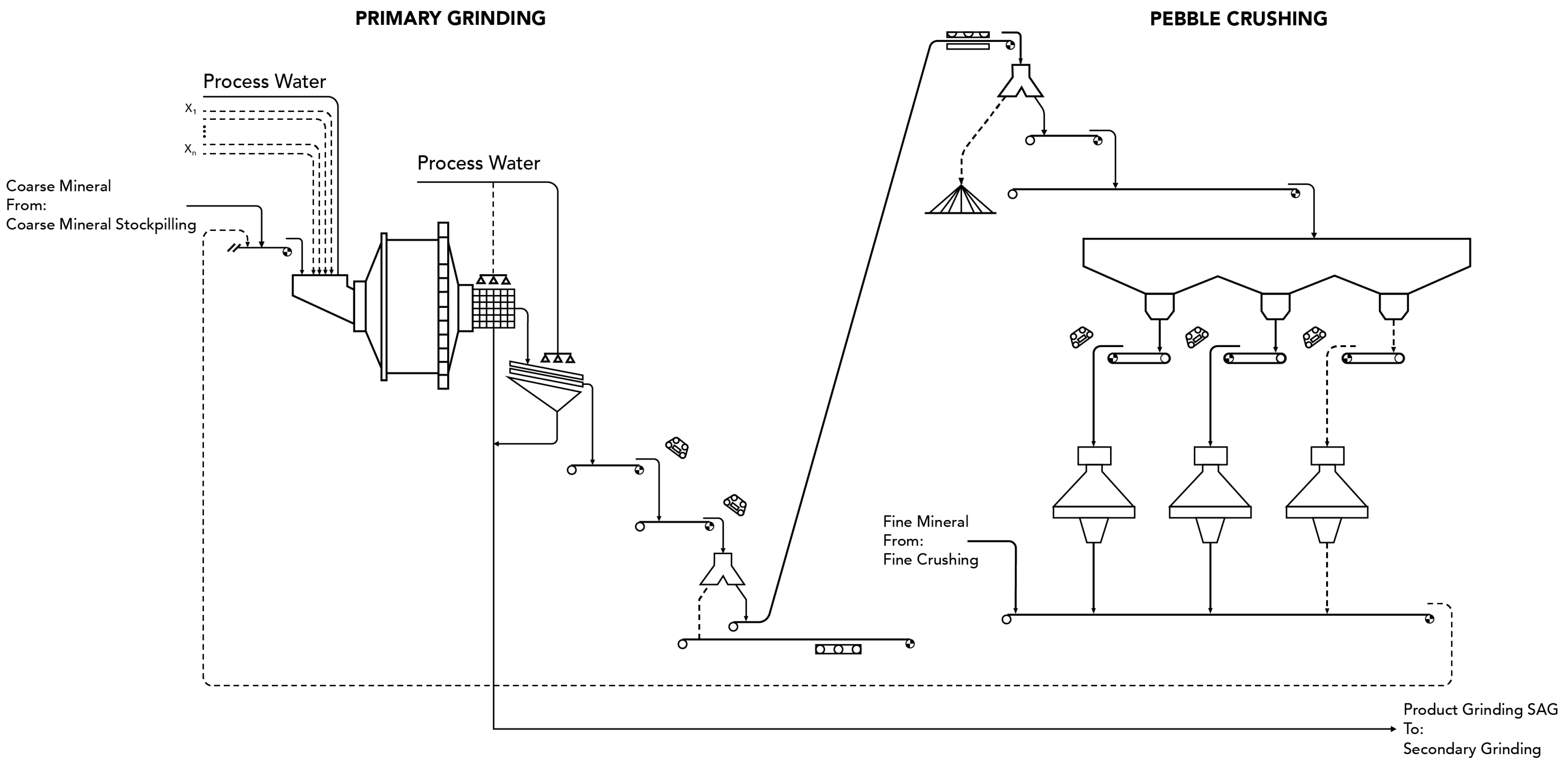
3.1. Study Case
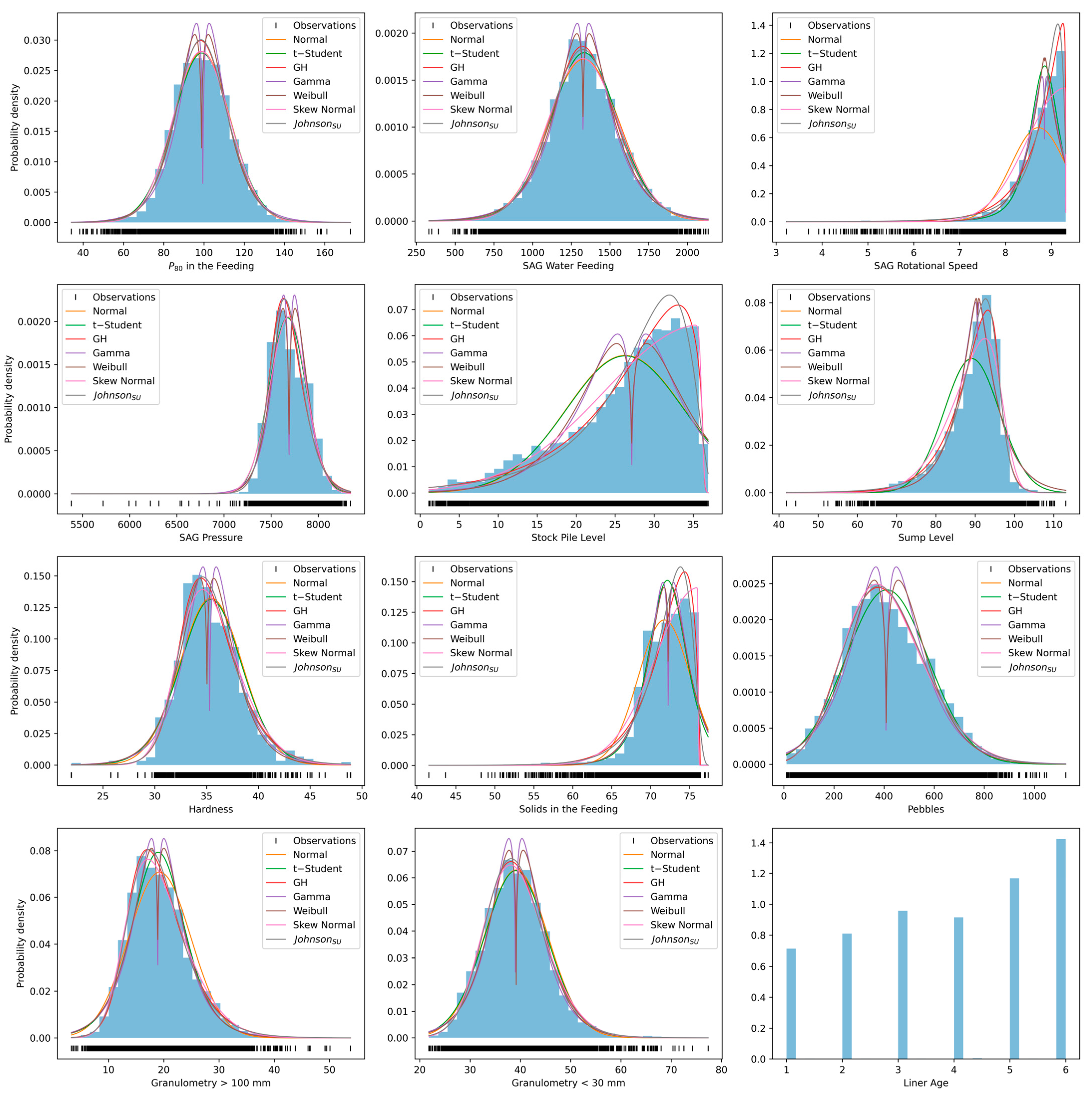
- P80: Size of the mesh opening that allows the passage of 80% of the granulometry.
- SAG water feeding (m3/h): Water flow feeding to the SAG mill.
- SAG rotational speed (RPM): Mill rotational speed.
- SAG pressure (PSI): Mill fill or load level.
- Stockpile level (m): Stockpile level in the feeding stack.
- Sump level (m): Thicker downloading pool at the SAG mill.
- Hardness: Resistance offered by the mineral to abrasion or scraping.
- Solids in the feeding (%): Percentage of solids in the feed pulp.
- Pebbles (TpH): Pebbles (pebbles, chunks, or small stones) are the result of mineral grinding. These are hard materials and are difficult to reduce to a smaller size in the SAG mill.
- Granulometry > 100 mm (%): Percentage of the ore feed whose granulometry is greater than 100 mm.
- Granulometry < 30 mm (%): Percentage of the ore feed whose granulometry is less than 30 mm.
- Liner age (months): Categorical variable. Age of mill liners. Liners are part of the mill and act as protective sleeves for the internal casing (shell), which wears over time due to the strong and constant internal impact between the ore charge and the steel balls.
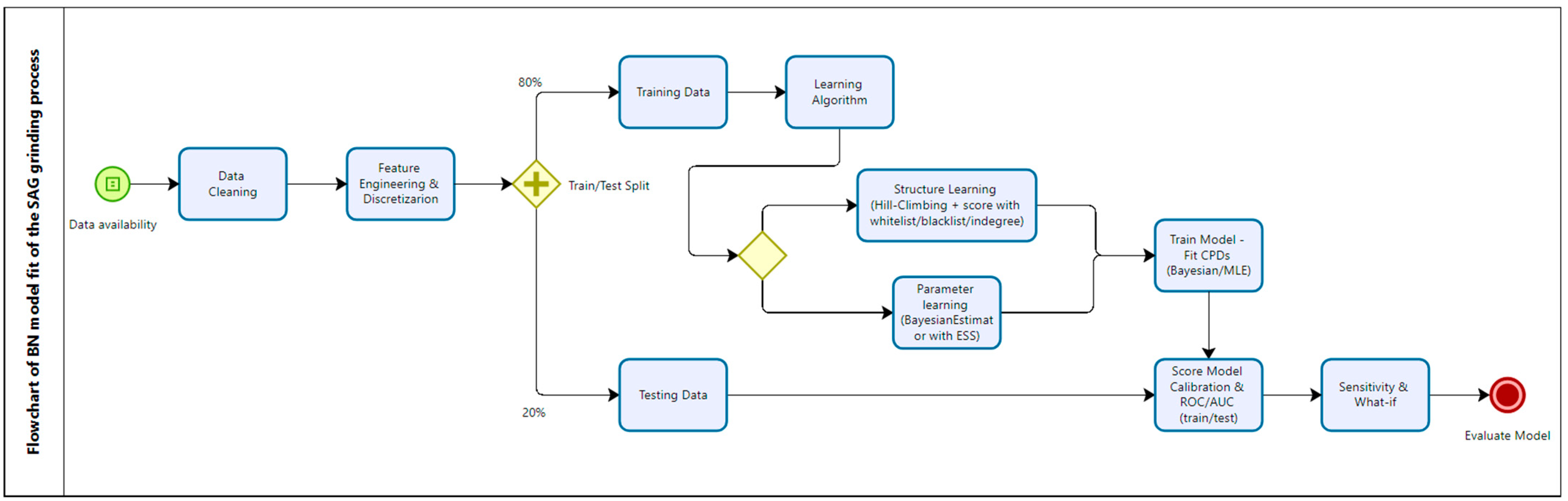
3.2. Machine Learning
3.3. Bayesian Networks
3.4. Structural Constraints: Blacklists and Whitelists
- R1:
- R2:
- R3:
- R4:
3.5. Validation Through Performance Measures
4. Results
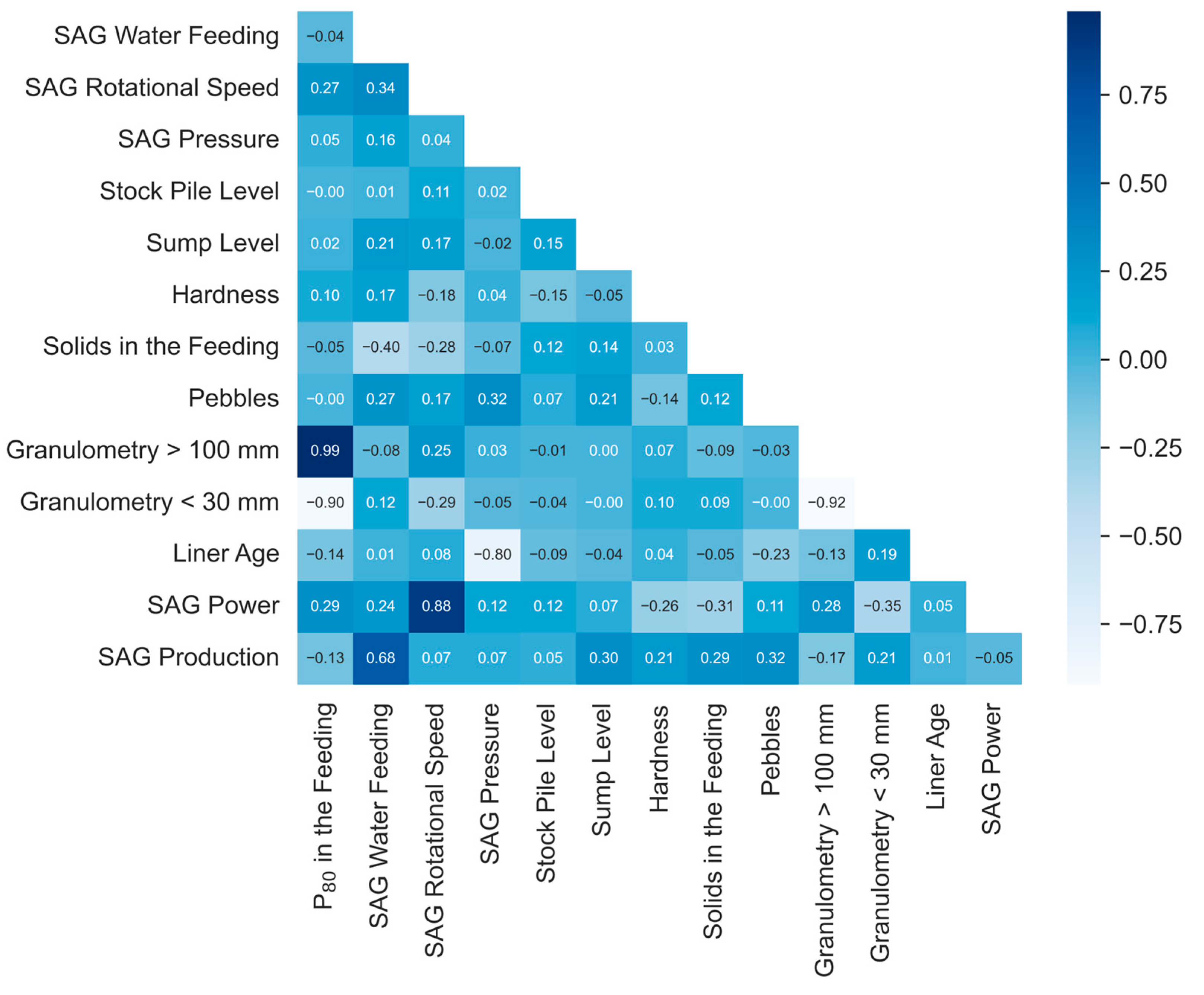
4.1. Explanatory Analysis
4.2. Discretization Strategy and Distribution Fitting Validation
4.2.1. Discretization Strategy
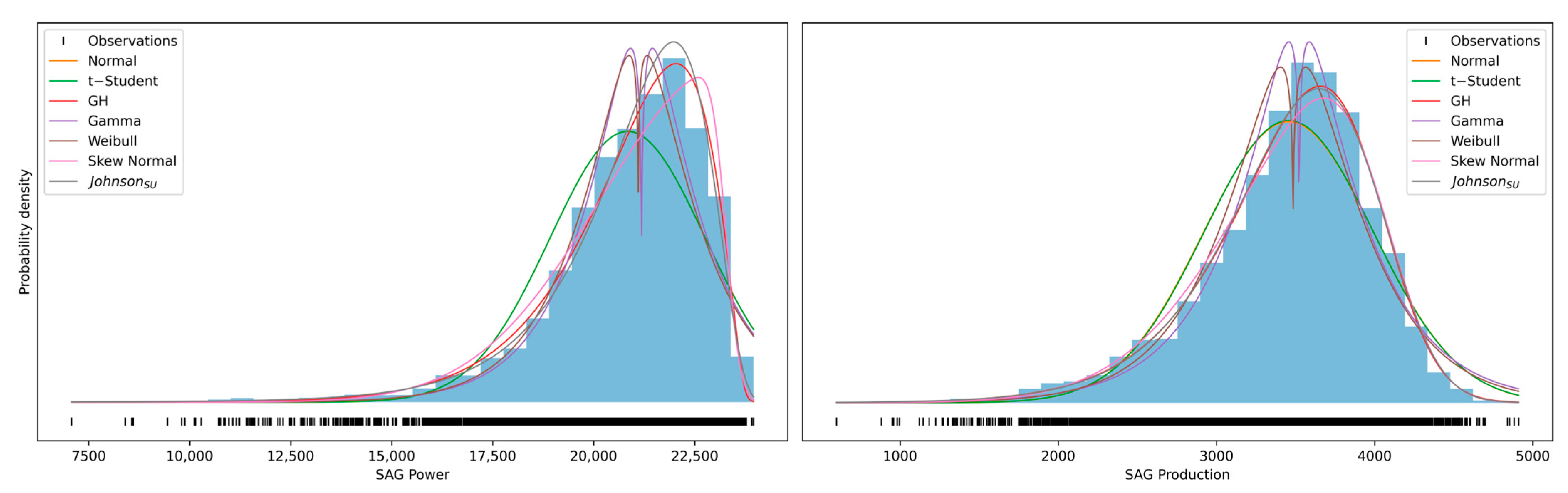
4.2.2. Distribution Fitting Validation
4.3. Bayesian Network Modeling
- Robustness and efficiency: Greedy search with decomposable scores is computationally feasible for the number of variables and states involved, unlike exhaustive (NP-hard) searches or continuous approaches that are not directly applicable to discrete variables.
- Support for process knowledge: The score-based framework naturally integrates physical constraints (e.g., objectives such as sinks, indegree bounds, required/allowed edges), which are more cumbersome in purely constraint-based methods.
- Out-of-sample performance: The BDeu + Dirichlet tandem penalizes overly complex models and mitigates the overfitting typical of large CPTs, resulting in better temporal validation/holdout metrics.
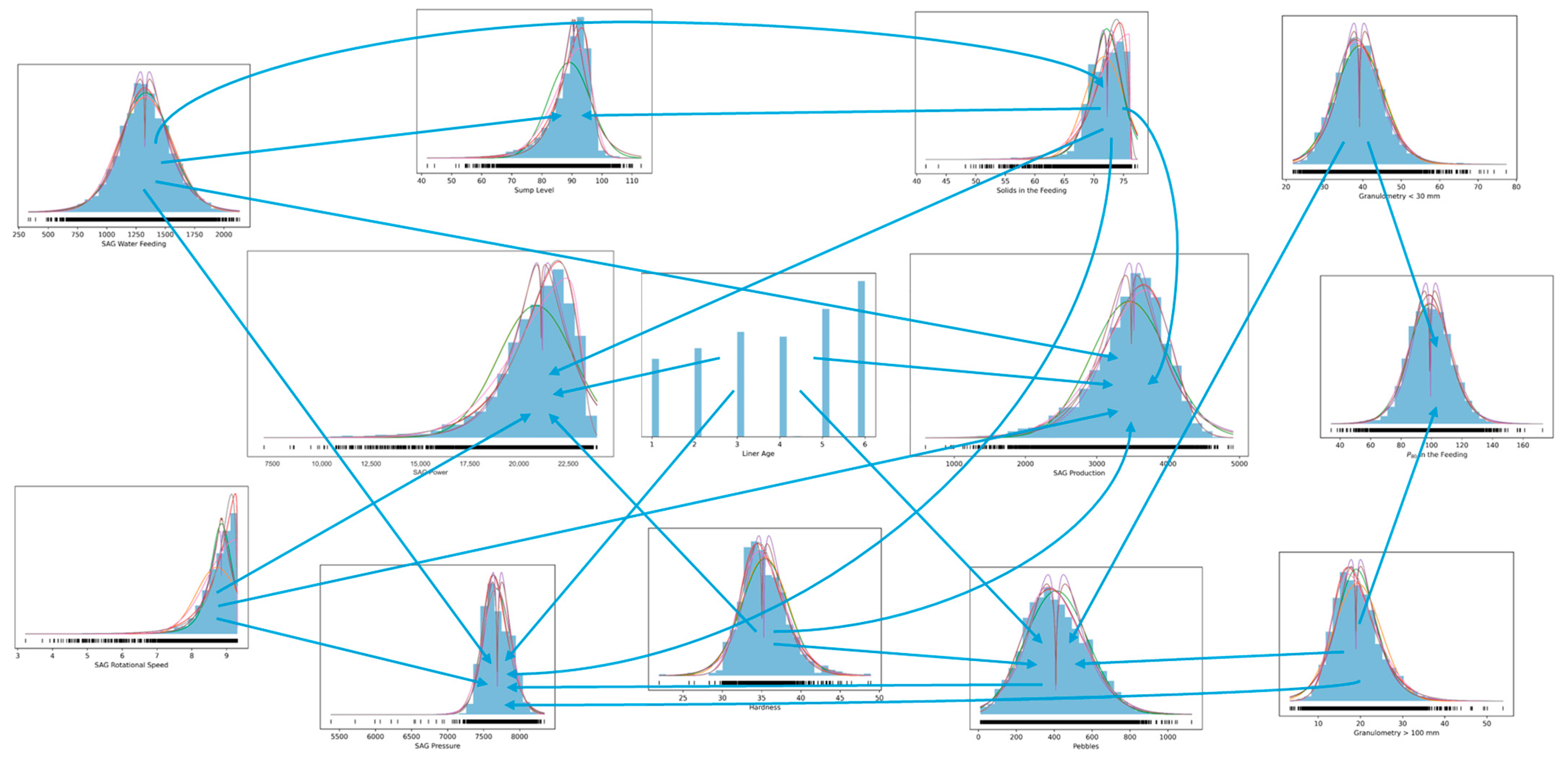
- Hardness → Pebbles: Greater mineral hardness increases the likelihood of accumulating particles in the hard-to-break range (≈25–55 mm), which the circuit itself recognizes as pebbles and recirculates to the crusher; therefore, it is reasonable that hardness increases the observed pebble flow rate. Dynamic and design studies of SAG circuits emphasize precisely this breaking inefficiency in this range and its management with pebble crushing [100].
- Solids in the Feeding → Sump Level: Solids percentage in the feeding governs rheology and downstream hydraulics. Higher densities imply that the sump level tends to rise (more load on pumps and cyclones), while with dilution, it falls. Control manuals and circuit models show that water/solids in the sump are a central lever for stabilizing the level and cyclone cut-off [101].
- Pebbles → SAG Pressure: Higher pebble levels increase the critical size fraction within the SAG mill, partially obstruct the passage through the grates/pulp lifters, and increase pulp residence time. This “clogging” favors the formation of slurry pooling, reduces evacuation capacity, and consequently increases the internal pressure of the SAG circuit. The literature shows that pooling is closely linked to the discharge capacity and pulp transport rate. When evacuation is limited by the accumulation of critical sizes, pressure rises and throughput drops, a phenomenon documented in industrial campaigns and mechanistic discharge analyses (grate–pulp lifter). Furthermore, recent studies on pebble recycling dynamics show that higher pebble loads increase the circulating load and aggravate pooling/clogging conditions, with a direct impact on hydraulic variables such as pressure. These mechanisms explain why pebble flow is a driver of the SAG Pressure observed at the plant [100,102,103].
- SAG Water Feeding → {Solids in the Feeding, SAG Production, SAG Pressure, Sump Level}: Water is the key manipulated variable for determining the solids percentage and, by extension, bed rheology; its adjustment impacts the sump level and pressure (transport/pooling). By improving transport and cyclone shear, it also impacts production (SAG Production) and the pebble fraction (relieving critical size retentions). Experimental and simulation evidence shows the influence of the solids percentage/water ratio on size distribution and the hydraulic performance of the circuit [104,105].
- Liner age → {SAG Production, SAG Power, SAG Pressure}: Liner age alters the lifter profile and load kinematics, simultaneously affecting throughput, power, and hydraulic conditions (e.g., alleviation or worsening of pooling). Therefore, liner age explains trends in TpH, MW, and pressure. Field and modeling work confirms that performance often improves as the liner settles and then declines at the end of the cycle, and that liner changes modify both power and slurry evacuation [106].
4.4. Validation and Verification of the Bayesian Network
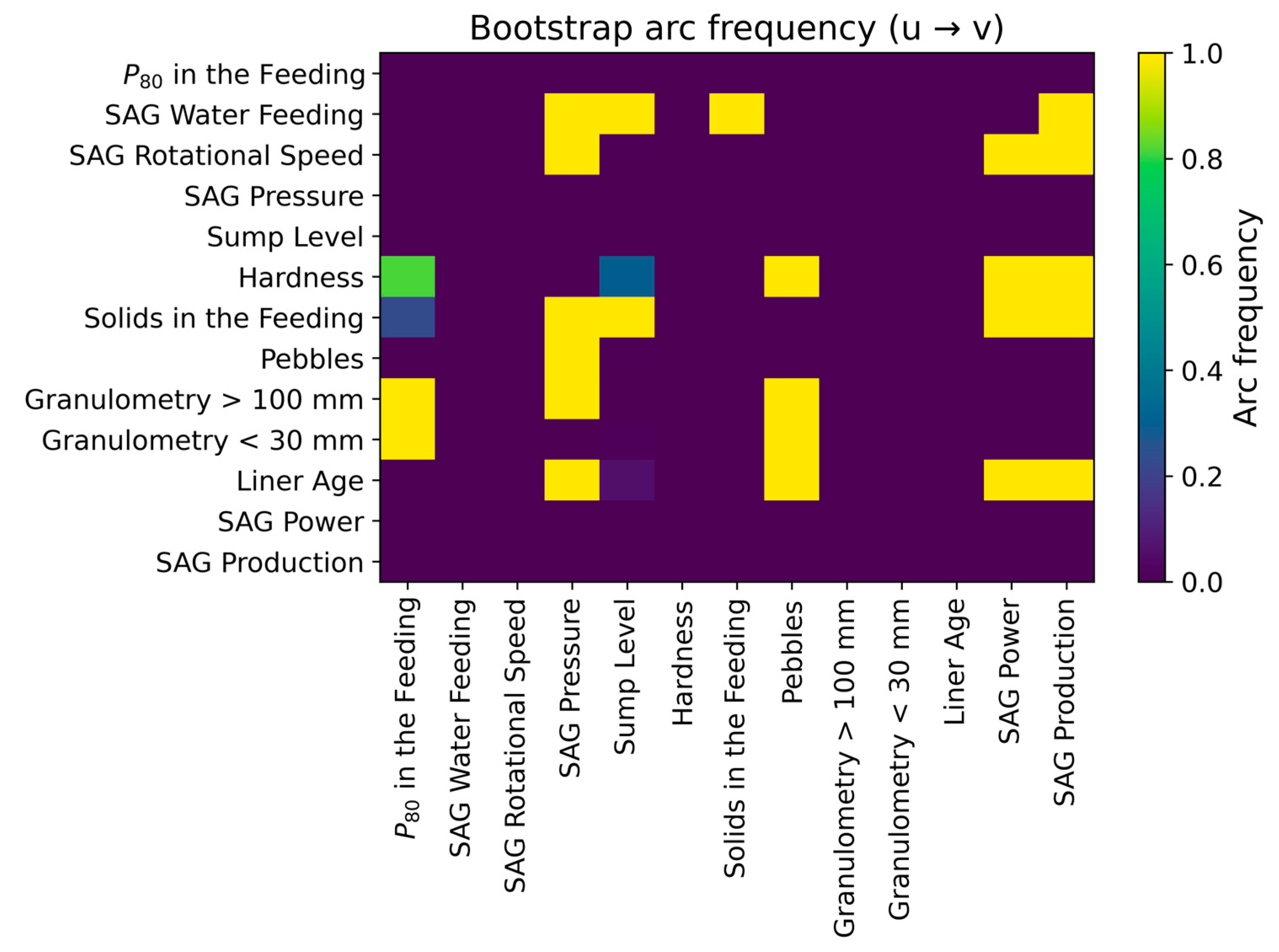
4.5. Structural Robustness Evaluation
4.6. Temporal Validation—Time-Block Split
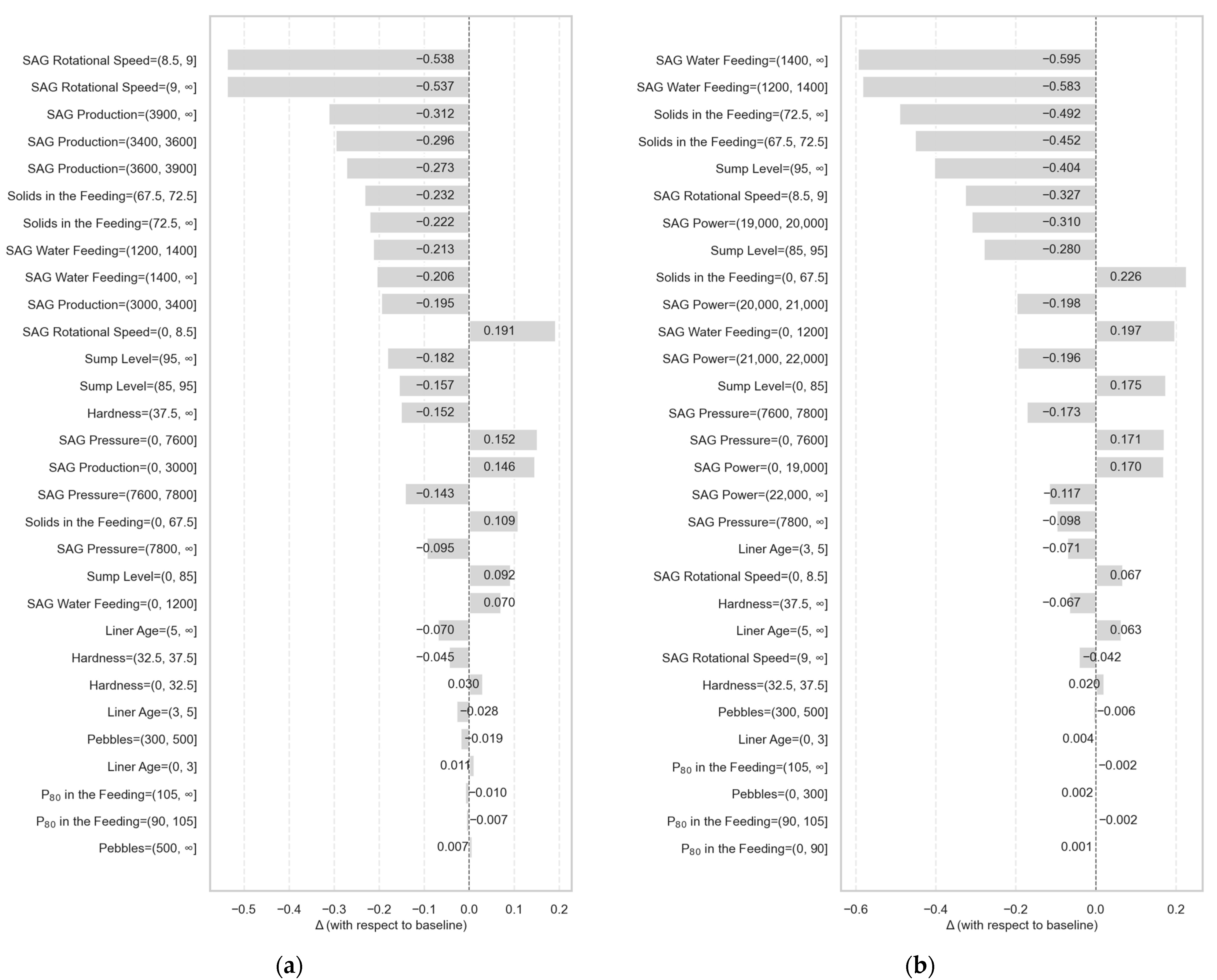
4.7. Interventional Scenario Analysis—What-If Conditions
- Scenario 1—Increasing SAG rotational speed to its highest level while keeping water addition and solid concentration at baseline levels. This intervention produced a strong rise in SAG Power (∆ ≈ +3.8 bins) but only a negligible change in SAG Production, reflecting that RPM primarily influences energy draw rather than throughput efficiency. The above is consistent with SAG mill physics; increasing RPM increases kinetic energy and torque demand, thus increasing SAG Power. On the other hand, increasing RPM does not guarantee greater tonnage; it can even reduce it due to cataracting or load instability.
- Scenario 2—Increasing water feeding while decreasing solids, representing a more dilute pulp regime. In this case, SAG Production increases (Δ ≈ +0.56), whereas SAG Power remains unchanged relative to the baseline (Δ ≈ 0). This behavior is consistent with improved material transport rather than increased mechanical load. The additional water does not lead to higher power consumption, which is expected since power draw is primarily governed by the mass of material being lifted and impacted inside the mill, rather than by slurry volume alone. However, it does result in a clear increase in SAG production (+0.56), as higher water addition enhances slurry mobility and a lower solids content reduces pulp viscosity, leading to improved flow conditions and faster material evacuation.
- Scenario 3—Simultaneously increasing hardness and pebbles, which moderately elevated SAG Power (∆ ≈ +0.7 bins) and produced a very small increase in SAG Production, a behavior aligned with the higher energy requirements imposed by tougher ore and coarse circulating load. This behavior is consistent with the operational physics of the SAG mill. In general, harder ore tends to increase the specific energy demand and, in many cases, can even reduce production due to the greater effort required for size reduction. Likewise, a higher presence of pebbles is usually associated with coarser particle sizes, which would increase the work required.
- Scenario 4—Combining high rotational speed with intermediate solids and medium water levels, representing a near-optimal operating balance. This configuration simultaneously generates a significant increase in both SAG Power (Δ ≈ +0.56) and SAG Production (Δ ≈ +0.56), reflecting a favorable balance between available energy and pulp transport efficiency. The high rotational speed increases the specific energy available for comminution, while the solids and water at intermediate levels promote a stable flow without overloading the mill. As a result, this scenario stands out as the most efficient among those evaluated, demonstrating a balanced increase in both Power and Production, and revealing operating conditions that approach optimal SAG circuit performance.
4.8. Bayesian Network Sensitivity Analysis
5. Discussions
5.1. On the Modeled and Fitted Bayesian Network
- Identifying relationships with lags will require time-shifts and/or dynamic models (DBN) to capture delayed effects (e.g., stockpile → PSD → SAG Production).
- Sensitivity showed clear levers. A next step can integrate optimization under uncertainty (e.g., recommending water/solids percentage/rotational speed setpoints) using BN as a probabilistic simulator.
5.2. On Comparative Benchmarking with Alternative Machine Learning Models
5.2.1. Random Forest and Tree-Based Ensemble Methods
5.2.2. Gradient Boosting Machines and XGBoost
5.2.3. Artificial Neural Networks and Deep Learning Architectures
5.2.4. Hybrid and Ensemble Intelligent Systems
5.2.5. Comparative Synthesis: Strengths, Limitations, and Complementary Capabilities
- In terms of pure predictive accuracy for point forecasts, gradient boosting methods and deep neural networks consistently achieve the highest performance metrics in recent benchmarking studies [15,68,110,116]. These methods excel in capturing complex nonlinear patterns and temporal dependencies in large datasets, making them highly suitable for real-time forecasting and control applications where predictive precision is paramount [116,117].
- Regarding interpretability and physical consistency, tree-based methods provide feature importance rankings and hybrid physics-informed models enforce physical constraints [115,119]; only BNs offer explicit graphical representations of conditional dependencies that align with domain knowledge about SAG mill operations. This transparency facilitates expert validation, enables incorporation of prior knowledge, and supports diagnostic reasoning when mill performance deviates from expectations [124,125].
- Uncertainty quantification capabilities vary across methods. Most ML approaches provide point predictions with limited probabilistic interpretation, whereas BNs naturally represent joint probability distributions over all variables [126]. This distinction is crucial for SAG mill applications characterized by significant operations. The ability to propagate uncertainty through the causal network and quantify prediction confidence under partial observability represents a fundamental advantage of the BN framework [127,128].
- Causal inference and bidirectional reasoning distinguish BNs from alternative ML methods. While XGBoost can predict power consumption given operational parameters, it cannot efficiently infer probable causes of observed power anomalies or evaluate counterfactual scenarios. BNs support these diagnostic and interventional queries through their explicit causal structure, enabling decision support beyond pure prediction [124,129].
5.3. On Methodological and Practical Recommendations
- Data and sensors: Improved online detection systems and standardized data models. Without reliable signals, probabilistic inference and digital twins cannot be precise [64].
- New trend—probabilistic digital twins: A practical roadmap is to build digital twins that incorporate probabilistic models for key components, operate within a simulation system or control loop to evaluate operating modes under uncertainty, and generate optimal control parameters through optimization (evolutionary algorithms) [61,65,68,70].
- Step 4: Run phased industrial pilots with operator validation in the loop and suggestions for conservative setting values before closed-loop control [64].
6. Conclusions and Future Perspectives
6.1. Conclusions
- Identify the dependencies between the independent variables and the response variable, as well as between the independent variables.
- Determine the variables that contribute most to explaining the variability of the response(s).
- Incorporate quantitative knowledge about the frequency of occurrence of an event, using the parameters obtained by the Bayesian network, which will allow for the identification of recurring scenarios.
- Generate estimates of SAG production based on partial knowledge (in addition to a priori knowledge) of the operational variables considered in the study, such as liner age or mill rotation speed.
6.2. Future Perspectives
Author Contributions
Funding
Institutional Review Board Statement
Informed Consent Statement
Data Availability Statement
Acknowledgments
Conflicts of Interest
References
- Flanagan, D.M. Copper. In Mineral Commodity Summaries 2025; U.S. Geological Survey: Reston, VA, USA, 2025; pp. 64–65. ISBN 978-1-4113-4595-9. [Google Scholar]
- Velásquez-Yévenes, L.; Torres, D.; Toro, N. Leaching of Chalcopyrite Ore Agglomerated with High Chloride Concentration and High Curing Periods. Hydrometallurgy 2018, 181, 215–220. [Google Scholar] [CrossRef]
- Pradhan, N.; Nathsarma, K.C.; Srinivasa Rao, K.; Sukla, L.B.; Mishra, B.K. Heap Bioleaching of Chalcopyrite: A Review. Miner. Eng. 2008, 21, 355–365. [Google Scholar] [CrossRef]
- Ghorbani, Y.; Franzidis, J.P.; Petersen, J. Heap Leaching Technology—Current State, Innovations, and Future Directions: A Review. Miner. Process. Extr. Metall. Rev. 2016, 37, 73–119. [Google Scholar] [CrossRef]
- Schlesinger, M.; King, M.; Sole, K.; Davenport, W. Extractive Metallurgy of Copper, 5th ed.; Elsevier Ltd.: Amsterdam, The Netherlands, 2011; ISBN 9780080967899. [Google Scholar]
- Saldaña, M.; González, J.; Jeldres, R.; Villegas, Á.; Castillo, J.; Quezada, G.; Toro, N. A Stochastic Model Approach for Copper Heap Leaching through Bayesian Networks. Metals 2019, 9, 1198. [Google Scholar] [CrossRef]
- Barros, K.S.; Vielmo, V.S.; Moreno, B.G.; Riveros, G.; Cifuentes, G.; Bernardes, A.M. Chemical Composition Data of the Main Stages of Copper Production from Sulfide Minerals in Chile: A Review to Assist Circular Economy Studies. Minerals 2022, 12, 250. [Google Scholar] [CrossRef]
- Neira, A.; Pizarro, D.; Quezada, V.; Velásquez-Yévenes, L. Pretreatment of Copper Sulphide Ores Prior to Heap Leaching: A Review. Metals 2021, 11, 1067. [Google Scholar] [CrossRef]
- Consejo Minero. Updated Mining Statistics [Cifras Actualizadas de la Minería]; Consejo Minero: Santiago, Chile, 2025. [Google Scholar]
- Moskalyk, R.R.; Alfantazi, A.M. Review of Copper Pyrometallurgical Practice: Today and Tomorrow. Miner. Eng. 2003, 16, 893–919. [Google Scholar] [CrossRef]
- Curry, J.A.; Ismay, M.J.L.; Jameson, G.J. Mine Operating Costs and the Potential Impacts of Energy and Grinding. Miner. Eng. 2014, 56, 70–80. [Google Scholar] [CrossRef]
- Bilim, N.; Çelik, A.; Kekeç, B. A Study in Cost Analysis of Aggregate Production as Depending on Drilling and Blasting Design. J. Afr. Earth Sci. 2017, 134, 564–572. [Google Scholar] [CrossRef]
- De Solminihac, H.; Gonzales, L.E.; Cerda, R. Copper Mining Productivity: Lessons from Chile. J. Policy Model. 2018, 40, 182–193. [Google Scholar] [CrossRef]
- Jeswiet, J.; Szekeres, A. Energy Consumption in Mining Comminution. Procedia CIRP 2016, 48, 140–145. [Google Scholar] [CrossRef]
- Avalos, S.; Kracht, W.; Ortiz, J.M. Machine Learning and Deep Learning Methods in Mining Operations: A Data-Driven SAG Mill Energy Consumption Prediction Application. Min. Metall. Explor. 2020, 37, 1197–1212. [Google Scholar] [CrossRef]
- Daozhen, G.; Peilong, W.; Chunbao, S.; Jue, K.; Ruiyang, Z.; Yang, H.; Daozhen, G.; Peilong, W.; Chunbao, S.; Jue, K.; et al. The Application of JKSimMet Software in the Multi-Objective Collaborative Optimization of the Grinding and Classification System at a Gold Mine. Conserv. Util. Miner. Resour. 2020, 40, 99–104. [Google Scholar] [CrossRef]
- Villanueva, M.; Calderón, C.; Saldaña, M.; Toro, N. Modelling a Sag Grinding System through Multiples Regressions. In Proceedings of the METAL 2020—29th International Conference on Metallurgy and Materials, Brno, Czech Republic, 20–22 May 2020; pp. 1243–1248. [Google Scholar] [CrossRef]
- Napier-Munn, J.; Morrell, S.; Morrison, R.D.; Kojovic, T. Mineral Communition Circuits Their Operation and Optimization; Napier-Munn, T.J., Ed.; Julius Kruttsnitt Mineral Research Center: Indooroopilly, Australia, 1996; ISBN 064628861X. [Google Scholar]
- Carrasco, C.; Keeney, L.; Napier-Munn, T.J.; Bode, P. Unlocking Additional Value by Optimising Comminution Strategies to Process Grade Engineering® Streams. Miner. Eng. 2017, 103–104, 2–10. [Google Scholar] [CrossRef]
- Morrell, S. Predicting the Overall Specific Energy Requirement of Crushing, High Pressure Grinding Roll and Tumbling Mill Circuits. Miner. Eng. 2009, 22, 544–549. [Google Scholar] [CrossRef]
- Valery, W., Jr.; Morrell, S.; Kojovic, T.; Kanchibotla, S.; Thornton, D. Modelling and Simulation Techniques Applied for Optimisation of Mine to Mill Operations and Case Studies. In Proceedings of the VI Southern Hemisphere Conference on Minerals Technology, Rio de Janeiro, Brazil, 27 May–1 June 2001; Da Luz, A., Soares, P., Eds.; Corba Editora Artes Graficas: Rio de Janeiro, Brazil, 2001; pp. 107–116. [Google Scholar]
- Darwiche, A. Modeling and Reasoning with Bayesian Networks, 1st ed.; Cambridge University Press: Los Angeles, CA, USA, 2009; ISBN 9780521884389. [Google Scholar]
- Mckee, D.J. Understanding Mine to Mill, 1st ed.; The Cooperative Research Centre for Optimising Resource Extraction: Brisbane, Australia, 2013; ISBN 9781922029270. [Google Scholar]
- Cisternas, L.A.; Lucay, F.A.; Botero, Y.L. Trends in Modeling, Design, and Optimization of Multiphase Systems in Minerals Processing. Minerals 2019, 10, 22. [Google Scholar] [CrossRef]
- Austin, L.G. A Mill Power Equation for SAG Mills. Min. Metall. Explor. 1990, 7, 57–63. [Google Scholar] [CrossRef]
- Moys, M.H. A Model of Mill Power as Affected by Mill Speed, Load Volume, and Liner Design. J. S. Afr. Inst. Min. Metall. 1993, 93, 135–141. [Google Scholar]
- Morrell, S. Power Draw of Wet Tumbling Mills and Its Relationship to Charge Dynamics—Part 2: An Empirical Approach to Modelling of Mill Power Draw. Trans. Inst. Min. Metall. Sect. C Miner. Process. Extr. Metall. 1996, 105, C54–C62. [Google Scholar]
- Kojovic, T. Influence of Aggregate Stemming in Blasting on the SAG Mill Performance. Miner. Eng. 2005, 18, 1398–1404. [Google Scholar] [CrossRef]
- Morrel, S.; Valery, W. Influence of Feed Size on AG/SAG Mill Performance. In Proceedings of the SAG 2001, Vancouver, BC, Canada, 30 September–3 October 2001; pp. 1203–1214. [Google Scholar]
- Michaux, S.; Djordjevic, N. Influence of Explosive Energy on the Strength of the Rock Fragments and SAG Mill Throughput. Miner. Eng. 2005, 18, 439–448. [Google Scholar] [CrossRef]
- Behnamfard, A.; Namaei Roudi, D.; Veglio, F. The Performance Improvement of a Full-Scale Autogenous Mill by Setting the Feed Ore Properties. J. Clean. Prod. 2020, 271, 122554. [Google Scholar] [CrossRef]
- Morrell, S. The Appropriateness of the Transfer Size in AG and SAG Mill Circuit Design. In Proceedings of the SAG 2011, Los Angeles, CA, USA, 30 January 2011; pp. 1–12. [Google Scholar]
- Van Nierop, M.A.; Moys, M.H. Exploration of Mill Power Modelled as Function of Load Behaviour. Miner. Eng. 2001, 14, 1267–1276. [Google Scholar] [CrossRef]
- Silva, M.; Casali, A. Modelling SAG Milling Power and Specific Energy Consumption Including the Feed Percentage of Intermediate Size Particles. Miner. Eng. 2015, 70, 156–161. [Google Scholar] [CrossRef]
- Dong, S.; Wang, B.; Wang, Z.; Hu, X.K.; Song, H.C.; Liu, Q. Comparison of Prediction Models for Power Draw in Grinding and Flotation Processes in a Gold Treatment Plant. J. Chem. Eng. Jpn. 2018, 49, 204–210. [Google Scholar] [CrossRef]
- Lucay, F.A.; Gálvez, E.D.; Salez-Cruz, M.; Cisternas, L.A. Improving Milling Operation Using Uncertainty and Global Sensitivity Analyses. Miner. Eng. 2019, 131, 249–261. [Google Scholar] [CrossRef]
- Lucay, F.A. Accelerating Global Sensitivity Analysis via Supervised Machine Learning Tools: Case Studies for Mineral Processing Models. Minerals 2022, 12, 750. [Google Scholar] [CrossRef]
- Li, H.; Evertsson, M.; Lindqvist, M.; Hulthén, E.; Asbjörnsson, G. Dynamic Modeling and Simulation of a SAG Mill-Pebble Crusher Circuit by Controlling Crusher Operational Parameters. Miner. Eng. 2018, 127, 98–104. [Google Scholar] [CrossRef]
- Asghari, M.; VandGhorbany, O.; Nakhaei, F. Relationship among Operational Parameters, Ore Characteristics, and Product Shape Properties in an Industrial SAG Mill. Part. Sci. Technol. 2020, 38, 482–493. [Google Scholar] [CrossRef]
- Lvov, V.; Chitalov, L.; Nikolayevna Aleksandrova, T.; Mütze, T. Semi-Autogenous Wet Grinding Modeling with CFD-DEM. Minerals 2021, 11, 485. [Google Scholar] [CrossRef]
- Marijnissen, M.J.; Graczykowski, C.; Rojek, J. Simulation of the Comminution Process in a High-Speed Rotor Mill Based on the Feed’s Macroscopic Material Data. Miner. Eng. 2021, 163, 106746. [Google Scholar] [CrossRef]
- Ge, Z.; Song, Z.; Ding, S.X.; Huang, B. Data Mining and Analytics in the Process Industry: The Role of Machine Learning. IEEE Access 2017, 5, 20590–20616. [Google Scholar] [CrossRef]
- Joe Qin, S. Special Issue on Big Data: Data Science for Process Control and Operations. J. Process Control 2018, 67, iii. [Google Scholar] [CrossRef]
- LV, Y.; Le, Q.T.; Bui, H.B.; Bui, X.N.; Nguyen, H.; Nguyen-Thoi, T.; Dou, J.; Song, X. A Comparative Study of Different Machine Learning Algorithms in Predicting the Content of Ilmenite in Titanium Placer. Appl. Sci. 2020, 10, 635. [Google Scholar] [CrossRef]
- Tang, J.; Qiao, J.; Liu, Z.; Zhou, X.; Yu, G.; Zhao, J. Mechanism Characteristic Analysis and Soft Measuring Method Review for Ball Mill Load Based on Mechanical Vibration and Acoustic Signals in the Grinding Process. Miner. Eng. 2018, 128, 294–311. [Google Scholar] [CrossRef]
- Smith, M.L.; Prisbrey, K.A.; Barron, C.L. Blasting Design for Increased SAG Mill Productivity. Min. Metall. Explor. 1993, 10, 188–190. [Google Scholar] [CrossRef]
- Salazar, J.L.; Magne, L.; Acuña, G.; Cubillos, F. Dynamic Modelling and Simulation of Semi-Autogenous Mills. Miner. Eng. 2009, 22, 70–77. [Google Scholar] [CrossRef]
- Bascur, O.A.; Soudek, A. Grinding and Flotation Optimization Using Operational Intelligence. Min. Metall. Explor. 2019, 36, 139–149. [Google Scholar] [CrossRef]
- Bardinas, J.P.; Aldrich, C.; Napier, L.F.A. Predicting the Operating States of Grinding Circuits by Use of Recurrence Texture Analysis of Time Series Data. Processes 2018, 6, 17. [Google Scholar] [CrossRef]
- Delaney, G.W.; Cleary, P.W.; Morrison, R.D.; Cummins, S.; Loveday, B. Predicting Breakage and the Evolution of Rock Size and Shape Distributions in Ag and SAG Mills Using DEM. Miner. Eng. 2013, 50–51, 132–139. [Google Scholar] [CrossRef]
- Apelt, T.A.; Thornhill, N.F. Inferential Measurement of SAG Mill Parameters V: MPC Simulation. Miner. Eng. 2009, 22, 1045–1052. [Google Scholar] [CrossRef]
- Apelt, T.A.; Thornhill, N.F. Inferential Measurement of Sag Mill Parameters IV: Inferential Model Validation. Miner. Eng. 2009, 22, 1032–1044. [Google Scholar] [CrossRef]
- Bueno, M.P.; Kojovic, T.; Powell, M.S.; Shi, F. Multi-Component AG/SAG Mill Model. Miner. Eng. 2013, 43–44, 12–21. [Google Scholar] [CrossRef]
- Kahraman, A.; Kantardzic, M.; Kahraman, M.M.; Kotan, M. A Data-Driven Multi-Regime Approach for Predicting Energy Consumption. Energies 2021, 14, 6763. [Google Scholar] [CrossRef]
- Olivier, J.; Aldrich, C. Use of Decision Trees for the Development of Decision Support Systems for the Control of Grinding Circuits. Minerals 2021, 11, 595. [Google Scholar] [CrossRef]
- Azizi, A.; Rooki, R.; Mollayi, N. Modeling and Prediction of Wear Rate of Grinding Media in Mineral Processing Industry Using Multiple Kernel Support Vector Machine. SN Appl. Sci. 2020, 2, 1469. [Google Scholar] [CrossRef]
- Hoseinian, F.S.; Abdollahzadeh, A.; Rezai, B. Semi-Autogenous Mill Power Prediction by a Hybrid Neural Genetic Algorithm. J. Cent. South Univ. 2018, 25, 151–158. [Google Scholar] [CrossRef]
- Lu, X.; Kiumarsi, B.; Chai, T.; Jiang, Y.; Lewis, F.L. Operational Control of Mineral Grinding Processes Using Adaptive Dynamic Programming and Reference Governor. IEEE Trans. Ind. Inform. 2019, 15, 2210–2221. [Google Scholar] [CrossRef]
- Xie, Q.; Zhong, C.; Liu, D.; Fu, Q.; Wang, X.; Shen, Z. Operation Analysis of a SAG Mill under Different Conditions Based on DEM and Breakage Energy Method. Energies 2020, 13, 5247. [Google Scholar] [CrossRef]
- Hadizadeh, M.; Farzanegan, A.; Noaparast, M. Supervisory Fuzzy Expert Controller for Sag Mill Grinding Circuits: Sungun Copper Concentrator. Miner. Process. Extr. Metall. Rev. 2017, 38, 168–179. [Google Scholar] [CrossRef]
- Valencia, J.V.; Vargas, F. A Probabilistic Graphical Model for Semi-Autogenous Grinding Processes. In Proceedings of the IEEE CHILEAN Conference on Electrical, Electronics Engineering, Information and Communication Technologies, ChileCon, Valdivia, Chile, 5–7 December 2023. [Google Scholar] [CrossRef]
- Magzumov, Z.; Kumral, M. Application of the Hierarchical Bayesian Models to Analyze Semi-Autogenous Mill Throughput. Miner. Eng. 2025, 232, 109486. [Google Scholar] [CrossRef]
- Pegoraro, M. Probabilistic and Non-Deterministic Event Data in Process Mining: Embedding Uncertainty in Process Analysis Techniques. CEUR Workshop Proc. 2022, 3139, 37–46. [Google Scholar] [CrossRef]
- Estay, H.; Lois-Morales, P.; Montes-Atenas, G.; Ruiz del Solar, J. On the Challenges of Applying Machine Learning in Mineral Processing and Extractive Metallurgy. Minerals 2023, 13, 788. [Google Scholar] [CrossRef]
- Dehon, V.; Quintanilla, P.; Chanona, A.D.R. Probabilistic Model Predictive Control for Mineral Flotation Using Gaussian Processes. Syst. Control. Trans. 2025, 4, 1023–1028. [Google Scholar] [CrossRef]
- Moraga, C.; Astudillo, C.A.; Estay, R.; Maranek, A. Enhancing Comminution Process Modeling in Mineral Processing: A Conjoint Analysis Approach for Implementing Neural Networks with Limited Data. Mining 2024, 4, 966–982. [Google Scholar] [CrossRef]
- Kazemi, M.; Moradkhani, D.; Alipour, A.A. Application of Random Forest and Support Vector Machine for Investigation of Pressure Filtration Performance, a Zinc Plant Filter Cake Modeling. Int. J. Miner. Process. Extr. Metall. 2023, 8, 15–23. [Google Scholar] [CrossRef]
- Ghasemi, Z.; Neshat, M.; Aldrich, C.; Karageorgos, J.; Zanin, M.; Neumann, F.; Chen, L. A Hybrid Intelligent Framework for Maximising SAG Mill Throughput: An Integration of Expert Knowledge, Machine Learning and Evolutionary Algorithms for Parameter Optimisation. arXiv 2023, arXiv:2312.10992. [Google Scholar] [CrossRef]
- Nad, A.; Jooshaki, M.; Tuominen, E.; Michaux, S.; Kirpala, A.; Newcomb, J. Digitalization Solutions in the Mineral Processing Industry: The Case of GTK Mintec, Finland. Minerals 2022, 12, 210. [Google Scholar] [CrossRef]
- Quelopana, A.; Órdenes, J.; Wilson, R.; Navarra, A. Technology Upgrade Assessment for Open-Pit Mines through Mine Plan Optimization and Discrete Event Simulation. Minerals 2023, 13, 642. [Google Scholar] [CrossRef]
- Liao, Z.; Xu, C.; Chen, W.; Chen, Q.; Wang, F.; She, J. Effective Throughput Optimization of SAG Milling Process Based on BPNN and Genetic Algorithm. In Proceedings of the 2023 IEEE 6th International Conference on Industrial Cyber-Physical Systems, ICPS 2023, Wuhan, China, 8–11 May 2023. [Google Scholar] [CrossRef]
- Bizagi. Bizagi Modeler. 2025. Available online: https://www.bizagi.com/es/plataforma/modeler (accessed on 13 July 2025).
- McCoy, J.T.; Auret, L. Machine Learning Applications in Minerals Processing: A Review. Miner. Eng. 2019, 132, 95–109. [Google Scholar] [CrossRef]
- Umucu, Y.; Deniz, V.; Bozkurt, V.; Fatih Çağlar, M. The Evaluation of Grinding Process Using Artificial Neural Network. Int. J. Miner. Process 2016, 146, 46–53. [Google Scholar] [CrossRef]
- Ahmadzadeh, F.; Lundberg, J. Remaining Useful Life Prediction of Grinding Mill Liners Using an Artificial Neural Network. Miner. Eng. 2013, 53, 1–8. [Google Scholar] [CrossRef]
- Khoshjavan, S.; Khoshjavan, R.; Rezai, B. Evaluation of the Effect of Coal Chemical Properties on the Hardgrove Grindability Index (HGI) of Coal Using Artificial Neural Networks. J. S. Afr. Inst. Min. Metall. 2013, 113, 505–510. [Google Scholar]
- Özbayoǧlu, G.; Özbayoǧlu, A.M.; Özbayoǧlu, M.E. Estimation of Hardgrove Grindability Index of Turkish Coals by Neural Networks. Int. J. Miner. Process 2008, 85, 93–100. [Google Scholar] [CrossRef]
- Venkoba Rao, B.; Gopalakrishna, S.J. Hardgrove Grindability Index Prediction Using Support Vector Regression. Int. J. Miner. Process 2009, 91, 55–59. [Google Scholar] [CrossRef]
- Makokha, A.B.; Moys, M.H. Multivariate Approach to On-Line Prediction of in-Mill Slurry Density and Ball Load Volume Based on Direct Ball and Slurry Sensor Data. Miner. Eng. 2012, 26, 13–23. [Google Scholar] [CrossRef]
- Saldaña, M.; Gálvez, E.; Navarra, A.; Toro, N.; Cisternas, L.A. Optimization of the SAG Grinding Process Using Statistical Analysis and Machine Learning: A Case Study of the Chilean Copper Mining Industry. Materials 2023, 16, 3220. [Google Scholar] [CrossRef] [PubMed]
- Nakhaei, F.; Mosavi, M.R.; Sam, A.; Vaghei, Y. Recovery and Grade Accurate Prediction of Pilot Plant Flotation Column Concentrate: Neural Network and Statistical Techniques. Int. J. Miner. Process 2012, 110–111, 140–154. [Google Scholar] [CrossRef]
- Niedermayer, D. An Introduction to Bayesian Networks and Their Contemporary Applications. In Innovations in Bayesian Networks; Springer: Berlin/Heidelberg, Germany, 2008; Volume 156, pp. 117–130. ISBN 978-3-540-85066-3. [Google Scholar]
- Koski, T.; Noble, J.M. Bayesian Networks: An Introduction; John Wiley: Hoboken, NJ, USA, 2009; ISBN 978-0-470-74304-1. [Google Scholar]
- Devore, J. Probability & Statistics for Engineering and the Sciences, 8th ed.; Julet, M., Ed.; Cengage Learning: Boston, MA, USA, 2010; ISBN 0-538-73352-7. [Google Scholar]
- Hastie, T.; Tibshirani, R.; Friedman, J. The Elements of Statistical Learning: Data Mining, Inference and Prediction, 2nd ed.; Springer: Berlin/Heidelberg, Germany, 2017; ISBN 9780387848570. [Google Scholar]
- Grosan, C.; Abraham, A. Intelligent Systems, 1st ed.; Grosan, C., Abraham, A., Eds.; Intelligent Systems Reference Library; Springer: Berlin/Heidelberg, Germany, 2011; Volume 17, ISBN 978-3-642-21003-7. [Google Scholar]
- Montgomery, D.C.; Runger, G.C. Applied Statistics and Probalisty for Engineers, 6th ed.; John Wiley & Sons, Inc.: Hoboken, NJ, USA, 2014; ISBN 9781118539712. [Google Scholar]
- Pearl, J. Probabilistic Reasoning in Intelligent Systems; Elsevier: Amsterdam, The Netherlands, 1988; ISBN 9780080514895. [Google Scholar]
- Cooper, G.F.; Herskovits, E. A Bayesian Method for the Induction of Probabilistic Networks from Data. Mach. Learn. 1992, 9, 309–347. [Google Scholar] [CrossRef]
- Heckerman, D.; Geiger, D.; Chickering, D.M. Learning Bayesian Networks: The Combination of Knowledge and Statistical Data. Mach. Learn. 1995, 20, 197–243. [Google Scholar] [CrossRef]
- Tsamardinos, I.; Brown, L.E.; Aliferis, C.F. The Max-Min Hill-Climbing Bayesian Network Structure Learning Algorithm. Mach. Learn. 2006, 65, 31–78. [Google Scholar] [CrossRef]
- Madera, J.; Ochoa, A. Evaluating the Max-Min Hill-Climbing Estimation of Distribution Algorithm on B-Functions. In Lecture Notes in Computer Science (Including subseries Lecture Notes in Artificial Intelligence and Lecture Notes in Bioinformatics); Springer: Berlin/Heidelberg, Germany, 2018; Volume 11047, pp. 26–33. [Google Scholar] [CrossRef]
- Chickering, D.M. Optimal Structure Identification with Greedy Search. J. Mach. Learn. Res. 2003, 3, 507–554. [Google Scholar] [CrossRef][Green Version]
- Suzuki, J. A Theoretical Analysis of the BDeu Scores in Bayesian Network Structure Learning. Behaviormetrika 2017, 44, 97–116. [Google Scholar] [CrossRef]
- Chen, Y.C.; Wheeler, T.A.; Kochenderfer, M.J. Learning Discrete Bayesian Networks from Continuous Data. J. Artif. Intell. Res. 2017, 59, 103–132. [Google Scholar] [CrossRef]
- Chavira, M.; Darwiche, A.; Jaeger, M. Compiling Relational Bayesian Networks for Exact Inference. Int. J. Approx. Reason. 2006, 42, 4–20. [Google Scholar] [CrossRef]
- Kumral, M. Bed Blending Design Incorporating Multiple Regression Modelling and Genetic Algorithms. J. S. Afr. Inst. Min. Metall. 2006, 106, 229–237. [Google Scholar]
- Ye, Z.; Yahyaei, M.; Hilden, M.; Powell, M.S. Novel Size Segregation Indices for Multi-Sized Particle Stockpiles. Miner. Eng. 2023, 201, 108165. [Google Scholar] [CrossRef]
- Saavedra, M.; Risso, N.; Momayez, M.; Nunes, R.; Tenorio, V.; Zhang, J. Blending Characterization for Effective Management in Mining Operations. Minerals 2025, 15, 891. [Google Scholar] [CrossRef]
- Li, H.; Asbjörnsson, G.; Bhadani, K.; Evertsson, M. Investigating Dynamic Behavior in SAG Mill Pebble Recycling Circuits: A Simulation Approach. Minerals 2024, 14, 716. [Google Scholar] [CrossRef]
- Liu, Y.; Spencer, S. Dynamic Simulation of Grinding Circuits. Miner. Eng. 2004, 17, 1189–1198. [Google Scholar] [CrossRef]
- Powell, M.S.; Valery, W. Slurry Pooling and Transport Issues in SAG Mills. In Proceedings of the International Autogenous and Semiautogenous Grinding Technology, Vancouver, BC, Canada, 24–27 September 2006; University of British Columbia, Dept. of Mining Engineering: Vancouver, BC, Canada, 2006; Volume 1, pp. 133–152. [Google Scholar]
- Mulenga, F.K.; Moys, M.H. Effects of Slurry Pool Volume on Milling Efficiency. Powder Technol. 2014, 256, 428–435. [Google Scholar] [CrossRef]
- Guo, W.; Guo, K. Effect of Solid Concentration on Particle Size Distribution and Grinding Kinetics in Stirred Mills. Minerals 2024, 14, 720. [Google Scholar] [CrossRef]
- Weerasekara, N.S.; Powell, M.S. Performance Characterisation of AG/SAG Mill Pulp Lifters Using CFD Techniques. Miner. Eng. 2014, 63, 118–124. [Google Scholar] [CrossRef]
- Toor, P.; Powell, M.; Hilden, M.; Weerasekara, N. Understanding the Effects of Liner Wear on SAG Mill Performance. In Proceedings of the MetPlant 2015, Perth, Australia, 7 September 2015; The Australasian Institute of Mining and Metallurgy: Perth, Australia, 2015; pp. 150–161. [Google Scholar]
- Saldaña, M.; Neira, P.; Flores, V.; Robles, P.; Moraga, C. A Decision Support System for Changes in Operation Modes of the Copper Heap Leaching Process. Metals 2021, 11, 1025. [Google Scholar] [CrossRef]
- Rogers, P. Advances in Computational Intelligence Applications in the Mining Industry; MDPI: Basel, Switzerland, 2022; ISBN 978-3-0365-3158-8. [Google Scholar]
- Ghasemi, Z.; Neumann, F.; Zanin, M.; Karageorgos, J.; Chen, L. A Comparative Study of Prediction Methods for Semi-Autogenous Grinding Mill Throughput. Miner. Eng. 2024, 205, 108458. [Google Scholar] [CrossRef]
- Pural, Y.E.; Ledezma, T.; Hilden, M.; Forbes, G.; Boylu, F.; Yahyaei, M. Application of Machine Learning for Generic Mill Liner Wear Prediction in Semi-Autogenous Grinding (SAG) Mills. Minerals 2024, 14, 1200. [Google Scholar] [CrossRef]
- Ghasemi, Z.; Neshat, M.; Aldrich, C.; Zanin, M.; Chen, L. Optimising SAG Mill Throughput and Circulating Load Using Machine Learning Models: A Multi-Objective Approach for Identifying Optimal Process Parameters. Miner. Eng. 2025, 232, 109551. [Google Scholar] [CrossRef]
- Ruiz, M.A.V.; Gonzales, J.A.V.; Villalba, F.J.B. Multivariable Predictive Models for the Estimation of Power Consumption (KW) of a Semi-Autogenous Mill Applying Machine Learning Algorithms [Modelos Predictivos Multivariables Para La Estimación de Consumo de Potencia (KW) de Un Molino Semi—Autógeno aplicando algoritmos de Machine Learning]. J. Energy Environ. Sci. 2024, 8, 14–31. [Google Scholar] [CrossRef]
- Meinshausen, N. Quantile Regression Forests. J. Mach. Learn. Res. 2006, 7, 983–999. [Google Scholar]
- Chen, T.; Guestrin, C. XGBoost: A Scalable Tree Boosting System. In Proceedings of the ACM SIGKDD International Conference on Knowledge Discovery and Data Mining, New York, NY, USA, 13–17 August 2016; pp. 785–794. [Google Scholar] [CrossRef]
- Feng, Y.; Wang, X.; Zou, H.; Yan, L. A Composite Power Prediction Model for Semi-Au-Togenous Grinding Mill Based on Mechanistic Approach and XGBoost. In Proceedings of the 37th Chinese Control and Decision Conference, CCDC, Xiamen, China, 16–19 May 2025; pp. 557–564. [Google Scholar] [CrossRef]
- Lopez, P.; Reyes, I.; Risso, N.; Aguilera, C.; Campos, P.G.; Momayez, M.; Contreras, D. Assessing Machine Learning and Deep Learning-Based Approaches for SAG Mill Energy Consumption. In Proceedings of the 2021 IEEE CHILEAN Conference on Electrical, Electronics Engineering, Information and Communication Technologies, CHILECON, Valparaíso, Chile, 6–9 December 2021. [Google Scholar] [CrossRef]
- Hochreiter, S.; Schmidhuber, J. Long Short-Term Memory. Neural Comput. 1997, 9, 1735–1780. [Google Scholar] [CrossRef] [PubMed]
- Zhang, D.; Xiong, X.; Shao, C.; Zeng, Y.; Ma, J. Semi-Autogenous Mill Power Consumption Prediction Based on CACN-LSTM. Appl. Sci. 2024, 15, 2. [Google Scholar] [CrossRef]
- Hermosilla, R.; Valle, C.; Allende, H.; Aguilar, C.; Lucic, E. SAG’s Overload Forecasting Using a CNN Physical Informed Approach. Appl. Sci. 2024, 14, 11686. [Google Scholar] [CrossRef]
- LeCun, Y.; Bengio, Y.; Hinton, G. Deep Learning. Nature 2015, 521, 436–444. [Google Scholar] [CrossRef]
- Goodfellow, I.; Bengio, Y.; Courville, A. Deep Learning; The MIT Press: Cambridge, MA, USA, 2016; ISBN 9780262337373. [Google Scholar]
- Prokhorenkova, L.; Gusev, G.; Vorobev, A.; Dorogush, A.V.; Gulin, A. CatBoost: Unbiased Boosting with Categorical Features. In Proceedings of the 32nd Conference on Neural Information Processing Systems (NeurIPS 2018), Montréal, QC, Canada, 2–8 December 2018. [Google Scholar] [CrossRef]
- Cristianini, N.; Shawe-Taylor, J. An Introduction to Support Vector Machines and Other Kernel-based Learning Methods; Cambridge University Press: Cambridge, UK, 2000. [Google Scholar] [CrossRef]
- Pearl, J. Causality: Models, Reasoning, and Inference, 2nd ed.; Cambridge University Press: Cambridge, UK, 2011; pp. 1–464. [Google Scholar] [CrossRef]
- Koller, D.; Friedman, N. Structure Learning in Bayesian Networks. In Probabilistic Graphical Models: Principles and Techniques; The MIT Press: Cambridge, MA, USA, 2009; pp. 783–848. [Google Scholar]
- Pourret, O.; Naim, P.; Marcot, B. Introduction to Bayesian Networks. In Bayesian Networks: A Practical Guide to Applications; Wiley: Hoboken, NJ, USA, 2008; pp. 1–430. [Google Scholar] [CrossRef]
- Fenton, N.; Neil, M. Risk Assessment and Decision Analysis with Bayesian Networks, 2nd ed.; Chapman and Hall/CRC: Boca Raton, FL, USA, 2018; ISBN 9781315269405. [Google Scholar]
- Kjærulff, U.B.; Madsen, A.L. Bayesian Networks and Influence Diagrams: A Guide to Construction and Analysis; Springer: Berlin/Heidelberg, Germany, 2013; Volume 22. [Google Scholar] [CrossRef]
- Bareinboim, E.; Pearl, J. Causal Inference and the Data-Fusion Problem. Proc. Natl. Acad. Sci. USA 2016, 113, 7345–7352. [Google Scholar] [CrossRef]
- Marcot, B.G.; Penman, T.D. Advances in Bayesian Network Modelling: Integration of Modelling Technologies. Environ. Model. Softw. 2019, 111, 386–393. [Google Scholar] [CrossRef]
- Der Kiureghian, A.; Ditlevsen, O. Aleatory or Epistemic? Does It Matter? Struct. Saf. 2009, 31, 105–112. [Google Scholar] [CrossRef]




| Model | Strengths | Typical Data Needs | Uncertainty Handling | Example Source |
|---|---|---|---|---|
| BN | Captures conditional dependencies and causal structure; interpretable probabilistic outputs | Moderate (structure + conditional tables); benefits from expert priors | Native probabilistic inference and sensitivity analysis [61,62] | Videla & Vargas SAG BN for feed prediction [61] |
| ANN (MLP; RNN; LSTM) | Strong nonlinear function approximation; RNNs excel for temporal forecasts | High for generalization; can be reduced with scenario-based design [15,66] | Usually point forecasts; uncertainty via Bayesian NN or ensemble methods | Avalos et al. found RNNs best for SAG energy forecasting [15]; Moraga et al. achieved R2 > 0.99 using discretized scenarios [66] |
| SVM | Effective in moderate-dimensional regression/classification; robust regularization | Moderate | Non-probabilistic by default; probability estimates via calibration | Used among candidate predictors for SAG energy; often outperformed by ensembles in some tasks [15,67] |
| RF | Strong off-the-shelf performance, robust to outliers, interpretable feature importance | Moderate; tolerates noisy/heterogeneous inputs | Can provide empirical uncertainty (quantile forests/ensembles) | RFR outperformed SVR for filter cake moisture [67]; CatBoost was top predictor in a hybrid SAG throughput study [68] |
| Justification | Father Node | Son Node |
|---|---|---|
| Feeding and granulometry | Granulometry > 100 mm | P80 in the feeding |
| Hardness | P80 in the feeding | |
| Stock Pile Level | P80 in the feeding | |
| Granulometry > 100 mm | Pebbles | |
| Granulometry < 30 mm | Pebbles | |
| Solids and water | SAG Water Feeding | Solids in the feeding |
| P80 in the feeding | Solids in the feeding | |
| Hydraulic condition | SAG Water Feeding | SAG Pressure |
| Solids in the feeding | SAG Pressure | |
| Pebbles | SAG Pressure | |
| SAG Pressure | Sump Level | |
| SAG Water Feeding | Sump Level | |
| Influences on responses | SAG Rotational Speed | SAG Power |
| SAG Rotational Speed | SAG Production | |
| Solids in the feeding | SAG Production | |
| P80 in the feeding | SAG Production | |
| SAG Pressure | SAG Power | |
| SAG Pressure | SAG Production | |
| Liner Age | SAG Power | |
| Liner Age | SAG Production | |
| Pebbles | SAG Production |
| Justification | Father Node | Son Node |
|---|---|---|
| Targets such as sinks | SAG Power | |
| SAG Production | ||
| Exogenous roots without parents (no node/variable in the model can “explain” hardness, degree of wear, coarse/fine particle size, etc.) | Hardness | |
| Granulometry > 100 mm | ||
| Granulometry < 30 mm | ||
| Liner Age | ||
| Stock Pile Level | ||
| SAG Rotational Speed | ||
| SAG Water Feeding |
| Variable | n | Q1 | Q3 | IQR | FD Bin Width | Range | FD Suggested Bins | Chosen Bins | Obs/Bin |
|---|---|---|---|---|---|---|---|---|---|
| SAG Power | 8253 | 19,807 | 22,171 | 2363 | 234 | 23,957 | 103 | 5 | ~1650 |
| SAG Production | 8253 | 3146 | 3808 | 661 | 65 | 4333 | 67 | 5 | ~1650 |
| Variable | Unit | Bins | Mean Value | Ranges |
|---|---|---|---|---|
| P80 [ ] | mm | 3 | 98.9065 | (0, 90], (90, 105], (105, +∞) |
| SAG water feeding [ ] | m3/h | 3 | 1325.4114 | (0, 1200], (1200, 1400], (1400, +∞) |
| SAG rotational speed [ ] | RPM | 3 | 8.7150 | (0, 8.5], (8.5, 9], (9, +∞) |
| SAG pressure [ ] | kPa | 3 | 7679.3956 | (0, 7600], (7600, 7800], (7800, +∞) |
| Stockpile level [ ] | m | 3 | 26.1888 | (0, 20], (20, 30], (30, +∞) |
| Sump Level [ ] | m | 3 | 89.2064 | (0, 85], (85, 95], (95, +∞) |
| Hardness [ ] | - | 3 | 35.3518 | (0, 32.5], (32.5, 37.5], (37.5, +∞) |
| Solids in the feeding [ ] | % | 3 | 71.7799 | (0, 67.5], (67.5, 72.5], (72.5, +∞) |
| Pebble [ ] | TpH | 3 | 410.7058 | (0, 300], (300, 500], (500, +∞) |
| Granulometry > 100 mm [ ] | % | 3 | 19.2524 | (0, 15], (15, 22.5], (22.5, +∞) |
| Granulometry < 30 mm [ ] | % | 3 | 39.1673 | (0, 35], (35, 40], (40, +∞) |
| Liner Age [ ] | Month | 3 | 3.8823 | (0, 3.0), [3.0, 5.0), [5.0, +∞) |
| SAG Power [ ] | MW | 5 | 20,820.9266 | (0, 19,000], (19,000, 20,000], (20,000, 21,000], (21,000, 22,000], (22,000, +∞) |
| SAG Production [ ] | TpH | 5 | 3443.5385 | (0, 3000], (3000, 3400], (3400, 3600], (3600, 3900], (3900, +∞) |
| Distribution | ||||||||
|---|---|---|---|---|---|---|---|---|
| Var. | Ind. | Normal | t—Student | GH | Gamma | Weibull | Skew Normal | |
| KS | 0.016585 | 0.020223 | 0.01795 | 0.024821 | 0.01491 * | 0.017279 | 0.017256 | |
| AD | 3.760762 | 7.143328 | 3.293659 | 7.531065 | 3.189279 | 4.280355 | 3.062996 * | |
| Log-lik. | −32,431.25 | −32,412.5 | −32,390.21 * | −32,474.34 | −32,413.92 | −32,429.29 | −32,391.15 | |
| AIC/BIC | 0.999785 | 0.999677 | 0.999461 * | 0.999678 | 0.999677 | 0.999677 | 0.999569 | |
| KS | 0.021705 | 0.021705 | 0.009818 * | 0.019532 | 0.014746 | 0.023457 | 0.011884 | |
| AD | 7.167178 | 7.167166 | 0.963199 * | 4.237795 | 1.854724 | 7.434172 | 1.400765 | |
| Log-lik. | −54,720.04 | −54,720.04 | −54,677.38 * | −54,740.33 | −54,700.75 | −54,716.03 | −54,681.69 | |
| AIC/BIC | 0.999872 | 0.999809 | 0.999681 * | 0.999809 | 0.999809 | 0.999809 | 0.999745 | |
| KS | 0.164566 | 0.135409 | 0.043681 | 0.149112 | 0.158222 | 0.103099 | 0.040372 * | |
| AD | 375.645015 | 167.005365 | 37.705976 | 160.843722 | 188.164438 | 255.011176 | 29.311883 * | |
| Log-lik. | −7341.14 | −5569.48 | −3803.62 * | −5942.19 | −5975.13 | −4504.76 | −4052.9 | |
| AIC/BIC | 0.99905 | 0.998124 | 0.995437 * | 0.998241 | 0.998251 | 0.997682 | 0.996569 | |
| KS | 0.045868 | 0.045868 | 0.043033 * | 0.068434 | 0.067292 | 0.050537 | 0.04338 | |
| AD | 29.650513 | 29.650531 | 22.09348 * | 51.982616 | 40.119984 | 35.020186 | 25.489655 | |
| Log-lik. | −53,329.24 | −53,329.24 | −53,214.38 | −53,376.84 | −53,269.39 | −53,309.54 | −53,191.06 * | |
| AIC/BIC | 0.999869 | 0.999804 | 0.999672 * | 0.999804 | 0.999803 | 0.999804 | 0.999738 | |
| KS | 0.100596 | 0.099831 | 0.020715 * | 0.102747 | 0.099066 | 0.027639 | 0.030904 | |
| AD | 188.433358 | 184.918713 | 8.920261 | 142.321182 | 168.687387 | 8.153442 * | 24.071989 | |
| Log-lik. | −27,480.07 | −27,477.57 | −26,109.03 | −27,544.08 | −27,485.01 | −26,031.55 * | −26,305.14 | |
| AIC/BIC | 0.999746 | 0.999619 | 0.999332 * | 0.99962 | 0.999619 | 0.999598 | 0.999469 | |
| KS | 0.108423 | 0.079086 | 0.422935 | 0.080595 | 0.087883 | 0.066732 | 0.012207 * | |
| AD | 199.995576 | 125.542184 | 22,172.56729 | 106.380384 | 122.78821 | 60.439987 | 2.247726 * | |
| Log-lik. | −26,806.61 | −26,394.24 | −25,646.6 | −26,319.95 | −26,332.28 | −25,972.24 | −25,644.26 * | |
| AIC/BIC | 0.99974 | 0.999603 | 0.99932 * | 0.999602 | 0.999602 | 0.999597 | 0.999456 | |
| KS | 0.056386 | 0.05826 | 0.02149 * | 0.041761 | 0.043112 | 0.030718 | 0.022254 | |
| AD | 44.392028 | 49.376112 | 3.612349 * | 36.916985 | 36.666484 | 13.244529 | 4.208556 | |
| Log-lik. | −20,122.3 | −20,022.28 | −19,809.88 | −19,978.26 | −19,971.17 | −19,959.54 | −19,805.01 * | |
| AIC/BIC | 0.999653 | 0.999477 | 0.99912 * | 0.999476 | 0.999476 | 0.999476 | 0.999295 | |
| KS | 0.098829 | 0.086667 | 0.454278 | 0.098412 | 0.101752 | 0.059273 | 0.050136 * | |
| AD | 136.126504 | 71.611043 | 31,180.31987 | 78.475707 | 82.406033 | 41.672367 | 37.54826 * | |
| Log-lik. | −20,928.6 | −20,202.32 | −19,426.85 * | −20,336.28 | −20,395.75 | −19,528.32 | −19,507.88 | |
| AIC/BIC | 0.999666 | 0.999482 | 0.999102 * | 0.999485 | 0.999487 | 0.999464 | 0.999285 | |
| KS | 0.03352 | 0.03352 | 0.97102 | 0.033227 | 0.038529 | 0.019844 | 0.019243 * | |
| AD | 14.789109 | 14.789116 | 109,648.6016 | 22.919554 | 17.10692 | 3.703869 | 3.651643 * | |
| Log-lik. | −52,062.28 | −52,062.28 | −51,990.36 * | −52,271.99 | −52,157.25 | −51,998.13 | −51,994.76 | |
| AIC/BIC | 0.999866 | 0.999799 | 0.999664 * | 0.9998 | 0.999799 | 0.999799 | 0.999731 | |
| KS | 0.045209 | 0.042058 | 0.009295 * | 0.037231 | 0.033572 | 0.014543 | 0.012592 | |
| AD | 42.092397 | 31.086192 | 0.613646 * | 30.321545 | 26.723171 | 1.217411 | 0.938973 | |
| Log-lik. | −24,969.2 | −24,888.14 | −24,664.96 * | −24,938.69 | −24,903.69 | −24,681.5 | −24,668 | |
| AIC/BIC | 0.99972 | 0.999579 | 0.999293 * | 0.99958 | 0.99958 | 0.999576 | 0.999434 | |
| KS | 0.024616 | 0.029067 | 0.019106 | 0.027416 | 0.018637 | 0.018498 | 0.015535 * | |
| AD | 11.006665 | 16.38656 | 2.965513 * | 11.365011 | 7.409345 | 4.576473 | 3.347478 | |
| Log-lik. | −26,041.56 | −25,996.79 | −25,896.68 | −26,026.41 | −25,981.51 | −25,922.14 | −25,894.77 * | |
| AIC/BIC | 0.999732 | 0.999597 | 0.999326 * | 0.999598 | 0.999597 | 0.999596 | 0.999461 | |
| KS | 0.082501 | 0.08838 | 0.018689 | 0.080549 | 0.079383 | 0.040279 | 0.017925 * | |
| AD | 157.251036 | 168.658464 | 4.345249 * | 86.735191 | 81.153245 | 19.850331 | 4.700906 | |
| Log-lik. | −71,703.95 | −71,449.52 | −70,357.85 * | −71,236.62 | −71,260.35 | −70,500.56 | −70,361.63 | |
| AIC/BIC | 0.999903 | 0.999853 | 0.999752 * | 0.999853 | 0.999853 | 0.999851 | 0.999802 | |
| KS | 0.072416 | 0.073819 | 0.01184 * | 0.038911 | 0.043172 | 0.027981 | 0.0131 | |
| AD | 76.117203 | 76.466679 | 1.22653 * | 39.74364 | 42.151594 | 8.050869 | 1.4181 | |
| Log-lik. | −61,408.4 | −61,347.59 | −60,939.17 * | −61,291.7 | −61,271.55 | −60,973.53 | −60,941.69 | |
| AIC/BIC | 0.999886 | 0.999829 | 0.999714 * | 0.999829 | 0.999829 | 0.999828 | 0.999771 | |
| Variable | Distribution | Parameters |
|---|---|---|
| P80 in the feeding | GH | |
| SAG water feeding | GH | |
| SAG rotational speed | GH | |
| SAG pressure | GH | |
| Stock Pile Level | GH | |
| Sump Level | ||
| Hardness | GH | |
| Solids in the feeding | ||
| Pebbles | ||
| Granulometry > 100 mm | GH | |
| Granulometry < 30 mm | GH | |
| Liner Age | Uniform | |
| SAG Power | GH | |
| SAG Production | GH |
| Node | Indegree—Parents | Outdegree—Children |
|---|---|---|
| Hardness | 0—None | 3—Pebbles, Production, Power |
| P80 in the Feeding | 2—Granulometry < 30 mm, Granulometry > 100 mm | 0—None |
| Solids in the Feeding | 1—Water Feeding | 4—Production, Power, Pressure, Sump Level |
| Pebbles | 4—Hardness, Granulometry < 30 mm, Granulometry > 100 mm, Liner Age | 1—Pressure |
| Granulometry < 30 mm | 0—None | 2—P80 in the Feeding, Pebbles |
| Granulometry > 100 mm | 0—None | 3—P80 in the Feeding, Pebbles, Pressure |
| SAG Production | 5—Water Feeding, Solids in the Feeding, Hardness, Rotational Speed, Liner Age | 0—None |
| SAG Power | 4—Rotational Speed, Pressure, Hardness, Liner Age, Solids in the Feeding | 0—None |
| SAG Pressure | 6—Pebbles, Liner Age, Solids in the Feeding, Water Feeding, Rotational Speed, Granulometry > 100 mm | 0—None |
| SAG Rotational Speed | 0—None | 3—Production, Power, Pressure |
| SAG Water Feeding | 0—None | 4—Solids in the Feeding, Production, Pressure, Sump Level |
| Sump Level | 2—Solids in the Feeding, Water Feeding | 0—None |
| Liner Age | 0—None | 4—Pebbles, Production, Power, Pressure |
| SAG Production | SAG Power | |||
|---|---|---|---|---|
| Indicator | Train | Test | Train | Test |
| Accuracy | 0.844036 | 0.833732 | 0.850076 | 0.848313 |
| Precision | 0.609185 | 0.600320 | 0.622398 | 0.605359 |
| Recall | 0.578821 | 0.565102 | 0.554137 | 0.544076 |
| Specificity | 0.957327 | 0.955063 | 0.952465 | 0.952868 |
| F1 Score | 0.571129 | 0.555936 | 0.551891 | 0.548892 |
| MCC | 0.668403 | 0.650520 | 0.680502 | 0.679226 |
| Kappa Index | 0.665144 | 0.646731 | 0.677890 | 0.677320 |
| R2 | 0.862866 | 0.85824 | 0.906283 | 0.90063 |
| RMSE | 0.465638 | 0.481844 | 0.432270 | 0.432403 |
| MAE | 0.206369 | 0.216380 | 0.207529 | 0.209084 |
| AIC/BIC | 1.680453 | 2.125833 | 1.326733 | 1.737242 |
| SAG Production | SAG Power | |||
|---|---|---|---|---|
| Indicator | Train | Test | Train | Test |
| R2 | 0.629812 | 0.601573 | 0.624801 | 0.596750 |
| RMSE | 434.082808 | 449.314834 | 1951.403879 | 1999.219260 |
| MAE | 318.737717 | 443.473305 | 1443.219690 | 1504.043798 |
| ESS | SHD Versus Reference | Edges | BDEU Score |
|---|---|---|---|
| 1 | 0 | 25 | −139,313.5338 |
| 5 | 0 | 25 | −137,618.8983 |
| 10 | 0 | 25 | −136,929.0632 |
| 20 | 1 | 26 | −136,277.3399 |
| 50 | 2 | 27 | −135,560.2599 |
| Score A | Score B | SHD | Edges A | Edges B |
|---|---|---|---|---|
| BDeu | BIC | 2 | 25 | 23 |
| BDeu | K2 | 3 | 25 | 28 |
| BIC | K2 | 5 | 23 | 28 |
| SAG Production | SAG Power | |||
|---|---|---|---|---|
| Indicator | Train|∆ | Test|∆ | Train|∆ | Test|∆ |
| Accuracy | 0.7963|~↓5.66% | 0.7673|~↓7.97% | 0.7845|~↓7.71% | 0.7654|~↓9.77% |
| Precision | 0.5751|~↓5.6% | 0.564|~↓6.05% | 0.5792|~↓6.94% | 0.5579|~↓7.84% |
| Recall | 0.5475|~↓5.41% | 0.5264|~↓6.85% | 0.5179|~↓6.54% | 0.4996|~↓8.17% |
| Specificity | 0.9029|~↓5.69% | 0.8918|~↓6.62% | 0.9025|~↓5.25% | 0.8911|~↓6.48% |
| F1 Score | 0.561|~↓5.5% | 0.5446|~↓6.42% | 0.5468|~↓6.73% | 0.5271|~↓8% |
| MCC | 0.6298|~↓5.78% | 0.6074|~↓6.63% | 0.6359|~↓6.55% | 0.6139|~↓9.62% |
| Kappa Index | 0.6245|~↓6.11% | 0.5898|~↓8.8% | 0.6259|~↓7.67% | 0.6125|~↓9.57% |
| R2 | 0.7929|~↓8.11% | 0.7535|~↓12.2% | 0.8243|~↓9.05% | 0.7809|~↓13.29% |
| RMSE | 0.5143|~↑10.45% | 0.5517|~↑14.5% | 0.4959|~↑14.72% | 0.5156|~↑19.24% |
| MAE | 0.2284|~↑10.68% | 0.2478|~↑14.52% | 0.2355|~↑13.48% | 0.2483|~↑18.76% |
| AIC/BIC | 1.6293|~↓3.04% | 2.0473|~↓3.69% | 1.2805|~↓3.48% | 1.6665|~↓4.07% |
| Scenario | Target | Expected Code | Delta Versus Baseline |
|---|---|---|---|
| Baseline | SAG Power | 0.000207 | 0 |
| SAG Production | 0.000014 | 0 | |
| Scenario 1: +RPM (alto) and baseline water/solids | SAG Power | 3.756627 | 3.756419 |
| SAG Production | 0.152091 | 0.152078 | |
| Scenario 2: +Water and -Solids | SAG Power | 0.000207 | 0 |
| SAG Production | 0.559289 | 0.559275 | |
| Scenario 3: +Hardness and +Pebbles | SAG Power | 0.70227 | 0.702062 |
| SAG Production | 0.040323 | 0.040309 | |
| Scenario 4: Near-optimal regime (high RPM, moderate solids, medium water) | SAG Power | 3.679789 | 3.679582 |
| SAG Production | 1.371145 | 1.371131 |
| Model | Predictive Accuracy | Interpretability | Uncertainty Quantification | Causal Inference | Computational Efficiency | Extrapolation Capability |
|---|---|---|---|---|---|---|
| Random Forest | Moderate to High (R2: 0.47–0.94) [15,112] | Moderate (feature importance) | Limited (quantile forests) | No | High | Poor [110,111] |
| XGBoost GBM | High (MAPE: 5.27–6.12%) [110] | Moderate (feature importance) | Limited | No | Moderate | Moderate [110,115] |
| ANN/ LSTM | Very High (RMSE < 4%) [116] | Low (black box) | Limited | No | Low (training-intensive) | Moderate [120] |
| Hybrid | Very High [115,119] | High (physics-constrained) | Moderate | Partial | Moderate | Improved [115] |
| Bayesian Networks | Moderate to High | High (graphical structure) | High (joint distributions) | Yes | High (inference) | Moderate |
Disclaimer/Publisher’s Note: The statements, opinions and data contained in all publications are solely those of the individual author(s) and contributor(s) and not of MDPI and/or the editor(s). MDPI and/or the editor(s) disclaim responsibility for any injury to people or property resulting from any ideas, methods, instructions or products referred to in the content. |
© 2026 by the authors. Licensee MDPI, Basel, Switzerland. This article is an open access article distributed under the terms and conditions of the Creative Commons Attribution (CC BY) license.
Share and Cite
Saldana, M.; Gálvez, E.; Sales-Cruz, M.; Salinas-Rodríguez, E.; Castillo, J.; Navarra, A.; Toro, N.; Arias, D.; Cisternas, L.A. A Stochastic Model Approach for Modeling SAG Mill Production and Power Through Bayesian Networks: A Case Study of the Chilean Copper Mining Industry. Minerals 2026, 16, 60. https://doi.org/10.3390/min16010060
Saldana M, Gálvez E, Sales-Cruz M, Salinas-Rodríguez E, Castillo J, Navarra A, Toro N, Arias D, Cisternas LA. A Stochastic Model Approach for Modeling SAG Mill Production and Power Through Bayesian Networks: A Case Study of the Chilean Copper Mining Industry. Minerals. 2026; 16(1):60. https://doi.org/10.3390/min16010060
Chicago/Turabian StyleSaldana, Manuel, Edelmira Gálvez, Mauricio Sales-Cruz, Eleazar Salinas-Rodríguez, Jonathan Castillo, Alessandro Navarra, Norman Toro, Dayana Arias, and Luis A. Cisternas. 2026. "A Stochastic Model Approach for Modeling SAG Mill Production and Power Through Bayesian Networks: A Case Study of the Chilean Copper Mining Industry" Minerals 16, no. 1: 60. https://doi.org/10.3390/min16010060
APA StyleSaldana, M., Gálvez, E., Sales-Cruz, M., Salinas-Rodríguez, E., Castillo, J., Navarra, A., Toro, N., Arias, D., & Cisternas, L. A. (2026). A Stochastic Model Approach for Modeling SAG Mill Production and Power Through Bayesian Networks: A Case Study of the Chilean Copper Mining Industry. Minerals, 16(1), 60. https://doi.org/10.3390/min16010060