
Extraction of NW-Trending, Ore-Conducting Basement Hidden Faults in Manganese Ore Concentration Area Based on Multi-Source Data in Northeastern Guizhou, China

 ,
,  ,
,
Abstract
1. Introduction
2. Data Sources
3. Methods
3.1. Linear Feature Extraction Based on U-Net CNN
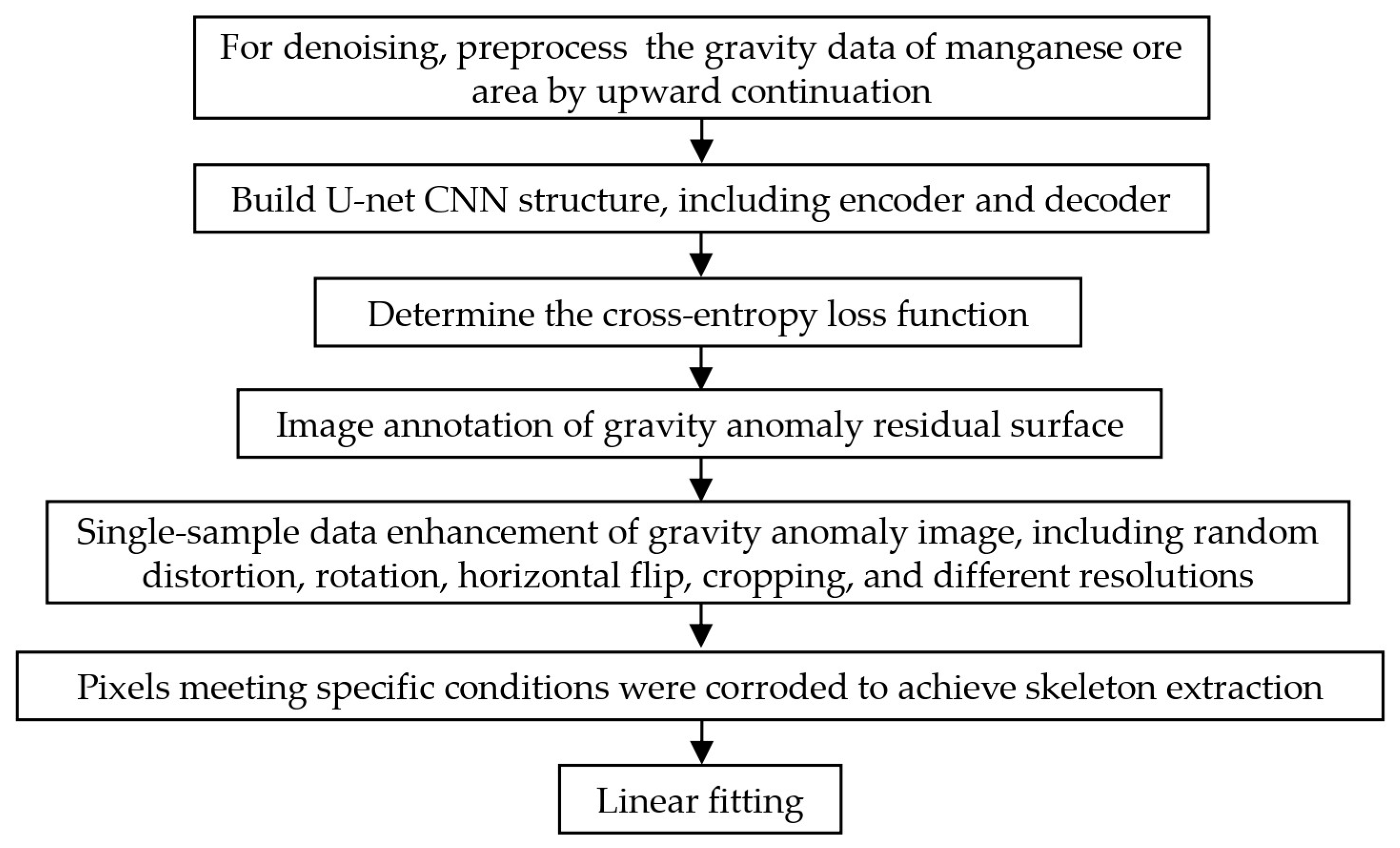
- (1)
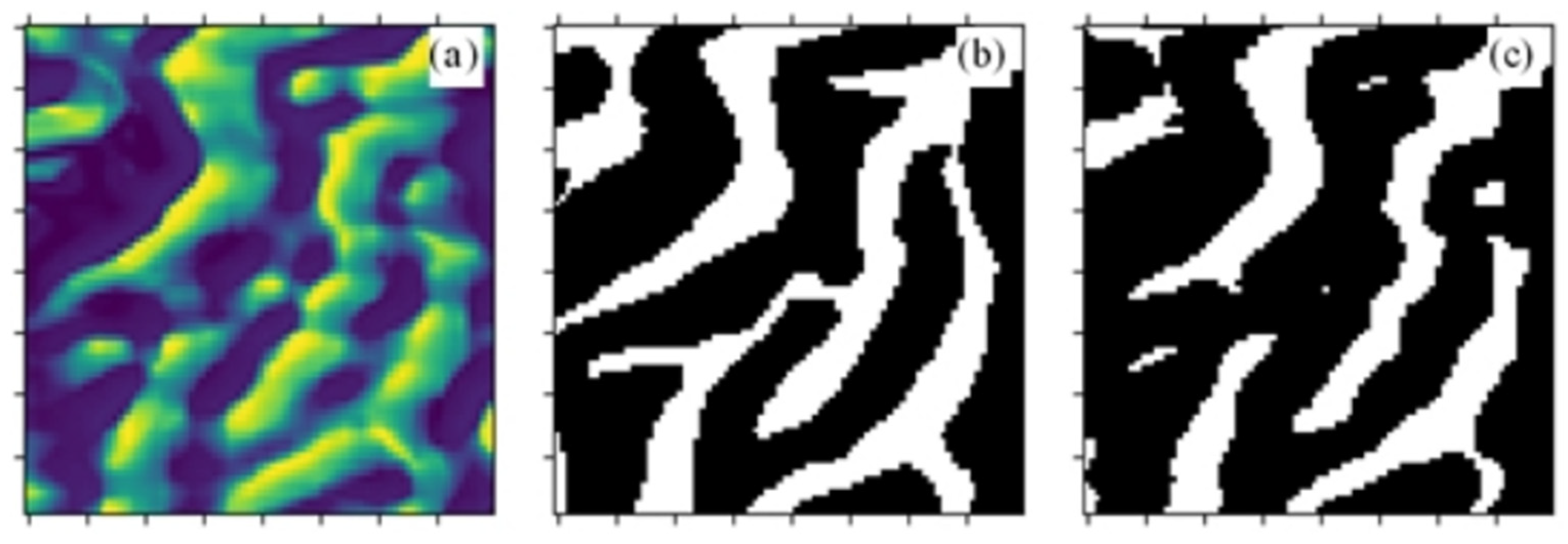
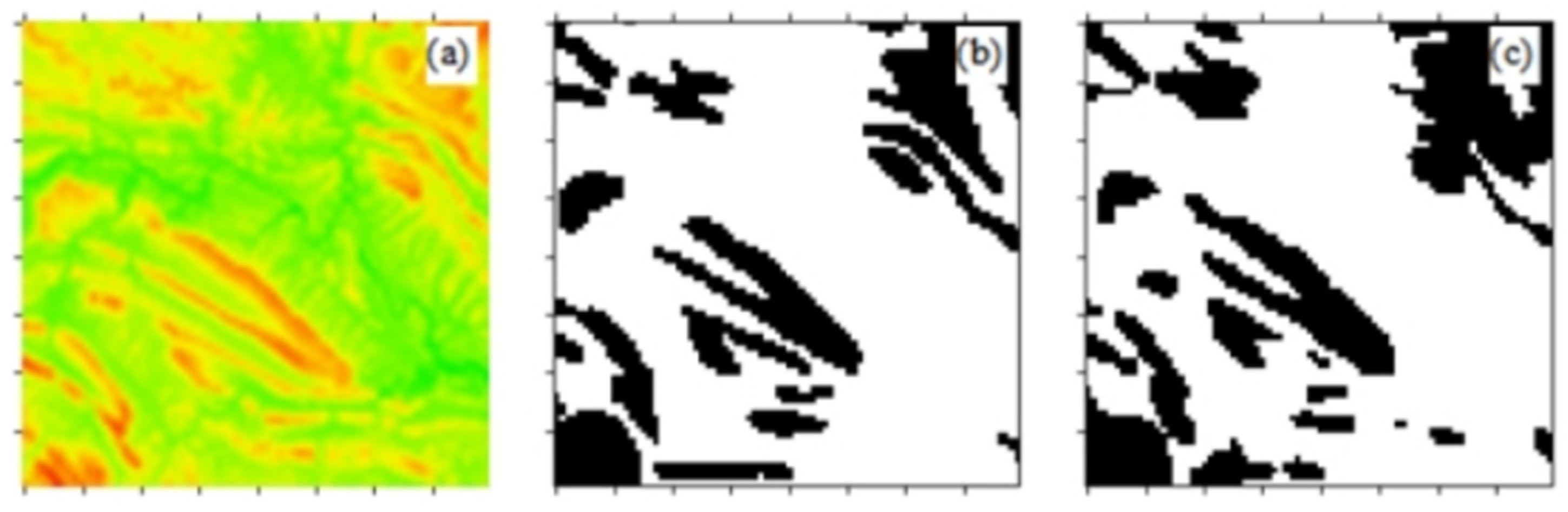
- Bouguer gravity anomaly residual images were preprocessed via upward continuation for denoising.
- (2)
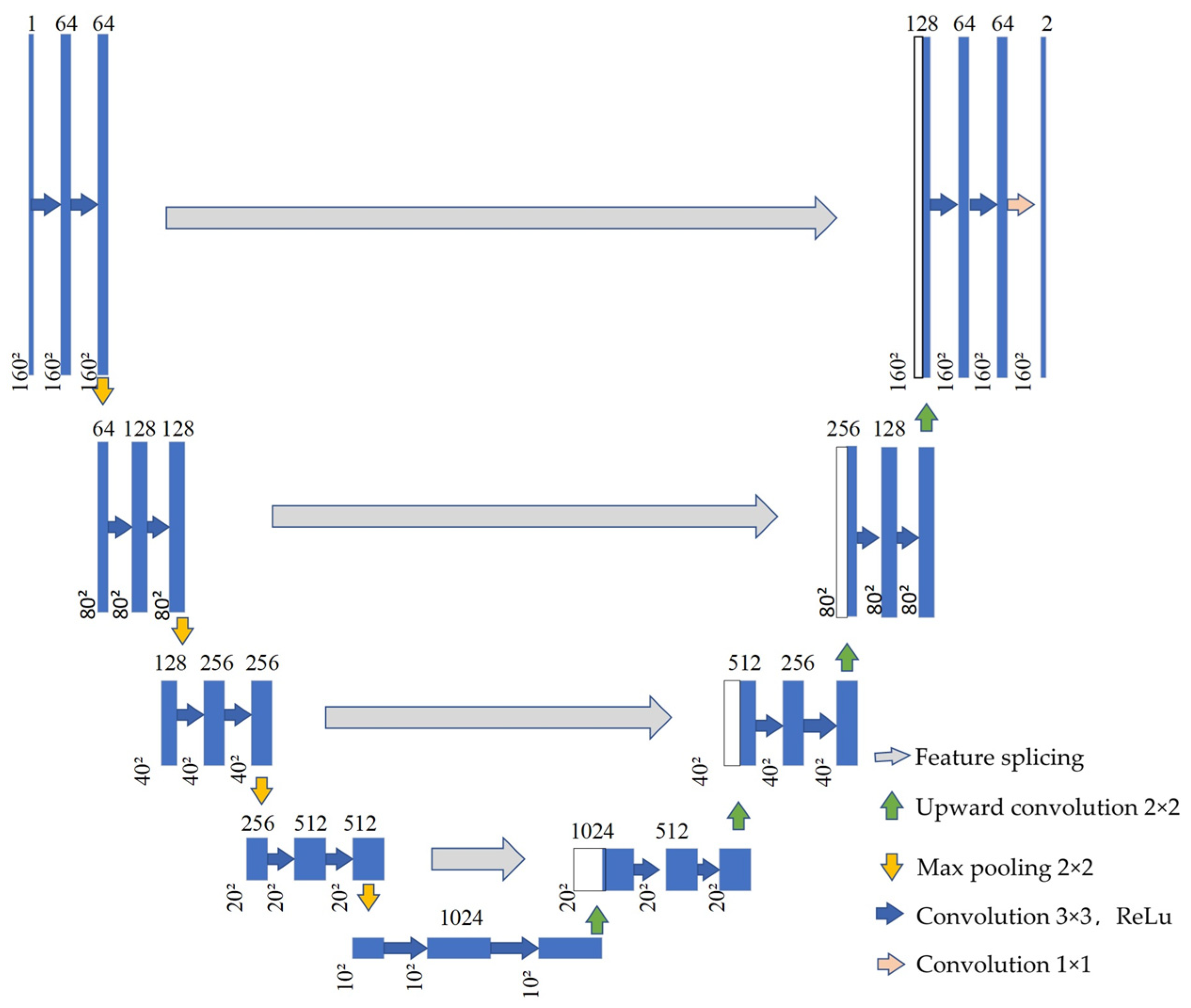
- The U-Net CNN architecture designed in this study (Figure 6) can be divided into down-sampling and up-sampling stages. The network consisted of only convolutional and pooling layers, with no fully connected layer. Here, the down-sampling stage is referred to as the encoder, and the up-sampling stage is referred to as the decoder. The encoder comprised four submodules, each of which had two 3 × 3 convolutional layers. Each convolutional layer was followed by a rectified linear unit. Each submodule was followed by a down-sampling layer, implemented through 2 × 2 max pooling with a step size of 2. The decoder, which had a layer number corresponding to that of the encoder, also consisted of four submodules. Each module first used 2 × 2 up-sampling transposed convolution to reduce the number of feature channels by half. Then, the channels were serially connected to the corresponding features of the encoder. This was followed by two 3 × 3 convolutional layers, each of which was followed by a rectified linear unit. The final layer used 1 × 1 convolution to map the feature vectors to the required number of categories.
- (3)
- A cross-entropy loss function was established and then used to represent the similarity between the actual output probability and the target output probability of the U-Net CNN (Loss). The calculation formula can be expressed as Formula (1):
- (4)
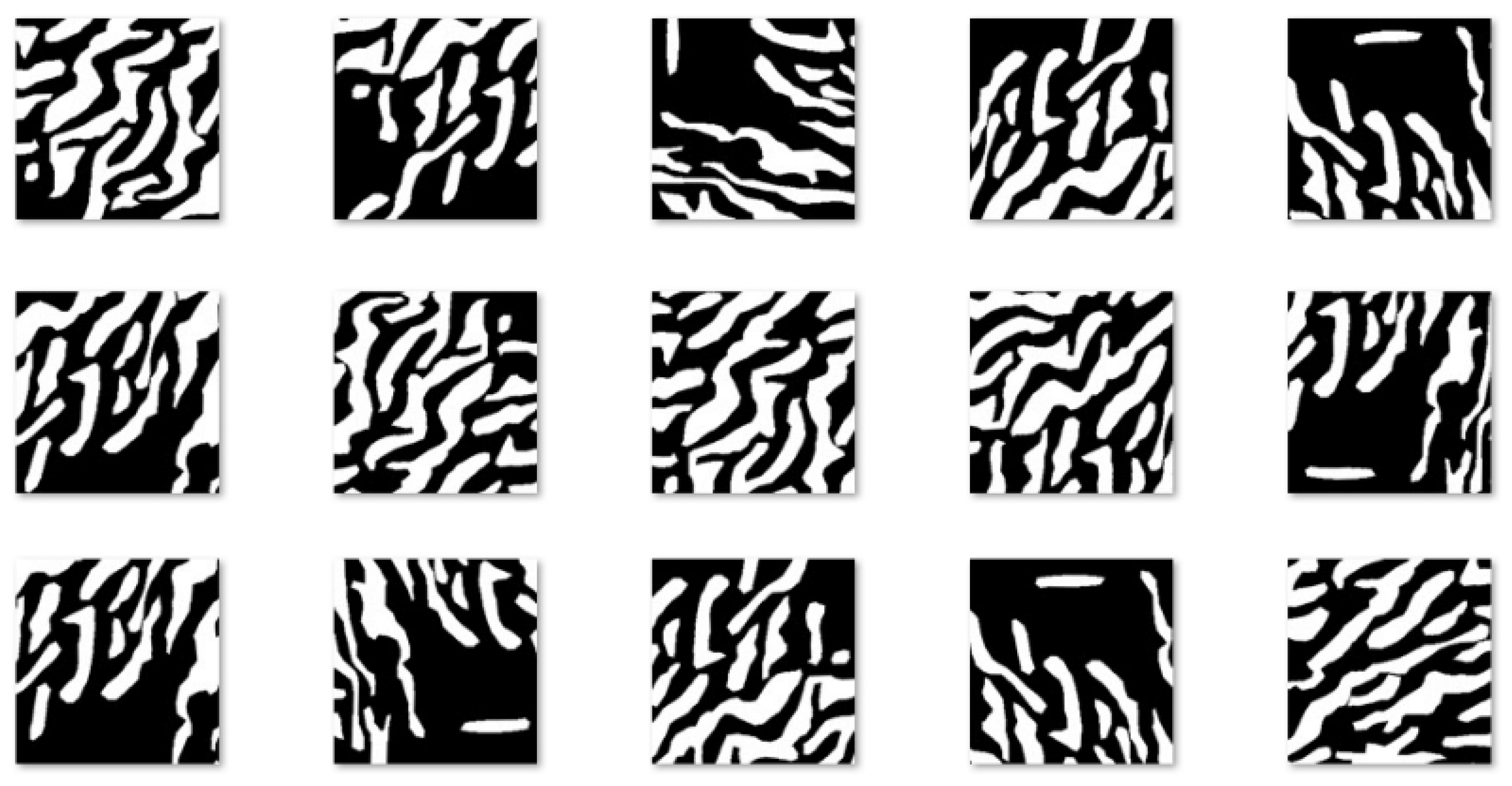
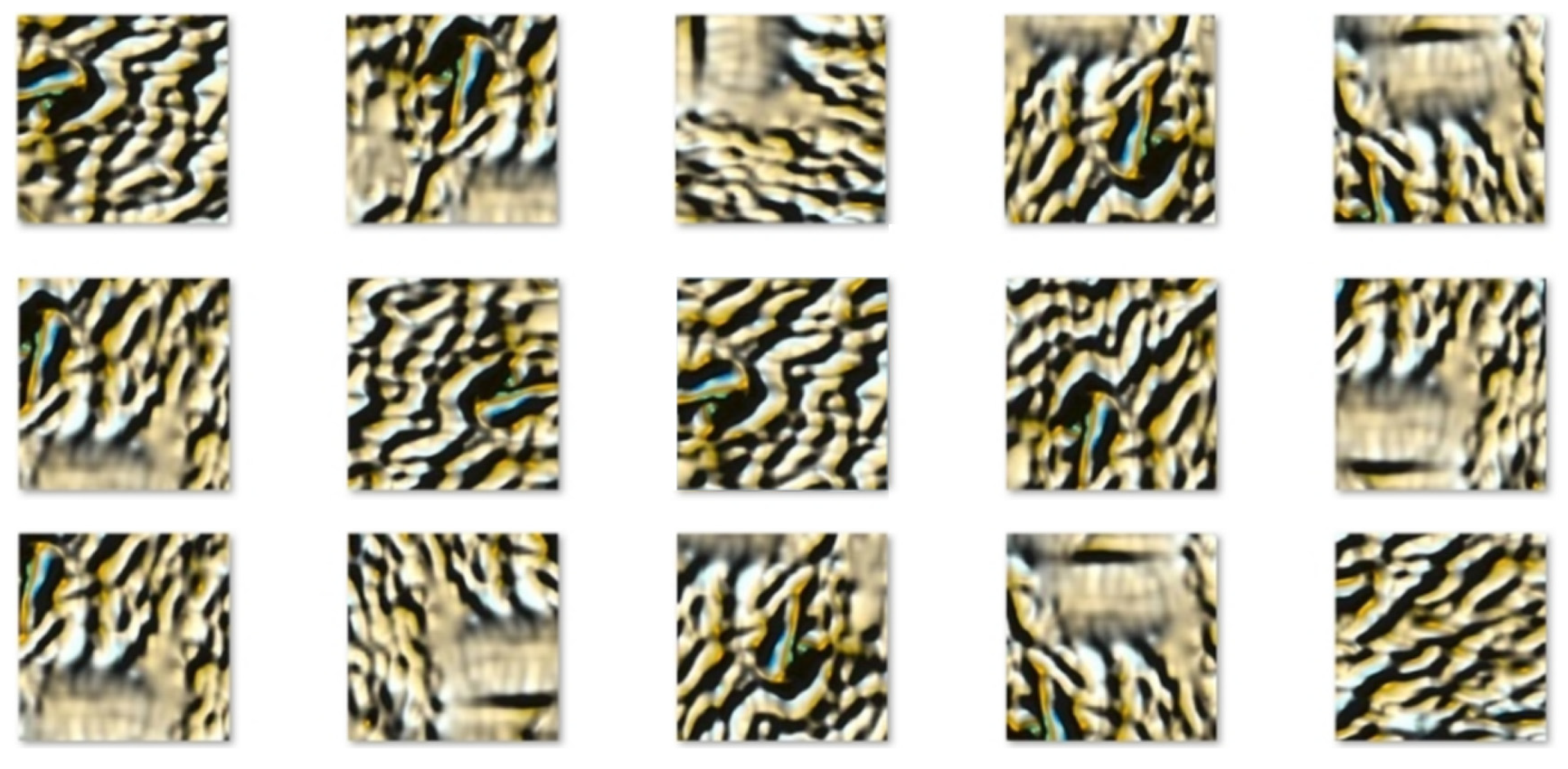
- Data enhancement was conducted on single samples in the Bouguer gravity anomaly residual images; this included image distortion, rotation with 50% probability, horizontal flipping with 80% probability, vertical flipping with 30% probability, cropping of 50% of the region, random generation of images with specified resolution, and generation of a specified number of images from the pipeline.
- (5)
- On the basis of the fast parallel refinement algorithm, the skeletons of features expressing the spatial distribution of hidden faults were extracted from the Bouguer gravity anomaly residual images, i.e., those pixels that met specific conditions were corroded such that only the skeletons were displayed.
- (6)
- The skeletons in the Bouguer gravity anomaly residual images were linearly fitted using the least squares method. The skeleton extraction process was as follows. First, the binary image was preprocessed to remove noise and outliers. Second, through a pixel-by-pixel refinement operation, pixels were deleted according to a predefined refinement template. Third, the refinement operation was repeated until no further refinement was possible. Finally, the refined skeleton was post-processed to remove unreasonable branches and isolated points.
3.2. Linear Feature Extraction Based on Line Segment Detection
- (1)
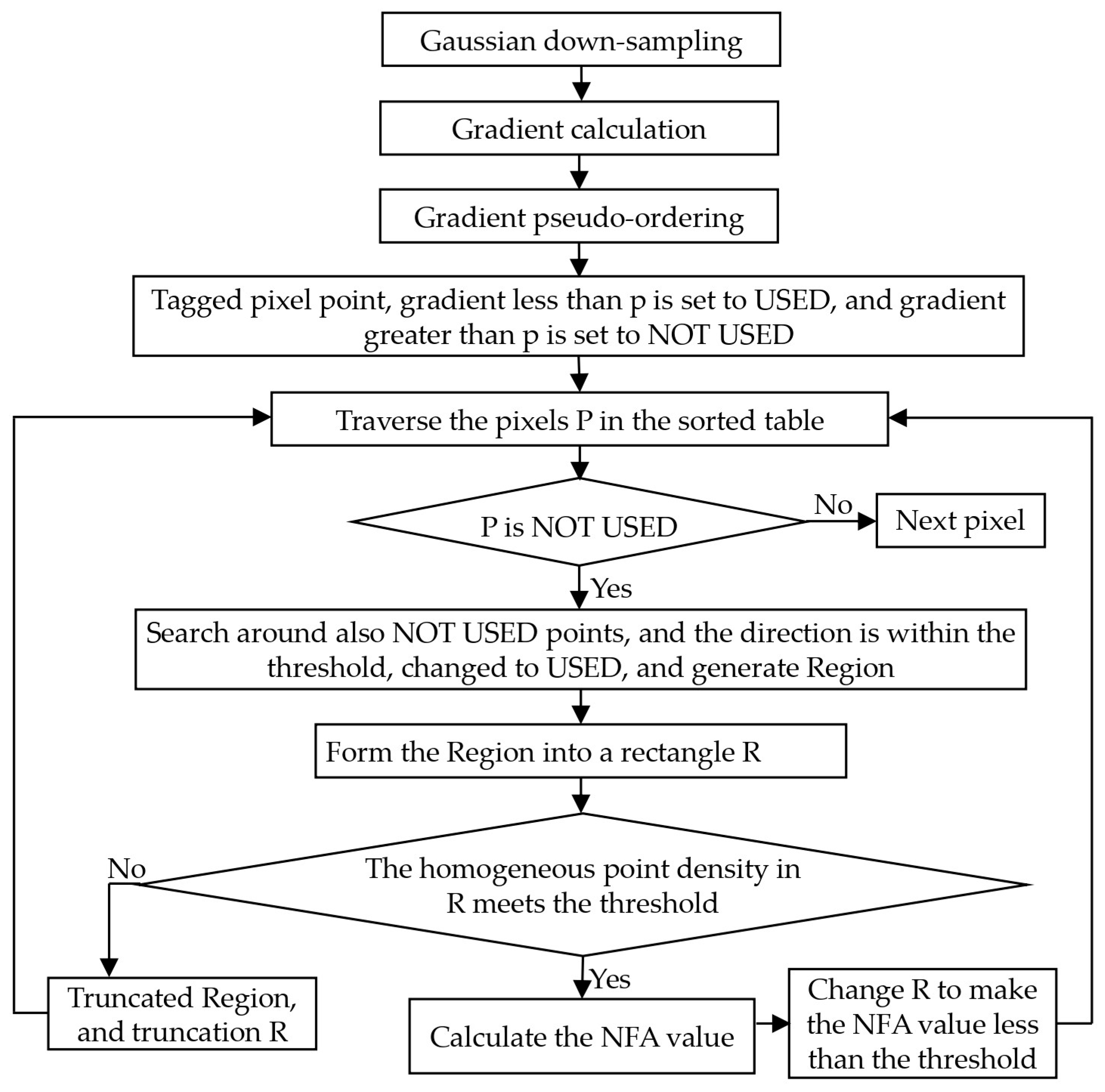
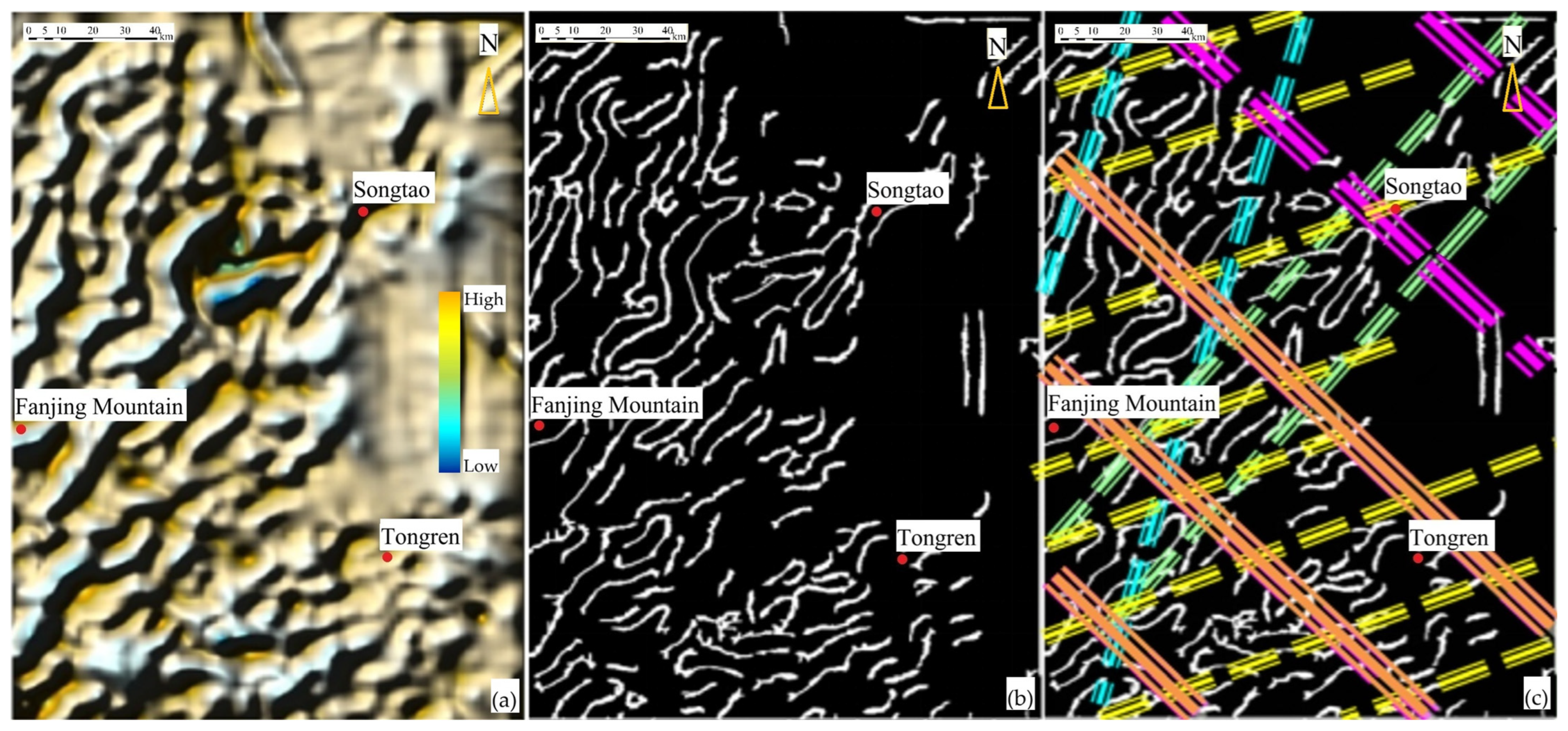
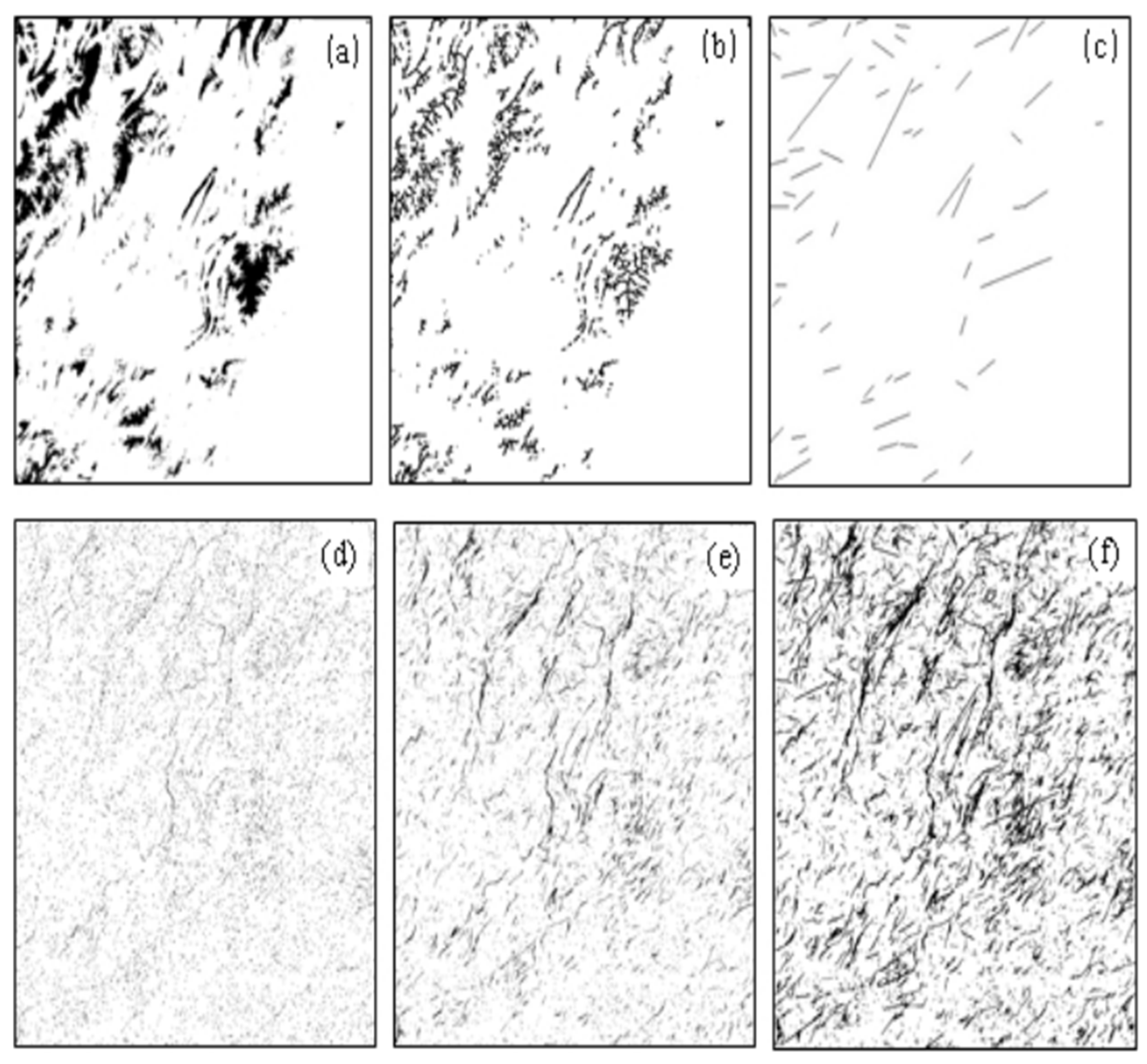
- The Bouguer gravity data of the study area were subjected to 20 km upward continuation, and the extended data were converted into 8-bit raster grayscale images. Then, Otsu’s method was employed to determine the optimal threshold for segmentation of the grayscale images that permitted grayscale images of high and low gravity anomalies to be obtained [50].
- (2)
- The gradient of each pixel was calculated using a 2 × 2 template, and the gradients of an entire image were quickly sorted using a non-recursive method. Subsequently, the gradient threshold was determined using an adaptive algorithm, and small gradient values in smooth areas or areas with slow changes in gradient were omitted. The pixel gradient was calculated as follows:
- (3)
- The pixel point not currently used in the gradient sorting and having the largest amplitude was taken as the seed point, and its horizontal line angle was considered as the initial region angle. Eight neighboring regions were searched to determine the point at which the region angle deviated less than the tolerance value. This point was then merged into the region, and the region angle was updated.
- (4)
- The minimum circumscribed rectangle containing all pixel points in the linear region, constructed using the rotating calipers method, was then used for straight line extraction.
- (5)
- The extracted line segments were processed using the line feature expansion method and sorted in descending order of length. The left and right endpoints of the current longest and unused line segment were taken as the base points, and the endpoints of other unused line segments were used as candidate points to traverse line segments. Then, the endpoint closest to the base points was selected from the candidate list to generate a new long line segment representing the graben and horst boundary of the hidden basement.
4. Results and Discussion
4.1. Reflection of NW-Trending Early Depression Zone in the Crystalline Basement
4.2. Reflection of NW-Trending Early Rift in the Middle–Lower Crust
4.3. Surface Reflection of Basement Structure
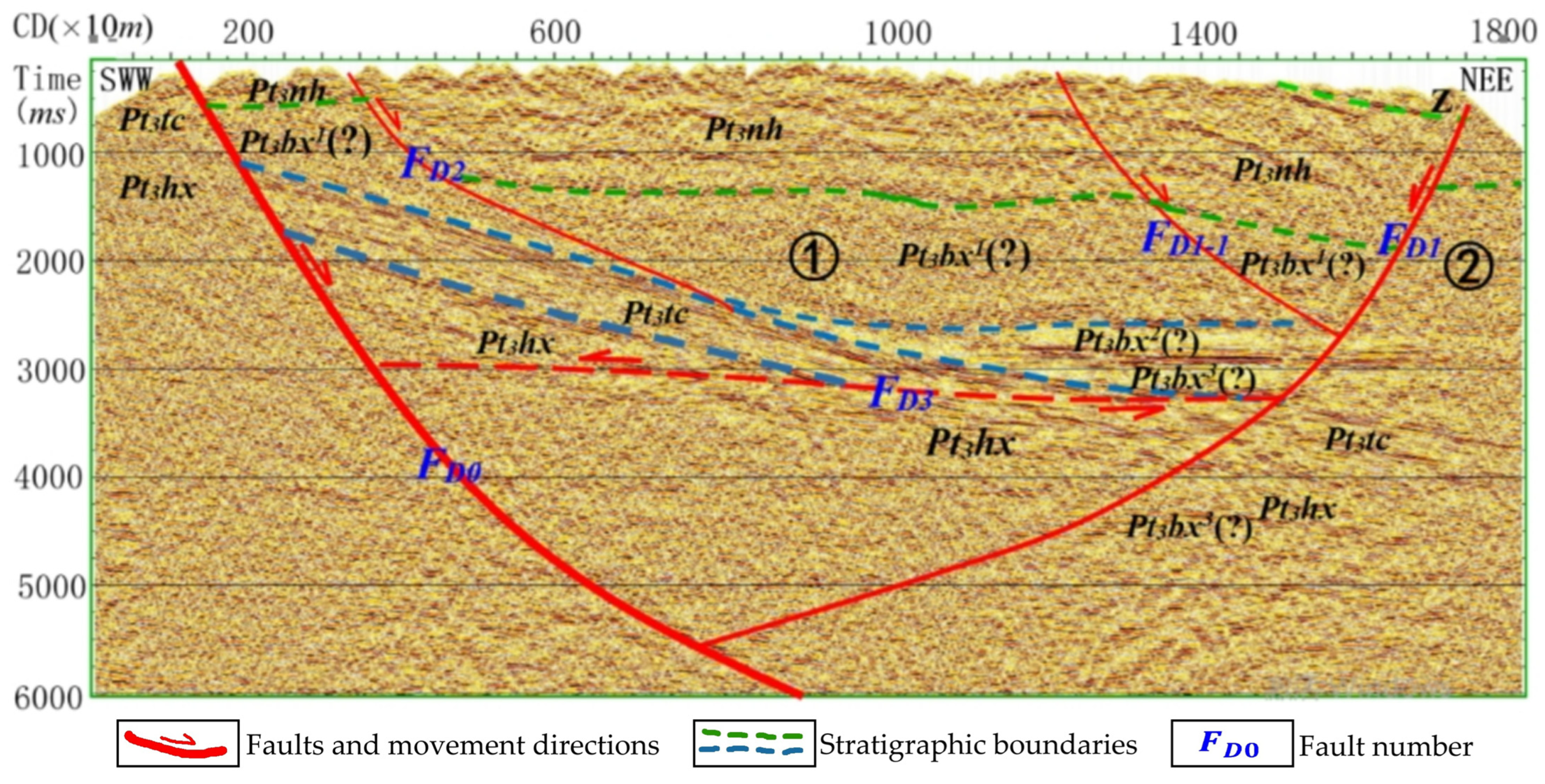
4.4. Verification of Deep Geological Structure via Seismic Reflection Exploration
5. Conclusions
6. Patents
Author Contributions
Funding
Data Availability Statement
Acknowledgments
Conflicts of Interest
References
- Zhou, Q.; Du, Y.; Qin, Y. Ancient Natural Gas Seepage Sedimentary-Type Manganese Metallogenic System and Ore-Forming Model: A Case Study of Datangpo Type Manganese Deposits Formed in Rift Basin of Nanhua Period along Guizhou-Hunan-Chongqing Border Area. Miner. Depos. 2013, 32, 457–466. [Google Scholar]
- Zhou, Q.; Du, Y.; Yuan, L.; Zhang, S.; Yu, W.; Yang, S.; Liu, Y. The Structure of the Wuling Rift Basin and its Control on the Manganese Deposit during the Nanhua Period in Guizhou-Hunan-Chongqing Border Area, South China. Earth Sci. 2016, 41, 177–188. [Google Scholar]
- Xu, K.; Zhao, S.; Wu, C.; Zhang, S.; Yuan, L.; Yang, C.; Li, Y.; Dong, Y.; Wu, Y.; Xiang, S.; et al. Manganese Mineral Prospectivity based on Deep Convolutional Neural Networks in Songtao of Northeastern Guizhou. Earth Sci. Inform. 2024, 17, 1681–1697. [Google Scholar] [CrossRef] [Scilit]
- Zhou, Q.; Wu, C.; Hu, X.; Yang, B.; Zhang, X.; Du, Y.; Xu, K.; Yuan, L.; Ni, J.; Hu, D.; et al. A New Metallogenic Model for the Giant Manganese Deposits in Northeastern Guizhou, China. Ore Geol. Rev. 2022, 149, 105070. [Google Scholar] [CrossRef] [Scilit]
- Zhang, X.; Wu, C.; Zhou, Q.; Weng, Z.; Yuan, L.; Zhu, F.; Li, Z.; Zhang, Z.; Yang, B.; Zhao, Y. Multi-scale 3D Geological Modeling and Visualization of Super Large Manganese Ore Gathering Area in Guizhou China. Earth Sci. 2020, 45, 634–644. [Google Scholar]
- Wu, C.; Zhang, S.; Xu, K.; Yuan, L.; Kong, C.; Zhang, Z.; Shen, H. Sedimentary Evolution for the Wuling Secondary Rift of the Western Nanhua Rift and Exhalative-sedimentary Mineralization Cycles of “Datangpo-type” Manganese Ore Deposits in South China. J. Asian Earth Sci. 2025, 287, 106566. [Google Scholar] [CrossRef] [Scilit]
- Zhou, Q.; Yuan, L.; Yang, B.; Zhang, S.; Xu, K.; Xie, X.; Zhang, X.; Pan, W. Development and Application of a Technological System for Exploration of “Datangpo-type” Concealed Manganese Deposits in China. J. Asian Earth Sci. 2025, 292, 106727. [Google Scholar] [CrossRef] [Scilit]
- Zhang, S.; Yuan, L.; Long, J.; Liu, Y.; Pan, W.; Shen, H. Genesis and Role of Bubble-like Structures in Rhodochrosite-rich Orebodies of “Datangpo-type” Sedimentary Exhalative Manganese Deposits in China. J. Asian Earth Sci. 2025, 292, 106741. [Google Scholar] [CrossRef] [Scilit]
- Gao, L.; Xu, S.; Hu, X.; Liu, S.; Zhou, Q.; Yang, B. Sedimentary Setting and Ore-forming Model in the Songtao Manganese Deposit, Southwestern China: Evidence from Audio-frequency Magnetotelluric and Gravity Data. Minerals 2021, 11, 1273. [Google Scholar] [CrossRef] [Scilit]
- Yang, B.; Hu, X.; Gao, L.; Shen, X.; Liao, W.; Wang, J.; Yuan, L. Discharge and Deposition Metallogenic Model of “Datangpo-type” Manganese Deposits in China: Geophysical Evidence from Deep Electrical Structure of Manganese-bearing Grabens. J. Asian Earth Sci. 2025, 292, 106732. [Google Scholar] [CrossRef] [Scilit]
- Yuan, L.; Yang, B.; Zhang, S.; Zhang, Z.; Long, J.; Xie, X. A study on the Manganese-bearing Fluid Diapir–discharge Structural System of the Datangpo-type Manganese Deposits in China. J. Asian Earth Sci. 2025, 292, 106723. [Google Scholar] [CrossRef] [Scilit]
- Wu, C.; Liu, G.; Zhang, X.; He, Z.; Zhang, Z. Discussion on Geological Science Big Data and its Applications. China Sci. Bull. 2016, 61, 1797–1807. [Google Scholar] [CrossRef] [Scilit]
- Fatehi, M.; Asadi, H.H. Data Integration Modeling Applied to Drillhole Planning Through Semi-Supervised Learning: A Case Study from the Dalli Cu-Au Porphyry Deposit in Central Iran. J. Afr. Earth Sci. 2017, 128, 147–160. [Google Scholar] [CrossRef] [Scilit]
- Li, S.; Song, W.; Fang, L.; Chen, Y.; Ghamisi, P.; Benediktsson, J. Deep Learning for Hyperspectral Image Classification: An Overview. IEEE Trans. Geosci. Remote Sens. 2019, 57, 6690–6709. [Google Scholar] [CrossRef] [Scilit]
- Hong, D.; Wu, X.; Ghamisi, P.; Chanussot, J.; Yokoya, N.; Zhu, X. Invariant Attribute Profiles: A Spatial-Frequency Joint Feature Extractor for Hyperspectral Image Classification. IEEE Trans. Geosci. Remote Sens. 2020, 58, 3791–3808. [Google Scholar] [CrossRef] [Scilit]
- Gao, L.; Hong, D.; Yao, J.; Zhang, B.; Gamba, P.; Chanussot, J. Spectral Superresolution of Multispectral Imagery with Joint Sparse and Low-Rank Learning. IEEE Trans. Geosci. Remote Sens. 2021, 59, 2269–2280. [Google Scholar] [CrossRef] [Scilit]
- Ghezelbash, R.; Maghsoudi, A.; Bigdeli, A.; Carranza, E.J.M. Regional-Scale Mineral Prospectivity Mapping: Support Vector Machines and an Improved Data-Driven Multi-Criteria Decision-Making Technique. Nat. Resour. Res. 2021, 30, 1977–2005. [Google Scholar] [CrossRef] [Scilit]
- Parsa, M.; Carranza, E.J.M.; Ahmadi, B. Deep GMDH Neural Networks for Predictive Mapping of Mineral Prospectivity in Terrains Hosting Few but Large Mineral Deposits. Nat. Resour. Res. 2021, 31, 37–50. [Google Scholar] [CrossRef] [Scilit]
- Yousefi, M.; Carranza, E.J.M.; Kreuzer, O.P.; Nykänen, V.; Hronsky, J.M.A.; Mihalasky, M.J. Data Analysis Methods for Prospectivity Modelling as Applied to Mineral Exploration Targeting: State-of-the-Art and Outlook. J. Geochem. Explor. 2021, 229, 106839. [Google Scholar] [CrossRef] [Scilit]
- Hajihosseinlou, M.; Maghsoudi, A.; Ghezelbash, R. Stacking: A Novel Data-Driven Ensemble Machine Learning Strategy for Prediction and Mapping of Pb-Zn Prospectivity in Varcheh District, West Iran. Expert Syst. Appl. 2024, 237, 121668. [Google Scholar] [CrossRef] [Scilit]
- Hu, W.; Huang, Y.; Wei, L.; Zhang, F.; Li, H. Deep Convolutional Neural Networks for Hyperspectral Image Classification. J. Sens. 2015, 7, 1–12. [Google Scholar] [CrossRef] [Scilit]
- Chen, Y.; Jiang, H.; Li, C.; Jia, X.; Ghamisi, P. Deep Feature Extraction and Classification of Hyperspectral Images Based on Convolutional Neural Networks. IEEE Trans. Geosci. Remote Sens. 2016, 54, 6232–6251. [Google Scholar] [CrossRef] [Scilit]
- Li, W.; Wu, G.; Zhang, F.; Du, Q. Hyperspectral Image Classification using Deep Pixel-Pair Features. IEEE Trans. Geosci. Remote Sens. 2017, 55, 844–853. [Google Scholar] [CrossRef] [Scilit]
- Yuan, Y.; Fang, J.; Lu, X.; Feng, Y. Remote Sensing Image Scene Classification using Rearranged Local Features. IEEE Trans. Geosci. Remote Sens. 2019, 57, 1779–1792. [Google Scholar] [CrossRef] [Scilit]
- Hong, D.; Gao, L.; Yao, J.; Zhang, B.; Plaza, A.; Chanussot, J. Graph Convolutional Networks for Hyperspectral Image Classification. IEEE Trans. Geosci. Remote Sens. 2021, 59, 5966–5978. [Google Scholar] [CrossRef] [Scilit]
- Kong, C.; Tian, Q.; Liu, J.; Cai, G.; Zhao, J.; Xu, K. Metallogenic Prediction Based on Ensemble Learning Models and Bayesian Optimization Algorithm. Earth Sci. Front. 2025, 32, 122–139. [Google Scholar]
- Chen, Q.; Zhou, R.; Chen, D.; Cui, Z.; Ma, X.; Liu, G. A Conditional Masked Autoencoder Network Based on Efficient Multiple-head Self-attention for Characterizing Heterogeneous Reservoirs. Expert Syst. Appl. 2026, 296, 128973. [Google Scholar] [CrossRef] [Scilit]
- Wu, C.; Liu, G.; Zhang, X.; Xu, K. Fundamental Problems of integrated Application of Big Data in Geoscience. Bull. Geol. Sci. Technol. 2020, 39, 1–11. [Google Scholar]
- Kong, C.; Zhao, J.; Li, B.; Wu, C.; Xu, K. Manganese Mineral Prospectivity Mapping Based on Semi-Supervised Learning and Multi-Source Geoscientific-Sample Wasserstein Generative Adversarial Network (Geo-WGAN) in Songtao of Guizhou, South China. Ore Geol. Rev. 2025, 186, 106933. [Google Scholar] [CrossRef] [Scilit]
- Xu, K.; Yuan, L.; Yang, B.; Kong, C.; Zhang, X.; Zheng, J.; Zhou, Q.; Wu, C. Extraction of Hidden Manganese Ore Information with combined Mining of Associated and Secondary Mineral of Remote Sensing Data on Northeast Guizhou. Bull. Geol. Sci. Technol. 2020, 39, 37–43. [Google Scholar]
- Iwabuchi, S.; Kakazu, Y.; Koh, J.Y.; Harata, N. Evaluation of the Effectiveness of Gaussian Filtering in Distinguishing Punctate Synaptic Signals from Background Noise During Image Analysis. J. Neurosci. Methods 2014, 223, 92–113. [Google Scholar] [CrossRef] [Scilit] [PubMed]
- Singla, A.; Patra, S. A Fast Automatic Optimal Threshold Selection Technique for Image Segmentation. SIVIP 2017, 11, 243–250. [Google Scholar] [CrossRef] [Scilit]
- Patra, S.; Gautam, R.; Singla, A. A Novel Context Sensitive Multilevel Thresholding for Image Segmentations. Appl. Soft Comput. 2014, 23, 122–127. [Google Scholar] [CrossRef] [Scilit]
- Huang, G.; Wang, H.; Xu, D. Understanding the Complementary Effect of Bike-Sharing on Public Transit: A Case Study of Subway Line Expansion in Xiamen, China. J. Transp. Geogr. 2024, 121, 104021. [Google Scholar] [CrossRef] [Scilit]
- Sun, Y.; Leng, B.; Guan, W. A Novel Wavelet-SVM Short-Time Passenger Flow Prediction in Beijing Subway System. Neurocomputing 2015, 166, 109–121. [Google Scholar] [CrossRef] [Scilit]
- Zhang, J.M.; Zeng, Z.F.; Wu, Y.G.; Du, W.; Wang, Y.Z. Balanced Morphological Filters for Horizontal Boundaries Enhancement of the Potential Field Sources. Appl. Geophys. 2024, 21, 147–156. [Google Scholar] [CrossRef] [Scilit]
- Ronneberger, O.; Fischer, P.; Brox, T. U-Net: Convolutional Networks for Biomedical Image Segmentation. In Proceedings of the Medical Image Computing and Computer-Assisted Intervention (MICCAI), Munich, Germany, 5–9 October 2015; Volume 9351, pp. 234–241. [Google Scholar]
- Koch, T.L.; Perslev, M.; Igel, C.; Brandt, S.S. Accurate Segmentation of Dental Panoramic Radiographs with U-Nets. In Proceedings of the 2019 IEEE 16th International Symposium on Biomedical Imaging (ISBI 2019), Venice, Italy, 8–11 April 2019; pp. 15–19. [Google Scholar]
- Perslev, M.; Jensen, M.H.; Darkner, S.; Jennum, P.J.; Igel, C. U-Time: A Fully Convolutional Network for Time Series Segmentation Applied to Sleep Staging. Adv. Neural Inf. Process. Syst. 2019, 32, 4415–4426. [Google Scholar]
- Cao, K.; Zhang, X. An Improved Res-Unet Model for Tree Species Classification using Airborne High-Resolution Images. Remote Sens. 2020, 12, 1128. [Google Scholar] [CrossRef] [Scilit]
- Rayachoti, E.; Vedantham, R.; Gundabatini, S.G. EU-Net: An Automated CNN Based Ebola U-Net Model for Efficient Medical Image Segmentation. Multimed. Tools Appl. 2024, 83, 74323–74347. [Google Scholar] [CrossRef] [Scilit]
- Hoorfar, H.; Merchenthaler, I.; Puche, A.C. Optimizing U-Net CNN Performance: A Comparative Study of Noise Filtering Techniques for Enhanced Thermal Image Analysis. J. Supercomput. 2024, 80, 23384–23406. [Google Scholar] [CrossRef] [Scilit]
- Anand, V.; Gupta, S.; Koundal, D.; Singh, K. Fusion of U-Net and CNN Model for Segmentation and Classification of Skin Lesion from Dermoscopy Images. Expert Syst. Appl. 2023, 213, 119230. [Google Scholar] [CrossRef] [Scilit]
- Ragupathy, B.; Karunakaran, M. A Fuzzy Logic-Based Meningioma Tumor Detection in Magnetic Resonance Brain Images Using Canfis and U-Net CNN Classification. Int. J. Imaging Syst. Technol. 2021, 31, 379–390. [Google Scholar] [CrossRef] [Scilit]
- Von Gioi, R.G.; Jakubowicz, J.; Morel, J.M.; Randall, G. LSD: A Fast Line Segment Detector with a False Detection Control. IEEE Trans. Pattern Anal. Mach. Intell. 2010, 32, 722–732. [Google Scholar] [CrossRef] [Scilit]
- Von Gioi, R.G. The LSD Algorithm, In a Contrario Line Segment Detection; Ser. Springer Briefs in Computer Science; Springer: New York, NY, USA, 2014; pp. 27–47. [Google Scholar]
- Yuan, Y.; Ma, D.; Wang, Q. Hyperspectral Anomaly Detection via Sparse Dictionary Learning Method of Capped Norm. IEEE Access 2019, 7, 16132–16144. [Google Scholar] [CrossRef] [Scilit]
- Zheng, Y.; Jin, Y.; Dong, Y. Rail Detection Based on LSD and the Least Square Curve Fitting. Int. J. Autom. Comput. 2021, 18, 85–95. [Google Scholar] [CrossRef] [Scilit]
- Zheng, X.; Zhong, B. Overview and Evaluation of Image Straight Line Segment Detection Algorithms. Comput. Eng. Appl. 2019, 55, 9–19. [Google Scholar]
- Otsu, N. A Threshold Selection Method from Gray-Level Histograms. IEEE Trans. Syst. Man Cybern. 1979, 9, 62–66. [Google Scholar] [CrossRef] [Scilit]
- Chen, Q.; Liu, G.; Ma, X.; Li, X.; He, Z. 3D Stochastic Modeling Framework for Quaternary Sediments using Multiple-Point Statistics: A Case Study in Minjiang Estuary Area, Southeast China. Comput. Geosci. 2020, 136, 104404. [Google Scholar] [CrossRef] [Scilit]
- Chen, Q.; Liu, G.; Ma, X.; Que, X. Spatial Analysis. In Encyclopedia of Mathematical Geosciences; Daya Sagar, B.S., Cheng, Q., Mckinley, J., Agterberg, F., Eds.; Springer Nature: Cham, Switzerland, 2023. [Google Scholar]
- Yang, H.; Liang, Y. Nationwide Aeromagnetic ΔT Anomalies and China’s Geoscience Block Structures. Geophys. Geochem. Explor. 2013, 37, 957–967. [Google Scholar]
- Xiong, S.; Ding, Y.; Li, Z. China Terrestrial Aeromagnetic and Geological Structure Characteristics; Geological Press: Beijing, China, 2016. [Google Scholar]
- Li, B.; Song, Y.; Shi, L.; Wang, Q.; Jiang, J.; Jin, J.; Zhou, D.; Xu, M.; Xiao, G.; Xie, M. Characteristics of Gravity and Magnetic Fields in Ordos Basin and Their Geological Significance. Geophys. Geochem. Explor. 2019, 43, 767–777. [Google Scholar]
- Guizhou Institute of Geological Survey. Regional Geology of Guizhou Province; Geological Publishing House: Beijing, China, 2013. [Google Scholar]
- Zhou, Q.; Wu, C. Experimental Research on Big Data-based Intelligent Exploration Models and Advance. Earth Sci. Front. 2024, 31, 350–367. [Google Scholar]







| Type | Scale | Data Type | Objective | Data Preprocessing |
|---|---|---|---|---|
| Gravity data | 1:200,000 | TXT | Lower-crust fault information | Extension, residual field analysis |
| Aeromagnetic data | 1:200,000 | JPG | Middle-crust fault information | Polarization, extension |
| Remote sensing data | 1:200,000 | TIFF | Surface fault information | Radiation correction, atmospheric correction |
| Module | Network Layer | Nuclear Size | Output Size (Fill) |
|---|---|---|---|
| Input image | - | 160 × 160 × 1 | |
| Decoder | Convolution layer 1 (ReLu) | 3 × 3 | 160 × 160 × 64 |
| Convolution layer 2 (ReLu) | 3 × 3 | 160 × 168 × 64 | |
| Maximum pooling layer | 2 × 2 | 80 × 80 × 64 | |
| Convolution layer 3 (ReLu) | 3 × 3 | 80 × 80 × 128 | |
| Convolution layer 4 (ReLu) | 3 × 3 | 80 × 80 × 128 | |
| Maximum pooling layer | 2 × 2 | 40 × 40 × 128 | |
| Convolution layer 5 (ReLu) | 3 × 3 | 40 × 40 × 256 | |
| Convolution layer 6 (ReLu) | 3 × 3 | 40 × 40 × 256 | |
| Maximum pooling layer | 2 × 2 | 20 × 20 × 256 | |
| Convolution layer 7 (ReLu) | 3 × 3 | 20 × 20 × 512 | |
| Convolution layer 8 (ReLu) | 3 × 3 | 20 × 20 × 512 | |
| Maximum pooling layer | 2 × 2 | 10 × 10 × 512 | |
| Convolution layer 9 (ReLu) | 3 × 3 | 10 × 10 × 1024 | |
| Encoder | Convolution layer 10 (ReLu) | 3 × 3 | 10 × 10 × 1024 |
| Upward convolution + feature concatenation | 2 × 2 | 20 × 20 × 1024 | |
| Convolution layer 11 (ReLu) | 3 × 3 | 20 × 20 × 512 | |
| Convolution layer 12 (ReLu) | 3 × 3 | 20 × 20 × 512 | |
| Upward convolution + feature concatenation | 2 × 2 | 40 × 40 × 512 | |
| Convolution layer 13 (ReLu) | 3 × 3 | 40 × 0 × 56 | |
| Convolution layer 14 (ReLu) | 3 × 3 | 40 × 0 × 56 | |
| Upward convolution + feature concatenation | 2 × 2 | 80 × 80 × 256 | |
| Convolution layer 15 (ReLu) | 3 × 3 | 80 × 80 × 128 | |
| Convolution layer 16 (ReLu) | 3 × 3 | 80 × 80 × 128 | |
| Upward convolution + feature concatenation | 2 × 2 | 160 × 160 × 128 | |
| Convolution layer 17 (ReLu) | 3 × 3 | 160 × 160 × 64 | |
| Convolution layer 18 (ReLu) | 3 × 3 | 160 × 160 × 64 | |
| Classification | Convolution layer 19 (ReLu) | 1 × 1 | 160 × 160 × 2 |
| Epochs | Cross-Loss | Binary Classification Accuracy | Crossover Ratio | Dice Coefficient | Accuracy Rate |
|---|---|---|---|---|---|
| 1 | 0.9866 | 0.4643 | 0.3275 | 0.4990 | 0.5010 |
| 5 | 0.6933 | 0.4691 | 0.3289 | 0.5002 | 0.6931 |
| 10 | 0.4586 | 0.8249 | 0.5298 | 0.7030 | 0.8701 |
| 15 | 0.2908 | 0.8756 | 0.6810 | 0.8186 | 0.9501 |
| 20 | 0.2692 | 0.8812 | 0.7001 | 0.8314 | 0.9566 |
| ID | Level | Length (km) | LSD | U-Net | Fusion Result | |||
|---|---|---|---|---|---|---|---|---|
| Quantity | Percent (%) | Quantity | Percent (%) | Quantity | Percent (%) | |||
| 1 | Short | <30 | 10,420 | 96.9 | 31 | 51.7 | 10,451 | 96.67 |
| 2 | Intermediate | 30–60 | 332 | 3.1 | 9 | 15 | 341 | 3.15 |
| 3 | Long | 60–90 | 0 | 0 | 8 | 13.3 | 8 | 0.07 |
| 4 | Extremely long | >90 | 0 | 0 | 12 | 20 | 12 | 0.11 |
Disclaimer/Publisher’s Note: The statements, opinions and data contained in all publications are solely those of the individual author(s) and contributor(s) and not of MDPI and/or the editor(s). MDPI and/or the editor(s) disclaim responsibility for any injury to people or property resulting from any ideas, methods, instructions or products referred to in the content. |
© 2026 by the authors. Licensee MDPI, Basel, Switzerland. This article is an open access article distributed under the terms and conditions of the Creative Commons Attribution (CC BY) license.
Share and Cite
Xu, K.; Wu, C.; Zhang, S.; Ma, X.; Yang, B.; Kong, C. Extraction of NW-Trending, Ore-Conducting Basement Hidden Faults in Manganese Ore Concentration Area Based on Multi-Source Data in Northeastern Guizhou, China. Minerals 2026, 16, 58. https://doi.org/10.3390/min16010058
Xu K, Wu C, Zhang S, Ma X, Yang B, Kong C. Extraction of NW-Trending, Ore-Conducting Basement Hidden Faults in Manganese Ore Concentration Area Based on Multi-Source Data in Northeastern Guizhou, China. Minerals. 2026; 16(1):58. https://doi.org/10.3390/min16010058
Chicago/Turabian StyleXu, Kai, Chonglong Wu, Sui Zhang, Xiaogang Ma, Bingnan Yang, and Chunfang Kong. 2026. "Extraction of NW-Trending, Ore-Conducting Basement Hidden Faults in Manganese Ore Concentration Area Based on Multi-Source Data in Northeastern Guizhou, China" Minerals 16, no. 1: 58. https://doi.org/10.3390/min16010058
APA StyleXu, K., Wu, C., Zhang, S., Ma, X., Yang, B., & Kong, C. (2026). Extraction of NW-Trending, Ore-Conducting Basement Hidden Faults in Manganese Ore Concentration Area Based on Multi-Source Data in Northeastern Guizhou, China. Minerals, 16(1), 58. https://doi.org/10.3390/min16010058