


Abstract
The mechanisms of massive gold migration and enrichment are challenging issues in mineral deposit research. The evolution of the elements and structures of gold-bearing minerals is the key to revealing the mechanisms of gold enrichment and migration. The Sawayardun gold deposit has an ore reserve of 127 t located in the southwestern Tianshan, Xinjiang, China. It is an ideal place for studying the mechanisms of massive gold migration and precipitation. However, the occurrence and distribution of gold are unclear, preventing an understanding of the massive gold enrichment and precipitation mechanism in the Sawayardun gold deposit. Therefore, in this study, the microscopic structural characteristics and chemical compositions of sulfides and gold minerals in the deposit were comprehensively analyzed using scanning electron microscopy (SEM) and electron probe microanalysis (EPMA) techniques. The mineralization evolution is divided into a metamorphosed sedimentary period and a hydrothermal mineralization period, with the latter further subdivided into four mineralization stages: the quartz–pyrite stage, the arsenopyrite–pyrite stage, the polymetallic sulfide stage, and the carbonate stage. EPMA analysis reveals no clear compositional trends among different pyrite generations. Arsenopyrite (Apy) is more enriched in Au and Sb than pyrite. Overall, arsenopyrite is S-rich and As-deficient. Compared to Apy2, Apy1 is enriched in Fe and S but depleted in As. Stibnite is closely associated with native gold and contains elevated Au (up to 3.63%). Invisible gold exists in a form that is visible at the micrometer-to-atomic scale within pyrite and is lattice-bound in arsenopyrite. Visible gold occurs as native grains in quartz fractures or within sulfides. The composition of pyrite indicates that the Sawayardun gold deposit formed in a reducing, medium-depth, meso-epithermal environment. Au extraction by Sb-rich melts, dissolution–reprecipitation, and adsorption by As-bearing pyrite were the primary mechanisms for Au migration and precipitation. This study contributes to understanding the enrichment and precipitation processes of gold in orogenic-gold deposits in southwestern Tianshan.
1. Introduction
Among 149 gold deposits (each >100 t Au) worldwide, orogenic gold deposits account for 42% and provide 47% of the world’s gold reserves [1]. Orogenic gold deposits are predominantly distributed along active continental margins, form at convergent plate boundaries, and occur in regionally metamorphosed terranes of diverse ages [2,3]. The Central Asian Orogenic Belt (CAOB) represents a globally significant accretionary orogenic metallogenic province [4,5,6]. Numerous microcontinents, magmatic arcs, subduction–accretion complexes, arc-related basins, and ophiolites that make up this vast collage experienced multiple accretion, terrane stitching, and evolution events during the Phanerozoic, accompanied by numerous and varied mineralization episodes [7,8], producing abundant mineral endowment and forming the world’s second-largest gold province [9,10]. World-class gold deposits discovered within the CAOB include Muruntau (6137 t Au @ 3.5 g/t) [11,12], Kumtor (1100 t Au @ 4.4 g/t) [13,14], and Daugyztau (186 t Au @ 4.0 g/t) [15]. As the largest gold deposit in Xinjiang, the Sawayardun deposit is a typical example of orogenic gold deposits in the western Tianshan, with a reserve of >100 t Au and inferred resource of ~300 t Au [16], makes it of great significance for conducting research on the mechanism of massive gold accumulation in this area and exploring the formation conditions of orogenic gold deposits.
The Sawayardun gold deposit is located in the western segment of the southwestern Tianshan of China, at the southwest part of the Tianshan–Xingmeng orogenic belt–east Alai-Kharkh Mount arc-front accretionary belt, and at the junction between the Ili-Issyk-Kul microplate and the active northern margin of the Tarim Basin. The deposit has a total resource of 127 t Au @ 2.0 g/t [17]. Previous studies indicate the deposit experienced intense tectonic activity and features polyphase mineralization. The Re-Os age dating of pyrite indicates mineralization ages of 323.9 ± 4.8 Ma and 282 ± 12 Ma [16]. Fluid inclusion and isotopic signatures reveal two distinct hydrothermal events, with ore-forming fluids resulting from mixing of shallow-derived and deep-sourced components [18,19,20,21]. Metallogenic materials were primarily sourced from the host sequences, with most gold derived from country rocks and a minor contribution from underlying plutons [18,22,23,24,25]. A positive correlation exists between sulfide abundance and gold grade [26]. The gold-bearing minerals include pyrite, arsenopyrite, and stibnite. Notably, stibnite exclusively coexists with native gold and is restricted to gold ore bodies [27]. In order to better understand the gold enrichment and precipitation mechanism of the Sawayardun gold deposit, we conducted this detailed study on sulfides.
This study focuses on describing the pyrite, arsenopyrite, and stibnite found in association with gold in the Sawayardun gold deposit. We provide detailed information on the mineral paragenesis, ore structures, micro-texture, and chemical compositions of the pyrite, arsenopyrite, stibnite and native gold, using ore microscopy, SEM-EDS (scanning electron microscopy with energy dispersive spectrometry), and EPMA. These results might reveal the gold enrichment and precipitation gold enrichment and precipitation mechanism in the Sawayardun gold deposit, thereby facilitating an understanding of the metallogenic processes of orogenic gold deposits in the southwestern Tianshan of China.
2. Geological Setting
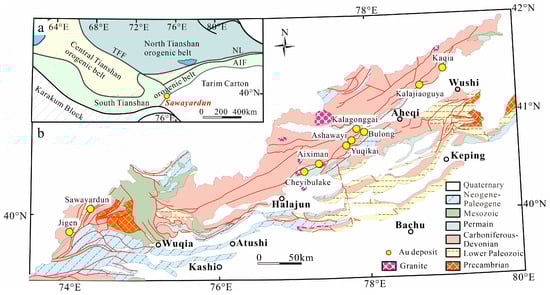
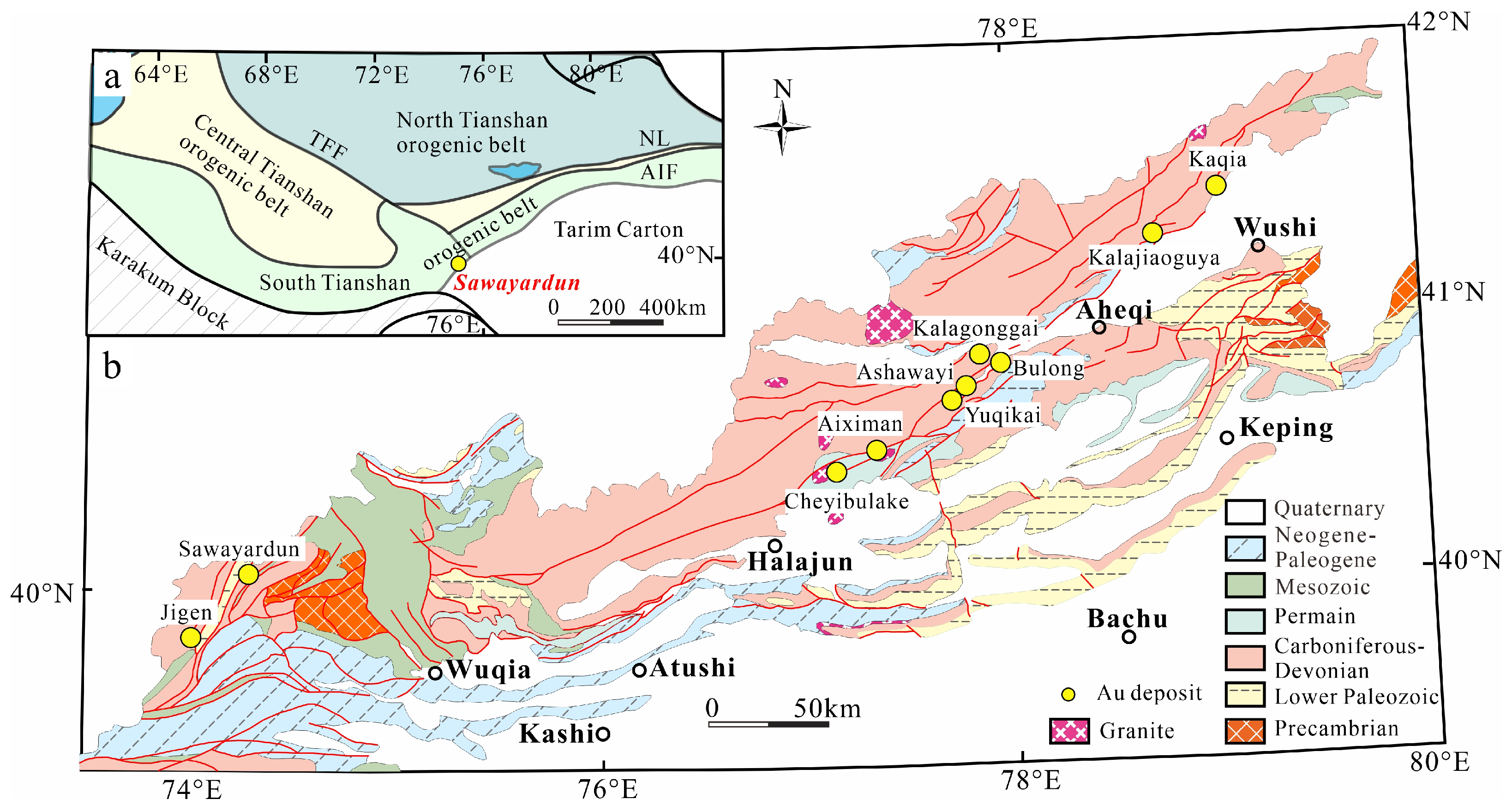
The Tianshan orogenic belt is subdivided from north to south into Northern Tianshan, Central Tianshan, and Southern Tianshan by the Nigolaye Line (NL) and the Atebashi Fault (AIF) (Figure 1a). It is transected by the Talas–Fergana Fault (TFF) in an east–west direction. Within China, Tianshan is further divided by the Urumqi–Toksay–Korla line and the Khan Tengri into Eastern Tianshan, Western Tianshan, and Southwestern Tianshan [28,29,30]. Southwestern Tianshan, located south of the AIF and west of Khan Tengri, is the suture zone between Central Tianshan and the Tarim Craton (Figure 1a) [31,32,33]. As a typical accretionary orogen, Southwestern Tianshan exhibits well-developed tectonic activity within the region, having undergone oceanic-continental subduction accretion, plate extension, continental collision, and magmatic intrusion [8,34,35]. The strata exposed within the area consist predominantly of a Precambrian basement comprising schist, gneiss, and marble, overlain by Silurian, Devonian, Carboniferous, Early Permian, Jurassic, and Cretaceous sequences [26]. The overall trend of the strata is NE-SW, consistent with the structural orientation (Figure 1b). Magmatic rocks are sparsely developed across the region, with only minor occurrences of ophiolitic mélange observed within the Jigen-Sawayardun Fault Zone. Many gold deposits have been discovered in the southwestern Tianshan orogenic belt (Figure 1b), among which the largest one is the Sawayardun gold deposit.
Figure 1.
Tectonic map of the Tianshan Orogen (a) and geology and distribution of gold deposits of the Southwestern Tianshan Orogen (b) (modified after Zhou et al. [21]). NL—Nigolaye Line; AIF—the Atebashi Fault; TFF—the Talas-Fergana Fault.
3. Deposit Geology
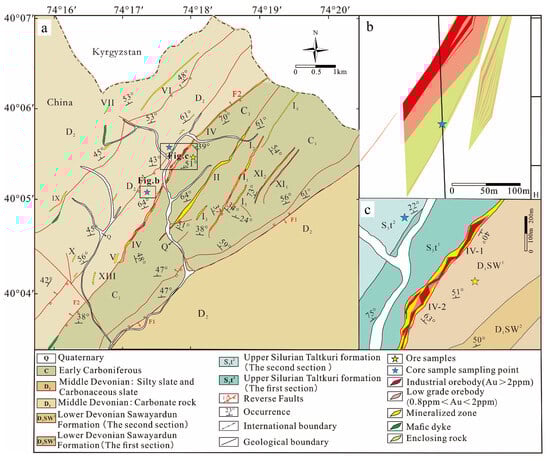
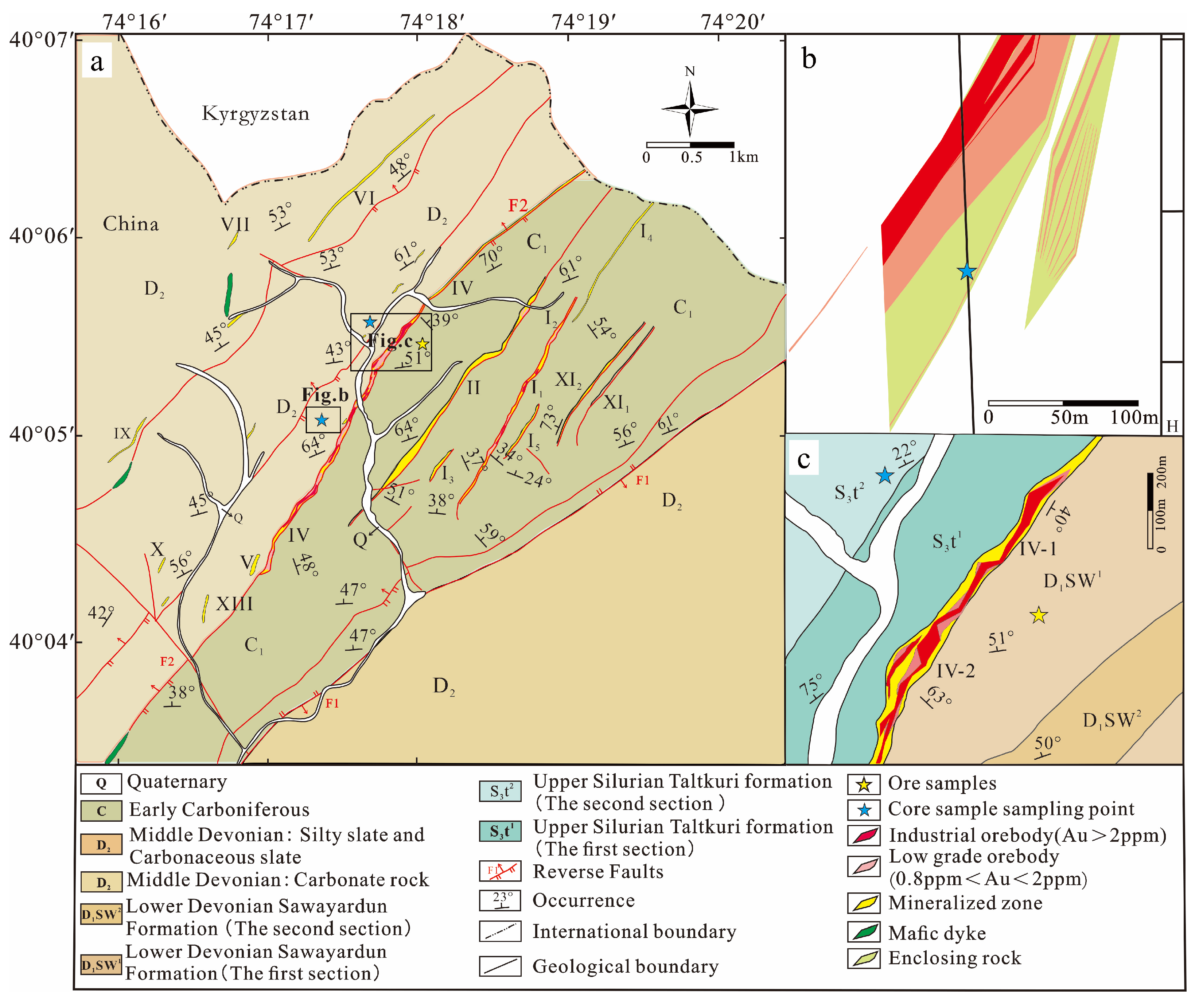
The strata exposed in the Sawayardun gold deposit consist primarily of the Upper Silurian Tartkul Formation (S3t), Lower Devonian Sawayardun Formation (D1sw), Middle Devonian Togmaiti Formation (D2t), and Lower Carboniferous Bashisuogong Formation (C1b) (Figure 2a). Among these, the Lower Devonian Sawayardun Formation (D1sw) serves as the principal host rock sequence for mineralization. This formation is subdivided into two lithological segments: The first segment consists of interbedded metamorphosed siltstone and carbonaceous phyllite, while the second segment is composed of metamorphosed calcareous fine-grained sandstone intercalated with carbonaceous sericite phyllite and locally contains lenses of metamorphic siltstone. Magmatic activity within the mining district is notably weak, with only minor diabase dykes and monzonite dykes identified in the northwestern and southwestern sectors of the district (Figure 2a).
Figure 2.
Geological sketch map (a) of the Sawayardun gold deposit (modified after Zhang et al. [16] and schematic diagrams (b,c) showing sample locations.
The mining district exhibits well-developed structures. Influenced by regional tectonic stress, the strata exhibit an overall NE-trending orientation. Faults are classified into three sets based on strike: NE-, NW-, and SN-trending (Figure 2b,c). Under the influence of regional metamorphism, the gold in the mining area was activated and initially migrated and concentrated in the favorable locations, forming gold mineralization or low-grade ores.
The mining district exhibits well-developed structures. Influenced by regional tectonic stress, the strata exhibit an overall NE-trending orientation. Faults are classified into three sets based on strike: NE-, NW-, and SN-trending. Orebody emplacement is primarily controlled by the NE-trending faults. A total of 21 mineralized zones have been identified within the district. Among these, Mineralized Zones I, II, IV, and XI are the most extensive, with a slightly equidistant and parallel alignment, collectively constituting the principal mineralized zones of the mining district (Figure 2a).
4. Methods
For this study, a total of 28 samples were systematically collected from the mining face of Orebody IV in the Sawayardun Gold Deposit and adjacent drill cores (Figure 2b,c). The 28 samples were subjected to morphology, texture, and mineral paragenesis using reflected light microscopy after preparation as probe sections.
The micro-texture and chemical composition of sulfide (arsenopyrite, pyrite, and stibnite) and gold in 10 samples from various mineralization stages were investigated using a JEOL JXA-iSP100 electron probe microanalyzer (EPMA) (from JEOL.Ltd, Tokyo, Japan) equipped with a back-scattering electron (BSE) detector and an energy dispersive spectrometer (EDS) in Guangzhou Tuoyan Testing Technology Co., Ltd. (Guangzhou, China) The analysis conditions for the chemical composition of different minerals are as follows: arsenopyrite, of which its operating conditions were an accelerating voltage of 20 kV, probe current of 20 nA, and beam diameter of 1–3 μm; and pyrite, stibnite, and native gold, of which their conditions were an accelerating voltage of 20 kV, probe current of 20 nA, and beam diameter of 3 μm. The standard reference materials used for quantification were MAC mineral/metal standards (UK) and Chinese national standard samples (GSB). The specific elemental standards were as follows: Se (ZnSe), S (Pyrite/Arsenopyrite), Pb (Galena), Bi (Bi), Au (Au), Fe (Pyrite/Arsenopyrite), Co (Co), Ni (Ni), Cu (Chalcopyrite), As (Arsenopyrite), Ge (Ge), Ag (Ag), Sb (Sb), Te (Te), and Zn (Sphalerite). The counting times were set as follows: for S: background counting time of 10 s and peak counting time of 5 s; for Fe, Co, Ni, Cu, Pb, Zn, Bi, Au, Ag, Sb, and Te: background counting time of 20 s and peak counting time of 10 s; for As, Se, and Ge: background counting time of 30 s and peak counting time 15 s. The analytical procedures strictly adhered to the following Chinese national standards: GB/T 15246-2002 (implemented by National Committee Microbeam Analysis Standardization Technology for sulfide minerals using electron probe). The element detection limit is 10−4. The relative standard deviation is usually less than 1%. The selected results of the data obtained from this test are within the range of 99% to 101%. The acquired data were corrected for matrix effects using the ZAF correction method. The analysis included both point analysis and area scanning of typical minerals. The results are summarized in Supplementary Materials Tables S1–S5.
5. Result
5.1. Mineral Structure and Alteration
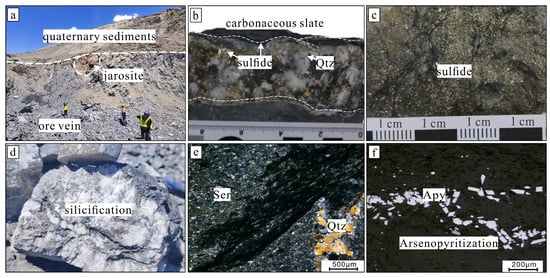
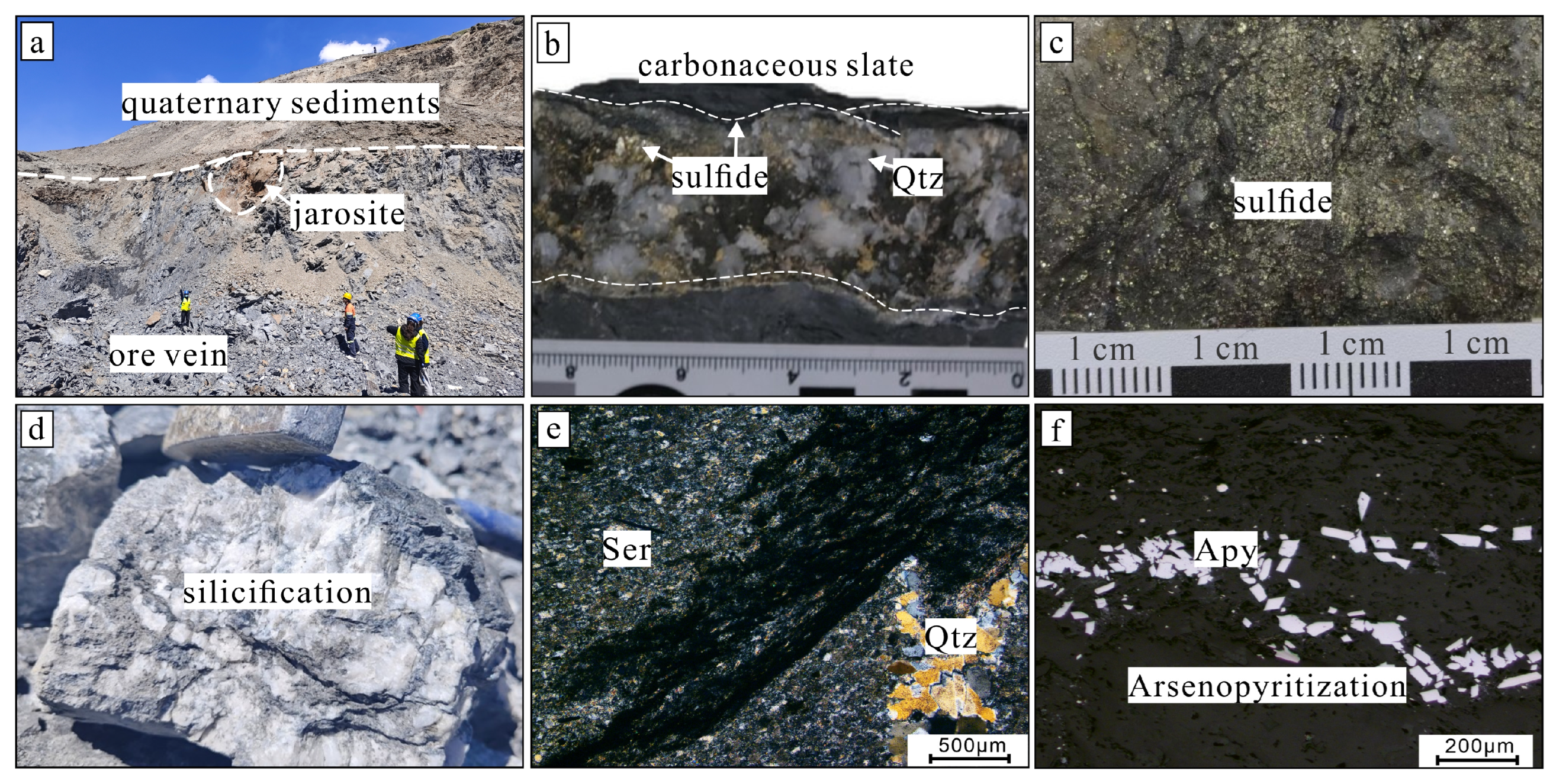
The ore types of the Sawayardun gold deposit include quartz veinlet–stockwork type (Figure 3a,b) and the altered rock type (Figure 3c), with the ore textures being disseminated, vein-like, and massive (Figure 3b,c). The wall-rock alteration in the mining area includes silicification (Figure 3d), sericitization (Figure 3e), pyritization (Figure 3c), arsenopyritization (Figure 3f), and jarositization (Figure 3a).
Figure 3.
Photographs showing ore textures and wall-rock alteration of the Sawayardun gold deposit. (a) Zoning of alteration zones around the ore body. (b) Sulfides as veinlets between carbonaceous slate and quartz veins, and as massive aggregates within quartz veins. (c) Pyrite occurring as disseminated in carbonaceous slate. (d) Silicification. (e) Sericitization (cross-polarized light); (f) Arsenopyritization (reflected light). Abbreviation: Qtz—quartz; Ser—sericite; Apy—arsenopyrite.
Petrographic and mineralographic observations reveal that the primary ore minerals are predominantly pyrite and arsenopyrite, with minor amounts of pyrrhotite, sphalerite, chalcopyrite, and native gold. The mineral textures are mainly coarse-grained anhedral and fine-grained euhedral to subhedral, with a minor anhedral component. The gangue minerals are primarily quartz, calcite, and mica. Quartz mostly occurs as impurity-bearing granular crystals, calcite is intergrown with quartz, and mica is mainly sericite and muscovite, occasionally showing signs of stress-induced modification.
5.2. Texture of the Arsenopyrite, Pyrite, Stibnite, and Gold
Based on field observations, ore textures, cross-cutting relations, and mineral paragenetic associations, the mineralization stages at the Sawayardun gold deposit are divided into a metamorphosed sedimentary period and a hydrothermal mineralization period. Based on mineral assemblages and sulfide morphology/composition, the hydrothermal period is further subdivided into four stages.
5.2.1. Metamorphosed Sedimentary Period
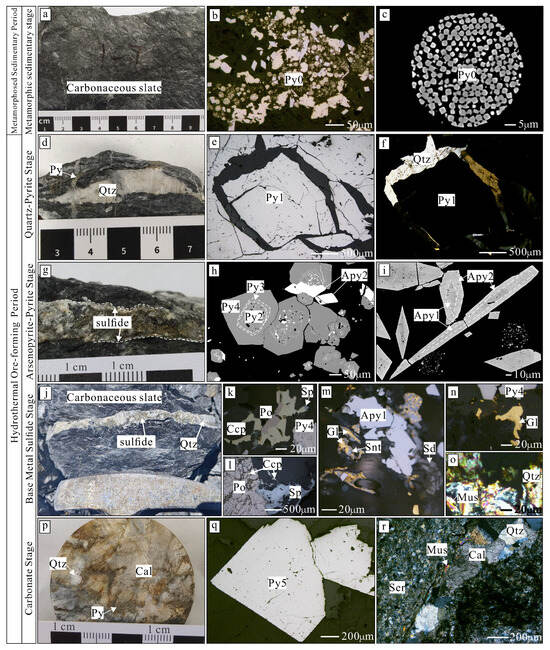
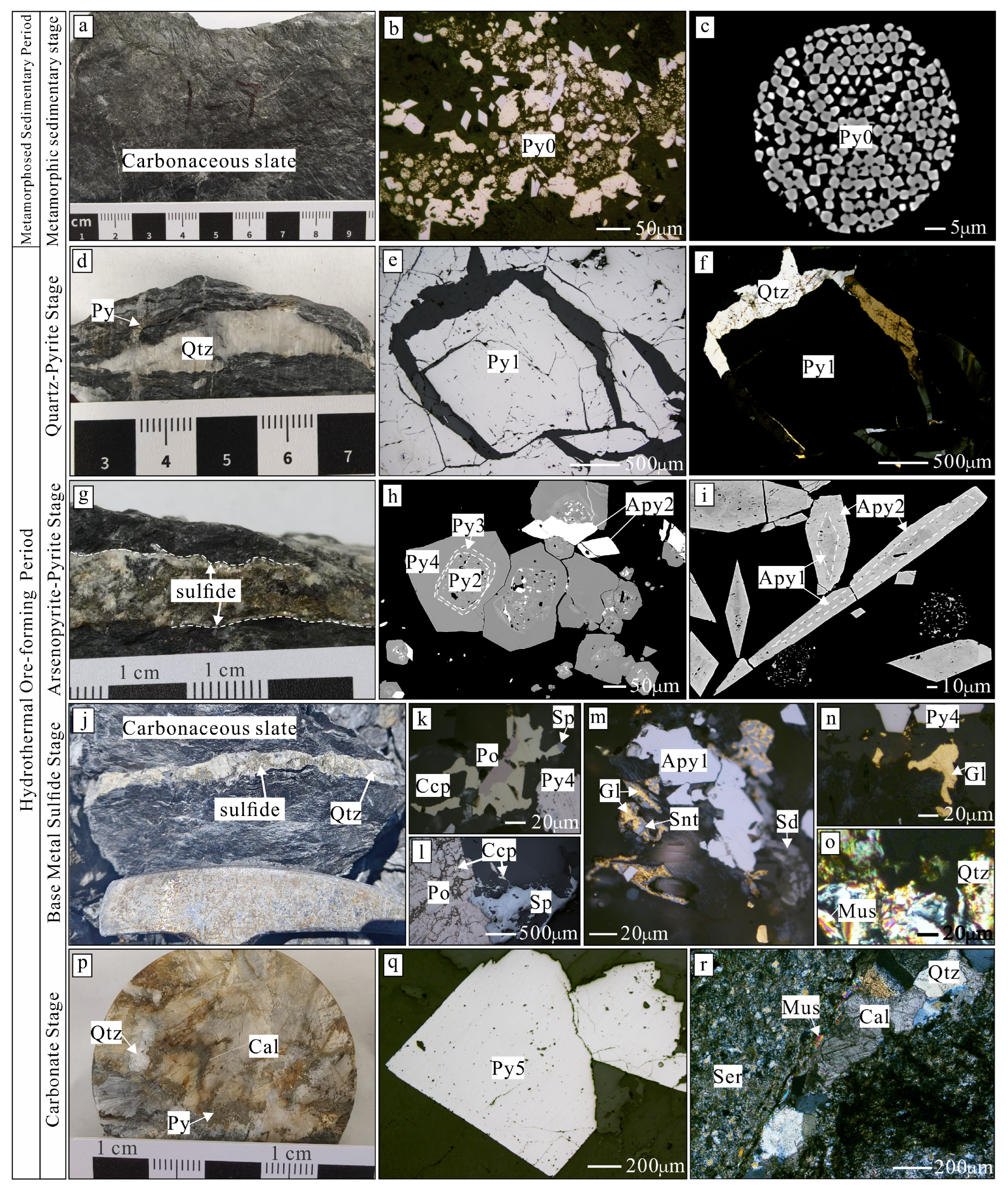
During the metamorphosed sedimentary stage, a minor amount of pyrite developed and is distributed within carbonaceous slate near the hanging wall and footwall of the main orebody (Figure 4a). This stage is characterized predominantly by framboidal pyrite (Py0) (Figure 4b,c), which occurs mainly as spheres, hemispheres, or spherical aggregates. The aggregates are relatively small, typically <50 μm. SEM images show that some framboidal pyrite clusters are composed of multiple spherical pyrite microcrystals (Figure 4c). Individual microcrystals are less than 5 μm in size, exhibit rough surfaces, and have well-developed pores (Figure 4c).
Figure 4.
Microscopic characteristics of mineral assemblages from different metallogenic stages in the Sawayardun gold deposit. (a) Carbonaceous sericite slate. (b) The framboidal pyrite (Py0) coexists with the anhedral-subhedral pyrite (Py1) and arsenopyrite (Apy1). (c) Sedimentary framboidal pyrite (Py0) composed of many nano-micro-subhedral pyrite (BSE). (d) The disseminated pyrite existed in the carbonaceous shale and quartz interlayers. (e) Coarse-grained anhedral pyrite (Py1) from the quartz–pyrite stage (reflected light). (f) Fractures in coarse-grained anhedral pyrite filled with quartz (cross-polarized light). (g) The quartz–sulfide veins between the carbonaceous schist. (h) Multi-generation pyrite (Py2, Py3, and Py4) coexisted with Apy2 (BSE). (i) Apy2 overgrowth along with Apy1 (BSE). (j) Carbonaceous slates is filled with quartz–sulfide vein. (k) Coexistence of pyrrhotite, chalcopyrite, and sphalerite, also coexisting with euhedral pyrite (Py4) (reflected light). (l) Chalcopyrite is filled along the fractures of pyrrhotite (reflected light). (m) Native gold intergrowth with stibnite and along with arsenopyrite (Apy1) (reflected light). (n,o) Native gold occurs in fractures of quartz and muscovite (n: reflected light; o: cross-polarized light); (p) Hand specimen from carbonate stage showing abundant carbonate minerals. (q) Coarse-grained cubic pyrite (Py5) (reflected light). (r) Gangue minerals, including sericite, quartz, and calcite, from the carbonate stage (cross-polarized light). Abbreviation: Py—pyrite; Po—pyrrhotite; Ccp—chalcopyrite; Sp—sphalerite; Gl—gold; Mus—muscovite; Cal—calcite; Sd—siderite; Snt—stibnite.
5.2.2. Hydrothermal Ore-Forming Period
- (1)
- Quartz–Pyrite Stage: This stage represents Phase I of hydrothermal activity, characterized by the formation of short and irregular lenticular quartz veins extending along the strata within the host rock (Figure 4d). The metallic minerals in this stage are almost exclusively pyrite (Py1). Py1 occurs predominantly as coarse-grained euhedral crystals with large particle sizes, exceeding 500 μm and often reaching 1 mm. It exhibits well-developed fractures and pores, with the fractures being infilled by relatively pure quartz grains measuring over 500 μm in size (Figure 4e,f).
- (2)
- Arsenopyrite–Pyrite Stage: This stage represents Phase II of hydrothermal activity, characterized by the occurrence of pyrite–arsenopyrite–quartz veinlets within carbonaceous host rocks (Figure 4g). Pyrite (Py2) and arsenopyrite are distributed within these quartz veinlets, whose widths vary significantly, ranging from a few millimeters to several tens of centimeters. Pyrite (Py2) occurs as anhedral grains with rough and porous surfaces (Figure 4h). The pores are often infilled by arsenopyrite, and the grains are overgrown by later-stage pyrite (Py3). Arsenopyrite (Apy1) exhibits euhedral to subhedral crystal forms, predominantly appearing as rhombohedra, prisms, and needles. The cores of arsenopyrite crystals are porous and are commonly overgrown by later-generation arsenopyrite (Apy2) (Figure 4i). The main gangue minerals are quartz and sericite.
- (3)
- Polymetallic Sulfide Stage: This stage, corresponding to Phases III and IV of hydrothermal activity, constitutes the principal ore-forming episode. It is characterized by metal-bearing quartz veins with widths ranging from 1 to 2 cm (Figure 4j). The sulfide assemblage is dominated by arsenopyrite and pyrite, with subordinate pyrrhotite, chalcopyrite, sphalerite, and stibnite (Figure 4k–m). Native gold is also precipitated during this stage (Figure 4m,n).
Py3 occurs as overgrowths on earlier Py2, exhibiting distinct compositional zoning. Later Py4 forms as euhedral with smooth crystal faces, nucleating on the margins of Py3 (Figure 4h). Arsenopyrite (Apy2) displays well-developed smooth faces without visible porosity. It occurs as rhombohedral, prismatic, and acicular crystals, commonly enclosing earlier Apy1 (Figure 4i). Anhedral pyrrhotite exhibits extensive fracturing and is intergrown with chalcopyrite and sphalerite (Figure 4k). Stibnite occurs in anhedral grains with pitted surfaces. It is paragenetically associated with native gold (Figure 4m).
Native gold is found as inclusions within sulfide grains and in fractures of quartz veins, with particle sizes around 50 μm (Figure 4m–o). Quartz predominantly appears as granular to fine-grained anhedral crystals with abundant inclusions. Sericite forms fine-grained lepidoblastic aggregates.
- (4)
- Carbonate Stage: This stage represents Phase IV of hydrothermal activity and is characterized by the development of carbonate minerals (Figure 4p). Metallic minerals are sparse, with rarely observed sulfides consisting almost exclusively of pyrite. The pyrite occurring in this stage (Py5) is exceptionally coarse-grained, exceeding 500 μm in size, and forms euhedral crystals with well-developed morphology (Figure 4q). The gangue mineral assemblage, in addition to quartz and sericite, contains abundant calcite (Figure 4r).
5.3. Chemical Composition of Arsenopyrite, Pyrite, Stibnite, and Gold
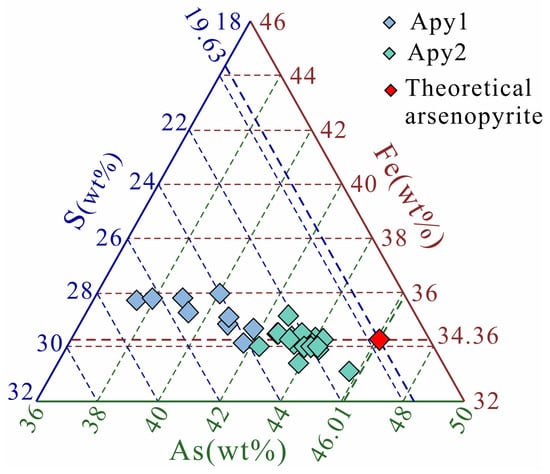
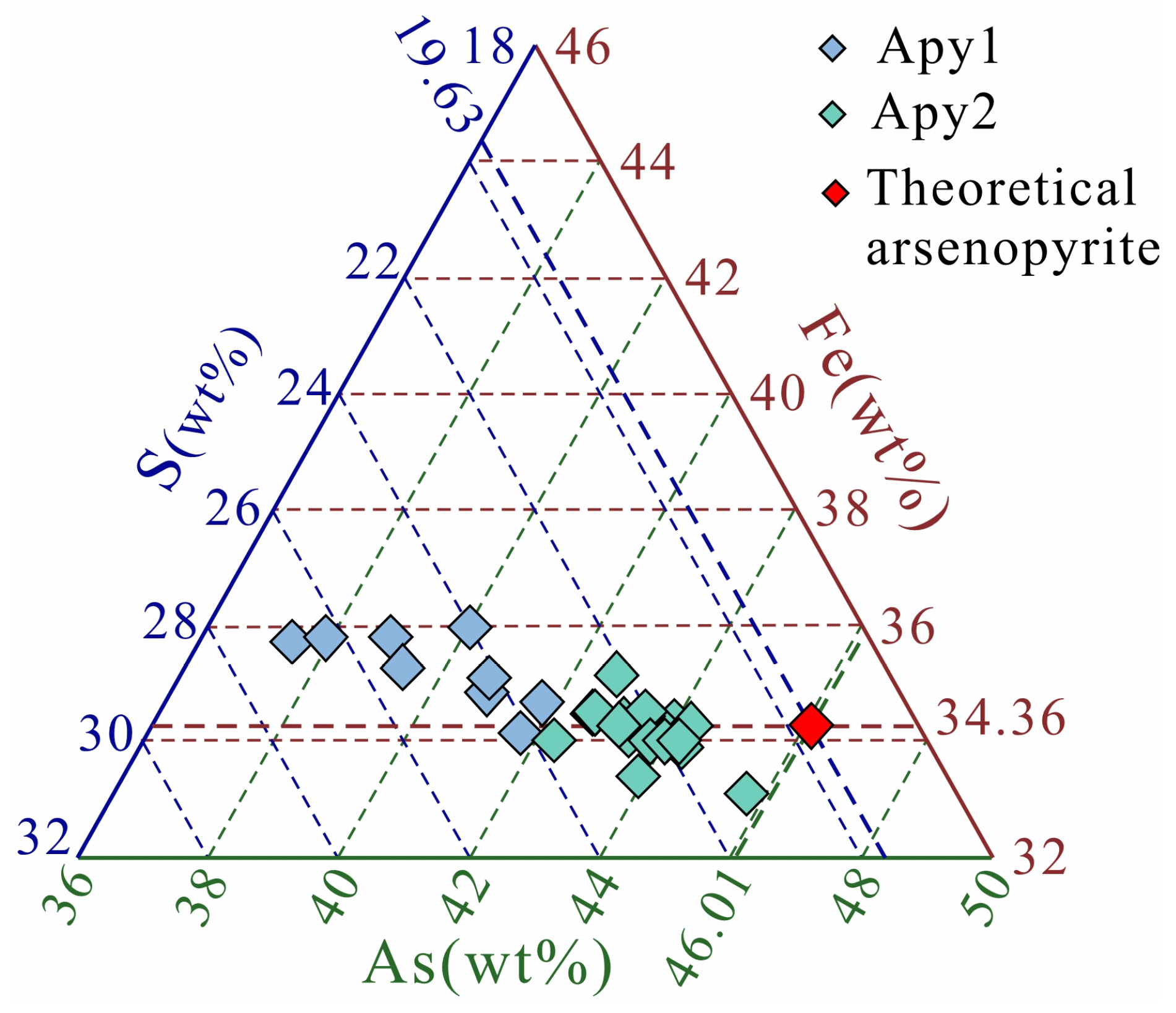
According to the EMPA data, the composition of As, S, and Fe in the two generations of arsenopyrite (Apy1 and Apy2) indicates that both are enriched with S and exhibit a loss of As (Figure 5; Supplementary Materials Table S1). The Fe, S, and As components in Apy1 and Apy2 are significantly different; relative to Apy1, Apy2 exhibits higher As but lower Fe and S contents (Figure 5; Supplementary Materials Table S1). And among them, the composition of Apy1 varies greatly, while the composition of Apy2 varies relatively concentratedly (Figure 5). The S contents of Apy1 and Apy2 (23.32 to 26.69 wt.%, Ave: 24.74 wt.%, N = 9; 20.50 to 23.45 wt.%, Ave: 22.06 wt.%, N = 23, respectively) are generally higher than the theoretical value (19.69 wt.%) of S in arsenopyrite. On the contrary, the As content of Apy1 and Apy2 (37.22 to 41.72 wt.%, Ave: 39.64 wt.%, N = 9; 41.89 to 44.86 wt.%, Ave: 43.26 wt.%, N = 23, respectively) is less than the theoretical values (46.01 wt.%) of As in arsenopyrite. The average value of Fe in Apy1 (34.16 to 35.95 wt.%, Ave: 35.05 wt.%, N = 9) is higher than the theoretical value (34.36 wt.%) of Fe in arsenopyrite, while the average content of Fe in Apy2 (32.22 to 34.95 wt.%, Ave: 33.92, N = 23) is lower than the theoretical value of Fe in arsenopyrite (Supplementary Materials Table S1; Figure 5).
Figure 5.
Fe-S-As ternary diagram showing the major element characteristics of arsenopyrite (Apy1 and Apy2). All data based on the results of arsenopyrite analyses by EPMA are given in Supplementary Materials Table S1.
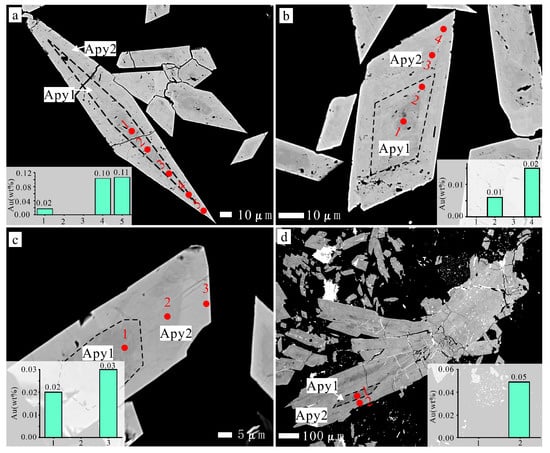
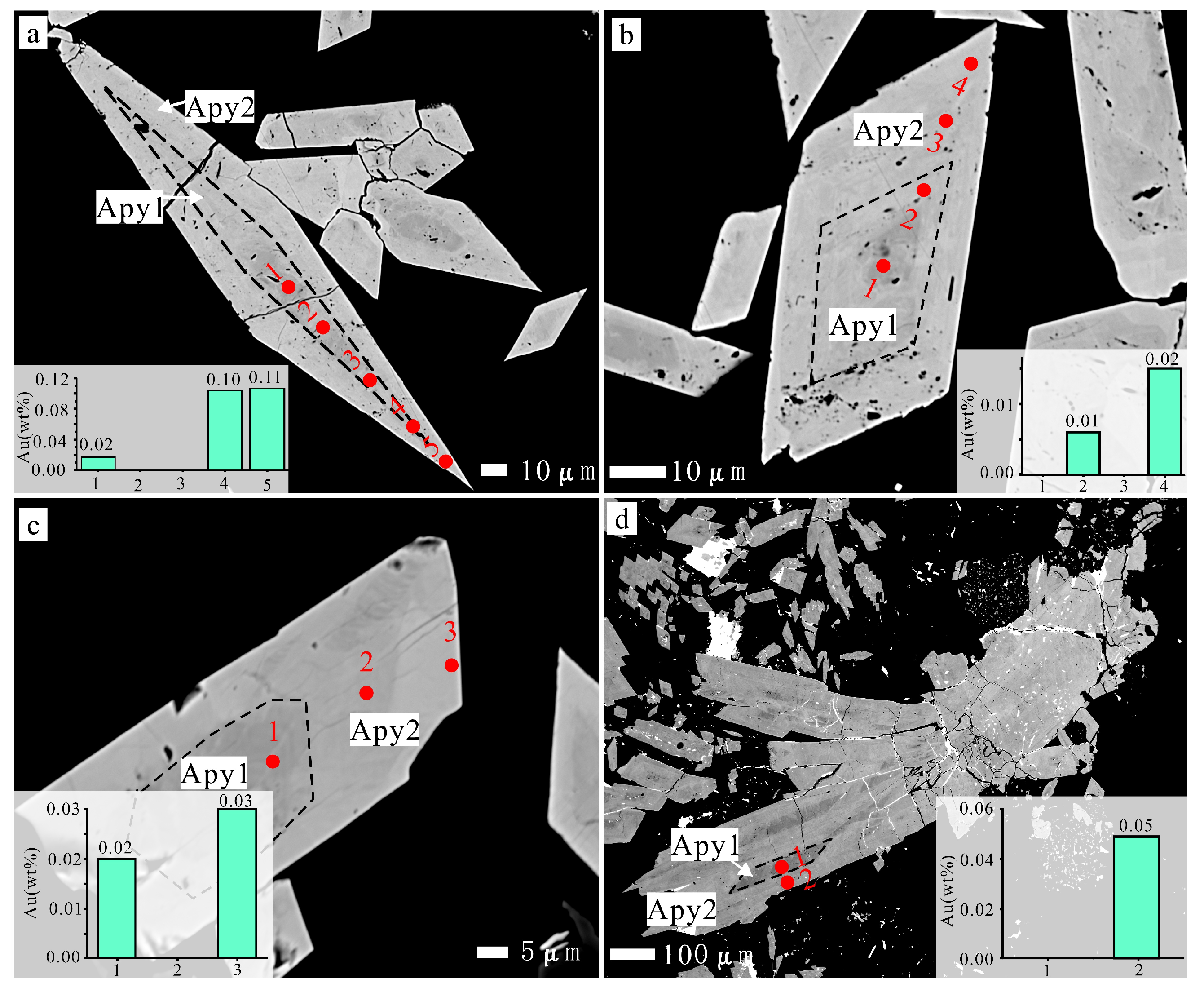
The Au contents of Apy2 (~0.11 wt.%, Ave: 0.062 wt.%; N = 23) is significantly higher than Apy1 (~0.02 wt.%, Ave: 0.016 wt.%, N = 7) (Supplementary Materials Table S1). From the core to the periphery, the concentration of gold shows a gradually increasing trend (Figure 6). Additionally, Co and Ni values are elevated in Apy2 relative to Apy1. Sb is significantly enriched in arsenopyrite, with higher concentrations observed in Apy1 than in Apy2 (Supplementary Materials Table S1). Other elements, including Pb, Bi, Ge, Ag, and Zn, in arsenopyrite are below the detection limit (Supplementary Materials Tables S1 and S2).
Figure 6.
The BSE images show that the pyrite has a distinct banding structure. All data based on the results of arsenopyrite analyses by EPMA are given in Supplementary Materials Table S2. (a,b). Rhombic arsenopyrite with a band-like structure. (c). Columnar arsenopyrite with element zoning characteristics. (d). Anhedral arsenopyrite with element zoning characteristics.
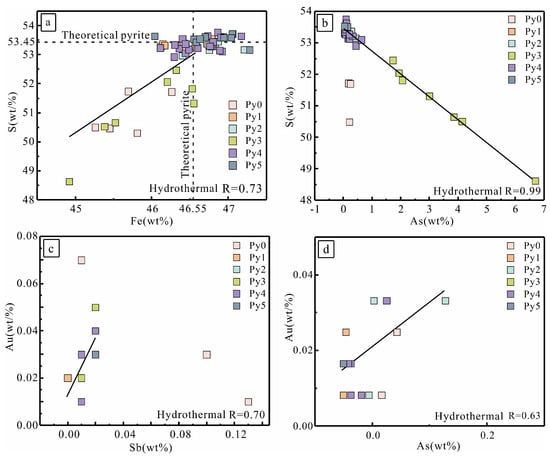
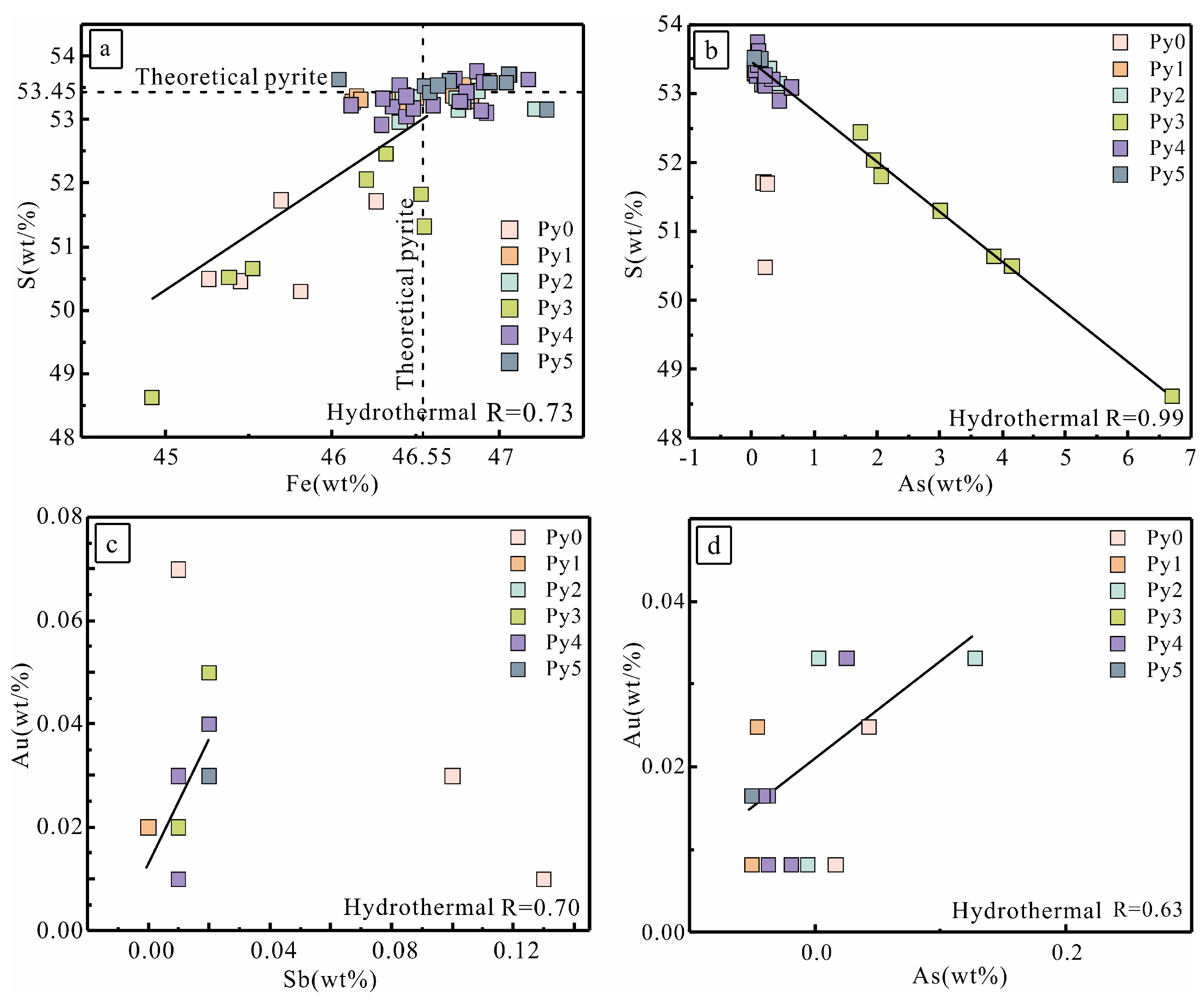
The composition of pyrite is relatively stable, excluding Py0 and Py3 (Supplementary Materials Table S3). The chemical composition of Py0 (S: 50.29 to 51.72 wt.%, Ave. 50.93 wt.%, N = 5; Fe: 45.26 to 46.26 wt.%, Ave. 45.69 wt.%, N = 5) and Py3 (S: 48.62 to 52.45 wt.%, Ave. 51.06 wt.%, N = 7; Fe: 44.92 to 46.55 wt.%, Ave. 45.92, N = 7) shows varying degrees of sulfur and iron depletion (Supplementary Materials Table S3, Figure 7a). Six generations of pyrite (Py0–Py5) contain As (Supplementary Materials Table S3), while the As content in Py3 is 6.68 wt.% and the As-S binary diagram shows a stronger negative correlation between S and As (R = 0.99) (Figure 7b). Gold was detected in more than half of the pyrite, and Au shows a positive correlation with Sb (R = 0.7) and As (R = 0.63) in five generations of pyrite (Supplementary Materials Table S3, Figure 7c,d). Minor Co was detected in Py0 and Py1, with contents in other generations of pyrite fluctuating near the detection limit (Supplementary Materials Table S3). The trace elements of pyrite, such as Ni, Pb, Bi, Ge, Ag, and Zn, are near or below the detection limit (Supplementary Materials Table S3).
Figure 7.
Scatter diagram of major and trace elements of pyrite. All data based on the results of arsenopyrite analyses by EPMA are given in Supplementary Materials Table S3. (a). The binary graph shows a strong positive correlation between Fe and S in pyrite. (b). The binary graph shows a strong negative correlation between As and S in pyrite. (c). The binary graph shows a strong positive correlation between Au and Sb in pyrite. (d). The binary graph shows a positive correlation between Au and As in pyrite.
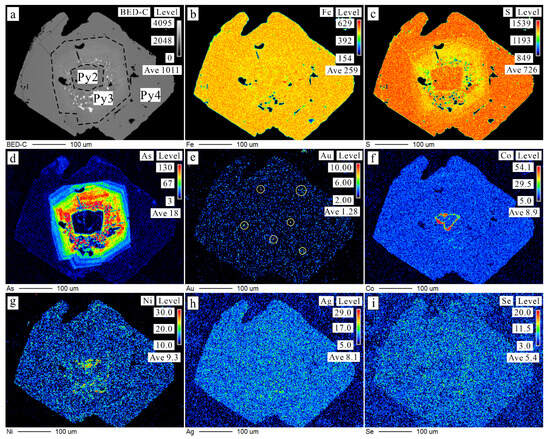
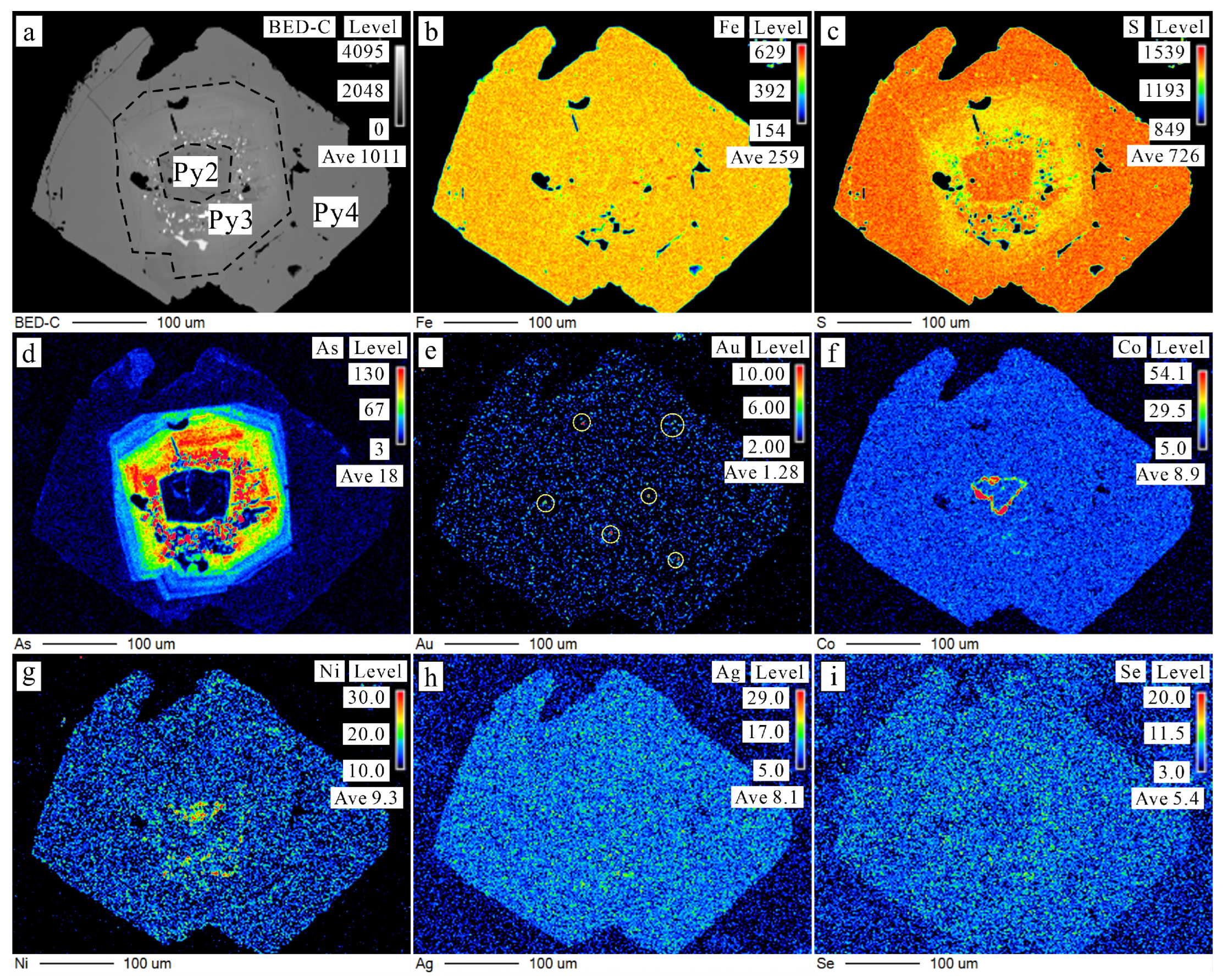
EPMA mapping (WDX) of pyrite reveals distinct zonation textures within individual grains (Figure 8a). In contrast, the rim (Py4) and the core (Py2) show relatively homogeneous distributions of Fe and S (Figure 8b,c). The intermediate zone (Py3) is characterized by arsenic-enriched and sulfur-depleted bands (Figure 8c,d), with localized anomalously high concentrations of Au occurring as discrete spots (Figure 8e). The core (Py2) exhibits pronounced enrichment of Co and Ni, forming fine-scale oscillatory zoning (Figure 8f,g). Elements such as Ag and Se show concentrations close to background levels in Py2, Py3, and Py4 (Figure 8h,i).
Figure 8.
BSE images (a), and WDX element mapping (b–i) show the microtexture and the distribution of elements in Py2, Py3, and Py4 within the Sawayardun gold deposit.
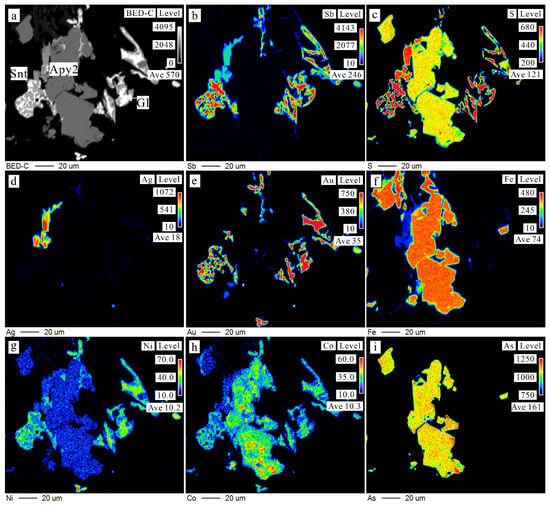
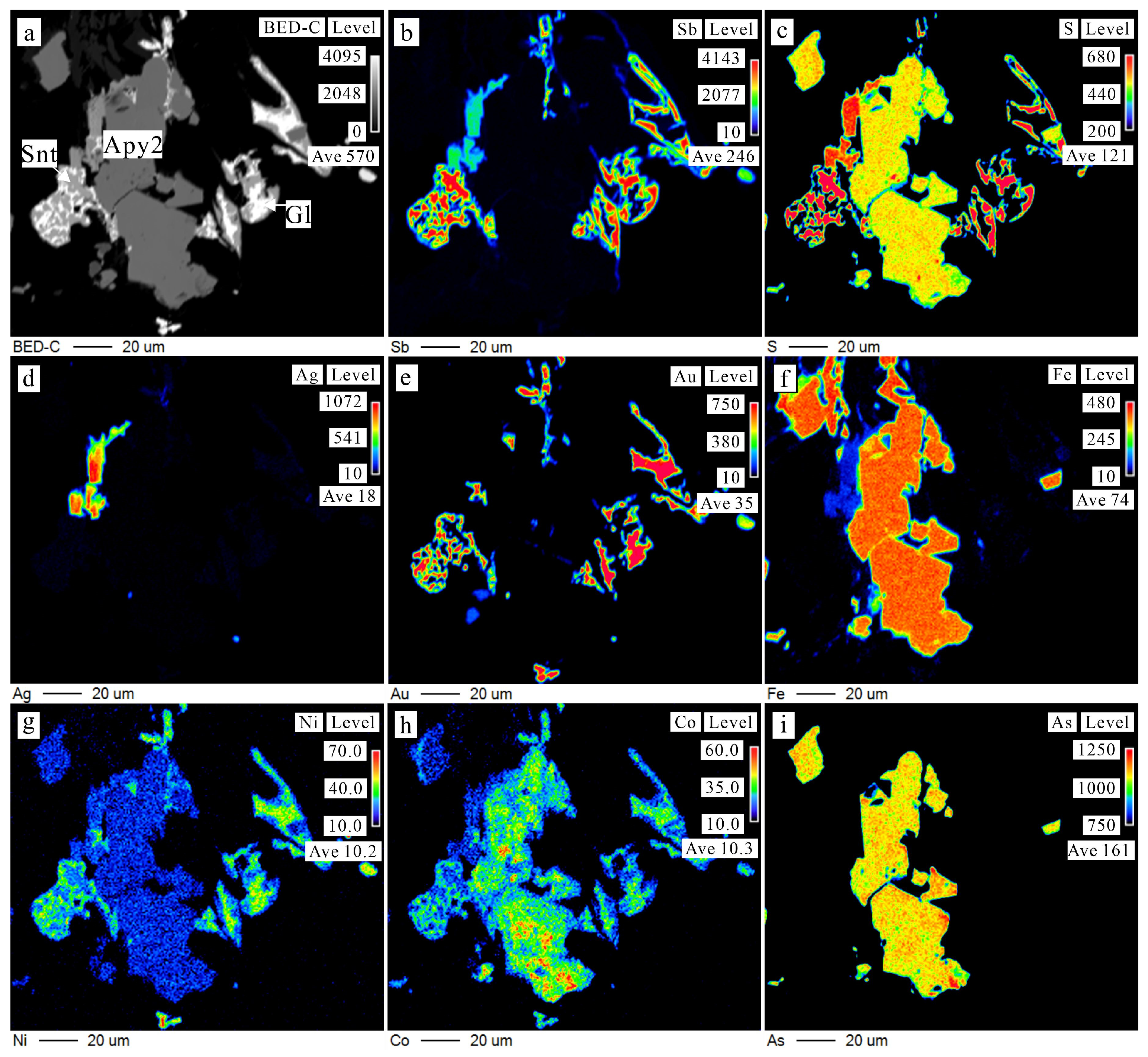
Stibnite coexisted with native gold, and both of them occur along with Apy2 (Figure 4m and Figure 9a). According to Supplementary Materials Table S5, the Sb content in stibnite ranges from 66.95 wt.% to 71.40 wt.%, and the S content is 27.15 wt.% to 29.41 wt.%. The trace elements in stibnite are mainly Fe (0.22 wt.%–0.64 wt.%), Bi (0.07 wt.%–0.13 wt.%), and gold (0.04 wt.%–3.63 wt.%) (Supplementary Materials Table S4). The Sb concentration in stibnite gradually decreases from the core of the stibnite to the rim (Figure 9b,c).
Figure 9.
BSE images (a), and WDS elemental mapping (b–i) showing the microtexture and chemical composition of Apy2, stibnite, and native gold within the Sawayardun gold deposit.
According to the content of Au (93.65 to 100.65 wt.%) and Ag (4.73 wt.% to 5.19 wt.%) of the gold minerals in Supplementary Materials Table S5, the gold minerals belong to native gold, which is confirmed by the WDX element mapping, showing that the Au element mapping is non-overlapping with the Ag element mapping (Figure 9d,e). The Sb-Ag-S-bearing mineral, such as argentite or dyscrasite, might occur with native gold based on the WDX element mapping (Figure 9b–e). The WDX element mapping of arsenopyrite shows that S, As, and Co have higher concentrations in the core than in the rim (Figure 9c,h,i).
6. Discussion
6.1. Physicochemical Conditions of Mineralization
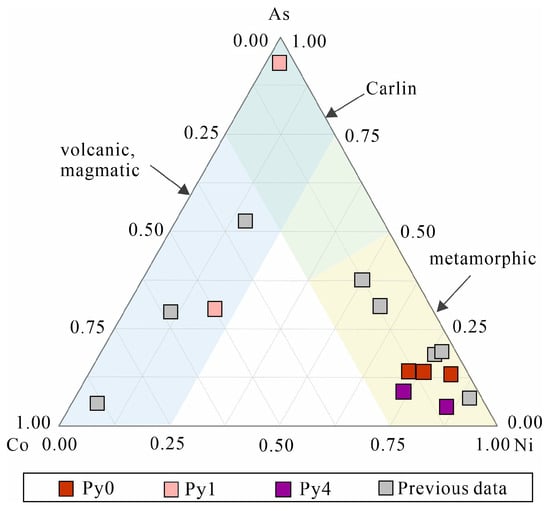
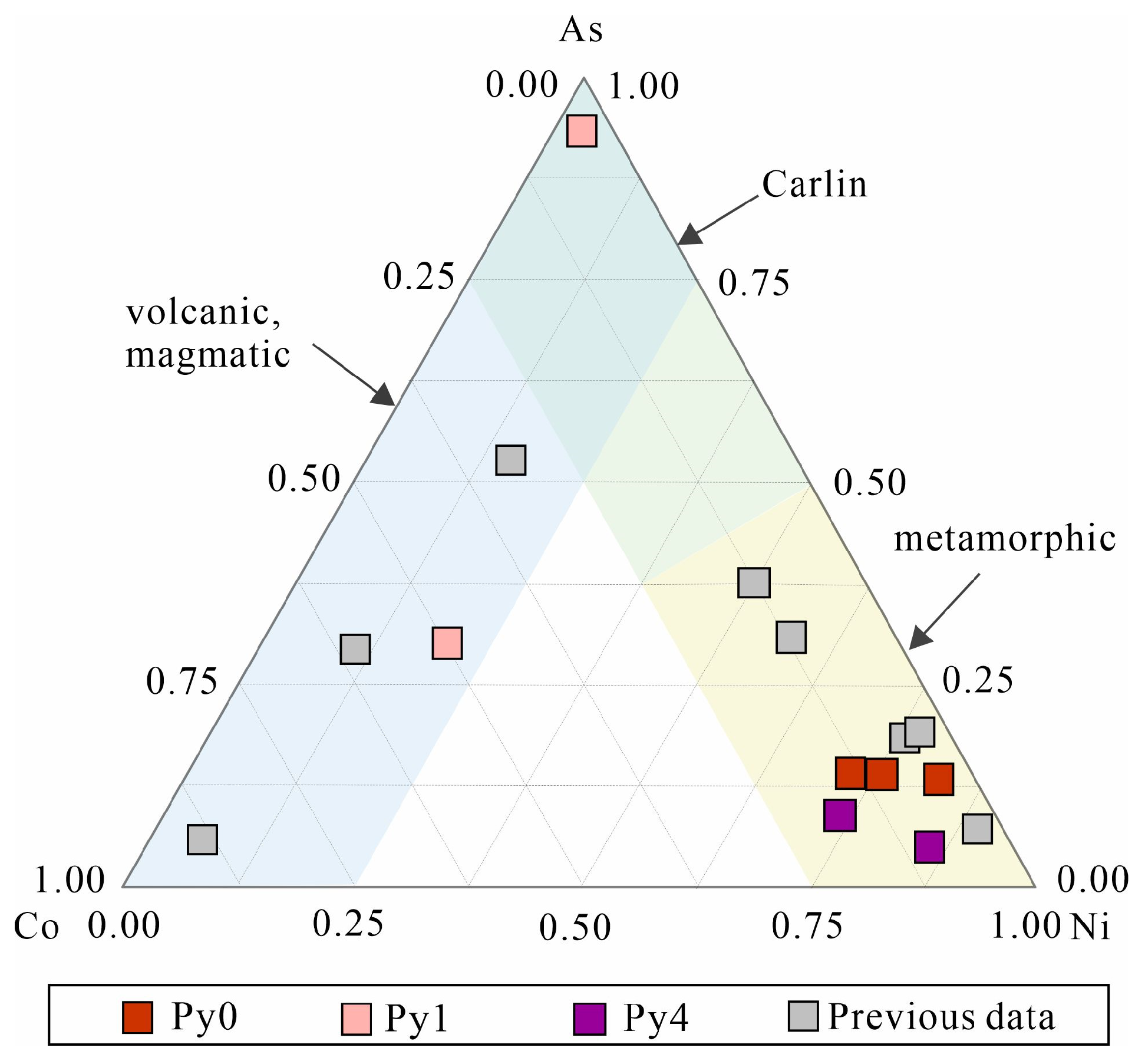
Pyrite is ubiquitously distributed in hydrothermal deposits, and its physical textures and chemical composition serve as significant indicators for ore-forming processes [36,37]. The Co/Ni ratio in pyrite is widely regarded as a diagnostic indicator for determining its genetic origin [38,39,40]. In the Sawayardun gold deposit, the early-stage pyrite generations (Py1) are characterized by relatively high Co and low As contents, whereas the later-formed generations (Py3, Py4, and Py5) exhibit the opposite trend. The Co-Ni-As composition plot (Figure 10) reveals that the pyrite in the Sawayardun deposit is primarily of metamorphic–hydrothermal origin. The ore-forming fluids were dominated by metamorphic water and formation water, with a minor input of magmatic water during the early mineralization stage [41,42].
Figure 10.
Co-Ni-As ternary diagram of pyrite from the Sawayardun gold deposit (modified after [41]). Previous data from Zhang et al. [43].
The Fe/(As + S) ratio in pyrite exhibits a strong correlation with its formation depth, with values of approximately 0.926 in shallow epigenetic environments, 0.863 in intermediate-depth settings, and 0.846 in deep hydrothermal environments [44]. The Fe/(As + S) ratios of pyrite from the Sayayardun gold deposit range from 0.88 to 0.91 during the metamorphosed sedimentary period (Py0), and from 0.81 to 0.89 through the hydrothermal stages (Supplementary Materials Table S3). Notably, 82.14% of the values exceed 0.87, indicating that the mineralization process may have occurred dominantly in an intermediate-to-shallow-depth environment.
The oxidation of Fe2+ can increase the Te content in pyrite [45]. In this study, the Te content in pyrites from various stages was below the detection limit (Supplementary Materials Table S3). The ore bodies in the Sawayardun gold deposit are primarily hosted in surrounding rocks such as carbonaceous slate and carbonaceous phyllite (Figure 3), indicating that the overall mineralization environment of the Sawayardun gold deposit was not oxidizing [45,46]. The sulfides present are mainly arsenopyrite and As-rich pyrite, with minor pyrrhotite (Figure 4), indicating that the overall physicochemical conditions of the ore-forming fluids were relatively reducing. The alteration assemblage of silicification (Figure 3d), sericitization (Figure 3e), and chloritization in the main mineralization stage suggests that the ore-forming fluids were likely weakly acidic [47,48]. In the late mineralization stage, the development of carbonate minerals such as calcite and magnesite in the mining area suggests that the properties of the ore-forming fluids may have gradually evolved toward weakly alkaline conditions [49].
6.2. Occurrence Modes of Gold
Gold in minerals primarily exists in two forms: visible and invisible. Visible gold exists in forms observable under a microscope, such as free-milling gold and microscopic to submicroscopic gold. In contrast, invisible gold typically occurs either through isomorphic substitution into the crystal lattice of sulfides (known as lattice gold or solid solution gold, Au+) or as submicroscopic to nano-sized particles of native gold (Au0) [50,51,52].
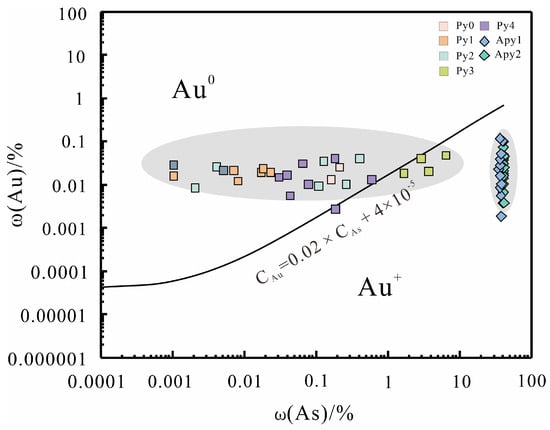
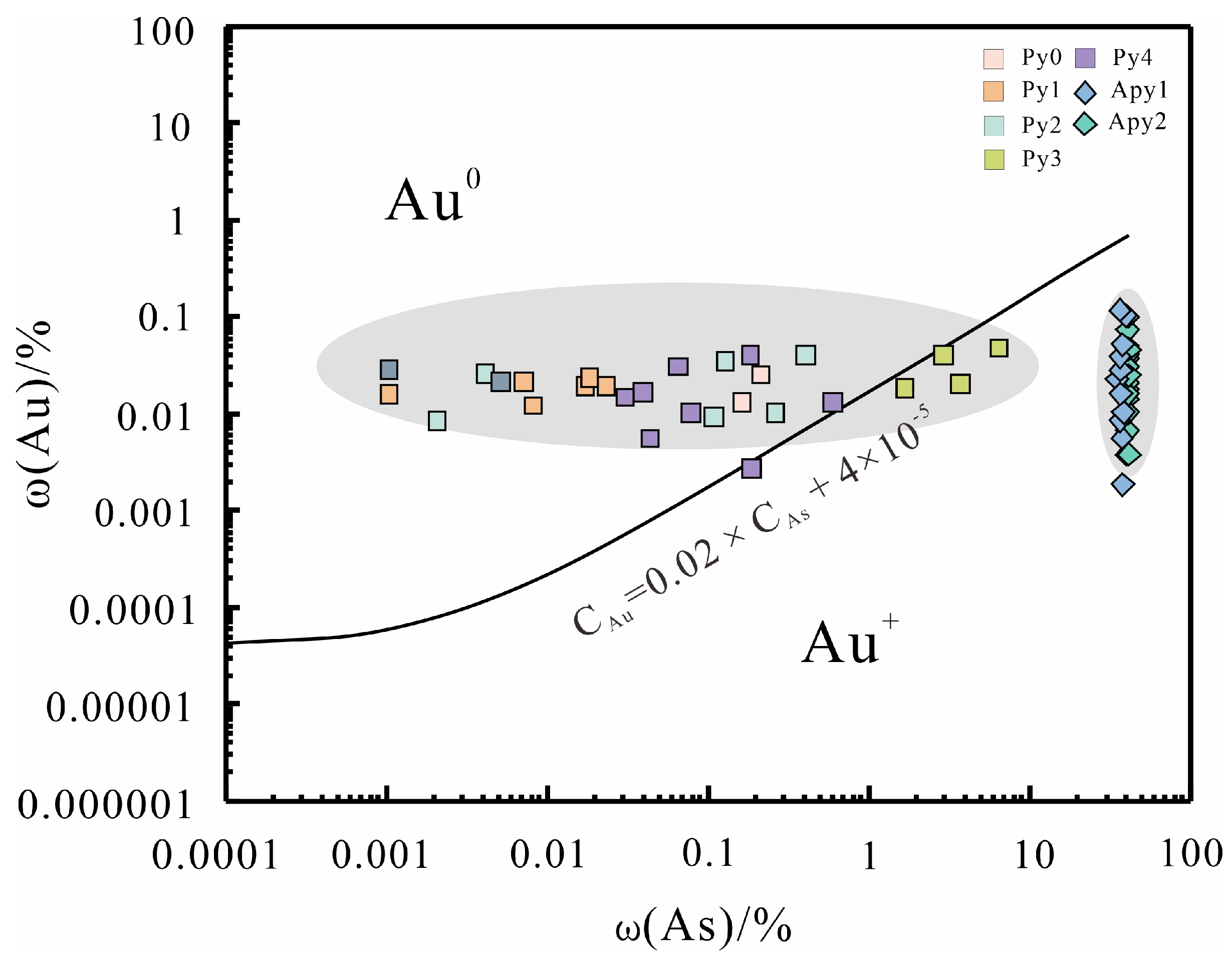
The Sawayardun gold deposit hosts a total gold resource of 127 t Au @ 2.0 g/t [17]. The scarcity of visible gold suggests that most gold exists in invisible form. EPMA data above the detection limit reveal that 92% of the analyzed pyrite grains have Au/As ratios between 0.02 and 1.5 (Supplementary Materials Table S3). According to the Au–As solubility relationship CAu = 0.02 × CAs + 4 × 10⁻⁵ [52], gold in pyrite predominantly exists as Au nanoparticles (Au0) (Figure 11). In Py3 arsenic-rich zones, however, limited Au incorporation into the pyrite lattice (Au/As < 0.02) occurred due to arsenic enrichment (Figure 11) [45,46]. In contrast, arsenopyrite consistently shows Au/As values below 0.02, indicating that gold is primarily present in solid solution (Au+) (Figure 11) [52,53].
Figure 11.
Au-As solubility curve showing the occurrence state of gold in pyrite and pyrrhotite [52].
In the ore samples from the study area, visible gold is relatively rare, with only a small number of grains occurring as native gold hosted within sulfides, mineral fractures, or quartz veins (Figure 4n,o and Figure 9a). Additionally, EPMA mapping of pyrite (Py3) revealed several localized high-Au signals (Figure 8e), indicating gold exists at the micrometer-to-angstrom scale and can be observed in pyrite.
6.3. Gold Enrichment and Precipitation Mechanisms
In the Sawayardun gold deposit, gold occurs mainly as invisible gold and is associated with arsenic-bearing pyrite and arsenopyrite (Figure 8). In contrast, other visible gold is distributed within sulfides, fractures, or in association with stibnite (Figure 4m,n). Under conditions of high fluid temperature (350 °C) and high oxygen fugacity coupled with low pH, gold primarily migrates in the form of AuCl2− within the fluid [54]. In contrast, under medium- to low-temperature ore-forming conditions, gold is mainly transported as Au(HS)2− [54,55,56]. Additionally, in fluids enriched with low-melting-point chalcophile elements (LMCEs), gold can migrate as a melt [57,58,59].
During the early mineralization stage, extensive water–rock reactions occurred between iron in the wall rocks and the ore-forming fluids. This led to substantial consumption of sulfur in the fluids and a notable decrease in sulfur fugacity (fS2). As a result, the Au(HS)2− complexes became destabilized, releasing gold ions back into the fluid [54,55,56]. These gold ions were subsequently incorporated into growing pyrite and arsenopyrite crystals, co-precipitating with them. In this phase, the mineral grains, particularly the early-generation pyrite (Py1) (Figure 4e), provide abundant host sites for gold enrichment [60]. WDX mapping and EPMA data plotting indicate that gold predominantly occurs as microscopically visible inclusions within pyrite, while in arsenopyrite, it exists primarily as “invisible gold (Au+)” (Figure 8e, Figure 11). A negative correlation between As and S and a positive correlation between Au and As are observed in pyrite (Figure 7b,d; Supplementary Material Table S3), suggesting that As substitutes for S in the pyrite lattice and plays a role in gold enrichment [61]. When As incorporates into the pyrite structure, it increases lattice vacancies and reduces the electrostatic repulsion between pyrite and nano-sized gold particles [62,63,64]. This process enables gold to enter the pyrite lattice via chemisorption onto the pyrite surface, forming a metastable solid solution. Both Apy1 and Apy2 exhibit arsenic contents below the theoretical value (Supplementary Material Table S1), and a negative correlation between As and S is present (Figure 5). This indicates an overall As-deficient fluid environment, with S substituting for As in the arsenopyrite lattice to compensate for lattice vacancies. During this process, charge imbalance likely promotes the incorporation of gold, leading to its co-precipitation and enrichment with the crystallizing arsenopyrite.
Both Re-Os dating of pyrite and fluid inclusion studies indicate the presence of two distinct fluid episodes during mineralization [16,20]. This is further corroborated by the microtextures observed in pyrite and arsenopyrite (Figure 6 and Figure 8). The influx of the second fluid episode introduced substantial fluid to the crystal–fluid interfaces, readily triggering dissolution–reprecipitation (CDR) processes. This resulted in the formation of alternating zones depleted and enriched in trace elements [60,65]. Both pyrite and arsenopyrite exhibit distinct textures: a darker, porous core, a brighter, smooth rim, and an intermediate transitional zone between them (Figure 6 and Figure 8). These features provide clear evidence for the occurrence of dissolution-reprecipitation. Electron microprobe analyses of arsenopyrite further confirm that the gold content in Apy2 is higher than in Apy1 and that the rims are richer in gold than the cores (Supplementary Materials Table S1, Figure 6). This demonstrates that dissolution-reprecipitation is a key enrichment mechanism for the Sawayardun gold deposit. Gold initially precipitated in early-stage arsenopyrite, and pyrite was remobilized and extracted, subsequently reprecipitating in a more concentrated form alongside later generations of pyrite and arsenopyrite.
Furthermore, a close association between stibnite and native gold was observed in this study (Figure 9a). EPMA reveals that gold content in stibnite can reach up to 3.36% (Supplementary Materials Table S4). This indicates that LMCE melts also played a significant role in gold enrichment. As an LMCE, Sb can exist as a melt within the Fe-As-S system at temperatures as low as 300 °C [57,66,67]. This melt exhibits low viscosity, allowing it to migrate within the fluid under gravitational forces and strongly scavenge Au from the fluid [67,68,69]. The scavenged Au exists within the melt in the form of specific atomic clusters, which prevent the melt from reaching phase equilibrium. When perturbed by a temperature decrease, these gold clusters preferentially precipitate [70]. Previous studies have shown that the mineralization temperatures at the Sawayardun gold deposit decreased progressively from early to late stages, ranging from 360 °C to 270 °C and finally to 190 °C [20]. Due to the temperature-sensitive nature of LMCE melts, the gold clusters within them decouple and precipitate preferentially as temperature declines, forming native gold. The dissolution–reprecipitation of minerals and the scavenging by LMCE melts could operate concurrently, mutually reinforcing each other to continuously extract and concentrate precious metals from the minerals.
In summary, during the early mineralization stage, gold was released from complexes and incorporated into pyrite and arsenopyrite—a process facilitated by arsenic. Subsequently, the second episode of fluid activity triggered extensive dissolution-reprecipitation, which remobilized gold from earlier sulfides and further concentrated it in the newly formed mineral rims. Simultaneously, LMCE melts effectively scavenged gold from the fluid and precipitated native gold as the temperature decreased. These mechanisms, which are spatially and temporally interconnected, worked in concert to ultimately lead to the high-grade enrichment of gold in the deposit.
7. Conclusions
- (1)
- The Sawayardun gold deposit has experienced a metamorphosed sedimentary period and a hydrothermal ore-forming period. The hydrothermal ore-forming period is further divided into four stages: quartz–pyrite stage, arsenopyrite–pyrite stage, polymetallic sulfide stage, and carbonate stage. The ore-forming fluids were characterized as S-rich, As-poor, and relatively reduced.
- (2)
- Gold in the Sawayaerdun deposit occurs in both visible and invisible forms. Visible gold, primarily as native gold, is hosted within and along fractures of sulfides or quartz. Invisible gold mainly exists as gold that can be observed at the micron-to-nanometer scale (Au0) in pyrite and solid solution (Au+) in arsenopyrite.
- (3)
- The adsorption effect of As, the substitution of elements, the dissolution and reprecipitation (CDR) process, and the extraction of the LMCE melt all work together to dominate the enrichment and precipitation of gold in the Sawayardun gold mine.
Supplementary Materials
The following supporting information can be downloaded at https://www.mdpi.com/article/10.3390/min16010039/s1. Table S1: Compositions of arsenopyrite in Sawayardun gold deposit (data from EPMA, wt.%). Table S2: Compositions of arsenopyrite (with oscillatory zoning) in Sawayardun gold deposit (data from EPMA, wt.%). Table S3: Compositions of pyrite in Sawayardun gold deposit (data from EPMA, wt.%). Table S4: Compositions of stibnite in Sawayardun gold deposit (data from EPMA, wt.%). Table S5: Compositions of gold in Sawayardun gold deposit (data from EPMA, wt.%).
Author Contributions
W.D. and L.M. devised the project. W.D. and L.M. wrote this paper. J.D. and X.Y. provided in fieldwork assistance. S.L., W.Y., and X.H. assisted with data processing. All authors have read and agreed to the published version of the manuscript.
Funding
This research was funded by the National Natural Science Foundation (42402040) and the “Tianchi Talent” Introduction Program Project of the Xinjiang Uygur Autonomous Region.
Data Availability Statement
All data used in this study are freely available.
Acknowledgments
The authors would like to thank Xinjiang Zijin Gold Co., Ltd. for assistance with fieldwork and for providing the basic research data. We thank the editor and three anonymous reviewers for their critical and constructive comments and suggestions to improve our manuscript.
Conflicts of Interest
Author Jiangang Ding was employed by the company Zijin Mining Group Northwest Geological and Mineral Exploration Co., Ltd. Author Xiuzhi Yang was employed by the company Xinjiang Zijin Gold Co., Ltd. The remaining authors declare that the research was conducted in the absence of any commercial or financial relationships that could be construed as a potential conflict of interest.
References
- Xue, C.J.; Zhao, X.B.; Zhang, G.Z.; Mo, X.X.; Gu, X.X.; Dong, L.H.; Zhao, S.M.; Mi, D.J.; Nurtaev, B.; Pak, N.; et al. Metallogenic environments, ore-forming types and prospecting potential of Au-Cu-Zn-Pb resources in Western Tianshan Mountains. China Geol. 2015, 42, 381–410, (In Chinese with English abstract). [Google Scholar]
- Groves, D.I.; Goldfarb, R.J.; Gebre-Mariam, M.; Hagemann, S.G.; Robert, F. Orogenic gold deposits: A proposed classification in the context of their crustal distribution and relationship to other gold deposit types. Ore Geol. Rev. 1998, 13, 7–27. [Google Scholar] [CrossRef] [Scilit]
- Goldfarb, R.; Groves, D. Orogenic gold: Common or evolving fluid and metal sources through time. Lithos 2015, 233, 2–26. [Google Scholar] [CrossRef] [Scilit]
- Biske, Y.S.; Seltmann, R. Paleozoic Tian-Shan as a transitional region between the Rheic and Urals-Turkestan oceans. Gondwana Res. 2010, 17, 602–613. [Google Scholar] [CrossRef] [Scilit]
- Xiao, W.J.; Song, D.F.; Windley, B.F.; Li, J.L.; Han, C.M.; Bo, W.; Zhang, J.E.; Ao, S.J.; Zhang, Z.Y. Accretionary processes and metallogenesis of the Central Asian Orogenic Belt: Advances and perspectives. Sci. China Earth Sci. 2020, 63, 329–361. [Google Scholar] [CrossRef] [Scilit]
- Zhang, J.Y.; Li, Y.J.; Wang, P.L.; Li, W.; Wang, Q.; Peng, N.H.; Fu, H.; Yang, G.X. Genesis of the Katbasu gold deposit in the western Tianshan, NW China: Constraints from fluid inclusions and H-O, S, and Pb isotopes. J. Asian Earth Sci. 2025, 294, 106819. [Google Scholar] [CrossRef] [Scilit]
- Wilhem, C.; Windley, B.F.; Stampfli, G.M. The Altaids of Central Asia: A tectonic and evolutionary innovative review. Earth-Sci. Rev. 2012, 113, 303–341. [Google Scholar] [CrossRef] [Scilit]
- Zhang, K.X.; He, Z.Y.; Liang, Y.; Song, S.D.; Johan, D.G.; Zhu, W.B.; Tong, H.F.; Bakhiter, N.; Zhong, L.L.; Li, C.L.; et al. Mesozoic−Cenozoic source provenance and thermal evolution of the southwestern Tien Shan, SE Uzbekistan. Geol. Soc. Am. Bull. 2025, 138, 839–856. [Google Scholar] [CrossRef] [Scilit]
- Goldfarb, R.J.; Taylor, R.D.; Collins, G.S.; Goryachev, N.A.; Orlandini, O.F. Phanerozoic continental growth and gold metallogeny of Asia. Gondwana Res. 2014, 25, 48–102. [Google Scholar] [CrossRef] [Scilit]
- Xue, C.J.; Zhao, X.B.; Zhao, Y.; Zhao, W.C.; Mo, X.X.; Xiao, W.J.; Ma, H.D.; Zhu, B.Y.; Pak, N.; Nurtaev, B.; et al. Early Permian Au-Ni major metallogenic events in western Central Asian metallogenic domain. Miner. Depos. 2024, 43, 749–784. [Google Scholar]
- Frimmel, H.E. Earth’s continental crustal gold endowment. Earth Planet. Sci. Lett. 2008, 267, 45–55. [Google Scholar] [CrossRef] [Scilit]
- Soloviev, S.G.; Kryazhev, S.G.; Seltmann, R. Geochemical fingerprints of the late Palaeozoic igneous rocks at the giant Muruntau gold deposit (Tien Shan, Uzbekistan) and implications for a metallogenic model. Int. Geol. Rev. 2025, 67, 2613–2641. [Google Scholar] [CrossRef] [Scilit]
- Mao, J.W.; Dmitry, K.; Reimar, S.; Bernd, L.; Chen, W.; Wang, Y.T.; Olav, E.; Toorat, U. Postcollisional Age of the Kumtor Gold Deposit and Timing of Hercynian Events in the Tien Shan, Kyrgyzstan. Econ. Geol. 2004, 99, 1771–1780. [Google Scholar] [CrossRef]
- Asilbekov, K.; Orozbaev, R.; Skrzypek, E.; Hauzenberger, C.; Ivleva, E.; Gallhofer, D.; Gao, J.F.; Pak, N.; Shevkunov, A.; Bashkirov, A.; et al. Age and Petrogenesis of the newly Discovered Early Permian Granite in the Kumtor Gold Field, Kyrgyz Tien-Shan. J. Earth Sci. 2025, 36, 1090–1108. [Google Scholar] [CrossRef] [Scilit]
- Bierlein, F.P.; Wilde, A.R. New constraints on the polychronous nature of the giant Muruntau gold deposit from wall-rock alteration and ore paragenetic studies. Aust. J. Earth Sci. 2010, 57, 839–854. [Google Scholar] [CrossRef] [Scilit]
- Zhang, G.Z.; Xue, C.J.; Chi, G.X.; Liu, J.Y.; Zhao, X.B.; Zu, B.; Zhao, Y. Multiple-stage mineralization in the Sawayaerdun orogenic gold deposit, western Tianshan, Xinjiang: Constraints from paragenesis, EMPA analyses, Re–Os dating of pyrite (arsenopyrite) and U–Pb dating of zircon from the host rocks. Ore Geol. Rev. 2017, 81, 326–341. [Google Scholar] [CrossRef] [Scilit]
- Xue, C.J.; Zhao, X.B.; Zhao, W.C.; Zhao, Y.; Zhang, G.Z.; Nurtaev, B.; Pak, N.; Mo, X.X. Deformed zone hosted gold deposits in the China-Kazakhstan-Kyrgyzstan-Uzbekistan Tien Shan: Metallogenic environment, controlling parameters, and prospecting criteria. Earth Sci. Front. 2020, 27, 294–319, (In Chinese with English abstract). [Google Scholar]
- Ye, J.H.; Ye, Q.T.; Wang, J.; Wu, Y.P.; Yang, F.Q.; Fu, X.J. Geology, Geochemistry, and Metallogenesis of the Sawayaerdun Gold (-Antimony) Deposit. Miner. Depos. 1999, 66–75. (In Chinese) [Google Scholar]
- Chen, H.Y.; Chen, Y.J.; Ni, P.; Zhang, Z.J. Fluid inclusion study of the Sawayardun Au deposit in southern Tianshan, China:implication for ore genesis and exploration. Miner. Petrol. 2004, 24, 46–54, (In Chinese with English abstract). [Google Scholar]
- Chen, H.Y.; Chen, Y.J.; Ni, P.; Zhang, L.; Zhang, Z.J. Chemical composition of fluid inclusions of the Sawayardun gold deposit, Xinjiang:Implications for oregenesis and prediction. Acta Geosci. Sin. 2007, 23, 2189–2197, (In Chinese with English abstract). [Google Scholar]
- Zhou, Z.J.; Chen, Z.L.; Zhang, W.G.; Zhang, T.; Zhang, Q.; Han, F.B.; Huo, H.L.; Yang, B.; Ma, J.; Wang, W.; et al. Structural deformation and fluid evolution associated with the formation of the Sawayardun gold deposit in Southwestern Tianshan Orogen. China Geol. 2022, 49, 181–200, (In Chinese with English abstract). [Google Scholar]
- Zheng, M.H.; Liu, J.J.; Long, X.R.; Zhang, S.T.; Song, X.Y. Geochemical Characteristics of the Sawaya’erdun Gold Deposit in the Southwestern Tianshan Mountains. Bull. Mineral. Petrol. Geochem. 2000, 226–227, (In Chinese with English abstract). [Google Scholar]
- Yang, Y. Preliminary study of the sources of ore-forming minerals of shawayaerdun gold deposit. Xinjiang Geol. 2001, 271–275. [Google Scholar]
- Li, E.D. Source of Mineralized Substances and Ore-Forming Mechanism of Xinjiang Sawayaerdun Murantau-Type Gold Deposits; Graduate University of Chinese Academy of Sciences (Institute of Geochemistry): Guiyang, China, 2003. [Google Scholar]
- Chen, H.Y.; Chen, Y.J.; Baker, M.J. Evolution of ore-forming fluids in the Sawayaerdun gold deposit in the Southwestern Chinese Tianshan metallogenic belt, Northwest China. J. Asian Earth Sci. 2012, 49, 131–144. [Google Scholar] [CrossRef] [Scilit]
- Yang, F.Q.; Mao, J.; Wang, Y.T.; Li, M.W.; Ye, H.S.; Ye, J.H. Geological characteristics and metallogenesis of Sawayaerdun gold deposit in southwest Tianshan Mountains, Xinjiang. Miner. Depos. 2005, 24, 206–227, (In Chinese with English abstract). [Google Scholar]
- Wang, Y.S.; Wang, S.Y.; Deng, S.L. Typomorphic minerals characteristics of the Sawaya’erdun gold deposit and the distribution with enriching rules of the gold, Xinjiang. Miner. Resour. Geol. 2008, 22, 391–395, (In Chinese with English abstract). [Google Scholar]
- Charvet, J.; Shu, L.; Laurent Charvet, S.; Wang, B.; Michel, F.; Dominique, C.; Chen, Y.; Koen, D.J. Palaeozoic tectonic evolution of the Tianshan belt, NW China. Sci. China Earth Sci. 2011, 54, 166–184. [Google Scholar] [CrossRef] [Scilit]
- Gao, Y.Y.; Frederik, T.; Yuan, X.H.; Andreas, R.; Sofia-Katerina, K.; Li, W.; Bernd, S.; Andreas, F. Unraveling the Mantle Dynamics in Central Asia with Joint Full Waveform Inversion. J. Geophys. Res. Solid Earth 2025, 130, e2024JB030061. [Google Scholar] [CrossRef] [Scilit]
- Jing, H.L.; Wang, W.T.; Zhang, P.Z.; Wang, Y.; Pang, J.Z.; Zhang, Y.P.; Li, Z.G.; Yan, Y.G.; Zhang, H.P.; Zheng, D.W. Multi-Stage Uplift and Propagation of the Chinese East Tianshan During the Cenozoic. Tectonics 2025, 44, e2024TC008666. [Google Scholar] [CrossRef] [Scilit]
- Şengör, A.M.C.; Natal’in, B.A.; Burtman, V.S. Evolution of the Altaid tectonic collage and Palaeozoic crustal growth in Eurasia. Nature 1993, 364, 299–307. [Google Scholar] [CrossRef] [Scilit]
- Chen, Z.L.; Wang, Z.Z.; Han, F.B.; Zhang, W.G.; Zhang, Q.; Zhou, Z.J.; Wang, X.H.; Xiao, W.F.; Han, S.Q.; Yu, X.Q.; et al. Late Cretaceous-Cenozoic uplift, deformation, and erosion of the SW Tianshan Mountains in Kyrgyzstan and Western China. Int. Geol. Rev. 2018, 60, 1019–1037. [Google Scholar] [CrossRef] [Scilit]
- Huo, H.L.; Chen, Z.L.; Zhang, Q.; Han, F.B.; Zhang, W.G.; Wang, Y.; Wang, W.B. Early Paleozoic Tectonic Evolution of the Chinese Southwest Tianshan Orogen: Implications from Detrital Zircon U-Pb Geochronology of the Biedieli Sedimentary Rocks, Northern Wushi Area, NW China. Acta Geol. Sin.-Engl. 2025, 99, 38–52. [Google Scholar] [CrossRef] [Scilit]
- Windley, B.F.; Alexeiev, D.; Xiao, W.J.; Kroöner, A.; Badarch, G. Tectonic models for accretion of the Central Asian Orogenic Belt. J. Geol. Soc. London 2007, 164, 31–47. [Google Scholar] [CrossRef] [Scilit]
- Li, D.; He, D.F.; Tang, Y.; Wu, X.Z.; Lian, Y.C.; Yang, Y.H. Dynamic processes from plate subduction to intracontinental deformation: Insights from the tectono-sedimentary evolution of the Zhaosu–Tekesi Depression in the southwestern Chinese Tianshan. J. Asian Earth Sci. 2015, 113, 728–747. [Google Scholar] [CrossRef] [Scilit]
- Voute, F.; Hagemann, S.G.; Evans, N.J.; Villanes, C. Sulfur isotopes, trace element, and textural analyses of pyrite, arsenopyrite and base metal sulfides associated with gold mineralization in the Pataz-Parcoy district, Peru: Implication for paragenesis, fluid source, and gold deposition mechanisms. Minim. Depos. 2019, 54, 1077–1100. [Google Scholar] [CrossRef] [Scilit]
- Steadman, J.A.; Large, R.R.; Olin, P.H.; Danyushevsky, L.V.; Meffre, S.; Huston, D.; Fabris, A.; Lisitsin, V.; Wells, T. Pyrite trace element behavior in magmatic-hydrothermal environments: An LA-ICPMS imaging study. Ore Geol. Rev. 2021, 128, 103878. [Google Scholar] [CrossRef] [Scilit]
- Bralia, A.; Sabatini, G.; Troja, F. A revaluation of the Co/Ni ratio in pyrite as geochemical tool in ore genesis problems. Minim. Depos. 1979, 14, 353–374. [Google Scholar] [CrossRef] [Scilit]
- Clark, C.; Grguric, B.; Mumm, A.S. Genetic implications of pyrite chemistry from the Palaeoproterozoic Olary Domain and overlying Neoproterozoic Adelaidean sequences, northeastern South Australia. Ore Geol. Rev. 2004, 25, 237–257. [Google Scholar] [CrossRef] [Scilit]
- Cao, G.S.; Zhang, Y.; Chen, H.Y. Trace elements in pyrite from orogenic gold deposits: Implications for metallogenic mechanism. Acta Geosci. Sin. 2023, 39, 2330–2346, (In Chinese with English abstract). [Google Scholar] [CrossRef] [Scilit]
- Yan, Y.T.; Li, S.R.; Jia, B.J.; Zhang, N.; Yan, L.N. Composition typomorphic characteristics and statistic analysis of pyrite in gold deposits of different genetic types. Earth Sci. Front. 2012, 19, 214–226, (In Chinese with English abstract). [Google Scholar]
- Zhang, R.; Xiao, Z.B.; Fu, C.; Fu, S.X.; Zhu, Z.M. Genetic Mineralogy and Geological Significance of Gold Minerals and Gold-bearing Pyrites from the Xinli Gold Deposit in the Jiaodong Area. Rock Miner. Anal. 2022, 41, 997–1006, (In Chinese with English abstract). [Google Scholar]
- Zhang, G.Z.; Xue, C.J.; Liu, J.Y.; Zhao, X.B.; Feng, C.R.; Meng, B.D. The ore-forming process of the Sawayaerdun gold deposit, western Tianshan, Xinjiang: Contraints from the generation relationship and EMPA, LA-ICPMS and FESEM analysis of the Pyrite and Arsenopyrite. Geol. China 2022, 49, 16–35. [Google Scholar]
- Lu, F.; LÜ, X.B.; Yang, S.; Xiao, Q.; Li, J.; Ren, L. Typomorphic characteristics of pyrites in the Pangjiahe gold deposit, Shaanxi Province and indication for deep ore prospecting. China Geol. 2023, 50, 277–288, (In Chinese with English abstract). [Google Scholar]
- Keith, M.; Smith, D.J.; Doyle, K.; Holwell, D.A.; Jenkin, G.R.T.; Barry, T.L.; Becker, J.; Rampe, J. Pyrite chemistry: A new window into Au-Te ore-forming processes in alkaline epithermal districts, Cripple Creek, Colorado. Geochim. Cosmochim. Acta 2020, 274, 172–191. [Google Scholar] [CrossRef] [Scilit]
- Yang, F.Q.; Mao, J.W.; Wang, Y.T.; Bierlein, F.P.; ShouYe, H.; Li, M.W.; Zhao, C.S.; Ye, J. Geology and Metallogenesis of the Sawayaerdun Gold Deposit in the Southwestern Tianshan Mountains, Xinjiang, China. Resour. Geol. 2007, 57, 57–75, (In Chinese with English abstract). [Google Scholar] [CrossRef] [Scilit]
- Yang, M.F.; Qiu, K.F.; He, D.Y.; Huang, Y.Q.; Wang, Y.X.; Fu, N.; Yu, H.C.; Xue, X.F. Mineralogy and geochemistry of gold-bearing sulfides in the Wanken gold deposit West Qinling Orogen. Earth Sci. Front. 2023, 30, 371–390, (In Chinese with English abstract). [Google Scholar]
- Cheng, Y.L.; Zhang, Y.; Chen, H.Y.; Wu, C.; Li, H.B.; Shah, S.A. Geochemical Characteristics of Chlorite from the Chaxi Gold Deposit in Southwestern Hunan, Jiangnan Orogenic Belt:Implications on Ore Genesis. Geotecton. Metallog. 2023, 47, 598–617. [Google Scholar]
- Wang, Q.; Deng, T.; Xu, D.R.; Lin, Y.F.; Liu, G.F.; Tang, H.M.; Zhou, L.; Zhang, J. Genetic association between carbonates and gold precipitation mechanisms in the Jinshan deposit, eastern Jiangnan orogen. Geol. Soc. Am. Bull. 2024, 136, 4195–4217. [Google Scholar] [CrossRef] [Scilit]
- Cabri, L.J.; Chryssoulis, S.L.; de Villiers, J.P.R.; Laflamme, J.H.G.; Buseck, P.R. The nature of “invisible” gold in arsenopyrite. Can. Mineral. 1989, 27, 353–362. [Google Scholar]
- Cook, N.J.; Chryssoulis, S.L. Concentrations of invisible gold in the common sulfides. Can. Mineral. 1990, 28, 1–16. [Google Scholar]
- Reich, M.; Kesler, S.E.; Utsunomiya, S.; Palenik, C.S.; Chryssoulis, S.L.; Ewing, R.C. Solubility of gold in arsenian pyrite. Geochim. Cosmochim. Acta 2005, 69, 2781–2796. [Google Scholar] [CrossRef] [Scilit]
- Deditius, A.P.; Reich, M.; Kesler, S.E.; Utsunomiya, S.; Chryssoulis, S.L.; Walshe, J.; Ewing, R.C. The coupled geochemistry of Au and As in pyrite from hydrothermal ore deposits. Geochim. Cosmochim. Acta 2014, 140, 644–670. [Google Scholar] [CrossRef] [Scilit]
- Williams-Jones, A.E.; Bowell, R.J.; Migdisov, A.A. Gold in Solution. Elements 2009, 5, 281–287. [Google Scholar] [CrossRef] [Scilit]
- Seward, T.M. Thio complexes of gold and the transport of gold in hydrothermal ore solutions. Geochim. Cosmochim. Acta 1973, 37, 379–399. [Google Scholar] [CrossRef] [Scilit]
- Loucks, R.R.; Mavrogenes, J.A. Gold Solubility in Supercritical Hydrothermal Brines Measured in Synthetic Fluid Inclusions. Science 1999, 284, 2159–2163. [Google Scholar] [CrossRef] [Scilit]
- Frost, B.R.; Mavrogenes, J.A.; Tomkins, A.G. Partial melting of sulfide ore deposits during medium-and high-grade metamorphism. Can. Mineral. 2002, 40, 1–18. [Google Scholar] [CrossRef] [Scilit]
- Liu, K.; Qi, C.; Du, Z.Z.; Zhang, H.K.; Wang, S.C.; Wang, H.S.; Yu, J.T.; Li, L. Decoding the driving mechanisms of high-grade gold enrichment in the Jiaodong Peninsula: Insights from episodic releases of gold-rich fluids in the Jinqingding deposit. Ore Geol. Rev. 2025, 187, 106975. [Google Scholar] [CrossRef] [Scilit]
- Liu, J.J.; Zhai, D.G.; Wang, D.Z.; Gao, S.; Yin, C.; Liu, Z.J.; Wang, J.P.; Wang, Y.H.; Zhang, F.F. Classification and mineralization of the Au-(Ag)-Te-Se deposits. Earth Sci. Front. 2020, 27, 79–98, (In Chinese with English abstract). [Google Scholar]
- Wu, Y.F.; Fougerouse, D.; Evans, K.; Reddy, S.M.; Saxey, D.W.; Guagliardo, P.; Li, J.W. Gold, arsenic, and copper zoning in pyrite: A record of fluid chemistry and growth kinetics. Geology 2019, 47, 641–644. [Google Scholar] [CrossRef] [Scilit]
- Meng, L.; Huang, F.; Gao, W.Y.; Gao, R.Z.; Zhao, F.D.; Zhou, Y.R.; Li, Y.L. Multi-Step Gold Refinement and Collection Using Bi-Minerals in the Laozuoshan Gold Deposit, NE China. Minerals 2022, 12, 1137. [Google Scholar] [CrossRef] [Scilit]
- Nie, X.; Wan, Q.; Hochella, M.F.; Luo, S.; Yang, M.; Li, S.; Fu, Y.; Zeng, P.; Qin, Z.; Yu, W. Interfacial adsorption of gold nanoparticles on arsenian pyrite: New insights for the transport and deposition of gold nanoparticles. Chem. Geol. 2023, 640, 121747. [Google Scholar] [CrossRef] [Scilit]
- Gopon, P.; Douglas, J.O.; Auger, M.A.; Hansen, L.; Wade, J.; Cline, J.S.; Robb, L.J.; Moody, M.P. A Nanoscale Investigation of Carlin-Type Gold Deposits: An Atom-Scale Elemental and Isotopic Perspective. Econ. Geol. 2019, 114, 1123–1133. [Google Scholar] [CrossRef] [Scilit]
- Fleet, M.E.; Mumin, A.H. Gold-bearing arsenian pyrite and marcasite and arsenopyrite from Carlin Trend gold deposits and laboratory synthesis. Am. Mineral. 1997, 82, 182–193. [Google Scholar] [CrossRef] [Scilit]
- Adegoke, I.A.; Xia, F.; Deditius, A.P.; Pearce, M.A.; Roberts, M.P.; Brugger, J. A new mode of mineral replacement reactions involving the synergy between fluid-induced solid-state diffusion and dissolution-reprecipitation: A case study of the replacement of bornite by copper sulfides. Geochim. Cosmochim. Acta 2022, 330, 165–190. [Google Scholar] [CrossRef] [Scilit]
- Fabricio-Silva, W.; Schutesky, M.E.; Frimmel, H.E.; Fougerouse, D.; Rosière, C.A.; Caxito, F.A.; Bosco-Santos, A. Is there a specific “timing of mineralization” in gold deposits? Ore Geol. Rev. 2025, 182, 106663. [Google Scholar] [CrossRef] [Scilit]
- Tomkins, A.G.; Pattison, D.R.M.; Frost, B.R. On the Initiation of Metamorphic Sulfide Anatexis. J. Petrol. 2007, 48, 511–535. [Google Scholar] [CrossRef] [Scilit]
- Holwell, D.A.; Fiorentini, M.; McDonald, I.; Lu, Y.J.; Giuliani, A.; Smith, D.J.; Keith, M.; Locmelis, M. A metasomatized lithospheric mantle control on the metallogenic signature of post-subduction magmatism. Nat. Commun. 2019, 10, 3511. [Google Scholar] [CrossRef] [Scilit]
- Tooth, B.; Brugger, J.; Ciobanu, C.; Liu, W.H. Modeling of gold scavenging by bismuth melts coexisting with hydrothermal fluids. Geology 2008, 36, 815–818. [Google Scholar] [CrossRef] [Scilit]
- Liu, J.J.; Wang, D.Z.; Zhai, D.G.; Xia, Q.; Zhang, B.; Gao, S.; Zhong, R.C.; Zhao, S.J. Super-enrichment mechanisms of precious metals by low-melting point copper-philic element(LMCE) melts. Acta Petrol. Sin. 2021, 37, 2629–2656, (In Chinese with English abstract). [Google Scholar]
Disclaimer/Publisher’s Note: The statements, opinions and data contained in all publications are solely those of the individual author(s) and contributor(s) and not of MDPI and/or the editor(s). MDPI and/or the editor(s) disclaim responsibility for any injury to people or property resulting from any ideas, methods, instructions or products referred to in the content. |
© 2025 by the authors. Licensee MDPI, Basel, Switzerland. This article is an open access article distributed under the terms and conditions of the Creative Commons Attribution (CC BY) license.