Article

Application of Dense Gravity Survey for Polymetallic Deposit Exploration in Northeastern Zhejiang, China

1
Wuhan Geodesy National Observation and Research Station, Innovation Academy for Precision Measurement Science and Technology, CAS, Wuhan 430077, China
2
State Key Laboratory of Precision Geodesy, Innovation Academy for Precision Measurement Science and Technology, CAS, Wuhan 430077, China
3
Shaoxing Bureau of Natural Resources and Planning, Shaoxing 312099, China
4
Shaoxing Shangyu Guojing Engineering Survey and Design Co., Ltd., Shaoxing 312300, China
5
Zhejiang Nonferrous Metals Geological Exploration Institute, Shaoxing 312000, China
*
Author to whom correspondence should be addressed.
Minerals 2026, 16(1), 30; https://doi.org/10.3390/min16010030 (registering DOI)
Submission received: 20 November 2025 / Revised: 19 December 2025 / Accepted: 23 December 2025 / Published: 26 December 2025
(This article belongs to the Section Mineral Exploration Methods and Applications)

Abstract

High-precision gravity surveys are effective in detecting concealed geological structures and mineral deposits with density contrasts. In this study, 754 dense gravity measurements (average accuracy: 0.0043 mGal, or 4.3 × 10⁻⁸ m/s2) were deployed in Dingzhai Township, northeastern Zhejiang, China, to investigate concealed ore bodies and structural controls on mineralization. Using the mean-field method for source-field separation of Bouguer anomalies, combined with density inversion and edge detection, we delineated subsurface density distributions and fault systems. A newly identified “tongue-shaped” high-density anomaly near Xiashadi is interpreted as resulting from local upward intrusion of intermediate-acid porphyry from the Chencai Group basement, indicating significant exploration potential. Beneath Quaternary cover, a previously unrecognized east–west-trending concealed fault was detected, which may have controlled the structural evolution of mineralization at the Daqi’ao Ag deposit and Miaowan Cu deposit. Gravity profile inversion reveals a deep high-density anomaly beneath Xie’ao–Xi’ao’an, possibly representing the deep extension of the Hengtang Cu–Mo deposit. Low-density anomalies near Chenxi and Dongli villages are attributed to Early Cretaceous low-density intrusions (e.g., monzogranite) and multi-phase volcanism in the Shangshawan caldera. This work provides robust geophysical constraints for deep mineral exploration and advance understanding of the metallogenic tectonic evolution in northeastern Zhejiang.

1. Introduction

Gravity exploration, as a non-invasive geophysical method, effectively detects spatial variations in crustal rock density [1,2,3]. High-precision, large-scale dense gravity surveys can identify subtle density anomalies at depths of several hundred meters, providing critical constraints for identifying concealed intrusive bodies [4,5], fault structures, and mineralized zones [6,7]. Following appropriate data processing and petrophysical inversion, gravity anomalies derived from density contrasts can aid in interpreting regional tectonic frameworks [8] and delineating prospective mineralization targets [9,10], particularly in Quaternary cover areas [11,12].
In recent years, significant progress has been made in copper–gold ore exploration in northeastern Zhejiang, with the discovery of a large-scale copper–gold symbiotic ore body near Qi’ao Village in Dingzhai Township, Shangyu District, Shaoxing City. There is considerable potential for concealed ore bodies at depth. However, extensive Quaternary cover and limited bedrock exposure severely restrict access to deep geological information. Owing to the scarcity of large-scale geophysical surveys in northeastern Zhejiang, current interpretations of how regional fault structures control mineralization rely primarily on geological mapping and inference, and lack robust geophysical validation.
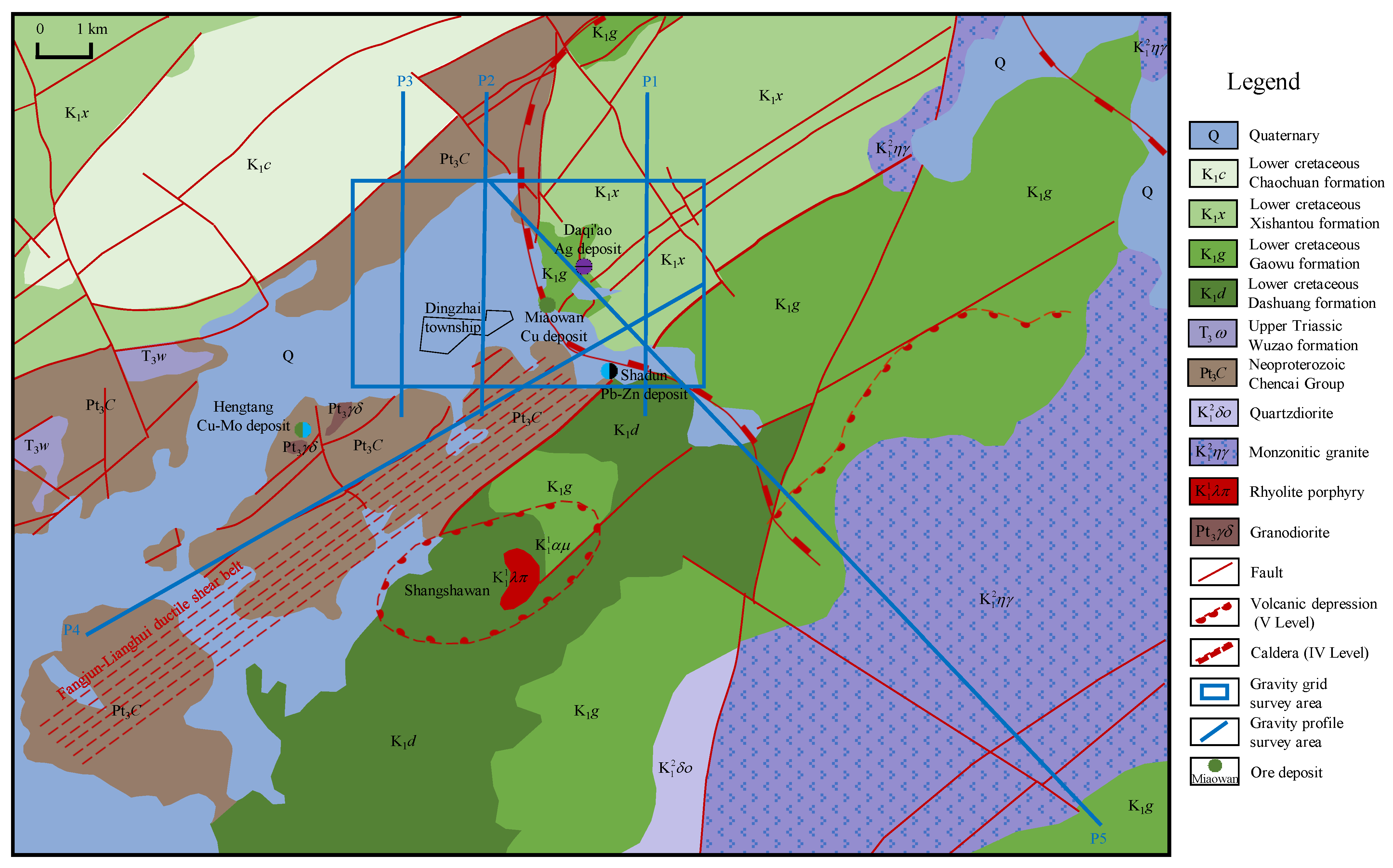
The study area is located in Dingzhai Township, Shangyu District, Shaoxing City, Zhejiang Province, situated on the northeastern segment of the Qinling–Hangzhou (Qin-Hang) Convergence Zone, specifically on the northeast edge of the Jiangshan-Shaoxing ductile shear zone (locally referred to as the Fangjun-Lianghui ductile shear zone). This shear zone not only represents a key macrostructural marker of the Jiangshan–Shaoxing Fault Zone but also coincides with a prominent gravity gradient belt [13]. Its tectonically strategic position, coupled with intense magmatism, volcanism, and metamorphism, has created favorable conditions for multi-metallic mineralization, particularly Cu and Au, making it one of Zhejiang’s most prospective metallogenic regions [14]. The regional geological setting and location of the gravity survey are shown in Figure 1.
Since the 1970s, numerous medium- to small-sized polymetallic deposits—including the Hengtang Cu–Mo, Miaowan Cu, Daqi’ao Ag and Shadun Pb–Zn deposits—have been discovered in the region, primarily characterized by porphyry and epithermal types. In the study area, new and old strata are relatively well developed, mainly exposed as Mesozoic Cretaceous volcanic rock series of the Moshishan Group, including the Dashuang Formation (K1d), Gaowu Formation (K1g), and Xishantou Formation (K1x), partially covered by Quaternary layers (Q). In the northwestern part of the study area, Neoproterozoic Chencai Group (Pt3c) metamorphic rocks are exposed. These consist of intermediate- to high-grade metamorphosed basic volcanic–sedimentary associations, with dominant lithologies including biotite plagioclase gneiss, amphibolite, siliceous rocks, felsic granulite, and interlayered marble, locally exhibiting migmatization [15]. Previous studies indicate that the Chencai Group not only preserves critical records of early tectonic evolution within the Jiangnan Orogenic Belt but also exhibits a close genetic link to regional Pb–Zn, Cu–Au, and other polymetallic mineral systems [15].
From the perspective of regional metallogenic setting, both the Neoproterozoic Chencai Group metamorphic rocks and the Cretaceous volcanic sequences in northeastern Zhejiang constitute important Au–Ag–bearing strata, with mineralization strongly controlled by fault systems [14]. Ni and Wang [16] pointed out that the northeastern segment of the Qin-Hang metallogenic belt experienced multiple Cu–Au mineralization events during the late Mesoproterozoic-Neoproterozoic, early Paleozoic, and late Mesozoic periods. Among these, the Neoproterozoic Jiangnan orogeny and contemporaneous intraplate magmatic activities enriched the newly accreted crust with copper and gold elements, establishing a substantial geochemical reservoir that facilitated large-scale metal enrichment during the Yanshan orogeny—a critical geological prerequisite for the development of this metallogenic belt. Mineralization-related magmatic rocks are predominantly calc-alkaline intermediate-acid porphyries (such as granodiorite porphyry, granite porphyry, and monzogranite porphyry) [17,18], whose genesis is closely linked to the reactivation of ancient subduction-zone materials during the Mesozoic [19]. These porphyritic intrusions are interpreted to have originated from partial melting of Proterozoic island-arc basalts, thereby inheriting distinctive geochemical signatures characteristic of an island-arc subduction tectonic environment, which imparts a specific affinity for Cu-polymetallic mineralization [20,21]. Such ore-controlling intrusions typically emplaced at shallow crustal levels (2–6 km depth or less) [22], with their ascent and emplacement structurally guided by regional deep-seated fault systems that served as conduits for magma transport. In terms of physical properties, Mesozoic volcanic rocks in northeastern Zhejiang exhibit relatively uniform densities, ranging from 2.60 to 2.65 g/cm3, whereas the Chencai Group metamorphic rocks display higher average densities (~2.70 g/cm3). This property difference provides a favorable geophysical premise for identifying concealed high-density geological features (e.g., metamorphic basement blocks or structural interfaces) using gravity survey methods.
Existing study has demonstrated that gold occurrences in Zhejiang Province are commonly concentrated in regions characterized by high Bouguer gravity anomaly values [23]. Known metallic ore districts in the province frequently exhibit distinctive “tongue-shaped” anomalies or distortions in Bouguer anomaly contours, indicating the presence of intrusive bodies, volcanic structures, or remnants of older stratigraphic units [24]. Based on the original 1:200,000-scale surface Bouguer gravity anomaly data compiled by the former Ministry of Geology and Mineral Resources, Yang et al. [25] conducted a comprehensive analysis of Zhejiang’s crustal architecture and concluded that the Jiangshan–Shaoxing Fault Zone represents an upper-crustal structure, while the eastern Zhejiang volcanic belt generally displays high-density characteristics. Low-gravity anomalies in mineralized regions are primarily attributed to several interrelated mechanisms: (1) the intrinsically low density of ore-related intrusions; (2) density reduction in host rocks due to magmatic thermal effects and associated alteration; (3) development of fractures and their infill by low-density materials during tectonic deformation; and (4) extensive hydrothermal alteration and mineralization processes. Collectively, magmatic activity and tectonic evolution jointly govern the spatial patterns of regional gravity anomalies [26]. These observations underscore the utility of gravity surveys in both regional mineral exploration and the reconstruction of structural evolution.
Given the absence of prior high-precision, large-scale gravity surveys in the study area, this research implemented dense gravity measurements across key sectors of Dingzhai Township in northeastern Zhejiang, integrating the latest high-resolution geological mapping results to acquire high-quality gravity data. Through a comprehensive processing workflow—including Bouguer anomaly computation, source-field separation, density inversion, and identification of fault structures—the study systematically delineates subsurface density architecture and maps concealed fault systems. The primary objectives are to (1) clarify deep-seated ore-controlling structural frameworks; (2) identify potential concealed mineralized zones or intrusive targets; (3) evaluate regional mineral exploration potential; and (4) provide geophysical evidence for subsequent drilling verification and exploration deployment. This study not only fills a critical gap in high-precision gravity coverage for the region but also offers new geophysical insights into the architecture and evolution of deep-seated ore-forming systems within the northeastern segment of the Qin-Hang metallogenic belt.

2. Data Processing and Methods

2.1. Data Acquisition

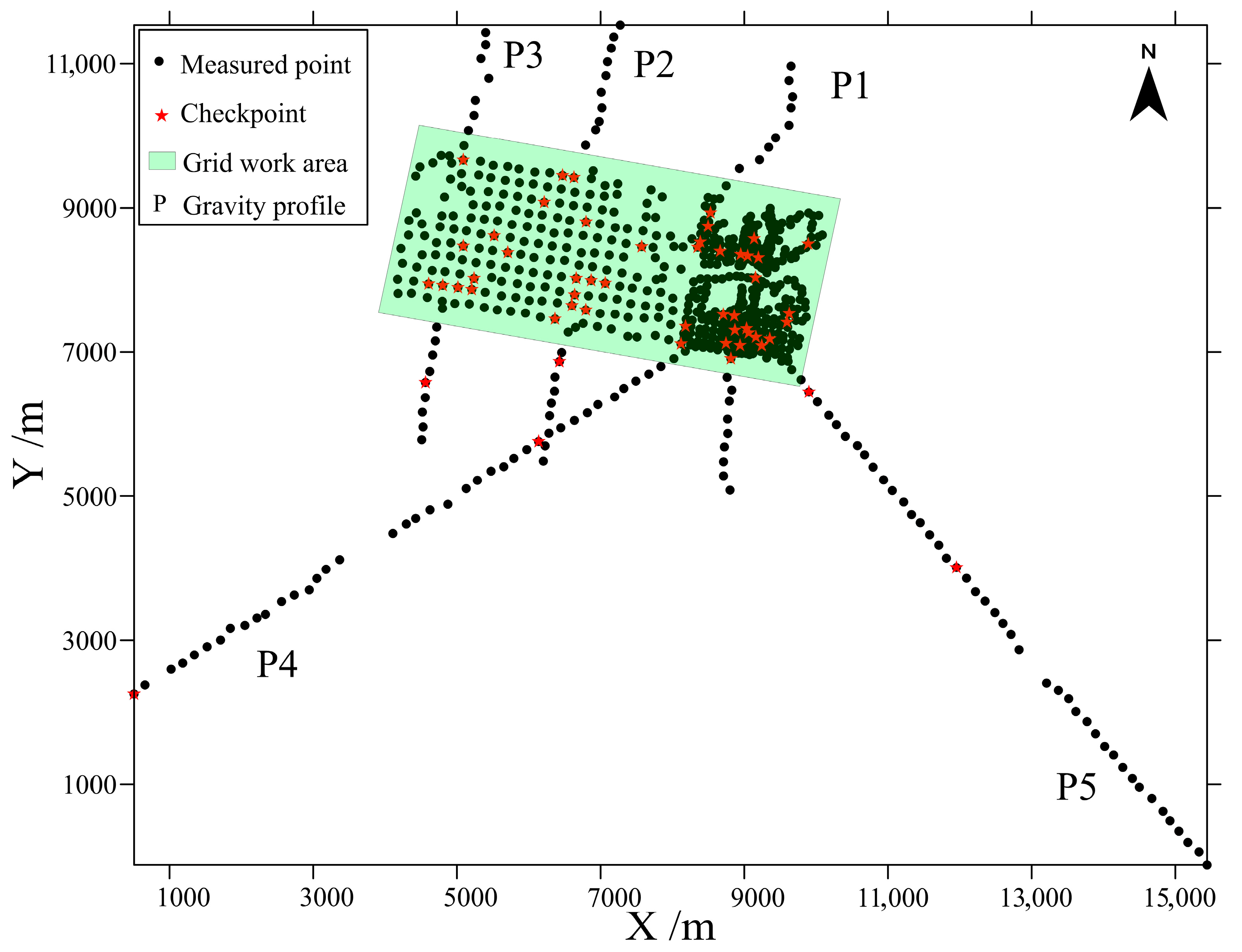
Building on prior geological surveys, this study conducted high-precision, dense gravity measurements in the Cu–Au mineralized zone of Qi’ao village, Dingzhai Township, northeastern Zhejiang, as well as in key surrounding geological structure area. Stations were deployed on a grid with spacings of 50–200 m, covering an area of approximately 17 km2, with intensified sampling over surface mineralization outcrops. The spatial distribution of gravity stations is shown in Figure 2. Field data acquisition utilized three CG-6 high-precision relative gravimeters (instrumental accuracy better than 10 × 10−8 m/s2) (Scintrex, Concord, ON, Canada) and three Qianxun A100 RTK (Real-Time Kinematic) GNSS units (Qianxun Spatial Intelligence (SpatiX), Shanghai, China), which provide horizontal and vertical positioning accuracies of ±0.015 m or better. These instruments operated synchronously to ensure precise determination of station coordinates and elevations—essential for accurate Bouguer corrections. To improve resolution of deep crustal features, five auxiliary profiles were established: three short profiles (P1–P3; ~6 km each) and two long profiles (P4 and P5; ~12 km each). A total of 754 valid gravity stations were acquired, including 54 repeat (check) stations (7.16% of the total). The maximum discrepancy among check stations was 13.9 × 10⁻⁸ m/s2, while 87% exhibited discrepancies below 10 × 10−8 m/s2. Following network adjustment, the final dataset achieved an average precision of 4.3 × 10⁻⁸ m/s2—determined with LGADJ V1.0 software—substantially exceeding conventional regional gravity survey standards. This high-quality dataset provides a robust foundation for subsequent analyses of gravity field characteristics, interpretation of subsurface structures, and identification of ore-related anomalies.

2.2. Data Preprocessing

Data preprocessing involved deriving precise surface gravity values at each station and applying a series of standard gravity corrections to compute the Bouguer gravity anomaly for the study area. First, raw field measurements were jointly measured with an absolute gravity control point—whose value was determined using an FG5X absolute gravimeter—and corrected for instrumental scale factor, atmospheric pressure, solid Earth tides, instrument height, and instrumental zero drift. Subsequently, a combined adjustment of the relative gravity network was performed to derive accurate surface gravity values at all stations. The adjustment employed a constrained weighted least squares method implemented in the LGADJ software; detailed descriptions of the methodological principles and parameter settings are provided in Xing et al. (2020) [27].
In order to obtain the Bouguer anomaly—which reflects subsurface density variations independent of surface topography—a sequence of corrections was applied to the adjusted surface gravity data: (1) normal gravity correction, (2) free-air correction, (3) intermediate layer correction, and (4) terrain correction. The normal gravity correction employed the International Gravity Formula to account for latitude-dependent variations in the theoretical gravity field. The free-air correction compensated for the elevation of each station above the geoid. The intermediate layer correction removed the gravitational effect of an idealized horizontal slab of uniform density between the geoid and the measurement point. Finally, terrain correction eliminated gravitational perturbations caused by local topographic relief surrounding each station [28]. For terrain correction, ultra-high-resolution (1 m) digital elevation model (DEM) data were used. Corrections were computed separately for three zones: the near zone (0–20 m), intermediate zone (20–500 m), and far zone (500–20,000 m). A uniform crustal density of 2.67 g/cm3 was adopted throughout the terrain correction process. The final Bouguer gravity anomaly [28] g b is expressed as:
g b = g c     γ 0 +   δ g h   +   δ g z   +   δ g t
where g c is the surface gravity value after preprocessing and network classical adjustment, γ 0 is the normal gravity field, δ g h is the free-air correction, δ g z is the intermediate layer correction, and δ g t is the terrain correction.
Accurate determination of the Bouguer gravity anomaly in the study area provides the essential foundation for all subsequent processing and interpretation. Compared with previous studies, the Bouguer anomaly derived in this work offers two key advantages: (1) it is based on a high-density survey grid (station spacing of 50–200 m), complemented by centimeter-level RTK elevation measurements and 1-m ultra-high-resolution topographic data, which collectively enhance the spatial resolution of the anomaly; and (2) relative gravity observations were rigorously jointly measured with an absolute gravity control point, yielding a high-precision Bouguer anomaly with an average point accuracy of 9.5 × 10⁻⁸ m/s2.

2.3. Fracture Structure Identification

Gravity anomalies not only reflect subsurface density distributions but also encode critical information about lithological contacts and fault structures through their amplitude variations and spatial trends. Consequently, the high-precision Bouguer gravity anomaly derived in this study serves as an effective tool for identifying concealed fault systems. Since the Paleozoic, the study area has experienced multiple phases of tectonic evolution. Regional geological mapping (Figure 1) indicates that the dominant structural trend within the surveyed grid is NE–SW, characterized by well-developed multiphase folds, ductile shear zones, and fault systems. Beneath the Quaternary cover, the observed gravity field represents a composite response from both shallow sediments and the deeper crystalline basement. Linear features extracted using boundary enhancement and edge detection techniques may correspond to basement lithological boundaries, hidden faults, or active fracture zones within the sedimentary cover. Previous studies have demonstrated that, in regions extensively blanketed by Quaternary deposits, geophysical methods constitute the only reliable means of constraining deep basement architecture and delineating concealed tectonic structures [29].
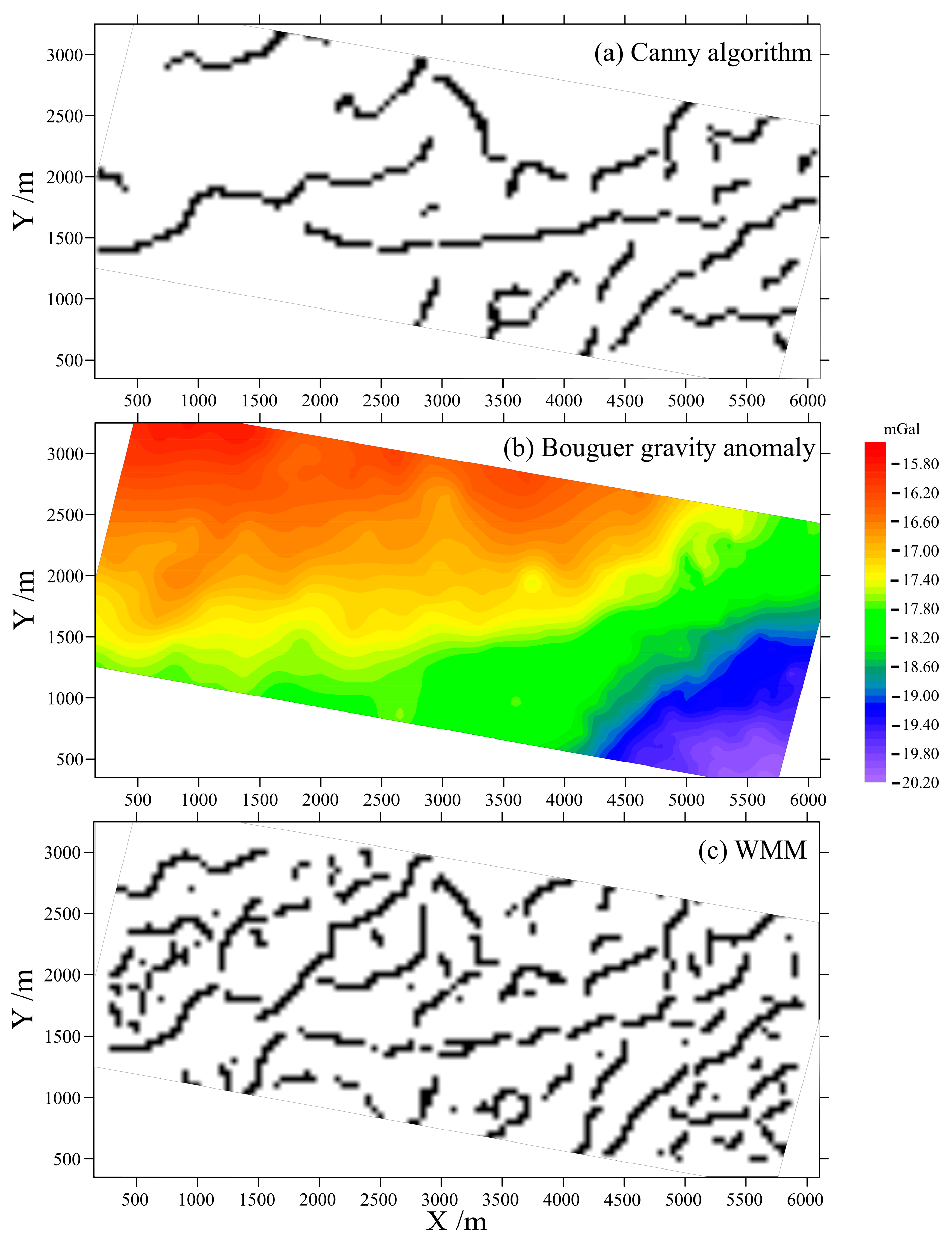
A variety of methods exist for identifying fault structures from potential field data, broadly falling into two categories: (1) techniques based on potential field processing—such as the tilt-angle method [30] and the Wavelet Modulus Maximum (WMM) method [31]—which typically employ combinations of horizontal and vertical derivatives and their transforms; and (2) approaches derived from image processing principles—such as the Blakely algorithm [32] and the Canny algorithm [33]—which identify edges by detecting local maximum/minimum point in gradient magnitude. The performance of these methods varies with respect to noise robustness and spatial scale sensitivity, depending on the geological context, and no single algorithm can fully resolve the complexity of natural fault systems [29]. Following a comparative assessment, this study adopts a joint interpretation strategy that integrates the WMM method and the Canny algorithm to analyze the Bouguer gravity anomaly across the gridded survey area, capitalizing on their complementary strengths. The WMM method leverages the multi-resolution capability of wavelet transforms to effectively suppress noise while enhancing subtle density boundaries, making it particularly well-suited for edge detection in potential field data [34]. While, the Canny algorithm—based on gradient extremum detection—automatically extracts continuous edges through non-maximum suppression and dual-thresholding, offering high positional accuracy and proven effectiveness in enhancing structural features in gravity and magnetic datasets [35]. Their combined application significantly improves the completeness, continuity, and reliability of structural interpretations.
Following preprocessing to derive the Bouguer gravity anomaly for the gridded survey area, boundary detection was conducted to delineate the spatial distribution of linear structures (Figure 3). The WMM results reveal abundant detail, capturing subtle anomalies associated with secondary structures, whereas lineaments extracted using the Canny algorithm exhibit greater continuity and sharper definition. Both methods consistently resolve the orientation of major structural features. Integrated with regional geological mapping, this combined approach successfully delineated the contact between Neoproterozoic Chencai Group metamorphic rocks and Quaternary sediments in the northwestern portion of the survey area, as well as a known deep-seated regional fault zone in the southeast. Most notably, a previously unrecognized, nearly east–west-trending concealed fault zone was identified beneath the extensive Quaternary cover in Dingzhai Township. This structure displays pronounced linearity and clear continuity, and its spatial position correlates closely with mineralization clusters at the Daqi’ao Ag deposit and Miaowan Cu deposit, suggesting it likely functioned as a fluid conduit or ore-hosting structure during hydrothermal mineralization. Cross-validation between the two edge detection methods effectively suppressed spurious features arising from local topographic effects or data noise, thereby significantly enhancing the reliability of the structural interpretation.

2.4. Inversion of Underground Density Structure

Prior to inversion and interpretation of the high-precision Bouguer gravity anomaly, source separation must be performed in accordance with the specific inversion objective [28]. The Bouguer anomaly represents the integrated gravitational response of all density heterogeneities—from near-surface features to deep crustal structures—and thus contains rich but superimposed geological information. Because this signal arises from multi-scale and multi-layered sources, isolating the residual anomaly attributable to a target geological body is essential to effectively constrain inversion models and enhance interpretational accuracy.
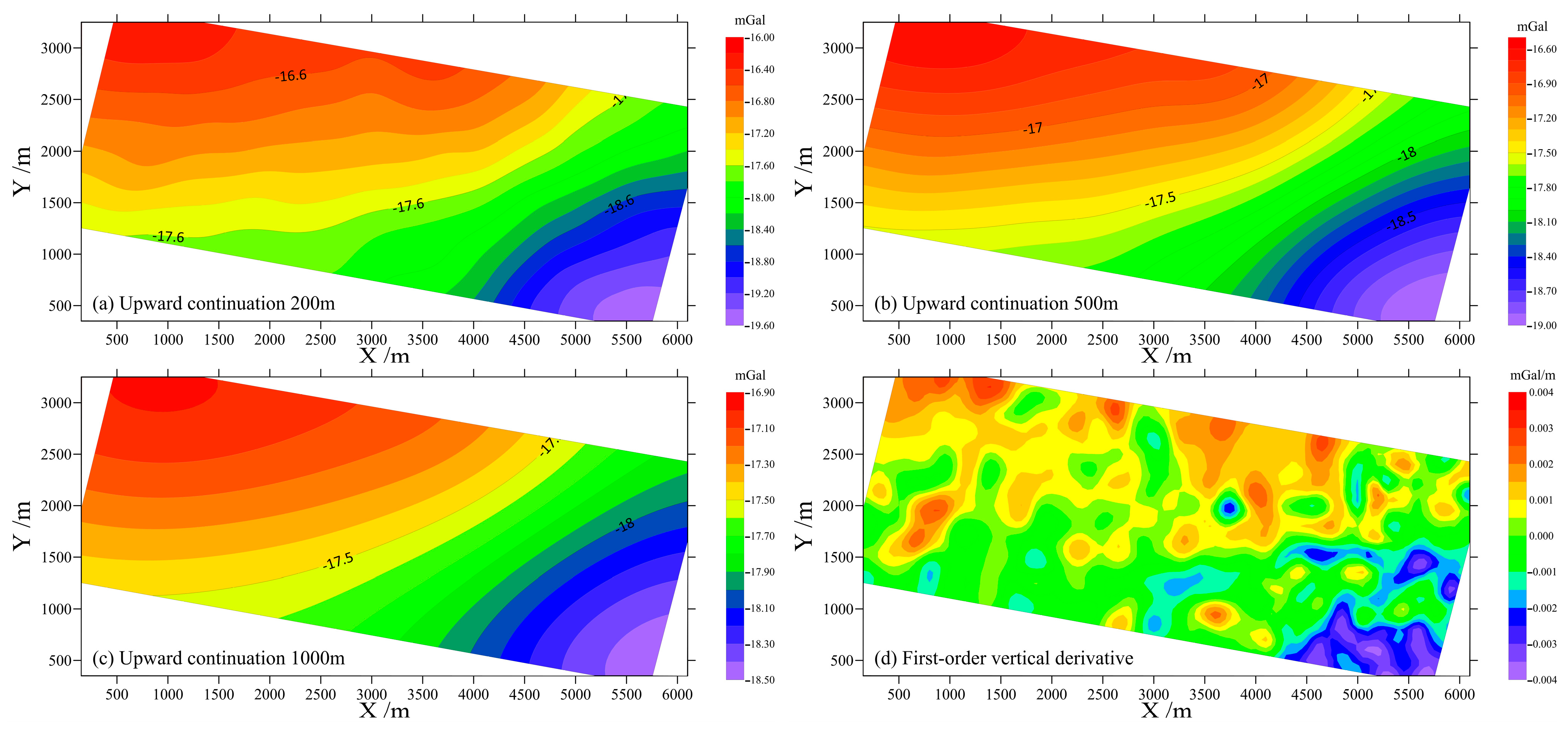
To achieve source separation, upward continuation and vertical first-order derivative analyses were applied to the Bouguer gravity anomaly over the gridded survey area. Upward continuations suppress shallow, short-wavelength anomalies while emphasizing deeper, regional components. As shown in Figure 4a–c, upward continuation to 500 m reveals a coherent regional background field; further continuation to 1000 m produces an even smoother and more spatially extensive anomaly pattern, indicating that the dominant gravity sources in the study area are mainly confined to depths less than 1000 m. In contrast, the vertical first-order derivative (Figure 4d) enhances the edges of shallow, localized high-density bodies and accentuates near-surface density contrasts, thereby providing critical guidance for identifying potential ore-related anomalies.
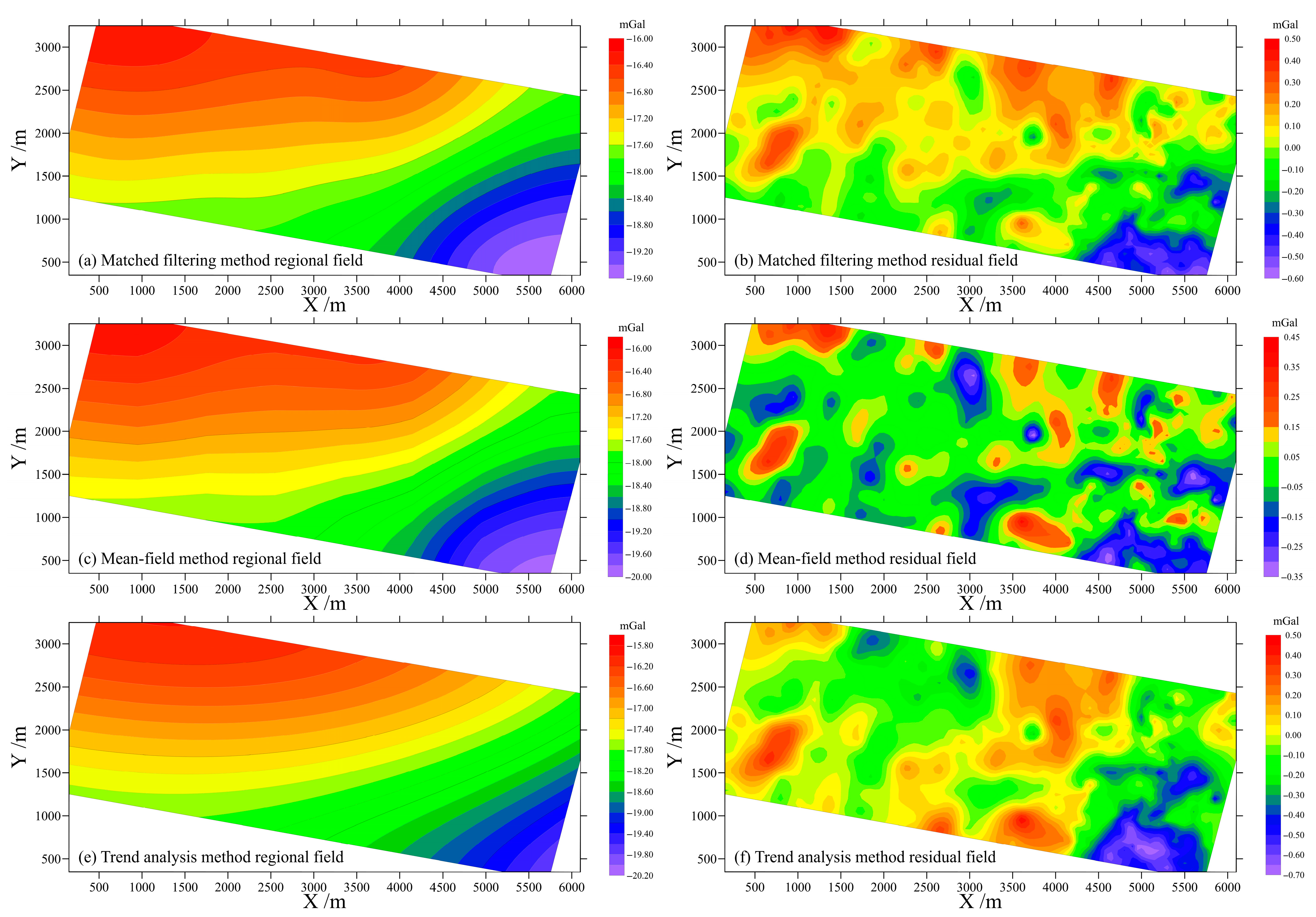
To further separate the regional and the residual anomaly field, a comparative assessment was conducted using three established techniques: the mean-field method, trend analysis, and matched filtering [28]. Integrating insights from the preliminary upward continuation and vertical derivative analyses, the performance of these separation methods was systematically evaluated (Figure 5). The results indicate that the mean-field method not only preserves the morphological integrity of residual anomalies more effectively but also suppresses the regional background trend with greater fidelity. Its output demonstrates superior consistency with known geological structures and mineralization occurrences. Consequently, the residual anomaly derived from the mean-field method was selected for subsequent density inversion to ensure that the modeling specifically targets shallow, mineralization-related density structures.
Using the residual gravity anomaly obtained after the aforementioned source-field separation, we proceed with the inversion of subsurface density structures. The study employs the property-based inversion method developed by Li and Oldenburg [36] to invert the residual Bouguer gravity anomaly data over the gridded survey area, yielding the model of the subsurface residual density distribution. The method discretizes the subsurface volume into a regular, multi-layered grid of cells, with grid spacing matched to the distance between adjacent measurement points. The density perturbation of each cell is treated as an independent inversion parameter. An objective function is formulated in the spatial domain and minimized using optimization algorithms to reconstruct the distribution of density anomalies. The objective function employed in the inversion is defined as follows [36]:
ϕ ( m ) = ϕ d   +   μ ϕ m
where ϕ d represent the data misfit function, ϕ m represent the model objective function, and μ is the regularization parameter.
The optimal regularization parameter μ is typically selected using the L-curve (Tikhonov) method [37], which plots the data misfit against the model norm for varying values of μ. At large μ, the data misfit decreases rapidly while model complexity remains low. However, once the misfit falls below a certain threshold, further reduction incurs a sharp increase in model complexity, yielding solutions that lack geophysical plausibility. Consequently, the optimal μ is identified at the corner (inflection point) of the L-curve, where an appropriate trade-off between data fit and model simplicity is achieved.
The Neoproterozoic Chencai Group (Pt3c), the oldest known stratigraphic unit in the study area, has an average density of approximately 2.70 g/cm3 [24], slightly higher than the crustal reference density of 2.67 g/cm3 used in the Bouguer gravity anomaly reduction. Based on this density contrast, shallow subsurface zones exhibiting residual densities exceeding +0.03 g/cm3 in the inversion results are interpreted as potential anomalies associated with either uplifted high-density basement rocks or zones of mineralization enrichment. These high residual density values serve as a primary criterion for delineating prospective ore targets.

3. Results and Discussion

3.1. Characteristics and Interpretation of Bouguer Gravity Anomaly in Gravimetric Grid Area

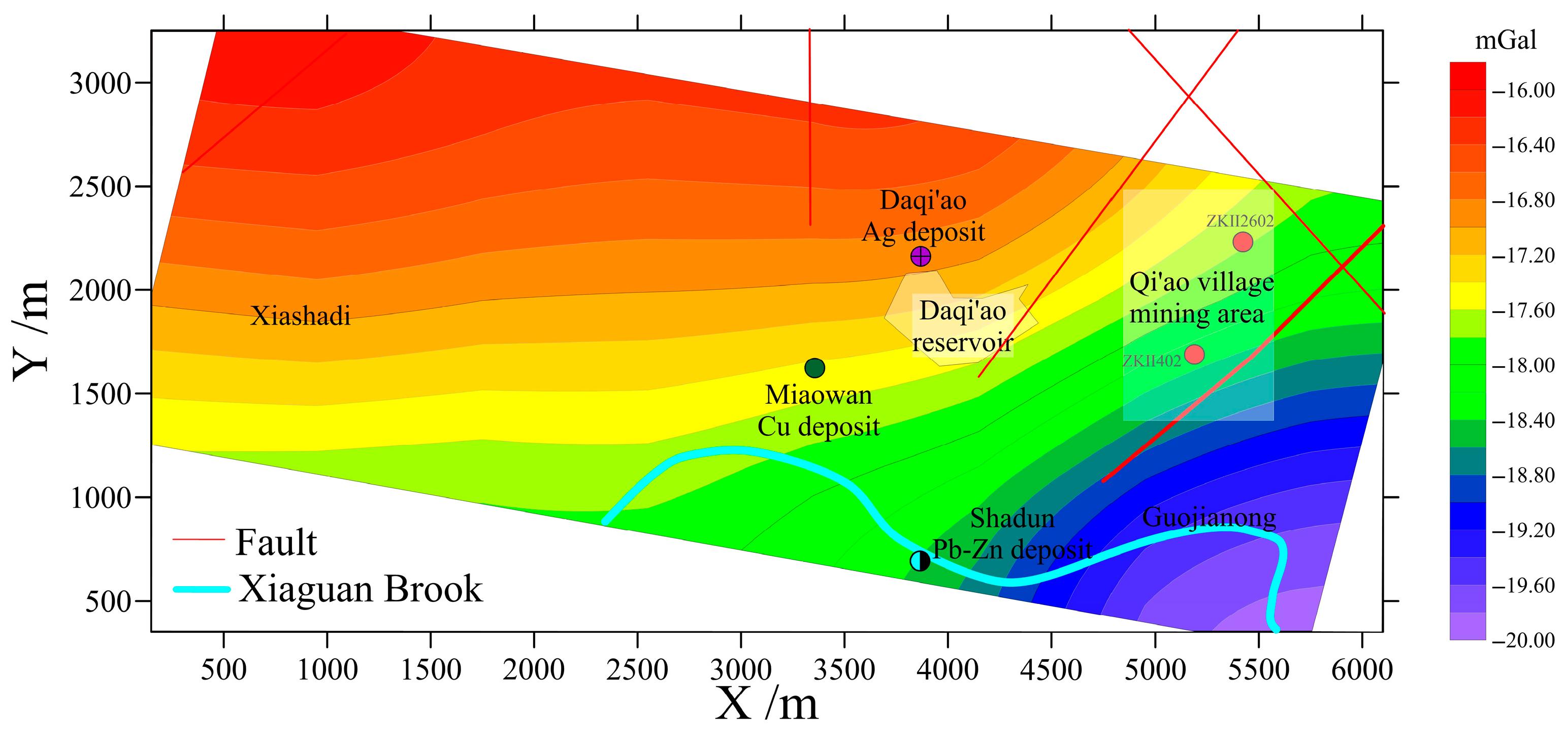
The regional Bouguer gravity anomaly across the gridded survey area ranges from −19.881 × 10⁻⁵ m/s2 to −16.043 × 10⁻⁵ m/s2 (Figure 6), which is broadly consistent with the crustal structure model for Zhejiang Province proposed by Yang et al. [25]. The anomaly field exhibits an overall smooth spatial variation, characterized by a stepwise decrease in amplitude from the northwest to the southeast. A pronounced gravity gradient zone occurs near Qi’ao Village, trending parallel to the Fangjun–Lianghui ductile shear zone. This feature is interpreted to be controlled by major deep-seated regional faults, notably the Jiangshan–Shaoxing suture zone, underscoring the dominant influence of deep basement architecture on the observed gravity field. The sharp gravity gradients along these structures reflect their role as density boundaries, where lithological contrasts—such as those between high-density Neoproterozoic metamorphic basement rocks and overlying lower-density sedimentary cover—generate significant anomalies. Integration with regional geological mapping further suggests that the relatively higher gravity values in the northwestern part of the survey area may result from shallow uplift or diapiric intrusion of the high-density Chencai Group (Pt3c). Conversely, the lower gravity anomalies in the southeastern sector are likely attributable to either density heterogeneity within the Lower Cretaceous Dashuang Formation or thickening of low-density Quaternary unconsolidated sediments in the Xiaguan Brook basin.
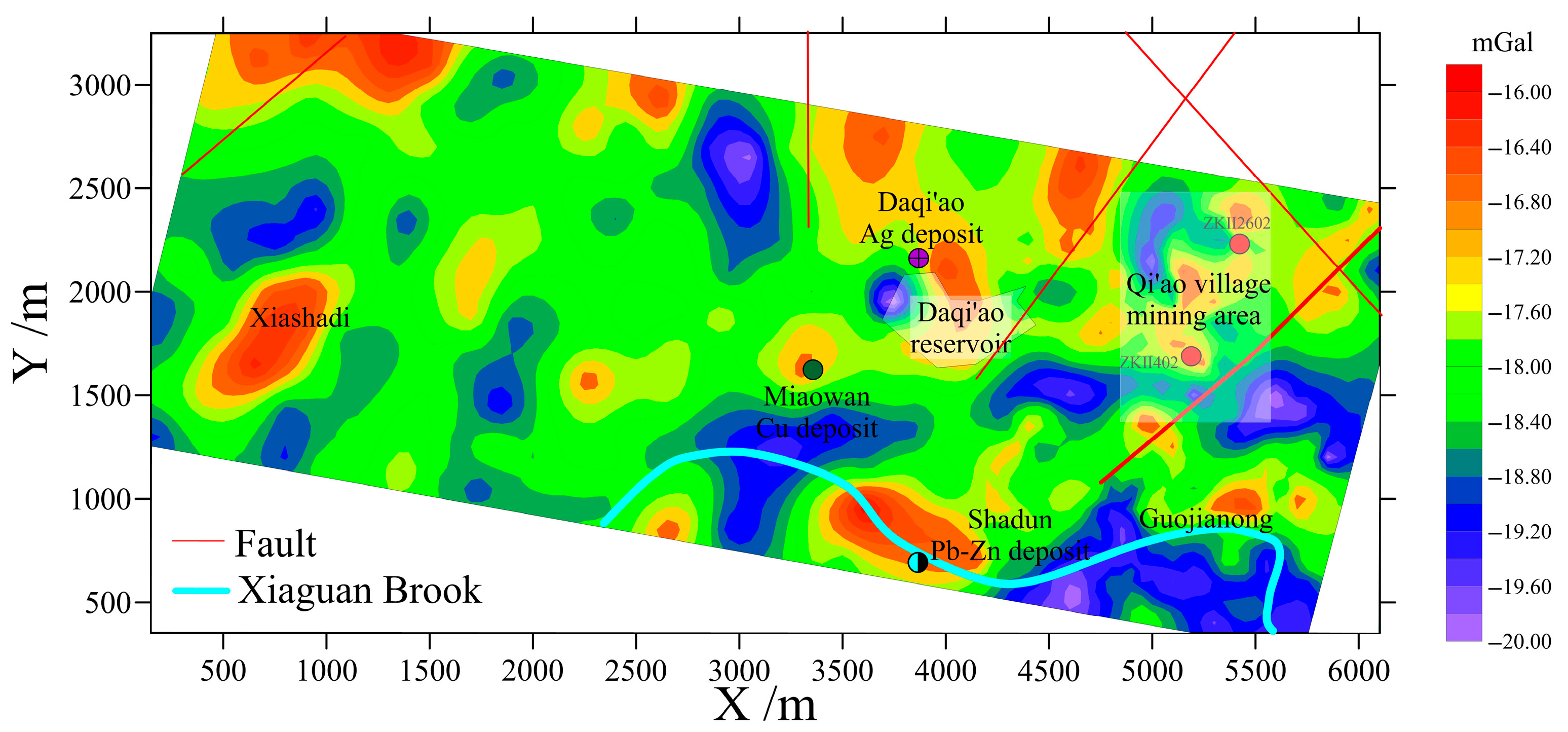
The residual Bouguer gravity anomaly (representing shallow-source signals) across the gridded survey area ranges from −0.339 × 10⁻⁵ m/s2 to +0.3745 × 10⁻⁵ m/s2 (Figure 7). This field effectively resolves near-surface density heterogeneities and exhibits strong spatial correspondence with known geological features and mineralization occurrences. For example, a localized positive anomaly in the northwestern corner aligns closely with surface outcrops of the Neoproterozoic Chencai Group. More significantly, a newly identified, prominent positive anomaly has been detected at Xiashadi in the southwestern part of the survey area. This feature displays a distinct “tongue-shaped” morphology and closely resembles the gravity signature of the known Shadun Pb–Zn deposit. It is tentatively interpreted as reflecting localized upwelling of high-density Neoproterozoic basement material—potentially intermediate-acid porphyritic intrusions generated during Mesozoic partial melting—indicating considerable mineral exploration potential. Notably, the Miaowan Cu, Daqi’ao Ag, and Shadun Pb–Cu deposits all coincide with centers of local gravity highs, confirming a robust spatial correlation between residual anomalies and known mineralization. In particular, the central position of the Shadun anomaly appears to extend northwestward beyond the current mining area, suggesting that existing mining operations may not fully encompass the core of the anomaly. Low-amplitude anomalies in the region are generally associated with fault zones or sedimentary cover. For instance, the Xiaguan Brook area consistently exhibits reduced gravity values, attributable to variable thicknesses of low-density Quaternary sediments. An isolated gravity low observed west of the Daqi’ao Reservoir coincides precisely with the central crest of the reservoir dam. Upon thorough re-examination of the processing workflow, this feature is attributed to an overcorrection in terrain reduction: the elevated topography of the dam resulted in excessive compensation during the terrain correction, artificially generating a spurious local low. Overall, analysis of the residual Bouguer gravity anomaly demonstrates that the high-precision survey successfully delineated prospective mineralized zones. Critically, all currently exploited deposits fall within these interpreted target areas, providing strong validation for the gravity anomaly–based exploration strategy.
Moreover, several key locations exhibit characteristics of structural–lithological coupling. As shown in Figure 7, the area northeast of Daqi’ao Reservoir shows well-developed faulting, which accounts for the pronounced positive-to-negative gradient transitions in the Bouguer gravity anomaly. Drill holes ZKII2602 and ZKII402 are situated within zones of relatively high gravity values; however, the local anomaly maxima are more tightly clustered in the mountainous terrain north of Qi’ao Village, suggesting the possible presence of undiscovered high-density bodies at depth. The localized gravity high in the northeastern corner of the survey area may correspond to surface exposures of fine-grained (porphyritic) intrusive rocks within the northeastern sector of the mining area. Conversely, the pronounced low Bouguer anomaly south of Guojianong Village is likely attributable to lateral variations in the thickness of Quaternary sediments along and adjacent to Xiaguan Brook. Two distinct gravity highs occur north of Guojianong Village, potentially reflecting stratigraphic unconformities or lithological contacts between the Lower Cretaceous Dashuang Formation and Gaowu Formation. Overall, the residual Bouguer gravity anomaly effectively delineates shallow density heterogeneities across the gridded survey area and demonstrates strong consistency with existing geological mapping and field observations.
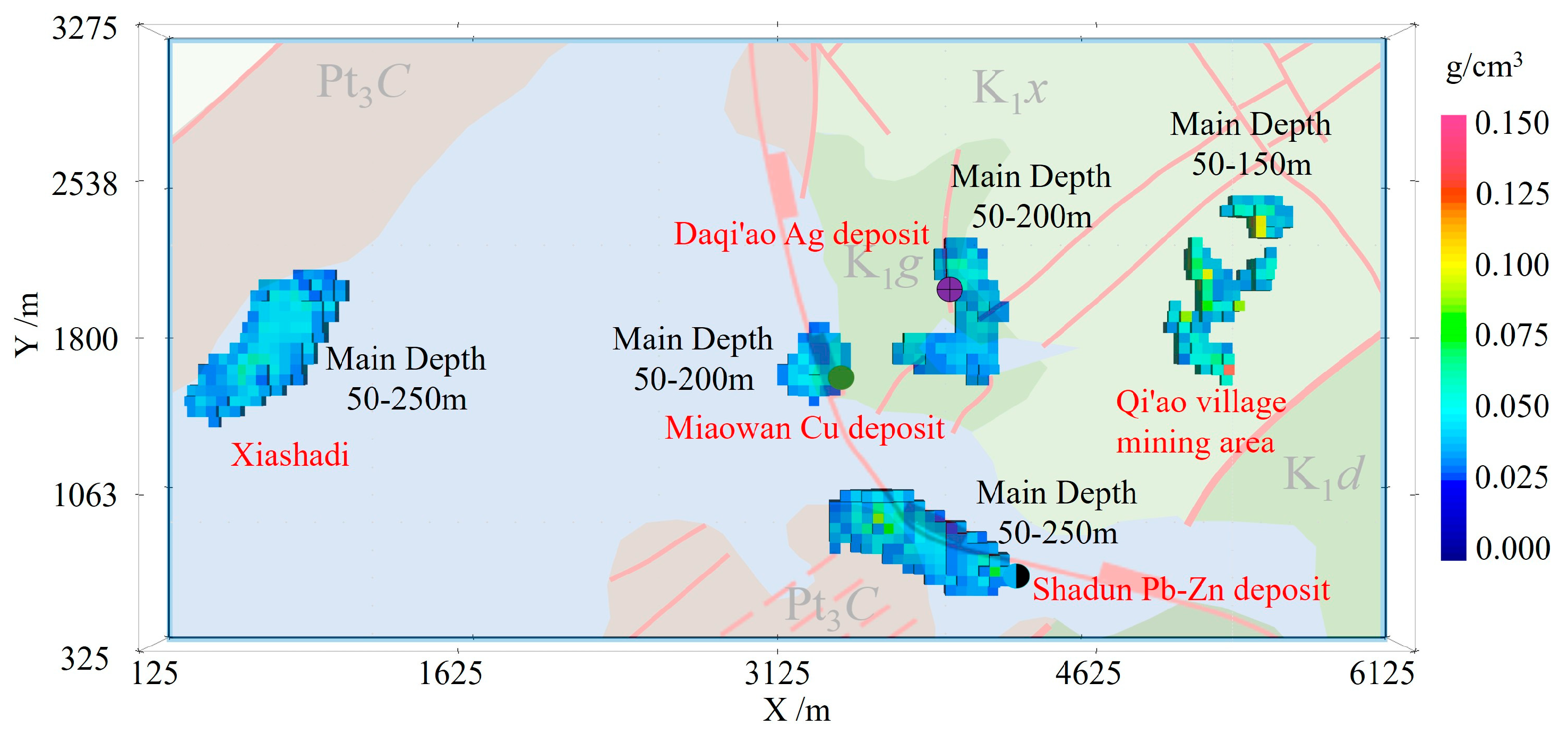
Applying the aforementioned three-dimensional (3D) density inversion method, the shallow-source density structure of the survey area was reconstructed, revealing that major anomalous bodies are concentrated at depths of 50–250 m. The 3D gravity inversion model is discretized over a domain of 50 m × 50 m × 50 m cell size, resulting in a grid of 120 × 59 × 10 cells. By integrating existing geological and geophysical data (as discussed above), we interpret the subsurface density anomaly patterns associated with five mineral targets—three known deposits and two prospective zones—within the gridded survey area (Figure 8). Negative gravity anomalies in the study area are primarily attributed to fault-controlled variations in sediment thickness and the presence of low-density geological units. Given the limited spatial extent of the study area and the complexity of its geological setting, our interpretation focuses on a subset of major, high-density gravity anomaly that are most confidently resolved by the available gravity data. This targeted approach enhances the reliability of our structural inferences and avoids overinterpretation of features with ambiguous geophysical signatures. Specifically, the Qi’ao Village mining area exhibits a relatively dispersed high-density anomaly pattern, primarily confined to depths of 50–150 m. This distribution closely aligns with local gravity anomalies, suggesting multiple phases or centers of shallow mineralization and/or intrusive activity. The Daqi’ao Ag deposit appears to be structurally controlled by regional faults, resulting in irregularly shaped subsurface density anomalies. The Miaowan Cu deposit is characterized by a comparatively small-scale inverted density anomaly. Notably, the density structure and anomaly extent in the Xiashadi area closely resemble those of the Shadun Pb–Zn deposit, highlighting Xiashadi as a high-priority target for focused exploration and indicating significant potential for the discovery of new mineral resources.

3.2. Characteristics and Interpretation of Bouguer Gravity Anomaly in Gravimetric Lines

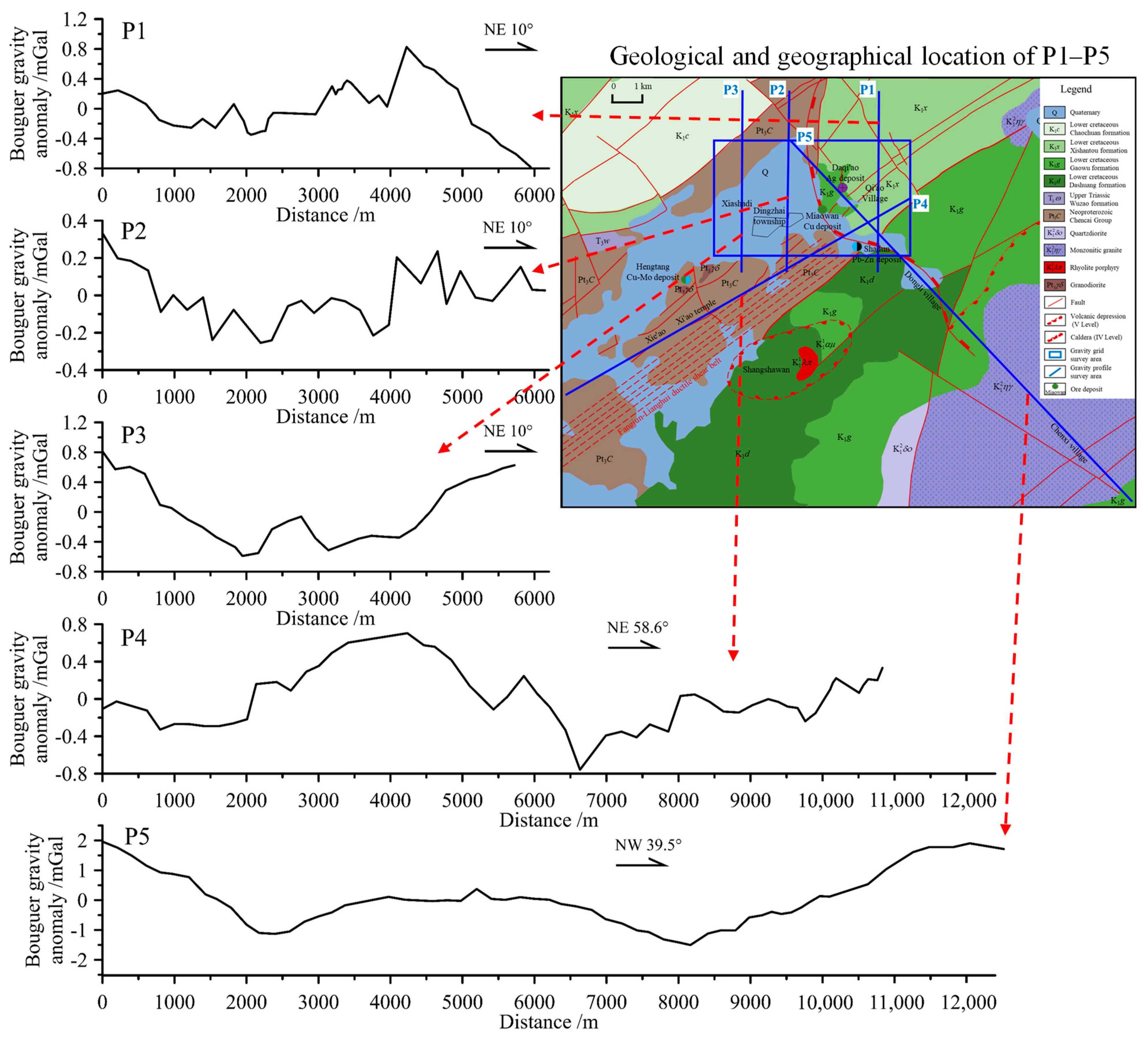
By requiring data acquisition only along individual profiles, 2D inversion entails substantially lower fieldwork and processing demands compared to 3D surveys, making it well suited for rapid regional screening and preliminary structural assessment. To characterize deeper density structures beneath the study area, gravity observations along profiles were employed to conduct two-dimensional (2D) inversion of density anomalies. The processing workflow for the Bouguer gravity anomaly data from these profiles closely follows that applied to the gridded survey area. After deriving precise Bouguer gravity anomalies, the regional background field was removed using linear regression to isolate the local Bouguer anomalies (Figure 9). The amplitude variations along profiles P1 and P2 are relatively subdued. The localized high in the northern segment of P1 may be associated with a major regional fault, whereas the reduced gravity values in the central portion of P2 are likely attributable to the influence of low-density Quaternary cover sediments. Profile P3 exhibits higher gravity anomalies on both flanks, interpreted as reflecting shallow exposures of high-density Neoproterozoic Chencai Group rocks. Profile P4 traverses the northern margin of the Fangjun–Lianghui ductile shear zone and displays pronounced local gravity variations, consistent with complex deformation along this tectonic boundary. Profile P5 crosses multiple Cretaceous formations, as confirmed by regional geological mapping. It shows large overall amplitude changes but relatively smooth short-wavelength variations, suggesting the presence of two distinct deep-seated density contrasts or multiple density interfaces at depth.
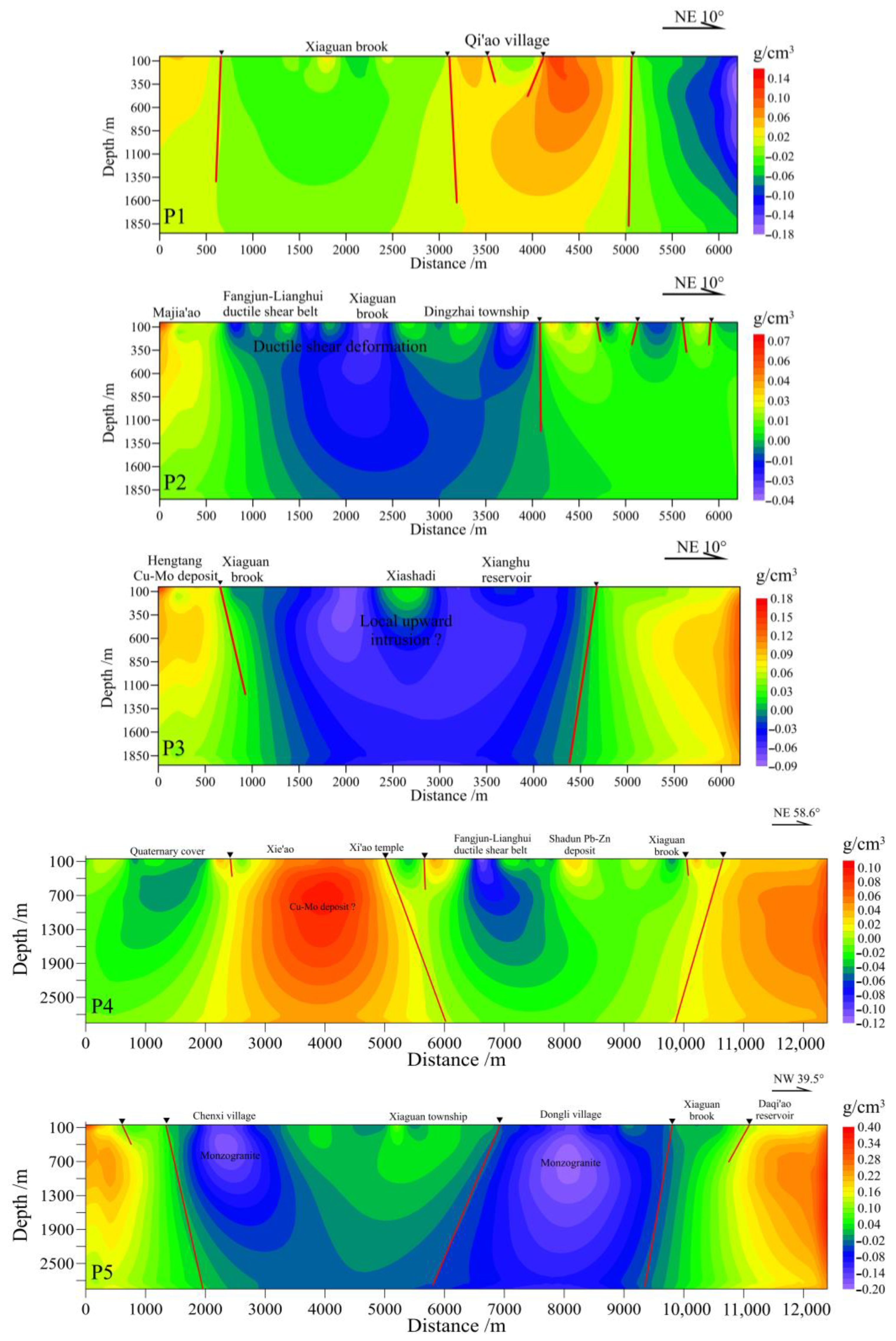
To facilitate a more intuitive understanding of subsurface density architecture, shallow density structures along five gravity profiles were inverted using the aforementioned 2D density inversion methodology (Figure 10), based on local Bouguer gravity anomalies derived from the gravity profiles data (Figure 9). For the 2D gravity inversion, the model depth was set to 2000 m for profiles P1–P3 and 3000 m for profiles P4 and P5, consistent with their respective profile lengths. All profiles were discretized using a uniform cell size of 200 m (horizontal) × 100 m (vertical), yielding model grids of 32 × 20 cells for P1–P3 and 64 × 30 cells for P4 and P5.
The inversion results reveal relatively subdued amplitude variations in the gravity anomalies of P1 and P2. Profile P1 exhibits distinct density gradient zones coincident with four mapped fault locations. A localized high-density anomaly in its northern segment is likely influenced by regional-scale faults, whereas the remainder of the profile displays comparatively stable density variations. In Profile P2, the central section shows reduced Bouguer anomalies attributable to thick Quaternary sediments, with additional modulation by shallow ductile shear zones and minor and shallow faults.
Profile P3 displays higher gravity anomalies on both flanks, interpreted as resulting from shallow exposures of high-density Neoproterozoic Chencai Group metamorphic rocks. Despite the influence of variable sediment thickness in the Dingzhai Township area, a pronounced positive density anomaly persists near Xiashadi—supporting the hypothesis of localized upwelling of intermediate-acid porphyritic intrusions or ancient basement materials. North of Xianghu Reservoir, major reverse faults separate the Chencai Group from the Chaochuan Group, reflecting compressional tectonism in the region.
Profile P4 traverses the northern margin of the Fangjun–Lianghui ductile shear zone and exhibits significant short-wavelength gravity variability. The southern segment contains low-density anomalies associated with sedimentary cover but features a prominent high-density body in the Xie’ao–Xi’ao’an segment, potentially representing the deep extension of the Hengtang Cu–Mo deposit. Although the northern end also shows elevated gravity values—possibly linked to dense Cretaceous Gaowu Formation strata—the interpretation is less robust due to sparse data coverage near the profile terminus.
Profile P5 is dominated by two major low-density anomalies. The anomaly near Chenxi village is tentatively attributed to late Early Cretaceous intrusion of low-density monzonitic granite, possibly accompanied by deeper concealed magmatic bodies and tectonic overprinting. In the Dongli village area, an extensive and deeper low-density feature likely reflects the combined effects of Quaternary sedimentation and stratigraphic unconformities between the Lower Cretaceous Dashuang and Gaowu Formations—structures that may be genetically linked to multiphase volcanism within the Shangshawan caldera during the Cretaceous. The major deep-seated fault near Xiaguan Brook, as revealed by gravity inversion, is interpreted as a reverse fault, consistent with regional compressional tectonics and associated crustal uplift.
Collectively, the profile density inversion results highlight a significant deep-seated high-density anomaly beneath the Xie’ao–Xi’ao’an segment, consistent with a downward continuation of the Hengtang Cu–Mo deposit. Conversely, the deep low-density anomalies beneath Chenxi and Dongli village appear to be associated with magmatic and volcanic processes related to the Shangshawan caldera, underscoring the role of Cretaceous magmatism in shaping the region’s crustal density structure.

4. Conclusions

High-precision Bouguer gravity anomalies were derived from large-scale, densely spaced gravity measurements and high-resolution topographic data. These anomalies were inverted to characterize the subsurface distribution of density heterogeneities, providing a robust geophysical foundation for subsequent drilling campaigns—particularly in high-priority targets such as Xiashadi and Xie’ao–Xi’ao’an.
The mean-field method was applied to effectively isolate local Bouguer anomalies that reflect shallow crustal density variations within the gridded survey area. A 3D density inversion of these anomalies yielded a detailed subsurface density model for the mining district, enabling quantitative assessment of the ore-forming potential and spatial extent of known mineralized zones. The Daqi’ao Ag deposit is structurally constrained by regional faults, producing irregular subsurface density patterns; the Miaowan Cu deposit exhibits a localized, small-scale anomaly; and the Qi’ao Village area shows a dispersed shallow anomaly (50–150 m), suggestive of multi-phase mineralization or intrusive activity. Notably, a newly identified “tongue-shaped” high-density anomaly near Xiashadi in Dingzhai Township closely resembles the gravity signature of the Shadun Pb–Zn deposit. This feature is interpreted as either an exposure of high-density Neoproterozoic Chencai Group basement or the product of localized upwelling of intermediate-acid porphyry, highlighting its potential as a new mineral prospect. Gravity-based structural interpretation across the gridded area successfully delineated stratigraphic boundaries and revealed a previously unrecognized, nearly east–west-trending concealed fault beneath Quaternary cover in Dingzhai Township. This structure may have acted as a conduit for ore-forming fluid migration and is likely associated with mineralization at both the Daqi’ao Ag and Miaowan Cu deposits.
Inversion of profile gravity data further identified a deep-seated high-density anomaly beneath Xie’ao–Xi’ao’an, potentially representing the downward continuation of the Hengtang Cu–Mo deposit. In contrast, pronounced low-density anomalies in the Chenxi and Dongli village areas are attributed to Early Cretaceous low-density intrusions (e.g., monzogranite) and multiphase volcanism linked to the Shangshawan caldera. The anomaly near Dongli village is notably more extensive in areal extent. Collectively, integrated analysis of Bouguer gravity anomalies from five profiles, constrained by regional geology, not only supports earlier hypotheses of porphyry-related upwelling near Xiashadi but also reveals new mineralized bodies and key structural controls on mineralization.


Author Contributions

Conceptualization, X.M. and X.C.; methodology, X.M.; software, L.X.; validation, X.C. and L.X.; formal analysis, X.M.; investigation, X.M., M.L., X.N., P.S., L.B. and Z.C. (Zheng Chen); resources, Z.C. (Zheng Chen); data curation, Z.C. (Zhida Chen), Y.Z., J.L. and G.L.; writing—original draft preparation, X.M.; writing—review and editing, X.C.; visualization, X.M.; supervision, X.C.; funding acquisition, X.C. All authors have read and agreed to the published version of the manuscript.

Funding

This research was funded by National Science and Technology Major Project for Deep Earth Probe and Mineral Resources Exploration (grant number 2024ZD1002700), Theory of Hydrocarbon Enrichment under Multi-Spheric Interactions of the Earth (THEMSIE) and The Central-to-Local Science and Technology Development Special Project in Hubei Province (grant number 2025CFC006) and National Precise Gravity Measurement Facility, Huazhong University of Science and Technology (grant number PGMF-2024-Z003).

Data Availability Statement

The part of data presented in this study are available on request from the corresponding author.

Acknowledgments

We would like to express our gratitude to the relevant staff of the Zhejiang Nonferrous Metals Geological Exploration Institute for their extensive basic geological work.

Conflicts of Interest

Guofang Luo is affiliated with the company Shaoxing Shangyu Guojing Engineering Survey and Design Co., Ltd. The remaining authors declare that the research was conducted in the absence of any commercial or financial relationships that could be construed as a potential conflict of interest.

Abbreviations

The following abbreviations are used in this manuscript:
DEMDigital elevation model
Qin-HangQinling–Hangzhou
WMMWavelet Modulus Maximum
2DTwo-dimensional
3DThree-dimensional
RTKReal-Time Kinematic

References

  1. Liu, S.; Hu, X.; Zhang, B.; Zhu, D.; Lyu, M.; Shu, Y. Key Technologies and Research Advances in Gravity and Magnetic Exploration for Polymetallic Deposits. Northwest. Geol. 2025, 58, 1–21. [Google Scholar] [CrossRef]
  2. Mehanee, S.; Heinson, G. Gravity Data Inversion by a Faulted 2-D Horizontal Block of Arbitrary Thickness with Application to Crustal Imaging. IEEE Trans. Geosci. Remote Sens. 2025, 63, 5900521. [Google Scholar] [CrossRef]
  3. Gaber, G.M.; Saleh, S.; Kotb, A. 3D Gravity and Magnetic Inversion Modelling for Geothermal Assessment and Temperature Modelling in the Central Eastern Desert and Red Sea, Egypt. Sci. Rep. 2024, 14, 15266. [Google Scholar] [CrossRef] [PubMed]
  4. Liu, S.; Luo, S.; Liu, L.; Liu, H.; Chen, C. Deduced the Distribution of the Concealed Acidic-intermediate Rock with Gravity and Magnetic Exploration in the South-central Area. Chin. J. Eng. Geophys. 2013, 10, 805–813. [Google Scholar]
  5. Zhao, L.; Li, X.; Li, C.; Li, C.; Zhao, J.; Bao, Y.; Chen, Z.; Liu, H.; Liang, J.; Wang, P. Recognition of Concealed Porphyry Body and Deep Prospecting Practice in Duobaoshan Ore Concentration Area Based on Gravity, Magnetic and Electromagnetic Surveys. Miner. Depos. 2022, 41, 1217–1231. [Google Scholar] [CrossRef]
  6. Eppelbaum, L.V.; Khesin, B.E. Advanced 3-D Modelling of Gravity Field Unmasks Reserves of a Pyrite-Polymetallic Deposit: A Case Study from the Greater Caucasus. First Break 2024, 22, 53–56. [Google Scholar] [CrossRef]
  7. Mantovani, M.S.M.; Shukowsky, W.; de Brito Neves, B.B.; Rugenski, A. Gravimetric Study of a Potential Mineral Deposit in the Itapororoca Region, Brazil. Geophys. Prospect. 2008, 56, 751–760. [Google Scholar] [CrossRef]
  8. Rezaie, M. Focusing Inversion of Gravity Data with an Error Function Stabilizer. J. Appl. Geophys. 2023, 208, 104890. [Google Scholar] [CrossRef]
  9. Chen, T.; Zhang, G. Mineral Exploration Potential Estimation Using 3D Inversion: A Comparison of Three Different Norms. Remote Sens. 2022, 14, 2537. [Google Scholar] [CrossRef]
  10. Mehanee, S. A new Scheme for Gravity Data Interpretation by a Faulted 2-D Horizontal Thin Block: Theory, Numerical Examples and Real Data Investigation. IEEE Trans. Geosci. Remote Sens. 2022, 60, 4705514. [Google Scholar] [CrossRef]
  11. Sun, K.; Chen, C.; Du, J.S.; Wang, L.M.; Lei, B.H. Determination of Cenozoic Sedimentary Structures Using Integrated Geophysical Surveys: A Case Study in the Barkol Basin, Xinjiang, China. J. Appl. Geophys. 2018, 148, 152–162. [Google Scholar] [CrossRef]
  12. Talgarbayeva, D.; Vilayev, A.; Serikbayeva, E.; Orynbassarova, E.; Ahmadi, H.; Saurykov, Z.; Sydyk, N.; Bermukhanova, A.; Iskakov, B. Integrated Prospectivity Mapping for Copper Mineralization in the Koldar Massif, Kazakhstan. Minerals 2025, 15, 805. [Google Scholar] [CrossRef]
  13. Hu, K. Initial Discussion on the Tectonic Evolution of Jiangshan–Shaoxing Fault Zone. J. Zhejiang Geol. 2001, 17, 1–11. [Google Scholar]
  14. Cheng, F. The Future of Energy in Pingshui Area Zhejiang Province. World Nonferrous Met. 2019, 3, 230–231. [Google Scholar]
  15. Zhang, G.; Wang, Q.; Yu, Y.; Yang, Y.; Xiao, J. Stratigraphic Age and Subdivision of Volcanic Rocks in Eastern Zhejiang. J. Stratigr. 2012, 36, 641–652. [Google Scholar] [CrossRef]
  16. Ni, P.; Wang, G. Multiple Episodes of Cu-Au Mineralization in the Northeastern Section of the Qin-Hang Metallogenic Belt Induced by Reworking of Continental Crust. Acta Petrol. Sin. 2017, 33, 3373–3394. [Google Scholar]
  17. Liang, J.; Zhou, Y.; Li, H. Tectonic Evolution of the Juncture Between Yangtze Craton and Cathaysian Block: Its Significance for Mineralization of Porphyry Copper Deposits. Earth Sci. Front. 2015, 22, 144–159. [Google Scholar] [CrossRef]
  18. Wang, K.; Zhang, D.; Zhu, Y.; Fu, F.; Yin, X.; Wang, C. Petrogenic Age and Magma Source of Granite Porphyry in Lishanling Porphyry Cu Deposit in Changshan Area, Zhejiang Province. J. Jilin Univ. (Earth Sci. Ed.) 2016, 46, 736–748. [Google Scholar] [CrossRef]
  19. Zhang, Z.; Yang, J.; Zhuang, D. Regularity of Searching for Porphyry Copper Deposit in Tuwu–Yandong Area–The Research of Prospection Model of “Three Tall and Two Correspondences and One Correlation”. Northwest. Geol. 2010, 43, 169–183. [Google Scholar]
  20. Geng, W. Geology and Prospecting Indicators for Subvolcanic Cu–Ag Poly Metallic Deposits in the Mesozoic Terrestrial Volcanic Region of East China. Ph.D. Thesis, Chengdu University of Technology, Chengdu, China, 2005. [Google Scholar]
  21. Zhang, J.; He, Y.; Wen, C.; Liu, J. Metallogenic Characteristics and Prospecting Signs of Porphyry Copper Deposit in China. World Nonferrous Met. 2017, 7, 92–94. [Google Scholar]
  22. Zhou, Y.; Zeng, C.; Li, H.; An, Y.; Liang, J.; Lyu, W.; Yang, Z.; He, J.; Shen, W. Geological Evolution and Ore-Prospecting Targets in Southern Segment of Qinzhou Bay-Hangzhou Bay Juncture Orogenic Belt, Southern China. Geol. Bull. China 2012, 31, 486–491. [Google Scholar]
  23. Zhao, J. Research on Comprehensive Assessment of Mineral Resources (Gold Mines) in the Typical Region in Zhejiang Segment of Qinhang Metallogenic Belt. Master’s Thesis, Zhejiang University, Hangzhou, China, 2015. [Google Scholar]
  24. Liu, P.; Zhang, C.; Zhao, Z. Geophysical and Geochemical Exploration Annals of Zhejiang Province; Data Set; Zhejiang Institute of Geophysics and Geochemistry Exploration, National Geological Archives of China: Zhejiang, China, 1998; Available online: https://www.ngac.cn/dzzlfw_sjgl/d2d/dse/category/detail.do?method=cdetail&_id=102_93435&tableCode=ty_qgg_edmk_t_ajxx&categoryCode=dzzlk (accessed on 2 November 2025).
  25. Yang, W.; He, L.; Jiang, J.; Zhong, Q.; Chen, M. A Synthetic Study of the Crust Structures of Zhejiang Province. Acta Geol. Sin. 2022, 96, 95–103. [Google Scholar] [CrossRef]
  26. Zhang, M.; Zhang, J.; Chen, J. Preliminary Study on the Intelligent Construction of the Geophysical Exploration and Identification System for Porphyry Deposits. Geotecton. Metallog. 2025, 49, 1–18. [Google Scholar]
  27. Xing, L.; Bai, L.; Niu, X.; Sang, P. A New and High-precision Gravity Base Network in the South of the Tibetan Plateau. Geod. Geodyn. 2020, 11, 258–264. [Google Scholar] [CrossRef]
  28. Hinze, W.; vonFrese, R.; Saad, A. Gravity and Magnetic Exploration, Principles, Practices, and Applications; Cambridge University Press: Cambridge, UK, 2013. [Google Scholar] [CrossRef]
  29. Sun, K. Research on Integrated Application of Geophysical Information on Geological Mapping of Barkol Basin. Ph.D. Thesis, China University of Geosciences, Wuhan, China, 2018. [Google Scholar]
  30. Miller, H.; Singh, V. Potential field tilt—A New Concept for Location of Potential Field Sources. J. Appl. Geophys. 1994, 32, 213–217. [Google Scholar] [CrossRef]
  31. Zhang, S.; Liu, J.; Zhang, P.; Chen, J. Multi-scale Edge Detection of Potential Field Using the BEMD and WMM Methods. Geomat. Inf. Sci. Wuhan Univ. 2022, 47, 533–542. [Google Scholar] [CrossRef]
  32. Blakely, R.; Simpson, R. Approximating Edges of Source Bodies from Magnetic or Gravity Anomalies. Geophysics 1986, 51, 1494–1498. [Google Scholar] [CrossRef]
  33. Canny, J. A Computational Approach to Edge-Detection. IEEE Trans. Pattern Anal. Mach. Intell. 1986, 8, 679–698. [Google Scholar] [CrossRef]
  34. Zhu, B. The Study on the Application of Multi-scale Wavelet Transforms Modulus Maxima in Boundary Detection of Potential Fields. Master’s Thesis, Jilin University, Changchun, China, 2013. [Google Scholar]
  35. Xiao, F.; Wu, Y.; Meng, L. Edge Enhancement and Detection Technology in Gravity Anomaly Map. J. Jilin Univ. (Earth Sci. Ed.) 2011, 41, 1197–1203. [Google Scholar] [CrossRef]
  36. Li, Y.; Oldenburg, D.W. 3-D Inversion of Gravity Data. Geophysics 1998, 63, 109–119. [Google Scholar] [CrossRef]
  37. Liang, Q.; Chen, C.; Li, Y. 3-D Inversion of Gravity Data in Spherical Coordinates with Application to the GRAIL Data. J. Geophys. Res. Planets 2014, 119, 1359–1373. [Google Scholar] [CrossRef]
Figure 1. Geological map of the study area (the geological data were sourced from the Zhejiang Nonferrous Metals Geological Exploration Institute).
Minerals 16 00030 g001
Figure 2. Distribution of measured stations from the dense gravity measurement.
Minerals 16 00030 g002
Figure 3. Fracture structure identification results (the black line or dots in (a) and (c)) based on the Bouguer gravity anomaly of the gridded survey area.
Minerals 16 00030 g003
Figure 4. Upward continuation and vertical first-order derivative results of the Bouguer gravity anomaly.
Minerals 16 00030 g004
Figure 5. Comparison of field-source separation results for the Bouguer gravity anomaly.
Minerals 16 00030 g005
Figure 6. The regional Bouguer gravity anomaly in the grid survey area.
Minerals 16 00030 g006
Figure 7. The residual Bouguer gravity anomaly in the grid survey area.
Minerals 16 00030 g007
Figure 8. Inversion results of shallow-source subsurface residual density structures in the gridded survey area (Only regions with density contrasts exceeding +0.03 g/cm3 are shown; Features interpreted as non-ore-related anomalies have been excluded; The base map is the partial geological map showing in Figure 1).
Minerals 16 00030 g008
Figure 9. Residual Bouguer gravity anomalies along profiles P1–P5 and the geological and geographical location of profiles P1–P5 (revised from Figure 1).
Minerals 16 00030 g009
Figure 10. 2D density inversion results of gravity anomalies along profiles P1–P5.
Minerals 16 00030 g010
Disclaimer/Publisher’s Note: The statements, opinions and data contained in all publications are solely those of the individual author(s) and contributor(s) and not of MDPI and/or the editor(s). MDPI and/or the editor(s) disclaim responsibility for any injury to people or property resulting from any ideas, methods, instructions or products referred to in the content.