
Article

Micro-XRF-Based Quantitative Mineralogy of the Beauvoir Li Granite: A Tool for Facies Characterization and Ore Processing Optimization

by
Zia Steven Kahou
1,*,
Michel Cathelineau
1,
Wilédio Marc-Emile Bonzi
2,
Lise Salsi
1 and
Patrick Fullenwarth
3
1
Université de Lorraine, CNRS, GéoRessources, F-54000 Nancy, France
2
Université Daniel Ouezzin Coulibaly, Dédougou BP 176, Burkina Faso
3
Imerys Ceramics France–Kaolins de Beauvoir, 03330 Echassières, France
*
Author to whom correspondence should be addressed.
Minerals 2026, 16(1), 29; https://doi.org/10.3390/min16010029 (registering DOI)
Submission received: 7 November 2025 / Revised: 15 December 2025 / Accepted: 24 December 2025 / Published: 26 December 2025

Abstract

Quantitative mineralogy plays a vital role in exploration geology by defining mineral assemblages, identifying metal-bearing phases, and providing clues to optimize ore processing. In peraluminous rare-metal granites such as those at Beauvoir (France), mineral quantification is challenging, especially in altered facies where partial replacement complicates the estimation of muscovite and feldspars. The present study applies micro-X-ray fluorescence (micro-XRF) to quantify mineral assemblages of the Beauvoir granite. Modal abundances were compared with normative proportions derived from whole-rock geochemistry. In fresh facies with Li contents between 4000 and 6000 ppm, albite and quartz dominate (~40% and 25%), respectively, while lepidolite averages 20%–25%. During alteration to greisen, feldspars and lepidolite are partly replaced by muscovite, reducing lepidolite by up to threefold and increasing muscovite to ~30%. The obtained results demonstrate that micro-XRF provides a fast and reliable method for quantifying mineral distributions in rare-metal granites. Combined with complementary microscale techniques, quantitative mineralogy offers a powerful approach to characterize Li-bearing granites, assess alteration intensity, and improve predictions of ore quality and processability.

1. Introduction

Quantitative mineralogy is a key component of geological exploration and resource evaluation, as it allows the identification of primary mineral assemblages and alteration parageneses, the quantification of metal-bearing minerals (e.g., Li, Au, Cu), and the anticipation of beneficiation strategies [1,2,3,4,5]. The nature and relative abundance of mineral phases within a paragenetic sequence constrain both the petrogenetic conditions of rock formation and the economic parameters of an orebody, including grade, tonnage, and metallurgical behavior.
Two main approaches are commonly used to estimate mineral proportions in rocks. The first is a modal approach, based on direct mineral identification and quantification from image analysis of drill cores or thin sections [6]. The second is a normative approach, which derives mineral abundances from whole-rock geochemical compositions using mass-balance calculations [7,8]. Modal methods increasingly rely on chemical and mineralogical mapping techniques, including micro X-ray fluorescence (micro-XRF; [6]), laser-induced breakdown spectroscopy (micro-LIBS; [9]), X-ray diffraction (XRD; [10]), visible–near-infrared and short-wave infrared spectroscopy (VNIR–SWIR; [11]), and scanning electron microscopy coupled with energy-dispersive X-ray spectroscopy (SEM–EDS; [12]).
Among these techniques, micro-XRF mapping has become one of the most widely used tools for modal mineralogy, owing to its rapid acquisition, non-destructive nature, multi-elemental capability, and relative ease of implementation. It has been successfully applied to a wide range of geological contexts, including gold deposits [1], volcanogenic massive sulfide and platinum-group-element (PGEs) deposits [2,13], and sedimentary systems for environmental studies [14,15]. Although micro-XRF cannot directly detect elements lighter than magnesium, the combined use of multiple elemental maps allows indirect identification and quantification of minerals hosting light elements, such as Li-bearing phases (e.g., lepidolite or amblygonite-group minerals). However, because micro-XRF is inherently a surface-based technique, questions remain regarding the representativeness of mapped sections relative to bulk-rock volumes.
By contrast, the normative approach is based on whole-rock chemical analyses obtained from crushed samples, typically using inductively coupled plasma optical emission spectroscopy (ICP-OES) and inductively coupled plasma mass spectrometry (ICP-MS). This approach benefits from better volumetric representativeness at the scale of drill core intervals but may suffer from under-determination when several mineral phases share the same major elements, as is commonly the case in peraluminous granites containing feldspars and multiple mica species. Consequently, modal and normative approaches should be regarded as complementary rather than mutually exclusive, and their combined use provides a means of cross-validation and uncertainty assessment.
In this study, we apply micro-XRF mapping to quantify mineral distributions in the peraluminous rare-metal Beauvoir granite (northern French Massif Central), which is a highly fractionated intrusion of the western European Variscan belt [16]. Petrological studies distinguish three main magmatic units (B1 to B3), with the uppermost B1 unit representing the most evolved facies [16]. The B1 granite is hololeucocratic and dominated by an albite matrix containing abundant lepidolite, with quartz, K-feldspar, topaz, Li-rich phosphates, and Sn–Nb–Ta oxides as accessory phases [17]. Based on the B1 unit, the total inferred resources of the Beauvoir granite are estimated at approximately 117 Mt of ore with an average grade of ~0.9 wt.% Li2O (https://emili.imerys.com, accessed on 30 October 2025).
Quantitative mineral mapping was performed on drill cores and thick sections from duplicate core samples, encompassing both fresh and hydrothermally altered facies, with a particular focus on lepidolite as the main Li-bearing mineral. These modal estimates are systematically compared with normative mineral abundances derived from whole-rock geochemical data obtained on the same samples. The primary objective of this work is to evaluate the robustness, limitations, and complementarity of modal and normative approaches for estimating mineral proportions in Li-mica–bearing granites. Such quantitative constraints are essential for exploration, resource modeling, and process design, particularly in systems where hydrothermal alteration modifies the modal abundance of economically critical minerals.

2. Materials and Methods

2.1. Sampling

The samples have been obtained from the PER and EMILI drilling campaigns (Figure 1), conducted by IMERYS in 2018 (PER) and ongoing since 2021 (EMILI). Following the drilling campaign, whole-rock geochemical analyses were obtained from the drill cores.
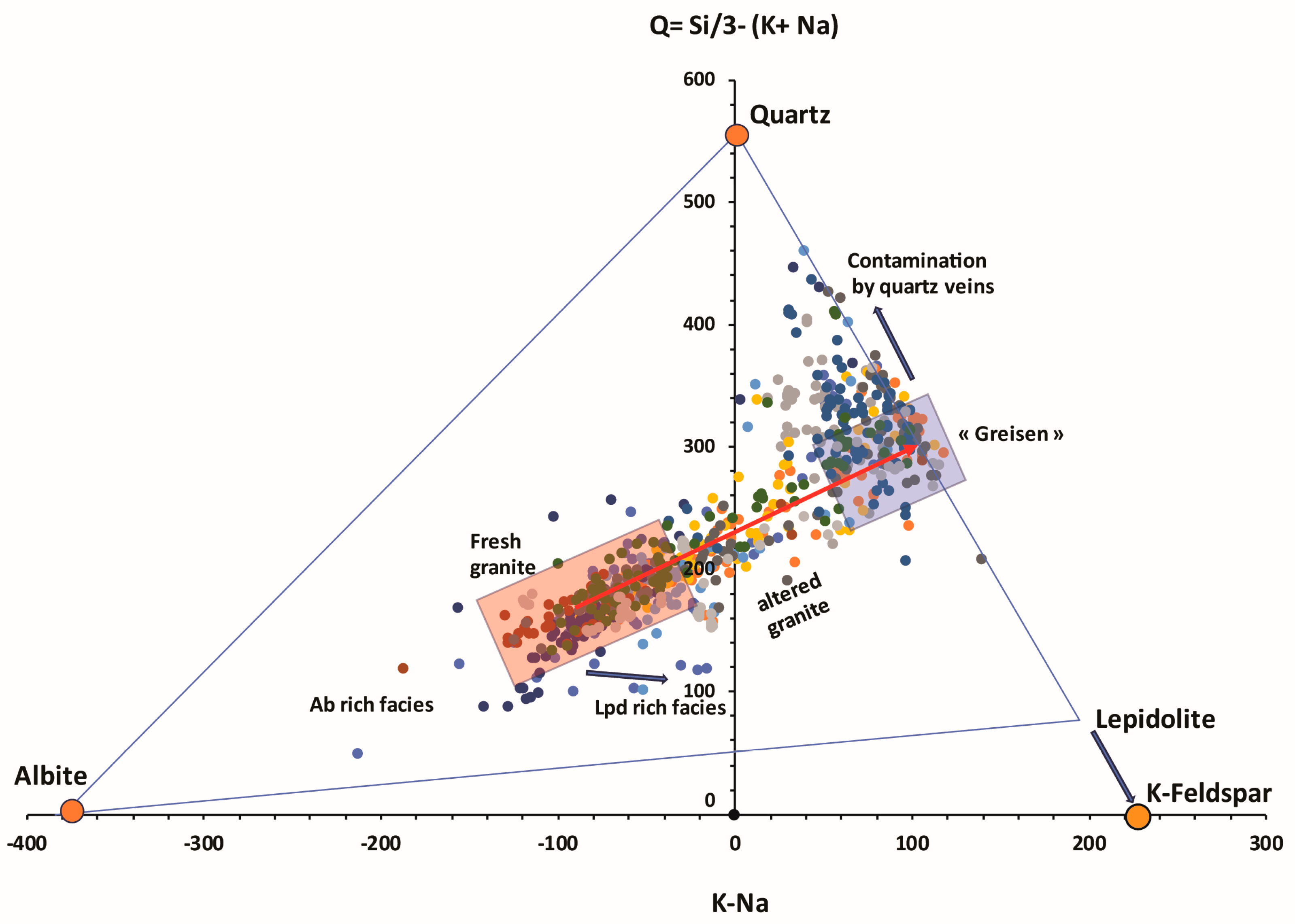
The whole-rock analyses corresponding to the drill holes selected were then plotted in a Quartz–Feldspar (QF) diagram [2] to discriminate between fresh and altered drill cores (Figure 2). Based on the QF diagram and macroscopic observations, fourteen drill core samples from fresh facies and nine drill cores from altered facies, respectively, have been selected from the north, central, and southern parts of the Beauvoir quarry. The fresh facies correspond to a white-color typical Beauvoir granite texture, without alteration signs, made of albite, quartz, lepidolite, K-feldspar, and minor amblygonite-group minerals and Sn-Nb-Ta oxides. The altered facies correspond to a greenish-color granite highlighting the replacement of the feldspars (albite and K-feldspar) and lepidolite by hydrothermal muscovite and quartz. Table 1 lists the chosen samples and their characteristics. The twenty-third set of core samples was then cut into 5 × 5 cm mini-core samples and prepared as thick sections. Similarly, nineteen of the twenty-eight mini-core samples used for the thick-section preparation were crushed into powder, reduced to aqueous solutions by acid attack, and sent to the Service d’Analyses des Roches et Matériaux (SARM, Nancy, France). Major element and trace element contents were determined using a ThermoFisher ICP-OES iCap6500 and ICP-MS iCapQ. In addition, an Agilent 200 Atomic Absorption Spectrometer was used for Lithium analysis, and an ion-specific electrode (ISE) coupled to a Metrohm 855 Robotic Titrosampler was used for Fluorine analysis.

2.2. Micro X-Ray Fluorescence Spectrometry

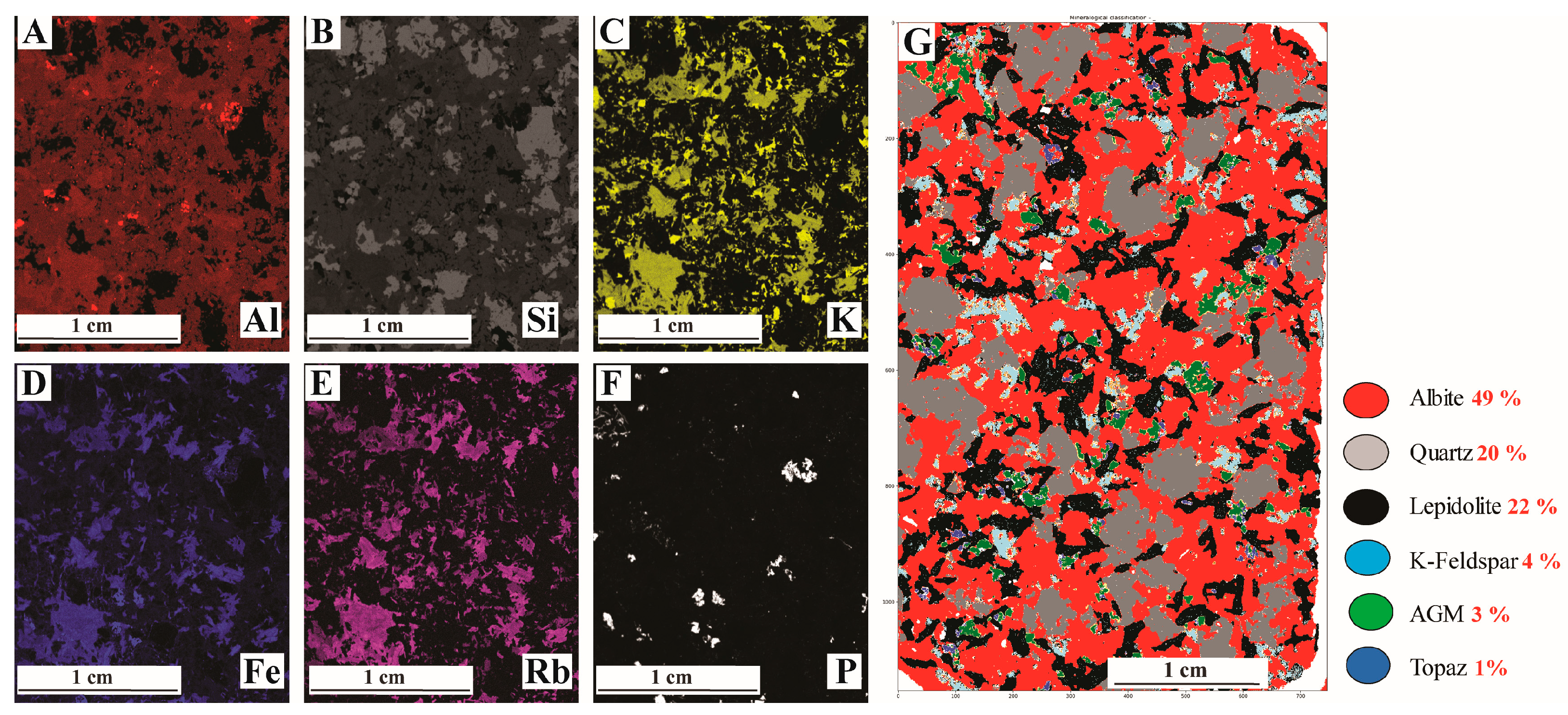
Micro-XRF analyses have been conducted at GéoRessources (Nancy, France) using a Bruker M4 Tornado micro-XRF equipped with a Rhodium X-ray tube. The conditions for the elemental mapping were a 20 µm spot size, a step width of 20 µm, 16 ms times per pixel, and a voltage/intensity of 50 kV/600 µA under a 20 mbar vacuum. The two spectrometers were used at 40 keV/130 kcps for each. Elemental distribution maps of Al, Si, K, Fe, Rb, and P were acquired using the associated software of the micro-XRF (Figure 3A–F), following the procedure explained by [4]. Converting elemental maps to chemical composite maps (Figure 3G) enables us to identify the minerals present and their modal proportions. This conversion was performed with MARCIA [5], a free GitHub code for quantitative mineralogy mapping (https://github.com/hameye/MARCIA, accessed on 15 October 2025). MARCIA is a standardless quantification method in which classification is achieved by defining masks as linear combinations of the elemental intensities of each mineral. We note that the volume modal proportions obtained by MARCIA have been converted into mass percentages for comparison with normative proportions. This conversion is performed by multiplying the modal proportion of each mineral by its density, then MARCIA sums the relative masses and normalizes them to 100.

2.3. Normative Mineral Calculation with GeoRunes

The normative calculation of minerals is based on whole-rock geochemistry and defines a theoretical mineralogical sequence based on the bulk composition of the rock. The first use of this method, known as the Cross-Iddings-Pirsson-Washington norm (CIPW norm; [6]), involved determining the molar content of each chemical element in the bulk composition and allocating it to the corresponding mineral, following a pre-determined paragenetic sequence. In this study, we employ an alternative approach in which we describe the bulk composition as a linear combination of the chemical compositions of the minerals it contains [7,8,9]. Fifteen samples from fresh to highly altered granite were crushed and reduced into powder and analyzed using ICP-OES, AAS (for Li) and ISE (for F) for major elements (SiO2, TiO2, Al2O3, Fe2O3, MnO, MgO, CaO, Na2O, K2O, P2O5, LOI), and ICP-MS for trace elements (Rb, Sn, Nb, Ta).
The normative calculation was performed using Georunes, a Python-based library developed for data visualization and geochemical calculations (https://github.com/dugucrypter/georunes, version 0.1.0, accessed on 2 December 2025). The functions used from the GeoRunes library (modmin module) fit the mineral abundances to the whole-rock (WR) chemical composition by assuming that the WR composition is a linear combination of the oxide compositions of the constituent minerals. This assumption yields a system of linear equations (Equation (1)), where the unknowns are the mineral modal proportions (expressed as percentages). The coefficients in this system are the oxide weight percentages (wt%) of the minerals, while the constant terms are the whole-rock oxide wt%. The starting data required includes (1) bulk geochemistry of data (in oxide wt%) and (2) the average composition of the minerals from the paragenetic sequence (in oxide wt%). Based on the textural characterization, albite, quartz, lepidolite, K-feldspar, topaz, and amblygonite-group minerals (AGMs) were chosen for the fresh facies samples. In contrast, albite, lepidolite, quartz, K-feldspar, muscovite and apatite were selected for the altered facies. Since small mineral proportions are not well estimated during normative calculation [10], we decided not to add Sn-Nb-Ta oxides to the fresh facies and fluorite to the altered facies (Table 2).
The relative amounts of these minerals can be calculated independently as they contain only minor amounts of elements common to the main minerals, such as iron. Equation (1) is as follows:
a o x 1 , m i 1 x m i 1 +     a o x 1 , m i 2 x m i 2   +   +   a o x 1 , m i n x m i n =   y o x 1 , W R a o x 2 , m i 1 x m i 1 +     a o x 2 , m i 2 x m i 2   +   +   a o x 2 , m i n x m i n =   y o x 2 , W R . . . a o x m , m i 1 x m i 1 +     a n , m i 2 x m i 2   +   +   a o x m , m i n x m i n =   y o x m , W R
Linear system Equation (1) is solved by minimizing an error function of the Euclidean norm of the difference between the given WR composition and the computed WR composition (Equation (2)). This minimization was addressed using a gradient descent algorithm that iteratively adjusts the mineral modal proportions to converge to an optimal solution. A random starting composition is selected as the initial estimate for the modal proportions. The gradient descent algorithm is run for a maximum of 1000 iterations, with a learning rate of 0.0005 to control the step size at each iteration Equation (2):
e 2 = i = 1 m ( y o x i , c a l c u l a t e d   y o x i , W R ) 2

3. Results

3.1. Textural Characterization of the Beauvoir Granite

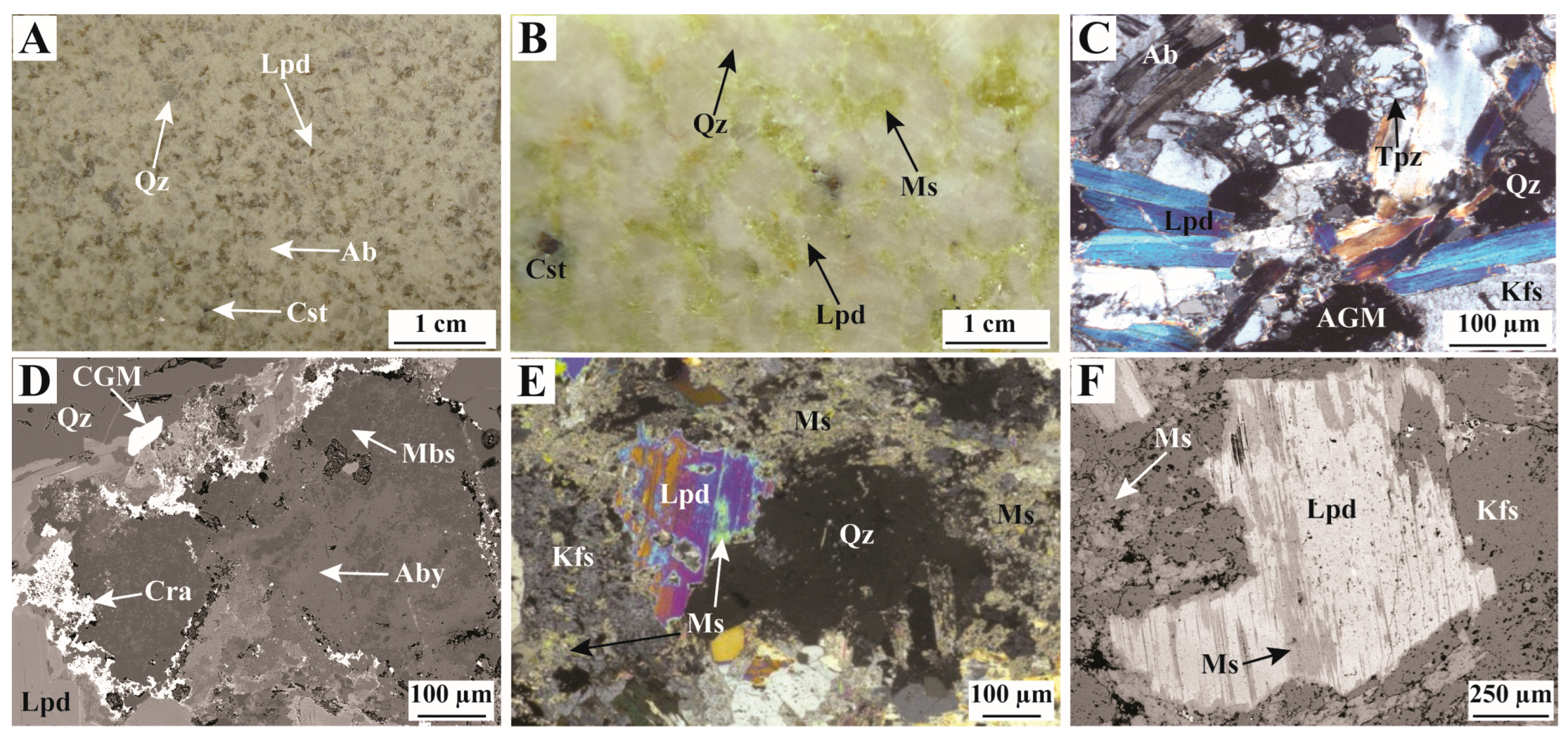
The Beauvoir granite comprises three units, from the least evolved B3 and B2 units at the bottom, to the most evolved B1 unit at the top [11]. Unit B1 of the Beauvoir granite extends to a depth of around 450 m [11]. Two lithologies characterize this unit: (1) a fresh facies, hololeucocratic (Figure 4A), and (2) an altered facies known as greisen (Figure 4B), found in the superficial part of the granite and near fracture networks in depth.
Based on hand-sample examination and optical microscopy observations (Figure 4A,C), the matrix of the fresh facies is composed of abundant albite laths and lepidolite, with interstices filled by globular quartz, potassium-feldspar (i.e., K-feldspar), and topaz. Sn-Nb-Ta oxides are rare but can be recognized in hand samples by their metallic luster. Phosphates of the fresh facies are composed of Li-rich Al-phosphates (i.e., amblygonite-group minerals, Figure 4D) and a minor amount of Be-phosphates, which are not recognizable macroscopically [12,13,14]. Magmatic apatite is rare and has not been identified in either hand samples or thin sections.
Altered facies have a green (hydrothermal muscovite) aspect. According to optical microscopy (Figure 4B,E), the feldspars are replaced by a muscovite–quartz assemblage. Muscovite also partially replaces K-feldspar and lepidolite (Figure 4E,F). Secondary apatite is the dominant phosphate in the altered facies, while primary Li-Al phosphates are absent, and replaced by crandallite-group minerals. Neither beryl nor Be-phosphates were identified in the altered facies. Finally, it is pertinent to note that oxides are less abundant in the altered facies, but fluorite is noticeably more abundant than in the fresh rock.

3.2. Micro-XRF Modal Abundances

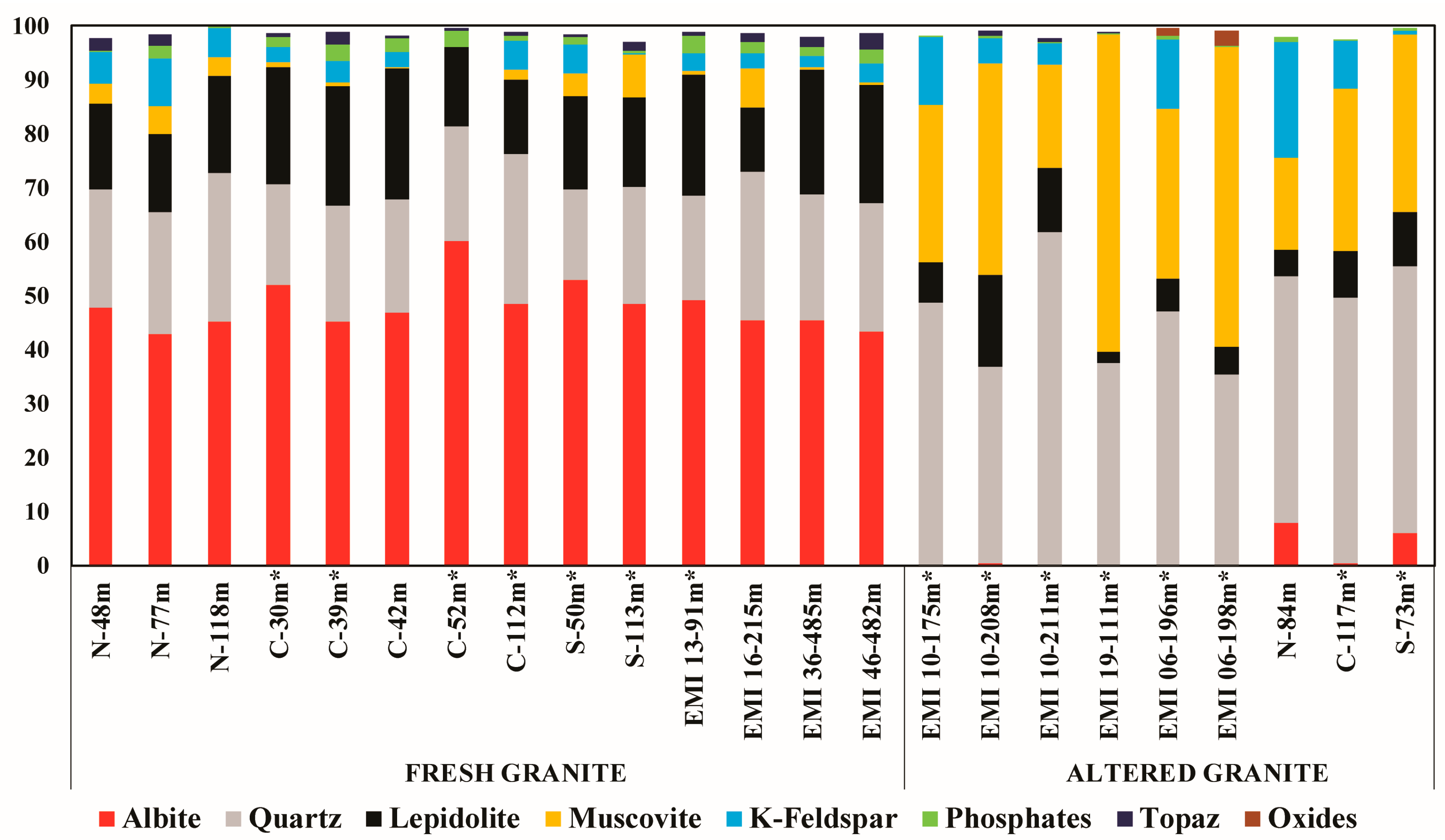
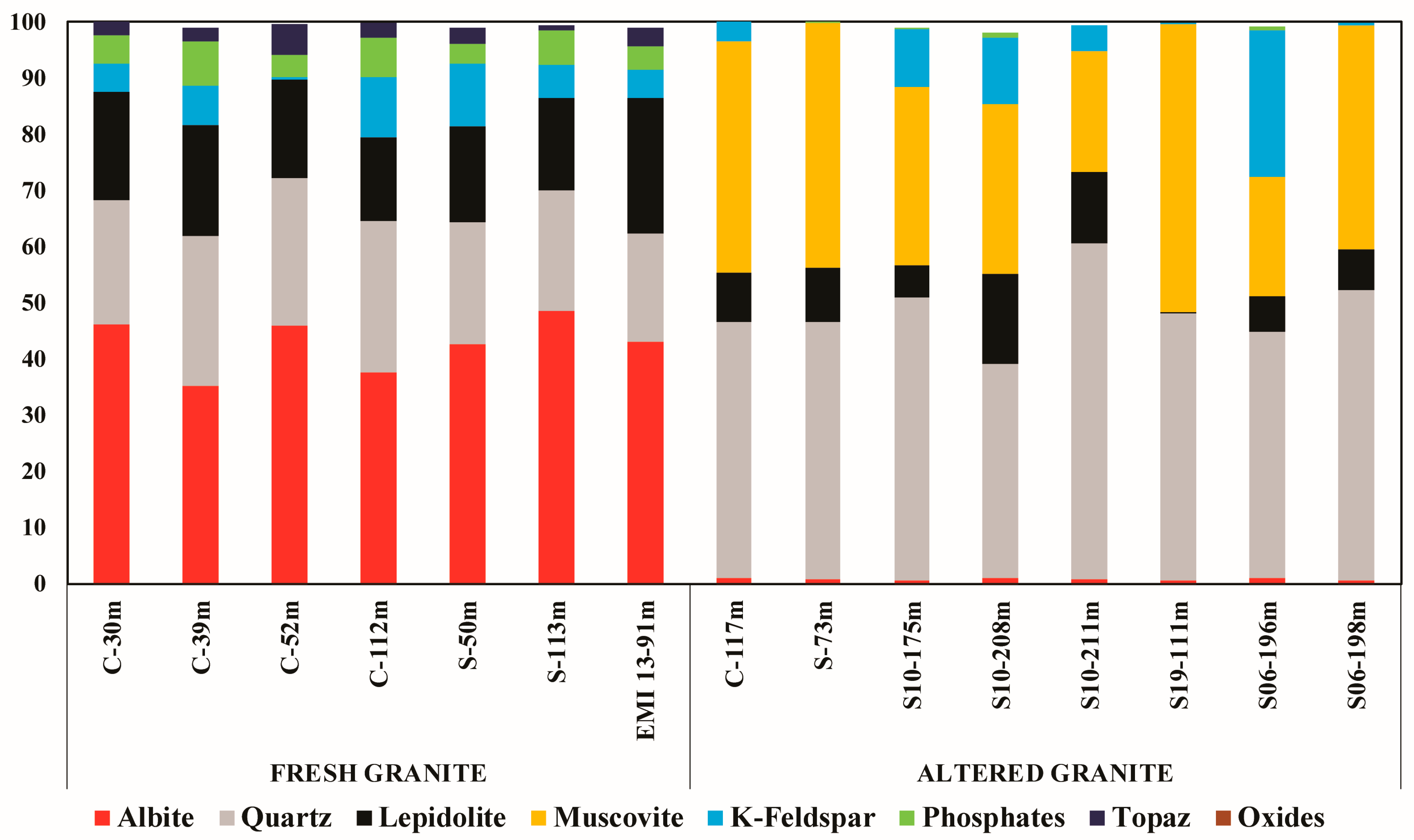
The modal abundances of the samples from fresh and altered facies are presented in Table 3 and Figure 5.

3.2.1. Fresh Granite

The modal proportions reveal that albite is the most abundant mineral, with an average abundance of 44%. Granular quartz ranks second, with an average abundance of 25%. Lepidolite, the main Li-bearing mineral, has a proportion of 20 ± 3%. After these three main phases, K-feldspar (5%–10%, with an average of 8%) and topaz (average 3%) are the two minor silicate minerals. In addition, minor phosphates and oxides have been identified. Amblygonite-group minerals and calcium-rich phosphates (i.e., herderite and magmatic apatite) show an average abundance of less than 5%, while Sn-Nb-Ta oxides do not exceed 1%. As shown in Figure 5, K-feldspar is much more abundant in the northern part of the granite than in the center and south (up to 5%).

3.2.2. Altered Facies

Altered greisen facies (Figure 4B) are typically comprising muscovite (average 37%) and quartz (average 48%). As shown by optical microscopy and SEM-EDS images, muscovite replaces the feldspars (Figure 4E) and lepidolite (Figure 4F). While the feldspars are entirely replaced by muscovite (in the highly altered facies), lepidolite shows a partial replacement by muscovite, occurring at the rims and along the cleavages (Figure 4F). Contrary to feldspars, the globular magmatic quartz is not replaced. Still, new hydrothermal quartz has precipitated along the fractures (Figure 4E).
After hydrothermal muscovite and quartz, lepidolite shows the third most abundant proportion (average 10%). However, this proportion can decrease to 1% in the highly altered facies. Furthermore, K-feldspar shows a heterogeneous distribution (typically 5%) in the altered facies, sometimes wholly or partially replaced, especially in the northern part of the quarry. Finally, topaz and AGM are almost entirely replaced by muscovite and crandallite-group minerals. Although less abundant in the altered facies, oxides survived from greisenisation (Figure 4B). Finally, fluorite appears in the altered facies (average 5%), mainly in the northern part of the granite.

3.3. Normative Proportions Results

Table 4 and Figure 6 show the normative proportions of the selected samples.
The distributions in Figure 6 issued from whole-rock chemical data show a rough similar distribution when compared to those issued from Micro-XRF image treatment (Figure 5). The number of selected mineral phases was reduced as already explained methodological section, explaining the differences concerning the minerals in low abundance (phosphate, oxides).
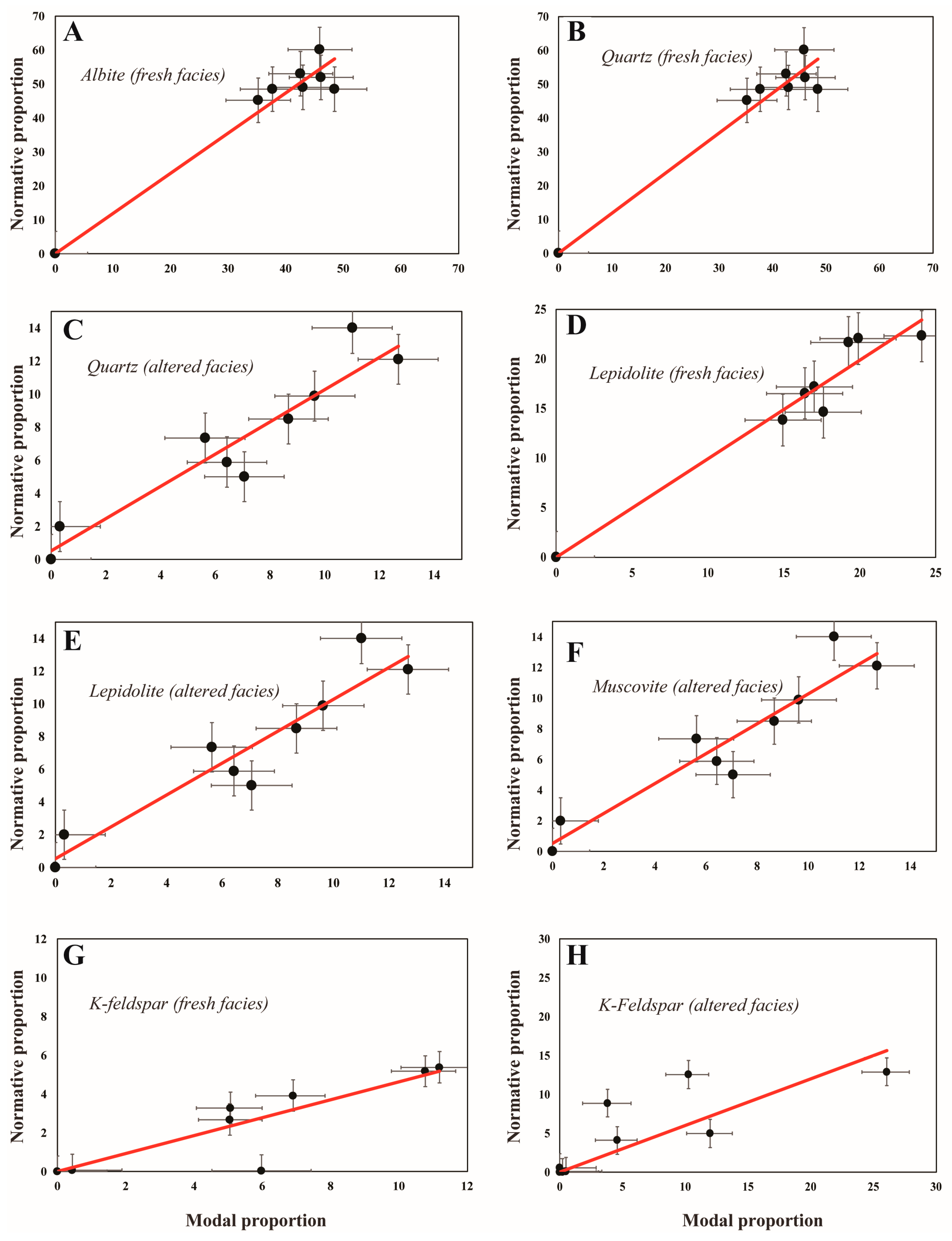
Normative proportions of the selected samples were compared with modal abundances (Figure 7). It can be emphasized that for comparison purposes, linear regressions were calculated with the intercept constrained to zero. Regressions forced through the origin are shown solely to assess proportionality between modal and normative estimates, as zero mineral abundance implies zero elemental contribution. Furthermore, the constrained regressions are not used as indicators of correlation strength and should not be interpreted as measures of statistical goodness-of-fit. Figure 7A,B,D shows that modal and normative proportions of albite, quartz, and lepidolite are proportional. For the altered facies, modal and normative proportions are less well proportional (Figure 7C). Muscovite from the altered facies shows modal and normative proportions that are less well proportional. Finally, K-feldspar abundances from fresh (Figure 7G) and altered facies (Figure 7H) show moderate relationships, respectively.

4. Discussion

4.1. Advantages and Limitations of the Different Quantitative Mineralogical Methods and Comparison to LIBS

To date, micro-XRF is the fastest, requires the least preparation time, is the most cost-effective, and is the most precise tool for the mineralogical mapping of thin and thick sections, as well as drill cores. However, some issues can arise, related to (1) surface preparation as well as the representativeness of the minerals present at depth and (2) poor estimation at low concentrations. When analyzing samples with micro-XRF, careful attention must be paid to ensure the sample is flat and uniform to obtain accurate results. Indeed, preparation defects can cause poor interaction between X-rays and the material, resulting in poor-quality maps and, ultimately, incorrect mineralogical proportions. Special precautions must, therefore, be taken, particularly during the sawing of rock samples and the preparation of thin sections. Additionally, it is crucial to select surfaces that accurately represent the mineralogical composition of the entire sample. Micro-XRF analysis focuses on the upper few micrometers of the sample surface. This surface is intended to describe the whole sample, but that may not always be the case. For instance, for the sample EMI06-196, the normative proportion of K-feldspar is double that obtained by modal calculation. Such a discrepancy could be explained by a higher proportion of K-feldspar at depth than analyzed by micro-XRF at the surface. Another limitation of micro-XRF is the poor estimation of low-concentration elements, which is related to both the grain size and software calculations. For instance, at Beauvoir, Sn-Nb-Ta oxides, although rare, do not exceed a hundred micrometers in size [15] when they are not included in albite or lepidolite [16,17]. Since the minimum spot size is 20 µm, a significant portion of Sn-Nb-Ta oxides could not be mapped, resulting in a poor approximation of the abundance of these oxides. Since the primary target was lepidolite, estimating the proportions in the Beauvoir granite case was not difficult. However, estimating Sn-Nb-Ta oxides, which constitute a secondary target, remains challenging.
As explained in Section 2.3, the normative method is applied after crushing and reducing the sample to powder, and the sample is then analyzed by ICP-OES and ICP-MS. Unlike micro-XRF, which estimates surface abundances, mineral abundances from whole-rock analysis reflect the entire sample. Although time-consuming and requiring more preparation than micro-XRF or XRD Rietveld, this technique is the most accurate and representative. However, two drawbacks exist: (1) the approximation in attributing element abundances to different minerals during the normative calculation and (2) the poor estimation of small mineral proportions. The main difficulty lies in attributing element abundances to different minerals. In the altered Beauvoir granite, a significant problem is the presence of three potassic minerals: lepidolite, K-feldspar, and muscovite. K-feldspar from the altered facies is not fresh (see Figure 4E,F) and has been replaced by muscovite. Indeed, the calculation of the normative composition of the altered facies tends to overestimate K in muscovite, leading to an overestimation of the muscovite proportion relative to lepidolite and K-feldspar. One solution would be to simplify the actual composition of these three K-minerals. For instance, removing H2O from the composition of muscovite and lepidolite helps stabilize the proportion of muscovite and lepidolite in the normative mineralogy. This modification of the chemical formulas during modeling, thus allowed a better distribution of K among the three K-minerals in the altered facies.
Besides micro-XRF and the normative method, LIBS, as a tool for in situ elemental mapping and quantitative mineralogy, is widely used [18,19,20]. Indeed, in addition to being fast and cost-effective, it can analyze light elements (i.e., Li, Be, and F), that micro-XRF cannot. For instance, Be-bearing phosphate minerals in the Beauvoir granite, including beryllonite, hurlbutite, and herderite [12,13,14], could not be identified by micro-XRF. In contrast, there is no doubt that LIBS would have allowed easier identification of these Be-minerals.

4.2. Modal and Normative Quantitative Mineralogy Comparison

When comparing modal and normative proportions, attention must be paid to the choice of the sample and, consequently, to the scale differences between thin sections and crushed samples. Indeed, since micro-XRF only analyzes surfaces, we must ensure that the surface is representative of the entire sample. In our case, micro-XRF was mainly performed on thick sections while normative analyses were based on core samples. However, to avoid representativity and scale disparities, samples were selected based on whole-rock geochemistry. However, identification of fresh and altered facies was based on geochemical analysis following optical observation. To obviate the scaling problem, the core remnant used to produce the thin section was itself crushed for whole-rock geochemistry. When comparing the silicate minerals for fresh facies, it is evident that both modal and normative proportions exhibit similar proportions for albite (Figure 7A), quartz (Figure 7B) and lepidolite (Figure 7D). This could be explained by the fact that fresh facies of the Beauvoir granite are relatively homogeneous. The proportions of the four main silicates do not vary, except for a higher proportion of K-feldspar in the northern part of the granite. At the same time, for the calculation of normative proportions, the absence of mineralogical transformations implies a near stoichiometric distribution of elements, especially K, which is shared between lepidolite and K-feldspar only.
Some mineralogical changes are evident in the altered greisen facies. As shown in Section 3, the feldspars and lepidolite are partially replaced by muscovite. This replacement can lead to misrepresentation of mineralogical proportions. Lepidolite shows a strong proportionality between modal and normative estimates. Muscovite is well discriminated using the MARCIA procedure and does not affect the lepidolite estimate (see Figure 7E). Similarly, hydrothermal quartz abundances are adequately accounted when estimating the rate of conversion of albite into quartz and muscovite, e.g., the progressive “greisenisation” [2]. Finally, modal proportions sometimes show lower values than those recorded in normative data for muscovite. The normative data seem robust because K is accommodated between the three potassic minerals (i.e., lepidolite, muscovite, and K-feldspar). However, the modal data appear to be underestimated. The main reason is the partial, small-scale replacement of lepidolite and diffuse albite alteration, which results in complex textures and leads to an underestimation of the muscovite proportion. K-feldspar, when present, exhibits a less pronounced issue. The EMI 010 drill hole, located to the north, in the K-feldspar-rich zone, reveals an accurate estimation between the modal and normative data, except for the EMI 10-208 sample, where the K-feldspar from the modal calculation would seem to be underestimated. This underestimation of K-feldspar could be explained by an overestimation of K-feldspar altered by muscovite.
In the fresh facies, mineralogical homogeneity yields a reasonable comparison between modal and normative proportions, resulting in a good reconciliation of the mineralogical proportions. The altered facies exhibit differences between the modal and normative proportions, which are almost certainly linked to the partial-to-total replacement of feldspars and lepidolite during the greisen-forming episode. If lepidolite and hydrothermal quartz are similar in their modal and normative proportions, muscovite and K-feldspar show modal and normative proportions that are not relatively equal, due to the approximation of attributing element abundances, especially K, between both minerals.

4.3. Implications for Facies Classification of Beauvoir Granite and Lithium Recovery

The definition of mineralogical proportions, as well as the reconciliation of modal and normative data, are beneficial for understanding the distribution of minerals and metals during magmatic and hydrothermal stages, for the recovery of metals, and, ultimately, for the distribution of Li and its associated minerals. Indeed, the mineralogical proportions clearly show a replacement of feldspar and magmatic lepidolite by hydrothermal muscovite. Muscovite averages more than 35% of the mineralogical proportion when the feldspars are replaced. K-feldspar is a significant constituent of the altered facies in the northern zone of the Beauvoir granite. The increase in quartz proportion is primarily reflected in hydrothermal quartz associated with greisenisation, such as the replacement of albite by quartz and muscovite. Lepidolite is also replaced by muscovite, from partial to total replacement in the highly altered zones. The greisen alteration yields a decrease in the lepidolite abundance by a factor of two to three times when comparing the fresh facies (20 ± 3%) with the altered facies (between 5% and 10%). Furthermore, this hydrothermal alteration appears to be less widespread than in other Variscan rare-metal granites of western Europe [21,22,23]. As explained by [11], the emplacement depth of Beauvoir granite (i.e., 3–4 km) prevents vein and fracture development, and therefore, pervasive alteration of significant volumes of rocks compared to other western Variscan rare-metal granites such as Cίnovec granite [24,25], resulting in the partial replacement of lepidolite.
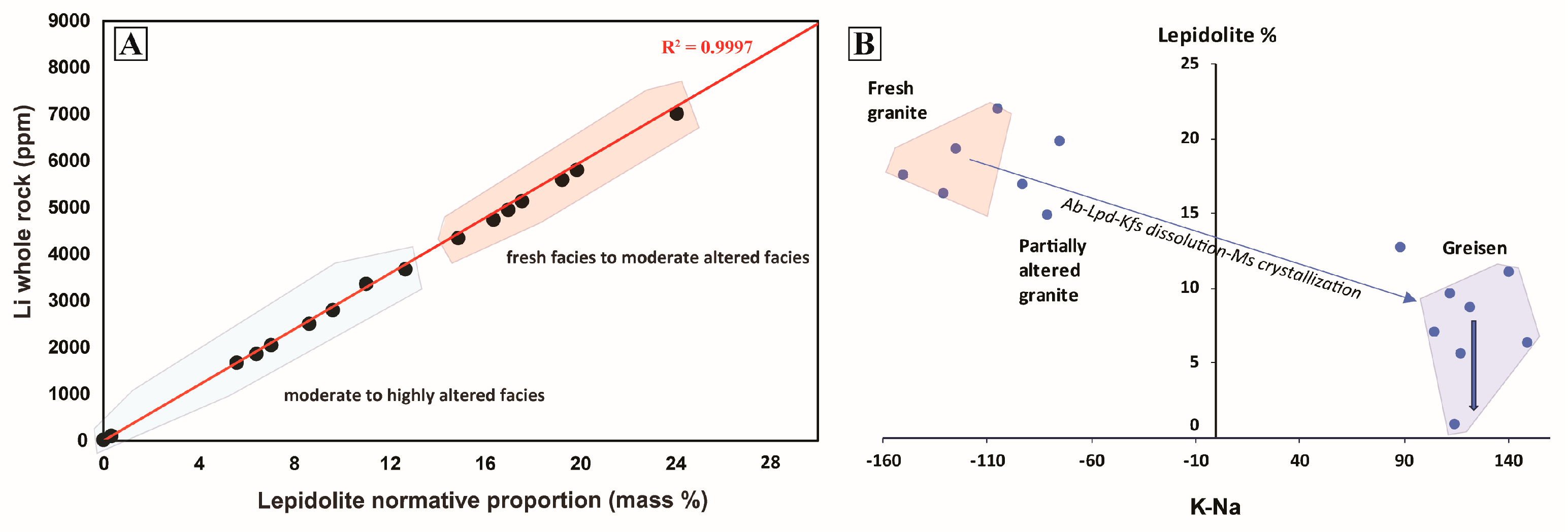
The plot of the normative proportions of lepidolite versus Li whole-rock content is rich in information (Figure 8 and Table 5): (i) the good correlation in this diagram (R2 = 0.99) indicates that the endmember controlling the Li content in the rock is the lepidolite, which is known to have a relatively constant Li content around 29,000 ppm [26], and (ii) the fresh to moderately altered facies, which show Li whole-rock values between 4000 and 7000 ppm, have a lepidolite content between 16% and 23%–25%, while moderately to highly altered facies with Li whole-rock values of less than 4000 ppm (average 2000 ppm) show lepidolite proportions between 15% and 1%–5%. This finding is in agreement with the observations cited in [26,27], who have demonstrated that muscovite from Beauvoir granite is nearly Li-free. Muscovite is therefore a diluting endmember, reducing the bulk Li content of the bulk mica concentrate (lepidolite + muscovite).
In the case of ore processing, muscovite is extremely difficult to separate from lepidolite. Therefore, the best solution to maintain the highest Li content in the mica concentrates is to avoid exploiting the greisen-rich volumes of the granite intrusion.

4.4. Quantitative Estimation of Lepidolite: Comparison and Integration of Bulk-Rock Geochemistry and Chemical Mapping

Quantitative estimation of lepidolite abundance in the Beauvoir granite is challenging because several major mineral phases (lepidolite, muscovite, K-feldspar) share the same principal chemical components (K–Al–Si), leading to under-determined systems when using bulk-rock chemical data alone. Although lepidolite is distinguished by its high and relatively constant Li content (~28,000 ppm), uncertainties arise where K-feldspar is scarce or variably altered, and where Li is not measured directly in mapping techniques.
Bulk-rock geochemical analyses provide representative data at the scale of decimetric samples or 4 m drilling intervals and are therefore well suited for estimating average mineral proportions at borehole scale, provided that sampling and analytical protocols are rigorous. However, solving modal proportions from whole-rock chemistry requires mathematical minimization procedures and remains sensitive to assumptions regarding mineral compositions.
By contrast, micro-XRF chemical mapping allows direct spatial discrimination of K-bearing phases and provides robust surface-based modal estimates, particularly when phase-specific thresholding is calibrated using the actual mineral compositions determined by EPMA. The principal limitations of this approach relate to representativeness (mapped area versus sample volume) and to potential scale effects, although these are mitigated at Beauvoir by the low textural variability at the sample scale and the absence of strong mineral preferred orientations.
In this study, we therefore adopted an integrated approach in which micro-XRF-derived surface proportions are used to calibrate bulk-rock-based modal calculations on the same samples. Once calibrated, this relationship can be extrapolated to continuous geochemical datasets acquired along boreholes, allowing lepidolite abundance to be estimated at deposit scale. This combined strategy provides a practical and reproducible solution for industrial-scale resource evaluation, while explicitly accounting for the uncertainties inherent to each method. Table 6 provides the main advantages and limitations of the two methods.

5. Conclusions

  • Elemental and chemical composite mapping combined with modal mineralogy highlights the usefulness of micro-XRF for mineralogical characterization.
  • Beyond qualitative mapping, Micro-XRF imaging enables quantitative comparisons with normative and modal mineralogy, providing insights into the respective strengths and limitations of each approach.
  • Micro-XRF results, in conjunction with normative mineral proportion calculations, reveal similar mineralogical abundances for fresh granite; however, noticeable discrepancies occur in the estimation of muscovite in the altered facies.
  • By comparing mineralogical proportions with Li content, this study allows the discrimination of fresh and altered facies based on their mineral signatures, thereby improving deposit characterization and predictions of ore-processing performance.
  • Micro-XRF is not suitable for the direct quantification of lithium-bearing minerals as it cannot detect elements with atomic numbers below sodium (Z = 11). This intrinsic limitation highlights the necessity of complementary analytical techniques, such as ICP-MS or LA-ICP-MS, when investigating lithium-rich phases.
  • Overall, this work demonstrates the value of quantitative mineralogy—particularly for Li-bearing rare-metal granites—in providing critical information on the abundance of Li-bearing minerals and the potential presence of Li-poor muscovite acting as a diluting component in flotation mica concentrates.
  • In Li-mica–bearing peraluminous granites such as Beauvoir, neither normative nor modal approaches alone provide a fully reliable estimate of lepidolite abundance. Whole-rock geochemistry ensures volumetric representativeness at the drill-core scale but suffers from under-determined systems where several K-bearing phases coexist. Conversely, micro-XRF mapping allows precise discrimination of mineral phases and alteration textures but is limited by surface representativeness. Their combined use enables cross-calibration of mineral proportions, reduces methodological uncertainties, and provides a robust framework for resource estimation and orebody modeling.

Author Contributions

Conceptualization, Z.S.K. and M.C.; methodology, Z.S.K., M.C., W.M.-E.B. and L.S.; software, Z.S.K. and W.M.-E.B.; validation, M.C. and P.F.; investigation, Z.S.K., M.C., W.M.-E.B. and L.S.; resources, Z.S.K., M.C., W.M.-E.B. and L.S.; data curation, Z.S.K., M.C. and W.M.-E.B.; writing—original draft preparation Z.S.K. and M.C.; writing—review and editing, Z.S.K., M.C., W.M.-E.B., L.S. and P.F.; project administration, M.C. and P.F.; funding acquisition, M.C. and P.F. All authors have read and agreed to the published version of the manuscript.

Funding

The work was supported by the French National Research Agency through the national program “Investissements d’avenir” with the reference ANR-10-LABX-21-RESSOURCES21.

Data Availability Statement

The data supporting the findings of this study, specifically the geographical coordinates of the Beauvoir quarry and the drill cores, are available upon request from the corresponding author, Zia Steven Kahou. The data are not publicly available since they form part of an ongoing exploration campaign.

Acknowledgments

The authors thank IMERYS and all their geologists, especially Benjamin Barré and Alyson Bargain, for providing access to the Beauvoir quarry and for assistance during core sampling. This work was supported by the French National Research Agency through the national program “Investissements d’avenir” with the reference ANR-10-LABX-21- RESSOURCES21. Andreï Lecomte from the Service Commun de Microscopie Electronique et de Microanalyse (SCMEM, Université de Lorraine, Nancy, France) is thanked for his assistance during the SEM acquisition. The corresponding author would also like to warmly thank Gregoire Jean and Jean Cauzid, respectively, the head of IMERYS R&D and an assistant professor at Lorraine University, for numerous discussions about quantitative mineralogy, which significantly improved the present paper. Analyses were carried out at the SCMEM and LA-ICP-MS platforms of GeoRessources in Nancy, which are funded by the Labex Ressources 21 (ANR-10-LABX-21-RESSOURCES21), the Region Lorraine, and the European Community through the FEDER program.

Conflicts of Interest

Patrick Fullenwarth was employed by Imerys Ceramics France–Kaolins de Beauvoir. The remaining authors declare that the research was conducted in the absence of any commercial or financial relationships that could be construed as potential conflicts of interest.

References

  1. Harlaux, M.; Mercadier, J.; Bonzi, W.M.-E.; Kremer, V.; Marignac, C.; Cuney, M. Geochemical Signature of Magmatic-Hydrothermal Fluids Exsolved from the Beauvoir Rare-Metal Granite (Massif Central, France): Insights from LA-ICPMS Analysis of Primary Fluid Inclusions. Geofluids 2017, 2017, 1925817. [Google Scholar] [CrossRef]
  2. Cathelineau, M.; Kahou, Z.S. Discrimination of Muscovitisation Processes Using a Modified Quartz–Feldspar Diagram: Application to Beauvoir Greisens. Minerals 2024, 14, 746. [Google Scholar] [CrossRef]
  3. Warr, L.N. IMA–CNMNC Approved Mineral Symbols. Mineral. Mag. 2021, 85, 291–320. [Google Scholar] [CrossRef]
  4. Mohamed, N.; Rifai, K.; Selmani, S.; Constantin, M.; Doucet, F.R.; Özcan, L.Ç.; Sabsabi, M.; Vidal, F. Chemical and Mineralogical Mapping of Platinum-Group Element Ore Samples Using Laser-Induced Breakdown Spectroscopy and Micro-X-Ray Fluorescence. Geostand. Geoanal. Res. 2021, 45, 539–550. [Google Scholar] [CrossRef]
  5. Meyer, H.; Jean, C. Hameye/MARCIA: MARCIA v 0.1.3. Zenodo 2021, 711. [Google Scholar] [CrossRef]
  6. Cross, W.; Iddings, J.P.; Pirsson, L.V.; Washington, H.S. A Quantitative Chemico-Mineralogical Classification and Nomenclature of Igneous Rocks. J. Geol. 1902, 10, 555–690. [Google Scholar] [CrossRef]
  7. Banks, R. The Use of Linear Programming in the Analysis of Petrological Mixing Problems. Contrib. Mineral. Petrol. 1979, 70, 237–244. [Google Scholar] [CrossRef]
  8. Tolosana-Delgado, R.; von Eynatten, H.; Karius, V. Constructing Modal Mineralogy from Geochemical Composition: A Geometric-Bayesian Approach. Comput. Geosci. 2011, 37, 677–691. [Google Scholar] [CrossRef]
  9. Weltje, G.J. End-Member Modeling of Compositional Data: Numerical-Statistical Algorithms for Solving the Explicit Mixing Problem. Math. Geol. 1997, 29, 503–549. [Google Scholar] [CrossRef]
  10. Braun, G.E. Quantitative Analysis of Mineral Mixtures Using Linear Programming. Clays Clay Miner. 1986, 34, 330–337. [Google Scholar] [CrossRef]
  11. Cuney, M.; Marignac, C.; Weisbrod, A. The Beauvoir Topaz-Lepidolite Albite Granite (Massif Central, France); the Disseminated Magmatic Sn-Li-Ta-Nb-Be Mineralization. Econ. Geol. 1992, 87, 1766–1794. [Google Scholar] [CrossRef]
  12. Aubert, G.; Burnol, L. Observations Sur Les Mineralisations En Beryllium Du Massif Granitique d’Echassiers Decouverte de Herderite. Acad. Sience Comptes Rendus 1964, 258, 273–276. [Google Scholar]
  13. Burnol, L. Geochimie du Beryllium et Types de Concentration dans les Leucogranites du Massif Central Francais; Relations Entre les Caracteristiques Geochimiques des Granitoides et les Gisements Endogenes de Type Depart Acide (Be, Sn, Li) ou de Remaniement Tardif (U, F, Pb et Zn); BRGM: Orléans, France, 1974. [Google Scholar]
  14. Charoy, B. Beryllium Speciation in Evolved Granitic Magmas; Phosphates versus Silicates. Eur. J. Mineral. 1999, 11, 135–148. [Google Scholar]
  15. Demeusy, B.; Arias-Quintero, C.A.; Butin, G.; Lainé, J.; Tripathy, S.K.; Marin, J.; Dehaine, Q.; Filippov, L.O. Characterization and Liberation Study of the Beauvoir Granite for Lithium Mica Recovery. Minerals 2023, 13, 950. [Google Scholar] [CrossRef]
  16. Chen, W.R.; Fontan, F.; Monchoux, P. Interrelations et Évolution Comparée de La Cassitérite et Des Niobotantales Dans Les Différents Faciès Du Granite de Beauvoir (Massif d’Echassières). Géologie Fr. 1987, 2–3, 237–245. [Google Scholar]
  17. Wang, R.C. Minéraux Disséminés Comme Indicateurs du Caractère Pegmatitique du Granite de Beauvoir, Massif d’Echassières, Allier, France. Can. Mineral. 1992, 30, 763–770. [Google Scholar]
  18. Sweetapple, M.T.; Tassios, S. Laser-Induced Breakdown Spectroscopy (LIBS) as a Tool for In Situ Mapping and Textural Interpretation of Lithium in Pegmatite Minerals. Am. Mineral. 2015, 100, 2141–2151. [Google Scholar] [CrossRef]
  19. Rifai, K.; Constantin, M.; Yilmaz, A.; Özcan, L.Ç.; Doucet, F.R.; Azami, N. Quantification of Lithium and Mineralogical Mapping in Crushed Ore Samples Using Laser Induced Breakdown Spectroscopy. Minerals 2022, 12, 253. [Google Scholar] [CrossRef]
  20. Fabre, C.; Trebus, K.; Tarantola, A.; Cauzid, J.; Motto-Ros, V.; Voudouris, P. Advances on microLIBS and microXRF Mineralogical and Elemental Quantitative Imaging. Spectrochim. Acta Part B At. Spectrosc. 2022, 194, 106470. [Google Scholar] [CrossRef]
  21. Ballouard, C.; Carr, P.; Parisot, F.; Gloaguen, É.; Melleton, J.; Cauzid, J.; Lecomte, A.; Rouer, O.; Salsi, L.; Mercadier, J. Petrogenesis and Tectonic-Magmatic Context of Emplacement of Lepidolite and Petalite Pegmatites from the Fregeneda-Almendra Field (Variscan Central Iberian Zone): Clues from Nb-Ta-Sn Oxide U-Pb Geochronology and Mineral Geochemistry. BSGF–Earth Sci. Bul. 2024, 195, 3. [Google Scholar] [CrossRef]
  22. Michaud, J.A.-S.; Gumiaux, C.; Pichavant, M.; Gloaguen, E.; Marcoux, E. From Magmatic to Hydrothermal Sn-Li-(Nb-Ta-W) Mineralization: The Argemela Area (Central Portugal). Ore Geol. Rev. 2020, 116, 103215. [Google Scholar] [CrossRef]
  23. Raimbault, L.; Cuney, M.; Azencott, C.; Duthou, J.-L.; Joron, J.L. Geochemical Evidence for a Multistage Magmatic Genesis of Ta-Sn-Li Mineralization in the Granite at Beauvoir, French Massif Central. Econ. Geol. 1995, 90, 548–576. [Google Scholar] [CrossRef]
  24. Breiter, K.; Hložková, M.; Korbelová, Z.; Galiová, M.V. Diversity of Lithium Mica Compositions in Mineralized Granite–Greisen System: Cínovec Li-Sn-W Deposit, Erzgebirge. Ore Geol. Rev. 2019, 106, 12–27. [Google Scholar] [CrossRef]
  25. Harlaux, M.; Blein, O.; Gourcerol, B. Comparison of the Beauvoir and Cínovec Rare Metal Granite/Greisen Systems: Role of Muscovitization on Li-Sn-W-Ta Hydrothermal Remobilization. In Proceedings of the 17th Biennial SGA Meeting, Zurich, Switzerland, 28 August–1 September 2023; pp. 39–42. [Google Scholar]
  26. Kahou, S.; Cathelineau, M.; Boiron, M.-C. Quantitative Mineralogy and Lithium Distribution in the Upper Part of the Beauvoir Granite; European Geosciences Union General Assembly: Vienna, Austria, 2024. [Google Scholar]
  27. Monnier, L.; Salvi, S.; Melleton, J.; Lach, P.; Pochon, A.; Bailly, L.; Béziat, D.; De Parseval, P. Mica Trace-Element Signatures: Highlighting Superimposed W-Sn Mineralizations and Fluid Sources. Chem. Geol. 2022, 600, 120866. [Google Scholar] [CrossRef]
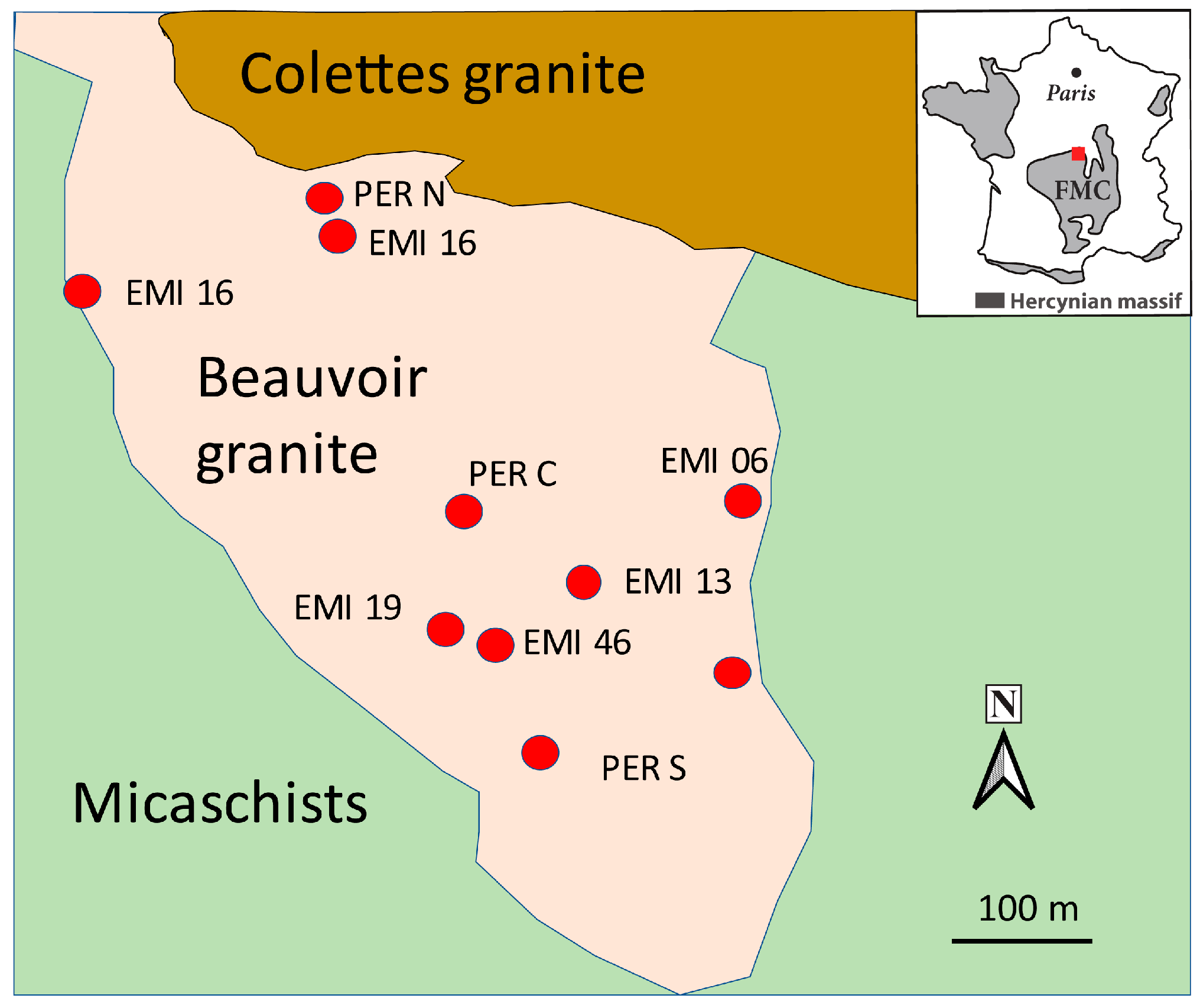
Figure 1. Simplified geological of the Echassières mining district showing the Beauvoir and les Colettes granites and the enclosing micaschists (modified after [1]). The red points represent the drilling holes selected to obtain samples for the present study.
Minerals 16 00029 g001
Figure 2. The Quartz–Feldspar diagram (Q = Si/3 − (K + Na) vs. F = K-Na where Q and F are calculated from millicationic values derived from whole-rock analysis using the calculation exemplified in the file provided in the supplementary material from [2]). The diagram applied to selected drilling holes of the EMILI campaigns shows that most granites are distributed along a trend from fresh albitic granites towards a quartz–muscovite assemblage so-called “greisen” where feldspars are absent. Intermediate “altered granites” as indicated correspond to granites with progressive development of muscovite at the expense of albite and lepidolite. The colored dots represent a selected drilling holes of the EMILI campaigns. Ab: albite; Lpd: lepidolite. The mineral abbreviations are according to the International Mineralogical Association (IMA) as adopted by [3].
Minerals 16 00029 g002
Figure 3. (AF) Elemental distribution maps of Al, Si, K, Fe, Rb, and P from a thick section from the Beauvoir granite generated by the M4 Tornado software (version 1.6.5) and corresponding (G) modal mineral distribution generated by the MARCIA code. AGM: amblygonite-group minerals.
Minerals 16 00029 g003
Figure 4. Hand specimens (A,B), optical microscopic (C,E), and SEM (D,F) microphotographs showing the textural relationships from the fresh and altered facies of the Beauvoir granite. Ab: Albite; Qz: quartz; Lpd: lepidolite; Ms: muscovite; Kfs: K-feldspar; Tpz: topaz; AGM: amblygonite-group minerals; Cst: cassiterite; Cra: crandallite; CGM: columbite-group minerals.
Minerals 16 00029 g004
Figure 5. Histogram summarizing mineralogical modal proportions of the fresh and altered facies analyzed by micro-XRF. The asterisk indicates the samples analyzed by both micro-XRF for modal proportions and ICP-OES for normative proportions (see Figure 6 for normative proportions). Phosphates represent AGM and apatite.
Minerals 16 00029 g005
Figure 6. Histogram summarizing mineralogical normative proportions for the fresh and altered facies of the studied samples. Phosphates represent amblygonite, montebrasite, and apatite.
Minerals 16 00029 g006
Figure 7. Binary diagrams showing the correlation between modal and normative proportions from albite (A), magmatic quartz (B) and hydrothermal quartz (C), lepidolite from fresh (D) and altered facies (E), muscovite (F), and K-feldspar from fresh (G) and altered facies (H). Note that the line corresponds to a regression forced through the origin and is shown only to illustrate proportionality; no R2 is reported for this regression. The errors bars represent an assigned relative uncertainty of ±5 to both modal and normative mineral proportions.
Minerals 16 00029 g007
Figure 8. Diagrams from the fifteen selected samples from Table 4, highlighting a good correlation (R2 = 0.9997) between (A) the Li whole-rock content and the lepidolite normative proportion, (B) the Quartz–Feldspar diagram (modified from [2]), and the lepidolite normative proportion. Ab: albite; Lpd: lepidolite; Ms: muscovite; Kfs: K-feldspar.
Minerals 16 00029 g008
Table 1. Summary of fresh and altered samples collected from the drill holes, including their mineralogy, depth, and facies nature. Ab: Albite; Qz: quartz; Lpd: lepidolite; Ms: muscovite; Kfs: K-feldspar; Tpz: topaz; AGM: amblygonite-group minerals; Cst: cassiterite; Ap: apatite. The mineral abbreviations are according to the International Mineralogical Association (IMA) as adopted by [3].
Drill Hole.Sample NumberDepth (m)MineralogyFacies Nature
PER NorthN4848Ab, Qz, Lpd, Kfs, AGM, Tpzfresh
N7777Ab, Qz, Lpd, Kfs, AGM, Tpzfresh
N8484Ms, Qz, Lpd, Apaltered
N118118Ab, Qz, Lpd, Kfs, Ms, AGM, Tpzfresh
PER CenterC3030Ab, Qz, Lpd, Kfs, AGM, Tpzfresh
C3939Ab, Qz, Lpd, Kfs, AGM, Tpzfresh
C4242Ab, Qz, Lpd, Kfs, AGM, Tpzfresh
C5252Ab, Qz, Lpd, Kfs, AGM, Tpzfresh
C112112Ab, Qz, Lpd, Kfs, AGM, Tpzfresh
C117117Ms, Qz, Lpd, Kfsaltered
PER SouthS5050Ab, Qz, Lpd, Kfs, AGM, Tpz, Msfresh
S7373Ms, Qz, Lpd, Kfsaltered
S113113Ab, Qz, Lpd, Kfs, AGM, Tpz, Msfresh
EMI 006EMI6-196196Ms, Qz, Lpd, Kfs, CGM, Apaltered
EMI6-198198Ms, Qz, Lpd, Cstaltered
EMI 010EMI10-175175Ms, Qz, Lpd, Kfsaltered
EMI10-208208Ms, Qz, Lpd, Kfs, Apaltered
EMI10-211211Ms, Qz, Lpd, Kfsaltered
EMI 013EMI13-9191Ab, Qz, Lpd, Kfs, AGM, Tpzfresh
EMI 016EMI16-215215Ab, Qz, Lpd, Kfs, Ms, AGM, Tpzfresh
EMI 019EMI19-111111Ms, Qz, Lpd, Apaltered
EMI 036EMI36-485485Ab, Qz, Lpd, Kfs, AGM, Tpz, Msfresh
EMI 046EMI46-482482Ab, Qz, Lpd, Kfs, AGM, Tpz, Msfresh
Table 2. Representative mineral chemical composition (oxides in wt%) used for the normative proportion calculation. The iron oxide corresponds to total iron in ferric form.
MineralSiO2TiO2Al2O3Fe2O3MnOMgOCaONa2OK2OP2O5Li2OFRb2O
Albite68.2019.9000011.60.10.2000
Quartz99.900.00000000000
Lepidolite51.8022.61.20.4000.39.906.25.12.2
Microcline64.8018.200000.116.50.3000.3
Muscovite46.0036.40.90.10.100.110.6000.40.4
Topaz32.6056.90000000017.50
Amblygonite0036.1000.10.47.5046.96.08.80
Apatite0.10000.2055.20041.803.90
Table 3. Summary of modal mineral proportions from all the samples selected for the selected study. Oxides represent the total opaque minerals, and AGM represent amblygonite and montebrasite.
Fresh Granite
Sample/MineralAlbiteQuartzLepidoliteMuscoviteK-FeldsparAGMTopazOxides
N-48m48221646020
N-77m43231459220
N-118m45281835000
C-30m52192213210
C-39m45212214320
C-42m47212403200
C-52m60211500300
C-112m49281425110
S-50m53171745200
S-113m49221780120
EMI 13-91m49192213310
EMI 16-215m45281273220
EMI 36-485m46232312220
EMI 46-482m43242213330
Altered Granite
Sample/MineralAlbiteQuartzLepidoliteMuscoviteK-FeldsparApatiteTopazOxides
EMI 10-175m04972913000
EMI 10-208m03714415010
EMI 10-211m06212194010
EMI 19-111m0382590000
EMI 06-196m04763213102
EMI 06-198m0365560003
N-84m84651721100
C-117m1499309000
S-73m65010331100
Table 4. Summary of normative mineral proportions from fifteen selected samples, and their corresponding modal proportions. Oxides represent the total opaque minerals, and AGM represent amblygonite and montebrasite.
FRESH GRANITE
Mineral/SampleC-30mC-39mC-52mC-112mS-50mS-113mEMI 13-91m
NormativeModalNormativeModalNormativeModalNormativeModalNormativeModalNormativeModalNormativeModal
Albite4652354546603849435349494349
Quartz2219272126212728221722221919
Lepidolite1922202218151514171716172422
Muscovite01010002040801
K-Feldspar5374001151156053
AGM52834371426143
Topaz31225031301231
Oxides00000000000000
ALTERED GRANITE
Mineral/SampleC-117mS-73mEMI 10-175mEMI 10-208mEMI 10-211mEMI 19-111mEMI 06-196mEMI 06-198m
NormativeModalNormativeModalNormativeModalNormativeModalNormativeModalNormativeModalNormativeModalNormativeModal
Albite1116101010101010
Quartz46494650504940376062473844475236
Lepidolite9910106711141312126675
Muscovite41304433322933412219515921324056
K-Feldspar490110131255400261300
Apatite0011001000001100
Topaz0000000101000000
Oxides0000000000000203
Table 5. Correlation between the Li whole-rock content and the lepidolite normative proportion from fifteen selected samples from Table 4.
SampleLi Whole-Rock Content (ppm)Lepidolite Normative Proportion (%)
C30559119
C39578820
C52512118
C112432915
S50492717
S113472616
EMI13-91699724
C11725009
S73278110
EMI10-17516516
EMI10-208335211
EMI10-211365313
EMI19-111971
EMI6-19618516
EMI6-19820267
Table 6. Comparison of normative and modal approaches for estimating lepidolite abundance.
AspectNormative Approach (Whole-Rock Geochemistry)Modal Approach (Micro-XRF Mapping)
PrincipleMineral proportions calculated from bulk-rock chemistry using mass balance.Direct identification and surface quantification of mineral phases from elemental maps.
ScaleDecimetric to metric (e.g., 4 m drill-core intervals).Millimetric to centimetric (thin/thick sections).
RepresentativenessHigh, provided sampling and quartering are robust.Limited; depends on number of sections and textural homogeneity.
Discrimination of K-bearing phasesLimited when several phases share major elements (under-determined systems).High, using phase-specific chemical thresholds (MARCIA approach).
Sensitivity to LiHigh at bulk scale, indirect at mineral scale.Indirect (Li not detected), inferred from associated elements and calibration.
Sensitivity to alterationExpressed as bulk metal lossExplicitly resolved through replacement textures (e.g., lepidolite → muscovite).
Main uncertaintiesAssumed mineral compositions; phase overlap.Surface-to-volume extrapolation.
StrengthsRobust drill-core–scale estimates.High mineralogical and textural resolution.
LimitationsPoor resolution of textural controls.Cannot be extrapolated alone to resource scale.
Optimal combined useProvides volumetric control and resource-scale continuity.Provides calibration, phase discrimination and correction factors.
Implications for exploration and resource modelingEnsures reliable grade and tonnage estimation at borehole scaleImproves mineralogical accuracy and correction of normative models in heterogeneous or altered facies.
Disclaimer/Publisher’s Note: The statements, opinions and data contained in all publications are solely those of the individual author(s) and contributor(s) and not of MDPI and/or the editor(s). MDPI and/or the editor(s) disclaim responsibility for any injury to people or property resulting from any ideas, methods, instructions or products referred to in the content.