Origin and Evolution of the Qingshan Pb–Zn Deposit, Northwestern Guizhou, SW China: Evidences from Fluid Inclusions and C–O–S–Pb Isotopes
Abstract
1. Introduction
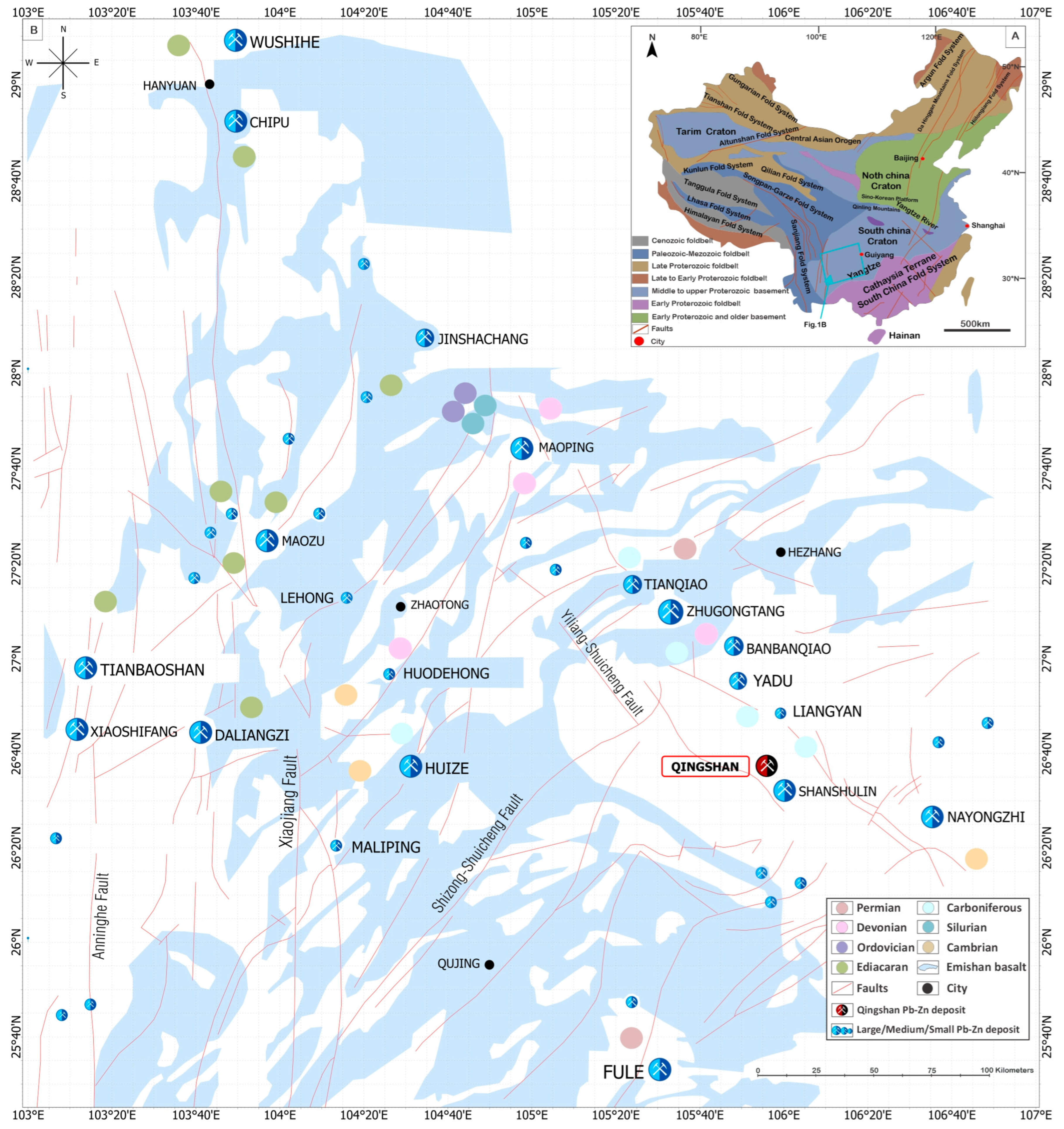
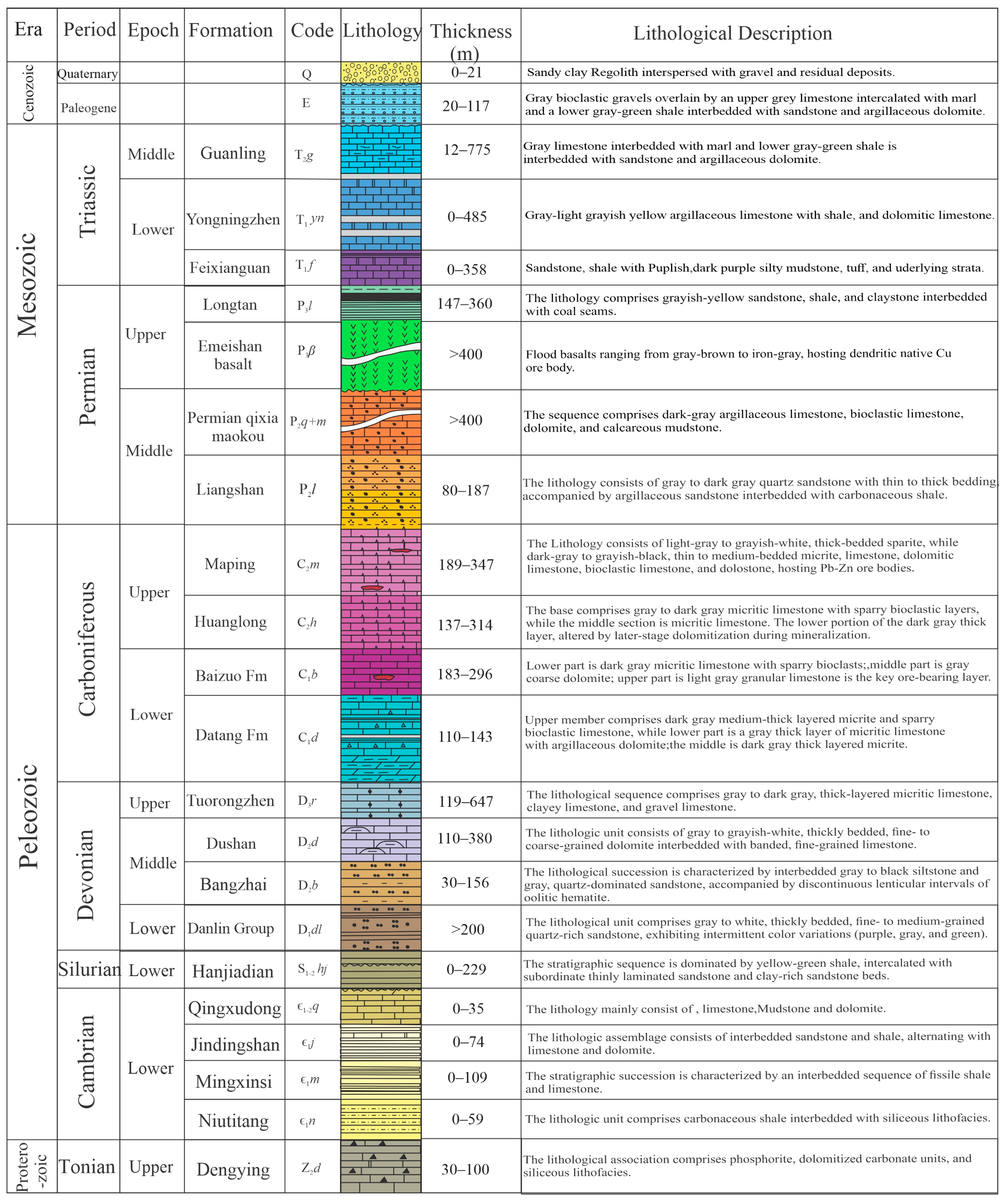
2. Regional Geology
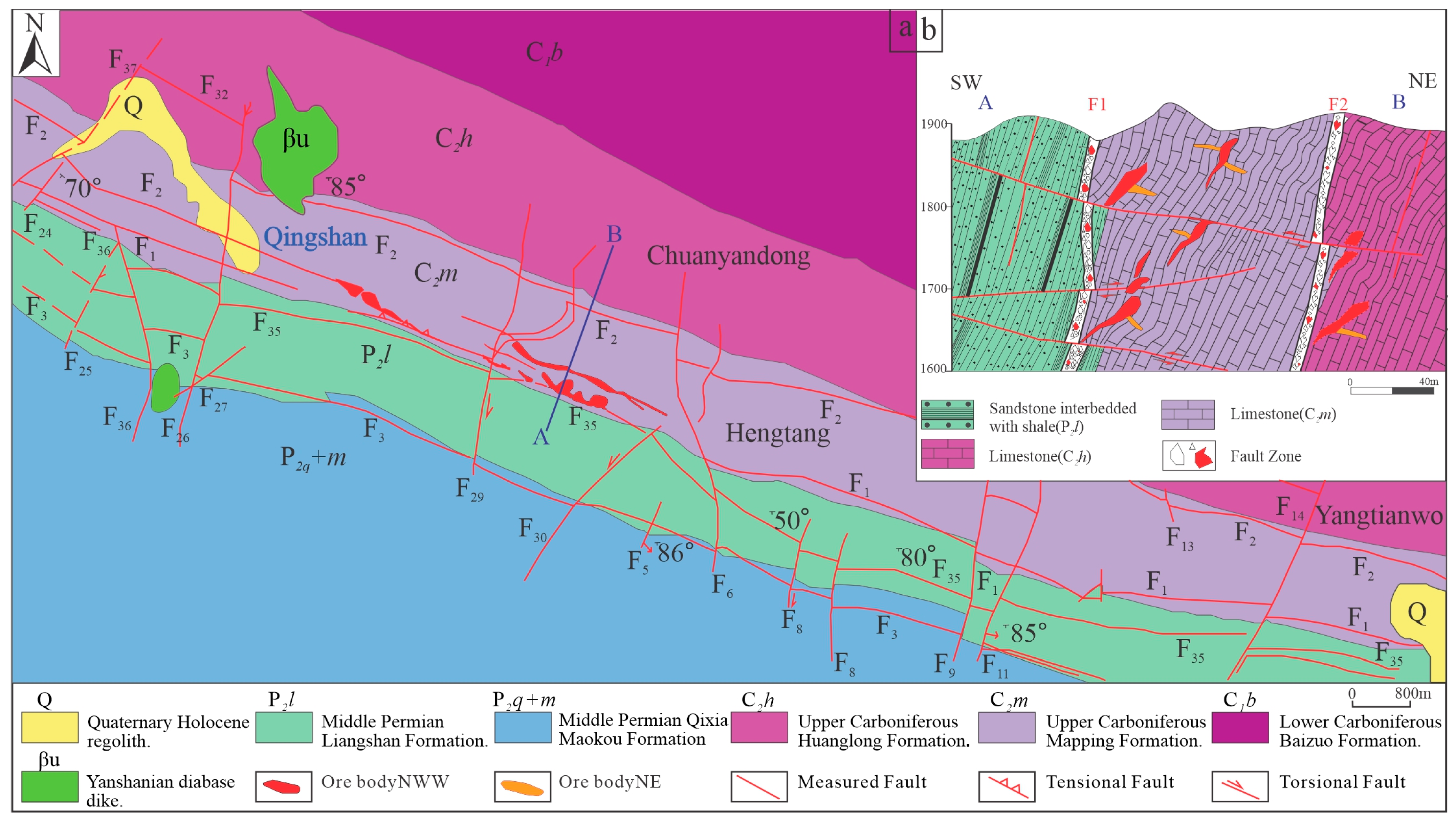
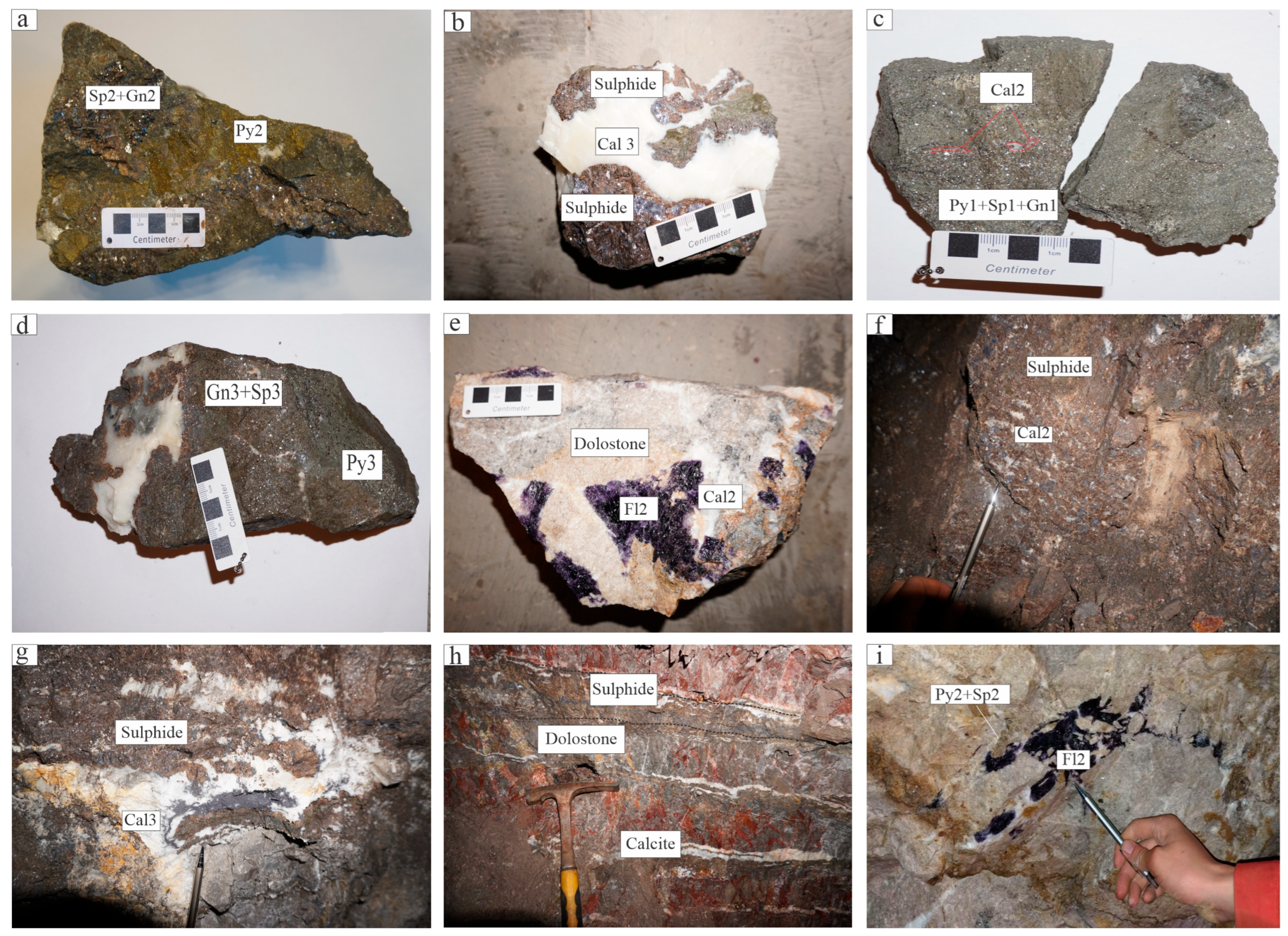
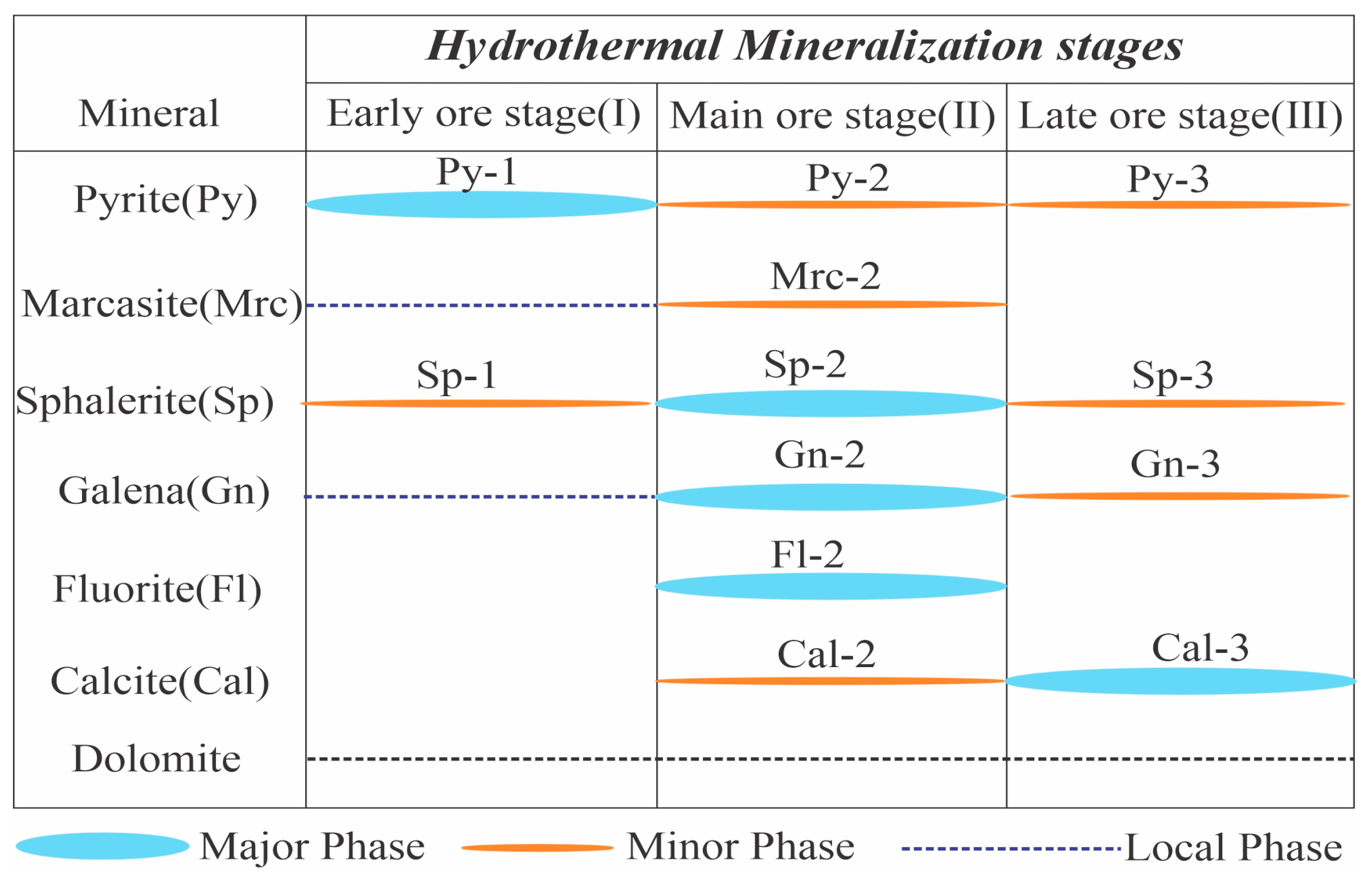
3. Ore Deposit Geology
4. Research Methods
4.1. Sampling Methods and Sample Processing
4.2. Analytical Methods
5. Analytical Results
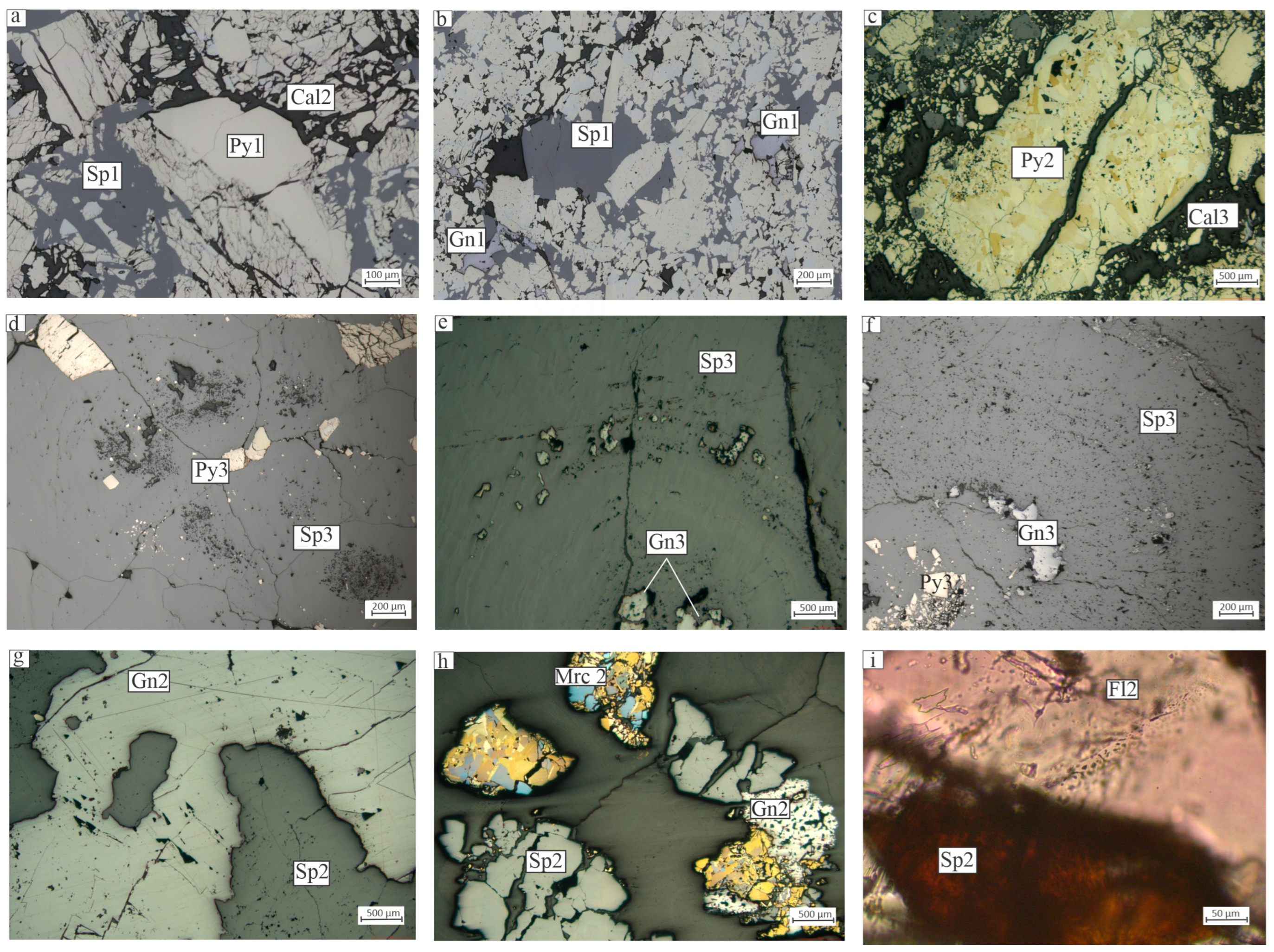
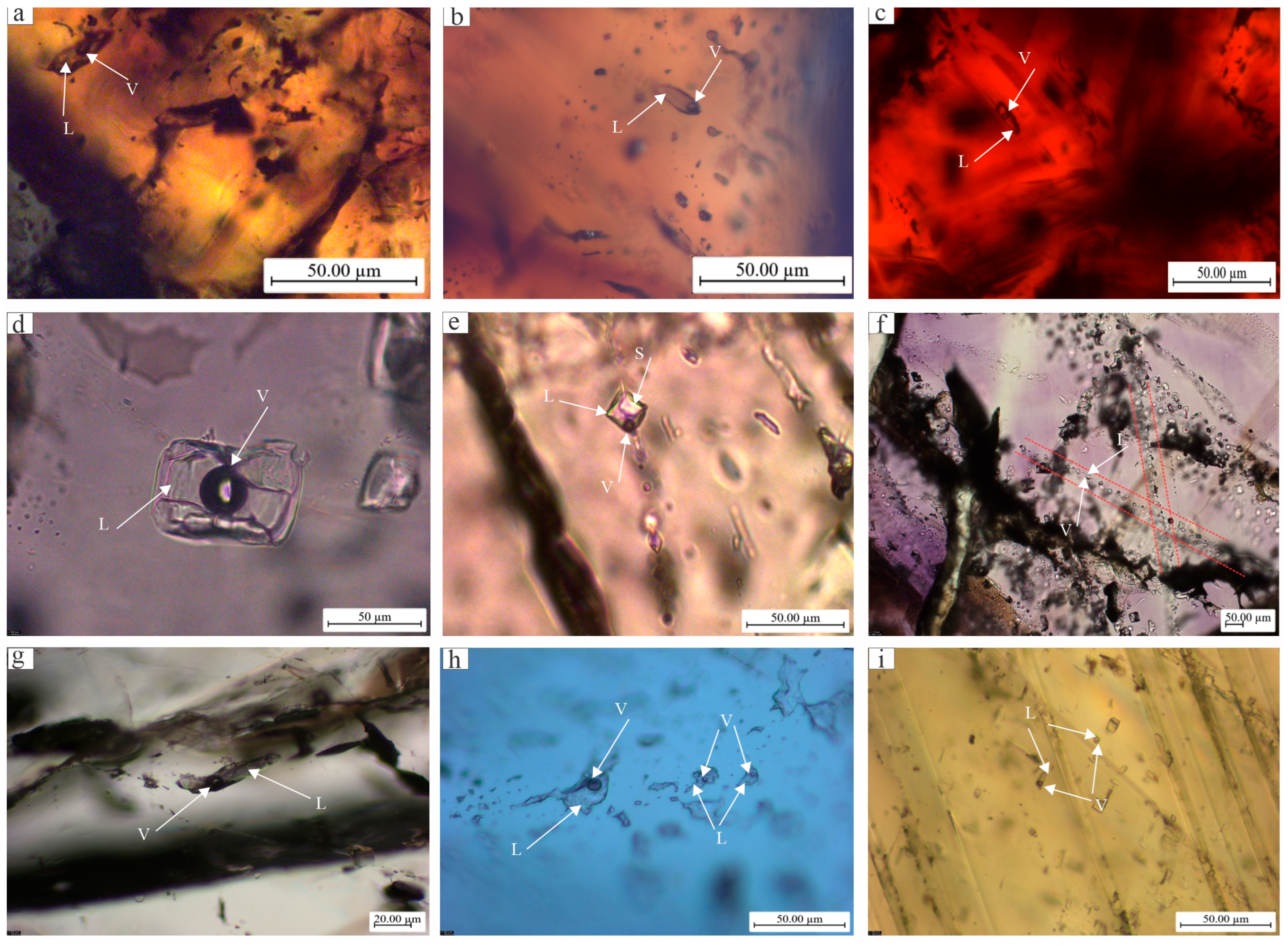
5.1. Fluid-Inclusion Petrography
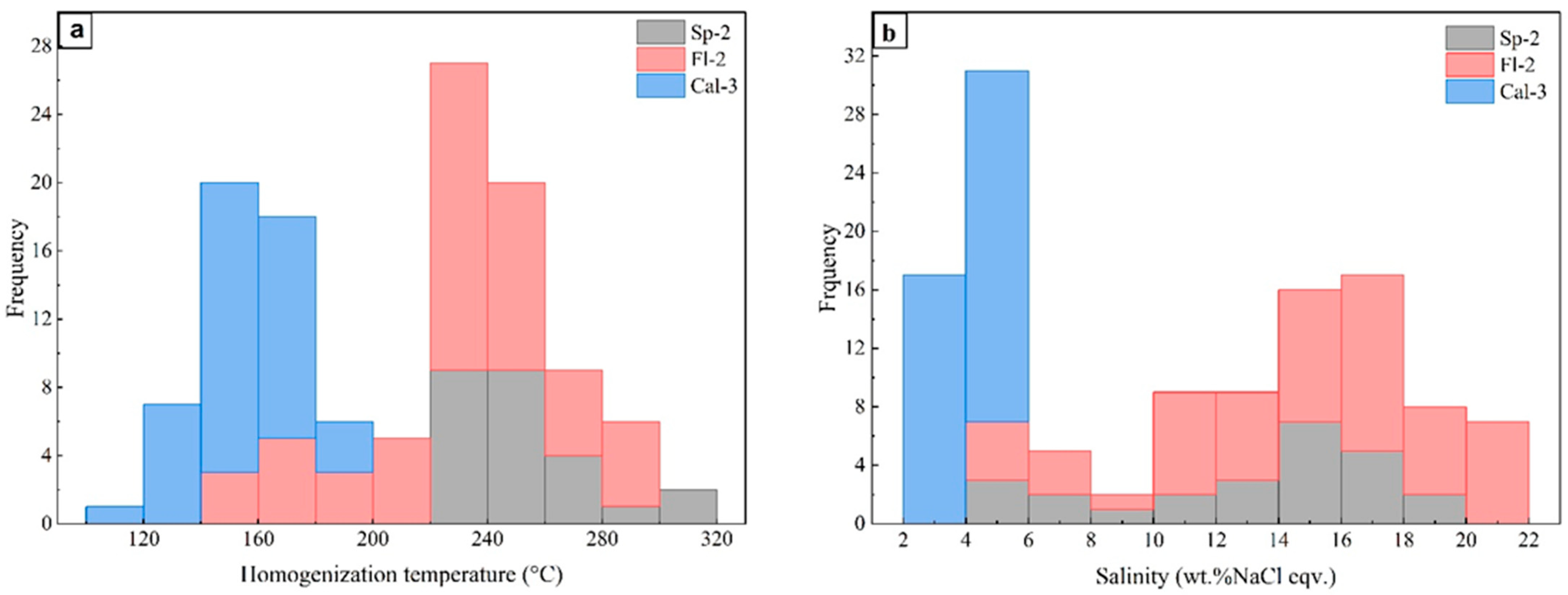
5.2. Microthermometry
5.3. C–O Isotopic Composition
5.4. Sulfur Isotope Compositions
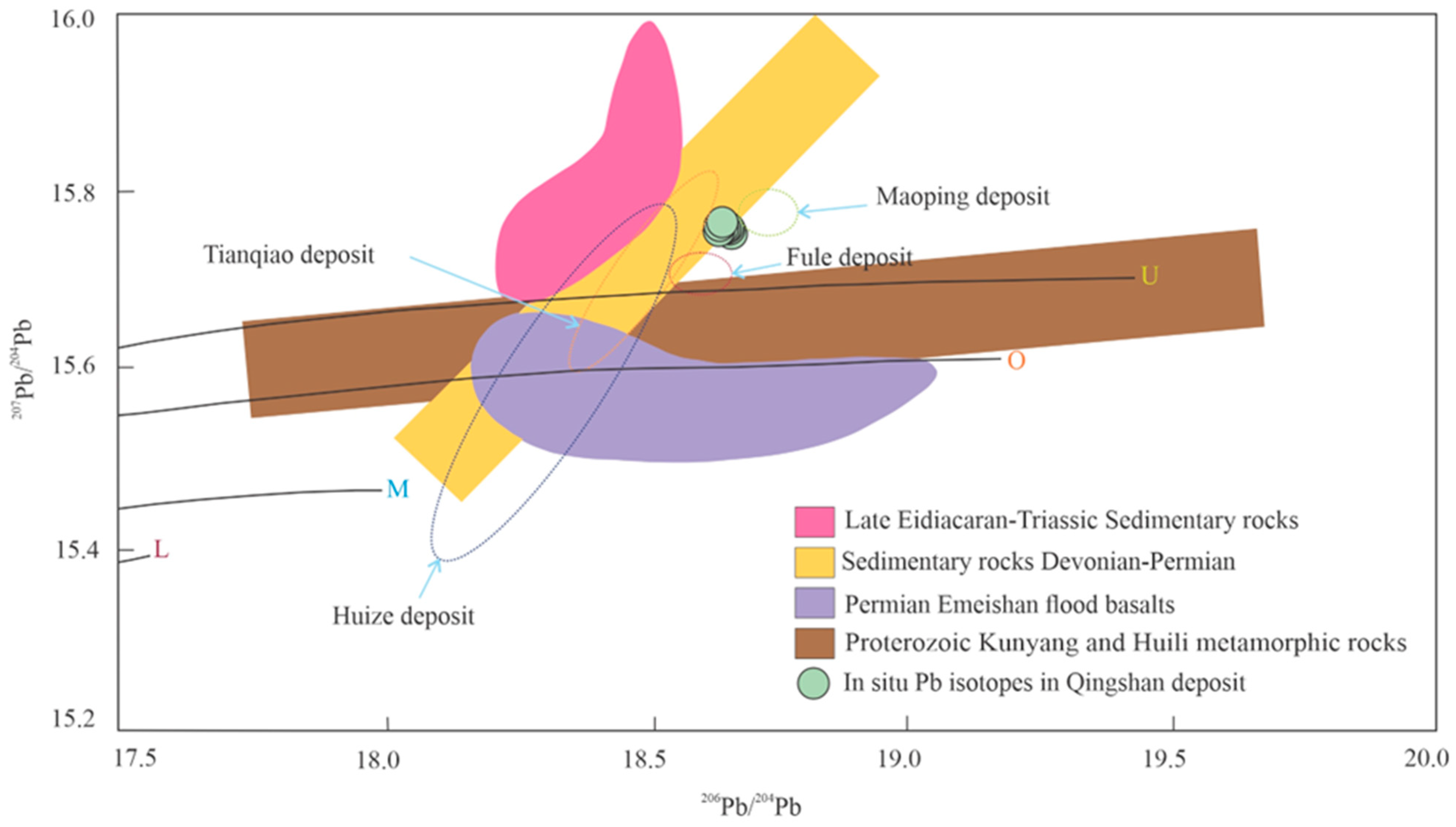
5.5. Lead Isotope Analyses
6. Discussion
6.1. Microthermometric Constraints on the Nature and Evolution of Ore-Forming Fluids
6.2. Sources of CO2

6.3. Sulfur Sources and Reduction Mechanism

6.4. Metal Sources
6.5. Proposed Metallogenic Model and Implications for Ore Exploration
7. Conclusions
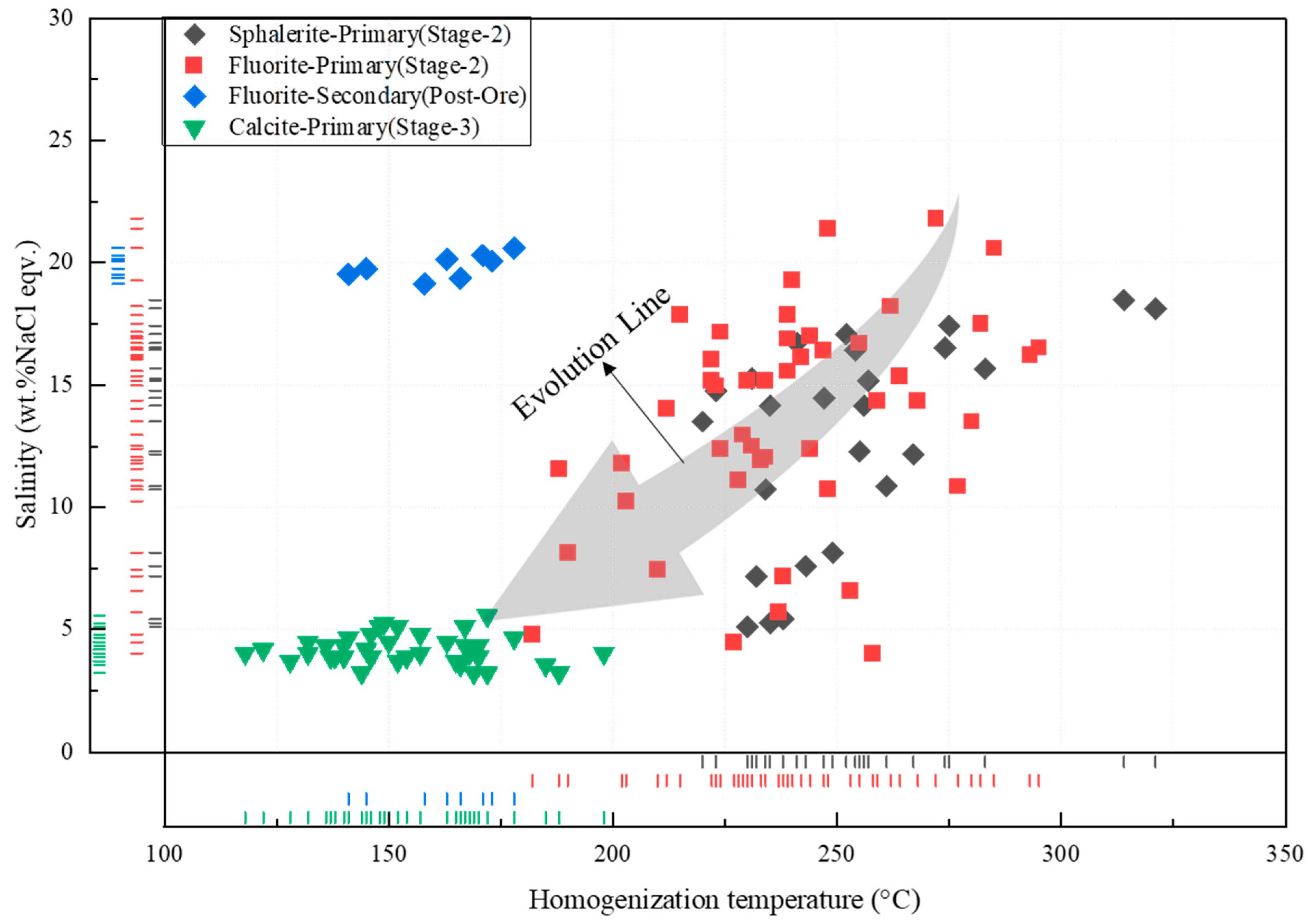
- The Qingshan Pb–Zn deposit, hosted within Upper Carboniferous carbonate rocks of the Maping Formation, formed through a multi-stage hydrothermal system linked to deep-fault controlled tectono-thermal reactivation in the SYGT area. The ore-forming fluids (118–310 °C; 3.2–21.8 wt.% NaCl equiv.) were dominantly deep-sourced brines, locally influenced by elevated regional heat flow and possible thermal input related to fault reactivation during the Indosinian orogeny.
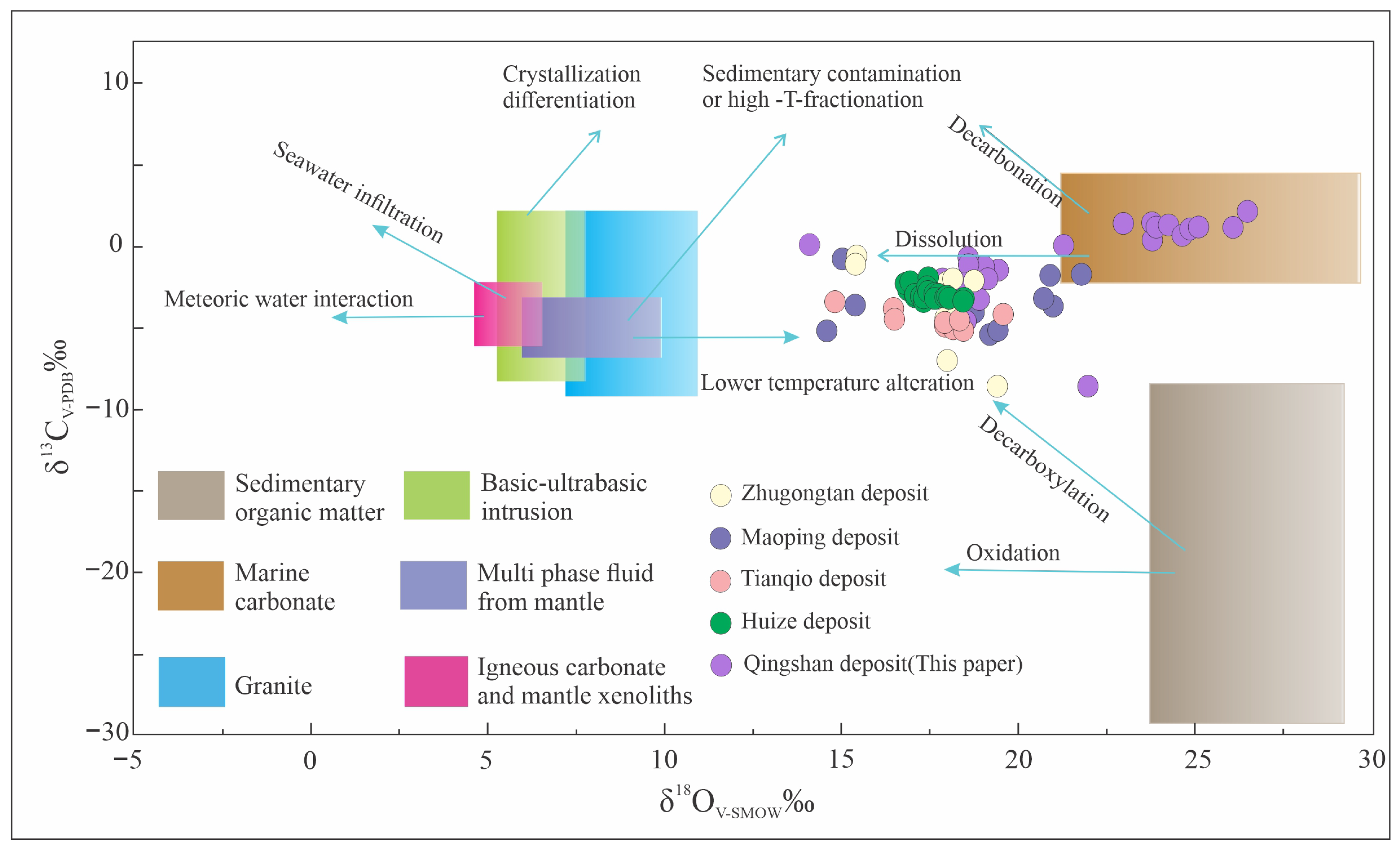
- Ore-stage calcite δ13CV_PDB (−8.60‰ to +2.10‰) and δ18OV_SMOW (14.10‰ to 26.50‰) indicate mixed carbon derived predominantly from marine carbonates, with additional contributions from organic matter, and deep-sourced fluids, reflecting carbonate dissolution and thermochemical sulfate reduction (TSR) during fluid–rock interaction.
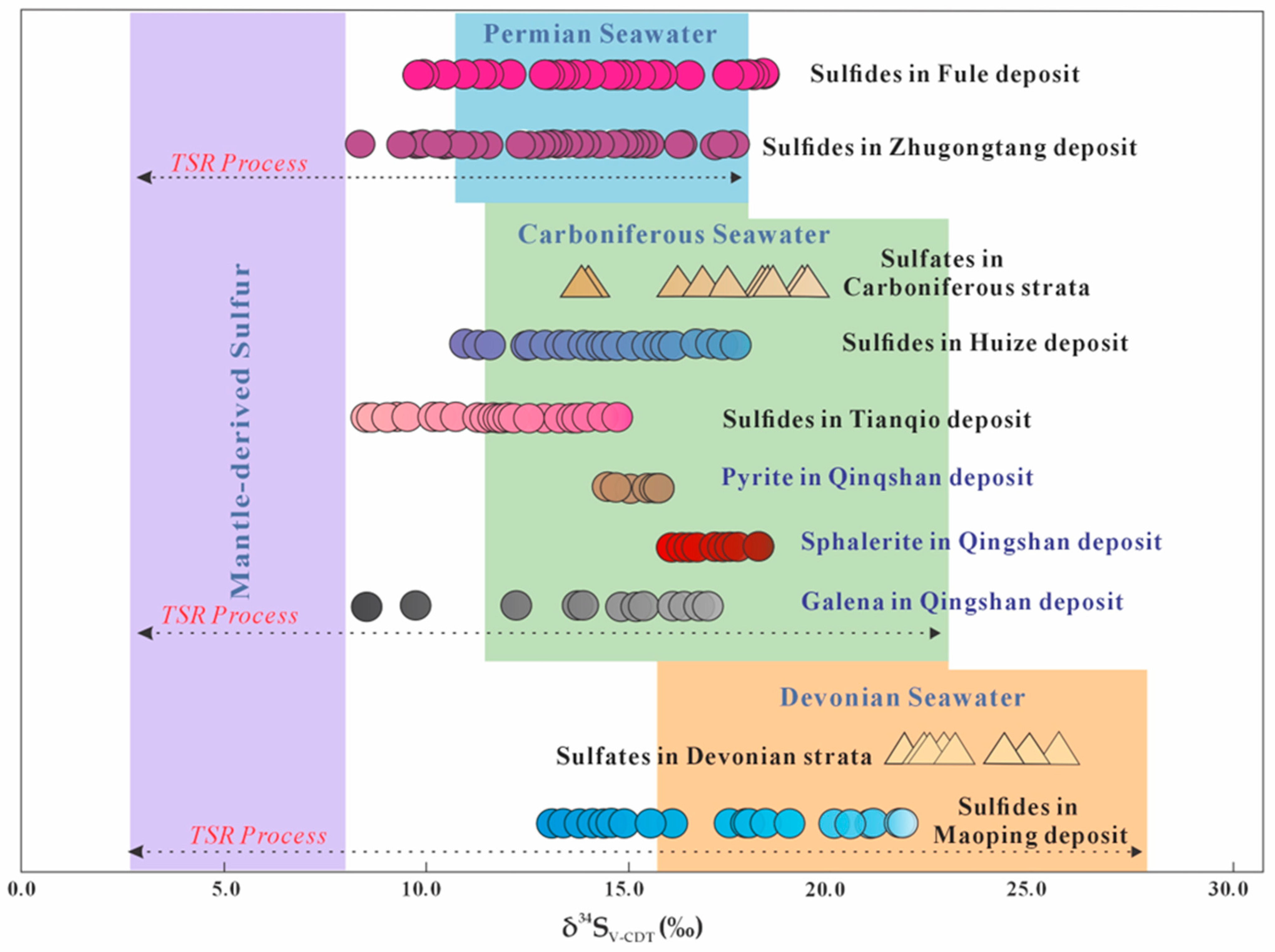
- Positive δ34SV_CDT values (+8.56‰ to +18.29‰), together with fluid temperatures >120 °C, indicate evaporitic sulfate as the principal sulfur source, reduced by thermochemical sulfate reduction (TSR). The heavy sulfur signature, coupled with partial isotopic disequilibrium among coexisting sulfides, indicates dynamic physicochemical conditions involving fluid mixing during ore deposition.
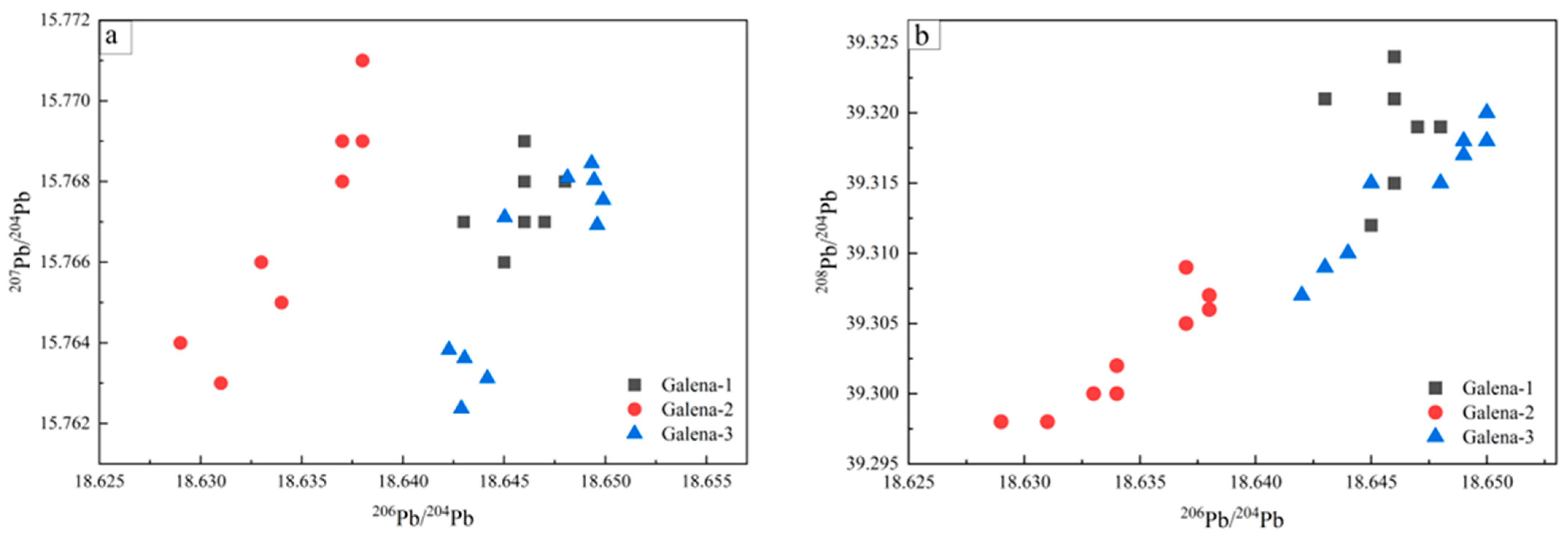
- Lead isotopic compositions demonstrate that metals were leached primarily from Devonian–Permian carbonate strata, with subordinate contributions from the Proterozoic basement.
- The Qingshan Pb–Zn deposit is genetically consistent with HZT-type, carbonate-hosted Pb–Zn deposit.
Author Contributions
Funding
Data Availability Statement
Acknowledgments
Conflicts of Interest
References
- Zhang, Y.; Han, R.-S.; Ding, X.; Wang, Y.-R.; Wei, P.-T. Experimental Study on Fluid Migration Mechanism Related to Pb–Zn Super-Enrichment: Implications for Mineralisation Mechanisms of the Pb–Zn Deposits in the Sichuan–Yunnan–Guizhou, SW China. Ore Geol. Rev. 2019, 114, 103110. [Google Scholar] [CrossRef]
- Han, R.S.; Zhang, Y.; Qiu, W.L.; Ding, T.Z.; Wang, M.Z.; Wang, F. Geology and Geochemistry of Zn-Pb(-Ge-Ag) Deposits in the Sichuan-Yunnan-Guizhou Triangle Area, China: A Review and a New Type. Front. Earth Sci. 2023, 11, 1136397. [Google Scholar] [CrossRef]
- Han, R.S.; Hu, Y.Z.; Wang, X.K.; Hou, B.H.; Huang, Z.L.; Chen, J.; Wang, F.; Wu, P.; Li, B.; Wang, H.J. Mineralization Model of Rich Ge-Ag-Bearing Zn-Pb Polymetallic Deposit Concentrated District in Northeastern Yunnan, China. Acta Geol. Sin. 2012, 86, 294, (In Chinese with English Abstract). [Google Scholar]
- Wang, C.; Deng, J.; Carranza, E.J.M.; Lai, X. Nature, Diversity and Temporal–Spatial Distributions of Sediment-Hosted Pb―Zn Deposits in China. Ore Geol. Rev. 2014, 56, 327–351. [Google Scholar] [CrossRef]
- Liu, H.C.; Lin, W.D. Regularity Research of Lead-Zinc-Silver Deposits in Northeastern Yunnan Province; Yunnan University Press: Kunming, China, 1999; pp. 1–468. (In Chinese) [Google Scholar]
- Leach, D.L.; Bradley, D.C.; Huston, D.; Pisarevsky, S.A.; Taylor, R.D.; Gardoll, S.J. Sediment-Hosted Lead-Zinc Deposits in Earth History. Econ. Geol. 2010, 105, 593–625. [Google Scholar] [CrossRef]
- Zhang, C.Q.; Xu, J.J.; Mao, J.W.; Rui, Z.Y. Advances in the Study of Mississippi Valley-Type Deposits. Miner. Depos. 2009, 28, 195–210, (In Chinese with English Abstract). [Google Scholar]
- Bradley, D.C.; Leach, D.L. Tectonic Controls of Mississippi Valley-Type lead–zinc Mineralization in Orogenic Forelands. Miner. Depos. 2003, 38, 652–667. [Google Scholar] [CrossRef]
- Leach, D.L.; Rowan, E.L. Genetic Link between Ouachita Foldbelt Tectonism and the Mississippi Valley–Type Lead-Zinc Deposits of the Ozarks. Geology 1986, 14, 931–935. [Google Scholar] [CrossRef]
- Wilkinson, J.J.; Weiss, D.J.; Mason, T.; Coles, B.J. Zinc Isotope Variation in Hydrothermal Systems: Preliminary Evidence from the Irish Midlands Ore Field. Econ. Geol. 2005, 100, 583–590. [Google Scholar] [CrossRef]
- Szmihelsky, M.; Steele-MacInnis, M.; Bain, W.M.; Falck, H.; Adair, R.; Campbell, B.; Dufrane, S.A.; Went, A.; Corlett, H.J. Mixing of Brine with Oil Triggered Sphalerite Deposition at Pine Point, Northwest Territories, Canada. Geology 2020, 49, 488–492. [Google Scholar] [CrossRef]
- Wilkinson, J.J.; Stoffell, B.; Wilkinson, C.C.; Jeffries, T.E.; Appold, M.S. Anomalously Metal-Rich Fluids Form Hydrothermal Ore Deposits. Science 2009, 323, 764–767. [Google Scholar] [CrossRef] [PubMed]
- Zhang, C.; Wu, Y.; Hou, L.; Mao, J. Geodynamic Setting of Mineralization of Mississippi Valley-Type Deposits in World-Class Sichuan–Yunnan–Guizhou Zn–Pb Triangle, Southwest China: Implications from Age-Dating Studies in the Past Decade and the Sm–Nd Age of Jinshachang Deposit. J. Asian Earth Sci. 2015, 103, 103–114. [Google Scholar] [CrossRef]
- Wang, J.; Li, C.Y.; Li, Z.Q.; Li, B.H.; Liu, W.Z. The Comparison of Mississippi Valley-Type Lead-Zinc Deposits in Southwest of China and in Mid-Continent of United States. BMPG 2002, 21, 127–132, (In Chinese with English Abstract). [Google Scholar]
- Zhang, C.Q.; Mao, J.; Wu, S.P.; Li, H.M.; Liu, F.; Guo, B.J.; Gao, D.R. Distribution, Characteristics and Genesis of Mississippi Valley-Type Lead-Zinc Deposits in Sichuan-Yunnan-Guizhou Area. Miner. Depos. 2005, 24, 336–348, (In Chinese with English Abstract). [Google Scholar]
- Han, R.S.; Wang, F.; Hu, Y.Z.; Wang, X.K.; Ren, T.; Qiu, W.L.; Zhong, K.H. Metallogenic Tectonic Dynamics and Chronology Constrains on the Huize-Type (HZT) Germanium-Rich Silver-Zinc-Lead Deposits. Geotecton. Metallog. 2014, 38, 759–771, (In Chinese with English Abstract). [Google Scholar]
- Han, R.S.; Chen, J.; Wang, F.; Wang, X.K.; Li, Y. Analysis of Metal-Element Association Halos within Fault Zones for the Exploration of Concealed Ore-Bodies—A Case Study of the Qilinchang Zn-Pb-(Ag-Ge) Deposit in the Huize Mine District, Northeastern Yunnan, China. J. Geochem. Explor. 2015, 159, 62–78. [Google Scholar] [CrossRef]
- Xu, Y.; Huang, Z.L.; Zhu, D.; Luo, T.Y. Origin of Hydrothermal Deposits Related to the Emeishan Magmatism. Ore Geol. Rev. 2014, 63, 1–8. [Google Scholar] [CrossRef]
- Han, R.S.; Zhang, Y.; Wang, F.; Wu, P.; Qiu, W.L.; Li, W.Y. Metallogenic Mechanism of Germanium Rich Lead-Zinc Deposits and Prediction of Concealed Ore Location in Northeast Yunnan; Science Press: Beijing, China, 2019; p. 501. (In Chinese) [Google Scholar]
- Han, R.S.; Wang, M.Z.; Jing, Z.G.; Li, B.; Wang, Z.Y. Ore-Controlling Mechanism of NE-Trending Ore-Forming Structural System at Zn-Pb Polymetallic Ore Concentration Area in Northwestern Guizhou. Acta Geol. Sin. 2020, 94, 850–868, (In Chinese with English Abstract). [Google Scholar]
- John, B.M.; Zhou, X.H.; Li, J.L. Formation and Tectonic Evolution of Southeastern China and Taiwan: Isotopic and Geochemical Constraints. Tectonophysics 1990, 183, 145–160. [Google Scholar] [CrossRef]
- Hu, R.; Fu, S.; Huang, Y.; Zhou, M.-F.; Fu, S.; Zhao, C.; Wang, Y.; Bi, X.; Xiao, J. The Giant South China Mesozoic Low-Temperature Metallogenic Domain: Reviews and a New Geodynamic Model. J. Asian Earth Sci. 2017, 137, 9–34. [Google Scholar] [CrossRef]
- Yang, Q.; Jiang, S.-Y.; Xiong, S.-F.; Hou, J.-J. Ore-Forming Processes of Giant Carbonate-Hosted Zn Pb Deposit and Ge Enrichment Mechanism in Zhugongtang, Guizhou Province, China: Constraints from Trace Element and Isotopic Compositions of Sulfides. J. Geochem. Explor. 2025, 270, 107666. [Google Scholar] [CrossRef]
- Han, R.S.; Wu, P.; Zhang, Y.; Huang, Z.L.; Wang, F.; Jin, Z.G.; Zhou, G.M.; Shi, Z.L.; Zhang, C.Q. New Research Progresses of Metallogenic Theory for Rich Zn-Pb-(Ag-Ge) Deposits in the Sichuan-Yunnan-Guizhou Triangle (SYGT) Area, Southwestern Tethys. Acta Geol. Sin. 2022, 96, 554–573, (In Chinese with English Abstract). [Google Scholar]
- Qiu, Y.M.; Gao, S.; McNaughton, N.J.; Groves, D.I.; Ling, W.L. First Evidence of > 3.2 Ga Continental Crust in the Yangtze Craton of South China and Its Implications for Archean Crustal Evolution and Phanerozoic Tectonics. Geology 2000, 28, 11–14. [Google Scholar] [CrossRef]
- Gao, S.; Yang, J.; Zhou, L.; Li, M.; Hu, Z.; Guo, J.; Yuan, H.; Gong, H.; Xiao, G.; Wei, J. Age and Growth of the Archean Kongling Terrain, South China, with Emphasis on 3.3 Ga Granitoid Gneisses. Am. J. Sci. 2011, 311, 153–182. [Google Scholar] [CrossRef]
- Zhao, X.F.; Zhou, M.F.; Li, J.W.; Sun, M.; Gao, J.F.; Sun, W.H.; Yang, J.H. Late Paleoproterozoic to Early Mesoproterozoic Dongchuan Group in Yunnan, SW China: Implications for Tectonic Evolution of the Yangtze Block. Precambrian Res. 2010, 182, 57–69. [Google Scholar] [CrossRef]
- Sun, W.H.; Zhou, M.F.; Yan, D.P.; Li, J.W.; Ma, Y.X. Provenance and Tectonic Setting of the Neoproterozoic Yanbian Group, Western Yangtze Block (SW China). Precambrian Res. 2008, 167, 213–236. [Google Scholar] [CrossRef]
- Wang, L.J.; Yu, J.H.; Griffin, W.L.; O’Reilly, S.Y. Early Crustal Evolution in the Western Yangtze Block: Evidence from U-Pb and Lu-Hf Isotopes on Detrital Zircons from Sedimentary Rocks. Precambrian Res. 2012, 222, 368–385. [Google Scholar] [CrossRef]
- Zhou, M.-F.; Malpas, J.; Song, X.-Y.; Robinson, P.T.; Sun, M.; Kennedy, A.K.; Lesher, C.M.; Keays, R.R. A Temporal Link between the Emeishan Large Igneous Province (SW China) and the End-Guadalupian Mass Extinction. Earth Planet. Sci. Lett. 2002, 196, 113–122. [Google Scholar] [CrossRef]
- Jing, Z.G. Ore-Controlling Factors, Metallogenic Rules and Prospecting Prediction of Lead and Zinc Deposits in Northwest Guizhou; Metallurgical Industry Press: Beijing, China, 2008. (In Chinese) [Google Scholar]
- Song, D.H.; Han, R.S.; Wang, F.; Wang, M.Z.; He, Z.; Zhou, W.; Luo, D. Structural Ore−controlling Mechanism of the Qingshan Lead−zinc Deposit in Northwestern Guizhou, China and Its Implications for Deep Prospecting. Geol. China 2024, 51, 399–425. [Google Scholar]
- Zhao, X.; Han, R.; Zhang, Y.; Wang, M.; Wang, L. Indication of REEs, Fe, and Mn Composition Typomorphism of Calcite in Metallogenic Fracture Zones with Respect to Local Tectonic Stress Fields: A Case Study of the Qingshan Lead–Zinc Deposit in Northwest Guizhou, China. Minerals 2025, 15, 292. [Google Scholar] [CrossRef]
- Bodnar, R.J. Revised Equation and Table for Determining the Freezing Point Depression of H2O-Nacl Solutions. Geochim. Et Cosmochim. Acta 1993, 57, 683–684. [Google Scholar] [CrossRef]
- McCrea, J.M. On the Isotopic Chemistry of Carbonates and a Paleotemperature Scale. J. Chem. Phys. 1950, 18, 849–857. [Google Scholar] [CrossRef]
- Chen, L.; Chen, K.; Bao, Z.; Liang, P.; Sun, T.; Yuan, H. Preparation of Standards for in Situ Sulfur Isotope Measurement in Sulfides Using Femtosecond Laser Ablation MC-ICP-MS. J. Anal. At. Spectrom. 2017, 32, 107–116. [Google Scholar] [CrossRef]
- Bao, Z.; Chen, L.; Zong, C.; Yuan, H.; Chen, K.; Dai, M. Development of Pressed Sulfide Powder Tablets for in Situ Sulfur and Lead Isotope Measurement Using LA-MC-ICP-MS. Int. J. Mass Spectrom. 2017, 421, 255–262. [Google Scholar] [CrossRef]
- Yuan, H.; Liu, X.; Chen, L.; Bao, Z.; Chen, K.; Zong, C.; Li, X.-C.; Qiu, J.W. Simultaneous Measurement of Sulfur and Lead Isotopes in Sulfides Using Nanosecond Laser Ablation Coupled with Two Multi-Collector Inductively Coupled Plasma Mass Spectrometers. J. Asian Earth Sci. 2018, 154, 386–396. [Google Scholar] [CrossRef]
- Yuan, H.; Yin, C.; Liu, X.; Chen, K.; Bao, Z.; Zong, C.; Dai, M.; Lai, S.; Wang, R.; Jiang, S. High Precision In-Situ Pb Isotopic Analysis of Sulfide Minerals by Femtosecond Laser Ablation Multi-Collector Inductively Coupled Plasma Mass Spectrometry. Sci. China Earth Sci. 2015, 58, 1713–1721. [Google Scholar] [CrossRef]
- Roedder, E. Fluid inclusions. Rev. Mineral. 1984, 12, 644. [Google Scholar]
- Chi, G.; Haid, T.; Quirt, D.; Fayek, M.; Blamey, N.; Chu, H. Petrography, Fluid Inclusion Analysis, and Geochronology of the End Uranium Deposit, Kiggavik, Nunavut, Canada. Min. Depos. 2017, 52, 211–232. [Google Scholar] [CrossRef]
- Steele-MacInnis, M.; Lecumberri-Sanchez, P.; Bodnar, R.J. HokieFlincs_H2O-NaCl: A Microsoft Excel Spreadsheet for Interpreting Microthermometric Data from Fluid Inclusions Based on the PVTX Properties of H 2 O–NaCl. Comput. Geosci. 2012, 49, 334–337. [Google Scholar] [CrossRef]
- Limbeck, A.; Galler, P.; Bonta, M.; Bauer, G.; Nischkauer, W.; Vanhaecke, F. Recent Advances in Quantitative LA-ICP-MS Analysis: Challenges and Solutions in the Life Sciences and Environmental Chemistry. Anal Bioanal Chem 2015, 407, 6593–6617. [Google Scholar] [CrossRef]
- Cooke, D.R.; Bull, S.W.; Large, R.R.; McGoldrick, P.J. The Importance of Oxidized Brines for the Formation of Australian Proterozoic Stratiform Sediment-Hosted Pb–Zn (Sedex) Deposits. Econ. Geol. 2000, 95, 1–18. [Google Scholar] [CrossRef]
- Fernández, F.G.; Both, R.A.; Mangas, J.; Arribas, A. Metallogenesis of Zn-Pb Carbonate-Hosted Mineralization in the Southeastern Region of the Picos de Europa (Central Northern Spain) Province: Geologic, Fluid Inclusion, and Stable Isotope Studies. Econ. Geol. 2000, 95, 19–40. [Google Scholar] [CrossRef]
- Burruss, R.C. Diagenetic Palaeotemperatures from Aqueous Fluid Inclusions: Re-Equilibration of Inclusions in Carbonate Cements by Burial Heating. Mineral. Mag. 1987, 51, 477–481. [Google Scholar] [CrossRef]
- Bodnar, R.J.; Sterner, S.M. Synthetic Fluid Inclusions in Natural Quartz. II. Application to PVT Studies. Geochim. Et Cosmochim. Acta 1985, 49, 1855–1859. [Google Scholar] [CrossRef]
- Yardley, B.W.D.; Graham, J.T. The Origins of Salinity in Metamorphic Fluids. Geofluids 2002, 2, 249–256. [Google Scholar] [CrossRef]
- Hanor, J.S. Origin of Saline Fluids in Sedimentary Basins. Geol. Soc. Lond. Spec. Publ. 1994, 78, 151–174. [Google Scholar] [CrossRef]
- Zhou, J.-X.; Xiang, Z.-Z.; Zhou, M.-F.; Feng, Y.-X.; Luo, K.; Huang, Z.-L.; Wu, T. The Giant Upper Yangtze Pb–Zn Province in SW China: Reviews, New Advances and a New Genetic Model. J. Asian Earth Sci. 2018, 154, 280–315. [Google Scholar] [CrossRef]
- Yang, Q.; Xiong, S.-F.; Jiang, S.-Y. Genesis of Pb–Zn Deposits in Northwestern Guizhou Province of China: Constraints from the in Situ Analyses of Fluid Inclusions and Sulfur Isotopes. Ore Geol. Rev. 2024, 164, 105842. [Google Scholar] [CrossRef]
- Bodnar, R.J. Reequilibration of Fluid Inclusions. In Fluid Inclusions: Analysis and Interpretation; Mineralogical Association of Canada Short Course; Samson, I., Anderson, A., Marshall, D., Eds.; 2003; Volume 32, pp. 213–230. [Google Scholar] [CrossRef]
- Li, T.; Wu, G.; Liu, J.; Hu, Y.; Zhang, Y.; Luo, D.; Mao, Z. Fluid Inclusions and Isotopic Characteristics of the Jiawula Pb–Zn–Ag Deposit, Inner Mongolia, China. J. Asian Earth Sci. 2015, 103, 305–320. [Google Scholar] [CrossRef]
- Taylor, H.P.; Frechen, J.; Degens, E.T. Oxygen and Carbon Isotope Studies of Carbonatites from the Laacher See District, West Germany and the Alnö District, Sweden. Geochim. Et Cosmochim. Acta 1967, 31, 407–430. [Google Scholar] [CrossRef]
- Hoefs, J. Stable Isotope Geochemistry, 6th ed.; Springer: Berlin/Heidelberg, Germany, 2009. [Google Scholar] [CrossRef]
- Veizer, J.; Hoefs, J. The Nature of O18/O16 and C13/C12 Secular Trends in Sedimentary Carbonate Rocks. Geochim. Et Cosmochim. Acta 1976, 40, 1387–1395. [Google Scholar] [CrossRef]
- Liu, Y.; He, L.-L.; Yang, K.-G.; Ali, P.; Zhou, Q.; Wu, P.; Wu, D.-W.; Wang, J.; Cai, J.-C. Constraints of C H O S Pb Isotopes and Fluid Inclusions on the Origin of the Giant Zhugongtang Carbonate-Hosted Pb–Zn Deposit in South China. Ore Geol. Rev. 2022, 151, 105192. [Google Scholar] [CrossRef]
- He, Y.; Wu, T.; Huang, Z.; Ye, L.; Deng, P.; Xiang, Z. Genesis of the Maoping Carbonate-Hosted Pb–Zn Deposit, Northeastern Yunnan Province, China: Evidences from Geology and C–O–S–Pb Isotopes. Acta Geochim. 2020, 39, 782–796. [Google Scholar] [CrossRef]
- Han, R.S.; Zou, H.J.; Hu, B.; Hu, Y.Z. Features of Fluid Inclusions and Sources of Ore-Forming Fluid in the Maoping Carbonate-Hosted Zn-Pb-(Ag-Ge) Deposit, Yunnan, China. Acta Petrol. Sin. 2007, 23, 2109–2118, (In Chinese with English Abstract). [Google Scholar]
- Zhou, J.; Huang, Z.; Zhou, M.; Li, X.; Jin, Z. Constraints of C–O–S–Pb Isotope Compositions and Rb–Sr Isotopic Age on the Origin of the Tianqiao Carbonate-Hosted Pb–Zn Deposit, SW China. Ore Geol. Rev. 2013, 53, 77–92. [Google Scholar] [CrossRef]
- Han, R.-S.; Liu, C.-Q.; Huang, Z.-L.; Chen, J.; Ma, D.-Y.; Lei, L.; Ma, G.-S. Geological Features and Origin of the Huize Carbonate-Hosted Zn–Pb–(Ag) District, Yunnan, South China. Ore Geol. Rev. 2007, 31, 360–383. [Google Scholar] [CrossRef]
- Huang, Z.; Li, X.; Zhou, M.; Li, W.; Jin, Z. REE and C-O Isotopic Geochemistry of Calcites from the World-Class Huize Pb–Zn Deposits, Yunnan, China: Implications for the Ore Genesis. Acta Geol. Sin.-Engl. Ed. 2010, 84, 597–613. [Google Scholar] [CrossRef]
- Yang, Q.; Liu, W.H.; Zhang, J.; Wang, J.; Zhang, X.J. Formation of Pb–Zn Deposits in the Sichuan-Yunnan-Guizhou Triangle Linked to the Youjiang Foreland Basin: Evidence from Rb-Sr Age and in Situ Sulfur Isotope Analysis of the Maoping Pb–Zn Deposit in Northeastern Yunnan Province, Southeast China. Ore Geol. Rev. 2019, 107, 780–800. [Google Scholar] [CrossRef]
- Kump, L.R.; Arthur, M.A. Interpreting Carbon-Isotope Excursions: Carbonates and Organic Matter. Chem. Geol. 1999, 161, 181–198. [Google Scholar] [CrossRef]
- Ottaway, T.L.; Wicks, F.J.; Bryndzia, L.T.; Kyser, T.K.; Spooner, E.T.C. Formation of the Muzo Hydrothermal Emerald Deposit in Colombia. Nature 1994, 369, 552–554. [Google Scholar] [CrossRef]
- Ohmoto, H.; Goldhaber, M.B. Sulfur and Carbon Isotopes. In Geochemistry of Hydrothermal Ore Deposits, 3rd ed.; Barnes, H.L., Ed.; Wiley: New York, NY, USA, 1997; pp. 517–611. [Google Scholar]
- Seal, R.R., II. Sulfur Isotope Geochemistry of Sulfide Minerals. Rev. Mineral. Geochem. 2006, 61, 633–677. [Google Scholar] [CrossRef]
- Chaussidon, M.; Albarède, F.; Sheppard, S.M.F. Sulphur Isotope Variations in the Mantle from Ion Microprobe Analyses of Micro-Sulphide Inclusions. Earth Planet. Sci. Lett. 1989, 92, 144–156. [Google Scholar] [CrossRef]
- Rollinson, H.R. Using Geochemical Data: Evaluation, Presentation, Interpretation; Longman Scientific & Technical: London, UK, 1993; pp. 306–308. [Google Scholar]
- Claypool, G.E.; Holser, W.T.; Kaplan, I.R.; Sakai, H.; Zak, I. The Age Curves of Sulfur and Oxygen Isotopes in Marine Sulfate and Their Mutual Interpretation. Chem. Geol. 1980, 28, 199–260. [Google Scholar] [CrossRef]
- Machel, H.G. Bacterial and Thermochemical Sulfate Reduction in Diagenetic Settings—Old and New Insights. Sediment. Geol. 2001, 140, 143–175. [Google Scholar] [CrossRef]
- Zhou, J.-X.; Luo, K.; Wang, X.-C.; Wilde, S.A.; Wu, T.; Huang, Z.-L.; Cui, Y.-L.; Zhao, J.-X. Ore Genesis of the Fule Pb Zn Deposit and Its Relationship with the Emeishan Large Igneous Province: Evidence from Mineralogy, Bulk C O S and in Situ S Pb Isotopes. Gondwana Res. 2018, 54, 161–179. [Google Scholar] [CrossRef]
- Li, X.B.; Huang, Z.L.; Li, W.B.; Zhang, Z.L.; Yan, Z.F. Sulfur Isotopic Compositions of the Huize Super-Large Pb–Zn Deposit, Yunnan Province, China: Implications for the Source of Sulfur in the Ore-Forming Fluids. J. Geochem. Explor. 2006, 89, 227–230. [Google Scholar] [CrossRef]
- Ren, S.L.; Li, Y.H.; Zeng, P.S.; Qiu, W.L.; Fan, C.F.; Hu, G.Y. Effect of Sulfate Evaporate Salt Layer in Mineralization of the Huize and Maoping Lead-Zinc Deposits in Yunnan: Evidence from Sulfur Isotope. Acta Geol. Sin. 2018, 92, 1041–1055. [Google Scholar]
- Machel, H.G. Relationships between Sulphate Reduction and Oxidation of Organic Compounds to Carbonate Diagenesis, Hydrocarbon Accumulations, Salt Domes, and Metal Sulphide Deposits. Carbonates Evaporites 1989, 4, 137–151. [Google Scholar] [CrossRef]
- Jørgensen, B.B.; Isaksen, M.F.; Jannasch, H.W. Bacterial Sulfate Reduction Above 100 °C in Deep-Sea Hydrothermal Vent Sediments. Science 1992, 258, 1756–1757. [Google Scholar] [CrossRef]
- Carr, G.R.; Dean, J.A.; Suppel, D.W.; Heithersay, P.S. Precise Lead Isotope Fingerprinting of Hydrothermal Activity Associated with Ordovician to Carboniferous Metallogenic Events in the Lachlan Fold Belt of New South Wales. Econ. Geol. 1995, 90, 1467–1505. [Google Scholar] [CrossRef]
- Kong, Z.; Wu, Y.; Liang, T.; Zhang, F.; Meng, X.; Lu, L.; Yang, G. Sources of Ore-Forming Material for Pb–Zn Deposits in the Sichuan-Yunnan-Guizhou Triangle Area: Multiple Constraints from C-H-O-S-Pb-Sr Isotopic Compositions. Geol. J. 2018, 53, 159–177. [Google Scholar] [CrossRef]
- Zartman, R.E.; Doe, B.R. Plumbotectonics—The Model. Tectonophysics 1981, 75, 135–162. [Google Scholar] [CrossRef]
- Shellnutt, J.G. The Emeishan Large Igneous Province: A Synthesis. Geosci. Front. 2014, 5, 369–394. [Google Scholar] [CrossRef]
- Huang, Z.L.; Chen, J.; Han, R.S.; Li, W.B.; Liu, C.Q.; Zhang, Z.L.; Ma, D.Y.; Gao, D.R.; Yang, H.L. Geochemistry and Ore-Formation of the Huize Giant Lead-Zinc Deposit, Yunnan Province, China: Discussion on the Relationship between the Emeishan Flood Basalts and Lead–Zinc Mineralization; Geological Publishing House: Beijing, China, 2004; pp. 1–204. (in Chinese) [Google Scholar]
- Basuki, N.I. A Review of Fluid Inclusion Temperatures and Salinities in Mississippi Valley-Type Zn-Pb Deposits: Identifying Thresholds for Metal Transport. Explor. Min. Geol. 2002, 11, 1–17. [Google Scholar] [CrossRef]
- Leach, D.L.; Sangster, D.F.; Kelley, K.D.; Large, R.R.; Garven, G.; Allen, C.R.; Gutzmer, J.; Walters, S. Sediment-hosted lead-zinc deposits: A global perspective. Econ. Geol. 2005, 561–607. [Google Scholar] [CrossRef]



| Mineral | Stage | n | Tm-ice (°C) | Th (°C) | Salinity (wt.% NaCl Eqv.) | |||
|---|---|---|---|---|---|---|---|---|
| Range | Mean | Range | Mean | Range | Mean | |||
| Sphalerite | II | 25 | −14.8 to −3.1 | −9.4 | 220 to 310 | 252 | 5.1 to 18.5 | 12.9 |
| Fluorite | II | 47 | −19.2 to −2.4 | −10.2 | 182 to 295 | 240 | 4.0 to 21.8 | 13.9 |
| Calcite | III | 41 | −3.4 to −1.9 | −2.5 | 118 to 198 | 155 | 3.2 to 5.6 | 4.2 |
| Fluorite | Post ore | 8 | −17.5 to 15.5 | −16.7 | 141 to 178 | 162 | 19.1 to 20.6 | 19.9 |
| Sample Number | Mineral | δ13CV-PDB (‰) | δ18OV-PDB (‰) | δ18OV-SMOW (‰) | |
|---|---|---|---|---|---|
| QSL-5r-2 | Calcite | 0.1 | −9.3 | 21.3 | |
| QSL4PD-1 | Calcite | 0.8 | −6 | 24.7 | |
| QSC-1 | Calcite | 2.1 | −4.3 | 26.5 | |
| QSH-2-1r | Calcite | −2.3 | −12.1 | 18.4 | |
| QSHZ2-2r | Calcite | 0.5 | −6.9 | 23.8 | |
| QSL-5r-1 | Calcite | 1.2 | −4.6 | 26.1 | |
| QSL-13r | Calcite | −1 | −11.9 | 18.6 | |
| QSH-2-3r | Calcite | −1.5 | −11.2 | 19.3 | This paper |
| QSH-2-4r | Calcite | −1.4 | −12 | 18.6 | |
| Qsl-7-1r | Calcite | 1.2 | −6.7 | 24 | |
| QSL-4 | Calcite | 1.4 | −6.4 | 24.3 | |
| QSH-2-2r | Calcite | −2.6 | −13.5 | 17 | |
| WL-6 | Calcite | −8.6 | −8.6 | 22 | |
| QSL4PD-2 | Calcite | 1.4 | −6.8 | 23.9 | |
| QSL4PD-3 | Calcite | 1.2 | −5.7 | 25 | |
| QSL4PD-4 | Calcite | 1.4 | −7.7 | 23 | |
| QSL-6r | Calcite | 1.3 | −5.6 | 25.2 | |
| QSC-2 | Calcite | 0.1 | −16.3 | 14.1 | |
| QSC-5 | Calcite | −4.7 | −12.1 | 18.4 | |
| QSC-6 | Calcite | −2.3 | −12.6 | 18 | |
| QSH-1-1r | Calcite | −2.2 | −11.5 | 19 | |
| 8PJLY | Calcite | −1.5 | −11.6 | 19 |
| Sample No. | Spot | Mineral | δ34SV-CDT (‰) |
|---|---|---|---|
| QSWL-13 | S-1 | Pyrite-1 | 15.06 |
| S-2 | Pyrite-1 | 15.59 | |
| S-3 | Pyrite-1 | 14.49 | |
| S-4 | Pyrite-1 | 15.18 | |
| S-5 | Pyrite-1 | 15.27 | |
| S-6 | Pyrite-1 | 14.91 | |
| S-7 | Pyrite-1 | 15.40 | |
| S-8 | Pyrite-1 | 14.85 | |
| S-9 | Pyrite-1 | 15.37 | |
| S-10 | Pyrite-1 | 15.27 | |
| QSL4PD-3 | S-1 | Pyrite-2 | 15.04 |
| S-2 | Pyrite-2 | 14.87 | |
| S-3 | Pyrite-2 | 15.22 | |
| S-4 | Pyrite-2 | 14.79 | |
| S-5 | Pyrite-2 | 15.02 | |
| S-6 | Pyrite-2 | 14.69 | |
| S-7 | Pyrite-2 | 14.69 | |
| S-8 | Pyrite-2 | 15.50 | |
| S-9 | Pyrite-2 | 14.54 | |
| S-10 | Pyrite-2 | 15.42 | |
| QSL-6r | S-1 | Pyrite-3 | 15.79 |
| S-2 | Pyrite-3 | 15.71 | |
| S-3 | Pyrite-3 | 15.54 | |
| S-4 | Pyrite-3 | 15.55 | |
| S-5 | Pyrite-3 | 15.08 | |
| QSWL-13 | S-1 | Sphalerite-1 | 17.74 |
| S-2 | Sphalerite-1 | 16.73 | |
| S-3 | Sphalerite-1 | 18.22 | |
| S-4 | Sphalerite-1 | 17.57 | |
| S-5 | Sphalerite-1 | 18.29 | |
| QSL4PD-1 | S-1 | Sphalerite-2 | 17.74 |
| S-2 | Sphalerite-2 | 17.18 | |
| S-3 | Sphalerite-2 | 17.69 | |
| S-4 | Sphalerite-2 | 17.70 | |
| S-5 | Sphalerite-2 | 17.64 | |
| QSL-6r | S-1 | Sphalerite-3 | 16.58 |
| S-2 | Sphalerite-3 | 16.42 | |
| S-3 | Sphalerite-3 | 16.12 | |
| S-4 | Sphalerite-3 | 17.41 | |
| S-5 | Sphalerite-3 | 17.77 | |
| S-6 | Sphalerite-3 | 17.58 | |
| QSWL-13 | S-1 | Galena-1 | 13.77 |
| S-2 | Galena-1 | 13.79 | |
| S-3 | Galena-1 | 12.30 | |
| S-4 | Galena-1 | 13.94 | |
| S-5 | Galena-1 | 8.56 | |
| QSL4PD-2 | S-1 | Galena-2 | 14.92 |
| S-2 | Galena-2 | 15.04 | |
| S-3 | Galena-2 | 15.08 | |
| S-4 | Galena-2 | 14.88 | |
| S-5 | Galena-2 | 15.23 | |
| QSL-6r | S-1 | Galena-3 | 16.51 |
| S-2 | Galena-3 | 16.73 | |
| S-3 | Galena-3 | 16.48 | |
| S-4 | Galena-3 | 17.01 | |
| S-5 | Galena-3 | 9.76 | |
| S-6 | Galena-3 | 16.14 | |
| S-7 | Galena-3 | 16.42 | |
| S-8 | Galena-3 | 15.45 |
| Sample | Spot | Mineral | 208Pb/204Pb | SE | 207Pb/204Pb | SE | 206Pb/204Pb | SE |
|---|---|---|---|---|---|---|---|---|
| QSWL-13 | S-1 | Galena-1 | 39.231 | 0.002 | 15.767 | 0.002 | 18.643 | 0.002 |
| S-2 | Galena-1 | 39.324 | 0.002 | 15.769 | 0.002 | 18.646 | 0.002 | |
| S-3 | Galena-1 | 39.319 | 0.002 | 15.767 | 0.002 | 18.647 | 0.002 | |
| S-4 | Galena-1 | 39.312 | 0.001 | 15.766 | 0.001 | 18.645 | 0.001 | |
| S-5 | Galena-1 | 39.321 | 0.002 | 15.768 | 0.002 | 18.646 | 0.002 | |
| S-6 | Galena-1 | 39.319 | 0.002 | 15.768 | 0.002 | 18.648 | 0.002 | |
| S-7 | Galena-1 | 39.315 | 0.002 | 15.767 | 0.002 | 18.646 | 0.002 | |
| QSL4PD-2 | S-1 | Galena-2 | 39.300 | 0.002 | 15.766 | 0.002 | 18.633 | 0.001 |
| S-2 | Galena-2 | 39.305 | 0.001 | 15.769 | 0.001 | 18.637 | 0.001 | |
| S-3 | Galena-2 | 39.307 | 0.001 | 15.769 | 0.001 | 18.638 | 0.001 | |
| S-4 | Galena-2 | 39.306 | 0.002 | 15.771 | 0.002 | 18.638 | 0.001 | |
| S-5 | Galena-2 | 39.309 | 0.002 | 15.768 | 0.002 | 18.637 | 0.002 | |
| S-6 | Galena-2 | 39.300 | 0.002 | 15.765 | 0.002 | 18.634 | 0.002 | |
| S-7 | Galena-2 | 39.300 | 0.002 | 15.765 | 0.002 | 18.634 | 0.002 | |
| S-8 | Galena-2 | 39.302 | 0.002 | 15.765 | 0.002 | 18.634 | 0.001 | |
| S-9 | Galena-2 | 39.298 | 0.002 | 15.764 | 0.002 | 18.629 | 0.002 | |
| S-10 | Galena-2 | 39.298 | 0.002 | 15.763 | 0.002 | 18.631 | 0.001 | |
| QSL-6r | S-1 | Galena-3 | 39.320 | 0.002 | 15.768 | 0.002 | 18.650 | 0.001 |
| S-2 | Galena-3 | 39.318 | 0.001 | 15.768 | 0.002 | 18.649 | 0.001 | |
| S-3 | Galena-3 | 39.318 | 0.002 | 15.767 | 0.002 | 18.650 | 0.001 | |
| S-4 | Galena-3 | 39.309 | 0.002 | 15.762 | 0.002 | 18.643 | 0.002 | |
| S-5 | Galena-3 | 39.309 | 0.002 | 15.764 | 0.002 | 18.643 | 0.002 | |
| S-6 | Galena-3 | 39.307 | 0.002 | 15.764 | 0.002 | 18.642 | 0.002 | |
| S-7 | Galena-3 | 39.315 | 0.002 | 15.767 | 0.002 | 18.645 | 0.002 | |
| S-8 | Galena-3 | 39.310 | 0.002 | 15.763 | 0.002 | 18.644 | 0.002 | |
| S-9 | Galena-3 | 39.315 | 0.002 | 15.768 | 0.002 | 18.648 | 0.001 | |
| S-10 | Galena-3 | 39.317 | 0.002 | 15.768 | 0.002 | 18.649 | 0.001 |
Disclaimer/Publisher’s Note: The statements, opinions and data contained in all publications are solely those of the individual author(s) and contributor(s) and not of MDPI and/or the editor(s). MDPI and/or the editor(s) disclaim responsibility for any injury to people or property resulting from any ideas, methods, instructions or products referred to in the content. |
© 2025 by the authors. Licensee MDPI, Basel, Switzerland. This article is an open access article distributed under the terms and conditions of the Creative Commons Attribution (CC BY) license.
Share and Cite
Ahmed, J.; Han, R.; Zhang, Y.; Wang, L.; Chen, Y. Origin and Evolution of the Qingshan Pb–Zn Deposit, Northwestern Guizhou, SW China: Evidences from Fluid Inclusions and C–O–S–Pb Isotopes. Minerals 2026, 16, 17. https://doi.org/10.3390/min16010017
Ahmed J, Han R, Zhang Y, Wang L, Chen Y. Origin and Evolution of the Qingshan Pb–Zn Deposit, Northwestern Guizhou, SW China: Evidences from Fluid Inclusions and C–O–S–Pb Isotopes. Minerals. 2026; 16(1):17. https://doi.org/10.3390/min16010017
Chicago/Turabian StyleAhmed, Jalil, Runsheng Han, Yan Zhang, Lei Wang, and Yi Chen. 2026. "Origin and Evolution of the Qingshan Pb–Zn Deposit, Northwestern Guizhou, SW China: Evidences from Fluid Inclusions and C–O–S–Pb Isotopes" Minerals 16, no. 1: 17. https://doi.org/10.3390/min16010017
APA StyleAhmed, J., Han, R., Zhang, Y., Wang, L., & Chen, Y. (2026). Origin and Evolution of the Qingshan Pb–Zn Deposit, Northwestern Guizhou, SW China: Evidences from Fluid Inclusions and C–O–S–Pb Isotopes. Minerals, 16(1), 17. https://doi.org/10.3390/min16010017