Article

Basalts from Zhangzhongjing Seamount, South China Sea and Their Linkage to a Plume-Modified Mantle Reservoir


1
Key Laboratory of Marine Environmental Survey Technology and Application, South China Sea Marine Survey Center, Ministry of Natural Resources, Guangzhou 510300, China
2
National Ocean Technology Center, Tianjin 300112, China
*
Authors to whom correspondence should be addressed.
Minerals 2025, 15(12), 1292; https://doi.org/10.3390/min15121292
Submission received: 14 September 2025 / Revised: 24 November 2025 / Accepted: 6 December 2025 / Published: 10 December 2025
(This article belongs to the Special Issue Geochronology and Geochemistry of Alkaline Rocks)

Abstract

Basement rock samples were collected from the Zhangzhongjing intraplate seamount in the Southeast sub-basin of the South China Sea (SCS). These alkaline basalts are enriched in light rare earth elements (LREE). The Sr-Nd-Pb-Hf isotopic compositions of the basalts suggest that their parental melts originated from an Indian Ocean-type mantle source that was mixed with enriched EMII components. Semi-quantitative geochemical modeling indicates that the parental melts of the studied basalts formed through heterogeneous melting starts at depth in the garnet facies and, during its uprising, continue at shallow levels in the spinel facies. Furthermore, qualitative isotopic modeling indicates that the inferred EMII components were most likely derived from the nearby Hainan plume. This study provides invaluable insights into the extent to which the Hainan diapir influenced the geochemical and isotopic composition of the upper mantle beneath the East Sub-basin of the SCS.

1. Introduction

To date, numerous petrologic studies have thoroughly examined the mechanisms responsible for causing isotopic variations in the sub-oceanic lithospheric mantle (SOLM) (e.g., [1,2]). Many of these investigations have shown that basalts from the North Atlantic, the East Pacific Rise and the Pacific-Antarctic mid-ocean ridges (MOR) exhibit lower 208Pb/204Pb and 207Pb/204Pb ratios for a given 206Pb/204Pb value, as well as lower 87Sr/86Sr ratios, compared to basalts found across a region extending from the South Atlantic Ocean eastward to the West Pacific Ocean (e.g., [3,4]). Basalts with enriched Pb-Sr isotopic compositions are known in the literature as mafic lavas with a “DUPAL” anomaly, named after [5]. However, the DUPAL signature is not exclusive to basalts from the Southern Hemisphere, as mafic lavas with similar isotopic traits have also been identified in several parts of the Northern Hemisphere, such as the Philippine Sea, the Mariana trough, the Parece Vela basin, and the South China Sea (SCS) [6,7,8,9,10,11].
The enriched isotopic signatures of the SCS intraplate basalts have been attributed to varying degrees of mixing between enriched mantle (EM) components and a depleted Indian Ocean-type mantle (DM) source (e.g., [9,12]. Nevertheless, the origin of these inferred EM components remains a highly debated issue. In fact, the formation of basalts with enriched isotopic compositions in the SCS has been linked to various petrologic processes: (i) heterogeneous melting of sub-continental lithospheric mantle (SCLM; [12]), (ii) thermo-mechanical erosion of lower continental crust (LCC; e.g., [11,13,14]), (iii) recycling of oceanic crustal materials and pelagic sediments through lithospheric slab subduction (e.g., [15]) and (iv) magmatic activity associated with a young thermal plume beneath the Hainan Island-Leizhou Peninsula region (e.g., [11,13,16,17]). These processes are not mutually exclusive and may have occurred simultaneously at various stages in the development of the SCS marginal basin. Understanding the relationship between these processes and the isotopic compositions of the SCS basalts could shed light on the complex origins of the EM components in the depleted Indian Ocean-type mantle beneath the SCS.
In this study, we present comprehensive geological, petrographic, geochemical, and Sr-Nd-Pb-Hf isotopic data, for a series of basalts from Zhangzhongjing intraplate seamounts in the central part of the SCS. By integrating our findings with those of previous works, we aim to provide new insights into the petrologic processes that controlled the genesis of basalts in the central domains of the SCS. Our data suggest a strong petrologic connection between a plume-modified Indian Ocean-type mantle source and volcanism in the study area.

2. Geological Setting

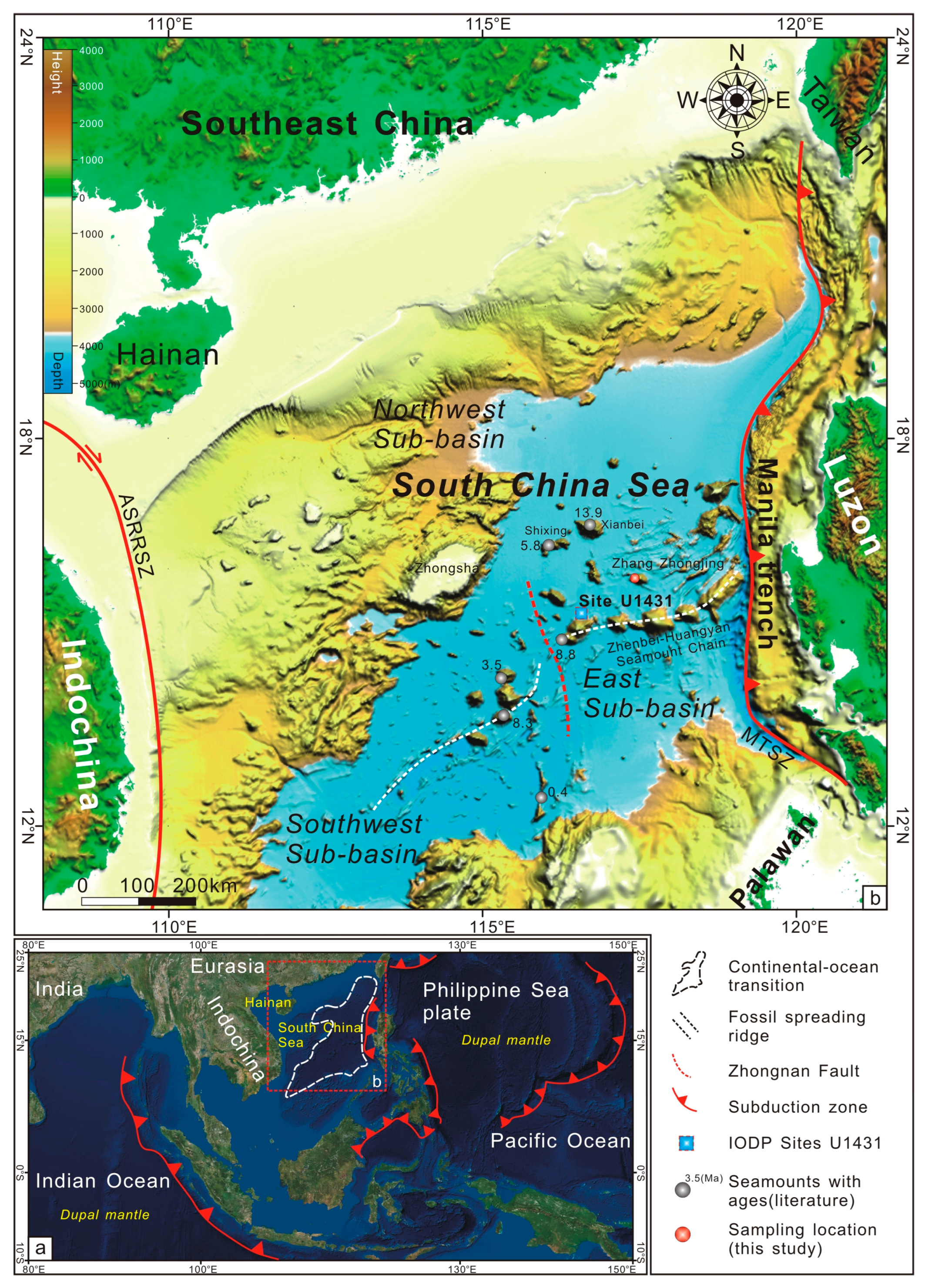
The South China Sea (SCS) is situated at the convergence of the Eurasian, Pacific and Indo-Australian plates (Figure 1a) and is one of the largest marginal seas in the western Pacific. It is bounded to the west by the Ailao Shan-Red River (ASRR) strike-slip fault system and to the east by an active continental margin along the Manila trench. (Figure 1b). To the south, a compressional margin separates the SCS from the Palawan block (Figure 1b). The northern part of the SCS resembles a hyperextended, magma-poor margin that formed through continental rifting and subsequent seafloor spreading during the Late Cretaceous to Oligocene.
At the end of the Mesozoic era, tectonic activity shifted from convergence to divergence along the South China margin [18]), marking the beginning of the multi-phase Cenozoic opening of the SCS (33.5–15.5 Ma) [19,20]. Analyses of magnetic anomalies and seismic reflection data suggest that the SCS originated from the rifting of the Eurasian continent in the Late Eocene, followed by the formation of oceanic lithosphere from the Early Oligocene to the Middle Miocene [19]. Geomagnetic studies have revealed that continental break-up started in the northeastern part of the SCS and gradually progressed southwestward, creating three fossil oceanic ridges and three extensional sub-basins: the East (Central), Southwest and Northwest Sub-basins [19] (Figure 1b). Geochronological data indicate that the oldest basalts dredged from the seamounts have an age of ~15.5 Ma; that is, the estimated age when seafloor spreading ceased in the region [9]. These post-spreading basalts make up the seamount chains and volcanic flows located in the deepest parts and along the continental slopes of the SCS [21].
A typical feature of the seabed of the East sub-basin is the NE-SW−trending undersea mountain range with conspicuous volcanic seamount morphological characteristics (Figure 1b). This intermittent seamount chain includes a few tens of identified submarine volcanoes, stretching over 400 km in the north to the eastern end of the Zhenbei-Huangyan seamount chain in the south (Figure 1b). The volcanic chain that crosses the East sub-basin includes the Guanshi, Shixing, Xianbei, Zhangzhong, Xiannan and Zhangzhongjing seamounts with heights ranging between 200 and 3400 m above the seafloor and a NE-SW dominant elongation direction.
Figure 1. (a) Schematic tectonic framework of the southwestern Pacific basins showing major tectonic subdivisions (modified after [11]); (b) Geomorphological-bathymetric map of the broader South China Sea (SCS) region (modified after [22]). The locations of the intraplate seamounts we sampled are also shown as red circles. Abbreviations (in alphabetical order): ASRRSZ—Ailao Shan-Red River Shear Zone; MTSZ—Mariana Trench Subduction Zone.
Minerals 15 01292 g001
The east–west-oriented Zhangzhong-Xiannan-Zhangzhongjing seamount chain crosses the central part of the SCS, representing a fossil spreading ridge. This submarine mountain range consists of several submarine volcanoes, extending over 300 km from the Zhongsha Islands in the west to the exposed coral terraces on the western side of Luzon Island in the east (Figure 1b).
During the International Ocean Discovery Program (IODP) expedition 349, numerous samples of oceanic crustal rocks were collected from the western edge of the East Sub-basin. However, the central and eastern sections of the seamount chain were not sampled during that expedition, leaving a significant gap in our understanding of the petrologic evolution of the upper mantle beneath the SCS. This study of basalts from the Zhangzhongjing seamount will help us better understand the puzzling geodynamic evolution of the broader SCS region.

3. Sampling and Petrography

3.1. Sampling

Our research focused on the Zhangzhongjing seamount of the SCS [latitude (φ): 16°7′15″ N, longitude (λ): 116°44′20″ E; Figure 1b]. All samples were obtained using dredging, which is a straightforward and effective method for collecting substantial amounts of rock material from the seabed. A total of 5 samples were obtained from the Zhangzhongjing seamount in the East Sub-basin of the SCS (Figure 1b). They were taken from the flanks of these seamounts at water depths of about 3000 m.

3.2. Petrography

All samples exhibit a dark gray to dim black color and a pervasive isotropic, aphanitic igneous texture typical of volcanic rocks. Some samples show signs of fossil gas bubble nucleation and coalescence caused by strain localization during discontinuous plastic flow. Two to three polished thin sections were prepared from each of the five rock samples collected for our study. All sections were examined under transmitted and reflected light using a Nikon Eclipse LV100 POL optical microscope at South China Sea Marine Survey Center, Ministry of Natural Resources in Guangzhou, China.
The mafic rock samples exhibit a porphyritic texture characterized by a small percentage of phenocrysts (<20–25% modal) embedded in a fine-grained matrix composed of microlites and volcanic glass (>75–80% modal). Modal analysis of the phenocrysts revealed an average composition of ~75–80% plagioclase (anorthite), about 15–20% clinopyroxene (ranging from augite to titanoaugite), less than 5% olivine and small amounts of other minerals (such as chromian spinel and ilmenite). The groundmass primarily consists of microlites of plagioclase (~70–75%) and clinopyroxene (>5%), along with minor amounts of Fe-Ti oxides and volcanic glass (~20–25%). Based on these mineralogical characteristics, the volcanic rocks under investigation are classified as basalts.
The predominant texture in these rocks is porphyritic, but additional textural variations such as trachytic (Figure 2a) and pilotaxitic (Figure 2b) have also been observed in several samples. Plagioclase crystals range from small (<0.2mm) to relatively large (~0.5–2.0 mm) and appear as elongated, subhedral to euhedral laths. Occasionally, some of the larger plagioclase crystals display a myrmekitic-like texture due to vermicular inclusions of alkali-feldspar. Clinopyroxene phenocrysts are typically smaller than 0.6 mm, anhedral to subhedral, exhibiting weak pleochroism, wavy extinction and occasional twinning (Figure 2c). Clinopyroxene crystals may be converted to a mixture of clay minerals and oxyhydroxides (Figure 2d), especially along grain boundaries and brittle fractures. The matrix is generally unaltered, but in places may become partially devitrified. In a few of the investigated polished thin sections the vesicles are filled with secondary calcite (Figure 2d).

4. Methods and Results

4.1. Analytical Methods

Detailed descriptions of the methods used to analyze our rock samples can be found in the Supplementary Materials file. The geochemical composition of each rock sample collected from the Zhangzhongjing seamount was analyzed. Major element oxide analyses were performed on fused glasses using X-ray fluorescence (XRF) at the Guangzhou Institute of Geochemistry, Chinese Academy of Sciences (GIG-CAS). Trace element analyses were conducted using an inductively coupled plasma-mass spectrometer (ICP-MS) Thermo X Series II at GIG-CAS, Sr-Nd-Pb isotope ratios for bulk-rock samples were measured with a multicollector (MC)-ICP-MS (Nu Plasma HR) at GIG-CAS. Hf isotope analyses were carried out using a Micromass IsoProbe MC-ICP-MS and a Thermo Fisher Triton thermal ionization mass spectrometer (TIMS) at GIG-CAS. It is noted that the sample powders for Sr-Nd-Pb-Hf isotope analyses were leached in 4N HCl at 50 °C for 20 min prior to digestion to mitigate potential seafloor alteration effects. Geochemical and isotopic data are provided in Table S1 in the Supplementary Materials file.

4.2. Results

4.2.1. Major and Trace Element Analysis

The compositions of basalts from the Zhangzhongjing seamount vary in major-element oxide concentrations (Al2O3 = 14.80–16.21 wt%, CaO = 8.81–9.98 wt%, MgO = 3.39–4.02 wt%, Na2O = 2.65–3.04 wt%, K2O = 0.59–1.20 wt%, TiO2 = 2.36–3.21 wt% and P2O5 = 0.17–0.30 wt%). These basalts have low to moderate loss on ignition (LOI) values (2.21–3.03 wt%).
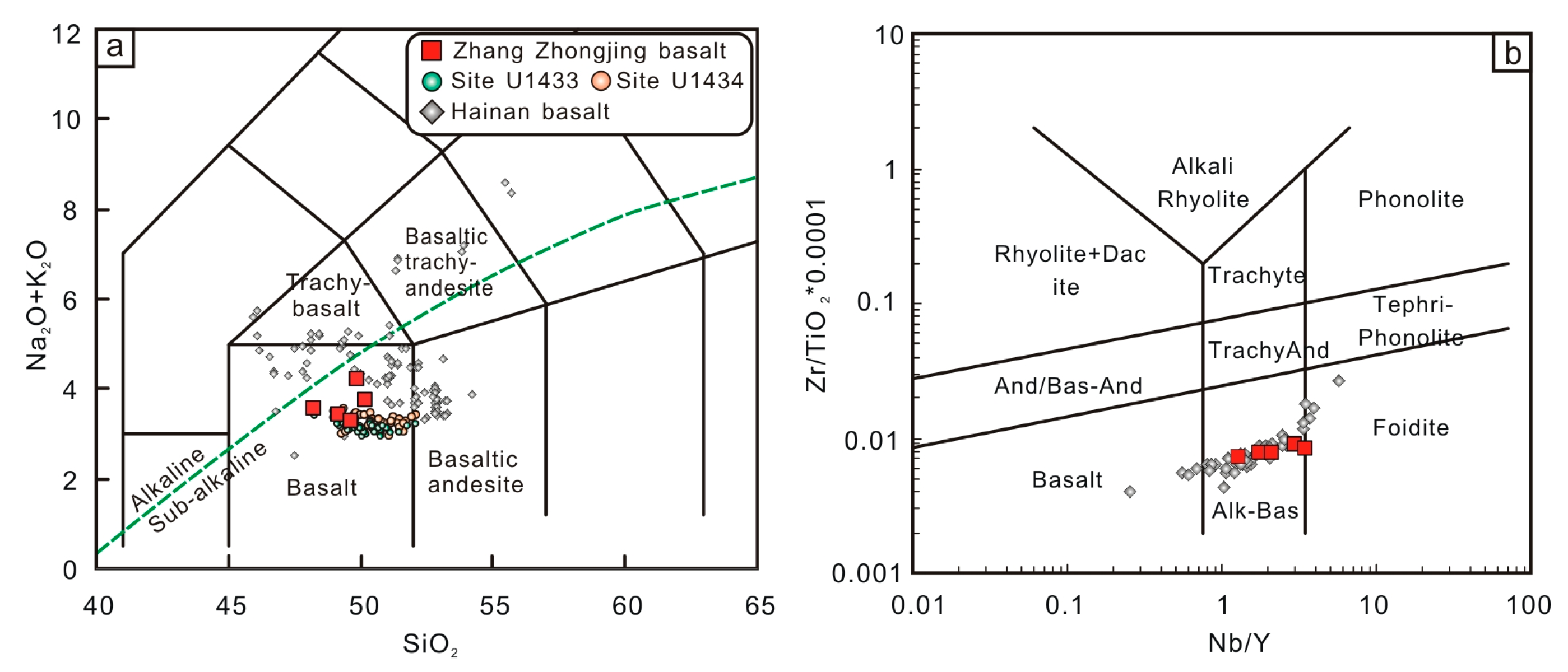
To minimize the effects of dilution due to ocean floor alteration, major element concentrations were normalized on an anhydrous (volatile-free) basis. In the total alkalis (Na2O + K2O) vs. SiO2 (TAS) diagram [23], all of the basalts analyzed exhibit sub-alkaline compositions (Figure 3a). Based on their plots in the Zr/TiO2*10−4 versus Nd/Y diagram [24], the Zhangzhongjing seamount basalts have an alkaline geochemical affinity (Figure 3b). Overall, the compositions of basalts from the study area are similar to those of basalts from the Hainan Island.
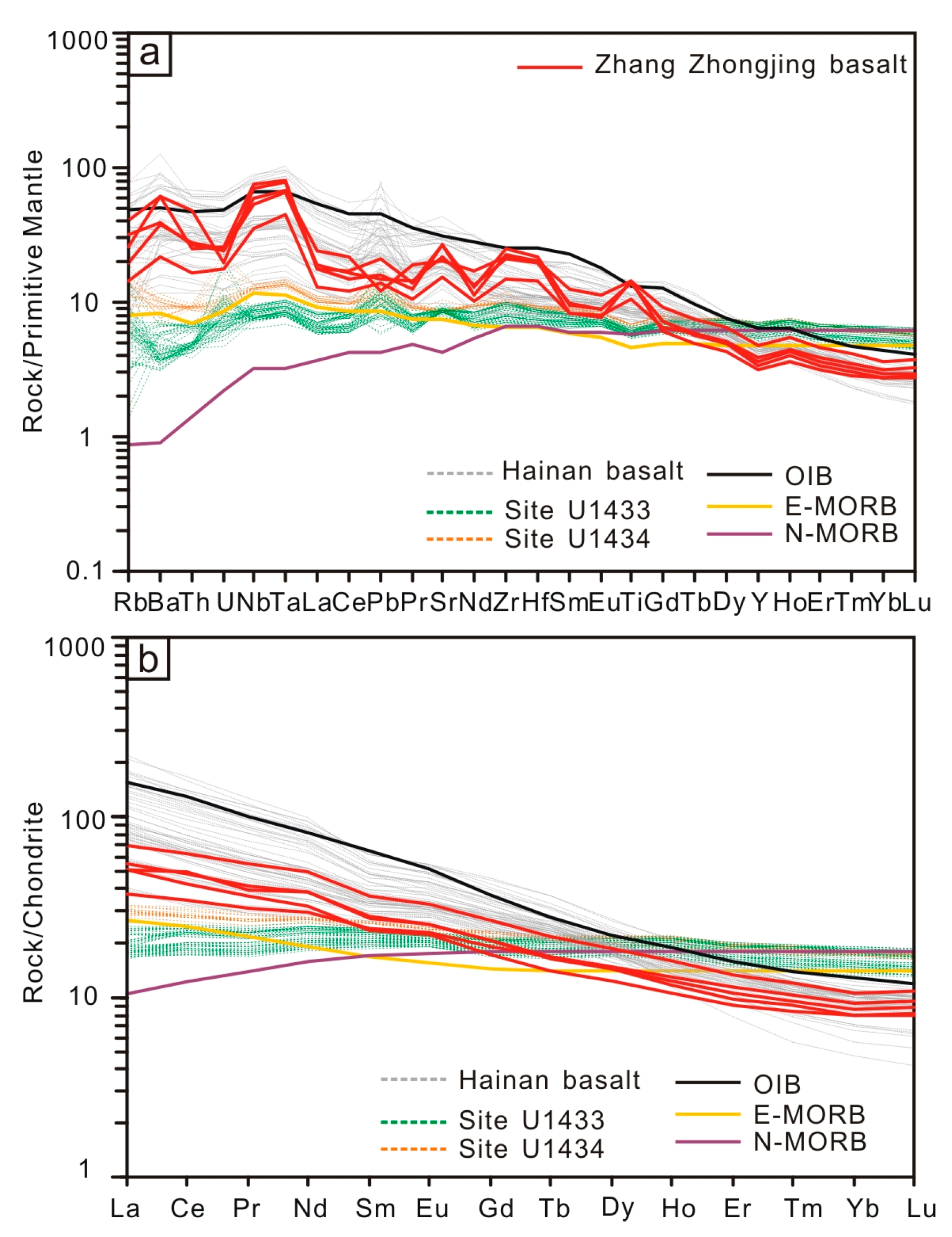
Primitive mantle (PM)-normalized spidergrams of the studied basalts reveal significant enrichments in high field strength elements (HFSE) such as Nb, Ta, Zr and Hf (Figure 4a). Additionally, they are enriched and depleted in Pb and Th, they exhibit mild negative U anomalies and display positive Ti spikes (Figure 4a). All basalts show slight negative Y anomalies (Figure 4a).
Basalts from the Zhangzhongjing seamount display chondrite-normalized rare earth element (REE) patterns characterized by variable enrichments in light (L-) REE relative to middle (M-) and heavy (H-) REE (Figure 4b). The LREE and MREE concentrations in these basalts range between those typical of enriched mid-ocean ridge basalts (E-MORB) and OIB-type rocks (Figure 4b). The studied basalts are richer in HFSE and LREE than those from the IODP but share some compositional similarities with those from the Hainan Island.

4.2.2. Sr-Nd-Hf-Pb Isotope Systematics

Intraplate basalts from the Zhangzhongjing seamount exhibit relatively consistent 87Sr/86Sr and 143Nd/144Nd ratios, ranging from 0.70362 to 0.70381 and from 0.51291 to 0.51303, respectively. These isotopic ratios are similar to the current isotopic values for a superchondritic bulk silicate Earth (87Sr/86Sr = 0.7030 ± 0.004, 143Nd/144Nd = 0.512997 ± 0.000103; [27]. Additionally, the studied rocks display a broad range of εNd(t) values (+5.4 to +7.8) and radiogenic Hf isotopic compositions (εHf(t) = 9.3–10.8), which likely indicate the highly heterogeneous isotopic compositions of their mantle sources.
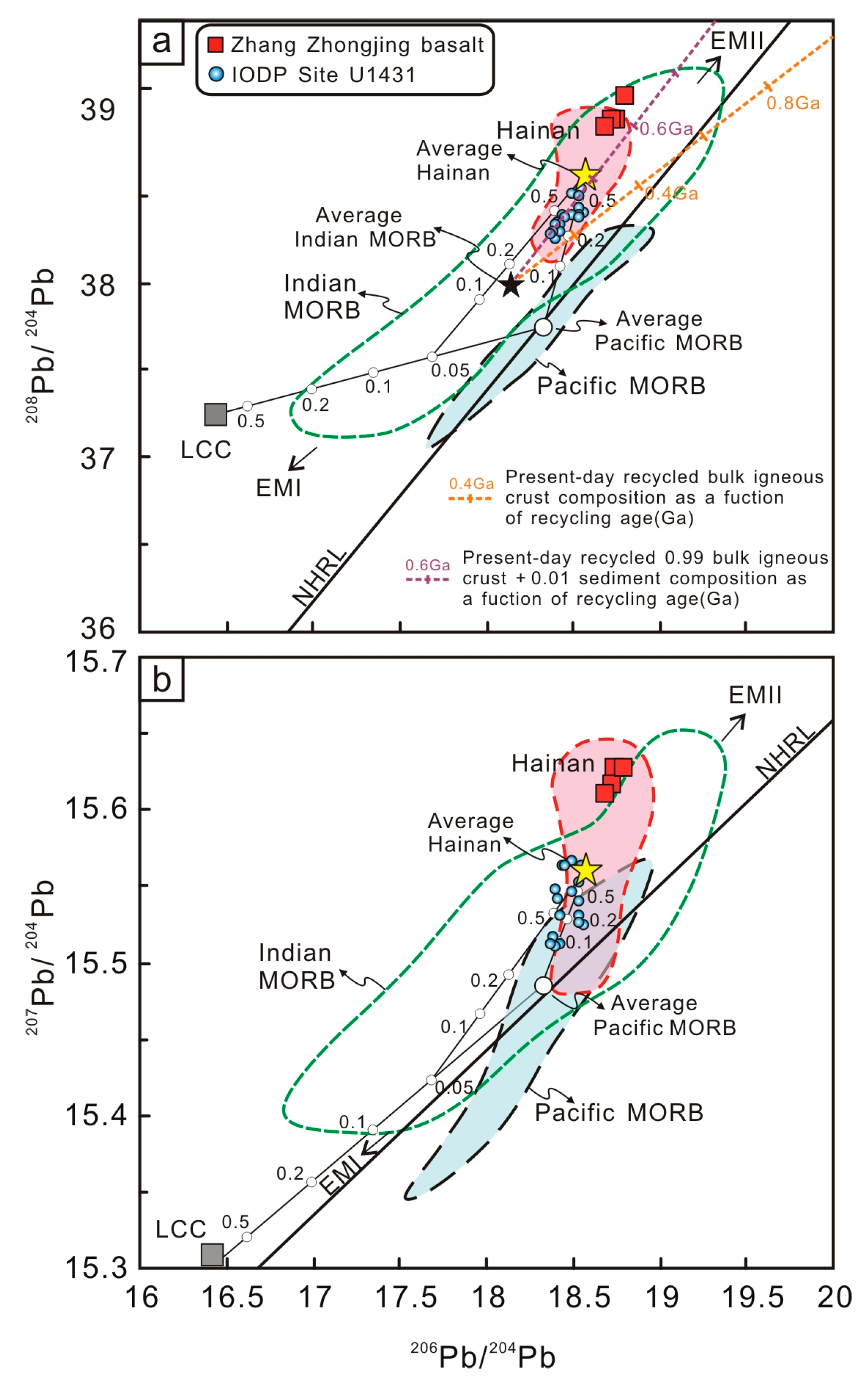
The basalts studied show a narrow range of 206Pb/204Pb, 207Pb/204Pb and 208Pb/204Pb ratios (18.69–18.80, 15.61–15.63 and 38.89–39.06, respectively). However, these isotopic ratios are higher in the analyzed basalts than in mafic rocks from IODP (Figure 5). Most of the studied basalts plot within the overlapping regions of the isotopic fields of mid-ocean ridge basalts (MORB) from the Indian Ocean and the Hainan OIB on the 208Pb/204Pb vs. 206Pb/204Pb and 207Pb/204Pb vs. 206Pb/204Pb diagrams. Moreover, the isotopic compositions of these basalts trend towards an EMII-like end-member (Figure 5a,b).

5. Discussion

5.1. Potential Effects of Post-Solidification Alteration, Fractionation and Crustal Assimilation

Our petrographic observations indicate that the studied basalts experienced a small degree of post-magmatic alteration. This is further supported by their relatively low LOI values (2.21–3.03 wt%). Therefore, the original compositions of basalts from Zhangzhongjing seamount are unlikely to be significantly affected by post-solidification processes. The strong correlations between various incompatible trace elements (Hf, Th, Y, Ta, Nb, REE) and the relatively immobile Zr suggest that their concentrations were not disrupted by metamorphic or hydrothermal processes.
All of the studied basalts display notable positive Eu anomalies in chondrite-normalized REE patterns (δEu = 1.01–1.09), indicating the accumulation of plagioclase phenocrysts during their formation. This suggests that these basalt compositions were likely influenced by cumulus processes and thus may not represent true liquid compositions. Mantle melting can cause significant geochemical variations in mafic rocks [35]. The low to moderate levels of MgO (3.39–4.02 wt%), Ni (21.3–53.1 ppm) and Cr (44.8–154 ppm) along with the low to moderate Mg# values (41–43) of the studied basalts suggest that their genesis was controlled by fractional crystallization of Mg-rich melts indicating that the parental melts of the studied post-spreading basalts underwent early fractionation of forsteritic olivine (±chromian spinel) during their ascent to the surface (and possibly during storage in crustal magma chambers).
A key question is whether the parental melts of the studied basalts were influenced by contributions from the continental crust during their formation. Previous studies on the petrogenesis of basalts from Hainan Island (e.g., [16]), the Indochina block (e.g., [36]) and the SCS (e.g., [37,38]) have ruled out the possibility of crustal contamination. The high Nb/La ratios (2.6–4.4) of the non-cumulative basalts from the study area are too high to result from assimilation of crustal materials (Nb/La < 1.01) [39]. Additionally, the investigated basalts have significantly lower Th/Ta ratios than those of the continental crust (0.6–1.3 vs. ≥8) [40]. Therefore, the parental melts of the studied basalts were not geochemically modified by processes (such as assimilation, subduction or melt-rock interaction) involving components derived from the continental crust.
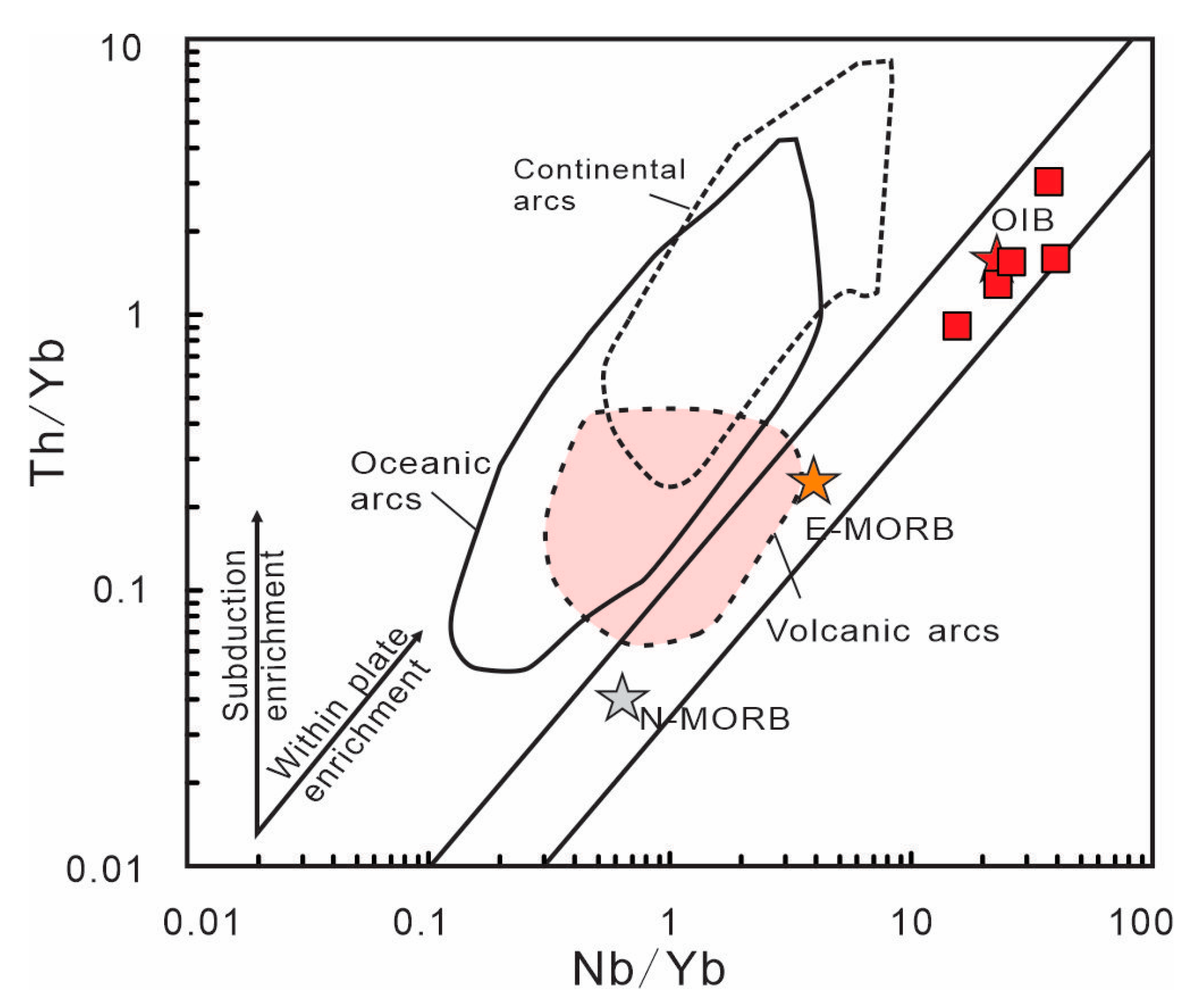
While mantle-derived magmas may undergo contamination by the oceanic crust during their ascent, the impact of such interactions on the resulting rock compositions remains unclear [41]. The studied basalts show high Th/Yb and Nb/Yb ratios and fall within the present-day MORB-OIB array in the Th/Yb vs. Nb/Yb diagram [42] (Figure 6). This trend supports the hypothesis that the studied basalts formed in an oceanic setting as a result of concentrated melt flux through nearly uncontaminated pathways. Contamination with oceanic crustal materials would result in a different compositional trend, starting from the center of the MORB-OIB array and extending slightly above it [42]. Furthermore, the studied basalts lack oceanic gabbro xenoliths and have lower K2O/P2O5 ratios (2.6–4.7) than those expected from oceanic gabbro assimilation by mantle-derived basaltic melts (≥4.7; [43]).
In conclusion, the compositions of the non-cumulative basalts from the Zhangzhongjing seamount were controlled by magma differentiation. Since fractional crystallization does not alter the Sr-Nd-Pb-Hf isotope ratios of basalt-forming melts, the isotopic compositions of the studied basalts can provide insights into the nature of the petrologic components involved in their formation.

5.2. Insights into the Origin of the EM-Signature—Implications for Mantle Heterogeneity

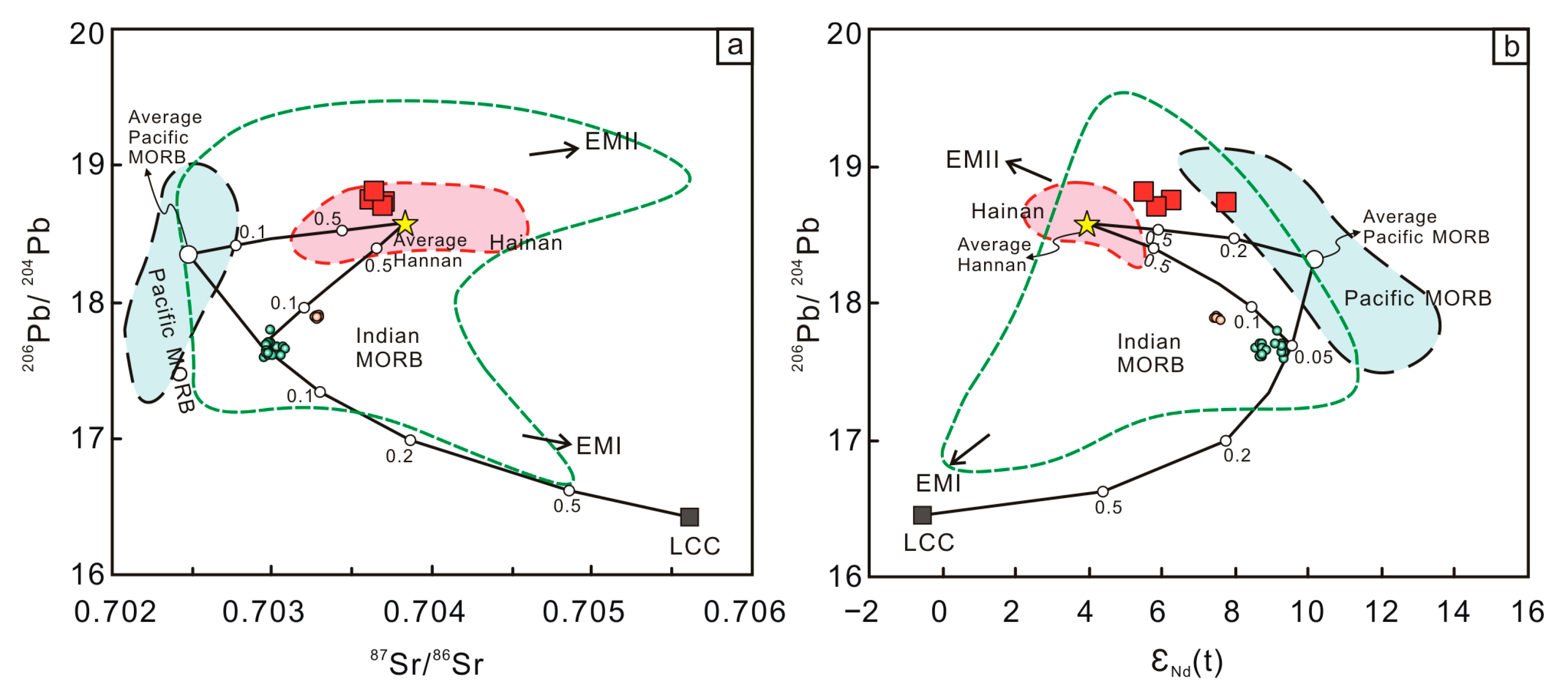
The isotopic compositions of the non-cumulative basalts from the Zhangzhongjing seamount display trends toward an EMII-like end-member in the 206Pb/204Pb vs. 87Sr/86Sr and 206Pb/204Pb vs. εNd(t) diagrams (Figure 7a,b). This raises the question of the origin of the inferred EMII component. One hypothesis for the origin of the EMII component involves the thermomechanical erosion of the lower continental crust (LCC; [11,16,30]). However, the Sr-Nd-Pb isotopic signatures of the studied basalts differ significantly from those of mafic rocks formed by partial melting of upper mantle regions enriched with materials from the delamination of a hypothesized granulitic/eclogitic LCC (Figure 7a,b). This discrepancy arises because a mixture of mantle-derived melts and LCC-derived materials would likely produce magmas with much lower 206Pb/204Pb ratios than those measured in the studied basalts (Figure 7a,b). Furthermore, the incorporation of a delaminated crustal component would generate silica-saturated melts in the later stages of volcanism, which is inconsistent with the prevailing knowledge that post-spreading magmatism in the broader SCS region is dominated by alkali basalts.
Another hypothesis suggests that the inferred EMII component could originate from the sub-continental lithospheric mantle (SCLM). Basalts derived from melting of an SCLM source typically display PM-normalized multi-element diagrams with negative Nb and Ta anomalies (e.g., [38,44,45]). The investigated basalts exhibit positive Nb and Ta spikes in PM-normalized trace element profiles (Figure 4a). Therefore, an SCLM reservoir is unlikely to be the source of the parental melts of Zhangzhongjing seamount.
To determine the origin of the EMII-like isotopic signature in basalts from the Zhangzhongjing seamount, we used semi-quantitative binary mixing models, as shown in Figure 7. Ref. [11] using these models demonstrated that the isotopic signatures of basalts from the East Sub-basin of the SCS (site U1431) can be reproduced by mixing OIB-type components from the adjacent Hainan thermal plume with MORB-type magmas derived from the melting of a depleted Pacific Ocean-type mantle (in a ratio of approximately 3:7). Our data indicate that the isotopic compositions of the studied basalts cannot be explained by mixing the average Pacific N-MORB with EMII components derived from the Hainan thermal plume (Figure 7a,b). Instead, the isotopic compositions of Zhangzhongjing basalts plot within the field of MORB from a depleted Indian Ocean-type mantle source and are broadly analogous to those of OIB from Hainan Island (Figure 7a,b). This suggests that the sub-ridge mantle has captured the isotopic signature of the rising thermal plume beneath the Hainan Island-Leizhou Peninsula region, providing insights into mantle plume-ridge interaction [15].

5.3. Evidence for a Plume-Modified Mantle Reservoir

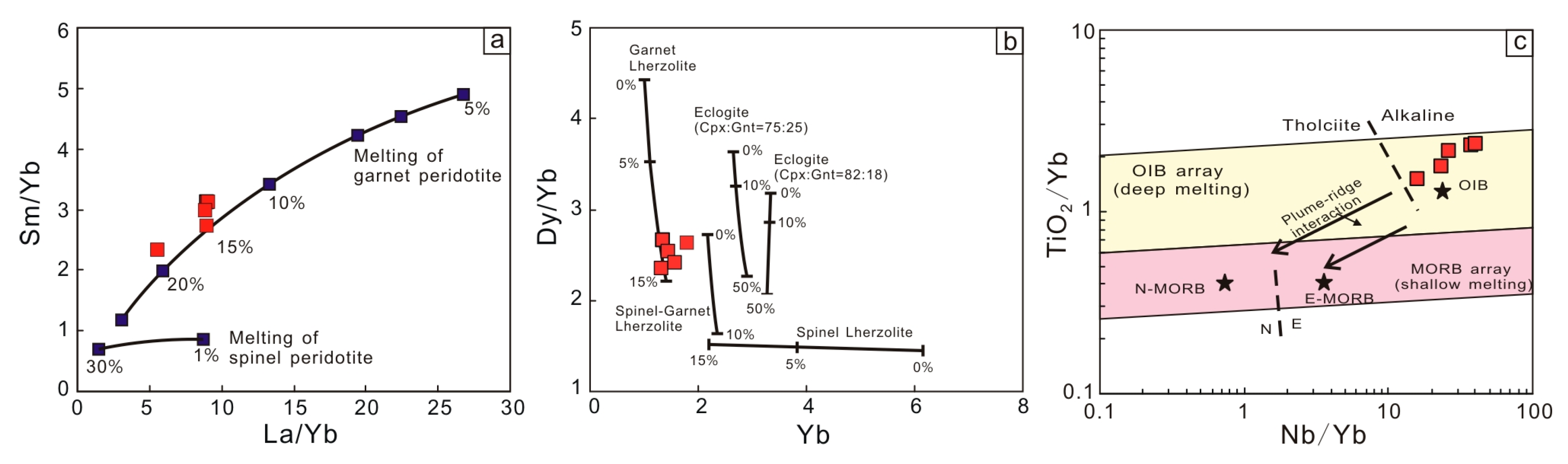
To investigate the nature of the source components involved in the genesis of basalts from the Zhangzhongjing seamount, we applied a semi-quantitative batch melting model, To infer the mineralogy of the source of the melts we used a Sm/Yb vs. La/Yb diagram ([46]; Figure 8a). The Sm/Yb ratios will not change during partial melting of a fertile mantle source because Sm and Yb have similar partition coefficients, but the Sm contents and the La/Sm ratios of the magmas produced from melting of a fertile mantle source may decrease [42]. The compositions of basalts from the study area align with the modeled melting curves. In the Dy/Yb vs. Yb variations [47] (Figure 8b), our geochemical model includes melting curves for non-modal batch melting of garnet-bearing, spinel-garnet-bearing and spinel-bearing lherzolite, as well as for modal batch melting of two mineralogically distinct types of eclogite, using partition coefficients from [48]. Their Yb concentrations and Dy/Yb ratios are comparable to those of mafic rocks formed by melting of garnet-bearing peridotites. Our melting model suggests that the parental magmas of these basalts were produced by heterogeneous melting starts at depth in the garnet facies and, during its uprising, continue at shallow levels in the spinel facies. Furthermore, our basalt analyses plot within the deep melting array on the TiO2/Yb vs. Nb/Yb discrimination diagram ([42], Figure 8c). This suggests that their compositions are similar to those of mafic magmas derived from the melting of deep mantle sources enriched with OIB-type components.
Our data combined together suggest that basalts from the Zhangzhongjing seamount most likely originated from melting of a deep-seated mantle reservoir heterogeneously modified by the igneous activity of the Hainan thermal plume (e.g., [11,53,54]). No single parental magma can account for the isotopic variations observed in the studied basalts; rather, each basalt type derives from distinct mafic melt inputs. These melt inputs originate from a single mantle region but are sourced from different segments of the inferred mantle reservoir. Additionally, the source of the inferred OIB-type components was most likely the nearby Hainan plume as indicated by the isotopic compositions of the studied basalts. The 230Th excesses measured in plume-derived basalts from Hainan Island indicate that they were produced by mantle melting at depths greater than ~75 km [30]. Therefore, it is likely that the melting events that generated the parental melts of the basalts under investigation occurred at asthenospheric depths.

5.4. Petrotectonic Implications

Several competing hypotheses have been proposed to explain the origin of the Indian Ocean-type mantle beneath the South China Sea (SCS). One theory suggests that the SCS lithosphere separated from Gondwana and moved northward during the Late Paleozoic [55], eventually becoming trapped between the larger Eurasian, Indo-Australian and Philippine Sea plates [36]. However, the northward subduction of the Indian plate beneath Southeast Asia began before the Mesozoic [56]. Since then, the resulting suture zone beneath the Sunda-Java volcanic arc has acted as a natural barrier, preventing the Indian Ocean-type mantle from flowing northward (e.g., [8]). Additionally, the timing of the Indochina extrusion does not account for the stage of continental rifting that preceded the opening of the SCS [57]. These considerations support the hypothesis that the Indian Ocean-type mantle beneath the SCS is a pre-existing geological feature.
The isotopic characteristics of basalts from the Zhangzhongjing seamount suggest that the East Sub-basin of the SCS experienced a phase of intraplate volcanism, facilitated by the igneous activity of the Hainan mantle diapir. This involved contamination of the upper mantle with plume-derived components [58,59]. This interpretation is supported by the positive εNd(t) values (+5.4 to +7.8) of the non-cumulative basalts from the study area, indicating that they may have originated from an LREE-depleted mantle source [60]. Despite this, they are enriched in LREE and their primitive mantle (PM)-normalized trace element patterns are similar to those of typical OIB-like rocks and enriched mid-ocean ridge basalts (E-MORB) (Figure 4b). This implies the long-term presence of an LREE-depleted Indian Ocean-type mantle source beneath the Zhangzhongjing seamount, which was recently enriched by LREE-rich plume-type components (e.g., [14]). Determining the precise timing of this enrichment event requires further geochemical and isotopic research. Nevertheless, our study provides valuable insights into the petrologic processes that have influenced the composition of the upper mantle beneath the Zhangzhongjing seamount. These findings present opportunities for a deeper re-evaluation of the Hainan thermal plume model, which has been previously used to explain post-spreading magmatism in the broader SCS region.

6. Conclusions

The present study has yielded the following conclusions:
  • Basalts from the Zhangzhongjing seamount of the SCS exhibit geochemical signatures consistent with E-MORB-to-OIB-type rocks.
  • The Sr-Nd-Pb-Hf isotopic compositions of basalts suggest that they originated from melting of an Indian Ocean-type mantle source that had been contaminated with components derived from the Hainan plume.
  • Our study improves our knowledge about the effect of the Hainan plume on the composition of the upper mantle beneath the East Sub-basin of the SCS.

Supplementary Materials

The following supporting information can be downloaded at: https://www.mdpi.com/article/10.3390/min15121292/s1, Analytical methods: Details of analytical procedures for major and trace element and isotope analyses; Table S1: Results of whole-rock and isotope analyses of the Zhengzhongjing basalts. Reference [61] is cited in the Supplementary Materials.

Author Contributions

Conceptualization, R.L., L.Y. and H.Z.; Formal Analysis, R.L., L.Y. and H.Z.; Investigation, H.Z., A.X., X.H., C.P. and Z.L.; Data Curation, R.L., L.Y. and H.Z.; Writing—Original Draft Preparation, R.L., L.Y. and H.Z.; Writing—Review and Editing, R.L., L.Y., H.Z. and H.H.; Visualization, R.L., L.Y., H.Z., A.X., X.H., C.P. and Z.L.; Funding Acquisition, R.L., H.Z. and H.H. All authors have read and agreed to the published version of the manuscript.

Funding

This work was financially supported by the PhD Research Startup Fund of the South China Sea Marine Survey Center, MNR, PR China (MESTA-2023-E001), the National Natural Science Foundation of China (Grant No. 42102249), the Fundamental Research Funds for the Natural Science Foundation of Guangdong Province (Grant No. 2020A1515010501) and the National Key Research and Development Program of China (2022RDC2013302).

Data Availability Statement

The original contributions presented in this study are included in the article. Further inquiries can be directed to the corresponding author.

Acknowledgments

We would like to express our sincere gratitude to the crew of the R/V Jiageng (TKK) and Xiangyanghong No. 5. The valuable comments and suggestions of three anonymous reviewers also helped us greatly improve our paper.

Conflicts of Interest

The authors declare no conflicts of interest. The funding sponsors had no role in the design of the study; in the collection, analyses or interpretation of data; in the writing of the manuscript, and in the decision to publish the results.

References

  1. Hofmann, A.W.; Jochum, K.P.; Seufer, M.; White, W.M. Nb and Pb inoceanic basalts: New constraints on mantle evolution. Earth Planet. Sci. Lett. 1986, 79, 33–45. [Google Scholar] [CrossRef]
  2. Iwamori, H.; Nakamura, H. East-west mantle geochemical hemispheres constrained from Independent Component Analysis of basalt isotopic compositions. Geochem. J. 2012, 46, e39−e46. [Google Scholar] [CrossRef]
  3. Agranier, A.; Blichert-Toft, J.; Graham, D.; Debaille, V.; Schiano, P.; Albarède, F. The spectra of isotopic heterogeneities along the Mid-Atlantic Ridge. Earth Planet. Sci. Lett. 2005, 238, 96–109. [Google Scholar] [CrossRef]
  4. Waight, T.E.; Baker, J.A. Depleted Basaltic Lavas from the Proto-Iceland Plume, Central East Greenland. J. Petrol. 2012, 53, 1569−1596. [Google Scholar] [CrossRef]
  5. Dupré, B.; Allègre, C.J. Pb-Sr isotope variation in Indian Ocean basalts and mixing phenomena. Nature 1983, 303, 142–146. [Google Scholar] [CrossRef]
  6. Mukasa, S.B.; McCabe, R.; Gill, J.B. Pb-isotopic compositions of volcanic rocks in the West and East Philippine island arcs: Presence of the Dupal isotopic anomaly. Earth Planet. Sci. Lett. 1987, 84, 153−164. [Google Scholar] [CrossRef]
  7. Flower, M.; Tamaki, K.; Hoang, N. Mantle extrusion: A model for dispersed volcanism and DUPAL-Like Asthenosphere in East Asia and the Western Pacific. Mantle Dyn. Plate Interact. East Asia 1998, 27, 67–88. [Google Scholar]
  8. Hickey-Vargas, R. Origin of the Indian Ocean-type isotopic signature in basalts from Philippine Sea plate spreading centers: An assessment of local versus large-scale processes. J. Geophys. Res. Solid Earth 1998, 103, 20963–20979. [Google Scholar] [CrossRef]
  9. Yan, Q.S.; Shi, X.F.; Wang, K.S.; Bu, W.R.; Xiao, L. Major element, trace element, Sr-Nd-Pb isotopic studies of Cenozoic alkali basalts from the South China Sea. Sci. China Ser. D Earth Sci. 2008, 51, 550–566. [Google Scholar] [CrossRef]
  10. Miyazaki, T.; Kimura, J.I.; Senda, R.; Vaglarov, B.S.; Chang, Q.; Takahashi, T.; Hirahara, Y.; Hauff, F.; Hayasaka, Y.; Sano, S.; et al. Missing western half of the Pacific Plate: Geochemical nature of the Izanagi-Pacific Ridge interaction with a stationary boundary between the Indian and Pacific mantles. Geochem. Geophys. Geosyst. 2015, 16, 3309–3332. [Google Scholar] [CrossRef]
  11. Zhang, G.L.; Luo, Q.; Zhao, J.; Jackson, M.G.; Guo, L.S.; Zhong, L.F. Geochemical nature of sub-ridge mantle and opening dynamics of the South China Sea. Earth Planet. Sci. Lett. 2018, 489, 145−155. [Google Scholar] [CrossRef]
  12. Tu, K.; Flower, M.F.; Carlson, R.W.; Xie, G.; Chen, C.Y.; Zhang, M. Magmatism in the South China Sea basin: 1. Isotopic and trace element evidence for an endogenous Dupal mantle component. Chem. Geol. 1992, 97, 47–63. [Google Scholar] [CrossRef]
  13. Wang, W.; Chu, F.; Wu, X.; Li, Z.; Chen, L.; Li, X.; Yan, Y.; Zhang, J. Constraining Mantle Heterogeneity beneath the South China Sea: A New Perspective on Magma Water Content. Minerals 2019, 9, 410. [Google Scholar] [CrossRef]
  14. Zheng, H.; Zhong, L.-F.; Kapsiotis, A.; Cai, G.-Q.; Wan, Z.-F.; Xia, B. Post-spreading Basalts from the Nanyue Seamount: Implications for the Involvement of Crustal- and Plume-Type Components in the Genesis of the South China Sea Mantle. Minerals 2019, 9, 378. [Google Scholar] [CrossRef]
  15. Wang, X.C.; Li, Z.X.; Li, X.H.; Li, J.; Xu, Y.G.; Li, X.H. Identification of an ancient mantle reservoir and young recycled materials in the source region of a young mantle plume: Implications for potential linkages between plume and plate tec-tonics. Earth Planet. Sci. Lett. 2013, 377, 248–259. [Google Scholar] [CrossRef]
  16. Wang, X.C.; Li, Z.X.; Li, X.H.; Li, J.; Liu, Y.; Long, W.G.; Zhou, J.-B.; Wang, F. Temperature, pressure, and composition of the mantle source region of Late Cenozoic basalts in Hainan Island, SE Asia: A consequence of a young thermal mantle plume close to subduction zones? J. Petrol. 2012, 53, 177–233. [Google Scholar] [CrossRef]
  17. An, A.; Choi, S.; Yu, Y.; Lee, D. Petrogenesis of Late Cenozoic basaltic rocks from southern Vietnam. Lithos 2017, 272–273, 192–204. [Google Scholar] [CrossRef]
  18. Shi, H.; Li, C.F. Mesozoic and early Cenozoic tectonic convergence-to-rifting transition prior to opening of the South China Sea. Int. Geol. Rev. 2012, 54, 1801–1828. [Google Scholar] [CrossRef]
  19. Li, C.F.; Xu, X.; Lin, J.; Sun, Z.; Zhu, J.; Yao, Y.J.; Zhao, X.X.; Liu, Q.S.; Kulhanek, D.K.; Wang, J.; et al. Ages and magnetic structures of the South China Sea constrained by deep tow magnetic surveys and IODP Expedition 349. Geochem. Geophys. Geosyst. 2014, 15, 4958–4983. [Google Scholar] [CrossRef]
  20. Sibuet, J.C.; Yeh, Y.C.; Lee, C.S. Geodynamics of the South China Sea. Tectonophysics 2016, 692, 98–119. [Google Scholar] [CrossRef]
  21. Fan, C.; Xia, S.; Zhao, F.; Sun, J.; Cao, J.; Xu, H.; Wan, K. New insights into the magmatism in the northern margin of the South China Sea: Spatial features and volume of intraplate seamounts. Geochem. Geophys. Geosyst. 2017, 18, 2216–2239. [Google Scholar] [CrossRef]
  22. Yang, S.; Qiu, Y.; Zhu, B. (Eds.) Atlas of Geology and Geophysics of the South China Sea; China Navigation Publication House Press: Tianjin, China, 2015. [Google Scholar]
  23. Le Bas, M.J.; Le Maitre, R.W.; Streckeisen, A.; Zanettin, B. A chemical classification of volcanic rocks based on the total alkali-silica diagram. J. Petrol. 1986, 27, 745–750. [Google Scholar] [CrossRef]
  24. Winchester, J.A.; Floyd, P.A. Geochemical discrimination of different magma series and their differentiation products using immobile elements. Chem. Geol. 1977, 20, 325–343. [Google Scholar] [CrossRef]
  25. Irvine, T.N.; Baragar, W.R.A. A Guide to the Chemical Classification of the Common Volcanic Rocks. Can. J. Earth Sci. 1971, 8, 523−548. [Google Scholar] [CrossRef]
  26. Sun, S.S.; McDonough, W.F. Chemical and isotopic systematics of oceanic basalts: Implications for mantle composition and processes. Geol. Soc. Lond. Spec. Publ. 1989, 42, 313–345. [Google Scholar] [CrossRef]
  27. Caro, G.; Bourdon, B. Non-chondritic Sm/Nd ratio in the terrestrial planets: Consequences for the geochemical evolution of the mantle-crust system. Geochim. Cosmochim. Acta 2010, 74, 3333–3349. [Google Scholar] [CrossRef]
  28. Gale, A.; Dalton, C.A.; Langmuir, C.H.; Su, Y.; Schilling, J.G. The mean composition of ocean ridge basalts. Geochem. Geophys. Geosyst. 2013, 14, 489–518. [Google Scholar] [CrossRef]
  29. Han, J.W.; Xiong, X.L.; Zhu, Z.Y. Geochemistry of late-Cenozoic basalts from Leiqiong area: The origin of EM2 and the contribution from sub-continental lithosphere mantle. Acta Petrol. Sin. 2009, 25, 3208–3220, (In Chinese with English Abstract). [Google Scholar]
  30. Zou, H.; Fan, Q. U-Th isotopes in Hainan basalts: Implications for sub-asthenospheric origin of EM2 mantle endmember and the dynamics of melting beneath Hainan Island. Lithos 2010, 116, 145−152. [Google Scholar] [CrossRef]
  31. Li, N.; Yan, Q.; Chen, Z.; Shi, X. Geochemistry and petrogenesis of Quaternary volcanism from the islets in the eastern Beibu Gulf: Evidence for Hainan plume. Acta Oceanol. Sin. 2013, 32, 40–49. [Google Scholar] [CrossRef]
  32. Hart, S.R. A large-scale isotope anomaly in the Southern Hemisphere mantle. Nature 1984, 309, 753–757. [Google Scholar] [CrossRef]
  33. Rudnick, R.L.; Fountain, D.M. Nature and composition of the continental crust: A lower crustal perspective. Rev. Geophys. 1995, 33, 267–309. [Google Scholar] [CrossRef]
  34. Zindler, A.; Hart, S. Chemical geodynamics. Annu. Rev. Earth Planet. Sci. 1986, 14, 493–571. [Google Scholar] [CrossRef]
  35. Saccani, E.; Allahyari, K.; Beccaluva, L.; Bianchini, G. Geochemistry and petrology of the Kermanshah ophiolite (Iran): Implication for the interaction between passive rifting, oceanic accretion, and OIB-type components in the Southern Neo-Tethys Ocean. Gondwana Res. 2013, 24, 392–411. [Google Scholar] [CrossRef]
  36. Yan, Q.; Shi, X.; Metcalf, I.; Liu, S.; Xu, T.; Kornkanitnan, N.; Sirichaiseth, T.; Yuan, L.; Zhang, Y.; Zhang, H. Hainan mantle plume produced late Cenozoic basaltic rocks in Thailand, Southeast Asia. Sci. Rep. 2018, 8, 2640. [Google Scholar] [CrossRef]
  37. Yan, Q.; Castillo, P.; Shi, X.; Wang, L.; Liao, L.; Ren, J. Geochemistry and petrogenesis of volcanic rocks from Daimao Seamount (South China Sea) and their tectonic implications. Lithos 2015, 218, 117–126. [Google Scholar] [CrossRef]
  38. Yan, Q.; Straub, S.; Shi, X. Hafnium isotopic constraints on the origin of late Miocene to Pliocene seamount basalts from the South China Sea and its tectonic implications. J. Asian Earth Sci. 2019, 171, 162–168. [Google Scholar] [CrossRef]
  39. Kieffer, B.; Arndt, N.; Lapierre, H.; Bastien, F.; Bosch, D.; Pecher, A.; Yirgu, G.; Ayalew, D.; Weis, D.; Jerram, D.A.; et al. Flood and shield basalts from Ethiopia: Magmas from the African Superswell. J. Petrol. 2004, 45, 793−834. [Google Scholar]
  40. Rudnick, R.L.; Gao, S. Composition of the continental crust. Treatise Geochem. 2003, 3, 1−64. [Google Scholar]
  41. Davidson, J.P.; Bohrson, W.A. Shallow-Level Processes in Ocean-island Magmatism: Editorial. J. Petrol. 1998, 39, 799−801. [Google Scholar]
  42. Pearce, J.A. Geochemical fingerprinting of oceanic basalts with applications to ophiolite classification and the search for Archean oceanic crust. Lithos 2008, 100, 14–48. [Google Scholar] [CrossRef]
  43. Borisova, A.Y.; Faure, F.; Deloule, E.; Grégorie, M.; Béjina, F.; De Parseval, P.; Devidal, J.-L. Lead isotope signatures of Kerguelen plume-derived olivine-hosted melt inclusions: Constraints on the ocean island basalt petrogenesis. Lithos 2014, 198−199, 153−171. [Google Scholar]
  44. Zou, H.; Reid, M.R.; Liu, Y.; Yao, Y.; Xu, X.; Fan, Q. Constraints on the origin of historic potassic basalts from northeast China by U-Th disequilibrium data. Chem. Geol. 2003, 200, 189–201. [Google Scholar] [CrossRef]
  45. Kwon, S.K.; Choi, S.H.; Lee, D.-C. Sr-Nd-Hf-Pb isotope geochemistry of basaltic rocks from the Cretaceous Gyeongsang Basin, South Korea: Implications for basin formation. J. Asian Earth Sci. 2013, 73, 504–519. [Google Scholar] [CrossRef]
  46. Xu, Y.G.; Ma, J.L.; Frey, F.A.; Feigenson, M.D.; Liu, J.F. Role of lithosphere asthenosphere interaction in the genesis of quaternary alkali and tholeiitic basalts from Datong, Western North China Craton. Chem. Geol. 2005, 224, 247–271. [Google Scholar] [CrossRef]
  47. Shaw, D.M. Trace element fractionation during anatexis Geochim. Cosmochim. Acta 1970, 34, 237−243. [Google Scholar] [CrossRef]
  48. McKenzie, D.; O’Nions, R.K. Partial melt distributions from inversion of rare earth element concentrations. J. Petrol. 1991, 32, 1021–1091. [Google Scholar]
  49. Johnson, K.T.M.; Dick, H.J.B.; Shimizu, N. Melting in the oceanic upper mantle: An ion microprobe study of diopsides in abyssal peridotites. J. Geophys. Res. 1990, 95, 2661–2678. [Google Scholar] [CrossRef]
  50. Walter, M.J. Melting of garnet peridotite and the origin of komatiite and depleted lithosphere. J. Petrol. 1998, 39, 29–60. [Google Scholar]
  51. Kinzler, R.J. Melting of mantle peridotite at pressures approaching the spinel to garnet transition: Application to mid-ocean ridge basalt petrogenesis. J. Geophys. Res. Solid Earth 1997, 102, 853–874. [Google Scholar]
  52. Workman, R.K.; Hart, S.R. Major and trace element composition of the depleted MORB mantle (DMM). Earth Planet. Sci. Lett. 2005, 231, 53−72. [Google Scholar] [CrossRef]
  53. Xu, Y.G.; Wei, J.X.; Qiu, H.N.; Zhang, H.N.; Huang, X.L. Opening and evolution of the South China Sea constrained by studies on volcanic rocks: Preliminary results and a research design. Chin. Sci. Bull. 2012, 57, 3150–3164. [Google Scholar]
  54. Yu, M.; Yan, Y.; Huang, C.Y.; Zhang, X.; Tian, Z.; Chen, W.H.; Santosh, M. Opening of the South China Sea and upwelling of the Hainan plume. Geophys. Res. Lett. 2018, 45, 2600–2609. [Google Scholar] [CrossRef]
  55. Tu, K.; Flower, M.F.J.; Carlson, R.W.; Zhang, M.; Xie, G. Sr, Nd, and Pb isotopic compositions of Hainan basalts (south China): Implications for a sub-continental lithosphere Dupal source. Geology 1991, 19, 567–569. [Google Scholar]
  56. Metcalfe, I. Tectonic framework and Phanerozoic evolution of Sundaland. Gondwana Res. 2011, 19, 3–21. [Google Scholar] [CrossRef]
  57. Hsu, S.; Yeh, Y.; Doo, W.; Tsai, C. New bathymetry and magnetic lineations identifications in the northernmost South China Sea and their tectonic implications. Mar. Geophys. Res. 2004, 25, 29–44. [Google Scholar] [CrossRef]
  58. Zhao, M.; He, E.; Sibuet, J.C.; Sun, L.; Qiu, X.; Tan, P.; Wang, J. Postseafloor spreading volcanism in the central East South China Sea and its formation through an extremely thin oceanic crust. Geochem. Geophys. Geosyst. 2018, 19, 621–641. [Google Scholar] [CrossRef]
  59. Yang, F.; Huang, X.-L.; Xu, Y.-G.; He, P.-L. Plume-ridge interaction in the South China Sea: Thermometric evidence from Hole U1431E of IODP Expedition 349. Lithos 2019, 324−325, 466−478. [Google Scholar]
  60. Zou, H.B.; Zindler, A.; Xu, X.S.; Qi, Q. Major, trace element, and Nd, Sr and Pb studies of Cenozoic basalts in SE China: Mantle sources, regional variations, and tectonic significance. Chem. Geol. 2000, 171, 33–47. [Google Scholar] [CrossRef]
  61. White, W.M.; Albarede, F.; Telouk, P. High-precision analysis of Pb isotope ratios by multi-collector ICP-MS. Chem. Geol. 2000, 167, 257–270. [Google Scholar]
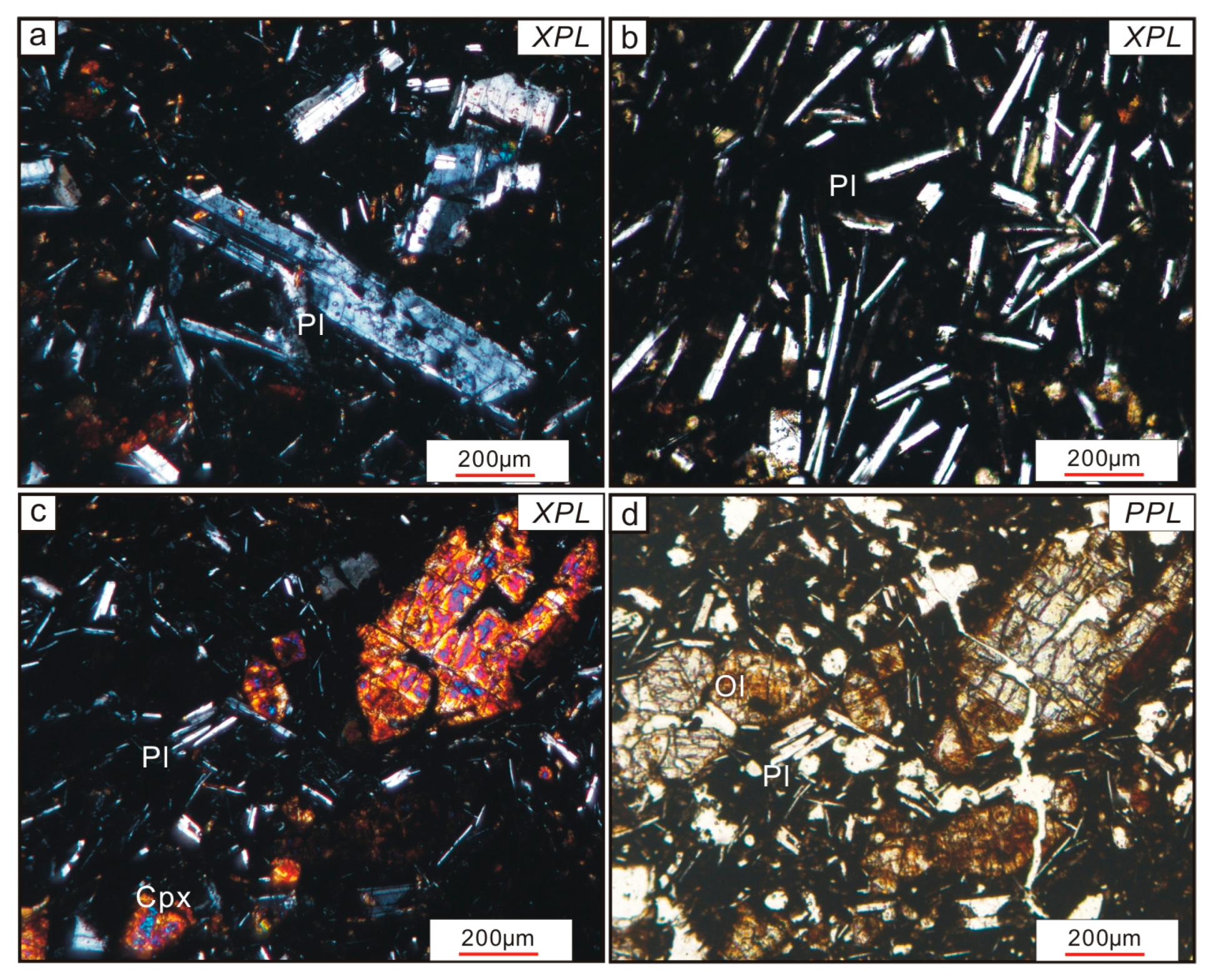
Figure 2. Photomicrographs of basalts from the Zhangzhongjing seamount showing (a,b) porphyritic texture; (c) Clinopyroxene crystals with partially resorbed grain boundaries; (d) Clinopyroxene crystals may be converted to a mixture of clay minerals and oxyhydroxides. With one exception (photomicrograph (d)), all photomicrographs were taken under crossed polarized transmitted light. Abbreviations (in alphabetical order): Cpx—clinopyroxene; Ol—olivine; Pl—plagioclase.
Minerals 15 01292 g002
Figure 3. Na2O + K2O (wt%) vs. SiO2 (wt%) (after [23]), (b) Zr/TiO2*10−4 vs. Nb/Y (after [24]). In (a) the alkaline-sub-alkaline boundary is after [25]. Compositional data for volcanic rocks from the Hainan Island and the IODP in the SCS are from [11,16].
Minerals 15 01292 g003
Figure 4. (a) Primitive mantle (PM)-normalized multi-element profiles and (b) chondrite-normalized lanthanide profiles for the Zhangzhongjing basalts. The PM- and chondrite-normalizing data are from [26]. Sources of data for reference [normal- and enriched mid-ocean ridge basalt (N- and E-MORB), and ocean island basalt (OIB)] are from [26]. Compositional data of volcanic rocks from the Hainan Island and the IODP in the SCS are from [11,16].
Minerals 15 01292 g004
Figure 5. Isotopic plots of (a) 208Pb/204Pb vs. 206Pb/204Pb and (b) 207Pb/204Pb vs. 206Pb/204Pb for the investigated basalts from the Zhangzhongjing seamount. Sources of data for comparison: the Pacific MORB and the Indian MORB are from [28]; and the Hainan OIB is from [16,29,30,31]. The North Hemisphere reference line (NHRL) is from [32]. Sources of data used for the end-member mixing calculations: the average isotopic composition of the Hainan OIB is from [16,29,30,31]; the average isotopic composition of the Pacific MORB is from [28]; and the isotopic composition of the lower continental crust (LCC) is taken from [33]. Each white dot on the mixing lines represents various increments of melt fractions from the average Hainan OIB, the average Pacific MORB and the LCC. Data references of enriched mantle (EM)-I and -II end-members are from [34]. Compositional data of volcanic rocks from the IODP in the SCS are from [11].
Minerals 15 01292 g005
Figure 6. Plots of Th/Yb vs. Nb/Yb (after [42]) for the investigated basalts from the Zhangzhongjing seamount. Abbreviations (in alphabetical order): E-MORB—enriched-type mid-ocean ridge basalt; N-MORB—normal-type mid-ocean ridge basalt; OIB—ocean island basalt.
Minerals 15 01292 g006
Figure 7. Isotopic plots of (a) 206Pb/204Pb vs. 87Sr/86Sr, (b) 206Pb/204Pb vs. εNd(t) and εNd(t) vs. 87Sr/86Sr for the investigated basalts from the Zhangzhongjing seamount. Sources of data for comparison: the Pacific MORB and the Indian MORB are from [28]; and the Hainan OIB is from [16,29,30,31]. Sources of data used for the end-member mixing calculations: the average isotopic composition of the Hainan OIB is from [16,29,30,31]; the average isotopic composition of the Pacific MORB is from [28]; and the isotopic composition of the lower continental crust (LCC) is taken from [33]. Binary lines corresponding to the isotopic compositions resulting from the application of various mixing models are from [11]. Each white dot on the mixing lines represents various increments of melt fractions from the average Hainan OIB, the average Pacific MORB and the LCC. Compositional data of basalts from the IODP in the SCS are from [11].
Minerals 15 01292 g007
Figure 8. (a) Sm/Yb vs. La/Yb (after [46]) for the Zhangzhongjing basalts. Batch melting curves calculated for garnet peridotite and spinel peridotite are also shown. Partition coefficients are from [49]. The starting materials are Ol = 55%; Opx = 20%; Cpx = 15%; Gt = 10%. Melting reaction in the garnet-stability field [50]: Ol = 3%; Opx = 3%; Cpx = 70%; Gt = 24%. Melting reaction in the spinel-stability field ([51]): Ol = −6%; Opx = 28%; Cpx = 67%; Sp = 11%. (b) Dy/Yb vs. Yb (ppm) diagram for the investigated non-cumulative basalts from the East Sub-basin of the SCS. The melt curves for the non-modal batch melting of spinel lherzolite, garnet lherzolite and spinel-garnet lherzolite, and for the modal batch melting of distinct types of eclogite (Cpx:Gnt = 75:25 and 82:18) are shown. The partition coefficients are from [48]. The “enriched”-depleted MORB mantle (E-DMM; [52]) and N-MORB [26] compositions were used for the modeling of lherzolite and eclogite, respectively. The phase proportions (by weight) in solid modes for spinel lherzolite are Ol55Opx25Cpx18Sp2, for garnet lherzolite are Ol55Opx25Cpx10Gnt10, and for spinel-garnet lherzolite are Ol50Opx25Cpx19Gnt3Sp3. The phase proportions (by weight) in melt modes for spinel lherzolite are: Ol10Opx20Cpx68Sp2, for garnet lherzolite are: Ol5Opx5Cpx45Gnt45, and for spinel-garnet lherzolite are: Ol7Opx10Cpx50Gnt25Sp8. Abbreviations (in alphabetical order): Cpx—clinopyroxene; Gnt—garnet; Ol—olivine; Opx—orthopyroxene; Sp—spinel. (c) TiO2/Yb vs. Nb/Yb discrimination diagram [42] for the investigated non-cumulative basalts from the East Sub-basin of the SCS. Abbreviations (in alphabetical order): Alk—alkaline; E-MORB—enriched-type mid-ocean ridge basalt; N-MORB—normal-type mid-ocean ridge basalt; OIB—ocean island basalt; Th—tholeiitic.
Minerals 15 01292 g008
Disclaimer/Publisher’s Note: The statements, opinions and data contained in all publications are solely those of the individual author(s) and contributor(s) and not of MDPI and/or the editor(s). MDPI and/or the editor(s) disclaim responsibility for any injury to people or property resulting from any ideas, methods, instructions or products referred to in the content.