


Abstract
Placer deposits constitute important secondary resources for economically valuable minerals, including rare earth elements (REEs) and heavy minerals such as zircon, rutile, and ilmenite. In this study, representative samples from the Hantepe placer deposit (Çanakkale, Türkiye) were processed to investigate the occurrence, distribution, and beneficiation potential of REE-bearing minerals. The ore was subjected to size classification, followed by gravity concentration on a shaking table and subsequent magnetic separation using a low-intensity disc separator. The resulting products were characterized by X-ray diffraction and X-ray fluorescence. The dominant REE-host minerals were identified as titanite, zircon, apatite, monazite and, allanite, accompanied by magnetite, hematite, quartz, and feldspar as gangue constituents. The non-magnetic final concentrate achieved substantial upgrading of critical elements, with Ce increasing from 868 g/t to 5716 g/t, Nd from 308 g/t to 2308 g/t, and Zr from 1435 g/t to 9748 g/t. Additionally, the magnetic concentrate (7.0 wt.%) was strongly enriched in Fe2O3 (70.26%) and V (2359 g/t), indicating its potential suitability as an Fe–V source. Overall, the results demonstrate that combined gravity and magnetic separation constitutes an effective beneficiation strategy for critical mineral recovery from placer systems. These findings establish a strong basis for future pilot-scale studies and the techno-economic evaluation of the Hantepe deposit as an emerging source of strategic and industrially relevant heavy minerals.
1. Introduction
Placer deposits, formed through the weathering, disintegration, and subsequent transportation of primary ore minerals, constitute some of the most important secondary sources of economically valuable metal resources. Due to their natural concentration mechanisms based on density and particle size differences, placer deposits are enriched in heavy minerals such as ilmenite (FeTiO3), rutile (TiO2), zircon (ZrSiO4), monazite ((Ce, La, Th)PO4), and cassiterite (SnO2). Globally, these deposits account for a substantial portion of titanium (Ti) and zirconium (Zr) production [1]. For example, Australia, India, and South Africa together contribute more than 60% of the world’s heavy mineral sand output, supplying critical raw materials to industries ranging from metallurgy to advanced ceramics [2].
REEs are indispensable in high-value applications such as permanent magnets, green energy systems (wind turbines, electric vehicle motors), electronic components, optical devices, and nuclear reactors [3]. However, their global supply is highly concentrated, with China currently producing over 60% of the total output [4]. Placer deposits have attracted renewed attention as potential alternative sources of REEs. The primary geological sources of REEs are typically magmatic–hydrothermal deposits such as carbonatites and granitic systems. Among secondary sources, placer deposits stand out as promising alternatives. These deposits form when high-density, chemically resistant minerals are liberated from host rocks and transported by natural forces (streams, waves, wind, or glaciers), before being deposited due to differences in specific gravity [5]. Placer deposits are of economic significance as secondary sources of gold, rutile, zircon, ilmenite, and especially monazite and bastnasite (La(CO3)F), both of which are rich in REEs.
Placer mining has been practiced globally for decades, with coastal placers in Australia, India, and Brazil producing high-grade REE-bearing minerals [4,5,6]. Titanium-bearing placer deposits are primarily associated with coastal and fluvial systems and, to a lesser extent, with alluvial formations. Among these, coastal placers are of greater economic importance, typically forming lens-shaped or blanket-like bodies that may reach several tens of meters in thickness and extend for tens of kilometers along the coastline [5]. The largest alluvial rutile placers are found in Sierra Leone, Togo, and Virginia, while recent studies indicate the potential for similar deposits in Türkiye. Although alluvial deposits may occur above or near primary ore bodies, they are often mined together with them. These placers originate from the hydraulic accumulation of sediments transported by rivers and typically contain REE-bearing minerals such as monazite, zircon, xenotime, euxenite, and niobium–tantalum phases [7,8].
In Türkiye, placer deposits have been documented in a limited number of locations, with studies mainly focused on gold and iron-bearing systems. The best-known occurrences include the Manisa–Sart River, the Sivas–Divriği region, and the Eastern Black Sea coastal regions [9]. Beyond these, Türkiye hosts a variety of important clastic placer systems. Auriferous fluvial placers are among the most economically significant. In addition, rutile accumulations in the Büyük Menderes Valley, the Sivas–Divriği iron placer deposit, coastal black sands rich in ilmenite and magnetite (Fe3O4) along the eastern Black Sea, monazite-bearing sands in Şile, and ilmenite/magnetite-rich sands in streams flowing northeast from the Istranca Massif and adjacent coastal zones have been reported. These deposits illustrate the geological diversity and untapped potential of Türkiye’s placer systems [10]. However, their REE potential remains poorly investigated. From a mineral processing standpoint, a significant research gap remains in both the mineralogical characterization and beneficiation of placer-hosted REE-bearing minerals at the laboratory scale.
In mineral processing and beneficiation, the choice of methods depends on ore type, mineralogy, grade, physical and chemical properties, and grain liberation size. The most important titanium-bearing minerals recovered from placer deposits are rutile and ilmenite, which commonly occur together with quartz (SiO2), magnetite, leucoxene, an alteration product of ilmenite consisting of cryptocrystalline TiO2 (typically anatase or rutile), zircon, garnet ((Fe, Mn, Ca)3Al2(SiO4)3), and monazite, a major rare earth element-bearing mineral. Beneficiation exploits property contrasts such as density, magnetic susceptibility, and electrical conductivity, allowing efficient concentration through gravity separation, magnetic separation, and electrostatic methods. The processing flowsheet is adjusted according to the mineral composition, particle size distribution, and the results of prior enrichment steps [11].
In the beneficiation of placer ores, the initial stage involves washing and classification to remove fine silicate and clay minerals. The remaining coarse-grained heavy minerals (ilmenite, rutile, zircon, monazite) are typically concentrated using spiral separators based on density contrasts. In many industrial heavy-mineral processing circuits, magnetic separation is applied before electrostatic separation. Low- and high-intensity magnetic stages are used to fractionate Fe–Ti oxides from silicates; for example, ilmenite is commonly separated from garnet at approximately 3000 Gauss. Subsequent electrostatic separation is then employed to differentiate non-magnetic minerals such as rutile and zircon. Because electrostatic separation is highly sensitive to moisture and often requires pre-heated feed, it is most effective when applied to the magnetically pre-concentrated heavy-mineral fractions. For finer particles (−212 μm), which cannot be efficiently recovered by gravity or magnetic methods, flotation is used, exploiting differences in surface properties to selectively separate valuable minerals from gangue through bubble attachment and froth collection [11].
Previous studies indicate that many investigations on placer deposits have focused primarily on monazite recovery for characterization purposes rather than systematic beneficiation. A variety of mineral-processing equipment, such as high-tension roll separators, high-intensity and low-intensity magnetic separators, and gravity tables, has been applied to obtain high-grade monazite concentrates. For example, Kim et al. 2019 separated monazite from placer sands through sequential magnetic separations, where ilmenite was removed by a low-intensity magnetic separator (0.8 T), and the remaining non-magnetic fraction was processed with a high-intensity separator (1.4 T) to recover monazite [12]. The residual non-magnetic product was further upgraded using gravity separation and additional magnetic separation stages. Reza et al. (2014) investigated the Iranian Saghand ore deposit, which contains ilmenite, hematite (Fe2O3), magnetite, calcite (CaCO3), and REE-bearing phases with monazite identified as the principal rare earth mineral [13]. They reported that monazite typically occurs as a cementing material between ilmenite and hematite grains, thereby being concentrated in the coarse fraction during primary comminution. Using a Humphrey spiral separator under optimized conditions (feed size < 700 µm, feed rate 1.5 L/s, 15% solids), the REE grade increased from 2860 g/t to 6050 g/t with a recovery of 57.1%. Their results demonstrated that feed rate and particle size significantly influence concentration efficiency and, importantly, confirmed that the applied process is both fast and cost-effective, indicating potential scalability for industrial applications. Similarly, Anitha et al. 2020 investigated the distribution and geochemistry of monazite along the Neendakara–Kayamkulam coast of Kerala, India [14]. For fine-grained monazite, flotation techniques have also been explored, utilizing selective reagents to depress other valuable and gangue minerals and thus enhance the purity of the monazite concentrate [15,16,17,18].
Against this background, the present study focuses on the Hantepe placer deposit in Çanakkale, northwestern Türkiye, an occurrence that has not been systematically investigated to date. Representative samples were subjected to size classification, followed by gravity pre-concentration using a shaking table and subsequent dry disc magnetic separation to isolate target heavy minerals. The resulting products were characterized by X-ray diffraction (XRD) and X-ray fluorescence (XRF) analyses in order to determine their mineralogical and chemical composition. The ultimate aim of this study is to identify the types, distribution, and enrichment potential of heavy minerals and REE-bearing phases within the Hantepe placer sands, and to evaluate their significance in the context of Türkiye’s national critical raw material strategy. By addressing the existing research gap in placer-hosted REE beneficiation, this study provides new insights into the potential of secondary sources as a supplement to Türkiye’s primary REE deposits and contributes to the global discourse on securing alternative critical raw material supplies.
2. Experimental Studies
2.1. Materials
The experimental work was carried out on placer samples collected from the Hantepe coastal sands in Çanakkale, northwestern Türkiye. The study area is part of a geologically diverse region characterized by Neogene sedimentary formations and Quaternary alluvial deposits, where marine and fluvial dynamics have facilitated the concentration of heavy minerals along the shoreline. Previous investigations have indicated the potential occurrence of radioactive minerals, particularly allanite and other REE-bearing phases such as monazite group minerals, within these coastal sands [19,20]. However, no systematic research oriented towards beneficiation has been reported to date. In this context, this study provides the first comprehensive characterization of the mineralogy and an assessment of the beneficiation potential of the Hantepe deposit. The placer is derived from the Kestanbol Magmatic Complex that hosts some REE-Th and U enrichments [21].
Field observations revealed that the sands occur as beach accumulations forming alternating zones of light-colored quartz-rich fractions and darker streaks enriched in heavy minerals. The sands are predominantly fine to medium-grained, with most particles smaller than 600 µm, consistent with typical coastal placer deposits. The lighter portions of the sand are mainly composed of quartz and feldspar, whereas the darker, denser zones display concentrations of ilmenite, magnetite, rutile, zircon, and garnet. Occasional reddish-brown to black coloration was observed, indicating the presence of Fe–Ti oxide minerals. The bulk density of the sands ranged between 2.7 and 3.5 g/cm3 depending on the proportion of heavy minerals. Preliminary hand-magnet tests conducted on site suggested a considerable presence of magnetic phases such as magnetite and ilmenite, while non-magnetic but high-density minerals, including zircon, rutile, apatite (Ca5(PO4)3(F, Cl, OH)), monazite [(Ca, Ce, Nd)PO4], and allanite ((Ce, Ca, Y, La)2(Al, Fe3+)3(SiO4)3(OH)), were locally enriched. These macroscopic features provided a qualitative basis for laboratory-scale beneficiation experiments.
The collected bulk samples were transported to the Prof. Dr. Güven Önal Pilot Plant Laboratory of Mineral Processing Engineering Department at Istanbul Technical University. Upon arrival, the samples were subjected to standard preparation and mass reduction procedures, including homogenization and representative subsampling. In the mineralogical and chemical characterization of placer deposits, Powder XRD and XRF were used to determine the types, distribution, and beneficiation responses of heavy minerals and rare earth elements present in the Hantepe samples.
The compositions of major and trace elements were analyzed using a BRUKER S8 TIGER (Bruker, Karlsruhe, Germany) wavelength-dispersive X-ray fluorescence (WDXRF) spectrometer at the Geochemistry Research Laboratory of the ITU Department of Geological Engineering. Milled samples were homogenized with wax at a 5:1 (w/w) ratio and pelletized using a HERZOG (Herzog, Osnabrück, Germany) pelletizer to produce homogeneous discs suitable for XRF measurement. The accuracy of the analytical method was verified by analyzing certified reference materials (USGS DNC-1A and GEOSTATS GBM915-4). Three replicate analyses were performed, and the mean values were compared with the certified data, showing good agreement. XRF proved particularly effective in identifying the contents of major oxides such as Fe2O3, TiO2, and ZrO2, as well as rare earth oxides including Ce2O3, La2O3, and Nd2O3. Quantitative comparisons of REE contents were performed both before and after the beneficiation stages. For XRD analysis, a Bruker D8 Advance X-ray diffractometer (Bruker, Karlsruhe, Germany) (40 kV, 40 mA) equipped with a Cu Kα radiation source (λ = 1.5406 Å) was used to determine the crystalline structure of the mineral phases. Data were collected over a 2θ range of 2–72°, with a step size of 0.02° and a scanning rate of 5°/min. These patterns allowed the identification of minerals, with crystalline phases such as ilmenite, rutile, zircon, apatite, monazite allanite, and magnetite producing distinct peaks. Peak positions were interpreted based on Bragg’s Law (nλ = 2dsinθ), following reference values provided in the literature [22]. The XRD patterns were evaluated using Panalytical Highscore 3.0 and ICDD 2.2a database. In addition to XRF and XRD, optical microscopy was employed to examine the morphology, surface textures, and associations of heavy mineral grains such as ilmenite, rutile, zircon, monazite, and allanite. Representative photomicrographs were taken to document grain size, liberation characteristics, and intergrowths with gangue minerals, providing complementary evidence to support mineral identification and beneficiation behavior.
Each obtained product fraction, raw feed, shaking table, and magnetic separation products, was analyzed by both XRD and XRF. Mass balances, recoveries, and enrichment factors were calculated for key elements (Ti, Fe, Zr, REEs). To ensure representativity and reproducibility, all experiments were duplicated, and deviations between repeats did not exceed ±2% for mass yield and ±5% for elemental concentration. The recovery (R) used in result interpretation was calculated by Equation (1):
where C is the weight of the concentrate, c is the metal content of the concentrate, F is the weight of the feed, and f is the metal content in the feed. In addition to chemical analysis, particle size classification was carried out using a standard wet-sieving procedure. The samples were fractionated into well-defined size intervals, oven-dried at 105 °C, weighed, and their mass yields recorded.
R (%) = (Cc/Ff) × 100
2.2. Beneficiation Methods
Beneficiation experiments were designed considering the mineralogical characteristics of the Hantepe placer sands, which typically contain a mixture of high-density heavy minerals (ilmenite, rutile, zircon, apatite, allanite, monazite and, magnetite) with densities in the range of 4.5–5.5 g/cm3, and low-density gangue minerals (primarily quartz, feldspar, and clay minerals) with densities around 2.6 g/cm3 (see Table 1). The fundamental principle of separation in such deposits is using the specific gravity difference between these mineral groups, which allows effective separation by gravity-based techniques.
Table 1.
Chemical composition of the Hantepe placer sand sample (C = Content, D = Distribution).
In this context, gravity concentration was implemented using a Wilfley laboratory-scale shaking table under controlled operational parameters. The shaking table is widely applied in mineral processing for separating sand-sized particles (−2 + 0.05 mm) on the basis of density contrasts, making it particularly suitable for upgrading placer deposits. In this study, it was employed to increase the concentration of heavy mineral fractions while rejecting low-density gangue, thereby producing feed material more amenable to subsequent magnetic separation.
Enrichment experiments were carried out separately for two size groups: +300 µm and −300 µm.
- In the +300 µm size group, three products (heavy, middlings, and light) were obtained at a table inclination of 7° and a water flow rate of 4 L/min. The heavy fraction was subsequently reprocessed at an inclination of 8° to improve recovery, yielding the final heavy concentrate.
- In the −300 µm size group, three products (heavy, middlings, and light) were produced under a table inclination of 6° and a water flow rate of 2 L/min.
Following gravity concentration, further separation of the Hantepe placer sands was carried out based on the magnetic susceptibility differences among constituent minerals. Heavy minerals such as magnetite, ilmenite, and hematite exhibit distinct magnetic responses: magnetite is strongly ferromagnetic, ilmenite is weakly paramagnetic, and hematite displays variable weak magnetism depending on its crystallinity. In contrast, valuable non-magnetic or weakly paramagnetic minerals such as rutile, zircon, apatite, and allanite remain largely unaffected under low-intensity magnetic fields. This contrast in magnetic behavior offers an effective basis for stepwise magnetic separation.
Magnetic separation tests were conducted with a dry, disc-type electromagnetic separator capable of generating high magnetic field strengths up to 11,000 Gauss. In the first stage, low-intensity fields (≈3000 Gauss) efficiently remove strongly magnetic phases, primarily magnetite and partially ilmenite. The non-magnetic fraction from this stage, still ferric in ilmenite and REE-bearing allanite, was then subjected to a higher-intensity field (≈11,000 Gauss). At this strength, ilmenite and some hematite fractions were recovered as magnetic products, while zircon, rutile, apatite, and allanite were retained in the non-magnetic stream. Such stepwise separation is widely reported in placer beneficiation studies and ensures selective recovery of mineral groups with distinct magnetic behavior [12].
The middlings obtained from shaking table tests were then fed into the magnetic separation stage, thereby creating a combined process flowsheet in which gravity and magnetic methods were sequentially applied. This integrated approach not only enhanced the selectivity of separation but also provided a more realistic basis for evaluating the industrial applicability of the beneficiation scheme, as the sequential exploitation of density contrasts and magnetic susceptibility differences maximized the recovery of valuable heavy minerals and REE-bearing phases while minimizing losses. This combined gravity–magnetic flowsheet is particularly effective for placer deposits characterized by mineral mixtures with complex and closely related physical properties.
All products obtained from beneficiation experiments, including table concentrates, middlings, tailings, and magnetic fractions, were analyzed for chemical composition using XRF. Mineral identification and phase analysis were carried out with XRD, supported by microscopic imaging. These combined analytical methods enabled the comprehensive characterization of the mineralogical and chemical composition of each product fraction.
3. Results
3.1. Characterization Studies
The particle size distribution of the placer ore sample exhibits a pronounced accumulation within the 100–500 µm range, which is consistent with the typical granulometric characteristics of coastal placer sands. The calculated characteristic diameters were d80 ≈ 390 µm and d50 ≈ 220 µm, confirming that the bulk of the material falls within the medium- to coarse-sand size range. The relatively steep slope of the curve suggests that the sample is well-graded and concentrated within a narrow particle size interval. The analysis revealed that the sample contained only a negligible amount of material in the fine clay fraction (−55 µm), indicating the sample is predominantly concentrated in the sand fraction, with approximately 66% of the material reporting to the −300 µm size fraction. In mineral processing practice, separation processes such as shaking table concentration and magnetic separation are generally performed on narrow size fractions to enhance their efficiency. For this reason, and in line with the observed size distribution, beneficiation experiments in this study were carried out separately on the +300 µm and −300 µm fractions.
The chemical composition of the Hantepe placer sand sample, fractionated into +0.3 mm (34 wt.%) and −0.3 mm (66 wt.%) size groups, is presented in Table 1. The bulk chemistry is dominated by SiO2 (61.16%), consistent with a quartz-rich sand deposit, while the presence of moderate Al2O3 (10.69%) and Fe2O3 (8.14%) indicates feldspar and Fe-bearing mineral contributions. Elevated CaO (6.76%) together with notable enrichments in Ce (869 g/t), La (389 g/t), Nd (309 g/t), and Zr (1299 g/t) initially suggested the possible presence of Ca-, REE-, and Zr-bearing minerals; however, to avoid speculative mineralogical interpretations based solely on geochemistry, these observations were subsequently verified through XRD analysis. The diffraction patterns in Section 3.2.2 confirm the presence of titanite, apatite, monazite, zircon, magnetite, and hematite. These identifications directly support the oxide and trace-element distributions, particularly the association of CaO with apatite rather than clay minerals, and the linkage of REE enrichments to monazite rather than allanite, as evidenced by the phosphate reflections in the XRD data.
A clear compositional contrast is observed between the two size fractions. The +0.3 mm fraction is dominated by SiO2 and Al2O3, reflecting a quartz–feldspar-rich gangue assemblage, whereas the −0.3 mm fraction exhibits pronounced enrichment in Fe2O3, TiO2, and CaO, indicating a higher concentration of Fe–Ti oxides (magnetite, hematite, titanite) and accessory heavy minerals. Distribution calculations reinforce this conclusion: more than 93% of the total Fe2O3 and TiO2 reside in the −0.3 mm material, confirming that the fine fraction hosts the majority of valuable heavy mineral phases, including the REE- and Zr-bearing minerals detected by XRD. These integrated mineralogical and geochemical findings provide a solid, evidence-based justification for treating the +0.3 mm and −0.3 mm fractions separately during beneficiation, guiding the flowsheet design adopted in the subsequent stages of this study.
REEs and other critical metals, particularly Zr, Nb, and V, exhibit the same trend. The fine fraction hosts more than 95% of the total Ce (1280 g/t vs. 71 g/t in the coarse fraction), La (567 g/t vs. 45 g/t), and Nd (459 g/t vs. 20 g/t), confirming its role as the primary carrier of REE-bearing minerals such as allanite. Zr also exhibits a marked partitioning, with ~97% of the total Zr present in the fine fraction (1871 g/t) compared to only ~3% in the coarse. Likewise, Th (145 g/t) and U (57 g/t) are strongly concentrated in the fine size group, confirming the enrichment of radioactive and REE-associated phases in finer particles. Taken together, these results demonstrate that approximately two-thirds of the feed mass (−0.3 mm) hosts the vast majority of heavy minerals, REEs, and associated critical elements, while the +0.3 mm fraction is largely quartz- and feldspar-dominated. The pronounced mineralogical and geochemical partitioning provided the rationale for conducting beneficiation experiments separately on both size groups. Gravity separation was applied first to exploit density contrasts, followed by magnetic separation to take advantage of the differential magnetic responses of heavy minerals. Thus, the characterization results directly guided the design of the process flowsheet. Although the TiO2 grade is lower compared to globally exploited heavy mineral sands (e.g., in Australia and India), the strong enrichment of REEs and Zr within the fine fraction highlights the potential of the Hantepe deposit as an alternative source of critical raw materials.
Overall, the chemical composition highlights the bimodal nature of the Hantepe placer sands, with a silicate-rich gangue and a heavy mineral fraction dominated by Fe–Ti oxides, zircon, and REE-bearing phases. This geochemical profile provides a strong foundation for designing targeted beneficiation experiments aimed at maximizing the recovery of Ti, Zr, and REE-rich mineral fractions. It should be noted that quantitative liberation analysis (e.g., MLA/QEMSCAN) could not be performed within the scope of this study. Accordingly, mineralogical interpretations rely on combined XRD, XRF, and optical microscopy data. While these methods provide consistent evidence for phase distribution, detailed liberation quantification is recommended for future work.
3.2. Beneficiation Experiments
The beneficiation experiments were designed based on the mineralogical and chemical characteristics of the Hantepe placer sands, as indicated during the characterization stage. Since the feed material consists of a mixture of quartz-dominated light gangue and heavy minerals such as ilmenite, rutile, zircon, allanite, monazite and magnetite, a two-step beneficiation strategy was adopted. This sequential approach enabled a systematic evaluation of the separation behavior of critical mineral phases and provided a basis for optimizing recovery pathways for Ti, Zr, and REE-bearing minerals.
3.2.1. Gravity Separation Tests
Shaking table tests were conducted on the Hantepe placer sands, classified into two size fractions: +0.3 mm (34% wt.) and −0.3 mm (66% wt.). In each fraction, a clean light product was initially removed, and the resulting bulk concentrate was subjected to further cleaning, ultimately producing a heavy concentrate, middlings, and a final light fraction. The chemical compositions of these products are presented in Table 2 and Table 3.
Table 2.
Chemical composition of gravity separation products for major oxides and selected trace elements.
Table 3.
Chemical composition of gravity separation products for REEs and radioactive elements.
The results indicate clear mineralogical partitioning between size fractions and among shaking table products. In the coarse fraction (+0.3 mm), SiO2 is dominant (70.05%), reflecting the abundance of quartz and feldspar. Consequently, heavy minerals such as Fe–Ti oxides and REE-bearing phases are scarce, as confirmed by the relatively low concentrations of Fe2O3 (1.68%), TiO2 (0.47%), Zr (191 g/t), and REEs (e.g., Ce: 67 g/t, La: 41 g/t, Nd: 19 g/t, and Y: 29 g/t). Distribution data further demonstrate that the +0.3 mm fraction contributes less than 10% to the total REEs and Zr, highlighting its limited beneficiation potential and its gangue-dominated character.
In contrast, the fine fraction (−0.3 mm), which accounts for two-thirds of the bulk sample, exhibits significant enrichment in heavy mineral components. Fe2O3 (11.47%) and TiO2 (4.02%) concentrations are notably higher than in the coarse fraction, reflecting the presence of ilmenite, magnetite, and related Fe–Ti oxides. Similarly, Zr (1871 g/t) and REEs show pronounced enrichment, with Ce (1281 g/t), La (565 g/t), Nd (459 g/t), and Y (243 g/t) recording order of magnitude increases relative to the coarse size group. Importantly, distribution calculations reveal that the fine fraction hosts over 95% of the total Zr and REEs (e.g., 97% of Ce, 96% of La, 98% of Nd, 94% of Y), as well as more than 96% of Th and U, strongly indicating the preferential occurrence of zircon, apatite, monazite and, allanite within the finer particle range.
Within each size group, gravity concentration on the shaking table effectively separated light silicate gangue from denser mineral phases. For example, in the −0.3 mm fraction, the heavy and middlings products contributed over 80% of the total Fe2O3, 90% of TiO2, and over 95% of the total REE and radioactive element contents, demonstrating the high upgrading efficiency of the table for fine particles. Although the REE and radioactive element contents in the −0.3 mm heavy and middling products were relatively similar, they were processed separately in the following magnetic separation stage due to the significant differences in their Zr, Fe, and V contents. This approach allowed for the selective recovery of specific mineral phases and improved the overall efficiency of the beneficiation flowsheet.
The gravity separation tests confirm that the beneficiation potential of the Hantepe placer sands resides primarily in the −0.3 mm fraction, where heavy minerals are both concentrated and liberated sufficiently for efficient separation. The combination of compositional enrichment and distribution patterns establishes this fine fraction as the primary target for subsequent magnetic and flotation-based separation steps aimed at recovering ilmenite, zircon, and REE-bearing phases such as allanite, monazite as revealed in XRD analysis.
The enrichment ratios (ER) derived from the shaking table tests provide valuable insight into the beneficiation potential of the Hantepe placer sands. In the coarse fraction (+0.3 mm), although the heavy product accounts for only 2.5% of the feed, it exhibits remarkably high upgrading for several critical elements. For instance, Ce, La, Th, and U show enrichment ratios in the range of 11–12, while Nb and Y are concentrated by factors of about 8.0, and Zr and V by approximately 6.0 and 4.3, respectively. This indicates that the coarse fraction, despite its limited yield, acts as a selective carrier of REEs and associated high-value trace metals. By contrast, the fine fraction (−0.3 mm), yielding 8.4% heavy product, shows significant enrichment in traditional heavy minerals: Fe2O3 and V are upgraded by about fivefold, Zr by 6.2-fold, and TiO2 by 2.2-fold, reflecting the predominance of Fe–Ti oxides and zircon in the fine-grained matrix. Although REEs are also enriched in this fraction, the corresponding ratios are lower (2–3×) compared to the coarse fraction.
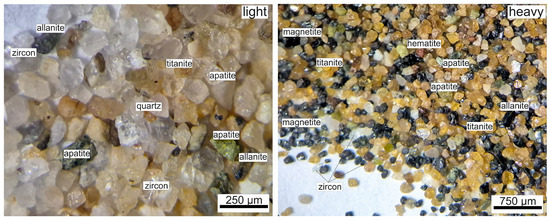
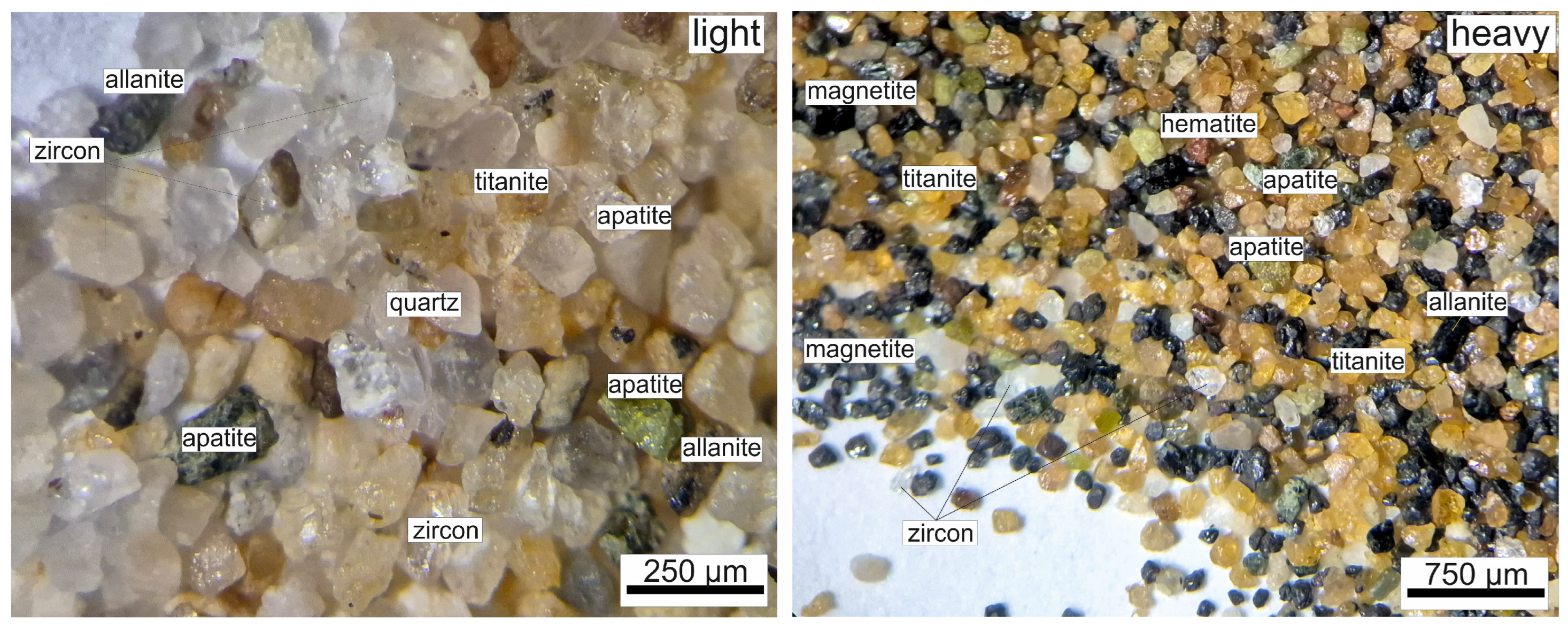
Overall, these results demonstrate a clear distinction: the +0.3 mm heavy product is particularly effective in concentrating REEs and radioactive elements, while the −0.3 mm heavy product serves as the principal source for Fe–Ti oxides and zircon. This dual beneficiation pathway emphasizes the importance of fraction-wise treatment to maximize recovery of both REE-bearing and traditional heavy mineral phases. As illustrated in Figure 1, microscopic images of the −0.3 mm fraction products clearly demonstrate the effectiveness of gravity separation. In the heavy product, dark-colored heavy minerals predominate, with magnetite and titanite being particularly abundant, reflecting their high specific gravity and efficient recovery in the fine size range. Conversely, the light product is dominated by quartz and feldspar grains, with virtually no heavy minerals present. This distinct mineralogical partitioning within the fine fraction highlights the strong selectivity of the shaking table. Moreover, optical microscopy provided direct visual evidence of mineral liberation and textural associations, thereby supporting the chemical analyses and offering valuable insight into the beneficiation behavior of individual mineral phases within the fine fraction.
Figure 1.
Microscopic views of −0.3 mm shaking table products: light fraction dominated by quartz and feldspar (left) and heavy fraction enriched in magnetite and titanite (right).
3.2.2. Magnetic Separation Tests
In the second stage of beneficiation, both the heavy and middlings products obtained from the shaking table were subjected to dry, disc-type magnetic separation to further fractionate minerals based on their magnetic susceptibilities. The procedure was performed sequentially using two magnetic field intensities. First, a low-intensity field of ≈3000 Gauss was applied to recover strongly magnetic minerals, primarily magnetite and other Fe-rich phases; the products obtained at this field strength are reported as magnetic products in Table 4 and Table 5. Subsequently, the non-magnetic portion from the first step was passed through a high-intensity field of ≈11,000 Gauss, enabling the separation of weakly paramagnetic minerals such as hematite, ilmenite, and titanite; the products obtained at this stage appear as middlings. The remaining non-magnetic fractions, enriched in zircon, rutile, apatite, and monazite, constitute the final non-magnetic products.
Table 4.
Chemical composition (major oxides and selected trace elements) of magnetic separation products of the heavy fraction of gravity separation.
Table 5.
Chemical composition (REEs and radioactive elements) of magnetic separation products of the heavy fraction of gravity separation.
Table 4 and Table 5 first summarize the chemical compositions and distribution patterns of magnetic and non-magnetic products obtained from the shaking table heavy fraction in the +0.3 mm and −0.3 mm size groups, respectively. Results for the middlings fraction are provided in the next section. Thus, the integration of gravity and magnetic separation created a stepwise beneficiation scheme that maximized the selective recovery of valuable heavy mineral and REE-bearing phases.
In the +0.3 mm size group, magnetic separation produced a moderate contrast between mineral fractions. The magnetic product was enriched in Fe2O3 (C: 20.46%, D: 44.8%), reflecting the recovery of magnetite-dominated grains, whereas the non-magnetic product consisted mainly of quartz–feldspar gangue, as indicated by its high SiO2 content (C: 70.69%, D: 79.1%). TiO2 and Zr both showed preferential reporting to the non-magnetic stream, with enrichment ratios (ER) of ~1.07 and ~1.28, respectively, consistent with the presence of titanite and zircon in the coarse non-magnetic fraction.
In the −0.3 mm size fraction, the partitioning of minerals became markedly more selective. The magnetic product exhibited strong Fe2O3 enrichment (C: 82.26%, D: 91.0%, ER ~1.45), confirming the dominance and finer liberation of magnetite and ilmenite. In contrast, TiO2 showed a dual distribution, with only 22.2% reporting to the magnetic stream and the majority (68.7%) recovered in the non-magnetic fraction, where TiO2 reached 30.67%, yielding a high ER of ~3.17. Zr behaved similarly, being strongly enriched in the fine non-magnetic stream (50,195 g/t; D: 81.8%; ER ~3.8). These trends indicate that the −0.3 mm fraction hosts both well-liberated magnetic Fe–Ti oxides and non-magnetic zircon and titanite, whereas middlings retain partially liberated grains.
Rare earth elements displayed a decoupled behaviour between coarse and fine fractions, reflecting different mineral carriers. In the +0.3 mm group, Ce (715 g/t), La (412 g/t), Nd (76 g/t), and Y (289 g/t) reported mainly to the non-magnetic product, but their ERs were near unity because enrichment resulted largely from the high mass of the non-magnetic stream rather than selective upgrading. The differing relative proportions of LREEs (Ce–La–Nd) and Y further indicate that multiple minerals contribute to REE inventories. In the −0.3 mm fraction, however, REEs were significantly concentrated in the non-magnetic product, with Ce (10,318 g/t; ER~3.3), La (2725 g/t; ER~1.9), Nd (3485 g/t; ER~3.8), and Y (1582 g/t; ER~3.6). This strongly suggests that fine-grained monazite (dominated by LREEs) and allanite (hosting both LREEs and Y) were efficiently recovered into the non-magnetic concentrates. The parallel enrichment of Th (1935 g/t) and U (594 g/t) supports this interpretation, given their typical association with monazite–allanite assemblages.
Collectively, these results demonstrate the complementary roles of gravity concentration and staged magnetic separation: the shaking table effectively pre-concentrated heavy minerals, whereas magnetic separation produced clear partitioning between ferromagnetic Fe–Ti oxides and non-magnetic Zr- and REE-bearing minerals. The substantially higher ERs obtained in the −0.3 mm size group confirm that fine-grained, well-liberated heavy minerals host the majority of Ti, Zr, REEs, Th, and U in the Hantepe placer sands, highlighting the importance of size classification before beneficiation.
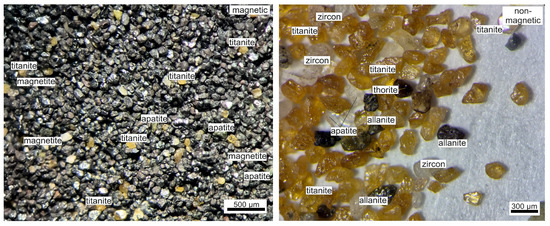
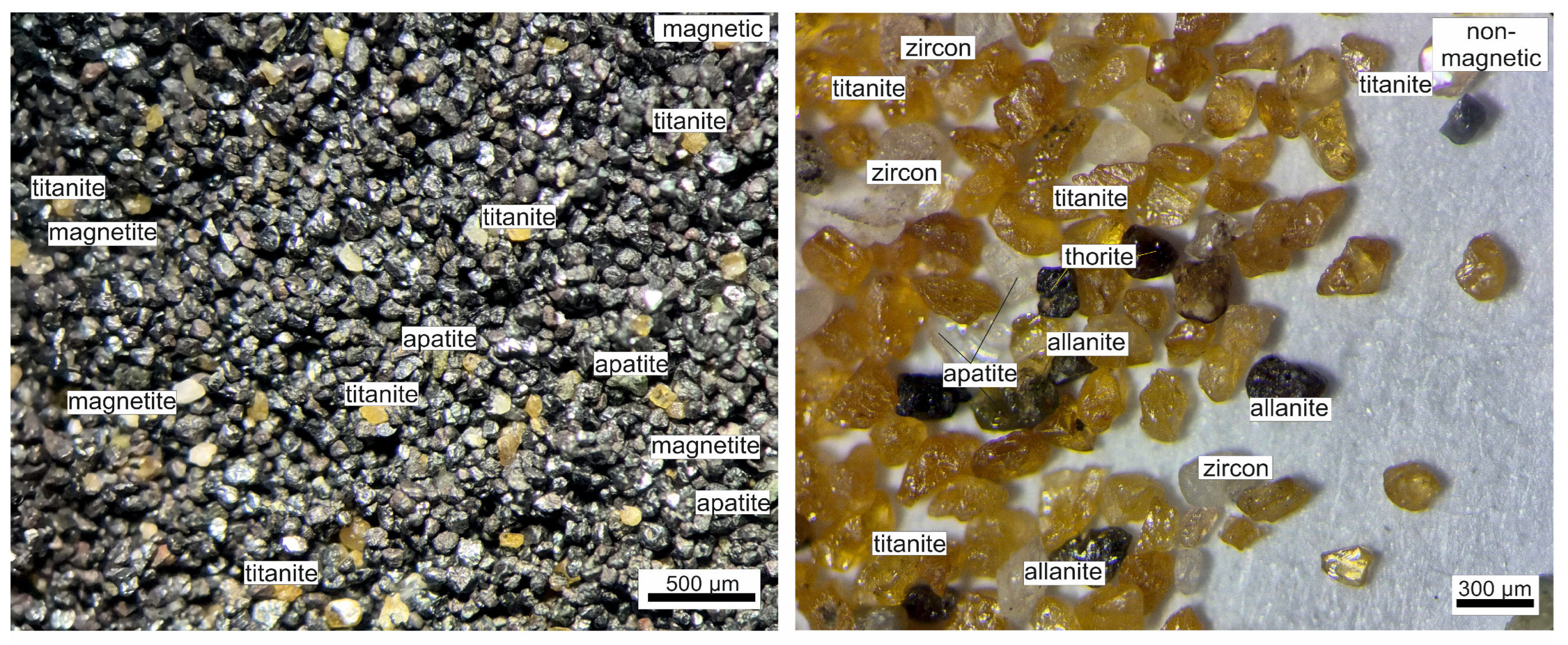
The optical microscopy images of the magnetic and non-magnetic products obtained from separation are presented in Figure 2. The magnetic fraction is predominantly composed of magnetite grains, which exhibit a distinct dark color and high reflectivity, consistent with their high magnetic susceptibility. In contrast, the non-magnetic fraction is enriched in accessory heavy minerals such as titanite, zircon, apatite, monazite and, allanite, which appear as transparent to reddish-brown grains under reflected light. The clear distinction between the fractions confirms the efficiency of magnetic separation in concentrating Fe–Ti oxides within the magnetic product, while non-magnetic but high-density minerals were successfully partitioned into the corresponding fraction.
Figure 2.
Optical microscope images of magnetic (left) and non-magnetic (right) products obtained after magnetic separation of heavy products of gravity separation.
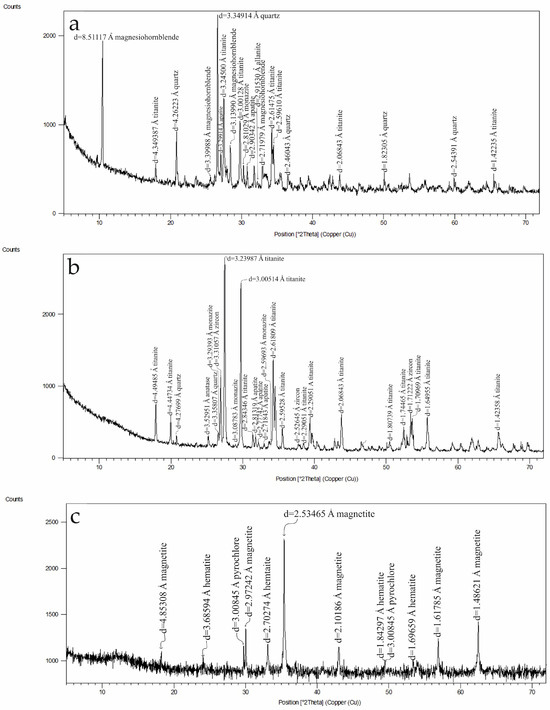
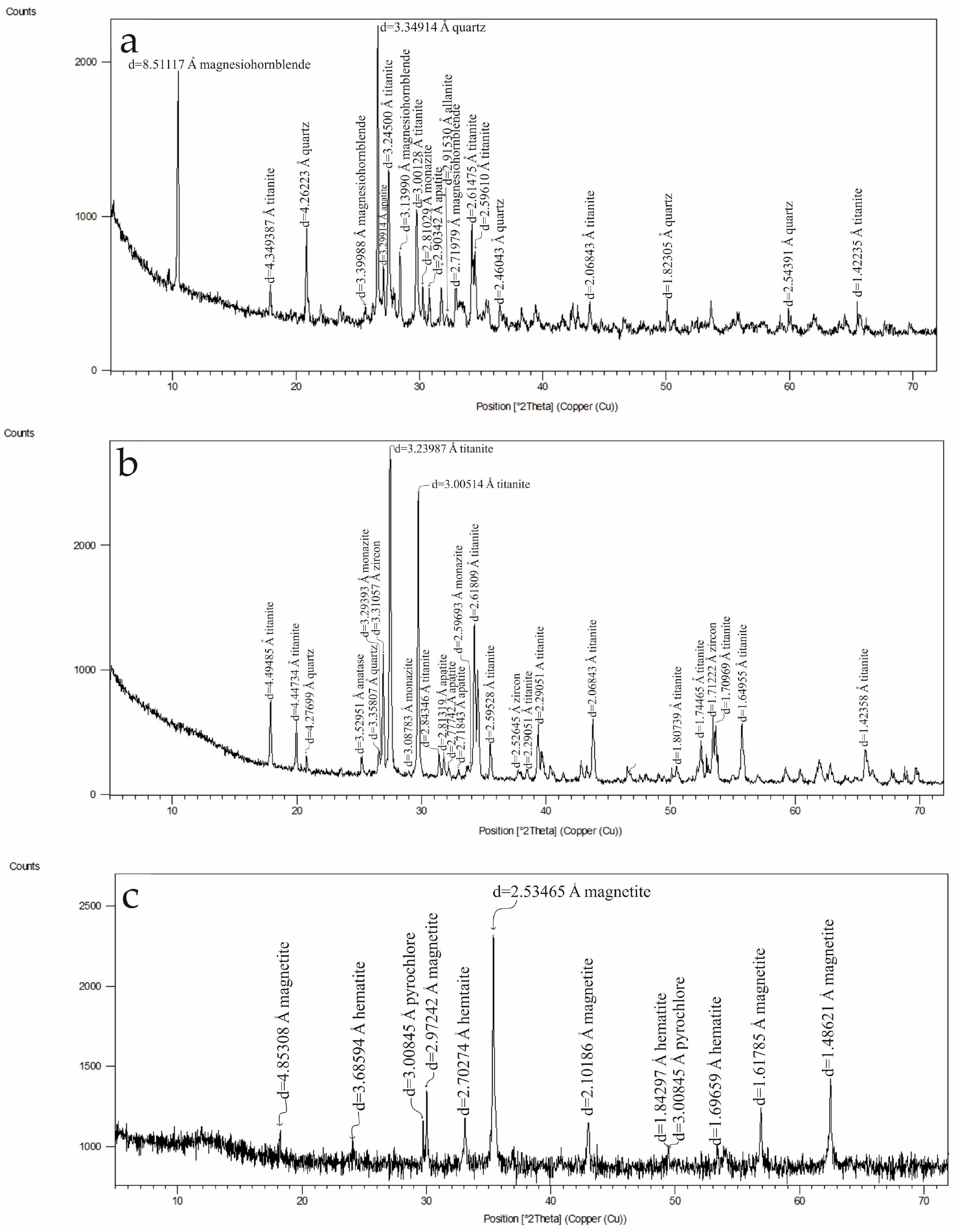
As shown in Figure 3a, the XRD pattern of the −0.3 mm shaking-table middlings presents a broad but diagnostic set of low- to medium-intensity reflections, consistent with the mixed mineralogy of this intermediate product. The pattern is dominated by titanite and quartz, but multiple well-defined peaks in the 2θ ≈ 10–30° region correspond closely to the ICDD reference positions for allanite, supporting its presence as a major REE-bearing phase. The simultaneous appearance of Ca-, Fe-, and REE-related reflections is fully consistent with the elevated CaO, Fe2O3, Ce, La, Nd, and Th contents measured chemically. Importantly, several discrete peaks, notably at d ≈ 3.25 Å, 3.08 Å, and 2.60 Å, match the characteristic fingerprint of monazite providing independent evidence for a second REE–Th-bearing accessory mineral. This is in agreement with the enrichment of Th and U in this fraction and indicates that part of the radiogenic element budget is hosted in arsenate-type REE minerals. Minor reflections attributable to ferro-hornblende and Ti-oxide phases indicate limited contributions from amphibole alteration products and titanite-associated species. Collectively, the XRD pattern confirms that the middlings fraction contains a mixture of titanite, silicates, allanite, and gasparite, reinforcing the geochemical interpretation and demonstrating that this size class hosts the bulk of the REE-bearing accessory minerals in the Hantepe placer sands.
Figure 3.
XRD patterns of the gravity separation −0.3 mm middlings (a), nonmagnetic (b), and magnetic (c) products.
The non-magnetic fraction obtained at 11,000 Gauss (Figure 3b) is dominated by titanite, which forms the principal Ti-bearing phase in this product. In addition to titanite, the pattern displays well-defined reflections attributable to zircon, fluorapatite, quartz, and minor Ti-oxide phases, confirming the coexistence of Zr-, Ca-, and P-bearing accessories. Notably, several diagnostic peaks, such as those at d ≈ 3.29 Å and 2.81 Å, correspond closely to reference positions for monazite indicating the presence of a Th- and REE-bearing phosphate phase within the non-magnetic concentrate. The combined occurrence of titanite together with zircon, fluorapatite, and monazite aligns with the chemical data showing co-enrichment of Ti, Ca, Zr, REEs, Th, and U in this product. These mineralogical features demonstrate that the material reporting to the non-magnetic fraction hosts a mixture of Ti-silicate, Zr-silicate, and REE–Th–phosphate minerals, and confirm that titanite, not ilmenite, is the dominant TiO2-bearing phase in the Hantepe placer sands.
In contrast, the XRD pattern of the magnetic fraction obtained at 3000 Gauss (Figure 3c) is dominated by magnetite, consistent with the strong magnetic response of this phase. In addition to magnetite, a minor iron-oxide phase is present, although its diffraction peaks are not sufficiently well resolved to confidently distinguish between hematite and goethite. The pattern also contains weak reflections attributable to pyrochlore and fluorapatite. These phases indicate that minerals with high magnetic susceptibility were effectively concentrated into the magnetic product. This interpretation is consistent with the chemical enrichment ratios: Fe2O3 increased from 8.1% in the feed to 20.5% in the +0.3 mm magnetic product and to over 80% in the finer −0.3 mm magnetic fraction, confirming the efficient recovery of iron oxides. Likewise, the substantial TiO2 enrichment observed in the non-magnetic fractions (e.g., 30.7% in the −0.3 mm non-magnetic stream) aligns with the dominance of titanite suggested by the XRD Rietveld calculation results in Table 6.
Table 6.
Mineralogical composition of selected gravity and magnetic separation products calculated by Rietveld Analysis.
While the magnetic fractions represented the principal concentrates of Fe–Ti oxides, the non-magnetic fractions became enriched in titanite, zircon, and phosphate minerals such as monazite and apatite, thereby effectively partitioning the ore into technologically valuable products. Following the initial gravity separation, the −0.3 mm middling fraction obtained from the shaking table was subjected to magnetic separation to further upgrade the heavy mineral content. Unlike the coarser middlings, this fine-grained fraction exhibited significantly higher concentrations of Fe–Ti oxides and REE-bearing minerals, making it a suitable candidate for secondary beneficiation. The objective of this stage was to improve the overall recovery of valuable minerals and to establish a more efficient integrated flowsheet by reprocessing middlings products rather than discarding them as tailings. The results of chemical composition, metal distributions, and ERs for the obtained products are presented in Table 7 and Table 8.
Table 7.
Chemical composition (major oxides and selected trace elements) of magnetic separation products of the middlings fraction of gravity separation.
Table 8.
Chemical composition (REEs and radioactive elements) of magnetic separation products of the middlings fraction of gravity separation.
Magnetic separation of the −0.3 mm middling fraction resulted in a distinct separation between magnetic Fe–Ti oxides and non-magnetic heavy mineral phases. The magnetic product (9.9 wt.%) was strongly enriched in Fe2O3 (C: 32.33%, ER: 2.9, D: 28.9%). This enrichment was accompanied by a notable decrease in SiO2 (C ≈ 5%, ER: 0.12, D: 1.2%), indicating efficient rejection of silicate gangue. However, TiO2 (C: 5.19%, ER: 0.52, D: 5.1%) showed only minor upgrading, reflecting the weak magnetic susceptibility of ilmenite and titanite minerals. The middlings product (38.1 wt.%) displayed intermediate grades of Fe2O3 (C: 17.19%, ER: 1.55, D: 59.2%) and TiO2 (C: 3.24%, ER: 0.32, D: 12.5%), suggesting partial liberation and incomplete separation of Fe–Ti oxides from associated gangue minerals. The non-magnetic product (52.0 wt.%) was notably rich in valuable non-magnetic heavy minerals, with TiO2 (C: 15.82%, ER: 1.58, D: 82.4%), Zr (C: 1835 g/t, ER: 1.52, D: 79.3%), and Nb (C: 928 g/t, ER: 1.66, D: 86.5%) representing the principal upgrading indicators. While V (C: 428 g/t, ER: 0.90, D: 46.8%) remained relatively evenly distributed, the dominance of Zr and Nb in this fraction reveals the preferential concentration of zircon, niobite, and possibly allanite-bearing phases in the non-magnetic stream.
The rare earth and actinide elements exhibited a parallel trend. The non-magnetic product contained Ce (C: 4816 g/t, ER: 1.46, D: 75.7%), La (C: 1186 g/t, ER: 1.35, D: 70.3%), Nd (C: 2078 g/t, ER: 1.66, D: 86.4%), Y (C: 1116 g/t, ER: 1.64, D: 85.5%), Th (C: 384 g/t, ER: 1.48, D: 77.0%), and U (C: 192 g/t, ER: 1.59, D: 82.2%), substantially higher than the magnetic product. Although the non-magnetic product accounts for just over half of the feed mass, its elevated ERs and high elemental distributions indicate true concentration rather than simple mass dilution.
Overall, magnetic separation of the −0.3 mm middlings fractions effectively recovered Fe-rich oxides into the magnetic fraction (Fe2O3 ER ≈ 2.9) while generating a non-magnetic concentrate enriched in TiO2, Zr, Nb, and REEs (ER ≈ 1.3–1.7). These findings confirm that reprocessing the middlings improves total recovery efficiency and enhances the economic potential of the flowsheet by producing separate Fe–oxide and REE–Zr–Nb-rich products.
3.3. Mass Balance and Overall Flowsheet
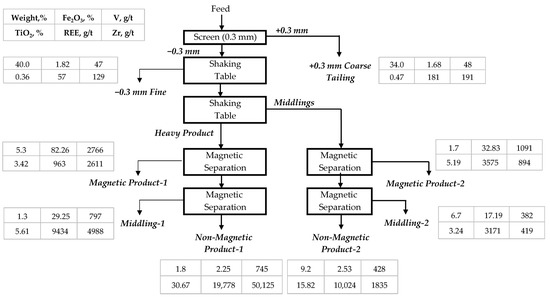
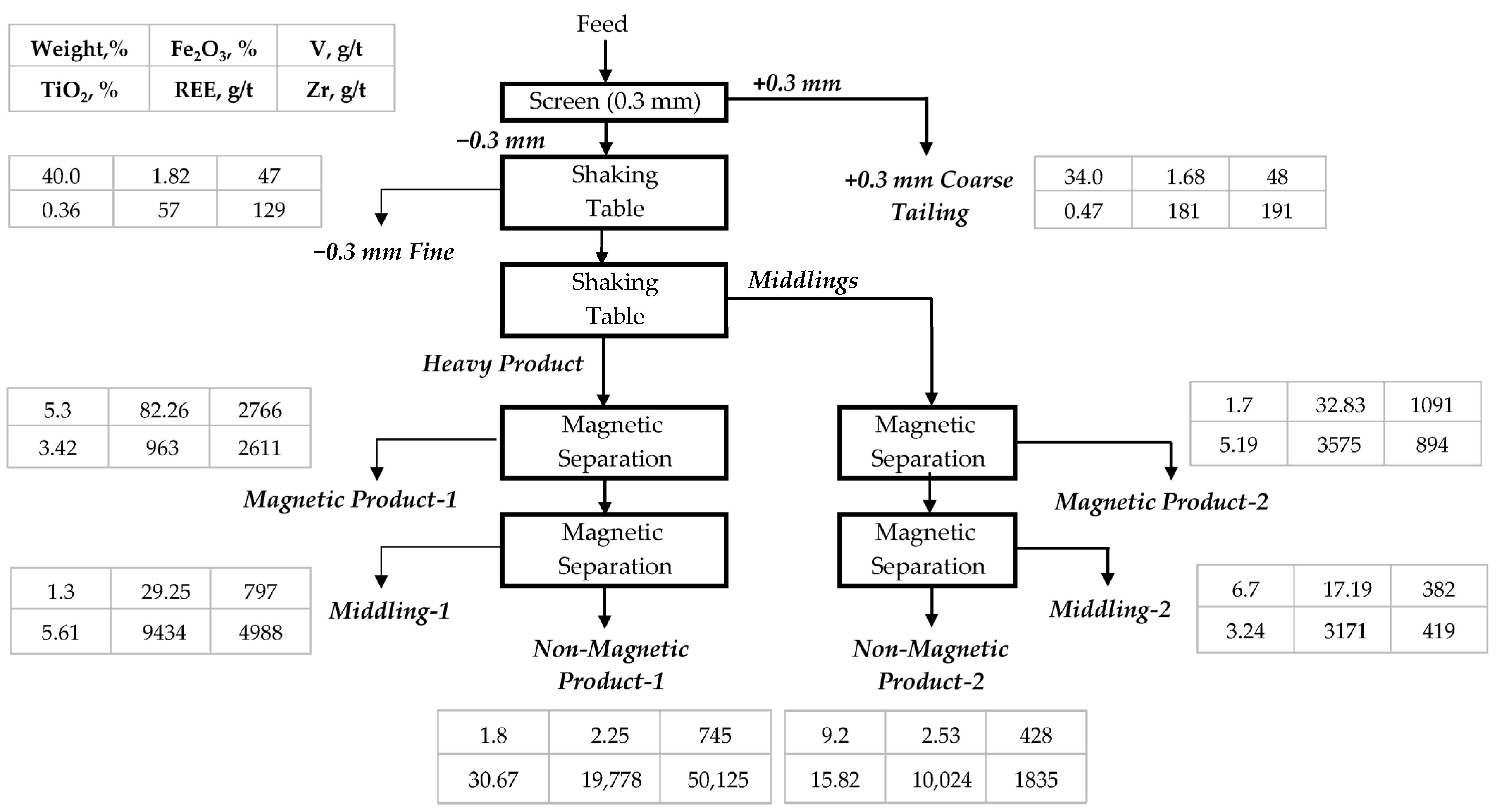
The overall mass balance of the beneficiation experiments (Figure 4) demonstrates the effectiveness of the integrated gravity and magnetic separation strategy applied to both coarse (+0.3 mm) and fine (−0.3 mm) fractions after initial screening. The coarse fraction represented 34% of the total feed, with relatively low metal contents (1.68% Fe2O3, 48 g/t V, 0.47% TiO2, 181 g/t REEs, 191 ppm Zr) and was therefore designated as a coarse waste product. The remaining 66% of the feed, corresponding to the −0.3 mm fraction, was subjected to shaking table concentration. This step produced a light product equivalent to 40% of the total feed, containing 1.82% Fe2O3, 47 g/t V, 0.36% TiO2, 57 g/t REEs, and 129 ppm Zr, which was rejected as fine waste due to its predominantly silicate composition.
Figure 4.
Proposed flowchart for concentration of Hantepe placer deposit by gravity and magnetic separation methods.
The heavy and middlings products from the second-stage shaking table were processed separately using magnetic separation. This yielded a magnetic product (5.3 wt.%) highly concentrated in 82.26% Fe2O3, 3.42% TiO2, 2766 g/t V, 963 g/t REEs, and 2611 ppm Zr, confirming the efficient recovery of Fe-bearing magnetic minerals (e.g., magnetite and hematite) and vanadium. Additionally, a magnetic middlings product (1.3 wt.%) with 29.25% Fe2O3, 5.61% TiO2, 797 g/t V, 9434 g/t REEs, and 4988 ppm Zr was generated, while the non-magnetic product (1.8 wt.%) exhibited significant enrichment in high-value minerals, containing 30.67% TiO2, 19,788 g/t REEs, and 50,125 ppm Zr.
To maximize the recovery of critical metals, the shaking-table middlings were further subjected to magnetic separation. This upgrading step effectively separated Fe–Ti oxides and REE–Zr-bearing minerals into distinct concentrate streams. The resulting magnetic product-2 (1.7 wt.%) contained 32.83% Fe2O3, 5.19% TiO2, 1091 g/t V, 3575 g/t REEs, and 894 ppm Zr. Despite its relatively low mass pull, this product represents a valuable Fe–V concentrate with moderate REE enrichment. The middlings-2 product (6.7 wt.%), which contained 17.19% Fe2O3, 3.24% TiO2, 382 g/t V, 3171 g/t REEs, and 419 ppm Zr, constitutes an intermediate stream with appreciable critical metal potential, indicating that an additional cleaning stage or selective flotation could further improve both grade and recovery.
In contrast, the non-magnetic product-2 (9.2 wt.%) was strongly enriched in non-ferromagnetic critical minerals, reporting 15.82% TiO2, 10,024 g/t REEs, and 1835 g/t Zr. This substantial enrichment confirms that REE-bearing silicates and phosphates (e.g., allanite and monazite) and Zr-bearing minerals (zircon) are preferentially concentrated into non-magnetic fractions in the fine size range. Thus, while the magnetic circuits selectively remove Fe–Ti oxides, the non-magnetic route yields high-value concentrates rich in technologically strategic elements. Collectively, these outcomes demonstrate that reprocessing middlings not only prevents the loss of valuable components to tailings but also significantly enhances the overall performance of the beneficiation flowsheet.
To evaluate the overall metallurgical performance of the designed flowsheet, the products obtained in Figure 4 were combined within their corresponding categories, and the total metal grades and contents of major oxides, trace elements, REEs, and radioactive elements were recalculated. Furthermore, the distribution and enrichment ratios of key elements were assessed to quantify the effectiveness of each separation stage.
Table 9 and Table 10 present the final elemental compositions of the principal product streams obtained after classification, gravity concentration, and magnetic separation of the Hantepe placer deposit, namely Tailings (+0.3 mm coarse tailings and −0.3 mm shaking table light product), Magnetic concentrates (Magnetic Product 1 and Magnetic Product 2), Middlings (Middling 1 and Middling 2), and Non-magnetic concentrates (Non-magnetic 1 and Non-magnetic 2). These datasets provide the basis for determining the cumulative recovery performance and identifying the most technologically valuable products of the beneficiation process.
Table 9.
Chemical composition (major oxides and selected trace elements) of the final products of the Hantepe placer deposit.
Table 10.
Chemical composition (REEs and radioactive elements) of the final products of the Hantepe placer deposit.
The overall mass balance indicates that 74 wt.% of the feed reports to tailings, whereas 7 wt.% forms a magnetic concentrate, 8 wt.% a middlings stream, and 11 wt.% a non-magnetic concentrate. The magnetic concentrate is the principal sink for Fe-bearing oxides and V, assaying 70.26% Fe2O3 and 2359 g/t V with ER (Fe2O3) = 8.76 and ER (V) = 8.16; it captures D (Fe2O3) = 61.3% and D (V) = 57.1% of the total, consistent with magnetite/hematite-dominated magnetic behavior. By contrast, the non-magnetic concentrate is the main deposit of Ti, Zr and REEs, grading 18.25% TiO2, 9749 g/t Zr and REEs up to 5716 g/t Ce, 2023 g/t La, 2308 g/t Nd, 1192 g/t Y. Its upgrading factors are high, ER (TiO2) = 6.36, ER (Zr) = 6.79, and for REEs ER (Ce) = 6.59, ER (La) = 5.30, ER (Nd) = 7.52, ER (Y) = 6.85, with likewisely upgraded thorium and uranium (ER (Th) = 6.44, ER (U) = 6.45). Correspondingly, the non-magnetic stream accounts for the bulk of critical metals: D (TiO2) = 69.9%, D (Zr) = 74.7%, D (Nb) = 52.9%, and for REEs/radioelements D = 72.5% (Ce), 58.3% (La), 82.6% (Nd), 75.4% (Y), 71.4% (Th), 71.8% (U). The middlings carry intermediate grades (19.15% Fe2O3; 3.63% TiO2; 1162 g/t Zr), with moderate upgrading (ER ≈ 2.39 for Fe2O3; 1.26 for TiO2; 0.81 for Zr) and non-negligible shares, e.g., D (Fe2O3) = 19.1% and D (V) = 12.4%, suggesting that additional cleaning or selective flotation could recover further value.
Although shaking tables and dry disc magnetic separators were used due to laboratory limitations, the observed separation behaviors of Fe–Ti oxides and REE–Zr-bearing minerals are consistent with those reported from industrial gravity and magnetic circuits. In particular, the performance of the shaking table closely mirrors the expected behavior in spiral concentrators, which operate efficiently within the same particle-size range. Similarly, the high-intensity magnetic response of ilmenite, hematite, and monazite aligns well with separation efficiencies typically achieved by WHIMS units. Therefore, the results presented here provide a realistic basis for upscaling the flowsheet to industrial operations, with pilot-scale spiral and WHIMS testing recommended as the next development stage.
An additional consideration arising from the final product distribution is the marked enrichment of Th and U in the non-magnetic concentrate, reflecting their association with monazite and allanite. Although this fraction represents the principal carrier of REEs and Zr, its radioelement content introduces regulatory and operational constraints for downstream processing. Any future pilot-scale application will therefore require appropriate radiological monitoring, controlled handling procedures, and compliant waste-management strategies to ensure the safe treatment of REE-bearing concentrates. Accordingly, the radioactivity present in this stream should be regarded as an integral design parameter for subsequent flowsheet development.
Collectively, these metrics confirm a clear phase separation: Fe–Ti oxides (plus V) are efficiently recovered into the magnetic circuit, while REE–Zr–Nb-bearing silicates/phosphates are preferentially upgraded into the non-magnetic circuit. The simultaneous attainment of high ER and dominant D in the non-magnetic products for REEs and Zr provides a quantitative basis for the proposed flowsheet, supporting Hantepe’s potential as a viable critical raw-material source (Ti–Zr–REEs) and highlighting the middlings stream as the most promising target for incremental recovery gains.
4. Conclusions
The present study provides the first systematic beneficiation assessment of the Hantepe placer deposit (Çanakkale, Türkiye), demonstrating its potential as a secondary source of Fe–Ti oxides, zircon, and REE-bearing phases. Size classification revealed a pronounced mineralogical partitioning, with more than two-thirds of the heavy mineral group concentrated in the −0.3 mm fraction. This size-dependent distribution governed the subsequent separation response and enabled the development of a targeted flowsheet.
Sequential gravity and magnetic separation produced distinct mineral concentrates with markedly different chemical signatures. The fine-grained magnetic products showed strong upgrading of Fe and V, consistent with the dominance of magnetite–hematite phases in these streams. Conversely, the non-magnetic products were enriched in titanite, zircon, and REE-bearing phosphates/silicates, yielding TiO2, Zr, and TREO grades that indicate significant beneficiation potential. However, the identification of titanite as the principal Ti-bearing phase, rather than ilmenite or rutile, places a mineralogical constraint on the economic value of the Ti fraction, given the more complex processing route required for pigment-grade TiO2 production.
Reprocessing of the shaking-table middlings enhanced the recovery of both magnetic and non-magnetic value minerals, underlining the importance of multi-stage treatment for fine-grained placer systems and validating the integrated gravity–magnetic flowsheet. The final non-magnetic concentrate should nevertheless be regarded as a middling product, as it still contains a mixture of titanite, zircon, and REE-bearing minerals. To advance the deposit toward commercial viability, future work should focus on mineral-specific upgrading, such as electrostatic separation for zircon–titanite differentiation, flotation for monazite/allanite–apatite recovery, and detailed liberation studies to support downstream hydrometallurgical extraction.
Overall, the results establish a technically feasible beneficiation pathway and provide a quantitative framework for evaluating the critical-metal potential of the Hantepe placer sands within Türkiye’s emerging strategic mineral supply efforts.
Author Contributions
Conceptualization, M.Ö.; methodology, M.Ö. and G.G.; validation, M.Ö. and G.G.; formal analysis, M.Ö. and G.G.; investigation, M.Ö., G.G. and F.B.; resources, M.Ö. and A.T.U.; data curation, M.Ö. and F.B.; writing—original draft preparation, M.Ö. and F.B.; writing—review and editing, M.Ö., F.B. and O.K.; visualization, M.Ö., G.G. and O.K.; supervision, M.Ö. and Ş.Ö.; project administration, M.Ö. and Z.D. All authors have read and agreed to the published version of the manuscript.
Funding
The authors declare that this research did not receive any specific grant from funding agencies in the public, commercial, or not-for-profit sectors.
Data Availability Statement
Data are contained within the article.
Acknowledgments
The present study was conducted as part of a graduate thesis at Istanbul Technical University. The authors sincerely thank the Mineral Processing Engineering Department for providing laboratory facilities. The authors also acknowledge the support of the Geochemistry Analysis Laboratory (JAL) at Istanbul Technical University and express their gratitude to Beril Tanç Kaya for her valuable contributions to the analytical measurements.
Conflicts of Interest
The authors declare that the research was conducted in the absence of any commercial or financial relationships that could be construed as a potential conflict of interest.
Abbreviations
The following abbreviations are used in this manuscript:
| REEs | Rare Earth Elements |
| TREO | Total Rare Earth Oxides |
| U | Uranium |
| Th | Thorium |
| Zr | Zirconium |
| Ti | Titanium |
| C | Content |
| D | Distribution |
| ER | Enrichment Ratios |
| XRF | X-Ray Fluorescence Spectroscopy |
| XRD | X-Ray Diffraction |
References
- Subasinghe, C.S.; Ratnayake, A.S.; Roser, B.; Sudesh, M.; Wijewardhana, D.U.; Attanayake, N.; Pitawala, J. Global distribution, genesis, exploitation, applications, production, and demand of industrial heavy minerals. Arab. J. Geosci. 2022, 15, 1616. [Google Scholar] [CrossRef] [Scilit]
- Özer, M. Plaser cevherlerden altın kazanımı [Gold recovery from placer ores]. Madencilik Türkiye 2022, 15, 80–90. [Google Scholar]
- Aslan, N.; Say, Y. Nadir toprak elementlerinin uygulama alanları [Applications of rare earth elements]. Kırklareli Univ. J. Eng. Sci. 2022, 8, 148–178. [Google Scholar] [CrossRef] [Scilit]
- European Commission. Study on the EU’s List of Critical Raw Materials–2020 Update: CRM Factsheets; Publications Office of the European Union: Luxemburg, 2020. [Google Scholar]
- Van Gosen, B.S.; Verplanck, P.L.; Seal, R.R., II; Long, K.R.; Gambogi, J. Rare-earth elements. In Critical Mineral Resources of the United States—Economic and Environmental Geology and Prospects for Future Supply; USGS Professional Paper 1802–O; U.S. Geological Survey: Reston, VA, USA, 2017. [Google Scholar]
- Kırat, G. Nadir toprak elementleri ve yatak türleri [Rare earth elements and their deposit types]. Euroasia J. Math. Eng. Nat. Med. Sci. 2022, 9, 25–34. [Google Scholar] [CrossRef]
- Gültekin, A.H. Titanyum yatakları: Kayaçlarda titanyum içeriği ve bölümlenmesi [Titanium deposits: Titanium content and partitioning in rocks]. Jeoloji Mühendisliği Dergisi 1993, 17, 21–37. [Google Scholar]
- Hamilton, N.T.M. Controls on the global distribution of coastal titanium-zirconium placers. Int. Geol. Rev. 1995, 37, 755–779. [Google Scholar] [CrossRef] [Scilit]
- Gültekin, A.H.; Akyol, A. Plaser Yataklar [Placer Deposits]; İstanbul Teknik Üniversitesi Yayınları: İstanbul, Türkiye, 1992; Kitap Yayın No: 35. [Google Scholar]
- Deady, E.; Lacinska, A.; Goodenough, K.M.; Shaw, R.A.; Roberts, N.M.W. Volcanic-Derived Placers as a Potential Resource of Rare Earth Elements: The Aksu Diamas Case Study, Turkey. Minerals 2019, 9, 208. [Google Scholar] [CrossRef] [Scilit]
- Wills, B.A.; Finch, J.A. Wills’ Mineral Processing Technology, An Introduction to the Practical Aspects of Ore Treatment and Mineral Recovery; Butterworth-Heinemann; Elsevier: Oxford, UK, 2015; ISBN 978-008-097-054-7. [Google Scholar]
- Kim, K.; Jeong, S. Separation of Monazite from Placer Deposit by Magnetic Separation. Minerals 2019, 9, 149. [Google Scholar] [CrossRef] [Scilit]
- Reza, A.R.; Khanchi, A.R.; Amini, A.; Chelgani, S.C. Preconcentration of rare earth elements from Iranian monazite ore by spiral separator using multi-response optimization method. Int. J. Min. Sci. 2014, 24, 117–121. [Google Scholar] [CrossRef] [Scilit]
- Anitha, J.K.; Joseph, S.; Rejith, R.G.; Sundararajan, M. Monazite chemistry and its distribution along the coast of Neendakara–Kayamkulam belt, Kerala, India. SN Appl. Sci. 2020, 2, 812. [Google Scholar] [CrossRef] [Scilit]
- Erdem, A.; Babuçcuoğlu, Y.; Güneş, H.; Obuz, H.E.; Özdemir, E.; Kara, Ç.; Diktepe, Ş.; Akgül, M.B.; Özen İlik, B.; Akçay, H. Nadir toprak minerallerinin fiziksel ayrılması ve flotasyonu: Derleme [Physical separation and flotation of rare earth minerals: A review]. Int. J. Appl. Sci. 2021, 7, 321–345. [Google Scholar] [CrossRef] [Scilit]
- Ren, J.; Song, S.; Lopez-Valdivieso, A.; Lu, S. Selective flotation of bastnaesite from monazite in rare earth concentrates using potassium alum as depressant. Int. J. Miner. Process 2000, 59, 237–245. [Google Scholar] [CrossRef] [Scilit]
- Pavez, O.; Peres, A.E.C. Effect of sodium metasilicate and sodium sulfide on the floatability of monazite-zircon-rutile with oleate and hydroxamates. Miner. Eng. 1993, 6, 69–78. [Google Scholar] [CrossRef] [Scilit]
- Cheng, T.W.; Holtham, P.N.; Tran, T. Froth flotation of monazite and xenotime. Miner. Eng. 1993, 6, 341–351. [Google Scholar] [CrossRef] [Scilit]
- Cetiner, M.A.; Gündüz, H.; Ilgar, A. High background radiation areas at Çanakkale in Turkey. Radiat. Phys. Chem. 2011, 80, 704–709. [Google Scholar] [CrossRef] [Scilit]
- Moustafa, M.I.; Abdelfattah, N.A. Physical and chemical beneficiation of the Egyptian beach monazite. Resour. Geol. 2010, 60, 288–299. [Google Scholar] [CrossRef] [Scilit]
- Doner, Z.; Unluer, A.T.; Özdamar, Ş.; Sarıkaya, O.; Roden, M.F.; Kaya, M.; Kocaturk, H.; Kumral, M.; Esenli, F. The origin of alkali granites and Th-U ± REE enrichments in Kestanbol Magmatic complex (NW Anatolia) revisited: Evidences from bulk-rock geochemistry and isotopic data, zircon UPb, biotite Ar/Ar and apatite (UTh)/He geochronology. Lithos 2024, 484, 107751. [Google Scholar] [CrossRef] [Scilit]
- Cullity, B.D.; Stock, S.R. Elements of X-Ray Diffraction, 3rd ed.; Pearson Education Limited: Essex, UK, 2014; ISBN 13: 978-1-292-04054-7. [Google Scholar]

Disclaimer/Publisher’s Note: The statements, opinions and data contained in all publications are solely those of the individual author(s) and contributor(s) and not of MDPI and/or the editor(s). MDPI and/or the editor(s) disclaim responsibility for any injury to people or property resulting from any ideas, methods, instructions or products referred to in the content. |
© 2025 by the authors. Licensee MDPI, Basel, Switzerland. This article is an open access article distributed under the terms and conditions of the Creative Commons Attribution (CC BY) license (https://creativecommons.org/licenses/by/4.0/).